Article

From Openable to Operable: A Comparative Policy Analysis of Window Standards and Occupant Agency


School of Architecture, Inha University, Incheon 22212, Republic of Korea
Sustainability 2026, 18(5), 2460; https://doi.org/10.3390/su18052460
Submission received: 7 February 2026 / Revised: 28 February 2026 / Accepted: 2 March 2026 / Published: 3 March 2026
(This article belongs to the Section Green Building)

Abstract

Operable windows are critical for indoor environmental quality (IEQ) and occupant agency, yet their usability is increasingly compromised by conflicts between regulatory compliance and building performance. This study investigates the gap between geometrically compliant provisions and effectively operable windows through a comparative policy analysis of mandatory codes (Level 1), green rating systems (Level 2), and regenerative frameworks (Level 3). The findings identify a structural discrepancy termed the Geometric Trap: while minimum opening areas are legally required, mechanical ventilation often substitutes for natural access. In the United States, Japan, and Republic of Korea, explicit waivers permit full substitution, while in the United Kingdom, conditional constraints such as environmental noise limit practical operability. Germany, by contrast, maintains operable windows as an independent mandate, restricting substitution to defined environmental conditions. Although emerging green rating systems increasingly recognize resilience and adaptive comfort, operability remains optional. Regenerative standards, however, treat it as a prerequisite for occupant health. This study proposes a shift from static geometric compliance toward an Effective Opening Area framework that evaluates actual accessibility and usability, advancing a performance-based and occupant-centered regulatory perspective.

1. Introduction

1.1. Background

For centuries, the window served as the respiratory organ of a building, mediating light, air, and environmental exchange between the interior and the exterior. It was the primary instrument for light, fresh air, and connection to the natural world. However, as contemporary architectural discourse observes, the modernization of building skins has significantly decoupled these functions. With the advent of centralized Heating, Ventilation, and Air Conditioning (HVAC) systems and high-performance curtain walls, the window has been transformed from an operable device into a sealed surface. As Rem Koolhaas observed in Elements of Architecture (2014), the window has effectively assumed a dual role within the modern building system. It acts in his terms as both a “victim and accomplice” to the mechanization of comfort [1]. Through this lens, the window is increasingly reduced to a mere “transparent enclosure”, severing its historical function as a permeable threshold for environmental connection.
This architectural evolution was driven by a pursuit of the “perfect seal” to maximize energy efficiency and thermal consistency. As early as 1930, Le Corbusier, the pioneer of modernism, envisioned a “neutralizing wall,” or mur neutralisant, that would tightly seal the interior. He proposed replacing unpredictable natural breezes with mechanically controlled “exact respiration,” known as respiration exacte [2].
This Modernist ideal of environmental control effectively institutionalized the separation of the occupant from the exterior. As Kiel Moe [3] argues in Insulating Modernism, this paradigm shifts architecture toward isolated thermodynamics, where the building envelope is designed to resist rather than engage with the environment.
Following this modernist ideal, contemporary buildings have increasingly adopted airtight envelopes. Reyner Banham later critiqued this trend in 1969, arguing that it prioritized mechanical dominance over environmental interaction [4].
During the mid-20th century, the rapid urbanization of cities introduced environmental noise as a significant challenge for architectural design which necessitated a shift in how building envelopes were conceived. This acoustic pressure provided a powerful justification for the decoupling of the interior from the external environment because fixed glass and mechanical ventilation were marketed as essential tools for protection against the urban environmental noise [5]. Consequently, the sealed building became a symbol of modern control where the removal of the operable window was framed as a necessary evolution for acoustic comfort rather than a loss of occupant agency.
This phenomenon fosters a paradoxical psychological reliance on sealed environments. In such settings, the indoor space is perceived as a sanctuary from the unpredictable exterior. This condition was originally described as a preference for enclosed environments within the broader context of the evolution of the window [1]. While this shift toward environmental closure promises a highly controlled indoor climate, it simultaneously strips occupants of their agency. Within this study, agency is defined as the capacity of an occupant to intentionally interact with and modulate their physical environment to achieve personal comfort [6]. This loss of agency contradicts established research which proves that the ability to personally control one’s environment is fundamental to satisfaction. Specifically, the physical act of opening a window has been shown to significantly increase occupant tolerance for wider temperature ranges while enhancing overall psychological well-being [7]. A recent systematic review confirms that the integration of natural ventilation is essential for multidimensional well-being, encompassing physiological and psychological health [8].
As illustrated in Table 1, the gap between geometric and effective areas is physically inherent in modern window typologies. While sliding windows offer moderate openness (~50%), high-rise typologies such as project-out windows or glass-railing systems are structurally restricted to less than 10% efficiency due to safety limiters and barrier codes, creating a foundational Geometric Trap before policy even intervenes.
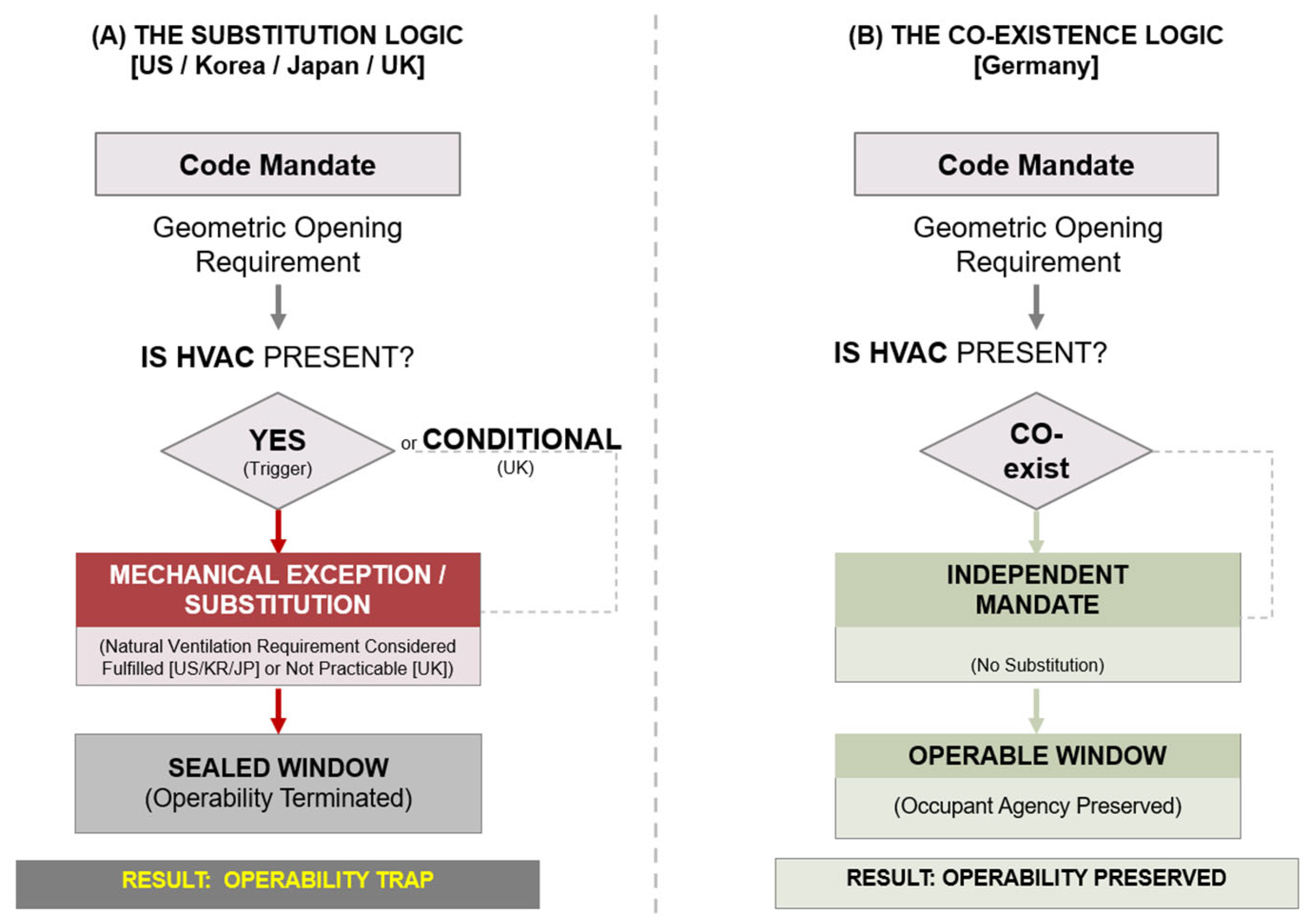
Crucially, this marginalization of the operable window is not merely a stylistic trend but a phenomenon codified and reinforced by regulatory frameworks. Across the globe, building codes ostensibly mandate openable windows for safety or theoretical ventilation compliance. However, a closer examination reveals what this study terms a Mechanical Exception, an analytical designation for regulatory clauses that permit natural ventilation requirements to be waived when compliant mechanical systems are installed. This regulatory Substitution Logic has contributed to the prevalence of sealed building typologies, creating a condition in which windows remain legally openable to satisfy geometric egress criteria but offer limited practical operability for daily environmental control.
Furthermore, a historical perspective suggests a relative reduction in natural ventilation requirements over time. While early 20th century codes prioritized ample natural ventilation for public health, modern regulations have progressively reduced these requirements in favor of mechanical solutions. For instance, the 1964 Uniform Building Code (UBC) in the US required ventilation openings equivalent to approximately 6.25% of the floor area [9], whereas contemporary codes often mandate significantly lower ratios, such as the 4% requirement in the International Building Code (IBC) [10]. Despite the growing risks of indoor pollutants and airborne pathogens, recently underscored by the global pandemic, regulatory mandates for natural ventilation capacity have not proportionally expanded in response to contemporary public health concerns, indicating a divergence between evolving public health discourse and regulatory development. This trend creates a widening gap between legal compliance and actual occupant health.
This inquiry is particularly urgent given that the current period marks a global pivot point in building standards. Leading international frameworks, such as Leadership in Energy and Environmental Design (LEED) and Building Research Establishment Environmental Assessment Method (BREEAM), are significantly shifting their focus from static energy efficiency to resilience and carbon neutrality. Unlike the rigid prescriptions of mandatory codes, these evolving standards increasingly recognize the operable window as a critical instrument for climate adaptation and passive survivability. However, mandatory building codes have remained largely stagnant, institutionalizing mechanical control as a substitute for natural contingency. This widening divergence, specifically between the static legal minimums and the resilience-driven voluntary standards, demands a rigorous comparative analysis to identify the regulatory gaps hindering true occupant agency.

1.2. A Literature Review

Prior research underscores that the value of operable windows extends far beyond simple air exchange, functioning as a critical leverage point for energy efficiency, indoor environmental quality (IEQ), and occupant psychology.

1.2.1. Environmental Performance and Energy Efficiency

Contrary to the perception that window opening compromises energy efficiency, the literature on mixed mode buildings, which integrates both natural ventilation and mechanical cooling systems, demonstrates significant potential for energy reduction through hybrid ventilation strategies [11]. As a specialized low-energy cooling solution, mixed-mode systems optimize both thermal comfort and operational efficiency by utilizing natural airflow whenever outdoor conditions are favorable [12]. Recent reviews confirm that these systems remain highly effective across diverse climate zones, offering a robust alternative to fully sealed environments [13]. Furthermore, the energy saving potential of natural ventilation is shown to be resilient even under the challenges of climate change, particularly when coupled with supplementary cooling methods [14].
Extensive research has validated these quantitative benefits by utilizing high fidelity Computational Fluid Dynamics (CFD) simulations and energy modeling to predict airflow rates and thermal reduction [15]. Beyond energy performance, natural ventilation serves as an essential strategy for indoor hygiene, effectively preventing stagnant air and moisture related issues such as mold growth [16]. In the post-pandemic era, the role of operable windows has been further emphasized for enhancing indoor air quality and overall building resilience [17]. The significance of windows has also evolved toward passive survivability, ensuring habitable conditions during extreme climate events or grid failures [18]. This reframes the operable window as a core component of whole life carbon strategies, where low tech adaptive options ensure long-term building performance.
Beyond chemical pollutants, environmental noise serves as a critical barrier to window operability because the need for acoustic insulation often conflicts with natural ventilation requirements. The World Health Organization (WHO) has identified environmental noise as a major public health threat that triggers psychological stress and sleep disturbance and even chronic conditions such as cardiovascular disease [19]. This creates a complex noise ventilation paradox in urban environments where occupants are forced to remain in a sealed environment to avoid external noise even at the expense of indoor air quality and personal agency.

1.2.2. Adaptive Comfort and Occupant Agency

Occupant behavior is increasingly recognized as a primary driver of building performance, necessitating a shift beyond simplified assumptions toward a comprehensive understanding of human–building interactions [20]. This perspective is deeply supported by adaptive thermal comfort theory, which posits that occupants in naturally ventilated buildings prefer environments where they have the agency to adjust conditions, thereby tolerating a wider range of temperatures [21]. Recent research into nudging the adaptive model suggests that providing such agency through operable windows or personal control devices actually shifts thermal expectations while increasing psychological resilience to environmental fluctuations [22].
The psychological value of perceived control is paramount, as the simple knowledge that a window can be operated provides a sense of agency that significantly enhances environmental satisfaction regardless of physical adjustments [23]. However, the decision to operate a window is a complex social and contextual process that extends far beyond mere thermal triggers [24]. Analysis using data-mining techniques has revealed diverse behavioral patterns among building users, demonstrating that standardized, machine-determined environments often fail to accommodate individual subjective requirements [25]. As building technology evolves towards more integrated human–building interaction (HBI), the role of operable windows is being redefined as a critical interface for future smart, resilient, and human-centric design [26].

1.2.3. The Drivers of Marginalization: Cost, Aesthetics, and Regulatory Control

Despite the clear environmental and psychological benefits, the operable window faces increasing marginalization in practice due to a convergence of economic, aesthetic, and managerial pressures. From a construction management perspective, operable units are frequently targeted for value engineering (VE) due to a perceived cost premium. The complexity of hardware including hinges and gaskets makes them a prime target for cost cutting. However, this logic ignores the economy of means demonstrated by a vanguard of architects, notably Glenn Murcutt and Lacaton & Vassal, whose work proves that buildings can serve as permeable instruments through intelligent and simplified detailing [27,28].
Furthermore, as noted by Matthias Schuler, this economic resistance is often short sighted. Empirical evidence from the Stuttgart market reveals that office buildings with operable windows can command a significant rental premium, typically 30 percent more than those with fixed facades [1]. Recent large scale analyses further confirm that such healthy building features consistently generate higher occupancy rates and measurable rental premiums across diverse global markets [29,30].
The prevailing architectural pursuit of aesthetic purity favors large fixed panes that eliminate the visual interruption of frames. This tendency is exemplified by the works of SANAA, where the pursuit of a clean and simple appearance often overrides functional agency [31]. As Schuler observes, this push for transparency frequently leads to a nonexistent enclosure where occupants are visually connected to the exterior but physically isolated from it, deprived of the breeze and sound that define a true environmental connection [1]. This reduction of the window to a merely rhetorical or visual device cancels its primary function as a physical mediator between the body and the climate.
Finally, for facility managers and engineers, the operable window introduces a variable of unpredictability. In high rise office environments, open windows can disrupt the pressure balance of sophisticated HVAC systems and introduce significant safety and maintenance liabilities. This technical resistance is reinforced by institutional frameworks where energy codes focus predominantly on the closed state of a window [32].
Furthermore, the requirement to meet strict acoustic standards serves as an equally powerful institutional driver for sealing building envelopes. Because urban noise pollution makes natural ventilation unpredictable and legally challenging to implement without violating sound insulation codes, designers frequently default to fixed windows. This compliance driven approach strongly reinforces the mechanical exception in building regulations where mechanical systems are readily accepted as a substitute for operable windows at the expense of occupant agency [33].
Consequently, despite the best intentions of sustainable design, the sealed box creates a persistent operational bias that prioritizes predictable building operation over occupant agency. This disconnection between design intent and reality often results in a persistent performance gap, where buildings in use fail to achieve the energy efficiency predicted during the design phase [34,35].
This gap becomes particularly critical in modern nearly Zero Energy Buildings (nZEB) and PlusEnergy buildings. In these highly efficient environments equipped with mechanical ventilation, improper window operation by occupants can significantly exacerbate the energy gap. Therefore, understanding occupant behavior is not just a matter of comfort but a crucial prerequisite for maintaining expected performance standards.

1.2.4. Research Gap: From Behavioral Analysis to Policy Critique

A critical gap remains in the institutional dimension. There is a distinct scarcity of research that scrutinizes the legal frameworks governing these architectural elements. Most policy-related studies analyze building codes solely through the lens of energy efficiency, rarely addressing the structural conflict between mechanical compliance and occupant agency. Consequently, a direct comparative analysis of how different nations legally define and restrict window operability, specifically regarding the Mechanical Exception, remains underexplored. This study fills this gap by shifting the analytical lens from theoretical simulation to regulatory critique, exposing the legal mechanisms that render scientifically proven benefits unattainable in practice.

1.3. Research Scope and Objectives

While this study examines global trends, specific attention is paid to Republic of Korea as a critical case study. As a high-density, high-tech urban environment, Seoul exemplifies the Geometric Trap where advanced glazing technologies and strict safety codes have inadvertently created highly sealed living spaces.
To address this issue, this study aims to interrogate the structural gap between the potential for natural ventilation encoded in international standards and the actual operability available to users. By contrasting mandatory regulations with advanced wellness frameworks, this paper exposes how mere geometric compliance masks the lack of true performance.
Ultimately, this study argues for a shift from static area-based criteria to a performance-based framework, Effective Operability, to restore the window’s role as a functional instrument of occupant health.

2. Materials and Methods

2.1. Research Framework: Comparative Policy Analysis

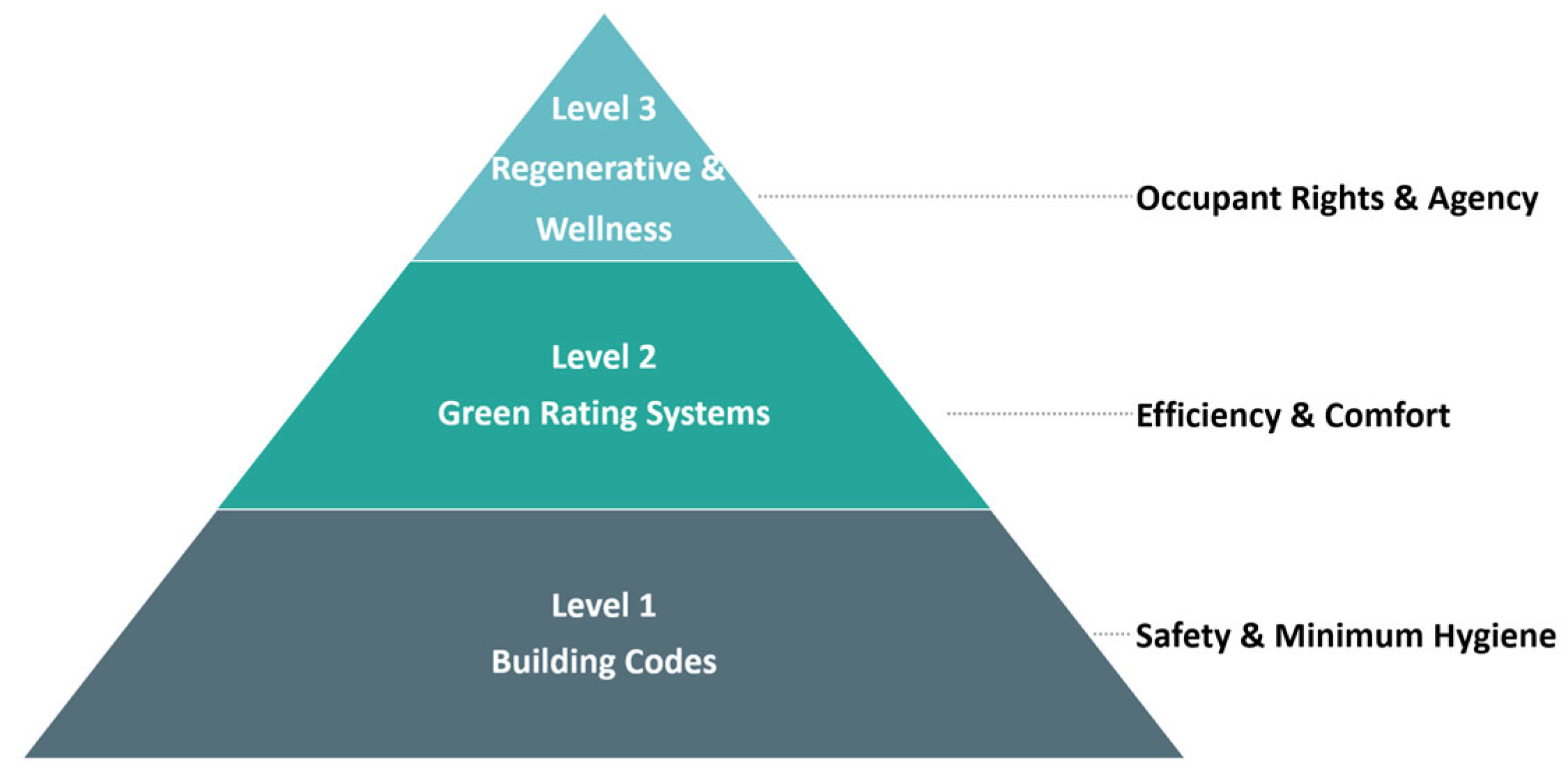
This study employs a Comparative Policy Analysis approach to evaluate the standards governing window operability across distinct regulatory and cultural contexts. The analysis is structured around a three-tiered conceptual hierarchy (Figure 1), which categorizes standards based on their primary objective regarding occupant agency.
  • Level 1: Mandatory building codes that prioritize safety and minimum hygiene, often treating windows as static egress elements.
  • Level 2: Voluntary green rating systems that focus on energy optimization and comfort, treating operability as a conditional variable.
  • Level 3: Regenerative frameworks that frame natural ventilation as a fundamental occupant right and passive survivability strategy.

2.2. Conceptual Definition: From Geometric to Effective Operability

Existing studies often use “openable area” and “effective area” interchangeably. However, in the context of occupant agency, these two represent significantly different realities. To address the Geometric Trap, this study distinguishes between the static potential of a window and its dynamic usability:
  • Geometric Opening Area (Ageo): The maximum physical opening area of a window (Width × Height), typically used for code compliance. It represents a theoretical capacity assuming no obstruction.
  • Effective Opening Area (Aeff): The actual usable area available to the occupant, accounting for physical constraints (e.g., safety limiters, barriers) and environmental factors (e.g., noise, pollution). It represents realized agency.
This distinction is not merely theoretical but physically constrained. For instance, standard discharge coefficients (ASHRAE, CIBSE) indicate that safety-limited project windows often provide only a fraction (<10%) of their geometric potential (see Table 1).
Consequently, regulatory reliance on geometric openability often fails to guarantee effective operability. While the former satisfies the legal requirement, only the latter ensures the Effective Perimeter Zone, the depth (typically 6–8 m [36]) where natural ventilation meaningfully impacts occupant comfort. Therefore, this study adopts Effective Operability as the primary criterion for evaluating whether a regulatory framework supports or inhibits occupant agency.

2.3. Analysis Framework

To evaluate the structural gap between compliance and agency, this study employs a tripartite analysis framework that categorizes standards into three hierarchical levels of operability:
  • Level 1 (Mandatory Codes): The baseline legal requirements focusing on safety and minimum hygiene (e.g., IBC, Building Act of Korea). The primary analysis focuses on whether these codes prioritize Geometric Compliance or Occupant Agency.
  • Level 2 (Green Rating Systems): Voluntary high-performance standards (e.g., LEED, BREEAM) that typically emphasize energy efficiency. The analysis examines the extent to which user control credits are granted or traded off for energy performance.
  • Level 3 (Regenerative Frameworks): Human-centric standards (e.g., WELL, Living Building Challenge (LBC)) that view operability as a prerequisite for health and biophilia, advancing toward Regenerative Operability.

2.4. Data Collection

This study strategically selected data sources from nations that possess Global Reference Standards with established international influence. The United States (Leadership in Energy and Environmental Design, LEED), the United Kingdom (BREEAM), and Japan (Comprehensive Assessment System for Built Environment Efficiency, CASBEE) were chosen as the originators of dominant global rating systems and representative standards for high-density Asian contexts, respectively. Additionally, Germany (German Sustainable Building Council, DGNB) is included to reflect the recent global attention on performance-based resilience and passive design principles. These four regulatory archetypes provide a comprehensive comparative framework for analyzing Republic of Korea (Green Standard for Energy and Environmental Design, G-SEED), which is the primary focus of this study, allowing for a critical evaluation of how these global sustainability principles are adapted within the specific regulatory and urban context.

2.5. Dataset of Standards

This study analyzes the most recent versions of currently active regulatory documents and certification standards, reflecting a period marking a significant paradigm shift in global frameworks toward decarbonization.
  • Mandatory Codes (Level 1)
    US: International Building Code (IBC, 2024) [10];
    UK: UK Building Regulations: Part F (Ventilation) & Part O (Overheating) (2021) [37,38];
    Germany: Model Building Code (MBO, 2019) [39] and Technical Rules for Workplaces (ASR, A3.6, 2022) [40];
    Japan: Building Standards Act (2024) [41];
    Republic of Korea: Building Act (2024) [42].
  • Green Rating Systems (Level 2):
    LEED (US/Global): LEED v5 (2025) [43];
    BREEAM (UK/Global): BREEAM V7 (2025) [44];
    DGNB (Germany): DGNB System Version 2023 (2023) [45];
    CASBEE (Japan): CASBEE for Building Design (2024) [46];
    G-SEED (Republic of Korea): G-SEED Revision Proposal (2025) [47]: While the 2016 version is currently enforced, this study analyzes the 2025 revision proposal to reflect the Korean strategic shift toward carbon neutrality and Environmental, Social, and Governance (ESG) alignment.
  • Regenerative Frameworks (Level 3):
    Living Building Challenge (US/Global): LBC 4.1 (2024) [48];
    WELL (US/Global): WELL v2 (2025) [49].
These documents were reviewed to extract quantitative criteria regarding minimum opening areas, distance limitations, and mechanical substitution clauses.

3. Results

3.1. Level 1 Analysis: The Geometric Trap in Mandatory Codes

The comparative analysis of baseline architectural codes (Level 1) reveals two distinct regulatory logics regarding the Mechanical Exception. To maintain a consistent focus, this analysis primarily examines the regulations for habitable rooms, where occupant agency and natural ventilation are most critical.
As illustrated in Figure 2, the presence of a mechanical ventilation system significantly alters the regulatory evaluation pathway. In the Substitution Model, the installation of HVAC systems triggers the omission of natural ventilation provisions through either explicit waivers (US, Republic of Korea, Japan) or conditional constraints (UK). In contrast, the Decoupled Model maintains operability as a primary independent mandate, restricting mechanical substitution only to extreme environmental constraints (e.g., excessive noise), thereby ensuring the strong co-existence of mechanical efficiency and occupant agency.
This section examines how these opposing logics of substitution and co-existence manifest in the national building codes of the US, the UK, Germany, Japan, and Republic of Korea.

3.1.1. Functional Substitution: US, Japan, and Republic of Korea

This cluster represents a clear manifestation of the Geometric Trap. While the IBC (USA), Building Standards Act (Japan), and Building Act (Republic of Korea) all prescribe a mandatory geometric opening area ranging from 4% to 5% of the floor area, they simultaneously functionally override this requirement in practice through the Mechanical Exception.
  • The Substitution Logic: Specifically, the US IBC §1202.1 establishes an explicit ‘OR’ condition (Natural OR Mechanical), whereas Republic of Korea’s Rules on Equipment Standards Article 11 and Japan’s Enforcement Decree Article 20-2 employ a conditional waiver where natural ventilation standards are exempted if a mechanical system is installed. Despite this structural difference, both mechanisms effectively allow system control to override occupant accessibility.
  • The Consequence: In high-rise offices or mixed-use complexes, windows become functionally marginal elements solely for daylight or emergency egress (geometric compliance), while their effective operability is sealed off to maintain air-tightness for HVAC efficiency.
Unlike the UK and Germany, which use environmental constraints like excessive outdoor noise as specific legal thresholds to permit mechanical substitution, Japan’s Building Standard Act and Republic of Korea’s Building Act do not explicitly codify noise in their baseline natural ventilation requirements. Instead, they employ an unconditional ‘OR’ waiver; the mere installation of a compliant mechanical ventilation system legally nullifies the requirement for operable windows entirely, regardless of the surrounding acoustic environment.

3.1.2. Functional Reduction: UK

The UK framework (Approved Document F & O) presents a conditional variation of the trap. Unlike the prescriptive geometric mandates of the US (4%) or Republic of Korea (5%), UK regulations primarily rely on a performance-based standard for purge ventilation (typically 4 air changes per hour (ACH)). While Approved Document F advises a minimum window area of 1/20 (5%) of the floor area to meet this performance in dwellings, this is guidance rather than a strict legal mandate for all building types.
  • Conditional Alternative: Consequently, UK regulations effectively allow mechanical systems to substitute for natural openings when external constraints make opening windows “not practicable.” Specifically, Approved Document O (Overheating) stipulates that if external noise or pollution levels are high, windows must be assumed “closed” during overheating assessments. This forces the adoption of mechanical cooling or mechanical ventilation as a primary strategy, rendering the operable window a theoretical feature rather than a usable one.
  • Hygiene vs. Purge: In this context, window opening is often categorized merely as Purge Ventilation (a rapid, intermittent action to remove smoke or pollutants) rather than a tool for daily adaptive comfort. This limits occupant agency to emergency or specific purge scenarios, unlike the continuous control guaranteed in the German model.

3.1.3. The Regulatory Outlier: Germany

Germany presents a distinct regulatory model that presents an alternative to the Geometric Trap.
  • Structural Guarantee: The MBO §47(2) mandates a significantly larger physical opening area of 1/8 (12.5%) for habitable rooms (Aufenthaltsräume), setting a higher geometric baseline than other jurisdictions.
  • Systemic Decoupling: Crucially, the technical rule ASR A3.6 establishes a decoupled compliance structure. Unlike the US, Japan, or Korean models where mechanical systems legally substitute natural ventilation requirements, German regulations mandate operable windows independently of HVAC installation. Specifically, while ASR A3.6 restricts window usage in cases of high noise or pollution (requiring supplementary mechanical ventilation), standard building codes (MBO §47) still mandate the provision of operable windows for emergency egress and occupant agency. Thus, within the examined provisions, no explicit substitution clause comparable to those found in the US, Japan, or Republic of Korea is identified. This interpretation is structurally based on the absence of an explicit ‘OR’ substitution clause in MBO §47, ensuring that natural access remains a fixed architectural requirement rather than a tradable variable.
  • Historical Divergence: This regulatory difference reflects a distinct historical trajectory. German regulations (ASR) originated from an occupational health perspective aimed at combating Sick Building Syndrome in the 1980s [23]. Consequently, window operability is codified not as an optional energy strategy, but as a standard occupational health requirement (see Table 2).

3.2. Level 2 Analysis: The Evolution to Functional Operability

Green building rating systems are actively evolving to bridge the gap left by mandatory codes. The analysis of the most recent standards reveals a unified global paradigm shift: moving from static area-based compliance to control-based performance, as summarized in Table 3.

3.2.1. LEED v5 (US/Global): From Comfort to Resilience

The evolution from LEED v4 (2013) [50] to the newly drafted v5 (2025) illustrates a critical shift in how natural ventilation is framed: from a tool for daily comfort to a strategy for emergency survival.
  • Continuity of the Equivalency Trap: Both v4 and v5 versions significantly maintain the Thermal Comfort credit structure, where operable windows are legally equivalent to mechanical thermostats. By allowing digital controls to substitute for physical openings, the system continues to treat natural ventilation as an optional amenity for sensory satisfaction rather than a fundamental architectural right.
  • Shift to Resilience: However, v5 introduces a significant paradigm shift in the Resilient Spaces credit (EQc4). Unlike v4, which focused primarily on everyday air quality, v5 specifically rewards designs where operable windows provide access to outdoor air during heat waves or localized power outages. This reframes the window as a disaster relief tool.
  • The Visual-Aerodynamic Conflict: Furthermore, the separate Quality Views credit often incentivizes large fixed glazing to maximize visual connectivity. This creates a structural conflict where the right to view (fixed glass) often suppresses the right to air (operable frames), separating the visual experience from the aerodynamic connection.
  • Limitation: Ultimately, despite acknowledging the survival value of windows, the systemic limitation persists. Since resilience is merely one option within a broader menu, designers can achieve top-tier certification through alternative passive thermal measures, leaving the sealed box typology legally intact for non-emergency operations.

3.2.2. BREEAM (UK/Global): From Potential to Adaptation

The transition from BREEAM V6 (2022) [51] to the recently launched V7 (2025) marks a strategic pivot from checking ventilation potential to demanding climate adaptability.
  • The Potential Standard: Under the previous Version 6, Criterion Hea 02 (Indoor Air Quality) focused on the potential for natural ventilation. It rewarded designs that simply provided the capability to open windows for fresh air intake, framing operability primarily as an indoor air quality strategy. The metric was static checking if the hardware existed.
  • The Adaptation Imperative: Version 7 drastically escalates this requirement under Criterion Hea 04 (Thermal Comfort) and the new Resilience category. It mandates a rigorous thermal modeling analysis against future climate scenarios (e.g., 2050s and 2080s weather files). Here, natural ventilation is no longer just for fresh air; it is evaluated as a critical passive strategy to prevent summer overheating without reliance on energy-intensive cooling.
  • Significance: This shifts the evaluation from “Can the window open?” to “Can the window save the building from overheating?” It redefines the operable window as a primary instrument for climate adaptation.
  • Limitation: However, despite this rigorous modeling, the optional trap persists. While passive strategies are heavily encouraged to meet Net Zero targets, projects can still achieve compliance through high-efficiency active cooling systems if the passive analysis deems the site too noisy or polluted, effectively trading off the Right to Open for mechanical thermal stability.

3.2.3. DGNB (Germany): The Aggressive Geometric Strategy

While other systems focus on the physical properties of the window itself, the German DGNB System (Version 2023) shifts the analytical focus to the relationship between the user and the façade.
  • Metric of Proximity (Distance to Agency): Under Criterion SOC 1.4 (Thermal Comfort), DGNB assesses not just the existence of openings, but the User Influence on Thermal Comfort. Crucially, this credit penalizes deep plan typologies. It evaluates the proportion of the usable area situated within a specific distance (typically 6–7 m) from an operable window.
  • Anti-Deep Plan Logic: This approach redefines operability from a hardware metric to a spatial metric. Even if a building has a high geometric opening ratio, it scores poorly if the floor plate is too deep, effectively rendering the window inaccessible to occupants in the core zone. This enforces a thinner building massing that inherently supports cross-ventilation.
  • Limitation: However, the fundamental flaw of Level 2 persists. The user influence credit is weighed against mechanical thermal comfort capabilities. A highly efficient, fully sealed building with advanced climate control (Category I) can still achieve a Platinum rating without providing direct user access to windows, turning this spatial right into a tradable commodity.

3.2.4. CASBEE (Japan): The Efficiency-Centric Strategy

The newly released CASBEE-Building 2024 Edition maintains its rigorous quantitative approach established in its predecessor (2014 Edition) [52], pushing the boundaries of geometric openness under the strengthened banner of Carbon Neutrality.
  • Aggressive Geometric Benchmarks: Unlike other systems that accept minimal compliance, CASBEE has consistently upheld a steep tiered benchmark for the Effective Opening Area (Q1. Indoor Environment, 4.2.2 Natural Ventilation). While the baseline for offices starts at 1/20 (5%), achieving the top-tier Level 5 requires an effective opening area of 1/10 (10%). For schools, the baseline is even stricter at 1/15 (6.7%), reflecting higher ventilation demands.
  • Significance (10% Rule): This maintained 10% requirement is double the standard international code (typically 1/20), forcing architects to design building envelopes that are physically twice as porous as conventional buildings. It cements CASBEE’s position as the advocate for maximum permeability.
  • Evolution (2024 Update): The 2024 edition explicitly reframes this openness not just as an amenity, but as a critical passive cooling instrument to achieve Net Zero Energy (IEQ) targets. By integrating these geometric metrics with the Natural Energy Utilization credit (LR1), it instrumentalizes the window as a primary device for cooling load reduction, making the Right to Open subservient to the duty to decarbonize.

3.2.5. G-SEED (Republic of Korea): From Quantity to Arrangement

The evolution of G-SEED illustrates a strategic pivot from Geometric Compliance to Functional Operability.
  • The Limitation (2016 Version) [53]: Under the current Criterion 3.2.1 (Introduction of Natural Ventilation), evaluations are limited to a simple geometric ratio that rewards designs where the opening area exceeds tiered benchmarks (2, 3, 4, or 5%) of the floor area, regardless of actual airflow effectiveness. This metric often allows for ineffective single-sided ventilation designs that satisfy the code numerically but fail to provide thermal comfort.
  • The Evolution (2025 Revision Proposal): Addressing this deficiency, the 2025 Revision restructures the framework under Category 2 (Living Space and Health), introducing Criterion 2.4 (Natural Ventilation through Window Arrangement). This new credit shifts the focus to the effectiveness of airflow paths, explicitly incentivizing cross-ventilation and the strategic placement of windows to ensure effective airflow, although detailed technical specifications have not yet been disclosed.
  • Significance: This marks a transition from checking hardware existence to verifying architectural performance. However, a critical limitation remains: like other Level 2 systems, this architectural credit remains optional, liable to be discarded in favor of mechanical scores if not prioritized by the client.

3.2.6. The Remaining Limitation: Optional Agency

Despite these advancements, a critical structural flaw remains. In most Level 2 systems (with the qualitative exception of DGNB), operability credits remain optional.
  • The Scoring Trade-off: Under the current points-based frameworks, a building can achieve a Platinum or Outstanding rating by maximizing energy points (HVAC efficiency, renewables) while completely ignoring occupant control credits.
  • Persistence of the Sealed Box: This Substitution Logic allows the proliferation of mechanically optimized yet occupant-limited configurations, buildings that are environmentally efficient on paper but deny occupants the agency to regulate their own environment. This critical discrepancy underscores the necessity for a paradigm shift to Level 3, where agency becomes mandatory.

3.3. Level 3 Analysis: The Return of Mandatory Agency

The most radical departure from the status quo is observed in Level 3 regenerative frameworks. The Living Building Challenge (LBC) and WELL Standard redefine the operable window not as a ventilation backup, but as a fundamental human right and a prerequisite for biological health (Table 4).

3.3.1. LBC 4.1: Mandatory Operability as a Baseline Condition

The Living Building Challenge (LBC) 4.1 establishes one of the most stringent requirements regarding window operability among contemporary building standards. Within this framework, access to operable windows is treated not as a tradable design option, but as a prerequisite condition for certification.
  • Imperative 09 (Healthy Interior Environment): Unlike Level 2 systems that permit performance trade-offs, LBC 4.1 Imperative 09 requires that regularly occupied space provide access to operable windows for natural ventilation. This requirement is framed as a foundational component of indoor environmental quality rather than as an optional credit.
  • Non-Waivable Coverage Requirement: In practice, this results in near-complete coverage of operable windows across occupied spaces. Projects that include regularly occupied zones without access to operable windows (with limited exceptions for specific medical or industrial program types) are not eligible for certification, irrespective of their mechanical efficiency or energy performance.
  • Biophilic Integration (Imperative 19): Operability is further contextualized within Imperative 19 (Beauty + Biophilia), which emphasizes experiential and psychological connection to the outdoors. Within this framework, the window is positioned not solely as a ventilation device, but as an architectural interface supporting human well-being and environmental engagement.

3.3.2. WELL v2: The Health-Centric Agency

While LEED v5 focuses on resilience, WELL v2 focuses on daily health and cognitive performance, enforcing agency through rigorous coverage and verification.
  • Feature A07 (Operable Windows): WELL v2 mandates high accessibility, requiring that at least 75% of regularly occupied spaces have operable windows (Part 1). While not 100% like LBC, it sets a high baseline that prevents the core-heavy deep plans common in conventional offices.
  • Feature T08 (Enhanced Control): Crucially, WELL links operability to Thermal Comfort (Feature T08 Enhanced Operable Windows). It does not treat the window merely as an air intake, but as a tool for individual thermal control, acknowledging that personal agency over temperature is directly linked to occupant productivity and mental well-being.
  • Monitoring Integration: Uniquely, WELL v2 emphasizes the integration of real-time air quality monitoring (Feature A01), encouraging a mixed-mode approach where occupants are actively informed when to open windows, bridging the gap between human agency and building intelligence.

4. Discussion

4.1. The Geometric Trap: How Codes Fail Occupant Agency

The most significant finding of this study is that contemporary regulatory systems predominantly govern geometric compliance rather than occupant agency. Mandatory codes (Level 1), particularly the IBC and its global derivatives including Korean standards, rely on a binary definition of Openability based solely on geometric dimensions. As long as a window meets the 4% or 5.7 ft2 (0.53 m2) requirement, it is deemed compliant.
However, the widespread adoption of the Mechanical Exception (IBC §1202) has significantly eroded the window’s function. By permitting mechanical ventilation systems to substitute for natural openings, regulatory frameworks have effectively transformed the window from a primary instrument of environmental control into a secondary element for emergency egress. In high-rise commercial, office, and mixed-use contexts in Republic of Korea and the US, this has led to the prevalence of fixed or highly restricted window configurations that comply with safety regulations but do not necessarily ensure effective natural ventilation for cooling or air quality management. This contrasts with the German model (MBO), which codifies natural ventilation as a non-negotiable environmental standard. The absence of a general waiver in the German framework highlights a divergence in regulatory logic: while the US model allows for System Substitution (replacing windows with HVAC), the German model enforces Structural Redundancy, requiring both mechanical sufficiency and natural access to function independently.

4.2. The 2025 Pivot: From Paradox to Passive Survivability

Historically, green building certifications (Level 2) have inadvertently further reinforced this tension through the Energy and Acoustic Paradox. Under previous versions of LEED (v4) and standards like BREEAM V6 or CASBEE, opening a window was often disadvantaged for disrupting the thermal envelope or allowing noise ingress, creating a disincentive for operability in urban zones.
However, the release of LEED v5 and BREEAM V7 in 2025 marks a critical turning point, here termed the Resilience Pivot. The introduction of the passive survivability credit acknowledges that, in an era of climate-related disruptions, a sealed building that relies entirely on grid-dependent systems may be energy efficient under normal conditions but becomes vulnerable during outages or extreme events. This shift redefines the operable window, repositioning it from an energy liability to a resilience asset aligned with the Whole Life Carbon approach, suggesting that long-term performance depends not solely on airtight envelopes, but also on accessible, low-tech adaptive strategies.

4.3. The Evolution of Occupant Control

While the Resilience Pivot is promising, its application across different regions faces unique challenges shaped by specific local circumstances. As highlighted by the diverging regulatory models in Section 3, building codes do not evolve in a vacuum; they are the result of a complex interplay between urbanization, environmental factors, safety protocols, and historical HVAC reliance. Table 5 provides a comparative overview of these contextual drivers across the analyzed nations.
As Table 5 illustrates, the trajectory of window regulations is heavily dictated by regional contexts. In the United States, a strong historical reliance on centralized HVAC systems in corporate high-rises has normalized sealed envelopes, prioritizing mechanical energy efficiency over occupant agency [54]. Conversely, European nations like Germany benefit from a strong tradition of passive design and lower HVAC reliance, allowing them to largely mandate manual operability [23]. The UK represents a middle ground, promoting natural ventilation but permitting mechanical substitution heavily based on the acoustic constraints of its dense urban centers.
However, in high-density East Asian megacities such as Seoul and Tokyo, standards developed in different climatic and regulatory contexts may not fully align with local environmental and safety conditions. Severe external factors such as seasonal PM2.5 and Asian Dust in Republic of Korea [55,56], pollen in Japan [57], and persistent urban noise can substantially constrain the practical feasibility of natural ventilation. Particularly in Japan, frequent seismic activity necessitates highly rigid facade structures and shatterproof glazing to prevent disaster-related casualties, which inherently restricts the free operability of windows.
In addition, strict fire safety regulations in high-rise buildings often prioritize firefighter ingress (e.g., designated rescue windows in Japan) and smoke exhaust systems over routine occupant ventilation. Under such combined environmental and regulatory constraints, the effective usability of operable windows may be significantly reduced, even when geometric compliance is formally achieved.
Therefore, the global transfer of operability standards without careful consideration of localized climatic, environmental, and safety contexts may result in formal compliance without ensuring practical usability. This does not diminish the importance of operability but highlights the need for context-sensitive performance criteria.

4.4. Toward a Performance-Based Understanding of Operability

The preceding analysis demonstrates that the structural limitation surrounding operable windows does not stem from the absence of minimum opening requirements, but from the logic by which operability is defined. Across multiple jurisdictions, compliance is evaluated through static geometric thresholds, while the actual capacity of occupants to use windows in daily life remains unexamined.
This gap reveals a fundamental limitation of area-based criteria. A window that satisfies geometric requirements may nevertheless be inaccessible due to spatial depth, restricted hardware, environmental exposure, or mechanical substitution. In such cases, formal compliance masks the reduction in functional operability.
Operability should therefore be understood not as a fixed physical attribute, but as a relational condition shaped by proximity, environmental context, and systemic interaction. This reframing aligns with emerging regenerative standards, which increasingly prioritize occupant agency and passive survivability over nominal compliance.
Rather than prescribing a fixed metric for calculation, the Effective Opening Area framework functions as a diagnostic lens to evaluate whether regulatory and spatial conditions allow occupants to meaningfully access natural ventilation. This shift redefines compliance not as a geometric capacity, but as the preservation of occupant agency against mechanical substitution.

4.5. Occupant Agency and the Energy Gap in High Performance Buildings

The shift toward a performance-based understanding of operability must also account for the operational reality of occupant behavior. The progressive transition toward nearly Zero Energy Buildings (nZEB) and PlusEnergy standards has significantly transformed the operational dynamics of modern architecture. In these highly efficient environments equipped with advanced mechanical ventilation, the role of the occupant becomes a critical performance variable. As highlighted by recent literature, a significant energy gap often emerges between design predictions and actual building operation. This discrepancy can be further amplified when window operation is not aligned with the intended mechanical strategy. When occupants interact with operable windows without understanding the overarching mechanical strategy, they can inadvertently disrupt the optimized thermal balance, thereby neutralizing the intended energy savings. Therefore, understanding and guiding occupant behavior is not merely a matter of personal comfort but a crucial prerequisite for maintaining expected performance standards.
Current mandatory codes fail to address this behavioral dimension because they evaluate compliance based on static geometric capacity rather than dynamic human–building interaction. To mitigate the energy gap, future regulatory frameworks must evolve to incorporate guided agency. As demonstrated by the WELL v2 standard, integrating real time air quality monitoring and active signaling can effectively prompt occupants to open or close windows at optimal times. By aligning physical operability with intelligent operational cues, buildings can ensure that natural ventilation strategies support rather than compromise the efficiency of mechanical systems.

5. Conclusions

This study investigated the structural gap between regulatory compliance and the actual operability of windows, identifying a condition referred to in this study as the Geometric Trap, in which geometric compliance does not necessarily ensure functional operability. Through a comparative analysis of mandatory codes (Level 1), green rating systems (Level 2), and regenerative frameworks (Level 3), the research revealed that current regulations in the US, the UK, Japan, and Republic of Korea structurally reduce the functional relevance of operable windows within everyday operation through mechanical substitution. While these codes mandate a specific geometric opening area, they legally allow mechanical ventilation systems to override natural access, reducing the functional relevance of the window in everyday operation.
In contrast, the German model demonstrates a structural co-existence, proving that mechanical sufficiency does not require the reduced legal emphasis on natural access. This divergence demonstrates that the Mechanical Exception is not a technical inevitability, but a regulatory choice.
Furthermore, while early green rating systems (Level 2) have historically focused on energy efficiency, often deepening the reliance on sealed environments, emerging regenerative frameworks (Level 3) are beginning to re-establish the connection between operability and occupant health. However, without a fundamental shift in mandatory legal baselines (Level 1), these voluntary standards remain limited in their widespread impact.
Therefore, this study argues for a paradigm shift from static area-based criteria to the Effective Opening Area framework. This approach moves beyond simple geometric compliance to evaluate the actual accessibility and usability of the window in the context of mechanical systems and environmental constraints. As the comparative analysis demonstrates, acknowledging regional specificities such as urban density and external pollution is essential for developing realistic operability standards.
Furthermore, achieving true operability in modern high performance buildings requires addressing the behavioral energy gap. The future of window regulation lies not in choosing between mechanical optimization and natural access, but in designing regulatory structures that allow both to function synergistically. By restoring the window as a functional instrument rather than a theoretical requirement, future building codes can mitigate the conflict between energy performance and human needs. This ensures that occupant agency remains central to the design of the built environment without compromising the efficiency of advanced zero energy systems.

Funding

This work was supported by INHA UNIVERSITY Research Grant (Grant Number 70452 1).

Institutional Review Board Statement

Not applicable.

Informed Consent Statement

Not applicable.

Data Availability Statement

The original contributions presented in this study are included in the article. Further inquiries can be directed to the corresponding author.

Acknowledgments

The author would like to thank Jaewook Lee for his informal discussions and insights that helped refine the conceptual framework of this study. During the preparation of this manuscript, the author used a generative AI language model for language refinement. The author reviewed and edited the output and takes full responsibility for the content of this publication.

Conflicts of Interest

The author declares no conflicts of interest.

Abbreviations

The following abbreviations are used in this manuscript:
AeffEffective Opening Area
AgeoGeometric Opening Area
ACHAir Changes per Hour
ASRTechnical Rules for Workplaces (Technische Regeln für Arbeitsstätten)
BREEAMBuilding Research Establishment Environmental Assessment Method
CASBEEComprehensive Assessment System for Built Environment Efficiency
CFDComputational Fluid Dynamics
DGNBGerman Sustainable Building Council
ERVEnergy Recovery Ventilation
ESGEnvironmental, Social, and Governance
G-SEEDGreen Standard for Energy and Environmental Design
HBIHuman–Building Interaction
HVACHeating, Ventilation, and Air Conditioning
IBCInternational Building Code
IEQIndoor Environmental Quality
LBCLiving Building Challenge
LEEDLeadership in Energy and Environmental Design
MBOModel Building Code (Musterbauordnung)
PM2.5Particulate Matter 2.5
UBCUniform Building Code
VEValue Engineering
WHOWorld Health Organization

References

  1. Koolhaas, R.; Di Robilant, M.; Maak, N. Window (Elements of Architecture); Marsilio: Venice, Italy, 2014. [Google Scholar]
  2. Corbusier, L. Precisions on the Present State of Architecture and City Planning; Aujame, E.S., Translator. Original Work Published 1930; The MIT Press: Cambridge, MA, USA, 1991. [Google Scholar]
  3. Moe, K. Insulating Modernism: Isolated and Non-isolated Thermodynamics in Architecture; Birkhäuser: Basel, Switzerland, 2014. [Google Scholar]
  4. Banham, R. The Architecture of the Well-Tempered Environment, 2nd ed.; Originally Published in 1969; University of Chicago Press: Chicago, IL, USA, 1984. [Google Scholar]
  5. Bijsterveld, K. Mechanical Sound: Technology, Culture, and Public Problems of Noise in the Twentieth Century; MIT Press: Cambridge, MA, USA, 2008. [Google Scholar]
  6. O’Brien, W.; Wagner, A.; Schweiker, M.; Mahdavi, A.; Day, J.; Kjærgaard, M.B.; Carlucci, S.; Dong, B.; Tahmasebi, F.; Yan, D.; et al. Introducing IEA EBC annex 79: Key challenges and opportunities in the field of occupant-centric building design and operation. Build. Environ. 2020, 178, 106738. [Google Scholar] [CrossRef]
  7. Brager, G.S.; Paliaga, G.; De Dear, R. Operable Windows, Personal Control, and Occupant Comfort. ASHRAE Trans. 2004, 110, 17–35. Available online: https://escholarship.org/uc/item/4x57v1pf (accessed on 25 February 2026).
  8. Zaniboni, L.; Albatici, R. Natural and mechanical ventilation concepts for indoor comfort and well-being with a sustainable design perspective: A systematic review. Buildings 2022, 12, 1983. [Google Scholar] [CrossRef]
  9. International Conference of Building Officials (ICBO). Uniform Building Code (UBC) 1964 Edition; ICBO: Pasadena, CA, USA, 1964; Available online: https://archive.org/details/UniformBuildingCode1964 (accessed on 25 February 2026).
  10. International Code Council (ICC). International Building Code (IBC); ICC: Washington, DC, USA, 2024; Available online: https://codes.iccsafe.org/content/IBC2024P1 (accessed on 25 February 2026).
  11. Ackerly, K.; Baker, L.; Brager, G. Window Use in Mixed-Mode Buildings: A Literature Review; Center for the Built Environment (CBE): Berkeley, CA, USA, 2011; Available online: https://escholarship.org/uc/item/0t70f65m (accessed on 25 February 2026).
  12. Brager, G. Mixed-Mode Cooling; Center for the Built Environment (CBE), University of California: Berkeley, CA, USA, 2006; Available online: https://escholarship.org/uc/item/3bb8x7b8 (accessed on 25 February 2026).
  13. Kim, J.; de Dear, R. Is mixed-mode ventilation a comfortable low-energy solution? A literature review. Build. Environ. 2021, 191, 107530. [Google Scholar] [CrossRef]
  14. Bamdad, K.; Matour, S.; Izadyar, N.; Omrani, S. Impact of climate change on energy saving potentials of natural ventilation and ceiling fans in mixed-mode buildings. Build. Environ. 2022, 209, 108605. [Google Scholar] [CrossRef]
  15. Li, Y.; Heiselberg, P. Analysis methods for natural and hybrid ventilation: A critical literature review and recent developments. Int. J. Vent. 2003, 1, 3–20. [Google Scholar] [CrossRef]
  16. World Health Organization (WHO). WHO Guidelines for Indoor Air Quality: Dampness and Mould; WHO Regional Office for Europe: Copenhagen, Denmark, 2009; Available online: https://www.who.int/publications/i/item/9789289041683 (accessed on 25 February 2026).
  17. Megahed, N.A.; Ghoneim, E.M. Indoor air quality: Rethinking rules of building design strategies in post-pandemic architecture. Environ. Res. 2021, 193, 110471. [Google Scholar] [CrossRef] [PubMed]
  18. Wilson, A. Passive Survivability: Understanding and Quantifying the Thermal Habitability of Buildings During Power Outages. In Climate Adaptation and Resilience Across Scales: From Buildings to Cities; Rajkovich, N.B., Holmes, S.H., Eds.; Routledge: New York, NY, USA, 2021; Available online: https://www.taylorfrancis.com/chapters/oa-edit/10.4324/9781003030720-9/passive-survivability-alex-wilson (accessed on 25 February 2026).
  19. World Health Organization Regional Office for Europe. Environmental Noise Guidelines for the European Region; WHO Regional Office for Europe: Copenhagen, Denmark, 2018; Available online: https://iris.who.int/handle/10665/279952 (accessed on 26 February 2026).
  20. Hong, T.; Yan, D.; D’Oca, S.; Chen, C. Ten questions concerning occupant behavior in buildings: The big picture. Build. Environ. 2017, 114, 518–530. [Google Scholar] [CrossRef]
  21. de Dear, R.J.; Brager, G.S. Developing an Adaptive Model of Thermal Comfort and Preference. ASHRAE Trans. 1998, 104, 145–167. Available online: https://escholarship.org/uc/item/4qq2p9c6 (accessed on 25 February 2026).
  22. Parkinson, T.; de Dear, R.; Brager, G. Nudging the adaptive thermal comfort model. Energy Build. 2020, 206, 109559. [Google Scholar] [CrossRef]
  23. Hellwig, R.T. Perceived control in indoor environments: A review. Build. Res. Inf. 2015, 43, 302–315. [Google Scholar] [CrossRef]
  24. Haldi, F.; Robinson, D. Interactions with window openings by office occupants. Build. Environ. 2009, 44, 2378–2395. [Google Scholar] [CrossRef]
  25. D’Oca, S.; Hong, T. A data-mining approach to discover patterns of window opening and closing behavior in offices. Build. Environ. 2014, 82, 726–739. [Google Scholar] [CrossRef]
  26. Kim, H.; Kang, H.; Choi, H.; Jung, D.; Hong, T. Human-building interaction for indoor environmental control: Evolution of technology and future prospects. Autom. Constr. 2023, 152, 104938. [Google Scholar] [CrossRef]
  27. The Murcutt Foundation. Glenn Murcutt: Architecture and Philosophy; The Murcutt Foundation: Sydney, Australia, 2024; Available online: https://www.murcuttfoundation.org (accessed on 4 December 2025).
  28. Lacaton, A.; Vassal, J.P. Lacaton & Vassal Architectes: Official Website; Paris, France. Available online: https://www.lacatonvassal.com (accessed on 5 February 2026).
  29. Holtermans, R.; Kok, N. On the Value of Environmental Certification in the Commercial Real Estate Market. Real Estate Econ. 2019, 47, 685–722. [Google Scholar] [CrossRef]
  30. Sadikin, N.; Turan, I.; Chegut, A. The Financial Impact of Healthy Buildings: Rental Prices and Market Dynamics in Commercial Office; MIT Center for Real Estate Research Paper No. 21/04 2021; MIT Real Estate Innovation Lab: Cambridge, MA, USA, 2021. [Google Scholar] [CrossRef]
  31. SANAA (Sejima and Nishizawa and Associates). Official Website. Available online: http://www.sanaa.co.jp (accessed on 25 February 2026).
  32. Yan, D.; O’Brien, W.; Hong, T.; Feng, X.; Gunay, H.B.; Tahmasebi, F.; Mahdavi, A. Occupant behavior modeling for building performance simulation: Current state and future challenges. Energy Build. 2015, 107, 264–278. [Google Scholar] [CrossRef]
  33. Ghiaus, C.; Allard, F.; Santamouris, M.; Georgakis, C.; Nicol, F. Urban environment influence on natural ventilation potential. Build. Environ. 2006, 41, 395–406. [Google Scholar] [CrossRef]
  34. Tang, S.-K. A Review on Natural Ventilation-Enabling Façade Noise Control Devices for Congested High-Rise Cities. Appl. Sci. 2017, 7, 175. [Google Scholar] [CrossRef]
  35. Bordass, B.; Leaman, A.; Ruyssevelt, P. Assessing building performance in use 5: Conclusions and implications. Build. Res. Inf. 2001, 29, 144–157. [Google Scholar] [CrossRef]
  36. The American Institute of Architects (AIA). The Framework for Design Excellence; AIA: Washington, DC, USA, 2024; Available online: https://www.aia.org/design-excellence/aia-framework-for-design-excellence/introduction (accessed on 25 February 2026).
  37. HM Government. The Building Regulations 2010. Approved Document F: Ventilation; Buildings Other than Dwellings; Department for Levelling Up, Housing and Communities (DLUHC): London, UK, 2021; Volume 2.
  38. HM Government. The Building Regulations 2010. Approved Document O: Overheating; Department for Levelling Up, Housing and Communities (DLUHC): London, UK, 2021.
  39. Federal Ministry of the Interior, Building and Community. Model Building Code (MBO); Federal Ministry of the Interior, Building and Community: Berlin, Germany, 2024.
  40. BAuA (Bundesanstalt für Arbeitsschutz und Arbeitsmedizin). Technische Regeln für Arbeitsstätten (ASR) A3.6 Lüftung; BAuA: Dortmund, Germany, 2022. [Google Scholar]
  41. Ministry of Land, Infrastructure, Transport and Tourism (MLIT). Building Standards Act (Enforcement Order); MLIT: Tokyo, Japan, 2024.
  42. Ministry of Land, Infrastructure and Transport (MOLIT). Building Act; MOLIT: Sejong, Republic of Korea, 2024.
  43. U.S. Green Building Council (USGBC). LEED v5 for Building Design and Construction; USGBC: Washington, DC, USA, 2025. [Google Scholar]
  44. BRE Global. BREEAM International New Construction Version 7; BRE Global Ltd.: Watford, UK, 2025. [Google Scholar]
  45. German Sustainable Building Council (DGNB). DGNB System—New Construction Building, Version 2023 [Criteria Set]; DGNB GmbH: Stuttgart, Germany, 2023. [Google Scholar]
  46. Institute for Built Environment and Carbon Neutral for SDGs (IBECs). CASBEE for Building (New Construction) 2024 Edition [Technical Manual]; IBECs: Tokyo, Japan, 2024. [Google Scholar]
  47. Korea Institute of Civil Engineering and Building Technology (KICT). Directions for the Full Revision of G-SEED: Focusing on Living Space and Health (2025 Revision Proposal) [Presentation Materials]; KICT: Goyang, Republic of Korea, 2025; Available online: https://www.gseed.or.kr (accessed on 4 December 2025).
  48. International Living Future Institute (ILFI). Living Building Challenge 4.1; ILFI: Seattle, WA, USA, 2024. [Google Scholar]
  49. International WELL Building Institute (IWBI). WELL Building Standard v2; IWBI: New York, NY, USA, 2025. [Google Scholar]
  50. U.S. Green Building Council (USGBC). LEED v4 for Building Design and Construction; USGBC: Washington, DC, USA, 2013. [Google Scholar]
  51. BRE Global. BREEAM International New Construction Version 6; BRE Global Ltd.: Watford, UK, 2022. [Google Scholar]
  52. Japan Sustainable Building Consortium (JSBC); Institute for Built Environment and Carbon Neutral for SDGs (IBECs). CASBEE for Building (New Construction) 2014 Edition [Technical Manual]; IBECs: Tokyo, Japan, 2014. [Google Scholar]
  53. No. 2016-1139; Green Standard for Energy and Environmental Design (G-SEED) Certification Criteria. Ministry of Land, Infrastructure and Transport (MOLIT): Sejong, Republic of Korea, 2016.
  54. Janssen, J.E. The history of ventilation and temperature control. ASHRAE J. 1999, 41, 48–52. [Google Scholar]
  55. Kim, D.; Choi, H.E.; Gal, W.M.; Seo, S. Five Year Trends of Particulate Matter Concentrations in Korean Regions (2015 to 2019): When to Ventilate? Int. J. Environ. Res. Public Health 2020, 17, 5764. [Google Scholar] [CrossRef] [PubMed]
  56. Kang, D. Addressing Indoor Air Pollution Challenges Through Concrete Public Policies in South Korea. Field Actions Sci. Rep. 2020, 21, 82–85. Available online: https://journals.openedition.org/factsreports/6141 (accessed on 25 February 2026).
  57. Tamuro, A.; Kuwahara, R.; Kim, H. Effects of Outdoor Air Pollutants on Indoor Environment Due to Natural Ventilation. Atmosphere 2022, 13, 1917. [Google Scholar] [CrossRef]
Figure 1. The Conceptual Hierarchy of Window Standards.
Sustainability 18 02460 g001
Figure 2. Conceptual framework of regulatory logics: The Substitution Model (Geometric Trap) vs. The Decoupled Model (Occupant Agency).
Sustainability 18 02460 g002
Table 1. Classification of Window Typologies based on Geometric Efficiency.
TypologySustainability 18 02460 i001Sustainability 18 02460 i002Sustainability 18 02460 i003Sustainability 18 02460 i004Sustainability 18 02460 i005Sustainability 18 02460 i006
(a)
Turn & Tilt
(b)
Metal Rail
Sliding
(c)
Split-Sash
(d)
Glass Rail
Sliding
(e)
Project-Out
(f)
Fixed
Geometric Efficiency (Estimated)≈100%(Turn)/
<5%(Tilt)
≈50%≈25%≈20%<10%0%
MechanismEuropean
(Dual-Mode)
ConventionalHybrid
(Fixed bottom)
PanoramicHigh-Rise
(Office Tower)
Sealed
(Mechanical)
ControlFullHighRestrictedObstructedMinimalNone
Note: Efficiency percentages are approximate values based on standard discharge coefficients found in ASHRAE Fundamentals and CIBSE Guide A. Values for project-out windows assume the application of safety limiters (e.g., 100 mm restriction) commonly required in high-rise buildings.
Table 2. Comparative Analysis of Level 1 Mandatory Codes.
CountryCode/
Standard
Min.
Opening Area
Mechanical
Exception 1
Primary LogicImpact on Operability
USIBC
(2024) [10]
4%
(1/25)
Yes
(Waived)
System
Control
Mechanically Substituted Configuration: Natural ventilation requirements are waived when HVAC systems are installed.
UKApproved Document F
(2021) [37]
Performance-based
(Min. 4 ACH for Purge)
Conditional
(Noise/Overheating)
Conditional Substitution (Hygiene & Purge)Intermittent Use: Windows are framed as ‘Purge’ devices for rapid ventilation, often substituted by mechanical extraction in noisy areas.
GermanyMBO/ASR A3.6
(2024/2018) [39,40]
12.5%
(1/8)
No General Substitution (Limited Environmental Restrictions, e.g., noise)DecoupledDual Compliance: Natural ventilation remains mandatory regardless of mechanical systems. HVAC is treated as an additive system, not a substitute.
JapanBuilding Standards
Act
(2024) [41]
5%
(1/20)
Yes
(Waived)
Emergency
Ingress
(Fire)
Firefighter Focus: Windows are for Emergency Entry (Red Triangle ▽), often blocked by rails or limiters (<150 mm).
Republic
of Korea
Building Act
(2024) [42]
5%
(1/20)
Yes
(Waived)
Minimum
Habitability
The Geometric Trap: High Ageo exists on paper, but energy recovery ventilation (ERV) systems allow total sealing, ignoring actual usability (Aeff).
1 Mechanical Exception: Defines whether the mandatory requirement for natural ventilation openings can be legally removed or ignored if a mechanical ventilation system is installed.
Table 3. Comparative Analysis of Level 2 Green Rating Systems.
System
(Region, Year)
Target Credit/CategoryPerformance CriteriaOperability
Status
Limitation
LEED v5
(US/Global, 2025)
EQ: Resilient Spaces
(Option 4)
Emergency Survival
(Shift from v4 Control)
Optional
Option
Emergency Framing: Redefines windows as disaster relief tools rather than daily rights; often conflicts with fixed Quality Views.
BREEAM v7
(UK/Global, 2025)
Hea 04: Thermal Comfort
(Adaptation to Climate Change)
Climate Adaptation
(Overheating Prevention)
Critical
Option
Tradable Resilience: Shifts focus from potential (v6) to adaptability (v7) against future warming, but remains tradable for mechanical stability.
DGNB
System
(Germany, 2023)
SOC 1.4: Thermal Comfort
(User Influence)
Spatial Depth
(Distance to Window)
High
Priority
Mechanical Substitution: Penalizes deep plans (>7 m) to ensure user access, but operable windows can be substituted by high-end HVAC.
CASBEE
(Japan, 2024)
Q1: Indoor Env.
(4.2.2 Nat. Ventilation)
Aggressive Ratio
(Target: 1/10)
Optional
Score
Instrumentalization: Uses maximum openness (10%) as a tool for Carbon Neutrality (ZEB), subordinating user agency to energy performance.
G-SEED
(Republic of Korea, 2025 Proposal)
2: Living Space and Health
(2.4: Arrangement)
Window
Arrangement
Optional
Score
Incomplete Transition: Moves from simple area ratio (>5%) (v2016) to effective arrangement, but the 2025 standard remains a proposal.
Table 4. Comparative Analysis of Level 3 Regenerative Frameworks.
System
(Region, Year)
Target
Mandate
Performance CriteriaAgency
Status
Key Philosophy
LBC 4.1
(US/Global, 2024)
Imp 09: Healthy Interior/Imp 19: Biophilia100% Coverage
(Zero Exception)
MandatoryBiological Necessity: Certification is contingent upon the provision of operable windows in regularly occupied spaces.
WELL v2
(US/Global, 2025)
A07: Operable Windows75% Coverage
+ Thermal Control
Precondition
(High Priority)
Health & Productivity: Agency is key to mental/physical well-being.
Table 5. Contextual Drivers Influencing the Evolution of Window Regulations.
CountryUrban Density &
Environment
Fire Safety &
Emergency Egress
HVAC Reliance &
Thermal Control
USVaried density; strong high-rise office cultureStrict egress window requirements for residential; minimal operability for high-rise commercial/officeHigh historical reliance on centralized HVAC; explicit ‘OR’ waivers permit mechanical substitution
UKMedium to high density in historic urban centers; strong focus on mitigating urban noise and pollution.Egress considered, but strong focus on smoke purge ventilationIncreasing mixed-mode adoption; conditional substitution under noise/pollution constraints
GermanyMedium density; strong tradition of passive design.Strict structural fire safety, but operable windows maintained for rescue and purge ventilationLower HVAC dependence; operability maintained as independent requirement
JapanExtreme urban density; frequent seismic activity; high concern for noise and severe seasonal pollen (hay fever)Highly stringent firefighter ingress regulations (e.g., mandatory Red Triangle rescue windows) in mid-to-high-rises.High mechanical reliance; unconditional ‘OR’ waiver permits geometric compliance only
Republic of KoreaExtreme density dominated by high-rise residential complexes; severe seasonal PM2.5 issues.Strict smoke exhaust and mandatory evacuation area regulations in high-rises, often restricting free window operabilityMandatory adoption in new housing; ‘OR’ waivers incentivize sealed configurations
Disclaimer/Publisher’s Note: The statements, opinions and data contained in all publications are solely those of the individual author(s) and contributor(s) and not of MDPI and/or the editor(s). MDPI and/or the editor(s) disclaim responsibility for any injury to people or property resulting from any ideas, methods, instructions or products referred to in the content.