Article

Spatio-Temporal Local Sensitivity and Structural Attribution of Coordinated High-Quality New-Type Urbanization Towards Sustainable Development in China: Evidence from GTWR and OPGD Models

School of Architecture and Civil Engineering, Huangshan University, Huangshan 245041, China
*
Author to whom correspondence should be addressed.
Sustainability 2026, 18(5), 2459; https://doi.org/10.3390/su18052459
Submission received: 10 January 2026 / Revised: 13 February 2026 / Accepted: 24 February 2026 / Published: 3 March 2026

Abstract

New-type urbanization (NTU) is a key driver of high-quality development and progress toward the Sustainable Development Goals (SDGs) in China. While existing studies acknowledge the multidimensional nature of this process, they often measure it as a single composite aggregate. This approach masks the system’s local sensitivity to internal structural changes and obscures the spatially stratified heterogeneity of dominant drivers. To address this gap, this study constructs construct a comprehensive evaluation index system using panel data for 280 prefecture-level and above cities in China from 2001 to 2023. This study integrates the entropy-weighted TOPSIS method, a modified coupling coordination degree model (MCCD), geographically and temporally weighted regression (GTWR), and the optimal parameters geographical detector (OPGD). Using this framework, this study investigates the spatio-temporal characteristics of the coordinated high-quality development (CHQD) in NTU, systematically dissecting the spatial heterogeneity of local sensitivities and dominant drivers. The results indicate that the following: (1) CHQD exhibits a continuous upward trajectory characterized by significant regional convergence, with the center of gravity gradually shifting southwest. Structurally, green and social dimensions demonstrate the most rapid growth, progressively superseding spatial expansion as primary growth poles. (2) The structural decomposition reveals clear spatially stratified heterogeneity in local sensitivity. The coastal East faces “diminishing marginal utility” of traditional factor inputs, whereas the Central and Western regions continue to reap “structural dividends” from factor accumulation. (3) The dominant drivers shaping spatial heterogeneity have undergone a sequential evolution from an early “resource-space orientation” to a later “innovation-service orientation.” For instance, in the eastern region, the proportion of construction land (L2) had a single-factor explanatory power (q-statistic) of 0.791. However, its interactions with science and technology expenditure (E3) and other factors yielded q-statistics exceeding 0.820, indicating a marked synergistic effect. These findings support region-specific policy recommendations to promote CHQD and inform sustainable urbanization pathways in China.

1. Introduction

Urbanization constitutes a cornerstone of modernization and a hallmark of human societal progress [1]. Since the Reform and Opening-up policy, China has undergone an urbanization process unprecedented in scale and speed in world history. While achieving remarkable success, this rapid transformation has simultaneously precipitated severe challenges, including “semi-urbanization,” ecological overload, and the rigidification of the rural-urban dual structure [2]. In 2012, the 18th National Congress of the Communist Party of China (CPC) proposed a pathway of “new-type urbanization with Chinese characteristics” to address the tensions generated by high-speed growth [3]. In contrast to traditional urbanization, which is defined by a scale-driven growth model, new-type urbanization (NTU) emphasizes the coordinated development of a people-centered, multidimensional urban system [4]. Entering a new era, the relationship between urban and rural areas and the quality of urbanization has garnered widespread attention, leading to continuous policy optimization [5]. In 2025, the CPC Central Committee and the State Council further emphasized that urban development is transitioning from a stage of large-scale incremental expansion to one prioritizing stock optimization and quality improvement. This shift necessitates accelerating the transformation of urban development modes to foster high-quality outcomes [6].
Against this backdrop, examining the spatio-temporal evolution of the coordinated high-quality development (CHQD) in new-type urbanization (NTU) is of substantial practical significance. Clarifying the internal mechanisms underlying this evolution can further support Chinese-style modernization and the pursuit of sustainable development.

2. Literature Review

2.1. Theoretical Evolution of NTU

Currently, academia has generated substantial research regarding the theory, connotation, and development paths of NTU. In terms of theory, scholars generally concur that NTU represents an evolution from the traditional model [4]. However, clear distinctions remain between the two paradigms in terms of core value orientation, spatial manifestation, and driving mechanisms (Table 1). Traditional urbanization prioritized the expansion of secondary and tertiary industries and the migration of rural populations into cities. This process concentrated key production factors in urban areas, thereby improving efficiency and accelerating economic growth [7]. In contrast, NTU transcends the reliance on mere scale expansion and urban population ratios as the sole evaluation criteria. Instead, it adopts a “people-oriented” philosophy, emphasizing industrial upgrading, green sustainable development, and the improvement of quality of life [8].
Regarding development paths, researchers have proposed differentiated strategies from diverse perspectives. Chen et al., from a social governance perspective, advocated strengthening local government roles in social security to promote migrant citizenization, ease employment pressures, and advance sustainable urbanization [9]. Based on the new development philosophy, Ma et al. advocated for optimizing urbanization scale and spatial layout, while strengthening territorial spatial planning to foster sustainability [10]. Li et al., emphasized land-system reform, advocating a better balance between public ownership and property rights to support equitable revenue distribution and efficient resource allocation [11]. Theoretically, NTU is not a single trajectory but a complex coupling system integrating population transformation, economic restructuring, social equity, spatial optimization, ecological protection, and urban-rural coordination. However, while existing empirical studies typically construct indicator systems based on these aspects, they frequently evaluate NTU as a monolithic aggregate. This approach tends to overlook the spatio-temporal heterogeneity in the local sensitivity of internal sub-dimensions. This oversight makes it difficult to identify key bottlenecks for coordinated high-quality development.

2.2. Methodologies in Evaluation and Driver Analysis

Regarding empirical measurement and driver analysis, scholars have conducted extensive research. Most studies employ methods such as the entropy method [12], principal component analysis (PCA) [13], and the spatial durbin model (SDM) [3]. Empirical analyses often focus on selected typical regions, such as Anhui and Shandong provinces [14,15]. Nevertheless, given China’s vast territory, significant disparities exist in resource endowments and development stages across different regions. Traditional research often emphasizes average effects based on composite indices, while neglecting spatial heterogeneity and interaction effects among influencing factors. Consequently, it remains challenging to identify site-specific policy focus points and priorities.

2.3. Review of the Study

In summary, although research on NTU has yielded substantial outcomes, certain shortcomings remain. On the one hand, existing studies predominantly treat it as a monolithic aggregate, lacking exploration of its spatio-temporal variations across sub-dimensions. On the other hand, research often focuses on identifying global factors across different time periods, neglecting the internal structural dynamics and the spatially stratified heterogeneity of these interactions. In light of this, this study examines 280 prefecture-level and above cities in China from 2001 to 2023. It constructs a six-dimensional NTU indicator system encompassing population, economy, society, space, green, and urban-rural. Utilizing the entropy-weighted TOPSIS method and a modified coupling coordination degree model (MCCD), it assesses the spatio-temporal characteristics of each dimension and CHQD. Furthermore, the geographically and temporally weighted regression (GTWR) model is employed to perform a structural decomposition, quantifying the spatio-temporal evolution of local sensitivity of CHQD to its sub-dimensions. From an internal structural attribution perspective, we then apply the optimal-parameter geographical detector (OPGD) to identify dominant drivers of regional CHQD heterogeneity. Finally, corresponding implications are proposed based on the research findings. This study aims to clarify the underlying logic of high-quality development in China’s new-type urbanization through multidimensional empirical analysis. The findings provide an evidence base for designing differentiated regional policies aligned with the Sustainable Development Goals (SDGs).

3. Materials and Methods

3.1. Study Area and Data Sources

3.1.1. Study Area

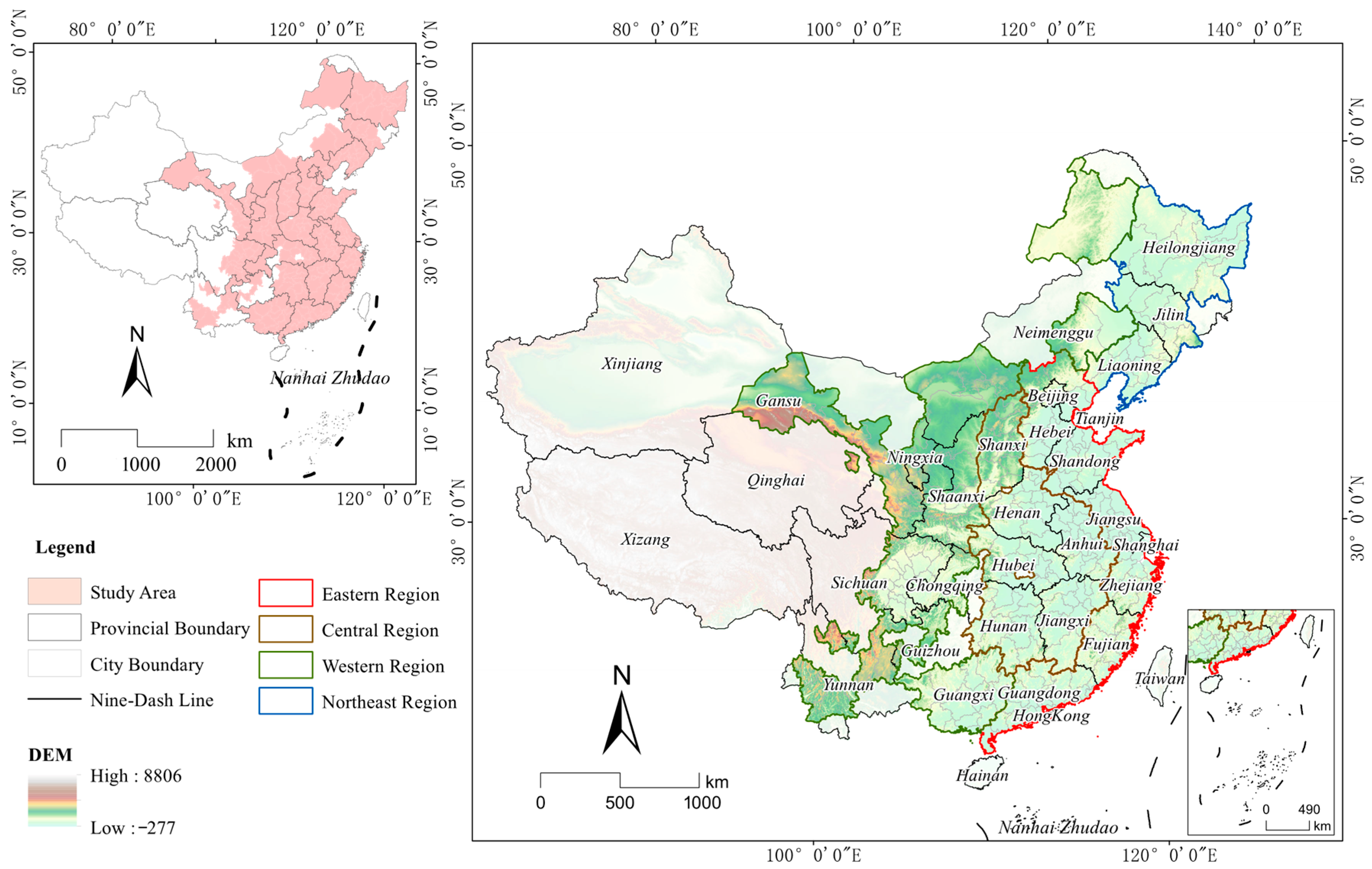
This study selects prefecture-level and above cities in China as the primary research subjects (excluding Hong Kong, Macao, and Taiwan). To ensure spatial continuity and data reliability, cities with severe data deficiencies or those subject to significant administrative division adjustments (e.g., merged or newly established units such as Chaohu, Jiyuan, and Bijie) were excluded. The final sample comprises 280 prefecture-level and above cities (Figure 1).

3.1.2. Index System

Emphasizing a “people-oriented” approach and sustainable development, NTU represents a significant paradigm shift. Drawing upon policy frameworks such as the ‘Five-Sphere Integrated Plan’ (encompassing economic, political, cultural, social, and ecological civilization construction) and the National New-type Urbanization Plan (2014–2020), and synthesizing existing scholarly findings [16,17,18], this study constructs a comprehensive evaluation index system. This system encompasses six dimensions: Population, Economy, Society, Space, Green, and Urban-Rural (Table 2), with indicator weights determined via the Entropy method.
Indicator selection follows the logic below. The population dimension embodies the core ‘people-centered’ principle by focusing on population scale, employment structure rationality, and social employment stability [13]. The economic dimension considers regional development and development logic of NTU through indicators like per capita GDP, industrial structure, and the share of fiscal spending on science and technology [19]. The social dimension highlights public service provision and social security system sophistication to demonstrate equity and welfare levels [20]. The spatial dimension employs indicators such as transport infrastructure development, land use scale, and efficiency to emphasize intensive utilization and rational layout [21]. The green dimension reflects ecological and environmental outcomes via indicators including built-up area green coverage, sewage treatment rate, and solid waste utilization rate [22]. The urban-rural dimension aims to narrow development gaps using indicators like the urban-rural income ratio, consumption ratio, and Engel coefficient ratio [23].

3.1.3. Data Sources and Processing

The primary datasets underpinning this study were derived from authoritative statistical publications, specifically the China City Statistical Yearbook, the China Urban-Rural Statistical Yearbook, and the China Urban-Rural Construction Statistical Yearbook [24,25]. To address sporadic missing data for specific cities or years and ensure temporal continuity of the panel data, a hybrid imputation strategy was employed. Specifically, singular missing values were filled using trend extrapolation based on the average growth rate of adjacent years, assuming a consistent developmental trend. For other missing observations, the Multiple Imputation (MI) method was utilized to ensure data integrity and minimize statistical bias [7,19].
Furthermore, to facilitate the subsequent analysis of regional heterogeneity, the 280 sample cities were categorized into four major economic regions—Eastern, Central, Western, and Northeastern China—based on their provincial administrative affiliations (Table 3).

3.2. Methodology

3.2.1. Measurement of Development Levels

To objectively quantify the development levels of the various dimensions of NTU, this study employs the Entropy-weighted TOPSIS method [26]. By determining indicator weights using information entropy, this data-driven approach reduces the bias associated with subjective weighting. It also provides an objective estimate of each indicator’s relative importance within the evaluation system. Subsequently, the TOPSIS method is utilized to calculate the development level of each dimension.
The specific calculation procedure is as follows: (1) First, the raw data were standardized to eliminate dimensional differences. Notably, for indicators in the Urban-Rural Dimension (which reflect the development gap, with values closer to 1 indicating better coordination), a reciprocal transformation was applied to convert them into positive indicators. Subsequently, all indicators were normalized based on their positive or negative attributes using the range method. (2) The information entropy (ej) was calculated to determine the dispersion of each indicator, which was then used to derive the objective weight (wj) for the j-th indicator. (3) A weighted decision matrix Z = (zij)m×n was constructed by multiplying the standardized matrix by the weight vector. Based on this, the positive ideal solution (Z+) and the negative ideal solution (Z) were identified. (4) The Euclidean distances (Dij+ and Dij) from the evaluation unit (city j in year i) to the positive and negative ideal solutions were computed using the following formulas (Equation (1)). (5) Finally, the relative closeness (U), representing the development level of each dimension for city j in year i, was calculated.
U i j = D i j D i j + + D i j ,   i = 1 , 2 , , m ,   j = 1 , 2 , , n

3.2.2. Measurement of CHQD

NTU is a complex socio-economic phenomenon. To evaluate its CHQD level, this study adopts a MCCD. This modification improves the validity of the coupling coordination degree model in sociological applications. Specifically, it addresses the concern that the coupling degree (C) is not uniformly distributed over the [0, 1] interval [27]. The calculation formulas are as follows (Equations (2)–(4)).
C = 1 i > j , j = 1 n ( U i U j ) 2 m = 1 n 1 m × ( i = 1 n U i max U i ) 1 n 1
T = i = 1 n a i × U i , i = 1 n a i = 1
D = C × T
where C denotes the coupling degree; T represents the comprehensive coordination index; D is the coupling coordination degree, indicating the level of CHQD in NTU; Ui signifies the development level of each dimension; and ai is the weight coefficient of each dimension. Consistent with previous studies that regard the six dimensions of NTU as equally important at the subsystem level, each dimension is assigned an equal weight of 1/6 [3,12].

3.2.3. GTWR Model

To examine spatio-temporal heterogeneity in the local sensitivity of CHQD to its internal dimensions, this study employs the GTWR model [28]. Extending geographically weighted regression (GWR), GTWR incorporates a temporal dimension to capture spatio-temporal non-stationarity while accounting for spatial heterogeneity [29]. Unlike global ordinary least squares (OLS), which assumes spatially and temporally invariant relationships, GTWR allows regression coefficients to vary with the spatio-temporal location of the observation.
Importantly, because CHQD is constructed from the same internal dimension indices used as explanatory variables, the local coefficient βk represents local sensitivity profiles (association intensity) rather than causal inference. This allows the model to capture how the relationship between CHQD and its components fluctuates across regions and development stages. This enables a spatio-temporal mapping of heterogeneity in the internal structure of CHQD [30]. The model is expressed as:
y i = β 0 u i , v i , t i + k = 1 6 β k u i , v i , t i x i k + ε i
where (ui, vi, ti) represents the spatio-temporal coordinates of the sample point i; β0(ui, vi, ti) is the intercept at that specific spatio-temporal location; xik denotes the k-th independent variable (explanatory variable) at sample point i; βk(ui, vi, ti) is the local coefficient, representing the local sensitivity of CHQD to the k-th dimension; εi is the random error term.

3.2.4. OPGD Model

This study adopts an internal structural attribution perspective. Using the OPGD, the study quantifies the explanatory power (q-statistic) of indicator-level factors for the spatially stratified heterogeneity of CHQD. It also tests whether pairs of indicators exhibit interaction enhancement in explanatory power. Traditional geographical detectors often rely on subjectively determined discretization methods, which can introduce bias into the results. OPGD addresses this issue by incorporating a parameter-optimization module: it iterates over five discretization schemes (natural breaks, equal intervals, quantiles, geometric intervals, and standard deviation) and evaluates q-statistic under 3–8 classes [6,31]. The optimal parameter combination is selected by maximizing the q-statistic, thereby providing a more objective assessment of (i) each indicator’s explanatory power for the spatially stratified heterogeneity of CHQD and (ii) interaction enhancement patterns among indicators. The core formula is given in Equation (6):
q = N σ 2 h = 1 L N h σ h 2 N σ 2
where q measures the explanatory power of an indicator regarding the spatial heterogeneity of CHQD; N and Nh represent the number of units in the entire study area and in stratum h, respectively; L is the number of strata (classes) of the indicator factor; σh2 and σ2 are the variances of CHQD in stratum h and the entire study area, respectively.

4. Results

4.1. Spatio-Temporal Characteristics

4.1.1. Analysis of Sub-Dimensions

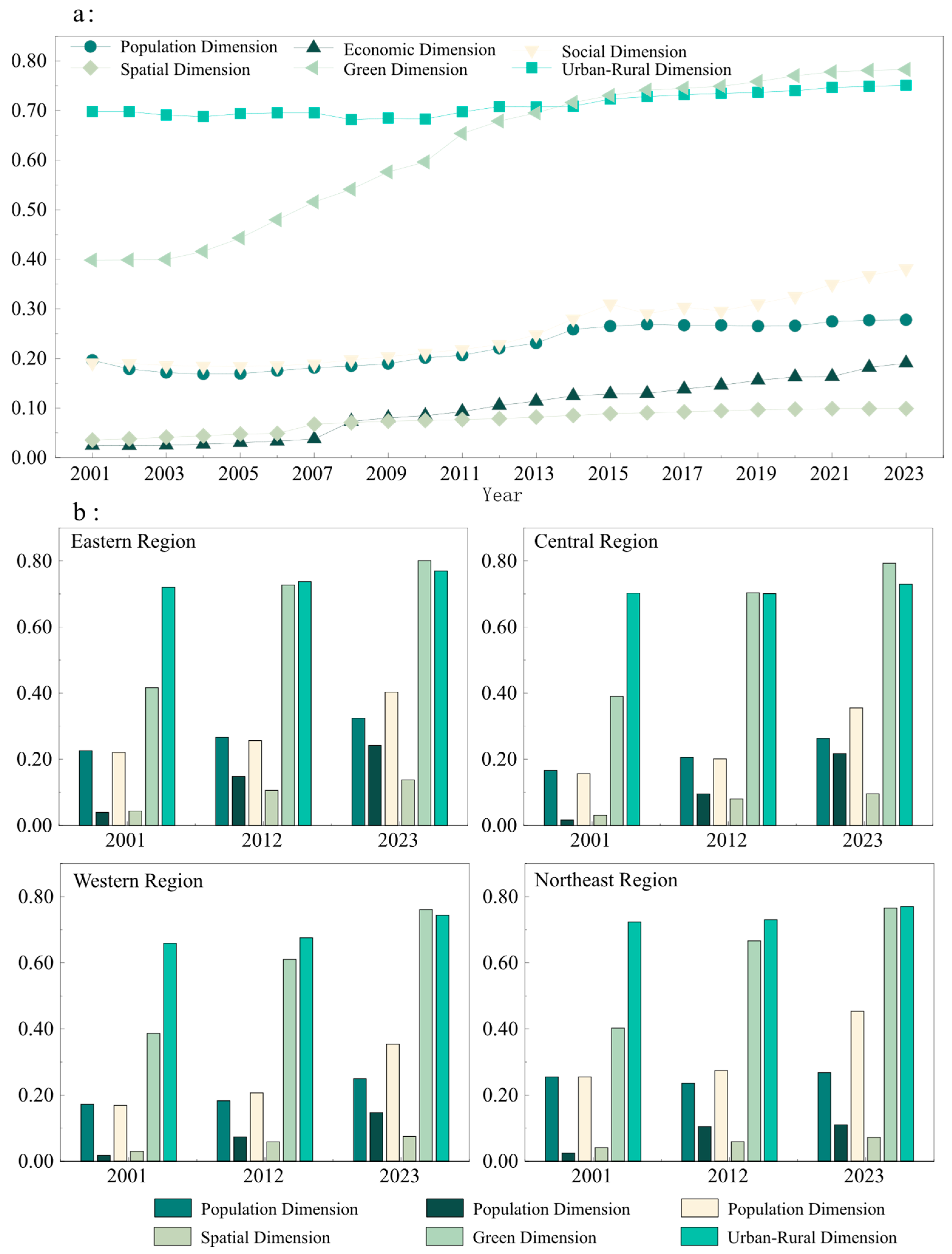
Based on the evaluation results, the development trends of the various dimensions of NTU are illustrated in Figure 2. The results indicate an overall upward trajectory across all dimensions, yet significant spatio-temporal heterogeneity persists.
In terms of temporal evolution, Figure 2a reveals a distinct tiered pattern in the development of these dimensions. The first tier comprises the green and urban-rural dimensions. Notably, the green dimension exhibited the fastest growth rate; driven by the impetus of “ecological civilization construction,” it ascended to the leading position in 2014 [32]. The urban-rural dimension remained consistently stable at approximately 0.700, reflecting the efficacy of policies guided by the goal of shared prosperity. The second tier includes the social and population dimensions. While both exhibited similar levels and steady growth in the early stages, the improvement rate of the social dimension (reaching 0.381 in 2023) slightly outpaced that of the population dimension (0.278 in 2023). The third tier consists of the economic and spatial dimensions, which represent significant shortcomings in the system. Furthermore, economic dimensions accelerated after 2008, surpassing spatial urbanization. By the end of the study period, their evaluation values stood at 0.191 and 0.099, respectively, indicating a gradual shift in urbanization dynamics from spatial expansion to economic quality enhancement.
Regarding regional disparities, Figure 2b shows that while the four major regions share common strengths, they differ in how they address their shortcomings. The commonality lies in the superior performance of all four regions in the green, urban-rural, and social dimensions. Specifically, green dimension levels in the eastern, central, and western regions have all ascended to the top rank. Additionally, by the end of the study period, the social dimension in the eastern and northeastern region reached 0.403 and 0.454, respectively. The divergence is evident in the fact that the central and eastern regions, benefiting from regional strategic promotion, are gradually addressing their economic shortcomings. In contrast, the northeastern region, constrained by structural contradictions such as resource depletion and population outflow, exhibits sluggish economic growth. Furthermore, it ranks last in spatial urbanization, highlighting significant pressure for transformation [33].

4.1.2. Analysis of CHQD

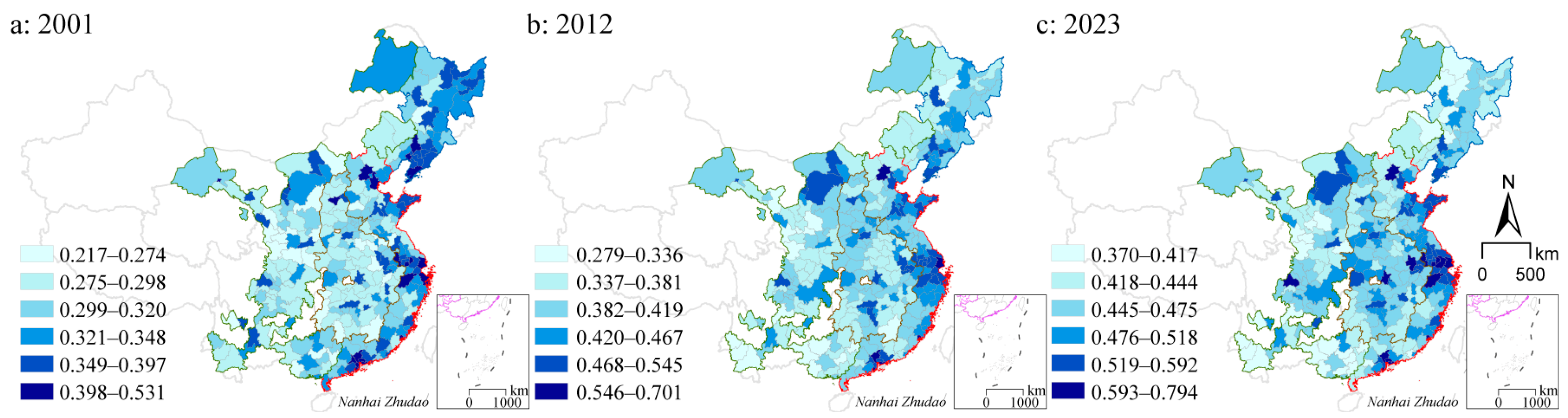
Based on the calculation results, Table 4 reports provincial CHQD in NTU across regions, while Figure 3 illustrates the spatial distribution. The data reveal that the CHQD in NTU of China exhibits distinct regional disparities and phasic characteristics.
Regarding regional disparities, the eastern region maintains a leading position in coordination, followed by the central region, while the western and northeastern regions remain relatively lower. Leveraging a robust socio-economic foundation, the eastern region sustained its advantage, with the mean value rising from 0.374 in 2001 to 0.552 in 2023. Notably, Beijing and Shanghai exceeded 0.670, entering a high-level coordination stage. Under the “Rise of Central China” strategy, the Central region’s mean rose to 0.478, with Hubei and Anhui emerging as new growth engines [34]. Although the Western and Northeastern regions achieved steady improvements (reaching year-end means of 0.460 and 0.454, respectively), they still face unbalanced development due to weak economic foundations and population outflows. Despite growth highlights in Chongqing (0.511) and Inner Mongolia (0.474), the overall growth rates in Guangxi, Yunnan, and the three Northeastern provinces remained relatively sluggish [35].
In terms of temporal evolution, NTU underwent a kinetic conversion from rapid expansion to quality and efficiency enhancement. From 2001 to 2011, CHQD experienced rapid growth. Large-scale infrastructure investment and economic expansion drove coordination improvements across most provinces. The strongest effects and highest growth rates were observed in the eastern provinces and parts of the central region. From 2012 to 2023, while the improvement in coupling coordination remained substantial, the growth rate moderated. This phase placed greater emphasis on addressing shortcomings of urbanization, particularly by coordinating economic, social, spatial, and green development, reflecting a gradual paradigm shift in NTU from “prioritizing speed” to “prioritizing quality” [36].
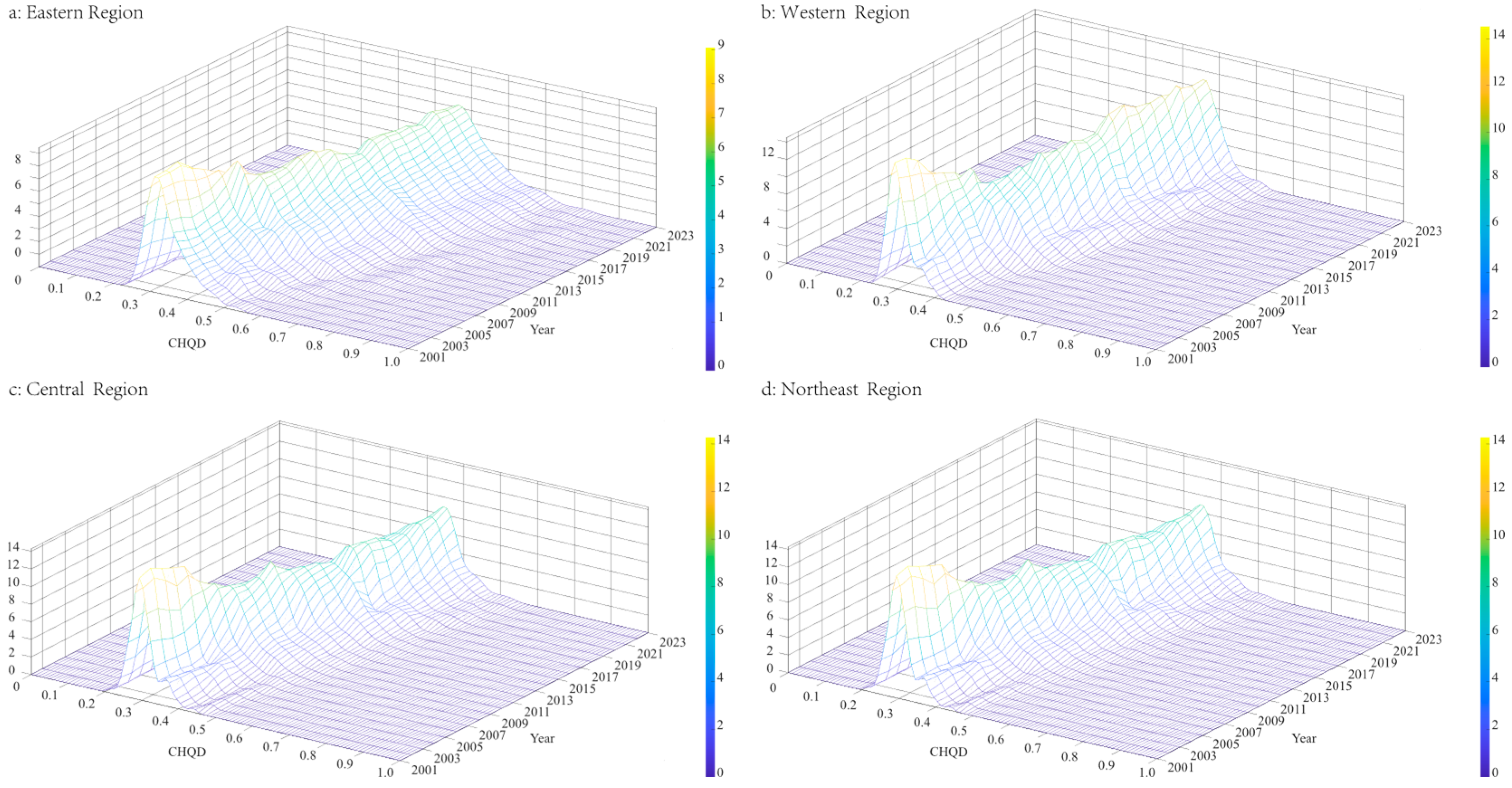
Furthermore, the 3D Kernel Density Estimation (KDE) model and Standard Deviation Ellipse (SDE) were utilized to explore the development trends (Figure 4) and pattern evolution (Table 5) of CHQD in NTU.
As shown in Figure 4, the distribution curves for all four regions shifted to the right by the end of the study period. This indicates a steady overall upward trend, although most cities remain in the medium-to-low coordination range and improvements differ across regions. Specifically, the eastern region exhibited a larger rightward shift (Figure 4a), with the centerline reaching approximately 0.48 by the end of the period. In contrast, the western and northeastern regions (Figure 4b,d) showed minor shifts, reaching only around 0.43. Secondly, the prominent peaks in all regions underwent an evolution of “descent followed by ascent,” with gradually increasing wave widths. The distribution morphology evolved from a step-like arrangement (one central peak and one side peak) in the early stage to a single-peak pattern. This phenomenon suggests that the extensibility of the CHQD distribution experienced a process of “widening-convergence,” ultimately showing a converging trend. Regarding distribution extensibility, all four regions exhibit right-tailed patterns. The eastern region shows the most pronounced outward extension of the right tail, indicating large disparities between low- and high-value cities.
The SDE results reveal a stable “Northeast-Southwest” orientation in the distribution of CHQD (Table 5). Both the long and short axes of the ellipse show a shrinking trend over time, with the long axis shrinking more, leading to a continuous decrease in oblateness (shape index). This indicates that the level of coordinated development tended toward spatial agglomeration during the study period, with weakened directionality. The continuous expansion of the azimuth angle reflects that the momentum of coupling coordination improvement in eastern cities generally outperformed that in the west. The center of gravity of the ellipse lies near Zhumadian City, Henan Province, indicating an overall migration path of “first Southeast, then Southwest.” The southeastward shift from 2001 to 2012 indicates strong development momentum in southeastern cities. The subsequent southwestward shift from 2012 to 2023 suggests a further strengthening of coordinated development in southern cities.

4.2. Spatio-Temporal Local Sensitivity Analysis

4.2.1. Model Construction and Verification

To systematically decompose the internal structure of the NTU system and characterize spatio-temporal non-stationarity of the local sensitivity of CHQD to its sub-dimensions, this study constructs a GTWR model. Before estimation, this study test for spatial autocorrelation in the dependent variable and diagnose potential multicollinearity among the explanatory variables [37]. First, Global Moran’s I is calculated to assess spatial dependence in CHQD. Second, the variance inflation factor (VIF) is used to evaluate multicollinearity among the six sub-dimensional indices. As shown in Table 6, the results indicate significant spatial autocorrelation in the dependent variable across all years (p < 0.01). Furthermore, all VIF values are below 7.5, indicating no severe multicollinearity among the six dimensions.
To reduce the sensitivity of GTWR results to location specification, four alternative coordinate representations are compared [38]. Schemes 1 and 2 adopt static representations using each city’s government-seat coordinates and geometric centroids, respectively. Scheme 3 adopts the GDP-weighted center of gravity to capture time-varying centers of economic activity. In contrast, Scheme 4 uses the population-weighted center of gravity to reflect shifts in population distribution. For all schemes, a fixed Gaussian kernel is used to construct the weighting matrix, and the bandwidth is selected by minimizing the AICc criterion in ArcGIS 10.8.
As reported in Table 7, the R2 and Adjusted R2 across schemes range from 0.810 to 0.866, indicating a generally good fit and supporting the presence of spatio-temporal non-stationarity in the local sensitivity profiles. Dynamic coordinate schemes generally outperform static ones. Notably, Scheme 4 achieves the highest goodness of fit (R2 = 0.866, Adjusted R2 = 0.863) and the lowest spatio-temporal distance ratio. Therefore, Scheme 4 is selected to characterize the spatio-temporal evolution of structural sensitivity in the subsequent analysis.

4.2.2. Analysis of GTWR Results

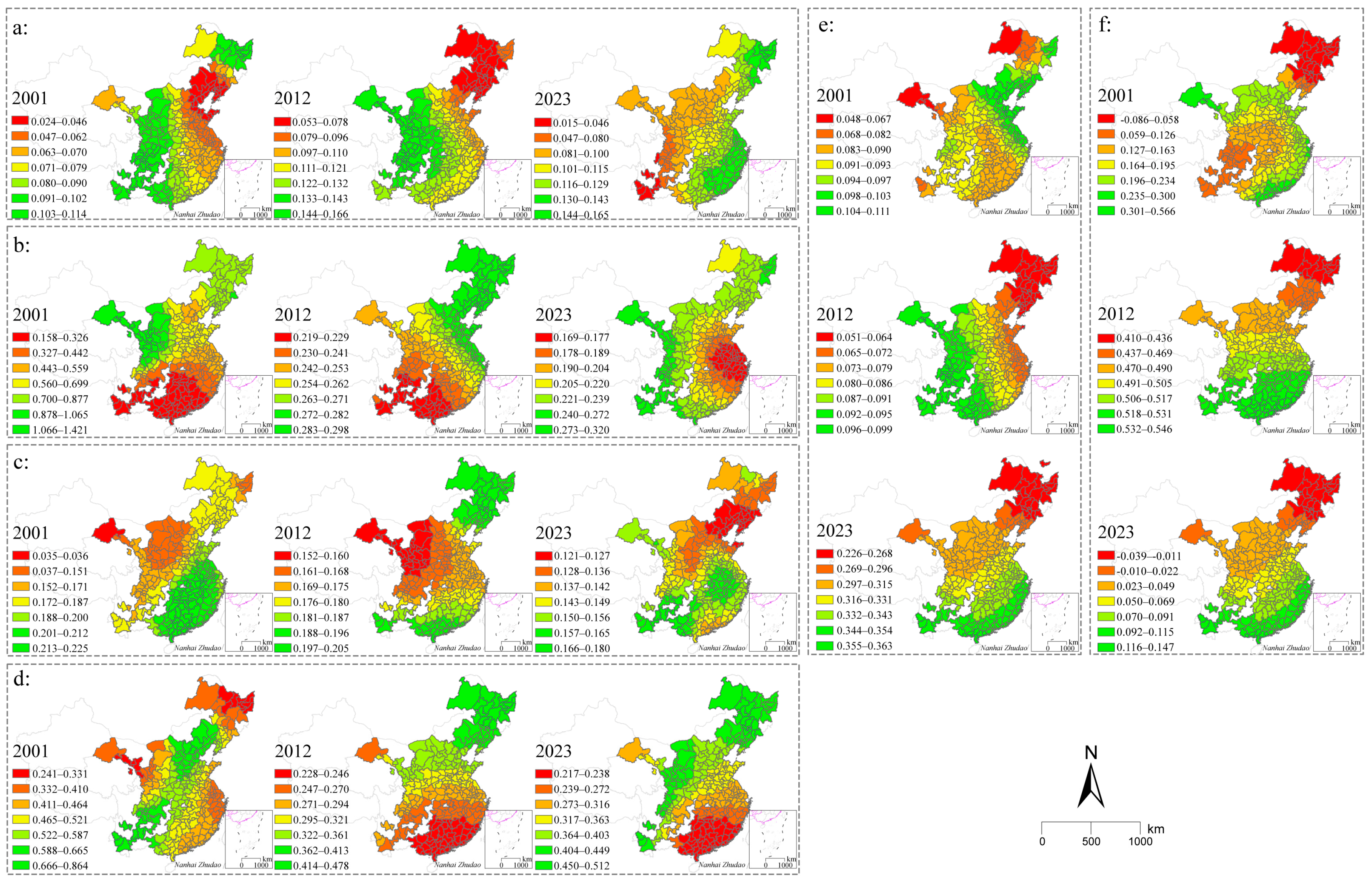
Based on the GTWR estimation results, the spatial distribution of regression coefficients for each dimension was mapped (Figure 5) to illustrate spatial heterogeneity in local sensitivity.
The population and economic dimensions exhibit diminishing marginal utility and structural shifts (Figure 5a,b). The median local sensitivity for the population dimension follows an inverted U-shaped trajectory, with values of 0.069, 0.110, and 0.090 in 2001, 2012, and 2023, respectively. High-value areas shifted from peripheral provinces like Heilongjiang and Yunnan in the early period to the southeastern coastal areas. This evolution suggests that in the early stages, the eastern regions benefited primarily from agglomeration effects associated with the “demographic dividend.” However, in the later stages, constrained by institutional barriers and the limited carrying capacity of public services, the marginal contribution of expanding population size alone to coordination diminished [39]. The sensitivity of the economic dimension continued to decline, with the median coefficient falling from 0.790 in 2001 to 0.245 in 2023. Low-value areas expanded from underdeveloped northwestern and northeastern regions to the periphery of the Yangtze River Delta. This phenomenon confirms the law of diminishing marginal returns: given the substantial economic base of the developed east, the marginal contribution of aggregate growth on coordination is significantly weaker than that in the Central and Western regions [40].
The social and urban-rural dimensions reveal distinct local sensitivity patterns, reflecting the shifting bottlenecks in urbanization (Figure 5c,f). The median coefficient for the social dimension first increased, then decreased, registering 0.130, 0.179, and 0.151, respectively, with high-value areas progressively clustering in the Yangtze River Delta urban agglomeration. This suggests that during the early and middle stages of urbanization, development priorities centered on infrastructure deficiencies. In contrast, in later stages, core regions like the Yangtze River Delta face more urgent demands for high-quality public services, making social services a key factor in enhancing coordination quality. The regression coefficient for the urban-rural dimension exhibits an inverted U-shaped evolution, with a spatial distribution pattern of ‘higher in the south, lower in the north’. In southern regions such as Fujian and Guangdong, robust county-level economies and urban-rural factor flows have amplified the positive feedback loop between integration and coordination. Conversely, northern regions still require extending infrastructure into rural areas to dismantle dual-structure barriers [41].
The median local sensitivity for the spatial dimension was 0.553, 0.353, and 0.365, respectively (Figure 5d). Although declining over time, these values remained higher than those of other dimensions. The Hu Huanyong Line clearly constrained high-value zones: in the southeastern half, diminishing marginal returns on spatial expansion arose from near-saturated land development intensity; in the northwestern half, urban development faced rigid constraints from topography and water resources [4]. Conversely, the local sensitivity for the green dimension continued to increase, reaching a median of 0.369 by the end of the study period (Figure 5e). High-value zones exhibited a diffusion trend from south to north and east to west. Eastern regions unleashed substantial ‘ecological dividends’ through industrial green transformation, emerging as new engines for high-quality development. Conversely, ecologically fragile western regions grappled with the trade-off between conservation and development, with synergistic mechanisms for green transformation still undergoing refinement [41].

4.3. Attribution of Spatial Heterogeneity and Dominant Drivers

To further identify the dominant drivers underlying the spatially stratified heterogeneity of CHQD, this study employs the OPGD. By iteratively applying five discretization methods and varying the number of classes (3–8), the optimal parameter combination for each explanatory variable is selected to estimate the explanatory power (q-statistic) of each factor and its interactions.

4.3.1. Evolution of Dominant Drivers

To reveal the temporal evolution of the drivers shaping regional differentiation, explanatory variables are ranked by their q-statistics for each region in representative years. The top five dominant drivers for 2001, 2012, and 2023 are presented in Table 8. The results indicate substantial regional variation in dominant-driver profiles.
As shown in Table 8, the core drivers in the eastern region center on population, economy, and spatial aspects. In 2001, employment structure (P2, 0.697) and pension coverage (S3, 0.693) ranked first and second, respectively. By 2012, the construction land ratio (L2, 0.847) had reached the highest level, reflecting the rapid spatial expansion characteristic of that period. In 2023, P2 (0.914) reclaimed the top spot, and industrial structure (E2, 0.827) remained prominent. This suggests that the eastern region has shifted beyond land-driven growth toward a stage emphasizing real-economy resilience and high-end service adaptation.
The central region exhibits a transition from spatial dependency to quality-driven development. In the early stage, dominant drivers were primarily spatial factors (L2, 0.522), whereas the economic foundation (E1, 0.769) became the leading driver in the middle stage. By the end of the study period, social services (S3, 0.857; S2, 0.855) replaced economic indicators as dominant drivers.
The western region transformed baseline constraints into endogenous circulation. Initially, it was heavily influenced by urban-rural relations (R2, 0.585). Following rapid urbanization driven by factors such as population (P1, 0.790) and social development (S2, 0.726) during the mid-period, the region evolved towards dual-engine growth driven by social services (S3, 0.803) and economic foundations (E1, 0.762) by the study’s conclusion, gradually aligning its development model with that of the eastern and central regions. Meanwhile, the northeast region remained persistently driven by spatial-dimension factors between 2001 and 2012. By the study’s conclusion, its per capita GDP (E1, 0.840) had surged to the top, indicating that economic recovery and reindustrialization are currently pivotal to enhancing the quality of urbanization in this region [24].

4.3.2. Analysis of Interaction Detection

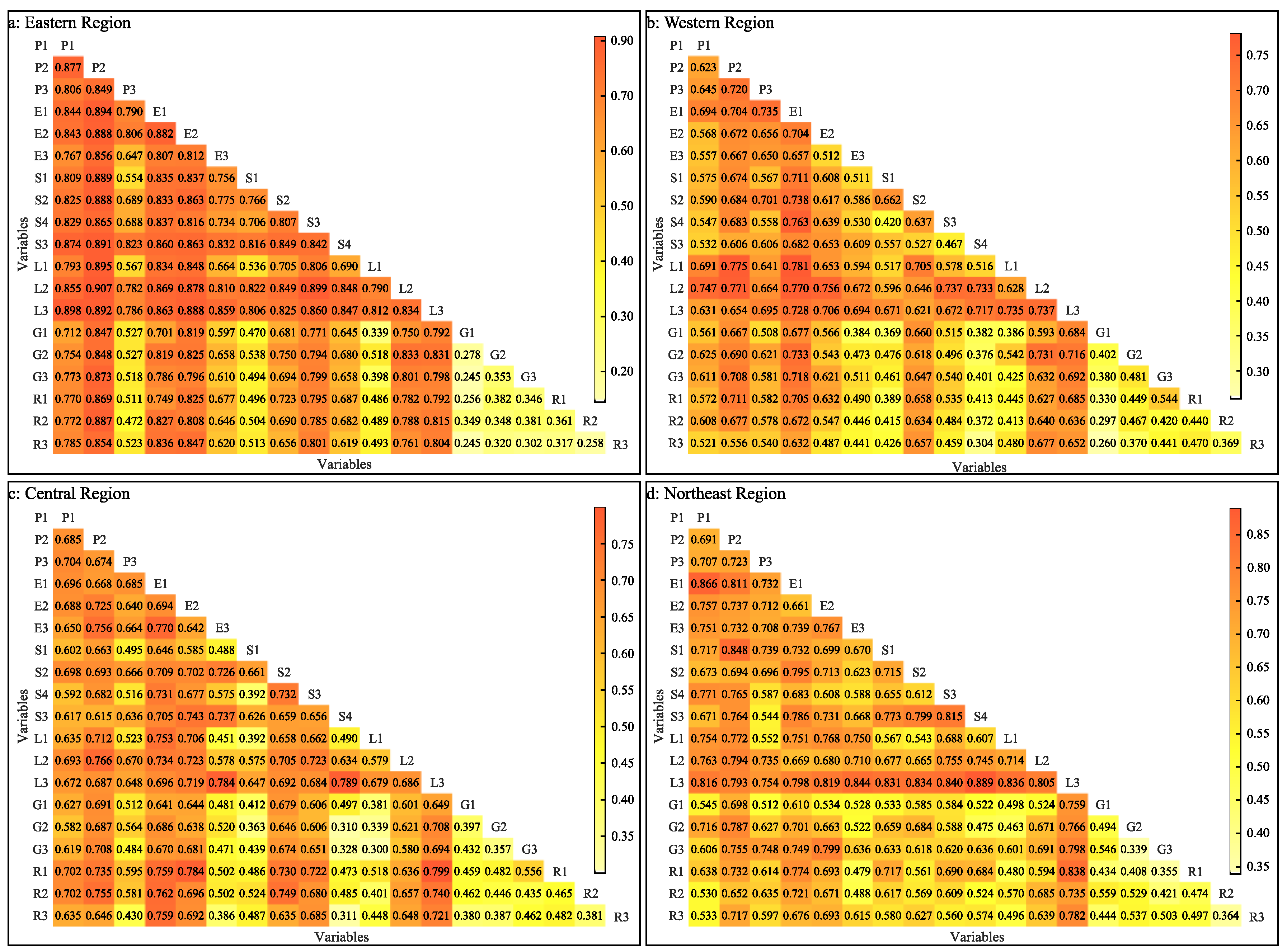
The interaction results (Figure 6) show that the q-statistics after pairwise interactions are generally higher than those of single factors. This pattern indicates predominantly bi-factor enhancement and, in some cases, nonlinear enhancement. Overall, interaction strength is highest in the eastern region, followed by the northeast and west, whereas the central region exhibits relatively weaker interactions.
The strong factor interactions in the eastern region primarily concentrate on elements P1, P2, E1, E2, L2, and L3. For instance, the interaction between P2 and L2/L1 yielded the most potent effects, with q of 0.907 and 0.895, respectively. This reflects that during rapid urbanization, the release of land and intensive investment in industrial capital generated a strong multiplier effect, thereby accelerating improvements in regional coordination. Conversely, weaker interactions were primarily found in the green and urban-rural dimensions.
For the central region, strong interactions are primarily observed within the economic and spatial dimensions, particularly involving E1, L1, L2, and L3. The interaction between E1 and L1 had the highest explanatory power (0.781), followed by the interaction between L1 and P2 (0.775). This pattern resembles the east’s earlier trajectory, where land release and capital investment drove coordination.
In contrast, the western and northeastern regions exhibit relatively weaker interactions, with strong interactions concentrated primarily in the population and land dimensions. In the northeast, strong interaction effects are focused on L3, reflecting the pivotal role of spatial urbanization in its CHQD. However, these results also suggest that a development path relying solely on infrastructure expansion or resource endowments is unlikely to be sustainable. Economic recovery is needed to finance public services. High-quality science-and-technology services can, in turn, support industrial upgrading and economic transformation.

5. Discussion and Implications

5.1. Discussion

This study integrates GTWR with OPGD to unveil the spatio-temporal evolution and internal structural logic of CHQD in NTU across 280 prefecture-level and above cities in China. The key findings and their implications are discussed below:
(1)
The CHQD in NTU exhibits a trend of tiered ascent and spatial convergence, with its gravitational center gradually shifting southwest. Empirical results indicate a steady improvement in the degree of coupling coordination throughout the study period. Moreover, the 3D KDE curves corroborate the findings of Wang et al. [27], revealing a narrowing trend in absolute regional disparities. This suggests that the polarization of China’s urbanization development is gradually diminishing. Dimensionally, the Green and Social dimensions witnessed the fastest growth, progressively superseding simple spatial expansion as new growth poles. This transition profoundly mirrors a fundamental paradigm shift in China’s urbanization model. Research indicates that prior to 2012, urbanization was primarily driven by factor inputs and industrialization [22]. Since the 18th National Congress of the CPC, as the “Ecological Civilization” and “people-oriented” philosophies have deepened, the development focus has pivoted toward ecological livability and the equalization of public services. This aligns with that green sustainable development may be emerging as the core dynamic of urbanization [8]. Additionally, the southwestward migration of the gravitational center likely correlates with national strategies such as the “Western Development” and regional coordinated development initiatives. Some studies attribute this pattern to a structural rebound in inland areas, arguing that late-developing regions are narrowing the gap with the coastal east by addressing deficits in infrastructure and livelihoods [20,42].
(2)
The sensitivity of CHQD to various dimensions is characterized by significant “diminishing marginal utility” and “shortcoming constraints,” resulting in pronounced spatial heterogeneity. GTWR analysis demonstrates that the sensitivity of the same dimension varies distinctively across regions. This spatial shift implies that as factor agglomeration in the east approaches a certain threshold, the marginal contribution of merely increasing population or capital input to coordination tends to decline. Existing research suggests that this phenomenon is likely linked to “congestion effects” overshadowing agglomeration economies in highly developed urban areas, where efficiency gains from scale expansion are diminishing [17]. Conversely, the central and western regions, currently in an accelerated phase of industrialization, appear to be reaping significant “structural dividends” from population return and industrial transfers [22]. Furthermore, rigid environmental constraints are increasingly evident. The green dimension has become a critical variable—especially in the fragile west and dense eastern agglomerations—and may act as a “veto player” that constrains or enhances coordination levels [28,34]. The dominant drivers in the northeast region further demonstrate the constraints imposed by factors such as resources and population, particularly the outflow of population and limited development space [33].
(3)
The dominant drivers shaping the spatial heterogeneity of CHQD appear to have undergone a cascade evolution from a “resource-space orientation” to an “innovation-service orientation,” with multi-factor synergies producing significant gains. The OPGD results reveal that in the early stages, the highest explanatory power stemmed from traditional factor accumulation, such as employment structure (P2) and construction land ratio (L2). By the end of the study period, the dominance shifted toward connotative indicators, particularly sci-tech expenditure (E3) and social dimensions. This further supports the perspective that China’s urbanization is shifting from simple factor mobility toward multidimensional coordination across ecological and social systems [22,24]. Interaction detection indicates that factor interactions exhibit bi-factor or non-linear enhancement effects. Specifically, distinctive regional synergies were identified. The east is characterized by deep integration between industry and services. The central region, by comparison, shows strong support for infrastructure development and industrial expansion. The west exhibits nonlinear activation between ecological conditions and public services. The northeast is marked by deep integration between economic development and science–education systems. These patterns are consistent with the “System Theory” perspective found in related studies, implying that NTU is not achieved through a single-dimensional breakthrough but likely results from a “positive resonance” among multiple subsystems [16,33].

5.2. Policy Implications

Based on the empirical findings and the analysis of influence mechanisms, the following implications are proposed to facilitate the transition of China’s NTU from a “speed-oriented” to a “quality-oriented” model:
(1)
Implement differentiated precision governance strategies based on factor endowment disparities. Given the significant spatio-temporal mismatch of core influence factors, policy formulation should abandon the homogeneous “one-size-fits-all” mode and instead adopt classification guidance based on regional comparative advantages. Eastern regions should leverage their strengths in deep industrial-service integration to prioritize the cultivation of new productive forces. By optimizing spatial structures to alleviate excessive population concentration, they should develop world-class, high-quality urban clusters. Central regions must seize the window of opportunity presented by the strong interaction between infrastructure and industry. Relying on transport hubs, they should systematically undertake industrial transfers, transforming existing infrastructure into incremental industrial development. Western regions should increase investment in soft infrastructure, particularly education and healthcare, given the nonlinear catalytic role of public services. This can help overcome geographical and baseline constraints and guide population concentration toward suitable key towns. Northeastern regions should deepen the symbiotic relationship between the economy and science/education. Institutional reforms are needed to activate existing science and education assets and convert them into drivers of real-economy recovery. Industrial revitalization should retain talent and resolve the challenges faced by shrinking cities.
(2)
Dismantle dependence on land finance and construct an endogenous momentum mechanism for “Human-Industry-City” integration. Empirical evidence shows a declining marginal contribution from spatial urbanization, while the influence of social and green dimensions continues to rise, indicating an urgent need to shift urbanization dynamics. Future policies must resolutely discard the extensive mode characterized by large-scale spatial expansion, shifting the focus from “expanding urban space” to “operating urban assets.” It is recommended that the assessment and evaluation system be reformed. Greater weight should be assigned to the urbanization rate of agricultural migrants, public service coverage, and ecological and environmental quality. Meanwhile, the weight assigned to construction land indicators should be reduced. Concurrently, a dynamic adjustment mechanism linking population to land allocation should be established to allocate construction land in response to changes in the resident population. This will compel cities to enhance the efficiency of existing spatial utilization through the renovation of aging neighborhoods and urban renewal, thereby shifting the influence force of urbanization from outward expansion to inward densification.
(3)
Strengthen systems thinking to leverage the synergistic efficiency of multi-dimensional factors. Interaction detection confirms that multi-factor synergy is significantly stronger than single-factor effects, suggesting that breakthroughs in a single dimension cannot achieve optimal results. At the policy implementation level, departmental barriers should be dismantled to strengthen integrated planning across industry, residential development, ecology, and services. For instance, when attracting investment, concurrently plan talent support measures; whilst advancing industrialization, simultaneously integrate green and low-carbon technologies. A virtuous cycle can strengthen system synergies: industrial upgrading attracts talent, population concentration raises tax revenue, fiscal capacity supports public services, and environmental quality further promotes factor agglomeration. This approach enables a spiral-like ascent across all subsystems of new urbanization.
(4)
Reinforce county-level carrier functions to remedy key shortcomings in urban-rural integration. Although the overall level of urban-rural integration is high, local fractures persist, and empirical results indicate that the urban-rural dimension holds immense potential for driving growth in the central and western regions. County-level areas, serving as pivotal nodes connecting urban and rural regions, should be granted greater authority to integrate resources, becoming the primary battleground for urban-rural integration. Future efforts should prioritize extending municipal utilities and public services to rural areas, establishing a tiered development framework anchored by county seats, central towns, and key villages. By facilitating the two-way flow of urban-rural resources, we can foster mutually beneficial interaction between rural labor migration and urban capital investment in rural development. This will smooth the transition from a dualistic urban-rural structure towards integrated development, thereby advancing the goal of shared prosperity.

6. Conclusions

Based on panel data from cities in China spanning 2001 to 2023, this study constructed a comprehensive six-dimensional evaluation index system. Building on the measurement of development levels for each subsystem, and evaluated the spatio-temporal evolution characteristics of CHQD in NTU using a MCCD. Furthermore, the GTWR model was introduced to perform a structural decomposition, investigating the spatio-temporal heterogeneity of the local sensitivity of CHQD to its sub-dimensions. Subsequently, the OPGD model was employed to identify the dominant explanatory indicators shaping the spatially stratified heterogeneity. The core findings are as follows:
(1)
CHQD exhibits a distinct trend of “tiered ascent” and spatial convergence. This is accompanied by a southwestward migration of the coordination center of gravity, indicating a narrowing of regional disparities and a weakening of polarization.
(2)
Structural decomposition reveals significant spatially stratified heterogeneity in local sensitivity. The coastal East faces “diminishing marginal utility” of traditional factor inputs, whereas the Central and Western regions continue to reap “structural dividends” from factor accumulation.
(3)
The dominant drivers shaping spatial heterogeneity have undergone a cascade evolution from a “resource-space” to an “innovation-service” orientation. Furthermore, nonlinear factor interactions confirm that high-quality urbanization relies on the “positive resonance” among multiple subsystems rather than single-dimensional breakthroughs.
However, this study is subject to certain limitations. First, constrained by the availability of macro-level statistical data, the analysis primarily operates at the prefecture-level city scale, making it challenging to precisely capture the details of urban-rural integration and internal spatial differentiation at the county and township micro-levels. Second, while the current evaluation system covers six core dimensions, subsequent analyses primarily characterize the spatial heterogeneity sensitivity and interpretive differences in CHQD across these dimensions within this framework. However, the incorporation of external factors influencing new-era urbanization—such as the digital economy, smart governance, and institutional environments—remains relatively inadequate. Future research could incorporate multi-source big data and high-resolution remote sensing imagery to extend the analysis to the county or grid unit level. Concurrently, aligning with the digital China strategy, expanding the breadth of evaluation indicators would enable more precise revelation of the dynamic mechanisms of evolution within China’s complex new urbanization system.

Author Contributions

Conceptualization, G.H.; methodology, L.Q.; software, Q.F.; validation, G.H. and L.Q.; formal analysis, L.Q.; investigation, L.Q. and Q.F.; resources, G.H.; writing—original draft preparation, L.Q. and Q.F.; writing—review and editing, G.H.; visualization, Q.F.; supervision, G.H.; project administration, G.H.; funding acquisition, G.H. All authors have read and agreed to the published version of the manuscript.

Funding

This research was funded by Huangshan Federation of Social Sciences: name of funder grant number hxkt2025150.

Institutional Review Board Statement

Not applicable.

Informed Consent Statement

Not applicable.

Data Availability Statement

The data presented in this study are available on request from the corresponding author.

Conflicts of Interest

The authors declare no conflicts of interest.

References

  1. Meng, Y.; Hao, Z.; Shang, S. Analysis of the Equalization Effect of Basic Public Services in New-Type Urbanization—A Case Study of County Regions in Guizhou, China. Heliyon 2024, 10, e39922. [Google Scholar] [CrossRef] [PubMed]
  2. Liu, Y.; Zhou, X. Does the New-Type Urbanization Policy Promote Green Technological Innovation? Evidence from a Quasi-Natural Experiment in China. Appl. Econ. 2026, 58, 501–516. [Google Scholar] [CrossRef]
  3. Wang, M.; Krstikj, A.; Liu, H. Planning Compact City in Rapidly Growing Cities—An Estimation of the Effects of New-Type Urbanization Planning in Hangzhou City. Land 2022, 11, 1907. [Google Scholar] [CrossRef]
  4. Chen, M.; Liu, W.; Lu, D.; Chen, H.; Ye, C. Progress of China’s New-Type Urbanization Construction since 2014: A Preliminary Assessment. Cities 2018, 78, 180–193. [Google Scholar] [CrossRef]
  5. Liu, L.; Liu, W.; Yang, L.; Zhang, X. The Drag Effect of Land Resources on New-Type Urbanization: Evidence from China’s Top 10 City Clusters. Sustainability 2025, 17, 7746. [Google Scholar] [CrossRef]
  6. Li, C.; Lei, T.; Wang, L. Examining the Decoupling Relationship between New-Type Urbanization and Carbon Emissions and Its Driving Factors in China: Evidence from 260 Cities. Stoch. Environ. Res. Risk Assess. 2024, 38, 4669–4695. [Google Scholar] [CrossRef]
  7. Zhao, Y.; Peng, Y.; Li, M.; Fan, S. Spatial–Temporal Coupling Characteristics and Interactive Effects of New-Type Urbanization and Cultivated Land Use Efficiency on Food Security. Agriculture 2026, 16, 243. [Google Scholar] [CrossRef]
  8. Wang, J.; Han, S.; Lin, H.; Wu, P.; Yuan, J. New-Type Urbanization Ecologically Reshaping China. Heliyon 2023, 9, e12925. [Google Scholar] [CrossRef]
  9. Chen, C.; Wang, S.; Liu, M.; Huang, K.; Guo, Q.; Xie, W.; Wan, J. Beyond Linearity: Uncovering the Complex Spatiotemporal Drivers of New-Type Urbanization and Eco-Environmental Resilience Coupling in China’s Chengdu–Chongqing Economic Circle with Machine Learning. Land 2025, 14, 1424. [Google Scholar] [CrossRef]
  10. Ma, L.; Wang, Q.; Tan, X.; Chen, Y.; Jiang, W. Identifying the Coupling Coordination Relationship between New-Type Urbanization and Cultivated Land Use Transition and Its Impact Mechanism—A Case Study of the Middle and Lower Reaches of the Yellow River in China. Agric. Syst. 2026, 232, 104568. [Google Scholar] [CrossRef]
  11. Li, Y.; Cao, X.-Y.; Feng, D.-C. A Numerical Model Database for Seismic Retrofitting of Existing RC Structures towards Urban Renewal. Bull. Earthq. Eng. 2025, 23, 3295–3325. [Google Scholar] [CrossRef]
  12. Yu, Y.; Zhao, K.; Du, Y. Nexus between New-Type Urbanization, Economic Development, and Haze Pollution in China: A Spatial Analysis. J. Urban Plan. Dev. 2024, 150, 04024043. [Google Scholar] [CrossRef]
  13. Yao, S.; Wang, Y.; An, L. People-Centred Development in China: The Impact of New-Type Urbanization on Migrants’ Labour Market Outcomes. Appl. Econ. 2025, 1–18. [Google Scholar] [CrossRef]
  14. Shi, L.; Lin, H.; Tan, B. The Impact of the Coupling Coordination between New-Type Urbanization and the Digital Economy on Ecological Efficiency. Int. Rev. Financ. Anal. 2025, 105, 104427. [Google Scholar] [CrossRef]
  15. Guo, D.; Kong, S.; Li, X.; Liu, Y.; Sun, W. Urbanization and Subjective Well-Being of Native Urban Residents: Evidence from the “New-Type Urbanization Pilot Policy” in China. Ann. Reg. Sci. 2025, 74, 4. [Google Scholar] [CrossRef]
  16. Cheng, H.; Li, Y.; Chen, Z.; Huang, Y.; Min, J.; Shi, W.; Zhang, L.; Ji, R. Coordination Degree between New Urbanization and the Construction of “Beautiful China”: A Case Study of Jiangsu Province. Ecol. Environ. Sci. 2026, 35, 29. [Google Scholar] [CrossRef]
  17. Xing, G.; Xudong, L.; Xuan, C.; Zhiwen, Y.; Minghao, C. Impact of Human Capital Accumulation on New-Type Urbanization in the Context of Large-Scale Population Mobility: A Case Study of the Mountain Cities in Guizhou Province. J. Resour. Ecol. 2025, 16, 1797–1810. [Google Scholar] [CrossRef]
  18. Yang, X.; Jia, Z.; Yang, Z. How new-type urbanization pilots reduce carbon emissions: A technology progress paths perspective. J. Clean. Prod. 2023, 401, 136663. [Google Scholar] [CrossRef]
  19. Zhang, G.; Xing, L. Research on Tourism Economic Effect under the Threshold of New-Type Urbanization in Coastal Cities of China: From the Perspective of Development Economics. Ocean Coast. Manag. 2023, 239, 106587. [Google Scholar] [CrossRef]
  20. Yuan, C.; Zhang, B.; Xu, J.; Lyu, D.; Liu, J.; Hu, Z.; Han, Y. Impact of New-Type Urbanization Pilot Policy on Public Service Provision: Evidence from China. Cities 2025, 161, 105853. [Google Scholar] [CrossRef]
  21. Sun, D.; Zhou, L.; Li, Y.; Liu, H.; Shen, X.; Wang, Z.; Wang, X. New-Type Urbanization in China: Predicted Trends and Investment Demand for 2015–2030. J. Geogr. Sci. 2017, 27, 943–966. [Google Scholar] [CrossRef]
  22. Liu, C. Spatiotemporal Evolution and Influencing Factors of Coordinated Development between Cultivated Land Use Eco-Efficiency and New-Type Urbanization: Insights from Henan Province, China. Front. Environ. Sci. 2025, 13, 1633927. [Google Scholar] [CrossRef]
  23. Chen, N. The Impact of the Rural Digital Economy on China’s New-Type Urbanization. PLoS ONE 2025, 20, e0321663. [Google Scholar] [CrossRef]
  24. Wang, J.; Luo, X.; Liang, X.; Ning, C. New-Type Urbanization and Regional Public Health: Mechanisms and Effects. Front. Public Health 2025, 13, 1513173. [Google Scholar] [CrossRef]
  25. Li, H.; Song, W. Evolution of Rural Settlements in the Tongzhou District of Beijing under the New-Type Urbanization Policies. Habitat Int. 2020, 101, 102198. [Google Scholar] [CrossRef]
  26. Yang, T.; Zhou, C.; Xiao, T.; Xu, Q. Coordinated Development of the Digital Economy and Urban–Rural Integration in the Yangtze River Delta and Its Spatial Correlation Structure. Sustainability 2025, 17, 4144. [Google Scholar] [CrossRef]
  27. Wang, S.; Wei, K.; Liang, R.; Dan, Z.; Dai, B. Research on misuses and modification of coupling coordination degree model in China. J. Nat. Resour. 2021, 36, 793–810. [Google Scholar] [CrossRef]
  28. Geng, Y.; Jiang, P.; Xu, X.; Yao, W.; Zhang, J. Spatio-Temporal Evolution and Influencing Factors of Coupling Coordination between New Urbanization and Ecological Environment in Shaanxi Province, China, (2010–2020), Based on Geodetector and GWR. Environ. Dev. Sustain. 2025, 1–32. [Google Scholar] [CrossRef]
  29. Xue, B.; Xiao, X.; Li, J.; Zhao, B.; Fu, B. Multi-Source Data-Driven Identification of Urban Functional Areas: A Case of Shenyang, China. Chin. Geogr. Sci. 2023, 33, 21–35. [Google Scholar] [CrossRef]
  30. Xue, Y.; Li, Y.; Xu, W.; Sunhee, S.; Triana, N.; Song, X.; Liu, F.; Wang, L.; Liu, Y. Coupling Coordination Degree Analysis and Spatiotemporal Heterogeneity between Tourism Economy and Ecosystem Service Value in China. Ecol. Indic. 2026, 182, 114559. [Google Scholar] [CrossRef]
  31. Cen, Q.; Zhou, X.; Qiu, H. Exploration of Urban Neighborhood Blue-Green Space Quality Patterns and Influencing Factors in Waterfront Cities Based on MGWR and OPGD Models. Urban Clim. 2024, 55, 101942. [Google Scholar] [CrossRef]
  32. Gao, X.; Yan, X.; Song, S.; Xu, N. The Impact and Mechanism of New-Type Urbanization on New Quality Productive Forces: Empirical Evidence from China. Sustainability 2025, 17, 353. [Google Scholar] [CrossRef]
  33. Zhao, N. Mechanism and Empirical Evidence on New-Type Urbanization to Narrow the Urban–Rural Income Gap: Evidence from China’s Provincial Data. PLoS ONE 2024, 19, e0270964. [Google Scholar] [CrossRef]
  34. Ran, X.; Zhang, B.; Ding, R.; Jiang, S.; Yuan, J.; Zheng, Y.; Yang, C. Application of Explainable Machine Learning in the Study of Urban Ecological Economic Resilience. Ecol. Model. 2026, 511, 111368. [Google Scholar] [CrossRef]
  35. Zhang, R.; Bao, Q. Evolutionary Characteristics, Regional Differences and Spatial Effects of Coupled Coordination of Rural Revitalization, New-Type Urbanization and Ecological Environment in China. Front. Environ. Sci. 2024, 12, 1510867. [Google Scholar] [CrossRef]
  36. Gu, T.; Huang, Q.; Chen, M.; He, C.; Zhu, G.; Hou, Y.; Zhou, Y.; Yue, K.; Zhang, M.; Zhang, S. Does People Oriented Urbanization Catch up with Land and Population Urbanization. Npj Urban Sustain. 2025, 5, 61. [Google Scholar] [CrossRef]
  37. Wang, H.; Zhang, B.; Liu, Y.; Liu, Y.; Xu, S.; Zhao, Y.; Chen, Y.; Hong, S. Urban Expansion Patterns and Their Driving Forces Based on the Center of Gravity-GTWR Model: A Case Study of the Beijing-Tianjin-Hebei Urban Agglomeration. J. Geogr. Sci. 2020, 30, 297–318. [Google Scholar] [CrossRef]
  38. Jiang, F.; Chen, B.; Li, P.; Jiang, J.; Zhang, Q.; Wang, J.; Deng, J. Spatio-Temporal Evolution and Influencing Factors of Synergizing the Reduction of Pollution and Carbon Emissions-Utilizing Multi-Source Remote Sensing Data and GTWR Model. Environ. Res. 2023, 229, 115775. [Google Scholar] [CrossRef] [PubMed]
  39. Wang, Y.; Wang, L. New-Type Urbanization and Rural Revitalization: A Study on the Coupled Development of the Yangtze River Economic Belt, China. PLoS ONE 2025, 20, e0314724. [Google Scholar] [CrossRef]
  40. Dong, S.; An, H.; Dong, S. Exploring the Spatial Interaction Relationship between New-Type Urbanization and Ecological Vulnerability. Ecol. Model. 2026, 513, 111427. [Google Scholar] [CrossRef]
  41. Wang, X.; Zhang, J.; Zhang, F. Spatiotemporal Assessment of New-Type Urbanization and Rural Revitalization Coupling in China, 2014–2023: Implications for Spatial Planning. Land 2025, 14, 2404. [Google Scholar] [CrossRef]
  42. Liu, X.; Zhao, G. Spatial Effects of New Urbanization, Industrial Structure Upgrading, and Farmers’ Income: A Case Study of Northeast China. Sustainability 2026, 18, 592. [Google Scholar] [CrossRef]
Figure 1. Study Area: This map was produced from the standard map with approval number GS(2023)2767, downloaded from the Standard Map Service Website of the Ministry of Natural Resources of the People’s Republic of China. The base map remains unmodified.
Sustainability 18 02459 g001
Figure 2. NTU Development Trend: (a) Evolutionary trends across all dimensions in China; (b) Regional development trends for each dimension.
Sustainability 18 02459 g002
Figure 3. Space Distribution of CHQD.
Sustainability 18 02459 g003
Figure 4. Three-dimensional Kernel Density Trend of CHQD.
Sustainability 18 02459 g004
Figure 5. Distribution of Local Sensitivity for Each Dimension of NTU: (a) Population Dimension; (b) Economic Dimension; (c) Social Dimension; (d) Spatial Dimension; (e) Green Dimension; (f) Urban-Rural Dimension.
Sustainability 18 02459 g005
Figure 6. Factor Interaction Heatmap by Region: P1–R3 represent the indicators defined in Table 2.
Sustainability 18 02459 g006
Table 1. Differences between Traditional Urbanization and New-type urbanization.
DimensionTraditional UrbanizationNew-Type Urbanization
Core value orientationGrowth-first: efficiency gains via factor concentration; industrial expansion and rapid absorption of rural migrants into citiesPeople-oriented: improved quality of life; green and inclusive development; balanced and coordinated outcomes
Development logicIncremental, expansion-led development, where scale enlargement (land, industry, and population) is the primary pathwayConnotative development emphasizing stock optimization, structural upgrading, and quality improvement rather than pure scale growth
Spatial manifestationExtensive land/space expansion; rapid built-up growth; persistent urban–rural separationSpatial optimization and intensive land use; improved functional quality; strengthened urban–rural integration and coordination
Driving mechanism
(i)
Expansion of secondary and tertiary industries;
(ii)
Rural-to-urban migration;
(iii)
Agglomeration of production factors to raise productivity and accelerate economic growth
(i)
Industrial upgrading;
(ii)
Enhanced governance capacity;
(iii)
Ecological constraints and green transition;
(iv)
Improved public service provision;
(v)
Multi-dimensional coupling
Evaluation criteriaUrban population ratio, urbanization rate, and scale indicators dominateEmphasizes quality of life, green performance, equity, and coordinated development
Typical policy instrumentsIndustrial park expansion, land conversion, and infrastructure-led growthDifferentiated strategies including:
(i)
Strengthening social security and promoting migrant citizenization;
(ii)
Optimizing urbanization scale and spatial layout through territorial spatial planning;
(iii)
Land-system reform balancing public ownership and property rights
Table 2. Multidimensional NTU Evaluation Index System.
Target LayerIndicator LayerCodeDescription/FormulaAttributeWeight
Population DimensionUrbanization RateP1Urban resident population/Total resident population+0.326
Employment StructureP2Employees in secondary and tertiary industries/Total employees+0.468
Unemployment RateP3Registered unemployed persons/Total resident population0.206
Economic DimensionGDP per CapitaE1Regional GDP/Total resident population+0.416
Industrial StructureE2Output value of primary industry/Output value of secondary and tertiary industries0.379
Sci-Tech ExpenditureE3Science and technology expenditure/Total fiscal expenditure+0.205
Social DimensionEducation ExpenditureS1Education expenditure/Total fiscal expenditure+0.166
Medical PersonnelS2(Licensed doctors/Total resident population)\times 1000+0.301
Pension CoverageS3Number of insured people/Total resident population+0.215
Public Library BooksS4Number of library books/Total resident population+0.318
Spatial DimensionRoad Network DensityL1Total highway mileage/Administrative area+0.260
Construction Land RatioL2Built-up area/Administrative area+0.437
Land Use IntensityL3Built-up area/Total resident population+0.302
Green DimensionGreen CoverageG1Green coverage area/Built-up area+0.259
Sewage Treatment RateG2Treated sewage volume/Total sewage discharge+0.438
Solid Waste UtilizationG3Reutilized industrial solid waste/Total industrial solid waste generated+0.303
Urban-Rural DimensionDisp. Income RatioR1Urban per capita disposable income/Rural per capita disposable income+0.366
Consumption RatioR2Urban per capita consumption/Rural per capita consumption+0.391
Engel Coefficient RatioR3Urban Engel coefficient/Rural Engel coefficient+0.243
Note: + and − indicate the positive and negative attributes of the indicators, respectively; GDP stands for Gross Domestic Product.
Table 3. Division of the Study Area.
RegionProvinces/Municipalities
Eastern RegionBeijing, Tianjin, Hebei, Shanghai, Jiangsu, Zhejiang, Fujian, Shandong, Guangdong
Central RegionShanxi, Anhui, Jiangxi, Henan, Hubei, Hunan
Western RegionInner Mongolia, Guangxi, Chongqing, Sichuan, Guizhou, Yunnan, Shaanxi, Gansu, Qinghai, Ningxia
Northeastern RegionLiaoning, Jilin, Heilongjiang
Table 4. The Provincial CHQD Across Regions.
RegionProvince20012006201220172023RegionProvince20012006201220172023
Eastern RegionBeijing0.4600.4930.5880.6140.673Northeastern RegionLiaoning0.3560.3740.4380.4460.472
Tianjin0.4180.4530.5170.5670.586Jilin0.3180.3320.4010.4270.448
Hebei0.3040.3310.3930.4280.450Heilongjiang0.3410.3450.3960.4110.444
Shanghai0.4560.5220.5920.6380.683Regional Mean0.3390.3500.4120.4280.454
Jiangsu0.3420.3870.4590.5100.534Western RegionInner Mongolia0.3210.3500.4180.4500.474
Zhejiang0.3510.3880.4700.5060.538Guangxi0.3000.2900.3520.3910.423
Fujian0.3350.3540.4310.4640.506Chongqing0.2910.3430.4230.4680.511
Shandong0.3340.3660.4400.4750.495Sichuan0.3000.3110.3830.4220.459
Guangdong0.3640.3740.4490.5030.506Guizhou0.2910.3020.3790.4420.474
Regional Mean0.3740.4080.4820.5230.552Yunnan0.3070.3000.3500.3920.422
Central RegionShanxi0.3070.3320.4090.4220.458Shaanxi0.2890.3130.3890.4260.459
Anhui0.3080.3250.4110.4430.484Gansu0.3010.3140.3650.4130.443
Jiangxi0.3130.3180.3930.4340.476Qinghai0.3010.3320.4130.4520.468
Henan0.3050.3270.4070.4380.484Ningxia0.3310.3410.3990.4290.461
Hubei0.3130.3280.4150.4640.497Regional Mean0.3030.3200.3870.4280.459
Hunan0.2940.3110.4010.4270.467Overall Mean0.3310.3500.4220.4540.486
Regional Mean0.3070.3240.4060.4380.478
Table 5. Standard Deviation Ellipse Coefficients of CHQD.
YearSemi-Major Axis/kmSemi-Minor Axis/kmAzimuth/°Center CoordinateShape IndexArea/km2
20011146.354710.64646.522114°33′27.738″ E, 32°58′44.969″ N0.3802,559,302.540
20121117.165707.14346.554114°33′48.719″ E, 32°58′10.380″ N0.3672,481,843.331
20231109.871706.97946.971114°25′45.577″ E, 32°51′52.913″ N0.3632,465,068.397
Table 6. Spatial Autocorrelation of Dependent Variables and VIF Coefficients.
YearMoran’s IVIF
ScoreVarianceZpConfidencePopulationEconomySocietySpaceGreenUrban-Rural
20010.2730.00043013.3370.0010.992.1371.6142.2012.1611.0461.084
20120.3180.00042915.5240.0010.993.4592.2172.9001.5671.1671.244
20230.310.00042715.1710.0010.994.1392.3642.0761.8341.1021.115
Table 7. Estimation results of the GTWR model.
Metric Scheme 1 Scheme 2 Scheme 3 Scheme 4
Bandwidth683,125.835554,519.315602,263.507402,747.986
Residual Squares1.1720.8561.2451.075
Sigma0.0390.0320.0390.039
AICc−2458.232−2412.648−2496.995−2498.661
R20.8110.8250.8310.866
Adjusted R20.810 0.8230.8280.863
Spatio-temporal Distance Ratio1.8211.6551.5461.122
Table 8. Dominant Drivers of CHQD across regions.
ItemNO. 1NO. 2NO. 3NO. 4NO. 5
FactorsqFactorsqFactorsqFactorsqFactorsq
Eastern Region2001P20.697 ***
(0.000)
S30.693 ***
(0.000)
E10.689 *
(0.045)
S20.676 *
(0.048)
L30.649 ***
(0.000)
2012L20.847 ***
(0.000)
P10.839 ***
(0.000)
P20.838 ***
(0.000)
E20.830 ***
(0.000)
E10.796 ***
(0.000)
2023P20.914 ***
(0.000)
S30.829 ***
(0.000)
E20.827 ***
(0.000)
E10.819 ***
(0.000)
L20.791 ***
(0.000)
Central Region2001L20.522 ***
(0.000)
L10.345 ***
(0.000)
P30.332 ***
(0.000)
G30.325 ***
(0.000)
S10.309
(0.146)
2012E10.769 **
(0.006)
L30.727
(0.210)
L20.655 *
(0.041)
P10.639 *
(0.031)
S20.624
(0.354)
2023S30.857 ***
(0.000)
S20.855 ***
(0.000)
L30.832 ***
(0.000)
E10.818 ***
(0.000)
S40.811 ***
(0.000)
Western Region2001R20.585 ***
(0.000)
R10.488 ***
(0.000)
R30.455 ***
(0.000)
E10.287
(0.174)
P20.243 **
(0.005)
2012P10.790 ***
(0.000)
P20.772 ***
(0.000)
S20.726 ***
(0.000)
L30.708 ***
(0.000)
E20.659 ***
(0.000)
2023S30.803 ***
(0.000)
P20.792 ***
(0.000)
E10.762 ***
(0.000)
S20.757 ***
(0.000)
L30.741 ***
(0.000)
Northeastern Region2001L30.641 **
(0.004)
P20.461 *
(0.037)
P10.424 *
(0.043)
L10.399 *
(0.015)
G30.345 *
(0.048)
2012L30.764 ***
(0.000)
P30.689
(0.280)
P20.670 *
(0.044)
L20.637 *
(0.032)
E10.600 **
(0.001)
2023E10.840 ***
(0.000)
L20.708 ***
(0.000)
S30.679
(0.526)
P20.671 ***
(0.000)
L30.669 **
(0.002)
Note: *, **, and *** denote significance levels of 0.05, 0.01, and 0.001, respectively; The codes (e.g., P1, E1) refer to the specific indicators defined in Table 2.
Disclaimer/Publisher’s Note: The statements, opinions and data contained in all publications are solely those of the individual author(s) and contributor(s) and not of MDPI and/or the editor(s). MDPI and/or the editor(s) disclaim responsibility for any injury to people or property resulting from any ideas, methods, instructions or products referred to in the content.