Spatio-Temporal Local Sensitivity and Structural Attribution of Coordinated High-Quality New-Type Urbanization Towards Sustainable Development in China: Evidence from GTWR and OPGD Models
Abstract
1. Introduction
2. Literature Review
2.1. Theoretical Evolution of NTU
2.2. Methodologies in Evaluation and Driver Analysis
2.3. Review of the Study
3. Materials and Methods
3.1. Study Area and Data Sources
3.1.1. Study Area
3.1.2. Index System
3.1.3. Data Sources and Processing
3.2. Methodology
3.2.1. Measurement of Development Levels
3.2.2. Measurement of CHQD
3.2.3. GTWR Model
3.2.4. OPGD Model
4. Results
4.1. Spatio-Temporal Characteristics
4.1.1. Analysis of Sub-Dimensions
4.1.2. Analysis of CHQD
4.2. Spatio-Temporal Local Sensitivity Analysis
4.2.1. Model Construction and Verification
4.2.2. Analysis of GTWR Results
4.3. Attribution of Spatial Heterogeneity and Dominant Drivers
4.3.1. Evolution of Dominant Drivers
4.3.2. Analysis of Interaction Detection
5. Discussion and Implications
5.1. Discussion
- (1)
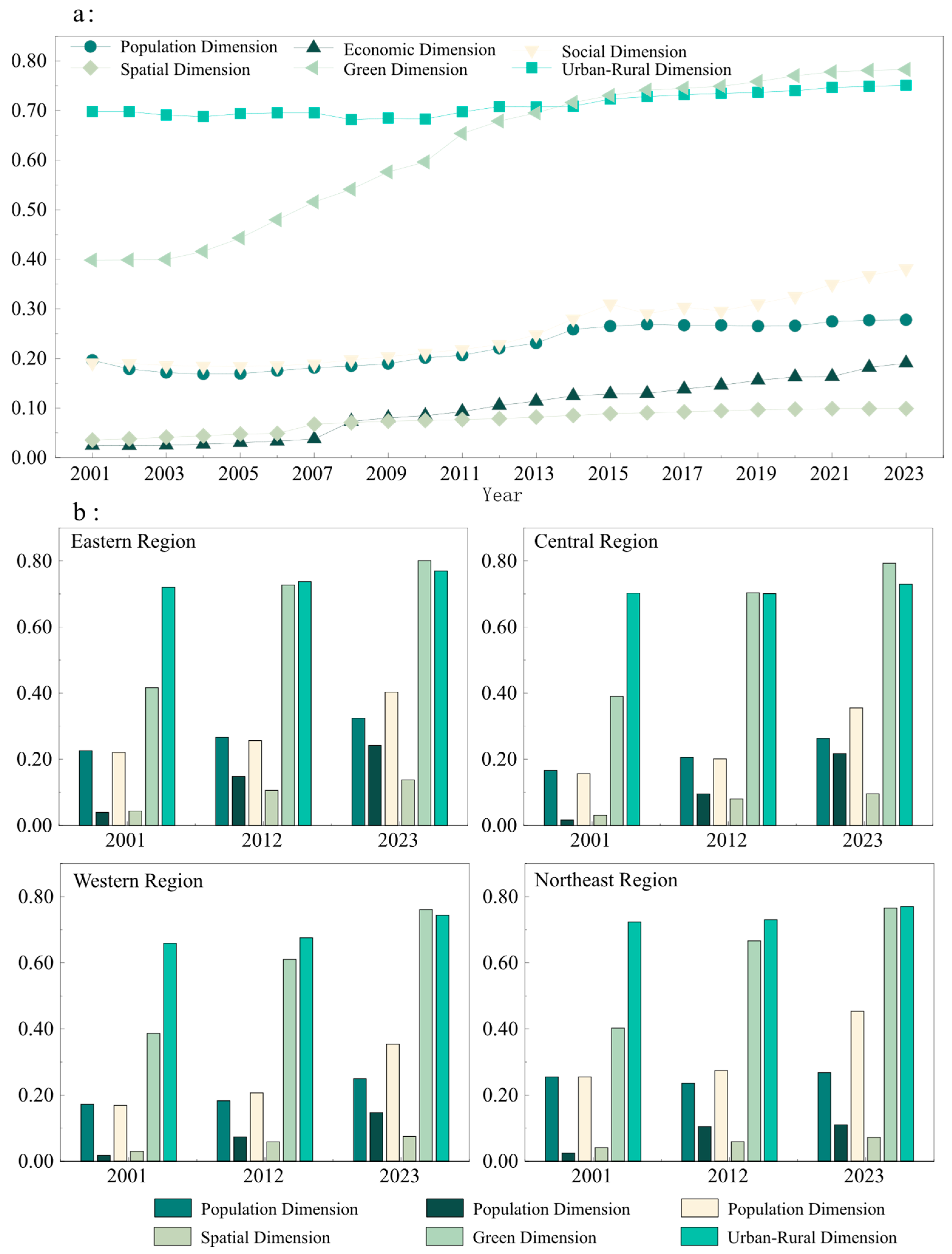
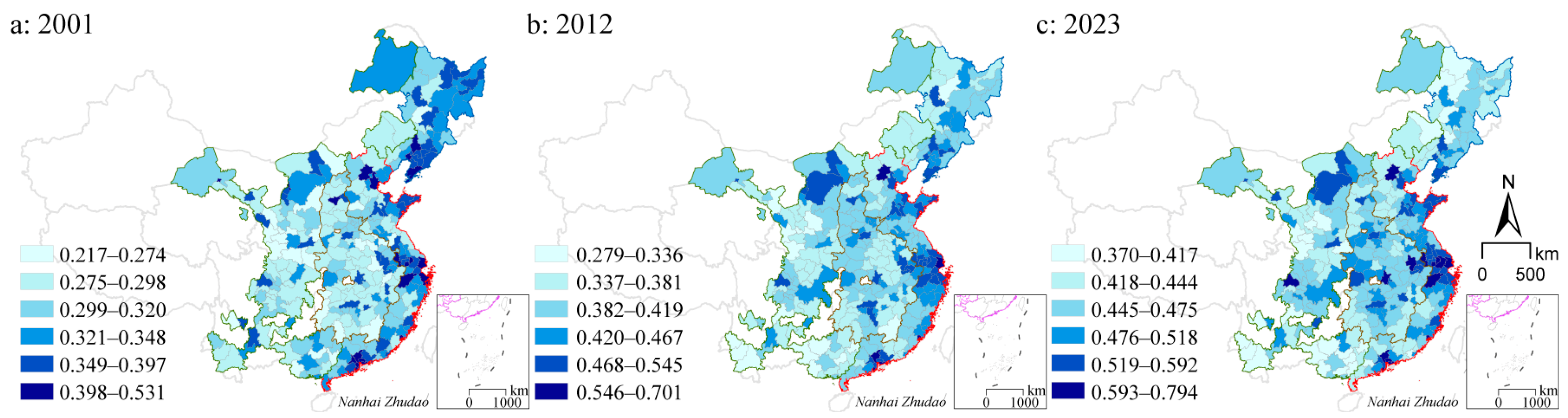
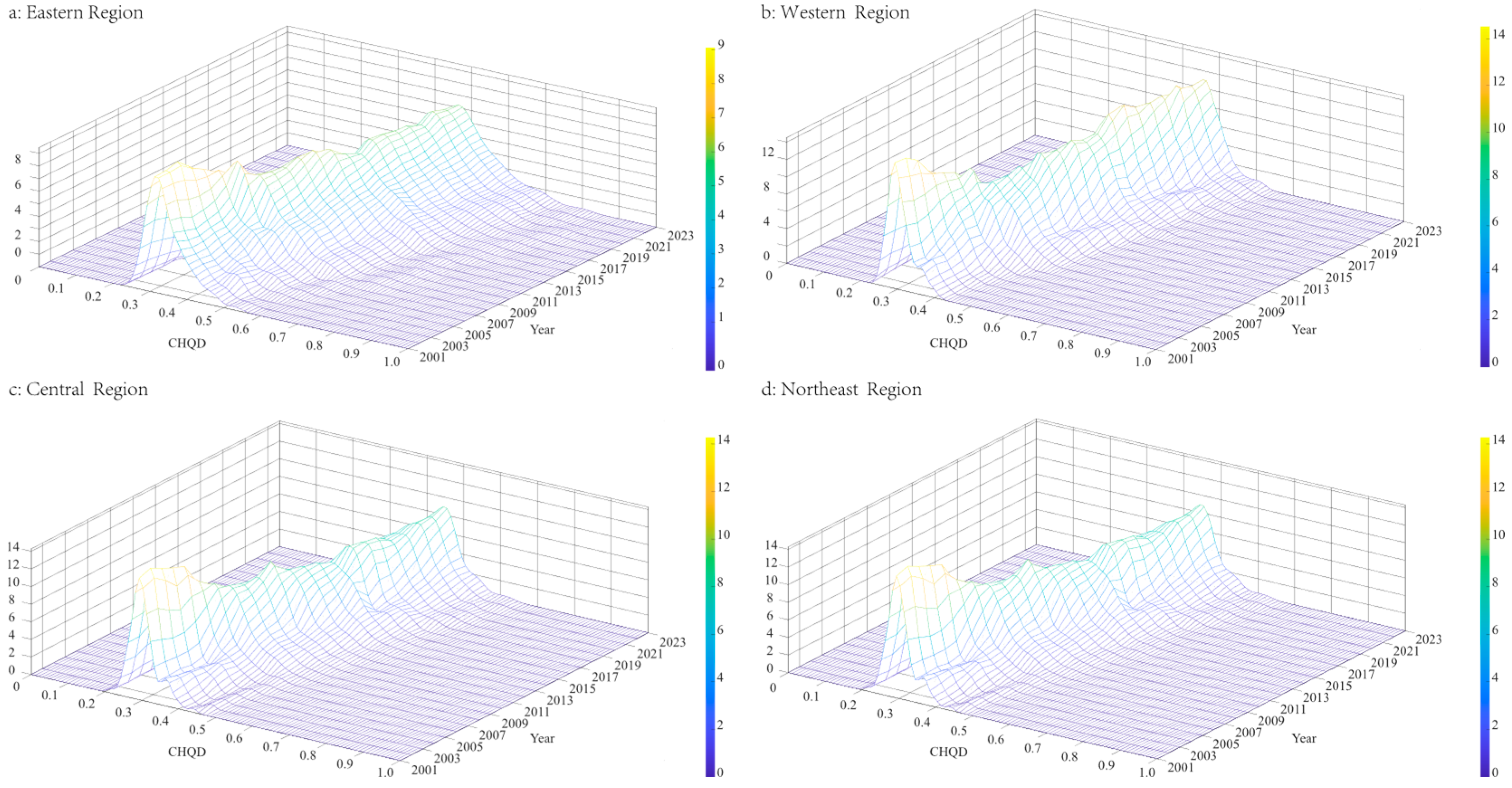
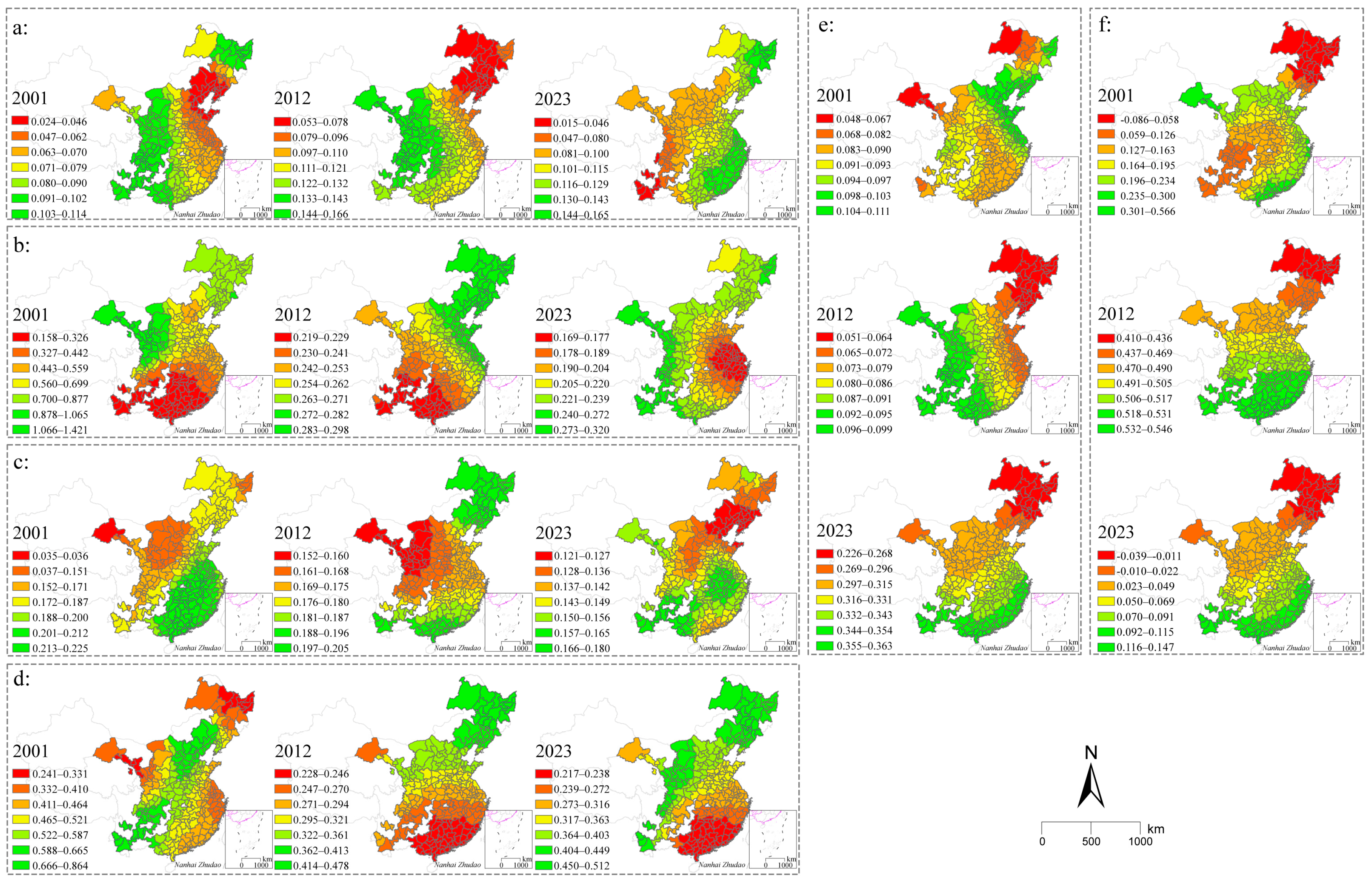
- The CHQD in NTU exhibits a trend of tiered ascent and spatial convergence, with its gravitational center gradually shifting southwest. Empirical results indicate a steady improvement in the degree of coupling coordination throughout the study period. Moreover, the 3D KDE curves corroborate the findings of Wang et al. [27], revealing a narrowing trend in absolute regional disparities. This suggests that the polarization of China’s urbanization development is gradually diminishing. Dimensionally, the Green and Social dimensions witnessed the fastest growth, progressively superseding simple spatial expansion as new growth poles. This transition profoundly mirrors a fundamental paradigm shift in China’s urbanization model. Research indicates that prior to 2012, urbanization was primarily driven by factor inputs and industrialization [22]. Since the 18th National Congress of the CPC, as the “Ecological Civilization” and “people-oriented” philosophies have deepened, the development focus has pivoted toward ecological livability and the equalization of public services. This aligns with that green sustainable development may be emerging as the core dynamic of urbanization [8]. Additionally, the southwestward migration of the gravitational center likely correlates with national strategies such as the “Western Development” and regional coordinated development initiatives. Some studies attribute this pattern to a structural rebound in inland areas, arguing that late-developing regions are narrowing the gap with the coastal east by addressing deficits in infrastructure and livelihoods [20,42].
- (2)
- The sensitivity of CHQD to various dimensions is characterized by significant “diminishing marginal utility” and “shortcoming constraints,” resulting in pronounced spatial heterogeneity. GTWR analysis demonstrates that the sensitivity of the same dimension varies distinctively across regions. This spatial shift implies that as factor agglomeration in the east approaches a certain threshold, the marginal contribution of merely increasing population or capital input to coordination tends to decline. Existing research suggests that this phenomenon is likely linked to “congestion effects” overshadowing agglomeration economies in highly developed urban areas, where efficiency gains from scale expansion are diminishing [17]. Conversely, the central and western regions, currently in an accelerated phase of industrialization, appear to be reaping significant “structural dividends” from population return and industrial transfers [22]. Furthermore, rigid environmental constraints are increasingly evident. The green dimension has become a critical variable—especially in the fragile west and dense eastern agglomerations—and may act as a “veto player” that constrains or enhances coordination levels [28,34]. The dominant drivers in the northeast region further demonstrate the constraints imposed by factors such as resources and population, particularly the outflow of population and limited development space [33].
- (3)
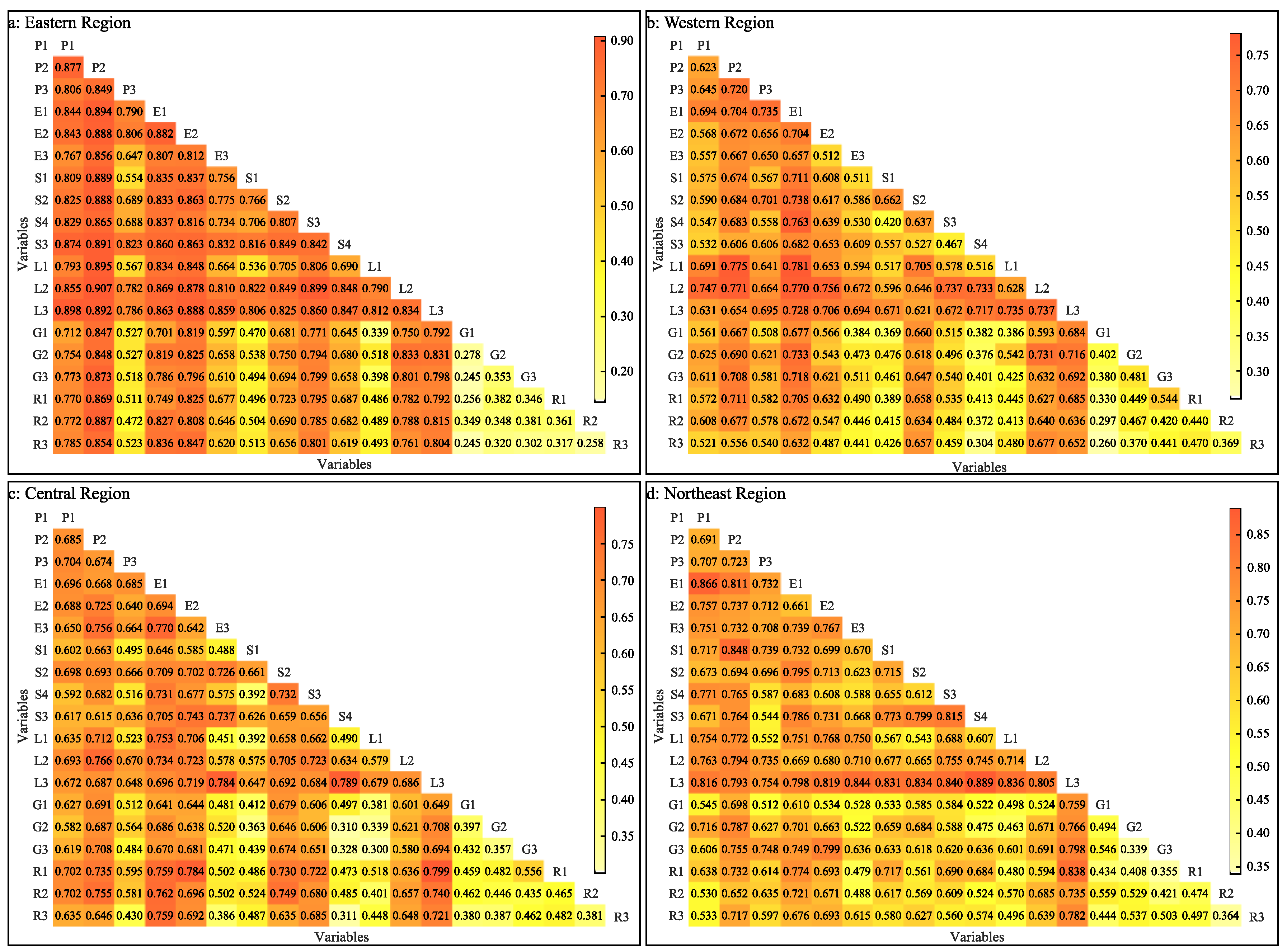
- The dominant drivers shaping the spatial heterogeneity of CHQD appear to have undergone a cascade evolution from a “resource-space orientation” to an “innovation-service orientation,” with multi-factor synergies producing significant gains. The OPGD results reveal that in the early stages, the highest explanatory power stemmed from traditional factor accumulation, such as employment structure (P2) and construction land ratio (L2). By the end of the study period, the dominance shifted toward connotative indicators, particularly sci-tech expenditure (E3) and social dimensions. This further supports the perspective that China’s urbanization is shifting from simple factor mobility toward multidimensional coordination across ecological and social systems [22,24]. Interaction detection indicates that factor interactions exhibit bi-factor or non-linear enhancement effects. Specifically, distinctive regional synergies were identified. The east is characterized by deep integration between industry and services. The central region, by comparison, shows strong support for infrastructure development and industrial expansion. The west exhibits nonlinear activation between ecological conditions and public services. The northeast is marked by deep integration between economic development and science–education systems. These patterns are consistent with the “System Theory” perspective found in related studies, implying that NTU is not achieved through a single-dimensional breakthrough but likely results from a “positive resonance” among multiple subsystems [16,33].
5.2. Policy Implications
- (1)
- Implement differentiated precision governance strategies based on factor endowment disparities. Given the significant spatio-temporal mismatch of core influence factors, policy formulation should abandon the homogeneous “one-size-fits-all” mode and instead adopt classification guidance based on regional comparative advantages. Eastern regions should leverage their strengths in deep industrial-service integration to prioritize the cultivation of new productive forces. By optimizing spatial structures to alleviate excessive population concentration, they should develop world-class, high-quality urban clusters. Central regions must seize the window of opportunity presented by the strong interaction between infrastructure and industry. Relying on transport hubs, they should systematically undertake industrial transfers, transforming existing infrastructure into incremental industrial development. Western regions should increase investment in soft infrastructure, particularly education and healthcare, given the nonlinear catalytic role of public services. This can help overcome geographical and baseline constraints and guide population concentration toward suitable key towns. Northeastern regions should deepen the symbiotic relationship between the economy and science/education. Institutional reforms are needed to activate existing science and education assets and convert them into drivers of real-economy recovery. Industrial revitalization should retain talent and resolve the challenges faced by shrinking cities.
- (2)
- Dismantle dependence on land finance and construct an endogenous momentum mechanism for “Human-Industry-City” integration. Empirical evidence shows a declining marginal contribution from spatial urbanization, while the influence of social and green dimensions continues to rise, indicating an urgent need to shift urbanization dynamics. Future policies must resolutely discard the extensive mode characterized by large-scale spatial expansion, shifting the focus from “expanding urban space” to “operating urban assets.” It is recommended that the assessment and evaluation system be reformed. Greater weight should be assigned to the urbanization rate of agricultural migrants, public service coverage, and ecological and environmental quality. Meanwhile, the weight assigned to construction land indicators should be reduced. Concurrently, a dynamic adjustment mechanism linking population to land allocation should be established to allocate construction land in response to changes in the resident population. This will compel cities to enhance the efficiency of existing spatial utilization through the renovation of aging neighborhoods and urban renewal, thereby shifting the influence force of urbanization from outward expansion to inward densification.
- (3)
- Strengthen systems thinking to leverage the synergistic efficiency of multi-dimensional factors. Interaction detection confirms that multi-factor synergy is significantly stronger than single-factor effects, suggesting that breakthroughs in a single dimension cannot achieve optimal results. At the policy implementation level, departmental barriers should be dismantled to strengthen integrated planning across industry, residential development, ecology, and services. For instance, when attracting investment, concurrently plan talent support measures; whilst advancing industrialization, simultaneously integrate green and low-carbon technologies. A virtuous cycle can strengthen system synergies: industrial upgrading attracts talent, population concentration raises tax revenue, fiscal capacity supports public services, and environmental quality further promotes factor agglomeration. This approach enables a spiral-like ascent across all subsystems of new urbanization.
- (4)
- Reinforce county-level carrier functions to remedy key shortcomings in urban-rural integration. Although the overall level of urban-rural integration is high, local fractures persist, and empirical results indicate that the urban-rural dimension holds immense potential for driving growth in the central and western regions. County-level areas, serving as pivotal nodes connecting urban and rural regions, should be granted greater authority to integrate resources, becoming the primary battleground for urban-rural integration. Future efforts should prioritize extending municipal utilities and public services to rural areas, establishing a tiered development framework anchored by county seats, central towns, and key villages. By facilitating the two-way flow of urban-rural resources, we can foster mutually beneficial interaction between rural labor migration and urban capital investment in rural development. This will smooth the transition from a dualistic urban-rural structure towards integrated development, thereby advancing the goal of shared prosperity.
6. Conclusions
- (1)
- CHQD exhibits a distinct trend of “tiered ascent” and spatial convergence. This is accompanied by a southwestward migration of the coordination center of gravity, indicating a narrowing of regional disparities and a weakening of polarization.
- (2)
- Structural decomposition reveals significant spatially stratified heterogeneity in local sensitivity. The coastal East faces “diminishing marginal utility” of traditional factor inputs, whereas the Central and Western regions continue to reap “structural dividends” from factor accumulation.
- (3)
- The dominant drivers shaping spatial heterogeneity have undergone a cascade evolution from a “resource-space” to an “innovation-service” orientation. Furthermore, nonlinear factor interactions confirm that high-quality urbanization relies on the “positive resonance” among multiple subsystems rather than single-dimensional breakthroughs.
Author Contributions
Funding
Institutional Review Board Statement
Informed Consent Statement
Data Availability Statement
Conflicts of Interest
References
- Meng, Y.; Hao, Z.; Shang, S. Analysis of the Equalization Effect of Basic Public Services in New-Type Urbanization—A Case Study of County Regions in Guizhou, China. Heliyon 2024, 10, e39922. [Google Scholar] [CrossRef] [PubMed]
- Liu, Y.; Zhou, X. Does the New-Type Urbanization Policy Promote Green Technological Innovation? Evidence from a Quasi-Natural Experiment in China. Appl. Econ. 2026, 58, 501–516. [Google Scholar] [CrossRef]
- Wang, M.; Krstikj, A.; Liu, H. Planning Compact City in Rapidly Growing Cities—An Estimation of the Effects of New-Type Urbanization Planning in Hangzhou City. Land 2022, 11, 1907. [Google Scholar] [CrossRef]
- Chen, M.; Liu, W.; Lu, D.; Chen, H.; Ye, C. Progress of China’s New-Type Urbanization Construction since 2014: A Preliminary Assessment. Cities 2018, 78, 180–193. [Google Scholar] [CrossRef]
- Liu, L.; Liu, W.; Yang, L.; Zhang, X. The Drag Effect of Land Resources on New-Type Urbanization: Evidence from China’s Top 10 City Clusters. Sustainability 2025, 17, 7746. [Google Scholar] [CrossRef]
- Li, C.; Lei, T.; Wang, L. Examining the Decoupling Relationship between New-Type Urbanization and Carbon Emissions and Its Driving Factors in China: Evidence from 260 Cities. Stoch. Environ. Res. Risk Assess. 2024, 38, 4669–4695. [Google Scholar] [CrossRef]
- Zhao, Y.; Peng, Y.; Li, M.; Fan, S. Spatial–Temporal Coupling Characteristics and Interactive Effects of New-Type Urbanization and Cultivated Land Use Efficiency on Food Security. Agriculture 2026, 16, 243. [Google Scholar] [CrossRef]
- Wang, J.; Han, S.; Lin, H.; Wu, P.; Yuan, J. New-Type Urbanization Ecologically Reshaping China. Heliyon 2023, 9, e12925. [Google Scholar] [CrossRef]
- Chen, C.; Wang, S.; Liu, M.; Huang, K.; Guo, Q.; Xie, W.; Wan, J. Beyond Linearity: Uncovering the Complex Spatiotemporal Drivers of New-Type Urbanization and Eco-Environmental Resilience Coupling in China’s Chengdu–Chongqing Economic Circle with Machine Learning. Land 2025, 14, 1424. [Google Scholar] [CrossRef]
- Ma, L.; Wang, Q.; Tan, X.; Chen, Y.; Jiang, W. Identifying the Coupling Coordination Relationship between New-Type Urbanization and Cultivated Land Use Transition and Its Impact Mechanism—A Case Study of the Middle and Lower Reaches of the Yellow River in China. Agric. Syst. 2026, 232, 104568. [Google Scholar] [CrossRef]
- Li, Y.; Cao, X.-Y.; Feng, D.-C. A Numerical Model Database for Seismic Retrofitting of Existing RC Structures towards Urban Renewal. Bull. Earthq. Eng. 2025, 23, 3295–3325. [Google Scholar] [CrossRef]
- Yu, Y.; Zhao, K.; Du, Y. Nexus between New-Type Urbanization, Economic Development, and Haze Pollution in China: A Spatial Analysis. J. Urban Plan. Dev. 2024, 150, 04024043. [Google Scholar] [CrossRef]
- Yao, S.; Wang, Y.; An, L. People-Centred Development in China: The Impact of New-Type Urbanization on Migrants’ Labour Market Outcomes. Appl. Econ. 2025, 1–18. [Google Scholar] [CrossRef]
- Shi, L.; Lin, H.; Tan, B. The Impact of the Coupling Coordination between New-Type Urbanization and the Digital Economy on Ecological Efficiency. Int. Rev. Financ. Anal. 2025, 105, 104427. [Google Scholar] [CrossRef]
- Guo, D.; Kong, S.; Li, X.; Liu, Y.; Sun, W. Urbanization and Subjective Well-Being of Native Urban Residents: Evidence from the “New-Type Urbanization Pilot Policy” in China. Ann. Reg. Sci. 2025, 74, 4. [Google Scholar] [CrossRef]
- Cheng, H.; Li, Y.; Chen, Z.; Huang, Y.; Min, J.; Shi, W.; Zhang, L.; Ji, R. Coordination Degree between New Urbanization and the Construction of “Beautiful China”: A Case Study of Jiangsu Province. Ecol. Environ. Sci. 2026, 35, 29. [Google Scholar] [CrossRef]
- Xing, G.; Xudong, L.; Xuan, C.; Zhiwen, Y.; Minghao, C. Impact of Human Capital Accumulation on New-Type Urbanization in the Context of Large-Scale Population Mobility: A Case Study of the Mountain Cities in Guizhou Province. J. Resour. Ecol. 2025, 16, 1797–1810. [Google Scholar] [CrossRef]
- Yang, X.; Jia, Z.; Yang, Z. How new-type urbanization pilots reduce carbon emissions: A technology progress paths perspective. J. Clean. Prod. 2023, 401, 136663. [Google Scholar] [CrossRef]
- Zhang, G.; Xing, L. Research on Tourism Economic Effect under the Threshold of New-Type Urbanization in Coastal Cities of China: From the Perspective of Development Economics. Ocean Coast. Manag. 2023, 239, 106587. [Google Scholar] [CrossRef]
- Yuan, C.; Zhang, B.; Xu, J.; Lyu, D.; Liu, J.; Hu, Z.; Han, Y. Impact of New-Type Urbanization Pilot Policy on Public Service Provision: Evidence from China. Cities 2025, 161, 105853. [Google Scholar] [CrossRef]
- Sun, D.; Zhou, L.; Li, Y.; Liu, H.; Shen, X.; Wang, Z.; Wang, X. New-Type Urbanization in China: Predicted Trends and Investment Demand for 2015–2030. J. Geogr. Sci. 2017, 27, 943–966. [Google Scholar] [CrossRef]
- Liu, C. Spatiotemporal Evolution and Influencing Factors of Coordinated Development between Cultivated Land Use Eco-Efficiency and New-Type Urbanization: Insights from Henan Province, China. Front. Environ. Sci. 2025, 13, 1633927. [Google Scholar] [CrossRef]
- Chen, N. The Impact of the Rural Digital Economy on China’s New-Type Urbanization. PLoS ONE 2025, 20, e0321663. [Google Scholar] [CrossRef]
- Wang, J.; Luo, X.; Liang, X.; Ning, C. New-Type Urbanization and Regional Public Health: Mechanisms and Effects. Front. Public Health 2025, 13, 1513173. [Google Scholar] [CrossRef]
- Li, H.; Song, W. Evolution of Rural Settlements in the Tongzhou District of Beijing under the New-Type Urbanization Policies. Habitat Int. 2020, 101, 102198. [Google Scholar] [CrossRef]
- Yang, T.; Zhou, C.; Xiao, T.; Xu, Q. Coordinated Development of the Digital Economy and Urban–Rural Integration in the Yangtze River Delta and Its Spatial Correlation Structure. Sustainability 2025, 17, 4144. [Google Scholar] [CrossRef]
- Wang, S.; Wei, K.; Liang, R.; Dan, Z.; Dai, B. Research on misuses and modification of coupling coordination degree model in China. J. Nat. Resour. 2021, 36, 793–810. [Google Scholar] [CrossRef]
- Geng, Y.; Jiang, P.; Xu, X.; Yao, W.; Zhang, J. Spatio-Temporal Evolution and Influencing Factors of Coupling Coordination between New Urbanization and Ecological Environment in Shaanxi Province, China, (2010–2020), Based on Geodetector and GWR. Environ. Dev. Sustain. 2025, 1–32. [Google Scholar] [CrossRef]
- Xue, B.; Xiao, X.; Li, J.; Zhao, B.; Fu, B. Multi-Source Data-Driven Identification of Urban Functional Areas: A Case of Shenyang, China. Chin. Geogr. Sci. 2023, 33, 21–35. [Google Scholar] [CrossRef]
- Xue, Y.; Li, Y.; Xu, W.; Sunhee, S.; Triana, N.; Song, X.; Liu, F.; Wang, L.; Liu, Y. Coupling Coordination Degree Analysis and Spatiotemporal Heterogeneity between Tourism Economy and Ecosystem Service Value in China. Ecol. Indic. 2026, 182, 114559. [Google Scholar] [CrossRef]
- Cen, Q.; Zhou, X.; Qiu, H. Exploration of Urban Neighborhood Blue-Green Space Quality Patterns and Influencing Factors in Waterfront Cities Based on MGWR and OPGD Models. Urban Clim. 2024, 55, 101942. [Google Scholar] [CrossRef]
- Gao, X.; Yan, X.; Song, S.; Xu, N. The Impact and Mechanism of New-Type Urbanization on New Quality Productive Forces: Empirical Evidence from China. Sustainability 2025, 17, 353. [Google Scholar] [CrossRef]
- Zhao, N. Mechanism and Empirical Evidence on New-Type Urbanization to Narrow the Urban–Rural Income Gap: Evidence from China’s Provincial Data. PLoS ONE 2024, 19, e0270964. [Google Scholar] [CrossRef]
- Ran, X.; Zhang, B.; Ding, R.; Jiang, S.; Yuan, J.; Zheng, Y.; Yang, C. Application of Explainable Machine Learning in the Study of Urban Ecological Economic Resilience. Ecol. Model. 2026, 511, 111368. [Google Scholar] [CrossRef]
- Zhang, R.; Bao, Q. Evolutionary Characteristics, Regional Differences and Spatial Effects of Coupled Coordination of Rural Revitalization, New-Type Urbanization and Ecological Environment in China. Front. Environ. Sci. 2024, 12, 1510867. [Google Scholar] [CrossRef]
- Gu, T.; Huang, Q.; Chen, M.; He, C.; Zhu, G.; Hou, Y.; Zhou, Y.; Yue, K.; Zhang, M.; Zhang, S. Does People Oriented Urbanization Catch up with Land and Population Urbanization. Npj Urban Sustain. 2025, 5, 61. [Google Scholar] [CrossRef]
- Wang, H.; Zhang, B.; Liu, Y.; Liu, Y.; Xu, S.; Zhao, Y.; Chen, Y.; Hong, S. Urban Expansion Patterns and Their Driving Forces Based on the Center of Gravity-GTWR Model: A Case Study of the Beijing-Tianjin-Hebei Urban Agglomeration. J. Geogr. Sci. 2020, 30, 297–318. [Google Scholar] [CrossRef]
- Jiang, F.; Chen, B.; Li, P.; Jiang, J.; Zhang, Q.; Wang, J.; Deng, J. Spatio-Temporal Evolution and Influencing Factors of Synergizing the Reduction of Pollution and Carbon Emissions-Utilizing Multi-Source Remote Sensing Data and GTWR Model. Environ. Res. 2023, 229, 115775. [Google Scholar] [CrossRef] [PubMed]
- Wang, Y.; Wang, L. New-Type Urbanization and Rural Revitalization: A Study on the Coupled Development of the Yangtze River Economic Belt, China. PLoS ONE 2025, 20, e0314724. [Google Scholar] [CrossRef]
- Dong, S.; An, H.; Dong, S. Exploring the Spatial Interaction Relationship between New-Type Urbanization and Ecological Vulnerability. Ecol. Model. 2026, 513, 111427. [Google Scholar] [CrossRef]
- Wang, X.; Zhang, J.; Zhang, F. Spatiotemporal Assessment of New-Type Urbanization and Rural Revitalization Coupling in China, 2014–2023: Implications for Spatial Planning. Land 2025, 14, 2404. [Google Scholar] [CrossRef]
- Liu, X.; Zhao, G. Spatial Effects of New Urbanization, Industrial Structure Upgrading, and Farmers’ Income: A Case Study of Northeast China. Sustainability 2026, 18, 592. [Google Scholar] [CrossRef]



| Dimension | Traditional Urbanization | New-Type Urbanization |
|---|---|---|
| Core value orientation | Growth-first: efficiency gains via factor concentration; industrial expansion and rapid absorption of rural migrants into cities | People-oriented: improved quality of life; green and inclusive development; balanced and coordinated outcomes |
| Development logic | Incremental, expansion-led development, where scale enlargement (land, industry, and population) is the primary pathway | Connotative development emphasizing stock optimization, structural upgrading, and quality improvement rather than pure scale growth |
| Spatial manifestation | Extensive land/space expansion; rapid built-up growth; persistent urban–rural separation | Spatial optimization and intensive land use; improved functional quality; strengthened urban–rural integration and coordination |
| Driving mechanism |
|
|
| Evaluation criteria | Urban population ratio, urbanization rate, and scale indicators dominate | Emphasizes quality of life, green performance, equity, and coordinated development |
| Typical policy instruments | Industrial park expansion, land conversion, and infrastructure-led growth | Differentiated strategies including:
|
| Target Layer | Indicator Layer | Code | Description/Formula | Attribute | Weight |
|---|---|---|---|---|---|
| Population Dimension | Urbanization Rate | P1 | Urban resident population/Total resident population | + | 0.326 |
| Employment Structure | P2 | Employees in secondary and tertiary industries/Total employees | + | 0.468 | |
| Unemployment Rate | P3 | Registered unemployed persons/Total resident population | − | 0.206 | |
| Economic Dimension | GDP per Capita | E1 | Regional GDP/Total resident population | + | 0.416 |
| Industrial Structure | E2 | Output value of primary industry/Output value of secondary and tertiary industries | − | 0.379 | |
| Sci-Tech Expenditure | E3 | Science and technology expenditure/Total fiscal expenditure | + | 0.205 | |
| Social Dimension | Education Expenditure | S1 | Education expenditure/Total fiscal expenditure | + | 0.166 |
| Medical Personnel | S2 | (Licensed doctors/Total resident population)\times 1000 | + | 0.301 | |
| Pension Coverage | S3 | Number of insured people/Total resident population | + | 0.215 | |
| Public Library Books | S4 | Number of library books/Total resident population | + | 0.318 | |
| Spatial Dimension | Road Network Density | L1 | Total highway mileage/Administrative area | + | 0.260 |
| Construction Land Ratio | L2 | Built-up area/Administrative area | + | 0.437 | |
| Land Use Intensity | L3 | Built-up area/Total resident population | + | 0.302 | |
| Green Dimension | Green Coverage | G1 | Green coverage area/Built-up area | + | 0.259 |
| Sewage Treatment Rate | G2 | Treated sewage volume/Total sewage discharge | + | 0.438 | |
| Solid Waste Utilization | G3 | Reutilized industrial solid waste/Total industrial solid waste generated | + | 0.303 | |
| Urban-Rural Dimension | Disp. Income Ratio | R1 | Urban per capita disposable income/Rural per capita disposable income | + | 0.366 |
| Consumption Ratio | R2 | Urban per capita consumption/Rural per capita consumption | + | 0.391 | |
| Engel Coefficient Ratio | R3 | Urban Engel coefficient/Rural Engel coefficient | + | 0.243 |
| Region | Provinces/Municipalities |
|---|---|
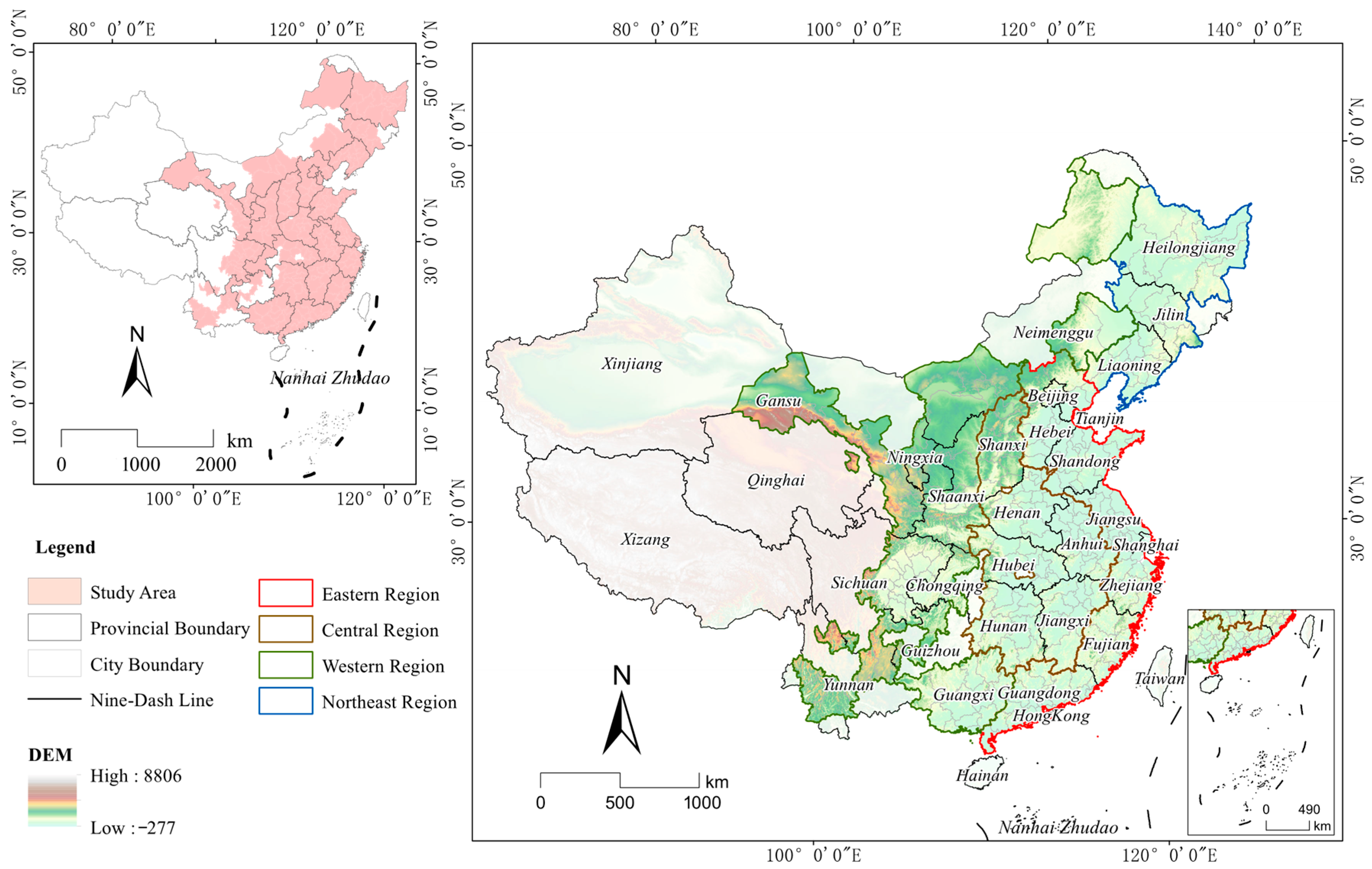
| Eastern Region | Beijing, Tianjin, Hebei, Shanghai, Jiangsu, Zhejiang, Fujian, Shandong, Guangdong |
| Central Region | Shanxi, Anhui, Jiangxi, Henan, Hubei, Hunan |
| Western Region | Inner Mongolia, Guangxi, Chongqing, Sichuan, Guizhou, Yunnan, Shaanxi, Gansu, Qinghai, Ningxia |
| Northeastern Region | Liaoning, Jilin, Heilongjiang |
| Region | Province | 2001 | 2006 | 2012 | 2017 | 2023 | Region | Province | 2001 | 2006 | 2012 | 2017 | 2023 |
|---|---|---|---|---|---|---|---|---|---|---|---|---|---|
| Eastern Region | Beijing | 0.460 | 0.493 | 0.588 | 0.614 | 0.673 | Northeastern Region | Liaoning | 0.356 | 0.374 | 0.438 | 0.446 | 0.472 |
| Tianjin | 0.418 | 0.453 | 0.517 | 0.567 | 0.586 | Jilin | 0.318 | 0.332 | 0.401 | 0.427 | 0.448 | ||
| Hebei | 0.304 | 0.331 | 0.393 | 0.428 | 0.450 | Heilongjiang | 0.341 | 0.345 | 0.396 | 0.411 | 0.444 | ||
| Shanghai | 0.456 | 0.522 | 0.592 | 0.638 | 0.683 | Regional Mean | 0.339 | 0.350 | 0.412 | 0.428 | 0.454 | ||
| Jiangsu | 0.342 | 0.387 | 0.459 | 0.510 | 0.534 | Western Region | Inner Mongolia | 0.321 | 0.350 | 0.418 | 0.450 | 0.474 | |
| Zhejiang | 0.351 | 0.388 | 0.470 | 0.506 | 0.538 | Guangxi | 0.300 | 0.290 | 0.352 | 0.391 | 0.423 | ||
| Fujian | 0.335 | 0.354 | 0.431 | 0.464 | 0.506 | Chongqing | 0.291 | 0.343 | 0.423 | 0.468 | 0.511 | ||
| Shandong | 0.334 | 0.366 | 0.440 | 0.475 | 0.495 | Sichuan | 0.300 | 0.311 | 0.383 | 0.422 | 0.459 | ||
| Guangdong | 0.364 | 0.374 | 0.449 | 0.503 | 0.506 | Guizhou | 0.291 | 0.302 | 0.379 | 0.442 | 0.474 | ||
| Regional Mean | 0.374 | 0.408 | 0.482 | 0.523 | 0.552 | Yunnan | 0.307 | 0.300 | 0.350 | 0.392 | 0.422 | ||
| Central Region | Shanxi | 0.307 | 0.332 | 0.409 | 0.422 | 0.458 | Shaanxi | 0.289 | 0.313 | 0.389 | 0.426 | 0.459 | |
| Anhui | 0.308 | 0.325 | 0.411 | 0.443 | 0.484 | Gansu | 0.301 | 0.314 | 0.365 | 0.413 | 0.443 | ||
| Jiangxi | 0.313 | 0.318 | 0.393 | 0.434 | 0.476 | Qinghai | 0.301 | 0.332 | 0.413 | 0.452 | 0.468 | ||
| Henan | 0.305 | 0.327 | 0.407 | 0.438 | 0.484 | Ningxia | 0.331 | 0.341 | 0.399 | 0.429 | 0.461 | ||
| Hubei | 0.313 | 0.328 | 0.415 | 0.464 | 0.497 | Regional Mean | 0.303 | 0.320 | 0.387 | 0.428 | 0.459 | ||
| Hunan | 0.294 | 0.311 | 0.401 | 0.427 | 0.467 | Overall Mean | 0.331 | 0.350 | 0.422 | 0.454 | 0.486 | ||
| Regional Mean | 0.307 | 0.324 | 0.406 | 0.438 | 0.478 | ||||||||
| Year | Semi-Major Axis/km | Semi-Minor Axis/km | Azimuth/° | Center Coordinate | Shape Index | Area/km2 |
|---|---|---|---|---|---|---|
| 2001 | 1146.354 | 710.646 | 46.522 | 114°33′27.738″ E, 32°58′44.969″ N | 0.380 | 2,559,302.540 |
| 2012 | 1117.165 | 707.143 | 46.554 | 114°33′48.719″ E, 32°58′10.380″ N | 0.367 | 2,481,843.331 |
| 2023 | 1109.871 | 706.979 | 46.971 | 114°25′45.577″ E, 32°51′52.913″ N | 0.363 | 2,465,068.397 |
| Year | Moran’s I | VIF | |||||||||
|---|---|---|---|---|---|---|---|---|---|---|---|
| Score | Variance | Z | p | Confidence | Population | Economy | Society | Space | Green | Urban-Rural | |
| 2001 | 0.273 | 0.000430 | 13.337 | 0.001 | 0.99 | 2.137 | 1.614 | 2.201 | 2.161 | 1.046 | 1.084 |
| 2012 | 0.318 | 0.000429 | 15.524 | 0.001 | 0.99 | 3.459 | 2.217 | 2.900 | 1.567 | 1.167 | 1.244 |
| 2023 | 0.31 | 0.000427 | 15.171 | 0.001 | 0.99 | 4.139 | 2.364 | 2.076 | 1.834 | 1.102 | 1.115 |
| Metric | Scheme 1 | Scheme 2 | Scheme 3 | Scheme 4 |
|---|---|---|---|---|
| Bandwidth | 683,125.835 | 554,519.315 | 602,263.507 | 402,747.986 |
| Residual Squares | 1.172 | 0.856 | 1.245 | 1.075 |
| Sigma | 0.039 | 0.032 | 0.039 | 0.039 |
| AICc | −2458.232 | −2412.648 | −2496.995 | −2498.661 |
| R2 | 0.811 | 0.825 | 0.831 | 0.866 |
| Adjusted R2 | 0.810 | 0.823 | 0.828 | 0.863 |
| Spatio-temporal Distance Ratio | 1.821 | 1.655 | 1.546 | 1.122 |
| Item | NO. 1 | NO. 2 | NO. 3 | NO. 4 | NO. 5 | ||||||
|---|---|---|---|---|---|---|---|---|---|---|---|
| Factors | q | Factors | q | Factors | q | Factors | q | Factors | q | ||
| Eastern Region | 2001 | P2 | 0.697 *** (0.000) | S3 | 0.693 *** (0.000) | E1 | 0.689 * (0.045) | S2 | 0.676 * (0.048) | L3 | 0.649 *** (0.000) |
| 2012 | L2 | 0.847 *** (0.000) | P1 | 0.839 *** (0.000) | P2 | 0.838 *** (0.000) | E2 | 0.830 *** (0.000) | E1 | 0.796 *** (0.000) | |
| 2023 | P2 | 0.914 *** (0.000) | S3 | 0.829 *** (0.000) | E2 | 0.827 *** (0.000) | E1 | 0.819 *** (0.000) | L2 | 0.791 *** (0.000) | |
| Central Region | 2001 | L2 | 0.522 *** (0.000) | L1 | 0.345 *** (0.000) | P3 | 0.332 *** (0.000) | G3 | 0.325 *** (0.000) | S1 | 0.309 (0.146) |
| 2012 | E1 | 0.769 ** (0.006) | L3 | 0.727 (0.210) | L2 | 0.655 * (0.041) | P1 | 0.639 * (0.031) | S2 | 0.624 (0.354) | |
| 2023 | S3 | 0.857 *** (0.000) | S2 | 0.855 *** (0.000) | L3 | 0.832 *** (0.000) | E1 | 0.818 *** (0.000) | S4 | 0.811 *** (0.000) | |
| Western Region | 2001 | R2 | 0.585 *** (0.000) | R1 | 0.488 *** (0.000) | R3 | 0.455 *** (0.000) | E1 | 0.287 (0.174) | P2 | 0.243 ** (0.005) |
| 2012 | P1 | 0.790 *** (0.000) | P2 | 0.772 *** (0.000) | S2 | 0.726 *** (0.000) | L3 | 0.708 *** (0.000) | E2 | 0.659 *** (0.000) | |
| 2023 | S3 | 0.803 *** (0.000) | P2 | 0.792 *** (0.000) | E1 | 0.762 *** (0.000) | S2 | 0.757 *** (0.000) | L3 | 0.741 *** (0.000) | |
| Northeastern Region | 2001 | L3 | 0.641 ** (0.004) | P2 | 0.461 * (0.037) | P1 | 0.424 * (0.043) | L1 | 0.399 * (0.015) | G3 | 0.345 * (0.048) |
| 2012 | L3 | 0.764 *** (0.000) | P3 | 0.689 (0.280) | P2 | 0.670 * (0.044) | L2 | 0.637 * (0.032) | E1 | 0.600 ** (0.001) | |
| 2023 | E1 | 0.840 *** (0.000) | L2 | 0.708 *** (0.000) | S3 | 0.679 (0.526) | P2 | 0.671 *** (0.000) | L3 | 0.669 ** (0.002) | |
Disclaimer/Publisher’s Note: The statements, opinions and data contained in all publications are solely those of the individual author(s) and contributor(s) and not of MDPI and/or the editor(s). MDPI and/or the editor(s) disclaim responsibility for any injury to people or property resulting from any ideas, methods, instructions or products referred to in the content. |
© 2026 by the authors. Licensee MDPI, Basel, Switzerland. This article is an open access article distributed under the terms and conditions of the Creative Commons Attribution (CC BY) license.
Share and Cite
Huang, G.; Qiao, L.; Fang, Q. Spatio-Temporal Local Sensitivity and Structural Attribution of Coordinated High-Quality New-Type Urbanization Towards Sustainable Development in China: Evidence from GTWR and OPGD Models. Sustainability 2026, 18, 2459. https://doi.org/10.3390/su18052459
Huang G, Qiao L, Fang Q. Spatio-Temporal Local Sensitivity and Structural Attribution of Coordinated High-Quality New-Type Urbanization Towards Sustainable Development in China: Evidence from GTWR and OPGD Models. Sustainability. 2026; 18(5):2459. https://doi.org/10.3390/su18052459
Chicago/Turabian StyleHuang, Guanjun, Liang Qiao, and Qunli Fang. 2026. "Spatio-Temporal Local Sensitivity and Structural Attribution of Coordinated High-Quality New-Type Urbanization Towards Sustainable Development in China: Evidence from GTWR and OPGD Models" Sustainability 18, no. 5: 2459. https://doi.org/10.3390/su18052459
APA StyleHuang, G., Qiao, L., & Fang, Q. (2026). Spatio-Temporal Local Sensitivity and Structural Attribution of Coordinated High-Quality New-Type Urbanization Towards Sustainable Development in China: Evidence from GTWR and OPGD Models. Sustainability, 18(5), 2459. https://doi.org/10.3390/su18052459