_Li.png)
An Advanced Eco-Solution to Address the Excessive Consumption of Water, Electricity and Towels/Linen at Luxury Hotels/Resorts: An Incentive-Linked Smart Meter System to Influence Consumer Behaviors


Abstract
1. Introduction
2. Methods
2.1. Literature Review Process
2.2. Literature Analysis Procedure
3. Results
3.1. Excessive Water Consumption
3.2. Excessive Electricity Consumption
3.3. Excessive Towel/Linen Consumption
4. Importance of Conservation and Changes in Guest Behavior
4.1. Operational and Environmental Justifications
4.2. Challenges Hindering Current Strategies
5. Proposed Solution: Optional Electronic Incentive System for Guests
5.1. The General Concept of the Improved System Proposed in This Paper
5.2. System Overview and Core Functionality
- A.
- Technical Field and System Overview
- B.
- ICT Architecture and Concrete Technologies
- ▪
- Water consumption: Any water-based sensing technology can be used, such as hardware calculation layers where water consumption is monitored via ultrasonic flow meters that measure liters (L) without impacting water pressure.
- ▪
- Electricity consumption: Electricity usage is tracked through smart sub-meters capable of measuring real-time kilowatt-hours (kW h).
- ▪
- Towel and linen consumption: This can be calculated using radio frequency identification (RFID) tags embedded into fabrics and tracked by scanners located in bathrooms or laundry chutes to record daily replacement frequencies. Alternatively, it can be calculated manually by housekeeping staff during their routine daily bathroom cleaning and preparation procedures.
- ▪
- Network and integration: Data is transmitted from the room to the hotel’s backend via a Low-Power Wide-Area Network (LPWAN), Zigbee mesh or any other appropriate technology, ensuring that the system does not compete with the guest Wi-Fi for bandwidth. This data is then fed into an API-driven integration layer that bridges the building management system (BMS) with the Property Management System (PMS), allowing the hotel to synchronize room data with guest identities securely.
- C.
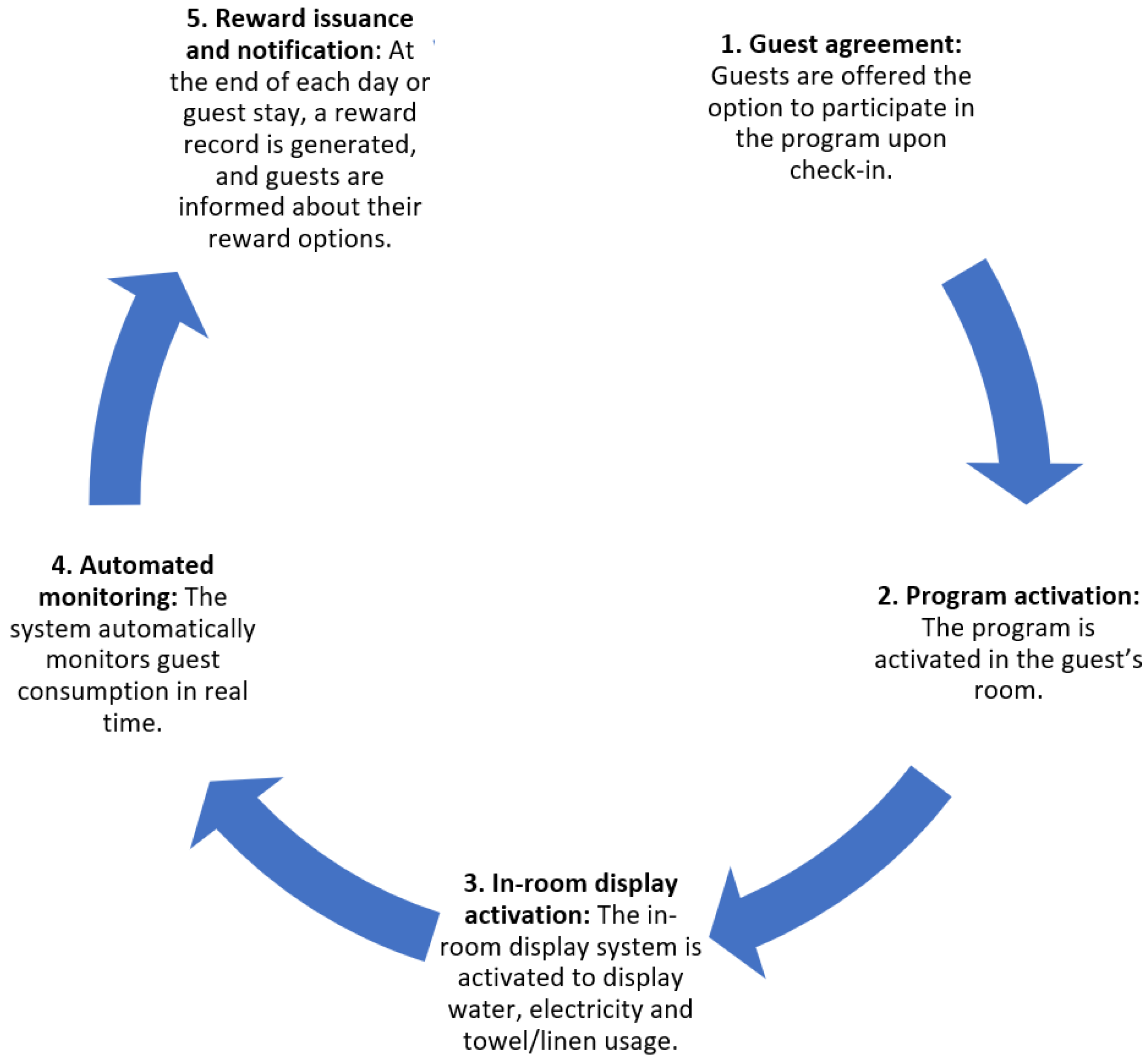
- The Operational Mechanism and the Five-Stage Guest Journey
- D.
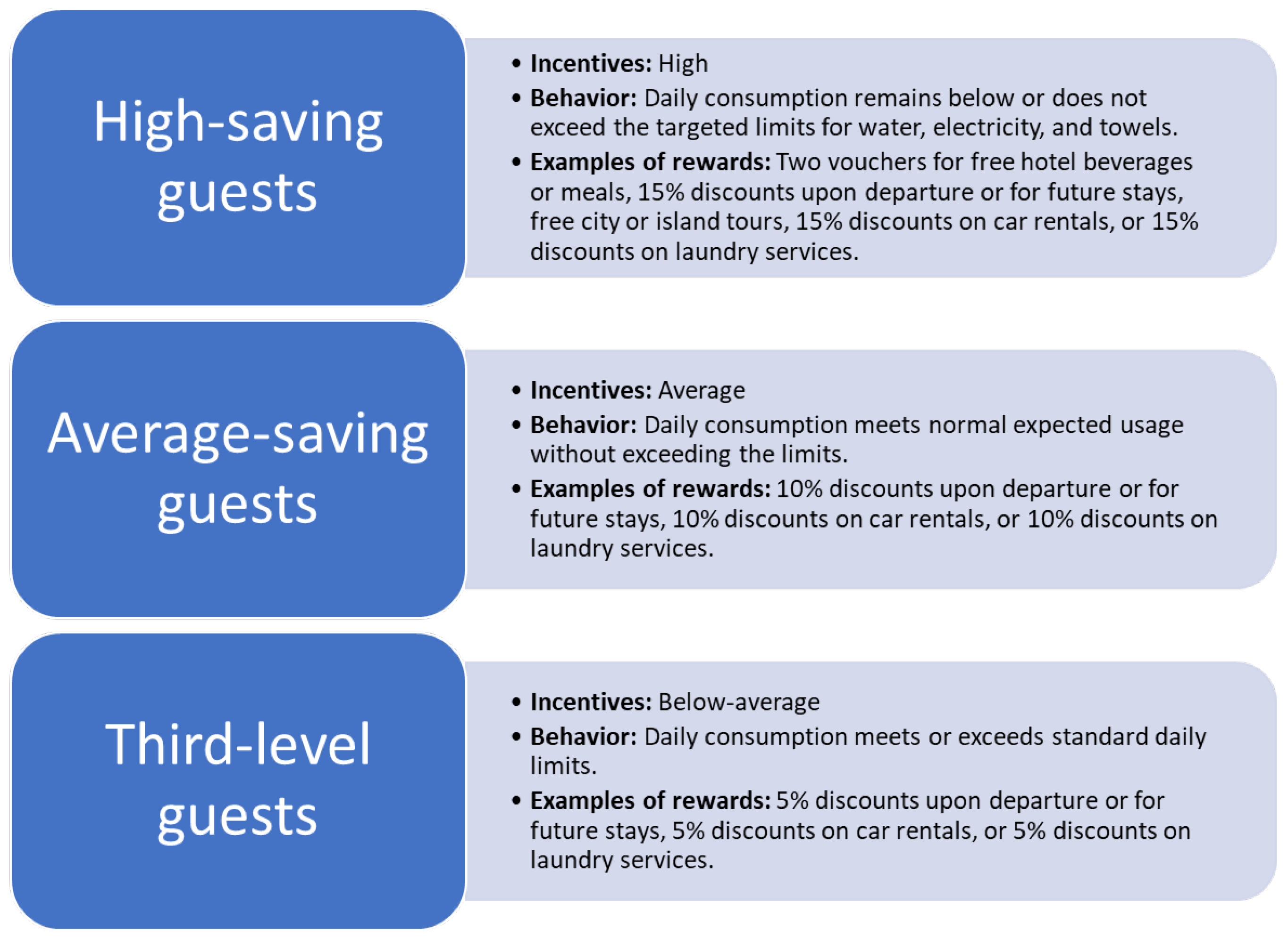
- The Guest Eco-Wallet and Behavioral Incentive Tiers
- ▪
- Economic Consumption (High-Saving): Guests who significantly conserve resources receive ‘Generous Rewards,’ such as vouchers for fine dining, free island tours or substantial discounts on future stays.
- ▪
- Normal Consumption (Average-Saving): Guests that meet standard targets are categorized as average-savers and receive ‘Average Rewards,’ including beverage vouchers or laundry credits.
- ▪
- High Consumption (Below-Average): Guests that exceed limits receive ‘Base Rewards’ or simple participation badges.
- E.
- Data Security and Privacy Safeguards
5.3. Operational Flow and Operation Mechanism
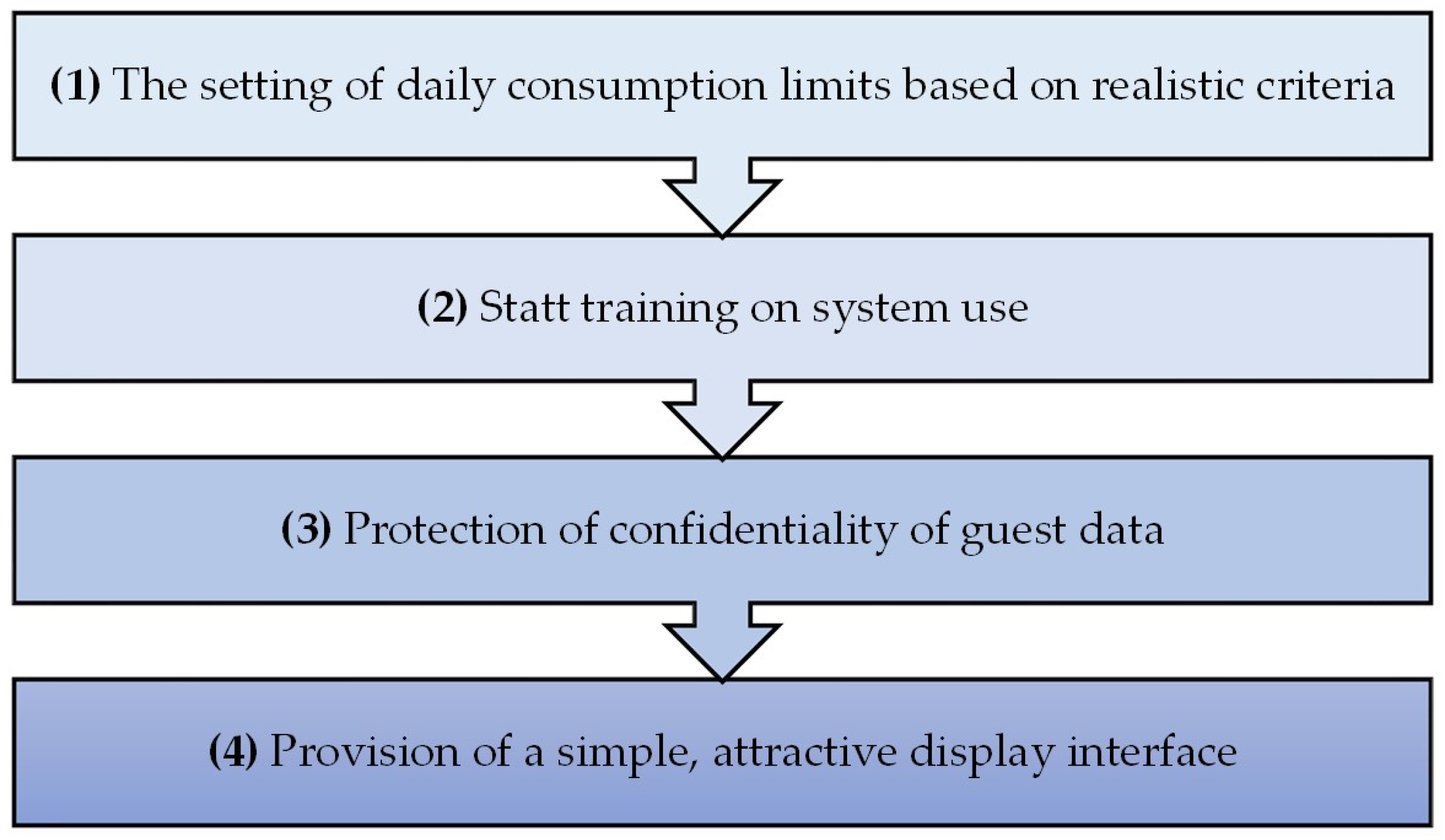
5.4. Implementation Requirements
6. Benefits for Luxury Hotels and Resorts
6.1. Operational Benefits
6.2. Environmental Certification and Green Marketing
6.3. Community Sustainability
6.4. Guest Satisfaction and Competitive Advantage
7. Implications for Luxury Hotels and Resorts
7.1. Managerial Implications
7.2. Consumer Behavior Implications
7.3. Environmental and Societal Implications
7.4. Research and Policy Implications
8. Discussion and Limitations
8.1. Challenges of Privacy and Guest Participation
8.2. Failure Challenges and Proposed Strategies
8.3. Challenges of Technical Costs and Return on Investment
8.4. Challenges of Maintaining Service Quality
8.5. Monitoring and Evaluation Challenges
9. Future Research and Conclusions
Funding
Institutional Review Board Statement
Informed Consent Statement
Data Availability Statement
Acknowledgments
Conflicts of Interest
References
- Bohdanowicz, P.; Martinac, I. Determinants and benchmarking of resource consumption in hotels—Case study of Hilton International and Scandic in Europe. Energy Build. 2007, 39, 82–95. [Google Scholar] [CrossRef]
- Gabarda-Mallorquí, A.; Garcia, X.; Ribas, A. Mass tourism and water efficiency in the hotel industry: A case study. Int. J. Hosp. Manag. 2017, 61, 82–93. [Google Scholar] [CrossRef]
- Cai, R.; Kong, L.; Bai, Y.; Liu, J.; Hu, M.; Bai, X. Hierarchy Analysis of Water Demand Among Hotel Consumers for Water Appliances. Sustainability 2024, 16, 9467. [Google Scholar] [CrossRef]
- Deng, S.-M.; Burnett, J. A study of energy performance of hotel buildings in Hong Kong. Energy Build. 2000, 31, 7–12. [Google Scholar] [CrossRef]
- Gössling, S.; Peeters, P.; Hall, C.M.; Ceron, J.P.; Dubois, G.; Lehmann, L.V.; Scott, D. Tourism and water use: Supply, demand, and security. An international review. Tour. Manag. 2012, 33, 1–15. [Google Scholar] [CrossRef]
- Cruz-Pérez, N.; Rodríguez-Martín, J.; Acosta Martín, J.F.; García, C.; Ruiz-Rosa, I.; Santamarta, J.C. Improvements in hotel water consumption: Case study of a five-star hotel (Canary Islands, Spain). Urban Water J. 2022, 19, 32–39. [Google Scholar] [CrossRef]
- Han, H.; Lee, J.-S.; Trang, H.L.T.; Kim, W. Water conservation and waste reduction management for increasing guest loyalty and green hotel practices. Int. J. Hosp. Manag. 2018, 75, 58–66. [Google Scholar] [CrossRef]
- Pham, N.T.; Vo-Thanh, T.; Shahbaz, M.; Huynh, T.L.D.; Usman, M. Managing environmental challenges: Training as a solution to improve employee green performance. J. Environ. Manag. 2020, 269, 110781. [Google Scholar] [CrossRef]
- Rehman, S.U.; Elrehail, H.; Alshwayat, D.; Ibrahim, B.; Alami, R. Linking hotel environmental management initiatives and sustainable hotel performance through employees’ eco-friendly behaviour and environmental strategies: A moderated-mediated model. Eur. Bus. Rev. 2023, 35, 184–201. [Google Scholar] [CrossRef]
- Becken, S.; McLennan, C.L. Evidence of the water-energy nexus in tourist accommodation. J. Clean. Prod. 2017, 144, 415–425. [Google Scholar] [CrossRef]
- Antonova, N.; Mendoza-Jiménez, J.; Ruiz-Rosa, I. Determinants of water consumption in hotels: New insights obtained through a case study. Water 2023, 15, 3049. [Google Scholar] [CrossRef]
- Arenhart, R.S.; Souza, A.M.; Zanini, R.R. Energy use and its key factors in hotel chains. Sustainability 2022, 14, 8239. [Google Scholar] [CrossRef]
- Shang, J.; Basil, D.Z.; Wymer, W. Using social marketing to enhance hotel reuse programs. J. Bus. Res. 2010, 63, 166–172. [Google Scholar] [CrossRef]
- Arhin, A.K. Technology-induced sustainability paradox: A Marxist’s critique of water conservation in hotels. Int. J. Hosp. Manag. 2026, 132, 104386. [Google Scholar] [CrossRef]
- Greene, D.; Demeter, C.; Dolnicar, S. The comparative effectiveness of interventions aimed at making tourists behave in more environmentally sustainable ways: A meta-analysis. J. Travel Res. 2024, 63, 1239–1255. [Google Scholar] [CrossRef]
- Dilmi, K.A.; Sannasgala, S.; Weerarathna, R.; Rathnayake, N.; Pitipanaarachchi, S.M.; Dushmanthi, N.; Rajapakse, V. How effective are incentives in driving green behavior? Analyzing monetary and non-monetary incentives in the hospitality industry. Cogent Bus. Manag. 2025, 12, 2524043. [Google Scholar] [CrossRef]
- Toșa, C.; Karaczun, Z.M.; Zawieska, J.; Paneru, C.P.; Bojanowski, J.; Joudavi, A.; Tarigan, A.K. Unlocking rewards for sustainability: A framework for valuing pro-environmental behaviors in Polish cities. Sustain. Sci. Pract. Policy 2024, 20, 2382381. [Google Scholar] [CrossRef]
- Chen, R.J. From sustainability to customer loyalty: A case of full service hotels’ guests. J. Retail. Consum. Serv. 2015, 22, 261–265. [Google Scholar] [CrossRef]
- Yu, W.; Liao, X.; Ji, S.; Cui, F. Green rewards vs. non-green rewards? The impact of hotel marketing incentives on guests’ green consumption intentions. J. Sustain. Tour. 2025, 33, 1534–1552. [Google Scholar] [CrossRef]
- Tanford, S.; Malek, K. Segmentation of reward program members to increase customer loyalty: The role of attitudes towards green hotel practices. J. Hosp. Mark. Manag. 2015, 24, 314–343. [Google Scholar] [CrossRef]
- Vorobeva, D.; Scott, I.J.; Oliveira, T.; Neto, M. Adoption of new household waste management technologies: The role of financial incentives and pro-environmental behavior. J. Clean. Prod. 2022, 362, 132328. [Google Scholar] [CrossRef]
- Baumeister, R.F.; Leary, M.R. Writing narrative literature reviews. Rev. Gen. Psychol. 1997, 1, 311–320. [Google Scholar] [CrossRef]
- MacInnis, D.J. A framework for conceptual contributions in marketing. J. Mark. 2011, 75, 136–154. [Google Scholar] [CrossRef]
- Grant, M.J.; Booth, A. A typology of reviews: An analysis of 14 review types and their associated methodologies. Health Inf. Libr. J. 2009, 26, 91–108. [Google Scholar] [CrossRef] [PubMed]
- Green, B.N.; Johnson, C.D.; Adams, A. Writing narrative literature reviews for peer-reviewed journals: Secrets of the trade. J. Chiropr. Med. 2006, 5, 101–117. [Google Scholar] [CrossRef]
- Hulland, J. Conceptual review papers: Revisiting existing research to develop and refine theory. AMS Rev. 2020, 10, 27–35. [Google Scholar] [CrossRef]
- Ferrari, R. Writing narrative style literature reviews. Med. Writ. 2015, 24, 230–235. [Google Scholar] [CrossRef]
- Orynycz, O.; Tucki, K. Total productive maintenance approach to an increase of the energy efficiency of a hotel facility and mitigation of water consumption. Energies 2021, 14, 1706. [Google Scholar] [CrossRef]
- Eras, J.J.C.; Santos, V.S.; Gutiérrez, A.S.; Plasencia, M.Á.G.; Haeseldonckx, D.; Vandecasteele, C. Tools to improve forecasting and control of the electricity consumption in hotels. J. Clean. Prod. 2016, 137, 803–812. [Google Scholar] [CrossRef]
- Gössling, S.; Araña, J.E.; Aguiar-Quintana, J.T. Towel reuse in hotels: Importance of normative appeal designs. Tour. Manag. 2019, 70, 273–283. [Google Scholar] [CrossRef]
- Han, H.; Hyun, S.S. What influences water conservation and towel reuse practices of hotel guests? Tour. Manag. 2018, 64, 87–97. [Google Scholar] [CrossRef]
- Antonova, N.; Ruiz-Rosa, I.; Mendoza-Jimenez, J. Water resource management in hotels using a sustainable balanced scorecard. Sustainability 2022, 14, 8171. [Google Scholar] [CrossRef]
- Barberán, R.; Egea, P.; Gracia-de-Rentería, P.; Salvador, M. Evaluation of water saving measures in hotels: A Spanish case study. Int. J. Hosp. Manag. 2013, 34, 181–191. [Google Scholar] [CrossRef]
- Chan, M.K.M.; Tsang, N.K.; Au, W.C.W. Effective approaches for encouraging hotel guests’ voluntary bedding linen reuse behavior. Int. J. Hosp. Manag. 2022, 101, 103105. [Google Scholar] [CrossRef]
- Díaz Pérez, F.J.; Chinarro, D.; Guardiola Mouhaffel, A.; Díaz Martín, R.; Pino Otín, M.R. Comparative study of carbon footprint of energy and water in hotels of Canary Islands regarding mainland Spain. Environ. Dev. Sustain. 2019, 21, 1763–1780. [Google Scholar] [CrossRef]
- Dimara, E.; Manganari, E.; Skuras, D. Don’t change my towels please: Factors influencing participation in towel reuse programs. Tour. Manag. 2017, 59, 425–437. [Google Scholar] [CrossRef]
- Dolnicar, S.; Knezevic Cvelbar, L.; Grün, B. Do pro-environmental appeals trigger pro-environmental behavior in hotel guests? J. Travel Res. 2017, 56, 988–997. [Google Scholar] [CrossRef]
- Saracevic, S.; Schlegelmilch, B.B. The Impact of Social Norms on Pro-Environmental Behavior: A Systematic Literature Review of the Role of Culture and Self-Construal. Sustainability 2021, 13, 5156. [Google Scholar] [CrossRef]
- Han, H.; Chua, B.L.; Hyun, S.S. Eliciting customers’ waste reduction and water saving behaviors at a hotel. Int. J. Hosp. Manag. 2020, 87, 102386. [Google Scholar] [CrossRef]
- Deng, S.M.; Burnett, J. Water use in hotels in Hong Kong. Int. J. Hosp. Manag. 2002, 21, 57–66. [Google Scholar] [CrossRef]
- Kim, H.; Oldham, E. Long-term field investigation and modeling of electricity end-use patterns in hotel guest rooms. Energy Build. 2017, 155, 414–424. [Google Scholar] [CrossRef]
- Liao, X.; Zhao, X.; Liu, W.; Li, R.; Wang, X.; Wang, W.; Tillotson, M.R. Comparing water footprint and water scarcity footprint of energy demand in China’s six megacities. Appl. Energy 2020, 269, 115137. [Google Scholar] [CrossRef]
- MacAskill, S.; Becken, S.; Coghlan, A. Engaging hotel guests to reduce energy and water consumption: A quantitative review of guest impact on resource use in tourist accommodation. Clean. Responsib. Consum. 2023, 11, 100156. [Google Scholar] [CrossRef]
- Priyadarsini, R.; Xuchao, W.; Eang, L.S. A study on energy performance of hotel buildings in Singapore. Energy Build. 2009, 41, 1319–1324. [Google Scholar] [CrossRef]
- Sayegh, M.A.; Ludwińska, A.; Rajski, K.; Dudkiewicz, E. Environmental and energy saving potential from greywater in hotels. Sci. Total Environ. 2021, 761, 143220. [Google Scholar] [CrossRef]
- Styles, D.; Schoenberger, H.; Galvez-Martos, J.L. Water management in the European hospitality sector: Best practice, performance benchmarks and improvement potential. Tour. Manag. 2015, 46, 187–202. [Google Scholar] [CrossRef]
- Tirado, D.; Nilsson, W.; Deyà-Tortella, B.; García, C. Implementation of water-saving measures in hotels in Mallorca. Sustainability 2019, 11, 6880. [Google Scholar] [CrossRef]
- Tortella, B.D.; Tirado, D. Hotel water consumption at a seasonal mass tourist destination. The case of the island of Mallorca. J. Environ. Manag. 2011, 92, 2568–2579. [Google Scholar] [CrossRef] [PubMed]
- Wong, P.; Wan, C. Exploring the moderating effects of incidental emotions on rewards for encouraging hotel guests’ towel reuse behavior. Environ. Behav. 2024, 56, 440–467. [Google Scholar] [CrossRef]
- Alhaj, M.; Mohammed, S.; Darwish, M.; Hassan, A.; Al-Ghamdi, S.G. A review of Qatar’s water resources, consumption and virtual water trade. Desalination Water Treat. 2017, 90, 70–85. [Google Scholar] [CrossRef]
- Al-Zubari, W.; Al-Turbak, A.; Zahid, W.; Al-Ruwis, K.; Al-Tkhais, A.; Al-Muataz, I.; Abdelwahab, A.; Murad, A.; Al-Harbi, M.; Al-Sulaymani, Z. An overview of the GCC Unified Water Strategy (2016–2035). Desalination Water Treat. 2017, 81, 1–18. [Google Scholar] [CrossRef]
- Medina-Rivas, C.M.; Rodríguez-Tapia, L.; Morales-Novelo, J.A.; Revollo-Fernández, D.A. Spatial inequality of domestic water consumption in Mexico city. Water Resour. Econ. 2022, 40, 100210. [Google Scholar] [CrossRef]
- Sekovski, I.; Newton, A.; Dennison, W.C. Megacities in the coastal zone: Using a driver-pressure-state-impact-response framework to address complex environmental problems. Estuar. Coast. Shelf Sci. 2012, 96, 48–59. [Google Scholar] [CrossRef]
- Papathanasiou, A.-F.; Ntemiri, K.; Baltas, E. Sustainable water resources management and energy production in small Mediterranean Islands. Environ. Process. 2025, 12, 19. [Google Scholar] [CrossRef]
- Liu, J.; Mei, C.; Wang, H.; Shao, W.; Xiang, C. Powering an island system by renewable energy—A feasibility analysis in the Maldives. Appl. Energy 2018, 227, 18–27. [Google Scholar] [CrossRef]
- Ministry of Environment. Water and Sewerage Master Plan: Republic of Maldives 2021–2035; Ministry of Environment, Climate Change & Technology: Male, Maldives, 2021. Available online: https://www.environment.gov.mv/v2/wp-content/files/publications/20210805-pub-water-and-sanitation-master-plan-2021-2035.pdf (accessed on 5 October 2025).
- Cingoski, V.; Petrevska, B. Making hotels more energy efficient: The managerial perception. Econ. Res.-Ekon. Istraživanja 2018, 31, 87–101. [Google Scholar] [CrossRef]
- Torres Bagur, M.; Bruns Smith, A.; McCabe, S.; Font, X.; Hughes, H. Incentives and Barriers to Water Saving Measures in Hotels in the Mediterranean: A Case Study of the Muga River Basin (Girona, Spain). Sustainability 2019, 11, 3583. [Google Scholar] [CrossRef]
- Kang, K.H.; Stein, L.; Heo, C.Y.; Lee, S. Consumers’ willingness to pay for green initiatives of the hotel industry. Int. J. Hosp. Manag. 2012, 31, 564–572. [Google Scholar] [CrossRef]
- Lee, J.S.; Hsu, L.T.; Han, H.; Kim, Y. Understanding how consumers view green hotels: How a hotel’s green image can influence behavioural intentions. J. Sustain. Tour. 2010, 18, 901–914. [Google Scholar] [CrossRef]
- Do Paco, A.; Shiel, C.; Alves, H. A new model for testing green consumer behaviour. J. Clean. Prod. 2019, 207, 998–1006. [Google Scholar] [CrossRef]
- Faiers, A.; Cook, M.; Neame, C. Towards a contemporary approach for understanding consumer behaviour in the context of domestic energy use. Energy Policy 2007, 35, 4381–4390. [Google Scholar] [CrossRef]
- Zhao, R.; Zhong, S. Carbon labelling influences on consumers’ behaviour: A system dynamics approach. Ecol. Indic. 2015, 51, 98–106. [Google Scholar] [CrossRef]
- Kowalska-Pyzalska, A. What makes consumers adopt to innovative energy services in the energy market? A review of incentives and barriers. Renew. Sustain. Energy Rev. 2018, 82, 3570–3581. [Google Scholar] [CrossRef]
- Simon, J.; Smith, K.; West, T. Price incentives and consumer payment behaviour. J. Bank. Financ. 2010, 34, 1759–1772. [Google Scholar] [CrossRef]
- Yang, J.; Jiang, P.; Zheng, M.; Zhou, J.; Liu, X. Investigating the influencing factors of incentive-based household waste recycling using structural equation modelling. Waste Manag. 2022, 142, 120–131. [Google Scholar] [CrossRef] [PubMed]
- Andrews, M.L.; Benedicktus, R.L.; Brady, M.K. The effect of incentives on customer evaluations of service bundles. J. Bus. Res. 2010, 63, 71–76. [Google Scholar] [CrossRef]
- Montazeri, S.; Tamaddoni, A.; Stakhovych, S.; Ewing, M. Empirical decomposition of customer responses to discount coupons in online FMCG retailing. J. Retail. Consum. Serv. 2021, 58, 102340. [Google Scholar] [CrossRef]
- Bridson, K.; Evans, J.; Hickman, M. Assessing the relationship between loyalty program attributes, store satisfaction and store loyalty. J. Retail. Consum. Serv. 2008, 15, 364–374. [Google Scholar] [CrossRef]
- Loedphacharakamon, N.; Choibamroong, T. Attitudinal Segmentation and the Perceived Value of Sustainable Practices in Luxury Hotels: Evidence from Chinese Tourists. Sustainability 2025, 17, 5525. [Google Scholar] [CrossRef]
- Daemen, J.; Rijmen, V. The Design of Rijndael: The Advanced Encryption Standard (AES); Springer: Berlin, Germany, 2020. [Google Scholar]
- Segarra-Oña, M.D.V.; Peiró-Signes, Á.; Verma, R.; Miret-Pastor, L. Does Environmental Certification Help the Economic Performance of Hotels? Evidence from the Spanish Hotel Industry. Cornell Hosp. Q. 2012, 53, 242–256. [Google Scholar] [CrossRef]
- Ting, C.-T.; Hsieh, C.-M.; Chang, H.-P.; Chen, H.-S. Environmental Consciousness and Green Customer Behavior: The Moderating Roles of Incentive Mechanisms. Sustainability 2019, 11, 819. [Google Scholar] [CrossRef]
- Bernard, S.; Nicolau, J.L. Environmental Certification and Hotel Market Value. Int. J. Hosp. Manag. 2022, 101, 103129. [Google Scholar] [CrossRef]
- Velaoras, K.; Menegaki, A.N.; Polyzos, S.; Gotzamani, K. The Role of Environmental Certification in the Hospitality Industry: Assessing Sustainability, Consumer Preferences, and the Economic Impact. Sustainability 2025, 17, 650. [Google Scholar] [CrossRef]
- Birinci, H.; Esenyel, I.; Obeng, H.A. Sustainable Destination Management in Luxury Tourism: Balancing Economic Development and Environmental Responsibility. Sustainability 2025, 17, 6815. [Google Scholar] [CrossRef]
- Santos, M.; Ribeiro, M.A.; Casais, B. Sustainability Practices in Hospitality: Case Study of a Luxury Hotel in Arrábida Natural Park. Sustainability 2021, 13, 3164. [Google Scholar] [CrossRef]
- Luekveerawattana, R. Successful green tourism in remote cultural community areas. Cogent Soc. Sci. 2024, 10, 2330733. [Google Scholar] [CrossRef]
- Han, H.; Hsu, L.T.J.; Sheu, C. Application of the Theory of Planned Behavior to green hotel choice: Testing the moderating effect of eco-friendly attitudes. Tour. Manag. 2010, 31, 325–334. [Google Scholar] [CrossRef]
- Merli, R.; Preziosi, M.; Acampora, A.; Ali, F. Why should hotels go green? Insights from guests’ experience in higher-end hotels. Int. J. Hosp. Manag. 2019, 81, 169–179. [Google Scholar] [CrossRef]
- Pienwisetkaew, T.; Wongsaichia, S.; Boontham, W.; Padthar, S.; Ponsree, K.; Wannapipat, W.; Ketkaew, C. Carbon labels and rewards: Driving sustainable consumer purchase decisions through incentive-based strategies. Sustain. Futur. 2025, 10, 101385. [Google Scholar] [CrossRef]
- Kuang, D.; Li, X.-F.; Bi, W.-W. How to effectively design referral rewards to increase the referral likelihood for green products. Sustainability 2021, 13, 7177. [Google Scholar] [CrossRef]
- Mansoor, M.; Jam, F.A.; Khan, T.I. Fostering eco-friendly behaviors in hospitality: Engaging customers through green practices, social influence, and personal dynamics. Int. J. Contemp. Hosp. Manag. 2025, 37, 1804–1826. [Google Scholar] [CrossRef]
- Bélanger, F.; Crossler, R.E. Privacy in the digital age: A review of information privacy research in information systems. MIS Q. 2011, 35, 1017–1041. [Google Scholar] [CrossRef]
- Dinev, T.; Hart, P. An extended privacy calculus model for e-commerce transactions. Inf. Syst. Res. 2006, 17, 61–80. [Google Scholar] [CrossRef]
- Xu, H.; Luo, X.R.; Carroll, J.M.; Rosson, M.B. The personalization-privacy paradox: An exploratory study of decision making process. Decis. Support Syst. 2012, 51, 42–52. [Google Scholar] [CrossRef]
- Miao, L.; Wei, W. Consumers’ pro-environmental behavior and its determinants in the lodging segment. J. Hosp. Tour. Res. 2013, 37, 322–355. [Google Scholar] [CrossRef]
- Dwork, C. Differential privacy: A survey of results. In Proceedings of the International Conference on Theory and Applications of Models of Computation, Xi’an, China, 25–29 April 2008; pp. 1–19. [Google Scholar] [CrossRef]
- Martin, K. The penalty for privacy violations: How privacy violations impact trust and behavioral intentions. J. Bus. Res. 2018, 82, 103–116. [Google Scholar] [CrossRef]
- Waris, I.; Suki, N.M.; Ahmed, A.; Barkat, W. Environmental corporate social responsibility initiatives and green customer citizenship behavior in tourism industry: The mediating roles of green trust, customer-company identification and green corporate image. Soc. Responsib. J. 2024, 20, 1138–1156. [Google Scholar] [CrossRef]



| Author/s | Journals | Identified Challenges/Consumptions | Types of Industries |
|---|---|---|---|
| [32] | Sustainability | Water | Hotels |
| [11] | Water | Water | Hotels |
| [14] | International Journal of Hospitality Management | Water | Hotels |
| [12] | Sustainability | Energy | Hotels |
| [10] | Journal of Cleaner Production | Water–energy | Tourist accommodation |
| [1] | Energy and Buildings | Energy and water | Hotels |
| [33] | International Journal of Hospitality Management | Water | Hotels |
| [3] | Sustainability | Water | Hotels |
| [34] | International Journal of Hospitality Management | Linen | Hotels |
| [6] | Urban Water Journal | Water | Hotels |
| [35] | Environment, Development and Sustainability | Energy and water | Hotels |
| [36] | Tourism Management | Towels | Hotels |
| [37] | Journal of Travel Research | Towels/electricity | Hotels |
| [29] | Journal of Cleaner Production | Electricity | Hotels |
| [2] | International Journal of Hospitality Management | Water | Hotels |
| [38] | Journal of Consumer Research | Towels | Hotels |
| [30] | Tourism Management | Towels | Hotels |
| [5] | Tourism management | Water | Not specified |
| [31] | Tourism Management, | Water | Hotels |
| [7] | International Journal of Hospitality Management | Water | Hotels |
| [39] | International Journal of Hospitality Management | Water | Hotels |
| [40] | International Journal of Hospitality Management | Water | Hotels |
| [13] | Journal of Business Research | Towels and linen | Hotels |
| [41] | Energy and Buildings | Electricity | Hotels |
| [42] | Applied Energy | Water/energy | Hotels |
| [43] | Cleaner and Responsible Consumption | Energy and water | Hotels |
| [44] | Energy and Buildings | Energy | Hotels |
| [45] | Science of The Total Environment | Energy | Hotels |
| [46] | Tourism Management | Water | Hotels |
| [47] | Sustainability | Water | Hotels |
| [48] | Journal of Environmental Management | Water | Hotels |
| [28] | Energies | Water | Hotels |
| [49] | Environment and Behavior | Towel | Hotels |
Disclaimer/Publisher’s Note: The statements, opinions and data contained in all publications are solely those of the individual author(s) and contributor(s) and not of MDPI and/or the editor(s). MDPI and/or the editor(s) disclaim responsibility for any injury to people or property resulting from any ideas, methods, instructions or products referred to in the content. |
© 2026 by the author. Licensee MDPI, Basel, Switzerland. This article is an open access article distributed under the terms and conditions of the Creative Commons Attribution (CC BY) license.
Share and Cite
Aldhamiri, A. An Advanced Eco-Solution to Address the Excessive Consumption of Water, Electricity and Towels/Linen at Luxury Hotels/Resorts: An Incentive-Linked Smart Meter System to Influence Consumer Behaviors. Sustainability 2026, 18, 2447. https://doi.org/10.3390/su18052447
Aldhamiri A. An Advanced Eco-Solution to Address the Excessive Consumption of Water, Electricity and Towels/Linen at Luxury Hotels/Resorts: An Incentive-Linked Smart Meter System to Influence Consumer Behaviors. Sustainability. 2026; 18(5):2447. https://doi.org/10.3390/su18052447
Chicago/Turabian StyleAldhamiri, Ali. 2026. "An Advanced Eco-Solution to Address the Excessive Consumption of Water, Electricity and Towels/Linen at Luxury Hotels/Resorts: An Incentive-Linked Smart Meter System to Influence Consumer Behaviors" Sustainability 18, no. 5: 2447. https://doi.org/10.3390/su18052447
APA StyleAldhamiri, A. (2026). An Advanced Eco-Solution to Address the Excessive Consumption of Water, Electricity and Towels/Linen at Luxury Hotels/Resorts: An Incentive-Linked Smart Meter System to Influence Consumer Behaviors. Sustainability, 18(5), 2447. https://doi.org/10.3390/su18052447