

Article

Trait Mindfulness and Pro-Environmental Behaviours: The Mediating Role of Eco-Emotions

1
Department of Life, Health and Environmental Sciences, University of L’Aquila, P.le S. Tommasi, 1, 67100 L’Aquila, Italy
2
Department of Biotechnological and Applied Clinical Sciences, University of L’Aquila, 67100 L’Aquila, Italy
*
Author to whom correspondence should be addressed.
These authors contributed equally to this work.
Sustainability 2026, 18(5), 2446; https://doi.org/10.3390/su18052446
Submission received: 22 January 2026 / Revised: 25 February 2026 / Accepted: 28 February 2026 / Published: 3 March 2026

Abstract

Climate change and ecological degradation represent profound global challenges, eliciting a wide range of emotional responses that can influence individuals’ engagement in pro-environmental behaviour (PEBs). This cross-sectional study examined the association between trait mindfulness and PEBs, with a focus on the mediating role of eco-emotions, including eco-anxiety, eco-depression, and eco-anger. A total of 259 adults were recruited in central Italy using a non-probabilistic snowball sampling method and completed self-report measures assessing trait mindfulness, eco-emotions, and PEBs. Data were analysed using a parallel mediation model. Results indicated that only eco-anger mediated the association between trait mindfulness and PEBs. Neither eco-anxiety nor eco-depression showed significant indirect effects. These findings suggest that eco-anger represents a distinct emotional pathway through which mindfulness-related regulatory processes can translate into environmentally relevant action, highlighting the differentiated motivational roles of eco-emotions. By clarifying the emotional mechanisms linking trait mindfulness to PEBs, this study provides new evidence contributing to the literature on individual differences, eco-emotions, and environmental psychology. The findings also offer practical implications for developing psychologically informed interventions to promote PEBs by integrating emotional activation with emotion regulation processes.

1. Introduction

Climate change and environmental degradation represent one of the most significant global challenges of the twenty-first century. Anthropogenic activities such as industrialisation, deforestation, and large-scale pollution have progressively undermined ecological integrity, accelerating global warming and contributing to rising temperatures, sea-level rise, and biodiversity loss [1]. These environmental transformations are no longer confined to physical or ecological domains but increasingly permeate psychological and social life. Indeed, a growing body of research indicates that environmental degradation is associated with heightened stress, anxiety, uncertainty, and emotional distress [2]. Evidence further suggests that the deterioration of natural environments is linked to reduced cognitive functioning, decreased psychological well-being, and lower perceived environmental quality [3]. Moreover, recent studies emphasise that residential and environmental contexts actively shape individuals’ identity, self-concept, and psychosocial health, underscoring the relevance of environmental conditions for urban planning and public health strategies and social sustainability policies [4].
The psychological consequences of climate change extend beyond traditional stress-based frameworks, encompassing a constellation of emotion-centred responses that reflect individuals’ lived experiences of environmental disruption. Constructs such as “solastalgia”, defined as the distress caused by the transformation or degradation of one’s home environment [5], alongside climate grief, and ecological worry, capture the affective complexity elicited by ecological loss and instability. These emerging concepts provide a nuanced framework for understanding how environmental change is emotionally processed and internalised.
Although the psychological consequences of environmental change have been extensively documented, these emotional and cognitive responses are particularly relevant because they shape individuals’ behavioural responses to environmental threats. Indeed, concern, anxiety, and emotional responses to climate change are not confined to the intrapsychic level but can translate, albeit in different ways, into everyday actions aimed at mitigating environmental impact.
Within this broader context, identifying the psychological factors that promote pro-environmental behaviours (PEBs) has become increasingly important. PEBs refer to a constellation of everyday actions influenced by psychological, social, and contextual factors aimed at reducing environmental impact and fostering ecological sustainability, including energy conservation, recycling, material reuse, waste reduction, and the adoption of frugal or equitable practices [6,7].
Despite widespread awareness of environmental problems, a persistent gap remains between concern and action. Many individuals experience difficulties in translating environmental concern into consistent behavioural engagement. Psychological barriers, including low perceived efficacy, entrenched habits, ideological resistance, social comparison processes, sunk-cost effects, and perceived inconvenience, frequently inhibit engagement in PEBs [8]. Consequently, contemporary research increasingly focuses on identifying psychological features that enable or constrain individual involvement in environmentally responsible behaviours [9].
Among these characteristics, personality traits represent a central yet complex explanatory mechanism. Research grounded in the Big Five framework [10] has consistently shown that higher conscientiousness, openness, and agreeableness, along with lower levels of neuroticism, are associated with greater engagement in PEBs [11,12,13]. Conversely, personality traits belonging to the Dark Triad (psychopathy, Machiavellianism, and narcissism) have been negatively linked to biospheric value orientation as well as PEBs, highlighting the role of dispositional self-interest and emotional detachment in environmental neglect [14,15].
Although research on personality traits has greatly improved our understanding of individual differences in PEBs, these approaches offer a limited view of the emotional processes through which dispositional characteristics translate into concrete actions. This limitation highlights the need to study personality-related constructs that more directly capture the regulatory and experiential processes involved in responding to emotionally relevant environmental issues.
Although this literature underscores the importance of personality in explaining individual differences in PEBs, alternative personality-related constructs remain comparatively overlooked, particularly trait mindfulness. Originating from broader conceptualisations of mindfulness as a psychological state cultivated through meditation-based interventions (e.g., Mindfulness-Based Stress Reduction), trait mindfulness refers to a stable dispositional tendency to attend to present-moment experiences with awareness, openness, and non-judgement, independent of formal meditative practice [16,17].
Trait mindfulness has been robustly associated with adaptive emotional regulation processes, including lower levels of anxiety, depression, and anger, as well as enhanced psychological resilience in contexts characterised by uncertainty and threat [18,19,20,21]. These characteristics suggest that mindful individuals may be particularly equipped to process emotionally charged environmental information without resorting to avoidance, denial, or disengagement.
Based on these psychological benefits, several scholars have hypothesised that trait mindfulness may play a significant role in shaping PEBs. For example, Pandwal and Bhatt [22] reported a positive association between trait mindfulness and PEBs, suggesting that mindful individuals may be more attuned to the consequences of their actions and more motivated to behave in environmentally responsible ways. However, the psychological mechanisms underlying this association remain largely unspecified.
In this regard, eco-emotions can provide a fundamental explanation. Eco-emotions reflect emotional reactions specifically related to climate change, including eco-anxiety, eco-depression and eco-anger [23,24,25]. Although these eco-emotions share a common environmental reference, they represent conceptually and practically distinct affective responses, characterised by different cognitive evaluations and motivational functions. Eco-anxiety is mainly associated with anticipatory worry and heightened concern about future environmental threats; eco-depression encompasses emotions such as sadness and a sense of helplessness in response to perceived ecological problems [5]; while eco-anger reflects frustration and anger directed towards perceived environmental injustices, institutional inertia, or environmentally destructive practices and has been associated with behavioural activation and collective and individual engagement [26].
It is important to note that trait mindfulness is consistently linked to the regulation of negative affective states [18,19], suggesting that this dispositional trait may similarly shape climate-related emotional responses, including eco-anxiety, eco-depression, and eco-anger. Furthermore, it has been shown that eco-emotions should not be conceptualised simply as maladaptive reactions but rather as complex affective processes that can foster meaning-making, social connection, and action [27]. McCaffery and Boetto [27] emphasise that climate-related emotions play a central role in how individuals interpret ecological threats and translate them into personal and collective actions, particularly in the context of regulatory processes such as trait mindfulness [28].
Eco-emotions are affective responses that differ from person to person in response to environmental stimuli. This does not mean that responses are always negative; rather, they are triggered by the experience of the ecological crisis rather than by individual factors [28,29]. Different eco-emotions are characterised by partially different cognitive evaluations, motivational tendencies and behavioural implications. Eco-anxiety is typically associated with anticipatory concern, uncertainty and heightened perception of threat, which can mobilise or inhibit action depending on perceived efficacy and action [30]. Eco-depression, on the other hand, reflects feelings of sadness and helplessness in response to the ecological situation and leads to disengagement and behavioural withdrawal. Eco-depression also takes on the connotations of environmental melancholy, a specific form of depression [31]. Eco-anger, on the other hand, is conceptualised as an action-oriented emotion and has been shown to promote collective engagement and action in favour of the environment [32].

The Present Study

Given these functional differences, the present study focuses on eco-anxiety, eco-depression, and eco-anger as theoretically distinct emotional pathways through which trait mindfulness may be associated with PEBs. As a dispositional tendency related to emotion regulation and non-reactive awareness, trait mindfulness may shape the intensity and quality of these specific emotional responses, which in turn may differentially relate to behavioural engagement. Accordingly, this study examines the association between trait mindfulness and PEBs, focusing on the mediating role of eco-emotions and testing whether eco-anxiety, eco-depression, and eco-anger constitute distinct pathways linking mindfulness-related regulatory processes to environmental engagement. In the present study, eco-anxiety, eco-depression, and eco-anger were modelled as parallel mediators rather than as a sequential process, as these eco-emotions are theoretically conceptualised as distinct and potentially concurrent affective responses to environmental issues rather than as stages of a single emotional pathway. One study asserts that they show differentiated, non-sequential associations with PEBs, with eco-anger in particular emerging as a distinct motivational pathway [33]. In this regard, the present study fills a gap in the literature, which has often considered eco-emotions in an aggregate manner or focused on direct associations, by testing distinct eco-emotional pathways through which trait mindfulness can be indirectly associated with PEBs, thus offering an innovative contribution to the understanding of the psychological mechanisms of environmental engagement.
On this basis, three mediation hypotheses were formulated:
H1. 
Eco-anxiety mediates the relationship between trait mindfulness and PEBs.
H2. 
Eco-depression mediates the relationship between trait mindfulness and PEBs.
H3. 
Eco-anger mediates the relationship between trait mindfulness and PEBs.

2. Materials and Methods

2.1. Participants and Procedure

An a priori power analysis was conducted using G*Power 3.1.9.7 [34] to determine the minimum required sample size for the planned analyses. The parameters employed were specified as follows: “F test analysis”; statistical test: “Linear multiple regression: fixed model; R2 deviation from zero”; type of analysis: “A priori: Compute required sample size—given α, power and effect size”, α err prob = 0.05, power (1 − β err prob) = 0.95; and mean effect size f2 = 0.15 (medium effect). The maximum number of predictors was set to 7, including one dependent variable, three mediators, and three covariates (age, sex, and education). Under these assumptions, the power analysis indicated a minimum required sample size of 153 participants. Although this sample size was sufficient to ensure adequate statistical power, a larger sample was recruited to improve the stability of parameter estimates, particularly for the estimation of indirect effects in multiple-mediator models.
After data screening for missing values (N = 3) and outliers (N = 4) with ± 4 z-scores as the threshold for samples larger than 100 participants [35], the final sample consisted of 259 participants (meanage = 33.60 years; SDage = 14.50; age range = 18–72 years; 109 females). Participants were recruited using a non-probability snowball sampling strategy. Initial participants were selected through the researchers’ personal and professional networks and had to be adults (≥18 years) residing in central Italy. These initial respondents were invited to complete the online questionnaire, and the researchers then shared the survey link within their social networks (e.g., Facebook, Instagram, WhatsApp). No incentives were provided for participation or recruitment. Although this approach facilitated access to a heterogeneous sample across different regions, the recruitment process lacked control over referral chains, and no quotas or stratification criteria were applied. Table 1 shows the socio-demographic features of the sample.
All participants provided online informed consent prior to taking part in the study. The survey included a brief socio-demographic questionnaire on age, sex, years of education (5 years = primary school; 8 years = lower secondary school; 13 years = upper secondary school diploma; 16 years = Bachelor’s degree; 18 years = Master’s degree; 21 years = Postgraduate specialisation degree), place of residence (rural vs. urban), and income. As a consistent number of participants (N = 36) did not declare their income, this variable was excluded from the analysis to avoid a substantial loss of statistical power in the mediation model. In addition, participants completed a set of self-report measures assessing trait mindfulness, eco-emotions, and PEBs. Participation was entirely voluntary, and no monetary or non-monetary incentives were offered. Completion of the survey required approximately 10 min. Ethical approval for the study was granted by the local Ethics Committee, and all procedures were carried out in accordance with the ethical standards of the Declaration of Helsinki.

2.2. Measures

Participants completed a short socio-demographic questionnaire collecting information on age, sex (0 = female; 1 = male), total years of education, and place of residence.
The Cognitive and Affective Mindfulness Scale–Revised (CAMS-R; [18,36]) is a 12-item self-report measure using a 4-point Likert scale ranging from 1 (rarely/not at all) to 4 (almost always). The instrument captures trait mindfulness through four primary components: attentional engagement, present-moment focus, awareness, and acceptance. Previous validation studies have documented satisfactory psychometric properties of the scale [36]. In the current sample, internal consistency was slightly below conventional thresholds (Cronbach’s α = 0.68).
The eco-emotions scale (EES; [23]) comprises 6 items rated on a 5-point Likert-type scale from 1 (not at all this way) to 5 (a great deal). Participants rated how and to what extent climate change makes them depressed and unhappy (eco-depression; 2 items), anxious and afraid (eco-anxiety; 2 items), and angry and frustrated (eco-anger; 2 items). Previous research has reported acceptable psychometric properties for the EES [23]. In the present study, the Spearman–Browne coefficients were 0.75, 0.71, and 0.71 for eco-anxiety, eco-depression, and eco-anger, respectively.
The Pro-Environmental Behaviours Questionnaire (PEBQ; [6,14]) comprises 16 items rated on a 4-point Likert scale, ranging from 0 (never) to 3 (always), with higher scores indicating higher engagement in PEBs. Previous studies have reported acceptable internal consistency for the PEBQ [14]. In the present study, the internal consistency reliability was low, with Cronbach’s α of 0.66. All measures are reported in the Appendix A.

2.3. Statistical Analysis

All statistical procedures were performed with IBM SPSS Statistics for Windows (Version 24; IBM Corp., Armonk, NY, USA). Descriptive statistics and correlational analyses were conducted to examine the key characteristics of the variables under investigation and their interrelationships. The mediating effect of eco-emotions in the association between trait mindfulness and PEBs was assessed using the PROCESS macro for SPSS (version 3.5; [37]), selecting Model 4. Compared to traditional causal-steps approaches, PROCESS directly estimates indirect effects and associated confidence intervals, thereby avoiding power loss and inflated Type II error rates. The significance of the indirect effects was evaluated using 5000 bootstrap resamples with 95% bias-corrected confidence intervals (CIs). Mediation effects were considered statistically significant when the corresponding 95% CIs did not include zero [38,39]. Bootstrapping is a non-parametric resampling procedure in which the observed sample is treated as a pseudo-population, allowing the empirical estimation of the sampling distribution of indirect effects through repeated resampling with replacement [38]. As this approach does not rely on the assumption of normality, it provides a robust method for testing mediation effects, particularly in the presence of non-normal distributions and complex models [39,40]. Statistical significance for all analyses was set at p < 0.05.

3. Results

The Shapiro–Wilk test indicated that the study variables were not normality distributed, except for trait mindfulness. In addition, correlational analysis (Table 2) indicated that trait mindfulness was negatively correlated with eco-anxiety (r = −0.31, p < 0.01), eco-depression (r = −0.31, p < 0.01), and eco-anger (r = −0.17, p < 0.01), while PEBs were positively correlated with eco-anger (r = 0.30, p < 0.01).
To examine the mediating role of eco-emotions (e.g., eco-depression, eco-anxiety, and eco-anger) in the association between trait mindfulness and pro-environmental behaviours (PEBs), we conducted a parallel mediation analysis (PROCESS Model 4). Trait mindfulness (X) was specified as the predictor; eco-depression, eco-anxiety, and eco-anger were entered as parallel mediators; and PEBs as the outcome, with age, sex, years of education, and place of residence included as covariates. In particular, the equations for mediators and the outcome are as follows:
Mediator equations (for each eco-emotion): (Mk): Mk = αk + αkX + ΓkC + εk
Outcome equation: Y = β0 + cX + ΣbkMkk + ΔTC + u
where (X) = Trait mindfulness; (Mk) = eco-anger/eco-anxiety/eco-depression; (Y) = Pro-Environmental Behaviours (PEBs); (C) = co variates (age/sex/education); and the indirect effects are (akbk).
Results indicated that trait mindfulness was negatively associated with eco-depression (b = −0.58, SE = 0.12, t = −4.78, p < 0.001, 95% CI [−0.8212, −0.3422]), eco-anxiety (b = −0.66, SE = 0.13, t = −4.99, p < 0.001, 95% CI [−0.9135, −0.3964]), and eco-anger (b = −0.47, SE = 0.14, t = −3.26, p < 0.01, 95% CI [−0.7492, −0.1848]). In the outcome model, eco-anger was positively associated with PEBs (b = 0.11, SE = 0.03, t = 3.81, p < 0.001, 95% CI [0.0519, 0.1630]), whereas eco-depression (b = −0.02, SE = 0.03, t = −0.45, p > 0.05, 95% CI [−0.0815, 0.0511]) and eco-anxiety (b = 0.01, SE = 0.03, t = 0.43, p > 0.05, 95% CI [−0.0445, 0.0695]) were not significant (Figure 1).
Among the indirect effects, only the pathway through eco-anger was statistically significant (b = −0.05, 95% bootstrap CI [−0.0958, −0.0149]). The direct effects of trait mindfulness on PEBs was not significant (b = 0.07, SE = 0.05, t = 1.41, p > 0.05, 95% CI [−0.0294, 0.1787]) as well as the total effect (b = 0.03, SE = 0.05, t = 0.49, p > 0.05, 95% CI [−0.0768, 0.1272]). Table 3 summarises the direct and indirect effects. Furthermore, to assess the robustness of the findings, additional sensitivity analyses were conducted by testing alternative mediation models in which trait mindfulness was the mediator, PEBs were the dependent variable, and each eco-emotion was the independent variable. Results did not support a mediating role of trait mindfulness in any of these models. Specifically, the indirect effects were non-significant for eco-depression (b = −0.01, 95% bootstrap CI [−0.0278, 0.0089]), eco-anxiety (b = −0.01, 95% bootstrap CI [−0.0293, 0.0077]), and eco-anger (b = −0.01, 95% bootstrap CI [−0.0179, 0.0039]).

4. Discussion

This study examined the association between trait mindfulness and PEBs, with a focus on the mediating role of eco-emotions, including eco-anxiety, eco-depression, and eco-anger. In particular, this research sought to elucidate the emotional pathways through which regulatory processes related to trait mindfulness can shape behavioural responses aimed at caring for the natural environment. Within this context, eco-emotions were conceptualised as distinct climate-related affective responses influenced by trait mindfulness that may exert differential motivational effects on PEBs.
Results supported H3 and rejected H1 and H2, indicating that eco-anger emerged as the only significant mediator in the association between trait mindfulness and PEBs. While this pattern is consistent with the conceptualisation of trait mindfulness as a dispositional factor involved in the regulation of negative affect [18,41], it also suggests that eco-emotions differ in their motivational effects on actions aimed at caring for the natural environment, even when they are rooted in the same dispositional trait [33]. In addition, eco-depression and eco-anxiety did not translate into changes in PEBs, strengthening the view that these emotions are more closely tied to distress, rumination, and emotional burden than to proactive behaviour.
In this regard, the present findings diverge somewhat from those reported by Pandwal and Bhatt [22], who observed a direct positive association between trait mindfulness and PEBs. In the present study, the direct association between trait mindfulness and PEBs was not statistically significant, whereas an indirect effect through eco-anger was significant. This discrepancy can be explained by differences in sample characteristics, cultural context, and measurement instruments. Specifically, while Pandwal and Bhatt [22] examined mindfulness and PEBs in a socio-cultural context in which environmental norms and practices may facilitate a more immediate behavioural translation of trait mindfulness, the present findings suggest that trait mindfulness may primarily exert its influence through emotion regulation processes. From this perspective, trait mindfulness seems to shape the intensity and quality of eco-emotional responses, which, in turn, relate differentially to behavioural commitment rather than directly predicting PEBs.
In this context, eco-anger functions as a crucial emotional pathway through which dispositional regulatory processes, such as trait mindfulness, influence PEBs. Furthermore, research indicated that eco-anger is a highly activating and action-oriented emotion, capable of transforming frustration and perceptions of climate injustice into concrete behavioural responses, whereas eco-anxiety and eco-depression are more frequently associated with emotional distress and behavioural inhibition [23,42]. Recent theoretical work on eco-emotions highlights that eco-anger is a highly activated, action-oriented emotional response closely linked to the assessment of environmental injustice and the attribution of responsibility, and is functionally distinct from other eco-emotions [43]. This framework supports the assertion that eco-anger is a particularly relevant emotional and behavioural state through which dispositional regulatory processes can translate into environmental engagement [43]. This view is in line with recent work on PEBs, which highlights the importance of role salience, responsibility attribution, and risk framing in shaping everyday environmental choices [44]. When individuals perceive a clear personal or collective responsibility for addressing environmental risks, eco-anger can be channelled into action. Conversely, eco-depression, which lacks a strong attribution of responsibility, may be less likely to activate PEBs [44].
It is important to interpret the mediating role of eco-anger in light of the socio-cultural and contextual characteristics of the sample. The participants, recruited from regions of central Italy, are part of a context characterised by growing public awareness of climate change, frequent media coverage of environmental issues, and a relatively structured social debate on institutional and collective responsibilities [44]. This interpretation is consistent with cross-cultural evidence showing that, in the Italian context, public discourse and media feedback play a central role in shaping emotionally charged responses to socially relevant issues [45].
In this regard, following information exposure and public discussion, eco-anger tends to take the form of an action-oriented emotion. It is associated with, and perceived as a driving force in combating climate change by using the information acquired to take concrete actions and thus generate PEBs [26,33,43].
In contrast, eco-anxiety and eco-depression can take on a predominantly disorganising and action-inhibiting function, especially when environmental problems are perceived as complex and individually unsolvable. In these cases, such emotions are more frequently associated with rumination, emotional overload and behavioural withdrawal rather than with PEBs [24,25,27]. Cross-cultural evidence also indicates that the relationship between eco-emotions and PEBs is strongly modulated by cultural context, available cognitive and normative resources, and perceived sense of agency, showing that eco-anger is more frequently associated with behavioural engagement than other forms of emotional distress related to climate change [46,47]. From this perspective, the mediating role of eco-anger observed in the present study appears consistent with a situated interpretation of emotional processes, in which climate emotions take on different meanings and functions depending on the socio-cultural context.
With regard to the lack of the mediating effect of eco-anxiety and eco-depression, results are in line with previous research arguing that eco-anxiety is a heterogeneous emotional construct, sometimes associated with commitment and other times with discomfort or paralysis, leading to inaction [2,24,25]. A similar result has been found in other studies stating that depressive reactions to climate change may reflect concern, withdrawal, or emotional overload [23,27]. With regard to the lack of the mediating effect of eco-anxiety and eco-depression, the results are consistent with previous research suggesting that eco-anxiety is a heterogeneous emotional construct, sometimes associated with commitment and other times with distress or paralysis, leading to inaction [2,24,25]. A similar finding has been reported in other studies arguing that depressive reactions to climate change may reflect concern, withdrawal, or emotional overload [23,27]. This finding is supported by recent studies suggesting climate concerns are associated with a greater perception of personal economic insecurity, especially in European societies [48]. When environmental and climate change concerns coexist with material difficulties, eco-anxiety may not translate into PEBs because constraints related to territory and individual possibilities reduce the possibility of action and behavioural capacity.
The findings of this study have theoretical and practical implications. From a theoretical standpoint, the findings support the idea that eco-emotions should not be treated uniformly, but as distinct affective responses with different behavioural implications depending on the specific case. In addition, the results reinforce the evidence that eco-anger is the eco-emotion most strongly linked to PEBs [42]. Moreover, they show how emotion regulation tendencies associated with trait mindfulness can interact with motivational processes related to environmental engagement. Finally, the findings align with broader perspectives that emphasise the role of dispositional tendencies, emotional processes, and contextual factors in shaping environmental behaviours [7,8,49,50].
From a practical standpoint, results stress the view that interventions aimed at recognising and legitimising anger related to environmental degradation may support behavioural engagement, particularly when environmental problems are perceived as preventable and morally salient. Rather than viewing eco-anger as maladaptive, this emotional factor may be understood as a functional activator of action aimed at caring for the natural environment.
These findings also have implications for environmental communication and education. Strategies that combine emotional activation with emotion regulation skills, perspective-taking, and constructive channels for action may enhance the sustainability of engagement. From a broader perspective, the results suggest that promoting PEBs requires balancing emotional activation and psychological well-being while accounting for individual differences in trait mindfulness. Overall, effective interventions should integrate eco-emotions with regulatory and value-based processes to support sustained and psychologically sustainable engagement with environmental challenges.
Beyond these implications, several limitations should be acknowledged. First, the cross-sectional design precludes any inference regarding causal or temporal relationships among the variables under investigation. Second, all constructs were assessed using self-report measures that assess subjective tendencies rather than objective behaviours [51]. Third, the internal consistency of the PEBQ and CAMS-R fell below conventional thresholds, indicating limited reliability that may undermine the estimation of effect sizes and the strength of the indirect effects. Moreover, data were collected online, a procedure that may introduce selection bias and limit the generalisability of the findings due to reduced control over the assessment context [44]. In addition, only a limited set of socio-demographic variables (age, sex, years of education, and place of residence) was assessed. The omission of other potentially relevant characteristics (e.g., occupational background) may have constrained the explanatory power of the model. Finally, the mediation model shows a relatively modest R2 (0.14). This result may be explained by considering the multifaceted nature of PEBs, which are shaped by different individual and contextual factors [44,48,52,53,54] that were not modelled in the present study.

5. Conclusions

In conclusion, the present study contributes to the literature on PEBs, highlighting that the association between trait mindfulness and PEBs operates through different emotional pathways. In particular, eco-anger emerged as the only significant mediator. This result underscores its specific motivational role in translating trait mindfulness features into concrete actions to care for the natural environment. The lack of the mediating effects of eco-anxiety and eco-depression provides evidence that not all climate-related emotions are equally action-oriented. Overall, these findings offer a nuanced theoretical contribution to environmental psychology by clarifying the emotional mechanisms linking dispositional regulatory processes to environmental engagement. Moreover, they provide a foundation for developing psychologically informed strategies that foster ecological responsibility by integrating emotion regulation with constructive emotional activation.

Author Contributions

Conceptualisation, D.B., M.P., M.G., S.D. and E.P.; methodology, M.G.; data curation, M.G.; formal analysis, M.G.; investigation, D.B.; resources, S.D. and E.P.; writing—original draft preparation, D.B.; writing—review and editing, D.B., M.P., M.G., S.D. and E.P.; supervision, S.D. and E.P.; project administration, S.D. and E.P. All authors have read and agreed to the published version of the manuscript.

Funding

This research received no external funding.

Institutional Review Board Statement

The study was conducted in accordance with the Declaration of Helsinki and approved by the Institutional Review Board of the University of L’Aquila (protocol code 128734 and date of approval 4 November 2022).

Informed Consent Statement

Informed consent was obtained from all subjects involved in the study.

Data Availability Statement

The data presented in this study are available on request from the corresponding author, as the data are not publicly available due to privacy and ethical restrictions.

Conflicts of Interest

The authors declare no conflicts of interest.

Appendix A

Table A1. Cognitive and affective mindfulness scale-revised (Cams-R).
1. [ITA]È facile per me concentrarmi su ciò che sto facendo
1. [ENG]It is easy for me to concentrate on what I am doing
2. [ITA]Sono preoccupato/a riguardo al futuro
2. [ENG]I am preoccupied by the future.
3. [ITA]Posso tollerare le emozioni dolorose
3. [ENG]I can tolerate emotional pain
4. [ITA]So accettare le cose che non posso cambiare
4. [ENG]I can accept things I cannot change
5. [ITA]Generalmente so descrivere quello che sento in un dato momento in modo dettagliato
5. [ENG]I can usually describe how I feel at the moment in considerable detail
6. [ITA]Mi distraggo facilmente
6. [ENG]I am easily distracted
7. [ITA]Mi preoccupo del passato
7. [ENG]I am preoccupied by the past
8. [ITA]È facile per me conoscere momento per momento i miei pensieri e le mie emozioni
8. [ENG]It’s easy for me to keep track of my thoughts and feelings
9. [ITA]Cerco di notare i miei pensieri senza giudicarli
9. [ENG]I try to notice my thoughts without judging them
10. [ITA]Sono in grado di accettare i miei pensieri e i miei sentimenti
10. [ENG]I am able to accept the thoughts and feelings I have
11. [ITA]Sono in grado di focalizzarmi sul momento presente
11. [ENG]I am able to focus on the present moment
12. [ITA]Sono in grado di concentrarmi su una cosa per un lungo periodo di tempo
12. [ENG]I am able to pay close attention to one thing for a long period of time
Note. Items 2, 6, and 7 are reverse-scored.
Table A2. The pro-environmental behaviours questionnaire (PEBQ).
1. [ITA]Aspettare di avere un carico completo per fare il bucato
1. [ENG]Waits until having a full load for laundry
2. [ITA]Guidare ad una velocità inferiore a 100 km/h sulle autostrade
2. [ENG]Drive at speeds below 100 on freeways
3. [ITA]Conservare e riciclare carta già utilizzata
3. [ENG]Collects and recycles used paper
4. [ITA]Portare le bottiglie vuote in un cestino per la raccolta differenziata
4. [ENG]Brings empty bottles to a recycling bin
5. [ITA]Far notare le abitudini non ecologiche
5. [ENG]Has pointed out unecological behaviour
6. [ITA]Comprare cibi pronti
6. [ENG]Buys convenience foods
7. [ITA]Comprare prodotti in confezioni ricaricabili
7. [ENG]Buys products in refillable packages
8. [ITA]Comprare prodotti stagionali
8. [ENG]Buys seasonal product
9. [ITA]Usare l’asciugatrice
9. [ENG]Uses a clothes dryer
10. [ITA]Informarsi riguardo ai problemi ambientali
10. [ENG]Reads about environmental issues
11. [ITA]Parlare agli amici dei problemi ambientali
11. [ENG]Talks to friends about environmental problems
12. [ITA]Uccidere gli insetti con insetticidi chimici
12. [ENG]Kills insects with a chemical insecticide
13. [ITA]Spegnere il condizionatore quando si lascia un posto
13. [ENG]Turn down air conditioning when leaving place
14. [ITA]Cercare un modo per riutilizzare le cose
14. [ENG]Looks for ways to reuse things
15. [ITA]Incoraggiare amici e parenti al riciclo
15. [ENG]Encourages friends and family to recycle
16. [ITA]Risparmiare carburante andando a piedi o in bicicletta
16. [ENG]Conserves gasoline by walking or bicycling
Note. No reverse item.
Table A3. Eco-emotions scale (EES).
1. [ITA]Depresso
1. [ENG]Depressed
2. [ITA]Infelice
2. [ENG]Miserable
3. [ITA]Ansioso
3. [ENG]Anxious
4. [ITA]Spaventato
4. [ENG]Afraid
5. [ITA]Arrabbiato
5. [ENG]Angry
6. [ITA]Frustrato
6. [ENG]Frustrated
Note. No reverse item.

References

  1. Climate Change 2021: The Physical Science Basis. Available online: https://www.ipcc.ch/report/ar6/wg1/ (accessed on 22 January 2026).
  2. Clayton, S.; Manning, C.M.; Krygsman, K.; Speiser, M. Mental Health and Our Changing Climate: Impacts, Implications, and Guidance; American Psychological Association and ecoAmerica: Washington, DC, USA, 2017; Available online: https://www.apa.org/news/press/releases/2017/03/mental-health-climate.pdf (accessed on 22 January 2026).
  3. Bratman, G.N.; Hamilton, J.P.; Daily, G.C. The impacts of nature experience on human cognitive function and mental health. Ann. N. Y. Acad. Sci. 2012, 1249, 118–136. [Google Scholar] [CrossRef]
  4. Perilli, E.; Bontempo, D.; Perazzini, M.; Bucci, M.; Passaretti, R.A.; Giancola, M. Perceived urban quality and environmental well-being during the post-earthquake in the emergency housing of L’Aquila. Cities Health 2024, 9, 264–272. [Google Scholar] [CrossRef]
  5. Albrecht, G. Chronic environmental change: Emerging “psychoterratic” syndromes. In Climate Change and Human Well-Being; Weissbecker, I., Ed.; Springer: New York, NY, USA, 2011. [Google Scholar] [CrossRef]
  6. Tapia-Fonllem, C.; Corral-Verdugo, V.; Fraijo-Sing, B.; Durón-Ramos, M.F. Assessing sustainable behavior and its correlates: A measure of pro-ecological, frugal, altruistic and equitable actions. Sustainability 2013, 5, 711–723. [Google Scholar] [CrossRef]
  7. Steg, L.; Vlek, C. Encouraging pro-environmental behaviour: An integrative review and research agenda. J. Environ. Psychol. 2009, 29, 309–317. [Google Scholar] [CrossRef]
  8. Gifford, R. The dragons of inaction: Psychological barriers that limit climate change mitigation and adaptation. Am. Psychol. 2011, 66, 290–302. [Google Scholar] [CrossRef] [PubMed]
  9. Denault, A.S.; Bouchard, M.; Proulx, J.; Poulin, F.; Dupéré, V.; Archambault, I.; Lavoie, M.D. Predictors of pro-environmental behaviors in adolescence: A scoping review. Sustainability 2024, 16, 5383. [Google Scholar] [CrossRef]
  10. McCrae, R.R.; John, O.P. An introduction to the five-factor model and its applications. J. Pers. 1992, 60, 175–215. [Google Scholar] [CrossRef]
  11. Brick, C.; Lewis, G.J. Unearthing the “green” personality: Core traits predict environmentally friendly behavior. Environ. Behav. 2016, 48, 635–658. [Google Scholar] [CrossRef]
  12. Hirsh, J.B. Personality and environmental concern. J. Environ. Psychol. 2010, 30, 245–248. [Google Scholar] [CrossRef]
  13. Soutter, A.R.B.; Mõttus, R. Big Five facets’ associations with pro-environmental attitudes and behaviors. J. Pers. 2021, 89, 203–215. [Google Scholar] [CrossRef]
  14. Giancola, M.; Palmiero, M.; D’Amico, S. The association between Dark Triad and pro-environmental behaviours: The moderating role of trait emotional intelligence. PsyEcology 2023, 14, 338–362. [Google Scholar] [CrossRef]
  15. Ucar, G.K.; Malatyalı, M.K.; Planalı, G.Ö.; Kanik, B. Personality and pro-environmental engagements: The role of the Dark Triad, the Light Triad, and value orientations. Pers. Individ. Differ. 2023, 203, 112036. [Google Scholar] [CrossRef]
  16. Lindsay, E.K.; Creswell, J.D. Mechanisms of mindfulness training: Monitor and Acceptance Theory (MAT). Clin. Psychol. Rev. 2017, 51, 48–59. [Google Scholar] [CrossRef]
  17. Bravo, A.J.; Lindsay, E.K.; Pearson, M.R. Nature, appraisal, and mechanisms of mindfulness. In Handbook of Assessment in Mindfulness Research; Medvedev, O.N., Krägeloh, C.U., Siegert, R.J., Singh, N.N., Eds.; Springer: Cham, Switzerland, 2022; pp. 1–12. [Google Scholar] [CrossRef]
  18. Feldman, G.; Hayes, A.; Kumar, S.; Greeson, J.; Laurenceau, J.P. Mindfulness and emotion regulation: The development and initial validation of the Cognitive and Affective Mindfulness Scale-Revised. J. Psychopathol. Behav. Assess. 2007, 29, 177–190. [Google Scholar] [CrossRef]
  19. Fisher, M.E.; Duraney, E.; Friess, K.; Whitmoyer, P.; Andridge, R.; Prakash, R.S. Trait mindfulness and emotion regulation responsiveness to negative affect in daily life. Mindfulness 2022, 13, 2796–2811. [Google Scholar] [CrossRef] [PubMed]
  20. Himes, L.; Hubbard, N.A.; Maruthy, G.B.; Gallagher, J.; Turner, M.P.; Rypma, B. The relationship between trait mindfulness and emotional reactivity following mood manipulation. Mindfulness 2021, 12, 170–185. [Google Scholar] [CrossRef]
  21. Paul, N.A.; Stanton, S.J.; Greeson, J.M.; Smoski, M.J.; Wang, L. Psychological and neural mechanisms of trait mindfulness in reducing depression vulnerability. Soc. Cogn. Affect. Neurosci. 2013, 8, 56–64. [Google Scholar] [CrossRef]
  22. Pandwal, A.; Bhatt, R. Environmental sustainability can be predicted by mindfulness: Extensive study examining mindfulness traits and pro-environmental behavior. Int. J. Indian Psychol. 2023, 11, 421–429. [Google Scholar] [CrossRef]
  23. Stanley, S.K.; Hogg, T.L.; Leviston, Z.; Walker, I. From anger to action: Differential impacts of eco-anxiety, eco-depression, and eco-anger on climate action and wellbeing. J. Clim. Change Health 2021, 1, 100003. [Google Scholar] [CrossRef]
  24. Pihkala, P. Anxiety and the ecological crisis: An analysis of eco-anxiety and climate anxiety. Sustainability 2020, 12, 7836. [Google Scholar] [CrossRef]
  25. Cosh, S.M.; Ryan, R.; Fallander, K.; Robinson, K.; Tognela, J.; Tully, P.J.; Lykins, A.D. The relationship between climate change and mental health: A systematic review of the association between eco-anxiety, psychological distress, and symptoms of major affective disorders. BMC Psychiatry 2024, 24, 833. [Google Scholar] [CrossRef] [PubMed]
  26. Rozuel, C.; Bellehumeur, C.R. Contextualizing eco-anxiety and eco-anger: Tentative responses to visceral and numinous emotions. J. Anal. Psychol. 2022, 67, 1431–1451. [Google Scholar] [CrossRef]
  27. McCaffery, J.; Boetto, H. Eco-emotional responses to climate change: A scoping review of social work literature. Br. J. Soc. Work 2025, 55, 120–140. [Google Scholar] [CrossRef]
  28. Guan, J.Y.; Dutcher, E.G.; Goldin, P.; Ahmadi, S.E.; Fromer, E.; Weiser, S.D.; Epel, E.S. The role of trait mindfulness in moderating climate distress during wildfire season. PLoS Clim. 2024, 3, e0000524. [Google Scholar] [CrossRef]
  29. Lackner, Z.; Graton, A.; Carré, A. From climate change to eco-emotions: An investigation of the roles of the experience of climate change and individual factors on eco-emotions. Collabra Psychol. 2025, 11, 128467. [Google Scholar] [CrossRef]
  30. Vecina, M.L.; Alonso-Ferres, M.; Díaz-Silveira, C. Eco-anxiety or simply eco-worry? Incremental validity study in a representative Spanish sample. Front. Psychol. 2025, 16, 1560024. [Google Scholar] [CrossRef]
  31. Abate, R.; Rogier, G.; Lopuszanska, U.; Velotti, P. Climate change, nature connection, and mental health: A comprehensive systematic review of eco-psychopathologies. Curr. Psychol. 2026, 45, 308. [Google Scholar] [CrossRef]
  32. Hickman, C.; Marks, E.; Pihkala, P.; Clayton, S.; Lewandowski, R.E.; Mayall, E.E.; Van Susteren, L. Climate anxiety in children and young people and their beliefs about government responses to climate change: A global survey. Lancet Planet. Health 2021, 5, e863–e873. [Google Scholar] [CrossRef]
  33. Contreras, A.; Blanchard, M.A.; Mouguiama-Daouda, C.; Heeren, A. When eco-anger (but not eco-anxiety nor eco-sadness) makes you change! A temporal network approach to the emotional experience of climate change. J. Anxiety Disord. 2024, 102, 102822. [Google Scholar] [CrossRef]
  34. Faul, F.; Erdfelder, E.; Lang, A.-G.; Buchner, A. G*Power 3: A flexible statistical power analysis program for the social, behavioral, and biomedical sciences. Behav. Res. Methods 2007, 39, 175–191. [Google Scholar] [CrossRef] [PubMed]
  35. Mertler, C.A.; Vannatta, R.A.; LaVenia, K.N. Advanced and Multivariate Statistical Methods: Practical Application and Interpretation; Routledge: New York, NY, USA, 2021. [Google Scholar]
  36. Veneziani, C.A.; Voci, A. The Italian adaptation of the Cognitive and Affective Mindfulness Scale-Revised. TPM Test. Psychom. Methodol. Appl. Psychol. 2015, 22, 43–52. [Google Scholar] [CrossRef]
  37. Hayes, A.F. Introduction to Mediation, Moderation, and Conditional Process Analysis: A Regression-Based Approach; Guilford Publications: New York, NY, USA, 2017. [Google Scholar]
  38. Preacher, K.J.; Hayes, A.F. Asymptotic and resampling strategies for assessing and comparing indirect effects in multiple mediator models. Behav. Res. Methods 2008, 40, 879–891. [Google Scholar] [CrossRef]
  39. Bollen, K.A.; Stine, R. Direct and indirect effects: Classical and bootstrap estimates of variability. Sociol. Methodol. 1990, 20, 115–140. [Google Scholar] [CrossRef]
  40. Giancola, M.; Bocchi, A.; Palmiero, M.; De Grossi, I.; Piccardi, L.; D’Amico, S. Examining cognitive determinants of planning future routine events: A pilot study in school-age Italian children. Stud. Psychol. 2023, 44, 1–26. [Google Scholar] [CrossRef]
  41. Perazzini, M.; Bontempo, D.; Giancola, M.; D’Amico, S.; Perilli, E. Adult Attachment and Fear of Missing Out: Does the Mindful Attitude Matter? Healthcare 2023, 11, 3093. [Google Scholar] [CrossRef]
  42. Bergman, H. Anger in response to climate breakdown. ZEMO 2023, 6, 269–292. [Google Scholar] [CrossRef]
  43. Voşki, A.; Wong-Parodi, G.; Ardoin, N.M. A new planetary affective science framework for eco-emotions: Findings on eco-anger, eco-grief, and eco-anxiety. Glob. Environ. Psychol. 2023, 1, e11465. [Google Scholar] [CrossRef]
  44. Pavlova, O.; Liashenko, O.; Mykhailovska, O.; Pavlov, K.; Posłuszny, K.; Korcyl, A. Roles, Risks and Responsibility: Foundations of Pro-Environmental Culture in Everyday Choices. Sustainability 2025, 17, 9019. [Google Scholar] [CrossRef]
  45. Istituto Superiore per la Protezione e la Ricerca Ambientale. Percezione dei Cambiamenti Climatici in Italia; ISPRA: Rome, Italy, 2022. Available online: https://www.isprambiente.gov.it (accessed on 2 February 2026).
  46. Perilli, E.; Scosta, E.; Perazzini, M.; Di Giacomo, D.; Ciuffini, R.; Bontempo, D.; Cobianchi, S. Cross-cultural correlates of homophobia: Comparison of Italian and Spanish attitudes towards homosexuals. Mediterr. J. Clin. Psychol. 2021, 9, 3063. [Google Scholar] [CrossRef]
  47. Ogunbode, C.A.; Doran, R.; Hanss, D.; Ojala, M.; Salmela-Aro, K.; Broek, K.L.v.D.; Bhullar, N.; Aquino, S.D.; Marot, T.; Schermer, J.A.; et al. Climate anxiety, wellbeing and pro-environmental action: Correlates of negative emotional responses to climate change in 32 countries. J. Environ. Psychol. 2022, 84, 101887. [Google Scholar] [CrossRef]
  48. Liashenko, O.; Adamyk, B.; Adamyk, O. The role of climate and migration concerns in shaping personal economic insecurity in European societies. Energy Res. Soc. Sci. 2026, 131, 104533. [Google Scholar] [CrossRef]
  49. Heeren, A.; Mouguiama-Daouda, C.; McNally, R.J. A network approach to climate change anxiety and its key related features. J. Anxiety Disord. 2023, 93, 102625. [Google Scholar] [CrossRef]
  50. Stern, P.C. Toward a coherent theory of environmentally significant behavior. J. Soc. Issues 2000, 56, 407–424. [Google Scholar] [CrossRef]
  51. Poškus, M.S. Personality and pro-environmental behaviour. J. Epidemiol. Community Health 2018, 72, 969–970. [Google Scholar] [CrossRef]
  52. Lange, F. Behavioral paradigms for studying pro-environmental behavior: A systematic review. Behav. Res. Methods 2023, 55, 600–622. [Google Scholar] [CrossRef] [PubMed]
  53. Andrade, C. The limitations of online surveys. Indian J. Psychol. Med. 2020, 42, 575–576. [Google Scholar] [CrossRef] [PubMed]
  54. Xu, L.; Yang, H.; Ling, M. Interpersonal contextual influences on the relationship between values and pro-environmental behaviors. Sustain. Prod. Consum. 2022, 32, 532–540. [Google Scholar] [CrossRef]
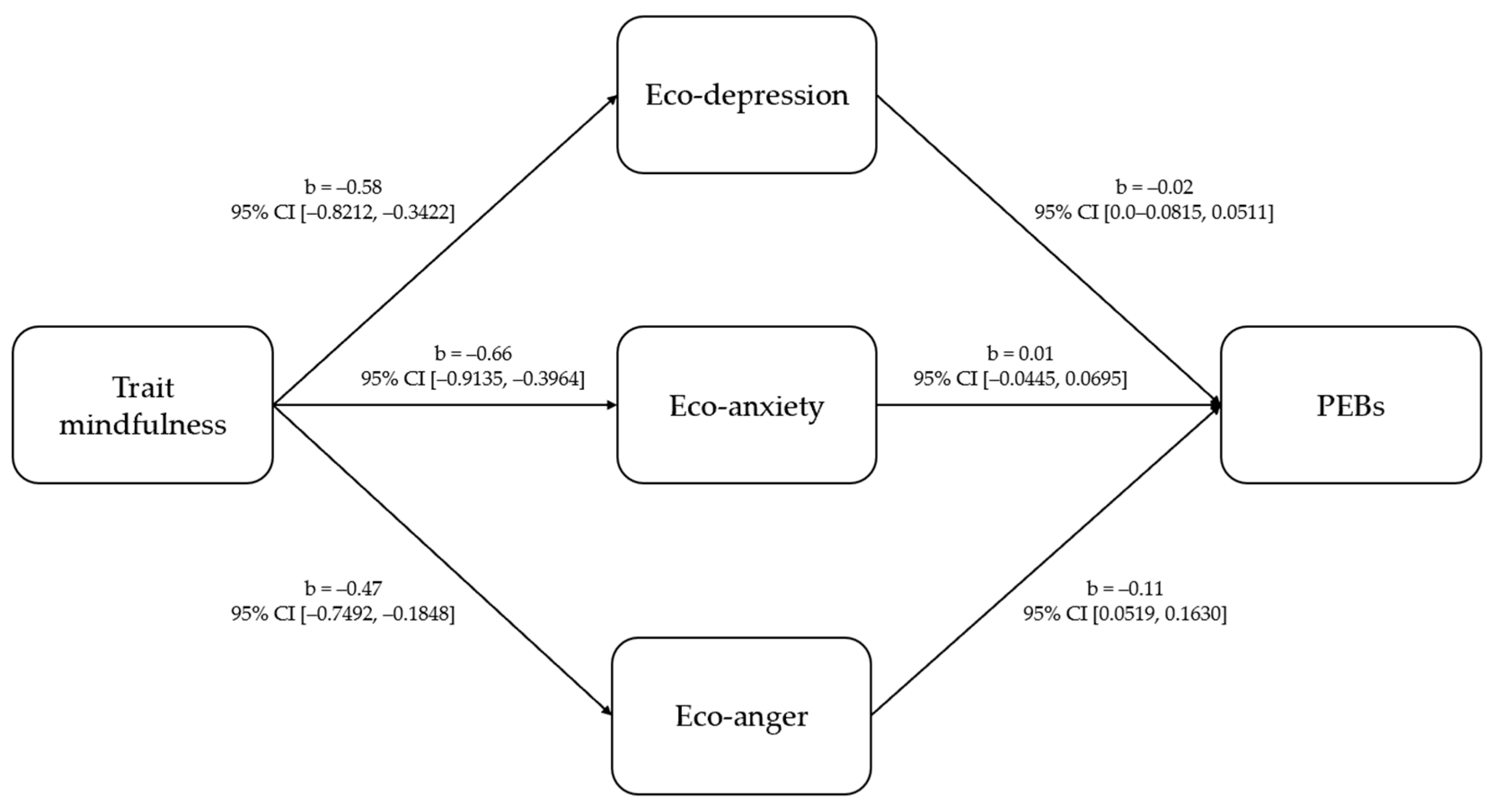
Figure 1. Path diagram of the model proposed in the current study. Note. Trait mindfulness → Eco-depression → PEBs: b = 0.01, 95% CI [−0.02, 0.05]); Trait mindfulness → Eco-anxiety → PEBs: b = −0.01, 95% CI [−0.05, 0.03]); Trait mindfulness → Eco-anger → PEBs: b = −0.05, 95% CI [−0.10, −0.01]). PEBs = Pro-environmental behaviours.
Sustainability 18 02446 g001
Table 1. Socio-demographic features of the sample.
Frequency (%)M (SD)Min–Max
Age 33.60 (14.50)18–72
Sex
      Male150 (57.90)
      Female109 (42.10)
Years of education 15.12 (3.05)8–21
Place of residence
      Rural119 (45.90)
      Urban140 (54.10)
Income (in Euros)
      <10,000 46 (17.80)
      11,000–25,000115 (44.40)
      26,000–50,00050 (19.30)
      51,000–75,0007 (2.70)
      76,000–100,0002 (0.80)
      >100,0003 (1.20)
Not declared36 (13.90)
Note. N = 259.
Table 2. Means, standard deviations, and correlation analysis.
MSD1.2.3.4.5.6.7.8.9.
1. Age33.6014.501
2. Sex 0.071
3. Years of education 15.123.050.38 **−0.14 *1
4. Place of residence 0.070.03−0.081
5. Trait Mindfulness 2.720.460.26 **−0.13 *0.16 **−0.121
6. Eco-anxiety2.680.99−0.17 **0.010.000.05−0.31 **1
7. Eco-depression2.190.90−0.050.00−0.050.01−0.31 **0.53 **1
8. Eco-anger2.561.03−0.20−0.010.06 0.00−0.17 **0.48 **0.59 **1
9. PEBs1.570.370.12−0.040.18 **0.020.100.110.090.30 **1
Note. N = 259. Sex (0 = Female; 1 = Male), place of residence (0 = Rural; 1 = Urban). PEBs = Pro-environmental behaviours. * p < 0.05 (two tailed), ** p < 0.01 (two tailed).
Table 3. Summary of the mediation analysis.
PathbBootSEBootLLCIBootULCI
Trait mindfulness → PEBs (direct effect)0.070.05−0.030.18
Trait mindfulness → Eco-depression → PEBs (indirect effect)0.010.02−0.020.05
Trait mindfulness → Eco-anxiety → PEBs (indirect effect)−0.010.02−0.050.03
Trait mindfulness → Eco-anger → PEBs (indirect effect)−0.050.02−0.10−0.01
Total effect0.030.05−0.0768−0.1272
R2 = 0.14
F(8,250) = 4.94 ***
Note. N = 259. BootSE = bootstrap standard error. BootLLCI/BootULCI = lower and upper limits of the 95% bootstrap confidence interval. PEBs = pro-environmental behaviours. Covariates: age, sex, years of education, and place of residence. *** p < 0.001.
Disclaimer/Publisher’s Note: The statements, opinions and data contained in all publications are solely those of the individual author(s) and contributor(s) and not of MDPI and/or the editor(s). MDPI and/or the editor(s) disclaim responsibility for any injury to people or property resulting from any ideas, methods, instructions or products referred to in the content.



