1. Introduction
In an era marked by interconnected global challenges—from climate change and social inequality to cultural fragmentation—the role of communication and media in advancing sustainable development has become paramount [
1]. Education, particularly in cultivating globally competent and critically literate professionals, is recognized as a foundational driver for achieving the United Nations Sustainable Development Goals (SDGs), with Sustainable Development Goal 4 (SDG 4) emphasizing inclusive, equitable learning and the promotion of lifelong opportunities for all [
2]. Sustainability in this study is defined as the capacity of an educational model to cultivate competencies that remain relevant and transferable over time, enabling learners to adapt to evolving professional demands and contribute meaningfully to society [
3]. This definition moves beyond general educational effectiveness—which often focuses on immediate knowledge acquisition or short-term skill gains—to emphasize durability, adaptability, and cross-contextual applicability of learning outcomes. It aligns with SDG 4.7, which calls for education that promotes sustainable development, global citizenship, and cultural diversity [
2]. In contrast to traditional pedagogies that prioritize exam performance and rote learning, sustainability-oriented education prioritizes future-readiness and adaptive capacity. Within this context, English as a Foreign Language (EFL) education for media majors occupies a critical intersection. It must not only develop linguistic proficiency but also foster the cross-cultural understanding, innovation skills, and critical thinking required to produce responsible media content and engage with diverse global audiences on sustainability issues [
4,
5].
In addition, the rapid digital transformation and globalization of the media industry have escalated the demand for such multifaceted competencies [
6]. However, a significant gap persists between traditional EFL pedagogies and the evolving needs of sustainable professional practice. Conventional models often prioritize grammatical accuracy and passive knowledge acquisition over the applied, critical, and collaborative competencies essential for real-world impact [
7]. In response, pedagogical innovations such as Content-Based Instruction (CBI) and Project-Based Learning (PBL) have gained traction. CBI integrates language learning with discipline-specific content, providing authentic context and enhancing cognitive engagement [
8], adaptable to new contexts and professional challenges, while PBL engages learners in extended, real-world projects that cultivate problem-solving, teamwork, and self-directed learning [
9], which are essential for lifelong adaptability. Together, these approaches form a pedagogical model that is sustainability-oriented, not merely effective in the short term. The outcomes measured in this study—self-directed learning [
10], innovation skills [
10], critical thinking [
11], teamwork [
12], and intercultural competence [
13]—are thus framed not as ends in themselves, but as indicators of sustainable competency development, reflecting learners’ capacity to apply and adapt these skills across time and contexts.
While previous research has explored CBI and PBL individually or in combination within EFL contexts, these studies have typically emphasized immediate learning outcomes—such as language proficiency gains or project completion—rather than the durability and transferability of competencies over time [
14,
15]. Existing studies on CBI in language teaching sometimes lack media-specific adaptation [
16,
17], whereas PBL research in EFL settings may not fully address the collaborative and critical dimensions needed for sustainability-oriented media production [
18]. Moreover, existing CBI-PBL integrations have not been explicitly aligned with Education for Sustainable Development (ESD) frameworks, nor have they theorized the synergistic mechanism through which content input and project application interact to produce sustainability-oriented learning. This disconnect underscores a notable research gap and a pressing pedagogical need.
Furthermore, while initiatives like China’s “New Liberal Arts” construction advocate for interdisciplinary integration and practical competency development [
19], the operationalization of these principles into a coherent, sustainability-aligned EFL framework for media students requires further empirical investigation and model development. This study, therefore, aims to address these gaps by designing, implementing, and evaluating an integrated CBI-PBL pedagogical framework within a media-focused EFL program. Grounded in the principles of ESD, this research investigates how the fusion of disciplinary content, authentic project work, and reflective language practice can enhance not only linguistic and media-related knowledge but also the core competencies for sustainability. The principal conclusions indicate that this integrated model significantly advances students’ multifaceted development and offers a replicable pathway for aligning language education with the imperatives of global sustainability.
To guide this research, the following questions have been established:
RQ1. What is the impact of the integrated CBI-PBL model on students’ acquisition of disciplinary knowledge, practical skills, and comprehensive competencies?
RQ2. How does the model influence students’ language application abilities, professional practice capabilities, and higher-order thinking skills relevant to sustainability?
RQ3. To what extent does the model demonstrate efficacy and relevance across different media-related specializations, and what are its implications for sustainable EFL pedagogy?
By employing a mixed-methods approach to gather robust empirical evidence, this study aims to contribute a replicable teaching model that aligns language education with the imperatives of sustainability. It seeks to offer both theoretical insights for the field of ESD-infused language teaching and practical guidance for educators and curriculum designers striving to prepare students for the complex, evolving demands of the media industry and global citizenship.
2. Towards a Sustainable Pedagogy: Addressing Gaps with an Integrated CBI-PBL Framework
2.1. The Sustainability Imperative in Media-Focused EFL Education
The rapid globalization and digital transformation of the media landscape have fundamentally reshaped the competencies required of future professionals [
20]. In this context, media-focused EFL education faces a sustainability imperative that transcends mere pedagogical updating [
21]. Sustainability here is understood as the capacity of an educational system to deliver long-term, adaptive, and relevant value to learners, enabling them to thrive in a volatile, uncertain, complex, and ambiguous media environment [
22]. This aligns with the core aims of Sustainable Development Goal 4 (Quality Education), which advocates for inclusive, equitable, and lifelong learning that builds future-ready skills [
23].
However, a persistent theory-practice divide threatens this sustainability. Industry demands professionals who can integrate advanced English communication with media literacy, critical thinking, and collaborative problem-solving [
24]. Yet, traditional EFL pedagogies for non-English majors often remain anchored in decontextualized, input-driven models, focused on grammatical accuracy and vocabulary recall assessed through standardized exams [
25,
26]. This approach creates several critical sustainability gaps: First, the Competency-Action Gap emerges when isolated knowledge acquisition fails to translate into actionable professional skills, ultimately undermining students’ long-term employability and career resilience in a competitive and evolving industry [
27]. Second, the Curriculum-Industry Dynamics Gap results from static curricula that cannot keep pace with the rapidly changing media and technological landscape, leading to the persistent risk of delivering obsolete content and skills [
28]. Finally, the Learning Engagement-Motivation Gap occurs when students perceive their learning as disconnected from authentic, real-world contexts, which significantly dampens intrinsic motivation and limits the depth and sustainability of the learning process itself [
29]. Therefore, reforming media-focused EFL is not merely an instructional choice but a strategic necessity for sustainable human capital development [
30]. The goal is to shift from a model of short-term knowledge transmission to one engineered for long-term competency cultivation—creating learning ecosystems that are adaptive, resilient, and regenerative.
In this study, sustainability serves primarily as a conceptual lens—grounded in the principles of ESD and SDG 4—through which the design and interpretation of the pedagogical model are framed. As highlighted in recent systematic reviews, the field of ESD continues to grapple with the absence of a unified framework for assessing sustainability competencies, and the extent to which these competencies are effectively integrated into educational programs remains largely undiscovered [
31]. Building upon this conceptual foundation, our research examines the crucial life skills and values identified by scholars as foundational to ESD competencies. Specifically, we focus on self-directed learning [
10], innovation skills [
10], critical thinking [
11], teamwork [
12], and intercultural competence [
13]. These elements form a cohesive unit wherein ESD knowledge supplies the necessary context and foundation, and these life skills function as the practical mechanism to translate theoretical understanding into significant real-world practices [
31].
2.2. Conceptual Foundations: Aligning CBI and PBL for Sustainable Competency Development
To bridge these sustainability gaps, this study integrates two pedagogical approaches whose core tenets align with the goals of sustainable education: CBI and PBL.
CBI contributes by fostering sustainable knowledge structures through the integration of language learning with subject-specific content, providing meaningful context that enhances both knowledge retention and practical application [
32,
33]. In a media-focused setting, this translates to learning English through and for the study of journalism, film narrative, or digital analytics. This dual focus promotes the development of integrated and durable knowledge frameworks that resist obsolescence, as language skills are continuously reinforced and expanded through engagement with relevant, evolving content [
34,
35]. Research corroborates CBI’s effectiveness in improving overall language performance and learner motivation [
36,
37].
Concurrently, PBL serves as the engine for sustainable skill and mindset development. It engages students in authentic, extended projects that require the application of knowledge to solve complex problems [
38]. This process intrinsically cultivates critical thinking, collaboration, self-directed learning, and innovation—precisely the higher-order skills and adaptive mindsets essential for lifelong learning and career agility [
39,
40]. By simulating real-world media production workflows, PBL constructs a pedagogical bridge to professional practice, directly addressing the previously identified competency-action gap. Meta-analytic evidence supports the positive impact of PBL on learning outcomes [
41].
The integration of CBI and PBL is synergistic. CBI provides the disciplinary substance and linguistic scaffolding, while PBL offers the practical mechanism for application and synthesis. Together, they establish a coherent framework for nurturing the multidimensional, transferable competencies that lie at the heart of a sustainable education.
2.3. Proposed Framework: A Sustainable CBI-PBL Model for Media-Focused EFL
Grounded in the foregoing rationale and aligned with UNESCO’s Media and Information Literacy Framework [
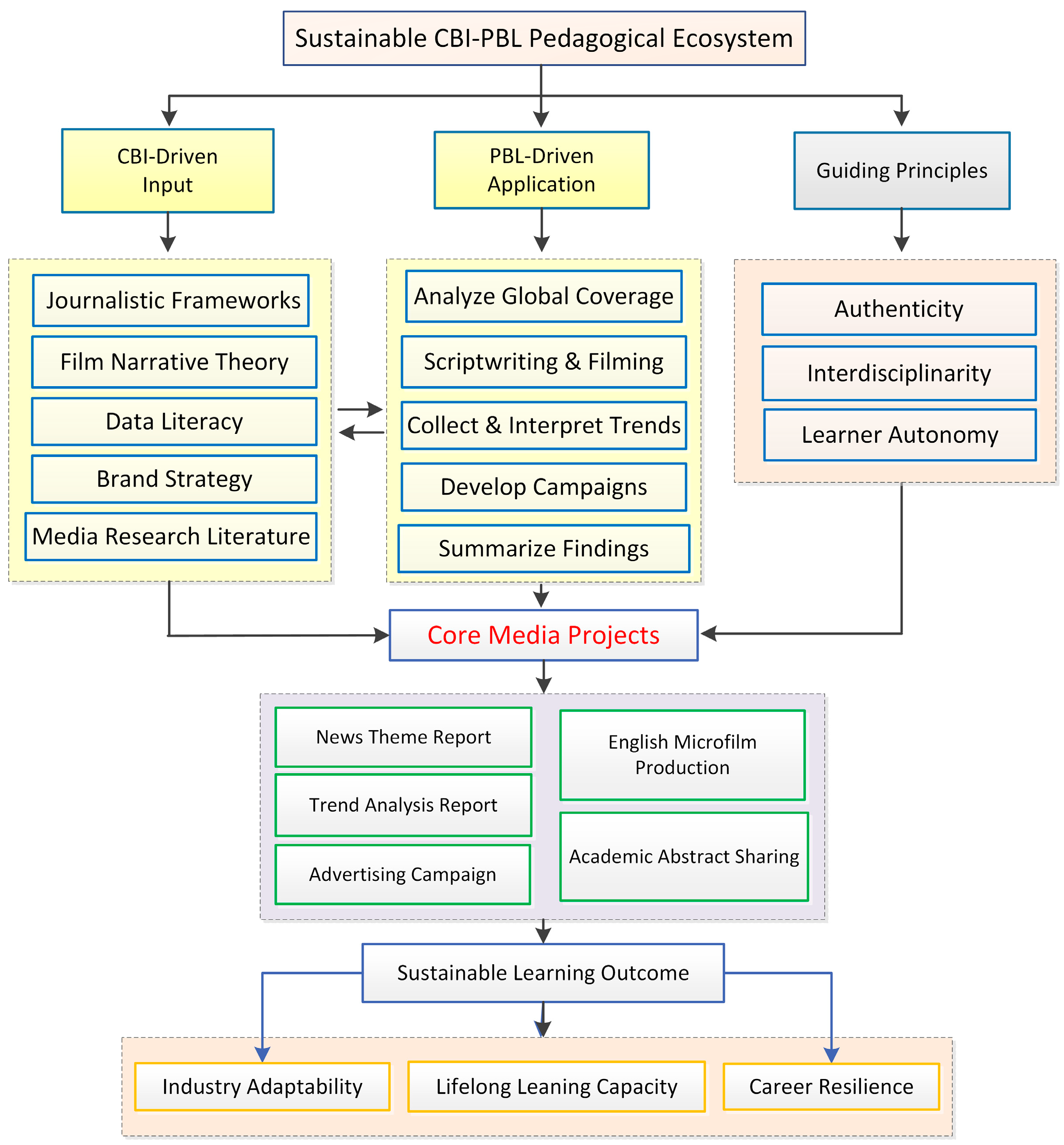
42], we propose an integrated CBI-PBL model conceived as a sustainable pedagogical ecosystem. This framework, visualized in
Figure 1, illustrates a cyclical interaction between content input (via CBI) and task application (via PBL) to foster integrated competencies. The model is founded on three guiding principles essential for sustainability: Authenticity, through the use of real-world media tasks and materials; Interdisciplinary, by merging language learning with media studies; and Learner Autonomy, through the fostering of self-directed learning strategies.
To translate these principles into practice, the curriculum is designed around five scaffolded, authentic media projects (see
Figure 1), each a deliberate fusion of CBI-driven content and PBL-driven tasks. These include a News Theme Report, where journalistic frameworks (CBI) inform the analysis of global coverage and analytical writing (PBL); English Microfilm Production, combining film narrative theory (CBI) with collaborative scriptwriting and production (PBL); a Trend Analysis Report, building data literacy (CBI) to execute technical reporting on social media trends (PBL); an Advertising Campaign, applying brand strategy and consumer psychology (CBI) to develop and pitch a full campaign (PBL); and Academic Abstract Sharing, where engagement with media research literature (CBI) underpins summarizing and presenting findings (PBL). By utilizing authentic resources—such as BBC news scripts, Cannes Lions-winning advertisements, and SSCI journal abstracts—and replicating genuine industry workflows, this curriculum ensures continuous contextual renewal and sustained professional relevance [
43].
The framework is conceptualized not as a linear sequence of projects but as a dynamic pedagogical ecosystem in which content input (CBI) and project application (PBL) interact recursively. Each project phase generates feedback that informs subsequent content learning, while deepened content knowledge enables more sophisticated project execution. This cyclical mechanism produces sustainability-oriented outcomes—including adaptive expertise, metacognitive awareness, and cross-contextual transferability—that distinguish the model from standard CBI-PBL implementations, which typically treat content and project work as parallel rather than recursively integrated components.
The five projects are not merely common media tasks but are designed as scaffolded, sustainability-oriented learning arcs: (1) News Theme Report: Students analyze global news coverage through comparative cultural frameworks, developing intercultural competence and critical media literacy—competencies essential for responsible global citizenship (SDG 4.7); (2) English Microfilm Production: Students collaboratively produce short films addressing social or environmental themes, cultivating collaborative problem-solving and ethical storytelling skills; (3) Trend Analysis Report: Students analyze social media trends using data literacy frameworks, developing analytical adaptability to evolving digital landscapes; (4) Advertising Campaign: Students design campaigns promoting sustainable consumption or social causes, applying consumer psychology to real-world sustainability challenges; (5) Academic Abstract Sharing: Students engage with international research literature, building lifelong learning capacity and aspirations for global academic mobility. Each project progressively builds students’ capacity to transfer competencies across professional and cultural contexts—a core indicator of sustainability-oriented education.
This curriculum necessitates an assessment system that itself supports sustainable learning. Moving beyond exam-centric evaluation, a 40-40-20 assessment matrix is employed: 40% for content mastery (CBI), 40% for language accuracy (the intersection of CBI and PBL), and 20% for creativity and innovation (PBL). While this framework heavily utilizes project-based outputs to mirror real-world collaboration, it is designed with built-in mechanisms to mitigate free-rider effects and ensure individual accountability. To achieve this, the 40% allocated to project-based components (specifically within the language accuracy and creativity portions) is further deconstructed: a portion of the score is derived from group submissions, while the remainder is based on individual contributions evidenced through peer reviews, reflective journals, or individually assessed project milestones. This approach balances formative assessments, like peer reviews and project feedback, with summative evaluations, measuring not only what students know but crucially how they individually apply knowledge and innovate within a team context—key indicators of durable competency development. To ensure fairness and consistency, all assessments are governed by fixed, pre-established rubrics that explicitly define performance levels for both individual contributions and collaborative outcomes.
To address potential concerns regarding the assessment of teamwork—such as the free-rider effect and uneven participation—the 40-40-20 matrix is operationalized with a clear distinction between group and individual performance. While the PBL component encourages collaboration, the assessment criteria are designed to capture individual competency gains. For instance, the 40% allocated to language accuracy and the 20% for creativity are not solely based on the final group product. Instead, they are triangulated with individual formative assessments, including peer evaluations, self-assessments, and individual presentations of project components. This ensures that the final grade reflects not only the collective output but also each student’s demonstrated ability to apply knowledge and innovate, thereby preventing the overstatement of individual competencies as highlighted by peer review processes.
Fundamental to sustaining this dynamic ecosystem is a transformed teacher role. Educators evolve from knowledge transmitters into facilitators, curriculum co-designers, and learning architects [
44]. Their responsibilities encompass curating authentic materials, designing project scaffolds, providing targeted linguistic and strategic support during project execution, and fostering a collaborative classroom culture that encourages intellectual risk-taking and peer learning [
45,
46,
47]. This shift is indispensable for maintaining a responsive, student-centered learning environment capable of adapting to both diverse learner needs and ongoing industry transformations.
2.4. Theoretical Positioning and Novelty
The proposed CBI-PBL model advances the field in two key respects:
First, it theorizes the synergistic mechanism of integration. Prior research has treated CBI and PBL as complementary but parallel components. This study demonstrates that their recursive interaction—where project outcomes inform content learning and deepened content enables more sophisticated projects—generates durable, transferable competencies that neither approach produces alone. This mechanism is operationalized through the cyclical feedback loops visualized in
Figure 1.
Second, it aligns the model with ESD principles and SDG 4.7. While previous CBI-PBL integrations have focused on linguistic or disciplinary outcomes, this study explicitly frames competency development—including self-directed learning, innovation skills, critical thinking, teamwork, and intercultural competence—as indicators of sustainability-oriented education. These competencies are distinguished from general educational effectiveness by their durability, adaptability, and cross-contextual applicability.
3. Materials and Methods
3.1. Research Design
This study employed a mixed-methods sequential explanatory design [
48] to comprehensively evaluate the effectiveness of the integrated Content-Based Instruction and Project-Based Learning (CBI-PBL) model in media-focused EFL education. This study employed a single-group pretest-posttest design without a control or comparison group. This design was necessitated by the real-world classroom context: the intervention was implemented as a required component of the curriculum for all second-year media majors, making it impractical to withhold the treatment from a control group for administrative constraints. This design involved two interconnected phases: an initial quantitative phase followed by a subsequent qualitative phase.
This initial phase involved administering a questionnaire survey and collecting pre-test/post-test academic performance data from a larger sample (N = 204). A five-point Likert scale questionnaire is distributed to all participants, collecting measurable data on these aspects. To further complement the assessment of academic performance, the study also incorporates a detailed analysis of students’ grades and academic achievements throughout the course. Its primary objective was to objectively measure and generalize the model’s impact on students’ knowledge, skills, competencies, and academic achievement.
The second phase is qualitative and follows the quantitative phase. In this phase, semi-structured interviews are conducted with a purposive sample of 50 students to gather deeper insights into their experiences, perceptions, and feedback regarding the teaching model. These interviews are designed to explore the reasons behind the quantitative findings, providing a more nuanced understanding of students’ subjective experiences. While questionnaires provide valuable insight into student perceptions, we acknowledge that such self-report data may be subject to social desirability and novelty biases. These are addressed further in the limitations section.
3.2. Participants
The participants in this study were 204 second-year media majors from the 2022 cohort at Communication University of Shanxi, China. These students represent three distinct disciplines: Broadcasting and Hosting (n = 50), Advertising Design and Communication (n = 49), Internet and New Media (n = 46) and Advertising Planning (n = 59). The diversity of academic backgrounds ensures a broad range of perspectives on the effectiveness of the CBI-PBL teaching model.
For the qualitative phase of the study, a purposive sample of 50 students was selected for interviews. The selection criteria for the interviewees included English proficiency (final English scores from the previous semester, categorized into A, B, and C), gender balance (22 males and 28 females), and academic performance (GPA range: 2.5–4.0). This purposive selection was designed to ensure a diverse range of student experiences and perceptions. Students with prior experience in CBI-PBL courses were excluded from the sample to avoid potential confounding effects and to focus on the participants’ responses to their first exposure to the teaching model.
Before the data collection, all participants were informed about the purpose of the study, their voluntary participation, and their right to confidentiality and anonymity. Informed consent was obtained from all participants, and they were given the opportunity to withdraw from the study at any point without consequence.
3.3. Research Instruments and Data Collection
This study employs both quantitative and qualitative research instruments to assess the effectiveness of the CBI-PBL teaching model. The instruments used include a questionnaire survey, semi-structured interviews, and academic performance data.
Questionnaire survey: A self-administered questionnaire was developed based on a comprehensive review of literature on CBI, PBL, and ESD competency frameworks [
15,
17,
18]. The instrument was designed to measure three core dimensions aligned with the study’s objectives: A self-developed questionnaire, structured around a five-point Likert scale (1 = Strongly Disagree to 5 = Strongly Agree), was used to assess three core dimensions: (1) Knowledge Acquisition, assessed through 6 items targeting gains in both English language and media discipline knowledge; (2) Skill Enhancement, evaluated via 12 items focusing on language application, self-directed learning, innovation, and critical thinking; and (3) Competency Development, measured by 6 items centered on teamwork and intercultural communication. Prior to the main study, the questionnaire underwent a pilot test with a separate cohort of 30 students to ensure item clarity and face validity. Based on pilot feedback, minor revisions were made to item wording to enhance comprehensibility.
To examine the construct validity of the instrument, a Confirmatory Factor Analysis (CFA) was conducted on the main study sample (N = 204). The three-factor model demonstrated a good fit with the data: χ2/df = 2.35, Comparative Fit Index (CFI) = 0.92, Tucker–Lewis Index (TLI) = 0.91, Root Mean Square Error of Approximation (RMSEA) = 0.06, and Standardized Root Mean Square Residual (SRMR) = 0.05. All fit indices met or exceeded the recommended thresholds, supporting the proposed three-dimensional structure.
Convergent validity was assessed through composite reliability (CR) and average variance extracted (AVE). For the three dimensions, CR values ranged from 0.82 to 0.90, exceeding the recommended criterion of 0.70, and AVE values ranged from 0.51 to 0.60, meeting or approaching the 0.50 threshold. These results indicate adequate convergent validity. Discriminant validity was established as the square root of the AVE for each dimension exceeded its correlations with the other dimensions (see
Table 1).
The instrument also demonstrated excellent internal consistency, with a Cronbach’s Alpha of 0.964 for the overall scale. The Kaiser–Meyer–Olkin (KMO) measure of sampling adequacy was 0.901, and Bartlett’s test of sphericity was significant (p < 0.001), confirming the suitability of the data for factor analysis.
The final questionnaire was administered online to all 204 participants upon completion of the 16-week instructional semester.
Analysis of the main study data confirmed the instrument’s robust psychometric properties, demonstrating excellent internal consistency with a Cronbach’s Alpha of 0.964. Furthermore, the KMO measure of sampling adequacy was 0.901, and Bartlett’s test of sphericity was significant (p < 0.001), confirming the suitability of the data for factor analysis. The final questionnaire was administered online to all 204 participants upon completion of the 16-week instructional semester.
Semi-structured interviews: To gain qualitative depth, a semi-structured interview protocol was developed. The guide included open-ended questions and prompts exploring: (a) students’ overall perceptions of the CBI-PBL model; (b) specific experiences and challenges during different project phases; (c) perceived growth in language abilities, media skills, and sustainability-oriented competencies (e.g., critical thinking, collaboration); and (d) suggestions for improvement. Each interview lasted 20–30 min, was conducted in Mandarin Chinese to ensure comfort and depth of expression, audio-recorded with permission, and later transcribed verbatim for analysis.
Academic performance data: To obtain an objective measure of learning gains, standardized course assessment scores were collected. Parallel-form pre-test and post-test instruments were designed by the course instructors and a language assessment expert to ensure alignment with course objectives. These tests specifically evaluated media-contextualized English language skills, including vocabulary in context, reading comprehension of media-related texts, and analytical writing tasks. The pre-test was administered in the first week, and the post-test in the final week of the semester.
Data collection was conducted from February to July 2025. Quantitative data (questionnaires and test scores) were collected at the end of the semester. Qualitative interviews were conducted in the two weeks immediately following, allowing interview questions to probe initial quantitative trends.
3.4. Data Analysis
Quantitative data from the questionnaires and test scores were analyzed using SPSS (Version 26). Descriptive statistics were calculated for all items. Paired-sample t-tests were conducted to compare pre-test and post-test academic performance scores across the four majors, with effect sizes (Cohen’s d) calculated to determine the magnitude of change.
For the qualitative data, thematic analysis was conducted following the six-phase framework proposed by Braun and Clarke [
49]. First, two researchers immersed themselves in the dataset by re-reading interview transcripts to develop a holistic understanding of the data, note initial impressions, and identify potential patterns prior to formal coding. Second, each researcher independently conducted systematic line-by-line coding of the transcripts, identifying and labeling meaningful data segments relevant to students’ experiences, perceptions, and challenges within the CBI-PBL model. Both semantic codes (capturing explicit content) and latent codes (capturing underlying meanings) were generated to ensure comprehensive and inclusive coverage of the dataset. Following the independent coding phase, the two researchers convened to compare, discuss, and reconcile their codes. Discrepancies were resolved through dialog and consensus. The refined codes were then grouped into broader clusters. Then, researchers returned to the original coded data extracts to verify that each theme was adequately supported by the data and accurately represented the dataset as a whole. Themes that lacked sufficient grounding were merged, refined, or discarded accordingly. To assess inter-rater reliability, a random sample of 20% of the transcripts was double-coded, yielding a Cohen’s kappa coefficient of κ = 0.84, indicating substantial agreement [
50,
51]. Each finalized theme was assigned a concise name and detailed thematic descriptions to articulate the essence of each theme and its relationship to the research question. Representative data extracts were selected to illustrate and substantiate each theme. Examples of final themes include “Engagement with Authentic Tasks”, “Challenges of Collaboration,” and “Growth in Critical Perspective”. The finalized themes were synthesized into a coherent narrative that integrated interpretive commentary, illustrative participant quotations, and connections to the research question. The reporting process maintained methodological transparency by documenting analytical decisions at each stage.
4. Results
This mixed-methods study systematically evaluated the effectiveness of the CBI-PBL model. The key findings were synthesized into four main domains: knowledge acquisition, skill enhancement, competency development, and academic performance.
4.1. Impact on Students’ Knowledge Acquisition
The quantitative results showed that a significant portion of students found the CBI-PBL model effective. As shown in
Table 2, 42.50% of students considered it “very useful” for learning English, while 36.13% rated it as “somewhat useful.” Similarly, 74.88% (36.75% “very useful” + 38.13% “somewhat useful”) of students reported that the model was beneficial for acquiring media-related knowledge. Only a small percentage of students reported that the model had little to no effect on their learning, with 1.36% stating it was “not useful” for English language knowledge and 2.96% for media discipline knowledge.
The thematic analysis revealed three distinct themes that explain how and why the CBI-PBL model facilitated learning:
Theme 1: Contextualized Vocabulary Acquisition through Authentic Media Tasks.
Consistent with students’ general reports that vocabulary improvement was linked to repeated exposure during projects, the interviews revealed that tasks such as script-writing and news reporting provided meaningful contexts for lexical retention. One student noted: “When we were writing the news script, I had to look up and use words like ‘anchor’ and ‘breaking news’ repeatedly. After the project, those words just stuck with me because I used them in a real context”. This suggests that the project-based application of language in media tasks created cognitive engagement beyond rote memorization.
Theme 2: Authentic Audience as a Catalyst for Oral Proficiency.
Echoing the finding that peer evaluations and English presentations enhanced pronunciation and listening skills, students explained that the presence of an authentic audience heightened their awareness of language accuracy. “Knowing that my classmates would evaluate my presentation pushed me to practice my pronunciation more. It wasn’t just for the teacher; I had to be understood by everyone”, explained another participant. This shift from teacher-oriented learning to peer-oriented accountability was a key driver of oral skill development.
Theme 3: Tacit Understanding of Professional Media Practices.
Beyond the acquisition of disciplinary knowledge, students developed a deeper understanding of media operational mechanisms through hands-on application. The interviews highlighted that projects such as simulating a newsroom or producing a short film allowed them to internalize professional workflows. One student reflected: “I used to just watch the news. But after doing the project, I finally understood the pressure of deadlines and how a news team has to collaborate. You can’t learn that from a textbook.” This finding underscores the model’s capacity to bridge theoretical knowledge and practical competency.
4.2. Impact on Students’ Skill Enhancement
In terms of skill enhancement, the quantitative results revealed that the majority of students reported positive feedback regarding their language skills, with 74.99% expressing satisfaction. As illustrated in
Table 3, 30.23% of students considered the teaching model “very useful” for developing language skills, while 44.76% rated it as “somewhat useful.” Regarding self-directed learning ability, 72.29% of students offered favorable views, with 25.31% finding the model “very useful” and 46.98% deeming it “somewhat useful”. However, challenges such as language barriers (6.89%) and workload constraints (5.84%) were noted by some students.
The model’s impact on innovation skills yielded positive outcomes for 69.56% of students, with 23.89% rating it as “very useful” and 45.67% as “somewhat useful”. Additionally, 66.37% of students acknowledged the development of critical thinking skills, as indicated by 27.45% who found it “very useful” and 38.92% who rated it “somewhat useful”, though issues related to team dependency were also mentioned.
Thematic analysis of the interview transcripts revealed four distinct themes that explain how and why the CBI-PBL model facilitated skill acquisition.
Theme 1: Language Skills Developed through Authentic Genre Production
Consistent with the quantitative finding that 74.99% of students found the model useful for language learning, the interviews revealed that reading proficiency was enhanced through engagement with authentic media materials, while writing skills were sharpened through project documentation. One student described this process: “For the news report project, we had to read actual English news articles to understand the genre conventions. Then, when we wrote our own script, I became much more aware of sentence structure and word choice because it had to sound like real journalism. The reading and writing were connected—not separate exercises”.
Theme 2: Self-Directed Learning as a Catalyst for Cross-Disciplinary Skill Acquisition
The microfilm project emerged as a primary driver, requiring students to acquire skills outside their comfort zones: “None of us knew how to edit videos before this course. We had to watch YouTube tutorials and teach ourselves how to use the editing software. It was frustrating at first, but by the end, I felt proud that I could do something I never thought I’d learn in an English class”. These responses indicate that self-directed learning in this context was not merely about managing time, but about acquiring tangible new competencies driven by project demands.
Theme 3: Innovation Skills Fostered by Creative Constraints
While 69.56% of students rated the model positively for innovation skills, the inter-views revealed that creativity flourished within the structured constraints of media pro-jects. One student explained how the advertising campaign project sparked innovative thinking: “We had to create an ad campaign for a real product. The teacher gave us guide-lines, but within that, we had total freedom. My group came up with this idea of using a mini-drama to sell the product. It was risky, but we went for it. That experience taught me that creativity isn’t about no rules—it’s about working imaginatively within them”. This suggests that the PBL framework provided a safe structure for creative risk-taking, enabling students to innovate without feeling overwhelmed by ambiguity.
Theme 4: Critical Thinking Sharpened through Debate and Peer Evaluation—and Challenges in Team Dynamics
The quantitative data indicated that 66.37% of students acknowledged gains in critical thinking skills. The interviews traced this development to specific pedagogical activities: structured debates and peer evaluations. One participant noted: “During the trend analysis report, we had to present our findings, and then other groups would question our interpretations. Defending our ideas in English forced me to think on my feet and consider perspectives I hadn’t thought of. That’s when I felt my critical thinking really growing”.
However, consistent with the quantitative finding that some students reported challenges, the interviews also revealed concerns about team dependency and uneven contributions—a critical nuance that enriches the quantitative data. One student candidly shared: “In my group, two people did most of the work, and one person barely contributed. It was frustrating because our grade depended on the final product, but we didn’t want to report our teammate. I learned a lot from the project itself, but I also learned that group work can be unfair”.
Another student offered a more balanced perspective: “At first, I was worried about uneven participation. But our teacher had us do peer evaluations mid-way through the project, which helped. We could give anonymous feedback, and after that, the less active member started contributing more. The system held everyone accountable”.
These contrasting experiences highlight both the potential pitfalls of project-based learning and the importance of structured accountability mechanisms—such as peer evaluations—in mitigating free-rider effects.
4.3. Impact on Students’ Competency Development
The study revealed that a substantial 71.96% of students positively rated their experience with teamwork, particularly during collaborative projects such as microfilm production. As shown in
Table 4, 26.98% of students considered the development of teamwork spirit “very useful”, while 45.12% rated it as “somewhat useful”. In terms of intercultural competence, 72.1% of participants recognized an enhanced global perspective, primarily through the comparative analysis of Chinese and international media narratives. Specifically, 29.34% of students found this aspect “very useful”, and 42.67% considered it “somewhat useful”, demonstrating the model’s effectiveness in broadening students’ intercultural communication skills.
Qualitative data from semi-structured interviews with 50 students provided rich in-sights into how the CBI-PBL model fostered competency development in teamwork and intercultural competence.
Theme 1: Task Interdependence as the Engine of Collaborative Learning
Consistent with the quantitative finding that 71.96% of students positively rated their teamwork experience, the interviews revealed that the structure of collaborative pro-jects—particularly the microfilm production—created authentic task interdependence that made teamwork essential rather than optional. One student explained: “In our microfilm project, everyone had a specific role: one person wrote the script, another handled filming, another edited, and I was in charge of the English subtitles. If I didn’t do my part accurately, the whole film’s quality would suffer. We had to rely on each other completely. That’s what made it feel like real teamwork, not just dividing up busy work”.
These responses indicate that the PBL framework’s core media projects were de-signed with inherent interdependence, compelling students to engage in meaningful collaboration rather than parallel work.
Theme 2: Intercultural Competence Forged Through Comparative Analysis
The quantitative data indicated that 72.1% of students recognized enhanced inter-cultural competence, primarily through comparative analysis of Chinese and international media narratives. The interviews illuminated how this competence developed and why it was meaningful to students. One participant described the eye-opening experience of analyzing global news coverage: “For the trend analysis report, my group compared how Chinese and Western media covered the same technology story. I was shocked to see how different the angles were—Chinese media focused on innovation and progress, while Western media emphasized privacy concerns. It made me realize that news is never neutral; it’s shaped by cultural values. That awareness changed how I consume media now”.
Another student connected the abstract writing project to a broader global perspective: “Writing an academic abstract in English forced me to read international journals I’d never heard of before. I discovered research being done by scholars in Europe and America that I wouldn’t have encountered otherwise. It made me feel connected to a global academic community. Now I’m seriously considering applying for a master’s program abroad because I want to be part of that conversation”.
These responses demonstrate that intercultural competence in this context was not merely theoretical knowledge but a practiced sensitivity developed through concrete analytical tasks and collaborative interaction.
4.4. Impact on Students’ Academic Performance Improvement
The results of pre- and post-test assessments across four academic majors are summarized in
Table 5. Significant improvements in student performance were observed following the intervention. In the Broadcasting major, the average pre-test score was 73.4 (SD = 10.2), while the post-test score increased to 85.6 (SD = 8.7). A paired-samples t-test yielded a t-value of 12.34 (
p < 0.001), with Cohen’s d of 1.21, indicating a large effect size. The 95% confidence interval (CI) for the mean difference ranged from 10.8 to 13.6, suggesting a substantial improvement in student performance. Similarly, in the Advertising Design major, the pre-test average was 71.8 (SD = 9.5), with the post-test score rising to 83.2 (SD = 9.1). The t-value was 10.87 (
p < 0.001), and Cohen’s d was 1.05, reflecting a large effect size. The 95% CI for the mean difference was between 9.2 and 11.8. For the New Media major, pre-test scores averaged 74.1 (SD = 11.3), while post-test scores increased to 84.9 (SD = 10.5). The t-value of 9.65 (
p < 0.001) and Cohen’s d of 0.96 suggest a medium to large effect size. The 95% CI for the improvement ranged from 8.5 to 12.1, further indicating significant progress. Finally, in the Advertising Planning major, the pre-test score was 72.6 (SD = 10.8), and the post-test score improved to 82.4 (SD = 11.2). The paired-samples t-test revealed a t-value of 8.92 (
p < 0.001), with Cohen’s d of 0.89, indicating a medium to large effect. The 95% CI for the mean difference ranged from 7.9 to 11.3.
These findings collectively demonstrate that the implementation of the project-based content teaching method led to significant improvements in student performance across all four majors, with large effect sizes observed in the Broadcasting and Advertising Design majors, and medium to large effect sizes in the New Media and Advertising Planning majors.
Statistically significant improvements from pre-test to post-test were observed across all four majors, with effect sizes ranging from medium to large (Cohen’s d = 0.89 to 1.21). While these within-group gains are encouraging, they must be interpreted with caution due to the absence of a control group. The observed improvements could reflect not only the effects of the CBI-PBL model but also other factors such as students’ natural maturation over the semester, increased familiarity with the assessment format, instructor enthusiasm, or concurrent exposure to English-language media outside the classroom. Therefore, these findings provide preliminary evidence of positive change but do not demonstrate causal efficacy.
5. Discussion
The findings of this mixed-methods study offer robust evidence supporting the efficacy of the integrated CBI-PBL model may present a viable and effective framework within media-focused EFL education. This discussion synthesizes quantitative trends with qualitative insights, situating the results within the broader theoretical frameworks of CBI, PBL, and ESD. It further elucidates the model’s underlying mechanisms, addresses its pedagogical implications for sustainability, and reflects on its limitations to outline pathways for future refinement.
5.1. Integrating Knowledge and Skill Development: From Input to Sustainable Application
The high percentage of students reporting benefits in both English and media knowledge (
Section 4.1) supports the model’s core premise: integrating content and language learning is effective. Qualitative insights elucidate this success; vocabulary improvement was tied to repeated exposure during authentic tasks like scriptwriting, while pronunciation and listening skills benefited from peer evaluations and English presentations. This aligns with CBI theory, which posits that learning language through meaningful, discipline-specific content enhances acquisition [
52,
53,
54]. These findings represent empirically observed outcomes, directly supported by student self-reports and qualitative accounts of learning experiences. However, due to the lack of a control group, these findings should be interpreted as associations observed under the implemented model rather than causal effects.
Similarly, the significant skill enhancement reported (
Section 4.2) can be attributed to the PBL component’s experiential nature. The improvement in reading and writing skills can be directly linked to extensive engagement with authentic materials and project documentation. The development of self-directed learning was necessitated by the need to acquire cross-disciplinary skills (e.g., video editing), particularly evident in microfilm projects. These empirically observed gains in self-directed learning, innovation skills, and critical thinking—as measured by student self-reports and qualitative accounts—demonstrate the model’s effectiveness. While challenges like workload and language barriers were noted, overall, the model effectively facilitated a shift from a teacher-centered paradigm of knowledge transmission toward a learner-centered ecology of knowledge construction and application.
5.2. Fostering Collaborative and Intercultural Capacities: Essential Skills for a Globalized Field
The empirically observed development of teamwork and intercultural competence (
Section 4.3) speaks directly to two recognized gaps in conventional EFL training and aligns with key ESD objectives. These findings are directly supported by student self-reports and qualitative accounts of collaborative experiences. In collaborative projects like microfilm production, success depended on genuine interdependence, making teamwork a practical reality rather than a theoretical ideal. However, as in any group work, issues like uneven participation (“free-riding”) emerged [
55]. This reminds us that the aspiration to achieve sustainable competency development requires more than just placing students in groups; it needs careful design—with clear roles, individual accountability, and guided reflection—to ensure collaborative tasks become true learning experiences. The goal of fostering enduring collaborative capacities represents a pedagogical aspiration toward which the model contributes, rather than a fully realized outcome of this implementation.
In addition, according to student self-reports, the model appeared to nurture a more nuanced intercultural awareness, largely through activities that required students to compare Chinese and international media narratives. Qualitative data from interviews reveal that this comparative analysis fosters a critical awareness of how cultural values shape media perspectives. This process leads students to understand that news is not neutral, fundamentally changing how they engage with information and solidifying a key component of global citizenship. For aspiring media professionals, this analytical capacity is vital for creating content that is both globally relevant and culturally sensitive. An empirically observed and noteworthy outcome was that several students reported increased interest in studying abroad after engaging with international academic abstracts, suggesting the model’s potential to inspire global academic and professional mobility.
5.3. Validating Outcomes and Envisioning an Adaptive, Inclusive Pedagogy
The positive outcomes in academic performance across all majors (
Section 4.4), with notable effect sizes, provide strong empirical evidence for the model’s efficacy. These pre-post test gains represent measured, empirically observed outcomes. These gains likely stem from the alignment of assessments with real-world tasks, which increases student motivation and applies learning in contextually meaningful ways. However, the study also identifies a crucial limitation: a minority of students benefited less, primarily due to insufficient integration of theory with professional practice or cognitive overload from dual language-content demands—a phenomenon also observed in CLIL contexts [
56]. This limitation is itself an empirically observed finding, directly supported by student feedback and performance patterns.
Therefore, the aspiration of sustainable implementation of this framework necessitates a shift from a standardized, one-size-fits-all model toward a more flexible and supportive learning ecosystem. Based on the challenges identified in this study, we propose three interconnected pedagogical recommendations to guide this transition and promote more inclusive and effective practice. These recommendations represent forward-looking strategies grounded in the study’s findings rather than empirically tested interventions. First, differentiated scaffolding should be provided by offering tiered linguistic and procedural supports tailored to learners’ varying proficiency levels and starting points. Second, deepened instructor collaboration is essential, requiring ongoing co-planning and team teaching between language and media specialists to bridge disciplinary theory and practical application seamlessly. Finally, explicit strategy instruction must be embedded into the curriculum, equipping students with metacognitive tools to help them plan, monitor, and navigate the dual challenges of simultaneous content and language learning.
5.4. Limitations and Future Works
While the findings of this study are encouraging, several limitations must be acknowledged when interpreting the results. First, the absence of a control or comparison group limits the extent to which the observed improvements can be causally attributed to the CBI-PBL intervention. Although pre- and post-test comparisons showed significant gains, alternative explanations such as student maturation, increased familiarity with assessments, or general semester effects cannot be ruled out. Therefore, the positive outcomes reported throughout this paper should be viewed as associations observed under the implemented model rather than definitive causal effects.
Second, the reliance on self-reported questionnaire data introduces potential biases, including social desirability and novelty effects. While triangulation with academic performance and qualitative interviews strengthens the evidence, future studies should incorporate more objective measures and longitudinal designs to confirm the durability and causality of the observed competencies.
Third, the study was conducted within a single institutional context with a specific cohort of second-year media students. This limits the generalizability of the findings to other settings, disciplines, or educational levels. Replication in diverse contexts is necessary to establish the broader applicability of the model. Moreover, while the study was conceptually framed within ESD, sustainability-related outcomes were not directly operationalized or measured. The competencies examined—such as critical thinking, collaboration, and intercultural awareness—are best understood as proxies or foundational elements of sustainability rather than direct indicators of sustainable development.
These limitations underscore the need for cautious interpretation and highlight directions for future research, including the use of a control or comparison group, longer intervention periods, cross-institutional comparisons and development and validation of direct measures for sustainability competencies. Despite these constraints, the study provides valuable insights into the potential of integrated CBI-PBL approaches for fostering sustainability-oriented competencies in media EFL education.
6. Conclusions
This study provides evidence that the integrated CBI-PBL model is correlated with enhanced achievement in media-focused EFL education. The findings suggest that this approach is associated with positive student perceptions of learning gains in linguistic knowledge, media-related content, practical skills, and key competencies such as teamwork and intercultural communication. The marked improvement in academic performance across diverse media majors further underscores the model’s observed efficacy in achieving core learning objectives. These outcomes affirm the value of integrating disciplinary content with authentic, project-driven language practice.
However, the study also empirically identifies challenges to the model’s consistent effectiveness, notably the uneven integration of theory and professional practice, which limited the gains for a subset of students. This highlights a need for deliberate scaffolding and support structures. To optimize implementation and ensure more inclusive benefits, we propose targeted strategies grounded in the study’s findings: fostering deeper interdisciplinary collaboration between language and media faculty to co-design curricula, providing clearer guidance for students to develop self-regulated learning strategies, and incorporating more personalized instructional support to address diverse learner needs and proficiency levels.
The implications of this research primarily concern future-oriented capability outcomes observed within one semester. The CBI-PBL framework was associated with statistically significant pre–post gains and consistently positive student perceptions regarding language development, media-related knowledge, teamwork, and intercultural communication. These findings suggest that the model can support the development of competencies (e.g., critical thinking [
11], collaborative problem-solving [
12], and self-directed learning [
10]) that are conceptually aligned with Education for Sustainable Development and SDG 4.7. However, the present study did not assess long-term retention or transfer to employment-related trajectories. Future longitudinal research tracking graduates’ competency retention and professional adaptation is needed to evaluate whether and how such future-oriented capability gains translate into sustainability-oriented educational impacts.
In summary, the integrated CBI-PBL model offers a promising pathway for reforming specialized EFL education. Its success in fostering multidimensional competency development points toward a more holistic and applied direction for language teaching. However, given the study’s single-institutional scope and specific cohort characteristics, the findings should be interpreted as contextually grounded rather than universally generalizable. The model’s applicability in other settings will depend on thoughtful adaptation to local curricular structures, student profiles, and institutional resources. To fully realize its potential and ensure its sustainability, continued refinement through collaborative curriculum design, responsive teaching practices, and further empirical research is essential. This work provides a foundation for such efforts, contributing to the broader discourse on creating future-ready and sustainable educational experiences.