1. Introduction
Against the backdrop of accelerating global environmental governance and deepening integration of the digital economy, it is critical to explore how environmental policy instruments can simultaneously promote environmental sustainability and economic transformation. Meanwhile, digital transformation has emerged as a key global driver of productivity growth and sustainable development. However, the interaction between environmental tax and corporate digital transformation remains insufficiently explored, particularly at the micro level.
As the world’s second-largest economy and foremost emerging market, China has contributed over 30% to global economic growth over the past decade. It serves not only as a central hub in global industrial and value chains but also as a trailblazer in green transition and digital economy development. Since the announcement of its “Carbon Peaking and Carbon Neutrality” (Dual Carbon) goals, China has pursued ecological civilization construction with unprecedented intensity. By 2024, renewable energy accounts for over 50% of China’s total installed power capacity, while new energy vehicle production and sales have maintained global leadership for ten consecutive years. Concurrently, the value added of core digital industries accounts for approximately 10% of the GDP, establishing digitalization as the primary engine driving industrial restructuring and sustainable growth. These developments position China as a highly informative empirical case for examining the co-evolution of environmental regulation and digital transformation under conditions increasingly faced by many economies worldwide.
The green tax system, as a policy instrument for reconciling environmental protection and economic development, is undergoing functional evolution from “unidimensional pollution control” toward “multidimensional innovation incentives”, which is a transition particularly consequential in China’s institutional context. China’s environmental governance predominantly relied on command-and-control regulations. While delivering rapid compliance outcomes, such mandatory mechanisms incurred high implementation costs and generated adverse socioeconomic externalities. The enactment of the Environmental Protection Tax Law in 2018 marked China’s substantive transition toward market-based environmental regulation. As a long-term market-conforming instrument, the environmental tax not only restructures corporate cost frameworks and development paradigms but also pioneers novel pathways for achieving “dual dividends”, simultaneously improving environmental quality (the “green dividend”) and economic efficiency (the “blue dividend”).
The existing literature has examined environmental taxation from multiple angles. One strand focuses on its “green dividend”, demonstrating that environmental tax can effectively reduce pollution emissions [
1] and stimulate green technology innovation. Another strand investigates the “blue dividend”, exploring effects on productivity, employment, and economic efficiency, though the findings remain mixed [
2]. Concurrently, a growing body of research examines the drivers of corporate digital transformation, identifying external factors such as tax incentives and internal factors such as ESG performance.
However, the literature has largely developed in parallel, with limited integration. The studies examining environmental tax typically focus on innovation outcomes measured by patents or R&D investment [
3], while the studies of digital transformation rarely consider environmental tax as a potential driver. Moreover, the research on ESG and digitalization has not been linked to the incentive structures created by environmental taxation. Crucially, it remains unclear whether and how market-based environmental policies such as taxation can bridge the “green governance” and “digital revolution” to foster sustainability-oriented corporate transformation, and through which mechanisms such effects might operate. Therefore, conducting research on the impact effects, mechanism paths and heterogeneity of environmental tax on digital transformation of enterprises can help provide realistic references for the government to optimize environmental regulatory tools as well as for enterprises to formulate digital transformation strategies.
This paper highlights four main questions: First, does environmental tax significantly promote enterprise digital transformation? Second, if such an effect operates, what mechanisms might influence it? Third, how do external institutional environments, such as marketization level and environmental information disclosure, moderate this relationship? Finally, does the effect of environmental tax exhibit heterogeneity across regions and firm characteristics, and what are its subsequent implications for economic and environmental performance? Based on these questions, this paper focuses on the relationship between environmental tax and enterprise digital transformation, enriching the research on the interaction between fiscal policy and corporate behavior and providing important insights for improving China’s environmental tax system and promoting digital transformation.
This study makes several contributions. First, we integrate environmental tax, green innovation, ESG, and digital transformation into a unified analytical framework, revealing the dual mediating pathways through which environmental tax operates. Second, by distinguishing between technology-oriented and application-oriented digitalization, we demonstrate that these dimensions differentially mediate the effects of environmental tax on economic (TFP) versus environmental (GGP) outcomes, providing a novel insight into how digital transformation delivers dual dividends. Third, we analyze the boundary conditions of environmental tax effectiveness at both the institutional level (marketization, information disclosure, low-carbon policies) and the firm level (size, technological capability, pollution intensity), offering guidance for targeted policy design. Fourth, we extend the analysis to economic consequences, showing that environmental tax enhances both total factor productivity and green governance performance by accelerating digital transformation, thereby achieving synergistic green–digital development. Drawing on empirical evidence from China, this study provides practical implications for other emerging economies navigating the dual transition toward sustainability and digitalization.
The remainder of this study is structured as follows.
Section 2 reviews the relevant literature.
Section 3 develops the theoretical framework and research hypotheses.
Section 4 describes the methodology and data.
Section 5 and
Section 6 present the empirical results.
Section 7 concludes with findings, policy implications for sustainability, and future research directions.
3. Theoretical Framework and Research Hypothesis
3.1. Driving Effect of Environmental Tax on Enterprise Digital Transformation
As an important market-based environmental regulation tool, environmental tax not only directly influences enterprise behavior by increasing pollution costs but also drives enterprises to digital transformation at a deeper level. This effect can be fully explained on the basis of the Porter hypothesis. The Porter hypothesis was put forward by economist Michael Porter in 1991, and it argues that appropriate environmental regulation can help to force enterprises to innovate green technology and form “compensatory benefits” that exceed the cost of environmental regulation. By applying green innovations to their production processes, enterprises can reduce their reliance on old polluting production methods and effectively avoid the costs of environmental regulation. Porter’s hypothesis provides theoretical support for the role of environmental tax in influencing enterprise digital innovation. The central role of environmental tax is to internalize environmental externalities, increase the cost of polluting emissions, and alter the cost–benefit structure of enterprise production and operational decisions. This forces enterprises to reassess their traditional production models and seek more sustainable and efficient alternatives. In this process, digital transformation has become an important strategic choice for enterprises to cope with environmental tax pressures due to its tremendous potential in improving operational efficiency, optimizing resource use, and reducing pollution emissions. In this context, digital transformation emerges as a strategic, sustainability-oriented governance tool, reconfiguring operational models, enhancing resource efficiency, and reducing emissions, thereby addressing both regulatory pressures and long-term sustainability goals.
On the one hand, environmental tax can stimulate the “innovation compensation” effect by exerting cost pressure, directly driving enterprise digital transformation. The increase in environmental tax significantly raises the environmental compliance costs and pollution discharge expenses of enterprises, squeezing their profit margins. To offset these new costs, enterprises have strong incentives to introduce digital technologies, optimize production processes, improve resource efficiency, and reduce energy consumption and emissions. For example, enterprises can use digital technologies to achieve real-time monitoring and intelligent control of production processes, precisely manage energy and material usage, reduce pollution control costs, and improve resource utilization efficiency. Such digital applications not only help enterprises meet environmental requirements and avoid environmental tax burdens but also enable them to gain additional economic benefits through efficiency improvements, enhancing market competitiveness.
On the other hand, environmental tax can indirectly promote enterprises to choose digital transformation paths by shaping institutional and market environments. With the implementation of environmental tax policies, the government’s green development orientation has become increasingly clear, and investors and markets are paying more attention to enterprises’ environmental, social, and governance (ESG) performance. To build a green image, obtain policy benefits, and gain market trust, enterprises actively incorporate digitalization and green innovation into their long-term development strategies. Digital transformation enables more accurate, transparent, and efficient environmental management and reporting, thereby strengthening ESG performance and facilitating access to green financing and other support [
26]. Therefore, in the context of environmental tax, digital transformation is not only technological upgrading but also a strategic choice for enterprises to enhance sustainability and comprehensive competitiveness.
Based on the above analysis, this paper proposes the following hypothesis:
Hypothesis 1. Environmental tax significantly promotes enterprise digital transformation.
3.2. The Influencing Mechanisms of Environmental Tax on Enterprise Digital Transformation
This paper intends to explore the mechanism by which environmental tax affects the digital transformation of enterprises and to analyze the mediating effects of green technology innovation and ESG performance in this process.
The promotion of environmental tax on enterprise digital transformation is not only reflected in direct policy pressure but also has far-reaching impacts through stimulating green technology innovation. Green technology innovation plays a mediating role in enterprises’ response to environmental tax policies and implementation of digital strategies.
On the one hand, environmental tax can significantly enhance enterprises’ motivation and capability for green technology innovation through cost internalization and policy expectations. Environmental tax can increase the costs of energy consumption and pollution emissions, directly squeezing corporate profits, thereby forcing enterprises to invest more resources in green R&D. Under the pressure of external environmental regulations, enterprises are forced to stimulate their own green technology innovation in order to improve green production efficiency. These innovations not only help enterprises meet environmental compliance requirements but also generate an “innovation compensation” effect by improving energy and resource efficiency.
On the other hand, green technology innovation provides crucial technical support and integration foundation for digital transformation. Innovations in energy efficiency, clean production, and circular economy principles help reduce the carbon footprint and energy consumption of the digital infrastructure itself [
27]. This is conducive to promoting the transformation of enterprise digital technology facilities, thus reducing the energy consumption of the industrial chain and improving the energy-saving efficiency [
28], which ultimately leads to the accelerated application of digital technology and the realization of digital transformation. This “green and digital” dual-driven innovation model not only mitigates issues such as energy consumption, carbon emissions, and e-waste generated by digital infrastructure itself but also improves the overall effectiveness and quality of digital transformation. Through this pathway, green technology innovation ensures that digital transformation advances in tandem with environmental sustainability goals, embedding green principles into the core of technological upgrading.
Therefore, the following hypothesis is proposed:
Hypothesis 2. Environmental tax can indirectly promote enterprise digital transformation by enhancing green technology innovation.
Environmental tax can not only directly regulate corporate pollution behavior but also indirectly and systematically promote their digital transformation by enhancing corporate environmental, social, and governance performance. The concept of enterprise ESG includes protecting the ecological environment, fulfilling social responsibilities, and improving the governance levels, and it serves as strategic instrument for enterprises to create value and promote sustainable development [
29]. Environmental tax provides internal motivation and external support for digital transformation by strengthening enterprises’ behavioral motivation and management capabilities in the three dimensions of ESG.
First, in terms of the environmental dimension, environmental tax can significantly increase the pollution costs of enterprises, forcing them to adopt more environmentally friendly technologies and processes in their production processes. To cope with this pressure, enterprises are motivated to introduce digital technologies such as the Internet of Things, big data, and artificial intelligence to monitor energy consumption and pollution emissions, optimize production processes, and achieve energy conservation and emissions reduction [
30].
Second, in terms of social responsibility, environmental tax can enhance enterprises’ awareness of fulfilling environmental and social responsibilities. Good ESG performance helps build a responsible image and reduces information asymmetry between stakeholders such as investors and consumers. Enterprises with higher ESG ratings are more likely to gain favor from capital markets and long-term financial support, which can reduce financing costs. This makes it easier for enterprises to increase digital R&D investment, promote digital technology innovation, and accelerate digital transformation.
Finally, at the enterprise governance level, environmental tax encourages better internal governance, particularly in environmental information disclosure. Firms with higher ESG standards face greater external scrutiny, driving them to adopt digital platforms for more accurate, timely, and transparent reporting. This process not only enhances operational efficiency but also embeds digitalization into the governance structure, making sustainability monitoring and management integral to corporate oversight.
Thus, ESG performance acts as a critical bridge, translating environmental tax pressures into a comprehensive digital governance strategy that institutionalizes sustainability objectives.
Therefore, the following hypothesis is proposed:
Hypothesis 3. Environmental tax can indirectly promote enterprise digital transformation by improving ESG performance.
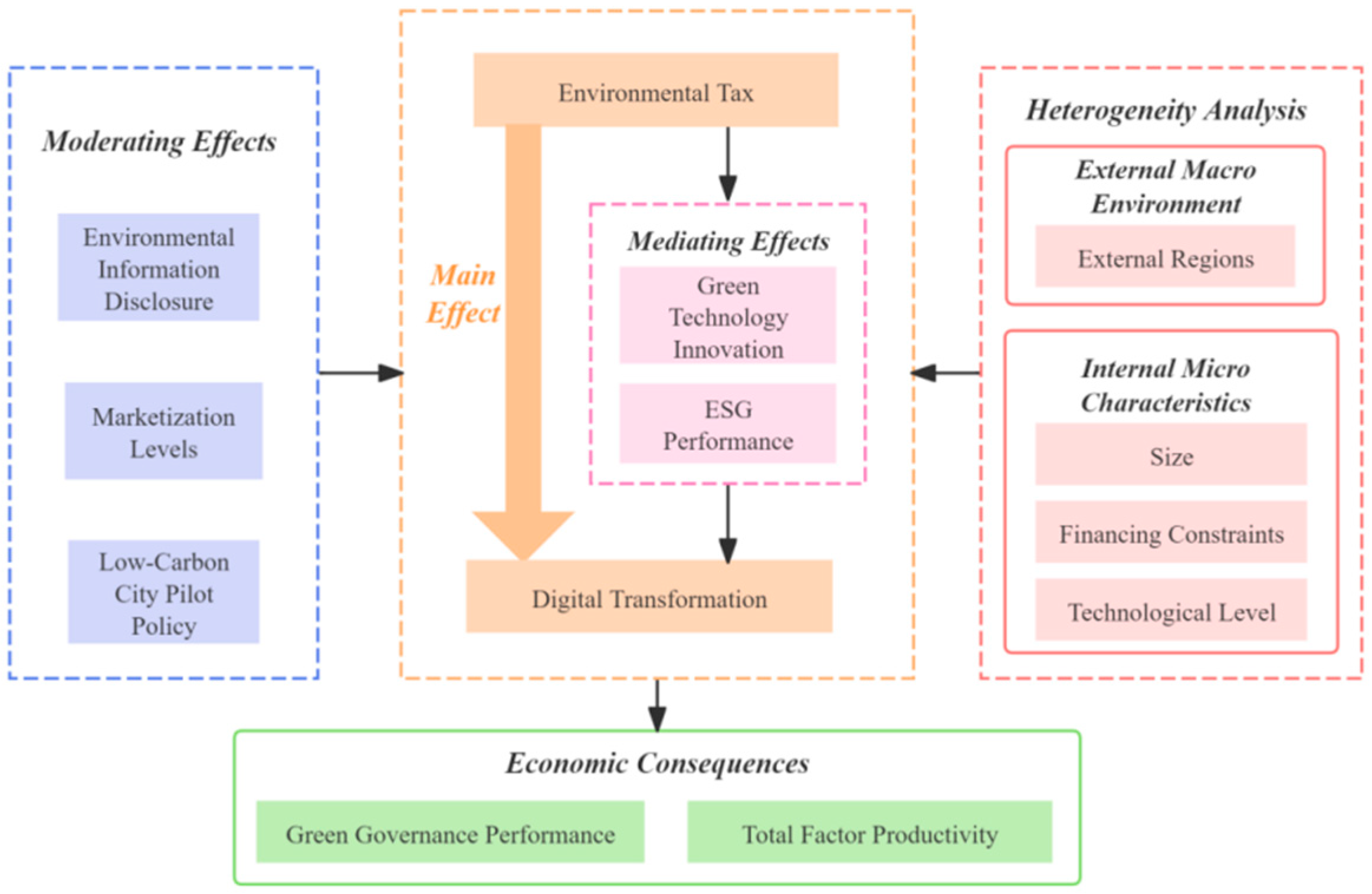
The theoretical framework is shown in
Figure 1.
6. Further Analysis
The impact of environmental tax on digital transformation may vary across the firms due to differences in regional conditions and firm-specific characteristics. To explore these heterogeneous effects and uncover the underlying drivers, this paper conducts a subgroup regression analysis.
Table 8 reports the results.
6.1. Heterogeneity of External Regions
The impact of environmental tax is likely conditioned by the external regional context in which firms operate. Divergences in economic development, digital infrastructure, policy implementation, and governance capacity across regions may lead to heterogeneous effects. This paper analyzes the heterogeneity of the effect of environmental tax on enterprise digital transformation due to differences in the regions where the enterprises are located. This paper divides the samples by external geographical location and categorizes 31 provinces and cities in China into eastern and non-eastern regions. Columns (1)–(2) of
Table 8 compare the effect of environmental tax on digital transformation between firms located in the eastern and non-eastern regions of China. The coefficient of
is 0.1544 for the eastern region, significantly larger than the coefficient of 0.1399 for the non-eastern region, and the SUEST test confirms the difference is statistically significant (
p < 0.01). The eastern region has a higher level of economic development, better digital infrastructure, and a higher concentration of digital talent, collectively providing firms with abundant resources for digital transformation. In addition, local governments in the east pay more attention to environmental protection and enforce environmental regulations more stringently. Firms in the east have better access to green finance and policy support, enabling them to translate tax pressures into tangible digital investments. Therefore, environmental tax is more capable of facilitating enterprises in the eastern region to improve their digital transformation level.
6.2. Heterogeneity of Internal Microscopic Characteristics
Firm-level attributes shape how companies respond to environmental tax. We examine heterogeneity based on firm size, technological level and pollution intensity.
Columns (3)–(4) of
Table 8 examine heterogeneity by firm size, where firms are split into large and small groups based on the annual median of total assets. The coefficient of
is significantly stronger for large firms (0.1601) than small firms (0.1108), with a SUEST
p-value of 0.0003. This suggests that resource-rich large firms are better positioned to invest in digital transformation. Columns (5)–(6) introduce the one-period lag of environmental tax (
) into the model to examine dynamic adjustment. For large firms, both current (
) and lagged coefficients (
) are significantly positive, indicating a sustained response. For small firms, only the current coefficient is significant. This finding reveals that large firms, endowed with greater financial resources and organizational capabilities, can sustain their digital investments over time, whereas small firms face financing constraints that limit the sustainability of their investment.
Columns (7)–(8) compare the effect between high-tech and non-high-tech firms. The coefficient of for non-high-tech firms is significantly larger than that for high-tech firms. One possible explanation is that high-tech firms already operate at the technological frontier, with limited room for further digital catch-up, so the marginal incentive from environmental tax is relatively modest. In contrast, non-high-tech firms have a greater untapped potential for digital upgrading; environmental tax creates a strong impetus for them to adopt basic digital technologies to improve efficiency and reduce compliance costs.
Columns (9)–(10) examine heterogeneity based on pollution intensity, classifying firms as high-polluting or non-high-polluting according to the List of Industries Subject to Environmental Verification for Listed Companies. The coefficient of for high-polluting firms is significantly larger than that for non-high-polluting firms. First, high-polluting firms face greater environmental tax burdens due to their higher emission intensity, generating stronger incentives for innovation. Second, these firms are subject to tighter regulatory scrutiny and public pressure, intensifying the urgency of their transformation. Third, many high-polluting firms belong to capital-intensive industries, possessing the resources necessary for digital transformation. This finding corroborates the “innovation compensation” hypothesis within the context of China’s environmental reforms and underscores the potential of market-based policy instruments in driving the green digital transformation within heavily polluting sectors.
In summary, the heterogeneity analysis reveals that the positive effect of environmental tax on digital transformation is more pronounced for firms in economically advanced regions, large firms, non-high-tech firms, and high-polluting firms. The dynamic patterns further show that large firms sustain their response over time, while small firms exhibit only a temporary effect.
6.3. Test of Economic Consequences: Pathways to Sustainable Development
The diverse mechanisms of environmental tax on enterprise digital transformation have been studied in the above analysis. Although many scholars have extensively examined the economic consequences of environmental tax and enterprise digital transformation, research investigating whether environmental taxes can shape sustainability performance through the channel of digital transformation remains scarce. Therefore, this study focuses on examining if environmental tax enhances corporate sustainability performance by promoting digital transformation, specifically from two integrated dimensions: economic efficiency and environmental governance. This dual-lens approach aims to empirically reveal the policy utility of environmental taxation in fostering the green–digital synergistic transition and achieving the “double dividend” crucial for sustainable development. By employing two distinct measures of digital transformation, technology-oriented () and application-oriented (), this study aims to uncover the heterogeneous transmission pathways.
6.3.1. Total Factor Productivity: The Role of Technology-Oriented Digitalization
Total factor productivity () is a core indicator of economic efficiency and sustainable growth. This study employs the Levinsohn–Petrin method to estimate the firm-level TFP and examines whether digital transformation serves as a transmission channel through which environmental tax enhances productivity.
Table 9 reports the results. Column (1) shows that the coefficient of
is significantly positive at the 1% level, confirming that environmental tax directly enhances TFP. Column (2) introduces technology-oriented digitalization (
) into the regression. The result shows that the coefficients of
and
are significantly positive, indicating that environmental tax promotes TFP through its positive effect on technology-oriented digitalization. Column (3) replaces
with
(application-oriented digitalization). The coefficient of
is positive but not significant, while
remains significant. This result indicates that application-oriented digitalization, while valuable for operational integration, may not directly drive the technological innovations that underpin TFP growth. Instead, its effects are likely channeled through improvements in areas such as environmental management, as examined below. Improvements in TFP are driven largely by frontier technologies (e.g., AI, big data, cloud computing) that enable breakthroughs in production process optimization.
In summary, environmental tax can not only directly incentivize enterprises to undergo digital transformation but also significantly boost total factor productivity through this digital pathway, generating a substantial “blue dividend” (economic efficiency dividend). This demonstrates that well-designed market-based environmental regulations can synergize with digital strategy to jointly drive the economy toward an innovation-driven and resource-efficient model of sustainable development.
6.3.2. Green Governance Performance: The Role of Application-Oriented Digitalization
Corporate green governance performance refers to the environmental governance outcomes achieved through developing clean production technologies and improving green processes. It is a core manifestation of a firm’s environmental sustainability.
This study uses the Janis–Fadner coefficient based on firms’ positive and negative environmental engagements to comprehensively measure green governance performance (
) [
34]. This index ranges from −1 to 1, with higher values indicating superior green governance. Positive scores are derived from achievements such as ISO 14001 certification, environmental honors, and top-tier ESG ratings, while negative scores reflect environmental violations, accidents, and poor ESG performance.
Column (4) of
Table 9 shows that the coefficient of
is significantly positive at the 1% level, confirming that environmental tax directly improves green governance performance. Column (5) introduces
(technology-oriented digitalization). The coefficient of
is positive but not statistically significant. This indicates that frontier technologies without operational integration may not directly enhance environmental management outcomes. Column (6) replaces
with
(application-oriented digitalization). The coefficient of
is significantly positive. This demonstrates that environmental tax improves green governance performance partly by promoting application-oriented digitalization, which directly enhances corporate green governance performance through mechanisms such as intelligent manufacturing for energy efficiency and digital platforms for environmental information disclosure.
In summary, environmental tax generates dual sustainability dividends through different digital pathways. It enhances economic efficiency by promoting technology-oriented digitalization, and it improves environmental governance by fostering application-oriented digitalization.
7. Conclusions and Discussion
7.1. Main Conclusions
Based on the panel data of Chinese listed firms from 2010 to 2023, this study examines the impact of environmental tax on corporate digital transformation and its subsequent sustainability outcomes. The findings are as follows. First, environmental tax significantly promotes corporate digital transformation, and this finding remains robust across a series of robustness checks. Second, our mechanism analyses reveal that green technology innovation and ESG performance are critical transmission channels. Third, higher regional marketization levels, better environmental information disclosure, and low-carbon city pilot policies can strengthen the incentive effects of environmental tax. Fourth, our heterogeneity analyses show that the effect is more pronounced for firms in economically developed regions, large firms, non-high-tech firms, and high-polluting firms. Finally, further analysis demonstrates that environmental tax enhances both total factor productivity and green governance performance through distinct digital pathways. This finding underscores that different dimensions of digital transformation serve different functions in achieving the “dual dividends” of economic efficiency and environmental quality.
7.2. Policy Implications
Based on the conclusions, the following policy recommendations are proposed to harness environmental tax for promoting sustainability-oriented digital transformation: (1) Strengthen and Optimize Environmental Tax Design. Policymakers should recognize and leverage the dual role of environmental tax in stimulating both green innovation and digital transformation. Consideration should be given to dynamically adjusting tax rates or broadening the tax base to maintain incentive pressure, explicitly linking policy design to the goal of fostering a “green–digital” synergistic transition. (2) Promote Inclusive and Sustainable Digital Transformation. The government should provide targeted fiscal support, green financing channels, and technical assistance to SMEs, non-high-polluting firms, and enterprises in underdeveloped regions that face resource constraints. This is to help them overcome barriers in the digital transformation process and thereby achieve sustainable development. (3) Foster Sustainability-Oriented Digital Governance Ecosystems. Policy should encourage firms to adopt digital tools for sustainability-oriented governance, particularly in environmental information disclosure and ESG management. Incentives can be aligned with the quality of the digital ESG reporting. Concurrently, governments must accelerate market institution building, enhance data transparency regulations, and deepen low-carbon city initiatives to create an institutional environment that amplifies the positive signals of environmental tax and supports long-term sustainable corporate behavior.
7.3. Future Research
This study still has certain limitations, and further investigation can be conducted in the following aspects:
Firstly, this paper only investigates the mediating effect of green technology innovation and ESG performance, and future research could consider more potential mechanisms, such as government subsidies and entrepreneurship. Secondly, this study uses instrumental variables to assess the robustness of the benchmark results, which can overcome the endogeneity. In the future, alternative approaches can be explored to address the endogeneity of the model, such as finding more appropriate instrumental variables for environmental tax and using other economic models for the analysis. Thirdly, our digital transformation measures rely on a textual analysis of the annual reports. Future research could complement these with more direct measures, such as digital investment intensity or patent data, and track how the meaning of “digital transformation” evolves over time. Finally, our findings are based on Chinese data, which may limit their generalizability. Follow-up studies can be extended to different countries or institutional contexts, such as developed economies or other emerging markets, which would help to assess the external validity of our conclusions.