Article

Redefining Policy Effectiveness in the Digital Era: From Corporate Scaling to Inclusive Employment Growth—Evidence from China’s National Cultural Demonstration Zones

by
Yuanming Wang
*,
Mu Li
,
Yuanyuan Chen
and
Yuting Xue
School of Public Management, Tianjin University of Commerce, Tianjin 300134, China
*
Author to whom correspondence should be addressed.
Sustainability 2026, 18(5), 2432; https://doi.org/10.3390/su18052432
Submission received: 21 January 2026 / Revised: 18 February 2026 / Accepted: 2 March 2026 / Published: 3 March 2026

Abstract

Public cultural services are traditionally viewed as welfare provisions. However, this perspective overlooks their productive externalities as critical social infrastructure. This study treats China’s National Public Cultural Service System Demonstration Zone program as a quasi-natural experiment to examine its economic performance. The analysis utilizes panel data from 280 prefecture-level cities between 2008 and 2021 and employs a multi-period difference-in-differences model. Results show that the policy successfully increased employment in the cultural sector. This was achieved by enabling flexible labor opportunities through digital platforms and government procurement, rather than through significant growth in formal enterprises. We term this structural divergence De-organized Growth. Mechanism analysis confirms that Fiscal-Digital Synergy drives this phenomenon. Effective collaboration between government funding and digital technology activates cultural consumption on the demand side and facilitates disintermediation on the supply side. Crucially, we identify a nonlinear Digital Exclusion Trap. In this trap, fiscal support is ineffective or even counterproductive in regions falling below a critical digital infrastructure threshold. The findings suggest that the equalized provision of public culture serves as a productive input for achieving UN Sustainable Development Goal 8 regarding decent work. We advocate for a shift in governance paradigms from traditional administration to a strategic purchaser role. This role leverages digital platforms to foster a more inclusive labor market.

1. Introduction

As the global digital economy reshapes labor markets, the economic function of public goods demands fundamental reconsideration. The New Public Management (NPM) paradigm, based on productivity logic, has often viewed public services merely as tools for private capital accumulation. This framework assumes that regional economic vitality depends on corporate expansion and capital agglomeration [1]. However, this linear model increasingly fails to explain the growth decoupling phenomenon that is emerging in the digital era. Digital infrastructure has drastically reduced transaction costs for market search and matching, shifting the basic unit of value creation from hierarchical firms to individual workers [2]. This transformation forces a rethinking of labor governance. Rather than offering genuine autonomy, digital platforms often establish a model of subordinated agency where workers bear market risks while remaining subject to strict algorithmic control [3,4]. Empirical evidence from China confirms that this shift generates a workforce operating independently of corporate boundaries [5]. Although such independence offers flexibility, it frequently diminishes job security. Consequently, a vulnerability gap emerges because workers are no longer covered by the social protection frameworks found in formal employment [6]. This gap highlights the urgent need for a new form of public support that differs from the industrial-era welfare model. As Klinenberg (2018) argues, Contemporary public cultural infrastructure has evolved beyond mere welfare provision to become a vital component of social infrastructure [7]. It is now focused on establishing institutional foundations that promote individual livelihood resilience, rather than solely facilitating capital appreciation.
China’s National Public Cultural Service Demonstration Zone (NPCDZ) policy provides a rare quasi-natural experiment for testing this theoretical tension. Current literature predominantly focuses on firm-centric analyses. Although existing studies validate the regional spillover effects of policies [8,9], they tend to conflate firm expansion with economic growth, overlooking the emergence of informal employment in the context of the digital economy. Even Kaszynska’s (2025) enabling state framework has not been operationalized to directly measure how public services empower individuals apart from intermediary organizations [10]. This study employs a multi-period difference-in-differences model on data from 280 Chinese cities. The empirical results reveal a pattern of De-organized Growth. Specifically, the policy significantly expands the cultural workforce, yet this growth is not accompanied by an increase in formal firm registration. Mechanism analysis reveals that Fiscal-Digital Synergy drives this process. This synergy represents the effective collaboration between government funding and digital technology. On the demand side, it activates cultural consumption, while on the supply side, it facilitates government service procurement to enable disintermediation. Furthermore, the analysis identifies a Digital Exclusion Trap. In this scenario, fiscal support remains ineffective in regions that fall below a critical digital infrastructure threshold.
The contribution of this study lies in challenging the stereotype of public culture as mere welfare consumption and demonstrating its transformation into productive labor assets [11]. Theoretically, we extend the literature on labor restructuring by identifying a distinct public sector pathway. In contrast to the instability often observed in the commercial gig economy, we show that the NPCDZ functions as an institutional buffer that mitigates market risks for individuals. Practically, this finding advances SDG 8 by validating a growth model that reduces intermediaries. It offers a viable alternative for resource-limited developing countries, enabling them to seek inclusive development beyond traditional industrialization.

2. Policy Review and Research Hypotheses

2.1. Policy Review

The NPCDZ initiative is a core strategic tool for advancing the equalization of basic public services and modernizing cultural governance in China. It aims to address the imbalances in resource allocation between urban and rural areas [12,13]. Since its launch in 2011, the policy has implemented a phased approach, focused on tiered development and dynamic management. The policy has evolved significantly from physical spatial coverage to enhanced digital efficacy. Between 2011 and 2018, the Ministry of Culture and Tourism approved four batches of demonstration zones, revealing distinct evolutionary phases. The initial phase (2011–2014), centered on the first and second batches, focused on standardized infrastructure development to establish a four-tier service network and eliminate supply gaps [13,14]. The deepening phase (2015–present) has seen a shift in the policy’s focus from incremental expansion to enhancing quality and upgrading digitally, driven by the integration of the ‘Internet Plus Public Culture’ strategy through the third and fourth batches of demonstration zones. The emphasis has shifted toward the coordinated construction of public digital cultural platforms and precise service assessment. This transition moves cultural supply from unidirectional administrative delivery toward interactive, socialized, and digitally co-constructed models. By prioritizing new digital infrastructure over traditional hard infrastructure, this policy provides a practical model for cultural governance in the digital age. Furthermore, it offers an ideal quasi-natural experimental setting to evaluate economic performance using a multi-period DID model.

2.2. Theoretical Analysis and Research Hypotheses

2.2.1. From Firm-Centric Logic to Disintermediated Growth

Coase’s (1937) [15] seminal framework posits that firms emerge essentially to mitigate transaction costs. However, this framework rests on a critical assumption: that transaction costs remain prohibitively high for individuals operating independently. The NPCDZ policy, combined with digital infrastructure, challenges this premise. When government intervention directly reduces search frictions and coordination costs at the individual level, the traditional efficiency advantage of the firm diminishes. This transformation aligns with the theory of labor restructuring [3]. As digital platforms reduce transaction costs, the basic unit of production shifts from the hierarchical firm to the individual worker. Traditional internal labor markets are dismantled, allowing production to organize around tasks rather than jobs. Public cultural facilities lower the fixed costs of creative production by providing shared workspaces, equipment, and training. Digital platforms reduce matching costs through algorithmic coordination and reputation systems [16,17]. Under these conditions, individuals can access markets and coordinate production without embedding themselves in corporate hierarchies. This represents a shift from firm-mediated growth to disintermediated growth, where employment expansion occurs through direct market participation rather than through organizational expansion.

2.2.2. Resource Competition and the Non-Neutrality of Public Investment

Regional development policies are often modeled as neutral instruments that reduce location-specific transaction costs. The NPCDZ policy deviates from this ideal. Because demonstration zones prioritize social welfare maximization over output growth, they create resource allocation distortions that constrain formal enterprise expansion.
On the demand side, the extensive provision of free public cultural services reshapes household consumption patterns. This impact is primarily manifested through a substitution effect, where accessible public digital resources displace traditional commercial cultural expenditures. When public goods function as close substitutes for market alternatives, government spending displaces private consumption [18]. In the post-pandemic context of household balance sheet contraction, free access to digital resources and community arts programming reduces willingness to pay for comparable commercial services. This substitution effect concentrates among price-sensitive consumers, lowering expected returns for potential market entrants and suppressing firm formation. On the supply side, fiscal allocation exhibits systematic bias driven by administrative performance pressures. This bias is manifested in a strategic redirection of fiscal funds, where local governments prioritize state-led physical infrastructure projects over direct subsidies to private enterprises. Recent evidence shows that fiscal stress forces local governments to redirect resources from private sector innovation subsidies toward public utilities and state-owned platforms with soft budget constraints [19]. Local public investment heavily crowds out private firm expansion by tightening their financial constraints [20]. This reallocation raises financing costs for private small and medium enterprises while triggering credit rationing. Furthermore, as digitalization diminishes reliance on physical infrastructure, conventional policy tools focused on substantial asset development become increasingly incompatible with the specific factor requirements of emerging cultural enterprises [21]. This severe crowding-out effect pushes the labor force to seek income in the informal sector and platform economy [22]. The result is that policy interventions fail to translate into locational advantages that attract formal enterprise registration.
H1. 
Driven by resource substitution on the demand side and systematic allocation bias on the supply side, the NPCDZ policy exhibits a limited impact on the registration of for-profit cultural enterprises. In resource-constrained regions, this intervention may trigger crowding-out effects. Consequently, the policy facilitates de-organized growth, a phenomenon defined as significant sectoral employment expansion that is not matched by formal enterprise registration.

2.2.3. Fiscal-Digital Synergy and the Disintermediation Mechanism

While formal enterprise growth faces structural constraints, policy effects concentrate at the level of individual labor market participation. The NPCDZ operates on the principle of regenerative empowerment, as defined by Kaszynska (2025) [10]. This concept emphasizes public investment aimed at restoring systemic capacity rather than merely delivering services. This reframes public cultural infrastructure as productive social capital rather than a consumption space. The mechanism functions through cost socialization. Socialized fixed costs refer to the public provision of essential production factors, including shared creative spaces, digital access points, and professional skills training. By socializing these inputs, the state lowers the entry barriers for individual practitioners, allowing them to participate in the cultural market without the capital requirements of formal firm formation [23], demonstration zones externalize the fixed costs of cultural production that firms traditionally internalize. However, this shift introduces new dynamics of control. Wood and Lehdonvirta (2021) describe this as subordinated agency, where platforms grant workers market autonomy while enforcing strict discipline through algorithms [4]. Unlike the instability often seen in commercial gig work [6], the NPCDZ functions as an institutional buffer. By providing stable public service orders and free resources, the state mitigates the market risks usually associated with this de-organized labor. As Dâmaso and Rex (2025) point out, this regenerative mechanism significantly lowers the threshold for individuals to participate in value creation [24]. This provides a strong theoretical explanation for why enterprise expansion lags behind employment growth. According to transaction cost economics, organizations exist to minimize market friction and internalize matching costs. When public investment and digital platforms absorb the human capital development and market search costs ordinarily borne within organizational boundaries, the traditional economic rationale for forming a formal firm weakens. This enables individuals to reach operational viability without corporate intermediation. The result is a restructuring of employment patterns: labor market expansion no longer requires horizontal scaling of enterprise size but occurs through endogenous growth in flexible and self-employment.
Crucially, this disintermediation depends on the fiscal-digital synergy. We define disintermediation operationally as the direct economic matching between government funding and individual creators that bypasses traditional corporate hierarchies. To test these mechanisms empirically, we identify specific measurable proxies. We use the structural gap between regional employment growth and formal firm registration as the empirical proxy for disintermediation. Furthermore, we use the interaction term between local fiscal expenditure and regional digitalization levels to proxy the fiscal digital synergy. Government service procurement operates through project-based governance, where funds flow directly to individuals or micro-teams via digital platforms. This approach circumvents conventional organizational hierarchies, thereby minimizing the administrative barriers that often impede effective policy communication. Digital infrastructure transforms fiscal resources into accessible, productive assets, lowering barriers to independent market participation.
H2. 
Through fiscal-digital synergy, the NPCDZ policy achieves disintermediation by socializing entrepreneurial fixed costs and reducing individual barriers to market entry. This generates inclusive employment growth independent of formal enterprise expansion.

2.2.4. Digital Moderation and Allocative Efficiency

The employment effects of fiscal support depend on the regional technological environment. Digitalization enhances allocative efficiency by optimizing resource matching [25] and reducing information asymmetry in public expenditure [26]. In digitally advanced regions, platforms facilitate the execution of complex tasks outside corporate hierarchies by leveraging algorithmic matching and digital trust mechanisms. Individuals can independently complete production and transaction cycles using cloud infrastructure and public data resources, decoupling task complexity from organizational scale. This suggests that digitalization functions as a positive moderator of fiscal policy effectiveness. In scenarios where digital infrastructure is highly developed, public investment generates greater employment multipliers, as technological advancements enhance the efficiency of converting public resources into individual productive capabilities. The employment elasticity of fiscal support is empirically estimable. It is measured through the interaction between city-level public cultural expenditure and regional digital economy development. Digital platforms reduce the transaction costs that historically justified firm-based organization, accelerating the shift from traditional employment toward platform-mediated work [27]. Disintermediated employment outcomes include independent digital content creators, freelance designers fulfilling government cultural procurement contracts, and gig workers providing community arts training. To empirically test this dynamic, unstructured growth is conceptualized as a significantly high ratio of regional employment expansion relative to formal enterprise registration. Consequently, the fiscal-digital interaction reinforces the structural divergence between robust employment growth and enterprise stagnation.
H3. 
Regional digitalization enhances the employment elasticity associated with fiscal support. In regions equipped with sophisticated digital infrastructure, platforms decrease the costs of matching supply and demand, thereby intensifying the disintermediated employment outcomes of public services. This dynamic further reinforces the trend of unstructured growth in these areas.

3. Research Design

3.1. Data and Sample Construction

We construct a balanced panel dataset comprising 280 prefecture-level cities in China from 2008 to 2021. This timeframe encompasses the comprehensive implementation of the National Pilot Cultural Demonstration Zones (NPCDZ), which was executed in phased intervals. This approach allowed for the observation of varying treatment effects based on the timing of the interventions.
Data sources are as follows: (1) Policy treatment variable: Manual coding of demonstration zone designations based on official announcements from the Ministry of Culture and Tourism, with implementation occurring in four batches (2011, 2013, 2015, 2018); (2) Firm-level microdata: Registration records obtained from the Qichacha enterprise database, cross-validated against the China Research Data Services Platform (CNRDS) to ensure accuracy; (3) City-level covariates: Macroeconomic and infrastructure indicators sourced from the China City Statistical Yearbook, supplemented by the Peking University Digital Financial Inclusion Index for digital economy measures.
We exclude four provincial-level municipalities and Tibetan Autonomous Region cities due to structural differences in administrative hierarchies and data incompleteness. All continuous variables are winsorized at the 1% and 99% tails to reduce the influence of extreme values on coefficient estimates.

3.2. Econometric Strategy

The staggered implementation of the NPCDZ constitutes a quasi-natural experiment. We employ a time-varying Difference-in-Differences (DID) model to identify the net causal effect. To rigorously test the Asymmetric Effect between capital and labor, we specify the following dual-track baseline model:
Yi,t = α + βPolicyi,t + γControl_Vari,t + CityFE + YearFE + ε
where Yi,t denotes the dependent variables: Firm Entry (representing capital vitality) and Employment (representing labor absorption). Policyi,t is the policy dummy, taking the value of 1 if city i is an approved demonstration zone in year t, and 0 otherwise. Control-Vari,t is a vector of time-varying controls. CityFE and YearFE represent city and year fixed effects, respectively. Standard errors are clustered at the city level. The coefficient β identifies the average treatment effect on the treated (ATT), interpreted as the net impact of demonstration zone status on outcomes, conditional on observables and fixed effects.

3.3. Variable Definitions

Table 1 summarizes key variable constructions. To align theoretical predictions with empirical indicators, we implement a dual-track measurement strategy for our dependent variables. This approach operationalizes the asymmetric effect hypothesis by utilizing separate indicators for both capital and labor sides.
Dependent Variables.—Firm Entry (LnFirm): Natural logarithm of newly registered cultural sector firms in city i and year t. This evaluates the extensive margin of capital response, specifically assessing the rate at which market participants allocate resources to engage with the subsidized sector [28].—Employment (LnEmp): The natural logarithm of the total employment figures within the cultural sector. This measures the capacity for labor absorption, highlighting the policy’s potential to foster inclusive economic growth and generate employment opportunities [9]. While total employment volume is systematically reported in the China City Statistical Yearbook, disaggregated data on individual practitioners at the prefecture level remain limited. To address this data constraint, the study employs a structural identification approach to capture De-organized Growth. This phenomenon is operationalized through the statistical divergence between two primary dependent variables: Labor (LnEmp) and Capital (LnFirm). Under this framework, De-organized Growth is identified when the NPCDZ policy significantly stimulates employment expansion. Crucially, this growth occurs alongside a negligible impact on formal enterprise registration. The resulting residual growth is interpreted as labor absorption occurring outside traditional corporate structures, providing a robust macro-level proxy for flexible employment within the existing statistical constraints. Independent Variable—Treat: Time-varying treatment indicator constructed from official designation lists. This variable isolates the exogenous policy shock, exploiting discontinuities in eligibility timing across cities.
Control Variables. Following the urban economics literature [29], we include time-varying city characteristics to mitigate omitted variable bias:—Economic fundamentals: LnGDP (log real GDP), LnPop (log population).—Factor endowments: LnHuman (log number of higher education students per capita, proxying human capital stock), FinDepth (loan-to-GDP ratio, measuring financial development).—Cost factors: LnHp (log average housing price), measuring living costs that affect labor retention and firm location decisions.—Digital infrastructure: Digital (city-level digital economy index). This variable is essential for disentangling the net impact of the policy from interfering technological trends. The index employs a multivariate weighting methodology to systematically aggregate key indicators—namely, internet penetration, e-commerce activity, and fintech adoption—based on their informational value. This approach minimizes the influence of arbitrary subjective weights, ensuring a more objective and robust construction of the index [30]. Incorporating this control guarantees that the coefficient β accurately represents the policy specific to the demonstration zone, rather than being influenced by incidental factors related to digital transformation.
Table 1. Variable Definitions and Measurements.
Variable Name (Symbol)Definition & MeasurementLiterature Basis
Dependent Variables
Firm Entry
(LnFirm)
The natural logarithm of the number of newly registered firms in cultural and related industries.Decker, R. A (2020) [28]
Employment
(LnEmp)
The natural logarithm of the number of employees in the cultural sector at the end of the year.Sheng et al. (2024); Y Zhang et al. (2024) [9,31]
Independent Variable
Policy
(DID)
Dummy variable: equals 1 if the city is a designated NPCDZ and year >= implementation, 0 otherwise.Sheng et al. (2024) [9]
Control Variables
Digital Maturity
(Digital)
Composite index (PCA) integrating Internet Development (infrastructure, usage, and software employment) and Digital Financial Inclusion (PKU Index).Liu et al. (2020); Goldfarb & Tucker (2019) [16,30]
Econ. Development
(LnGDP)
The natural logarithm of GDP per capita, controlling for regional economic foundation and agglomeration.Au & Henderson (2006) [29]
Human Capital
(LnHuman)
The natural logarithm of the number of university students per 10,000 people.Sheng et al. (2024) [9]
Population
(LnPop)
The natural logarithm of the year-end resident population (Market Size).Sheng et al. (2024) [9]
Fin. Development
(FinDepth)
The ratio of year-end loan balances of financial institutions to GDP (Financial Depth).Lee, C. C et al. (2022) [32]
Housing Price
(LnHp)
The natural logarithm of the average housing price, controlling for living and business costs.CT Hsieh et al. (2019) [33]

4. Empirical Results

Before we delve into causal estimation, we first perform descriptive statistics and collinearity diagnostics on all variables. As shown in Appendix A Table A1, the summary statistics indicate significant cross-city variation in cultural firm entry rates and employment size, highlighting the necessity for fixed effects controls. The Variance Inflation Factor (VIF) tests reveal no issues with severe multicollinearity, with a mean VIF of 3.24, comfortably below the critical threshold of 10. This confirms the robustness of our coefficient estimates.

4.1. Baseline Results

Table 2 presents the baseline difference-in-differences (DID) estimates, controlling for city and year fixed effects and other time-varying covariates. The findings indicate a significant structural divergence in the effects of policy across both capital and labor dimensions, offering strong support for the De-organized growth hypothesis.
The treatment coefficient associated with firm entry (LnFirm) is economically trivial and statistically indistinct from zero (β = −0.042, p > 0.10). The observed null effect provides a nuanced understanding of the dynamics of firm formation within China’s cultural sector. Despite recent administrative reforms aimed at reducing registration hurdles, the persistent costs associated with formal incorporation—especially the stringent requirements for social security contributions and tax compliance—continue to pose significant barriers. These costs remain disproportionately high when juxtaposed with the more flexible nature of project-based cultural activities. In the short term, the task-specific projects incentivized by NPCDZ subsidies create unnecessary organizational overhead through the establishment of legal entities. Rational market participants tend to eschew formalization to sidestep these holding costs, which leads to a stagnation in the influx of new enterprises. This observation provides empirical support for Hypothesis H1 (capital crowding-out or neutrality), indicating that the policy does not effectively catalyze significant for-profit market entry.
The policy demonstrates a significant and robust positive impact on employment within the cultural sector. The treatment coefficient indicates that the designation of a demonstration zone is associated with a roughly 6.5% increase in cultural sector employment (β = 0.065, p < 0.01). The current employment boom is happening independently of traditional firm growth, reflecting a clear pattern of De-organized employment expansion. This situation has significant economic implications: the policy does not function through conventional corporate growth models. Rather, it establishes a disintermediated access channel that allows individual workers to directly seize financial opportunities as freelancers, independent contractors, or participants on various platforms. This supports Hypothesis H2 (labor empowerment), indicating that public cultural infrastructure functions as a form of social scaffolding to facilitate inclusive employment, effectively circumventing traditional corporate gatekeepers. The paper’s primary empirical contribution lies in the observation of stagnant firm entry juxtaposed with robust job creation. This finding suggests that the benefits of cultural policy emerge through decoupled organizational forms, rather than the typical model of firm-led growth.

4.2. Parallel Trend Test

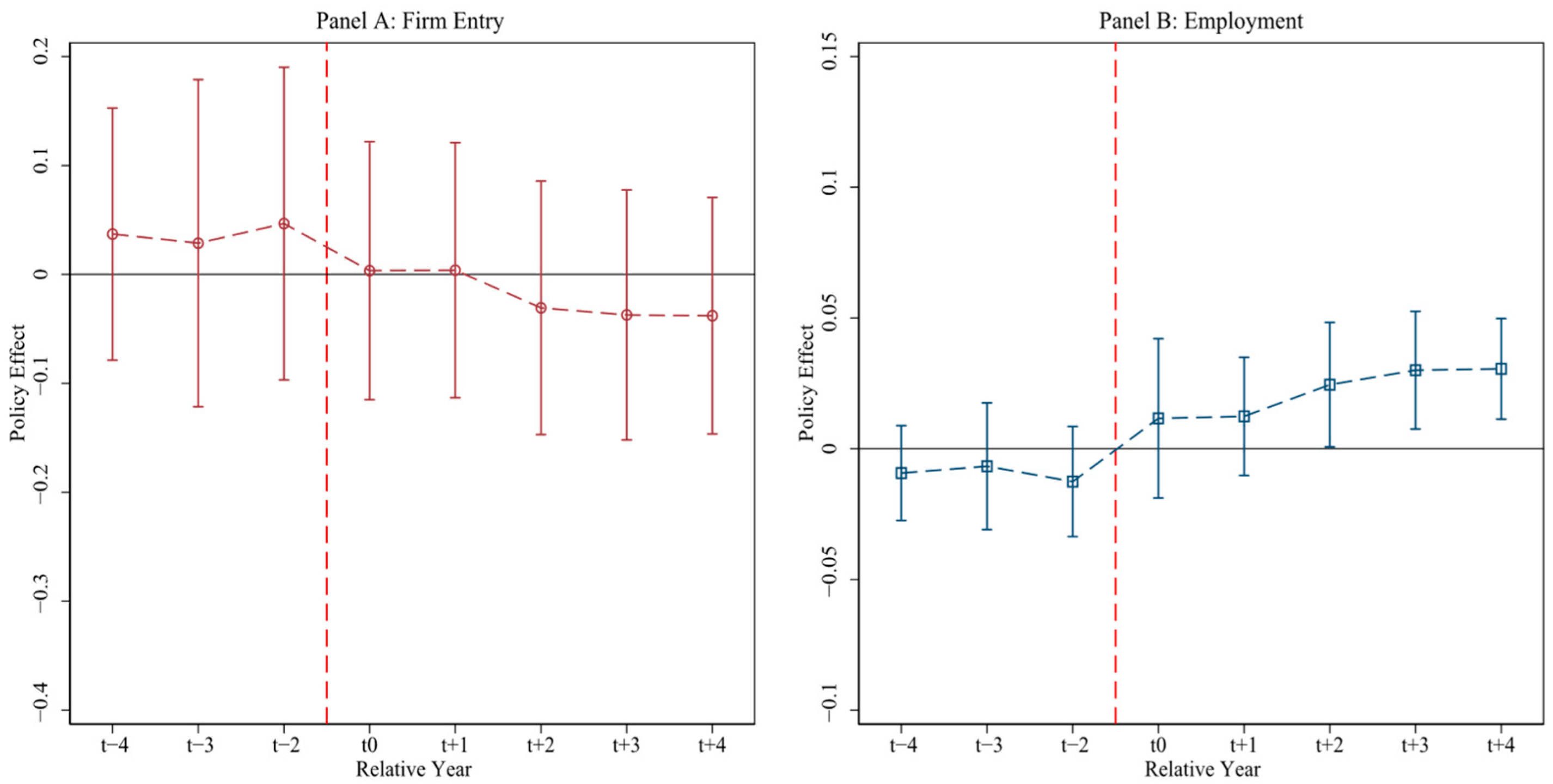
The validity of the Difference-in-Differences (DID) estimator fundamentally relies on the parallel trends assumption, which posits that in the absence of treatment, the trajectory of outcomes for both treated and control cities would have been identical. To empirically assess this assumption, we implement an event study framework that estimates dynamic treatment effects during both pre- and post-policy periods. In Figure 1, we present the point estimates along with 95% confidence intervals for each event time relative to the initiation of treatment.
In Panel A regarding firm entry, the estimated coefficients across all pre-policy years did not diverge significantly from zero, thereby affirming the parallel trend assumption. This finding rules out the occurrence of immediate market shocks attributable to the policy, supporting the hypothesis that the development of the Demonstration Zone had a negligible impact on incentivizing entry by for-profit market players. This finding is highly consistent with the capital crowding-out or neutral hypothesis H1 proposed earlier. Concurrently, the dynamic effects on employment (Panel B) manifest a transient lag effect during the policy’s nascent phase (t = 0, t + 1). This is primarily attributed to the cyclical nature of constructing public cultural infrastructure and deploying service networks, which delayed the immediate release of policy dividends. However, commencing from period t + 2, the policy effect undergoes a substantial positive shift, manifesting a sustained upward trend. By t + 4, the coefficient reaches its peak, indicating that the policy’s promotion of labor absorption exhibits significant cumulative and sustainable effects. The observed dynamic trajectory offers compelling evidence in favor of the Empowerment Hypothesis H2. This hypothesis posits that the backing of public services for individual workforce participation necessitates a transformative process. This transformation involves a transition from mere facility improvements to achieving tangible effectiveness. Ultimately, this process is anticipated to facilitate inclusive growth in employment opportunities.

4.3. Robustness Checks

In order to provide further validation of the reliability of the asymmetric effect and to address potential endogeneity issues, a series of rigorous robustness checks was conducted.

4.3.1. Entropy Balancing Approach

A critical issue to consider is that the allocation of demonstration zones may disproportionately advantage cities that already possess certain advantages, such as strong administrative capabilities or cultural assets. This could lead to selection bias in straightforward comparisons. To address this issue, we utilize the Entropy Balancing technique [34], which reweights control units to establish an exact balance with treated units across all specified moments (means, variances, skewness) of relevant covariates. This nonparametric approach generates a synthetic control group that closely replicates the observable characteristics of the treatment group, effectively isolating the causal impact of the policy under consideration. The estimates derived from the reweighted sample, as presented in Columns (1)–(2) of Table 3, closely align with the baseline results. The coefficient for employment under treatment is both positive and statistically significant, registering at β = 0.063 (p < 0.01). Conversely, the coefficient for firm entry is negligible, reported at β = −0.037 (p > 0.10). The observed asymmetric effects remain enduring even after rigorous covariate balancing. This evidence lends robust support to the causal impact of the policy, rather than compositional disparities between the treatment and control cities. From an economic standpoint, this indicates that cities with comparable pre-treatment characteristics exhibit divergent capital-labor dynamics following designation, thereby reinforcing the structural narrative of De-organized growth.

4.3.2. Excluding the Innovative City Pilot

A pertinent identification challenge arises from policy overlap, as several cities within the demonstration zone concurrently engaged in the National Innovative City Pilot program (initiated in 2008), which also offered fiscal incentives. This convergence could stimulate firm entry and improve employment outcomes [35]. Neglecting to address this confounding treatment may blur the distinction between the effects of the NPCDZ and the spillover effects of innovation policies.
To delineate the net impact of the NPCDZ, we enhance the baseline model by integrating an indicator for Innovative City Pilot status (Inn. Policy). Results from columns (3) and (4) of Table 3 demonstrate that the coefficient for NPCDZ remains relatively constant, reflecting a robust employment effect (β = 0.053, p < 0.01), whereas the effect on firm entry continues to be statistically insignificant (β = −0.040, p > 0.10). Notably, the Innovative City dummy shows a positive association with both outcomes, indicating that innovation subsidies effectively promote formal entrepreneurship. However, this does not diminish the asymmetric effect of NPCDZ. From an economic perspective, this orthogonality suggests that cultural policy functions through different mechanisms than innovation policy. Specifically, cultural policy focuses on labor empowerment through public infrastructure enhancements, rather than driving technology-led firm growth.

4.4. Placebo Test

A residual concern is that the employment effect might spuriously arise from unobserved time-varying shocks or random noise rather than the policy itself. To rule out this possibility, we implement a nonparametric placebo test following Chetty et al. (2009) [36] and Cai et al. (2016) [37].
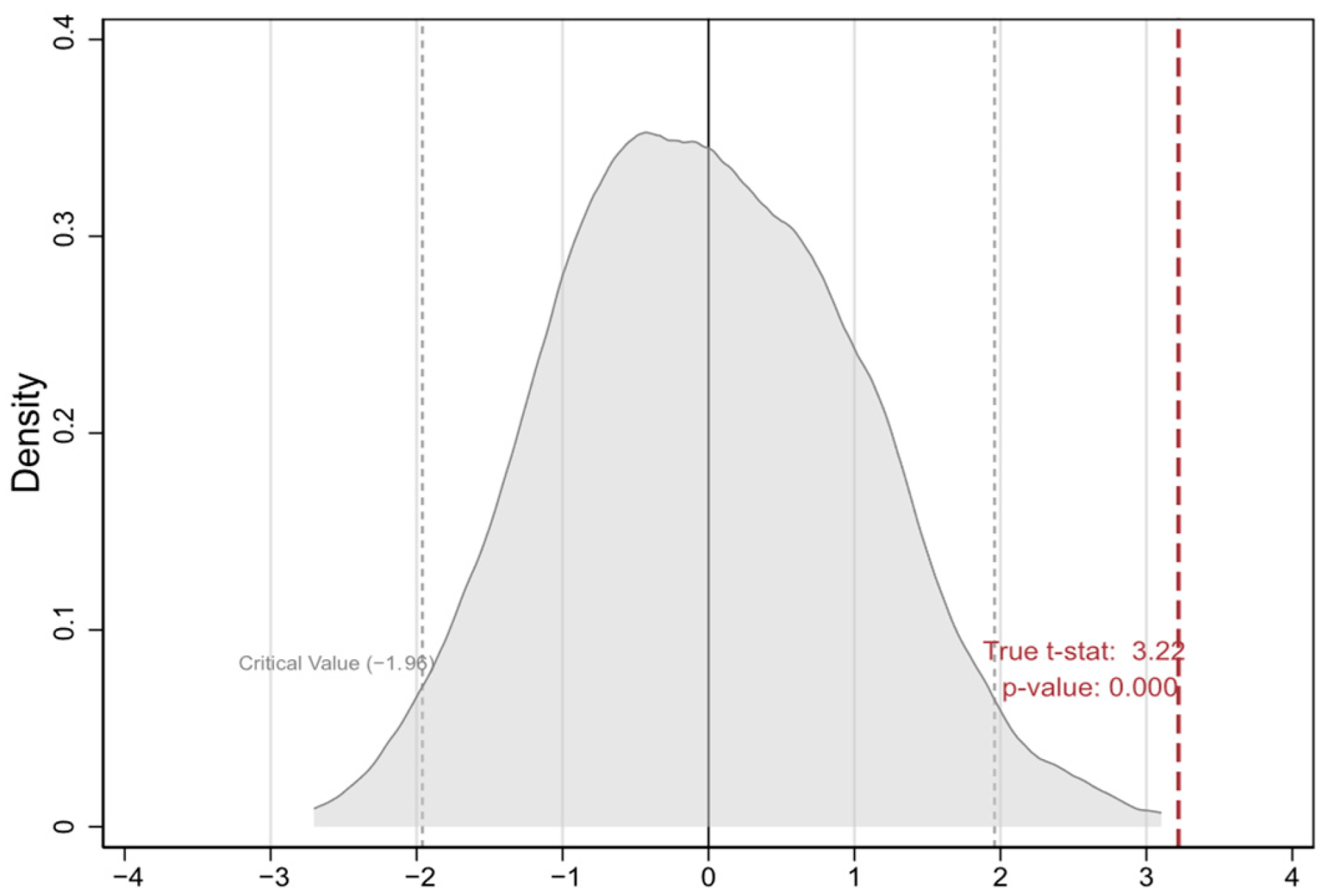
The methodology employed involves randomly assigning fictitious treatment statuses to cities, as well as arbitrary implementation years within the 2011–2018 policy window, ensuring that the number of treated units corresponds with the actual dataset. We then re-estimate the baseline model utilizing these counterfactual assignments to derive the associated t-statistic. This procedure is replicated 500 times through a Monte Carlo simulation, which yields a distribution of placebo t-statistics under the null hypothesis positing no real policy impact. Figure 2 illustrates the kernel density estimate of these 500-placebo t-statistics. The resulting distribution is approximately normal and tightly clustered around zero, with over 95% of the estimates falling within the non-rejection interval of [−1.96, 1.96]. This outcome is consistent with our expectations under the null hypothesis, indicating that random treatment assignments do not produce systematic effects. In sharp contrast, the actual t-statistic from our baseline regression (t = 3.22, highlighted by the red dashed line) resides significantly in the right tail of the distribution, exceeding the 99th percentile of the placebo distribution. The simulation-based p-value of 0.000 suggests that fewer than 0.4% of random assignments yield effects that are as extreme as the observed estimate. This falsification test provides compelling evidence that the observed employment gains are causally attributable to the NPCDZ policy, not to unobserved confounders or stochastic noise. The negligible probability of generating the true effect through chance alone reinforces the robustness of our core finding: demonstration zone designation genuinely empowers labor market participation in culturally-driven activities.

5. Heterogeneity Analysis

The baseline Difference-in-Differences (DID) estimates reveal a distinct empirical trend: the designation of demonstration zones leads to asymmetric outcomes, particularly driving employment growth while exhibiting little to no increase in formal firm entry. However, the effectiveness of place-based policies is not uniformly distributed across different locales. As noted by Lin (2020) [38], the impact of such policies is heavily contingent upon regional absorption capacities and the structures of factor endowments. Economic geography literature further demonstrates that institutional environments, technological foundations, and resource endowments generate substantial spatial variation in policy transmission [39]. To precisely identify the boundary conditions under which the NPCDZ policy generates inclusive employment spillovers, and to test whether average treatment effects mask critical structural biases, we adopt a context-dependent policy evaluation framework [26,40]. We conduct heterogeneity tests across three dimensions: regional macro-location, institutional environment quality, and digital economy development level. Estimation results are reported in Table 4.

5.1. Regional Heterogeneity Analysis

Given the pronounced disparities in marketization levels and institutional quality between China’s eastern and central-western regions, we partition the sample into two distinct geographic groups. The regression results corroborate the threshold effects of institutional environments on policy performance [41]. In the eastern regions, the policy exhibits a typical market multiplier effect, significantly promoting both firm entry and employment growth. This synergistic growth can be attributed to the mature industrial clusters in the East. In these developed markets, public cultural infrastructure functions as a complementary asset to private capital rather than a substitute. Specialized cultural firms in the East possess the capacity to use these public goods to enhance productivity and innovation [42]. Consequently, the policy lowers operational costs for existing firms and encourages them to expand and absorb labor. This results in a crowding-in effect where firms grow alongside public investment rather than inducing individuals to leave for freelance work. Conversely, a divergent pattern emerges in the central and western regions: while the policy significantly boosts employment, it simultaneously generates a significant crowding-out effect on market entities. This statistical finding is supported by the distinct transmission mechanism in less marketized areas. Where market mechanisms remain nascent, government-led cultural projects dominate resource allocation. Consequently, employment gains occur primarily through fiscal-driven absorption rather than market-driven firm growth. This reliance on administrative transfusion raises critical concerns regarding the long-term sustainability of employment once fiscal support subsides.

5.2. Institutional Environment Differences

To delineate the institutional boundaries of policy efficacy, we categorize cities into two groups. These groups, characterized by strong intervention and moderate intervention, are defined by the intensity of government control over economic activities [31]. Panel B of Table 4 reveals a pronounced institutional asymmetry in policy outcomes. The estimated coefficient for the moderate intervention group is significantly positive, indicating that the policy effectively leverages the labor market when government and market mechanisms coexist in equilibrium. Conversely, in the strong intervention group, the coefficient loses statistical significance and turns negative. This structural break supports the Institutional Crowding-Out Hypothesis. It suggests that the regional institutional environment strictly constrains the efficacy of administrative resource injection. In regions characterized by excessive intervention, the direct allocation of resources often induces elevated institutional transaction costs—such as rent-seeking and rigid compliance burdens. These frictions raise the holding costs of formal organization beyond the economic value generated by short-term cultural projects. Consequently, rational market participants may bypass formalization or exit the market entirely.

5.3. Digital Economy

Digital infrastructure fundamentally redefines organizational boundaries. Drawing on Goldfarb (2019) and Autor (2024) [16,43], we posit that next-generation digital technologies possess unique enabling attributes [44]. By reducing market search frictions and lowering entry barriers for high-skill tasks, these technologies allow non-expert individuals to participate in value creation independently, rendering traditional organizational intermediaries redundant. Group-based testing using the Digital Economy Development Index reveals a striking pattern: in regions with higher digital development, the policy exerts a sustained positive effect on labor employment but lacks a significant impact on the quantitative growth of cultural enterprises. This decoupling reinforces the conclusion that the policy operates via a disintermediated pathway. This mechanism is materially supported by observable market transformations. Digital ecosystems (e.g., Douyin, Taobao) allow cultural workers, from freelance designers to rural artisans, to monetize skills without formal incorporation. By leveraging zero-marginal-cost distribution and algorithmic matching, these individuals bypass the holding costs of traditional corporate employment (e.g., office rent, regulatory compliance) to access national markets directly. The demonstration zone policy acts as a catalyst in this process by supplying complementary public goods, such as digital literacy training and subsidized connectivity. While this model demonstrates universal applicability, its marginal efficiency varies by region. It is significantly amplified in technologically advanced areas characterized by mature logistical and payment infrastructures.

6. Mechanism Analysis

The baseline regression reveals an apparent decoupling between employment growth and firm expansion, necessitating a departure from conventional firm-scale paradigms to explore alternative mechanisms for labor absorption at the micro level. Cutting-edge literature provides robust theoretical support for understanding this structural shift from bureaucratic organization to De-organized growth.
Building upon the disorganization hypothesis proposed by Burtch et al. (2018) [45], we posit that the penetration of digital technologies significantly reduces market transaction costs, empowering individual workers to disintermediate traditional corporate hierarchies and directly participate in value creation. At the micro level, this mechanism induces a substitution effect for low-quality start-ups, as individuals increasingly prefer flexible employment over formal business registration to enter the market. Dheer and Treviño (2022) further observe that specific digital technology environments are more likely to stimulate subsistence-based entrepreneurship driven by livelihood needs, suggesting that disorganization in the digital era represents a rational choice by workers to leverage low-barrier digital infrastructure in accordance with survival logic [46]. Statistically, this pattern manifests as a divergence between the endogenous growth of practitioners and the scaled expansion of registered market entities. Demonstration zone policies do not drive employment through traditional enterprise incubation. Instead, they achieve disintermediated labor absorption through specific resource allocation mechanisms. We term these mechanisms Project-based Governance and Fiscal-Digital Synergy.

6.1. Mechanisms of Supply and Demand

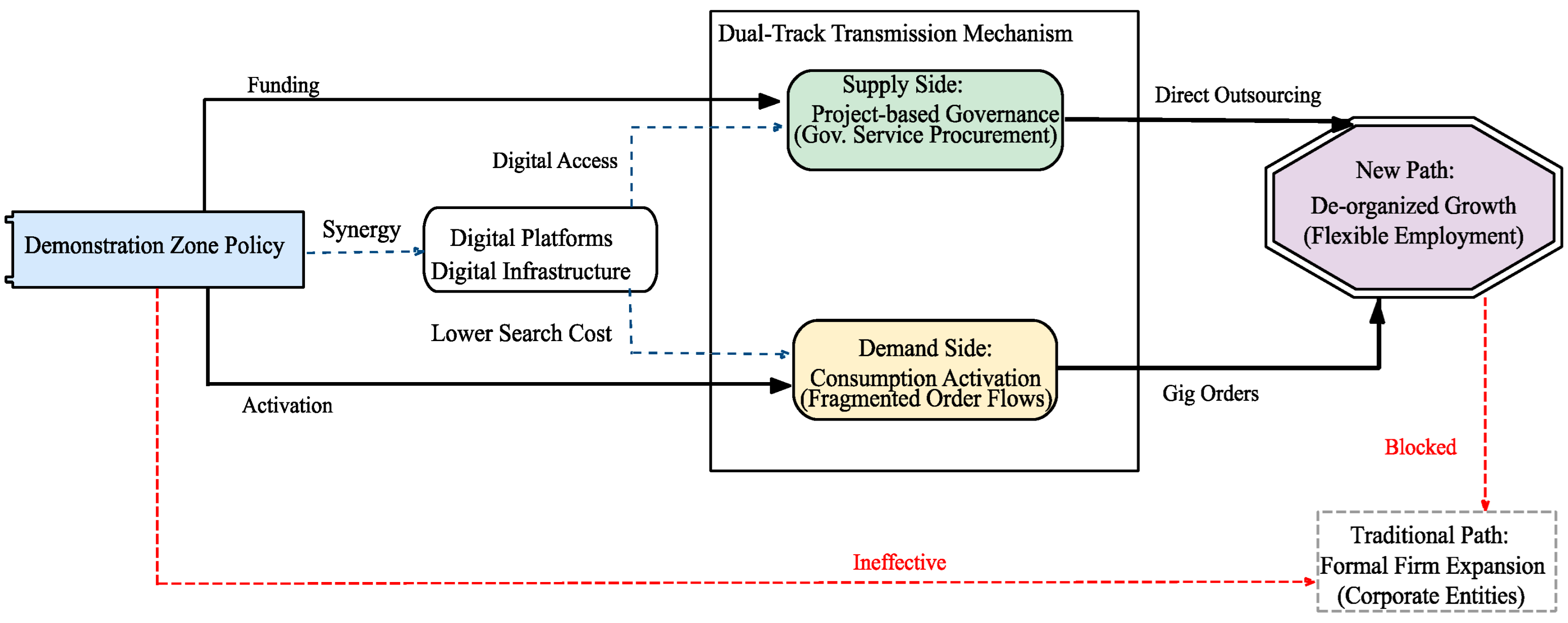
Macro-level aggregate data frequently obscure the labor absorption pathway of De-organized growth. To address this limitation, we propose a dual-sided driven framework (Figure 3) to capture the driving mechanisms behind this atypical growth precisely. This flowchart illustrates the synergistic relationship between policy inputs, digital mediation, and dual-track transmission. This framework analyzes how demonstration zone policies collectively reshape labor allocation logic. It achieves this through market activation on the demand side and governance transformation on the supply side.
On the demand side, the pulling effect is mainly reflected in activating the consumer market through the supply of public services, which in turn leads to flexible employment demand. Demonstration zone policies effectively stimulate latent consumer demand by significantly lowering barriers to accessing public cultural services [47]. As indicated by the grey dashed lines in Figure 3, the regional digital ecosystem plays a crucial mediating role here; specifically, digital platforms reduce matching friction (Lower Search Cost), causing decentralized and fragmented cultural and entertainment consumption to exhibit pronounced immediacy, This generates task flows better suited to flexible labor rather than rigidly hierarchical formal enterprises. To capture this mechanism, this paper uses per capita cultural and entertainment expenditure (Consumption) as a proxy for effective market demand. This variable is used to verify how consumption upgrades induce informal employment. The supportive role of the supply side is rooted in a significant shift in local government governance logic, which we term Project-based Governance. Local governments are constrained by fiscal austerity and rigid staffing quotas. Under these pressures, mandatory assessment metrics for demonstration zone development forced them to abandon traditional institutional expansion in favor of project-based resource allocation. This shift signified a paradigm shift in governance logic, transitioning from personnel maintenance to service procurement [48]. By procuring public cultural services, governments transformed fiscal funds into concrete service orders [49]. This project-for-service model gave rise to significant project-dependent flexible employment opportunities linked to government procurement chains. In the context of employment, workers are contractually bound to specific service projects as opposed to being employed on a more general basis.
Furthermore, the framework incorporates the Fiscal-Digital Synergy mechanism. While fiscal funding provides the initial impetus, the digital infrastructure serves as the essential substrate that allows these public service orders and consumption tasks to be disaggregated and distributed to individual gig workers. This process facilitates a direct connection between policy resources and flexible labor, effectively bypassing the traditional path of formal firm expansion—a structural shift illustrated by the red dashed lines (Ineffective and Blocked) in Figure 3.
To rigorously identify these causal channels and mitigate the endogeneity bias inherent in traditional stepwise regression [50], we adopt the two-step identification strategy proposed by Nunn and Wantchekon (2011) [51]. First, we verify Policy Activation (X → M) by testing whether the policy causally stimulates residents’ consumption potential and local fiscal expenditures. Second, we examine Channel Transmission (M → Y) to determine if these activated resources effectively drive employment growth. The model explicitly controls for housing prices (lnhp) and the digital economy (Digital). This approach rules out confounding effects from rising living costs and digital infrastructure expansion. The results are reported in Table 5.

6.2. Unpacking the Mechanisms

Table 5 reports the regression results for the mediating effects based on the dual-drive framework.
Demand-Side Transmission. Columns (1) and (2) of Table 5 report the tests for the demand-side transmission channel. Results in Column (1) show that the policy significantly boosts per capita cultural consumption. This effect persists despite the inclusion of housing prices as a control, suggesting that the policy effectively mitigates the financial crowding-out effect by reducing service access barriers. Column (2) further demonstrates that this induced demand significantly drives employment. This finding supports an order-driven labor absorption mechanism. Specifically, the policy stimulates fragmented and real-time consumer demand. This generates a continuous flow of tasks that flexible labor arrangements fulfill more effectively than traditional corporate structures. This confirms the demand-side pathway for De-organized growth. Furthermore, this mechanism relies on a critical technological substrate. China’s digital platform ecosystem (e.g., WeChat, Douyin) significantly reduces search costs, allowing individual service providers to instantly access these dispersed market orders. This digital infrastructure serves as the catalyst that translates policy-induced demand into actual flexible employment.
Supply-Side Transmission. Columns (3) and (4) substantiate the role of fiscal input as a supply-side engine. Column (3) indicates that the Demonstration Zone policy significantly increased the intensity of local fiscal expenditure on culture. Subsequently, Column (4) confirms that this fiscal expansion significantly translates into employment growth. Contextualized within China’s local governance framework, this finding reveals an alternative labor absorption pathway driven by government service purchasing. This contractual procurement of public services constitutes a direct supply-side driver for employment growth.
Ruling Out Technological Determinism. To ensure the exclusivity of our identified mechanisms, we explicitly controlled for the level of the digital economy in the model. The results in Columns (2) and (4) indicate that while digital technology exhibits a significant positive correlation in the first stage (resource activation), its regression coefficients in the second stage (employment conversion) fail to achieve statistical significance. Furthermore, the magnitude of these coefficients declines substantially. This evidence effectively falsifies the hypothesis of “technological determinism,” which posits that employment growth stems solely from technological dividends. Instead, it reveals that the technological environment, proxied by the digital economy index, functions not as a direct driver of employment but as the digital medium and infrastructure facilitating labor mobility. To explore how digital technology acts as a moderator influencing the efficiency of fiscal resource allocation, we will further investigate the interaction relationship between these factors in Section 6.3.

6.3. Further Discussion: Digital Thresholds in Fiscal Allocation

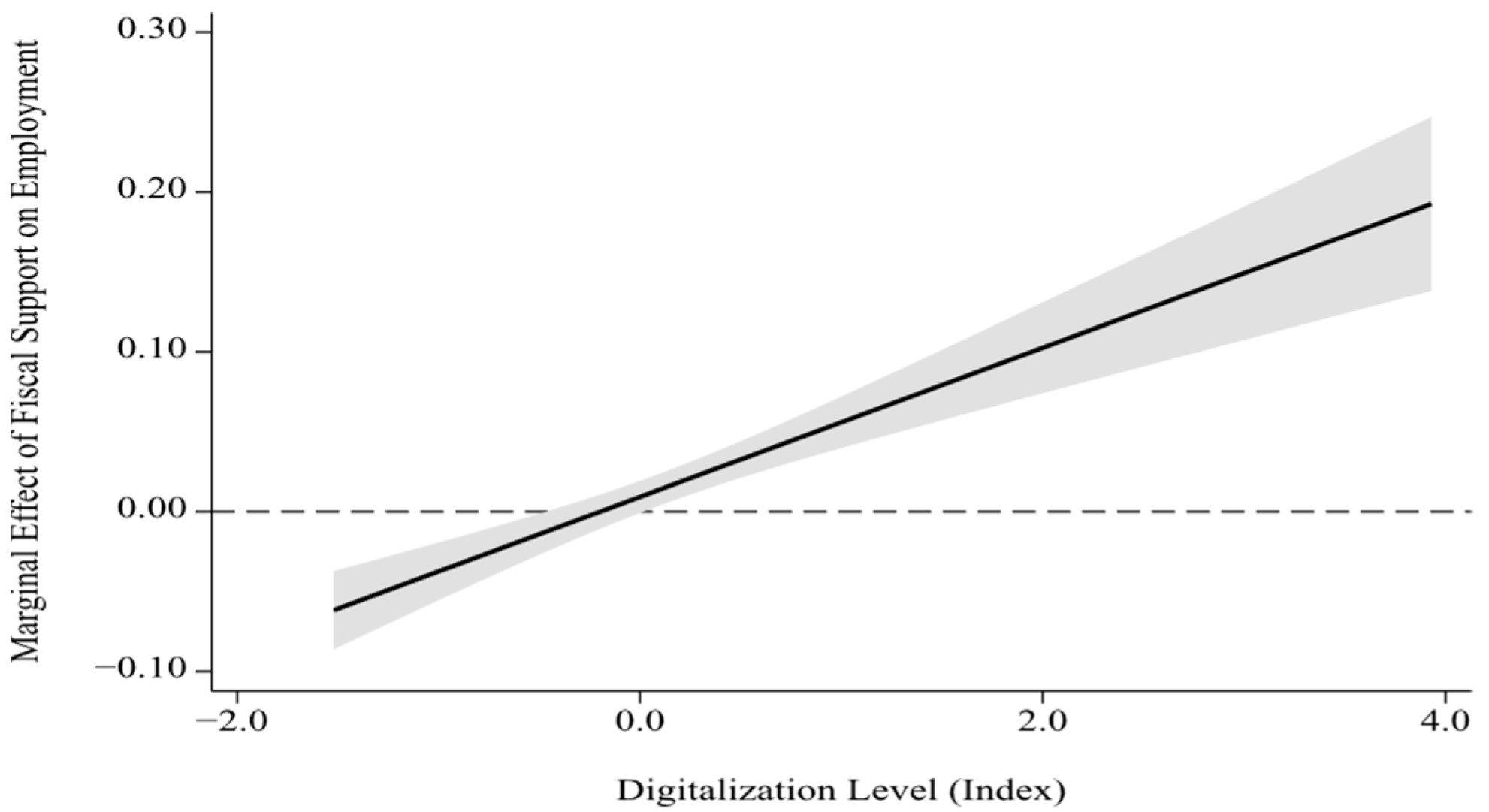
To further explore the boundary conditions and optimal range for policy effectiveness, this section employs Hansen’s (1999) [52] panel threshold model to examine the moderating threshold of digital economic development and the nonlinear characteristics of fiscal support intensity. As illustrated in Table 6, the results of the moderation effect tests incorporating the interaction term between fiscal support and the digital economy index are reported. The interaction coefficient is significantly positive at the 1% level, indicating that digital economic development significantly enhances the marginal employment-boosting effect of fiscal support, a pattern we term Fiscal-Digital Synergy.

6.3.1. Digitalization Reshapes Fiscal Allocation Efficiency

As illustrated in Figure 4, the trajectory of the marginal effect of fiscal support on employment is contingent on the level of digitalization. The combination of regression coefficients and the marginal effect diagram reveals a specific mechanism. It shows a complementary and corrective relationship between technological infrastructure and institutional provision. The marginal effect of fiscal support on employment manifests distinct threshold characteristics. Crucially, when the digitalization level falls below the threshold (approximately −0.5), the marginal effect of fiscal support turns negative. This reversal suggests that in regions with insufficient digital infrastructure, fiscal inputs may fail to achieve their intended outcomes, potentially leading to inefficient resource allocation typical of developing digital ecosystems. In regions with underdeveloped digital infrastructure, local governments suffer from severe information asymmetry regarding real market demand [53]. Consequently, fiscal spending often falls into a supply-driven trap, manifesting as investments in physical white elephant projects—such as grandiose but underutilized cultural centers—rather than demand-based services. As noted by Hao et al. (2020), such misallocation often leads to significant efficiency losses [54]. These inefficient public investments fail to generate sustainable jobs and may even induce a crowding-out effect, displace private grassroots cultural activities, and suppress net employment growth. Only when digitalization surpasses the critical threshold does the marginal effect curve monotonically increase and become significantly positive. This suggests that digital technology enhances the visibility and execution efficiency of public service projects, alleviates information asymmetry between government and market entities, and encourages qualified cultural institutions to respond more actively to fiscal contracts. Consequently, this results in an expansion of derived demand for underlying labor factors.
As illustrated in Table 6, the digitalization variable exhibited a considerably negative main effect coefficient in the regression analysis, contrasting with its insignificance in the baseline regression. This shift suggests that in the mixed regression across the full sample, the substitution and creation effects of digital technology may cancel each other out, rendering its average effect insignificant. However, after the introduction of the interaction term, the coefficient assumes a significantly positive value, thereby indicating that fiscal support exerts a substantial and positive moderating influence on the relationship between digitalization and employment.

6.3.2. The Mechanism of Fiscal-Digital Collaboration

The synergistic effect between fiscal policy and digital initiatives is built upon the tripartite foundation of supply, transmission, and demand. According to data reports such as the “2024 Statistical Bulletin on Culture and Tourism Development” released by the Ministry of Culture and Tourism, on the supply side, Digital resources are undergoing a structural transformation from static storage to dynamic empowerment. As a result, the National Public Culture Cloud is expanding its repository and integrating real-time interactive mechanisms through initiatives like the Spotlight Initiative. Over 23,000 professional live streams conducted throughout 2024 lowered learning barriers for individual workers, enabling skill acquisition and capacity building without formal institutional affiliation. Transmission infrastructure penetration. By 2024, China’s 5G network had achieved full coverage in townships and reached over 90% of administrative villages, with a total of 1.16 billion fiber-optic access ports. This high-density network infrastructure has bridged the technological access gap between urban and rural areas, ensuring that market entities in underdeveloped regions can access the unified national market with minimal information friction costs. This physical infrastructure provides the technological substrate for the Project-based Governance model to function effectively across vast geographic distances.
High-frequency market data corroborates the efficacy of this supply-demand alignment. In 2024, public libraries nationwide saw a total of 1.34 billion visits, while domestic performances attracted over 310 million attendees. This confirms that public cultural services have become embedded in the daily lives and work of the population, ensuring that fiscal funds translate into tangible socio-economic benefits through the mechanism of Fiscal-Digital Synergy—essentially the effective collaboration between government funding and digital technology.

7. Discussion

7.1. Theoretical Interpretations

7.1.1. The De-Organized Growth Paradox

Our benchmark regressions reveal a divergence between stagnant enterprise registration and robust employment growth. This finding challenges the core tenets of traditional regional development theory. Contrary to the productivism logic that dominates New Public Management frameworks, where economic vitality is measured by firm formation and capital accumulation [1], our findings reveal a qualitatively different growth pattern. Within China’s strategic framework of high-quality development, this De-organized Growth does not signal a market failure in enterprise incubation. Instead, it represents a structural evolution where cultural productivity shifts from capital-intensive organizational models toward labor-intensive modes driven by individual creativity.
The phenomenon of De-organized Growth validates the theory of labor restructuring. It demonstrates how digital technologies shift value creation from hierarchical firms to flexible individual networks [3]. Unlike the commercial gig economy which often leads to job instability [6] the NPCDZ policy functions as an institutional buffer. By providing stable government procurement orders and free digital infrastructure the state mitigates the market risks typically associated with freelance labor. This creates a unique form of publicly supported flexible economy where workers enjoy market autonomy without the precarity of subordinated agency [4]. This mechanism fundamentally alters labor demand patterns as digital platforms fragment traditional employment into task-based transactions [26]. This task-oriented restructuring dissolves bureaucratic boundaries, allowing consumer demand to flow directly to individual workers without corporate intermediation [55]. Our results extend this insight by showing that public policy can deliberately engineer such disintermediation. Whereas traditional industrial policy assumes a trickle-down mechanism by subsidizing firms with the expectation that benefits eventually reach workers, our evidence suggests that direct individual empowerment through lowered institutional barriers achieves superior allocative efficiency in the digital era [56]. More importantly, this model aligns with China’s Common Prosperity agenda by endowing industrial policy with a tertiary distribution function. The NPCDZ policy operates as an incubator for intangible cultural heritage practitioners and independent content creators, establishing direct fiscal channels that bypass corporate intermediaries. Unlike firm-centric subsidies that systematically fail to rectify distributional imbalances, this policy addresses income inequality during digital transformation by preventing capital accumulation at the organizational level and allocating resources directly to grassroots workers.

7.1.2. The Role of Government Policy in Digital Employment

The moderating effect analysis reveals a digital paradox that is often overlooked by technological optimists. Specifically, our findings suggest that digitalization alone does not automatically generate employment dividends. Absent institutional guidance, digital capital exhibits an inherent bias toward labor substitution through automation [57]. This explains the statistical insignificance of digitalization in our baseline regressions and refutes technological determinism—the assumption that digital infrastructure mechanically produces inclusive growth.
The NPCDZ policy functions as a critical institutional corrective. Government service procurement creates application scenarios that redirect digital technology from substitution toward augmentation. As Li (2025) argues, the employment effects of the digital economy depend fundamentally on inclusive institutional environments [55]. Our findings confirm this conditional relationship. Inclusive growth is not an automatic byproduct of technology; rather, it results from deliberate state action that channels digital infrastructure toward empowerment rather than displacement. Only through the synergistic governance of digital platforms and public policy can the risk of technological unemployment be mitigated, releasing the employment multiplier effects observed in our high-digitalization subsample.
This non-substitutability has profound implications for understanding China’s development model. The fiscal-digital synergy documented here represents a distinctive pathway to inclusive employment. By treating digital infrastructure as public productive capital rather than private competitive advantage, Chinese policy transforms technology from a labor-displacing force into a labor-augmenting scaffold.

7.2. Governance and Heterogeneity

7.2.1. Governance Transformation

Heterogeneity analysis across intervention intensity levels delineates sharp boundaries for effective government action. Policy effects concentrate in low-intervention regions while disappearing entirely in high-intervention contexts. This contrast supports the government failure hypothesis, where administrative rigidity crowds out flexible employment. Within gig economy ecosystems that depend on agility and low transaction costs, excessive bureaucratic control generates systemic friction [58]. Higher general public expenditures typically correlate with stronger administrative oversight, which increases institutional transaction costs for micro-level actors and suppresses market vitality [49]. These findings point toward a fundamental governance paradigm shift—what Kaszynska (2025) terms the transition from the administrative state to the enabling state [10]. Traditional cultural governance operates through direct institutional management: establishing and staffing cultural bureaus, theaters, and museums. Our results suggest that this model has exhausted its efficiency frontier. Extending Mazzucato’s (2018) mission-driven governance framework to the cultural sector, we argue that the state’s core competency lies not in managing operational entities but in functioning as a strategic purchaser [11]. Government service procurement mechanisms inject liquidity directly into the gig economy without imposing administrative burdens. This represents a dialectical unity of de-administration and re-marketization, whereby bureaucratic control is reduced while market coordination is strengthened through targeted fiscal intervention
The successful demonstration zone model thus offers a template for governance modernization in the digital era. Rather than feeding institutions through permanent budgetary allocations, the state should fund outcomes through project-based procurement that individuals and micro-teams can access directly. This shift transforms the state’s role. It moves from a provider managing service delivery through hierarchical organizations into an enabler constructing ecosystems that facilitate direct individual participation.

7.2.2. Regional Heterogeneity

Regional heterogeneity analysis reveals divergent development pathways on either side of China’s historical Heihe-Tengchong demographic divide (the Hu Line). In eastern regions, both firm registration and employment exhibit significant positive responses, validating Duranton and Puga’s (2004) agglomeration economics framework [59]. This divergence is theoretically grounded in the Coasean boundary of the firm (Coase, 1937) [15]. In regions with high marketization, internal management costs remain low relative to market transaction costs, rendering the formal enterprise the most efficient unit for organizing production. Favorable institutional environments thus amplify the capability of formal enterprises to internalize digital resources, strengthening their comparative advantage [42]. Rich industrial complementarities allow demonstration zone policies to function as intensive marginal enhancers, driving industrial upgrading within traditional bureaucratic organizational structures [25]. This represents an efficiency-driven growth model where public investment strengthens existing institutional capacity.
Central and western regions exhibit a contrasting pattern: significant employment expansion coincides with contracting or stagnant enterprise registration. This validates the view that digital infrastructure enables individuals to bypass high institutional costs by leveraging the substitution effect of the gig economy [60]. In areas west of the Hu Line, characterized by sparse agglomeration economies and high institutional transaction costs, digital platforms enable individual workers to bypass local administrative barriers and the sunk costs of formal registration [26]. Following Huang et al. (2025) and Chen and Ding (2025) [14,61], we interpret this De-organized growth not as developmental failure but as a strategic leapfrog trajectory. Potential entrepreneurs rationally avoid the friction-laden formal sector, leveraging digital infrastructure to access national markets directly.
This geographic bifurcation reflects different stages in China’s uneven development. Eastern regions optimize existing institutional capacity through intensive enhancement; western regions achieve inclusive entry by circumventing institutional constraints through disintermediation. Both pathways advance the broader goal of balanced regional development, but through distinct mechanisms suited to local conditions. The fiscal-digital synergy proves universally effective but manifests through distinct mechanisms: amplifying organizational efficiency in the east while enabling organizational bypass in the west. Inclusive growth in China’s interior depends on constructing alternative pathways that leverage digital infrastructure to transcend geographic and institutional constraints.

7.3. Limitations and Future Research

Our empirical analysis faces constraints regarding data granularity. The study relies on city-level macro data from statistical yearbooks. These official sources lack disaggregated records on individual practitioners. We adopted a structural divergence approach to measure employment expansion by capturing the gap between labor absorption and firm registration. However, this method cannot reveal the demographic details or working conditions of independent workers. Future research should utilize micro-level surveys or platform datasets to examine individual behaviors directly.
The institutional context presents a second limitation. The demonstration zone policy operates exclusively within China. This environment is characterized by strong state capacity to mobilize digital resources. The observed fiscal and digital synergy might perform differently in other developing economies where administrative structures vary. Future comparative studies are necessary to verify if similar public policies yield comparable results in different countries.
A final limitation lies in the scope of our mechanism analysis. We focused on how fiscal support interacts with digital infrastructure. Yet the rise of flexible employment is a complex phenomenon shaped by external factors such as social security provisions and local cultural consumption habits. Our current model does not fully isolate these variables. Subsequent studies need to explore how these broader social institutions influence the sustainability of new employment patterns.

8. Conclusions and Policy Implications

8.1. Main Conclusions

This study leverages the establishment of China’s National Public Cultural Service Demonstration Zone (NPCDZ) as a quasi-natural experiment to reassess the economic performance and micro-mechanisms of public policy in the digital era. Our findings reveal a distinctive pattern of De-organized employment growth, characterized by a significant structural divergence: the policy successfully generated robust job creation within the cultural sector without a corresponding scale expansion of formal corporate entities.
This growth model is driven by a dual mechanism: consumption induction on the demand side and project-based fiscal procurement on the supply side. These mechanisms construct a disintermediated value-creation pathway, enabling the direct absorption of individual labor while bypassing traditional reliance on hierarchical corporate structures. Theoretically, this finding challenges the conventional trickle-down hypothesis, confirming that the synergy between digital technology and fiscal support can foster an inclusive growth pathway aligned with the goal of Common Prosperity.
Further analysis indicates that while this model possesses a universality capable of bridging the digital divide, its efficiency follows a non-linear trajectory of fiscal-digital synergy. Specifically, higher levels of digitalization significantly amplify the employment multiplier effect of fiscal funds. Consequently, this study advocates for a governance paradigm shift from administrative management to ecological empowerment, where the state functions as a platform builder to cultivate a flexible, resilient, and sustainable labor market.

8.2. Policy Implications

The findings of the study propose three policy implications:
(1) Evaluation systems must be reoriented from organizational expansion toward individual labor.
The current evaluation framework relies too heavily on fixed asset investment and the number of registered firms, which fails to capture the vitality of the digital economy. We recommend incorporating indicators that reflect individual labor value into development assessments. Specifically, this system should monitor the ratio of active creator accounts on digital platforms relative to the local population, track income growth through digital transaction data, and evaluate service efficacy based on how frequently private users interact with digital resources.
(2) Transitioning from Intervention to Ecological Empowerment. Aligning with the enabling state paradigm proposed by Kaszynska (2025) [10], the core of cultural policy lies in stimulating market dynamics rather than mere fiscal transfer. To reduce fiscal dependency, policy must shift from direct administration to the facilitation of entrepreneurship. Since the synergy between funding and technology is most effective when intermediaries are minimized, financial aid should target individual market participants directly. These vouchers should allow independent designers and heritage heirs to purchase cloud services or copyright protection. This approach encourages a self-sustaining market and reduces the need for continuous government funding. (3) Differentiated Governance for Regional Coordination.
For lagging Western regions, policy efforts must prioritize fortifying digital infrastructure to dismantle opportunity barriers rooted in the digital divide. This enables the rich cultural endowments of Western regions to align directly with the significant consumer demand in Eastern markets. As S. Plutalov (2024) argues, a symbiotic mechanism is crucial for correcting regional imbalances [62]. To mitigate long-term fiscal dependency, we propose a strategic transition from direct corporate subsidies to a digital innovation voucher system, fostering entrepreneurship over permanent government reliance. Furthermore, underdeveloped regions should earmark a guaranteed proportion of their cultural budgets specifically for digital literacy and infrastructure to cross the threshold barrier identified in this study.

Author Contributions

Conceptualization, Y.W.; methodology, Y.W. and M.L.; software, Y.C.; formal analysis, Y.W. and M.L.; investigation, Y.W. and Y.X.; resources, Y.W. and Y.C.; data curation, Y.W. and Y.X.; writing-original draft preparation, Y.W. and M.L.; writing-review and editing, Y.W.; visualization, Y.W. and Y.C.; supervision, Y.W.; project administration, Y.W.; funding acquisition, Y.W. All authors have read and agreed to the published version of the manuscript.

Funding

This research was funded by the Tianjin Art and Science Planning Project “Consultation and Effective Supply of Public Culture for Rural Residents in Tianjin” (Project No. D20006).

Institutional Review Board Statement

Not applicable.

Informed Consent Statement

Not applicable.

Data Availability Statement

The raw data supporting the conclusions of this article will be made available by the authors on request.

Acknowledgments

The authors used generative AI tools (DeepSeek (V3.1)/ChatGPT (GPT-5.1)) solely for the purpose of language editing, translation assistance, and improving readability. The final content was reviewed and verified by the authors, who take full responsibility for the manuscript.

Conflicts of Interest

The authors declare no conflict of interest.

Appendix A

Table A1. Descriptive Statistics.
VariableSymbolObsMeanStd. Dev.MinMax
Firm EntryLnEmp39207.8280.8794.60511.428
EmploymentLnFirm39203.6041.81107.738
Demonstration Zone PolicyPolicy39200.1420.34901
Fiscal SupportFiscal39204.9810.9450.1618.661
ConsumptionConsum39201.7730.6830.2014.863
Digital MaturityDigital39200.3000.791−1.5183.967
Human CapitalLnHuman39208.6281.6683.34911.832
Econ. DevelopmentLnGDP392010.5970.6439.02812.008
PopulationLnPop39205.8780.6513.857.087
Fin. DevelopmentFinDepth392016.2581.1813.91719.408
Housing PriceLnHp39208.4240.4947.3469.904
Gov. InterventionGov39200.1950.1000.0680.613

References

  1. Burlina, C.; Casadei, P.; Crociata, A. Economic complexity and firm performance in the cultural and creative sector: Evidence from Italian provinces. Eur. Urban Reg. Stud. 2023, 30, 152–171. [Google Scholar] [CrossRef]
  2. Ganuthula, V.R.R. AI-enabled individual entrepreneurship theory: Redefining scale, capability, and sustainability in the digital age. J. Innov. Entrep. 2025, 14, 85. [Google Scholar] [CrossRef]
  3. Vallas, S.; Schor, J.B. What do platforms do? Understanding the gig economy. Annu. Rev. Sociol. 2020, 46, 273–294. [Google Scholar] [CrossRef]
  4. Wood, A.J.; Lehdonvirta, V. Antagonism beyond employment: How the ‘subordinated agency’of labour platforms generates conflict in the remote gig economy. Socio-Econ. Rev. 2021, 19, 1369–1396. [Google Scholar] [CrossRef]
  5. Zhao, Y.; Said, R. The Effect of the Digital Economy on the Employment Structure in China. Economies 2023, 11, 227. [Google Scholar] [CrossRef]
  6. Sun, P.; Yujie Chen, J.; Rani, U. From flexible labour to ‘sticky labour’: A tracking study of workers in the food-delivery platform economy of China. Work Employ. Soc. 2023, 37, 412–431. [Google Scholar] [CrossRef]
  7. Klinenberg, E. Palaces for the People: How Social Infrastructure Can Help Fight Inequality, Polarization, and the Decline of Civic Life; Crown: New York, NY, USA, 2018. [Google Scholar]
  8. Zhou, C.; Li, B. Improving Innovation within the Cultural Industry via Public Cultural Service Systems: Evidence from a City Pilot in China. J. Urban Plan. Dev. 2026, 152, 04025080. [Google Scholar] [CrossRef]
  9. Sheng, X.; Zhou, Y.; Liu, Y. Can the National Public Cultural Service System Demonstration Zone Promote the Sustainable Development of Urban Culture? Sustainability 2024, 16, 9323. [Google Scholar] [CrossRef]
  10. Kaszynska, P. Enabling as the anchor for regenerative cultural policy. Int. J. Cult. Policy 2025, 31, 422–433. [Google Scholar] [CrossRef]
  11. Mazzucato, M. The Value of Everything: Making and Taking in the Global Economy; Hachette: London, UK, 2018. [Google Scholar]
  12. Guoxin, L. Development of Public Cultural Services in the Deepening Reform of Cultural Systems and Mechanisms. Libr. J. 2025, 44, 4–9. [Google Scholar]
  13. Dan, W.T.S. The Role of Building Demonstration Areas in Equal Public Cultural Services. Libr. Trib. 2023, 43, 79–88. [Google Scholar]
  14. Chen, Y.; Ding, Y. Public Cultural Services and Urban Labor Productivity: Evidence from China’s Demonstration Zone Program. Northwest Popul. J. 2025, 46, 96–110. [Google Scholar]
  15. Coase, R.H. The nature of the firm. Economica 1937, 4, 386–405. [Google Scholar] [CrossRef]
  16. Goldfarb, A.; Tucker, C. Digital economics. J. Econ. Lit. 2019, 57, 3–43. [Google Scholar] [CrossRef]
  17. Gregory, K. Platforms and cultural production. Int. J. Cult. Policy 2022, 28, 923–925. [Google Scholar] [CrossRef]
  18. Li, N.; Noureldin, D. Eliminating the productivity drag. Financ. Dev. 2024, 61, 22–23. [Google Scholar]
  19. Peng, Y.; Zhang, Q.; Yan, H.; Lei, X.; Ma, S. Short-term relief or long-term risk? The impact of financial asset allocation on corporate risk in China’s construction and manufacturing firms. J. Asian Archit. Build. Eng. 2025, 1–14. [Google Scholar] [CrossRef]
  20. Huang, Y.; Pagano, M.; Panizza, U. Local Crowding Out in China. J. Financ. 2020, 75, 2855–2898. [Google Scholar] [CrossRef]
  21. He, Z.; Nelson, S.; Su, Y.; Zhang, A.L.; Zhang, F. Land (Mis) allocation and Local Public Finance in China; University of Chicago: Chicago, IL, USA, 2025. [Google Scholar]
  22. Chen, H. Prospects and Difficulties of Informal Employment in China Under the Enormous Wave of World Urbanization. Financ. Econ. Res. 2025, 2, 6. [Google Scholar] [CrossRef]
  23. Hao, X.; Li, Y.; Ren, S.; Wu, H.; Hao, Y. The role of digitalization on green economic growth: Does industrial structure optimization and green innovation matter? J. Environ. Manag. 2023, 325, 116504. [Google Scholar] [CrossRef]
  24. Dâmaso, M.; Rex, B. Towards a regenerative approach to cultural policy. Int. J. Cult. Policy 2025, 31, 409–421. [Google Scholar] [CrossRef]
  25. Pan, W.; Xie, T.; Wang, Z.; Ma, L. Digital economy: An innovation driver for total factor productivity. J. Bus. Res. 2022, 139, 303–311. [Google Scholar] [CrossRef]
  26. Zhang, Z.; Sun, C.; Wang, J. How can the digital economy promote the integration of rural industries—Taking China as an example. Agriculture 2023, 13, 2023. [Google Scholar] [CrossRef]
  27. Omar, N.; Jamil, R. A Systematic Literature Review of the Gig Economy: Insights into Worker Experiences, Policy Implications, and the Impact of Digitalization. Int. J. Res. Innov. Soc. Sci. 2025, 9, 2136–2156. [Google Scholar] [CrossRef]
  28. Decker, R.A.; Haltiwanger, J.; Jarmin, R.S.; Miranda, J. Changing business dynamism and productivity: Shocks versus responsiveness. Am. Econ. Rev. 2020, 110, 3952–3990. [Google Scholar] [CrossRef]
  29. Au, C.-C.; Henderson, J.V. Are Chinese cities too small? Rev. Econ. Stud. 2006, 73, 549–576. [Google Scholar] [CrossRef]
  30. Liu, J.; Yang, Y.; Zhang, S. Research on the measurement and driving factors of China’s digital economy. Shanghai J. Econ 2020, 6, 81–96. [Google Scholar]
  31. Zhang, Y.; Li, X. Digital Economy, Marine Industrial Structure Upgrading, and the High-Quality Development of Marine Economy Based on the Static and Dynamic Spatial Durbin Model. Sustainability 2024, 16, 9677. [Google Scholar] [CrossRef]
  32. Lee, C.-C.; Lee, C.-C. How does green finance affect green total factor productivity? Evidence from China. Energy Econ. 2022, 107, 105863. [Google Scholar] [CrossRef]
  33. Hsieh, C.-T.; Moretti, E. Housing constraints and spatial misallocation. Am. Econ. J. Macroecon. 2019, 11, 1–39. [Google Scholar] [CrossRef]
  34. Hainmueller, J. Entropy balancing for causal effects: A multivariate reweighting method to produce balanced samples in observational studies. Political Anal. 2012, 20, 25–46. [Google Scholar] [CrossRef]
  35. Zhang, M.; Hong, Y.; Zhu, B. Does national innovative city pilot policy promote green technology progress? Evidence from China. J. Clean. Prod. 2022, 363, 132461. [Google Scholar] [CrossRef]
  36. Chetty, R.; Looney, A.; Kroft, K. Salience and taxation: Theory and evidence. Am. Econ. Rev. 2009, 99, 1145–1177. [Google Scholar] [CrossRef]
  37. Cai, H.; Chen, Y.; Gong, Q. Polluting thy neighbor: Unintended consequences of China’s pollution reduction mandates. J. Environ. Econ. Manag. 2016, 76, 86–104. [Google Scholar] [CrossRef]
  38. Lin, J.Y.; Wang, Y. Structural change, industrial upgrading, and middle-income trap. J. Ind. Compet. Trade 2020, 20, 359–394. [Google Scholar] [CrossRef]
  39. Frick, S.A.; Rodríguez-Pose, A. What draws investment to special economic zones? Lessons from developing countries. Reg. Stud. 2023, 57, 2136–2147. [Google Scholar] [CrossRef]
  40. Yu, Y.; Ma, D.-P.; Gan, G.-y. Context-dependent data-envelopment-analysis-based efficiency evaluation of coastal ports in China based on social network analysis. J. Mar. Sci. Technol. 2023, 31, 1. [Google Scholar] [CrossRef]
  41. Song, X.; Tian, Z.; Ding, C.; Liu, C.; Wang, W.; Zhao, R.; Xing, Y. Digital economy, environmental regulation, and ecological well-being performance: A provincial panel data analysis from China. Int. J. Environ. Res. Public Health 2022, 19, 11801. [Google Scholar] [CrossRef]
  42. Xiao, W.; Fan, D. The “Simultaneous Development of Quantity and Quality”: Research on the Impact of the Digital Economy in Enabling Manufacturing Innovation. Systems 2024, 12, 470. [Google Scholar] [CrossRef]
  43. Autor, D. Applying AI to Rebuild Middle Class Jobs; National Bureau of Economic Research: Cambridge, MA, USA, 2024. [Google Scholar]
  44. Zhang, Z. The impact of the artificial intelligence industry on the number and structure of employments in the digital economy environment. Technol. Forecast. Soc. Change 2023, 197, 122881. [Google Scholar] [CrossRef]
  45. Burtch, G.; Carnahan, S.; Greenwood, B.N. Can you gig it? An empirical examination of the gig economy and entrepreneurial activity. Manag. Sci. 2018, 64, 5497–5520. [Google Scholar] [CrossRef]
  46. Dheer, R.J.; Treviño, L.J. Explaining the rate of opportunity compared to necessity entrepreneurship in a cross-cultural context: Analysis and policy implications. J. Int. Bus. Policy 2022, 5, 29–55. [Google Scholar] [CrossRef]
  47. Autor, D.; Dube, A.; McGrew, A. The Unexpected Compression: Competition at Work in the Low Wage Labor Market; National Bureau of Economic Research: Cambridge, MA, USA, 2023. [Google Scholar]
  48. Xu, Q.; Cheng, X.; Zhao, H. Does the selection of high-quality scenic spots promote the growth of tourism economy? evidence from China’s 5A-rated tourist attractions. PLoS ONE 2024, 19, e0304108. [Google Scholar] [CrossRef]
  49. Yang, L.; Li, R. Government procurement and corporate investment efficiency: Evidence from China. Financ. Res. Lett. 2024, 67, 105934. [Google Scholar] [CrossRef]
  50. Ting, J. Mediating Effects and Moderating Effects in Causal Inference. China Ind. Econ. 2022, 5, 100–120. [Google Scholar]
  51. Nunn, N.; Wantchekon, L. The slave trade and the origins of mistrust in Africa. Am. Econ. Rev. 2011, 101, 3221–3252. [Google Scholar] [CrossRef]
  52. Hansen, B.E. Threshold effects in non-dynamic panels: Estimation, testing, and inference. J. Econom. 1999, 93, 345–368. [Google Scholar] [CrossRef]
  53. Stiglitz, J.E. Information and the Change in the Paradigm in Economics. Am. Econ. Rev. 2002, 92, 460–501. [Google Scholar] [CrossRef]
  54. Hao, Y.; Gai, Z.; Wu, H. How do resource misallocation and government corruption affect green total factor energy efficiency? Evidence from China. Energy Policy 2020, 143, 111562. [Google Scholar] [CrossRef]
  55. Li, Y.; Xie, Z.; Tui, Z.; Woo, D. The Impact of Digital Economy on Flexible Employment: The Mediating Role of Laborer Perceptions. SAGE Open 2025, 15, 21582440251327017. [Google Scholar] [CrossRef]
  56. Lin, B.; Zhu, Y. The impact of artificial intelligence policy on green innovation of firms. Energy Econ. 2025, 148, 108524. [Google Scholar] [CrossRef]
  57. Wu, B.; Yang, W. Empirical test of the impact of the digital economy on China’s employment structure. Financ. Res. Lett. 2022, 49, 103047. [Google Scholar] [CrossRef]
  58. Xiao, Z.; Zhang, Y.; Xu, M.; Fajardo, B.; Zhang, X. Government Intervention and the Quality of Urban Agglomeration Development: Analysis Based on Market Perspective. J. Urban Plan. Dev. 2024, 150, 04023054. [Google Scholar] [CrossRef]
  59. Duranton, G.; Puga, D. Microfoundations of Urban Agglomeration Economies. Handb. Reg. Urban Econ. 2003, 4, 2063–2117. [Google Scholar]
  60. Wang, J.; Gao, Q.; Zhang, R. Gig economy and its impact on individual employment: An empirical analysis. Humanit. Soc. Sci. Commun. 2025, 12, 1703. [Google Scholar] [CrossRef]
  61. Huang, M.; Hua, M.; Li, J.; Han, Y. Digital economy empowered entrepreneurship. Manag. Decis. 2025, 63, 155–186. [Google Scholar] [CrossRef]
  62. Plutalov, S.; Iastremska, O.; Kulinich, T.; Shofolova, N.; Zelenko, O. Symbiosis of Creativity and Sustainability: Modelling the Dynamic Relationship Between Sustainable Development and Cultural and Creative Industries in the EU Countries, Great Britain and Ukraine. Probl. Ekorozwoju 2024, 2, 166–185. [Google Scholar] [CrossRef]
Figure 1. Parallel Trend Tests and Dynamic Effects.
Sustainability 18 02432 g001
Figure 2. Distribution of t-statistics from Placebo Tests. (Note: The grey dashed lines denote the non-rejection interval [−1.96, 1.96]. The red dashed line represents the actual t-statistic (3.22) from the baseline regression.).
Sustainability 18 02432 g002
Figure 3. Conceptual Framework of the De-organized Employment Growth.
Sustainability 18 02432 g003
Figure 4. Marginal Effect of Fiscal Support on Employment across Digitalization Levels. Note: The grey shaded area represents the 95% confidence interval.
Sustainability 18 02432 g004
Table 2. The Divergence of Policy Impact.
(1)
Firm Entry
(2)
Employment
DID−0.0420.065 ***
(0.033)(0.0188)
Controls YesYes
City FEYesYes
Year FEYesYes
Observations39203920
Adj. R-squared0.9430.917
*** p < 0.01.
Table 3. Entropy Balancing and Controlling for Concurrent Policies.
VariableEntropy BalancingInn. Policy
(1)(2)(3)(4)
Firm EntryEmploymentFirm EntryEmployment
DID−0.037 **0.063 **−0.0400.053 ***
(0.032)(0.026)(0.033)(0.018)
Inn. Policy −0.0260.149 ***
(0.034)(0.019)
ControlsYesYesYesYes
City FEYesYesYesYes
Year FEYesYesYesYes
Observations3920392039203920
Adj. R-squared0.9600.9600.9430.918
** p < 0.05, *** p < 0.01.
Table 4. Heterogeneity Analysis.
(1)(2)
Firm EntryEmployment
Panel A: Region
Central & West Region−0.096 **
(0.040)
0.071 ***
(0.022)
Eastern Region0.132 ***0.046 **
(0.046)(0.025)
Panel B: Gov. Intervention
Low Gov Group−0.0140.123 ***
(0.036)(0.024)
High Gov Group−0.084−0.019
(0.057)(0.024)
Panel C: Digital
Low Digital−0.0470.067 **
(0.044)(0.023)
High Digital−0.0370.063 **
(0.047)(0.026)
ControlsYesYes
City FEYesYes
Year FEYesYes
Observations39203920
Adj. R-squared0.9430.914
** p < 0.05, *** p < 0.01.
Table 5. Mechanism Analysis.
Demand-Side
(Consumption)
Supply-Side
(Fiscal)
(1)(2)(3)(4)
X -> M1M1 -> YX -> M2M2 -> Y
DID0.089 *** 0.116 **
(0.016) (0.059)
Consumption (M1) 0.109 ***
(0.023)
Fiscal (M2). 0.013 **
(0.005)
InHousing−0.045 *0.073 *0.0320.067 *
(0.024)(0.040)(0.099)(0.039)
Digital0.077 ***0.0180.128 **0.023
(0.017)(0.019)(0.056) (0.019)
Controls YesYesYesYes
City FEYesYesYesYes
Year FEYesYesYesYes
Observations3920392039203920
Adj. R-squared0.9130.9140.3020.914
* p < 0.10, ** p < 0.05, *** p < 0.01.
Table 6. The Moderating Role of Digitalization.
VariableEmployment
Fiscal0.009 **
(0.005)
Digital−0.221 ***
(0.042)
Fiscal × Digital0.046 ***
(0.007)
Controls Yes
City FEYes
Year FEYes
Observations3920
Adj. R-squared0.915
** p < 0.05, *** p < 0.01.
Disclaimer/Publisher’s Note: The statements, opinions and data contained in all publications are solely those of the individual author(s) and contributor(s) and not of MDPI and/or the editor(s). MDPI and/or the editor(s) disclaim responsibility for any injury to people or property resulting from any ideas, methods, instructions or products referred to in the content.