Article

The Impact of Environmental Tax on Corporate Digital Transformation: Evidence from Chinese Listed Companies

School of Public Finance and Taxation, Central University of Finance and Economics, Beijing 102206, China
*
Author to whom correspondence should be addressed.
Sustainability 2026, 18(5), 2431; https://doi.org/10.3390/su18052431
Submission received: 26 January 2026 / Revised: 25 February 2026 / Accepted: 26 February 2026 / Published: 3 March 2026
(This article belongs to the Section Economic and Business Aspects of Sustainability)

Abstract

Environmental tax is a key market-based instrument for promoting sustainability and reshaping corporate strategy. Using the panel data of Chinese listed firms from 2010 to 2023, this study employs text mining to measure digital transformation and examines the impact of environmental tax on corporate digitalization. The results show that environmental tax significantly promotes digital transformation. The mechanism analyses reveal that green technology innovation and ESG performance serve as important transmission channels. Furthermore, the effect is positively moderated by regional marketization, environmental information disclosure, and low-carbon city policies. The heterogeneity analyses indicate stronger effects in economically developed regions and firms with greater resource endowments. The additional analysis demonstrates that environmental tax enhances both total factor productivity and green governance performance through accelerating digital transformation, achieving a synergistic green–digital transition. This study provides empirical evidence on how market-based environmental policies can foster corporate digital transformation as a pathway toward sustainable development.

1. Introduction

Against the backdrop of accelerating global environmental governance and deepening integration of the digital economy, it is critical to explore how environmental policy instruments can simultaneously promote environmental sustainability and economic transformation. Meanwhile, digital transformation has emerged as a key global driver of productivity growth and sustainable development. However, the interaction between environmental tax and corporate digital transformation remains insufficiently explored, particularly at the micro level.
As the world’s second-largest economy and foremost emerging market, China has contributed over 30% to global economic growth over the past decade. It serves not only as a central hub in global industrial and value chains but also as a trailblazer in green transition and digital economy development. Since the announcement of its “Carbon Peaking and Carbon Neutrality” (Dual Carbon) goals, China has pursued ecological civilization construction with unprecedented intensity. By 2024, renewable energy accounts for over 50% of China’s total installed power capacity, while new energy vehicle production and sales have maintained global leadership for ten consecutive years. Concurrently, the value added of core digital industries accounts for approximately 10% of the GDP, establishing digitalization as the primary engine driving industrial restructuring and sustainable growth. These developments position China as a highly informative empirical case for examining the co-evolution of environmental regulation and digital transformation under conditions increasingly faced by many economies worldwide.
The green tax system, as a policy instrument for reconciling environmental protection and economic development, is undergoing functional evolution from “unidimensional pollution control” toward “multidimensional innovation incentives”, which is a transition particularly consequential in China’s institutional context. China’s environmental governance predominantly relied on command-and-control regulations. While delivering rapid compliance outcomes, such mandatory mechanisms incurred high implementation costs and generated adverse socioeconomic externalities. The enactment of the Environmental Protection Tax Law in 2018 marked China’s substantive transition toward market-based environmental regulation. As a long-term market-conforming instrument, the environmental tax not only restructures corporate cost frameworks and development paradigms but also pioneers novel pathways for achieving “dual dividends”, simultaneously improving environmental quality (the “green dividend”) and economic efficiency (the “blue dividend”).
The existing literature has examined environmental taxation from multiple angles. One strand focuses on its “green dividend”, demonstrating that environmental tax can effectively reduce pollution emissions [1] and stimulate green technology innovation. Another strand investigates the “blue dividend”, exploring effects on productivity, employment, and economic efficiency, though the findings remain mixed [2]. Concurrently, a growing body of research examines the drivers of corporate digital transformation, identifying external factors such as tax incentives and internal factors such as ESG performance.
However, the literature has largely developed in parallel, with limited integration. The studies examining environmental tax typically focus on innovation outcomes measured by patents or R&D investment [3], while the studies of digital transformation rarely consider environmental tax as a potential driver. Moreover, the research on ESG and digitalization has not been linked to the incentive structures created by environmental taxation. Crucially, it remains unclear whether and how market-based environmental policies such as taxation can bridge the “green governance” and “digital revolution” to foster sustainability-oriented corporate transformation, and through which mechanisms such effects might operate. Therefore, conducting research on the impact effects, mechanism paths and heterogeneity of environmental tax on digital transformation of enterprises can help provide realistic references for the government to optimize environmental regulatory tools as well as for enterprises to formulate digital transformation strategies.
This paper highlights four main questions: First, does environmental tax significantly promote enterprise digital transformation? Second, if such an effect operates, what mechanisms might influence it? Third, how do external institutional environments, such as marketization level and environmental information disclosure, moderate this relationship? Finally, does the effect of environmental tax exhibit heterogeneity across regions and firm characteristics, and what are its subsequent implications for economic and environmental performance? Based on these questions, this paper focuses on the relationship between environmental tax and enterprise digital transformation, enriching the research on the interaction between fiscal policy and corporate behavior and providing important insights for improving China’s environmental tax system and promoting digital transformation.
This study makes several contributions. First, we integrate environmental tax, green innovation, ESG, and digital transformation into a unified analytical framework, revealing the dual mediating pathways through which environmental tax operates. Second, by distinguishing between technology-oriented and application-oriented digitalization, we demonstrate that these dimensions differentially mediate the effects of environmental tax on economic (TFP) versus environmental (GGP) outcomes, providing a novel insight into how digital transformation delivers dual dividends. Third, we analyze the boundary conditions of environmental tax effectiveness at both the institutional level (marketization, information disclosure, low-carbon policies) and the firm level (size, technological capability, pollution intensity), offering guidance for targeted policy design. Fourth, we extend the analysis to economic consequences, showing that environmental tax enhances both total factor productivity and green governance performance by accelerating digital transformation, thereby achieving synergistic green–digital development. Drawing on empirical evidence from China, this study provides practical implications for other emerging economies navigating the dual transition toward sustainability and digitalization.
The remainder of this study is structured as follows. Section 2 reviews the relevant literature. Section 3 develops the theoretical framework and research hypotheses. Section 4 describes the methodology and data. Section 5 and Section 6 present the empirical results. Section 7 concludes with findings, policy implications for sustainability, and future research directions.

2. Literature Review

2.1. Research on Environmental Tax

2.1.1. Definition of Environmental Tax

Environmental regulation can be broadly categorized into market-based instruments and command-and-control approaches. Market-based regulation policies advocate the use of economic incentives such as taxation, which is more flexible than command-and-control regulation [4]. The conceptual foundation of environmental tax traces back to the Pigouvian tax, designed to internalize the external costs of pollution. In practice, environmental tax can be defined in two ways. The narrow definition refers to taxes specifically levied on pollution emissions. In China, this corresponds to the Environmental Protection Tax implemented in 2018 and its predecessor, the pollution discharge fee. The broad definition encompasses all taxes with environmental relevance, including resource tax, consumption taxes on energy products, vehicle-related taxes, and others that indirectly affect environmental outcomes [5]. The OECD defines environmental tax as a tax levied on products and services that cause environmental pollution, aiming to internalize environmental external costs through economic means and promote environmental protection and sustainable development.

2.1.2. Environmental Tax “Double Dividend” Hypothesis

The “double dividend” hypothesis, first formalized by Pearce (1991) [6], proposes that environmental tax can yield two distinct benefits: improving environmental quality (the “green dividend”) and enhancing economic efficiency through revenue recycling or innovation effects (the “blue dividend”). This hypothesis has stimulated extensive theoretical and empirical investigation. The Porter hypothesis (Porter and Linde, 1995) [7] provides a complementary perspective, arguing that well-designed environmental regulations can stimulate innovation that partially or fully offsets compliance costs—the so-called “innovation compensation” effect. This suggests that environmental taxes may not only reduce emissions but also drive technological upgrading and productivity improvements.
Regarding the environmental dividend, the existing studies show that environmental tax can effectively reduce pollution emissions [8], promote enterprise green technological innovation [9], and also contribute to strengthening urban pollution control and improving environmental performance [10]. In terms of the social dividend, although the understanding of environmental dividends is relatively consistent in previous studies, there are still different views on whether environmental tax can bring social dividends and promote economic efficiency and social equity. Bovenberg and Smulders (1995) constructed a dynamic general equilibrium model and found that the imposition of environmental tax may increase the operating costs of enterprises, so that labour-intensive enterprises will have to cut down on their labour inputs, which in turn will have an impact on employment and lead to difficulties in realizing the employment dividend [11]. These mixed findings underscore that the realization of the blue dividend depends critically on policy design, industrial structure, and institutional context.

2.2. Research on Enterprise Digital Transformation

2.2.1. Definition and Measurement of Digital Transformation

Digital transformation refers to the use of information, computing and communication technology to improve the efficiency of enterprise information processing. Digital transformation can promote the allocation of resources, and promote the transformation of production processes, business activities and business models [12]. It encompasses not only technological adoption but also organizational change and strategic renewal. Research demonstrates that digital transformation can enhance enterprise value [13], foster innovation capabilities [14], and improve productivity [15].
Regarding the measurement of digital transformation, many studies have focused on measuring the level of digitization at the macro level. Most of the studies mainly calculate the level of digital transformation from the perspectives of infrastructure construction, digital application, data management and innovation capability. At the micro level, some scholars use qualitative research methods, and some scholars measure according to the level of digital patents of enterprises, but these methods are highly subjective and random. In addition, some scholars use text mining methods to calculate the frequency of words related to digital transformation, such as “Artificial Intelligence”, “Blockchain” and “Cloud Computing” in the annual reports of enterprises, so as to reflect the degree of importance that enterprises attach to digital transformation [16]. This method is more objective and has accuracy.

2.2.2. Influencing Factors of Digital Transformation

Scholars generally believe that the factors affecting the digital transformation of enterprises mainly come from external environmental factors and internal enterprise factors.
External factors include institutional environment, industry dynamics, and policy support. Among various institutional factors, the impact of tax policies is the focus of many research discussions. As an important tool for the government to regulate enterprise behavior, tax policies have a direct impact on enterprise digital transformation. Nie et al. (2024) propose that targeted resource subsidies and tax reduction policies can help enterprises expand their digital fixed assets scale, strengthen digital talent training, thereby effectively promoting the digital transformation process [17].
Internal factors encompass resource capabilities, technological foundation, and governance structure. Digital transformation essentially depends on the application and integration of big data, artificial intelligence, and other technologies. Therefore, enterprises’ digital technology innovation capabilities are the core internal driving force for transformation [18]. Meanwhile, the digital transformation of enterprises will be influenced by managers. Additionally, Environmental, Social, and Governance (ESG) performance reflects enterprises’ commitment to sustainable development, and can provide more resources and social capital for digital transformation by improving corporate image, alleviating financing constraints, and optimizing governance mechanisms [19,20].

2.3. Research Gaps

Despite substantial research on both environmental tax and digital transformation, the intersection of these two domains remains underexplored. The existing studies can be grouped into several strands, each with distinct limitations. First, the environmental tax and innovation literature primarily examines the effects on green innovation measured by patents or R&D [21,22]. This focus overlooks how environmental tax can shape broader strategic transformations, such as digitalization, that have implications beyond environmental performance. Second, the literature on the drivers of digital transformation identifies multiple factors, including tax incentives [23] and ESG performance [24], but rarely considers the effect of environmental tax. When tax policies are examined, the focus is typically on R&D tax credits or investment incentives, not on environmental tax as a market-based regulatory instrument. Third, the studies linking environmental performance to digitalization tend to examine digital transformation as a driver of environmental outcomes rather than as an outcome shaped by environmental policy [25]. The reverse direction, how environmental regulation stimulates digitalization, remains largely unexplored.
This study addresses these gaps by developing and testing an integrated framework linking environmental tax to digital transformation, mediated by green technology innovation and ESG performance, moderated by institutional factors, and ultimately transmitted to total factor productivity and green governance performance. By distinguishing between technology-oriented and application-oriented digitalization, we further uncover the nuanced pathways through which environmental tax delivers its dual dividends.

3. Theoretical Framework and Research Hypothesis

3.1. Driving Effect of Environmental Tax on Enterprise Digital Transformation

As an important market-based environmental regulation tool, environmental tax not only directly influences enterprise behavior by increasing pollution costs but also drives enterprises to digital transformation at a deeper level. This effect can be fully explained on the basis of the Porter hypothesis. The Porter hypothesis was put forward by economist Michael Porter in 1991, and it argues that appropriate environmental regulation can help to force enterprises to innovate green technology and form “compensatory benefits” that exceed the cost of environmental regulation. By applying green innovations to their production processes, enterprises can reduce their reliance on old polluting production methods and effectively avoid the costs of environmental regulation. Porter’s hypothesis provides theoretical support for the role of environmental tax in influencing enterprise digital innovation. The central role of environmental tax is to internalize environmental externalities, increase the cost of polluting emissions, and alter the cost–benefit structure of enterprise production and operational decisions. This forces enterprises to reassess their traditional production models and seek more sustainable and efficient alternatives. In this process, digital transformation has become an important strategic choice for enterprises to cope with environmental tax pressures due to its tremendous potential in improving operational efficiency, optimizing resource use, and reducing pollution emissions. In this context, digital transformation emerges as a strategic, sustainability-oriented governance tool, reconfiguring operational models, enhancing resource efficiency, and reducing emissions, thereby addressing both regulatory pressures and long-term sustainability goals.
On the one hand, environmental tax can stimulate the “innovation compensation” effect by exerting cost pressure, directly driving enterprise digital transformation. The increase in environmental tax significantly raises the environmental compliance costs and pollution discharge expenses of enterprises, squeezing their profit margins. To offset these new costs, enterprises have strong incentives to introduce digital technologies, optimize production processes, improve resource efficiency, and reduce energy consumption and emissions. For example, enterprises can use digital technologies to achieve real-time monitoring and intelligent control of production processes, precisely manage energy and material usage, reduce pollution control costs, and improve resource utilization efficiency. Such digital applications not only help enterprises meet environmental requirements and avoid environmental tax burdens but also enable them to gain additional economic benefits through efficiency improvements, enhancing market competitiveness.
On the other hand, environmental tax can indirectly promote enterprises to choose digital transformation paths by shaping institutional and market environments. With the implementation of environmental tax policies, the government’s green development orientation has become increasingly clear, and investors and markets are paying more attention to enterprises’ environmental, social, and governance (ESG) performance. To build a green image, obtain policy benefits, and gain market trust, enterprises actively incorporate digitalization and green innovation into their long-term development strategies. Digital transformation enables more accurate, transparent, and efficient environmental management and reporting, thereby strengthening ESG performance and facilitating access to green financing and other support [26]. Therefore, in the context of environmental tax, digital transformation is not only technological upgrading but also a strategic choice for enterprises to enhance sustainability and comprehensive competitiveness.
Based on the above analysis, this paper proposes the following hypothesis:
Hypothesis 1.
Environmental tax significantly promotes enterprise digital transformation.

3.2. The Influencing Mechanisms of Environmental Tax on Enterprise Digital Transformation

This paper intends to explore the mechanism by which environmental tax affects the digital transformation of enterprises and to analyze the mediating effects of green technology innovation and ESG performance in this process.
The promotion of environmental tax on enterprise digital transformation is not only reflected in direct policy pressure but also has far-reaching impacts through stimulating green technology innovation. Green technology innovation plays a mediating role in enterprises’ response to environmental tax policies and implementation of digital strategies.
On the one hand, environmental tax can significantly enhance enterprises’ motivation and capability for green technology innovation through cost internalization and policy expectations. Environmental tax can increase the costs of energy consumption and pollution emissions, directly squeezing corporate profits, thereby forcing enterprises to invest more resources in green R&D. Under the pressure of external environmental regulations, enterprises are forced to stimulate their own green technology innovation in order to improve green production efficiency. These innovations not only help enterprises meet environmental compliance requirements but also generate an “innovation compensation” effect by improving energy and resource efficiency.
On the other hand, green technology innovation provides crucial technical support and integration foundation for digital transformation. Innovations in energy efficiency, clean production, and circular economy principles help reduce the carbon footprint and energy consumption of the digital infrastructure itself [27]. This is conducive to promoting the transformation of enterprise digital technology facilities, thus reducing the energy consumption of the industrial chain and improving the energy-saving efficiency [28], which ultimately leads to the accelerated application of digital technology and the realization of digital transformation. This “green and digital” dual-driven innovation model not only mitigates issues such as energy consumption, carbon emissions, and e-waste generated by digital infrastructure itself but also improves the overall effectiveness and quality of digital transformation. Through this pathway, green technology innovation ensures that digital transformation advances in tandem with environmental sustainability goals, embedding green principles into the core of technological upgrading.
Therefore, the following hypothesis is proposed:
Hypothesis 2.
Environmental tax can indirectly promote enterprise digital transformation by enhancing green technology innovation.
Environmental tax can not only directly regulate corporate pollution behavior but also indirectly and systematically promote their digital transformation by enhancing corporate environmental, social, and governance performance. The concept of enterprise ESG includes protecting the ecological environment, fulfilling social responsibilities, and improving the governance levels, and it serves as strategic instrument for enterprises to create value and promote sustainable development [29]. Environmental tax provides internal motivation and external support for digital transformation by strengthening enterprises’ behavioral motivation and management capabilities in the three dimensions of ESG.
First, in terms of the environmental dimension, environmental tax can significantly increase the pollution costs of enterprises, forcing them to adopt more environmentally friendly technologies and processes in their production processes. To cope with this pressure, enterprises are motivated to introduce digital technologies such as the Internet of Things, big data, and artificial intelligence to monitor energy consumption and pollution emissions, optimize production processes, and achieve energy conservation and emissions reduction [30].
Second, in terms of social responsibility, environmental tax can enhance enterprises’ awareness of fulfilling environmental and social responsibilities. Good ESG performance helps build a responsible image and reduces information asymmetry between stakeholders such as investors and consumers. Enterprises with higher ESG ratings are more likely to gain favor from capital markets and long-term financial support, which can reduce financing costs. This makes it easier for enterprises to increase digital R&D investment, promote digital technology innovation, and accelerate digital transformation.
Finally, at the enterprise governance level, environmental tax encourages better internal governance, particularly in environmental information disclosure. Firms with higher ESG standards face greater external scrutiny, driving them to adopt digital platforms for more accurate, timely, and transparent reporting. This process not only enhances operational efficiency but also embeds digitalization into the governance structure, making sustainability monitoring and management integral to corporate oversight.
Thus, ESG performance acts as a critical bridge, translating environmental tax pressures into a comprehensive digital governance strategy that institutionalizes sustainability objectives.
Therefore, the following hypothesis is proposed:
Hypothesis 3.
Environmental tax can indirectly promote enterprise digital transformation by improving ESG performance.
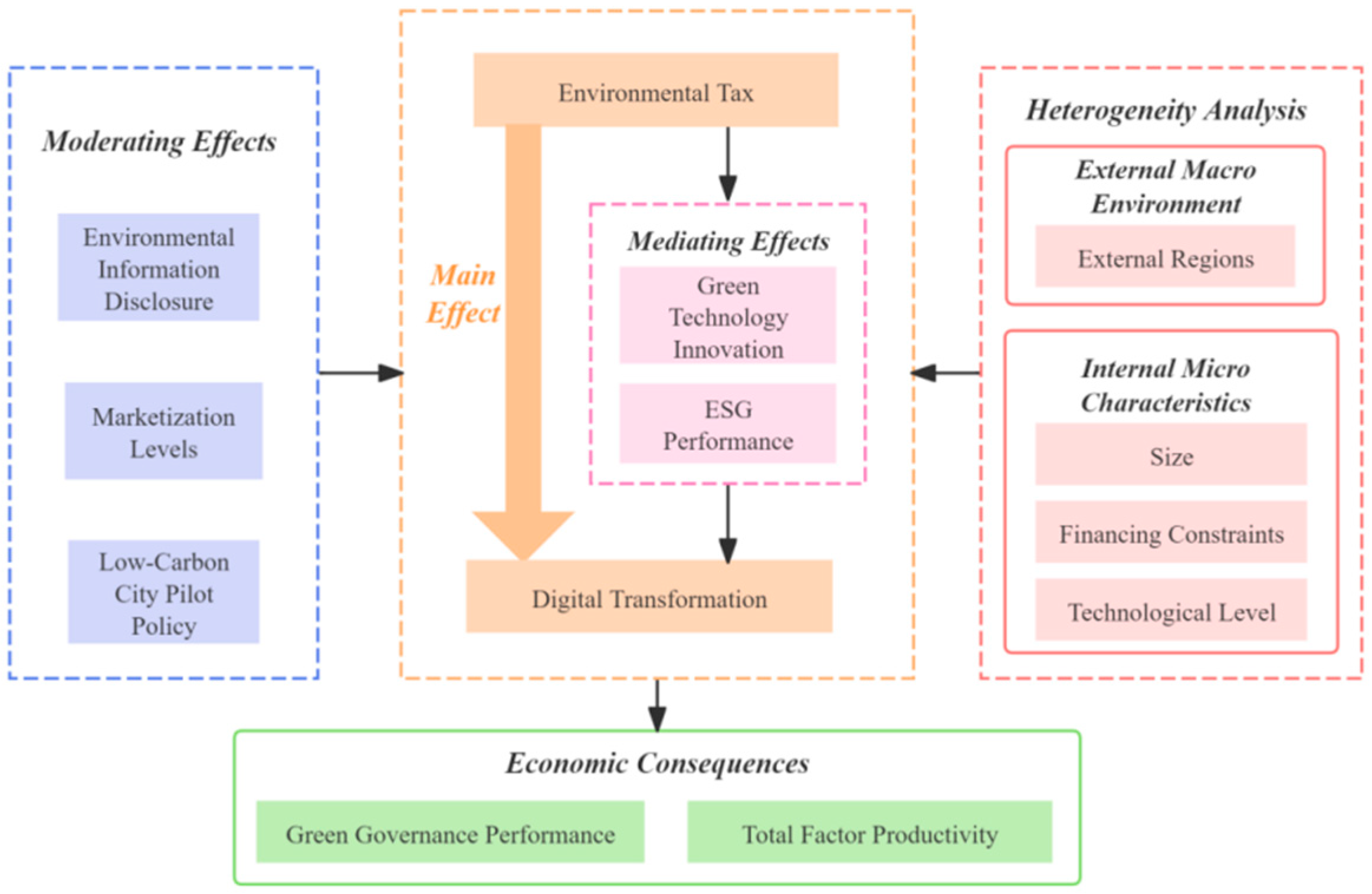
The theoretical framework is shown in Figure 1.

4. Methodology and Data

4.1. Econometric Model Setting

According to the research purposes of this study, this paper sets the benchmark model:
l n d i g i t i t = α 0 + α 1 l n t a x i t + α 2 c o n t r o l s i t + μ i + λ t + ε i t
where l n d i g i t i t represents the logarithmic transformation of digital transformation of firm i in the year t ; l n t a x i t is the logarithmic transformation of environmental tax of firm i in the year t ; c o n t r o l s i t is a series of control variables; the firm and year fixed effects are μ i and λ t , respectively; and ε i t is the random disturbance term.
To investigate the mechanistic factors through which environmental tax affects the digital transformation of enterprises, we choose green technology innovation and ESG performance as the mechanism variables. We adopt a stepwise regression method to construct the mediating effect model. That is:
M i t = β 0 + β 1 l n d i g i t i t + β 2 c o n t r o l s i t + μ i + λ t + ε i t
l n d i g i t i t = θ 0 + θ 1 M i t + θ 2 l n t a x i t + θ 3 c o n t r o l s i t + μ i + λ t + ε i t
where M i t is the mediating variable. The specific testing steps are as follows: if α 1 of the Equation (1) is significant, then we construct Equations (2) and (3). The significance of β 1 , θ 1 and θ 2 can be used to determine whether the mediating effect exists.
Furthermore, the impact of environmental tax on digital transformation may be moderated by some promotion mechanisms, such as environmental information disclosure, the level of marketization and exogenous policies. This paper constructs the following model to study the moderating effect, that is, Equation (4):
l n d i g i t i t = γ 0 + γ 1 l n t a x i t + γ 2 M o d i t + γ 3 l n t a x i t × M o d i t + γ 4 c o n t r o l s i t + μ i + λ t + ε i t
where M o d i t is the moderating variable and the interaction term l n t a x i t × M o d i t is the core variable to investigate whether there is a moderating effect. The significance of γ 3 can be used to determine whether the moderating effect exists.

4.2. Variables

4.2.1. Explained Variable

The explained variable is digital transformation ( l n d i g i t ). This paper adopts a more specific approach to measure digital transformation based on text analysis. The information disclosed by the annual reports of the listed enterprises is more objective, and it can provide a better insight into the operating situation, development strategy and future outlook of the firms. Therefore, in order to measure the level of enterprise digital transformation more comprehensively and objectively, this paper takes the annual reports of Chinese A share listed enterprises as the research scope and adopts the method of text mining analysis to conduct research. The steps to measure enterprise digital transformation in this paper are as follows.
Firstly, we use Python 3.10 to collect the annual reports of the listed enterprises from 2010 to 2023 and extract the textual content of the management discussion and analysis (MD&A) sections using the Java PDFbox library (version 2.0.26). The MD&A section is chosen because it best reflects the management’s strategic focus and future orientation.
Secondly, we combine public documents issued by government departments and digitization-related research reports to further expand the digital transformation lexicon. A complete list of keywords and their classification rules is provided in Appendix A Table A1. The lexicon encompasses five technological dimensions: artificial intelligence, big data, cloud computing, blockchain, and digital technology applications. These dimensions correspond to the core technology domains widely recognized in international digital transformation frameworks. Our measurement captures the direction of the firms’ digital transformation, namely the specific technological areas that the firms are strategically prioritizing. Although our keyword lexicon is grounded in China’s policy context, the five technological dimensions align closely with the core digital technology domains defined by international organizations such as the OECD and the World Economic Forum.
Thirdly, we use text mining methods to count the frequency of the keywords related to enterprise digital transformation within each annual report. The raw word frequency reflects the intensity of the firms’ strategic attention to digital technologies.
Therefore, the word frequency number of digital transformation keywords can be calculated. This paper adopts the “logarithm of the sum of digital transformation-related word frequencies” to measure the level of enterprise digital transformation ( l n d i g i t ).

4.2.2. Explanatory Variable

The core explanatory variable in this study is environmental tax ( l n t a x ). Following the definition of the OECD, environmental tax refers to a mandatory, non-reimbursable levy imposed on individuals and entities based on their activities that affect the environment, such as resource utilization, pollution emissions, or environmental degradation. In China, the formal Environmental Protection Tax was introduced in 2018, replacing the previous pollution discharge fee system. Although the legal form and collection procedures differ, the two instruments are conceptually continuous in terms of policy objectives and tax base: both are calculated based on pollutant emissions or equivalent units. Therefore, we combine the historical pollution discharge fee (2010–2017) with the Environmental Protection Tax (2018–2023). Specifically, we adopt the narrow definition of environmental tax, using the sum of these two components, and take the natural logarithm to obtain the final variable ( l n t a x ).

4.2.3. Mediating Variables

Green technology innovation ( G T I ). Green technology innovation plays an important role in enterprise digital transformation. The enterprise patent data come from the China National Intellectual Property Administration, and green patent identification adopts the internationally accepted standards published by WIPO, which guarantees data availability and accuracy. In addition, the use of green patent indicators can exclude the effects of other unobservable factors in the macroeconomy. As a result of the impact of patented technologies on enterprise production during the application process, patent application data are more stable, reliable and timely than grant data. The green application patent indicator can better reflect the enterprise’s efforts on green technology innovation under the pressure of environmental tax. The number of green patent applications can reflect the level of green technology innovation of enterprises more accurately than the number of authorizations. Therefore, this paper uses “the logarithm of (the number of green patent applications of listed enterprises +1)” to measure enterprise green technology innovation.
ESG performance ( E S G ). ESG performance includes environmental, social and governance dimensions. The ESG indicator data in the Sino-Securities Index (also known as the Huazheng ESG rating in China) is characterized by its proximity to the Chinese market, wide coverage and high timeliness, and the index has now been widely recognized and applied by the industry and academia. In terms of data updating, Huazheng ESG indicators use a combination of quarterly periodic evaluation and dynamic tracking for data adjustment and convert the ESG ratings into a numerical scale ranging from 1 to 9, corresponding to CCC through AAA grades. This paper uses “ESG indicators in the ESG rating system of Sino-Securities Index” to measure ESG performance and calculates the annual mean value to obtain the indicators of the ESG variables.

4.2.4. Moderating Variables

Environmental information disclosure ( E d i ). Referring to Zhang et al. (2024) [31], this paper constructs 27 indicators from seven aspects, including environmental management, environmental regulation, and environmental performance. The scoring criteria are as follows: the value of 0 is assigned to those who do not disclose the content of qualitative and quantitative indicators, the value of 1 is assigned to those who disclose non-monetary qualitative indicators, and the value of 2 is assigned to those who disclose monetary quantitative indicators. The logarithm is taken according to the final scores to obtain the environmental disclosure level variable of this paper.
Marketization level ( M a r k e t ). The level of marketization is a multi-dimensional concept involving economic freedom, financial marketization, degree of administrative intervention and level of social security. As a market-based environmental regulation tool, environmental tax has a stronger innovation incentive effect on enterprises with a high level of marketization. In order to attract investors and become more competitive, enterprises will be more willing to develop digital technologies and promote digital transformation. The indicators to measure the level of marketization are mainly from the perspectives of economic freedom, the degree of financial market development, the degree of government intervention, the degree of property rights protection and the state of rule of law. Based on the studies of Mei et al. (2021) [32], this paper constructs a marketization index to measure the level of marketization.
Exogenous policy shocks ( T r e a t ). This paper investigates the moderating effect of the low-carbon city pilot policy. The low-carbon city pilot policy has been implemented since 2010, and as an important policy tool to promote regional green development, it can be combined with environmental tax to strengthen the impact on the digital transformation of enterprises and promote the realization of sustainable development. Pilot cities usually accompany a series of supportive policies to create a more favorable environment for enterprise digital transformation. In addition, enterprises in the pilot areas pay more attention to environmental policies, so environmental tax has a stronger driving effect on their digital transformation. This paper assigns a value of 1 to listed enterprises in pilot areas and 0 to others, based on the list of three batches of low-carbon city pilots released by the National Development and Reform Commission.

4.2.5. Control Variables

We use the following firm-level control variables: (1) firm age ( l n a g e ), measured by the natural logarithm of the number of years since listing; (2) asset liability ratio ( L e v ), denoted as the ratio of total liabilities to total assets; (3) return on assets ( R o a ), denoted as the ratio of net profit to average total assets; (4) shareholding concentration ( T o p 1 ), measured as the shareholding ratio of the largest shareholder is used in this study; (5) CEO duality ( D u a l ), denoted as a dummy variable that “if the board director and CEO are the same person equals 1, otherwise 0”; and (6) firm performance ( T o b i n Q ), denoted as Tobin’s Q index, which is used to measure the relationship between market capitalization and the net asset value of the firm.

4.3. Data

This paper selects the data of A-share listed enterprises in Shanghai and Shenzhen from 2010 to 2023 as the research subjects of this investigation. The green patent data are collated by matching the data from the National Intellectual Property Administration with the WIPO’s IPC Green Inventory. The ESG data are processed from the official website of the Sino-Securities Index in China, including specific rating scores and rating data ranging from AAA to CCC grades. All the other data are selected from the CSMAR and WIND databases, along with the enterprise annual reports. In order to ensure the robustness of the findings, the samples are further processed in this paper. Firstly, we remove the listed enterprises related to financial industries; secondly, we eliminate the samples of firms with abnormal listing status such as ST and PT during the sampling period; thirdly, all the continuous variables involved in the measurement and inspection are winsorized at the 1% and 99% levels. In addition, in order to avoid serious loss of the sampling data and to better study the impact of environmental tax on digital transformation, this paper tries to use the linear interpolation method to supplement the relevant missing data on the basis of the existing data, obtaining 26,522 observations. All regressions are estimated using Stata/MP 17.0. The descriptive statistics of the main variables are shown in Table 1.

5. Empirical Results

5.1. Benchmark Analysis

This paper empirically investigates the impact and mechanism of environmental tax on the digital transformation of enterprises using a two-way fixed effects model. Meanwhile, we adopt robust standard errors to enhance the robustness of our estimations. Table 2 presents the regression results of the impact of environmental tax on enterprise digital transformation. Column (1) details the estimated results excluding the control variables, and Columns (2)–(6) systematically include the control variables. With the continuous addition of the control variables, the fitted coefficients of l n t a x always pass the 1% level significance test. In Column (6), the fitted coefficient of l n t a x is 0.1524, which means that a 1% increase in environmental tax will lead to a 0.1524% increase in the level of digital transformation of enterprises. The findings demonstrate that the impact of environmental tax ( l n t a x ) on enterprise digital transformation ( l n d i g i t ) is significantly positive regardless of whether the control variables are added, validating Hypothesis 1.

5.2. Robustness Tests and Endogenous Discussion

5.2.1. Robustness Tests

We next conduct a series of robustness tests to assess the reliability of the results. Table 3 shows the results of the tests. Firstly, we conduct robustness tests by varying the model. Columns (1) and (2) of Table 3 present the results using random effects and pooled OLS models, respectively. In both models, the coefficients of l n t a x remain significantly positive at the 1% level. This result is consistent with the results of the benchmark model, indicating that the models are robust. Secondly, we narrow the sampling range and exclude the impact of major global events. China suspended production activities in response to the COVID-19 pandemic in 2020. To mitigate the impact of this event, this study excludes the samples in 2020 for the re-estimation. The results are shown in Column (3). The coefficient of l n d i g i t is 0.1613, which remains significantly positive at the 1% level. Thirdly, we test whether our findings are robust to an alternative measure of digital transformation. We construct a digital transformation index ( D i g i n d e x ) based on a different keyword lexicon covering four dimensions: digital technology applications, internet business models, intelligent manufacturing, and modern information systems. This lexicon comprises 99 digitalization-related keywords, with a complete list provided in Appendix A Table A2. Unlike the main measure ( l n d i g i t ), which focuses on the firms’ strategic attention to frontier technologies and reflects their willingness to invest in emerging digital technologies, this index ( D i g i n d e x ) emphasizes the integration of digital technologies into business operations, capturing the depth of digital technology application in areas such as internet business models, intelligent manufacturing, and digital technology adoption. Column (4) shows the results. The coefficient of D i g i n d e x is 0.1463 and remains significant at the 1% level. The results are consistent with the results of the benchmark model, indicating that the models are robust.
We further conduct a series of robustness tests. Table 4 reports the results. Firstly, to examine whether the effect of environmental tax on digital transformation changed after the implementation of the Environmental Protection Tax Law in 2018, we introduce a dummy variable ( p o s t ) and its interaction with l n t a x . Column (1) shows that the coefficients of both l n t a x and the interaction term l n t a x × p o s t are significantly positive. This indicates that the promoting effect of environmental tax strengthened after the 2018 reform. The main effect of l n t a x remains significant, confirming that our findings are not driven by macro trends. Secondly, to rule out the possibility that time-varying industry or region-specific factors drive our results, we sequentially include industry–year fixed effects (Column 2), province–year fixed effects (Column 3), and both simultaneously (Column 4). The coefficients of l n t a x remain significantly positive at the 1% level. These results confirm that our findings are not confounded by industry- or region-level shocks. Thirdly, recognizing that digital transformation is a gradual process that may not respond instantaneously to policy changes, we incorporate one- and two-period lags of l n t a x ( L . t a x and L 2 . t a x ) into the model. Column (5) shows that the coefficient of L . t a x is significantly positive, while L 2 . t a x is positive but not statistically significant. This result suggests that the effect of environmental tax on digital transformation persists for one year but dissipates thereafter, consistent with the notion that firms require time to adjust their digital strategies and that the policy incentive is most salient in the short to medium term.
To further address concerns about potential omitted variable bias and reverse causality, we refine the set of control variables. First, we replace Tobin’s Q with its one-period lag ( L _ t o b i n ) to mitigate reverse causality, as market valuation may be influenced by digital transformation expectations. Second, we include both the firm age ( a g e ) and its squared term ( a g e 2 ) to test for nonlinear age effects. Third, given that executives’ awareness of environmental issues may influence their corporate digitalization decisions, following Duriau et al. (2007) [33], we add a measure of executives’ green cognition ( E G C ) to capture their attention to environmental matters. Column (6) reports the results, showing that the coefficient of l n t a x remains positive and highly significant. The coefficient of firm age is significantly positive, while its squared term is insignificant, indicating that although firm age exhibits a significant positive linear association with digital transformation, we do not find evidence of a nonlinear relationship in our sample. Collectively, the core findings remain robust to these sensitivity checks.

5.2.2. Endogeneity Tests

The potential endogeneity of environmental tax is a critical concern when examining its impact on corporate digital transformation. On the one hand, environmental tax increases the firms’ compliance costs, which may crowd out R&D investment in digital transformation. On the other hand, digital transformation can reduce pollution emissions through technological innovation, potentially affecting the firms’ environmental tax burden. To address endogeneity, we employ a 2SLS approach and construct two instrumental variables. The first IV is the one-period lag of environmental tax ( L . l n t a x ), which is correlated with the current tax burden but is predetermined and thus unaffected by contemporaneous shocks to digital transformation. The second IV is the industry–province–year average environmental tax ( M . l n t a x ), which captures regional and industry-level tax pressures affecting the firm’s tax burden. As it reflects exogenous policy and market conditions, it is unlikely to directly influence the firm’s digital transformation decisions. Table 5 reports the 2SLS estimation results. Columns (1) and (3) present the results using L . l n t a x as the sole instrument, while Columns (2) and (4) report the results when both instruments are used jointly. The first-stage results indicate that both the instruments are positively and significantly correlated with l n t a x . The Kleibergen–Paap rk LM statistics reject under-identification at the 1% level. The Kleibergen–Paap rk Wald F statistics (351.78 and 223.73) are above the Stock–Yogo critical value at the 10% level, rejecting the null of weak instruments. The Hansen J statistic is 0.9017 (p > 0.1), failing to reject the over-identification test and supporting the exogeneity of the instruments. This suggests that our instruments are valid and uncorrelated with the error term. The second-stage results in Columns (3) and (4) show that the coefficients of l n t a x remain significantly positive, indicating that even after accounting for potential endogeneity, the environmental tax exerts a positive causal effect on corporate digital transformation. In conclusion, the instrumental variables chosen in this paper are deemed reasonable, and the 2SLS regression results are reliable, corroborating the robustness of our main findings.

5.3. Mediating Effects Test

5.3.1. Green Technology Innovation

This paper investigates the mediating mechanism of green technology innovation. Table 6 reports the results of the mediating effects. The coefficient of l n t a x in Column (1) and the coefficient of G T I in Column (2) are significantly positive, indicating that the mediating mechanism is valid. Environmental tax makes enterprises strengthen their own green technological innovations and improve the corresponding technologies to reduce pollutant emissions, which promotes the acceleration of the digital transformation of the enterprises. In addition, this paper further adopts the Bootstrap test. The number of repeated samplings is 1000, and the mediating variable is green technological innovation. The results are presented in Table A3 in Appendix A, which show that the indirect effect is significant. Environmental tax can promote digital transformation by improving green technology innovation. Hypothesis 2 is supported. The environmental tax incentivizes green technological innovation that enhances energy efficiency and reduces emissions, thereby providing a critical technical foundation for digital transformation. This enables firms to develop and implement digital solutions that are inherently less resource-intensive and more environmentally compatible. Therefore, this mechanism reveals that the promotion of digital transformation by environmental tax is intrinsically linked to the internalization of sustainability goals, fostering a “green and digital” co-evolution where technological advancement aligns with ecological objectives.

5.3.2. ESG Performance

The effects of ESG performance are reported in Table 6. The coefficients of l n t a x and E S G in Column (3) and (4) are significantly positive, indicating that ESG performance has passed the test of mediating effect. In addition, this paper further adopts the Bootstrap test. The number of repeated samplings is 1000, and the mediating variable is ESG performance. The results are presented in Table A4 in Appendix A, which show that environmental tax has led enterprises to strengthen their digital governance in order to enhance their social performance, and it has facilitated the acceleration of their digital transformation by improving their ESG performance, validating Hypothesis 3. Environmental tax elevates firms’ attention to environmental, social, and governance standards. To meet these enhanced standards and the associated stakeholder expectations, firms are motivated to adopt digital tools for superior monitoring, reporting, and management of their ESG metrics. Consequently, digital transformation is propelled as a governance tool to operationalize and demonstrate sustainability commitments. This pathway underscores that the tax’s influence extends beyond cost considerations to shape corporate governance paradigms, encouraging firms to leverage digitization to build transparent, accountable, and sustainable management systems, thereby strategically embedding sustainability into their core operations.

5.4. Moderating Effects Test

To further explore the boundary conditions under which environmental tax influences digital transformation, this study examines the moderating roles of three contextual factors: environmental information disclosure ( E d i ), regional marketization level ( M a r k e t ), and the low-carbon city pilot policy ( T r e a t ). The variables are mean-centered prior to constructing interaction terms to mitigate multicollinearity. The regression results are presented in Table 7.

5.4.1. Moderating Role of Environmental Information Disclosure

Effective environmental information disclosure mitigates information asymmetry between firms and external stakeholders. Firms with higher disclosure levels face greater scrutiny from regulators, investors, and the public. Under environmental tax pressure, these firms possess a stronger incentive to leverage digital transformation to achieve tangible emissions reductions and align their disclosed environmental performance with actual outcomes. Furthermore, superior disclosure facilitates access to policy benefits such as green subsidies and financing, which can support digital investments. The empirical results support this reasoning. As shown in Column (1) of Table 7, the interaction term between environmental tax ( l n t a x ) and disclosure level ( E d i ) is significantly positive. This indicates that the positive effect of environmental tax on digital transformation is stronger for the firms with a more intensive environmental information disclosure.

5.4.2. Moderating Role of Regional Marketization Level

The regional marketization level shapes the institutional environment for firm responses. In high-marketization regions, well-established market mechanisms and stronger intellectual property protection allow the “price signal” of environmental tax to function more effectively. Firms in these environments face less governmental intervention and greater operational freedom, enabling them to respond to tax-induced cost pressures more flexibly and proactively through innovation and digital adoption. Conversely, regions with lower marketization are often characterized by inefficient resource allocation and weaker institutional support, which can hinder digital transformation. The results in Column (2) of Table 7 confirm a significant positive interaction between environmental tax ( l n t a x ) and marketization level ( M a r k e t ), suggesting that a higher degree of marketization amplifies the promoting effect of environmental tax on digital transformation.

5.4.3. Moderating Role of the Low-Carbon City Pilot Policy

The low-carbon city pilot policy acts as an exogenous policy shock that creates a supportive ecosystem for green and digital initiatives. Pilot cities typically implement a package of supportive measures, including financial incentives, technical assistance, and institutional innovations. For the firms located in these pilot areas, the combined pressure from environmental tax and the supportive policy framework creates a stronger impetus for digital upgrading. The policy environment reduces the cost and uncertainty associated with digital and green transitions, enabling the firms to better capitalize on the signals sent by the environmental tax. Column (3) of Table 7 reports a positive and significant interaction term between environmental tax ( l n t a x ) and the pilot policy dummy variable ( T r e a t ). This finding confirms that the low-carbon city pilot policy positively moderates the relationship, meaning the effect of environmental tax is more pronounced for the firms in pilot cities. Having established that the institutional environment moderates the relationship between environmental tax and digital transformation, the following heterogeneity analysis explores differences across regions, firm sizes, technological levels, and pollution intensities.

6. Further Analysis

The impact of environmental tax on digital transformation may vary across the firms due to differences in regional conditions and firm-specific characteristics. To explore these heterogeneous effects and uncover the underlying drivers, this paper conducts a subgroup regression analysis. Table 8 reports the results.

6.1. Heterogeneity of External Regions

The impact of environmental tax is likely conditioned by the external regional context in which firms operate. Divergences in economic development, digital infrastructure, policy implementation, and governance capacity across regions may lead to heterogeneous effects. This paper analyzes the heterogeneity of the effect of environmental tax on enterprise digital transformation due to differences in the regions where the enterprises are located. This paper divides the samples by external geographical location and categorizes 31 provinces and cities in China into eastern and non-eastern regions. Columns (1)–(2) of Table 8 compare the effect of environmental tax on digital transformation between firms located in the eastern and non-eastern regions of China. The coefficient of l n t a x is 0.1544 for the eastern region, significantly larger than the coefficient of 0.1399 for the non-eastern region, and the SUEST test confirms the difference is statistically significant (p < 0.01). The eastern region has a higher level of economic development, better digital infrastructure, and a higher concentration of digital talent, collectively providing firms with abundant resources for digital transformation. In addition, local governments in the east pay more attention to environmental protection and enforce environmental regulations more stringently. Firms in the east have better access to green finance and policy support, enabling them to translate tax pressures into tangible digital investments. Therefore, environmental tax is more capable of facilitating enterprises in the eastern region to improve their digital transformation level.

6.2. Heterogeneity of Internal Microscopic Characteristics

Firm-level attributes shape how companies respond to environmental tax. We examine heterogeneity based on firm size, technological level and pollution intensity.
Columns (3)–(4) of Table 8 examine heterogeneity by firm size, where firms are split into large and small groups based on the annual median of total assets. The coefficient of l n t a x is significantly stronger for large firms (0.1601) than small firms (0.1108), with a SUEST p-value of 0.0003. This suggests that resource-rich large firms are better positioned to invest in digital transformation. Columns (5)–(6) introduce the one-period lag of environmental tax ( L . t a x ) into the model to examine dynamic adjustment. For large firms, both current ( l n t a x ) and lagged coefficients ( L . t a x ) are significantly positive, indicating a sustained response. For small firms, only the current coefficient is significant. This finding reveals that large firms, endowed with greater financial resources and organizational capabilities, can sustain their digital investments over time, whereas small firms face financing constraints that limit the sustainability of their investment.
Columns (7)–(8) compare the effect between high-tech and non-high-tech firms. The coefficient of l n t a x for non-high-tech firms is significantly larger than that for high-tech firms. One possible explanation is that high-tech firms already operate at the technological frontier, with limited room for further digital catch-up, so the marginal incentive from environmental tax is relatively modest. In contrast, non-high-tech firms have a greater untapped potential for digital upgrading; environmental tax creates a strong impetus for them to adopt basic digital technologies to improve efficiency and reduce compliance costs.
Columns (9)–(10) examine heterogeneity based on pollution intensity, classifying firms as high-polluting or non-high-polluting according to the List of Industries Subject to Environmental Verification for Listed Companies. The coefficient of l n t a x for high-polluting firms is significantly larger than that for non-high-polluting firms. First, high-polluting firms face greater environmental tax burdens due to their higher emission intensity, generating stronger incentives for innovation. Second, these firms are subject to tighter regulatory scrutiny and public pressure, intensifying the urgency of their transformation. Third, many high-polluting firms belong to capital-intensive industries, possessing the resources necessary for digital transformation. This finding corroborates the “innovation compensation” hypothesis within the context of China’s environmental reforms and underscores the potential of market-based policy instruments in driving the green digital transformation within heavily polluting sectors.
In summary, the heterogeneity analysis reveals that the positive effect of environmental tax on digital transformation is more pronounced for firms in economically advanced regions, large firms, non-high-tech firms, and high-polluting firms. The dynamic patterns further show that large firms sustain their response over time, while small firms exhibit only a temporary effect.

6.3. Test of Economic Consequences: Pathways to Sustainable Development

The diverse mechanisms of environmental tax on enterprise digital transformation have been studied in the above analysis. Although many scholars have extensively examined the economic consequences of environmental tax and enterprise digital transformation, research investigating whether environmental taxes can shape sustainability performance through the channel of digital transformation remains scarce. Therefore, this study focuses on examining if environmental tax enhances corporate sustainability performance by promoting digital transformation, specifically from two integrated dimensions: economic efficiency and environmental governance. This dual-lens approach aims to empirically reveal the policy utility of environmental taxation in fostering the green–digital synergistic transition and achieving the “double dividend” crucial for sustainable development. By employing two distinct measures of digital transformation, technology-oriented ( l n d i g i t ) and application-oriented ( d i g i n d e x ), this study aims to uncover the heterogeneous transmission pathways.

6.3.1. Total Factor Productivity: The Role of Technology-Oriented Digitalization

Total factor productivity ( T F P ) is a core indicator of economic efficiency and sustainable growth. This study employs the Levinsohn–Petrin method to estimate the firm-level TFP and examines whether digital transformation serves as a transmission channel through which environmental tax enhances productivity.
Table 9 reports the results. Column (1) shows that the coefficient of l n t a x is significantly positive at the 1% level, confirming that environmental tax directly enhances TFP. Column (2) introduces technology-oriented digitalization ( l n d i g i t ) into the regression. The result shows that the coefficients of l n t a x and l n d i g i t are significantly positive, indicating that environmental tax promotes TFP through its positive effect on technology-oriented digitalization. Column (3) replaces l n d i g i t with D i g i n d e x (application-oriented digitalization). The coefficient of D i g i n d e x is positive but not significant, while l n t a x remains significant. This result indicates that application-oriented digitalization, while valuable for operational integration, may not directly drive the technological innovations that underpin TFP growth. Instead, its effects are likely channeled through improvements in areas such as environmental management, as examined below. Improvements in TFP are driven largely by frontier technologies (e.g., AI, big data, cloud computing) that enable breakthroughs in production process optimization.
In summary, environmental tax can not only directly incentivize enterprises to undergo digital transformation but also significantly boost total factor productivity through this digital pathway, generating a substantial “blue dividend” (economic efficiency dividend). This demonstrates that well-designed market-based environmental regulations can synergize with digital strategy to jointly drive the economy toward an innovation-driven and resource-efficient model of sustainable development.

6.3.2. Green Governance Performance: The Role of Application-Oriented Digitalization

Corporate green governance performance refers to the environmental governance outcomes achieved through developing clean production technologies and improving green processes. It is a core manifestation of a firm’s environmental sustainability.
This study uses the Janis–Fadner coefficient based on firms’ positive and negative environmental engagements to comprehensively measure green governance performance ( G G P ) [34]. This index ranges from −1 to 1, with higher values indicating superior green governance. Positive scores are derived from achievements such as ISO 14001 certification, environmental honors, and top-tier ESG ratings, while negative scores reflect environmental violations, accidents, and poor ESG performance.
Column (4) of Table 9 shows that the coefficient of l n t a x is significantly positive at the 1% level, confirming that environmental tax directly improves green governance performance. Column (5) introduces l n d i g i t (technology-oriented digitalization). The coefficient of l n d i g i t is positive but not statistically significant. This indicates that frontier technologies without operational integration may not directly enhance environmental management outcomes. Column (6) replaces l n d i g i t with D i g i n d e x (application-oriented digitalization). The coefficient of D i g i n d e x is significantly positive. This demonstrates that environmental tax improves green governance performance partly by promoting application-oriented digitalization, which directly enhances corporate green governance performance through mechanisms such as intelligent manufacturing for energy efficiency and digital platforms for environmental information disclosure.
In summary, environmental tax generates dual sustainability dividends through different digital pathways. It enhances economic efficiency by promoting technology-oriented digitalization, and it improves environmental governance by fostering application-oriented digitalization.

7. Conclusions and Discussion

7.1. Main Conclusions

Based on the panel data of Chinese listed firms from 2010 to 2023, this study examines the impact of environmental tax on corporate digital transformation and its subsequent sustainability outcomes. The findings are as follows. First, environmental tax significantly promotes corporate digital transformation, and this finding remains robust across a series of robustness checks. Second, our mechanism analyses reveal that green technology innovation and ESG performance are critical transmission channels. Third, higher regional marketization levels, better environmental information disclosure, and low-carbon city pilot policies can strengthen the incentive effects of environmental tax. Fourth, our heterogeneity analyses show that the effect is more pronounced for firms in economically developed regions, large firms, non-high-tech firms, and high-polluting firms. Finally, further analysis demonstrates that environmental tax enhances both total factor productivity and green governance performance through distinct digital pathways. This finding underscores that different dimensions of digital transformation serve different functions in achieving the “dual dividends” of economic efficiency and environmental quality.

7.2. Policy Implications

Based on the conclusions, the following policy recommendations are proposed to harness environmental tax for promoting sustainability-oriented digital transformation: (1) Strengthen and Optimize Environmental Tax Design. Policymakers should recognize and leverage the dual role of environmental tax in stimulating both green innovation and digital transformation. Consideration should be given to dynamically adjusting tax rates or broadening the tax base to maintain incentive pressure, explicitly linking policy design to the goal of fostering a “green–digital” synergistic transition. (2) Promote Inclusive and Sustainable Digital Transformation. The government should provide targeted fiscal support, green financing channels, and technical assistance to SMEs, non-high-polluting firms, and enterprises in underdeveloped regions that face resource constraints. This is to help them overcome barriers in the digital transformation process and thereby achieve sustainable development. (3) Foster Sustainability-Oriented Digital Governance Ecosystems. Policy should encourage firms to adopt digital tools for sustainability-oriented governance, particularly in environmental information disclosure and ESG management. Incentives can be aligned with the quality of the digital ESG reporting. Concurrently, governments must accelerate market institution building, enhance data transparency regulations, and deepen low-carbon city initiatives to create an institutional environment that amplifies the positive signals of environmental tax and supports long-term sustainable corporate behavior.

7.3. Future Research

This study still has certain limitations, and further investigation can be conducted in the following aspects:
Firstly, this paper only investigates the mediating effect of green technology innovation and ESG performance, and future research could consider more potential mechanisms, such as government subsidies and entrepreneurship. Secondly, this study uses instrumental variables to assess the robustness of the benchmark results, which can overcome the endogeneity. In the future, alternative approaches can be explored to address the endogeneity of the model, such as finding more appropriate instrumental variables for environmental tax and using other economic models for the analysis. Thirdly, our digital transformation measures rely on a textual analysis of the annual reports. Future research could complement these with more direct measures, such as digital investment intensity or patent data, and track how the meaning of “digital transformation” evolves over time. Finally, our findings are based on Chinese data, which may limit their generalizability. Follow-up studies can be extended to different countries or institutional contexts, such as developed economies or other emerging markets, which would help to assess the external validity of our conclusions.


Author Contributions

Conceptualization, R.S.; methodology, C.C.; writing—original draft preparation, R.S.; writing—review and editing, C.C. All authors have read and agreed to the published version of the manuscript.

Funding

This research received no external funding.

Institutional Review Board Statement

Not applicable.

Informed Consent Statement

Not applicable.

Data Availability Statement

The data presented in this study are available on request from the corresponding author.

Conflicts of Interest

The authors declare no conflicts of interest.

Appendix A

Table A1. Complete list of keywords for the main index (lndigit).
Indicator CategoriesIndicator Name
Artificial Intelligence TechnologiesArtificial Intelligence; Machine Learning; Deep Learning; Natural Language Processing; Business Intelligence; Intelligent Data Analytics; Semantic Search; Image Understanding; Intelligent Robotics; Biometric Technology; Face Recognition; Identity Verification; Voice Recognition; Autonomous Driving; Investment Decision Support System
Blockchain TechnologiesBlockchain; Distributed Computing; Digital Currency; Smart Financial Contracts; Differential Privacy Technology
Cloud Computing TechnologiesCloud Computing; Stream Computing; Graph Computing; In-Memory Computing; Secure Multi-Party Computation; Neuromorphic Computing; Green Computing; Cognitive Computing; Converged Architecture; Hundred Million-Level Concurrency; EB-Level Storage; Internet of Things; Cyber–Physical Systems
Big Data TechnologiesBig Data; Data Mining; Text Mining; Data Visualization; Heterogeneous Data; Credit Reporting; Virtual Reality; Augmented Reality; Mixed Reality
Digital Technology ApplicationsMobile Internet; Mobile Connectivity; Industrial Internet; Internet Healthcare; Smart Energy; E-commerce; Mobile Payment; Third-Party Payment; NFC Payment; FinTech; Digital Finance; Quantitative Finance; Open Banking; Internet Finance; Wearable Technology; Smart Home; Intelligent Customer Service; Robo-Advisory; Smart Marketing; Digital Marketing; Intelligent Transportation; Smart Healthcare; Smart Agriculture; Smart Environmental Protection; Smart Grid; Smart Cultural Tourism; Unmanned Retail; Networked Connectivity; B2B; B2C; C2B; C2C; O2O
Table A2. Complete list of keywords for the alternative index (Digindex).
Indicator CategoriesIndicator Name
Digital Technology ApplicationData management; data mining; data network; data platform; data center; data science; digital control; digital technology; digital communication; digital network; digital intelligence; digital terminal; digital marketing; digitalization; big data; cloud computing; cloud IT; cloud ecosystem; cloud services; cloud platform; blockchain; Internet of Things; machine learning
Internet Business ModelMobile Internet; industrial Internet; industrial Internet; Internet solutions; Internet technology; Internet thinking; Internet action; Internet business; Internet mobility; Internet application; Internet marketing; Internet strategy; Internet platform; Internet model; Internet business model; Internet ecosystem; e-commerce; electronic commerce; Internet; “Internet+” online-offline; online to offline; online and offline; O2O; B2B; C2C; B2C; C2B
Intelligent ManufacturingArtificial intelligence; high-end intelligence; industrial intelligence; mobile intelligence; intelligent control; intelligent terminal; intelligent mobility; intelligent management; intelligent factory; intelligent logistics; intelligent manufacturing; intelligent warehousing; intelligent technology; intelligent equipment; intelligent production; intelligent network connection; intelligent system; intelligentization; automatic control; automatic monitoring; automatic monitoring; automatic detection; automatic production; numerical control; integration; integration; integrated solutions; integrated systems; industrial cloud; future factory; intelligent fault diagnosis; life cycle management; production manufacturing execution system; virtualization; virtual manufacturing
Modern Information SystemInformation sharing; information management; information integration; information software; information system; information network; information terminal; information center; informatization; networking; industrial information; industrial communication
Table A3. Bootstrap test: green technology innovation.
Observed CoefficientBootstrap Std. ErrorzP > zNormal Based 95% Conf. Interval
Indirect0.11480.0038 30.08000.00000.1074 0.1223
Direct0.04450.0074 6.01000.00000.0300 0.0590
Total Eff.0.15930.0073 21.82000.00000.1450 0.1736
Table A4. Bootstrap test: ESG performance.
Observed CoefficientBootstrap Sd. ErrorzP > zNormal Based 95% Conf. Interval
Indirect0.02000.001711.97000.00000.01670.0232
Direct0.14000.007219.33000.00000.12580.1542
Total Eff.0.16000.007122.54000.00000.14610.1739

References

  1. Lin, Y.F.; Liao, L.X.; Yu, C.X.; Yang, Q.S. Re-examining the governance effect of China’s environmental protection tax. Environ. Sci. Pollut. Res. 2023, 30, 62325–62340. [Google Scholar] [CrossRef] [PubMed]
  2. Kumbaroğlu, G.S. Environmental taxation and economic effects: A computable general equilibrium analysis for Turkey. J. Policy Model. 2003, 25, 795–810. [Google Scholar] [CrossRef]
  3. Franco, C.; Marin, G. The effect of within-sector, upstream and downstream environmental taxes on innovation and productivity. Environ. Resour. Econ. 2017, 66, 261–291. [Google Scholar] [CrossRef]
  4. Wei, Y.; Xu, D.; Zhang, K.; Cheng, J. Research on the innovation incentive effect and heterogeneity of the market-incentive environmental regulation on mineral resource enterprises. Environ. Sci. Pollut. Res. 2021, 28, 58456–58469. [Google Scholar] [CrossRef] [PubMed]
  5. Shen, Y.; Zhang, X. Study on the impact of environmental tax on industrial green transformation. Int. J. Environ. Res. Public Health 2022, 19, 16749. [Google Scholar] [CrossRef]
  6. Pearce, D.W. The role of carbon taxes in adjusting to global warming. Econ. J. 1991, 101, 938–948. [Google Scholar] [CrossRef]
  7. Porter, M.E.; Linde, C. Toward a new conception of the environment-competitiveness relationship. J. Econ. Perspect. 1995, 9, 97–118. [Google Scholar] [CrossRef]
  8. Piciu, G.C.; Trica, C.L. Trends in the evolution of environmental taxes. Procedia Econ. Financ. 2012, 3, 716–721. [Google Scholar] [CrossRef][Green Version]
  9. Zhang, Q.; Anwer, S.; Hafeez, M.; Jadoon, A.K.; Ahmed, Z. Effect of environmental taxes on environmental innovation and carbon intensity in China: An empirical investigation. Environ. Sci. Pollut. Res. 2023, 30, 57129–57141. [Google Scholar] [CrossRef]
  10. Xu, Y.; Wen, S.; Tao, C.Q. Impact of environmental tax on pollution control: A sustainable development perspective. Econ. Anal. Policy 2023, 79, 89–106. [Google Scholar] [CrossRef]
  11. Bovenberg, A.L.; Smulders, S. Environmental quality and pollution-augmenting technological change in a two-sector endogenous growth model. J. Public Econ. 1995, 57, 369–391. [Google Scholar] [CrossRef]
  12. Warner, K.S.R.; Wäger, M. Building dynamic capabilities for digital transformation: An ongoing process of strategic renewal. Long Range Plann. 2019, 52, 326–349. [Google Scholar] [CrossRef]
  13. Matarazzo, M.; Penco, L.; Profumo, G.; Quaglia, R. Digital transformation and customer value creation in Made in Italy SMEs: A dynamic capabilities perspective. J. Bus. Res. 2021, 123, 642–656. [Google Scholar] [CrossRef]
  14. Trocin, C.; Hovland, I.V.; Mikalef, P.; Dremel, C. How artificial intelligence affords digital innovation: A cross-case analysis of Scandinavian companies. Technol. Forecast. Soc. Change 2021, 173, 121081. [Google Scholar] [CrossRef]
  15. Jiang, K.; Du, X.; Chen, Z. Firms’ digitalization and stock price crash risk. Int. Rev. Financ. Anal. 2022, 82, 102196. [Google Scholar] [CrossRef]
  16. Peter, C.V.; Thijs, B.; Yakov, B.; Bhattacharya, A.; Dong, J.Q.; Fabian, N.; Haenlein, M. Digital transformation: A multidisciplinary reflection and research agenda. J. Bus. Res. 2021, 122, 889–901. [Google Scholar] [CrossRef]
  17. Nie, J.; Jian, X.; Xu, J.; Jiang, T.; Yu, Y. The effect of corporate social responsibility practices on digital transformation in China: A resource-based view. Econ. Anal. Policy 2024, 82, 1–15. [Google Scholar] [CrossRef]
  18. Sebastian, I.M.; Ross, J.W.; Beath, C.; Mocker, M.; Moloney, K.G.; Fonstad, N.O. How big old companies navigate digital transformation. In Strategic Information Management; Routledge: London, UK, 2020; pp. 133–150. [Google Scholar]
  19. Wang, X.; Ye, Y. Environmental protection tax and firms’ ESG investment: Evidence from China. Econ. Model. 2024, 131, 106621. [Google Scholar] [CrossRef]
  20. Zheng, X.; Zhuang, L.; Zheng, X.; Zhuang, L. The impact of environmental protection tax on green behaviors and ESG performance of industrial enterprises. Sustainability 2025, 17, 8592. [Google Scholar] [CrossRef]
  21. Yi, Y.; Wei, Z.; Fu, C. An optimal combination of emissions tax and green innovation subsidies for polluting oligopolies. J. Clean. Prod. 2021, 284, 124693. [Google Scholar] [CrossRef]
  22. Song, M.; Wang, S.; Zhang, H. Could environmental regulation and R&D tax incentives affect green product innovation? J. Clean. Prod. 2020, 258, 120849. [Google Scholar] [CrossRef]
  23. Chen, Z.; Xiao, Y.; Jiang, K. The impact of tax reform on firms’ digitalization in China. Technol. Forecast. Soc. Change 2023, 187, 122196. [Google Scholar] [CrossRef]
  24. Cheng, Y.; Li, H. The impact of ESG performance on corporate digital transformation. Environ. Dev. Sustain. 2025, 27, 1–28. [Google Scholar] [CrossRef]
  25. Chang, H.; Ding, Q.; Zhao, W.; Hou, N.; Liu, W. The digital economy, industrial structure upgrading, and carbon emission intensity: Empirical evidence from China’s provinces. Energy Strategy Rev. 2023, 50, 101218. [Google Scholar] [CrossRef]
  26. Ding, X.; Sheng, Z.; Appolloni, A.; Shahzad, M.; Han, S. Digital transformation, ESG practice, and total factor productivity. Bus. Strategy Environ. 2024, 33, 4547–4561. [Google Scholar] [CrossRef]
  27. Xu, L.; Fan, M.T.; Yang, L.L.; Shao, S. Heterogeneous green innovations and carbon emission performance: Evidence at China’s city level. Energy Econ. 2021, 99, 105269. [Google Scholar] [CrossRef]
  28. Zhu, Q.; Ma, D.; He, X. Digital transformation and firms’ pollution emissions. Technol. Forecast. Soc. Change 2023, 197, 122910. [Google Scholar] [CrossRef]
  29. Bolognesi, E.; Burchi, A. The impact of ESG disclosure on sell-side analysts’ target prices: The new era post Paris agreements. Res. Int. Bus. Finance 2023, 64, 101827. [Google Scholar] [CrossRef]
  30. Hassan, K.A.; Elgendi, E.O.; Shehata, A.S.; Elmasry, M.I. Energy saving and environment protection solution for the submarine pipelines based on deep learning technology. Energy Rep. 2022, 8, 1261–1274. [Google Scholar] [CrossRef]
  31. Zhang, L.; Zhang, M. Media pressure, internal control, and corporate environmental information disclosure. Financ. Res. Lett. 2024, 63, 105369. [Google Scholar] [CrossRef]
  32. Mei, Y.; Ma, T.; Su, R. How marketized is China’s natural gas industry? A bibliometric analysis. J. Clean. Prod. 2021, 306, 127289. [Google Scholar] [CrossRef]
  33. Duriau, V.J.; Reger, R.K.; Pfarrer, M.D. A content analysis of the content analysis literature in organization studies: Research themes, data sources, and methodological refinements. Organ. Res. Methods 2007, 10, 5–34. [Google Scholar] [CrossRef]
  34. Yu, M.; Sun, Q.; Huang, H. The impact of artificial intelligence on the green governance performance of enterprises. Int. Rev. Financ. Anal. 2025, 106, 104548. [Google Scholar] [CrossRef]
Figure 1. Theoretical framework.
Sustainability 18 02431 g001
Table 1. Descriptive statistics of the main variables.
VariablesSymbolInterpretationNMeanSdMinMax
Explained variablelndigitDigital transformation26,5221.28131.26780.00006.2442
Explanatory variablelntaxEnvironmental tax26,52214.89951.50130.000022.0869
Mediating variablesGTIGreen technology innovation26,5220.99901.27220.00007.4662
ESGESG performance25,9904.24410.91461.00008.0000
Control variableslnageEnterprise age26,5221.89620.92340.00003.4965
LevAsset liability ratio26,5220.39500.19580.00751.3804
RoaReturn on Assets26,5220.04500.0635−1.19930.7586
Top1Shareholding concentration26,52234.856614.89321.840089.9900
DualCEO duality26,5220.31590.46490.00001.0000
TobinQFirm performance26,5221.93961.16790.84059.1628
Table 2. Benchmark regression results.
Variables(1)(2)(3)(4)(5)(6)
lndigitlndigitlndigitlndigitlndigitlndigit
lntax0.1609 ***0.1457 ***0.1447 ***0.1527 ***0.1527 ***0.1524 ***
(0.0229)(0.0232)(0.0234)(0.0240)(0.0240)(0.0240)
lnage 0.1143 ***0.1127 ***0.1097 ***0.1071 ***0.1089 ***
(0.0215)(0.0222)(0.0222)(0.0224)(0.0230)
Lev 0.0191−0.0282−0.0267−0.0265
(0.0815)(0.0853)(0.0854)(0.0855)
Roa −0.2804 **−0.2754 **−0.2721 **
(0.1194)(0.1192)(0.1195)
Top1 −0.0008−0.0008
(0.0016)(0.0016)
Dual 0.0134
(0.0253)
TobinQ −0.0016
(0.0077)
Constant−1.9655 ***−1.8475 ***−1.8397 ***−1.9130 ***−1.8807 ***−1.8788 ***
(0.3253)(0.3257)(0.3258)(0.3310)(0.3411)(0.3429)
Firm FEYesYesYesYesYesYes
Year FEYesYesYesYesYesYes
Observations26,52226,52226,52226,52226,52226,522
R-squared0.32200.32430.32430.32460.32460.3247
Note: Robust standard errors in parentheses; *** p < 0.01, ** p < 0.05.
Table 3. Robustness test I.
Variables(1)(2)(3)(4)
Random EffectsPooled OLSExcluding 2020Replacing Dependent Variable
lndigitDigindex
lntax0.1152 ***0.1153 ***0.1613 ***0.1463 ***
(0.0172)(0.0067)(0.0246)(0.0215)
Constant−1.2631 ***−1.2197 ***−2.0094 ***−0.1236
(0.2387)(0.0900)(0.3524)(0.3122)
Control variablesYesYesYesYes
Firm FENoYesYesYes
Year FEYesYesYesYes
Observations26,52226,52224,02626,522
R-squared0.32330.15050.32870.4480
Note: Robust standard errors in parentheses; *** p < 0.01.
Table 4. Robustness test II.
Variables(1)(2)(3)(4)(5)(6)
Policy InteractionIndustry–Year FEProvince–Year FEHigh-Dimensional FEDynamic EffectsControl Variable Adjustment
lndigitlndigitlndigitlndigitlndigitlndigit
lntax0.1319 ***0.1301 ***0.1430 ***0.1254 ***0.1272 ***0.1876 ***
(0.0255)(0.0210)(0.0239)(0.0211)(0.0268)(0.0291)
lntax × post0.0331 ***
(0.0121)
L.tax 0.0477 **
(0.0229)
L2.tax 0.0041
(0.0167)
age 0.1030 ***
(0.0084)
age2 −0.0002
(0.0003)
L_tobin 0.0110
(0.0088)
EGC 0.0230 *
(0.0120)
Constant−1.5912 ***−0.7327 **−1.0035 ***−0.6678 **−2.2257 ***−2.4262 ***
(0.3643)(0.3083)(0.3540)(0.3109)(0.4703)(0.4205)
Control variablesYesYesYesYesYesYes
Firm FEYesYesYesYesYesYes
Year FEYesNoNoNoYesYes
Ind–Year FENoYesNoYesNoNo
Prov–Year FENoNoYesYesNoNo
Observations26,52226,43526,51726,43319,43018,758
R-squared0.32540.78860.77500.79290.26180.3024
Note: Robust standard errors in parentheses; *** p < 0.01, ** p < 0.05, * p < 0.1.
Table 5. Endogeneity test.
VariablesIV-2SLS: First StageIV-2SLS: Second Stage
lntaxlntaxlndigitlndigit
(1)(2)(3)(4)
lntax 0.2026 ***0.1931 ***
(0.0351)(0.0395)
L.lntax0.6166 ***0.6035 ***
(0.0329)(0.0303)
M.lntax 0.0221 ***
(0.0070)
Control variablesYesYesYesYes
Firm FEYesYesYesYes
Year FEYesYesYesYes
Observations22,87619,74022,87619,740
Kleibergen–Paap rk LM statistic 285.7800303.8270
Kleibergen–Paap Wald rk F statistic 351.7800223.7260
Stock–Yogo weak ID test critical values 16.380019.9300
Hansen J statistic 0.00000.9017
Note: Robust standard errors in parentheses; *** p < 0.01.
Table 6. Mediating effects.
Variables(1)(2)(3)(4)
GTIlndigitESGlndigit
lntax0.3008 ***0.1301 ***0.1855 ***0.1565 ***
(0.0269)(0.0233)(0.0189)(0.0244)
GTI 0.0741 ***
(0.0094)
ESG 0.0302 ***
(0.0079)
Constant−3.9026 ***−1.5896 ***1.8503 ***−2.0832 ***
(0.3880)(0.3319)(0.2630)(0.3477)
Control variablesYesYesYesYes
Firm FEYesYesYesYes
Year FEYesYesYesYes
Observations26,52226,52225,99025,990
R-squared0.25570.32850.04130.3251
Note: Robust standard errors in parentheses; *** p < 0.01.
Table 7. Moderating effects.
Variables(1)(2)(3)
lndigitlndigitlndigit
lntax0.1947 ***0.1506 ***0.0830 ***
(0.0281)(0.0242)(0.0260)
lntax × Edi0.0476 **
(0.0217)
lntax × Market 0.0142 **
(0.0056)
Lntax × Treat 0.0910 ***
(0.0196)
Constant0.5244 ***0.3879 ***0.4195 ***
(0.0939)(0.0855)(0.0863)
Control variablesYesYesYes
Firm FEYesYesYes
Year FEYesYesYes
Observations18,26926,50823,498
R-squared0.31470.32540.3346
Note: Robust standard errors in parentheses; *** p < 0.01, ** p < 0.05.
Table 8. Heterogeneity analysis.
Variables(1)(2)(3)(4)(5)(6)(7)(8)(9)(10)
EasternNon-EasternLarge SizeSmall SizeLarge SizeSmall SizeHigh-TechNon-High-TechHigh-PollutingNon-High-Polluting
lndigitlndigitlndigitlndigitlndigitlndigitlndigitlndigitlndigitlndigit
lntax0.1544 ***0.1399 ***0.1601 ***0.1108 ***0.1258 ***0.1076 ***0.1385 ***0.1585 ***0.1665 ***0.1371 ***
(0.0302)(0.0350)(0.0334)(0.0347)(0.0354)(0.0368)(0.0273)(0.0384)(0.0358)(0.0289)
L.tax 0.0581 **0.0278
(0.0282)(0.0235)
Constant−1.8913 ***−1.7381 ***−2.0484 ***−1.1624 **−2.3106 ***−1.5623 **−1.5017 ***−2.3080 ***−2.2498 ***−1.6127 ***
(0.4377)(0.4869)(0.5024)(0.4825)(0.5500)(0.6400)(0.3714)(0.5677)(0.5112)(0.4157)
Control variablesYesYesYesYesYesYesYesYesYesYes
Firm FEYesYesYesYesYesYesYesYesYesYes
Year FEYesYesYesYesYesYesYesYesYesYes
Observations19,130739213,04913,47311,80011,11117,8528670694819,574
R-squared0.32570.32610.33110.25050.30740.22640.32890.31510.25990.3487
SUEST test p-value0.00000.00030.00030.02830.0000
Note: Robust standard errors in parentheses; *** p < 0.01, ** p < 0.05. The SUEST test p-values in Columns (5) and (6) refer to the difference in the lagged coefficients between large and small firms.
Table 9. Economic consequences test.
Variables(1)(2)(3)(4)(5)(6)
TFPTFPTFPGGPGGPGGP
lntax0.6640 ***0.6631 ***0.6634 ***0.0298 ***0.0287 ***0.0276 ***
(0.0092)(0.0093)(0.0093)(0.0099)(0.0099)(0.0099)
lndigit 0.0056 * 0.0071
(0.0030) (0.0050)
Digindex 0.0039 0.0153 **
(0.0037) (0.0061)
Constant−1.6345 ***−1.6224 ***−1.6331 ***0.14510.15900.1473
(0.1245)(0.1252)(0.1248)(0.1401)(0.1405)(0.1403)
Control variablesYesYesYesYesYesYes
Firm FEYesYesYesYesYesYes
Year FEYesYesYesYesYesYes
Observations23,98123,98123,98122,79822,79822,798
R-squared0.79770.79780.79770.04680.04700.0473
Note: Robust standard errors in parentheses; *** p < 0.01, ** p < 0.05, * p < 0.1.
Disclaimer/Publisher’s Note: The statements, opinions and data contained in all publications are solely those of the individual author(s) and contributor(s) and not of MDPI and/or the editor(s). MDPI and/or the editor(s) disclaim responsibility for any injury to people or property resulting from any ideas, methods, instructions or products referred to in the content.