Article

Pre- and Postharvest Application of Propolis Extract as a Sustainable Strategy for Preservation of ‘Rocha’ Pear Quality

by
Marcella Loebler
1,2,
Maria Paula Duarte
1,3,*,
Margarida Gonçalves
1,3,4 and
Claudia Sánchez
2,5,*
1
The Mechanical Engineering and Resource Sustainability Center (MEtRICs), Chemistry Department, NOVA School of Science and Technology, Universidade NOVA de Lisboa, 2829-516 Caparica, Portugal
2
National Institute for Agricultural and Veterinary Research (INIAV, I.P.), Estrada de Leiria, 2460-059 Alcobaça, Portugal
3
Associated Laboratory for Green Chemistry (LAQV-REQUIMTE), Chemistry Department, NOVA School of Science and Technology, Universidade NOVA de Lisboa, 2829-516 Caparica, Portugal
4
Research Center for Endogenous Resource Valorization (VALORIZA), Polytechnic Institute of Portalegre, 7300-555 Portalegre, Portugal
5
GREEN-IT—Bioresources for Sustainability R&D Unit, ITQB NOVA, 2780-157 Oeiras, Portugal
*
Authors to whom correspondence should be addressed.
Sustainability 2026, 18(5), 2413; https://doi.org/10.3390/su18052413
Submission received: 5 January 2026 / Revised: 11 February 2026 / Accepted: 24 February 2026 / Published: 2 March 2026
(This article belongs to the Section Sustainable Agriculture)

Abstract

Postharvest fruit losses significantly impact producers and distributors. Although synthetic preservatives mitigate these losses, consumer safety concerns and regulatory restrictions drive interest in alternative approaches. Propolis, rich in polyphenols, exhibits antioxidant and antimicrobial activities, making it a promising natural strategy to preserve fruit quality. This study aimed to evaluate the effects of the pre- and postharvest applications of Portuguese propolis extracts on the preservation of postharvest quality of ‘Rocha’ pear, an exclusively Portuguese variety of major economic importance. Treatments were applied by spraying the fruits one month before and at harvest. After five months of cold storage, the main quality parameters, phenolic content, antioxidant capacity, physiological disorders, and microbial contamination were assessed. The results showed that the application of propolis extract, either 30 days before or immediately after harvest, reduces the total microbiological load on the fruit’s epidermis (~1-log to 2-log reduction, after treatment). Moreover, the treatment enhanced the preservation of key quality attributes, including a reduction in water loss of up to 44%, a 13–33% decrease in firmness loss relative to the control, and a lower incidence of physiological disorders during postharvest storage. Furthermore, the application of propolis can enhance the production of fruits with higher levels of bioactive compounds, while also adding value to a bee product that is often underappreciated by most beekeepers.

1. Introduction

Pre- and postharvest fruit losses resulting from microbial contamination, physiological disorders, mechanical or chilling injury, and general quality deterioration represent an important negative impact on the activity of producers and distributors. Recognition of the importance of reducing food losses throughout production and supply chains to enhance global food security has led to the inclusion of a specific target within the United Nations Sustainable Development Goals (target 12.3) [1].
Different strategies have been developed to maintain fruit quality during storage, including the application of fungicides and antioxidants, low-temperature storage, and the modification of storage atmospheric conditions, among others [2,3]. Although chemical fungicides remain widely used for controlling fruit infections, their prolonged and large-scale application can promote the emergence of resistant pathogens and pose potential risks to human health and to the environment [4,5]. Moreover, extended cold storage may induce physiological disorders that compromise fruit quality [6]. In addition, increasing consumer concern regarding food quality and safety, together with stricter regulations on the use of synthetic compounds, has stimulated the study of alternative pre- and postharvest strategies. These approaches aim to control the proliferation of fruit-infecting microorganisms throughout the production cycle, delay quality deterioration during storage, and preserve the nutritional and sensory attributes of the fruits [2,4,7].
Fruit quality at harvest strongly influences subsequent postharvest performance and shelf-life. This includes not only the attainment of appropriate physiological maturity but also factors such as nutritional status or microbiological quality [8]. Preharvest treatments can be applied to help preserve quality attributes during fruit storage. These treatments may improve fruit mineral nutrition, thereby reducing physiological disorders, decreasing pathogen load, enhancing resistance to pathogen infections through increased polyphenol concentrations, or modulating the activity of key fruit metabolic enzymes [8,9].
The use of natural extracts as preharvest treatments, namely aloe vera [10] or tea tree oil [11], has demonstrated effectiveness in reducing microbial load at harvest and during storage, maintaining fruit quality, delaying senescence, and inducing defense responses [10,11,12]. Similarly, several studies have reported that the postharvest application of natural extracts, like oregano essential oil [4] or propolis [13,14], has considerable potential to maintain fruit quality during storage.
Propolis is a resinous substance collected by bees from plant buds and exudates, and subsequently enriched with bee-derived enzymes, pollen, and wax. It has been extensively studied and utilized due to its broad-spectrum biological activities, including antifungal, antibacterial, antiviral, and anti-inflammatory properties. The composition and physicochemical characteristics of propolis are strongly influenced by the specificity of the local flora, the botanical resin sources available to bees, and the season during which it is collected [15,16,17,18]. Due to its richness in bioactive compounds, including flavonoids (flavones and flavanones), phenolic acids, and terpenoids, as well as evidence supporting their beneficial physiological properties and low toxicity, propolis and its extracts show promising potential as natural antioxidant agents and antimicrobial preservatives [17,19]. Moreover, several studies suggest that the hydrophobic constituents of propolis, together with its high phenolic content, may form a biodegradable barrier capable of reducing fruit transpiration and respiration, thereby enhancing postharvest preservation [20].
Propolis has been shown to be effective against a broad spectrum of fungal pathogens impacting crops, including Penicillium expansum [21], Penicillium digitatum [21,22], Penicillium italicum [21], Penicillium notatum [23], Botrytis cinerea [21,24], Colletotrichum gloeosporioides [25,26], and Alternaria alternata [21].
In vivo experiments using artificially wounded ‘Rocha’ pears inoculated with Stemphylium vesicarium (Wallr.) E. G. Simmons showed a reduction of up to 25% in disease incidence and up to 57% in lesion diameter in fruits treated with propolis, compared to untreated controls [27]. Similar experiments conducted with P. expansum, another important pear pathogen, showed that propolis effectively slowed fungal development and significantly reduced lesion size on ‘Rocha’ pears [28]. In P. expansum–inoculated ‘Nanguo’ pears, the application of guar gum-based composite films, with and without incorporation of ethanolic extract of propolis, further confirmed the antifungal efficacy of propolis. Its incorporation into the coating significantly reduced both lesion diameter and depth, while also limiting weight loss and preserving fruit firmness throughout storage [14].
‘Rocha’ pear (Pyrus communis L. cv Rocha) is an exclusively Portuguese pear variety, whose production is mainly concentrated in the western region of the country and has major economic relevance [27]. ‘Rocha’ pear harvest takes place in August, but its availability throughout the year is crucial to consumers and producers. Cold storage, 1-methylcyclopropene treatment, and controlled atmosphere have been applied to prolong the storage life of pears; however, these methods do not fully prevent the development of different physiological disorders that lead to deterioration in fruit quality [29]. Consequently, more effective approaches are still needed to enhance ‘Rocha’ pear postharvest preservation.
In this context, the aim of this study was to evaluate the effects of the pre- and postharvest application of Portuguese propolis extracts on maintaining the postharvest quality of ‘Rocha’ pear during long-term cold storage. To the best of our knowledge, the impact of preharvest propolis application on the preservation of ‘Rocha’ pear during storage has never been studied. In particular, this approach aimed to assess the potential induction of defense mechanisms in ‘Rocha’ pear, as previously reported for other fruit species and bioactive compounds [10,11,12]. The treatment was applied approximately one month before harvest, after cell division had ceased and during the cell expansion phase. At this stage, the fruit’s natural defense mechanisms are still developing and are highly responsive to induction, allowing preharvest interventions to activate defense responses [30]. This strategy was also expected to confer a preventive or prophylactic effect, as observed in earlier studies involving P. expansum–infected pears [28], and to reduce the surface microbial load of the fruit, thereby enhancing subsequent postharvest storage. In addition to helping maintain fruit quality, the application of propolis can enhance the nutritional value of pears by increasing their content in bioactive compounds, while simultaneously adding value to a bee product that is often underestimated by most beekeepers.

2. Materials and Methods

2.1. Reagents

Bradford reagent, bovine serum albumin (BSA), 2,2-diphenyl-1-picrylhydrazyl (DPPH), polyvinylpyrrolidone, pyridine, N,O-bis(trimethylsilyl)trifluoroacetamide (BSTFA) containing 1% trimethylchlorosilane, trolox, and 2,4,6-tris(2-pyridyl)-s-triazine (TPTZ), were from Sigma-Aldrich (St. Louis, MO, USA). Acetone, ethanol absolute, hexane, and iron (II) sulfate heptahydrate were from Riedel-de Haën (Seelze, Germany). Folin–Ciocalteu reagent, gallic acid and iron (III) chloride hexahydrate were from Merck (Darmstadt, Germany). Ascorbic acid, disodium hydrogen phosphate dihydrate, sodium acetate trihydrate, sodium carbonate and sodium dihydrogen phosphate monohydrate were purchased from Panreac (Barcelona, Spain). Catechol was from Fisher Scientific (Loughborough, UK). Plate Count Agar, Dichloran Rose Bengal Chloramphenicol Agar and Tryptone-Salt Broth were from Biokar Diagnostics (Allonne, France). The water used was purified using a Milli-Q water purification system (Millipore, Bedford, MA, USA) and all chemicals were of analytical reagent grade or HPLC grade.

2.2. Propolis Extract Preparation

Crude Portuguese propolis was supplied by apiaries from Fafe, Luso, and Tondela in central and northern Portugal. The propolis samples were stored at −20 °C until further usage. Prior to the extraction, propolis was ground and homogenized and a mixture composed of propolis from Fafe (50%, w/w), Luso (33%, w/w) and Tondela (17%, w/w) was prepared. The extract was prepared according to the Ultrasound extraction procedure described by Loebler et al. [27]. Briefly, a 70% ethanol solution was added to the propolis at a ratio of 1 g to 30 mL, the mixture was sonicated for 20 min in an ultrasonic bath (P-Selecta Ultrasons, Barcelona, Spain) at 20 °C, and left to macerate in the dark for 24 h, at room temperature (20 to 22 °C). The insoluble residues were then removed by filtration, and the remaining material was subjected to a new extraction under the same conditions. The filtrates were pooled, stored at –20 °C, and then filtrated once more. The concentration of the extract was established, according to Trusheva et al. [31]. Specifically, 2.0 mL of extract was evaporated to dryness using a rotary evaporator at 40 °C under vacuum. This determination was performed in triplicate. The propolis extract stock solution was prepared by adjusting the extract concentration to 30 mg/mL with 70% ethanol.

2.3. Propolis Extract Characterization

Hydroethanolic propolis extract was characterized in terms of total phenolic content (Folin–Ciocalteu assay), antiradical activity (DPPH assay), reducing activity (FRAP assay) and gas chromatography–mass spectrometry (GC-MS) chromatographic profile.

2.3.1. Determination of Extract Total Phenolic Content

Total phenolic compounds were determined as gallic acid equivalents (GAE), according to the procedure described by Romeiras et al. [32]. In brief, 6.0 mL of water, 100 μL of diluted sample and 500 μL of undiluted Folin–Ciocalteu reagent were mixed. After 1 min, 1.5 mL of 20% (w/v) Na2CO3 and water up to 10 mL were added. The reaction mixtures were incubated for 120 min in the dark. The absorbance was recorded (UV/VIS spectrophotometer SPEKOL 1500, Analytik Jena, Jena, Germany) at 765 nm and compared to a gallic acid calibration curve. Results were expressed as mg GAE/g of dry extract. Each analysis was performed in triplicate.

2.3.2. Ferric Reducing Antioxidant Power (FRAP) Assay

The FRAP assay was carried out according to the procedure described by Lima et al. [33]. Succinctly, 3 mL of FRAP reagent (10 mM TPTZ solution in 40 mM HCl, 20 mM ferric chloride and 0.25 M sodium acetate buffer, pH 3.6, at a ratio of 1:1:10, freshly prepared and warmed at 37 °C) was mixed with a 400 µL aliquot of diluted extract. The reaction mixtures were incubated for 4 min at 37 °C, and the absorbance was recorded (UV/VIS spectrophotometer SPEKOL 1500, Analytik Jena, Jena, Germany) at 593 nm and compared to a ferrous sulphate calibration curve. The results were expressed as mmol Fe2+ equivalents per gram of dry extract. Data are presented as means ± standard deviations. Each analysis was performed in triplicate.

2.3.3. DPPH Radical-Scavenging Assay

The DPPH assay was carried out based on the procedure described by Lima et al. [33]. In brief, a 500 µL aliquot of diluted extract was added to 3.0 mL of freshly prepared DPPH solution (24 mg/L in ethanol). The reaction mixtures were incubated at room temperature in the dark, and the absorbance at 517 nm was recorded (UV/VIS spectrophotometer SPEKOL 1500, Analytik Jena, Jena, Germany). A negative control was prepared by substituting the extract with its solvent. A calibration curve constructed with trolox was used, and results were expressed as mg trolox equivalents (TE) per gram of dry extract. Each analysis was performed in triplicate.

2.3.4. Derivatization Procedure and GC-MS Analysis

The propolis extract was derivatized using the method proposed by Isidorov et al. [34] with some adaptations [35]. Briefly, 2 mL of the extract was evaporated to dryness under a nitrogen flow, and the residue was re-suspended in 250 µL of pyridine, followed by the addition of 100 µL of the derivatizing agent N,O-bis(trimethylsilyl)trifluoroacetamide (BSTFA); after incubation at room temperature for 12 h and in the dark, the mixture was diluted to 2 mL with petroleum ether, dried with anhydrous sodium sulphate and immediately subject to chromatographic analysis. The GC-MS analysis was performed using a GC-MS system composed of a LECO L-PAL3 autosampler, an Agilent 7890B (Palo Alto, CA, USA) gas chromatograph and a LECO Pegasus BT Time-of-Flight mass spectrometer (Saint Joseph, MI, USA). The derivatized sample (1 µL) was injected using a LECO L-PAL3 autosampler, and separation was achieved using an Agilent HP-5MS UI fused silica capillary column (30 m × 0.25 mm i.d., 0.25 µm film thickness). The injector was operated in solvent vent mode, with the split valve opened at 100 mL/min for 25 s, at 70 °C. Then, the split valve was closed for 120 s, and the inlet temperature was raised to 300 °C at 700 °C/min. Finally, the split valve was opened again at 20 mL/min until the end of the run. The oven program was as follows: 50 °C for 1 min, then 7 °C/min until 100 °C, then 3 °C/min until 220 °C, and finally 10 °C/min until 295 °C, and held at that temperature for 8 min. The transfer line to the MS was kept at 300 °C. The mass spectrometer ion source was kept at 250 °C, and electron ionization at 70 eV. Data acquisition was made from m/z 40 to 550, 10 spectra per second, with an acquisition delay of 480 s. Data acquisition, system control and spectra deconvolution were performed using LECO ChromaTOF version 5.40. NIST MS Search Program Version 2.3 g was used for spectra matching (NIST, 2015, Gaithersburg, MD, USA).

2.4. Fruits and Experimental Design

‘Rocha’ pears (Pyrus communis L.) were cultivated in an experimental orchard at the Fruit Research Station of the National Institute for Agricultural and Veterinary Research (INIAV), located in Alcobaça, Portugal. For the preharvest assay, pears were sprayed with propolis extract E1 (a 1:10 v/v aqueous dilution of the propolis extract stock solution, which corresponds to a final concentration of 3 mg/mL) directly on the tree one month before harvest. Fruits sprayed only with water, also referred to as untreated fruits, served as the control group (preharvest control). The experimental design included two trial plots per treatment. Each plot consisted of seven contiguous trees, with assessments conducted on the five central trees. To prevent cross-contamination and spray drift, two untreated buffer trees were maintained between adjacent plots, and buffer rows separated treated rows. Buffer trees were excluded from data collection. Harvesting took place at commercial maturity in late August (58 N firmness and 13 °Brix total soluble solids). For the postharvest assay, undamaged pears were hand-selected immediately after harvest and subsequently sprayed with water (postharvest control), propolis extract E1, and propolis extract E2 (a 1:50 v/v aqueous dilution of the propolis extract stock solution, which corresponds to a final concentration of 0.6 mg/mL). The concentrations of propolis used were selected based on preliminary in vitro antimicrobial assays and literature references [36]. Approximately 180 pears were pooled per studied condition. Of these, one-third (60 pooled pears) were analyzed immediately at harvest, while the remaining pears were evenly divided and stored in a normal atmosphere cold room at 1 °C and 90% relative humidity for 5 months. The cold room was periodically ventilated to maintain ambient atmospheric conditions and to avoid the buildup of ethylene. No additional postharvest treatments with preservatives or antifungal agents were applied to the fruits.

2.5. Pears Physicochemical Analyses

At harvest, the fruits were evaluated for weight, color, firmness, total soluble solids, pH and titratable acidity. Fruits used in the postharvest assay were analyzed immediately after the application of treatments. For all treatments, the same physicochemical analyses were conducted after 3 and 5 months of cold storage. At each sampling date, a total of 20 fruits per treatment were evaluated, using two replicates.
The color was measured with a Minolta chromameter (model CR-300, Data Processor 301, Minolta, Ramsey, MN, USA) in three different zones of each fruit. The results were expressed using the CIELAB colorimetric system (L*, a*, b*). The a* and b* values were used to determine the hue angle (H° = 180° + Tang−1 [b*/a*]), associated with the tonality of the fruit’s epidermis [37]. Weight loss was calculated by weighing the same sample of fruit (20 pears per treatment and sampling time) and expressed as a percentage of the initial weight [38]. For firmness determination, the skin was removed from three different equatorial and equidistant zones of the fruit, and then the force required to penetrate the pulp was measured with a penetrometer (Penefel, Setop-Giraud Technologies, Cavaillon, France) equipped with an 8 mm diameter tip. The firmness was expressed in newtons (N). Total soluble solids (TSS) content of the fruit juice was determined by using a hand-held refractometer (Atago ATC-1, Tokyo, Japan) at 20 °C. The results were expressed in °Brix. For titratable acidity (TA) and pH determination, groups of five pears each were mashed, and 10 mL of the juice obtained was diluted with 30 mL of distilled water. After measuring the pH (Hanna Instruments, HI2211 pH meter, Cluj, Romania), the diluted juice was titrated with 0.10 N NaOH up to pH 8.2. The volume of NaOH was used to calculate the titratable acidity (TA). Results were expressed as g malic acid/L of juice [37]. The analysis was performed in triplicate.

2.6. Total Phenolic Content and Antioxidant Capacity of Pears

Fruit total phenolic content and antioxidant capacity were determined at harvest and after 5 months of cold storage. Pear extracts were prepared according to the procedure described by Abouraicha et al. [39] with minor modifications. Briefly, five fruits (peel and pulp) of each treatment were cut into small pieces, and then 2 g were macerated in a mortar with 20 mL of chilled 80% acetone solution. Subsequently, the mixtures were sonicated for 20 min in an ultrasonic bath (P-Selecta Ultrasons, Barcelona, Spain) and filtered. Extracts were kept at −80 °C until analysis.
After 5 months of cold storage, extracts were also prepared from different pear tissues. First, the pulp was separated from the peel. Then, slices of pulp were taken from the region of the largest diameter in the equatorial section of the pears. These slices were divided into two pulp fractions: (i) the outer pulp, located approximately 1 cm beneath the peel (pulp fraction 1) and (ii) the inner pulp, located approximately 2 cm beneath the peel and adjacent to the core (pulp fraction 2). Extracts from the peel and each pulp fraction were prepared following the same procedure described previously for whole pears.
Total phenolic compounds were quantified as previously described for propolis extracts. The antioxidant capacity was determined by the DPPH radical-scavenging method and FRAP assay as previously described for propolis extracts, using ascorbic acid as a reference compound in both assays. Total phenolic content was expressed as mg GAE/100 g of fruit, and antioxidant activities were expressed as mg ascorbic acid equivalents (AAE)/100 g of fruit. Each analysis was performed in triplicate.

2.7. Extraction and Quantification of α-Farnesene and Conjugated Trienols

Immediately after harvest, and after 3 and 5 months of cold storage, samples of 15 pears per treatment were separated and kept at room temperature for 7 days. Subsequently, α-farnesene and conjugated trienols (CTs) were extracted from peel disks (12 mm diameter; 5 disks per sample, in triplicate) by immersion in 5 mL of HPLC-grade hexane for 10 min, under constant stirring at 22 ± 2 °C [40]. Following incubation, the solvent was filtered through a sterile 0.20 µm filter, and the absorbance of the extracts was determined spectrophotometrically at 232 nm and 281–290 nm (Shimadzu, UV-visible spectrophotometer, model UV-160A, Kyoto, Japan). α-Farnesene and CTs concentrations were calculated according to the following molar extinction coefficients: ε232 nm = 27,740 L mol−1 cm−1 for α-farnesene and ε281–290 nm = 25,000 L mol−1 cm−1 for CTs and expressed as µg/cm2.

2.8. Assessment of Superficial Scald and Internal Disorders

Pears used for the α -farnesene and CTs assay were visually examined for superficial scald and internal browning disorders as described by Gago et al. [3]. Internal browning incidence was determined by cutting the fruits lengthwise and recording those exhibiting a brown area ≥ 1 cm in diameter around the core, and was expressed as a percentage of the total number of fruits.

2.9. Activity of the Enzyme Polyphenoloxidase (PPO)

This determination was performed according to the procedure described by Abouraicha et al. [39]. The extracts for enzymatic analysis were prepared by homogenizing 20 g of pear pulp (obtained from three pooled samples, each composed of pulp from 10 fruits, totaling 30 pears) with 40 mL of sodium phosphate buffer (100 mM, pH 6.4, 5% (w/v) polyvinylpyrrolidone). Homogenization was performed in an ice bath with an Ultra Turrax (IKA T18 Digital, Staufen, Germany) for 3 min, with a 1 min interval after each cycle, operating at 10,000 rpm for the first two cycles and at 12,000 rpm for the final cycle. The extracts were then centrifuged (Centrifuge Sigma 4K15, Osterode am Harz, Germany) at 16,000 g, for 30 min and at 4 °C. Finally, the supernatants were collected and stored at −80 °C until analysis. For PPO activity assessment, 200 µL of pear extract was added to 2 mL of buffered substrate solution (10 mM catechol in sodium phosphate buffer 100 mM, pH 6.0), and the absorbance at 420 nm of this mixture was monitored for 3 min (UV/VIS spectrophotometer SPEKOL 1500, Analytik Jena, Jena, Germany). One unit (U) of PPO was defined as the amount of enzyme giving an increase in absorbance of 0.01 in 1 min, under these conditions. Results were expressed as U/mg protein in pear enzymatic extracts. Protein content in pear enzymatic extracts was assessed by the Bradford method, using bovine serum albumin as a standard [39]. Each analysis was performed in triplicate.

2.10. Microbiological Methods

For the preharvest treatment, the total aerobic microorganisms at 30 °C and total viable yeasts and molds were enumerated after spraying the fruits with propolis extract on the tree one month before harvest (July), at harvest time and after 3 and 5 months of cold storage. For the postharvest treatment, the same analyses were performed at harvest time, immediately after spraying the fruits with propolis extract, and after 3 and 5 months of cold storage. Total aerobic microorganisms at 30 °C were assessed according to ISO 4833-1:2013 [41], by plating in Plate Count Agar, followed by incubation for 72 h, at 30 ± 1 °C. Total viable yeasts and molds C were assessed according to ISO21527-1:2008 [42], by plating in Dichloran Rose Bengal Chloramphenicol Agar, followed by incubation at 25 ± 1 °C, for 5 days.
The peel of 5 fruits of each treatment was aseptically removed and pooled. Initial suspensions were prepared by homogenizing 10 g of these pooled test portions with 90 g of sterile Tryptone-Salt Broth for 60 s in a peristaltic homogenizer (Stomacher Star Blender LB 400, VWR, Leuven, Belgium). Decimal dilutions (up to 10−4) were prepared in Tryptone-Salt Broth. Microbial counts were reported as colony-forming units (CFU)/g fresh peel.

2.11. Statistical Analysis

Statistical analysis was performed with the program STATISTICA version 7.0 (StatSoft Inc., Tulsa, OK, USA). One-way ANOVA with Tukey’s post hoc test was applied for the identification of significant differences between variables at different time points (harvest and during cold storage), and between the different treatments at the same time point. The differences between the total phenolic content, antioxidant assay and PPO activity for the same treatment at harvest and at the end of the cold storage were tested by the Student t-test. Differences with p < 0.05 were considered significant. All data were reported as mean ± standard deviation.

3. Results and Discussion

3.1. Characterization of Propolis Extract

Antioxidant activity was evaluated using two assays that detect different mechanisms of antioxidant activity. The FRAP assay is a single-electron transfer (SET)-based method that measures the reduction in Fe3+-TPTZ complex to the Fe2+-TPTZ by the antioxidants [43], while DPPH radical scavenging involves multiple mechanisms, including single-step hydrogen atom transfer (HAT), single-electron transfer followed by proton transfer (SET-PT), and sequential proton loss and electron transfer [44]. The total phenolic content and antioxidant activity of the extract (Table 1) agreed with other studies on Portuguese propolis [27].
The results obtained through the analysis of the extract by GC-MS are shown in Table S1. In total, 144 compounds were identified in the ethanolic extract of propolis, corresponding to 94.2% of the total chromatographic area. From these, 21 compounds were selected as major components, since they presented a relative chromatographic area higher than 1% (Table 2).
The major components found in the propolis extract were diisooctyl phthalate (9.237%), 1-hydroxy-3-methoxy-6-methylanthraquinone (8.907%), and 4′-hydroxyflavanone (7.987%). Although phthalates are common extract contaminants due to their use as plasticizers, diisooctyl phthalate is a natural compound, and its presence has been described in plants such as Pistia stratiotes and Azadirachta indica [45,46], as well as in a propolis extract from Algeria [47]. Antioxidant and antimicrobial properties of this compound have also been reported [48,49]. The 1-hydroxy-3-methoxy-6-methylanthraquinone and the 4′-hydroxyflavanone are phenolic compounds typically identified in propolis extracts [47,50]. Most of the detected extract components have been frequently identified in propolis extracts in previous literature reports. That is the case of caffeic acid, 4-coumaric acid, 3,4-dimethoxycinnamic acid and 5-hydroxy-7-methoxy-flavone, also designated as tectocrisin [17,51,52,53,54]. Other notable compounds include methyl 3-phenylpropanoate, benzyl caffeate, and phenylethyl caffeate (CAPE)—the latter being frequently reported in propolis by other authors and widely recognized for its significant biological activity [55,56]. Moreover, caffeic acid, 4-coumaric acid, tectocrisin, and phenylethyl caffeate (CAPE) have also been previously identified in Portuguese propolis [28,57,58].
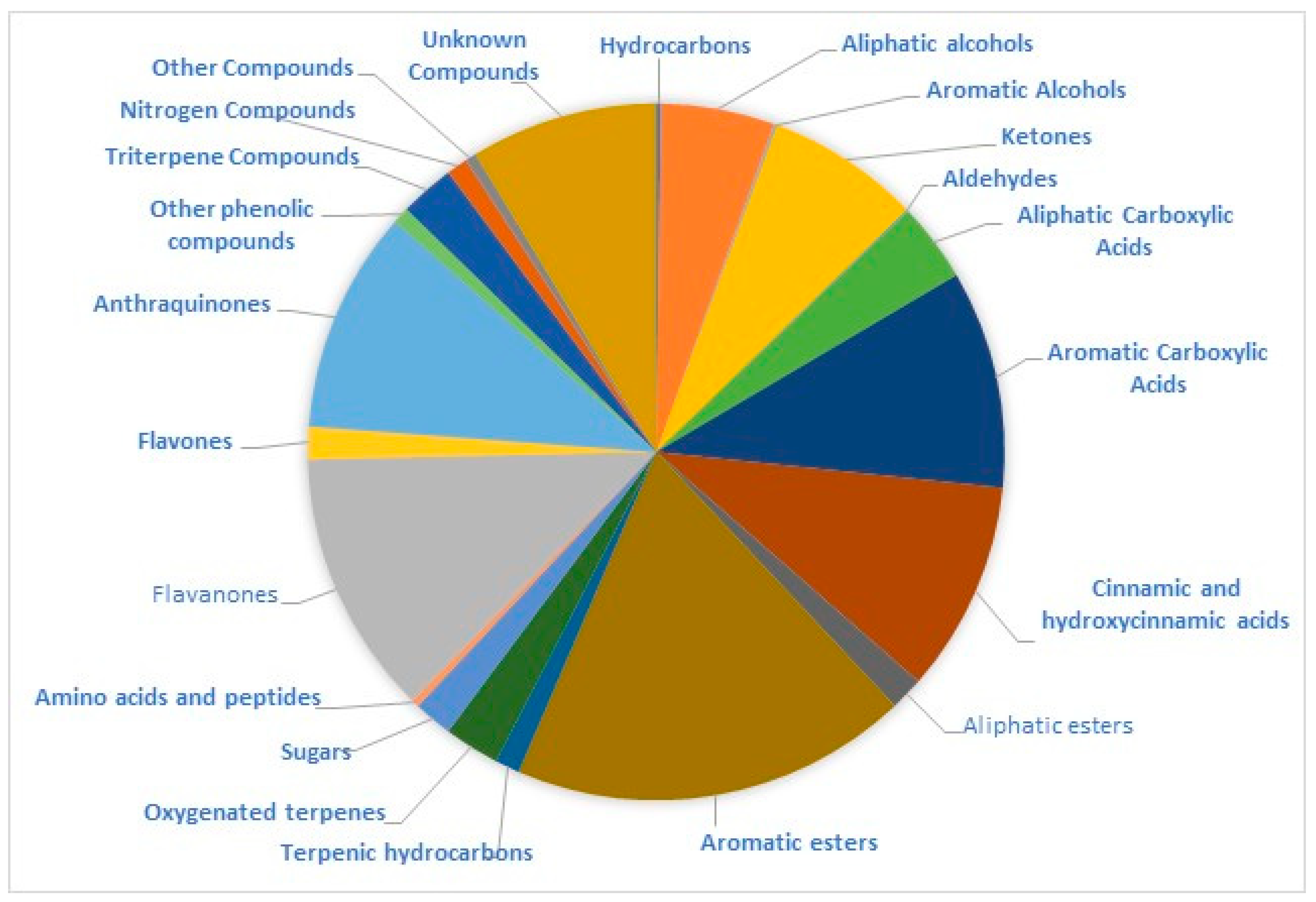
Considering all 144 components detected in the extract, the corresponding functional group distribution was evaluated and represented in Figure 1. The major functional groups found in the propolis were aromatic esters (18%), flavanones (12%), cinnamic and hydroxycinnamic acids (10%), aromatic carboxylic acids (10%) and anthraquinones (10%), as typically found in the literature [54,58].

3.2. Effect of Propolis Treatments on Pear Quality Parameters

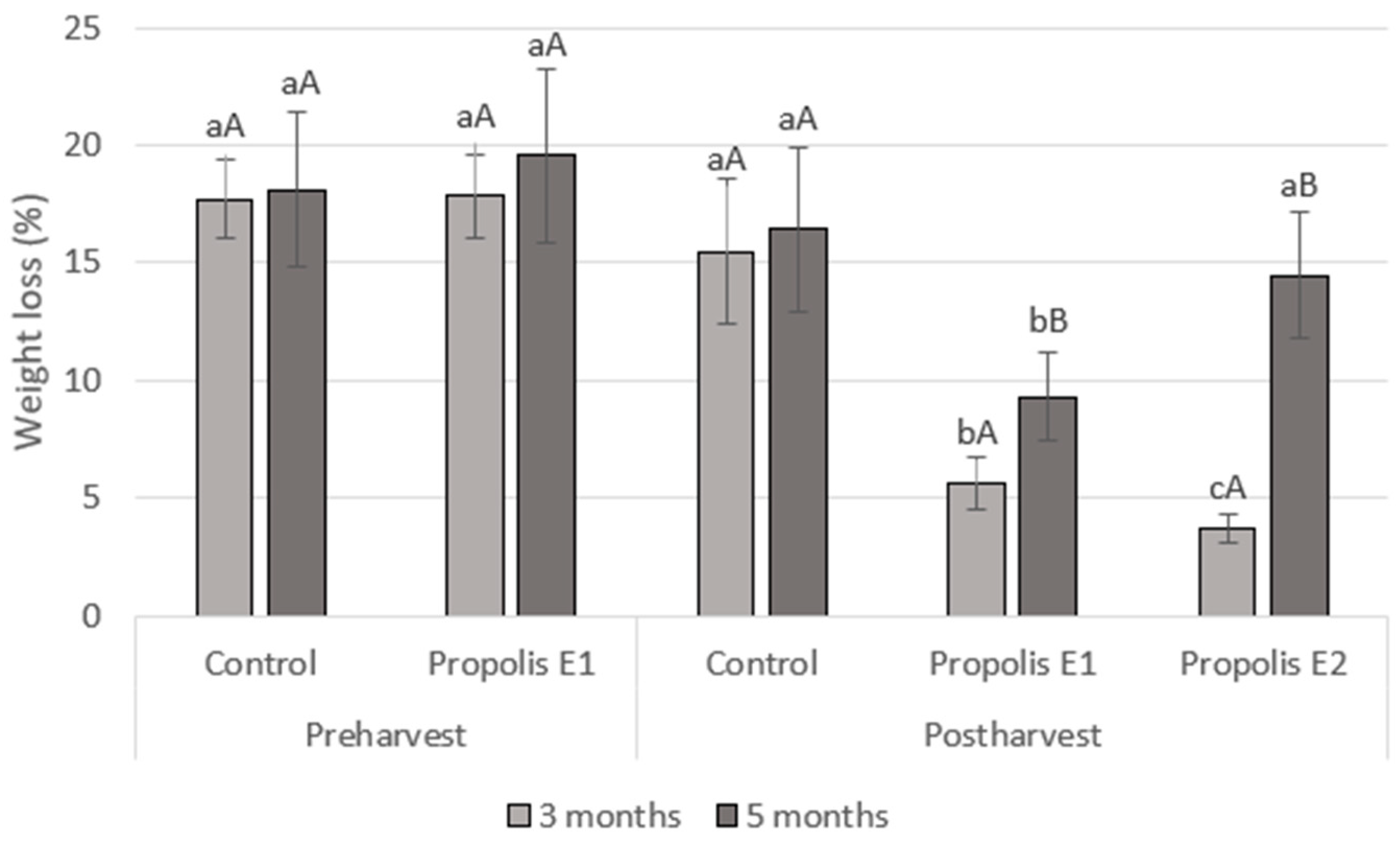
Aqueous dilutions of the propolis extract stock solution were applied to the ‘Rocha’ pear in pre- and postharvest treatments. Preharvest application had no effect on pear weight, since no significant differences were observed compared with the control, either at harvest or throughout the storage period (Table 3). A normal weight loss was observed over time; however, the trend was similar across both treated and untreated fruits, and no significant differences were observed after 5 months of storage, with weight loss values of approximately 19.5% and 18.1%, respectively (Figure 2). In contrast, postharvest application of the extracts significantly decreased fruit weight loss, with both treated groups exhibiting markedly lower values (5.6% and 3.7%) than the control (15.5%) after 3 months (Figure 2). At 5 months, weight loss remained significantly lower in the treatment with the higher concentration of propolis (E1), reaching nearly half of that observed in the control.
This effect has been previously reported in the literature, as coatings act as a protective physical barrier that typically reduces water loss from fruits, thereby minimizing overall weight loss [59,60]. In this context, the hydrophobic compounds present in propolis extracts, which are capable of forming a biodegradable semipermeable film on the fruit surface, are likely responsible for this effect. In addition, phenolic compounds in propolis may enhance the structural integrity of the coating matrix through intermolecular interactions, thereby improving its barrier properties and contributing to reduced moisture loss [61,62]. Alvarez et al. [63] reported a significant reduction in weight loss in oranges coated with edible coatings enriched with propolis extract, consistent with results previously observed in apples [64], grapes [65], dragon fruit [13], papaya [66] and mangos [26]. In ‘Rocha’ pears, Medeiros et al. [67] reported reduced weight loss in fruits coated with polysaccharide/protein nanomultilayer. In contrast, Gago et al. [29,68] found no differences in ‘Rocha’ pear coated with different types of coatings enriched with essential oils like lemongrass and citral.
During storage, pears progressively changed color, going from greenish-yellow to yellow (decrease in Hue values), accompanied by an increase in luminosity, which is characteristic of ‘Rocha’ pear ripening. Nonetheless, no statistically significant differences in color development were observed between the propolis-treated and control groups, irrespective of whether the treatment was applied pre- or postharvest (Table 3 and Table 4). The maintenance of Hue values between control and treated pears immediately after application of the propolis extract can be considered advantageous, as it indicates a minimal visual impact on the fruit. Nevertheless, the slight differences in hue angle observed between control and treated pears after 5 months of storage suggest that the treatments were not effective in delaying the ripening process, at least with respect to color changes. A similar behavior has been reported for ‘Rocha’ pears treated with plant-based coatings [2].
Regarding total soluble solids content, pears treated with propolis one month prior to harvest consistently exhibited higher °Brix values compared to untreated controls, with a notable increase during storage, particularly within the first 3 months (Table 3). In contrast, postharvest application of propolis had no significant effect on TSS (Table 4). Although a slight increase in TSS was observed during storage in both treated and untreated fruits, the differences were not statistically significant. These findings are consistent with previous studies, which have reported that edible coatings generally do not affect TSS levels. The early increase in TSS is commonly attributed to the enzymatic breakdown of starch into soluble sugars, as well as the fruit dehydration during storage [67,68,69].
For all treatments evaluated, titratable acidity decreased significantly over time, consistent with the natural ripening process. However, when propolis was applied preharvest, titratable acidity remained consistently higher in treated pears compared to untreated controls, with differences becoming more pronounced after 3 and 5 months of storage (approximately 28% and 40% higher than the control, respectively) (Table 3). In contrast, postharvest application of propolis had no significant effect, as no differences in acidity were observed between treated and untreated fruits (Table 4).
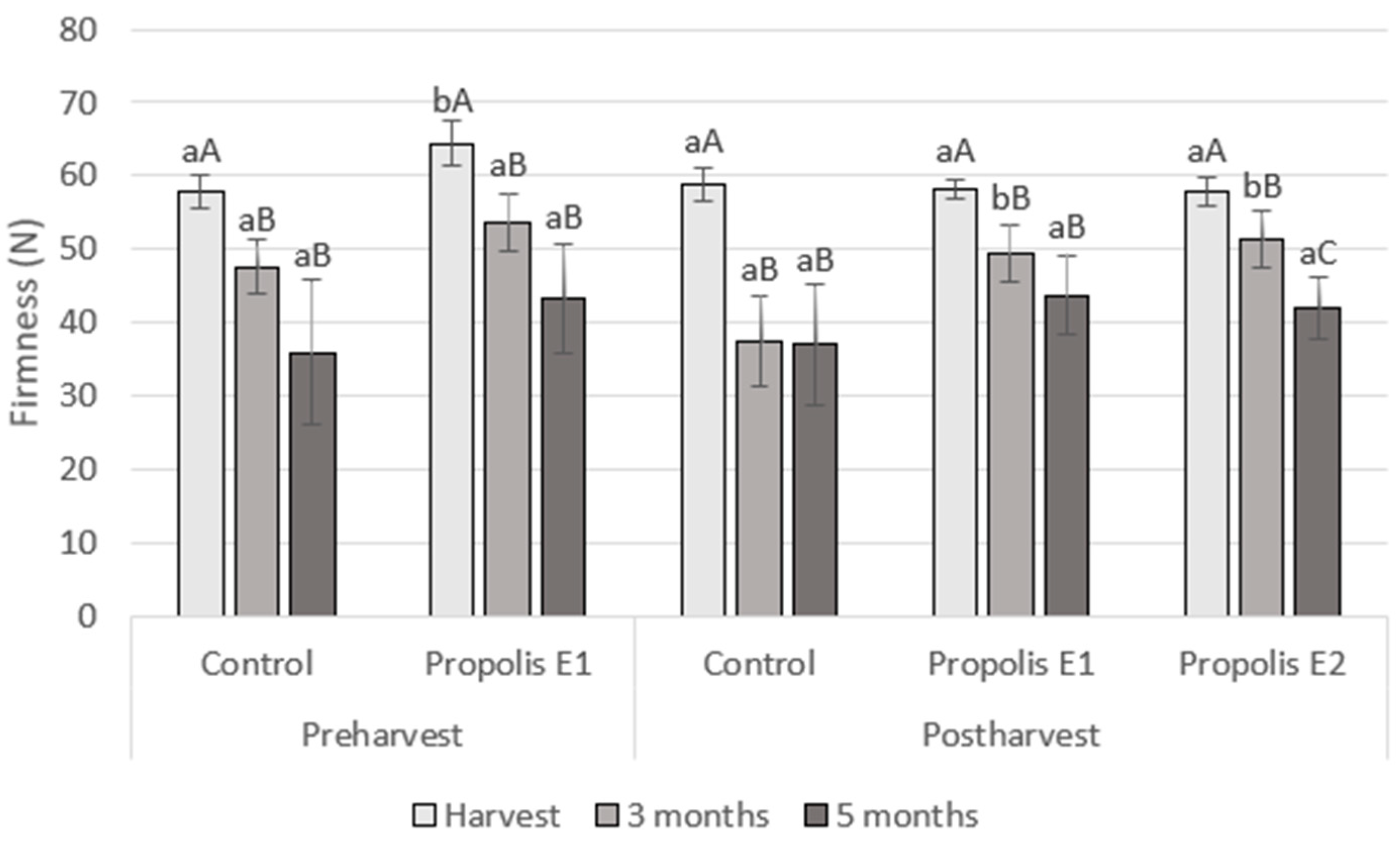
In all cases, a progressive loss of firmness was observed during storage, becoming apparent from the third month onward (Figure 3). However, propolis treatments clearly mitigated firmness loss compared with the untreated control, as higher firmness values were observed in both pre- and postharvest treated pears. Since treatments did not significantly affect color or TSS, parameters that would be expected to shift if ripening was substantially altered, the most plausible explanation is that the observed differences in firmness are primarily due to variations in water loss. In other words, propolis treatments that reduced transpirational water loss better preserved cell turgor, thereby maintaining fruit firmness and structural integrity. Similar effects have been observed in other fruits treated with propolis extracts, such as grapes [65], dragon fruit [13], papaya [66] and mangos [70], where firmness retention was associated with reduced water loss and lower weight loss.
Additionally, by limiting gas diffusion (low O2) and reducing oxidative stress, propolis may slow the enzymatic degradation of cell wall components such as pectin and hemicellulose, further contributing to the retention of texture. This effect was previously reported in black mulberry coated with edible films enriched with propolis extract [62], in tomato coated with polysaccharide-based edible coatings [71], and in avocado coated with chitosan- and carboxymethyl cellulose-based edible coatings [72].
With regard to a potential link between the observed effects and the chemical composition of the propolis, several of the main compounds identified in the extract have previously been reported for their biological activities. Among these, CAPE and caffeic acid, both major components of propolis, have been widely studied for their antibacterial, antiviral, antioxidant and anti-inflammatory properties [73,74]. Russo et al. [73] demonstrated that the antioxidant capacity of propolis is particularly pronounced in extracts rich in CAPE. In addition, in a recent postharvest study on pears, it has been shown that caffeic acid delays weight loss and pulp firmness decline, and reduces fruit yellowing [75].
Nevertheless, the specific mechanisms underlying the effects observed in the present study remain to be elucidated.

3.3. Effect of Propolis Treatments on Total Phenolic Content and Antioxidant Capacity

The total phenolic content of the fruits (control and treated) ranged between 168.42 and 60.73 mg GAE/100 g (Table 5). These values are in line with those reported in the literature for the ‘Rocha’ pear [37,76].
Pre- and postharvest application of propolis resulted in a significant increase in the total phenolic content of the fruits, both at harvest time and after 5 months of cold storage. However, after cold storage, a decrease in the total phenolic content was observed in all treatments. This declining trend following cold storage is consistent with previous reports in other pear species, such as Pyrus pyrifolia L. [77], different Italian cultivars of Pyrus communis L. [78] or Pyrus serotina Rehd [79].
Postharvest treatments resulted in the highest increase in total phenolic content at harvest; however, preharvest treatment was the one that allowed for better preservation of these compounds during cold storage. The increase in polyphenol content in fruits treated with propolis extracts was also reported in other fruits, namely in mangos [70] or dragon fruit [13].
Interestingly, total phenolic content in pears does not rise linearly with propolis application as no significant differences were detected between the two postharvest treatments (Propolis E1 and Propolis E2). Zahid et al. [13] reported that the total phenolic content in dragon fruit decreases with increasing concentrations of propolis ethanolic extract applied in postharvest. This reduction was related to the lower respiration rates of fruits treated with the lowest concentration. Moreover, the absence of a linear response may result from possible restrictions in the absorption of bioactive compounds from propolis.
The antioxidant capacity, determined by DPPH and FRAP assays (Table 6) of fruits, followed the same trend observed for the total phenolic content. Propolis treatments resulted in a significant increase in the antioxidant capacity of the fruits, with this increase being most evident at the end of the 5 months of cold storage. Moreover, for all treatments, the antioxidant capacity of the fruits decreases during cold storage. The same trend was reported by other authors [78]. The correlation between the levels of phenolic compounds and the antioxidant capacity of the fruits is not surprising, since it is known that phenolic compounds are an important class of natural antioxidants [80].
Phenolic compounds play significant roles in plants’ defensive mechanisms against several biotic and abiotic factors, being able to prevent stresses and regulate defense mechanisms [81]. Factors such as drought, UV exposure or temperature lead to the induction of the biosynthesis of specific types of phenolic compounds to counteract all the associated adverse effects [81]. The treatment of apples with caffeic acid or with epicatechin (both phenolic compounds) increases the resistance of apples to gray mold by promoting the accumulation of lignin and flavonoids, respectively, due to the activation of different branches of the phenylpropanoid pathway [82]. High levels of polyphenols can limit or delay the growth of the pathogen, whereas lignification can enhance the mechanical resistance to pathogen penetration [39]. Therefore, inducing the biosynthesis and/or preventing the degradation of phenolic compounds can contribute to preserving the postharvest fruit quality [20].
Besides the positive impact on fruit preservation, the increase in total phenolic content could also be valuable for consumers. Polyphenols can affect the organoleptic characteristics of the fruits, namely the visual appearance and the flavor [20]. Furthermore, polyphenols are important bioactive elements and play a key role in improving fruits’ nutritional value and health benefits, including protection against chronic diseases such as cardiovascular and neurodegenerative diseases, diabetes, and cancer [80,83,84].
Pears are composed of two distinct edible fractions: peel and pulp. Although both are edible, the peel is often discarded. Therefore, from a human consumption perspective, it is important to analyze these two fractions separately [84].
For all fruits (control and treated), the total phenolic content and antioxidant capacity were higher in peel and decreased from the outermost fractions of the pulp (outer pulp) to the innermost ones (inner pulp) (Table 7). These results are in agreement with those reported by other authors for the ‘Rocha’ pear produced in five different locations in Portugal [84], as well as for other pear varieties from Serbia [85].
After 5 months of cold storage, and compared to the control, treatments with propolis resulted in a significant increase in the total phenolic content and antioxidant capacity of both peel and pulp fractions (Table 7). Once again, the preharvest treatment seems to be the one that allowed for better preservation of phenolic compounds during cold storage, in the three fractions analyzed. Although propolis treatments have resulted in the fortification of pears with phenolic compounds, both in the pulp and the peel, the results showed that discarding the peel results in the loss of valuable compounds, and so, the ingestion of both fractions could be beneficial regarding the health-promoting effects of polyphenols.

3.4. Effect of Propolis Treatments on Polyphenol Oxidase Enzymatic Activity

Polyphenol oxidase (PPO) catalyzes the oxidation of phenols into quinones, which are prone to polymerization, giving rise to brown pigments that reduce the sensorial quality of the fruits [86]. The results presented in Table 8 show that the application of propolis, both pre- and postharvest, prevented an increase in PPO activity after the 5 months of cold storage. Thus, while in the control group there was a significant increase of approximately 3.5-fold in PPO activity, in pears treated with propolis, both pre- and postharvest, PPO activity remained stable and without significant differences compared to the value recorded at harvest.
PPO inhibition may be one of the factors contributing to improved preservation of phenolic compounds during refrigerated storage (Table 5), since the degradation of these compounds in pears can result from their direct oxidation by this enzyme [77].
Consistent with the results presented, other authors have reported increased PPO activity during pear storage [77,83,87,88]. PPO activity is directly associated with the occurrence of brown core in pears throughout the oxidation of phenolic compounds [87], and positive correlations between internal browning and PPO activity have been reported [88]. Several treatments have shown positive effects in inhibiting PPO, making it possible to extend the storage of pears. For example, the application of boric acid [77], cysteine [83] or salicylic acid [87] has demonstrated positive effects.
Other studies reported the inhibitory effects of polyphenols on the PPO activity. For example, a honey extract rich in polyphenols showed high inhibition of PPO from apple juice, while CAPE, one of the compounds identified in the propolis extract used (Table 2), also showed inhibitory activity, although lower than that of the honey extract [89]. Thus, by inhibiting PPO activity, propolis treatment can be beneficial in reducing the incidence of internal browning in pears, helping to preserve the fruit’s acceptability and nutritional value.

3.5. α-Farnesene, Conjugated Trienols and Superficial Scald Development

Superficial scald is one of the most common and damaging postharvest disorders. The most generally approved theory to explain this chilling-induced oxidative disorder is linked to the synthesis of α-farnesene and its auto-oxidation into conjugated trienols (CTs), which accumulate in the peel. These oxidation products disrupt membrane integrity, causing cellular compartmentalization to fail. This allows PPO to contact phenolic substrates, leading to enzymatic browning. Symptoms begin during cold storage but intensify when fruits are returned to ambient temperatures [90,91,92].
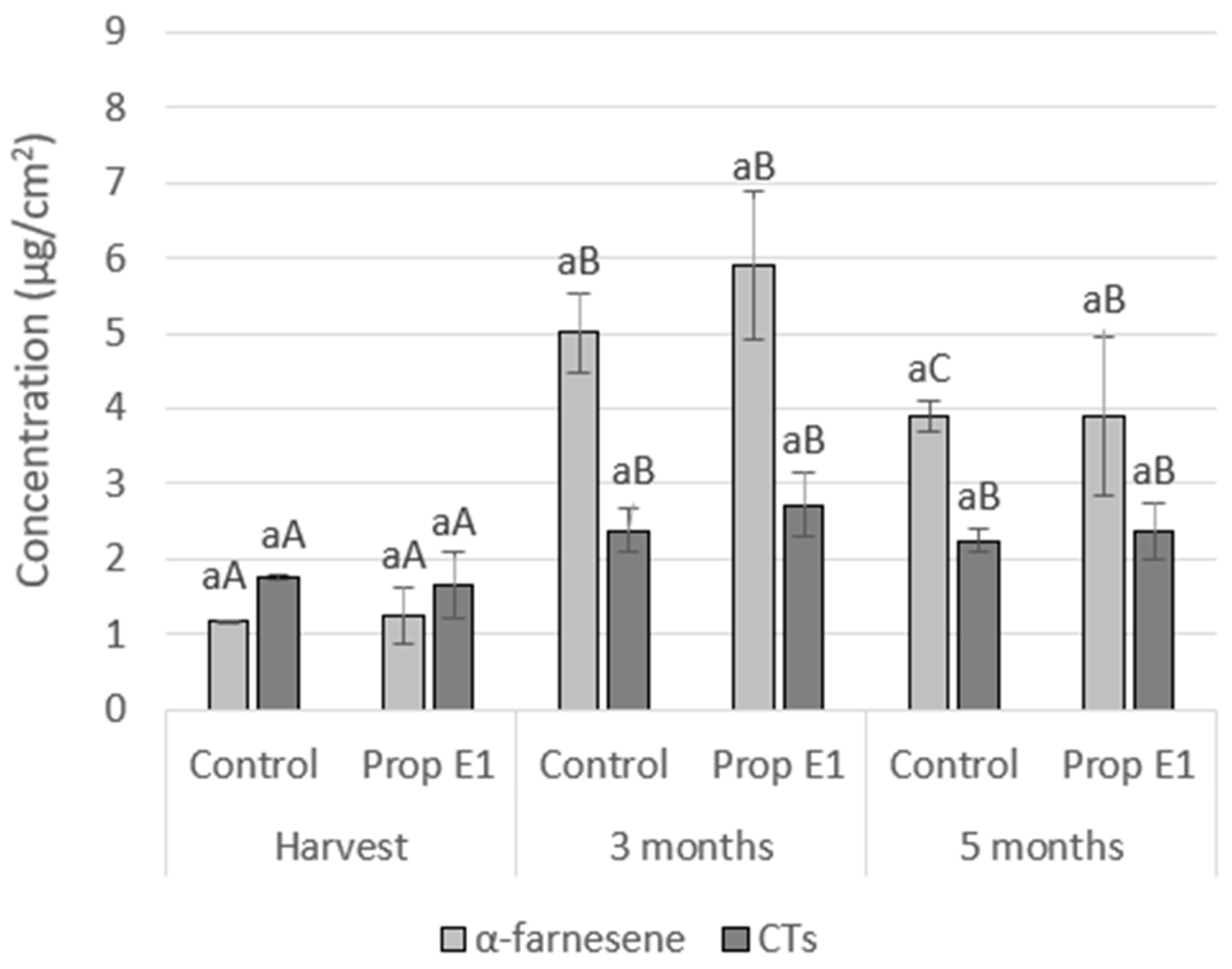
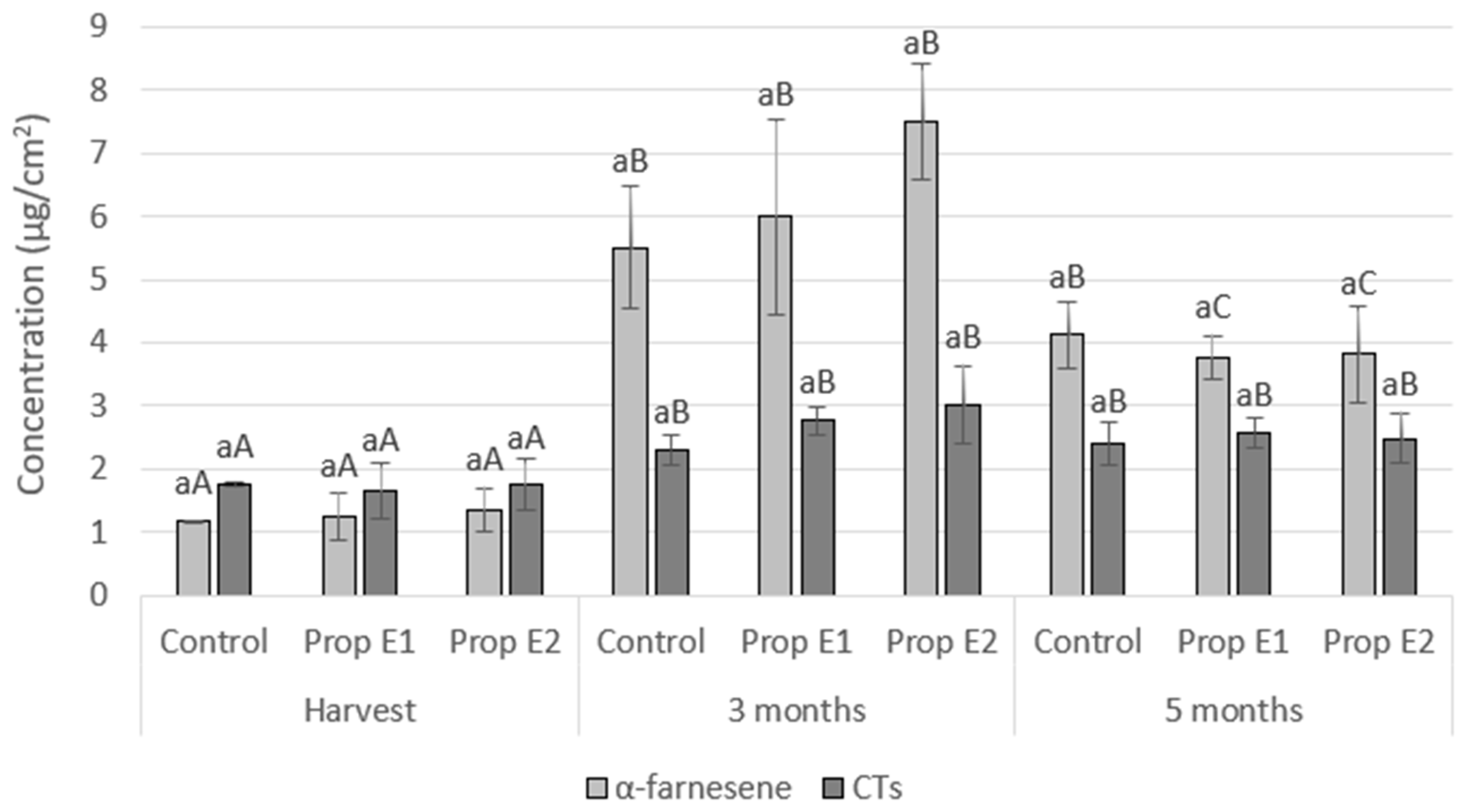
The accumulation of α-farnesene during the first months of storage and its subsequent stabilization or decline has already been described for pome fruits in general, and for ‘Rocha’ pear in particular [3,40]. In this study, we found that both α-farnesene and CTs contents increased during the first three months of storage and then decreased until the end of the storage period, regardless of the treatment applied (Figure 4 and Figure 5). At 3 months, α-farnesene levels were higher in the propolis-treated pears, particularly in the postharvest treatment with E2, where levels reached values about 37% higher than in the control (Figure 5). However, this increase did not yield a corresponding rise in CTs concentrations, suggesting a potential delay in α-farnesene oxidation, thus, a potential positive effect in preventing scald. This protective effect appears to be more closely associated with the higher phenolic content and antioxidant capacity observed in treated fruits, particularly in the peel (Table 5, Table 6 and Table 7), than with the phenolic content of the propolis extract itself, since the effect is more evident in the diluted extract than in the concentrated one. By the fifth month, the levels of α-farnesene and CTs were essentially indistinguishable among all treatments.
Despite these temporal increases, the absolute concentrations of conjugated trienols remained very low (Figure 4 and Figure 5) and below the threshold levels typically associated with superficial scald risk in ‘Rocha’ pear, around 4 µg/cm2 [40]. Indeed, even after 5 months of cold storage followed by 7 days at room temperature, no scald symptoms were observed in any of the experimental groups, regardless of treatment. On the other hand, Gago et al. [68] reported differential effects of nanocoatings on superficial scald in ‘Rocha’ pears: coatings enriched with lemongrass prevented scald, whereas those enriched with citral exacerbated it. Under the experimental conditions of the present study, propolis treatment similarly did not induce scald development, irrespective of whether it was applied pre- or postharvest.

3.6. Development of Internal Disorders

General internal disorders, which lack external symptoms but significantly compromise fruit quality, are often associated with oxidative stress. Under stress conditions, reactive oxygen species (ROS) tend to accumulate, damaging cellular membranes and leading to physiological disorders such as internal browning. The application of edible coatings or compounds capable of forming semipermeable biofilms on the fruit surface, such as propolis, can modify the internal atmosphere by altering gas exchange rates, thereby slowing senescence and reducing ROS accumulation [67,93,94,95]. Moreover, such coatings can enhance the fruit’s intrinsic defense mechanisms by stimulating the activity of antioxidant enzymes, including catalase, ascorbate peroxidase and peroxidase, as well as by increasing the levels of protective compounds such as phenols, flavonoids, and other antioxidants [95].
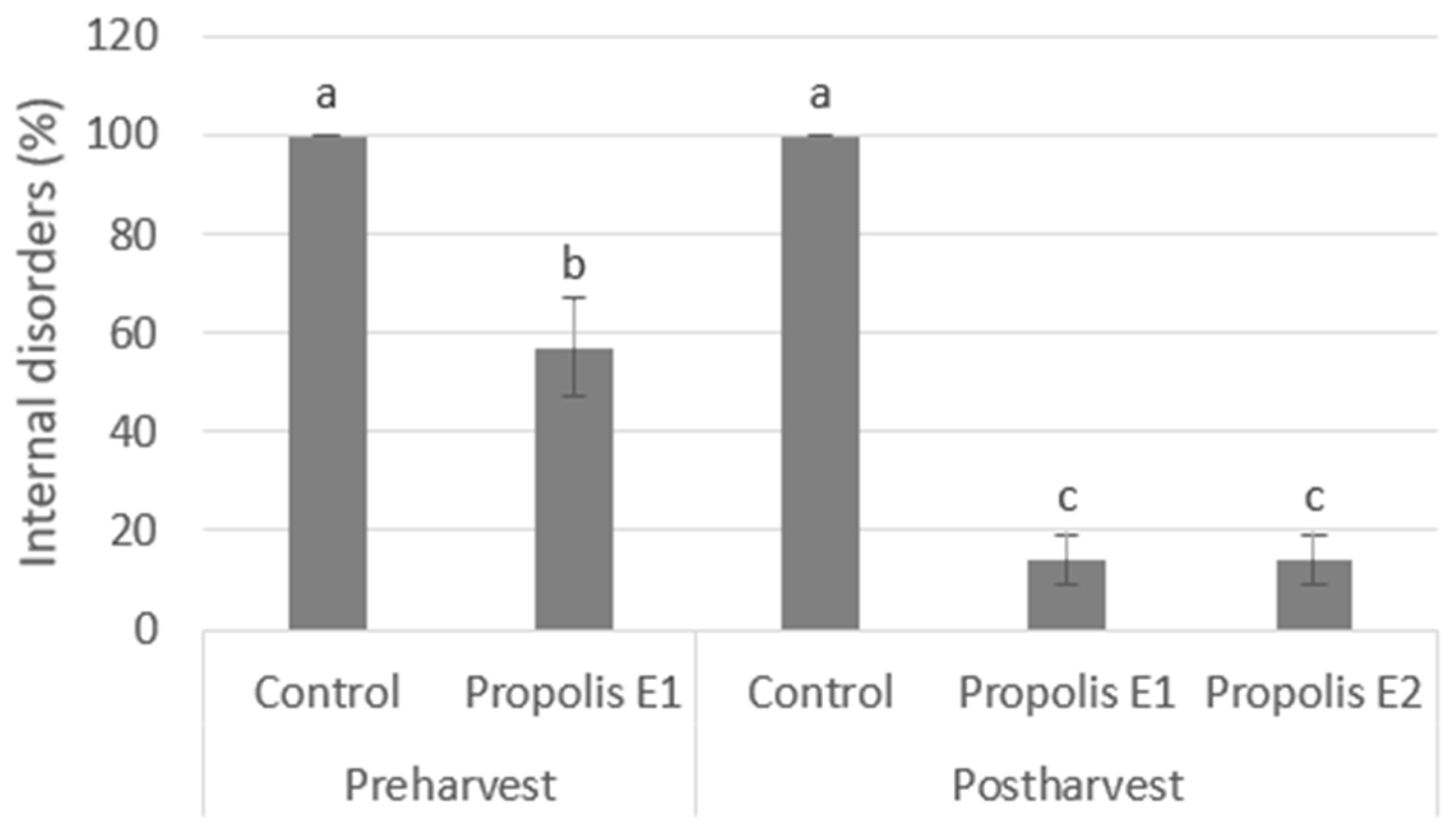
The first symptoms of internal browning were observed after 5 months of storage plus 7 days at room temperature. All the pears corresponding to the controls showed a brown area around the core. However, a significant reduction in browning incidence was observed in propolis-treated pears (Figure 6), with an approximate 50% decrease when applied preharvest, and a more pronounced reduction of about 85% when propolis was applied postharvest. Interestingly, although the incidence was significantly reduced, no dose-dependent effects were observed, as no differences were found between treatments using concentrated or diluted extracts.
The observed protective effect appears to be related to the elevated levels of phenolic compounds and antioxidants in the treated fruits (Table 7), in addition to the reduction in PPO activity (Table 8). These findings suggest that the use of propolis extract is a promising strategy for mitigating internal browning and warrants further investigation.

3.7. Microbiological Analyses

To assess the microbial load present on pear skin, fruit samples from all modalities under study were subjected to microbiological analysis. This involved quantifying total aerobic microorganisms, as well as molds and yeasts (Table 9).
Results showed that the application of propolis, both in preharvest and in postharvest, reduces the total aerobic microorganisms at 30 °C and the yeast and mold count. This reduction is most pronounced immediately after treatment (in July for preharvest treatment and in August for postharvest treatment), becoming less pronounced over the course of cold storage. Thus, immediately after preharvest treatment, compared to the control, a 0.9-log reduction for total aerobic microorganisms and a 1.2-log reduction for yeast and molds were observed, while at the end of the cold storage, these reductions were 0.7-log and 0.5-log, respectively. For the postharvest treatment, immediately after propolis application, reductions of 2.0-log for E1 and 1.3-log for E2 for total aerobic microorganisms’ counts were observed, while at the end of the cold storage, these reductions were 0.7-log and 0.3-log, respectively. In the case of molds and yeasts, immediately after postharvest treatment, a reduction in counts of 0.7-log for E1 and 0.4-log for E2 was observed, while at the end of the cold storage, only treatment E1 showed a reduction of 0.1-log, compared to the control.
The reduction in microbial counts was related to propolis concentration, as the postharvest treatment with Propolis E1 (3 mg/mL) showed higher reductions than the postharvest treatment with Propolis E2 (0.6 mg/mL).
Results obtained confirm the antimicrobial activity of propolis. This activity appears to be related to its phenolic constituents and may be exerted by various mechanisms, including interference with the cell membrane, inhibition of nucleic acid and protein synthesis, as well as enzyme inhibition [27]. The antimicrobial activity of caffeic acid and CAPE, two of the main compounds identified in the propolis extract (Table 2), has been previously reported [73,74]. Moreover, diisooctyl phthalate, the compound with the highest abundance in the propolis extract, has also been identified in ethanolic extracts of Arthrospira platensis, being associated with the antimicrobial activity of both extracts [96]. The second most abundant compound, an anthraquinone, and the third, a flavanone, belong to two classes of compounds that exert pharmacological actions including antimicrobial effects [97,98].
These results corroborate previous reports in the literature for apples, cherries and grapefruits treated with propolis ethanolic extract [99,100,101]. Ethanolic extracts of propolis have been shown to be efficient in preventing and reducing the incidence of fungal diseases during the postharvest period (4 weeks) of cherries [99] and preventing fungal decay in grapefruits [100]. Moreover, Feas et al. [102] reported that when applied in the sanitation of lettuce, propolis proved to be slightly more effective in reducing microbiological contamination than commercial sodium hypochlorite. These authors describe a reduction of two or three logarithmic cycles in total mesophilic and psychrotrophic counts, respectively, with the application of propolis at contact times of 15 and 30 min.
In addition to propolis, other natural extracts have shown good results in reducing the microbial load in fruits. Castillo et al. [10], showed that the application of an aloe vera extract as a pre-harvest treatment in table grape vineyards resulted in a significant decrease in total aerobic microorganism counts, as well as in yeast and mold counts. These authors showed that this antimicrobial effect persisted during storage and that, at the end of the storage period, the percentage of rotted berries was significantly lower in treated than in control fruit [10]. Wei et al. [11] showed that the preharvest spraying with tea tree oil effectively reduces bacterial and fungal counts on the strawberry surface at harvest. These reductions in microbial load were identified as one of the factors contributing to the success of tea tree oil treatment in controlling postharvest decay in strawberries.
Several authors studied the effect of propolis extracts and other natural preservatives (e.g., chitosan, alginate, pectin) on postharvest quality of fruits and vegetables [103], namely in apples [101,104], bananas [105,106], and strawberries [25]. Most of these works also reported positive effects on controlling microbial growth, reducing weight loss, maintaining firmness, and/or increasing total phenolic content. However, these studies refer only to postharvest treatments and do not investigate the possibility of preharvest application. Furthermore, most of these studies use significantly higher propolis concentrations (between 1% and 10%) than those used in the present work (0.06% and 0.3%). Thus, this study stands out for demonstrating the effectiveness of both preharvest treatment and propolis extract at concentrations lower than those normally tested. The use of lower concentrations contributes to the economic viability and sustainability of propolis treatment. Furthermore, the use of low concentrations reduces the risk of problems related to allergies or alterations in the natural aroma of the fruits [103]. Compared to other natural products, the use of propolis can have the advantage of adding value to a bee product that is often underestimated by most beekeepers.


4. Conclusions

This study demonstrates that pre- and postharvest treatments with propolis extract positively influence ‘Rocha’ pear quality and storability during cold storage under normal atmosphere, without the use of preservatives or synthetic postharvest fungicides. Propolis extract did not compromise fruit quality; on the contrary, it improved preservation by significantly reducing water loss (by up to 44%) and limiting firmness degradation (by approximately 13–33%). Furthermore, when the extract was applied postharvest, the incidence of physiological disorders was reduced by approximately 85%, regardless of the concentration used. This effect is likely associated with increased levels of phenolic compounds and antioxidant capacity throughout the fruit, together with reduced polyphenol oxidase activity. The enhancement of phenolic content not only strengthens the fruit’s resistance to oxidative processes but also contributes to its nutritional value. Overall, these findings indicate that propolis extract, a natural and underutilized bioactive compound, represents a promising and sustainable alternative for maintaining fruit quality and reducing reliance on chemical inputs in postharvest management. With respect to the application method, all propolis treatments outperformed the control; however, considering all evaluated parameters, postharvest application of the most concentrated extract (E1) proved to be the most effective strategy. Nevertheless, further optimization is required to enhance treatment efficacy. Future research should prioritize the improvement of formulations through the incorporation of surfactants, adjuvants, or stabilizers, as well as the assessment of alternative application strategies, including different preharvest timings, additional treatments, or combined pre- and postharvest applications. In addition, to overcome limitations associated with variability in propolis composition and biological activity linked to geographic and botanical origin, the investigation of individual extract fractions is recommended. This approach would enable the identification of key bioactive compounds and support the development of standardized and effective propolis-based treatments.

Supplementary Materials

The following supporting information can be downloaded at: https://www.mdpi.com/article/10.3390/su18052413/s1, Table S1. Components detected in the chromatographic profile of the propolis extract.

Author Contributions

M.L., M.P.D., C.S. and M.G. conceived and designed the experiments. M.L., M.P.D., M.G. and C.S. performed the experiments and analyzed the data. M.L., M.P.D. and C.S. wrote the paper with contributions from M.G., M.P.D., M.G. and C.S. supervised the execution of analyses and revised the data. All authors have read and agreed to the published version of the manuscript.

Funding

This research was funded by PRODER (Program for the Rural Development of Mainland Portugal), Medida 4.1, under the project ProFruta (PA54101, PA54102, and PA54103). This work was also supported by Fundação para a Ciência e Tecnologia (FCT, Portugal) through national funds to Mechanical Engineering and Resource Sustainability Center—MEtRICs unit (UID/04077/2025, DOI https://doi.org/10.54499/UID/04077/2025) and to Green-it Bioresources for Sustainability R&D Unit (UID/04551/2025, DOI: 10.54499/UID/04551/2025; UID/PRR/04551/2025, DOI: 10.54499/UID/PRR/04551/2025).

Data Availability Statement

All data are contained within this article.

Acknowledgments

The authors thank Paula Vasilenko (INIAV, I.P.), Mário Santos (INIAV, I.P.), João Neto (INIAV, I.P.) and Edgar Perestrelo (NOVA FCT) for their technical assistance in the laboratory, and Rui M. de Sousa (INIAV, I.P./ENFVN) for technical assistance with preharvest spray applications.

Conflicts of Interest

The authors declare no conflicts of interest.

Abbreviations

The following abbreviations are used in this manuscript:
AAEAscorbic acid equivalents
CFUColony forming unit
CTsConjugated trienols
DPPH2,2-Diphenyl-1-picrylhydrazyl radical
FRAPFerric reducing antioxidant power
GAEGallic acid equivalents
GC-MSGas chromatography–mass spectrometry
PPOPolyphenol oxidase
ROSReactive oxygen species
UVUltraviolet

References

  1. Mayienga, S.; Cachia, F. Research on the Measurement of Post-Harvest Losses; FAO: Rome, Italy, 2021. [Google Scholar] [CrossRef]
  2. Fonseca, A.M.; Dias, C.; Amaro, A.L.; Isidoro, N.; Pintado, M.; Silvestre, A.J.; Rocha, S.M. The impact of plant-based coatings in ‘Rocha’ Pear preservation during cold storage: A metabolomic approach. Foods 2020, 9, 1299. [Google Scholar] [CrossRef] [PubMed]
  3. Gago, C.M.; Miguel, M.G.; Cavaco, A.M.; Almeida, D.P.; Antunes, M.D. Combined effect of temperature and controlled atmosphere on storage and shelf-life of ‘Rocha’ Pear treated with 1-methylcyclopropene. Food Sci. Technol. Int. 2013, 21, 94–103. [Google Scholar] [CrossRef] [PubMed]
  4. Liu, Q.; Li, L.; Yang, Z.; Xiong, X.; Song, Q.; Li, B.; Zou, H.; Zhang, L.; Liu, T. Antifungal effect of oregano essential oil against Penicillium expansum on Pyrus sinkiangensis. J. Fungi 2024, 10, 752. [Google Scholar] [CrossRef] [PubMed]
  5. Tripathi, S.; Srivastava, P.; Devi, R.S.; Bhadouria, R. Influence of synthetic fertilizers and pesticides on soil health and soil microbiology. In Agrochemicals Detection, Treatment and Remediation; Elsevier: Amsterdam, The Netherlands, 2020; pp. 25–54. [Google Scholar] [CrossRef]
  6. Dias, C.; Amaro, A.; Fonseca, A.; Ferrante, A.; Silvestre, A.; Rocha, S.M.; Isidoro, N.; Pintado, M. β-Farnesene exogenous application as a novel damage induction model to fast explore the effectiveness of postharvest strategies: The case study of the ‘Rocha’ Pear DOP. Horticulturae 2022, 8, 93. [Google Scholar] [CrossRef]
  7. Romanazzi, G.; Smilanick, J.L.; Feliziani, E.; Droby, S. Integrated management of postharvest gray mold on fruit crops. Postharvest Biol. Technol. 2016, 113, 69–76. [Google Scholar] [CrossRef]
  8. Khan, A.S.; Ali, S. Preharvest sprays affecting shelf life and storage potential of fruits. In Preharvest Modulation of Postharvest Fruit and Vegetable Quality; Academic Press: Cambridge, MA, USA, 2018; pp. 209–255. [Google Scholar] [CrossRef]
  9. Lara, I. Preharvest sprays and their effects on the postharvest quality of fruit. Stewart Postharvest Rev. 2013, 9, 1–12. [Google Scholar] [CrossRef]
  10. Castillo, S.; Navarro, D.; Zapata, P.J.; Guillén, F.; Valero, D.; Serrano, M.; Martínez-Romero, D. Antifungal efficacy of Aloe vera in vitro and its use as a preharvest treatment to maintain postharvest table grape quality. Postharvest Biol. Technol. 2010, 57, 183–188. [Google Scholar] [CrossRef]
  11. Wei, Y.; Shao, X.; Wei, Y.; Xu, F.; Wang, H. Effect of preharvest application of tea tree oil on strawberry fruit quality parameters and possible disease resistance mechanisms. Sci. Hortic. 2018, 241, 18–28. [Google Scholar] [CrossRef]
  12. Nia, A.E.; Taghipour, S.; Siahmansour, S. Pre-harvest application of chitosan and postharvest Aloe vera gel coating enhances quality of table grape (Vitis vinifera L. cv. ‘Yaghouti’) during the postharvest period. Food Chem. 2021, 347, 129012. [Google Scholar] [CrossRef]
  13. Zahid, N.; Ali, A.; Siddiqui, Y.; Maqbool, M. Efficacy of ethanolic extract of propolis in maintaining postharvest quality of dragon fruit during storage. Postharvest Biol. Technol. 2013, 79, 69–72. [Google Scholar] [CrossRef]
  14. Pu, Y.; Wang, H.; Jiang, H.; Cao, J.; Qu, G.; Jiang, W. Techno-functional properties of active film based on guar gum–propolis and its application for “Nanguo” pear preservation. Int. J. Biol. Macromol. 2024, 261, 129578. [Google Scholar] [CrossRef] [PubMed]
  15. Sforcin, J.M. Biological properties and therapeutic applications of propolis. Phytother. Res. 2016, 30, 894–905. [Google Scholar] [CrossRef] [PubMed]
  16. Hossain, R.; Quispe, C.; Khan, R.A.; Saikat, A.S.M.; Ray, P.; Ongalbek, D.; Yeskaliyeva, B.; Jain, D.; Smeriglio, A.; Trombetta, D.; et al. Propolis: An update on its chemistry and pharmacological applications. Chin. Med. 2022, 17, 69. [Google Scholar] [CrossRef] [PubMed]
  17. Kalogeropoulos, N.; Konteles, S.J.; Troullidou, E.; Mourtzinos, I.; Karathanos, V.T. Chemical composition, antioxidant activity and antimicrobial properties of propolis extracts from Greece and Cyprus. Food Chem. 2009, 116, 452–461. [Google Scholar] [CrossRef]
  18. Teixeira, É.W.; Message, D.; Negri, G.; Salatino, A.; Stringheta, P.C. Seasonal variation, chemical composition and antioxidant activity of brazilian propolis samples. Evid.-Based Complement. Altern. Med. 2010, 7, 307–315. [Google Scholar] [CrossRef]
  19. Wieczorek, P.P.; Hudz, N.; Yezerska, O.; Horčinová-Sedláčková, V.; Shanaida, M.; Korytniuk, O.; Jasicka-Misiak, I. Chemical variability and pharmacological potential of propolis as a source for the development of new pharmaceutical products. Molecules 2022, 27, 1600. [Google Scholar] [CrossRef]
  20. Kahramanoglu, I.; Okatan, V.; Wan, C. Biochemical composition of propolis and its efficacy in maintaining postharvest storability of fresh fruits and vegetables. J. Food Qual. 2020, 2020, 8869624. [Google Scholar] [CrossRef]
  21. Moreno, M.A.; Vallejo, A.M.; Ballester, A.R.; Zampini, C.; Isla, M.I.; López-Rubio, A.; Fabra, M.J. Antifungal edible coatings containing argentinian propolis extract and their application in raspberries. Food Hydrocoll. 2020, 107, 105973. [Google Scholar] [CrossRef]
  22. Abo-Elyousr, K.A.M.; Al-Qurashi, A.D.; Almasoudi, N.M. Evaluation of the synergy between Schwanniomyces vanrijiae and propolis in the control of Penicillium digitatum on lemons. Egypt. J. Biol. Pest Control 2021, 31, 66. [Google Scholar] [CrossRef]
  23. Xu, X.; Pu, R.; Li, Y.; Wu, Z.; Li, C.; Miao, X.; Yang, W. Chemical compositions of propolis from China and the United States and their antimicrobial activities against Penicillium notatum. Molecules 2019, 24, 3576. [Google Scholar] [CrossRef]
  24. Sadallah, A.; Aprea, E.; Cignola, R.; Caratti, A.; Cordero, C.; Angeli, A.; Martens, S.; Di Francesco, A. Propolis hydroalcoholic extracts: Biochemical characterization and antifungal efficacy. Horticulturae 2025, 11, 122. [Google Scholar] [CrossRef]
  25. Omar, N.A.; Sidique, S.N.M.; Ahmad, F.T. Antifungal properties of water extract propolis coating against anthracnose (Colletotrichum gloeosporioides) disease on strawberry (Fragaria ananassa). Malays. Appl. Biol. 2020, 49, 253–260. [Google Scholar] [CrossRef]
  26. Mattiuz, B.H.; Ducamp-Collin, M.N.; Mattiuz, C.F.M.; Vigneault, C.; Marques, K.M.; Sagoua, W.; Montet, D. Effect of propolis on postharvest control of anthracnose and quality parameters of ‘Kent’ Mango. Sci. Hortic. 2015, 184, 160–168. [Google Scholar] [CrossRef]
  27. Loebler, M.; Sánchez, C.; Maurício, E.M.; Diogo, E.; Santos, M.; Vasilenko, P.; Cruz, A.S.; Mendes, B.; Gonçalves, M.; Duarte, M.P. Potential application of propolis extracts to control the growth of Stemphylium vesicarium in ‘Rocha’ Pear. Appl. Sci. 2020, 10, 1990. [Google Scholar] [CrossRef]
  28. Sánchez, C.; Duarte, P.; Vasilenko, P.; Santos, M.; Loebler, M.; Cruz, A.S.; Gonçalves, M. Potential application of portuguese propolis to control blue mould disease in ‘Rocha’ Pear. Acta Hortic. 2016, 1144, 359–363. [Google Scholar] [CrossRef]
  29. Gago, C.; Guerreiro, A.; Cruz, S.; Martins, N.; Cabrita, M.J.; Miguel, M.G.; Faleiro, M.L.; Antunes, M.D. 1-Methylcyclopropene and lemongrass essential oil nanocoatings effect on the preservation of cold stored ‘Rocha’ Pear. Postharvest Biol. Technol. 2022, 192, 111992. [Google Scholar] [CrossRef]
  30. Prusky, D.B.; Bi, Y.; Li, Y.; Guillén, F.; Romanazzi, G. Inducing resistance in fruit, delays ripening and reduces postharvest decay. Postharvest Biol. Technol. 2025, 230, 113817. [Google Scholar] [CrossRef]
  31. Trusheva, B.; Trunkova, D.; Bankova, V. Different extraction methods of biologically active components from propolis: A preliminary study. Chem. Cent. J. 2007, 1, 13. [Google Scholar] [CrossRef]
  32. Romeiras, M.M.; Essoh, A.P.; Catarino, S.; Silva, J.; Lima, K.; Varela, E.; Moura, M.; Gomes, I.; Duarte, M.C.; Duarte, M.P. Diversity and biological activities of medicinal plants of Santiago Island (Cabo Verde). Heliyon 2023, 9, e14651. [Google Scholar] [CrossRef]
  33. Lima, K.; Malmir, M.; Sabiha, S.; Pinto, R.; Silva, I.M.D.; Figueira, M.E.; Rocha, J.; Duarte, M.P.; Silva, O. Effects of Periploca chevalieri browicz on postprandial glycemia and carbohydrate-hydrolyzing enzymes. Pharmaceuticals 2025, 18, 913. [Google Scholar] [CrossRef]
  34. Isidorov, V.A.; Szczepaniak, L.; Bakier, S. Rapid GC/MS determination of botanical precursors of Eurasian propolis. Food Chem. 2014, 142, 101–106. [Google Scholar] [CrossRef] [PubMed]
  35. Correia, R.; Duarte, M.P.; Maurício, E.M.; Brinco, J.; Quintela, J.C.; da Silva, M.G.; Gonçalves, M. Chemical and functional characterization of extracts from leaves and twigs of Acacia dealbata. Processes 2022, 10, 2429. [Google Scholar] [CrossRef]
  36. Kahramanoğlu, İ.; Aktaş, M.; Gündüz, Ş. Effects of Fludioxonil, Propolis and Black Seed Oil Application on the Postharvest Quality of ‘Wonderful’ Pomegranate. PLoS ONE 2018, 13, e0198411. [Google Scholar] [CrossRef] [PubMed]
  37. Sánchez, C.; Lidon, F.C.; Vivas, M.; Ramos, P.; Santos, M.; Barreiro, M.G. Effect of chitosan coating on quality and nutritional value of Fresh-Cut ‘Rocha’ Pear. Emir. J. Food Agric. 2015, 27, 206–214. [Google Scholar] [CrossRef]
  38. AOAC. Official Methods of Analysis of the Association of Official Analytical Chemists, 17th ed.; Association of Official Analytical Chemists: Washington, DC, USA, 2000. [Google Scholar]
  39. Abouraïcha, E.; El Alaoui-Talibi, Z.; El Boutachfaiti, R.; Petit, E.; Courtois, B.; Courtois, J.; El Modafar, C. Induction of natural defense and protection against Penicillium expansum and botrytis cinerea in apple fruit in response to bioelicitors isolated from green algae. Sci. Hortic. 2015, 181, 121–128. [Google Scholar] [CrossRef]
  40. Isidoro, N.; Almeida, D.P.F. α-Farnesene, conjugated trienols, and superficial scald in ‘Rocha’ Pear as affected by 1-methylcyclopropene and diphenylamine. Postharvest Biol. Technol. 2006, 42, 49–56. [Google Scholar] [CrossRef]
  41. ISO 4833-1:2013; Microbiology of the Food Chain—Horizontal Method for the Enumeration of Microorganisms—Part 1: Colony Count at 30 Degrees by the Pour Plate Technique. International Organization for Standardization: Geneva, Switzerland, 2013.
  42. ISO 21527-1:2008; Microbiology of Food and Animal Feeding Stuffs—Horizontal Method for the Enumeration of Yeasts and Moulds—Part 1: Colony Count Technique in Products with Water Activity Greater than 0.95. International Organization for Standardization: Geneva, Switzerland, 2008.
  43. Prior, R.L.; Wu, X.; Schaich, K. Standardized methods for the determination of antioxidant capacity and phenolics in foods and dietary supplements. J. Agric. Food Chem. 2005, 53, 4290–4302. [Google Scholar] [CrossRef]
  44. Yamauchi, M.; Kitamura, Y.; Nagano, H.; Kawatsu, J.; Gotoh, H. DPPH measurements and structure–activity relationship studies on the antioxidant capacity of phenols. Antioxidants 2024, 13, 309. [Google Scholar] [CrossRef]
  45. Duan, X.; Zhao, Y.Y.; Zhang, J.C. Characteristics of the root exudate release system of typical plants in plateau lakeside wetland under phosphorus stress conditions. Open Chem. 2020, 18, 808–821. [Google Scholar] [CrossRef]
  46. Ousman, B.M.; Mennane, Z.; Boussaoudi, I.; Otchom, B.B.; Saoud, Y. First investigation of phytochemical screening, HPLC–MS characterization, and antibacterial activity of Azadirachta indica A. Juss (Mim or Neem) leaf extracts grown in the Republic of Chad. Nat. Prod. Commun. 2025, 20, 1934578X251322360. [Google Scholar] [CrossRef]
  47. Soltani, E.K.; Cerezuela, R.; Charef, N.; Mezaache-Aichour, S.; Esteban, M.A.; Zerroug, M.M. Algerian propolis extracts: Chemical composition, bactericidal activity and in vitro effects on gilthead seabream innate immune responses. Fish Shellfish Immunol. 2017, 62, 57–67. [Google Scholar] [CrossRef]
  48. Kamel, N.M.; Abdel-Motaal, F.F.; El-Zayat, S.A.; Mohamed, A.E.H.; Ohta, S.; Hussien, T.A. A New secondary metabolite with antimicrobial, antioxidant, and cytotoxic activities from an endophytic fungus, Gymnoascus thermotolerans. Egypt. J. Bot. 2024, 64, 107–124. [Google Scholar] [CrossRef]
  49. Mangalagowri, M.S.; Krishna, K. Diisooctyl phthalate, a major bioactive metabolite with antimicrobial activity isolated from endophytic fungus Hypoxylon griseobrunneum symbiotic with the medicinal plant Thunbergia fragrans roxb. Afr. J. Biomed. Res. 2024, 27, 2822–2832. [Google Scholar] [CrossRef]
  50. Atta, A.H.; Mouneir, S.M.; Nasr, S.M.; Sedky, D.; Mohamed, A.M.; Atta, S.A.; Desouky, H.M. Phytochemical studies and anti-ulcerative colitis effect of Moringa oleifera seeds and Egyptian propolis methanol extracts in a rat model. Asian Pac. J. Trop. Biomed. 2019, 9, 98–108. [Google Scholar] [CrossRef]
  51. Boulechfar, S.; Zellagui, A.; Bensouici, C.; Lahouel, M.; Desdous, A. GC–ms based metabolic profile and toxicological evaluation of three Algerian propolis. Nat. Prod. Res. 2023, 39, 1718–1722. [Google Scholar] [CrossRef]
  52. Garzoli, S.; Maggio, F.; Vinciguerra, V.; Rossi, C.; Donadu, M.G.; Serio, A. Chemical characterization and antimicrobial properties of the hydroalcoholic solution of Echinacea purpurea (L.) Moench and propolis from Northern Italy. Molecules 2023, 28, 1380. [Google Scholar] [CrossRef]
  53. Keskin, Ş. Orange peel volatile oil: A green solvent for propolis extraction with enhanced α-amylase inhibition activity. Flavour Fragr. J. 2020, 35, 411–416. [Google Scholar] [CrossRef]
  54. Mohammadzadeh, S.; Shariatpanahi, M.; Hamedi, M.; Ahmadkhaniha, R.; Samadi, N.; Ostad, S.N. Chemical composition, oral toxicity and antimicrobial activity of Iranian propolis. Food Chem. 2007, 103, 1097–1103. [Google Scholar] [CrossRef]
  55. Hegazi, A.G.; Abd El Hady, F.K. Egyptian propolis: Antioxidant, antimicrobial activities and chemical composition of propolis from reclaimed lands. Z. Naturforsch. C 2002, 57, 395–402. [Google Scholar] [CrossRef]
  56. Sawicka, D.; Car, H.; Borawska, M.H.; Nikliński, J. The anticancer activity of propolis. Folia Histochem. Cytobiol. 2012, 50, 25–37. [Google Scholar] [CrossRef]
  57. Cruz, M.; Antunes, P.; Paulo, L.; Ferreira, A.M.; Cunha, A.; Almeida-Aguiar, C.; Oliveira, R. Antioxidant and dual dose-dependent antigenotoxic and genotoxic properties of an ethanol extract of propolis. RSC Adv. 2016, 6, 49806–49816. [Google Scholar] [CrossRef]
  58. Falcão, S.I.; Vilas-Boas, M.; Estevinho, L.M.; Barros, C.; Domingues, M.R.M.; Cardoso, S.M. Phenolic characterization of Northeast Portuguese propolis: Usual and unusual compounds. Anal. Bioanal. Chem. 2010, 396, 887–897. [Google Scholar] [CrossRef] [PubMed]
  59. Monedero, F.M.; Fabra, M.J.; Talens, P.; Chiralt, A. Effect of oleic acid–beeswax mixtures on mechanical, optical and water barrier properties of soy protein isolate-based films. J. Food Eng. 2009, 91, 509–515. [Google Scholar] [CrossRef]
  60. Jawandha, S.K.; Gill, P.P.S.; Kaur, N.; Verma, A.; Chawla, N. Effect of edible surface coatings on the storability of pear fruits. Indian J. Hortic. 2017, 74, 271. [Google Scholar] [CrossRef]
  61. Stanicka, K.; Dobrucka, R.; Woźniak, M.; Sip, A.; Majka, J.; Kozak, W.; Ratajczak, I. The Effect of Chitosan Type on Biological and Physicochemical Properties of Films with Propolis Extract. Polymers 2021, 13, 3888. [Google Scholar] [CrossRef]
  62. Salimi, A.; Khodaiyan, F.; Askari, G.; Amraei, A. Effect of Propolis Extract-Loaded Films Made of Apple Pomace Pectin and Grass Pea Protein on the Shelf Life Extension of Black Mulberry. Food Hydrocoll. 2025, 158, 110549. [Google Scholar] [CrossRef]
  63. Alvarez, M.V.; Pérez-Gago, M.B.; Taberner, V.; Settier-Ramírez, L.; Martínez-Blay, V.; Palou, L. Postharvest application of novel bio-based antifungal composite edible coatings to reduce sour rot and quality losses of ‘Valencia’ oranges. Coatings 2023, 13, 1412. [Google Scholar] [CrossRef]
  64. Yan, R.; Ren, X.; Wang, S. Effects of propolis on the storage life of ‘Pink Lady’ apple fruit. J. Fruit Sci. 2010, 27, 289–292. [Google Scholar]
  65. Pastor, C.; Sánchez-González, L.; Marcilla, A.; Chiralt, A.; Chafer, M.; González-Martínez, C. Quality and safety of table grapes coated with hydroxypropylmethylcellulose edible coatings containing propolis extract. Postharvest Biol. Technol. 2011, 60, 64–70. [Google Scholar] [CrossRef]
  66. Ali, A.; Cheong, C.K.; Zahid, N. Composite effect of propolis and gum arabic to control postharvest anthracnose and maintain quality of papaya during storage. Int. J. Agric. Biol. 2014, 16, 1117–1122. [Google Scholar]
  67. Medeiros, B.G.S.; Pinheiro, A.C.; Teixeira, J.A.; Vicente, A.A.; Carneiro-da-Cunha, M.G. Polysaccharide/protein nanomultilayer coatings: Construction, characterization and evaluation of their effect on ‘Rocha’ Pear (Pyrus communis L.) shelf-life. Food Bioprocess Technol. 2012, 5, 2435–2445. [Google Scholar] [CrossRef]
  68. Gago, C.; Antão, R.; Dores, C.; Guerreiro, A.; Miguel, M.G.; Faleiro, M.L.; Figueiredo, A.C.; Antunes, M.D. The effect of nanocoatings enriched with essential oils on ‘Rocha’ Pear long storage. Foods 2020, 9, 240. [Google Scholar] [CrossRef] [PubMed]
  69. Nath, A.; Deka, B.C.; Singh, A.; Patel, R.K.; Paul, D.; Misra, L.K.; Ojha, H. Extension of shelf life of pear fruits using different packaging materials. J. Food Sci. Technol. 2012, 49, 556–563. [Google Scholar] [CrossRef] [PubMed]
  70. Al-Qurashi, A.D.; Awad, M.A. Postharvest ethanolic extract of propolis treatment affects quality and biochemical changes of ‘Hindi-Besennara’ mangos during shelf life. Sci. Hortic. 2018, 233, 520–525. [Google Scholar] [CrossRef]
  71. Baraiya, N.S.; Rao, T.V.R.; Gol, N.B. Influence of Polysaccharide-Based Edible Coatings on the Shelf Life and Nutritional Quality of Tomato Fruit. Food 2012, 6, 22–27. [Google Scholar]
  72. Tesfay, S.Z.; Magwaza, L.S. Evaluating the Efficacy of Moringa Leaf Extract, Chitosan and Carboxymethyl Cellulose as Edible Coatings for Enhancing Quality and Extending Postharvest Life of Avocado (Persea americana Mill.) Fruit. Food Packag. Shelf Life 2017, 11, 40–48. [Google Scholar] [CrossRef]
  73. Russo, A.; Longo, R.; Vanella, A. Antioxidant Activity of Propolis: Role of Caffeic Acid Phenethyl Ester and Galangin. Fitoterapia 2002, 73, S21–S29. [Google Scholar] [CrossRef]
  74. Bankova, V.; Trusheva, B.; Popova, M. Caffeic Acid Phenethyl Ester (CAPE)—Natural Sources, Analytical Procedures and Synthetic Approaches. Compt. Rend. Acad. Bulg. Sci. 2018, 71, 1157–1169. [Google Scholar] [CrossRef]
  75. Guo, Y.; Li, C.; Wang, M.; Xu, H.; Zhang, S.; Liu, J.; Jin, Y.; Ge, Y. Postharvest Caffeic Acid Dipping Enhances Disease Resistance and Storage Capacity of ‘Zaosu’ Pear Fruit via Regulating Phenylpropane Metabolism. Postharvest Biol. Technol. 2024, 209, 112716. [Google Scholar] [CrossRef]
  76. Pedro, S.I.; Coelho, E.; Peres, F.; Machado, A.; Rodrigues, A.M.; Wessel, D.F.; Coimbra, M.A.; Anjos, O. Physicochemical fingerprint of “Pera Rocha do Oeste”, a PDO pear native from Portugal. Foods 2020, 9, 1209. [Google Scholar] [CrossRef]
  77. Kaur, A.; Gill, P.P.S.; Jawandha, S.K.; Singh, M. Pre-storage exogenous application of boric acid extends storability and maintains quality of pear fruits. Sci. Hortic. 2019, 256, 108616. [Google Scholar] [CrossRef]
  78. Caracciolo, G.; Magri, A.; Petriccione, M.; Maltoni, M.L.; Baruzzi, G. Influence of cold storage on pear physico-chemical traits and antioxidant systems in relation to superficial scald development. Foods 2020, 9, 1175. [Google Scholar] [CrossRef]
  79. Arzani, K.; Khoshghalb, H.; Malakouti, M.J.; Barzegar, M. Polyphenoloxidase activity, polyphenol and ascorbic acid concentrations and internal browning in asian pear (Pyrus serotina rehd.) Fruit during storage in relation to time of harvest. Eur. J. Hortic. Sci. 2009, 74, 61. [Google Scholar] [CrossRef]
  80. Zhong, Y.; Yuan, X.; Feng, Q.; Wang, Q.; Pan, H.; Qiao, Z.; Wang, T.; Zhuang, Y. Application of polyphenols as natural antioxidants in edible oils: Current status, antioxidant mechanism, and advanced technology. Food Res. Int. 2025, 208, 116234. [Google Scholar] [CrossRef] [PubMed]
  81. Kumar, K.; Debnath, P.; Singh, S.; Kumar, N. An overview of plant phenolics and their involvement in abiotic stress tolerance. Stresses 2023, 3, 570–585. [Google Scholar] [CrossRef]
  82. Zhang, M.; Wang, D.; Gao, X.; Yue, Z.; Zhou, H. Exogenous caffeic acid and epicatechin enhance resistance against Botrytis cinerea through activation of the phenylpropanoid pathway in apples. Sci. Hortic. 2020, 268, 109348. [Google Scholar] [CrossRef]
  83. Khoshalani, K.A.; Hassanpour, H.; Manda-Hakki, K. Changes in postharvest quality and antioxidant characteristics of ‘Dargazi’ pear fruit influenced by l-cysteine. Appl. Food Res. 2025, 5, 101293. [Google Scholar] [CrossRef]
  84. Santos, S.C.; Guiné, R.P.; Barros, A. Effect of drying temperatures on the phenolic composition and antioxidant activity of pears of Rocha Variety (Pyrus communis L.). J. Food Meas. Charact. 2014, 8, 105–112. [Google Scholar] [CrossRef]
  85. Savić, A.; Alimpić Aradski, A.; Živković, J.; Šavikin, K.; Jarić, S.; Marin, P.D.; Duletić-Laušević, S. Phenolic composition and antioxidant and antineurodegenerative potential of methanolic extracts of fruit peel and flesh of pear varieties from Serbia. Pol. J. Food Nutr. Sci. 2021, 71, 225–236. [Google Scholar] [CrossRef]
  86. Liao, T.; Liu, J.; Sun, Y.; Zou, L.; Zhou, L.; Liu, C.; Terefe, N.S.; Liu, W. Differential inhibitory effects of organic acids on pear polyphenol oxidase in model systems and pear puree. LWT–Food Sci. Technol. 2020, 118, 108704. [Google Scholar] [CrossRef]
  87. Adhikary, T.; Gill, P.S.; Jawandha, S.K.; Bhardwaj, R.D.; Anurag, R.K. Browning and quality management of pear fruit by salicylic acid treatment during low-temperature storage. J. Sci. Food Agric. 2021, 101, 853–862. [Google Scholar] [CrossRef]
  88. Saba, M.K.; Moradi, S. Internal browning disorder of eight pear cultivars affected by bioactive constituents and enzyme activity. Food Chem. 2016, 205, 257–263. [Google Scholar] [CrossRef] [PubMed]
  89. De la Rosa, L.; Alvarez-Parrilla, E.; Moyers-Montoya, E.; Villegas-Ochoa, M.; Ayala-Zavala, J.; Hernández, J.; Ruiz-Cruz, S.; González-Aguilar, G. Mechanism for the inhibition of apple juice enzymatic browning by Palo Fierro honey extract and other natural compounds. LWT–Food Sci. Technol. 2011, 44, 269–276. [Google Scholar] [CrossRef]
  90. Pedreschi, R.; Franck, C.; Lammertyn, J.; Erban, A.; Kopka, J.; Hertog, M.; Verlinden, B.; Nicolaï, B. Metabolic profiling of ‘conference’ pears under low oxygen stress. Postharvest Biol. Technol. 2009, 51, 123–130. [Google Scholar] [CrossRef]
  91. Lurie, S.; Watkins, C.B. Superficial scald, its etiology and control. Postharvest Biol. Technol. 2012, 65, 44–60. [Google Scholar] [CrossRef]
  92. Karagiannis, E.; Tanou, G.; Scossa, F.; Samiotaki, M.; Michailidis, M.; Manioudaki, M.; Laurens, F.; Job, D.; Fernie, A.R.; Orsel, M.; et al. Systems-based approaches to unravel networks and individual elements involved in apple superficial scald. Front. Plant Sci. 2020, 11, 8. [Google Scholar] [CrossRef]
  93. Rojas-Graü, M.A.; Tapia, M.S.; Martín-Belloso, O. Using polysaccharide-based edible coatings to maintain quality of fresh-cut Fuji apples. LWT—Food Sci. Technol. 2008, 41, 139–147. [Google Scholar] [CrossRef]
  94. Lima, Á.M.; Cerqueira, M.A.; Souza, B.W.S.; Santos, E.C.M.; Teixeira, J.A.; Moreira, R.A.; Vicente, A.A. New edible coatings composed of galactomannans and collagen blends to improve the postharvest quality of fruits—Influence on fruits gas transfer rate. J. Food Eng. 2010, 97, 101–109. [Google Scholar] [CrossRef]
  95. Adiletta, G.; Di Matteo, M.; Petriccione, M. Multifunctional role of chitosan edible coatings on antioxidant systems in fruit crops: A review. Int. J. Mol. Sci. 2021, 22, 2633. [Google Scholar] [CrossRef]
  96. El-Shafiey, S.N.; Gouda, H.I.A.A. Mining of Potential Arthrospira platensis Antimicrobial Metabolites to Tackle Honey Bee Pathogens. Clean Technol. Environ. Policy 2025, 27, 6309–6321. [Google Scholar] [CrossRef]
  97. Panche, A.N.; Diwan, A.D.; Chandra, S.R. Flavonoids: An Overview. J. Nutr. Sci. 2016, 5, e47. [Google Scholar] [CrossRef]
  98. Qun, T.; Zhou, T.; Hao, J.; Wang, C.; Zhang, K.; Xu, J.; Wang, X.; Zhou, W. Antibacterial Activities of Anthraquinones: Structure–Activity Relationships and Action Mechanisms. RSC Med. Chem. 2023, 14, 1446–1471. [Google Scholar] [CrossRef] [PubMed]
  99. Candir, E.E.; Ozdemir, A.E.; Soylu, E.M.; Sahinler, N.; Gul, A. Effects of propolis on storage of sweet cherry cultivar Aksehir Napolyon. Asian J. Chem. 2009, 21, 2659–2666. [Google Scholar]
  100. Özdemir, A.E.; Çandir, E.E.; Kaplankiran, M.; Soylu, E.M.; Şahinler, N.; Gül, A. The effects of ethanol-dissolved propolis on the storage of grapefruit cv. Star ruby. Turk. J. Agric. For. 2010, 34, 155–162. [Google Scholar] [CrossRef]
  101. Pereira, L.; Cunha, A.; Almeida Aguiar, C. Portuguese Propolis from Caramulo as a Biocontrol Agent of the Apple Blue Mold. Food Control 2022, 139, 109071. [Google Scholar] [CrossRef]
  102. Feás, X.; Pacheco, L.; Iglesias, A.; Estevinho, L.M. Use of propolis in the sanitization of lettuce. Int. J. Mol. Sci. 2014, 15, 12243–12257. [Google Scholar] [CrossRef]
  103. Pu, Y.; Jiang, H.; Zhang, Y.; Cao, J.; Jiang, W. Advances in Propolis and Propolis-Functionalized Coatings and Films for Fruits and Vegetables Preservation. Food Chem. 2023, 414, 135662. [Google Scholar] [CrossRef]
  104. Embaby, E.M.; Hazaa, M.M.; El-Dougdoug, K.H.; Monem, A.M.O.; Abd-Elgalil, M.M.; Elwan, E.E. Control Apple Fruit Decay by Using Ethanol Extract of Propolis (EEP). Int. J. Adv. Multidiscip. Stud. 2019, 4, 1–11. [Google Scholar]
  105. Passos, F.R.; Mendes, F.Q.; Cunha, M.C.D.; Pigozzi, M.T.; Carvalho, A.M.X.D. Propolis Extract in Postharvest Conservation of ‘Prata’ Banana. Rev. Bras. Frutic. 2016, 38, e-931. [Google Scholar] [CrossRef][Green Version]
  106. Areff, A.A.M.; Sidique, S.N.M.; Lani, M.N.; Ahmad, F.T. Effect of Different Concentrations of Propolis Extract Coating on Postharvest Quality of Banana Artificially Inoculated with Colletotrichum gloeosporioides. Malays. Appl. Biol. 2022, 51, 149–156. [Google Scholar] [CrossRef]
Figure 1. Functional group distribution of the compounds found in propolis extract.
Sustainability 18 02413 g001
Figure 2. Weight loss in control (fruits sprayed with water) and fruits sprayed with propolis extract E1 (3 mg/mL) or E2 (0.6 mg/mL), corresponding to preharvest or postharvest assays, was evaluated after 3 and 5 months of cold storage. Values are means ± standard deviations. Different lowercase letters (a–c) indicate statistically significant differences (p < 0.05) among treatments at the same sampling time; different uppercase letters (A,B) indicate significant differences (p < 0.05) over the storage period for the same treatment.
Sustainability 18 02413 g002
Figure 3. Firmness of control (fruits sprayed with water) and fruits sprayed with Propolis E1 (3 mg/mL) or E2 (0.6 mg/mL), corresponding to preharvest or postharvest assays, evaluated after 3 and 5 months of cold storage. Values are means ± standard deviations. Different lowercase letters (a,b) indicate statistically significant differences (p < 0.05) among treatments at the same sampling time; different uppercase letters (A–C) indicate significant differences (p < 0.05) over the storage period for the same treatment.
Sustainability 18 02413 g003
Figure 4. Concentrations of α-farnesene and conjugated trienols (CTs) in control (fruits sprayed with water) and propolis-treated pears sprayed with Propolis E1 (3 mg/mL) on the tree 1 month before harvest (preharvest treatment), analyzed at harvest and after 3 and 5 months of cold storage followed by 7 days at room temperature. Values are means ± standard deviations. Treatments at the same sampling time with the same lowercase letter (a) are not significantly different (p < 0.05); different uppercase letters (A–C) indicate significant differences (p < 0.05) over the storage period for the same treatment.
Sustainability 18 02413 g004
Figure 5. Concentrations of α-farnesene and conjugated trienols (CTs) in control (fruits sprayed with water) and propolis-treated pears, sprayed with Propolis E1 (3 mg/mL) or Propolis E2 (0.6 mg/mL) immediately after harvest (postharvest treatment), analyzed immediately after application (Harvest), and after 3 and 5 months of cold storage followed by 7 days at room temperature. Values are means ± standard deviations. Treatments at the same sampling time with the same lowercase letter (a) are not significantly different (p < 0.05); different uppercase letters (A–C) indicate significant differences (p < 0.05) over the storage period for the same treatment.
Sustainability 18 02413 g005
Figure 6. Internal disorders incidence in control (pears sprayed with water) and propolis-treated pears, sprayed with Propolis E1 (3 mg/mL) or Propolis E2 (0.6 mg/mL), corresponding to preharvest or postharvest assays, analyzed after 5 months of cold storage followed by 7 days under room temperature conditions. Values are means ± standard deviations. Different letters (a–c) indicate statistically significant differences (p < 0.05).
Sustainability 18 02413 g006
Table 1. Total phenolic content and antioxidant capacity of the propolis extract.
Total Phenolic Content
mg GAE/g DE
DPPH
mg TE/g DE
FRAP
mmol Fe2/g DE
Propolis extract 313.7 ± 12.5258.1 ± 1.84.0 ± 0.2
Means ± standard deviations. FRAP: Ferric reducing antioxidant power; DPPH: 2,2-Diphenyl-1-picrylhydrazyl radical; GAE: Gallic acid equivalents; TE: Trolox equivalents; DE: Dry extract.
Table 2. Major components detected in the chromatographic profile of the propolis extract.
ComponentsCAS NumberDerivative% Relative Area
Sugars
D-fructofuranose57-48-75 TMS1.2
Cinnamic and hydroxycinnamic acids
3,4-Dimethoxycinnamic acid2316-26-9TMS1.1
Caffeic acid331-39-53 TMS2.2
4-Coumaric acid501-98-42 TMS3.6
Aromatic Carboxylic Acids
Abietic acid514-10-3TMS1.3
Tetrahydrocannabinolic acid23978-85-02 TMS1.0
2,3,4-Trihydroxybenzoic acid610-02-6TMS3.3
Oxygenated Terpenes
Farnesol4602-84-0TMS1.9
Flavanones
5-Hydroxy-7-methoxyflavanone (Pinostrobin)480-37-5-1.3
4′-Hydroxyflavanone6515-37-3TMS8.0
((2S)-4′,5,7-Trihydroxyflavan-4-one, ((±)-Naringenin)480-41-12 TMS2.0
Flavones
5-Hydroxy-7-methoxy-flavone, (Tectocrisin)520-28-5-1.3
Aromatic esters
Diisooctyl phthalate131-20-45 TMS9.2
Phenylethyl caffeate (CAPE)104594-70-9-2.0
Methyl 3-phenylpropanoate103-25-3TMS2.7
Benzyl caffeate107843-77-6TMS3.0
Anthraquinones
1,6-Dihydroxy-3-methylanthraquinone6866-87-1TMS8.9
Aliphatic alcohols
Phytol150-86-7TMS3.8
Triterpenic compounds
Βeta-Amyrin559-70-6-2.4
Ketones
2-Propenophenone768-03-6TMS6.0
Unknown--8.1
TMS: Trimethylsilyl derivative.
Table 3. Quality parameters of control fruits (sprayed with water) and propolis-treated fruits (Propolis E1) subjected to preharvest application, evaluated at harvest and after 3 and 5 months of cold storage (1 °C and 90% RH).
Color
L*Hueº
TreatmentHarvest3 months5 monthsHarvest3 months5 months
Control71.1 ± 3.2 aA79.2 ± 1.4 aB78.9 ± 1.7 aB109.2 ±1.8aA94.9 ± 1.9 aB89.7 ± 1.7 aC
Propolis E170.41 ± 4.1aA77.7 ± 2.7 aB80.1 ± 1.8 aB109.6± 3.7aA94.1 ± 1.3 aB88.7 ± 1.2 aC
Weight and Total soluble solids (TSS)
Weight (g)TSS (ºBrix)
TreatmentHarvest3 months5 monthsHarvest3 months5 months
Control143.5 ± 36.3 aA118.1 ± 18.5 aA118.6 ± 20.5 aA 13.2 ± 1.0 aA13.1 ± 0.5 aA12.8 ± 0.6 aA
Propolis E1155.4 ± 46.3 aA127.7 ± 33.7 aA125.0 ± 26.7 aA13.6 ± 0.8 aA15.0 ± 0.9 bA14.5 ± 0.4 bA
Titratable acidity (TA) and pH
TA (g malic acid/L)pH
TreatmentHarvest3 months5 monthsHarvest3 months5 months
Control2.79 ± 0.02 aA2.14 ± 0.22 aB1.65 ± 0.19 aC4.10 ± 0.10 aA4.42 ± 0.10 aB4.47 ± 0.24 aB
Propolis E13.20 ± 0.02 bA2.74 ± 0.17 bB2.29 ± 0.20 bC4.05 ± 0.02 aA4.27 ± 0.05 aB4.37 ± 0.11 aB
Means ± standard deviations. E1: 1:10 v/v aqueous dilution of the propolis stock solution, which corresponds to a final concentration of 3 mg/mL. Superscript letters (a,b): Values in the same column followed by different letters differ from each other at the 5% probability level (p < 0.05); (A–C): Values in the same line followed by different letters differ from each other at the 5% probability level p < 0.05).
Table 4. Quality parameters of control fruits (sprayed with water) and propolis-treated fruits (Propolis E1 or E2) subjected to postharvest application, evaluated at harvest and after 3 and 5 months of cold storage (1 °C and 90% RH).
Color
L*Hueº
TreatmentHarvest3 months5 monthsHarvest3 months5 months
Control70.1 ± 2.2 aA80.8 ± 2.1 aB78.0 ± 1.4 aB109.8 ±1.2 aA95.7 ± 2.0 aB89.0 ± 1.2 aC
Propolis E170.9 ± 2.0 aA81.8 ± 1.2 aB82.6 ± 1.1 bB108.5 ± 2.3 aA97.5 ± 0.9 aB91.1 ± 1.0 aC
Propolis E270.5 ± 1.9 aA80.5 ± 2.3 aB81.9 ± 1.1 bB110.4 ± 2.5 aA98.2 ± 2.3 aB91.0 ± 1.1 aC
Weight and Total soluble solids (TSS)
Weight (g)TSS (ºBrix)
TreatmentHarvest3 months5 monthsHarvest3 months5 months
Control145.5 ± 30.3 aA139.5 ± 39.5 aA121.6 ± 23.8 aA 13.1 ± 0.9 aA 14.4 ± 1.3 aA13.5 ± 0.4 aA
Propolis E1140.9 ± 29.3 aA133.0 ± 24.9 aA 127.8 ± 39.8 aA12.7 ± 0.9 aA 13.0 ± 0.5 aA13.7 ± 0.5 aA
Propolis E2144.5 ± 20.5 aA139.1 ± 30.9 aA123.6 ± 29.3 aA12.9 ± 0.9 aA13.5 ± 1.0 aA13.8 ± 0.8 aA
Titratable acidity (TA) and pH
TA (g malic acid/L)pH
TreatmentHarvest3 months5 monthsHarvest3 months5 months
Control2.82 ± 0.03 aA2.01 ± 0.23 aB1.63 ± 0.09 aC4.05 ± 0.10 aA4.32 ± 0.20 aB4.42 ± 0.02 aB
Propolis E12.79 ± 0.04 aA2.02 ± 0.13 aB1.61 ± 0.08 aC4.09 ± 0.15 aA4.48 ± 0.11 aB4.48 ± 0.05 aB
Propolis E22.87 ± 0.06 aA2.07 ± 0.13 aB1.69 ± 0.24 aC4.05 ± 0.20 aA4.39 ± 0.09 aB4.39 ± 0.12 aB
Means ± standard deviations. E1: 1:10 v/v aqueous dilution of the propolis extract stock solution, which corresponds to a final concentration of 3 mg/mL.; E2: 1:50 v/v aqueous dilution of the propolis extract stock solution, which corresponds to a final concentration of 0.6 mg/mL. Superscript letters (a,b): Values in the same column followed by different letters differ from each other at the 5% probability level (p < 0.05); (A–C): Values in the same line followed by different letters differ from each other at the 5% probability level (p < 0.05).
Table 5. Total phenolic content of control (fruits sprayed with water) and propolis-treated fruits (Propolis E1 or E2), corresponding to preharvest or postharvest assays, evaluated at harvest and after 5 months of cold storage (1 °C and 90% RH).
Total Phenolic Compounds (mg GAE/100 g)
Harvest5 Months
Control Preharvest128.37 ± 3.40 c,A66.96 ± 2.64 c,B
Propolis E1 Preharvest139.20 ± 3.55 b,A108.35 ± 5.03 a,B
Control Postharvest 114.57 ± 10.73 c,A60.73 ± 1.80 c,B
Propolis E1 Postharvest 157.13 ± 8.51 a,A85.98 ± 2.47 b,B
Propolis E2 Postharvest168.42 ± 6.40 a,A93.38 ± 6.50 b,B
Means ± standard deviations. GAE: Gallic acid equivalents; E1: 1:10 v/v aqueous dilution of the propolis extract stock solution which corresponds to a final concentration of 3 mg/mL; E2: 1:50 v/v aqueous dilution of the propolis extract stock solution which corresponds to a final concentration of 0.6 mg/mL Superscript letters (a–c): Values in the same column followed by different letters differ from each other at the 5% probability level (p < 0.05); (A,B): Values in the same line followed by different letters differ from each other at the 5% probability level (p < 0.05).
Table 6. Antioxidant capacity of control (fruits sprayed with water) and propolis-treated fruits (Propolis E1 or E2), corresponding to preharvest or postharvest assays, evaluated at harvest and after 5 months of cold storage (1 °C and 90% RH).
DPPH (mg AAE/100 g)FRAP (mg AAE/100 g)
Harvest5 MonthsHarvest5 Months
Control preharvest105.95 ± 4.28 b,A23.69 ± 2.09 c,B164.62 ± 12.16 c,A75.33 ± 20.37 c,B
Propolis E1 preharvest103.59 ± 3.39 b,A43.80 ± 1.41 a,B170.32 ± 12.05 bc,A141.98 ± 6.27 a,B
Control postharvest 96.48 ± 11.83 b,A20.82 ± 0.40 c,B151.32 ± 29.55 c,A63.61 ± 16.88 c,B
Propolis E1 postharvest 126.99 ± 8.55 a,A33.37 ± 1.26 b,B207.63 ± 19.43 ab,A85.62 ± 7.22 bc,B
Propolis E2 postharvest 141.67 ± 3.97 a,A35.11 ± 3.37 b,B220.98 ± 28.82 a,A109.68 ± 17.78 ab,B
Means ± standard deviations. FRAP: Ferric reducing antioxidant power; DPPH: 2,2-Diphenyl-1-picrylhydrazyl radical; AAE: Ascorbic acid equivalents; E1: 1:10 v/v aqueous dilution of the propolis extract stock solution which corresponds to a final concentration of 3 mg/mL; E2: 1:50 v/v aqueous dilution of the propolis extract stock solution which corresponds to a final concentration of 0.6 mg/mL Superscript letters (a–c): Values in the same column followed by different letters differ from each other at the 5% probability level (p < 0.05); (A,B): Values in the same line followed by different letters differ from each other at the 5% probability level (p < 0.05).
Table 7. Total phenolic content and antioxidant capacity of control (fruits sprayed with water) and propolis-treated fruits (Propolis E1 or E2), corresponding to preharvest or postharvest assays, evaluated after 5 months of cold storage (1 °C and 90% RH).
Total Phenolic Compounds (mg GAE/100 g Pear Fraction)
PeelOuter Pulp Inner Pulp
Control421.65 ± 12.36 c,A51.25 ± 8.94 c,B27.52 ± 6.67 c,C
Propolis E1 Preharvest522.04 ± 14.55 a,A95.12 ± 6.56 a,B41.56 ± 2.61 ab,C
Propolis E1 Postharvest 497.03 ± 20.96 b,A67.04 ± 5.17 b,B35.60 ± 2.82 b,C
Propolis E2 Postharvest 541.34 ± 12.87 a,A67.65 ± 8.49 b,B42.92 ± 4.53 a,C
DPPH (mg AAE/100 g pear fraction)
PeelPulp 1 Pulp 2
Control602.19 ± 25.43 c,A48.17 ± 2.83 d,B19.39 ± 1.86 c,C
Propolis E1 Preharvest708.33 ± 52.62 b,A125.13 ± 3.95 a,B26.83 ± 0.17 b,C
Propolis E1 Postharvest 660.80 ± 22.46 b,A76.64 ± 9.38 c,B27.91 ± 0.34 b,C
Propolis E2 Postharvest 794.00 ± 25.97 a,A92.64 ± 5.09 b,B35.34 ± 1.70 a,C
Means ± standard deviations. GAE: Gallic acid equivalents; DPPH: 2,2-Diphenyl-1-picrylhydrazyl radical; AAE: Ascorbic acid equivalents; E1: 1:10 v/v aqueous dilution of the propolis extract stock solution which corresponds to a final concentration of 3 mg/mL; E2: 1:50 v/v aqueous dilution of the propolis extract stock solution which corresponds to a final concentration of 0.6 mg/mL; Outer pulp: Pulp located approximately 1 cm beneath the peel; Inner pulp: Pulp located approximately 2 cm beneath the peel and adjacent to the core. Superscript letters (a–d): Values in the same column followed by different letters differ from each other at the 5% probability level (p < 0.05); (A–C): Values in the same line followed by different letters differ from each other at the 5% probability level (p < 0.05).
Table 8. Polyphenol oxidase enzymatic activity of control (fruits sprayed with water) and propolis-treated fruits (Propolis E1 or E2), corresponding to preharvest or postharvest assays, evaluated at harvest and after 5 months of cold storage (1 °C and 90% RH).
HarvestPolyphenol oxidase (U/mg protein)
Control 32.24 ± 2.1 b
Propolis E1 Preharvest33.94 ± 2.2 b
5 monthsPolyphenol oxidase (U/mg protein)
Control 112.78 ± 37.75 a
Propolis E1 Preharvest51.45 ± 3.64 b
Propolis E1 Postharvest 24.30 ± 9.01 b
Propolis E2 Postharvest36.14 ± 10.54 b
Means ± standard deviations. E1: 1:10 v/v aqueous dilution of the propolis extract stock solution, which corresponds to a final concentration of 3 mg/mL; E2: 1:50 v/v aqueous dilution of the propolis extract stock solution, which corresponds to a final concentration of 0.6 mg/mL. Values followed by different superscript letters (a,b) differ from each other at the 5% probability level (p < 0.05).
Table 9. Results of the microbiological analyses of fruit peels sprayed with water (control) and with propolis (Propolis E1 or E2), corresponding to preharvest or postharvest assays, evaluated after propolis application in the trees (July), at harvest (August) and after 3 and 5 months of cold storage (1 °C and 90% RH).
Total Aerobic Microorganisms at 30 °C (Log CFU/g)
JulyHarvest (August)3 months5 months
Control preharvest3.98 ± 0.07 a4.54 ± 0.13 a4.50 ± 0.13 a,b3.79 ± 0.10 a
Propolis E1 preharvest3.08 ± 0.08 b3.99 ± 0.22 b4.31 ± 0.18 ab3.11 ± 0.13 c
Control postharvest -4.37 ± 0.20 ab4.70 ± 0.04 a3.52 ± 0.11 ab
Propolis E1 postharvest -2.39 ± 0.09 d4.20 ± 0.07 c2.86 ± 0.23 c
Propolis E2 postharvest -3.07 ± 0.21 c4.45 ± 0.09 a–c3.27 ± 0.25 b,c
Yeast and molds (Log CFU/g)
JulyHarvest (August)3 months5 months
Control preharvest3.55 ± 0.14 a4.59 ± 0.07 a,b4.44 ± 0.09 a3.53 ± 0.17 a
Propolis E1 preharvest2.32 ± 0.28 b3.98 ± 0.20 d3.88 ± 0.07 b3.06 ± 0.18 c
Control postharvest -4.79 ± 0.11 a4.36 ± 0.08 a3.34 ± 0.12 a,b
Propolis E1 postharvest -4.09 ± 0.09 c,d4.02 ± 0.02 b3.25 ± 0.04 b,c
Propolis E2 postharvest -4.40 ± 0.08 b,c4.14 ± 0.17 b3.36 ± 0.04 a,b
Means ± standard deviations. (-): Not applicable; E1: 1:10 v/v aqueous dilution of the propolis extract stock solution, which corresponds to a final concentration of 3 mg/mL; E2: 1:50 v/v aqueous dilution of the propolis extract stock solution, which corresponds to a final concentration of 0.6 mg/mL. CFU: Colony-forming units. In each column, values followed by different superscript letters (a–d) differ from each other at the 5% probability level (p < 0.05).
Disclaimer/Publisher’s Note: The statements, opinions and data contained in all publications are solely those of the individual author(s) and contributor(s) and not of MDPI and/or the editor(s). MDPI and/or the editor(s) disclaim responsibility for any injury to people or property resulting from any ideas, methods, instructions or products referred to in the content.