Article

How Mobility Direction Shapes Sustainable Research Productivity in Higher Education: Buffering and Amplifying Roles of Co-Authorship Networks

1
School of Economics and Management, University of Chinese Academy of Sciences, Beijing 100190, China
2
Sino-Danish College, University of Chinese Academy of Sciences, Beijing 101408, China
3
MOE Social Science Laboratory of Digital Economic Forecasts and Policy Simulation, University of Chinese Academy of Sciences, Beijing 100190, China
4
Sino-Danish Centre for Education and Research, University of Chinese Academy of Sciences, Beijing 101408, China
*
Author to whom correspondence should be addressed.
Sustainability 2026, 18(5), 2411; https://doi.org/10.3390/su18052411
Submission received: 29 January 2026 / Revised: 16 February 2026 / Accepted: 16 February 2026 / Published: 2 March 2026

Abstract

Maintaining stable research productivity is critical for sustainable knowledge production, yet institutional mobility—an increasingly common form of organizational transition in higher education—may disrupt scientists’ output trajectories. This study examines how mobility direction shapes sustainable research productivity and how co-authorship network structure conditions these effects. Using curriculum vitae records and 74,336 Web of Science publications for 531 preliminary candidates for Chinese Academy of Sciences academicians (2005–2019), we estimate random-effects negative binomial models to assess the quantity and quality dimensions of sustainable research productivity in the third-to-fifth years after mobility events. Downward mobility to lower-ranked institutions is associated with significant declines in both dimensions, whereas upward mobility shows no detectable effect within the same window. Network structure matters: higher co-authorship network density buffers the adverse effect of downward mobility, while higher betweenness centrality amplifies it. These findings suggest that cohesive collaboration structures help sustain knowledge production under adverse transitions, whereas brokerage-oriented positions may increase vulnerability when collaborations are reconfigured. By conceptualizing post-mobility outcomes as sustainable research productivity, this study extends the talent mobility literature and offers implications for universities and science policy on supporting high-level scientists during institutional transitions.

1. Introduction

Sustaining progress in knowledge production is increasingly recognized as a foundational condition for social and economic sustainability. In this context, the mobility of high-level scientists has become a salient feature of contemporary higher education systems, as universities and public research institutes intensify competition to recruit and retain scientists who can sustain frontier research over time [1,2]. Such moves go beyond individual career advancement. They represent organizational transitions that reallocate research capacity across an increasingly stratified sector. For receiving institutions, the central governance challenge is not simply talent attraction, but whether mobility can be converted into sustainable research productivity through the continuity and reconfiguration of collaborations, routines, and work arrangements [3]. In this sense, academic mobility represents a mechanism through which higher education institutions (HEIs) reconfigure research capacity and partnerships, with implications for sustaining knowledge production during periods of institutional change.
Existing research provides mixed expectations regarding the productivity consequences of mobility. On the one hand, moving across organizations or regions can expand access to research infrastructure, funding opportunities, doctoral labor, and new peer communities, thereby supporting subsequent sustainable research productivity [4,5,6]. On the other hand, mobility generates transition costs that may weaken sustainable research productivity. Relocation can disrupt collaboration routines and project coordination, require adaptation to new organizational processes, and shift time toward teaching, administration, or relationship rebuilding, particularly in the years immediately following the move [7,8,9]. In this study, sustainable research productivity refers to the capacity to maintain stable research output after mobility, captured by the quantity and quality of research output in the post-mobility observation window. Conceptually, sustainable research productivity emphasizes the continuity and resilience of research pipelines after mobility (i.e., maintaining stable throughput and converting ongoing projects into publishable outputs), rather than merely the output level in a given post-mobility period. These countervailing forces imply heterogeneous mobility effects, contingent on whether scientists can restore the relational and organizational conditions needed to sustain their research pipeline after the move [10].
One reason for these mixed findings is that mobility is not direction neutral. Recent studies have emphasized the directionality of mobility, namely whether scientists move to institutions of higher or lower academic prestige. Upward mobility refers to transitions into institutions with stronger research capabilities and richer resources, while downward mobility involves moves into relatively weaker environments. Available evidence suggests that mobility direction is associated with differences in both the quantity and quality of research output [11]. However, whether such directional shifts translate into sustainable research productivity is likely contingent on collaboration networks, because network structures shape how quickly scientists adapt to new environments and how resilient ongoing projects remain when collaborative ties are disrupted and reorganized after mobility [4,5].
Although prior studies have linked mobility direction to research performance, the mechanisms behind heterogeneous outcomes for upward versus downward moves remain unclear. In particular, we know little about how collaboration networks determine whether mobility becomes a sustainable productivity gain or a persistent loss [2,11,12]. Under downward mobility, dense and cohesive networks may preserve coordination and project continuity, thereby buffering declines in sustainable research productivity. Under upward mobility, where formal resources and organizational support are more available, the same cohesion may become less necessary and can even slow the reconfiguration of collaboration portfolios. These dynamics are rarely examined among elite scientific talent, whose reputation and long-standing collaborations can both stabilize output and create dependence on specific ties [13,14,15]. Clarifying these mechanisms is important for understanding how talent mobility shapes the sustainability of knowledge production at the top of the scientific hierarchy.
To address this gap, we examine how mobility direction influences sustainable research productivity and how pre-mobility co-authorship networks moderate this relationship. We focus on 531 high-level scientists listed as preliminary candidates for Chinese Academy of Sciences academicians from 2005 to 2019 and analyze 74,336 publications within a five-year window before and after each mobility event. Our analysis draws on archival curriculum vitae records and Web of Science bibliometric data. We construct individual co-authorship networks and estimate negative binomial regression models to test interactions between mobility direction, network density, and betweenness centrality in shaping post-mobility sustainable research productivity.
This study makes three contributions. First, it extends talent mobility research by focusing on sustainable research productivity after organizational transitions and by explaining divergent post-mobility trajectories. Second, it advances science and technology human resource management by showing how collaboration network structure shapes high-level scientists’ capacity to sustain productivity under changing institutional conditions. Third, it offers implications for universities and science policy on recruitment, placement, and transition support aimed at improving the sustainability of knowledge production during elite scientists’ moves.
The remainder of this paper is organized as follows. Section 2 develops the theoretical framework and hypotheses. Section 3 describes the data, measures, and empirical strategy. Section 4 presents the empirical results, and Section 5 discusses implications, limitations, and directions for future research.

2. Literature Review and Hypotheses

2.1. The Impact of Mobility Direction on Sustainable Research Productivity

Career mobility has become increasingly common among high-level scientists in China, yet its implications for sustainable research productivity remain contested [2,16,17]. A key reason is that mobility is not direction neutral. In this study, upward mobility refers to a prestige-based transition to a higher-ranked institution, whereas downward mobility denotes a move to a lower-ranked one [3,18]. We do not assume that upward mobility universally guarantees more favorable research conditions across countries or systems. Rather, within the Chinese higher education and public research context, institutional prestige is often associated with differences in research infrastructure, funding access, doctoral labor, administrative support, and collaboration opportunities. Mobility direction therefore serves as a contextual proxy for shifts in potential research conditions. Because sustainable research productivity depends on maintaining research pipelines and converting ongoing work into cumulative publishable outputs, direction-related shifts should shape post-mobility trajectories [4,5].
Accordingly, upward mobility is likely to strengthen the quantity dimension of sustainable research productivity by reducing resource bottlenecks and improving the reliability of research production [10,19,20]. Higher-prestige institutions typically offer stronger platforms, more stable facilities and support, and governance arrangements that reduce coordination frictions, which helps scientists keep multiple projects running in parallel. Upward moves can also expand exposure to active communities and collaboration opportunities, facilitating division of labor and steadier output flows [21,22].
Upward mobility is also expected to enhance the quality dimension of sustainable research productivity by improving problem selection, methodological rigor, and the integration of heterogeneous knowledge [21,22]. In addition, more mature institutional systems for project management, evaluation, and knowledge transfer may improve coordination discipline and speed up dissemination and recognition of research outcomes [23,24]. Together, these mechanisms suggest that upward mobility can increase the likelihood that scientists not only publish more but also produce outputs with higher scientific value and broader influence.
Nevertheless, upward mobility involves transition and adaptation costs. Scientists must integrate into new routines, rebuild collaboration portfolios, and adjust to new evaluative expectations, which can temporarily slow research production [4,5,7,25]. This is also why we assess outcomes in the third to fifth years after mobility, when initial adjustment frictions are more likely to have been absorbed and the advantages of the receiving environment can more plausibly translate into sustained output. Accordingly, we propose the following hypotheses:
H1a. 
Upward mobility positively affects the quantity dimension of sustainable research productivity.
H1b. 
Upward mobility positively affects the quality dimension of sustainable research productivity.
By contrast, downward mobility is more likely to weaken sustainable research productivity because it reflects an unfavorable shift in the resource environment. Resource dependence theory posits that access to critical resources directly shapes the performance of organizational members [19,20,26]. Compared with prestigious institutions, lower-level organizations often face systematic constraints in research funding, advanced facilities, graduate and technical support, opportunities for external collaboration, and reputational endorsement. These constraints can reinforce one another, increasing the likelihood that projects stall or slow and reducing scientists’ capacity to sustain continuous research pipelines [8].
Such resource constraints can undermine both the quantity and quality dimensions of sustainable research productivity. Limited funding and infrastructure can prolong research and experimental cycles, while weaker graduate and technical support can slow execution and reduce the scale of parallel work. Restricted external collaboration opportunities and weaker reputational endorsement can further limit access to competitive projects and high visibility publication channels, thereby lowering throughput and disrupting the continuity of publishable outputs [17,27]. At the same time, scarce resources and limited support capacity can narrow exploration space and constrain methodological refinement by encouraging short-cycle deliverables and routine tasks over uncertain and risky projects. In combination, these mechanisms make it harder to sustain continuous knowledge production and to accumulate the experience required for high quality outcomes [28].
Taken together, downward mobility can disrupt both the throughput and the developmental quality of scientific work, making it difficult to sustain continuous knowledge production over time. The negative consequences are therefore likely to outweigh potential benefits in the post-mobility period, leading to a decline in sustainable research productivity. Hence, we propose the following hypotheses:
H1c. 
Downward mobility negatively affects the quantity dimension of sustainable research productivity.
H1d. 
Downward mobility negatively affects the quality dimension of sustainable research productivity.

2.2. The Moderating Role of Co-Authorship Network Density

Scientific innovation relies on social capital embedded in collaborative relations [29,30,31]. In this study, co-authorship network density refers to the density of a scientist’s co-authorship network before a mobility event and reflects the extent to which collaborators are tightly interconnected, indicating a cohesive structure of prior collaboration. From a mechanism perspective, higher network density tends to generate trust and repeated interaction, which improves coordination efficiency, supports tacit knowledge transfer, and strengthens joint problem solving. These features reduce coordination costs in task division and project execution, helping scientists preserve the continuity of research activity during career transitions and sustain output production over time [32]. In this sense, higher network density can operate as a stabilizing force when mobility threatens routine collaboration and project momentum.
Meanwhile, the same cohesion that stabilizes coordination can also narrow information diversity. Higher network density in closed collaboration structures may generate information homogeneity and knowledge redundancy, limiting access to novel ideas and reducing incentives or opportunities for exploratory efforts [15,33]. This tradeoff implies that co-authorship network density is not uniformly beneficial for sustainable research productivity. Instead, whether its coordination benefits dominate its informational constraints depends on the institutional context scientists enter, especially mobility direction and the resource environment of the receiving institution. This contingency perspective helps explain why the same network feature may buffer disruptions in some settings but hinder adaptation in others [19,20,32].
Under upward mobility, scientists enter higher-prestige institutions where organizational support and newly available partners can partially substitute for some coordination functions previously provided by dense prior ties [13]. At the same time, maintaining intensive interaction within a cohesive pre-mobility network may anchor attention in established routines and compete with efforts to integrate into new teams and form new collaborations in the host institution [34]. Thus, higher pre-mobility network density may dampen the extent to which upward mobility translates into sustainable research productivity [4,5]. Accordingly, we propose the following hypotheses:
H2a. 
Co-authorship network density negatively moderates the relationship between upward mobility and the quantity dimension of sustainable research productivity.
H2b. 
Co-authorship network density negatively moderates the relationship between upward mobility and the quality dimension of sustainable research productivity.
By contrast, under downward mobility, scientists enter environments with tighter resource constraints and weaker organizational support, where a central risk to sustainable research productivity is the disruption of ongoing research pipelines and coordination routines. In such settings, a dense pre-mobility co-authorship network functions as a relationship-based coordination infrastructure. Cohesive ties foster trust, repeated interaction, and shared routines, which lower transaction and coordination costs, facilitate tacit knowledge transfer, and enable rapid problem solving when disruptions occur [31,32,35]. This coordination advantage helps scientists keep projects moving, maintain division of labor, and prevent delays from cascading across interdependent tasks, thereby stabilizing throughput and protecting the quantity dimension of sustainable research productivity.
Moreover, when the receiving institution provides fewer high-quality local complements, dense networks can preserve access to external collaborators, equipment, and complementary expertise through reliable existing ties. This continuity helps maintain methodological rigor and execution quality, and it mitigates the erosion of research standards that may arise when local platforms and reputational endorsement are weaker [36]. Accordingly, we expect network density to buffer the negative effect of downward mobility on sustainable research productivity and propose the following hypotheses:
H2c. 
Co-authorship network density positively moderates the relationship between downward mobility and the quantity dimension of sustainable research productivity.
H2d. 
Co-authorship network density positively moderates the relationship between downward mobility and the quality dimension of sustainable research productivity.

2.3. The Moderating Role of Co-Authorship Network Betweenness Centrality

While network density captures cohesion in prior collaboration, betweenness centrality captures brokerage in the collaboration structure [32,37]. Co-authorship network betweenness centrality captures the extent to which a scientist lies on the shortest paths connecting collaborators in the co-authorship network. In this study, it refers to betweenness centrality measured in the co-authorship network before a mobility event and indicates the scientist’s bridging capacity for knowledge exchange and resource transfer [38]. This bridging capacity can shape how scientists reorganize collaborations after mobility and, in turn, influence sustainable research productivity.
Betweenness centrality entails a clear tradeoff. On the one hand, higher betweenness centrality increases access to non-redundant and heterogeneous information, which facilitates cross-domain knowledge recombination and problem identification. On the other hand, bridging across groups requires more indirect ties and cross-group coordination, raising communication and maintenance costs and potentially reducing efficiency [39,40,41]. Whether informational benefits dominate coordination costs depends on the resource environment and absorptive capacity of the receiving institution and therefore differs by mobility direction.
Under upward mobility, the receiving environment typically provides stronger platforms and broader local collaboration opportunities. In such contexts, pre-mobility brokerage can help scientists connect to diverse partners and identify complementary expertise. However, because the host institution can partially provide organizational support and ready access to collaborators, the incremental contribution of pre-mobility brokerage is likely to be more modest and more contingent on matching and integration conditions [42]. When these conditions are met, betweenness-based bridging may facilitate cross-group linking and knowledge integration, thereby supporting post-mobility throughput and citation-based impact. Accordingly, we propose the following hypotheses:
H3a. 
Co-authorship network betweenness centrality positively moderates the relationship between upward mobility and the quantity dimension of sustainable research productivity.
H3b. 
Co-authorship network betweenness centrality positively moderates the relationship between upward mobility and the quality dimension of sustainable research productivity.
However, when scientists experience downward mobility, the receiving environment is often less able to absorb the coordination and maintenance requirements embedded in brokerage positions. Downward moves are more likely to coincide with constraints in administrative support, research infrastructure, and reliable local staffing, which reduces institutional capacity to support cross-group collaboration and increases the transaction costs of sustaining dispersed ties [43]. In such settings, brokerage can shift from being an advantage to becoming a coordination burden. Scientists must simultaneously rebuild local routines and project teams, resecure access to equipment and funding channels, and keep cross-group relationships functional.
This accumulation of reconstruction demands redirects time and cognitive resources away from deep problem solving, iterative experimentation, and manuscript development toward relationship maintenance and coordination work. As a result, project cycles can slow and the throughput of publishable outputs can decline, weakening both the quantity and citation-based quality dimensions of sustainable research productivity [33,44,45]. In addition, weaker local absorptive capacity and limited complementary expertise can make it harder to integrate heterogeneous inputs obtained through brokerage into coherent research projects [46,47]. Consequently, the informational benefits of bridging are attenuated while the maintenance costs remain salient, leading brokerage positions to exacerbate the negative consequences of downward mobility for sustainable research productivity [43]. Accordingly, we propose the following hypotheses:
H3c. 
Co-authorship network betweenness centrality negatively moderates the relationship between downward mobility and the quantity dimension of sustainable research productivity.
H3d. 
Co-authorship network betweenness centrality negatively moderates the relationship between downward mobility and the quality dimension of sustainable research productivity.
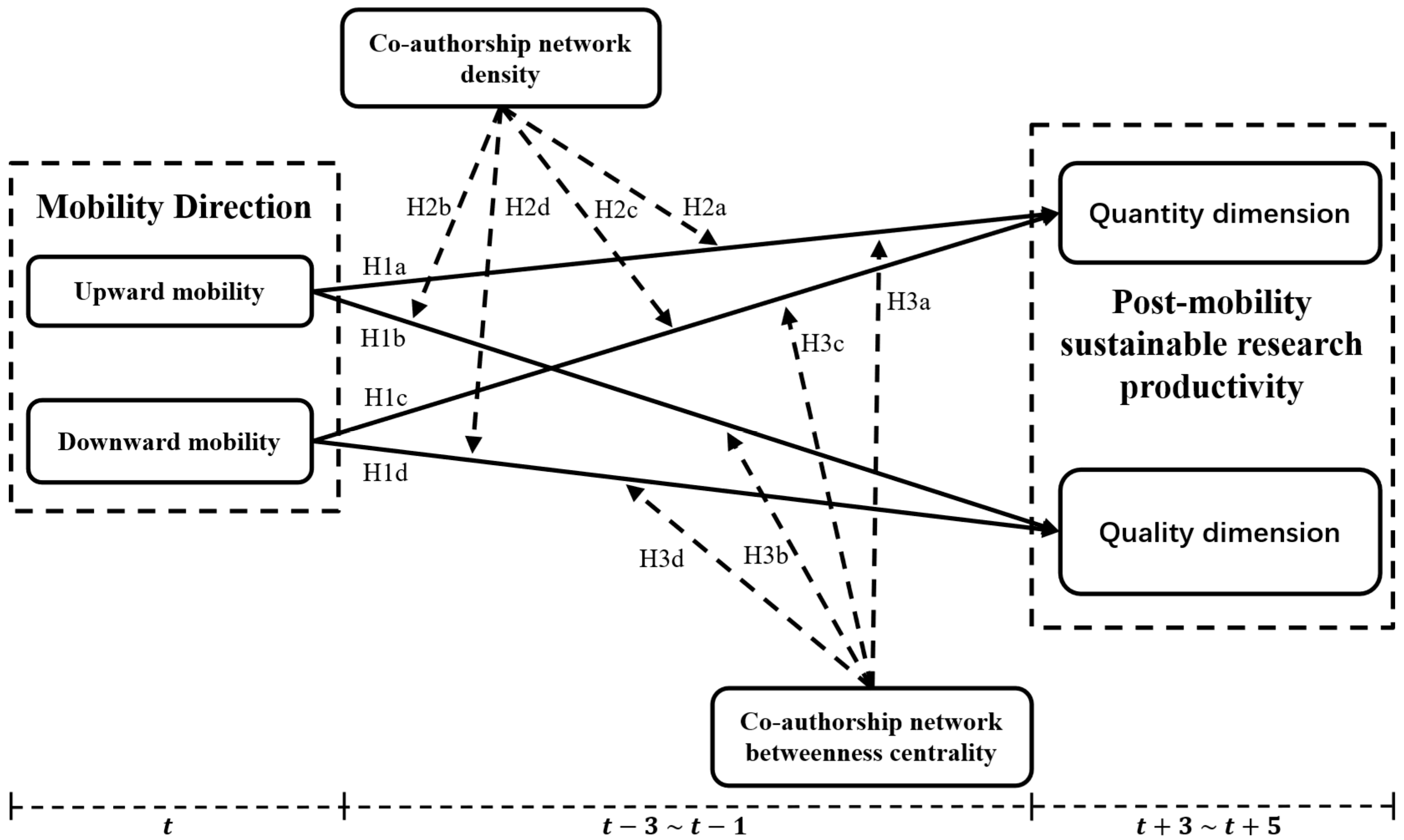
Taken together, the research framework and hypotheses (Network variables are measured pre-mobility, and sustainable research productivity is assessed post-mobility in quantity and quality dimensions) of this study are presented in Figure 1.

3. Method

3.1. Research Setting and Data

To systematically examine how career mobility shapes the sustainable research productivity of high-level scientists, this study constructed an individual-level panel dataset based on scientists included in the preliminary candidate lists for the Chinese Academy of Sciences (CAS) academicians during 2005 to 2019. For each candidate, we compiled detailed curriculum vitae information, including institutional affiliations and appointment periods, and linked these records to publication outputs.
Publication records were retrieved from the Web of Science (WoS) Core Collection. The data collection and cleaning process consisted of the following steps.
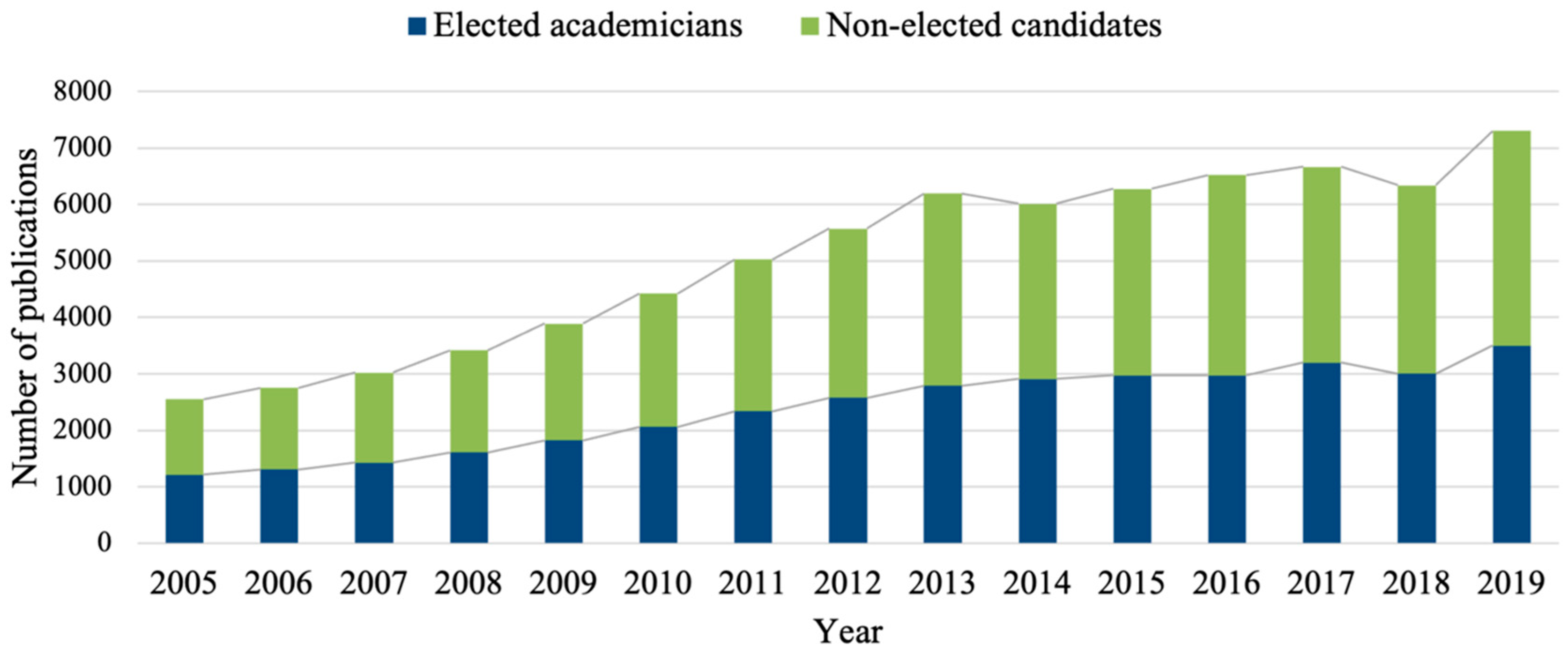
First, we identified the names and institutional affiliations of both elected and non-elected CAS academician candidates based on official announcements published on the CAS academic divisions’ website over the focal period (The list of academician candidates was obtained from the official website: https://yszx.casad.cas.cn/lcmd/ (accessed on 17 July 2021)). Second, we collected and cross-validated the curriculum vitae of each candidate using authoritative sources, such as university websites and personal academic profiles. Institutional names and appointment periods were standardized, and missing fields were supplemented and verified for consistency. Third, we constructed WoS search queries using combinations of “name, institution, and discipline field” to retrieve publication records for each scientist between 2005 and 2019. The retrieved records include author affiliations, publication year, subject category, and citation information. Fourth, we implemented a three-step manual verification procedure involving name disambiguation, institution matching, and research field consistency. We excluded individuals whose names could not be reliably linked to affiliations, whose research fields were inconsistent and unverifiable, or whose CV timelines did not align with publication records. After removing redundant records, the final dataset contains 34,268 publications for 224 elected academicians and 40,068 publications for 307 non-elected candidates (Figure 2).
Finally, based on the cleaned publication data, we extracted co-authorship relations and constructed co-authorship networks by treating authors as nodes and collaborative ties as edges. Following a three-year rolling time-window approach [12], we established a total of 4248 co-authorship networks for subsequent analyses.

3.2. Variables

3.2.1. Dependent Variables

Consistent with our conceptualization of sustainable research productivity, we operationalize the dependent variable using two dimensions, output quantity and output quality [31], observed after each mobility event. To reduce contamination from immediate adjustment frictions, we focus on publications and citations in the third to fifth years after mobility (t + 3 to t + 5) (Considering the typical two-year publication lag, research output indicators are calculated starting from the third year after mobility. The same rule applies throughout the paper), following prior work on post-event research performance [15,34,37]. This operationalization aligns with our conceptual focus on post-transition continuity in research output, rather than merely reporting post-mobility output levels within a predefined observation window.
Quantity dimension of sustainable research productivity ( Q i ). Quantity dimension is measured as the number of publications produced by scientist i during the post-mobility observation window. This measure captures sustained knowledge-production throughput in the post-mobility period, after the initial adjustment phase.
Quality dimension of sustainable research productivity ( P Q i ). Quality dimension is measured as the average citations per publication for scientist i within the same post-mobility window. Specifically,
P Q i = Σ C i j Q i
where C i j denotes the citations received by publication j authored by scientist i within the same window. This measure captures the average impact of post-mobility sustainable research productivity.

3.2.2. Explanatory Variables

Mobility direction is identified by comparing the institutional prestige of the receiving and original institutions within the five-year period surrounding the year of candidacy. Mobility data were coded on an annual basis. To ensure objectivity and credibility in evaluating institutional prestige [7], we relied on two authoritative and widely recognized sources, the 2021 Nature Index institutional rankings (Institutional rankings were sourced from the Nature Index official website: https://www.nature.com/nature-index/institution-outputs/generate/all/global/all (accessed on 17 July 2021)) and the Chinese university rankings published by Shanghai Ranking (University rankings were obtained from the official website of Shanghai Ranking Consultancy: https://www.shanghairanking.cn/rankings/bcur/202111 (accessed on 17 July 2021)). We acknowledge that institutional prestige can evolve over time. Therefore, we use these rankings as transparent and replicable proxies to capture cross-institution differences in research standing, and we interpret mobility direction as a relative prestige shift rather than a precise reconstruction of year-specific hierarchies.
We define two binary indicators for mobility direction [48,49]. Upward mobility is coded as 1 if the receiving institution ranks higher than the original institution in year t, and 0 otherwise. Conversely, downward mobility is coded as 1 if the receiving institution ranks lower than the original institution in year t, and 0 otherwise. Scientists with no inter-institutional move in year t are coded as 0 for both indicators. We treat prestige-based mobility direction as a contextual indicator of potential shifts in research conditions rather than a deterministic measure of resource gain, because resource acquisition may still depend on competition and individual effort within the receiving institution.

3.2.3. Moderating Variables

Co-authorship Network Density (CND). Co-authorship network density captures how densely connected a scientist’s collaboration partners are in the co-authorship network before a mobility event. It is defined as the proportion of observed co-authorship ties to the maximum number of possible ties among all co-authors in the network. A higher value indicates a more cohesive collaboration structure in which collaborators are more interconnected. We compute density using the scientist’s co-authorship network over the three years prior to mobility, it is calculated as [28]:
C N D n i = τ i ψ m
where τ i denotes the observed number of co-authorship ties in scientist i ’s network during time window (t − 3 to t − 1), and ψ m represents the maximum possible number of ties among the same set of co-authors during that period.
Co-authorship Network Betweenness Centrality (CNBC). This variable captures the extent to which a scientist occupies a bridging position that connects otherwise disconnected collaborators in the pre-mobility co-authorship network. We compute betweenness centrality in the scientist’s co-authorship network over the three years prior to mobility (t − 3 to t − 1) as [14]:
C B n i = j < k g j k n i g j k
where g j k is the number of shortest paths between co-authors j and k , and g j k n i is the number of those shortest paths that pass-through scientist i . Because co-authorship networks vary in size, we use the normalized betweenness centrality:
C B n i = 2 C B n i ( g 1 ) ( g 2 )
where g is the total number of scientists in the network. All co-authorship network metrics were calculated using the social network analysis software UCINET (version 6.72).

3.2.4. Control Variables

To isolate the relationship between mobility direction, collaboration network characteristics, and sustainable research productivity, we include seven control variables commonly used in prior research.
Number of collaborators (NC). Collaboration can enhance the visibility and impact of scientific outputs by providing access to diverse knowledge and resources [50]. We control for collaboration intensity using the average number of co-authors per publication for scientist i in year t.
Number of collaborating institutions (NCI). Inter-institutional collaboration can improve research performance by enabling access to complementary expertise and infrastructure [50]. We control for institutional collaboration breadth using the average number of distinct collaborating institutions associated with scientist i in year t, based on publication affiliation information.
Doctoral degree. Educational attainment influences individual research capacity. Doctoral training equips scientists with advanced research skills and academic networks that support scientific productivity [51]. We include a dummy variable coded as 1 if a scientist holds a PhD in year t, and 0 otherwise.
Age. Age is associated with career stage, experience accumulation, and role responsibilities, which can shape research activity and output [7]. We compute age from CV information in year t and include it as a continuous control.
Gender. Gender differences in access to resources, networks, and career opportunities may contribute to variation in research productivity [6]. We include a dummy variable coded as 1 for female scientists and 0 for male scientists.
Prior academic performance (PAP). Prior achievements can generate cumulative advantages in reputation and resource access, which affect future productivity [52]. We measure prior academic performance as the number of WoS-indexed publications produced by scientist i during the five years prior to year t (t − 5 to t − 1).
Academician status. Elite recognition may influence research outcomes through enhanced institutional support, prestige, and resource access [24]. To account for potential systematic differences between elected and non-elected candidates, we include a dummy variable coded as 1 for elected academicians and 0 for non-elected candidates. As indicated above, we summarized the definitions of variables in Table 1.

4. Results

4.1. Descriptive Statistics

Table 2 presents the descriptive statistics and correlations matrix for the main variables in this study. The results show that downward mobility is significantly negatively correlated with both the quantity and quality dimensions of sustainable research productivity ( β = −0.091, p < 0.01; β = −0.172, p < 0.01). In contrast, the correlations between upward mobility and either outcome are not statistically significant.
Furthermore, all variance inflation factor (VIF) values are below the conventional threshold of 10, indicating that multicollinearity is not a concern. Therefore, regression analysis is conducted in the next step to further test the research hypotheses.

4.2. Main Results

To examine how mobility direction relates to sustainable research productivity among high-level scientists, we estimate negative binomial regression models. The quantity dimension is a non-negative count outcome, and the citation-based quality measure is also non-negative and highly right-skewed. Descriptive statistics suggest over-dispersion, making the negative binomial specification appropriate for testing H1, H2, and H3.
In addition, because the models include time-invariant indicators, we report random-effects negative binomial estimates [53,54]. We performed a Hausman test as a diagnostic check when considering fixed- versus random-effects specifications, and the test did not provide evidence that would clearly favor a fixed-effects approach ( p > 0.05 ) . Nevertheless, we acknowledge that the random-effects specification relies on the assumption that time-invariant unobserved individual heterogeneity is not systematically correlated with the explanatory variables. We therefore interpret the results as conditional associations rather than strong causal effects [55,56].
Table 3 presents the main-effect results for H1. In Models 1 and 3, downward mobility shows a significant negative association with both the quantity ( β = −0.855, p < 0.01) and quality ( β = −0.577, p < 0.01) dimensions of sustainable research productivity. In contrast, Models 2 and 4 indicate that upward mobility has no statistically significant effect on either outcome ( β = 0.122, n.s.; β = 0.043, n.s.). Therefore, H1c and H1d are supported, whereas H1a and H1b are not supported.
The regression results for Hypotheses H2 and H3 are reported in Table 4 and Table 5. Table 4 examines the moderating role of co-authorship network density in the relationship between mobility direction and sustainable research productivity. For the quantity dimension, Model 5 includes the main effects of downward mobility and network density, and Model 6 adds the interaction term Downward mobility × Density. Models 7 and 8 repeat the same specification for upward mobility by including Upward mobility and then adding the interaction Upward mobility × Density. For the quality dimension, Models 9–12 follow the same sequence.
Consistent with H2c, the interaction between downward mobility and network density is positive and statistically significant for the quantity dimension (Model 6, β = 0.217, p < 0.01). This indicates that higher network density attenuates the negative effect of downward mobility on post-mobility sustainable research productivity. A similar buffering pattern is observed for the quality dimension. The interaction term Downward mobility × Density is also positive and significant (Model 10, β = 0.037, p < 0.01), supporting H2d. In contrast, the interaction terms involving upward mobility are not statistically significant for either outcome (Model 8, β = −0.924, n.s.; Model 12, β = −0.623, n.s.), providing no support for H2a or H2b.
Table 5 reports the moderating role of co-authorship network betweenness centrality. For the quantity dimension, Model 13 includes the main effects, and Model 14 tests the moderation by adding the interaction term Downward mobility × Betweenness centrality. Models 15 and 16 follow the same procedure for upward mobility by including Upward mobility and then adding the interaction Upward mobility × Betweenness centrality. For the quality dimension, Models 17 to 20 repeat the same model-building sequence.
Hypotheses H3c and H3d propose that betweenness centrality amplifies the negative effect of downward mobility on sustainable research productivity. Consistent with this expectation, the interaction term Downward mobility × Betweenness centrality is negative and statistically significant for the quantity dimension (Model 14, β = −0.381, p < 0.01) and for the quality dimension (Model 18, β = −0.819, p < 0.01). This pattern indicates that when betweenness centrality is higher, the adverse effect of downward mobility becomes stronger, supporting H3c and H3d. In contrast, the interaction terms involving upward mobility are not statistically significant for either outcome (Model 16, β = 0.215, n.s.; Model 20, β = 0.062, n.s.), and therefore H3a and H3b are not supported.
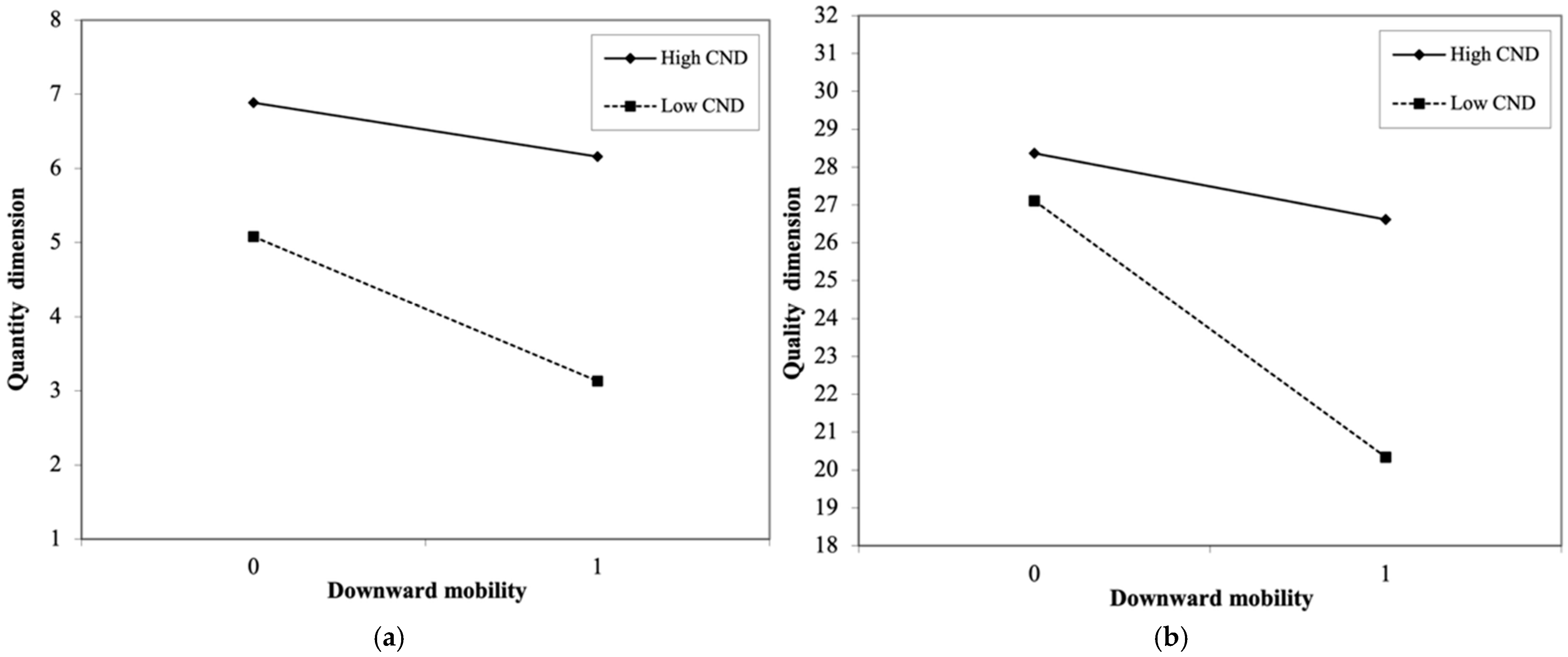
To visualize the moderating effects, we split the moderator into high and low levels using the mean ± one standard deviation and plotted the corresponding interaction patterns [57]. Figure 3a shows that downward mobility is negatively associated with the quantity dimension of sustainable research productivity. When co-authorship network density is higher, the slope becomes less negative, indicating that network density buffers the adverse effect of downward mobility on output quantity ( β = 0.217, p < 0.01). Similarly, Figure 3b shows a negative relationship between downward mobility and the quality dimension. The negative slope is weaker at higher density, suggesting a buffering effect on output quality ( β = 0.037, p < 0.01).
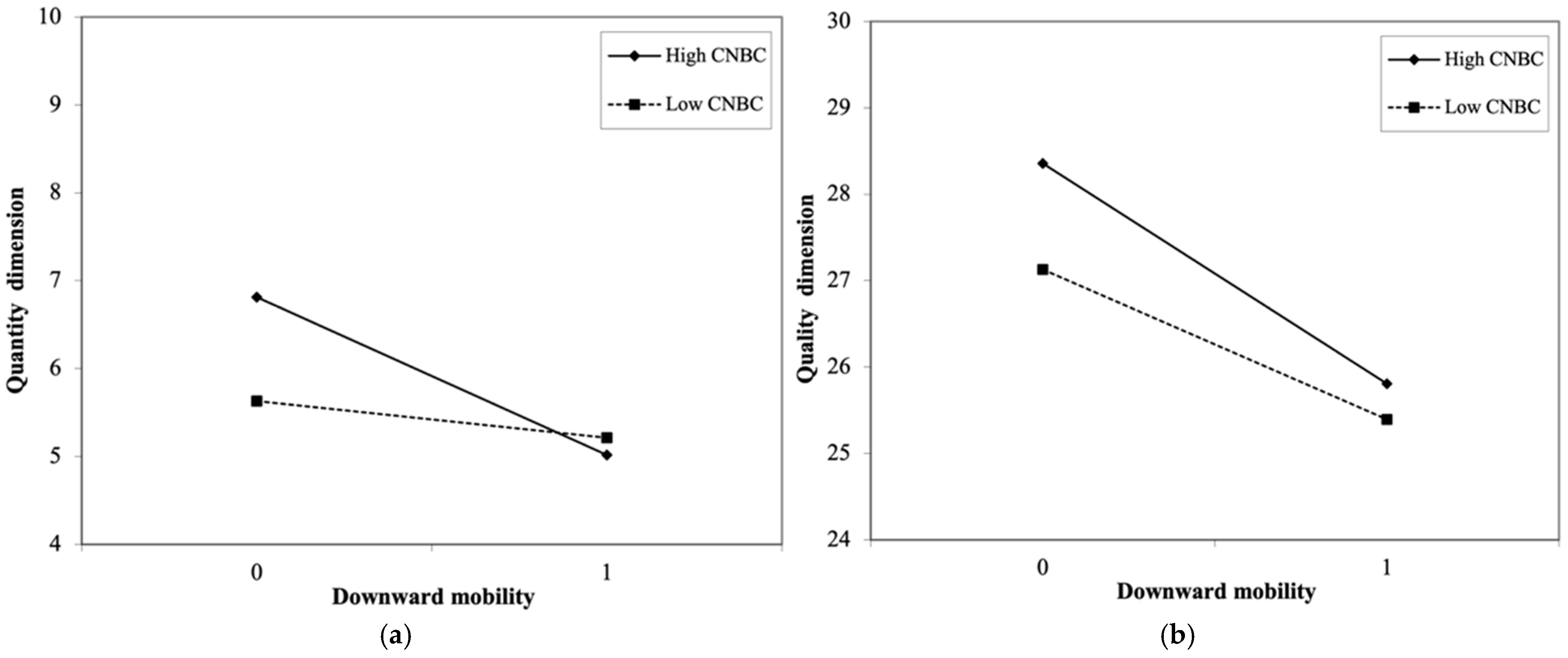
Figure 4a shows that downward mobility is negatively associated with the quantity dimension of sustainable research productivity. When betweenness centrality is low, the slope is negative and statistically significant ( β = −0.812, p < 0.01). When betweenness centrality is high, the negative slope becomes less negative ( β = −0.381, p < 0.01), indicating that higher betweenness centrality amplifies the adverse effect of downward mobility on output quantity. Similarly, Figure 4b illustrates a negative relationship between downward mobility and the quality dimension. The slope is negative and significant when betweenness centrality is low ( β = −0.548, p < 0.01), and it becomes more negative at higher betweenness centrality ( β = −0.819, p < 0.01), suggesting that betweenness centrality intensifies the negative impact of downward mobility on output quality.

4.3. Robustness Check

To further assess the robustness of our findings, we conducted an alternative specification by shifting the post-mobility observation window for the dependent variable from the baseline setting to (t + 2 to t + 4). The results remain consistent with the baseline estimates. Specifically, downward mobility continues to show a significant negative association with both the quantity and quality dimensions of sustainable research productivity ( β = −0.357, p < 0.01; β = −0.272, p < 0.01), whereas upward mobility remains statistically insignificant for both outcomes.
We further examined whether the moderation patterns hold under the alternative window. The interaction effects of co-authorship network density and betweenness centrality remain consistent in both direction and statistical significance, replicating the patterns reported in Table 4 and Table 5. Overall, the alternative time-window estimates are highly aligned with the baseline results, providing additional support for the robustness of our main conclusions.

5. Conclusions

5.1. Main Findings

This study yields three main findings regarding how mobility direction relates to sustainable research productivity among high-level scientists. First, mobility effects are strongly direction dependent. Downward mobility is associated with significant declines in both the quantity and quality dimensions of sustainable research productivity [2,7,17]. A plausible explanation is that lower-prestige institutions often provide less supportive research conditions, including weaker research infrastructure and fewer high-performing collaboration opportunities, which can disrupt ongoing projects and reduce scientists’ capacity to sustain continuous knowledge production. By contrast, upward mobility shows no statistically significant effect on either dimension in the post-mobility period. This non-significant average effect is consistent with our theoretical argument that potential resource advantages may be counterbalanced by integration and coordination costs within the observed post-mobility window. Particularly, rebuilding collaboration routines and aligning ongoing projects with the receiving institution’s administrative and research systems can consume time and attention, and any performance gains may depend on matching conditions between scientists’ needs and host-institution support that do not materialize immediately [3].
Importantly, these results do not imply that mobility is undesirable or should be discouraged. Rather, they indicate that the productivity consequences of mobility are contingent on the receiving environment and the extent to which scientists can access and integrate material resources, instrumentation, and qualified research teams during the transition. Moreover, our evidence is based on publication counts and citation-based indicators within the observed window and therefore does not directly speak to long-run scientific contributions that may unfold beyond this period.
Second, co-authorship network density buffers the negative consequences of downward mobility for both dimensions of sustainable research productivity [32]. Scientists embedded in denser collaboration structures can continue to rely on trust-based ties and established coordination routines, which helps maintain project continuity during institutional transitions. This continuity stabilizes output throughput and mitigates quality losses by sustaining access to qualified collaborators and ongoing research pipelines. It also reduces the need to rebuild coordination from scratch, shortens the effective transition period, and preserves collective problem-solving capacity that supports timely publication and higher-impact outcomes.
Third, co-authorship network betweenness centrality amplifies the adverse consequences of downward mobility for both dimensions of sustainable research productivity. High betweenness centrality indicates a stronger brokerage position that requires greater cross-group coordination [18,24,42,43]. After moving to lower-prestige institutions with weaker support capacity, these coordination and maintenance burdens become more salient and can crowd out time and attention for deep problem solving and methodological refinement. In addition, brokerage-based ties are often more dispersed and harder to sustain when local resources and reputation are weaker, which can delay project execution and increase fragmentation across research efforts.

5.2. Theoretical Contributions and Practical Implications

This study offers two main theoretical contributions. First, it advances the talent mobility literature by reframing post-mobility outcomes as sustainable research productivity, defined by the quantity and quality dimensions of research output in the post-mobility period. Existing research has often emphasized career development, mobility choices, and institutional inflows and outflows, while systematic evidence on whether productivity can be sustained after an institutional transition remains comparatively limited [58]. Our findings underscore that mobility is not direction neutral. Downward mobility is associated with significant declines in both dimensions of sustainable research productivity, whereas upward mobility does not yield statistically significant gains over the same time horizon. This asymmetric pattern suggests that mobility consequences cannot be inferred from institutional prestige alone, because performance trajectories depend on whether scientists can maintain research pipelines and convert ongoing work into cumulative publishable outputs under changing organizational conditions [26]. Importantly, these findings do not rule out potential benefits of mobility; rather, they suggest that mobility outcomes are contingent on institutional context and pre-existing collaboration structures. Accordingly, caution is warranted when extrapolating these results to other national systems.
Second, this study develops a more nuanced understanding of how collaboration networks condition mobility consequences by distinguishing cohesion and brokerage in co-authorship structures. Prior research has recognized the importance of collaboration networks for scientific productivity, yet less is known about how pre-existing network structures interact with institutional disruption and resource shifts caused by mobility [58,59]. Our results clarify this contingency. Network density, a cohesion-oriented feature, buffers the negative effect of downward mobility on both the quantity and quality dimensions, highlighting how trust-based coordination and established routines can stabilize production during adverse transitions [34]. In contrast, betweenness centrality, a brokerage-oriented feature, amplifies the negative effect of downward mobility, suggesting that the coordination burden and maintenance costs embedded in brokerage positions become more difficult to sustain when the receiving environment offers weaker support capacity. This pattern reinforces a double-edged view of social capital and shows that the same collaboration structure can be beneficial or detrimental depending on the mobility context.
These findings yield practical implications for scientists, host institutions, and policymakers who aim to sustain knowledge production through mobility. For scientists facing downward mobility, preserving project continuity and stabilizing key collaborations should be prioritized. Maintaining dense and reliable ties can reduce coordination frictions, protect access to complementary expertise, and sustain the throughput of ongoing research pipelines, thereby mitigating losses in both output quantity and impact. In practice, prioritizing a small set of core collaborations may be more effective than attempting to expand collaboration breadth during the transition [32].
For host institutions, mobility effectiveness can be improved by designing transition support that targets coordination and integration challenges rather than only providing general resources. Beyond infrastructure and space, targeted instruments such as seed funding, bridging grants, and short-term research assistance can help incoming scientists maintain critical collaborations and keep projects on schedule [60]. In addition, differentiated support by network position is warranted, particularly for moves into weaker environments, because scientists with higher betweenness centrality face heavier cross-group coordination demands and may benefit more from targeted project-management support (e.g., coordination facilitation, timeline and deliverable tracking), administrative assistance, and institutional platforms that facilitate collaboration maintenance and knowledge transfer.
At the policy level, improving mobility effectiveness requires lowering transition costs and strengthening transition support and matching mechanisms, especially for moves into weaker institutional environments where the downside risk is most salient. Consistent with our findings that downward mobility entails systematic productivity risks while upward mobility does not automatically yield gains within the observed window, policy tools should aim to stabilize collaboration and resource integration during mobility episodes [35,61]. This can include improving placement and matching procedures, providing mobility-linked research support, and designing evaluation mechanisms that recognize transition frictions to avoid penalizing scientists for temporary adjustments. These insights speak to the sustainability of higher education systems by showing how transition support and collaboration governance can help institutions sustain research productivity during organizational transformation.

5.3. Limitations and Future Research

This study has several limitations that also point to opportunities for future research. First, our sample focuses on CAS academician candidates from 2005 to 2019, a highly selected elite group at relatively mature career stages with distinctive career conditions. Accordingly, the findings should be generalized cautiously beyond this population and national context. Future studies could extend this design to other talent groups and earlier career phases, and test whether mobility direction and network contingencies operate similarly across broader cohorts and institutional systems.
Second, institutional prestige is proxied by institutional-level rankings, which may not fully capture disciplinary heterogeneity in research environments. Future research could employ more fine-grained field or discipline-level indicators, such as discipline-specific excellence programs to refine the measurement of prestige and better align mobility direction with domain-specific resource conditions.
Third, while our models account for observed covariates and use a panel structure, unobserved time-invariant individual characteristics may still correlate with mobility or network measures. Therefore, the results should be interpreted as evidence of robust associations rather than definitive causal effects.
Fourth, the quality dimension of sustainable research productivity is measured using citations per publication within the post-mobility window. Although citations are widely used, they capture only one aspect of research impact and may be sensitive to field- and time-related citation dynamics. Future work could triangulate research quality using complementary indicators, such as field-normalized citation impact, journal-based measures, or recognition-based outcomes, to strengthen inference about the quality dimension of post-mobility sustainable research productivity.

Author Contributions

Conceptualization, C.T.; Software, D.W.; Validation, A.W.; Formal analysis, D.W.; Data curation, D.W. and A.W.; Writing—original draft, D.W. and A.W.; Writing—review and editing, C.T. and D.W.; Visualization, A.W.; Supervision, C.T.; Project administration, C.T.; Funding acquisition, C.T. All authors have read and agreed to the published version of the manuscript.

Funding

This work was supported by the National Natural Science Foundation of China (Grant No: 71974178, 71932009), and the Fundamental Research Funds for the Central Universities (Grant No: E2E40806X2).

Institutional Review Board Statement

Not applicable. This article does not contain any studies with human participants or animals performed by any of the authors.

Informed Consent Statement

Not applicable.

Data Availability Statement

Publication data supporting the findings of this study were obtained from the Web of Science Core Collection, which is publicly accessible with subscription. Curriculum vitae information of Chinese Academy of Sciences (CAS) candidates was collected from publicly available institutional websites and official announcements. Due to privacy considerations, the processed individual-level dataset is not publicly available, but it may be obtained from the corresponding author upon reasonable request.

Acknowledgments

The authors thank the editor and anonymous reviewers for their valuable comments and suggestions.

Conflicts of Interest

The authors declare no conflicts of interest.

References

  1. Ejermo, O.; Fassio, C.; Källström, J. Does mobility across universities raise scientific productivity? Oxf. Bull. Econ. Stat. 2020, 82, 603–624. [Google Scholar] [CrossRef]
  2. Netz, N.; Hampel, S.; Aman, V. What effects does international mobility have on scientists’ careers? A systematic review. Res. Eval. 2020, 29, 327–351. [Google Scholar] [CrossRef]
  3. Azoulay, P.; Ganguli, I.; Zivin, J.G. The mobility of elite life scientists: Professional and personal determinants. Res. Policy 2017, 46, 573–590. [Google Scholar] [CrossRef]
  4. Verginer, L.; Riccaboni, M. Cities and countries in the global scientist mobility network. Appl. Netw. Sci. 2020, 5, 38. [Google Scholar] [CrossRef]
  5. Verginer, L.; Riccaboni, M. Talent goes to global cities: The world network of scientists’ mobility. Res. Policy 2021, 50, 104127. [Google Scholar] [CrossRef] [PubMed]
  6. Zhang, M.; Zhang, G.; Liu, Y.; Zhai, X.; Han, X. Scientists’ genders and international academic collaboration: An empirical study of Chinese universities and research institutes. J. Informetr. 2020, 14, 101068. [Google Scholar] [CrossRef]
  7. Abramo, G.; D’Angelo, C.A.; Di Costa, F. The effect of academic mobility on research performance: The case of Italy. Quant. Sci. Stud. 2022, 3, 345–362. [Google Scholar] [CrossRef]
  8. Bäker, A. Non-tenured post-doctoral researchers’ job mobility and research output: An analysis of the role of research discipline, department size, and coauthors. Res. Policy 2015, 44, 634–650. [Google Scholar] [CrossRef]
  9. Finocchi, I.; Ribichini, A.; Schaerf, M. An analysis of international mobility and research productivity in computer science. Scientometrics 2023, 128, 6147–6175. [Google Scholar] [CrossRef]
  10. Bao, C.; Zhao, X.; Li, Y.; Li, Z. How to maintain sustainable research productivity: From talents mobility perspective. Sustainability 2023, 15, 11506. [Google Scholar] [CrossRef]
  11. Momeni, F.; Karimi, F.; Mayr, P.; Peters, I.; Dietze, S. The many facets of academic mobility and its impact on scholars’ career. J. Informetr. 2022, 16, 101280. [Google Scholar] [CrossRef]
  12. Newman, M.E.J. The structure of scientific collaboration networks. Proc. Natl. Acad. Sci. USA 2001, 98, 404–409. [Google Scholar] [CrossRef]
  13. Lou, W.; Gao, M. Factorize international mobility on academic performance: A time-varying DID method examining over 7million Chinese scholars. J. Informetr. 2025, 19, 101698. [Google Scholar] [CrossRef]
  14. Luo, J.D. Social Network Analysis; Social Sciences Academic Press: Beijing, China, 2020. [Google Scholar]
  15. McFadyen, M.A.; Semadeni, M.; Cannella, A.A., Jr. Value of strong ties to disconnected others: Examining knowledge creation in biomedicine. Organ. Sci. 2019, 20, 552–564. [Google Scholar] [CrossRef]
  16. De Filippo, D.; Casado, E.S.; Gómez, I. Quantitative and qualitative approaches to the study of mobility and scientific performance: A case study of a Spanish university. Res. Eval. 2019, 18, 191–200. [Google Scholar] [CrossRef]
  17. Fernández-Zubieta, A.; Geuna, A.; Lawson, C. Productivity pay-offs from academic mobility: Should I stay or should I go? Ind. Corp. Change 2016, 25, 91–114. [Google Scholar] [CrossRef]
  18. Wang, J.; Veugelers, R.; Stephan, P. Bias against novelty in science: A cautionary tale for users of bibliometric indicators. Res. Policy 2017, 46, 1416–1436. [Google Scholar] [CrossRef]
  19. Kwiek, M.; Roszka, W. Are scientists changing their research productivity classes when they move up the academic ladder? Innov. High. Educ. 2025, 50, 329–367. [Google Scholar] [CrossRef]
  20. Kwiek, M.; Szymula, L. Quantifying lifetime productivity changes: A longitudinal study of 320,000 late-career scientists. Quant. Sci. Stud. 2025, 6, 1002–1038. [Google Scholar] [CrossRef]
  21. Hottenrott, H.; Lawson, C. Flying the nest: How the home department shapes researchers’ career paths. Stud. High. Educ. 2017, 42, 1091–1109. [Google Scholar] [CrossRef]
  22. Laudel, G.; Gläser, J. Beyond breakthrough research: Epistemic properties of research and their consequences for research funding. Res. Policy 2014, 43, 1204–1216. [Google Scholar] [CrossRef]
  23. Lei, Y. Strategies for Building a Scientific Research Talent Team Based on Regression Models. J. Hum. Resour. Dev. 2023, 5, 44–51. [Google Scholar] [CrossRef]
  24. Yang, X.; Gu, X.; Wang, Y.; Hu, G.; Tang, L. The Matthew effect in China’s science: Evidence from academicians of Chinese Academy of Sciences. Scientometrics 2015, 102, 2089–2105. [Google Scholar] [CrossRef]
  25. Liu, M.; Hu, X. Movers’ advantages: The effect of mobility on scientists’ productivity and collaboration. J. Informetr. 2022, 16, 101311. [Google Scholar] [CrossRef]
  26. Bozeman, B.; Corley, E. Scientists’ collaboration strategies: Implications for scientific and technical human capital. Res. Policy 2004, 33, 599–616. [Google Scholar] [CrossRef]
  27. Zhang, J.; Su, X.; Wang, Y. A Qualitative Study on the Relationship between Faculty Mobility and Scientific Impact: Toward the Sustainable Development of Higher Education. Sustainability 2024, 16, 7739. [Google Scholar] [CrossRef]
  28. Pauli, J.; Basso, K.; Gobi, R.L.; Bilhar, A. The effect of co-authorship network density on the performance of postgraduate programs. Braz. Bus. Rev. 2019, 16, 576–588. [Google Scholar] [CrossRef]
  29. Gonzalez-Brambila, C.N.; Veloso, F.M.; Krackhardt, D. The impact of network embeddedness on research output. Res. Policy 2013, 42, 1555–1567. [Google Scholar] [CrossRef]
  30. Li, F.; Miao, Y.; Yang, C. How do Alumni Faculty Behave in Research Collaboration? An Analysis of Chang Jiang Scholars in China. Res. Policy 2015, 44, 438–450. [Google Scholar] [CrossRef]
  31. Li, L.; Tang, C. How does inter-organizational cooperation impact organizations’ scientific knowledge generation? Evidence from the biomass energy field. Sustainability 2020, 13, 191. [Google Scholar] [CrossRef]
  32. Li, E.Y.; Liao, C.H.; Yen, H.R. Co-authorship networks and research impact: A social capital perspective. Res. Policy 2013, 42, 1515–1530. [Google Scholar] [CrossRef]
  33. Tang, C.Y.; Yi, L.N. A Study on the Interactive Effect of Knowledge Bases and Cooperation Network on Firm Knowledge Innovation. Sci. Sci. Manag. S. T. 2017, 38, 85–95. [Google Scholar]
  34. Reagans, R.; McEvily, B. Network structure and knowledge transfer: The effects of cohesion and range. Adm. Sci. Q. 2003, 48, 240–267. [Google Scholar] [CrossRef]
  35. Jonkers, K.; Tijssen, R. Chinese researchers returning home: Impacts of international mobility on research collaboration and scientific productivity. Scientometrics 2008, 77, 309–333. [Google Scholar] [CrossRef]
  36. Fleming, L.; Mingo, S.; Chen, D. Collaborative brokerage, generative creativity, and creative success. Adm. Sci. Q. 2007, 52, 443–475. [Google Scholar] [CrossRef]
  37. Leahey, E.; Beckman, C.M.; Stanko, T.L. Prominent but Less Productive: The Impact of Interdisciplinarity on Scientists’ Research. Adm. Sci. Q. 2017, 62, 105–139. [Google Scholar] [CrossRef]
  38. Hu, X.; Li, O.Z.; Pei, S. Of stars and galaxies–Co-authorship network and research. China J. Account. Res. 2020, 13, 1–30. [Google Scholar] [CrossRef]
  39. Abbasi, A.; Altmann, J.; Hossain, L. Identifying the effects of co-authorship networks on the performance of scholars: A correlation and regression analysis of performance measures and social network analysis measures. J. Informetr. 2011, 5, 594–607. [Google Scholar] [CrossRef]
  40. Abbasi, A.; Hossain, L.; Leydesdorff, L. Betweenness centrality as a driver of preferential attachment in the evolution of research collaboration networks. J. Informetr. 2012, 6, 403–412. [Google Scholar] [CrossRef]
  41. Kong, X.; Mao, M.; Jiang, H.; Yu, S.; Wan, L. How does collaboration affect researchers’ positions in co-authorship networks? J. Informetr. 2019, 13, 887–900. [Google Scholar] [CrossRef]
  42. Xu, Q.; Chang, V. Analysis of co-authorship network and the correlation between academic performance and social network measures. In Proceedings of the 5th International Conference on Internet of Things, Big Data and Security, IoTBDS 2020, Online, 7–9 May 2020; pp. 359–366. [Google Scholar]
  43. Zaman, S.; Satoglu, E.B.; Velez-Calle, A.; Sanchez-Henriquez, F.; Salmon, J.R. How much is too much? Inter-city brokerage in ICT industry innovation networks. Econ. Innov. New Technol. 2024, 34, 1040–1063. [Google Scholar] [CrossRef]
  44. Rahimi, S.; Soheili, F.; Nia, Y.A. Social Influence, Research Productivity and Performance in the Social Network Co-authorship: A Structural Equation Modelling. J. Scientometr. Res. 2020, 9, 326–334. [Google Scholar] [CrossRef]
  45. Seibert, S.E.; Kacmar, K.M.; Kraimer, M.L.; Downes, P.E.; Noble, D. The Role of Research Strategies and Professional Networks in Management Scholars’ Productivity. J. Manag. 2017, 43, 1103–1130. [Google Scholar] [CrossRef]
  46. Tang, C.; Ye, L.; Naumann, S.; Lu, X. Outstanding and ordinary scientists’ co-authorship networks in the early career phase. Malays. J. Libr. Inf. Sci. 2021, 26, 39–61. [Google Scholar] [CrossRef]
  47. Chen, Q.; Sun, T.; Wang, T. Network centrality, support organizations, exploratory innovation: Empirical analysis of China’s integrated circuit industry. Heliyon 2023, 9, e17709. [Google Scholar] [CrossRef]
  48. Gibbs, M.; Mengel, F.; Siemroth, C. Innovator Networks Within the Firm and the Quality of Innovation; Institute of Labor Economics (IZA): Bonn, Germany, 2025. [Google Scholar]
  49. González-Sauri, M.; Rossello, G. The role of early-career university prestige stratification on the future academic performance of scholars. Res. High. Educ. 2023, 64, 58–94. [Google Scholar] [CrossRef]
  50. Holding, B.C.; Acciai, C.; Schneider, J.W.; Nielsen, M.W. Quantifying the mover’s advantage: Transatlantic migration, employment prestige, and scientific performance. High. Educ. 2024, 87, 1749–1767. [Google Scholar] [CrossRef]
  51. Gao, Z.; Chen, M.J.; Wang, Y.L. Research on the Characteristics of Scientific Research Cooperation of Outstanding Scientists. J. Intell. 2022, 41, 176–180+137. [Google Scholar]
  52. Carayol, N.; Matt, M. Individual and collective determinants of academic scientists’ productivity. Inf. Econ. Policy 2006, 18, 55–72. [Google Scholar] [CrossRef]
  53. Teodoridis, F.; Bikard, M.; Vakili, K. Creativity at the knowledge frontier: The impact of specialization in fast-and slow-paced domains. Adm. Sci. Q. 2019, 64, 894–927. [Google Scholar] [CrossRef]
  54. Guan, J.; Liu, N. Exploitative and exploratory innovations in knowledge network and collaboration network: A patent analysis in the technological field of nano-energy. Res. Policy 2016, 45, 97–112. [Google Scholar] [CrossRef]
  55. Wooldridge, J.M. Econometric Analysis of Cross Section and Panel Data; MIT Press: Cambridge, MA, USA, 2010. [Google Scholar]
  56. Cameron, A.C.; Trivedi, P.K. Regression Analysis of Count Data; Cambridge University Press: Cambridge, UK, 2013. [Google Scholar]
  57. Keele, L.; Stevenson, R.T.; Elwert, F. The causal interpretation of estimated associations in regression models. Political Sci. Res. Methods 2020, 8, 1–13. [Google Scholar] [CrossRef]
  58. Hoisl, K. Tracing mobile inventors—The causality between inventor mobility and inventor productivity. Res. Policy 2007, 36, 619–636. [Google Scholar] [CrossRef]
  59. Cheng, S.; Park, B. Flows and boundaries: A network approach to studying occupational mobility in the labor market. Am. J. Sociol. 2020, 126, 577–631. [Google Scholar] [CrossRef]
  60. Toubøl, J.; Larsen, A.G. Mapping the social class structure: From occupational mobility to social class categories using network analysis. Sociology 2017, 51, 1257–1276. [Google Scholar] [CrossRef]
  61. Stephan, P. How Economics Shapes Science; Harvard University Press: Cambridge, MA, USA, 2015. [Google Scholar]
Figure 1. Research framework and hypotheses.
Sustainability 18 02411 g001
Figure 2. The number of publications by elected academicians and non-elected candidates.
Sustainability 18 02411 g002
Figure 3. The moderating effect of co-authorship network density. (a) Interaction effect on the quantity dimension, (b) Interaction effect on the quality dimension.
Sustainability 18 02411 g003
Figure 4. The moderating effect of co-authorship network betweenness centrality. (a) Interaction effect on the quantity dimension, (b) Interaction effect on the quality dimension.
Sustainability 18 02411 g004
Table 1. Definitions of variables.
Variable NameVariable DescriptionSources
Dependent variables:
Quantity dimension ( Q i )The number of publications produced by scientist i in years t + 3 to t + 5 after a mobility event.[15,34]
Quality dimension ( P Q i )The average citations per publication for scientist i in years t + 3 to t + 5 after a mobility event.[53,54]
Explanatory variables:
Upward mobilityA binary indicator of moving to a higher-prestige institution in year t.[48,49]
Downward mobilityA binary indicator of moving to a lower-prestige institution in year t.[48,49]
Moderating variables:
Co-authorship Network Density (CND)The proportion of observed co-authorship ties to all possible ties in scientist i’s co-authorship network (t − 3 to t − 1).[28]
Co-authorship Network Betweenness Centrality (CNBC)The normalized proportion of shortest paths that pass-through scientist i in the co-authorship network (t − 3 to t − 1).[14]
Control variables:
Number of collaborators (NC)The average number of co-authors per publication for scientist i in year t.[10,50]
Number of collaborating institutions (NCI)The average number of distinct collaborating institutions per publication for scientist i   in   year   t .[50]
Doctoral degreeA dummy indicator equal to 1 if scientist i holds a PhD in year t, and 0 otherwise.[51]
AgeScientist i’s age in year t.[7]
GenderA dummy indicator equal to 1 for female and 0 for male.[6]
Prior academic performance (PAP)The number of WoS-indexed publications produced by scientist i in t − 5 to t − 1.[52]
Academician statusA dummy indicator equal to 1 for elected academicians and 0 for non-elected candidates.[24]
Table 2. Summary statistics of the variables (N = 5310).
VariablesMeanStd.DevMinMax12345678910111213
1. Q i (t + 3 to t + 5)13.94913.9560341
2. P Q i (t + 3 to t + 5)29.35175.03918590.572 ***1
3. Downward mobility (t)0.1330.2501−0.091 ***−0.172 ***1
4. Upward mobility (t)0.1060.307010.0110.019−0.028 **1
5. CND (t − 3 to t − 1)0.1050.1360.0770.452−0.362 ***−0.264 ***−0.086 ***0.021
6. CNBC (t − 3 to t − 1)0.1450.0740.0260.2550.152 ***0.016 ***0.021 **−0.009−0.289 ***1
7. Gender0.6470.224010.034 **−0.0070.026 *0.0160.044 ***−0.0041
8. NC87.482100.397401040.646 ***0.538 ***0.115 ***−0.023−0.442 ***−0.163 ***0.0131
9. NCI11.58913.7383210.188 ***0.216 ***0.064 ***−0.018−0.247 ***0.323 ***−0.0050.318 ***1
10. Age56.4879.0054773−0.116 ***−0.080 ***−0.041 ***−0.044 ***0.188 ***0.030 **−0.098 ***−0.119 ***−0.049 ***1
11. PAP13.69816.8553560.059 ***0.520 ***0.190 ***0.003−0.198 ***−0.02−0.064 ***0.220 ***0.199 ***−0.141 ***1
12. Doctoral degree0.7660.423010.178 ***0.219 ***0.138 ***0.014−0.252 ***−0.041 ***0.029 **0.178 ***0.100 ***−0.537 ***0.225 ***1
13. Academician status0.2090.407010.119 ***0.225 ***0.511 ***−0.053 ***−0.132 ***0.006−0.0030.130 ***0.104 ***0.057 ***0.178 ***0.070 ***1
Note: Std.Dev represents the standard deviation. *, **, and *** indicate significance at the 10%, 5%, and 1% levels, respectively. t denotes the value in the year of mobility.
Table 3. Baseline Regression Results.
VariablesModel 1Model 2Model 3Model 4
Q i (t + 3 to t + 5) Q i (t + 3 to t + 5) P Q i (t + 3 to t + 5) P Q i (t + 3 to t + 5)
Downward mobility (t)−0.855 *** −0.577 ***
(0.096) (0.097)
Upward mobility (t) 0.122 0.043
(0.228) (0.234)
Gender−0.032−0.033−0.576 ***−0.605 ***
(0.109)(0.109)(0.115)(0.115)
NC0.003 ***0.003 ***0.031 ***0.006 ***
(0.001)(0.001)(0.001)(0.001)
NCI−0.005 ***−0.005 ***−0.001−0.001
(0.001)(0.001)(0.001)(0.001)
Age−0.049 ***−0.049 ***−0.018 ***−0.018 ***
(0.003)(0.003)(0.003)(0.003)
PAP−0.013 ***−0.013 ***0.027 ***0.026 ***
(0.002)(0.002)(0.002)(0.002)
Doctoral degree−0.053−0.0560.145 **0.112
(0.066)(0.066)(0.072)(0.072)
Constant6.303 ***6.305 ***4.218 ***4.284 ***
(0.257)(0.257)(0.265)(0.265)
Academician statusYesYesYesYes
Year fixed-effectYesYesYesYes
chi2823.689823.562511.277481.126
Pseudo R Square0.02030.02030.01280.0120
Log pseudolikelihood−19,897.023−19,897.087−19,762.957−19,778.032
Observations5310.0005310.0005310.0005310.000
Note: *, **, and *** indicate significance at the 10%, 5%, and 1% levels, respectively.
Table 4. Regression Results for Mobility Direction, Co-Authorship Network Density, and Research Output.
VariablesModel 5Model 6Model 7Model 8Model 9Model 10Model 11Model 12
Q i (t + 3 to t + 5) Q i (t + 3 to t + 5) Q i (t + 3 to t + 5) Q i (t + 3 to t + 5) P Q i (t + 3 to t + 5) P Q i (t + 3 to t + 5) P Q i (t + 3 to t + 5) P Q i (t + 3 to t + 5)
Downward mobility (t)−0.802 ***−0.730 *** −0.567 ***−0.638 ***
(0.105)(0.130) (0.108)(0.133)
Upward mobility (t) 0.1930.090 0.0620.006
(0.243)(0.317) (0.252)(0.341)
CND (t − 3 to t − 1)0.834 ***0.810 ***−0.847 ***−0.855 ***0.212 ***0.251 ***−0.229 ***−0.235 ***
(0.223)(0.225)(0.223)(0.224)(0.072)(0.064)(0.012)(0.096)
Downward mobility (t) *
CND (t − 3 to t − 1)
0.217 *** 0.037 ***
(0.083) (0.001)
Upward mobility (t) *
CND (t − 3 to t − 1)
−0.924
(0.949)
−0.623
(2.189)
Gender0.0060.004−0.013−0.013−0.622 ***−0.619 ***−0.652 ***−0.652 ***
(0.120)(0.120)(0.121)(0.121)(0.127)(0.127)(0.127)(0.127)
NC0.002 ***0.002 ***0.002 ***0.002 ***0.011 **0.041 **0.001 **0.101 **
(0.000)(0.000)(0.000)(0.000)(0.000)(0.000)(0.000)(0.000)
NCI−0.006 ***−0.006 ***−0.006 ***−0.006 ***−0.010 ***−0.100 ***−0.031 ***−0.003 ***
(0.001)(0.001)(0.001)(0.001)(0.001)(0.001)(0.001)(0.001)
Age−0.055 ***−0.055 ***−0.056 ***−0.056 ***−0.018 ***−0.018 ***−0.018 ***−0.018 ***
(0.004)(0.004)(0.004)(0.004)(0.004)(0.004)(0.004)(0.004)
PAP−0.016 ***−0.016 ***−0.017 ***−0.017 ***0.023 ***0.023 ***0.021 ***0.021 ***
(0.002)(0.002)(0.002)(0.002)(0.002)(0.002)(0.002)(0.002)
Doctoral degree−0.159 **−0.156 **−0.195 ***−0.194 ***0.170 **0.167 **0.145 *0.144 *
(0.075)(0.075)(0.075)(0.075)(0.078)(0.078)(0.078)(0.078)
Constant6.883 ***6.887 ***6.934 ***6.935 ***28.367 ***28.365 ***28.409 ***28.412 ***
(0.285)(0.285)(0.285)(0.285)(0.288)(0.288)(0.287)(0.287)
Academician statusYesYesYesYesYesYesYesYes
Year fixed-effectYesYesYesYesYesYesYesYes
chi2619.127620.016572.330572.565378.760379.605355.179355.262
Pseudo R Square0.01760.01760.01630.01630.01100.01100.01030.0103
Log pseudolikelihood−17,296.889−17,296.444−17,320.287−17,320.17−17,091.916−17,091.494−17,103.707−17,103.665
Observations5310.0005310.0005310.0005310.0005310.0005310.0005310.0005310.000
Note: *, **, and *** indicate significance at the 10%, 5%, and 1% levels, respectively.
Table 5. Regression Results for Mobility Direction, Co-Authorship Network Betweenness Centrality, and Research Output.
VariablesModel 13Model 14Model 15Model 16Model 17Model 18Model 19Model 20
Q i (t + 3 to t + 5) Q i (t + 3 to t + 5) Q i (t + 3 to t + 5) Q i (t + 3 to t + 5) P Q i (t + 3 to t + 5) P Q i (t + 3 to t + 5) P Q i (t + 3 to t + 5) P Q i (t + 3 to t + 5)
Downward mobility (t)−0.812 ***−0.796 *** −0.548 ***−0.553 ***
(0.105)(0.120) (0.107)(0.136)
Upward mobility (t) 0.1680.119 0.0540.156
(0.242)(0.303) (0.250)(0.401)
CNBC (t − 3 to t − 1)−0.327 ***−0.183 ***0.486 ***0.499 ***−0.222 ***−0.229 ***0.391 ***0.185 ***
(0.126)(0.071)(0.072)(0.047)(0.520)(0.056)(0.051)(0.001)
Downward mobility (t) *
CNBC (t − 3 to t − 1)
−0.381 *** −0.819 ***
(0.027) (0.074)
Upward mobility (t) *
CNBC (t − 3 to t − 1)
0.215 0.062
(4.744) (8.116)
Gender−0.203−0.203−0.088−0.088−0.611 ***−0.610 ***−0.640 ***−0.639 ***
(0.158)(0.158)(0.120)(0.120)(0.124)(0.124)(0.125)(0.125)
NC0.004 ***0.004 ***0.003 ***0.003 ***0.0010.0010.0010.001
(0.001)(0.001)(0.001)(0.001)(0.001)(0.002)(0.001)(0.001)
NCI0.005 *0.005 *−0.004 **−0.004 **−0.010 *−0.010 *−0.010 *0.020 *
(0.003)(0.003)(0.002)(0.002)(0.001)(0.001)(0.001)(0.001)
Age−0.052 ***−0.052 ***−0.058 ***−0.058 ***−0.019 ***−0.019 ***−0.019 ***−0.019 ***
(0.005)(0.005)(0.004)(0.004)(0.004)(0.004)(0.004)(0.004)
PAP0.015 ***0.015 ***−0.016 ***−0.016 ***0.023 ***0.023 ***0.022 ***0.022 ***
(0.003)(0.003)(0.002)(0.002)(0.002)(0.002)(0.002)(0.002)
Doctoral degree0.211 **0.210 **−0.129 *−0.130 *0.143 *0.143 *0.1160.115
(0.097)(0.097)(0.072)(0.072)(0.077)(0.077)(0.077)(0.077)
Constant6.814 ***6.812 ***6.875 ***6.876 ***28.357 ***28.357 ***28.406 ***28.413 ***
(0.281)(0.281)(0.281)(0.281)(0.285)(0.285)(0.285)(0.285)
Academician statusYesYesYesYesYesYesYesYes
Year fixed-effectYesYesYesYesYesYesYesYes
chi2620.935621.012572.363572.434391.404391.407368.790369.246
Pseudo R Square0.01720.01730.01590.01590.01110.01110.01040.0104
Log pseudolikelihood−17,688.742−17,688.703−17,713.028−17,712.992−17,500.322−17,500.321−17,511.629−17,511.401
Observations5310.0005310.0005310.0005310.0005310.0005310.0005310.0005310.000
Note: *, **, and *** indicate significance at the 10%, 5%, and 1% levels, respectively.
Disclaimer/Publisher’s Note: The statements, opinions and data contained in all publications are solely those of the individual author(s) and contributor(s) and not of MDPI and/or the editor(s). MDPI and/or the editor(s) disclaim responsibility for any injury to people or property resulting from any ideas, methods, instructions or products referred to in the content.