Article

“We Leave at Least a Little Seed”: The School’s Role in Developing Students’ Agency Toward Climate Change


Psychology Research Center, School of Psychology, University of Minho, 4710-057 Braga, Portugal
*
Author to whom correspondence should be addressed.
These authors contributed equally to this work.
Sustainability 2026, 18(5), 2350; https://doi.org/10.3390/su18052350
Submission received: 6 January 2026 / Revised: 16 February 2026 / Accepted: 21 February 2026 / Published: 28 February 2026

Abstract

As in schools worldwide, climate change (CC) is addressed in curricula and environmental programs in Portugal. Grounded in Bandura’s human agency theory, effective CC mitigation requires the capacity to intentionally initiate, sustain, and reflect on behaviors to reduce greenhouse gas emissions, i.e., climate agency. This study aimed to map school’s role (environmental initiatives and CC teaching) in developing students’ climate agency and its determinants. Participants included 42 school representatives and 24 teachers from various subjects. Data sets, collected through online surveys, semi-structured interviews, and a focus group, were analyzed using content analysis. School representatives emphasized school initiatives requiring significant levels of student engagement (e.g., cleanups) but with limited participation. Most teachers reported employing transmissive teaching approaches, complemented by audio–visual resources and classroom discussions. Interviewees identified facilitators (e.g., family pro-environmental behaviors and municipal support), but mostly obstacles (e.g., limited instruction time and surface approach to learning) that contributed to a perceived minimal impact of CC education on their students. Overall, the data suggest that current environmental programs and CC teaching are not consistently developing students’ climate agency. The findings highlight the need to rethink formal and informal approaches to promote high-quality CC education and student agency in addressing the climate crisis.

1. Introduction

Amidst the challenges posed by a triple planetary crisis (climate change [CC], pollution, and biodiversity loss), the United Nations has highlighted the role of educational systems in fostering the holistic development of a more just, sustainable, and resilient generation [1]. Through curricular and extracurricular activities, schools have the potential to offer students opportunities to engage in collaborative decision-making and develop action competencies [2].
However, Baker and colleagues [3] suggest that the number of schools supporting their students’ environmental action or modeling school-wide sustainability is relatively low. In addition, data from UNESCO [4] indicate that national curricula frameworks of 87% of the analyzed member states make scarce or no reference to specific CC topics. This is noteworthy, as the projected near- and long-term effects on human and natural systems related to the global climate crisis render it the most pressing environmental problem [5]. To make matters worse, the structural challenges within the school systems of several countries were further intensified by the COVID-19 pandemic, making learning recovery the primary goal [6]. In addition, even in countries where CC is addressed (e.g., Portugal), many students typically implement low-impact CC mitigation behaviors and easily give up or forget to adopt them daily [7]. Understanding the present state of CC education in schools is therefore crucial to effectively respond to the United Nations’ call for an educational reform that transcends disciplinary knowledge [1]. Therefore, the current study aims to map school-led environmental initiatives and CC teaching and explore their contribution to the development of students’ climate agency.

1.1. Cross-Curricular Approach

Portugal has been one of the few nations recognized for the prominence of sustainability issues in its educational policy [8]. As is often the case among countries where CC is compulsory [9], this topic is included in the Portuguese school curricula following an interdisciplinary instructional approach, i.e., the topic is disseminated across the curricula of physical sciences, social sciences, and humanities [10]. Such an approach allows for addressing CC across its sociocultural, moral, ethical, economic, and political dimensions alongside the science curriculum [11]. The literature (e.g., [12]) suggests that educating students on this holistic understanding of CC facilitates their decision-making as citizens and serves as a key tool for combatting CC.
However, prior research [13] has warned that when national school curricula are not clearly delineated, as is the case in Portugal with the Essential Learnings Guideline [10], teachers find it challenging to comply. For example, Colston and Ivey [14] and Drewes and colleagues [15] have stated that different degrees of understanding of the curriculum related to CC are likely to result in diverse applications of the national educational policy.

1.2. Teachers and CC Teaching

Through the implementation of the CC curricula within the school setting, teachers play a significant role in transmitting to younger generations the knowledge, values, and skills required to address the climate crisis effectively [4]. However, there is no consensus on this role among teachers. For instance, middle and high school teachers tend to perceive limited opportunities for cross-curricular approaches to address CC due to a general understanding that this topic is the sole responsibility of physical sciences subjects [16]. Additionally, teachers often feel limited in their CC teaching due to time constraints. For example, in the USA, Colston and Ivey [14] reported that middle and high school science teachers devote an average of four hours to CC instruction annually, and Plutzer and Hannah [17] found that biology teachers allocate a minimum of one hour of instruction exclusively to global warming. Considering students’ data, a study by Valdez and colleagues [18] reported that 14.5% of students had never discussed CC in class, while Baker and colleagues [3] found that teacher–student discussions on CC occur informally, on average, once a week, typically at students’ initiative. Together, these findings may help us understand prior research that found no significant relationships between class discussions and pro-environmental behavior (PEB) [19].
Additionally, the literature refers to time constraints as a widespread perceived obstacle to implementing engaging action-based CC learning opportunities [20]. Therefore, mapping and understanding the impact of CC instruction practices on achieving the goals of climate action promotion is expected to add to the literature. Surprisingly, research on this topic is limited. A recent scoping review on educational interventions to promote CC action [19] identified only three studies on teacher-led classroom practices featuring a behavioral change curriculum [21,22,23]. For example, the study by Stevenson and colleagues [22], which encompassed a four-lesson wildlife curriculum, yielded improvements in students’ knowledge but not behavioral change when compared to the regular science curriculum. Another study by Cornelius and colleagues [21], based on a set of five lessons framed as a media design workshop on energy-saving and greenhouse gas (GHG)-reducing behaviors, successfully achieved short-term behavioral change. The authors attributed part of this success to the fact that this curriculum allowed students to develop strategic thinking skills, as they were challenged to find their own strategies to overcome the obstacles to behavioral change. Gallay and colleagues [23] developed a study integrating climate science with civic action (i.e., youth partnered with locals to make informed decisions that benefit their communities). This program, which spanned one semester or a school year, led to students’ engagement in CC mitigation beyond private individual behaviors through collective actions (e.g., community gardens).

1.3. School-Based CC Interventions

Despite limited research, some school-based intervention studies addressed educational practices complementary to the sciences curriculum (e.g., school assemblies and workshops, field trips, school gardens, and environmental clubs; [19]). In particular, stand-alone events such as school assemblies [24] or short interventions such as the extracurricular arts-based “You and CO2” program [25] hold the potential to propel attitudinal or short-term behavioral changes, but may be ineffective for students who are disengaged from environmental causes. In their scoping review, Hohenhaus and colleagues [19] concluded that CC educational practices require multiple components to yield long-lasting behavioral effects. Specifically, CC programs must encompass essential elements (knowledge, self-efficacy, place attachment, and sense of individual and collective agency), which can be complemented by others (e.g., goal setting). Importantly, these authors stress the development of the students’ sense of agency as key to empowering their CC action competence (i.e., the ability and willingness to act in an intentional, informed, and targeted manner [26]).

1.4. Agency Development: Theoretical Framework

While conceptions of human agency have been the subject of continuous debate, within the field of psychology, there is an agreement across frameworks that the construct captures the individual’s capacity for autonomous and intentional action, shaped by psychological, social, and structural processes [27]. For instance, from an ecological perspective [28], agency emerges from the interaction between the individual’s cultural (e.g., beliefs, values), structural (e.g., social roles), and material conditions (e.g., access to resources). In the context of environmental citizenship, Firinci Orman [29] conceptualizes interpretive agency as the capacity to engage in mundane green lifestyles while challenging dominant social norms and constraints (e.g., materialism or overconsumption). However, within these agency frameworks, the self-regulatory dimensions of human agency are mostly implicit. Recent research on the promotion of everyday and proactive climate action [30,31] has emphasized the importance of self-regulatory mechanisms, including the ability to set goals and plans, self-monitor their behavior, and manage conflicting cues.
Considering the centrality of self-regulatory properties and the scope of sustainability transformations required, the construct of human agency proposed by Bandura [32,33] is considered theoretically relevant by scholars in the environmental education (EE) field, such as Koskela and Paloniemi [34]. The current study follows the lens of Bandura’s social cognitive theory [32,35], specifically the human agency theory and the triadic reciprocal causation model. The framework’s central construct—agency—is the capacity to intentionally influence one’s functioning and the course of life through one’s self-regulatory processes [32,33]. In the current context of planetary environmental problems, “agency” has been characterized as an intention, sustained motivation, and the associated competencies required to undertake and adjust actions aimed at fostering sustainable transformations at local, regional, national, or global levels [34]. Specifically, CC requires individuals to display behaviors that intentionally reduce GHG emissions, which is termed “climate agency” henceforth. According to Bandura [33], the construct of human agency comprises three core properties: forethought, self-reactiveness, and self-reflectiveness. In other words, to adopt CC mitigation behaviors, students are expected to develop the skill to plan, implement, and regulate their behaviors (adjusting the courses of action when needed) and reflect on their drivers and the efficacy of CC mitigation actions, considering alternative ways to achieve their goals [32,33]. Three modes of agency pertinent to CC education have been identified [34,36]: individual (i.e., influence on one’s own functioning and environment), proxy (i.e., influencing others who hold the power to act on one’s behalf), and collective agency (i.e., working with others towards future outcomes). Importantly, these modes of agency are shaped by the interplay of personal (e.g., biological, cognitive, affective, and other motivational factors), behavioral (e.g., choices and performance), and environmental (physical and social contexts, including peers and family) determinants [33,35].
Bandura’s human agency theory [32] provides a framework of how pedagogical interventions can move beyond simple knowledge transmission and awareness raising towards empowering students to critically evaluate their intentions, align their actions with their goals and plans, and build alternative pathways when necessary [2,34,37,38]. Accordingly, some authors (e.g., [16,39]) recommend further research into the classroom practices employed by teachers to assess the impact of current CC education on students’ agency. As it mirrors other EE systems worldwide, the current Portuguese educational landscape provides a relevant context to assess how schools equip their students with critical competencies and agency in the face of an escalating climate crisis.

1.5. Objectives

The literature has stressed the need for agency among younger generations to mitigate CC [40], and CC education is key to achieving this goal [4]. However, studies conducted in naturally occurring school contexts are scarce (see [19]). Specifically, research focusing on the impact of schools, whether environmental projects or CC teaching practices used by teachers of the various subjects, on students’ climate agency is still lacking.
Acknowledging the relevance of Bandura’s human agency theory [32] for EE [34], the current study aims to address this research gap. To deepen our understanding of the role of the school context in CC education and its contribution to developing students’ climate agency, this study considers the perspectives of Portuguese school stakeholders of middle and high schools.
The overarching research question that prompted the study was How does the school context contribute to the development of students’ climate agency?
The present study specifically aims to address this research question by mapping the following:
  • School-led environmental initiatives addressing CC:
    • The perceived determinants of both the implementation of school-led environmental initiatives addressing CC and students’ participation in these initiatives.
  • CC teaching practices reported by teachers:
    • The perceived determinants of both CC teaching practices and students’ participation in class.
  • Students’ CC mitigation actions and agency reported by teachers:
    • Students’ determinants of their climate agency.
  • The linkages between the school context (i.e., school-led environmental initiatives and CC teaching practices) and students’ climate agency.
Advancing current knowledge in this domain is of high relevance as it will enable us to understand students’ poor climate agency, as previously identified (e.g., [7]), and will provide tailored suggestions to improve current CC education.

2. Materials and Methods

2.1. Participants

School boards across all regions of Portugal were contacted via email to present the study’s overarching topic (i.e., EE), general goal, data collection procedure, and informed consent form. The consent form did not disclose the study’s specific topic (i.e., CC) to prevent bias. Through a link invitation, school board members could (1) participate in an online survey or designate a key informant to represent the school; (2) express willingness to be interviewed or appoint a key informant of the school; (3) identify in-service teachers who teach CC within their school and disseminate the informed consent form for the study. Schools could participate in the study by adhering to one or more of these procedures.
In this study, participants were from 45 schools located in seven regions of Mainland Portugal and one island: twenty-three (51%) from region A, six (16%) from B, four (9%) from C, four (9%) from D, three (7%) from E, two (4%) from F, two (4%) from island A, and one (2%) from region G. Eleven (24%) of the participating schools were not registered in the Eco-schools program in the 2023–2024 school year, an internationally implemented framework that guides enrolled schools in empowering students to engage with environmental issues locally [41]. As detailed below, 42 school representatives from the participating schools completed an online survey, and 45 school stakeholders participated in a semi-structured interview (i.e., 21 school representatives and 24 in-service teachers). The number of interviewees in each group ensures sufficient diversity and data saturation to address the research question [42,43].

2.1.1. School Representatives

A total of 42 school representatives responded to the online survey: 18 (43%) were members of the school boards, 18 (43%) were coordinators of environmental programs or disciplinary departments, and 6 (14%) were teacher key-informants. In the survey, 29 respondents indicated their willingness to elaborate on their answers in a semi-structured interview, of whom 21 participated. The ages of the interviewed school representatives ranged from 33 to 61 (M = 51.0; SD = 6.8). Four (19%) had served on school boards for 3 to 13 years (M = 6.3; SD = 4.6); sixteen (76%) were program or department coordinators for 1 to 16 years (M = 6.9; SD = 4.6); and one was a geography teacher key-informant (5%). Only one (5%) school representative worked at a school not registered in the Eco-schools program in the 2023–2024 school year.

2.1.2. In-Service Teachers

In addition to the initial invitation sent to the schools, teachers were also recruited to participate in the study through a snowball sampling approach. Inclusion criteria required teachers to have addressed CC during the 2023–2024 school year in 7th through 12th-grade classes. Following the dissemination methods described above, 25 teachers completed the informed consent form, and 24 completed the interview: 20 (83%) interviewees taught in middle school, 4 (17%) in high school, and 4 (17%) in technical high school classes. Participants were in-service teachers, aged 43 to 62 (M = 52.3; SD = 5.5), with professional teaching experience ranging from 1 to 40 years (M = 26.4; SD = 7.5). Their disciplinary backgrounds are diverse: 11 (48%) interviewees taught math and sciences, 10 (42%) taught languages and social studies, 3 (13%) taught artistic and technological education, and 6 (25%) taught other subjects, including citizenship (i.e., a civics education subject designed to provide students with knowledge, skills, and values across a broad scope of topics such as human rights, sustainability, health, and financial literacy). Only two (8%) teachers worked at a school not registered in the Eco-schools program in the 2023–2024 school year. Twelve (50%) interviewees reported a lack of professional training on CC.

2.2. Data Collection

This study adhered to the recommendations of the ethics committee of the University of Minho. All participants provided written informed consent to enroll in the current study in accordance with the Declaration of Helsinki. Two school stakeholders evaluated the survey and interview protocols intended for data collection. Following these pilots, the questions and prompts were discussed and revised. Note: These informants did not participate in the current study. Data sets were collected between June 2024 and January 2025. See Supplementary Material S1 for all interview protocols.

2.2.1. Online Survey

Data were collected via a Google Forms survey. The survey gathered both quantitative (e.g., a checklist of assessment strategies used for school-led environmental initiatives) and qualitative data (e.g., sections for describing school-led environmental initiatives addressing CC implemented during the 2023–2024 school year). Data from this survey were considered to develop the semi-structured interview questions.

2.2.2. School Representative Interviews

Semi-structured interviews were conducted via video conference (Zoom) to facilitate access for interviewees from home or school. The literature’s recommendations for videoconferencing in qualitative interviews, such as setting up one’s own recording system, were followed (e.g., [44]). The interviews were audio-recorded, lasting between 21 and 72 min (M = 45.7; SD = 17.8). Qualitative interviews enabled participants to elaborate on their survey responses and their perspectives on their school’s environmental initiatives addressing CC, the school’s role in CC education and the associated challenges.

2.2.3. In-Service Teacher Interviews

Concurrently, semi-structured interviews with in-service teachers were conducted over Zoom, following the same procedures outlined in the prior subsection. Interviews lasted 40 to 103 min (M = 66.3; SD = 14.4) and comprised introductory questions about the teachers’ background, open questions aimed at understanding CC contents and CC teaching practices, their perspectives on student engagement with the topic, and exploration of the role played by their CC classes in fostering students’ agency properties. Following the interview, participants answered an online survey to gather sociodemographic data.

2.2.4. Focus Group

To further triangulate data and deepen the comprehension of the research question [45], interviewees were invited to participate in two focus group discussions: one for members of the school board or program coordinators and another for teachers teaching CC. To boost the response rate, respondents would be included in a draw for a EUR 30 gift card [46].
Ten participants in the school representative interview protocol and six in the teacher interview protocol expressed their willingness to take part in a focus group. However, due to various schedule constraints, only five were able to participate. Given participants’ availability, one focus group was scheduled, including five school stakeholders: one school board member (with no hierarchical relationship with the remaining participants) and four program coordinators. The session was held via Zoom, facilitated by two moderators, following the procedure described by Krueger and Casey [47]. The session was audio-recorded and lasted 114 min. The moderators opened by introducing themselves, describing the study’s purpose, and stating the ground rules for the focus group. Participants were assured of the confidentiality of their responses (for instance, names and researchers’ personal notes that could associate participants with their schools were deleted). The researchers subsequently commenced the discussion, covering the same themes outlined in the school representative semi-structured interview protocol.

2.3. Data Analysis

Quantitative and qualitative data were used to address the overarching research question of the current study. Descriptive analyses of quantitative data were performed using SPSS 29. NVivo 14 was used to support qualitative data analysis.
Interviews and focus group were transcribed verbatim with the algorithmic speech recognition system Whisper. One researcher subsequently verified the accuracy of the transcriptions against the original audio recordings, anonymized them, and adapted them according to the transcription system outlined by Kuckartz and Rädiker [48]. The adoption of this hybrid transcription approach aimed to minimize human and algorithmic bias. Following these revisions, the transcripts were imported into NVivo 14 software.
Grounding in Bandura’s theory of human agency [32,33], this research operates within a post-positivist paradigm, seeking to derive deductive conclusions while also recognizing the value of an inductive approach to achieve a deeper understanding of the qualitative data [49]. Data were analyzed through a structuring qualitative content analysis [48] to explore topics and their related subtopics, as well as the linkages between them. This analysis method comprises a cyclical process of seven steps that can be repeated: (i) engaged reading of the material and writing memos and case summaries, (ii) development of the main categories, (iii) first cycle of coding with the main categories, (iv) development of subcategories inductively, (v) second cycle of coding considering the new subcategories, (vi) simple and complex analyses (e.g., matrix coding queries, diagrams), and (vii) reporting of the findings.
After the first step, the main categories were developed deductively, anchored in Bandura’s theory of human agency and the triadic model of reciprocal causation [35], and organized in a hierarchical category system (see Supplementary Material S2). The initial main categories were the three agency modes (i.e., individual, proxy, and collective) and the three determinants (i.e., personal, behavioral, and environmental). Within the agency modes, the three properties of agency (i.e., forethought, self-reactiveness, and self-reflectiveness) were defined as subcategories. Concerning the hierarchy of behavioral determinants, the reported students’ CC mitigation behaviors were grouped into different subcategories, following the United Nations Environment Program (UNEP)’s multisectoral solution, with the potential to reduce GHG concentration emissions: energy systems; agriculture, forestry, and other land uses (AFOLU); industry; and transport [5]. Two researchers piloted this initial category system to assess its suitability for the data in 10% of the material [48].
Subsequently, an inductive process of category and subcategory development (see Supplementary Material S2) and coding was undertaken. In this second coding cycle, subcategories were inductively defined within the hierarchy of personal, behavioral, and environmental determinants. Categories related to the perceived impact of CC teaching and a collective proxy agency mode (i.e., emerging mixed mode to designate actions in which a group of individuals influence another person to act on their behalf) also emerged from this analysis.
As the analysis progressed, three subcategories were developed within the hierarchy of environmental determinants. Firstly, a deeper exploration of data on “CC learning goals” and “assessment criteria” resulted in a “goals–assessment mismatch” category. In addition, evaluative subcategories were created based on the assessment of the school-led environmental initiatives and on the perceived impact of the school context. Regarding the former, the initiatives described by the interviewees were grouped into three levels (i.e., low, intermediate, or high active involvement required from students), which were inspired by the action competence approach developed by Jensen and Schnack [26]. Concerning the latter category, descriptions of the perceived impact on students’ behavior and knowledge were grouped into three levels (i.e., no, minimal, or noticeable impact; see Supplementary Material S2).
The coding scheme employed an iterative procedure and was refined through discussions among the research team and data review. Notes were written throughout the coding process to gain an in-depth understanding of school stakeholders’ perspectives [48]. After these coding cycles, the resulting category system was applied to the focus group transcript, and no additional codes were generated. The interactive process of data analysis confirmed convergence and complementarity between the interviews and focus group. Subsequently, data were integrated to provide the category system with additional examples stemming from group interaction [50].
To further ensure reliability in the coding cycles beyond the revisions of the coding guide, a consensual coding approach was employed, with a second researcher independently coding a random selection of 10% of the material [51]. The interrater reliability indicates a strong level of agreement (Cohen’s kappa 0.82; [52]). In instances of discrepancies, the research team met to reach a consensus through discussion.
After the final coding cycle, NVivo software provided the participant count for each subcategory. Coding matrices were subsequently created to explore data patterns regarding students’ modes of agency and their various determinants, consistent with the theoretical framework of this study.
Upon conclusion of data analysis and reporting, interviewees were invited to provide a member check of the study’s results to establish the trustworthiness of the findings [53]. Eight (38%) school representatives and five (21%) in-service teachers agreed and were individually requested to watch a video summary of the findings and complete a 5-point Likert scale (1, completely disagree; 5, completely agree) with five items (e.g., “Findings capture my experiences and perspectives on what was discussed in the interview/focus group I participated in”). On average, respondents completely agreed (M = 4.6; SD = 0.4) that the findings accurately represented their views on school-led environmental initiatives, CC teaching practices, and factors that determine the students’ climate agency development. Minor suggestions for improvement encompassed details omitted from the video summary due to time constraints, but are reported in the present research article.

3. Results

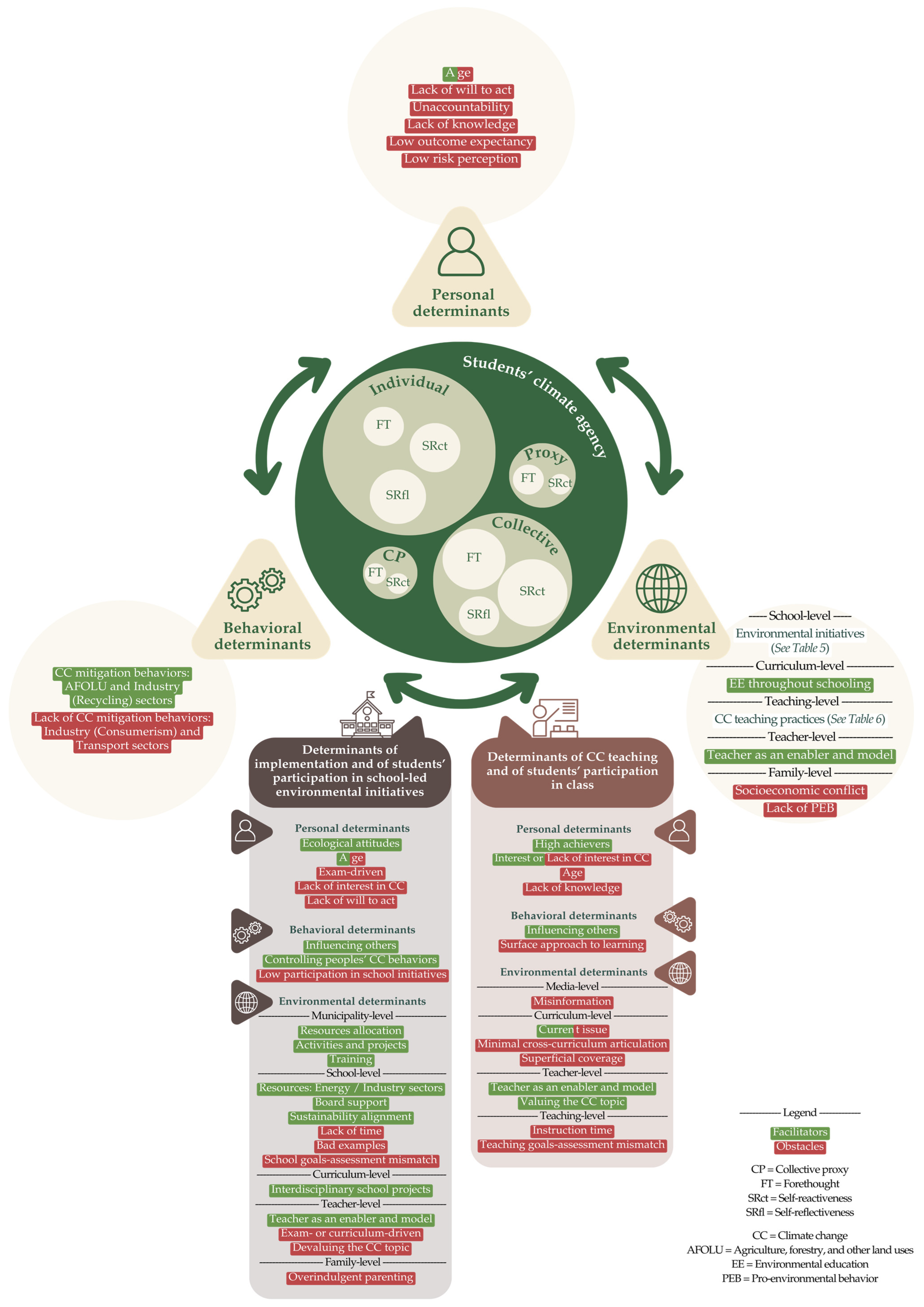
Data from the different sources described above are integrated and presented in this section. Multisystemic determinants were found to be at play within school’s contribution to developing students’ climate agency. The findings are organized into four major topics: (1) characterization of school-led environmental initiatives and the determinants of both the implementation of and students’ participation in the initiatives; (2) CC teaching practices and the determinants of both CC teaching and students’ participation in class; (3) students’ CC mitigation actions and climate agency; and (4) the contribution of the school context in developing climate agency.
Data patterns are reported based on the number of participants for each category and subcategory. Following the reporting guidelines for qualitative research outlined by Braun and Clarke [54], for both parsimony reasons and depth of presentation, this study reports subcategories mentioned by at least five interviewees. Nevertheless, a few rare subcategories related to climate agency properties are reported due to their relevance to the research question. Finally, verbatim quotes are provided to illustrate the categories.

3.1. School-Led Environmental Initiatives Addressing CC

This subsection integrates qualitative and quantitative data on the participating schools’ environmental initiatives by mapping (1) their CC-related goals, (2) the assessment criteria, (3) planning strategies for their environmental initiatives, and (4) the implemented school-led environmental initiatives addressing CC. Throughout the individual and focus group interviews, school representatives described their school’s institutional mission concerning CC mitigation. In an effort to integrate some of the United Nations’ Sustainable Development Goals (SDGs) into the school projects, 13 schools out of 21 adopted one or more of the following CC-related goals: promoting climate action (n = 9), and developing students’ theoretical knowledge and awareness of CC (n = 7). Other schools (n = 9) had broader goals of developing students’ civic education, of which engagement in CC mitigation is only a part.
Respondents’ data revealed the criteria schools use to assess their environmental initiatives. Quantitative data from the online survey indicated that most schools use student participation criteria, namely the number of participants (n = 34) and student active participation (n = 32) (see Table 1). Most respondents also included behavioral change on school premises (n = 24) as a criterion. Participants revealed that schools typically assess change through objective metrics on littering and waste separation, a requirement of the annual audit for those registered in the Eco-schools program. Although mitigation behaviors in the energy and transportation sectors are part of the audit, those were mentioned by only one interviewee. Similarly, respondents indicated that fewer schools (n = 12) assess students’ behavioral change outside the school compared to on school grounds. A couple of Eco-school coordinators acknowledged that although they gather these behavioral data from students through their audits, they do not consider these data useful when assessing the impact of the school’s environmental initiatives. The following utterance illustrates the interviewees’ point of view:
“For us, the school, it’s a bit difficult to look at the history, look at the numbers, and somehow reflect on them. Why? … I can give you the data, but it is data from the current moment. That is, I can’t make much of an assessment of it. ‘It has decreased’, okay. But that could be a result of the students I currently have enrolled. If I do the same thing next year, some will probably leave, and maybe the ones that are here [in school] are still not so good.”
(Joaquim, Blue School and Eco-schools coordinator)
Another typical assessment criterion is the students’ feedback about the activity (n = 23). During interviews, school representatives explained that collecting students’ opinions is an informal way to assess their enjoyment with the environmental initiative, evaluate their subjective knowledge, and gather suggestions for future implementations (see Table 1). Content learning among students is a criterion followed by 20 of the participating schools. These data are not typically gathered directly by schools or their environmental clubs to assess knowledge gains; instead, most are formally assessed by the teachers of the school subject in which the school’s environmental initiatives are embedded. Other assessment criteria are presented in Table 1.
The data presented above suggest a misalignment between the schools’ general aims regarding CC and the criteria used to assess the activities developed. Concretely, the schools’ educational goals regarding CC primarily focus on developing students’ critical awareness, knowledge, or mitigation skills, while the assessment criteria followed prioritize metrics of implementation and student participation. In some instances, when students’ CC knowledge or behavioral data are collected, these criteria are not used at the school level to check whether the climate action goals are being fulfilled. Triangulation of survey and interview data revealed a misalignment between goals and assessment among 8 of the 21 interviewed school representatives.
Regarding strategies for planning school-led environmental initiatives, some interviewees (n = 10) mentioned starting the school year by scheduling environmental activities that are implemented annually, or environmental observances, such as Zero Emissions Day. Seven interviewees reported being open to scheduling activities, usually led by municipal partners, and explained how these activities are integrated into the school’s activities plan. Most interviewees (n = 19) mentioned embedding the school’s environmental activities in the classroom context of subjects such as citizenship, sciences, and geography. This is to ensure a wider participation of the school community; as Fernanda (Head of Department of Exact Sciences and coordinator of the Eco-schools Program) explains, “Most of the activities are carried out in the classroom, right? Because students do not want to stay in the afternoon, after their classes.” In the context of these strategies, some interviewees (n = 6) reported being open to students’ suggestions for selecting environmental initiatives with wider appeal, or to new projects and campaigns that teachers might not have considered. Eco-schools coordinator Evelina explains how she asks her students for feedback:
“Eco-schools offer certain activities that are also contests. For example, there’s a contest for creative poster-making, and there are some prizes. It’s about waste. And I ask: ‘Do you want to participate in this one, this one, or that one?’ ‘Oh, teacher, we really like that one, let’s do that one.’ ‘Okay, let’s do this one.’ And sometimes we don’t even know how the work will turn out.”
Numerous whole-school programs integrating environmental awareness, sustainability practices, and other environmental education activities into the school curriculum and culture were mentioned during the individual and focus group interviews. For example, 34 interviewees mentioned the Eco-schools program, 18 referred to other sustainability education clubs (e.g., Young Reporters for the Environment, Science Clubs, Forest Clubs), 12 reported their school’s Citizenship Education framework, and 9 mentioned international exchange programs.
Under the programs listed above, several schools carry out environmental initiatives. The activities were ranked and sorted across three groups in accordance with the level of active involvement demanded from students: (1) low active engagement initiatives, those just disseminating knowledge and developing CC awareness; (2) intermediate active engagement initiatives, those promoting students’ motivation, commitment, and drive through monitoring of indirect or implicit pro-environmental action, and; (3) high active engagement initiatives, those requiring students’ hands-on participation and coordination in mitigation actions or explicit involvement in decision-making or environmental governance processes (see Table 2).
The low active engagement activities, despite being less frequently mentioned in the interviews (n = 31), are those that are more frequently scheduled throughout the school year and reach a wider number of students. These activities involve awareness-raising activities and events (n = 23) such as celebrating internationally recognized days like Tree Day; attending school assemblies or lectures (n = 16) led by environmental educators or professionals from local or national institutions; and participating in organized school field visits (n = 11) to interact and learn directly from specialists and institutions.
Among the group of activities with an intermediate level of active engagement (n = 33), recycling challenges are cited by most school representatives (n = 23), involving gathering specific materials (e.g., bottle caps, paper, electronic devices, batteries, clothes), often within a set timeframe or with defined solidarity goals. Artistic activities using waste, also mentioned by some interviewees (n = 12), include students designing art or functional objects from collected recyclables, combining creativity with environmental action, often culminating in an exhibition of the artworks. Less frequently addressed, interviewees provided examples of students forming structured green brigades (n = 7), which involve monitoring and correcting their peers’ behaviors on school grounds. Participating in citizen science projects was mentioned by seven school representatives, enabling students to assist in formulating research questions, gathering and evaluating data, interpreting findings, or participating in scientific problem-solving activities related to the environment. Some interviewees (n = 6) also implemented activities in which students produce posters or videos to visually present key environmental messages.
The highly active engagement activities, highlighted by most interviewees (n = 40), generally involve a small number of participants (e.g., students with higher grades or more environmentally engaged) and are less frequently scheduled throughout the school year. Most respondents (n = 26) mentioned developing beach or school ground cleanups. Outdoor learning in school gardens (n = 19) and hands-on reforestation activities (n = 13) were also cited. Engaging in the democratic process through school- or municipal-level participatory budgeting initiatives was mentioned by eight interviewees.
In parallel to the school-led environmental initiatives listed above, some interviewees (n = 8) reported strategies to increase students’ participation. Examples include implementing a reward system to encourage students, foster competition, enhance motivation, and ensure their continued participation in eco-challenges by presenting certificates or other monetary or symbolic rewards (e.g., picture frame).

Determinants of Both Implementation of School-Led Environmental Initiatives and Students’ Participation in These Initiatives

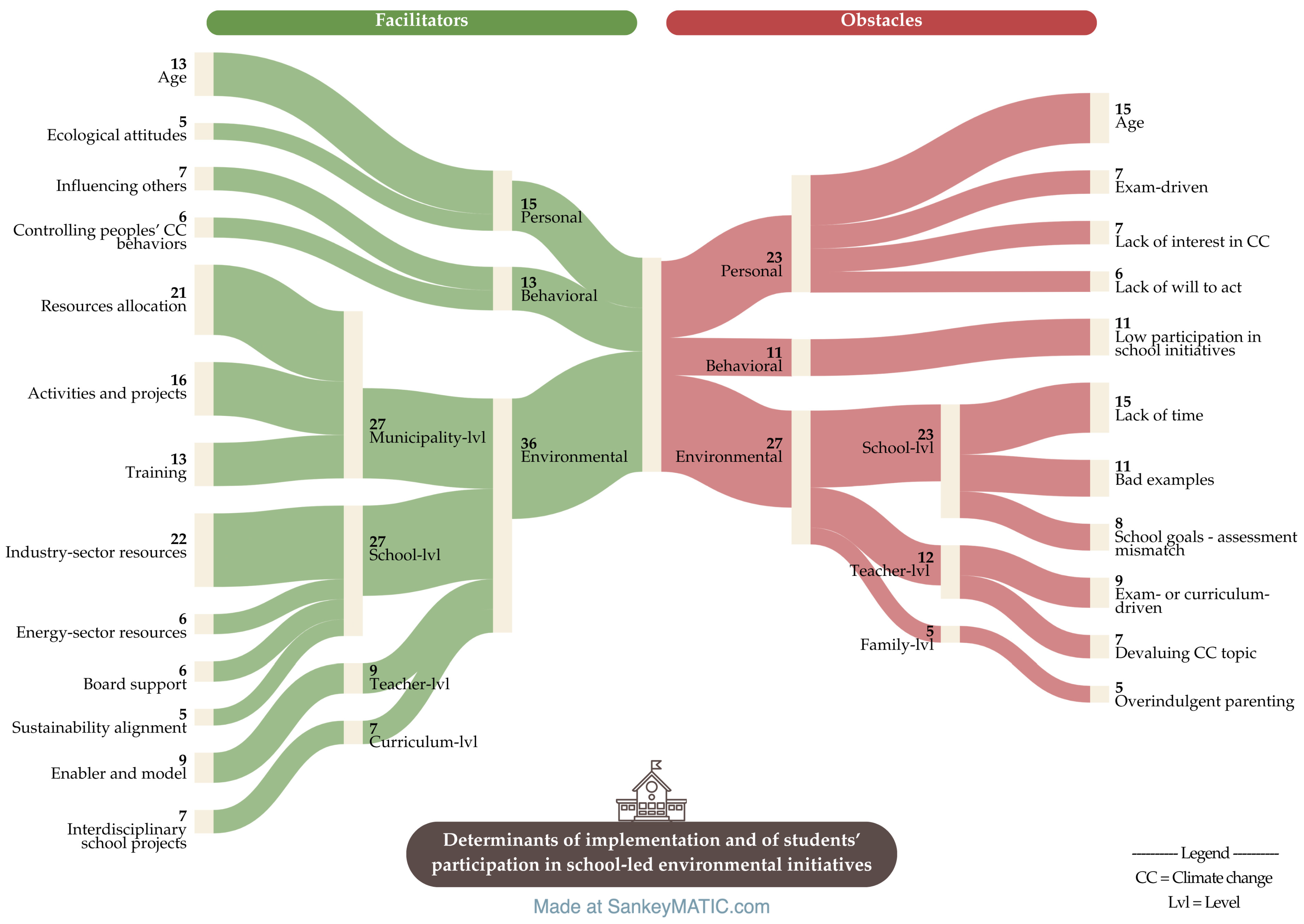
Throughout the interviews, participants mentioned determinants that facilitate or hinder the implementation of the aforementioned school-led environmental initiatives and students’ participation in them (see Figure 1). Facilitators and obstacles include students’ personal, behavioral, and environmental determinants.
Regarding students’ personal determinants, the age factor emerged both as a facilitator (n = 13) and an obstacle (n = 15) in most interviews. Overall, interviewees tended to perceive the age group they worked with directly as the most challenging. Still, there was a consensus that younger students, in elementary school, would be the easiest to work with, due to their willingness to actively engage in practical environmental action and to involve adults in their activities. As students grow older, teachers perceive a decline in environmental concerns, engagement with CC school activities, and sustainability behaviors. In fact, regarding middle schoolers, some interviewees (n = 13) mentioned obstacles in the form of their “students’ immaturity in understanding complex issues” (teachers of various subjects), such as CC, or being autonomous enough to engage in CC mitigation. Other addressed obstacles related to the transition to adolescence include a decline in affinity for nature, shame about engaging in specific environmental initiatives, or a shift in their interests, motivation, or priorities. Olívia (Eco-schools coordinator and middle and technical high school geography teacher) illustrates her point of view on this decline:
“Between 5th and 7th grade, they are excited [to participate]. They get to 8th and 9th grade, and there is a slight drop, because by then they already have other interests, and that [the environment] is no longer that interesting, … there is some enthusiasm there that fades. They start to feel a little embarrassed: ‘Oh, teacher, the Eco-schools vest…?’. ‘Yes, so what, I also have the Eco-schools vest’. Well, they put on the Eco-schools vest, but it is not such a pretty thing anymore.”
Particularly regarding high schoolers, some interviewees (n = 7) believe that these students are more focused on preparing for national exams than on participating in the environmental school activities. Three other personal determinants emerged from some of the interviews: a facilitator, related to students’ ecological attitudes (n = 5), and two motivational obstacles, related to students’ lack of interest in the topic of climate action (n = 7) and lack of willingness to act (n = 6).
Concerning behavioral determinants, a subcategory related to students’ behavior emerged: low participation in school initiatives (n = 11). Beyond the personal obstacles described above, this factor was associated with a family-level environmental determinant mentioned by some interviewees (n = 5) that characterizes parents’ overindulgence as limiting (e.g., forbidding participation in cleanups out of fear and anxiety regarding their child’s safety). Even though less frequently addressed, two behavioral facilitators emerged. Some interviewees (n = 7) cited students’ efforts to encourage their peers to increase participation in activities. On the other hand, six interviewees mentioned students criticizing or highlighting other people’s mistakes (e.g., controlling teachers or classmates who left the lights switched on). This was generally described as a positive behavior; however, Vicente (environmental programs coordinator) provided a dissonant point of view: “Sometimes they are critical, but it’s not constructive criticism, is it? Pointing the finger, which is something I don’t really like. I like to say where the solution is, more than pointing out where the problem is.”
Regarding the students’ environmental determinants that influence school-led environmental initiatives, the municipality emerged as a major facilitator (n = 27), as local governments often partner with their schools. According to most of the interviewees’ perspectives and the focus group discussion, these partnerships include allocating resources namely related to green infrastructure (e.g., school gardens, trees, and eco-bags; n = 21), implementing or supervising environmental initiatives (e.g., reforestation; n = 16), and offering training (n = 13): technical expertise in school-led initiatives (e.g., during field trips), professional development opportunities for teachers (e.g., training through environmental programs led by the municipality), or learning opportunities for students in the area of CC.
Apart from the municipality, at the school level, interviewees mentioned how sustainability was part of their school’s culture, with six specifying support from their school board for sustainability issues, and five describing organizational alignment to address environmental issues. Still, these interviewees (n = 11) mentioned negative examples set by certain teachers or school staff (e.g., indifference towards waste recycling). This obstacle was also addressed in the focus group. Interviewees explained that this behavior is inconsistent with and undermines the influence of positive role models, which in turn further decreases engagement in recycling and consumerism awareness campaigns at the school. Moreover, nine interviewees commented that some colleagues are more motivated to prepare for school tests and complete the subject’s curriculum than engage in environmental initiatives, and seven mentioned that other colleagues have no interest in environmental topics such as CC. These determinants further limit the support provided to environmental programs at school. Nevertheless, some interviewees (n = 9) highlighted how they encourage students to participate in school activities.
In addition, either through their municipalities or under whole-school programs, schools acquired and developed resources that enable students to engage in daily CC mitigation actions at their schools. The resources cited by most were related to industry sector behaviors (n = 22), particularly waste. Adriana’s (Eco-schools coordinator at a private school) interview illustrates this idea: “Now we have waste separation right on the school grounds. And [students] already had some containers. We managed to make EcoBags and put EcoBags in all the classrooms.” Even though in lower number, some interviewees (n = 6) mentioned resources related to the energy system, namely lower cost items such as stickers to remind to switch off the lights after use, or even other items such as solar panels: “Quite a few years ago, when we competed [at a national contest], we won funding to install solar panels on the pavilion. So, the school’s solar panels, which heat the kids’ shower water, were won through [that contest].” (Graciete, Eco-schools and Young Reporters for the Environment coordinator)
A lack of time also surfaced in some interviews as a significant obstacle (n = 15) to planning environmental activities. Interviewees reported that they have only one hour per week in their schedules to manage Eco-schools’ activities and related administrative work, while others have no time allocated to these activities. The Eco-schools coordinator Juliana explained during the focus group that “At the school where I was [teaching], there was no time allocated in the schedule to develop the Eco-schools activities. Everything I did was after hours, which was extremely tiring.”
Regarding the curricular programs, setting interdisciplinary projects emerged as a facilitator (n = 7). Interdisciplinarity enables school stakeholders to integrate and complete EE programs and school goals within multiple subjects, which is likely to provide students with more comprehensive CC learning opportunities:
“That’s why I really like interdisciplinary projects. Because with interdisciplinary projects, we ultimately gain time. At least that’s my perception: you gain time. It’s not just the geography class anymore. It’s the geography class and the science class, and maybe even the citizenship class. We manage to create all these steps and complete them all.”
(Francisco, Eco-schools coordinator)
In summary, as illustrated in Figure 1, school representatives addressed facilitators and obstacles that influence the implementation of school-led environmental initiatives and students’ participation in them. Among the perceived environmental facilitators, interviewees emphasized determinants external to the school. In particular, municipal support is associated with resources that enable a wide range of environmental initiatives. Similarly, interviewees highlighted the presence of waste separation containers on school grounds as another facilitating determinant, often beyond the schools’ direct budgetary capacity. Despite these relevant facilitators, interviewees also mentioned various obstacles, particularly related to schooling aspects (e.g., lack of time), that hinder the potential success of the implemented initiatives.

3.2. CC Teaching

Data about the participating teachers’ CC teaching, namely their (1) teaching goals, (2) assessment criteria, and (3) CC teaching practices, were collected in the interviews. Regarding teaching goals, interviewees shared different perspectives. Around half of the teachers (n = 12) consider changing students’ behaviors (habits, lifestyle choices, and other practical steps towards CC mitigation) their top priority. In contrast, others (n = 7) mentioned developing their students’ awareness of the impact of their own behaviors. Seven stressed being focused on developing students’ understanding and knowledge of natural processes and sustainability principles. Finally, five teachers mentioned aiming to develop their students’ attitudes, norms, or sensitivity toward ecological sustainability and the natural environment.
In the interviews, teachers were also asked to describe specific methods or criteria used to assess the effectiveness of their CC classes. Around half of the teachers (n = 12) mentioned using rubrics to evaluate students’ CC knowledge through various methods (e.g., assignments, assessment tests). Moreover, eight teachers reported using rubrics for evaluating students’ individual or group CC research, projects, or presentations (e.g., understanding of their own projects, accuracy of the final product, evaluation of group work processes) and five specified assessing the students’ accuracy, communicative effectiveness, vocabulary, or even fluency in a foreign language during class discussions, oral presentations, editing tasks, or written essays. Apart from these knowledge skills rubrics, some interviewees (n = 10) mentioned using rubrics to evaluate the participation and active involvement of students in the class (e.g., asking questions, verbal contributions to discussions, active participation in practical activities, or collaboration in group work).
These data showcase a misalignment, as the teaching aims for the CC classes are mostly related to developing the students’ critical awareness or climate action skills, while assessment criteria focus on factual recall, CC knowledge testing, or the quality of research projects rather than on processual skill or behavior assessment rubrics that could capture students’ understanding through application. This misalignment was found in most of the interviews (n = 16).
During the interviews, teachers were asked to describe the CC contents of their subject’s curriculum. Sixteen reported teaching classes on the causes that contribute to CC, including natural processes and human activities (anthropogenic factors and socioeconomic influences), eleven on the adverse consequences of CC for human or ecological systems, and eleven on CC mitigation actions that contribute to reducing or preventing GHG emissions. These topics were generally addressed across all subjects. Specifically, CC causes and consequences are particularly addressed in languages and social studies, as well as in mathematics and sciences, and CC mitigation actions are explored in the citizenship education subject.
Regarding CC teaching practices (see Table 3), most interviewees (n = 24) reported asking students to develop research projects, engage in guided research tasks, or undertake problem-solving activities that would be presented to their classmates or delivered as a visual assignment. Most teachers (n = 22) also mentioned following expository methods to deliver CC information, raise awareness, and advise students to adopt PEBs. Andreia (middle and technical high school sciences teacher), in her interview, addressed the constraints of the CC topic surfacing at the end of the school year and elaborated on the reasons for the transmissive approach being the teaching practice most used by her in class:
“I usually write ‘the program was given’ [on the school reports], because throughout the year I always address these things. When we talk about this, I’ll say: ‘Attention, you have to be careful with this. Look at you, look at recycling, look at the environment, look at this, everyone is responsible.’ So, I spend time hammering them on this. Sometimes I even say: ‘Look, poor things, you’re already tired of hearing me.’”.
Some teachers (n = 13) mentioned using audio/visual instructional materials, such as documentaries or podcasts, and have students discuss the information provided in class. Often associated with these two teaching practices, some interviewees (n = 10) reported employing communication strategies that appeal to students’ negative emotions, namely fear, guilt, and moral shock. Through alarmist and sensationalist messages or images, these teachers intend to encourage them to adopt different behaviors or give more importance to the issue. Most interviewees (n = 17) also mentioned facilitating class discussions, debates, or brainstorming focused on CC mitigation solutions. There were also references to other teaching strategies, such as delivering the lessons according to the contents and activities of the textbook (n = 9), using digital and online platforms and resources (e.g., Padlet, SDG’s online activities; n = 6), or developing practical, experimental practices or laboratory activities (n = 5).

Determinants of Both CC Teaching Practices and Students’ Participation in Class

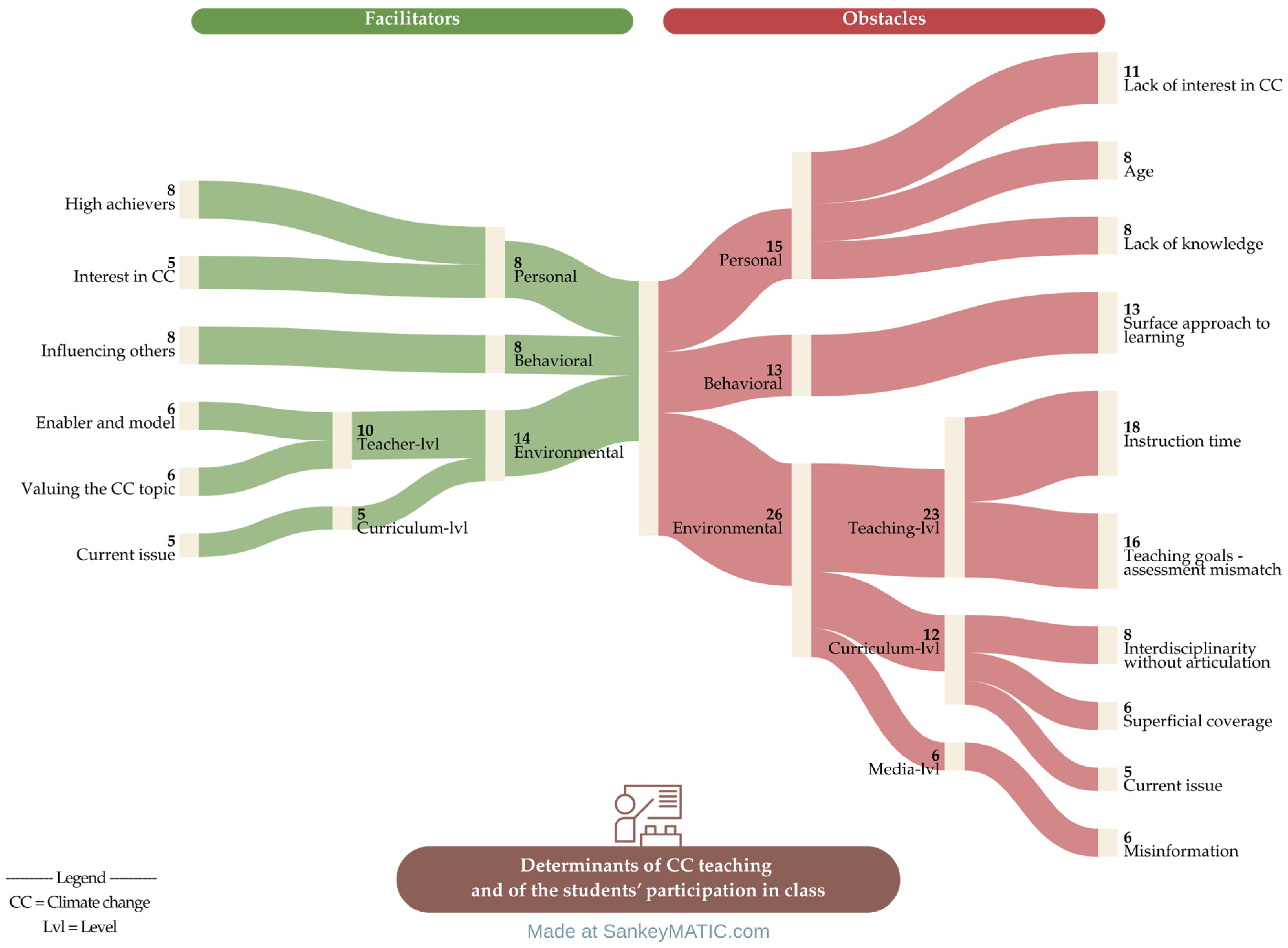
In the interviews, teachers reported determinants that facilitate or hinder the impact of CC teaching practices, considering both the implementation of these practices and students’ participation in class (see Figure 2). Facilitators and obstacles include the students’ personal, behavioral, and environmental determinants.
Starting with the analysis of the students’ personal aspects, age emerged as a hindering determinant in some interviews (n = 8), particularly at the middle school level (n = 7). Teachers consider these students too immature to engage in class discussions on complex topics, such as CC, and put these learnings into practice.
In addition, regarding students’ interest or motivation to learn about CC, the interviewees’ perspectives were mixed. While five interviewees considered that some of their students are interested in CC, eleven considered the opposite to be true for many of their students.
Academic engagement was mentioned by eight teachers, who perceive that CC classes have a greater impact on high-achieving students (who demonstrate active involvement, motivation, and dedication to their overall education and academic success). Furthermore, some interviewees (n = 8) noted that students present a low level of belief or erroneous knowledge about CC. Albano, a high school biology teacher, addressed the impact of this factor on the class. His report linked students’ lack of CC knowledge with the environmental disinformation and false or misleading narratives in media content that students consume (another environmental determinant that emerged from the analysis, n = 6):
“They [students] bring information that is not always correct. … Today, there is, let’s say, a parallel school of media and social networks, which disrupts things a bit. … I have taught students in classes that are capable of taking this very seriously and we spend the whole class talking about this, and other students in classes that, honestly…, they limit themselves to a superficial discussion, comments that are more to express opinions and not so much to substantiate a position, because, there you have it, they still lack a scientific knowledge many times.”
Teachers mentioned the CC topic as a facilitator and an obstacle. Five interviewees reported that, as it is a current issue, CC education is compelling for students. At the same time, the topic becomes tedious for other students due to its recurrence in school. In those cases, students overestimate their knowledge about CC, confusing it with their familiarity with the topic. This has an impact on their commitment to studying, as Filipa (middle school physical–chemistry sciences teacher) explains:
“I think that sometimes they [students] undervalue some things. They sometimes consider them [CC-related topics] minor issues. I think they believe they already know what it is, right? They already know, they have already mastered it, they don’t need to work on it anymore. But the truth is that they don’t go beyond the basics. When you ask questions about sustainability, about CC, they always go back to the same thing. They always go back to pollution; they always go back to the issue of waste and little more than that.”
These factors also relate to a particular behavioral determinant that emerged from the analysis. Around half of the teachers (n = 13) reported that students generally adopt a surface approach to learning and, on this topic in particular, are prone to memorizing facts without a deep understanding of their meaning, treating information as isolated bits. On the other hand, some teachers (n = 8) reported that students do contribute to the CC classes by using moments of class discussion to share their ecological knowledge or influence their peers towards sustainable practices.
Throughout the interviews, some teachers (n = 6) described their efforts to influence students’ thoughts, behaviors, and feelings through modeling, tuition, or social persuasion, serving both as enablers and models. Acknowledging the teachers’ autonomy to follow the Essential Learning Guideline set by the Ministry of Education, some participants (n = 6) addressed the impact of teachers valuing the CC topic.
“Teachers have a curriculum [to deliver], they have essential learnings [to follow], but they have great latitude in how they approach these essential learnings, … which essential learnings they give greater importance or less importance. For example, in seventh and eighth grade, I can address CC in a 10 or 15-min class conversation or simply by assigning homework. I don’t do that, but I don’t do it because of different personal and professional sensibilities.”
(Cláudia, middle school sciences teacher)
In addition, six interviewees stated that the coverage of the CC topic in the curriculum is superficial, as it is scattered across different topics, or the curriculum does not encompass deep integration. Still, the obstacle cited by most (n = 18) is related to instruction time. Teachers report not having sufficient time to teach the CC curriculum in class or to select in-depth teaching practices. For example, high school teachers in particular mentioned the challenge of having to allocate instructional time to cover test-related content and to prepare students for standardized exams.
In summary, as Figure 2 illustrates, interviewees identified facilitators but mostly obstacles limiting the implementation of teachers’ CC teaching practices (particularly at the environmental level). Several interviewees emphasized instruction time constraints impeding the adoption of a deeper approach to the topic. Moreover, the evaluative inductive analysis of the interviews revealed a discrepancy between the teachers’ goals of CC classes and the assessment methods selected.

3.3. Students’ CC Mitigation Actions and Climate Agency

School stakeholders mentioned that their students carried out daily PEBs to mitigate CC. As Table 4 indicates, actions stood out in relation to two of the five UNEP sectors: industry and AFOLU. Actions related to the industry sector were mentioned by nearly half of the interviewees (n = 22; e.g., behaviors such as carrying a reusable water bottle or recycling waste). Nevertheless, during the individual and focus group interviews, the discourses tended to stress that these actions were not generalized. The industry sector also has the most counterexamples (n = 16), in part because some teachers identify generalized consumerism behaviors among their students. The AFOLU sector was addressed by some interviewees (n = 6), who mentioned efforts to reduce food waste by consuming leftovers and to adopt a vegetarian diet; the latter was mentioned in a few cases. The transport sector (e.g., walking or cycling instead of using private vehicles to commute to school) is relevant for its higher number of counterexamples (n = 7). Relatedly, Filipa (middle school physical–chemistry sciences teacher) addressed in her interview what is a common concern among other participating schools:
“Another very big problem is the issue of mobility. Everyone knows this, yet everyone continues to use their cars for short distances. For example, we have a problem at school with the issue of arrival and departure times, which is cars and more cars in line waiting for the students. Even though kids live nearby, their parents take them by car. So, it is a very difficult job.”
The remaining UNEP sectors were mostly absent from the interviewees’ reports. Perceived behaviors related to the buildings and energy sectors were mentioned by two and one interviewees, respectively.
The CC mitigation actions were also analyzed, drawing on Bandura’s human agency theory, to assess whether the interviewees’ reports denoted aspects associated with the properties (i.e., forethought, self-reactiveness, and self-reflectiveness) of the individual, proxy, and collective modes of agency. Besides those modes, one interviewee provided an example of a mixed agency mode that encompasses characteristics of the proxy and collective modes. Notably, no reported action reflected all three properties of an agency mode simultaneously.
Although aspects of individual agency were more frequent in interviews (n =12), reports were dispersed across the three properties. Some interviewees mentioned aspects associated with the students’ forethought (n = 3; e.g., creating action plans to start adopting CC mitigation actions), self-reactiveness (n = 5; e.g., keeping their commitment to reduce meat consumption), and self-reflectiveness (n = 6; e.g., reordering their priorities) of their behavior. The following utterance illustrates a self-reflection prompted by the class discussion practices:
“In the English subject, in high school, we talk about all these issues. And it’s like I said: there are many students who, I think, have never stopped to think about this. Then, some of them start saying that perhaps they buy less now than they did a few years ago because they have already considered these issues. They think twice. And they think like this: ‘Do I really need that t-shirt or that product, or is it just for vanity and I really don’t need it, and it’s not worth it?’ Some of them start thinking about these issues.”
(Olália, high school English teacher)
Aspects associated with the proxy agency (n = 2) and its properties were either rare or missing. Contrastingly, ten interviewees reported examples of collective agency. Four school stakeholders emphasized the importance of active students’ associations. The properties of this mode were most evident in the flow of the interviews when compared to those of the other modes. These data may reflect greater awareness of the students’ collective actions (usually held and organized within the school) than individual actions (usually held autonomously outside the school). Concerning the forethought property, mentioned by eight interviewees, examples were provided of how students take advantage of their schools’ programs to create action plans to combat CC. While describing the initiative-taking of one of her classes, Cláudia (middle school sciences teacher) denotes the forethought property:
“They’d already done something in the 5th and 6th grades, like a club in the class, and they’d organized it, and the parents came together for a weekend or a day to clean up [a beach] together. It was even organized by the kids; they’re very active. I know they did this beach cleanup on their own initiative.”
Nevertheless, more interviewees presented aspects associated with the self-reactiveness property (n = 10), i.e., actually executing collective actions to mitigate CC. Aspects associated with the self-reflectiveness property, such as reflecting on additional behavioral changes necessary on school grounds, were addressed by a couple of participants.
Lastly, it is relevant to highlight one quotation from Eco-schools coordinator Simone that illustrates the forethought and self-reactiveness properties of a collective proxy agency mode (i.e., the students worked together to intentionally influence public and private institutions with the needed resources or power to help them complete their project):
“There was a project exclusively [set up] by the students. The students from our Student Association have a project called Ecopark. … The Student Association approached us to promote their idea. They are going to build an Ecopark with furniture made by a local company, which produces all its furniture from waste. They have already held meetings with the City Council and have the project and budget in place. They have already managed to raise money, and I think the City Council and the company will cover the rest.”

Determinants of Students’ CC Mitigation Actions and Climate Agency

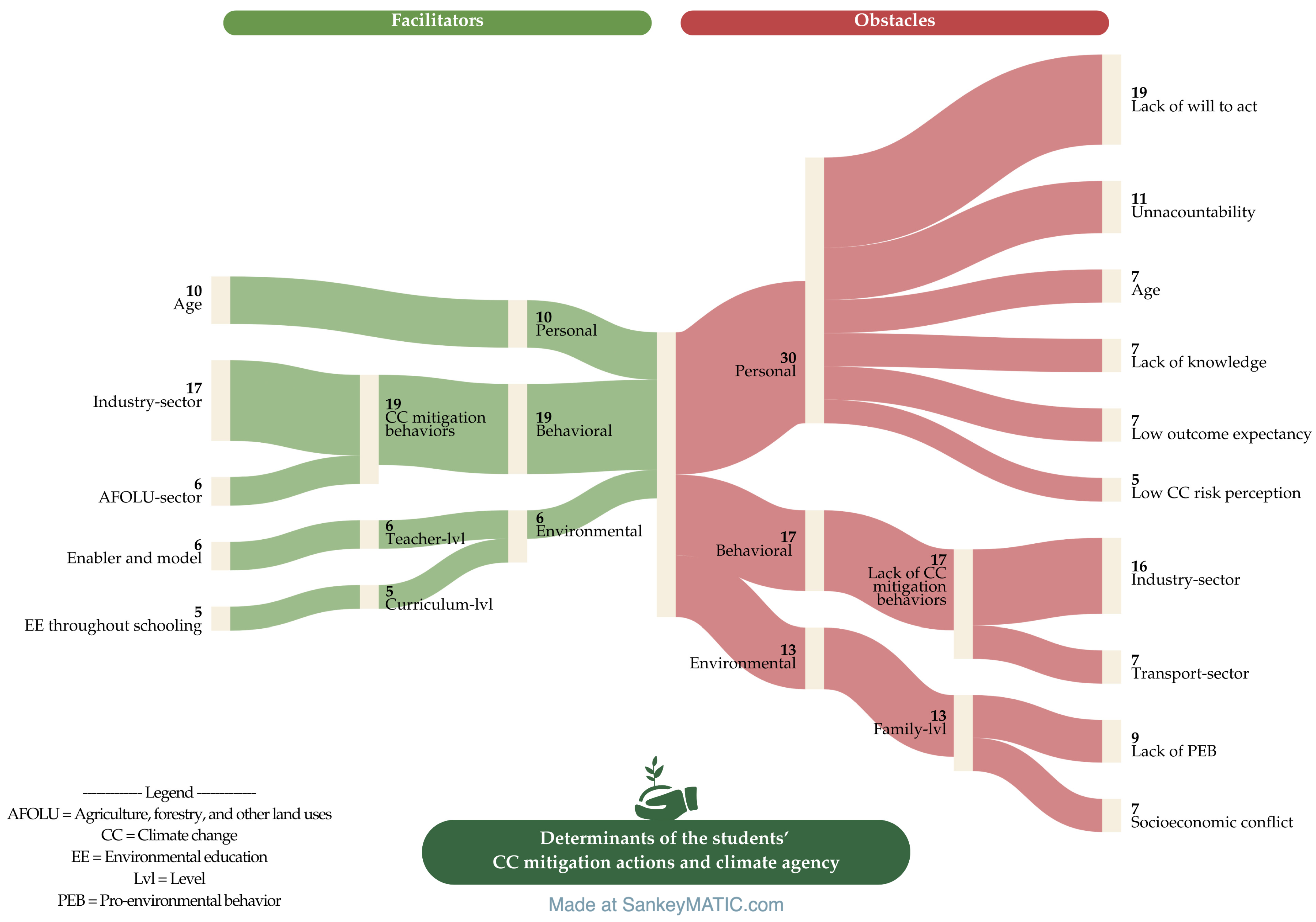
Throughout the interviews, participants mentioned determinants that influence students’ CC mitigation actions and agency. Interviewees addressed facilitators and obstacles related to personal, behavioral, and environmental determinants (see Figure 3). In this subsection, only new findings related to personal and environmental determinants are reported, given that behavioral determinants were reported in the previous section.
Regarding personal determinants, age surfaced again as either a facilitator (n = 10) or an obstacle (n = 7) for the same reasons described in “Determinants of both the implementation of school-led environmental initiatives addressing CC and students’ participation in these initiatives” and “Determinants of both CC teaching practices and students’ participation in class”. Regarding other personal determinants, only obstacles emerged from the analysis. The students’ limited understanding of climate-related natural processes (e.g., misconstruing concepts of greenhouse effect, ozone layer, and acid rain) and of the impact of human activities on these phenomena was perceived by some (n = 7) as an impediment to PEB. This lack of knowledge is associated with students’ perceptions that CC threats are unlikely or personally irrelevant (n = 5) and with beliefs that their pro-environmental efforts are insignificant in mitigating CC (n = 7). Some interviewees (n = 11) addressed their students’ unaccountability, specifically the diffusion of responsibility to others, skepticism regarding the management of municipal and corporate waste systems, or whether materials are actually recycled. Still, the most frequently reported obstacle (n = 19) was students’ indifference and unwillingness to act towards sustainable lifestyle choices. Interviewees characterized students as possessing knowledge about environmental problems or holding positive attitudes towards environmental protection and CC mitigation, but failing to translate these into concrete PEB.
“In fact, I think some of them are even aware that what they’re doing might not be the right thing to do, and perhaps they even need to make some changes. But then, going from ‘thinking they can and need to change’ to ‘doing so’ is still a long way off.”
(Cesária, middle school sciences teacher)
Regarding the environmental determinants, some interviewees (n = 13) mentioned the negative influence of the students’ families. Among these participants, nine identified the low involvement of students’ families in PEBs. In particular, those working in territories with a high number of young people at risk of social vulnerability reported the influence of the low socioeconomic status of the families (n = 7), as they may prioritize immediate financial needs over long-term environmental sustainability.
Other environmental determinants emerged from the analysis, namely, facilitators related to teachers’ and curriculum characteristics. As these help us understand the linkages between the school context and the development of the students’ climate agency, the findings are further detailed in the section below.
In summary, when prompted to address their students’ key CC mitigation actions, school stakeholders identified waste-related behaviors as the predominant facilitators. However, as Figure 3 shows, there is a prevalence of perceived obstacles to the development of students’ climate agency. In particular, interviewees emphasized personal determinants, such as a lack of willingness to act and a sense of unaccountability among their students.

3.4. Linkages Between the School Context and Students’ Climate Agency

Despite the scarcity of data (see Table 5 and Table 6), the qualitative analysis of the interviews revealed linkages between features of the school context (i.e., school-led environmental initiatives and CC teaching practices) and the development of students’ four climate agency modes (see Section 3.3 and Supplementary Material S2 for the description of each agency mode). Specifically, a few interviewees associated the set of school-led environmental initiatives requiring low active engagement from students with properties of climate agency. From the interviewees’ perspectives, these activities help promote students’ self-reflectiveness of the individual agency mode (i.e., promoting reflection about the impact of their individual actions on the environment).
Among the group of activities requiring an intermediate level of active engagement from students, green brigades are occasions where students take the initiative to form or join a structured group to act together to monitor and correct their peers’ behaviors on the school grounds (particularly self-reactiveness of the collective agency mode; n = 5). Moreover, some interviewees (n = 6) mentioned recycling challenges in association with the development of the following properties: forethought of the individual agency mode (e.g., identify items that students no longer use and items to be collected as part of the competition) and self-reactiveness of the collective agency mode (all students of the class work together to collect the highest number of items). The competitive aspect and blend of environmental and solidarity goals were perceived as contributing to students working together on mitigation actions in the industry sector:
“What I also feel is that whenever I combine the environmental aspect with the social aspect, things work much better. We have the Paper for Food campaign, where we collect, for example, paper waste here in the school context. This paper is then delivered to the Food Bank. And the kids love it. So, sometimes they even have competitions between classes, seeing who collects more paper, and they collect old notebooks and magazines because they realize that something like waste separation also has a huge social impact.”
(Luciana, Coordinator of Eco-schools and social responsibility programs)
Regarding initiatives that require students’ high active engagement in taking concrete mitigation actions, the analysis of six interviews revealed a link between school or municipal participatory budgeting initiatives and the collective proxy agency mode. By committing to these local political processes, students are encouraged to strive toward CC mitigation goals and publicly engage in democratic actions, developing forethought (e.g., through devising a plan to address CC at a local level) and self-reactiveness (e.g., by arguing in favor and implementing their plans) of the collective proxy agency mode. Beach or school ground cleanups (n = 9) were perceived as particularly impactful for bringing together students and, sometimes, other members of the school community, as they involve collective efforts that yield an immediate noticeable result (i.e., self-reactiveness properties of the collective agency mode).
Olívia (Eco-schools coordinator and middle and technical high school geography teacher), as other school stakeholders, associated the cleanups with the potential to develop self-reflectiveness of individual agency: “We did a cool activity with the local water company and an [Environmental non-governmental organization]. We cleaned an area in a nature reserve equivalent to the environmental impact of a cell phone. This activity helps to build these kinds of connections [between consumption behaviors and environmental impact].”
Regarding CC teaching, the subcategory emerging from most interviews was a transmissive approach (n = 17; see Table 6), as interviewees often attributed the development of the three properties of individual agency to the use of expository methods to raise awareness (i.e., forethought), sustain efforts (i.e., self-reactiveness), and advise students to reflect on their PEBs (i.e., self-reflectiveness). For similar reasons, although mentioned by fewer interviewees (n = 9), class discussions were also highlighted.
Six teachers attributed group research projects, guided research tasks, or problem-solving activities to the development of the students’ knowledge required to identify the behavioral changes needed in their lives, prepare and implement personal CC mitigation behaviors intentionally, and reflect on the environmental impact of their actions (i.e., the three properties of individual agency mode). In addition, these strategies involve group work on more practical activities or visual presentations to influence students’ peers (i.e., self-reactiveness of collective agency mode). The exact same number of teachers reported noticing an impact of employing alarmist and sensationalist messages or images. In particular, these interviewees perceive such practices to enable students to visualize the effects of their actions and consider alternatives (forethought and self-reflectiveness properties of individual agency mode). In her interview, Cesária (middle school sciences teacher) highlights how this CC teaching practice contributes to the self-reflectiveness of her students’ individual agency:
“It’s really about developing specific practical activities and also viewing impactful images. It’s not light images. What I usually say: It’s about impactful images. Images where they can really see the effects. For example, the issue of sea ice decline. Some images are truly frightening when we see them and realize [the relationship between human activity and CC].”
Interviewees also addressed two environmental determinants of teachers’ and curriculum characteristics that are associated with the development of climate agency modes. Regarding teachers’ characteristics, their encouragement, initiative, and reinforcement (n = 6) emerged as a facilitator. In addition, the presence of the CC topic throughout a student’s educational journey, starting from early childhood (n = 5), was also perceived as a facilitator. Both determinants are considered to have the potential to promote goal setting related to PEBs (i.e., forethought of individual agency mode) and to sustain the students’ attitudes toward CC and their own daily engagement in PEB, such as recycling (i.e., self-reactiveness of individual agency mode).
When asked about the impact of the school-led environmental initiatives or CC teaching on their students, interviewees did not address gains associated with properties of agency. Instead, the reported perceived impacts of the school experiences centered on behavioral change and knowledge acquisition. While describing the outcomes of the wider school’s initiatives, school representatives had dispersed points of view. When discussing waste-related behavioral changes spontaneously, five interviewees considered that the school had no impact, while five others felt it had a noticeable effect on students.
Regarding CC teaching, most interviewed teachers (n = 13) perceived it as having little or no impact on students’ knowledge and awareness of the issue. However, some teachers (n = 5) perceived a notable increase in these aspects. In the interviews, teachers also addressed behavioral changes, particularly in terms of recycling and consumerism. Some teachers consider that CC classes have no impact on this level (n = 10), and around half (n = 12) characterized the impact as minimal. Still, around half of the teachers (n = 12) reported not having an adequate perception of the effect of CC teaching on their students. In fact, while addressing their perception that CC education lacks a high or immediate effect, some interviewees shared a hope and expectation that CC teaching might have a long-term influence on shaping students’ future perceptions and behaviors related to CC. During the interviews (and corroborated in the focus group with school representatives), teachers coincidentally used the expression “we leave at least a little seed” to illustrate their beliefs. For instance, Rafaela, a middle school Portuguese and Portuguese as a foreign language teacher, shared the following:
“I don’t know if my classes have any impact. I want to believe that with these topics, as with so many others, the seed has been planted. It’s like reading. Sometimes, no matter how much someone insists, [students] keep saying they don’t like reading and don’t want to read. But one day later, some even discover the joy of reading. I’ve had former students who said, ‘The teacher insisted so much that the truth is, now I’m an avid reader. But back then, I didn’t understand how it was possible to enjoy reading.’ Well, I want to believe that the seed at least remains there. With so much insistence and so many programs and so many things that exist in schools in [regards to the environment], I want to believe that something remains there.”

3.5. Summary of Findings

Schools provide students with several learning experiences (i.e., environmental initiatives and formal CC teaching) related to CC mitigation. The current study analyzed those opportunities to further understand the various facilitators and obstacles related to personal, behavioral, and environmental determinants of students’ climate agency. Figure 4 provides a graphical summary of the findings, reflecting the complex net of relationships between several determinants that facilitate or undermine the development of students’ climate agency. In particular, multisystemic determinants associated with the implementation of and participation in school-led environmental initiatives and CC teaching interact in the reciprocal relationship between the behavioral and environmental determinants of students’ climate agency. As Figure 4 illustrates, the three properties of climate agency were not equally present in the interviewees’ reports.

4. Discussion

According to the literature, adolescents need to be active agents to combat CC [40]. Schools have the potential to encompass the procedural learning and civic development required to promote the societal change needed to address the advancement of CC [1]. Anchored in the theory of human agency and the triadic reciprocal causation model [32,33,35], the current study aimed to explore in detail the role of this specific environmental determinant in developing students’ climate agency.
The analysis of data from surveys, complemented by individual and focus group interviews, enabled the mapping of personal, behavioral, and other environmental determinants likely to facilitate or hinder students’ climate agency, reflecting a complex net of influences. Hereafter, each major topic of the results will be discussed. To avoid redundancy and maintain brevity, emphasis will be given to the findings directly related to the research question of the current study.

4.1. School-Led Environmental Initiatives Addressing CC

The data indicate that 13 out of 21 schools include goals related to climate action in their educational strategic plans. This is a promising finding, as school structures (including leadership) and culture (ideas and values) contribute to a collective vision among school stakeholders and the local community [16]. However, only five interviewed school representatives characterized their school communities (i.e., school boards, teachers, support staff, and students) as engaged and aligned with sustainability issues. In contrast, twice as many accounts described poor examples by school stakeholders, including harmful behaviors or indifference toward environmental issues. Consequently, inconsistent CC mitigation efforts may undermine the influence of positive role models and lessen the credibility of a school’s climate action mission [55]. Institutional culture and values alone are insufficient to foster students’ climate agency [55]. Worryingly, climate action goals seem to be overlooked during the planning, implementation, and assessment stages of the environmental initiatives throughout the school year.
Multiple data sources in this study indicate that schools have invested significant efforts in developing a variety of environmental initiatives for their students; however, they often lack a clear, action-oriented strategy aligned with the educational strategic plan. While such diversity of environmental initiatives is positive, the evaluative analysis considering the level of active involvement required from students [26] revealed that high active engagement activities tend to reach a limited number of students, and often those who are already engaged in environmental action.
In addition, this study found that waste topics within the industry sector [5] are prominent in schools (e.g., cleanups, recycling challenges, artistic activities with waste, and green brigades). These data align with prior research [2] showing that the waste issue is overrepresented in schools compared to its contribution to global emissions, whereas topics posing political challenges (e.g., heat supply within the energy sector) remain underrepresented. This is particularly relevant because emphasizing the role of students’ waste-related behaviors could contribute to a misconception that individual action and recycling are sufficiently effective to mitigate CC [56]. Drewes and colleagues [15] further alert that such misconceptions may lead students to perceive limited opportunities for future action to address CC effectively.
The emphasis on waste is also reflected in the schools’ assessment strategy. Overall, schools mainly consider students’ behavioral change in relation to recycling. Instead, a more comprehensive approach could help broaden the scope of CC mitigation actions, for example, by following the sectoral framework by UNEP [5] to better capture the actions needed to reduce GHG emissions. A couple of interviewed Eco-schools coordinators expressed the difficulty in drawing conclusions from the program’s audit. This finding highlights the need to enhance the program’s assessment strategy to objectively understand its impact on students.
The findings also revealed several facilitators and obstacles organized by personal, behavioral, and environmental determinants that influence the implementation of, and students’ participation in, school-led initiatives. Reciprocal relationships between these determinants are consistent with the theoretical framework followed (e.g., [33]). In particular, beyond school-level facilitators, most interviewees mentioned the importance of municipality-level facilitators (see Figure 1). The significant role of municipal partners was highlighted as an opportunity for students to connect with community CC mitigation initiatives, allowing for real-world applications of the concepts learned. This finding is consistent with the increasing commitment of municipal and community partners to advancing CC mitigation policy at a local level [57]. Such local communities of practice, along with a willingness to collaborate with teachers from distinct subjects [58], tend to stimulate an interconnectedness of environmental, social, and economic issues, as well as intrinsic motivation, commitment to achieve, and success expectations [59]. Considering the challenges discussed above, it would be beneficial for school stakeholders to strategically design their initiatives in collaboration with municipal partners, incorporating clear goals and a methodology to assess the expected outcomes among participating students. This approach could enhance the usage of the available human and material resources provided by the municipality and improve the implementation of initiatives and their outcomes.

4.2. CC Teaching

Given that the goals of CC education are embedded across multiple grades and subjects, this research is relevant as it portrays a broad understanding of CC teaching. Around half of the interviewees indicated that their CC teaching goals included raising their students’ awareness and commitment to adopting CC mitigation actions. However, the current data analysis indicates that teachers did not employ assessment metrics to measure the impact of their teaching on these goals. Students’ behaviors are typically assessed informally based on classroom participation. Nevertheless, what typically emerges during class discussions reflects behavioral intention, which seldom translates into actual CC mitigation behaviors, as the literature on the attitude–behavior gap expresses [60]. In practice, teachers seem to prioritize assessing product outcomes (e.g., completing subject assignments or questions in assessment tests) and preparing students for standardized tests (particularly in high school). This emphasis further sidelines the teachers’ original CC teaching goals, considering that testable content does not include elements of climate agency required for sustained behavioral change.
Limited time perceived by teachers to address the curriculum further contributes to overlooking their original teaching goals. Timetable pressures within schools remain a great obstacle preventing teachers from engaging more with the topic and addressing CC mitigation actions [14]. Consistent with research conducted in England [16], the current study found that teachers tend to prioritize topics that more readily align with the curriculum over interdisciplinary issues such as CC. As pointed out by Ben Zvi Assaraf and colleagues [61], given the vagueness that characterizes interdisciplinary instructional approaches, it is crucial that teachers from multiple subjects collaborate in planning and implementing CC teaching. Such collaboration enables a more in-depth approach to teaching. Cross-disciplinarity, along with activities in extracurricular spaces (e.g., citizen science initiatives), holds the potential to promote holistic learning experiences that foster young people’s understanding of CC [16]. Moreover, teachers must consider the challenges that students face in connecting the multisystemic dimensions of CC taught across subjects [62].
The limited instruction time and interdisciplinary articulation appear to contribute to surface CC teaching practices. This research found a relatively balanced integration of student-centered (e.g., research projects and discussion) and teacher-centered practices (e.g., transmissive orientation and following the textbook). Still, it is relevant to highlight that even within student-centered practices such as research projects, teachers seem to follow traditional pedagogical models that predominantly focus on knowledge transmission [63]. The literature suggests that a teacher-focused strategy positions students as passive recipients of information [64], restricting their autonomy to engage in self-directed behaviors [65]. In addition, teaching practices such as class discussions on CC tend to be sporadic and brief, with participation typically limited to the students who are already environmentally engaged.
In this context, teachers also identified students’ surface approach to learning as an obstacle. It would therefore be relevant to examine whether transmissive CC teaching approaches are linked to students’ surface approach to learning. This is pertinent, as prior research has found this association on different topics (e.g., [64,66]), and a student’s level of engagement with CC teaching has been considered a determinant of learning gains [39].
Faced with disengaged and disinterested students, interviewed teachers mentioned employing audio–visual materials, and some resorted to alarmist and sensationalist media or communication strategies in their CC classes. Appealing to negative emotions such as fear, guilt, or moral shock is further legitimized due to its daily presence in CC communication [67] and in educational materials [68]. Teachers employ appeals to negative emotions as a motivational strategy, with the expectation that they will increase students’ motivation, effort, and sustained commitment to CC mitigation [69]. However, using such strategies without accounting for the students’ characteristics, such as prevailing social norms, or developing their climate self-efficacy, might at best generate only a short-term sense of urgency and, at worst, backfire and promote apathy [69,70].
Overcoming this set of obstacles requires significant investment in the teachers’ professional development [12]. Around half of the interviewed teachers characterized their training at the university as lacking expertise about CC (see Section 2.1.2), which is consistent with the broader literature documenting insufficient literacy on CC among in-service teachers of all disciplinary areas [13,20,39,71]. Such a lack of expertise contributes to a diminished perception of self-efficacy in CC teaching, as some teachers question the effectiveness of their CC teaching and experience challenges in selecting materials helpful in stimulating critical thinking and prompting student action [72]. Consequently, teachers may rely on strategies focused on the transmission of knowledge which more readily fit CC topics within traditional knowledge acquisition testing [73]. This exam-driven pedagogy has been identified as a key factor contributing to the gap between theorized environmental education policy (e.g., national CC curriculum or SDGs) and its practical application [73].

4.3. Students’ CC Mitigation Actions and Agency

The UNEP’s multisectoral framework to address CC [5] helped examine the school stakeholders’ perspectives on the areas where students are most active and the CC mitigation actions that are often overlooked. Actions within the industry sector were frequently discussed in interviews. However, they account for one-third and nearly half of the GHG emissions attributed to the energy and AFOLU sectors, respectively [5]. Specifically, school stakeholders predominantly described that the students’ actions relate to the reduction in single-use plastic and waste separation. Regarding the former, prior research suggests that cost-saving behaviors, such as stopping the purchase of bottled water, may be motivated by practical reasons or a desire to follow social norms rather than environmental ones [74]. This may be particularly relevant in the context of Portuguese schools, as educational institutions have joined the “plastic-free” movement [75], which often provides reusable water bottles or water fountains. Concerning waste separation, Brown and Krettenauer [76] similarly found that basic PEBs, such as waste separation among disengaged adolescents, tend to be the outcome of routines rather than a reflection of active commitment to an environmental cause. Given the emphasis on these PEBs, it is noteworthy that a single aluminum water bottle must be reused more than 483 times to offset its GHG emission impact compared to single-use plastic bottles [77], underscoring the importance of students’ sustained commitment to effective CC mitigation. Moreover, recycling, the behavior most frequently recommended in textbooks [78], has lower potential for reducing carbon emissions relative to other behaviors within the industry sector, such as reducing consumption and transitioning to circular fashion products [78,79]. Conversely, interviewees tended to describe their students as consumerists, suggesting that providing information on best practices in the circular economy may help them assess their decision-making consciously, as recommended by prior research [77,79]. These findings also point to a potential misconception about environmental issues, as the highlighted PEBs address the problem of pollution more directly than CC.
Within the UNEP’s framework, it is also noteworthy that the energy sector, the primary source of GHG emissions, was mentioned mostly in relation to school resources. For instance, school stakeholders described the availability of renewable energy sources and visual reminders to switch off lights and devices as opportunities to enable students to reduce carbon emissions. However, from the interviewees’ perspectives, energy-related behaviors were largely absent among the students’ CC mitigation actions. While prior research with Portuguese adolescents showed that some mentioned conserving energy at home [7], the limited transfer to other contexts may suggest that students lack intentionality regarding energy-saving behaviors.
Similarly, the AFOLU sector was addressed by only six interviewees, primarily in relation to reducing food waste or meat consumption. References to plant-based diets typically concerned one or two students at a time. However, this behavior holds a greater potential for reducing carbon emissions within the AFOLU sector [78]. This analysis may be informative to assist practitioners in identifying potential gaps in CC education, particularly regarding the coverage of mitigation actions in the energy, AFOLU, transport, and buildings sectors.
This study also revealed numerous obstacles that hinder sustained CC mitigation action and must be addressed. For instance, interviewees reported an age-related decline in environmental interest and concerns, also reflecting a reduced willingness to act on climate issues. This is a common perceived obstacle across the three levels of analysis of this study: participation in school initiatives, participation in CC classes, and the development of climate agency (see Figure 1, Figure 2 and Figure 3). This phenomenon, occurring during the developmental stage of adolescence, is referred to in the literature as the “adolescence dip” [76]. In this context, fostering climate agency among students is particularly challenging when they do not deliberately decide to engage in CC mitigation, instead performing only reactive environmental actions at school. Although awareness-raising initiatives (those usually reaching large numbers of students) are important for fostering behavioral intention [69], they alone are insufficient to produce sustained behavioral change. Adopting the lens of Bandura’s [32,33] human agency theory provides practitioners with a framework to overcome such a challenge.
From a social–cognitive perspective [35], the findings of this study suggest a promising, yet incomplete, development of students’ climate agency, as they are not perceived by school stakeholders to consistently engage in planning, monitoring, maintaining, and reflecting on their own CC mitigation behaviors. In this study, interviewees provided more examples of individual than proxy or collective CC mitigation actions. However, through the lens of human agency theory, these examples did not simultaneously exhibit the core properties of the individual agency mode. This prompts reflection on whether school experiences may be providing students with opportunities to coherently train self-regulatory processes and to exercise climate agency. For instance, the forethought property of individual agency was the least reported, despite being a critical first step to enable students to set achievable CC mitigation goals and actively develop contextually relevant action plans [34]. Regarding the self-reactiveness property, it is important to consider practices that allow both school stakeholders and students to track progress and commitment, ensuring CC mitigation actions are sustained rather than one-off [19,39]. Without these two properties, the development of students’ self-reflectiveness of individual agency may be compromised. Even though it was the most reported property of individual agency, its significance lies in assisting students to reflect on and reassess their set of values and priorities, changing their behavior accordingly [33,34]. When implemented with this intention, class discussions may encourage students to critically evaluate their lifestyle and make meaningful corrections [39].
The scarcity of reports related to proxy agency suggests that school stakeholders perceive students as not actively engaging in influencing the actions of others or seeking systemic change. Developing students’ self-efficacy and other skills necessary for proxy agency (e.g., understanding means to exert social influence through private or public activism; [80]) is critical for enabling students to transcend the limitations of individual efforts [2].
The reports on properties of collective agency mode suggest that school stakeholders are more aware of students’ engagement in public or collective CC mitigation actions (typically implemented at the school level through environmental programs) rather than actions in private spheres (usually held outside the school). This finding underscores the crucial role of schools as settings for developing collective climate agency [4]. Schools participating in this research appear somewhat receptive to students taking initiative and planning activities they consider relevant. Group initiatives require guidance from a school stakeholder to anticipate and coordinate efforts, which explains the number of reports on the forethought property of collective agency. Nevertheless, self-reactiveness of collective agency was the most frequently reported agency property. This indicates that students actively participate as a group in CC mitigation activities and further highlights the importance of supporting communities of practice within schools. However, considering that the self-reactiveness property of collective agency was addressed by only a couple of interviewees, it is important to assess whether these collective efforts emerge from genuine student collective agency or are primarily driven by the school or community’s effective mobilization of the groups. To ensure school-wide engagement in CC mitigation, it is important to provide opportunities for students to collectively reflect on ongoing progress, group efficacy, and the determinants influencing further behavioral change [81,82]. Such opportunities could empower other students, school stakeholders, and local community partners who might otherwise be reluctant to engage in climate action independently [83].
In relation to the efforts of student associations, this study highlighted a relevant student dynamic described by an Eco-schools coordinator (i.e., a project to build an EcoPark). This project did not fully reflect collective agency, as the action was not carried out directly by the members of the student association. Similarly, it was not limited to proxy agency as described by Bandura [32,33], since the initiative to delegate action responsibilities (i.e., to school stakeholders and City Council members) derives from a collective effort. In this social setting, the individuals intentionally worked together to amplify their influence on others in positions of greater power to take action. This complex mediation dynamic, termed here as “collective proxy agency mode,” broadens Bandura’s theoretical framework by acknowledging that an individual may act as a representative or delegated agent for an entire group, anchored in collective efforts to influence or assign to an external entity the responsibility to act on their behalf. This agency mode can be particularly relevant to strengthening students’ efficacy in combating CC.

4.4. Linkages Between the School Context and Students’ Climate Agency

This research mapped school-led environmental initiatives and CC teaching practices. Several facilitators and, mostly, obstacles were perceived as determinants of their implementation and students’ participation. These data may help us understand the limited number of references from interviewees linking the various experiences provided in the school context to the properties of climate agency. Considering their relevance to the research question, these cases are discussed below.
The current study revealed a diverse set of environmental initiatives addressing CC implemented in Portuguese schools. As presented in Table 5, there is a great discrepancy between the number of interviewees mentioning the implementation of a certain initiative and the number of references linking them to the development of climate agency. The sole exception refers to participatory budgeting initiatives. These require a high level of student engagement, as they must conduct a needs assessment in their school or municipality, design a project idea, plan its implementation, advocate it, and ultimately contribute to its execution. Therefore, this type of initiative includes several of the key elements to enhance students’ climate action identified by Hohenhaus and colleagues [19], such as knowledge, systems thinking, place attachment, social environment, goal setting, and leadership. In other words, students must be sufficiently informed to analyze problems and identify solutions at a local level, while considering the effects of other systems. In addition, they must feel a strong connection to their living places and be integrated in a respectful social environment that is open to cooperation and transformation. Students are further empowered by planning achievable goals that consider their self-efficacy [19]. Ultimately, this type of stewardship initiative nurtures leadership skills, a critical element that can also increase collective proxy agency mode.
However, participatory budgeting activities are not a widespread initiative. Instead, as mentioned, schools implement a considerable number of environmental initiatives related to waste management. School representatives perceive a great contribution of cleanups, recycling challenges, and green brigades to climate agency. Waste-oriented initiatives provide visible, immediate outcomes that motivate students; however, it would be important for school stakeholders to adopt a more comprehensive approach that promotes the core properties of climate agency.
Regardless of the main issues addressed in environmental initiatives or the level of student engagement required, it would be important for schools to consider the alignment between their initiatives’ goals and the methods used to assess their outcomes. This discrepancy at the school level seems to extend into the classroom. Consistent with previous research [3], interviewed teachers perceive their primary responsibility as CC educators to encourage and support their students in action. Nevertheless, this goal is not reflected in their teaching or assessment practices. For instance, while most interviewed teachers use research project practices, only six perceive these practices as contributing to the development of properties of climate agency, mostly within individual agency mode. Teachers often perceive their transmissive and inquiry-based teaching practices as opportunities to motivate students, guide them, and encourage them to reflect on mitigation actions; i.e., providing them with opportunities to exercise the self-reactiveness and reflectiveness properties of agency. However, a transmissive orientation positions students as passive recipients of information [64,66]. This is consistent with a study conducted with Portuguese students that found that they have surface knowledge of CC mitigation actions [7]. Teachers’ transmissive approach to teaching and students’ surface CC knowledge limit opportunities to translate information into intentional, self-regulated CC mitigation actions.
Following an agency perspective [32,33] would provide teachers with a framework for using inquiry-based teaching practices in a manner that makes CC information personally meaningful and actionable for students. Strategic planning and problem-solving approaches would further contribute to developing students’ climate agency properties as they engage with complex and sustained CC-related tasks [16,39]. For instance, strategic planning and problem-solving approaches have been used in the media design workshop studied by Cornelius and colleagues [21]. Over the course of five lessons, students were given opportunities to develop skills relevant to the forethought property of agency, such as setting behavioral goals, identifying obstacles to change, building action plans accordingly, and putting these into practice. As a result, students improved their procedural knowledge on CC mitigation, self-efficacy, and energy-saving and GHG-reducing behaviors [21].
Taken together, the current study’s data reveal both strengths and improvement points among the reported school-led initiatives and CC teaching practices. Beyond those, there is a large number of perceived determinants that hinder the influence of the school context on developing students’ climate agency (see Figure 4). This complex set of determinants may help explain that, in general, interviewed school stakeholders perceive CC learning outcomes as minimal or absent. These findings complement evidence from a meta-analysis indicating that interventions delivered by teachers produce smaller effect sizes on attitudinal outcomes than those delivered by experts [84]. It seems that recurring exposure to sustainability topics throughout schooling does not translate into noticeable gains in CC-related knowledge or mitigation behaviors. Furthermore, students’ lack of knowledge was cited as a significant obstacle to both CC teaching and the development of climate agency. Some of the participants’ reports even suggest the presence of a Dunning–Kruger effect [85], as recurrence and familiarity with the CC topic foster an overconfidence in students, i.e., a presumption that they are better informed than they actually are. Considering this obstacle, it is noteworthy that data analysis activities (e.g., carbon footprint calculation) were underrepresented in this study. Such problem-solving practices hold the potential to provide students with evidence-based information that strengthens their self-reflectiveness by encouraging them to evaluate the outcomes of their actions and adjust their strategies accordingly [39,58].
Despite the aforementioned obstacles, there are important facilitating determinants that, if better leveraged, can enhance students’ engagement in CC mitigation and, hopefully, their agency. At the municipal level, educational and environmental policymakers can play a crucial role in helping schools align with the sustainability goals and efforts of the local community [57]. At the school level, strategic planning to fulfill a school’s climate action mission would increase the opportunities for students to develop climate agency properties. Specifically, institutional strategic planning can enable school-led environmental initiatives to be implemented as cycles of project-based learning (i.e., providing students with the opportunity to identify problems, explore their interests, and learn by tackling climate-related issues in their local settings through the various agency modes; [33,34,86]). Concurrently, the projects should be complemented at the teaching level. For example, the subject of citizenship in Portugal (see Section 2.1.2) provides a relevant context in which teachers move beyond climate science and predominantly adopt non-subject-specific and student-centered pedagogies (e.g., connecting CC to local issues, showcasing role models, and providing citizenship education) [61]. This could be a privileged setting to create action plans, track the progress of their projects, and reflect on their goals and outcomes [39]. This integrated approach can train self-regulatory processes more effectively [39], and may prevent school-led environmental initiatives from being perceived as tokenistic or inconsequential isolated events [87]. Furthermore, at the student level, this research highlights the significance of school stakeholders collaborating and fostering active student associations. These provide a complementary platform for students to collectively engage in CC mitigation behaviors and further develop their climate agency.

4.5. Strenghts, Limitations, and Future Directions

The findings discussed above are particularly relevant to CC education policy and practice, as this is one of the few studies that have mapped environmental initiatives and CC teaching across various subjects in naturally occurring school contexts. The data retrieved from multiple sources (i.e., online questionnaires, interviews, and focus group) were consistent. Importantly, no new categories emerged from the focus group. Furthermore, the member-checking procedure confirmed that the qualitative findings accurately reflected the overall perspectives of the participants on the impacts of school-led environmental initiatives and CC teaching on students’ climate agency. These triangulation methodological procedures increase the trustworthiness and validity of the findings [51]. It should be acknowledged, however, that there may be a bias associated with a single researcher reviewing interview transcriptions produced by speech recognition software.
This study’s findings align with prior research conducted in countries where the topic of CC similarly follows a cross-curricular approach [9,61]. This reinforces their relevance for educational policy and practice regarding CC beyond Portugal. Nevertheless, this research may provide an incomplete perspective of the CC schooling experience. Firstly, despite 2145 Portuguese schools being enrolled as Eco-Schools during this study’s execution [88], the sample overrepresents institutions participating in this program. Specifically, only three interviewees worked at schools not registered as an Eco-school. Secondly, the participants who agreed to be interviewed were those who recognized themselves as CC educators and, therefore, were more comprehensively engaged with environmental causes. For instance, 38% of interviewed teachers held coordination roles of environmental and civic programs at their schools. In addition, the participants in this study predominantly worked with middle schoolers rather than high schoolers and in schools in the northern part of the country, which may have introduced some bias into the findings. Future research may address these limitations by investigating school stakeholders’ perceptions from other school grades, from schools with lower engagement in environmental education, and located in regions more affected by CC. Such an in-depth understanding of CC education across diverse schooling levels would be useful to practitioners, researchers, and policymakers. In addition, future studies could collect complementary data (e.g., analyzing schools’ documental data on environmental initiatives, conducting in-class observations) to compare with the qualitative findings from this study.
Lastly, future studies might consider assessing schools’ role in CC adaptation education. Although it was not this study’s focus, this topic is increasingly recognized by some stakeholders as critical for local education systems to identify their CC vulnerabilities and develop their school communities’ climate resilience [55].

5. Conclusions

The current study revealed that most participating schools include CC-related goals in their educational projects or, at least, address CC in their students’ civic education. Accordingly, schools offer a wide range of environmental initiatives to their students. Additionally, CC is addressed in various subjects, where teachers use diverse educational practices. Taken together, the school context provides a rich environment for developing students’ climate agency. However, data on students’ climate agency were scarce. The data analysis, through the lens of Albert Bandura’s robust theoretical framework [32,33,35], allowed us to identify several obstacles related to personal, behavioral, and environmental determinants that hinder the development of students’ climate agency. With this awareness, practitioners may implement targeted teaching and assessment strategies to develop students’ climate agency modes and their properties [33,34,37]. For instance, integrating action portfolios or self-monitoring grids can support students’ identification of barriers to acting in accordance with their valued environmental goals and planning strategies to overcome them. It is urgent to move away from transmissive and exam-driven teaching to address the gaps highlighted in the current study, improve CC education quality, and effectively achieve SDG 13 as defined by the United Nations.

Supplementary Materials

The following supporting information can be downloaded at https://www.mdpi.com/article/10.3390/su18052350/s1: Supplementary Material S1: Interview protocols; Supplementary Material S2: Coding scheme of the study. References [89,90,91,92,93] are presented in the reference list of the article.

Author Contributions

Conceptualization, J.C.; methodology, J.C.; validation, S.M. and P.R.; formal analysis, M.F. and J.C.; investigation, M.F. and J.C.; data curation, M.F. and J.C.; writing—original draft preparation, M.F. and J.C.; writing—review and editing, S.M. and P.R.; visualization, M.F.; supervision, J.C.; project administration, J.C.; funding acquisition, J.C. All authors have read and agreed to the published version of the manuscript.

Funding

This research was funded by National Funds through the Portuguese Foundation for Science and Technology (FCT), under the scope of the NoPLANetB Project (https://doi.org/10.54499/PTDC/PSI-GER/1892/2021), and was partially conducted at the Psychology Research Centre (CIPsi; PSI/01662), School of Psychology, University of Minho, supported by FCT (UID/01662/2025) through the Portuguese State Budget. The centre is registered under the DOI https://doi.org/10.54499/UID/01662/2025.

Institutional Review Board Statement

This study was conducted in accordance with the Declaration of Helsinki and approved by the Ethics Committee for Research in Social and Human Sciences of the University of Minho (protocol code CEICSH 112/2022, 7 October 2022) for studies involving humans.

Informed Consent Statement

Informed consent was obtained from all subjects involved in this study.

Data Availability Statement

The data presented in this study are available on request from the corresponding author due to ethical restrictions.

Acknowledgments

The research team would like to thank all participants involved in this study.

Conflicts of Interest

The authors declare that the research was conducted in the absence of any commercial or financial relationships that could be construed as a potential conflict of interest.

Abbreviations

The following abbreviations are used in this manuscript:
AFOLUAgriculture, forestry, and other land uses
CCClimate change
EEEnvironmental education
GHGGreenhouse gas
PEBPro-environmental behavior
SDGSustainable development goal
UNEPUnited Nations environment programme

References

  1. UNESCO-IBE; Opertti, R. The Transformation of Education at the Peak of United Nations; Curriculum on the Move, Thematic Note; UNESCO-IBE: Geneva, Switzerland, 2022; Volume 15. [Google Scholar]
  2. Kranz, J.; Schwichow, M.; Breitenmoser, P.; Niebert, K. The (Un)Political Perspective on Climate Change in Education—A Systematic Review. Sustainability 2022, 14, 4194. [Google Scholar] [CrossRef]
  3. Baker, C.; Clayton, S.; Bragg, E. Educating for Resilience: Parent and Teacher Perceptions of Children’s Emotional Needs in Response to Climate Change. Environ. Educ. Res. 2021, 27, 687–705. [Google Scholar] [CrossRef]
  4. UNESCO. Getting Every School Climate-Ready: How Countries Are Integrating Climate Change Issues in Education; UNESCO: Paris, France, 2021. [Google Scholar]
  5. Calvin, K.; Dasgupta, D.; Krinner, G.; Mukherji, A.; Thorne, P.W.; Trisos, C.; Romero, J.; Aldunce, P.; Barrett, K.; Blanco, G.; et al. Climate Change 2023: Synthesis Report; Contribution of Working Groups I, II and III to the Sixth Assessment Report of the Intergovernmental Panel on Climate Change; Arias, P., Bustamante, M., Elgizouli, I., Flato, G., Howden, M., Méndez-Vallejo, C., Pereira, J.J., Pichs-Madruga, R., Rose, S.K., Saheb, Y., et al., Eds.; Intergovernmental Panel on Climate Change (IPCC): Geneva, Switzerland, 2023. [Google Scholar]
  6. World Bank; Sanchez, A.; Crawford, M.F.; Oviedo Buitrago, M.E.; Ellinore, A.; Arias Diaz, O.S.; Jaime, S. Guide for Learning Recovery and Acceleration: Using the RAPID Framework to Address COVID-19 Learning Losses and Build Forward Better; World Bank: Washington, DC, USA, 2022. [Google Scholar]
  7. Carneiro, R.J.S. Exploring Adolescents’ Agency Modes Toward Climate Change. Master’s Dissertation, University of Minho, Braga, Portugal, 2024. [Google Scholar]
  8. UNESCO. Learn for Our Planet: A Global Review of How Environmental Issues Are Integrated in Education; UNESCO: Paris, France, 2021; p. 4. [Google Scholar]
  9. Dawson, V.; Eilam, E.; Tolppanen, S.; Assaraf, O.B.Z.; Gokpinar, T.; Goldman, D.; Putri, G.A.P.E.; Subiantoro, A.W.; White, P.; Widdop Quinton, H. A Cross-Country Comparison of Climate Change in Middle School Science and Geography Curricula. Int. J. Sci. Educ. 2022, 44, 1379–1398. [Google Scholar] [CrossRef]
  10. Direção-Geral da Educação. Aprendizagens Essenciais. Available online: https://web.archive.org/web/20250720163240/http://www.dge.mec.pt/aprendizagens-essenciais-0 (accessed on 20 July 2025).
  11. Rousell, D.; Cutter-Mackenzie-Knowles, A. A Systematic Review of Climate Change Education: Giving Children and Young People a ‘Voice’ and a ‘Hand’ in Redressing Climate Change. Child. Geogr. 2020, 18, 191–208. [Google Scholar] [CrossRef]
  12. Hestness, E.; McDonald, R.C.; Breslyn, W.; McGinnis, J.R.; Mouza, C. Science Teacher Professional Development in Climate Change Education Informed by the Next Generation Science Standards. J. Geosci. Educ. 2014, 62, 319–329. [Google Scholar] [CrossRef]
  13. Khalidi, R.; Ramsey, J. A Comparison of California and Texas Secondary Science Teachers’ Perceptions of Climate Change. Environ. Educ. Res. 2021, 27, 669–686. [Google Scholar] [CrossRef]
  14. Colston, N.M.; Ivey, T.A. (Un)Doing the Next Generation Science Standards: Climate Change Education Actor-Networks in Oklahoma. J. Educ. Policy 2015, 30, 773–795. [Google Scholar] [CrossRef]
  15. Drewes, A.; Henderson, J.; Mouza, C. Professional Development Design Considerations in Climate Change Education: Teacher Enactment and Student Learning. Int. J. Sci. Educ. 2018, 40, 67–89. [Google Scholar] [CrossRef]
  16. Rushton, E.A.C.; Dunlop, L.; Atkinson, L. Fostering Teacher Agency in School-based Climate Change Education in England, UK. Curric. J. 2025, 36, 36–51. [Google Scholar] [CrossRef]
  17. Plutzer, E.; Hannah, A.L. Teaching Climate Change in Middle Schools and High Schools: Investigating STEM Education’s Deficit Model. Clim. Change 2018, 149, 305–317. [Google Scholar] [CrossRef]
  18. Valdez, R.X.; Peterson, M.N.; Stevenson, K.T. How Communication with Teachers, Family and Friends Contributes to Predicting Climate Change Behaviour among Adolescents. Envir. Conserv. 2018, 45, 183–191. [Google Scholar] [CrossRef]
  19. Hohenhaus, M.; Boddy, J.; Rutherford, S.; Roiko, A.; Hennessey, N. Engaging Young People in Climate Change Action: A Scoping Review of Sustainability Programs. Sustainability 2023, 15, 4259. [Google Scholar] [CrossRef]
  20. Wise, S.B. Climate Change in the Classroom: Patterns, Motivations, and Barriers to Instruction among Colorado Science Teachers. J. Geosci. Educ. 2010, 58, 297–309. [Google Scholar] [CrossRef]
  21. Cornelius, M.; Armel, K.C.; Hoffman, K.; Allen, L.; Bryson, S.W.; Desai, M.; Robinson, T.N. Increasing Energy- and Greenhouse Gas-Saving Behaviors among Adolescents: A School-Based Cluster-Randomized Controlled Trial. Energy Effic. 2014, 7, 217–242. [Google Scholar] [CrossRef]
  22. Stevenson, K.T.; Nils Peterson, M.; Bondell, H.D. Developing a Model of Climate Change Behavior among Adolescents. Clim. Change 2018, 151, 589–603. [Google Scholar] [CrossRef]
  23. Gallay, E.; Furlan Brighente, M.; Flanagan, C.; Lowenstein, E. Place-based Civic Science—Collective Environmental Action and Solidarity for Eco-resilience. Child Adolesc. Ment. Health 2022, 27, 39–46. [Google Scholar] [CrossRef]
  24. Flora, J.A.; Saphir, M.; Lappé, M.; Roser-Renouf, C.; Maibach, E.W.; Leiserowitz, A.A. Evaluation of a National High School Entertainment Education Program: The Alliance for Climate Education. Clim. Change 2014, 127, 419–434. [Google Scholar] [CrossRef]
  25. Rudd, J.A.; Horry, R.; Skains, R.L. You and CO2: A Public Engagement Study to Engage Secondary School Students with the Issue of Climate Change. J. Sci. Educ. Technol. 2020, 29, 230–241. [Google Scholar] [CrossRef]
  26. Jensen, B.B.; Schnack, K. The Action Competence Approach in Environmental Education. Environ. Educ. Res. 2006, 12, 471–486. [Google Scholar] [CrossRef]
  27. Klemenčič, M. What Is Student Agency? An Ontological Exploration in the Context of Research on Student Engagement. In Student Engagement in Europe: Society, Higher Education and Student Governance; Klemenčič, M., Bergan, S., Primožič, R., Eds.; Council of Europe higher education series; Council of Europe Publishing: Strasbourg, France, 2015. [Google Scholar]
  28. Priestley, M.; Edwards, R.; Priestley, A.; Miller, K. Teacher Agency in Curriculum Making: Agents of Change and Spaces for Manoeuvre. Curric. Inq. 2012, 42, 191–214. [Google Scholar] [CrossRef]
  29. Firinci Orman, T. Youth’s Everyday Environmental Citizenship: An Analytical Framework for Studying Interpretive Agency. Childhood 2022, 29, 495–511. [Google Scholar] [CrossRef]
  30. Frick, M.; Guggenberger, J.A.; Liebhaber, N.; Michelsen, G.; Oberauer, K.; Schackmar, S.; Schickl, M.; Keller, L.; Hüfner, K. Conceptual Links Between Environmental Psychology and Climate Change Education to Encourage Climate-Friendly Behavior of Young People: Is There a Role for Self-Regulation? Environ. Educ. Res. 2025, 31, 2531–2551. [Google Scholar] [CrossRef]
  31. Colombo, S.L.; Chiarella, S.G.; Lefrançois, C.; Fradin, J.; Simione, L.; Raffone, A. Probing Pro-Environmental Behaviour: A Systematic Review on Its Relationship with Executive Functions and Self-Regulation Processes. J. Environ. Psychol. 2023, 92, 102153. [Google Scholar] [CrossRef]
  32. Bandura, A. Toward a Psychology of Human Agency. Perspect. Psychol. Sci. 2006, 1, 164–180. [Google Scholar] [CrossRef]
  33. Bandura, A. Toward a Psychology of Human Agency: Pathways and Reflections. Perspect. Psychol. Sci. 2018, 13, 130–136. [Google Scholar] [CrossRef]
  34. Koskela, I.-M.; Paloniemi, R. Learning and Agency for Sustainability Transformations: Building on Bandura’s Theory of Human Agency. Environ. Educ. Res. 2023, 29, 164–178. [Google Scholar] [CrossRef]
  35. Bandura, A. Social Foundations of Thought and Action: A Social Cognitive Theory; Prentice-Hall series in social learning theory; Prentice-Hall: Englewood Cliffs, NJ, USA, 1986. [Google Scholar]
  36. Cunha, J.; Martins, J.; Núñez, J.C.; Vallejo, G.; Rosário, P. Adolescents’ Agency toward Climate Change: Development and Validation of Scales for Individual, Proxy, and Collective Modes. Front. Psychol. 2025, 16, 1532409. [Google Scholar] [CrossRef]
  37. Schoots-Snijder, A.J.M.; Tigelaar, E.H.; Admiraal, W.F. Curriculum Guidelines for the Development of Student Agency in Secondary Education: A Systematic Review. Curric. J. 2025, 36, 541–573. [Google Scholar] [CrossRef]
  38. Rupnik, D.; Avsec, S. Student Agency as an Enabler in Cultivating Sustainable Competencies for People-Oriented Technical Professions. Educ. Sci. 2025, 15, 469. [Google Scholar] [CrossRef]
  39. Monroe, M.C.; Plate, R.R.; Oxarart, A.; Bowers, A.; Chaves, W.A. Identifying Effective Climate Change Education Strategies: A Systematic Review of the Research. Environ. Educ. Res. 2019, 25, 791–812. [Google Scholar] [CrossRef]
  40. Russell, T. A ‘Greenhouse Affect’? Exploring Young Australians’ Emotional Responses to Climate Change. Clim. Change 2024, 177, 75. [Google Scholar] [CrossRef]
  41. Sousa, S. Some Reflections on the Role of the Eco-Schools Program in the Promotion of Sustainable HEIs: A Case Study in Portugal. Adm. Sci. 2022, 12, 149. [Google Scholar] [CrossRef]
  42. Beitin, B. Interview and Sampling: How Many and Whom. In The Sage Handbook of Interview Research: The Complexity of the Craft; Gubrium, J.F., Ed.; SAGE: Los Angeles, CA, USA, 2012. [Google Scholar]
  43. Rahimi, S.; Khatooni, M. Saturation in Qualitative Research: An Evolutionary Concept Analysis. Int. J. Nurs. Stud. Adv. 2024, 6, 100174. [Google Scholar] [CrossRef] [PubMed]
  44. Irani, E. The Use of Videoconferencing for Qualitative Interviewing: Opportunities, Challenges, and Considerations. Clin. Nurs. Res. 2019, 28, 3–8. [Google Scholar] [CrossRef]
  45. Zelčāne, E.; Pipere, A. Finding a Path in a Methodological Jungle: A Qualitative Research of Resilience. Int. J. Qual. Stud. Health Well-Being 2023, 18, 2164948. [Google Scholar] [CrossRef]
  46. Warriner, K.; Goyder, J.; Gjertsen, H.; Hohner, P.; McSpurren, K. Charities, No; Lotteries, No; Cash, Yes: Main Effects and Interactions in a Canadian Incentives Experiment. Public Opin. Q. 1996, 60, 542. [Google Scholar] [CrossRef]
  47. Krueger, R.A.; Casey, M.A. Focus Groups: A Practical Guide for Applied Research, 5th ed.; SAGE Publications: Thousand Oaks, CA, USA, 2014. [Google Scholar]
  48. Kuckartz, U.; Rädiker, S. Qualitative Content Analysis: Methods, Practice and Software, 2nd ed.; SAGE: Los Angeles, CA, USA; London, UK; New Delhi, India; Singapore; Washington, DC, USA; Melbourne, VIC, Australia, 2023. [Google Scholar]
  49. Dawadi, S.; Shrestha, S.; Giri, R.A. Mixed-Methods Research: A Discussion on Its Types, Challenges, and Criticisms. JPSE 2021, 2, 25–36. [Google Scholar] [CrossRef]
  50. Lambert, S.D.; Loiselle, C.G. Combining Individual Interviews and Focus Groups to Enhance Data Richness. J. Adv. Nurs. 2008, 62, 228–237. [Google Scholar] [CrossRef]
  51. Lincoln, Y.S.; Guba, E.G. Naturalistic Inquiry; Sage: Newbury Park, CA, USA, 1985. [Google Scholar]
  52. McHugh, M.L. Interrater Reliability: The Kappa Statistic. Biochem. Med. 2012, 22, 276–282. [Google Scholar] [CrossRef]
  53. Ahmed, S.K. The Pillars of Trustworthiness in Qualitative Research. J. Med. Surg. Public Health 2024, 2, 100051. [Google Scholar] [CrossRef]
  54. Braun, V.; Clarke, V. Reporting Guidelines for Qualitative Research: A Values-Based Approach. Qual. Res. Psychol. 2025, 22, 399–438. [Google Scholar] [CrossRef]
  55. UNESCO. Green School Quality Standard—Greening Every Learning Environment, 1st ed.; UNESCO: Paris, France, 2024. [Google Scholar]
  56. Herranen, J.; Aksela, M. Fostering Teachers as Sustainability and Climate Change Educators through Understanding of Teachers’ Self-Efficacy Beliefs. LUMAT 2024, 12, 30–52. [Google Scholar] [CrossRef]
  57. Long, J.; Rice, J.L. From Sustainable Urbanism to Climate Urbanism. Urban Stud. 2019, 56, 992–1008. [Google Scholar] [CrossRef]
  58. Sihvonen, P.; Herranen, J.; Uusi-Äijö, V.; Aksela, M. Teacher Agency in Using Students’ Questions in Climate Change Education. Int. J. Environ. Sci. Educ. 2023, 19, e2317. [Google Scholar] [CrossRef]
  59. Raath, S.; Hay, A. Self-Efficacy: A South African Case Study on Teachers’ Commitment to Integrate Climate Change Resilience into Their Teaching Practices. Cogent Educ. 2016, 3, 1264698. [Google Scholar] [CrossRef]
  60. Vieira, J.; Castro, S.L.; Souza, A.S. Psychological Barriers Moderate the Attitude-Behavior Gap for Climate Change. PLoS ONE 2023, 18, e0287404. [Google Scholar] [CrossRef]
  61. Ben Zvi Assaraf, O.; Dawson, V.; Eilam, E.; Gokpinar, T.; Goldman, D.; Naugauker, N.; Eka Putri, G.A.P.; Subiantoro, A.W.; Tolppanen, S.; White, P.; et al. Climate Change Education Implementation: The Voices of Policymakers, Professional Development Providers, and Teachers in Five Countries. Int. J. Sci. Educ. 2025, 47, 191–213. [Google Scholar] [CrossRef]
  62. Feldbacher, E.; Waberer, M.; Campostrini, L.; Weigelhofer, G. Identifying Gaps in Climate Change Education—A Case Study in Austrian Schools. Int. Res. Geogr. Environ. Educ. 2024, 33, 109–124. [Google Scholar] [CrossRef]
  63. Howard-Jones, P.; Sands, D.; Dillon, J.; Fenton-Jones, F. The Views of Teachers in England on an Action-Oriented Climate Change Curriculum. Environ. Educ. Res. 2021, 27, 1660–1680. [Google Scholar] [CrossRef]
  64. Trigwell, K.; Prosser, M.; Waterhouse, F. Relations between Teachers’ Approaches to Teaching and Students’ Approaches to Learning. High. Educ. 1999, 37, 57–70. [Google Scholar] [CrossRef]
  65. Olsson, D. Empowering Political Engagement with Unsustainable Actions: The Possibilities and Limitations of Teaching Guides for Climate Change Education. Environ. Educ. Res. 2022, 28, 1109–1125. [Google Scholar] [CrossRef]
  66. Rosário, P.; Núñez, J.C.; Ferrando, P.J.; Paiva, M.O.; Lourenço, A.; Cerezo, R.; Valle, A. The Relationship between Approaches to Teaching and Approaches to Studying: A Two-Level Structural Equation Model for Biology Achievement in High School. Metacognition Learn. 2013, 8, 47–77. [Google Scholar] [CrossRef]
  67. O’Neill, S.; Nicholson-Cole, S. “Fear Won’t Do It”: Promoting Positive Engagement with Climate Change Through Visual and Iconic Representations. Sci. Commun. 2009, 30, 355–379. [Google Scholar] [CrossRef]
  68. Wang, X.; Chen, J. Fear Emotion Reduces Reported Mitigation Behavior in Adolescents Subject to Climate Change Education. Clim. Change 2022, 174, 1. [Google Scholar] [CrossRef]
  69. Félix, M.; Cunha, J.; Rosário, P. Fear Appeal Strategies in Climate Change Education: Food for Thought from a Literature Review. In Exploración de Variables Psicológicas y Educativas: Avances en la Investigación Escolar; Molero Jurado, M.D.M., Martos Martínez, Á., Molina Moreno, P., Pérez-Fuentes, M.D.C., Eds.; Dykinson: Madrid, Spain, 2024. [Google Scholar]
  70. Vlasceanu, M.; Doell, K.C.; Bak-Coleman, J.B.; Todorova, B.; Berkebile-Weinberg, M.M.; Grayson, S.J.; Patel, Y.; Goldwert, D.; Pei, Y.; Chakroff, A.; et al. Addressing Climate Change with Behavioral Science: A Global Intervention Tournament in 63 Countries. Sci. Adv. 2024, 10, eadj5778. [Google Scholar] [CrossRef] [PubMed]
  71. Abasto, V.; Larraín, A.; Vergara, C.; Cofré, H. Alternative Conceptions about Climate Change in a Group of Teachers in Chile: Are Science Teachers More Knowledgeable than Non-Science Teachers? ECNU Rev. Educ. 2025, 8, 144–160. [Google Scholar] [CrossRef]
  72. Verlie, B.; Clark, E.; Jarrett, T.; Supriyono, E. Educators’ Experiences and Strategies for Responding to Ecological Distress. Aust. J. Environ. Educ. 2021, 37, 132–146. [Google Scholar] [CrossRef]
  73. Buchanan, J. Environmental Trust? Sustainability and Renewables Policy and Practice in the School Years. Curric. Perspect. 2021, 41, 163–173. [Google Scholar] [CrossRef]
  74. Testa, F.; Pretner, G.; Iovino, R.; Bianchi, G.; Tessitore, S.; Iraldo, F. Drivers to Green Consumption: A Systematic Review. Environ. Dev. Sustain. 2021, 23, 4826–4880. [Google Scholar] [CrossRef]
  75. Nguyen, X.C.; Dao, D.C.; Nguyen, T.T.; Tran, Q.B.; Huyen Nguyen, T.T.; Tuan, T.A.; Phuong Nguyen, K.L.; Nguyen, V.-T.; Nadda, A.K.; Thanh-Nho, N.; et al. Generation Patterns and Consumer Behavior of Single-Use Plastic Towards Plastic-Free University Campuses. Chemosphere 2022, 291, 133059. [Google Scholar] [CrossRef]
  76. Brown, J.; Krettenauer, T. Contrasting Trajectories in Adolescent Pro-Environmentalism: Qualitative Differences Between “Engagers” Versus “Disengagers”. Sustainability 2025, 17, 389. [Google Scholar] [CrossRef]
  77. Tamburini, E.; Costa, S.; Summa, D.; Battistella, L.; Fano, E.A.; Castaldelli, G. Plastic (PET) vs Bioplastic (PLA) or Refillable Aluminium Bottles—What Is the Most Sustainable Choice for Drinking Water? A Life-Cycle (LCA) Analysis. Environ. Res. 2021, 196, 110974. [Google Scholar] [CrossRef] [PubMed]
  78. Wynes, S.; Nicholas, K.A. The Climate Mitigation Gap: Education and Government Recommendations Miss the Most Effective Individual Actions. Environ. Res. Lett. 2017, 12, 074024. [Google Scholar] [CrossRef]
  79. Li, Z.; Zhou, Y.; Zhao, M.; Guan, D.; Yang, Z. The Carbon Footprint of Fast Fashion Consumption and Mitigation Strategies—A Case Study of Jeans. Sci. Total Environ. 2024, 924, 171508. [Google Scholar] [CrossRef] [PubMed]
  80. Wu, J.; Otsuka, Y. Pro-Climate Behaviour and the Influence of Learning Sources on It in Chinese Adolescents. Int. Res. Geogr. Environ. Educ. 2021, 30, 24–38. [Google Scholar] [CrossRef]
  81. Hensel, M.; Bryan, J.; McCarthy, C.; McNeal, K.S.; Norfles, N.; Rath, K.; Rooney-Varga, J.N. Participatory Approaches Enhance a Sense of Urgency and Collective Efficacy about Climate Change: Qualitative Evidence from the World Climate Simulation. J. Geosci. Educ. 2023, 71, 177–191. [Google Scholar] [CrossRef]
  82. Jugert, P.; Greenaway, K.H.; Barth, M.; Büchner, R.; Eisentraut, S.; Fritsche, I. Collective Efficacy Increases Pro-Environmental Intentions through Increasing Self-Efficacy. J. Environ. Psychol. 2016, 48, 12–23. [Google Scholar] [CrossRef]
  83. Badu, J.; Kruke, B.I.; Sætren, G.B. Balancing Stakeholder Engagement in Climate Action: A Symbiotic Typology Approach. Environ. Sci. Policy 2025, 163, 103953. [Google Scholar] [CrossRef]
  84. Aeschbach, V.M.-J.; Schwichow, M.; Rieß, W. Effectiveness of Climate Change Education—A Meta-Analysis. Front. Educ. 2025, 10, 1563816. [Google Scholar] [CrossRef]
  85. Mede, N.G.; Kobilke, L.; Fawzi, N.; Zerback, T. The Climate Change Generation: Vocal but Overconfident? How Young Adults Who Overestimate Their Climate Knowledge Use Social Media and Engage with Others. Soc. Media Soc. 2025, 11, 20563051251341792. [Google Scholar] [CrossRef]
  86. Guerra, A.; Jiang, D.; Du, X.; Abou-Hayt, I.; Valderrama Pineda, A.F. Examining Engineering Design Students’ Perceptions of Agency for Sustainability in a Problem- and Project-Based Learning (PBL) Context—A Q Methodology Study. Int. J. Technol. Des. Educ. 2025, 35, 723–746. [Google Scholar] [CrossRef]
  87. Huang, Y.-S.; Harvey, B.; Asghar, A. Bureaucratic Exercise? Education for Sustainable Development in Taiwan Through the Stories of Policy Implementers. Environ. Educ. Res. 2021, 27, 1099–1114. [Google Scholar] [CrossRef]
  88. ABAAE. Eco-Escolas 2023–2024. Available online: https://web.archive.org/web/20251119083611/https://ecoescolas.abaae.pt/escolas-e-municipios/escolas/eco-escolas-2023-2024/ (accessed on 19 November 2025).
  89. Casper, A.M.A.; Fernández-Giménez, M.E.; Balgopal, M.M. A Tool for Measuring Ecological Literacy: Coupled Human-Ecosystem Interactions. J. Agric. Educ. Ext. 2021, 27, 21–34. [Google Scholar] [CrossRef]
  90. Van Der Linden, S. Determinants and Measurement of Climate Change Risk Perception, Worry, and Concern. In Oxford Research Encyclopedia of Climate Science; Oxford University Press: Oxford, UK, 2017. [Google Scholar]
  91. Sardo, M.C. Responsibility for Climate Justice: Political Not Moral. Eur. J. Political Theory 2023, 22, 26–50. [Google Scholar] [CrossRef]
  92. Usher, E.; Ford, C.J. Social Cognitive Theory and Personal Agency; Routledge: Abingdon, UK, 2022. [Google Scholar]
  93. Eristi, B.; Akdeniz, C. Development of a Scale to Diagnose Instructional Strategies. Contemp. Educ. Technol. 2012, 3, 141–161. [Google Scholar] [CrossRef]
Figure 1. Diagram of determinants of both the implementation of school-led environmental initiatives addressing CC and students’ participation in these initiatives.
Sustainability 18 02350 g001
Figure 2. Diagram of determinants of both CC teaching practices and students’ participation in class.
Sustainability 18 02350 g002
Figure 3. Diagram of determinants influencing students’ CC mitigation actions and climate agency.
Sustainability 18 02350 g003
Figure 4. Summary of study’s findings.
Sustainability 18 02350 g004
Table 1. An integrated quantitative and qualitative findings matrix for the assessment criteria of the impact of school-led environmental initiatives.
Assessment CriteriaQuantitative Data (N = 42)Qualitative Data
nExample Quote
Number of participants34Vicente: “for us [school board], the number of students works very well for the school, to say: ‘We managed to involve all students’ … That is, the school evaluates [our club], by the number of students [enrolled], by the participation and involvement.”
Level of involvement of participants in activity32No representative example.
Participants’ feedback about activity32Adriana: “But in general, it is easier for us to ask in general terms: ‘How was the activity? Did you like it? Any suggestions for next time?’ This year, we made a school trip with all the eighth graders, and we evaluated the visit: whether it was useful, whether they learned, and whether it had anything to do with the classes.”
Fulfillment of activity’s objectives31No representative example.
Change in participants’ behavior on school premises24Telma: “We have a huge number of water bottles in the trash cans at school every day. We do this check every time. … I recall that one of the points mentioned in the Eco-schools report, is that the number of single-use plastic bottles has been significantly reduced at the school.
Contribution of activity to goals of Educational Strategic Plan24Graciete: “Then, there is the degree of execution of the activities to put the Educational Strategic Plan into practice, and, at the end of each activity, we have to carry out that assessment.”
Participants’ learning20Francisco: “This criterion is applied to activities that are disciplinary activities. For example, let’s imagine that students create an infographic about the impact of CC in the Northwest of Portugal as part of geography, biology and geology, or another subject. This activity is part of the Eco-schools, but the assessment [of this task] is that of the subject.
Level of interaction between participants14No representative example.
Quality of documents and materials produced14Paula: “Many of the students’ assignments are submitted to competitions. We always participate in the competitions, and most of them have external juries.”
Change in participants’ behavior outside school12Joaquim: “Look, there is a question in our questionnaire that we ask every year, which is whether students separate [waste] at home.”
Number of documents and materials produced7Lúcio: “Therefore, the impact is also measured by … the number of environmental projects the students are able to create.”
Level of ease/difficulty of implementing activity7No representative example.
Qualitative data (interviews) were integrated into the quantitative data (online survey) to provide a more comprehensive description of the criteria that schools use to assess their environmental initiatives.
Table 2. Findings matrix for school-led environmental initiatives.
Level of Students’ Active EngagementImplementation by SchoolSchool-Led Environmental
Initiative
Implementation by School
Interviewees
n
Interviewees
n
Low active engagement31Awareness-raising events23
School assembly or lectures16
School field visits11
Intermediate active engagement33Recycling challenges23
Artistic activities with waste12
Green brigades7
Citizen science7
Poster or video design6
High active engagement40Cleanups26
School gardens19
Reforestation13
Participatory budgeting8
Table 3. Findings matrix for CC teaching practices.
CC Teaching PracticeAdopted in CC Classes
Interviewees n
Research projects24
Transmissive orientation22
Discussion17
Audio–visual resources13
Appeal to negative emotions10
Following the textbook9
Digital and online resources6
Practical or experimental activities5
Table 4. Findings matrix for students’ CC mitigation actions.
UNEP SectorPerceived Students’ ActionsExample QuotePerceived Absence of Students’ ActionsExample Quote
Interviewees
n
Interviewees
n
Industry22Cleia: “They start reusing plastic water bottles and then, when we get to class discussions about industry, … they start buying reusable bottles. I really notice [a change] with water bottles. I notice it with recycling, too.”16Lucas: “We are hoarders! There’s no point denying it. It’s our culture… “How many cell phones do you have at home?” “Oh, professor. I have four.” “Why, if you only use one? That’s hoarding. … You have clothes you’ll never wear, guys. Sneakers you’ll never wear again.” And [these] kids have a lot of things. Teenagers are hoarders.”
AFOLU6Olália: “There are other students who already volunteer … at [a movement to rescue and redistribute surplus food]. And so, it has everything to do with these environmental issues, not only in terms of helping those most in need, but also in terms of zero waste.”0No representative example.
Transport4José: “During the school year, there are one or two students who ride their bikes to school. The rest travel by car or motorcycle.”7Graciete: “I think that after COVID, [students] got used to being brought to school by their parents. Before, they used to come by bus more often.”
Buildings2Berto: “They even say: ‘Sometimes I forget, but I try to be more mindful, … so that I can turn off the water while I’m brushing my teeth, or while I’m washing the dishes, or while I’m taking a shower.’ They admit that they sometimes forget, but they are being a little more careful, because it’s also a matter of habit.”1Cesária: “The truth is that sometimes I get a little disheartened with what I hear, because… the showers are endless, they leave everything on in the house… Well, a set of practices that I think are not exactly the best and that don’t contribute in any way.”
Energy1João: “And they try to be more mindful of their consumption. … In terms of energy use, there’s also some degree of moderation.”2Sandra: “I don’t know if it has to do with the sociocultural context. … It bothers me, for example, to walk by a classroom [at the school] during the day where they [students] left the lights on.”
Table 5. Findings matrix for school-led environmental initiatives and development of students’ climate agency.
Level of Students’ Active EngagementSchool-Led Environmental InitiativeInterviewees n
Implementation by SchoolsLinkage to Climate Agency Mode Development
TotalIndividual Proxy Collective Collective Proxy
Low active engagementAwareness-raising events2344000
School assembly or lectures1632010
School field visits110----
Intermediate active engagementRecycling challenges2362040
Artistic activities with waste1220020
Green brigades750050
Citizen science710010
Poster or video design60----
High active engagementCleanups2692090
School gardens1921020
Reforestation1330030
Participatory budgeting861005
Table 6. Findings matrix for CC teaching practices and the development of students’ climate agency.
CC Teaching PracticeInterviewees n
Adopted in CC ClassesLinkage to Climate Agency Mode Development
TotalIndividual Proxy Collective Collective Proxy
Research projects2465020
Transmissive orientation221716110
Discussion1799100
Audio–visual resources1322000
Appeal to negative emotions1066000
Following the textbook90----
Digital and online resources60----
Practical or experimental activities511000
Disclaimer/Publisher’s Note: The statements, opinions and data contained in all publications are solely those of the individual author(s) and contributor(s) and not of MDPI and/or the editor(s). MDPI and/or the editor(s) disclaim responsibility for any injury to people or property resulting from any ideas, methods, instructions or products referred to in the content.