“We Leave at Least a Little Seed”: The School’s Role in Developing Students’ Agency Toward Climate Change



Abstract
1. Introduction
1.1. Cross-Curricular Approach
1.2. Teachers and CC Teaching
1.3. School-Based CC Interventions
1.4. Agency Development: Theoretical Framework
1.5. Objectives
- School-led environmental initiatives addressing CC:
- The perceived determinants of both the implementation of school-led environmental initiatives addressing CC and students’ participation in these initiatives.
- CC teaching practices reported by teachers:
- The perceived determinants of both CC teaching practices and students’ participation in class.
- Students’ CC mitigation actions and agency reported by teachers:
- Students’ determinants of their climate agency.
- The linkages between the school context (i.e., school-led environmental initiatives and CC teaching practices) and students’ climate agency.
2. Materials and Methods
2.1. Participants
2.1.1. School Representatives
2.1.2. In-Service Teachers
2.2. Data Collection
2.2.1. Online Survey
2.2.2. School Representative Interviews
2.2.3. In-Service Teacher Interviews
2.2.4. Focus Group
2.3. Data Analysis
3. Results
3.1. School-Led Environmental Initiatives Addressing CC
“For us, the school, it’s a bit difficult to look at the history, look at the numbers, and somehow reflect on them. Why? … I can give you the data, but it is data from the current moment. That is, I can’t make much of an assessment of it. ‘It has decreased’, okay. But that could be a result of the students I currently have enrolled. If I do the same thing next year, some will probably leave, and maybe the ones that are here [in school] are still not so good.”(Joaquim, Blue School and Eco-schools coordinator)
“Eco-schools offer certain activities that are also contests. For example, there’s a contest for creative poster-making, and there are some prizes. It’s about waste. And I ask: ‘Do you want to participate in this one, this one, or that one?’ ‘Oh, teacher, we really like that one, let’s do that one.’ ‘Okay, let’s do this one.’ And sometimes we don’t even know how the work will turn out.”
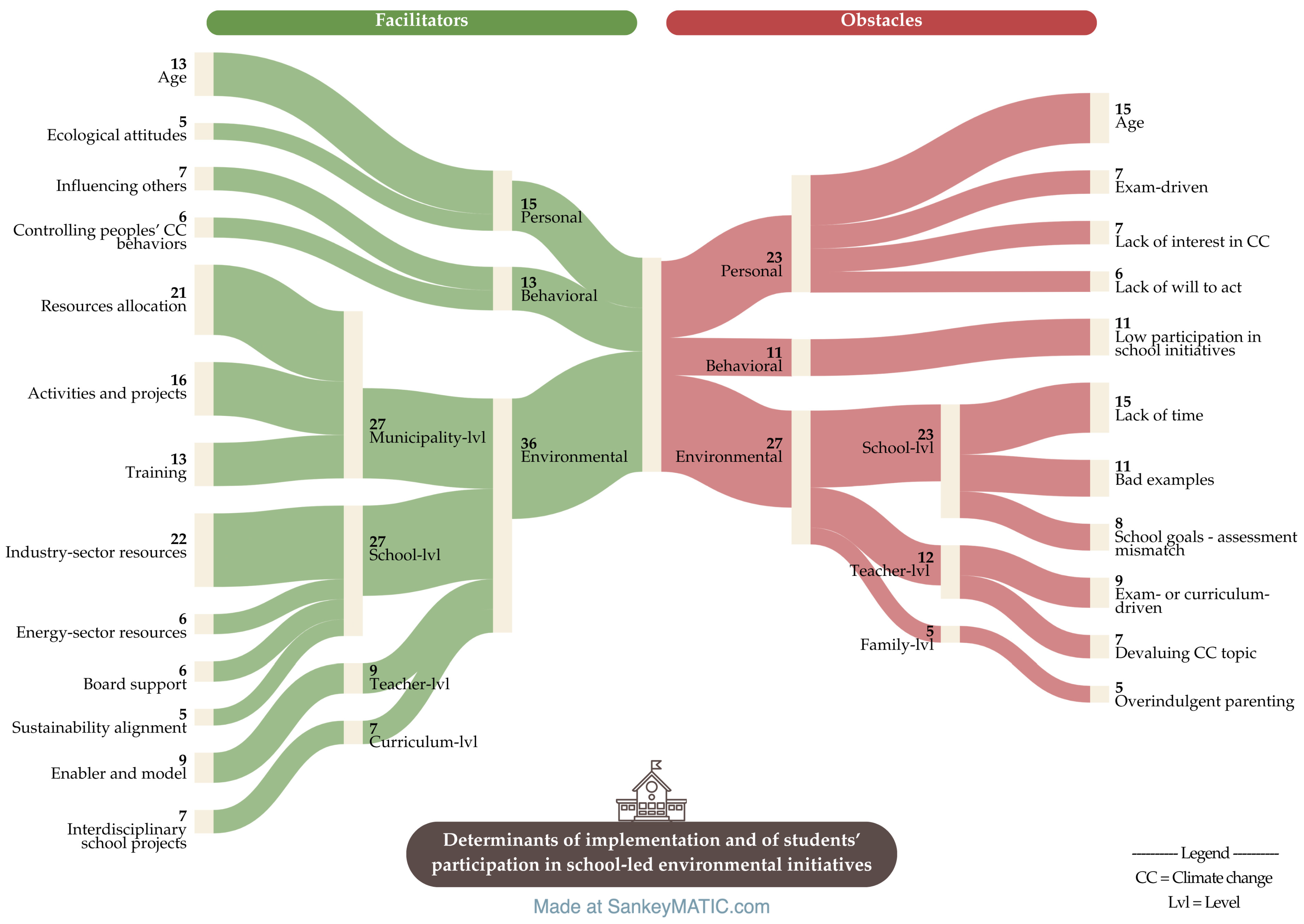
Determinants of Both Implementation of School-Led Environmental Initiatives and Students’ Participation in These Initiatives
“Between 5th and 7th grade, they are excited [to participate]. They get to 8th and 9th grade, and there is a slight drop, because by then they already have other interests, and that [the environment] is no longer that interesting, … there is some enthusiasm there that fades. They start to feel a little embarrassed: ‘Oh, teacher, the Eco-schools vest…?’. ‘Yes, so what, I also have the Eco-schools vest’. Well, they put on the Eco-schools vest, but it is not such a pretty thing anymore.”
“That’s why I really like interdisciplinary projects. Because with interdisciplinary projects, we ultimately gain time. At least that’s my perception: you gain time. It’s not just the geography class anymore. It’s the geography class and the science class, and maybe even the citizenship class. We manage to create all these steps and complete them all.”(Francisco, Eco-schools coordinator)
3.2. CC Teaching
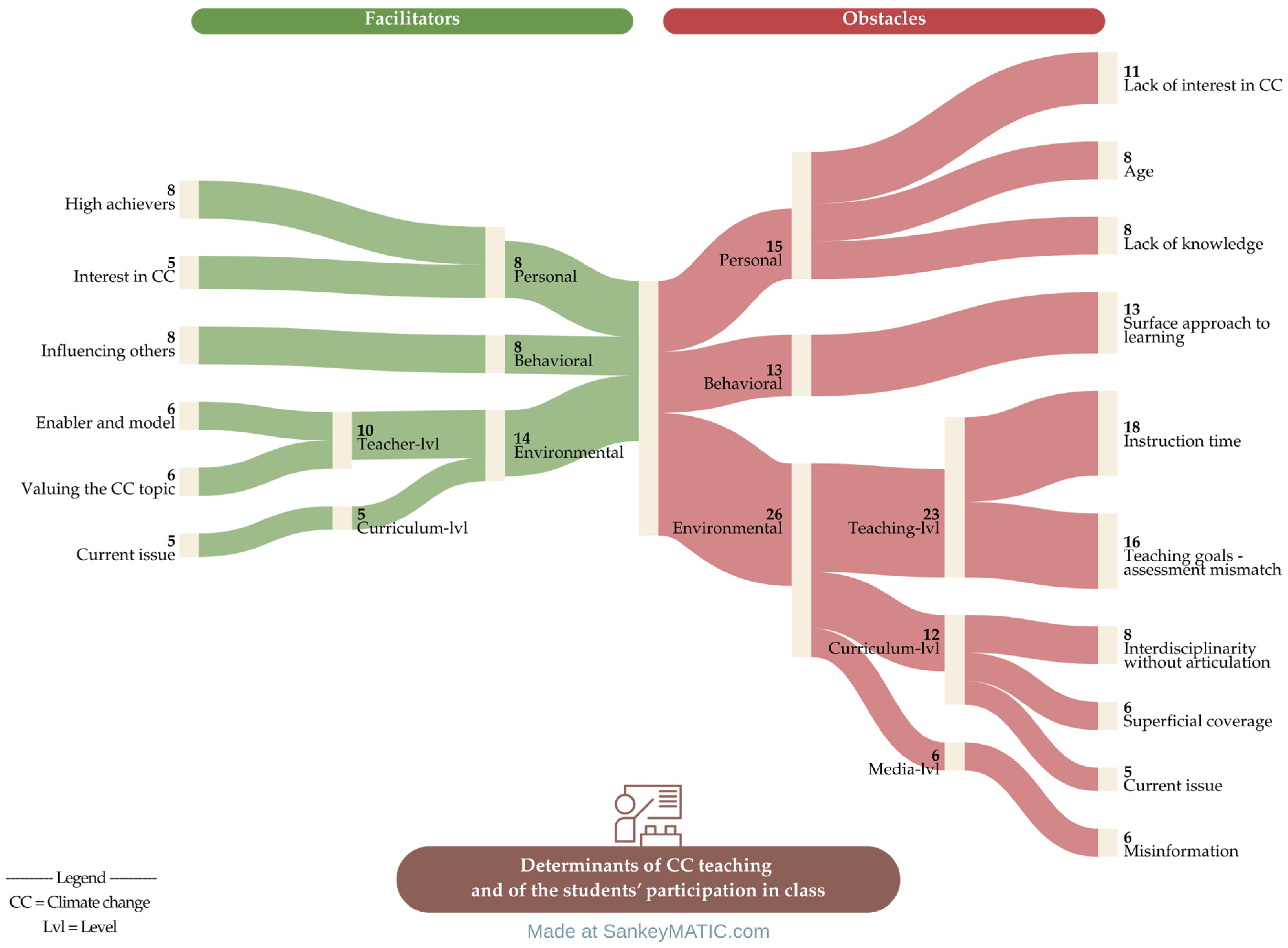
Determinants of Both CC Teaching Practices and Students’ Participation in Class
“I think that sometimes they [students] undervalue some things. They sometimes consider them [CC-related topics] minor issues. I think they believe they already know what it is, right? They already know, they have already mastered it, they don’t need to work on it anymore. But the truth is that they don’t go beyond the basics. When you ask questions about sustainability, about CC, they always go back to the same thing. They always go back to pollution; they always go back to the issue of waste and little more than that.”
“Teachers have a curriculum [to deliver], they have essential learnings [to follow], but they have great latitude in how they approach these essential learnings, … which essential learnings they give greater importance or less importance. For example, in seventh and eighth grade, I can address CC in a 10 or 15-min class conversation or simply by assigning homework. I don’t do that, but I don’t do it because of different personal and professional sensibilities.”(Cláudia, middle school sciences teacher)
3.3. Students’ CC Mitigation Actions and Climate Agency
“In the English subject, in high school, we talk about all these issues. And it’s like I said: there are many students who, I think, have never stopped to think about this. Then, some of them start saying that perhaps they buy less now than they did a few years ago because they have already considered these issues. They think twice. And they think like this: ‘Do I really need that t-shirt or that product, or is it just for vanity and I really don’t need it, and it’s not worth it?’ Some of them start thinking about these issues.”(Olália, high school English teacher)
“They’d already done something in the 5th and 6th grades, like a club in the class, and they’d organized it, and the parents came together for a weekend or a day to clean up [a beach] together. It was even organized by the kids; they’re very active. I know they did this beach cleanup on their own initiative.”
“There was a project exclusively [set up] by the students. The students from our Student Association have a project called Ecopark. … The Student Association approached us to promote their idea. They are going to build an Ecopark with furniture made by a local company, which produces all its furniture from waste. They have already held meetings with the City Council and have the project and budget in place. They have already managed to raise money, and I think the City Council and the company will cover the rest.”
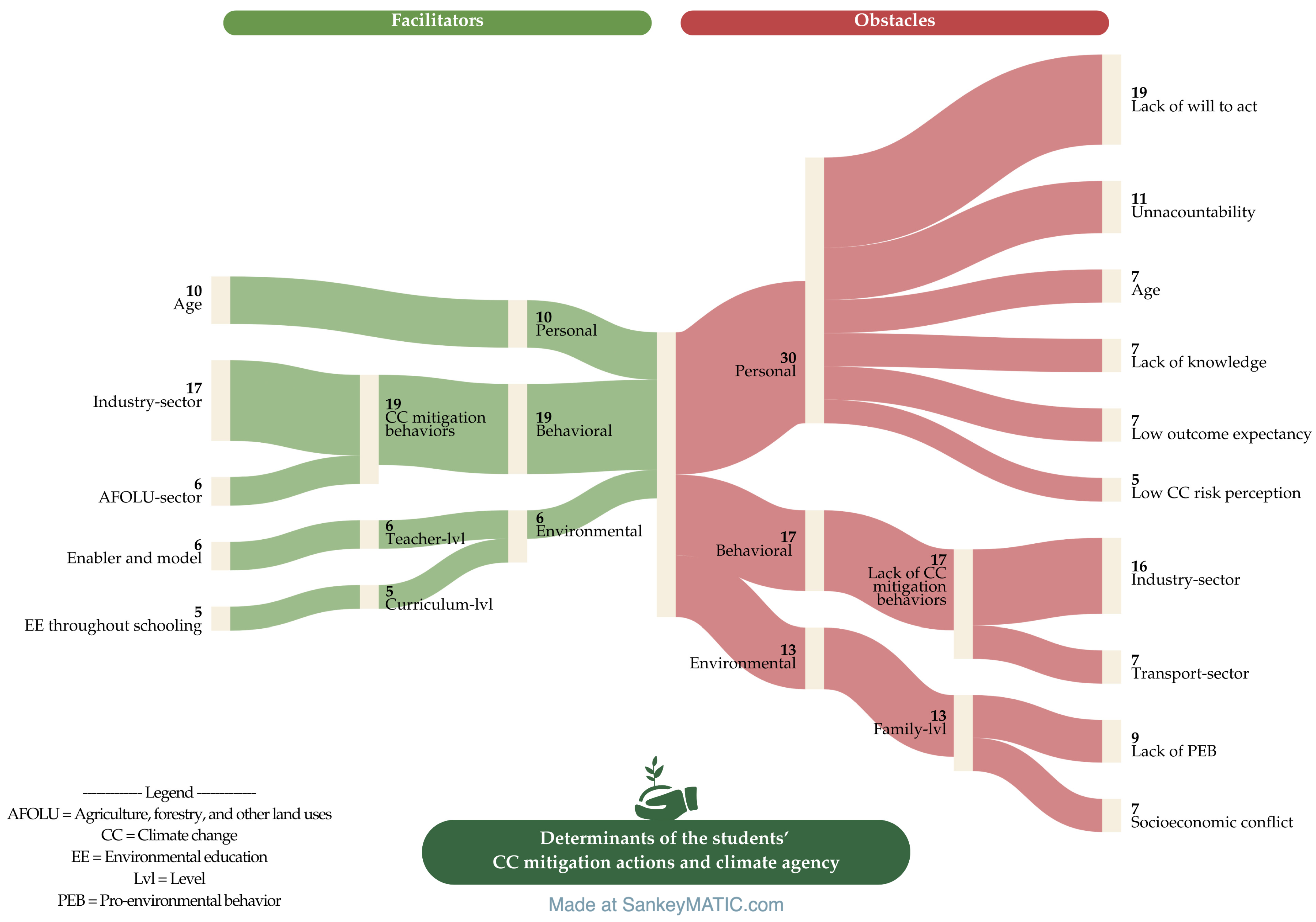
Determinants of Students’ CC Mitigation Actions and Climate Agency
“In fact, I think some of them are even aware that what they’re doing might not be the right thing to do, and perhaps they even need to make some changes. But then, going from ‘thinking they can and need to change’ to ‘doing so’ is still a long way off.”(Cesária, middle school sciences teacher)
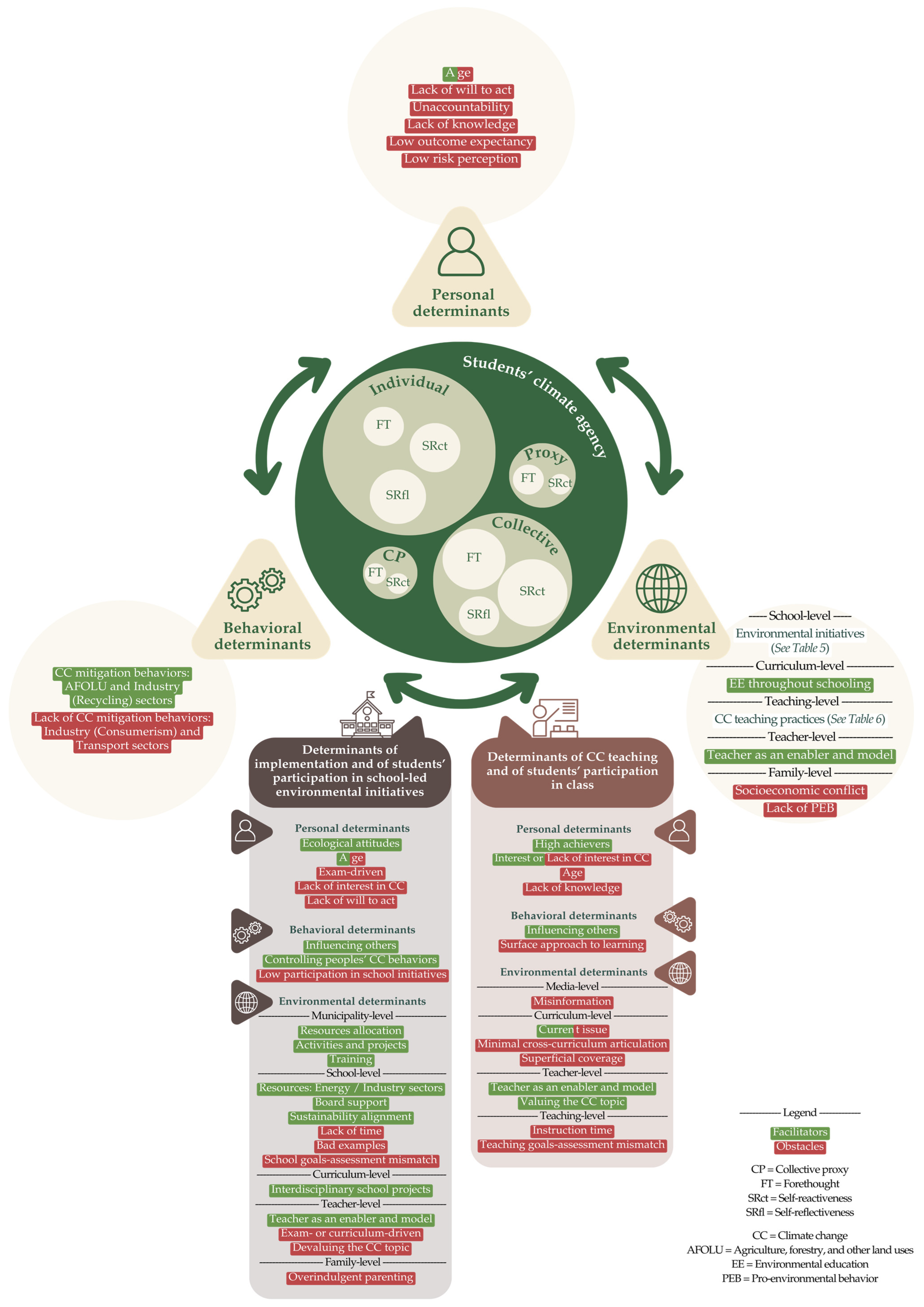
3.4. Linkages Between the School Context and Students’ Climate Agency
“What I also feel is that whenever I combine the environmental aspect with the social aspect, things work much better. We have the Paper for Food campaign, where we collect, for example, paper waste here in the school context. This paper is then delivered to the Food Bank. And the kids love it. So, sometimes they even have competitions between classes, seeing who collects more paper, and they collect old notebooks and magazines because they realize that something like waste separation also has a huge social impact.”(Luciana, Coordinator of Eco-schools and social responsibility programs)
“It’s really about developing specific practical activities and also viewing impactful images. It’s not light images. What I usually say: It’s about impactful images. Images where they can really see the effects. For example, the issue of sea ice decline. Some images are truly frightening when we see them and realize [the relationship between human activity and CC].”
“I don’t know if my classes have any impact. I want to believe that with these topics, as with so many others, the seed has been planted. It’s like reading. Sometimes, no matter how much someone insists, [students] keep saying they don’t like reading and don’t want to read. But one day later, some even discover the joy of reading. I’ve had former students who said, ‘The teacher insisted so much that the truth is, now I’m an avid reader. But back then, I didn’t understand how it was possible to enjoy reading.’ Well, I want to believe that the seed at least remains there. With so much insistence and so many programs and so many things that exist in schools in [regards to the environment], I want to believe that something remains there.”
3.5. Summary of Findings
4. Discussion
4.1. School-Led Environmental Initiatives Addressing CC
4.2. CC Teaching
4.3. Students’ CC Mitigation Actions and Agency
4.4. Linkages Between the School Context and Students’ Climate Agency
4.5. Strenghts, Limitations, and Future Directions
5. Conclusions
Supplementary Materials
Author Contributions
Funding
Institutional Review Board Statement
Informed Consent Statement
Data Availability Statement
Acknowledgments
Conflicts of Interest
Abbreviations
| AFOLU | Agriculture, forestry, and other land uses |
| CC | Climate change |
| EE | Environmental education |
| GHG | Greenhouse gas |
| PEB | Pro-environmental behavior |
| SDG | Sustainable development goal |
| UNEP | United Nations environment programme |
References
- UNESCO-IBE; Opertti, R. The Transformation of Education at the Peak of United Nations; Curriculum on the Move, Thematic Note; UNESCO-IBE: Geneva, Switzerland, 2022; Volume 15. [Google Scholar]
- Kranz, J.; Schwichow, M.; Breitenmoser, P.; Niebert, K. The (Un)Political Perspective on Climate Change in Education—A Systematic Review. Sustainability 2022, 14, 4194. [Google Scholar] [CrossRef]
- Baker, C.; Clayton, S.; Bragg, E. Educating for Resilience: Parent and Teacher Perceptions of Children’s Emotional Needs in Response to Climate Change. Environ. Educ. Res. 2021, 27, 687–705. [Google Scholar] [CrossRef]
- UNESCO. Getting Every School Climate-Ready: How Countries Are Integrating Climate Change Issues in Education; UNESCO: Paris, France, 2021. [Google Scholar]
- Calvin, K.; Dasgupta, D.; Krinner, G.; Mukherji, A.; Thorne, P.W.; Trisos, C.; Romero, J.; Aldunce, P.; Barrett, K.; Blanco, G.; et al. Climate Change 2023: Synthesis Report; Contribution of Working Groups I, II and III to the Sixth Assessment Report of the Intergovernmental Panel on Climate Change; Arias, P., Bustamante, M., Elgizouli, I., Flato, G., Howden, M., Méndez-Vallejo, C., Pereira, J.J., Pichs-Madruga, R., Rose, S.K., Saheb, Y., et al., Eds.; Intergovernmental Panel on Climate Change (IPCC): Geneva, Switzerland, 2023. [Google Scholar]
- World Bank; Sanchez, A.; Crawford, M.F.; Oviedo Buitrago, M.E.; Ellinore, A.; Arias Diaz, O.S.; Jaime, S. Guide for Learning Recovery and Acceleration: Using the RAPID Framework to Address COVID-19 Learning Losses and Build Forward Better; World Bank: Washington, DC, USA, 2022. [Google Scholar]
- Carneiro, R.J.S. Exploring Adolescents’ Agency Modes Toward Climate Change. Master’s Dissertation, University of Minho, Braga, Portugal, 2024. [Google Scholar]
- UNESCO. Learn for Our Planet: A Global Review of How Environmental Issues Are Integrated in Education; UNESCO: Paris, France, 2021; p. 4. [Google Scholar]
- Dawson, V.; Eilam, E.; Tolppanen, S.; Assaraf, O.B.Z.; Gokpinar, T.; Goldman, D.; Putri, G.A.P.E.; Subiantoro, A.W.; White, P.; Widdop Quinton, H. A Cross-Country Comparison of Climate Change in Middle School Science and Geography Curricula. Int. J. Sci. Educ. 2022, 44, 1379–1398. [Google Scholar] [CrossRef]
- Direção-Geral da Educação. Aprendizagens Essenciais. Available online: https://web.archive.org/web/20250720163240/http://www.dge.mec.pt/aprendizagens-essenciais-0 (accessed on 20 July 2025).
- Rousell, D.; Cutter-Mackenzie-Knowles, A. A Systematic Review of Climate Change Education: Giving Children and Young People a ‘Voice’ and a ‘Hand’ in Redressing Climate Change. Child. Geogr. 2020, 18, 191–208. [Google Scholar] [CrossRef]
- Hestness, E.; McDonald, R.C.; Breslyn, W.; McGinnis, J.R.; Mouza, C. Science Teacher Professional Development in Climate Change Education Informed by the Next Generation Science Standards. J. Geosci. Educ. 2014, 62, 319–329. [Google Scholar] [CrossRef]
- Khalidi, R.; Ramsey, J. A Comparison of California and Texas Secondary Science Teachers’ Perceptions of Climate Change. Environ. Educ. Res. 2021, 27, 669–686. [Google Scholar] [CrossRef]
- Colston, N.M.; Ivey, T.A. (Un)Doing the Next Generation Science Standards: Climate Change Education Actor-Networks in Oklahoma. J. Educ. Policy 2015, 30, 773–795. [Google Scholar] [CrossRef]
- Drewes, A.; Henderson, J.; Mouza, C. Professional Development Design Considerations in Climate Change Education: Teacher Enactment and Student Learning. Int. J. Sci. Educ. 2018, 40, 67–89. [Google Scholar] [CrossRef]
- Rushton, E.A.C.; Dunlop, L.; Atkinson, L. Fostering Teacher Agency in School-based Climate Change Education in England, UK. Curric. J. 2025, 36, 36–51. [Google Scholar] [CrossRef]
- Plutzer, E.; Hannah, A.L. Teaching Climate Change in Middle Schools and High Schools: Investigating STEM Education’s Deficit Model. Clim. Change 2018, 149, 305–317. [Google Scholar] [CrossRef]
- Valdez, R.X.; Peterson, M.N.; Stevenson, K.T. How Communication with Teachers, Family and Friends Contributes to Predicting Climate Change Behaviour among Adolescents. Envir. Conserv. 2018, 45, 183–191. [Google Scholar] [CrossRef]
- Hohenhaus, M.; Boddy, J.; Rutherford, S.; Roiko, A.; Hennessey, N. Engaging Young People in Climate Change Action: A Scoping Review of Sustainability Programs. Sustainability 2023, 15, 4259. [Google Scholar] [CrossRef]
- Wise, S.B. Climate Change in the Classroom: Patterns, Motivations, and Barriers to Instruction among Colorado Science Teachers. J. Geosci. Educ. 2010, 58, 297–309. [Google Scholar] [CrossRef]
- Cornelius, M.; Armel, K.C.; Hoffman, K.; Allen, L.; Bryson, S.W.; Desai, M.; Robinson, T.N. Increasing Energy- and Greenhouse Gas-Saving Behaviors among Adolescents: A School-Based Cluster-Randomized Controlled Trial. Energy Effic. 2014, 7, 217–242. [Google Scholar] [CrossRef]
- Stevenson, K.T.; Nils Peterson, M.; Bondell, H.D. Developing a Model of Climate Change Behavior among Adolescents. Clim. Change 2018, 151, 589–603. [Google Scholar] [CrossRef]
- Gallay, E.; Furlan Brighente, M.; Flanagan, C.; Lowenstein, E. Place-based Civic Science—Collective Environmental Action and Solidarity for Eco-resilience. Child Adolesc. Ment. Health 2022, 27, 39–46. [Google Scholar] [CrossRef]
- Flora, J.A.; Saphir, M.; Lappé, M.; Roser-Renouf, C.; Maibach, E.W.; Leiserowitz, A.A. Evaluation of a National High School Entertainment Education Program: The Alliance for Climate Education. Clim. Change 2014, 127, 419–434. [Google Scholar] [CrossRef]
- Rudd, J.A.; Horry, R.; Skains, R.L. You and CO2: A Public Engagement Study to Engage Secondary School Students with the Issue of Climate Change. J. Sci. Educ. Technol. 2020, 29, 230–241. [Google Scholar] [CrossRef]
- Jensen, B.B.; Schnack, K. The Action Competence Approach in Environmental Education. Environ. Educ. Res. 2006, 12, 471–486. [Google Scholar] [CrossRef]
- Klemenčič, M. What Is Student Agency? An Ontological Exploration in the Context of Research on Student Engagement. In Student Engagement in Europe: Society, Higher Education and Student Governance; Klemenčič, M., Bergan, S., Primožič, R., Eds.; Council of Europe higher education series; Council of Europe Publishing: Strasbourg, France, 2015. [Google Scholar]
- Priestley, M.; Edwards, R.; Priestley, A.; Miller, K. Teacher Agency in Curriculum Making: Agents of Change and Spaces for Manoeuvre. Curric. Inq. 2012, 42, 191–214. [Google Scholar] [CrossRef]
- Firinci Orman, T. Youth’s Everyday Environmental Citizenship: An Analytical Framework for Studying Interpretive Agency. Childhood 2022, 29, 495–511. [Google Scholar] [CrossRef]
- Frick, M.; Guggenberger, J.A.; Liebhaber, N.; Michelsen, G.; Oberauer, K.; Schackmar, S.; Schickl, M.; Keller, L.; Hüfner, K. Conceptual Links Between Environmental Psychology and Climate Change Education to Encourage Climate-Friendly Behavior of Young People: Is There a Role for Self-Regulation? Environ. Educ. Res. 2025, 31, 2531–2551. [Google Scholar] [CrossRef]
- Colombo, S.L.; Chiarella, S.G.; Lefrançois, C.; Fradin, J.; Simione, L.; Raffone, A. Probing Pro-Environmental Behaviour: A Systematic Review on Its Relationship with Executive Functions and Self-Regulation Processes. J. Environ. Psychol. 2023, 92, 102153. [Google Scholar] [CrossRef]
- Bandura, A. Toward a Psychology of Human Agency. Perspect. Psychol. Sci. 2006, 1, 164–180. [Google Scholar] [CrossRef]
- Bandura, A. Toward a Psychology of Human Agency: Pathways and Reflections. Perspect. Psychol. Sci. 2018, 13, 130–136. [Google Scholar] [CrossRef]
- Koskela, I.-M.; Paloniemi, R. Learning and Agency for Sustainability Transformations: Building on Bandura’s Theory of Human Agency. Environ. Educ. Res. 2023, 29, 164–178. [Google Scholar] [CrossRef]
- Bandura, A. Social Foundations of Thought and Action: A Social Cognitive Theory; Prentice-Hall series in social learning theory; Prentice-Hall: Englewood Cliffs, NJ, USA, 1986. [Google Scholar]
- Cunha, J.; Martins, J.; Núñez, J.C.; Vallejo, G.; Rosário, P. Adolescents’ Agency toward Climate Change: Development and Validation of Scales for Individual, Proxy, and Collective Modes. Front. Psychol. 2025, 16, 1532409. [Google Scholar] [CrossRef]
- Schoots-Snijder, A.J.M.; Tigelaar, E.H.; Admiraal, W.F. Curriculum Guidelines for the Development of Student Agency in Secondary Education: A Systematic Review. Curric. J. 2025, 36, 541–573. [Google Scholar] [CrossRef]
- Rupnik, D.; Avsec, S. Student Agency as an Enabler in Cultivating Sustainable Competencies for People-Oriented Technical Professions. Educ. Sci. 2025, 15, 469. [Google Scholar] [CrossRef]
- Monroe, M.C.; Plate, R.R.; Oxarart, A.; Bowers, A.; Chaves, W.A. Identifying Effective Climate Change Education Strategies: A Systematic Review of the Research. Environ. Educ. Res. 2019, 25, 791–812. [Google Scholar] [CrossRef]
- Russell, T. A ‘Greenhouse Affect’? Exploring Young Australians’ Emotional Responses to Climate Change. Clim. Change 2024, 177, 75. [Google Scholar] [CrossRef]
- Sousa, S. Some Reflections on the Role of the Eco-Schools Program in the Promotion of Sustainable HEIs: A Case Study in Portugal. Adm. Sci. 2022, 12, 149. [Google Scholar] [CrossRef]
- Beitin, B. Interview and Sampling: How Many and Whom. In The Sage Handbook of Interview Research: The Complexity of the Craft; Gubrium, J.F., Ed.; SAGE: Los Angeles, CA, USA, 2012. [Google Scholar]
- Rahimi, S.; Khatooni, M. Saturation in Qualitative Research: An Evolutionary Concept Analysis. Int. J. Nurs. Stud. Adv. 2024, 6, 100174. [Google Scholar] [CrossRef] [PubMed]
- Irani, E. The Use of Videoconferencing for Qualitative Interviewing: Opportunities, Challenges, and Considerations. Clin. Nurs. Res. 2019, 28, 3–8. [Google Scholar] [CrossRef]
- Zelčāne, E.; Pipere, A. Finding a Path in a Methodological Jungle: A Qualitative Research of Resilience. Int. J. Qual. Stud. Health Well-Being 2023, 18, 2164948. [Google Scholar] [CrossRef]
- Warriner, K.; Goyder, J.; Gjertsen, H.; Hohner, P.; McSpurren, K. Charities, No; Lotteries, No; Cash, Yes: Main Effects and Interactions in a Canadian Incentives Experiment. Public Opin. Q. 1996, 60, 542. [Google Scholar] [CrossRef]
- Krueger, R.A.; Casey, M.A. Focus Groups: A Practical Guide for Applied Research, 5th ed.; SAGE Publications: Thousand Oaks, CA, USA, 2014. [Google Scholar]
- Kuckartz, U.; Rädiker, S. Qualitative Content Analysis: Methods, Practice and Software, 2nd ed.; SAGE: Los Angeles, CA, USA; London, UK; New Delhi, India; Singapore; Washington, DC, USA; Melbourne, VIC, Australia, 2023. [Google Scholar]
- Dawadi, S.; Shrestha, S.; Giri, R.A. Mixed-Methods Research: A Discussion on Its Types, Challenges, and Criticisms. JPSE 2021, 2, 25–36. [Google Scholar] [CrossRef]
- Lambert, S.D.; Loiselle, C.G. Combining Individual Interviews and Focus Groups to Enhance Data Richness. J. Adv. Nurs. 2008, 62, 228–237. [Google Scholar] [CrossRef]
- Lincoln, Y.S.; Guba, E.G. Naturalistic Inquiry; Sage: Newbury Park, CA, USA, 1985. [Google Scholar]
- McHugh, M.L. Interrater Reliability: The Kappa Statistic. Biochem. Med. 2012, 22, 276–282. [Google Scholar] [CrossRef]
- Ahmed, S.K. The Pillars of Trustworthiness in Qualitative Research. J. Med. Surg. Public Health 2024, 2, 100051. [Google Scholar] [CrossRef]
- Braun, V.; Clarke, V. Reporting Guidelines for Qualitative Research: A Values-Based Approach. Qual. Res. Psychol. 2025, 22, 399–438. [Google Scholar] [CrossRef]
- UNESCO. Green School Quality Standard—Greening Every Learning Environment, 1st ed.; UNESCO: Paris, France, 2024. [Google Scholar]
- Herranen, J.; Aksela, M. Fostering Teachers as Sustainability and Climate Change Educators through Understanding of Teachers’ Self-Efficacy Beliefs. LUMAT 2024, 12, 30–52. [Google Scholar] [CrossRef]
- Long, J.; Rice, J.L. From Sustainable Urbanism to Climate Urbanism. Urban Stud. 2019, 56, 992–1008. [Google Scholar] [CrossRef]
- Sihvonen, P.; Herranen, J.; Uusi-Äijö, V.; Aksela, M. Teacher Agency in Using Students’ Questions in Climate Change Education. Int. J. Environ. Sci. Educ. 2023, 19, e2317. [Google Scholar] [CrossRef]
- Raath, S.; Hay, A. Self-Efficacy: A South African Case Study on Teachers’ Commitment to Integrate Climate Change Resilience into Their Teaching Practices. Cogent Educ. 2016, 3, 1264698. [Google Scholar] [CrossRef]
- Vieira, J.; Castro, S.L.; Souza, A.S. Psychological Barriers Moderate the Attitude-Behavior Gap for Climate Change. PLoS ONE 2023, 18, e0287404. [Google Scholar] [CrossRef]
- Ben Zvi Assaraf, O.; Dawson, V.; Eilam, E.; Gokpinar, T.; Goldman, D.; Naugauker, N.; Eka Putri, G.A.P.; Subiantoro, A.W.; Tolppanen, S.; White, P.; et al. Climate Change Education Implementation: The Voices of Policymakers, Professional Development Providers, and Teachers in Five Countries. Int. J. Sci. Educ. 2025, 47, 191–213. [Google Scholar] [CrossRef]
- Feldbacher, E.; Waberer, M.; Campostrini, L.; Weigelhofer, G. Identifying Gaps in Climate Change Education—A Case Study in Austrian Schools. Int. Res. Geogr. Environ. Educ. 2024, 33, 109–124. [Google Scholar] [CrossRef]
- Howard-Jones, P.; Sands, D.; Dillon, J.; Fenton-Jones, F. The Views of Teachers in England on an Action-Oriented Climate Change Curriculum. Environ. Educ. Res. 2021, 27, 1660–1680. [Google Scholar] [CrossRef]
- Trigwell, K.; Prosser, M.; Waterhouse, F. Relations between Teachers’ Approaches to Teaching and Students’ Approaches to Learning. High. Educ. 1999, 37, 57–70. [Google Scholar] [CrossRef]
- Olsson, D. Empowering Political Engagement with Unsustainable Actions: The Possibilities and Limitations of Teaching Guides for Climate Change Education. Environ. Educ. Res. 2022, 28, 1109–1125. [Google Scholar] [CrossRef]
- Rosário, P.; Núñez, J.C.; Ferrando, P.J.; Paiva, M.O.; Lourenço, A.; Cerezo, R.; Valle, A. The Relationship between Approaches to Teaching and Approaches to Studying: A Two-Level Structural Equation Model for Biology Achievement in High School. Metacognition Learn. 2013, 8, 47–77. [Google Scholar] [CrossRef]
- O’Neill, S.; Nicholson-Cole, S. “Fear Won’t Do It”: Promoting Positive Engagement with Climate Change Through Visual and Iconic Representations. Sci. Commun. 2009, 30, 355–379. [Google Scholar] [CrossRef]
- Wang, X.; Chen, J. Fear Emotion Reduces Reported Mitigation Behavior in Adolescents Subject to Climate Change Education. Clim. Change 2022, 174, 1. [Google Scholar] [CrossRef]
- Félix, M.; Cunha, J.; Rosário, P. Fear Appeal Strategies in Climate Change Education: Food for Thought from a Literature Review. In Exploración de Variables Psicológicas y Educativas: Avances en la Investigación Escolar; Molero Jurado, M.D.M., Martos Martínez, Á., Molina Moreno, P., Pérez-Fuentes, M.D.C., Eds.; Dykinson: Madrid, Spain, 2024. [Google Scholar]
- Vlasceanu, M.; Doell, K.C.; Bak-Coleman, J.B.; Todorova, B.; Berkebile-Weinberg, M.M.; Grayson, S.J.; Patel, Y.; Goldwert, D.; Pei, Y.; Chakroff, A.; et al. Addressing Climate Change with Behavioral Science: A Global Intervention Tournament in 63 Countries. Sci. Adv. 2024, 10, eadj5778. [Google Scholar] [CrossRef] [PubMed]
- Abasto, V.; Larraín, A.; Vergara, C.; Cofré, H. Alternative Conceptions about Climate Change in a Group of Teachers in Chile: Are Science Teachers More Knowledgeable than Non-Science Teachers? ECNU Rev. Educ. 2025, 8, 144–160. [Google Scholar] [CrossRef]
- Verlie, B.; Clark, E.; Jarrett, T.; Supriyono, E. Educators’ Experiences and Strategies for Responding to Ecological Distress. Aust. J. Environ. Educ. 2021, 37, 132–146. [Google Scholar] [CrossRef]
- Buchanan, J. Environmental Trust? Sustainability and Renewables Policy and Practice in the School Years. Curric. Perspect. 2021, 41, 163–173. [Google Scholar] [CrossRef]
- Testa, F.; Pretner, G.; Iovino, R.; Bianchi, G.; Tessitore, S.; Iraldo, F. Drivers to Green Consumption: A Systematic Review. Environ. Dev. Sustain. 2021, 23, 4826–4880. [Google Scholar] [CrossRef]
- Nguyen, X.C.; Dao, D.C.; Nguyen, T.T.; Tran, Q.B.; Huyen Nguyen, T.T.; Tuan, T.A.; Phuong Nguyen, K.L.; Nguyen, V.-T.; Nadda, A.K.; Thanh-Nho, N.; et al. Generation Patterns and Consumer Behavior of Single-Use Plastic Towards Plastic-Free University Campuses. Chemosphere 2022, 291, 133059. [Google Scholar] [CrossRef]
- Brown, J.; Krettenauer, T. Contrasting Trajectories in Adolescent Pro-Environmentalism: Qualitative Differences Between “Engagers” Versus “Disengagers”. Sustainability 2025, 17, 389. [Google Scholar] [CrossRef]
- Tamburini, E.; Costa, S.; Summa, D.; Battistella, L.; Fano, E.A.; Castaldelli, G. Plastic (PET) vs Bioplastic (PLA) or Refillable Aluminium Bottles—What Is the Most Sustainable Choice for Drinking Water? A Life-Cycle (LCA) Analysis. Environ. Res. 2021, 196, 110974. [Google Scholar] [CrossRef] [PubMed]
- Wynes, S.; Nicholas, K.A. The Climate Mitigation Gap: Education and Government Recommendations Miss the Most Effective Individual Actions. Environ. Res. Lett. 2017, 12, 074024. [Google Scholar] [CrossRef]
- Li, Z.; Zhou, Y.; Zhao, M.; Guan, D.; Yang, Z. The Carbon Footprint of Fast Fashion Consumption and Mitigation Strategies—A Case Study of Jeans. Sci. Total Environ. 2024, 924, 171508. [Google Scholar] [CrossRef] [PubMed]
- Wu, J.; Otsuka, Y. Pro-Climate Behaviour and the Influence of Learning Sources on It in Chinese Adolescents. Int. Res. Geogr. Environ. Educ. 2021, 30, 24–38. [Google Scholar] [CrossRef]
- Hensel, M.; Bryan, J.; McCarthy, C.; McNeal, K.S.; Norfles, N.; Rath, K.; Rooney-Varga, J.N. Participatory Approaches Enhance a Sense of Urgency and Collective Efficacy about Climate Change: Qualitative Evidence from the World Climate Simulation. J. Geosci. Educ. 2023, 71, 177–191. [Google Scholar] [CrossRef]
- Jugert, P.; Greenaway, K.H.; Barth, M.; Büchner, R.; Eisentraut, S.; Fritsche, I. Collective Efficacy Increases Pro-Environmental Intentions through Increasing Self-Efficacy. J. Environ. Psychol. 2016, 48, 12–23. [Google Scholar] [CrossRef]
- Badu, J.; Kruke, B.I.; Sætren, G.B. Balancing Stakeholder Engagement in Climate Action: A Symbiotic Typology Approach. Environ. Sci. Policy 2025, 163, 103953. [Google Scholar] [CrossRef]
- Aeschbach, V.M.-J.; Schwichow, M.; Rieß, W. Effectiveness of Climate Change Education—A Meta-Analysis. Front. Educ. 2025, 10, 1563816. [Google Scholar] [CrossRef]
- Mede, N.G.; Kobilke, L.; Fawzi, N.; Zerback, T. The Climate Change Generation: Vocal but Overconfident? How Young Adults Who Overestimate Their Climate Knowledge Use Social Media and Engage with Others. Soc. Media Soc. 2025, 11, 20563051251341792. [Google Scholar] [CrossRef]
- Guerra, A.; Jiang, D.; Du, X.; Abou-Hayt, I.; Valderrama Pineda, A.F. Examining Engineering Design Students’ Perceptions of Agency for Sustainability in a Problem- and Project-Based Learning (PBL) Context—A Q Methodology Study. Int. J. Technol. Des. Educ. 2025, 35, 723–746. [Google Scholar] [CrossRef]
- Huang, Y.-S.; Harvey, B.; Asghar, A. Bureaucratic Exercise? Education for Sustainable Development in Taiwan Through the Stories of Policy Implementers. Environ. Educ. Res. 2021, 27, 1099–1114. [Google Scholar] [CrossRef]
- ABAAE. Eco-Escolas 2023–2024. Available online: https://web.archive.org/web/20251119083611/https://ecoescolas.abaae.pt/escolas-e-municipios/escolas/eco-escolas-2023-2024/ (accessed on 19 November 2025).
- Casper, A.M.A.; Fernández-Giménez, M.E.; Balgopal, M.M. A Tool for Measuring Ecological Literacy: Coupled Human-Ecosystem Interactions. J. Agric. Educ. Ext. 2021, 27, 21–34. [Google Scholar] [CrossRef]
- Van Der Linden, S. Determinants and Measurement of Climate Change Risk Perception, Worry, and Concern. In Oxford Research Encyclopedia of Climate Science; Oxford University Press: Oxford, UK, 2017. [Google Scholar]
- Sardo, M.C. Responsibility for Climate Justice: Political Not Moral. Eur. J. Political Theory 2023, 22, 26–50. [Google Scholar] [CrossRef]
- Usher, E.; Ford, C.J. Social Cognitive Theory and Personal Agency; Routledge: Abingdon, UK, 2022. [Google Scholar]
- Eristi, B.; Akdeniz, C. Development of a Scale to Diagnose Instructional Strategies. Contemp. Educ. Technol. 2012, 3, 141–161. [Google Scholar] [CrossRef]



| Assessment Criteria | Quantitative Data (N = 42) | Qualitative Data |
|---|---|---|
| n | Example Quote | |
| Number of participants | 34 | Vicente: “for us [school board], the number of students works very well for the school, to say: ‘We managed to involve all students’ … That is, the school evaluates [our club], by the number of students [enrolled], by the participation and involvement.” |
| Level of involvement of participants in activity | 32 | No representative example. |
| Participants’ feedback about activity | 32 | Adriana: “But in general, it is easier for us to ask in general terms: ‘How was the activity? Did you like it? Any suggestions for next time?’ This year, we made a school trip with all the eighth graders, and we evaluated the visit: whether it was useful, whether they learned, and whether it had anything to do with the classes.” |
| Fulfillment of activity’s objectives | 31 | No representative example. |
| Change in participants’ behavior on school premises | 24 | Telma: “We have a huge number of water bottles in the trash cans at school every day. We do this check every time. … I recall that one of the points mentioned in the Eco-schools report, is that the number of single-use plastic bottles has been significantly reduced at the school. |
| Contribution of activity to goals of Educational Strategic Plan | 24 | Graciete: “Then, there is the degree of execution of the activities to put the Educational Strategic Plan into practice, and, at the end of each activity, we have to carry out that assessment.” |
| Participants’ learning | 20 | Francisco: “This criterion is applied to activities that are disciplinary activities. For example, let’s imagine that students create an infographic about the impact of CC in the Northwest of Portugal as part of geography, biology and geology, or another subject. This activity is part of the Eco-schools, but the assessment [of this task] is that of the subject. |
| Level of interaction between participants | 14 | No representative example. |
| Quality of documents and materials produced | 14 | Paula: “Many of the students’ assignments are submitted to competitions. We always participate in the competitions, and most of them have external juries.” |
| Change in participants’ behavior outside school | 12 | Joaquim: “Look, there is a question in our questionnaire that we ask every year, which is whether students separate [waste] at home.” |
| Number of documents and materials produced | 7 | Lúcio: “Therefore, the impact is also measured by … the number of environmental projects the students are able to create.” |
| Level of ease/difficulty of implementing activity | 7 | No representative example. |
| Level of Students’ Active Engagement | Implementation by School | School-Led Environmental Initiative | Implementation by School |
|---|---|---|---|
| Interviewees n | Interviewees n | ||
| Low active engagement | 31 | Awareness-raising events | 23 |
| School assembly or lectures | 16 | ||
| School field visits | 11 | ||
| Intermediate active engagement | 33 | Recycling challenges | 23 |
| Artistic activities with waste | 12 | ||
| Green brigades | 7 | ||
| Citizen science | 7 | ||
| Poster or video design | 6 | ||
| High active engagement | 40 | Cleanups | 26 |
| School gardens | 19 | ||
| Reforestation | 13 | ||
| Participatory budgeting | 8 |
| CC Teaching Practice | Adopted in CC Classes Interviewees n |
|---|---|
| Research projects | 24 |
| Transmissive orientation | 22 |
| Discussion | 17 |
| Audio–visual resources | 13 |
| Appeal to negative emotions | 10 |
| Following the textbook | 9 |
| Digital and online resources | 6 |
| Practical or experimental activities | 5 |
| UNEP Sector | Perceived Students’ Actions | Example Quote | Perceived Absence of Students’ Actions | Example Quote |
|---|---|---|---|---|
| Interviewees n | Interviewees n | |||
| Industry | 22 | Cleia: “They start reusing plastic water bottles and then, when we get to class discussions about industry, … they start buying reusable bottles. I really notice [a change] with water bottles. I notice it with recycling, too.” | 16 | Lucas: “We are hoarders! There’s no point denying it. It’s our culture… “How many cell phones do you have at home?” “Oh, professor. I have four.” “Why, if you only use one? That’s hoarding. … You have clothes you’ll never wear, guys. Sneakers you’ll never wear again.” And [these] kids have a lot of things. Teenagers are hoarders.” |
| AFOLU | 6 | Olália: “There are other students who already volunteer … at [a movement to rescue and redistribute surplus food]. And so, it has everything to do with these environmental issues, not only in terms of helping those most in need, but also in terms of zero waste.” | 0 | No representative example. |
| Transport | 4 | José: “During the school year, there are one or two students who ride their bikes to school. The rest travel by car or motorcycle.” | 7 | Graciete: “I think that after COVID, [students] got used to being brought to school by their parents. Before, they used to come by bus more often.” |
| Buildings | 2 | Berto: “They even say: ‘Sometimes I forget, but I try to be more mindful, … so that I can turn off the water while I’m brushing my teeth, or while I’m washing the dishes, or while I’m taking a shower.’ They admit that they sometimes forget, but they are being a little more careful, because it’s also a matter of habit.” | 1 | Cesária: “The truth is that sometimes I get a little disheartened with what I hear, because… the showers are endless, they leave everything on in the house… Well, a set of practices that I think are not exactly the best and that don’t contribute in any way.” |
| Energy | 1 | João: “And they try to be more mindful of their consumption. … In terms of energy use, there’s also some degree of moderation.” | 2 | Sandra: “I don’t know if it has to do with the sociocultural context. … It bothers me, for example, to walk by a classroom [at the school] during the day where they [students] left the lights on.” |
| Level of Students’ Active Engagement | School-Led Environmental Initiative | Interviewees n | |||||
|---|---|---|---|---|---|---|---|
| Implementation by Schools | Linkage to Climate Agency Mode Development | ||||||
| Total | Individual | Proxy | Collective | Collective Proxy | |||
| Low active engagement | Awareness-raising events | 23 | 4 | 4 | 0 | 0 | 0 |
| School assembly or lectures | 16 | 3 | 2 | 0 | 1 | 0 | |
| School field visits | 11 | 0 | - | - | - | - | |
| Intermediate active engagement | Recycling challenges | 23 | 6 | 2 | 0 | 4 | 0 |
| Artistic activities with waste | 12 | 2 | 0 | 0 | 2 | 0 | |
| Green brigades | 7 | 5 | 0 | 0 | 5 | 0 | |
| Citizen science | 7 | 1 | 0 | 0 | 1 | 0 | |
| Poster or video design | 6 | 0 | - | - | - | - | |
| High active engagement | Cleanups | 26 | 9 | 2 | 0 | 9 | 0 |
| School gardens | 19 | 2 | 1 | 0 | 2 | 0 | |
| Reforestation | 13 | 3 | 0 | 0 | 3 | 0 | |
| Participatory budgeting | 8 | 6 | 1 | 0 | 0 | 5 | |
| CC Teaching Practice | Interviewees n | |||||
|---|---|---|---|---|---|---|
| Adopted in CC Classes | Linkage to Climate Agency Mode Development | |||||
| Total | Individual | Proxy | Collective | Collective Proxy | ||
| Research projects | 24 | 6 | 5 | 0 | 2 | 0 |
| Transmissive orientation | 22 | 17 | 16 | 1 | 1 | 0 |
| Discussion | 17 | 9 | 9 | 1 | 0 | 0 |
| Audio–visual resources | 13 | 2 | 2 | 0 | 0 | 0 |
| Appeal to negative emotions | 10 | 6 | 6 | 0 | 0 | 0 |
| Following the textbook | 9 | 0 | - | - | - | - |
| Digital and online resources | 6 | 0 | - | - | - | - |
| Practical or experimental activities | 5 | 1 | 1 | 0 | 0 | 0 |
Disclaimer/Publisher’s Note: The statements, opinions and data contained in all publications are solely those of the individual author(s) and contributor(s) and not of MDPI and/or the editor(s). MDPI and/or the editor(s) disclaim responsibility for any injury to people or property resulting from any ideas, methods, instructions or products referred to in the content. |
© 2026 by the authors. Licensee MDPI, Basel, Switzerland. This article is an open access article distributed under the terms and conditions of the Creative Commons Attribution (CC BY) license.
Share and Cite
Cunha, J.; Félix, M.; Miranda, S.; Rosário, P. “We Leave at Least a Little Seed”: The School’s Role in Developing Students’ Agency Toward Climate Change. Sustainability 2026, 18, 2350. https://doi.org/10.3390/su18052350
Cunha J, Félix M, Miranda S, Rosário P. “We Leave at Least a Little Seed”: The School’s Role in Developing Students’ Agency Toward Climate Change. Sustainability. 2026; 18(5):2350. https://doi.org/10.3390/su18052350
Chicago/Turabian StyleCunha, Jennifer, Marcelo Félix, Sara Miranda, and Pedro Rosário. 2026. "“We Leave at Least a Little Seed”: The School’s Role in Developing Students’ Agency Toward Climate Change" Sustainability 18, no. 5: 2350. https://doi.org/10.3390/su18052350
APA StyleCunha, J., Félix, M., Miranda, S., & Rosário, P. (2026). “We Leave at Least a Little Seed”: The School’s Role in Developing Students’ Agency Toward Climate Change. Sustainability, 18(5), 2350. https://doi.org/10.3390/su18052350