Article

Mitigating Regional Disparities in Green Development Amid the Trade-Off Between Economic Growth and Environmental Protection: Evidence from China

1
School of Economics and Management, Beijing University of Technology, Pingleyuan 100, Beijing 100124, China
2
Integrated Research on Energy, Environment and Society, University of Groningen, Broerstraat 9, 9712 CP Groningen, The Netherlands
*
Author to whom correspondence should be addressed.
Sustainability 2026, 18(5), 2343; https://doi.org/10.3390/su18052343
Submission received: 9 January 2026 / Revised: 10 February 2026 / Accepted: 12 February 2026 / Published: 28 February 2026
(This article belongs to the Section Sustainable Urban and Rural Development)

Abstract

Achieving green development demands simultaneously balancing between economic growth and pollutant emission reduction, which can have complex impacts on regional disparities. This study measures the green development efficiency (GDE) for 266 Chinese cities during the 11th–13th National Five-Year Plan periods (2006–2020) by a global non-oriented endogenous directional distance function (endogenous DDF) that endogenizes direction vectors using the maximum improvement potential. Regional disparities are then quantified and decomposed by the Dagum Gini coefficient decomposition (intra-group, net inter-group, and hypervariable density) across seven regions. To make the policy implications operational, we further derive the separable economic efficiency loss and environmental efficiency loss components from the endogenous DDF and identify cities’ optimal preference options (γ); scenario experiments (5–30% improvement) are used to validate whether differentiated improvement directions can simultaneously raise GDE and narrow disparities. The main findings are as follows: (1) From the 11th Five to the 13th Five, cities’ GDE evolved from a median-centered distribution to a bimodal distribution, accompanied by spatial polarization and widening regional disparities. (2) By the 13th Five period, regional disparities had deepened, mainly driven by inter-group differences, notably hypervariable density. The original regional development patterns were disrupted, leading to increased overlap across cities. (3) Most cities have shifted from a “green-oriented” to an “economic-oriented” development preference since the 13th Five period. North China, South China, and East China favor pollution reduction, while others prioritize economic growth. (4) Preference options for cities with varying resource endowments should adapt over time. Under various hypothetical scenarios, cities adopting differentiated optimal options can enhance their GDE while simultaneously narrowing regional disparities. Reducing arbitrariness in balancing emission reduction and economic growth can promote regionally coordinated and environmentally sustainable development.

1. Introduction

The industrial revolution intensified the emissions of greenhouse gases and atmospheric pollutants [1], resulting in global climate warming and air quality degradation [2,3]. The conflict between resource–environment constraints and social–economic development has become a significant barrier to sustainable economic growth [4,5]. As a typical example, China has experienced extensive economic growth, with serious environmental problems [6]. In 2019, China’s CO2 emissions accounted for 30% of global total emissions [7], and PM2.5 ranked 11th among the countries with the worst air pollution [8]. Urban areas contributed as much as 85% of China CO2 emissions, surpassing the global average of 70% [9,10], and 48 cities were among the 100 most polluted cities worldwide [11]. Therefore, the pollution control and carbon abatement in China are of great importance to a global sustainable transition.
To balance economic growth and pollution reduction, China is guiding cities to explore pathways toward a green transition. Environmental governance has been incorporated into the National Five-Year Plan Outline, which is a national guiding document [12,13,14,15] with timely phased adjustments, as appropriate [16,17]. The 11th Five-Year Plan marked the first inclusion of total pollutant emission control as a binding constraint. The 12th Five-Year Plan introduced, for the first time, a target for reducing carbon intensity. In addition, China has continuously strived to reduce the intensity of energy consumption and increase the efficiency of production factors to promote green development efficiency, such as China’s Dual Control Policy on Total Energy Consumption and Energy Intensity. However, discrepancies in resource endowments and development level can lead to a distinct policy adopted by cities, which in turn change the original pattern among cities. When choosing between prioritizing emission pollution or promoting growth, cities’ policy preferences are influenced by their comparative advantages, thereby resulting in the regional disparities.
As the basic units in implementing green transformation development [18,19], cities are central to environmental governance [20,21]. In achieving green development and regional coordinated goals, cities should continuously upgrade and optimize their industrial structures while also narrowing development gaps with other cities. However, regional development disparities are expected to be amplified by the differences in the capabilities of green economic growth across cities. Considering both pollution reduction and economic growth offer a more comprehensive reflection of regional disparities, in this context, the disparities in urban development and the competitive landscape will be reshaped, thereby influencing progress toward achieving regional coordinated goals.
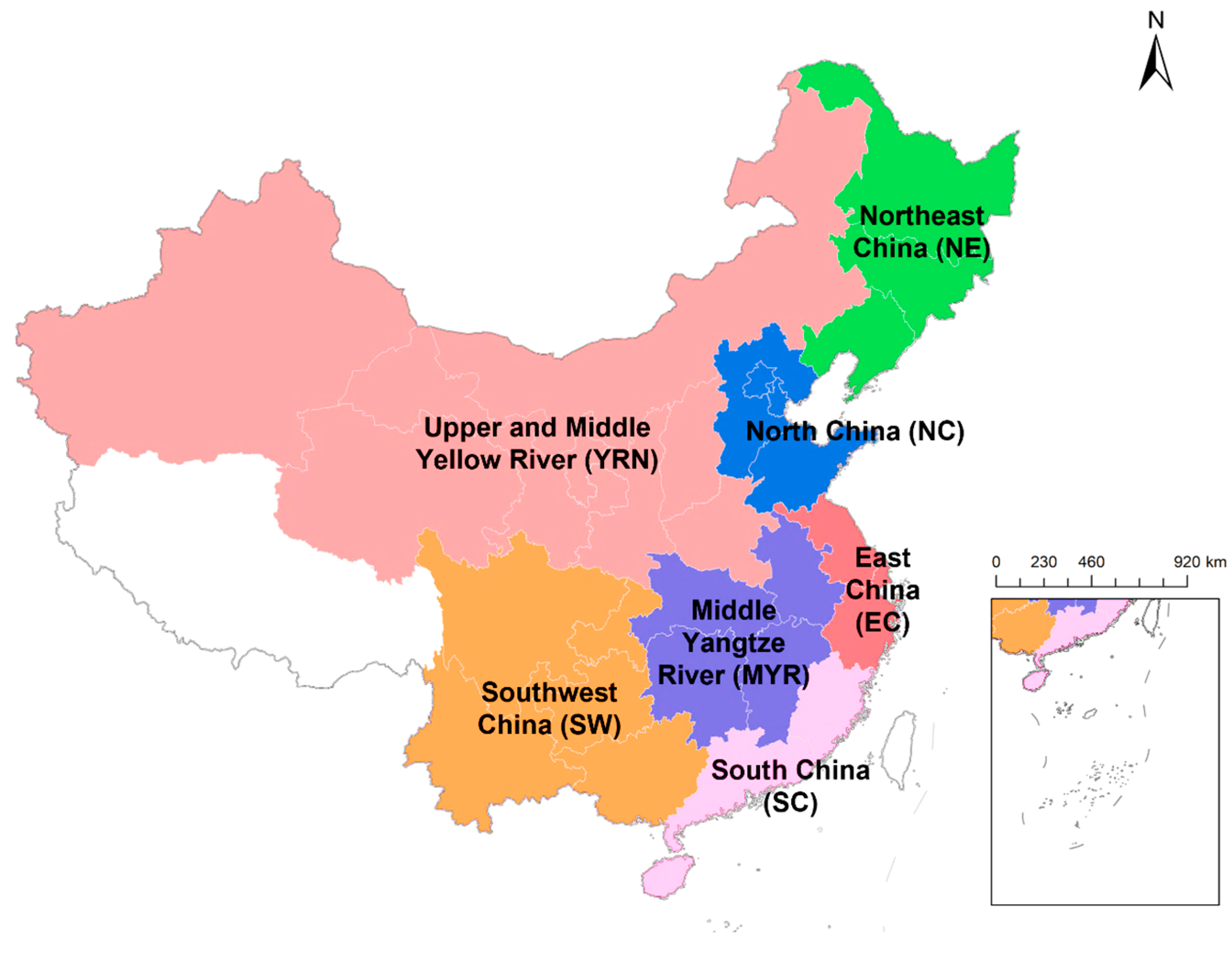
This study aims to contribute to reducing the uncertainty cities face in balancing emission reduction and economic growth, promoting the achievement of the goals in both regional coordination and sustainable development. This manuscript aims to (i) measure city-level green development efficiency (GDE) for 266 Chinese cities during the 11th–13th Five-Year Plan periods (2006–2020) using a global non-oriented endogenous DDF; (ii) quantify and decompose regional disparities in GDE across seven regions using the Dagum Gini decomposition (intra-group, net inter-group, and hypervariable density); (iii) separate the total inefficiency into economic efficiency loss and environmental efficiency loss to identify each city’s optimal preference option (γ) and test, via scenario-based improvements, whether differentiated improvement directions can jointly raise the GDE and reduce regional disparities. Based on an improved endogenous directional distance function, we measured the green development efficiency (GDE) of 266 Chinese cities in conjunction with China’s National Five-Year Plans. We explored the phased changes from the 11th Five-Year Plan (11th Five) to the 13th Five-Year Plan (13th Five) (2006–2020) in disparities across seven regions: Northeast China (NE), North China (NC), Upper and Middle Yellow River (YRN), Southwest China (SW), Middle Yangtze River (MYR), South China (SC), and East China (EC) (see Appendix A and Appendix B). The analysis focused on identifying the origins and underlying drivers of regional disparities and exploring how cities choose differentiated paths that align with their respective development stages under the broader context of regional imbalances and urban heterogeneity. The sections are organized as follows: Section 2 reviews the literature. Methodological model and data sources are provided in Section 3. Section 4 presents the results, and Section 5 summarizes the conclusions. The research proceeds in an orderly pipeline: (i) construct a consistent city-level input–output dataset (Section 3.3); (ii) estimate city–year GDE and its economic loss/environmental loss decomposition via the global non-oriented endogenous DDF (Section 3.1); (iii) quantify and attribute regional disparities using Dagum decomposition (Section 3.2 and Section 4.2); and (iv) translate component-based inefficiency into preference options (γ) and validate disparity-reduction potential through scenario experiments (Section 4.3).

2. Literature Review

2.1. Measuring Green Development Efficiency

Data envelopment analysis (DEA) is one of the most commonly used methods in measuring green development efficiency [22,23,24,25], with directional distance function (DDF) being a prevalent branch. The DDF enables increased desirable outputs and decreased undesirable outputs, and has been widely used in empirical studies [26]. However, a major limitation of DDF is its requirement for all inputs and outputs to change proportionally, which can underestimate the inefficiency value of the decision-making unit (DMU). Based on the model proposed by Chung et al. (1997) [27], scholars have made continuous improvements. For example, Zhou et al. (2012) introduced a non-radial directional distance function (NDDF) by relaxing the same proportional movement requirement [28]. Nevertheless, the direction vectors are still given exogenously with a degree of subjectivity, and the optimal choice of vectors is still a theoretical problem.
Researchers such as Färe et al. (2013), Zofio et al. (2013), and Lee et al. (2014) have tried to endogenize the direction vectors and proposed various endogenous directions [29,30,31]. The existing vector selection methods can be divided into two main categories [32]. The first category includes cost minimization selection techniques [33], profit maximization selection techniques [34], and marginal profit maximization selection techniques [31]. These methods consider the indicator’s price information and its direction based on market orientation. The second category includes the closest benchmark selection technique [35] and the maximum improvement potential selection technique [17], which are considered the theoretically optimal directions.
Empirical analyses have revealed that endogenous DDF can more accurately identify inefficient DMUs than exogenous DDF models [36]. The maximum improvement potential has the optimal estimation error, which can identify all improvement potential values and maximization directions with zero error rate. However, most studies around the maximum improvement potential focus on the improvement of outputs, which ignores the inefficiency of inputs. However, input factors’ inefficiencies also exist in production activities and can be adjusted over a longer time period. Thus, solely considering an output-oriented approach may underestimate the inefficiency values. However, in economically less developed or resource-dependent regions, factor inputs such as energy and capital are often rigid in the short run, and environmental outputs (e.g., CO2 and PM2.5 emissions) are closely tied to legacy industrial structures. An output-oriented approach implicitly assumes that inefficiency can be fully eliminated through output expansion alone, thereby masking the inefficiencies embedded in input redundancy and pollution intensity.

2.2. Regional Disparities in Environmental Governance

Concerning the impact of environmental changes on regional development, some studies are conducted from the macro perspective, such as industrial restructuring, industrial transfer, regional innovation, etc. [37] (Li, X., Xu, H., 2020). For example, Shu et al. (2022) found that industrial sector adjustments within industrial restructuring can simultaneously reduce both CO2 and PM2.5 emissions in the Beijing–Tianjin–Hebei region [38]. Other studies analyzed the impact of environmental changes on regional development from the micro perspective, e.g., company-level. Enterprises are increasingly recognized as pivotal actors in regional carbon mitigation strategies. By improving the productivity of low-carbon technologies, firms serve to accelerate the transition toward green and low-carbon development within regions [39].
Many studies integrated environmental pollution and economic growth into a unified analysis to quantitatively analyze the regional efficiency gaps from different perspectives [40,41]. Some studies focused on country-level discrepancy [42], and others analyzed the disparity across various areas within the country [43,44]. For instance, Guo et al. (2022) found that the green development efficiency of cities within urban agglomerations is higher than that of non-urban agglomeration cities in the Yellow River Basin [45]. Song et al. (2022) discovered that the green development efficiency of downstream cities is higher than that of upstream cities in the Yangtze River Basin [46]. A few studies found that urban green development efficiency has a significant impact on neighboring cities, exhibiting a spatial spillover effect, which further shapes the evolution of regional disparity [47]. Generally, they focused on the temporal and spatial characteristics of inter-regional differences and influenced factors [48,49]. The existing studies focus less on the reasons for regional disparities based on measuring regional gaps. In addition, few studies have explored the implementation path of narrowing regional disparities based on discovering reasons for differences.
Meanwhile, the growing body of literature has emphasized that regional disparities in green development efficiency are deeply rooted in structural factors, rather than arising solely from technological or scale differences [50]. Marketization level is widely recognized as a key determinant, as regions with higher degrees of market openness and competition tend to allocate resources more efficiently and adopt cleaner technologies more rapidly, thereby achieving higher green efficiency. In contrast, regions with stronger administrative intervention or factor-market distortions often exhibit lower green efficiency and larger internal disparities [51]. Infrastructure development constitutes another critical structural factor shaping regional differences in green efficiency. Well-developed transportation, energy, and information infrastructure can reduce transaction costs, facilitate interregional factor mobility, and enhance the diffusion of green technologies. Empirical studies have shown that infrastructure gaps between regions can amplify disparities in green development outcomes, particularly in large developing economies where spatial fragmentation remains pronounced. In addition, institutional environments and governance quality further condition regional green efficiency performance. Regions with stricter environmental regulation, more transparent governance, and stronger enforcement capacity tend to experience both higher average green efficiency and more coordinated development paths. Conversely, institutional fragmentation and uneven regulatory enforcement may lead to cross-regional overlap and polarization in green efficiency, reinforcing regional disparities.
Taken together, these studies suggest that regional disparities in green development efficiency are the combined outcome of market, infrastructure, and institutional structures. This structural perspective provides an essential theoretical foundation for the present study, which seeks not only to measure regional disparities in green development efficiency, but also to identify differentiated improvement directions that are consistent with each region’s underlying structural conditions.
In summary, compared with the existing literature, the marginal contribution of this paper is three aspects. (1) Methodologically, we expanded the output-oriented endogenous directional distance function to a global non-oriented endogenous directional distance function. Based on the endogenous distance function, this study systematically maps endogenous inefficiency into economic and environmental loss components that can be directly linked to regional disparity decomposition and policy-oriented scenario analysis. (2) The research subjective is in conjunction with the Outline of China’s Five-Year Plan. This study analyzed the phased changes in regional disparities of cities’ GDE from the 11th Five to the 13th Five period, decomposed and identified the sources of regional disparities, and explored the reasons that contribute to them. (3) In terms of policy insights, by comparing the economic development potential and the environmental improvement potential, this study explored the optimal preference options and divergent development paths in various cities across seven areas in mitigating regional disparities.

3. Methods

3.1. Non-Oriented Endogenous Directional Distance Function Model

According to Hampf and Krüger’s research (2015) [52], this study constructs a non-oriented endogenous directional distance function (non-oriented endogenous DDF), which further incorporates the input inefficiency, based on maximum improvement potential technology selection. Suppose that each DMU has M inputs, x = ( x 1 , , x m ) , N expected outputs, y = ( y 1 , , y n ) , and S unexpected outputs, u = ( u 1 , , u n ) . The vector of input–output of producer j in each period t (t = 1, …, T) is ( x j t , y j t , u j t ). Considering the comparability of DMUs in different periods, the non-oriented endogenous DDF model under the global benchmark technology is constructed. See Equations (1) and (2).
Firstly, the environmental directional distance function is defined as follows:
D G x , y , u ; g = m a x β : x g x , y + g y , u g u ϵ T G
where β is the efficiency loss, which is the maximum likelihood of increasing expected outputs and decreasing inputs and non-expected outputs. The larger β is, the greater the efficiency loss. g = ( g x , g y , g u ) is a vector of directions that decreases inputs and non-expected outputs and increases expected outputs.
Secondly, a global non-oriented endogenous DDF model is constructed:
max β , λ j , α mj 0 , δ nj 0 , φ sj 0 β
s . t . x m j 0 t β α m j 0 x m j 0 t t = 1 T j = 1 J x m j t λ j t , m = 1 , , M
y n j 0 t + β δ n j 0 y n j 0 t t = 1 T j = 1 J y n j t λ j t , n = 1 , , N
u s j 0 t β φ s j 0 u s j 0 t = t = 1 T j = 1 J u s j t λ j t , s = 1 , , S
m = 1 M α m j 0 + n = 1 N δ n j 0 + s = 1 S φ s j 0 = 1
j = 1 J λ j = 1
β , λ j t , α m j 0 , δ n j 0 , φ s j 0 0 , j = 1 , J , m = 1 , , M , n = 1 , , N , s = 1 , , S
where β is the efficiency loss, i.e., the direction vector ( α x , δ y , φ u ) in the solution Equation (2). If β > 0, it indicates that the evaluated DMU is inefficient, at which point the inputs and outputs need to be improved. The first three constraints represent decreased input and unexpected output and increased expected output. The fourth constraint is the standardization of endogenous variables, which can solve the different development directions of various cities. The fifth constraint is variable returns to scale. Equation (2) is a nonlinear plan which needs to be transformed linearly, i.e., Equation (3), to get the endogenous direction vectors ( α x , δ y , φ u ).
m a x m = 1 M β x , m + n = 1 N β y , n + s = 1 S β u , s
s . t . x m j 0 t ( 1 β x , m ) t = 1 T j = 1 J x m j t λ j t , m = 1 , , M
y n j 0 t 1 + β y , n t = 1 T j = 1 J y n j t λ j t , n = 1 , , N
u s j 0 t ( 1 β u , s ) = t = 1 T j = 1 J u s j t λ j t , s = 1 , , S
λ j t , β x , m , β y , n , β u , s 0 , j = 1 , J , m = 1 , , M , n = 1 , , N , s = 1 , , S
where β is the GDE’s loss (i.e., total efficiency improvement potential). β x , m = β α m ,   β y , n = β δ n ,   β u , s = β λ s ,   β x , m + β y , n + β u , s = β . β x is the input that can be decreased, β y is the expected output that can be increased, and β x , m + β y , n represents the loss of economic efficiency (the potential for which economic efficiency can be improved), i.e., insufficient economic development. β u is unexpected output that can be reduced. It represents the loss of environmental efficiency (the potential for environmental efficiency to be improved), i.e., excessive emissions of air pollution and carbon dioxide.
Equation (3) is obtained by linearizing the nonlinear formulation in Equation (2), following standard DEA linearization procedures. Specifically, the original fractional programming problem is transformed into an equivalent linear programming form through variable substitution and normalization, which preserves the optimal solution of the original problem. For transparency and reproducibility, the detailed linearization derivation from Equation (2) to Equation (3) is provided in Appendix C.
Regarding the approximation accuracy, the linearization does not introduce additional estimation bias to the efficiency measure β, as the transformation is mathematically equivalent, rather than an approximation. Consistent with existing studies using endogenous distance functions, the estimated β values remain invariant under the linearized formulation, ensuring the robustness of the efficiency estimation.
Further, the economic efficiency improvement potential ( β x + β y ) and the environmental efficiency improvement potential β u of DMUs can be derived from Equation (3). If ( β x + β y ) > β u , it indicates that the potential for economic development is greater than that for environmental enhancement, and vice versa. At this point, DMUs can clearly realize the optimal improvement direction (optimal preference option) to enhance their GDE.
Accordingly, the developmental tendency γ (optimal preference option of cities) is defined as follows:
γ = 1 S s = 1 S β u , s / 1 M + N m = 1 M β x , m + n = 1 N β y , n   = 1 S s = 1 S β φ s / 1 M + N m = 1 M β α m + n = 1 N β δ n   = 1 S s = 1 S φ s / 1 M + N m = 1 M α m + n = 1 N δ n
where α + δ + φ = 1, γ ϵ [0, ∞). If γ is larger, it means that the loss of urban economic efficiency is smaller than the loss of environmental efficiency, that is, the direction of urban development should focus on environmental protection for GDE improvement, and vice versa. γ < 1 does not mean that economic development is worse than environmental development, but the potential for improvement in the economic direction is greater than that for improvement in the environmental direction. At this time, focusing on economic development can improve the overall level of urban development faster, and vice versa.
The tendency of urban development does not shift abruptly by a specific index exceeding a threshold, but by a gradual process of transformation. Therefore, based on the research of Tu Zhengge (2022) [53], γ is divided into three intervals. γ ϵ [0, 0.8) is the economic tendency. The optimal direction of GDE improvement is to enhance the level of economic development. γ ϵ [0.8, 1.2) is a neutral tendency. The optimal direction for GDE improvement is to balance economic development and environmental protection at the same time. γ ϵ [1.2, ∞) is a green tendency. The optimal direction of GDE improvement is to prioritize environmental quality.
While the classification of green development trends in this study draws inspiration from the decoupling framework proposed by Tapio (2005) [54], it should be emphasized that the present application does not rely on the original economic–environmental elasticity per se, but rather on its underlying threshold logic. The core contribution of Tapio’s framework lies in using relative change rates to identify qualitatively distinct development regimes, rather than in the specific variables to which the thresholds were initially applied.
In the context of green development efficiency, the endogenous directional distance function provides separable improvement potentials for desirable outputs (economic dimension) and undesirable outputs (environmental dimension). The relative magnitude of these two improvement components reflects the dominant constraint faced by a city at a given stage of development. Accordingly, the preference option (γ) captures the balance between economic efficiency improvement and environmental efficiency improvement, which is conceptually analogous to the relative growth logic underlying decoupling analysis.
Therefore, adopting threshold-based classifications is theoretically appropriate in green efficiency research, as it enables the identification of distinct improvement regimes—economic-oriented, balanced, and environment-oriented—based on relative adjustment intensities, rather than absolute performance levels. This extension has also been implicitly supported by recent studies that apply decoupling-inspired thresholds to efficiency change, transition dynamics, and sustainability pathways [55].
Our method yields a transparent mapping from variables to results: the endogenous DDF produces city–year GDE (1 − β) and its economic loss and environmental loss components, which are then summarized into the preference option γ to indicate each city’s optimal improvement direction. The Dagum Gini decomposition uses the estimated city-level GDE to quantify intra-regional disparity, net inter-regional disparity, and hypervariable density, thereby identifying whether disparities stem mainly from within-region gaps, between-region gaps, or cross-overlap among regions.

3.2. Dagum Gini Coefficient

The Gini coefficient is a general method for analyzing disparities and inequalities among countries or regions. Dagum (1997) extended the classical Gini coefficient by relaxing the assumption of non-cross-overlap among grouped samples [56]. Dagum decomposed regional disparities into three components: intra-group differences, net inter-group differences and inter-group hypervariable density. The intra-group difference reflects the gap within regions, the inter-group net difference highlights the gap between regions, and the inter-group hypervariable density indicates the cross-over phenomenon of regions, which is the relative gap. The sum of the net difference and the hypervariable density is the inter-group gap. The specific calculations are as follows:
First, intra-group Gini coefficient and inter-group Gini coefficient are calculated as in Equations (5) and (6).
Intra-group Gini coefficient:
G j j = j = 1 n j r = 1 n j y j i y j r 2 n j 2 y j ¯
Inter-group Gini coefficient:
G j h = i = 1 n j f = 1 n h y j i y h f n j n h y j ¯ + y h ¯
where n j and n h denote cities’ numbers in various regions, y j i and y j r denote the GDE of city i and city r in region j, y h f denotes the GDE of city f in region h, and y j ¯ and y h ¯ denote the mean of GDE of cities in regions j and h.
Next, the Dagum Gini coefficient is calculated and decomposed into three components, as in Equation (7):
G = G w + G n b + G t   = j = 1 k G i j p j s j + j = 1 k j h G j h p j s h D j h + j = 1 k j h G j h p j s h 1 D j h
where G w represents the intra-group difference, G n b represents the net inter-group difference, G t represents the inter-group hypervariable density, and G g b = G n b + G t represents the total contribution of all inter-regional differences. p j = n j / n denotes the ratio of cities’ numbers in region j to that in all regions, s j = ( n j y j ¯ ) / ( n y ¯ ) represents the product of the mean of cities’ numbers in region j and their GDE over that of all cities, and D j h is the relative effect of the GDE between regions j and h, calculated as shown in Equation (8).
D j h = d j h p j h d j h + p j h
Equation (8) is the ratio of the net influence of the d j h p j h inter-group area to its maximum possible value of d j h + p j h . d j h is the difference value in the GDE between the j and h regions, and p j h is the mathematical expectation of the summation of the values of y j i y h f > 0 between the j and h regions, computed by Formulas (9) and (10), respectively, where F h and F j are the cumulative distribution functions of the GDE of regions j and h.
d j h = 0 d F j y 0 y y x d F h x
p j h = 0 d F h y 0 y y x d F j x

3.3. Data Sources

3.3.1. Variable Definition and Construction

We define the production system with three inputs (capital, labor, energy), one desirable output (GDP), and two undesirable outputs (CO2 and PM2.5). Capital (K) is constructed as fixed-capital stock using the perpetual inventory method with a 2000 base year; GDP is converted to constant 2000 prices to ensure intertemporal comparability. Labor (L) is measured as year-end employment. Energy (E) is proxied by city-level energy use, derived from provincial energy consumption scaled by the city’s share of provincial electricity consumption, ensuring consistency with official provincial totals. CO2 emissions are derived from nighttime-light inversion data, and PM2.5 concentrations are based on satellite–ground fused estimates that are spatially matched to prefecture-level administrative boundaries.
To address concerns regarding the rationality of regional division, particularly the incorporation of northwestern cities into the ‘Upper and Middle Reaches of the Yellow River’ (YRN), we conduct a set of cluster sensitivity tests based on alternative data-driven regional classifications. This ensures that the empirical results are not an artifact of geographical proximity alone. A GDP-based hierarchical clustering is applied to reflect economic similarity across cities. The finding indicates that cities in Northwestern China are systematically grouped with those in the middle and upper reaches of the Yellow River, reflecting a strong similarity in economic development levels, rather than arbitrary geographical aggregation.

3.3.2. Data Cleaning, Missing Values, and Consistency Checks

Considering data availability, this paper excluded the cities with an amount of missing data and finally obtained the data of 266 Chinese cities from 2006 to 2020. The raw data are sourced from the China Urban Statistical Yearbook, the China Energy Statistical Yearbook, the Statistical Bulletin, the Statistical Yearbook of National Economy and Social Development of Provinces, and the China Statistical Yearbook from 2007 to 2021. Missing data are estimated by the linear interpolation method.
The variables used in this study are shown in Table 1, which include:
(1)
Expected inputs: Capital, labor and energy are selected as input indicators. Capital is expressed as the stock of fixed asset investment, calculated using the perpetual inventory method of Zhang Jun et al. (2004) [57] with a 2000 base year. Labor is represented by people employed at the end of the year. Energy is measured by total energy consumption. Given the lack of city-scale energy consumption data in China, the total urban energy consumption is derived by multiplying the proportion of urban electricity consumption within the province’s total electricity consumption by the total provincial energy consumption. We acknowledge that estimating the urban energy consumption as the product of a city’s electricity-consumption share and provincial total energy consumption may introduce measurement errors. In particular, this approach may systematically bias energy estimates toward more developed cities, where electricity intensity and service-sector activity are relatively higher, while underestimating energy use in less-developed or industry-oriented cities. Nevertheless, we emphasize that electricity consumption is strongly correlated with actual energy use in urban production systems and is widely regarded as a superior scaling proxy compared with population- or GDP-based weights, especially when the analysis focuses on the relative efficiency and regional disparities, rather than absolute energy levels. In addition, to further assess whether potential measurement errors in urban energy consumption affect our main conclusions, we conducted robustness checks using alternative energy proxies derived from remote-sensing data.
(2)
Expected output: GDP. It is adjusted to constant 2000 prices.
(3)
Unexpected outputs: CO2 and PM2.5. Following the method of Wang et al. (2017) [58], CO2 data are obtained from DMSP/OLS nighttime light image simulation inversion. PM2.5 data are estimated by a combination of NASA satellite data and ground-based monitoring stations [59] which spatially matched with China’s administrative boundary vector data.
Cities with substantial missingness were excluded; the final balanced panel includes 266 cities for 2006–2020. Remaining sporadic missing observations were imputed using linear interpolation within each city–year series. To reduce scale distortions, all monetary variables (GDP and capital stock) are expressed in constant 2000 prices, and units are harmonized as reported in Table 1. We performed consistency checks to ensure (i) non-negativity for all inputs/outputs; (ii) alignment of PM2.5 grids and CO2 estimates with city boundaries; and (iii) plausibility screening for extreme outliers by comparing city–year values to provincial distributions; flagged extremes were cross-checked against statistical yearbooks and corrected when attributable to reporting changes.

4. Results and Discussion

4.1. Regional Disparities of GDE

4.1.1. Regional Disparities

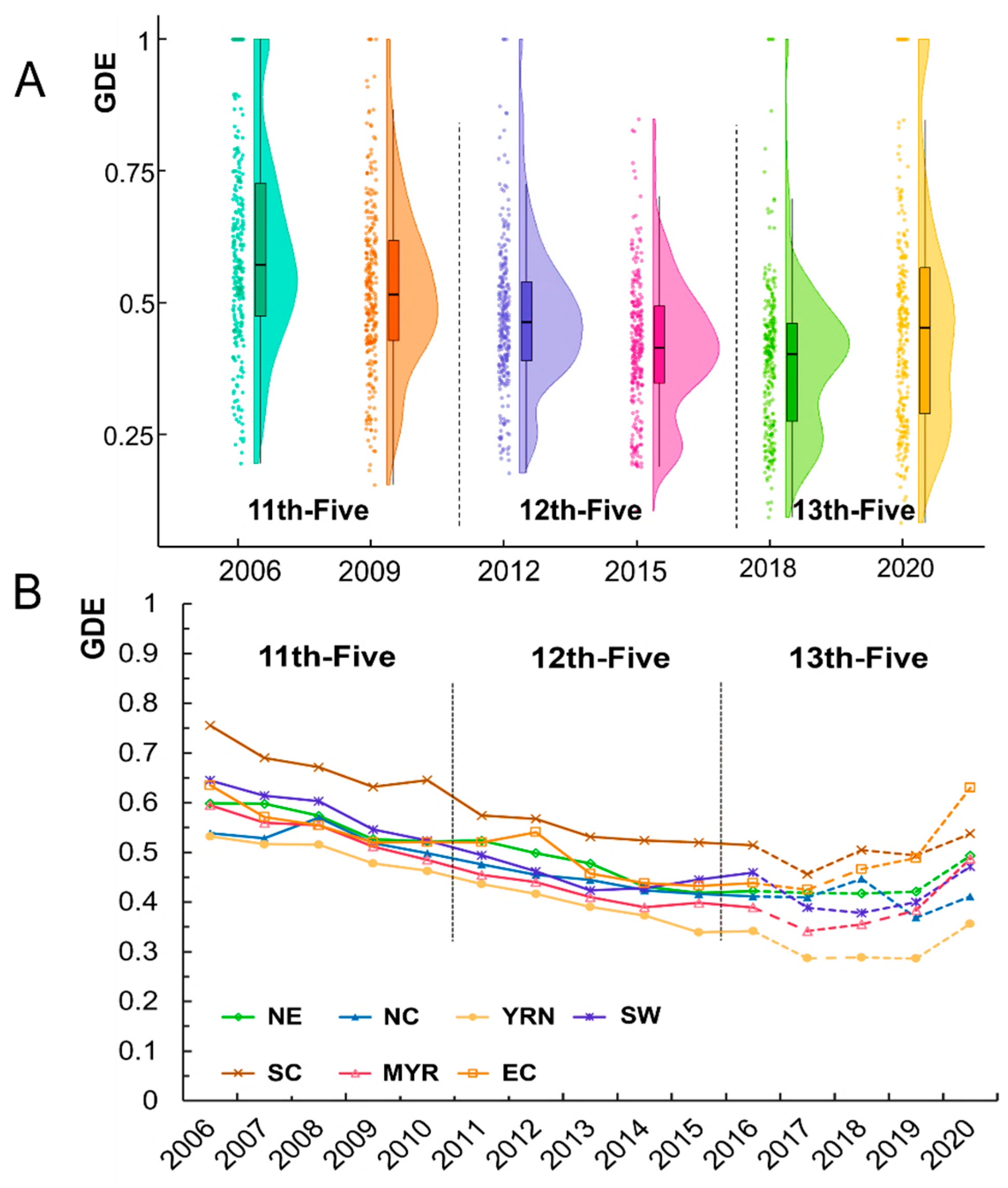
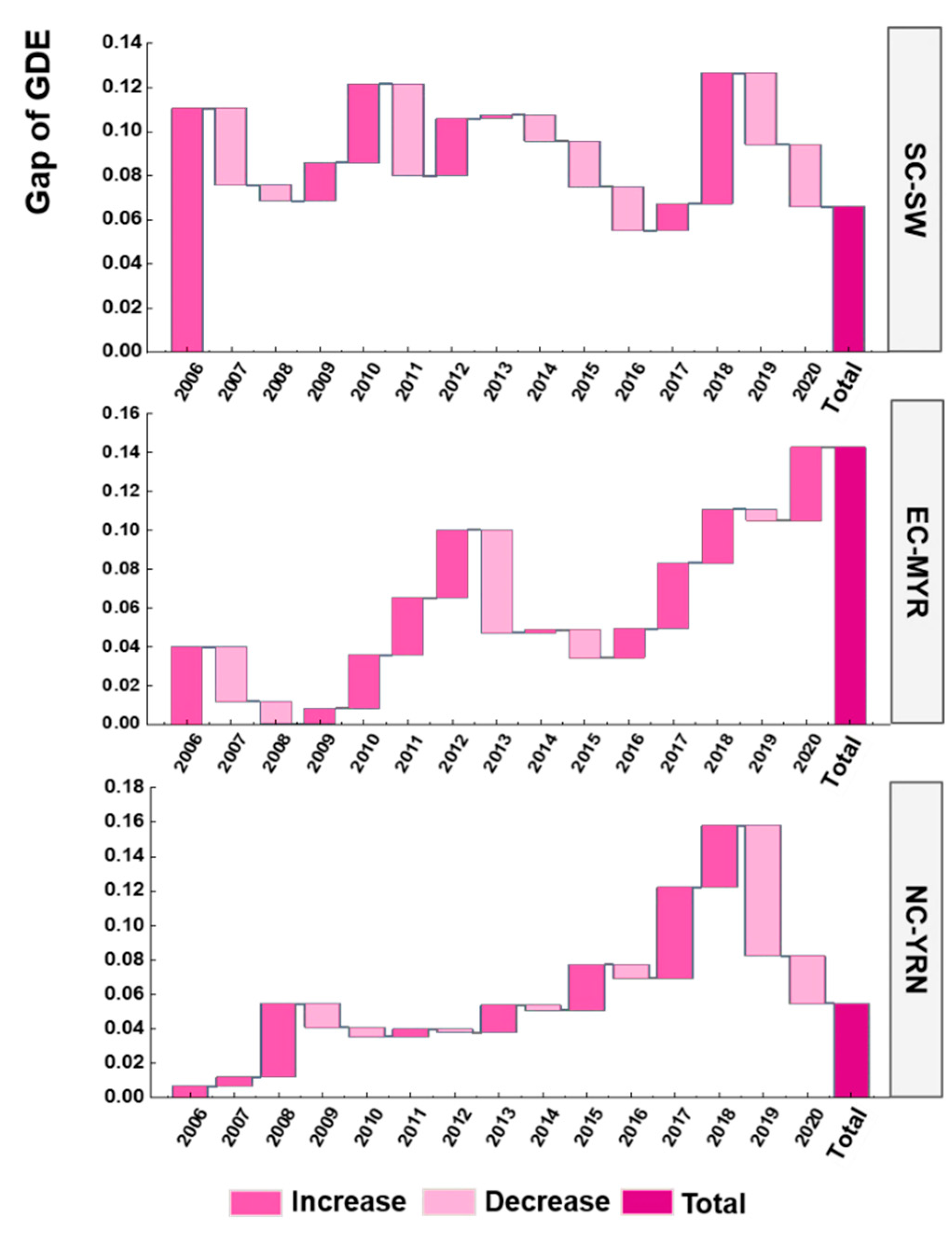
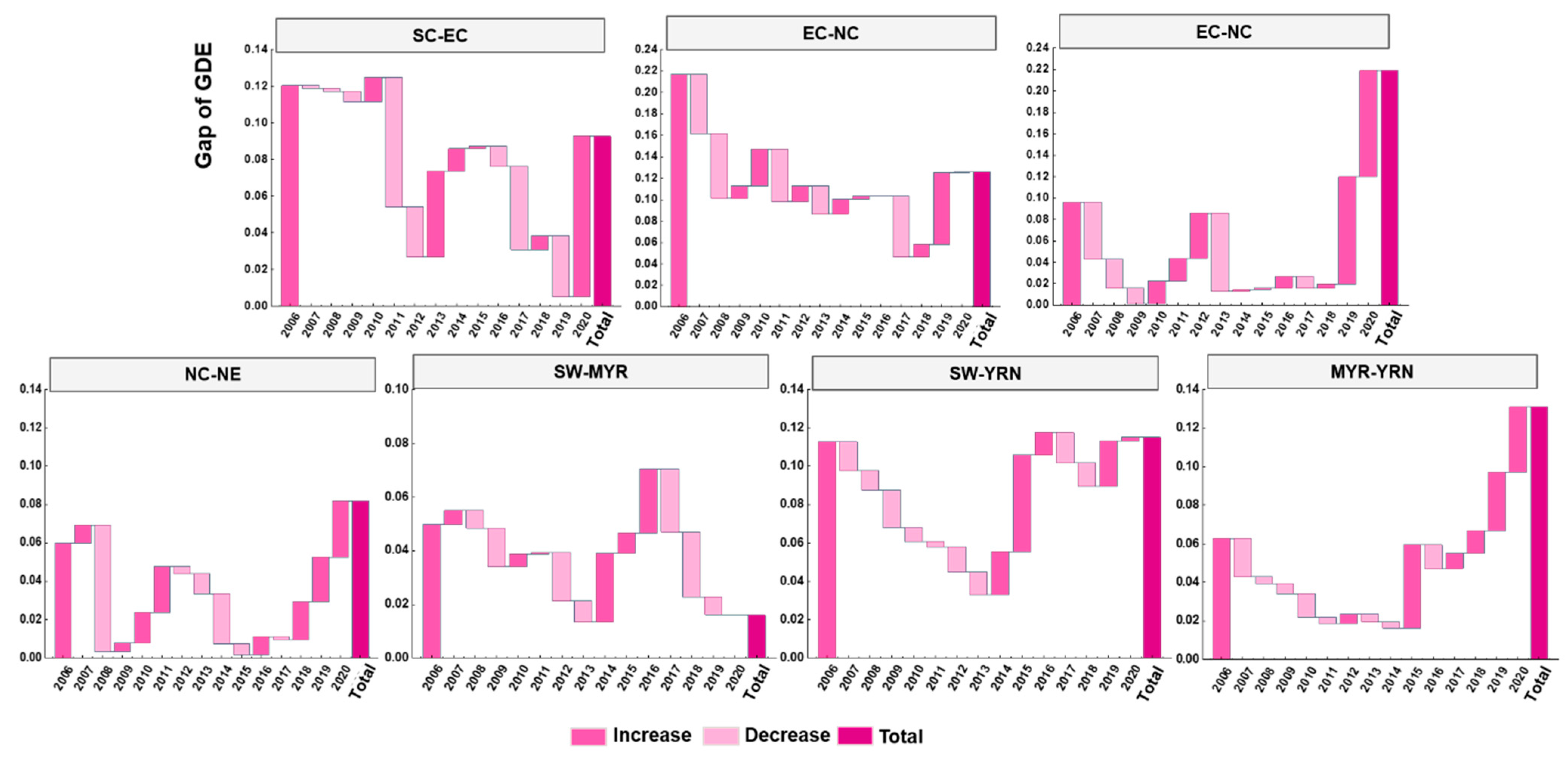
GDE across all regions was showing a similar pattern of a U-shaped trajectory: that is, declining at a faster rate in the 11th Five period, slowing down in the 12th Five period, and rising in the 13th Five period (Figure 1). The effect of China’s green transition has begun to appear, with some progress observed. The distribution of GDE shifted from a median concentration-diffusion pattern to a bimodal distribution. While GDE levels among cities show signs of convergence, polarization is also evident, indicating intensifying regional disparities. The disparity in GDE between regions remained small and stable during the 11th Five and 12th Five, but increased markedly in the 13th Five. Specifically, in the 13th Five, the gap between SW and MYR remained stable. The gaps between SC and SW and between SC and EC gradually narrowed, while the gaps between EC and MYR, NC and YRN, EC and NC, and MYR and YRN widened progressively.
Further, from an East–West horizontal perspective, the GDE gap between SC and SW showed a narrowing trend from the 11th Five to the 13th Five. The GDE gap between EC and MYR was small in the 11th Five and 12th Five, but widened significantly in the 13th Five. The GDE gap between NC and YRN increased gradually from the 11th Five to the 13th Five, but showed a shrinking trend at the end of the 13th Five. From a South–North vertical perspective, the GDE gap between SC and EC was gradually narrowing, but the gap with NC was slightly decreasing. The overall gap in GDE between EC and NC was minimal, while it widened at the end of the 13th Five. The GDE gap between NC and NE was relatively small and stable. The gap in GDE of SW with MYR and YRN was stable, but the gap with MYR was smaller than that of YRN. The gap in GDE between MYR and YRN was stable and very small during the 11th Five and 12th Five, but increased year by year in the 13th Five (see Appendix D and Appendix E). Overall, the 13th Five period marks the structural break in regional disparities, indicating that the green transition reshaped the relative positions of cities and widened the region-level dispersion of GDE.

4.1.2. Decomposing GDE Loss into Economic Loss and Environmental Loss Components

To avoid mixing effects across variables, we decompose the total GDE loss (β) into two interpretable components: (i) the economic efficiency loss, reflecting insufficient desirable output expansion potential, and (ii) the environmental efficiency loss, reflecting excessive undesirable output reduction potential (CO2 and PM2.5). We report their levels and relative shares by period and region to clarify which mechanism dominates regional disparities.
Results show that regions with relatively higher GDE (notably NC, SC, and EC) exhibit a larger share of environmental loss, implying that further improvements depend more on pollution and carbon abatement. In contrast, regions with lower GDE (NE, YRN, SW, and MYR) exhibit a larger share of economic loss, indicating that improving factor allocation and economic output potential is comparatively more important for raising GDE. This component-based evidence provides a consistent explanation for the observed γ-patterns and prevents conflating GDE trends with preference option outcomes.

4.2. Sources and Decomposition of Disparities Across Seven Regions

4.2.1. Intra-Regional Disparities

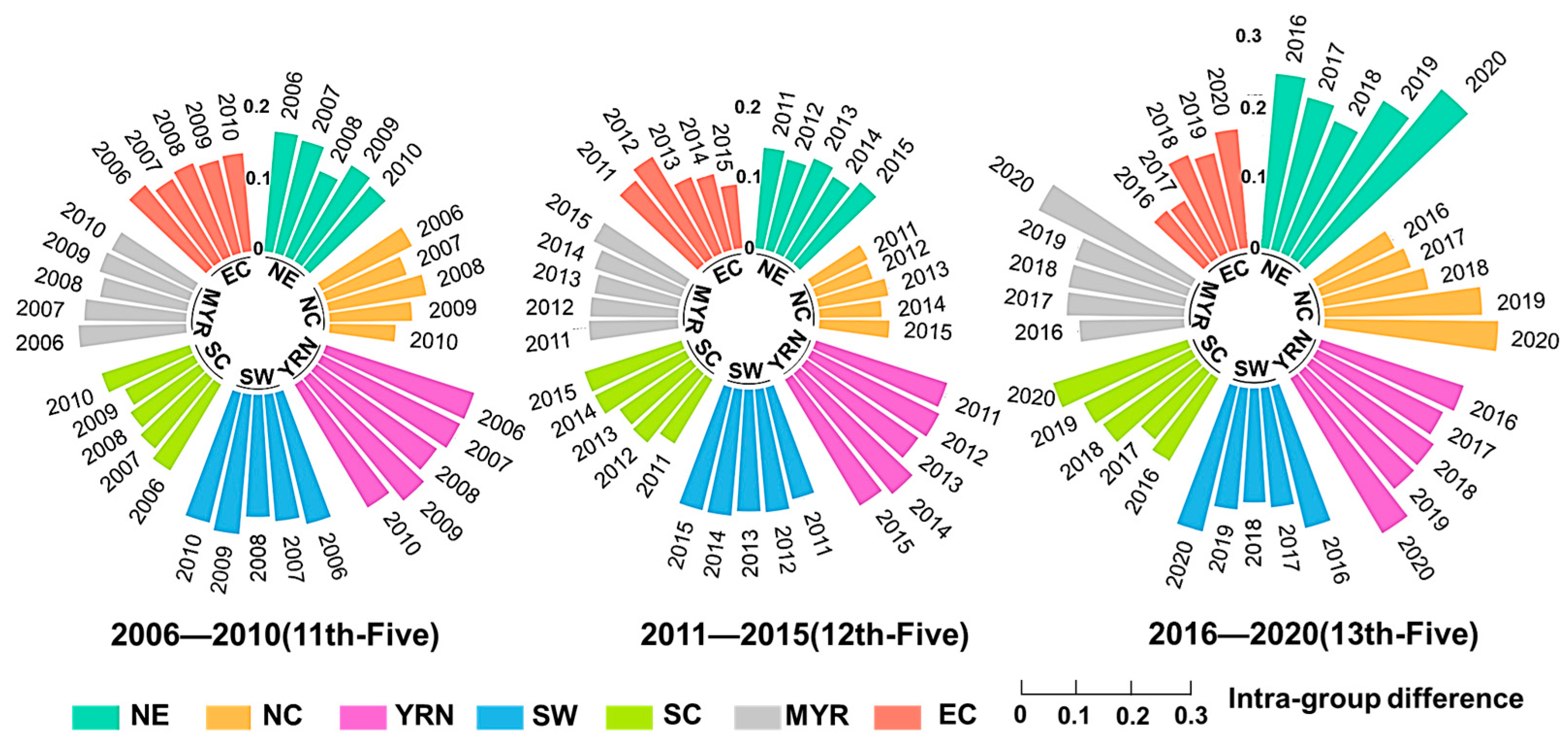
The intra-group differences in the Gini coefficient were relatively stable during the 11th Five and 12th Five, with an upward trend by the 13th Five, except for YRN and SW (Figure 2). The Gini coefficients within the YRN and SW groups were the largest, located in the west of China, and those of NC and EC were the smallest, located in the east of China.
Regarding the high-value areas in the west, the intra-group Gini coefficient of YRN was the largest and that of SW was the second-highest, both with a relatively stable change across the sample time. Due to differences in the resources and ecology, YRN cities’ choices were varied in reduction action and industrial restructuring, which resulted in an internal imbalance [60]. In SW, core cities such as Chengdu and Chongqing possessed a robust economic foundation and a high labor factor allocation to develop environmental industries like electronic circuits and new energy. In contrast, cities such as Mianyang, Liupanshui and Qujing relied on the resource extraction, processing, and manufacturing industries. NE’s intra-group Gini coefficient was 0.146 in the 11th Five and 12th Five, but it rose sharply to 0.252 in the 13th Five. The provincial capitals and first-tier cities in NE were at the forefront of transformation by priority advantages, exerting a strong siphoning effect on the surrounding cities, thereby rapidly increasing the internal disparities. The value of MYR showed a slight decline but started to grow from the end of the 12th Five. The industrial structures of the MYR cities were relatively close in the early years, but later, a clear divergence appeared, which has gradually increased the intra-group gap. The findings in this study align with those of Zhang (2022) [61].
Regarding the low-value areas in the East, the EC’s intra-group Gini coefficient showed an overall decreasing trend, but it slightly increased at the end of the 13th Five. Yangtze River Delta integration not only generates economic agglomeration externalities but also produces positive spatial spillovers to the environment; however, the challenges of homogeneous competition need to be guarded against. The intra-group Gini coefficient of SC was 0.139, with a fluctuating upward trend. Cities’ industries in SC vary greatly, with cities such as Shenzhen, Guangzhou and Xiamen gradually realizing high-end manufacturing or modern service industries, while cities like Qingyuan, Huizhou, and Longyan are still reliant on traditional chemicals and building materials. NC’s intra-group Gini coefficient showed a downward and then upward trend. The transfer of traditional industries between Beijing, Tianjin and Hebei is nearly complete, but the high-carbon industries that shifted from Beijing to Hebei have not yet achieved low-carbon transformation. It is the main reason for the increase in the coefficient at a later stage.

4.2.2. Inter-Regional Disparities

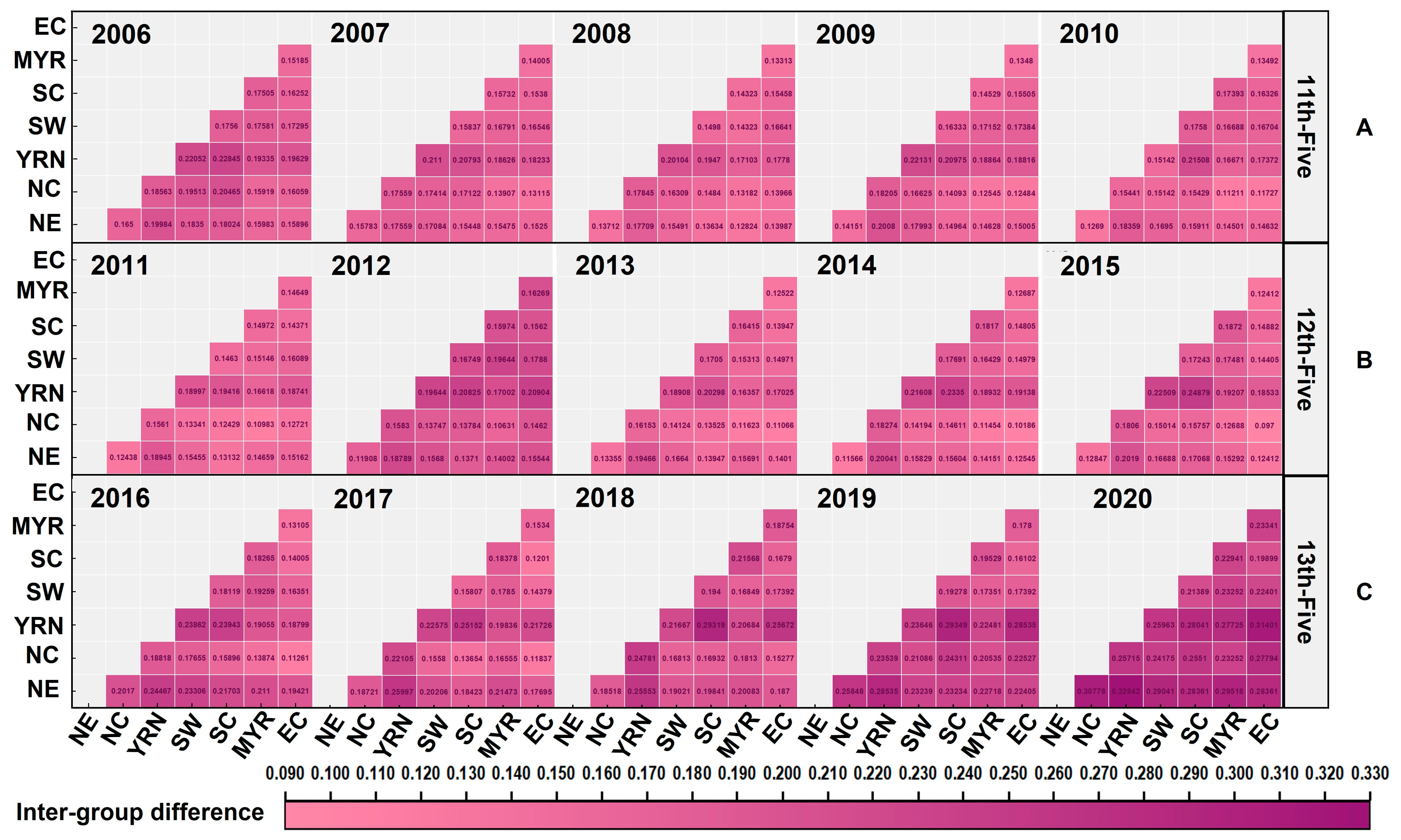
The results indicate a deepening gap across the seven regions (Figure 3). The inter-regional disparities in GDE were characterized by both a clear temporal and spatial distribution, which is largely consistent with the spatial layout of China’s industrial cities. Compared with the east–west difference, the north–south difference is more obvious. In the southern regions, the inter-group difference was small and stable, with an increase of about 2%, while the gap in the northern regions varied greatly, with an increase of about 5%.
On the one hand, the Gini coefficient of inter-group difference across areas remained relatively stable in the 11th Five and 12th Five, but increased in the 13th Five. The rate of increase is more pronounced in the eastern inter-regional area than in the western, and the northern inter-regional area than in the southern. On the other hand, the disparity between regions that are geographically closer to the west or north than those that are closer to the east or south has become more pronounced. The mean values of the differences in NC and EC, EC and SC, and NC and SC were 0.142, 0.154, and 0.144, respectively, while the mean values of the differences in YRN and MYR, MYR and SW, and YRN and SW were 0.192, 0.174, and 0.213. NC, EC, and SC have accelerated the pace of industrial transfer and structural adjustment, and then gradually formed a distinctive industrial development path, which brought intensifying inter-regional differences.

4.2.3. Decomposition of Disparity and Sources Exploring

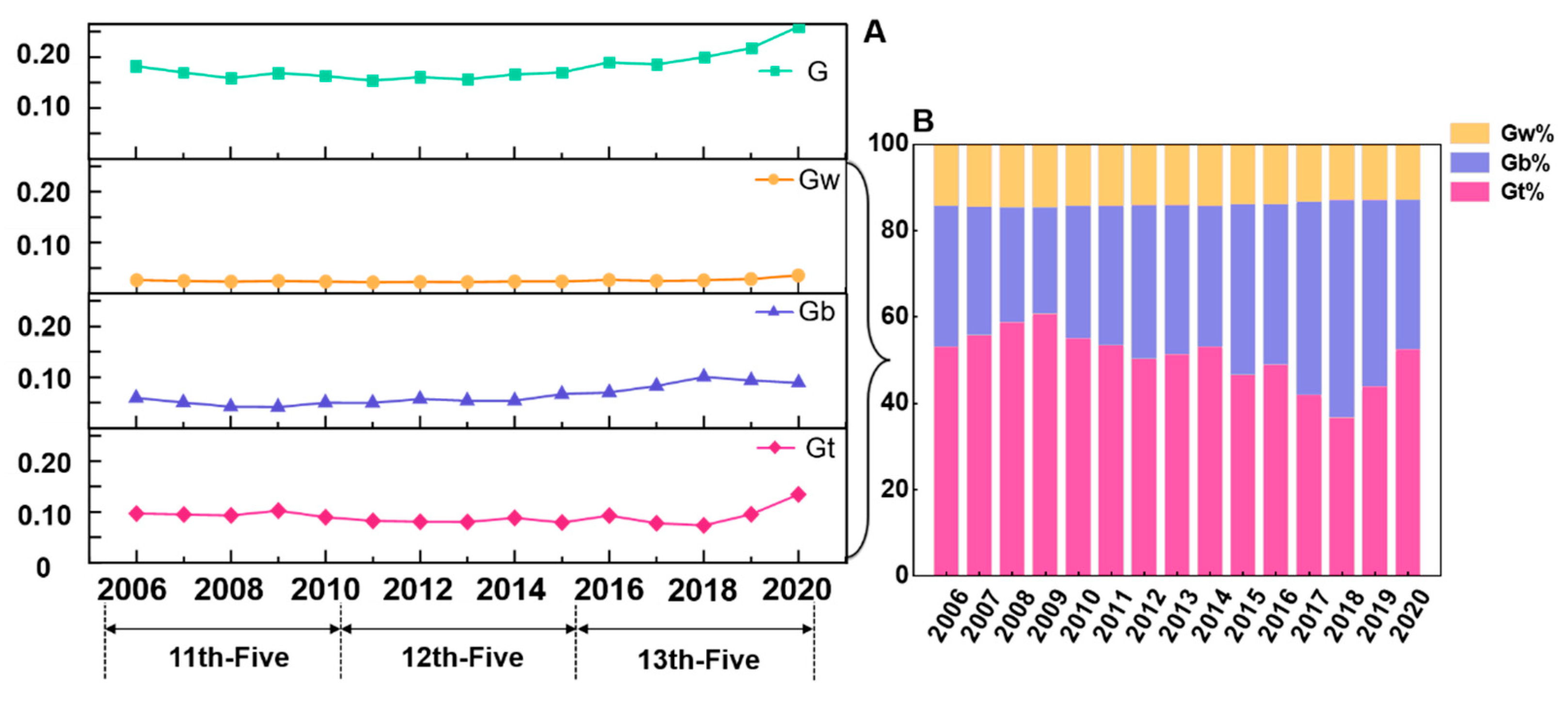
Figure 4 shows intra-group disparity, net inter-group disparity, and inter-group hypervariable density in GDE and their respective share of contribution. The overall GDE disparity across the seven regions showed an increasing trend. The Gini coefficient of the intra-group rose slightly at the end of the sample period, yet its contribution to the total variance declines from 14.29% to 12.76%. Inter-group difference is the primary source of disparity. The net difference showed an upward trend during the sample period and began to decline at the end of the 13th Five, while the hypervariable density was just the opposite. The contribution shares of the net disparity rose from an average of 28.86% in the 11th Five to 41.97% in the 13th Five. The contribution share of hypervariable density has been decreasing, from an average of 56.64% in the 11th Five to 44.62% in the 13th Five. Although the contribution share of hypervariable density exhibits a moderate decline over time, its absolute level remains relatively high, indicating that cross-regional overlap in green development efficiency persists. The change in the contribution of hypervariable density suggests a relative adjustment in the composition of regional disparities, while the persistent magnitude of this component indicates that cross-regional overlap remains an important and non-negligible characteristic of green development efficiency across regions. Therefore, the observed change in contribution shares should not be interpreted as a statistically confirmed reduction in cross-over, but rather as a relative shift in the composition of disparity sources. In this sense, hypervariable density continues to represent a structural feature of regional disparity, rather than a diminishing phenomenon.
Inter-group disparity emerges as the largest contributor, with hypervariable density being the most influential factor. This finding is contrary to some previous conclusions that hypervariable density has a limited contribution to regional economic development [62]. Our result suggests more overlaps between regions, and it is common to find that high-GDE cities in low-GDE areas exceed low-GDE cities in high-GDE areas. Therefore, simply enhancing efficiency in low GDE areas may not reduce the inter-regional disparities, but rather aggravate inequality and increase the overall Gini coefficient. Results also show that the dynamics introduced by air pollution and carbon reduction effort break the original pattern of inter-regional inherent development. At the national level, it is crucial to address regional imbalances when implementing environmental initiatives and promoting green transformation. For cities, the opportunity to enhance the green development level lies in the differentiated development paths tailored to their characteristics.

4.3. The Preference Option for Different Regional Cities

4.3.1. The Evolution Trend and Preference Option Across Seven Regions

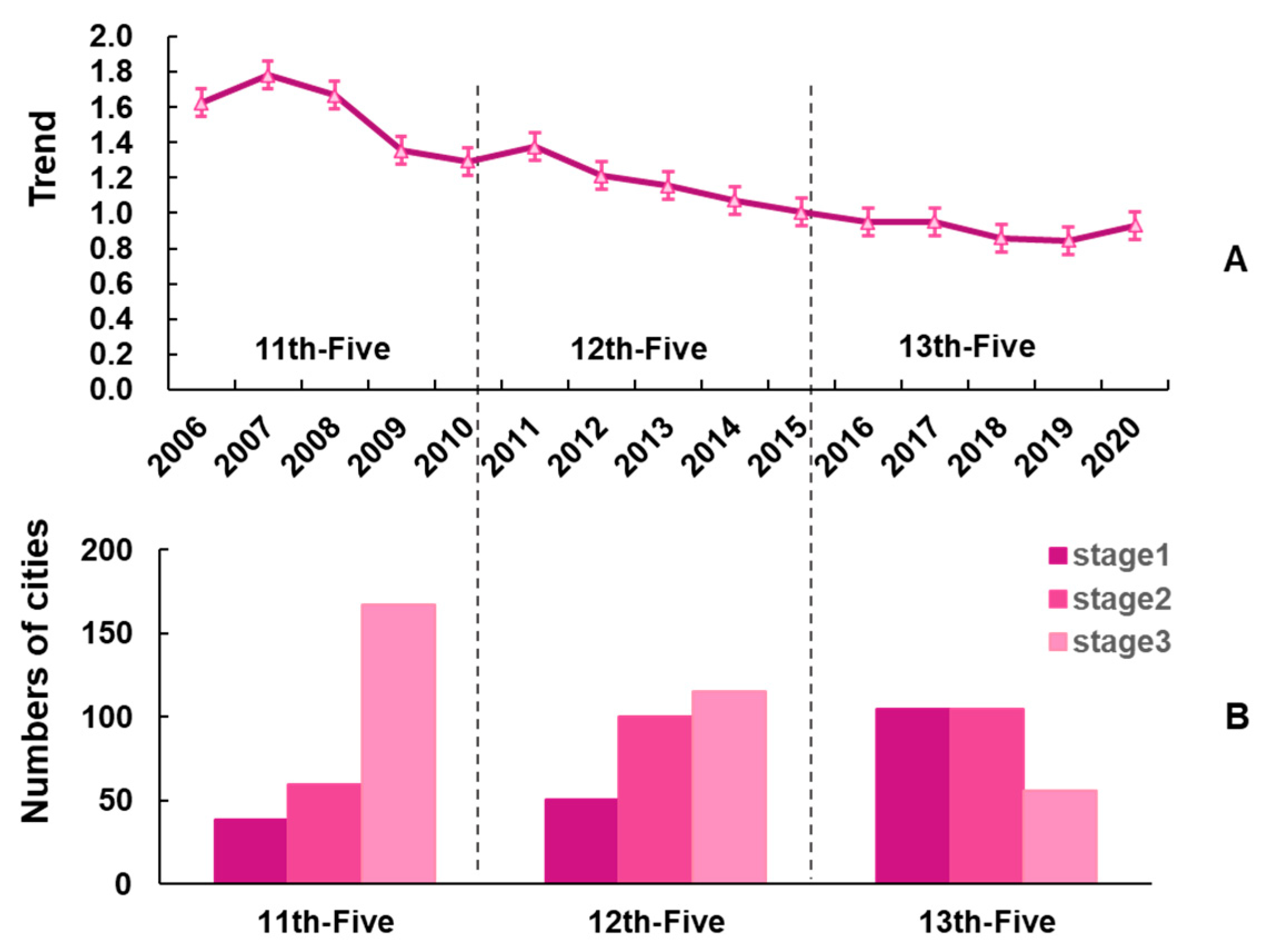
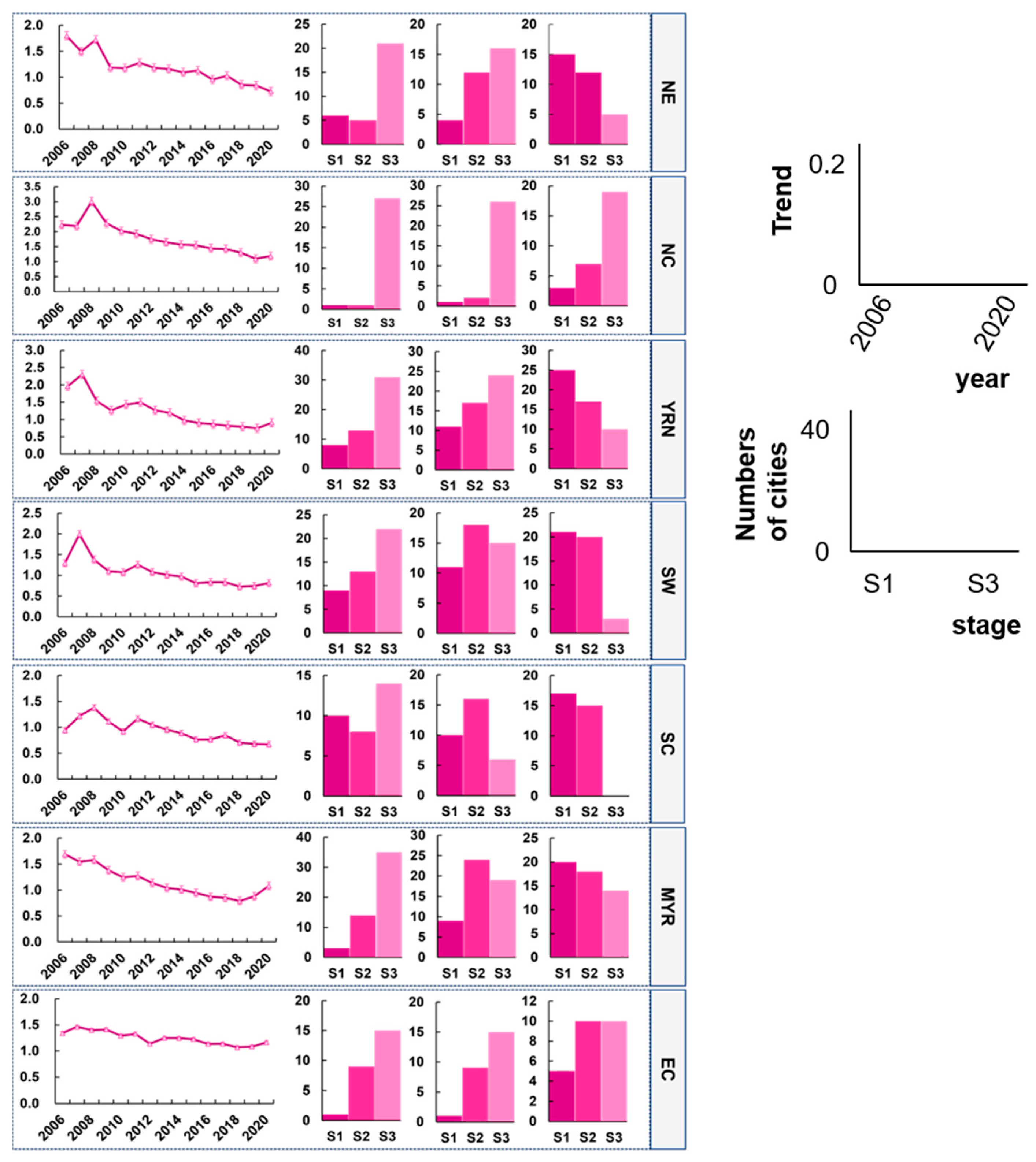
Importantly, the preference option γ is not interpreted from mixed indicators; it is derived from the separately measured economic loss and environmental loss components, which allows us to attribute cities’ improvement directions to a dominant mechanism, rather than to an aggregate index alone. The value of γ shows a decreasing trend, with a variation across different periods, see Figure 5. Urban development direction was shifting from a “green tendency” to an “economic tendency”, and 2015 was the turning point. The “economy” is becoming mainstream in China’s urban development. The loss of GDE starts to come more from the loss of economic efficiency. However, γ slightly rose at the end of the 13th Five. This means that Chinese cities should be wary of environmental rebound when improving their economic efficiency. Further, the economic tendency (0 ≤ γ <0.8) is set as Stage 1, the neutral tendency (0.8 ≤ γ <1.2) is set as Stage 2, and the green tendency (1.2 ≤ γ) is set as Stage 3. In the 11th Five, green tendency cities outnumbered the sum of cities with economic tendency and neutral tendency. In the 12th Five, green tendency cities declined significantly, while cities with a neutral tendency increased. In the 13th Five, economic tendency cities exceeded green tendency cities first. Nevertheless, 60% of the cities were in Stages 2 and 3, indicating that environment issues still remain serious in most cities.
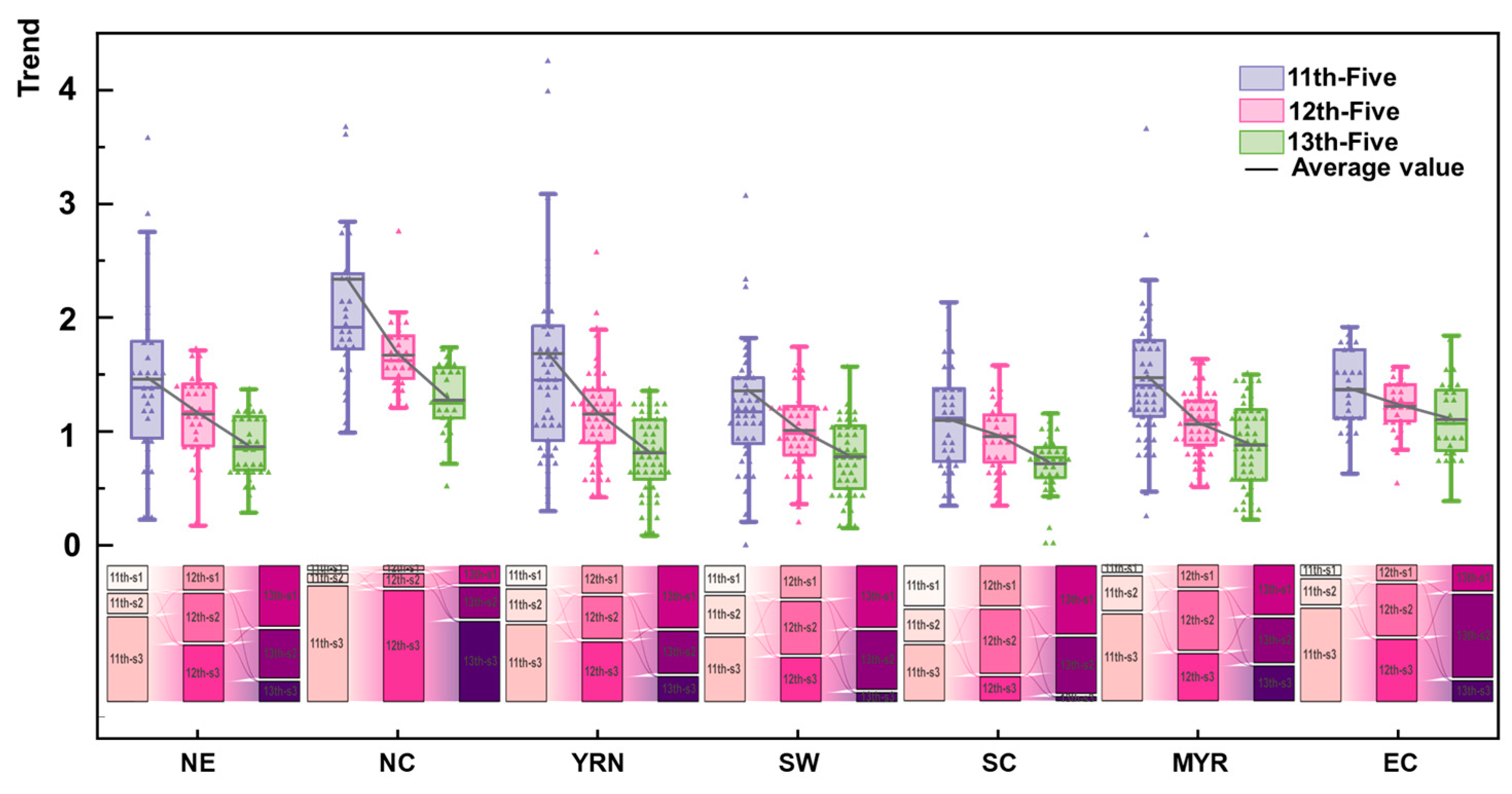
The γ of most cities in NC, SC and EC were greater than 0.8 from the 11th Five to the 13th Five, see Figure 6 and Appendix F. It indicates that there is more space for improvement in environmental governance than in economic development. However, the γ of most cities in NE, YRN, SW and MYR were less than one by the 13th Five, showing greater potential economic efficiency for improvement. This disparity may stem from the fact that NE, SC, and EC are mostly more economically developed cities, while most cities in NE, YRN, SW, and MYR are less economically developed. Efficiency losses are more attributable to environmental efficiency in regions with higher GDE, which are located in the East. In contrast, regions with low GDE, mainly in the West, experience greater losses in economic efficiency. The length of the box had shortened in all regions from the 11th Five to the 13th Five, but cities change in tendency across seven regions was different. Except for NC, all other regions demonstrated a clear shift in urban tendency. In the 11th Five, cities in most areas were in the stage of neutral tendency and green tendency. By the 13th Five, most cities had shifted to neutral tendency and economic tendency, except for those in the NC. It is worth noting that significant differences in tendency exist among cities within the same region. The preference option γ is consistent with the component decomposition: cities/regions dominated by environmental loss should prioritize abatement-oriented improvements, whereas those dominated by economic loss should prioritize output and factor-allocation improvements.

4.3.2. The Preference Option of Different Cities

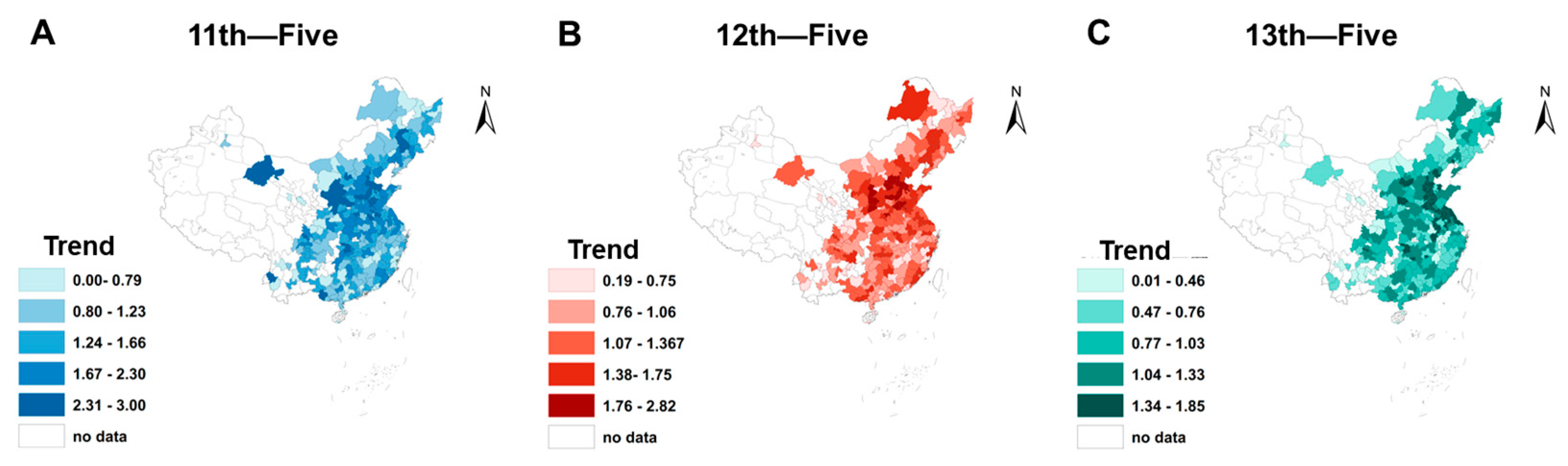
Based on the differences in resource endowments, cities are further categorized into resource-based and non-resource-based cities. Resource-based cities are divided into four categories: declining, regeneration, growth, and maturity [63]. Non-resource-based cities are classified into major national strategic regional cities and other cities. The change in tendency is shown in Figure 7.
Economic development should be the top priority for declining resource cities that are in the situation of core industries declining, resources depleting, and driving forces lacking for economic development. Some need focus on economic development, like Yichun, Hegang, Tongchuan, etc., and others should balance economic development and environmental protection, like Jiaozuo, Tongling, Zaozhuang, etc. The tendency of most regenerative resource cities is green, with high enhancement potential in environmental factors, such as Tangshan, Anshan, Xuzhou, etc. These cities are typical industrial bases and could cultivate green and low-carbon industries by supporting national transformation initiatives. The tendencies of all growing resource cities are neutral and green, like Zhaotong, Ordos, Yulin, Shuozhou, Nanchong, etc. Due to their vulnerability to bottlenecks during industrial restructuring, it is essential for them to manage the transition from traditional resource-based industries to emerging sectors, thereby avoiding the “resource curse”. The tendency of most mature cities is neutral or green. Cities with a neutral tendency are concentrated in the central, like Yangquan, Ezhou, Shaoyang, Xuancheng, etc. Others with a green tendency are mainly located in NC and YRN, such as Handan, Tai’an, Luliang, Sanmenxia, etc. These cities have a high economic foundation, but their ecological problems are a major obstacle to high-quality development.
The tendency of Major National Strategic Regional cities is neutral or green. Cities with a neutral tendency are all in the south, such as Hangzhou, Zhuhai, Chengdu and Wuxi, while cities with green tendency are mainly in NE, NC, and MYR, like Shijiazhuang, Hefei and Nantong. Among other cities, typical cities with an economic tendency are Shangluo, Bazhong, etc., and some with a neutral tendency are Dalian, Taiyuan, Fuzhou, etc. Others with a green tendency are mainly in the north, such as Shenyang, Changchun, Heze, Kaifeng, etc.

4.3.3. Scenario Analysis

To enhance the practical relevance of the proposed efficiency improvement scenarios, it is important to calibrate these hypothetical improvements against existing policy objectives and historical development trends. The improvement magnitudes considered in this study (5–30%) are consistent with the medium- and long-term targets embedded in China’s green development and energy-transition policies, which emphasize gradual efficiency enhancement, rather than abrupt structural shifts. Moreover, historical evidence indicates that many cities experienced cumulative improvements of comparable magnitude in green development efficiency during previous Five-Year Plan periods, particularly under intensified environmental regulation and industrial upgrading.
From this perspective, lower-range scenarios (5–10%) can be interpreted as short-term, policy-feasible adjustments that are achievable through incremental technological upgrades and management improvements, while medium-range scenarios (15–20%) correspond to medium-term transitions associated with industrial restructuring and cleaner energy substitution. Higher-range scenarios (25–30%), although more challenging, reflect the long-term strategic objectives aligned with carbon peaking and neutrality goals. By explicitly anchoring the scenario design to policy timelines and historical trends, the conclusions underscore that differentiated improvement paths are not only analytically optimal, but also institutionally and temporally feasible.
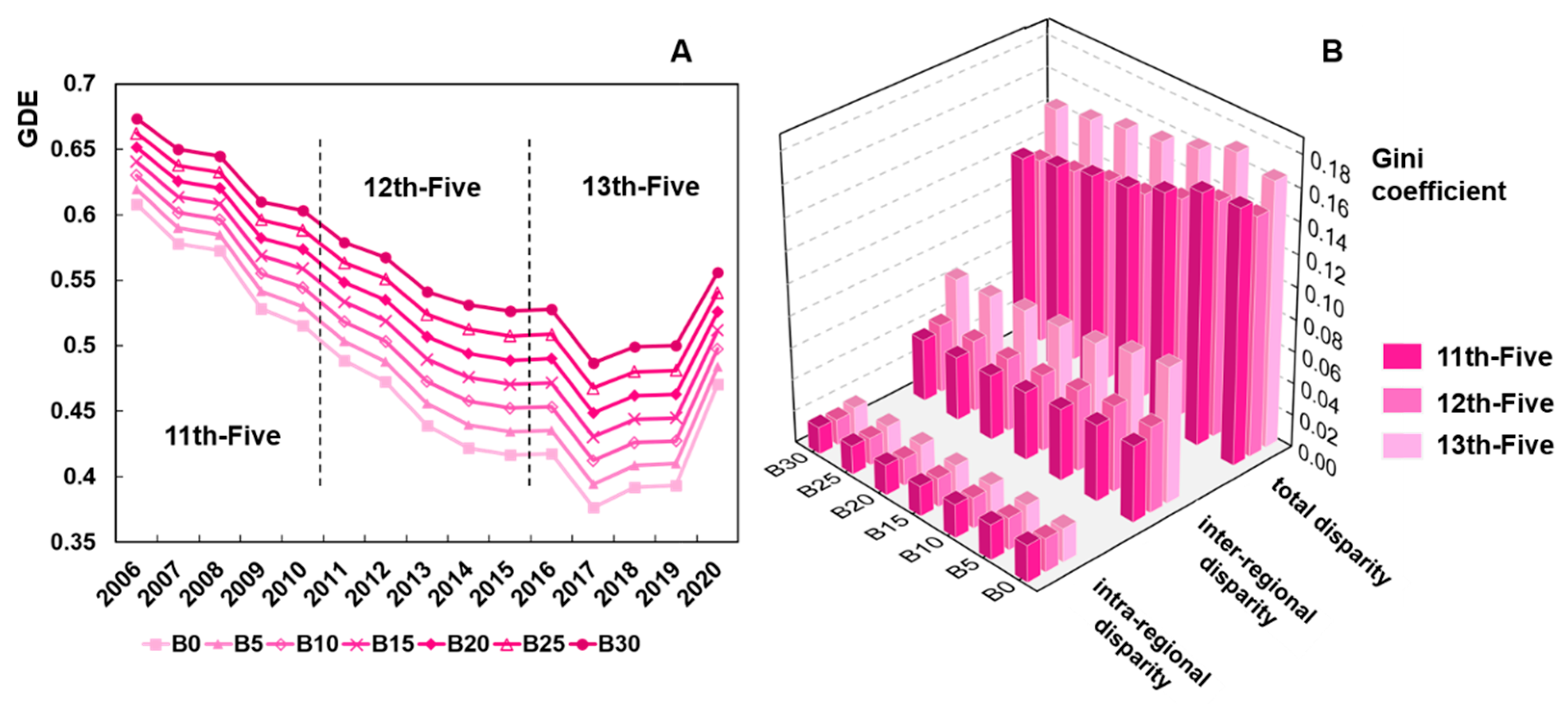
Based on the optimal improvement directions for each city, we set scenarios where cities’ GDE increases by 5% (B5), 10% (B10), 15% (B15), 20% (B20), 25% (B25), and 30% (B30), with the original calculation results serving as the baseline scenario (B0), as shown in Figure 8. Results indicate that, from the 11th Five to the 13th Five, the values of GDE in cities under each hypothetical scenario were higher than those in the baseline scenario. The higher the improvement rate, the greater the increase in green development efficiency. Further measurement of regional disparity under different scenarios shows that the regional variations in cities’ GDE were lower after improvement compared to the baseline scenario, including total disparity, intra-regional disparity, and inter-regional disparity. As the level of improvement increases, regional disparities in cities’ GDE continuously narrow. This progress confirms the validity of the non-oriented endogenous directional distance function model and the selected improvement directions. The results also demonstrate that differentiated optimal choices by each city can enhance their own GDE while simultaneously narrowing regional disparities, ultimately facilitating the achievement of coordinated regional green development.

4.4. Discussion

An extensive mode of economic development, characterized by severe air pollution and high CO2 emissions, led to significant economic and environmental efficiency losses. As a result, GDE in Chinese cities declined quickly in the 11th Five period. During the 12th Five period, China issued a series of stringent plans to reduce air pollution: e.g., the Air Pollution Prevention and Control Action Plan in 2013, which helped to slow down the decline in GDE. In the 13th Five-Year Plan period, China promoted the dual control of total energy consumption and energy intensity, alongside strengthened carbon emission control. These efforts led to notable improvements in environmental quality, and the initial outcomes of economic reforms began to emerge, with GDE rising slowly, signaling a gradual transition toward high-quality development. In the short term, actions aimed at environmental governance are unlikely to immediately improve environmental quality and may exert a ‘painful’ economic burden with reducing GDE. However, in the long term, such measures are expected to enhance both environmental quality and economic development, ultimately improving cities’ overall green development. Meanwhile, this transformation could reshape the existing regional development landscape and exert a considerable influence on disparities between regions.
Meanwhile, to further assess whether potential measurement errors in urban energy consumption affect our main conclusions, we conducted robustness checks using alternative energy proxies derived from remote-sensing data. Specifically, we constructed an alternative city-level energy indicator by combining nighttime light intensity with industrial emission-related satellite information, following the logic that nighttime luminosity captures the overall economic activity, while industrial satellite emissions reflect energy-intensive production processes. Re-estimating green development efficiency and regional disparity measures with this alternative proxy yields highly consistent spatial patterns, relative rankings, and Dagum decomposition results compared with the baseline specification. In particular, the dominance of inter-regional disparities and hypervariable density, as well as the identified regional heterogeneity in improvement directions, remain qualitatively unchanged. This suggests that our core findings are robust to alternative measurements of urban energy consumption.
Despite regions continuously making efforts to adjust and develop, the outcomes vary significantly. High industrial regions actively adjust their industrial and energy consumption patterns, leveraging strong scientific research foundations and high-quality labor resources to drive technological innovation. In turn, the innovation contributes to emission reductions and supporting high-quality development goals [64]. However, low economic areas, constrained by their development level and less efficient factor allocation, may passively accept the transfer of high-emission industries from developed areas. Transferring emission-intensive industries without effective carbon constraints may induce pollution haven effects and carbon leakage, whereby the local environmental pressure is reduced in the East but national-level emissions remain unchanged or even increase. Meanwhile, the feasibility of interregional industrial transfer critically depends on the shadow price of carbon emissions faced by different regions. The shadow price reflects the implicit marginal cost of carbon abatement and serves as a benchmark for evaluating whether additional emissions associated with relocated industries are compatible with national climate objectives. Industrial transfer can only be considered environmentally and economically sustainable if the receiving regions internalize comparable or higher carbon costs through effective regulation, thereby preventing carbon leakage at the national level. In addition, the time lag of environmental governance on GDE has led local governments to prioritize short-term economic gains in response to the pressure of GDP-oriented assessments. Consequently, local industrial planning may differ significantly from the policy-oriented focus on industries, potentially weakening the effectiveness of the environmental policy effect and exacerbating regional disparities. This finding is consistent with that of Yu (2022) [65]. Moreover, competition among local governments for GDP growth and tax revenues has led some regions to deliberately weaken their pollution and CO2 emission control efforts when undertaking industrial transfers. This mismatch between intra-regional industrial upgrading and inter-regional industrial relocation forms a vicious cycle of “racing to the bottom”. As a result, inter-regional disparities are further exacerbated, aligning with the findings of Chen (2024) [66]. In general, the optimal improvement tendency of cities largely aligns with the spatial distribution of China’s heavy industrial cities. Most cities in the eastern region, particularly Tangshan, Xuzhou, possess a high level of economic development, with greater potential for improvement in environmental governance. These cities could prioritize green development by leveraging robust financial resources and advanced research capabilities to foster green technologies and promote industrial greening. In contrast, most cities in the western region, represented by Tongchuan, Shangluo, and Bazhong, have relatively underdeveloped economies, with more potential for economic advancement. These areas can focus on accelerating economic development by actively undertaking industrial transfers from the East while simultaneously working to reduce air pollution and CO2 emissions, thus promoting industrial growth more sustainably.

5. Conclusions

Balancing economic growth and environmental governance requires guiding cities to explore pathways for green transformation. This study examined the GDE of 266 cities and phased changes in regional disparities in conjunction with the National Five-Year Plan. By analyzing the evolution, we identified the sources of differences and explored the socio-economic factors contributing to them. And then, considering regional imbalance and urban heterogeneity, we investigated the development potential and preference options of different cities according to their respective stages of development, aiming to balance both green development goals and narrow the gap among areas. The main conclusions are as follows.
China’s urban GDE showed a U curve from the 11th Five to the 13th Five, yet it remains relatively low. The distribution of GDE in Chinese cities was characterized by a concentration of median to bimodal. The imbalance in cities’ comprehensive development level is pronounced. The gap between the seven regions changed significantly in the 13th Five, and the east–west gap exceeded the north–south gap. The SW and MYR gap was stable, and the gaps of SC and SW and SC and EC gradually narrowed, while the gaps of EC and MYR, NC and YRN, EC and NC, and MYR and YRN gradually widened. The degree of the regional gap deepened.
Disparities of GDE across the seven regions showed a slow upward trend, primarily driven by inter-regional disparity. The contribution of hypervariable density is the largest, followed by net inter-group differences and the smallest by intra-group differences. Actions of environmental governance have broken the original regional development distribution, resulting in a high crossover between the seven regions. The intra-group difference in YRN and SW was the largest, showing a prominent intra-regional imbalance. More influenced by historical factors and policies, NE’s intra-group difference widened significantly by the 13th Five. The intra-group difference in MYR and SC fluctuated and rose, reflecting the large gap in industrial development within the area. With the continuous advancement of Beijing–Tianjin–Hebei integration and city cluster industrial chain division, the intra-group difference in NC decreased and then increased. The intra-group difference in EC was smallest by the 13th Five, indicating the significant effect of Yangtze River delta integration.
The year of 2015 is the turning point where Chinese cities showed the characteristics of shifting from a green tendency to an economic tendency, with economic tendency cities exceeding green tendency cities for the first time by the 13th Five. The γ of all regions had different downward trends, but the development tendency of each region varied greatly. In areas with high GDE, the total efficiency loss came from the environmental efficiency loss, and vice versa. Among them, NC, SC, and EC had more space for improvement in the environmental direction, inclining towards ‘green’; YRN, SW, and MYR had more space for improvement in the economic direction, showing as ‘economic’.
Resource cities’ development tendency at different stages also varies. Declining resource cities with small γ should prioritize economic development, while regenerating resource cities with large γ could focus more on environmental governance. The development tendency of growing and mature resource cities exhibits obvious regional characteristics. Cities with a neutral development tendency are concentrated in the central and western areas, while cities with a green tendency are mainly located in NC and YRN. The environmental enhancement potential of both is better than that of economic development. Cities in national strategic regions with a neutral development tendency are in the south, and those with a green tendency are mainly in NC, EC, and MYR. In various hypothetical scenarios, differentiated optimal choices by each city can enhance their own GDE while simultaneously narrowing regional disparities.

Author Contributions

Conceptualization, X.S. and Y.L.; methodology, X.S.; software, X.S.; validation, X.S. and Y.L.; formal analysis, X.S.; investigation, X.S.; resources, X.S.; data curation, X.S.; writing—original draft preparation, X.S.; writing—review and editing, X.S.; visualization, X.S.; supervision, Y.L.; project administration, Y.L.; funding acquisition, Y.L. All authors have read and agreed to the published version of the manuscript.

Funding

This study was supported by the Major Project of Beijing Social Science Fund (No. 24GLA007).

Institutional Review Board Statement

Not applicable.

Informed Consent Statement

Not applicable.

Data Availability Statement

Data can be obtained on request.

Conflicts of Interest

The authors declare no conflicts of interest.

Appendix A

Figure A1. Classifications of different areas. Note: The seven regions are divided based on the eight economic zones in China. Considering that there are only very few cities in Northwestern China, it was merged with those in the middle of the Yellow River to form the Upper and Middle parts of the Yellow River (YRN) region, based on its geographical location.
Sustainability 18 02343 g0a1
The clusters represent distinct economic development tiers, ranging from core metropolitan cities to remote and less-developed areas. The correspondence between clustering outcomes and broad regional characteristics suggests that the adopted regional division is consistent with underlying economic structures, rather than arbitrary geographical aggregation.
Table A1. Summary statistics of GDP-based hierarchical clustering.
ClusterNumber of CitiesMean GDP (2006–2020)Economic Characteristics
C1~30Very highCore coastal and metropolitan cities
C2~40HighDeveloped eastern and northern cities
C3~35Upper-middleIndustrial and regional centers
C4~45MiddleCentral China and Yellow River cities
C5~40Lower-middleWestern and resource-based cities
C6~45LowNorthwestern and Yellow River cities
C7~30Very lowRemote and less-developed cities

Appendix B

Table A2. List of seven regions and cities.
AreaProvincesCitiesNumbers
Northeast China (NE)Heilongjiang, Jilin, LiaoningAnshan, Baicheng, Baishan, Benxi, Chaoyang, Dalian, Daqing, Dandong, Fuzhou, Fuxin, Haerbin, Hegang, Heihe, Huludao, Jixi, Jilin, Jiamusi, Jinzhou, Liaoyang, Liaoyuan, Mudanjiang, Panjin, Qitaiihe, Qiqihaer, Shenyang, Shuangyashan, Siping, Songyuan, Tieling, Tnghua, Yichun, Changchun32
North China (NC)Beijing, Tianjin, Shandong, HebeiBaoding, Beijing, Binzhouo, Cangzhou, Chengde, Dezhou, Dongying, Handan, Heze, Hengshui, Jinan, Jining, Langfang, Liaocheng, Linyi, Qinhuangdao, Qingdao, Rizhao, Shijiazhuang, Taian, Tangshan, Tianjin, Weihai, Weifang, Xingtai, Yantai, Zaozhuang, Zhangjiakou, Zibo29
Upper and Middle Yellow River (YRN)Nei Mongol, Shnxi, Shaanxi, Henan, Gansu, Qinghai, Xinjiang, NingxiaAnkang, Anyang, Byanzhuoer, Baotou, Baoji, Chifeng, Datong, Eerduosi, Hanzhong, Hebi, Huhehaote, Hulunbeier, Jiaozuo, Jincheng, Jinzhong, Jiuquan, Kaifeng, Lanzhou, Linfen, Luoyang, Luohe, Lvliang, Nanyang, Pingdingshan, Puyang, Sanmenxia, Shangluo, Shangqiu, Shuozhou, Taiyuan, Tongliao, Tongchuan, Weinan, Wuhai, Wulanchabu, Wulumuqi, Xian, Xining, Xianyang, Xizhou, Xinxiang, Xinyang, Xuchang, Yanan, Yangquan, Yinchuan, Yulin, Yuncheng, Changzhi, Zhenghou, Zhoukou, Zhumadian52
Southwest China (SW)Yunan, Sichuan, Chongqing, Guizhou, GuangxiAnshun, Bazhou, Baise, Baoshan, Beihai, Chengdu, Chongzuo, Dazhou, Deyang, Fangchenggang, Guangan, Guanyuan, Guigang, Guiyang, Guilin, Hechi, Hezhou, Kunming, Laibin, Leshan, Lijiang, Lincang, Liuzhou, Liupanshui, Luzhou, Meishan, Mianyang, Nanchong, Nnanning, Neijiang, Panzhihua, Qinzhou, Qujing, Suining, Wuzhou, Yaan, Yibin, Yulin, Yuxi, Zhaotong, Chongqing, Ziyang, Zigong, Zunyi44
Middle Yangtze River (MYR)Guangdong, Fujian, HainanChaozhou, Dongguan, Foshan, Fuzhou, Guangzhou, Haikou, Heyuan, Huizhou, Jiangmen, Jieyang, Longyan, Maoming, Meizhou, Nanping, Ningde, Putian, Qingyuan, Quanzhou, Sanming, Sanya, Xiamen, Shantou, Shanwei, Shaoguan, Shenzhen, Yangjiang, Yunfu, Zhanjiang, Zhangzhou, Zhaoqing, Zhongshan, Zhuhai32
South China (SC)Anhui, Jiangxi, Hubei, HunanAnqing, Bengbu, Hazhou, Changde, Chenzhou, Chizhou, Chuzhou, Ezhou, Fuzhou, Fuyang, Ganzhou, Hefei, Hengyang, Huaihua, Huaibei, Huainan, Huanggang, Huangshan, Huangshi, Jian, Jingmen, Jingzhou, Jingdezhen, Jiujiang, Liuan, Loudi, Maanshan, Nanchang, Pingxiang, Shangrao, Shaoyang, Shiyan, Suzhou, Suizhou, Tongling, Wuhu, Wuhan, Xianning, Xiangtan, Xiangyang, Xiaogan, Xinyu, Xuancheng, Yichang, Yichun, Yiyang, Yingtan, Yongzhou, Yueyang, Zhangjiajie, Changsha, Zhuzhou52
East China (EC)Shanghai, Jiangsu, ZhejiangChangzhou, Fuzhou, Huzhou, Huaian, Jiaxing, Jinhua, Lishui, Lianyungang, Nanjing, Nantoong, Ningbo, Quzhou, Shanghai, Shaoxing, Suzhou, Suqian, Taizhou, Taizhou, Wenzhou, Wuxi, Xuzhou, Yancheng, Yangzhou, Zhenjiang, Zhoushan25

Appendix C

Linearization of the endogenous distance function
This appendix presents the linearization process from Equation (2) to Equation (3). Equation (2) represents a nonlinear fractional programming problem, in which the objective function involves endogenous directional vectors. To obtain a tractable linear programming formulation, we apply a standard variable transformation by normalizing the directional components and rescaling the decision variables. This transformation converts the original nonlinear problem into an equivalent linear program without altering the feasible set or the optimal solution.
Equation (2) is nonlinear because the endogenous direction components (e.g., α m 0 , δ n 0 , φ s 0 ) are decision variables and appear multiplicatively with the efficiency loss β in the constraints (e.g., x m 0 β α m 0 , y n 0 + β δ n 0 , and u s 0 β φ s 0 ). To obtain a linear program, we apply an exact substitution that absorbs these products into new variables.
Define the following product variables (the same notation as in Equation (3)):
β x , m β α m 0 ( m = 1 , , M ) , β y , n β δ n 0 ( n = 1 , , N ) , β u , s β φ s 0 ( s = 1 , , S ) .
Then, the nonlinear terms in Equation (2) become linear.
Input contraction term:
x m 0 β α m 0 = x m 0 β x , m .
Desirable output expansion term:
y n 0 + β δ n 0 = y n 0 + β y , n .
Undesirable output reduction term:
u s 0 β φ s 0 = u s 0 β u , s .
Accordingly, Equation (2) can be rewritten as the following linear program (Equation (3) in the main text):
m a x λ j } , { β x , m } , { β y , n } , { β u , s m = 1 M β x , m n = 1 N β y , n s = 1 S β u , s
subject to
j = 1 J λ j x m j x m 0 β x , m , m = 1 , , M ,
j = 1 J λ j y n j y n 0 + β y , n , n = 1 , , N ,
j = 1 J λ j u s j u s 0 β u , s , s = 1 , , S ,
m = 1 M β x , m + n = 1 N β y , n + s = 1 S β u , s = β ,
j = 1 J λ j = 1 , λ j 0 ,   β x , m 0 ,   β y , n 0 ,   β u , s 0 .
Finally, the endogenous direction components in Equation (2) can be recovered from the LP solution of Equation (3) by:
α m 0 = β x , m β , δ n 0 = β y , n β , φ s 0 = β u , s β ,
with β > 0 . When β = 0 (efficient DMU), the direction components are not identified but are irrelevant, because no improvement is required.
Impact of linearization on β :
The above transformation is an exact reformulation (product-variable substitution) that preserves feasibility and optimality; therefore, it introduces no approximation error. The optimal β estimated from Equation (3) is mathematically identical to that from Equation (2), ensuring that the efficiency loss estimation is reproducible and unbiased, with respect to the linearization step.

Appendix D

Figure A2. East–West discrepancy of GDE in different regions.
Sustainability 18 02343 g0a2

Appendix E

Figure A3. South–North discrepancy of GDE in different regions.
Sustainability 18 02343 g0a3

Appendix F

Figure A4. Changes in development trend and numbers of seven areas.
Sustainability 18 02343 g0a4

References

  1. Overpeck, J.T. The IPCC, International Science Diplomacy, and the Challenge of Climate Change. In Proceedings of the American Association for the Advancement of Science 2011 Annual Meeting, Washington, DC, USA, 17–21 February 2011. [Google Scholar]
  2. Jones, N. Climate assessments: 25 years of the IPCC. Nature 2013, 501, 298–299. [Google Scholar] [CrossRef]
  3. Budescu, D.V.; Por, H.-H.; Broomell, S.B.; Smithson, M. The interpretation of IPCC probabilistic statements around the world. Nat. Clim. Change 2014, 4, 508–512. [Google Scholar] [CrossRef]
  4. Niu, Y.; Boussemart, J.-P.; Shen, Z.; Vardanyan, M. Performance evaluation using multi-stage production frameworks: Assessing the tradeoffs among the economic, environmental, and social well-being. Eur. J. Oper. Res. 2024, 318, 1000–1013. [Google Scholar] [CrossRef]
  5. Barbier, E.B. A Global Green New Deal: Rethinking the Economic Recovery; Cambridge Books: Cambridge, UK, 2010. [Google Scholar] [CrossRef]
  6. Yang, J.; Cheng, J.; Zou, R.; Geng, Z. Industrial SO2 technical efficiency, reduction potential and technology heterogeneities of China’s prefecture-level cities: A multi-hierarchy meta-frontier parametric approach. Energy Econ. 2021, 104, 105626. [Google Scholar] [CrossRef]
  7. IEA. Available online: https://www.iea.org/data-and-statistics (accessed on 10 March 2024).
  8. World Air Quality Report, 2019. Available online: https://www.iqair.cn/ (accessed on 10 March 2024).
  9. Shan, Y.; Guan, D.; Hubacek, K.; Zheng, B.; Davis, S.J.; Jia, L.; Liu, J.; Liu, Z.; Fromer, N.; Mi, Z.; et al. City-level climate change mitigation in China. Sci. Adv. 2018, 4, eaaq0390. [Google Scholar] [CrossRef]
  10. Sha, W.; Chen, Y.; Wu, J.; Wang, Z. Will polycentric cities cause more CO2 emissions? A case study of 232 Chinese cities. J. Environ. Sci. 2020, 96, 33–43. [Google Scholar] [CrossRef]
  11. World Air Quality Report, 2023. Available online: https://www.iqair.cn/ (accessed on 10 March 2024).
  12. Outline of the Eleventh Five Year Plan for National Economic and Social Development of the People’s Republic of China. Available online: https://www.gov.cn/gongbao/content/2006/content_268766.htm (accessed on 3 April 2024).
  13. Outline of the Fourteenth Five Year Plan for National Economic and Social Development of the People’s Republic of China and the Long Range Objectives for 2035. Available online: https://www.gov.cn/xinwen/2021-03/13/content_5592681.htm (accessed on 3 April 2024).
  14. Outline of the Thirteenth Five Year Plan for National Economic and Social Development of the People’s Republic of China. Available online: https://www.gov.cn/xinwen/2016-03/17/content_5054992.htm (accessed on 3 April 2024).
  15. Outline of the Twelfth Five Year Plan for National Economic and Social Development of the People’s Republic of China. Available online: https://www.gov.cn/zhuanti/2011-03/16/content_2623428.htm (accessed on 3 April 2024).
  16. Yang, Z.; Fan, M.; Shao, S.; Yang, L. Does carbon intensity constraint policy improve industrial green production performance in China? A quasi-DID analysis. Energy Econ. 2017, 68, 271–282. [Google Scholar] [CrossRef]
  17. Ge, X.; Li, Y.; Yang, H. The green paradox of time dimension: From pilot to national carbon emission trading system in China. Environ. Impact. Assess. Rev. 2024, 109, 107642. [Google Scholar] [CrossRef]
  18. Nations United. World Urbanization Prospects; United Nations: New York, NY, USA, 2018; Available online: https://population.un.org/wup/ (accessed on 10 March 2024).
  19. Clean Air Asia. Chinas 10-Year Path Towards Cleaner Air. 2022. Available online: http://cleanairasia.cn/ChinaAirSpecialIssue/index.html (accessed on 10 March 2024).
  20. IPCC. Climate Change 2014: Mitigation of Climate Change; Cambridge University Press: Cambridge, UK, 2014; pp. 98–100. Available online: https://www.ipcc.ch/report/ar5/wg3/ (accessed on 10 March 2024).
  21. Yang, S.; Wang, J.; Tao, M. Is fair carbon mitigation practicable in China? Insights from digital technology innovation and carbon inequality. Environ. Impact Assess. Rev. 2024, 108, 107608. [Google Scholar] [CrossRef]
  22. Du, L.; Lu, Y.; Ma, C. Carbon efficiency and abatement cost of China’s coal-fired power plants. Technol. Forecast. Soc. Change 2021, 175, 121421. [Google Scholar] [CrossRef]
  23. Gao, Z.; Zhou, P.; Wen, W. What drives urban low-carbon transition? Findings from China. Environ. Impact Assess. Rev. 2025, 110, 107679. [Google Scholar] [CrossRef]
  24. Zhao, X.; Wang, Z.; Xie, Y.; Taghizadeh-Hesary, F.; Li, H. Regional disparities and dynamic evolution of energy efficiency distribution: Evidence from 2052 Chinese counties. Gondwana Res. 2024, 130, 158–168. [Google Scholar] [CrossRef]
  25. Nakaishi, T.; Takayabu, H.; Eguchi, S. Environmental efficiency analysis of China’s coal-fired power plants considering heterogeneity in power generation company groups. Energy Econ. 2021, 102, 105511. [Google Scholar] [CrossRef]
  26. Riccardi, R.; Oggioni, G.; Toninelli, R. Efficiency Analysis of World Cement Industry in Presence of Undesirable Output: Application of Data Envelopment Analysis and Directional Distance Function. Energy Policy 2012, 44, 140–152. [Google Scholar] [CrossRef]
  27. Chung, Y.H.; Färe, R.; Grosskopf, S. Productivity and Undesirable Outputs: A Directional Distance Function Approach. J. Enviro. Manag. 1997, 51, 229–240. [Google Scholar] [CrossRef]
  28. Zhou, P.; Ang, B.W.; Wang, H. Energy and CO2 Emission Performance in Electricity Generation: A Non-radial Directional Distance Function Approach. Eur. J. Oper. Res. 2012, 221, 625–635. [Google Scholar] [CrossRef]
  29. Färe, R.; Grosskopf, S.; Whittaker, G. Directional output distance functions: Endogenous directions based on exogenous normalization constraints. J. Prod. Anal. 2013, 40, 267–269. [Google Scholar] [CrossRef]
  30. Zofio, J.L.; Pastor, J.T.; Aparicio, J. The directional profit efficiency measure: On why profit inefficiency is either technical or allocative. J. Prod. Anal. 2013, 40, 257–266. [Google Scholar] [CrossRef]
  31. Lee, C.-Y. Meta-data envelopment analysis: Finding a direction towards marginal profit maximization. Eur. J. Oper. Res. 2014, 237, 207–216. [Google Scholar] [CrossRef]
  32. Wang, K.; Xian, Y.; Lee, C.-Y.; Wei, Y.-M.; Huang, Z. On selecting directions for directional distance functions in a non-parametric framework: A review. Ann. Oper. Res. 2019, 278, 43–76. [Google Scholar] [CrossRef]
  33. Granderson, G.; Prior, D. Environmental externalities and regulation constrained cost productivity growth in the US electric utility industry. J. Prod. Anal. 2013, 39, 243–257. [Google Scholar] [CrossRef]
  34. Lee, C.-Y.; Johnson, A.L. Measuring efficiency in imperfectly competitive markets: An example of rational inefficiency. J. Optimiz. Theory Appl. 2014, 64, 702–722. [Google Scholar] [CrossRef]
  35. Baek, C.; Lee, J. The relevance of DEA benchmarking information and the least-distance measure. Math. Comput. Model. 2009, 49, 265–275. [Google Scholar] [CrossRef]
  36. Du, K.; Lu, H.; Yu, K. Sources of the potential CO2 emission reduction in China: A nonparametric metafrontier approach. Appl. Energy 2014, 115, 491–501. [Google Scholar] [CrossRef]
  37. Li, X.; Xu, H. The energy-conservation and emission-reduction paths of industrial sectors: Evidence from China’s 35 industrial sectors. Energy Econ. 2020, 86, 104628. [Google Scholar] [CrossRef]
  38. Shu, Y.; Hu, J.; Zhang, S.; Schöpp, W.; Tang, W.; Du, J.; Cofala, J.; Kiesewetter, G.; Sander, R.; Winiwarter, W.; et al. Analysis of the air pollution reduction and climate change mitigation effects of the Three-Year Action Plan for Blue Skies on the “2+26” Cities in China. J. Environ. Manag. 2022, 317, 115455. [Google Scholar] [CrossRef]
  39. Liu, B.; Ding, C.J.; Hu, J.; Su, Y.; Qin, C. Carbon trading and regional carbon productivity. J. Clean. Prod. 2023, 420, 138395. [Google Scholar] [CrossRef]
  40. Sueyoshi, T.; Qu, J.; Li, A.; Liu, X. A new approach for evaluating technology inequality and diffusion barriers: The concept of efficiency Gini coefficient and its application in Chinese provinces. Energy 2021, 235, 121256. [Google Scholar] [CrossRef]
  41. Gong, Y.; Ma, R.; Ren, F. Decomposition of industrial SO2 emission in China with firm entry and exit. J. Clean. Prod. 2023, 428, 139406. [Google Scholar] [CrossRef]
  42. Yacouba, C. Resource-backed loans and ecological efficiency of human development: Evidence from African countries. Ecol. Econ. 2024, 224, 108295. [Google Scholar] [CrossRef]
  43. Wang, P.; Li, H.; Huang, Z.; Yang, H. The impact of teleconnections of built-up land on unbalanced regional development and spatial carbon balance. J. Clean. Prod. 2024, 448, 141587. [Google Scholar] [CrossRef]
  44. Wang, H.; Chen, J.; Lu, W.; Zhang, J.; Cao, T.; Zhu, Y.; Lv, H.; Liu, Z.; Wang, S. The effects of the clean air actions on the Beautiful China initiative: The regional heterogeneity analysis. Environ. Impact Assess. Rev. 2024, 9, 107598. [Google Scholar] [CrossRef]
  45. Guo, F.; Gao, S.; Tong, L.; Ren, J. Spatio-temporal evolution track and influencing factors of green development efficiency in Yellow River Basin. Geogr. Res. 2022, 41, 167–180. [Google Scholar]
  46. Song, Y.; Sun, X.; Xia, P.; Cui, Z.; Zhao, X. Research on the spatiotemporal evolution and influencing factors of green economic efficiency in the Yangtze River Economic Belt. Environ. Sci. Pollut. Control Ser. 2022, 29, 68257–68268. [Google Scholar] [CrossRef]
  47. Zhou, L.; Zhou, C.; Che, L.; Wang, B. Spatio-temporal evolution and influencing factors of urban green development efficiency in China. J. Geogr. Sci. 2020, 30, 724–742. [Google Scholar] [CrossRef]
  48. Nguyen, T.H.; Deng, H.; Abbas, Z.Z.; Lam, T.T.; Abbas, H.R. The effect of natural capital, regional development, FDI, and natural resource rent on environmental performance: The Mediating role of green innovation. Resour. Policy 2024, 91, 104923. [Google Scholar] [CrossRef]
  49. Du, W.; Li, M. Assessing the impact of environmental regulation on pollution abatement and collaborative emissions reduction: Micro-evidence from Chinese industrial enterprises. Environ. Impact Assess. Rev. 2020, 82, 106382. [Google Scholar] [CrossRef]
  50. Chen, J.; Gao, M.; Cheng, S.; Hou, W.; Song, M.; Liu, X.; Liu, Y.; Shan, Y. County-level CO2 Emissions and Sequestration in China during 1997~2017. Sci. Data 2020, 7, 391. [Google Scholar] [CrossRef] [PubMed]
  51. Chen, W.; Tang, H.; He, L.; Zhang, Y.; Ma, W. Co-effect assessment on regional air quality: A perspective of policies and measures with greenhouse gas reduction potential. Sci. Total Environ. 2022, 851, 158119. [Google Scholar] [CrossRef] [PubMed]
  52. Hampf, B.; Krüger, J.J. Optimal Directions for Directional Distance Functions: An Exploration of Potential Reductions of Greenhouse Gases. Am. J. Agric. Econ. 2015, 97, 902–938. [Google Scholar] [CrossRef]
  53. Tu, Z.G.; Wang, K.; Shen, R. Economic Growth and Pollution Reduction: An Integrated Analytical Framework. Econ. Res. J. 2022, 57, 154–171. (In Chinese) [Google Scholar]
  54. Tapio, P. Towards a theory of decoupling: Degrees of decoupling in the EU and the case of road traffic in Finland between 1970 and 2001. Transp. Policy 2005, 12, 137–151. [Google Scholar] [CrossRef]
  55. Zhou, B.; Liu, T. The impact of economic performance on the environmental protection orientation of mining enterprises: A case study of the Yangtze River Economic Belt in China. Resour. Policy 2023, 86, 104169. [Google Scholar] [CrossRef]
  56. Dagum, C. A new approach to the decomposition of the Gini income inequality ratio. Empir. Econ. 1997, 22, 515–531. [Google Scholar] [CrossRef]
  57. Zhang, J.; Wu, G.; Zhang, J. The Estimation of China’s provincial capital stock: 1952-2000. Econ. Res. J. 2004, 10, 35–44. (In Chinese) [Google Scholar]
  58. Wang, S.; Liu, X. China’s city-level energy-related CO2 emissions: Spatiotemporal patterns and driving forces. Appl. Energy 2017, 200, 204–214. [Google Scholar] [CrossRef]
  59. van Donkelaar, A.; Hammer, M.S.; Bindle, L.; Brauer, M.; Brook, J.R.; Garay, M.J.; Hsu, N.C.; Kalashnikova, O.V.; Kahn, R.A.; Lee, C.; et al. Monthly global estimates of fine particulate matter and their uncertainty. Environ. Sci. Technol. 2021, 55, 15287–15300. [Google Scholar] [CrossRef] [PubMed]
  60. Wang, Y.; Fan, J. Multi-scale analysis of the spatial structure of China’s major function zoning. J. Geogr. Sci. 2020, 30, 197–211. [Google Scholar] [CrossRef]
  61. Zhang, Z.; Zhang, T.; Feng, D. Study on Regional Differences, Dynamic Evolution and Convergence of Carbon Emission Intensity in China. J. Quant. Technol. Econ. 2022, 39, 67–87. (In Chinese) [Google Scholar] [CrossRef]
  62. Feng, C.; Zeng, Z.; Cui, N. The economic disparities and their spatio-temporal evolution in China since 2000. Geogr. Res. 2015, 34, 234–246. (In Chinese) [Google Scholar] [CrossRef]
  63. Notice of the State Council on Issuing the National Sustainable Development Plan for Resource Based Cities (2013–2020). Available online: https://www.gov.cn/gongbao/content/2013/content_2547140.htm (accessed on 3 April 2024).
  64. Acemoglu, D.; Aghion, P.; Bursztyn, L.; Hemous, D. The Environment and Directed Technical Change. Am. Econ. Rev. 2012, 102, 131–166. [Google Scholar] [CrossRef] [PubMed]
  65. Yu, Z.; Chen, J.; Dong, J. The Road to a Low-carbon Economy: The Perspective of Industrial Plans. Econ. Res. J. 2022, 55, 116–132. (In Chinese) [Google Scholar]
  66. Chen, D.; Huang, Y.; Tan, N.; Hong, T.; Ma, T. Cross-regional economic impact of carbon emission regulations: A quantitative spatial equilibrium model for China. Struct. Change Econ. D 2024, 69, 438–462. [Google Scholar] [CrossRef]
Figure 1. Trend of green development efficiency (GDE) in Chinese cities. Note: (A) is a cloud and rain distribution map for several years, and (B) is a map showing the annual temporal changes.
Sustainability 18 02343 g001
Figure 2. The intra-group differences in GDE in seven regions.
Sustainability 18 02343 g002
Figure 3. Evolution in inter-group differences in seven regions’ GDE. Note: (A) represents the inter-group differences among the seven regions during the 11th Five period. (B) represents the inter-group differences among the seven regions during the 12th Five period. (C) represents the inter-group differences among the seven regions during the 13th Five period.
Sustainability 18 02343 g003
Figure 4. Decomposition differences in GDE and its sources. Note: G represents total Gini difference, Gw represents intra-group Gini difference, Gb represents inter-group Gini difference, Gt represents hypervariable density, Gw% represents the share of intra-group Gini difference in total Gini difference, Gb% represents the share of inter-group Gini difference in total Gini difference, and Gt% represents the share of hypervariable density in total Gini difference. (A) represents the intra-group difference, net inter-group difference, and hypervariable density difference after regional difference decomposition. (B) represents the proportions of intra-group difference, net inter-group difference, and hypervariable density difference to the total difference.
Sustainability 18 02343 g004
Figure 5. Changes in development trends and numbers of cities. Note: Stage 1 represents the economic tendency. Stage 2 represents the neutral tendency. Stage 3 represents the green tendency. γ is computed from the endogenous DDF component losses and is classified into Stage 1 (economic-oriented: 0 ≤ γ < 0.8), Stage 2 (neutral: 0.8 ≤ γ < 1.2), and Stage 3 (green-oriented: γ ≥ 1.2). The figure highlights the structural turning point around 2015, when Stage 1 cities begin to expand and Stage 3 cities declined. (A) represents the development tendency value. (B) represents the number of cities in different development tendency groups.
Sustainability 18 02343 g005
Figure 6. Changes in urban development tendency in seven regions. Note: The 11th-s1 represents the economic tendency in 11th Five. The 11th-s2 represents the neutral tendency in 11th Five. The 11th-s3 represents the green tendency in 11th Five. These correspond to the 12th-s1, 12th-s2, 12th-s3, 13th-s1, 13th-s2, 13th-s3.
Sustainability 18 02343 g006
Figure 7. Characteristics of the distribution of urban development tendency in China. Note: (A) represents the spatial distribution characteristics of urban development trends in China during the 11th Five period. (B) represents the spatial distribution characteristics of urban development trends in China during the 12th Five period. (C) represents the spatial distribution characteristics of urban development trends in China during the 13th Five period.
Sustainability 18 02343 g007
Figure 8. GDE and regional disparities under different hypothetical scenarios. Note: Figure 8 validation via scenario experiments: GDE and Dagum-based disparity measures under baseline (B0) and improvement scenarios (B5–B30). Each scenario applies city-specific optimal improvement directions derived from the endogenous DDF, demonstrating that differentiated improvements can simultaneously increase the average GDE and reduce total, intra-, and inter-regional disparities. (A) represents the trend of GDE changes under different scenarios. (B) represents the regional differences in GDE under different scenarios.
Sustainability 18 02343 g008
Table 1. Descriptive statistics of variables.
VariablesUnitMeanMinMaxSDNumber
CapitalMillion yuan446,96874457,461,974607,8413990
LaborMillion people1.1740.05117.2911.6993990
Energy10,000 kWh1529.98524.17713,13117623990
GDPMillion yuan53,55944,126707,789701,5723990
CO2Million tons29.9921.845230.17225.6633990
PM2.5ug/m344.10811.872108.526115.7713990
Disclaimer/Publisher’s Note: The statements, opinions and data contained in all publications are solely those of the individual author(s) and contributor(s) and not of MDPI and/or the editor(s). MDPI and/or the editor(s) disclaim responsibility for any injury to people or property resulting from any ideas, methods, instructions or products referred to in the content.