Article

Economics-Based Comparison of Retrofitting Interventions for Existing Industrial Buildings Through Life Cycle Cost Analysis


Department of Civil and Environmental Engineering (DICEA), University of Florence, 50139 Florence, Italy
*
Author to whom correspondence should be addressed.
Sustainability 2026, 18(5), 2344; https://doi.org/10.3390/su18052344
Submission received: 29 January 2026 / Revised: 19 February 2026 / Accepted: 22 February 2026 / Published: 28 February 2026
(This article belongs to the Section Green Building)

Abstract

Nowadays, the building sector is responsible for 30% of the global final energy demand and 37% of global energy and process emissions. In this context, industrial buildings account for 33% of global final energy consumption, representing one of the most energy-intensive sectors. The challenging European goal of achieving a carbon-free economy by 2050 is not reachable without intervening on the existing building stock. This research study aims to propose several retrofitting measures implemented in existing Italian industrial facilities to ameliorate energy and environmental performance, as well as to guarantee better indoor thermal conditions for workers. These interventions deal with both external envelope interventions and conditioning system improvements, along with their possible combination, to identify the most cost-effective solutions. A life cycle cost (LCC) analysis is performed to assess and compare the different redevelopment measures to identify the advisable ones considering the initial investment expenditure and operational and maintenance costs during a life span of 20 years. To define the cost-effective solution, different synthetic indexes are considered in the analysis. A sensitivity analysis is conducted on the discount rate and the operational life of the building (20 years). Redevelopment measures concerning conditioning systems seem to be the most advantageous ones in terms of operational energy savings and payback period evaluation if renewables are installed. The latter possibly makes industrial buildings carbon-neutral. The interventions on the external envelope allow buildings to meet the current Italian regulations in terms of thermodynamic properties, even if they affect the operational cost to a lesser extent.

1. Introduction

1.1. European and Italian Background in the Construction Sector and Industrial Facilities

Nowadays, according to the Global Status Report for Buildings and Construction [1], the building sector is the most energy-intensive sector, accounting for 34% of total final energy consumption (TFEC), encompassing both operational and materials production phases.
As stressed in the scientific literature on the topic, about 85% of energy needs in buildings are related to the operating phase, primarily for maintaining adequate indoor thermal conditions [2]. For this reason, some authors highlight that this stage must necessarily be included in analyses based on life cycle thinking (LCT) approaches [3].
Focusing on the Italian context, primary energy demand in 2021 was equal to 153.7 Mtep, according to RAEE2023 [4], and it was mostly met with fossil fuels. Furthermore, the energy demand connected to industrial or manufacturing buildings is generally disregarded in both the scientific literature and regulatory initiatives. However, this specific building stock accounts for about 22% of the national TFEC [5], and it is constituted by 325,427 industrial buildings, registered across the national territory by Ance and Cresme in 2012 [6].
A total of 66% of these facilities were built between the 1950s and the 1990s, when requirements for seismic performance were significantly underestimated and the energy and environmental performance of these buildings was largely overlooked.
As a result, the heritage Italian buildings used for production activities are predominantly outdated and often characterized by structural, technological and energy issues, which are also induced by the widespread usage of precast reinforced construction systems. In this regard, the external concrete wall panels usually adopted in most cases exhibit thermal properties not compliant with current Italian requirements. Similar issues are associated with the roof stratigraphy, which are often affected by the presence of vaulted fiber cement panels containing asbestos. Finally, existing conditioning systems, which are generally characterized by low efficiency and fueled by fossil fuels, often fail to ensure workers’ well-being during winter, while summer cooling is usually not provided, as registered by the authors during several on-site surveys.

1.2. State of the Art of LCT for Existing Heritage Manufacturing

Considering the ambitious European goals of achieving a carbon-free building stock, intervening in existing facilities, including those intended for manufacturing, is crucial. The cost effectiveness of retrofitting initiatives over new construction projects is also stressed by research in the literature that highlights joint environmental and financial benefits [7]. However, Toosi et al. [8] affirm that incentives and supporting policies are key measures to promote the retrofitting of buildings and reduce environmental emissions in the near future. Some authors propose integrating building enclosure commissioning (BECx) into the life cycle cost (LCC) process to achieve carbon neutrality for the existing building stock [9]. Further studies aim to overcome possible limitations of LCC methods [10] by proposing different cost parameters specifically intended to evaluate the integration of on-site energy production systems from renewables [11]. On the other hand, some LCC studies focus solely on specific improvement measures, such as retrofitting the external envelope of existing facilities with different intended uses [12,13]. Other authors consider only calculations related to lighting system redevelopment [14].
Office buildings stand out as the most commonly addressed typology, with retrofitting interventions evaluated for both the building external envelope and systems [15,16]. These studies can easily be coupled with optimization procedures. For instance, Rabani et al. proposed an iterative optimization process to minimize the global cost of different retrofitting interventions to achieve the Norwegian Passive House standard. Building on the above research, Wang et al. [17] performed a multi-objective optimization of economic benefits by evaluating net present value and payback period. Similarly, other authors have proposed methodologies for the redevelopment of existing building stock that integrate economic, energy and environmental aspects [18].
LCC studies are also widely applied to residential buildings, with research developing methodologies at different territorial scales. For instance, Costantino et al. [19] analyzed the energy consumption of a residential district in Italy and compared different retrofit scenarios to identify cost-effective interventions. Similarly, the LCC methodology was applied to a residential community slated for redevelopment to achieve the NZEB standard through the installation of rooftop solar panels [20]. At the building level, Taseer et al. [21] proposed an LCC-based comparison of different insulation materials for residential facilities, while other authors have developed online tools to explore alternative intervention scenarios, addressing both the building envelope (external wall and roof) and systems, including passive and active strategies [22,23,24]. In the Italian context, the most common insulation materials used to retrofit the external envelope of existing buildings are both natural (cellulose fiber, mineral wool and wood fiber) and plastic-based insulation (expanded and extruded polystyrenes) materials [25].
With regard to existing industrial buildings, they are largely overlooked in the scientific literature on retrofitting initiatives.
As shown by Medina et al. [26], who applied an LCC approach to the Italian ceramic tile manufacturing sector as a case study, stakeholders are increasingly sensitive to the environmental sustainability of circular production processes and are no longer focused exclusively on economic aspects. However, stakeholders currently prioritize actions on manufacturing processes over addressing the building-related costs [27] and environmental impacts.
According to Li et al. [28], compared with buildings with different intended use, industrial buildings exhibit low operational costs related to occupancy, maintenance, repair and replacement but are characterized by expensive materials, building-envelope components and structural elements. For this reason, identifying cost-effective constructive and technological solutions for this building type remains challenging, even for newly built facilities. With a focus on new constructions, Meshref et al. [29] proposed a prediction model to identify cost-effective solutions among different technological options for the external envelope and structural alternatives in industrial building design. After performing an LCC analysis to compare an environmentally friendly designed industrial building with a traditional one, other researchers concluded that the former allows overall life cycle costs to be reduced by 17% [30].

1.3. Research Goal

As emerges from this brief literature review, research on manufacturing buildings, going beyond the economically driven amelioration of production processes, usually focuses on specific issues related to the existing facilities or prioritizes design alternatives for new ones. A systematic proposal of a comprehensive redevelopment approach or an analysis of environmental impacts during the operational phase from a life cycle perspective is currently lacking. This study compares various redevelopment interventions for the building envelope and conditioning system of an existing Italian industrial building, selected as a representative case study of the industrial building stock in Tuscany. The on-site installation of renewable energy systems is also evaluated. The main goal is to identify the most cost-effective measures and propose viable interventions for renovating existing Italian industrial facilities. The work is conducted by performing an LCC analysis and considering both economic and environmental key evaluation parameters.

2. Materials and Methods

2.1. Case-Study Building and Retrofitting Initiatives

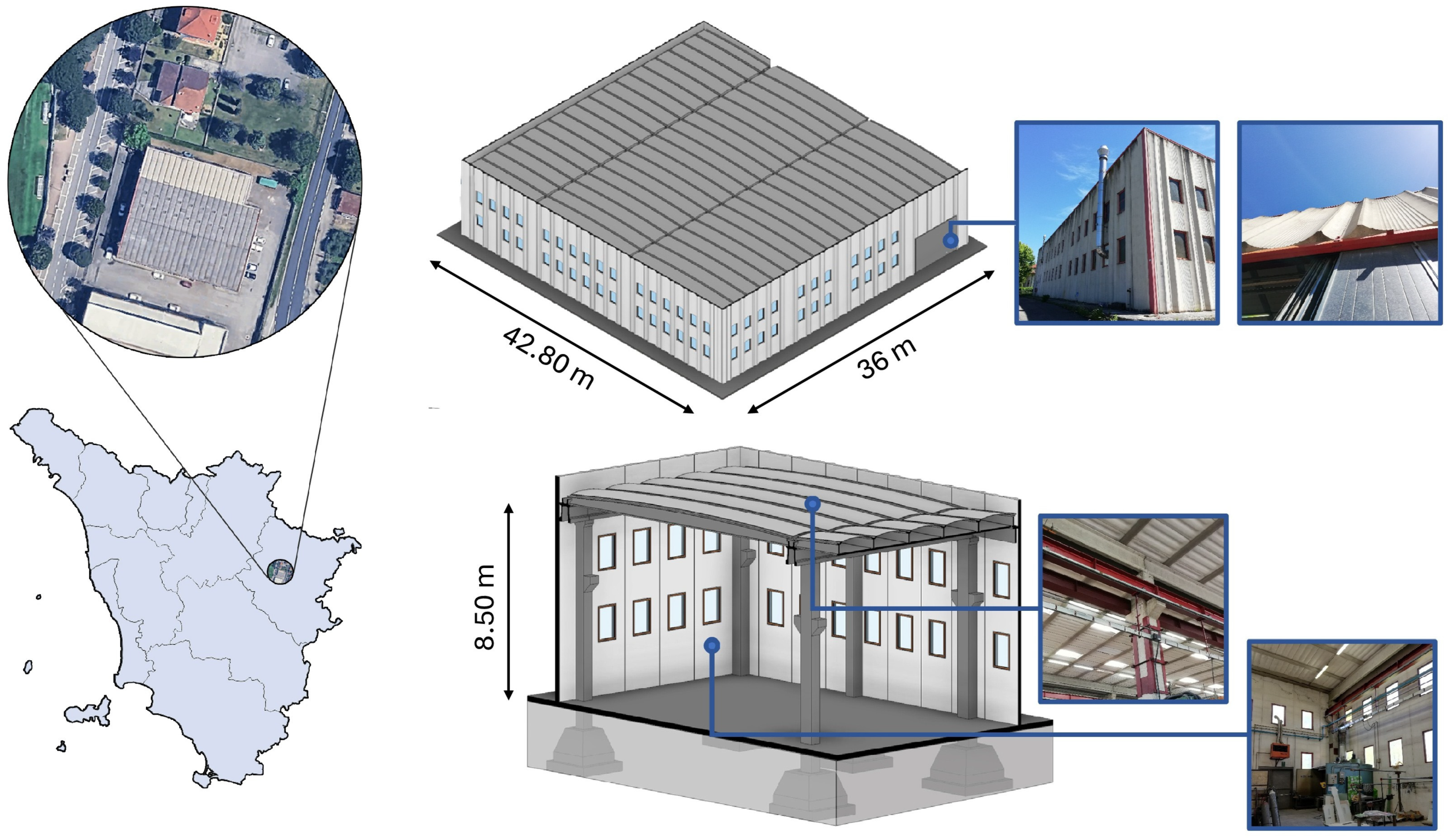
This study focuses on an existing industrial building located in the Casentino Area (province of Arezzo), chosen because it is representative of the recurrent precast reinforced-concrete structural typology found throughout the Casentino industrial district. Comprehensive original project documentation allowed for the precise retrieval of the building’s geometrical, structural, and technological specifications to model the facility in detail in the Revit environment. Furthermore, essential data for energy simulations—including monthly energy bills, occupancy profiles, working hours, and details of the heating generation and distribution systems—were meticulously collected through multiple on-site surveys conducted by the authors’ research group.
The industrial facility features a rectangular footprint of approximately 1600 m2 and a volume of about 13,600 m3 (Figure 1), comprising two structurally independent sections. The primary section, a single-story, double-volume workshop area, accounts for 90% of the total surface area. An expansion in 1996 added an additional nave, which mirrors the original block’s construction and technological solutions. The secondary, double-story block accommodates ground-level worker locker rooms, archives, and storage, with administrative offices located on the first floor. The industrial facility is organized into three naves, each 9 m wide, with a total length of 42.80 m. The workshop area features five 9 m wide spans, while the administrative area has 6 m wide spans. Internal heights are approximately 8.50 m for the workshop, 3.90 m for secondary rooms, and 3.10 m for offices.
The precast concrete structure incorporates tenon head columns and perimeter H-shaped beams, complemented by Y-shaped roof beams. External walls consist of two types of precast concrete sandwich panels: plain (0.13 m thick) and concave (variable thickness from 0.13 m to 0.27 m). Both panel types include internal expanded sintered polystyrene (EPS) insulation of varying thickness. The roof assembly comprises asbestos-containing fiber cement panels with a double layer of glass wool insulation, totaling 0.06 m. Existing polycarbonate skylights exhibit a thermal transmittance of 5.60 W/m2K, a solar heat gain coefficient of 0.35, and a light transmittance of 0.40. Windows feature wired single-glazed panes within metal frames lacking thermal breaks, with a thermal transmittance of 5.63 W/m2K, a solar heat gain coefficient of 0.82, and a light transmittance of 0.50. The heating system for the workshop area uses gas heaters with an efficiency of 0.65. In this case, the energy carrier is natural gas from the public grid, given the lack of renewables in the existing facility. Artificial lighting is provided by fluorescent lamps, characterized by a radiant fraction of 42% and a visible fraction of 18%. The main distinguishing features and thermodynamic properties of the external envelope components are mainly retrieved from UNI 10351 [31] and from the alternatives currently available on the market.
Based on the identified characteristics of the existing facility, this study investigates a range of redevelopment interventions, including both singular and integrated retrofit strategies targeting external envelope and building system.
Solutions W1 and W2 target external wall redevelopment and the replacement of existing windows. W1 involves the installation of an internal thermal insulation layer and a plasterboard counter wall, whereas W2 evaluates external recladding with insulated sandwich metal panels. Regarding roof enhancement, scenario R includes removing existing suspended ceiling and the external cupels—both containing asbestos—and replacing the latter with vaulted insulated sandwich panels with polyurethane insulation. Polyurethane foam was selected for its lightweight properties, ensuring that the current roof loads are not increased, thereby preventing structural issues. Regarding system-related retrofit options, the replacement of the existing gas heaters with a centralized air-to-air heat pump is explored (scenario HP), as is its integration with photovoltaic panels (scenario HP + PV). To evaluate integrated, multi-target interventions, the combination of a full envelope retrofit (W2 + R) and the combined roof and system upgrade (R + HP + PV) were also analyzed. Totally, 7 different scenarios were included in this study, as summarized in Table 1.

2.2. LCC Analysis

A life cycle cost (LCC) analysis was performed to compare the alternative retrofitting interventions, assuming an operational lifetime of 20 years for the manufacturing building. Given that the facility dates back to 1982, this period was considered its residual useful service life. The choice of this reduced lifespan, rather than the conventionally adopted 50-year period, is a cautious boundary condition, and it is aligned with other LCC retrofit studies that consider 30 years [32,33] or 20 years [34] as the reference period.
The LCC methodology aligns with commonly applied approaches in the current literature for reducing energy consumption in existing building stocks [35,36]. It was implemented in accordance with ISO 15686:2017(5) [37], and the global cost was calculated in accordance with EN 15459:2018 [38] using the following equation:
C G ( τ ) = C I + j i = 1 τ C a , i j R d ( i ) V f , τ ( j )
where CG(τ) is the global cost, CI represents the initial investment cost, Ca,i(j) is the annual cost of component j during year i (including operational costs CO, maintenance costs Cm, replacement costs Cr, dismantling Cdm and disposal costs Cdp including transport), Rd(i) is the discount factor for year i, and Vf,τ(j) denotes the residual value of component j at the end of the considered lifespan. The discount factor required for the LCC methodology was calculated using the following equation:
R d t = 1 1 + r t
where r denotes the real discount rate, initially assumed equal to 4%. To allow for a comparison with the current state of the facility, only the operational costs were derived for this baseline scenario.
The bills of quantities (BoQs) of materials and components were generated starting from a building information model (BIM) of the case-study building, developed in Revit v2022 [39]. The BIM was set to accurately represent the geometrical and technological characteristics of the industrial facility, enabling precise estimation of quantities for both the baseline and retrofit scenarios. Operational costs were derived by calculating annual energy consumption for the baseline case and for the redevelopment interventions using DesignBuilder v6 [40].
The resulting energy consumption values obtained were then converted into economic expenditures by using national Italian price lists published by ARERA (Regulatory Authority for Energy, Networks, and Environment), and they were set equal to 0.1774 €/kWh [41] for electricity and 0.0858 €/kWh for natural gas [41]. Maintenance costs, when needed and not available from official price lists, were calculated as a percentage of the initial investment cost [42]. Specifically, the maintenance cost for the air-to-air heat pump was set to 2% of its initial investment cost, while for the photovoltaic (PV) panels, it was set to 331 €/item [43].
In addition to the global cost, the net present value (NPV) and discounted payback period (DPP) economic indicators were also calculated (Appendix A). The former represents the difference between the present value of cash inflows and outflows over the useful life considered in the LCC analysis, while the latter delineates the period of time required to offset the initial costs of intervention through energy savings achieved by redevelopment interventions [18,44]. To provide a more comprehensive evaluation and account for market and financial fluctuations, a sensitivity analysis was conducted by varying the discount rate and energy prices. For the former, 6 different conditions were assumed, including r equal to 3%, 4% and 5%, in accordance with European Guidelines for Cost-Optimal Method [45,46,47], as well as additional values of 1%, 7% and 10% [48]. As for energy price uncertainties, a variation of +30% (_up) and −30% (_down) with respect to the current energy price set by ARERA for both electricity and gas was imposed. This assumption derives from an analysis of energy prices based on data reported in ARERA statistical reports [49].
Finally, an integrated assessment was performed by linking the LCC approach with a life cycle assessment (LCA) to quantify the environmental impact of the various retrofitting measures, consistent with methodologies applied in the literature [50]. The global environmental cost (CGEnv) is an environmental–economic parameter that combines the cost of the building components with the expenditure associated with their environmental impact within a single indicator. The updated equation for the combined economic and environmental evaluation (CGEnv) is as follows:
C G E n v = C I + C E E + C E C + C m + C r 1 + r t + C d m + C d p V r 1 + r N
where CEE represents the cost of embodied energy (EE) [MJ] and CEC denotes the cost of embodied carbon (EC) [kgCO2eq]. These additional factors were calculated considering the cost of electricity based on the Italian energy mix equal to 0.1774 €/kWh and the average value of European Carbon Tax equal to 57.01 €/tCO2 [51]. The global warming potential (GWP) [kgCO2eq], the total use of non-renewable primary energy resources (PENRT) and the total use of renewable primary energy resources (PERT) indexes were calculated using OneClick LCA software v2022 [52] based on the UNI EN 15978 standard [53] and adopting a cradle-to-grave approach. The following phases were considered for the calculation: A1–A3 production, A4–A5 construction process, B4–B5 replacement and refurbishment when needed, C1–C4 end-of-life and D1–D4 benefits and loads beyond the system boundary. The building lifetime was set to 20 years, and the functional unit for the analysis was 1 m2 per gross floor area (GFA).
Finally, for completeness, the CO2 emissions savings associated with the different configurations were estimated using conversion factors equal to 1.986 tCO2eq/103m3 (0.1858 kgCO2eq/kWh) for natural gas and 0.2666 kgCO2eq/kWh for electricity.
In Table 2, the financial implications of the initial investments associated with each retrofit scenario evaluated in this paper are itemized. A preliminary cost inventory was compiled based on available price lists, valid in 2025 for different Italian regions, such as Tuscany [54] and Lombardy [43]. When not already included, the following additional costs have been considered in the life cycle cost analysis: qualified worker, 36.29 €/h; specialized worker, 39.06 €/h; moving platform, 5.53 €/h; crane, 7.60 €/h; lifting tower, 21.68 €/m2; scaffolding, 35.117 €/h.
When required, the costs associated with the demolition of existing stratigraphy or components were also accounted for as initial costs, including dismantling, disposal, and transport to the waste treatment facility.
Moreover, an adequate service life for components was considered to account for replacement over the analyzed 20-year period. For PV panels and the air-to-air heat pump, the lifetime was set to 25 years, whereas inverters require replacement after 10 years. For envelope components, the service life was set to 20 years, in line with the assumed building lifetime. The residual value of components at the end of life was also included in the global cost calculation.

2.3. Design Builder Setup

The existing manufacturing facility was modeled in DesignBuilder, leveraging the Energy Plus engine for the required energy simulations. The building is located in a temperate climate zone, classified as Koppen C and Italian Climate Zone D [55], characterized by 2041 heating degree-days (HDD). Key climatic data for the Municipality of Subbiano are detailed in Table 3.
Setpoint temperatures, metabolic rates, air change rates, and HVAC specifications were set based on information provided directly by the company and supplemented by relevant Italian regulations for any missing data.
Specifically, the heating setpoint temperature was maintained at 18 °C, as required by the company operating in the facility, throughout the heating period (1st November–15th April). Furthermore, the energy simulations of the conditioning system employed the simplified HVAC method available in Design Builder, with an operational schedule from 7:30 a.m. to 5:30 p.m.
Occupancy was set to 0.011 people/m2, from Monday to Friday from 8:30 a.m. to 5:30 p.m. The facility was considered closed throughout August for the summer break. A metabolic rate of 167 W/person was assigned to account for the typical standing light activity. Natural ventilation flow rates were set to 0.76 m3/s in accordance with UNI/TS 11300–1:2014 [56] for industrial buildings. To reflect the actual conditions of the external envelope, a medium level of airtightness (4 h−1) was assumed for external infiltration, drawing from the established literature [57]. A sheltering coefficient of 0.07 was applied, considering the building’s urban context.
As for the properties of the external envelope, the insulation thickness within the existing facade stratigraphy was assumed to be half of its original value, accounting for potential material degradation over time and the presence of reinforced-concrete ribs.
The energy model of the base case facility was subsequently validated by comparing the simulated outputs with the evidence derived from actual energy bills provided by the company itself.

3. Results

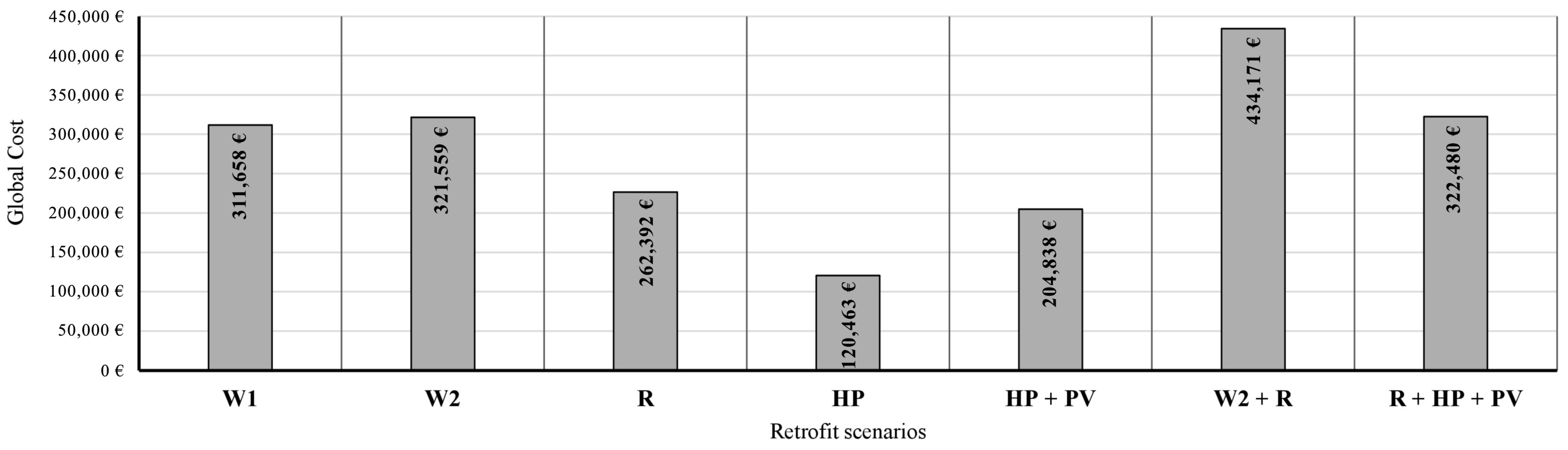
The LCC analysis carried out led to derive general insights into the ranking of the alternative solutions evaluated in terms of their global costs over the reference 20-year period. In Figure 2, the overall expected expenditure estimated for each scenario is displayed graphically.
Solutions targeting the thermal enhancement of facades (W1 and W2) are comparable in terms of global cost but are more expensive compared with the roof retrofit (R), whose cost is about 30% lower than the aforementioned measures. However, the substitution of the existing heating system emerged as the most convenient intervention, with an estimated global cost of about 120,000€. This scenario requires a significantly lower budget, as its global cost is only about 50% of that required for the roof enhancement and 40% of that for facade retrofitting. However, when integrated with PV modules for on-site energy production, the global cost can rise over 200,000€, due to the additional initial investment and the substitution of technical components over time. Integrated retrofit scenarios are sensibly more expensive. In particular, the complete redevelopment of the existing building envelope (W2 + R) is characterized by the highest global cost and can be regarded as the least profitable solution. Conversely, the combined retrofit of the roof stratigraphy and heating system, coupled with PV installation (R + HP + PV) can be pointed out as particularly promising. The simultaneous benefits of improving roofing components, increasing generator efficiency, and achieving partial independence from the grid serve to counterbalance the initial investment.
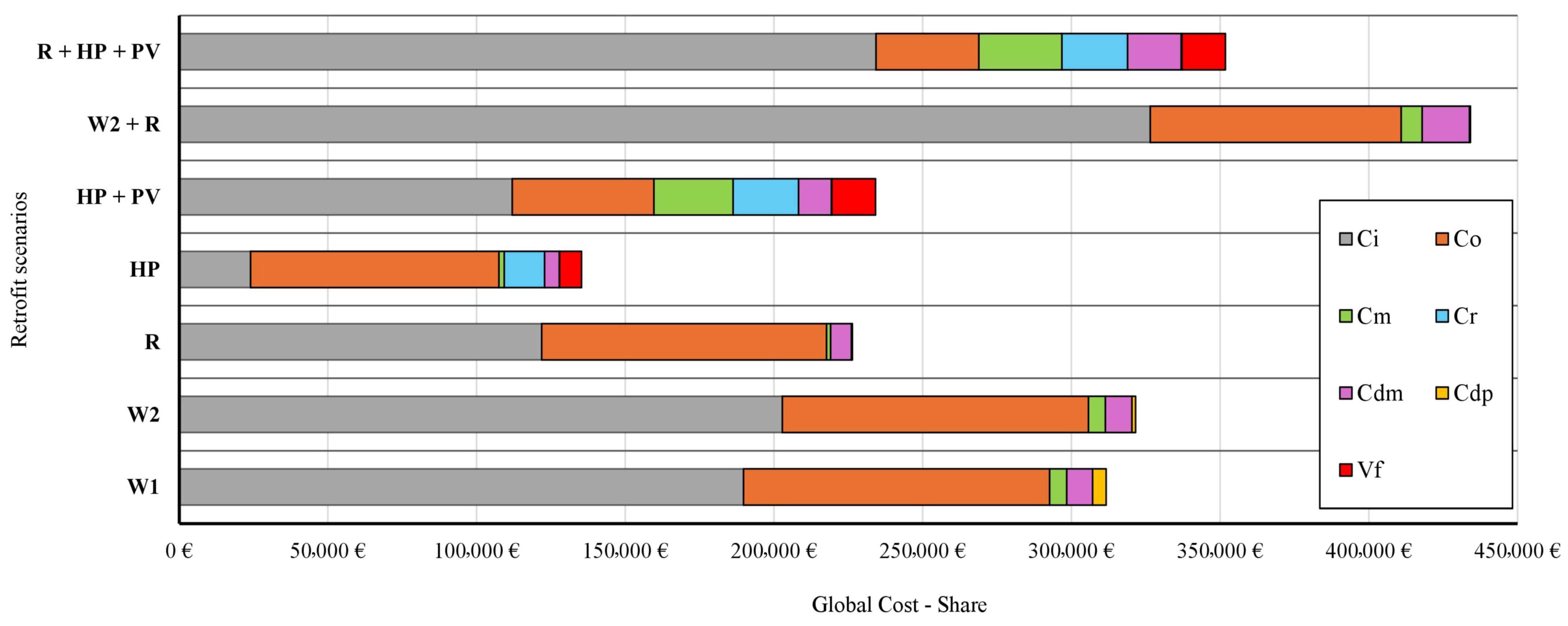
To provide more detailed considerations and better analyze the composition of the global costs, the graph in Figure 3 illustrates the share of each cost item, and the corresponding values are reported in Table 4.
For envelope-oriented interventions, initial investment and operational energy costs are the dominant contributors to total life cycle costs. In the W1 and W2 scenarios, these components account for approximately 60% and 30% of the total costs, respectively. A slightly different distribution is observed in the roof retrofit scenario, where initial investment represents 54% of the global cost, while operational energy costs contribute 42%.
This cost structure is substantially altered in the heat pump (HP) scenario, where initial investment is significantly reduced and accounts for only 20% of the overall expenditure. Operational energy costs become the main contributor (approximately 70%), while the replacement of obsolete components—due to the shorter service life of system elements—remains non-negligible (11%).
The additional integration of photovoltaic (PV) modules leads again to an increased share of initial investment (55%) and a marked reduction in grid-supplied energy costs (23%). However, this configuration entails higher maintenance requirements over time, which account for about 13% of the total costs.
Dismantling costs are marginal, ranging between 3% and 6% for all of the solutions analyzed.
Focusing on the end-of-life stages, a residual value was registered only in the solutions involving system redevelopment and PV adoption.
Notably, both integrated retrofit scenarios require a substantial upfront budget—covering approximately 75% of total costs over the 20-year assessment period—while resulting in limited operational and running expenditures.
To better understand these trends, it is essential to consider energy savings achievable in each scenario, as reported in Table 5.
Considering envelope redevelopment, the roof proved to be more effective, allowing for a decrease in natural gas demand of about 34% compared with the 26% savings achieved in scenarios W1 and W2. The envelope retrofit substantially reduced the heating demand by about half. To compare scenarios relying on different heating generation solutions, total primary energy demand was calculated using the conversion factors stated by Italian standards [58] (2.42 for electricity from the grid, 1.05 for natural gas, and 1 for electricity from on-site renewables). The overall primary energy savings achievable in scenario HP amount to about 28%, further increasing to 46% in the HP + PV case. As for the integrated retrofit scenarios, the R + HP + PV scenario results in a significant reduction of about 60% in primary energy consumption, thanks to enhanced independence from energy supplied by the grid.
To contextualize the findings illustrated above in Table 5, it is necessary to investigate and discuss the potential advantages of the proposed redevelopment measures. Installing a heat pump (HP) as an alternative heating configuration reduces reliance on imported fossil fuels. Furthermore, the retrofit configuration HP + PV supports the European goal of promoting local renewable resources to address energy-security mandates. Resource availability was evaluated using hourly climate data (epw file) to obtain a detailed assessment of both energy demand and production. Additionally, the sensitivity analysis on discount rates and energy prices evaluates the economic resilience and stability of each retrofit scenario under varying market boundary conditions.
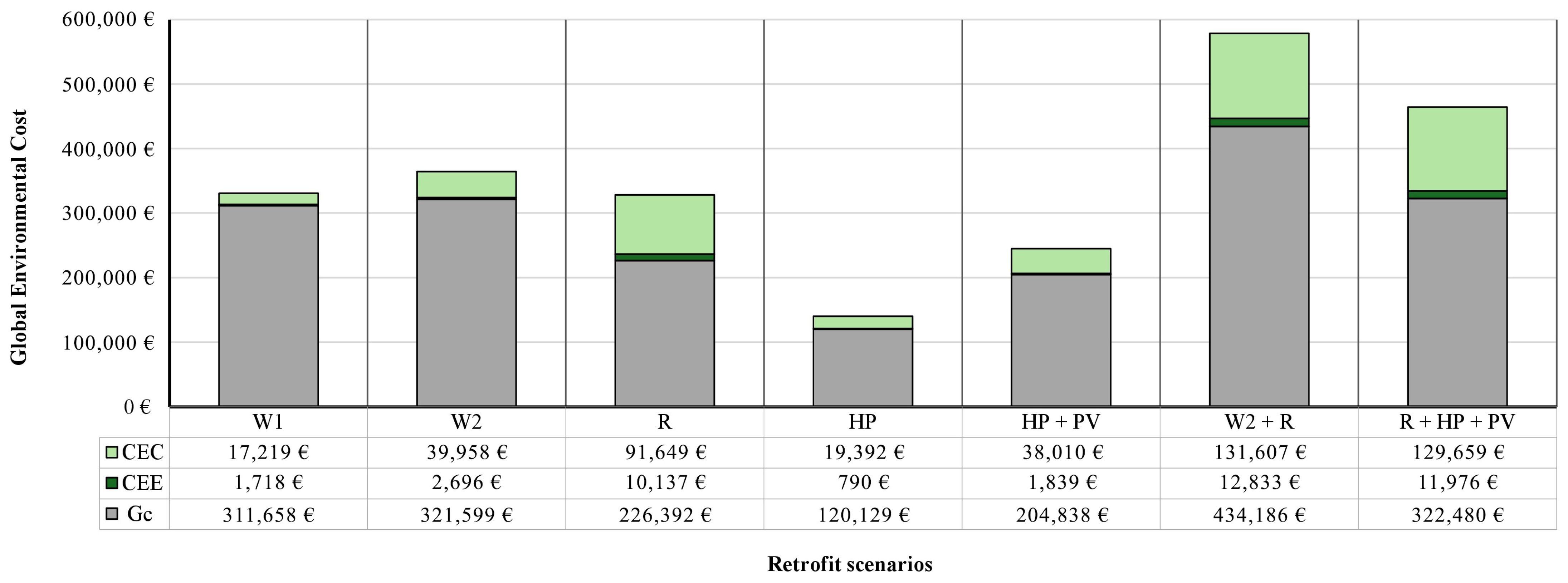
The environmental–economic impact of each solution was examined by monetizing the embodied energy and CO2 emissions associated with each component. The results are reported in Figure 4.
Incorporating the global environmental cost does not alter the relative ranking of the retrofit scenarios; however, it enables a more granular comparison of component-specific impacts from an environmental perspective. The W2 + R scenario exhibited the highest environmental cost, totaling 144,440€. Among envelope-oriented strategies, scenario R was the most impactful, primarily due to the demolition required for existing finishing elements. These demolition-related impacts also burdened the R + HP + PV solution, bringing its total impact in line with the aforementioned worst-case scenario. Regarding wall interventions, the production of metal sandwich panels with polyurethane insulation in W2 made this solution less environmentally favorable than W1. While the heat pump (HP) remained the most cost-effective individual solution, the HP + PV scenario was penalized by the additional environmental burden of PV module manufacturing, which nearly doubled the associated economic–environmental impact.
Conversely, an analysis of operational greenhouse gas (GHG) emissions highlights the effectiveness of measures that may not be immediately profitable in purely economic terms. While wall and roof retrofits reduced CO2 emissions by 18% and 25%, respectively, the installation of a PV system emerged as a critical measure for reducing fossil fuel dependency. The HP + PV configuration achieved a 70% reduction in CO2 emissions compared with the baseline—surpassing the 47% reduction achieved by replacing gas heaters with air-source heat pumps alone. The maximum environmental benefit was observed when coupling system upgrades with roof retrofits, resulting in an aggregate 78% reduction in atmospheric CO2 emissions.
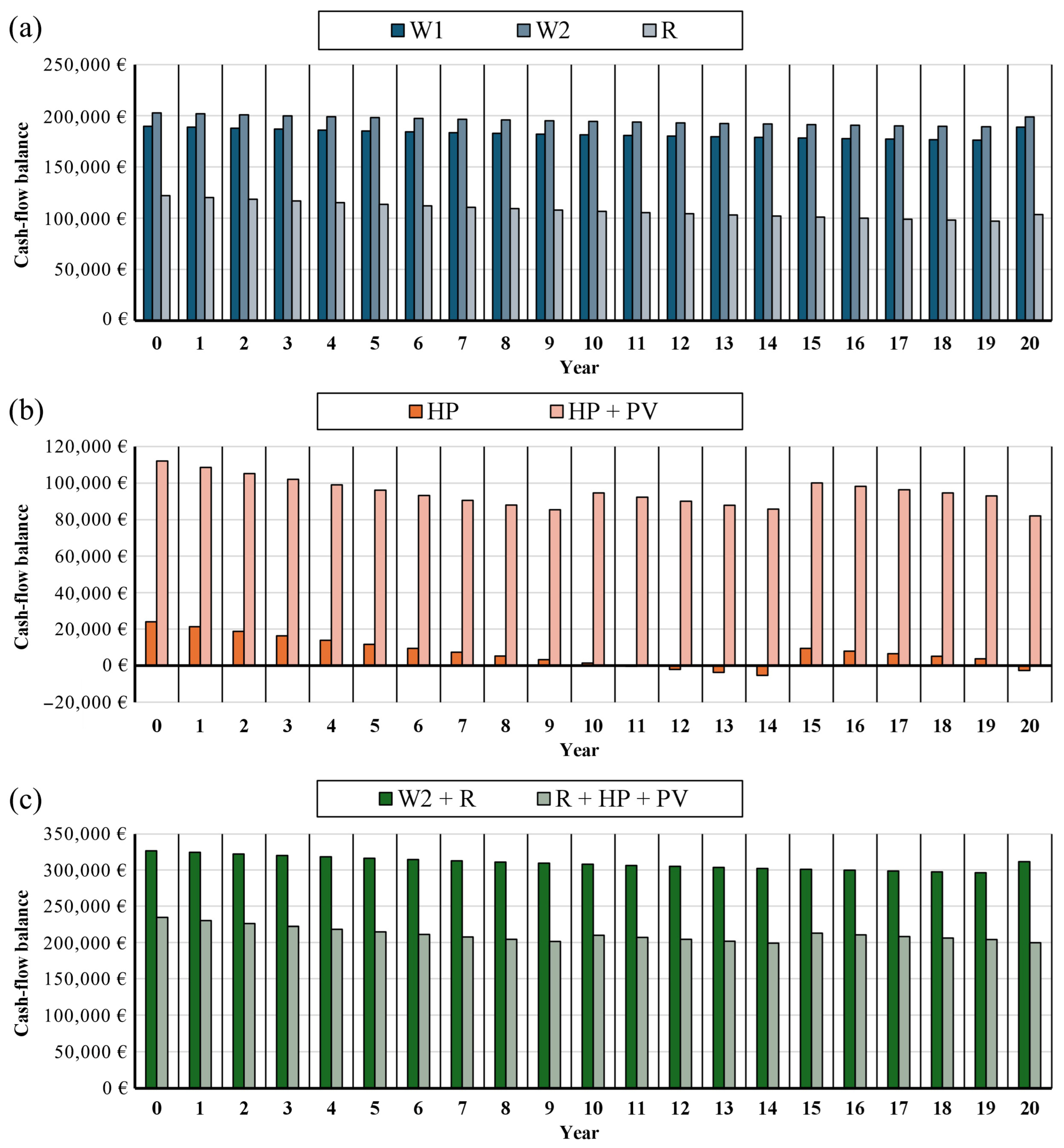
To assess the long-term financial sustainability of the proposed interventions, the DPP for each solution was determined through a 20-year cash-flow analysis. The results are illustrated in Figure 5. As shown in the graphs, focusing exclusively on the heating generation system (Figure 5b) is the only strategy that yields a profitable investment. For all other measures (Figure 5a), the high initial capital expenditure outweighs the achievable annual savings. Furthermore, for scenarios involving photovoltaic (PV) systems (HP + PV and R + HP + PV respectively in Figure 5b and Figure 5c), the required replacement of inverters and PV modules in years 10 and 15, respectively, further diminishes profitability. However, this is only partially the case for the HP scenario (Figure 5b): an initial breakeven point is reached in year 10, and while the heat pump requires replacement in year 15, the costs are largely offset by accumulated savings. Consequently, these replacement costs are recovered within only four years, resulting in a positive net balance by the end of the 20-year reference period. For completeness, the DPP was also evaluated over a 50-year horizon. The evaluation over the longer time span confirms the results obtained in the previous analysis. In this case as well, the substitution of the heating system appears to be the most beneficial intervention.
The same evidence is also confirmed by the NPV analysis, whose results are reported in Table 6: the HP scenario is the only case to yield a positive value over the considered period.
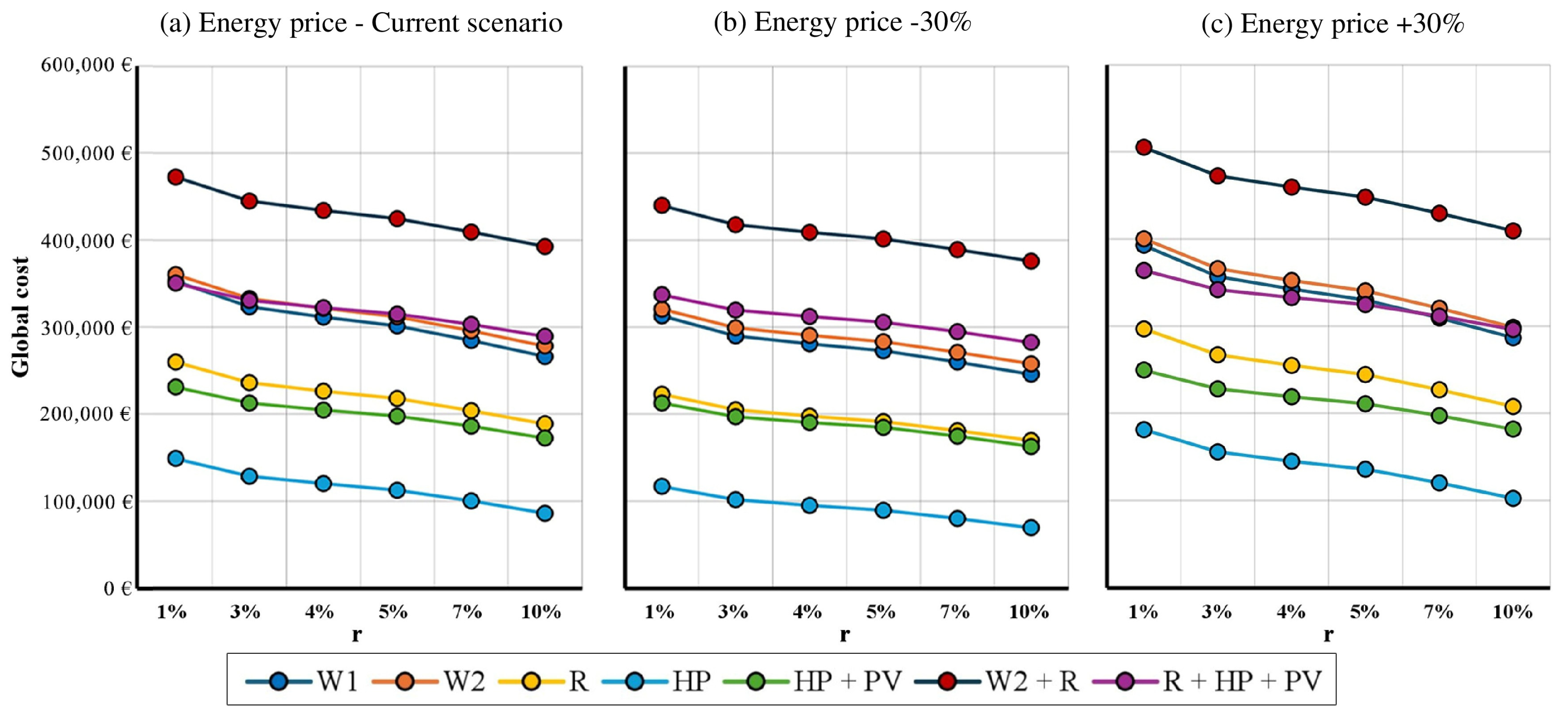
To evaluate the influence of energy market fluctuations and of the assumptions on the discount rate on the overall results, a multi-parameter sensitivity analysis was performed, and the results are graphically synthesized in Figure 6. Focusing on the current energy price scenario ((a) in Figure 6), the variations in the discount rate only slightly alter the overall results, as relative changes can be observed only for configurations W2, W1, and R + HP + PV. The former presents the highest cost in case of a lower discount rate, while R + HP + PV progressively emerges as the most financially impactful among these three measures. However, energy prices prove to be the most influential parameter. In case of energy price reduction ((b) in Figure 6), scenarios featuring the substitution of the heating system generator (HP, HP + PV, and R + HP + PV) are substantially penalized given the reduction in the real energy savings guaranteed. On the other hand, the same measures are more advantageous in higher-energy-price scenarios ((c) in Figure 6), since they allow the rise in operational costs to be offset. For this reason, for instance, R + HP + PV is more convenient in this case than acting on the thermal redevelopment of external walls, with the only exception of higher discount rates.

4. Discussion

The findings aim to support to the promotion of economically sustainable interventions on the existing building stock, since retrofitting initiatives are crucial to achieving the European Union’s Fit for 55% goals [59].
This study identifies the installation of air-to-air heat pumps (HPs) as the most economically viable intervention, yielding a lower global cost and a shorter payback period than solutions targeting the thermal properties of the building envelope. Prioritizing amelioration of active systems’ efficiency aligns with the findings of other studies. Luddeni et al., focusing on Italian office stocks, conclude that measures targeting system elements, such as electrical consumption and daylight controls, can outperform passive envelope retrofits in terms of cost optimality [60]. Furthermore, installing a heat pump (HP) for heating provides an advantage in reducing greenhouse gas emissions in the atmosphere, particularly given that approximately 49% of Italian electricity demand is covered by renewable sources. So, the carbon footprint associated with an efficient heat pump is significantly lower than that of traditional fossil fuel heating systems. In addition, the use of heat pump reduces primary energy demand by 28%. Although the price of electrical energy in Italy remains higher than that of natural gas, the heat pump system ensures a consistent reduction in operational costs thanks to its higher efficiency. Regarding energy price structure, in Italy, both energy carriers are subjected to considerable taxes and fees; however, for electricity, these account for 25% of the total expenditure, whereas this share increases to 31% for natural gas.
In this research study, the retrofitting measures addressing the external envelope (e.g., external walls and roof technological solutions) are not the most suitable solutions when considering only economic investment and the environmental impact. However, it is necessary to highlight that this kind of interventions, in addition to ensuring energy savings, ameliorates the users’ indoor comfort conditions. As a consequence, these measures can positively affect the productivity in the working environment, since thermal well-being is recognized in the literature as a highly influential factor [61]. Deepening the analysis of financial implications, retrofitting initiatives yield negative NPV values, highlighting a significant economic barrier to achieving Nearly Zero Energy Building (NZEB) standards. This economic gap is consistent with the findings of Luddeni et al., who conclude that reaching NZEB status is frequently unfeasible for private owners, particularly when the area available for PV deployment is limited [60]. Although industrial buildings are usually characterized by large roof surfaces with high solar exploitation potential, the wider dimensions of the facilities and the significant dispersing area of building envelope require consistent investments in construction materials. To promote large scale decarbonization and energy-saving retrofits in the industrial building stock, public subsidies and incentives are urgently needed to support industrial companies and stakeholders in achieving financial sustainability.
Given this context, implementing parametric decision-support frameworks, such those proposed by Kovacic et al., represents a valuable tool for design teams to navigate the trade-offs between financial constraints (initial investment costs of building components, available funds for renovation, etc.) and ecological requirements of the industrial sector (carbon-free economy by 2050 across all sectors) [62]. By applying similar analytical approaches, it is also possible to evaluate the long-term amortization of initial expenditure to inform business and strategic comparisons.
As highlighted in this research study, initial investment costs and operational expenditure represent the most impactful categories in the global cost calculation. However, Bochare et al. underline the need to adequately analyze operational and maintenance costs in industrial contexts, since expenditures not accounted for during the initial building design stages can compromise the long-term profitability of interventions [63].
The sensitivity analysis conducted on discount rates and energy prices allowed us to address the uncertainty inherent in long-term economic forecasting. A similar approach was adopted by Copiello et al., whose stochastic modeling demonstrated that the discount rate is the most influential parameter in life cycle costing, accounting for 60% to 78% of the variance in results [64]. In line with these findings, high discount rates were shown to reduce the economic attractiveness of capital-intensive envelope retrofitting strategies, albeit to a lesser extent. According to the results obtained, varying the discount rate induces variability between 16% and 42%, whereas a 30% fluctuation in energy price affects results by between 3% and 21%.
On the other hand, energy price fluctuations emerged as a highly influential factor in the analysis, especially for measures that directly promote independency from the grid and therefore prevent energy market volatility.
From an environmental life cycle assessment perspective, the available literature indicates additional complexities for industrial typologies. Rodrigues et al. observe that the product stage (A1–A3) can account for up to 94% of total embodied carbon [65]. In particular, Arab et al. (2025) advocate for the integration of the social cost of carbon (SCC) to internalize these climate externalities, noting that the use of components featuring significant shares of recycled materials can mitigate the carbon footprint by 16% [66]. In this regard, a homogeneous policy at the European level should be promoted for carbon tax applications and fees, which are currently highly differentiated, ranging from a minimum tariff of 0.09 €/tonCO2 in Poland up to 134.06 €/tonCO2 in Sweden. Other countries, Italy included, do still not foresee a clear strategy to address similar issues, but the implementation of the renewed European Emissions Trading System (EU ETS) could represent a significant opportunity in the near future.
Furthermore, the transition toward a circular economy requires a focus on end-of-life (C1–C4) phases. Marrero highlights that this aspect can be particularly relevant in a sector where buildings are often characterized by relatively short service lives (approximately 35 years) and identify at the same time high recycling potential for metals (100%) and concrete (70%) [67]. Consequently, selecting modular or precast components can facilitate material recovery in case of interventions on these facilities. This evidence is in line with the global cost composition derived in this study, where strategies encompassing metal-containing components show lower disposal costs. Notably, all of the metal-based components can be entirely recycled and hence do not influence the economic balance, as well as the PV modules, whose disposal is responsibility of the producer and included in the initial cost according to Italian regulation [68]. Waste treatment, on the other hand, is more impactful for insulating materials, especially those already in place, and for asbestos-containing elements which must be treated as potentially harmful substances.
Given the intended use of these facilities, manufacturing-related needs should be carefully accounted for when evaluating building-related initiatives. In this regard, Reisinger et al. propose that structural flexibility should be addressed as an additional critical sustainability metric; manufacturing facilities with wider spans can increase layout adaptability by 55%, thereby extending the building’s functional life and delaying demolition [69]. Similar considerations can be applied when considering the compatibility of the different retrofit scenarios evaluated in this research study with the ongoing working activities. While strategies involving roof renovation (R, R + HP + PV) require a mandatory long-term suspension of industrial processes, the external recladding proposed in scenario W2 is expected to induce more limited impacts, thus preventing additional economic consequences. In this case, the construction activities are expected to be carried out entirely from outside of the facility, with only limited interference during window replacement.
This study presents some limitations related to the number of retrofitting strategies considered. In particular, several redevelopment measures related to both cooling and artificial lighting systems and structural interventions were not included, as this study mainly focuses on envelope retrofitting interventions and the introduction of on-site renewables or electricity generation.
Future research should extend the current analysis by exploring additional retrofit scenarios, including cooling and artificial lighting systems. While the present study focuses on heating demand, the increasing frequency of extreme summer temperatures is challenging the ability to maintain thermal comfort and operational efficiency within industrial halls, potentially leading to the adoption of cooling systems that are currently not often installed.
Furthermore, the optimization of artificial lighting in large indoor environments represents a significant area for potential energy savings. Future investigations should assess the impact of increasing the percentage of skylights to maximize natural daylight autonomy and the introduction of dimmable and automatic LED lighting devices.
Moreover, the robustness of these retrofit strategies should be tested under varying climatic conditions, assuming different geographic locations and contexts. Finally, the proposed methodology can also be applied to buildings with different intended uses but the boundary conditions for LCC analysis must be modified and appropriately updated. For instance, in residential facilities, the BoQ is typically smaller than in an industrial building, leading to lower initial investment costs; however, the payback period for various measures may remain high [70]. Furthermore, when evaluating different intended uses, additional factors (such as internal comfort and indoor air quality) should be integrated into the analysis.

5. Conclusions

The study presented applies life cycle cost analysis as a comprehensive framework to support retrofit decisions for industrial building heritage. In the current scientific literature, this building type remains quite underexplored despite its significant energy demand and inadequate use of renewables. This research study systematically compares envelope and system-oriented measures, both individually and in combination, to outline cost-effective interventions while also considering the environmental aspect.
The main results highlight that retrofit strategies targeting building heating systems and installation of renewables offer the most favorable economic performance over the 20-year period considered for the LCC analysis. Specifically, the replacement of inefficient heating systems with high-efficiency heat pumps, integrated with on-site renewables, emerged as the most profitable measure, yielding a 46% reduction in primary energy demand. Conversely, while envelope retrofits contribute to decreasing energy consumption (R = 34% and W1, W2 = 26%) and ensuring regulatory framework compliance, their higher upfront costs and longer payback periods limit their economic attractiveness when evaluated solely with conventional financial indicators. The sensitivity analysis emphasizes the strong influence of discount rates and energy price fluctuations on the results, highlighting the need for robust evaluation frameworks for long-term investments. Notably, the integrated economic–environmental assessment demonstrates that solutions with limited short-term profitability can yield significant reductions in operational greenhouse gas emissions, thereby supporting broader decarbonization goals. Overall, the proposed methodology is transferable and scalable, providing a structured decision-support tool for stakeholders involved in the redevelopment of existing Italian industrial facilities. These findings underscore the need for targeted policy incentives and regulatory measures to bridge the gap between economic feasibility and environmental performance, enabling a more extensive and effective redevelopment of the existing industrial building stock in line with European energy and environmental targets.

Author Contributions

Conceptualization, C.C., N.B., F.B. and V.D.N.; methodology, C.C., N.B., F.B. and V.D.N.; software, C.C. and N.B.; validation, C.C., N.B., F.B. and V.D.N.; formal analysis, F.B. and V.D.N.; investigation, C.C., N.B. and V.D.N.; resources, F.B. and V.D.N.; data curation, C.C. and N.B.; writing—original draft preparation, C.C. and N.B.; writing—review and editing, C.C., F.B. and V.D.N.; visualization, C.C. and N.B.; supervision, F.B. and V.D.N. All authors have read and agreed to the published version of the manuscript.

Funding

This research study received no external funding.

Institutional Review Board Statement

Not applicable.

Informed Consent Statement

Not applicable.

Data Availability Statement

The data presented in this study are available upon request from the corresponding author because the research is still ongoing.

Conflicts of Interest

The authors declare no conflicts of interest.

Appendix A

The net present value is defined by the following equation:
N P V = t = 0 n C F t 1 + r t   C I
where CFt indicates the annual net cash flow at time t, t delineates the period of time (20 years), CI delineates the initial investment cost, n is the total number of period and r indicates the real discount rate.
t = 0 n C F t 1 + r t = C I
The annual net cash flow is variable, and it is discounted using the real discount rate r.
The discounted payback period is defined by the following equation:
D P P =   C I C F t
where CFt indicates the annual net cash flow at time t, t delineates the period of time (20 years) and CI delineates the initial investment cost.

References

  1. United Nation. 2023 Global Status Report for Buildings and Construction: Beyond Foundations—Mainstreaming Sustainable Solutions to Cut Emissions from the Buildings Sector. Report. 2024. Available online: https://www.unep.org/resources/report/global-status-report-buildings-and-construction (accessed on 12 September 2024).
  2. Maduta, C.; Melica, G.; D’Agostino, D.; Bertoldi, P. Towards a decarbonised building stock by 2050: The meaning and the role of zero emission buildings (ZEBs) in Europe. Energy Strategy Rev. 2022, 44, 101009. [Google Scholar] [CrossRef]
  3. Larsen, V.G.; Tollin, N.; Sattrup, P.A.; Birkved, M.; Holmboe, T. What are the challenges in assessing circular economy for the built environment? A literature review on integrating LCA, LCC and S-LCA in life cycle sustainability assessment, LCSA. J. Build. Eng. 2022, 50, 104203. [Google Scholar] [CrossRef]
  4. ENEA. Efficienza Energetica 2023; ENEA: Rome, Italy, 2023. [Google Scholar]
  5. Agenza Nazionale per l’Efficieza Energetica. Rapporto Annuale Efficienza Nergetica 2022; Agenzia Nazionale per l’Efficienza Energetica: Rome, Italy, 2022. [Google Scholar]
  6. ANCE/CRESME. Lo Stato del Territorio Italiano 2012 Insediamento e Rischio Sismico e Idrogeologico; ANCE/CRESME: Rome, Italy, 2012. [Google Scholar]
  7. Leichter, M.; Piccardo, C. Assessing life cycle sustainability of building renovation and reconstruction: A comprehensive review of case studies and methods. Build. Environ. 2024, 262, 111817. [Google Scholar] [CrossRef]
  8. Toosi, H.A.; Lavagna, M.; Leonforte, F.; Del Pero, C.; Aste, N. Life Cycle Sustainability Assessment in Building Energy Retro fi tting; A Review. Sustain. Cities Soc. 2020, 60, 102248. [Google Scholar] [CrossRef]
  9. Kim, S.; Moon, J.-E.; Lim, S.; Kim, S.; Kim, J.; Lim, J. Building enclosure commissioning as an energy efficiency strategy: Energy and economic benefits through life-cycle operational costing. Build. Environ. 2026, 287, 113849. [Google Scholar] [CrossRef]
  10. Cheng, M.-Y.; Vu, Q.-T.; Zhang, X.-K. Carbon-footprint-based optimization for building life-cycle total cost analysis—A case study on MEGA house. J. Build. Eng. 2025, 114, 114273. [Google Scholar] [CrossRef]
  11. Ropo, M.; Mustonen, H.; Knuutila, M.; Luoranen, M.; Kosonen, A. Considering embodied CO2 emissions and carbon compensation cost in life cycle cost optimization of carbon-neutral building energy systems. Environ. Impact Assess. Rev. 2023, 101, 107100. [Google Scholar] [CrossRef]
  12. Kiran, K.; Anand, K.B. Comparison of life cycle cost and embodied energy for buildings with alternative walling materials. Mater. Today Proc. 2023. [Google Scholar] [CrossRef]
  13. Zhang, C.; Hu, M.; Laclau, B.; Garnesson, T.; Yang, X.; Li, C.; Tukker, A. Environmental life cycle costing at the early stage for supporting cost optimization of precast concrete panel for energy renovation of existing buildings. J. Build. Eng. 2021, 35, 102002. [Google Scholar] [CrossRef]
  14. Belany, P.; Hrabovsky, P.; Kolkova, Z. Combination of lighting retrofit and life cycle cost analysis for energy efficiency improvement in buildings. Energy Rep. 2021, 7, 2470–2483. [Google Scholar] [CrossRef]
  15. Luo, X.J.; Oyedele, L.O. A data-driven life-cycle optimisation approach for building retrofitting: A comprehensive assessment on economy, energy and environment. J. Build. Eng. 2021, 43, 102934. [Google Scholar] [CrossRef]
  16. Luo, X.J. Retrofitting existing office buildings towards life-cycle net-zero energy and carbon. Sustain. Cities Soc. 2022, 83, 103956. [Google Scholar] [CrossRef]
  17. Wang, B.; Xia, X.; Zhang, J. A multi-objective optimization model for the life-cycle cost analysis and retrofitting planning of buildings. Energy Build. 2014, 77, 227–235. [Google Scholar] [CrossRef]
  18. Gangolells, M.; Gaspar, K.; Casals, M.; Ferré-Bigorra, J.; Forcada, N.; Macarulla, M. Life-cycle environmental and cost-effective energy retrofitting solutions for office stock. Sustain. Cities Soc. 2020, 61, 102319. [Google Scholar] [CrossRef]
  19. Costantino, C.; Benedetti, A.C.; Gulli, R. Quick GIS-based tools for energy simulation, LCA and LCC analysis at the urban block scale. A cradle-to-cradle comparative methodology for evaluating energy refurbishment and demolition-reconstruction scenarios. In Transition: Challenges and Opportunities for the Build Heritage; Edicom Edizioni: Monfalcone, Italy, 2023; pp. 14–17. [Google Scholar]
  20. Rethnam, O.R.; Thomas, A. A Community Building Energy Modelling—Life Cycle Cost Analysis framework to design and operate net zero energy communities. Sustain. Prod. Consum. 2023, 39, 382–398. [Google Scholar] [CrossRef]
  21. Taseer, A.; Aslam, M.; Malik, M.S.A.; Zahoor, H.; Jadoon, A.A. Energy efficiency and life cycle cost analysis of residential buildings using sustainable building materials. J. Build. Eng. 2025, 114, 114243. [Google Scholar] [CrossRef]
  22. Hajare, A.; Elwakil, E. Integration of life cycle cost analysis and energy simulation for building energy-e ffi cient strategies assessment. Sustain. Cities Soc. 2020, 61, 102293. [Google Scholar] [CrossRef]
  23. Weerasinghe, L.N.K.; Darko, A.; Chan, A.P.C.; Blay, K.B.; Edwards, D.J. Measures, benefits, and challenges to retrofitting existing buildings to net zero carbon: A comprehensive review. J. Build. Eng. 2024, 94, 109998. [Google Scholar] [CrossRef]
  24. Apostolopoulos, V.; Mamounakis, I.; Seitaridis, A.; Tagkoulis, N.; Kourkoumpas, S.; Iliadis, P.; Angelakoglou, K.; Nikolopoulos, N. An integrated life cycle assessment and life cycle costing approach towards sustainable building renovation via a dynamic online tool. Appl. Energy 2023, 334, 120710. [Google Scholar] [CrossRef]
  25. Frasca, F.; Bartolucci, B.; Parracha, J.L.; Ogut, O.; Mendes, M.P.; Siani, A.M.; Tzortzi, J.N.; Bertolin, C.; Flores-Colen, I. A quantitative comparison on the use of thermal insulation materials in three European countries through the TEnSE approach: Challenges and opportunities. Build. Environ. 2023, 245, 110973. [Google Scholar] [CrossRef]
  26. Medina-Salgado, M.S.; García-Muiña, F.E.; Cucchi, M.; Settembre-Blundo, D. Adaptive life cycle costing (Lcc) modeling and applying to italy ceramic tile manufacturing sector: Its implication of open innovation. J. Open Innov. Technol. Mark. Complex. 2021, 7, 101. [Google Scholar] [CrossRef]
  27. Alejandrino, C.; Mercante, I.T.; Bovea, M.D. Bovea Combining O-LCA and O-LCC to support circular economy strategies in organizations: Methodology and case study. J. Clean. Prod. 2022, 336, 130365. [Google Scholar] [CrossRef]
  28. Li, S.; Lu, Y.; Kua, H.W.; Chang, R. The economics of green buildings: A life cycle cost analysis of non-residential buildings in tropic climates. J. Clean. Prod. 2020, 252, 119771. [Google Scholar] [CrossRef]
  29. Meshref, A.; El-Dash, K.; Basiouny, M.; El-Hadidi, O. Implementation of a Life Cycle Cost Deep Learning Prediction Model Based on Building Structure Alternatives for Industrial Buildings. Buildings 2022, 12, 502. [Google Scholar] [CrossRef]
  30. Weerasinghe, A.S.; Ramachandra, T.; Rotimi, J.O.B. Comparative life-cycle cost (LCC) study of green and traditional industrial buildings in Sri Lanka. Energy Build. 2021, 234, 110732. [Google Scholar] [CrossRef]
  31. UNI 10351; Materiali e Prodotti per Edilizia—Proprietà Termoigrometriche—Procedure per la Scelta dei Valori di Progetto. UNI—Italian Organization for Standardization: Milan, Italy, 2015.
  32. Salem, R.; Bahadori-Jahromi, A.; Mylona, A.; Bohdanowicz, P.; Cook, D. Life Cycle Cost Analysis of Retrofit Scenarios for a UK Residential Dwelling. Proc. Inst. Civ. Eng.—Eng. Sustain. 2019, 173, 57–72. [Google Scholar] [CrossRef]
  33. Campagna, L.M.; Carlucci, F.; Fiorito, F. Life cycle cost optimization for schools energy retrofit under climate change: Methodological approach and analyses in five different climates. Energy Build. 2025, 335, 115561. [Google Scholar] [CrossRef]
  34. Kusumastuti, D.; Setyowati, E.; Sari, S.R.; Dwiyanto, A. Life Cycle Cost Perspective of Retrofitting the Istiqlal Mosque: Demonstrating Long-Term Savings of Green Public Buildings. In E3S Web of Conferences; EDP Sciences: Les Ulis, France, 2025; p. 02056. [Google Scholar]
  35. Dahiya, D.; Laishram, B. Life cycle energy analysis of buildings: A systematic review. Build. Environ. 2024, 252, 111160. [Google Scholar] [CrossRef]
  36. Ferrari, S.; Beccali, M. Energy-environmental and cost assessment of a set of strategies for retrofitting a public building toward nearly zero-energy building target. Sustain. Cities Soc. 2017, 32, 226–234. [Google Scholar] [CrossRef]
  37. ISO 15686-5:2017; Buildings and Constructed Assets—Service Life Planning. Part 5: Life-Cycle Costing. ISO: Geneva, Switzerland, 2017.
  38. UNI EN 15459-1:2018; Prestazione Energetica Degli Edifici—Sistemi di Riscaldamento e Sistemi di Raffrescamento Idronici Negli Edifici—Parte 1: Procedura di Valutazione Economica per i Sistemi Energetici Negli Edifici, Modulo M1–14. Ente Italiano di Normzione: Rome, Italy, 2018.
  39. Autodesk, Inc. Revit, v 2022; Informatic Company: Bublin, Ireland, 2021. Available online: https://www.autodesk.com/it (accessed on 10 September 2025).
  40. DesignBuilder Software Ltd. Design Builder, v6; Informatic Company: Gloucs, UK, 2019. Available online: https://www.designbuilderitalia.it/ (accessed on 10 September 2025).
  41. ARERA Autorità di Regolazione per Energia Reti e Ambiente. 2025. Available online: https://www.arera.it/ (accessed on 23 October 2025).
  42. Carpino, C.; Bruno, R.; Arcuri, N. Social housing refurbishment for the improvement of city sustainability: Identification of targeted interventions based on a disaggregated cost-optimal approach. Sustain. Cities Soc. 2020, 60, 102223. [Google Scholar] [CrossRef]
  43. Regione Lomabardia. Prezzario Regionale dei Lavori Pubblici della Regione Lombardia. 2025. Available online: https://www.regione.lombardia.it/wps/portal/istituzionale/HP/DettaglioServizio/servizi-e-informazioni/Enti-e-Operatori/Autonomie-locali/Acquisti-e-contratti-pubblici/Osservatorio-regionale-contratti-pubblici/prezzario-opere-pubbliche/prezzario-opere-pubbliche (accessed on 10 September 2025).
  44. Amini Toosi, H.; Del Pero, C.; Leonforte, F.; Lavagna, M.; Aste, N. Machine learning for performance prediction in smart buildings: Photovoltaic self-consumption and life cycle cost optimization. Appl. Energy 2023, 334, 120648. [Google Scholar] [CrossRef]
  45. Parlamento Europeo. Direttiva 2010/31/UE del Parlamento Europeo e del Consiglio del 19 Maggio 2010 Sulla Prestazione Energetica Dell’edilizia; European Parliament: Strasbourg, France, 2010. [Google Scholar]
  46. Fregonara, E.; Ferrando, D.G. The Discount Rate in the Evaluation of Project Economic-Environmental Sustainability. Sustainability 2023, 15, 2467. [Google Scholar] [CrossRef]
  47. Dodd, N.; Donatello, S.; Cordella, M. JCR Technical Report. Level(s) Indicator 6.1: Life Cycle Costs. User Manual: Introductory Brefing, Instructions and Guidance; European Commission: Brussel, Belgium, 2021. [Google Scholar]
  48. Kovacic, I.; Waltenbereger, L.; Gourlis, G. Tool for life cycle analysis of facade-systems for industrial buildings. J. Clean. Prod. 2016, 130, 260–272. [Google Scholar] [CrossRef]
  49. Arera ARERA. Available online: https://www.arera.it/dati-e-statistiche (accessed on 14 January 2026).
  50. Fregonara, E.; Giordano, R.; Ferrando, D.G.; Pattono, S. Economic-environmental indicators to support investment decisions: A focus on the buildings’ end-of-life stage. Buildings 2017, 7, 65. [Google Scholar] [CrossRef]
  51. Tax Foundation Europe. 2025. Available online: https://taxfoundation.org/data/all/eu/carbon-taxes-europe/ (accessed on 2 December 2025).
  52. One Clik LCA 2022. OneClick LCA Software v2022. Informatic Company: Helsinki, Finland. Available online: https://oneclicklca.com/ (accessed on 10 September 2025).
  53. UNI EN 15978:2011; Sostenibilità delle Costruzioni—Valutazione della Prestazione Ambientaledegli Edifici—Metodo di Calcolo. Ente Italiano di Normazione: Milan, Italy, 2011.
  54. Regione Toscana Prezzario Lavori della Regione Toscana. 2025. Available online: https://prezzariollpp.regione.toscana.it/2025-1/firenze (accessed on 25 September 2025).
  55. Governo Italiano. Regolamento Recante Norme per la Progettazione, L’installazione, L’esercizio e la Manutenzione Degli Impianti Termici Degli Edifici ai Fini del Contenimento dei Consumi di Energia, In Attuazione Dell’art. 4, Comma 4, della Legge 9 Gennaio 1991, n. 10; Governo Italiano: Rome, Italy, 1993. [Google Scholar]
  56. UNI/TS 11300-1; Prestazioni Energetiche Degli Edifici. Parte 1—Determinazione del Fabbisogno di Energia Termica Dell’edificio per la Climatizzazione Estiva ed Invernale. Ente Italiano di Normzione: Rome, Italy, 2014.
  57. Brinks, P.; Kornadt, O.; Oly, R. Air infiltration assessment for industrial buildings. Energy Build. 2015, 86, 663–676. [Google Scholar] [CrossRef]
  58. Governo Italiano. Decreto Ministeriale 26 Giugno 2015. Applicazione delle Metodologie di Calcolo delle Prestazioni Energetiche e Definizione delle Prescrizioni e dei Requisiti Minimi Degli Edifici; Governo Italiano: Rome, Italy, 2015. [Google Scholar]
  59. European Council. Fit for 55. 2022. Available online: https://www.consilium.europa.eu/en/policies/green-deal/fit-for-55-the-eu-plan-for-a-green-transition/ (accessed on 13 March 2023).
  60. Luddeni, G.; Krarti, M.; Pernigotto, G.; Gasparella, A. An analysis methodology for large-scale deep energy retrofits of existing building stocks: Case study of the Italian office building. Sustain. Cities Soc. 2018, 41, 296–311. [Google Scholar] [CrossRef]
  61. Braga, M.P.; Niza, I.L.; Broday, E.E. Assessment between indoor environmental quality aspects and productivity in buildings: A systematic literature review. Build. Environ. 2025, 278, 112983. [Google Scholar] [CrossRef]
  62. Gourlis, G.; Kovacic, I. A study on building performance analysis for energy retrofit of existing industrial facilities. Appl. Energy 2016, 184, 1389–1399. [Google Scholar] [CrossRef]
  63. Bochare, R.; Dagliya, M.; Kadam, M. Assessment of economic performance of an industrial building using life cycle cost & refined benefit-cost analysis—A case study. J. Build. Eng. 2024, 83, 108397. [Google Scholar] [CrossRef]
  64. Copiello, S.; Gabrielli, L.; Bonifaci, P. Evaluation of energy retro fi t in buildings under conditions of uncertainty: The prominence of the discount rate. Energy 2017, 137, 104–117. [Google Scholar] [CrossRef]
  65. Rodrigues, H.; Vitorino, H.; Batalha, N.; Sousa, R.; Fernandes, P.; Varum, H. Influence of Beam-to-Column Connections in the Seismic Performance of Precast Concrete Industrial Facilities. Struct. Eng. Int. 2022, 32, 507–519. [Google Scholar] [CrossRef]
  66. Arab, B.; Raouf, M.A.; Rahal, A.; Mostafa, M.; Abouzeid, M.N. Life cycle assessment for construction materials of an industrial building using web-based software “OneClick LCA”. Discov. Sustain. 2025, 6, 615. [Google Scholar] [CrossRef]
  67. Marrero, M.; Rivero-Camacho, C.; Martínez-Rocamora, A.; Alba-Rodríguez, M.D.; Solís-Guzmán, J. Life Cycle Assessment of Industrial Building Construction and Recovery Potential. Case Studies in Seville. Processes 2022, 10, 76. [Google Scholar] [CrossRef]
  68. Governo Italiano. Decreto Legislativo 14 Marzo 2014, n. 49 Attuazione della Direttiva 2012/19/UE sui Rifiuti di Apparecchiature Elettriche ed Elettroniche (RAEE). (14G00064); Governo Italiano: Rome, Italy, 2014. [Google Scholar]
  69. Reisinger, J.; Kugler, S.; Kovacic, I.; Knoll, M. Parametric Optimization and Decision Support Model Framework for Life Cycle Cost Analysis and Life Cycle Assessment of Flexible Industrial Building Structures Integrating Production Planning. Buildings 2022, 12, 162. [Google Scholar] [CrossRef]
  70. Kanteraki, A.E.; Kyriakopoulos, G.L.; Zamparas, M.; Kapsalis, V.C.; Makridis, S.S.; Mihalakakou, G. Investigating Thermal Performance of Residential Buildings in Marmari Region, South Evia, Greece. Challenges 2020, 11, 5. [Google Scholar] [CrossRef]
Figure 1. Site context: Italy, Tuscany Region, with the indication of the case-study area and building construction site. Details of case-study building.
Sustainability 18 02344 g001
Figure 2. Global cost of the different retrofit scenarios for the representative case study.
Sustainability 18 02344 g002
Figure 3. Share of global cost: initial investment cost (Ci), operational cost (Co), maintenance cost (Cm), replacement cost (Cr), dismantling cost (Cdm), disposal cost (Cdp), and residual value (Vf) with respect to the total global cost for each redevelopment proposal.
Sustainability 18 02344 g003
Figure 4. Global environmental cost associated to each retrofit scenario.
Sustainability 18 02344 g004
Figure 5. Cash-flow balance in 20-year period in the different retrofit scenarios analyzed. (a) Cash-flow balance for external envelope retrofit: W1, W2 and R. (b) Cash-flow balance for systems measures: HP and HP + PV. (c) Cash-flow balance for combined scenarios: W2 + R and (R + HP + PV).
Sustainability 18 02344 g005
Figure 6. Sensitivity analysis for the evaluated scenario, with variation in discount rate r (x-axes of the three graphs) and energy prices: (a) the current energy price scenario, (b) a decrease by 30% in energy prices and (c) a rise by 30%.
Sustainability 18 02344 g006
Table 1. Retrofitting measures proposed for this case study.
Retrofitting MeasureType of InterventionConstructive SolutionProperties
W1Retrofit of the external walls by internal insulation without demolishing the existing ones Internal insulated false wall (thermal insulation: rock wool)
Installation of new windows with metal frames and thermal breaks
U = 0.272 W/m2K
Surface mass = 145 kg/m2
U = 1.2 W/m2K,
g = 0.51
Light transmittance = 0.74
W2External recladding of existing walls External sandwich panels (thermal insulation: polyurethane)
Installation of new windows with metal frames and thermal breaks
U = 0.247 W/m2K
Surface mass = 118 kg/m2
U = 1.2 W/m2K,
g = 0.51
Light transmittance = 0.74
RDemolition of the external fiber cement panels with asbestos and substitution of the existing roofExternal vaulted sandwich panels (thermal insulation: polyurethane)
Substitution of existing skylights
U = 0.209 W/m2K
Surface mass = 15 kg/m2
U = 1.2 W/m2K,
g = 0.51
Light transmittance = 0.74
HPInstallation of a reversible air-to-air heat pump (nominal power of 100 kW)
HP + PVInstallation of a reversible air-to-air heat pump and 230 flexible photovoltaic panels (0.165 kWp/item)
W2 + RCombination of solution W2 for external walls and R for roof stratigraphy
R + HP + PVRetrofit of roof stratigraphy and heating system upgrade with integration of renewables
Table 2. Initial investment costs and bills of quantities (BoQs) for the acquisition of new components and installation in each redevelopment intervention. For scenarios W2 + R and R + HP + PV, the investment costs can be derived by summing the individual target measures.
Retrofit ScenarioMaterial/WorkBoQInitial Investment Cost
W1Plasterboard counter wall820 m259.05 €/m2
Rock wool insulation820 m229.04 €/m2
Installation of new windows116 m2886.97 €/m2
W2Sandwich panels1154 m234.91 €/m2
Substructure7320 kg5.60 €/kg
Installation of new windows116 m2886.97 €/m2
RSandwich panels1136 m234.91 €/m2
Polycarbonate skylights28 m2163 €/m2
HP1-unit air-to-air heat pump (100 kW)1-unit HP23,488 €/unit
HP + PV1-unit air-to-air heat pump (100 kW)1-unit HP23,488 €/unit
Semi-flexible PV modules (0.165 kWp)230 items331 €/item
Installation of inverters4 items3025 €/unit
Table 3. Climate data for energy simulations in the Municipality of Subbiano. In the table, HDD means heating degree day, GH stands for global horizontal radiation, Dh means diffuse radiation, Bn means direct normal radiation, Ta stands for air temperature, Td stands for dew point temperature and Ws means wind speed. The climate data are annual means.
Climate ZoneHDD [K/d]GH
[kWh/m2a]
Dh [kWh/m2a]Bn
[kWh/m2a]
Ta
[°C]
Td
[°C]
Ws
[m/s]
D204114476291496157.92.8
Table 4. Global cost composition in every retrofit scenario proposed.
CiCoCmCrCdmCdpVf
W1189,751€102,941€5738€-8697€4530€-
W2202,797€102,941€5738€-8878€1204€-
R121,936€95,776€1385€-6989€306€-
HP24,000€83,503€1823€13,564€4942€63€7432€
HP + PV112,015€47,640€26,582€22,065€10,993€219€14,676€
W2 + R326,561€84,309€7124€-15,867€1510€-
R + HP +PV234,341€34,568€27,968€22,065€17,982€588€14,676€
Table 5. Energy consumption in base case and retrofit scenarios.
Base
Case
W1 − W2RHPHP + PVW2 + RR + HP + PV
Energy consumption [kW]Electricity from grid18,78618,61418,31333,17019,00018,15013,787
Electricity from PV 14,170 14,193
Extra energy production—PV----22,023-22,000
Natural
gas
62,62746,40041,114--32,008-
Primary
energy
111,22093,76687,48780,27160,15077,53133,608
Table 6. NPV calculated for every retrofit scenario included in the study.
W1W2RHPHP + PVW2 + RR + HP + PV
−188,866€−198,767€−103,600€2662€−82,047€−311,395€−199,689€
Disclaimer/Publisher’s Note: The statements, opinions and data contained in all publications are solely those of the individual author(s) and contributor(s) and not of MDPI and/or the editor(s). MDPI and/or the editor(s) disclaim responsibility for any injury to people or property resulting from any ideas, methods, instructions or products referred to in the content.