Business Analytics Socio-Technical Perspective in Driving Market Orientation and Absorptive Capacity: Its Impacts on Innovation Ambidexterity

Abstract
1. Introduction
2. Theoretical Background and Hypothesis Development
2.1. Theoretical Underpinning
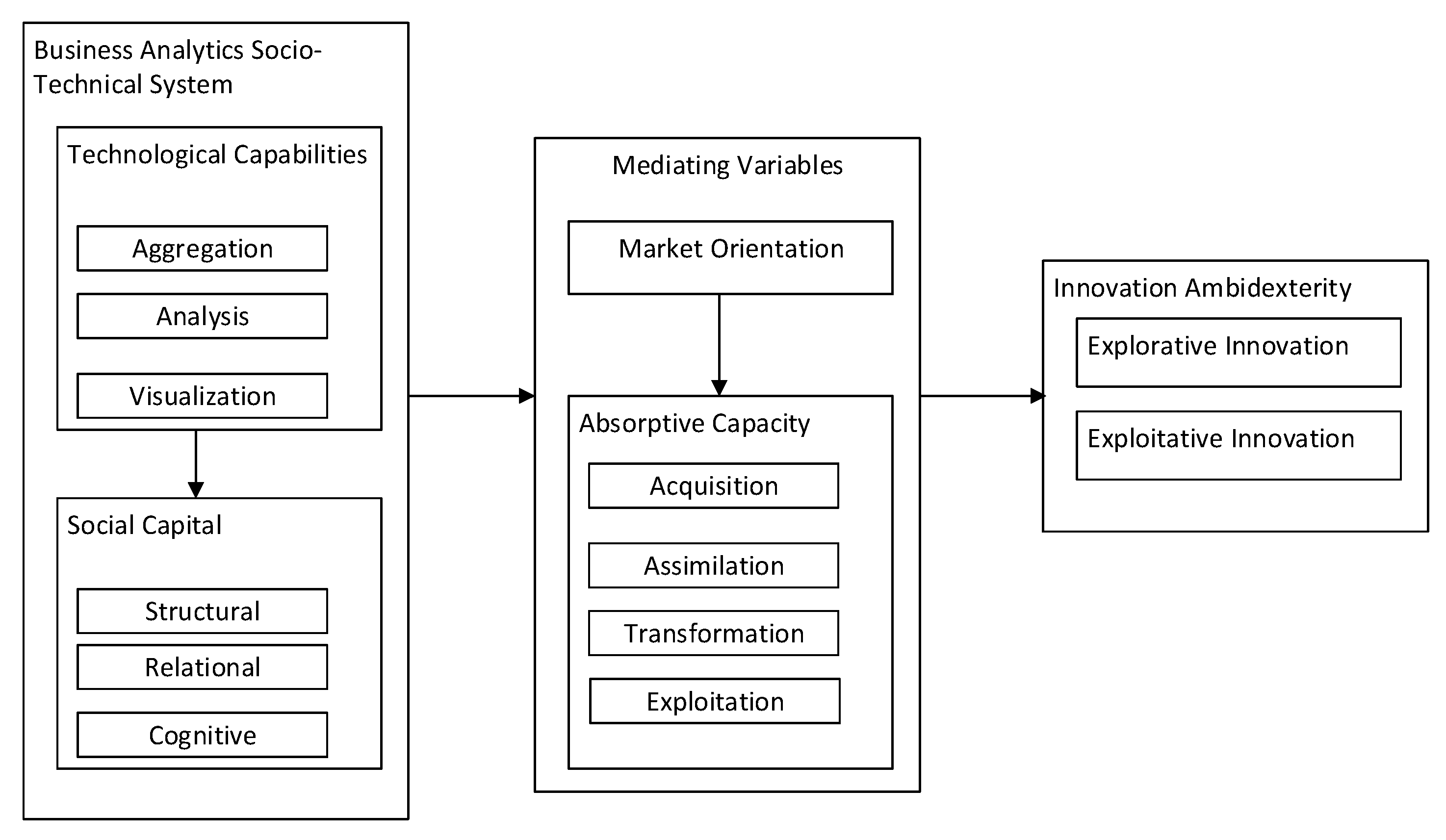
2.2. Business Analytics Socio-Technical Capabilities
2.3. The Effect of Business Analytics Technological Capabilities and Social Capital on Market Orientation
2.4. The Impact of Business Analytics Technological Capabilities and Social Capital on Absorptive Capacity
2.5. Mediating Role of Market Orientation and Absorptive Capacity
3. Research Methodology
3.1. Survey Instruments
3.2. Data and Sample
3.3. Common Bias Method
3.4. Data Analysis Technique
4. Results
4.1. Examination of the Measurement Model
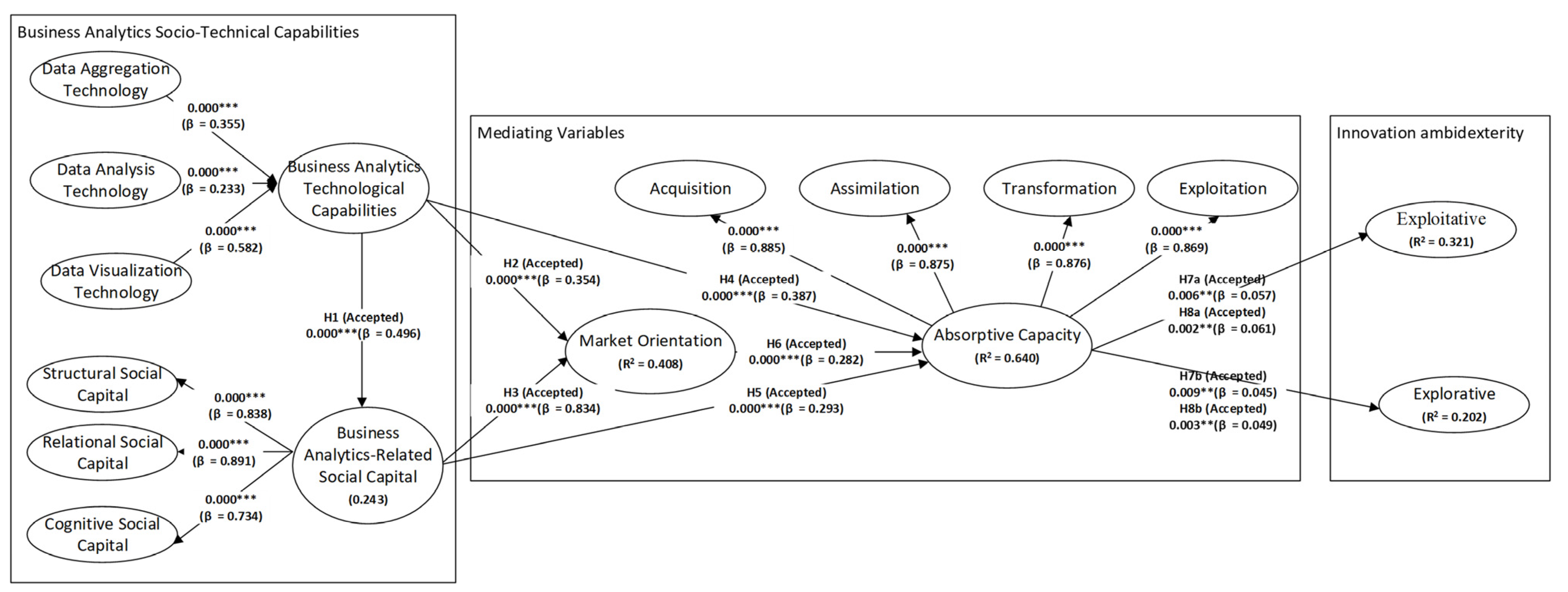
4.2. Examination of Structural Models
5. Discussion and Conclusions
5.1. Theoretical Contributions
5.2. Practical Implications
5.3. Limitations and Recommendations for Future Research
5.4. Conclusions
Author Contributions
Funding
Institutional Review Board Statement
Informed Consent Statement
Data Availability Statement
Acknowledgments
Conflicts of Interest
References
- Lozada, N.; Arias-Pérez, J.; Henao-García, E.A. Unveiling the effects of big data analytics capability on innovation capability through absorptive capacity: Why more and better insights matter. J. Enterp. Inf. Manag. 2023, 36, 680–701. [Google Scholar] [CrossRef]
- Elidjen, E.; Pertiwi, A.; Mursitama, T.N.; Beng, J.T. How potential and realized absorptive capacity increased ability to innovate: The moderating role of structural ambidexterity. VINE J. Inform. Knowl. Manag. 2022, 55, 15–33. [Google Scholar] [CrossRef]
- D’souza, C.; Nanere, M.; Marimuthu, M.; Arwani, M.; Nguyen, N. Market orientation, performance and the mediating role of innovation in Indonesian SMEs. Asia Pac. J. Mark. Logist. 2022, 34, 2314–2330. [Google Scholar] [CrossRef]
- Asni, N.; Agustia, D. Does corporate governance induce green innovation ? An emerging market evidence. Corp. Gov. 2022, 22, 1375–1389. [Google Scholar] [CrossRef]
- Jaidi, N.; Siswantoyo; Liu, J.; Sholikhah, Z.; Andhini, M.M. Ambidexterity Behavior of Creative SMEs for Disruptive Flows of Innovation: A Comparative Study of Indonesia and Taiwan. J. Open Innov. Technol. Mark. Complex. 2022, 8, 141. [Google Scholar] [CrossRef]
- Ju, M.; Elliott, M.T. Antecedents of organizational ambidexterity: An empirical investigation of foreign ventures in an emerging market. J. Bus. Ind. Mark. 2024, 39, 350–365. [Google Scholar] [CrossRef]
- Moreno-Luzon, M.; Gil-Marques, M.; Lloria, M.B.; Salas-Vallina, A. Quality-oriented human resource practices (QHRP), ambidextrous culture and organizational ambidexterity: A study of green agro-food companies. Eur. J. Manag. Bus. Econ. 2024, 33, 253–271. [Google Scholar] [CrossRef]
- Shamim, S.; Zeng, J.; Khan, Z.; Zia, N.U. Big data analytics capability and decision making performance in emerging market firms: The role of contractual and relational governance mechanisms. Technol. Forecast. Soc. Change 2020, 161, 120315. [Google Scholar] [CrossRef]
- O’Reilly, C.A.; Tushman, M.L. The Ambidextrous Organization. Harv. Bus. Rev. 2004, 82, 74–81. [Google Scholar]
- O’Reilly, C.A.; Tushman, M.L. Ambidexterity as a dynamic capability: Resolving the innovator’s dilemma. Res. Organ. Behav. 2008, 28, 185–206. [Google Scholar] [CrossRef]
- March, J.G. Exploration and Exploitation in Organizational Learning. Organ. Sci. 1991, 2, 71–87. [Google Scholar] [CrossRef]
- Kassotaki, O. Review of Organizational Ambidexterity. SAGE Open 2022, 12, 21582440221. [Google Scholar] [CrossRef]
- Dzenopoljac, A.; Dzenopoljac, V.; Muhammed, S.; Abidi, O.; Kraus, S. Intra-organizational knowledge sharing, ambidexterity and firm performance: Evaluating the role of knowledge quality. J. Knowl. Manag. 2024, 28, 132–155. [Google Scholar] [CrossRef]
- Alaskar, T.H.; Alsadi, A.K.; Aloulou, W.J.; Ayadi, F.M. Big Data Analytics, Strategic Capabilities, and Innovation Performance: Mediation Approach of Organizational Ambidexterity. Sustainability 2024, 16, 5111. [Google Scholar] [CrossRef]
- Ashrafi, A.; Zareravasan, A. An ambidextrous approach on the business analytics-competitive advantage relationship: Exploring the moderating role of business analytics strategy. Technol. Forecast. Soc. Change 2022, 179, 121665. [Google Scholar] [CrossRef]
- Shuradze, G.; Bogodistov, Y.; Wagner, H.T. The role of marketing-enabled data analytics capability and organisational agility for innovation: Empirical evidence from German firms. Int. J. Innov. Manag. 2018, 22, 1–32. [Google Scholar] [CrossRef]
- Persaud, A.; Zare, J. Beyond Technological Capabilities: The Mediating Effects of Analytics Culture and Absorptive Capacity on Big Data Analytics Value Creation in Small- and Medium-Sized Enterprises. IEEE Trans. Eng. Manag. 2024, 71, 7147–7159. [Google Scholar] [CrossRef]
- Božič, K.; Dimovski, V. Business intelligence and analytics for value creation: The role of absorptive capacity. Int. J. Inf. Manag. 2019, 46, 93–103. [Google Scholar] [CrossRef]
- Kristoffersen, E.; Mikalef, P.; Blomsma, F.; Li, J. Towards a business analytics capability for the circular economy. Technol. Forecast. Soc. Change 2021, 171, 120957. [Google Scholar] [CrossRef]
- Marjanovic, O. A novel mechanism for business analytics value creation: Improvement of knowledge-intensive business processes. J. Knowl. Manag. 2022, 26, 17–44. [Google Scholar] [CrossRef]
- Mikalef, P.; Pappas, I.O.; Krogstie, J.; Giannakos, M. Big data analytics capabilities: A systematic literature review and research agenda. Inf. Syst. e-Bus. Manag. 2018, 16, 547–578. [Google Scholar] [CrossRef]
- Yoshikuni, A.C.; Dwivedi, R.; Filho, A.R.d.A.V.; Wamba, S.F. Big data analytics-enabled dynamic capabilities for corporate performance mediated through innovation ambidexterity: Findings from machine learning with cross-country analysis. Technol. Forecast. Soc. Change 2025, 210, 123851. [Google Scholar] [CrossRef]
- Mikalef, P.; Boura, M.; Lekakos, G.; Krogstie, J. Big Data Analytics Capabilities and Innovation: The Mediating Role of Dynamic Capabilities and Moderating Effect of the Environment. Br. J. Manag. 2019, 30, 272–298. [Google Scholar] [CrossRef]
- Shi, Y.; Toorn, C.V.; McEwan, M. Exploration–Exploitation: How business analytics powers organisational ambidexterity for environmental sustainability. Inf. Syst. J. 2024, 34, 894–930. [Google Scholar] [CrossRef]
- Mehdikhani, R.; Valmohammadi, C.; Taraz, R. The influence of business analytics on supply chain ambidexterity: The mediating role of market learning. VINE J. Inform. Knowl. Manag. 2024, 55, 951–977. [Google Scholar] [CrossRef]
- Shamim, S.; Zeng, J.; Shafi Choksy, U.; Shariq, S.M. Connecting big data management capabilities with employee ambidexterity in Chinese multinational enterprises through the mediation of big data value creation at the employee level. Int. Bus. Rev. 2020, 29, 101604. [Google Scholar] [CrossRef]
- Alshahrani, M.A.; Salam, M.A. Entrepreneurial orientation and SMEs performance in an emerging economy: The mediating role of absorptive capacity. J. Res. Mark. Entrep. 2024, 26, 1–24. [Google Scholar] [CrossRef]
- Lee, Y.; Cortes, A.F.; Zhuang, Y.; Herrmann, P. Social capital and organizational ambidexterity: The moderating effect of absorptive capacity. Int. J. Emerg. Mark. 2021, 16, 1793–1812. [Google Scholar] [CrossRef]
- Putnam, R.D. Social Capital and Public Life. Am. Prospect. 1993, 4, 1–11. [Google Scholar]
- Gnizy, I. Big data and its strategic path to value in international firms. Int. Mark. Rev. 2019, 36, 318–341. [Google Scholar] [CrossRef]
- Ciampi, F.; Demi, S.; Magrini, A.; Marzi, G.; Papa, A. Exploring the impact of big data analytics capabilities on business model innovation: The mediating role of entrepreneurial orientation. J. Bus. Res. 2021, 123, 1–13. [Google Scholar] [CrossRef]
- Song, J.; Xiang, Y.; Huang, B.; Xie, Y.; Li, Y. Exploring How Big Data Analytics Management Capability Fuel Market Performance: Evidence From a Mediated Moderation Model. IEEE Trans. Eng. Manag. 2024, 71, 9080–9093. [Google Scholar] [CrossRef]
- Gangwani, K.K.; Bhatia, M.S. The effect of market orientation and technology orientation on industry 4.0 technologies and market performance: Role of innovation capability. Ind. Mark. Manag. 2024, 118, 231–241. [Google Scholar] [CrossRef]
- Kim, H.; Hur, D. Feeling torn? The conflicting effects of market and entrepreneurial orientations on manufacturing SMEs’ innovation performance. Eur. J. Innov. Manag. 2024, 27, 233–262. [Google Scholar] [CrossRef]
- Sengura, J.D.; Mu, R.; Zhang, J. Towards Frugal Innovation Capability in Emerging Markets within the Digitalization Epoch: Exploring the Role of Strategic Orientation and Organizational Ambidexterity. J. Theor. Appl. Electron. Commer. Res. 2024, 19, 2000–2029. [Google Scholar] [CrossRef]
- Lichtenthaler, U. Determinants of absorptive capacity: The value of technology and market orientation for external knowledge acquisition. J. Bus. Ind. Mark. 2016, 31, 600–610. [Google Scholar] [CrossRef]
- Randhawa, K.; Wilden, R.; Gudergan, S. How to innovate toward an ambidextrous business model? The role of dynamic capabilities and market orientation. J. Bus. Res. 2021, 130, 618–634. [Google Scholar] [CrossRef]
- Gao, J.; Sarwar, Z. How do firms create business value and dynamic capabilities by leveraging big data analytics management capability? Inf. Technol. Manag. 2024, 34, 219–232. [Google Scholar] [CrossRef]
- Bharadwaj, A.S. A resource-based perspective on information technology capability and firm Performance. MIS Q. 2000, 24, 169–196. [Google Scholar] [CrossRef]
- Barney, J.; Wright, M.; Ketchen, D.J. The resource-based view of the firm: Ten years after 1991. J. Manag. 2001, 27, 625–641. [Google Scholar] [CrossRef]
- Eisenhardt, K.M.; Martin, A.J. Dynamic capabilities: What are they? Strateg. Manag. J. 2000, 21, 1105–1121. [Google Scholar]
- Helfat, C.E.; Peteraf, M.A. The dynamic resource-based view: Capability lifecycles. Strateg. Manag. J. 2003, 24, 997–1010. [Google Scholar] [CrossRef]
- Teece, D.J. Explicating Dynamic Capabilities: The Nature and Microfoundations of (Sustainable) Enterprise Performance. Strateg. Manag. J. 2007, 28, 1319–1350. [Google Scholar] [CrossRef]
- Birkinshaw, J.; Zimmermann, A.; Raisch, S. How Do Firms Adapt to Discontinuous Change? Bridging The Dynamic Capabilities And Ambidexterity Perspectives. Calif. Manag. Rev. 2016, 58, 36–58. [Google Scholar] [CrossRef]
- Malik, M.; Andargoli, A.; Chavez, R.; Mikalef, P. A relational view of how social capital contributes to effective digital transformation outcomes. J. Strategic. Inform. Syst. 2024, 33, 101837. [Google Scholar] [CrossRef]
- Božič, K.; Dimovski, V. The Relationship between Business Intelligence and Analytics Use and Organizational Absorptive Capacity: Applying the DeLone & Mclean Information Systems Success Model. Econ. Bus. Rev. 2020, 22, 191–232. [Google Scholar] [CrossRef]
- Cohen, W.M.; Levinthal, D.A. Absorptive Capacity: A New Perspective on Learning and Innovation. Adm. Sci. Q. 1990, 35, 128–152. [Google Scholar] [CrossRef]
- Zahra, S.A.; George, G. Absorptive capacity: A review, reconceptualization, and extension. Acad. Manag. Rev. 2002, 27, 185–203. [Google Scholar] [CrossRef]
- Pavlou, P.a.; Sawy, O.a.E. Understanding the ‘Black Box’ of Dynamic Capabilities. Manag. Sci. 2011, 92521, 239–273. [Google Scholar] [CrossRef]
- Schryen, G. Revisiting IS business value research: What we already know, what we still need to know, and how we can get there. Eur. J. Inf. Syst. 2013, 22, 139–169. [Google Scholar] [CrossRef]
- Gillani, F.; Ali, K.; Sadiq, S.; Cao, D.; Ma, X. Unpacking Digital Transformation: Identifying key enablers, transition stages and digital archetypes. Technol. Forecast. Soc. Change 2024, 203, 123335. [Google Scholar] [CrossRef]
- Mikalef, P.; van de Wetering, R.; Krogstie, J. Building dynamic capabilities by leveraging big data analytics: The role of organizational inertia. Inf. Manag. 2021, 59, 103412. [Google Scholar] [CrossRef]
- Raisch, S.; Birkinshaw, J.; Probst, G.; Tushman, M.L. Organizational Ambidexterity: Balancing Exploitation and Exploration for Sustained Performance. Organ. Sci. 2009, 20, 685–695. [Google Scholar] [CrossRef]
- Gibson, C.B.; Birkinshaw, J. The Antecedents, Consequences, And Mediating Role of Organizational Ambidexterity. Acad. Manag. J. 2004, 47, 209–226. [Google Scholar] [CrossRef]
- Raisch, S.; Birkinshaw, J. Organizational Ambidexterity: Antecedents, Outcomes, and Moderators. J. Manag. 2008, 34, 375–409. [Google Scholar] [CrossRef]
- Kowalczyk, M.; Buxmann, P. An ambidextrous perspective on business intelligence and analytics support in decision processes: Insights from a multiple case study. Decis. Support Syst. 2015, 80, 1–13. [Google Scholar] [CrossRef]
- Kumalaningrum, M.P.; Ciptono, W.S.; Indarti, N.; Purnomo, B.R. Ambidexterity in Indonesian SMEs: A Systematic Review and Synthesis for Future Research. Cogent Bus. Manag. 2023, 10, 1. [Google Scholar] [CrossRef]
- Gupta, M.; George, J.F. Toward the development of a big data analytics capability. Inf. Manag. 2016, 53, 1049–1064. [Google Scholar] [CrossRef]
- Akter, S.; Hossain, M.A.; Lu, Q.; Shams, S.M.R. Big data-driven strategic orientation in international marketing. Int. Mark. Rev. 2021, 38, 927–947. [Google Scholar] [CrossRef]
- Hu, H.; Wen, Y.; Chua, T.S.; Li, X. Toward scalable systems for big data analytics: A technology tutorial. IEEE Access 2014, 2, 652–687. [Google Scholar] [CrossRef]
- Belhadi, A.; Zkik, K.; Cherrafi, A.; Yusof, S.r.M.; El Fezazi, S. Understanding Big Data Analytics for Manufacturing Processes: Insights from Literature Review and Multiple Case Studies. Comput. Ind. Eng. 2019, 137, 106099. [Google Scholar] [CrossRef]
- Oesterreich, T.D.; Anton, E.; Teuteberg, F.; Dwivedi, Y.K. The role of the social and technical factors in creating business value from big data analytics: A meta-analysis. J. Bus. Res. 2022, 153, 128–149. [Google Scholar] [CrossRef]
- Wang, Y.; Byrd, T.A. Business analytics-enabled decision-making effectiveness through knowledge absorptive capacity in health care. J. Knowl. Manag. 2017, 21, 517–539. [Google Scholar] [CrossRef]
- Nugroho, M.A.; Jusoh, R.; Salleh, N.A.M. The Role of Alignment Between IS Strategy and Social Capital on the IS Capability and Business Performance Relationship: A Cross-Sectional Survey. IEEE Access 2020, 8, 52760–152771. [Google Scholar] [CrossRef]
- Yang, S.; Lee, H.; Kurnia, S. Social Capital in Information and Communications Technology Research: Past, Present, and Future. Commun. Assoc. Inf. Syst. 2009, 25, 23. [Google Scholar] [CrossRef]
- Nahapiet, J.; Goshal, S. Creating organizational capital through intellectual and social capital. Acad. Manag. Rev. 1998, 23, 242–266. [Google Scholar] [CrossRef]
- Aloulou, W.J. Impacts of strategic orientations on new product development and firm performances: Insights from Saudi industrial firms. Eur. J. Innov. Manag. 2019, 22, 257–280. [Google Scholar] [CrossRef]
- Narver, J.C.; Slater, S.F. The of Effect Orientation on a Market Business Profitability. J. Mark. 1990, 54, 20–35. [Google Scholar] [CrossRef]
- Qu, Y.; Mardani, A. Market orientation, technological opportunity, and new product innovation performance. J. Bus. Res. 2023, 162, 113841. [Google Scholar] [CrossRef]
- Ramachandran, I.; Lengnick-Hall, C.A.; Badrinarayanan, V. Enabling and leveraging ambidexterity: Influence of strategic orientations and knowledge stock. J. Knowl. Manag. 2019, 23, 1136–1156. [Google Scholar] [CrossRef]
- Grant, R.M. Toward a Knowledge-Based Theory of The Firm. Strategic. Manag. J. 1996, 17, 109–122. [Google Scholar] [CrossRef]
- Kohli, A.K.; Jaworski, B.J. Market Orientation: The Construct, Research Propositions, and Managerial Implications. J. Mark. 1990, 54, 1–18. [Google Scholar] [CrossRef]
- Ramírez-Solis, E.R.; Llonch-Andreu, J.; Malpica-Romero, A.D. How beneficial are relational capital and technology orientation for innovation? Evidence from Mexican SMEs. Int. J. Innov. Stud. 2022, 6, 1–10. [Google Scholar] [CrossRef]
- Gao, S.; Yeoh, W.; Wong, S.F.; Scheepers, R. A literature analysis of the use of Absorptive Capacity construct in IS research. Int. J. Inf. Manag. 2017, 37, 36–42. [Google Scholar] [CrossRef]
- Božič, K.; Dimovski, V. Business intelligence and analytics use, innovation ambidexterity, and firm performance: A dynamic capabilities perspective. J. Strategic. Inform. Syst. 2019, 28, 101578. [Google Scholar] [CrossRef]
- Chuang, M.Y.; Chen, C.J.; Lin, M.J.J. The impact of social capital on competitive advantage: The mediating effects of collective learning and absorptive capacity. Manag. Decis. 2016, 54, 1443–1463. [Google Scholar] [CrossRef]
- Zardini, A.; Ricciardi, F.; Rossignoli, C. The relational capital of the IT department: Measuring a key resource for creating strategic value. J. Intellect. Cap. 2015, 16, 835–859. [Google Scholar] [CrossRef]
- Akbari, M.; Baghersad, V.; Harandizadeh, M.; Giglio, C.; Padash, H. Absorptive capacity and technological innovation: Ambidexterity and research and development. Manag. Decis 2025. [Google Scholar] [CrossRef]
- Huma, S.; Muslim, S.; Ahmed, W. Understanding the role of organizational intellectual capital on developing absorptive capacity to strategize innovation ambidexterity. Rev. Int. Bus. Strategy 2024, 34, 433–453. [Google Scholar] [CrossRef]
- Flatten, T.C.; Engelen, A.; Zahra, S.A.; Brettel, M. A measure of absorptive capacity: Scale development and validation. Eur. Manag. J. 2011, 29, 98–116. [Google Scholar] [CrossRef]
- Jansen, J.J.P.; Van Den Bosch, F.A.J.; Volberda, H.W. Exploratory innovation, exploitative innovation, and performance: Effects of organizational antecedents and environmental moderators. Manag. Sci. 2006, 52, 1661–1674. [Google Scholar] [CrossRef]
- Mandal, S. An examination of the importance of big data analytics in supply chain agility development: A dynamic capability perspective. Manag. Res. Rev. 2018, 41, 1201–1219. [Google Scholar] [CrossRef]
- Hair, J.F.; Hult, G.T.M.; Ringle, C.M.; Sarstedt, M. A Primer on Partial Least Squares Structural Equation Modeling (PLS-SEM), 3rd ed.; SAGE Publishing: Thousand Oaks, CA, USA, 2022; p. 355. [Google Scholar]
- Kock, N. Common Method Bias in PLS-SEM. Int. J. e-Collab. 2015, 11, 1–10. [Google Scholar] [CrossRef]
- Becker, J.M.; Cheah, J.H.; Gholamzade, R.; Ringle, C.M.; Sarstedt, M. PLS-SEM’s most wanted guidance. Int. J. Contemp. Hosp. Manag. 2023, 35, 321–346. [Google Scholar] [CrossRef]
- Sarstedt, M.; Hair, J.F.; Cheah, J.H.; Becker, J.M.; Ringle, C.M. How to specify, estimate, and validate higher-order constructs in PLS-SEM. Australas. Mark. J. 2019, 27, 197–211. [Google Scholar] [CrossRef]
- Hair, J.; Alamer, A. Partial Least Squares Structural Equation Modeling (PLS-SEM) in second language and education research: Guidelines using an applied example. Res. Methods Appl. Linguist. 2022, 1, 100027. [Google Scholar] [CrossRef]
- Henseler, J.; Hubona, G.; Ray, P.A. Using PLS path modeling in new technology research: Updated guidelines. Ind. Manag. Data Sys 2016, 116, 2–20. [Google Scholar] [CrossRef]
- Ramírez-Solis, E.R.; Llonch-Andreu, J.; Malpica-Romero, A.D. Relational capital and strategic orientations as antecedents of innovation: Evidence from Mexican SMEs. J. Innov. Entrep. 2022, 11, 42. [Google Scholar] [CrossRef]
- Ibarra-Cisneros, M.A.; Demuner-Flores, M.d.R.; Hernández-Perlines, F. Strategic orientations, firm performance and the moderating effect of absorptive capacity. J. Strategy Manag. 2021, 14, 582–611. [Google Scholar] [CrossRef]
- Moreira, A.C.; Navaia, E.C.; Ribau, C. The Importance of Exploration and Exploitation Innovation in Emerging Economies. J. Open Innov. Technol. Mark. Complex. 2022, 8, 140. [Google Scholar] [CrossRef]
- Karina, R.; Siti-Nabiha, A.K.; Jurnali, T. Big data integration in performance management and control: A socio-technical perspective. J. Account. Organ. Change 2025. [Google Scholar] [CrossRef]
- Lukiyanto, K.; Wijayaningtyas, M. Gotong Royong as social capital to overcome micro and small enterprises’ capital difficulties. Heliyon 2020, 6, 110–120. [Google Scholar] [CrossRef]
- Humaedi, M.A.; Wibowo, D.P.; Hariyanto, W.; Rahmat, S.; Susilo, T.; Wijayanti, F.; Hakim, F.N.; Martino, M.; Wijaya, G.; Andari, R.N.; et al. Shifting collective values: The role of rural women and gotong royong in village fund policy. Hum. Soc. Sci. Commun. 2025, 12, 411. [Google Scholar] [CrossRef]
- Faedlulloh, D.; Karmilasari, V.; Meutia, I.F.; Yulianti, D. Examining Social Capital for Urban Societies in the Midst of Covid-19 Through Digital Gotong Royong. Adv. Soc. Sci. Educ. Humanit. Res. 2021, 606, 202–208. [Google Scholar]



| Constructs | Sub-Constructs | Items | Measurement Items | References |
| Business analytics’ technological capabilities (BATC) | Data aggregation technology (AGG) | AGT1 | Our company collects data from external sources and from various systems throughout our organization. | [63] |
| AGT2 | Our company maintains records that are consistent, visible, and easily accessible for further analysis. | |||
| AGT3 | Our company stores data in appropriate databases. | |||
| Data analysis technology (ANT) | ANT1 | Our company identifies essential business insights and trends to improve our products and services. | [63] | |
| ANT2 | Our company identifies patterns to meet our business needs. | |||
| ANT3 | Our company analyzes data in near-real or real time, enabling rapid responses to unexpected business events. | |||
| ANT4 | Our company analyzes social media data to understand current trends across large populations. | |||
| Data visualization technology (INT) | VIS1 | Our company provides systematic, comprehensive reporting to help identify feasible opportunities for business improvement. | [63] | |
| VIS2 | Our company supports data visualization that enables users to easily interpret results. | |||
| VIS3 | Our company provides near-real or real-time information on business operations and services within organizations and across systems. | |||
| Social capital (SC) | Structural social capital (SSC) | SSC1 | Our employees maintain close social relationships with one another. | [16] |
| SSC2 | Our employees spend a lot of time interacting with one another. | |||
| SSC3 | Our employees know each other at a personal level. | |||
| SSC4 | Our employees communicate frequently with each other. | |||
| Relational social capital (RSC) | RSC1 | Our employees maintain close social relationships with one another. | [16] | |
| RSC2 | Our employees spend a lot of time interacting with one another. | |||
| RSC3 | Our employees know each other at a personal level. | |||
| RSC4 | Our employees communicate frequently with each other. | |||
| Cognitive social capital (CSC) | CSC1 | When interacting, our company’s employees use common terms or jargon. | [16] | |
| CSC2 | During discussions, our employees use clear communication patterns. | |||
| CSC3 | When communicating, our employees use clear, understandable narratives. | |||
| Market orientation | MO1 | Our company’s strategy for competitive advantage is based on our thorough understanding of our customers’ needs. | [30] | |
| MO2 | All our managers understand how the entire business can contribute to creating customer value. | |||
| MO3 | Our company responds quickly to negative customer satisfaction information throughout the organization. | |||
| MO4 | Our company’s market strategies are driven in large part by our understanding of opportunities to create value for customers. | |||
| Absorptive capacity (ACAP) | Acquisition (ACQ) | ACQ1 | The search for relevant information concerning our industry is an everyday affair in our company. | [80]. |
| ACQ2 | Our company motivates employees to use industry-specific information sources. | |||
| ACQ3 | Our company expects its employees to handle information beyond the industry. | |||
| Assimilation (ASS) | ASS1 | In our company, ideas and concepts are communicated cross-departmentally. | [80]. | |
| ASS2 | Our company emphasizes cross-departmental support in solving problems. | |||
| ASS3 | In our company, information flows quickly, e.g., if a business unit obtains essential information, it promptly communicates it to all other business units or departments. | |||
| ASS4 | Our company demands periodic cross-departmental meetings to exchange new developments, problems, and achievements. | |||
| Transformation (TRF) | TRF1 | Our company can structure and use the knowledge we collect. | [80]. | |
| TRF2 | Our company is accustomed to absorbing new knowledge, preparing it for future use, and making it available. | |||
| TRF3 | Our company successfully links existing knowledge with new insights. | |||
| TRF4 | Our company can apply new knowledge in its practical work. | |||
| Exploitation (EXP) | EXP1 | Our company supports the development of prototypes. | [80]. | |
| EXP2 | Our company regularly reconsiders technologies and adapts them according to new knowledge. | |||
| EXP3 | Our company can work more effectively by adopting new technologies. | |||
| Exploratory innovation (EXPR) | EXPR1 | Our company accepts demands that go beyond existing products and services. | [81] | |
| EXPR2 | Our company invents new products and services. | |||
| EXPR3 | Our company experiments with new products and services in our local market. | |||
| EXPR4 | Our company commercializes products and services that are entirely new to our unit. | |||
| EXPR5 | Our company frequently takes advantage of opportunities in new markets. | |||
| Exploitative innovation (EXPL) | EXPL1 | Our company frequently refines the provision of existing products and services. | [81] | |
| EXPL2 | Our company regularly implements minor adaptations to existing products and services. | |||
| EXPL3 | Our company introduces improved but existing products and services to our local market. | |||
| EXPL4 | Our company improves its efficiency in providing products and services. | |||
| EXPL5 | Our company increases economies of scale in existing markets. |
| Variable(s) | Sample (N = 218) | Percentage (%) |
|---|---|---|
| Industry | ||
| Manufacturing | 43 | 19.72 |
| Health and pharmacy | 5 | 2.29 |
| Financial and banking | 26 | 11.93 |
| Mining and energy | 20 | 9.17 |
| Transportation and logistics | 23 | 10.55 |
| Utilities | 4 | 1.83 |
| Retail and consumers | 30 | 13.76 |
| Information technology | 44 | 20.18 |
| Consultancy | 4 | 1.83 |
| Communication and media | 5 | 2.29 |
| Construction and property | 14 | 6.42 |
| Firm size (No. of employees) | ||
| 20–100 | 83 | 38.07 |
| >100 | 135 | 61.93 |
| Total business analytics experience | ||
| 1–4 years | 31 | 14.22 |
| >4 years | 187 | 85.78 |
| Respondent’s position | ||
| CEO | 3 | 1.38 |
| Director | 11 | 5.05 |
| Senior Manager | 49 | 22.48 |
| Manager | 121 | 55.50 |
| Specialist | 34 | 15.60 |
| Outer Weight | T Statistics | p-Values | VIF | OLs | |
|---|---|---|---|---|---|
| Stage 1-LOC Analysis | |||||
| (First-order constructs) | |||||
| AGT1 → AGT | 0.256 | 2.137 | 0.033 | 1.511 | 0.737 |
| AGT2 → AGT | 0.671 | 5.431 | 0.000 | 1.789 | 0.949 |
| AGT3 → AGT | 0.235 | 2.032 | 0.042 | 1.580 | 0.744 |
| ANT1 → ANT | 0.262 | 2.226 | 0.026 | 1.509 | 0.728 |
| ANT2 → ANT | 0.353 | 2.479 | 0.013 | 1.617 | 0.801 |
| ANT3 → ANT | 0.378 | 2.600 | 0.009 | 1.311 | 0.747 |
| ANT4 → ANT | 0.333 | 3.470 | 0.001 | 1.357 | 0.734 |
| VIS1 → VIS | 0.256 | 2.137 | 0.033 | 1.256 | 0.765 |
| VIS2 → VIS | 0.671 | 5.431 | 0.000 | 1.442 | 0.738 |
| VIS3 → VIS | 0.518 | 4.566 | 0.000 | 1.232 | 0.770 |
| Stage 2: Step 1 HOC analysis Second-order constructs | |||||
| AGT → BATC | 0.355 | 3.029 | 0.002 | 1.533 | 0.722 |
| ANT → BATC | 0.233 | 3.029 | 0.002 | 2.098 | 0.880 |
| VIS → BATC | 0.582 | 4.958 | 0.000 | 1.884 | 0.913 |
| Stage 1-LOC Analysis (First-Order Constructs) | (1) | (2) | (3) | (4) | (5) | (6) | (7) | (8) | (9) |
|---|---|---|---|---|---|---|---|---|---|
| (1) ACQ | |||||||||
| (2) ASS | 0.753 | ||||||||
| (3) CSS | 0.683 | 0.520 | |||||||
| (4) EXP | 0.819 | 0.776 | 0.572 | ||||||
| (5) EXPL | 0.686 | 0.492 | 0.499 | 0.609 | |||||
| (6) EXPR | 0.540 | 0.334 | 0.408 | 0.462 | 0.722 | ||||
| (7) RSC | 0.747 | 0.516 | 0.763 | 0.596 | 0.541 | 0.432 | |||
| (8) SSC | 0.470 | 0.360 | 0.630 | 0.420 | 0.357 | 0.326 | 0.669 | ||
| (9) MO | 0.679 | 0.567 | 0.399 | 0.717 | 0.650 | 0.595 | 0.509 | 0.360 | |
| (10) TRA | 0.801 | 0.741 | 0.495 | 0.848 | 0.506 | 0.455 | 0.531 | 0.405 | 0.711 |
| (1) | (2) | (3) | (4) | ||||||
| (1) ACAP | |||||||||
| (2) EXPL | 0.646 | ||||||||
| (3) EXPR | 0.495 | 0.722 | |||||||
| (4) MO | 0.758 | 0.708 | 0.512 | ||||||
| (5) SC | 0.749 | 0.588 | 0.495 | 0.685 |
| Relationship | Inner VIF | β | t-Value | p-Value | Support | Bias-Corrected 95% Confidence Interval | F2 | |
|---|---|---|---|---|---|---|---|---|
| H1 | BATC → SC | 1.537 | 0.496 | 7.584 | 0.000 *** | Yes | [0.358–0.616] | 0.377 |
| H2 | BATC → MO | 1.564 | 0.354 | 5.580 | 0.000 *** | Yes | [0.241–0.616] | 0.159 |
| H3 | SC → MO | 1.323 | 0.384 | 6.029 | 0.000 *** | Yes | [0.236–0.536] | 0.188 |
| H4 | BATC → ACAP | 1.423 | 0.387 | 6.166 | 0.000 *** | Yes | [0.233–0.456] | 0.270 |
| H5 | SC → ACAP | 1.323 | 0.293 | 4.815 | 0.000 *** | Yes | [0.211–0.336] | 0.151 |
| H6 | MO → ACAP | 1.495 | 0.282 | 4.169 | 0.000 *** | Yes | [0.228–0.302] | |
| H7a | BATC → MO → ACAP → EXPL | 0.057 | 2.750 | 0.006 ** | Partial | [0.038–0.126] | ||
| H7b | BATC → MO → ACAP → EXPR | 0.045 | 2.626 | 0.009 ** | Partial | [0.028–0.102] | ||
| H8a | SC → MO → ACAP → EXPL | 0.061 | 3.023 | 0.002 ** | Partial | [0.031–0.111] | ||
| H8b | SC → MO → ACAP → EXPR | 0.049 | 3.076 | 0.003 ** | Partial | [0.026–0.101] | ||
| N1 | BATC → EXPL | 1.803 | 0.286 | 3.521 | 0.000 *** | Yes | [0.118–0.434] | 0.173 |
| N2 | BATC → EXPR | 1.803 | 0.342 | 4.827 | 0.000 *** | Yes | [0.205–0.486] | 0.192 |
| N3 | SC → EXPL | 1.678 | 0.154 | 2.149 | 0.032 * | Yes | [0.004–0.289] | 0.171 |
| N4 | SC → EXPL | 1.678 | 0.182 | 1.997 | 0.046 * | Yes | [0.001–0.353] | 0.189 |
| SSO | SSE | Q2 | R2 | |
|---|---|---|---|---|
| Social Capital (SC) | 854.000 | 425.211 | 0.421 | 0.243 |
| Absorptive capacity (ACAP) | 872.000 | 441.177 | 0.494 | 0.639 |
| Market orientation (MO) | 872.000 | 673.894 | 0.227 | 0.408 |
| Exploitative Innovation (EXPL) | 1090.000 | 891.205 | 0.182 | 0.397 |
| Explorative Innovation (EXPR) | 1090.000 | 949.660 | 0.129 | 0.242 |
Disclaimer/Publisher’s Note: The statements, opinions and data contained in all publications are solely those of the individual author(s) and contributor(s) and not of MDPI and/or the editor(s). MDPI and/or the editor(s) disclaim responsibility for any injury to people or property resulting from any ideas, methods, instructions or products referred to in the content. |
© 2026 by the authors. Licensee MDPI, Basel, Switzerland. This article is an open access article distributed under the terms and conditions of the Creative Commons Attribution (CC BY) license.
Share and Cite
Ridwan, A.Y.; Govindaraju, R.; Andriani, M. Business Analytics Socio-Technical Perspective in Driving Market Orientation and Absorptive Capacity: Its Impacts on Innovation Ambidexterity. Sustainability 2026, 18, 2311. https://doi.org/10.3390/su18052311
Ridwan AY, Govindaraju R, Andriani M. Business Analytics Socio-Technical Perspective in Driving Market Orientation and Absorptive Capacity: Its Impacts on Innovation Ambidexterity. Sustainability. 2026; 18(5):2311. https://doi.org/10.3390/su18052311
Chicago/Turabian StyleRidwan, Ari Yanuar, Rajesri Govindaraju, and Made Andriani. 2026. "Business Analytics Socio-Technical Perspective in Driving Market Orientation and Absorptive Capacity: Its Impacts on Innovation Ambidexterity" Sustainability 18, no. 5: 2311. https://doi.org/10.3390/su18052311
APA StyleRidwan, A. Y., Govindaraju, R., & Andriani, M. (2026). Business Analytics Socio-Technical Perspective in Driving Market Orientation and Absorptive Capacity: Its Impacts on Innovation Ambidexterity. Sustainability, 18(5), 2311. https://doi.org/10.3390/su18052311