Article

The Impact of Natural Gas Prices on the Green Bond Market: A Quantile-on-Quantile Analysis Within the Sustainable Development Framework


1
School of Finance, Shanxi University of Finance and Economics, Taiyuan 030006, China
2
School of Innovation and Development, Central University of Finance and Economics, Beijing 100081, China
3
School of Economics, Qingdao University, Qingdao 260071, China
*
Author to whom correspondence should be addressed.
Sustainability 2026, 18(5), 2277; https://doi.org/10.3390/su18052277
Submission received: 2 December 2025 / Revised: 9 February 2026 / Accepted: 11 February 2026 / Published: 27 February 2026

Abstract

This paper explores the dynamic and distributional association between natural gas prices (NGPs) and the green bond market in a sustainable development context. The analysis employs a Quantile-on-Quantile (QQ) approach on monthly data between 2013 and 2025 to capture nonlinear and asymmetric interactions as well as state-dependent interactions between the two markets under varying market conditions. The findings indicate a bilateral intricate relationship. In the short run, NGP rises are likely to have a negative impact on green bond performance, indicating cost impacts and macro-financial risk in traditional energy markets. In the long run, the development of NGP becomes progressively shaped by the rise of sustainable finance together with the stepwise transformation of energy systems toward low-carbon configurations, ultimately bringing about a structural decline in fossil fuel dependence. In contrast, it is observed that the increase in the green bond market has a short-to-medium-term positive impact on NGP, which highlights the significance of natural gas as a transitional fuel in the energy transition. On the whole, the results indicate that, although green bonds are important in supporting sustainable development goals, their interplay with transitional energy markets like natural gas is nonlinear and changes over time. These findings provide key indications on how financial strategies can be realigned to accord with long-term sustainability goals.

1. Introduction

Energy is one of the basic inputs to the modern economic activity and the continuous energy supply is the precondition of the national security and the stable development [1]. The global energy mix relies centrally on natural gas to support industrial processes and electricity generation, and this fuel is often classified as comparatively cleaner than coal and oil among fossil energy sources. Nonetheless, the fact that natural gas is an exhaustible resource and that its reserves are concentrated in geopolitically delicate zones exposes economies to potential supply breaks and price instability [2]. Simultaneously, the processes of extraction, transportation, and burning of natural gas is a source of greenhouse gas emissions and other environmental externalities, which justifies the urgency of structural energy change as population and energy increase [3]. These strains have stepped-up policy undertakings to expedite the shift to renewable and low-carbon energy systems, such as the development of non-fossil-fuel transportation and other clean technologies that necessitate large upfront investments [4]. Financing is one of the main obstacles to this transition. For many green projects, large capital commitments, long payback horizons, and uncertain policy and technological conditions prevail, which can make private investors reluctant to participate if the expected returns, after accounting for risk, are considered insufficient. Consequently, decarbonization needs to be scaled with the help of financial mechanisms that can mobilize both the public and private sources of capital. It is against this backdrop that green bonds have become a significant tool to direct funds to deserving environment-related projects and facilitate the transition to a low-carbon economy. As the use of proceeds from green bonds is constrained to sustainable investment, the green bond market opens access for issuers to dedicated sustainability capital and creates, for investors, an extra fixed-income asset class compatible with sustainability objectives [5]. Natural gas prices (NGP) have the potential to influence the development of green bond markets in several, possibly counterbalancing ways. First, an uptick in NGP strengthens the relative competitiveness of renewables and energy-efficiency investments, which augments expected profitability and expands financing demand. Within this substitution channel, the increase in NGP can trigger clean-energy investment and consequently prompt the issuance and purchase of green bonds [5]. Second, higher NGP is capable of functioning in cost-pressure and macro-financial channels. Acute rises in NGP can increase the cost of production, add to inflationary pressures, and deteriorate the financial situation, thus preventing risk appetite and undermining the demand for green projects that are capital-intensive. In the years after the global financial crisis, the marked instability of NGP has unfolded alongside broader market uncertainty, which can progressively erode real returns and weaken investor confidence [6]. The interaction of these rival mechanisms implies that the aggregate relationship between NGP and green bond performance is unlikely to remain stable or to conform to a linear and symmetric pattern across market regimes.
Natural gas is also applicable to the overall sustainability transition beyond the energy-price channel. Even though it is not as emission-intensive as other fossil fuels, the natural gas consumption still leads to environmental pollution and greenhouse gas emissions [7]. To meet long-run sustainability goals, it is necessary to decrease the use of fossil fuels, such as natural gas [8,9]. As a consequence, green bonds play a central part in mobilizing finance for renewable energy and other mitigation projects, by making capital available to issuers and potentially offering investors a relatively stable stream of returns [10]. Additionally, the natural gas-related environmental and local externalities, such as air and water effects and depletion of resources, further support the policy drive of fast-tracking the clean-energy implementation [11]. International evidence points to a contextual role of energy prices in influencing renewable investment incentives [12], and institutional actions—chiefly in the European Union—have actively promoted green bond markets as an integral instrument of the wider green transition [13]. Understanding whether oscillations in NGP function as a catalyst or a constraint for the green bond market is thus of considerable importance to issuers, investors, and policymakers whose agendas span both energy security and sustainable finance.
It is against this backdrop that this paper analyzes the bidirectional relationship between NGP and the green bond market in a sustainable development context. Instead of focusing on central tendencies, the study captures distribution-to-distribution dependence with the aid of a Quantile-on-Quantile (QQ) approach. This framework analyzes the mapping of a specified quantile of NGP to a specified quantile of green bond returns, which allows the identification of nonlinear, asymmetric and state-dependent transmission processes that might be hidden by traditional mean specifications or purely linear specifications.
This paper presents three contributions. First, it gives empirical data on the interaction between pricing of a transitional energy commodity, natural gas, and green fixed-income assets in various market conditions, a question of growing importance as the effectiveness of energy-transition policies is determined by the interaction be-tween traditional energy price and green financial instruments [14]. Second, the findings have practical relevance for investors and for issuers and policymakers, particularly in major natural-gas-importing and exporting economies, by clarifying how green bond allocation and issuance decisions may respond to gas-market shocks and evolving energy-security considerations [15]. Third, methodologically, the paper extends the literature by applying a QQ framework to identify nonlinear and asymmetric dependence across the full conditional distribution. The results indicate that NGP movements can materially influence green bond market dynamics, while green bonds alone may be insufficient to fully neutralize NGP risks, underscoring both the complexity of transition-finance interactions and the scope for continued market development.
The remainder of the paper is structured as follows. Section 2 reviews the related literature. Section 3 develops the conceptual framework linking NGP and green bonds. Section 4 presents the wavelet-based quantile-on-quantile methodology. Section 5 describes the data and preliminary statistics. Section 6 reports the empirical findings, and Section 7 concludes with the main economic and policy implications.

2. Literature Review

The interactions between NGP and green bonds have been studied by many researchers due to the role of green finance in funding the energy transition and the financial impact of fossil-fuel price volatility. The available empirical evidence is inconclusive and tends to be contradictory. In order to trace the state of knowledge and identify gaps in research, literature can be categorized into three broad strands: literature that reports positive relationships, literature that reports negative relationships, and literature that highlights nonlinear or state-dependent relationships.
A preliminary strand of research notes that the green bond market can be supported by higher NGP since they render a clean investment in energy more appealing. When the price of fossil-fuel energy rises, renewable technologies supported by bond financing become comparatively more economical, motivating both governmental and corporate actors to push forward energy diversification plans at a faster pace. Under this scenario, green bonds gain added demand as they typically fund low-carbon technologies and energy-transition infrastructure, and their performance can thus react to changes in the structure of fossil-fuel costs. Several studies report that NGP influences incentives for clean energy investment and the demand for environmentally oriented financial assets. Empirical works also emphasize the hedging and diversification roles of green bonds vis-à-vis energy commodities. Abakah et al. (2023) [16] examine natural resource commodity prices and show that NGP exhibits significant nonlinear associations with green bond indices across conditional quantiles, indicating heterogeneity in the response of green bonds to gas-market movements. Huang et al. (2023) [17] find that green bonds offer hedging benefits against fluctuations in natural gas, with the effectiveness of this hedge varying under extreme market conditions. Mensi et al. (2024) [18] identify natural gas as a safe-haven asset for green bonds and report limited spillover transmission from energy commodities to green bonds. Some studies also demonstrate that shale gas prices exert time-varying causal effects on green bond indices, with both positive and negative influences depending on market phases. Abakah et al. (2023) [16] further observe that natural gas is the most effective hedge for green bond prices and find no significant short-run causality between green bonds and natural gas, though they detect long-run causality between green bonds and shale gas. Khamis et al. (2023) [19] find weak short-run cross-correlations between green bonds and natural gas markets, implying short-term diversification benefits, with cross-market dependence strengthening at longer horizons.
For gas-importing economies, heavy dependence on external natural gas supplies may reduce economic resilience and increase vulnerability to NGP shocks. Elevated NGP can heighten inflationary pressures and impose additional costs on electricity generation, prompting governments to accelerate energy-diversification strategies, often supported through green bond issuance [16]. When NGP moves lower, the relative cost advantage of renewables may weaken, which can reduce incentives for rapid clean-energy deployment and, in turn, moderate green bond demand [20]. The spike in natural gas prices associated with the Russia–Ukraine conflict exacerbated energy security concerns in Europe, and policy responses in a number of economies emphasized the importance of sustainable finance in reducing exposure to fossil-fuel price volatility [21]. The data reported by the International Energy Agency suggest that excessive volatility in gas prices can increase the pace of renewable investment [22], whereas low NGP can slow these changes.
Sharp NGP fluctuations have macroeconomic and financial implications since natural gas continues to be a strategic energy resource. As Cao et al. (2024) [23] demonstrate, has a more powerful spillover impact on green assets in the upper quantiles of market stress, highlighting the asymmetric nature of the transmission of gas-market uncertainty to green financial instruments. Knowledge about interrelationships between green bonds and energy commodities is thus a requisite for portfolio construction and risk management [24,25]. There are studies supporting the idea that green bonds can be used as a hedging tool to counter NGP shocks [26,27], whereas in some studies, natural gas can be used as a safe haven compared to green bonds [28]. In general, this strand indicates that NGP–green bond interactions are regime-dependent and influenced by market regimes, which have their implications for diversification and hedging strategies.
In contrast, another strand of research documents a negative association between NGP and green bond returns. This view emphasizes cost-pressure and macro-financial channels. Sharp increases in NGP raise production and electricity costs, intensify inflationary pressures, and tighten financial conditions, which can crowd out investment in capital-intensive green projects and weaken green bond performance. Empirically, Su et al. (2025) [29] show that natural resource prices affect green bonds only in specific market states, with NGP exerting a significant but adverse influence at lower quantiles of the green bond distribution. Su et al. (2024) [30] document weak short-run cross-correlations between global green bond indices and several natural gas benchmarks, with stronger comovements emerging only at longer horizons. By contrast, Qin et al. (2023) [31] report a negative association between green bond returns and the S&P GSCI natural gas index, suggesting some hedging potential for gas-exposed portfolios, whereas Y et al. (2023) [32] find that natural gas and oil returns contribute little incremental predictive power for green bond returns once broader financial and climate-risk factors are taken into account. Overall, this evidence points to weak, regime-dependent, and often asymmetric interactions between the green bond and natural gas markets rather than a stable linear linkage.
A third and increasingly influential strand argues that the relationship between NGP and the green bond index (GBI) is inherently nonlinear and state-dependent. Rather than exhibiting a stable linear relationship, interactions vary across market conditions, time horizons, and distributional states. Abakah et al. (2023) [16] provide early evidence of significant nonlinear and time-varying causal effects, with both positive and negative influences depending on market phases. Khamis et al. (2023) [19] document weak short-run correlations but stronger dependence at longer horizons, underscoring horizon-specific dynamics. More recent studies emphasize asymmetry and tail dependence. Su et al. (2025) [29] similarly find that the dependence between NGP and green bonds materializes only in certain regimes, suggesting that average effects mask substantial heterogeneity. These findings collectively indicate that the relationship between NGP and green bonds depends critically on market states, volatility regimes, and the stage of the energy transition.
Taken together, the literature offers no consensus on whether NGP supports or hinders green bond market performance. Positive and negative effects often coexist, and the evidence suggests that the NGP–GBI linkage is nonlinear, uneven, and sensitive to different market conditions. Most existing studies rely on mean-based models, linear causality tests, or standard quantile regressions. However, mean-based approaches and linear frameworks are not well-suited to capture how dependence varies across the entire joint distribution of energy prices and financial assets, particularly in the tails, where stress episodes and extreme price movements are concentrated. Standard quantile regressions improve on mean-based models by allowing for heterogeneity in the conditional distribution of the dependent variable, but they do not explicitly model how specific quantiles of one variable correspond to specific quantiles of another, which is important when tail dependence is present. These methodological constraints leave a gap in the understanding of distribution-to-distribution transmission mechanisms between NGP and green bonds. This study addresses that gap by applying a Quantile-on-Quantile (QQ) framework. The QQ approach allows for the examination of how specific quantiles of bond returns react to specific quantiles of NGP, and vice versa, thereby directly modeling distribution-to-distribution dependence. This enables the analysis to uncover nonlinear transmission mechanisms and asymmetric causal effects that are hidden in other approaches. The QQ method also allows the assessment of whether the relationship is driven by extreme price realizations, differs between bull and bear markets, or varies across short-, medium-, and long-term horizons. In doing so, the paper provides a more comprehensive and policy-relevant understanding of the NGP–green bond nexus within the sustainable development framework, thereby extending and helping to reconcile the existing literature.

3. Theoretical Framework: A Supply–Demand Correlation Model for Natural Gas and Green Bonds

The supply-demand equilibrium framework of Kanamura (2020) [33] is extended to examine the interaction between the GBI and the NGP. Under short-run demand inelasticity for natural gas and short-run supply inelasticity for green bonds, the equilibrium prices of N G P t and G B I t are specified as
N G P t = ( 1 + β 1 D t c 1 ) 1 / β 1 G B I t = ( 1 + β 2 V ¯ t V t c 2 ) 1 / β 2 d D t = μ D d t + σ D d w t d V t = γ ( N G P t ) d D t + σ V d z t
where D t denotes natural-gas demand, V t represents the effective supply of green bonds, and V ¯ t is its upper bound, treated as constant. The processes w t and z t are Brownian motions with
E t [ d w t d z t ] = ρ d t
and γ ( N G P t ) captures the contemporaneous influence of natural-gas price dynamics on green-bond supply. As in Kanamura (2015) [34], V t is assumed to move in the same direction as market trading volume.
Using Itô’s lemma and retaining only diffusion terms, the instantaneous volatility of G B I t is
σ ¯ G B I = γ ( N G P t ) 2 σ D 2 + σ V 2 2 ρ γ ( N G P t ) σ D σ V
Define the instantaneous correlation between natural-gas and green-bond returns as
ρ G N 1 d t c o r r ( d G B I t G B I t , d N G P t N G P t ) = γ ( N G P t ) σ D + ρ σ V σ ¯ G B I
Thus, ρ G N > 0 holds when
γ ( N G P t ) σ D + ρ σ V > 0
Differentiating with respect to N G P t ,
ρ G N N G P t = σ D σ V 2 σ ¯ G B I 3 ( 1 ρ 2 ) γ N G P t
If γ / N G P t < 0 , then ρ G N is increasing in N G P t . Although the model identifies the channels through which natural-gas price shocks affect green-bond dynamics, it does not impose the sign of γ ( ) ; this remains an empirical matter.
The above specification implies that the dependence between N G P t and G B I t is inherently state-dependent, since ρ G N varies with N G P t ,   γ ( ) , and the volatility structure. This feature motivates the use of QQ methods in the empirical analysis.
Heightened volatility and cross-market transmission under global financial integration make the co-movement between green bonds and conventional energy assets—including natural gas—analytically relevant. Green bonds constitute a ring-fenced financing instrument for eligible environmental projects, including renewable-energy and energy-efficiency investments [35]. Their rapid expansion channels capital toward low-carbon technologies [36], which compete with fossil-fuel-based energy systems [37]. Elevated NGP strengthens substitution incentives toward renewable energy, thereby supporting the financing needs of green projects and potentially increasing green-bond issuance.
For end-users, higher NGPs increase energy expenditures; for producers, they raise input costs and reduce output availability. Both effects encourage efficiency improvements and decarbonizing investments that may be financed through green bonds [38]. Empirically, incentives for environmentally oriented investment tend to rise with increases in fossil-fuel prices, enhancing the valuation of green financial instruments. Conversely, negative shocks to traditional-energy prices weaken these incentives and may reduce the attractiveness of green bonds.
Within the above model, these mechanisms are embedded in the sign and magnitude of γ ( N G P t ) and the resulting correlation ρ G N , both of which vary across the conditional distributions of natural-gas and green-bond returns.
This study extends the supply–demand equilibrium framework of Kanamura (2020) [33] to analyze the interaction between the Green Bond Index (GBI) and the natural gas price (NGP), with particular emphasis on how NGP affects the supply of green bonds. The contemporaneous parameter γ , which captures the immediate influence of NGP dynamics on green-bond supply, is not theoretically sign-restricted and should be determined empirically because its direction plausibly varies with market conditions. To clarify why γ may switch between positive and negative values across regimes, the analysis distinguishes two offsetting channels—substitution and income effects—and links them to firms’ financing incentives and the valuation of green assets.
An increase in NGP can generate a substitution effect by raising the relative cost of fossil-fuel-based production and strengthening incentives for energy-intensive firms to adjust their energy mix toward cleaner technologies. Because many green technologies and energy-efficiency upgrades financed through green bonds function as substitutes for conventional fossil energy, higher NGP can improve the relative profitability of low-carbon investment projects. Under this channel, rising NGP are expected to support green investment demand and, by extension, green bond issuance and performance, especially over short-to-medium horizons in which firms actively re-optimize input choices and accelerate transition-related capital expenditures.
At the same time, higher NGP can induce an income (cash-flow) effect by increasing operating expenses and compressing internal funds, particularly for firms with limited pass-through ability or constrained access to external finance. When profitability deteriorates and liquidity buffers are reduced, firms may defer capital expenditure broadly, including green projects that often require substantial upfront investment even when their long-run benefits are favorable. This mechanism implies that NGP increases may weaken green bond supply and market valuation in adverse macro-financial environments, such as recessions or periods of tight credit conditions, when financing constraints are binding.
Thus, these substitution and income channels provide the theoretical rationale for the QQ framework implemented in subsequent sections.

4. Methodology

4.1. Wavelet Analysis

Wavelet analysis is a widely used method in economics and finance [39,40,41]. Wavelets are wave-like oscillations that begin and return to zero and can simultaneously capture information in both the time and frequency domains, which often exhibit time-varying dynamics [42,43,44]. In the standard framework, the wavelet is constructed dyadically and expressed as a pair of specially defined functions, δ and γ , as shown below:
δ ( t ) d t = 1   and   γ ( t ) d t = 0
Here, δ represents the “father” wavelet, and γ represents the “mother” wavelet. The δ wavelet is used to capture smooth, low-frequency components, while γ identifies high-frequency components. The wavelet functions are defined as:
δ ( p , q ) ( t ) = 2 j / 2 δ ( 2 p t q )   and   γ ( p , q ) ( t ) = 2 j / 2 γ ( 2 p t q )
The number of scales that can be examined is constrained by the number of available observations ( T 2 p ) . The term δ _ ( p , q ) ( t ) represents the wavelet coefficient, which quantifies the information contained in the time series, with parameters p and q determining the position and frequency, respectively. Specifically, at a random level p 0 N , the underlying wavelet can be extended across different scales, expressed as:
X ( t ) = q C p 0 , q δ p 0 , q ( t ) + p > p 0 q d p , q δ p , q ( X )
In this equation, C ( p 0 , q ) denotes the comprehensive coefficient, calculated as C p 0 , q = X ( t ) δ j , k ( t ) d t , while d _ ( p , q ) represents the corresponding coefficient, calculated by d p , q = X ( t ) γ ( t ) d t . The low-frequency features of the time series X ( t ) are captured by C p , t = q C p 0 , q δ p 0 , q ( t ) , while its high-frequency features are identified by D p , t = k d p , q γ p , q ( t ) .

4.2. Maximum Overlap Discrete Wavelet Transform

The Discrete Wavelet Transform (DWT) is employed for discrete sampling and wavelet transformations of time series data. The core components of the DWT are the scaling filter r l (where l = 0 , , L 1 ) and the wavelet filter s l (where l = 0 , , L 1 ), with the length of the filter denoted by L N [45]. These filters must satisfy the following conditions:
l = 0 L 1 r l = 0 ,   l = 0 L 1 r l 2 = 0 ,   l = 0 L 1 r l r l + 2 n = 0   n N .
A Quadrature Mirror Filter (QMF) expresses the low-pass (scaling) and high-pass (wavelet) filters as follows:
r l = ( 1 ) l s L 1 l   or   s l = ( 1 ) l + 1 r L 1 l , l = 0 , , L 1 .
Scaling filters satisfy the following conditions:
l = 0 L 1 s l = 2 ,   l = 0 L 1 s l 2 = 1 ,   l = 0 L 1 s l s l + 2 n = 0   n N .
For a given level p { 1 , , P } , the wavelet and scaling coefficients of DWT are defined as:
h j , t = l = 0 L 1 r l X t l , g j , t = l = 0 L 1 s l X t l
The Maximal Overlap Discrete Wavelet Transform (MODWT) overcomes the limitations of DWT by decomposing the series and enhancing its ability to capture time-scale deviations [45]. Using the Daubechies least asymmetric wavelet, one can obtain a set of wavelet coefficients across different frequency bands, as well as rescale the scaling coefficients via MODWT as follows:
r ˜ p , l = r p , l 2 p / 2 , s ˜ p , l = s p , l 2 p / 2 , p = 0 , , P .
Based on Mallat’s pyramid algorithm (1989) [46], the coefficients h ˜ p , t and g ˜ p , t can be obtained iteratively. The MODWT algorithm requires three inputs: initial data, wavelet coefficients, and scaling coefficients. For the first level p = 1 , the wavelet and scaling coefficients are:
h ˜ 1 , t = l = 0 L 1 r ˜ l X t l , s ˜ 1 , t = l = 0 L 1 s ˜ l X t l
The resulting scaling coefficient becomes the input for the second iteration, where the second-level wavelet coefficients are:
h ˜ 2 , t = l = 0 L 1 r ˜ l g ˜ 1 , t l , g ˜ 2 , t = l = 0 L 1 s ˜ l X ˜ t l
Similarly, the scaling coefficient and p -th level MODWT wavelet coefficients of X t are represented as:
g ˜ J , t = l = 0 L 1 s ˜ l X t l , h ˜ p , t = l = 0 L 1 r ˜ l g ˜ 1 , t l

4.3. The Quantile-on-Quantile Method

To analyze the nonlinear and asymmetric dynamics between NGP and the GBI, this study employs the QQ approach as the core empirical method. The QQ method is designed precisely to overcome the limitations of traditional linear frameworks [47]. This ‘distribution-to-distribution’ testing paradigm is sensitive to nonlinear and asymmetric causal linkages between variables, particularly to mechanisms that arise in the tails of distributions (e.g., under extreme market conditions) [48].
A conventional nonlinear causality test typically yields a binary conclusion—either rejecting or not rejecting the null of no nonlinear predictability—thereby offering limited information on where, within the conditional distribution, predictability may concentrate. By contrast, the QQ framework characterizes causal effects across the full range of conditional quantiles [49]. It recovers quantile-specific dynamics and therefore provides a more suitable framework for isolating asymmetric channels that are economically relevant precisely because they materialize under adverse or exuberant market regimes.
Moreover, embedding the QQ framework within a wavelet-based decomposition extends the analysis beyond purely distributional heterogeneity to include horizon dependence. This joint quantile–scale perspective enables the identification of nonlinear causal structures that differ simultaneously across market states and across investment or policy horizons. Relative to applying a single nonlinear test to an undifferentiated time-scale representation, the combined approach yields a more granular and decision-relevant characterization of how causal interactions vary with both the intensity of market conditions and the temporal aggregation level.
To model the influence of NGP on GBI, we begin with the nonparametric quantile regression framework:
G B I t θ = α θ ( N G P t ) + ϵ t θ
where G B I t θ represents the conditional qauantile of the GBI at quantile level θ , and N G P t is the corresponding value of NGP. ϵ t θ captures the idiosyncratic shock.
We employ a local linear regression model to consider the possible endogeneity and dynamic interactions between variables. This is achieved by conducting a first-order Taylor expansion around the quantile θ of N G P t , as follows:
α θ ( N G P t 1 ) = α θ ( N G P τ ) + α θ ( N G P τ ) ( N G P t 1 N G P τ )
Here, α θ ( N G P t 1 ) represents the partial derivative of the quantile regression function with respect to N G P t 1 , and α θ ( N G P τ ) is the estimated regression parameter at the quantile τ .
Subsequently, we expand the equation to capture the relationship between the conditional quantiles of N G P and G B I , yielding:
G B I t θ = α 0 ( θ , τ ) + α 1 ( θ , τ ) ( N G P t 1 N G P τ ) + ϵ t θ
This equation reflects the causality between the θ -th quantile of N G P and the τ -th quantile of GBI, distinguishing the QQ approach from standard conditional quantile functions by accommodating the non-linear dependencies between the variables.
The estimation of α 0 and α 1 requires replacing N G P t 1 and N G P τ with their respective estimates, leading to the following optimization problem:
m i n α 0 , α 1 i = 1 n ρ θ ( G B I t α 0 α 1 ( ( N G P t ) ( N G P τ ) ) ) × K ( F n ( ( N G P τ ) ) h )
Here, ρ θ ( ϵ ) is the quantile loss function, defined as:
ρ θ ( ϵ ) = ϵ ( θ I ( ϵ < 0 ) )
K ( · ) is the Gaussian kernel, and h is the bandwidth parameter, which is important in regulating the smoothness of the estimates obtained. The selection of bandwidth, as indicated by Shahbaz et al. (2018) [50], is crucial: improper choice of bandwidth may cause either bias or excessive variance in the estimation. For this analysis, we select h = 0.05 , which aligns with the methodology proposed by Sim and Zhou (2015) [47], to obtain robust and reliable estimates.

5. Data

Employing monthly data spanning May 2013 to October 2025, the study investigates the NGP–GBI relationship, focusing in particular on how NGP may affect the green bond market. Natural gas is an important supplement to the world energy system because it is a major alternative to fossil fuels like coal and oil that cause more pollution. Though natural gas is less carbon-emitting than oil and coal, its production, transportation, and consumption are sources of environmental issues, such as the emission of greenhouse gases [51]. To address these environmental issues, governments and financial markets have progressively resorted to green bonds as a financial tool to fund a sustainable energy shift and projects that can alleviate climate change. The popularity of green bonds has increased over the past few years since they are in compliance with international sustainability objectives, particularly following the Paris Agreement. They have been well-documented as a tool to fund renewable energy projects and other environmentally sustainable initiatives [52]. We track the dynamics of green bond markets using the S&P Green Bond Select Index, which is denominated in U.S. dollars and consists of bonds that are certified as “green” by the Climate Bonds Initiative (CBI) and satisfy strict environmental standards [53]. This index operates as a key gauge of the performance and trends in the green bond market. Meanwhile, we analyze the natural gas market based on the Henry Hub Natural Gas Spot Price, which is commonly accepted as a reference point for the U.S. NGP and a major benchmark for foreign markets. The NGP data are sourced from the U.S. Energy Information Administration (EIA), which is an authoritative and reliable source of energy statistics. To explore temporal relationships between NGP and GBI, the analysis employs a wavelet-based decomposition that isolates short-, medium-, and long-term components of the series. Concretely, this procedure decomposes the data into three distinct frequency bands: short-term (roughly 1–16 days), medium-term (roughly 32–64 days), and long-term (roughly 128–256 days) dynamics. The underlying data are monthly, but the wavelet framework provides the opportunity to study fluctuations related to those various investment horizons in the time-frequency domain. This decomposition provides further insight into how the changes in NGP can affect the green bond market on various time scales. The existing body of research suggests that the energy sector, including natural gas, holds a pivotal position in influencing green bond prices because it directly affects energy policy and market dynamics [16]. The data used in this research thus offer a strong basis in testing the existence of a causal relationship between NGP and GBI and in evaluating the effects of NGP volatility on the future of the green bond market.
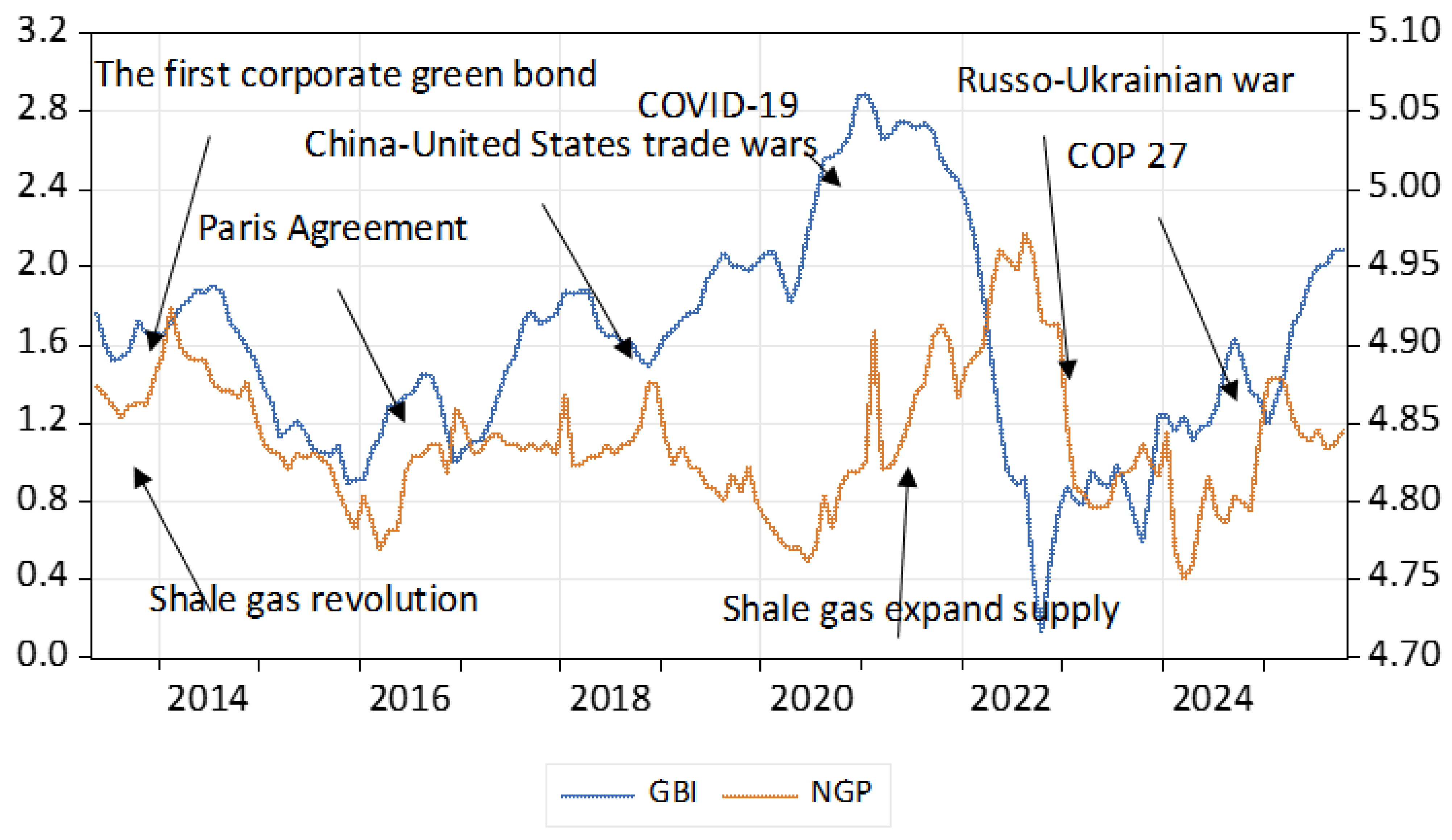
Figure 1 illustrates the trends of the Green Bond Index (GBI) and Natural Gas Price (NGP) between May 2013 and October 2025. The figure shows time series of monthly data of the S&P Green Bond Select Index (GBI, left axis) and the Henry Hub Natural Gas Spot Price (NGP, right axis), with co-movements and differences between the two series being shown against the background of major world events like the 2015 Paris Agreement, the Russia–Ukraine conflict, and the COVID-19 pandemic. The data indicate that the development of GBI and NGP is strongly connected with key economic and geopolitical changes [54,55,56,57]. Since 2014, the GBI has displayed volatility that is linked to major political and economic occurrences [58]. An example is the decrease in NGP that commenced in 2014, which was affected by geopolitical factors, including the conflict between Russia and Ukraine [59]. This decline in NGP undermined economic stability in the natural gas-producing areas, and it was a part of negative feedback in global energy markets. In the same time frame, the GBI started to rebound after 2013 when the global issuance of green bonds was fast-tracked. By 2015, the market had increased to USD 42.5 billion from USD 11 billion in 2013, largely because governments, multilateral development banks, and corporations increasingly used green bonds to raise capital for environmental projects. The declining tendency in NGP in 2014, caused by both oversupply in the natural gas market and political tensions, however, created a temporary recession in green bond interest. This period was characterized by weakened investor demand for green bonds, which reduced the GBI and indicates the complicated relationship between green finance and energy markets. The 2015 Paris Agreement then made a significant contribution to the renewal of interest in green bonds. With governments and the private-sector investors aiming to achieve sustainability objectives, more players joined the green bond market with institutional investors, including pension funds and mutual funds [60]. The increase in the GBI over the next couple of years was fueled by the increasing awareness of green finance as an important mechanism to combat climate change. The data also show intervals of a disrupted market environment, like in 2018, when trade tensions including the Sino–U.S. trade war, have been among contributors to the decreases in both GBI and NGP. Due to the COVID-19 pandemic and the oil price war between Russia and Saudi Arabia in 2020, market conditions further deteriorated, and initially, the two variables reduced [61]. The period is characterized by a complicated interdependency where the changes in energy prices [62], especially natural gas, have a significant effect on the issuance of green bonds and market conditions. All in all, the tendencies, captured in Figure 1, demonstrate interdependent interactions that exist between global energy markets, NGP, and the issuance of green bonds, and they indicate that the dynamics of the NGP are interconnected with the dynamics of the green bond markets.
Table 1 presents the descriptive statistics for the Green Bond Index (GBI) and Natural Gas Price (NGP). The GBI has an average value of 4.899751, while the NGP exhibits a mean of 1.115075. The median values for GBI and NGP are 4.900244 and 1.066432, respectively, indicating relatively symmetric distributions for both series. The maximum values recorded are 5.061434 for GBI and 2.175887 for NGP, while the minimum values are 4.715936 and 0.398776, respectively. Both GBI and NGP display positive skewness, with GBI having a skewness of 0.295648 and NGP a higher skewness of 0.660652, suggesting that the distributions of both series have longer right tails. The kurtosis values for GBI and NGP are 2.832691 and 3.488385, respectively, indicating that both distributions are close to, but not exactly, normal. The Jarque–Bera test results further confirm that the series deviates from normality. The GBI series is not normally distributed at the 1% significance level, as indicated by its Jarque–Bera statistic of 2.360145, while the NGP series displays a stronger deviation from normality at the 1% level, with a Jarque–Bera statistic of 12.40229. These results suggest that the distribution of both series, particularly NGP, departs from the normal distributional assumption, which supports the use of distribution-sensitive methods such as quantile-based techniques.
To examine the stationarity properties of the variables, the Augmented Dickey–Fuller (ADF) test [63], Phillips–Perron (PP) test [64], and Kwiatkowski–Phillips–Schmidt–Shin (KPSS) test [65] are employed. These tests jointly assess whether the GBI and NGP series are stationary in levels or require differencing. The results, reported in Table 2, indicate that the ADF and PP test statistics for both GBI and NGP fail to reject the null hypothesis of a unit root in levels, whereas the KPSS test statistics exceed the critical values at the 1% significance level, confirming non-stationarity in levels. However, after first differencing, all three tests consistently indicate stationarity for both variables. Specifically, the ADF and PP statistics become significant at the 5% and 1% levels, while the KPSS statistic falls below the critical threshold, implying the absence of a unit root in first differences. Therefore, both the GBI and NGP are integrated of order one, I(1). In line with standard practice, the subsequent empirical analysis is conducted using first-differenced series to ensure valid inference under the QQ framework.

6. Empirical Results

6.1. Basic Results

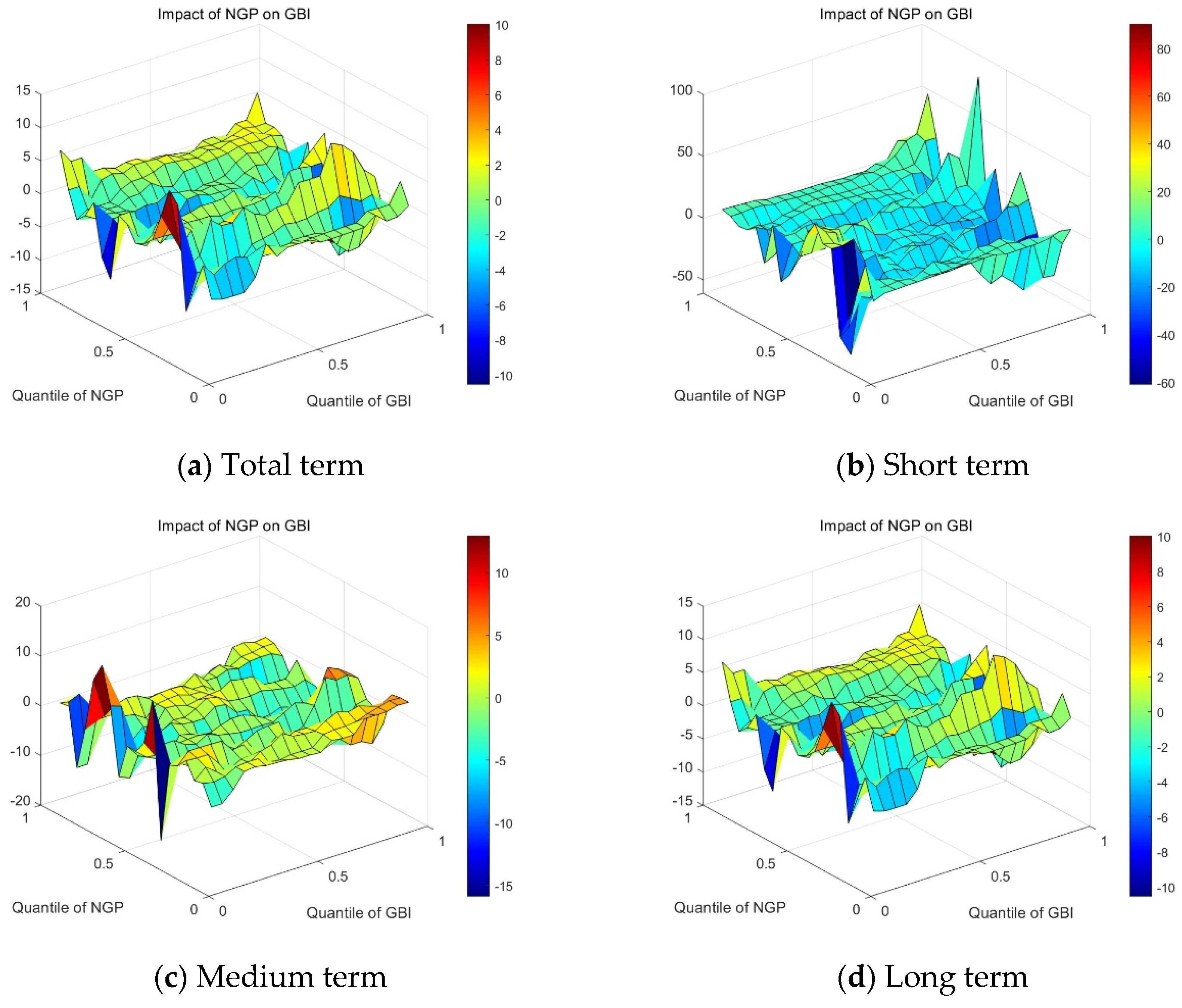
Before discussing individual figures, it is useful to clarify how the QQ framework captures dependence across both distributional states and time horizons. In the QQ surface plots.
β ^ ( τ , θ ) = Q G B I NGP ( τ θ ) NGP ,
where Q G B I NGP ( τ θ ) denotes the conditional τ -quantile of the GBI given the θ -quantile of NGP. Each coefficient measures how a small change in NGP (or GBI), at a given quantile of its own distribution, affects a given conditional quantile of the other variable. Positive values on the Z-axis indicate that higher NGP (or stronger GBI) raises the corresponding conditional quantile, whereas negative values denote a contractionary effect on the other market.
To improve clarity and internal referencing, each QQ surface is divided into four labeled panels. Panel (a) reports the results for the overall series; Panel (b) presents the short-term decomposition; Panel (c) shows the medium-term decomposition; and Panel (d) displays the long-term decomposition.
Figure 2 is organized into four panels to present a comprehensive view of the impact of natural gas prices (NGsP) on the Green Bond Index (GBI) across different quantile distributions. The x-axis denotes the θ-quantile of NGP, the y-axis denotes the τ-quantile of GBI, and the z-axis reports the estimated QQ coefficient β(τ,θ). Negative (positive) values imply that increases in NGP depress (support) GBI at the corresponding market states. The panels report the full sample and the short-, medium-, and long-run decomposed components. As shown in Panel (a), the aggregate results reveal a predominantly negative influence of NGP on GBI, particularly at higher quantiles of both variables. The negative effect becomes stronger in selected regions of the joint distribution, especially when NGP and GBI lie in intermediate-to-upper quantile ranges. Panel (b) indicates that, in the short term, the effects remain mostly negative, with the most pronounced responses concentrated around the middle quantiles of NGP. This suggests that short-horizon shocks to NGP, particularly around typical price levels, have a sizeable adverse impact on green bond performance. Panels (c) and (d) reveal that this pattern persists at medium and long horizons, although the intensity of the effect varies with the time scale. In the medium-term decomposition, negative responses are again concentrated at mid-to-high quantiles, indicating that sustained periods of elevated NGP tend to weigh on GBI returns. High NGP levels remain to be linked with poorer GBI performance, particularly when NGP and GBI are all situated in upper quantile ranges, in the long-term distribution. These findings are consistent with the notion that higher NGP, particularly when persistent, can increase production costs, contribute to inflationary pressures, and reduce the financial viability of capital-intensive green projects [62]. Given that many green investments involve substantial upfront costs and are sensitive to financing conditions [66], surges in NGP can reduce the attractiveness and feasibility of such projects, thereby depressing green bond valuations.
Figure 2 also highlights where these effects are strongest. Across most of the surface, the effect of NGP on GBI is negative, and this negative impact becomes more pronounced in particular regions of the joint distribution. In the overall series, the negative relationship is especially strong in the quantile ranges [0.75, 0.85] and [0.10, 0.20], indicating that high NGP levels tend to lower the GBI when both NGP and GBI are in these parts of their respective distributions. The QQ surfaces further indicate that the upper parts of the NGP distribution have a larger effect on green bond indices: when NGP is high, the adverse impact on GBI is more pronounced, and price jumps translate into sharper negative responses in GBI. At the same time, the broader empirical patterns suggest that green bonds and NGP are not perfect substitutes. Natural gas remains an important input in several sectors, whereas renewable energy financed by green bonds is primarily associated with power generation and low-carbon infrastructure. Because of this sectoral differentiation, changes in NGP do not always move green bond demand in a one-to-one fashion. In some regimes, episodes of lower NGP may ease cost pressures and improve financing conditions, which can also support green bond issuance. The data further align with developments in energy technology and financing. Advances in clean-energy technologies and declining production costs have attracted increasing capital into green projects, while innovation and the growing flexibility of financing methods for green energy projects have contributed to the profitability of green energy companies [67,68]. These factors help insulate green bond valuations from some of the negative effects of oil and gas price shocks. Overall, the empirical evidence suggests that while NGP can exert a negative impact on GBI—especially at higher quantiles and during periods of elevated energy prices—the relationship is not straightforward. The green bond market exhibits a degree of resilience to NGP fluctuations, particularly as technological progress and more flexible financing structures make renewable energy projects more financially attractive and competitive.
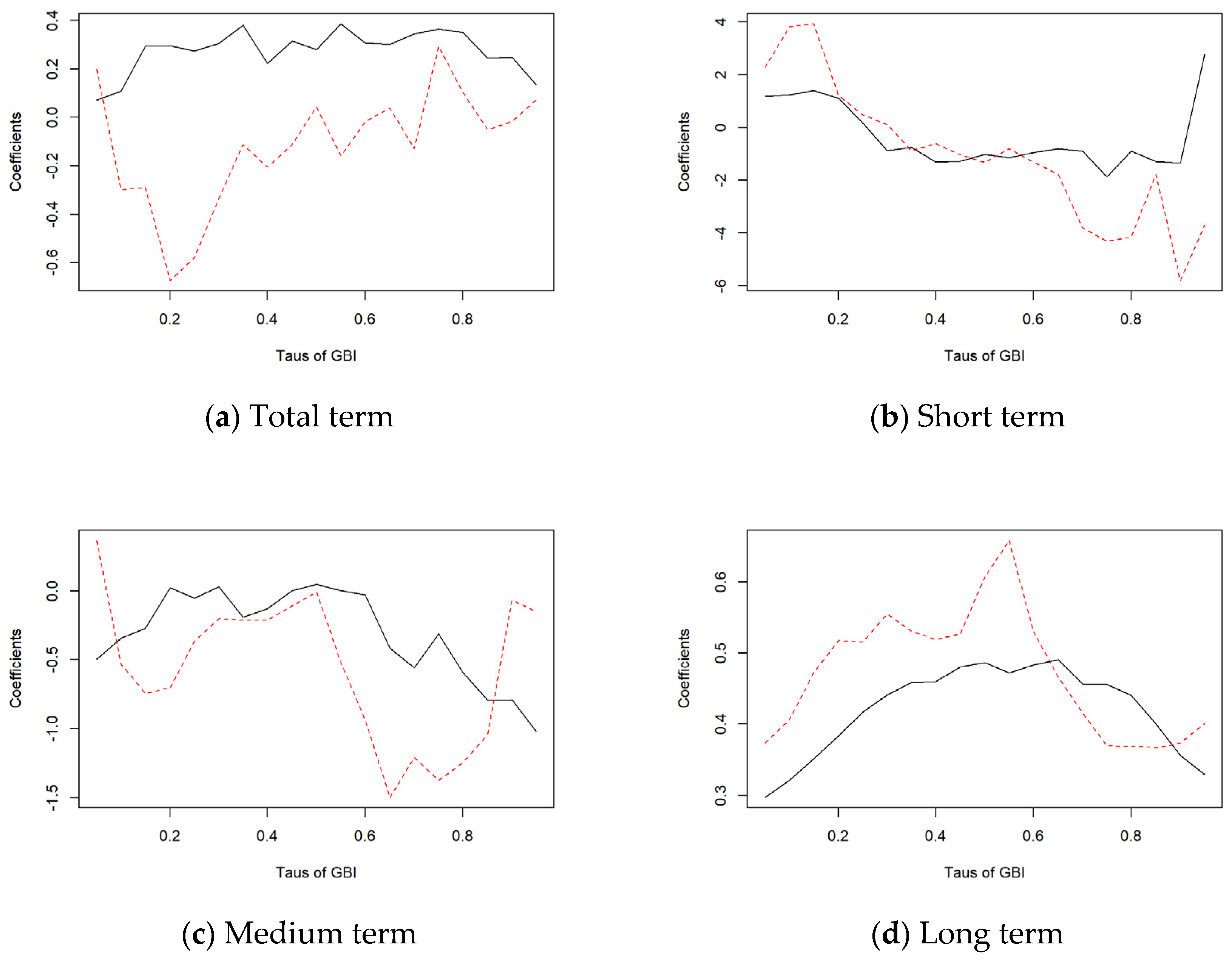
QQ methods allow the decomposition of standard quantile regression into conditional estimates defined jointly over the quantiles of the dependent and explanatory variables. In this study, the τ-th quantile of the GBI conditional on the θ-th quantile of NGP represents the baseline specification. The quantile parameters τ and θ index the respective quantile levels of GBI and NGP. Because the dependence structure varies across quantiles, QQ provides a heterogeneous response surface that can recover the implied parameters of a conventional quantile regression.
Formally, the quantile-specific slope coefficients summarize the influence of NG on GBI. The associated QQ coefficient for quantile θ can be written as the average of the bivariate QQ parameters along τ :
γ 1 ( θ ) 1 s τ β ˆ 1 ( θ , τ ) ,
where s is the number of quantiles and τ = [ 0.10,0.15 , , 0.90 ] . This aggregation recovers the marginal effect consistent with the standard θ -quantile regression while preserving the underlying joint-quantile heterogeneity.
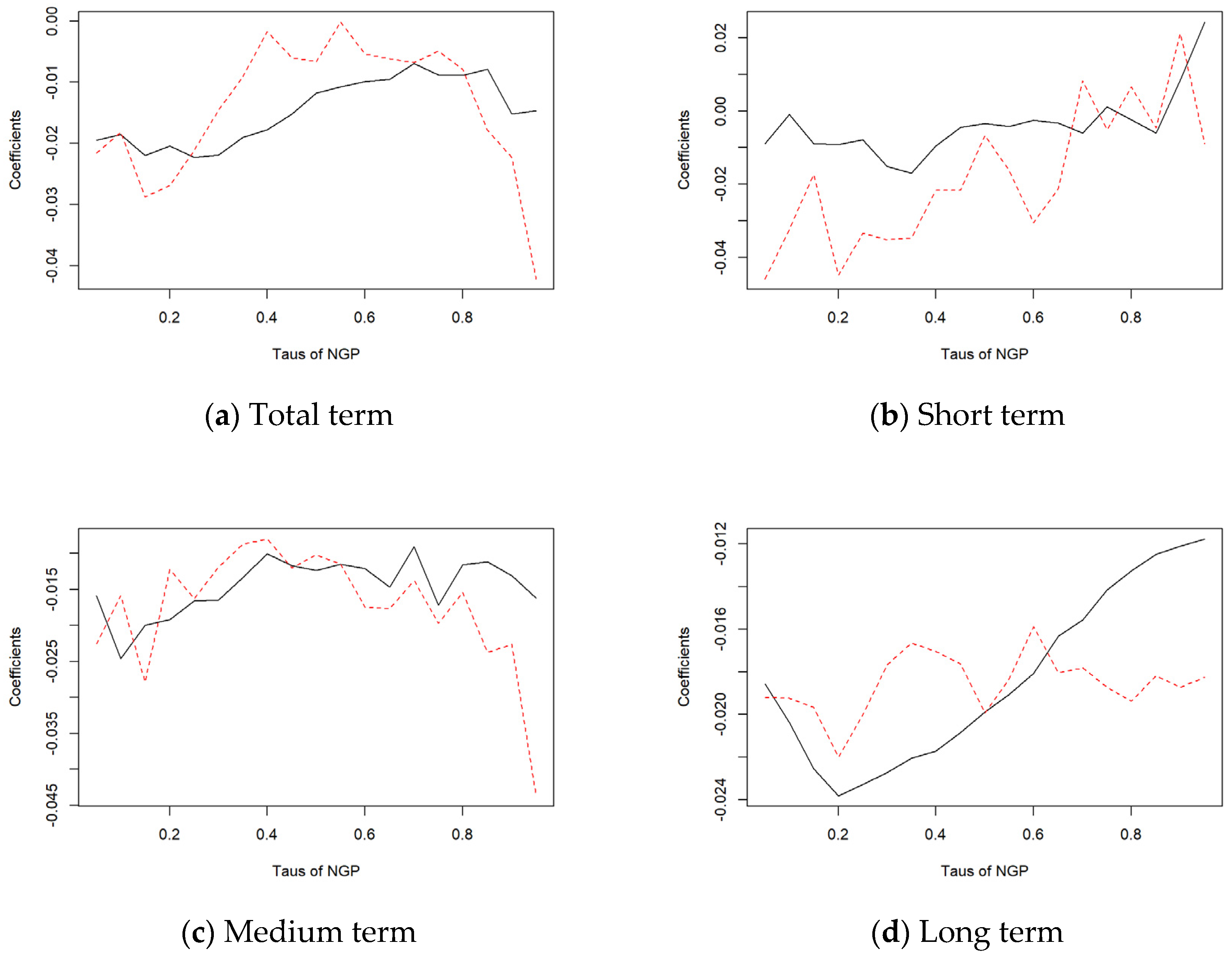
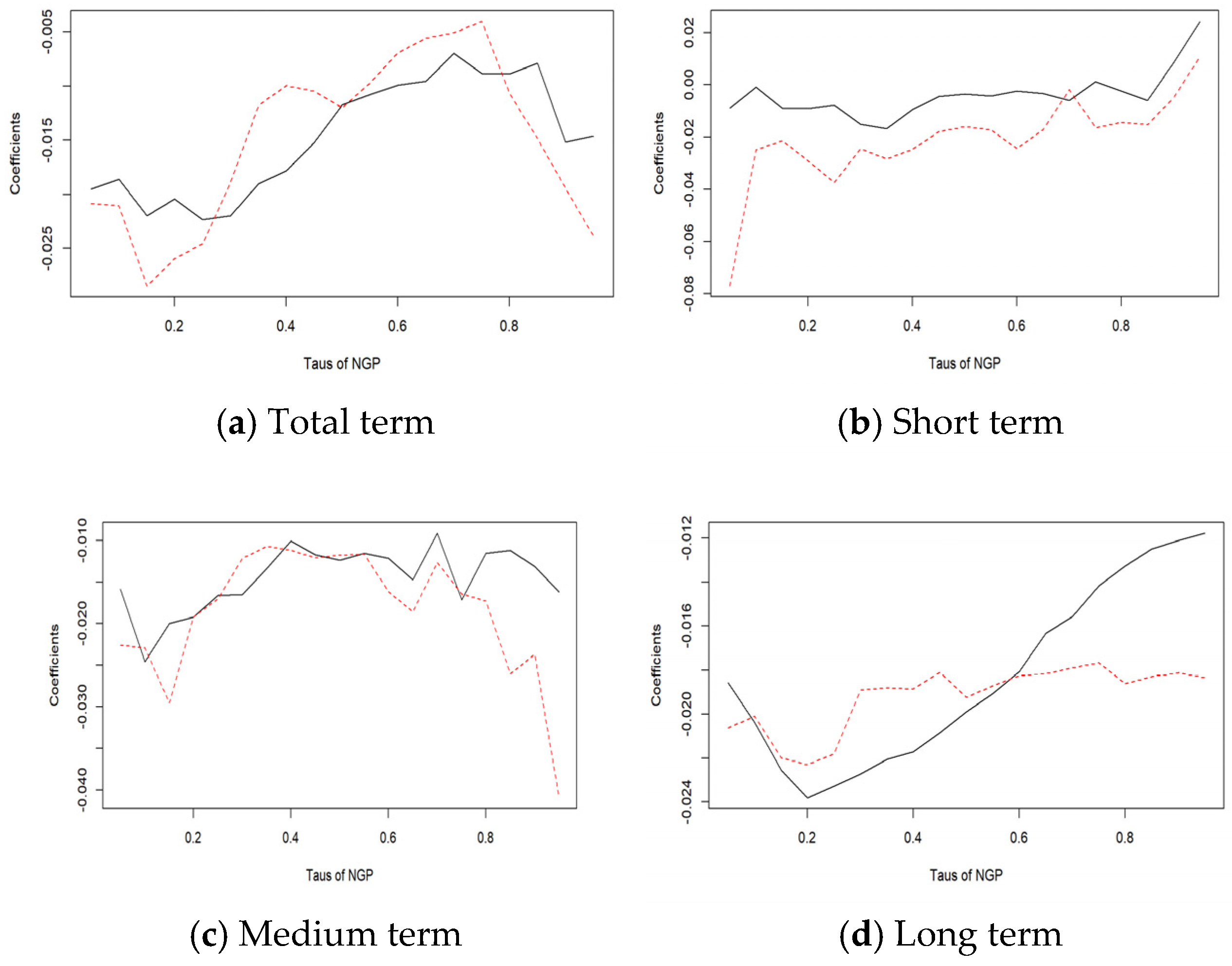
Figure 3 presents the QQ estimates (red line) together with the conventional quantile regression (QR) results (black line). The figure provides a consistency check between QQ and standard QR for the NGP–GBI relation. The red line plots the QQ-aggregated marginal effect at each τ-quantile of GBI, while the black line shows the corresponding QR slope estimate. Their close alignment over most quantiles supports the internal validity of the QQ estimates, while deviations highlight nonlinear and state-dependent effects that QR does not capture. The joint-quantile surface shows that, in the lower quantiles of GPI, corresponding to stressed market conditions or contractionary market conditions, NGP have a positive effect on GPI. Nevertheless, within the middle and upper quantiles, which can be viewed as longer-term or more positive market conditions, the effect is negative. This tendency highlights the asymmetric transmission mechanism between natural gas and the green bond market, implying that NGP does not have a positive impact on green bond performance during the low-state or short-horizon variations, whereas the impact is negative as the market conditions stabilize or strengthen.
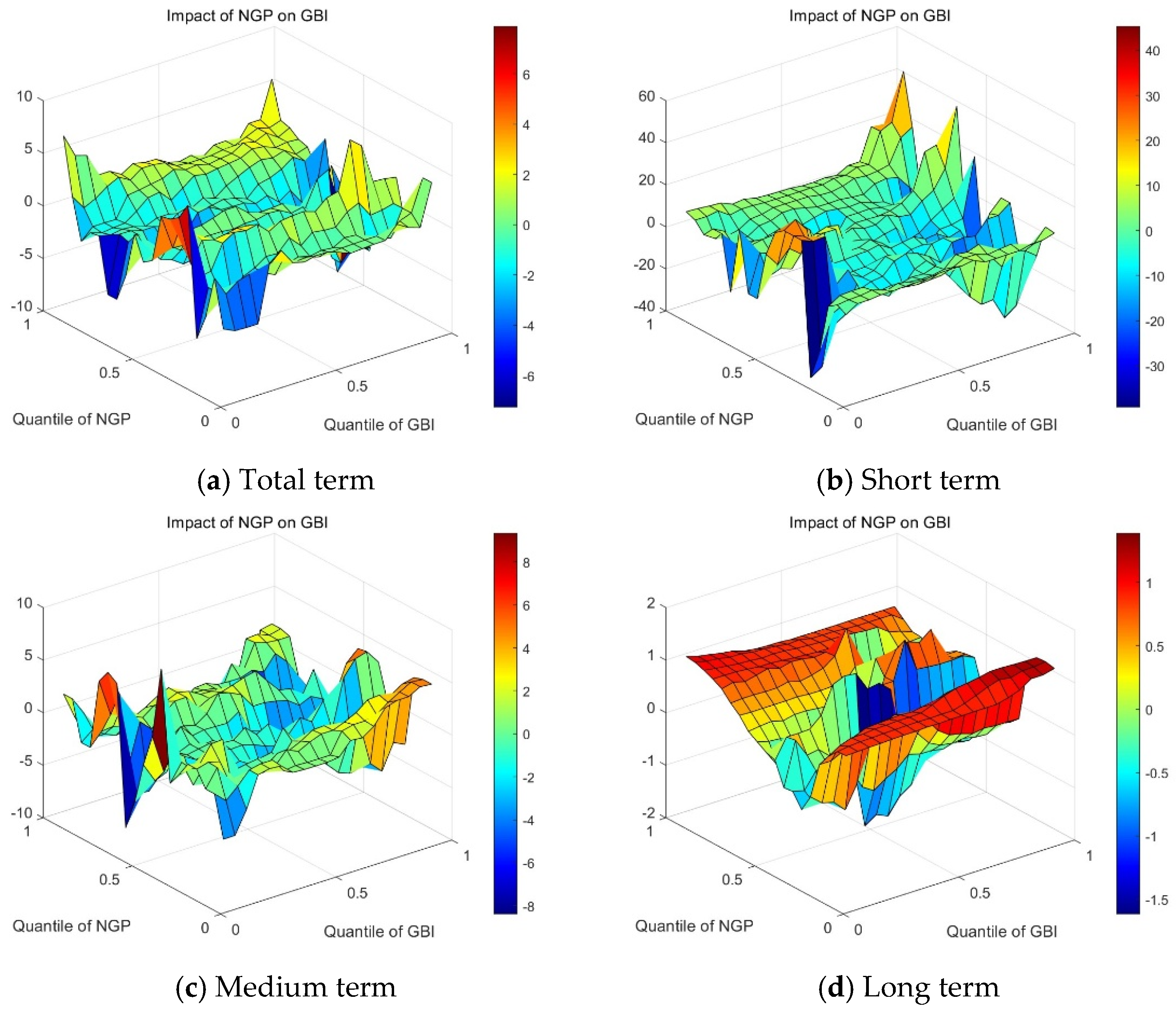
Figure 4 shows Quantile-on-Quantile (QQ) estimates of the impact of the Green Bond Index (GBI) on Natural Gas Prices (NGPs). The four panels again present the relationship decomposed by time horizon: (a) full sample, (b) short term, (c) medium term, and (d) long term. The x-axis denotes the θ-quantile of GBI, the y-axis denotes the τ-quantile of NGP, and the z-axis shows the coefficient β(τ, θ). Positive (negative) values suggest that stronger green bond market conditions are associated with higher (lower) NGP at the corresponding distributional states. The overall series indicates that the effect of GBI on NGP is predominantly positive across most quantile combinations, with the surface becoming more markedly positive when both GBI and NGP lie in middle quantile ranges. Only limited negative responses appear at the margins of the joint distribution. These findings imply that increases in GBI—reflecting stronger market participation in green finance—are generally associated with higher NGP. This pattern is consistent with the view that the expansion of the green bond market supports investment in energy-transition technologies [69], many of which still rely on natural gas as a bridging fuel, so that heightened GBI tends to coincide with stable or rising natural gas demand.
In the short-term series, the impact of GBI on NGP remains mostly positive, although the surface exhibits larger fluctuations than in the overall results. The strongest positive responses emerge in the medium quantiles of NGP, indicating that when NGP are in their normal state, increases in GBI are associated with moderate price appreciation. Negative coefficients are concentrated in the lower quantiles of NGP and the upper quantiles of GBI, suggesting that during short-run market downturns, the sensitivity of NGP to GBI weakens. The predominance of positive effects in the short term can be attributed to the rapid expansion of the global green bond market, which has increased the availability of capital for cleaner energy systems [70]. At the same time, short-run NGP remains primarily driven by cyclical demand conditions, inventory adjustments, and weather-related shocks [71,72], and these factors typically do not offset the underlying positive association between GBI and NGP. In the long-term series, by contrast, GBI exerts a mainly negative influence on NGP, with the strongest negative responses concentrated in the middle quantiles of both variables and only small positive regions at the extremes of the distribution. This pattern indicates that the expansion of green finance ultimately reduces reliance on natural gas by encouraging investment in renewable energy, energy-efficiency improvements, and low-carbon industrial processes [73]. The medium-term results show a more heterogeneous pattern: coefficients are positive when NGP is in the upper quantiles, especially when GBI lies in the middle-to-high quantile range, reinforcing the interpretation of natural gas as a transitional fuel whose demand can initially rise alongside green finance before declining at longer horizons.
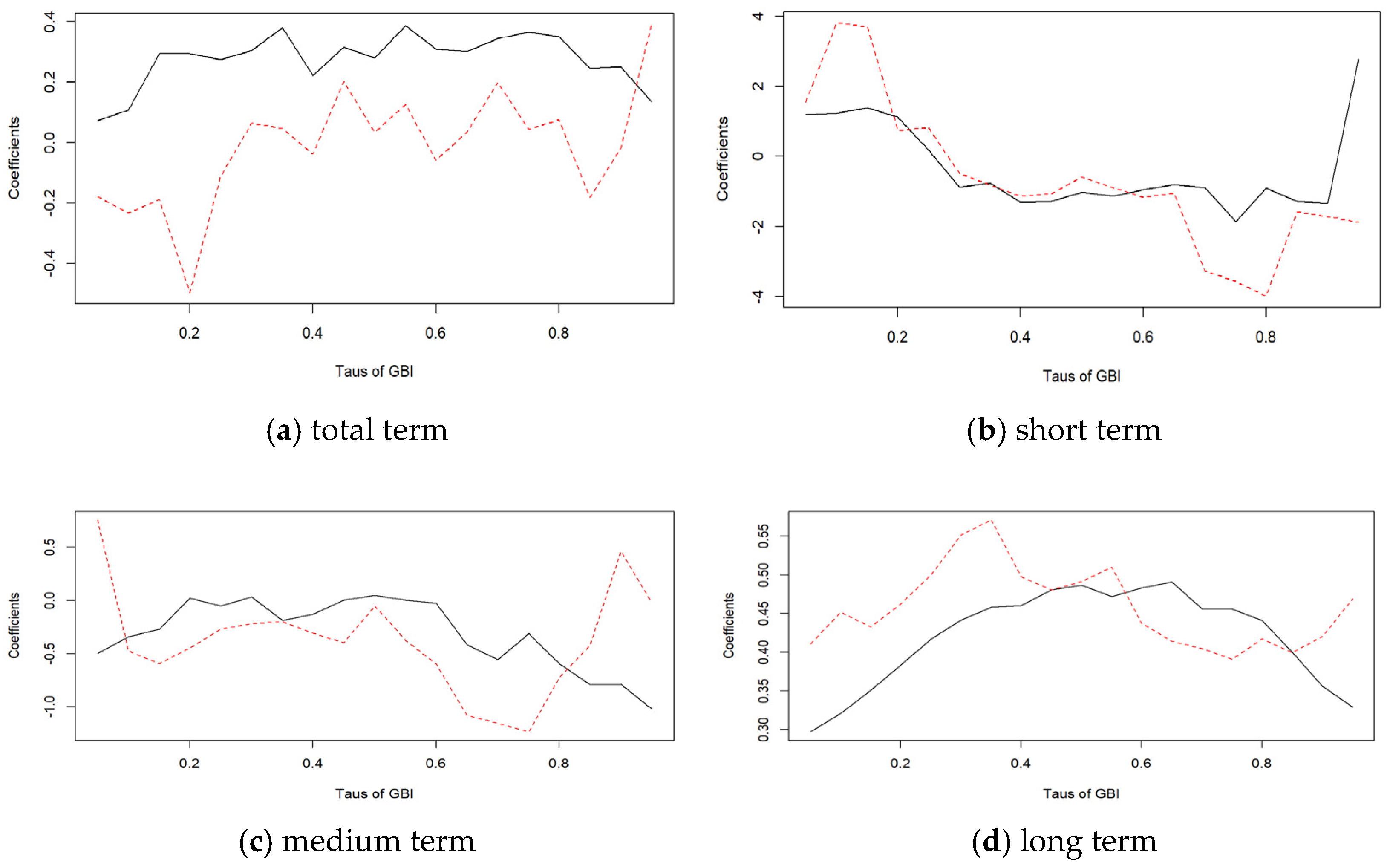
Figure 5 reports the QQ estimates together with the standard quantile-regression coefficients across the conditional distribution of NGP), summarizing the NGP–GBI linkage in a complementary way. The red line plots the QQ-implied marginal effects, and the black line reports the standard QR estimates. The comparison shows that the estimated effects of NGP on green bond performance are heterogeneous across quantiles. In most cases, both QQ and QR estimates remain consistently negative, implying that higher NGP is associated with a contractionary response in green bond valuations over much of the distribution. Only in the upper range of NGP quantiles do the coefficients shift from negative to positive, suggesting that extreme price conditions may partially offset the otherwise adverse association, possibly reflecting stronger substitution effects under very high NGP.
Taken together, the empirical analysis reveals a complex, heterogeneous pattern of interaction between NGP and GBI. In the short term, NGP exerts a predominantly negative effect on GBI, with significant adverse impacts observed at medium and higher quantiles. The negative effect is strong over medium horizons, and the reverse relationship shows that the growth of green finance can sustain natural gas demand in cases where gas is regarded as a transitional fuel. At longer horizons, the influence of GBI on NGP is mainly negative, which accords with a gradual structural decoupling process driven by green finance-induced deep decarbonization.
In general, the evidence confirms the NGP–GBI relationship as nonlinear, asymmetric, and state-dependent and highlights the necessity of taking into account both state distribution and time horizons in the evaluation of the influence of energy prices on green finance.

6.2. Robustness Check

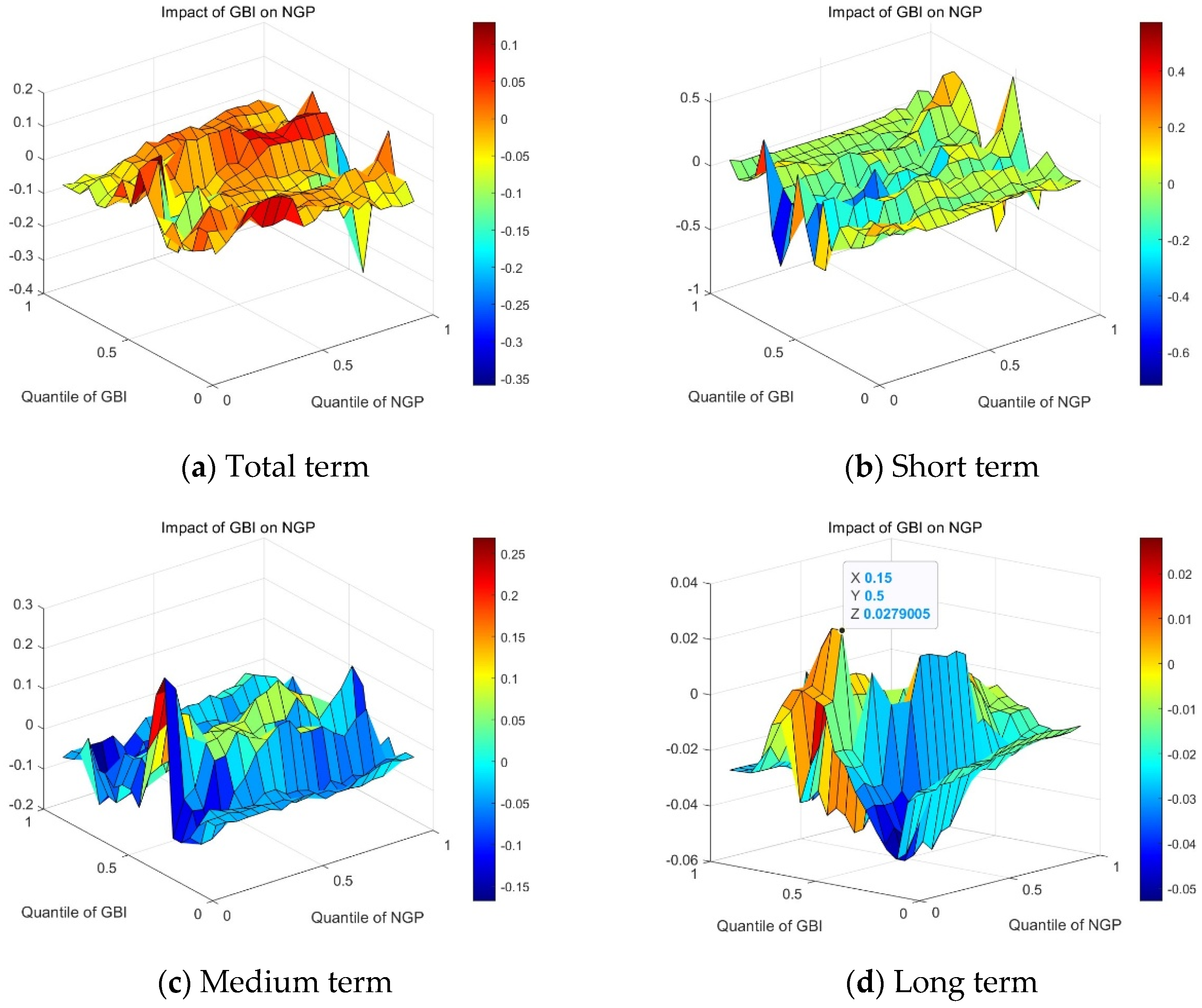
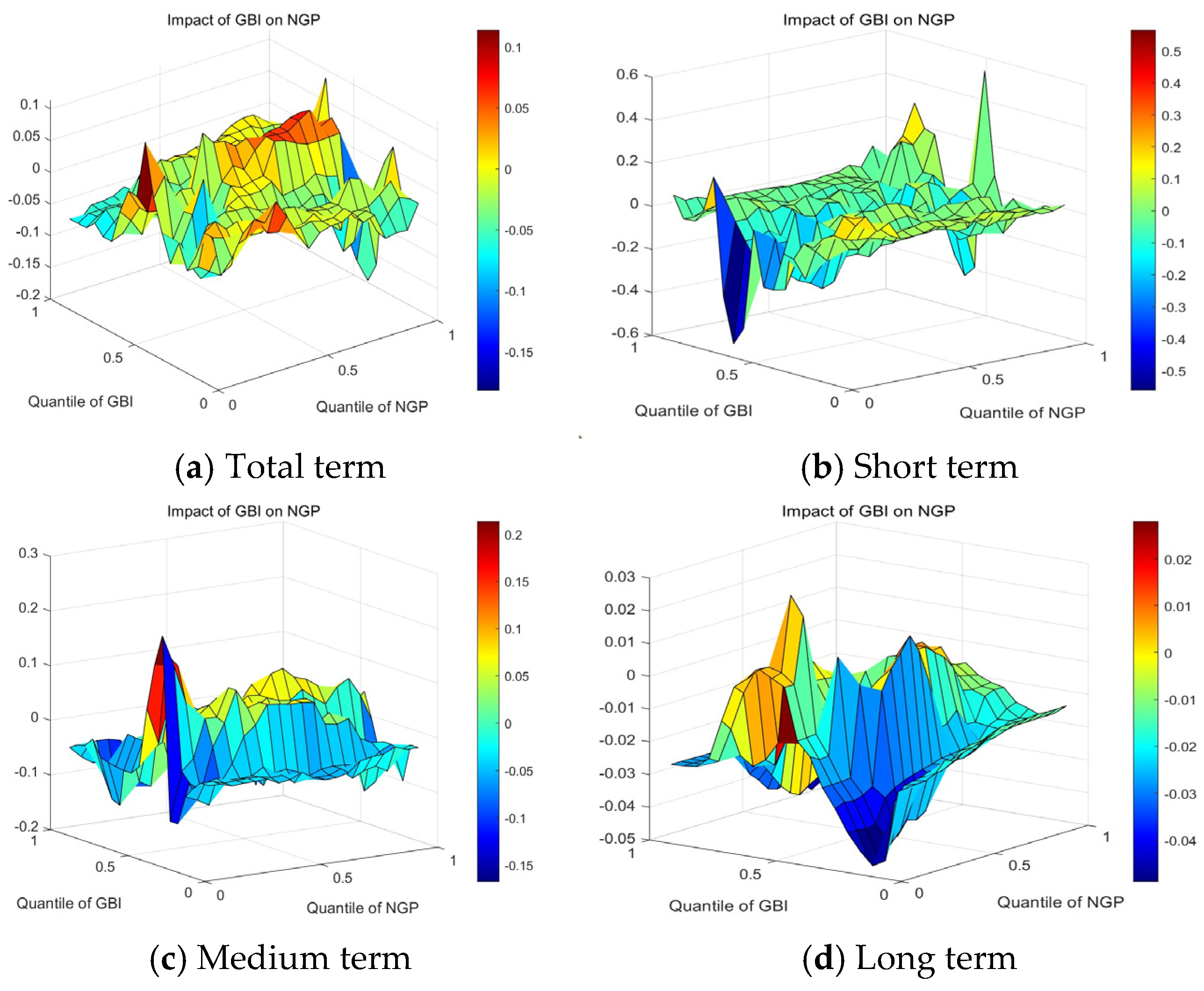
We first examined the robustness of the QQ estimation with respect to the bandwidth parameter (h), which controls the local smoothing intensity. In addition to the baseline setting (h = 0.05), the model was re-estimated using an adjacent bandwidth value (h = 0.06). Figure 6 and Figure 7 report the resulting surfaces for both directional effects—Natural Gas Price (NGP) → Green Bond Index (GBI) and GBI → NGP—across total, short-, medium-, and long-term horizons.
As shown in the figure, after varying the bandwidth parameter h, the patterns describing the impact of NGP on green bonds remain largely consistent with the baseline empirical results. This indicates that changing h does not materially affect the relationship, confirming the robustness of our findings for the NGP → GBI channel.
As shown in the Figure 8, after varying the bandwidth parameter h, the patterns describing the impact of green bonds on NGP also remain largely consistent with the baseline empirical results. This indicates that changing h does not materially affect the relationship, confirming the robustness of our findings for the GBI → NGP channel.
The robustness Figure 9 show that changing the bandwidth parameter does not materially alter the empirical dependence structure identified in the baseline QQ estimation. Across the total, short-, medium-, and long-term decompositions, the estimated response surfaces preserve the same overall configuration: the sign patterns remain unchanged, the regions of relatively strong and weak effects occur at comparable quantile combinations, and the statistically significant areas continue to cluster in the same parts of the joint distribution. In particular, the NGP → GBI channel retains predominantly negative coefficients in the upper quantiles, indicating that elevated NGP states are consistently associated with weaker green bond performance. Conversely, the reverse GBI → NGP effect remains mainly positive in the middle quantile range, implying that normal-state improvements in green bond conditions are still linked to upward pressure on NGP, while long-term results continue to show a shift toward negative effects as green finance matures.
Collectively, this stability indicates that the main findings are not sensitive to reasonable changes in the smoothing parameter and are therefore not an artifact of bandwidth choice. The robustness results reinforce the reliability of the QQ framework in capturing the nonlinear and state-dependent interaction between NGP and the green bond market.

7. Conclusions and Policy Implications

This study analyzed the nonlinear and heterogeneous linkages between NGP and the GBI using a QQ approach. The empirical results show that the relationship between NGP and GBI is strongly state-dependent and varies across time horizons. In the short term, higher NGP tends to be associated with a decline in GBI returns, as elevated energy costs and general market volatility weigh on the environmental sector. At medium horizons, the impacts are confounded and reliant on current market conditions, reflecting the interaction between investor sentiment, risk appetite, and decarbonization trajectory. Over the long run, the growth of sustainable finance markets, coupled with technological advances in clean technology and supportive environmental regulation, gradually weakens the dependence of green bonds on natural gas. This finding is consistent with a partial decoupling between NGP dynamics and GBI performance as the role of natural gas as a “bridge fuel” diminishes during the transition.
The bidirectional analysis further shows that GBI has asymmetric effects on NGP. In the short and medium run, increases in green finance are associated with small increases in demand for fossil fuels, as green financing supports transitional generation mixes in which natural gas continues to play a complementary role. Over longer horizons, however, green bonds appear to contribute to lower fossil-fuel demand by financing alternative energy sources and efficiency improvements that displace traditional fuel use. Thus, both directions of causality can be viewed as ultimately leading to reduced reliance on fossil fuels: directly, through the funding of low-carbon projects, and indirectly, through the gradual reshaping of energy systems and capital allocation. In general, the findings are in line with recent literature reporting non-linear interactions between fossil-fuel markets and green bonds, which suggests the importance of considering state dependence and regime change in policy design and portfolio choices.
From a policy perspective, evidence indicates that green bonds are short-term sensitive but could be long-term stabilizing and diversifying assets. This means that they cannot be effective in supporting the energy transition fully unless well-coordinated policies are in place to support them. First, green bonds ought to be directly incorporated into national climate change mitigation policies and low-carbon development policies. Policymakers can also take into account the possibility of substituting general, undifferentiated subsidies with more specific fiscal policies and regulatory frameworks that would deal specifically with near-term barriers to implementation. Examples include tax incentives to offset issuance and certification costs for new green bond issuers; the design of clear, activity-level eligibility standards (e.g., aligned with the EU Taxonomy where applicable) to reduce uncertainty about what qualifies as “green”; and the provision of sovereign or public guarantees for pilot projects in hard-to-abate sectors. These measures can broaden participation by making issuance more economically efficient and manageable, thereby supporting market depth and stability during periods of macroeconomic stress.
Second, the findings emphasize that green products are still vulnerable to the changes in the underlying energy markets, which reinforces the necessity to enhance the market resilience and credibility. To reduce the threat of “greenwashing” and to ensure that investors remain unafraid of uncertainty, policymakers and regulators may demand periodic post-issuance reporting (e.g., annual reporting of realized emission reductions or other environmental achievements), move toward performance-based green bond criteria rather than process-oriented requirements, and promote or enforce third-party verification by certified external reviewers. By improving transparency and easing information asymmetries, these measures would make the market more robust to short-run shocks, without diminishing the longer-horizon hedging and diversification benefits that green bonds provide.
Third, the empirical data indicate that the effective utilization of green bonds presupposes the consistency of fiscal policy, energy pricing, and environmental regulation to ensure the consistency of market signals in the long run. Green bonds function most effectively when there is strong investor confidence that the capital raised genuinely advances emissions reduction and when energy-price dynamics are aligned with climate goals. This means that funding of environmental policy must be well synchronized with the general energy price reforms. Concrete alternatives entail either the implementation of emissions trading or price-based systems on carbon with proper floor provisions (via the use of either an auction reserve or a minimum price on bid) and specific fiscal support, such as preferential tax treatment of certified green bond income to reduce the cost of capital on sustainable investments. Such coordination reduces distortions between energy and financial markets and helps to avoid the misalignments highlighted by the empirical results.
Moreover, a holistic policy package demands supportive equipment to minimize the price and risk of systemically significant transition activities. Potential elements include loan guarantees for large-scale conversion projects, standardized and streamlined reporting standards that limit administrative burdens, and consistent criteria for assessing transitional activities so that improvement paths are transparent and measurable. Combinations of these strategies can contribute to lowering the cost of capital, increasing investor involvement, and further stabilizing the green bond market as a stable, long-term platform for phasing out fossil fuels.
This analysis can be expanded in future studies in a number of ways. First, the inclusion of more economic and environmental factors, such as oil prices, emissions trading prices, or climate policy uncertainty indicators, would assist in revealing more ways in which green finance interacts with energy and climate dynamics. Second, disaggregating the green bond market by country of origin, sectoral classification, or type of issuer could reveal important differences between advanced and emerging economies and across industries with varying exposure to energy transition risks. Third, the methodology is more advanced since a more sophisticated set of empirical and machine-learning tools, including time-varying parameter quantile regressions or causal inference methods based on distributional dependence, would allow representing more complex, time-varying associations. Lastly, with the advent of new climate-aligned financing instruments (such as blue bonds, sustainability-linked bonds, and outcome-based instruments), it would be worthwhile to research the interactions between the varied forms of green and transition bonds and how their joint application can be optimized to help achieve global decarbonization objectives.

Author Contributions

Conceptualization, J.W., J.L., X.J. and C.-W.S.; methodology, J.W., J.L., X.J. and C.-W.S.; software, J.W., J.L., X.J. and C.-W.S.; validation, J.W., J.L., X.J. and C.-W.S.; formal analysis, J.W., J.L., X.J. and C.-W.S.; investigation, J.W., J.L., X.J. and C.-W.S.; resources, J.W., J.L., X.J. and C.-W.S.; data curation, J.W., J.L., X.J. and C.-W.S.; writing—original draft preparation, J.W., J.L., X.J. and C.-W.S.; writing—review and editing, J.W., J.L., X.J. and C.-W.S.; visualization, J.W., J.L., X.J. and C.-W.S.; supervision, J.W., J.L., X.J. and C.-W.S.; project administration, J.W., J.L., X.J. and C.-W.S.; funding acquisition, J.W., J.L., X.J. and C.-W.S. All authors have read and agreed to the published version of the manuscript.

Funding

This research received no external funding.

Institutional Review Board Statement

Not applicable.

Informed Consent Statement

Not applicable.

Data Availability Statement

The authors do not have permission to share data.

Conflicts of Interest

The authors declare no conflicts of interest.

References

  1. Cin, R.; Onaygil, S. Energy poverty and a possible energy efficiency obligation scheme in Türkiye: Comparing income and energy expenditure-based definitions and policy implications. Energy Policy 2025, 207, 114831. [Google Scholar] [CrossRef]
  2. Chen, Z.; He, M.; Ali, M. Natural Resources and Geopolitical Risk Impact on Energy Security Risk: The Role of Renewable Energy Consumption and Foreign Direct Investment. In Natural Resources Forum; Blackwell Publishing Ltd.: Oxford, UK, 2025. [Google Scholar] [CrossRef]
  3. Schmitz, R.; Flachsbarth, F.; Plaga, L.S.; Braun, M.; Härtel, P. Energy security and resilience: Revisiting concepts and advancing planning perspectives for transforming integrated energy systems. Energy Policy 2025, 207, 114796. [Google Scholar] [CrossRef]
  4. Krupa, J.; Busch, F.; Gladwin, D.; Ellis, N. Financing clean technologies within Canada’s Indigenous communities: Perspectives on sustainable energy transition from practitioners and academics. Energy 2025, 322, 134930. [Google Scholar] [CrossRef]
  5. MacAskill, S.; Roca, E.; Liu, B.; Stewart, R.A.; Sahin, O. Is there a green premium in the green bond market? Systematic literature review revealing premium determinants. J. Clean. Prod. 2021, 280, 124491. [Google Scholar] [CrossRef]
  6. Amin, S.B.; Taghizadeh-Hesary, F.; Khan, F.; Samia, B.I. Reviving the green transition process in the post-pandemic Era: The case of Bangladesh. Environ. Econ. Policy Stud. 2025, 1–36. [Google Scholar] [CrossRef]
  7. Costa, D.; Garaffa, R.; Branco, D.C.; Danko, A.; Fiúza, A. Price volatility across the Atlantic: The US and the European natural gas markets. In Proceedings of the 2017 14th International Conference on the European Energy Market (EEM), Dresden, Germany, 6–9 June 2017; pp. 1–5. [Google Scholar] [CrossRef]
  8. Kircher, K.J. Accounting for methane from natural gas infrastructure in United States greenhouse gas emission estimates. Energy Policy 2025, 206, 114747. [Google Scholar] [CrossRef]
  9. Kröger, M.; Longmuir, M.; Neuhoff, K.; Schütze, F. The price of natural gas dependency: Price shocks, inequality, and public policy. Energy Policy 2023, 175, 113472. [Google Scholar] [CrossRef]
  10. Hussain, C.S.U.; Chenghu, Z.; Shoaib, A.; Zia, S. Does managerial climate awareness affect green bond issuance? The moderating role of managerial myopia. Financ. Res. Lett. 2025, 85, 107979. [Google Scholar] [CrossRef]
  11. Liu, J.; Liu, G.; Lu, C.; Dang, R.; Gao, Y. Natural gas reforming for LNG and methanol production: Sustainability and economic viability. Energy 2025, 335, 138257. [Google Scholar] [CrossRef]
  12. Llewellyn, J.; Katzeff, C.; Johansson, F.; Pargman, D. Aligning European Union ambitions of renewable energy communities with citizens actions using United Nations sustainable neighbourhood indexes. Energy Policy 2026, 209, 114960. [Google Scholar] [CrossRef]
  13. Leitao, J.; Ferreira, J.; Santibanez-Gonzalez, E. Green bonds, sustainable development and environmental policy in the European Union carbon market. Bus. Strategy Environ. 2021, 30, 2077–2090. [Google Scholar] [CrossRef]
  14. Xie, Q.; Guo, S.; Cao, F. Exploring the Decoupling of Carbon Emissions and Economic Growth and Its Influencing Factors: A Comparative Study of the EU and BRICS Countries. Sustainability 2025, 17, 10637. [Google Scholar] [CrossRef]
  15. Santillán Vera, M.; García Manrique, L.; Rodríguez Peña, I.; De La Vega Navarro, A. Drivers of electricity GHG emissions and the role of natural gas in Mexican energy transition. Energy Policy 2023, 173, 113316. [Google Scholar] [CrossRef]
  16. Abakah, E.J.A.; Tiwari, A.K.; Adekoya, O.B.; Oteng-Abayie, E.F. An analysis of the time-varying causality and dynamic correlation between green bonds and US gas prices. Technol. Forecast. Soc. Change 2023, 186, 122134. [Google Scholar] [CrossRef]
  17. Huang, L.; Zhang, K.; Wang, J.; Zhu, Y. Examining the interplay of green bonds and fossil fuel markets: The influence of investor sentiments. Resour. Policy 2023, 86, 104171. [Google Scholar] [CrossRef]
  18. Mensi, W.; Selmi, R.; Al-Kharusi, S.; Belghouthi, H.E.; Kang, S.H. Connectedness between green bonds, conventional bonds, oil, heating oil, natural gas, and petrol: New evidence during bear and bull market scenarios. Resour. Policy 2024, 91, 104888. [Google Scholar] [CrossRef]
  19. Khamis, M.; Aassouli, D. The eligibility of green bonds as safe haven assets: A systematic review. Sustainability 2023, 15, 6841. [Google Scholar] [CrossRef]
  20. Kotek, P.; Selei, A.; Takácsné Tóth, B.; Felsmann, B. What can the EU do to address the high natural gas prices? Energy Policy 2023, 173, 113312. [Google Scholar] [CrossRef]
  21. Zhang, Y.; Yu, X.; Zhang, P.; Zhang, H. Price impacts of natural gas chokepoints on China: An energy security analysis of the Russia-Ukraine conflict. Util. Policy 2025, 96, 101985. [Google Scholar] [CrossRef]
  22. Shah, I.H.; Hiles, C.; Morley, B. How do oil prices, macroeconomic factors and policies affect the market for renewable energy? Appl. Energy 2018, 215, 87–97. [Google Scholar] [CrossRef]
  23. Cao, F.; Su, C.W.; Qin, M.; Moldovan, N.C. The investment of renewable energy: Is green bond a safe-haven to hedge U.S. monetary policy uncertainty? Energy 2024, 307, 132651. [Google Scholar] [CrossRef]
  24. Dou, J.; Su, C.W.; Li, W.; Dou, J. Green finance and artificial intelligence: Catalysts for promoting sustainability? Econ. Anal. Policy 2025, 88, 13–25. [Google Scholar] [CrossRef]
  25. Liya, Z.; Su, C.-W.; Baz, S.; Xue, Z. Governance and greenwashing in the BRICS: The moderating role of national ESG performance in sustainable finance outcomes. J. Innov. Knowl. 2026, 12, 100893. [Google Scholar] [CrossRef]
  26. Li, K.; Mirza, N.; Safi, A.; Umar, M.; Su, C.-W. Leveraging Energy Efficiency, Digitalization, and Green Finance for Sustainable Competitiveness: Insights from OECD Economies Post-COP28. J. Compet. 2025, 17, 317. [Google Scholar] [CrossRef]
  27. Su, C.W.; Song, X.Y.; Dou, J.; Qin, M. Fossil fuels or renewable energy? The dilemma of climate policy choices. Renew. Energy 2025, 238, 121950. [Google Scholar] [CrossRef]
  28. Bai, L.; Wei, Y.; Zhang, J.; Wang, Y.; Lucey, B.M. Diversification effects of China’s carbon neutral bond on renewable energy stock markets: A minimum connectedness portfolio approach. Energy Econ. 2023, 123, 106727. [Google Scholar] [CrossRef]
  29. Su, C.-W.; Wu, Y.; Qin, M. Preserving energy security: Can renewable energy withstand the energy-related uncertainty risk? Energy 2025, 320, 135349. [Google Scholar] [CrossRef]
  30. Su, C.W.; Song, X.Y.; Qin, M.; Lobonţ, O.-R.; Umar, M. Optimistic or pessimistic: How do investors impact the green bond market? N. Am. J. Econ. Financ. 2024, 74, 102248. [Google Scholar] [CrossRef]
  31. Qin, M.; Su, Y.H.; Zhao, Z.; Mirza, N. The politics of climate: Does factionalism impede U.S. carbon neutrality? Econ. Anal. Policy 2023, 78, 954–966. [Google Scholar] [CrossRef]
  32. Yi, X.; Lu, T.; Li, Y.; Ai, Q.; Hao, R. Collaborative planning of multi-energy systems integrating complete hydrogen energy chain. Renew. Sustain. Energy Rev. 2025, 210, 115147. [Google Scholar] [CrossRef]
  33. Kanamura, T. Are green bonds environmentally friendly and good performing assets? Energy Econ. 2020, 88, 104767. [Google Scholar] [CrossRef]
  34. Kanamura, T. A supply-and-demand based price model for financial assets. J. Invest. Strateg. 2015, 4, 19–53. [Google Scholar] [CrossRef]
  35. Li, H.; Li, Y.; Luo, F.; Guo, L. Navigating extreme risk spillovers: Building a synergistic network of rare earths, green bonds, and clean energy markets in China. Energy Econ. 2025, 147, 108562. [Google Scholar] [CrossRef]
  36. Bartolini, N.; Romagnoli, S.; Santini, A. A climate risk hedge? Investigating the exposure of green and non-green corporate bonds to climate risk. Energy Econ. 2025, 149, 108664. [Google Scholar] [CrossRef]
  37. Wang, K.H.; Wang, Z.S.; Yunis, M.; Kchouri, B. Spillovers and connectedness among climate policy uncertainty, energy, green bond and carbon markets: A global perspective. Energy Econ. 2023, 128, 107170. [Google Scholar] [CrossRef]
  38. Naifar, N. Biodiversity finance, green bonds, and tokenized carbon: A Quantile-on-Quantile connectedness analysis. Financ. Res. Lett. 2025, 85, 108009. [Google Scholar] [CrossRef]
  39. Su, C.W.; Khan, K.; Tao, R.; Nicoleta-Claudia, M. Does geopolitical risk strengthen or depress oil prices and financial liquidity? Evidence from Saudi Arabia. Energy 2019, 187, 116003. [Google Scholar] [CrossRef]
  40. Su, C.W.; Khan, K.; Tao, R.; Umar, M. A review of resource curse burden on inflation in Venezuela. Energy 2020, 204, 117925. [Google Scholar] [CrossRef]
  41. Su, C.W.; Khan, K.; Umar, M.; Zhang, W. Does renewable energy redefine geopolitical risks? Energy Policy 2021, 158, 112566. [Google Scholar] [CrossRef]
  42. Crowley, P.M. A guide to wavelets for economists. J. Econ. Surv. 2007, 21, 207–267. [Google Scholar] [CrossRef]
  43. Graps, A. An introduction to wavelets. IEEE Comput. Sci. Eng. 1995, 2, 50–61. [Google Scholar] [CrossRef]
  44. Torrence, C.; Webster, P.J. Interdecadal changes in the ENSO–monsoon system. J. Clim. 1999, 12, 2679–2690. [Google Scholar] [CrossRef]
  45. Percival, D.B.; Mofjeld, H.O. Analysis of subtidal coastal sea level fluctuations using wavelets. J. Am. Stat. Assoc. 1997, 92, 868–880. [Google Scholar] [CrossRef]
  46. Mallat, S.G. A theory for multiresolution signal decomposition: The wavelet representation. IEEE Trans. Pattern Anal. Mach. Intell. 1989, 11, 674–693. [Google Scholar] [CrossRef]
  47. Sim, N.; Zhou, H. Oil prices, US stock return, and the dependence between their quantiles. J. Bank. Financ. 2015, 55, 1–8. [Google Scholar] [CrossRef]
  48. Gupta, R.; Pierdzioch, C.; Selmi, R.; Wohar, M.E. Does partisan conflict predict a reduction in US stock market (realized) volatility? Evidence from a quantile-on-quantile regression model. N. Am. J. Econ. Financ. 2018, 43, 87–96. [Google Scholar] [CrossRef]
  49. Gao, X.; Ren, Y.; Umar, M. To what extent does COVID-19 drive stock market volatility? A comparison between the U.S. and China. Econ. Res.-Ekon. Istraživanja 2022, 35, 1686–1706. [Google Scholar] [CrossRef]
  50. Shahbaz, M.; Zakaria, M.; Shahzad, S.J.H.; Mahalik, M.K. The energy consumption and economic growth nexus in top ten energy-consuming countries: Fresh evidence from using the quantile-on-quantile approach. Energy Econ. 2018, 71, 282–301. [Google Scholar] [CrossRef]
  51. Xu, X.; Chen, Y. Air emissions from the oil and natural gas industry. Int. J. Environ. Stud. 2016, 73, 422–436. [Google Scholar] [CrossRef]
  52. Deschryver, P.; de Mariz, F. What Future for the Green Bond Market? How Can Policymakers, Companies, and Investors Unlock the Potential of the Green Bond Market? J. Risk Financ. Manag. 2020, 13, 61. [Google Scholar] [CrossRef]
  53. Park, D.; Park, J.; Ryu, D. Volatility Spillovers between Equity and Green Bond Markets. Sustainability 2020, 12, 3722. [Google Scholar] [CrossRef]
  54. Li, X.; Su, C.W. Evaluating the impact of multiple uncertainty shocks on China’s airline stocks volatility: A novel joint quantile perspective. J. Air Transp. Manag. 2024, 121, 102688. [Google Scholar] [CrossRef]
  55. Qin, M.; Wan, Y.; Dou, J.; Su, C.W. Artificial intelligence: Intensifying or mitigating unemployment? Technol. Soc. 2024, 79, 102755. [Google Scholar] [CrossRef]
  56. Song, Y.; Ren, T.; Zhang, M. Does the issuance of green bonds promote green practices among peer companies? Evidence from China’s listed companies. J. Clean. Prod. 2024, 477, 143899. [Google Scholar] [CrossRef]
  57. Zheng, L.; Mirza, N.; Umar, M.; Su, C.-W. Sustainable Lending to European SMEs: Implications for Bank Performance. Int. Rev. Econ. Financ. 2025, 104283. [Google Scholar] [CrossRef]
  58. Song, X.Y.; Su, C.W.; Qin, M. Geopolitical storm approaches: Can defence stocks serve as a safe haven? Def. Peace Econ. 2025, 36, 1–26. [Google Scholar] [CrossRef]
  59. Song, X.Y.; Su, C.W.; Qin, M. Geopolitical Risk and Airline Stocks: Driver or Drag? J. Aircr. 2025, 62, 1–8. [Google Scholar] [CrossRef]
  60. Reboredo, J.C. Green bond and financial markets: Co-movement, diversification and price spillover effects. Energy Econ. 2018, 74, 38–50. [Google Scholar] [CrossRef]
  61. Huang, F.-W.; Su, C.-W.; Yang, S.; Qin, M.; Zhang, W. How do economic policy uncertainty and geopolitical risk affect oil imports? Evidence from China and India. Energy Strategy Rev. 2025, 59, 101695. [Google Scholar] [CrossRef]
  62. Zhou, W.; Zhuang, Y.; Chen, Y. How does artificial intelligence affect pollutant emissions by improving energy efficiency and developing green technology. Energy Econ. 2024, 131, 107355. [Google Scholar] [CrossRef]
  63. Dickey, D.A.; Fuller, W.A. Distribution of the Estimators for Autoregressive Time Series With a Unit Root. J. Am. Stat. Assoc. 1979, 74, 427–431. [Google Scholar] [CrossRef] [PubMed]
  64. Phillips, P.C.B.; Perron, P. Testing for a Unit Root in Time Series Regression. Biometrika 1988, 75, 335–346. [Google Scholar] [CrossRef]
  65. Kwiatkowski, D.; Phillips, P.C.B.; Schmidt, P.; Shin, Y. Testing the null hypothesis of stationarity against the alternative of a unit root: How sure are we that economic time series have a unit root? J. Econom. 1992, 54, 159–178. [Google Scholar] [CrossRef]
  66. Banga, J. The green bond market: A potential source of climate finance for developing countries. J. Sustain. Financ. Invest. 2019, 9, 17–32. [Google Scholar] [CrossRef]
  67. Ferrer, R.; Shahzad, S.J.H.; Soriano, P. Are green bonds a different asset class? Evidence from time-frequency connectedness analysis. J. Clean. Prod. 2021, 292, 125988. [Google Scholar] [CrossRef]
  68. Mertzanis, C. Energy policy diversity and green bond issuance around the world. Energy Econ. 2023, 128, 107116. [Google Scholar] [CrossRef]
  69. Christnacht, L.; Mertzanis, C. Foreign direct investment, technology transfer and the global issuance of green bonds. Energy Economics 2025, 143, 108246. [Google Scholar] [CrossRef]
  70. Arif, M.; Naeem, M.A.; Farid, S.; Nepal, R.; Jamasb, T. Diversifier or more? Hedge and safe haven properties of green bonds during COVID-19. Energy Policy 2022, 168, 113102. [Google Scholar] [CrossRef]
  71. Bower, R.S.; Bower, N.L. Weather Normalization and Natural Gas Regulation. Energy J. 1985, 6, 101–116. [Google Scholar] [CrossRef]
  72. Grønhaug, R.; Christiansen, M.; Desaulniers, G.; Desrosiers, J. A Branch-and-Price Method for a Liquefied Natural Gas Inventory Routing Problem. Transp. Sci. 2010, 44, 400–415. [Google Scholar] [CrossRef]
  73. Ji, X.; Chen, X.; Mirza, N.; Umar, M. Sustainable energy goals and investment premium: Evidence from renewable and conventional equity mutual funds in the Euro zone. Resour. Policy 2021, 74, 102387. [Google Scholar] [CrossRef]
Figure 1. The trends of GBI and NGP.
Sustainability 18 02277 g001
Figure 2. Impact of NGP on GBI.
Sustainability 18 02277 g002
Figure 3. QQ estimates and Quantile Regression. Note: The red line represents QQ estimates and black line represents Quantile Regression.
Sustainability 18 02277 g003
Figure 4. Impact of GBI on NGP.
Sustainability 18 02277 g004
Figure 5. QQ estimates and Quantile Regression. Note: The red line represents QQ estimates and black line represents Quantile Regression.
Sustainability 18 02277 g005
Figure 6. Impact of NGP on GBI.
Sustainability 18 02277 g006
Figure 7. QQ estimates and Quantile Regression. Note: The red line represents QQ estimates and black line represents Quantile Regression.
Sustainability 18 02277 g007
Figure 8. Impact of GBI on NGP.
Sustainability 18 02277 g008
Figure 9. QQ estimates and Quantile Regression. Note: The red line represents QQ estimates and black line represents Quantile Regression.
Sustainability 18 02277 g009
Table 1. Descriptive statistics for GBI and NGP.
GBINGP
Observations150150
Mean4.8997511.115075
Median4.9002441.066432
Maximum5.0614342.175887
Minimum4.7159360.398776
Standard Deviation0.0700430.349686
Skewness0.2956480.660652
Kurtosis2.8326913.488385
Jarque–Bera2.36014512.40229 ***
Note: *** denote significance at the 1%.
Table 2. The Results of unit root test.
ADFPPKPSS
LevelGBI−2.493−7.0620.254 ***
NGP−2.752−18.381 *0.136 ***
First differenceGBI−3.858 **−78.311 ***0.095
NGP−5.298 ***−155.425 ***0.042
Notes: * denotes significance at the 10% level, ** denote significance at the 5% level, *** denotes significance at the 1% level.
Disclaimer/Publisher’s Note: The statements, opinions and data contained in all publications are solely those of the individual author(s) and contributor(s) and not of MDPI and/or the editor(s). MDPI and/or the editor(s) disclaim responsibility for any injury to people or property resulting from any ideas, methods, instructions or products referred to in the content.