1. Introduction
The energy transition, together with the rapid deployment of low-carbon technologies, is sharply increasing demand for critical raw materials (CRMs), especially for battery systems, electric vehicles, renewable energy, and grid infrastructure [
1,
2]. For the European Union, this creates a dual challenge: to secure long-term supply while simultaneously reducing environmental pressures, social risks, and industrial vulnerability to external shocks. These issues are directly linked to the achievement of sustainable development goals in the areas of energy, industry, responsible consumption, and climate (SDGs 7, 9, 12, 13) [
3,
4].
Supply chains for lithium, cobalt, nickel, copper, aluminum, and rare earth elements remain highly concentrated in a limited number of producing and processing countries, which heightens geopolitical and price risks for the EU [
5]. At the same time, “anthropogenic deposits” accumulated in products, infrastructure, and waste offer substantial potential to expand secondary CRM supply by increasing collection, recycling, and reuse rates, including urban mining and specialized scrap streams [
6,
7,
8,
9]. Unlocking this potential requires technological advances to be aligned with a coherent mix of regulatory and economic instruments that generate stable investment signals along the entire value chain.
The EU’s response to these challenges takes the form of a comprehensive policy package that combines measures on security of supply, the circular economy, and the management of waste flows. The core of this package consists of four interlinked regulatory “pillars”: the Critical Raw Materials Act (CRMA) [
10], the new Batteries Regulation, the Ecodesign for Sustainable Products Regulation (ESPR) [
11] together with Digital Product Passports (DPPs) [
12], and the recast Waste Shipments Regulation (WSR) [
13]. Taken together, these acts aim to expand secondary CRM supply from recycling, improve material quality and traceability, and provide a more predictable framework for investment in recycling and urban mining in the EU [
14,
15]. In this sense, the four-pillar package is a key instrument in the shift from a traditional resource-extractive model toward an environmental economics perspective. In that perspective, the management of critical raw material flows is treated as part of managing natural capital and internalizing environmental externalities.
In addition, a higher-level layer of strategies, soft-law measures and economic and fiscal instruments is taking shape, including EU-wide and national strategies on CRMs and the circular economy, criticality indicators, decarbonization roadmaps, carbon tariffs, subsidies, tax schemes, and deposit–refund systems [
16,
17,
18,
19]. These measures set long-term priorities and modify the relative attractiveness of investment in primary and secondary raw material chains. However, they do not provide a transparent assessment of how they affect the volume and quality of secondary CRM flows or the distribution of benefits and costs among market participants. Even under tight fiscal constraints, it is the combination of institutional reform, targeted incentives, and digital MRV solutions that determines the ability to mobilize natural capital for resilience and adaptation to climate risks [
20].
Despite intensive regulatory activity, the scientific literature on the effects of EU policies on secondary CRM chains remains fragmented. A substantial share of studies focuses on individual instruments (for example, recycled content and metal recovery targets in batteries, ecodesign requirements, extended producer responsibility schemes, or rules for cross-border waste shipments) or on specific value chain stages such as collection, pre-processing, or refining [
21,
22,
23,
24]. Scenario-based and legal–conceptual analyses predominate, including dynamic MFA models and flow models for Li, Co, and Ni [
15,
25], whereas rigorous ex post evaluations of causal effects are still much less common.
Against this background, there is a need for an integrative review that links the main EU regulatory initiatives on critical raw materials and the circular economy to observed changes in value chains and to sustainable development outcomes.
On this basis, the aim of the present review is to use a systematized empirical evidence base to show how the EU’s four-pillar policy package on critical raw materials and the circular economy shapes markets for secondary supply of battery-related and other critical materials. It also assesses how the literature frames SDG-relevant impact channels and to what extent the current evidence base supports inferences about potential contributions to SDGs 7, 9, 12, and 13, distinguishing between regulatory intent, ex ante expectations and empirically observed outcomes. The analysis centers on a set of interrelated questions: (i) which combinations of regulatory instruments, and at which value chain stages, generate stable investment signals and encourage the use of secondary resources; (ii) where the evidence base remains fragmented and relies mainly on scenario-based and conceptual studies; (iii) which gaps in data, methods, and institutional arrangements impede the development of more rigorous ex post evaluations and the alignment of the CRM/CE policy package with an environmental economics framework.
In line with this objective, the review:
- –
systematizes academic and policy-oriented publications related to the four key regulatory “pillars” (CRMA, the Batteries Regulation, ESPR/DPP, and the recast WSR) and the broader CRM/circular economy policy mix;
- –
compares the classes of instruments they examine (product standards and design, extended producer responsibility, targets and quotas, trade and shipment rules, economic and fiscal instruments, strategies and soft law) across major value chain stages and regulatory levels;
- –
and, on this basis, develops a map of benefits and costs for key actor groups and a research agenda focused on advancing rigorous ex post evaluations, improving data architectures (MRV/DPP), and aligning trade rules with circularity and a just transition.
Methodologically, the paper adopts a structured scoping review design with PRISMA-style screening and evidence mapping, implemented using the Scopus database and official EU law sources. From the initial set of identified publications, 90 peer-reviewed articles focused on EU policy, markets, and sustainable development were selected and then coded by material, value chain stage, type of policy instrument, and regulatory domain. This coding scheme serves two main purposes. First, it supports the construction of an evidence map for the four regulatory pillars and the two additional domains (strategies and soft law, economic and fiscal instruments). Second, it helps identify gaps and biases in the existing literature, including the scarcity of quantitative ex post evaluations and the limited attention to interactions among different instruments within a single policy package. Given the uneven distribution of studies across pillars and the strong skew toward battery-related chains, the review is positioned as an evidence map rather than an evenly weighted assessment. The Batteries Regulation thus provides the most evidence-rich vertical case, whereas CRMA, ESPR/DPP, and WSR are analyzed primarily as strategic, enabling, and boundary instruments whose realized impacts largely await ex post verification.
The contribution of the review is twofold. It proposes an integrative analytical framework (“instrument × stage × signal”) that aligns the fragmented empirical evidence with the EU’s four-pillar regulatory package and helps identify which combinations of instruments support the development of secondary CRM chains and which create additional barriers or uncertainty. Based on the systematization of 90 studies, it develops a map of benefits and costs for different actor groups and formulates a research agenda aimed at strengthening rigorous ex post evaluations, improving data architectures (MRV/DPP), and aligning trade rules with circularity and a just transition; these aspects are discussed in detail in
Section 4.
The remainder of the paper is organized as follows.
Section 2 describes the review design, data sources, inclusion criteria, and coding scheme.
Section 3 presents the characteristics of the sample and the results for the four regulatory pillars and the cross-cutting domains of strategies and economic–fiscal instruments.
Section 4 discusses the findings in the broader context of sustainable development policy and sets out the research agenda, while
Section 5 concludes and highlights key directions for further improvement of EU policies on critical raw materials and the circular economy.
2. Materials and Methods
This study follows a PRISMA-style structured scoping review and evidence-mapping protocol. The aim is to map methods, mechanisms, and evidence gaps across the four regulatory pillars rather than to produce quality-weighted causal estimates of effectiveness. The protocol includes the definition of the research scope and time frame, the development of a search strategy, stepwise screening, data extraction and coding, and a narrative synthesis with elements of structured comparison. The methodological design aimed to obtain a sample of studies that is both representative and manageable in size, focusing on the intersection of three dimensions: (i) critical raw materials and metals relevant for battery supply chains; (ii) EU policy on the circular economy and waste management; and (iii) observed or projected effects on secondary supply, markets, and sustainable development.
The review is thematically focused on the four key regulatory “pillars” (CRMA, the Batteries Regulation, ESPR/DPP, and the recast WSR) and at the same time maps the broader EU policy mix and national strategies that influence markets for secondary CRM materials.
The main source of scientific literature was the Scopus database, which makes it possible to cover a wide range of peer-reviewed journals on sustainable development, energy, environmental and institutional economics, and natural-resource policy. In addition, to analyze the regulatory and institutional context, official texts of the above-mentioned EU regulations and directives were taken from EUR-Lex.
The Scopus search string focused on combining terms related to critical raw materials, the circular economy, and EU policy. In the TITLE-ABS-KEY field, the query used the following structure: TITLE-ABS-KEY ((“critical raw material *” OR “critical mineral *” OR “rare earth *” OR lithium OR cobalt OR nickel OR copper OR aluminium) AND (“circular economy” OR recycle * OR “secondary material *” OR “end-of-life” OR “resource efficiency”) AND (policy OR regulation OR governance OR “economic instrument *” OR incentive * OR trade OR market *) AND (“European Union” OR “EU” OR “EU policy” OR “Regulation (EU)” OR “European Commission”) AND NOT (catalyst OR nanoparticle * OR electrode * OR coating * OR alloy OR synthesis)). As a result, the search returned 321 articles as of 13 November 2025.
Including a block that explicitly limited the search to EU policy intentionally narrowed the corpus to studies that directly discuss European regulatory regimes. This choice involved a methodological trade-off: some global studies that are indirectly relevant for the EU may have been excluded. However, without this filter the initial pool (more than 3000 records) would have been practically unmanageable for in-depth analysis.
After the initial keyword search, several filters consistent with the research objectives were applied stepwise to the publication set. First, the search was restricted to the years 2016–2025 (status as of 13 November 2025), reflecting the period of active development and reform of EU policy on critical raw materials, the circular economy, and waste management.
Next, a filter by Scopus subject area was introduced to focus on studies analyzing policy, markets, and sustainable development rather than purely technological solutions. The sample retained publications classified under Environmental Science, Energy, Economics/Econometrics/Finance, Business/Management/Accounting, Social Sciences, and Decision Sciences (as well as Multidisciplinary where appropriate), and excluded clearly technical domains (Engineering, Materials Science, Chemical Engineering, Chemistry, Physics and Astronomy, Computer Science), as well as Earth and Planetary Sciences, Agricultural and Biological Sciences, Biochemistry/Genetics/Molecular Biology, Pharmacology/Toxicology/Pharmaceutics, Medicine, and Arts and Humanities. This choice reduced the share of purely technological or materials-science publications that do not address market and regulatory aspects, in line with the stated focus of the review.
In addition, only research and review articles (article, review) were retained. This reflected the aim to combine a synthesized overview (based on review publications and policy overviews) with evidence from empirical and modeling studies that assess the impacts of specific policy measures.
The sample was also limited to publications in English, reflecting the dominance of English as a working language in European and international academic and policy debates on CRMs. At the same time, local studies in other languages may have been omitted, which is considered a limitation of the review.
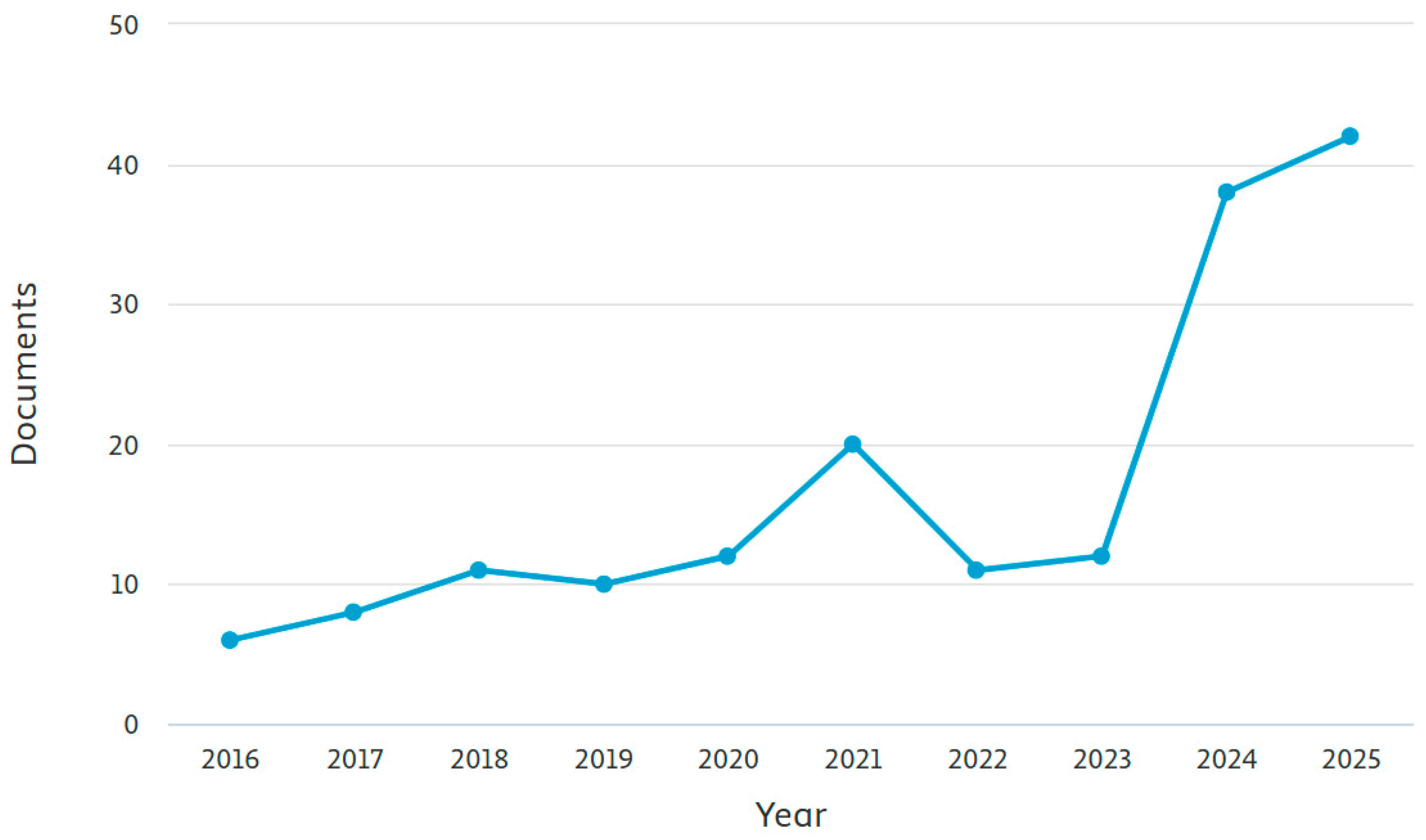
After applying the thematic, typological, and language filters, the initial pool was reduced to 169 studies. Their distribution by year is shown in
Figure 1.
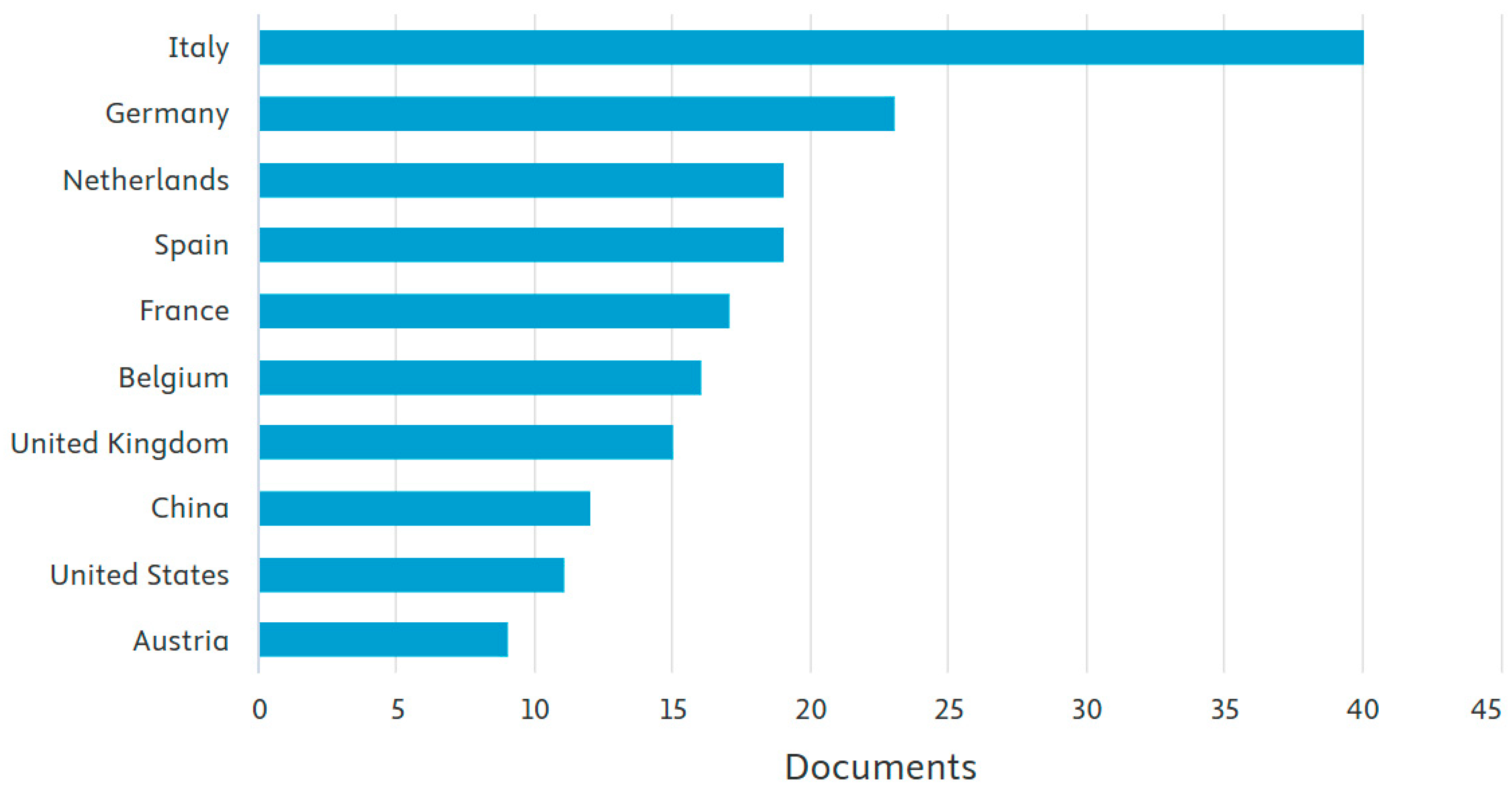
In terms of geographic distribution, Italy leads with 40 publications, followed by Germany (
n = 23). The Netherlands and Spain each contribute 19 publications, while other countries in the top ten include France, Belgium, the United Kingdom, China, the United States, and Australia, each with between 9 and 17 papers (
Figure 2).
The remaining records were screened in two PRISMA-style stages: first on the basis of title and abstract, and then through full-text assessment. The inclusion criteria were defined as follows:
- –
a focus on policies or economic instruments related to the circular economy, waste management, resource efficiency, or critical raw materials (regulations, directives, strategies, economic instruments, governance arrangements);
- –
relevance to critical raw materials and battery-related metals, including lithium, cobalt, nickel, copper, aluminum, rare earth elements, and their associated product chains (LIBs, electronics, magnets, energy equipment, etc.);
- –
the presence of measurable outcomes or substantive analysis related to markets, supply chains, and circularity, such as collection and recycling volumes, secondary content shares, material quality and specifications, investment, trade flows, and indicators of traceability and MRV;
- –
an explicit EU or European context, meaning the European Union appears as regulator, market, or reference point for assessing risks and dependencies, or global studies that are directly comparable to the European CRM/CE agenda.
Exclusion criteria primarily concerned studies that (i) focused exclusively on chemical, materials science, or engineering aspects (new recycling processes, material properties, etc.) without explicit analysis of the regulatory context, markets, or economic incentives, or (ii) described local cases outside the EU without a clear pathway for extrapolation to European policies or markets.
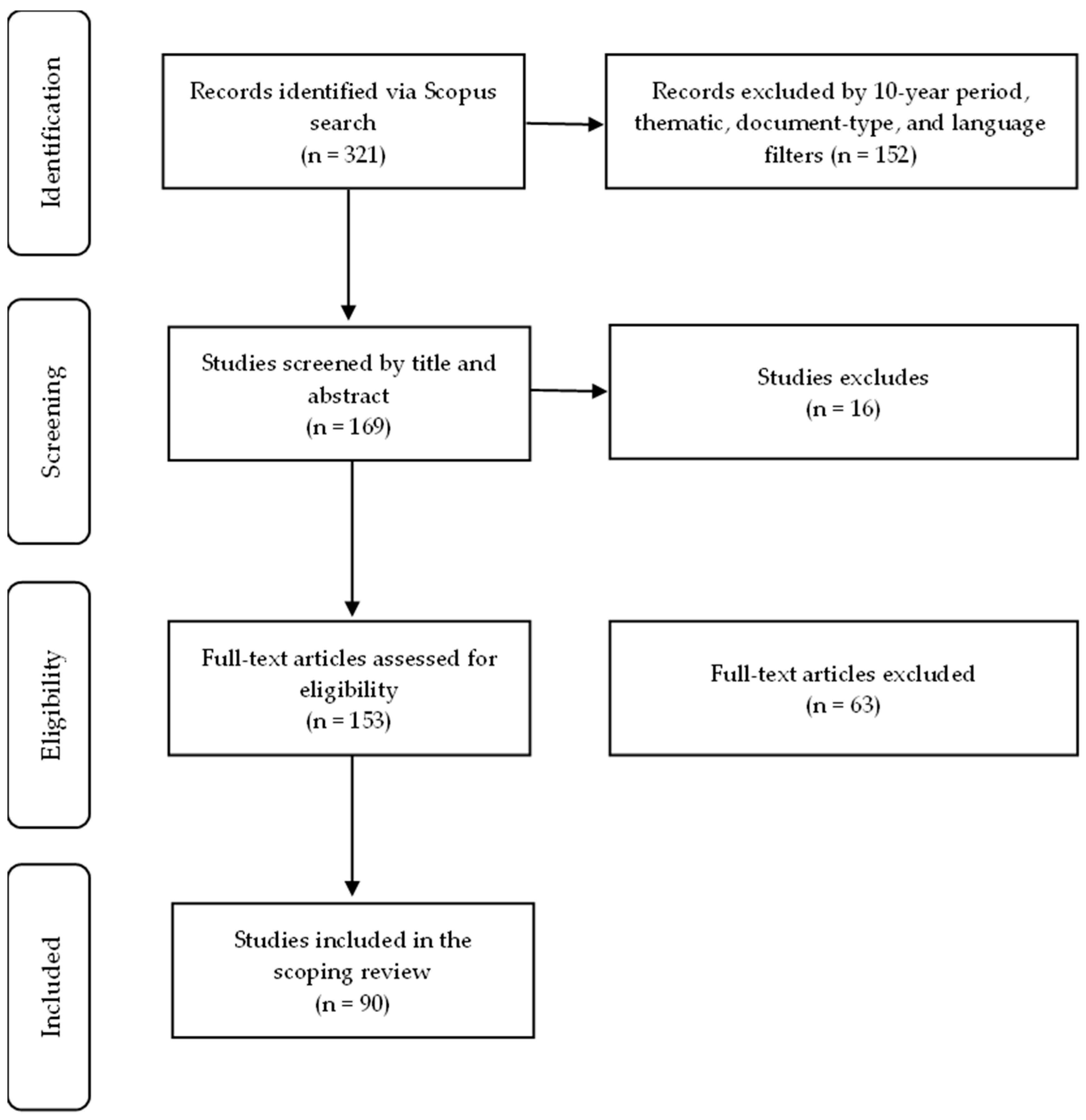
In the first screening stage, the titles and abstracts of the 169 records were assessed against these criteria. This step allowed the exclusion of publications with a clearly technological focus or only weak links to policy and markets, leaving 153 studies. In the second stage, full-text analysis was carried out for the studies meeting the inclusion conditions at the abstract level, with particular attention to the presence of concrete outcomes related to secondary supply, circularity, and sustainable development.
After the two-stage screening and full-text assessment, the final sample comprised 90 articles, as shown in the PRISMA diagram (
Figure 3).
To standardize the subsequent analysis, a detailed data extraction template was developed and implemented as a tabular database for the 90 included studies. Data were extracted for the following core fields:
- –
Material—the main type(s) of raw materials or products (Li, Co, Ni, Cu, Al, rare earth elements, mixed streams, urban mine, etc.);
- –
Value_chain_stage—the value chain stage(s) covered in the study (mining, primary processing, product design, use phase, collection, pre-processing, refining/recycling, secondary material production, trade);
- –
Study_type—the type of study (ex ante modeling, scenario analysis, prospective LCA, MFA, ex post evaluation, qualitative case studies, reviews, and conceptual works);
- –
Policy_instrument—the type of policy instrument considered (extended producer responsibility schemes, targets for collection/recycling/secondary content, product standards and ecodesign, fiscal and economic instruments, strategic frameworks, etc.);
- –
EU_focus—the nature of the European context (the EU as regulator, case studies of individual Member States, comparison of the EU with other regions, etc.);
- –
Outcomes—key results in condensed form (for example, changes in collection rates, recycling efficiency, impacts on prices and costs, dynamics of trade flows, indicators of traceability and the quality of secondary materials);
- –
Notes—clarifications on methodology, data sets, context, and the main conclusions of the study;
- –
Policy_level—the policy domain to which the analyzed instrument is assigned;
- –
Pillar_link—the regulatory “anchor” that links the study to one of the four regulatory pillars or to the broader policy mix.
This structure provides a quantitative description of the sample and supports consistent comparison of studies across key dimensions such as materials, value chain stages, instrument types, and regulatory level.
At the first level, for the Policy_level field, all studies were assigned to six policy domains:
- –
Product-/producer responsibility—studies centered on extended producer responsibility (EPR) schemes, deposit–refund systems, take-back and return obligations, and similar mechanisms that reallocate responsibility for end-of-life management.
- –
Product standards and design—studies analyzing ecodesign requirements, product standards, design for disassembly, traceability, and digital solutions (including precursors of Digital Product Passports).
- –
Targets and quotas—publications focused on quantitative targets for collection, recycling, secondary content shares, resource efficiency, and related indicators.
- –
Trade and shipment rules—studies in which rules for cross-border movements of waste and secondary materials are the main focus (including WSR regimes and international agreements).
- –
Economic/fiscal instruments—studies examining taxes, fees, subsidies, emissions-trading schemes, and other price and fiscally based instruments that shape incentives for recycling and the use of secondary materials.
- –
Strategies and soft law—publications in which the core of the analysis is strategies, roadmaps, action plans, framework programs, and overviews of mixed policy packages (policy mixes) at both EU and national levels.
The choice of these six policy domains followed a combined deductive–inductive logic. They reflect the main families of instruments that are actually used in the EU policy package on critical raw materials and the circular economy. Strategic documents and soft-law instruments set the overall trajectory and goal framework. Product standards and design (including ESPR and DPP) specify requirements for products and data flows. Extended producer responsibility and collection/recycling targets define obligations and quantitative benchmarks for market participants. Trade and customs regimes (WSR/Basel) determine the conditions for cross-border movements of waste and secondary materials. Economic and fiscal instruments provide price signals and shape the distribution of costs among actors.
These six domains formed the minimal set of categories that first allowed each instrument identified in the 90 studies to be assigned unambiguously to a single type and second made it possible to compare studies that formally refer to different legal acts but analyze the same class of incentives. In this sense, the Policy_level field represents an operationalized, author-developed typology. It is consistent with the logic of the EU CRM/CE policy mix and with common distinctions in the literature between strategic, regulatory, trade, and fiscal instruments, while being adapted to the empirical content of the article corpus.
At the second level, for the Pillar_link field, each article was assigned to one of several “regulatory anchors” that link the study to a specific regulatory act or to the broader policy mix:
- –
CRMA-related—studies that directly discuss the Critical Raw Materials Act, its preparation, or related CRM risk management initiatives;
- –
Batteries-related—studies focused on the new Batteries Regulation and its predecessors (the Battery Directive), including questions of EPR, targets, and secondary content;
- –
ESPR/DPP-related—publications centered on ecodesign, sustainable products, and Digital Product Passports;
- –
WSR-related—studies in which rules for cross-border movements of waste and secondary raw materials (the Waste Shipments Regulation and related regimes) are the main focus;
- –
Broader EU CE/CRM mix—articles analyzing the wider EU policy package on the circular economy and critical raw materials without focusing on any one of the four acts (strategies, action plans, policy-mix overviews, etc.);
- –
National/regional policies—studies on national or subregional strategies and measures relevant for CRMs and the circular economy, but not tightly tied to a specific EU act;
- –
Global—studies examining global regimes and markets that nonetheless shape the context for European policy on critical raw materials and secondary materials.
The distinction between Policy_level and Pillar_link serves two main purposes. First, it shows which types of instruments the literature actually examines. Second, it allows the evidence base to be interpreted through the four central regulatory pillars and the broader set of strategic and soft instruments. In the following sections, the results are analyzed within this two-dimensional frame (“instrument × regulatory level × value chain stage”). This frame is then used as an integrative analytical framework (“instrument × stage × signal”) to synthesize findings for the four regulatory pillars and relate them to sustainable development goals.
Approach to synthesizing results.
Given the considerable heterogeneity of methods and outcomes across the included studies (ranging from scenario-based MFA and prospective LCA to qualitative interviews and legal analysis), we adopted a narrative and thematic synthesis. For each of the four regulatory pillars—CRMA, the Batteries Regulation, ESPR/DPP, and the recast WSR—we developed thematic blocks that (i) describe the instrument’s design and its role within the European policy mix; (ii) summarize the main types of empirical and modeling studies (ex ante and ex post) captured in the Policy_level and Pillar_link fields; (iii) synthesize key findings related to secondary CRM supply, markets, trade flows, and sustainability indicators; and (iv) identify gaps and methodological limitations in the literature.
As a separate step, we identified and analyzed cross-cutting strategies and soft-law/fiscal instruments that are not reducible to any one of the four acts but shape expectations and modify investment signals (for example, CE and CRM strategies, industrial policy, fiscal incentives for recycling). These studies are mainly classified in the Strategies and soft law and Economic/fiscal instruments domains and are used to interpret the robustness of effects associated with the regulatory package as a whole.
To account for heterogeneity in evidence strength without imposing a single quality metric, the synthesis explicitly differentiates between (a) peer-reviewed empirical ex post evaluations and econometric analyses, (b) ex ante scenario and modeling studies (e.g., MFA/LCA-based projections), (c) qualitative case studies and stakeholder interviews, and (d) legal–conceptual or policy-framework papers. Throughout
Section 3 and
Section 4, we label conclusions as observed effects versus expected mechanisms and give greater weight, when discussing effectiveness, to findings grounded in transparent data and replicable methods.
We deliberately do not apply formal quality assessment scales or quantitative risk-of-bias procedures, since the heterogeneity of methods and outcomes (from legal analysis to scenario modeling) makes comparison within a single metric only weakly informative. Instead, the review concentrates on mapping the types of data, approaches, and results used in the literature and on identifying recurring patterns and gaps in the evidence base. Accordingly, the synthesis focuses on mapping mechanisms, signal channels, and evidence gaps across the four pillars, rather than producing quality-weighted estimates of effectiveness. Quantitative synthesis/meta-analysis was not pursued because effect sizes are not reported in a sufficiently comparable form across the included studies, particularly for the more recent acts.
Taken together, this review design makes it possible to systematically describe and interpret the existing academic literature on the effects of EU policy on secondary flows of critical materials and the associated sustainability outcomes while also making the methodological assumptions and limitations explicit.
3. Results
3.1. Sample Characteristics and Study Classification Scheme
In line with the PRISMA protocol, the initial Scopus search for 2016–2025 yielded 321 records at the intersection of critical raw materials, the circular economy, and policy instruments in the EU. After removing duplicates, screening titles and abstracts, and then assessing full texts against the inclusion criteria, 90 articles were retained in the final sample. All of them either describe a European context (the EU as regulator, market, or reference point for assessing CRM risks) or global processes that are directly relevant to the emerging EU policy package on critical raw materials and the circular economy.
Materials and value chain stages. With respect to covered materials, the sample is skewed toward raw materials and products linked to the battery supply chain. Around one-third of the studies focus on lithium as a key critical raw material (including analyses not directly tied to specific end products). A substantial group of publications examines other metals that are important for batteries and e-mobility infrastructure (cobalt, nickel, copper, aluminum), as well as rare earth elements and magnets. Roughly one-third of the articles analyze a broader set of materials or combined waste and secondary material streams (various metals, mixed waste flows, the urban mine), reflecting the complex structure of secondary supply chains.
In terms of value chain stages, many studies span several steps at once (product design, use phase, end-of-life, recycling, and secondary material trade), and thus work with a “full” or aggregated value chain. Some articles concentrate on earlier stages (mining, primary processing, anthropogenic deposits), while others focus on waste collection and logistics, metal recovery and refining, or macro-level material and trade flows. Taken together, this makes it possible to consider the effects of EU policy on secondary CRM supply not only at a single point, but along the entire value chain.
Types of studies. From a methodological perspective, the sample is relatively diverse but shows some clear imbalances. A large group consists of ex ante and scenario-based studies (material flow modeling, scenarios for meeting collection and recycling targets, assessments of future scarcity and secondary supply potential). Another sizable block includes conceptual and framework papers that propose classifications, urban mine concepts, typologies of policy instruments, and CRM risk assessment frameworks. A distinct group is formed by case studies (qualitative analyses of individual countries, sectors, or supply chains, often based on stakeholder interviews and industry statistics) and review articles that synthesize experience with circular economy instruments applied to critical raw materials.
By contrast, ex post econometric evaluations and strictly causal empirical studies aimed at quantifying the actual impact of specific regulatory measures (for example, changes in recycled content requirements or the introduction of new collection targets) account for a much smaller share of the sample. Already at this descriptive level, this points to an important gap: scenario-based work and extrapolations clearly dominate, while only a limited number of studies assess the realized effects of policy interventions (
Table 1). This imbalance motivates the comparative strategy used below: we use a common “instrument × stage × signal” template to assess coherence across pillars while explicitly flagging where evidence is predominantly ex ante or conceptual.
To analyze how policy affects secondary CRM supply, all articles were coded by the type of instrument they examine. Six domains (Policy_level) were distinguished (
Table 2).
To connect the fragmented evidence base to the emerging package of EU regulatory acts adopted in 2023–2025, an additional variable, Pillar_link, was introduced. It shows which regulatory “pillar” or policy level each article relates to (
Table 3).
To make this comparative logic explicit,
Table 4 operationalizes the proposed “instrument × stage × signal” framework across the four regulatory pillars.
The table consolidates, for each pillar, the primary value chain stages addressed, the dominant signal channels, and the prevailing evidence status in the reviewed corpus (ex post empirical, ex ante modeling, qualitative, legal–conceptual).
Section 3.2,
Section 3.3,
Section 3.4,
Section 3.5 and
Section 3.6 apply this mapping to structure pillar narratives and to compare reinforcement pathways and tensions across acts, including the two horizontal domains (Strategies and soft law; Economic/fiscal instruments).
3.2. CRMA and the Strategic Governance of Critical Raw Materials and Secondary Supply
Within our sample, the Critical Raw Materials Act (CRMA) appears more as the culmination of an already established research trajectory than as its starting point. Only five of the 90 articles are directly linked to CRMA (the CRMA-related cluster), and most of them either situate CRMA within the broader architecture of EU green industrial policy or examine it from a legal–political and institutional perspective, rather than providing rigorous quantitative ex post assessments of its effects on secondary supply. This pattern reflects an early phase in the “life cycle” of the regulation itself: the legal framework has already been adopted, but empirical evaluations of its actual impact on secondary material markets are still emerging.
Stakeholder and institutional assessments of CRMA. In [
26] CRMA is placed in the context of the wider Green Deal Industrial Plan and the Net-Zero Industry Act. Drawing on stakeholder interviews and policy analysis, the authors show that CRMA is perceived as a key element of the “scaffolding” for raw material security, but at the same time as a source of regulatory fragmentation and rising requirements for reporting and traceability along supply chains, including for batteries and related CRMs.
At the level of national implementation, Alexandru in [
16] analyzes the Romanian case and demonstrates that European initiatives on critical raw materials, including CRMA, are layered onto an already fragmented domestic legal framework. The conclusion is that, without institutional strengthening and adjustments to project approval procedures, waste and secondary flow monitoring, and investment support for recycling, CRMA’s targets for processing and recycling remain largely declarative.
From a legal–political perspective, Crochet and Zhou interpret CRMA as part of a broader shift in EU resource policy—from a predominantly “soft” approach toward a more active strategy of supply chain governance and risk reallocation between internal and external sources [
27]. They emphasize that the stronger security dimension may come into tension with rules of the international trading system, creating potential frictions for raw material supplier countries.
The other two CRMA-related articles focus on the links between critical raw materials, the circular economy, and specific product streams. Vafeas et al., using the example of electronics, show that CRMA’s “raw material” framework alone is insufficient to achieve the goal of reducing import dependence on CRMs [
28]. They argue that integration with waste policy, product standards, and recycled content requirements is needed to create predictable incentives for recycling and urban mining. Jakimów, analyzing CRMA through the lens of EU strategic autonomy, stresses that closing material loops for CRMs (through recycling, reuse, and substitution) does reduce vulnerability to external shocks, but that physical limits on waste volumes and technological losses make CRMA a necessary yet not sufficient condition for raw material security [
29].
Taken together, this “narrow” CRMA cluster indicates three main points: (i) the regulation already sets long-term benchmarks for processing and recycling; (ii) the empirical literature so far is dominated by qualitative and legal–conceptual assessments; and (iii) quantitative ex post evaluations of actual effects on secondary supply for individual CRMs are, at this stage, almost entirely absent.
Preceding wave of research: from security of supply to criticality and geopolitics.
The lack of direct assessments of CRMA is partly offset by a large body of work in the Broader EU CE/CRM mix domain, which examines CRMA’s predecessors and measures with a similar logic. These studies document the main challenges—risk of supply, concentration of extraction, low recycling rates, and leakage of secondary materials—that CRMA now addresses in legal and institutional terms.
Løvik et al. review ongoing EU initiatives aimed at improving the security of supply of critical metals and related research projects [
30]. They show that the key problems are low end-of-life recycling rates, technological losses, and institutional barriers to the development of recycling within the EU. In effect, these findings anticipate CRMA’s quantitative targets for processing and recycling.
Cimprich et al. systematize approaches to assessing material criticality at the product level and propose integrating indicators of supply risk and economic importance into product life-cycle assessment as a complement to environmental LCA [
31]. Such product-oriented assessments later provide the basis for selecting “critical” value chains and for CRMA’s focus on particular groups of materials.
The geopolitics of the European Green Deal emphasizes that the EU’s climate agenda inevitably increases external resource dependence, especially for mineral resources used in the energy transition [
17]. The authors argue that the EU will have to combine internal circularity (recycling, reuse, resource efficiency) with new partnerships and risk management mechanisms for supply. CRMA can be seen as a direct institutional response to these conclusions.
CRMA in the context of the broader circular economy policy mix.
An important part of the evidence base for the CRMA pillar comes from studies that do not focus solely on critical raw materials but analyze the entire EU circular economy policy mix and its internal coherence. In [
32], network analysis is used to examine the connectedness and coherence of EU circular economy policies. Their results show that these policies form not just a collection of individual instruments but a system of interlinked measures, in which strategic documents, targets, product standards, and economic incentives cluster together.
Although CRMA is not yet fully integrated into this system in empirical terms (because of its recent adoption), the findings by Rizos and Zambianchi support an important conclusion for our analysis: the effects of CRMA on secondary CRM supply cannot be assessed in isolation [
32]. It will operate through (i) the alignment of targets for extraction, processing, and recycling with existing EPR instruments, product standards, and collection/recycled content targets, and (ii) its influence on the expected stability and predictability of the overall policy mix for firms making investment decisions in recycling and urban mining.
Taken together, the narrow CRMA-related cluster and the broader body of studies on precursor and accompanying measures point to several core observations that are important for the following subsections:
- –
Regulatory signals are already strong, while empirical evidence is lagging. CRMA sets quantitative benchmarks and raises the profile of critical raw materials in EU industrial policy, yet the literature still mainly describes expected effects on secondary CRM supply and offers almost no rigorous ex post evaluations.
- –
CRMA builds on an already established field of research on criticality and security of supply. Studies on criticality, supply risk, and geopolitics [
17,
30,
31] have, in effect, defined the problem space to which CRMA provides an institutional response.
- –
The expected impact on secondary CRM supply is systemic in nature. On the basis of policy-mix analyses [
32] and sectoral case studies [
28,
29], it is reasonable to expect that CRMA will strengthen secondary supply indirectly through (i) tighter coordination between strategic objectives, design standards, EPR schemes, and recycling targets; (ii) higher predictability for investments in recycling and urban mining in the EU; and (iii) new requirements for data and traceability, which are then taken up and operationalized by ESPR/DPP and the Batteries Regulation.
It is in this systemic sense that CRMA is treated in the remainder of the paper: not as an isolated act, but as a “vertical” pillar that sets the strategic frame for the other instruments (the Batteries Regulation, ESPR/DPP, WSR) and amplifies their effects on secondary CRM supply chains and on SDG-relevant impact channels and indicators (SDGs 7, 9, 12, and 13).
Within the instrument × stage × signal mapping (
Table 4), CRMA primarily provides strategic and coordination signals that shape system-level enabling conditions rather than stage-specific binding requirements for secondary flows. Consistent with
Table 1, the pillar-specific evidence remains dominated by qualitative/review and conceptual–institutional contributions, with ex post evaluations absent.
3.3. The EU Batteries Regulation: Secondary Content Quotas, Recovery Targets, and Signals for Secondary CRM Markets
The new EU Batteries Regulation 2023/1542 [
11] is the second key pillar of the package, translating the broad CRMA agenda to the level of a specific product. Unlike CRMA, which sets macro-level targets for extraction, processing, and recycling of critical raw materials, the Batteries Regulation works with very strict micro-level parameters. These include mandatory minimum shares of secondary content for Li, Co, Ni, and Pb, progressively tightening metal recovery targets, requirements on carbon footprint and extended producer responsibility, and a detailed system of monitoring and reporting.
Although Regulation 2023/1542 is relatively recent, our sample already includes 19 related articles. At the same time, many of these studies remain ex ante in nature, focusing on scenarios, methodological design, or legal analysis. To understand how the Batteries Regulation affects secondary supply of critical metals, it is therefore necessary to draw on a broader set of evidence: studies on the drafting of the new directive/regulation, work on the previous Battery Directive, analyses of LIB flows and the EU “urban mine,” and LCA studies in which new quotas and targets are explicitly built into scenarios. Below, these strands are summarized in the logic “instrument design → economic signals → expected effects for secondary CRMs and SDGs 7, 9, 12, 13.”
Regulatory design and strategic signals for supply chain actors.
Qualitative studies show that the Batteries Regulation substantially reshapes the institutional environment for the EV–LIB chain. It strengthens circular economy requirements while at the same time making the regulatory landscape more complex for firms and regulators. A systematic review of global regimes for end-of-life traction LIBs demonstrates that the EU combines the strictest EPR architecture with binding recycling and secondary content targets, alongside high regulatory complexity [
21].
Shqairat and coauthors analyze the text of Regulation 2023/1542 and complement it with semi-structured interviews with EV–LIB supply chain actors, identifying three main trajectories: operational resilience and safety, R&D and new technologies, and evolving patterns of cooperation between manufacturers, recyclers, and regulators [
14]. Their study shows that the regulation creates “proactive” stakeholders, who use the new requirements as a stimulus for innovation and collaboration, and “reactive” actors, who are merely forced to adapt to growing regulatory pressure, with implications for how costs are distributed.
The legal analysis by Danthinne and Picard focuses on the compatibility of the Batteries Regulation and the associated e-mobility framework with circular economy objectives [
33]. The authors show that stricter requirements on collection, recycling, and secondary material content do move the sector closer to a CE model. However, weak coordination between sectoral acts and fragmented implementation across Member States generate regulatory frictions and uncertainty for investors.
Melin et al. place the Batteries Regulation in the wider context of global supply chains and argues that strict EU requirements on carbon footprint, recycled content, and due diligence can reshape LIB and CRM flows by shifting parts of the value and risk to exporting countries [
34]. From the perspective of this review, this implies that EU regulation of secondary materials may trigger responses in third countries and affect not only Europe’s “urban mine,” but also the global balance between primary and secondary supply.
In parallel, Arora et al. examine the regulation’s requirements (for example, on secondary material content and carbon footprint) through the lens of WTO compatibility, showing that some provisions can be interpreted as de facto discriminatory toward producers from developing countries [
35]. This finding links back to the “green protectionism” issues discussed in the CRMA sections and highlights the need to align the Batteries Regulation with trade rules and the reformed WSR.
Taken together, these studies provide a nuanced picture. The Batteries Regulation sends strong signals about the predictability and long-term nature of demand for secondary metals and encourages investment in recycling, new technologies (such as direct recycling and reactivation), and digital traceability. At the same time, the broad definition of “economic operators,” uneven national implementation, and potential trade disputes introduce additional risks for firms, particularly those operating outside the EU [
14,
35].
Quotas, recovery targets, and modeling of secondary material flows.
Quantitative studies indicate that meeting the recycling targets and secondary content levels set in the regulation is far from straightforward, even under optimistic assumptions about infrastructure development.
Ginster et al. integrate a system-dynamics model of the EV market in the EU-27 with prospective LCA to assess compliance with the minimum shares of recycled materials required by the regulation and the associated environmental effects [
36]. They conclude that post-consumer battery flows alone are insufficient to meet the ambitious targets for Co and, to some extent, Li before 2035–2040. Under realistic battery lifetimes, a gap emerges between the available volume of scrap and the regulatory quotas. Giving greater weight to post-production waste helps to narrow this gap, but also introduces a risk of distorted incentives: firms may have an interest in generating “regulated” scrap rather than minimizing it.
An ex ante assessment of specific recyclate streams in “regulation-compliant” LIB production shows that the effect of secondary material use on GWP and other indicators is not uniformly positive; it depends strongly on cell chemistry and the chosen recycling technology [
37]. In several scenarios, high secondary content quotas can even increase total impacts in certain categories (for example, marine eutrophication) because of energy-intensive and chemically intensive recycling processes. This finding underlines the importance of combining quantitative targets with stringent requirements on process quality and on the properties of secondary materials themselves.
Several studies consider the Batteries Regulation together with global flows and the EU’s position in the world LIB industry. Liu and coauthors model how the combination of EU Batteries Regulation requirements (recycling efficiency, collection rates, carbon footprint) affects China’s export-oriented lithium-ion sector [
38]. They show that tightening EU standards can both stimulate investment in cleaner recycling technologies and impose substantial costs on firms that are unable to modernize quickly. For the purposes of this review, the key point is that a large share of the future volume of secondary CRMs circulating in Europe depends on investment and policy decisions outside the EU, not solely on internal regulation.
At the global level, the impact of CE measures similar to the Batteries Regulation on the structure of primary and secondary Li flows is modeled by Wu et al. [
39]. Using prospective supply chain analysis, they show that even with high collection and recycling rates, secondary lithium will cover only a limited share of future demand, especially before 2040, because of the inertia created by stocks locked in operating batteries. This result aligns well with studies of global Li flows, which find that secondary lithium remains a supplement rather than a substitute for primary extraction, even under aggressive collection and recycling scenarios [
7]. Taken together, these findings imply that, while the Batteries Regulation strengthens the role of secondary supply, it does not remove the EU’s fundamental dependence on primary CRMs; it only moderates it to some extent.
Scenario-based estimates of future returns of traction batteries highlight that the peak of available post-consumer scrap occurs with a noticeable delay relative to the peak in EV sales [
40]. This creates a temporary “shortage window” for secondary materials, during which secondary content requirements are already in force, but the flow of spent batteries is still insufficient. In practical terms, this calls for timely planning of recycling capacity, integration of 3R solutions (reuse and remanufacturing), and explicit consideration of cross-border flows within the framework of the revised WSR.
Methodological developments in LCA and EPR: foundation for MRV and digital passports.
A share of the literature on the Batteries Regulation is methodological rather than evaluative, but it is crucial for our topic, because these studies define MRV standards and data architectures on which digital passports and quota reporting will have to rely.
Husmann and coauthors examine how the choice of stakeholder perspective (regulator, manufacturer, recycler) and the associated allocation scheme affects LCA results for LIBs in the context of the new battery directive/regulation [
41]. They show that differences between cut-off, avoided-burden, and hybrid approaches lead to substantial variation in outcomes. As a result, without harmonized methodologies, comparability of carbon footprint reporting and progress toward secondary content targets is problematic.
In another study, the authors conduct an ex ante LCA of different strategies for reactivating cathode materials in direct recycling, explicitly using the framework of future EU Batteries Regulation requirements [
42]. They find that the choice of recycling technology and energy mix can substantially change the overall impact profile and that some options that are attractive from a material efficiency perspective are less favorable in terms of climate and other ecosystem indicators. These results are directly relevant to which processes are recognized as eligible when calculating recovery rates and secondary content shares.
A further methodological contribution is a three-step procedure for assessing whether a given battery system complies with the regulation [
43]. The authors propose decomposing regulatory requirements into verifiable indicators and linking textual provisions to concrete product and process parameters. For the purposes of this review, this is an example of how the Batteries Regulation is translated into engineering and management decisions: from abstract quotas to specific KPIs that must be embedded in digital passports and company reporting.
Regulatory logic and target requirements: from EPR to mandatory recycled content shares.
Most articles that deal explicitly with the new Batteries Regulation treat it as an evolution of the previous regime rather than a clean break. The focus is on the shift from the relatively soft framework of Directive 2006/66/EC (take-back obligations and targets for collection and recycling, but weak incentives related to valuable metals) to the stricter architecture of Regulation 2023/1542 [
11], in which:
- –
minimum recycled content shares are introduced for cobalt, lithium, nickel, and other metals;
- –
metal recovery targets in recycling are raised and differentiated;
- –
producer responsibility is strengthened through more precise requirements on information, traceability, and secondary material quality;
- –
the battery digital passport appears as a link between regulatory objectives and actual material flows.
Some studies examine Regulation 2023/1542 in connection with industrial policy and the resilience of supply chains. “Sustainable battery ecosystem” scenarios for 2030 suggest that complying with the new requirements on recycling and secondary content requires growth in recycling capacity together with a reorientation of supply chains and investments toward the EU [
44]. The authors combine demand–supply projections, vulnerability indicators (including indices of institutional instability in raw material supplier countries), and recycling scenario analysis to identify the trajectories of capacity expansion and waste collection under which the new recycled content thresholds are even feasible.
A qualitative study of LIB management practices in the EU finds that fragmented regulation, uncertainty about quality requirements in recycling, and cross-country differences in EPR implementation weaken investment incentives for high-quality recycling, despite a stronger legal framework [
45]. This means that even strict targets in the Batteries Regulation encounter institutional bottlenecks at the implementation stage. An analysis of end-of-life LIB management systems in the EU shows that collection and recycling infrastructure is not keeping pace with the rapid growth in volumes and that existing EPR schemes do not ensure full capture and return of batteries into the formal sector [
46]. This further underscores the gap between collection targets and the actual secondary supply of battery-related CRMs. A case study on reverse logistics for traction LIBs in the EU identifies a set of systemic barriers—from blurred responsibility boundaries along the EPR chain to weak incentives for battery return and poor coordination among actors—that directly constrain realized secondary supply of battery CRMs [
47].
To assess the potential and limits of the new Regulation in shaping secondary CRM markets, the accumulated experience with Directive 2006/66/EC and national EPR schemes, as documented in the 2016–2022 literature, is therefore highly relevant.
Limitations of the existing literature and implications for secondary supply analysis.
Despite rapid growth in the number of publications, the empirical evidence on the actual impact of the Batteries Regulation on secondary CRM supply remains limited.
First, most studies take a forward-looking perspective (system dynamics, ex ante LCA, MFA scenarios) and model future effects over 2030–2050 time horizons [
36,
39]. This work is important for understanding potential pathways, but it provides very little information on observed price responses, investment behavior, or changes in trade flows.
Second, the behavior of households and firms at the collection and waste management stage remains a weak point. Existing research already documents substantial leakage of LIBs into household waste streams and embedded batteries in WEEE, which undermines the achievement of target collection rates and adds further risks [
48]. An empirical analysis of end-of-life portable Li-ion flows in the EU and in Poland shows that, even when national targets are formally met, a significant share of batteries still escapes official collection and recycling channels, further narrowing the secondary supply base for Li, Co, and Ni [
24].
Third, there is almost no rigorous ex post evidence on how the new requirements for secondary content and recovery are translated into prices, margin distribution along the chain, or the competitiveness of different business models (for example, vertically integrated producers with in-house recycling versus independent recyclers).
For this review, these gaps imply that the battery pillar can be described in considerable detail in terms of intent, instrument architecture, and potential trajectories, whereas quantitative conclusions about the realized expansion of secondary supply and the contribution to SDGs 7, 9, 12, and 13 are still largely based on models and assumptions. For that reason, in the following subsections we systematically compare the findings on the Batteries Regulation with the broader literature on LIB and CRM flows and with the provisions of CRMA, ESPR/DPP, and WSR to assess how coherent and feasible the overall policy package for developing secondary material markets appears.
Table 4 summarizes this pillar’s downstream focus (collection–recycling–recycled content uptake) and its primarily compliance-based signal structure (binding targets and product-specific obligations), which serves as the reference point for the cross-pillar comparison that follows.
3.4. ESPR and Digital Product Passports: Product Standards and Data Architecture for Circular CRM Chains
The Ecodesign for Sustainable Products Regulation (ESPR) and the associated concept of Digital Product Passports (DPP) constitute the third pillar of the policy package considered in this review. Unlike CRMA, which provides a framework for critical raw materials, and the Batteries Regulation, which focuses on a single product group, ESPR operates as a horizontal instrument. Through requirements on design, durability, reparability, disassembly, and mandatory digital information, it is intended to ensure traceability of material flows and to make circularity an embedded property of products.
In our sample, only a small number of articles (five studies) can be classified as ESPR/DPP-related in the narrow sense: they explicitly discuss forthcoming ecodesign and DPP requirements or analyze regulatory initiatives that directly anticipate ESPR. This thin layer, however, rests on a broader body of work in the Product Standards and design and Broader EU CE/CRM mix domains, where the focus is on (i) product standards and design requirements for electronics and batteries; (ii) the role of information and traceability in managing CRM flows; (iii) methodological foundations for MRV and LCA on which digital passports are expected to build.
Ecodesign and DPP as a link between CRM objectives and firm behavior.
Studies directly assigned to the ESPR/DPP pillar emphasize that the new ecodesign framework and DPPs go beyond “classic” energy efficiency goals and reorient product policy toward circularity and critical raw materials.
Talens Peiró examines the new ecodesign regulation for servers and data-storage equipment as a flagship example of integrating circular economy principles into product requirements [
49]. The study shows that combining requirements for energy efficiency, reparability, lifetime, and upgradability leads not only to lower energy use, but also to changes in material flows, including components containing CRMs. The authors demonstrate that criteria for disassembly and access to information on product composition have a direct impact on the economics of recycling and on the feasibility of recovering critical metals.
In an earlier article, Talens Peiró extends this approach by proposing a methodology for assessing the disassemblability of battery modules within European product policy [
50]. Using batteries in laptops and tablets as examples, the authors show that current EU product policies only partially reflect Design for Disassembly: batteries are often integrated in ways that make their removal without damage and at reasonable cost difficult. This constrains the potential for high-quality recycling and secondary CRM recovery, even where downstream recycling infrastructure is available [
50].
A study on micromobility applies the same logic to e-scooters and e-bikes [
51]. Analysis of current EU directives (WEEE, Ecodesign, Batteries) shows that micromobility remains a blind spot in CRM policy: devices are retired quickly, but the directives provide weak incentives for take-back and recovery of critical materials from batteries and electronics. The authors explicitly propose strengthening existing instruments by adding CRM-specific recovery targets and requirements for minimum shares of secondary CRMs in micromobility components [
51]. This directly anticipates the logic of ESPR: product requirements and data should be tailored to specific critical materials, not only to total waste mass or energy performance.
Husmann in [
52] analyzes the Product Environmental Footprint (PEF) and sectoral EF rules for batteries, vehicles, and chemical products. The study shows that different interpretations of multifunctionality and recycling in EF guidance lead to markedly different footprint results for the same EV batteries. This creates a risk of methodological “gaming” and undermines the comparability of data that are supposed to underpin DPPs. The authors argue that, without harmonization of PEF/EF methods, digital product passports may institutionalize non-comparability rather than improve transparency [
52].
An additional case on rare earth magnets in the energy sector shows that, even under rising demand and stronger circular economy efforts, dependence on primary raw materials persists if there are no clear requirements on product design and magnet recovery [
53]. This finding supports the view that ESPR/DPP should contain material-specific standards and indicators for components that embed CRMs, rather than relying solely on general product-level parameters.
Across these examples, ESPR and DPP function as a transmission channel between the strategic objectives of CRMA and the Batteries Regulation and the concrete level of product properties and data architecture. In practice, this means translating targets for secondary content and metal recovery into design and information requirements that make these targets technically attainable and verifiable at the product level.
Preceding experience: from “energy-centered” ecodesign to a material-centered approach.
The limited number of direct assessments of ESPR is partly offset by a substantial body of work examining earlier waves of ecodesign and related policies. A systematic study of European policies affecting electronics and batteries [
54] provides a “map” of all relevant acts, from WEEE and the Batteries Directive to early ecodesign regulations for energy-intensive products. The authors show that, until recently, policy focused primarily on energy efficiency and waste management, while issues of critical raw materials and design for disassembly remain secondary. The policy landscape is characterized by strong fragmentation across sectors and product types, and design and information requirements are defined in a heterogeneous way.
A review of EU initiatives on security of supply and CRM supply chain resilience [
30] confirms that, prior to CRMA and ESPR, resource security and ecodesign agendas evolved largely in parallel. Climate and energy policy was strengthened on one side, and CRM lists and supply strategies were developed on the other, but links between product policy and CRM objectives remained weakly institutionalized.
An important methodological bridge between product policy and critical raw materials is provided by the work on product-level criticality [
31]. This study compares methods for assessing supply risk and material importance at the product level and proposes integrating criticality indicators into life-cycle assessment. This approach creates a basis for differentiated design and information requirements: the higher the criticality of a material, the stronger the case for stringent standards on its traceability and recovery. ESPR subsequently embeds this logic by envisaging priority product groups with tailored indicator sets.
Material flow analysis of secondary sources of neodymium magnets shows that, even though the EU has a sizable “urban mine” of Nd, actual secondary flows remain small [
55]. The reasons lie not only in limited recycling infrastructure, but also in product characteristics: magnet placement in equipment, lack of standardized information, and disassembly complexity substantially increase recovery costs. This underscores that, without ESPR-type requirements on design and information, the potential of secondary CRM supply can only be partially realized.
Finally, an analysis of policy coherence within the EU CE policy package shows that product standards and information tools form a distinct cluster within the policy mix, closely connected to both resource efficiency objectives and the CRM agenda [
32]. By mapping the interlinkages between strategies, targets, standards, and economic instruments, the authors conclude that, without stronger horizontal standards for design and data (in the ESPR/DPP logic), the achievability of circularity and CRM goals remains uncertain.
Taken together, this body of work situates ESPR/DPP not as a break with past practice, but as a logical step in the evolution of product policy—from a focus on energy savings toward material-centered and criticality sensitive circularity.
Limitations of current empirical evidence and the expected role of ESPR/DPP in shaping secondary CRM supply.
As with CRMA and the Batteries Regulation, there are currently almost no rigorous ex post assessments of how ESPR and DPP affect actual volumes of secondary CRM supply. Existing studies (i) conceptualize the role of design and information in electronics, micromobility, and battery value chains [
49,
50,
51]; (ii) analyze the overall configuration of the policy mix and CRM criticality [
30,
31,
32,
54]; or (iii) focus on PEF/EF methodology and the operationalization of regulatory requirements in measurable indicators [
52].
Even so, this fragmented body of work supports several core conclusions that are important for the subsequent analysis.
First, direct evaluations of ESPR/DPP are scarce (five articles), but the substantial literature on earlier ecodesign measures and measurement methodologies makes it possible to infer likely effects. These effects concern less the immediate “increase in tons recycled” and more the creation of design and information conditions that enable CRM recovery along the entire value chain.
Second, ESPR/DPP close the gap between strategic objectives and product-level targets. CRMA and the Batteries Regulation define how much critical raw material should be extracted, processed, and returned, while ESPR specifies what products and data must look like for these targets to be technically achievable and institutionally controllable.
Third, the realization of ESPR’s potential depends on its alignment with the other pillars and on the quality of the underlying data architecture. Without harmonized PEF/EF methods and clear criteria for measurement and interpretation, DPP risks becoming a formal reporting obligation that does not materially change the behavior of producers, recyclers, or consumers.
In the comparative framework (
Table 4), ESPR/DPP functions as a horizontal enabling pillar by shaping design- and information-related conditions (product requirements and traceability/data architecture) across multiple stages. As reflected in
Table 1, the current corpus is largely conceptual–legal and early qualitative, with only limited ex ante modeling and no ex post evidence. In the following sections, these insights are used to compare the four pillars (CRMA, the Batteries Regulation, ESPR/DPP, WSR) within our “instrument × value chain stage × signal” framework and to assess the extent to which their combination creates stable and predictable conditions for the development of secondary critical material markets in the EU.
3.5. WSR and Rules for Transboundary Waste Movements: “Gateways” for Secondary CRMs
The fourth pillar in our framework is the Waste Shipments Regulation (WSR) and, more broadly, the rules governing trade in waste and secondary raw materials. In our dataset, only one article is classified directly as WSR-related [
5], two additional studies fall into the Trade and shipment rules domain, and several publications in the Broader EU CE/CRM mix block examine international and European regimes for waste management and “anthropogenic deposits.” Thus, while there are almost no direct assessments of the revised WSR, this broader body of work on earlier regimes and related measures makes it possible to reconstruct the role of transboundary waste rules in shaping secondary CRM supply and to identify remaining gaps.
The article in Resources Policy [
5] serves as a methodological anchor for understanding how the European Commission assesses raw material criticality. The author(s) update the criticality assessment method by incorporating indicators of (i) import dependence; (ii) trade barriers and political regulatory risks; and (iii) the role of recycling and secondary supply. The analysis shows that restrictions on cross-border flows of waste and secondary materials—such as customs barriers, export/import restrictions on certain fractions, and legal uncertainty over “waste vs. resource” status—directly increase criticality.
Even where a substantial urban mine exists within the EU, secondary CRMs may remain effectively inaccessible because of regulatory frictions [
5]. In other words, the methodology underpinning CRMA already embeds the premise that rules governing waste and secondary material trade are not peripheral, but a key driver of supply risk. In this sense, the revised WSR continues a line established well before its update: reducing criticality is possible not only through mining and recycling, but also by removing unnecessary barriers to secondary resources.
A historical review of global and European initiatives on waste and the circular economy traces the evolution of a multi-level waste governance system, from the Basel Convention and the earlier WSR to current debates on the circular economy, climate policy, and resource security [
56]. The article shows (i) how restrictions on exports of hazardous waste from and to the EU were developed; (ii) how the environmental dimension was gradually strengthened, while CRM and “secondary deposits” remained at the margins for a long time; (iii) how fragmented the regulatory landscape became, with separate acts on waste, trade, resource policy, and the circular economy. The authors conclude that the existing regime for waste and secondary material trade aligns poorly with CRM and secondary supply objectives, which was one of the arguments for revising the WSR [
56].
At the same time, policy coherence studies of the EU CE package show that waste and circular economy instruments—from waste directives to the WSR—form a separate policy cluster marked by multiple gaps and weak links, particularly at the interface with the CRM agenda [
32]. For the purposes of this review, the key point is that WSR and waste trade rules almost never appear as the primary object of analysis, but they recur as a background factor that either constrains or unlocks secondary material flows.
A more concrete view of tensions between environmental policy and trade rules is provided by the “Can War” case [
57]. Drawing on the long-running dispute over Denmark’s ban on single-use cans and the subsequent EU rulings, the article shows how EU free-trade rules can constrain national bans and other stringent environmental measures. As a result, policy gradually shifts away from outright prohibitions on specific packaging formats toward more market-based tools, such as deposit–return and recycling schemes. The study also traces how firms and civil society groups adjust their strategies as the focus moves from national bans to EU-wide governance regimes.
Although the article does not address CRMs directly, it illustrates a pattern typical of policies on waste and secondary materials more broadly. National initiatives collide with constraints imposed by the EU single market and trade law. The resulting arrangements tend to replace simple bans with more complex, but also more flexible, governance systems, where trade in packaging, waste, and recycled materials becomes a central arena of negotiation and conflict [
57].
A conceptual contribution on the global “circular e-chain” [
58] adds a global perspective. The authors propose viewing waste as a resource and building global waste trade chains that direct flows to locations with the best technological and institutional conditions for recycling. They stress two opposing dynamics. On the one hand, “waste colonialism” is a real risk, with waste flows diverted to countries that have weaker environmental standards. On the other hand, if waste trade is embedded in transparent, tightly regulated frameworks—global agreements, regional regimes, and national strategies—it can support a more equitable distribution of the benefits from recycling.
For the purposes of this review, these insights provide a useful frame for interpreting the role of WSR. The revised EU regulation should not only restrict “undesirable” exports and imports of waste. It is also expected to create conditions for sustainable trade in secondary resources, including CRMs, while avoiding both environmental dumping and the blocking of beneficial flows.
Several studies in the Broader EU CE/CRM mix block address strategies for exploiting “anthropogenic deposits,” ranging from mining tailings and technogenic dumps to existing waste streams. Research on extractive waste and silicate rocks [
59] shows that some mining residues contain significant potential for rare earths and other critical elements. The authors examine geological, technological, and economic parameters, as well as barriers and opportunities for extracting secondary resources. Their results provide a basis for regional and national programs targeting technogenic deposits, where the decision to “process on site or export” is inevitably shaped by WSR and trade rules.
A related study develops a decision-support system for public authorities selecting extractive-waste sites for treatment [
19]. The interactive sDSS ranks sites using techno-economic, environmental, and social criteria. While the focus is on domestic processing, the authors also acknowledge the possibility of cross-border shipments of treated fractions, which makes WSR and trade restrictions an important part of the external context.
In this light, WSR and waste trade rules can be viewed as a horizontal filter for any project aimed at using anthropogenic deposits and expanding secondary supply. When the regime allows flexible but well-controlled movement of fractions, firms can combine local processing with exports to specialized facilities. If the regime is overly restrictive or legally uncertain, geologically and economically attractive projects may simply not go ahead.
Based on the existing literature, several conclusions can be drawn, which are then used in our integrative “instrument × stage × signal” framework.
First, direct assessments of the new WSR are very limited (one article), and its regulatory effects on secondary CRM supply are discussed mainly in an indirect way. WSR and waste trade rules appear more often as part of the context (trade barriers, regulatory frictions) than as the primary focus of quantitative analysis.
Second, even so, methodological and historical studies suggest that the waste trade regime is one of the key drivers of criticality. The updated CRM assessment method explicitly incorporates trade barriers and recycling, while historical reviews of waste policy [
56] document fragmented regimes and “blind spots” with respect to CRMs.
Third, case studies of trade conflicts show that environmental objectives and the EU’s free-trade regime are not always aligned. The “Can War” example [
57] illustrates how national measures on waste and packaging are reinterpreted through the lens of single-market rules. A similar logic is likely to apply to secondary CRM flows, especially when Member States attempt to introduce strict restrictions or incentives on secondary material exports and imports.
Finally, conceptual work on global waste trade and studies on anthropogenic deposits highlight a core dilemma: should policy focus on preventing leakage of secondary resources, or on using global recycling chains? Depending on how WSR and trade rules are configured, the EU may either retain a substantial share of the value added from CRM recycling or, conversely, incentivize the export of “rich” waste streams to other jurisdictions.
For this review, the implication is that the fourth pillar—WSR and Trade and shipment rules—shifts attention from “internal” circularity (CRMA, the Batteries Regulation, ESPR/DPP) to the external boundaries of the system. As mapped in
Table 4, the revised WSR mainly affects end-of-life allocation and cross-border flows via compliance and enforcement conditions, acting as a boundary pillar for secondary material circulation. Consistent with
Table 1, pillar-specific academic evidence remains very limited and predominantly conceptual–institutional, with ex ante modeling and ex post evaluations absent.
The next section brings together the results for all four pillars and asks whether this “boundary” regime supports the EU’s long-term objectives of expanding secondary CRM supply and lowering criticality.
3.6. Cross-Cutting Strategies and Soft Law/Fiscal Instruments
In addition to the four regulatory pillars, a substantial share of the literature falls into the Strategies and soft law and Economic/fiscal instruments domains. Together, these account for 51 publications and form a “superstructure” of policy: strategies, roadmaps, criticality indicators, policy-mix concepts, and economic–fiscal tools that alter the relative attractiveness of investments in secondary CRM value chains. Most of these studies are scenario-based, conceptual, or review-type contributions. They work with expected effects and possible pathways rather than detailed ex post evaluations of implemented measures.
3.6.1. Strategies and Soft Law
The set of 41 articles classified under Strategies and soft law can be grouped into four interconnected blocks:
- –
strategies and conceptual frameworks for managing CRM and circularity;
- –
scenario and flow models that support strategic decision-making;
- –
indicators, criticality metrics, and methodological approaches to assessing sustainability;
- –
sectoral and problem-oriented studies.
Strategic frameworks for CRM/CE.
Several contributions examine how strategic frameworks for managing critical raw materials and waste have emerged at EU and member-state level. Rather than focusing on a single regulation, they trace the evolution of the broader policy mix. Historical reviews of global and European regimes on waste and hazardous secondary material flows show how today’s “combinatorial” regulatory system has taken shape over several decades, with CRMA, the Batteries Regulation, ESPR, and WSR as the most recent additions to this architecture [
56].
Strategic analyses of titanium and other CRMs illustrate how the location of processing capacity within the EU, the development of the urban mine, and the choice of value chain configurations are increasingly treated as elements of geo-economic strategy rather than purely technological decisions [
3,
60]. A statistical assessment of the global distribution of critical elements shows that reserves and production follow a power-law pattern. This implies that CRM strategies must start from the premise that easily accessible resources are limited and that accelerated development of recycling and innovation is required [
2].
Research on raw material policy and the energy transition describes how EU initiatives on critical raw materials, climate, and energy (the Raw Materials Initiative, circular economy strategies, the “green” transition) shape business expectations and set benchmarks for reducing external dependence and enhancing resource security [
19,
61,
62,
63,
64]. Legal and doctrinal analyses show that the intersection of waste, climate, and raw material strategies often creates a “regulatory limbo” for secondary materials and anthropogenic deposits, where substance status and applicable rules remain unclear [
65]. Additionally, a case study of the “lithium paradox,” using STEEP analysis and fuzzy cognitive mapping, underlines that CRM strategies face hard trade-offs among climate security, socio-environmental justice, and national resource security [
66].
Scenario and flow models as soft decision-support tools.
A sizable group of studies uses dynamic material flow analysis (MFA/dMFA) and scenario frameworks to explore how different combinations of strategies and regulatory measures affect the balance between primary and secondary resources, criticality, and import dependence. For antimony, cobalt, aluminum, copper, and other metals, long-term trajectories to 2050 are modeled under assumptions about demand growth, technological change, higher collection and recycling rates, and the expansion of the urban mine [
67,
68,
69,
70,
71]. These studies usually treat circular economy strategies, recycling targets, and waste management policies as one package. They do not disentangle the specific contributions of CRMA, the Batteries Regulation, ESPR, or WSR, and therefore remain in the realm of “what if” scenarios. A prospective MFA model of the EU urban mine for battery metals shows that scenario outcomes for secondary supply are highly sensitive to policy-dependent parameters such as collection rates, recycling efficiencies, product lifetimes, and exports of end-use products [
9].
Additional case studies illustrate how strategic choices on the development of deposits and recycling capacity—including anthropogenic wastes, tailings, and storage facilities—can either reduce or amplify criticality, depending on the interplay of global prices, technological pathways, and policy decisions [
59,
72]. Scenario analyses for the power and transport sectors link targeted growth in renewables and electric vehicles to pressures on the mineral base. They show that, without a substantial contribution from secondary resources, climate targets may come into tension with raw material security [
62,
73].
Indicators, criticality, and methodological foundations of soft law.
A second cluster of articles provides the methodological backbone for soft-law instruments that connect CRM strategies to measurable indicators. Several studies propose criticality and external-dependence metrics for the EU mineral base using exergoecology and multi-criteria approaches [
74,
75,
76]. Methodological papers from the JRC integrate the CRM list and the Raw Materials Initiative with LCIA models and environmental footprint schemes, turning criticality indices into indirect regulatory reference points for products and supply chains [
77].
The “thermodynamic rarity” approach shows that focusing EPR and ecodesign primarily on waste mass leads to under-prioritization of components that are most “costly” in energy and resource terms and that often contain CRMs [
78]. This type of indicator can operate as a soft targeting tool for tightening product requirements and adjusting EPR schemes for specific materials.
Several studies propose indicators and prioritization maps for flows in the urban mine and the technosphere. These tools help public authorities and firms identify the most promising targets for recycling investments, taking into account CRM content and structural losses along the chain [
6,
79,
80]. Other contributions develop quantitative indicators to assess how CE strategies reduce emissions and criticality, using WEEE and rare earth elements as case studies [
8,
81,
82,
83]. Taken together, this indicator layer functions as a form of soft law: it nudges regulators and market participants toward specific trajectories without creating binding legal obligations. A comparative analysis of national and supranational critical mineral lists shows that such lists act as key soft-law instruments for setting priorities, yet they remain only weakly linked to quantitative CE targets and to actual secondary material flows [
84].
Sectoral and problem-oriented studies.
A set of studies focuses on specific sectors and flows—electric mobility, WEEE containing CRMs, construction and energy technologies, and security-related issues. They show how high-level CE and CRM objectives translate into concrete risk and infrastructure management dilemmas, including the treatment of contaminated water after EV fires, the choice of waste-treatment technologies, and the trade-off between exporting waste and building recycling capacity within the EU [
56,
85,
86,
87]. Against this backdrop, scientific proposals for introducing a “carbon rule” for batteries and for shaping the architecture of the future EU battery regulation add another layer of soft law, linking climate targets, traceability requirements, and global supply chain governance to material intensity and criticality [
34,
88].
A characteristic example is provided by an assessment of WEEE EPR implementation in the United Kingdom, which shows that mass-based collection and recycling targets do little to encourage preparation for reuse or high-quality CRM recovery from WEEE streams [
89]. A review of CE strategies and business models for EV-LIBs in the EU demonstrates that combinations of reuse, repurposing, and high-quality recycling are tightly coupled to EPR requirements and collection targets, effectively redefining the role of car manufacturers in managing battery flows [
22].
Taken together, the Strategies and soft law block establishes a broad but fragmented frame around the four core regulatory pillars. It sets directions for development—identifying which materials and value chains should be treated as priorities and which indicators as key—yet it rarely provides clearly identifiable ex post estimates of how individual acts affect secondary supply volumes or trade flows.
3.6.2. Economic/Fiscal Instruments
The Economic/fiscal instruments block complements the strategic agenda by examining taxes, tariffs, subsidies, and other fiscal mechanisms that indirectly shape the development of secondary CRM value chains and related investment decisions. These contributions can be viewed as a “price layer” built on top of the legal foundations provided by CRMA, the Batteries Regulation, ESPR/DPP, and WSR.
First, a group of studies examines fiscal instruments in the context of the EU’s broader climate and industrial strategy. Theoretical and conceptual contributions show how the European Green Deal, CBAM, and other climate and trade measures can change the relative attractiveness of investments in mining, processing, and secondary raw materials, including through rent redistribution and shifts in trade flows [
17,
27]. These papers stress that even when strict circularity requirements are in place, a “linear” incentive structure in favor of primary resources can persist if fiscal signals are not aligned.
Second, several studies explicitly model the impact of carbon tariffs and other price-based instruments on trade, emissions, and the distribution of benefits across regions. Carbon-tariff models indicate that stringent climate policies which ignore differences in resource endowments and recycling potential may exacerbate unequal access to CRMs and shift environmental burdens between countries [
18]. Analyses of business cases for recycling rare earth elements and silicon show that the robustness of investment models depends strongly on the combination of market prices, subsidies, emission charges, and structural demand characteristics [
90,
91].
Third, part of the literature links economic and fiscal instruments directly to the regulatory pillars discussed above. Document-based analyses of cases related to the Batteries Regulation and circular product requirements highlight that cost burdens and the distribution of expenses among producers, consumers, and recyclers depend on how fiscal elements (taxes, fees, deposits, recycling subsidies) are designed and how they interact with EPR schemes and recycled content requirements [
14,
92,
93].
Country-level studies show that fragmented fiscal measures and administrative barriers can undermine the implementation of EU CRM and CE strategies, especially in states with limited administrative and investment capacity [
16,
26]. System-dynamics modeling of the policy mix for platinum-group metals demonstrates that a combination of fiscal instruments, trade restrictions, and EPR produces very different trajectories for secondary supply compared with changes in any single tool in isolation [
94]. This supports the conclusion that assessing individual economic or fiscal measures outside the context of the broader policy mix provides only a partial picture of their effects on CRMs.
Overall, the Economic/fiscal instruments block highlights two main points. First, economic signals are not neutral with respect to value chain structure. The design of carbon tariffs, subsidies, emission taxes, and deposit schemes can either support or undermine the development of secondary CRM supply, even when firms formally comply with regulatory requirements. Second, the existing literature offers almost no rigorous causal ex post estimates of how specific fiscal measures affect the volume and quality of secondary CRM flows. Conceptual and scenario-based studies dominate, along with business cases that lack counterfactual analysis.
In this sense, the Economic/fiscal instruments block complements the picture emerging from the four core pillars. Strategies and soft-law instruments set the overall direction and the language in which CRM circularity is discussed, while fiscal tools shape price signals and the distribution of costs. Taken together, however, they still provide mainly qualitative and scenario-driven insights, rather than robustly identified causal links between specific policy provisions and outcomes for secondary supply and sustainable development.
3.7. Synthesis of Findings Across the Four Regulatory Pillars
Analysis of the 90 studies shows that the four key EU regulatory acts—CRMA, the Batteries Regulation, ESPR/DPP, and the revised WSR—form a complementary but unevenly studied policy framework for critical raw materials. Across the package, the dominant interaction pattern is sequential and enabling: CRMA and the Batteries Regulation are discussed mainly as vertical instruments that set strategic direction and binding requirements, while ESPR/DPP and WSR provide horizontal and boundary conditions—through design, information/traceability, and trade/enforcement rules—that enable implementation across stages. Potential tensions highlighted in the reviewed literature include (i) target stringency versus recycle quality/availability constraints, and (ii) trade restrictions versus efficient recycling allocation, especially under capacity bottlenecks.
Beyond the vertical–horizontal distinction, the reviewed literature frames the package as combining three complementary signal channels: (i) binding quantitative requirements and compliance obligations (most explicit under the Batteries Regulation), (ii) design- and information-based implementation infrastructures (most salient under ESPR/DPP), and (iii) boundary conditions for transboundary allocation and enforcement (central under WSR), with CRMA providing strategic direction and coordination. Overall, this complementarity is supported mainly by instrument design and forward-looking assessments, while ex post identification of realized effects remains limited.
Against this background, from a value chain perspective, existing studies indicate that ESPR/DPP are most influential at the design and engineering stage, while the Batteries Regulation shapes incentives at the production and use stages. The combination of EPR schemes, quantitative targets, and WSR rules then determines incentives and constraints at end-of-life, primary and secondary processing, and for cross-border flows of secondary materials. If we focus specifically on work that uses quantitative modeling or evaluates the effects of mandatory instruments, the best covered domains are product/producer responsibility and Targets and quotas. By contrast, trade and fiscal instruments, the practical implementation of MRV/DPP, and their interaction with WSR remain noticeably underexplored.
4. Discussion
The findings of this review confirm and refine the picture that has emerged in the broader literature on critical raw materials and the circular economy. EU CRM policy is moving away from a narrow focus on “resource security” toward a more complex combination of sustainable development, industrial competitiveness, and climate objectives. The complementary vertical–horizontal architecture of the four-pillar package is synthesized in
Section 3.7; here, we focus on its implications for policy coherence and evidence gaps.
When discussing “effectiveness”, we distinguish between (i) empirical evidence, including ex post evaluations where available, and (ii) claims inferred from ex ante modeling, legal interpretation, and policy-framework reasoning. Accordingly, the Discussion treats many pillar-level effects as mechanisms and expectations that require ex post verification, and it highlights the data and measurement conditions needed to enable such verification.
Compared with the earlier wave of circular economy studies, which focused mainly on conceptual frameworks and broad “urban mining” scenarios [
6], more recent contributions in our sample are much more closely tied to concrete regulatory regimes and quantitative targets (recycled content, recovery, collection). However, they remain predominantly ex ante. Scenario-based MFA and LCA models estimate the potential secondary supply of Li, Co, and Ni under different combinations of collection and recycled content targets [
7,
9,
15,
95], but only rarely move toward rigorous ex post identification of the impacts of adopted acts.
Our results are also consistent with the literature on anthropogenic deposits and global secondary material flows. Existing regimes for waste and secondary material trade create both opportunities and barriers for retaining CRM value within the EU [
5,
56,
59]. In this context, the EU’s four-pillar package functions not only as a set of environmental regulations, but also as a practical expression of environmental economics principles. It seeks to reconfigure rent distribution and risk allocation between primary and secondary chains through institutional design, treating CRMs as a component of natural capital.
Policy implications for the EU, Member States, and firms.
Drawing on the evidence reviewed above, we mapped the distribution of benefits and costs for key actor groups—EU institutions, Member States, firms operating within the EU, and partners in third countries. Several implications for policy design and implementation emerge.
First, the vertical signals embedded in CRMA and the Batteries Regulation will remain only partially effective unless they are aligned with material-specific roadmaps and with national implementation of EPR schemes. The literature on criticality and supply security shows that risk profiles—driven by supply concentration, end-of-life recycling rates, and secondary material leakage—vary markedly across metals and are particularly acute for cobalt, lithium, and rare earth elements [
30,
31]. This implies that quotas, product standards, and fiscal incentives need to be differentiated across value chains rather than applied uniformly.
Second, studies on LIB and other battery systems indicate that the combined use of time-bound targets (recycled content, recovery, and collection) can provide credible investment signals for collection, pre-treatment, and recycling. Yet the effect is highly dependent on whether these targets are accompanied by the design and information requirements under ESPR/DPP [
21,
24]. Evidence from WEEE and battery flows shows that mass-based targets, when not linked to the quality of recyclates or to CRM recovery, can result in downcycling and low effective returns of high-value metals [
47]. A policy evaluation model of traction-battery recycling demonstrates that minimum recovery efficiency thresholds have less influence on metal return volumes than the actual service life of batteries—an important consideration when setting targets and designing instrument mixes [
96].
Third, reforming WSR and aligning trade rules with the objectives of CRMA and ESPR is crucial if secondary flows are to become a genuine resource base for the EU rather than leaving the Union as low-value exports or “grey” streams [
5,
59]. For Member States, this implies developing collection and recycling infrastructure in parallel with tightened export/import rules. Without such parallel investment, stricter WSR provisions will initially raise costs and delays without creating stable incentives for domestic recycling capacity.
Contribution of the regulatory package to the SDGs and the green transition.
In this subsection, SDGs are used as a structured framing of impact channels discussed in the reviewed literature, not as demonstrated policy outcomes, unless supported by empirical ex post evaluation.
From a sustainable development perspective, the EU’s four-pillar policy package on CRM and the circular economy functions as an enabling infrastructure that indirectly shapes progress toward SDGs 7, 9, 12, and 13. Scenario studies show that scaling secondary chains for Li, Co, Ni, and other battery metals can materially reduce the carbon footprint of battery production, lower EU import dependence, and support the deployment of low-carbon technologies—particularly in transport and energy [
1,
15]. Through these channels, CRMA and the Batteries Regulation are expected to support SDG 7 and SDG 13, as suggested primarily by scenario-based assessments rather than ex post evaluations.
At the same time, macro-level research on CE policies highlights a recurrent pattern: improvements in circularity indicators and innovation outputs do not always translate into a decline in total material stock or aggregate resource use. Panel evidence for EU countries shows that stronger waste and resource efficiency strategies can coexist with continued accumulation of electrical and electronic equipment and the embedded metal demand that comes with it [
25].
This suggests that contributions to SDG 12 and SDG 13 should be assessed not only through relative gains in resource and carbon efficiency but also through the policy’s ability to slow the absolute growth of material flows. Similar dynamics appear in the agricultural sector: without structural changes in production practices and environmental governance, economic development continues to increase pressure on ecosystems, undermining long-term sustainability [
97]. Comparative evidence from Mercosur countries further shows that climate and socio-economic crises in food systems require integrated, SDG-oriented regional strategies that combine infrastructure development, innovation, social protection, and climate adaptation [
98]. In this sense, evaluating the CRM/CE package requires tools from environmental economics, capable of integrating resource efficiency with trends in material stock accumulation, natural-capital use, and associated ecosystem-degradation risks.
Finally, research on strategic autonomy and global supply chains underscores that even under high secondary supply scenarios, the EU will not fully eliminate the need for primary raw material imports [
19,
29]. Comparable findings appear in adjacent fields such as energy policy: even rapid expansion of bioenergy and decentralized energy systems can only complement, not replace, the broader European configuration of energy security and climate objectives [
4]. The contribution of the CRM/CE package to the SDGs should therefore be understood as reducing vulnerability and increasing the manageability of the transition—not as a pathway toward full raw material autarky.
Taken together, these results allow a more differentiated reading of how the package relates to individual Sustainable Development Goals. The most direct channels discussed in the reviewed literature concern SDG 12 and SDG 9, via higher collection and recycling rates, improvements in the quality of secondary materials, the development of “anthropogenic deposits,” and the strengthening of the EU’s industrial resilience, whereas links to SDG 7 and SDG 13 remain more conditional and indirect. They depend on the actual energy mix, the energy intensity of recycling technologies, and the extent to which CRM and circular economy policies can restrain the absolute growth of material throughput rather than merely improve relative resource and carbon efficiency indicators.
Limitations of the study. The methodological approach adopted in this review comes with several limitations that should be considered when interpreting the findings.
First, relying exclusively on Scopus introduces a structural bias toward English-language and indexed journals. As a result, studies published in local outlets or in non-indexed journals may be missing, including detailed case-based analyses of national policy implementation. This reliance on Scopus represents a deliberate trade-off between coverage and replicability; expanding to other databases and grey literature is an important direction for future reviews.
Second, the language restriction (English-only publications) necessarily excludes parts of the regional and national policy discourse—particularly in EU Member States where debates on waste governance, critical raw materials, and circular economy practices are active but largely confined to domestic languages. This can lead to an underrepresentation of country-specific institutional arrangements and implementation practices that rarely appear in the English-language academic corpus.
Third, the temporal frame (2016–2025) implies that, for the newest regulatory acts—CRMA, the revised Batteries Regulation, ESPR/DPP, and the updated WSR—the available literature is dominated by early-stage contributions, primarily ex ante modeling and conceptual–legal analyses. Rigorous ex post econometric assessments of how this package affects secondary CRM supply, price formation, investment behavior, and socio-economic outcomes remain extremely limited. Consequently, the scope for quantitative generalization and direct comparison between normative expectations and realized effects is still constrained. This time-lag effect is not uniform across pillars and is strongest for WSR and CRMA-related evidence.
Fourth, the classification developed in this review—across policy domains (Policy_level) and regulatory anchors (Pillar_link)—relies on interpretative coding of article content and regulatory references. For complex policy mixes, where a single instrument may draw simultaneously on several acts and combine multiple policy mechanisms, boundaries between domains and pillars inevitably overlap. Even so, the proposed scheme provides a useful analytical lens for mapping a fragmented evidence base onto the EU’s four-pillar regulatory architecture for CRM and the circular economy, and it offers a foundation for further refinement and comparative analysis.
Finally, the review does not include a formal quality assessment of included studies or a structured evaluation of potential biases. This is consistent with the objective of the work—to map methods and evidence across the four regulatory pillars rather than conduct a meta-analysis of quantitative effects. Accordingly, inferences are restricted to mapping plausible channels and identifying evidence gaps rather than evaluating realized policy effectiveness. However, the absence of explicit quality grading means that interpretation of the findings must account for potential heterogeneity in internal validity and should encourage revisiting original assumptions and methodological constraints in future, more narrowly scoped reviews.
The review reveals several structural gaps that should guide future research priorities.
First, as documented in
Section 3.1 (‘Types of studies’), the evidence base is dominated by ex ante scenario modeling and conceptual–legal analyses [
7,
9,
15]. Robust ex post evaluations of how CRMA, the Batteries Regulation, ESPR/DPP, and the revised WSR affect secondary supply volumes, price dynamics, investment behavior, or employment are almost entirely absent. Developing such assessments requires better access to data on trade flows, recycle quality, margin distribution along the chain, and material circulation times.
Second, few studies examine how instruments interact within a coherent policy mix. A small set of contributions on strategic frameworks and fiscal instruments [
3,
26] shows that combinations of regulations, subsidies, taxes, and voluntary initiatives can amplify or offset each other. Advancing methodological tools to analyze these interactions—such as hybrid approaches that link scenario models with empirical data—remains an important task.
Third, as shown in
Section 3.5, direct assessments of the revised WSR remain scarce, and research on WSR and global secondary material flows [
5,
59] is still rarely linked to the specific provisions of CRMA, the Batteries Regulation, or ESPR. This gap calls for interdisciplinary work that integrates trade-policy analysis, criminological perspectives, and quantitative assessments of CRM losses along global chains.
Forth, building a stronger “measurement infrastructure” for CRM policy is a key frontier. Integrating LCA/MFA models, trade statistics, corporate disclosure, and data from digital product passports would allow for more consistent and verifiable indicators. Studies on PEF/EF and MRV approaches [
52] point to this potential, but actual uptake in regulatory or corporate decision-making remains limited. An interdisciplinary review likewise shows that the effectiveness of digital tools for resource monitoring and decision-support depends on open data infrastructures, interpretable models, and local institutional capacity—elements that often determine whether pilot systems translate into durable governance practices [
99].
In addition, the firm-level microeconomic and accounting implications of the EU policy package remain only weakly addressed in the reviewed literature. Future research should examine how regulatory requirements translate into changes in product cost structures (e.g., compliance, traceability, and recycling-related costs), how margins and price spreads between primary and secondary materials evolve under recycled content and recovery targets, and how accounting and risk management practices respond to volatile secondary material prices, quality uncertainty, and regulatory provisions. Addressing these issues will require firm-level data, supply chain accounting evidence, and integrated approaches linking regulatory analysis with management accounting and industrial organization perspectives.
Taken together, these observations suggest that the EU’s four-pillar framework for critical raw materials is increasingly portrayed as a potentially integrated architecture for developing secondary CRM markets. Yet empirical assessments of its real-world performance remain fragmented and depend heavily on scenario assumptions and model-based reasoning. The analytical structure proposed in this article—instrument × stage × signal—together with the regulatory-domain map, offers a starting point for more rigorous future research aimed at evaluating how regulatory, fiscal, and market mechanisms jointly shape outcomes in the circular economy and in progress toward sustainable development goals.
5. Conclusions
This review systematized a body of 90 peer-reviewed studies examining how the emerging EU policy package on critical raw materials and the circular economy shapes the development of secondary supply chains for CRMs. Taken together, the four central regulatory acts—CRMA, the new Batteries Regulation, ESPR/DPP, and the revised WSR—can be viewed as an evolving architecture that aims for coherence, even if notable gaps remain. Within this architecture, vertical instruments—CRMA, the new Batteries Regulation—set strategic and quantitative targets, while horizontal regimes—ESPR/DPP, WSR—define the design, information, and trade conditions under which these targets can be implemented.
Literature is dominated by contributions focused on strategic documents and soft-law instruments. At the same time, among studies that rely on quantitative modeling or assess the effects of binding measures, the most developed evidence base concerns Product/producer responsibility and Targets and quotas, primarily in the context of batteries and WEEE. Existing work shows that combinations of collection, recycled content, and recovery requirements are viewed as the main channel for expanding secondary supplies of critical metals. However, even under ambitious targets, secondary resources generally mitigate—but do not eliminate—material criticality.
ESPR and digital product passports play a pivotal role in linking CRM objectives with actual business models. Requirements for durability, repairability, disassembly, and traceability provide a foundation for improving recycled quality and developing urban-mining pathways. Their real impact, however, depends on data quality, MRV architecture, and the availability of standardized solutions, particularly for SMEs. Without such a measurement infrastructure, information-based instruments risk remaining largely procedural.
Despite the very limited number of direct empirical studies, WSR and Trade and shipment rules are conceptually central for understanding leakages of secondary CRMs and the risks of misalignment with SDG 7 and SDG 13. Persistent losses through exports of low-grade scrap and semi-formal flows call into question the EU’s ability to close resource loops on its own. This highlights the need for closer alignment of the WSR with the objectives of CRMA, the Batteries Regulation, and ESPR, as well as with the trade and industrial policies of partner countries. Strategic and economic–fiscal instruments operate as an additional layer that can reinforce or weaken the effects of core regulations, yet they are still rarely tied to measurable targets for secondary CRM supply.
From a sustainable development perspective, the EU’s four-pillar package should be understood as an institutional infrastructure that increases the manageability and resilience of the green transition, rather than as a means of removing fundamental dependence on primary resources. In its current form, secondary materials policy primarily reduces vulnerability and environmental pressure instead of delivering full raw material self-sufficiency. This calls for a focus not only on relative indicators of resource and carbon efficiency, but also on constraining the absolute growth of material stocks. Given that the existing literature is dominated by scenario-based and legal–conceptual studies, these conclusions remain preliminary and should be refined as robust ex post evidence on the effects of the regulatory package on secondary CRM flows, price dynamics, and socio-economic outcomes becomes available.
The methodological limitations identified in this review—reliance on a single bibliographic database and English-language sources, the early stage of several regulatory acts, and the interpretive nature of the Policy_level and Pillar_link classification—set important boundaries for how the findings should be read and, at the same time, highlight priorities for future research. Key directions include: (i) developing rigorous ex post evaluations of the actual effects of the regulatory package; (ii) analyzing interactions among instruments within a coherent policy mix; (iii) integrating heterogeneous data sources—trade statistics, material-flow data, corporate reporting, and DPP-based information; and (iv) deepening the investigation of how cross-border waste trade regimes interact with the emergence of “anthropogenic deposits” within the EU.
Taken together, the results suggest that the success of the European strategy on critical raw materials and the circular economy will depend on more than the legal design of individual regulations. It hinges on the coherence of their implementation, the quality and openness of underlying data, and the capacity of policy to adjust to rapidly changing technological and geopolitical conditions. The “instrument × stage × signal” framework and the accompanying map of regulatory domains developed in this review can serve as a reference point for regulators, firms and researchers working towards more integrated and empirically grounded approaches to governing critical resources in the context of the green transition.