Article

The Influence of Cascade Dams on Multifractality of River Flow

1
Departamento de Estatística e Informática, Universidade Federal Rural de Pernambuco, Rua Dom Manoel de Medeiros s/n, Dois Irmãos, Recife 52171-900, PE, Brazil
2
Department of Biological and Agricultural Engineering, Zachry Department of Civil Engineering, Texas A&M University, 321 Scoates Hall, 2117 TAMU, College Station, TX 77843-2117, USA
*
Author to whom correspondence should be addressed.
Sustainability 2026, 18(5), 2276; https://doi.org/10.3390/su18052276
Submission received: 5 February 2026 / Accepted: 24 February 2026 / Published: 26 February 2026

Abstract

The sustainable use of freshwater resources includes balancing between human demand for water and the long-term health of river systems. Although dams and reservoirs are essential for water supply, flood control and energy generation, they can induce significant hydrological alterations, affecting water quality, sediment transport, downstream water availability, and aquatic and riparian ecosystems. In this study, we employed multifractal analysis to investigate hydrological changes in the São Francisco River basin, Brazil, resulting from the construction of a cascade of dams and reservoirs. We applied multifractal detrended fluctuation analysis (MFDFA) to daily streamflow time-series spanning the period from 1929 to 2016, at locations both upstream and downstream of cascade dams, and for periods before and after dam construction. We calculated multifractal spectra f(α) and analyzed key complexity parameters: the position of the spectrum maximum α_0, representing the overall Hurst exponent H; the spectrum width W indicating the degree of multifractality; and the asymmetry parameter r, which reflects the dominance of small (r > 1) and large (r < 1) fluctuations. We found that after the construction of Sobradinho dam, located in the Sub-Middle São Francisco region, streamflow dynamics shifted towards a regime characterized by uncorrelated increments (H~0.5) and stronger multifractality (larger W), with the dominance of small fluctuations (r > 1). In contrast, the cumulative effect of all cascade dams downstream, in the Lower São Francisco region, led to streamflow regime with similarly uncorrelated increments (H~0.5), but with weaker multifractality (smaller W) and a dominance of large fluctuations (r < 1). The novelty of this work is the use of a sliding-window MFDFA approach to explore the temporal evolution of streamflow multifractality. This method uncovered otherwise hidden aspects of hydrological alterations, such as increasing tendency in spectrum width, indicating stronger multifractality and higher complexity of streamflow dynamics after the dam construction. These results demonstrate that multifractal analysis is a powerful tool for assessing the complexity of hydrological changes induced by human activities.

1. Introduction

Rivers are vital for the sustainable supply of renewable freshwater to both humans and freshwater ecosystems. However, their capacity to ensure long-term water security is increasingly compromised by human activities, including land use changes [1,2] and water management practices that prioritize human access over ecological needs [3,4]. Under natural conditions, free-flowing rivers maintain resilience through dynamic flow adjustments that buffer against climatic and hydrological variability. However, in many basins, this capacity has been substantially weakened due to escalating anthropogenic pressures [5,6]. Assessing river flow fluctuations across multiple temporal scales is therefore essential for characterizing the underlying stochastic process that governs this natural buffering mechanism. Such knowledge is crucial for establishing environmental flow standards that support sustainable water resource management while preserving the ecological integrity of river systems.
Dam construction and operation induce a range of environmental changes, among which the alteration in the pre-impoundment natural flow regime has the most damaging impact on the ecology and biodiversity of aquatic and riparian zone [6,7]. While complete dam removal is the only way to fully restore natural flow conditions, most existing dams will remain in place, and new ones will continue to be built to meet growing demands for services such as flood control, hydropower generation, and water supply. The most promising strategy to achieve sustainable freshwater use without dam removal is a modification in dam operation (dam re-operation) to produce flow regimes that closely mimic natural patterns. Successful re-operation requires a thorough understanding of nature and the extent of hydrologic alterations caused by dam operation, which can be achieved through detailed empirical analyses of streamflow data before and after dam construction [8].
Since the introduction of the concept of “natural flow regime” in the 1990s [9] as a new paradigm for restoration and conservation of the ecological integrity of rivers, various ecologically relevant hydrologic indicators have been developed and widely used to quantify the degree of hydrologic alterations caused by climate change and anthropogenic activities [9,10,11]. These indicators are based on streamflow characteristics that are considered fundamental for “river health” and basin ecosystem: magnitude, frequency, duration, period of occurrence and rate of change. However, recent developments in this direction indicate that other streamflow characteristics that emerge as a result of complex nonlinear interactions between different components of hydrological systems (precipitation, runoff, evaporation, transpiration, infiltration, etc.) may also be relevant for evaluation of hydrological alterations. Concepts from complex system science such as multifractality, deterministic chaos, information theory, and network analysis have shown promise for classifying flow regimes [12,13,14], yet their potential for assessing hydrologic alterations remains underexplored [15,16].
Multifractality of hydrological processes has been extensively studied over the past decades [17,18,19,20]. Although several studies have investigated whether and how multifractal properties of streamflow dynamics are affected by human activities, such as urbanization and the construction of dams and reservoirs, the reported results varied from case to case and did not provide clear evidence of such relationship [15,21,22,23].
The objective of this study is to evaluate hydrological alterations related to human activities, in particular the construction of a cascade of dams and reservoirs along the Sub Middle and Lower section of the São Francisco River in Brazil. This region is heavily impacted by diverse water use practices, including irrigation projects, inter-basin water transport, and hydropower generation [24,25]. We apply multifractal detrended fluctuation analysis (MDFA) [26] to long-term daily streamflow time-series recorded both upstream and downstream of dams and reservoirs. To assess the influence of the construction of cascade dams on streamflow fluctuations, we perform time-dependent multifractal analysis by calculating a multifractal spectrum in 10-year sliding windows. This approach enables us to analyze the temporal evolution of multifractal parameters (the position of the spectrum’s maximum, its width, and asymmetry), which reflect distinct properties of streamflow fluctuations and contribute to a better understanding of the underlying stochastic processes.

2. Data and Methodology

2.1. Study Area

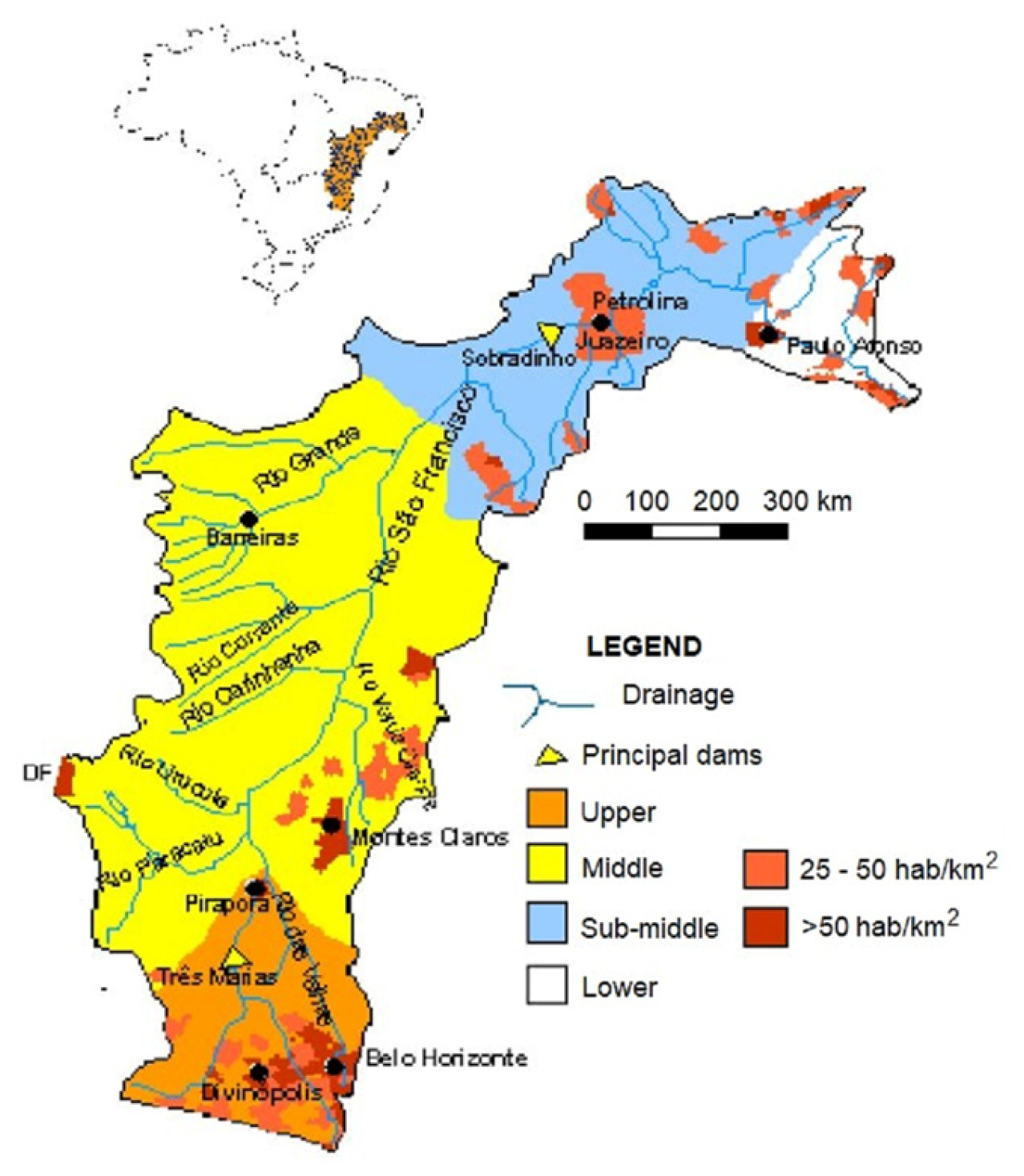
The São Francisco River is the major river of eastern South America. With a length of 3200 km, it is the longest river that runs entirely in the Brazilian territory, and it is the third largest basin in Brazil, after the Amazon River basin and the Parana River basin. Its headwaters are in Serra da Canastra, Minas Gerais, and the mouth is in Piaçabuçu, Alagoas and Brejo Grande, Sergipe. With an area of 630,000 km2, it covers about 8% of the national territory and extends through five Brazilian states, Pernambuco, Alagoas, Sergipe, Bahia, Minas Gerais, and the Federal District, and it is divided into four physiographic regions: Upper, Middle, Sub-Middle, and Lower São Francisco [27]. The vegetation cover includes Atlantic Forest (headwaters), tropical savanna (Cerrado) in the Upper and Middle São Francisco, herbaceous and arborescent vegetation (Caatinga) in the Middle, Sub-Middle and Lower São Francisco, and Atlantic Forest in the Upper São Francisco and coastal area of Lower São Francisco [28]. The climate is dry subhumid in the Upper region of the basin, semiarid in the Middle region, semiarid and arid in the Sub-Middle region, and subhumid in the Lower São Francisco region. The mean annual precipitation ranges from 1500 mm in the Upper São Francisco to 350 mm in Sub-Middle São Francisco, which is vulnerable to the occurrence of severe droughts as a result of low rainfall and high evapotranspiration [29]. The annual average natural flow of the São Francisco River is 2846 m3/s, but throughout the year, it can vary between 1077 m3/s and 5290 m3/s. [27]. Regarding uses, there is a predominance of withdrawal for irrigation (77% of total demands), followed by urban demand (11%) and industrial demand (7%). The São Francisco Region plays an important role in generating electricity, with a potential installed in 2013 of 10,708 MW (12% of the country’s total). Along the river, there are several large dams listed in the downstream order: Três Marias, Sobradinho, Itaparica, Moxotó, Paulo Afonso I, II, III and IV, and Xingó, which were constructed between 1962 (Três Marias) and 1994 (Xingó). There are four reservoirs with large storage volumes: Três Marias located in Upper São Francisco, Sobradinho and Itaparica located in Sub-Middle São Francisco, and Xingó, which is in the Lower São Francisco. The largest hydroelectric plants are Xingó (3162 MW), Paulo Afonso IV (2462 MW), Luiz Gonzaga (1479 MW), and Sobradinho (1050 MW) [30]. Figure 1 shows the map of the São Francisco River basin with physiographic regions and location of dams and hydrological stations.

2.2. Data

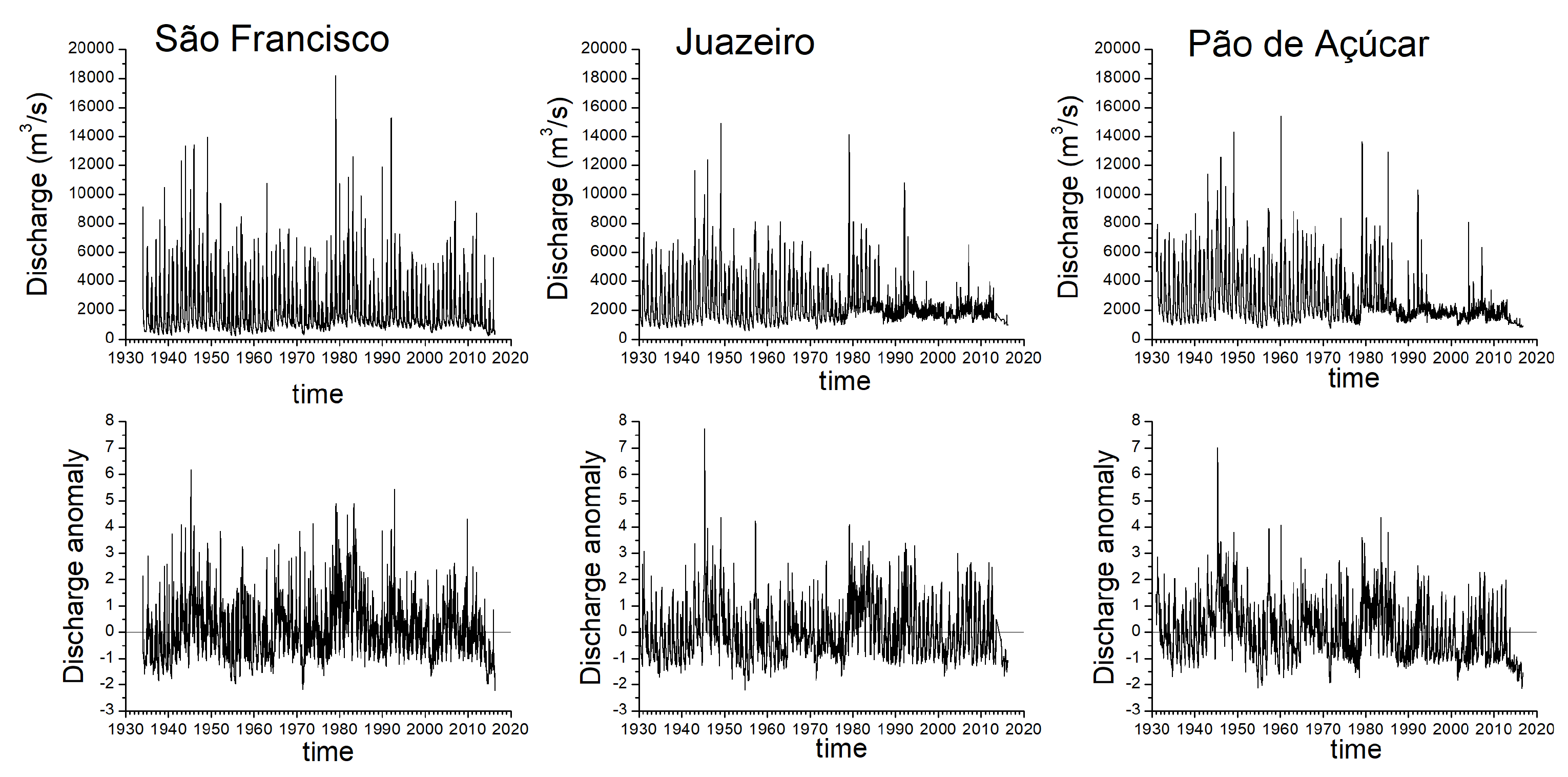
The data used in this work are daily streamflow series recorded at three gauge stations located in different parts of the São Francisco River basin: São Francisco (code 44200000, coordinates 15°56′24″ S, 44°52′04″ W, drainage area 184,000 km2), Juazeiro (code 48020000, coordinates: 09°24′23″ S, 40°30′13″ W, drainage area: 516,000 km2) and Pão de Açúcar (code: 49370000, coordinates: 09°45′05″ S, 37°26′47″ W, drainage area: 615,000 km2). The Juazeiro station is located about 40 km downstream of Sobradinho dam and it is influenced by reservoir operation. The Pão de Açúcar station is located about 60 km downstream of Xingó dam, which is the most downstream and the last to be constructed of the cascade dams. The São Francisco station is located upstream of all dams except Três Marias, which is very distant (about 350 km) and can be considered as less impacted than Juazeiro and Pão de Açúcar. The data are provided by the National Water Agency (Agência Nacional de Águas—ANA) [27]. The recorded period is 1 January 1934 to 31 May 2016 for the São Francisco gauge station, 1 September 1928 to 31 March 2016 for the Juazeiro station, and 1 January 1931 to 29 September 2016 for the Pão de Açúcar station. To remove the seasonality effect, for the period under study for each station, for each calendar day i , we find the mean μ i and standard deviation σ i over the years j (e.g., j = 1934, …, 2016 for São Francisco station), and we normalize the discharge data to find the discharge anomalies z i , j = x i , j μ i / σ i . The original daily streamflow series and the daily anomaly series are shown in Figure 2.

2.3. Multifractal Detrended Fluctuation Analysis

While fractal processes are characterized by long-term correlations that are described by a single scaling exponent, in multifractal time-series, subsets with small and large fluctuations can scale differently, and the analysis of long-term correlations results in a hierarchy of scaling exponents [26]. Multifractal analysis of temporal series can be performed using different methods, such as the wavelet transform modulus maxima (WTMM) method [31], the multifractal detrended fluctuation analysis (MF-DFA) method [26], and the multifractal detrending moving average method (MF-DMA) [32]. In this work, we employ MF-DFA, which has been found to produce reliable results [33] and has been widely used in data analysis across various research fields [34,35,36,37,38].
The implementation of the MF-DFA algorithm is described as follows [26]:
(i)
The first step is the integration of original series x i ,   i = 1 , , N to produce:
X k = i = 1 k x i x   ,             k = 1 , , N
where x = 1 N i = 1 k x i is the average.
(ii)
Next, the integrated series X k is divided into N n = i n t ( N / n ) non-overlapping segments of length n , and in each segment ν = 1 , , N n the local trend X n , ν ( k ) (linear or higher order polynomial least square fit) is estimated and subtracted from X k
(iii)
The detrended variance:
F 2 n , ν = 1 n k = ν 1 n + 1 ν n X k X n , ν k 2
is calculated for each segment and then averaged over all segments to obtain q th order fluctuation function
F q n = 1 N n ν = 1 N n F 2 n , ν q / 2 1 / q
where, in general, q can take on any real value except zero.
(iv)
Repeating this calculation for all box sizes provides the relationship between fluctuation function F q n and box size n . If long-term correlations are present, F q n increases with n according to a power law F q n   ~   n h ( q ) . The scaling exponent h ( q ) is obtained as the slope of the linear regression of log F q n versus log n
The power law exponent h ( q ) is called the generalized Hurst exponent, as for stationary time-series, h ( 2 ) is identical to the well-known Hurst exponent H . For positive values of q , h ( q ) describes the scaling behavior of large fluctuations, while for negative values of q , h ( q ) describes the scaling behavior of small fluctuations. For monofractal time-series, h ( q ) is independent of q , while for multifractal time-series, h ( q ) is a decreasing function of q .
Generalized Hurst exponents h ( q ) are related to the Renyi exponents τ ( q ) defined by the standard partition function-based multifractal formalism τ ( q ) = q h ( q ) 1 . For monofractal signals, τ ( q ) is a linear function of q (as h ( q ) = c o n s t . ), and for multifractal signals, τ ( q ) is a nonlinear function of q . A multifractal process can also be characterized by the singularity spectrum f α , which is related to τ ( q ) through the Legendre transform:
α q = d τ q d q     , f α ( q ) = q α q   τ q     ,
where f ( α ) is the fractal dimension of the support of singularities in the measure with Lipschitz–Holder exponent α . The singularity spectrum of monofractal signal is represented by a single point in the f ( α ) plane, whereas a multifractal process yields a single humped function.
A multifractal spectrum reflects the level of complexity of the underlying stochastic process and can be characterized by a set of three parameters, which are determined as follows: the singularity spectra are fitted to a fourth-degree polynomial:
f α = A + B α α 0 + C α α 0 2 + D α α 0 3 + E α α 0 4
and the multifractal spectrum parameters are found as the position of maximum α 0 , width of the spectrum W = α m a x α m i n , obtained from extrapolating the fitted curve to zero, and the skew parameter r = ( α m a x α 0 ) / α 0 α m i n ) , where r = 1 for symmetric shapes, r > 1 for right-skewed shapes, and r < 1 for left-skewed shapes. These three parameters can be used to evaluate the complexity of the process. If α 0 > 0.5 , the underlying process is overall persistent (larger value of α_0 indicates stronger persistency), and if α 0 < 0.5 , the process is overall antipersistent (smaller value of α 0 indicates stronger antipersistency). For a nonstationary process (fractional Brownian motion), α 0 > 1 , and the Hurst exponent is calculated as α 0 1 , describing the scaling of series increments. The width W of the spectrum measures the degree of multifractality of the process (the wider the range of the fractal exponents, the “richer” the structure of the process). The skew parameter r indicates which fractal exponents are dominant. If high-fractal exponents are dominant, f α , the spectrum is right-skewed ( r > 1 ) and the process is characterized by “fine structure” (small fluctuations). If low-fractal exponents are dominant, the process is more regular or smooth, the f ( α ) spectrum is left-skewed ( r < 1 ) and fractal exponents describe the scaling of large fluctuations. In summary, a signal with a high value of α 0 , a wide range W of fractal exponents (higher degree of multifractality), and a right-skewed shape ( r > 1 ) may be considered more complex than one with opposite characteristics [39]. Calculations were performed using the in-house developed software, available at https://github.com/borkostosic/MFDFALIB (accessed on 20 February 2026).

3. Results and Discussion

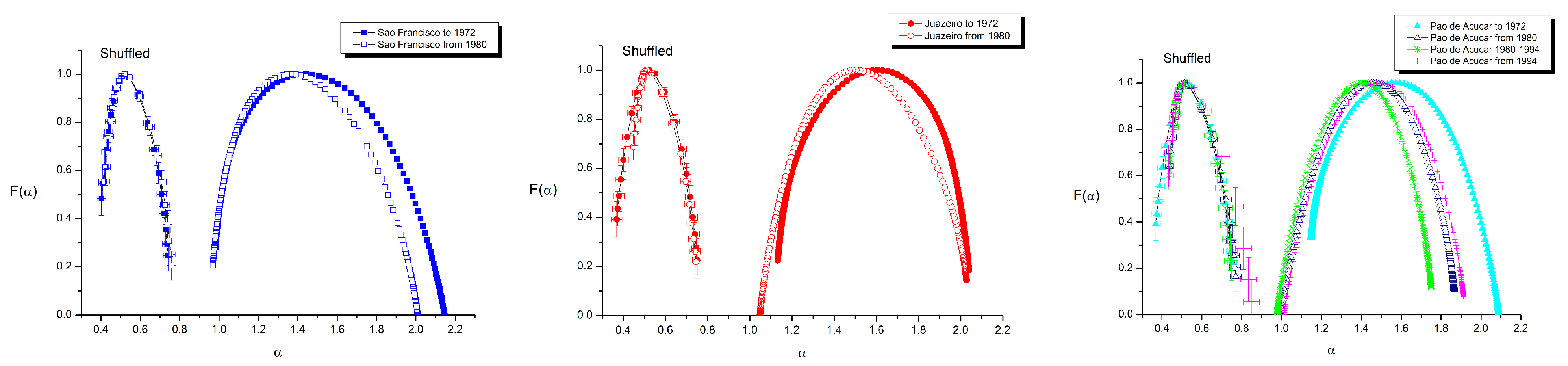
Multifractal spectra of streamflow data before and after the construction of dams and reservoirs are presented in Figure 3. As the construction period of the Sobradinho dam was from 1972 to 1979, the multifractal spectra in Figure 3 were calculated for all stations for the period before 1972 and after 1980. Before the construction of the Xingó dam (1994), a series of cascade dams were constructed downstream of Sobradinho and upstream of the Pão de Açúcar station; so, for this station, we analyzed the period of 1980–1994 that included the construction of all reservoirs except Xingó, and the period after 1994. The corresponding values of multifractal parameters are presented in Table 1.
To check whether the multifractality detected by MF-DFA arises from long-range correlations, heavy-tailed discharge distributions, or their combination, all the series were shuffled, with the results presented in Figure 3 together with the corresponding spectra. Shuffling was performed by implementing 10,000 × L data pair transpositions (where L is the length of the series), upon which the MFDFA spectrum was recalculated. This procedure was repeated 100 times for each series to produce the error bars (one standard deviation) in Figure 3. It is seen that in all cases, shuffling leads to rather narrow spectra with a maximum positioned close to α 0 = 0.5 , as may be expected for a random series. The principal source of multifractality can therefore be attributed to long-range correlations, while the residual width of the shuffled data spectra may be attributed to a (less pronounced) effect of heavy-tailed discharge distributions.
Before the construction of reservoirs (until 1972), the value of α 0 , which can be interpreted as the overall Hurst exponent [39], for the São Francisco station is equal to 1.5, indicating fractional Brownian motion with uncorrelated increments ( H   ~   α 0 1 = 0.5 ). For the downstream stations Juazeiro and Pão de Açúcar (with larger drainage area), the value of α 0 increases, indicating weak persistence ( α 0 > 1.5   ,   H > 0.5 ) in increment series. For the same period, the width of f ( α ) spectrum for Juazeiro and Pão de Açúcar station is smaller than for São Francisco station, indicating the decrease in multifractality with the increase in drainage area. The skew parameter r also decreases with drainage area. For the São Francisco station, r > 1 , indicating that multifractality is more influenced by the scaling of small fluctuations (right skewed spectrum). For the Juazeiro station, r < 1 , indicating the dominance of low fractal exponents and large fluctuations. For the Pão de Açúcar station, the f ( α ) spectrum is symmetric ( r 1 ), indicating the equal contribution of both large and small fluctuations. Before 1972, two hydroelectric plants located upstream (about 100 km) of the Pão de Açúcar station started operating: Paulo Alfonso 1 (1954) and Paulo Alfonso 2 (1961). These plants (together with Paulo Alfonso 3 inaugurated in 1971) operate with unique dam and reservoir. Although this reservoir has a small storage volume compared to Sobradinho, Itaparica and Xingo, the downstreamflow regulation could partially buffer the effect of drainage area on multifractal properties in Pão de Açúcar station: the value of α_0 stayed unchanged, while the width of the spectrum W and skew parameter r slightly increased compared to Juazeiro station. However, the overall tendency of the alteration in multifractal parameters (compared with São Francisco station) toward higher α 0 and lower W and r still holds.
Hirpa et al. [40] studied 14 stations in the Flint River basin in Georgia in the southeastern United States and found that the persistency of river flow fluctuations increased with the increase in drainage area. Ozger et al. [41] analyzed streamflow records from 56 gauging stations from five basins located in two different climate zones and found that larger drainage areas tended to have weaker multifractality and stronger persistence of streamflow fluctuations. The multifractal behavior of São Francisco River streamflow during the pre-construction period is in agreement with these findings.
After the construction of the Sobradinho reservoir, the multifractal properties of streamflow fluctuations for Juazeiro station change towards the regime with uncorrelated increments ( α 0 1.5 ), stronger multifractality (larger W ) and stronger influence of small fluctuations (right skewed spectrum, r > 1 ). Compared with the less-impacted station São Francisco for the same period, we can see that the two properties of f ( α ) become more similar than before the reservoir construction: the degree of multifractality ( W ) and the dominance of high fractal exponents that describe the scaling of small fluctuations ( r > 1 ). Considering temporal correlations, for both stations, there is a decrease in α 0 value, toward an antipersistent regime ( α 0 < 1.5 ) for São Francisco and toward an uncorrelated regime (α_0 ≈ 1.5) for the Juazeiro station. In summary, the downstream reservoir regulation of streamflow results in behavior that is characterized by less persistency, stronger multifractality, and the dominance of small fluctuations.
Before the construction of the Xingó dam (1994), the series of cascade dams were constructed downstream of Sobradinho and upstream of the Pão de Açúcar station: Moxoto (1977), Paulo Alfonso 4 (1979), and Itaparica (1988); so, for this station, we analyzed the period of 1980–1994 that included the construction of all reservoirs except Xingó, which was constructed in 1994. The streamflow process shifted toward the regime with antipersistent increments ( α 0 < 1.5 ), weaker multifractality (smaller W ) and the dominance of large fluctuations ( r < 1 ). Finally, after the construction of the last dam, Xingó (1994), the values of all multifractal parameters increased but the direction of alterations stayed the same, reflecting the superimposed influence of all cascade reservoirs: less correlated increments, decreased multifractality, and the dominance of large fluctuations. Comparing all analyzed periods for the Juazeiro and Pão de Açúcar stations, we can observe that the largest difference in the values of multifractal parameters with respect to the pre-construction period (until 1972) was identified for the Pão de Açúcar station during the period between the beginning of operation of two large reservoirs: Sobradinho and Xingó (1980–1994). Zhou et al. [15] studied the effect of the Gezhouba and the Three Gorges Dams on the Yangtze River flow variations by analyzing long daily streamflow series from two gauging stations located upstream and downstream of these two dams. They also identified the largest alteration in multifractality during the time intervals between the construction periods of the two dams.
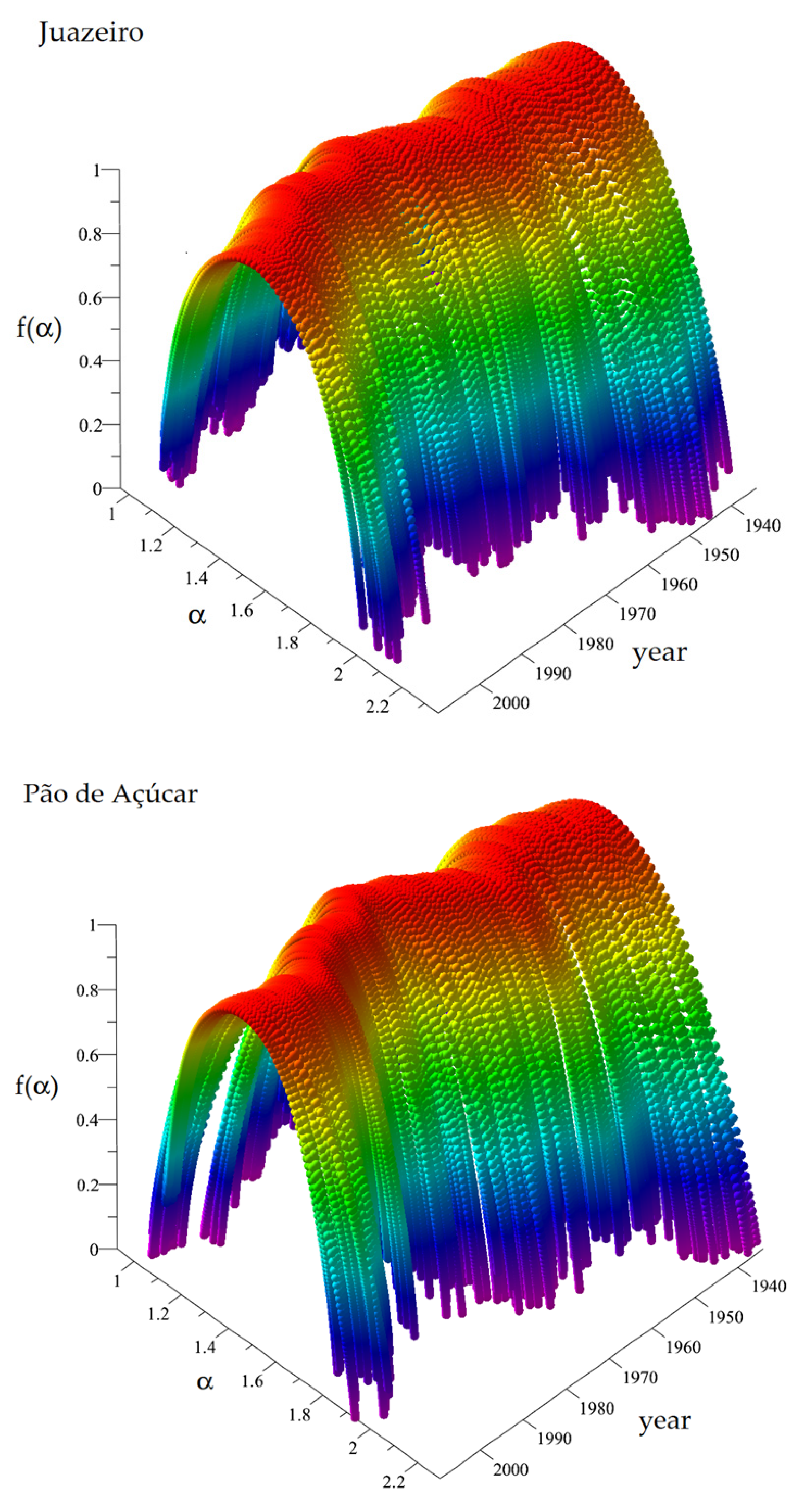
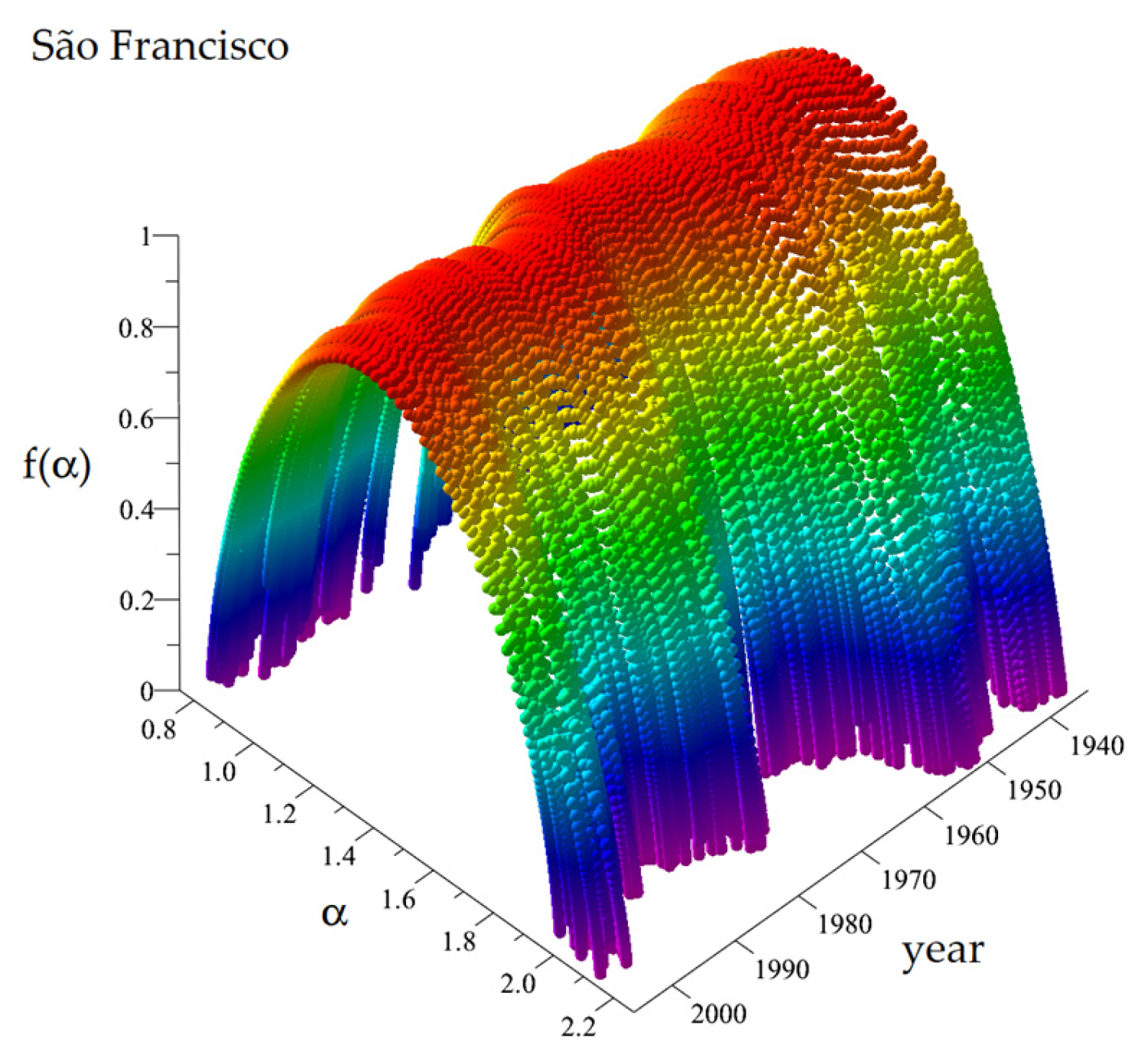
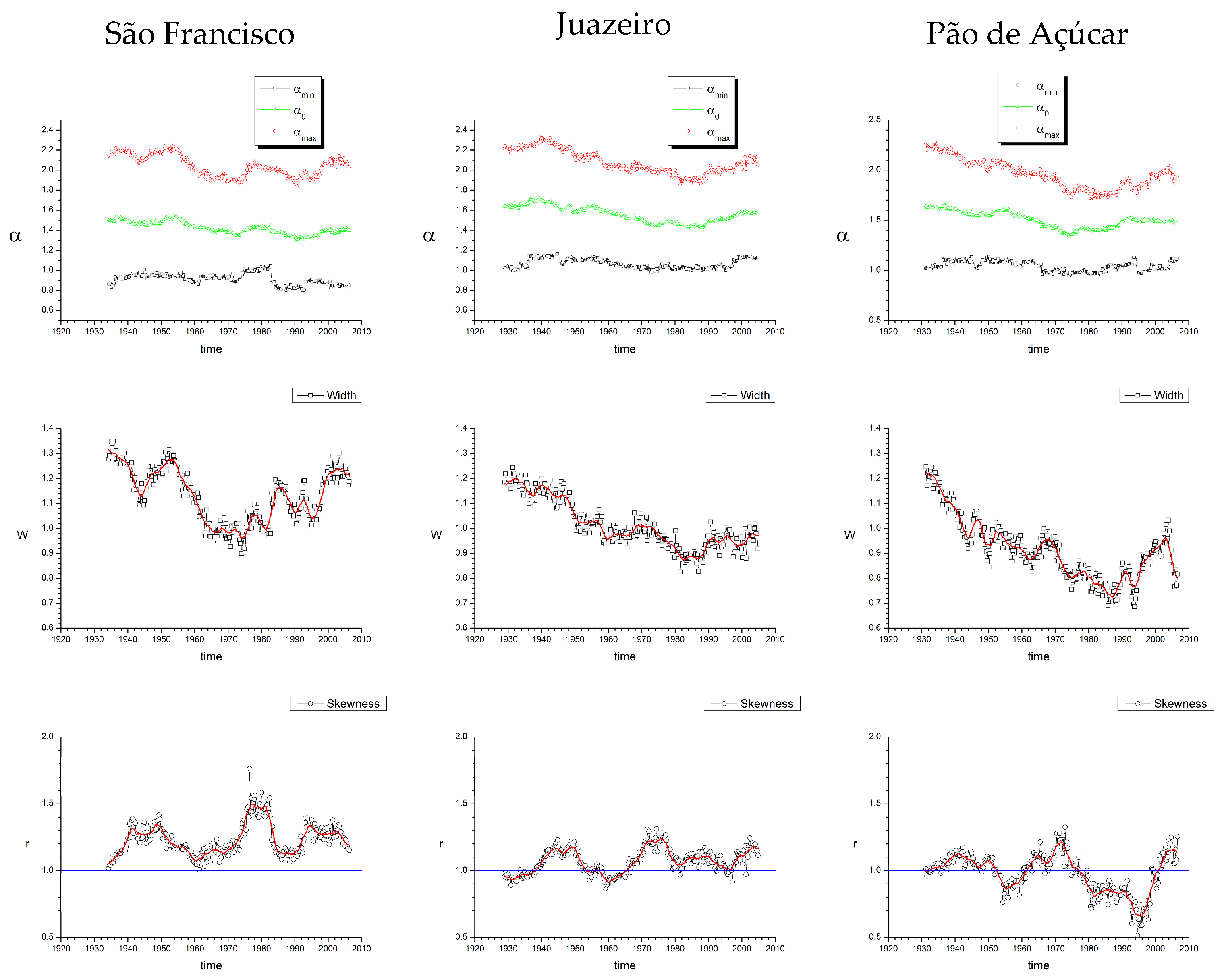
The novelty of this work is the analysis of temporal evolution of streamflow multifractality by applying MF-DFA to sliding windows of 10 years of data (shifting each window for 3 months), which, in the presence of temporal correlations, is sufficiently long to guarantee stability of the results [42,43]. This computationally intensive approach permits us to analyze the temporal evolution of multifractal parameters which are related to different properties underlying the process. For each window, we calculated the multifractal spectrum and determined the complexity parameters. The temporal evolution of the multifractal spectrum f ( α ) for all stations is shown in Figure 4, and the evolution of the corresponding multifractal parameters α 0 , W and r can be seen in Figure 5.
For all stations, multifractal parameter dynamics reveal behavior that cannot be identified by analyzing longer data samples. For the São Francisco station (Figure 5, top left panel), the streamflow increments fluctuate between uncorrelated ( α 0 = 1.5 ) until the 1950s and from the mid-1970s to the mid-1980s, and an antipersistent regime ( α 0 < 1.5 ) in periods in between; W is smaller during the period from the 1950s to the 1980s, while the skew parameter indicated the dominance of small fluctuations ( r > 1 ) until the 1960s, between the 1970s and the mid-1980s, and after the mid-1990s. For other periods, the value of r was close to unity, indicating equal contribution of small and large fluctuations. For the Juazeiro station, the value of α 0 showed a persistent hydrological regime ( α 0 > 1.5 ) until the mid-1970s, followed by an uncorrelated regime ( α 0 = 1.5 ) during the period from the mid-1970s to the 1990s, which is the period between the construction of Sobradinho (1979) and the Xingó (1994) reservoir. After this period, the streamflow fluctuations showed weak persistency ( α 0 > 1.5 ). For the same period (between Sobradinho and Itaparica), the width of f ( α ) decreased, followed by an increase in the 90s. The evolution of the skewness parameter r was similar to that for the São Francisco station until the construction of Sobradinho, after which the value of r became close to unity, indicating that both large and small fluctuations contributed equally to multifractality of the process.
Finally, we discuss the evolution of multifractality of streamflow recorded in the Pão de Açúcar station, which is located downstream of all the cascade dams. We can observe a decrease in α 0 in the mid-1950s from a weak persistent ( α 0 > 1.5 ) to a weak antipersistent ( α 0 < 1.5 ) regime, which could be related to the construction of the first dam, Paulo Alfonso (1954). In the mid-1970s to the mid-1990s (a period during which four more dams, Moxoto, Paulo Alfonso 4, Itaparica and Sobradinho, were constructed), the value of α 0 increased toward α 0 = 1.5 , the width of the spectrum decreased, and the skew parameter r became lower than one. This indicates that the streamflow regime is characterized by uncorrelated increments and weaker multifractality, with the dominance of large fluctuations. After the construction of the last reservoir Xingó in the mid-1990s, the streamflow regime changed again toward stronger multifractality ( W increased), stronger contribution of small fluctuations (r increased and became greater than 1), and uncorrelated increments ( α 0 = 1.5 ).
Out of the three parameters, the spectrum width as a measure of degree of multifractality (complexity) exhibits consistent behavior, which could be related to dam construction: the decrease in W is observed in the São Francisco station until the 60s, in the Juazeiro station until the 80s and in the Pão de Açúcar station until the 90s, which corresponds to the construction of the upstream dams Três Marias, Juazeiro and Xingó, respectively. In the following period, in all three stations, the spectrum width showed an increasing tendency, indicating stronger multifractality and higher complexity of streamflow dynamics. Recent studies have shown that climate change, water use practices, and changes in land use and land cover have affected hydrological variables in the São Francisco River Basin [44,45,46]. Future research is needed to determine which of these factors may also be related to the alteration in streamflow multifractality, in addition to the impacts of dam construction.
There are only a few other studies about the influence of dams and reservoir construction on the multifractality of streamflow. The results vary from showing that regulation activities by water reservoirs could not impact the scaling properties of streamflow series, as in the case of East River (Pearl River basin, China) [47], to the evidence of alterations in multifractality, as in the case of Canadian rivers [21]. Zhou et al. [15] investigated the hydrological effect of both the Gezhou and the Three Gorges Dams in China on the multifractality of streamflow during the different temporal segments determined by the construction of the two dams. They found that the interaction of two dams may weaken the changes, which is similar to our result that the decrease in the width of multifractal spectrum for the Pão de Açúcar station related to dam construction became less pronounced after the construction of all cascade dams. More studies should be performed for other streamflow data from impacted rivers with different degrees of disturbance caused by human activities, not only dam construction but other kinds, such as urbanization, for which some preliminary results were reported [22].

4. Conclusions

Ensuring the sustainable use of water resources requires a deep understanding of how human interventions affect natural hydrological systems. In this work, we investigated how the construction of cascade dams affected the daily streamflow of São Francisco River, Brazil, by using multifractal analysis. We analyzed streamflow temporal series for different periods and locations related to the construction of reservoirs and dams. By applying the well-established method of multifractal detrended fluctuation analysis (MFDFA), we calculated a multifractal spectrum and determined its complexity parameters (position of maximum width and asymmetry) that were related to different properties of streamflow fluctuations. After the construction of the large reservoir Sobradinho, the streamflow dynamics (Juazeiro station) changed towards a regime with uncorrelated increments and stronger multifractality, with the dominance of small fluctuations. The superimposed influence of all cascade dams induced a streamflow regime (Pão de Açúcar station) with uncorrelated increments, decreased multifractality and led to the dominance of large fluctuations. We also applied MFDFA to sliding windows, which showed to be an efficient tool for the analysis of time evolution of multifractal parameters and corresponding streamflow properties. This novel approach revealed more changes related to the construction of dams: i) for all stations, multifractal parameters showed oscillations that cannot be identified by analyzing the entire data samples; ii) the spectrum width as a measure of degree of multifractality (complexity) exhibits consistent changes that could be related to dam construction.
Although a few studies have examined changes in the multifractality of streamflow dynamics potentially associated with dam construction, no clear consensus has yet emerged regarding the direction of alterations in multifractal parameters. Our work seeks to contribute to advancing this understanding. Moreover, the findings indicate that multifractal models for temporal series are well-suited to streamflow modeling in the São Francisco River Basin, and the results presented here provide a solid foundation for the future development and validation of such models.
In summary, this work should be understood as a contribution to worldwide efforts in developing and testing new methods for hydrological analysis, which will improve our understanding of the characteristics of natural and altered flow regime, and thus help to maximize ecologically sustainable freshwater use.

Author Contributions

Conceptualization, B.S., T.S. and V.P.S. methodology, B.S. and T.S.; software, B.S.; validation, B.S. and T.S.; formal analysis, B.S., T.S. and V.P.S.; data curation, B.S.; writing—original draft preparation, B.S. and T.S.; writing—review and editing, B.S., T.S. and V.P.S.; visualization, B.S. All authors have read and agreed to the published version of the manuscript.

Funding

We acknowledge support of Brazilian agency CNPq (grants: 308782/2022-4 and 309499/2022-4).

Institutional Review Board Statement

Not applicable.

Informed Consent Statement

Not applicable.

Data Availability Statement

The data are provided by the Brazilian National Water Agency (Agência Nacional de Águas—ANA) https://dadosabertos.ana.gov.br/ (accessed on 20 February 2026).

Conflicts of Interest

The authors declare no conflicts of interest.

References

  1. Zhang, Y.K.; Schilling, K.E. Increasing streamflow and baseflow in Mississippi River since the 1940s: Effect of land use change. J. Hydrol. 2006, 324, 412–422. [Google Scholar] [CrossRef]
  2. Coe, M.T.; Latrubesse, E.M.; Ferreira, M.E.; Amsler, M.L. The effects of deforestation and climate variability on the streamflow of the Araguaia River, Brazil. Biogeochemistry 2011, 105, 119–131. [Google Scholar] [CrossRef]
  3. Batalla, R.J.; Gomez, C.M.; Kondolf, G.M. Reservoir-induced hydrological changes in the Ebro River basin (NE Spain). J. Hydrol. 2004, 290, 117–136. [Google Scholar] [CrossRef]
  4. Kustu, M.D.; Fan, Y.; Robock, A. Large-scale water cycle perturbation due to irrigation pumping in the US High Plains: A synthesis of observed streamflow changes. J. Hydrol. 2010, 390, 222–244. [Google Scholar] [CrossRef]
  5. Vörösmarty, C.J.; Sahagian, D. Anthropogenic disturbance of the terrestrial water cycle. AIBS Bull. 2000, 50, 753–765. [Google Scholar] [CrossRef]
  6. Poff, N.L.; Olden, J.D.; Merritt, D.M.; Pepin, D.M. Homogenization of regional river dynamics by dams and global biodiversity implications. Proc. Natl. Acad. Sci. USA 2007, 104, 5732–5737. [Google Scholar] [CrossRef]
  7. Döll, P.; Fiedler, K.; Zhang, J. Global-scale analysis of river flow alterations due to water withdrawals and reservoirs. Hydrol. Earth Syst. Sci. 2009, 13, 2413. [Google Scholar] [CrossRef]
  8. Richter, B.; Thomas, G. Restoring environmental flows by modifying dam operations. Ecol. Soc. 2007, 12, 12. [Google Scholar] [CrossRef]
  9. Richter, B.D.; Baumgartner, J.V.; Powell, J.; Braun, D.P. A method for assessing hydrologic alteration within ecosystems. Conserv. Biol. 1996, 10, 1163–1174. [Google Scholar] [CrossRef]
  10. Döll, P.; Zhang, J. Impact of climate change on freshwater ecosystems: A global-scale analysis of ecologically relevant river flow alterations. Hydrol. Earth Syst. Sci. 2010, 14, 783–799. [Google Scholar] [CrossRef]
  11. Mittal, N.; Bhave, A.G.; Mishra, A.; Singh, R. Impact of human intervention and climate change on natural flow regime. Water Resour. Manag. 2016, 30, 685–699. [Google Scholar] [CrossRef]
  12. Sivakumar, B.; Singh, V.P. Hydrologic system complexity and nonlinear dynamic concepts for a catchment classification framework. Hydrol. Earth Syst. Sci. 2012, 16, 4119. [Google Scholar] [CrossRef]
  13. Fang, K.; Sivakumar, B.; Woldemeskel, F.M. Complex networks, community structure, and catchment classification in a large-scale river basin. J. Hydrol. 2017, 545, 478–493. [Google Scholar] [CrossRef]
  14. Mihailović, D.T.; Mimić, G.; Drešković, N.; Arsenić, I. Kolmogorov complexity based information measures applied to the analysis of different river flow regimes. Entropy 2015, 17, 2973–2987. [Google Scholar] [CrossRef]
  15. Zhou, Y.; Zhang, Q.; Singh, V.P. Fractal-based evaluation of the effect of water reservoirs on hydrological processes: The dams in the Yangtze River as a case study. Stoch. Environ. Res. Risk Assess. 2014, 28, 263–279. [Google Scholar] [CrossRef]
  16. de Carvalho Barreto, I.D.; Stosic, T.; Filho, M.C.; Delrieux, C.; Singh, V.P.; Stosic, B. Complexity analyses of Sao Francisco river streamflow: Influence of dams and reservoirs. J. Hydrol. Eng. 2020, 25, 05020036. [Google Scholar] [CrossRef]
  17. Pandey, G.; Lovejoy, S.; Schertzer, D. Multifractal analysis of daily river flows including extremes for basins of five to two million square kilometres, one day to 75 years. J. Hydrol. 1998, 208, 62–81. [Google Scholar] [CrossRef]
  18. Kantelhardt, J.W.; Koscielny-Bunde, E.; Rybski, D.; Braun, P.; Bunde, A.; Havlin, S. Long-term persistence and multifractality of precipitation and river runoff records. J. Geophys. Res. 2006, 111, D011106. [Google Scholar] [CrossRef]
  19. Adarsh, S.; Nourani, V.; Archana, D.S.; Dharan, D.S. Multifractal description of daily rainfall fields over India. J. Hydrol. 2020, 586, 124913. [Google Scholar] [CrossRef]
  20. Gómez-Gómez, J.; Plocoste, T.; Alexis, E.; Jiménez-Hornero, F.J.; de Ravé, E.G.; Nuiro, S.P. Multifractal detrended fluctuation analysis of rainfall time series in the Guadeloupe archipelago. J. Hydrol. 2023, 626, 130377. [Google Scholar] [CrossRef]
  21. Tan, X.; Gan, T.Y. Multifractality of Canadian precipitation and streamflow. Int. J. Climatol. 2017, 37, 1221–1236. [Google Scholar] [CrossRef]
  22. Jovanovic, T.; Mejía, A.; Gall, H.; Gironás, J. Effect of urbanization on the long-term persistence of streamflow records. Phys. A Stat. Mech. Appl. 2016, 447, 208–221. [Google Scholar] [CrossRef]
  23. Stratimirovic, D.; Batas-Bjelic, I.; Djurdjevic, V.; Blesic, S. Changes in long-term properties and natural cycles of the Danube river level and flow induced by damming. Phys. A Stat. Mech. Appl. 2021, 566, 125607. [Google Scholar] [CrossRef]
  24. Ioris, A.A.R. Water resources development in the Sao Francisco River Basin (Brazil): Conflicts and management perspectives. Water Int. 2001, 26, 24–39. [Google Scholar] [CrossRef]
  25. Maneta, M.P.; Torres, M.; Wallender, W.W.; Vosti, S.; Kirby, M.; Bassoi, L.H.; Rodrigues, L.N. Water demand and flows in the Sao Francisco River Basin (Brazil) with increased irrigation. Agric. Water Manag. 2009, 96, 1191–1200. [Google Scholar] [CrossRef]
  26. Kantelhardt, J.W.; Zschiegner, S.A.; Koscielny-Bunde, E.; Havlin, S.; Bunde, A.; Stanley, H.E. Multifractal detrended fluctuation analysis of nonstationary time series. Phys. A Stat. Mech. Appl. 2002, 316, 87–114. [Google Scholar] [CrossRef]
  27. ANA—Agencia Nacional de Água (National Water Agency). Available online: www.ana.gov.br (accessed on 20 February 2026).
  28. Freitas, A.A.; Drumond, A.; Carvalho, V.S.; Reboita, M.S.; Silva, B.C.; Uvo, C.B. Drought assessment in São Francisco river basin, Brazil: Characterization through SPI and associated anomalous climate patterns. Atmosphere 2021, 13, 41. [Google Scholar] [CrossRef]
  29. Bezerra, B.G.; Silva, L.L.; e Silva, C.M.S.; de Carvalho, G.G. Changes of precipitation extremes indices in São Francisco River Basin, Brazil from 1947 to 2012. Theor. Appl. Climatol. 2018, 135, 565–576. [Google Scholar] [CrossRef]
  30. CHESF—Companhia Hidro Elétrica do São Francisco (São Francisco’s Hydroelectric Company). Available online: https://www.chesf.com.br (accessed on 20 February 2026).
  31. Muzy, J.F.; Bacry, E.; Arneodo, A. Wavelets and multifractal formalism for singular signals: Application to turbulence data. Phys. Rev. Lett. 1991, 67, 3515–3518. [Google Scholar] [CrossRef]
  32. Gu, G.F.; Zhou, W.X. Detrending moving average algorithm for multifractals. Phys. Rev. E 2010, 82, 011136. [Google Scholar] [CrossRef]
  33. Oświȩcimka, P.; Kwapień, J.; Drożdż, S. Wavelet versus detrended fluctuation analysis of multifractal structures. Phys. Rev. E 2006, 74, 016103. [Google Scholar] [CrossRef] [PubMed]
  34. Li, S. Multifractal detrended fluctuation analysis of congestive heart failure disease based on constructed heartbeat sequence. IEEE Access 2020, 8, 205244–205249. [Google Scholar] [CrossRef]
  35. Stosic, B.; Stosic, T.; Tošić, I.; Djurdjević, V. Multifractal analysis of temperature in Europe: Climate change effect. Chaos Solitons Fractals 2025, 196, 116386. [Google Scholar] [CrossRef]
  36. Romaguera, A.R.D.C.; Vasconcelos, J.V.; Negreiros-Neto, L.G.; Pessoa, N.L.; Silva, J.F.D.; Cadena, P.G.; Souza, A.J.D.; Oliveira, V.M.D.; Barbosa, A.L. Multifractal fluctuations in zebrafish (Danio rerio) polarization time series. Eur. Phys. J. E 2024, 47, 29. [Google Scholar] [CrossRef]
  37. Telesca, L.; Abate, N.; Faridani, F.; Lovallo, M.; Lasaponara, R. Discerning xylella fastidiosa-infected olive orchards in the time series of MODIS terra satellite evapotranspiration data by using the Fisher–Shannon analysis and the multifractal detrended fluctuation analysis. Fractal Fract. 2023, 7, 466. [Google Scholar] [CrossRef]
  38. Jiang, Z.Q.; Xie, W.J.; Zhou, W.X.; Sornette, D. Multifractal analysis of financial markets: A review. Rep. Prog. Phys. 2019, 82, 125901. [Google Scholar] [CrossRef]
  39. Shimizu, Y.U.; Thurner, S.; Ehrenberger, K. Multifractal spectra as a measure of complexity in human posture. Fractals 2002, 10, 103–116. [Google Scholar] [CrossRef]
  40. Hirpa, F.A.; Gebremichael, M.; Over, T.M. River flow fluctuation analysis: Effect of watershed area. Water Resour. Res. 2010, 46, W12529. [Google Scholar] [CrossRef]
  41. Özger, M.; Mishra, A.K.; Singh, V.P. Seasonal and spatial variations in the scaling and correlation structure of streamflow data. Hydrol. Process. 2013, 27, 1681–1690. [Google Scholar] [CrossRef]
  42. Drożdż, S.; Kwapień, J.; Oświecimka, P.; Rak, R. Quantitative features of multifractal subtleties in time series. Europhys. Lett. (EPL) 2009, 88, 60003. [Google Scholar] [CrossRef]
  43. Drożdż, S.; Kowalski, R.; Oświȩcimka, P.; Rak, R.; Gȩbarowski, R. Dynamical variety of shapes in financial multifractality. Complexity 2018, 2018, 7015721. [Google Scholar] [CrossRef]
  44. Lima, C.E.S.; da Silva, M.V.M.; Rocha, S.M.G.; Silveira, C.D.S. Anthropic Changes in land use and land cover and their impacts on the hydrological variables of the São Francisco River Basin, Brazil. Sustainability 2022, 14, 12176. [Google Scholar] [CrossRef]
  45. Melo, L.S.; Costa, V.A.; Fernandes, W.S. Assessing the anthropogenic and climatic components in runoff changes of the São Francisco River Catchment. Water Resour. Manag. 2023, 37, 3615–3629. [Google Scholar] [CrossRef]
  46. Gomes, P.V.O.; Figueiredo, F.T.; Fambrini, G.L.; Pupim, F.; Grohmann, C.H.; Vedana, L.A.; Franco, L.S. Hydrological and morphological responses in the São Francisco River Basin (Northeast Brazil) resulting from river damming and climate changes in a tropical region. Earth Surf. Process. Landf. 2024, 49, 5339–5361. [Google Scholar] [CrossRef]
  47. Zhang, Q.; Xu, C.Y.; Yu, Z.; Liu, C.L.; Chen, Y.D. Multifractal analysis of streamflow records of the East River basin (Pearl River), China. Phys. A Stat. Mech. Appl. 2009, 388, 927–934. [Google Scholar] [CrossRef]
Figure 1. Location of the São Francisco River basin, physiographic regions, dams and hydrological stations.
Sustainability 18 02276 g001
Figure 2. Original and deseasonalized streamflow time-series for the São Francisco station (left column), Juazeiro station (middle column) and Pão de Açúcar station (right column).
Sustainability 18 02276 g002
Figure 3. Multifractal spectra for all stations and periods before and after the construction of reservoirs: São Francisco, left panel; Juazeiro, middle panel; and Pão de Açúcar, right panel. MFDFA results for shuffled data are also shown for comparison.
Sustainability 18 02276 g003
Figure 4. Multifractal spectra as a function of time. Color coding emphasizes the height of the individual curves.
Sustainability 18 02276 g004aSustainability 18 02276 g004b
Figure 5. Temporal evolution of the multifractal parameters. The red lines in the middle and bottom rows represent smoothed averages over 5-point windows, and the blue lines in the bottom row divides the left skewed spectra (below the line) from the right skewed spectra (above the line).
Sustainability 18 02276 g005
Table 1. The values of multifractal parameters for all stations and periods before and after the construction of reservoirs.
Station Name α m i n α m a x α 0 W r
São Francisco to 19720.9462.1451.5021.1991.156
São Francisco from 19800.9442.0091.3921.0651.377
Juazeiro to 19721.1062.0591.6090.9540.894
Juazeiro from 19801.0472.0531.5061.0061.191
Pão de Açúcar to 19721.1022.0891.5960.9870.998
Pão de Açúcar from 1980 0.9981.8831.4550.8850.935
Pão de Açúcar 1980-19940.9771.7671.3980.7900.878
Pão de Açúcar from 19941.0131.9251.4820.9120.944
Disclaimer/Publisher’s Note: The statements, opinions and data contained in all publications are solely those of the individual author(s) and contributor(s) and not of MDPI and/or the editor(s). MDPI and/or the editor(s) disclaim responsibility for any injury to people or property resulting from any ideas, methods, instructions or products referred to in the content.