Transitioning Plastic Packaging Waste Management in Laos: Circular Solutions and Environmental Implications


Abstract
1. Introduction
2. Materials and Methods
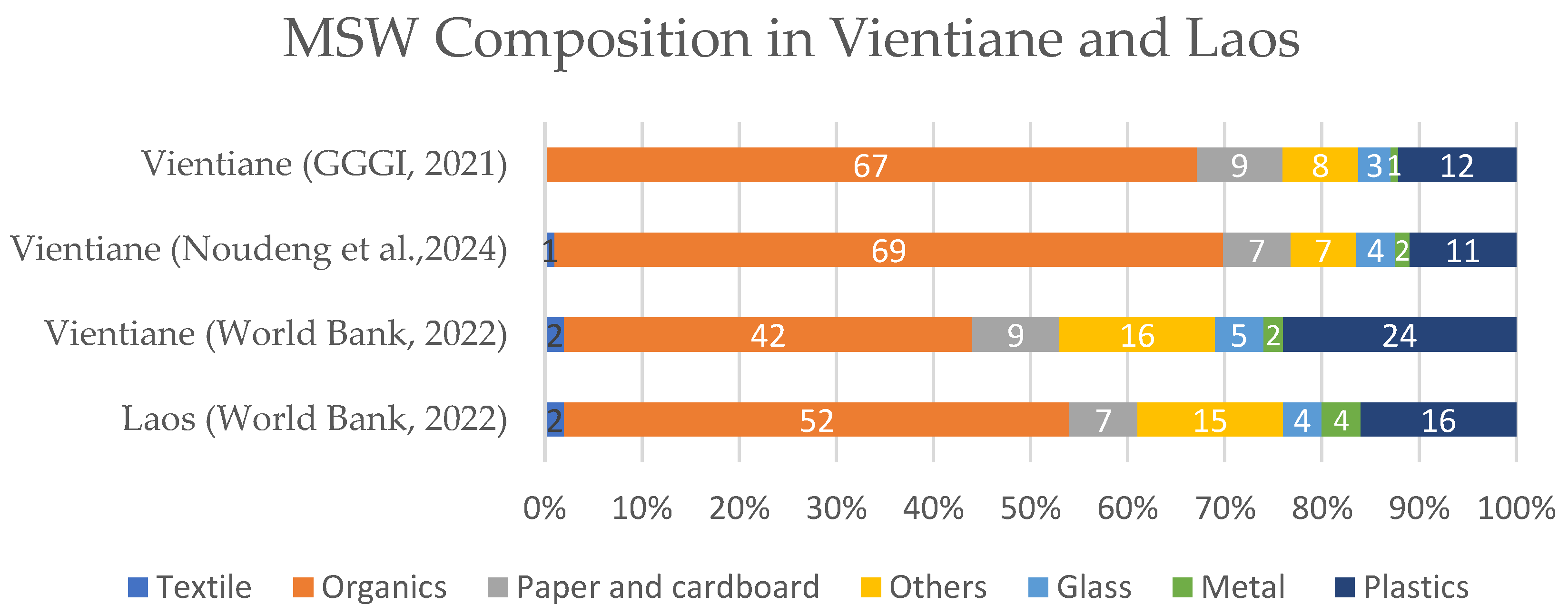
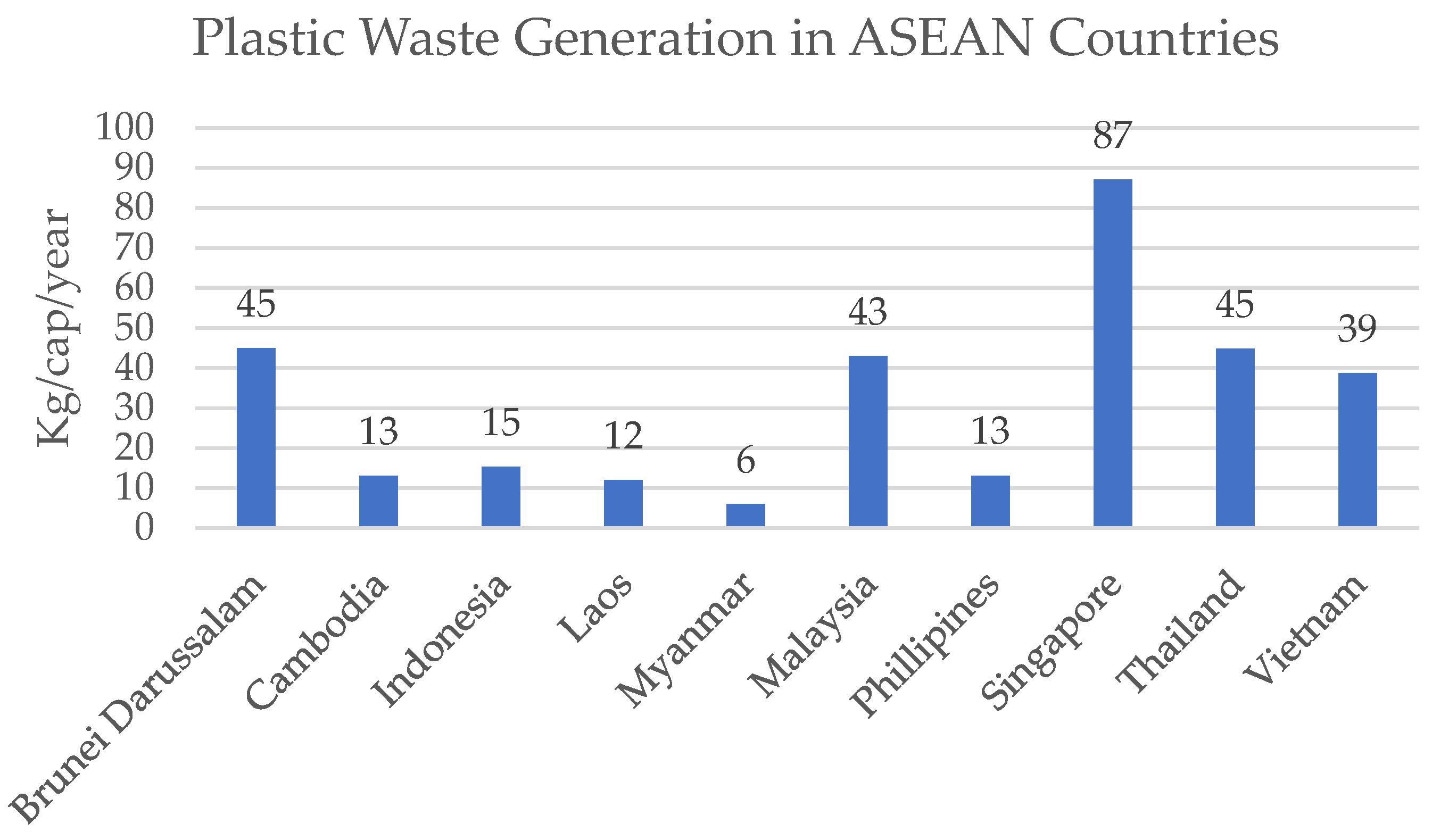
2.1. Municipal Waste and Plastic Waste Management in Laos

| Level | Year | Population | Total MSW Generation (t/Year) | MSW Waste Generation Rate (kg/cap/Year) | Plastic Waste Composition (%) | Plastic Waste Generation Rate (kg/cap/Year) | Estimated Annual Plastic Waste (t/Year) | Sources | Remark |
|---|---|---|---|---|---|---|---|---|---|
| National | 2020 | 7,346,533 | 910,000 | 124 | 16 | 20 | 145,600 | World Bank, 2021 [25] | Overall waste report |
| National | 2018 | 7,128,045 | 1,691,129 | 237 | 16 | 38 | 270,581 | GGGI, 2018 [32] | Based on 0.65 kg/cap/day |
| National | 2024 | 7,664,993 | - | - | - | 12 | 91,980 | Earth Action, 2024 [27] | Based on the Plasteax modelling approach, plastic waste generation is 12 kg/cap/year |
| Vientiane | 2020 | 683,000 | 354,050 | 518 | 12 | 63 | 42,840 | GGGI & VCOMs, 2021 [24] | Based on 970 tons/day; 31% collection rate |
| Vientiane | 2018 | 665,000 | 219,000 | 329 | 12 | 36 | 24,090 | GGGI, 2018 [32] | Overall waste report |
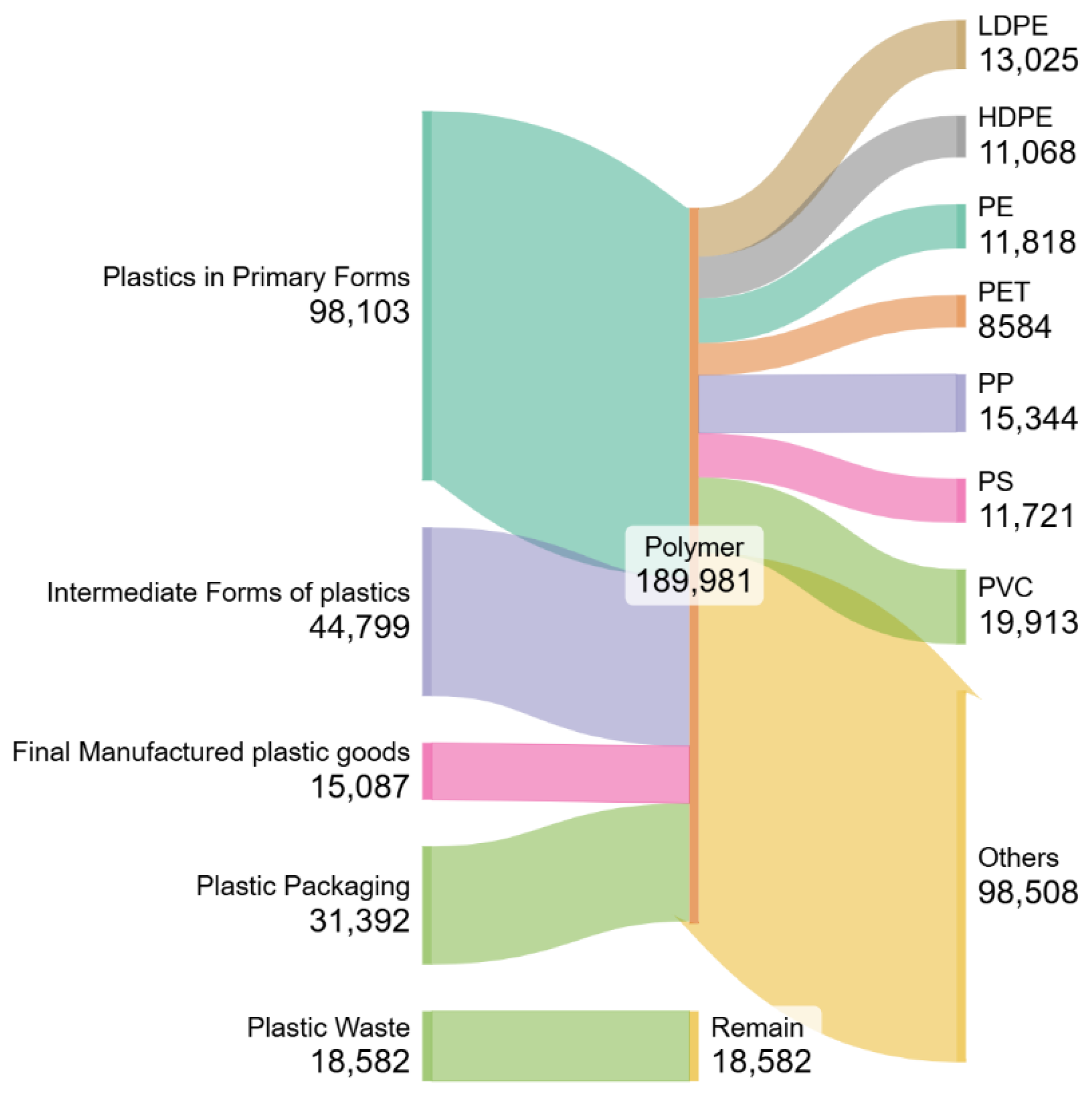
2.2. Plastic and Plastic Packaging Material Flows
Overview of the Approach
- Step 1: Data source
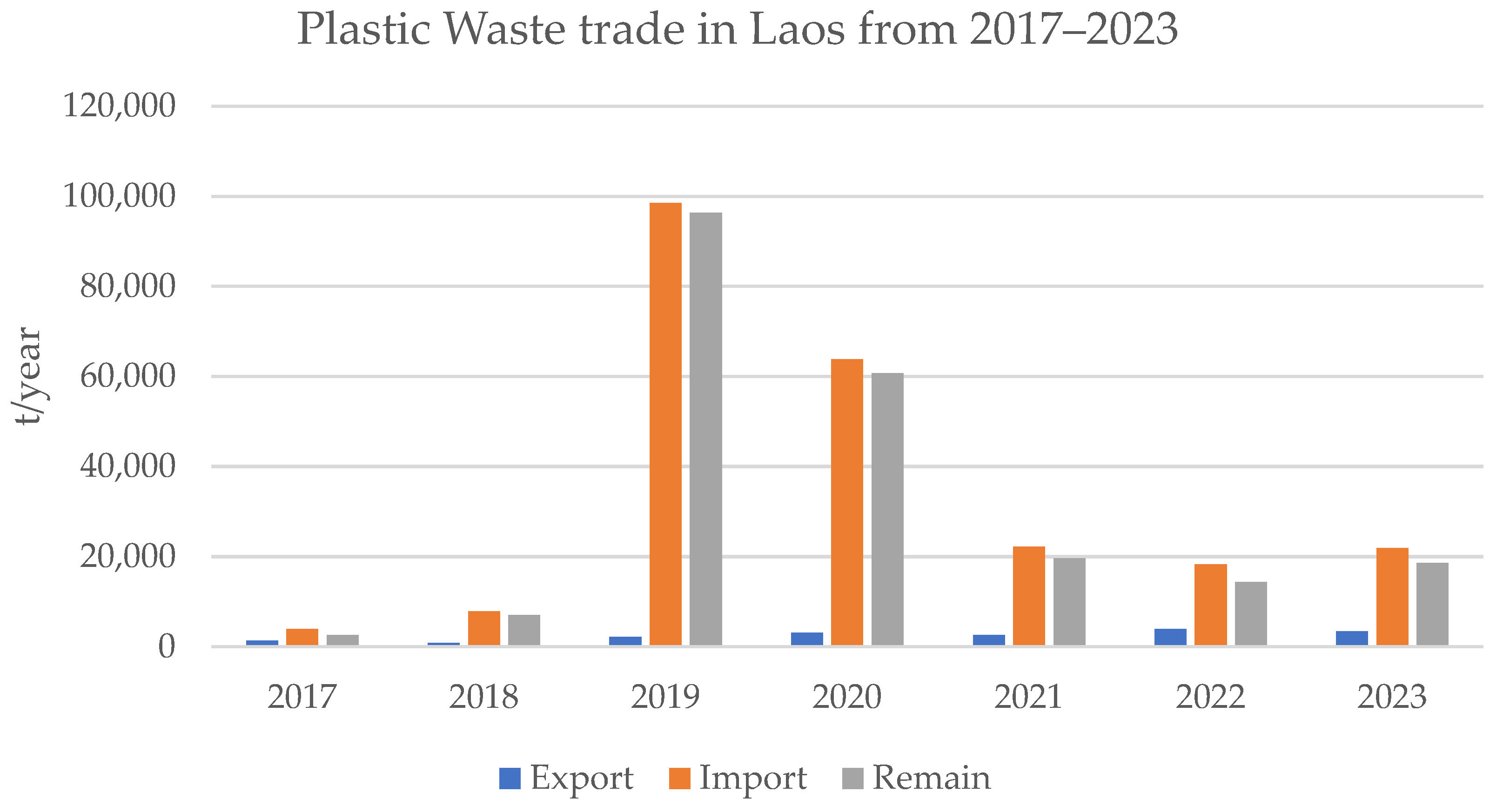
- Step 2: Estimation of apparent consumption
- Domestic production refers to polymer production either from a primary virgin source or a secondary source (recycled plastic from the previous year);
- Import includes all plastic entering the country in any form (primary polymers, plastic products, or plastics embedded in products);
- Export includes all plastic leaving the country, in any form.
- Step 3: Classification of plastic flows by product group
- Step 4: Classification of plastic flows by polymer type
- Step 5: Identification and quantification of plastic packaging flows
2.3. Scenario-Based Emission Model
2.3.1. Goal and Scope
2.3.2. Life Cycle Inventory
- Mplastic: mass of plastic packaging undergoing the respective waste treatment (e.g., open burning, open dumping, and landfilling) [kg].
- EFtreatment: gate-to-grave emission factor for respective waste treatment process [kg CO2-eq].
- Munrecovered: mass of plastic packaging not recovered through material recycling and therefore disposed of via open burning, open dumping, and landfilling [kg].
- EFproduction: cradle-to-gate emission factor for virgin plastic production [kg CO2-eq].
- Mrecycled: mass of plastic packaging entering the recycling process [kg].
- EFproduction: cradle-to-gate emission factor for virgin plastic production [kg CO2-eq].
- EFrecycling: emission factor associated with the recycling process [kg CO2-eq].
2.3.3. Scenario Development
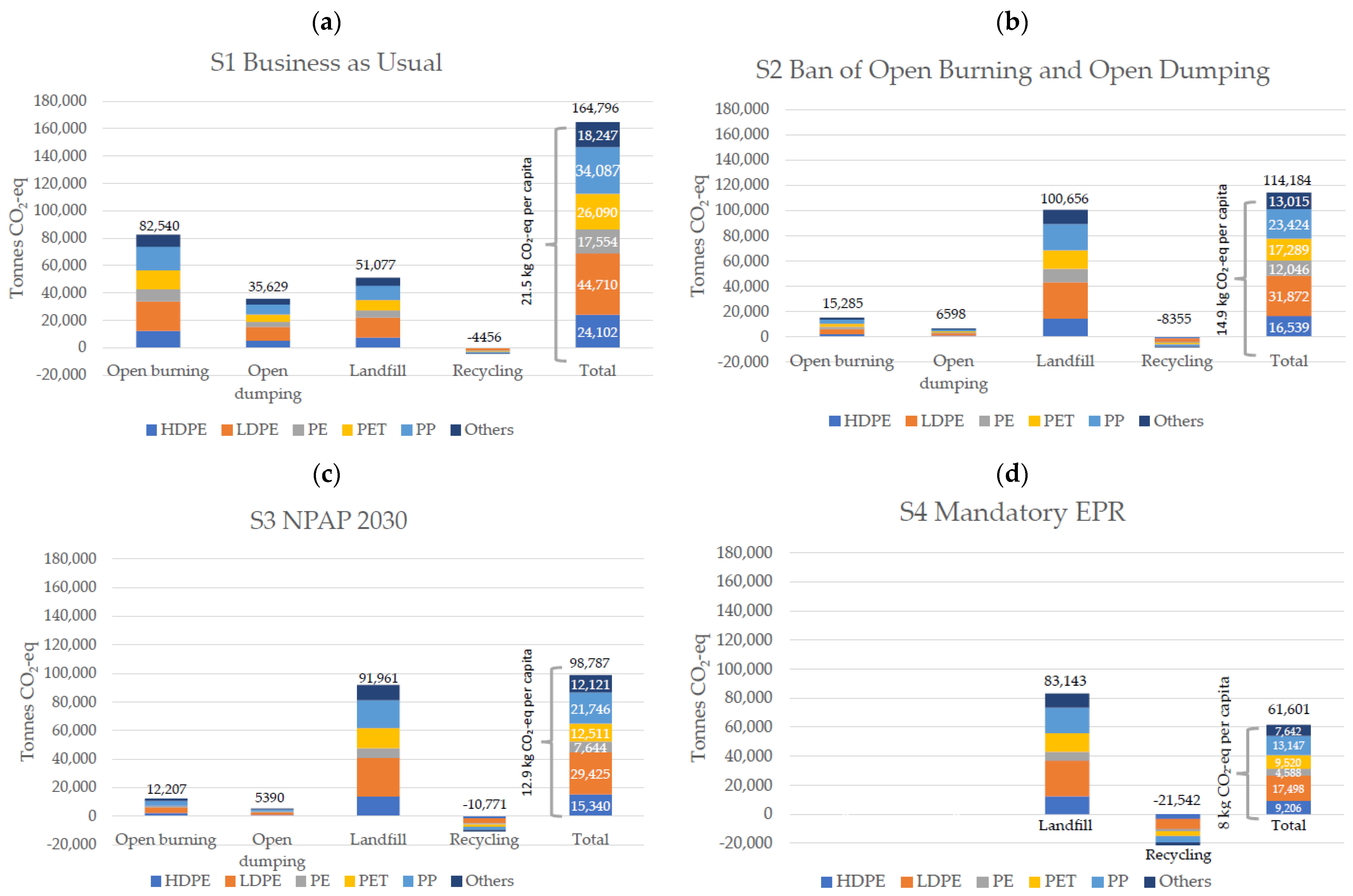
- S1 Business as Usual represents the current MSW management in Vientiane, Laos [23]. Waste treatment shares comprise open burning (27%), open dumping (27%), landfilling (38%), and recycling (8%), reflecting limited collection coverage, continued reliance on informal disposal behaviour, and limited formal recycling capacity. No upstream reduction in plastic packaging consumption is assumed.
- S2 Ban on Open Burning (OB) and Open Dumping (OD), assuming that waste collection services are improved and inadequate treatment options, such as open dumping and burning, are prohibited. However, a 5% share is retained for each practice to reflect persistent informal disposal, particularly in areas with limited service coverage. Diverted waste from OB and OD is primarily reallocated to landfilling (75%), with a modest increase in recycling (15%). This allocation reflects improved collection without significant expansion of recycling capacity. No upstream reduction in plastic packaging consumption is assumed in this scenario.
- S3 NPAP 2030 reflects on the principal objectives and policy instruments of the National Plastics Action Plan (NPAP) for Laos from 2024 to 2030 [21]. In addition to improved waste management, this scenario incorporates upstream plastic reduction, reflecting restrictions on selected single-use plastic products, and a voluntary Extended Producer Responsibility (EPR) initiative, with at least 50 businesses participating to support recyclable collection and take-back programs. Upstream reduction is applied specifically to plastic bags (HS code 392321), with a 31.6% reduction rate based on empirical evidence from the EU Plastic Bag Directive [47]. On the waste management side, improved collections reduce open burning and dumping to 5% each. However, under voluntary EPR, recycling capacity is assumed to expand only modestly. This reflects the modest improvement without mandatory producer obligations or large-scale investment in recycling infrastructure. As a result, diverted waste is predominantly directed to landfilling 70%, with recycling increasing to 20%.
- S4 Mandatory Extended Producer Responsibility (EPR) represents the implementation of mandatory EPR for plastic packaging. As in S3, 31.6% upstream reduction in plastic bags is applied, reflecting the prevention incentives embedded in EPR schemes. For the remaining waste, open burning and open dumping are eliminated, assuming nationwide formalisation of collection under mandatory EPR. Recycling increases to 40%, aligned with the average plastic packaging recycling rate observed in EU member states following EPR implementation [48]. The remaining 60% is directed to landfilling, reflecting the current technological constraints in Laos and the absence of alternative treatment options.
3. Results
3.1. Plastic and Plastic Packaging Material Flow
3.2. Plastic Waste Trade in Laos
3.3. Environmental Implications
- Sensitivity Analysis
4. Discussion
- Limitations of this study
5. Conclusions
Supplementary Materials
Author Contributions
Funding
Institutional Review Board Statement
Informed Consent Statement
Data Availability Statement
Conflicts of Interest
References
- Geyer, R. Chapter 2—Production, use, and fate of synthetic polymers. In Plastic Waste and Recycling; Academic Press: San Diego, CA, USA, 2020; pp. 13–32. [Google Scholar] [CrossRef] [Scilit]
- Plastic Europe. Plastics the Facts 2021; Plastic Europe: Brussels, Belgium, 2022. [Google Scholar]
- Lebreton, L.; Andrady, A. Future scenarios of global plastic waste generation and disposal. Palgrave Commun. 2019, 5, 6. [Google Scholar] [CrossRef] [Scilit]
- Pottinger, A.S.; Geyer, R.; Biyani, N.; Martinez, C.C.; Nathan, N.; Morse, M.R.; Liu, C.; Hu, S.; Bruyn, M.d.; Boettiger, C.; et al. Pathways to reduce global plastic waste mismanagement and greenhouse gas emissions by 2050. Sci. Adv. 2024, 386, 1168–1173. [Google Scholar]
- Jambeck, J.R.; Geyer, R.; Wilcox, C.; Siegler, T.R.; Perryman, M.; Andrady, A.; Narayan, R.; Law, K.L. Plastic waste inputs from land into the ocean. Mar. Pollut. 2015, 347, 768–771. [Google Scholar] [CrossRef] [Scilit]
- Borrelle, S.B.; Ringma, J.; Law, K.L.; Monnahan, C.C.; Lebreton, L.; McGivern, A.; Murphy, E.; Jambeck, J.; Leonard, G.H.; Hilleary, M.A.; et al. Predicted growth in plastic waste exceeds efforts to mitigate plastic pollution. Plast. Pollut. 2020, 369, 1515–1518. [Google Scholar]
- Meijer, L.J.J.; van Emmerik, T.; van der Ent, R.; Schmidt, C.; Lebreton, L. More than 1000 rivers account for 80% of global riverine plastic emissions into the ocean. Sci. Adv. 2021, 7, eaaz5803. [Google Scholar] [CrossRef] [Scilit] [PubMed]
- OECD. Regional Plastics Outlook for Southeast and East Asia; OECD: Paris, France, 2025. [Google Scholar]
- Soudachanh, S.; Campitelli, A.; Salhofer, S. Identifying Priorities for the Development of Waste Management Systems in ASEAN Cities. Waste 2024, 2, 102–121. [Google Scholar] [CrossRef] [Scilit]
- Amy, L.; Brooks, S.W.; Jambeck, J.R. The Chinese import ban and its impact on global plastic waste trade. Sci. Adv. 2018, 4, eaat0131. [Google Scholar] [CrossRef] [Scilit]
- D’Amato, A.; Paleari, S.; Pohjakallio, M.; Vanderreydt, I.; Zoboli, R. Plastics Waste Trade and the Environment; European Environment Agency: Copenhagen, Denmark, 2019. [Google Scholar]
- Soudachanh, S.; Salhofer, S. Global plastic waste transboundary movement and implications in ASEAN. In Proceedings of the 8th 3R International Scientific Conference—3RINCs 2022, Online, 14–18 March 2022. [Google Scholar]
- ASEAN. Bangkok Declaration on Combating Marine Debris in ASEAN Region; ASEAN: Jakarta, Indonesia, 2019. [Google Scholar]
- ASEAN. ASEAN Framework of Action on Marine Debris; ASEAN: Jakarta, Indonesia, 2019. [Google Scholar]
- ASEAN. ASEAN Regional Action Plan for COMBATING MARINE DEBRIS in the ASEAN Member States (2021–2025); ASEAN: Jakarta, Indonesia, 2021. [Google Scholar]
- ASEAN. ASEAN Declaration on Plastic Circularity; ASEAN: Jakarta, Indonesia, 2024. [Google Scholar]
- European Commission. A European Strategy for Plastics in a Circular Economy; European Commission: Brussels, Belgium, 2018. [Google Scholar]
- European Commission. A New Circular Economy Action Plan; European Commission: Brussels, Belgium, 2020. [Google Scholar]
- Kojima, M.; Suwarno, A.S. Extended Producer Responsibility on Plastics in Southeast Asian Countries; ERIA Annex Office: Jakarta, Indonesia, 2025. [Google Scholar]
- World Bank. Extended Producer Responsibility for Plastic Packaging in Selected ASEAN Member States; World Bank: Washington, DC, USA, 2025. [Google Scholar]
- MONRE. National Plastics Action Plan for the Lao PDR 2024–2030; Minister of Natural Resource and Environment: Phaya Thai District, Bangkok, 2024. [Google Scholar]
- World Bank. Get CLEAN and GREEN—Solid and Plastic Waste Management in Lao PDR; World Bank: Washington, DC, USA, 2022. [Google Scholar]
- Noudeng, V.; Pheakdey, D.V.; Minh, T.T.N.; Xuan, T.D. Municipal Solid Waste Management in Laos: Comparative Analysis of Environmental Impact, Practices, and Technologies with ASEAN Regions and Japan. Environments 2024, 11, 170. [Google Scholar] [CrossRef] [Scilit]
- GGGI; VCOMs. Sustainable Solid Waste Management Strategy and Action Plan for Vientiane 2021–2030; Global Green Growth Institute: Seoul, Republic of Korea, 2021; Available online: https://gggi.org/report/sustainable-solid-waste-management-strategy-and-action-plan-for-vientiane-2021-2030-lao/ (accessed on 1 June 2025).
- World Bank. Supporting Lao PDR to Improve Solid and Plastic Waste Management; World Bank: Washington, DC, USA, 2021. [Google Scholar]
- World Bank. Supporting Lao PDR in Development of a Plastic Action Plan Diagnostics; World Bank: Washington, DC, USA, 2021. [Google Scholar]
- Earth Action. Plastic Overshoot Day; Earth Action: Amherst, MA, USA, 2024. [Google Scholar]
- SWITCH Asia. Plastic Policies in Indonesia Country Profile; SWITCH Asia: Bangkok, Thailand, 2025. [Google Scholar]
- SWITCH Asia. Plastic Policies in the Philippines Country Profile; SWITCH Asia: Bangkok, Thailand, 2025. [Google Scholar]
- SWITCH Asia. Plastic Policies in Vietnam Country Profile; SWITCH Asia: Bangkok, Thailand, 2025. [Google Scholar]
- SWITCH Asia. Plastic Policies in Thailand Country Profile; SWITCH Asia: Bangkok, Thailand, 2025. [Google Scholar]
- GGGI. Solid Waste Management in Vientiane, Lao P.D.R; GGGI: Seoul, Republic of Korea, 2018. [Google Scholar]
- United Nations Statistics Division. UN Comtrade Database. 2025. Available online: https://comtradeplus.un.org/ (accessed on 1 June 2025).
- World Customs Organization. What Is the Harmonized System (HS)? Available online: https://www.wcoomd.org/en/topics/nomenclature/overview/what-is-the-harmonized-system.aspx (accessed on 1 June 2025).
- UNCTAD. Global Trade in Plastics: Insights from the First Life-Cycle Trade Database; UNCTAD: Geneva, Switzerland, 2020. [Google Scholar]
- Baldé, C.P.; Kuehr, R.; Yamamoto, T.; McDonald, R.; D’Angelo, E.; Althaf, S.; Bel, G.; Deubzer, O.; Fernandez-Cubillo, E.; Vanessa Forti, V.G.; et al. Global E-Waste Monitor 2024; International Telecommunication Union (ITU): Geneva, Switzerland; United Nations Institute for Training and Research (UNITAR): Bonn, Germany, 2024. [Google Scholar]
- Salhofer, S.; Soudachanh, S.; Jandric, A.; Darasouk, A.; Chansomphou, V.; Latthachak, P. E-Waste Management in Laos: Country Report; BOKU University: Vienna, Austria, 2023. [Google Scholar]
- Baldé, K. Methodology and Practical Guidance to Estimate Plastic Waste Generation; United Nations Institute for Training and Research: Geneva, Switzerland, 2022. [Google Scholar]
- UNITAR SCYCLE. Plastic Put on Market Calculation (POM) Tool Manual; United Nations Institute for Training and Research: Geneva, Switzerland, 2023. [Google Scholar]
- Plastic Europe. Plastic the Facts 2022; Plastic Europe: Brussels, Belgium, 2022. [Google Scholar]
- European Environmental Agency. Flexible Plastics in Europe’s Circular Economy; European Environmental Agency: Copenhagen, Denmark, 2022. [Google Scholar]
- Castagnoli, A.; Simi, S.; Pulvirenti, I.; Valese, A. Cradle-to-Grave LCA of In-Person Conferences: Hotspots, Trade-Offs and Mitigation Pathways. Sustainability 2025, 17, 7604. [Google Scholar] [CrossRef] [Scilit]
- Ecoinvent. Ecoinvent Database Version 3.11. Available online: https://ecoquery.ecoinvent.org/3.11/cutoff (accessed on 9 December 2025).
- US EPA. Waste Reduction Model Tool; Version 16; US EPA; 2025. Available online: https://www.epa.gov/waste-reduction-model/versions-waste-reduction-model (accessed on 1 June 2025).
- Leal Filho, W.; Barbir, J.; Carpio-Vallejo, E.; Dobri, A.; Voronova, V. Decarbonising the plastic industry: A review of carbon emissions in the lifecycle of plastics production. Sci. Total Environ. 2025, 999, 180337. [Google Scholar] [CrossRef] [Scilit]
- Kasper, J.B.; Parker, L.A.; Postema, S.; Hoppener, E.M.; Leighton, A.H.; Finnegan, A.M.D.; Rutten, S.B.; Nijman, J.; Larasati, A.; Soares, A.C.C.; et al. Losses and emissions in polypropylene recycling from household packaging waste. Waste Manag. 2025, 191, 230–241. [Google Scholar] [CrossRef] [Scilit]
- Eurostat. Packaging Waste Statistics; Eurostat: Luxembourg, 2025. [Google Scholar]
- OECD. Global Plastics Outlook: Economic Drivers, Environmental Impacts and Policy OptionsGlobal Plastics Outlook; OECD Publishing: Paris, France, 2022. [Google Scholar]
- Areeprasert, C.; Asingsamanunt, J.; Srisawat, S.; Kaharn, J.; Inseemeesak, B.; Phasee, P.; Khaobang, C.; Siwakosit, W.; Chiemchaisri, C. Municipal Plastic Waste Composition Study at Transfer Station of Bangkok and Possibility of its Energy Recovery by Pyrolysis. Energy Procedia 2017, 107, 222–226. [Google Scholar] [CrossRef] [Scilit]
- Pongpunpurt, P.; Chawaloesphonsiya, N.; Poyai, T.; Guiraud, P.; Tiruta-Barna, L.; Rungsithong, R.; Leknoi, U.; Janjaroen, D.; Painmanakul, P. Exploring the circular business model for sustainable plastic waste management in shopping malls: Challenges, opportunities, and impacts in Thailand. Case Stud. Chem. Environ. Eng. 2024, 10, 100872. [Google Scholar] [CrossRef] [Scilit]
- Ramadan, B.S.; Rosmalina, R.T.; Syafrudin; Munawir; Khair, H.; Rachman, I.; Matsumoto, T. Potential Risks of Open Waste Burning at the Household Level: A Case Study of Semarang, Indonesia. Aerosol Air Qual. Res. 2023, 23, 220412. [Google Scholar] [CrossRef] [Scilit]
- Pansuk, J.; Junpen, A.; Garivait, S. Assessment of Air Pollution from Household Solid Waste Open Burning in Thailand. Sustainability 2018, 10, 2553. [Google Scholar] [CrossRef] [Scilit]
- Pathak, G.; Nichter, M.; Hardon, A.; Moyer, E.; Latkar, A.; Simbaya, J.; Pakasi, D.; Taqueban, E.; Love, J. Plastic pollution and the open burning of plastic wastes. Glob. Environ. Change 2023, 80, 102648. [Google Scholar] [CrossRef] [Scilit]
- Pathak, G.; Nichter, M.; Hardon, A.; Moyer, E. The Open Burning of Plastic Wastes is an Urgent Global Health Issue. Ann. Glob. Health 2024, 90, 3. [Google Scholar] [CrossRef] [Scilit] [PubMed]
- Adetona, O.; Ozoh, O.B.; Oluseyi, T.; Uzoegwu, Q.; Odei, J.; Lucas, M. An exploratory evaluation of the potential pulmonary, neurological and other health effects of chronic exposure to emissions from municipal solid waste fires at a large dumpsite in Olusosun, Lagos, Nigeria. Environ. Sci. Pollut. Res. Int. 2020, 27, 30885–30892. [Google Scholar] [CrossRef] [Scilit] [PubMed]
- Kovats, N.; Hubai, K.; Sainnokhoi, T.A.; Eck-Varanka, B.; Hoffer, A.; Toth, A.; Kakasi, B.; Teke, G. Ecotoxic emissions generated by illegal burning of household waste. Chemosphere 2022, 298, 134263. [Google Scholar] [CrossRef] [Scilit]
- Verma, R.; Vinoda, K.S.; Papireddy, M.; Gowda, A.N.S. Toxic Pollutants from Plastic Waste—A Review. Procedia Environ. Sci. 2016, 35, 701–708. [Google Scholar] [CrossRef] [Scilit]
- Yamahara, S.; Viyakarn, V.; Chavanich, S.; Bureekul, S.; Isobe, A.; Nakata, H. Open dumping site as a point source of microplastics and plastic additives: A case study in Thailand. Sci. Total Environ. 2024, 948, 174827. [Google Scholar] [CrossRef] [Scilit]
- Vongdala, N.; Tran, H.D.; Xuan, T.D.; Teschke, R.; Khanh, T.D. Heavy Metal Accumulation in Water, Soil, and Plants of Municipal Solid Waste Landfill in Vientiane, Laos. Int. J. Environ. Res. Public Health 2018, 16, 22. [Google Scholar] [CrossRef] [Scilit]
- Wojnowska-Baryla, I.; Bernat, K.; Zaborowska, M. Plastic Waste Degradation in Landfill Conditions: The Problem with Microplastics, and Their Direct and Indirect Environmental Effects. Int. J. Environ. Res. Public Health 2022, 19, 13223. [Google Scholar] [CrossRef] [Scilit]
- Kibria, M.G.; Masuk, N.I.; Safayet, R.; Nguyen, H.Q.; Mourshed, M. Plastic Waste: Challenges and Opportunities to Mitigate Pollution and Effective Management. Int. J. Environ. Res. 2023, 17, 20. [Google Scholar] [CrossRef] [Scilit]
- Lin, X.; Zhang, S.; Yang, S.; Zhang, R.; Shi, X.; Song, L. A landfill serves as a critical source of microplastic pollution and harbors diverse plastic biodegradation microbial species and enzymes: Study in large-scale landfills, China. J. Hazard. Mater. 2023, 457, 131676. [Google Scholar] [CrossRef] [Scilit]
- Noudeng, V.; Van Quan, N.; Xuan, T.D.; Vathanamixay, C.; Souvanna, P. Risk Assessment of Microplastics Dispersion and Accumulation in Urban Canals to the Water Environment in Vientiane Capital, Laos. Water Air Soil Pollut. 2023, 234, 575. [Google Scholar] [CrossRef] [Scilit]
- European Commission. Waste Hierarchy Under EU Waste Framework Directive (Directive 2008/98/EC); European Commission: Brussels, Belgium, 2008. [Google Scholar]
- Plastic Europe. Plastics the Facts 2019; Plastic Europe: Brussels, Belgium, 2020. [Google Scholar]
- Tumu, K.; Vorst, K.; Curtzwiler, G. Global plastic waste recycling and extended producer responsibility laws. J. Environ. Manag. 2023, 348, 119242. [Google Scholar] [CrossRef] [Scilit]
- Colelli, F.P.; Croci, E.; Bruno Pontoni, F.; Floriana Zanini, S. Assessment of the effectiveness and efficiency of packaging waste EPR schemes in Europe. Waste Manag. 2022, 148, 61–70. [Google Scholar] [CrossRef] [Scilit] [PubMed]
- Andreasi Bassi, S.; Boldrin, A.; Faraca, G.; Astrup, T.F. Extended producer responsibility: How to unlock the environmental and economic potential of plastic packaging waste? Resour.Conserv. Recycl. 2020, 162, 105030. [Google Scholar] [CrossRef] [Scilit]
- Sanders, T. EPR Focus: Mandatory vs. Voluntary Extended Producer Responsibility (EPR). Available online: https://www.bvrio.org/epr-focus-mandatory-vs-voluntary-extended-producer-responsibility-epr/ (accessed on 30 November 2025).
- Rigamonti, L.; Taelman, S.E.; Huysveld, S.; Sfez, S.; Ragaert, K.; Dewulf, J. A step forward in quantifying the substitutability of secondary materials in waste management life cycle assessment studies. Waste Manag. 2020, 114, 331–340. [Google Scholar] [CrossRef] [Scilit]
- Salhofer, S.; Jandric, A.; Soudachanh, S.; Le Xuan, T.; Tran, T.D. Plastic Recycling Practices in Vietnam and Related Hazards for Health and the Environment. Int. J. Environ. Res. Public Health 2021, 18, 4203. [Google Scholar] [CrossRef] [Scilit]
- Steuer, B.; Chen, P. Exploring capacities, environmental benefits and potential for a circular economy on waste plastic bottles in Hong Kong. Resour. Conserv. Recycl. 2023, 199, 107270. [Google Scholar] [CrossRef] [Scilit]
- Yap, K.S.; Leow, Y.J.; Chung, S.Y.; Loke, C.P.H.; Tan, D.Z.L.; Yeo, Z.; Low, J.S.C. Life Cycle Assessment of Plastic End of Life Treatment in Singapore. Procedia CIRP 2023, 116, 522–527. [Google Scholar] [CrossRef] [Scilit]
- Falsafi, A.; Falsafi, A.; Abdulkareem, M.; Horttanainen, M. Assessing dioxin emissions change in the transition from landfilling of MSW to waste-to-energy. Environ. Sci. Pollut. Res. Int. 2025. [Google Scholar] [CrossRef] [Scilit] [PubMed]
- Circularise. R-Strategies for Circular Economy. Available online: https://www.circularise.com/blogs/r-strategies-for-a-circular-economy (accessed on 1 June 2025).
- UNDP. EPPIC 2023 Finalists Booklet Lao PDR; UNDP: Vientiane, Laos, 2023. [Google Scholar]
- PatiHoub. PatiHoub—A Circular Solution for Plastic Waste in Laos. Available online: https://patihoub.com/ (accessed on 1 June 2025).
- Econox. Plastic Free Laos Label. Available online: https://plasticfreelaos.com/ (accessed on 1 June 2025).


| Polymer | EFOpen Burning [43] | EFOpen Dumping [43] | EFLandfilling [45] | EFRecycling [43,44] | EFProduction [43,44] |
|---|---|---|---|---|---|
| LDPE | 2.44 | 0.11 | 0.08 | 0.8 | 1.8 |
| HDPE | 2.44 | 0.11 | 0.08 | 0.8 | 1.6 |
| PE | 2.44 | 0.11 | 0.08 | 0.8 | 1.6 |
| PP | 2.44 | 0.11 | 0.08 | 0.78 | 1.6 |
| PS | 2.44 | 0.11 | 0.08 | 1.05 | 1.5 |
| PET | 2.44 | 0.11 | 0.08 | 0.69 | 1.45 |
| Other polymers | 2.44 | 0.11 | 0.08 | 1.05 | 1.9 |
| Scenarios | Open Burning (%) | Open Dumping (%) | Landfilling (%) | Recycling (%) |
|---|---|---|---|---|
| S1 Business as Usual | 27 | 27 | 38 | 8 |
| S2 Ban on OB & OD | 5 | 5 | 75 | 15 |
| S3 NPAP 2030 | 5 | 5 | 70 | 20 |
| S4 Mandatory EPR | 0 | 0 | 60 | 40 |
| Year | Export (t/Year) | Import (t/Year) | Domestic Production (t/Year) | Apparent Consumption (t/Year) |
|---|---|---|---|---|
| 2017 | 199 | 25,491 | 35,853 | 61,145 |
| 2018 | 4674 | 30,866 | 35,853 | 62,045 |
| 2019 | 89,703 | 113,006 | 35,853 | 59,156 |
| 2020 | 66,390 | 147,088 | 35,853 | 116,551 |
| 2021 | 33,127 | 135,171 | 35,853 | 137,898 |
| 2022 | 17,292 | 163,694 | 35,853 | 182,256 |
| 2023 | 14,275 | 168,402 | 35,853 | 189,980 |
| Description | Trade-Based Model | Waste-Based 1 [25] | Waste-Based 2 [32] |
|---|---|---|---|
| Total plastic consumption (t/year) | 189,980 | 145,600 | 282,923 |
| Plastic consumption per capita (kg/cap/year) | 25 | 20 | 38 |
| Total plastic packaging input (t/year) | 75,157 | 38,827 | 74,367 |
| Plastic packaging input per capita (kg/cap/year) | 9.8 | 5 | 10 |
| Polymer level | |||
| HDPE | 11,190 | 22,287 | 42,686 |
| LDPE | 19,767 | 6756 | 12,940 |
| PE | 8150 | - | - |
| PET | 12,664 | 2291 | 4388 |
| PP | 15,814 | 2834 | 5429 |
| PS | - | 1864 | 3570 |
| Other polymers | 7572 | 2769 | 5206 |
Disclaimer/Publisher’s Note: The statements, opinions and data contained in all publications are solely those of the individual author(s) and contributor(s) and not of MDPI and/or the editor(s). MDPI and/or the editor(s) disclaim responsibility for any injury to people or property resulting from any ideas, methods, instructions or products referred to in the content. |
© 2026 by the authors. Licensee MDPI, Basel, Switzerland. This article is an open access article distributed under the terms and conditions of the Creative Commons Attribution (CC BY) license.
Share and Cite
Soudachanh, S.; Salhofer, S.; Chansomphou, V. Transitioning Plastic Packaging Waste Management in Laos: Circular Solutions and Environmental Implications. Sustainability 2026, 18, 2249. https://doi.org/10.3390/su18052249
Soudachanh S, Salhofer S, Chansomphou V. Transitioning Plastic Packaging Waste Management in Laos: Circular Solutions and Environmental Implications. Sustainability. 2026; 18(5):2249. https://doi.org/10.3390/su18052249
Chicago/Turabian StyleSoudachanh, Souphaphone, Stefan Salhofer, and Vathanamixay Chansomphou. 2026. "Transitioning Plastic Packaging Waste Management in Laos: Circular Solutions and Environmental Implications" Sustainability 18, no. 5: 2249. https://doi.org/10.3390/su18052249
APA StyleSoudachanh, S., Salhofer, S., & Chansomphou, V. (2026). Transitioning Plastic Packaging Waste Management in Laos: Circular Solutions and Environmental Implications. Sustainability, 18(5), 2249. https://doi.org/10.3390/su18052249