The Threshold of Authenticity and the Limits of Cultural Involvement: A Non-Linear Perspective on Heritage Tourist Loyalty


Abstract
1. Introduction
2. Literature Review
2.1. Consumer-Based Model of Authenticity
2.2. Cultural Motivation
2.3. Object-Based and Existential Authenticity
2.4. Cultural Involvement
2.5. Loyalty
3. Research Methodology
3.1. Study Location
3.2. Data Collection
3.3. Data Modeling
4. Results
4.1. Sample Characteristics
4.2. Assessment of Measurement Model
4.3. Assessment of Structural Model
4.3.1. Collinearity Assessment
4.3.2. Explained Variance and Predictive Relevance
4.3.3. Path Coefficients and Hypothesis Testing
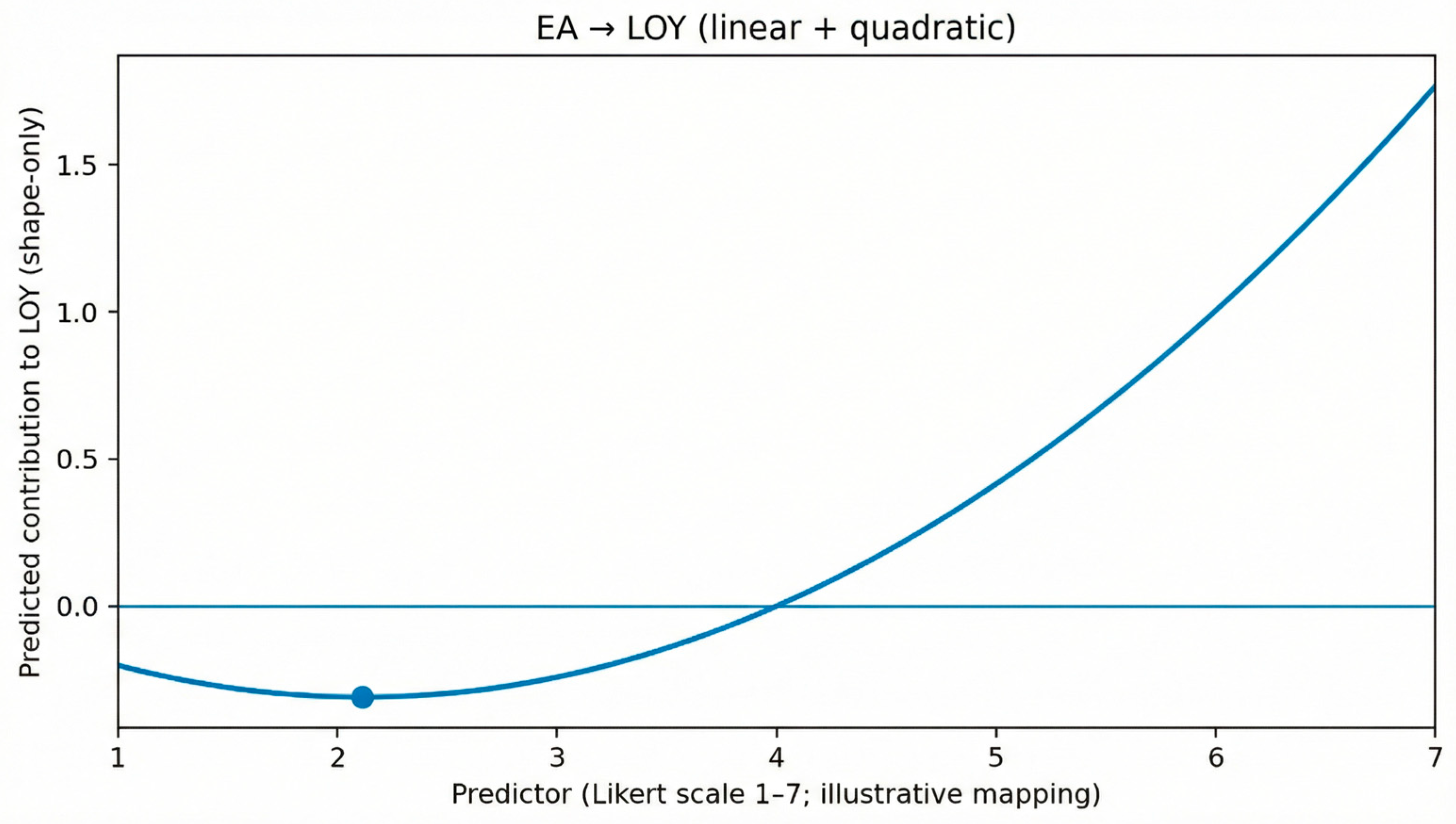
4.4. Non-Linear Effects
4.5. Total Effects
5. Discussion and Conclusions
5.1. Discussion of the Findings
5.2. Theoretical Contributions
5.3. Managerial Implications
5.4. Conclusions
Author Contributions
Funding
Institutional Review Board Statement
Informed Consent Statement
Data Availability Statement
Conflicts of Interest
Abbreviations
| AVE | Average variance extracted |
| BCa | Bias-corrected and accelerated (confidence interval) |
| CA | Cronbach’s alpha |
| CINV | Cultural involvement |
| CM | Cultural motivation |
| CMB | Common method bias |
| CR | Composite reliability |
| EA | Existential authenticity |
| HTMT | Heterotrait–Monotrait ratio |
| LL | Lower limit |
| LOY | Tourist loyalty |
| OBA | Object-based authenticity |
| PLS-SEM | Partial least squares structural equation modeling |
| Q2 | Stone–Geisser’s predictive relevance |
| R2 | Coefficient of determination |
| SmartPLS | SmartPLS 4 (software) |
| STDEV | Standard deviation |
| UL | Upper limit |
| VIF | Variance inflation factor |
| β | Path coefficient |
References
- UNWTO (Ed.) Urban Solutions—Culture Driven Sustainable Urban Tourism; World Tourism Organization (UNWTO): Madrid, Spain, 2024; ISBN 978-92-844-2085-8. [Google Scholar]
- Gao, J.; Lin, S.; Zhang, C. Authenticity, Involvement, and Nostalgia: Understanding Visitor Satisfaction with an Adaptive Reuse Heritage Site in Urban China. J. Destin. Mark. Manag. 2020, 15, 100404. [Google Scholar] [CrossRef]
- Lu, L.; Chi, C.G.; Liu, Y. Authenticity, Involvement, and Image: Evaluating Tourist Experiences at Historic Districts. Tour. Manag. 2015, 50, 85–96. [Google Scholar] [CrossRef]
- Dwyer, L.; Kim, C. Destination Competitiveness: Determinants and Indicators. Curr. Issues Tour. 2003, 6, 369–414. [Google Scholar] [CrossRef]
- Hosany, S.; Sthapit, E.; Björk, P. Memorable Tourism Experience: A Review and Research Agenda. Psychol. Mark. 2022, 39, 1467–1486. [Google Scholar] [CrossRef]
- Timothy, D.J. Cultural Heritage and Tourism: An Introduction; Channel View Publications: Bristol, UK, 2011; ISBN 978-1-84541-176-3. [Google Scholar]
- Fuller, A. Cultural and Heritage Tourism; Scientific e-Resources: New Delhi, India, 2018; ISBN 978-1-83947-436-1. [Google Scholar]
- Kolar, T.; Zabkar, V. A Consumer-Based Model of Authenticity: An Oxymoron or the Foundation of Cultural Heritage Marketing? Tour. Manag. 2010, 31, 652–664. [Google Scholar] [CrossRef]
- Ashworth, G.J.; Tunbridge, J.E. The Tourist-Historic City; Routledge: London, UK, 2000; ISBN 978-1-136-35579-0. [Google Scholar]
- United Nations. 2030 Agenda for Sustainable Development.Pdf. 2015. Available online: https://www.un.org/ohrlls/sites/www.un.org.ohrlls/files/2030_agenda_for_sustainable_development_web.pdf (accessed on 20 February 2024).
- Richards, G.; Wilson, J. Tourism Development Trajectories: From Culture to Creativity? In Tourism, Creativity and Development; Routledge: London, UK, 2007. [Google Scholar]
- Yin, S.; Dai, G. Authenticity and Tourist Loyalty: A Meta-Analysis. Asia Pac. J. Tour. Res. 2021, 26, 1331–1349. [Google Scholar] [CrossRef]
- Shen, S.; Guo, J.; Wu, Y. Investigating the Structural Relationships among Authenticity, Loyalty, Involvement, and Attitude toward World Cultural Heritage Sites: An Empirical Study of Nanjing Xiaoling Tomb, China. Asia Pac. J. Tour. Res. 2014, 19, 103–121. [Google Scholar] [CrossRef]
- Wang, G.; Huang, L.; Xu, C.; He, K.; Shen, K.; Liang, P. Analysis of the Mediating Role of Place Attachment in the Link between Tourists’ Authentic Experiences of, Involvement in, and Loyalty to Rural Tourism. Sustainability 2022, 14, 12795. [Google Scholar] [CrossRef]
- Bryce, D.; Curran, R.; O’Gorman, K.; Taheri, B. Visitors’ Engagement and Authenticity: Japanese Heritage Consumption. Tour. Manag. 2015, 46, 571–581. [Google Scholar] [CrossRef]
- Wang, N. Rethinking Authenticity in Tourism Experience. Ann. Tour. Res. 1999, 26, 349–370. [Google Scholar] [CrossRef]
- Yeh, S.-S.; Leong, A.M.W.; Hung, C.-W.; Huan, T.-C. Destination Authenticity Influence on Tourists’ Behavioral Intentions, Involvement and Nostalgic Sentiments. Tour. Rev. 2024, 80, 456–471. [Google Scholar] [CrossRef]
- Kesgin, M.; Taheri, B.; Murthy, R.S.; Decker, J.; Gannon, M.J. Making Memories: A Consumer-Based Model of Authenticity Applied to Living History Sites. Int. J. Contemp. Hosp. Manag. 2021, 33, 3610–3635. [Google Scholar] [CrossRef]
- Taheri, B.; Gannon, M.J.; Cordina, R.; Lochrie, S. Measuring Host Sincerity: Scale Development and Validation. Int. J. Contemp. Hosp. Manag. 2018, 30, 2752–2772. [Google Scholar] [CrossRef]
- Crompton, J.L. Motivations for Pleasure Vacation. Ann. Tour. Res. 1979, 6, 408–424. [Google Scholar] [CrossRef]
- Zhou, Q.; Zhang, J.; Edelheim, J.R. Rethinking Traditional Chinese Culture: A Consumer-Based Model Regarding the Authenticity of Chinese Calligraphic Landscape. Tour. Manag. 2013, 36, 99–112. [Google Scholar] [CrossRef]
- Zhao, S.; Marzuki, A.; Rong, W.; Ran, X. An Empirical Application of the Consumer-Based Authenticity Model in Heritage Tourism of the George Town Historic District, Penang, Malaysia. Heliyon 2024, 10, e38254. [Google Scholar] [CrossRef]
- Kim, H.; Jamal, T. Touristic Quest for Existential Authenticity. Ann. Tour. Res. 2007, 34, 181–201. [Google Scholar] [CrossRef]
- Brown, L. Tourism: A Catalyst for Existential Authenticity. Ann. Tour. Res. 2013, 40, 176–190. [Google Scholar] [CrossRef]
- Zhang, T.; Yin, P. Testing the Structural Relationships of Tourism Authenticities. J. Destin. Mark. Manag. 2020, 18, 100485. [Google Scholar] [CrossRef]
- Havitz, M.E.; Dimanche, F. Leisure Involvement Revisited: Conceptual Conundrums and Measurement Advances. J. Leis. Res. 1997, 29, 245–278. [Google Scholar] [CrossRef]
- Zaichkowsky, J.L. Measuring the Involvement Construct. J. Consum. Res. 1985, 12, 341. [Google Scholar] [CrossRef]
- Fotiadis, A.; Stylos, N.; Vassiliadis, C.A. Travelling to Compete: Antecedents of Individuals’ Involvement in Small-Scale Sports Events. Tour. Recreat. Res. 2021, 46, 531–547. [Google Scholar] [CrossRef]
- Kyle, G.; Graefe, A.; Manning, R.; Bacon, J. An Examination of the Relationship between Leisure Activity Involvement and Place Attachment among Hikers along the Appalachian Trail. J. Leis. Res. 2003, 35, 249–273. [Google Scholar] [CrossRef]
- Chen, H.; Rahman, I. Cultural Tourism: An Analysis of Engagement, Cultural Contact, Memorable Tourism Experience and Destination Loyalty. Tour. Manag. Perspect. 2018, 26, 153–163. [Google Scholar] [CrossRef]
- Kontogeorgopoulos, N. Forays into the Backstage: Volunteer Tourism and the Pursuit of Object Authenticity. J. Tour. Cult. Change 2017, 15, 455–475. [Google Scholar] [CrossRef]
- Oliver, R.L. Whence Consumer Loyalty? J. Mark. 1999, 63, 33–44. [Google Scholar] [CrossRef]
- Bigné, J.E.; Sánchez, M.I.; Sánchez, J. Tourism Image, Evaluation Variables and after Purchase Behaviour: Inter-Relationship. Tour. Manag. 2001, 22, 607–616. [Google Scholar] [CrossRef]
- Yoon, Y.; Uysal, M. An Examination of the Effects of Motivation and Satisfaction on Destination Loyalty: A Structural Model. Tour. Manag. 2005, 26, 45–56. [Google Scholar] [CrossRef]
- Reichheld, F.F.; Sasser, W.E. Zero Defections: Quality Comes to Services. Harv. Bus. Rev. 1990, 68, 105–111. [Google Scholar]
- Reisinger, Y.; Steiner, C.J. Reconceptualizing Object Authenticity. Ann. Tour. Res. 2006, 33, 65–86. [Google Scholar] [CrossRef]
- Yi, X.; Lin, V.S.; Jin, W.; Luo, Q. The Authenticity of Heritage Sites, Tourists’ Quest for Existential Authenticity, and Destination Loyalty. J. Travel Res. 2017, 56, 1032–1048. [Google Scholar] [CrossRef]
- Prebensen, N.K.; Woo, E.; Chen, J.S.; Uysal, M. Motivation and Involvement as Antecedents of the Perceived Value of the Destination Experience. J. Travel Res. 2013, 52, 253–264. [Google Scholar] [CrossRef]
- Prayag, G.; Ryan, C. Antecedents of Tourists’ Loyalty to Mauritius: The Role and Influence of Destination Image, Place Attachment, Personal Involvement, and Satisfaction. J. Travel Res. 2012, 51, 342–356. [Google Scholar] [CrossRef]
- Grant, A.M.; Schwartz, B. Too Much of a Good Thing: The Challenge and Opportunity of the Inverted U. Perspect. Psychol. Sci. J. Assoc. Psychol. Sci. 2011, 6, 61–76. [Google Scholar] [CrossRef]
- Sweller, J. Cognitive Load Theory. In The Psychology of Learning and Motivation: Cognition in Education; The Psychology of Learning and Motivation; Elsevier Academic Press: San Diego, CA, USA, 2011; Volume 55, pp. 37–76. ISBN 978-0-12-387691-1. [Google Scholar]
- Antón, C.; Camarero, C.; Laguna-García, M. Towards a New Approach of Destination Loyalty Drivers: Satisfaction, Visit Intensity and Tourist Motivations. Curr. Issues Tour. 2017, 20, 238–260. [Google Scholar] [CrossRef]
- Tasci, A.D.A.; Knutson, B.J. An Argument for Providing Authenticity and Familiarity in Tourism Destinations. J. Hosp. Leis. Mark. 2004, 11, 85–109. [Google Scholar] [CrossRef]
- Xie, J.; Heath, T. Conservation and Revitalization of Historic Streets in China: Pingjiang Street, Suzhou. J. Urban Des. 2017, 22, 455–476. [Google Scholar] [CrossRef]
- Yu, N.I.U.; Degen, W. Influence Mechanism and Innovation of Tourism Development Pattern of Historic Streets Based on the Perspective of Tourists: A Case of Pingjiang Road of Suzhou. Geogr. Res. 2015, 34, 181–196. [Google Scholar] [CrossRef]
- Xie, Y.; Zhang, H.; Guo, Z.; Lin, X.; Cai, L.; Zhu, X.; Jiang, Y.; Zhao, Z. (Eds.) Pingjiang Road Chronicles [Pingjiang Lu Zhi]; Suzhou Local Chronicles Press: Suzhou, China, 2023; ISBN 978-7-5546-1836-3. [Google Scholar]
- UNESCO Project Profile: 2005 Honourable Mention, Pingjiang Historic Block 2005. Available online: https://articles.unesco.org/sites/default/files/medias/fichiers/2023/06/2005-winners.pdf (accessed on 13 May 2024).
- Lin, L.; Ruan, Y. Conservation Planning and Practice for Pingjiang Historic District of Suzhou City “Su Zhou Gu Cheng Ping Jiang Li Shi Jie Qu Bao Hu Gui Hua Yu Shi Jian”. Urban Plan. Forum 2006, 3, 45–51. [Google Scholar] [CrossRef]
- Nguyen, T.H.H.; Cheung, C. Chinese Heritage Tourists to Heritage Sites: What Are the Effects of Heritage Motivation and Perceived Authenticity on Satisfaction? Asia Pac. J. Tour. Res. 2016, 21, 1155–1168. [Google Scholar] [CrossRef]
- Comrey, A.L.; Lee, H.B. Interpretation and Application of Factor Analytic Results. In A First Course in Factor Analysis; Psychology Press: Hove, UK, 1992; ISBN 978-1-315-82750-6. [Google Scholar]
- Gorsuch, R.L. Factor Analysis, 2nd ed.; Psychology Press: New York, NY, USA, 1983; ISBN 978-0-203-78109-8. [Google Scholar]
- Kock, N. Common Method Bias in PLS-SEM: A Full Collinearity Assessment Approach. Int. J. E-Collab. 2015, 11, 1–10. [Google Scholar] [CrossRef]
- Hair, J.F.; Hult, G.T.M.; Ringle, C.M.; Sarstedt, M. A Primer on Partial Least Squares Structural Equation Modeling (PLS-SEM); SAGE Publications: New York, NY, USA, 2021; ISBN 978-1-5443-9641-5. [Google Scholar]
- Hair, J.F.; Risher, J.J.; Sarstedt, M.; Ringle, C.M. When to Use and How to Report the Results of PLS-SEM. Eur. Bus. Rev. 2019, 31, 2–24. [Google Scholar] [CrossRef]
- Fornell, C.; Larcker, D.F. Evaluating Structural Equation Models with Unobservable Variables and Measurement Error. J. Mark. Res. 1981, 18, 39–50. [Google Scholar] [CrossRef]
- Henseler, J.; Ringle, C.M.; Sarstedt, M. A New Criterion for Assessing Discriminant Validity in Variance-Based Structural Equation Modeling. J. Acad. Mark. Sci. 2015, 43, 115–135. [Google Scholar] [CrossRef]
- Sarstedt, M.; Ringle, C.M.; Hair, J.F. PLS-SEM: Looking Back and Moving Forward. Long Range Plann. 2014, 47, 132–137. [Google Scholar] [CrossRef]
- Fu, X. Existential Authenticity and Destination Loyalty: Evidence from Heritage Tourists. J. Destin. Mark. Manag. 2019, 12, 84–94. [Google Scholar] [CrossRef]
- Park, E.; Choi, B.-K.; Lee, T.J. The Role and Dimensions of Authenticity in Heritage Tourism. Tour. Manag. 2019, 74, 99–109. [Google Scholar] [CrossRef]
- Lehman, D.W.; O’Connor, K.; Kovács, B.; Newman, G.E. Authenticity. Acad. Manag. Ann. 2019, 13, 1–42. [Google Scholar] [CrossRef]
- Zhou, G.; Chen, W.; Wu, Y. Research on the Effect of Authenticity on Revisit Intention in Heritage Tourism. Front. Psychol. 2022, 13, 883380. [Google Scholar] [CrossRef] [PubMed]
- Cooper, C.D.; Scandura, T.A.; Schriesheim, C.A. Looking Forward but Learning from Our Past: Potential Challenges to Developing Authentic Leadership Theory and Authentic Leaders. Leadersh. Q. 2005, 16, 475–493. [Google Scholar] [CrossRef]
- Atzeni, M.; Del Chiappa, G.; Mei Pung, J. Enhancing Visit Intention in Heritage Tourism: The Role of Object-Based and Existential Authenticity in Non-Immersive Virtual Reality Heritage Experiences. Int. J. Tour. Res. 2022, 24, 240–255. [Google Scholar] [CrossRef]
- MacCannell, D. Staged Authenticity: Arrangements of Social Space in Tourist Settings. Am. J. Sociol. 1973, 79, 589–603. [Google Scholar] [CrossRef]
- Oliver, R.L. A Cognitive Model of the Antecedents and Consequences of Satisfaction Decisions. Sage J. 1980, 17, 460–469. [Google Scholar] [CrossRef]
- Cheng, X.; Chi, X.; Han, H. Perceived Authenticity and the Heritage Tourism Experience: The Case of Emperor Qinshihuang’s Mausoleum Site Museum. Asia Pac. J. Tour. Res. 2023, 28, 503–520. [Google Scholar] [CrossRef]





| Constructs | Items | Loadings | CA | CR | AVE |
|---|---|---|---|---|---|
| Cultural Motivation | CM1 | 0.775 | 0.867 | 0.909 | 0.715 |
| CM2 | 0.872 | ||||
| CM3 | 0.854 | ||||
| CM4 | 0.876 | ||||
| Object-Based Authenticity | OBA1 | 0.751 | 0.805 | 0.872 | 0.632 |
| OBA2 | 0.820 | ||||
| OBA3 | 0.849 | ||||
| OBA4 | 0.755 | ||||
| Existential Authenticity | EA1 | 0.724 | 0.846 | 0.887 | 0.566 |
| EA2 | 0.784 | ||||
| EA3 | 0.756 | ||||
| EA4 | 0.775 | ||||
| EA5 | 0.757 | ||||
| EA6 | 0.715 | ||||
| Cultural Involvement | CINV1 | 0.746 | 0.812 | 0.876 | 0.640 |
| CINV2 | 0.809 | ||||
| CINV3 | 0.821 | ||||
| CINV4 | 0.820 | ||||
| Loyalty | LOY1 | 0.859 | 0.770 | 0.867 | 0.687 |
| LOY2 | 0.878 | ||||
| LOY3 | 0.742 |
| Fornell–Larcker Criterion | |||||
|---|---|---|---|---|---|
| CINV | CM | EA | LOY | OBA | |
| CINV | 0.800 | ||||
| CM | 0.538 | 0.845 | |||
| EA | 0.676 | 0.603 | 0.752 | ||
| LOY | 0.590 | 0.423 | 0.520 | 0.829 | |
| OBA | 0.540 | 0.658 | 0.701 | 0.393 | 0.795 |
| Heterotrait–Monotrait (HTMT) ratio | |||||
| CINV | CM | EA | LOY | OBA | |
| CINV | |||||
| CM | 0.634 | ||||
| EA | 0.815 | 0.695 | |||
| LOY | 0.739 | 0.503 | 0.644 | ||
| OBA | 0.668 | 0.783 | 0.843 | 0.489 | |
| R2 | LR2 | Q2 | |
|---|---|---|---|
| OBA | 0.433 | 0.433 | 0.265 |
| EA | 0.527 | 0.527 | 0.291 |
| CINV | 0.548 | 0.484 | 0.329 |
| LOY | 0.419 | 0.380 | 0.274 |
| H | Path | β | STDEV | BCa LL | BCa UL | T-Value | p | Support |
|---|---|---|---|---|---|---|---|---|
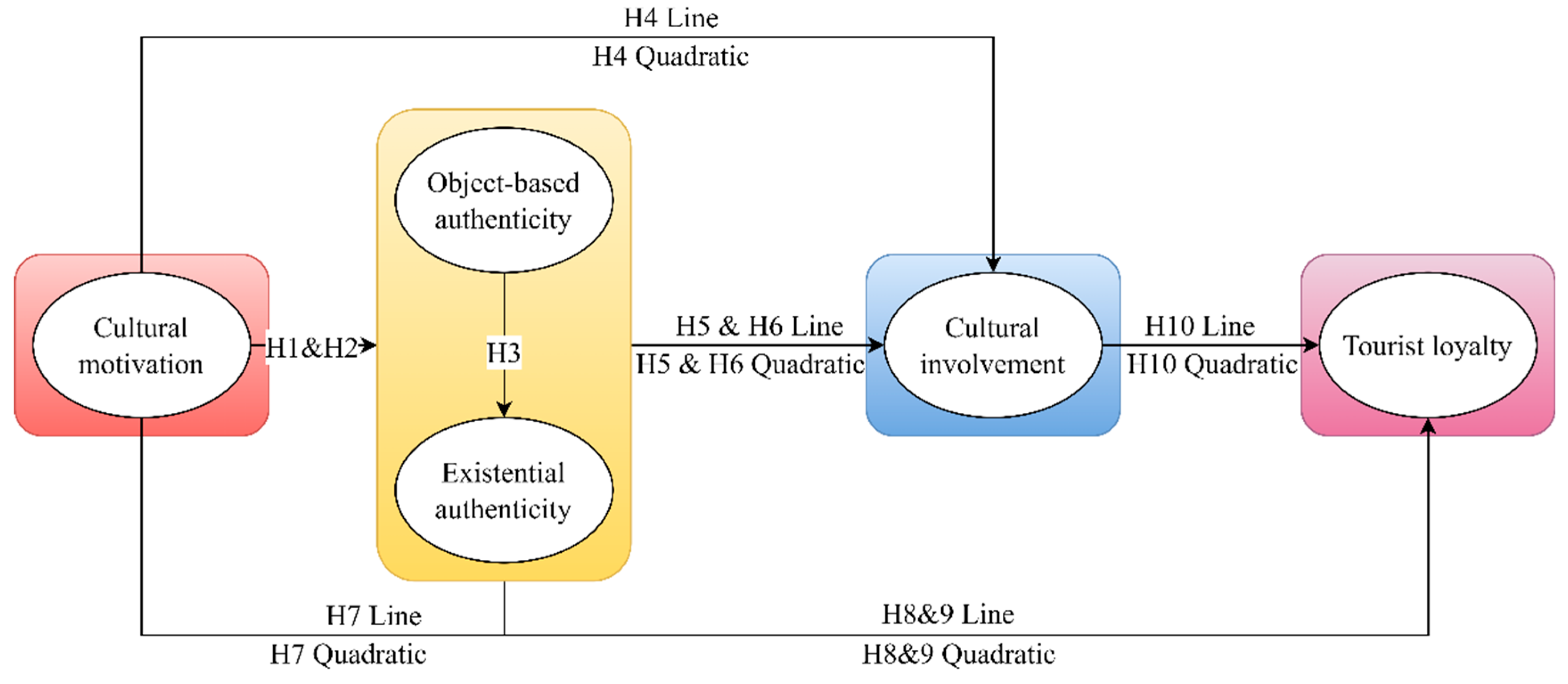
| H1 | CM −> OBA | 0.658 | 0.051 | 0.544 | 0.744 | 12.929 | 0.000 | Yes |
| H2 | CM −> EA | 0.251 | 0.058 | 0.141 | 0.367 | 4.322 | 0.000 | Yes |
| H3 | OBA −> EA | 0.536 | 0.070 | 0.388 | 0.658 | 7.638 | 0.000 | Yes |
| H4-L | CM −> CINV | 0.304 | 0.063 | 0.182 | 0.430 | 4.832 | 0.000 | Yes |
| H4-Q | CM −> CINV (Q) | 0.066 | 0.041 | −0.031 | 0.131 | 1.608 | 0.108 | No |
| H5-L | OBA −> CINV | 0.134 | 0.068 | 0.018 | 0.288 | 1.975 | 0.048 | Yes |
| H5-Q | OBA −> CINV (Q) | 0.062 | 0.048 | −0.056 | 0.139 | 1.294 | 0.196 | No |
| H6-L | EA −> CINV | 0.501 | 0.054 | 0.392 | 0.604 | 9.227 | 0.000 | Yes |
| H6-Q | EA −> CINV (Q) | 0.031 | 0.042 | −0.054 | 0.109 | 0.737 | 0.461 | No |
| H7-L | CM −> LOY | 0.107 | 0.087 | −0.062 | 0.276 | 1.221 | 0.222 | No |
| H7-Q | CM −> LOY (Q) | −0.009 | 0.045 | −0.096 | 0.076 | 0.209 | 0.834 | No |
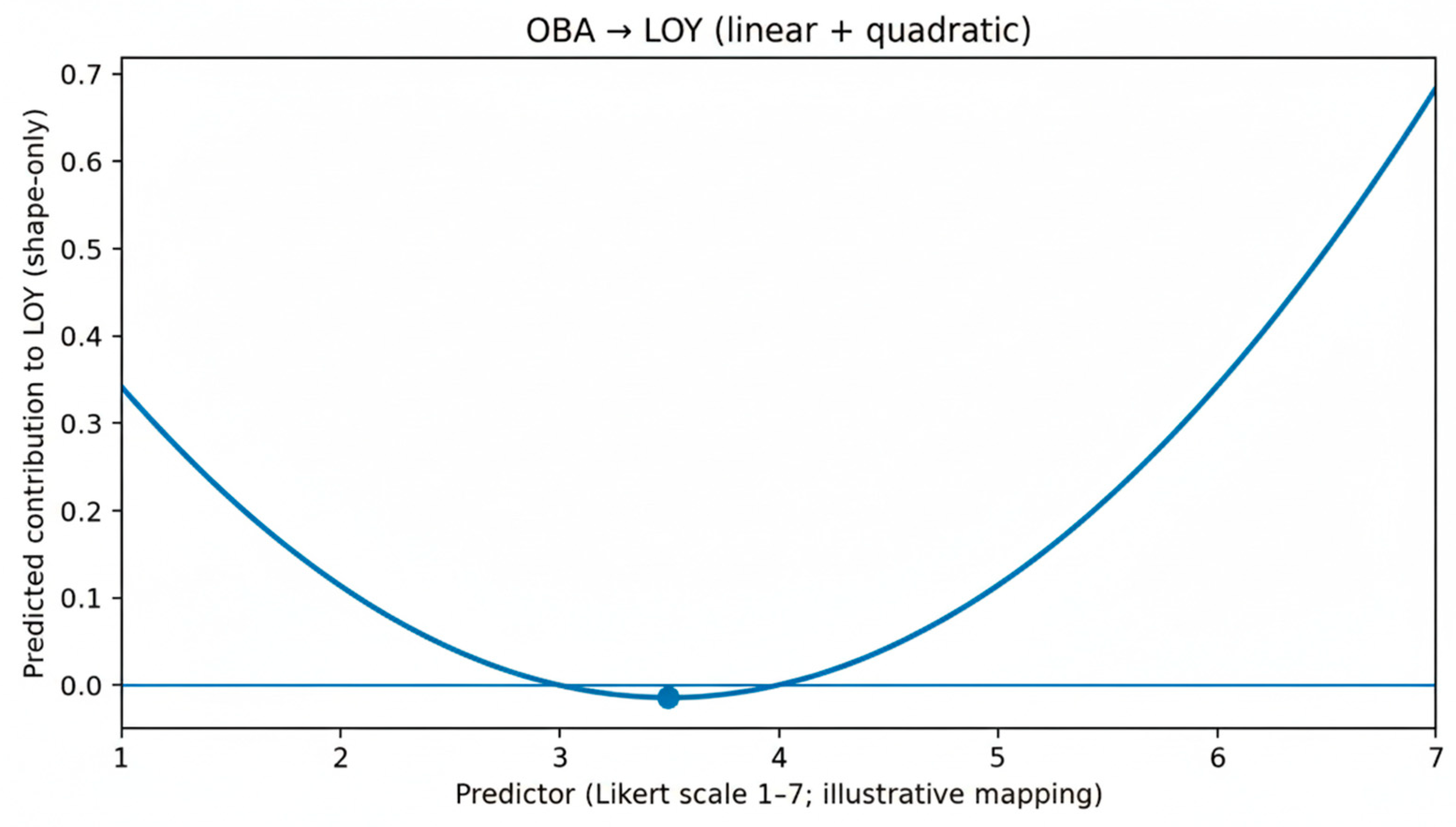
| H8-L | OBA −> LOY | 0.057 | 0.064 | −0.068 | 0.181 | 0.887 | 0.375 | No |
| H8-Q | OBA −> LOY (Q) | 0.057 | 0.028 | 0.000 | 0.111 | 2.051 | 0.040 | Yes |
| H9-L | EA −> LOY | 0.328 | 0.075 | 0.168 | 0.466 | 4.383 | 0.000 | Yes |
| H9-Q | EA −> LOY (Q) | 0.087 | 0.030 | 0.024 | 0.146 | 2.870 | 0.004 | Yes |
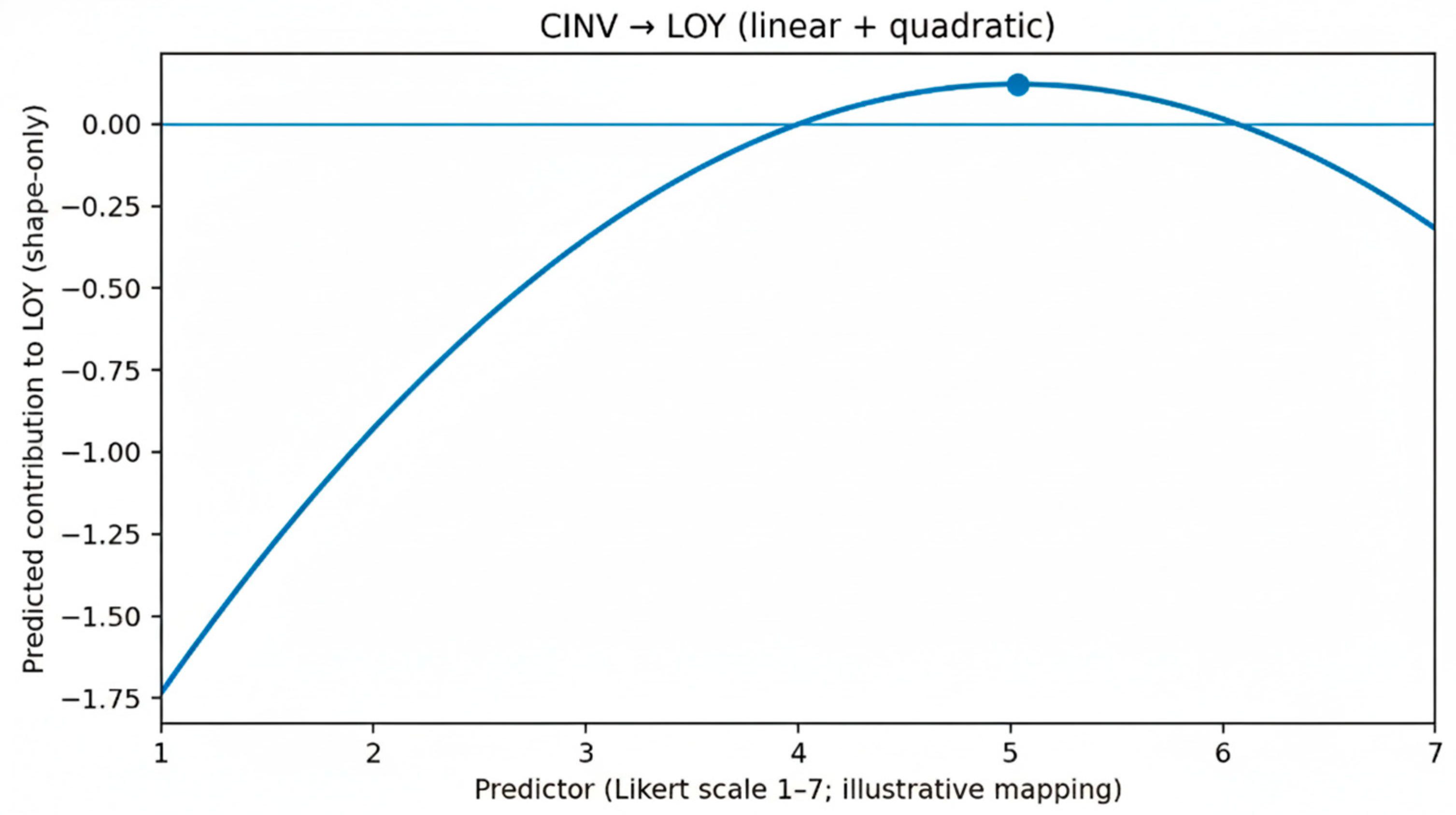
| H10-L | CINV −> LOY | 0.236 | 0.112 | 0.015 | 0.448 | 2.114 | 0.035 | Yes |
| H10-Q | CINV −> LOY (Q) | −0.114 | 0.042 | −0.199 | −0.031 | 2.681 | 0.007 | Yes |
| Path | β | STDEV | BCa LL | BCa UL | T-Value | p |
|---|---|---|---|---|---|---|
| CINV −> LOY | 0.236 | 0.112 | 0.015 | 0.448 | 2.114 | 0.035 |
| CM −> CINV | 0.694 | 0.054 | 0.586 | 0.796 | 12.801 | 0.000 |
| CM −> EA | 0.603 | 0.049 | 0.491 | 0.689 | 12.282 | 0.000 |
| CM −> LOY | 0.505 | 0.053 | 0.398 | 0.603 | 9.591 | 0.000 |
| CM −> OBA | 0.658 | 0.051 | 0.544 | 0.744 | 12.929 | 0.000 |
| EA −> CINV | 0.501 | 0.054 | 0.392 | 0.604 | 9.227 | 0.000 |
| EA −> LOY | 0.446 | 0.068 | 0.306 | 0.574 | 6.553 | 0.000 |
| OBA −> CINV | 0.402 | 0.076 | 0.263 | 0.559 | 5.315 | 0.000 |
| OBA −> EA | 0.536 | 0.070 | 0.388 | 0.658 | 7.638 | 0.000 |
| OBA −> LOY | 0.327 | 0.073 | 0.188 | 0.477 | 4.468 | 0.000 |
| CM −> CINV (Q) | 0.066 | 0.041 | −0.031 | 0.131 | 1.608 | 0.108 |
| CM −> LOY (Q) | 0.006 | 0.048 | −0.094 | 0.091 | 0.128 | 0.898 |
| EA −> CINV (Q) | 0.031 | 0.042 | −0.054 | 0.109 | 0.737 | 0.461 |
| EA −> LOY (Q) | 0.095 | 0.032 | 0.023 | 0.151 | 2.919 | 0.004 |
| CINV −> LOY (Q) | −0.114 | 0.042 | −0.199 | −0.031 | 2.681 | 0.007 |
| OBA −> CINV (Q) | 0.062 | 0.048 | −0.056 | 0.139 | 1.294 | 0.196 |
| OBA −> LOY (Q) | 0.072 | 0.033 | 0.000 | 0.136 | 2.170 | 0.030 |
Disclaimer/Publisher’s Note: The statements, opinions and data contained in all publications are solely those of the individual author(s) and contributor(s) and not of MDPI and/or the editor(s). MDPI and/or the editor(s) disclaim responsibility for any injury to people or property resulting from any ideas, methods, instructions or products referred to in the content. |
© 2026 by the authors. Licensee MDPI, Basel, Switzerland. This article is an open access article distributed under the terms and conditions of the Creative Commons Attribution (CC BY) license.
Share and Cite
Zhao, S.; Zhang, Y.; Niu, Y.; Marzuki, A. The Threshold of Authenticity and the Limits of Cultural Involvement: A Non-Linear Perspective on Heritage Tourist Loyalty. Sustainability 2026, 18, 2226. https://doi.org/10.3390/su18052226
Zhao S, Zhang Y, Niu Y, Marzuki A. The Threshold of Authenticity and the Limits of Cultural Involvement: A Non-Linear Perspective on Heritage Tourist Loyalty. Sustainability. 2026; 18(5):2226. https://doi.org/10.3390/su18052226
Chicago/Turabian StyleZhao, Shuaizheng, Yana Zhang, Yitong Niu, and Azizan Marzuki. 2026. "The Threshold of Authenticity and the Limits of Cultural Involvement: A Non-Linear Perspective on Heritage Tourist Loyalty" Sustainability 18, no. 5: 2226. https://doi.org/10.3390/su18052226
APA StyleZhao, S., Zhang, Y., Niu, Y., & Marzuki, A. (2026). The Threshold of Authenticity and the Limits of Cultural Involvement: A Non-Linear Perspective on Heritage Tourist Loyalty. Sustainability, 18(5), 2226. https://doi.org/10.3390/su18052226