Article

The Impact of Carbon Information Disclosure on Firm Value: The Mediating Role of Green M&A—Evidence from China

1
School of Bangor College, Central South University of Forestry and Technology, Changsha 410004, China
2
Bangor Business School, Bangor University, Bangor LL57 2DG, UK
*
Authors to whom correspondence should be addressed.
Sustainability 2026, 18(5), 2225; https://doi.org/10.3390/su18052225
Submission received: 30 January 2026 / Revised: 19 February 2026 / Accepted: 23 February 2026 / Published: 25 February 2026
(This article belongs to the Section Economic and Business Aspects of Sustainability)

Abstract

Under China’s “Dual Carbon” strategy, carbon transparency has become a critical determinant of corporate competitiveness. Using a dataset of Chinese A-share listed companies from 2010 to 2023, this study constructs an integrated theoretical framework combining signaling theory and the “real effects” hypothesis to investigate the impact of carbon information disclosure (CID) on firm value. The results demonstrate a significant positive relationship between CID quality and firm value, a finding that remains highly robust against the exogenous macro-policy shock of the 2020 Dual Carbon goals. A primary conceptual contribution lies in identifying Green Mergers and Acquisitions (M&A) as a vital mediating strategic mechanism. High-quality CID acts as a credible commitment device that triggers internal problemistic search, compelling firms to undertake substantive green M&A to fulfill environmental claims, thereby establishing a “transparency-to-strategy-to-value” continuum. Furthermore, heterogeneity analysis indicates that the valuation premium is markedly more pronounced in non-state-owned enterprises (Non-SOEs) and non-heavily polluting industries, reflecting their reliance on transparency to alleviate capital constraints and signal “green competitiveness.” These findings confirm that the capital market prices carbon disclosure as a high-quality strategic asset rather than a mere compliance cost, offering targeted empirical evidence for policymakers to refine standardized disclosure frameworks and for investors to screen for substantive “Green Alpha.”

1. Introduction

In the era of global climate urgency, China’s strategic pivot toward a “Dual Carbon” economy has fundamentally reshaped corporate accountability boundaries and sustainable development paradigms [1,2]. Since the Ministry of Environmental Protection issued the landmark Guidelines for Environmental Information Disclosure in 2010, marking the establishment of standardized environmental reporting in the world’s largest emerging market [3], corporate carbon information disclosure (CID) has transitioned from a peripheral voluntary practice to a core strategic imperative [4,5]. Faced with intensifying institutional pressures, firms are increasingly utilizing CID not merely for compliance, but as a critical mechanism to signal their commitment to sustainable development to capital markets [6].
Parallel to this transparency revolution, green mergers and acquisitions (Green M&A) have emerged as a vital pathway for rapid resource reallocation and energy transition [7,8]. While external drivers such as government attention [9] and green credit policies [10] are well-documented, the internal strategic link between a firm’s disclosure quality and its actual investment behavior remains under-explored. A critical tension exists: does high-quality disclosure serve merely as symbolic “greenwashing” to appease stakeholders [11,12], or does it exert “Real Effects” that compel firms to engage in substantive green transformation? Or, more cynically, is it utilized for “strategic arbitrage” to evade regulation [13,14]? This uncertainty creates a “green M&A dilemma,” where the capital market struggles to distinguish between genuine transition efforts and superficial marketing [15].
However, a distinct theoretical and empirical void remains in the existing literature. Prior studies have predominantly focused on the direct link between carbon disclosure and firm valuation (the “Market Reaction” view) [16] or examined the external drivers of green M&A (the “Regulatory Driver” view) [9,10]. Crucially, these two streams remain disconnected. Literature rarely investigates whether high-quality disclosure functions merely as a passive signal of legitimacy in response to institutional isomorphism [17,18,19], or actively exerts “Real Effects” that compel firms to engage in substantive strategic reallocations. Without identifying this transmission mechanism, the underlying logic connecting transparency to value creation remains obscure, leaving it unclear how intangible information converts into tangible competitive advantages.
To bridge this gap, a unified theoretical framework is constructed in this study, anchored in Signaling Theory and the “Real Effects” hypothesis. Green M&A is positioned not merely as an outcome variable, but as a pivotal mediating mechanism. High-quality carbon disclosure is conceptualized as a credible commitment device. It is posited that such disclosure not only reduces information asymmetry (Signaling Effect) but also creates internal governance pressure that compels managers to align investment behaviors with disclosed targets, thereby driving the frequency of Green M&A (Real Effects) [20,21].
Consequently, this study makes three specific contributions to the literature:
First, a novel theoretical perspective is provided by identifying the transmission mechanism. Unlike recent studies that link ESG disclosure directly to performance, this research elucidates the causal path of “Carbon Disclosure → Green M&A → Firm Value.” It is demonstrated that Green M&A acts as the tangible channel through which carbon transparency materializes into economic value, thus responding to the call for research on the real economic consequences of non-financial reporting.
Second, measurement rigor is enhanced. In response to the limitations of broad, generic ESG ratings used in previous studies, a granular Carbon Information Disclosure Index (CDIndex) is adopted based on the authoritative evaluation framework of the CSMAR database, ensuring high reliability and replicability (see Appendix A for detailed scoring criteria). Furthermore, substantive Green M&A is strictly distinguished from general M&A through meticulous manual verification. This methodological refinement provides more robust and reliable evidence regarding the actual efficacy of corporate green strategies.
Third, counter-intuitive contextual insights are offered. Through heterogeneity analysis, it is revealed that the “Green Alpha” effect is, interestingly, more pronounced in non-SOEs and non-heavily polluting sectors. This finding challenges the conventional wisdom (Legitimacy Theory) that regulation drives value primarily for heavy polluters, offering a nuanced understanding of how ownership structures and industry nature shape the marginal benefits of carbon disclosure in emerging markets.
Empirically, a comprehensive panel of Chinese A-share listed companies from 2010 to 2023 is utilized. Given that M&A frequency is count data characterized by overdispersion, negative binomial regression models are employed [22]. To mitigate potential endogeneity concerns arising from reverse causality or omitted variables, a series of robustness checks, including lagged variable models and Propensity Score Matching (PSM), are rigorously applied.
The remainder of the paper is organized as follows. Section 2 reviews the related literature and develops the hypotheses. Section 3 describes the data and methodology. Section 4 presents the empirical results. Section 5 discusses the findings, and Section 6 concludes.

2. Literature Review and Hypothesis Development

2.1. Theoretical Framework Integration

To elucidate the mechanisms through which CID influences market valuation, this study constructs an integrated theoretical framework anchored primarily in signaling theory [6] and the behavioral theory of the firm [23]. Rather than deploying multiple theoretical lenses in isolation, this study explicitly positions them within a sequential “Transparency-to-Strategy-to-Value” continuum. While institutional theory [19] provides the exogenous regulatory context and the resource-based view (RBV) [20] rationalizes the strategic acquisition of green assets, the core logic operates as follows: CID functions initially as an external market signal (Signaling Theory), which concurrently exposes internal performance gaps, triggering a “real effect” via problemistic search (Behavioral Theory) that culminates in substantive strategic reallocation through green M&A. This integrated theoretical architecture underpins the subsequent hypothesis development.

2.2. Carbon Information Disclosure and Firm Value

The economic consequence of CID is fundamentally linked to the pricing of carbon risk. In a transition economy, carbon emissions constitute a material financial liability [24,25]. High-quality CID supplies the granular data necessary for capital markets to accurately price these risks and evaluate corporate climate resilience [4,5].
Anchored in signaling theory [6], voluntary disclosure functions as a credible mechanism to convey unobservable firm quality, thereby reducing monitoring costs for institutional investors who depend on such metrics for portfolio optimization [26]. The proliferation of corporate digitalization further substantiates the reliability and accessibility of this ESG data [27]. Beyond historical performance reporting, CID stimulates a “green innovation effect” [28,29]. By publicly articulating emission reduction targets, firms are systematically incentivized to invest in green R&D, distinguishing themselves from opportunistic “greenwashers” and securing valuation premiums through reduced financing costs [13,14]. Concurrently, the rising influence of minority shareholders exerts additional pressure on management to prioritize sustainable value creation [1]. Therefore, the following hypothesis is proposed:
Hypothesis 1 (H1). 
High-quality carbon information disclosure has a significant positive impact on firm value.

2.3. Carbon Information Disclosure and Green M&A

While signaling theory addresses the capital market’s response, the organizational antecedents driving CID and subsequent actions are rooted in institutional theory [19]. Regulatory mechanisms, including stringent pollution guidelines [3,30] and environmental taxation [31], exert coercive pressure on firms to conform to environmental standards. Empirical evidence confirms that such regulatory stringency [32] compels firms to adopt green M&A as a strategic compliance mechanism [33]. In navigating these external pressures, firms deploy CID to establish legitimacy and mitigate political costs [9,18].
The translation of this external signal into internal strategic action is elucidated by the behavioral theory of the firm. The quantification and public disclosure of carbon data objectively expose discrepancies between current environmental performance and regulatory or peer benchmarks. This precise “performance gap” initiates a problemistic search [22,23]. Because internal green innovation is characterized by prolonged development cycles and high uncertainty, the “real effect” of this disclosure compels firms to increasingly rely on green M&A as an efficient resource-acquisition strategy to bridge technological deficits and satisfy stakeholder expectations [21,34]. Thus, the following hypothesis is proposed:
Hypothesis 2 (H2). 
High-quality carbon information disclosure promotes the frequency of corporate green M&A.

2.4. Green M&A and Firm Value

To address the performance gaps identified during problemistic search, green M&A operates as a mechanism for strategic resource reallocation. Consistent with the Resource-Based View (RBV) [20], acquiring green assets enables firms—particularly in carbon-intensive sectors—to rapidly internalize environmental innovation and curtail illegal pollution discharges [35,36]. Cross-border green M&A further facilitates the construction of international innovation ecosystems [37] and the assimilation of advanced, hard-to-imitate green technologies [38].
Although acquiring firms encounter potential integration and carbon-related risks during the post-merger phase [39], the prevailing empirical consensus indicates that green M&A generates net value by enhancing post-acquisition sustainability performance [16]. The capital market assigns a premium to the acquisition of green targets [40], interpreting such transactions as indicators of long-term operational resilience [41]. Additionally, effective green M&A mitigates the financial risks inherently associated with organic green process innovation [42]. Accordingly, the following hypothesis is proposed:
Hypothesis 3 (H3). 
Green M&A frequency has a significant positive impact on firm value.

2.5. The Mediating Role of Green M&A

Synthesizing the integrated theoretical framework, this study posits that green M&A constitutes the primary transmission mechanism linking corporate environmental transparency to economic performance.
While CID serves as an initial market signal of environmental commitment (H1) and catalyzes strategic realignment via problemistic search (H2), the crystallization of firm value is contingent upon the substantive execution of green M&A to acquire external resources (H3). For firms navigating the low-carbon transition, high-quality CID creates value not through symbolic impression management [11,12], but by necessitating the tangible acquisition of green assets. This sequential process resolves the “green M&A dilemma,” wherein initial environmental investments may temporarily depress financial performance [15], by converting short-term compliance costs into sustained competitive advantages [7,8]. Consequently, CID establishes a complete “transparency-to-strategy-to-value” continuum, differentiating substantive corporate transformation from strategic arbitrage. Sustainable integration throughout the deal stages ultimately ensures that the promised valuation premiums are actualized [43]. Therefore, the following hypothesis is proposed:
Hypothesis 4 (H4). 
Green M&A frequency plays a mediating role in the relationship between carbon information disclosure and firm value.
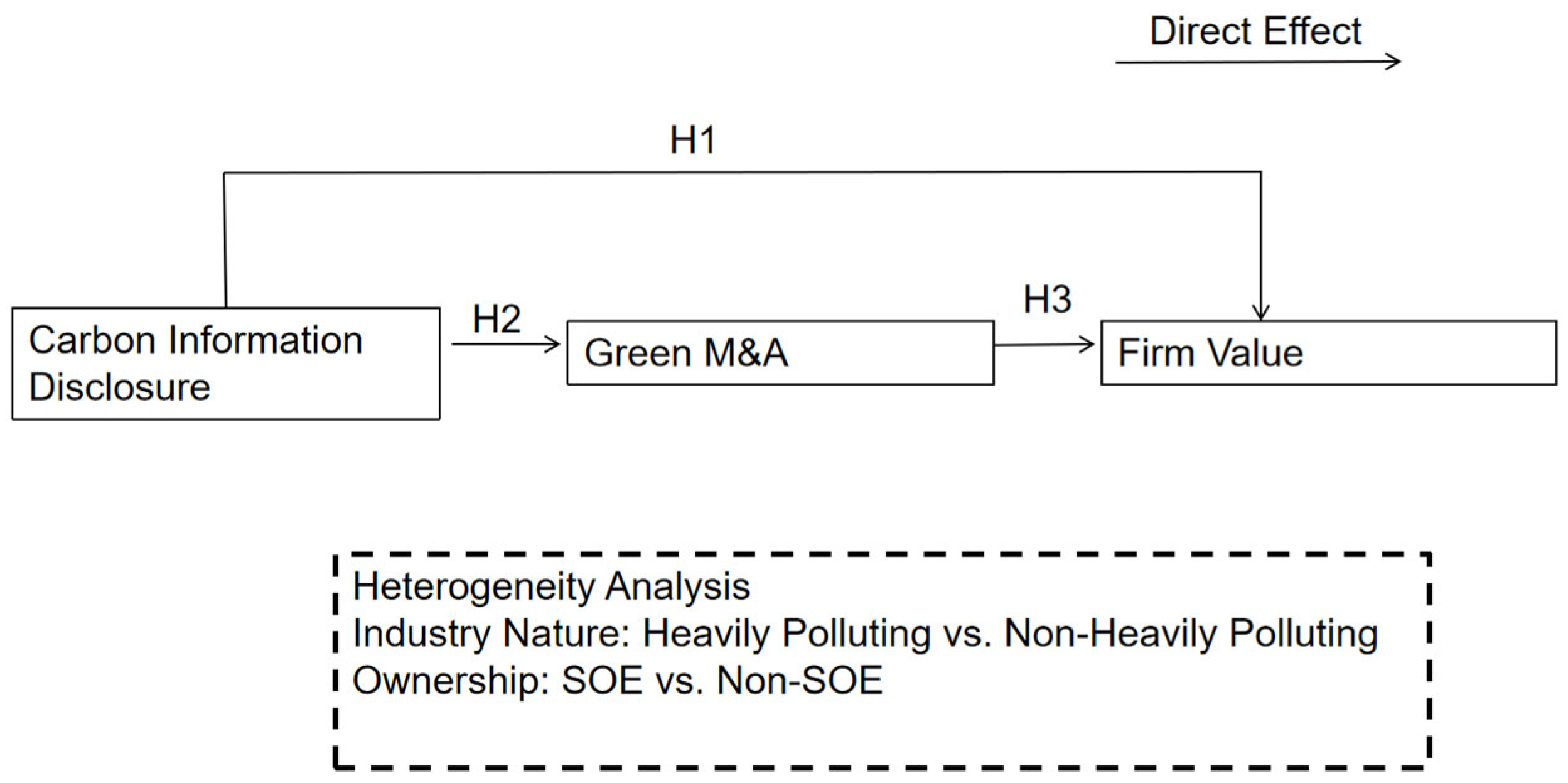
Based on the theoretical arguments proposed above, Figure 1 illustrates the conceptual framework of this study, depicting the logical relationships among the key variables and the underlying transmission mechanism.

3. Research Methodology

3.1. Sample Selection and Data Sources

The research sample comprises Chinese A-share listed companies for the period from 2010 to 2023. The sample period commences in 2010 to align with a critical institutional transition: the release of the Guidelines for Disclosure of Environmental Information of Listed Companies by the Ministry of Environmental Protection (MEP) in September 2010 [3], which initiated the shift from voluntary to standardized environmental reporting in China. Following this landmark guideline, the availability and consistency of corporate environmental data improved significantly.
Data for this study, including Carbon Information Disclosure ( C D I n d e x ), Green M&A, and firm-level financial and governance variables, are primarily obtained from the CSMAR (China Stock Market & Accounting Research) database. Specifically:
Carbon Information Disclosure: The underlying data for constructing the C D I n d e x are derived from the “Environmental Research” and “Social Responsibility” sub-databases within CSMAR.
Green M&A: Identification of green M&A events follows the comprehensive text analysis approach established in prior literature [44]. This involves a systematic screening of corporate M&A announcements to evaluate the background, strategic objectives, and business scopes of both the acquirer and the target enterprise. A transaction is classified as a green M&A if its primary purpose pertains to energy conservation, environmental protection, new energy, or green technology upgrades.
Financial and Governance Data: These variables are sourced from the respective financial statement sub-databases in CSMAR.
To ensure data reliability and the validity of empirical results, the following screening procedures are applied: exclusion of firms in the financial sector due to their unique asset structures and reporting standards; exclusion of firms designated as ST or *ST (Special Treatment) to mitigate the potential impact of financial distress abnormalities; exclusion of observations with missing data for key variables.
Following these procedures, the final sample consists of 42,673 firm-year observations. To mitigate the influence of outliers, all continuous variables are winsorized at the 1% and 99% levels.

3.2. Variable Definitions

3.2.1. Dependent Variable

Firm Value ( T o b i n Q ): The primary dependent variable is firm value. Following standard literature, we employ Tobin’s Q as the main proxy for firm value. It is calculated as the ratio of the market value of total assets (market value of equity plus book value of liabilities) to the book value of total assets. Tobin’s Q reflects the capital market’s forward-looking expectation of a firm’s future profitability and growth potential. To ensure the robustness of the empirical results, we also use Return on Assets (ROA) as an alternative measure of firm performance. Unlike Tobin’s Q, ROA represents a backward-looking accounting performance metric, calculated as net income divided by total assets. Using both measures allows us to examine the impact of carbon disclosure on both market valuation and operational efficiency.

3.2.2. Independent Variable

Carbon Information Disclosure ( C D I n d e x ): The core independent variable is the quality of carbon information disclosure. A granular content analysis index is constructed across five key pillars: governance, strategy, risk management, targets and mitigation measures, and metrics and verification. The index is aggregated from 22 specific indicators, capturing both qualitative strategic commitments and quantitative performance data. While the theoretical maximum score is 50, the final C D I n d e x in this study ranges from 0 to 42, where a score of 42 represents the maximum observed transparency and quality of carbon reporting in the research sample. Detailed scoring criteria and indicator definitions are provided in Appendix A. To mitigate data skewness and the potential influence of outliers, the natural logarithm of the score ( l n _ C D ) is also utilized in robustness checks.

3.2.3. Mediating Variable

Green M&A Frequency ( G r e e n _ F r e q ): The mediating variable is defined as the annual frequency of green mergers and acquisitions successfully completed by a firm. The identification and classification of green M&A events strictly replicate the established methodology developed by Pan et al. [44]. This process involves a systematic screening of corporate M&A announcements to evaluate the background, strategic objectives, and business scopes of both the acquirer and the target enterprise.
Specifically, following the criteria validated by Pan et al. [44], a transaction is classified as a green M&A if its primary purpose or the business nature of the target firm pertains to energy conservation, environmental protection, new energy, or green technology upgrades. To explicitly address potential classification bias and minimize subjective judgment, a strict keyword-matching protocol was applied utilizing the exact predefined dictionary of environmentally related terms established in the aforementioned authoritative prior literature [44]. Furthermore, the manual verification process was independently conducted by two researchers applying these standardized criteria. Any coding discrepancies were resolved through rigorous cross-verification by consulting the official environmental impact assessment (EIA) reports or detailed corporate social responsibility (CSR) disclosures of the target firms. This rigorous protocol ensures that the variable strictly captures substantive strategic resource reallocations toward sustainability, effectively filtering out superficial “greenwashing” events.
Given that   G r e e n _ F r e q is a non-negative integer count characterized by over-dispersion—where the variance significantly exceeds the mean—a Negative Binomial Regression model is employed for empirical estimation to avoid the biased results typically associated with standard Ordinary Least Squares (OLS) estimation.

3.2.4. Control Variables

To rule out alternative explanations and isolate the net effect of carbon disclosure, we control for a comprehensive set of firm-level characteristics that are widely documented to influence firm valuation and investment decisions.
First, regarding financial characteristics, we control for Firm Size (Size), Leverage (Lev), Sales Growth (Growth), and Operating Cash Flow (Cashflow), as larger, more profitable, and faster-growing firms typically exhibit different valuation multiples. We also control for Firm Age (FirmAge) to account for the life-cycle effect.
Second, considering the impact of corporate governance on strategic decision-making, we control for Board Independence (Indep), Ownership Concentration (Top1), State Ownership (SOE), and Audit Quality (Big4). Detailed definitions and measurement methods for all variables are summarized in Table 1.

3.3. Model Specification

To empirically test the value creation mechanism of carbon disclosure through green M&A, we construct the following regression models.

3.3.1. Baseline Model (Testing H1)

To empirically examine the total effect of carbon information disclosure on firm value (Hypothesis 1), the baseline regression model is constructed using the Fixed Effects (FE) estimator. This approach allows for controlling unobserved individual heterogeneity and temporal trends:
T o b i n Q i , t = α 0 + α 1 C D I n d e x i , t + λ k C o n t r o l s i , t + μ i + δ t + ϵ i , t
where α 1 captures the total impact of carbon disclosure quality on firm value. A statistically significant and positive α 1 would provide empirical support for Hypothesis 1. μ i and δ t denote firm-specific and year-specific fixed effects, respectively, while ϵ i , t represents the error term.

3.3.2. Mediation Mechanism Models (Testing H2, H3, and H4)

To investigate the transmission mechanism described in Hypotheses 2, 3, and 4, a stepwise regression framework combined with the Bootstrap method is employed.
Step 1: The Impact on Green M&A (Testing H2).
First, the relationship between carbon disclosure and the frequency of green M&A is examined (Hypothesis 2). Given that the mediator, G r e e n _ F r e q , is a non-negative count variable characterized by over-dispersion (where the variance significantly exceeds the mean), standard Ordinary Least Squares (OLS) estimation is theoretically inappropriate and may yield biased results. Consequently, the Negative Binomial Regression model is utilized:
G r e e n _ F r e q i , t = β 0 + β 1 C D I n d e x i , t + λ k C o n t r o l s i , t + μ i + δ t + ϵ i , t
In Equation (2), the coefficient β 1 represents the effect of carbon disclosure on green investment behavior (Path a). A significantly positive β 1 indicates that higher disclosure quality drives green M&A activities, thereby supporting Hypothesis 2.
Step 2: The Impact of Green M&A on Firm Value (Testing H3 & Direct Effect).
Subsequently, the mediator ( G r e e n _ F r e q ) is introduced into the firm value equation to assess whether green M&A contributes to value creation (Hypothesis 3) and to isolate the direct effect of disclosure:
T o b i n Q i , t = γ 0 + γ 1 C D I n d e x i , t + γ 2 G r e e n _ F r e q i , t + λ k C o n t r o l s i , t + μ i + δ t + ϵ i , t
In this model: The coefficient γ 2 captures the direct impact of green M&A on firm value ( P a t h b ). A significantly positive γ 2 supports Hypothesis 3. The coefficient γ 1 represents the direct effect ( P a t h c ) of carbon disclosure on firm value after controlling for the mediating variable.
Step 3: Verification of Mediation Effect (Testing H4).
Finally, to robustly verify the mediating role of green M&A (Hypothesis 4), the significance of the indirect effect—calculated as the product of the coefficients ( β 1 × γ 2 ) —is assessed. Recognizing that the sampling distribution of the indirect effect may deviate from normality, the Bootstrap method (with 500 replications) is applied to construct bias-corrected confidence intervals. If the 95% confidence interval for the indirect effect excludes zero, the mediating role of green M&A is statistically confirmed, supporting Hypothesis 4.

4. Results

4.1. Descriptive Statistics

Table 2 presents the descriptive statistics for the main variables used in this study. The sample consists of 42,673 firm-year observations from 2010 to 2023. The mean value of TobinQ is 2.001, with a standard deviation of 1.255, ranging from 0.838 to 8.297. This indicates significant variation in firm valuation among Chinese listed companies. The average score of CDIndex is 11.320, with a standard deviation of 9.226. Given the range from 0 to 42, the relatively low mean suggests that the overall quality of carbon information disclosure in China is still at a developing stage, and there is a large gap between leading firms and laggards. Regarding the mediating variable, Green_Freq, the mean value is 0.456, while the maximum value reaches 57.000. Notably, the standard deviation (1.486) is significantly larger than the mean, and the variance (1.4862 ≈ 2.21) exceeds the mean, confirming the presence of over-dispersion. This distributional characteristic justifies our choice of using the Negative Binomial Regression model for the mechanism test involving green M&A frequency.

4.2. Correlation Analysis and Multicollinearity Test

Table 3 reports the Pearson correlation matrix alongside the Variance Inflation Factors (VIF) for the primary variables. Prior to the multivariate regression analysis, the potential for multicollinearity was rigorously assessed. As detailed in the final column of Table 3, VIF values for all explanatory variables remain substantially below the conservative threshold of 5. The Mean VIF is recorded at 2.18, with the maximum VIF among the main explanatory variables observed at 1.93 for Size. These results provide empirical confirmation that multicollinearity does not compromise the reliability of the estimated coefficients in the proposed model.
Regarding the correlation analysis, several noteworthy observations are identified. First, CDIndex exhibits a significant and positive correlation with Green_Freq ( r = 0.092 ,     p < 0.01 ), offering preliminary evidence that higher-quality carbon disclosure is associated with increased green investment activities. Second, a negative univariate correlation is observed between CDIndex and TobinQ (−0.137). This negative coefficient is likely a byproduct of confounding firm-level characteristics. Specifically, firm size (Size) is positively correlated with disclosure quality (0.421) yet negatively associated with market valuation multiples (−0.369), suggesting that while larger firms generally provide higher-quality disclosures, they also tend to possess lower Tobin’s Q values. Such findings reinforce the necessity of a multivariate regression framework to isolate the net impact of carbon disclosure on firm value by controlling for size and other corporate characteristics, a process further explored in Section 4.3.

4.3. Baseline Regression and Mechanism Analysis

Table 4 presents the empirical results concerning the impact of carbon information disclosure ( C D I n d e x ) on firm value ( T o b i n Q ), alongside the mediating role of green M&A ( G r e e n _ F r e q ) . The estimation strategy follows a rigorous procedure to systematically verify the causal chain anchored in Signaling Theory and the “Real Effects” hypothesis.

4.3.1. Main Effect and Economic Significance (Testing H1)

The analysis begins with the examination of the total effect of carbon disclosure on firm value. As reported in Column (1), the coefficient of C D I n d e x is 0.0055 , which is statistically significant at the 1% level ( t = 4.98 ). This empirical evidence provides robust support for Hypothesis 1. From a theoretical perspective, this finding aligns with Signaling Theory, suggesting that high-quality disclosure serves as a credible signal of superior environmental governance, thereby reducing information asymmetry and lowering the risk premium demanded by investors.
To address the economic significance of this result, the practical magnitude of the impact is assessed. Based on the descriptive statistics where the standard deviation of C D I n d e x is 9.226 , a one-standard-deviation increase in carbon disclosure quality is associated with an increase in firm value ( T o b i n Q ) of approximately 0.0507 units ( 9.226 × 0.0055 ). Given that the mean value of T o b i n Q in the sample is 2.001, this represents a non-trivial improvement in market valuation of approximately 2.54%, confirming that the impact of disclosure is not only statistically significant but also economically meaningful.

4.3.2. Mechanism Analysis: The “Real Effects” of Green M&A (Testing H2, H3, & H4)

Subsequently, the transmission mechanism is investigated to determine if CID triggers “Real Effects” through substantive strategic reallocations.
Path A (Testing H2): Column (2) examines the influence of disclosure on the mediator ( G r e e n _ F r e q ). Utilizing a Negative Binomial model to account for the count nature and over-dispersion of M&A data, the coefficient for C D I n d e x is found to be 0.0146 (z = 8.05), significant at the 1% level. This suggests that higher transparency compels firms to engage in “problemistic search” to bridge environmental performance gaps, thereby promoting green M&A activities.
Path B (Testing H3): Column (3) evaluates the impact of the mediator on firm value. After controlling for C D I n d e x , the coefficient of G r e e n _ F r e q is 0.0235 and significant at the 1% level ( t = 6.98 ). This demonstrates that the capital market rewards the substantive strategic move of acquiring green assets, supporting the view that Green M&A is a value-creating instrument.
Direct & Indirect Effects (Testing H4): Upon including the mediator in Column (3), the coefficient of C D I n d e x remains significant but decreases from 0.0055 to 0.0054. This reduction indicates that Green M&A serves as a partial mediating channel, facilitating the translation of information signals into economic value.

4.3.3. Robustness of Mediation (Bootstrap Test)

To further validate the mediating role of green M&A beyond the stepwise approach, a Bootstrap method with 500 replications is employed. This approach is particularly suited for testing indirect effects as it does not assume a normal distribution for the product of coefficients. As reported in Table 5, the point estimate of the indirect effect is 0.00034 with a z v a l u e of 5.85   ( p < 0.01 ) . The bias-corrected 95% confidence interval is [ 0.00023,0.00046 ] , which strictly excludes zero. This confirms that the “Transparency-to-Strategy-to-Value” chain is robust, providing strong empirical support for Hypothesis 4.

4.4. Endogeneity Test

To ensure the robustness of the causal inference and address potential endogeneity concerns—specifically reverse causality and sample selection bias—two rigorous identification strategies are employed: the Lagged Explanatory Variable approach and Propensity Score Matching (PSM).

4.4.1. Lagged Explanatory Variable Approach

A primary endogeneity concern is reverse causality, where firms with higher valuations might possess more resources to engage in high-quality carbon disclosure. Since current firm value ( T o b i n Q t ) cannot logically influence past disclosure decisions ( C D I n d e x t 1 ), utilizing a one-period lagged independent variable helps establish the temporal direction of causality. Column (1) of Table 6 reports the estimation results using the lagged carbon information disclosure (L.CDIndex) as the main explanatory variable. The coefficient of L.CDIndex is 0.0030 and remains statistically significant at the 5% level (t = 2.54). This finding indicates that past improvements in disclosure quality serve as a reliable predictor of future firm value enhancement, confirming that the baseline results are not driven by reverse causality.

4.4.2. Propensity Score Matching (PSM)

To further mitigate potential self-selection bias—where firms with superior fundamentals might naturally choose to disclose more information—the Propensity Score Matching (PSM) method is employed. A dummy variable, High_CD, is constructed, taking the value of 1 if a firm’s carbon disclosure score exceeds the sample median, and 0 otherwise. Using a Logit model, propensity scores are estimated based on all control variables (Size, Lev, Growth, Cashflow, Indep, Top1, FirmAge, Big4), followed by a 1:1 nearest neighbor matching procedure within a caliper of 0.05.
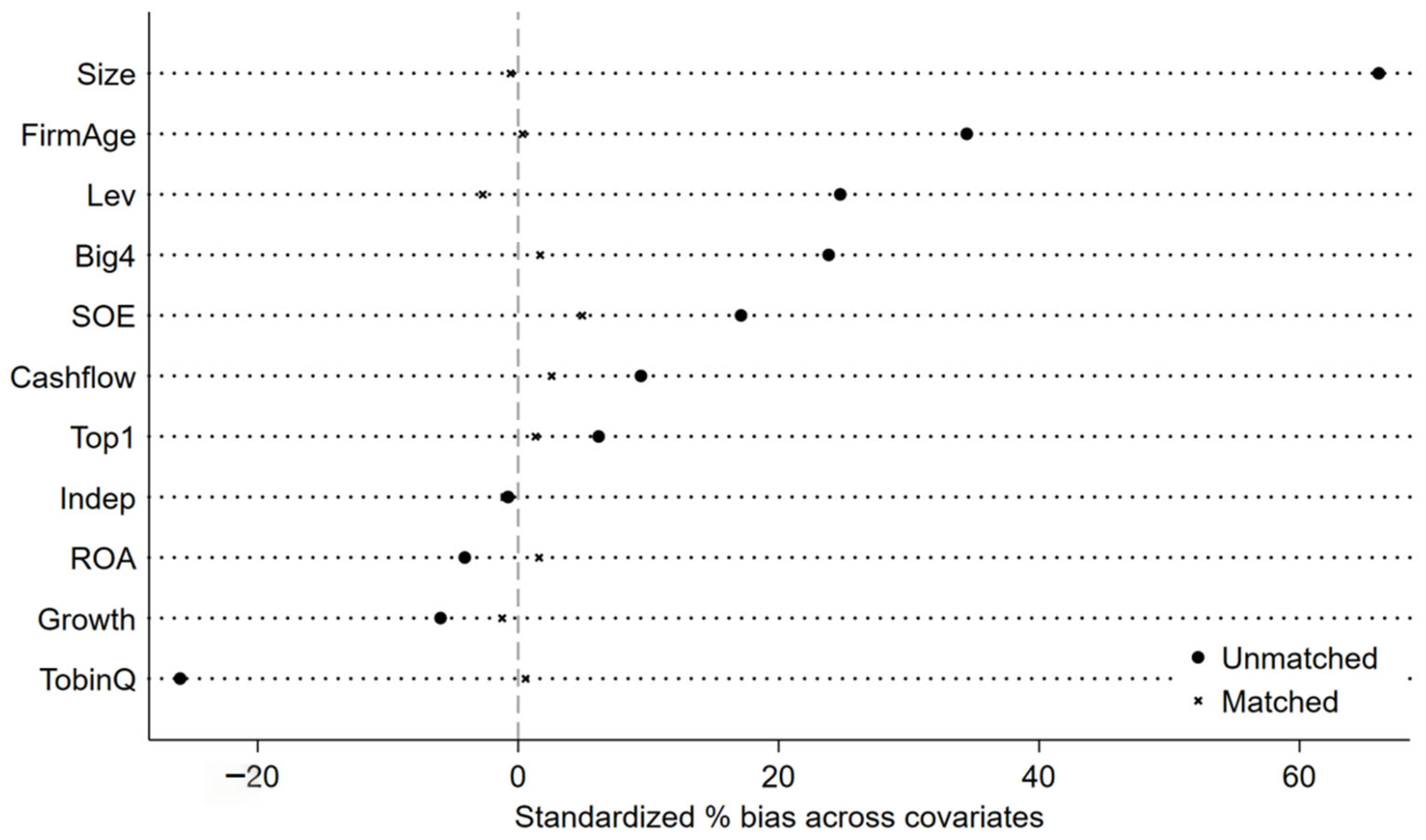
Figure 2 visualizes the covariate balance before and after matching. As illustrated, the standardized percentage biases for all covariates (represented by “x”) in the matched sample converge closely to the zero line and remain well below the 10% threshold, significantly reduced compared to the unmatched sample (represented by “•”). This visual evidence confirms that the matching process has effectively eliminated systematic differences between the treatment and control groups.
Column (2) of Table 6 presents the regression results based on the PSM-matched sample. The coefficient of CDIndex remains positive (0.0045) and statistically significant at the 1% level (t = 4.28). This consistency reinforces the conclusion that the value-enhancing effect of carbon disclosure is robust to sample selection bias.

4.5. Robustness Checks

To ensure the reliability and validity of the empirical findings, a comprehensive series of robustness tests were conducted. The results are summarized in Table 7.

4.5.1. Alternative Measures

First, to verify whether carbon disclosure translates into tangible operational performance, Return on Assets (ROA) was employed as the dependent variable, replacing Tobin’s Q. As reported in Column (1), the coefficient of CDIndex remains significantly positive ( p < 0.01 ), indicating that high-quality disclosure improves both market valuation and accounting profitability. Second, to mitigate the potential influence of outliers, the natural logarithm of the disclosure score (ln_CD) was utilized as an alternative independent variable. Column (2) confirms that the positive impact of disclosure on firm value remains robust to this specification.

4.5.2. Robustness of Mediation Mechanism

The causal chain was further re-examined using the alternative measure (ln_CD) to verify the robustness of the mediation mechanism (Hypotheses 2, 3 and 4).
Column (3) reports the result for Path A using the Negative Binomial model. The coefficient of ln_CD is significantly positive ( β = 0.2120 ,   z = 10.44 ), confirming that carbon transparency robustly promotes green M&A activities.
Column (4) reports the result for Path B. Even after controlling for the alternative disclosure measure, green M&A continues to exert a significant positive impact on firm value ( β = 0.0237 ,   t = 7.03 ). Collectively, these results provide consistent and robust support for the proposed “ D i s c l o s u r e G r e e n M & A F i r m V a l u e ” transmission channel.

4.5.3. Impact of Policy Shock: The “Dual Carbon” Strategy

The “Dual Carbon” strategy (announced in 2020) represents a nationwide systemic shift that universally affects all listed firms in China. This macro-level policy makes it theoretically challenging to construct a valid, unaffected control group required for a standard Difference-in-Differences (DID) design. Consequently, to assess the impact of this major regulatory shock, an interaction term approach is adopted to examine the temporal stability and potential structural shifts in the disclosure-value relationship.
A policy dummy variable, Post2020, is introduced, equaling 1 for the years 2020–2023 and 0 otherwise. This variable is interacted with the carbon disclosure index (CDIndex × Post2020) to test for structural changes in the valuation effect. As presented in Table 8, the coefficient of the interaction term is positive (0.0013) but does not reach statistical significance. However, the main effect of CDIndex remains positive and highly significant (0.0053, t = 3.38) even after explicitly controlling for the policy shock.
This result provides robust empirical evidence that the value-enhancing effect of carbon information disclosure is a fundamental market mechanism rather than a temporary artifact driven by recent policy trends. The consistency of the primary coefficient suggests that investors perceive high-quality carbon disclosure as a stable signal of corporate governance and green competitiveness, regardless of shifts in the macro-regulatory environment.

4.6. Heterogeneity Analysis

To provide a more nuanced understanding of the valuation effects, the analysis further examines how the relationship between carbon disclosure and firm value varies across different industrial and institutional contexts. The results are summarized in Table 9.

4.6.1. Analysis Based on Industry Nature (Pollution Intensity)

Columns (1) and (2) of Table 9 present the results based on industry pollution intensity. The sample is stratified according to the official list of heavily polluting sectors. Column (1) shows that for heavily polluting firms, the coefficient of C D I n d e x is 0.0045 , significant at the 5% level ( t = 2.15 ). This confirms that transparency helps mitigate legitimacy concerns and reduces the risk premium associated with high environmental liability.
Column (2) reveals that for non-heavily polluting firms, the coefficient is 0.0057 , highly significant at the 1% level ( t = 4.36 ). The stronger statistical significance and larger magnitude in the non-heavily polluting group suggest that the capital market recognizes proactive disclosure by cleaner firms as a credible signal of “green competitiveness.” For these firms, high-quality disclosure transcends mere compliance, functioning as a strategic differentiator that signals long-term sustainability and operational efficiency to investors.

4.6.2. Analysis Based on Ownership Structure (Institutional Logic)

Columns (3) and (4) of Table 9 examine the heterogeneity arising from ownership structure, revealing a distinct divergence in market reactions. Column (3) reports that for State-Owned Enterprises (SOEs), the coefficient of C D I n d e x is 0.0024 , showing only marginal significance ( t = 1.70 ) . This muted reaction is likely attributable to the unique political incentives and soft budget constraints inherent in SOEs. Investors may perceive SOE disclosures primarily as a response to mandatory political mandates rather than a market-driven signal of financial health. Consequently, the information content of these disclosures provides limited marginal utility for market valuation.
Conversely, Column (4) shows that for Non-SOEs, the coefficient is 0.0096 ( t = 6.10 ), significant at the 1% level. The magnitude for private firms is approximately four times that of SOEs, indicating a substantially higher valuation premium. This disparity highlights that high-quality carbon disclosure is a critical strategic tool for private firms to alleviate capital constraints and reduce information asymmetry. Faced with higher financing hurdles and stricter market scrutiny, private firms leverage transparency to signal their resilience and risk-management capabilities. Thus, the capital market rewards the substantive disclosure efforts of non-SOEs more aggressively, viewing them as credible commitments to sustainable value creation.

5. Discussion

Based on the robust empirical results presented in Section 4, this section discusses the broader theoretical implications of the findings, explicitly delineating how this study advances the current understanding of corporate sustainability and market valuation relative to existing literature.

5.1. Unpacking the “Black Box”: From Signaling to Real Effects (Validation of H1, H2, H3, H4)

A primary contribution of this research lies in explicitly distinguishing the proposed mechanism from existing literature. While prior studies have predominantly treated green investment or ESG disclosure as terminal outcome variables driven by regulatory pressure, this study conceptually advances the field by positioning Green M&A as a vital mediating strategic mechanism.
By establishing a unified theoretical anchor combining Signaling Theory and the “Real Effects” hypothesis, the findings elucidate a complete “Transparency-to-Strategy-to-Value” chain. The empirical evidence strongly supports Hypothesis 1, aligning with the “Value Enhancing View” in recent studies [4,5], which posit that high-quality environmental disclosure reduces information asymmetry and signals superior risk management capabilities. However, this study goes further by demonstrating that carbon information disclosure is not merely a passive communication tool; rather, it acts as a credible commitment device. This supports the Signaling Theory argument [6], where voluntary disclosure generates a valuation premium by acting as a credible signal of unobservable firm quality.
Furthermore, higher carbon transparency compels firms to engage in more frequent Green M&A, supporting the “problemistic search” logic and the “Real Effects” hypothesis. This indicates that disclosure forces management to align actual investment behavior with public environmental claims, echoing recent findings [7] that M&A is a primary tool for Chinese firms to tackle carbon challenges. Finally, the analysis demonstrates that Green M&A creates significant firm value. This contradicts the “greenwashing” or “strategic arbitrage” concerns raised in prior literature [11,13], confirming instead the view [8,12] that Green M&A represents a “substantive transformation” that improves resource allocation efficiency and drives industrial upgrading, thereby enhancing Tobin’s Q.

5.2. Institutional Context and Heterogeneous Market Valuation

The heterogeneity analysis yields nuanced theoretical insights that refine traditional assumptions regarding institutional logic and market valuation.
First, regarding ownership structure, the distinct divergence in market reactions between State-Owned Enterprises (SOEs) and Non-SOEs highlights the profound impact of institutional environments. The muted valuation effect for SOEs aligns with institutional theory, suggesting that investors perceive their disclosures primarily as mandatory political compliance driven by “soft budget constraints”. Conversely, private firms face tighter financing constraints and stricter market scrutiny. For Non-SOEs, proactive carbon disclosure combined with substantive green M&A serves as a critical, credible signal to alleviate financing friction. The capital market rewards these private firms aggressively, validating that transparency is utilized as a proactive strategy for market survival, consistent with recent evidence [1] regarding the distinct role of ESG in shaping sustainable behaviors across different institutional contexts.
Second, regarding pollution intensity, using the classification standard from the Ministry of Environmental Protection [45], the value-enhancing effect is observed to be significant in both groups but stronger and more robust for non-heavily polluting firms. This challenges the traditional Legitimacy Theory [18], which assumes that heavy polluters benefit the most from disclosure to repair their damaged socio-environmental image. Instead, the results support Signaling Theory: for cleaner firms, voluntary carbon disclosure acts as a strategic differentiator that signals “green competitiveness” and operational efficiency, successfully attracting “Green Alpha” from risk-sensitive investors.

5.3. Robustness Against Macro-Policy Shocks

A critical extension of this study is validating the fundamental nature of the disclosure-valuation relationship against systemic external shocks, such as the introduction of China’s “Dual Carbon” strategy in 2020 [46]. The interaction analysis (Section 4.5.3) demonstrates that while macro-level policies reshape the overarching regulatory environment, the main value-enhancing effect of carbon disclosure remains robust and highly significant. This provides vital theoretical insight: the capital market’s pricing of carbon transparency is an intrinsic, fundamental market mechanism rather than a temporary artifact driven by shifting policy trends [47]. Investors perceive high-quality carbon disclosure as a stable, long-term proxy for corporate governance and resilience, independent of short-term regulatory fluctuations.

6. Conclusions and Policy Implications

6.1. Conclusions

This study empirically investigates the impact of CID on firm value and explores the underlying transmission mechanisms using a dataset of Chinese A-share listed companies from 2010 to 2023. By establishing a unified theoretical anchor combining Signaling Theory and the “Real Effects” hypothesis, this research constructs a “Transparency-to-Strategy-to-Value” framework, yielding three primary conclusions:
First, The Value Creation Effect (Signaling Theory): Carbon information disclosure significantly enhances firm value. This positive relationship remains robust after controlling for endogeneity issues and macroscopic policy shocks (e.g., the “Dual Carbon” strategy). It indicates that the capital market prices carbon transparency as a critical, long-term intangible asset rather than a mere short-term compliance cost.
Second, The Transmission Mechanism (Real Effects): Green M&A functions as a vital mediating channel through which carbon disclosure affects firm value. High-quality disclosure exerts a “forcing mechanism” that compels firms to engage in substantive green mergers and acquisitions to fulfill their public environmental commitments. These strategic investment activities subsequently improve resource allocation and drive industrial upgrading, thereby translating intangible transparency into tangible corporate valuation.
Third, Heterogeneous Institutional Impacts: The value-enhancing effect exhibits significant institutional and industrial heterogeneity. The positive impact proves to be stronger and more robust for non-heavily polluting firms, suggesting that the market views proactive disclosure by cleaner firms as a high-quality signal of “green competitiveness.” Furthermore, the valuation premium is markedly more pronounced for Non-SOEs (private firms) than for State-Owned Enterprises (SOEs). This disparity highlights that private firms, which face tighter financing constraints and stricter market scrutiny, rely more heavily on transparency as a credible commitment to reduce information asymmetry and attract market capital.

6.2. Practical and Policy Implications

To address the specific scope of this study regarding the intersection of environmental transparency and strategic asset restructuring, the following targeted recommendations are proposed:
For Regulators (Refining Disclosure Frameworks): Policymakers should transition beyond generic ESG reporting by establishing standardized, quantifiable carbon disclosure frameworks that specifically mandate the reporting of post-M&A carbon synergies. By requiring firms to disclose how acquisitions impact their Scope 1, 2, and 3 emissions, regulators can reduce information processing costs for investors and facilitate more efficient capital allocation toward genuine green transitions.
For Corporate Managers (Strategic Alignment): Managers must shift their conceptualization of CID from a “compliance burden” to a “strategic asset.” Specifically, for private entities and non-heavily polluting firms, high-quality disclosure should be proactively utilized to lower the cost of capital. Crucially, managers should leverage the internal pressure generated by public disclosure to drive substantive business transformation. Instead of engaging in symbolic “greenwashing,” firms should strategically utilize Green M&A to acquire low-carbon technologies and optimize their industrial layout, ensuring that stated environmental goals are met with tangible strategic actions.
For the Capital Market (Screening for “Green Alpha”): Institutional investors should refine their valuation models by simultaneously evaluating a firm’s disclosure quality and its subsequent green investment behaviors. The findings confirm that “Green Alpha” exists predominantly in firms that combine high transparency with substantive green M&A activities. Investors should use this dual-screening approach to distinguish substantive low-carbon transition capabilities from superficial marketing.

6.3. Limitations and Future Research

While this study provides rigorous and novel insights, certain limitations remain.
First, regarding causal interpretation, although commendable efforts were made to address endogeneity utilizing lagged variables and PSM, these approaches mitigate but do not entirely eliminate concerns related to omitted variables and unobserved time-varying factors. Future research should exercise caution and could further strengthen causal claims by employing instrumental variables (IV) or leveraging specific, exogenous regulatory shocks at the provincial or industry level.
Second, the measurement of carbon disclosure relies on structured scoring frameworks provided by professional third-party databases (i.e., the CSMAR Environmental Research Database). While this approach ensures highly standardized, quantifiable, and replicable empirical data, it inherently captures predefined metrics (such as the presence of quantitative vs. qualitative data) rather than the complex linguistic nuances of the reports. Future studies could employ advanced natural language processing (NLP) and machine learning techniques to construct granular metrics that capture the specific semantic tone and potential “greenwashing” rhetoric within carbon reports.
Finally, the sample is confined to Chinese A-share listed companies. Future studies could expand to cross-country comparisons to examine how different institutional environments (e.g., developed vs. emerging markets) moderate the disclosure-value relationship.


Author Contributions

Conceptualization, Y.W.; methodology, Y.W.; software, Y.W.; validation, Y.W.; formal analysis, Y.W.; investigation, Y.W.; data curation, Y.W.; writing—original draft preparation, Y.W.; visualization, Y.W.; funding acquisition, S.C.; project administration, S.C.; resources, S.C.; writing—review and editing, M.H.S.; supervision, M.H.S. All authors have read and agreed to the published version of the manuscript.

Funding

This research was funded by the Scientific Research Fund of Hunan Provincial Education Department (Excellent Youth Project), grant number 25B0281.

Institutional Review Board Statement

Not applicable.

Informed Consent Statement

Not applicable.

Data Availability Statement

Publicly available datasets were analyzed in this study. This data can be found here: [CSMAR Database].

Conflicts of Interest

The authors declare no conflicts of interest.

Abbreviations

CIDCarbon Information Disclosure
CDIndexCarbon Information Disclosure Index
RBVResource-Based View
ESGEnvironmental, Social, and Governance
CSMARChina Stock Market & Accounting Research Database
SOEState-Owned Enterprise
Non-SOENon-State-Owned Enterprise
PSMPropensity Score Matching
FEFixed Effects
OLSOrdinary Least Squares
ROAReturn on Assets
CSRC China Securities Regulatory Commission
MEPMinistry of Environmental Protection
MEEMinistry of Ecology and Environment of the People’s Republic of China
M&AMergers and Acquisitions
NEDNon-Executive Director
VIFVariance Inflation Factor
STSpecial Treatment
PTParticular Transfer

Appendix A

Appendix A.1. Detailed Scoring Rules for Carbon Information Disclosure Index (CDIndex)

To satisfy the requirement for methodological transparency, the components and scoring criteria for the C D I n d e x are detailed below. The indicator framework and scoring rules are adopted from the professional environmental and social responsibility evaluation system of the CSMAR database, ensuring high reliability and replicability. The index is constructed by the CSMAR database through a systematic content analysis of corporate reports, with a maximum theoretical score of 50 based on 22 specific indicators.
Table A1. Detailed Components and Scoring Rules of CDIndex.
CategoryIndicator SymbolDefinition and Scoring CriteriaMax Score
I. Governancegov_boardsupervision1 if environmental philosophy/structure is disclosed; 0 otherwise.1
gov_managerespon1 if management-level climate body is disclosed; 0 otherwise.1
gov_employeeenga1 for employee carbon mechanisms; 1 for social green activities.2
risk_managesystem1 if climate risk management systems are disclosed; 0 otherwise.1
II. Risks & Strategyrisk_identifiassess1 if climate-related financial/business risks are disclosed; 0 otherwise.1
oppor_identifimanage1 if climate-related financial/business opportunities are disclosed; 0 otherwise.1
strategy_lctransf1 if a low-carbon transition strategy is explicitly mentioned; 0 otherwise.1
III. Targets & Actionstargets_carbonreduc0: No disclosure; 2: Qualitative; 4: Quantitative targets.4
targets_oclimatemanage2 if other climate-related management goals are disclosed; 0 otherwise.2
targets_ereducmeasures0: No disclosure; 2: Qualitative; 4: Quantitative actions.4
targets_btprogress0: No disclosure; 2: Qualitative; 4: Quantitative business transition.4
IV. Emission Metricsindex_ggescope10: No disclosure; 2: Qualitative; 4: Quantitative Scope 1 emissions.4
index_ggescope20: No disclosure; 2: Qualitative; 4: Quantitative Scope 2 emissions.4
index_ggescope30: No disclosure; 2: Qualitative; 4: Quantitative Scope 3 emissions.4
index_carbonei0: No disclosure; 2: Qualitative; 4: Quantitative emission intensity.4
V. Performance & Auditindex_echanges0: No disclosure; 2: Qualitative; 4: Quantitative emission changes.4
index_edscope12 if Scope 1 is decomposed by gas/region/subsidiary; 0 otherwise.2
index_edscope22 if Scope 2 is decomposed by region/business unit; 0 otherwise.2
index_vcinteraction1 if value chain climate interaction is disclosed; 0 otherwise.1
index_updowncm1 if supply chain climate risk management is disclosed; 0 otherwise.1
index_otherclimateinfo1 if other climate-related indicators are disclosed; 0 otherwise.1
index_verifiability1 if verified by ISO14001 or 3rd-party carbon assurance; 0 otherwise.1
Total CDIndex22 IndicatorsAggregate Sum of Sub-scores50 (Max)

Appendix A.2. Scoring Criteria for the Carbon Information Disclosure Index

The Carbon Information Disclosure Index ( C D I n d e x ) is derived from the aggregation of sub-scores across five dimensions. While individual indicators assign higher weights to quantitative and verified data, the composite index is scaled to a maximum of 42 points to reflect the comprehensive transparency level of Chinese listed firms.
Table A2. Dimensions of the CDIndex.
DimensionNumber of IndicatorsMean ValueMax Observed Value
I. Governance30.8465
II. Risk & Opportunity31.0403
III. Strategy10.2851
IV. Targets & Mitigation45.97514
V. Metrics & Verification113.17416
Total (CDIndex)2211.32042
Note: Metrics & Verification sub-dimensions are aggregated from multiple sub-indicators (Scope 1/2/3, intensity, changes, etc.) reported in the descriptive statistics.

References

  1. Yue, S.; Bajuri, N.H.; Ye, G.; Ullah, F. Green awakening: The rising influence of minority shareholders and ESG in shaping China’s sustainable future. Sustain. Futures 2025, 9, 100441. [Google Scholar] [CrossRef]
  2. Altenburg, T.; Corrocher, N.; Malerba, F. China’s leapfrogging in electromobility: A story of green transformation driving catch-up and competitive advantage. Technol. Forecast. Soc. Change 2022, 183, 121914. [Google Scholar] [CrossRef]
  3. Ministry of Environmental Protection (MEP). Guidelines for Disclosure of Environmental Information of Listed Companies (Draft for Comment); Ministry of Environmental Protection (MEP): Beijing, China, 2010.
  4. Gallego-Álvarez, I.; Segura, L.; Martínez-Ferrero, J. Carbon emission reduction: The impact on the financial and operational performance of international companies. J. Clean. Prod. 2015, 103, 149–159. [Google Scholar] [CrossRef]
  5. Luo, W.; Guo, X.; Zhong, S.; Wang, J. Environmental information disclosure quality, media attention and debt financing costs: Evidence from Chinese heavy-polluting listed companies. J. Clean. Prod. 2019, 231, 268–277. [Google Scholar] [CrossRef]
  6. Friske, W.; Hoelscher, S.A.; Nikolov, A.N. The impact of voluntary sustainability reporting on firm value: Insights from signaling theory. J. Acad. Mark. Sci. 2023, 51, 372–392. [Google Scholar] [CrossRef]
  7. Cui, D.; Ding, M.; Han, Y.; Suardi, S. Greening the future: How mergers and acquisitions in China tackle carbon challenges. Energy Econ. 2024, 136, 107725. [Google Scholar] [CrossRef]
  8. Li, Y.; Geng, X. Analyzing the role of mergers and acquisitions and environmental investment in achieving energy transition and sustainability. Econ. Change Restruct. 2024, 57, 131. [Google Scholar] [CrossRef]
  9. Bao, R.; Liu, T. How does government attention matter in air pollution control? Evidence from government annual reports. Resour. Conserv. Recycl. 2022, 185, 106435. [Google Scholar] [CrossRef]
  10. Sun, Y.; Liu, L. Green credit policy and enterprise green M&As: An empirical test from China. Sustainability 2022, 14, 15692. [Google Scholar] [CrossRef]
  11. Marquis, C.; Toffel, M.W.; Zhou, Y. Scrutiny, norms, and selective disclosure: A global study of greenwashing. Organ. Sci. 2016, 27, 483–504. [Google Scholar] [CrossRef]
  12. Li, D.; Jia, X.; Xin, L. A Literature Review of Corporate Greenwashing and Prospects. Foreign Econ. Manag. 2015, 37, 86–96. [Google Scholar] [CrossRef]
  13. Shi, P.; Huang, Q. Green mergers and acquisitions and corporate environmental responsibility: Substantial transformation or strategic arbitrage? Econ. Anal. Policy 2024, 83, 1023–1040. [Google Scholar] [CrossRef]
  14. Sun, Z.; Sun, X.; Wang, L.; Wang, W. Substantive transformation or strategic response? The impact of a negative social responsibility performance gap on green merger and acquisition of heavily polluting firms. J. Environ. Plan. Manag. 2025, 68, 1238–1262. [Google Scholar] [CrossRef]
  15. Ma, R.; Pan, X.; Suardi, S. Green M&A dilemma: Unravelling the impact on high polluting enterprises’ performance. Financ. Res. Lett. 2024, 70, 106292. [Google Scholar]
  16. Zhao, C.; Wang, Z.; Tang, Y.; Yang, F. ESG performance, green technology innovation, and corporate value: Evidence from industrial listed companies. Alex. Eng. J. 2025, 123, 369–380. [Google Scholar] [CrossRef]
  17. DiMaggio, P.J.; Powell, W.W. The iron cage revisited: Institutional isomorphism and collective rationality in organizational fields. Am. Sociol. Rev. 1983, 48, 147–160. [Google Scholar] [CrossRef]
  18. Pang, S.; Hua, G.; Liu, Y. Legitimacy and opportunism: Examining climate risk and green mergers and acquisitions in polluting firms. Bus. Ethics Environ. Responsib. 2025, Online ahead of print. [Google Scholar]
  19. Sun, Z.; Sun, X.; Dong, Y. Does negative environmental performance feedback induce substantive green innovation? The moderating roles of external regulations and internal incentive. Corp. Soc. Responsib. Environ. Manag. 2024, 31, 2953–2976. [Google Scholar] [CrossRef]
  20. Barney, J.B. Firm resources and sustained competitive advantage. J. Manag. 1991, 17, 99–120. [Google Scholar] [CrossRef]
  21. Wei, Y.; Pujari, D. Drivers of green innovation and green acquisition: Empirical evidence from the food and beverage industry. J. Bus. Ind. Mark. 2025, 40, 101–115. [Google Scholar] [CrossRef]
  22. Guo, J.; Cheng, H. Performance feedback on sales growth and M&A: Evidence from China. Japan World Econ. 2024, 69, 101236. [Google Scholar]
  23. Greve, H.R. A behavioral theory of R&D expenditures and innovations: Evidence from shipbuilding. Acad. Manag. J. 2003, 46, 685–702. [Google Scholar]
  24. Bose, S.; Minnick, K.; Shams, S. Does carbon risk matter for corporate acquisition decisions? J. Corp. Financ. 2021, 70, 102058. [Google Scholar] [CrossRef]
  25. Huang, H.H.; Kerstein, J.; Wang, C. The impact of climate risk on firm performance and financing choices: An international comparison. J. Int. Bus. Stud. 2018, 49, 633–656. [Google Scholar] [CrossRef]
  26. Dyck, A.; Lins, K.V.; Roth, L.; Wagner, H.F. Do institutional investors drive corporate social responsibility? International evidence. J. Financ. Econ. 2019, 131, 693–714. [Google Scholar] [CrossRef]
  27. Ramanathan, R.; He, Q.; Black, A.; Ghobadian, A.; Gallear, D. Environmental regulations, innovation and firm performance: A revisit of the Porter hypothesis. J. Clean. Prod. 2017, 155, 79–92. [Google Scholar] [CrossRef]
  28. Wang, G.; Ning, J.; Li, M. The Impact of Carbon Information Disclosure on Corporate Green Technological Innovation. Technol. Econ. Manag. Res. 2024, 33–39. [Google Scholar] [CrossRef]
  29. Xu, H.; Fu, Y.; Li, Y. Research on the Green Innovation Effect of Carbon Information Disclosure. East China Econ. Manag. 2024, 38, 27–38. [Google Scholar]
  30. Berrone, P.; Fosfuri, A.; Gelabert, L.; Gomez-Mejia, L.R. Necessity as the mother of “green” inventions: Institutional pressures and environmental innovations. Strateg. Manag. J. 2013, 34, 891–909. [Google Scholar] [CrossRef]
  31. Wang, D.; Wang, Y.; Zhou, M. Can environmental tax promote green M&A in emerging market firms? Evidence from China’s heavy polluters. Bus. Ethics Environ. Responsib. 2024, 34, 1450–1474. [Google Scholar]
  32. Han, Z.; Wang, Y.; Pang, J. Does environmental regulation promote green merger and acquisition? Evidence from the implementation of China’s newly revised Environmental Protection Law. Front. Environ. Sci. 2022, 10, 1042260. [Google Scholar] [CrossRef]
  33. Hu, J.; Fang, Q.; Wu, H. Environmental tax and highly polluting firms’ green transformation: Evidence from green mergers and acquisitions. Energy Econ. 2023, 127, 107046. [Google Scholar] [CrossRef]
  34. Wang, Y.; Wang, S.; Wang, X. Green mergers and acquisitions in corporate low-carbon transition: A driving mechanism based on dual external pressures. Int. Rev. Econ. Financ. 2025, 98, 103865. [Google Scholar] [CrossRef]
  35. Liang, X.; Li, S.; Luo, P.; Li, Z. Green mergers and acquisitions and green innovation: An empirical study on heavily polluting enterprises. Environ. Sci. Pollut. Res. 2022, 29, 48937–48952. [Google Scholar] [CrossRef]
  36. Lu, J.; Li, H.; Wang, G. The impact of green mergers and acquisitions on illegal pollution discharge of heavy polluting firms: Mechanism, heterogeneity and spillover effects. J. Environ. Manag. 2023, 340, 117973. [Google Scholar] [CrossRef] [PubMed]
  37. Hu, X.; Lyu, W.; Zhang, R. Use cross-border M&As to build innovation ecosystems: ESG practices, governmental control, and EMNEs’ green technological innovation. Int. J. Technol. Manag. 2024, 96, 6–34. [Google Scholar] [CrossRef]
  38. Li, J. Can technology-driven cross-border mergers and acquisitions promote green innovation in emerging market firms? Evidence from China. Environ. Sci. Pollut. Res. 2022, 29, 27954–27976. [Google Scholar] [CrossRef]
  39. Guo, J.; Cheng, H. Acquirers’ carbon risk, environmental regulation, and cross-border mergers and acquisitions: Evidence from China. Environ. Dev. Sustain. 2024, 26, 15861–15904. [Google Scholar] [CrossRef]
  40. Salvi, A.; Petruzzella, F.; Giakoumelou, A. Green M&A deals and bidders’ value creation: The role of sustainability in post-acquisition performance. Int. Bus. Res. 2018, 11, 96–105. [Google Scholar]
  41. Hussain, T.; Kumar, N. How do green acquirers select targets? Value of green innovation in takeovers. Br. J. Manag. 2025, 36, 1303–1325. [Google Scholar] [CrossRef]
  42. Tariq, A.; Ehsan, S.; Badir, Y.F.; Memon, M.A.; Sumbal, M.S.U.K. Does green process innovation affect a firm’s financial risk? The moderating role of slack resources and competitive intensity. Eur. J. Innov. Manag. 2022, 26, 1168–1185. [Google Scholar] [CrossRef]
  43. Kayser, C.; Zülch, H. Understanding the relevance of sustainability in mergers and acquisitions—A systematic literature review on sustainability and its implications throughout deal stages. Sustainability 2024, 16, 613. [Google Scholar] [CrossRef]
  44. Pan, A.; Liu, X.; Qiu, J.; Shen, Y. Can green mergers and acquisitions under media pressure promote the substantive transformation of heavily polluting enterprises? China Ind. Econ. 2019, 174–192. [Google Scholar] [CrossRef]
  45. Ministry of Environmental Protection of the People’s Republic of China (MEP). List of Classified Management of Environmental Verification for Listed Companies (Huanbanhan [2008] No. 373); Ministry of Environmental Protection of the People’s Republic of China (MEP): Beijing, China, 2008.
  46. National Development and Reform Commission (NDRC). Working Guidance for Carbon Dioxide Peaking and Carbon Neutrality in Full and Faithful Implementation of the New Development Philosophy; National Development and Reform Commission (NDRC): Beijing, China, 2021.
  47. Huo, X.; Jiang, D.; Qiu, Z.; Yang, S. The impacts of dual carbon goals on asset prices in China. J. Asian Econ. 2022, 83, 101546. [Google Scholar] [CrossRef]
Figure 1. Conceptual Framework. Note: This figure illustrates the research framework. The core logic posits that Carbon Information Disclosure enhances Firm Value directly through the Signaling Effect (H1) and indirectly through the Green M&A channel (H2 & H3), which represents the “Real Effects” of disclosure. The dotted box at the bottom illustrates the framework for the heterogeneity analysis, focusing on industry pollution intensity and ownership structures.
Sustainability 18 02225 g001
Figure 2. Covariate Balance Check: Standardized % Bias across Covariates before and after Matching. Note: The “Unmatched” dots represent the standardized bias prior to matching, while the “Matched” crosses represent the bias after 1:1 nearest neighbor matching. The convergence of crosses towards the zero line indicates effective balancing of covariates.The vertical dotted line at zero indicates no standardized bias.
Sustainability 18 02225 g002
Table 1. Variable Measurements.
TypeSymbolVariable NameDefinition and Measurement
Dependent VariableTobinQFirm ValueThe ratio of market value of total assets to book value of total assets.
Dependent Variable (Robustness)ROAReturn on AssetsNet income divided by total assets.
Independent VariableCDIndexCarbon Disclosure IndexA composite score measuring the quality of carbon information disclosure (range 0–42).
Independent Variable (Robustness)ln_CDLog of Carbon DisclosureThe natural logarithm of the carbon disclosure index, calculated as l n C D I n d e x + 1 to mitigate data skewness.
Mediating VariableGreen_FreqGreen M&A FrequencyThe total number of green M&A transactions completed by the firm in the year.
Control VariablesSizeFirm SizeThe natural logarithm of total assets.
LevLeverageTotal liabilities divided by total assets.
GrowthGrowth RateThe annual growth rate of operating revenue.
CashflowOperating Cash FlowNet operating cash flow divided by total assets.
IndepIndependent DirectorsThe proportion of independent directors on the board.
Top1Ownership ConcentrationThe shareholding percentage of the largest shareholder.
SOEState-Owned EnterpriseDummy variable: 1 for SOE, 0 otherwise.
FirmAgeFirm AgeNatural logarithm of listing years.
Big4Audit QualityDummy variable: 1 if audited by Big 4, 0 otherwise.
Table 2. Descriptive Variables.
VariableObsMeanStd. Dev.MinMax
TobinQ42,6732.0011.2550.8388.297
ROA42,6730.0410.065−0.2240.221
CDIndex42,67311.3209.2260.00042.000
Green_Freq42,6730.4561.4860.00057.000
Size42,67322.2031.29319.85726.258
Lev42,6730.4150.2080.0500.899
Growth42,6730.1530.369−0.5592.140
Cashflow42,6730.0460.069−0.1600.240
Indep42,67337.7055.34433.33057.140
Top142,6730.3400.1490.0840.743
SOE42,6730.3500.4770.0001.000
FirmAge42,6732.9230.3560.0004.190
Big442,6730.0610.2390.0001.000
Table 3. Correlation Matrix and VIF Results.
Variables(1)(2)(3)(4)(5)(6)(7)(8)(9)(10)(11)(12)VIF
(1) TobinQ1.000 -
(2) CDIndex−0.137 ***1.000 1.72
(3) Green_Freq−0.031 ***0.092 ***1.000 1.04
(4) Size−0.369 ***0.421 ***0.092 ***1.000 1.93
(5) Lev−0.229 ***0.143 ***0.134 ***0.501 ***1.000 1.51
(6) Growth0.061 ***−0.028 ***0.027 ***0.037 ***0.032 ***1.000 1.06
(7) Cashflow0.094 ***0.079 ***−0.051 ***0.081 ***−0.154 ***0.031 ***1.000 1.09
(8) Indep0.038 ***0.007−0.0030.002−0.011 **−0.011 **−0.0021.000 1.01
(9) Top1−0.117 ***0.055 ***−0.057 ***0.179 ***0.033 ***0.014 ***0.101 ***0.038 ***1.000 1.12
(10) SOE−0.120 ***0.108 ***0.021 ***0.324 ***0.273 ***−0.030 ***−0.019 ***−0.055 ***0.219 ***1.000 1.27
(11) FirmAge−0.020 ***0.203 ***0.033 ***0.197 ***0.185 ***−0.097 ***0.032 ***0.009 *−0.107 ***0.131 ***1.000 1.39
(12) Big4−0.071 ***0.203 ***−0.015 ***0.329 ***0.093 ***−0.0020.072 ***0.031 ***0.131 ***0.100 ***0.016 ***1.0001.15
Mean Vif2.18
Note: ***, **, and * denote significance at the 1%, 5%, and 10% levels, respectively.
Table 4. Baseline Regression Results.
Variables(1) Main Effect(2) Path A: Mediator(3) Path B: Direct Effect
Dependent Var.TobinQ (FE)Green_Freq (NegBin)TobinQ (FE)
CDIndex0.0055 *** (4.98)0.0146 *** (8.05)0.0054 *** (4.89)
Green_Freq 0.0235 *** (6.98)
Size−0.631 *** (−24.67)0.055 *** (3.18)−0.634 *** (−24.74)
Lev0.936 *** (10.50)1.307 *** (13.94)0.929 *** (10.41)
Growth0.074 *** (4.78)0.103 *** (3.74)0.072 *** (4.68)
Cashflow0.707 *** (7.37)−0.313 (−1.65)0.699 *** (7.29)
Indep0.006 *** (3.29)0.001 (0.40)0.006 *** (3.25)
Top1−0.835 *** (−6.57)−0.807 *** (−6.74)−0.826 *** (−6.47)
SOEOmitted−0.063 (−1.31)Omitted
FirmAge1.043 *** (8.97)−0.040 (−0.64)1.036 *** (8.91)
Big40.086 (1.23)−0.321 *** (−4.00)0.087 (1.25)
Constant12.799 *** (22.13)−2.032 *** (−5.20)12.877 *** (22.19)
Firm FEYESNO (RE used)YES
Year FEYESYESYES
Observations42,67342,67342,673
R-squared/Chi20.1951021.040.195
Note: The table reports the estimated coefficients. Columns (1) and (3) employ the Fixed Effects model with robust standard errors clustered at the firm level (t-statistics in parentheses). Column (2) employs the Negative Binomial Random Effects model (z-statistics in parentheses). Significance levels are denoted by *** p < 0.01. For brevity, control variables (Size, Lev, Growth, Cashflow, Indep, Top1, FirmAge, Big4) are included; SOE is omitted due to collinearity with firm fixed effects.
Table 5. Bootstrap Test for Mediation Effect.
PathCoef.Std. Err.z-Valuep > |z|[95% Conf. Interval]
Indirect Effect0.00034 ***0.000065.850.000[0.00023, 0.00046]
Note: The results are based on 500 Bootstrap replications. The confidence interval reported is Bias-Corrected. Significance level: *** p < 0.01.
Table 6. Robustness Checks: Lagged Variable and PSM Matched Sample.
Variables(1) Lagged Variable(2) PSM Matched Sample
Dependent Var.TobinQTobinQ
L.CDIndex0.0030 ** (2.54)
CDIndex 0.0045 *** (4.28)
ControlsYESYES
Firm FEYESYES
Year FEYESYES
Observations36,57229,259
R-squared0.25370.1943
Note: *** p < 0.01, ** p < 0.05.
Table 7. Results of the robustness checks.
Variables(1) Alternative Dep. Var.(2) Alternative Indep. Var.(3) Mechanism: Path A(4) Mechanism: Path B
Dependent Var.ROATobinQGreen_FreqTobinQ
CDIndex0.0004 *** (6.64)
ln_CD 0.0383 *** (3.59)0.2120 *** (10.44)0.0376 *** (3.55)
Green_Freq 0.0237 *** (7.03)
ControlsYESYESYESYES
Firm FEYESYESNO (RE)YES
Year FEYESYESYESYES
Observations42,67342,67342,67342,673
R-squared/Chi20.33390.22821055.360.2399
Note: Column (1) replaces the dependent variable with ROA. Column (2) replaces the independent variable with the natural logarithm of carbon disclosure ln (CDIndex + 1). Columns (3) & (4) re-examine the mediation mechanism using ln (CDIndex + 1). Column (3) uses the Negative Binomial model (reporting z-stats), and Column (4) uses the Fixed Effects model (reporting t-stats). Significance levels: *** p < 0.01.
Table 8. Impact of Policy Shock: The “Dual Carbon” Strategy (Interaction Test).
VariablesTobinQ
CDIndex0.0053 *** (3.38)
CDIndex × Post20200.0013 (0.82)
Post2020−0.6052 *** (−6.26)
ControlsYES
Firm FEYES
Year FEYES
Observations42,673
R-squared0.1905
Note: t-statistics are in parentheses. *** p < 0.01. The model includes all control variables specified in the baseline regression.
Table 9. Heterogeneity Analysis Results.
Variables(1) Heavily Polluting(2) Non-Heavily Polluting(3) SOE(4) Non-SOE
Dependent Var.TobinQTobinQTobinQTobinQ
CDIndex0.0045 ** (2.15)0.0057 *** (4.36)0.0024 * (1.70)0.0096 *** (6.10)
ControlsYESYESYESYES
Firm FEYESYESYESYES
Year FEYESYESYESYES
Observations13,16229,51114,93327,740
R-squared0.22840.24630.25640.2520
Note: The classification of heavily polluting industries is based on the List of Classified Management of Environmental Verification for Listed Companies (Huanbanhan [2008] No. 373) issued by the Ministry of Environmental Protection (MEP). Column (1) represents the heavily polluting subsample, which includes the following 16 sectors: thermal power, steel, cement, electrolytic aluminum, coal, metallurgy, chemicals, petrochemicals, building materials, paper making, brewing, pharmaceuticals, fermentation, textiles, leather, and mining. Column (2) represents the non-heavily polluting subsample. Robust t-statistics are reported in parentheses. Significance levels are denoted by *** p < 0.01, ** p < 0.05, and * p < 0.1. Control variables include Growth, Cashflow, Indep, Top1, FirmAge, and Big4.
Disclaimer/Publisher’s Note: The statements, opinions and data contained in all publications are solely those of the individual author(s) and contributor(s) and not of MDPI and/or the editor(s). MDPI and/or the editor(s) disclaim responsibility for any injury to people or property resulting from any ideas, methods, instructions or products referred to in the content.