1. Introduction
Thailand’s commitment to achieving carbon neutrality by 2050 and net-zero greenhouse gas emissions by 2065 has intensified the demand for reliable and scalable renewable energy systems. This policy direction is explicitly reflected in Thailand’s official energy planning documents, including the Power Development Plan (PDP) and the Alternative Energy Development Plan (AEDP) [
1,
2], which formally establish renewable energy targets and capacity expansion trajectories. Complementary regional market assessments by IRENA [
3] further highlight Southeast Asia’s growing renewable energy transition, while peer-reviewed studies examine the policy and institutional dimensions of renewable energy development in Thailand [
4]. Among the available renewable options, biomass energy remains strategically important due to its year-round availability, compatibility with existing thermal power plant technologies, and strong alignment with Thailand’s Bio-Circular-Green (BCG) economic framework [
5,
6].
Regional assessments by IRENA [
3] identify Thailand as one of the countries with substantial biomass potential in Southeast Asia. Empirical analysis focusing specifically on Thailand’s electricity sector further confirms the strategic role of biomass in enhancing energy security and sustainability [
4]. Despite this substantial resource base, biomass-based electricity generation has expanded more slowly than anticipated, contributing only a modest share to the national electricity mix and remaining below the targets set in the PDP. Official planning and economic assessments [
1,
2] acknowledge the gap between installed biomass capacity and long-term PDP targets, while recent World Bank analysis [
6] highlights structural investment constraints in the Thai energy sector. Peer-reviewed studies further identify regulatory and financial barriers specific to biomass power development [
4,
7].
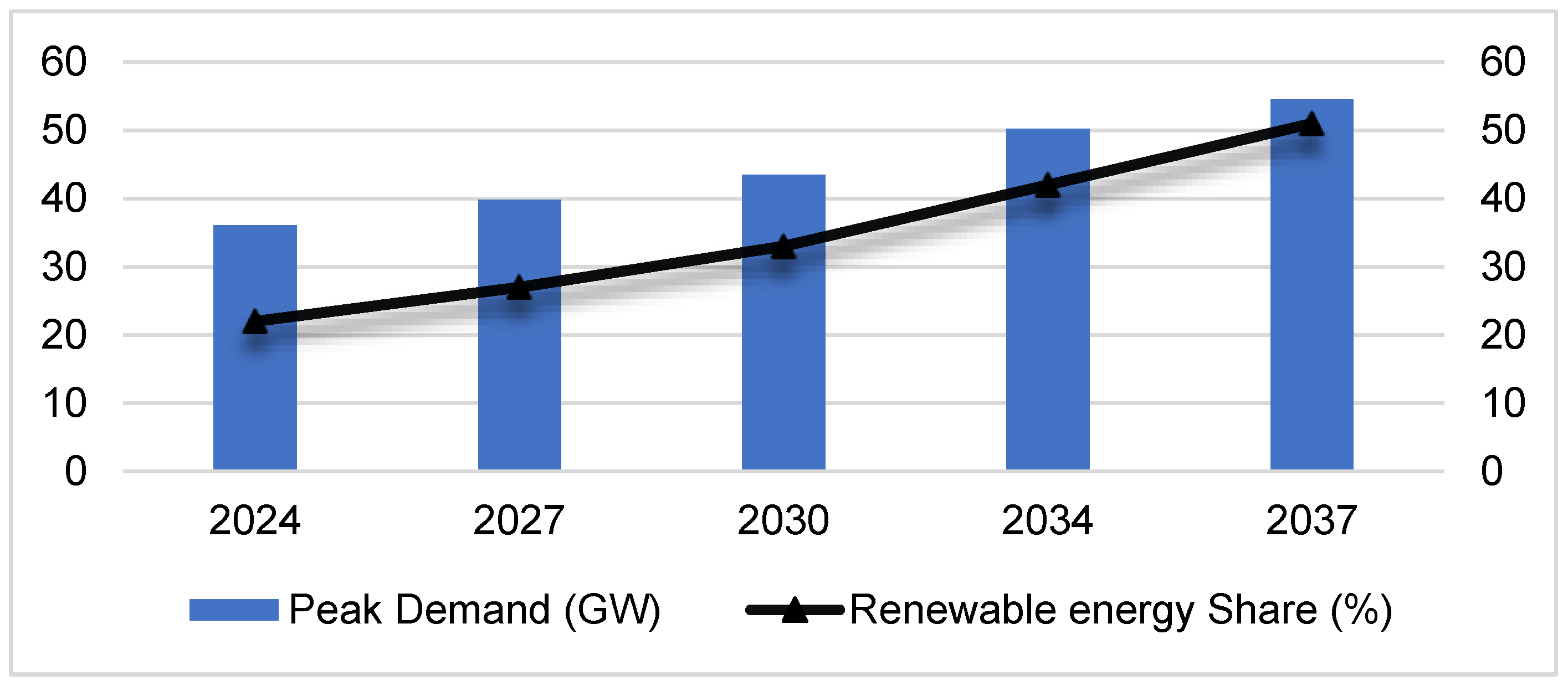
Figure 1 presents official planning targets for national peak electricity demand growth and renewable energy penetration as defined by Thailand’s PDP 2024–2037 and AEDP. These trajectories represent formally adopted government targets rather than model-based projections and are provided to contextualize the policy environment in which investment decisions are made [
1,
2,
8]. The corresponding numerical values for selected milestone years are summarized in
Table A1.
Structural barriers continue to undermine investor confidence in biomass energy development. Key regulatory challenges include complex and time-consuming permitting procedures, regulatory inconsistency, non-uniform environmental impact assessment requirements, non-standardized grid-connection processes, and delays in finalizing power purchase agreements (PPAs) [
7,
9]. Beyond regulation, investors also face operational uncertainties related to technology maturity, maintenance capacity, and performance variability, particularly in small- and medium-scale biomass facilities [
7,
9]. In addition, techno-economic factors such as optimal plant scale, cost sensitivity, and feedstock logistics remain critical determinants of project feasibility under region-specific conditions [
10,
11]. High upfront capital requirements, elevated transaction costs, and perceived policy risk further constrain the adoption of high-efficiency bio-mass conversion technologies [
8,
10,
12,
13].
Climate change intensifies these constraints by increasing uncertainty in biomass feedstock availability. The physical basis of climate-induced drought and heat stress is well established in the IPCC assessments [
14,
15]. In the Thai context, hydrological reports and national studies document increasing water scarcity and yield variability [
16], while agricultural assessments emphasize the vulnerability of crop production systems to irregular rainfall patterns [
17]. Fluctuating crop yields and unpredictable feedstock moisture content lead to operational inefficiencies and rising costs for biomass power plants [
11,
16]. Recent empirical evidence identifies heat stress and water scarcity as key drivers of declining biomass availability in Thailand, amplifying investment risk in the bioenergy sector [
16,
18]. These dynamics highlight the need for integrated energy planning approaches that explicitly link agricultural production systems and water resource management, as documented in national hydrological and irrigation studies [
14], while also incorporating climate adaptation principles emphasized in global and regional climate assessments [
14,
17].
Previous empirical studies have evaluated Thailand’s biomass resource potential and technical deployment constraints [
4,
9], while policy-oriented analyses have examined regulatory and investment barriers in the biomass sector [
7]. Methodological contributions applying the Analytic Hierarchy Process (AHP) to renewable energy decision-making provide structured prioritization tools [
19]. However, limited attention has been given to how climate-induced uncertainties are explicitly internalized within investor-oriented policy prioritization models. In particular, most existing AHP-based renewable energy policy studies treat climate-related feedstock risks as contextual background factors rather than as explicit investment constraints influencing policy prioritization outcomes. As a result, the interaction between regulatory uncertainty, climate-driven feedstock variability, and private investor confidence remains insufficiently explored, especially in emerging economies such as Thailand.
As shown in
Table 1, the reported climate-related yield reductions for major Thai biomass crops exhibit substantial variability, indicating non-negligible feedstock supply risk under changing climatic conditions.
The values reported in
Table 1 represent mid-range estimates derived from the central tendency of the impact ranges documented in the literature. Rather than relying on extreme-case assumptions, this study adopts representative median-level values to characterize typical climate-induced yield risks relevant for policy analysis. These estimates are not intended as precise forecasts, but serve as realistic indicators of increasing feedstock supply uncertainty. Accordingly, climate-related yield impacts are incorporated as a risk adjustment within the feedstock supply instability sub-criterion of the constraints dimension, allowing climate variability to be systematically embedded within the AHP-based policy prioritization framework.
Addressing this gap, the study develops an investor-focused decision-support framework based on the Analytic Hierarchy Process (AHP), originally proposed by Saaty [
19] and subsequently refined in methodological and applied decision-analysis research [
20,
21,
22]. The suitability of AHP for renewable energy policy evaluation has been widely demonstrated in energy-sector applications and multi-criteria decision analysis studies [
23,
24]. The analysis is guided by two research questions:
- (i)
Which policy instruments most effectively enhance investor confidence in Thailand’s biomass energy sector?
- (ii)
How do climate-induced feedstock supply risks influence policy prioritization from an investor perspective?
The results show that law and regulatory policy consistently emerges as the most critical intervention, outperforming financial incentives and technological support measures. Sensitivity analysis confirms the robustness of this prioritization under var-ying assumptions, highlighting the central role of regulatory clarity in mitigating cli-mate- and supply-related investment risks.
To clarify the specific contribution of this study to the existing literature, this study makes three key contributions. First, it proposes an investor-centric policy prioritization framework for biomass energy in Thailand using a Delphi–AHP approach, explicitly capturing the regulatory, financial, technological, and climate-related risks that have often only been treated qualitatively in previous studies. Second, climate-induced feedstock uncertainty is operationalized within the AHP structure by embedding yield- and water-related risks into the feedstock supply sub-criterion, enabling climate variability to directly influence policy rankings. Third, the robustness of policy priorities is systematically tested through sensitivity analysis, demonstrating that regulatory reform remains the dominant policy lever across plausible variations in investor preference structures, thereby offering actionable guidance for policy sequencing and implementation.
2. Materials and Methods
This study employs a structured multi-stage methodological framework integrating expert elicitation, a Delphi-based validation process, and the Analytic Hierarchy Process (AHP). The overall workflow follows a sequential decision-support logic consistent with classical AHP theory as originally formulated by Saaty [
19] and further elaborated in methodological expositions of hierarchical decision modeling [
20]. The design also incorporates contemporary practices widely applied in energy-sector multi-criteria decision analysis (MCDA), including consensus validation, consistency assessment, and robustness testing [
21,
22,
23,
24].
2.1. Research Design
This study adopts a structured, multi-stage research design integrating expert elicitation, a Delphi-based validation process, and the Analytic Hierarchy Process (AHP). The overall design was guided by Saaty’s hierarchical decision-making framework [
19], while incorporating methodological refinements highlighted in recent energy policy and decision-support studies, particularly with respect to robustness analysis and sensitivity testing [
23,
24], as well as hybrid and extended MCDA applications in renewable energy planning [
25,
26].
The use of AHP in this study is consistent with its established role among multi-criteria decision analysis (MCDA) tools applied in energy and environmental decision-making, where it is frequently employed alongside complementary quantitative approaches such as data envelopment analysis and hybrid assessment frameworks [
21,
27].
The methodological workflow comprised six sequential steps:
- (1)
Definition of the decision goal and hierarchical structure, including criteria, sub-criteria, and policy alternatives, informed by an extensive literature review and preliminary stakeholder consultations [
20,
25].
- (2)
Refinement of the evaluation criteria and sub-criteria through focus group discussions with key stakeholders involved in biomass energy development in Thailand [
28].
- (3)
Validation of the proposed criteria and sub-criteria using a two-round Delphi process to ensure relevance, clarity, and expert consensus across stakeholder groups [
28,
29,
30].
- (4)
Elicitation of pairwise comparison judgments via structured expert interviews and paper-based questionnaires, applying Saaty’s 1–9 fundamental scale [
19].
- (5)
Aggregation and consistency assessment of expert judgments using the geometric mean method, with consistency ratios evaluated to ensure logical coherence [
23].
- (6)
Derivation of priority weights and robustness testing, including sensitivity analysis to assess the stability of policy rankings under controlled variations in input weights [
24,
31].
This stepwise design preserves the core principles of AHP while extending the framework to address contemporary policy challenges. The integration of Delphi-based consensus validation, geometric mean aggregation, and systematic sensitivity analysis reflects the methodological enhancements widely adopted in recent renewable energy policy-oriented decision-support studies [
23,
24,
25,
26,
31].
2.2. Expert Selection and Sampling
This study employed a purposive expert sampling strategy that is commonly used in policy-oriented AHP studies, where the aim is to elicit informed judgments rather than achieve statistical representativeness [
19,
21,
30]. The expert panel comprised 18 participants selected based on their direct involvement in Thailand’s biomass energy sector and their capacity to evaluate investment-related policy factors.
The panel size is consistent with established AHP practice, which indicates that reliable results can be obtained with expert groups of approximately 10–20 participants, provided that adequate domain expertise and consistency checks are ensured [
32]. Moreover, expert panels of comparable size are widely reported in recent energy and policy research addressing complex and emerging low-carbon transition challenges, where depth of expertise, cross-sectoral representation, and structured consensus-building are prioritized over large sample sizes [
33]. For instance, recent studies on low-carbon trucking policy priorities and electric vehicle sector enablement have successfully employed expert panels of similar size to elicit informed judgments on policy effectiveness under uncertainty [
33]. Within this context, the panel size adopted in this study aligns with accepted methodological norms for Delphi-validated AHP applications.
The experts represented four key stakeholder groups involved in biomass energy investment and policy implementation: regulators and policymakers (4 experts); project developers and plant operators (5 experts); financial institutions (5 experts); and technology and engineering specialists (4 experts), including boiler vendors, engineering consultants, and EPC contractors.
To ensure an adequate level of expertise, all participants met three criteria: (i) a minimum of five years of professional experience; (ii) direct involvement in biomass energy projects, energy policy formulation, or energy-related financial assessment; and (iii) familiarity with Thailand’s renewable energy policy and regulatory framework [
13,
21,
30]. Experts were identified through professional networks, prior collaborative projects, and referrals from senior practitioners in the energy sector [
29,
30]. Participation was voluntary, and all responses were treated anonymously.
Most experts were based in Bangkok and central Thailand, reflecting the geo-graphic concentration of regulatory agencies, financial institutions, and major biomass project developers. However, several participants had direct operational experience with biomass facilities in regional agricultural areas, ensuring that regional supply and operational perspectives were represented.
Potential conflicts of interest were considered during expert selection [
13,
28]. Although some experts were affiliated with organizations involved in biomass energy projects, none held decision-making authority over the policy instruments evaluated. Experts were instructed to provide independent professional judgments, and anonymity was maintained throughout the elicitation process to mitigate potential bias [
28].
2.3. Delphi-Based Validation Process
A two-round Delphi-based validation process was conducted to refine and validate the evaluation criteria and sub-criteria prior to the AHP pairwise comparison stage [
28,
29,
30]. The Delphi approach was selected to enhance clarity and structured consensus while minimizing direct group influence and dominant individual effects, consistent with established consensus-building practices in policy-oriented decision analysis [
28,
29].
In Round 1, experts independently assessed the relevance and clarity of each criterion and sub-criterion using a five-point Likert scale (1 = not relevant/unclear; 5 = highly relevant/very clear), with opportunities to provide qualitative feedback [
28,
29]. Items receiving less than 70% agreement (defined as ratings ≥ 4) were revised or merged based on expert comments, in accordance with commonly adopted consensus thresholds in Delphi studies [
28,
30].
Round 2 was conducted to confirm consensus on the revised structure. Experts re-evaluated the updated criteria using the same scale after reviewing anonymized feedback summaries from Round 1 [
28,
30]. All criteria and sub-criteria met the predefined 70% consensus threshold in Round 2; therefore, a third Delphi round was not required. The validated criteria and sub-criteria were subsequently used as structured inputs for the AHP pairwise comparison analysis [
26,
34].
Prior to aggregation, expert judgments exhibited systematic differences across stakeholder groups, reflecting their distinct institutional roles. Regulators emphasized regulatory clarity and inter-agency coordination, financial institutions focused on contractual stability and financing risks, while technical experts assigned greater importance to system reliability and operational feasibility. These differences were addressed through anonymized feedback and iterative reassessment between rounds rather than by excluding divergent perspectives. No criteria or sub-criteria were eliminated due to dominance effects, ensuring balanced representation in the final model structure.
Although respondent-level group-specific weight outputs were not retained after aggregation, the Delphi design incorporated balanced stakeholder representation (4 regulators, 5 developers, 5 financiers, and 4 technical experts), anonymized evaluation, and iterative reassessment to mitigate disproportionate influence. In addition, geometric mean aggregation was applied during the AHP computation stage, a method widely recommended in AHP literature for combining expert judgments due to its reduced sensitivity to extreme values compared to arithmetic averaging [
19,
23]. Under these conditions, the resulting weights reflect structured consensus rather than the predominance of any single stakeholder perspective.
2.4. AHP Hierarchical Model Structure
The AHP hierarchical model was developed to prioritize biomass energy policy instruments in Thailand from an explicitly investor-oriented perspective. Consistent with foundational AHP formulations emphasizing structured hierarchical decomposition and priority synthesis [
23], subsequent methodological reviews in sustainable energy planning have frequently adopted a two-dimensional evaluation structure separating expected benefits from implementation constraints [
25].
In the context of renewable energy policy, this benefits–constraints distinction has been further applied in barrier-oriented analyses to differentiate enabling policy outcomes from regulatory and market impediments [
35], as well as in institutional assessments highlighting structural barriers to renewable energy deployment [
36]. Accordingly, the present model adopts a two-dimensional structure consisting of benefits and constraints to distinguish expected policy gains from implementation-related risks.
While earlier studies primarily employed the benefits–constraints structure to evaluate technical feasibility and economic efficiency within energy planning contexts [
19,
20], later renewable energy applications extended this structure to incorporate policy and institutional considerations [
25].
Building on these approaches, the present study reinterprets these dimensions from a private investment perspective. Regulatory uncertainty and financial risk are conceptualized as institutional and contractual barriers affecting investment confidence [
28], while technological and structural constraints in renewable energy systems have been analyzed in broader MCDM applications [
24].
Climate-induced feedstock variability, particularly in biomass-dependent systems, has been identified as an emerging operational and supply-chain risk in renewable energy policy analyses [
37]. Broader bioenergy policy studies emphasize integrating supply-side instability into risk-adjusted planning frameworks [
31]. In addition, adaptation-oriented energy transition research distinguishes between enabling pathways and structural constraints under climate uncertainty [
38]. Accordingly, environmental pressures—most notably climate-driven feedstock supply instability—are embedded within the constraints dimension to capture their influence on perceived investment risk and project bankability [
31].
2.5. Model Operationalization and Structure
The AHP hierarchical model was developed to prioritize biomass energy policy instruments in Thailand from an explicitly investor-oriented perspective. Consistent with prior AHP-based renewable energy policy studies, the model adopts a two-dimensional evaluation structure consisting of Benefits and Constraints, which is widely used to distinguish expected policy outcomes from implementation-related risks [
23,
25,
35,
36]. This structure also aligns barrier-based frameworks identifying regulatory, financial, technological, and informational factors as key impediments to renewable energy deployment.
While earlier studies primarily applied the Benefits–Constraints structure to assess technical or economic feasibility [
19,
20,
25], the present study reinterprets these dimensions to reflect private investment decision-making. Regulatory uncertainty, financial risk, and climate-induced feedstock variability are treated as investment constraints rather than technical limitations. Environmental pressures, most notably climate-driven feedstock supply instability—are therefore embedded within the Constraints dimension to capture their influence on perceived investment risk and project bankability [
24,
28,
31,
37].
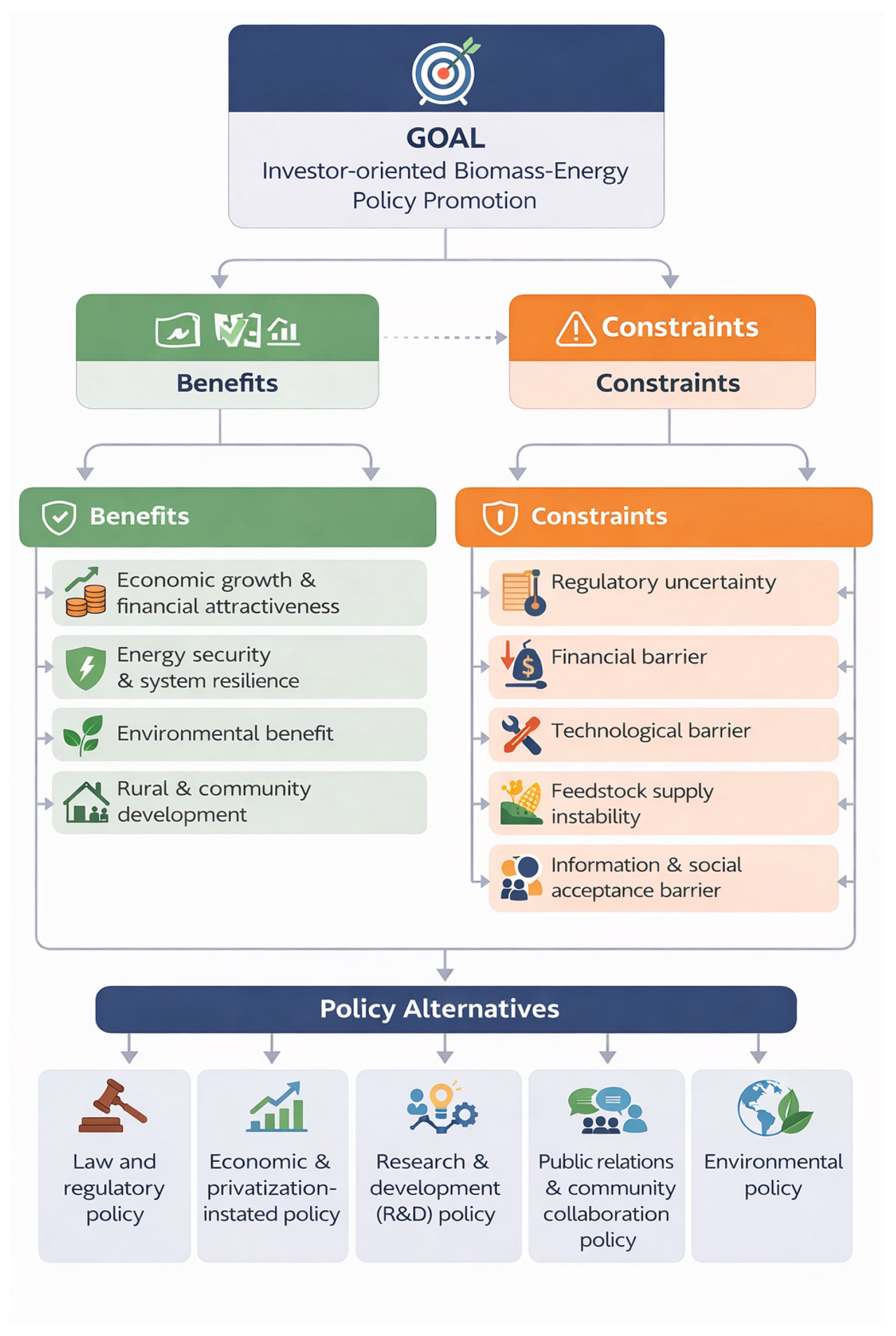
The objective of the hierarchical structure is to identify policy interventions that most effectively enhance investor confidence under conditions of regulatory adjustment, market volatility, and climate uncertainty. By explicitly distinguishing between policy-driven benefits and implementation-related risks, the model enables transparent and balanced policy prioritization. Sensitivity analysis confirms that this structural choice does not materially affect the ranking of policy alternatives, supporting the robustness of the adopted hierarchy as shown in
Figure 2.
Although certain elements such as energy security or environmental benefits may interact with risk or constraint dimensions in real policy environments, a strictly hierarchical AHP structure was intentionally retained to enhance analytical transparency and interpretability. These elements are classified under the Benefits dimension to reflect their normative role as expected positive outcomes of policy implementation from an investor-oriented perspective. Potential overlaps or cross-cutting effects were implicitly incorporated through expert judgment during pairwise comparisons rather than modeled as explicit interdependencies. Network-based approaches such as the Analytic Network Process (ANP) are acknowledged as a potential extension for future research but were not adopted here to preserve methodological parsimony and comparability with prior AHP-based policy analyses.
2.5.1. Criteria (Level 2)
Consistent with the original formulation, the model is structured around two primary criteria [
23,
39]:
Retaining these two pillars provides a balanced and transparent framework for policy prioritization in emerging renewable energy markets [
19,
32,
38,
39,
40].
2.5.2. Sub-Criteria (Level 3)
Each criterion was further decomposed into sub-criteria to reflect specific investment considerations.
Within the benefits dimension, sub-criteria include economic and financial attractiveness, national energy security and system resilience, environmental benefits, and rural and community development [
20,
25,
36]. These factors capture the anticipated economic returns, system-level contributions, and broader socio-environmental outcomes associated with biomass energy deployment.
Within the constraints dimension, sub-criteria capture key impediments to in-vestment, including regulatory uncertainty, financial barriers, technological barriers, feedstock supply instability, and information and social acceptance barriers [
8,
10,
11,
25,
28]. Climate-related risks associated with droughts, heat stress, and irregular rainfall were explicitly embedded within the feedstock supply instability sub-criterion to reflect climate-driven resource uncertainty [
14,
15,
16,
17,
18]. This approach allows climate impacts to be systematically represented as investment risks without double counting their effects across multiple constraint categories. Detailed operational definitions of all criteria and sub-criteria are provided in
Supplementary Table S1.
2.5.3. Policy Alternatives (Level 4)
To preserve comparability with earlier benchmark studies, the set of policy alternatives remained unchanged [
23,
25,
28]. These include (1) research and development policy, (2) economic and privatization-initiated policy, (3) public relations and community collaboration policy, (4) law and regulatory policy, and (5) environmental policy.
By preserving the original hierarchical backbone while updating the conceptual interpretation of its components, the proposed model provides continuity with prior AHP-based analyses while enhancing relevance under the current regulatory, financial, and climate conditions [
23,
25,
26,
32]. This design rationale ensures methodological transparency and alignment with recent AHP applications in renewable energy policy research [
19,
39].
Detailed descriptions and illustrative examples of the evaluated policy alternatives are provided in
Supplementary Table S2.
2.6. Saaty Scale and Pairwise Comparison Procedure
Experts evaluated relative importance using Saaty’s 1–9 scale, as shown in
Table 2:
The fundamental scale provides a structured approach for expressing expert preferences and has been widely adopted in multi-criteria decision-making studies in the energy policy domain [
20,
21,
22]. Intermediate values (2, 4, 6, and 8) were used only when expert judgments laid between two adjacent intensity levels.
All criteria, sub-criteria, and policy alternatives were evaluated using pairwise comparison questions directly aligned with their operational definitions (
Supplementary Tables S1 and S2), ensuring a one-to-one correspondence between conceptual constructs and expert judgments [
20,
21,
22,
24].
2.7. Pairwise Comparison and Judgment Aggregation
To determine the relative importance of each element within the hierarchy, we utilized a pairwise comparison matrix (
A). Experts evaluated
n items—whether criteria or alternatives—using the standard Saaty 1–9 scale [
39,
40]. This matrix is constructed such that each entry
aᵢⱼ represents the relative importance of item
i over item
j, satisfying the reciprocal property where
aⱼᵢ = 1/
aᵢⱼ and all diagonal elements
aᵢᵢ equal 1.
Since this study involves multiple expert perspectives, we employed the aggregation of individual judgments (AIJ) technique [
21,
31]. To reach a group consensus, individual judgments (
aᵢⱼᵏ) from
m experts were combined using the geometric mean [
21,
31,
34]:
where
denotes the aggregated group judgment obtained from individual expert assessments.
In AHP, pairwise comparisons are expressed on a ratio scale and must satisfy the reciprocal property (a
ij = 1/a
ji) [
19,
22]. The geometric means preserve this property during aggregation, whereas the arithmetic means do not [
21,
31]. Therefore, the resulting aggregated matrix provides a consistent group-level foundation for subsequent priority weight calculation. No additional statistical outlier removal was applied prior to aggregation, as judgment reliability was assessed using the consistency ratio, as described in
Section 2.8.
2.8. Weight Calculation and Consistency Assessment
The priority weights (
w) are extracted from the consensus matrix by calculating its principal eigenvector [
19,
22]. This relationship is defined by:
where λₘₐₓ represents the dominant eigenvalue of the pairwise comparison matrix.
To assess the logical consistency of expert judgments, a consistency assessment was conducted by calculating the consistency index (CI) [
19,
22], defined as
where
n denotes the number of elements (criteria or alternatives) being compared in the pairwise comparison matrix.
Finally, the consistency ratio (CR) was determined to validate the reliability of the results [
19,
22,
24]:
where
is the random index for matrix size
(
Table 3).
refers to the random index corresponding to the matrix size n [
19]. In accordance with AHP standards, a CR value of less than 0.10 is required to confirm that the pairwise comparisons are sufficiently consistent for reliable policy prioritization [
19,
22,
24].
A matrix is acceptable if CR < 0.10.
Across all evaluated comparison matrices, the average consistency ratio (CR) was 0.064, which is well below the commonly accepted threshold of 0.10. Individual CR values ranged from 0.021 to 0.093, indicating satisfactory consistency across all judgments. No comparison matrices exceeded the CR threshold of 0.10; therefore, no matrices were rejected or re-collected. In total, all comparison matrices generated during the expert elicitation process were retained for subsequent analysis.
2.9. Integration of Climate, Water, and Yield-Risk Factors
To reflect the growing vulnerability of biomass energy systems, climate-related supply-side risks were integrated as a climate-risk adjustment embedded exclusively within the feedstock supply instability sub-criterion of the Constraints dimension [
14,
15,
16,
17,
18]. This design reflects the primary pathway through which climate variability affects biomass energy investments, namely through agricultural yield reduction, water scarcity, and operational sensitivity to feedstock quality [
11,
14,
15,
16,
17,
18].
Rather than relying on generic risk profiles, this study utilizes documented yield-reduction ranges for Thailand’s primary biomass crops, as summarized in
Table 1 [
14,
15,
16,
17,
18]. From these ranges, mid-range (median-level) estimates were selected to represent typical climate-induced yield impacts, avoiding extreme-case assumptions while remaining policy-relevant [
31,
32]. A single representative yield-impact value (
ΔY) was applied in the base-case analysis to maintain model parsimony and analytical transparency.
To operationalize climate impacts within the AHP framework, a climate-risk modifier was applied as follows [
31,
32]:
where Wc denotes the climate-adjusted weight of the feedstock supply instability sub-criterion, W
0 represents the baseline AHP-derived weight, and ΔY represents the percentage yield impact, expressed as a negative value under climate stress conditions. The resulting reduction in Wc is intentional, as it reflects the heightened severity of feedstock supply risk perceived by investors under adverse climate conditions. The modifier was not distributed across other constraint categories to avoid double-counting climate effects [
14,
15,
16,
17,
18].
In the baseline AHP results, the feedstock supply instability sub-criterion has a local weight of 0.065 under the constraints dimension, corresponding to a global weight of 0.029 after aggregation (
Table A1). Based on the mid-range climate-related yield impacts summarized in
Table 1, a representative yield-impact parameter (ΔY) of −15% was adopted to reflect typical drought and heat stress conditions affecting major biomass crops in Thailand.
Applying the climate-risk modifier defined in Equation (5), the climate-adjusted weight was calculated as:
This adjusted local weight was then re-normalized within the constraints dimension prior to global priority synthesis. Importantly, this adjustment was applied exclusively to the feedstock supply instability sub-criterion to avoid double counting climate effects across multiple constraint categories.
Although the local weight decreases numerically (from 0.065 to 0.055), this reduction is intentional. This reflects the heightened severity of feedstock supply risk perceived by investors under adverse climate conditions, as the climate-risk modifier amplifies the relative influence of supply instability within the constraints dimension after re-normalization. In this way, climate stress increases the effective salience of feedstock-related risk in the overall policy prioritization framework rather than diminishing its importance.
This stepwise illustration clarifies how documented climate-related yield impacts (
Table 1) are systematically translated into adjusted AHP weights without altering the original pairwise comparison judgments or the hierarchical structure of the model. The implications of this climate adjustment for final policy rankings are further examined through sensitivity analysis in
Section 2.10 and discussed in
Section 4.
2.10. Global Priority Synthesis
Global priority scores for the policy alternatives were obtained by synthesizing weights across the hierarchical structure of the AHP model [
19,
22,
23]. Specifically, local priority weights of policy alternatives under each sub-criterion were multiplied by the corresponding sub-criterion and criterion weights and then aggregated to derive overall priority scores.
Let
Wc denote the weight vector of criteria,
Ws the weight vector of sub-criteria under each criterion, and
Wp the local priority vector of policy alternatives under each sub-criterion. The global priority vector (G) was computed as follows [
19,
22]:
where ⊗ denotes element-wise multiplication between sub-criterion weights and corresponding local alternative weights, followed by summation across all sub-criteria. The summation is performed across all sub-criteria in the hierarchy.
The resulting global priority values were subsequently re-normalized to satisfy the unit-sum condition (Σ G
i = 1), ensuring comparability across policy alternatives [
23]. This re-normalization step does not alter the relative ranking of alternatives but facilitates transparent interpretation of priority scores.
Where applicable, the climate-related adjustments described in
Section 2.8 were incorporated through the climate-risk adjustment applied to the feedstock supply instability sub-criterion prior to global synthesis. The final ranking of policy alternatives was obtained by ordering the elements of G in descending order, with higher values indicating higher policy priority from an investor-oriented perspective.
2.11. Sensitivity Analysis
To evaluate robustness, each criterion weight was independently perturbed by ±10%, and the resulting changes in final rankings were recorded [
24,
32,
41].
A ±10% one-at-a-time perturbation was adopted as a conservative and commonly used range in AHP-based sensitivity analysis to assess ranking robustness under modest parameter uncertainty. Larger perturbation ranges and simultaneous perturbations were not examined, as the objective was to evaluate local ranking stability rather than extreme scenario behavior.
Local partial sensitivity was as follows:
where g
i denotes the global priority of alternative i, and a
i(j) represents its local priority under criterion j. Ranking stability under these perturbations was used as the primary indicator of model robustness [
24,
32,
41].
2.12. Focus Group Discussion and Data Elicitation
At the initial stage of data collection, focus group discussions were conducted to support the development and refinement of the AHP hierarchical structure [
26,
27,
33]. A total of two focus group sessions were organized, each lasting approximately 90 min. Participants included government officials, renewable energy professionals, academic researchers, and biomass power plant developers with direct experience in policy formulation, project development, and system operation in Thailand.
The focus groups were conducted prior to the Delphi validation rounds and served an exploratory and confirmatory role rather than a quantitative weighting function [
26,
28,
34]. Guided discussion prompts focused on (i) identifying key benefits and constraints affecting biomass energy investment, (ii) validating the relevance and completeness of candidate criteria and sub-criteria identified from the literature, and (iii) clarifying practical policy instruments applicable to the Thai context. No pairwise comparisons or numerical judgments were collected during the focus group sessions.
Discussions were recorded in detailed facilitator notes and summarized thematically. The qualitative insights obtained were synthesized to refine definitions, merge overlapping concepts, and ensure the contextual relevance of the criteria, sub-criteria, and policy alternatives [
26,
27,
33]. These results informed the construction of the AHP hierarchy and the design of the Delphi questionnaires used in subsequent stages [
26,
31].
2.13. AHP Model Analysis Using Super Decisions Software
The Analytic Hierarchy Process (AHP) analysis was conducted using Super Decisions
® software (version 3.2), which is commonly used for multi-criteria decision-making problems with hierarchical and network-based structures. The program adheres to the essential prioritization concepts of AHP theory, obtaining priority weights using pairwise comparison judgments or direct measurements [
19,
23,
39,
40].
In this study, Super Decisions
® software was employed to calculate pairwise comparison matrices, derive eigenvector-based priority weights, and rank policy instruments aimed at increasing biomass-energy utilization in Thailand. The software ensured consistency checking and systematic aggregation of expert judgments in accordance with established AHP methodological standards [
19,
32].
Primary data were obtained from expert elicitation activities, including focus group discussions, Delphi-based validation, and structured expert interviews used for AHP pairwise comparisons. These data were complemented by secondary sources employed to support model framing and contextual interpretation, including the academic literature, published policy documents, and national energy strategies reflecting current and future energy-policy directions in Thailand, such as the Power Development Plan (PDP), Alternative Energy Development Plan (AEDP), and the Bio-Circular-Green (BCG) economy framework [
1,
2,
3,
4].
Following global priority synthesis, the overall priority scores of policy alternatives were arranged in descending order to obtain the final policy ranking. Higher priority values indicate greater effectiveness in promoting biomass energy development from an investor-oriented perspective.
Although Super Decisions
® supports both Analytic Hierarchy Process (AHP) and Analytic Network Process (ANP) models, only the hierarchical AHP approach was applied in this study [
19,
22]. No interdependence or feedback relationships among criteria were modeled, ensuring consistency with the hierarchical decision structure described in the methodology [
19,
32].
2.14. Methodological Considerations and Limitations
Several methodological limitations of this study should be acknowledged. First, the AHP framework relies on expert judgment, which may introduce subjectivity despite the application of consistency checks, anonymized elicitation, and a Delphi-based consensus process [
28,
33,
34]. While these procedures are widely accepted for mitigating individual bias, expert assessments inevitably reflect professional experience and institutional positioning.
Second, expert judgments were aggregated using equal weighting, assuming comparable levels of expertise across participants. This approach is consistent with established practice in Delphi-validated AHP studies and policy-oriented multi-criteria decision analysis [
19,
23]. Nevertheless, alternative aggregation schemes—such as experience-based or familiarity-based weighting—have been proposed in recent energy and policy research to account for heterogeneity in expert backgrounds and domain-specific knowledge [
19]. These approaches assign greater influence to experts with longer professional experience or higher familiarity with specific policy instruments and market conditions.
Because respondent-level metadata required to implement such alternative weighting schemes were not collected, these approaches could not be operationalized without introducing unverifiable assumptions. To assess robustness using available outputs, an expanded one-at-a-time (OAT) sensitivity analysis was conducted, a procedure commonly applied in MCDA robustness testing [
23,
24]. Each sub-criterion weight was systematically perturbed by ±50%, followed by re-normalization within its respective criterion, and final policy scores were recalculated. As shown in
Supplementary Tables S3 and S4, no rank reversals were observed across 18 perturbation scenarios, and law and regulatory policy remained the top-ranked alternative in every case. This stability indicates that the prioritization results are not disproportionately influenced by any single sub-criterion emphasis and remain structurally consistent under substantial variations in weighting assumptions.
Third, the AHP model adopts a static and strictly hierarchical structure, which enhances transparency and interpretability but does not explicitly capture interdependencies or feedback effects among criteria. More advanced network-based approaches, such as the Analytic Network Process (ANP), may be explored in future research to account for such interactions [
19].
Finally, climate-related risks were incorporated using representative mid-range yield impact values rather than dynamic or probabilistic climate projections. This choice prioritizes policy relevance and analytical clarity but limits the ability to capture extreme or long-term climate variability. These limitations do not undermine the validity of the findings but should be considered when interpreting the results and extending the framework to other contexts.
3. Results and Discussion
To ensure analytical accuracy, we employed Super Decisions
® software (version 3.2) for all priority weight computations, final rankings, and sensitivity tests following the AHP architecture outlined in
Section 2. We made sure that the Consistency Ratio (CR) stayed below 0.10 for every pairwise comparison matrix. This meant that the expert assessments were both logical and trustworthy. As a result, the findings provide a coherent synthesis of investor perspectives, notably illustrating the intricate interplay of Thailand’s current regulatory framework, technological landscape, and climate-induced concerns.
3.1. Criteria-Level Priority Weights
Table 4 presents the aggregated priority weights at the criteria level, distinguishing between the benefits and constraints dimensions of the AHP model.
At the criteria level, the aggregated results indicate that benefits received a slightly higher priority weight (0.56) compared to constraints (0.44), suggesting a relatively balanced evaluation structure rather than a strongly one-sided preference (
Table 4). The consistency ratio (CR) for this pairwise comparison was 0.042, well below the acceptable threshold of 0.10, indicating a high level of internal consistency in expert judgments.
Although minor variations in weighting magnitude were observed across expert groups, the relative importance of ordering between benefits and constraints remained consistent among regulators, project developers, financial institutions, and technical experts. This indicates broad agreement regarding the dual importance of expected returns and perceived risks in biomass energy investment decisions.
The relatively narrow separation between the two criteria reflects an investor decision context in which anticipated benefits must be carefully weighed against regulatory, operational, and climate-related constraints, rather than being dominated by a single dimension.
The full distribution of the criteria and sub-criteria weights underpinning these results is provided in
Table A2, which illustrates how regulatory and technological constraints dominate the overall decision structure.
3.2. Evaluation and Ranking of Policy Alternatives
The synthesis of local and global priority weights provides an integrated assessment of policy effectiveness from an investor-oriented perspective, with the resulting rankings summarized in
Table 5. Among the evaluated alternatives, law and regulatory policy achieved the highest global priority score (0.31), followed by economic and privatization-initiated policy (0.24), research and development (R&D) policy (0.18), public relations and community collaboration policy (0.15), and environmental policy (0.12).
The dominance of law and regulatory policy reflects its dual role in both enhancing expected investment benefits and mitigating key implementation constraints. When examined separately under the benefits and constraints dimensions, this policy category consistently ranked first in both perspectives. Under the benefits dimension, regulatory reform was perceived as a critical enabler of investment returns by reducing transaction costs, improving project bankability, and enhancing market predictability. Under the constraints dimension, its influence was even more pronounced, as regulatory clarity directly alleviates permitting delays, contractual uncertainty, and power purchase agreement (PPA) risks. This consistency across evaluative dimensions underscores the structural importance of regulatory frameworks in shaping investor confidence in Thailand’s biomass energy sector [
28].
Economic and privatization-initiated policies ranked second, indicating that financial incentives and market-oriented instruments are viewed as important complements to regulatory reform rather than standalone drivers of investment. R&D-oriented policies, while essential for long-term technological advancement, received a comparatively lower ranking due to their longer time horizon and indirect impact on near-term investment decisions. This finding aligns with previous energy investment studies, which suggest that private investors tend to prioritize policy instruments that reduce immediate uncertainty over those whose benefits accrue over extended periods [
38].
Although minor variations in weighting magnitude were observed across expert groups including regulators, project developers, financial institutions, and technical experts, the overall ranking order of policy alternatives remained stable, indicating broad cross-sectoral agreement. Nonetheless, differences in emphasis were evident in the underlying judgment patterns. Financial institutions tended to assign greater weight to regulatory certainty and PPA enforceability, whereas project developers and technical experts placed relatively higher importance on technological reliability and operational feasibility. These differences did not result in rank reversal but highlighted the heterogeneous risk perceptions within the investor community.
Uncertainty in the prioritization results was assessed through sensitivity analysis rather than statistical confidence intervals, which are not standard in AHP-based evaluations. As described in
Section 2.10, no rank reversals were observed under ±10% perturbations of criterion weights, confirming the robustness of the reported policy rankings.
The comparatively lower ranking of environmental policy does not imply limited relevance. Instead, it reflects the perception that environmental compliance constitutes an established institutional requirement that is generally assumed to be mandatory and uniformly enforced. As such, environmental policy functions more as a baseline condition than as a differentiating factor in investment prioritization. These results suggest that, while environmental governance remains essential, investor decision making in Thailand’s biomass sector is primarily driven by policy instruments that reduce regulatory uncertainty and enhance the predictability of project implementation.
The final policy rankings reported in this section are obtained through the AHP aggregation procedure summarized in
Supplementary Table S6.
3.3. Sub-Criteria Structure and Interpretation
Table 6 summarizes the dominant sub-criteria and their corresponding global weights to provide insight into the internal structure driving the overall policy rankings. Detailed weights across all criteria, sub-criteria, and policy alternatives are reported in
Appendix A (
Table A2).
Table 6 highlights the dominant sub-criteria derived from the full AHP synthesis presented in
Appendix A (
Table A2), providing insight into the internal structure driving policy prioritization.
The results indicate a structurally unbalanced sub-criteria distribution, in which a limited number of high-weight factors exert a disproportionate influence on investor decision-making. Within the benefits dimension, economic growth and financial attractiveness (0.273) clearly dominates, reflecting investor emphasis on revenue stability and market viability, followed by energy security and rural development considerations (0.117 each).
Within the constraints dimension, technological barriers (0.228) represent the most influential risk factor, exceeding regulatory uncertainty (0.114) and financial barriers (0.093). This pattern reflects investor sensitivity to system reliability and technological maturity, as operational failure directly threatens project viability regardless of regulatory or financial support [
8]. Regulatory uncertainty, while still significant, is perceived as a risk that can be progressively mitigated through institutional learning and policy reform.
The relatively low global weight assigned to feedstock supply instability (0.029) does not contradict the climate emphasis of this study. Instead, climate-related risks are internalized as background conditions that amplify other constraints—particularly technological and operational risks—rather than acting as standalone decision drivers. For this reason, climate risk was embedded within the feedstock supply instability sub-criterion and incorporated through risk adjustment rather than dominating the sub-criteria hierarchy.
This asymmetric sub-criteria structure explains why law and regulatory policy consistently emerges as the highest-ranked policy alternative, as such interventions simultaneously address many of the high-weight constraints identified in the model.
3.4. Sensitivity Analysis Results
To examine the robustness of the AHP results, sensitivity analysis was conducted to assess the influence of uncertainty in expert judgments on the final policy rankings. Consistent with standard practice in AHP-based policy analysis, a one-at-a-time perturbation approach was applied, in which each criterion weight was independently varied by ±10% while the remaining weights were proportionally re-normalized to preserve comparability and the unity sum constraint [
22,
23].
The one-at-a-time perturbation scheme was selected because the primary objective of sensitivity analysis in this study is to evaluate ordinal stability, particularly the potential for rank reversal among policy alternatives, rather than to estimate probabilistic uncertainty. Although alternative schemes—such as simultaneous or larger range perturbations can be employed, one-at-a-time analysis is widely regarded as sufficient for identifying whether policy rankings are structurally robust or sensitive to marginal changes in preference weights. This approach is especially appropriate in expert-elicitation-based AHP applications, where transparency and interpretability are prioritized.
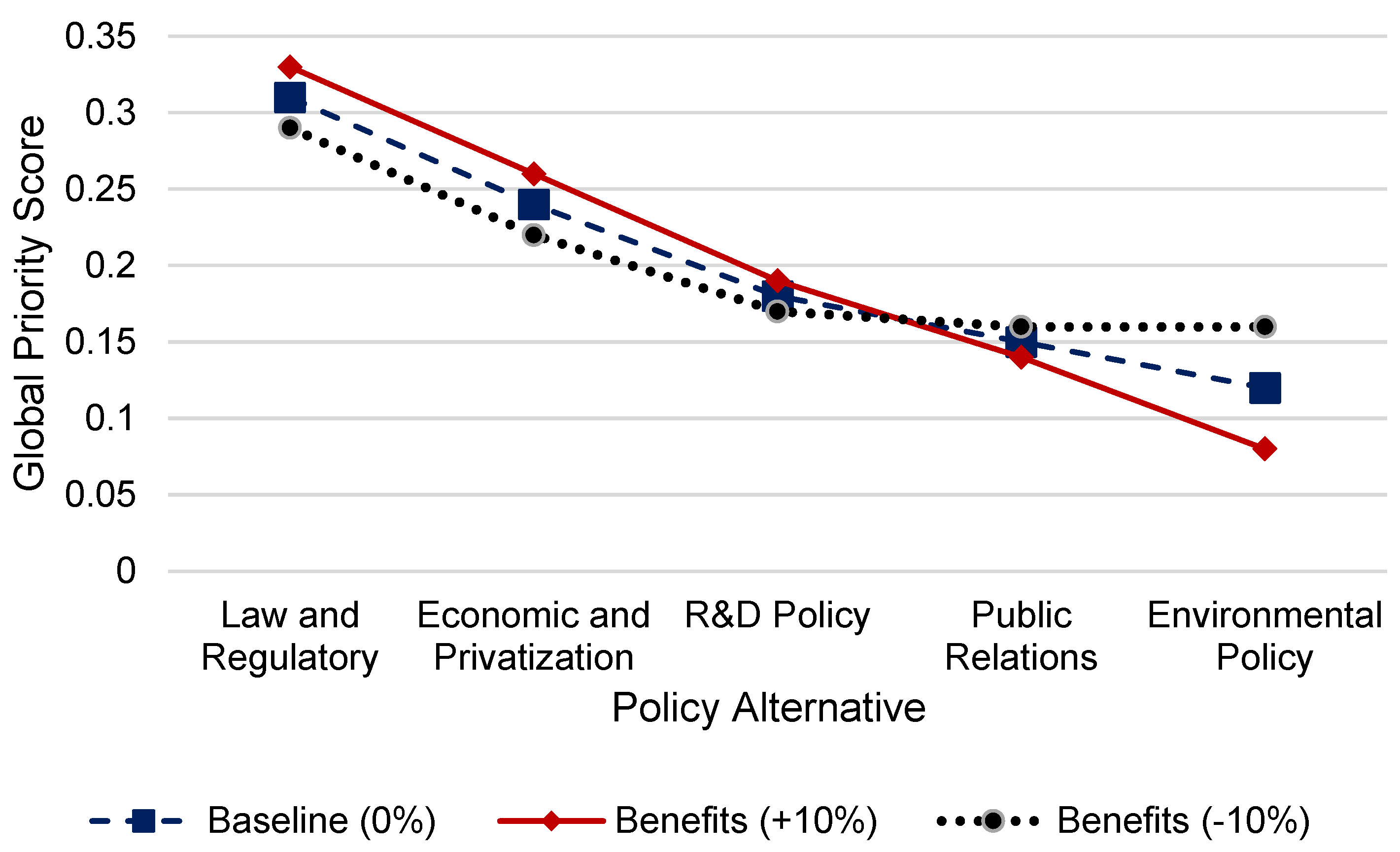
Sensitivity tests were conducted for both the benefits and constraints dimensions. For clarity of presentation,
Figure 3 illustrates the effects of perturbations applied to the benefits criterion. Equivalent perturbations applied to the constraints criterion produced consistent results and did not alter the overall ranking structure.
As shown in
Figure 3, the ranking of policy alternatives remained stable across all tested scenarios. Law and regulatory policy consistently retained the highest priority position under both positive and negative perturbations. No rank reversals were observed for the top-ranked policy alternative at any tested perturbation level, indicating a high degree of robustness in the model outcomes.
While minor variations in priority scores were observed among mid-ranked alternatives, no near-reversals occurred between the second- and third-ranked policies. In particular, the relative ordering of economic and privatization-initiated policy and research and development (R&D) policy remained unchanged throughout the sensitivity tests.
These results confirm that the dominance of law and regulatory policy is not a fragile outcome driven by marginal weighting assumptions, but rather a structurally resilient conclusion. The observed stability reflects the concentration of influence within high-weight constraints—particularly regulatory uncertainty and technological barriers—identified in the sub-criteria analysis. Consequently, the final policy prioritization remains robust under reasonable variations in expert judgment.
4. Discussion
Conceptually, this study contributes to the biomass energy policy literature by reframing policy prioritization as a risk-adjusted investment decision problem, in which regulatory and climate-induced uncertainties jointly shape private investor behavior rather than acting as peripheral constraints.
Before interpreting the results, several limitations should be acknowledged. The reported policy rankings reflect relative priorities derived from expert judgments within a structured AHP framework rather than absolute measures of policy effectiveness. The results are therefore context-specific and contingent upon the assumptions embedded in the model, including the selected criteria, sub-criteria definitions, and the expert composition. Although robustness was examined through sensitivity analysis, the findings remain influenced by prevailing regulatory, market, and climate conditions during the 2024–2025 period. Consequently, the results should be interpreted as indicative guidance for policy prioritization rather than deterministic prescriptions applicable across all contexts or time horizons.
This study offers an investor-oriented interpretation of biomass energy policy prioritization in Thailand, with particular emphasis on the role of regulatory and institutional conditions in shaping private investment decisions under climate uncertainty. The results demonstrate that law and regulatory policy consistently emerge as the most influential intervention, surpassing financial incentives and technological support measures. Rather than reflecting a narrow regulatory preference, this dominance indicates the capacity of regulatory frameworks to simultaneously address multiple high-weight constraints, including permitting uncertainty, grid-connection procedures, and contractual clarity in PPAs.
From a broader methodological and theoretical perspective, recent advances in renewable energy decision-support research emphasize the importance of explicitly incorporating uncertainty and institutional risk into structured multi-criteria frameworks [
40]. Hybrid and uncertainty-oriented extensions of AHP, including fuzzy and probabilistic approaches, have been increasingly applied to capture ambiguity in expert judgments and long-horizon investment risk [
41]. Comparative renewable energy policy evaluations further demonstrate that structured criteria hierarchies can systematically integrate institutional, technological, and financial dimensions within a unified decision model [
42].
In parallel, innovation and environmental economics research highlights the interaction between technological change, policy credibility, and institutional incentives in shaping private investment behavior [
43]. Portfolio-based perspectives on energy planning similarly stress that investors prioritize risk-adjusted returns over simple cost minimization when allocating capital under uncertainty [
44]. Multicriteria diversity frameworks reinforce the role of structured trade-off analysis in managing regulatory and technological volatility [
45]. Cross-country clean technology assessments in emerging markets also demonstrate that institutional coordination capacity significantly affects renewable energy investment outcomes. Experiences from electricity market reform processes further show that regulatory sequencing and policy stability are decisive in sustaining investor confidence [
46].
Comparisons with existing AHP-based renewable energy policy studies in Southeast Asia reveal both convergence and contextual specificity. Studies conducted in Indonesia identify regulatory uncertainty and institutional capacity as primary barriers to private-sector investment in renewable energy projects [
47]. Comparable findings are also reported in cross-country clean technology assessments highlighting institutional coordination challenges in emerging markets [
48], as well as in renewable energy prioritization studies in Vietnam [
49]. In contrast, AHP studies in the Philippines—where market liberalization and standardized PPAs are more firmly established—tend to assign greater relative importance to financial incentives and tariff mechanisms [
50]. These cross-country comparisons suggest that the prominence of regulatory policy is closely linked to the maturity and credibility of institutional and contractual frameworks rather than to the intrinsic characteristics of biomass technology itself.
Within the Thai context, comparisons with AHP studies focusing on other renewable energy sectors, such as solar and wind, further highlight the sector-specific nature of biomass investment risk [
51]. While financial incentives and tariff structures often dominate policy prioritization in solar and wind investments, biomass energy projects exhibit greater sensitivity to regulatory clarity due to their reliance on feedstock logistics, environmental permitting, and long-term supply contracts. This structural complexity reinforces the need for coherent and predictable regulatory frameworks in the biomass sector relative to other renewables.
Although biomass energy projects are inherently exposed to feedstock-related and climate-induced supply risks, the relatively low global weight assigned to feedstock supply instability does not imply that such risks are insignificant. Instead, this outcome reflects expert perceptions that short- to medium-term investment decisions are more strongly influenced by regulatory and technological uncertainty, while climate-related supply risks are often viewed as longer-term challenges that can be partially managed through diversification strategies, contracting mechanisms, and adaptive policy frameworks. This interpretation is consistent with investor-oriented decision frameworks, in which near-term institutional and technological risks typically take precedence over longer-horizon climate uncertainties in capital allocation decisions. For completeness, a brief conceptual comparison between the proposed crisp AHP framework and alternative uncertainty-oriented decision-support approaches (e.g., fuzzy, neutrosophic, and probabilistic methods) is provided in
Supplementary Table S6.
In addition to criterion-level sensitivity analysis, the robustness of the framework can also be considered with respect to alternative expert response weighting schemes. In this study, expert judgments were aggregated using equal weighting, which is consistent with standard practice in Delphi-validated AHP applications and appropriate given the balanced stakeholder representation and minimum experience threshold applied during expert selection. Recent energy and policy research suggests that alternative aggregation schemes—such as experience-based or familiarity-based weighting—may be used to reflect heterogeneity in expert backgrounds or domain-specific knowledge. While the implementation of multiple response-weighting schemes was beyond the scope of the present analysis, future research could extend the framework by explicitly comparing these approaches to further assess the stability and generalizability of policy rankings.
From a theoretical perspective, these findings align with institutional economics, which emphasizes that private investment behavior is shaped not only by expected returns but also by transaction costs, policy credibility, and enforcement mechanisms [
52,
53]. From a risk-management standpoint, investor sensitivity to regulatory and technological uncertainty is consistent with portfolio-based views of energy investment that prioritize risk-adjusted returns rather than cost minimization alone [
44]. The strong weighting of regulatory uncertainty and technological barriers indicates that institutional stability is perceived as a prerequisite for capital commitment. Persistent policy uncertainty increases perceived risk premiums, delays investment timing, and discourages long-term infrastructure development, even in the presence of financial incentives.
The policy implications of these findings are substantial. Regulatory reforms should prioritize streamlining permitting procedures, standardizing grid-connection requirements, and improving the transparency and enforceability of PPAs. A phased policy implementation strategy appears particularly relevant. Short-term actions (1–2 years) should focus on regulatory simplification and contractual standardization to reduce immediate investment risk, followed by medium-term measures (3–5 years) that integrate climate-risk considerations into feedstock planning, infrastructure design, and supply-chain coordination. Effective implementation will require adequate administrative capacity, strong inter-agency coordination, and the increased digitalization of approval and monitoring processes.
To enhance the practical relevance, the highest-ranked law and regulatory policy category can be translated into concrete regulatory and institutional measures without altering the underlying policy alternatives evaluated in the AHP model. From an investor-oriented perspective, its dominance is driven by strong links to regulatory uncertainty, feedstock supply instability, and financial barriers. Regulatory uncertainty is primarily associated with non-standardized permitting procedures, ambiguity in PPA execution, and fragmented institutional responsibilities across multiple agencies, particularly the Energy Policy and Planning Office (EPPO), the Energy Regulatory Commission (ERC), and the Department of Alternative Energy Development and Efficiency (DEDE). These coordination challenges occur within the broader implementation framework of Thailand’s Power Development Plan (PDP) and Alternative Energy Development Plan (AEDP), which set renewable energy capacity targets but require effective regulatory alignment to ensure investor confidence. Accordingly, regulatory measures that streamline approval processes, enhance contractual clarity through standardized PPA templates, and strengthen inter-agency coordination are perceived as high-impact instruments for reducing investment risk in Thailand’s biomass energy sector. In addition, regulatory frameworks that enable long-term biomass supply contracts, contract farming arrangements, and coordinated feedstock aggregation mechanisms help mitigate climate-related supply uncertainty. Financially oriented measures, in turn, are viewed as most effective when embedded within clear and predictable regulatory regimes.
Table 7 summarizes the conceptual mapping between dominant sub-criteria and illustrative regulatory or institutional measures, highlighting how the regulatory priority identified by the AHP can be operationalized into actionable policy directions.
5. Conclusions
In this study, we developed an investor-oriented decision-support framework to address the complex policy environment governing biomass energy development in Thailand, a sector that is increasingly shaped by regulatory uncertainty, market volatility, and climate-related risks. By integrating a Delphi-validated Analytic Hierarchy Process (AHP) model with expert insights from multiple stakeholder groups, the framework provides a structured means of evaluating how policy instruments influence private investment decisions under conditions of uncertainty.
The results clearly demonstrate the primacy of law and regulatory policy in shaping investor confidence. With the highest global priority score (0.31), regulatory reform outweighed financial incentives, technological support, and environmental policy measures. This finding is supported by sub-criteria analysis, which revealed that regulatory uncertainty (0.114) and technological barriers (0.228) together account for a substantial share of perceived investment risk. These results indicate that predictable permitting procedures, transparent grid connection rules, and stable PPAs are viewed by investors as the most effective mechanisms for reducing project risk, particularly under climate-induced feedstock variability.
Therefore, the policy sequencing implication that emerges from the AHP results is evidence-based rather than normative. Regulatory reform ranked highest under both the benefits and constraints dimensions and remained dominant across all sensitivity scenarios, confirming its foundational role. Economic and privatization-initiated policies ranked second (0.24), suggesting that financial incentives are most effective once regulatory clarity has been established. Long-term investments in research and development, along with community-based and climate-resilience initiatives, ranked lower, but remain essential for sustaining system performance and social acceptance over time. Together, these findings justify a phased policy strategy that begins with institutional reform, followed by targeted economic instruments, and culminates in longer-term technological and resilience investments.
While this study is grounded in the Thai context, its insights may be transferable to other developing countries that share similar conditions, including high dependence on agricultural biomass, evolving regulatory frameworks, and increasing exposure to climate-related supply risks. However, such transferability is contingent upon comparable institutional structures, market maturity, and governance capacity.
The findings of this study should be interpreted with appropriate caution. The reported policy priorities represent relative rankings derived from expert-based judgments within a structured AHP framework, rather than absolute measures of policy effectiveness. As such, the results are context-specific and contingent upon the assumptions embedded in the model, including the selected criteria, sub-criteria structure, and expert composition. Accordingly, the findings are intended to provide indicative guidance for policy prioritization and sequencing, rather than deterministic prescriptions applicable across all institutional or temporal contexts.
Several limitations should be acknowledged. The analysis reflects expert judgments collected during the 2024–2025 period and is specific to Thailand’s policy and market environment. The expert sample size, while consistent with established AHP practice, may not capture all stakeholder perspectives. Future research could extend this framework by (i) applying the model in cross-country comparative studies, (ii) incorporating dynamic or scenario-based climate projections, and (iii) integrating the AHP with complementary methods, such as the ANP or system dynamics, to capture feedback effects over time.
Future research may extend the proposed framework by incorporating fuzzy, hesitant fuzzy, or neutrosophic multi-criteria decision-making approaches to explicitly model epistemic uncertainty, expert hesitation, and divergent confidence levels. In addition, probabilistic or scenario-based extensions—potentially combined with digital twin or simulation-based supply chain models—could be explored to represent dynamic climate variability, feedstock availability, and market uncertainty. Such extensions would be particularly valuable when larger expert panels or high-resolution empirical and temporal data become available, and when the research objective shifts from policy prioritization toward adaptive planning and operational decision support.
Overall, this study contributes a robust, climate-aware decision-support framework that aligns policy prioritization with investor behavior, offering practical guidance for policymakers seeking to accelerate biomass energy deployment in a manner that is both economically viable and resilient to future uncertainty.