Article

Sustainable Reuse of Aquaculture Wastewater in Saline–Alkali Paddy Fields: Interactive Effects of Irrigation and Microalgae on Water Nutrient Removal and Rice Yield


1
College of Agricultural Science and Engineering, Hohai University, Nanjing 211100, China
2
College of Resources and Environmental Engineering, Guizhou University, Guiyang 550025, China
3
Research Center of Fluid Machinery Engineering and Technology, Jiangsu University, Zhenjiang 212013, China
*
Authors to whom correspondence should be addressed.
These authors contributed equally to this work.
Sustainability 2026, 18(5), 2185; https://doi.org/10.3390/su18052185
Submission received: 22 January 2026 / Revised: 15 February 2026 / Accepted: 19 February 2026 / Published: 24 February 2026

Abstract

To identify an optimized management strategy for the safe reuse of aquaculture wastewater in saline–alkali paddy fields, a pot experiment was conducted to investigate the interactive effects of irrigation modes (flooded and shallow–wet) and Chlorella application on wastewater purification, nitrogen and phosphorus transport, and rice yield. The results showed that Chlorella effectively improved the removal rates of nitrogen and phosphorus in field surface water, but its efficacy depended on the irrigation mode. The purification efficiency of shallow–wet combined with Chlorella (ISCW) was highest, and the removal rate of total phosphorus at the heading stage was 88.67%. The leaching risk of deep nitrate nitrogen (NO3-N) was the lowest, but the rice yield was significantly reduced. In contrast, flooded irrigation combined with Chlorella (IFCW) produced the highest rice yield, whereas its water purification effect was moderate. The entropy-weighted TOPSIS evaluation further indicated a clear trade-off. ISCW improved phosphorus removal in surface water, but reduced grain yield by 60.7% compared with IFCW. These findings demonstrate that irrigation mode is a key factor in regulating the purification effect of Chlorella and its trade-off with rice yield. These findings provide theoretical support for wastewater resource utilization in saline–alkali regions and contribute to the sustainable development of coastal agriculture.

1. Introduction

China’s coastal tidal flats cover a vast area and represent an important reserve of arable land [1]. However, during the early stages of reclamation, soils are typically characterized by high salinity and poor fertility, making it difficult for crops to achieve stable high yields [2,3,4]. In practice, an integrated production pattern combining freshwater aquaculture with rice cultivation has been widely adopted [5,6,7]. By continuously introducing freshwater and cultivating salt-tolerant crops, this approach progressively leaches salts, improves soil structure, and facilitates saline–alkali soil amelioration. Meanwhile, the rapid expansion of freshwater aquaculture has generated additional environmental pressures. Large inputs of feed during cultivation markedly increase COD, BOD5, and nitrogen and phosphorus concentrations in aquaculture water, while periodic water exchange and pond draining have become major contributors to regional eutrophication [8,9]. From a sustainability perspective, recycling this nutrient-rich aquaculture wastewater for irrigating saline–alkali paddy fields provides a feasible closed-loop way to reduce external discharges, saving freshwater, and offsetting part of the fertilizer demand, while potentially accelerating soil improvement [10].
Acting as artificial wetlands, rice paddies can mitigate nitrogen and phosphorus loads through plant uptake, soil sorption and sedimentation, and microbially mediated nitrification–denitrification, making them critical terrestrial systems for receiving aquaculture wastewater. However, the assimilation capacity of paddy fields for high-load wastewater is limited. Excessive nutrients tend to accumulate in the surface layer or migrate via leaching, increasing the risk of non-point source pollution.
Irrigation mode is a key factor regulating the water and nutrient transport in paddy fields [11,12]. Traditional flooding irrigation promotes saline–alkali soil remediation by diluting salts through a continuous water layer. However, the prolonged anaerobic environment inhibits nitrification, leading to reduced nitrogen use efficiency [13,14,15]. Conversely, while shallow–wet irrigation improves soil aeration and water conservation, the alternate wetting and drying cycles may increase the risk of nitrate nitrogen leaching and surface salt resurgence [16,17,18]. Therefore, it is difficult to simultaneously achieve an optimal balance among water purification, soil salinity control, and stable crop yield by only relying on irrigation modes.
In recent years, microalgae such as Chlorella have been widely applied in the bioremediation of wastewater [19,20]. Microalgae can not only efficiently assimilate inorganic nitrogen and phosphorus into biomass, but also create an oxygen-rich environment through photosynthesis that facilitates the oxidative degradation of pollutants [21,22,23]. Furthermore, microalgal biomass and metabolites may also improve soil physical structure and the rhizosphere microenvironment, thereby enhancing crop stress tolerance [24,25,26,27]. Therefore, introducing microalgae into paddy fields irrigated with aquaculture wastewater could increase nutrient use efficiency and alleviate saline–alkali stress, offering a way to overcome the limitations of single-measure management. However, microalgal performance is strongly dependent on factors such as water depth, light availability, and dissolved oxygen, all of which are sensitive to irrigation management [28]. Different irrigation modes may significantly change its purification capacity and its impact on the ecological process of rice fields.
Most studies focus on the effects of irrigation modes on water utilization and nutrient migration of rice, or the purification effect of microalgae in wastewater [29,30]. But evidence of their combined effects remains limited. In saline–alkali paddy fields irrigated with aquaculture wastewater, it remains unclear whether flooded and shallow–wet irrigation affect Chlorella’s nutrient-removal capacity. Furthermore, there is a lack of quantitative analysis on how this interaction regulates nutrient removal in surface water and the coupled leaching and accumulation of nitrogen and phosphorus across percolation water and soil profiles. Crucially, whether the combination of irrigation and microalgae can bring environmental benefits without decreasing rice yield or instead involve a yield–environment trade-off, has not been systematically evaluated.
Therefore, a pot experiment was conducted using saline–alkali paddy soil irrigated with simulated aquaculture wastewater to investigate the combined effects of irrigation modes (flooded and shallow–wet) and microalgae application on water purification, nutrient accumulation, and yield benefits. Additionally, an entropy-weighted TOPSIS method was used for a multi-criteria comprehensive evaluation. Specifically, this study aimed to: (1) quantify how irrigation and microalgae interactions influence nitrogen and phosphorus removal from surface water and their vertical transport patterns; (2) elucidate their effects on nutrient accumulation and physicochemical properties of saline–alkali soil; and (3) determine the impacts on rice yield components and reveal the trade-off between environmental benefits and yield. The findings are expected to provide a scientific basis for the safe resource utilization of aquaculture wastewater and the optimization of irrigation management in saline–alkali regions.

2. Materials and Methods

2.1. Experimental Setup and Materials

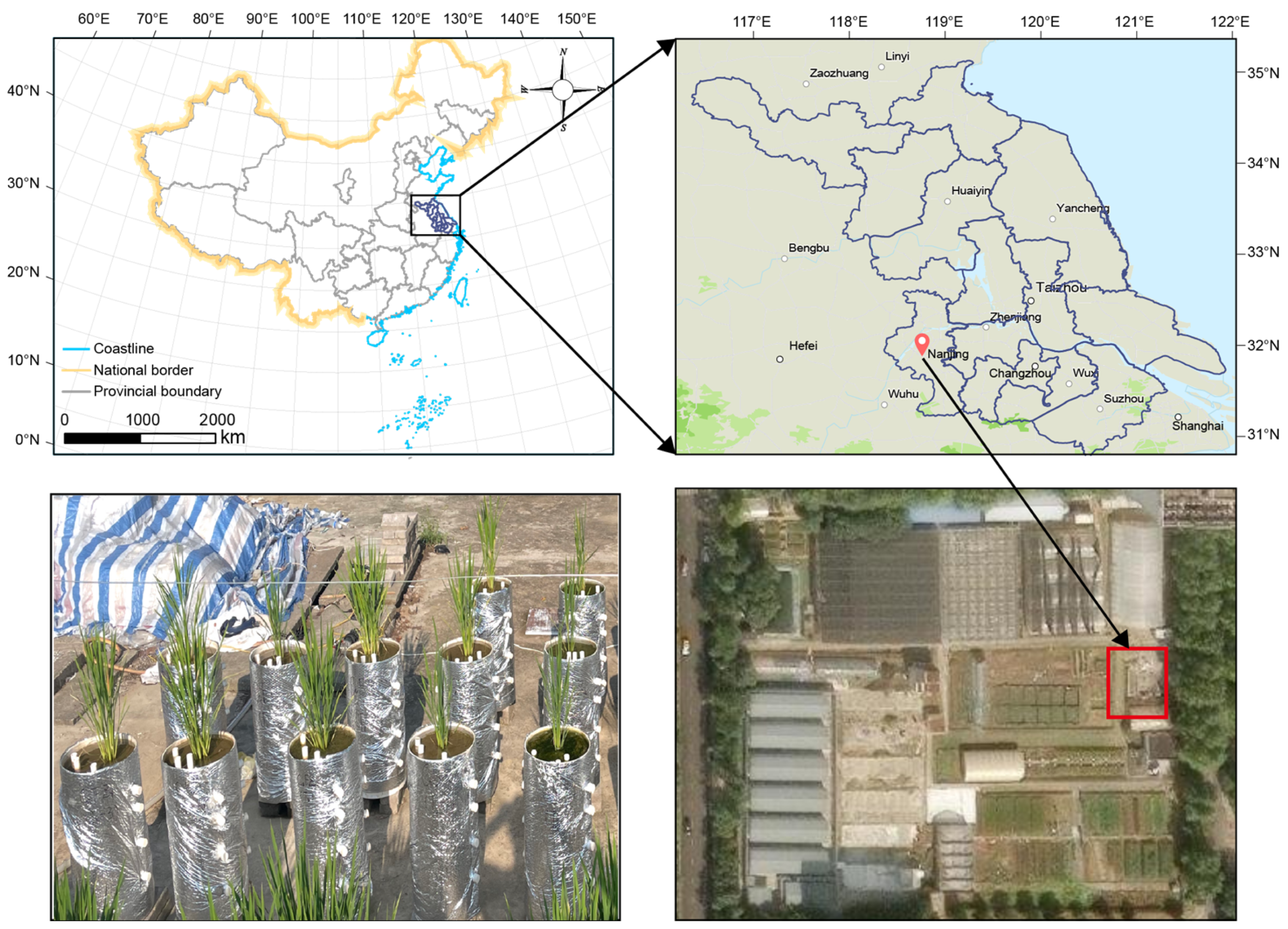
The pot experiment was conducted from June to October 2022 at the Engineering Research Center for Efficient Utilization of Agricultural Water and Soil Resources and Carbon Sequestration and Emission Reduction, Hohai University, Nanjing, Jiangsu Province, China (Figure 1). The site has a subtropical monsoon climate and an elevation of 15.0 m. Long-term means are 15.7 °C for annual air temperature, 1072.9 mm for annual precipitation, 122 precipitation days and 220 frost-free days per year, 900 mm for annual evaporation, 2212.8 h for annual sunshine duration, and 2.5 m s−1 for annual mean wind speed.
Soil was collected from a coastal reclaimed paddy field in the Tiaozini reclamation area, Dongtai, Jiangsu Province, China (33°23′ N, 121°35′ E). The region has a long-term mean annual temperature of 14.6 °C, mean annual precipitation of 1050 mm, and mean annual evaporation of 882.8 mm. The soil was air-dried naturally, cleared of plant residues, and passed through a 5 mm sieve. The soil was sandy loam, consisting of 51.12% sand, 45.87% silt, and 3.01% clay. Bulk density was 1.4 g cm−3. Field capacity and saturated water content were 24.72% and 33.78%, respectively. Soil salinity was 3.10‰ and pH was 9.31.
Cylindrical plastic pots (80 cm height, 35 cm inner diameter) were used for the experiment. A gravel layer of 5 cm was placed at the bottom to facilitate drainage. Above the gravel, saline–alkali soil was filled in layers and compacted stepwise, maintaining a bulk density of 1.2–1.4 g cm−3 to approximate field root-zone conditions. Detailed packing and bulk density control procedures are provided in Supplementary Text S3. An 8 cm depth was reserved at the top to accommodate the surface water. All pots were placed under a rain shelter to eliminate rainfall effects on irrigation water quality.
The Japonica rice cultivar ‘Nangeng 46’ was used. Uniform seedlings at the three-leaf-one-heart stage were transplanted on 28 June 2022, with three plants per hill and one hill per pot. The rice was harvested on 22 October 2022, with a total growth duration of 116 days. Basal fertilizer was applied once at rates equivalent to 120 kg N ha−1, 60 kg P2O5 ha−1, and 96 kg K2O ha−1. Agronomic management (e.g., pest and weed control) was consistent across all treatments.
The microalgae strain Chlorella pyrenoidosa (FACHB-5) was obtained from the Freshwater Algae Culture Collection, Institute of Hydrobiology, Chinese Academy of Sciences, Wuhan, China. Under sterile conditions, the inoculum was cultured in liquid medium in an illuminated incubator at 25 °C until the exponential growth phase. To simulate a low-input management strategy and evaluate the natural persistence of the introduced algae, a single inoculation was performed immediately after the regreening stage. The algal suspension was evenly mixed into the surface water of each pot to achieve a final density of 1.3 × 10⁷ cells mL−1. Detailed procedures are provided in Supplementary Text S2.
During the whole growth period of rice, simulated aquaculture wastewater was used for irrigation, which is in accordance with the typical local fishpond wastewater levels. Water-quality parameters of the freshly prepared wastewater were measured to determine nitrogen and phosphorus concentrations in the irrigation water and thus quantify nutrient input levels. Briefly, 25 g commercial fish feed was fermented in 2 L of water for 2 h, and the slurry was then filtered. The filtrate was transferred to a mixing tank, diluted to a final volume of 80 L, and supplemented with 0.70 g of NH4Cl and 0.26 g of urea, followed by thorough mixing. The simulated wastewater had an electrical conductivity of 147.80 μS cm−1 and a pH of 7.53, with total nitrogen (TN) of 8 mg L−1, NH4+–N of 3.53 mg L−1, NO3–N of 1.83 mg L−1, and total phosphorus (TP) of 2.03 mg L−1. Throughout the experiment, all treatments were irrigated with identically prepared wastewater to ensure stable water quality.

2.2. Experimental Design and Treatment

The experiment followed a two-factor randomized complete block design with irrigation mode (I) and Chlorella application (C) as the two factors, each at two levels. Irrigation included shallow–wet irrigation (IS) and flooded irrigation (IF). Chlorella application included no Chlorella (CN) and with Chlorella (CW). This resulted in four treatments (ISCN, ISCW, IFCN, and IFCW). Each treatment was replicated in three independent pots to ensure biological replication.
The full rice calendar is provided in Supplementary Table S1. For irrigation management and subsequent analyses, we focused on four key growth stages, which are tillering, jointing, heading, and fruiting. Irrigation was managed by growth stage according to local water requirements for Japonica rice. The specific standards for water layer depth and root zone soil relative moisture content are shown in Table 1. For the shallow–wet treatments, an alternation of shallow water and wet conditions was adopted during each growth stage. Irrigation was applied to reach the upper limit whenever the water depth or soil moisture content approached the lower limit. For the flooded treatments, a continuous water layer of 30–50 mm was maintained during the tillering and booting stages, and appropriate drainage was only implemented during the late heading stage and before maturity.

2.3. Sample Collection and Measurements

2.3.1. Water Parameters

Representative irrigation events were selected for monitoring during key growth stages. For each monitored event, samples were collected to determine the initial concentrations of TN, ammonium nitrogen (NH4+–N), nitrate nitrogen (NO3–N), and TP, as well as pH and EC. Surface water samples were collected from the center of each pot at 12, 36, and 60 h using a syringe. The samples were immediately filtered through a 0.45 μm membrane, stored in a refrigerator at 4 °C, and analyzed as soon as possible.
All spectrophotometric measurements were performed using a UV–Vis spectrophotometer (DR6000, Hach Company, Loveland, CO, USA). The TN concentration in surface water was determined using alkaline potassium persulfate digestion ultraviolet spectrophotometry method (HJ 636–2012). NH4+–N was measured using Nessler’s reagent spectrophotometry method (HJ 535–2009). NO3–N was determined using ultraviolet spectrophotometry method (HJ/T 346–2007). TP was measured using ammonium molybdate spectrophotometry method (GB 11893–89). Dissolved oxygen (DO), electrical conductivity (EC), and oxidation-reduction potential (ORP) were measured in situ using a portable multi-parameter water quality meter (HQ30d, Hach Company, Loveland, CO, USA).
To characterize the vertical migration of nitrogen and phosphorus within the soil profile, plastic sampling tubes were embedded along the inner wall of each pot before the experiment. The inlets were positioned at depths of 10, 20, and 30 cm below the soil surface, while the outlets extended outside the pots to allow percolation water extraction. Synchronous with the field surface water sampling, percolation samples were extracted from the tubes at each depth using a vacuum hand pump at 12, 36, and 60 h after irrigation. The determination methods for TN, NH4+-N, NO3-N, and TP in the percolation water were the same as those used for field surface water. These data were used to analyze the leaching intensity of nitrogen and phosphorus and their vertical variation patterns across different treatments.
To quantify the capacity of the paddy field to remove nitrogen and phosphorus from aquaculture wastewater, the removal rate at each sampling time was calculated using the surface water TN or TP concentration at 0 h after irrigation:
R t = C 0 C t C 0 × 100 %
where R t is the removal rate (%) at t hours after irrigation, C 0 is the concentration at 0 h after irrigation for the corresponding growth stage, and C t is the corresponding concentration at that time. The average removal rate at 60 h across key growth stages refers to the mean value of stage-specific 60 h removal rates. These stage-specific rates are calculated independently for the tillering, jointing, heading, and fruiting stages, using the C 0 and C 60 values corresponding to each respective growth stage. No concentration averaging was performed before the removal rate calculation.

2.3.2. Soil Sampling and Physicochemical Properties

The TDR soil moisture meter (Mini Trase System-SoilMoisture Equipment Corp., Santa Barbara, CA, USA) was used to measure the soil moisture content in each pot during the fruiting stage. After the harvest, soil samples were collected by depth from each pot using a 3.5 cm diameter soil auger, centered at the plant base. The soil profile was divided into three layers (0–10, 10–20, and 20–30 cm). For each layer, subsamples were thoroughly homogenized and split into two portions. One portion was oven-dried at 105 °C to constant weight for determination of gravimetric soil water content. The other portion was air-dried and sieved through a 2 mm mesh for measurement of soil pH (1:5 soil–water ratio), EC (1:5 soil–water ratio), TN and TP. Soil physicochemical properties were analyzed based on the “Soil Agrochemical Analysis” [31].

2.3.3. Rice Yield and Components

All rice plants in each pot were harvested separately and air-dried. Panicles were threshed, and grains were oven-dried at 80 °C to constant weight. The yield was calculated as total grain dry weight per hill. Additionally, representative samples were randomly selected from the central plants in each pot to avoid edge effects. Indicators such as panicle number, panicle length, and seed setting rate were determined to analyze the effects of different irrigation modes and Chlorella application on yield components.

2.4. Entropy-Weighted TOPSIS Method

To evaluate the overall performance of irrigation mode and Chlorella combinations across multiple objectives, including water purification, leaching risk, soil nutrient improvement, yield, and water-use performance, a multi-indicator evaluation system was established and optimized using the entropy-weighted TOPSIS method. The indicator system comprised eight indicators in five categories: (1) average removal rates of TN and TP in field surface water (Benefit indicator); (2) average concentrations of NO3-N and TP in leachate at a 30 cm depth across growth stages (Cost indicator, reflecting deep leaching risk); (3) net increments of TN and TP in the 0–20 cm soil layer (Benefit indicator, reflecting soil nutrient improvement); (4) rice yield (Benefit indicator); and (5) total irrigation amount per unit area (Cost indicator).
All indicators were first normalized to a dimensionless scale, and entropy weights were determined by calculating the information entropy and redundancy of each indicator, yielding objective weights. A weighted normalized decision matrix was constructed, and the Euclidean distances from each treatment to the positive ideal solution and the negative ideal solution were computed. The closeness coefficient C i was then calculated. Larger C i values indicate better overall performance under the multi-objective framework. The specific calculation steps followed the conventional entropy-weighted TOPSIS method [32], and data are provided in Supplementary Materials (Text S1 and Table S2).

2.5. Statistical Analysis

Statistical analyses were performed using SPSS 29 (IBM Inc., Armonk, NY, USA) to conduct two-way analysis of variance and the least significant difference (LSD) test to indicate the significance of different treatments. All data were analyzed in triplicate and are presented as mean ± standard deviation, with a significance level set at an alpha of 0.05 (p < 0.05) unless otherwise indicated. Corresponding plots were plotted using the ‘ggplot2’ package (v.4.0.0) in R (v.4.4.1).

3. Results

3.1. Nitrogen and Phosphorus Removal in Field Surface Water

Irrigation mode and Chlorella addition significantly affected nitrogen and phosphorus removal processes in surface water, and their interaction was significant across multiple growth stages. Overall, Chlorella was the primary factor in enhancing N and P removal efficiency, but its effectiveness was strongly modulated by irrigation mode.
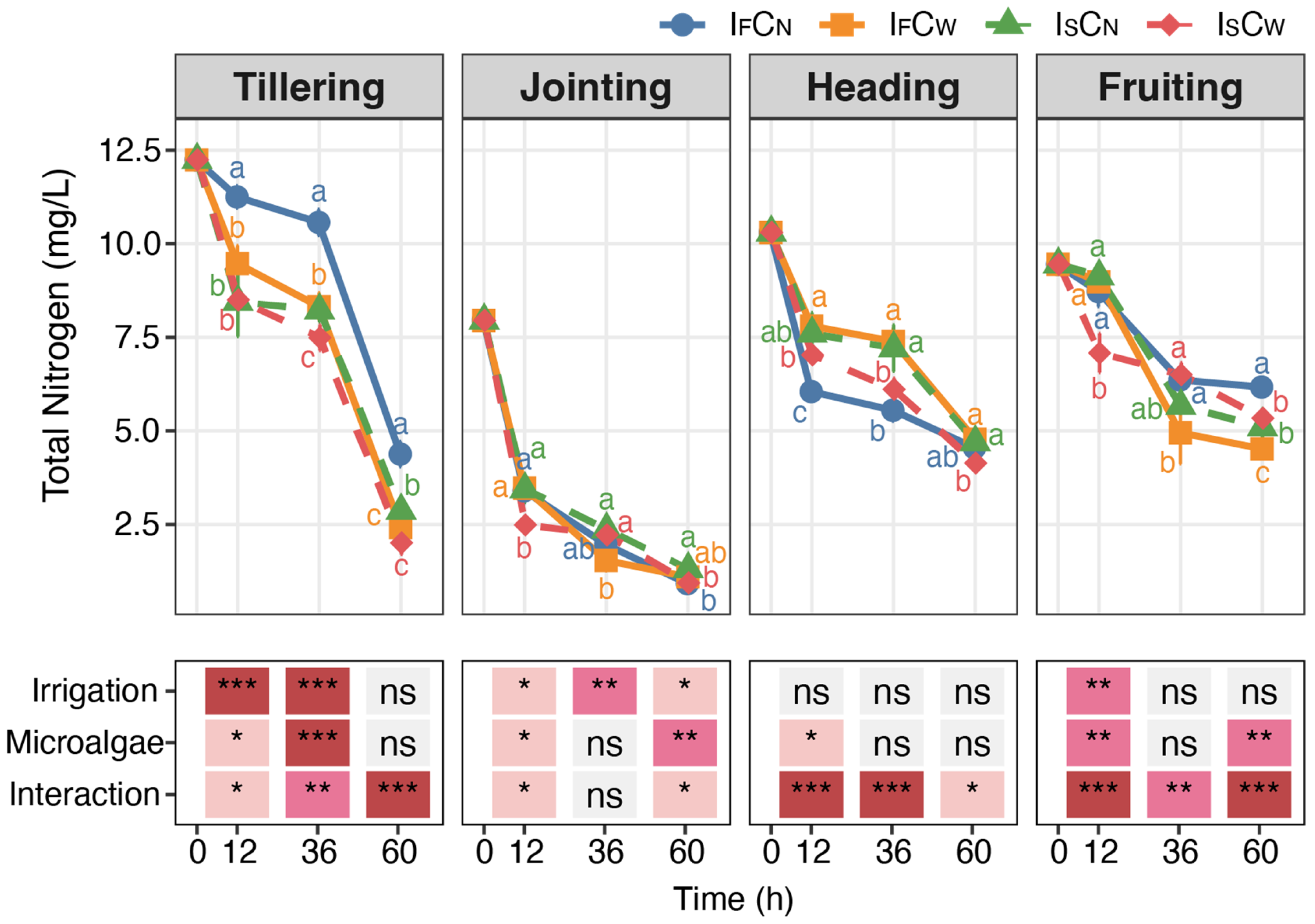
After irrigation, surface water TN concentrations decreased gradually during all growth stages (Figure 2). The differences among treatments were the most pronounced at the tillering stage. At 60 h after irrigation, TN decreased to 2.01–4.38 mg L−1, achieving an average removal rate exceeding 64%. Specifically, the reduction in TN was more substantial under shallow–wet irrigation. The ISCW treatment reached the lowest TN concentration at 60 h (2.01 mg L−1), which was significantly lower than IFCN (4.38 mg L−1) and ISCN (2.87 mg L−1) (p < 0.05). At this stage, the interactive effect of irrigation mode and microalgae was highly significant (p < 0.001). Upon entering the reproductive growth stage (after the jointing stage), TN concentrations continued to decrease, but differences among treatments became smaller, suggesting that the purification capacity tended to stabilize. Overall, shallow–wet irrigation was beneficial for accelerating TN removal during the early growth stages, while the purification effect of Chlorella was primarily observed at specific growth stages and sampling times.
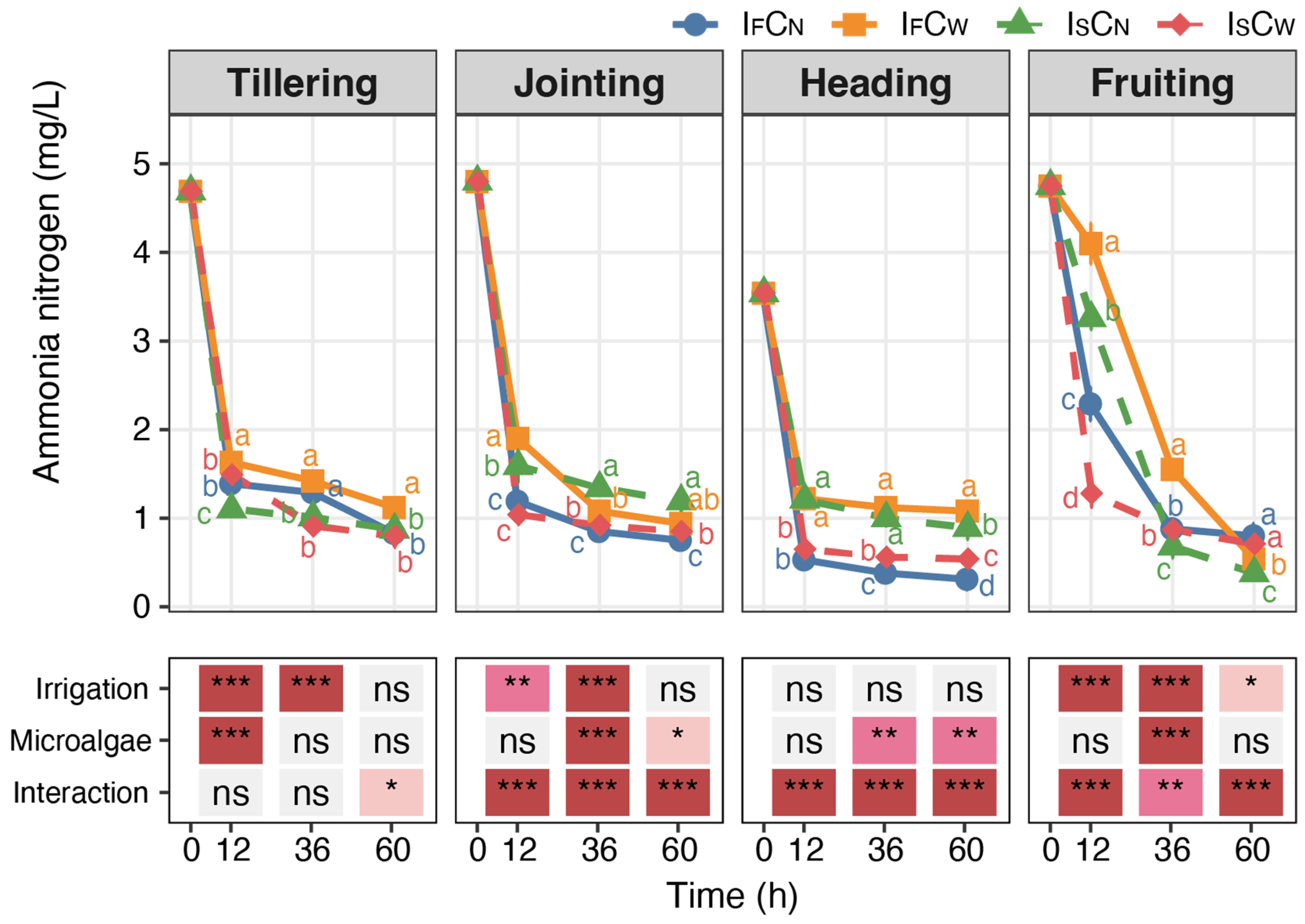
The transformation of nitrogen forms revealed distinct removal pathways. Across all growth stages, NH4+–N concentrations decreased rapidly within 12 h after irrigation, with removal efficiencies exceeding 65% (Figure 3). Notably, ISCW consistently maintained the lowest NH4+–N concentrations. At the jointing stage, the NH4+–N concentration at 60 h under ISCW (0.85 mg L−1) was significantly lower than that under ISCN (1.19 mg L−1).
Conversely, IFCW exhibited a temporary accumulation of NH4+–N from the tillering to the heading stages. Specifically, at 12 h during the heading stage, the concentration was 1.22 mg L−1, significantly higher than that of IFCN (0.53 mg L−1). This suggests that the deeper water layer may initially constrain algal assimilation of NH4+–N due to reduced light availability and oxygen limitation, and/or enhance the mineralization of organic N. Analysis of variance (ANOVA) indicated that the irrigation mode had a highly significant effect on the NH4+–N removal rate at 12–36 h during most growth stages (p < 0.001). Furthermore, the effects of microalgae application and its interaction with irrigation mode were particularly pronounced at 36–60 h during the jointing and heading stages, indicating that Chlorella exerted significantly different influences on NH4+–N transformation pathways under different irrigation modes.
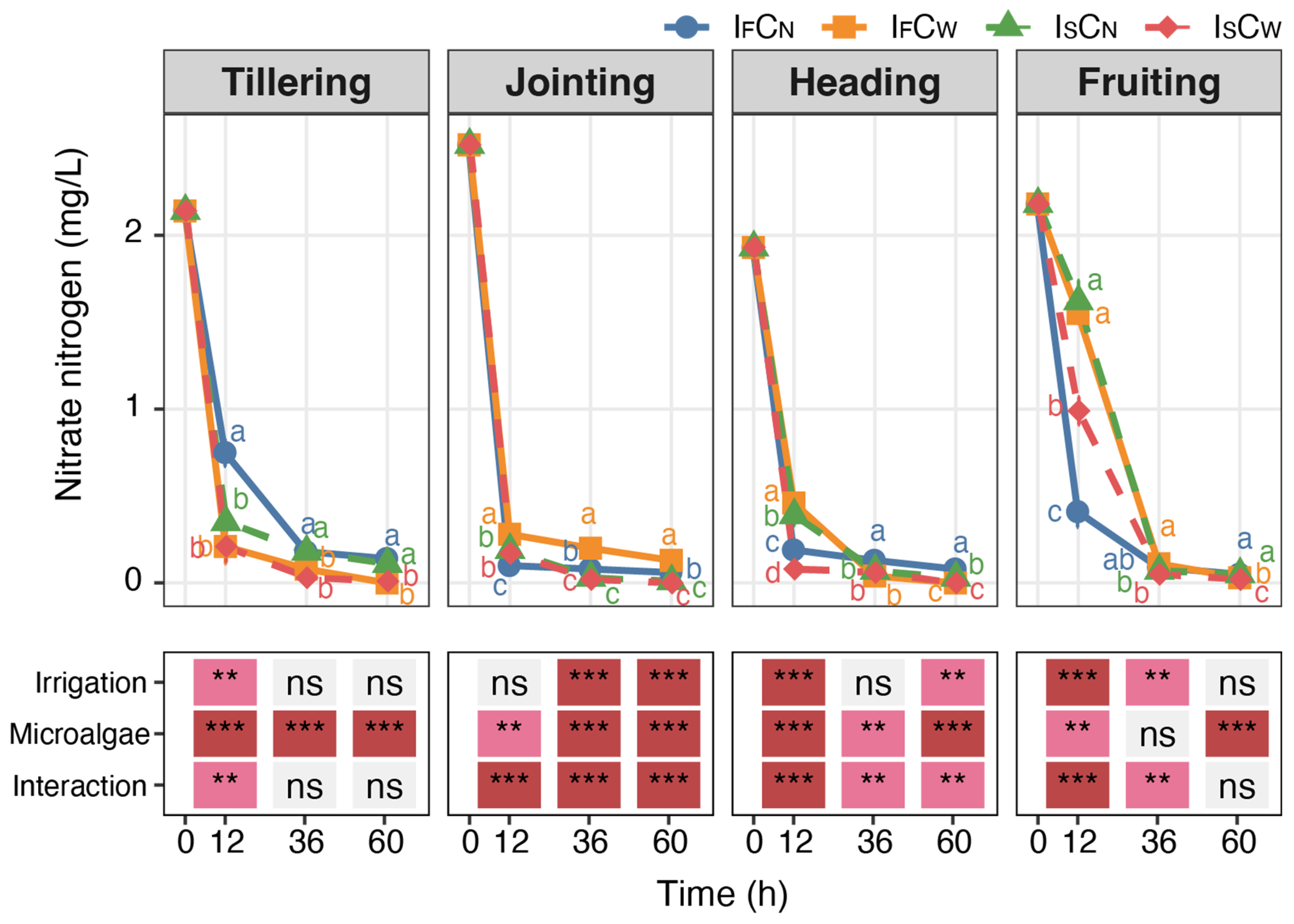
The removal of NO3–N was more rapid and complete (Figure 4). Concentrations of NO3–N in all treatments decreased rapidly within 12–60 h after irrigation, with the most substantial decline occurring during the initial 12 h. Treatments with algae application (IFCW, ISCW) consistently reduced NO3–N to levels approaching or below 0.05 mg L−1 by 36–60 h. For example, at 60 h after irrigation during the tillering stage, the concentration in ISCW dropped to 0.01 mg L−1. Similarly, at 60 h during the jointing stage, the concentration in IFCW was 0.13 mg L−1. In contrast, concentrations in treatments without microalgae were consistently higher at the corresponding time points. ANOVA indicated that microalgae application and its interaction with irrigation mode significantly reduced NO3–N concentrations across most growth stages and sampling times (p < 0.05), demonstrating that Chlorella possesses a stable and potent capacity for nitrate assimilation.
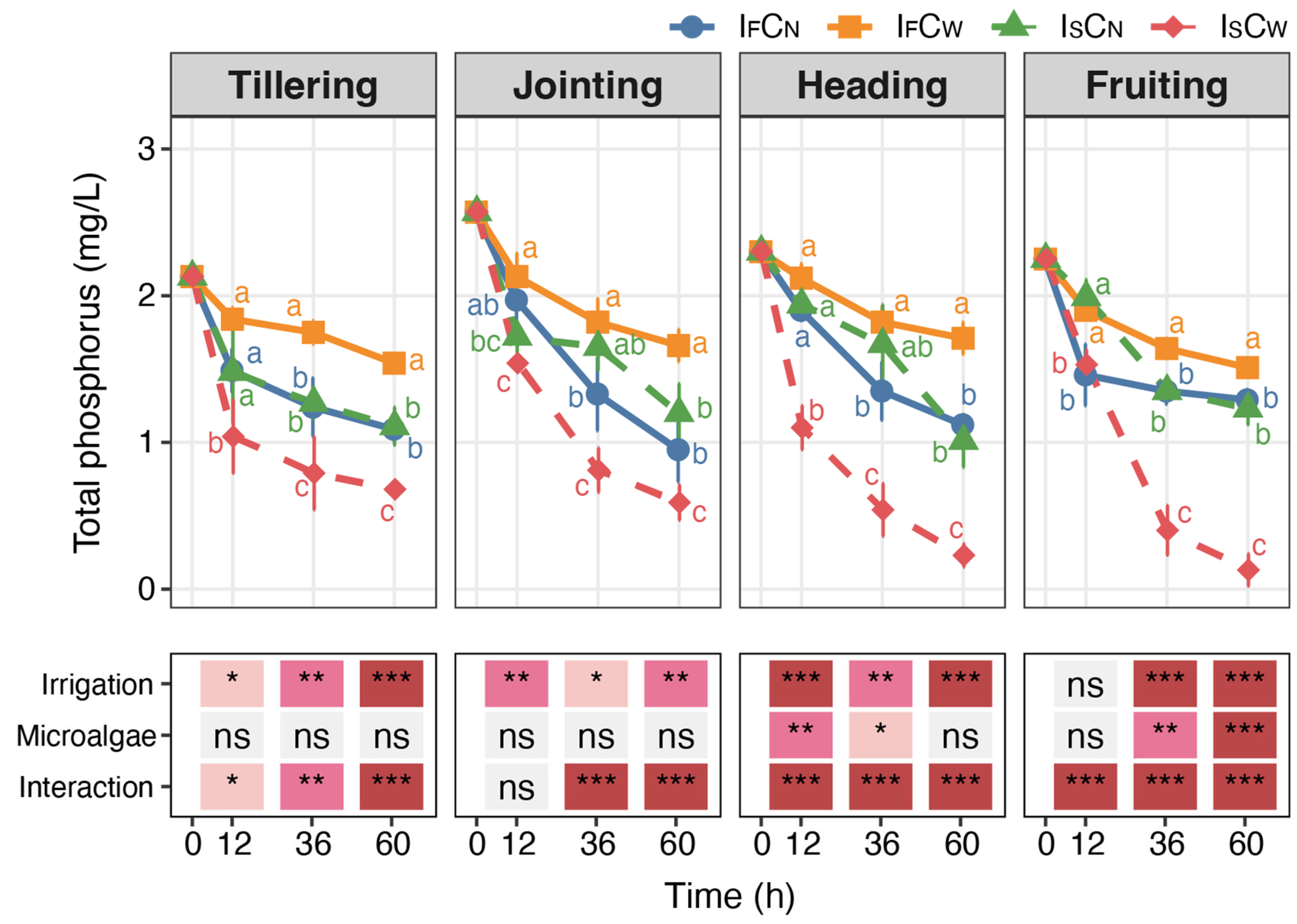
Different from TN, TP removal exhibited distinct dynamics and was more sensitive to both irrigation modes and Chlorella application. Throughout the entire growth period, the ISCW treatment consistently demonstrated a stable TP removal capacity (Figure 5). Specifically, at 60 h after irrigation during the heading stage, the TP concentration in the ISCW treatment dropped to 0.23 mg L−1, achieving a removal rate of 88.67%, which was significantly lower than that of other treatments (p < 0.05). In contrast, although the IFCW treatment showed TP concentrations similar to or slightly higher than the no-algae treatment in the early stage (12 h), it exhibited a sustained purification advantage in the middle and late period (36–60 h), maintaining TP concentrations significantly lower than those of the IFCN treatment. Two-way ANOVA indicated that the effect of irrigation mode was significant at 36–60 h across all growth stages. The main effect of Chlorella was significant during the middle and late stages of the heading and fruiting stages, while the interaction between the two factors was highly significant at both 36 h and 60 h across all growth stages (p < 0.001). These findings suggest that TP removal is primarily driven by the irrigation mode and coupling Chlorella with shallow–wet further amplified TP purification efficiency.
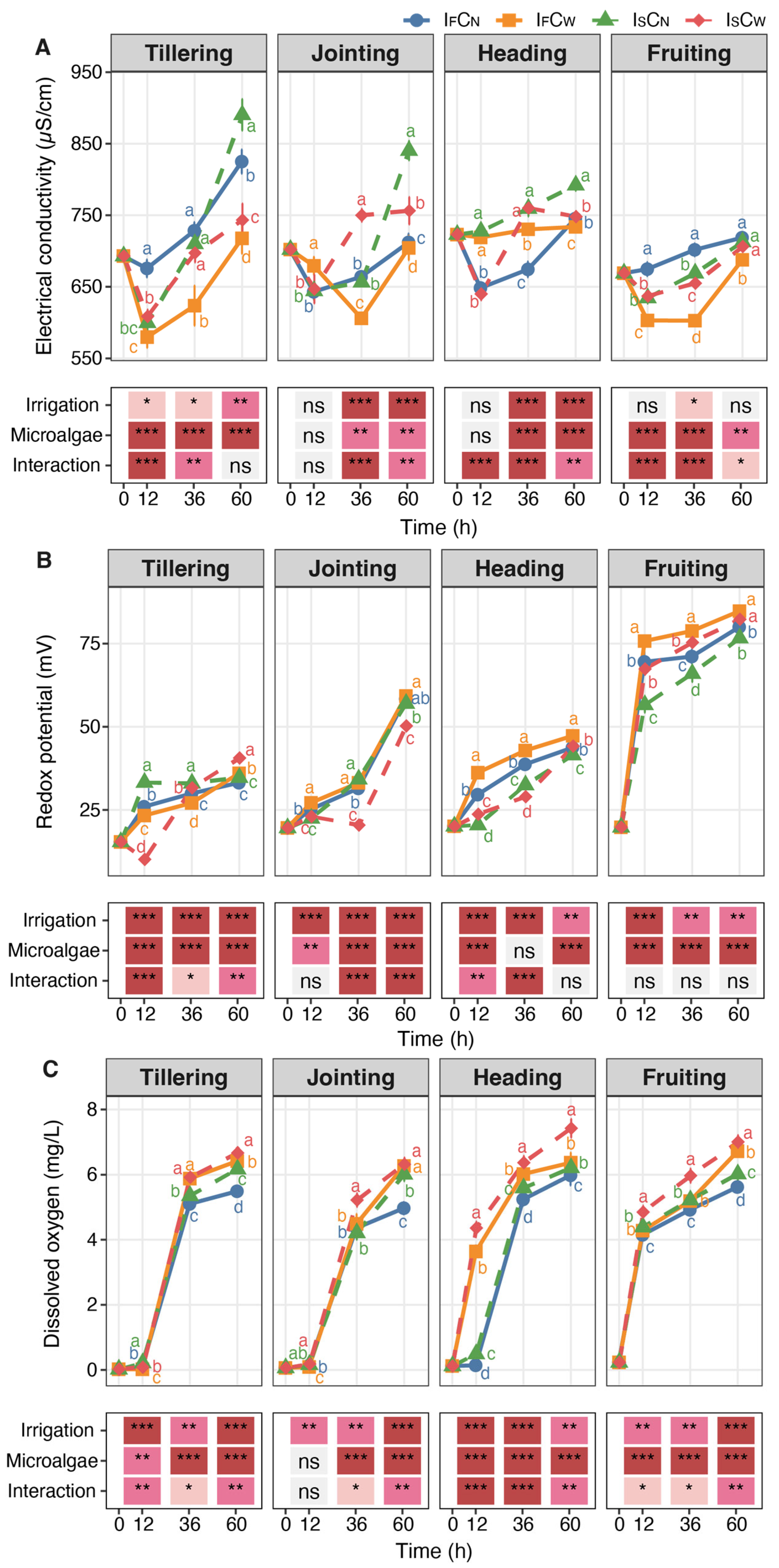
Changes in the aquatic environment help explain the observed nitrogen and phosphorus dynamics (Figure 6). DO was consistently higher in the Chlorella application treatments than in the non-microalgae treatments, with the differences becoming most evident during 36–60 h after irrigation. Specifically, at 60 h during the heading stage, DO in ISCW and IFCW was 7.42 mg L−1 and 6.37 mg L−1, respectively, which were higher than those in ISCN (6.21 mg L−1) and IFCN (5.98 mg L−1). Similarly, the ORP remained at a generally higher level in microalgae treatments. For instance, at 60 h during the tillering stage, the ORP in ISCW was 40.63 mV, exceeding the values observed in IFCN and ISCN. EC generally exhibited a trend of increasing initially and then decreasing or slowly rising after irrigation. During the tillering and jointing stages, EC values in the IFCW treatment at 60 h were significantly lower than those in the IFCN treatment. For example, at 60 h during the tillering stage, EC in IFCW was 717.67 μS cm−1, lower than the 825.00 μS cm−1 observed in IFCN, indicating that microalgae application under flooding conditions may alleviate salt accumulation in surface water.

3.2. Vertical Transport of Nitrogen and Phosphorus in Percolation Water

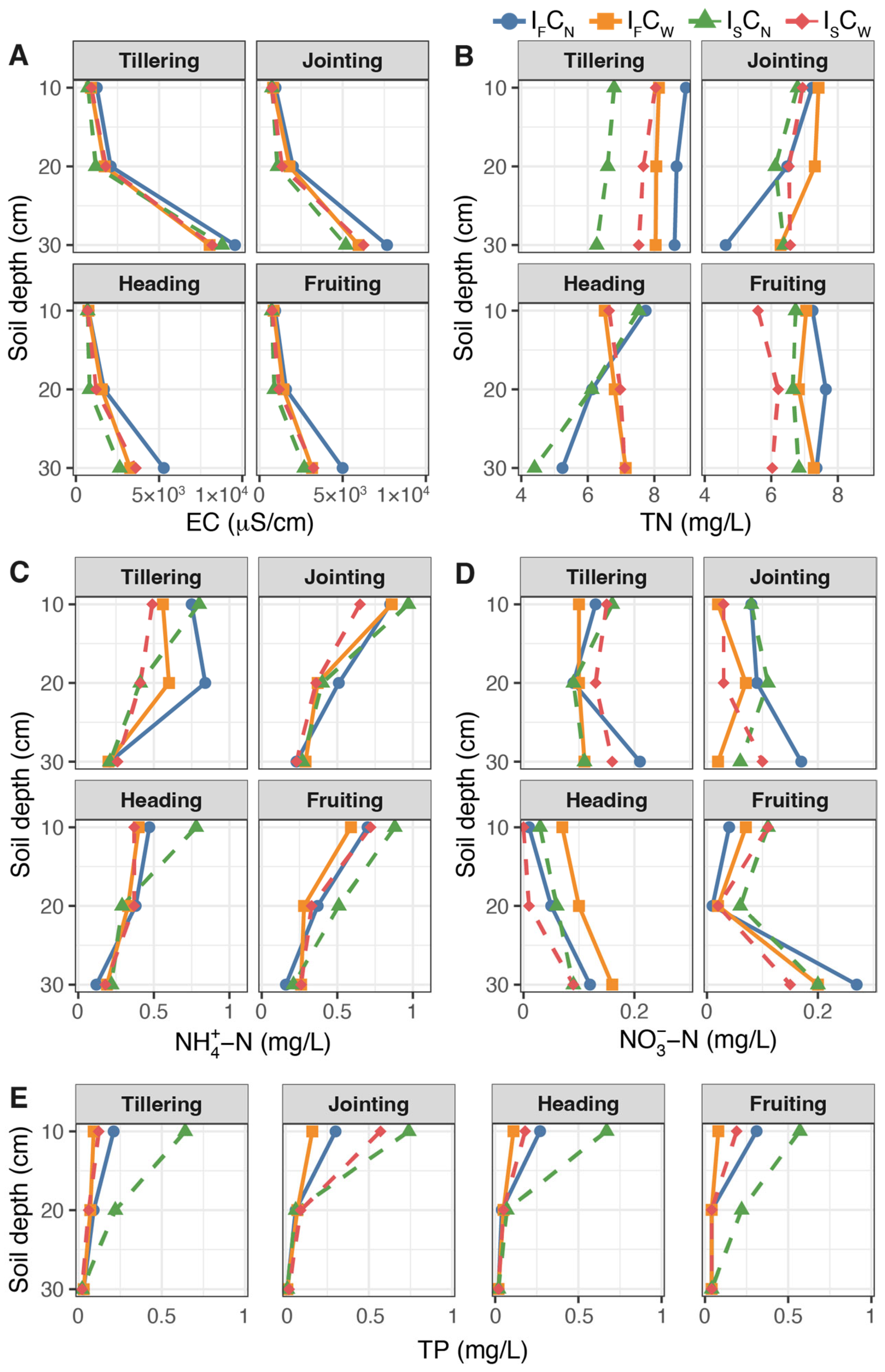
The vertical distribution of nitrogen, phosphorus, and EC in percolation water indicated that irrigation mode was the dominant factor controlling the risk of downward migration of salinity and nitrate nitrogen, while Chlorella reduced pollutant loads through attenuation at the source (Figure 7). Overall, EC in percolation water increased with soil depth but decreased as the growing season progressed, suggesting that irrigation facilitated salt leaching from the soil profile. Taking the jointing stage as an example, EC at 30 cm under IFCW was 5960 μS cm−1, which was significantly lower than under IFCN (7670 μS cm−1), indicating that flooded irrigation coupled with Chlorella helped mitigate salt translocation to deeper layers. In contrast, under shallow–wet irrigation, EC at 30 cm in ISCW was approximately 20.62% higher than in ISCN.
In terms of nitrogen, the concentrations of TN and NH4+–N decreased with increasing soil depth, approaching zero at the 30 cm depth in most cases. This indicates that the soil possesses a strong retention capacity for NH4+–N. However, in the flooded treatments during the tillering stage, this decreasing pattern partially reversed. NH4+–N concentrations momentarily increased in the 10–20 cm layer. This suggests that under deep water and reducing conditions, a portion of the nitrogen migrated downward and temporarily accumulated in the middle soil layers.
In contrast, NO3–N concentrations generally increased with depth across most growth stages, displaying complex profiles characterized by an initial decrease followed by an increase or a continuous ascent in some stages. Although the ranking of NO3–N concentrations at 30 cm varied across stages, the ISCW treatment generally maintained lower levels in the deep layers, whereas the IFCN treatment frequently exhibited higher levels. This suggests that the nitrification of NH4+–N in the surface water and upper soil layers occurred continuously within the profile, and the generated NO3–N was transported downward with leakage. Consequently, the risk of deep leaching was more prominent in treatments with better oxidizing conditions.
The TP concentration in the percolation water was generally low and decreased significantly with depth across all treatments and growth stages. At the 30 cm depth, TP levels were mostly below 0.05 mg L−1, with no significant differences among treatments (p > 0.05). This indicates that the soil has a strong capacity for vertical phosphorus retention, resulting in a generally low risk of deep phosphorus leaching. Nevertheless, the TP concentrations in the percolation water at various depths were significantly lower in microalgae treatments (ISCW, IFCW) compared to non-algae treatments, with ISCN often resulting in the highest TP concentrations. Overall, Chlorella further reduced the risk of phosphorus migration to deeper layers by promoting uptake and precipitation in the upper layers.

3.3. Soil Physicochemical Properties

Soil profile analysis revealed that nutrients in the aquaculture wastewater were effectively retained by the soil (Table 2). Vertical statistical analysis indicated that soil TN, TP, and organic matter contents significantly decreased with depth (p < 0.05) in all treatments. Specifically, the 0–10 cm layer exhibited significantly higher nutrient accumulation compared to the 10–20 cm and 20–30 cm layers, indicating preferential nutrient retention in the upper root zone. Compared to pre-experiment levels, the contents of TN and TP in the 0–30 cm soil layer increased to varying extents across all treatments. However, significant differences were observed in nutrient accumulation within the 0–10 cm layer among different combinations of irrigation modes and microalgae application. Chlorella application significantly enhanced the enrichment of nitrogen and phosphorus in the root area (0–10 cm). The TN contents in the 0–10 cm layer for the IFCW and ISCW treatments were approximately 139.07 mg kg−1 and 129.20 mg kg−1, representing increases of about 23.58% and 21.20% compared to IFCN and ISCN, respectively. TP showed a similar trend, with IFCW and ISCW increasing TP in the 0–10 cm layer by 11.11% and 5.99% compared to the non-algae treatments. These results suggest that under both irrigation modes, Chlorella facilitated the transfer and immobilization of nutrients from the water body into the root-zone soil.
Variations were also observed in soil organic carbon (SOC) among treatments. In the 0–10 cm layer, SOC under IFCW was significantly higher than under the corresponding non-algae treatment, with an increase of approximately 10%. This suggests that the anaerobic environment created by flooding is more favorable for the stable accumulation of algae-derived organic matter. In contrast, SOC responses under ISCW were weak, and some layers even showed significant decreases. Furthermore, the vertical distributions of soil EC and pH changed under different treatments. Overall, EC at 30 cm was higher than at the surface layer. Treatment differences in EC were pronounced in the 0–10 cm layer but diminished at 20–30 cm. Compared with IFCN, IFCW reduced EC in the deeper layer (20–30 cm), whereas ISCW tended to retain relatively higher salinity in the surface layer (0–10 cm).

3.4. Rice Yield and Yield Components

In contrast to the water purification responses, the response of rice yield to the treatments exhibited distinct trade-off characteristics (Table 3). Two-way ANOVA indicated significant differences in yield responses among irrigation modes and Chlorella treatments (p < 0.05). The IFCW achieved the highest grain yield, averaging 18.27 g hill−1, which was significantly higher than IFCN (13.09 g hill−1) and ISCN (9.74 g hill−1) (p < 0.05). In contrast, ISCW, which performed best in the integrated environmental assessment, had the lowest yield at only 7.18 g hill−1.
Yield component analysis suggested that the yield advantage of IFCW was primarily attributed to an increase in the panicle number, reaching approximately nine productive panicles per hill and exceeding the other treatments. By comparison, ISCW was limited by both panicle number and grains per panicle, but this yield loss was partially offset by the higher seed setting rate (66.67%).

3.5. Entropy-Weighted TOPSIS Evaluation

As shown in Table 4, a multi-criteria evaluation was established based on water quality purification (TN and TP removal in surface water, and NO3-N and TP concentrations in percolation water at 30 cm), soil nutrient accumulation, and rice yield. The entropy-weighted TOPSIS method was then applied to comprehensively evaluate the performance of different combinations of irrigation modes and microalgae application. Under a weighting scheme dominated by water quality and environmental safety indicators, the closeness coefficient ( C i ) ranked as follows: ISCW > ISCN > IFCW > IFCN. ISCW achieved the highest C i (≈0.9784), which was significantly superior to that of the other treatments. ISCN ranked second ( C i ≈ 0.5308), whereas IFCN had the lowest C i (≈0.1864), indicating that flooded irrigation without Chlorella performed the worst in the integrated assessment. IFCW fell between ISCN and IFCN, exhibiting a moderate performance level.
These results suggest that when evaluation objectives prioritize and emphasize nitrogen and phosphorus reduction, control of deep leaching risk, and improvement of soil fertility, ISCW offers the best overall performance, followed by ISCN. Conversely, the conventional flooded mode without microalgae (IFCN) was unable to balance water quality, environmental safety, and production benefits. A comparison with the yield results reveals that the ISCW, which demonstrated the best comprehensive environmental benefits, corresponded to the lowest yield, whereas the IFCW achieved the highest yield but only a moderate overall score. This highlights a distinct trade-off relationship between environmental benefits and yield under the experimental conditions, with the irrigation mode and its combination with Chlorella playing a pivotal role in managing this trade-off.

4. Discussion

4.1. Irrigation Modes Affect the Purification Capacity of Chlorella

The results indicate that irrigation mode is a key factor in how effectively Chlorella improves the water quality in saline–alkali paddy fields irrigated with aquaculture wastewater. Across treatments, Chlorella addition markedly decreased TN, NH4+–N, and NO3–N in surface water, demonstrating the distinct assimilation of inorganic nitrogen by microalgae. However, the magnitude and stability of this effect differed between irrigation modes. Under shallow–wet irrigation, ISCW maintained relatively high and stable TN removal across multiple growth stages, contrary to the expectation that microalgae require continuous flooding. Under flooded conditions, the microalgae treatments exhibited a more variable response, including transient increases in TP at certain times. This suggests that the purification process under flooded irrigation is more susceptible to the influence of water depth and oxidation-reduction conditions [33]. During the early vegetative stages (regreening and tillering), the irrigation mode primarily dictates oxygen availability and nutrient competition in the root zone, which directly determines tiller survival and potential panicle number. In the reproductive stages (jointing and heading), plant nitrogen demand is large and the rhizosphere becomes highly metabolically active. Thus, stage-dependent redox conditions (DO/ORP) play an important role in regulating the nitrification and denitrification balance. During the fruiting stage, the sustainability of the water influences root senescence and grain filling, explaining the difference between biomass accumulation and final grain yield.
The responses of DO and ORP reinforce this interpretation. At 60 h after irrigation during the heading stage, the DO in the ISCW treatment was 7.42 mg L−1, significantly higher than in other treatments. Similarly, at 60 h during the tillering stage, the ORP in microalgae treatments under both shallow–wet and flooded conditions was higher than in their corresponding non-algae treatments. This indicates that Chlorella can enhance water oxidizing properties through photosynthesis in both irrigation modes, but this effect is more significant under shallow–wet conditions [34]. Higher DO and ORP levels facilitate ammonia oxidation and nitrification [35,36]. Combined with the rapid assimilation of NH4+–N and NO3–N by microalgae, these mechanisms enabled the ISCW treatment to exhibit higher TN removal efficiency during most stages. In contrast, although the IFCW treatment also reduced TN and NH4+–N under deeper water and relatively reducing conditions, its TP concentrations were higher than those of the shallow–wet microalgae treatment during some stages. This suggests that under deep-water conditions, the decomposition of microalgal residues and the release of phosphorus at the sediment water interface exert a more significant influence, thereby weakening the stability of TP purification [37,38,39].
Variations in EC reflected differences in the regulation of dissolved salts among treatments. During the tillering stage at 60 h, EC under IFCW was lower than that of the ISCN treatment, suggesting that Chlorella application under continuous flooding may help moderate ionic accumulation in surface water. In the shallow–wet treatments, EC generally showed an initial increase followed by stabilization and a gradual decrease. While EC was relatively high in the ISCN treatment during some periods, the ISCW treatment inhibited the continuous enrichment of dissolved salts during some periods. Overall, shallow–wet irrigation appears to create a more favorable aquatic environment for microalgal photosynthesis and nutrient assimilation through its shallow water layer and improved aeration dynamics, thereby enhancing the purification potential of Chlorella. Conversely, flooded irrigation limited this effect to some degree, making the purification outcome more dependent on sedimentation and adsorption processes at the water–soil interface.

4.2. Coupled Hydrological Transport and Biological Retention Reshape Nutrient Distribution

Although concentrations of nitrogen and phosphorus in surface water decreased gradually after irrigation, data from percolation water and soil profiles indicated that these removed nutrients did not simply disappear. Instead, they were redistributed within the water–soil system. The concentrations of TN and NH4+–N in percolation water decreased with increasing soil depth across all treatments, mostly approaching detection limits at 30 cm. Meanwhile, soil TN and TP contents in the 0–30 cm layer increased to varying degrees compared to pre-experiment levels. Notably, in the 0–10 cm surface layer of microalgae treatments, TN increased by over 20% and TP by 6–11%. This suggests that the majority of nitrogen and phosphorus removed from the surface water was intercepted and retained within the root-zone soil rather than being lost through deep leaching [40]. Mechanistically, Chlorella contributed through two complementary pathways. Firstly, it reduced the initial nitrogen and phosphorus loads entering the soil solution through assimilation. Secondly, through microalgal sedimentation and coupling effects with the rhizosphere microsystem, it promoted the enrichment and immobilization of nitrogen and phosphorus in the surface soil [41]. In this way, nutrients in aquaculture tailwater are shifted from an external environmental load toward an internal soil nutrient pool.
Depth profiles of NO3–N further highlight treatment differences in leaching risk. In most growth stages, NO3–N concentrations at 30 cm exceeded those in upper layers, indicating that nitrate was the dominant form transported downward. IFCN frequently exhibited higher NO3–N in deep percolation water, whereas the shallow–wet coupled with Chlorella treatment generally maintained lower concentrations. This suggests that the irrigation mode largely determines whether nitrate can bypass the root zone and develop into deep leaching [42,43]. This is consistent with the stage-dependent redox environment. Specifically, higher DO/ORP promotes nitrification, increasing the NO3 fraction, which is weakly retained in soil and therefore more susceptible to downward transport with percolation water. Within a given irrigation mode, Chlorella can further buffer the leaching risk by lowering the initial nitrate load and by modifying redox conditions near the water–soil interface, thereby altering transformation and retention processes. The EC at 30 cm was comparable between ISCW and ISCN, suggesting that treatment differences in salinity tended to be consistent in deeper layers. However, EC in soil generally increased with depth, treatment differences converged at 20–30 cm, and TP in percolation water at 30 cm remained mostly below 0.05 mg L−1 with no significant treatment differences. These results show that, within the experimental duration and loading levels, deep salt transport and phosphorus leaching remained within a manageable range.
Changes in SOC provided valuable insights into nitrogen and phosphorus migration and transformation. The SOC content in the 0–20 cm layer of the IFCW treatment increased by approximately 10–14% compared to IFCN, consistent with the concurrent increases in soil TN and TP. This consistency suggests that under more reducing conditions, algae-derived organic matter and root residues are more likely to accumulate and form SOC-associated nutrient pools [44]. In contrast, under shallow–wet irrigation with Chlorella, TN and TP accumulated in surface soil but SOC showed little increase and even decreased in some layers, suggesting accelerated mineralization under higher DO and wet–dry alternation. Overall, irrigation mode primarily influences the patterns of deep nitrogen and phosphorus leaching by controlling water percolation and soil moisture status. On this basis, Chlorella strengthens the retention of nitrogen and phosphorus in surface soil, ensuring that more tailwater nutrients are preserved in the root zone soil and are available for crop uptake.

4.3. Resource Competition Drives the Trade-Off Between Environmental and Yield Benefits

Compared with the results for water purification and nutrient accumulation, the response of rice yield to irrigation modes and Chlorella application exhibited distinct patterns. Grain yield was highest under IFCW (18.27 g hill−1), which was significantly higher than that of IFCN and ISCN. Meanwhile, the ISCW treatment yielded the lowest, at only 7.18 g hill−1. This difference indicates that ISCW, despite having the most prominent environmental benefits, is not a high-yield mode, whereas IFCW offers increased yield but only moderate purification effects. This finding is consistent with the contrasting rankings derived from ponded-water TN and TP removal and the TOPSIS assessment.
The yield advantage of IFCW appears to reflect combined improvements in stand structure and the soil–water environment. On the one hand, irrigation can suppress salt stress in saline–alkali paddies by maintaining a standing water layer that dilutes and leaches salts, thereby alleviating rhizosphere salinity stress and stabilizing water supply [15,45]. On the other hand, Chlorella provides a continuous source of bioavailable nitrogen under flooded conditions through assimilation and turnover processes [46]. It can promote the accumulation of TN, TP, and SOC in surface soil, improving nutrient status and organic matter availability. In this study, IFCW produced a markedly higher number of productive panicles than the other treatments, indicating enhanced tillering and panicle formation that established the structural basis for higher yield. Because productive panicle number is mainly determined during the tillering stage, these results indicate that early-stage water regime dominated yield formation, whereas later-stage oxidative conditions mainly modulated grain filling efficiency. This is consistent with previous research regarding the combination of flooding and organic fertilizer input to enhance yields in saline–alkali paddy fields [47,48].
Conversely, ISCW exhibited a characteristic typical of stabilizing water quality at the expense of yield. Shallow–wet irrigation improved soil aeration through intermittent drying, and when combined with microalgae application, significantly elevated DO and ORP, which favored the maintenance of root vitality and nutrient uptake during the later growth stages [12]. The seed setting rate in ISCW was significantly higher than in other treatments, suggesting a promotional effect on grain filling during the late reproductive stage. However, frequent wet–dry alternation early in the season, together with competition for light and readily available carbon and nutrients associated with algal growth, likely constrained early vegetative expansion, especially tillering and panicle initiation [49,50]. In other words, ISCW sacrificed population quantity advantages while improving individual panicle efficiency, which is the fundamental reason why its yield was lower than that of IFCW.
From a management perspective, IFCW and ISCW represent two distinct strategies. IFCW prioritizes production, achieving a strong yield gain at the expense of lower purification performance than ISCW, and may be more suitable where yield security is the primary goal and environmental constraints are less stringent. By contrast, ISCW substantially improved TN and TP removal and reduced deep leaching risks of NO3–N and TP, making it advantageous in scenarios where compliance with discharge targets and nonpoint source pollution control are prioritized. The fact that ISCW achieved the highest relative closeness C i in the entropy-weighted TOPSIS results is precisely because this study assigned greater weight to water purification and environmental risk control in the indicator system, while assigning relatively lower weights to yield and water use efficiency.
These findings also motivate a potentially practical, stage-specific combined strategy. During the vegetative growth period, IFCW could be used to promote tillering and canopy development by providing a stable water layer and algal-derived nitrogen inputs, thereby establishing a high-yield stand. During reproductive growth, switching to ISCW could help maintain root function under more oxidative conditions, reduce lodging risk in later stages, and maximize TN and TP removal from wastewater, thereby lowering discharge pressure on surrounding waters. Such a temporal coupling may help reconcile production and environmental objectives, but it requires validation under field conditions and in long-term experiments. In addition, this trade-off was observed under a single Chlorella inoculation level and a one-time application. Different inoculation densities or repeated applications may change the balance between purification and yield, and future experiments should evaluate this.

5. Conclusions

Chlorella effectively removes nitrogen and phosphorus from aquaculture wastewater, with the removed nutrients primarily retained in the 0–10 cm surface soil layer, resulting in a low risk of deep leaching. However, its comprehensive effect depended strongly on the irrigation mode. Shallow–wet irrigation enhanced the purification efficacy of Chlorella, but significantly reduced rice yield to 7.18 g hill−1, which was 60.7% lower than the IFCW yield of 18.27 g hill−1, owing to a decrease in the number of effective panicles. Flooded irrigation constrained the purification potential to some extent, yet the stable water layer alleviated competition between algae and rice and promoted tillering, resulting in the highest grain yield. The entropy-weighted TOPSIS comprehensive evaluation indicates that the ISCW mode should be selected if the primary objectives are water quality purification and pollution risk control. Conversely, if ensuring food production is the primary objective, the IFCW mode is the more suitable choice. Overall, in coastal saline–alkali paddy fields irrigated with aquaculture wastewater, the irrigation mode governs the synergistic purification effect of Chlorella and the associated trade-off with rice yield. These findings provide a theoretical basis for the resource utilization of wastewater and the optimization of irrigation modes in coastal saline–alkali regions, contributing to sustainable coastal farming.

Supplementary Materials

The following supporting information can be downloaded at https://www.mdpi.com/article/10.3390/su18052185/s1, Text S1: Calculation steps of the entropy-weighted TOPSIS method; Text S2: Detailed algal cultivation and measurement procedures; Text S3: Soil column packing and bulk density control; Figure S1. Linear regression analysis of OD682 and algal density; Table S1: Rice growth-stage calendar during the experiment; Table S2: Indicator dataset used for the entropy-weighted TOPSIS evaluation.

Author Contributions

Conceptualization, S.Z. and Y.G.; Methodology, S.Z. and Y.G.; Formal Analysis, G.R. and S.W.; Investigation, Y.Z.; Data Curation, Y.Z.; Writing—Original Draft Preparation, S.Z. and Y.G.; Writing—Review and Editing, I.A.L.; Supervision, I.A.L. and S.Z.; Funding Acquisition, I.A.L. Authors S.Z. and Y.G. contributed equally to this work. All authors have read and agreed to the published version of the manuscript.

Funding

This study was supported by the Postgraduate Research & Practice Innovation Program of Jiangsu Province (Grant No. KYCX24_0892), the Special Fund Project of Jiangsu Hydraulic Research Institute (Grant No. 2023z037), and the Water Conservancy Science and Technology Project of Jiangsu Province (Grant No. 2024038).

Institutional Review Board Statement

Not applicable. This study did not involve humans or animals.

Informed Consent Statement

Not applicable.

Data Availability Statement

The data presented in this study are available on request from the corresponding authors.

Acknowledgments

We would like to express our gratitude to Shurong Hao from the College of Agricultural Science and Engineering for her invaluable assistance during the experiments.

Conflicts of Interest

The authors declare no conflicts of interest.

References

  1. Long, X.; Liu, L.; Shao, T.; Shao, H.; Liu, Z. Developing and Sustainably Utilize the Coastal Mudflat Areas in China. Sci. Total Environ. 2016, 569–570, 1077–1086. [Google Scholar] [CrossRef] [PubMed]
  2. Che, W.; Piao, J.; Gao, Q.; Li, X.; Li, X.; Jin, F. Response of Soil Physicochemical Properties, Soil Nutrients, Enzyme Activity and Rice Yield to Rice Straw Returning in Highly Saline-Alkali Paddy Soils. J. Soil Sci. Plant Nutr. 2023, 23, 1358. [Google Scholar] [CrossRef]
  3. Feng, G.; Wu, Y.; Yang, C.; Zhang, Q.; Wang, S.; Dong, M.; Wang, Y.; Qi, H.; Guo, L. Effects of Coastal Saline-Alkali Soil on Rhizosphere Microbial Community and Crop Yield of Cotton at Different Growth Stages. Front. Microbiol. 2024, 15, 1359698. [Google Scholar] [CrossRef] [PubMed]
  4. Akter, M.; Oue, H. Effect of Saline Irrigation on Accumulation of Na+, K+, Ca2+, and Mg2+ Ions in Rice Plants. Agriculture 2018, 8, 164. [Google Scholar] [CrossRef]
  5. Hu, A.; Lv, M.; Jiang, S.; Xu, L.; Guo, S.; Zhao, N.; Zheng, M.; Liu, B.; Li, J. Short-Term Effects of Reclamation of Aquaculture Ponds to Paddy Fields on Soil Chemical Properties and Bacterial Communities in Eastern China Coastal Zone. Sustainability 2022, 14, 1613. [Google Scholar] [CrossRef]
  6. Xie, Y.; Wang, Z.; Guo, X.; Lakthan, S.; Chen, S.; Xiao, Z.; Alhaj Hamoud, Y. Effects of Different Irrigation Treatments on Aquaculture Purification and Soil Desalination of Paddy Fields. Water 2019, 11, 1424. [Google Scholar] [CrossRef]
  7. Bashir, M.A.; Liu, J.; Geng, Y.; Wang, H.; Pan, J.; Zhang, D.; Rehim, A.; Aon, M.; Liu, H. Co-Culture of Rice and Aquatic Animals: An Integrated System to Achieve Production and Environmental Sustainability. J. Clean. Prod. 2020, 249, 119310. [Google Scholar] [CrossRef]
  8. Huang, J.; Xu, C.; Ridoutt, B.G.; Wang, X.; Ren, P. Nitrogen and Phosphorus Losses and Eutrophication Potential Associated with Fertilizer Application to Cropland in China. J. Clean. Prod. 2017, 159, 171–179. [Google Scholar] [CrossRef]
  9. Pinho, H.J.O.; Mateus, D.M.R. Sustainable Production of Reclaimed Water by Constructed Wetlands for Combined Irrigation and Microalgae Cultivation Applications. Hydrology 2021, 8, 30. [Google Scholar] [CrossRef]
  10. Qi, D.; Yan, J.; Zhu, J. Effect of a Reduced Fertilizer Rate on the Water Quality of Paddy Fields and Rice Yields under Fishpond Effluent Irrigation. Agric. Water Manag. 2020, 231, 105999. [Google Scholar] [CrossRef]
  11. Tan, X.; Shao, D.; Liu, H.; Yang, F.; Xiao, C.; Yang, H. Effects of Alternate Wetting and Drying Irrigation on Percolation and Nitrogen Leaching in Paddy Fields. Paddy Water Environ. 2013, 11, 381–395. [Google Scholar] [CrossRef]
  12. Zhang, H.; Xue, Y.; Wang, Z.; Yang, J.; Zhang, J. An Alternate Wetting and Moderate Soil Drying Regime Improves Root and Shoot Growth in Rice. Crop Sci. 2009, 49, 2246–2260. [Google Scholar] [CrossRef]
  13. Zhou, Y.; Zou, D.; Wang, A.; Zou, J.; Zheng, Z.; Liu, M.; Zhang, M.; Wang, H.; Xiao, R. Effects of Rice-Fish Integrated Farming on Soil Nutrients and Enzyme Activities under Long-Term Flooding. Res. Agric. Mod. 2022, 43, 911–920. [Google Scholar]
  14. Xu, Y.; Wu, X.; Li, S.; Yin, X. Long-Term Flooding Paddy Affects Inorganic Nitrogen Supply and Conservation Processes in Subtropical Soils of Southwest China. J. Soil Sci. Plant Nutr. 2022, 22, 2049–2059. [Google Scholar] [CrossRef]
  15. Chen, Y.Q.; Zhang, G.X.; Xu, Y.J.; Wu, L.-L.; Huang, Z.G. Changes in Root Zone Salt Content and Rice Yield on Saline-Sodic Soils across a Salinity Gradient under Different Irrigation Schedules. J. Food Agric. Environ. 2013, 11, 1499–1505. [Google Scholar]
  16. Ishfaq, M.; Farooq, M.; Zulfiqar, U.; Hussain, S.; Akbar, N.; Nawaz, A.; Anjum, S.A. Alternate Wetting and Drying: A Water-Saving and Ecofriendly Rice Production System. Agric. Water Manag. 2020, 241, 106363. [Google Scholar] [CrossRef]
  17. Belder, P.; Bouman, B.A.M.; Cabangon, R.; Guoan, L.; Quilang, E.J.P.; Yuanhua, L.; Spiertz, J.H.J.; Tuong, T.P. Effect of Water-Saving Irrigation on Rice Yield and Water Use in Typical Lowland Conditions in Asia. Agric. Water Manag. 2004, 65, 193–210. [Google Scholar] [CrossRef]
  18. Chen, T.; Yang, X.; Zuo, Z.; Xu, H.; Yang, X.; Zheng, X.; He, S.; Wu, X.; Lin, X.; Li, Y.; et al. Shallow Wet Irrigation Reduces Nitrogen Leaching Loss Rate in Paddy Fields by Microbial Regulation and Lowers Rate of Downward Migration of Leaching Water: A 15N-Tracer Study. Front. Plant Sci. 2024, 15, 336. [Google Scholar] [CrossRef]
  19. Tam, N.F.Y.; Wong, Y.S. Effect of Ammonia Concentrations on Growth of Chlorella Vulgaris and Nitrogen Removal from Media. Bioresour. Technol. 1996, 57, 45–50. [Google Scholar] [CrossRef]
  20. Ruiz, J.; Alvarez, P.; Arbib, Z.; Garrido, C.; Barragan, J.; Perales, J.A. Effect of Nitrogen and Phosphorus Concentration on Their Removal Kinetic in Treated Urban Wastewater by Chlorella vulgaris. Int. J. Phytoremed. 2011, 13, 884–896. [Google Scholar] [CrossRef]
  21. Lu, Y.; Xu, J. Phytohormones in Microalgae: A New Opportunity for Microalgal Biotechnology? Trends Plant Sci. 2015, 20, 273–282. [Google Scholar] [CrossRef]
  22. Zhu, C.; Ji, Y.; Du, X.; Kong, F.; Chi, Z.; Zhao, Y. A Smart and Precise Mixing Strategy for Efficient and Cost-Effective Microalgae Production in Open Ponds. Sci. Total Environ. 2022, 852, 158515. [Google Scholar] [CrossRef] [PubMed]
  23. Udaiyappan, A.F.M.; Hasan, H.A.; Takriff, M.S.; Abdullah, S.R.S. A Review of the Potentials, Challenges and Current Status of Microalgae Biomass Applications in Industrial Wastewater Treatment. J. Water Process Eng. 2017, 20, 8–21. [Google Scholar] [CrossRef]
  24. Osorio-Reyes, J.G.; Valenzuela-Amaro, H.M.; Pizaña-Aranda, J.J.P.; Ramírez-Gamboa, D.; Meléndez-Sánchez, E.R.; López-Arellanes, M.E.; Castañeda-Antonio, M.D.; Coronado-Apodaca, K.G.; Gomes Araújo, R.; Sosa-Hernández, J.E.; et al. Microalgae-Based Biotechnology as Alternative Biofertilizers for Soil Enhancement and Carbon Footprint Reduction: Advantages and Implications. Mar. Drugs 2023, 21, 93. [Google Scholar] [CrossRef] [PubMed]
  25. de Siqueira Castro, J.; Calijuri, M.L.; Assemany, P.P.; Cecon, P.R.; de Assis, I.R.; Ribeiro, V.J. Microalgae Biofilm in Soil: Greenhouse Gas Emissions, Ammonia Volatilization and Plant Growth. Sci. Total Environ. 2017, 574, 1640–1648. [Google Scholar] [CrossRef]
  26. Alvarez, A.L.; Weyers, S.L.; Goemann, H.M.; Peyton, B.M.; Gardner, R.D. Microalgae, Soil and Plants: A Critical Review of Microalgae as Renewable Resources for Agriculture. Algal Res. 2021, 54, 102200. [Google Scholar] [CrossRef]
  27. Dineshkumar, R.; Kumaravel, R.; Gopalsamy, J.; Sikder, M.N.A.; Sampathkumar, P. Microalgae as Bio-Fertilizers for Rice Growth and Seed Yield Productivity. Waste Biomass Valor. 2018, 9, 793–800. [Google Scholar] [CrossRef]
  28. Nie, X.; Mubashar, M.; Zhang, S.; Qin, Y.; Zhang, X. Current Progress, Challenges and Perspectives in Microalgae-Based Nutrient Removal for Aquaculture Waste: A Comprehensive Review. J. Clean. Prod. 2020, 277, 124209. [Google Scholar] [CrossRef]
  29. Álvarez-González, A.; Uggetti, E.; Serrano, L.; Gorchs, G.; Ferrer, I.; Díez-Montero, R. Can Microalgae Grown in Wastewater Reduce the Use of Inorganic Fertilizers? J. Environ. Manag. 2022, 323, 116224. [Google Scholar] [CrossRef]
  30. Zhang, S.; Rasool, G.; Guo, X.; Sen, L.; Cao, K. Effects of Different Irrigation Methods on Environmental Factors, Rice Production, and Water Use Efficiency. Water 2020, 12, 2239. [Google Scholar] [CrossRef]
  31. Bao, S. Soil Agrochemical Analysis; China Agricultural Press: Beijing, China, 2000. [Google Scholar]
  32. Li, M.; Sun, H.; Singh, V.P.; Zhou, Y.; Ma, M. Agricultural Water Resources Management Using Maximum Entropy and Entropy-Weight-Based TOPSIS Methods. Entropy 2019, 21, 364. [Google Scholar] [CrossRef] [PubMed]
  33. Whitton, R.; Ometto, F.; Villa, R.; Pidou, M.; Jefferson, B. Influence of Light Regime on the Performance of an Immobilised Microalgae Reactor for Wastewater Nutrient Removal. Algal Res. 2019, 44, 101648. [Google Scholar] [CrossRef]
  34. Yin, S.; Jin, W.; Xi, T.; Zhou, X.; He, Z.; Meng, X.; Naushad, M.; Jiang, G.; Li, X. Factors Affect the Oxygen Production of Chlorella Pyrenoidosa in a Bacterial-Algal Symbiotic System: Light Intensity, Temperature, pH and Static Magnetic Field. Process Saf. Environ. Prot. 2024, 184, 492–501. [Google Scholar] [CrossRef]
  35. Qin, Y.; Wang, S.; Wang, X.; Liu, C.; Zhu, G. Contribution of Ammonium-Induced Nitrifier Denitrification to N2O in Paddy Fields. Environ. Sci. Technol. 2023, 57, 2970–2980. [Google Scholar] [CrossRef]
  36. Zhao, F.; Xu, C.; Zhang, W.; Zhang, X.; Li, F.; Chen, J.; Wang, D. Effects of Rhizosphere Dissolved Oxygen Content and Nitrogen Form on Root Traits and Nitrogen Accumulation in Rice. Rice Sci. 2011, 18, 304–310. [Google Scholar] [CrossRef]
  37. Qi, D.; Wu, Q.; Zhu, J. Nitrogen and Phosphorus Losses from Paddy Fields and the Yield of Rice with Different Water and Nitrogen Management Practices. Sci. Rep. 2020, 10, 9734. [Google Scholar] [CrossRef]
  38. Li, S.; Zhou, Z.; Wang, H.; Chen, X.; Du, C. Characteristics of fixati on and release of phosphorus in three soils. Acta Pedol. Sin. 2003, 40, 908–914. [Google Scholar]
  39. Chu, Q.; Lyu, T.; Xue, L.; Yang, L.; Feng, Y.; Sha, Z.; Yue, B.; Mortimer, R.J.; Cooper, M.; Pan, G. Hydrothermal Carbonization of Microalgae for Phosphorus Recycling from Wastewater to Crop-Soil Systems as Slow-Release Fertilizers. J. Clean. Prod. 2021, 283, 124627. [Google Scholar] [CrossRef]
  40. Wang, X.; He, X.; Chen, B.; Xie, C. Rice Field for the Treatment of Pond Aquaculture Effluents. Afr. J. Biotechnol. 2011, 10, 6456–6465. [Google Scholar]
  41. Zhang, S.; Rasool, G.; Wang, S.; Zhang, Y.; Guo, X.; Wei, Z.; Zhang, X.; Yang, X.; Wang, T. Biochar and Chlorella Increase Rice Yield by Improving Saline-Alkali Soil Physicochemical Properties and Regulating Bacteria under Aquaculture Wastewater Irrigation. Chemosphere 2023, 340, 139850. [Google Scholar] [CrossRef]
  42. Wang, J.; Jin, W.; Xie, N.; Che, Z.; Zhang, C.; Li, X.; Wu, G.; Yang, S.; Dong, Z.; Song, H. Oxygen Availability Governs the Mitigating Effect of 3,4-Dimethylpyrazole Phosphate on Nitrous Oxide Emissions from Paddy Soils under Various Water Managements. J. Agric. Food Chem. 2025, 73, 5781–5791. [Google Scholar] [CrossRef]
  43. Karim, A.Q.M.B.; Vlamis, J. Comparative Study of the Effects of Ammonium and Nitrate Nitrogen in the Nutrition of Rice. Plant Soil 1962, 16, 32–41. [Google Scholar] [CrossRef]
  44. Zhu, S.; Tang, G.; Zhang, Y.; Xu, W.; Ge, C.; Ma, H. Changes in Soil Aggregates Associated Organic Carbon under Long-Term Irrigation and Drought Cultivation. Ecol. Environ. Sci. 2022, 31, 2152–2160. [Google Scholar]
  45. He, J.; Liu, T.; Wang, W.; Wu, X.; Wang, J.; Yan, W. Comprehensive Improvement of Soil Quality and Rice Yield by Flooding-Midseason Drying-Flooding. Appl. Microbiol. Biotechnol. 2022, 106, 7347–7359. [Google Scholar] [CrossRef]
  46. Watanabe, A.; Nishigaki, S.; Konishi, C. Effect of Nitrogen-Fixing Blue-Green Algae on the Growth of Rice Plants. Nature 1951, 168, 748–749. [Google Scholar] [CrossRef] [PubMed]
  47. Chen, X.; Sun, W.; Yu, F.; Li, Z.; Yu, Y.; Sun, F. Effect of Rice-Crab Co-Culture System on Soil Fertility and Economic Benefits. Chin. J. Soil Sci. 2021, 52, 1165–1172. [Google Scholar]
  48. Ran, C.; Gao, D.; Liu, W.; Guo, L.; Bai, T.; Shao, X.; Geng, Y. Straw and Nitrogen Amendments Improve Soil, Rice Yield, and Roots in a Saline Sodic Soil. Rhizosphere 2022, 24, 100606. [Google Scholar] [CrossRef]
  49. Hu, J.; Guo, H.; Xue, Y.; Gao, M.; Zhang, S.; Tsang, Y.F.; Li, J.; Wang, Y.; Wang, L. Using a Mixture of Microalgae, Biochar, and Organic Manure to Increase the Capacity of Soil to Act as Carbon Sink. J. Soils Sediments 2019, 19, 3718–3727. [Google Scholar] [CrossRef]
  50. Ramakrishnan, B.; Maddela, N.R.; Venkateswarlu, K.; Megharaj, M. Potential of Microalgae and Cyanobacteria to Improve Soil Health and Agricultural Productivity: A Critical View. Environ. Sci. Adv. 2023, 2, 586–611. [Google Scholar] [CrossRef]
Figure 1. Soil sampling and experiment locations.
Sustainability 18 02185 g001
Figure 2. Variations in TN concentrations across different stages and treatments. Note: Different lowercase letters indicate significant differences among treatments at the same sampling time within the same growth stage (p < 0.05). In the bottom significance matrix, light gray indicates no significant difference (ns); light pink, rose pink, and dark red indicate significant differences at the p < 0.05 (*), p < 0.01 (**), and p < 0.001 (***) levels, respectively. The same applies hereinafter. Abbreviations: IFCN, flooded irrigation without Chlorella; IFCW, flooded irrigation with Chlorella; ISCN, shallow–wet irrigation without Chlorella; ISCW, shallow–wet irrigation with Chlorella.
Sustainability 18 02185 g002
Figure 3. Variations in NH4+–N concentrations across different stages and treatments. Note: Different lowercase letters indicate significant differences among treatments at the same sampling time within the same growth stage (p < 0.05). In the bottom significance matrix, light gray indicates no significant difference (ns); light pink, rose pink, and dark red indicate significant differences at the p < 0.05 (*), p < 0.01 (**), and p < 0.001 (***) levels, respectively. Abbreviations: IFCN, flooded irrigation without Chlorella; IFCW, flooded irrigation with Chlorella; ISCN, shallow–wet irrigation without Chlorella; ISCW, shallow–wet irrigation with Chlorella.
Sustainability 18 02185 g003
Figure 4. Variations in NO3–N concentrations across different stages and treatments. Note: Different lowercase letters indicate significant differences among treatments at the same sampling time within the same growth stage (p < 0.05). In the bottom significance matrix, light gray indicates no significant difference (ns); rose pink, and dark red indicate significant differences at p < 0.01 (**), and p < 0.001 (***) levels, respectively. Abbreviations: IFCN, flooded irrigation without Chlorella; IFCW, flooded irrigation with Chlorella; ISCN, shallow–wet irrigation without Chlorella; ISCW, shallow–wet irrigation with Chlorella.
Sustainability 18 02185 g004
Figure 5. Variations in TP concentrations across different stages and treatments. Note: Different lowercase letters indicate significant differences among treatments at the same sampling time within the same growth stage (p < 0.05). In the bottom significance matrix, light gray indicates no significant difference (ns); light pink, rose pink, and dark red indicate significant differences at the p < 0.05 (*), p < 0.01 (**), and p < 0.001 (***) levels, respectively. Abbreviations: IFCN, flooded irrigation without Chlorella; IFCW, flooded irrigation with Chlorella; ISCN, shallow–wet irrigation without Chlorella; ISCW, shallow–wet irrigation with Chlorella.
Sustainability 18 02185 g005
Figure 6. Variations in (A) EC, (B) ORP, and (C) DO across different stages under different treatments. Note: Different lowercase letters indicate significant differences among treatments at the same sampling time within the same growth stage (p < 0.05). In the bottom significance matrix, light gray indicates no significant difference (ns); light pink, rose pink, and dark red indicate significant differences at the p < 0.05 (*), p < 0.01 (**), and p < 0.001 (***) levels, respectively. Abbreviations: IFCN, flooded irrigation without Chlorella; IFCW, flooded irrigation with Chlorella; ISCN, shallow–wet irrigation without Chlorella; ISCW, shallow–wet irrigation with Chlorella.
Sustainability 18 02185 g006
Figure 7. Vertical migration characteristics of nutrients in soil profile: (A) EC; (B) TN; (C) NH4+–N; (D) NO3–N; (E) TP. Note: Abbreviations: IFCN, flooded irrigation without Chlorella; IFCW, flooded irrigation with Chlorella; ISCN, shallow–wet irrigation without Chlorella; ISCW, shallow–wet irrigation with Chlorella.
Sustainability 18 02185 g007
Table 1. Irrigation water limits at different growth stages.
Irrigation ModesWater LimitIrrigation Quantity at Different Growth Stages
RegreeningTilleringJointingHeadingFruiting
Flooded
irrigation
Upper25 mm50 mm50 mm50 mm0
Lower20 mm30 mm30 mm30 mm70%θs
Shallow–wet
irrigation
Upper20 mm30 mm30 mm30 mm70%θs
Lower000070%θs
Note: “mm” represents the depth of the field surface water layer. “%” indicates the percentage of soil moisture content relative to the saturated water content (θs).
Table 2. Soil physicochemical properties at different depths.
DepthTreatmentpHEC (μS cm−1)TN (mg kg−1)TP (g kg−1)SOC (g kg−1)
10 cmIFCN9.69 ± 0.04 a117.80 ± 4.06 a112.53 ± 12.03 b2.25 ± 0.12 b6.87 ± 0.35 b
IFCW9.68 ± 0.03 a123.77 ± 6.81 a139.07 ± 4.41 a2.50 ± 0.13 a7.59 ± 0.30 a
ISCN9.30 ± 0.26 b119.52 ± 4.14 a106.60 ± 3.10 b2.17 ± 0.09 b6.57 ± 0.32 b
ISCW9.58 ± 0.03 ab119.78 ± 2.02 a129.20 ± 8.01 a2.30 ± 0.15 ab6.33 ± 0.37 b
20 cmIFCN9.83 ± 0.10 ab151.60 ± 3.21 ab87.73 ± 1.62 a1.63 ± 0.15 a6.09 ± 0.22 ab
IFCW9.88 ± 0.03 a158.57 ± 6.86 a94.58 ± 4.45 a1.59 ± 0.13 a6.53 ± 0.35 a
ISCN9.63 ± 0.25 b144.35 ± 7.75 b86.80 ± 7.39 a1.62 ± 0.21 a5.68 ± 0.25 bc
ISCW9.79 ± 0.04 ab149.68 ± 3.11 ab97.07 ± 7.05 a1.60 ± 0.11 a5.48 ± 0.21 c
30 cmIFCN9.90 ± 0.14 a185.87 ± 2.04 a75.87 ± 5.60 a1.54 ± 0.11 a4.57 ± 0.27 a
IFCW10.02 ± 0.03 a187.00 ± 5.96 a78.00 ± 10.34 a1.57 ± 0.11 a4.84 ± 0.20 a
ISCN9.75 ± 0.29 a182.20 ± 2.46 a72.27 ± 6.41 a1.55 ± 0.07 a4.61 ± 0.07 a
ISCW9.97 ± 0.02 a180.00 ± 5.00 a74.67 ± 9.07 a1.51 ± 0.11 a4.62 ± 0.22 a
Note: Values are means ± standard deviation (n = 3). Different lowercase letters within the same depth indicate significant differences among treatments (p < 0.05).
Table 3. Treatment effects on rice yield and yield components.
TreatmentPanicle Number
(Panicles Hill−1)
Panicle Length
(cm)
Seed-Setting Rate
(%)
Total Grain Dry Weight
(g hill−1)
IFCN7.33 ± 0.58 ab20.82 ± 2.9 a55.71 ± 12.06 a13.09 ± 2.27 b
IFCW9.00 ± 1.00 a22.89 ± 0.79 a62.60 ± 2.96 a18.27 ± 1.59 a
ISCN7.00 ± 1.00 ab21.61 ± 2.33 a51.10 ± 9.92 a9.74 ± 1.87 b
ISCW6.00 ± 2.65 b22.55 ± 2.14 a66.67 ± 5.95 a7.18 ± 1.73 c
Note: Values are means ± standard deviation (n = 3). Different lowercase letters within the same depth indicate significant differences among treatments (p < 0.05).
Table 4. Euclidean distances to positive and negative ideal solutions and relative closeness coefficient.
TreatmentLL+ C i Rank
ISCN0.04520.03990.53082
ISCW0.06780.00150.97841
IFCN0.01470.06430.18644
IFCW0.03470.04820.41913
Note: L means Euclidean distance to negative ideal solution. L+ means Euclidean distance to positive ideal solution. C i means relative closeness coefficient.
Disclaimer/Publisher’s Note: The statements, opinions and data contained in all publications are solely those of the individual author(s) and contributor(s) and not of MDPI and/or the editor(s). MDPI and/or the editor(s) disclaim responsibility for any injury to people or property resulting from any ideas, methods, instructions or products referred to in the content.