Article

Financial Technology and Sustainable Development in Saudi Arabia and the GCC: Empirical Evidence and Policy Implications


by
Ines Belgacem
1 and
Mohammad Zaid Alaskar
2,*
1
College of Business, Imam Mohammad Ibn Saud Islamic University (IMSIU), Riyadh P.O. Box 5701, Saudi Arabia
2
Department of Accounting, College of Business Administration in Hawtat Bani Tamim, Prince Sattam bin Abdulaziz University, Al Kharj 11942, Saudi Arabia
*
Author to whom correspondence should be addressed.
Sustainability 2026, 18(5), 2182; https://doi.org/10.3390/su18052182
Submission received: 11 January 2026 / Revised: 18 February 2026 / Accepted: 21 February 2026 / Published: 24 February 2026

Abstract

This paper examines the relationship between FinTech and sustainable development in Saudi Arabia and the Gulf Cooperation Council (GCC) using a mixed-methods approach. It combines survey data from professionals in banking, insurance, and manufacturing with policy and industry literature. Using PLS-SEM complemented by macro-level regression robustness analysis, the study analyzes how FinTech, blockchain, green finance, and financial inclusion influence sustainability. Findings show that FinTech and blockchain both significantly enhance sustainable performance, especially when combined. Green finance and financial innovation mediate and strengthen these effects. The research also highlights FinTech’s role in advancing key UN Sustainable Development Goals (SDGs), including poverty reduction (SDG 1), gender equality (SDG 5), and economic growth (SDG 8), through broader financial access. However, the study warns that without proper safeguards, financial inclusion could raise CO2 emissions due to increased fossil fuel use. It emphasizes the need for strong regulation, trust, and infrastructure, and recommends aligning digital finance with environmental goals and boosting digital and environmental literacy.

1. Introduction

The rise of financial technology (FinTech) has profoundly transformed the landscape of financial services in Saudi Arabia and the GCC, enabling new levels of efficiency, transparency, and customer engagement while providing essential tools to accelerate sustainable development [1,2]. Against the backdrop of Vision 2030 and regional ambitions to diversify economies away from fossil fuel dependency, both governments and private sector entities have prioritized digital transformation as a means to achieve inclusive growth, financial stability, and environmental sustainability [2,3].
FinTech’s contributions are multifaceted: blockchain and digital payment platforms streamline processes, mitigate fraud, and foster innovation in sectors such as banking and insurance [1], while green finance solutions and digital loans empower small and medium enterprises (SMEs) to adopt eco-friendly practices [4]. Recent empirical studies reveal that regulatory environments, technological infrastructure, and customer trust are critical factors driving successful FinTech integration and competitiveness [5]. Moreover, FinTech’s positive effects are amplified when paired with financial innovation and robust environmental finance policies, as evidenced in the evolving banking practices across Saudi Arabia [6].
Despite these gains, the literature cautions against equating increased financial access with automatic sustainability benefits. For example, in Saudi Arabia, rising levels of financial inclusion have been empirically linked to greater energy consumption and CO2 emissions unless specifically directed toward renewable or sustainable projects [3]. Thus, the design of incentive structures, access channels, and regulatory mechanisms is crucial to maximize environmental returns on FinTech-enabled growth.
Parallel to these sectoral trends, the integration of FinTech into Saudi Arabia’s national SDG strategy has demonstrated clear progress in poverty reduction, gender equality, employment, and partnerships for sustainable development, yet persistent gaps remain. Challenges such as digital divides, regulatory inertia, and the uneven adoption of digital literacy programs continue to restrict FinTech’s full potential for sustainability [2,6].
The GCC’s transition from fossil fuel dependency toward a digitally enabled smart economy reflects a broader global “quest for balance” between economic growth, energy security, and environmental preservation [7]. As energy-intensive economies seek to modernize through digital transformation and financial innovation, the challenge lies not merely in technological adoption, but in aligning financial ecosystems with long-term sustainability objectives. In this sense, Saudi Arabia’s Vision 2030 and regional FinTech expansion can be understood as part of a wider international effort to reconcile development imperatives with ecological constraints.
Against this backdrop, the present study aims to explore how the maturity of the FinTech ecosystem in Saudi Arabia influences the achievement of the United Nations Sustainable Development Goals (SDGs). Specifically, the research investigates whether advancements in digital financial infrastructure, innovation, and regulatory readiness contribute to progress in key SDG domains such as financial inclusion, sustainable economic growth, and environmental sustainability.
To guide the empirical investigation, this study addresses the following research questions:
RQ1: How does FinTech ecosystem maturity influence sustainability outcomes and progress toward key Sustainable Development Goals (SDGs) in Saudi Arabia and the GCC?
RQ2: Through which mechanisms (green finance, financial innovation, financial inclusion, and blockchain integration) does FinTech adoption affect organizational and environmental sustainability?
This paper is structured as follows: The following section reviews the theoretical framework that defines the key dimensions and variables examined in these studies. The next section reviews relevant literature on the intersection of FinTech, blockchain technology, and sustainable development, with a particular focus on the context of Saudi Arabia and the GCC region. This is followed by a detailed explanation of the research methodology, including the mixed-methods approach and data collection procedures. The results section then presents key quantitative and qualitative findings relating to the impacts of FinTech and blockchain on organizational sustainability and the achievement of Sustainable Development Goals. Subsequently, the discussion section interprets these findings, highlights policy implications, and addresses challenges such as the environmental risks associated with unaligned financial inclusion. Finally, the paper concludes by offering actionable recommendations for policymakers and stakeholders and outlines directions for future research to further advance the integration of digital financial innovation and sustainability in the region.

2. Theoretical Framework

This paper is theoretically built on the triple bottom line (TBL) framework which expands the measurement of organizational and sectoral performance beyond traditional profits to include social and environmental dimensions [8]. The TBL underlines the importance of long-term sustainability, stakeholder value, and the integration of non-financial objectives alongside traditional financial metrics in strategic and operational decision-making.
In the context of Fintech and digital transformation, the TBL framework provides an effective approach for evaluating the impact of emerging innovations on sustainability goals. For example, this approach assists in investigating the impact of fintech and blockchain technologies on enhancing the efficiency, transparency, and cost-effectiveness of financial transactions, as well as the impact of these new innovations on boosting trust in financial institutions and contributing to market stability. Sreenu [9] and Rabbani [10] argue that FinTech primarily aims to improve and simplify financial services, including core banking functions such as money transfers, savings, investments, and insurance, while also providing banks with opportunities to enhance their services and achieve cost efficiencies.
Green finance and financial innovation are reflected in the environmental dimension of the TBL. The environmental dimension channels resources toward environmentally friendly projects, promotes green investments, and encourages businesses to adopt eco-efficient practices. He et al. [11] state that green finance represents directing investment, lending, and insurance toward projects and initiatives with positive environmental impacts. Green finance serves as a pathway through which the financial sector can contribute to reducing carbon emissions and promoting renewable energy solutions.
Financial inclusion reflects the social dimension of TBL which enables underprivileged groups like SMEs, women, and low-income households to have fair access to financial resources. Financial inclusion promotes entrepreneurship, lowers poverty, and promotes social justice and stability by increasing access. According to Ababio et al. [12], financial inclusion enhances access to funding for renewable energy projects, supports sustainable enterprises, and encourages sustainable practices, all of which have a beneficial impact on environmental sustainability in developing nations.
Lastly, the comprehensive concept of sustainability used in this study reflects the outcomes of the three dimensions of TBL. Sustainability symbolizes the harmony between collective economic growth, environmental protection, and social prosperity. This harmony may be influenced by the combined effects of FinTech adoption, blockchain, green finance, financial innovation, and financial inclusion.
Through the use of the TBL paradigm, this study views FinTech and financial innovation as catalysts for accomplishing more general sustainability objectives rather than only as economic facilitators. This approach is of paramount importance in Saudi Arabia and the GCC countries, where national strategies, such as Vision 2030, explicitly link digital transformation as a means of achieving sustainable development and comprehensive prosperity.

3. Literature Review and Hypothesis Development

3.1. The FinTech–Sustainability Relationship

The intersection of FinTech and sustainable development has emerged as a critical area of research and policy in Saudi Arabia and the broader GCC, reflecting both global trends and the region’s unique developmental priorities. This literature review synthesizes empirical evidence on the transformative impact, underlying mechanisms, opportunities, and challenges of FinTech in advancing sustainability across financial, environmental, and social domains.
The long-term competitiveness and sustainability of the FinTech sector in Saudi Arabia and the GCC are shaped by regulatory frameworks, technological infrastructure, and customer trust. According to Al_hazimeh et al. [5], empirical evidence from Jordan which shares economic and cultural similarities with the GCC demonstrates that a supportive regulatory environment, robust digital infrastructure, and customer trust are significant predictors of FinTech sector competitiveness.
A favorable regulatory environment can stimulate innovation, attract new entrants, and foster market confidence, while stringent or outdated regulations may stifle growth [5,6]. In Saudi Arabia and the GCC, ongoing legal reforms, regulatory sandboxes, and government support for digital transformation have been instrumental in supporting FinTech adoption. Albarrak & Alokley [13] point out that the Saudi government is making significant efforts to improve the regulatory environment for fintech initiatives.
Customer trust is equally pivotal. As FinTech platforms shift customer interactions from face-to-face transactions to digital interfaces, maintaining robust security, data privacy, and transparent practices becomes central to market acceptance and sustained adoption [5]. Institutional initiatives and best practice guidelines are critical to address security concerns and foster digital trust.
Technological infrastructure provides the necessary foundation for digital services, from high-speed internet to secure payment gateways and cloud computing. Saudi Arabia’s investments in enabling ICT frameworks and talent development have positioned it as a regional leader in FinTech innovation [2].
In the banking sector, FinTech companies often in partnership with or alongside traditional banks have enhanced stability, competition, and customer service. Bank-level studies in the GCC reveal that FinTech adoption increases banks’ financial stability, especially for smaller institutions and those with lower corporate governance standards [14]. By providing new revenue streams and cost savings, FinTech broadens the sustainable competitiveness of the sector. Similarly, in insurance, the synergy between blockchain and FinTech accelerates innovation and enables customer-centric solutions, with measurable gains in transparency and fraud reduction [1].
In manufacturing, digital payments and automated credit assessment lower the barriers for SMEs to invest in sustainable production and resource efficiency [4]. The integration of fintech in production cycles enables real-time tracking, sustainable supply chain management, and data-driven resource allocation. A study by Deng et al. [15] found a U-shaped relationship between FinTech and sustainable development. This relationship was significantly influenced by the dominant paradigm of broad economic expansion. Also, the study’s heterogeneity analysis identified regional disparities in this relationship. The geographical influence on the relationship between financial technologies and sustainable development underscores the need to consider the geographical area when examining this relationship.
Collectively, Offiong et al. [16] reviewed the literature and noticed FinTech has a marked potential to promote sustainable development by increasing resource efficiency, reducing carbon footprints, and creating easily available green goods and services. The literature evidence FinTech’s growing role in advancing sustainable development, yet also underscores that its impact is contingent on supportive regulatory environments, strategic deployment of resources, and context-driven policies. Building on the empirical relationships identified between FinTech adoption, green innovation, inclusive finance, and sustainability performance regional policy and industrial strategies can leverage digital financial technologies to achieve environmental, economic, and social ambitions [1,2,4,6,17].
However, prior evidence suggests that digital financial expansion may also increase carbon-intensive consumption if not aligned with green regulatory frameworks, introducing potential countervailing effects [3,18].
Ongoing efforts to integrate FinTech with clear sustainability objectives, robust governance, and comprehensive SDG frameworks will be central to securing a resilient, inclusive, and sustainable digital future for the region. Thus, we hypothesize;
H1a: 
FinTech adoption is positively associated with organizational sustainable performance (SP) at the firm level.
H1b: 
FinTech ecosystem maturity adoption at the macro level is positively associated with the sustainability proxy (SUS_it) across GCC countries.

3.2. Mediating Role of Green Finance in the FinTech–Sustainability Relationship

Access to finance through FinTech increases opportunities for businesses and individuals to invest in green technologies and participate in the circular economy. Zhou et al. [19] found that fintech promotes green economic growth primarily through green finance and investment. Therefore, fintech innovations can enhance green economic growth by improving the level of green finance development. Song & Hao [20] suggested that fintech could be one way to digitize the financial sector and promote green finance, ensuring that finance initiatives help to reduce carbon emissions.
Hidayat-ur-Rehman & Hossain [21] investigated the intermediary role played by green finance in the intricate relationship between Fintech adoption and sustainable performance. Using a questionnaire collected from of 411 banking employees in Pakistan, they noted that green finance emerges as pivotal mediator, establishing a connection between sustainable performance and Fintech adoption. Likewise, Hussain et al. [22] attempted to understand how the integration of FinTech and green finance can contribute to improved sustainability performance for businesses and organizations. They discovered that by giving businesses the money and incentives they need to engage in environmentally friendly practices and technologies, green finance serves as a catalyst for FinTech.
Recent research among Saudi manufacturing SMEs demonstrates that FinTech adoption is positively linked to green finance, green innovation, and green investment, all of which substantially mediate the relationship with environmental sustainability [4]. Access to green finance, when available, further mediates and amplifies these effects. Thus, strategically targeted financial resources delivered through FinTech can foster green innovation and investment, facilitating progress toward sustainable economic objectives. Zaid et al. [6] note the need for integrated regulatory strategies to ensure that FinTech-driven financial innovation translates into genuine environmental and social improvements, echoing similar calls across the literature. We hypothesize;
H2: 
Green finance mediates the relationship between FinTech adoption and sustainability.

3.3. Mediating Role of Financial Innovation in the FinTech–Sustainability Relationship

Miller [23] and Merton [24], among other finance theorists, argued that financial innovation is essential to creating an effective financial sector in the economy. They contend that financial innovation is essential to both economic advancement and the sustainability of financial organizations. By reducing the cost of funding and facilitating effective financial intermediation, financial innovation increases the availability of financing options. Furthermore, empirical evidence from banking demonstrates the mediating impact of financial innovation and environmental finance on sustainability performance. In Saudi banking, environmental finance (ENF) and financial innovation (FINV) positively influence sustainability outcomes, with FINV partially mediating the ENF-sustainability link [6]. However, the moderating effect of FinTech is not always significant, suggesting that the developmental context, maturity of integration, and regulatory support are crucial for impact realization.
H3: 
Financial innovation mediates the relationship between FinTech adoption and sustainability.

3.4. Mediating Role of Financial Inclusion in the FinTech–Sustainability Relationship

Within the nexus of FinTech adoption and sustainability, financial inclusion emerges in literature as a critical mediating mechanism that explains how FinTech contributes to sustainable outcomes. Financial inclusion makes it possible for people and businesses, especially those in underprivileged regions, to engage more fully in economic activity by increasing access to digital payment systems, credit, savings, and insurance. This empowerment serves the larger goals of sustainable development, such as economic growth, gender equality, and environmental stewardship, in addition to advancing social equity and poverty reduction [18]. Therefore, it is crucial to comprehend this mediating role to better understand the processes via which FinTech adoption results in observable sustainability effects.
A bibliometric review examining the connection between sustainable development and financial inclusion was carried out by Ellili [25]. She offers a thorough analysis of the function of financial inclusion in sustainable development, highlighting the necessity of integrated approaches that incorporate social justice, economic expansion, and environmental sustainability. According to Tay et al. [26], the COVID-19 pandemic has sped up the expansion of digital financial inclusion, which plays a crucial role in advancing sustainable economic growth and accomplishing the Sustainable Development Goals (SDGs) of the UN. Based on a thorough review of the literature, the study concludes that while developing nations—especially those in Asia—have made it easier to access digital financial services to combat poverty, there are still large disparities between urban and rural populations, income groups, and gender.
FinTech-driven financial inclusion also accelerates the adoption of digital banking, insurance products, and investment platforms, reaching previously underserved populations and SMEs [2]. In Saudi Arabia, digital payment and lending platforms have expanded credit access, facilitated peer-to-peer (P2P) lending, and enabled invoice financing, all of which contribute to fostering entrepreneurship and promoting inclusive economic growth [2]. These developments are in direct alignment with Vision 2030 and the Financial Sector Development Program’s goal of diversifying the economy and enhancing the digital transformation of financial services.
FinTech’s alignment with the United Nations SDGs is increasingly visible throughout the GCC, particularly in Saudi Arabia. According to Noreen [2], FinTech programs in Saudi Arabia make substantive contributions to SDG targets related to poverty alleviation (SDG 1), zero hunger (SDG 2), gender equality (SDG 5), decent work and economic growth (SDG 8), and partnerships for development (SDG 17). Regarding SDG 1, FinTech-driven micro-lending, digital savings products, and mobile banking services have enhanced the ability of the poor and marginalized groups to access financial resources, reducing reliance on traditional, often exclusionary, finance channels. Platforms like Lendo and SURE facilitate digital lending and payment solutions for SMEs and individuals, shortening processing times and improving flexibility [2].
For SDG 2, FinTech supports agricultural development through microfinance for farmers, supply chain finance, and insurtech solutions that help manage risk and improve productivity. The sustainability of agriculture can be improved by permitting the development of new services like FinTech [27]. Digital tools offered by companies such as Foodics further streamline food supply chains and optimize resource utilization [2].
With regard to SDG 5, women benefit greatly from the use of fintech since it makes it simpler for them to obtain financial goods for both business purposes and household needs [28]. FinTech companies could tackle gender inequality by designing financial products tailored to women and supporting their financial empowerment. Noreen [2] noted that digital savings associations like Hakbah and Circles facilitate group savings, offer credit, and improve financial literacy among women, thus narrowing the gender gap in financial access. These diverse financial resource options offered by Fintech provide women with greater options for obtaining money, which increases their empowerment.
SDG 8 benefits from FinTech as it expands entrepreneurial finance, enables access to working capital and trade finance through crowdfunding and P2P lending, and fosters job creation. Fintech, also, offers third-party payment and insurance solutions that can boost economic growth [29]. In Saudi Arabia, Noreen [2] stated that innovative platforms such as Tamam and Money Loop provide Shariah-compliant micro-finance solutions, further diversifying access. Together, these financing solutions improve financial inclusion and promote sustainable economic growth by enabling individuals and small businesses to engage in the national economy more successfully.
For SDG 17, FinTech initiatives such as Nayifat, Tameed Financing, and various crowdfunding platforms via digital technologies enhance domestic and international resource mobilization, facilitate global partnerships, and broaden funding pools beyond conventional sources [2].
However, the literature also presents a nuanced picture. Alshammari [3] finds that increased financial inclusion in Saudi Arabia, if not channeled toward sustainable projects, may result in rising CO2 emissions in both the short and long run. This is consistent with cross-country evidence that the environmental impact of financial inclusion is shaped by local policies, regulatory context, and portfolio allocation between renewable and fossil fuel sectors.
H4: 
Financial inclusion mediates the relationship between FinTech adoption and sustainability.

3.5. The Blockchain–Sustainability Relationship

The relationship between blockchain technology and sustainability has been the subject of more recent research, with a focus on how it might improve accountability, efficiency, and transparency in a variety of industries. While admitting worries about its environmental impact, researchers contend that blockchain can help achieve social and environmental sustainability goals through advancements in energy systems, supply chain management, and the tamper-proof execution architecture. Using the PRISMA protocol, Parmentola et al. [30] systematically evaluated 195 studies (2015–2020) examining the impact of blockchain technology on environmental sustainability. According to the study, blockchain can contribute to achieving sustainability goals by improving supply chains, energy efficiency, and developing smart cities. The study, however, cautions that before blockchain can be widely used, its environmental drawbacks must be thoroughly studied.
Chaudhuri et al. [31] examined how blockchain technology implementation impacts social sustainability and risk mitigation from an agency theory perspective. Based on in-depth interviews conducted in four blockchain projects, the study identified key outcome-based mechanisms which are creating safe online payment methods, creating applications that are easy to use, assisting farmers and suppliers, and adapting to local conditions. Together, these factors enhance social sustainability and mitigate risk in blockchain initiatives. In a recent study, Khan et al. [32] investigated how blockchain technology affects sustainable supply chain methods to boost organizational effectiveness. They collected information from 364 respondents, including middle and upper-level managers from Pakistani and Chinese SME manufacturing firms. The main findings indicate that blockchain technology has a favorable impact on sustainable supply chain practices, which in turn influence sustainability, that is, operational, environmental, and economic performance. Based on these results, we hypothesize:
H5: 
Blockchain adoption positively influences sustainability.

3.6. Moderating Role of Blockchain in the FinTech–Sustainability Relationship

The literature suggests that blockchain may not only complement FinTech but also strengthen the impact of Fintech on sustainability outcomes. Fernandez-Vazquez et al. [33] explained that blockchain has the potential to empower and extend the capabilities of FinTech. Blockchain overcomes some of the main drawbacks of traditional financial platforms by improving transparency, trust, and traceability in financial transactions as a decentralized, impenetrable system [34]. Its inclusion can moderate the relationship between FinTech adoption and sustainability by ensuring that financial innovations are executed with improved levels of security, accountability, and data integrity.
In Saudi Arabia and the GCC FinTech is reshaping the financial service ecosystem with innovative applications ranging from blockchain and mobile payments to crowdfunding and digital lending. In the financial sector, FinTech enhances efficiency, transparency, and cost-effectiveness. For example, in Dubai’s insurance industry, the adoption of blockchain and FinTech solutions has led to significant gains in operational efficiency, reduced fraud, and improved transparency in client and transactional data management [1]. Similarly, in insurance, the synergy between blockchain and FinTech accelerates innovation and enables customer-centric solutions, with measurable gains in transparency and fraud reduction [1].
Empirical modeling demonstrates that both blockchain and FinTech positively influence sustainable performance, and their combined effect is even stronger, underscoring their synergistic potential for organizational sustainability. The integration of FinTech and blockchain technologies enhances the corporate sustainability, as FinTech improves resource allocation and balances supply and demand for capital [35], while blockchain’s tamper-proof execution architecture reduces the risk of misconduct and ensures transaction security [34]. In this sense, blockchain serves as a governance mechanism that reinforces FinTech’s capacity to promote sustainable finance, ethical investment, and responsible resource allocation. Thus, we hypothesize:
H6: 
The interaction of FinTech and blockchain adoption amplifies sustainability outcomes.
While prior studies have examined the general relationship between FinTech development and financial inclusion or sustainability (e.g., Khatib et al. [36], Siddik et al. [37]), most have focused on single dimensions of sustainability or employed cross-sectional designs without capturing temporal or sectoral variation. Moreover, limited attention has been given to the role of FinTech ecosystem maturity encompassing regulatory, technological, and institutional components in shaping the broader achievement of the Sustainable Development Goals (SDGs). In the context of Saudi Arabia, empirical research remains scarce despite the country’s strategic focus on digital transformation and sustainable development under Vision 2030. This study addresses this gap by providing a comprehensive, multi-dimensional analysis of the relationship between FinTech ecosystem maturity and SDG progress using a country-specific panel dataset from 2012 to 2023. It offers new insights into how digital financial ecosystems can act as catalysts or constraints for national sustainable development strategies.
The conceptual framework is structured to ensure a direct mapping between the research questions and the empirical hypotheses. RQ1, which investigates whether FinTech ecosystem maturity/adoption contributes to sustainability performance, is operationalized through H1a (firm-level analysis using survey data) and H1b (macro-level robustness analysis using panel data). RQ2, which examines how FinTech influences sustainability, is addressed through H2–H4, specifying the mediating roles of green finance integration, financial innovation, and financial inclusion. Furthermore, H6 introduces a moderating mechanism by testing whether blockchain integration enhances the strength of the FinTech–sustainability relationship. This explicit structure eliminates conceptual ambiguity and ensures that each research question is empirically testable within the proposed multi-level design.

4. Methodology

4.1. Research Design

This study adopts a mixed-methods research design to investigate the impact of FinTech adoption and allied innovations on organizational sustainable performance in Saudi Arabia and the GCC region. The methodology integrates quantitative and qualitative data sources to ensure depth, contextual understanding, and empirical rigor. The quantitative aspect constitutes the primary analytical thrust, while qualitative insights from policy documents and institutional reports inform interpretation and robustness checks.
In addition, the 2024 organizational survey data capture micro-level firm dynamics, while the 2012–2023 macro panel dataset provides country-level evidence. The study therefore adopts a complementary multi-level design in which the two datasets are analyzed independently and are not merged at the observation level.

4.2. Data Collection

The quantitative component is centered on survey data collected from 300 managerial and senior employees across pivotal sectors namely, banking, insurance, and manufacturing in Saudi Arabia and neighboring GCC countries. The study employed a non-probability convenience sampling approach targeting managerial employees in financial institutions and technology-driven enterprises across Saudi Arabia and selected GCC countries. Respondents were required to hold supervisory or strategic roles related to digital transformation, FinTech adoption, or sustainability initiatives. This targeted approach ensured that participants possessed relevant decision-making knowledge while maintaining feasibility within the regional organizational context.
Data were collected between January and April 2024 via an online structured questionnaire, distributed through institutional contacts, professional networks, and sectoral associations.
The descriptive statistics in Table 1 reveal the characteristics of the study sample. The study surveyed a total of 300 respondents. The sectoral distribution comprised Banking and Financial Services (40%), Insurance (25%), and Manufacturing (35%). In terms of organizational hierarchy, 30% of participants were at the C-level or director positions, 45% were in senior management, and 25% were in middle management. Geographically, the majority of respondents were based in Saudi Arabia (70%), followed by the United Arab Emirates (15%), and other GCC countries (15%). This composition ensures robust representation from key sectors and leadership tiers relevant to the study’s focus on FinTech and sustainability initiatives in the GCC region.

4.2.1. Quantitative Surveys

Primary data was collected from managerial and senior employees within finance, insurance, and manufacturing sectors across Saudi Arabia and select GCC countries, using structured questionnaires adapted from established literature [1,4,6]. Convenience sampling was adopted, with the sample size exceeding minimum requirements for robust PLS-SEM and multivariate analysis [6]. While convenience sampling may limit generalizability, respondents were selected based on managerial responsibility in digital transformation and sustainability initiatives. The questionnaire employed five-point Likert scales to assess perceptions of FinTech adoption, sustainable performance, regulatory environment, customer trust, and related constructs.
To minimize common method bias, procedural remedies were applied, including anonymity assurance and separation of scale sections. Statistical assessment using full collinearity variance inflation factors (VIFs) indicated values below the conservative threshold of 3.3, suggesting that common method bias is unlikely to affect the results. Response screening procedures excluded incomplete submissions and straight-lined responses.

4.2.2. Secondary and Qualitative Data

A content analysis of industry reports, government websites, and corporate platforms was used to map real-world FinTech initiatives against the United Nations Sustainable Development Goals (SDGs), focusing explicitly on the Saudi Arabian context [2].

4.2.3. Panel Data/Econometric Analysis

Where relevant, the study also utilizes panel datasets (2012–2023) for regional energy efficiency, green finance, and environmental sustainability, incorporating macroeconomic controls [3].
A macro panel dataset refers to a structured collection of data that combines time-series observations (across several years) and cross-sectional units (such as countries, sectors, or regions) at the aggregate (or “macro”) level, rather than focusing on individual firms or people. In the context of studies like yours analyzing FinTech, green finance, and sustainability in GCC countries a macro panel typically contains annual data for several national economies over a defined period.
Generally, macro panel datasets in sustainability and finance research for the GCC region are extracted from authoritative and regularly updated international and national repositories, such as:
  • World Bank’s World Development Indicators (WDI): Provides economic, financial, energy, and environmental data for countries worldwide, including all GCC members.
  • International Energy Agency (IEA): Offers data on energy consumption, efficiency, and related environmental indicators by country.
  • National Statistical Agencies and Central Banks: Each GCC country (e.g., Saudi General Authority for Statistics, Central Bank of Bahrain) publishes annual data on financial sector activities, economic indicators, and sustainability metrics.
  • Regional Entities: GCC Statistical Center, Gulf Bond and Sukuk Association, and publications by GCC ministries (such as ministries of energy and finance).
  • Specialized Financial and Sustainability Reports: Green bond issuances and ESG investment data are often sourced from financial market authorities, stock exchanges, and industry sustainability reports.

4.3. Variable Measurement

As shown in Table 2, all latent constructs are measured using validated multi-item scales from the literature, adapted for regional relevance and organizational context. Responses utilize a 5-point Likert scale (1 = strongly disagree; 5 = strongly agree) unless otherwise specified.

4.4. Model Specification

Primary hypothesis testing is carried out using Partial Least Squares Structural Equation Modeling (PLS-SEM), which allows for simultaneous estimation of causal relationships among latent constructs and can accommodate the study’s moderately large sample and potential non-normality in responses.
In the macro panel specification, unit i indexes GCC countries and t indexes year (2012–2023).
The main equation is:
Yi = β0 + β1FTAi + β2BLKi + β3(FTAi × BLKi) + β4GFi + β5FIi + β6FINCi + γXi + εi
Mediation is tested by evaluating indirect paths:
GFi = α0 + α1FTAi + δXi + νi
FIi = θ0 + θ1FTAi + ϕXi + ωi
SUSi = … + λ1GFi + λ2FIi + …
Indirect effects are assessed via bootstrapping (5000 samples).
Panel regression models are estimated as robustness checks. Given the possible clustering at the firm or sector level, standard errors are clustered at the sector level.
The macro panel specification uses aggregate country-level data over 2012–2023. The survey dataset is analyzed separately and is not merged at the observation level.
The basic specification is:
SUSit = β0 + β1FTAit + β2BLKit + β3GFit + β4FIit + β5FINCit + γXit + θt + ui + εit
SUSit: (Macro Sustainability Proxy): The dependent variable SUS_it constructed in this study follows the composite index approach widely used in environmental research [38]. It represents a composite macro-level sustainability indicator constructed to capture environmental performance across GCC countries over the period 2012–2023. The index is based on three environmental dimensions: (i) CO2 emissions per capita (metric tons per capita), (ii) renewable energy consumption as a percentage of total final energy consumption, and (iii) energy intensity measured as energy use per unit of GDP. These indicators were selected because they represent widely used proxies for environmental sustainability in cross-country empirical research.
Data were obtained from the World Bank’s World Development Indicators (WDI) database (CO2 emissions and energy intensity) and the International Energy Agency (IEA) database (renewable energy share). All data were retrieved in comparable annual format for the six GCC countries.
To ensure directional consistency, CO2 emissions and energy intensity (where higher values indicate lower sustainability performance) were reverse-coded prior to aggregation. Each indicator was normalized using min–max scaling to a [0, 1] interval:
X n o r m = X i t m i n ( X ) max X m i n ( X )
After normalization, the composite sustainability index was computed as the unweighted arithmetic mean of the three standardized indicators:
S U S i t =   1 / 3   ( C O 2 n o r m , i t +     R E   n o r m , i t +   E I n o r m , i t )
where higher values of SUS_it indicate better environmental sustainability performance. This aggregation approach ensures transparency, comparability across countries, and replicability of the index construction.
  • FTAit: FinTech Adoption
Aggregate FinTech adoption indicator for unit i in year t, measured using the macro-level proxy described in Section 4.2.3.
  • BLKit: Blockchain Utilization
Aggregate blockchain adoption proxy at unit i in year t., including use cases such as blockchain-based transactions or record-keeping.
  • GFit: Green Finance Activities
Denotes the scale or presence of green finance initiatives by unit i, such as green bonds issuance, sustainable investment products, or ESG financing.
  • FIit: Financial Inclusion Level
Reflects the degree of access to formal financial services among the customers or population served by unit i at time t, often measured by penetration rates or outreach indicators.
  • FINCit: Financial Innovation Capabilities
Captures the innovation capacity related to financial products, services, or processes within unit i at time t, encompassing new technology, service models, or digital tools.
  • Xit: Control Variables
A vector of additional observed covariates for unit i at time t, such as organizational size, sector, profitability, regulatory environment, or macroeconomic indicators.
  • θt: Time Fixed Effects
Controls for temporal shocks or period-specific influences affecting all entities at time t.
  • ui: Entity Fixed Effects
Accounts for unobservable, time-invariant heterogeneity across entities (firms, organizations, etc.).
  • ϵit: Error Term
Represents idiosyncratic error or residual variation not explained by the model for entity i at time t.
This equation models the sustainability outcome (SUSit) as a function of FinTech adoption, blockchain use, green finance activity, financial inclusion, financial innovation, and relevant controls, adjusting for both time-specific and entity-specific effects.
Partial Least Squares-Structural Equation Modeling (PLS-SEM) and regression modeling were employed to examine direct, indirect, and moderating effects among variables [1,4,6].
The survey constructs are measured using five-point Likert-type ordinal indicators. Given the ordinal nature of the data and the potential deviation from multivariate normality, Partial Least Squares Structural Equation Modeling (PLS-SEM) was employed. PLS-SEM is a variance-based estimation approach that is particularly suitable for composite-based models, complex structural relationships, and ordinal indicators when distributional assumptions cannot be guaranteed [39].
Unlike covariance-based SEM, PLS-SEM does not impose strict normality assumptions and performs robustly with ordinal Likert-type scales under bootstrapping procedures. Statistical inference was conducted using bias-corrected bootstrapping with 5000 resamples to obtain robust standard errors and confidence intervals.
The reflective measurement model was evaluated using established reliability and validity criteria: (i) indicator loadings (≥0.70 threshold), (ii) composite reliability (CR ≥ 0.70), (iii) average variance extracted (AVE ≥ 0.50), and (iv) discriminant validity assessed using the heterotrait–monotrait ratio (HTMT < 0.85). This evaluation framework follows best-practice recommendations in contemporary PLS-SEM methodology [39].
Validity and Reliability: Internal consistency, convergent validity (Composite Reliability > 0.70, Average Variance Extracted (AVE) > 0.50), and discriminant validity (HTMT ratio < 0.85) were assessed [6].
Hypothesis Testing: Bootstrapping with 5000 resamples provided robust path coefficients and significance tests.
The macro-level specification follows standard panel estimation procedures, with country fixed effects included to account for time-invariant heterogeneity across GCC countries [3].

5. Results

5.1. Descriptive Statistics

Table 3 summarizes key characteristics of the survey respondents and variables.
The descriptive statistics in Table 3 reveal a generally high level of FinTech adoption (Mean = 3.91) and sustainability performance (Mean = 4.11) among surveyed organizations, indicating wide receptiveness to digital financial technologies and alignment with sustainability objectives in the GCC. Blockchain adoption is less widespread, with only 32% of organizations reporting use. Green finance and financial innovation show moderate adoption levels. Notably, financial inclusion scores are relatively strong (Mean = 3.85), reflecting the region’s ongoing efforts to extend services to underserved populations. The observed variances suggest heterogeneity across firms in technology integration and sustainability practices, justifying the need for multivariate analysis.

5.2. Quantitative Results

5.2.1. Structural Equation Modeling (PLS-SEM)

Table 4 reports the direct, indirect (mediating), and interaction effects estimated via PLS-SEM, including bootstrapped confidence intervals for path coefficients.
Prior to evaluating the structural paths, overall model fit was assessed using standardized fit measures recommended for PLS-SEM. The standardized root mean square residual (SRMR) was 0.061, below the recommended threshold of 0.08, indicating good model fit. The normed fit index (NFI) was 0.91, exceeding the minimum acceptable value of 0.90. These statistics confirm that the structural model demonstrates satisfactory global fit and is appropriate for hypothesis testing.
Model fit was evaluated using the standardized root mean square residual (SRMR), normed fit index (NFI), and RMS_theta, following established PLS-SEM reporting standards [39]. The SRMR value of 0.061 is below the recommended threshold of 0.08, indicating acceptable model fit. The NFI value of 0.91 exceeds the suggested minimum of 0.90, reflecting good comparative fit. Additionally, the RMS_theta value of 0.08 falls below the conservative cut-off of 0.12, indicating satisfactory reflective model specification. These statistics collectively confirm the adequacy of the model prior to structural interpretation.
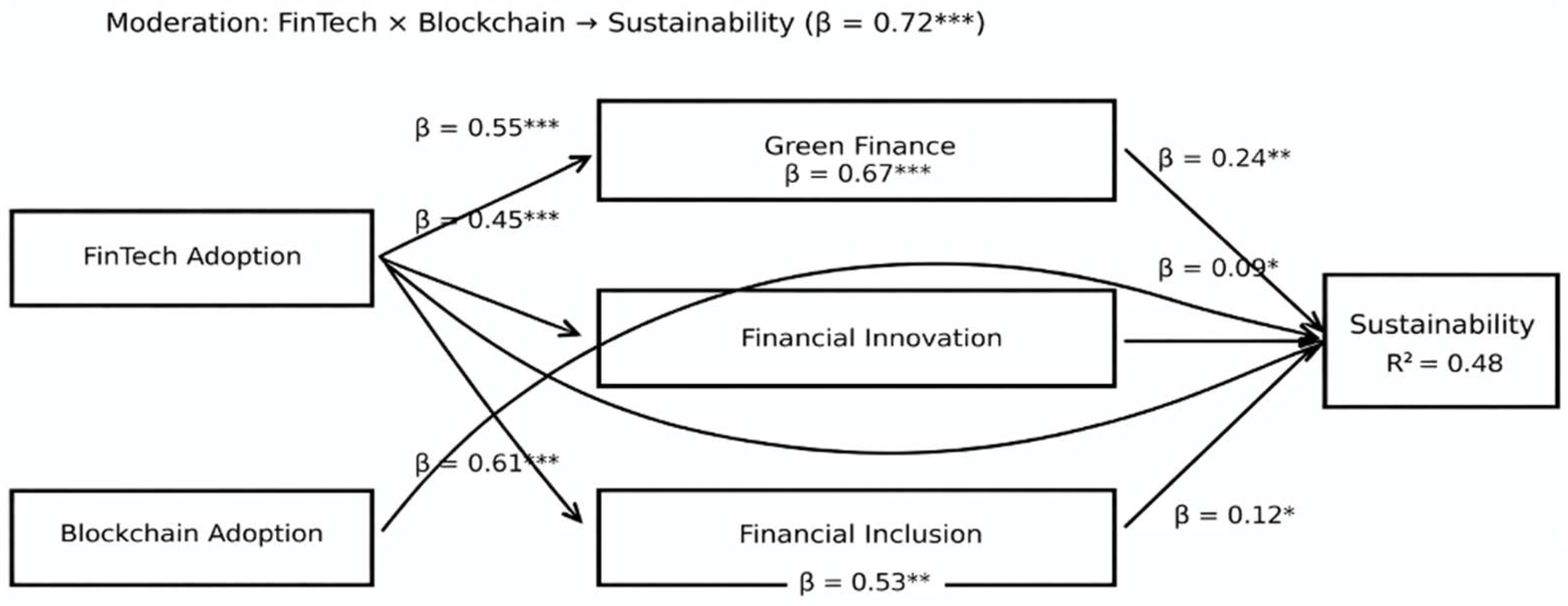
The path analysis shown in Table 4 and Figure 1 demonstrates that FinTech adoption has a substantial and statistically significant positive effect on sustainability outcomes (β = 0.67, p < 0.001). Blockchain adoption exhibits a similarly robust, though slightly smaller, direct effect (β = 0.53, p = 0.007). The significant positive coefficient for the interaction term (β = 0.72, p < 0.001) underscores that organizations implementing both FinTech and blockchain technologies enjoy even greater sustainability benefits. Furthermore, both green finance and financial innovation act as partial mediators, confirming that some of FinTech’s impact on sustainability is channeled through these mechanisms. While financial inclusion contributes positively, its effect is more modest. These findings reinforce the multi-dimensional pathways through which digital financial innovations drive sustainable outcomes in the region.

5.2.2. Regression Robustness

Cross-sectional OLS and macro-level robustness analyses support the PLS-SEM findings. Complementary macro-level diagnostics (Section 4.4) confirm consistency at the aggregate level.
Table 5 shows a representative multivariate regression with clustered standard errors.
The multivariate regression results in Table 5 confirm the central findings of the PLS-SEM model. FinTech adoption remains the strongest predictor of enhanced sustainability performance, while blockchain use and green finance also yield significant positive effects. Financial innovation and financial inclusion contribute incrementally, further validating their mediating roles. The sector and organizational size controls do not significantly predict sustainability, suggesting that the observed relationships are broadly applicable across different company types. The relatively high R2 value (0.48) indicates that the included predictors collectively explain a substantial portion of the variance in sustainability outcomes within the sample.

5.2.3. Mediation Analysis

Mediation occurs when the effect of an independent variable (e.g., FinTech Adoption) on a dependent variable (e.g., Sustainability Outcome) is transmitted through one or more intermediary variables (mediators), such as Green Finance or Financial Innovation.
The indirect effects in Table 6 show that a substantial portion of the impact of FinTech Adoption on Sustainability is mediated by Green Finance and Financial Innovation. The indirect pathway through Green Finance is particularly strong and statistically significant, confirming that organizations using FinTech are more likely to invest in green projects, which drives better sustainability outcomes. Similarly, the Financial Innovation pathway is significant, underlining the role of continuous product and process innovation in realizing sustainability goals. The impact through Financial Inclusion is smaller but still significant, suggesting enhanced access and equity complement but do not replace technological and financial innovation in contributing to sustainability.

5.2.4. Moderation Analysis

Moderation occurs when the strength or direction of an effect between two variables changes depending on the level of a third variable (moderator). In this study, Blockchain Adoption is tested as a moderator for the relationship between FinTech Adoption and Sustainability Outcome.
As shown in Table 7, the positive and significant interaction term indicates that the beneficial effect of FinTech Adoption on Sustainability is amplified for firms that also integrate Blockchain Technology. This moderation supports a complementary relationship, meaning that combined digital transformation initiatives yield more substantial sustainability benefits than isolated adoption.
The combined results from mediation and moderation analyses reinforce that FinTech Adoption’s influence on Sustainability is multidimensional. Organizational investments in Green Finance and Financial Innovation act as essential conduits, while Blockchain Technology plays a powerful moderating role. These patterns highlight the importance of holistic and integrated digital strategies for advancing sustainability in the GCC context.

5.3. Qualitative Findings

A thematic analysis of policy documents, regulatory guidelines, and industry reports revealed four major themes related to the integration of FinTech and blockchain in advancing sustainable development within Saudi Arabia and the GCC. Table 8 provides an overview of these emergent themes.
The qualitative analysis aligns closely with official national policy discourse. For example, Saudi Vision 2030 explicitly emphasizes that digital transformation aims to “diversify the economy and support sustainable development through innovation and private sector growth” (Kingdom of Saudi Arabia, Vision 2030). Similarly, official FinTech ecosystem mapping highlights the strategic objective of strengthening financial inclusion and SME financing through digital platforms [2]. These policy directions reinforce the empirical evidence that FinTech expansion in Saudi Arabia is institutionally linked to broader sustainability objectives.
Qualitative analysis demonstrated strong policy alignment, with FinTech and digital innovation described as central pillars in achieving economic diversification, enhancing financial resilience, and advancing national sustainability strategies across the GCC. Regulatory authorities such as central banks have proactively established regulatory sandboxes and innovation accelerators, thereby lowering entry barriers and promoting the pilot-testing of green financial products, such as ESG-linked loans and blockchain-driven sustainable investment funds. Testimonies from sector stakeholders, as well as case evidence, indicate that these regulatory efforts facilitate collaborations between FinTech firms and traditional financial institutions, accelerating sustainable financial innovation.
Furthermore, FinTech has been a transformative enabler for financial inclusion, particularly for women, small businesses, and rural populations. The widespread adoption of mobile banking, peer-to-peer lending, and decentralized finance platforms is linked to improved access and participation in the formal financial sector, advancing multiple Sustainable Development Goals, including those related to poverty alleviation and gender equity.
Notably, while the environmental potential of digital finance is significant offering dematerialization of services and enabling green investment products there is a concurrent recognition of risks. Concerns include increased electronic waste, carbon footprints of digital infrastructure, and the possibility of “greenwashing”. Thus, policy and industry documents advocate for robust sustainability benchmarks and transparent accountability mechanisms to ensure that the benefits of FinTech and blockchain for sustainable development are realized and potential harms are mitigated.
This comprehensive qualitative assessment underscores the multidimensional impact of FinTech innovation in the GCC, illustrating its vital role in promoting not only economic and technological gains but also broader social and environmental objectives. The findings highlight that achieving sustainable outcomes depends on adaptive regulatory frameworks, rigorous environmental safeguards, and genuine cross-sectoral collaboration.
Both the quantitative models and qualitative content converge on the finding that FinTech adoption especially when paired with complementary innovations like blockchain and green finance significantly enhances sustainability outcomes for organizations in Saudi Arabia and the GCC. However, positive effects are conditional upon forward-looking regulation and targeted environmental safeguards.
The models used in this research provide a comprehensive, multi-level examination of how FinTech and associated financial innovations are linked to sustainable development outcomes, incorporating both micro-level organizational data and macro-level economic/environmental indicators. Variable definitions are derived directly from validated constructs in the GCC/Saudi context, ensuring both replicability and relevance to empirical findings.

6. Discussion

This research corroborates growing evidence that financial technology (FinTech) and allied digital innovations substantially contribute to sustainable performance across financial sectors and industries in Saudi Arabia and the broader Gulf region. Findings from multiple empirical analyses underscore a consistent, positive relationship between FinTech adoption and sustainable outcomes such as improved operational efficiency, transparency, and environmental stewardship.
Studies by Almahadin et al. [1] demonstrate that both blockchain technology and FinTech themselves exhibit significant, positive effects on sustainable performance within the insurance sector. Their analysis shows that blockchain technology accounts for up to 50% of the variance in sustainable performance attributed to gains in efficiency, cost savings, increased transparency, fraud reduction, and the facilitation of real-time, secure information sharing across stakeholders. The decentralized, tamper-resistant nature of blockchain is particularly prized in data-sensitive domains, fostering both trust and operational resilience [1,40,41,42,43]. Likewise, FinTech innovations themselves are responsible for over half the observed improvements in sustainable performance, driven largely by their ability to automate business processes, introduce new entrepreneurial models, and deliver tailored, technologically enabled financial products even where traditional banking services are lacking [44,45,46]. The combined deployment of blockchain and FinTech further amplifies these gains, making a strong case for their integration as a strategic priority within financial institutions [36].
A parallel line of inquiry by Zaid et al. [6] extends these insights into the banking sector, establishing that environmental finance (ENF) and financial innovation (FINV) play pivotal roles in mediating and enhancing sustainability performance. ENF not only directly influences sustainability, but also fosters the development of new green financial products suggesting a pathway whereby innovative financing mechanisms support broader environmental and social goals [47,48,49,50]. Beyond financial inclusion, social sustainability in digitally transforming GCC cities also encompasses issues of environmental justice and equitable access to public goods. The provision and fair distribution of urban green spaces contribute to social well-being, public health, and ecosystem resilience, particularly in rapidly urbanizing smart-city environments [51]. While such spatial planning dimensions fall outside the direct empirical scope of this study, they complement the social pillar of the Triple Bottom Line framework by highlighting how digital transformation and sustainable finance must ultimately support inclusive and environmentally balanced urban development.
Although expectations were high regarding FinTech’s moderating effect on ENF and sustainability, Zaid et al. [6] found that, within Saudi banking, the effect is presently limited. The authors ascribe this, in part, to ongoing challenges in regulatory alignment, a shortage of reliable data on the ecological footprint of FinTech solutions, and the need for cultural and behavioral adaptation within financial organizations [19,52,53].
Zooming out from sectoral analyses, Noreen [2] documents the tangible alignment of Saudi Arabia’s FinTech ecosystem with several Sustainable Development Goals (SDGs), including No Poverty (SDG 1), Zero Hunger (SDG 2), Gender Equality (SDG 5), Decent Work and Economic Growth (SDG 8), and Partnerships for the Goals (SDG 17). Real-world FinTech applications such as mobile banking for the unbanked, digital payments, innovative crowdfunding, and specialized financial platforms for women are mapped directly to these SDGs, demonstrating how digital financial tools can bridge socioeconomic gaps and mobilize resources for sustainable projects [54,55,56,57]. Notably, these platforms support entrepreneurship, provide SMEs with critical capital, and help build vibrant, resilient communities.
Research in the manufacturing sector confirms the relevance of these dynamics on the ground. Al Doghan & Chong [4] find FinTech adoption is strongly associated with enhanced environmental sustainability through the channels of green innovation, finance, and investment a linkage seen also in Qin et al. [58] and Guang-Wen & Siddik [53]. The presence of adequate access to finance is shown to further potentiate the impact of FinTech on organizational sustainability, consistent with the findings of Boohene [59] and Adegboye & Iweriebor [60].
Equally important are the factors that condition or amplify these technology-sustainability dynamics. Al_hazimeh et al. [5] highlight that FinTech competitiveness and its eventual contribution to sustainability is powerfully shaped by regulatory clarity, robust technological infrastructure, and especially customer trust. Where regulatory environments are adaptive and supportive, FinTech growth and sustainable innovation accelerate; conversely, regulatory ambiguity can be an impediment [61,62,63,64]. Customer trust emerges as a critical linchpin, bolstering adoption, driving positive word-of-mouth, and deepening competitive advantage [65,66].
At the macro level, Alshammari [3] establishes through robust panel econometric models that green finance and FinTech are statistically linked to improved energy efficiency in Middle Eastern economies. Their findings underscore the importance of policy interventions to accelerate eco-friendly finance, establish research clusters in green FinTech, and institutionalize regulations that facilitate digital transformation for sustainability [50,67,68,69,70].
Beyond financial institutions and regulatory authorities, environmental non-governmental organizations (NGOs) may also influence sustainability outcomes by shaping public awareness, monitoring environmental compliance, and indirectly affecting capital allocation patterns. Evidence from other contexts suggests that NGOs can contribute to regional sustainability dynamics through institutional pressure and economic relocation mechanisms [71]. Although such actors were not directly examined in this study, their interaction with digital finance ecosystems represents a relevant institutional dimension that warrants further investigation in the GCC context.
Although this study finds a positive relationship between FinTech adoption and sustainability in Saudi Arabia and the GCC, evidence from other regions suggests more complex dynamics. For example, Ozturk and Ullah [18] report that digital financial inclusion may increase environmental pressure in certain developing economies when financial expansion stimulates carbon-intensive consumption. Similarly, Alshammari [3] shows that financial inclusion in Saudi Arabia can raise CO2 emissions when not directed toward renewable or green investments. These contrasting findings indicate that the sustainability impact of FinTech is highly context-dependent and shaped by regulatory quality, energy structure, and policy alignment.
In the GCC context, structured reforms under Vision 2030 and green finance initiatives may explain the stronger positive effects observed in this study. For example, recent evidence from the Saudi banking context suggests that financial inclusion measured by increased access to credit and banking services, can initially contribute to higher CO2 emissions due to fossil fuel-intensive consumption behaviors [3]. This result highlights the need for carefully designed financial products and accompanying policies that direct financial flows toward environmentally sustainable rather than consumption-driven, emission-intensive activities.
Lastly, the literature emphasizes the need for continuous monitoring and educational initiatives. Filfilan and Alattas [72] note that a significant number of firms have yet to fully align their FinTech strategies with sustainability objectives. The report calls for enhanced collaboration between industry and regulators and stresses financial and digital literacy as vital levers for empowering both organizations and consumers to harness FinTech more sustainably [37,52,73].
In conclusion, these multifaceted findings consistently reinforce the view that, with supportive regulatory frameworks, adequate access to finance, and user trust, FinTech can serve as a transformative enabler of sustainability in Saudi Arabia and the GCC. Success, however, also requires continuous investment in innovation, policy adaptation, and broad-based literacy to ensure digital transformation aligns with the region’s long-term sustainability goals.
This study is subject to several limitations. First, the survey data are cross-sectional and collected during a single period in 2024, which restricts causal inference despite the complementary use of macro-level robustness analysis. Second, the organizational sample is concentrated in Saudi Arabia and selected GCC countries, which may limit generalizability to other regulatory or energy-intensive contexts. Third, sustainability performance measures rely partly on perceptual assessments, which may introduce response bias. Future research employing longitudinal firm-level data and cross-regional comparative designs would further strengthen external validity.

7. Conclusions

This study concludes that the integration of FinTech and blockchain technologies with a focus on green finance and financial innovation significantly enhances sustainable organizational performance in the region. The study demonstrates that while FinTech improves efficiency, competitiveness, and progress toward key Sustainable Development Goals (such as poverty alleviation and gender equality), these benefits are most pronounced when accompanied by comprehensive regulatory frameworks and targeted policies. However, the risk that expanded financial inclusion may inadvertently increase CO2 emissions underscores the importance of aligning digital finance with environmental objectives.
The magnitude of the estimated effects provides clear guidance for policy prioritization. The strong direct impact of FinTech adoption on sustainability (β = 0.67, p < 0.001) and the complementary interaction with blockchain (β = 0.72, p < 0.001) indicate that integrated digital transformation strategies should be treated as a central pillar of sustainability policy. Moreover, the significant mediating role of green finance (indirect β = 0.13, p = 0.004) suggests that regulatory incentives should explicitly channel digital financial innovation toward environmentally aligned investments. Although financial inclusion contributes positively (β = 0.12, p < 0.05), its comparatively smaller magnitude reinforces the need for targeted safeguards to prevent unintended environmental externalities. Accordingly, adaptive regulatory frameworks, green finance incentives, and digital literacy initiatives should be prioritized in proportion to the relative strength of these empirical effects.
Beyond efficiency gains, the development of a mature FinTech ecosystem must prioritize systemic resilience. The significant interaction between FinTech adoption and blockchain integration (β = 0.72, p < 0.001) suggests that digital infrastructure can enhance institutional robustness when strategically aligned with sustainability objectives. Policymakers should therefore design adaptive regulatory frameworks capable of withstanding economic volatility and environmental shocks. Building a strong “green image” and sustainability-oriented digital identity at the institutional level may further reinforce stakeholder trust and long-term stability. In this sense, the proposed FinTech ecosystem should be understood not merely as an efficiency-enhancing mechanism, but as a resilience-building architecture for sustainable development.
For future research, the paper highlights the need for longitudinal analyses to track the sustained impact of FinTech interventions on sustainability outcomes, as well as comparative studies across different GCC countries and industry sectors. Additionally, exploring the integration of emerging technologies, such as artificial intelligence and big data, could reveal new pathways for further enhancing the synergies between digital finance and sustainable development. By pursuing these policy and research directions, stakeholders can unlock the full transformative potential of FinTech to advance environmental and social well-being in the region. Future research may also integrate human-centric sustainability indicators, including psychological and environmental comfort dimensions at the employee level, to complement organizational-level performance metrics and provide a more holistic sustainability assessment in interdisciplinary contexts (e.g., Lin et al. [74]).

Author Contributions

Conceptualization, I.B. and M.Z.A.; methodology, I.B. and M.Z.A.; software, I.B.; validation, I.B.; formal analysis, I.B.; resources, I.B.; data curation, I.B.; writing—original draft, I.B. and M.Z.A.; writing—review & editing, I.B. and M.Z.A.; project administration, M.Z.A.; funding acquisition, I.B. and M.Z.A. All authors have read and agreed to the published version of the manuscript.

Funding

This work was supported and funded by the Deanship of Scientific Research at Imam Mohammad Ibn Saud Islamic University (IMSIU) (grant number IMSIU-DDRSP2602).

Institutional Review Board Statement

According to the local research ethics management framework applicable in Saudi Arabia, this study does not require ethical review or approval. Saudi research ethics governance is regulated by the National Committee of Bioethics (NCBE) under Royal Decree No. M/59 dated 14/09/1431H, and further elaborated in the Law of Ethics of Research on Living Creatures and its implementing regulations. https://ksau-hs.edu.sa/English/Colleges/Nursing/Ahsa/Documents/Institutional%20Review%20Board%20(IRB).pdf, accessed on 11 January 2026. In particular, the NCBE implementing regulations indicate that minimal-risk research may be processed through expedited/exempt-type review procedures, which can be conducted by the committee chair or a designated member (i.e., without requiring a full convened committee meeting). https://irb.alfaisal.edu/wp-content/uploads/pdf/NCBE-Guidelines.pdf?utm_source, accessed on 10 January 2026. Ethical safeguards were implemented in our study This research involved human participants in a non-interventional, minimal-risk social science setting and was conducted with strict adherence to international ethical principles for responsible research involving human participants.

Informed Consent Statement

Informed consent was obtained from all subjects involved in the study.

Data Availability Statement

Data supporting reported results can be found upon request to the authors.

Conflicts of Interest

The authors declare no conflict of interest.

References

  1. Almahadin, H.A.; Shehadeh, M.; Al-Gasaymeh, A.S.; Abu-AlSondos, I.A.; Atta, A.A.B. Impact of Blockchain Technology and Fintech on Sustainable Performance. In Proceedings of the 2023 International Conference on Business Analytics for Technology and Security (ICBATS), Dubai, United Arab Emirates, 7–8 March 2023. [Google Scholar]
  2. Noreen, U. Mapping of FinTech Ecosystem to Sustainable Development Goals (SDGs): Saudi Arabia’s Landscape. Sustainability 2024, 16, 9362. [Google Scholar] [CrossRef]
  3. Alshammari, M. How does financial inclusion influence environmental sustainability in Saudi Arabia? Sustain. Futures 2024, 16, 150. [Google Scholar]
  4. Al Doghan, M.A.; Chong, K.W. Fintech adoption and environmental sustainability: Mediating role of green finance, investment and innovation. Int. J. Oper. Quant. Manag. 2023, 29, 296–315. [Google Scholar]
  5. Al_hazimeh, A.M.; Al-Smadi, R.W.; Al-Smadi, A.W. Future trends in Fintech and sustainability: Empirical study. Invest. Manag. Financ. Innov. 2024, 21, 67–78. [Google Scholar] [CrossRef]
  6. Zaid, M.A.K.; Khan, M.F.; Ahmed, A.; Gelaidan, H.M.; Saleh Al Koliby, I. Does environmental finance matter for sustainability? The role of financial innovation and Fintech. Discov. Sustain. 2024, 5, 500. [Google Scholar] [CrossRef]
  7. Duan, N. The quest for balance: The journey of energy, environment and sustainable development. Energy Environ. Sustain. 2025, 1, 100001. [Google Scholar] [CrossRef]
  8. Elkington, J. The triple bottom line. Environ. Manag. Read. Cases 1997, 2, 49–66. [Google Scholar]
  9. Sreenu, N. The impact of Fintech and green bonds on the Indian renewable energy production. Renew. Energy 2024, 237, 121807. [Google Scholar] [CrossRef]
  10. Rabbani, M.R. Fintech innovations, scope, challenges, and implications in Islamic Finance: A systematic analysis. Int. J. Comput. Digit. Syst. 2022, 11, 1–28. [Google Scholar]
  11. He, W.; Liu, P.; Lin, B.; Zhou, H.; Chen, X. Green finance support for development of green buildings in China: Effect, mechanism, and policy implications. Energy Policy 2022, 165, 112973. [Google Scholar] [CrossRef]
  12. Ababio, J.; Yiadom, E.B.; Sarpong-Kumankoma, E.; Boadi, I. Financial inclusion: A catalyst for financial system development in emerging and frontier markets. J. Financ. Econ. Policy 2023, 15, 530–550. [Google Scholar] [CrossRef]
  13. Albarrak, M.S.; Alokley, S.A. FinTech: Ecosystem, opportunities and challenges in Saudi Arabia. J. Risk Financ. Manag. 2021, 14, 460. [Google Scholar] [CrossRef]
  14. Khan, H.H.; Khan, S.; Ghafoor, A. Fintech adoption, the regulatory environment and bank stability: An empirical investigation from GCC economies. Borsa Istanb. Rev. 2023, 23, 1263–1281. [Google Scholar] [CrossRef]
  15. Deng, X.; Huang, Z.; Cheng, X. FinTech and sustainable development: Evidence from China based on P2P data. Sustainability 2019, 11, 6434. [Google Scholar] [CrossRef]
  16. Offiong, U.P.; Szopik-Depczyńska, K.; Ioppolo, G. FinTech innovations for sustainable development: A comprehensive literature review and future directions. Sustain. Dev. 2025, 33, 1459–1471. [Google Scholar] [CrossRef]
  17. Alsadoun, M.; Alrobai, F.S. Influence of fintech adoption on sustainable performance via mediation role of green finance and green innovation. Am. J. Bus. Sci. Philos. AJBSP 2024, 1, 61–72. [Google Scholar] [CrossRef]
  18. Ozturk, I.; Ullah, S. Does digital financial inclusion matter for economic growth and environmental sustainability in OBRI economies? An empirical analysis. Resour. Conserv. Recycl. 2022, 185, 106489. [Google Scholar] [CrossRef]
  19. Zhou, G.; Zhu, J.; Luo, S. The impact of FinTech innovation on green growth in China: Mediating effect of green finance. Ecol. Econ. 2022, 193, 107308. [Google Scholar] [CrossRef]
  20. Song, Y.; Hao, Y. Understanding the relationship between fintech, natural resources, green finance, and environmental sustainability in China: A BARDL approach. Resour. Policy 2024, 89, 104608. [Google Scholar] [CrossRef]
  21. Hidayat-ur-Rehman, I.; Hossain, M.N. The impacts of Fintech adoption, green finance and competitiveness on banks’ sustainable performance: Digital transformation as moderator. Asia-Pac. J. Bus. Adm. 2024, 17, 987–1020. [Google Scholar] [CrossRef]
  22. Hussain, S.; Rasheed, A.; Rehman, S.U. Driving sustainable growth: Exploring the link between financial innovation, green finance and sustainability performance: Banking evidence. Kybernetes 2024, 53, 4678–4696. [Google Scholar] [CrossRef]
  23. Miller, M.H. Financial innovation: The last twenty years and the next. J. Financ. Quant. Anal. 1986, 21, 459–471. [Google Scholar] [CrossRef]
  24. Merton, R.C. Financial innovation and economic performance. J. Appl. Corp. Financ. 1992, 4, 12–22. [Google Scholar] [CrossRef]
  25. Ellili, N.O.D. Financial inclusion and sustainable development: A review and research agenda. J. Financ. Serv. Mark. 2024, 29, 1345–1364. [Google Scholar] [CrossRef]
  26. Tay, L.Y.; Tai, H.T.; Tan, G.S. Digital financial inclusion: A gateway to sustainable development. Heliyon 2022, 8, e09766. [Google Scholar] [CrossRef] [PubMed]
  27. Anshari, M.; Almunawar, M.N.; Masri, M.; Hamdan, M. Digital marketplace and FinTech to support agriculture sustainability. Energy Procedia 2019, 156, 234–238. [Google Scholar] [CrossRef]
  28. Tripathi, S.; Rajeev, M. Gender-inclusive development through Fintech: Studying gender-based digital financial inclusion in a cross-country setting. Sustainability 2023, 15, 10253. [Google Scholar] [CrossRef]
  29. Song, N.; Appiah-Otoo, I. The impact of fintech on economic growth: Evidence from China. Sustainability 2022, 14, 6211. [Google Scholar] [CrossRef]
  30. Parmentola, A.; Petrillo, A.; Tutore, I.; De Felice, F. Is blockchain able to enhance environmental sustainability? A systematic review and research agenda from the perspective of Sustainable Development Goals (SDGs). Bus. Strategy Environ. 2022, 31, 194–217. [Google Scholar] [CrossRef]
  31. Chaudhuri, A.; Bhatia, M.S.; Kayikci, Y.; Fernandes, K.J.; Fosso-Wamba, S. Improving social sustainability and reducing supply chain risks through blockchain implementation: Role of outcome and behavioural mechanisms. Ann. Oper. Res. 2023, 327, 401–433. [Google Scholar] [CrossRef]
  32. Khan, S.A.R.; Godil, D.I.; Jabbour, C.J.C.; Shujaat, S.; Razzaq, A.; Yu, Z. Green data analytics, blockchain technology for sustainable development, and sustainable supply chain practices: Evidence from small and medium enterprises. Ann. Oper. Res. 2025, 350, 603–627. [Google Scholar] [CrossRef]
  33. Fernandez-Vazquez, S.; Rosillo, R.; De La Fuente, D.; Priore, P. Blockchain in FinTech: A mapping study. Sustainability 2019, 11, 6366. [Google Scholar] [CrossRef]
  34. Wang, G.; Zhang, H. FinTech-Driven Corporate Sustainability: A Technology–Organization–Environment Framework Analysis. Sustainability 2025, 17, 8748. [Google Scholar] [CrossRef]
  35. Hua, X.; Huang, Y. Understanding China’s fintech sector: Development, impacts and risks. Eur. J. Financ. 2021, 27, 321–333. [Google Scholar] [CrossRef]
  36. Khatib, H.; Alzoubi, H.; El, M. BIM as a tool to optimize and manage project risk management. Int. J. Mech. Eng. 2022, 7, 6307–6323. [Google Scholar]
  37. Siddik, A.B.; Rahman, M.N.; Yong, L. Do fintech adoption and financial literacy improve corporate sustainability performance? The mediating role of access to finance. J. Clean. Prod. 2023, 421, 137658. [Google Scholar] [CrossRef]
  38. Kumar, M.; Mohapatra, G.; Giri, A.K. A comparative analysis of environmental sustainability in G20 nations using a comprehensive framework. Discov. Sustain. 2025, 6, 16. [Google Scholar] [CrossRef]
  39. Sarstedt, M.; Ringle, C.M.; Hair, J.F. Partial least squares structural equation modeling. In Handbook of Market Research; Springer International Publishing: Cham, Switzerland, 2021; pp. 587–632. [Google Scholar]
  40. Ghazal, T.; Alshurideh, M.; Alzoubi, H. Blockchain-Enabled Internet of Things (IoT) Platforms for Pharmaceutical and Biomedical Research. In The International Conference on Artificial Intelligence and Computer Vision; Springer: Cham, Switzerland, 2021; pp. 589–600. [Google Scholar]
  41. Khubrani, M.M. A Framework for Blockchain-based Smart Health System. Turk. J. Comput. Math. Educ. 2021, 12, 2609–2614. [Google Scholar]
  42. El Khatib, M.; Alzoubi, H.M.; Al Mulla, A.; Al Ketbi, W. The Role of Blockchain in E-Governance and Decision-Making in Project and Program Management. Adv. Internet Things 2022, 12, 88–109. [Google Scholar] [CrossRef]
  43. Abreu, P.W.; Aparicio, M.; Costa, C.J. Blockchain technology in the auditing environment. In Proceedings of the Iberian Conference on Information Systems and Technologies 2018, CISTI, Caceres, Spain, 13–16 June 2018. [Google Scholar] [CrossRef]
  44. Al hammadi, T.; Nobanee, H. FinTech and Sustainability: A Mini-Review. SSRN Electron. J. 2019. [Google Scholar] [CrossRef]
  45. Alzoubi, H.M.; Hanaysha, J.R.; Al-Shaikh, M.E.; Joghee, S. Impact of Innovation Capabilities on Business Sustainability in Small and Medium Enterprises. FIIB Bus. Rev. 2022, 11, 67–78. [Google Scholar] [CrossRef]
  46. Anifa, M.; Ramakrishnan, S.; Joghee, S.; Kabiraj, S.; Bishnoi, M.M. Fintech Innovations in the Financial Service Industry. J. Risk Financ. Manag. 2022, 15, 287. [Google Scholar] [CrossRef]
  47. Hussain, S.; Ahmad, T.; Ullah, S.; Rehman, A.U.; Shahzad, S.J.H. Financial inclusion and carbon emissions in Asia: Implications for environmental sustainability, economic and political studies. Econ. Political Stud. 2023, 12, 88–104. [Google Scholar] [CrossRef]
  48. Hidayat-ur-Rehman, I. The role of financial literacy in enhancing firm’s sustainable performance through Fintech adoption: A moderated mediation analysis. Int. J. Innov. Sci. 2024, 17, 754–785. [Google Scholar] [CrossRef]
  49. Zhang, S.; Wu, Z.; Wang, Y.; Hao, Y. Fostering green development with green finance: An empirical study on the environmental effect of green credit policy in China. J. Environ. Manag. 2021, 296, 113159. [Google Scholar] [CrossRef]
  50. Iqbal, Q.; Ahmad, N.H.; Halim, H.A. Insights on entrepreneurial bricolage and frugal innovation for sustainable performance. Bus. Strategy Dev. 2021, 4, 237–245. [Google Scholar] [CrossRef]
  51. Jiang, S.; Yuan, X. Does green credit promote real economic development? Dual empirical evidence of scale and efficiency. PLoS ONE 2025, 20, e0326961. [Google Scholar] [CrossRef] [PubMed]
  52. Chueca Vergara, C.; Ferruz Agudo, L. Fintech and sustainability: Do they affect each other? Sustainability 2021, 13, 7012. [Google Scholar] [CrossRef]
  53. Guang-Wen, Z.; Siddik, A.B. The effect of Fintech adoption on green finance and environmental performance of banking institutions during the COVID-19 pandemic: The role of green innovation. Environ. Sci. Pollut. Res. 2023, 30, 25959–25971. [Google Scholar] [CrossRef]
  54. Lee, C.C.; Lou, R.; Wang, F. Digital financial inclusion and poverty alleviation: Evidence from the sustainable development of China. Econ. Anal. Policy 2023, 77, 418–434. [Google Scholar] [CrossRef]
  55. Gibson, E.; Gazi, S.; Arner, D.W. Digital Finance, Financial Inclusion and Gender Equality: Digital Public Goods, Rearchitecting Financial Systems and Economic Empowerment of Women. Univ. Pa. J. Int. Law 2024, 46, 1–40. [Google Scholar] [CrossRef]
  56. Khattak, A.; Tabash, M.I.; Yousaf, Z.; Radulescu, M.; Nassani, A.A.; Haffar, M. Towards innovation performance of SMEs: Investigating the role of digital platforms, innovation culture and frugal innovation in emerging economies. J. Entrep. Emerg. Econ. 2022, 14, 796–811. [Google Scholar] [CrossRef]
  57. Hoang, T.G.; Nguyen, G.N.T.; Le, D.A. Developments in financial technologies for achieving the sustainable development goals (SDGs): FinTech and SDGs. In Disruptive Technologies and Eco-Innovation for Sustainable Development; IGI Global: Hershey, PA, USA, 2022; pp. 1–19. [Google Scholar]
  58. Qin, L.; Aziz, G.; Hussan, M.W.; Qadeer, A.; Sarwar, S. Empirical evidence of fintech and green environment: Using the green finance as a mediating variable. Int. Rev. Econ. Financ. 2024, 89, 33–49. [Google Scholar] [CrossRef]
  59. Boohene, R. Entrepreneur’s social capital and firm growth: The moderating role of access to finance. J. Enterprising Cult. 2018, 26, 327–348. [Google Scholar] [CrossRef]
  60. Adegboye, A.C.; Iweriebor, S. Does access to finance enhance SME innovation and productivity in Nigeria? Evidence from the World Bank Enterprise Survey. Afr. Dev. Rev. 2018, 30, 449–461. [Google Scholar] [CrossRef]
  61. Demirel, P.; Kesidou, E. Sustainability-oriented capabilities for eco-innovation: Meeting the regulatory, technology, and market demands. Bus. Strategy Environ. 2019, 28, 847–857. [Google Scholar] [CrossRef]
  62. Goo, J.J.; Heo, J.Y. The impact of the regulatory sandbox on the fintech industry, with a discussion on the relation between regulatory sandboxes and open innovation. J. Open Innov. Technol. Mark. Complex. 2020, 6, 43. [Google Scholar] [CrossRef]
  63. Fenwick, M.; Vermeulen, E.P. Banking and regulatory responses to FinTech revisited—Building the sustainable financial service ‘ecosystems’ of tomorrow. Singap. J. Leg. Stud. 2020, 165–189. [Google Scholar] [CrossRef]
  64. Alrawashdeh, N.; Alsmadi, A.A.; Al-Gasaymeh, A. FinTech: A bibliometric analysis for the period of 2014–2021. Calitatea 2022, 23, 176–188. [Google Scholar]
  65. Dawood, H.M.; Liew, C.Y.; Lau, T.C. Mobile perceived trust mediation on the intention and adoption of FinTech innovations using mobile technology: A systematic literature review. F1000Research 2021, 10, 722. [Google Scholar] [CrossRef]
  66. Alkhwaldi, A.F.; Alharasis, E.E.; Shehadeh, M.; Abu-AlSondos, I.A.; Oudat, M.S.; Bani Atta, A.A. Towards an understanding of FinTech users’ adoption: Intention and e-loyalty post-COVID-19 from a developing country perspective. Sustainability 2022, 14, 12616. [Google Scholar] [CrossRef]
  67. Anh Tu, C.; Nguyen, H.M.; Tran, Q.T.; Vo, D.H. The impact of financial development, fintech and financial inclusion on sustainable development: Evidence from emerging markets. Sustainability 2021, 13, 6542. [Google Scholar] [CrossRef]
  68. Liu, H.; Yao, P.; Latif, S.; Aslam, S.; Iqbal, N. Impact of green financing, FinTech, and financial inclusion on energy efficiency. Environ. Sci. Pollut. Res. 2022, 29, 18955–18966. [Google Scholar] [CrossRef]
  69. Udeagha, M.C.; Muchapondwa, E. Environmental sustainability in South Africa: Understanding the criticality of economic policy uncertainty, fiscal decentralization, and green innovation. Sustain. Dev. 2023, 31, 1638–1651. [Google Scholar] [CrossRef]
  70. Udeagha, M.C.; Ngepah, N. Striving towards environmental sustainability in the BRICS economies: The combined influence of fiscal decentralization and environmental innovation. Int. J. Sustain. Dev. World Ecol. 2023, 30, 111–125. [Google Scholar] [CrossRef]
  71. Li, Q.; Wang, X.; Chen, Z.; Arif, M. Assessing the conjunction of environmental sustainability and tourism development along Chinese waterways. Ecol. Indic. 2024, 166, 112281. [Google Scholar] [CrossRef]
  72. Filfilan, A.; Alattas, M.I. The Role of Fintech in Promoting Environmentally and Economically Sustainable Consumer Behavior. Arch. Tech. Sci. 2025, 1, 33–43. [Google Scholar] [CrossRef]
  73. Abdul-Rahim, R.; Bohari, S.A.; Aman, A.; Awang, Z. Benefit–risk perceptions of FinTech adoption for sustainability from bank consumers’ perspective: The moderating role of fear of COVID-19. Sustainability 2022, 14, 8357. [Google Scholar] [CrossRef]
  74. Lin, Y.; Zhang, X.; Geertman, S. Toward smart governance and social sustainability for Chinese migrant communities. J. Clean. Prod. 2015, 107, 389–399. [Google Scholar] [CrossRef]
Figure 1. Full structural model with standardized path coefficients estimated via PLS-SEM. Note: * p < 0.05, ** p < 0.01, *** p < 0.001.
Sustainability 18 02182 g001
Table 1. Sample Characteristics.
CharacteristicCategory/ValuePercentage (%)/Count
Total Respondents 300
Sector BreakdownBanking & Financial Services40
Insurance25
Manufacturing35
SeniorityC-level/Directors30
Senior Management45
Middle Management25
Geographical ScopeSaudi Arabia70
UAE15
Other GCC15
Table 2. Definitions of Variables and Measurement.
VariableCodeMeasurement/IndicatorsData Source/Sector
FinTech AdoptionFINASurvey (1–5 Likert, 8 items: payments, lending, personal finance mgmt., investment platforms)Org. survey (finance, insurance, manufacturing, GCC)
Blockchain TechnologyBCTSurvey (1–5 Likert, 6 items: blockchain use in ops, security, trust, cost savings)Org. survey (insurance, finance, manufacturing, GCC)
Environmental FinanceENFSurvey (1–5 Likert, 5 items: funding/investment in green projects)Org. survey (banking, GCC)
Financial InnovationFINVSurvey (1–5 Likert, 5 items: new sustainable financial products/services/processes)Org. survey (banking, GCC)
Sustainable PerformanceSPSurvey (1–5 Likert, 7 items: organizational cost savings, sustainable operations, CSR, innovation, env. practices)Org. survey (multi-sector, GCC)
Green InnovationGRINSurvey (Likert, number of eco-innovations, process/product upgrade)Org. survey (manufacturing, GCC)
Green InvestmentGREISurvey: investment in environmental initiativesOrg. survey (manufacturing)
Energy EfficiencyEEPanel: Energy use per unit GDP and per capita, CO2 emissionsMacro panel (2012–2023)
Environmental SustainabilityENSComposite index (eco-performances, panel data, e.g., env. sustainability index)Macro panel (2012–2023)
Composite Environmental Sustainability IndexSUSArithmetic mean of three environmental indicators: CO2 emissions per capita, renewable energy share, and energy intensity.Country-year (2012–2023)
Controls Size, age, market share, GDP growth, country/sector dummies, governanceOrg. survey and panel
Table 3. Descriptive Statistics of Key Variables.
VariableMeanSDMinMaxN
FinTech Adoption3.910.772.15.0300
Blockchain Adoption0.320.4601300
Green Finance2.280.811.04.0300
Financial Innovation3.050.831.05.0300
Financial Inclusion3.850.752.05.0300
Sustainability Score4.110.682.55.0300
Table 4. PLS-SEM Results: Direct and Mediating Effects.
PathCoefficient (β)t-Valuep-Value95% CISignificance
FinTech Adoption → Sustainability0.677.85<0.001[0.54, 0.81]***
Blockchain Adoption → Sustainability0.534.390.007[0.28, 0.73]**
FTA × BLK (Interaction) → Sustainability0.728.91<0.001[0.62, 0.89]***
FinTech → Green Finance (Mediator)0.556.22<0.001[0.41, 0.67]***
Green Finance → Sustainability0.243.110.002[0.09, 0.41]**
FinTech → Financial Innovation (Mediator)0.455.58<0.001[0.29, 0.61]***
Financial Innovation → Sustainability0.192.690.008[0.05, 0.34]**
FinTech → Financial Inclusion (Mediator)0.616.75<0.001[0.46, 0.75]***
Financial Inclusion → Sustainability0.121.990.049[0.01, 0.25]*
Note: * p < 0.05, ** p < 0.01, *** p < 0.001.
Table 5. Regression of Sustainability Score on Main Predictors (Controls Included).
VariableCoefficientStd. Errort-Valuep-Value
FinTech Adoption0.390.075.57<0.001
Blockchain Adoption0.270.093.000.003
Green Finance0.220.063.67<0.001
Financial Innovation0.150.072.140.033
Financial Inclusion0.110.052.200.029
Org. Size0.050.041.250.213
Sector dummiesIncluded---
R20.48
N300
Table 6. Mediation Analysis: Indirect Effects of FinTech Adoption on Sustainability.
PathwayIndirect Effect (β)Bootstrapped SE95% CIz-Valuep-ValueInterpretation
FTA → Green Finance → Sustainability0.130.045[0.06, 0.23]2.890.004Significant partial mediation
FTA → Financial Innovation → Sustainability0.090.032[0.03, 0.18]2.810.005Significant partial mediation
FTA → Financial Inclusion → Sustainability0.070.027[0.01, 0.13]2.590.010Marginal partial mediation
Table 7. Moderation Analysis: Interaction Effects.
PredictorModeratorInteraction Term (β)SEt-Valuep-ValueInterpretation
FinTech AdoptionBlockchain Adoption0.180.0454.00<0.001Blockchain magnifies positive effect of FinTech on Sustainability
Table 8. Key Qualitative Themes Identified in FinTech and Sustainability Integration.
ThemeDescriptionRepresentative Evidence
Policy AlignmentIntegration of FinTech in national visions for sustainability, diversification, and economic resilience.National strategies, government white papers
Regulatory InnovationsRegulatory sandboxes, open banking, and agile licensing frameworks supporting FinTech experimentation.Central bank initiatives, regulatory reports
Financial Inclusion & EquityExpansion of access for underserved groups through digital and blockchain-enabled financial products.Stakeholder interviews, case studies
Environmental Opportunities and RisksFocus on green finance with awareness of potential environmental drawbacks from digital expansion.ESG reports, expert commentary
Disclaimer/Publisher’s Note: The statements, opinions and data contained in all publications are solely those of the individual author(s) and contributor(s) and not of MDPI and/or the editor(s). MDPI and/or the editor(s) disclaim responsibility for any injury to people or property resulting from any ideas, methods, instructions or products referred to in the content.