


Abstract
This study examines Italian adolescents’ willingness to use electronic devices rather than printed paper for reading and writing activities, a behavioural choice that differs from more conventional pro-environmental actions due to its implications for learning and well-being. We design an online vignette experiment with two informational conditions: an individual-impact and a social-impact treatment. Socially framed information is associated with a higher propensity to prefer digital tools relative to individual framing, although overall treatment effects are modest. Stronger treatment responsiveness emerges only when students reflect on avoidable printing practices. Preferences are primarily shaped by socio-demographic factors, particularly gender, educational background, and health and environmental attitudes. Paper is valued for its perceived benefits to reasoning, memory, and reading enjoyment, while digital tools are favoured for their ease of writing and editing. Even if not fully generalizable, our findings highlight the atypical nature of a paper–digital trade-off: when consumption choices involve cognitive or identity-related considerations, sustainability-based messages alone may be insufficient.
1. Introduction
Ten years ago, the nations of the world committed to the 2030 Agenda for Sustainable Development, which sets out 17 Sustainable Development Goals (SDG). Despite considerable progress, global achievements remain insufficient [1]. This study focuses on one specific dimension of sustainability: reducing paper consumption. Avoiding printing and replacing it with electronic devices is recommended in both SDG 13 (Climate Action), which calls for urgent measures to tackle climate change, and SDG 15 (Life on Land), which aims to promote the sustainable use of terrestrial ecosystems [2,3].
The trade-off between paper consumption and the use of digital tools is widely debated in the literature. Paper production generates both direct environmental damage, through solid-waste generation, and indirect harm via emissions and ecosystem degradation linked to deforestation [4]. These costs may incentivize a shift toward digital alternatives. At the same time, digital resources entail environmental costs that are often underestimated. Internet infrastructures are highly energy-intensive and generate significant CO2 emissions, while the production and end-of-life management of digital devices rely on the extraction of natural resources and contribute to growing volumes of electronic waste [5]. Although digital technologies should, in principle, reduce the need for printed materials, they may also generate a rebound effect, called the “Jevons paradox”: efficiency gains may unintentionally increase resource consumption [6]. In the case of paper, this phenomenon has been reframed as the “paperless office (PLO) paradox”, as the introduction of computers and internet technologies has often increased—rather than decreased—printing volumes [7,8,9].
Shibata and Omura [10] argue that digital tools are still unable to replace paper in tasks, such as handling large quantities of sheets or facilitating quick note-taking, and may never substitute its sensory dimensions (i.e., “smell of paper”). Life-cycle assessments comparing printed newspapers with electronic formats show that the environmental footprint of printed paper remains significantly higher, underscoring the potential benefits of digital alternatives in the publishing sector [11]. It is, however, necessary to recall that electronic devices have their own environmental impact, and efficiency alone is insufficient: excessive reliance on electronic devices, without consumption guided by sufficiency principles alongside efficiency, may produce an even larger environmental footprint [12,13].
Considering the ongoing debate in the literature on the benefits and drawbacks of new technologies, we discuss the outcomes of a pilot study on adolescents’ preferences for digital tools versus paper in everyday school-related tasks. Using a vignette experiment, we assess how different informational frames—specifically, social versus individual messages—shape these stated preferences. In doing so, we focus on self- versus other-focused framings, drawing on the notion of social distance to evaluate their effectiveness [14].
This study has two main objectives: First, it documents adolescents’ preferences regarding the use of paper and electronic devices for reading and writing tasks. Second, it provides policy-relevant insights into how informed and responsible consumption choices may be encouraged, taking into account both the advantages and the drawbacks of each medium. Guided by the Theory of Planned Behaviour [15], we also investigate the motivations underlying adolescents’ preferences for paper or digital devices. In doing so, we explore not only the subjective norms that influence their choices but also the identity-based factors, such as the way students recognise themselves as learners and the habits through which they construct their learning identity, which may shape them [16].
This study adopts an explicitly exploratory perspective. The paper–digital trade-off is treated as a heterogeneous behavioural domain, in which environmental considerations intersect with cognitive, educational, and identity-related factors. Rather than offering a definitive conceptual hierarchy, the analysis provides an initial empirical orientation by identifying the dimensions along which adolescents’ preferences tend to vary. The results should therefore be interpreted as suggestive, serving as a basis for more targeted and theoretically refined investigations into the paper–digital divide during adolescence.
The remainder of this paper is organised as follows. Section 2 reviews the relevant literature and discusses the conceptual background. Section 3 presents the research questions and hypotheses. Section 4 describes the materials and methods, including the experimental design and the survey instrument. Section 5 reports the main results, together with robustness checks. In Section 6, we discuss the results and highlight the limitations of our approach. Section 7 concludes and discusses implications for policy and future research.
We find that although Italian adolescents appear almost evenly divided between paper and digital tools, their preferences vary substantially with gender, educational level, school track, and attention to health-related issues. Moreover, choosing between paper and digital devices involves a trade-off that may influence comprehension and learning. In this regard, it is noteworthy that adolescents report a strong familiarity with printed paper, consider it irreplaceable for reading, and perceive it as supporting reasoning and memory.
2. Literature Review
2.1. Youth for Sustainability
Given the urgency of achieving the SDGs and the difficulties in meeting these targets, it is crucial to take action [17], particularly by engaging younger generations. Since the 2000s, the number of contributions assessing youth decision-making and preference formation has grown substantially. Adolescents represent the main actors of future society [18] but are also at a crucial stage of their personal development [19]. Teenagers are active economic agents who respond predictably to incentives and provide valuable insights into how adult behaviour develops [20]. Studying adolescents helps determine whether the behavioural patterns observed in adults are the result of developmental processes or are already present at early stages of decision formation [21], and it also sheds light on how targeted interventions might shape future behaviour [22].
A growing body of research examines adolescents’ pro-environmental concerns, although the nature of their pro-environmental behaviour (PEB) remains underexplored [23]. Most of the academic literature on environmental perceptions and behaviours focuses on adults rather than children and adolescents [23], partly due to ethical and practical challenges associated with conducting research with minors. Nevertheless, young individuals represent the adults of tomorrow, and understanding adolescents’ environmental attitudes and behaviours has become increasingly important [22]. Lisboa et al. [24] document that specific personality traits and emotional intelligence play a relevant role in shaping PEBs among adolescents, in line with the existing evidence for adults. Balundė et al. [25] show that biospheric values and environmental self-identity, mediated by personal norms, predict a broad set of PEBs—including recycling, sustainable travel, environmentally friendly purchases, and drinking tap water. In addition, Grønhøj and Thøgersen [26] find that adolescents’ pro-environmental motivation depends on family norms, parents’ environmental values, and autonomy-supportive parenting. Similarly, Collado et al. [27] show that parents’ and peers’ descriptive and injunctive norms have both a direct effect on adolescents’ pro-environmental behaviour and an indirect effect mediated by personal norms. Henriks [28] finds that adolescents’ support for climate policies declines as policies become more costly or intrusive. Still, adolescents appear highly sensitive to the social dimension of environmental action, responding positively to PEBs displayed by peers [29]. However, when narrowing the focus to adolescents’ preferences for paper versus digital tools, the literature becomes considerably more limited, and this trade-off remains largely unexplored within the field of economics.
2.2. The Paper-Digital Trade-Off
Discouraging the use of printed paper in favour of digital devices has delicate implications for adolescents. In recent years, young people have experienced high levels of access to and use of electronic devices in their daily lives [30,31]. Yet, several studies caution against interpreting this as positive: intense technology use is negatively associated with sleep quality [32] and positively associated with eyestrain [33].
Loh and Sun [34] observe that in adolescents’ reading habits, physical books and digital texts tend to complement each other: the former remains their preferred reading medium, while the latter is used when printed copies are unavailable or for reading news and sources that need to be accessed instantly. Conversely, Joon and Joan [35] find that digital devices lead adolescent readers to adopt a reading approach that is overly superficial and hurried, undermining comprehension compared with physical copies. In addition, public debate often tends to overestimate young people’s preference for e-books, whereas printed copies still appear more effective in increasing their enjoyment, engagement, and reading culture [36,37].
Despite these concerns, promoting sustainable behaviours among adolescents remains crucial, including with respect to paper waste. Generation Z—namely, the cohort of people born from 1997 to 2012—is proving to be sensitive to environmental issues and ready to take action [38], and they can also play a crucial role in raising the awareness of their own parents, for example, concerning the careless use of paper for printing activities [39]. As indicated by Balundė et al. [25], improving young people’s PEB depends not only on the development of an environmental self-identity but, above all, on changes in the habits and in the social and personal norms that adolescents set for themselves. Accordingly, there is a need to design targeted interventions, which typically involve examining specific communication strategies in the form of advertising campaigns or a series of informational lessons [40,41,42,43].
2.3. Vignette Experiments
There is broad agreement in the academic literature on the importance of promoting PEBs among adolescents through communication-based interventions. Tversky and Kahneman [44] showed that alternative formulations of equivalent problems might lead to different decisions. Nowadays, information provision is widely used as a non-price policy tool, and vignette experiments have become a common survey-based method for eliciting behavioural responses. Vignettes present brief scenarios or informational cues designed to capture respondents’ judgments or stated preferences [45].
Recent studies illustrate their usefulness in environmental research. Koessler et al. [29] experimentally examine how information about peers’ behaviour shapes adolescents’ perceptions of prevailing social norms and their own decision-making. The authors show that individuals respond more strongly to information about others’ behaviour when the described behaviour aligns with their self-interest. Hoffmann et al. [46] show that support for anti-deforestation projects increases when individuals perceive direct, certain outcomes. Blöbaum et al. [47] find that comparative feedback is the most effective psychological intervention for promoting energy saving. Overall, the evidence indicates that people respond more strongly to specific, action-oriented messages—especially when socially framed—than to abstract appeals focusing on individual responsibility [48,49].
3. Aims of This Study
The purpose of this study is to examine adolescents’ willingness to reduce paper waste by balancing the use of electronic devices. In light of the benefits and drawbacks highlighted in the existing literature, we do not treat paper and digital tools as perfect substitutes. Rather, we seek to understand how a more moderate and aware use of paper can be encouraged when appropriate. With a growing literature studies preference formation among younger generations [20]—especially their pro-environmental attitudes and consumption choices [18,24]—the paper–digital trade-off has received limited attention from an economic perspective. This trade-off is especially relevant during adolescence, as it intersects environmental considerations with identity formation and educational outcomes. We contribute to this literature by providing novel experimental evidence on how social versus individual information framing affects stated preferences related to paper consumption. In addition, we examine socio-demographic heterogeneity in these preferences and explore the motivations underlying adolescents’ choices. This study addresses three main research questions:
- RQ1:
- What individual, social, and demographic characteristics are associated with adolescents’ preferences for electronic devices over printed paper?
- RQ2:
- How does adolescents’ inclination to prefer paper change when they are presented with information emphasising the social rather than the individual impacts of their behaviour?
- RQ3:
- What motivations underlie adolescents’ preferences for paper versus electronic devices in reading and writing activities?
Research Hypotheses
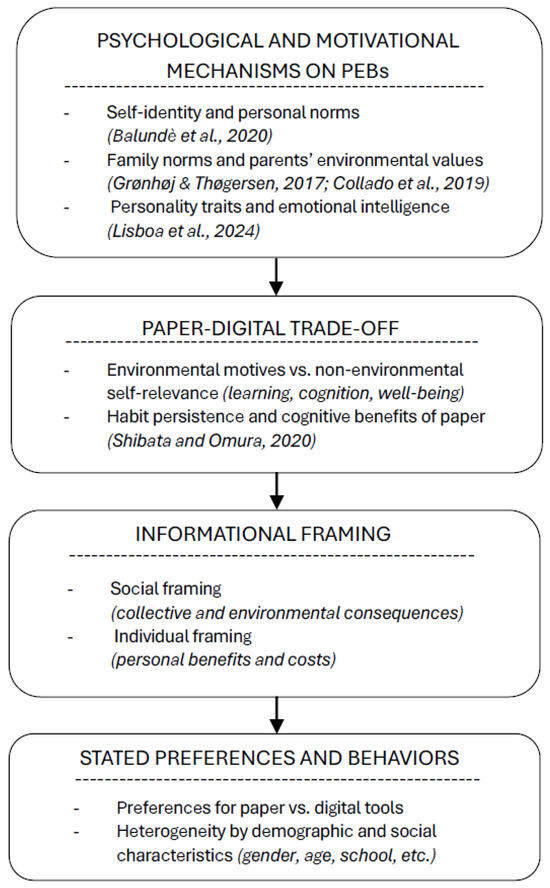
As shown in Figure 1, our theoretical framework conceives the paper–digital choice as the outcome of a layered process linking underlying psychological dispositions, evaluative trade-offs, and informational cues.
Figure 1.
Conceptual and methodological flow [10,24,25,26,27].
At the individual level, self-identity, personal and family norms, and broader personality traits shape baseline orientations towards pro-environmental behaviour. These predispositions structure how students evaluate the paper–digital trade-off, where environmental concerns may conflict with learning-related, cognitive, or well-being considerations, as well as with habit persistence.
Within this motivational space, informational framing—whether emphasising social/environmental consequences or individual costs and benefits—acts as a proximal trigger that can reorient the evaluation of the trade-off. The resulting configuration translates into stated preferences and reported behaviours, with heterogeneity across demographic and social characteristics.
On this basis, we formulate three hypotheses. The first two concern the determinants and potential effects shaping adolescents’ preferences, while the third relates to the motivations underlying these choices:
- HP1
- (Determinants): Preference toward electronic devices over printed paper is mainly affected by parental background [26,27] and awareness about environmental issues [25,27].
- HP2
- (Treatment): Informational framing affects adolescents’ stated preferences: social framing is expected to be more effective than individual framing in shaping adolescents’ stated preferences towards digital devices [48,49].
- HP3
- (Motivations): Adolescents prefer paper for its advantages for learning and cognitive processes, while electronic devices are preferred for comfort and habits [34,35].
4. Materials and Methods
4.1. The Survey
This experiment was conducted online in Spring 2022 and administered via Qualtrics. The survey was distributed to Italian high schools thanks to a collaboration with the nonprofit organization Fondazione Mondo Digitale (FMD) (Fondazione Mondo Digitale is a Rome-based Italian nonprofit foundation promoting digital skills, innovation, and social inclusion through education and training programs. More information is available at this link: https://www.mondodigitale.org/, accessed 18 February 2026). The questionnaire received ethical approval from the University of Siena’s Ethical Committee (CAREUS). The administration of the questionnaire was coordinated by teachers, who received standardized instructions from FMD and allowed students to complete the survey during class time; participants were not compensated. All participants provided informed consent and were informed that their responses were fully anonymized. Although we could not prevent schools from self-selecting into collaboration with FMD, there was no self-selection at the student level. The project primarily involved students in the final stage of secondary education. In fact, 87.5% of the surveyed students were aged 17 or older, while only 12.5% of the sample consisted of students aged between 13 and 16.
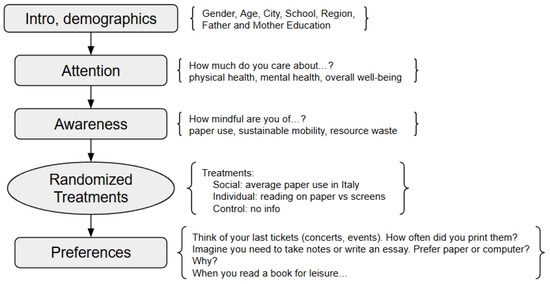
A stylised overview of the survey process is presented in Figure 2. The first block of the survey collects demographic information, including gender, age, type of high school, region of residence, and parents’ educational attainment. Next, we gather information concerning students’ health, sleep patterns, and self-medication habits, in line with research suggesting that adolescents with a higher propensity for internalising problems are more likely to use over-the-counter medicines [50,51]. This section of the questionnaire was then excluded due to low internal consistency, as Cronbach’s alpha values were consistently below 0.60, even after attempting item-selection procedures [52]. The excluded battery of questions asked respondents to rank the following items in order of priority: a balanced diet, physical activity and sport, social relationships, health-related prevention, the quantity and quality of sleep, and attention to the use of medication. In addition, this study also excluded a question asking about the number of hours slept per night, as well as one concerning the type of remedy chosen to relieve headaches. The latter was asked on the basis of evidence from Krettenauer [53], who finds that the use of natural remedies acts as a mediating factor in PEBs.
Figure 2.
Flow of the survey. In the block “Randomized Treatments”, each individual is randomly assigned to one of three treatments. The text of the survey is reported in Appendix A, in Table A1 and Table A2.
The survey continues with questions assessing the extent to which respondents care about physical and mental health and overall well-being (block called “Attention” in Figure 2), and how mindful they believe they are regarding issues such as nutrition, paper consumption, sustainable mobility, physical activity, and resource waste (“Awareness”).
In the experimental block (“Randomized Treatments”), we explore the propensity to reduce paper waste in favour of the use of electronic devices for reading and writing. Individuals are randomly assigned to one of three groups (a control group and two treatment groups). Each treatment condition consisted of a single vignette: treated participants were exposed either to a vignette providing information about the social and environmental consequences of excessive paper consumption or to a vignette outlining the personal benefits of using paper. Individuals in the control group did not receive any vignette. Specifically, the treatments consist of the following vignettes:
- Social Treatment: “An Italian consumes an average of 200 kg of paper per year, and producing this amount requires 88,000 litres of water. A family of four consumes the equivalent of two trees each year” [54].
- Individual Treatment: “Recent studies suggest that readers are more efficient and more aware when reading on paper than when reading on screens” [55].
- Control group: No information received.
While the social and individual dimensions are inherently interconnected—since social dynamics can influence individual behaviour and, conversely, individual actions can scale up to societal outcomes—the distinction between the two treatments is grounded in the concept of psychological distance [56]. The social treatment refers to consequences that are framed as relatively distant from respondents’ immediate personal experience, whereas the individual treatment draws on the respondents’ own subjective and everyday experience as readers and is therefore perceived as psychologically closer.
Finally, the last block (“Preferences”) asks about preferences for using paper or electronic devices when taking notes or writing an essay, as well as the frequency with which students print tickets for events such as concerts. Respondents who prefer paper are asked to indicate the reasons for this preference, while different motivations are explored for those who prefer electronic devices. All participants are then required to rate, on a 0–10 scale, the perceived benefits of using traditional printed books and electronic books.
4.2. Empirical Strategy
The analysis begins with the preparation of the questionnaire data. The survey initially included 921 students enrolled in the Italian upper-secondary education system. Respondents who did not complete the key questions required for the analysis were excluded. Missing values were limited and imputed using a Random Forest algorithm, which performs well with mixed data types [57,58,59], resulting in a final sample of 798 observations. Where necessary, covariates were re-categorized in order to secure group sizes large enough for meaningful analysis.
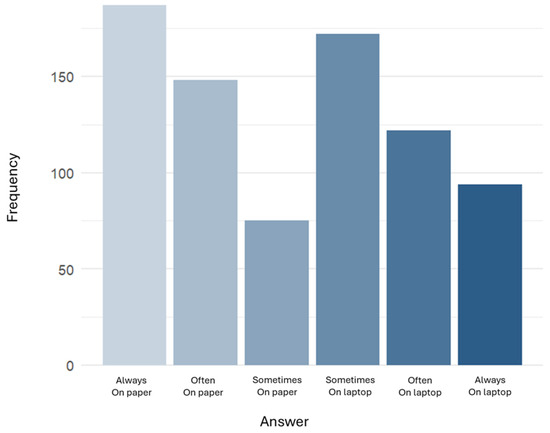
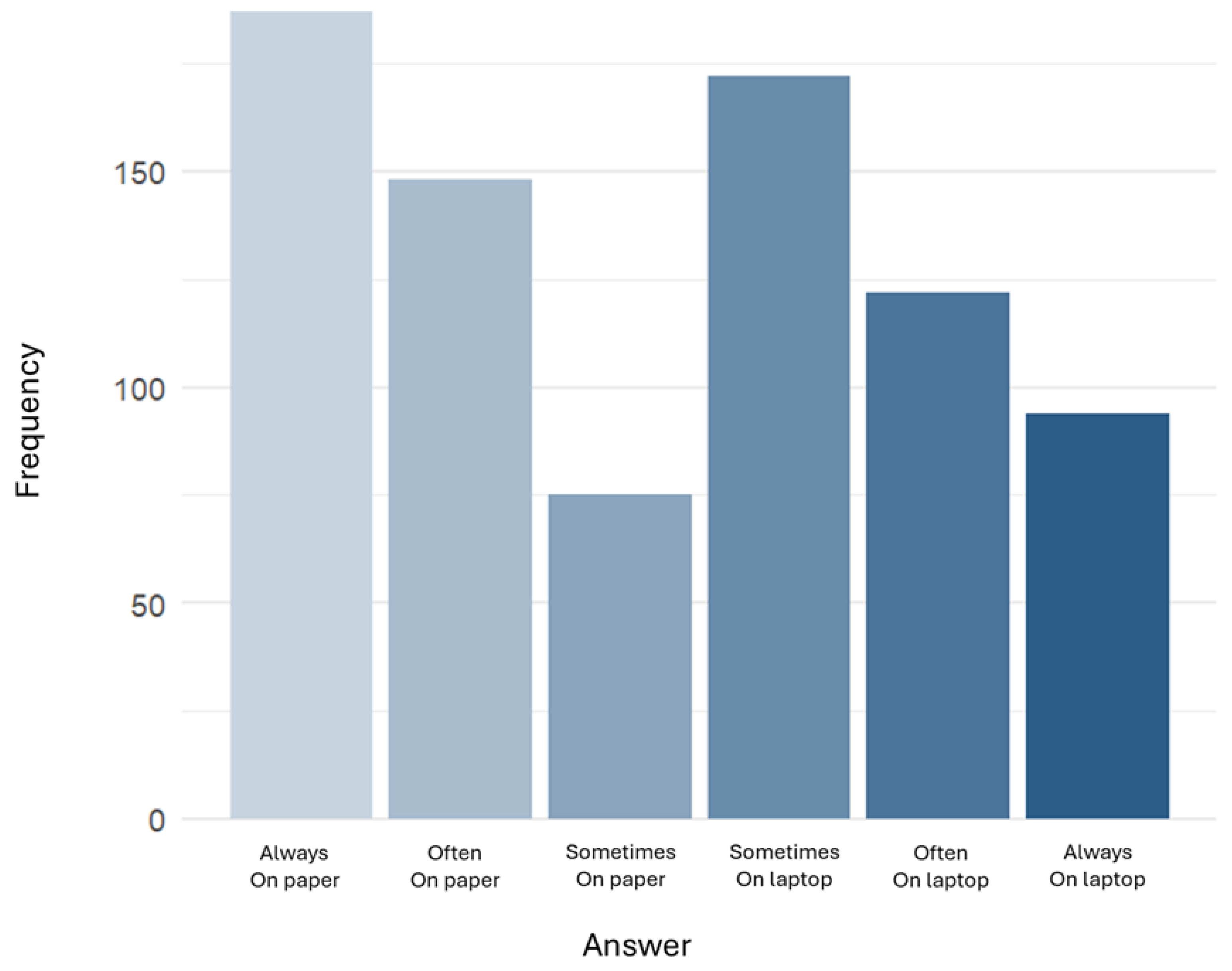
Our primary dependent variable is based on the question: “Imagine you need to take notes or write an essay. Would you prefer to write on paper or on a laptop?” Responses were recorded on six ordered items ranging from ‘Always on paper’ to ‘Always on laptop’. For analytical purposes, the variable was dichotomised with preference for paper coded as 0 and preference for laptop coded as 1. This transformation allows estimation using a Logit model, following a preliminary bivariate Chi-square test assessing associations between treatment assignment and stated preferences. As shown in Figure 3, the distribution displays a clear discontinuity between pro-paper and pro-laptop responses. Moreover, opting for an ordered logit model would create interpretation difficulties, particularly given the risk that the proportional odds (parallel lines) assumption may not hold. Given the exploratory scope of the study, we adopt a parsimonious modelling strategy and focus on the direction of associations between covariates and students’ dichotomised preferences. Additionally, to limit overfitting and multicollinearity issues, covariates were selected through stepwise regression based on the Akaike Information Criterion (AIC) [60], also taking into account the possible presence of interaction terms between all the covariates included. The risk of overfitting is especially pronounced when including all possible interactions among predictors; therefore, an AIC-based selection procedure is particularly appropriate. Far from being a purely data-driven process, the results of the stepwise procedure were carefully evaluated in light of our theoretical framework. In particular, the procedure consistently excluded all health-related factors, which showed no statistical significance in any model specification while absorbing a substantial share of variance in a substantively uninformative way. In Section 6, we elaborate on how, in light of our results, health-related factors appear to be unrelated to the decision-making process underlying the paper–digital trade-off.
Figure 3.
Distribution of answers for the question: “Imagine you need to take notes or write an essay. Would you prefer to write on paper or on a laptop?”
As a robustness check, we additionally examine the association between treatment assignment and the reported frequency of printing event tickets using a bivariate analysis. Finally, declared motivations for preferring paper or electronic devices are illustrated using boxplots.
5. Results
This section presents the results of the analysis. Section 5.1 provides a description of the sample, Section 5.2 analyses the propensity to prefer electronic devices over paper, Section 5.3 explores the preference for printing on paper, and Section 5.4 examines the motivations reported by students in relation to their responses.
5.1. Sample
Table 1 summarises the main covariates employed in this article. The columns referring to the treatment and control groups illustrate how the randomisation of treatments was effective in maintaining a good balance across individual characteristics, thereby creating three comparable groups.
Table 1.
Descriptive statistics.
The first variable included in Table 1 is the Italian macro-region, dichotomised into North and Centre–South due to the small number of southern schools participating in the study (39% vs. 61%). We acknowledge the limitations of this dichotomous approach; nonetheless, we consider it sufficient for capturing the well-known disparities in the Italian upper-secondary education system, where the North is characterised by students with both higher academic performance and socio-economic backgrounds. Indeed, Italy is known for experiencing the so-called North–South divide, whereby Southern regions consistently emerge as disadvantaged across multiple indicators, such as employment rates, while Northern regions have undergone more advanced processes of industrialisation and tertiarisation [61]. Consistently with this pattern, students in Northern Italy also achieve higher scores in the INVALSI assessments—annual tests designed to evaluate whether Italian students have attained the key competencies required by national curricular guidelines [62].
Given the widely documented positive relationship between educational attainment and PEBs [63,64,65], we include the highest education level achieved by students’ parents, categorised as follows: families where neither parent completed upper-secondary education (25%), families where at least one parent holds an upper-secondary qualification (42%), and families where at least one parent holds a university degree (33%). Moreover, students can be differentiated by the type of school they attend. In particular, high schools are grouped into Lyceums (i.e., the most academic track within the Italian upper-secondary education system) (48%), technical institutes (42%), and other types of high schools (11%).
Students’ gender is considered through the dichotomous distinction between males (54%) and females (42%). For inclusiveness and with respect to respondents’ sensitivity, we additionally include a residual category for those who identify with other genders and/or prefer not to disclose this information.
As previously shown in Figure 2, our survey included two batteries of questions aimed at assessing awareness of environmental topics such as paper usage, mobility, and resource waste, as well as levels of attention relating to physical and mental health and overall well-being. Acknowledging the inherent limitations of self-reported information, we computed composite scores for each battery after verifying internal consistency through Cronbach’s alpha ( 0.771 for Awareness and 0.772 for Attention). Since these batteries of questions are composed of three items each and measured on a 0–10 scale, the resulting indicators range from 0 to 30, with average values of 9.55 for Awareness and 11.32 for Attention.
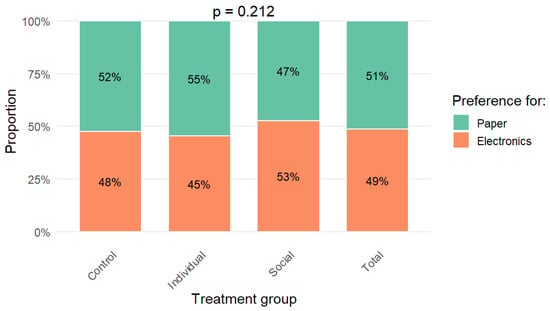
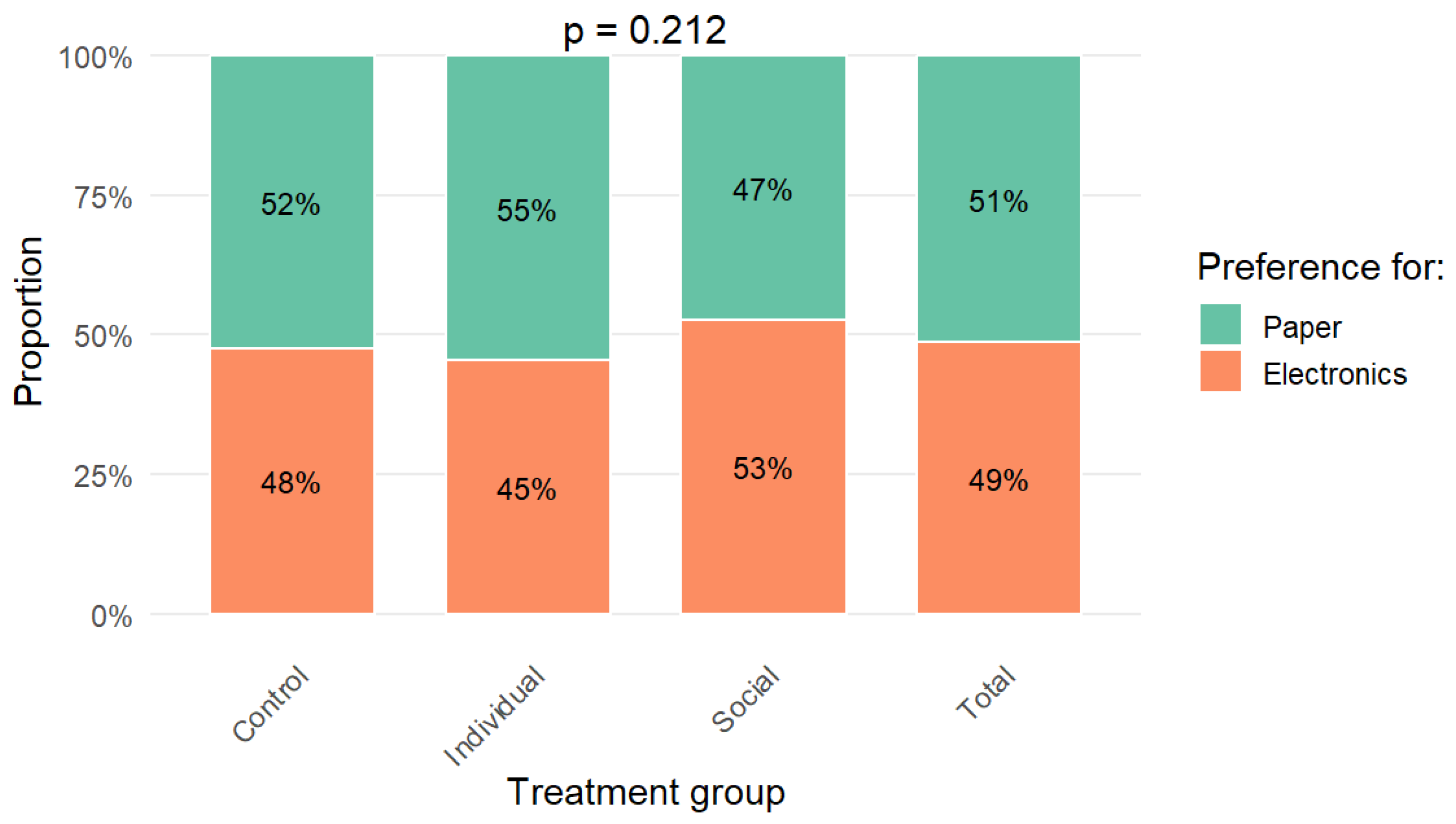
Our dependent variable investigates whether students prefer writing with pen and paper or typing on a laptop. Figure 4 presents these proportions, both for the entire sample and separately by treatment group, providing an initial indication of whether the vignettes may have influenced students’ perceptions. The reported p-value refers to a Chi-square test for differences between groups, which does not allow us to reject the null hypothesis of no difference.
Figure 4.
Sample composition of preferences for paper and electronics by treatment.
Nonetheless, it is worth noting that the only group in which more than 50% of students report preferring electronic devices over paper is the one that received the social treatment.
5.2. Analysis of Preferences: Paper vs. Electronics
As outlined in Section 4.2, we estimate a Logit regression on a binary dependent variable representing the likelihood of preferring the use of electronic devices over pen and paper for reading and writing. Table 2 reports the results of a stepwise selection procedure based on the Akaike Information Criterion (AIC) across three models. Model 1 includes all selected covariates without treatments; Model 2 adds the treatment variables; and Model 3 incorporates a set of theoretically meaningful interactions. The proposed models yield pseudo- values between 0.045 and 0.056. Unlike the in linear regression, pseudo- does not represent the proportion of variance explained; rather, it is a relative goodness-of-fit measure based on improvements in model likelihood compared to a null model. As such, these values indicate a modest but acceptable improvement in fit, which is in line with expectations for individual-level behavioural outcomes estimated through logistic models [66,67].
Table 2.
Logit models: estimation results.
Across all three models, no meaningful effects emerge for Italian macro-region, type of high school, awareness, or attention. Conversely, students from highly educated families and male students emerge as more likely to prefer the use of electronic devices.
These findings do not change substantially when the treatment variables are introduced. Indeed, neither of the two treatments shows a statistically significant effect relative to the control group. Nonetheless, a statistically significant difference emerges when comparing the social and individual treatments (; ; p-value < 0.1). This result weakly confirms that adolescents may be more responsive to arguments concerning the environment and society as a whole rather than to arguments framed solely at the individual level.
Strengthening the positive association with social argument, more meaningful associations with the use of electronic devices emerge when considering the selected interactions, as shown in Model 3 of Table 2. Indeed, students from the Centre–South attending residual types of high schools, particularly when exposed to the social treatment, seem to be more likely to prefer the use of electronic devices over pen and paper. Conversely, students from highly educated families who do not attend Lyceums, or those who perceive themselves as having high levels of attention to health and well-being, appear to favour the use of paper. Although this result may seem counterintuitive within a framework focused on reducing paper consumption, it is discussed in greater depth in Section 6.1.1 and Section 6.3.
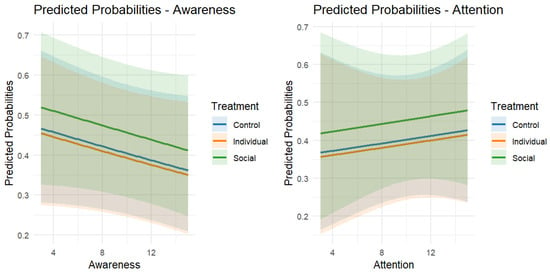
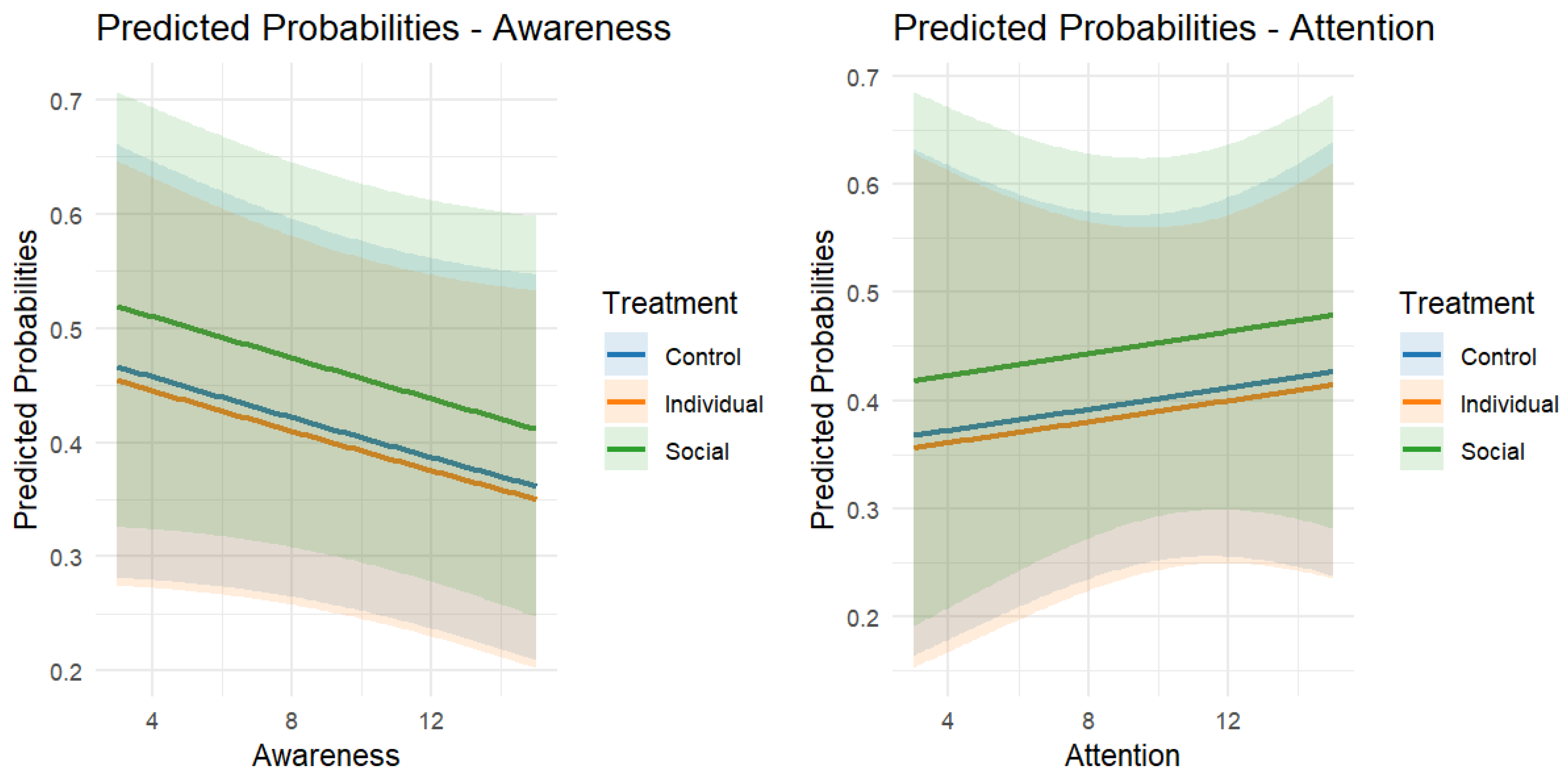
Meanwhile, Figure 5 provides a deeper insight into the estimated effect of the treatments based on the two continuous indicators, namely Awareness of sustainability issues and Attention to own health and well-being. While the likelihood of preferring the use of electronic devices increases as Attention increases, the opposite pattern is observed for Awareness. Our explanation for this evidence is that being informed about what should be done is not automatically or necessarily associated with actually engaging in the behaviour. Conversely, being an attentive individual, with regard to a broad concept of health, positively affects the likelihood of adopting PEBs. In both cases, on average, the likelihood of adopting the use of electronic devices is approximately 5% higher among students who received the social treatment.
Figure 5.
Predicted probabilities: Awareness of sustainability issues and attention to health and well-being.
Although treatment–control differences are not always statistically significant across model specifications, the contrast between social and individual framing remains statistically robust. In agreement with the main literature, our results also seem to indicate that social arguments would exert a meaningful positive influence.
5.3. Robustness Check: Analysis of Preferences Toward Printing
Another question proposed to participants after receiving the treatments was ‘Think about the last times you bought a ticket (for concerts, exhibitions, events, etc.). How often did you print it?’ Responses were categorised as “rarely”, “sometimes”, and “frequently”. This is a particularly interesting question to ask after the treatment, as it requires respondents to recall an action that has already occurred.
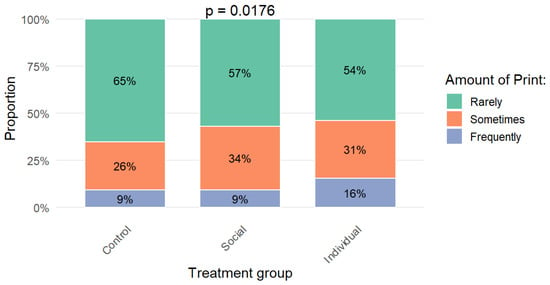
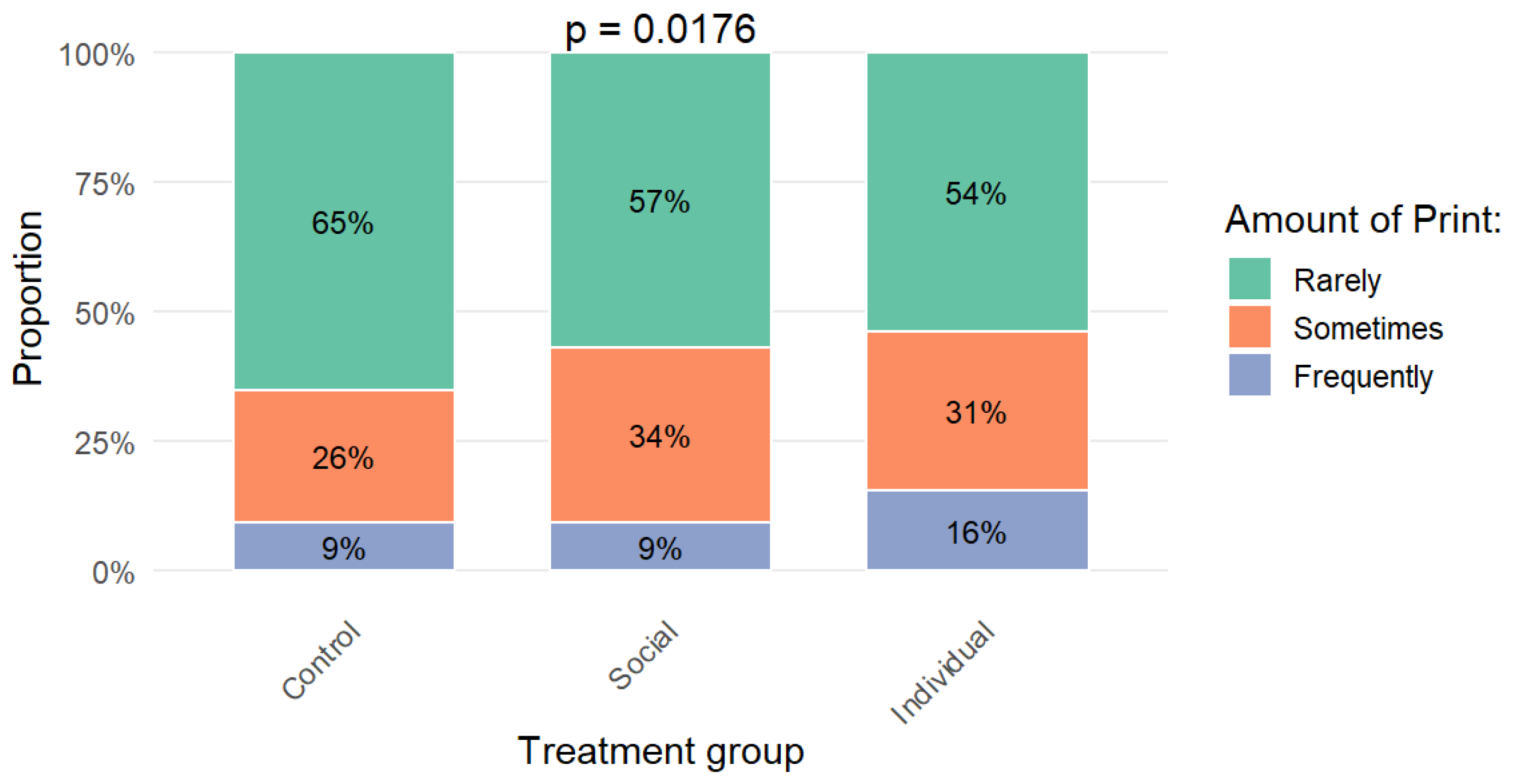
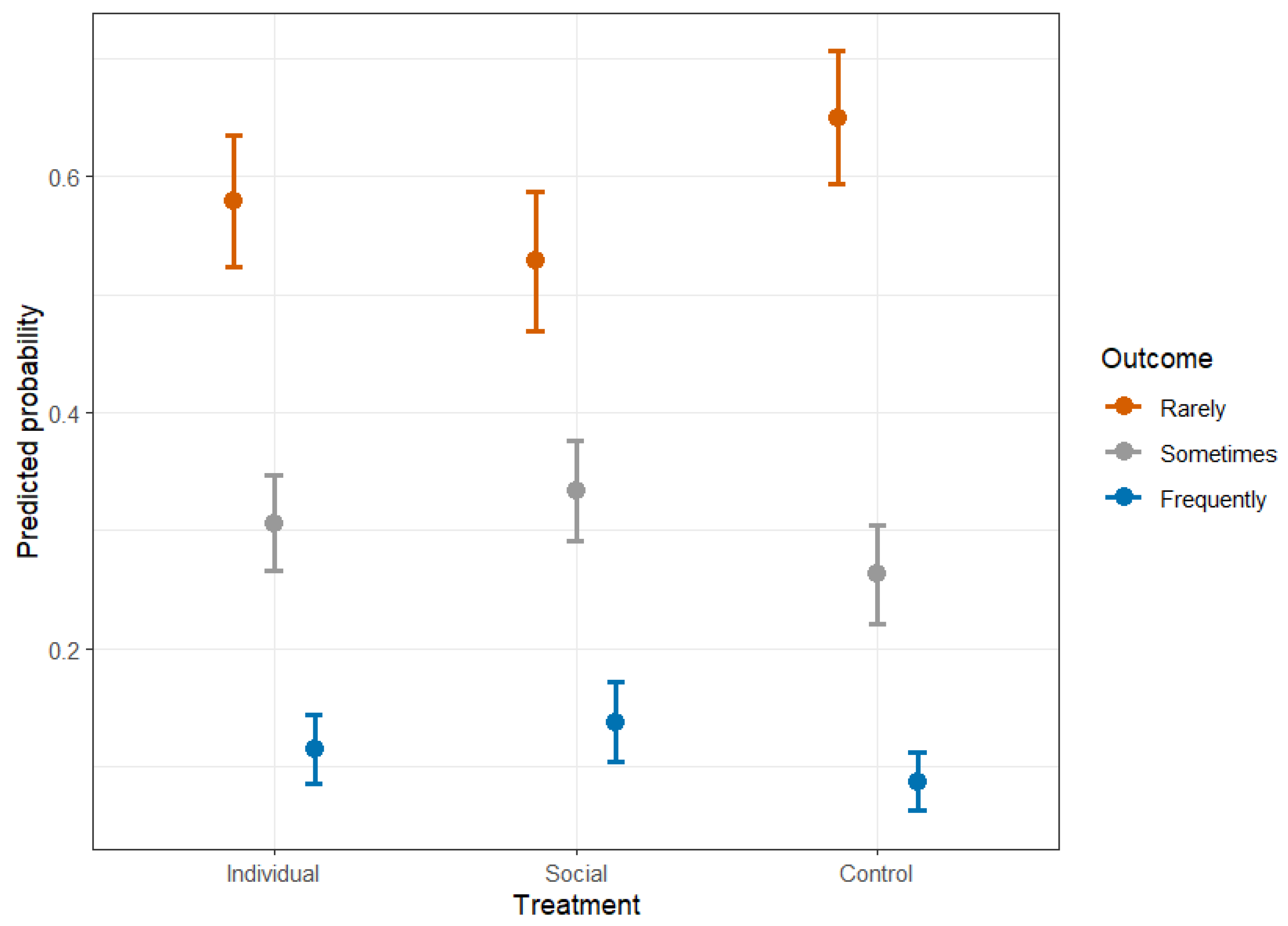
Figure 6 reports the results of a Chi-square test, which indicates that responses differ statistically across treatment groups. Interestingly, 65% of respondents in the control group reported having printed tickets on recent occasions, compared with 57% of those in the social treatment group and 54% in the individual one. However, while only 9% of respondents in both the control and social groups declared printing ‘frequently’, the percentage rises to 16% among participants in the individual group.
Figure 6.
Analysis of preferences towards printing.
A possible explanation is that the information provided through the vignettes prompted students to reassess what they perceive as wasteful paper use through a more critical and self-reflective lens, making treated individuals less likely to report that their printing behaviour occurred “rarely”.
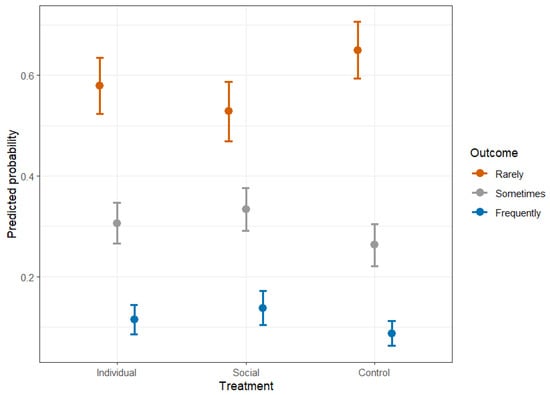
As shown in Figure 7, this result points in the same direction when looking at the estimation of predicted probabilities through an ordered logit model. As can be observed when focusing on the control group, statistically significant differences emerge when it is compared to the social treatment, unlike what occurs when it is compared to the individual treatment.
Figure 7.
Predicted probabilities by treatment for the amount of print estimated through an ordered logit model (LogLik = −721.14; AIC = 1466.29; Brant Test: = 10.877; p-value = 0.367).
Once again, the statistically significant differences suggest that, when provided with information about the social impacts of paper consumption, students tend to report making less parsimonious use of printing. As will be discussed in Section 6, this may indicate that students exposed to the social treatment are more inclined to reassess their consumption in a more conscious and reflective manner. However, it is also necessary to consider the possibility that these findings may be partly driven by social desirability bias.
5.4. Insights About the Motivations for Preferring Paper or Electronic Devices
Having analysed which Italian adolescents are more likely to reduce their paper consumption and which arguments are most persuasive for them, we now turn to the motivations behind their preference for paper or electronic devices for writing and reading.
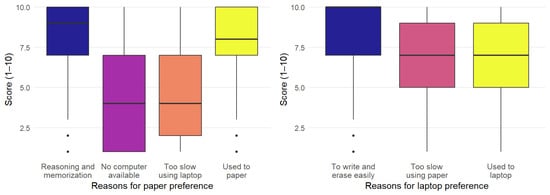
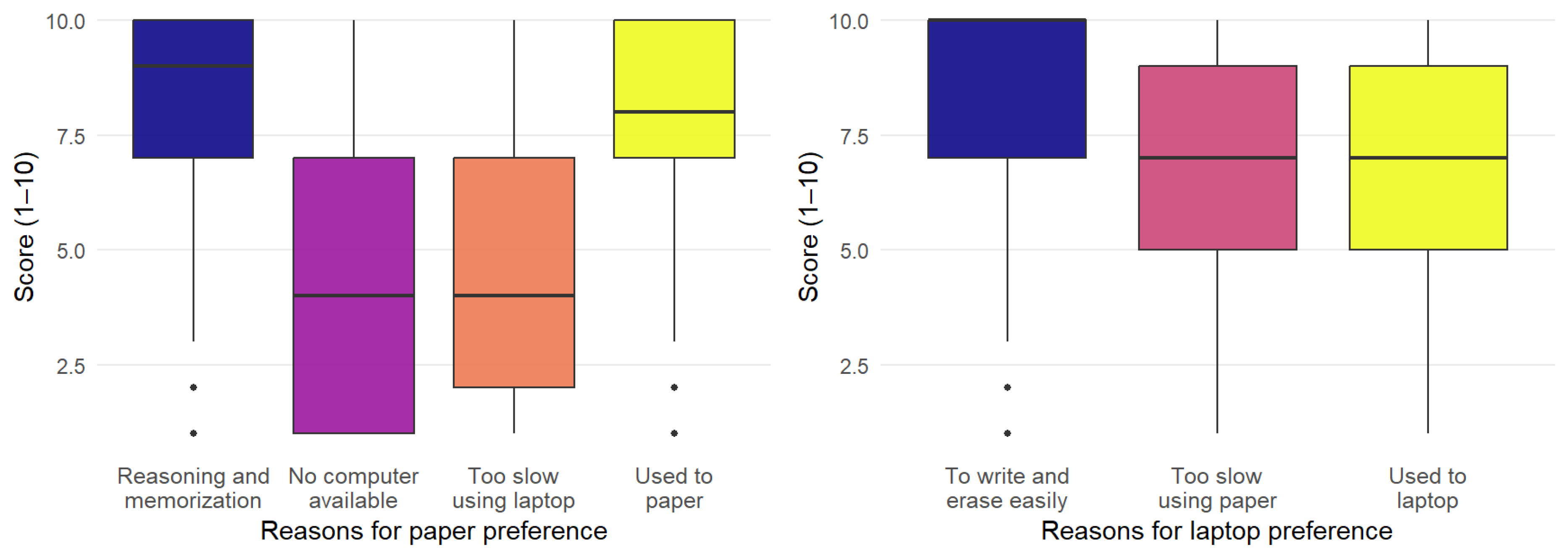
Figure 8 summarizes the results of two different questions included in the survey. The first question asked respondents who declared a preference for paper: “Why do you prefer writing on paper?” The second question was asked to students who preferred electronic devices: “Why do you prefer writing on a computer?” The first battery consists of four items, while the second includes three, and both are measured on a 0–10 scale.
Figure 8.
Boxplot of the answers to the questions: “Why do you prefer writing on paper?” (left) and “Why do you prefer writing on a computer? (right)”.
Looking at the left side of Figure 8, it is evident that the least relevant motivations for preferring paper concern the lack of access to electronic devices or insufficient skills in using them. This is unsurprising, considering that already well before 2010, an estimated 99% of households owned at least one television, 40–46% owned three or more different devices, and around 60% had Internet access [30,31]. Conversely, the main reasons for preferring paper relate to established habits and to perceived individual benefits in reasoning and memorization. Although this preference represents a less environmentally sustainable behaviour, such motivations remain noteworthy. Duncan and colleagues [68], for example, identify traditional extended-text reading as the only reading habit able to foster skilled comprehension, especially during adolescence, a life stage in which reading engagement is estimated to drop sharply compared to earlier years [69].
Turning to the right side of Figure 8, differences among motivations for preferring electronic devices appear less pronounced. Unsurprisingly, Italian high school students appreciate the ease of writing and deleting text when using computers, while assigning slightly lower importance to being too slow at handwriting or being overly accustomed to digital tools. These findings are encouraging, given that writing habits have implications for executive development, intelligence, and academic achievement [70], and that time spent writing digitally does not appear to be associated with increases in literacy levels [71].
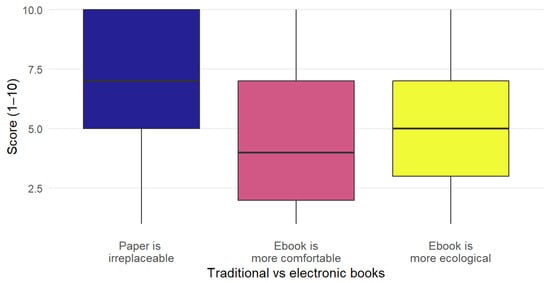
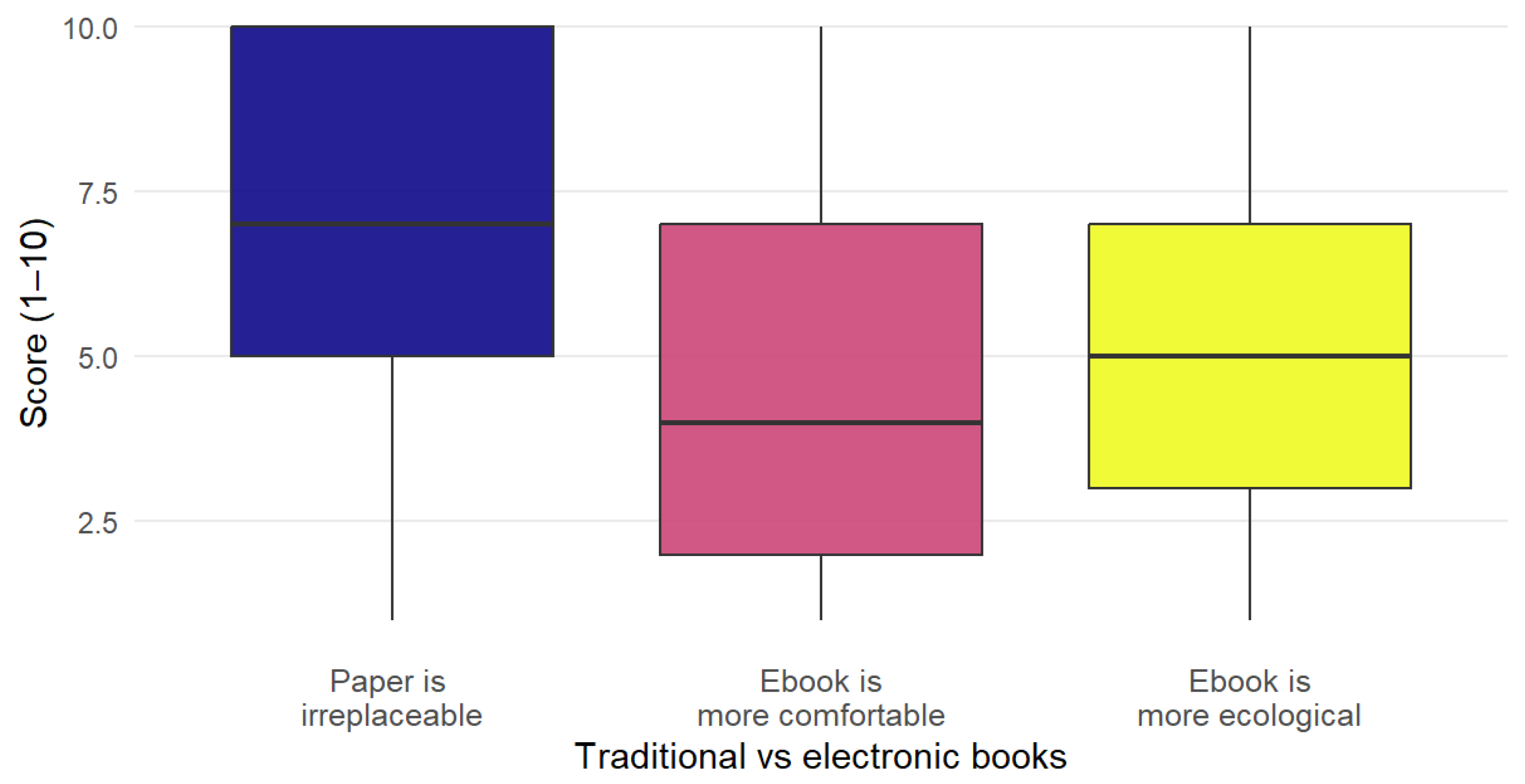
For the reasons mentioned above, the final question of the survey asked all respondents to rate, on a 0–10 scale, the main advantages of traditional and electronic books. As shown in Figure 9, the median score for the comfort and environmental advantages attributed to e-books reaches only around 5 out of 10, indicating a moderate level of appreciation. In contrast, students strongly endorse the value of traditional books for reading, rating their irreplaceability above 7 on the same scale. This suggests a persistent preference for printed books, despite widespread access to digital technologies.
Figure 9.
Boxplot of the answers to the question: “When you read a book for leisure, what do you prefer?”.
6. Discussion
This study provides evidence on Italian adolescents’ preferences for using electronic devices rather than printed paper in reading and writing activities. This trade-off differs from standard pro-environmental choices—such as reducing plastic consumption—because it involves additional cognitive, educational, and health-related considerations. While reducing paper use in favour of digital tools is generally encouraged, pedagogical research cautions against uncritical shifts toward digital tools among adolescents, given concerns related to prolonged screen exposure and the documented benefits of paper-based materials for learning processes [32,33,68,69].
Although the estimated effects are modest, the analysis offers informative insights into how adolescents process the paper–digital trade-off and helps identify directions for future research.
6.1. Individual Determinants of Preferences
Addressing RQ1, we examined the individual, social, and demographic factors associated with preferences for electronic devices over printed paper. Following Balundė et al. [25] and Žukauskienė et al. [39], HP1 anticipated that preferences for electronic media would be associated with parental background and self-awareness, the latter capturing pro-environmental personal norms [27]. Although this hypothesis is not fully supported by statistically significant evidence, the analysis still provides informative insights into the relevance of these dimensions. In contrast, gender differences emerge as robust and statistically meaningful.
6.1.1. Education and Family Background
Preference for electronic devices is positively associated with parental university education. This pattern is weaker—or even reversed—among students enrolled in vocational or professionally oriented institutes, where digital literacy may be less central to educational pathways. The emerging conclusion is that adolescents’ willingness to replace printed paper with technological devices is closely linked both to the cultural background of their family and to the educational track in which they are enrolled—particularly in Lyceums, which represent the academic stream of the Italian school system. However, when students in the residual school category are exposed to the social-information treatment, a positive effect appears, suggesting that this group is particularly responsive to biospheric–social values.
6.1.2. Individual Attitudes: Attention and Health
Our analysis also examined whether individual psychological attitudes towards health play a role in shaping students’ willingness to prefer electronic devices over paper. To this end, we construct two indicators: the first measures self-perceived Awareness of environmental issues; the second captures self-assessed Attention to physical and mental health, as well as overall well-being.
Contrary to expectations, perceived environmental awareness shows no association with the preference for writing on electronic devices, and even in the hypothetical case of significance, its estimated coefficient is consistently negative. Furthermore, any interaction between this indicator and other covariates is discarded through the AIC-based stepwise selection, suggesting that environmental awareness plays no meaningful role in the present context. Adolescents do not perceive the trade-off between paper and digital tools as an environmental issue but rather as a contemporary challenge associated with learning processes and mental health concerns. Consequently, ecological awareness does not seem to enter the decision-making process when choosing between the two modes of writing under study.
Consistent with this interpretation, the attention-to-health indicator is likewise statistically insignificant, with the sole exception of its interaction with having at least one university-educated parent. This finding underscores the need for further research to examine how growing up in a highly educated family, in combination with a stronger emphasis on health and well-being, reduces the likelihood of preferring electronic devices for writing activities.
6.1.3. Gender Differences
Gender differences present robust findings. Across all specifications, girls display a significantly lower propensity to prefer digital devices for writing. Moreover, as shown by Model 3 in Table 2, the interaction between gender and the treatments is excluded by the AIC-based stepwise selection procedure, indicating that this effect is robust and not driven by external interventions. This pattern is consistent with a substantial body of literature documenting persistent gender gaps in the use of technological tools, generally to the disadvantage of girls. While existing research highlights that excessive device use may hinder boys’ learning and that girls may face reduced professional development opportunities due to disadvantages in technology-related skills [72,73,74], our findings point to an additional concern: girls may also be less likely to adopt PEBs linked to reduced paper consumption.
6.2. Evaluation of Treatments’ Efficacy
Even if Italian adolescents in our sample tend to favour the use of paper for writing activities, many of them alternate between paper and digital tools. Overall, our sample is almost evenly divided between those who prefer paper-based tools and those who favour digital devices for their common reading and writing activities. Notably, the proportion of students who prefer electronic devices exceeds 50% only when they are exposed to the socio-environmental treatment.
Turning to RQ2, we assessed whether different informational framings influence adolescents’ stated preferences. Several studies have demonstrated that socially framed messages are more effective in motivating PEB, including among adolescents [29,48,49]. In line with HP2, socially framed messages are associated with a higher propensity to prefer electronic devices than individually framed messages, although differences relative to the control group remain limited. This pattern suggests that the paper–digital trade-off is not a typical pro-environmental choice, as preferences are strongly influenced by considerations related to learning outcomes and personal well-being. In this context, the weak treatment effects are themselves informative: sustainability-based messages appear insufficient when the choice involves cognitive demands or identity-related implications.
Students in our sample appear to respond more strongly to the treatments only when asked to reflect on how often they print event tickets, which we consider a proxy for unnecessary and avoidable printing in contemporary society. In this case, the treatments reduce the proportion of young people reporting that they “rarely” print such tickets. From this perspective, the apparent absence of effects may only be superficial and therefore deserving of further investigation. One possible interpretation is that, when confronted with information about the consequences of paper waste, adolescents tend to reassess more critically the frequency with which they have engaged in avoidable printing. A set of alternative strategies along these lines is discussed in Section 6.4.
6.3. Motivations Underlying Preferences
Finally, addressing RQ3, we study the motivations underlying Italian adolescents’ preferences for either printed paper or electronic devices for reading and writing activities. Given the literature indicating that printed materials tend to support learning and cognitive development among young people, it is highly encouraging that students’ preference for paper does not stem from a lack of access to, or inability to use, digital devices. Rather, adolescents who favour paper report doing so because they perceive it as facilitating reasoning and memory processes. They also emphasise a long-standing familiarity with paper, which they regard as irreplaceable in providing the pleasure of reading, in partial contrast with HP3. Although this preference may be less advantageous from an ecological perspective, it aligns with previous evidence. Shibata and Omura [10] highlight the ideal-type of the sensory and affective experience associated with the “smell of paper”, while Mueller and Oppenheimer [75] show that handwriting facilitates learning by supporting deeper cognitive processing and long-term memory formation compared to typing. Similarly, studies on reading demonstrate that paper-based reading is associated with higher comprehension outcomes, in comparison to screen-based reading [76]. Similarly, students who prefer writing on a computer do not attribute this preference to any difficulty in working with paper, but instead to the ease of writing, editing, and correcting afforded by digital tools.
An important dimension underlying preferences for paper or digital tools in writing activities is habit formation, particularly in its interaction with educational background. From this perspective, students whose parents have lower levels of formal education are the only group in which less than 80% report a high degree of habituation to paper-based writing (scores of 6 or above on a 10-point scale), while at the same time exhibiting the lowest proportion of respondents declaring maximal habituation to paper (33% vs. 42% at least). By contrast, students with at least one graduate parent show a stronger polarisation towards very high familiarity with paper-based writing (89.5%).
A similar pattern emerges when considering school tracks. Students attending Lyceums display the highest levels of habituation to paper-based writing (88%), whereas familiarity with paper decreases progressively among students enrolled in technical and other non-academic tracks (84% and 76%, respectively). This finding is consistent with pedagogical theories that emphasise the role of paper as a particularly effective medium for learning, and with its continued centrality in more academically oriented educational pathways within the Italian school system.
Turning to digital tools, differences by parental education appear to be more limited, as around 65% of students report high levels of habituation to laptops regardless of their family background. Nevertheless, 29% of students from lower socio-economic backgrounds—compared with less than 24% in the other categories—are more likely to report maximal familiarity with digital tools, which may suggest that digital writing represents a comparatively more accessible and familiar resource in disadvantaged contexts.
These patterns are further reinforced by differences across school tracks: students attending Lyceums report lower levels of habituation to digital tools (58%) compared to their peers in technical or residual school categories (at least 69%). Taken together, these results can indicate that, during adolescence, paper-based writing may increasingly function as a relatively “elite” practice, more closely associated with academically oriented trajectories, while digital tools play a more prominent role in less academic and more vocational contexts. This distinction emerges as an additional promising avenue for further in-depth research.
6.4. Limitations and Future Steps
Some limitations must be acknowledged. First, although sizeable, the sample is not nationally representative and is partly shaped by the voluntary participation of schools. Nonetheless, schools already collaborating with digital foundations such as FMD may host students who are more predisposed towards digital tools. If this represents the direction of the potential selection bias, it would not undermine our findings. On the contrary, the inclusion of students who are, on average, more inclined towards digital tools would bias our estimates in a conservative direction, given that we observe slightly higher preferences for paper.
Second, we acknowledge that the vignette treatments are asymmetric in their emphasis on costs (social) and benefits (individual), although they are grounded in real-world news coverage. In addition, the vignette treatments may exert only a modest influence, and stronger or repeated interventions could produce different results. Third, the dichotomisation of the dependent variable, while justified for interpretability and parsimony, necessarily reduces some of the nuance inherent in the original scale. Fourth, and more importantly, the questionnaire relies on self-reported measures that are potentially affected by social desirability bias. If respondents infer the normative direction of the expected outcome, they may conceal their true preferences and overstate their propensity towards PEBs, particularly when socially framed arguments are presented. Last, we acknowledge that pre-treatment exposure to environmental issues may introduce some ambiguity in the control group by increasing awareness of these topics even among control participants. This mechanism may partly explain the limited effectiveness of the pro-environmental dimension of the social treatment.
Our initial investigation opens several directions for future research. In particular, further studies should explicitly test the persistence of observed effects over time, especially in contexts where social arguments are preferred to individual ones. Longitudinal designs could help assess whether stated preferences translate into stable behavioural changes or merely reflect short-term compliance with perceived social norms. Moreover, future research could incorporate behavioural or indirect measures that are less sensitive to social desirability, as well as experimental interventions implemented in classroom settings to evaluate the impact of stronger or repeated social framings on actual behaviour rather than self-declared intentions. Finally, more diversified vignettes, featuring a wider range of scenarios as treatments, together with a broader set of dependent variables capturing different usage preferences, should be implemented in order to account for the heterogeneous motivations underlying writing processes. These motivations vary substantially, depending on whether writing involves simple note-taking or the production of complex and structured texts, but also among different scenarios requiring writing and/or printing activities. Future research should therefore differentiate more clearly between types of writing activities, in line with the writing process model developed by Hayes [77].
7. Implications for Marketers and Educators
The findings of this study offer practical implications for stakeholders concerned with adolescents’ pro-environmental behaviours, including educators, marketers, and organisations promoting more sustainable consumption habits. Overall, preferences in the paper–digital trade-off appear to be driven more by socio-demographic characteristics and perceived cognitive benefits than by environmental awareness alone. This suggests that interventions aimed at reducing paper use among adolescents should be carefully targeted.
First, gender differences deserve attention. Girls in the sample show a consistently lower likelihood of preferring digital tools for writing. This pattern aligns with previously observed differences in technology usage. Communication strategies may therefore benefit from recognising that digital adoption is not uniform across genders and that some groups may require additional reassurance or support.
Second, distinctions between school tracks or parental education appear relevant. Students in Lyceums tend to be more inclined toward digital tools, whereas those in vocationally oriented schools show lower levels of digital adoption. However, students in these latter tracks seem relatively responsive to socially framed messages. Interventions may be more effective when aligned with the educational context and its typical digital exposure. In vocational contexts, where digital literacy may be less central to the curriculum, communication efforts could emphasise the relevance of digital skills for future employability. Moreover, our findings suggest that cultural background can play a nuanced role in shaping digital practices: it may encourage a more selective and health-conscious use of digital devices for specific activities, while at the same time supporting a wider—though critically mediated—engagement with digital tools.
Third, the framing of messages seems to play a role. Socially oriented messages show a modest but consistent advantage over individually framed ones. Communication campaigns may therefore consider placing greater emphasis on the shared consequences of excessive paper use, rather than solely focusing on personal benefits. Given adolescents’ sensitivity to social norms, peer dynamics, and trend-related signals, interventions that present sustainable choices as both socially expected and increasingly prevalent among relevant peer groups are likely to be more credible and motivating.
Replacing paper with digital tools may involve perceived cognitive barriers. Many students report that paper supports reasoning, memory, and reading enjoyment. From the perspective of behavioural science, these perceptions can be interpreted through the effort–quality heuristic: students assume that what requires more effort (i.e., handwriting) produces higher-quality outcomes (e.g., deeper learning). The presence of such identity-based barriers means that simply promoting digital tools on environmental grounds will not suffice, and simple “digital-by-default” policies are not supported. Nuanced strategies are needed, recognising different student groups, relying on socially anchored communication, and remaining sensitive to the cognitive and pedagogical functions that adolescents associate with paper-based practices.
Author Contributions
Conceptualization, G.L. and A.M.; methodology, G.L. and A.M.; software, G.L.; formal analysis, G.L.; investigation, G.L., A.M., E.S. and F.G.; data curation, G.L., A.M. and E.S.; writing—original draft preparation, G.L. and A.M.; writing—review and editing, A.M., E.S., P.P. and F.G.; visualization, G.L. and A.M.; supervision, P.P.; funding acquisition, P.P. and A.M. All authors have read and agreed to the published version of the manuscript.
Funding
P.P. acknowledges funds from PRIN grants P20228SXNF and 2022389MRW financed by the Italian Ministry of Research. A.M. acknowledges funding from FIN-RIC grant by Universitas Mercatorum.
Institutional Review Board Statement
This study was approved by the Ethics Committee for Research in the Human and Social Sciences (CAREUS), https://en.unisi.it/research/ethics-committee-research-human-and-social-sciences-careus (accessed 18 February 2026) of the University of Siena (Parere n. 39/2021).
Informed Consent Statement
Informed consent was obtained from all subjects involved in the study.
Data Availability Statement
The data that support the findings of this study are available upon request from the corresponding author, A.M.
Acknowledgments
The authors deeply thank Fondazione Mondo Digitale for their precious support.
Conflicts of Interest
Author Francesca Garbin was employed by the company RBB Economics. The remaining authors declare that the research was conducted in the absence of any commercial or financial relationships that could be construed as a potential conflict of interest.
Abbreviations
The following abbreviations are used in this manuscript:
| PEB | Pro-Environmental Behaviour |
| PLO | Paperless Office |
| SDG | Sustainable Development Goal |
| FMD | Fondazione Mondo Digitale |
| AIC | Akaike Information Criteria |
Appendix A. Text of the Survey
Table A1.
Text of the survey before the randomization, i.e., before the vignettes are shown to the subjects.
Table A2.
Text of the survey after the treatment, i.e., after randomization and visualization of the vignettes.
References
- United Nations. The Sustainable Development Goals Report 2025. 2025. Available online: https://unstats.un.org/sdgs/report/2025/The-Sustainable-Development-Goals-Report-2025.pdf (accessed on 3 December 2025).
- United Nations. SDG 13: Climate Action. 2025. Available online: https://globalgoals.org/goals/13-climate-action/ (accessed on 3 December 2025).
- United Nations. SDG 15: Life on Land. 2025. Available online: https://globalgoals.org/goals/15-life-on-land/ (accessed on 3 December 2025).
- Isaev, N.; Clark, M.R.; Davidson, D.J. Assessing Opportunities and Constraints in Campus Sustainability. The Role of Paper Consumption. Sustain. J. Rec. 2010, 3, 171–177. [Google Scholar]
- Oo, K.T.; Jonah, K.; Thin, M.M.Z. A systematic review of the pros and cons of digital pollution and its impact on the environment. J. Sustain. Environ. Manag. 2023, 2, 61–73. [Google Scholar] [CrossRef] [Scilit]
- Alcott, B. Jevons’ paradox. Ecol. Econ. 2005, 54, 9–21. [Google Scholar] [CrossRef] [Scilit]
- Sopha, B.M. Sustainable paper consumption: Exploring behavioral factors. Soc. Sci. 2013, 2, 270–283. [Google Scholar] [CrossRef] [Scilit]
- York, R.; McGee, J.A. Understanding the Jevons paradox. Environ. Sociol. 2016, 2, 77–87. [Google Scholar] [CrossRef] [Scilit]
- Shah, I.A.; Amjed, S.; Alhamar Alkathiri, N. The economics of paper consumption in offices. J. Bus. Econ. Manag. JBEM 2019, 20, 43–62. [Google Scholar] [CrossRef] [Scilit]
- Shibata, H.; Omura, K. Why Digital Displays Cannot Replace Paper. In The Cognitive Science of Media for Reading and Writing; Springer: Singapore, 2020. [Google Scholar] [CrossRef] [Scilit]
- Moberg, Å.; Johansson, M.; Finnveden, G.; Jonsson, A. Printed and tablet e-paper newspaper from an environmental perspective—A screening life cycle assessment. Environ. Impact Assess. Rev. 2010, 30, 177–191. [Google Scholar] [CrossRef] [Scilit]
- Berkhout, F.; Hertin, J. De-materialising and re-materialising: Digital technologies and the environment. Futures 2004, 36, 903–920. [Google Scholar] [CrossRef] [Scilit]
- Coroama, V.C.; Moberg, Å.; Hilty, L.M. Dematerialization through electronic media? In ICT Innovations for Sustainability; Springer: Berlin/Heidelberg, Germany, 2014; pp. 405–421. [Google Scholar]
- Florence, E.S.; Fleischman, D.; Mulcahy, R.; Wynder, M. Message framing effects on sustainable consumer behaviour: A systematic review and future research directions for social marketing. J. Soc. Mark. 2022, 12, 623–652. [Google Scholar] [CrossRef] [Scilit]
- Ajzen, I. The theory of planned behavior. Organ. Behav. Hum. Decis. Process. 1991, 50, 179–211. [Google Scholar] [CrossRef] [Scilit]
- Oyserman, D. Identity-based motivation. Emerg. Trends Soc. Behav. Sci. 2015, 38, 1–11. [Google Scholar]
- Bazzani, G. Futures in action: Expectations, imaginaries and narratives of the future. Sociology 2023, 57, 382–397. [Google Scholar] [CrossRef] [Scilit]
- Denault, A.S.; Bouchard, M.; Proulx, J.; Poulin, F.; Dupéré, V.; Archambault, I.; Lavoie, M.D. Predictors of pro-environmental behaviors in adolescence: A scoping review. Sustainability 2024, 16, 5383. [Google Scholar] [CrossRef] [Scilit]
- Muscillo, A.; Lombardi, G.; Sestini, E.; Garbin, F.; Tambone, V.; Campanozzi, L.L.; Pin, P. Adolescents’ opinions on COVID-19 vaccine hesitancy: Hints toward enhancing pandemic preparedness in the future. Vaccines 2023, 11, 967. [Google Scholar] [CrossRef] [Scilit]
- List, J.A.; Petrie, R.; Samek, A. How experiments with children inform economics. J. Econ. Lit. 2023, 61, 504–564. [Google Scholar] [CrossRef] [Scilit]
- Sestini, E.; Muscillo, A.; Lombardi, G.; Garbin, F.; Pin, P. Enhancing Institutional Trust: Evidence from an Experimental Study with Adolescents in Italy. Soc. Indic. Res. 2025, 177, 449–488. [Google Scholar] [CrossRef] [Scilit]
- Brocas, I.; Carrillo, J.D. Introduction to special issue “understanding cognition and decision making by children.” studying decision-making in children: Challenges and opportunities. J. Econ. Behav. Organ. 2020, 179, 777–783. [Google Scholar] [CrossRef] [Scilit]
- Lee, K.; Gjersoe, N.; O’neill, S.; Barnett, J. Youth perceptions of climate change: A narrative synthesis. Wiley Interdiscip. Rev. Clim. Change 2020, 11, e641. [Google Scholar] [CrossRef] [Scilit]
- Lisboa, P.V.; Gómez-Román, C.; Guntín, L.; Monteiro, A.P. Pro-environmental behavior, personality and emotional intelligence in adolescents: A systematic review. Front. Psychol. 2024, 15, 1323098. [Google Scholar] [CrossRef] [Scilit]
- Balundė, A.; Jovarauskaitė, L.; Poškus, M.S. Exploring adolescents’ waste prevention via value-identity-personal norm and comprehensive action determination models. J. Environ. Psychol. 2020, 72, 101526. [Google Scholar] [CrossRef] [Scilit]
- Grønhøj, A.; Thøgersen, J. Why young people do things for the environment: The role of parenting for adolescents’ motivation to engage in pro-environmental behaviour. J. Environ. Psychol. 2017, 54, 11–19. [Google Scholar] [CrossRef] [Scilit]
- Collado, S.; Staats, H.; Sancho, P. Normative influences on adolescents’ self-reported pro-environmental behaviors: The role of parents and friends. Environ. Behav. 2019, 51, 288–314. [Google Scholar] [CrossRef] [Scilit]
- Henriks, S. Climate Change Mitigation Policies and Personal Cost: Are Young People More Willing to Bear the Cost for a Greener Tomorrow? Master’s Thesis, Lund University, Lund, Sweden, 2022. [Google Scholar]
- Koessler, A.K.; Vorlaufer, T.; Fiebelkorn, F. Social norms and climate-friendly behavior of adolescents. PLoS ONE 2022, 17, e0266847. [Google Scholar] [CrossRef] [Scilit] [PubMed]
- Subrahmanyam, K.; Greenfield, P.; Kraut, R.; Gross, E. The impact of computer use on children’s and adolescents’ development. J. Appl. Dev. Psychol. 2001, 22, 7–30. [Google Scholar] [CrossRef] [Scilit]
- Rey-López, J.P.; Vicente-Rodriguez, G.; Ortega, F.B.; Ruiz, J.R.; Martinez-Gómez, D.; De Henauw, S.; Manios, Y.; Molnar, D.; Polito, A.; Verloigne, M.; et al. Sedentary patterns and media availability in European adolescents: The HELENA study. Prev. Med. 2010, 51, 50–55. [Google Scholar] [CrossRef] [Scilit]
- Hysing, M.; Pallesen, S.; Stormark, K.M.; Jakobsen, R.; Lundervold, A.J.; Sivertsen, B. Sleep and use of electronic devices in adolescence: Results from a large population-based study. BMJ Open 2015, 5, e006748. [Google Scholar] [CrossRef] [Scilit]
- Ichhpujani, P.; Singh, R.B.; Foulsham, W.; Thakur, S.; Lamba, A.S. Visual implications of digital device usage in school children: A cross-sectional study. BMC Ophthalmol. 2019, 19, 76. [Google Scholar] [CrossRef] [Scilit]
- Loh, C.E.; Sun, B. “I’d still prefer to read the hard copy”: Adolescents’ print and digital reading habits. J. Adolesc. Adult Lit. 2019, 62, 663–672. [Google Scholar] [CrossRef] [Scilit]
- Kim, H.; Kim, J. Reading from an LCD monitor versus paper: Teenagers’ reading performance. Int. J. Res. Stud. Educ. Technol. 2013, 2, 1–10. [Google Scholar] [CrossRef] [Scilit]
- Merga, M.K. Do adolescents prefer electronic books to paper books? Publications 2015, 3, 237–247. [Google Scholar] [CrossRef] [Scilit]
- Rutherford, L.; Singleton, A.; Derr, L.A.; Merga, M.K. Do digital devices enhance teenagers’ recreational reading engagement? Issues for library policy from a recent study in two Australian states. Public Libr. Q. 2018, 37, 318–340. [Google Scholar] [CrossRef] [Scilit]
- Kristjánsson, S.J. Understanding Responsible Consumption: To Reduce Waste and Foster Sustainable Consumption Habits Among Adolescents. Master’s Thesis, University of Iceland, Reykjavík, Iceland, 2020. Available online: https://skemman.is/bitstream/1946/36835/5/Final_Thesis_StacyJKristjansson.pdf (accessed on 18 February 2026).
- Žukauskienė, R.; Truskauskaitė-Kunevičienė, I.; Gabė, V.; Kaniušonytė, G. “My words matter”: The role of adolescents in changing pro-environmental habits in the family. Environ. Behav. 2021, 53, 1140–1162. [Google Scholar] [CrossRef] [Scilit]
- Cornelius, M.; Armel, K.C.; Hoffman, K.; Allen, L.; Bryson, S.W.; Desai, M.; Robinson, T.N. Increasing energy-and greenhouse gas-saving behaviors among adolescents: A school-based cluster-randomized controlled trial. Energy Effic. 2014, 7, 217–242. [Google Scholar] [CrossRef] [Scilit]
- Marc, M. Teens and Nature. In Proceedings of the 14th International Scientific & Business Conference Social Responsibility and Current Challenges 2019: Social Responsibility: Development, Applications and Impact Measurement, Maribor, Slovenia, 20–21 June 2019; pp. 1–8. [Google Scholar]
- Prescott, M.P.; Burg, X.; Metcalfe, J.J.; Lipka, A.E.; Herritt, C.; Cunningham-Sabo, L. Healthy planet, healthy youth: A food systems education and promotion intervention to improve adolescent diet quality and reduce food waste. Nutrients 2019, 11, 1869. [Google Scholar] [CrossRef] [Scilit]
- Kulyk, P.; Kaźmierczak-Piwko, L.; Dybikowska, A.; Dubicki, P. Sustainable Consumption among Children in the Aspect of Waste Management. Sci. Pap. Silesian Univ. Technol. Organ. Manag. 2023, 18. [Google Scholar] [CrossRef] [Scilit]
- Tversky, A.; Kahneman, D. The framing of decisions and the psychology of choice. Science 1981, 211, 453–458. [Google Scholar] [CrossRef] [Scilit]
- Atzmüller, C.; Steiner, P.M. Experimental vignette studies in survey research. Methodology 2010, 6, 128–138. [Google Scholar] [CrossRef] [Scilit]
- Hoffmann, R.; Kanitsar, G.; Seifert, M. Behavioral barriers impede pro-environmental decision-making: Experimental evidence from incentivized laboratory and vignette studies. Ecol. Econ. 2024, 225, 108347. [Google Scholar] [CrossRef] [Scilit]
- Blöbaum, A.; Bamberg, S.; Kösling, P.; Schmidt, K. Experimental Vignette Methodology: A Cost-Effective Approach for Testing the Energy Saving Effects of Psychological Interventions? Environ. Behav. 2025, 57, 476–513. [Google Scholar] [CrossRef] [Scilit]
- Urban, J.; Bahník, Š.; Braun Kohlová, M. Pro-environmental behavior triggers moral inference, not licensing by observers. Environ. Behav. 2023, 55, 74–98. [Google Scholar] [CrossRef] [Scilit]
- Kim, E.; Moon, M.J.; Park, S.Y. Impact of public information campaign on citizen behaviors: Vignette experimental study on recycling program in South Korea. Rev. Policy Res. 2025, 42, 1008–1021. [Google Scholar] [CrossRef] [Scilit]
- Damphousse, K.; Kaplan, H.B. Intervening processes between adolescent drug use and psychological distress: An examination of the self-medication hypothesis. Soc. Behav. Personal. Int. J. 1998, 26, 115–130. [Google Scholar] [CrossRef] [Scilit]
- Hong, J.S.; Hsieh, Y.P.; Clary, K.L.; Theda, R.; Russ, R.; Voisin, D.R. Peer victimization, internalizing problems, and substance use in urban African American adolescents in Chicago: The relevance of the self-medication hypothesis. Violence Vict. 2019, 34, 850. [Google Scholar] [CrossRef] [Scilit]
- Chan, L.L.; Idris, N. Validity and reliability of the instrument using exploratory factor analysis and Cronbach’s alpha. Int. J. Acad. Res. Bus. Soc. Sci. 2017, 7, 400–410. [Google Scholar]
- Krettenauer, T. Pro-environmental behavior and adolescent moral development. J. Res. Adolesc. 2017, 27, 581–593. [Google Scholar] [CrossRef] [Scilit]
- Habitante.it. Come Ridurre il Consumo di Carta: Consigli Pratici. 2019. Available online: https://www.habitante.it/come-ridurre-il-consumo-di-carta-consigli-pratici/?cli_action=1647267438.098 (accessed on 23 November 2025).
- Clinton, V. Reading from paper compared to screens: A systematic review and meta-analysis. J. Res. Read. 2019, 42, 288–325. [Google Scholar] [CrossRef] [Scilit]
- Trope, Y.; Liberman, N. Construal-level theory of psychological distance. Psychol. Rev. 2010, 117, 440. [Google Scholar] [CrossRef] [Scilit] [PubMed]
- Shah, A.D.; Bartlett, J.W.; Carpenter, J.; Nicholas, O.; Hemingway, H. Comparison of random forest and parametric imputation models for imputing missing data using MICE: A CALIBER study. Am. J. Epidemiol. 2014, 179, 764–774. [Google Scholar] [CrossRef] [Scilit] [PubMed]
- Tang, F.; Ishwaran, H. Random forest missing data algorithms. Stat. Anal. Data Min. ASA Data Sci. J. 2017, 10, 363–377. [Google Scholar] [CrossRef] [Scilit]
- Hong, S.; Lynn, H.S. Accuracy of random-forest-based imputation of missing data in the presence of non-normality, non-linearity, and interaction. BMC Med Res. Methodol. 2020, 20, 199. [Google Scholar] [CrossRef] [Scilit]
- Yamashita, T.; Yamashita, K.; Kamimura, R. A stepwise AIC method for variable selection in linear regression. Commun. Stat. Methods 2007, 36, 2395–2403. [Google Scholar] [CrossRef] [Scilit]
- Cantalini, S.; Panichella, N.; Pietrolucci, A.; Triventi, M. Regional disparities, geographical marginality, and educational pathways: A study on upper secondary education in Italy. Soc. Incl. 2025, 13, 9555. [Google Scholar] [CrossRef] [Scilit]
- Lombardi, G.; Cipriano, R.; Ghellini, G. Exploring the predictive power of standardized assessments and non-standardized evaluations on Italian university freshpeople’s performance. In INVALSI Data in Educational Research-VII Seminar “INVALSI Data: A tool for Teaching and Scientific Research”; Franco Angeli: Rome, Italy, 2025; pp. 103–125. [Google Scholar]
- Casaló, L.V.; Escario, J.J. Heterogeneity in the association between environmental attitudes and pro-environmental behavior: A multilevel regression approach. J. Clean. Prod. 2018, 175, 155–163. [Google Scholar] [CrossRef] [Scilit]
- Cavaliere, A.; De Marchi, E.; Banterle, A. Exploring the adherence to the Mediterranean diet and its relationship with individual lifestyle: The role of healthy behaviors, pro-environmental behaviors, income, and education. Nutrients 2018, 10, 141. [Google Scholar] [CrossRef] [Scilit]
- Hoffmann, R.; Muttarak, R. Greening through schooling: Understanding the link between education and pro-environmental behavior in the Philippines. Environ. Res. Lett. 2020, 15, 014009. [Google Scholar] [CrossRef] [Scilit]
- Smith, T.J.; McKenna, C.M. A comparison of logistic regression pseudo R2 indices. Gen. Linear Model J. 2013, 39, 17–26. [Google Scholar]
- Lumley, T. Pseudo-R2 statistics under complex sampling. Aust. N. Z. J. Stat. 2017, 59, 187–194. [Google Scholar] [CrossRef] [Scilit]
- Duncan, L.G.; McGeown, S.P.; Griffiths, Y.M.; Stothard, S.E.; Dobai, A. Adolescent reading skill and engagement with digital and traditional literacies as predictors of reading comprehension. Br. J. Psychol. 2016, 107, 209–238. [Google Scholar] [CrossRef] [Scilit] [PubMed]
- Wilkinson, K.; Andries, V.; Howarth, D.; Bonsall, J.; Sabeti, S.; McGeown, S. Reading during adolescence: Why adolescents choose (or do not choose) books. J. Adolesc. Adult Lit. 2020, 64, 157–166. [Google Scholar] [CrossRef] [Scilit]
- Salem, A.A.G.G.; Ferreira da Silva, P.; Felizardo, D.; Holz, M.R.; Fonseca, R.P. Does the frequency of reading and writing habits contribute to executive functions, intelligence, and learning in adolescents with healthy development? Appl. Neuropsychol. Child 2023, 12, 34–44. [Google Scholar] [CrossRef] [Scilit]
- Zebroff, D.; Kaufman, D. Texting, reading, and other daily habits associated with adolescents’ literacy levels. Educ. Inf. Technol. 2017, 22, 2197–2216. [Google Scholar] [CrossRef] [Scilit]
- Drabowicz, T. Gender and digital usage inequality among adolescents: A comparative study of 39 countries. Comput. Educ. 2014, 74, 98–111. [Google Scholar] [CrossRef] [Scilit]
- Qazi, A.; Hasan, N.; Abayomi-Alli, O.; Hardaker, G.; Scherer, R.; Sarker, Y.; Kumar Paul, S.; Maitama, J.Z. Gender differences in information and communication technology use & skills: A systematic review and meta-analysis. Educ. Inf. Technol. 2022, 27, 4225–4258. [Google Scholar]
- Yildiz, A.; Varsak, S. Gender Differences in Technological Device Usage Times of Secondary School Students. In Proceedings of the 4th International Conference on Frontiers in Academic Research, Conference Presentation, Konya, Turkey, 13–14 December 2024. [Google Scholar]
- Mueller, P.A.; Oppenheimer, D.M. The pen is mightier than the keyboard: Advantages of longhand over laptop note taking. Psychol. Sci. 2014, 25, 1159–1168. [Google Scholar] [CrossRef] [Scilit]
- Delgado, P.; Vargas, C.; Ackerman, R.; Salmerón, L. Don’t throw away your printed books: A meta-analysis on the effects of reading media on reading comprehension. Educ. Res. Rev. 2018, 25, 23–38. [Google Scholar] [CrossRef] [Scilit]
- Hayes, J.R. Modeling and remodeling writing. Writ. Commun. 2012, 29, 369–388. [Google Scholar] [CrossRef] [Scilit]

Disclaimer/Publisher’s Note: The statements, opinions and data contained in all publications are solely those of the individual author(s) and contributor(s) and not of MDPI and/or the editor(s). MDPI and/or the editor(s) disclaim responsibility for any injury to people or property resulting from any ideas, methods, instructions or products referred to in the content. |
© 2026 by the authors. Licensee MDPI, Basel, Switzerland. This article is an open access article distributed under the terms and conditions of the Creative Commons Attribution (CC BY) license.