


Abstract
Institutional quality and globalization are crucial in influencing both the prevalence and quality of sustainable entrepreneurial ecosystems within an economy. This study examines the relationship between Opportunity-Driven Entrepreneurship (ODE); entrepreneurial quality, as measured by the Motivational Index (MI), and institutional quality, assessed through economic freedom and governance, in high- and middle-income countries. It also examines how globalization impacts both ODE and MI in these country groups. Using data from the Global Entrepreneurship Monitor (GEM) and combined indices of economic freedom, governance, and globalization, the study analyzes an unbalanced panel dataset comprising 64 countries from 2004 to 2018. Estimation is performed using the Robust Least Squares (RLS) method. The findings show that economic freedom has a positive and significant effect on both ODE and MI across high- and middle-income countries. In contrast, governance has a significant impact on ODE and MI only in high-income countries. Globalization exerts a negative influence on ODE across both income groups, with the adverse effect being more pronounced in middle-income countries. Conversely, its effect on MI is positive in middle-income countries but shows no significant influence in high-income economies. The study offers valuable insights for economists, policymakers, and scholars interested in the forces that shape ODE.
1. Introduction
Entrepreneurship has attracted considerable attention from academics and policymakers over the past few decades, as it is one of the main drivers of economic development. Entrepreneurship promotes economic growth by recognizing and exploiting new opportunities, often through innovative products, services, or business models [1]. The formation of new ventures is a crucial aspect of the entrepreneurial process, with numerous studies highlighting its significant impact on improving financial performance. Schumpeter [2] describes various entrepreneurial traits by identifying entrepreneurs whose actions drive creative destruction, shifting the economy from one equilibrium to a more advanced and improved stage through their innovative efforts. Therefore, fostering a strong entrepreneurial culture becomes a critical factor, not only for economic growth but also for advancing long-term, innovation-led sustainable development.
However, Wennekers et al. [3] argue that entrepreneurial activities do not always lead to innovation or generate economic value and Baumol [4] asserts that some entrepreneurial efforts are not directly linked to growth or development. These variations depend largely on the motivations that drive individuals to start businesses. The Global Entrepreneurship Monitor (GEM) distinguishes these motives through Opportunity-Driven Entrepreneurship (ODE) and the Motivational Index (MI). ODE represents entrepreneurs who voluntarily pursue opportunities, motivated by positive “pull” factors such as achievement, autonomy, and innovation, while necessity-driven entrepreneurs are “pushed” into self-employment due to limited alternatives, such as unemployment or job dissatisfaction.
Opportunity-driven entrepreneurs generally outperform their necessity-driven counterparts, particularly in innovation, business growth, and job creation. Traits such as ambition, proactive opportunity recognition, and a growth mindset which are core characteristics typically possessed by opportunity-driven entrepreneurs are strongly linked to higher firm survival, increased income, and greater employment generation [5]. The MI complements ODE by capturing the ratio of opportunity-driven to necessity-driven entrepreneurship, serving as an indicator of the quality and sustainability potential of entrepreneurial activity. Higher ODE and MI levels are typically associated with economies aligned with SDG 8 (decent work and economic growth) and SDG 9 (industry, innovation, and infrastructure), reflecting entrepreneurship’s central role in fostering innovation and sustainable economic transformation.
While prior studies underscore the significance of ODE for economic development [6,7,8], much of the literature remains focused on individual-level determinants such as personality, motivation, and risk perception [9], providing a limited view of how external environments shape entrepreneurial quality. Therefore, this focus has allowed for sufficient recognition to identify the significance of the institutional and economic environment. Boudreaux and Caudill [10] argue that the growth effects of entrepreneurship depend on the level of economic development: ODE tends to stimulate growth in high-income economies, while necessity-based entrepreneurship can constrain it in lower- or middle-income contexts. Therefore, this study examines entrepreneurship through the lens of institutional variation and income-level differentiation, highlighting how political institutions, economic freedom, and globalization collectively influence entrepreneurial outcomes across diverse country contexts. As globalization changes markets and accelerates cross-border knowledge flows, the way it interacts with institutional quality plays a critical role in determining whether economies convert global integration into opportunity-driven, innovation-based entrepreneurship or rely on necessity-driven activities.
Consequently, this research employs a broader perspective by investigating both ODE and MI as complementary indicators of sustainable entrepreneurship, capturing differences in entrepreneurial intent and quality. It further explores how institutional quality, economic freedom, and globalization influence these dimensions across income groups, thereby identifying the enabling conditions, consistent with SDG 16 (peace, justice, and strong institutions), that allow economies to transition toward higher-quality, innovation-driven, and sustainability-orientated entrepreneurship. This dual focus offers a more profound understanding of how institutional and global forces foster resilient, future-driven entrepreneurial ecosystems.
Institutions represent “human-made constraints that structure political, economic, and social interactions” [11]. Within this framework, political institutions are captured through governance quality indicators, which act as a formal system for organizing people and guiding their behavior through explicit rules and policies [12]. The economic dimension, represented by economic freedom (EF), refers to individuals’ ability to make economic choices with minimal interference [13]. Collectively, these institutions form the ecosystem that determines whether entrepreneurship thrives on innovation and opportunity or stagnates under necessity. Hence, these dimensions are considered key influences on entrepreneurship because of their significant impact on the choice between opportunity-driven and necessity-driven ventures [14]. Further, strong institutional frameworks promote ODE by featuring transparent governance, corruption control, and regulatory efficiency—encouraging opportunity-driven ventures by reducing barriers to entry and enhancing market predictability. Conversely, bureaucratic inefficiencies and weak rule of law discourage innovation, pushing individuals toward survival-orientated entrepreneurship.
A substantial body of research has explored the relationship between EF and ODE, resulting in varied conclusions. Bjørnskov & Foss [15] conducted cross-country analyses looking at five EF dimensions and their effects on ODE, NDE, and TEA. Similarly, McMullen et al. [16] used a cross-sectional approach, employing ten EF dimensions defined by the World Heritage Foundation, to analyze the interactions among ODE, NDE, and TEA. Building on this foundation, Díaz-Casero et al. [17] and Kuckertz et al. [18] expanded their research by including multiple EF dimensions (as defined by the World Heritage Foundation) along with various entrepreneurial measures (TEA, ODE, and NDE), across economies classified as factor-driven, efficiency-driven, and innovation-driven. Further research by Angulo-Guerrero et al. [9] and Bárcena-Martín et al. [19] used panel data methods with the Generalized Method of Moments (GMM). Angulo-Guerrero et al. [9] focused on five EF dimensions, as outlined by the Fraser Institute, to evaluate ODE and NDE in OECD countries. In contrast, Bárcena-Martín et al. [19] examined the impact of economic regulations and gender disparities on ODE across high-income and emerging economies. Additionally, Fuentelsaz et al. [20] employed panel data to assess how formal institutions—such as property rights, business freedom, fiscal and labor freedom, financial capital, and educational capital—affect TEA, ODE, and NDE. While these studies provide valuable insights into how institutional factors influence ODE across nations, a comprehensive assessment of EF’s overall impact on ODE, especially in relation to country income levels, remains lacking.
In examining empirical studies on governance quality and ODE, Aparicio et al. [21] and Audretsch et al. [14] emphasized corruption control as a crucial aspect of political institutional analysis. While these studies used panel data analysis to explore the impact of ODE, they were limited by their narrow focus on this specific aspect of political institutions, failing to capture the overall effect of political institutions on ODE. In contrast, Fuentelsaz et al. [22] employed panel data analysis to investigate the impact of both formal and informal institutions on ODE, utilizing a composite index of six governance indicators. However, this study was limited in its ability to differentiate institutional impacts across countries with different income levels.
Recent studies have expanded the institutional entrepreneurship discourse by using the MI, the ratio of opportunity- to necessity-driven entrepreneurs, which serves as a proxy for entrepreneurial quality. Verkhovskaya and Alexandrova [5] found that institutional factors such as property rights, corruption control, and education quality significantly improve MI, with secure property rights and low corruption fostering high-aspiration entrepreneurship. Faghih et al. [23] highlighted that MI is higher in innovation-driven economies, framing it as underutilized “dark data” that clarifies the connection between GDP and entrepreneurial behavior. Ranaei Kordshouli and Maleki [24] demonstrated a two-way causality between institutions and MI in Iran, where variables such as business freedom and government effectiveness both enhance MI and promote institutional change. Kah et al. [25], studying Gambia, found that both individual and contextual factors influence motivation, though financial and political barriers hinder the shift to opportunity-driven entrepreneurship. However, existing studies often examine ODE and MI separately and rarely disaggregate by income level.
Globalization plays a significant role in shaping sustainable entrepreneurship by expanding markets, fostering innovation, and promoting cross-border collaboration. It results increased interconnectedness and mutual awareness, particularly among economic, political, and social systems, generating opportunities for growth. It is also simultaneously creating challenges for entrepreneurs by increasing competition and regulatory complexity. Therefore, studying globalization is essential from a sustainability perspective since it affects the long-term viability, resilience, and inclusivity of entrepreneurial ecosystems. In addition to economic rewards, sustainable entrepreneurship seeks to make more significant social and innovative contributions that support the SDGs. However, despite its importance, limited empirical research has examined at how globalization impacts ODE and the MI differently for different income groups.
Although the previous literature highlights the vital role of institutional quality and globalization in shaping ODE and MI, research on broader institutional and policy contexts remains incomplete, both in quantitative and qualitative aspects [9]. Earlier studies mainly focused on identifying components of institutional quality indicators and globalization measures, but have not evaluated the overall impact of these factors on ODE. It is crucial to consider the overall effect, as these factors interact and are highly interdependent [26]. Therefore, this study aims to provide a comprehensive assessment of the combined influence of governance, EF, and globalization, offering a holistic view of how institutional quality and globalization affect ODE and MI.
Institutional quality and globalization have a recognized different impact on ODE across various country contexts [27,28], and it is reasonable to expect variations in their influence on the MI. Therefore, examining these impacts within specific income groups, especially by distinguishing between middle- and high-income countries, is crucial for developing tailored policy strategies that address the unique challenges and opportunities faced by each group.
ODE involves pursuing new business opportunities, and existing studies show that such entrepreneurial activities are generally more successful in environments with strong institutional quality [15,22,29]. Therefore, the first hypothesis is presented as follows:
Hypothesis 1a:
Economic Freedom (EF) has a significant positive impact on Opportunity-Driven Entrepreneurship (ODE) in both high-income and middle-income countries.
According to previous studies (e.g., Amorós [30]; Dau & Cuervo-Cazurra [31]), institutions tend to be more supportive of entrepreneurship in settings characterized by higher economic performance and better-quality frameworks. Therefore, the following hypothesis is suggested:
Hypothesis 1b:
Economic Freedom (EF) has a more substantial positive influence on Opportunity-Driven Entrepreneurship (ODE) in high-income countries compared to middle-income countries.
Besides ODE, the MI is also influenced by institutional and economic factors. Higher levels of EF correlate with more supportive environments, where individuals can engage in entrepreneurial activities that foster growth and innovation, rather than just survival [32]. Therefore, the following hypotheses are suggested:
Hypothesis 1c:
Economic Freedom (EF) significantly positively influences the Motivational Index (MI) in high-income and middle-income countries.
Building on this, van der Zwan et al. [33] emphasize that weaker financial infrastructure usually limits necessity-driven entrepreneurs more significantly. This suggests that in high-income countries with more developed institutional systems, economic freedom may improve motivational quality.
Hypothesis 1d:
Economic Freedom (EF) has a greater positive effect on the Motivational Index (MI) in high-income countries compared to middle-income countries.
Institutional quality, especially governance, plays a crucial role in shaping entrepreneurial outcomes. Previous research (e.g., Aidis et al. [34]; Acs et al. [35]) shows that strong, transparent, and predictable governance promotes productive entrepreneurship by ensuring accountability, effective policy implementation, and institutional stability. Under these conditions, entrepreneurs are more likely to pursue opportunity-driven ventures rather than necessity-driven ones. Additionally, Acs et al. [35] highlight that the impact of institutional arrangements varies depending on a country’s level of economic development and the specific aspect of entrepreneurship examined. This indicates that governance may influence both entrepreneurial motivation and opportunity-driven behaviour differently in high- and middle-income settings.
Based on these arguments, the following hypotheses are proposed:
Hypothesis 2a:
Governance Quality (GOV) has a significant positive impact on Opportunity-Driven Entrepreneurship (ODE) in high-income and middle-income countries.
Hypothesis 2b:
Governance Quality (GOV) has a more substantial positive impact on Opportunity-Driven Entrepreneurship (ODE) in high-income countries compared to middle-income countries.
Hypothesis 2c:
Governance Quality (GOV) significantly positively impacts the Motivational Index (MI) in both high-income and middle-income countries.
Hypothesis 2d:
Governance Quality (GOV) has a more substantial positive impact on the Motivational Index (MI) in high-income countries compared to middle-income countries.
Globalization goes beyond national borders, opening doors for entrepreneurship through increased economic integration, broader market access, and easier cross-border transactions, all of which help entrepreneurial ventures thrive [36]. Based on this reason, the following hypothesis is suggested:
Hypothesis 3a:
Globalization has a significant positive impact on Opportunity-Driven Entrepreneurship (ODE) in both high-income and middle-income countries.
Developing (middle-income) countries may benefit more from globalization by leveraging comparative advantages, attracting foreign investment, and accessing advanced technologies and management practices [37]. In contrast, developed (high-income) countries already have mature markets and established industries, which may limit the marginal impact of globalization. Thus, the following hypothesis is proposed:
Hypothesis 3b:
Globalization has a more substantial positive impact on Opportunity-Driven Entrepreneurship (ODE) in middle-income countries compared to high-income countries.
Regarding the MI, globalization is also expected to have a positive influence on both income groups. In high-income countries, it boosts entrepreneurial motivation by improving access to global markets, encouraging the use of digital platforms, and facilitating innovation and knowledge spillovers [38]. In middle-income countries, although adjustment pressures may occur, globalization still broadens entrepreneurial aspirations by increasing exposure to global business practices and new market opportunities [39]. Therefore, the following hypotheses are proposed.
Hypothesis 3c:
Globalization has a significant positive impact on the Motivational Index (MI) in both high-income and middle-income countries.
Hypothesis 3d:
Globalization has a more substantial positive impact on the Motivational Index (MI) in high-income countries than in middle-income countries.
Built on these conceptual frameworks, this study examines how institutional quality and globalization impact both ODE and MI, thereby providing a more detailed and comprehensive contribution to the entrepreneurship literature. Specifically, the study targets three main objectives: First, it explores the different effects of economic freedom on ODE and MI in high- and middle-income countries. Second, it assesses the impact of governance on ODE and MI across these income groups. Third, it examines how globalization differently affects both dependent variables within the two income categories. This approach offers more profound insights into how institutional and globalization factors shape entrepreneurial outcomes, providing valuable implications for evidence-based policymaking and sustainable economic development strategies.
2. Materials and Methods
2.1. Data
This study analyzes data from 2004 to 2018, covering 26 middle-income and 38 high-income countries, with ODE serving as the dependent variable. Data on ODE were obtained from the Global Entrepreneurship Monitor (GEM), a well-known international source for entrepreneurship research. GEM gathers information through the Adult Population Survey (APS), which surveys at least 2000 randomly selected working-age adults in each country. The APS measures the proportion of respondents aged 18–64 who are involved in Total Early-Stage Entrepreneurial Activity (TEA) and report either opportunity or necessity as their primary motivation for entrepreneurship. TEA indicates the percentage of adults in this age group who are either starting a business or are owner-managers of a new company formed within the last 42 months (nascent entrepreneurs) [40].
For the independent variables, this study uses three composite indices: the Economic Freedom Index, the Governance Index, and the Globalization Index. Data on economic freedom and globalization were obtained from globaleconomy.com. The Economic Freedom Composite Index combines sub-components from four areas: open markets, regulatory efficiency, the rule of law, and limited government. The Globalization Index includes political, economic, and social aspects of globalization. Governance data were collected from the World Bank’s World Development Indicators (WDI), covering six areas: government effectiveness, political stability and absence of violence or terrorism, control of corruption, rule of law, voice and accountability, and regulatory quality [41]. These governance indicators range from −2.5 to 2.5, with higher values indicating better institutional quality. Principal component analysis was used to create the composite governance index.
Control variables were included to account for country-level factors that could potentially influence ODE. Prior research consistently demonstrates that tertiary education fosters the development of formal entrepreneurship. For example, Jiménez et al. [42] found that individuals with tertiary education exhibit greater self-confidence, lower risk perception, and enhanced human capital, thereby promoting entrepreneurial activity. Similarly, studies examining institutional quality and entrepreneurship, such as Bjørnskov and Foss [15] and Angulo-Guerrero et al. [9], have used education enrolment as a control variable.
Research and development (R&D) is another crucial factor influencing entrepreneurship, as it creates new opportunities and technologies [43]. Investment in R&D often leads to the launch of new products, thereby boosting entrepreneurial activity [44]. Therefore, R&D expenditure is included as a control variable to account for its impact at the country level.
Including these control variables enables the study to more accurately identify the effects of institutional quality on ODE and the MI. The correlation matrix and the rationale given above further support their inclusion. The data that support the findings of this study are derived from publicly available sources. Entrepreneurship-related variables were obtained from the Global Entrepreneurship Monitor (GEM) dataset (https://www.gemconsortium.org/data, accessed on 8 August 2025). Economic freedom and governance quality indicators were obtained from TheGlobalEconomy.com (https://www.theglobaleconomy.com/, accessed on 8 August 2025) and the World Bank’s Worldwide Governance Indicators (WGI) database (https://databank.worldbank.org/source/worldwide-governance-indicators, accessed on 8 August 2025). Globalization data were also retrieved from TheGlobalEconomy.com (https://www.theglobaleconomy.com/, accessed on 8 August 2025). A detailed description of all variables and data sources is provided in Appendix A.
2.2. Methodology
Data availability for 64 countries over 15 years enabled panel data analysis, which combines cross-sectional and time-series data as an estimation method. Unlike solely cross-sectional or time-series approaches, panel data models use information from both dimensions, providing a more comprehensive understanding of underlying dynamics and relationships. Furthermore, panel data models demonstrate greater efficiency in estimation and better handling of unobserved heterogeneity compared to traditional models [45]. The study employs two panel methodologies to enhance robustness: the RLS and OLS methods. The panel formula shown below is used for this research.
Model specifications for ODE
Model specifications for MI
ODEct—Opportunity-Driven Entrepreneurship for country c at time t
MIct—Motivational Index for country c at time t
EFct—Economic freedom Index for country c at time t
GOVct—Governance quality Index for country c at time t
GLOBct—Globalization Index for country c at time t
TRT_EDUct—Gross enrollment ratio in tertiary education for country c at time t.
R_Dct—Government expenditure on research and development (R&D) as a percentage of GDP for country c at time t.
β1—Coefficients for economic freedom, governance, and globalization
β2, β3—Coefficients for TRT_EDU and R_D, respectively
β0—Intercept term
ωct—Normally distributed error term for country c at time t
Models 1 through 3 focus on the determinants of ODE, each isolating the impact of economic freedom, governance, and globalization, respectively, while controlling for tertiary education and R&D expenditure. Similarly, Models 4 through 6 analyze the MI, enabling a parallel examination of how institutional conditions influence entrepreneurial motivations across countries and over time.
The study uses the World Bank’s 2022 income classification to differentiate between high-income and middle-income countries for hypothesis testing. These classifications are reviewed yearly and are based on the previous year’s Gross National Income (GNI) per capita. According to this classification, high-income countries have a GNI per capita of $12,695 or more, while middle-income countries have a GNI per capita between $1046 and $12,695 [46].
In this study, the high-income group comprises 38 countries, while the middle-income group consists of 26 countries. The complete list of sampled countries is available in Appendix B. Although the EF, GOV, and GLOB indices, along with the control variables, use the latest available data, the GEM database provides continuous data only up to 2018. As a result, this study’s analysis covers the period from 2004 to 2018.
Previous studies have used OLS and dynamic panel data models, including fixed and random effects models, as well as GMM estimators, to analyze the data. However, GMM estimators were excluded from this analysis due to limitations in the time series. This study employed RLS as the primary estimation method, while OLS was used to verify robustness. The RLS method is a practical approach in panel data analysis because it enhances the reliability and validity of results by addressing common issues such as heteroskedasticity, autocorrelation, and outliers. It improves efficiency and predictive accuracy by handling violations of normality and other assumptions, offers protection against model mis-specification, and provides robust inferences even with small samples.
3. Results
3.1. Evolution of Fundamental Indicators over Time
3.1.1. Trends in ODE over Time
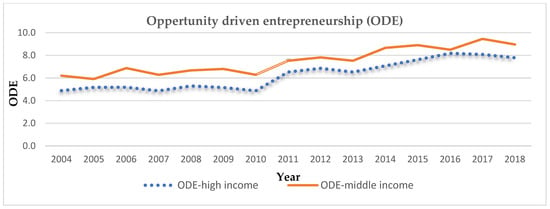
Before presenting the empirical analysis, several graphs are shown to illustrate trends in key indicators from 2004 to 2018. Figure 1 illustrates the development of opportunity-driven entrepreneurship (ODE) over time. Both high- and middle-income sub-samples show an increasing trend in ODE, with rates generally higher in middle-income countries throughout the study period. The figure also indicates that ODE in high-income countries shows greater variability, with a standard deviation of 1.26 compared to 1.16 in middle-income countries. These findings provide policymakers with valuable insights, helping them monitor changes in ODE rates and better understand entrepreneurial motivations within their economies.
Figure 1.
Trends in ODE by subsample (2010–2018).
3.1.2. Trends in MI over Time
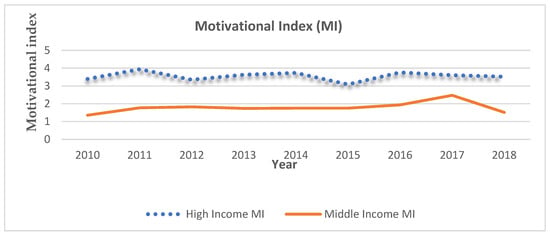
Figure 2 shows the evolution of the MI, which is the ratio of opportunity-driven to necessity-driven entrepreneurship. An MI greater than 1 indicates that opportunity-driven entrepreneurship (ODE) dominates. During the observed period, high-income countries consistently show significantly higher MI values (ranging from 3.08 to 3.94) compared to middle-income countries (ranging from 1.35 to 2.47), highlighting stronger motivation driven by opportunities. The relatively low standard deviations (high income = 0.25; middle income = 0.31) suggest that motivational patterns remain stable over time. These results offer valuable insights into the quality of entrepreneurship and can inform policies aimed at fostering opportunity-driven entrepreneurial activity.
Figure 2.
Trends in MI by subsample (2010–2018).
3.1.3. Trends in EF over Time
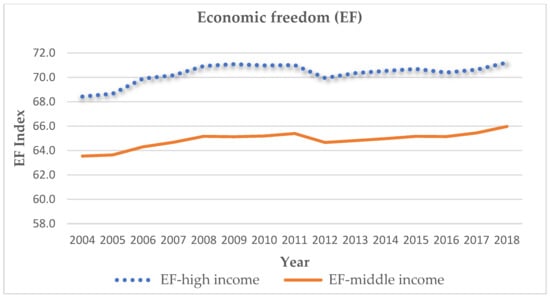
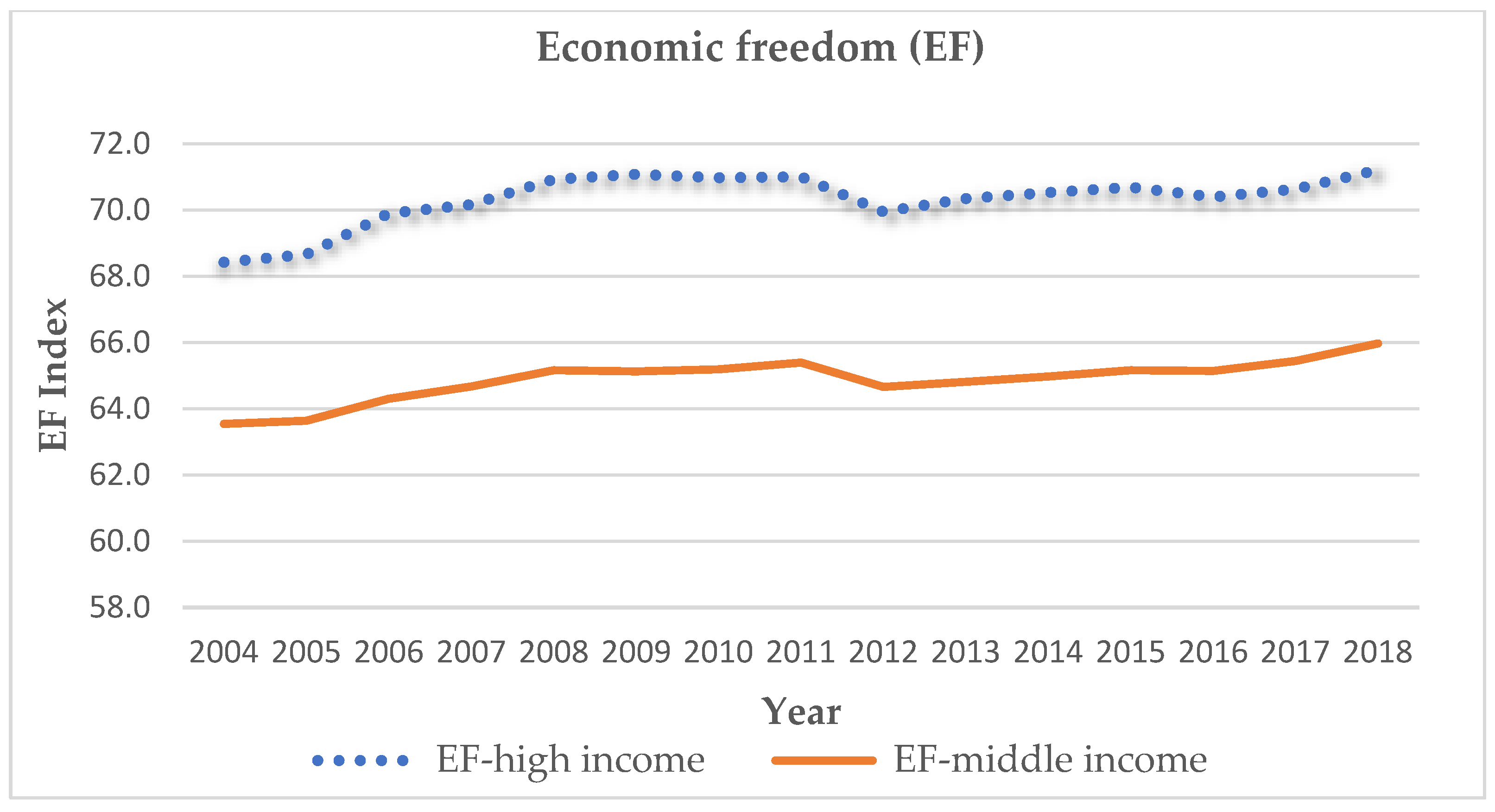
In Figure 3, the high-income sample exhibits a higher EF compared to the middle-income sample throughout the period. Both groups show relatively low standard deviations (high income = 0.8256, middle income = 0.6505), indicating limited variation within each group. However, an increasing trend is observed in both samples during the study period. The gap in EF scores between high- and middle-income countries remains consistently evident, with high-income countries showing higher scores. This ongoing disparity highlights a significant difference in EF levels between the two groups over the observed period.
Figure 3.
Trends in EF by subsample (2010–2018).
3.1.4. Trends in Governance over Time
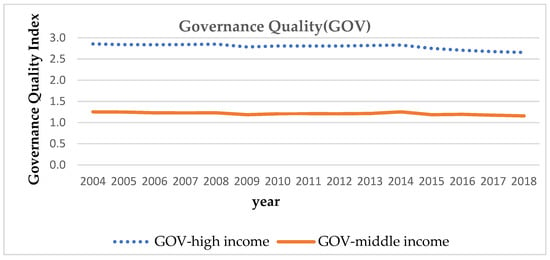
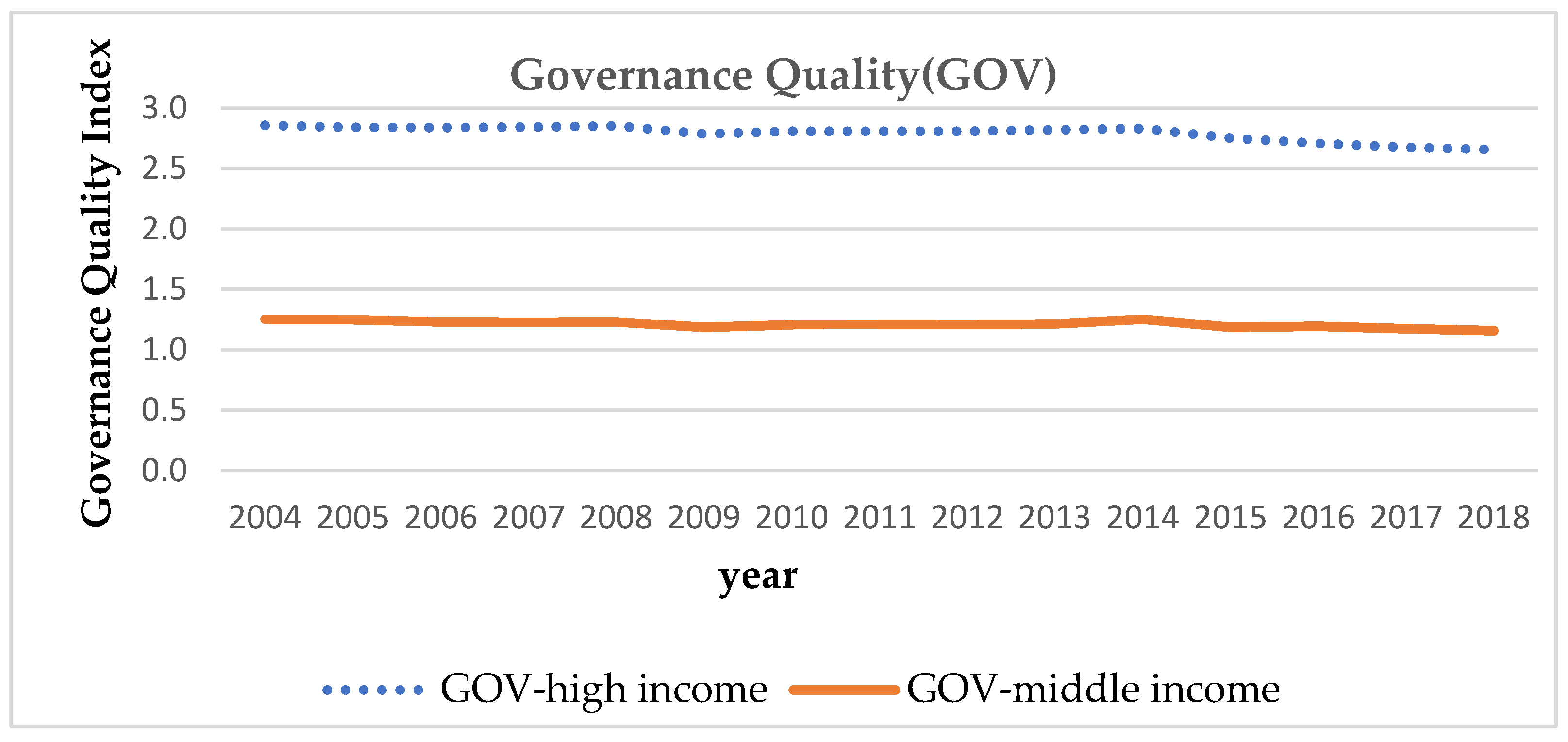
Regarding the evolution of governance, Figure 4 displays somewhat steady trends in both high-income and middle-income countries. The standard deviations are relatively low for both groups (SD = 0.0645 for the high-income group and 0.0286 for the middle-income group), indicating limited variation within each group. However, the governance scores for high-income countries consistently stay above those of middle-income countries throughout the period, maintaining a persistent and notable gap between the two groups.
Figure 4.
Trends in Governance Quality by subsample (2010–2018).
3.1.5. Trends in Globalization over Time
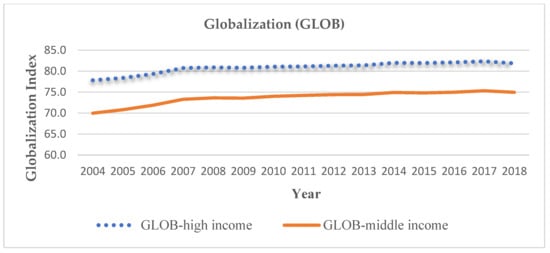
Figure 5 shows variations in globalization across subsamples from 2004 to 2018. The trend is upward for middle-income and high-income country groups during most of the period. There is a downward trend in the later years. Although the gap in globalization index values between high-income and middle-income countries stays large throughout, the variability within each group is greater for middle-income countries, as indicated by its higher standard deviation (1.5970) compared to the high-income group’s (1.3457).
Figure 5.
Trends in Globalization by subsample (2010–2018).
3.2. Summary of Descriptive Statistics
This study uses data from 2004 to 2018, covering 26 middle-income and 38 high-income countries. Table 1 and Table 2 show the descriptive statistics for ODE and MI, along with related variables. The findings reveal significant differences between high- and middle-income countries, indicating variations in ODE, MI, and the institutional environment across the two groups.
Table 1.
Summary of descriptive statistics for ODE in high- and middle-income countries.
Table 2.
Summary of descriptive statistics for MI in high- and middle-income countries.
Based on the descriptive statistics shown in Table 1, the ODE statistics reveal higher average values for middle-income countries (8.9593) compared to high-income countries (6.1225). Additionally, the standard deviation for ODE is greater in middle-income countries (4.8738) than in high-income countries (3.1732). The average values for the dependent variables (EF, GOV, GLOB) are also higher in high-income countries than in middle-income countries.
The descriptive statistics for the MI show that high-income countries have a notably higher mean value for MI (3.5593) compared to middle-income countries (1.8282). This suggests that entrepreneurship in high-income countries is more likely to be driven by opportunity than necessity. The standard deviation for MI is also larger in high-income countries than in middle-income countries, indicating more dispersed entrepreneurial motivations across developed economies.
3.3. Correlation Analysis
Table 3 presents the correlation analysis, indicating a positive correlation between EF and ODE in both high-income and middle-income country samples. Among the dependent variables, GOV positively correlates with ODE in high-income and middle-income countries. However, GLOB shows a negative correlation with ODE in both high-income and middle-income country samples. The correlation analysis reveals that in middle-income countries, ODE is negatively and significantly correlated with research and development (R&D), while its correlation with tertiary education remains insignificant. Similarly, in high-income countries, ODE shows a negative and significant correlation with R&D, whereas the correlation with tertiary education is positive but statistically insignificant.
Table 3.
Correlation matrix for ODE in high- and middle-income countries.
Table 4 shows the correlation analysis for the MI across samples from high- and middle-income countries. In groups, economic EF and GLOB have statistically significant positive correlations with MI. GOV also shows a positive and significant relationship in high-income countries, while in middle-income countries, the correlation stays positive but is not significant. These findings indicate that economic freedom, government effectiveness, and globalization are generally linked to higher entrepreneurial motivation.
Table 4.
Correlation matrix for MI in high- and middle-income countries.
In contrast, the correlations between MI and both tertiary education (TRT_EDU) and research and development (R&D) are not statistically significant in middle-income countries. Similarly, in the high-income group, TRT_EDU shows no significant correlation with MI, while R&D is positively and significantly correlated. These results suggest that although institutional quality and globalization are important for entrepreneurial motivation, the effects of education and R&D differ depending on income level and may not be consistent across different contexts.
3.4. Regression Analysis
Given that the literature on ODE has paid limited attention to the overall effects of institutional quality components, this study seeks to examine how key determinants of institutional quality influence ODE in high- and middle-income countries. While prior research has typically analyzed EF and governance separately, the present study argues for their joint consideration to provide a more comprehensive understanding of their impact on entrepreneurial activity.
A series of panel-data specification tests were performed to identify the best estimator. Even though the Hausman test initially recommended a fixed-effects model, it was eventually not adopted. That is due to the fact that the middle-income country sample contains only 26 cross-sections, making fixed effects method inefficient due to excessive loss of degrees of freedom and inflated standard errors. Second, the primary explanatory variables (globalization, governance quality, and economic freedom) are mostly cross-sectional and exhibit limited within-country variation. In this context, fixed effects absorb most of the relevant variation, resulting coefficient attenuation, sign reversals, and multicollinearity with country dummies. Further, diagnostic fixed-effects regressions generated economically implausible and unstable coefficients across cross-section, period, and two-way specifications, indicating misspecification.
Given these limitations, the study employed Robust Least Squares (OLS) as the main estimator and Ordinary Least Squares (RLS) as the estimator for robustness identification. RLS was selected because it is robust to heteroskedasticity, outliers, and deviations from normality, all of which are common in unbalanced macro-panel datasets. OLS preserves both cross-sectional and temporal variation and is consistent with the macro-comparative nature of the institutional variables. Across all model specifications, the OLS and RLS estimates show highly consistent coefficient signs and statistical significance, indicating that the findings are stable and not estimator-dependent. This multi-estimator validation provides a rigorous and methodologically sound foundation for the empirical conclusions.
Table 5 presents the results of linear regressions for ODE using RLS and OLS for samples of high-income and middle-income countries.
Table 5.
Regression Analysis for ODE in High-Income and Middle-Income Country Samples.
As shown in Table 5 (line 1), both RLS and OLS results verify hypothesis H1a strongly, as the results indicate that the coefficient of EF is positive and statistically significant at the 1% level. However, the strength of the relationship slightly varies by income category of the countries: high-income countries exhibit a slightly higher coefficient compared to the middle-income country group. Therefore, this confirms H1b, which states that EF promotes ODE more in high-income than in middle-income countries. The results imply that a one-unit increase in EF leads to a 1.1670-unit increase in ODE in high-income countries, whereas a one-unit increase in EF results in a 0.1664-unit increase in ODE in middle-income countries.
As shown in Table 5, line 2, the coefficient of GOV is positive and significant at the 1% level in high-income countries. However, the coefficient is insignificant in middle-income (MI) countries, leading to the rejection of Hypothesis H2a for the middle-income country sample. Consequently, the second hypothesis, H2b, is also rejected regarding the middle-income country sample due to the insignificance of the coefficient. In contrast, for the high-income country sample, a one-unit increase in GOV results in a 0.3604-unit increase in ODE.
When considering H1a and H1b, it can be found that high-income countries have a significant positive impact of EF and GOV on ODE. The middle-income countries also have a stronger positive effect of EF on ODE. However, there is no strong evidence that EF and GOV vary by the income level of countries.
Furthermore, H3a and H3b are not supported by our results, indicating a negative effect of globalization on high income and middle-income samples. The results imply that a one-unit increase in GLOB leads to a 0.0829-unit decrease in GLOB in high-income countries, whereas a one-unit increase in GLOB results in 0.1467-unit decrease in GLOB in middle-income countries. Moreover, H3b is also rejected, as globalization has a more pronounced negative impact on middle-income countries compared to high-income countries.
As shown in Table 6 (line 1), both RLS and OLS results confirm H1c, which proposes a positive effect of EF on the MI. The coefficients of EF are positive and statistically significant at the 1% level for both high-income and middle-income countries. Specifically, in middle-income countries, a 1-unit increase in EF leads to a 0.0776-unit increase in MI. In high-income (high income) countries, the corresponding effect is slightly higher at 0.0925. Therefore, H1c is supported for both income groups. In addition, hypothesis H1d, which predicts that the positive impact of EF is stronger in high-income countries than in middle-income, is also supported.
Table 6.
Regression Analysis for MI in High-Income and Middle-Income Country Samples.
Turning to Hypothesis H2c, which posits that stronger governance enhances MI, the results also provide clear support. The coefficients of GOV are positive and statistically significant at the 1% level for both high income and middle-income groups. In middle-income countries, a 1-unit increase in institutional quality results in a 0.3346 unit increase in middle-income countries, while in high-income countries, the increase is even more pronounced at 0.6259. Therefore, H2c is supported for both groups. Hypothesis H2d, which posits that the impact of institutional quality is stronger in high-income countries, is supported by the results. This confirms that governance exerts a greater influence on entrepreneurial motivation in developed contexts.
Regarding Hypothesis H3c, which predicts that globalization has a significant positive impact on the MI in both high- and middle-income countries, the results offer partial support. In middle-income countries, globalization shows a statistically significant and positive effect at the 1% level across both OLS (0.1219) and RLS (0.0635) estimates. In high-income countries, the effect is weaker and only marginally significant (OLS = 0.0777 at the 10% level), with the RLS coefficient (0.0287) lacking statistical significance.
Hypothesis H3d, which posits that globalization exerts a stronger positive impact on motivation in high-income countries, is not supported. In fact, the magnitude of the coefficient is greater for middle-income countries, suggesting that globalization has a more substantial motivational effect on entrepreneurs in middle-income contexts. For more details of estimation results, please refer to Supplementary Materials.
4. Discussion
4.1. Economic Freedom
EF exerts a positive influence on both ODE and the MI in high- and middle-income countries. By reducing regulatory barriers, securing property rights, and fostering open competition, greater economic freedom creates an enabling environment for ODE. These institutional conditions not only encourage greater entry into entrepreneurial activity but enhance the quality of ventures by encouraging innovation, independence, and social value creation, key elements of sustainable entrepreneurship.
The positive link between EF, ODE, and MI highlights its dual role: increasing the prevalence of entrepreneurship while also improving its quality. MI captures important motivational aspects, such as innovation, autonomy, and income growth [33], which are directly connected to entrepreneurial efforts that support long-term economic development. By enhancing MI, EF helps foster the emergence of sustainable, growth-focused ventures.
In middle-income countries, EF plays a crucial role in helping the shift from necessity-driven to innovation-led entrepreneurship, allowing entrepreneurs to move from mere survival activities to opportunity-driven ventures with greater growth potential. In high-income settings, where entrepreneurial ecosystems are already well-developed, EF mainly supports and improves the quality of entrepreneurial activities, backing ambitious ventures that boost productivity, innovation, and competitiveness at the forefront of economic growth.
4.2. Governance
Governance demonstrates a positive and statistically significant effect on ODE in high-income countries, while in middle-income countries, the effect is positive but not statistically significant. For MI, governance is positively associated with both groups, with stronger significance in high-income contexts. Institutional features such as regulatory quality, rule of law, and control of corruption reduce uncertainty, strengthen property rights, and ensure fair competition. These conditions foster not only the prevalence of ODE but, more importantly, enhance the quality of entrepreneurship by motivating individuals to pursue independence, innovation, and growth-oriented ventures rather than necessity-driven activities.
In this context, Faghih et al. [23] emphasize that MI is higher in innovation-driven economies, highlighting the importance of strong institutions in shaping entrepreneurial quality. While the effect of governance is stronger in high-income countries—where institutional maturity and stability are well established—the positive relationship in middle-income countries indicates a consistent influence. This suggests that improvements in governance in middle-income countries can gradually lead to higher entrepreneurial quality, supporting innovation-led and growth-oriented ventures.
Collectively, economic freedom and governance act as complementary foundations for sustainable entrepreneurship: Economic freedom encourages market entry by reducing regulatory barriers and promoting entrepreneurial initiatives, while governance establishes the institutional safeguards that ensure stability, trust, and long-term sustainability. Across different income levels, both factors boost not only the prevalence but also the quality of entrepreneurship, especially in environments where innovation capacity and institutional strength are higher. This outcome aligns closely with SDG 8 (decent work and economic growth) and SDG 9 (industry, innovation, and infrastructure), which emphasize inclusive, innovation-driven, and sustainable development.
4.3. Globalization
Our empirical results show that globalization negatively impacts ODE in both high-income and middle-income countries, with a stronger negative effect in middle-income nations. When looking at entrepreneurial quality through the MI, globalization has a positive effect in middle-income countries, while in high-income countries, the effect is statistically insignificant.
These findings align with broader theoretical and empirical literature. Globalization presents both opportunities and challenges for opportunity-driven entrepreneurs. On one hand, it promotes knowledge spillovers, access to technology, and international collaboration, aligning with SDG 17 (partnerships for the goals). It intensifies market competition and facilitates internationalization, yet these dynamics often disadvantage local start-ups [38]. Consumers in both high- and middle-income countries benefit from lower prices and broader product offerings, but domestic firms face reduced profitability and increased displacement risk. Globalization also influences consumer preferences, often redirecting demand toward internationally recognized brands, which can further marginalize domestic firms, particularly in middle-income countries, where innovation capacity and institutional maturity are more limited [38]. These pressures constrain domestic firms’ ability to respond, contributing to slower productivity growth, deindustrialization, and reduced prospects for innovation-led entrepreneurship [47].
Consequently, these results align with prior studies showing that globalization has a significant negative impact on opportunity-driven entrepreneurship in developing nations, where limited innovation capacity and weaker institutions hinder entrepreneurs from seizing global market opportunities [48]. In contrast, high-income countries are better equipped to adapt due to stronger institutional frameworks, more advanced innovation systems, and greater absorptive capacity [49]. Entrepreneurs in these economies can leverage globalization to boost motivation for innovation, autonomy, and growth, which exerts less negative effect of globalization and the ODE.
However, while globalization may reduce overall entrepreneurial prevalence, it enhances entrepreneurial quality in middle-income economies, thereby strengthening the connection between entrepreneurship and long-term economic growth. Overall, these findings underscore the dual nature of globalization: it creates systemic challenges for domestic entrepreneurship across all contexts, but its severity and implications differ by level of national development. In middle-income countries, globalization threatens the survival of local start-ups and constrains innovation-led ventures; yet, at the same time, it improves the quality dimension of entrepreneurship by fostering more opportunity-driven entrepreneurs. Therefore, tailored policy support is necessary to ensure that globalization becomes a catalyst for inclusive and sustainable entrepreneurship rather than a constraint.
4.4. Insights for Policy Makers
The findings of this study have significant policy implications for both high- and middle-income countries aiming to promote entrepreneurship that drives economic growth. For middle-income countries, the focus should be on strengthening institutional quality and boosting EF to create an environment conducive to high-quality, opportunity-driven entrepreneurship. This involves reducing corruption, enhancing regulatory frameworks, and investing in the capacity to enforce policies effectively. Although institution-building is a long-term process, these reforms are essential to help entrepreneurs transition from necessity-driven activities to more innovative and growth-oriented ventures that increase MI and meaningfully contribute to economic development. Such reforms elevate MI and nurture entrepreneurial ecosystems that support social and environmental innovation, consistent with SDG 8 and SDG 9.
High-income countries, by contrast, already benefit from established institutions that support entrepreneurial ecosystems. In these contexts, the challenge lies not in increasing entrepreneurial prevalence but in sustaining entrepreneurial quality. Policymakers should focus on refining governance, supporting innovation ecosystems, and ensuring that globalization’s pressures continue to channel entrepreneurial efforts toward innovation, competitiveness, and productivity-enhancing activities.
Globalization further reinforces the need for differentiated strategies. Policymakers in middle-income countries should invest in building domestic innovation capacity, supporting research and development, and facilitating technology absorption. At the same time, governments must provide better information and tools to help entrepreneurs manage risks associated with globalization—such as global supply chain disruptions, political and economic risks, and cross-cultural differences. For high-income countries, policies should concentrate on maintaining competitiveness in global markets and ensuring that entrepreneurs continue to exploit opportunities for innovation and growth. Overall, strengthening institutional readiness and entrepreneurial capability enables countries to harness globalization as a catalyst for high-quality, opportunity-driven entrepreneurship, consistent with the collaborative ambitions of SDG 17 (partnerships for the goals).
In both contexts, the ultimate goal is to foster entrepreneurship that not only increases in prevalence but also improves in quality, as captured by the MI. Since entrepreneurial quality is more directly linked to innovation and long-term economic growth, policies that enhance MI are likely to yield more sustainable developmental outcomes than those focused merely on increasing the number of entrepreneurs.
5. Conclusions
The analysis demonstrates that EF exerts a significant and positive influence on ODE and MI across both high- and middle-income countries. At the same time, governance only significantly affects ODE and MI in high-income countries. In contrast, globalization negatively impacts ODE in all contexts, with the adverse effect being more pronounced in middle-income countries. Its relationship with MI is positive in middle-income countries but statistically insignificant in high-income countries, reflecting differences in institutional maturity, innovation capacity, and absorptive capabilities.
These findings underscore that the promotion of ODE requires an integrated approach: fostering economic freedom and effective governance to enhance both the prevalence and quality of entrepreneurship, while implementing targeted interventions in middle-income countries to mitigate the challenges posed by global competition. Furthermore, policymakers should integrate entrepreneurship into broader sustainability agendas, aligning these institutional reforms to position entrepreneurship not merely as an economic mechanism but as a transformative force for achieving the Sustainable Development Goals (SDGs).
One major limitation of this research relates to data accessibility, as the GEM database is restricted in terms of time span and coverage for middle- and low-income countries, which hinders detailed and longitudinal analyses of entrepreneurial activities in these regions. Although several entrepreneurship-related databases exist, such as the World Bank Entrepreneurship Database and OECD statistics, they lack a specific, cross-country comparable indicator for ODE. Future research could focus on collecting primary data through targeted surveys or interviews, especially in countries where secondary data on ODE is scarce or unavailable.
Second, this empirical study does not differentiate between formal and informal institutions due to limited data availability across countries. Further studies may explore how both formal and informal institutional arrangements jointly shape ODE, with particular attention paid to developing countries where informal entrepreneurship is prevalent.
Supplementary Materials
The following supporting information can be downloaded at: https://www.mdpi.com/article/10.3390/su18010252/s1.
Author Contributions
Conceptualization, N.N.K.W.K., W.L. and S.C.; Methodology, N.N.K.W.K., W.L. and S.C.; Software, N.N.K.W.K.; Validation, N.N.K.W.K.; Formal analysis, N.N.K.W.K.; Investigation, N.N.K.W.K.; Resources, N.N.K.W.K., W.L. and S.C.; Data curation, N.N.K.W.K., W.L. and S.C.; Writing—original draft, N.N.K.W.K.; Writing—review & editing, N.N.K.W.K., W.L. and S.C.; Visualization, N.N.K.W.K.; Supervision, W.L. and S.C.; Project administration, N.N.K.W.K., W.L. and S.C.; Funding acquisition, W.L. and S.C. All authors have read and agreed to the published version of the manuscript.
Funding
The APC was partially funded by the Research Institute of International University of Japan (IRI Grant Number: IRI-RR-2501).
Institutional Review Board Statement
Not applicable.
Informed Consent Statement
Not applicable.
Data Availability Statement
The original contributions presented in this study are included in the article/Supplementary Materials. Further inquiries can be directed to the corresponding authors.
Conflicts of Interest
The authors declare no conflicts of interest.
Abbreviations
The following abbreviations are used in this manuscript:
| ODE | Opportunity-driven entrepreneurship |
| NDE | Necessity-driven entrepreneurship |
| MI | Motivational Index |
| GDP | Gross domestic product |
| TEA | Total early-stage entrepreneurial activity |
| OECD | Organization for economic cooperation and development |
| GMM | Generalize methods of moments |
| APS | Adult population of survey |
| GEM | Global entrepreneurship monitor |
| EF | Economic freedom |
| GOV | Governance |
| GLOB | Globalization |
| R_D | Government expenditure on research and development as a percentage of GDP |
| H | Hypothesis |
| GNI | Gross national income |
| UD | US dollars |
| WDI | World development indicators |
| RLS | Robust least squares |
| OLS | Ordinary least squares |
Appendix A
Table A1.
Description of variables.
Appendix B
High-income Countries
- Australia
- Austria
- Barbados
- Belgium
- Canada
- Chile
- Croatia
- Denmark
- Estonia
- Finland
- France
- Germany
- Greece
- Hungary
- Iceland
- Ireland
- Israel
- Italy
- Japan
- Latvia
- Luxembourg
- Netherlands
- Norway
- Panama
- Poland
- Portugal
- Romania
- Saudi Arabia
- Singapore
- Slovakia
- Slovenia
- Spain
- Sweden
- Switzerland
- Turkey
- United Kingdom
- Uruguay
- U.S.A.
Middle-income Countries
- Angola
- Argentina
- Bosnia
- Brazil
- China
- Colombia
- Ecuador
- Egypt
- Gautama
- India
- Indonesia
- Iraq
- Jamaica
- Kazakhstan
- Lebanon
- Malaysia
- Mexico
- Morocco
- Pakistan
- Peru
- Russia
- South Africa
- Thailand
- Tunisia
- Venezuela
- Vietnam
References
- Sagar, S. Entrepreneurship: Catalyst for Innovation and Economic Growth. Int. J. Innov. Sci. Res. Technol. 2024, 9, 81–92. [Google Scholar] [CrossRef]
- Schumpeter, J.A.; Opie, R.; Swedberg, R. The Theory of Economic Development; Routledge: London, UK, 2021. [Google Scholar]
- Wennekers, S.; Thurik, R. Linking Entrepreneurship and Economic Growth. Small Bus. Econ. 1999, 13, 27–56. [Google Scholar] [CrossRef] [Scilit]
- Baumol, W. Growth, Industrial Organization and Economic Generalities; Edward Elgar Publishing: Cheltenham, UK, 2003. [Google Scholar] [CrossRef] [Scilit]
- Verkhovskaya, O.R.; Alexandrova, E.A. Motivational Index of Entrepreneurial Activity and the Institutional Environment. Vestnik St. Petersb. Univ. Econ. 2018, 34, 511–533. [Google Scholar] [CrossRef] [Scilit]
- Acs, Z.J.; Audretsch, D.B.; Braunerhjelm, P.; Carlsson, B. Growth and Entrepreneurship. Small Bus. Econ. 2011, 39, 289–300. [Google Scholar] [CrossRef] [Scilit]
- Bergmann, H.; Sternberg, R. The Changing Face of Entrepreneurship in Germany. Small Bus. Econ. 2007, 28, 205–221. [Google Scholar] [CrossRef] [Scilit]
- Block, J.H.; Kohn, K.; Miller, D.; Ullrich, K. Necessity Entrepreneurship and Competitive Strategy. Small Bus. Econ. 2014, 44, 37–54. [Google Scholar] [CrossRef] [Scilit]
- Angulo-Guerrero, M.J.; Pérez-Moreno, S.; Abad-Guerrero, I.M. How Economic Freedom Affects Opportunity and Necessity Entrepreneurship in the OECD Countries. J. Bus. Res. 2017, 73, 30–37. [Google Scholar] [CrossRef] [Scilit]
- Boudreaux, C.J.; Caudill, S.B. Entrepreneurship, Institutions, and Economic Growth: Does the Level of Development Matter? In MPRA Paper No. 94244; University Library of Munich: Munich, Germany, 2019. [Google Scholar] [CrossRef] [Scilit]
- North, D.C. Institutions. J. Econ. Perspect. 1991, 5, 97–112. [Google Scholar] [CrossRef] [Scilit]
- Rothstein, B. Political Institutions: An Overview. In New Handbook of Political Science; Oxford University Press: Oxford, UK, 1998; pp. 133–166. [Google Scholar] [CrossRef] [Scilit]
- McMahon, F. Institutions and Economic, Political, and Civil Liberty in the Arab World; Fraser Institute: Vancouver, BC, Canada, 2022; Available online: https://www.fraserinstitute.org/research/institutions-and-economic-political-and-civil-liberty-arab-world (accessed on 25 August 2025).
- Audretsch, D.B.; Belitski, M.; Chowdhury, F.; Desai, S. Necessity or Opportunity? Government Size, Tax Policy, Corruption, and Implications for Entrepreneurship. Small Bus. Econ. 2021, 58, 2025–2042. [Google Scholar] [CrossRef] [Scilit]
- Bjørnskov, C.; Foss, N.J. Economic freedom and entrepreneurial activity: Some cross-country evidence. Public Choice 2007, 134, 307–328. [Google Scholar] [CrossRef] [Scilit]
- McMullen, J.S.; Bagby, D.R.; Palich, L.E. Economic freedom and the motivation to engage in entrepreneurial action. Entrep. Theory Pract. 2008, 32, 875–895. [Google Scholar] [CrossRef] [Scilit]
- Díaz Casero, J.C.; Almodóvar González, M.; de la Cruz Sánchez Escobedo, M.; Coduras Martínez, A.; Hernández Mogollón, R. Institutional variables, entrepreneurial activity, and economic development. Manag. Decis. 2013, 51, 281–305. [Google Scholar] [CrossRef] [Scilit]
- Kuckertz, A.; Berger, E.S.C.; Mpeqa, A. The more the merrier? Economic freedom and entrepreneurial activity. J. Bus. Res. 2016, 69, 1288–1293. [Google Scholar] [CrossRef] [Scilit]
- Bárcena-Martín, E.; Medina-Claros, S.; Pérez-Moreno, S. Economic regulation, opportunity-driven entrepreneurship and gender gap: Emerging versus high-income economies. Int. J. Entrep. Behav. Res. 2021, 27, 1311–1328. [Google Scholar] [CrossRef] [Scilit]
- Fuentelsaz, L.; González, C.; Maícas, J.P.; Montero, J. How different formal institutions affect opportunity and necessity entrepreneurship. BRQ Bus. Res. Q. 2015, 18, 246–258. [Google Scholar] [CrossRef] [Scilit]
- Aparicio, S.; Urbano, D.; Audretsch, D. Institutional factors, opportunity entrepreneurship and economic growth: Panel data evidence. Technol. Forecast. Soc. Change 2016, 102, 45–61. [Google Scholar] [CrossRef] [Scilit]
- Fuentelsaz, L.; González, C.; Maicas, J.P. Formal institutions and opportunity entrepreneurship: The contingent role of informal institutions. BRQ Bus. Res. Q. 2019, 22, 5–24. [Google Scholar] [CrossRef] [Scilit]
- Faghih, N.; Bonyadi, E.; Sarreshtehdari, L. Entrepreneurial Motivation Index: Importance of Dark Data. J. Glob. Entrep. Res. 2021, 11, 15–27. [Google Scholar] [CrossRef] [Scilit]
- Ranaei Kordshouli, H.; Maleki, B. Entrepreneurship Motivation and Institutions: System Dynamics and Scenario Planning. J. Glob. Entrep. Res. 2023, 13, 6. [Google Scholar] [CrossRef] [Scilit]
- Kah, S.; O’Brien, S.; Kok, S.; Gallagher, E. Entrepreneurial Motivations, Opportunities, and Challenges: An International Perspective. J. Afr. Bus. 2020, 23, 380–399. [Google Scholar] [CrossRef] [Scilit]
- Gwartney, J.; Lawson, R.; Hall, J. Economic Freedom of the World: 2016 Annual Report; The Fraser Institute: Vancouver, BC, Canada, 2016. Available online: https://www.fraserinstitute.org/sites/default/files/economic-freedom-of-the-world-2016.pdf (accessed on 10 March 2024).
- Vinig, T.G.; de Kluijver, J. Does globalization impact entrepreneurship? Comparative study of country-level indicators. Sprouts Work. Pap. Inf. Syst. 2008, 7, 194. Available online: https://aisel.aisnet.org/sprouts_all/194/ (accessed on 17 November 2025). [CrossRef] [Scilit]
- Ben Ali, T. How does institutional quality affect business start-up in high- and middle-income countries? An international comparative study. J. Knowl. Econ. 2022, 14, 2830–2877. [Google Scholar] [CrossRef] [Scilit]
- Boudreaux, C.J.; Nikolaev, B. Capital is not enough: Opportunity entrepreneurship and formal institutions. Small Bus. Econ. 2018, 53, 709–738. [Google Scholar] [CrossRef] [Scilit]
- Amorós, J.E. The impact of institutions on entrepreneurship in developing countries. In Entrepreneurship and Economic Development; Palgrave Macmillan: Basingstoke, UK, 2011; pp. 166–186. [Google Scholar] [CrossRef] [Scilit]
- Dau, L.A.; Cuervo-Cazurra, A. To formalize or not to formalize: Entrepreneurship and pro-market institutions. J. Bus. Ventur. 2014, 29, 668–686. [Google Scholar] [CrossRef] [Scilit]
- Boudreaux, C.J.; Nikolaev, B.; Klein, P. Socio-Cognitive Traits and Entrepreneurship: The Moderating Role of Economic Institutions. J. Bus. Ventur. 2019, 34, 178–196. [Google Scholar] [CrossRef] [Scilit]
- Van der Zwan, P.; Thurik, A.R.; Verheul, I.; Hessels, J. Factors Influencing the Entrepreneurial Engagement of Opportunity and Necessity Entrepreneurs. Eurasian Bus. Rev. 2016, 6, 273–295. [Google Scholar] [CrossRef] [Scilit]
- Aidis, R.; Estrin, S.; Mickiewicz, T. Institutions and Entrepreneurship Development in Russia: A Comparative Perspective. J. Bus. Ventur. 2008, 23, 656–672. [Google Scholar] [CrossRef] [Scilit]
- Acs, Z.J.; Desai, S.; Hessels, J. Entrepreneurship, Economic Development and Institutions. Small Bus. Econ. 2008, 31, 219–234. [Google Scholar] [CrossRef] [Scilit]
- Ayyagari, M.; Demirguc-Kunt, A.; Maksimovic, V. Small vs. young firms across the world: Contribution to employment, job creation, and growth. In Policy Research Working Papers; World Bank: Washington, DC, USA, 2011; pp. 1–37. [Google Scholar] [CrossRef] [Scilit]
- Savrul, M. The impact of entrepreneurship on economic growth: GEM data analysis. Pressacademia 2017, 4, 320–326. [Google Scholar] [CrossRef] [Scilit]
- Patel, P.C.; Rietveld, C.A. Does globalization affect perceptions about entrepreneurship? The role of economic development. Small Bus. Econ. 2021, 58, 1545–1562. [Google Scholar] [CrossRef] [Scilit]
- Amoa-Gyarteng, K.; Dhliwayo, S. The role of globalization in entrepreneurial development and unemployment: A comparative study of South Africa and the United Kingdom. Thunderbird Int. Bus. Rev. 2025, 67, 487–497. [Google Scholar] [CrossRef] [Scilit]
- GEM. Global Entrepreneurship Monitor, Definitions; GEM Global Entrepreneurship Monitor: London, UK, 2023; Available online: https://www.gemconsortium.org (accessed on 3 February 2024).
- Kaufmann, D.; Kraay, A. Worldwide Governance Indicators, 2023 Update; World Bank: Washington, DC, USA, 2023. Available online: www.govindicators.org (accessed on 3 February 2024).
- Jiménez, A.; Palmero-Cámara, C.; González-Santos, M.J.; González-Bernal, J.; Jiménez-Eguizábal, J.A. The impact of educational levels on formal and informal entrepreneurship. BRQ Bus. Res. Q. 2015, 18, 204–212. [Google Scholar] [CrossRef] [Scilit]
- Kassicieh, S.S. The knowledge economy and entrepreneurial activities in technology-based economic development. J. Knowl. Econ. 2010, 1, 24–47. [Google Scholar] [CrossRef] [Scilit]
- Foster, L.; Grim, C.; Zolas, N. A portrait of U.S. firms that invest in R&D. Econ. Innov. New Technol. 2019, 29, 89–111. [Google Scholar] [CrossRef] [Scilit]
- HSIAO, C. Why panel data? Singap. Econ. Rev. 2005, 50, 143–154. [Google Scholar] [CrossRef] [Scilit]
- Hamadeh, N.; Rompaey, C.V.; Metreau, E.; Eapen, S.G. New World Bank Country Classifications by Income Level: 2022–2023. World Bank Blogs, 1 July 2022. Available online: https://blogs.worldbank.org/en/opendata/new-world-bank-country-classifications-income-level-2022-2023 (accessed on 10 March 2024).
- Doner, R.F.; Schneider, B.R. The middle-income trap. World Polit. 2016, 68, 608–644. [Google Scholar] [CrossRef] [Scilit]
- Kentor, J. The long-term effects of globalization on income inequality, population growth, and economic development. Soc. Probl. 2001, 48, 435–455. [Google Scholar] [CrossRef] [Scilit]
- Scott, A.; Storper, M. Regions, Globalization, Development. Reg. Stud. 2003, 37, 579–593. [Google Scholar] [CrossRef] [Scilit]

Disclaimer/Publisher’s Note: The statements, opinions and data contained in all publications are solely those of the individual author(s) and contributor(s) and not of MDPI and/or the editor(s). MDPI and/or the editor(s) disclaim responsibility for any injury to people or property resulting from any ideas, methods, instructions or products referred to in the content. |
© 2025 by the authors. Licensee MDPI, Basel, Switzerland. This article is an open access article distributed under the terms and conditions of the Creative Commons Attribution (CC BY) license.