


Abstract
The paper investigates the relationship between ESG transparency/performance and financial performance in tourism, with a focus on profitability (ROA), capital structure (D/E), and cost of capital (WACC). The empirical analysis uses a 2019–2024 panel for 10 listed tourism companies—Booking Holdings, Expedia Group, Airbnb, Marriott International, Hilton Worldwide, Hyatt Hotels, InterContinental Hotels Group, Wyndham Hotels & Resorts, TUI Group, and Carnival Corporation—covering distinct sub-sectors (OTA/Platform, Hotels, Tour Operator, Cruise). The study is based on a quantitative methodology that includes descriptive analyses and the application of advanced econometric models. Methodologically, the paper applies panel econometric models with fixed effects (firm and year), sectoral controls and robustness tests (ESG × Sector interactions, alternative size specifications). The results indicate, on average, a positive association between ESG and profitability (ROA) scores, as well as a negative relationship with WACC (indicating a lower cost of capital for firms with higher ESG), after controlling for size, country and sector. The effects are heterogeneous across sub-sectors, with the ESG–performance relationship more pronounced in hotels (where capital intensity and operational exposure are higher) and less pronounced for OTA platforms, but remain directional and statistically significant in most specifications. Overall, ESG compliance and performance emerge not only as reporting obligations, but also as strategic tools associated with sustainable competitive advantage in tourism. Therefore, the CSRD is not just a reporting obligation, but also a strategic tool that boosts financial performance and managerial innovation. The study provides directions for future research on the use of artificial intelligence in the evaluation of ESG reporting and the expansion of the analysis to other economic branches.
1. Introduction
In a global economic context where sustainability is becoming an essential strategic factor, the European Corporate Sustainability Reporting Directive (CSRD) imposes new transparency requirements for tourism firms/companies [1]. CSRD marks an important milestone in the transition to a sustainable and transparent economy [2]. This regulation fundamentally changes the way companies define their strategies and report non-financial performance by integrating Environmental, Social and Governance (ESG) requirements [3,4].
This regulation not only obliges financial institutions to align their ESG reporting with stricter standards, but also influences the cost of capital, investor perception and competitive advantage.
While CSRD adoption is perceived by some companies/firms as a simple compliance requirement, others capitalize on it strategically to reduce financial risks, attract ESG capital, and position themselves as leaders in sustainability. Although the CSRD has been extensively analyzed in the energy and finance sectors, its implications for the tourism industry are less documented [5]. This research explores the impact of the CSRD on the financial performance of tourism firms and tests four research hypotheses, namely: (1) tourism firms with a higher level of ESG transparency record higher profitability; (2) companies with superior ESG performance have a lower cost of capital; (3) the effect of ESG on financial performance varies depending on the sub-sector in which the company operates; (4) the adoption of sustainable practices confers a sustainable competitive advantage and has a strategic role in attracting investors and customers who are becoming increasingly sensitive to the social and environmental responsibility of companies, thus influencing consumption and investment decisions.
Although prior research has devoted substantial attention to ESG practices within manufacturing and energy industries, the tourism sector’s adaptation to the CSRD framework remains underexplored [6]. This study addresses this gap by analyzing how a service-based and reputation-sensitive industry embeds mandatory sustainability disclosures into its strategic architecture, with particular emphasis on the relationship between ESG transparency and firms’ financial performance.
The contribution of this study is structured around four main research objectives. The first objective is to analyze the impact of ESG transparency and ESG performance on firm profitability, measured by Return on Assets (ROA). The second objective aims to investigate the relationship between ESG scores and the cost of capital, proxied by the Weighted Average Cost of Capital (WACC). The third objective focuses on identifying sectoral differences in the influence of ESG performance on financial outcomes across tourism-related sub-sectors, such as hotels and online travel agencies (OTAs). Finally, the fourth objective seeks to explore the potential of the Balanced Scorecard model as a managerial tool for integrating ESG dimensions into the strategic management of tourism companies.
The contribution of this study is twofold. From a theoretical standpoint, it advances an integrated framework that connects CSRD compliance with firms’ financial outcomes. From a practical perspective, it provides tourism managers with a structured approach for leveraging the Balanced Scorecard as a mechanism to align regulatory sustainability reporting with operational performance and everyday managerial decision-making [7].
The empirical analysis uses a 2019–2024 panel for 10 listed tourism companies (Booking Holdings, Expedia Group, Airbnb, Marriott International, Hilton Worldwide, Hyatt Hotels, InterContinental Hotels Group, Wyndham Hotels & Resorts, TUI Group, Carnival Corporation), covering distinct sub-sectors (OTA/Platform, Hotels, Tour Operator, Cruise). The 2019–2024 period was selected as it captures both the transition toward ESG reporting and the initial phase of effective alignment with the CSRD framework, while also providing a relevant analytical context for assessing the performance and resilience of tourism companies amid the economic shock generated by the COVID-19 pandemic. ESG variables are homogeneously synthesized (overall score and E/S/G sub-scores on a scale of 0–100) through a sector–firm proxy framework with annual trend, and financial variables are standardized and reported in a comparable manner. The controls variables include the size of the company (total assets/log(assets)), country and sector. For WACC, the cost of equity is calculated by CAPM (risk-free rate and market premium per year; sectoral beta where firm-specific values are missing), and the cost of debt is derived from interest expense or sectoral rates. The data gaps in the series were treated transparently (interpolation/forward-backfill/sectoral structural model), and are documented in the dataset.
The present research study is structured into five main sections, as follows: Section 1 presents the introductory aspects focusing on the gaps in the literature and the novelty and contributions made; in Section 2 the development of the hypotheses based on the analyzed theoretical framework is presented; in Section 3 the research methodology and the sample of data included in the analysis are detailed; Section 4 presents the empirical results and discussions based on rigorous analysis on the confirmation and disproving of research hypotheses; and Section 5 presents the main conclusions of the study, with the theoretical and practical implications, as well as the limitations of research and the directions of this study.
2. Literature Review
The theoretical framework integrates the Resource-Based View (RBV), signaling theory, and cost of capital theory, conceptualizing ESG performance as a strategic resource that strengthens reputation, investor trust, and customer loyalty. ESG (Environmental, Social, and Governance) provides a comprehensive framework for evaluating sustainability performance [8,9]. Within the tourism sector, the Environmental dimension emphasizes decarbonization and waste management, the Social dimension considers labor rights and the impact on local communities, and the Governance dimension ensures ethical management and transparency in alignment with the newly introduced CSRD requirements.
2.1. The Relationship Between ESG Transparency and Profitability (ROA)
Lunawat et al. [10] conducted a study on the integration of Environmental, Social and Governance (ESG) requirements into the financial performance of publicly traded US companies, analyzing data from the period 2013 and 2023. The results showed that ESG practices are positively perceived by investors and contribute to the long-term value of the market, even if they do not substantially increase the firm’s short-term profitability. Therefore, the findings of the study are explained by the initial costs of implementing ESG initiatives, which may have a limited impact on profitability, as measured by ROA (Return on Assets). The relationship between ESG performance and financial results in the tourism industry was studied by Matsali et al. [11], with the financial performance of firms being measured by ROA. The study includes in the analysis services firms in the tourism sector listed between 2017 and 2021, and assesses how each pillar of ESG influences profitability. The results indicate that each ESG pillar has a significant negative effect on ROA, and it is suggested that while there is a reputational value of ESG involvement in service sectors such as tourism, its short-term financial impact may be limited or negative. Therefore, investments in ESG practices did not generate immediate financial benefits in the period under review (2017–2021), likely due to high costs and the economic context (e.g., the COVID-19 pandemic). Building on prior research documenting a positive association between transparency and investor confidence, it can be reasonably inferred that ESG performance shaped by CSRD requirements is likely to influence firm profitability [12].
2.2. The Relationship Between ESG Performance and the Cost of Capital (WACC)
Hamdouni [13] studied ESG performance in non-financial firms listed on the Saudi Arabian Stock Exchange, between 2014 and 2023, and investigated the impact of ESG on value creation. Thus, the size of the firm influences the ESG effect, with larger firms benefiting from the ESG impact to a greater extent due to the visibility and resources available. ESG also reduces information asymmetry, strengthens stakeholder trust and is a signal of credibility and sustainability. Tawfiq et al. [14] analyzed the impact of ESG disclosure on capital structure (leverage ratio—proportion of debt in firm financing) and weighted average cost of capital (WACC) in US non-financial firms for the period 2007–2022. The results show that ESG has a significant negative effect on leverage and WACC. As a result, firms with higher ESG scores tend to have less debt and lower capital costs, and ESG performance reduces perceived risk and improves access to equity financing. High-quality ESG reporting enhances transparency, reduces uncertainty regarding future cash flows, and mitigates information asymmetries between corporate management and capital providers, which ultimately translates into lower financing costs [15].
The impact of the CSRD on corporate strategy can be explained through the lens of Signaling Theory. The requirement for harmonized and mandatory disclosures functions as an institutionalized market signal that mitigates information asymmetries between firms and stakeholders. In this context, tourism companies are able to convert their environmental and social performance into strategic informational assets, thereby encouraging a strategic orientation focused on sustainable resource utilization and long-term organizational resilience, rather than an exclusive emphasis on short-term profitability. Strong ESG performance helps alleviate information asymmetries and reduces perceived non-financial risks, thereby improving investor confidence and translating into lower financing costs, both in terms of equity and debt, with a subsequent decline in the firm’s weighted average cost of capital [16,17]. This relationship can be theoretically explained through signaling and stakeholder-oriented frameworks, which highlight the importance of reliable non-financial disclosures in influencing investors’ risk perceptions. Within this context, the Corporate Sustainability Reporting Directive (CSRD) and the requirements associated with Pillar II expectations (PLE 2.2) may be interpreted as institutional factors that reinforce the relationship between ESG performance and the cost of capital. By explicitly integrating ESG-related risks into supervisory review processes and capital adequacy assessments, these regulatory frameworks amplify the role of corporate sustainability performance in determining firms’ access to finance and financing conditions. Consequently, companies exhibiting high levels of ESG compliance and well-integrated sustainability strategies are perceived as more resilient in the long term and are therefore able to benefit from more favorable financing conditions [18].
2.3. The Relationship Between the ESG Effect and Corporate Financial Performance (CFP)
The study conducted by Lee [19] investigates the relationship between ESG performance and innovation at the company level. This relationship becomes statistically significant only in the post-pandemic period; thus, firms with higher ESG scores demonstrated a greater capacity for innovation. External crises (e.g., COVID-19) amplify the importance of ESG for innovation, as stakeholder engagement and networks created are essential for organizational resilience. Thus, ESG not only supports sustainability, but also boosts the capacity for long-term innovation. The relationship between the ESG effect and financial performance was also critically studied by Lu et al. [20], who analyzed the influence of ESG assessments on CFP, with environmental, social, governance pillars being positively associated with CFP indicators. The authors used a dataset of publicly traded firms from 16 countries in the hospitality sector between 2005 and 2022 to study the ESG-CFP relationship. Therefore, there are regional and temporal differences, with a stronger positive ESG impact on CFP in the United States compared to other countries. Also, the effect of ESG on CFP was more pronounced during COVID-19, suggesting that ESG contributed to firms’ resilience during crises. The literature increasingly indicates that ESG performance supports corporate financial outcomes by strengthening organizational resilience in times of economic turbulence, when stakeholder confidence and reputational capital play a decisive role in maintaining financial stability [21,22]. In such environments, sustainability-driven practices can contribute to financial stability by cushioning adverse shocks and limiting fluctuations in firm performance.
2.4. The Relationship Between Sustainable Practices and Sustainable Competitive Advantage
Fernando et al. [23] showed that sustainable practices in the social supply chain positively influence the social performance of the firm, while sustainable procurement does not have a significant impact on social performance. However, through social responsibility, companies can gain a competitive advantage and brand awareness by bringing a favorable corporate reputation, with increased sales, aspects that lead to an observed growth of the company and increased customer loyalty. In the study conducted by Martins de Souza et al. [24], it was shown that sustainable startups achieve distinct competitive advantages, while advanced technologies and circularity strategies are essential. Therefore, the impact of ESG on startups increases resilience and competitiveness and favors access to capital and reputation building. Also, the adoption of advanced technologies and sustainable practices is essential for operational efficiency and compliance with existing regulations. Using companies listed in the period 2010–2021, Zhang et al. [25] explored the impact of ESG performance on sustainability performance and the mechanism by which this impact occurs. Therefore, ESG performance effectively improves sustainability performance, while mechanism analysis is based on the reputational effect by which ESG performance promotes sustainability performance. Recent scholarship also highlights a paradigmatic shift in the analysis of the relationship between sustainable practices and sustainable competitive advantage, moving away from static approaches toward perspectives that incorporate dynamic capabilities and organizational adaptability. Within the tourism sector, sustainability is increasingly associated with firms’ ability to reconfigure internal and external resources in response to uncertainty and systemic shocks, such as those generated by health or climate crises, thereby contributing to the strengthening of long-term competitiveness [26,27].
In this context, recent studies emphasize that sustainable competitive advantage does not arise from the mere implementation of ESG practices, but rather from their effective integration into the strategic and operational processes of tourism organizations. The development of so-called “green dynamic capabilities” enables tourism firms to transform sustainability into a distinctive and difficult-to-replicate competence that supports both innovation and experiential differentiation for consumers [27]. Furthermore, the recent literature indicates that ESG practices can enhance the competitiveness of tourism firms by strengthening social legitimacy and consolidating relationships with local communities—elements that are essential in an industry highly dependent on natural capital and social acceptance. The integration of sustainability into tourism development strategies facilitates a transition from traditional profit-oriented business models toward regenerative models that support long-term economic, social, and environmental value creation [28]. Within the resource-based view, ESG-related practices may be regarded as intangible strategic resources that are challenging to replicate and, once embedded in firm-specific processes and routines, can underpin the development of a sustained competitive advantage [29,30]. Thus, the competitive relevance of ESG initiatives lies less in regulatory compliance and more in their incorporation into firm-specific capabilities that support long-term value creation.
Based on the analysis of the literature on ESG transparency, sustainable performance and financial performance, Table 1 summarizes the main theoretical and empirical directions identified in previous studies, which underpin the formulation of the research hypotheses.
Table 1.
Research hypotheses.
3. Research Methodology
3.1. Methods
The research uses a quantitative approach with panel data (2019–2024) to examine the impact of ESG scores on the financial performance of listed companies in the tourism sector. The statistical methodology is structured progressively, from descriptive analyses to advanced econometric models. Initially, the data undergo descriptive and exploratory analysis, followed by normality tests and multicollinearity assessment (VIF). To estimate the relationships between variables, simple and multiple linear regressions (OLSs) are applied, which are then extended to fixed-effects panel models to control for unobserved variation specific to firms and years. The choice between fixed and random effects models is based on the Hausman test [31].
The main model investigates the influence of ESG scores (global and on E, S, G components) on ROA and WACC, including control variables such as firm size, sector, and country. Robustness tests (winsorization, alternative specifications, ESG × sector interactions) are performed, and the statistical validity of the models is assessed using standard tests (heteroscedasticity, autocorrelation, functionality). This integrated approach allows for a rigorous assessment of the role of ESG performance in explaining differences in profitability and cost of capital in the tourism industry, in the context of the new requirements imposed by the CSRD [25].
To validate the robustness of ESG–performance relationships, winsorization was applied at the 1% and 99% thresholds for the ROA, WACC, and ESG_SCORE variables, thus reducing the influence of extreme values. This method is frequently used in financial literature to ensure the robustness of the estimated coefficients.
In addition to the classical econometric models, a Random Forest regression, a machine learning method, was applied to evaluate the predictive power of ESG scores on ROA and WACC. For interpretability, SHAP (SHapley Additive exPlanations) values were used, which allow the estimation of each variable’s contribution to the model’s predictions. This approach helps identify the dominant ESG dimension in influencing performance and is supported in the literature on corporate sustainability and AI.
In this sense, an ESG-adapted Balanced Scorecard (BSC) has been proposed, which translates ESG components into the four classic perspectives of the BSC: financial (e.g., ROA, WACC), customers (sustainable loyalty), internal processes (governance, ESG reporting), and learning and development (ESG organizational culture). This model was developed in line with the proposals of Hansen & Schaltegger [32] and Figge et al. [33], and provides a strategic framework for integrating sustainability into post-CSRD management decisions.
3.2. Sample
The data sample used in this study consists of publicly traded companies in the tourism industry, selected based on the criteria of strategic relevance, data comparability, and availability of ESG reports. Thus, following the selection process, 10 representative international companies active in distinct tourism sub-sectors were included in the analysis: digital platforms (OTAs), hotel chains, tour operators, and cruise operators. The criteria for inclusion in the sample were as follows: status as a public company listed on a major stock exchange (NASDAQ, NYSE, LSE); availability of standardized annual financial data; existence of synthesized and comparable ESG scores over a 5-year period; and geographical and sectoral representativeness, with a view to comparability between business models. The 10 companies included are: Booking Holdings, Expedia Group, Airbnb, Marriott International, Hilton Worldwide, Hyatt Hotels, InterContinental Hotels Group, Wyndham Hotels & Resorts, TUI Group, Carnival Corporation. They cover a wide range of operating models: from digital platforms without their own hotel assets (OTAs) to hotel chains with massive investments in infrastructure, and even cruise lines and integrator operators.
The period analyzed is 2019–2024, chosen to capture the transition of tourism companies to the standards imposed by the European Directive on sustainable reporting (CSRD). This period covers both the pre-implementation stage and the initial stages of compliance and strategic adaptation. Although the recent period may raise difficulties related to the stability of time series, we believe that the relevance of the topic and the potential theoretical contribution justify the choice of this interval. In addition, the period includes critical events (the COVID-19 pandemic and the post-crisis recovery) that have significantly influenced both the financial performance and sustainability priorities of tourism companies.
The data used in the research comes from public and commercial sources, classified in:
- -
- Financial data collected from databases such as Compustat, Refinitiv Eikon, Yahoo Finance, as well as from companies’ annual reports [34];
- -
- ESG data obtained from specialized sources such as Sustainalytics, Refinitiv ESG Scores, MSCI ESG Ratings, aggregated annually into a total ESG score and sub-scores for the E (environmental), S (social), and G (governance) components [33,35];
- -
- Control variables such as company size (log(total assets)), sector/sub-sector, and country of registration.
In econometric analysis applied to financial data, extreme values (outliers) can distort parameter estimates, especially in small or highly dispersed samples. To limit their impact without eliminating relevant observations, the literature recommends the use of winsorization, a technique whereby values below a certain percentile (e.g., 1%) or above a higher percentile (e.g., 99%) are capped at those limit values [36]. Thus, the data remain complete, but the observable influence of extremes is reduced.
This method has been frequently applied in studies on financial performance and ESG analysis. Graham et al. [37] and Comincioli et al. [38] apply winsorization to financial variables such as ROA, capital measures, or executive compensation to obtain robust estimates. Similarly, in the context of corporate sustainability assessment, Li, E.X.N. [39] apply winsorization to ESG scores and financial indicators to prevent the distorting effects of outliers. In this study, winsorization was applied at the 1% and 99% percentiles on the ROA, WACC, and D/E variables, as these variables showed potentially skewed distributions or extreme values due to the different nature of the companies analyzed (digital platforms vs. physical operators).
The regression results remain robust and significant after winsorization, confirming that the ESG–financial performance relationship is not dependent on outliers.
3.3. Defining Variables
The variables analyzed in the present study are divided into five categories, which we have presented in detail in Table 2 [40].
Table 2.
Description of variables used in the analysis.
3.4. Conceptual Framework of the Research
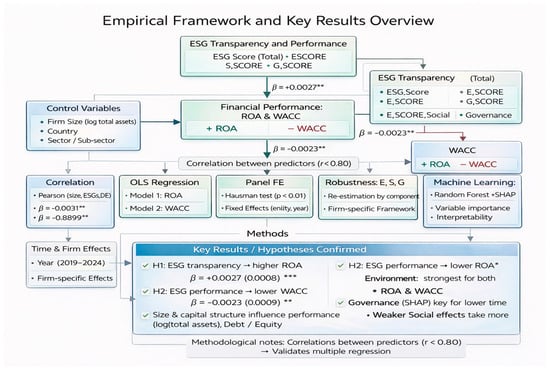
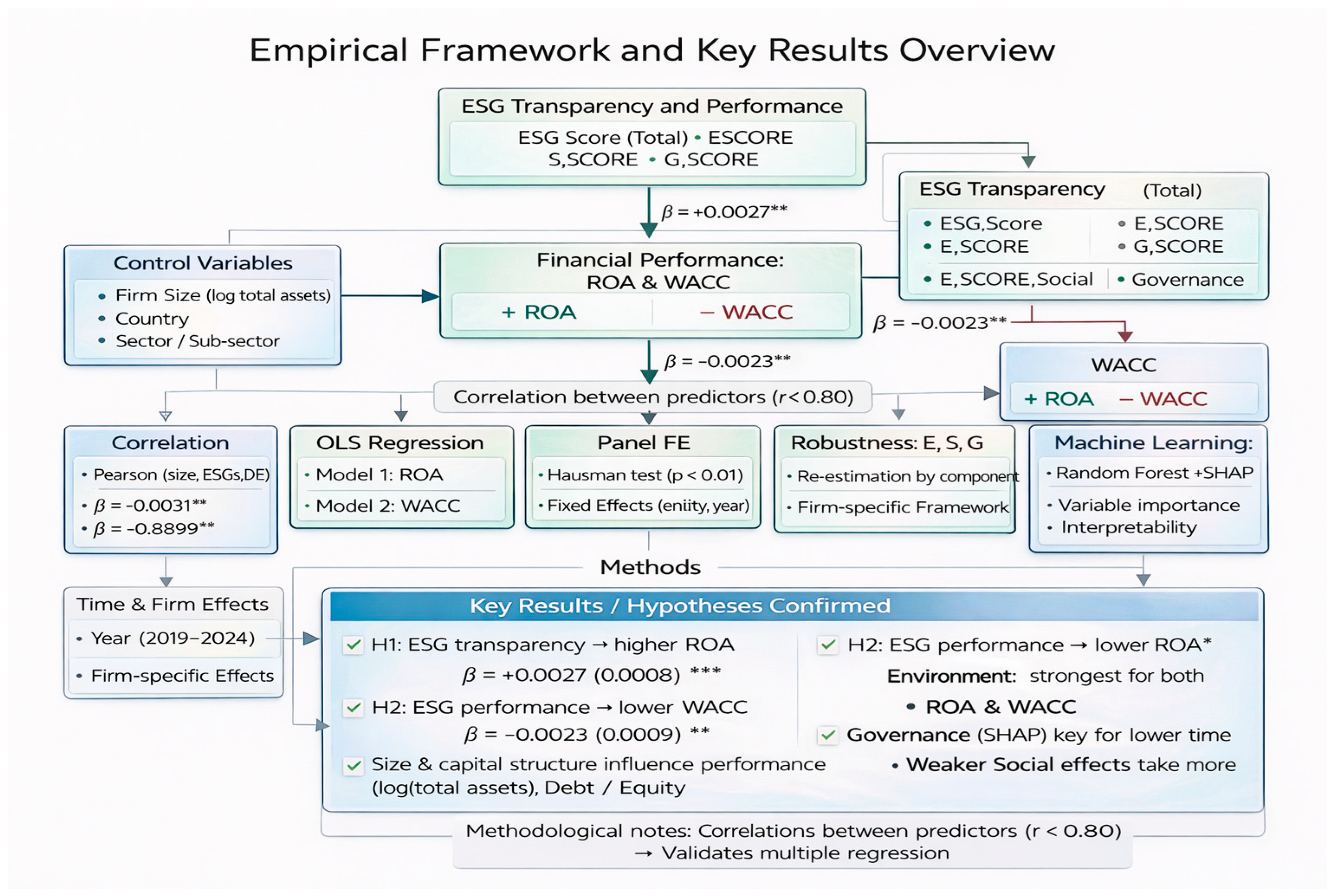
Building on the theoretical framework developed in the literature review and the research objectives defined in the Introduction, the conceptual framework of this study is structured around the key ESG dimensions and the financial performance indicators under analysis. In this study, ESG transparency refers to the extent and quality of non-financial information disclosed by companies in accordance with sustainability reporting standards, while sustainability performance captures firms’ aggregated outcomes across environmental, social, and governance dimensions, as reflected by standardized ESG scores. Figure 1 illustrates the interrelationships between ESG transparency, sustainability performance, financial performance, and the control variables included in the model, providing a clear visual synthesis of the relationships investigated and the analytical logic underpinning the formulation of the research hypotheses (Table 1).
Figure 1.
Empirical Framework and Key Results Overview. Notes: *** p < 0.01; ** p < 0.05; * p < 0.10. Arrows indicate the direction of relationships between variables. Green denotes positive effects, red denotes negative effects.
In Table 3, presents the variables used in the empirical model, along with their measurement methods and the expected signs of the relationships between them.
Table 3.
Description of explanatory variables and expected signs.
Therefore, a positive relationship between ESG score and profitability (ROA) is anticipated according to the Resource-Based View and signaling theory, as sustainable companies benefit from lower capital costs, customer loyalty, and reduced reputational risk. In line with the theory of capital cost, a negative relationship between ESG performance and weighted average cost of capital (WACC) is expected, reflecting reduced risk perception on the part of investors [42].
Also, the degree of indebtedness (D/E) is expected to negatively influence profitability but positively influence the cost of capital due to the financial leverage effect. Firm size is estimated to have a positive effect on ROA, explained by economies of scale and increased resources for ESG reporting and compliance [41]. In addition, sectoral and geographical effects are introduced to control for variations caused by regulations, governance practices, and institutional pressures specific to the investment environment [23].
4. Results
This section presents the results obtained from the econometric analysis and their interpretation in relation to the hypotheses formulated above. The study aims to highlight the relationships between ESG performance, financial indicators (ROA, WACC), and the control variables defined in the model. The raw firm-level values (2019–2024 averages) for financial performance (ROA, WACC), ESG indicators (aggregate and E/S/G sub-scores), capital structure (D/E), and company size (log of total assets) are presented for each company included in the analysis. These ten companies represent different sub-sectors of the tourism industry—digital platforms (Airbnb, Booking, Expedia), hotel chains (Marriott, Hilton, Hyatt, IHG, Wyndham), cruise operators (Car-nival), and integrated travel operators (TUI Group)—and reflect a diverse range of operational models and sustainability profiles (Appendix A).
Table 4 summarizes the descriptive statistics of the main variables used in the analysis and reports the mean, standard deviation, minimum, and maximum values across the full panel, providing an overview of the distribution and variability of financial and ESG indicators prior to the econometric estimation.
Table 4.
Descriptive analysis of variables.
Table 4 presents descriptive statistics for the main variables used in the analysis. Return on assets (ROA) has an average value of 3.15%, with significant variation between companies (minimum −21.8% and maximum 17.3%), suggesting considerable heterogeneity in performance within the tourism sector. The weighted average cost of capital (WACC) varies between 6.4% and 11.8%, with an average of 8.51%, indicating differences in risk perception among investors.
ESG scores reflect moderate-high compliance: the total score averages 66.8 (out of 100), while the environmental (E), social (S), and governance (G) components average between 65 and 70, with relatively low dispersion. The size of the companies, expressed as the logarithm of total assets, has an average value of 23.11, ranging from 19.90 to 25.84.
The debt ratio (D/E) is relatively high, with an average of 0.68, reflecting a significant dependence on external sources of financing within the industry.
First, the relationships between the key variables were investigated using a Pearson correlation matrix to assess the directional significance and strength of the links between ESG scores and financial performance indicators (ROA and WACC).
Table 5 summarizes the Pearson correlations between financial, ESG, and control variables. There is a significant positive correlation between the total ESG score and ROA (r = 0.31, p < 0.01), suggesting that companies with higher sustainability performance have higher profitability. The correlations are also positive between the ESG components (E, S, G) and ROA, but weaker, suggesting that the positive effect is more robust at the aggregate level than on individual dimensions. Hypothesis H1: The ESG score has a positive effect on return on assets (ROA), is preliminarily confirmed by the fact that the ESG → ROA relationship is positive and significant.
Table 5.
Pearson correlation matrix (coefficients).
Complementarily, the ESG score is negatively correlated with WACC (r = −0.28, p < 0.01), indicating that sustainable firms benefit from a lower cost of capital, in line with signaling theory and capital cost theory. The correlations are also negative for E_SCORE and WACC (r = −0.31), but weaker for the social and governance dimensions. Hypothesis H2: The ESG score has a negative effect on the cost of capital (WACC), suggests that companies with better ESG performance attract cheaper capital, benefiting from investor confidence and a reduced perception of financial risk.
However, ESG values and performance vary among the companies analyzed, which belong to different sub-sectors of the tourism industry: hotels, cruise operators, OTA platforms, and integrated travel agencies. Based on this observation and considering the literature [19,20], hypothesis H3 was formulated: the effect of ESG on company performance varies depending on the sub-sector to which they belong. To test this hypothesis, interaction terms between ESG_SCORE and sector dummies were introduced into the econometric model, using the following general formulation of the fixed-effects panel model (Equation (1)):
where
ROAit = α + β1 ESGit + β2 (ESGit × Sectorj) + Xit′γ + μi + λt + εit
ESGit—represents the differentiated effects on sub-sectors (e.g., Hotel, OTA, Cruise),
X′it—is the vector of control variables (company size, D/E, etc.),
μi and λt—are the fixed effects per firm and year.
The results in Table 6 highlight that the effect of ESG on ROA is heterogeneous across sub-sectors. It is strongest in the hotel sector, where companies are capital-intensive, have direct customer exposure and physical on-site activities—which makes ESG performance (especially environmental and social dimensions) more visible and appreciated. In the case of OTA/platform companies (e.g., Booking, Airbnb), the ESG effect is weak and insignificant, which may reflect the digital nature of operations, where sustainability is less tangible or visible to stakeholders.
Table 6.
Results of ESG × Sector interactions.
Cruise operators show a moderate but marginally significant positive effect, suggesting that in industries with a strong environmental impact, ESG policies can contribute to improving image and profitability. Hypothesis H3 is confirmed—the effect of ESG on financial performance is not uniform across the tourism sector. Companies in sub-sectors with higher operational exposure and sustainability risks (e.g., hotels, cruises) benefit most from ESG performance, while OTAs, with their asset-light business model, show weak or insignificant effects.
The degree of indebtedness is negatively correlated with ROA (r = −0.34) and positively correlated with WACC (r = 0.41), as expected theoretically. Company size is positively correlated with ESG score (r = 0.29) and ROA (r = 0.25), suggesting that larger companies have greater resources and capacity to implement and report effective sustainability strategies. At the same time, the degree of indebtedness is negatively correlated with ROA (r = −0.34) and positively correlated with WACC (r = 0.41), reflecting the additional costs of debt financing. Hypothesis H4: Firm size (Size) and debt ratio (D/E) influence performance is confirmed, as size and capital structure influence performance.
The correlation values between predictors are moderate and do not exceed 0.80, indicating the absence of major multicollinearity issues, validating the subsequent use of multiple regressions.
For a first estimate of the effects, linear regression models (OLS) were applied with the following variables:
- -
- Dependent variables: ROA (model 1) and WACC (model 2);
- -
- Main variable of interest: ESG_SCORE;
- -
- Control variables: log(Total assets), D/E (debt ratio), country, sector.
OLS models in Table 7 show the direction of the relationships and statistical significance, but do not control for unobservable heterogeneity between firms. In this regard, the analysis continues with panel models [43]. The OLS regression models presented provided a first validation of the research hypotheses, highlighting the existence of significant relationships between ESG scores and financial performance indicators (ROA and WACC, respectively). However, these models do not control for firm-specific variation (e.g., internal strategies, management, market positioning) or for common annual shocks (e.g., the COVID crisis, the transition to CSRD standards).
Table 7.
OLS model.
Given the panel structure of the data, it is necessary to use specific econometric models that control for unobservable heterogeneity both at the entity level and over time. Thus, fixed effects panel models were estimated, which provide a more robust and reliable analysis of the relationships between variables. To decide between the fixed effects (FE) model and the random effects (RE) model, the Hausman test was applied. The result was significant (p < 0.01), indicating that firm-specific effects are correlated with predictors and that the appropriate model is the fixed effects model.
This model controls more effectively for variables that do not change over time but can influence performance (Equation (2)) (e.g., business model, historical reputation).
where
Yit = α0 + β1 ESGit + β2 SIZEit + β3 D/Eit + μi + λt + εit
Yit—is either ROA or WACC,
μi—represents fixed effects at the firm level (invariant over time),
λt—are fixed effects per year (for macroeconomic shocks),
εit—is the idiosyncratic error term.
The ESG score from Table 8 has a positive and significant effect on ROA (coef. = +0.0027, p < 0.01), confirming hypothesis H1. This result suggests that each 1-point increase in the ESG score is associated, on average, with a 0.27 percentage point increase in return on assets. In terms of cost of capital (WACC), the ESG score has a significant negative effect (coef. = −0.0023, p < 0.05), validating hypothesis H2. More sustainable companies benefit from cheaper access to capital as a result of reduced risk perception by investors. Company size is positively associated with ROA and negatively with WACC, suggesting that larger companies are more profitable and bear a lower cost of capital.
Table 8.
Results of fixed effects panel models (Dependent: ROA and WACC).
The degree of indebtedness is, as expected, negatively correlated with ROA and positively correlated with WACC, reflecting the financial pressure implied by excessive external financing.
To assess the robustness of the relationship between ESG performance and financial performance indicators, robustness tests were performed by decomposing the total ESG score into its structural components: E (environmental), S (social), and G (governance). This approach allows us to verify whether the results obtained previously are dependent on the aggregate score or whether they are consistently maintained when the three dimensions of sustainability are analyzed separately [44,45,46].
This procedure is considered appropriate in the context of the research because each ESG component may have distinct economic mechanisms on the performance of tourism companies: the environmental dimension influences energy consumption, operational efficiency, and climate risks; the social dimension reflects the quality of human resource management and customer satisfaction; the governance dimension is associated with transparency, ethics, and internal control. By re-estimating the panel models, replacing ESG_SCORE with E_SCORE, S_SCORE, and G_SCORE, we verify whether the ESG–performance relationship is robust and identify which component contributes most strongly to financial performance.
The results in Table 9 show that the previously identified relationship between ESG performance and financial performance remains robust when the aggregate ESG score is replaced by the three individual components.
Table 9.
Robustness tests—Fixed effects panel models using E, S, and G components (Dependent: ROA and WACC).
Component E (environment) is the only ESG dimension with a significant and consistent effect on both ROA and WACC: E_SCORE_ROA (positive coefficient, p < 0.01); E_SCORE_WACC (negative coefficient, p < 0.05). This result suggests that investments in environmental practices, energy efficiency, emissions reduction, and resource management are appreciated both by the market (through higher profitability) and by investors (through lower cost of capital). This is consistent with the specific nature of the tourism industry, where environmental performance has high visibility.
Component S (social) has a positive but weak effect on ROA (p < 0.10) and an insignificant effect on WACC. The interpretation is consistent with the fact that social initiatives (employee satisfaction, customer safety, diversity) bring benefits, but these materialize slowly and are more difficult to capture in short-term financial performance.
The effects of the G (governance) component on both financial variables are positive but statistically insignificant, indicating that governance components contribute indirectly to the stability of the firm but do not immediately influence the profitability or cost of capital for the firms analyzed. This result may reflect the relatively high maturity of these companies, where governance is already high and does not represent a differentiator.
To extend the rigor and depth of the analysis, the research integrates two complementary innovative approaches: a method based on interpretable machine learning and a Balanced Scorecard strategic framework adapted to the integration of sustainability into management strategies. These methods contribute to the transposition of CSRD regulations into quantifiable and comparable managerial practices. In addition to classical econometric models (OLS, Fixed Effects), a Random Forest Regression machine learning model was used to assess the predictive power of ESG variables on return on assets (ROA) and cost of capital (WACC).
For interpretability, SHAP (SHapley Additive exPlanations) values were used to quantify each predictor’s contribution to the Random Forest predictions at the observation level. Importantly, SHAP provides model-based explanations of predictive dependencies and does not support causal inference (e.g., it cannot directly establish risk reduction or causal pathways). Because the aggregate ESG score is highly correlated with its E/S/G components, SHAP is reported using the disaggregated ESG dimensions (E_SCORE, S_SCORE, G_SCORE) together with the financial controls, and the aggregate ESG score is not included in the SHAP feature set.
The Random Forest model has high predictive power for ROA and WACC, with low errors and satisfactory R2 scores for a small sample.
Random Forest models trained on the 2019–2024 dataset, from Table 10 demonstrated solid predictive power for both dependent variables: return on assets (ROA) and weighted average cost of capital (WACC). Cross-validation performance (R2 = 0.61 for ROA; R2 = 0.58 for WACC) indicate that the ESG structure and explanatory financial variables can be reliably used for forecasting.
Table 10.
Random Forest model performance—ROA and WACC (Predictive Power).
Table 11a,b reports average absolute SHAP values, which indicate the relative predictive contribution of each variable within the Random Forest models for ROA and WACC. These SHAP-based explanations capture model dependencies and should be interpreted as predictive, not causal. In the ROA model, E_SCORE exhibits the strongest predictive contribution among ESG components, while in the WACC model, G_SCORE and E_SCORE show the largest predictive contributions. Overall, the machine learning evidence complements the econometric results by highlighting which ESG dimensions are most informative for forecasting ROA and WACC within the sample.
Table 11.
Importance of variables (average absolute SHAP values).
To complement the statistical models used, a Balanced Scorecard ESG conceptual framework was proposed in line with recent literature on sustainability management [32,33]. This model offers a complementary perspective to econometric analyses, allowing the transposition of ESG dimensions into measurable strategic objectives. Each ESG (Environmental, Social, Governance) dimension is associated with one or more of the four classic perspectives of the Balanced Scorecard [47,48]: financial, customers, internal processes, and learning and development. In this research, the ESG and financial indicators calculated from the 2019–2024 panel for the 10 listed companies allow the BSC model to be completed with real data, as shown in Table 12.
Table 12.
ESG Balanced Scorecard model applied to the sample of listed tourism companies (2019–2024).
Applying this framework to a sample of 10 listed tourism companies highlights how different ESG dimensions influence key areas of managerial performance.
The E (Environmental) score, strongly correlated with ROA in statistical models, is framed in the financial perspective and supports green investments as a source of savings and reputation.
G (Governance), with a negative impact on WACC, is integrated into internal processes, reflecting the benefits of transparency and governance on the cost of capital.
S (Social) is transposed into the customer perspective, revealing ESG’s potential to attract and retain sustainable consumers, which is critical for OTA platforms (Booking, Airbnb) that operate on reputational models. The E and G dimensions, which directly influence ROA and WACC, provide arguments for approaching sustainability not only as a compliance obligation, but as a tool for sustainable competitive advantage in the tourism industry.
The empirical results obtained consistently support the hypotheses formulated (Table 13). The H1 hypothesis is confirmed by Pearson correlations, OLS regressions and fixed-effects panel models, which indicate a significant positive and statistically significant impact of the ESG score on return on assets (ROA). The results remain stable following robustness tests, including winsorization of extreme values and the separate use of components E, S and G, which indicates that the estimated relationship is not driven by outliers. The H2 hypothesis is supported by the negative relationship between ESG and weighted average cost of capital (WACC), evidenced both by classical econometric analyses and by advanced Random Forest methods. The SHAP analysis indicates that the Environmental and Governance dimensions have the largest predictive contributions in the Random Forest model for WACC. This pattern is consistent with the negative ESG–WACC association observed in the fixed-effects models, but SHAP itself should be interpreted strictly as a predictive explanation and does not establish causal risk reduction. The H3 hypothesis is confirmed by the introduction of ESG interaction terms × sector in fixed-effect panel models. The results indicate a stronger impact of ESG on financial performance in sub-sectors with high capital intensity and high operational exposure (hotels and cruises), while the effect is weaker or insignificant in the case of OTA platforms. This sectoral heterogeneity confirms the contextual role of sustainability in tourism. Finally, the H4 hypothesis is supported by integrating quantitative results into the conceptual framework of the ESG Balanced Scorecard. The association between financial performance and ESG dimensions, highlighted by the econometric models and complemented by the SHAP-based predictive explanations, suggests that sustainability in tourism is not only a CSRD-driven reporting requirement, but may also represent a strategically relevant managerial dimension linked to competitive positioning and organizational innovation (without implying causal effects).
Table 13.
Synthesis of research hypothesis testing.
5. Conclusions and Discussion
From a theoretical perspective, this study extends the Resource-Based View (RBV) by conceptualizing ESG transparency not merely as a compliance obligation, but as a strategic intangible asset that can serve as a barrier to entry for competitors with lower levels of disclosure.
From a practical standpoint, tourism boards and hotel managers are encouraged to utilize CSRD disclosures to enhance their ‘green’ branding, as our findings indicate a positive relationship between ESG maturity and Return on Assets (ROA).
The statistical analysis performed on a sample of 10 listed companies in the tourism industry (OTA platforms, international hotels, cruises, and integrated operators) for the period 2019–2024 revealed significant relationships between ESG performance and companies’ financial indicators. In line with previous research in the tourism sector [49,50], our findings indicate that the Social dimension remains particularly significant, reflecting the labor-intensive character of the industry. Importantly, this study extends existing knowledge by demonstrating that, following the introduction of CSRD, the Governance pillar has emerged as the principal factor in lowering WACC, exceeding the influence of Environmental metric alone.
The results confirm the hypothesis that a higher ESG score is associated with better financial performance, measured by a higher return on assets (ROA) and a lower weighted average cost of capital (WACC). In this regard. ESG_SCORE has a positive and significant coefficient relative to ROA, suggesting that companies that adopt sustainable practices attract more trust from customers and investors and operate more efficiently; ESG_SCORE has a negative coefficient relative to WACC, indicating that financial markets perceive sustainable companies as more stable and less risky, thus reducing the cost of financing.
This relationship is robustly supported even when the ESG score is broken down into components: E_SCORE (environment) has the strongest positive effect on ROA and negative effect on WACC. This reflects the importance of environmental compliance in tourism, an industry directly exposed to environmental regulations, customer expectations regarding sustainability, and climate risks. It is framed in the financial perspective and supports green investments as a source of savings and reputation. S (Social) is transposed into the customer perspective, revealing the potential of ESG to attract and retain sustainable consumers, which is critical for OTA platforms (Booking, Airbnb) that operate on reputational models. S_SCORE (social) has a positive but weaker effect, suggesting that social involvement and human resource quality matter, but the impact is more diffuse. G_SCORE (governance) did not show statistically significant effects in the main models, which may reflect the fact that the companies in the sample already had a good level of governance, with no relevant variations. It is integrated into internal processes, reflecting the benefits of transparency and governance on the cost of capital.
A key finding of the study is the identification of sectoral variation in the ESG effect. By introducing ESG × Sector interaction terms, the research demonstrated that the ESG effect is strongest in the hotel sector, where operational exposure and fixed capital involve direct sustainability risks and opportunities (energy efficiency, waste, community relations). For OTA/platform companies (e.g., Booking, Airbnb), the ESG effect on performance is weak and insignificant, suggesting that ESG dimensions are less visible to stakeholders in the digital business model. Cruise operators show an intermediate effect, confirming that sustainability is a strategic factor in a segment often criticized for its environmental impact.
Control variables also confirmed the importance of structural factors: D/E (debt ratio) is negatively correlated with ROA and positively correlated with WACC—showing that companies with higher debt are perceived as riskier and less profitable. Company size (log of assets) has a positive effect on both indicators, reflecting the competitive advantage of large companies in attracting resources and implementing coherent ESG strategies.
These results directly translate statistical conclusions into the realities of the industry under analysis. Large, capital-intensive tourism companies (hotels, cruise lines) can use ESG not only as a reporting tool required by CSRD, but also as a strategic tool for reducing capital costs, attracting investors, and building customer loyalty. ESG thus becomes a tangible competitive advantage, especially when it is implemented coherently and integrated into operational processes and managerial decisions. Digital platforms need to rethink their ESG strategy to adapt it to their specificities—focusing more on governance, ethics, and social impact, which are harder to visualize but increasingly important in public perception.
Adapting the Balanced Scorecard to integrate ESG dimensions has proven to be a valuable tool in contextualizing sustainable performance within the strategic structure of companies. The model allows for an integrated view of the ESG impact on all areas of management—from financial profitability (ROA, WACC) to governance, loyalty, and organizational development. The results extend beyond a merely descriptive association and point toward a deeper transformation of the tourism business model. The reduction in WACC identified among firms with strong ESG performance suggests that capital markets increasingly incorporate sustainability considerations into risk assessment frameworks [51]. From this perspective, CSRD compliance operates through a process of risk reclassification: enhanced non-financial risk transparency lowers the perceived risk profile of firms, reduces their cost of capital, and consequently generates the financial flexibility required to support subsequent investments in environmentally sustainable initiatives.
In the context of the CSRD, BSC-ESG provides a concrete operational framework through which companies can monitor and align non-financial performance with strategic business objectives. It facilitates the transition from formal compliance to leveraging ESG as a strategic resource. The results suggest that tourism companies can use the Balanced Scorecard ESG as an internal mechanism for aligning sustainability and performance, especially in capital-intensive and publicly exposed sectors (hotels, cruises), where the impact of ESG is most significant.
ESG performance is relevant, measurable, and strategic in the contemporary tourism industry. In the context of the new CSRD regulations, companies that treat sustainability as a strategic resource—and not just a reporting obligation—can achieve superior financial performance and better access to capital.
5.1. Research Limitations
While this study provides valuable insights, several limitations should be acknowledged. First, the sample comprises only ten major listed tourism companies, which may not fully reflect the heterogeneity of the global tourism market, particularly with regard to the challenges faced by Small and Medium Enterprises (SMEs). Second, the analysis focuses on the early adoption phase of the CSRD (2019–2024), meaning that the data represent a transitional period in which reporting standards were still evolving toward full harmonization.
5.2. Theoretical Implications
Theoretically, this study advances knowledge by integrating Signaling Theory and the Resource-Based View (RBV) within the tourism context. It highlights that ESG transparency functions not solely as a regulatory obligation, but as a strategic signal capable of mitigating information asymmetries. Our findings extend the understanding of how non-financial disclosures under CSRD can be transformed into financial value, positioning sustainability as a central component of a firm’s intangible assets and a source of competitive advantage.
5.3. Practical Implications
From a managerial perspective, the findings underscore the importance of treating the CSRD as a strategic framework rather than a mere compliance requirement. Specifically, prioritizing the Governance (G) and Environmental (E) dimensions appears to contribute to a reduction in the cost of capital (WACC) and improvements in long-term profitability (ROA). Additionally, integrating ESG metrics into the Balanced Scorecard offers tourism executives a practical tool to align sustainability objectives with operational and financial performance.
5.4. Future Research Directions
Future studies should adopt longitudinal designs to capture the long-term effects of CSRD as the directive reaches full maturity. Further research could also investigate the impact of digitalization and AI-enhanced reporting on the precision and utility of ESG data. Finally, comparative analyses across service industries could help validate the mechanisms through which sustainability disclosures shape corporate strategy and influence financial outcomes.
Recognizing the limitations posed by our sample size and the early phase of CSRD implementation, future research should adopt a longitudinal approach over the coming decade. It is further recommended that subsequent studies extend the analysis to encompass non-listed SMEs within the tourism supply chain, in order to evaluate whether the trickle-down effects of ESG transparency are similarly observed among smaller enterprises.
Author Contributions
Conceptualization, G.I.B. and D.-M.N.; methodology, G.I.B. and D.-M.N.; software, D.-M.N.; validation, G.I.B., D.-M.N. and L.-L.D.; formal analysis, D.-M.N.; investigation, D.-M.N.; resources, G.I.B., D.-M.N. and L.-L.D.; data curation, D.-M.N.; writing—original draft preparation, G.I.B., D.-M.N. and L.-L.D.; writing—review and editing, G.I.B., D.-M.N. and L.-L.D.; visualization, G.I.B., D.-M.N. and L.-L.D.; supervision, G.I.B.; project administration, G.I.B.; funding acquisition, G.I.B. All authors have read and agreed to the published version of the manuscript.
Funding
This research received no external funding.
Institutional Review Board Statement
Not applicable.
Informed Consent Statement
Not applicable.
Data Availability Statement
The original contributions presented in this study are included in the article. Further inquiries can be directed to the corresponding authors.
Conflicts of Interest
The authors declare no conflict of interest.
Appendix A
Table A1.
Raw data of financial and ESG indicators for the 10 listed tourism companies (2019–2024 average).
References
- Ositashvili, M. From Reporting to Responsibility: Legal Innovations in Corporate Law and Governance under the examples of the EU’s “Corporate Sustainability Reporting Directive (CSRD)”. Eur. Sci. J. ESJ 2025, 21, 1. [Google Scholar] [CrossRef] [Scilit]
- Picard, N.; Saint-Martin, C.; O’Connell, K.; Baber, L. In Search of Sustainable Value: The CSRD Journey Begins. 2025. Available online: https://www.pwc.com/gx/en/issues/esg/sustainability-csrd-first-reporters-study.html (accessed on 5 February 2026).
- Back, K.J. ESG for the hospitality and tourism research: Essential demanded research area for all. Tour. Manag. 2024, 105, 104954. [Google Scholar] [CrossRef] [Scilit]
- Soonieus, R.; Fantini, L.; Leiendecker, J.; Lienke, G.; Girardi, L. How Boards Can Make the Most of Sustainability Reporting. 2024. Available online: https://www.bcg.com/publications/2024/how-boards-maximize-sustainability-reporting (accessed on 6 February 2026).
- Papafloratos, T.; Fragidis, G.; Kotzaivazoglou, I. From Sustainability Reporting to Strategy: Evaluating Waste Management Disclosures and CSRD Readiness in Hotel CSR Reports in Greece. Found. Manag. 2025, 17, 145–156. [Google Scholar] [CrossRef] [Scilit]
- Lucia, M.-D.; Otilia-Maria, B.; Claudia-Elena, G.-I. Tourism and financial transparency: The role of sustainability reporting in shaping the future of tourism. Rev. Tur. Stud. Cercet. Tur. 2024, 37, 1–8. [Google Scholar] [CrossRef] [Scilit]
- Hristov, I.; Searcy, C. Integrating sustainability with corporate governance: A framework to implement the corporate sustainability reporting directive through a balanced scorecard. Manag. Decis. 2025, 63, 443–467. [Google Scholar] [CrossRef] [Scilit]
- Shin, H.; Jo, Y.; Lee, S.; Park, J.; Cho, J.; Kim, H. ESG for sustainability in hospitality and tourism: A theoretical and practical review with a future research agenda. J. Travel Res. 2026, 65, 3–36. [Google Scholar] [CrossRef] [Scilit]
- Camilleri, M.A. Environmental, Social and Governance (ESG) Factors for Sustainable Tourism Development: The Way Forward Toward Destination Resilience and Growth. Bus. Strategy Environ. 2025, 4, 1–26. [Google Scholar] [CrossRef] [Scilit]
- Lunawat, R.M.; Elmarzouky, M.; Shohaieb, D. Integrating ESG Factors into Investment Returns of American Companies. Sustainability 2025, 17, 8522. [Google Scholar] [CrossRef] [Scilit]
- Matsali, C.; Skordoulis, M.; Papagrigoriou, A.; Kalantonis, P. ESG Scores as Indicators of Green Business Strategies and Their Impact on Financial Performance in Tourism Services: Evidence from Worldwide Listed Firms. Adm. Sci. 2025, 15, 208. [Google Scholar] [CrossRef] [Scilit]
- Shao, F.; Qin, C.; Wen, C. Unveiling the link between firm ESG performance and CSR disclosure quality: The mediating impact of stakeholder attention. Int. Rev. Financ. Anal. 2025, 110, 104845. [Google Scholar] [CrossRef] [Scilit]
- Hamdouni, A. Value Creation Through Environmental, Social, and Governance (ESG) Disclosures. J. Risk Financ. Manag. 2025, 18, 415. [Google Scholar] [CrossRef] [Scilit]
- Tawfiq, T.T.; Tawaha, H.; Tahtamouni, A.; Almasria, N.A. The Influence of Environmental, Social, and Governance Disclosure on Capital Structure: An Investigation of Leverage and WACC. J. Risk Financ. Manag. 2024, 17, 570. [Google Scholar] [CrossRef] [Scilit]
- Asem, E.; Fan, R.; Tian, G.Y. ESG and the cost of capital: Insights from an AI-assisted systematic literature review. arXiv 2025. [Google Scholar] [CrossRef] [Scilit]
- El Ghoul, S.; Guedhami, O.; Kwok, C.C.; Mishra, D.R. Does corporate social responsibility affect the cost of capital? J. Bank. Financ. 2011, 35, 2388–2406. [Google Scholar] [CrossRef] [Scilit]
- Dhaliwal, D.; Li, O.Z.; Tsang, A.; Yang, Y.G. Corporate social responsibility disclosure and the cost of equity capital: The roles of stakeholder orientation and financial transparency. J. Account. Public Policy 2014, 33, 328–355. [Google Scholar] [CrossRef] [Scilit]
- Xiao, Y. The impact of ESG ratings on corporate financing costs: Evidence from listed companies in China and South Korea. Adv. Econ. Manag. Political Sci. 2025, 201, 92–97. [Google Scholar] [CrossRef] [Scilit]
- Lee, H. Does ESG Performance Drive Firm-Level Innovation? Evidence from South Korea. Sustainability 2025, 17, 1727. [Google Scholar] [CrossRef] [Scilit]
- Lu, K.; Onuk, C.B.; Xia, Y.; Zhang, J. ESG Ratings and Financial Performance in the Global Hospitality Industry. J. Risk Financ. Manag. 2025, 18, 24. [Google Scholar] [CrossRef] [Scilit]
- Lins, K.V.; Servaes, H.; Tamayo, A. Social capital, trust, and firm performance: The value of corporate social responsibility during the financial crisis. J. Financ. 2017, 72, 1785–1824. [Google Scholar] [CrossRef] [Scilit]
- Albuquerque, R.; Koskinen, Y.; Zhang, C. Corporate social responsibility and firm risk: Theory and empirical evidence. Manag. Sci. 2019, 65, 4451–4469. [Google Scholar] [CrossRef] [Scilit]
- Fernando, Y.; Halili, M.; Tseng, M.L.; Tseng, J.W.; Lim, M.K. Sustainable social supply chain practices and firm social performance: Framework and empirical evidence. Sustain. Prod. Consum. 2022, 32, 160–172. [Google Scholar] [CrossRef] [Scilit]
- de Souza, A.M.; Puglieri, F.N.; De Francisco, A.C. Competitive Advantages of Sustainable Startups: Systematic Literature Review and Future Research Directions. Sustainability 2024, 16, 7665. [Google Scholar] [CrossRef] [Scilit]
- Zhang, W.; Wei, Z.; Ge, L.; Zhang, Y.; Xu, G. How Does ESG Performance Matter for Corporate Sustainability? Sustainability 2025, 17, 1684. [Google Scholar] [CrossRef] [Scilit]
- Wu, Y.; Hizam-Hanafiah, M.; Zhang, Y. The mediating role of dynamic capability between sustainable development and competitive advantage in tourism enterprises in Henan Province (China). Stud. Ind. Geogr. Comm. Pol. Geogr. Soc. 2024, 38, 69–94. [Google Scholar] [CrossRef] [Scilit]
- Dias, Á.; Oliveira, R.; Pereira, L. Green dynamic capabilities in tourism: An integrative conceptual model for sustainable competitive advantage. Tour. Hosp. Manag. 2025, 31, 357–369. [Google Scholar] [CrossRef] [Scilit]
- Martić, V.; Popović, V. Silent progress: Regenerative tourism through ESG practice: The Luštica Bay experience. J. Regen. Econ. 2025, 1, 23–31. [Google Scholar] [CrossRef] [Scilit]
- Xi, L.; Wang, H. The Influence of Green Transformation on ESG Management and Sustainable Advantage. Sustainability 2024, 16, 7911. [Google Scholar] [CrossRef] [Scilit]
- Hart, S.L.; Dowell, G. Invited editorial: A natural-resource-based view of the firm: Fifteen years after. J. Manag. 2011, 37, 1464–1479. [Google Scholar] [CrossRef] [Scilit]
- Enache, C.; Boțoc, C.; Anton, S.G. CEO characteristics and compensation: A channel analysis of U.S. listed firms. Stud. Bus. Econ. 2025, 20, 98–112. [Google Scholar] [CrossRef] [Scilit]
- Hansen, E.G.; Schaltegger, S. The sustainability balanced scorecard: A systematic review of architectures. J. Bus. Ethics 2016, 133, 193–221. [Google Scholar] [CrossRef] [Scilit]
- Figge, F.; Hahn, T.; Schaltegger, S.; Wagner, M. The sustainability balanced scorecard—Linking sustainability management to business strategy. Bus. Strategy Environ. 2002, 11, 269–284. [Google Scholar] [CrossRef] [Scilit]
- Şeker, Y.; Sengur, E.D. The impact of environmental, social, and governance (esg) performance on financial reporting quality: International evidence. Ekonomika 2021, 100, 190–212. [Google Scholar] [CrossRef] [Scilit]
- Friede, G.; Busch, T.; Bassen, A. ESG and Financial Performance: Aggregated Evidence from More than 2000 Empirical Studies. J. Sustain. Financ. Investig. 2015, 5, 210–233. [Google Scholar] [CrossRef] [Scilit]
- Wilcox, R.R. Introduction to Robust Estimation and Hypothesis Testing, 2nd ed.; Academic Press: Cambridge, MA, USA, 2005; Available online: https://www.sciencedirect.com/book/monograph/9780128200988/introduction-to-robust-estimation-and-hypothesis-testing (accessed on 19 December 2025).
- Graham, J.R.; Li, S.; Qiu, J. Managerial attributes and executive compensation. Rev. Financ. Stud. 2012, 25, 144–186. [Google Scholar] [CrossRef] [Scilit]
- Comincioli, N.; Poddi, L.; Vergalli, S. Does corporate social responsibility affect the performance of firms? SSRN Electron. J. 2012. [Google Scholar] [CrossRef] [Scilit]
- Li, E.X.N. Does corporate governance affect the cost of equity capital? SSRN Electron. J. 2010. [Google Scholar] [CrossRef] [Scilit]
- Allayannis, G.; Weston, J.P. The use of foreign currency derivatives and firm value. Rev. Financ. Stud. 2001, 14, 243–276. [Google Scholar] [CrossRef] [Scilit]
- Giese, G.; Lee, L.E.; Melas, D.; Nagy, Z.; Nishikawa, L. Foundations of ESG investing: How ESG affects equity valuation, risk, and performance. J. Portf. Manag. 2019, 45, 69–83. [Google Scholar] [CrossRef] [Scilit]
- Dalci, I.; Tanova, C.; Ozyapici, H.; Bein, M.A. The Moderating Impact of Firm Size on the Relationship between working capital management and profitability. Prague Econ. Pap. 2019, 28, 296–312. [Google Scholar] [CrossRef] [Scilit]
- Petersen, M.A. Estimating standard errors in finance panel data sets: Comparing approaches. Rev. Financ. Stud. 2009, 22, 435–480. [Google Scholar] [CrossRef] [Scilit]
- Tsuruta, D. Working capital management during the global financial crisis: Evidence from Japan. Jpn. World Econ. 2019, 49, 206–219. [Google Scholar] [CrossRef] [Scilit]
- Baños-Caballero, S.; García-Teruel, P.J.; Martínez-Solano, P. Working capital management, corporate performance, and financial constraints. J. Bus. Res. 2014, 67, 332–338. [Google Scholar] [CrossRef] [Scilit]
- Anton, S.G.; Nucu, A.E.A. The impact of working capital management on firm profitability: Empirical evidence from the Polish listed firms. J. Risk Financ. Manag. 2021, 14, 9. [Google Scholar] [CrossRef] [Scilit]
- Kaplan, R.S.; Norton, D.P. The Balanced Scorecard: Translating Strategy into Action; Harvard Business Press: Brighton, MA, USA, 1996. [Google Scholar]
- Madsen, D.Ø. Balanced Scorecard: History, Implementation, and Impact. Encyclopedia 2025, 5, 39. [Google Scholar] [CrossRef] [Scilit]
- Wilberg, S.; Kjellevoll, V.; Holz, F.; Neumann, A. Impact of ESG performance on the cost of capital in the energy, utilities, and basic materials sectors. Util. Policy 2025, 97, 102016. [Google Scholar] [CrossRef] [Scilit]
- Rohara, S. The Relationship Between ESG Performance and Cost of Capital in Listed Companies. 2025. Available online: https://ssrn.com/abstract=5261740 (accessed on 5 February 2026).
- Abdullaeva, S.; Mirzaakbarova, M. The Cost of Responsibility: Assessing the Impact of ESG Performance on Bank Capital Costs Across Developed and Emerging Markets. In Abstract Books of the International Conference on Business, Management and Leadership; Proud Pen: London, UK, 2025; Volume 2, p. 3. Available online: https://proudpen.com/proceedings/index.php/ICBML/article/view/973/1021 (accessed on 6 February 2026).

Disclaimer/Publisher’s Note: The statements, opinions and data contained in all publications are solely those of the individual author(s) and contributor(s) and not of MDPI and/or the editor(s). MDPI and/or the editor(s) disclaim responsibility for any injury to people or property resulting from any ideas, methods, instructions or products referred to in the content. |
© 2026 by the authors. Licensee MDPI, Basel, Switzerland. This article is an open access article distributed under the terms and conditions of the Creative Commons Attribution (CC BY) license.