Abstract
The rapid growth of e-commerce, particularly in China, has led to a surge in express packaging waste, posing significant environmental challenges. However, consumer participation in express packaging recycling remains a critical yet underexplored issue. To address this gap, this study extends the Theory of Planned Behavior (TPB) by incorporating perceived benefit, perceived trust, and policy communication to explain consumer behavior. Survey data from 382 urban consumers in China were analyzed using an integrated approach combining partial least squares structural equation modeling (PLS-SEM), fuzzy-set qualitative comparative analysis (fsQCA), and necessary condition analysis (NCA). The results indicate that attitude, perceived benefit, and perceived trust significantly influence recycling behavior, while subjective norm, perceived behavioral control, and policy communication exhibit no significant net effects. Furthermore, configurational analysis demonstrates that high recycling behavior emerges from multiple combinations of factors rather than any single dominant driver, and NCA identifies attitude as a necessary prerequisite. In conclusion, these findings underscore that express packaging recycling is driven by complex interactions among benefits, trust, and attitudes, suggesting that policymakers should prioritize multi-factor policy designs to effectively promote sustainable consumer behavior.
1. Introduction
The rapid growth of global e-commerce has reshaped consumption patterns, providing consumers with unprecedented convenience, speed, and accessibility [1]. As online retail continues to expand, this growth has driven a surge in the volume of express parcels, which has led to a corresponding increase in packaging waste. In 2024, the global express parcel market was valued at an estimated USD 456.6 billion, with the Asia-Pacific region accounting for nearly half of the global demand [2]. This market is expected to continue its rapid expansion, with a projected annual growth rate of approximately 7.6% from 2024 to 2035, driven by digitalization and evolving consumer habits [3]. Consequently, the environmental impact of this surge is profound. Packaging accounts for 5–6% of global greenhouse gas emissions and nearly 40% of the world’s plastic waste [4]. Municipal waste management systems are also under strain, as the global municipal solid waste generation is expected to rise from 2.1 billion tons in 2023 to 3.8 billion tons by 2050 [5]. This challenge is particularly acute in regions with inefficient recycling and weak waste management infrastructures [6].
In line with the United Nations Sustainable Development Goal 11 (SDG11) and 12 (SDG12) [7], this issue of packaging waste has become a global priority, especially in rapidly growing e-commerce markets such as China. China, as the world’s largest express delivery market, processed approximately 174.5 billion parcels in 2024 [8]. This volume generated significant waste, including millions of tons of cardboard, tapes and plastic [9,10]. Despite ongoing governmental initiatives, the recycling rate for express packaging in China remains below 10% [11], far below the 60% recycling rates seen in regions like the European Union [12]. Additionally, the presence of harmful chemicals and microplastics [13,14] in express packaging materials highlights the need for more effective packaging recovery systems.
Despite technological and regulatory advancements, consumer behavior plays a crucial role in achieving the closed-loop systems required by the SDGs [15]. However, most existing studies focus on household or food waste, typically extending the traditional TPB with additional variables and relying on structural equation modeling (SEM) to estimate linear net effects [16,17,18]. Such symmetric approaches, yet, are limited in capturing the non-linear, asymmetric, and context-dependent nature of recycling behavior [19,20,21]. Consequently, the recycling of express packaging as a byproduct of platform-based logistics remains underexplored, leaving a critical question unanswered: which non-linear and context-dependent mechanisms are shaping express consumers’ packaging recycling behavior?
This complexity is particularly evident for e-commerce consumer, for whom recycling express packaging entails high behavioral costs, resulting in persistently low participation rates despite stated environmental concerns [22,23,24]. This pervasive “value-action gap” is exacerbated by situational barriers such as perceived inconvenience, outcome uncertainty, and distrust in service providers [25]. Accordingly, to decode the specific mechanisms bridging this gap, this study moves beyond the traditional boundaries of the TPB by integrating perceived benefit, perceived trust, and policy communication. Rather than viewing these factors through a purely linear lens [26,27,28,29,30,31,32], we posit that utilitarian motivation, institutional assurance, and informational guidance interact in complex, configurational ways to drive engagement in such high-effort, low-visibility behaviors.
For end users, recycling express packaging entails substantial time and effort, yet participation rates remain persistently low [22,23,24]. This can be attributed to factors such as perceived inconvenience, uncertainty about recycling outcomes, and distrust in waste management service providers [25]. These issues reflect the broader value-action gap where individuals express concern for the environment but fail to act consistently.
The primary research question that this study addresses is: What are the non-linear and context-dependent mechanisms shaping express packaging recycling behavior? In particular, this study explores how factors like utilitarian motivation, institutional trust, and policy communication interact to influence recycling behavior. While traditional models, such as the Theory of Planned Behavior (TPB), emphasize linear relationships between attitudes, subjective norms, and perceived control [26,27,28,29,30,31,32], they have limitations in explaining high-effort, low-visibility behaviors like express packaging recycling. Moreover, prior TPB-based studies often use Structural Equation Modeling (SEM) to estimate net effects across variables [16,17,18]. However, SEM is limited in capturing the non-linear, asymmetric, and context-dependent nature of recycling behavior [19,20,21].
Accordingly, this study extends the TPB framework by incorporating three underexplored constructs—perceived benefit, perceived trust, and policy communication—to provide a more comprehensive explanation of consumer recycling behavior [29,30,32]. Methodologically, it employs a multi-method design that integrates PLS-SEM (Partial Least Squares Structural Equation Modeling), fsQCA (fuzzy-set Qualitative Comparative Analysis), and NCA (Necessary Condition Analysis) to capture different dimensions of behavioral causality. PLS-SEM assesses the symmetric net effects and structural relationships among key predictors [33], fsQCA reveals non-linear and configurational pathways underlying recycling behavior [21], and NCA identifies indispensable behavioral thresholds that remain invisible to both symmetric and configurational approaches [34].
The scientific novelty of this study lies in addressing the methodological and theoretical limitations of prior research by moving beyond symmetric “net effects” to explore asymmetric “causal configurations”. This study aims to make three main contributions to the field of sustainability and consumer behavior: 1. Theoretically, it bridges the gap between individual cognition and institutional context by integrating trust and policy communication into the TPB framework. 2. Methodologically, it demonstrates the value of triangulation (PLS-SEM, fsQCA, and NCA) in unraveling the complexities of high-effort pro-environmental behaviors. 3. Practically, it provides policymakers and logistics platforms with targeted, configuration-based strategies to enhance recycling rates, thereby directly supporting the achievement of SDG 11 and 12.
The remainder of the paper is organized as follows. The next section reviews the relevant literature and develops hypotheses based on the extended TPB model. The methodology section outlines the research design, including the survey instrument, participant selection, and analytical techniques. Results and analysis are then presented, followed by a discussion of the findings in the context of existing research. Finally, the paper concludes with policy recommendations and suggestions for future research.
2. Literature Review and Hypotheses Development
2.1. Extending the Theory of Planned Behavior
According to the Theory of Planned Behavior, human actions are primarily shaped by attitudes (ATT), subjective norms (SN), and perceived behavioral control (PBC) [35]. As a widely adopted cognitive–motivational framework, TPB has been extensively applied to explain pro-environmental behaviors, including green consumption, energy conservation, sustainable mobility, technology adoption, and waste sorting [36,37,38,39,40]. Collectively, this literature demonstrates TPB’s strong explanatory capacity in environmentally relevant decision-making.
Although TPB conceptually distinguishes behavioral intention from actual behavior, the present study focuses directly on recycling behavior. This choice is motivated by extensive evidence documenting a persistent intention–behavior gap in pro-environmental actions, whereby positive intentions frequently fail to translate into consistent behavior [41]. Examining behavior rather than intention therefore provides a more realistic assessment of consumer participation in recycling practices.
However, TPB’s predictive performance tends to be less stable in high-effort, repetitive, and low-visibility environmental behaviors [42]. Such behaviors often require individuals to overcome situational barriers (e.g., time constraints, inconvenience, inconsistent rules), which may weaken the direct influence of attitudes or subjective norms [43,44]. Consequently, scholars increasingly argue that TPB should be extended with contextual and institutional determinants that capture the conditions under which environmentally relevant behaviors are performed [45,46].
Responding to this call, recent studies have incorporated external and institutional factors into TPB-based models to improve explanatory power [47,48,49]. In the context of express packaging recycling, this study introduces three complementary constructs: perceived benefit, perceived trust, and policy communication. Perceived benefit captures consumers’ evaluation of the functional, environmental, and psychological gains associated with recycling [50,51]. Perceived trust reflects confidence in the reliability and effectiveness of recycling-related institutions, including logistics firms, community facilities, and regulatory agencies [25,52]. Policy communication refers to the clarity, credibility, and accessibility of recycling-related information disseminated by public authorities [53,54].
Integrating these constructs with classical TPB determinants allows for a more comprehensive understanding of consumer recycling behavior in the rapidly expanding express delivery sector, particularly in China.
2.2. Attitude and Express Packaging Recycling Behavior
Attitude reflects consumers’ overall positive or negative evaluation of engaging in express packaging recycling [55]. Prior research consistently shows that favorable attitudes are associated with stronger engagement in waste sorting and other pro-environmental practices [15,56,57]. Positive attitudes reinforce consumers’ moral responsibility and intrinsic satisfaction derived from environmental contribution [58]. However, some evidence also reveals inconsistencies. Experimental and field studies demonstrate that enhanced pro-recycling attitudes do not always result in increased recycling behavior when situational barriers persist [44,59]. Research on battery disposal similarly shows that positive ecological attitudes fail to predict participation under conditions of weak institutional support or inconvenient infrastructure [54]. These findings reflect the broader value–action gap, whereby favorable attitudes are insufficient to overcome high behavioral costs or contextual constraints [60,61].
Given these mixed findings, the role of attitude in express packaging recycling—which is inherently effortful, repetitive, and sensitive to contextual conditions—remains empirically ambiguous. Nevertheless, TPB suggests that favorable attitudes should, on average, increase the likelihood of engaging in the target behavior. Accordingly, the following hypothesis is proposed:
H1.
Attitude positively influences consumers’ express packaging recycling behavior.
2.3. Subjective Norm and Express Packaging Recycling Behavior
Subjective norm refers to consumers’ perceived social pressure from significant others and relevant social groups regarding whether they should engage in express packaging recycling, including both perceived expectations and observed behaviors of others [26,62]. When individuals believe that family members, neighbors, or community groups support recycling, they are more likely to conform to these expectations [63,64,65]. Visible recycling practices also signal social legitimacy, framing recycling as a collective norm rather than an isolated action [66,67,68].
However, the influence of subjective norms varies across contexts. In environments characterized by unclear rules or poorly coordinated infrastructure, normative pressure may raise intention without translating into actual behavior, because individuals lack actionable pathways to comply with perceived expectations [37,65,69,70]. These inconsistencies suggest that the effect of subjective norms depends on the availability of actionable pathways for compliance. Thus, further empirical examination is warranted in the express delivery context. Based on this reasoning, the following hypothesis is proposed:
H2.
Subjective norm positively influences consumers’ express packaging recycling behavior.
2.4. Perceived Behavioral Control and Express Packaging Recycling Behavior
Perceived behavioral control reflects individuals’ assessments of their capability and opportunity to recycle, incorporating both internal resources (e.g., knowledge, confidence, time) and external facilitating conditions (e.g., accessibility of facilities, clarity of procedures) [37,65]. Higher perceived control has been shown to promote engagement in waste sorting, battery disposal and other pro-environmental actions, particularly when behaviors require sustained effort [30,71,72].
However, evidence also shows that perceived behavioral control can vary widely across contexts. In systems with fragmented regulations or inconsistent bin placement, individuals may struggle to translate perceived ability into actual behavior due to situational barriers such as time pressure, ambiguous sorting rules, or inadequate access to return points [30]. Studies of household waste management likewise find that even when consumers believe they could recycle, limited convenience or high effort reduces actual engagement [73], illustrating a mismatch between perceived and enacted control. In express packaging recycling, fragmented requirements and inconsistent return channels may undermine individuals’ ability to translate perceived competence into action. Therefore, assessing the role of perceived behavioral control in this context is critical. Accordingly, the following hypothesis is proposed:
H3.
Perceived behavioral control positively influences consumers’ express packaging recycling behavior.
2.5. Perceived Benefit and Express Packaging Recycling Behavior
Perceived benefit refers to individuals’ subjective evaluation of the advantages associated with recycling, including environmental, social, and psychological rewards [74]. Prior studies show that stronger perceived benefits enhance motivation and willingness to engage in pro-environmental behavior, particularly when effort is required [75,76].
While many studies emphasize the role of personal and societal benefits in driving pro-environmental behavior, empirical evidence also suggests that the magnitude and type of perceived benefit can vary across contexts. For example, when the benefits of recycling are viewed as too distant or abstract (e.g., long-term environmental impact), individuals may not feel sufficiently motivated to engage in behavior that requires immediate effort or inconvenience. On the other hand, when individuals perceive direct and immediate benefits, such as a tangible reduction in waste or increased social recognition, their commitment to recycling tends to be stronger [68].
In the express packaging recycling domain, consumers may engage in recycling behavior due to the perceived environmental and social benefits. However, when the perceived benefits are unclear or insufficiently emphasized, participation in recycling may decline. Therefore, we propose that:
H4.
Perceived benefit positively influences consumers’ express packaging recycling behavior.
2.6. Perceived Trust and Express Packaging Recycling Behavior
Perceived trust captures confidence in the competence and integrity of institutions involved in recycling, including logistics providers and regulatory agencies [77]. Trust reduces perceived uncertainty about whether recycling efforts will be handled properly and whether the system operates fairly and effectively [29]. Prior studies show that individuals are more likely to engage in pro-environmental actions when they believe that responsible organizations will manage waste appropriately, ensure environmental benefits, and avoid opportunistic behavior [78,79].
However, trust may weaken in fragmented systems where consumers doubt whether returned packaging will be properly processed [80,81]. In express packaging recycling, institutional complexity heightens the relevance of trust in shaping participation. Thus, the following hypothesis is proposed:
H5.
Perceived trust positively influences consumers’ express packaging recycling behavior.
2.7. Policy Communication and Express Packaging Recycling Behavior
Policy communication refers to the ways in which governmental or institutional actors convey the rules, expectations, and incentive mechanisms surrounding recycling activities. Such communication shapes individuals’ understanding of environmental policy objectives, as well as their perceptions of feasibility and urgency [48]. Clear and credible communication reduces ambiguity, enhances perceived feasibility, and supports behavioral engagement [82,83,84,85]. Conversely, fragmented or inconsistent messaging may undermine perceived control and trust, particularly when perceived costs are high or infrastructural barriers persist [86].
Given the variability of express packaging recycling policies across regions and delivery platforms, effective communication is essential for guiding consumer participation. Therefore, we propose that:
H6.
Policy communication positively influences consumers’ express packaging recycling behavior.
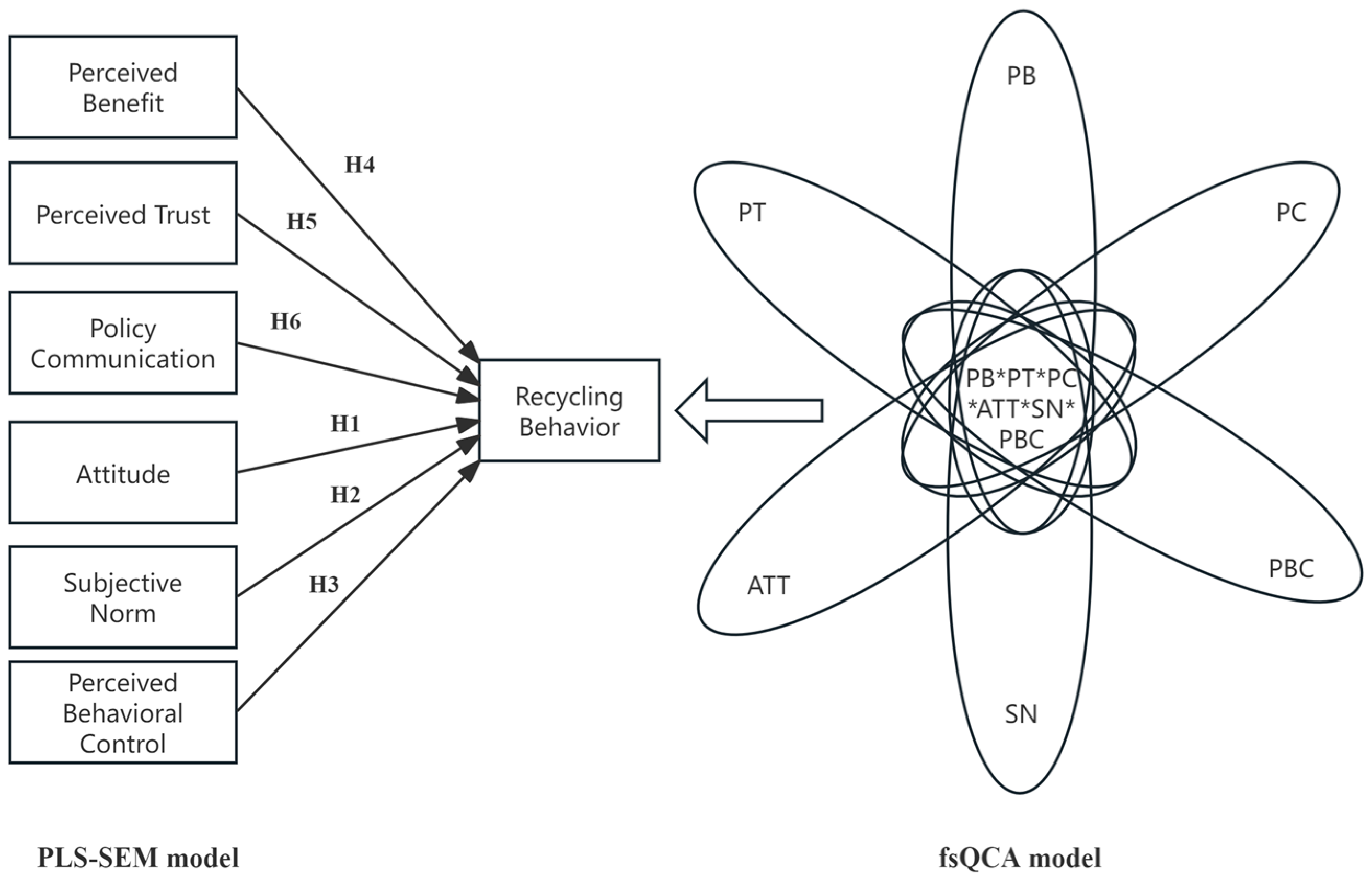
In summary, the proposed hypotheses are listed in Table 1, and the hypothesized relationships among these constructs collectively form an extended TPB framework, as depicted in Figure 1. This conceptual model provides the basis for the empirical analysis and methodological approach presented in the following section.
Table 1.
Summary of research hypotheses.
Figure 1.
Conceptual framework and study hypotheses.
3. Materials and Methods
3.1. Survey Instrument
Based on the latent variables proposed in the previous text, an initial survey questionnaire was developed under the framework of the extended TPB. A preliminary questionnaire was developed by adapting and extending established scales from recent literature to ensure content validity. Specifically, items for Perceived Benefit were sourced from [87], while those for Perceived Trust and Policy Communication were adapted from Yang et al. Measurement items for Attitude, Subjective Norm, Perceived Behavioral Control, and Recycling Behavior were drawn from [88] to align with the context of express packaging recycling and maintain theoretical coherence across constructs.
To ensure linguistic accuracy, the initial English version was translated into Chinese and then back-translated by independent bilingual researchers. After resolving discrepancies, five experts in environmental behavior, sustainable logistics, and public policy reviewed the questionnaire. Based on their suggestions, ambiguous or redundant items were revised. A pilot test involving 50 respondents was then conducted. According to the feedback, several expressions were refined, and the overall clarity of the questionnaire was confirmed.
The final measurement scale, presented in Appendix A (Table A1), consists of two major parts. The first part collects respondents’ demographic information, including gender, age, educational background, and occupation. The second part contains the measurement items for each latent variable, all evaluated using a five-point Likert scale ranging from 1 (“strongly disagree”) to 5 (“strongly agree”).
3.2. Participants and Procedure
This cross-sectional study was conducted between April and June 2025 and employed data collected through an online survey to test the proposed hypotheses. Data collection was facilitated through Wenjuanxing (https://www.wjx.cn), a prominent Chinese digital survey tool, with recruitment links shared across various instant messaging services to maximize participant outreach. To ensure a streamlined and economical data collection process, participants were selected using a simple random sampling technique, which allowed for efficient access to the target population [89]. Individuals residing in China who engage in e-commerce shopping and regularly use express delivery services were invited to participate in this study.
In accordance with ethical research standards, participants were provided with comprehensive information regarding the purpose and scope of the study and were explicitly informed of their right to withdraw at any stage without any adverse consequences. To ensure anonymity and confidentiality, all personal and professional identifiers were removed. All participants voluntarily completed the questionnaire after providing informed consent.
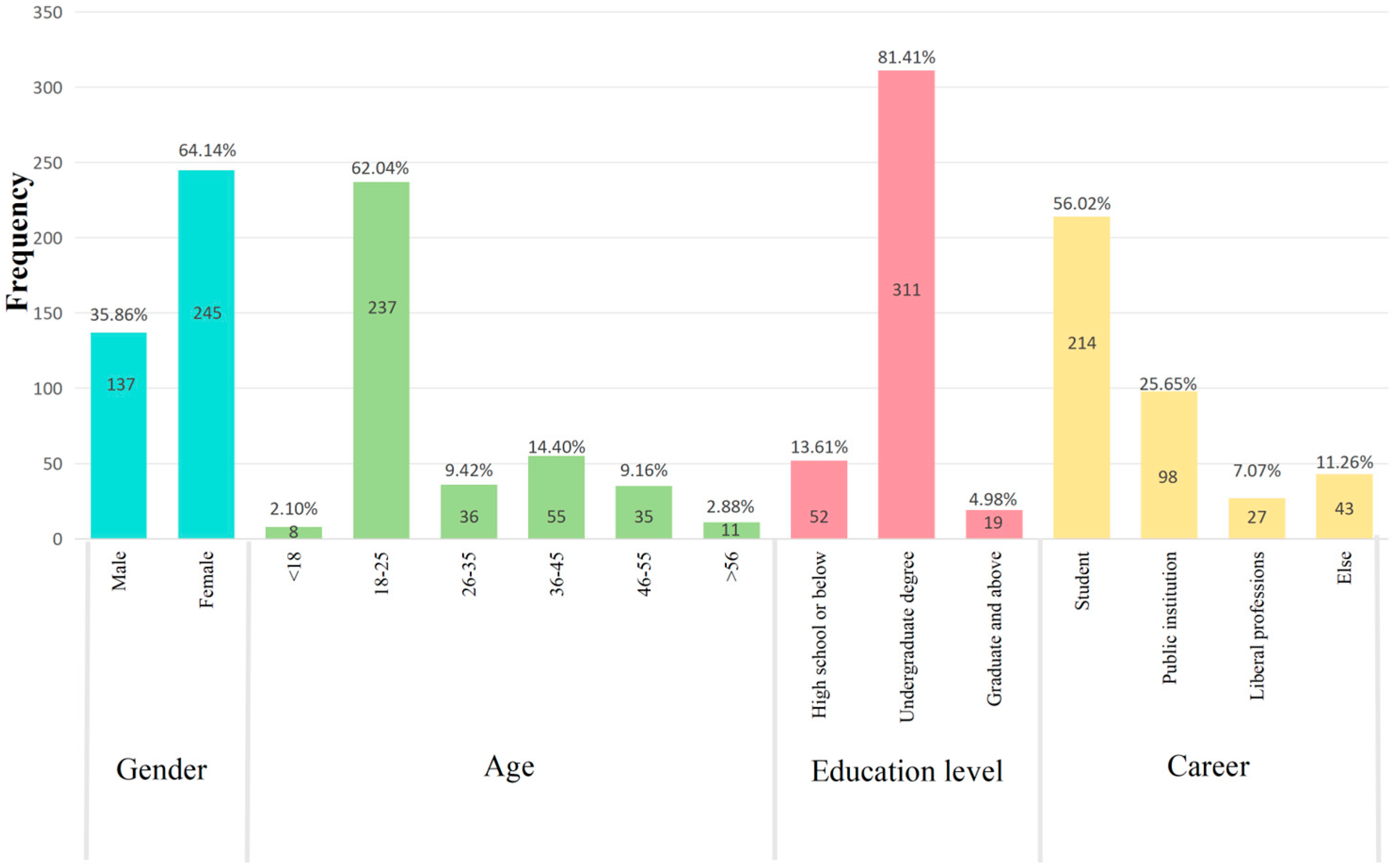
A total of 400 questionnaires were collected, of which 18 were excluded due to missing information or inconsistent responses. Consequently, 382 valid questionnaires were retained for analysis, yielding an effective response rate of 95.5%. The demographic characteristics of the sample are presented in Figure 2. Among the respondents, 64.14% were female, and 64.14% were aged 25 years or younger. In terms of occupation, 55.50% of participants were students. Moreover, approximately 81.41% of respondents had attained an undergraduate degree.
Figure 2.
Respondents’ demographic profile.
While the sample exhibits a skew toward younger demographics and students, this distribution aligns with the profile of ‘heavy users’ in China’s e-commerce sector. According to recent research, younger Chinese consumers constitute the most active segment of online shoppers and are the primary generators of express packaging waste [90]. Therefore, focusing on this demographic allows for a more precise examination of the behavioral mechanisms within the population most relevant to the research problem.
3.3. Integrated Analytical Framework
To capture the multifaceted mechanisms underlying consumers’ express packaging recycling behavior, this study employs an integrated analytical framework that combines complementary methodologies. Environmental behavior is influenced by psychological, contextual, and institutional factors, often exhibiting complexity that single methods cannot fully explain. Therefore, this research integrates PLS-SEM, fsQCA, and NCA, allowing for a comprehensive analysis of linear relationships, configurational patterns, and essential prerequisites.
PLS-SEM serves as the starting point for assessing this study’s theoretical model, ideal for situations with multiple latent constructs, complex measurement structures, and non-normal data distributions [91]. PLS-SEM is a widely used path analysis method in the social sciences, particularly for evaluating complex causal relationships and multivariate models. By estimating path relationships between latent variables, it helps reveal both direct and indirect effects among factors [92]. In this study, PLS-SEM is used to construct a extended model based on the TPB to assess how factors such as perceived benefits, perceived trust, and policy communication influence consumers’ recycling behavior. This approach quantifies the impact of these factors and analyzes their roles in the decision-making process through path coefficients. However, PLS-SEM’s linear assumptions limit its ability to address the non-linear and multi-causal nature of consumer recycling behavior [93].
To address this limitation, the analysis incorporates fsQCA, which approaches causality from a configurational and set-theoretic perspective. Unlike PLS-SEM’s linear assumptions, fsQCA explores non-linear causal pathways and multiple factor configurations leading to specific outcomes [94]. This perspective is particularly relevant for recycling behavior, where cognitive evaluations, motivational assessments, perceived capabilities, and institutional cues may combine in distinct ways across individuals. By calibrating raw data into fuzzy-set membership scores, constructing a truth table, and applying logical minimization, fsQCA identifies conditions that drive high or low recycling behavior. In doing so, it reveals causal complexities—such as substitution effects, synergistic interactions, and asymmetric pathways—that linear models cannot capture. The inclusion of fsQCA thus expands the explanatory reach of the analysis by illuminating how different clusters of conditions collectively shape consumer action.
Finally, NCA is introduced to assess whether any conditions are essential prerequisites for recycling behavior. While PLS-SEM and fsQCA both focus on sufficiency, NCA emphasizes necessity, determining whether the absence of a specific condition would prevent the outcome entirely. Using upper-boundary estimation and bottleneck analysis, NCA identifies the minimum levels of conditions required for different levels of behavioral performance [34]. This threshold-based approach provides valuable theoretical insights, distinguishing between factors that merely facilitate behavior and those that are indispensable for its occurrence [95].Identifying necessary conditions is crucial in behavioral research, as certain psychological or contextual factors may not directly prompt action but are vital for its possibility.
The following sections elaborate on the results derived from this integrated framework.
4. Results and Analysis
4.1. Analysis of PLS-SEM
4.1.1. Measurement Model Assessment
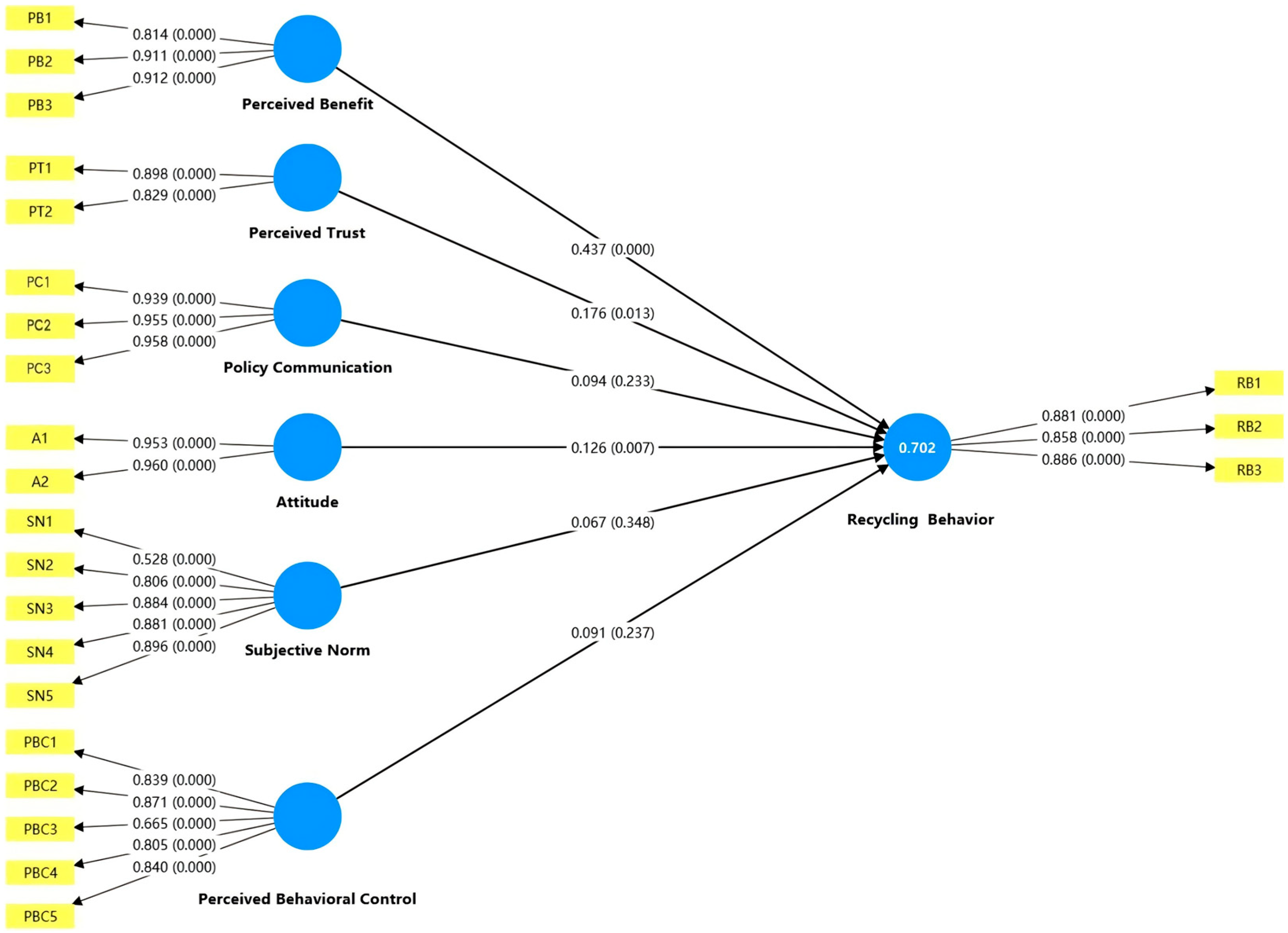
The measurement model was first evaluated in terms of indicator reliability, internal consistency, and convergent validity following the guidelines of [96]. As shown in Table 2, most standardized factor loadings met or exceeded the recommended threshold of 0.70, demonstrating adequate indicator reliability. Specifically, the loadings for PB (0.814–0.912), PT (0.829–0.898), PC (0.939–0.958), ATT (0.953–0.960) and RB (0.858–0.886) were consistently strong. Although one indicator of PBC (0.665) fell slightly below the ideal cut-off, the remaining items (0.805–0.871) showed satisfactory performance, and the construct was retained given its theoretical relevance and acceptable overall reliability.
Table 2.
Results of measurement model.
Internal consistency reliability was assessed using Cronbach’s alpha, rho_A, and composite reliability (CR). All constructs demonstrated satisfactory composite reliability (CR > 0.70). Although the Cronbach’s alpha and rho_A values of PT were slightly below 0.70, its composite reliability exceeded the recommended threshold, indicating acceptable internal consistency. Convergent validity was examined through the Average Variance Extracted (AVE), which for all constructs exceeded the threshold value of 0.50, confirming that each latent variable adequately captured the variance of its indicators.
Taken together, the measurement model demonstrates strong psychometric properties, providing a reliable basis for subsequent structural model analysis.
4.1.2. Discriminant Validity Assessment
Discriminant validity was assessed using the Fornell–Larcker criterion [97] and the heterotrait–monotrait (HTMT) ratio. As shown in Table 3, the square roots of AVE (diagonal values) were higher than most inter-construct correlations, although several notable exceptions were observed for PT, PBC, PB, and PC, indicating strong empirical associations among these constructs in the context of express packaging recycling behavior.
Table 3.
Results of discriminant validity.
HTMT analysis further showed that most construct pairs were below or close to the conservative threshold of 0.90. The HTMT value between PT and PBC exceeded this threshold, suggesting a high degree of association between these two constructs. In system-dependent recycling contexts, consumers’ perceived ability to perform recycling behaviors is closely linked to their trust in the effectiveness and reliability of the institutional recycling system [77].
Although the Fornell–Larcker criterion was not fully satisfied for several construct pairs involving PT, this pattern reflects conceptual proximity rather than construct redundancy. Perceived trust, by its nature, is closely related to policy communication, perceived benefits, and behavioral evaluations in institution-dependent pro-environmental behaviors. Importantly, PT, PC, PB, and PBC remain conceptually distinct, capturing system confidence, information credibility, outcome evaluation, and perceived behavioral feasibility, respectively. Overall, the discriminant validity of the measurement model can be considered acceptable within the theoretical framework and empirical context of this study.
4.1.3. Structural Model Assessment
The structural model was evaluated by examining multicollinearity, the significance of path coefficients, explanatory power (), effect sizes (), predictive relevance (), and overall model fit. This comprehensive assessment ensures the statistical robustness and theoretical soundness of the proposed framework.
Multicollinearity was assessed using the Variance Inflation Factor (VIF). As shown in Table 4, all VIF values ranged from 1.366 to 3.897, well below the commonly accepted thresholds of 5 (and the more conservative threshold of 3.3), indicating the absence of problematic multicollinearity and supporting the stability of the estimated structural paths.
Table 4.
Structural relationships.
Path coefficients were evaluated using a bootstrapping procedure with 5000 resamples. The results show that half of the six hypothesized relationships are statistically significant at the 0.05 or 0.001 levels. For example, ATT exerts a strong positive effect on RB ( = 0.126, < 0.01), demonstrating its central role in shaping consumers’ intentions. Likewise, PB shows a substantial positive influence on RB ( = 0.437, < 0.001), reaffirming its importance as a behavioral driver. These findings collectively support the theoretical expectations embedded in the model. However, the effects of SN on RB ( = 0.067, = 0.348), PBC on RB ( = 0.091, = 0.237), and PC on RB ( = 0.094, = 0.233) were not significant.
As shown in Figure 3, the explanatory power of the model was assessed using the coefficient of determination (). The value for RB is 0.702, indicating that ATT, SN, PBC, PB, PT, and PC jointly explain approximately 70.2% of the variance in RB. According to established benchmarks, these values represent substantial explanatory power. Predictive relevance was further assessed using the Stone–Geisser values obtained through the blindfolding procedure. The value for RB ( = 0.412) exceeds zero, demonstrating strong predictive relevance and confirming that the model has substantial out-of-sample predictive capability. Moreover, the overall model fit was evaluated using the Standardized Root Mean Square Residual (SRMR). According to [98], an SRMR value below 0.08 indicates good model fit. The SRMR for the current model is 0.073, suggesting that the structural model achieves an acceptable level of global model fit.
Figure 3.
Structural Model. Note: A = Attitude; PC = Policy Communication; PB = Perceived Benefit; PBC = Perceived Behavioral Control; PT = Perceived Trust; RB = Recycling Behavior; SN = Subjective Norm.
To further elucidate the relative contribution of individual predictors within the structural model, effect sizes () were examined. The results show that, although PB exhibits a medium effect size ( = 0.251), most other predictors—even those with statistically significant paths, such as ATT and PT—display small effect sizes. This indicates that statistical significance does not necessarily translate into substantial explanatory power at the individual predictor level. Overall, no single antecedent independently exerts a dominant influence on recycling behavior. Rather than indicating theoretical weakness, the prevalence of small to moderate effect sizes highlights the inherently complex and multifaceted nature of recycling behavior, which is shaped by the joint presence of multiple conditions rather than isolated factors. This finding implies that linear net-effect models may not fully capture the configurational logic underlying recycling behavior. Accordingly, to further explore how different combinations of conditions jointly lead to high levels of recycling behavior, the next section applies fsQCA.
4.2. Analysis of fsQCA
The fsQCA analysis proceeded in three steps: calibration, construction of the truth table, and derivation of the solutions.
4.2.1. Data Calibration
Following the method proposed in [99], all raw Likert-scale responses were calibrated into fuzzy-set membership scores prior to conducting the fsQCA. This procedure enables the transformation of numerical ratings into set-theoretic representations that capture meaningful qualitative distinctions in respondents’ perceptions and behaviors, thereby strengthening the validity of subsequent necessity and sufficiency analyses.
For each causal condition and the outcome, three qualitative anchor points—full membership, the crossover point, and full non-membership—were established. Consistent with prior fsQCA applications in behavioral intention and environmental psychology [100,101], the 95th, 50th, and 5th percentiles were selected as the calibration thresholds. Given the five-point Likert scale used in this study, these percentile thresholds correspond to the substantive values of 4.0 (full membership), 3.0 (crossover), and 2.0 (full non-membership) across all variables, including ATT, SN, PBC, PB, PT, PC and RB.
Specifically, the anchor for full membership (fuzzy score = 0.95) was set at 4 (‘Agree’), as this response clearly indicates the presence of the construct without being overly restrictive to only extreme values. The crossover point of maximum ambiguity (fuzzy score = 0.50) was set at 3 (‘Neutral’), where respondents are indifferent. The anchor for full non-membership (fuzzy score = 0.05) was set at 2 (‘Disagree’), representing a clear absence of the trait. This approach aligns with standard practices in recycling behavior research using 5-point scales, ensuring that the fuzzy sets accurately reflect consumer attitudes [29,102,103].
Calibration was performed using fsQCA 4.1, yielding fuzzy-set membership scores ranging from 0 to 1 (see Table 5). In line with methodological recommendations [100], cases with a computed membership score of exactly 0.50 were reassigned a value of 0.501 to avoid ambiguity in set-theoretic intersections, ensuring clear differentiation between cases that are more in versus more out of the set.
Table 5.
Calibration Anchor Points.
Following calibration, a necessity analysis was conducted for all antecedent conditions and their negated forms. As reported in Table 6, only ATT reaches a consistency of 1.00 for high RB, exceeding the conventional threshold of 0.90 for necessity. Several other conditions—such as PB, PT, and SN—also show relatively high consistency values (≥0.93), yet none of these fully satisfy the criteria for necessity when their empirical coverage is considered. All remaining conditions and their negations fall well below the threshold. These results indicate that no single condition other than ATT can be considered necessary for high levels of recycling behavior. The generation of RB therefore depends on the interplay of multiple antecedents, which must be examined through the analysis of configurational pathways.
Table 6.
Necessity Conditions Analysis.
4.2.2. Construction of Truth Table
Following [99]’s guidelines, a truth table was constructed to identify condition configurations sufficient for achieving high recycling behavior. A minimum frequency threshold of one case and a consistency cutoff of 0.80 were adopted. Following the approach of [101], the Pri consistency threshold was set to 0.7. Condition combinations meeting the aforementioned thresholds were assigned a value of 1, while others were assigned a value of 0. To ensure the robustness of the findings, a sensitivity analysis was conducted by raising the consistency threshold from 0.80 to 0.85. The identical configuration patterns obtained under the stricter threshold confirmed the stability and robustness of the fsQCA results. Ultimately, a structured truth table suitable for Boolean minimization operations was generated.
4.2.3. Configuration Analysis for High Recycling Behavior
Drawing on the truth table, the Boolean minimization procedure in fsQCA yields three types of solutions: complex, parsimonious, and intermediate. In this study, we prioritize the intermediate solution. On the one hand, the intermediate solution relies only on logical remainders that are consistent with theoretical directional expectations. On the other hand, compared with the complex solution, it offers more parsimonious causal configurations while avoiding the parsimonious solution’s heavy dependence on unobserved configurations. As such, it strikes an optimal balance between theoretical reasoning and empirical evidence. Table 7 presents the detailed results, revealing six distinct configurations that lead to high recycling behavior. Each configuration exhibits a consistency level above 0.9, and the overall coverage is 0.94, indicating strong explanatory power of these causal pathways.
Table 7.
Sufficient configurations for high and low recycling behavior.
Based on the six configurations associated with high RB reported in Table 6, two types of configurational pathways can be divided. The first type is characterized by PC as a core condition, which underscores the pivotal role of institutional information provision in stimulating recycling behavior. The second type is centered on PBC, suggesting that in the absence of strong policy communication, individuals’ perceived capability together with complementary psychological factors can independently drive high levels of recycling behavior.
PC-Driven Type
In this type, PC serves as the common core condition and functions as an “institutional catalyst” in RB by lowering informational barriers, shaping behavioral expectations, and enhancing the visibility and perceived enforceability of recycling practices. By providing clear guidance, incentives, and environmental cues, PC not only strengthens consumers’ awareness of recycling norms but also facilitates the internalization of pro-environmental values and intentions.
- (1)
- Configuration RB1: ATT * PT * PC
The consistency of configuration RB1 is 0.919, and the raw coverage is 0.07. Although this configuration covers a relatively small proportion of cases, it reveals a distinct motivational mechanism in which a subset of consumers with a clearly positive attitude toward recycling and strong trust in the recycling process or institutions are further encouraged by policy communication, which acts as a reinforcing mechanism that amplifies these internal motivations. Specifically, ATT provides a stable evaluative foundation, PT reduces perceived uncertainty regarding recycling outcomes, and PC aligns these psychological drivers by offering clear information, procedural guidance, and normative reinforcement [104].
This pathway highlights that PC achieves maximum effectiveness when it cooperates with consumers’ internal motivation system, enabling individuals with strong ATT and trust to translate intentions into sustained recycling behavior.
- (2)
- Configuration RB4: ATT * PB * PC
The consistency of configuration RB4 is 0.978, and the raw coverage is 0.84. This configuration indicates that when consumers hold a strong positive attitude toward recycling and perceive substantial benefits from participating—whether environmental, social, or personal—PC amplifies these motivations by clarifying the value of recycling and reinforcing its societal importance. PC makes recycling benefits more salient and concrete, thereby strengthening the cognitive–evaluative basis that supports recycling decisions.
Under this pathway, ATT provides the motivational foundation, perceived benefit enhances utility evaluation, and PC supplies institutional reinforcement. Together, they create a coherent cognitive system that encourages consumers to translate favorable perceptions into actual recycling behavior. This type of configuration demonstrates that consumers’ value-driven motivations can be effectively mobilized when policy communication ensures that the benefits of recycling are clearly understood and socially affirmed [31].
- (3)
- Configuration RB5: PBC * PT * PC
The consistency of configuration RB5 is 0.985, and the raw coverage is 0.82. This pathway highlights the combined role of PBC and PT in enabling consumers to act on institutional signals. When individuals believe they possess adequate ability and resources to carry out recycling tasks, PC further reduces perceived uncertainty about the recycling process. PC reinforces this mechanism by delivering operational clarity, institutional assurance, and procedural transparency.
In this configuration, PBC ensures that RB is perceived as feasible, while trust enhances consumers’ willingness to commit to the action. PC integrates these internal drivers by providing consistent informational cues, ultimately forming a triadic mechanism that supports confident and sustained recycling behavior.
PBC-Driven Type (RB2, RB3, RB6)
In this type, PBC appears as the shared core condition, while PC is absent. These pathways illustrate that even without strong institutional signaling, consumers with high perceived capability can still achieve high levels of recycling participation when supported by complementary internal motivations such as subjective norms, PBs, or trust.
This type reflects a self-regulatory motivation system, where individuals rely primarily on their internal psychological resources rather than external policy cues to guide recycling behavior.
- (1)
- Configuration RB2: SN * PBC
The consistency of configuration RB2 is 0.976, and the raw coverage is 0.84. This configuration demonstrates that strong SN, combined with high PBC, can independently motivate recycling participation. Social expectations, encouragement from peers, or perceived social approval create normative pressure that aligns with consumers’ perceived ability to act.
Here, subjective norms function as an external social driver, while PBC ensures that individuals feel capable of meeting these expectations. The absence of PC suggests that social influence mechanisms alone can effectively promote recycling, provided that individuals perceive the required behaviors as manageable and within their reach.
- (2)
- Configuration RB3: PB * PT * PBC
The consistency of configuration RB3 is 0.966, and the raw coverage is 0.87. This pathway highlights a motivation structure in which PB, PT, and PBC interact to guide recycling behavior. Individuals who recognize the tangible or symbolic benefits of recycling, trust the recycling system, and believe they possess the ability to perform the behavior are likely to engage actively, even in the absence of institutional communication.
This configuration reflects a self-reinforcing internal mechanism: PB provides outcome utility, trust reduces uncertainty, and PBC ensures behavioral feasibility. Together, they create a stable internal motivation network capable of sustaining RB autonomously.
- (3)
- Configuration RB6: ATT * PB * PBC
The consistency of configuration RB6 is 0.988, and the raw coverage is 0.80. In this configuration, positive ATT, PB, and PBC jointly shape recycling behavior. ATT forms the evaluative foundation, PB enhances behavioral motivation, and PBC ensures action feasibility. Even without policy communication, this combination allows individuals to maintain strong internal motivation toward recycling.
This pathway emphasizes that individuals with strong psychological readiness (attitude + benefit evaluation + perceived capability) can engage in recycling independently, relying on internalized motivations rather than institutional cues.
4.2.4. Configuration Analysis for Low Recycling Behavior
One of the distinct methodological advantages of fsQCA is its ability to capture causal asymmetry, revealing that the conditions leading to the absence of an outcome (low recycling behavior) are not merely the mirror opposites of those driving its presence [99]. To elucidate the inhibitory mechanisms preventing recycling, this study analyzed the configurations for low recycling behavior (~RB). The analysis identified four distinct paths (labeled ~RB1 to ~RB4), which can be theoretically categorized into two inhibitory typologies: the Attitude-Deficit Inhibition Type and the Constraint-Driven Inhibition Type.
Attitude-Deficit Inhibition Type (~RB1, ~RB4)
This typology is characterized by the core absence of internal psychological drivers, particularly ~ATT. It suggests a mechanism of “psychological disengagement”, where the lack of a favorable cognitive evaluation acts as a fundamental veto, rendering other potential enablers ineffective.
- (1)
- Configuration ~RB1: ⊗ATT * ⊗SN
The consistency of configuration ~RB1 is 0.98, and the raw coverage is 0.16. This pathway highlights a scenario of “normative and evaluative void”. The simultaneous absence of a positive attitude (~ATT) and subjective norms (~SN) implies that individuals neither value recycling personally nor perceive any social pressure to participate. Without these two critical sources of motivation, the behavioral intention is stifled at the source, leading to non-engagement regardless of external conditions.
- (2)
- Configuration ~RB4: ⊗ATT * ⊗PBC
The consistency of configuration ~RB4 is 0.93, and the raw coverage is 0.15. In this configuration, the absence of attitude (~ATT) is coupled with a lack of perceived behavioral control (~PBC). This reflects a “double jeopardy” of unwillingness and inability. Even if external policy signals exist, the lack of internal willingness combined with low self-efficacy creates an insurmountable cognitive barrier, causing individuals to dismiss recycling as either irrelevant or unfeasible.
Constraint-Driven Inhibition Type (~RB2, ~RB3)
Unlike the first typology, this category reflects a “frustrated intention” mechanism. It occurs when external structural constraints—such as the lack of Policy Communication (~PC) or Resources (~PBC)—act as bottlenecks, inhibiting behavior even when other psychological motivations might be present.
- (1)
- Configuration ~RB2: ⊗PBC * ⊗PB * ⊗PT
The consistency of configuration ~RB2 is 0.91, and the raw coverage is 0.15. This pathway describes a “resource-trust deficit”. The core absence of perceived behavioral control (~PBC), combined with low perceived benefits (~PB) and trust (~PT), creates a structural deadlock. This finding underscores that internal motivation alone is insufficient; without the foundational assurance of capability (PBC) and system reliability (PT), potential recycling intentions cannot be translated into action.
- (2)
- Configuration ~RB3: ⊗SN * ⊗PC
The consistency of configuration ~RB3 is 0.91, and the raw coverage is 0.24. This configuration highlights the critical role of the institutional and social environment. The dual absence of subjective norms (~SN) and policy communication (~PC) creates an “informational and normative vacuum”. In this context, individuals lack both the social cues to conform and the institutional guidance to act, resulting in low participation due to a lack of external triggers.
4.2.5. Comparative Analysis of High and Low Recycling Behavior Configurations
A comparative assessment of high and low recycling behavior configurations reveals the structural differences in their causal logic, offering specific directions for policy intervention.
High recycling behavior is typically synergistic, driven by the confluence of internal motivation (ATT, PBC) and external support (PC). In contrast, low recycling behavior is often bottleneck-driven. As shown in the Attitude-Deficit typology, the failure of a single core dimension (e.g., ATT) can unilaterally inhibit behavior, effectively vetoing other favorable conditions. Similarly, the Constraint-Driven typology demonstrates that structural deficits (~PC or ~PBC) can block participation even if the individual is psychologically willing.
Based on this asymmetry, distinct strategic directions are required for different consumer segments. For the Attitude-Deficit Inhibition Type, where the primary barrier manifests as internal disengagement (~RB1, ~RB4), interventions must prioritize Value Reconstruction. Since physical infrastructure alone cannot compensate for a lack of willingness, policies should aim to ignite the internal drive of these consumers. Conversely, the Constraint-Driven Inhibition Type—characterized by individuals hindered by structural barriers (~RB2, ~RB3)—necessitates a strategy of Barrier Removal. In these cases, motivational appeals are redundant; instead, the focus must shift toward restoring Perceived Behavioral Control and Policy Communication to facilitate the conversion of latent intentions into actual behavior (specific practical measures corresponding to these strategies are further detailed in Section 6.2).
4.3. Analysis of Necessary Condition Results
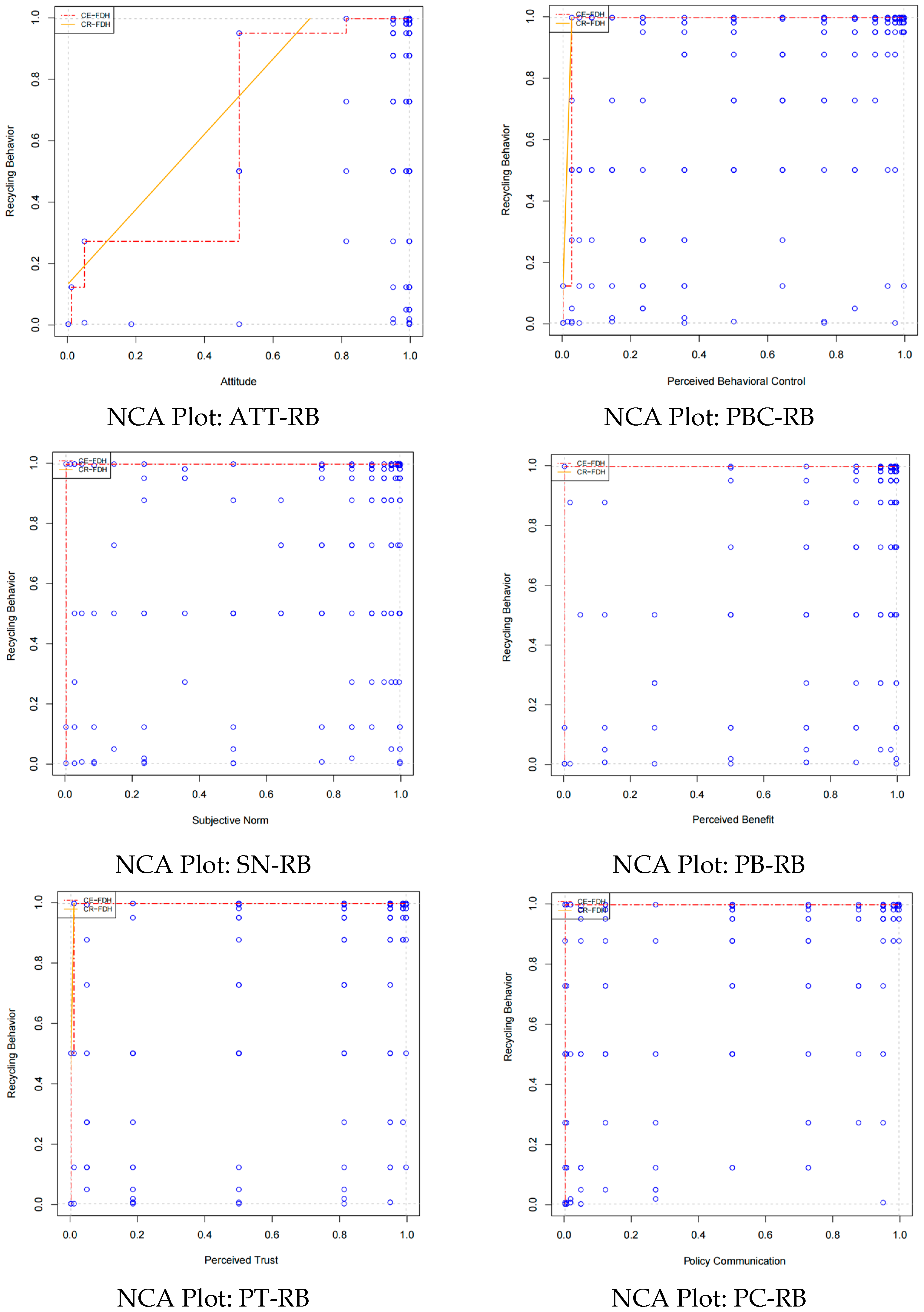
To complement the symmetric net-effect analysis obtained from the SEM and the configurational findings from the fsQCA, this study employed NCA to further examine whether any of the psychological or contextual factors act as indispensable prerequisites for high levels of consumer recycling behavior. Following [105], the NCA was conducted using the ceiling envelopment–free disposal hull (CE-FDH) technique. Unlike the ceiling regression (CR-FDH) method, which imposes a linear assumption and allows for exceptions, CE-FDH was specifically chosen because its non-parametric, step-function approach aligns with the discrete nature of Likert-scale data and enforces a strict necessity logic (100% ceiling accuracy) to identify indispensable prerequisites. Each condition was bootstrapped with 10,000 resamples to estimate the significance of the ceiling zone effect sizes (p-values). As visually demonstrated in Figure 4, the scatter plot for Attitude exhibits a substantial empty area in the upper-left corner above the ceiling line. This visual pattern signifies a ‘necessary condition’ relationship: high levels of recycling behavior are consistently absent when ATT is low (the empty upper-left), confirming that the presence of a positive attitude is indispensable. In contrast, the plots for SN and PC show scattered data points filling the upper-left zone, visually confirming that high recycling behavior can still occur even when these factors are low, thereby ruling them out as necessary prerequisites.
Figure 4.
NCA ceiling plots of the predictor variables versus recycling behavior.
According to [106], a variable qualifies as a necessary condition when it satisfies three criteria: (1) strong theoretical justification for its necessity, (2) an effect size (d) exceeding 0.10, and (3) a statistically significant p-value ( < 0.05). As shown in Table 8, among all constructs, ATT emerged as the only significant necessary condition (d = 0.384, < 0.001). This indicates that without a positive attitude toward recycling, consumers are unlikely to engage in recycling behavior, regardless of the presence or strength of other enabling factors. Although PBC and PT exhibited non-zero effect sizes, their values fell well below the recommended threshold (d = 0.022 and 0.005, respectively), indicating that they do not constitute indispensable prerequisites for recycling behavior. Other conditions, including SN, PB, and PC, likewise failed to meet the necessity criteria.
Table 8.
CE-FDH derived necessity effect sizes.
The bottleneck analysis results (Table 9) show that ATT remains the dominant necessary condition for achieving high levels of recycling behavior, with its required threshold increasing steadily from 5.5% at 20% of the outcome level to 70.8% at the 100% outcome level. This indicates that consumers must possess at least a moderate to high level of positive attitude before high recycling behavior can occur.
Table 9.
Bottleneck table (percentage).
In addition, PBC and PT exhibit minor but consistent increases in their threshold values (rising from 0.2% to 2.6% and from 0.2% to 0.9%, respectively). However, given that their necessity effect sizes remain well below the recommended threshold (d < 0.1), these conditions do not constitute indispensable prerequisites for recycling behavior.
By contrast, PC, PB, and SN remain non-necessary (NN) across all outcome levels, indicating that the absence of these conditions does not prevent the occurrence of recycling behavior.
Overall, the results reinforce that ATT functions as the critical bottleneck variable, while other conditions play secondary roles. This finding is consistent with the fsQCA results, where ATT consistently emerged as a core condition across multiple sufficient configurations, further confirming its central role as a psychological threshold for enabling high recycling behavior.
5. Discussion
Guided by the TPB, this study examines how perceived benefits, perceived trust, policy communication, and the three core constructs of TPB—ATT, SN, and PBC—collectively shape consumers’ intentions to engage in express packaging recycling.
5.1. PLS-SEM Analysis Findings
The PLS-SEM results reveal several clear patterns in the determinants of express packaging recycling. Attitude, perceived benefit, and perceived trust emerge as significant predictors of recycling behavior, indicating that consumers’ willingness to recycle is shaped by favorable evaluations of the intention, anticipated benefits, and confidence in institutional reliability—an observation consistent with prior research [31,50,77,107]. This reflects the effortful and low-visibility nature of express packaging recycling, in which consumers assess both whether the behavior is “worth the effort” and whether the system is “worth the trust”.
Notably, incorporating perceived benefit and perceived trust as extended variables substantially enhances the explanatory power of the TPB model. Perceived benefit—encompassing both economic returns and environmental gains—emerges as the strongest determinant of RB in this study, suggesting that perceived benefit functions as a compensatory mechanism that offsets behavioral costs in a system characterized by fragmented recycling channels and inconsistent service quality [40,47]. This reflects a broader tendency observed in high-effort pro-environmental behaviors, wherein individuals anchor their decisions on anticipated value rather than on moral commitment alone. Perceived trust likewise exerts a significant positive influence, indicating that when consumers believe their returned packaging will be handled responsibly, their intention to recycle strengthens even if the process itself remains inconvenient [29,102,103]. This highlights the role of trust in reducing perceived behavioral risk—an especially salient factor within China’s rapidly expanding yet unevenly regulated express delivery ecosystem.
In contrast, subjective norm, perceived behavioral control, and policy communication do not significantly predict RB. The weak effect of subjective norm reflects the low visibility and private nature of express packaging recycling, which reduces opportunities for social comparison and weakens normative pressure [108]. The absence of a significant role for perceived behavioral control in behavior formation indicates that consumers’ sense of capability is insufficient to motivate action when procedural ambiguity and inconsistent infrastructure persist. Similarly, policy communication alone does not translate into intention, because top-down information is easily diluted in a decentralized recycling environment [109,110], especially when specific operational guidance is lacking.
Finally, both RB and PBC significantly influence actual recycling behavior. Intention functions as the primary motivational driver, while perceived control facilitates the execution of behavior by enabling consumers to navigate practical constraints. This pattern suggests that successful recycling requires both motivational readiness and operational feasibility, reinforcing the importance of combining psychological and contextual determinants in models of consumer recycling behavior.
5.2. FsQCA Analysis Findings
Distinct from the PLS-SEM’s single model, fsQCA identifies six distinct configurations driving high recycling behavior, with an explanatory power of 94%, significantly surpassing the 71% from PLS-SEM. This underscores the multifaceted nature of consumer motivations in recycling, highlighting the need for fsQCA to capture and explain this complexity.
Several configurations feature PC as a core condition. These pathways indicate that consumers who already possess favorable psychological orientations—such as strong ATT, PB, or PT—can achieve high RB when institutional signals reinforce these motivations. PC thus functions as an enabling condition that compensates for uncertainties in the recycling environment, providing clarity and legitimizing behavioral expectations. A second set of configurations centers on PBC as the core condition. These pathways show that individuals with high perceived capability can attain high levels of RB even when institutional communication is weak or absent. This is because individuals with high PBC rely primarily on self-efficacy and prior knowledge, reducing their need for external institutional communication. PBC forms the backbone of self-regulated behavioral readiness, and when combined with subjective norms, PB, or trust, it produces strong internal motivation for action.
Notably, while PBC and PC were not found to be significant in the PLS-SEM analysis, the FSQCA results indicate that these factors play a crucial role in different solutions. This suggests that a single symmetric model cannot fully capture the complexity and diversity of consumer behavior. Therefore, the development of integrated strategies that combine various motivational factors is essential to effectively promote consumer participation in packaging recycling.
5.3. NCA Findings
The NCA results show that ATT is the only antecedent that qualifies as a necessary condition for high recycling behavior. ATT demonstrates a substantial effect size (d = 0.384, < 0.001), indicating that without a sufficiently positive ATT, high levels of RB cannot occur. In contrast, PB, PT, PBC, SN, and PC all fall below the necessity threshold (d < 0.1), and therefore do not function as necessary conditions.
Bottleneck analysis further highlights the central role of ATT, whose required minimum level increases sharply as the target recycling performance rises—from 5.5% at low outcome levels to 70.8% at full performance. Although PBC and PT show slight increases in their bottleneck thresholds, their small necessity effect sizes indicate that they do not constitute indispensable prerequisites for recycling behavior. Other conditions (PC, PB, and SN) remain non-necessary across all outcome levels.
Overall, the results confirm that ATT is the critical bottleneck variable, while other factors do not impose strict necessity constraints. This aligns with the fsQCA results, which consistently identify ATT as a core condition enabling high recycling behavior.
5.4. Integrated Findings from PLS-SEM, fsQCA, and NCA
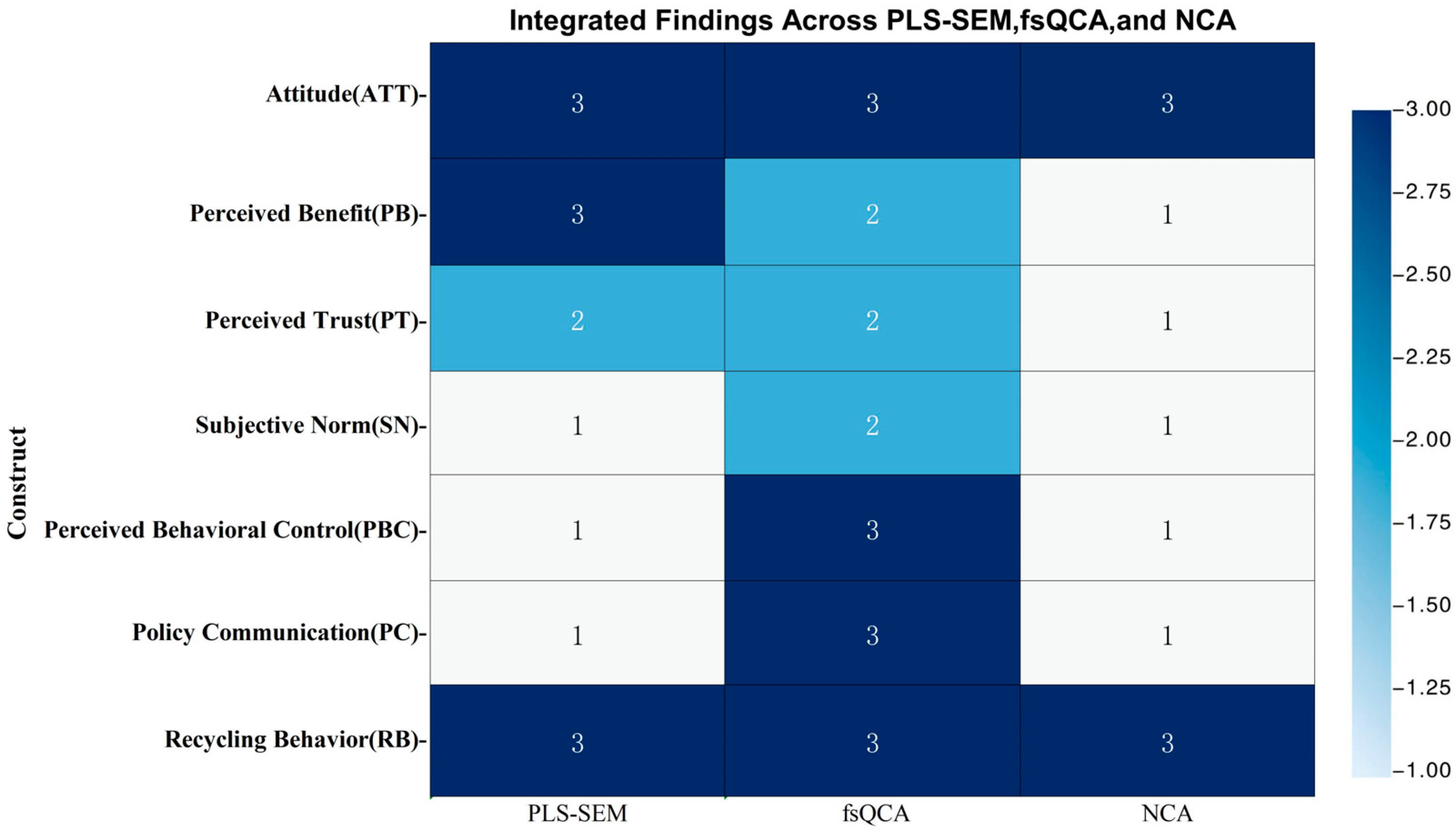
A comparative assessment of the PLS-SEM, fsQCA, and NCA results offers a more holistic understanding of consumers’ RB. As illustrated in Figure 5, the varying shades of blue represent the varying degrees of influence across methodologies. The top row for Attitude is marked with dark blue cells (Level 3) across the NCA column, visually highlighting its unique status as the distinct ‘bottleneck’ variable. In comparison, Perceived Benefit is highlighted in dark blue (Level 3) within the PLS-SEM column, identifying it as the strongest driver of behavioral intensity. Notably, Policy Communication and PBC shifts from light blue (Level 1, non-significant) in PLS-SEM to dark blue (Level 3, core condition) in the fsQCA column. This visual transition effectively captures the study’s core insight: factors that appear insignificant in isolation can become decisive catalysts when combined in specific configurations.
Figure 5.
Heatmap of Integrated Findings Across PLS-SEM, fsQCA, and NCA. Note: 3 = Core role/Significant influence/Necessary condition; 2 = Secondary role/Present in partial configurations; 1 = Not significant/Weak influence.
Taken together, the three methods provide complementary insights: PLS-SEM clarifies the net effects between variables, fsQCA uncovers alternative causal pathways capable of producing the same outcome, and NCA identifies the minimum requirement levels that must be met. Collectively, these results underscore the multidimensional nature of RB and reinforce the need for intervention strategies that integrate multiple motivational factors rather than relying on single-variable approaches.
6. Conclusions and Implications
6.1. Conclusions
This study investigates the complex mechanisms underlying consumer participation in express packaging recycling by extending the Theory of Planned Behavior with perceived benefit, perceived trust, and policy communication. By integrating PLS-SEM, fsQCA, and NCA, the findings delineate a multi-layered behavioral logic that linear models alone fail to capture.
First, attitude functions as the strict logical starting point and a critical bottleneck for recycling behavior. The NCA results reveal that Attitude is the sole necessary condition (d = 0.384, < 0.001), imposing a “hard constraint” on behavior. Specifically, the bottleneck analysis quantifies this constraint, showing that to achieve a 100% level of recycling behavior, the intensity of consumer attitude must reach at least 70.8%. This indicates that without a high threshold of positive cognitive evaluation, other enabling factors—regardless of their strength—cannot effectively trigger action.
Second, within the behavioral space enabled by attitude, utilitarian and relational factors act as the primary engines of participation. The PLS-SEM analysis identifies Perceived Benefit ( = 0.437) as the strongest dominant driver, significantly outperforming Perceived Trust ( = 0.176) and Attitude ( = 0.126) in terms of direct impact. This suggests a compensatory mechanism where consumers prioritize tangible returns (environmental or economic utility) and institutional reliability to overcome the high effort costs associated with recycling. Thus, while attitude opens the door to participation, perceived benefit determines the intensity of the engagement.
Third, the configurational analysis resolves the “significance paradox” of contextual factors. Although Policy Communication and Perceived Behavioral Control showed insignificant net effects in the PLS-SEM analysis, fsQCA reveals their pivotal roles in specific causal combinations. The identification of PC-Driven and PBC-Driven typologies demonstrates that these factors function as “institutional catalysts” or “capability backbones” in specific configurations (e.g., RB5: PBC * PT * PC, consistency = 0.985). This confirms that recycling behavior exhibits equifinality: consumers can achieve high participation through distinct pathways—either by relying on strong institutional guidance or by leveraging high self-efficacy—thereby clarifying the complex, non-linear role of institutional support.
In summary, this study theoretically refines the intention–behavior relationship by establishing a hierarchical causality: Attitude constitutes the necessary baseline, Perceived Benefit drives the behavioral intensity, and configurational pathways provide the sufficient routes for realization. This integrated perspective offers a robust, data-driven framework for designing precision interventions in high-effort pro-environmental behaviors.
6.2. Implications
6.2.1. Theoretical Implications
This study proposes an extended behavioral framework to explain consumers’ express packaging recycling by augmenting the TPB with perceived benefit, perceived trust, and policy communication. The findings demonstrate that recycling participation is not solely driven by attitudes or norms, but emerges from the joint influence of evaluative judgments, anticipated benefits, and trust in institutional arrangements. Although attitude remains a core psychological antecedent, its effect is contingent upon consumers’ perceived benefits of recycling and their confidence in the effectiveness and credibility of recycling systems. By incorporating these contextual and institutional factors, this study enhances the explanatory power of TPB and offers a more context-sensitive account of high-effort, low-visibility pro-environmental behavior.
Methodologically, the study adopts a multi-method approach integrating PLS-SEM, fsQCA, and NCA to capture complementary causal logics underlying recycling behavior. PLS-SEM identifies dominant net effects, fsQCA reveals multiple equifinal configurational pathways, and NCA distinguishes necessary from facilitating conditions. Together, the results show that recycling behavior arises from diverse and substitutable causal structures, while attitude constitutes a necessary psychological foundation that constrains high recycling performance. Accordingly, this integrated analytical framework yields a more comprehensive and nuanced understanding of consumers’ express packaging recycling behavior and meaningfully extends the existing literature on consumer behavior and pro-environmental behavior in this context.
6.2.2. Practical Implications
The findings of this study provide clear and actionable guidance for policymakers, logistics service providers, and e-commerce platforms seeking to enhance consumer participation in express packaging recycling. The integrated evidence derived from PLS-SEM, fsQCA, and NCA demonstrates that no single intervention is universally effective. Instead, the promotion of express packaging recycling depends on the coordinated design of interventions targeting specific psychological and institutional mechanisms.
First, attitude constitutes a necessary foundational condition for the formation of recycling behavior. The NCA results indicate that, in the absence of a sufficiently positive attitude toward recycling, high levels of participation cannot be achieved, even when incentives or recycling infrastructure are available. This finding suggests that practical interventions should prioritize stabilizing favorable evaluations of recycling behavior. Rather than relying on broad or abstract environmental campaigns, governments and platforms can embed attitude-oriented cues into concrete usage contexts. For example, brief prompts placed on parcel lockers, community collection points, or order pickup interfaces can explicitly communicate the environmental significance or subsequent handling of returned packaging, thereby reducing psychological resistance and reinforcing the legitimacy of recycling behavior.
Second, clearly defined and immediate benefits are essential to offset the perceived costs of recycling. Empirical results show that perceived benefit is the strongest driver of recycling behavior. E-commerce platforms can link packaging returns to existing loyalty or membership systems by offering cumulative Tand redeemable rewards, such as points, delivery fee reductions, or service privileges. To maintain effectiveness, incentive rules should remain simple and transparent, as overly complex procedures may undermine motivational impact. Moreover, fsQCA findings indicate that benefit mechanisms are most effective when combined with positive attitudes or high perceived behavioral control, suggesting that incentives should complement—rather than replace—consumers’ psychological readiness for recycling.
Third, enhancing institutional transparency is critical for building consumer trust. When consumers are uncertain whether returned packaging is properly processed, their willingness to participate declines substantially. Logistics firms and recycling operators can strengthen trust by disclosing recycling procedures, publishing periodic processing outcomes, or introducing digital traceability tools that make the recycling process more visible. Consistent regulatory enforcement and standardized operational practices further reduce institutional uncertainty. Configurational analysis indicates that trust is more likely to translate into actual behavior when combined with clear operational guidance or a strong sense of capability.
In addition, the primary function of policy communication lies in amplifying existing motivations rather than directly triggering behavior. Effective policy messages should focus on operational clarity by specifying where packaging can be returned, how it should be handled, and which actors are responsible. Abstract or symbolic messaging should be avoided. For consumers with high perceived behavioral control, brief reminders may be sufficient, whereas those with lower confidence require more detailed, step-by-step instructions to improve information uptake and behavioral translation.
Overall, the sustained promotion of express packaging recycling relies on the joint effects of attitude guidance, benefit compensation, institutional trust, and procedural clarity. Rather than depending on a single policy instrument, practitioners should flexibly combine these measures according to consumers’ psychological readiness and situational conditions. Such a coordinated and mechanism-based approach is more likely to achieve stable and scalable improvements in recycling participation within rapidly expanding e-commerce and logistics systems.
6.3. Limitations and Future Works
Despite its theoretical and methodological contributions, this study is subject to several limitations that also offer directions for future research.
First, regarding sample characteristics, although the 382 respondents meet the statistical power requirements for PLS-SEM, the sample size is relatively modest, and the demographic structure is skewed toward younger urban consumers and students. While this group represents the dominant force in e-commerce consumption and packaging waste generation, these factors may nonetheless limit the broad generalizability of the findings to other populations, such as older adults or rural residents. Future research should verify the proposed model using a larger-scale dataset and employ stratified sampling techniques to ensure a more balanced representation across diverse age groups and occupational backgrounds.
Second, the study focuses on urban consumers in China, where express delivery density, digital platforms, and regulatory frameworks differ substantially from those in rural areas or other countries. As a result, the generalizability of the findings may be limited. Future research could extend the model to diverse institutional contexts, including rural regions, developing economies, or countries with established deposit-refund or extended producer responsibility systems, to test the robustness and boundary conditions of the proposed mechanisms.
Third, this study primarily examines psychological and institutional determinants of recycling behavior but does not incorporate infrastructural variables (e.g., spatial accessibility to collection points or the operational efficiency of recycling systems), which could serve as potential mediators or moderators. These variables are critical in understanding how environmental factors influence the intention–behavior relationship. Future research could investigate how such contextual factors mediate or moderate the effects of psychological and institutional determinants, offering a more comprehensive and dynamic model of recycling behavior.
Finally, future studies may explore additional theoretical extensions, such as habit formation, moral licensing, or platform-level design features (e.g., default options or nudges), to further enrich the explanatory power of behavioral models in high-effort, low-visibility recycling contexts. Integrating qualitative methods could also deepen understanding of consumers’ lived experiences and contextual constraints.

Author Contributions
Methodology, J.L. and B.H.-B.; validation, J.L.; formal analysis, J.L.; investigation, J.L.; resources, J.L. and B.H.-B.; data curation, B.Z. and J.L.; writing—original draft preparation, J.L. and B.Z.; writing—review and editing, J.L. and B.H.-B.; visualization, J.L. and B.Z.; supervision, J.L.; project administration, J.L. All authors have read and agreed to the published version of the manuscript.
Funding
This research received no external funding.
Institutional Review Board Statement
Ethical review and approval were waived for this study due to the following justification: this study is a non-interventional, anonymous consumer questionnaire survey that poses no foreseeable risk to participants. According to the “Measures for the Ethical Review of Life Sciences and Medical Research Involving Humans” (2023) issued by the relevant Chinese authorities, this type of social science research falls outside the scope of mandatory ethical review.
Informed Consent Statement
Written informed consent was obtained from all participants prior to testing including consent to the collection of anonymized data and its use for research and publication.
Data Availability Statement
The datasets used and/or analyzed during the current study are available from the author on reasonable request at lyu_jun@cupk.edu.cn.
Conflicts of Interest
The authors declare no conflicts of interest.
Abbreviations
The following abbreviations are used in this manuscript:
| TPB | Theory of Planned Behavior |
| SEM | Structural Equation Modeling |
| PLS-SEM | Partial Least Squares Structural Equation Modeling |
| fsQCA | fuzzy-set Qualitative Comparative Analysis |
| NCA | Necessary Condition Analysis |
| ATT | Attitudes |
| SN | Subjective Norms |
| PBC | Perceived Behavioral Control |
| PC | Policy Communication |
| PB | Perceived Benefit |
| PT | Perceived Trust |
| RB | Recycling Behavior |
| CR | Composite Reliability |
| AVE | Average Variance Extracted |
| HTMT | Heterotrait–monotrait |
| VIF | Variance Inflation Factor |
| SRMR | Standardized Root Mean Square Residual |
| CR-FDH | Ceiling Regression–Free Disposal Hull |
Appendix A
Table A1.
The measurement scale.
Table A1.
The measurement scale.
| Part I | ||
| Q1: Gender: ☐ Male ☐ Female Q2: Age: ☐ Under 18 ☐ 18–25 ☐ 26–35 ☐ 36–45 ☐ 46–55 ☐ 56 and above Q3: Education level: ☐ High school or below ☐ Bachelor’s degree ☐ Master’s degree ☐ Doctoral degree or above Q4: Current occupation: __________ | ||
| Part II | ||
| Variable | Item | Topic |
| Attitude | A1 | Q5: We should actively recycle express packaging, as recycling express packaging contributes significantly to environmental protection. |
| A2 | Q6: Recycling express packaging is already a widely accepted practice and is in line with both environmental and social values. | |
| Subjective Norm | SN1 | Q7: I participate in recycling because my peers require me to do so. |
| SN2 | Q8: I participate in recycling because of the influence from people in my academic circle. | |
| SN3 | Q9: I participate in recycling because of the influence from the government. | |
| SN4 | Q10: I participate in recycling because of the influence from environmental organizations. | |
| SN5 | Q11: I participate in recycling because of the influence from community committees. | |
| Perceived Behavioral Control | PBC1 | Q12: I am well aware of the “express packaging recycling regulations.” |
| PBC2 | Q13: If I want to participate in recycling express packaging, I can do so easily, with sufficient time and ability to recycle. | |
| PBC3 | Q14: Paper packaging recycling is easy to handle and can be done with little effort. | |
| PBC4 | Q15: Non-paper express packaging recycling is harder and less convenient. | |
| PBC5 | Q16: Recycling express packaging fits well with my daily work routine. | |
| Perceived Benefit | PB1 | Q17: Express packaging recycling can benefit the environment, which motivates me to participate. |
| PB2 | Q18: Recycling express packaging helps create a more sustainable world. | |
| PB3 | Q19: Participating in express packaging recycling makes me feel more responsible for the environment. | |
| Perceived Trust | PT1 | Q20: I trust the companies managing the recycling process. |
| PT2 | Q21: I trust the government regarding express packaging recycling. | |
| Policy Communication | PC1 | Q22: Policy communication on recycling provides useful information. |
| PC2 | Q23: The media helps to promote express packaging recycling. | |
| PC3 | Q24: I receive valuable information regarding recycling express packaging from social media and other communication channels. | |
| Recycling Behavior | RB1 | Q25: I regularly return or recycle express packaging materials (e.g., cartons, plastic packaging, cushioning materials) after receiving parcels. |
| RB2 | Q26: When recycling facilities or return options are available, I actively choose to recycle express packaging rather than dispose of it as general waste. | |
| RB3 | Q27: I make an effort to follow relevant recycling rules or procedures when handling express packaging waste. | |
References
- Zerbini, C.; Bijmolt, T.H.; Maestripieri, S.; Luceri, B. Drivers of consumer adoption of e-Commerce: A meta-analysis. Int. J. Res. Mark. 2022, 39, 1186–1208. [Google Scholar] [CrossRef]
- imarc. Courier, Express and Parcel (CEP) Market Report by Service Type (B2B (Business-To-Business), B2C (Business-To-Consumer), C2C (Customer-To-Customer)), Destination (Domestic, International), Type (Air, Ship, Subway, Road), End-Use Sector (Services (BFSI- Banking, Financial Services, Insurance), Wholesale and Retail Trade (E-Commerce), Manufacturing, Construction and Utilities, and Others), and Region 2025–2033. Available online: https://www.imarcgroup.com/courier-express-parcel-market (accessed on 30 December 2025).
- SPHERICAL INSIGHTS. Global Courier, Express, and Parcel Market Size, Share, and COVID-19 Impact Analysis, Russia-Ukraine War Impact, Tariff Analysis, By Service (Standard Delivery, Express Delivery, Same-Day Delivery, and Last-Mile Delivery), By End Use (E-commerce, Healthcare, Manufacturing, Wholesale & Retail, and Others), and By Region (North America, Europe, Asia-Pacific, Latin America, Middle East, and Africa), Analysis and Forecast 2025–2035. Available online: https://www.sphericalinsights.com/reports/courier-express-and-parcel-market?utm_source=chatgpt.com (accessed on 31 December 2025).
- Our World in Data. Packaging is the Source of 40% of the Planet’s Plastic Waste. Available online: https://ourworldindata.org/data-insights/packaging-is-the-source-of-40-of-the-planets-plastic-waste (accessed on 30 December 2025).
- UNEP. Global Waste Management Outlook 2024: Beyond an Age of Waste: Turning Rubbish into a Resource; UNEP: Nairobi, Kenya, 2024. [Google Scholar]
- Kim, Y.; Kang, J.; Chun, H. Is online shopping packaging waste a threat to the environment? Econ. Lett. 2022, 214, 110398. [Google Scholar] [CrossRef]
- Meng, T.; Wang, Y.; Chen, X.; Cao, Z.; Han, Q.; Qin, X. The environmental burden of online shopping: Life cycle assessment of ambient temperature express delivery packaging. J. Mater. Cycles Waste Manag. 2025, 27, 3862–3875. [Google Scholar] [CrossRef]
- Central People’s Government of the People’s Republic of China. In 2024, the Volume of Express Delivery Services in China Exceeded 170 Billion Pieces. Available online: https://www.gov.cn/lianbo/bumen/202501/content_6997075.htm (accessed on 30 December 2025).
- Kang, P.; Song, G.; Xu, M.; Miller, T.R.; Wang, H.; Zhang, H.; Liu, G.; Zhou, Y.; Ren, J.; Zhong, R. Low-carbon pathways for the booming express delivery sector in China. Nat. Commun. 2021, 12, 450. [Google Scholar] [CrossRef] [PubMed]
- Ding, L.; Guo, Z.; Xue, Y. Dump or recycle? Consumer’s environmental awareness and express package disposal based on an evolutionary game model. Environ. Dev. Sustain. 2022, 25, 6963. [Google Scholar] [CrossRef] [PubMed]
- Guo, Y.; Luo, G.; Hou, G. Research on the evolution of the express packaging recycling strategy, considering government subsidies and synergy benefits. Int. J. Environ. Res. Public Health 2021, 18, 1144. [Google Scholar] [CrossRef]
- Scrioșteanu, A.; Criveanu, M.M. Reverse logistics of packaging waste under the conditions of a sustainable circular economy at the level of the European Union States. Sustainability 2023, 15, 14727. [Google Scholar] [CrossRef]
- Singh, N.; Walker, T.R. Plastic recycling: A panacea or environmental pollution problem. npj Mater. Sustain. 2024, 2, 17. [Google Scholar] [CrossRef]
- Jiang, Y.; Song, G.; Zhang, H. Material identification and heavy metal characteristics of plastic packaging bags used in Chinese express delivery. Front. Environ. Sci. 2023, 11, 1253108. [Google Scholar] [CrossRef]
- Xiao, J.J.; Rafiee, P.; Xia, F.; Wu, J. Consumer Sustanability: Is Knowledge Linked to Behavior in Recycling? Sustainability 2025, 17, 1498. [Google Scholar]
- Pedrinelli, V.; Rossi, A.; Brunetto, M.A. Theory of Planned Behavior applied to the choice of food with preservatives by owners and for their dogs. PLoS ONE 2024, 19, e0294044. [Google Scholar]
- Lihua, D. An extended model of the theory of planned behavior: An empirical study of entrepreneurial intention and entrepreneurial behavior in college students. Front. Psychol. 2022, 12, 627818. [Google Scholar] [CrossRef] [PubMed]
- Ren, Y.; Tan, X. The influence mechanism of planned behavior and self-consciousness on learners’ willingness to use language learning Apps: Validation based on structural equation modeling. PLoS ONE 2025, 20, e0319300. [Google Scholar] [CrossRef]
- Wang, Y.; Liang, G.; Lu, R. Following my heart: Natural sounds reduce the “intention-behavior gap” in pro-environmental purchasing decisions and enhance top-down physiological attention mechanisms. J. Environ. Psychol. 2025, 103, 102581. [Google Scholar] [CrossRef]
- Fan, X.; Ye, J. Determinants of consumers’ apparel recycling behavior intention using the extended norm activation model and the theory of planned behavior: An empirical study from China. Environ. Dev. Sustain. 2024, 26, 1–24. [Google Scholar] [CrossRef]
- Du, Y.; Fujiwara, T. Optimizing cell phone recycling process: Unraveling rational and emotional drivers of consumer recycling participation using PLS-SEM and fs-QCA. Process Saf. Environ. Prot. 2024, 191, 218–233. [Google Scholar] [CrossRef]
- Wu, Q.; Li, Y.; Siddiqui, F.; Jie, D. Consumer intention to express packaging recycling in China’s digital economy: An expansion of the theory of planned behavior. Environ. Dev. Sustain. 2024, 26, 31627–31655. [Google Scholar] [CrossRef]
- Jacobsen, L.F.; Pedersen, S.; Thøgersen, J. Drivers of and barriers to consumers’ plastic packaging waste avoidance and recycling—A systematic literature review. Waste Manag. 2022, 141, 63–78. [Google Scholar] [CrossRef] [PubMed]
- Corona, B.; Tunn, V.S.; van den Broek, K.L. Integrating consumer behaviour into the environmental assessment of circular packaging: A scoping review. Int. J. Life Cycle Assess. 2024, 29, 80–98. [Google Scholar] [CrossRef]
- Veliverronena, L.; Davidsone, A. The Role of Trust and Perceived Social Justice in the Waste Recycling Practices of Households in Latvia. Sustainability 2025, 17, 219. [Google Scholar] [CrossRef]
- Botetzagias, I.; Grigoraki, E.; Kokkoris, G.D. Using the Theory of Planned Behavior for Explaining Mobile Phone Recycling: The Role of Subjective Norms. Sustainability 2024, 16, 8773. [Google Scholar] [CrossRef]
- Pan, J.; Liu, P. Exploring waste separation using an extended theory of planned behavior: A comparison between adults and children. Front. Psychol. 2024, 15, 1337969. [Google Scholar] [CrossRef]
- Ertz, M.; Addar, W.; Ouerghemmi, C.; Takaffoli, M. Overview of factors influencing consumer engagement with plastic recycling. Wiley Interdiscip. Rev. Energy Environ. 2023, 12, e493. [Google Scholar] [CrossRef]
- Bruno, J.M.; Bianchi, E.C.; Sánchez, C. Determinants of household recycling intention: The acceptance of public policy moderated by habits, social influence, and perceived time risk. Environ. Sci. Policy 2022, 136, 1–8. [Google Scholar] [CrossRef]
- Li, J.; Xu, Y.; Jiao, J.; Yang, R.; Zha, J. Do recycling channels affect young consumers’ choices for formal power battery recycling? J. Clean. Prod. 2023, 425, 138766. [Google Scholar] [CrossRef]
- Liu, Z.; Yang, J.Z.; Clark, S.S.; Shelly, M.A. Recycling as a planned behavior: The moderating role of perceived behavioral control. Environ. Dev. Sustain. 2022, 24, 11011–11026. [Google Scholar] [CrossRef]
- Qian, L.; Liu, Q.; Gong, H. Stick or carrot, which works better on residents’ waste separation behavior. J. Mater. Cycles Waste Manag. 2025, 27, 4516–4527. [Google Scholar] [CrossRef]
- Rasoolimanesh, S.M.; Ringle, C.M.; Sarstedt, M.; Olya, H. The combined use of symmetric and asymmetric approaches: Partial least squares-structural equation modeling and fuzzy-set qualitative comparative analysis. Int. J. Contemp. Hosp. Manag. 2021, 33, 1571–1592. [Google Scholar] [CrossRef]
- Dul, J. A different causal perspective with Necessary Condition Analysis. J. Bus. Res. 2024, 177, 114618. [Google Scholar] [CrossRef]
- Ajzen, I. The theory of planned behavior. Organ. Behav. Hum. Decis. Process. 1991, 50, 179–211. [Google Scholar] [CrossRef]
- Wong, G.-Z.; Wong, K.-H.; Lau, T.-C.; Lee, J.-H.; Kok, Y.-H. Study of intention to use renewable energy technology in Malaysia using TAM and TPB. Renew. Energy 2024, 221, 119787. [Google Scholar] [CrossRef]
- Lou, S.; Zhang, X.; Zhang, D. What influences urban residents’ intention to sort waste?: Introducing Taoist cultural values into TPB. J. Clean. Prod. 2022, 371, 133540. [Google Scholar] [CrossRef]
- Tang, L.; Jiang, J. Enhancing the Combined-TAM-TPB model with trust in the sharing economy context: A meta-analytic structural equation modeling approach. J. Clean. Prod. 2024, 442, 141168. [Google Scholar] [CrossRef]
- Gansser, O.A.; Reich, C.S. Influence of the new ecological paradigm (NEP) and environmental concerns on pro-environmental behavioral intention based on the theory of planned behavior (TPB). J. Clean. Prod. 2023, 382, 134629. [Google Scholar] [CrossRef]
- Xu, Z.; Meng, W.; Li, S.; Chen, J.; Wang, C. Driving factors of farmers’ green agricultural production behaviors in the multi-ethnic region in China based on NAM-TPB models. Glob. Ecol. Conserv. 2024, 50, e02812. [Google Scholar] [CrossRef]
- de Matos, C.A.; Luppi, L.; Veiga, R.T. Assessing the intention-behavior gap in the pro-environmental behavior context: A longitudinal study about water conservation. J. Clean. Prod. 2025, 524, 146499. [Google Scholar] [CrossRef]
- Hagger, M.S.; Hamilton, K. Longitudinal tests of the theory of planned behaviour: A meta-analysis. Eur. Rev. Soc. Psychol. 2024, 35, 198–254. [Google Scholar] [CrossRef]
- Corrado, L.; Fazio, A.; Pelloni, A. Pro-environmental attitudes, local environmental conditions and recycling behavior. J. Clean. Prod. 2022, 362, 132399. [Google Scholar] [CrossRef]
- Wyss, A.M.; Knoch, D.; Berger, S. When and how pro-environmental attitudes turn into behavior: The role of costs, benefits, and self-control. J. Environ. Psychol. 2022, 79, 101748. [Google Scholar] [CrossRef]
- Rao, X.; Qiu, H.; Morrison, A.M.; Wei, W. Extending the theory of planned behavior with the self-congruity theory to predict tourists’ pro-environmental behavioral intentions: A two-case study of heritage tourism. Land 2022, 11, 2069. [Google Scholar] [CrossRef]
- Taraghi, M.; Yoder, L. Integrating the theory of planned behavior in agent-based models: A systematic review of applications of pro-environmental behaviors. Ecol. Model. 2025, 508, 111231. [Google Scholar] [CrossRef]
- Ben Yahya, T.; Jamal, N.M.; Sundarakani, B.; Omain, S.Z. The effects of data security and perceived benefits on mobile phone recycling behaviour and the recycling intention mediation role. Recycling 2023, 8, 27. [Google Scholar] [CrossRef]
- Li, J.; Jiang, R.; Tang, X. Assessing psychological factors on farmers’ intention to apply organic manure: An application of extended theory of planned behavior. Environ. Dev. Sustain. 2024, 26, 2467–2491. [Google Scholar] [CrossRef]
- Verma, S.; Yadav, R.; Andrade, H.D.S.; Yadav, S.K. Understanding household hesitancy: Analysis Of E-waste recycling application adoption among indian recyclers. Clean. Waste Syst. 2025, 11, 100265. [Google Scholar] [CrossRef]
- Adjei, M.; Song, H.; Nketiah, E.; Obuobi, B.; Adu-Gyamfi, G. Waste management: Forecasting residents’ plastic waste recycling intention and behavior in Ghana. Curr. Psychol. 2023, 42, 30987–31003. [Google Scholar] [CrossRef]
- Dhir, A.; Malodia, S.; Awan, U.; Sakashita, M.; Kaur, P. Extended valence theory perspective on consumers’e-waste recycling intentions in Japan. J. Clean. Prod. 2021, 312, 127443. [Google Scholar] [CrossRef]
- Yang, M.; Luo, M.; Jin, J. What Roles Do Attitudes and Recycling Trust Play in the Recycling Behavior of Urban Residents of Used Clothing in China?—An Analysis Based on Extended VBN Theory. SAGE Open 2025, 15, 21582440251377936. [Google Scholar] [CrossRef]
- Mehmood, K.; Iftikhar, Y.; Jabeen, F.; Khan, A.N.; Rehman, H. Energizing ethical recycling intention through information publicity: Insights from an emerging market economy. J. Bus. Ethics 2024, 191, 837–863. [Google Scholar] [CrossRef]
- Li, Y.; Bhutto, M.Y.; Sun, C.; Mehdi, S.M. Do information publicity and moral norms trigger waste-sorting intention among households? A sequential mediation analysis. Front. Psychol. 2023, 14, 1193411. [Google Scholar] [CrossRef] [PubMed]
- Sorkun, M.F.; Özen, Ş.; Can, S. The role of waste pickers in individual waste separation behavior. J. Environ. Manag. 2025, 373, 123505. [Google Scholar] [CrossRef]
- Puzzo, G.; Prati, G. Psychological correlates of e-waste recycling intentions and behaviors: A meta-analysis. Resour. Conserv. Recycl. 2024, 204, 107462. [Google Scholar] [CrossRef]
- Arias, C.; Trujillo, C.A. Behavioral spillover between the use of reusable shopping bags and recycling at home: A field experiment. PLoS ONE 2025, 20, e0328259. [Google Scholar] [CrossRef]
- Sharma, N.; Lal, M.; Goel, P.; Sharma, A.; Rana, N.P. Being socially responsible: How green self-identity and locus of control impact green purchasing intentions? J. Clean. Prod. 2022, 357, 131895. [Google Scholar] [CrossRef]
- Zaikauskaitė, L.; Grzybek, A.; Mumford, R.E.; Tsivrikos, D. The Theory of Planned Behaviour doesn’t reveal’attitude-behaviour’gap? Contrasting the effects of moral norms vs. idealism and relativism in predicting pro-environmental behaviours. PLoS ONE 2023, 18, e0290818. [Google Scholar] [CrossRef]
- Hoffmann, R.; Kanitsar, G.; Seifert, M. Behavioral barriers impede pro-environmental decision-making: Experimental evidence from incentivized laboratory and vignette studies. Ecol. Econ. 2024, 225, 108347. [Google Scholar] [CrossRef]
- Vieira, J.; Castro, S.L.; Souza, A.S. Psychological barriers moderate the attitude-behavior gap for climate change. PLoS ONE 2023, 18, e0287404. [Google Scholar] [CrossRef]
- Helferich, M.; Thøgersen, J.; Bergquist, M. Direct and mediated impacts of social norms on pro-environmental behavior. Glob. Environ. Change 2023, 80, 102680. [Google Scholar] [CrossRef]
- Liu, Z.; Yang, J.Z. Predicting recycling behavior in New York State: An integrated model. Environ. Manag. 2022, 70, 1023–1037. [Google Scholar] [CrossRef] [PubMed]
- Shah, P.; Yang, J.Z. When virtue is its own reward: How norms influence consumers’ willingness to recycle and reuse. Environ. Dev. 2023, 48, 100928. [Google Scholar] [CrossRef]
- Jia, Q.; Li, Y.; Zhang, C.; Jha, R.; Wang, Y.; Li, F. What determines plastic recycling intention and behavior of consumers in megacities of emerging economies? Evidence from Shanghai, China and Mumbai, India. J. Clean. Prod. 2024, 469, 143219. [Google Scholar] [CrossRef]
- Hartl, B.; Hofmann, E. To sort or not to sort?–Consumers’ waste behavior in public. J. Clean. Prod. 2024, 475, 143677. [Google Scholar] [CrossRef]
- Ek, C.; Söderberg, M. Norm-based feedback on household waste: Large-scale field experiments in two Swedish municipalities. J. Public Econ. 2024, 238, 105191. [Google Scholar] [CrossRef]
- Saulītis, A.; Silkāne, V.; Gaile, G.A. Nudging pro-environmental behaviour in a subsidized waste recycling system: A field experimental study. J. Environ. Psychol. 2024, 99, 102416. [Google Scholar] [CrossRef]
- Xia, Z.; Gu, Y.; Li, J.; Xie, J.; Liu, F.; Wen, X.; Tian, X.; Zhang, C. Do behavioural interventions enhance waste recycling practices? Evidence from an extended meta-analysis. J. Clean. Prod. 2023, 385, 135695. [Google Scholar] [CrossRef]
- Zhang, S.; Xia, Z.; Zhang, C.; Tian, X.; Xie, J. Green illusions in self-reporting? Reassessing the intention-behavior gap in waste recycling behaviors. Waste Manag. 2023, 166, 171–180. [Google Scholar] [CrossRef]
- Wang, S.; Wang, J.; Yang, S.; Li, J.; Zhou, K. From intention to behavior: Comprehending residents’ waste sorting intention and behavior formation process. Waste Manag. 2020, 113, 41–50. [Google Scholar] [CrossRef]
- Kotyza, P.; Cabelkova, I.; Pierański, B.; Malec, K.; Borusiak, B.; Smutka, L.; Nagy, S.; Gawel, A.; Bernardo López Lluch, D.; Kis, K. The predictive power of environmental concern, perceived behavioral control and social norms in shaping pro-environmental intentions: A multicountry study. Front. Ecol. Evol. 2024, 12, 1289139. [Google Scholar] [CrossRef]
- Nguyen, T.T.T.; Malek, L.; Umberger, W.J.; O’Connor, P.J. Household food waste disposal behaviour is driven by perceived personal benefits, recycling habits and ability to compost. J. Clean. Prod. 2022, 379, 134636. [Google Scholar] [CrossRef]
- Scheller, F.; Morrissey, K.; Neuhoff, K.; Keles, D. Green or greedy: The relationship between perceived benefits and homeowners’ intention to adopt residential low-carbon technologies. Energy Res. Soc. Sci. 2024, 108, 103388. [Google Scholar] [CrossRef]
- Bhutto, M.Y.; Soomro, Y.A.; Yang, H. Extending the theory of planned behavior: Predicting young consumer purchase behavior of energy-efficient appliances (evidence from developing economy). Sage Open 2022, 12, 21582440221078289. [Google Scholar] [CrossRef]
- Schulte, E.; Scheller, F.; Sloot, D.; Bruckner, T. A meta-analysis of residential PV adoption: The important role of perceived benefits, intentions and antecedents in solar energy acceptance. Energy Res. Soc. Sci. 2022, 84, 102339. [Google Scholar] [CrossRef]
- Hachana, R.; Najar, T.; Ivanaj, S. Exploring the Effect of Institutional Trust on the Relationship between Environmental Consciousness and Household Recycling Behavior. Environ. Manag. 2025, 75, 852–866. [Google Scholar] [CrossRef]
- Cohen, C.; Halfon, E.; Schwartz, M. Trust between municipality and residents: A game-theory model for municipal solid-waste recycling efficiency. Waste Manag. 2021, 127, 30–36. [Google Scholar] [CrossRef] [PubMed]
- Shah, R.; Modi, A.; Muduli, A.; Patel, J.D. Purchase intention for energy-efficient equipment appliances: Extending TPB with eco-labels, green trust, and environmental concern. Energy Effic. 2023, 16, 31. [Google Scholar] [CrossRef]
- Dong, B.; Ge, J. What affects consumers’ intention to recycle retired EV batteries in China? J. Clean. Prod. 2022, 359, 132065. [Google Scholar] [CrossRef]
- Tan, S.; Li, W.; Liu, X.; Wang, Y.; Wang, M. Exploring paths underpinning the implementation of municipal waste sorting: Evidence from China. Environ. Impact Assess. Rev. 2024, 106, 107510. [Google Scholar] [CrossRef]
- Cai, K.; Zeng, W.; Song, Q.; Liang, Y.; Peng, S.; Hu, J.; Li, J. What makes residents more willing to participate in source separation of waste masks under the COVID-19 pandemic? J. Mater. Cycles Waste Manag. 2023, 25, 103–116. [Google Scholar] [CrossRef]
- Chen, Z.; Zhou, H.; Jia, S. Multiple benefits of new-energy vehicle power battery recycling strategies based on the theory of planned behavior and stimulus organism response. Heliyon 2024, 10, e37202. [Google Scholar] [CrossRef]
- da Conceição Lussanje, A.; Wang, W.; Njie, Y. Factors influencing farmers on the adoption of solar PV water pumps: A case of Angola’s rural area. Environ. Dev. Sustain. 2025, 27, 1–20. [Google Scholar] [CrossRef]
- Tan, Y.; Ying, X.; Gao, W.; Wang, S.; Liu, Z. Applying an extended theory of planned behavior to predict willingness to pay for green and low-carbon energy transition. J. Clean. Prod. 2023, 387, 135893. [Google Scholar] [CrossRef]
- Kushwah, S.; Gokarn, S.; Ahmad, E.; Pant, K.K. An empirical investigation of household’s waste separation intention: A dual-factor theory perspective. J. Environ. Manag. 2023, 329, 117109. [Google Scholar] [CrossRef]
- Corsini, F.; Gusmerotti, N.M.; Bartoletti, E.; Testa, F.; Appolloni, A.; Iraldo, F. Addressing plastic concern: Behavioral insights into recycled plastic products and packaging in a circular economy. Circ. Econ. Sustain. 2024, 4, 1961–1981. [Google Scholar] [CrossRef]
- Chen, S.; Chen, Z. Influencing factors of consumers’ participation in express packaging recycling: A questionnaire survey on the current situation of five provinces in China. J. Mater. Cycles Waste Manag. 2024, 26, 986–1000. [Google Scholar] [CrossRef]
- Gnanasanjevi, G.; Balasubramaniam, P.; Sriram, N.; Gangai Selvi, R.; Suresh, J. A PLS-SEM approach to understanding tea growers’ adoption intentions of agroforestry boundary planting: An integrated theoretical framework. Agrofor. Syst. 2025, 99, 1–18. [Google Scholar] [CrossRef]
- Feng, R.; Ivanov, A. Does a generational gap exist in online shopping attitudes? A comparison of Chinese consumer generations from the media system dependency perspective. Telemat. Inform. Rep. 2023, 12, 100106. [Google Scholar] [CrossRef]
- Faiz, F.; Le, V.; Masli, E.K. Determinants of digital technology adoption in innovative SMEs. J. Innov. Knowl. 2024, 9, 100610. [Google Scholar] [CrossRef]
- Magno, F.; Cassia, F.; Ringle, C.M. A brief review of partial least squares structural equation modeling (PLS-SEM) use in quality management studies. TQM J. 2024, 36, 1242–1251. [Google Scholar] [CrossRef]
- Sukhov, A.; Friman, M.; Olsson, L.E. Unlocking potential: An integrated approach using PLS-SEM, NCA, and fsQCA for informed decision making. J. Retail. Consum. Serv. 2023, 74, 103424. [Google Scholar] [CrossRef]
- Ahamed, A.J.; Jakubowska, D.; Sadílek, T. Financial anxiety of university students in Poland and Czechia: fsQCA analysis. Int. J. Bank Mark. 2025, 43, 757–779. [Google Scholar] [CrossRef]
- Ahmad, J.; Al Mamun, A.; Reza, M.N.H.; Makhbul, Z.K.M.; Ali, K.A.M. Green human resource management, competitive advantages, and green ambidexterity: Using partial least squares structural equation modeling and necessary condition analysis. Environ. Sci. Pollut. Res. 2023, 30, 87938–87957. [Google Scholar] [CrossRef] [PubMed]
- Hair, J.F., Jr.; Hult, G.T.M.; Ringle, C.M.; Sarstedt, M.; Danks, N.P.; Ray, S. Partial Least Squares Structural Equation Modeling (PLS-SEM) Using R: A Workbook; Springer Nature: Cham, Switzerland, 2021. [Google Scholar]
- Fornell, C.; Larcker, D.F. Structural equation models with unobservable variables and measurement error: Algebra and statistics. J. Mark. Res. 1981, 18, 382–388. [Google Scholar] [CrossRef]
- Hair, J.F.; Risher, J.J.; Sarstedt, M.; Ringle, C.M. When to use and how to report the results of PLS-SEM. Eur. Bus. Rev. 2019, 31, 2–24. [Google Scholar] [CrossRef]
- Ragin, C.C. Redesigning Social Inquiry: Fuzzy Sets and Beyond; University of Chicago Press: Chicago, IL, USA, 2009. [Google Scholar]
- Fiss, P.C. Building better causal theories: A fuzzy set approach to typologies in organization research. Acad. Manag. J. 2011, 54, 393–420. [Google Scholar] [CrossRef]
- Pappas, I.O.; Woodside, A.G. Fuzzy-set Qualitative Comparative Analysis (fsQCA): Guidelines for research practice in Information Systems and marketing. Int. J. Inf. Manag. 2021, 58, 102310. [Google Scholar] [CrossRef]
- Nguyen, T.K.N. The determinants of individuals’ waste separation intention in an urbanizing city: A case study of Hanoi, Vietnam. Habitat Int. 2023, 137, 102835. [Google Scholar] [CrossRef]
- Yang, J.; Long, R.; Yang, M.; Huang, X. What determines citizens’ recycling behavior of express delivery packaging? Empirical evidence from a comprehensive model. J. Clean. Prod. 2024, 434, 139984. [Google Scholar] [CrossRef]
- Meng, Y.; Chung, D.; Zhang, A. The effect of social media environmental information exposure on the intention to participate in pro-environmental behavior. PLoS ONE 2023, 18, e0294577. [Google Scholar] [CrossRef]
- Dul, J. Necessary condition analysis (NCA) logic and methodology of “necessary but not sufficient” causality. Organ. Res. Methods 2016, 19, 10–52. [Google Scholar] [CrossRef]
- Dul, J.; Van der Laan, E.; Kuik, R. A statistical significance test for necessary condition analysis. Organ. Res. Methods 2020, 23, 385–395. [Google Scholar] [CrossRef]
- Jakhar, D.; Singh, D. Factors Affecting Recycling Intention: A Literature Review. Libr. Prog. Libr. Sci. Inf. Technol. Comput. 2024, 44, 1145. [Google Scholar]
- Enginkaya, E.; Sağlam, M.H. Recycling reinforced: The synergistic dynamics of sustainable behavior. Sustainability 2024, 16, 3827. [Google Scholar] [CrossRef]
- Wang, H.; Li, J.; Mangmeechai, A.; Su, J. Linking perceived policy effectiveness and proenvironmental behavior: The influence of attitude, implementation intention, and knowledge. Int. J. Environ. Res. Public Health 2021, 18, 2910. [Google Scholar] [CrossRef] [PubMed]
- Shen, X.; Chen, B.; Leibrecht, M.; Du, H. The moderating effect of perceived policy effectiveness in residents’ waste classification intentions: A study of Bengbu, China. Sustainability 2022, 14, 801. [Google Scholar] [CrossRef]
Disclaimer/Publisher’s Note: The statements, opinions and data contained in all publications are solely those of the individual author(s) and contributor(s) and not of MDPI and/or the editor(s). MDPI and/or the editor(s) disclaim responsibility for any injury to people or property resulting from any ideas, methods, instructions or products referred to in the content. |
© 2026 by the authors. Licensee MDPI, Basel, Switzerland. This article is an open access article distributed under the terms and conditions of the Creative Commons Attribution (CC BY) license.