


Abstract
Addressing climate change necessitates coordinated efforts across multiple sectors, with agriculture representing a significant source of greenhouse gas (GHG) emissions. This requires sophisticated mitigation strategies at the farm level. Digital decision support tools (DSTs) tailored for this purpose play a crucial role in accelerating farm-level decarbonization. Ensuring the reliability and accuracy of these DSTs mandates thorough model robustness validation. This study validates a farm-level GHG accounting and decarbonization DST using Sobol and Morris global sensitivity analyses to evaluate output robustness and to identify key input parameters critical for reliable mitigation planning. Both sensitivity analysis methods provide a comprehensive assessment of the tool’s robustness and highlight parameters most influencing farm-level GHG emission outcomes. Results show consistent outcomes across sensitivity approaches, reinforcing confidence in the tool’s application for emission reduction planning. The sensitivity analysis results indicate that the tool delivers reliable outcomes across various sensitivity analysis methods, thereby enhancing confidence in its suitability for decarbonization planning. Furthermore, the findings of this study provide a methodological foundation for future advancements and expanded use within the agriculture sector. This supports the DST’s effectiveness in prioritizing mitigation strategies and planning emission reduction pathways at the farm scale, while providing a transparent template to guide future tool improvements and broader agricultural applications.
1. Introduction
Addressing climate change necessitates coordinated mitigation efforts at various levels, encompassing governmental policies across multiple sectors and place-based actions at the local and the organizational level. International agreements such as the Paris Agreement and the European Green Deal [1] further increase the sense of urgency in coordinated action. Agriculture is one of the largest contributors to greenhouse gas (GHG) emissions, accounting for approximately 12% of total GHG emissions in EU. In the Baltic region in 2023, agriculture contributed 14.6% of Latvia’s GHG emissions, 11.8% of Estonia’s [2,3,4], and 20.8% of Lithuania’s [5]. Consequently, effective GHG emission reduction in agriculture requires integrated and targeted mitigation approaches.
Farm-level GHG emissions are mainly composed of agriculture-related GHG emissions stemming from enteric fermentation processes, fertilizer application and emissions from agriculture soils, and manure management [6]. The study by Dabkiene [6] also highlights the importance of energy-related GHG emissions at the farm level. Such an approach for farm-level GHG emission accounting would also be aligned with the Greenhouse Gas Protocol (GHGP)-developed standard for GHG emission accounting within companies [7], supporting full emission accounting without any exclusions. Knowing the full GHG emission profile enables better understanding of a farm’s impact and supports informed prioritization of decarbonization measures.
Agricultural decarbonization begins at the farm level by implementation of mitigation practices. Acceleration of effective farm-level decarbonization is possible if sufficient support for farms is in place, simplifying the decision-making process. This support can be offered through digital decision support tools (DSTs) specifically designed for this purpose [8,9,10]. While some GHG emission calculators for the sector of agriculture are available in the Baltic region, e.g., calculators prepared by the Lithuanian Environmental Agency [11] and the calculator developed on behalf of the Ministry of Regional Affairs and Agriculture of Estonia [12], agriculture DSTs for decarbonization remain limited in adoption and insufficiently evaluated in the scientific literature. Unlike static calculators, decarbonization-oriented DSTs are intended to support mitigation planning by linking farm activities to potential emission reduction pathways. Given that the effectiveness of such tools depends heavily on the accuracy and the relative importance of underlying input parameters, identifying and prioritizing the most sensitive or most impactful parameters becomes essential for designing robust, transparent and practically useful DSTs for the Baltic region.
To improve the reliability and accuracy of the developed DST, thorough model robustness validation is required, for example, by conducting sensitivity analysis of the digital tool calculations [13]. The decision-making framework employed in the developed GHG emission DST follows the von Neumann–Morgenstern paradigm, in which uncertain outcomes are evaluated on the basis of their expected utilities [13]. This structure enables the application of variance-based global sensitivity analysis techniques, such as the Sobol [14] and Morris [15] methods, to systematically assess the relative influence of input uncertainties on model outputs. Previously, sensitivity analyses have been applied to adjust the number of inputs to reduce agriculture’s GHG emissions [16,17] or to analyze a specific focus model’s sensitivity [18,19]. A similar approach was used in Xu, Li, Liang, & Ding’s [20] study to evaluate carbon footprint and a carbon emission mitigation model in China’s rice production by applying the Sobol and Morris methods, yet there is limited availability of scientific articles evaluating farm-level decarbonization decision support tools using global sensitivity analysis in Europe.
This study aims to validate a farm-level GHG accounting and decarbonization DST by applying Sobol [14] and Morris’s [15] global sensitivity analyses. Specifically, the study addresses the following objectives: (i) to identify the most influential input parameters; (ii) to assess the robustness of model outputs; (iii) to examine how sensitivity results can support parameter prioritization for GHG mitigation planning as well as future DST development.
2. Materials and Methods
The sensitivity analysis is performed on an agriculture decarbonization DST “DecarbFarm” developed by the authors of the study. The “DecarbFarm” tool has been chosen as the research object as it represents a newly developed farm-level greenhouse gas accounting tool for the Baltic region. As the tool is currently under active implementation, the application of sensitivity analysis provides methodological support for tool validation, parameter prioritization for a decarbonization measure definition, and future refinement, which would not be feasible for proprietary tools. Consequently, “DecarbFarm” provides a representative and methodologically appropriate case study for evaluating a farm-level decarbonization decision support tool through the application of sensitivity analysis.
The DST was primarily designed for integrated livestock–crop farming systems, where both animal production and crop production activities coexist and interact within a single farm structure. Due to its modular architecture and activity-based emission calculation approach, the tool can also be applied to specialized livestock-only or crop-only farming systems. In cases where certain production components are not present, the corresponding input fields remain inactive, and emissions are calculated exclusively based on the relevant production activities.
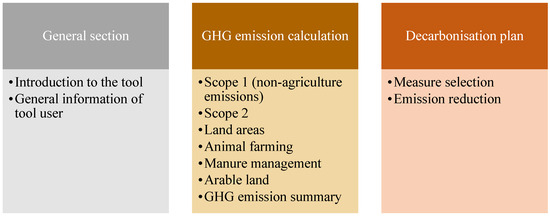
The tool consists of ten pages divided into three sections (see Figure 1). The first section of the DST is focused on general information about the tool—introducing the structure, pages, and input fields in the tool. Additionally, in this section, the tool users are required to provide general information on the farm, supporting efficient data entry and internal data processing. The second section of the DST is focused on farm-level GHG emission accounting, with six pages dedicated to data input and one page summarizing calculated emissions. The third section of the developed tool is dedicated to agriculture decarbonization measures that could be implemented on the farm, as well as approximation of the impact on farm emissions if specific action is implemented. The scope of the tool is limited only to Scope 1 and Scope 2 GHG emissions at the farm level, according to GHGP-developed standards and guidance [7,21]. The GHG emissions in the DST are calculated according to the 2019 Refinement to the 2006 Intergovernmental Panel on Climate Change (IPCC) Guidelines for National Greenhouse Gas Inventories for agricultural GHG emissions accounting [22] utilizing Tier 1 and Tier 2 calculation methodologies.
Figure 1.
Study’s DST structure by sections and pages of the respective section.
The sensitivity analysis of the developed tool was performed with the Sobol and Morris methods. This sensitivity analysis was automated using Python version 3.13.5 scripts based on SALib library version 1.5.1 for Sobol analysis [23]. In this study, Sobol sensitivity analysis was carried out in a two-step process. This two-step approach was applied to reduce computational demand while preserving the ability to identify dominant parameters within each functional component of the DST. The first step of the analysis was initially applied on each input data page separately. The input data pages considered were DST section “GHG emission calculation” pages “Scope 1 (non-agriculture emissions)”, “Scope 2”, “Land areas”, “Animal farming”, and “Arable land”. Input data page “Manure management” was excluded from Sobol analysis, as this page describes the distribution of manure management practices in the farm, therefore requiring a compositional or constrained sampling strategy rather than the standard Saltelli scheme [24]. This exclusion limits the model’s sensitivity analysis completeness. The first step requires computing first-order Sobol indices (S1), total-order Sobol indices (ST), and each parameter’s confidence level based on the Saltelli sampling scheme [24]. This step allows identification of the parameters exerting the strongest influence on GHG emission model output variance per input data page. In the second step, the subset of the top three most sensitive parameters ranked by S1 and ST indices identified in the first step, from each screened input data page, was re-evaluated with Sobol sensitivity analysis, calculating S1, ST, and the second-order Sobol indices (S2). S2 indices describe the combined effect of two different parameter sensitivities [24] and these indices are depicted in a heatmap produced in RStudio version 2025.09.1+401.
In total, 75 parameters were tested in the sensitivity analysis, changing the parameter input data values in the uniform range of [0, 200] and maintaining consistency across all input data parameters, while not using realistic input data ranges. This uniform range was selected to evaluate the structural sensitivity of the model rather than to represent realistic farm input distributions. The sample size of N = 128 was selected to balance the computational efficiency with accuracy for parameter ranking rather than precise index estimation [25]. Previous studies have demonstrated that global sensitivity analysis can yield stable relative rankings at comparatively low sample sizes [26,27]. For the input data page “Arable land”, the Sobol analysis in the first step was divided into two parts to separately assess the sensitivity of production outputs and fertilizer-related inputs. Bootstrap resampling was employed to estimate 95% confidence intervals for the Sobol sensitivity indices, whereby multiple resampled datasets were generated from the original model outputs and the Sobol indices recalculated, yielding empirical confidence bounds that quantified the statistical uncertainty associated with the indices.
The Morris sensitivity analysis [15] was conducted as a global sensitivity analysis, automated with Python version 3.13.5 scripts on SALib library version 1.5.1 for Morris analysis [23]. The analysis was conducted on 75 input parameters, changing the input data within the range [0, 200]. The sample size was chosen as N = 128 to match the Sobol analysis sample size. The input data page “Manure management” was excluded from Morris analysis for the same methodological reason as in the Sobol analysis. This exclusion limits the completeness of the model’s sensitivity analysis.
Morris sensitivity analysis returned three output parameters. The mean elementary effect (μ) shows the average impact and direction on the model output. The mean of the absolute elementary effect (μ*) presents the overall importance of the input parameter when comparing it to the model output [15]. Additionally, the standard deviation of the elementary effects (σ) was calculated. σ indicates whether the effect of an input parameter is primarily independent or influenced by interactions with other parameters.
Parameters were classified as highly influential when their μ* values were among the highest within the parameter set, while parameters with intermediate μ* values were considered moderately influential. There are no defined thresholds to identify influential and non-influential parameters within Morris analysis. The thresholds of most sensitive parameters should be defined based on the obtained analysis results. Based on this approach influential and non-influential parameters were defined in Menberg et al.’s [28] study.
The 95% confidence intervals for the Morris elementary effects were estimated using standard error, calculated as the standard deviation of elementary effects divided by the square root of the number of trajectories. The standard deviation was multiplied by 1.96 to approximate the interval around the mean effect, providing a statistical measure of uncertainty in the sensitivity indices [15].
The collected data was published as “Multiparameter Sensitivity Analysis Results for the “DecarbFarm” Decarbonization Decision Support Tool” dataset [29] in Mendeley Data.
3. Results
All calculated sensitivity indices have been uploaded in Mendeley Data, ensuring transparency and reproducibility of the analysis. The results consistently indicate a limited role of parameter interactions and highlight a small subset of inputs dominating output variance. The following section presents the results of these analyses, highlighting the most influential factors and their implications for farm-level decarbonization strategies.
3.1. Sobol Sensitivity Analysis
The first step of the Sobol analysis was carried out for six different input data sections. The results of Sobol indices S1 and ST for the most sensitive parameters of each input data page are provided in Table 1, indicating a total of 19 highly sensitive parameters in the “DecarbFarm” DST model. The results indicate that the combined effects of parameters on output variance are negligible, as reflected by the small differences between S1 and ST indices across all input data pages.
Table 1.
Sensitivity ranking of model parameters based on first-step Sobol analysis, highlighting the relative influence of individual parameters and their interactions on output variability.
Small or near-zero S1 values, including confidence intervals overlapping zero, reflect the limited sensitivity of these parameters within the tested input space rather than the numerical instability of the model.
These indices then were run through global Sobol sensitivity analysis, calculating the total sensitivity of these parameters. The results of the S1 and ST indices are provided in Table 2 and indicate that in the global Sobol sensitivity analysis, the most sensitive parameters in the model are heat energy and steam.
Table 2.
Sobol global sensitivity analysis results quantifying the contribution of each parameter to overall model output variance; near-zero values indicate negligible parameter influence at the global scale.
When evaluated jointly, most parameters identified as sensitive at the page level exhibit negligible global influence, indicating that their effects do not propagate strongly across the full model structure. Moderate sensitivity can be observed for non-renewable energy consumption; however, its ST index is approximately an order of magnitude lower than that of heat energy. Other parameters’ sensitivity indicates minimal impact on the output variance.
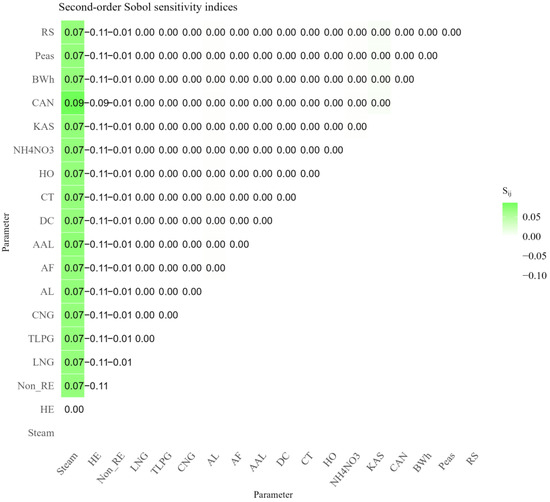
For the initially sensitive parameters, S2 indices were calculated (see Figure 2). The second-order indices confirm the absence of strong parameter interactions, indicating that the model behaves predominantly as an additive system. The two most sensitive parameters among the analyzed parameters depict the strongest interconnections with other parameters, with steam mainly indicating positive interconnections and heat energy indicating negative interconnections with other parameters.
Figure 2.
Second-order Sobol indices for the initially sensitive parameters. The abbreviations used in the figure are as follows: LNG—liquified natural gas; TLPG—liquified petrol gas for transport; CNG—compressed natural gas; steam—steam; HE—heat energy; Non_RE—non-renewable energy; AL—arable land; AF—agroforestry land; AAL—abandoned arable land; DC—dairy cows; CT—cattle; HO—horses; BWh—buckwheat; Peas—peas and beans; RS—rapeseed; NH4NO3—ammonium nitrate; KAS—urea and ammonium nitrate solution; CAN—calcium ammonium nitrate.
3.2. Morris Sensitivity Analysis
The Morris sensitivity analysis σ values for all defined input data parameters returned values of 0.0000. This indicates a linear response of model outputs to individual input parameters within the tested range, with no detectable interaction effects.
The μ* values obtained from the Morris sensitivity analysis for all input parameters are summarized in Table 3. To classify parameter sensitivity, a threshold of μ* = 5000.00 was applied to identify the most influential inputs; six parameters exceeded this threshold and were therefore classified as highly sensitive within the DST model. Parameters with μ* values between 1000.00 and 5000.00 were classified as moderately sensitive, while all remaining parameters exhibited lower sensitivity. The threshold was selected to facilitate practical differentiation between dominant, moderate, and low-influence parameters within the large input set.
Table 3.
Most sensitive parameters identified by Morris sensitivity analysis across input data pages, where μ and μ* indicate the overall influence of the most influential parameters of model output.
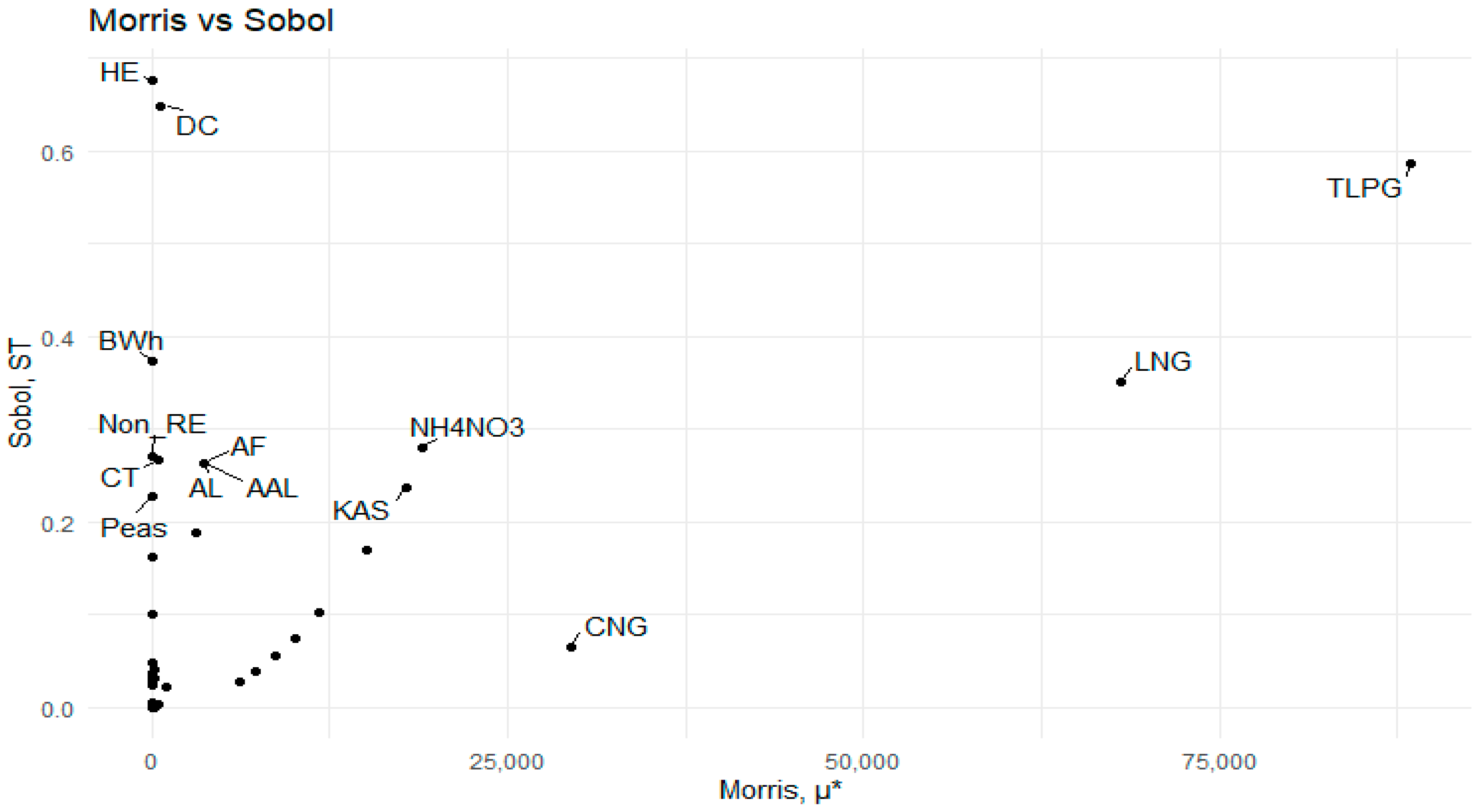
Figure 3 depicts the relationship between the Morris sensitivity measure μ* and the Sobol sensitivity indices ST for all model input parameters. The figure illustrates the distribution of parameters across the range of μ* and ST values obtained from the two sensitivity analyses and provides a direct comparison of parameter rankings produced by the Morris and Sobol methods.
Figure 3.
Comparison scatter plot between Morris and Sobol sensitivity indices. The abbreviations used in the figure are as follows: HE—heat energy; DC—dairy cows; BWh—buckwheat; Non_RE—non-renewable energy; CT—cattle; Peas—peas and beans; AF—agroforestry land; AAL—abandoned arable land; AL—arable land; KAS—urea and ammonium nitrate solution; NH4NO3—ammonium nitrate; CNG—compressed natural gas; LNG—liquified natural gas; TLPG—liquified petrol gas for transport.
The results of Figure 3 indicate that the parameters exhibiting high sensitivity are characterized by both ST values above 0.3 and μ* values exceeding 20,000. These parameters are liquified natural gas, liquified petrol gas for transport, compressed natural gas, heat energy, dairy cows, and buckwheat. These parameters represent inputs with both high absolute impact and strong contribution to output variance, making them robust priorities across sensitivity analysis methods.
4. Discussion
Both sensitivity analysis methods indicated that the model underlying the developed DST behaves predominantly as an additive and linear system, with limited interaction effects between input parameters. Both sensitivity analysis methods identify parameters influencing the GHG model’s output variance. This finding confirms that IPCC- and GHGP-based farm-level GHG accounting frameworks propagate input uncertainty primarily through additive pathways rather than synergistic interactions.
For the performed Morris analysis, the σ values of 0.0000 indicate that all input data parameters are acting linearly. The zero-valued Morris σ indices are consistent with the negligible S2 Sobol indices, jointly confirming the absence of interaction-driven uncertainty within the tested input space. This means that within this DST model, there are no interconnections between the defined input data parameters [15]. Similar results were also obtained from the Sobol analysis. The S1 and ST indices depicted in Table 1 and Table 2 and their limited differences indicate that the model parameters are impacting the output variance independently. The S2 indices represent the portion of output variance arising from interaction effects between the pairs of input parameters [14]. In this study, the S2 values are consistent with the results provided in Figure 2; given the negligible differences between S1 and ST, the given values are mainly zero [14,24]. Therefore, the negligible S2 indices indicate all parameters influence total GHG emissions independently within the tested input data ranges. Such results are expected for the specific model, as based on the given GHG accounting methodology by the IPCC and GHGP [7,21,22], the input parameters do not overlap either by providing the input data nor further calculating the related GHG emissions. This behavior is also desirable for an accounting-based GHG tool, improving the traceability and transparency of the emission sources. Nevertheless, it is acknowledged that real farms can exhibit non-linear responses and interactions between the management practices, meaning that some system interactions may not be fully reflected in the accounting framework.
Given the strictly additive structure of the underlying GHG accounting methodology, the absence of interaction effects is consistent with the expected model behavior. Future work should include complementary statistical checks to formally confirm the robustness of the results and to exclude potential computational biases.
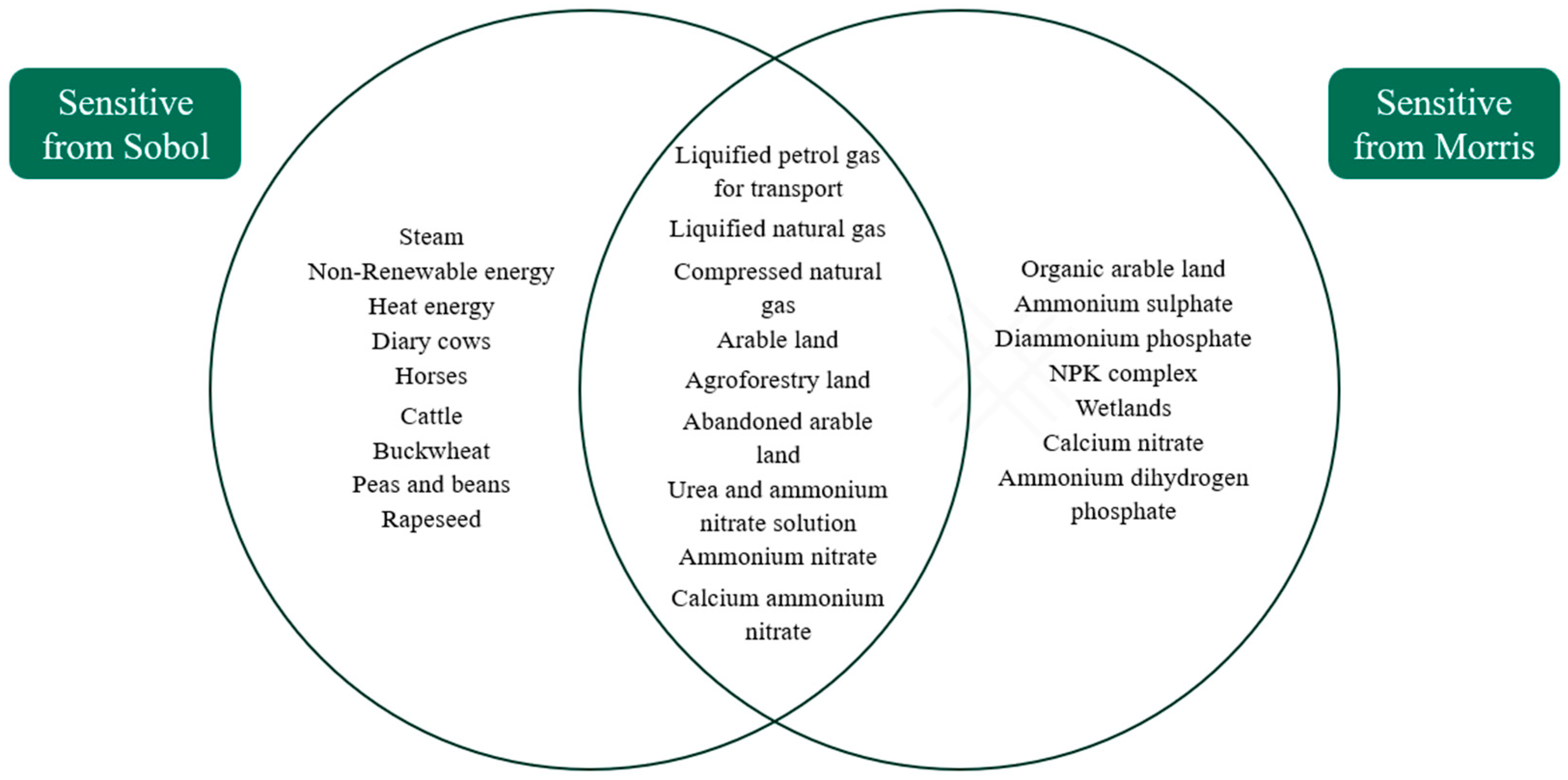
When looking at the most sensitive parameters from both methods, overlaps of sensitive parameters can be observed (see Figure 4). Nine parameters were determined as sensitive from both the Sobol and Morris methods. Seven parameters were determined as sensitive from the Morris method only, while nine parameters were determined as sensitive from the Sobol method only (see Table 3). Drouet’s [30] study on dairy farms applied the Morris method, the rank regression and correlation method, and the Extended Fourier Amplitude Sensitivity Test method. Differences in parameter rankings between the Morris and Sobol methods reflect their distinct analytical purposes rather than methodological disagreement. Their results indicated more similar parameter sensitivity throughout all methods [30].
Figure 4.
Parameter sensitivity comparison between sensitivity analysis methods.
The results show overlapping of sensitive parameters, accounting for 36% of the total number of sensitive parameters, indicating that between the used sensitivity analysis methods, there are methodological differences determining parameter sensitivity. Similar to previous farm-level studies [31,32], fertilizer use and land-related parameters emerge as influential; however, the dominance of energy-related inputs in the present study highlights the increasing relevance of energy management for agricultural decarbonization. Fertilizer use as an influential parameter on GHG emissions was identified in Abbas et. al.’s [16] study, while arable land was identified as sensitive in Drouet et al.’s [30] study.
The high sensitivity observed for energy-related parameters from the Sobol analysis (see Table 2) reflects the structure of the underlying GHG accounting methodology grounded in the IPCC and GHGP [7,21,22]. It is important to note that agricultural parameters are unimportant in real farm systems; they are used so that the agricultural GHG calculations are simplified within standardized accounting frameworks. At the same time, energy parameters should also be evaluated within real farm systems, as the importance of energy-related parameters was also recognized in Abbas et al. [16].
The Morris analysis partially validates the sensitivity rankings from the Sobol analysis. The overlap highlights that production output parameters are more influential when applying Morris sensitivity analysis than indicated by Sobol sensitivity analysis (see Table 1 and Table 3).
The comparison between different sensitivity analysis methods enables a comprehensive analysis to understand models’ parameter sensitivity, effectively identifying the most influential parameters, as the Morris analysis provides comparative parameter insights [15], while the Sobol sensitivity analysis focuses on quantitative parameter comparisons [14,24]. The limited overlap of the sensitive parameters highlights the complementary nature of these sensitivity analysis techniques and underscores the importance of employing multiple methods to gain a comprehensive understanding of parameter importance. The Morris method, designed as a screening technique, emphasizes absolute effect magnitude across wide input ranges, whereas Sobol analysis isolates variance-dominant parameters within the full model context. The complementary nature of the sensitivity analysis methods is also recognized in Iooss & Lemaître’s [33] review article on sensitivity analysis methods. In further studies, it is suggested to initially use the Morris method to identify the most sensitive parameters, which would be then screened for the quantitative sensitivity analysis using the Sobol method, optimizing the computational dependencies of the Sobol sensitivity analysis [33].
From a decision support perspective, the identified sensitivity structure implies that mitigation guidance can be effectively focused on a limited number of high-impact parameters, reducing the data collection burden and improving usability for farms and advisory services.
In addition, the results enable prioritization for farm-level decarbonization, including the suggestion of specific measure prioritization within the developed DecarbFarm tool. A similar approach was used in [16], suggesting local farmers’ potential for improvements in order to reduce GHG emissions and increase productivity of rice and cotton productions. Based on the results of the study, the abatement measures related to farm energy consumption, arable land type, fertilizer application, and cattle should be included in the DST, where applicable. Implementing abatement measures related to highly sensitive parameters is expected to yield comparatively higher GHG emission reductions, thereby enhancing the effectiveness of decarbonization planning. This assertion is corroborated by Rivera Moncada et al.’s [34] study. Prioritization of the most sensitive parameters is particularly relevant for local and regional climate strategies, where decision-makers and farmers require transparent and robust tools to support land-use planning, for example by limiting land transformation to arable land, and resource-efficient development pathways. The conclusions reached in the study by Van Schmidt were analogous [35]. Deploying digital tools supports not only the decarbonization plan development process but also data monitoring, and it enables timely decision-making and more effective use of DST outputs. To support effective implementation of DSTs, the results of this study highlight the potential need for automated data collection systems. Automated data collection could improve the used data’s accuracy. Such a data collection approach will be evaluated to be implemented within the next iterations of the DST.
In addition to informing abatement measure prioritization, the sensitivity results provide practical guidance for both DST users and developers. For DST users, such as farmers, high-sensitivity parameters should be prioritized during data collection, improving the GHG estimation. On the other hand, developers of the DST can utilize the sensitivity results for prioritizing the enhancement areas of the “DecarbFarm” tool.
This study contains limitations, such as using uniform input parameter ranges that do not necessarily represent a realistic view of farm-level data. This approach was intentionally selected to examine relative parameter importance within the model structure, rather than to represent realistic farm input distributions. For this reason, the given results should not be interpreted as representative for real farm conditions or GHG mitigation potential but rather should highlight the input data parameters’ relative importance within the developed model. In this context, the analysis contributes to the assessment of structural robustness and the prioritization of parameters. However, it does not empirically validate the tool in real-world examples. In the context of the present state of research, the application of a sensitivity analysis to real-life farm-level data is constrained by limited data availability. For this reason, statistical performance testing of the sensitivity analysis results with real farm data was not conducted.
It is acknowledged that the use of uniform input data ranges may reduce sensitivity resolution for parameters whose effects are predominantly reflected within narrow, realistic fluctuation ranges. However, the mostly additive structure of the DST and minimal nonlinear or interaction effects, as indicated by Morris analysis results, suggest that the influence of the most sensitive parameters is not strongly localized within restricted subranges. While the absolute sensitivity index values would change when realistic input value ranges are applied, the ranking of influential parameters should remain stable. Prior research suggests that while sensitivity values may shift with different input ranges, dominant parameters still emerge consistently [26,33].
Given the known contribution of manure management to agricultural GHG emissions, its exclusion represents a priority area for methodological advancement rather than a limitation of the DST concept itself. The omission of the manure management input data page in the present sensitivity analysis creates a potential bias in total emission estimates stemming from livestock-related input parameters. Exclusion of manure management composition parameters may lead to underestimation of overall sensitivity as well as incomplete understanding of parameter interactions within the developed model.
Additionally, the exclusion of the manure management-dedicated page within this study due to the input data’s compositional structure, requiring a different sampling method, e.g., compositional sensitivity analysis, is a limiting factor within this study. Given manure management’s impact on the GHG emission output, this exclusion limits the comprehensiveness of the sensitivity analysis on the developed DecarbFarm DST. Compositional sensitivity analysis methods, such as long-ration transformations, are specifically designed for datasets whose inputs must sum to a fixed total. These methods have been used in other environment-related studies [36]. As manure management parameters represent interdependent shares of a total manure flow, applying compositional methods would allow for the evaluation of parameter importance within the DST’s structure. Further studies should be focused on preventing this limitation, evaluating a suitable sensitivity analysis method or adjusting the sampling method to incorporate manure management input parameters into the sensitivity analysis. This also suggests that sensitivity analysis should be considered an iterative process and repeated for specific farm typologies and regional contexts as DSTs are deployed in practice.
Thirdly, the sensitivity analysis performed in this study did not consider a specific farm type based on the statistical classification of economic activities and different management practices that were included in the development of the tool. The current sensitivity analysis represents the general structure of the DST. If the sensitivity analysis were performed on a specified farm type, the results of the identified sensitive parameters could differ. The results demonstrate that combining complementary sensitivity analysis methods provides a robust basis for evaluating and improving farm-level decarbonization decision support tools.
5. Conclusions
Both sensitivity analysis methods complement each other in providing a robust and transparent validation framework for identifying critical input parameters for the farm-level GHG emission DST.
Sobol analysis results show that the two most sensitive parameters are heat energy and steam, indicating the dominant role of on-farm energy use in driving overall emission uncertainty, while moderate sensitivity is observed for non-renewable electricity consumption, suggesting a secondary but non-negligible influence.
Morris analysis confirms the importance of energy-related inputs while additionally highlighting production- and fertilizer-related parameters, reflecting its strength as a screening method that is sensitive to absolute effect magnitudes.
Parameters identified as sensitive to both Sobol and Morris methods include heat energy, steam, non-renewable energy parameters, and several fertilizer and land types, representing robust leverage points for mitigation planning across analytical approaches.
Methodologically, the study demonstrates the value of combining screening- and variance-based sensitivity analyses to evaluate the robustness of decarbonization decision support tools.
Further improvements can be implemented in future sensitivity analysis, including the use of input ranges representative of real farm-level data and harmonized sampling strategies across methods.
Incorporating manure management parameters using appropriate compositional sampling approaches represents a priority for advancing the completeness of future analyses.
The parameters identified in this study as the most sensitive should be prioritized when selecting and defining the potential abatement measures to be included in the DST. Prioritizing these parameters will more effectively support the decarbonization decision-making process for farmers and policymakers.
By enhancing the transparency and reliability of farm-level decarbonization tools, the findings support evidence-based climate action and contribute to sustainable spatial planning and local development strategies.
Author Contributions
Conceptualization, K.M., I.G. and J.P.-U.; methodology, K.M.; software, K.M.; validation, K.M., I.G. and J.P.-U.; formal analysis, K.M.; investigation, K.M.; resources, K.M.; data curation, K.M.; writing—original draft preparation, K.M.; writing—review and editing, K.M., J.P.-U. and I.G.; visualization, K.M.; supervision, I.G.; project administration, I.G. All authors have read and agreed to the published version of the manuscript.
Funding
This research received no external funding.
Institutional Review Board Statement
Not applicable.
Informed Consent Statement
Not applicable.
Data Availability Statement
The original data presented in the study are openly available in Mendeley Data at DOI 10.17632/n625vpggn5.3; https://data.mendeley.com/datasets/n625vpggn5/3 (accessed on 15 December 2025).
Conflicts of Interest
The authors declare no conflicts of interest.
Abbreviations
The following abbreviations are used in this manuscript:
| (NH4)(H2PO4) | Ammonium dihydrogen phosphate |
| (NH4)2HPO4 | Diammonium phosphate |
| (NH4)2SO4 | Ammonium sulfate |
| AAL | Abandoned arable land |
| AF | Agroforestry land |
| AL | Arable land |
| BWh | Buckwheat |
| Ca(NO3)2 | Calcium nitrate |
| CAN | Calcium ammonium nitrate |
| CNG | Compressed natural gas |
| CT | Cattle |
| DC | Dairy cows |
| DST | Decision support tool |
| GHG | Greenhouse gas |
| GHGP | Greenhouse Gas Protocol |
| HO | Horses |
| IPCC | Intergovernmental Panel on Climate Change |
| KAS | Urea and ammonium nitrate solution |
| LNG | Liquified natural gas |
| NH4NO3 | Ammonium nitrate |
| Non_RE | Non-renewable energy |
| NPK | NPK complex |
| OrgAL | Organic arable land |
| Peas | Peas and beans |
| RS | Rapeseed |
| S1 | First-order Sobol indices |
| S2 | Second-order Sobol indices |
| ST | Total Sobol indices |
| Steam | Steam |
| TLPG | Liquified petrol gas (transport) |
| Urea | Urea |
References
- European Commission. About European Green Deal. 2019. Available online: https://ec.europa.eu/info/strategy/priorities-2019-2024/european-green-deal_en (accessed on 28 November 2020).
- European Environment Agency. Greenhouse Gas Emissions by Source Sector. EUROSTAT. 2025. Available online: https://ec.europa.eu/eurostat/databrowser/view/env_air_gge__custom_18189802/default/table (accessed on 26 September 2025).
- Skrebele, A.; Treija, S.; Lupkina, L.; Eihenberga, I.; Cakars, I.; Siņics, L.; Lazdāne-Mihalko, J.; Puļķe, A.; Štelce, V.; Klāvs, G.; et al. Latvia’s National Inventory Document Under the UNFCCC and Paris Agreement; Ministry for Climate and Energy (MoCE) of the Republic of Latvia: Riga, Latvia, 2025; pp. 68–333. Available online: https://unfccc.int/sites/default/files/resource/LV_NID_15042025.pdf (accessed on 15 January 2026).
- Meriküll, S.-A.; Mägi, R.; Männisalu, L.B.; Štõkov, S.; Ruul, M.; Karu, H.; Suursild, E.; Raudsaar, M. Greenhouse Gas Emissions in Estonia 1990–2023: National Inventory Document; Ministry of Climate of the Republic of Estonia: Tallinn, Estonia, 2025; pp. 35–243. Available online: https://unfccc.int/sites/default/files/resource/NID_EST_1990-2023_15.04.pdf (accessed on 15 January 2026).
- Konstantinavičiūtė, I.; Byčenkienė, S.; Kavšinė, A.; Birgiolas, V.; Juška, R.; Žiukelytė, I.; Vaitiekūnienė, J.; Kairienė, E.; Balčius, M.; Mačiulskas, M.; et al. Lithuania’s National Inventory Document 2025: Greenhouse Gas Emissions 1990–2023; Ministry of Environment of the Republic of Lithuania: Vilnius, Lithuania, 2025; pp. 44–327. Available online: https://unfccc.int/sites/default/files/resource/NID_2025.pdf (accessed on 15 January 2026).
- Dabkiene, V.; Bale, T.; Streimikien, D. Calculation of the carbon footprint for family farms using the Farm Accountancy Data Network: A case from Lithuania. J. Clean. Prod. 2020, 262, 121509. [Google Scholar] [CrossRef] [Scilit]
- Ranganathan, J.; Corbie, L.; Bhatia, P.; Schmitz, S.; Gage, P.; Oren, K. A Corporate Accounting and Reporting Standard. Greenhouse Gas Protocol. 2012. Available online: https://ghgprotocol.org/sites/default/files/standards/ghg-protocol-revised.pdf (accessed on 20 September 2025).
- Iakovidis, D.; Gadanakis, Y.; Campos-Gonzalez, J.; Park, J. Optimising decision support tools for the agricultural sector. Environ. Dev. Sustain. 2024, 27, 25043–25067. [Google Scholar] [CrossRef] [Scilit]
- Kazimierczuk, K.; Barrows, S.E.; Olarte, M.V.; Qafoku, N.P. Decarbonization of Agriculture: The Greenhouse Gas Impacts and Economics of Existing and Emerging Climate-Smart Practices. ACS Eng. Au 2023, 3, 426–442. [Google Scholar] [CrossRef] [Scilit]
- Rose, D.C.; Sutherland, W.J.; Parker, C.; Lobley, M.; Winter, M.; Morris, C.; Twining, S.; Ffoulkes, C.; Amano, T.; Dicks, L.V. Decision support tools for agriculture: Towards effective design and delivery. Agric. Syst. 2016, 149, 165–174. [Google Scholar] [CrossRef] [Scilit]
- Aplinkos Apsaugos Agentūra. Agricultural Sector Calculators. 2025. Available online: https://aaa.lrv.lt/lt/veiklos-sritys/teisekuros-poveikio-vertinimas/teisekuros-poveikio-vertinimo-metodines-rekomendacijos-skaiciuokles/sesd-skaiciuokles/ (accessed on 8 November 2025).
- Ministry of Regional Affairs and Agriculture of Estonia; Sustinere, O.Ü. Carbon Footprint Assessment Tool. 2024. Available online: https://teabesalv.pikk.ee/digiakadeemia/kalkulaatorid/ (accessed on 8 November 2025).
- Borgonovo, E.; Peccati, L. Sensitivity Analysis in Decision Making: A Consistent Approach. In Advances in Decision Making Under Risk and Uncertainty; Springer: Berlin/Heidelberg, Germany, 2008; pp. 65–89. [Google Scholar]
- Sobol’, I.M. Global sensitivity indices for nonlinear mathematical models and their Monte Carlo estimates. Math. Comput. Simul. 2001, 55, 271–280. [Google Scholar] [CrossRef] [Scilit]
- Morris, M.D. Factorial Sampling Plans for Preliminary Computational Experiments. Technometrics 1991, 33, 161–174. [Google Scholar] [CrossRef]
- Abbas, A.; Waseem, M.; Ahmad, R.; Khan, K.A.; Zhao, C.; Zhu, J. Sensitivity analysis of greenhouse gas emissions at farm level: Case study of grain and cash crops. Environ. Sci. Pollut. Res. 2022, 29, 82559–82573. [Google Scholar] [CrossRef] [Scilit]
- Pereira, M.M.A.; Martinelli, L.A.; Carmo, J.B.; Duarte-Neto, P.J. Optimizing Greenhouse Gas Emissions Studies with Functional Data Analysis in Tropical Land Uses. ACS Agric. Sci. Technol. 2025, 5, 1590–1607. [Google Scholar] [CrossRef] [Scilit]
- DeJonge, K.C.; Ascough, J.C.; Ahmadi, M.; Andales, A.A.; Arabi, M. Global sensitivity and uncertainty analysis of a dynamic agroecosystem model under different irrigation treatments. Ecol. Model. 2012, 231, 113–125. [Google Scholar] [CrossRef] [Scilit]
- Guevara-González, R.G. Global sensitivity analysis by means of EFAST and Sobol’ methods and calibration of reduced state-variable TOMGRO model using genetic algorithms. Comput. Electron. Agric. 2014, 100, 1–12. [Google Scholar] [CrossRef] [Scilit]
- Xu, Q.; Li, J.; Liang, H.; Ding, Z. Coupling life cycle assessment and global sensitivity analysis to evaluate uncertainty and key processes of the carbon footprint of rice production in Eastern China. Front. Plant Sci. 2022, 13, 990105. [Google Scholar] [CrossRef] [Scilit]
- Sotos, M. GHG Protocol Scope 2 Guidance. Greenhouse Gas Protocol. 2014. Available online: https://ghgprotocol.org/scope-2-guidance (accessed on 18 August 2024).
- Ogle, S.M.; Sanchez, M.J.S.; Rocha, M.T.; MacDonald, J.D.; Dong, H. 2019 Refinement to the 2006 IPCC Guidelines for National Greenhouse Gas Inventories. Volume 4: Agriculture, Forestry and Other Land Use. IPCC. 2021. Available online: https://www.ipcc-nggip.iges.or.jp/public/2019rf/pdf/4_Volume4/19R_V4_Ch01_Introduction.pdf (accessed on 18 August 2024).
- Muižniece, K.; Grīnfelde, I.; Pilecka-Uļčugačeva, J. DecarbFarm Multiparameter Sensitivity Analysis Computational Notebook. Zenodo. 2025. Available online: https://zenodo.org/records/18038534 (accessed on 23 December 2025).
- Saltelli, A.; Tarantola, S.; Campolongo, F.; Ratto, M. Sensitivity Analysis in Practice: A Guide to Assessing Scientific Models; Wiley: Chichester, UK, 2004. [Google Scholar]
- Rajput, D.; Wang, W.-J.; Chen, C.-C. Evaluation of a decided sample size in machine learning applications. BMC Bioinform. 2023, 24, 48. [Google Scholar] [CrossRef] [Scilit]
- Saltelli, A.; Annoni, P.; Azzini, I.; Campolongo, F.; Ratto, M.; Tarantola, S. Variance based sensitivity analysis of model output: Design and estimator for the total sensitivity index. Comput. Phys. Commun. 2010, 181, 259–270. [Google Scholar] [CrossRef] [Scilit]
- Campolongo, F.F.; Saltelli, A.; Cariboni, J. From screening to quantitative sensitivity analysis. A unified approach. Comput. Phys. Commun. 2011, 182, 978–988. [Google Scholar] [CrossRef] [Scilit]
- Menberg, K.; Heo, Y.; Choudhary, R. Sensitivity analysis methods for building energy models: Comparing computational costs and extractable information. Energy Build. 2016, 133, 433–445. [Google Scholar] [CrossRef] [Scilit]
- Muižniece, K.; Pilecka-Ulcugaceva, J.; Grinfelde, I. Multiparameter Sensitivity Analysis Results for the “DecarbFarm” Decarbonization Decision Support Tool. Mendeley Data. 2025. Available online: https://data.mendeley.com/datasets/n625vpggn5/3 (accessed on 15 December 2025).
- Drouet, J.-L.; Capian, N.; Fiorelli, J.-L.; Blanfort, V.; Capitaine, M.; Duretz, S.; Gabrielle, B.; Martin, R.; Lardy, R.; Cellier, P.; et al. Sensitivity analysis for models of greenhouse gas emissions at farm level: Case study of N2O emissions simulated by the CERES-EGC model. Environ. Pollut. 2011, 159, 3156–3161. [Google Scholar] [CrossRef] [Scilit]
- Sharafi, S.; Kazemi, A.; Amiri, Z. Estimating energy consumption and GHG emissions in crop production: A machine learning approach. J. Clean. Prod. 2023, 408, 137242. [Google Scholar] [CrossRef] [Scilit]
- Adlan, C.A.; Hanssen, S.V.; Luchtenbelt, H.; Hendriks, C.; Doelman, J.C.; Stehfest, E.; Wicke, B. Emissions Footprints of Agriculture Around the World 1970–2020: Decreasing Land Conversion, Regional Exceptions and Increasing Management Intensity. Glob. Change Biol. 2025, 31, e70528. [Google Scholar] [CrossRef] [Scilit] [PubMed]
- Iooss, B.; Lemaître, P. A Review on Global Sensitivity Analysis Methods. In Uncertainty Management in Simulation-Optimization of Complex Systems; Springer: Boston, MA, USA, 2015; pp. 101–122. [Google Scholar]
- Moncada, A.R.; Dupas, M.-C.; Tempio, G.; Lanzoni, L.; Li, Y.; Rakotovao, N.; Wisser, D.; Gilbert, M. Sensitivity analysis of parameters, emission factors, and coefficients for estimating animal emissions of ruminant species in the Global Livestock Environmental Assessment Model (GLEAM). Int. J. Life Cycle Assess. 2025, 30, 2660–2676. [Google Scholar] [CrossRef] [Scilit]
- Van Schmidt, N.D.; Wilson, T.S.; Flint, L.E.; Langridge, R. Trade-offs in adapting to changes in climate, land use, and water availability in California. Ecol. Soc. 2023, 28, 9. [Google Scholar] [CrossRef] [Scilit]
- Oh, J.; Kim, K.H.; Kim, H.R.; Park, S.; Yun, S.T. Using isometric log-ratio in compositional data analysis for developing a groundwater pollution index. Sci. Rep. 2024, 14, 63178. [Google Scholar] [CrossRef] [Scilit] [PubMed]

Disclaimer/Publisher’s Note: The statements, opinions and data contained in all publications are solely those of the individual author(s) and contributor(s) and not of MDPI and/or the editor(s). MDPI and/or the editor(s) disclaim responsibility for any injury to people or property resulting from any ideas, methods, instructions or products referred to in the content. |
© 2026 by the authors. Licensee MDPI, Basel, Switzerland. This article is an open access article distributed under the terms and conditions of the Creative Commons Attribution (CC BY) license.