From Design Decisions to Sustainable Development: Exploring Textile and Fashion Designers’ Challenges in the Portuguese Textile and Fashion Industry


Abstract
1. Introduction
2. Methodology
- I.
- Interview guide
- II.
- Sampling design
- III.
- Interview sessions
- IV.
- Data treatment
- V.
- Data analysis
3. Results
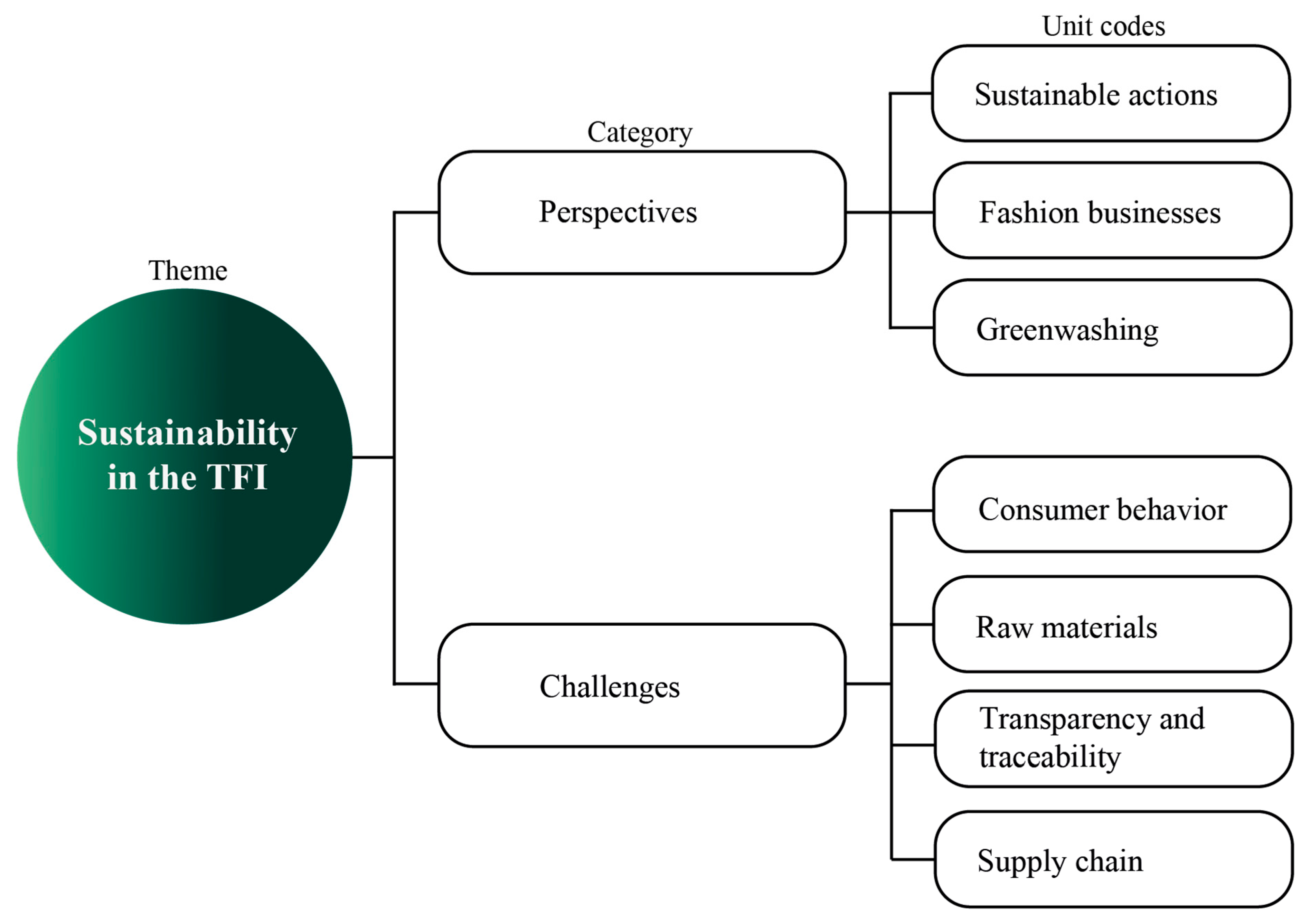
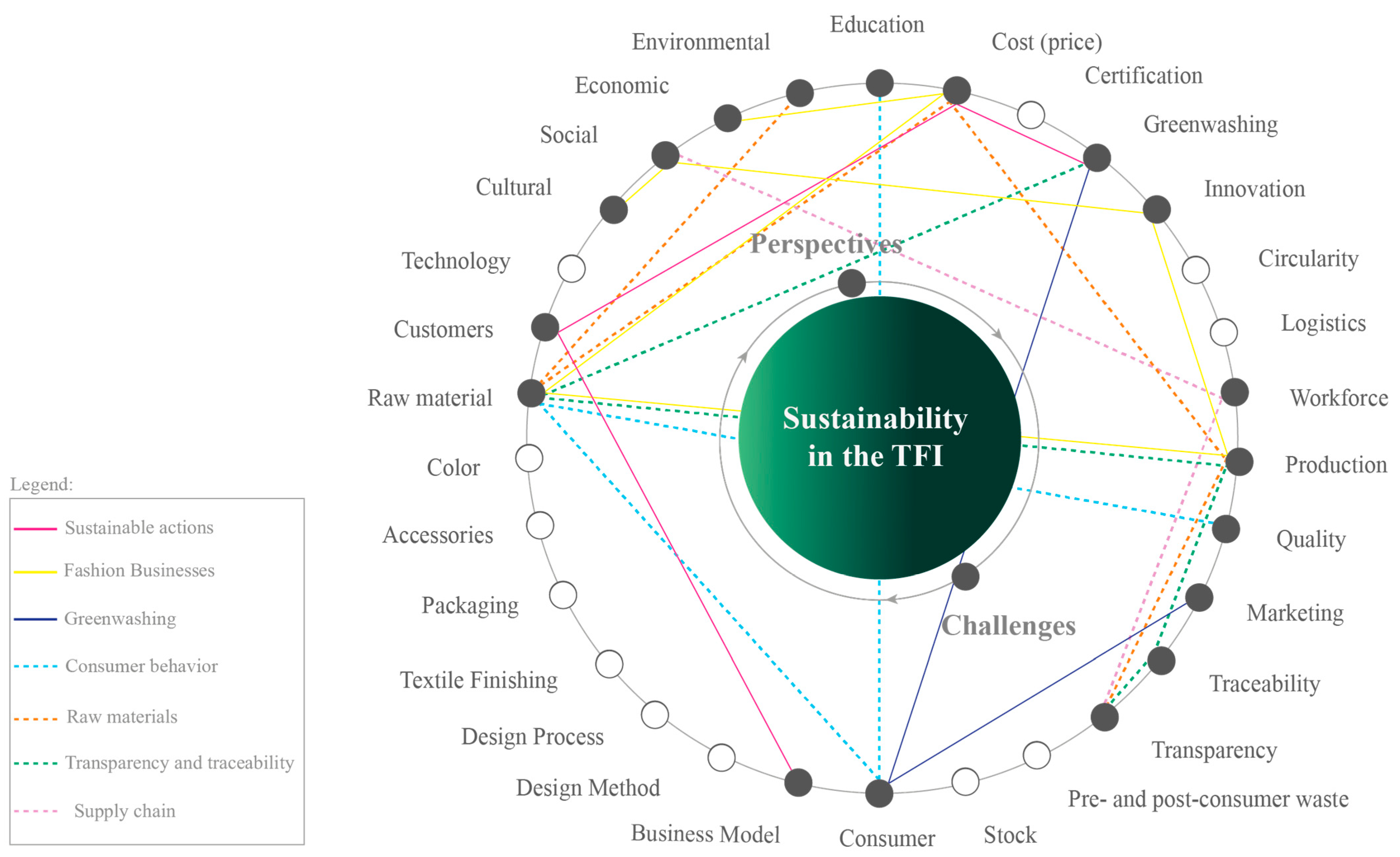
3.1. Sustainability in the Textile and Fashion Industry
3.1.1. Perspectives
- I.
- Sustainable actions
D1 […more and more companies have to look at this aspect…It’s already happening in many places… nowadays there are already processes… We already know that this exists and that it’s applied…]
D3 […the biggest concern for customers, or the greatest demand, was sustainability, sustainable solutions…. it’s really trying to change, it’s trying to work towards being more sustainable, more eco-friendly, less polluting…]
D10 […all brands are looking for this, even those that can’t afford it, they all want to have this difference…]
- (i)
- Sustainability has gained symbolic and commercially relevant value;
- (ii)
- There is increasing market pressure leading companies to seek sustainable solutions, even if these do not always translate into fully consistent practices.
- II.
- Fashion Businesses
D5 […the textile industry… as an industry, I think it ends up leaning a bit more towards what’s cheaper, what’s more profitable, what yields more than what’s more sustainable, unfortunately. But I think this is changing little by little, gradually…]
D6 […in terms of production, price almost always takes precedence over environmental concerns, since it is usually more expensive. Once it becomes more expensive, the sustainable aspect becomes secondary…]
D8 […I think there’s still a long way to go, because the industry still has rather traditional methods and I think it will take some time for them to change to more innovative things…]
- III.
- Greenwashing
D5 [… I think sustainability is a bit relative; sometimes I see that what they say is sustainable is actually the same thing…]
D2 […I think sustainability is used nowadays as a marketing tool, little more than that…]
D4 […they defined themselves as a brand that tried to work with sustainability, but they chose, for example, either to only use sustainable material for the T-shirt fabric, or they tried to use it in the packaging. But I see that even though they tried to use this title of sustainable brand, it was minimal. So, I think it’s a term that’s very much in vogue, but perhaps brands still can’t use it much…]
3.1.2. Challenges
- I.
- Consumer behavior
D1 […it’s necessary to educate the customer, educate ourselves, and also understand to what extent this is… initially the brand will offer a quality piece, even if it’s recycled, that recycled material is tested and initially the quality will respond in the same way, if not exactly the same, but it will try to be as good as the other one, isn’t it…]
D7 […in the process of daily use, because I also believe it should be sustainable…]
D3 […Now quality doesn’t matter as much; the average consumer wants novelty more and doesn’t value quality as much. That’s why the fast fashion industry has grown so much and so fast…]
D2 […And I think that the end consumer, the people who are going to buy the clothes, are still not sensitized to sustainability. I think they are still somewhat indifferent to whether the pieces are made with sustainable materials or not. Yes, there are people who are concerned about this, but we are not talking about the majority, we are talking about a niche market. As long as the end consumer doesn’t change this mentality, our clients, which are the brands, won’t change either…]
- II.
- Raw materials
D6 […Sometimes there isn’t enough raw material and the responses customers want aren’t quick enough… Then there’s the issue of demand; there’s immense demand right now, and nowadays buying a meter of organic fabric costs, on average, 40% more than buying a meter of conventional cotton fabric…]
D7 […Everyone nowadays is looking for sustainable cotton, organic cotton. It’s very difficult to find organic cotton. I’d venture to say that, most likely, 50% of the cotton that we see regulated as organic is not actually organic; it’s just a reaction to the market….]
D2 […we have some more sustainable products, namely recycled polyester, which is, to a certain extent, sustainable in quotation marks, because we know that there are many factories that produce only plastic bottles to make recyclable polyester, and that’s even worse, isn’t it?…]
D4 […Even though it’s a material that claims to be sustainable and all, it often ends up harming the environment a lot, because it requires more processes, more water, or some other processes.]
D6 […organic cotton, which is grown more sustainably, without chemicals, but at the same time something that doesn’t have chemicals and needs other things, such as more water…]
- III.
- Transparency and traceability
D5 […Now there are so many, so many stories surrounding this, aren’t there? About traceability and the possibility of the thread being traced, meaning there’s no chance of suppliers being deceived by each other. And I think the biggest challenge is really having that truthfulness, that transparency, and the price–quality ratio…]
D7 […There may be many people being misled here. Therefore, products labeled as organic or sustainable, but which in reality are not. This is what creates this unsustainability, or this false or disguised sustainability. Therefore, I think the biggest challenge is for us to be able to distinguish what is truly sustainable throughout the entire production chain…]
- IV.
- Supply chain
D11 […the manufacturing process itself, that is, who our suppliers are, where it’s made. Because part of sustainability isn’t just about materials or pollution, it also has to do with social sustainability, which, at least in my understanding, is part of it. So, knowing where it’s made, by whom it’s made, whether people are being paid properly, whether they work decent hours. All of these are things that need to be taken into account…]
D10 […Having production done here in Portugal also ends up being a challenge, because it’s also more expensive, and I don’t know to what extent that will be possible in the future, because we’ll also have fewer and fewer seamstresses and everything else. And that ends up being a challenge, this loss of know-how, which perhaps will eventually end…]
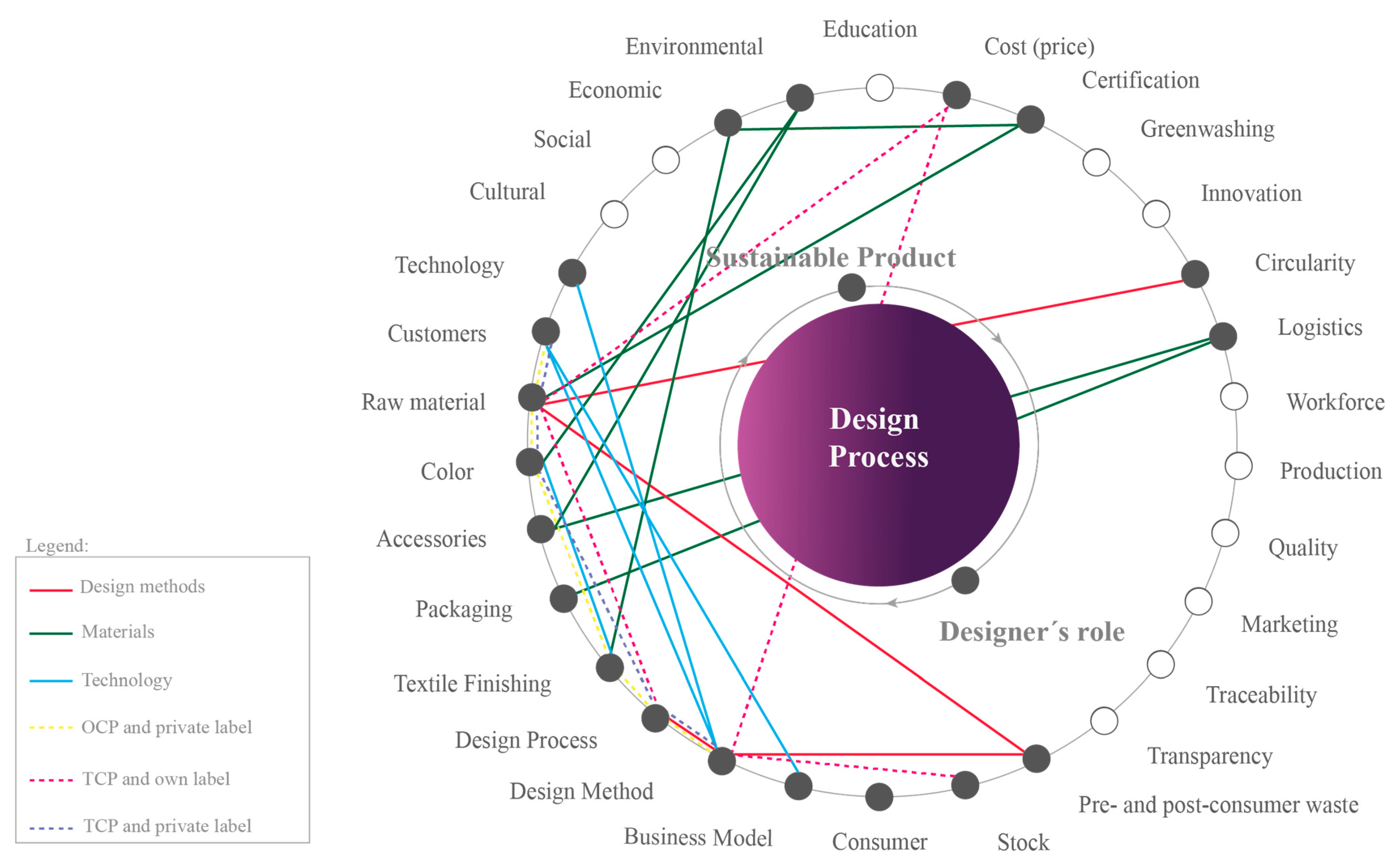
3.2. Design Process
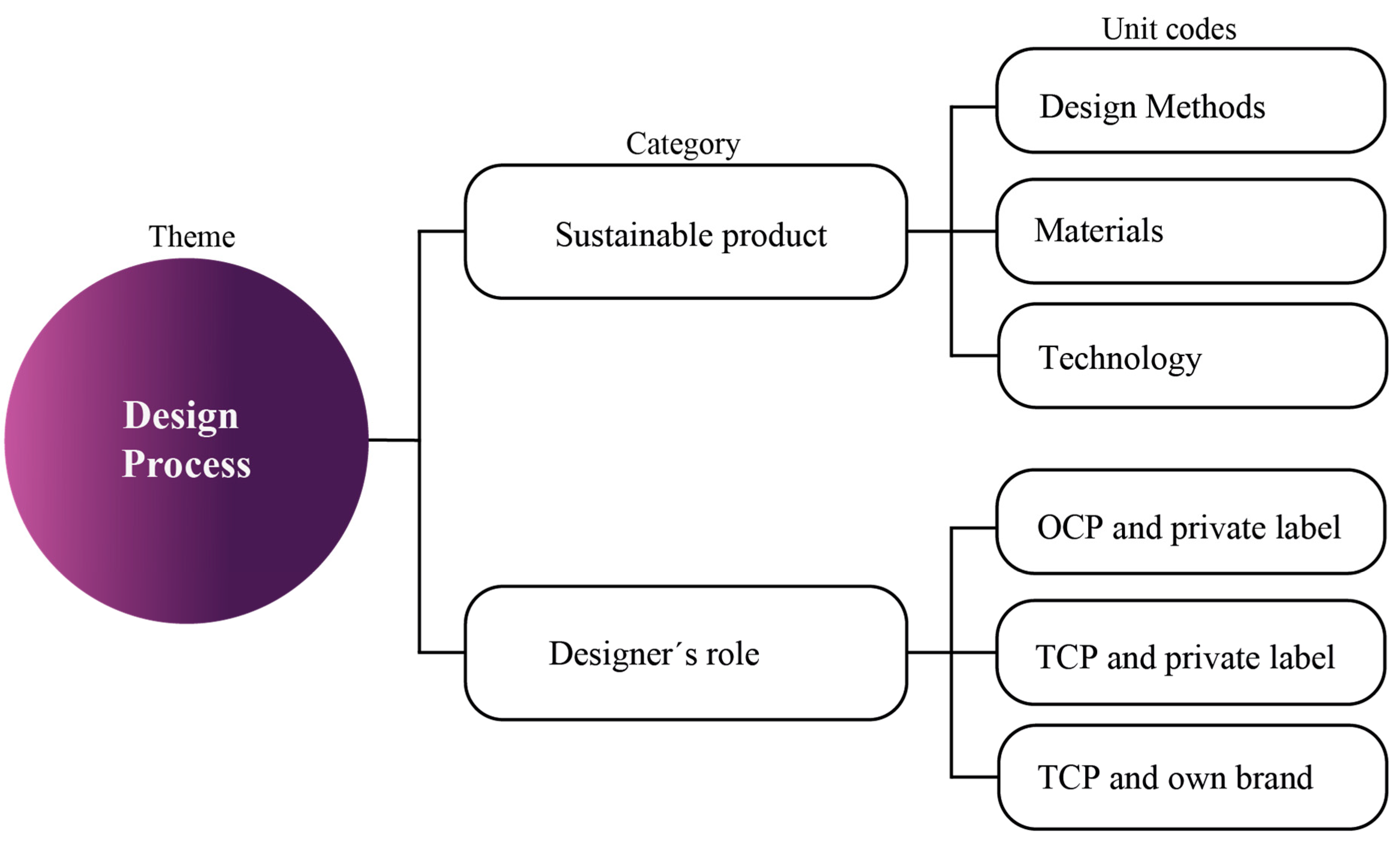
3.2.1. Sustainable Product
- I.
- Design methods
D9 […it involves making models that are more versatile, that work for all seasons, that can be worn in both summer and winter…making more versatile models…]
D7 […in the post-consumer recycling aspect, taking products that are no longer used and trying to recycle them as much as possible or reuse them, we are talking about upcycling…it would be the reuse of a product that has already been created…]
D10 […I think the most sustainable way to create is by not creating new things, but by using this waste…And then there’s the whole eco-design aspect, trying to create a piece that can be multifunctional…]
- II.
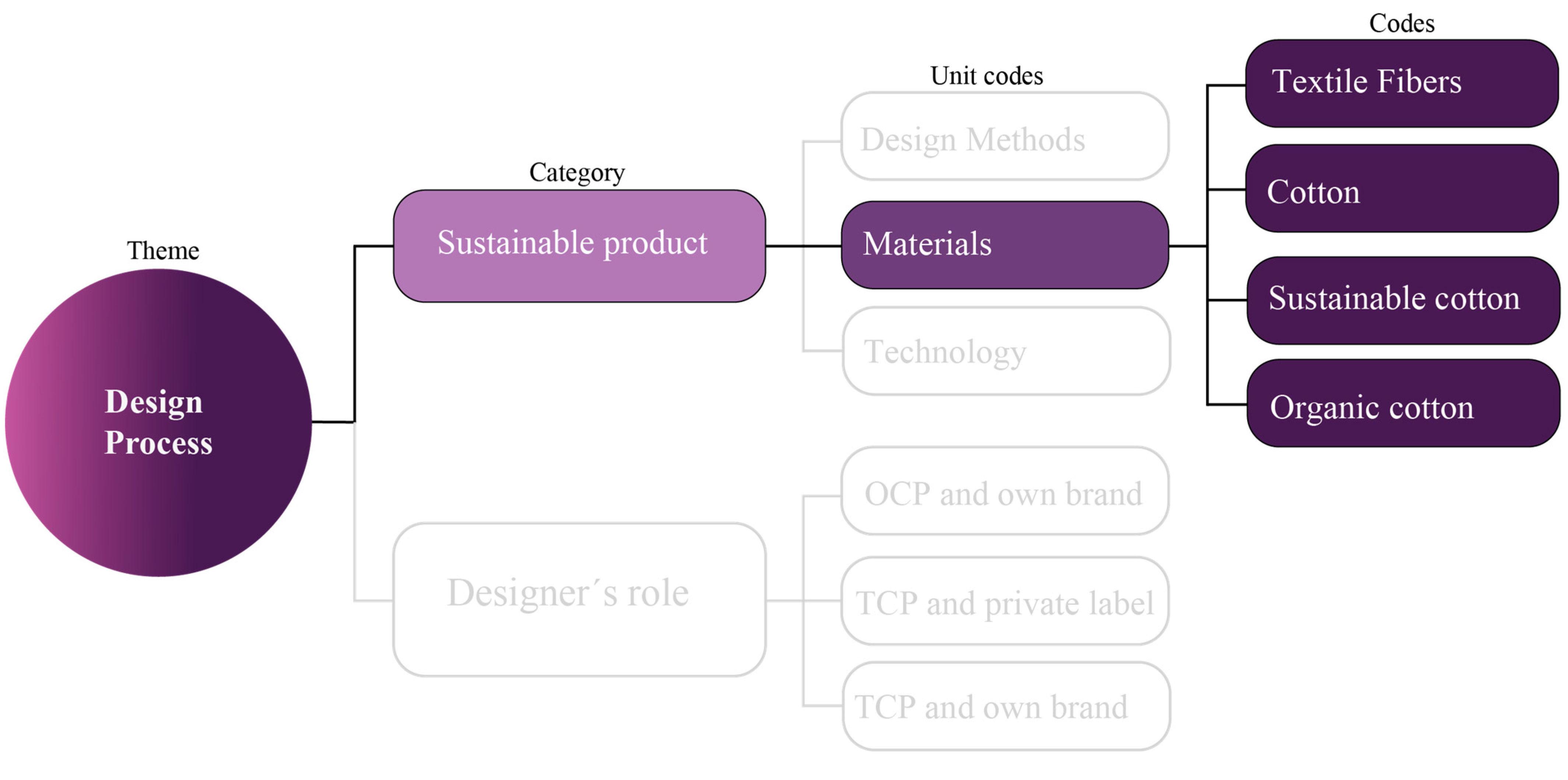
- Materials
D9 […I focus more on the fiber, then I try the fiber, and then that will influence the durability of the product…]
D11 […The fiber, first and foremost the textile fiber… the manufacturing process itself, that is, who our suppliers are, where it’s made… the packaging, that is, the box, the perfect materials, the way it’s packaged…]
D7 […It’s not just about having a GOTS label or a GRS label, or a BCI label; in my opinion, that alone shouldn’t define whether a product is sustainable or not…]
D1 […To be quite honest, today in my job it’s the choice of raw materials… Then, I would try to do the printing part, if necessary…]
D3 […The composition of the fabric, the dyeing…]
D10 […The choice of accessories is also always made locally, as close as possible.]
- III.
- Technology
D3 […CLO is a 3D design software that designs, that is, we are implementing this in the company to try to avoid the first samples, since that is also a big waste. So, we are trying to introduce this, we are trying, but this only normally works with larger brands. Larger brands, that is, those that produce a lot, that have larger quantities. I haven’t had any clients who wanted to go that way yet, but we’ve already had a lot of demand, and I think it has been a differentiating point in the company, which is that it’s from CLO, it comes already, the designer is in communication with the pattern maker…]
D10 […there’s the whole issue of 3D and the immense, immense possibilities…]
3.2.2. Designer’s Role
- I.
- OCP and private label
D7 [… Usually, brands already have this defined or an idea of what they want. Our job is to help them find the raw materials that meet their needs…]
D1 […The first step is the quality of the fabric, which is generally fleece or jersey for a teen audience. So, it’s always within that framework. I choose the raw material, then the designs. I have an inspiration, which I sent to them as options, they choose from those, and I create the design the way I want…]
D4 […Normally when the brand wants organic, they say so right at the beginning, so we only look for organic… Sometimes they send us a technical sheet, they send us a model, they tell us more or less the type of material they want to use. And we try to make a selection from our fabric suppliers, of what fits. Of course, always taking into account the client’s quality parameters, the price target they give us, that kind of thing…it was really in the choice of materials. But only up to a certain point, because I made the first selection and I chose, but in the end, for example, I would send three samples and the client would ultimately choose. But I always tried, like, to talk, to write something for them trying to get them to choose what I thought was best. And sometimes it worked, sometimes it didn’t…]
- II.
- TCP and own brand
D5 […I’ve noticed that lately it’s been difficult to find yarns in certain colors because we don’t have them in stock; we have to buy them or have them dyed. And then that process is very time-consuming, or there’s no yarn available, that kind of situation…. To make decisions, we in the collection department, to try to speed up the process and to try to make the most of the stock we have internally, which is still quite a lot, our colleagues who design also do this process at the beginning of building the collection. They do this process of researching stock yarns, looking for colors that are close to the palette we initially made, and trying to see what can be used….]
D11 […we are the ones who choose the colors, we are the ones who make the designs… We are also in contact with our sales teams to understand a little bit about what the market is experiencing or not…]
D8 […when projects come to us, we already know what we have to develop, taking into account the budget… imagine he asks for something super complex, but has a super small budget, okay, he’s not going to accept this, we have to adapt a design that the client can afford, with far fewer colors,…but always trying to respect the client’s wishes so he doesn’t say no…]
- III.
- TCP and private label
D9 […we suggest the raw materials to send them, or they say, “Look, this material is selling very well, send me options for it.” Or, for example, during the pattern making phase, “Look, maybe it’s better if we do it this way, or this finish looks better in the final product, should we switch?” It’s always a collaborative effort… we look for materials in that sense, we propose them, and they choose, or sometimes we have to develop them as well. It’s a whole joint process…]
D2 […Since I don’t work so much with price lists because that also depends on the market, it depends on the client… Some say, ‘Oh, we don’t want more than €8/m or €10 or €12.’ Anyway, whatever price they’ve set, I usually talk to the sales representative in those cases just to try and understand. And they always tell me to send everything, because sometimes they have room to lower the prices or they see a design in one quality but can get it in another quality, maybe even cheaper. So, price ends up not being a limitation for me…]
D3 […I don’t make any decisions, the brand decides. But what I offer, what I present depends on me and my boss… and therefore I had that freedom. And I also had the intention of responding as best as I could to the request…]
4. Discussion
4.1. Central Themes of Convergence
4.2. Strategic Lines—From Design Decisions to Sustainable Development
- Adopting Circular Design Methodologies: Applying approaches such as eco-design and upcycling, among others.
- Integrating Digital Technologies into the Design Process: Using AI tools, 3D design tools, and others to reduce physical samples, optimize processes, and support more sustainable decisions.
- Treating Material Selection as a Strategic Decision: Evaluating textile fibers, dyeing processes, finishes, accessories, and packaging based on environmental, economic, functional, and circularity criteria, going beyond merely aesthetic decisions.
- Valuing Materials in Stock and Optimizing Supply Logistics: Prioritizing the use of existing raw materials and local suppliers whenever possible, reducing waste and impacts associated with transportation.
- Critically Reflecting on Certifications: Recognizing the relevance of certificates but avoiding treating them as an absolute guarantee of sustainability, preventing greenwashing practices.
- Demanding Greater Transparency and Traceability in the Production Chain: Encouraging systems—such as the digital product passport (DPP)—that allow tracking the origin of materials, production processes, and working conditions, reinforcing the credibility of sustainable practices.
- Promoting Collaborative Work between Different Sectors: Stimulating effective collaboration between designers, sales teams, suppliers, and customers, ensuring that commercial decisions do not compromise quality, innovation, and sustainability.
- Considering the Impact of Dyeing and Textile Finishes: Integrating the choice of dyeing and finishing methods into the design process, taking into account water, energy, and chemical consumption.
- Acting in Raising Consumer Awareness and Education: Developing communication strategies that inform about materials, processes, use, and maintenance of products, promoting the extension of the useful life of garments.
- Valuing the Social and Cultural Dimensions of Sustainability: Encouraging practices that strengthen local work, preserve traditional know-how, and promote fair working conditions, especially in the context of the Portuguese textile and fashion industry.
- Stimulating Innovation in the Production Chain: Contributing to the development of creative and innovative solutions that balance economic viability, environmental responsibility, and positive social impact.
5. Conclusions and Future Trends
Author Contributions
Funding
Institutional Review Board Statement
Informed Consent Statement
Data Availability Statement
Acknowledgments
Conflicts of Interest
Abbreviations
| Portuguese TFI | Portuguese textile and fashion industry |
References
- Glogar, M.; Petrak, S.; Mahnić Naglić, M. Digital Technologies in the Sustainable Design and Development of Textiles and Clothing—A Literature Review. Sustainability 2025, 17, 1371. [Google Scholar] [CrossRef]
- Ricciardi, I.; Percuoco, M.; Prisco, A. Product Innovation for Sustainable Development in the Fashion Industry: A Bibliometric Review. In Sustainable Development; John Wiley and Sons Ltd.: Hoboken, NJ, USA, 2025. [Google Scholar] [CrossRef]
- Vassalo, A.L.; Marques, C.G.; Simões, J.T.; Fernandes, M.M.; Domingos, S. Sustainability in the Fashion Industry in Relation to Consumption in a Digital Age. Sustainability 2024, 16, 5303. [Google Scholar] [CrossRef]
- WCED. Report of the World Commission on Environment and Development: Our Common Future; WCED: Oslo, Norway, 1987. [Google Scholar]
- United Nations. THE 17 GOALS. Available online: https://sdgs.un.org/goals (accessed on 20 November 2025).
- Li, J.; Li, Y.; Fan, C. A Performance Evaluation System for Product Eco-Design in the Fashion Supply Chain. J. Clean. Prod. 2024, 440, 140716. [Google Scholar] [CrossRef]
- Faludi, J.; Hoffenson, S.; Kwok, S.Y.; Saidani, M.; Hallstedt, S.; Telenko, C.; Martinez, V. A Research Roadmap for Sustainable Design Methods and Tools. Sustainability 2020, 12, 8174. [Google Scholar] [CrossRef]
- Claxton, S.; Kent, A. The Management of Sustainable Fashion Design Strategies: An Analysis of the Designer’s Role. J. Clean. Prod. 2020, 268, 122112. [Google Scholar] [CrossRef]
- Jung, D.; Suh, S. Enhancing Soft Skills through Generative AI in Sustainable Fashion Textile Design Education. Sustainability 2024, 16, 6973. [Google Scholar] [CrossRef]
- Kozlowski, A.; Bardecki, M.; Searcy, C. Tools for Sustainable Fashion Design: An Analysis of Their Fitness for Purpose. Sustainability 2019, 11, 3581. [Google Scholar] [CrossRef]
- Ma, J.; Huang, L.; Guo, Q.; Zhu, Y. Sustainability in Design: Sustainable Fashion Design Practices and Environmental Impact Using Mixed-Method Analysis. Bus. Strategy Environ. 2024, 33, 6889–6910. [Google Scholar] [CrossRef]
- D’Itria, E.; Vacca, F. Fashion Design for Sustainability. A Transformative Challenge across the European Fashion Education System. In International Conference on Higher Education Advances; Universidad Politecnica de Valencia: Valencia, Spain, 2021; pp. 679–686. [Google Scholar] [CrossRef]
- Puglia, M.; Parker, L.; Clube, R.K.M.; Demirel, P.; Aurisicchio, M. The Circular Policy Canvas: Mapping the European Union’s Policies for a Sustainable Fashion Textiles Industry. Resour. Conserv. Recycl. 2024, 204, 107459. [Google Scholar] [CrossRef]
- Rahaman, M.T.; Pranta, A.D.; Repon, M.R.; Ahmed, M.S.; Islam, T. Green Production and Consumption of Textiles and Apparel: Importance, Fabrication, Challenges and Future Prospects. J. Open Innov. Technol. Mark. Complex. 2024, 10, 100280. [Google Scholar] [CrossRef]
- Hur, E.; Cassidy, T. Perceptions and Attitudes towards Sustainable Fashion Design: Challenges and Opportunities for Implementing Sustainability in Fashion. Int. J. Fash. Des. Technol. Educ. 2019, 12, 208–217. [Google Scholar] [CrossRef]
- Adamkiewicz, J.; Kochańska, E.; Adamkiewicz, I.; Łukasik, R.M. Greenwashing and Sustainable Fashion Industry. Curr. Opin. Green Sustain. Chem. 2022, 38, 100710. [Google Scholar] [CrossRef]
- Pieroni, M.P.P.; McAloone, T.C.; Pigosso, D.C.A. Business Model Innovation for Circular Economy and Sustainability: A Review of Approaches. J. Clean. Prod. 2019, 215, 198–216. [Google Scholar] [CrossRef]
- Bari, M.S.; Jin, B.E.; Kim, J. Unveiling Sustainability, Traceability, and Transparency in the Textile and Apparel Industry: Exploring Distinctive Concepts and Varied Motivations for Adoption. Int. J. Fash. Des. Technol. Educ. 2025, 1–18. [Google Scholar] [CrossRef]
- Thorisdottir, T.S.; Johannsdottir, L.; Pedersen, E.R.G.; Niinimäki, K. Social, Environmental, and Economic Value in Sustainable Fashion Business Models. J. Clean. Prod. 2024, 442, 141091. [Google Scholar] [CrossRef]
- Chopra, S.S.; Dong, L.; Kaur, G.; Len, C.; Ki Lin, C.S. Sustainable Process Design for Circular Fashion: Advances in Sustainable Chemistry for Textile Waste Valorisation. Curr. Opin. Green Sustain. Chem. 2023, 39, 100747. [Google Scholar] [CrossRef]
- Saccani, N.; Bressanelli, G.; Visintin, F. Circular Supply Chain Orchestration to Overcome Circular Economy Challenges: An Empirical Investigation in the Textile and Fashion Industries. Sustain. Prod. Consum. 2023, 35, 469–482. [Google Scholar] [CrossRef]
- AICEP—Agência Para o Investimento e Comércio Externo de Portugal. Indústria Têxtil e de Vestuário. Available online: https://portugalglobal.pt/investimento/principais-setores/industria-textil-e-de-vestuario/ (accessed on 20 January 2026).
- GEE (Gabinete de Estratégia e Estudos). Estudos Setoriais 2030—Indústria Têxtil e Do Vestuário Em Portugal—Versão Síntese; GEE: Lisboa, Portugal, 2024. Available online: https://www.gee.gov.pt/pt/?option=com_fileman&view=file&routed=1&name=GEE_ES2030_ITV_Síntese_20241021.pdf&folder=estudos-e-seminarios%2Fparticipacao-em-conferencias&container=fileman-files (accessed on 11 November 2025).
- Saunders, M.N.K.; Lewis, P.; Thornhill, A. Research Methods for Bussiness Students, 8th ed.; Pearson: New York, NY, USA, 2019. [Google Scholar]
- Bazeley, P. Qualitative Data Analysis Practical Strategies, 1st ed.; Seaman, J., Ed.; SAGE: Thousand Oaks, CA, USA, 2013. [Google Scholar]
- Seidman, I. Interviewing as Qualitative Research—A Guide for Researchers in Education and the Social Sciences, 3rd ed.; Teachers College Press: Amsterdam, The Netherlands, 2006. [Google Scholar]
- Plakantonaki, S.; Kiskira, K.; Zacharopoulos, N.; Chronis, I.; Coelho, F.; Togiani, A.; Kalkanis, K.; Priniotakis, G. A Review of Sustainability Standards and Ecolabeling in the Textile Industry. Sustainability 2023, 15, 11589. [Google Scholar] [CrossRef]
- Fung, Y.N.; Chan, H.L.; Choi, T.M.; Liu, R. Sustainable Product Development Processes in Fashion: Supply Chains Structures and Classifications. Int. J. Prod. Econ. 2021, 231, 107911. [Google Scholar] [CrossRef]
- Shamsuzzaman, M.; Al. Mamun, M.A.; Hasan, H.M.R.U.; Hassan, R.; Zulkernine, A.; Atik, M.A.R.; Islam, M. Fashion Circularity: Potential of Reusing and Recycling Remnant Fabric to Create Sustainable Products. Sustainability 2025, 17, 2010. [Google Scholar] [CrossRef]
- European Commission. EU Strategy for Sustainable and Circular Textiles; European Commission: Brussels, Belgium, 2022; Available online: https://eur-lex.europa.eu/legal-content/EN/TXT/?uri=CELEX%3A52022DC0141&qid=1768920413316 (accessed on 19 January 2026).
- European Commission. Ecodesign Your Future—How Ecodesign Can Help the Environment by Making Products Smarter. Available online: https://build-up.ec.europa.eu/sites/default/files/content/Brochure-Ecodesign-Your-Future-15022012.pdf (accessed on 19 November 2025).
- Thakker, A.M.; Sun, D. Sustainable Development Goals for Textiles and Fashion. Environ. Sci. Pollut. Res. 2023, 30, 101989–102009. [Google Scholar] [CrossRef]
- European Union. EU’s Digital Product Passport: Advancing Transparency and Sustainability. 2024. Available online: https://data.europa.eu/en/news-events/news/eus-digital-product-passport-advancing-transparency-and-sustainability (accessed on 5 February 2026).
- European Commission. Regulation of the European Parliament and of the Council Establishing a Framework for Setting Ecodesign Requirements for Sustainable Products and Repealing Directive 2009/125/EC; European Commission: Brussels, Belgium, 2022; Available online: https://eur-lex.europa.eu/legal-content/EN/TXT/HTML/?uri=CELEX:52022PC0142 (accessed on 5 February 2026).
- Abreu, H.; Pereira, V.; Barata, J. Blockchain-based digital product passport: Design principles and demonstration. Int. J. Prod. Res. 2025, 63, 5863–5882. [Google Scholar] [CrossRef]
- Colasante, A.; D’Adamo, I.; Desideri, S.; Iannilli, M.; Mangani, V. Environmental Concerns in the Fashion Industry: A Twin Transition with the Digital Product Passport. Bus. Strategy Environ. 2025, 34, 9242–9256. [Google Scholar] [CrossRef]
- Zhao, R.; Liu, C. Consumer Acceptance of Digital Product Passports: The Roles of Technological Awareness and Value Orientations. Sustainability 2025, 17, 10878. [Google Scholar] [CrossRef]
- Stridsland, T.; Biørnstad, W.; Vigen, K.; Østergaard, K.L.; Sanderson, H. No-one left behind: An open access approach to estimating the carbon footprint of a Danish clothing company. J. Clean. Prod. 2023, 426, 139126. [Google Scholar] [CrossRef]
- Gösken, C. Fashioning Authenticity: How Digital Product Passports could shape the future of trade mark law. J. Intellect. Prop. Law Pract. 2025, 20, 105–110. [Google Scholar] [CrossRef]
- Klemm, C.; Kaufman, S. The importance of circular attributes for consumer choice of fashion and textile products in Australia. Sustain. Prod. Consum. 2024, 45, 538–550. [Google Scholar] [CrossRef]
- Dan, M.C.; Østergaard, T. Circular Fashion: The New Roles of Designers in Organizations Transitioning to a Circular Economy. Des. J. 2021, 24, 1001–1021. [Google Scholar] [CrossRef]
- Kazancoglu, I.; Kazancoglu, Y.; Yarimoglu, E.; Kahraman, A. A conceptual framework for barriers of circular supply chains for sustainability in the textile industry. Sustain. Dev. 2020, 28, 1477–1492. [Google Scholar] [CrossRef]
- Abdelmeguid, A.; Afy-Shararah, M.; Salonitis, K. Mapping of the Circular Economy Implementation Challenges in the Fashion Industry: A Fuzzy-TISM Analysis. Circ. Econ. Sustain. 2024, 4, 585–617. [Google Scholar] [CrossRef]
- Rehman, M.; Petrillo, A.; Ortíz-Barrios, M.; Forcina, A.; Baffo, I.; De Felice, F. Sustainable fashion: Mapping waste streams and life cycle management. J. Clean. Prod. 2024, 444, 141279. [Google Scholar] [CrossRef]
- Kim, J.; Lee, J.H. Development of Sustainable Fashion Design Education Program. Arch. Des. Res. 2022, 35, 149–173. [Google Scholar] [CrossRef]





| Theme | Main Objective | Question |
|---|---|---|
| Sustainability in the textile and fashion industry | To understand, from the participant’s perspective, the concept of sustainability as applied to the textile and fashion industry. | Q1. Could you tell me your point of view on sustainability in the textile industry, with a specific focus on fashion? |
| To identify the challenges associated with sustainable development in the sector. | Q2. In your opinion, what are the biggest challenges to sustainable development in the fashion industry? | |
| Design Process | To examine, from the participant’s perspective, which aspects of a product are sustainable (e.g., raw materials, accessories, color, packaging, distribution, among others). | Q3. During your work as a designer, what product variables do you consider/pay attention to when making the product sustainable? And how do you assess whether these variables are sustainable? |
| To reflect on the designer’s role, their decision-making, and their responsibilities in relation to fashion business models. | Q4. Based on your professional practice, please describe in detail the steps of the design process, both for an own brand and private labels. | |
| Q5. During your professional practice, specifically in the design process, what are the points where you have responsibility and freedom to make decisions (for example, in the stages of choosing fabrics, in the color palette)? |
| Interviewee | Sample Selection | Company Type | Position in the Company | Academic Background | Work Experience (Years) |
|---|---|---|---|---|---|
| D1 | Snowball | OCP | Fashion Designer | M.Sc. in FDC | 10 |
| D2 | TCP | Forecast Designer | TC in FD | 6 | |
| D3 | Snowball | TCP | Fashion Designer | B.A. in FDM | 3 |
| D4 | Snowball | OCP | Fashion Designer | M.Sc. in FDC | 4 |
| D5 | Snowball | TCP | Fashion Designer | M.Sc. in FD | 3 |
| D6 | Snowball | OCP | Fashion Designer | B.A. in FDM | 5 |
| D7 | Snowball | OCP | Development Designer | B.A. in FDM | 16 |
| D8 | Snowball | HTP | Textile Designer | B.A. in DM | 3 |
| D9 | TCP | Fashion Designer | TC in FD | 5 | |
| D10 | TCP | Fashion Designer | M.Sc. in FD | 3 | |
| D11 | TCP | Fashion Designer | TC in FD | 4 |
Disclaimer/Publisher’s Note: The statements, opinions and data contained in all publications are solely those of the individual author(s) and contributor(s) and not of MDPI and/or the editor(s). MDPI and/or the editor(s) disclaim responsibility for any injury to people or property resulting from any ideas, methods, instructions or products referred to in the content. |
© 2026 by the authors. Licensee MDPI, Basel, Switzerland. This article is an open access article distributed under the terms and conditions of the Creative Commons Attribution (CC BY) license.
Share and Cite
Lara, L.; Cabral, I.; Cunha, J. From Design Decisions to Sustainable Development: Exploring Textile and Fashion Designers’ Challenges in the Portuguese Textile and Fashion Industry. Sustainability 2026, 18, 2141. https://doi.org/10.3390/su18042141
Lara L, Cabral I, Cunha J. From Design Decisions to Sustainable Development: Exploring Textile and Fashion Designers’ Challenges in the Portuguese Textile and Fashion Industry. Sustainability. 2026; 18(4):2141. https://doi.org/10.3390/su18042141
Chicago/Turabian StyleLara, Lívia, Isabel Cabral, and Joana Cunha. 2026. "From Design Decisions to Sustainable Development: Exploring Textile and Fashion Designers’ Challenges in the Portuguese Textile and Fashion Industry" Sustainability 18, no. 4: 2141. https://doi.org/10.3390/su18042141
APA StyleLara, L., Cabral, I., & Cunha, J. (2026). From Design Decisions to Sustainable Development: Exploring Textile and Fashion Designers’ Challenges in the Portuguese Textile and Fashion Industry. Sustainability, 18(4), 2141. https://doi.org/10.3390/su18042141