1. Introduction
China is currently in a critical period of achieving carbon peaking by 2030 and carbon neutrality by 2060, and energy issues remain deeply rooted challenges shaping these goals. Navigating energy constraints represents the foremost strategic priority for achieving China’s dual-carbon objectives. In May 2022, the National Development and Reform Commission (NDRC), together with the National Energy Administration (NEA), released the Implementation Plan for the High-Quality Energy Development (HQDE) Plan for the New Era, which aims to build new national competitive advantages and support sustainable growth in the energy sector [
1]. Therefore, resolving energy constraints and promoting high-quality energy development is an essential path toward meeting the “dual-carbon” target. With the continued expansion of digital technologies, the digital economy is reshaping production factor allocation, improving productivity, and optimizing production relations as a pivotal engine of China’s economic growth [
2,
3]. China’s new energy security strategy, “Four Revolutions, One Cooperation,” strengthens high-quality energy supply and consumption, enhances technological innovation, accelerates clean energy systems, and safeguards national energy security. High-quality energy development will remain a central priority for China’s future progress [
4].
Notably, whether the energy sector, as a traditional real economy, can enhance energy quality through digitalization is a valuable research topic. The digital economy supports the energy transition by increasing the share of renewable energy sources. The digital economy supports the energy transition by increasing the renewable energy sources’ share [
5]. It also promotes technological advancement in the mineral sector, contributing to the development of the broader energy industry [
6]. However, studies that explicitly link digital economic drivers to the multi-dimensional framework of HQED remain remarkably scarce. Moreover, because the digital economy’s development levels and the energy sector vary significantly across regions and over time, an in-depth heterogeneity analysis would help provide policies tailored to local energy needs. The digital economy also influences industrial structure [
7], low-carbon total factor productivity [
8], common wealth [
9], and labor income share [
10], yet limited research has examined whether it indirectly contributes to improvements in high-quality energy development.
The contributions of this study are threefold. (1) This paper measures the digital economy’s development level and high-quality energy development level, thereby enriching academic research on their relationship. (2) Technological innovation and industrial structure transformation are integrated into the analytical framework and are employed to examine how the digital economy promotes high-quality energy development through specific mechanisms, providing micro-empirical evidence and extending research on its potential effects. (3) Regional heterogeneity in the impact of the digital economy on high-quality energy development is explored, in addition to analyzing its underlying causes and proposing policy recommendations and insights tailored to local conditions.
2. Literature Review
Against the backdrop of increasingly severe global climate change, promoting HQED has become a key path to addressing the environmental crisis and achieving sustainable development. Existing research on high-quality energy development mainly emphasizes several points. Some scholars argue that its essence lies in building a safe, reliable, economically viable, green, and low-carbon energy system [
11], and advancing sustainable development that is innovative, coordinated, open, and shared while breaking through the “impossible energy triangle” [
12]. Other studies suggest that regional coordination and green technological innovation can promote high-quality energy development by strengthening green production and consumption, equity, and eco-efficiency [
13,
14]. In addition, the synergistic promotion of low-carbon transition and socially inclusive development through eliminating energy poverty and ensuring equitable access to clean energy is considered a core pathway for advancing high-quality energy development [
15]. In summary, the academic community has not yet reached a unified definition of HQED, and the concept still requires further exploration.
The digital economy, characterized by its innovativeness, integrative capacity, and extensive permeability, is profoundly reshaping the structural configuration, production modes, and business models of the energy industry, while accelerating the transformation of the energy system toward digitalization, intelligence, and green development. It is also accelerating the transformation and upgrading of the energy sector toward digitization, intelligence, and greening. Current academic research examines the role of the digital economy in high-quality energy development from several perspectives. First, regarding its direct contribution, some scholars argue that the digital economy has emerged as a key engine for improving efficiency, cleanliness, and inclusiveness in the energy system by curbing traditional energy consumption [
16] and advancing renewable energy technological innovation and structural optimization [
17]. Second, research highlights the role of the digital economy on energy poverty. Studies show that it can alleviate energy poverty through technological innovation and efficiency gains [
18,
19], although the negative impacts of the digital divide must be addressed to ensure equity and inclusion [
20]. Third, scholars examine the role of the digital economy in promoting the energy transition. Findings indicate that digital technologies enhance clean energy efficiency [
21], and tools such as the industrial internet and smart management significantly reduce energy intensity, improve industrial energy efficiency, and facilitate low-carbon transformation [
22,
23]. Qian (2025) further argues that digital technology indirectly reduces energy consumption per unit of GDP by empowering green innovation in manufacturing, thus accelerating the transition [
24]. Fourth, research explores the coupled development of the digital economy and the energy sector. Wang (2024) investigates the coupling and coordination between the high-quality development of both systems and analyzes corresponding carbon-reduction effects resulting from their integration [
25].
In summary, although existing literature on digital economy-enabled high-quality energy development has provided valuable insights, several gaps remain. First, the measurement of HQED requires further refinement, as current indicators are often fragmented and lack a unified and systematic quantification framework. Second, the intrinsic relationship between the digital economy and high-quality energy development has not been fully explored; most existing studies focus on single dimensions or partial effects, lacking a comprehensive theoretical and empirical framework. Third, technological innovation and industrial structure—two core mechanisms through which the digital economy may influence high-quality energy development—require more thorough empirical validation. Furthermore, regional heterogeneity has received insufficient attention. Given the significant differences in digital economy and energy development levels across regions, existing studies are limited in their subregional analysis and policy applicability.
To bridge these gaps, this research develops a multi-dimensional indicator system to rigorously evaluate HQED and its digital drivers. By situating technological advancement and industrial sophistication within a unified analytical nexus, this study systematically unpacks the catalytic role of the digital economy. Leveraging a longitudinal dataset of Chinese provinces (2013–2023), we explore regional granularity to reveal divergent developmental trajectories. This approach ultimately refines the methodological precision and empirical depth of the digital-energy discourse.
3. Theoretical Analysis and Research Hypothesis
3.1. Direct Effect of Digital Economy on High-Quality Energy Development
The digital economy acts as a fundamental driver for HQDE by lowering the marginal costs of information acquisition and processing. First, the application of digital technologies has advanced development of new energy technologies, accelerated the digital and intelligent transformation of the energy system, and promoted broader industry innovation [
26]. At the same time, digital platforms facilitate cross-border resource integration by breaking down industry barriers, enhancing synergy among innovation actors, and promoting efficient allocation of multi-party resources, thereby accelerating the development of new technologies and products. Second, digitalization internalizes environmental externalities by providing granular, real-time emission monitoring, which compels firms to shift from high-carbon to green production modes. Third, the digital economy supports energy’s green transformation. Digital technologies enhance the efficiency of renewable energy development and utilization, reduce fossil fuels, and optimize emission control through intelligent management systems, contributing to low-carbon development [
27]. Finally, with its interconnected and distributed characteristics, the digital economy weakens geographic constraints on regional economic cooperation and enhances openness and cooperation in international energy markets [
28]. These mechanisms operate simultaneously, as the digital infrastructure provides a multi-dimensional support system for innovation, regulation, and market efficiency in parallel. Therefore, the following hypothesis is proposed.
H1: The digital economy has a significant role in promoting high-quality energy development.
3.2. Analysis of the Transmission Mechanism of Digital Economy on Energy High-Quality Development
The transmission mechanisms—technological innovation and industrial structure—are expected to operate both simultaneously and sequentially. While digital inputs trigger immediate micro-level innovation, the cumulative effect of these innovations eventually leads to macro-level industrial structural shifts.
3.2.1. Technological Innovation
The digital economy influences high-quality energy development through techno-logical innovation, primarily by optimizing energy production, conversion, and consumption processes. The growth of the digital economy facilitates the widespread use of emerging technologies, encouraging enterprises to adopt smarter and more efficient approaches to energy production and utilization. Through technological innovation, it can reduce resource waste and carbon emissions during energy production and improve energy-use efficiency [
29], along with fostering green and low-carbon technological advances, thereby promoting the research, development, and application of new energy technologies [
30]. Accordingly, the following hypothesis is proposed.
H2: The digital economy has a positive impact on high-quality energy development by promoting technological innovation.
3.2.2. Industrial Structure
The impact of the digital economy on high-quality energy development is also reflected in the path of advanced and heightened industrial structure. The digital economy’s development facilitates the digital transformation of traditional industries and enhances the intelligence of industrial chains, thereby accelerating the growth of the tertiary industry, especially the modern service sector [
31]. Relative to the traditional secondary industry, the service industry has lower energy consumption and carbon emission intensity, and advanced industrial structures help reduce the dependence of economic growth on energy consumption. Furthermore, the digital economy influences high-quality energy development through industrial structure intensification, primarily reflected in improved resource allocation efficiency across industries [
32]. By promoting information sharing and platform-based coordination, the digital economy facilitates the allocation of production factors toward high-efficiency, low-energy-consuming industries, thus optimizing internal industrial structure. As digital technologies are increasingly applied in manufacturing, green production methods and energy-saving and emission-reduction technologies are gradually adopted, thereby lowering energy consumption intensity and supporting high-quality energy development [
33]. Therefore, the following hypotheses are proposed.
H3: The digital economy has a positive impact on high-quality energy development by promoting the advanced industrial structure.
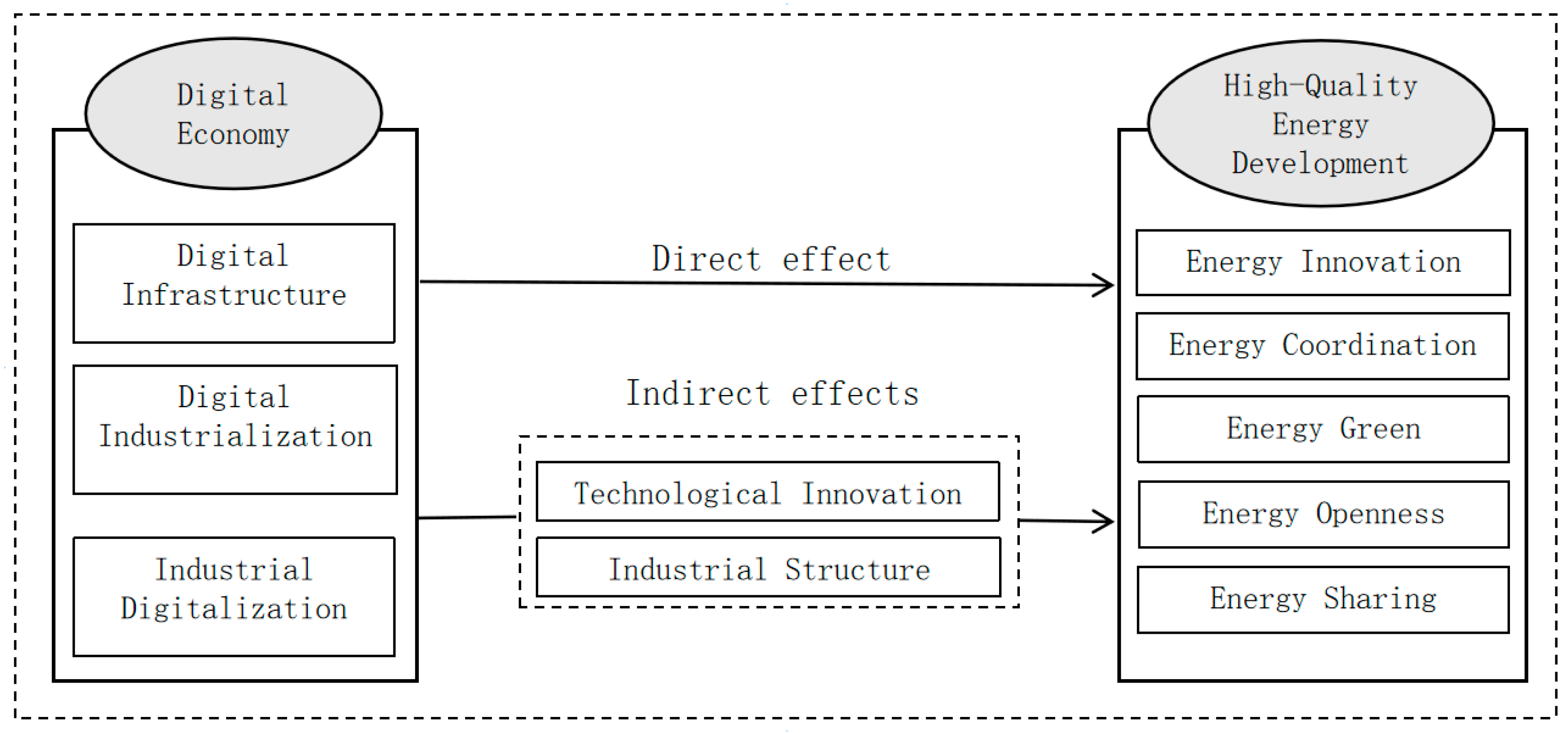
Based on the preceding analysis, the conceptual framework of this study is presented in
Figure 1.
4. Data and Variables
The research sample of this paper includes 30 provincial-level regions in China from 2013 to 2023, and the original data are drawn from the Cathay Pacific CSMAR, the China Statistical Yearbook from previous years. This paper applies the mean substitution method to fill missing values for individual provinces, and some variables are logarithmized.
4.1. Indicator Construction
4.1.1. Explained Variable (High-Quality Energy Development)
Building on the research of Wang et al. (2022) and Ding (2022), this study constructs a comprehensive evaluation index system for high-quality energy development across five dimensions [
34,
35]. To address the distinction between general economic development and specific energy quality, we have refined the justification for several key indicators: energy innovation, energy coordination, energy greening, energy openness, and energy sharing.
Energy innovation measures the level of scientific and technological progress in the energy field and related investment. The full-time equivalent of research and development personnel reflects the scale of scientific research input in energy, local fiscal investment in science and technology indicates governmental support for energy-related innovation, and investment in the energy industry is linked to the financial security of energy infrastructure and technological research.
Energy coordination reflects the alignment between the structure of energy supply and demand and economic development, capturing industrial structure optimization and adjustment. Specifically, the Proportion of Tertiary Industry is included not merely as an economic metric, but as a proxy for the energy-structural transition. A higher tertiary share signifies a move away from energy-intensive heavy industries, directly reflecting the structural de-energization of the economy. GDP per unit of energy consumption and per capita consumption further measure the economic productivity and individual accessibility of energy.
Energy greening focuses on environmental governance effectiveness and evaluates pollution control during energy utilization. Sulfur dioxide emissions and industrial fume (dust) emissions directly represent pollutants generated during energy use, and general industrial solid waste disposal reflects waste treatment efficiency.
Energy openness measures the degree of energy trade and external dependence, indicating the openness of the energy market. In the energy sector, high openness allows regions to import advanced green technologies and clean energy equipment, while participating in global energy value chains to enhance local energy security and transition speed.
Energy sharing focuses on livelihoods and energy security, assessing the accessibility and fairness of energy services. The specific indicator system is shown in
Table 1, the “+” indicates a positive indicator, while the “-” indicates a negative indicator.
4.1.2. Explanatory Variable (Digital Economy)
The development momentum of the digital economy stems from the synergy of three core dimensions: digital infrastructure, digital industrialization, and industrial digitization [
36]. Digital infrastructure measures the foundational support conditions for digital economic development, digital industrialization reflects the scale and vitality of the information technology industry, and industrial digitization captures the degree of penetration and integration of digital technologies in traditional industries. The specific indicators are shown in
Table 2. Accordingly, the basic approach for determining indicator weights involves dimensionless processing of the indicators and the application of the entropy weighting method.
To eliminate the influence of differences among indicators, the data for each variable are standardized. Specifically, for the ith year and the jth indicator, the standardized values are calculated as follows:
next, the proportion of the jth indicator in the ith year is calculated as
and the weighting matrix for all indicators can be expressed as
where n is the number of samples and m is the number of indicators. The entropy of indicator j is defined as
where k = 1/ln(n). Based on this, the information utility value dj for the jth indicator is calculated by
The weight of each evaluation indicator is then obtained as
Finally, a comprehensive score is calculated by multiplying the weights and standardized values of each indicator to obtain a digital economy development index for the 30 provinces, denoted as Digit. The full digital economy indicator system is presented in
Table 2.
4.1.3. Mediating Variables
The mediating variables selected are technological innovation (InPatent), industrial structure advanced (Ins1), and industrial structure heightened (Ins2). This paper uses the number of invention patents granted per 10,000 people to measure regional technological innovation. Industrial structure advanced (Ins1) reflects the shift from low value-added primary and secondary industries to high value-added tertiary industries and serves as an important dimension for assessing industrial structure optimization. In this paper, the advancement of regional industrial structure is measured by the share of tertiary industry value added in GDP. Industrial structure heightened (Ins2) captures technology intensity and production efficiency within the industrial structure. Following existing studies, this paper adopts the ratio of the value added of secondary and tertiary industries to measure regional industrial structure intensification. To eliminate scale-related effects on the analysis, the number of authorized invention patent applications is logarithmized.
Although these mediating variables are widely recognized in the existing literature, they also present certain limitations in measurement. First, patent counts primarily capture innovation output and may not fully reflect the actual efficiency of technology transfer within the energy sector. Second, these indicators may be influenced by omitted macro factors such as national industrial planning or resource endowments. To address this, we attempt to mitigate the issue by incorporating stringent control variables and fixed effects.
4.1.4. Control Variables
To account for potential confounding factors, this study incorporates several control variables, including government support, industrialization level, openness to international trade, urbanization rate, and the level of social consumption. First, the level of industrialization (Ind) directly affects the production mode and energy demand structure of a country or region. As industrialization increases, energy consumption typically rises, while the digital economy can improve production efficiency and optimize energy use. Second, the tax burden (tax) shapes the economic behavior of firms and individuals and plays a significant role in innovation and technological transformation. A high tax burden may discourage investment in new technologies and green applications, whereas a reasonable tax structure can incentivize energy efficiency and green development. Third, financial support (fin) is essential for advancing green technology and optimizing the energy structure. Government financial support can promote the R&D and application of new energy technologies and accelerate the energy transition. Fourth, the level of economic development (economy) determines the maturity of the digital economy and the potential for improving energy efficiency. Economically developed regions generally possess more advanced digital infrastructure and higher energy efficiency, while less developed regions may face resource constraints and outdated energy consumption patterns. Fifth, the level of social consumption (soc) reflects changes in consumption structure and energy demand. With the expansion of the digital economy, consumer behavior is becoming more intelligent, personalized, and low-carbon, which can help transform energy consumption patterns. Sixth, the urbanization rate reflects differences in population distribution and infrastructure. As urbanization increases, energy use in urban areas tends to become more concentrated and efficient, while rural areas may experience higher energy waste and lower levels of technological adoption. The specific indicators are shown in
Table 3.
4.2. Model Building
To evaluate the impact of the digital economy on high-quality energy development, this study constructs the following basic econometric model:
where,
represents the enterprise,
represents time,
is the digital economy,
is the level of high-quality energy development.
represents the degree of influence of the digital economy on high-quality energy development, vector
represents a series of enterprise-level and regional-level control variables, and vector
is the regression coefficient of a series of control variables. In addition,
represents individual fixed effects,
represents year fixed effects, and
is an independently and identically distributed random error term.
To test Hypotheses 2 and 3, we examine whether the digital economy promotes high-quality energy development through indirect paths. We test the mediating variables of technological innovation (InPatent), industrial structure advanced (Ins1), and industrial structure heightened (Ins2), and construct the mediating effect model as follows:
Among these factors, , and are technological innovation, advanced industrial structure and high industrial structure.
4.3. Descriptive Statistics
To preliminarily understand the distribution characteristics and variation of key variables,
Table 4 reports the descriptive statistics for the core variables, including the dependent variable (energy), explanatory variable (Digit), mediating variables, and control variables, based on a balanced panel of 30 provinces covering the period 2013–2023 (330 observations). The high-quality energy development index (energy) exhibits a mean value of 0.219 and a standard deviation of 0.087, indicating moderate dispersion across regions and years. The digital economy development index (Digit) has a mean of 0.152 and a standard deviation of 0.119, with values from 0.027 to 0.747, revealing substantial variation among provinces. This wide range suggests that some regions possess advanced digital infrastructure and industrial integration, while others remain in early development stages.
Among the control variables, the level of industrialization (Ind) has a mean of 0.320 and a relatively small standard deviation (0.075), indicating stable development across provinces. The tax burden (tax) shows moderate variation with a mean of 0.081, while financial support (fin) displays greater dispersion (mean = 0.258, SD = 0.109), implying uneven fiscal support for energy transformation and green innovation. The economic development level (economy), measured by the logarithm of GDP, has a mean of 10.980 and relatively low dispersion (SD = 0.440), indicating a generally consistent economic scale but still some differences across provinces. The social consumption level (soc), with a mean of 0.391, demonstrates moderate variability, reflecting differences in consumption structure and demand. The urbanization level (urban) averages 0.610, with values ranging from 0.000 to 0.896, showing sharp contrasts in urban development among provinces.
Overall, the descriptive statistics indicate that while most variables fall within reasonable ranges and reflect normal economic heterogeneity, the dependent and key explanatory variables—high-quality energy development and digital economy level—exhibit significant inter-provincial variation, providing a strong empirical foundation for subsequent regression and mediation analysis.
4.4. Correlation Analysis
Table 5 reports the Pearson correlation coefficients among the main variables. The results show that high-quality energy development (energy) is positively and significantly associated with digital economy development (digit), with a correlation coefficient of 0.543, suggesting a strong association between digitalization and energy development quality. Energy is also positively correlated with industrialization level (Ind), tax burden (tax), economic development level (economy), social consumption level (soc), and urbanization level (urban), whereas it is negatively correlated with financial support (fin).
Digital economy development exhibits significant correlations with several control variables. In particular, digit is positively correlated with economic development and urbanization, indicating that regions with higher levels of digitalization tend to be more economically developed and urbanized. Negative correlations are observed between digit and industrialization level as well as financial support, reflecting structural differences across regions
Overall, although many correlation coefficients are statistically significant, their magnitudes are generally below commonly accepted thresholds, suggesting that severe multicollinearity is unlikely to be a major concern. These preliminary results provide initial support for the subsequent regression analysis.
5. Empirical Analysis and Findings
5.1. Analysis of Benchmark Regression Results
Table 6 reports the benchmark regression results. Column Energy (1) presents the regression without control variables, while column (2) adds control variables, and in both cases the coefficients of the digital economy remain significantly positive. Column (3) shows the regression results with time fixed effects based on column (2), and column (4) includes both individual and time fixed effects. The coefficients continue to be positive and significant at the 1% level, indicating that the digital economy exerts a robust and positive effect on high-quality energy development.
The level of industrialization (Ind) does not have a significant effect on high-quality energy development, likely because its influence is more indirect and conditioned by other factors. Financial support (fin) also fails to show a significant effect, possibly due to inefficient use of fiscal funds or limited policy implementation outcomes. The level of economic development (economy) demonstrates a significant positive effect on high-quality energy development, which may reflect the long-term nature of its influence. The social consumption level (soc) exhibits a positive effect, indicating that shifts in consumption patterns contribute to optimizing the structure of energy use. Finally, the urbanization rate (urban) exhibits a positive and statistically significant effect, suggesting that urbanization plays a key role in facilitating high-quality energy development.
5.2. Robustness Test
To address estimation bias arising from endogeneity, this paper draws on Nunn and Qian (2014) and Li (2024) and adopts the instrumental variable method to correct this issue [
37,
38]. Specifically, the study employs the number of landline telephones per 100 people and the number of post offices per million people in each city in 1984 as instrumental variables. These historical variables provide a credible source of exogenous variation: the prevalence of fixed-line telephones (IV1) and post offices (IV2) in 1984 reflects the historical foundation for Internet development, as regions with greater reliance on traditional communication infrastructure were more likely to adopt the Internet in later years, thereby shaping the development of the digital economy. In addition, we present a counterfactual argument: by the 1980s, telecommunications technology had become functionally obsolete and incompatible with modern energy systems reliant on high-speed IoT, smart grids, and big data analytics. Beyond the pathway of fostering a modern digital economy, there exists no direct causal channel through which fixed telephone density from 40 years ago could influence contemporary energy efficiency or carbon intensity. Furthermore, drawing on the research strategy of Goldsmith et al. (2020) [
39], we contend that after controlling for regional economic characteristics, these instrumental variables exert negligible residual effects on industrial energy outcomes. This ensures that the instrumental variable influences energy quality solely through the digital economy variable. Building on this logic, the interaction terms between the 1984 historical infrastructure variables and national Internet investment in the previous year are constructed as instruments for the digital economy. The validity and robustness of the IV estimates are further confirmed through standard instrumental variable tests, ensuring that the approach adequately addresses potential endogeneity in the baseline model.
As shown in
Table 7, the first-stage regression shows that the selected instruments have strong explanatory power for the digital economy variables, with RKF statistics of 61.5944 and 114.247, both far exceeding 10 and significant at the 1% level. This indicates that the instrumental variables do not suffer from weak identification and that their direct relationship with high-quality energy development is minimal, satisfying the exclusivity condition and confirming their validity. The second-stage regression results further show that the coefficient measuring the impact of the digital economy on high-quality energy development remains significantly positive at the 1% level. This demonstrates that the positive effect persists after correcting for endogeneity. Meanwhile, the decline in R2 under the instrumental variable method may reflect a partial loss in goodness of fit due to restricted model freedom when introducing exogenous instruments to address endogeneity. In addition, the constant term shifts from significantly negative in OLS to positive in 2SLS, which may result from structural adjustments following endogeneity correction, though the significant estimation of the core variables still indicates robust results.
In addition, the following methods are used to test the model’s robustness. (1) Replacement of core explanatory variables: Energy (9) in column 5 of
Table 8 reports the regression results after replacing the core explanatory variables, and the coefficient of Digital Economy (Digit) is 0.104 and significant at the 5% level, further confirming that the digital economy promotes high-quality energy development, consistent with earlier regression results. (2) One-period lag of explanatory variables: As shown in
Table 8, the regression results of Energy (10) indicate that the coefficients obtained after re-estimating the model with Digit lagged one period remain significant, demonstrating strong robustness. (3) Changing the sample size: Re-estimating the baseline model after applying a 1% bilateral shrinkage to all variables yields coefficients significant at the 1% level, consistent with the previous conclusion.
6. Mechanism Analysis
The conclusions of the previous study show that the digital economy effectively enhances the high-quality energy development. To further explore the mechanisms underlying this relationship, this paper constructs a mediation effect model and conducts empirical analysis from three dimensions: technological innovation (InPatent), industrial structure advancing (Ins1), and industrial structure intensification (Ins2).
These channels are well-grounded in theory. Specifically, the digital economy fosters the generation and diffusion of knowledge through digital platforms, big data analytics, and intelligent networks, which stimulate enterprise-level technological innovation. Enhanced innovation can lead to the development of energy-saving technologies, cleaner production methods, and more efficient energy utilization, thereby contributing to high-quality energy outcomes. Similarly, the digital economy can restructure industrial composition by encouraging the growth of high-value-added and low-carbon industries and by optimizing existing industrial processes for higher efficiency. Together, these pathways suggest that digitalization not only directly affects energy systems but also operates indirectly by shaping the innovation capacity and structural composition of the economy. As shown in
Table 9, the digital economy on technological innovation (InPatent) is 4.937 and significant at the 1% level. Further examination shows that the coefficient of technological innovation on high-quality energy development is 0.0114 and remains significant, indicating that technological innovation significantly promotes high-quality energy development. Together, these results suggest that the digital economy indirectly promotes high-quality energy development by enhancing technological innovation. In other words, digitalization improves energy use by stimulating enterprise innovation, thereby increasing energy efficiency and advancing the green, low-carbon transition.
In the pathway of industrial structure advancedization, the digital economy on Ins1 is 0.864 and significant at the 5% level, indicating that the digital economy effectively facilitates the transition of industrial structure from low-end to high-end. Further regression results show that industrial structure advancement continues to promote high-quality energy development. This indicates that the digital economy reduces energy consumption and advances green economic development by optimizing the industrial structure and increasing the proportion of the tertiary industry, supporting the hypothesis.
Along the industrial structure intensification pathway, the coefficient of the digital economy on Ins2 is 0.181 and significant at the 1% level, indicating digitalization significantly improves resource allocation efficiency within the industrial structure. Further regression results show that the coefficient of industrial structure intensification on high-quality energy development is 0.180 and significant at the 1% level, indicating that intensification significantly promotes high-quality energy development. These findings imply that the digital economy promotes the flow of resource elements toward high-efficiency, low-energy-consumption industries, optimizes industrial chains, improves energy efficiency, and positively affecting high-quality energy development, in line with the hypothesis.
According to
Table 9, the digital economy exerts a positive influence on all three mediating variables. In the technological innovation pathway, the indirect effect is 0.0563. Given the overall effect of the digital economy on energy development, technological innovation accounts for approximately 13.6% of the total promotion effect. This indicates that digitalization enhances energy quality by lowering R&D barriers and stimulating green patent applications. In the industrial structure upgrading pathway, the indirect effect is 0.0213, accounting for about 5.1% of the total effect. In the industrial structure rationalization pathway, the indirect effect reached 0.0326, contributing about 7.9% to the total effect. This indicates that the reallocation of resources toward efficient sectors has a more direct impact on energy quality than broad-based industrial transformation. In summary, the digital economy promotes high-quality energy development through multiple channels, with technological innovation playing the primary driving role among the three mechanisms discussed.
In summary, the mechanism analysis results show that the digital economy promotes the high-quality energy development through technological innovation as well as advancing and intensifying the industrial structure.
7. Heterogeneity Analysis
Given the clear differences in resource endowment, economic development, and policy environments across provinces in China, 30 provinces are divided into the eastern, central, western, and northeastern regions to examine the impact. The detailed results are reported in
Table 10.
The regression results in
Table 8 reveal that the impact of the digital economy on high-quality energy development varies by region, following a pattern of “strong in the east, pronounced in the central region, and weaker in the west”. In the eastern region, the coefficient of the digital economy on high-quality energy development is 0.276 and significant at the 1% level, indicating a strong promoting effect. This may stem from the eastern region’s advanced digital infrastructure, stronger technological innovation capacity, and higher level of economic development. As a leader in digital economy development, the region benefits from broad adoption of digital technologies that enhance energy efficiency and accelerate the growth of green, low-carbon industries. In addition, more supportive government policies and a superior business environment provide favorable institutional conditions for digital-economy applications in the energy sector.
The regression coefficient for the central region is 0.688 and significant at the 1% level, indicating that the region is in a stage of accelerated integration between the digital economy and the energy sector. The central region has promoted new industrialization and the transformation of traditional energy structures in recent years, giving it substantial potential to improve energy efficiency through digital technologies, thereby amplifying the marginal effect of the digital economy.
In the western region, the coefficient of the digital economy is −0.253 and insignificant, indicating that its promoting effect on high-quality energy development has not yet emerged. Although the national East Data West Computing initiative has established large-scale data centers in western regions, these facilities primarily serve national computing demands and have yet to deeply integrate into the fragmented local energy grids. Due to the absence of localized data-energy synergy policies, digital investments and energy production chains remain relatively isolated.
The regression results for the northeastern region are significantly positive at the 1% level, demonstrating that the digital economy also contributes to high-quality energy development in this area. In recent years, the Northeast has advanced digital transformation and green reform within state-owned enterprises, which may have strengthened the indirect effects of the digital economy on industrial structure optimization and technological innovation.
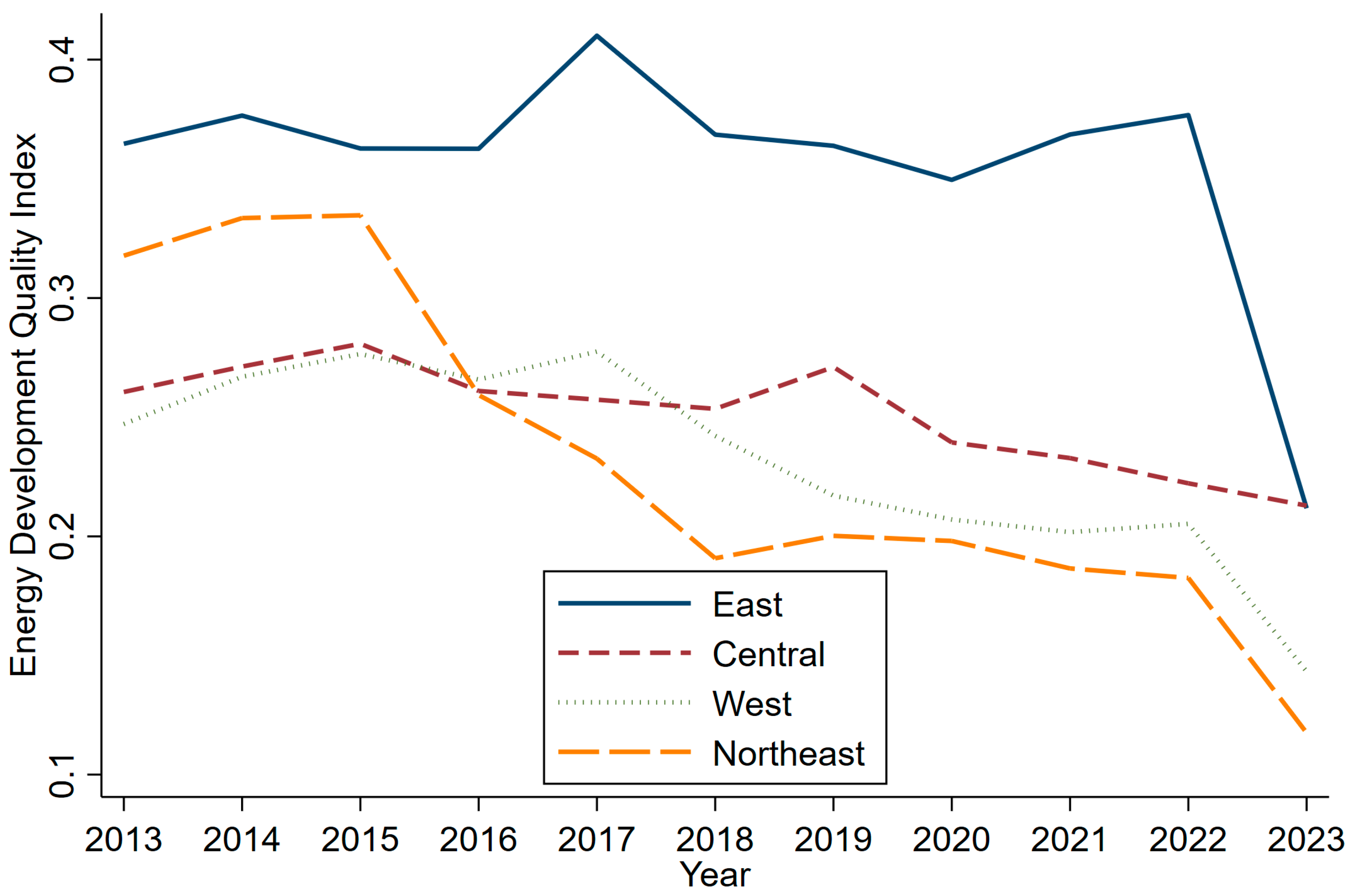
To conduct a more granular analysis of regional disparities, this paper examines temporal trends across the eastern, central, western, and northeastern regions. As illustrated in
Figure 2, High-Quality Energy Development Index exhibits a clear “step-like” distribution pattern. The Eastern region consistently emerges as the undisputed leader, maintaining a substantial margin over other regions. This leading position is underpinned by its robust digital economy and high energy conversion efficiency. In contrast, the Northeastern region has experienced a persistent downward trajectory since 2015, identifying it as the primary laggard. This decline may be attributed to the resource curse and the structural inertia of traditional heavy industries, which hinder the rapid integration of digital technologies into the energy sector. Meanwhile, the Central and Western regions demonstrate a moderate catch-up trend, though they remain vulnerable to external macroeconomic fluctuations. Specifically, provinces such as Guangdong and Shandong maintain their positions as national leaders, while Yunnan and Guizhou lag behind.
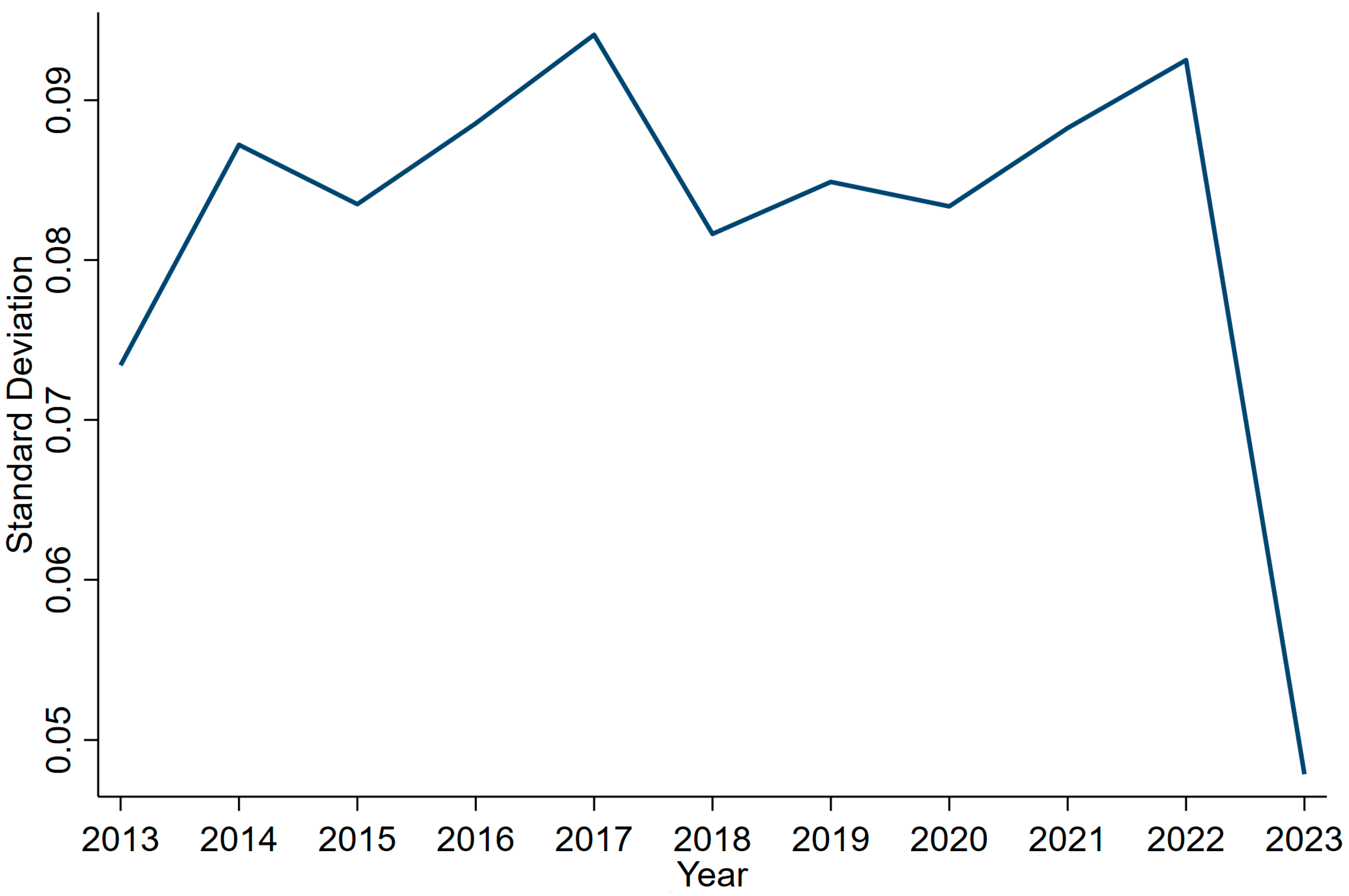
To assess whether inter-provincial disparities in high-quality energy development are narrowing over time, we conduct a σ-convergence analysis using the cross-sectional standard deviation of the High-Quality Energy Development as the dispersion metric. As illustrated in
Figure 3, the evolution of σ exhibits two distinct phases. From 2013 to 2022, the σ value fluctuated within the range of 0.07 to 0.09, without exhibiting a sustained downward trend. This pattern suggests the absence of significant convergence during this period and reflects the continued existence of a structural digital divide in energy development across regions. However, a marked shift emerged in 2023, when the σ value declined sharply to below 0.05. When considered alongside the regional trajectories depicted in
Figure 2, the narrowing gap was not primarily driven by rapid improvement in lagging provinces, but rather by structural adjustments and index corrections in the leading eastern provinces.
A significant structural inflection point emerged in 2023, when the dispersion index notably declined below 0.05. Interpreting this decline alongside the regional development trajectory depicted in
Figure 2, it appears to reflect narrowing disparities between regions. However, deeper analysis suggests that the convergence observed in 2023 likely did not stem from accelerated catch-up growth in lagging provinces. A more plausible explanation is that leading eastern provinces exhibited relatively moderate growth in their index values during performance adjustments.
To further examine whether the effect of the digital economy on High-Quality Energy Development varies with the level of economic development, provinces are divided into high- and low-economic-development groups based on the median value of regional GDP [
40]. The corresponding regression results are reported in
Table 11.
The results show a clear heterogeneity pattern across economic development levels. In the high-economic-development group, digital economy development plays a meaningful role in promoting high-quality energy development in economically advanced regions. This finding suggests that regions with higher income levels, stronger market mechanisms, and more mature industrial systems are better positioned to translate digital inputs into improvements in energy efficiency, green transformation, and innovation-driven energy development. In such regions, digital technologies are more likely to be effectively integrated into energy production, distribution, and consumption processes, thereby generating tangible development outcomes. In contrast, the coefficient of the digital economy in the low-economic-development group is negative but statistically insignificant, implying that the promoting effect of digitalization on high-quality energy development has not yet materialized in less developed regions. This result may be attributed to constraints such as limited digital infrastructure, insufficient human capital, weaker absorptive capacity, and a development priority that still favors scale expansion over quality improvement. Under these conditions, digital economy development alone may be insufficient to induce substantial changes in energy development patterns.
8. Conclusions and Recommendations
The findings suggest that the digital economy supports high-quality energy development through technological innovation, resource allocation optimization, and related pathways. Second, the digital economy promotes high-quality energy development through multiple mechanisms, including innovation-driven effects, coordination and optimization, green transformation, and shared development. Mechanism analysis shows that digitalization significantly improves the overall level of high-quality energy development by enhancing technological innovation in the energy sector, improving coordination between energy production and consumption, accelerating the low-carbon transition of the energy structure, and promoting the shared use of energy resources. Finally, there is heterogeneity in the digital economy’s effect on high-quality energy development.
Based on these findings, combined with the global context of energy transition and digital economy expansion, as well as China’s dual carbon goal and the strategic needs of high-quality energy development, the following four policy insights are proposed.
First, accelerate the in-depth application of digital technology in the energy sector and promote intelligent system upgrading. The government should actively support energy enterprises in adopting big data analytics, AI and other digital technologies to enhance operational efficiency and system reliability. Specifically, a nationwide smart grid system should be developed to enable real-time monitoring, automated fault detection, and optimized scheduling of energy production, transmission, and consumption. For instance, pilot smart grid projects in provinces such as Guangdong and Jiangsu have demonstrated that AI-based load balancing can reduce energy losses while improving grid stability. The application of digital twin technology should be expanded to introduce virtual simulation and real-time data analysis into energy infrastructure such as oil and gas pipelines, wind farms, and photovoltaic plants to optimize equipment performance and reduce maintenance costs. In addition, the establishment of a national energy big data center will integrate data on energy production, consumption, and transactions, providing support for government decision-making, enterprise management, and public services while advancing comprehensive digitalization and intelligent transformation of the energy industry.
Second, digital infrastructure in the energy industry should be strengthened and the hardware foundation for high-quality energy development should be reinforced. The government should advance the development of new energy infrastructure under the framework of the “East counts, West counts” project by leveraging the abundant renewable energy resources in the western region and building large-scale digital energy bases to foster synergies between energy production and digital computing. Simultaneously, distributed energy systems, such as rooftop photovoltaics, small-scale wind turbines, and microgrids, should be expanded and equipped with digital monitoring and control technologies to achieve localized energy production and consumption, minimize transmission losses, and improve overall system efficiency. For example, community-level microgrids in provinces such as Qinghai and Inner Mongolia have successfully combined solar and wind power with IoT-based monitoring to increase energy self-sufficiency and reduce grid dependency. In addition, the construction of a unified national digital charging-pile network is essential to support large-scale adoption of electric vehicles. This network should include smart charging management, real-time availability tracking, and grid-balancing features to optimize energy usage and facilitate the electrification of the transportation sector. Collectively, these measures will strengthen the physical and digital foundations of the energy industry, enabling more efficient, resilient, and high-quality energy development.
Third, strengthen interregional synergies, narrow the digital economy development gap, and promote balanced high-quality energy development. Given the substantial regional differences in digital economy–enabled energy development, the government should implement differentiated policies tailored to local conditions to ensure balanced progress. For example, through major initiatives such as the “West-to-East Gas Transmission” and “West-to-East Electricity Transmission” projects, integrated digital economy and energy development demonstration programs should be deployed in central and western regions. These programs can improve the digitization level of local energy industries by deploying smart grid technologies, IoT-based monitoring, and AI-driven energy management systems. At the same time, high-tech enterprises in the eastern region should be encouraged to share digital technologies and energy management experience with the central and western regions to narrow regional disparities through technical cooperation and talent exchange. In addition, cross-regional digital energy trading platforms should be developed to optimize the allocation of energy resources in real time. These platforms can facilitate coordinated supply and demand management across regions, enabling efficient dispatch of electricity and gas, balancing peak loads, and supporting the nationwide integration of renewable energy. By combining infrastructure investment, technological collaboration, and digital platforms, these strategies can ensure balanced, coordinated, and high-quality energy development across all regions of China.
Fourth, the green and low-carbon transformation of the energy industry should be promoted, and the realization of the double carbon goal should be supported. The digital economy provides essential support for green energy development, and the government should accelerate structural optimization through both policy guidance and market mechanisms. Specifically, technologies can enhance the development and utilization efficiency of renewable energy by supporting wind, photovoltaic, and other clean-energy industries. For example, AI-based predictive analytics can optimize wind turbine operation and solar power generation, improving capacity utilization while gradually reducing reliance on fossil fuels. Smart grid management and demand-response systems can further integrate renewable energy into the electricity network, ensuring stable and efficient energy distribution. In addition, technologies such as blockchain, big data, and IoT can be employed to construct a comprehensive carbon footprint tracking system for energy production and consumption. This system can provide real-time monitoring and transparent reporting, supporting carbon trading schemes, carbon tax implementation, and regulatory compliance.
9. Future Research Directions
Despite the contributions of this study, several avenues remain for future research. First, due to data availability constraints, this paper relies on provincial-level panel data, which may mask firm-level or household-level heterogeneity. Future studies could employ micro-level data to more precisely examine how digital technologies affect energy efficiency, clean energy adoption, and energy consumption behavior.
Second, although this study constructs comprehensive indices for the digital economy and high-quality energy development, alternative measurement approaches—such as satellite data, smart-meter data, or text-based indicators—could be explored to further improve robustness and accuracy.
Third, this paper focuses on technological innovation and industrial structure as the main transmission mechanisms. Future research may consider additional channels, including environmental regulation, digital governance capacity, energy market competition, and carbon trading mechanisms.
Finally, given the potential spatial spillovers of both the digital economy and energy systems, future studies could adopt spatial econometric models or network-based approaches to investigate cross-regional interactions and policy coordination effects in the process of high-quality energy development.