Artificial Intelligence Adoption and Labour Productivity in Slovakia and the EU27: Implications for Sustainable Economic Growth


Abstract
1. Introduction
2. Materials and Methods
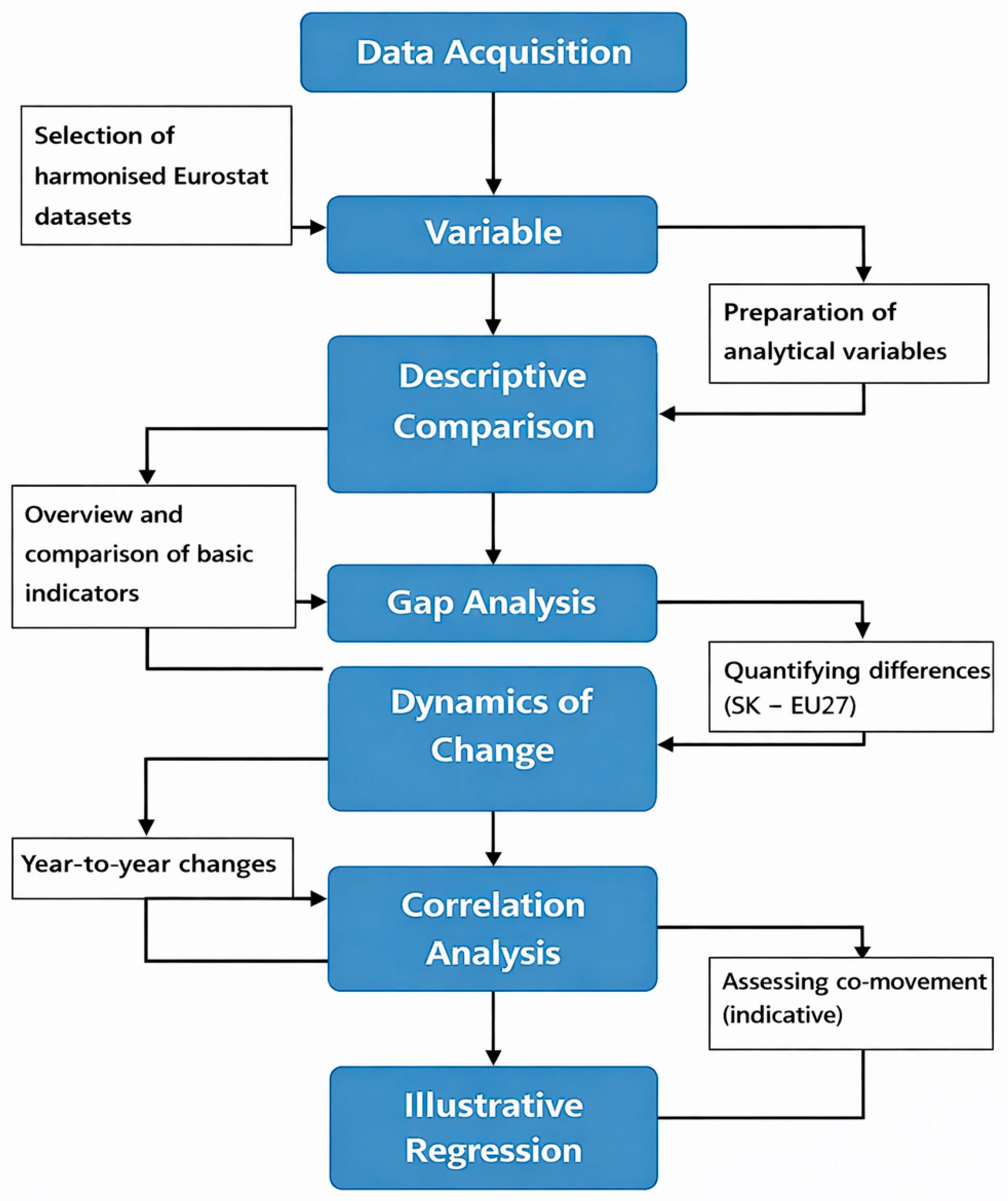
2.1. Research Framework
2.1.1. Step 1: Data Acquisition
- AI adoption in enterprises (isoc_eb_ai, indicator E_AI_TANY), available for 2021, 2023, and 2024. This dataset measures the share of enterprises using at least one AI technology and provides breakdowns by enterprise size (10–49, 50–249, 250+ employees).
- Labour productivity per hour worked (tipsna70), expressed as year-on-year percentage change, available for 2021–2024. This indicator captures short-term developments in economic performance.
- Real GDP growth (tec00115), used as macroeconomic background, available for 2021–2024.
2.1.2. Step 2: Variable Construction
- = AI adoption in Slovakia in year t;
- = AI adoption in the EU27 in year t;
- = difference between Slovakia and the EU27.
- = labour productivity growth in Slovakia in year t;
- = labour productivity growth in the EU27 in year t;
- = difference between Slovakia and the EU27.
- = level of AI adoption in year t;
- = level of AI adoption in the previous year (t − 1);
- = year-to-year change in AI adoption in year t;
- = labour productivity growth in year t;
- = labour productivity growth in the previous year (t − 1);
- = year-to-year change in labour productivity in year t.
- = intercept;
- = slope coefficient;
- = level of AI adoption in year t;
- = error term;
- = labour productivity growth in year t.
2.1.3. Step 3: Descriptive Comparison
2.1.4. Step 4: Gap Analysis
2.1.5. Step 5: Dynamics of Change
2.1.6. Step 6: Correlation Analysis
- = AI adoption in year t;
- = labour productivity in year t;
- , = mean values of the respective indicators;
- = Pearson’s correlation coefficient measuring the strength and direction of the linear association between AI adoption and labour productivity.
2.1.7. Step 7: Illustrative Regression
3. Results
3.1. AI Adoption in Slovakia and the EU27
3.2. Labour Productivity Developments
3.3. Gap Analysis: Slovakia vs. EU27
3.4. Dynamics of Change (ΔAI and ΔPROD)
3.5. Correlation Analysis
3.6. Illustrative Regression Results
4. Discussion
5. Conclusions
Author Contributions
Funding
Institutional Review Board Statement
Informed Consent Statement
Data Availability Statement
Acknowledgments
Conflicts of Interest
References
- Brynjolfsson, E.; McAfee, A. The Second Machine Age: Work, Progress, and Prosperity in a Time of Brilliant Technologies; W.W. Norton & Company: New York, NY, USA, 2014. [Google Scholar]
- Acemoglu, D.; Restrepo, P. Artificial Intelligence, Automation and Work. J. Econ. Perspect. 2020, 34, 197–236. [Google Scholar]
- OECD. Artificial Intelligence, Productivity and Policy Implications; OECD Publishing: Paris, France, 2022. [Google Scholar]
- European Commission. Digital Economy and Society Index (DESI) 2023; Publications Office of the European Union: Luxembourg, 2023. [Google Scholar]
- Billon, M.; Marco, R.; Lera-Lopez, F. Digital divide across the European Union. Inf. Manag. 2019, 56, 102–117. [Google Scholar]
- Kiseľáková, D.; Šofranková, B.; Čabinová, V.; Onuferová, E. The impact of R&D expenditure on the economic growth of the EU countries. J. Int. Stud. 2018, 11, 218–233. [Google Scholar]
- European Commission. Coordinated Plan on Artificial Intelligence 2021 Review; Publications Office of the European Union: Luxembourg, 2021. [Google Scholar]
- European Commission. 2030 Digital Compass: The European Way for the Digital Decade; Publications Office of the European Union: Luxembourg, 2021. [Google Scholar]
- European Union. Regulation (EU) 2021/694 Establishing the Digital Europe Programme (DEP); Official Journal of the European Union: Luxembourg, 2021. [Google Scholar]
- European Investment Bank. EIB Digitalisation Report 2022: Digitalisation in Europe 2022–2023; European Investment Bank: Luxembourg, 2022. [Google Scholar]
- European Commission. Digital Economy and Society Index (DESI) 2023—EU Country Profiles; Publications Office of the European Union: Luxembourg, 2023. [Google Scholar]
- Lachvajderová, L.; Kádárová, J. The Level of Sustainability and Digitalization of Small and Medium-Sized Enterprises in Slovakia. Acta Mech. Slovaca 2022, 26, 54–63. [Google Scholar] [CrossRef]
- OECD. The Digital Transformation of SMEs; OECD Publishing: Paris, France, 2021. [Google Scholar]
- European Commission. Slovakia Country Report 2023—Digitalisation and Innovation; Publications Office of the European Union: Luxembourg, 2023. [Google Scholar]
- OECD. The Future of Productivity; OECD Publishing: Paris, France, 2015. [Google Scholar]
- European Commission. The 2021 Ageing Report: Economic and Budgetary Projections for the EU Member States; Publications Office of the European Union: Luxembourg, 2021. [Google Scholar]
- Cockburn, I.M.; Henderson, R.; Stern, S. The Impact of Artificial Intelligence on Innovation; University of Chicago Press: Chicago, IL, USA, 2018. [Google Scholar]
- Brynjolfsson, E.; Rock, D.; Syverson, C. Artificial Intelligence and the Modern Productivity Paradox: A Clash of Expectations and Statistics. J. Econ. Perspect. 2019, 33, 3–30. [Google Scholar]
- Brynjolfsson, E.; Rock, D.; Syverson, C. The Productivity J-Curve: How Intangibles Complement General Purpose Technologies. Am. Econ. J. Macroecon. 2021, 13, 333–372. [Google Scholar] [CrossRef]
- Brynjolfsson, E.; Hitt, L.M.; Yang, S. Intangible Assets: Computers and Organizational Capital. Brook. Pap. Econ. Act. 2002, 33, 137–198. [Google Scholar] [CrossRef]
- OECD. Data-Driven Innovation: Big Data for Growth and Well-Being; OECD Publishing: Paris, France, 2015. [Google Scholar]
- European Investment Bank. EIB Investment Report 2023/2024: Innovation, Integration and Simplification in Europe; European Investment Bank: Luxembourg, 2023. [Google Scholar]
- World Bank. Firm-Level Adoption of Digital Technologies in Europe and Central Asia; World Bank: Washington, DC, USA, 2021. [Google Scholar]
- Eurostat. European Statistics Code of Practice; Publications Office of the European Union: Luxembourg, 2018. [Google Scholar]
- Alesina, A.; Spolaore, E.; Wacziarg, R. Economic Integration and Political Disintegration. Am. Econ. Rev. 2000, 90, 1276–1296. [Google Scholar] [CrossRef]
- United Nations. Digital Economy Report 2021: Cross-Border Data Flows and Development; United Nations: New York, NY, USA, 2021. [Google Scholar]
- European Investment Bank. EIB Digitalisation Report 2022: Transforming EU Economies; European Investment Bank: Luxembourg, 2022. [Google Scholar]
- Kádárová, J.; Lachvajderová, L.; Sukopová, D. Impact of Digitalization on SME Performance of the EU27. Sustainability 2023, 15, 9973. [Google Scholar] [CrossRef]
- Cirillo, V.; Fana, M.; Guarascio, D. Jobs and AI: A Framework to Assess the Effects on Employment. Econ. Res. Ekon. Istraživanja 2021, 34, 210–235. [Google Scholar]
- OECD. OECD Economic Survey: Slovak Republic 2022; OECD Publishing: Paris, France, 2022. [Google Scholar]
- Andrews, D.; Criscuolo, C.; Gal, P.N. The Best Versus the Rest: The Global Productivity Slowdown, Divergence Across Firms and the Role of Public Policy; OECD Publishing: Paris, France, 2016. [Google Scholar]
- European Commission. Artificial Intelligence and the Circular Economy; Joint Research Centre: Luxembourg, 2022. [Google Scholar]
- World Bank. Europe’s Digital Transformation: The Role of CEE Countries; World Bank: Washington, DC, USA, 2021. [Google Scholar]
- European Commission. A European Strategy for Artificial Intelligence; Publications Office of the European Union: Luxembourg, 2020. [Google Scholar]
- Cette, G.; Nevoux, S.; Py, L. The Impact of ICTs and Digitalization on Productivity. OECD Econ. Stud. 2021, 2021, 7–35. [Google Scholar]
- European Commission. Digital Economy and Society Index (DESI) 2023: Methodological Note; Publications Office of the European Union: Luxembourg, 2023. [Google Scholar]
- Eurostat. Artificial Intelligence in Enterprises (isoc_eb_ai). Available online: https://ec.europa.eu/eurostat/databrowser/view/isoc_eb_ai/default/table (accessed on 18 November 2025).
- Eurostat. Labour Productivity per Hour Worked (tipsna70). Available online: https://ec.europa.eu/eurostat/databrowser/view/tipsna70/default/table (accessed on 20 November 2025).
- Eurostat. Real GDP Growth Rate—Volume (tec00115). Available online: https://ec.europa.eu/eurostat/databrowser/view/tec00115/default/table (accessed on 22 November 2025).
- European Commission. Digital Economy and Society Index (DESI) Reports 2020–2022; Publications Office of the European Union: Luxembourg, 2022; Available online: https://digital-strategy.ec.europa.eu/en/policies/desi (accessed on 11 November 2025).
- McKinsey Global Institute. Notes from the AI Frontier: Modeling the Impact of AI on the World Economy; McKinsey & Company: New York, NY, USA, 2018; Available online: https://www.mckinsey.com/capabilities/quantumblack/our-insights/notes-from-the-ai-frontier-modeling-the-impact-of-ai-on-the-world-economy (accessed on 12 November 2025).


| Size Class | Year | Slovakia | EU27 |
|---|---|---|---|
| 10–49 employees | 2021 | 4.11 | 6.12 |
| 2023 | 5.98 | 6.41 | |
| 2024 | 8.78 | 11.21 | |
| 50–249 employees | 2021 | 7.01 | 12.55 |
| 2023 | 8.57 | 13.07 | |
| 2024 | 15.73 | 20.97 | |
| 250+ employees | 2021 | 19.44 | 28.41 |
| 2023 | 21.89 | 30.48 | |
| 2024 | 29.10 | 41.17 |
| Year | Slovakia | EU27 |
|---|---|---|
| 2021 | 5.6 | 0.6 |
| 2022 | −3.0 | 0.4 |
| 2023 | 0.9 | −0.8 |
| 2024 | 1.7 | 0.2 |
| AI Gap (Slovakia—EU27)—10–49 Employees | |
| Year | AI Gap |
| 2021 | −2.01 |
| 2023 | −0.43 |
| 2024 | −2.43 |
| Productivity Gap (Slovakia—EU27) | |
| Year | PROD Gap |
| 2021 | +5.0 |
| 2022 | −3.4 |
| 2023 | +1.7 |
| 2024 | +1.5 |
| ΔAI (10–49 employees) | ||
| Period | ΔAI (SR) | ΔAI (EU27) |
| 2021 → 2023 | +1.87 | +0.29 |
| 2023 → 2024 | +2.80 | +4.80 |
| ΔPROD | ||
| Period | ΔPROD (SR) | ΔPROD(EU27) |
| 2021 → 2022 | −8.6 | −0.2 |
| 2022 → 2023 | +3.9 | −1.2 |
| 2023 → 2024 | +0.8 | +1.0 |
| Country | r | |
|---|---|---|
| Slovakia | −0.70 | |
| EU27 | +0.19 |
| Country | α (Intercept) | β (Slope) |
|---|---|---|
| Slovakia | 7.42 | −0.746 |
| EU27 | −0.38 | +0.048 |
Disclaimer/Publisher’s Note: The statements, opinions and data contained in all publications are solely those of the individual author(s) and contributor(s) and not of MDPI and/or the editor(s). MDPI and/or the editor(s) disclaim responsibility for any injury to people or property resulting from any ideas, methods, instructions or products referred to in the content. |
© 2026 by the authors. Licensee MDPI, Basel, Switzerland. This article is an open access article distributed under the terms and conditions of the Creative Commons Attribution (CC BY) license.
Share and Cite
Kádárová, J.; Fiľo, M.; Sukopová, D.; Dúlová, M. Artificial Intelligence Adoption and Labour Productivity in Slovakia and the EU27: Implications for Sustainable Economic Growth. Sustainability 2026, 18, 2135. https://doi.org/10.3390/su18042135
Kádárová J, Fiľo M, Sukopová D, Dúlová M. Artificial Intelligence Adoption and Labour Productivity in Slovakia and the EU27: Implications for Sustainable Economic Growth. Sustainability. 2026; 18(4):2135. https://doi.org/10.3390/su18042135
Chicago/Turabian StyleKádárová, Jaroslava, Milan Fiľo, Dominika Sukopová, and Monika Dúlová. 2026. "Artificial Intelligence Adoption and Labour Productivity in Slovakia and the EU27: Implications for Sustainable Economic Growth" Sustainability 18, no. 4: 2135. https://doi.org/10.3390/su18042135
APA StyleKádárová, J., Fiľo, M., Sukopová, D., & Dúlová, M. (2026). Artificial Intelligence Adoption and Labour Productivity in Slovakia and the EU27: Implications for Sustainable Economic Growth. Sustainability, 18(4), 2135. https://doi.org/10.3390/su18042135