


Making It Look Green: Big Data Analytics, External Pressure, and Corporate Greenwashing


Abstract
1. Introduction
2. Theoretical Background
2.1. Big Data Analytics
2.2. Corporate Greenwashing
2.3. Impression Management Theory
3. Hypothesis Development
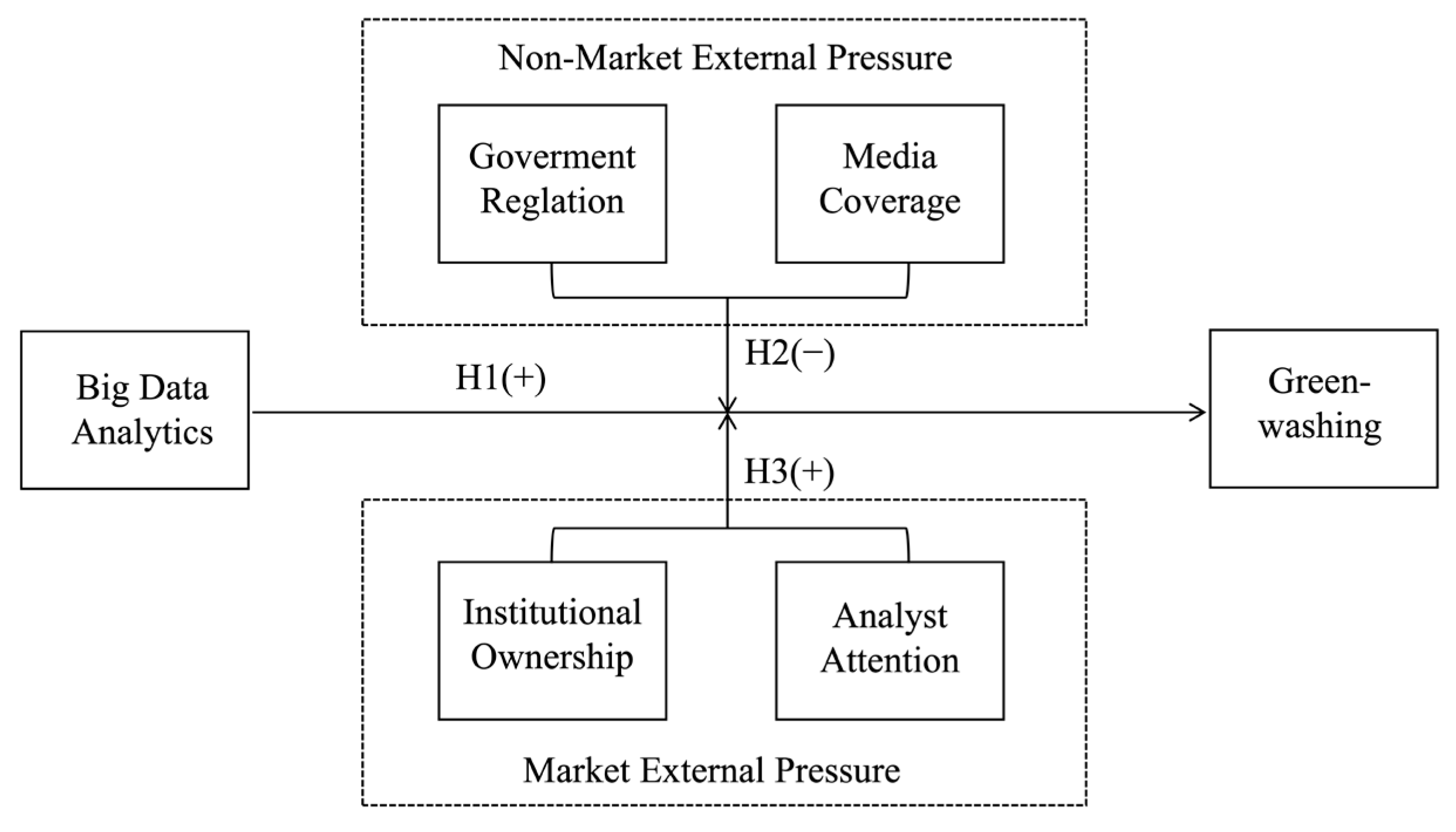
3.1. Effect of Big Data Analytics on Corporate Greenwashing
3.2. Moderating Role of Different External Pressures
3.2.1. Impact of Non-Market External Pressure
3.2.2. Impact of Market External Pressure
4. Methodology
4.1. Data and Sample
4.2. Measurement of the Variables
4.2.1. Independent Variable
4.2.2. Dependent Variable
4.2.3. Moderating Variables
4.2.4. Control Variables
4.3. Empirical Strategy
5. Results
5.1. Descriptive Statistics and Correlations
5.2. Baseline Results
5.3. Robustness Tests
6. Discussion and Conclusions
6.1. Theoretical Implication
6.2. Practical Implications
6.3. Limitations and Directions for Future Research
Author Contributions
Funding
Institutional Review Board Statement
Informed Consent Statement
Data Availability Statement
Acknowledgments
Conflicts of Interest
References
- Tseng, M.L.; Wu, K.J.; Lim, M.K.; Wong, W.P. Data-driven sustainable supply chain management performance: A hierarchical structure assessment under uncertainties. J. Clean. Prod. 2019, 227, 760–771. [Google Scholar] [CrossRef] [Scilit]
- Albarrak, M.S.; Elnahass, M.; Papagiannidis, S.; Salama, A. The effect of Twitter dissemination on cost of equity: A big data approach. Int. J. Inf. Manag. 2020, 50, 1–16. [Google Scholar] [CrossRef] [Scilit]
- Ndou, V.; Secundo, G.; Dumay, J.; Gjevori, E. Understanding intellectual capital disclosure in online media big data: An exploratory case study in a university. Meditari Account. Res. 2018, 26, 499–530. [Google Scholar] [CrossRef] [Scilit]
- Waqas, M.; Honggang, X.; Ahmad, N.; Ullah, S.; Khan, S.A.R. Big data analytics as a roadmap towards green innovation, competitive advantage and environmental performance. J. Clean. Prod. 2021, 323, 128998. [Google Scholar] [CrossRef] [Scilit]
- Choi, H.Y.; Park, J. Do data-driven CSR initiatives improve CSR performance? The importance of big data analytics capability. Technol. Forecast. Soc. Change 2022, 182, 121802. [Google Scholar] [CrossRef] [Scilit]
- Soni, G.; Mangla, S.K.; Singh, P.; Dey, B.L.; Dora, M. Technological interventions in social business: Mapping current research and establishing future research agenda. Technol. Forecast. Soc. Change 2021, 169, 120818. [Google Scholar] [CrossRef] [Scilit]
- Bag, S.; Rahman, M.S.; Srivastava, G.; Sahu, A.K.; Grover, P. Examining the role of virtue ethics and big data in enhancing viable, sustainable, and digital supply chain performance. Technol. Forecast. Soc. Change 2023, 186, 122154. [Google Scholar] [CrossRef] [Scilit]
- Seele, P.; Schultz, M.D. From greenwashing to machinewashing: A model and future directions derived from reasoning by analogy. J. Bus. Ethics 2022, 178, 1063–1089. [Google Scholar] [CrossRef] [Scilit]
- Agostini, M.; Arkhipova, D.; Mio, C. Corporate accountability and big data analytics: Is non-financial disclosure a missing link? Sustain. Account. Manag. Policy J. 2023, 14, 62–89. [Google Scholar] [CrossRef] [Scilit]
- Jia, F.; Du, K.; Chen, L.; Zhang, Y.; Li, Y. The side effects of corporate digitalization on corporate social responsibility: A fraud triangle perspective. Br. J. Manag. 2025; in press. [CrossRef] [Scilit]
- Liu, L. The rise of data politics: Digital China and the world. Stud. Comp. Int. Dev. 2021, 56, 45–67. [Google Scholar] [CrossRef] [Scilit]
- Wang, J.; Xu, C.; Zhang, J.; Li, Y. Big data analytics for intelligent manufacturing systems: A review. J. Manuf. Syst. 2022, 62, 738–752. [Google Scholar] [CrossRef] [Scilit]
- Li, L.; Lin, J.; Ouyang, Y.; Luo, X. Evaluating the impact of big data analytics usage on the decision-making quality of organizations. Technol. Forecast. Soc. Change 2022, 175, 121355. [Google Scholar] [CrossRef] [Scilit]
- Wei, X.; Jiang, F.; Yang, L. Does digital dividend matter in China’s green low-carbon development? Environmental impact assessment of the big data comprehensive pilot zones policy. Environ. Impact Assess. Rev. 2023, 101, 107143. [Google Scholar] [CrossRef] [Scilit]
- Qin, C.; Zhang, M.; Yang, C. Can national big data comprehensive experimental zones boost the development of regional green finance? Evidence from China. Emerg. Mark. Financ. Trade 2024, 60, 541–556. [Google Scholar] [CrossRef] [Scilit]
- Liao, L.; Lin, T.; Zhang, Y. Corporate board and corporate social responsibility assurance: Evidence from China. J. Bus. Ethics 2018, 150, 211–225. [Google Scholar] [CrossRef] [Scilit]
- Wang, W.; Zhao, C.; Jiang, X.; Liu, Y. Corporate environmental responsibility in China: A strategic political perspective. Sustain. Account. Manag. Policy J. 2021, 12, 220–239. [Google Scholar] [CrossRef] [Scilit]
- Nguyen, T.H.H.; Elmagrhi, M.H.; Ntim, C.G.; Wu, Y. Environmental performance, sustainability, governance and financial performance: Evidence from heavily polluting industries in China. Bus. Strategy Environ. 2021, 30, 2313–2331. [Google Scholar] [CrossRef] [Scilit]
- Wu, G.; Sun, M.; Feng, Y. How does the new environmental protection law affect the environmental social responsibility of enterprises in Chinese heavily polluting industries? Humanit. Soc. Sci. Commun. 2024, 11, 1–14. [Google Scholar] [CrossRef] [Scilit]
- Li, Z.; Huang, Z.; Su, Y. New media environment, environmental regulation and corporate green technology innovation: Evidence from China. Energy Econ. 2023, 119, 106545. [Google Scholar] [CrossRef] [Scilit]
- Wang, S.; Lai, Y.; Zhang, S. Greening by digitization? Exploring the effect of enterprise digital transformation on greenwashing. Bus. Strategy Environ. 2024, 33, 6616–6639. [Google Scholar] [CrossRef] [Scilit]
- George, G.; Haas, M.R.; Pentland, A. Big data and management. Acad. Manag. J. 2014, 57, 321–326. [Google Scholar] [CrossRef] [Scilit]
- Tsai, C.W.; Lai, C.F.; Chao, H.C.; Vasilakos, A.V. Big data analytics: A survey. J. Big Data 2015, 2, 21. [Google Scholar] [CrossRef] [Scilit]
- Grover, V.; Chiang, R.H.L.; Liang, T.P.; Zhang, D. Creating strategic business value from big data analytics: A research framework. J. Manag. Inf. Syst. 2018, 35, 388–423. [Google Scholar] [CrossRef] [Scilit]
- Mikalef, P.; Pappas, I.O.; Krogstie, J.; Giannakos, M. Big data analytics capabilities: A systematic literature review and research agenda. Inf. Syst. e-Bus. Manag. 2018, 16, 547–578. [Google Scholar] [CrossRef] [Scilit]
- Janssen, M.; Van Der Voort, H.; Wahyudi, A. Factors influencing big data decision-making quality. J. Bus. Res. 2017, 70, 338–345. [Google Scholar] [CrossRef] [Scilit]
- Awan, U.; Shamim, S.; Khan, Z.; Zia, N.U.; Shariq, S.M.; Khan, M.N. Big data analytics capability and decision-making: The role of data-driven insight on circular economy performance. Technol. Forecast. Soc. Change 2021, 168, 120766. [Google Scholar] [CrossRef] [Scilit]
- Chatterjee, S.; Chaudhuri, R.; Gupta, S.; Kumar, A.; Singh, S. Assessing the impact of big data analytics on decision-making processes, forecasting, and performance of a firm. Technol. Forecast. Soc. Change 2023, 196, 122824. [Google Scholar] [CrossRef] [Scilit]
- Li, Y.; Zheng, L.; Xie, C.; Chen, J. Big data development and enterprise ESG performance: Empirical evidence from China. Int. Rev. Econ. Financ. 2024, 93, 742–755. [Google Scholar] [CrossRef] [Scilit]
- Ghasemaghaei, M.; Turel, O. Possible negative effects of big data on decision quality in firms: The role of knowledge hiding behaviours. Inf. Syst. J. 2021, 31, 268–293. [Google Scholar] [CrossRef] [Scilit]
- Dumitrescu, A.; Gil-Bazo, J.; Zhou, F. Defining greenwashing. SSRN Electron. J. 2022. [Google Scholar] [CrossRef] [Scilit]
- Meyer, J.W.; Rowan, B. Institutionalized organizations: Formal structure as myth and ceremony. Am. J. Sociol. 1977, 83, 340–363. [Google Scholar] [CrossRef] [Scilit]
- Ashforth, B.E.; Gibbs, B.W. The double-edge of organizational legitimation. Organ. Sci. 1990, 1, 177–194. [Google Scholar] [CrossRef] [Scilit]
- Suchman, M.C. Managing legitimacy: Strategic and institutional approaches. Acad. Manag. Rev. 1995, 20, 571–610. [Google Scholar] [CrossRef] [Scilit]
- Li, R.; Ramanathan, R. Exploring the relationships between different types of environmental regulations and environmental performance: Evidence from China. J. Clean. Prod. 2018, 196, 1329–1340. [Google Scholar] [CrossRef] [Scilit]
- Li, W.; Li, W.; Seppanen, V.; Wang, Y.; Chen, X. Effects of greenwashing on financial performance: Moderation through local environmental regulation and media coverage. Bus. Strategy Environ. 2023, 32, 820–841. [Google Scholar] [CrossRef] [Scilit]
- Pizzetti, M.; Gatti, L.; Seele, P. Firms talk, suppliers walk: Analyzing the locus of greenwashing in the blame game and introducing vicarious greenwashing. J. Bus. Ethics, 2021; in press. [CrossRef] [Scilit]
- Roulet, T.J.; Touboul, S. The intentions with which the road is paved: Attitudes to liberalism as determinants of greenwashing. J. Bus. Ethics 2015, 128, 305–320. [Google Scholar] [CrossRef] [Scilit]
- Wang, J.; Ke, Y.; Sun, L.; Zhang, J. Speculative culture and corporate greenwashing: Evidence from China. Int. Rev. Financ. Anal. 2024, 95, 103447. [Google Scholar] [CrossRef] [Scilit]
- Delmas, M.A.; Burbano, V.C. The drivers of greenwashing. Calif. Manag. Rev. 2011, 54, 64–87. [Google Scholar] [CrossRef] [Scilit]
- Goffman, E. The presentation of self in everyday life. In Social Theory Re-Wired; Routledge: London, UK, 2023; pp. 450–459. [Google Scholar]
- Leary, M.R.; Kowalski, R.M. Impression management: A literature review and two-component model. Psychol. Bull. 1990, 107, 34–47. [Google Scholar] [CrossRef]
- Elsbach, K.D.; Sutton, R.I. Acquiring organizational legitimacy through illegitimate actions: A marriage of institutional and impression management theories. Acad. Manag. J. 1992, 35, 699–738. [Google Scholar] [CrossRef] [Scilit]
- Elsbach, K.D. Managing organizational legitimacy in the California cattle industry: The construction and effectiveness of verbal accounts. Adm. Sci. Q. 1994, 39, 57–88. [Google Scholar] [CrossRef] [Scilit]
- Merkl-Davies, D.M.; Brennan, N.M. A conceptual framework of impression management: New insights from psychology, sociology and critical perspectives. Account. Bus. Res. 2011, 41, 415–437. [Google Scholar] [CrossRef] [Scilit]
- Cho, C.H.; Patten, D.M. The role of environmental disclosures as tools of legitimacy: A research note. Account. Organ. Soc. 2007, 32, 639–647. [Google Scholar] [CrossRef] [Scilit]
- Li, F. Annual report readability, current earnings, and earnings persistence. J. Account. Econ. 2008, 45, 221–247. [Google Scholar] [CrossRef] [Scilit]
- Kitchens, B.; Dobolyi, D.; Li, J.; Abbasi, A. Advanced customer analytics: Strategic value through integration of relationship-oriented big data. J. Manag. Inf. Syst. 2018, 35, 540–574. [Google Scholar] [CrossRef] [Scilit]
- Barchiesi, M.A.; Colladon, A.F. Big data and big values: When companies need to rethink themselves. J. Bus. Res. 2021, 129, 714–722. [Google Scholar] [CrossRef] [Scilit]
- Bansal, P.; Clelland, I. Talking trash: Legitimacy, impression management, and unsystematic risk in the context of the natural environment. Acad. Manag. J. 2004, 47, 93–103. [Google Scholar] [CrossRef] [Scilit]
- Cho, C.H.; Michelon, G.; Patten, D.M. Impression management in sustainability reports: An empirical investigation of the use of graphs. Account. Public Interest 2012, 12, 16–37. [Google Scholar] [CrossRef] [Scilit]
- Gupta, M.; George, J.F. Toward the development of a big data analytics capability. Inf. Manag. 2016, 53, 1049–1064. [Google Scholar] [CrossRef] [Scilit]
- Marquis, C.; Qian, C. Corporate social responsibility reporting in China: Symbol or substance? Organ. Sci. 2014, 25, 127–148. [Google Scholar] [CrossRef] [Scilit]
- Christensen, H.B.; Hail, L.; Leuz, C. Mandatory CSR and sustainability reporting: Economic analysis and literature review. Rev. Account. Stud. 2021, 26, 1176–1248. [Google Scholar] [CrossRef] [Scilit]
- Lyon, T.P.; Maxwell, J.W. Greenwash: Corporate environmental disclosure under threat of audit. J. Econ. Manag. Strategy 2011, 20, 3–41. [Google Scholar] [CrossRef] [Scilit]
- Ioannou, I.; Serafeim, G. The impact of corporate social responsibility on investment recommendations: Analysts’ perceptions and shifting institutional logics. Strateg. Manag. J. 2015, 36, 1053–1081. [Google Scholar] [CrossRef] [Scilit]
- Kim, E.H.; Lyon, T.P. Greenwash vs. brownwash: Exaggeration and undue modesty in corporate sustainability disclosure. Organ. Sci. 2015, 26, 705–723. [Google Scholar] [CrossRef] [Scilit]
- Mahoney, L.S.; Thorne, L.; Cecil, L.; LaGore, W. A research note on standalone corporate social responsibility reports: Signaling or greenwashing? Crit. Perspect. Account. 2013, 24, 350–359. [Google Scholar] [CrossRef] [Scilit]
- Dyck, A.; Lins, K.V.; Roth, L.; Wagner, H.F. Do institutional investors drive corporate social responsibility? International evidence. J. Financ. Econ. 2019, 131, 693–714. [Google Scholar] [CrossRef] [Scilit]
- Shaik, A.S.; Nazrul, A.; Alshibani, S.M.; Khan, A.A.; Alqahtani, F. Environmental and economical sustainability and stakeholder satisfaction in SMEs: Critical technological success factors of big data analytics. Technol. Forecast. Soc. Change 2024, 204, 123397. [Google Scholar] [CrossRef] [Scilit]
- Gong, C.; Ribiere, V. Developing a unified definition of digital transformation. Technovation 2021, 102, 102217. [Google Scholar] [CrossRef] [Scilit]
- Xu, Q.; Li, X.; Guo, F. Digital transformation and environmental performance: Evidence from Chinese resource-based enterprises. Corp. Soc. Responsib. Environ. Manag. 2023, 30, 1816–1840. [Google Scholar] [CrossRef] [Scilit]
- Hu, X.; Hua, R.; Liu, Q.; Zhang, J.; Wang, Y. The green fog: Environmental rating disagreement and corporate greenwashing. Pac.-Basin Financ. J. 2023, 78, 101952. [Google Scholar] [CrossRef] [Scilit]
- Zhang, D. Subsidy expiration and greenwashing decision: Is there a role of bankruptcy risk? Energy Econ. 2023, 118, 106530. [Google Scholar] [CrossRef] [Scilit]

| Category | Indicator | Definition | Scoring Rule |
|---|---|---|---|
| Substantive efforts (Sub) | Sub1 | governance of exhaust emissions control | Quantitative and qualitive descriptions: 2; Only qualitive descriptions: 1; Not disclosed: 0 |
| Sub2 | emissions of exhaust | ||
| Sub3 | governance of wastewater discharge reduction | ||
| Sub4 | wastewater discharge | ||
| Sub5 | governance of dust and smoke control | ||
| Sub6 | smoke and dust emissions | ||
| Sub7 | utilization and disposal of solid waste | ||
| Sub8 | industrial solid waste emissions | ||
| Sub9 | governance of noise, light pollution, radiation | ||
| Sub10 | clean production implementation | ||
| Sub11 | environmental management system | Disclosed: 1; Not disclosed: 0 | |
| Sub12 | environmental education and training | ||
| Sub13 | environmental special actions | ||
| Sub14 | environmental emergency response mechanisms | ||
| Sub15 | “three simultaneous” systems | ||
| Symbolic efforts (Sym) | Sym1 | environmental protection concepts | Disclosed: 1; Not disclosed: 0 |
| Sym2 | environmental protection goals | ||
| Sym3 | environmental protection honors or awards | ||
| Sym4 | sudden environmental incidents | ||
| Sym5 | environmental violations | ||
| Sym6 | environmental petitions | ||
| Sym7 | key pollution monitoring units | ||
| Sub = Sub1 × Sub2 + Sub3 × Sub4 + Sub5 × Sub6 + Sub7 × Sub8 + Sub9 + Sub10 + Sub11 + Sub12 + Sub13 + Sub14 + Sub15 | |||
| Sym = Sum1 + Sum2 + Sym3 − (Sym4 + Sym5 + Sym6 + Sym7) | |||
| GW = Z-score (Sym) − Z-score (Sub) | |||
| Variable | Definitions |
|---|---|
| GW | The difference between substantive efforts and symbolic efforts |
| BDA | The logarithm of the frequency of big data–related keywords in annual reports |
| Age | The difference between the current year and the firm’s founding year |
| Size | The logarithm of total assets |
| Income | The logarithm of total operating income |
| ROA | Return on total assets |
| Fixed Assets | Ratio of fixed assets |
| Leverage | The ratio of total debt to total assets |
| Board Size | The number of directors on the board |
| Female Director | The number of female directors on the board |
| Tobin’s Q | degree of Tobin’s Q |
| Regulation | The logarithm of the frequency of environmental keywords in the government work report of the city where the firm is located |
| Media | The logarithm of the number of times the firm is reported by mainstream media in a given year |
| Institution | The proportion of shares held by institutional investors |
| Analyst | The logarithm of the number of analysts covering the firm in a given year |
| GW | BDA | Regulation | Media | Institution | Analyst | Age | Size | ROA | Fixed Assets | Leverage | Board Size | Female Director | Tobin’s Q | |
|---|---|---|---|---|---|---|---|---|---|---|---|---|---|---|
| GW | 1 | |||||||||||||
| BDA | 0.136 *** | 1 | ||||||||||||
| Regulation | −0.011 ** | 0.026 *** | 1 | |||||||||||
| Media | 0.009 * | 0.011 ** | −0.006 | 1 | ||||||||||
| Institution | −0.004 | −0.138 *** | 0.002 | 0.056 *** | 1 | |||||||||
| Analyst | 0.022 *** | 0.053 *** | 0.029 *** | 0.294 *** | 0.247 *** | 1 | ||||||||
| Age | −0.076 *** | −0.026 *** | 0.013 *** | −0.081 *** | 0.065 *** | −0.142 *** | 1 | |||||||
| Size | 0.008 | −0.026 *** | 0.027 *** | 0.216 *** | 0.435 *** | 0.386 *** | 0.218 *** | 1 | ||||||
| ROA | −0.026 *** | −0.074 *** | 0.011 ** | 0.046 *** | 0.099 *** | 0.332 *** | −0.106 *** | −0.020 *** | 1 | |||||
| Fixed Assets | −0.213 *** | −0.292 *** | −0.033 *** | −0.005 | 0.100 *** | −0.015 *** | −0.014 *** | 0.030 *** | −0.040 *** | 1 | ||||
| Leverage | 0.050 *** | −0.089 *** | 0.006 | 0.127 *** | 0.202 *** | 0.023 *** | 0.194 *** | 0.539 *** | −0.368 *** | 0.037 *** | 1 | |||
| Board Size | 0.025 *** | −0.028 *** | 0.013 *** | 0.068 *** | 0.214 *** | 0.085 *** | 0.096 *** | 0.306 *** | −0.058 *** | 0.071 *** | 0.208 *** | 1 | ||
| Female Director | 0.038 *** | 0.102 *** | 0.023 *** | 0.020 *** | −0.051 *** | 0.017 *** | 0.032 *** | −0.054 *** | 0.021 *** | −0.107 *** | −0.064 *** | −0.026 *** | 1 | |
| Tobin’s Q | 0.021 *** | 0.057 *** | 0.002 | 0.135 *** | −0.068 *** | 0.086 *** | −0.054 *** | −0.377 *** | 0.095 *** | −0.074 *** | −0.241 *** | −0.099 *** | 0.035 *** | 1 |
| min | −3.519 | 1.792 | 2.773 | 0.693 | 0.003 | 0 | 7 | 19.751 | −0.278 | 0.002 | 0.053 | 5 | 0 | 0.834 |
| max | 2.524 | 5.746 | 4.625 | 6.686 | 0.929 | 3.761 | 36 | 27.194 | 0.198 | 0.675 | 0.932 | 17 | 4 | 8.549 |
| mean | −0.046 | 3.249 | 3.841 | 4.305 | 0.432 | 1.308 | 19.415 | 22.269 | 0.034 | 0.196 | 0.422 | 9.278 | 1.063 | 1.998 |
| SD | 1.189 | 0.708 | 0.345 | 1.067 | 0.25 | 1.176 | 6.108 | 1.437 | 0.067 | 0.155 | 0.214 | 2.375 | 1.018 | 1.295 |
| VIF | - | 1.15 | 1 | 1.19 | 1.33 | 1.61 | 1.15 | 2.55 | 1.40 | 1.12 | 1.74 | 1.10 | 1.03 | 1.36 |
| DV:GW | (1) | (2) | (3) | (4) |
|---|---|---|---|---|
| BDA | 0.225 *** | 0.103 *** | 0.143 *** | 0.095 *** |
| (0.007) | (0.021) | (0.007) | (0.021) | |
| Age | −0.017 *** | −0.004 | ||
| (0.001) | (0.023) | |||
| Size | −0.003 | 0.028 | ||
| (0.005) | (0.020) | |||
| ROA | 0.013 | −0.405 *** | ||
| (0.035) | (0.111) | |||
| Fixed Assets | −1.481 *** | −0.179 * | ||
| (0.042) | (0.098) | |||
| Leverage | 0.440 *** | 0.038 | ||
| (0.031) | (0.069) | |||
| Board Size | 0.020 *** | 0.005 | ||
| (0.003) | (0.003) | |||
| Female Director | 0.021 *** | −0.009 | ||
| (0.006) | (0.010) | |||
| Tobin Q | 0.002 | 0.000 | ||
| (0.002) | (0.007) | |||
| Fixed Effects | NO | YES | NO | YES |
| Observations | 42,731 | 42,731 | 41,524 | 41,524 |
| R2 | 0.018 | 0.063 | 0.064 | 0.064 |
| DV:GW | (1) | (2) | (3) | (4) |
|---|---|---|---|---|
| BDA | 0.096 *** | 0.089 *** | 0.094 *** | 0.101 *** |
| (0.021) | (0.021) | (0.021) | (0.021) | |
| Regulation × BDA | −0.044 * | |||
| (0.024) | ||||
| Regulation | −0.046 ** | |||
| (0.022) | ||||
| Media × BDA | −0.044 *** | |||
| (0.009) | ||||
| Media | −0.024 *** | |||
| (0.009) | ||||
| Institution × BDA | 0.170 *** | |||
| (0.063) | ||||
| Institution | −0.020 | |||
| (0.083) | ||||
| Analyst BDA | 0.019 ** | |||
| (0.010) | ||||
| Analyst | −0.040 *** | |||
| (0.010) | ||||
| Control Variables | YES | YES | YES | YES |
| Fixed Effects | YES | YES | YES | YES |
| Observations | 41,424 | 40,125 | 41,524 | 41,354 |
| R2 | 0.064 | 0.070 | 0.065 | 0.066 |
| Model | (1) | (2) | (3) | (4) | (5) | (6) |
|---|---|---|---|---|---|---|
| DV | GW_dum | GW_diver | GW_tone | GW | GW | GW |
| BDA | 0.270 *** | 0.269 *** | 0.253 *** | |||
| (0.071) | (0.056) | (0.054) | ||||
| BDA_ratio | 0.466 *** | |||||
| (0.068) | ||||||
| BDA_patent | 0.215 *** | |||||
| (0.009) | ||||||
| BDA_assets | 0.406 *** | |||||
| (0.052) | ||||||
| Control Variables | YES | YES | YES | YES | YES | YES |
| Fixed Effects | YES | YES | YES | YES | YES | YES |
| Observations | 20,340 | 9192 | 10,807 | 41,524 | 41,642 | 33,264 |
| R2 | - | 0.014 | 0.174 | 0.065 | 0.098 | 0.058 |
| Model | (1) | (2) | (3) | (4) | (5) | (6) | (7) |
|---|---|---|---|---|---|---|---|
| DV | GW | GW | GW | GW | GW_dum | GW_diver | GW_tone |
| BDA | 2.498 *** | 0.649 *** | 1.350 *** | 1.680 *** | |||
| (0.501) | (0.080) | (0.300) | (0.332) | ||||
| BDA ratio | 5.164 *** | ||||||
| (0.462) | |||||||
| BDA_patent | 0.726 *** | ||||||
| (0.054) | |||||||
| BDA_asset | 3.559 *** | ||||||
| (0.281) | |||||||
| first stage | 0.135 *** | 0.039 *** | 0.325 *** | 0.062 *** | 0.124 *** | 0.117 *** | 0.122 *** |
| (0.005) | (0.003) | (0.017) | (0.003) | (0.008) | (0.017) | (0.016) | |
| C-D Wald F | 121.036 | 194.846 | 283.891 | 305.075 | - | 49.592 | 64.514 |
| K-P LM | 98.751 | 163.638 | 257.934 | 258.978 | - | 46.140 | 60.568 |
| Control Variables | YES | YES | YES | YES | YES | YES | YES |
| Fixed Effects | YES | YES | YES | YES | YES | YES | YES |
| Observations | 41,524 | 41,524 | 41,642 | 33,264 | 20,340 | 9192 | 10,807 |
| R2 | 0.421 | 0.474 | 0.453 | 0.399 | - | 0.382 | 0.321 |
| Model | (1) SGMM | (2) First Stage | (3) Second Stage |
|---|---|---|---|
| DV | GW | Disclosure | GW |
| BDA | 1.378 *** | 0.050 ** | |
| (0.185) | (0.024) | ||
| L.GW | 0.254 ** | ||
| (0.113) | |||
| AR (1) | −6.37 *** | ||
| [0.000] | |||
| AR (2) | 0.74 | ||
| [0.462] | |||
| Hansen Test | 40.97 | ||
| (0.133) | |||
| Indus_average | 1.130 *** | ||
| (0.056) | |||
| IMR | 1.354 *** | ||
| (0.108) | |||
| Control Variables | YES | YES | YES |
| Fixed Effects | YES | YES | YES |
| Observations | 30,118 | 40,338 | 35,589 |
| R2 | - | - | 0.074 |
Disclaimer/Publisher’s Note: The statements, opinions and data contained in all publications are solely those of the individual author(s) and contributor(s) and not of MDPI and/or the editor(s). MDPI and/or the editor(s) disclaim responsibility for any injury to people or property resulting from any ideas, methods, instructions or products referred to in the content. |
© 2026 by the authors. Licensee MDPI, Basel, Switzerland. This article is an open access article distributed under the terms and conditions of the Creative Commons Attribution (CC BY) license.
Share and Cite
Su, H.; Li, S. Making It Look Green: Big Data Analytics, External Pressure, and Corporate Greenwashing. Sustainability 2026, 18, 2121. https://doi.org/10.3390/su18042121
Su H, Li S. Making It Look Green: Big Data Analytics, External Pressure, and Corporate Greenwashing. Sustainability. 2026; 18(4):2121. https://doi.org/10.3390/su18042121
Chicago/Turabian StyleSu, Huiwen, and Sitong Li. 2026. "Making It Look Green: Big Data Analytics, External Pressure, and Corporate Greenwashing" Sustainability 18, no. 4: 2121. https://doi.org/10.3390/su18042121
APA StyleSu, H., & Li, S. (2026). Making It Look Green: Big Data Analytics, External Pressure, and Corporate Greenwashing. Sustainability, 18(4), 2121. https://doi.org/10.3390/su18042121

