Article

Spatiotemporal Evolution Analysis and Optimization Strategy Development for Ecological Carbon-Sink Security Patterns: A Case Study of Zhengzhou, China


1
School of Human Settlements, North China University of Water Resources and Electric Power, Zhengzhou 450046, China
2
School of Architecture and Planning, Yunnan University, Kunming 650500, China
3
State Key Laboratory of Urban and Regional Ecology, Research Center for Eco-Environmental Sciences, Chinese Academy of Sciences, Beijing 100085, China
*
Author to whom correspondence should be addressed.
Sustainability 2026, 18(4), 2117; https://doi.org/10.3390/su18042117
Submission received: 12 January 2026 / Revised: 13 February 2026 / Accepted: 17 February 2026 / Published: 20 February 2026

Abstract

Carbon sinks have been widely recognized as critical components of climate change mitigation and achieving carbon neutrality. With rapid urbanization, protecting and optimizing urban carbon sinks remain major challenges. This study uses Zhengzhou as a case study and analyzes 2000–2023 land-use data with the InVEST model to quantify carbon stocks and identify high-value carbon-sink areas. Circuit theory was further integrated to delineate ecological security patterns and inform optimization strategies. The results show a net decrease of 19.12 × 10⁶ t in carbon storage from 2000 to 2023, with the most rapid decline occurring during 2015–2020. Spatially, high-value carbon storage clustered in forested, high-elevation areas in the southwest, whereas low values predominated in the urban core. Carbon-sink source areas continued to shrink: fragmentation increased in the east, the west remained relatively stable, and the central area was highly fragmented. Corridor analysis indicated that the mean corridor length first increased and then decreased, accompanied by an expansion of pinch points and barrier areas. The study developed a systematic optimization framework that establishes a “Two Cores, Five Carbon-Sink Areas, Multiple Corridors” security pattern and proposes targeted conservation measures. The proposed methodology and findings offer a transferable basis for managing urban carbon sinks in rapidly developing regions and support both ecological security and climate-change mitigation, promoting sustainable urban development.

1. Introduction

In the context of global climate change and rapid urbanization, achieving a balance between economic growth, spatial expansion, and ecosystem stability represents a critical challenge for the attainment of the Sustainable Development Goals (SDGs) in urban areas [1]. Urban Land Use/Cover Change (LUCC) serves as a critical interface linking economic, spatial, and ecological dynamics, thereby influencing the coordinated development of these three factors. The accelerating pace of urbanization leads to the continuous concentration and expansion of population, economy, and industry within urban centers [2]. Urban expansion frequently results in landscape fragmentation and the compression of ecological spaces, leading to the encroachment or isolation of high-carbon-storage areas. This introduces dynamic risks to carbon-sink functions, which are characterized by a “decline in quantity—spatial fragmentation—process disruption,” thereby adversely affecting urban sustainability [3,4]. From the perspective of the SDGs, the protection and optimization of urban carbon sinks contribute to Climate Action (SDG 13) [5] and are closely linked to the enhancement of urban resilience and the governance of green spaces within Sustainable Cities and Communities (SDG 11) [6]. Furthermore, they can support the requirements of Life on Land (SDG 15) [7] by promoting ecological protection, enhancing connectivity, and fulfilling ecological restoration needs.
To address these challenges, cities should promote the comprehensive integration of territorial spatial planning with ecological protection and climate adaptation strategies. It is essential to scientifically delineate and strictly protect ecological redlines, corridors, and key carbon-sink nodes, thereby establishing an ecologically secure structure that is both comprehensive in form and stable in function [8]. Efforts should be focused on advancing the restoration and functional enhancement of ecological spaces, improving landscape connectivity through measures such as the establishment of ecological corridors, vegetation restoration, and wetland rehabilitation, while leveraging ecological networks to augment urban carbon-sink capacity [9]. Furthermore, a dynamic monitoring and performance evaluation mechanism for carbon sinks should be established, employing policy instruments such as ecological compensation and carbon-sink incentives to integrate carbon-sink protection into urban renewal and development decisions [10]. China has set strategic goals to peak carbon emissions by 2030 and achieve carbon neutrality by 2060 [11,12,13]. The country has proactively advanced ecological conservation redlines and major restoration programs, while also promoting pilot projects such as “Sponge City” [14] and “Park City” [15], which link carbon-sink enhancement with urban resilience and improved living conditions.
The structural integrity and functional stability of urban ecosystems are fundamental to their carbon sequestration and storage capacities. Areas with high carbon storage typically possess more intact ecosystems, which exhibit greater potential as carbon sinks. Research on carbon storage enhances the understanding of the role of terrestrial ecosystems in the global carbon cycle and assesses their potential to mitigate global warming. Revealing the spatiotemporal dynamics of carbon storage and the synergistic effects between carbon storage and ecological security networks is essential for optimizing carbon-sink efficiency, addressing climate change, and achieving the “dual-carbon” goals [16,17].
As a major contributor to global carbon reduction and sequestration [18,19], China’s regional carbon-sink dynamics exert a significant influence on global climate governance. Zhengzhou, the core city of China’s Central Plains, is a highly urbanized area experiencing significant population growth [20,21]. Its carbon storage is intricately linked to national ecological security and the advancement of China’s “dual-carbon” goals. The built-up area of Zhengzhou’s central urban district expanded from 133.2 km2 in 2000 [22] to 796.7 km2 in 2023 [23]. Currently, Zhengzhou is experiencing rapid urbanization and continuous functional development, leading to persistent adjustments in land-use patterns. The conflict between urban expansion and ecological space protection has become increasingly evident, posing a risk to carbon storage and the functionality of carbon sinks. Therefore, there is an urgent need to explore strategies for enhancing carbon sequestration while safeguarding ecological security. The findings and insights from this study offer valuable lessons for other rapidly growing cities facing similar challenges.
This study takes Zhengzhou as a case study to investigate the spatiotemporal evolution of carbon storage in the context of urbanization. It aims to identify key carbon-sink areas and potential corridors, assess how changes in carbon storage influence the structure and function of the ecological security network, and propose targeted strategies for optimizing carbon-sink patterns. By conducting a coupled analysis of high-carbon storage patches and ecological landscape patterns, this study merges methodological innovation with practical applicability. The research findings will provide a scientific foundation and decision-making support for enhancing urban carbon sequestration capacity and establishing a sustainable ecological security framework.

2. Literature Review

2.1. Research Progress on Carbon Storage

Carbon storage refers to the total quantity of carbon retained within an ecosystem across multiple carbon pools over a specified spatial extent. It generally includes four components: aboveground biomass carbon, belowground biomass carbon, soil organic carbon, and dead organic matter carbon [24,25]. Carbon storage is an important indicator for assessing ecosystem carbon pool magnitude and carbon security. Since the 1980s, research has shown that LUCC has exerted a significant influence on carbon-cycle processes. For instance, David et al. [26] developed a Land Use and Land Cover (LULC) modeling framework and, by simulating LULC change under the Intergovernmental Panel on Climate Change Special Report on Emissions Scenarios (IPCC SRES), demonstrated that both land-use configuration and land-management practices can reduce greenhouse gas emissions and enhance ecosystem carbon sequestration. Houghton et al. [27] also reported that anthropogenically driven land-use change is a major factor altering carbon-cycle processes; specifically, the expansion of farmland and construction land has encroached on forest areas, thereby weakening ecosystem carbon sequestration capacity.
Carbon storage assessment has evolved into a multidisciplinary framework that integrates empirical approaches, ecosystem process modeling, remote sensing–based estimation, and integrated assessment methods [28]. Among existing approaches, the Integrated Valuation of Ecosystem Services and Trade-offs (InVEST) model is widely adopted because it has relatively low data requirements and is computationally efficient [29,30]. The model enables spatial mapping of carbon storage and its temporal dynamics and quantifies the relationships between land-use change and carbon sequestration.
Early studies on carbon storage primarily focused on the monitoring and accounting of carbon stocks [31,32]. In recent years, with improvements in the availability and spatiotemporal resolution of remote-sensing-derived land-use data, research has shifted toward examining land-use-change-driven spatiotemporal dynamics of carbon storage and has proposed spatially optimized management strategies and measures to enhance carbon sequestration and expand carbon sinks [33,34]. To date, few studies have integrated carbon storage patterns with regional landscape networks through the lens of ecosystem structure–function synergies. To address this gap, this study integrates carbon storage assessment with the urban ecological network to enhance the long-term stability of carbon-sink functions.

2.2. Research Progress on Ecological Security Pattern

An ecological security pattern (ESP) is an ecologically stable and spatially efficient network established through the identification and protection of critical landscape elements and represents a key spatial approach to maintaining environmental safety and health [35]. Early scholars examined the relationship between ecological processes and spatial structure through the lens of connectivity. Following the 1995 proposal of the “patch–corridor–matrix” framework and the concept of connectivity in landscape ecology [36], and the 1996 introduction of ESP theory [37], ecological planning gradually shifted from land suitability-based zoning to a greater emphasis on landscape structure and spatial configuration. Meanwhile, scholars argued that maintaining ecological connectivity is essential for safeguarding key ecological processes (e.g., species migration, dispersal, and genetic exchange), thereby promoting the development of approaches that couple landscape structure with ecological processes [38,39]. Furthermore, driven by practical needs to enhance regional ecological connectivity and maintain functional integrity, related planning concepts—including Urban Growth Boundaries (UGB) [40], Ecological Networks (EN) [41], and Green Infrastructure (GI) [42]—have been proposed successively. As a result, ecological security patterns have gradually evolved into an important spatial governance tool for coordinating territorial spatial development and utilization with ecological conservation.
This approach has been formalized into a standardized paradigm comprising (1) ecological source identification, (2) resistance surface construction, and (3) ecological corridor extraction [43]. Ecological sources are the starting points or concentration areas of ecological processes within an ecosystem, and these areas often exhibit relatively high biodiversity. In early studies, ecological areas such as nature reserves and extensive forests or wetlands were directly identified as sources [44]. However, this approach is inherently subjective [45]. At present, high-value ecological patches are typically delineated as sources using morphological spatial pattern analysis (MSPA) [46,47], ecosystem service valuation [48,49], or ecological significance assessment [50,51] are more commonly adopted. This multicriteria approach improves objectivity by jointly considering functional attributes and the spatial configuration of landscape patches [52].
Resistance surfaces characterize the spatial distribution of resistance that constrains ecological processes [53]. Early studies relied on expert judgment to assign resistance values to different landscape types to represent the extent to which they impede ecological flows; however, this approach is inherently subjective. At present, scholars more commonly construct resistance factor systems by integrating natural and anthropogenic data, thereby improving the accuracy of resistance surface characterization [54]. In addition, some studies incorporate auxiliary variables (e.g., nighttime light intensity and ecological sensitivity) to further calibrate the resistance surface and derive the final resistance surface [55].
Ecological corridors serve as fundamental pathways for spatial and functional connectivity, facilitating the transfer of ecological elements between source habitats and maintaining spatial ecosystem integrity [56]. They also provide pathways for species gene flow, thereby supporting the maintenance of genetic diversity [57]. Identification approaches include the Minimum Cumulative Resistance (MCR) model [58], circuit theory [59], gravity models [60], graph-theoretical methods [61], ant colony algorithms [62], and others. Among these, the MCR model and circuit theory are most widely applied. However, the MCR model primarily represents least-cost paths for movement and cannot effectively capture the diffuse circulation of ecological processes [63]. In contrast to the MCR model, circuit theory can be used to simulate the random walk of electrons through an electrical circuit [64]. Specifically, species migration, dispersal, and gene flow are analogized to electron movement: organisms or propagules are treated as charge carriers, and the landscape is represented as a conductance surface. Landscape types that facilitate movement are assigned lower resistance values, whereas those that hinder movement are assigned higher resistance values [65].
After extracting ecological corridors, some scholars have identified pinch points and barrier points within the region: ecological pinch points—areas with fragile ecological functions along corridors and high current density in ecological networks—act as “stepping stones” for connectivity [66]. By contrast, ecological barriers are regions that impede the movement of species, energy, or information between patches, thereby reducing landscape connectivity [67]. This provides a scientific basis for the protection, restoration, and optimization-oriented regulation of ecological corridors.
However, existing studies on ESPs have largely focused on static assessments or single time points [68,69]. Few studies provide in-depth analyses of the spatiotemporal evolution of ESPs over long time series. Long-time-series data can capture the dynamic evolution of urban ecological patterns and more accurately reflect the impacts of urbanization on ecological functions [70,71].

3. Materials and Methods

3.1. Study Area

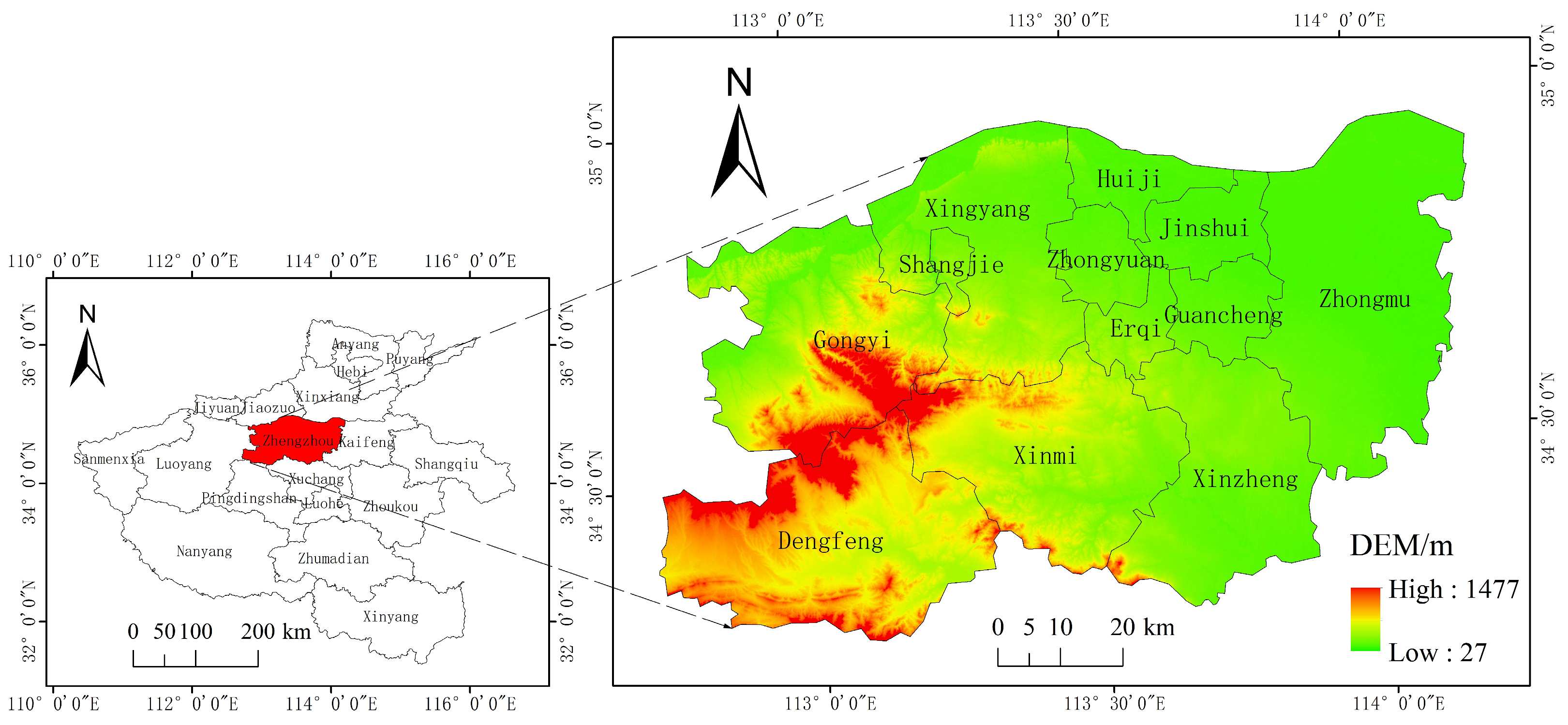
Zhengzhou (34°16′–34°58′ N, 112°42′–114°14′ E) is located in northern Henan Province, China, at the eastern foothills of Mount Songshan and along the Yellow River. The urban built-up area covers 1412.22 km2, and Zhengzhou has a resident population of 13.008 million and an urbanization rate of 80%. The region has a temperate continental monsoon climate, with pronounced seasonality characterized by cold, dry winters and hot, rainy summers. Topographically, elevation decreases from the southwest to the northeast (Figure 1). The Zhengzhou 2024 Forestry Ecological Construction Work Implementation Plan (April 2024) calls for promoting park-city development, improving forest quality in the Mount Songshan area through tending and degraded-forest restoration, and enhancing carbon-sink capacity. Accordingly, optimizing Zhengzhou’s carbon-sink pattern is essential to advance green, low-carbon development, strengthen environmental governance capacity, improve ecosystem service functions, and support the development of an ecologically sustainable city.

3.2. Data Sources and Preparation

The data used in this study are presented in Table 1. Within the study area, snow/ice and wetlands were absent, and shrubland was reclassified as woodland. Consequently, six land-use classes were included: farmland, woodland, grassland, water, construction land, and unused land. All datasets were projected to WGS 84/UTM Zone 49N and resampled to a standardized 30 m spatial resolution.

3.3. Methods

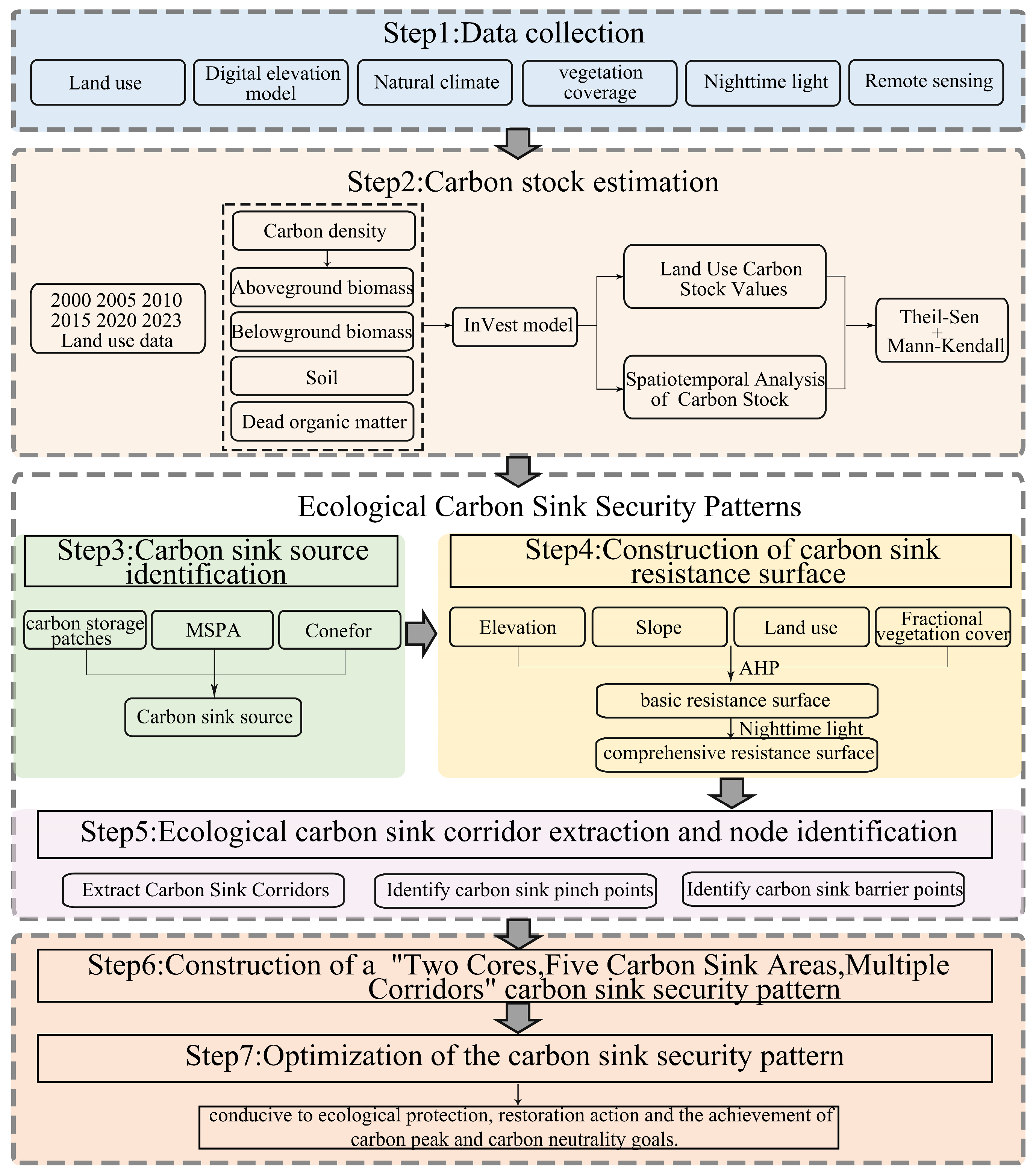
The framework of this study, as shown in Figure 2, consists of seven steps. The first step involves data collection, followed by carbon stock estimation. The Theil–Sen estimator and the Mann–Kendall test are applied to assess and visualize trends in carbon storage. The next three steps—identifying carbon-sink sources, constructing a carbon-sink resistance surface, and extracting corridors and nodes—are used to delineate the elements of the carbon-sink security pattern. The final step is to construct a carbon-sink security pattern based on the 2023 results and subsequently optimize the pattern.

3.3.1. Carbon Density Correction

Due to the limitations of the publicly available field measurement data on carbon density in the study area. Carbon density coefficients for Zhengzhou were determined using literature-based values from the Yellow River Basin and Henan Province, and established correction methods were applied [72,73,74]. Temperature and precipitation have been shown to influence regional carbon density substantially [75]. Given Zhengzhou’s annual mean temperature of 15.4 °C and annual precipitation of 655.67 mm during 2000–2023, carbon density values were corrected following the methods of [76,77,78]. Dead organic matter carbon density values were derived from [79]. The calculation is as follows:
C SP   =   3.3968   ×   P   +   3996.1   R 2   =   0.11
C BP   = 6.798   ×   e 0.0054 × P   R 2 = 0.70
C BT = 28   ×   T + 398   R 2 = 0.477 ,   P   <   0.01
In the formula, C SP denotes soil carbon density (t·hm−2), which is calculated from mean annual precipitation. C BP and C BT represent biomass carbon densities (t·hm−2) derived from mean annual precipitation and mean annual temperature, respectively. Mean annual precipitation (mm) is denoted by P , and mean annual temperature (°C) is denoted by T .
K s = C SP C SP
K BP = C BP C BP
K BT = C BT C BT
K B = K BP × K BT
In the formula, K s denotes the soil carbon density correction coefficient; K B denotes the biomass carbon density correction coefficient; K BP and K BT represent the precipitation and temperature correction coefficients for biomass carbon density, respectively; C SP and C SP denote soil carbon densities (t·hm−2) derived from mean annual precipitation in Zhengzhou and in the reference area reported in the literature, respectively; C BP and C BP denote biomass carbon densities (t·hm−2) derived from mean annual precipitation in Zhengzhou and in the reference literature area, respectively; and C BT and C BT denote biomass carbon densities (t·hm−2) derived from mean annual temperature in Zhengzhou and in the reference literature area, respectively. Corrected carbon density values for different land-use types in Zhengzhou are presented in Table 2.

3.3.2. InVEST Model to Estimate Carbon Storage

Carbon storage was calculated using the InVEST carbon sequestration module, which integrates land-use data and carbon-density parameters. The carbon storage was calculated as follows:
C i = C i-above + C i-below + C i-soil + C i-dead
C total = i n C i × S i
In the formula, the variables are defined as follows: C i denotes the total carbon density of land-use type i ; C i-above denotes the aboveground biomass carbon density of land-use type i ; C below denotes the belowground biomass carbon density of land-use type i ; C i-soil denotes the soil carbon density of land-use type i ; C i-dead denotes the dead organic matter carbon density of land-use type i ; C total denotes the total carbon storage in the study area; n denotes the number of land-use types in the study area; and S i denotes the area of land-use type i (m2).

3.3.3. Theil–Sen Trend

The Theil–Sen slope estimator is recognized as a robust method for trend analysis and is widely used in the study of long-term time-series data [80]. In this study, the Theil–Sen slope estimator was used to analyze the temporal trends of carbon storage changes in Zhengzhou from 2000 to 2023, and the Mann–Kendall test was employed to assess the statistical significance of these trends. Trend characteristics were determined by classifying the estimated trends, and the results were subsequently visualized. The trend estimation formula and the significance-based trend classes (Table 3) are as follows:
T S slope   =   Median x j - x i t j - t i , j   >   i
S = i - 1 n - 1 j = i + 1 n sign x j - x i
sign x j - x i = 1 x j - x i   >   0 0 x j - x i = 0 - 1 x j - x i   <   0
Z = S - 1 Var S S   >   0 0 S = 0 S + 1 Var S S   <   0
var S = n n - 1 2 n + 5 18
In the formula, T S slope denotes the Theil–Sen trend; x i and x j are the time-series data; t i and t j are the corresponding years of the time series; n is the length of the time series; and Z is the test statistic for significance testing.

3.3.4. Ecological Carbon-Sink Source Identification

In this study, carbon storage patches were integrated with morphological spatial pattern analysis (MSPA), and core areas exhibiting high carbon sequestration capacity and spatial continuity were identified as provisional ecological sources. Structural connectivity was quantitatively assessed using Conefor 2.6 to classify source significance and delineate priority conservation areas.
MSPA, an advanced image-processing technique, identifies and optimizes spatial patterns through erosion, expansion, opening, and closing operations, thereby defining landscape types and structural characteristics [81]. Carbon storage assessment results for Zhengzhou were classified into five categories using the natural breakpoint method: very low, low, medium, high, and very high levels of carbon storage. Patches with high and very high carbon storage were designated as foreground, and the remaining patches were assigned to the background. Using Guidos Toolbox, an 8-pixel adjacency rule was applied with a 90 m edge width [82,83], yielding seven non-overlapping landscape types: core, islet, perforation, edge, loop, bridge, and branch [84]. Core areas exceeding 1 km2 were extracted as potential carbon-sink sites.
Landscape connectivity refers to the degree to which a landscape facilitates or impedes organism dispersal and ecological processes between patches [85]. In Conefor 2.6, distance thresholds were established based on spatial relationships [86]. The probability of connectivity (PC) index was calculated to identify the final carbon-sink sites. The PC index was calculated as follows:
PC = i = 1 n j = 1 n a i a j P ij * A L 2
In the formula, the variables are defined as follows: n denotes the total number of patches; a i and a j denote the areas of patches i and j , respectively. P ij * denotes the maximum probability of species dispersal between patches i and j ; and A L denotes the total area of the study area.
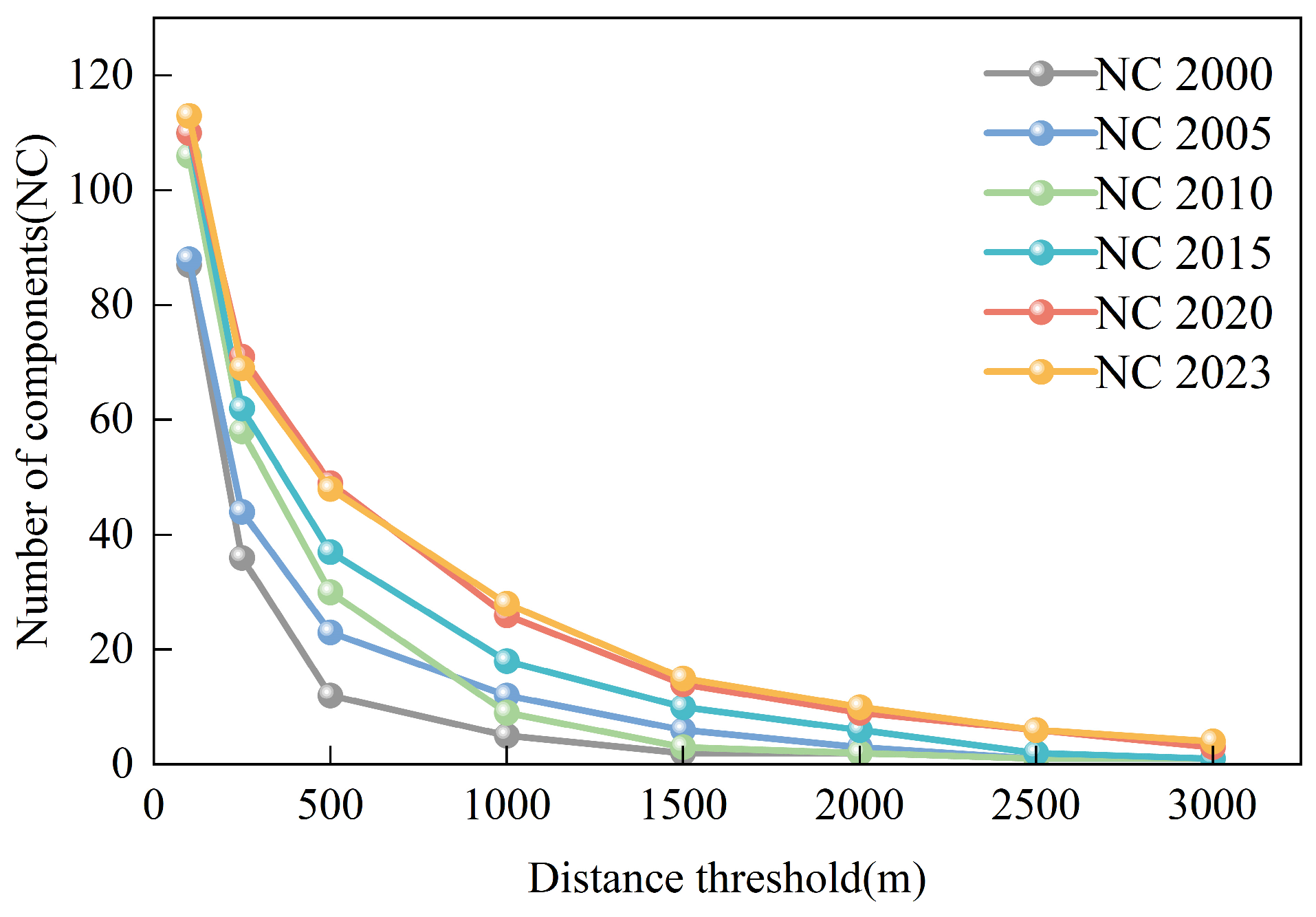
Distance thresholds strongly affect the validity of connectivity analyses. The Number of Components (NC) metric quantifies functionally or structurally interconnected patch networks; patches in different components remain mutually isolated [87]. Eight distance thresholds (100–3000 m) were evaluated to calculate NC (Figure 3). For thresholds > 1000 m, NC values stabilized, indicating stable patch aggregation. Accordingly, a connectivity probability of 0.5 was used, and a 1000 m threshold was selected for the landscape connectivity analysis. Candidate sources with dPC > 0.2 were classified as final carbon-sink sources and stratified into three tiers: Tier 1 (dPC > 5), Tier 2 (1 ≤ dPC < 5), and Tier 3 (0.2 ≤ dPC < 1).

3.3.5. Ecological Carbon-Sink Resistance Surface Construction

Four factors—elevation, slope, land-use type, and fractional vegetation cover—were identified and classified into five tiers using the natural breakpoint method; resistance values were assigned on a scale of 10 to 100. The analytic hierarchy process was used to determine factor weights, and a weighted sum was calculated to construct the base resistance surface [88,89]. Factor resistance assignments and corresponding weights are presented in Table 4.
Constructing resistance surfaces based solely on natural factors fails to account for anthropogenic barriers to species migration. Nighttime light data, recognized as a comprehensive indicator of human activity intensity, including urbanization level, economic activity, and population density [90], were used to adjust the base resistance surface. The modified surface was normalized to generate an integrated resistance surface for the study area. The correction formula is as follows:
R = TLI i TLI a × R o
In the formula, the variables are defined as follows: R denotes the revised grid resistance coefficient; TLI i denotes the nighttime light intensity of grid i ; TLI a denotes the mean nighttime light intensity of land-use type a ; and R o denotes the baseline resistance of grid i .

3.3.6. Ecological Carbon-Sink Corridor Extraction and Node Identification

To identify carbon-sink corridors, the Build Network and Map Linkages tool in Linkage Mapper was used. The ratio of cost-weighted distance (CWD) to least-cost path length (LCPL) was used to represent corridor “liquidity” (flow capacity) for carbon-sink sources [91]; higher values indicate lower corridor connectivity. Corridors were classified into three tiers (key, important, and general) using the natural breakpoint method.
Pinchpoint Mapper and the Circuitscape plugin were used in “All-to-One” mode. After multiple iterations, a 10 km weighted corridor cost distance was selected to derive the current-density distribution. Using the natural breakpoint method, five density levels were defined, and the highest level was extracted as carbon-sink pinch points.
Barrier Mapper and the Circuitscape plugin were used to identify these barriers. After testing various parameters, a minimum detection radius of 50 m, a maximum detection radius of 500 m, and a 50 m step size were selected. The “maximum” mode was used to calculate recovery current density, which was then classified into five levels using the natural breakpoint method. The highest level was extracted as carbon-sink barrier points.

4. Results

4.1. Spatiotemporal Evolution Analysis of Carbon Storage

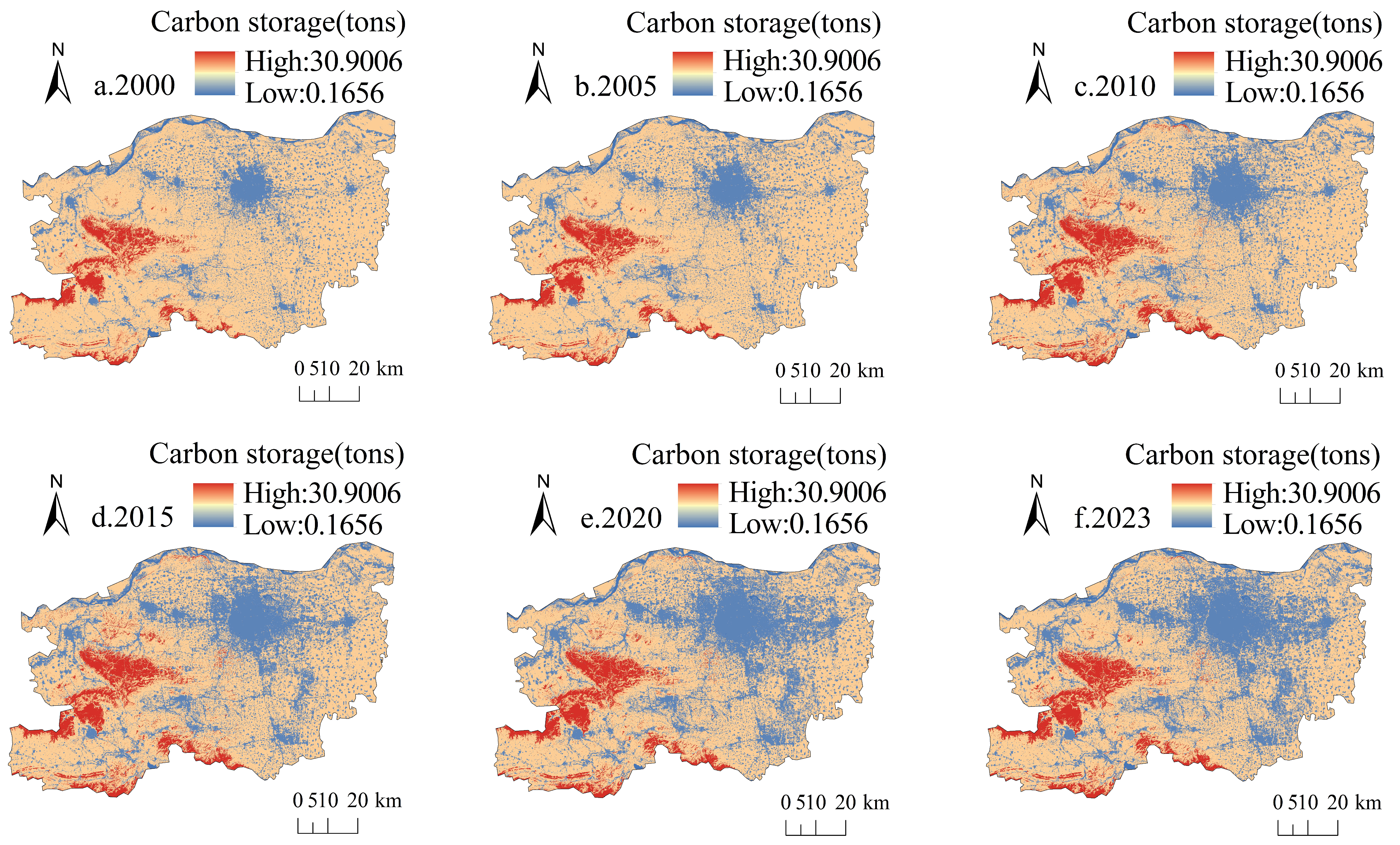
The spatial distribution of carbon storage in Zhengzhou from 2000 to 2023 is shown in Figure 4. The highest carbon storage values are concentrated in the southwestern region, which is characterized by elevated topography and dense forest cover. The lowest carbon storage occurs primarily within the central urban core due to urban expansion. Intermediate values are observed across predominantly agricultural lands with relatively flat terrain.
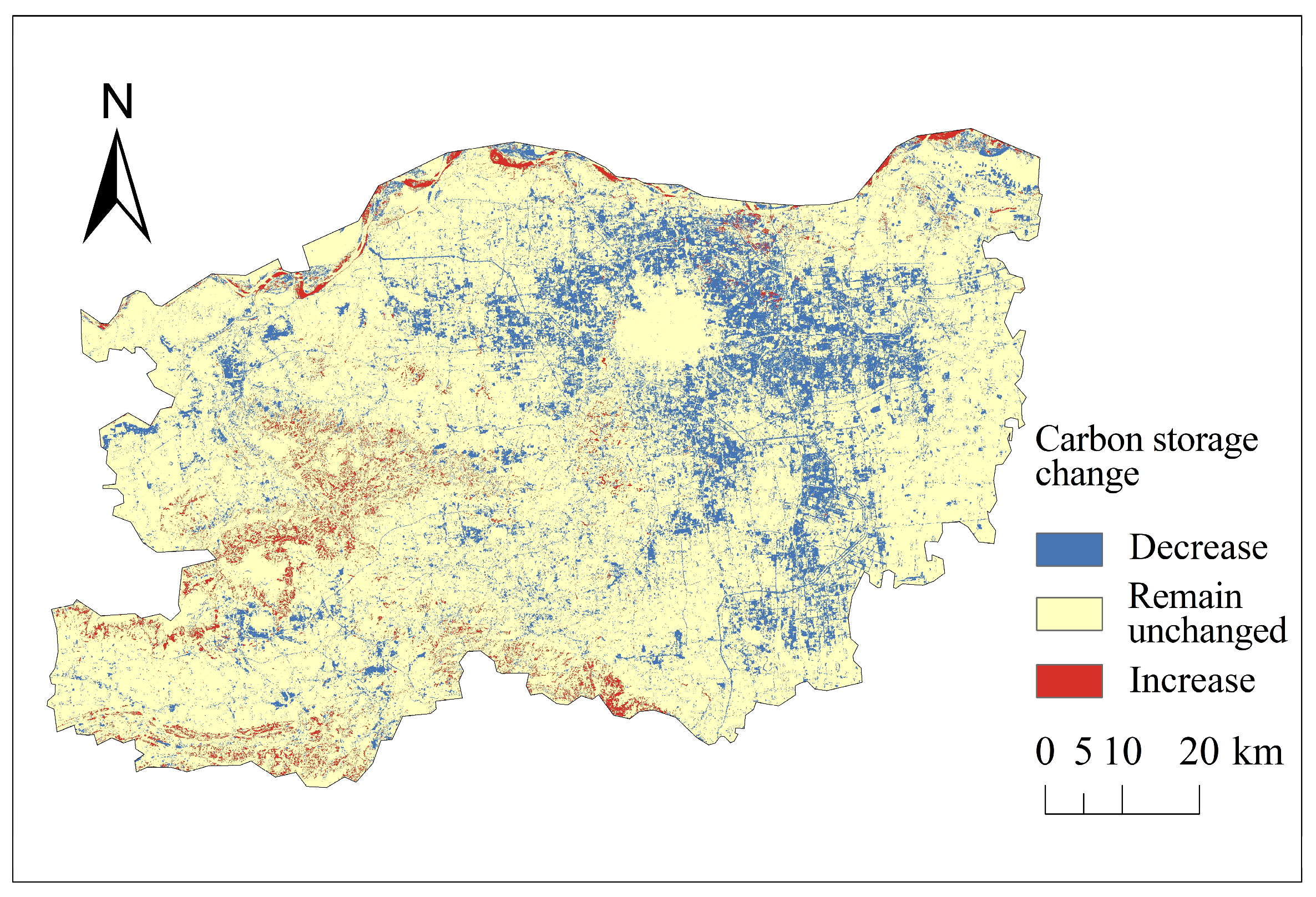
The temporal variation of carbon storage in Zhengzhou from 2000 to 2023 is shown in Table 5. The results indicate that Zhengzhou experienced a net reduction in carbon storage of 19.12 × 10⁶ t. The reduction between 2015 and 2020 was 6.05 × 10⁶ t, which accounted for 31.63% of the total reduction and marked the phase with the largest decline magnitude in the study area. Among land-use types, farmland exhibited the greatest carbon loss, at 24.70 × 10⁶ t; its proportional contribution declined from 85.93% to 79.08%. Spatially stable carbon storage regions predominated, constituting 80.97% of the study area, whereas areas of reduction and increase accounted for 15.56% and 3.46%, respectively (Figure 5). The reduction in carbon stocks of arable land was the main factor contributing to the decline in total carbon stocks in the study area.

4.2. Carbon Storage Trend Analysis

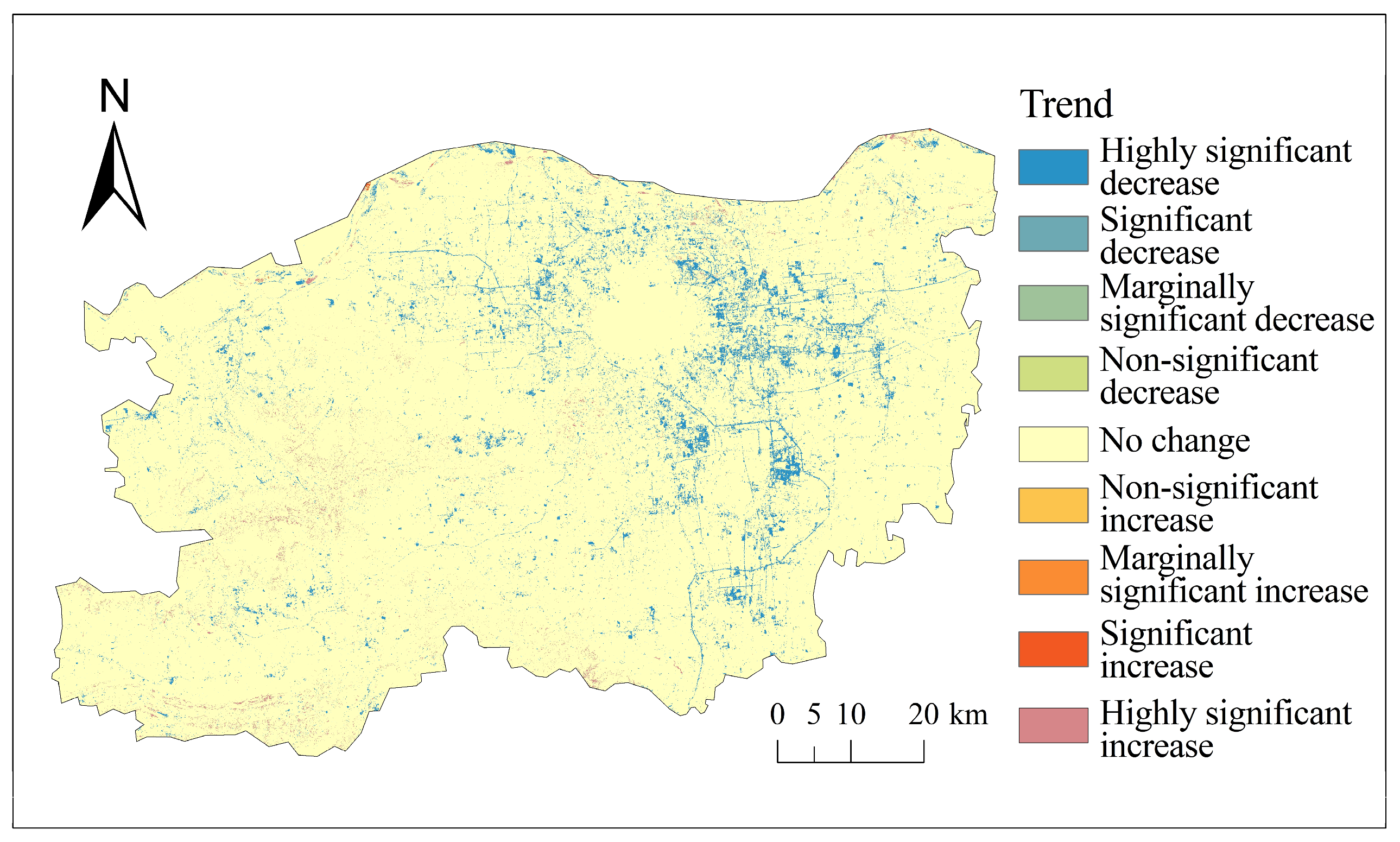
The results of carbon storage change trends in Zhengzhou from 2000 to 2023 are shown in Figure 6 and Table 6. Areas exhibiting no change accounted for the largest proportion (94.71%). Areas with decreasing trends were mainly distributed in the central built-up area, and the highly significant decrease class accounted for the largest proportion of the decreasing-trend area (4.5%). Areas with increasing trends were primarily located in the mountainous and hilly regions in the southwest, where the highly significant increase class accounted for the largest proportion of the increasing-trend area (0.74%).

4.3. Results of Carbon-Sink Source Identification

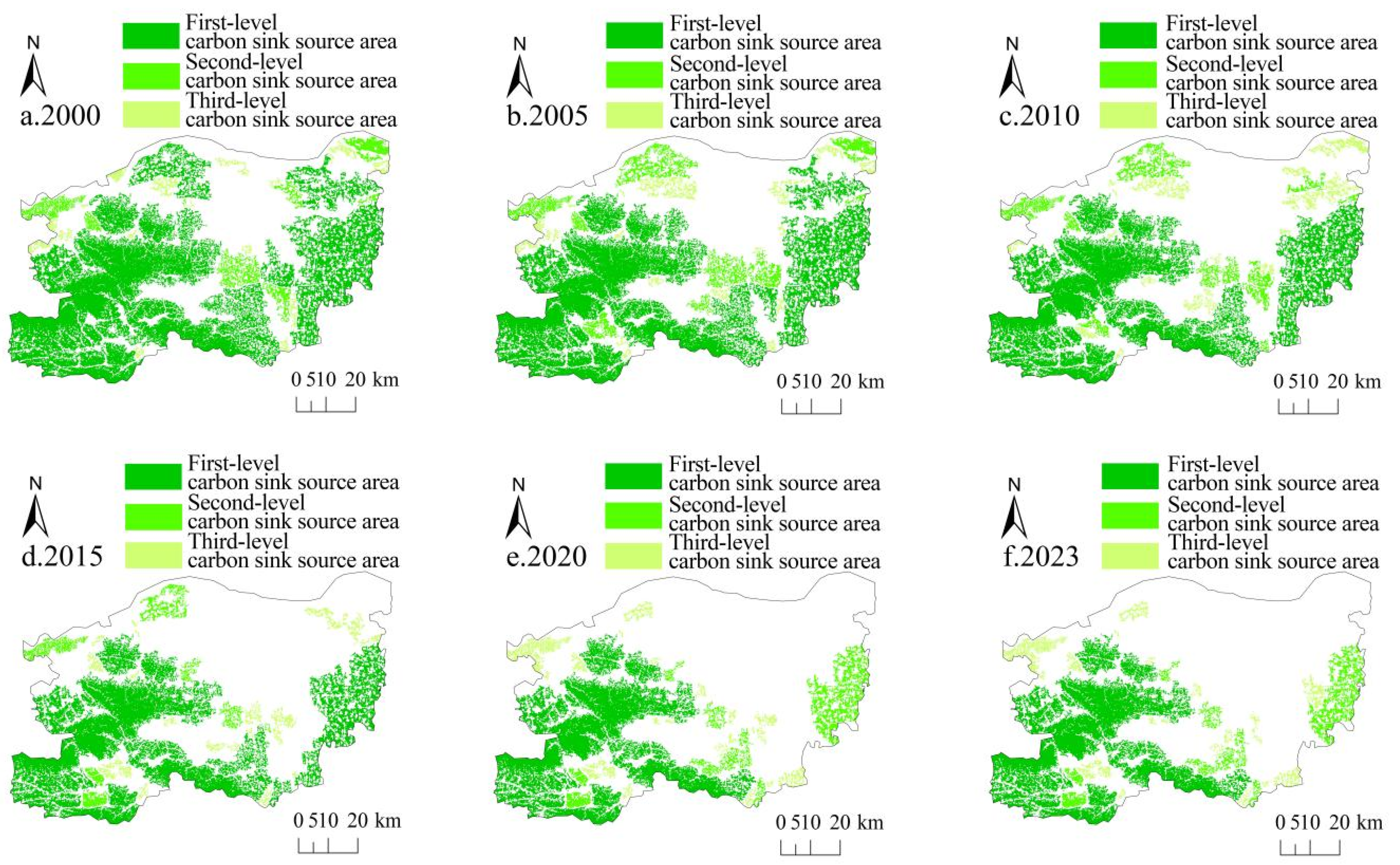
From 2000 to 2023, the carbon-sink source area in Zhengzhou decreased by 1412.66 km2, reducing its proportional coverage from 46% to 27.33% of the study area (Table 7). Spatially, topographic constraints in the western region promoted the retention of Tier-1 carbon-sink sources. Industrial clustering and well-developed transportation networks in the east reduced Tier-1 coverage while increasing the proportions of Tier-2 and Tier-3 sources. Central regions exhibited compression of high-value carbon-sink areas due to the expansion of construction land. Overall, progressive fragmentation was observed in the eastern zone; the western zone remained relatively stable, and the central districts experienced pronounced fragmentation (Figure 7).

4.4. Results of Carbon-Sink Resistance Surface Construction

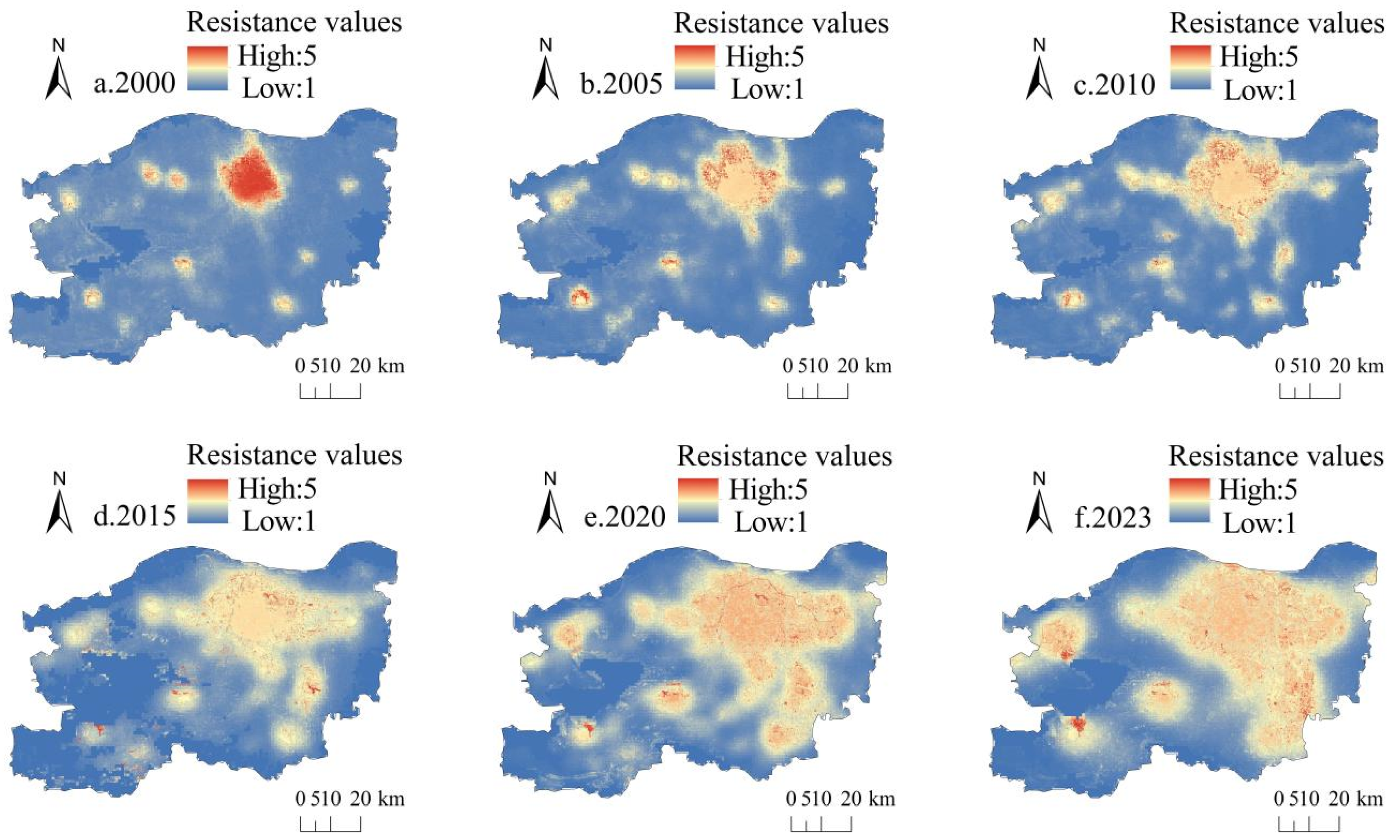
The comprehensive resistance surface is shown in Figure 8. Temporally, mean resistance values exhibited an overall increasing trend, with values of 1.22 (2000), 1.27 (2005), 1.33 (2010), 1.19 (2015), 1.34 (2020), and 1.46 (2023). A temporary reduction was observed between 2010 and 2015, which was attributed to enhanced carbon-sink connectivity following large-scale ecological restoration initiatives. Spatially, high-resistance zones initially formed isolated clusters in 2000 and subsequently radiated outward over time. This pattern reflects intensifying anthropogenic pressure on the ecosystem’s carbon-sequestration capacity.

4.5. Results of Carbon-Sink Corridor Extraction

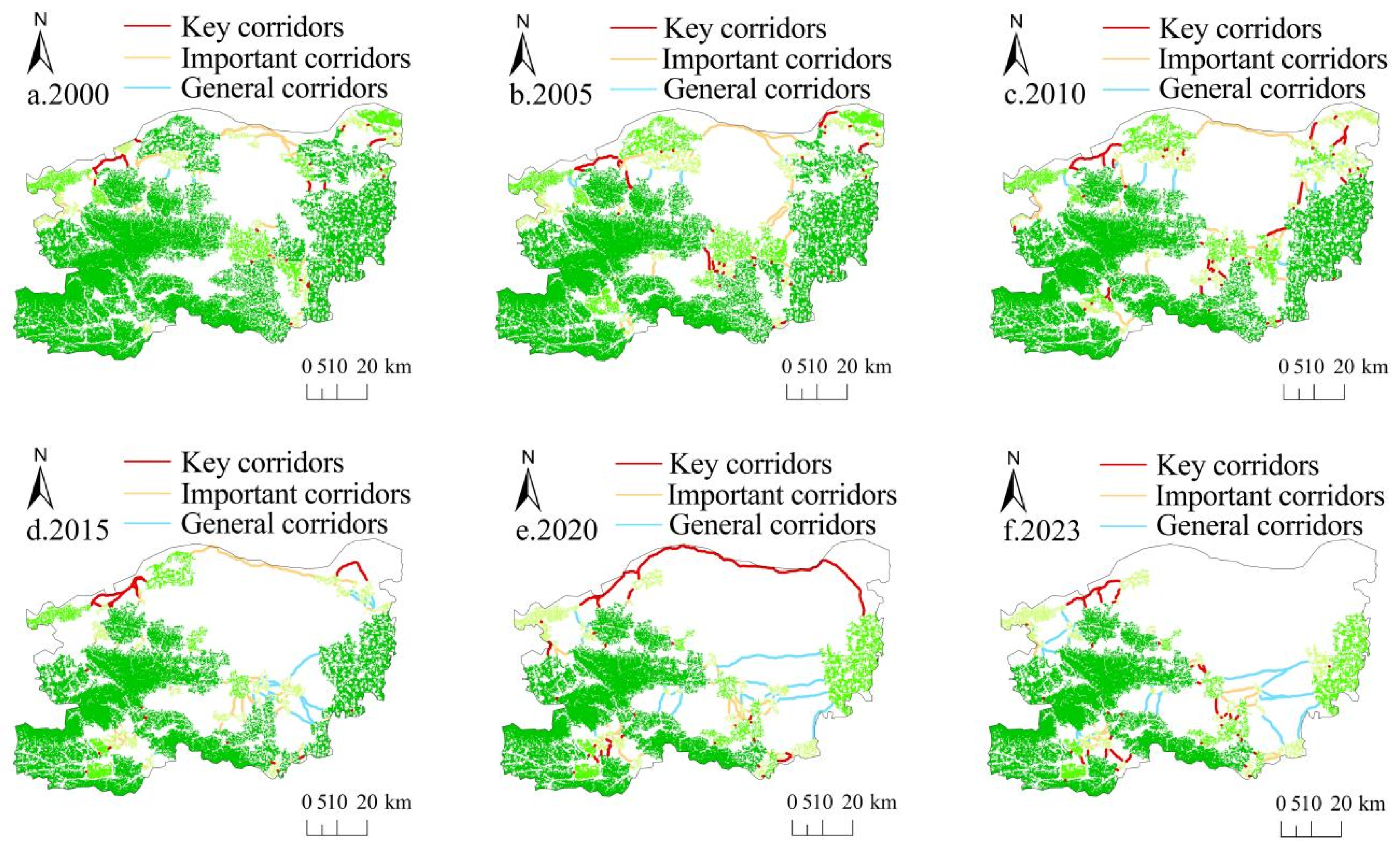
From 2000 to 2023, corridor quantity and length exhibited fluctuating increases (Table 8). Mean corridor length increased through 2020 before declining by 2023, as urban-fringe development obstructed carbon-sink pathways by occupying ecological space. Spatially, eastern corridors shortened progressively while maintaining connections to the Zhongmu Modern Agricultural Area; western corridors formed dense networks linking the Songshan Ecological Protection Area and the Plain Transition Zone; southern corridors comprised concentrated key pathways connecting Songshan Mountain to the Xinzheng–Xinmi Agricultural Planting Area; and northern corridors extended over longer distances to integrate the Xingyang Yellow River Ecological Breeding Area (Figure 9).

4.6. Results of Carbon-Sink Pinch Points and Barrier Points Identification

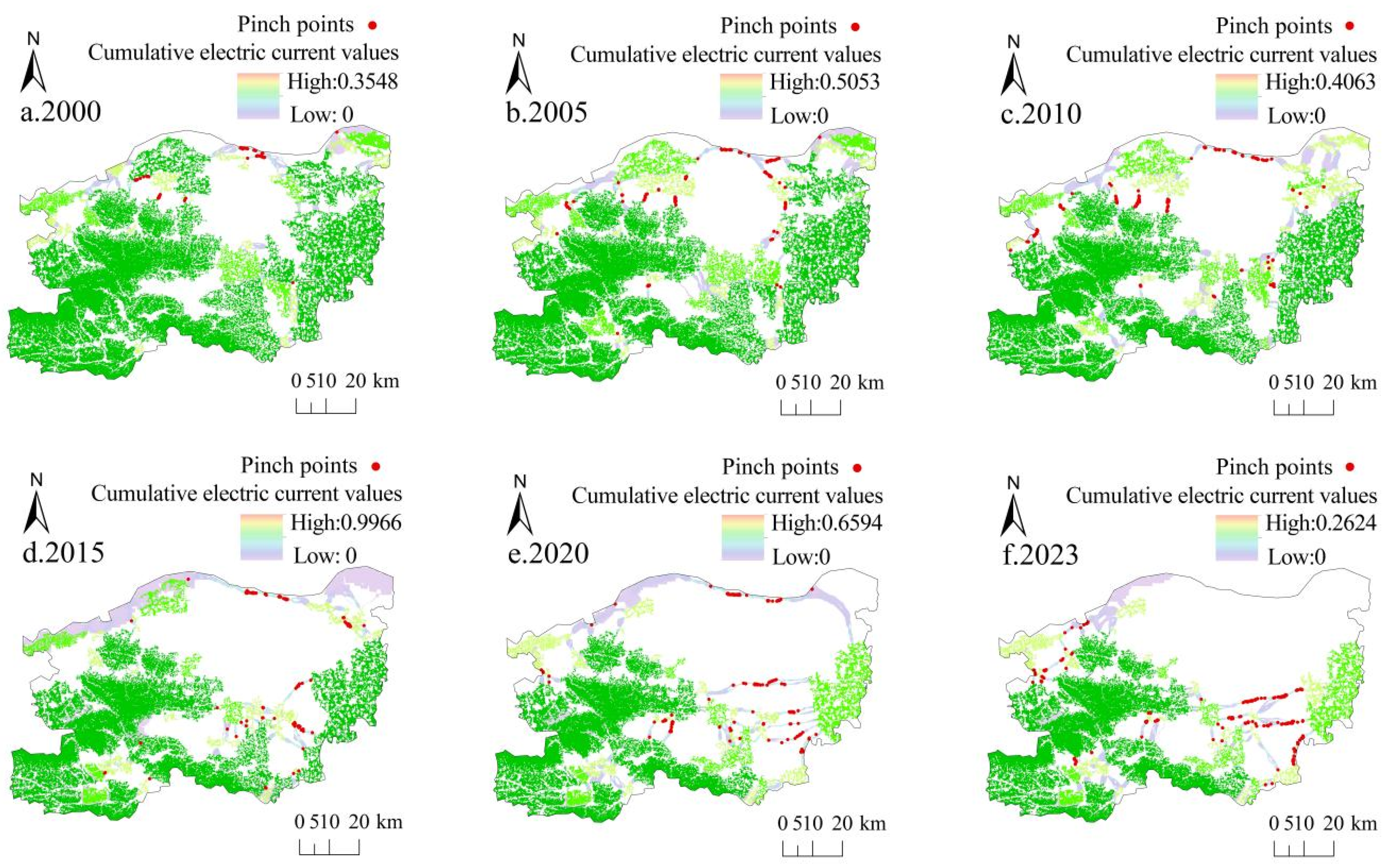
Pinch-point areas were 1.22 km2 (2000), 2.50 km2 (2005), 2.89 km2 (2010), 1.37 km2 (2015), 4.38 km2 (2020), and 6.36 km2 (2023), exhibiting an overall increasing, though fluctuating, trend (Figure 10). This pattern may reflect the progressive strengthening of ecological protection and low-carbon measures during urban development. Spatially, carbon-sink pinch points were concentrated in the northern region from 2000 to 2010 and began to shift southward after 2015. Overlay analysis revealed that pinch points were predominantly aligned with carbon-sink corridors.
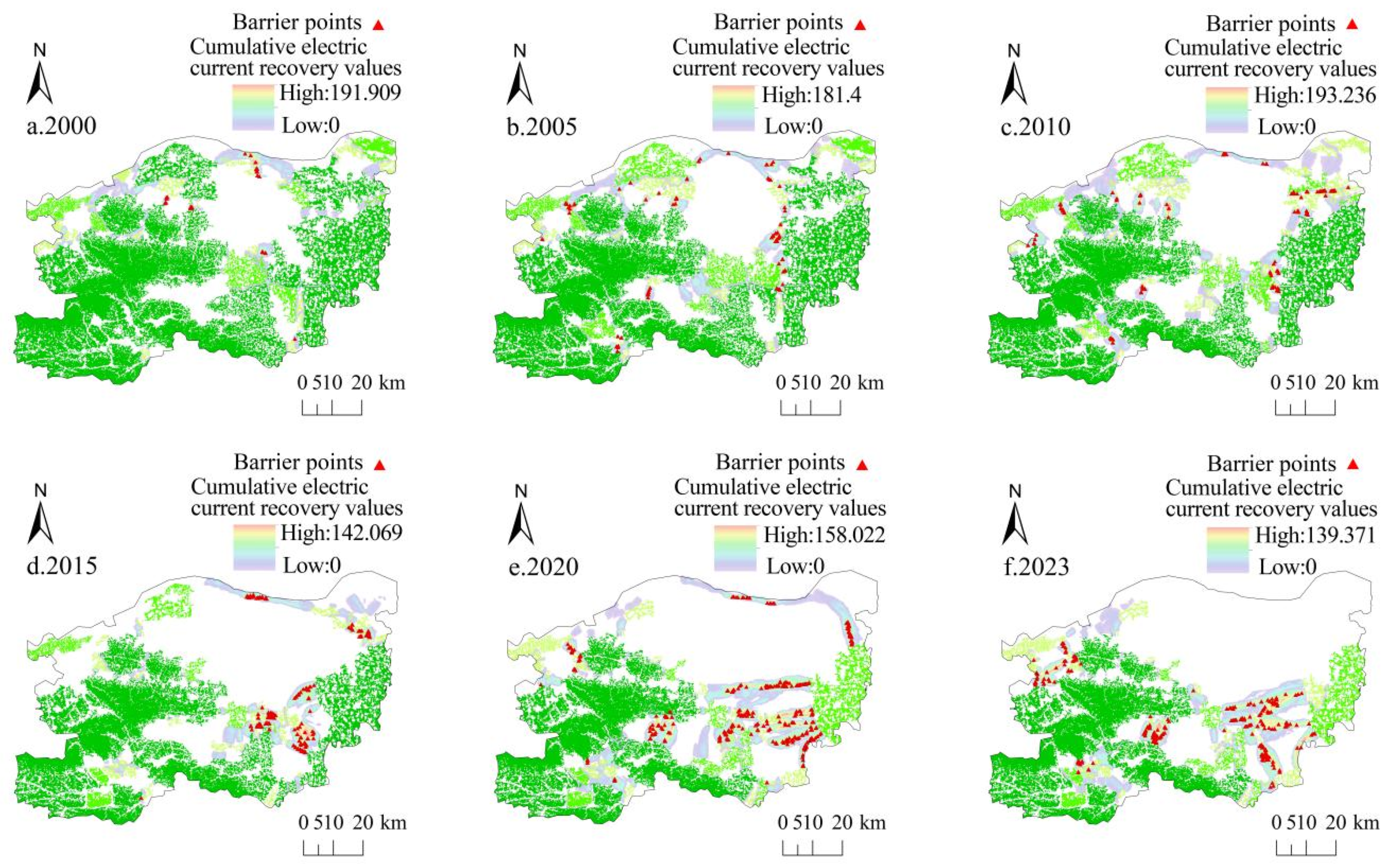
Barrier-point areas increased from 9.84 km2 (2000) to 106.63 km2 (2023), reflecting an overall upward trend (Figure 11). After 2015, rapid urban expansion triggered large-scale severance of carbon-sink corridors through the expansion of construction land, thereby reducing cumulative current-recovery values. Concomitantly, barrier-point distributions became increasingly concentrated.

5. Discussion

5.1. The Impact of Rapid Urbanization on Carbon Storage

A consistent declining trajectory in carbon sequestration capacity was observed over the study period. This reduction was primarily driven by the substantial loss of agricultural land and the large-scale expansion of construction land, particularly in the main urban and airport zones. Spatially, carbon storage demonstrated a distinct west-to-east gradient related to topography, with higher values in western forested highlands and lower values in central urbanized zones. A comparison with previous studies shows that the conclusions of this study regarding carbon storage in Zhengzhou are highly consistent with the Zhengzhou-related results reported by Wang et al. [73] in their research on carbon storage in Henan Province and by He [92] in a study of carbon storage in the Central Plains urban agglomeration. Furthermore, consistent with theories in landscape ecology regarding ecological security patterns and ecological connectivity [93], the spatial pattern of regional carbon storage is shaped by the interaction between natural landscape structure and the urbanization process.
The development of urban functional zones (e.g., Zhengdong New Area, Zhengzhou Airport Economy Zone, Zhengzhou High-Tech Zone, and Zhengzhou Economic and Technological Development Zone) was a primary driver of the decline in carbon-sink source areas. Specifically, Zhengdong New Area drove the eastward expansion of the city; large-scale construction in the Longhu Financial Center, the East High-Speed Railway Station area, and Baisha converted cultivated land, resulting in a reduction in the primary carbon sinks. In addition, the renovation of urban villages, the relocation of old industrial zones, and the construction of residential buildings, elevated roads, and the Beijing–Guangzhou Expressway reduced the available carbon-sink space. Therefore, biophilic design can be employed to inform building layout optimization [94]. In newly developed areas such as Zhengdong New District, residential and commercial buildings can be integrated with urban greenways and rooftop gardens [95], and similar features can be used to augment carbon-sink nodes, thereby enhancing the carbon sequestration potential of the built environment. In the renewal of older urban districts, existing mature trees can be preserved, and underutilized green spaces can be transformed into small carbon-sink patches, thereby enabling synergistic improvements in urban ecological functions and low-carbon development. The western region is less suitable for large-scale construction due to its hilly and mountainous topography, and the ecological protection redline has been designated to limit development.
From 2000 to 2020, farmland and ecological land were extensively fragmented by the large-scale expansion of construction land. To maintain regional ecological functions, planning initiatives such as the Yellow River ecological corridor and greening programs in the southwestern mountainous areas were implemented to establish or identify potential connecting corridors among fragmented patches. However, in recent years, the rapid expansion of Zhengdong New Area toward the southern part of Huiji District has encroached upon ecological corridors along the Jialu River, resulting in reduced corridor length. During 2000–2015, ecological carbon-sink pinch points in Zhengzhou were mainly concentrated along the Yellow River ecological corridor in the northern Xingyang–Huiji region, whereas after 2015, large-scale development in the Airport Economy Zone and the South Longhu Cluster shifted the concentration of carbon-sink pinch points to the Southern Mountain–Plain Transition Zone. From 2000 to 2023, the area of barrier points in Zhengzhou expanded, corresponding closely to the contiguous expansion of construction land. Specifically, after 2015, under a development-prioritized approach, large-scale, continuous construction—such as the expansion of Huanan City and the Economic and Technological Development Zone—fragmented ecological space along the boundary between the northern Airport Economy Zone and Xinzheng, thereby causing corridor disruptions. This process is consistent with landscape connectivity and fragmentation theories [96], whereby the extensive expansion of construction land intensifies fragmentation, thereby increasing resistance to carbon-sink flows, generating barriers, and undermining carbon-sink network connectivity.

5.2. Construction of a Carbon-Sink Security Pattern

Grounded in the core “patch–corridor–matrix” framework and connectivity concepts of landscape ecology, this study seeks to achieve dual improvements in carbon-sink functions and ecological connectivity by identifying high-carbon-storage source areas, constructing ecological corridors, and managing critical nodes.
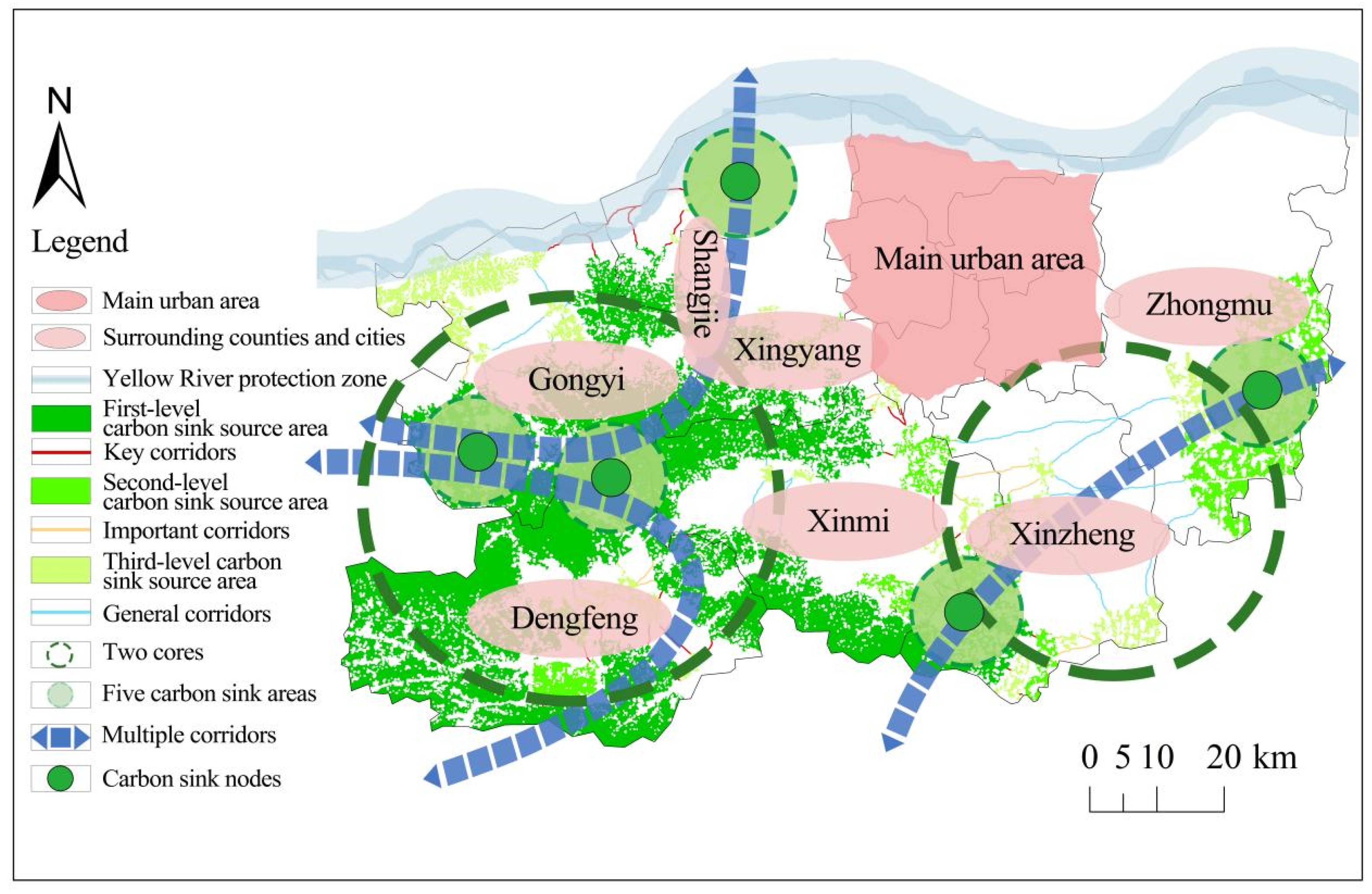
A “Two Cores–Five Carbon-Sink Areas–Multiple Corridors” carbon-sink security pattern was constructed based on the 2023 results (Figure 12). This spatial configuration was developed to optimize carbon sequestration potential while maintaining ecological connectivity across the study area.
The “two cores” denote the structural framework established through interconnected carbon-sink sources. The primary carbon-sink core is formed by integrating first-level sources in the western region through connecting corridors. A secondary carbon-sink core is developed in the southeastern part of the study area by strategically incorporating second-level sources with parallel corridor linkages. Collectively, these integrated cores constitute the foundational structure of the regional carbon-sink security pattern.
The “five carbon-sink areas” include the Dengfeng Songshan Ecological Reserve, classified as a first-level carbon-sink source dominated by high-carbon-sequestration forest ecosystems, and four major agricultural production zones: the Gongyi Gently Rolling Hills Agricultural Zone, the Xingyang Yellow River Ecological Breeding Area, the Xinzheng–Xinmi Characteristic Agricultural Zone, and the Zhongmu Modern Agricultural Area. Although these agricultural zones do not sequester carbon as efficiently as forests, they are important contributors to the city’s total carbon storage because of their extensive cultivated land, diverse cropping systems, and perennial vegetation cover.
“Multiple corridors” refers to corridors that connect carbon-sink sources. Carbon sequestration enhancement projects are implemented in key corridors, whereas ecological connectivity is prioritized in other important corridors. General corridors are reinforced through localized carbon replenishment to strengthen linkages among carbon-sink sources, ultimately establishing a carbon-sink flow network within the study area.
The results of this study differ to some extent from the ecological network security pattern for Zhengzhou constructed by Fan [97], which may primarily be attributable to differences in research focus and in source-area selection methods; this study is oriented toward carbon-sink functions, and the identification of source areas is based on carbon storage and carbon-sink stability as core indicators, aligning with the current research trend under the “dual-carbon” goals whereby ecological security patterns increasingly emphasize specific ecological functions such as carbon sequestration.

5.3. Optimization of the Carbon-Sink Security Pattern

The optimization strategies are grounded in ecological restoration theory [98] and urban sustainable development theory, focusing on the structural reconstruction and functional recovery of degraded ecosystems under human disturbance during urbanization, and are intended to support Zhengzhou’s “dual-carbon” objectives, optimization strategies for the carbon-sequestration security pattern are proposed, focusing on enhanced carbon-sink capacity, improved spatial connectivity, and integrated land-use planning. Three primary approaches are recommended:
(1) Carbon-sink source protection. Core carbon-sequestration zones are delineated through integrated land-use planning, with development activities restricted to ensure functional stability. In the Songshan Ecological Reserve, the forest community structure should be optimized by increasing mixed-forest coverage and introducing high-sequestration tree species to expand high-efficiency carbon sinks. Meanwhile, high-density building development should be restricted in surrounding areas, and low-intensity, dispersed building layouts should be adopted to prevent construction land from encroaching upon carbon-sink source areas.
Agricultural production areas require prioritized soil conservation and improvement. Crop rotation enhances soil structure and microbial diversity while promoting soil organic-carbon accumulation. Organic fertilizer application directly supplements soil organic carbon, improving soil fertility and carbon-storage capacity. Shelterbelts established around farmland sequester atmospheric CO2 through photosynthesis, fixing carbon in biomass and soils, and thereby increasing agricultural carbon storage. Through the coordinated configuration of building clusters and farmland shelterbelts, the fragmentation of agricultural carbon sinks caused by urbanization can be reduced, thereby enhancing urban spatial resilience [99].
(2) Carbon-sink corridor integration. Western mountainous regions require supplemental shelter forests to bridge habitat discontinuities and enhance woodland connectivity. Eastern corridors require replanting native carbon-sequestering species along transport routes, with parks and community green spaces interconnected to form continuous carbon networks. In the central urban area, a point-to-area carbon-sequestration network should be strengthened through green-space upgrades, the introduction of high-sequestration vegetation, and strategic node development.
(3) Critical-node management. Pinch points along southern and eastern agricultural corridors should be mitigated by establishing perimeter protection zones with development restrictions. Barrier-point concentrations should be designated as key restoration zones based on causal analysis. Industrial pollution sites require soil remediation and strengthened emission controls. Urban expansion areas require ecological-space planning to reconnect fragmented carbon sinks through the addition of green corridors. Areas affected by natural degradation warrant interventions such as soil amendment and afforestation. These measures can rapidly restore corridor functionality while enhancing overall network connectivity.

6. Conclusions

This study integrates urban carbon storage assessment with ecological landscape analysis by incorporating the InVEST carbon storage module, MSPA, and landscape connectivity analysis. A comprehensive analytical framework was established, comprising (1) identification of high-value carbon storage patches, (2) identification of carbon-sink sources, (3) construction of resistance surfaces, (4) extraction of carbon-sink corridors, (5) identification of key nodes, and (6) optimization of the ecological security network. The Theil–Sen slope estimator and the Mann–Kendall test were used to quantify and evaluate the spatiotemporal trends in carbon storage, thereby enhancing the reliability and scientific rigor of the conclusions. Compared with studies focusing solely on carbon storage or ecological networks, this framework simultaneously elucidates the relationship between carbon storage change and the structure and function of the ecological security network, thereby extending traditional carbon-sink research. The results provide a scientific reference for territorial spatial planning, the implementation of Zhengzhou’s “dual-carbon” goals, and ecological space restoration. The principal conclusions are as follows:
(1) From 2000 to 2023, the total carbon storage in Zhengzhou decreased by 19.12 × 10⁶ t. High-value carbon sequestration zones were concentrated in the southwestern highlands, characterized by elevated topography and dense forest cover. Conversely, low-value clusters were predominantly located in the central urban core. These findings indicate that mountainous and hilly areas often serve as key sources of carbon storage and carbon-sink functions and that urban expansion reduces the extent of high-value carbon-sink areas, potentially undermining urban ecological security patterns. Moreover, the results also provide practical evidence from a developing-country context to inform global efforts to protect urban carbon sinks and optimize pathways toward low-carbon urbanization.
(2) Carbon-sink source areas decreased continuously by 1412.66 km2 during the study period. The western mountainous source region maintained relatively stable ecological integrity, while progressive fragmentation was documented in eastern sectors. Central source areas exhibited pronounced fragmentation. Concurrently, citywide carbon-sink resistance demonstrated a consistent upward trajectory. Initially spatially isolated high-resistance clusters (2000) progressively expanded radially. This dynamic evolutionary process indicates that, under development pressure, mountainous ecological areas in inland central cities in China tend to exhibit relatively strong ecological resilience, whereas plain areas and peri-urban transition zones are more vulnerable to human disturbances, leading to the fragmentation of carbon-sink source areas. It provides a new analytical perspective and empirical evidence to support the protection of carbon-sink source areas in core cities of inland urban agglomerations in developing countries.
(3) Carbon-sink corridor length followed an inverted-U trajectory, with a net increase of 1.09 km. The eastern and western corridors remained comparatively short, primarily facilitating intra-zonal connectivity. Northern and southern corridors initially lengthened before contracting, serving as critical inter-zonal connectors between eastern and western source areas. Both pinch points and barrier areas expanded significantly, shifting from dispersed northern distributions (2000–2010) to consolidated southern clusters after 2015. It provides a scientific basis for restoring carbon-sink networks and identifying critical nodes in core cities of the Central Plains urban agglomeration, while offering important methodological reference value for other core cities undergoing rapid urbanization.
(4) Based on the requirements of the “Zhengzhou Municipal Territorial Planning (2021–2035)”, a “Two Cores, Five Carbon-Sink Areas, Multiple Corridors” security framework has been established, and the following specific recommendations are made to support urban carbon reduction: (1) continue advancing the ecological protection redline policy to restrict unnecessary development and construction; (2) reinforce the development of green infrastructure in urban planning to enhance the carbon sequestration capacity of ecosystems such as urban green spaces and forests; (3) design multi-level ecological networks and corridors to ensure the continuity and stability of ecological functions; and (4) regularly monitor and update urban carbon stocks. Overall, the carbon-sink security pattern provides a scientific foundation for implementing territorial spatial planning in Zhengzhou, enhancing ecosystem carbon sequestration capacity, and achieving carbon-balance targets.
This study was constrained by the 30 m resolution of national-scale land-cover data and limitations associated with field surveys on carbon density. In addition, riparian zones along the Yellow River were not classified as carbon sources due to patch fragmentation, limited spatial extent, and anthropogenic disturbance. Subsequent investigations should incorporate higher-resolution remote-sensing imagery with field-validated classification to improve carbon-source identification and validate the reliability of carbon density values through field surveys in the future. Subsequent investigations should also include specialized assessments of aquatic–terrestrial landscape connectivity and rigorous quantification of riparian vegetation contributions to carbon-sequestration functions.

Author Contributions

Conceptualization, X.X. and L.H.; methodology, X.X.; software, X.X.; validation, Z.X., X.X., and L.H.; formal analysis, X.X.; investigation, X.X.; resources, X.X.; data curation, X.X.; writing—original draft preparation, X.X.; writing—review and editing, Z.X.; visualization, X.X. and H.L.; supervision, H.L.; project administration, G.X.; funding acquisition, L.H. All authors have read and agreed to the published version of the manuscript.

Funding

This research was funded in part by Soft Science Research Program of Henan Province (No. 252400410731), in part by Henan Provincial Philosophy and Social Science Planning Project (No. 2025BJJ067), in part by 2025 National Landscape Architecture Professional Degree Graduate Education Steering Committee Teaching and Education Reform Research Project (No. LAJGXM2025071), in part by Henan Province Professional Degree Graduate Teaching Case Project (No. YJS2026AL010), and in part by Henan Provincial Science and Technology Research Project (No. 262102320330).

Institutional Review Board Statement

Not applicable.

Informed Consent Statement

Not applicable.

Data Availability Statement

Data will be made available on request.

Conflicts of Interest

The authors declare no conflicts of interest. The funders had no role in the design of the study; in the collection, analysis, or interpretation of data; in the writing of the manuscript; or in the decision to publish the results. All authors have read and agreed to the published version of the manuscript.

Abbreviations

The following abbreviations are used in this manuscript:
InVESTIntegrated Valuation of Ecosystem Services and Trade-offs
SDGsSustainable Development Goals
LUCCLand Use/Cover Change
ESPEcological Security Pattern
MSPAMorphological Spatial Pattern Analysis
MCRMinimum Cumulative Resistance
IPCC SRESIntergovernmental Panel on Climate Change Special Report on Emissions Scenarios
UGBUrban Growth Boundaries
ENEcological Networks
GIGreen Infrastructure
CLCDChina Land Cover Dataset
NOAANational Oceanic and Atmospheric Administration
NCNumber of Components
CWDCost-weighted Distance
LCPLLeast-cost Path Length
LULCLand Use and Land Cover

References

  1. Zhou, M.; Ma, Y.; Tu, J.; Wang, M. SDG-Oriented Multi-Scenario Sustainable Land-Use Simulation under the Background of Urban Expansion. Environ. Sci. Pollut. Res. 2022, 29, 72797–72818. [Google Scholar] [CrossRef]
  2. Li, Y.; Wei, L.; Zeng, E. Research on the Associations and Indicative Thresholds of Urban Density on Carbon Performance: A Case Study of Chengdu-Chongqing Urban Agglomeration. Urban Build. Sci. 2026, 2, 6. [Google Scholar] [CrossRef]
  3. Huang, L.; Wang, J.; Fang, Y.; Zhai, T.; Cheng, H. An Integrated Approach towards Spatial Identification of Restored and Conserved Priority Areas of Ecological Network for Implementation Planning in Metropolitan Region. Sustain. Cities Soc. 2021, 69, 102865. [Google Scholar] [CrossRef]
  4. Bateman, I.J.; Harwood, A.R.; Mace, G.M.; Watson, R.T.; Abson, D.J.; Andrews, B.; Binner, A.; Crowe, A.; Day, B.H.; Dugdale, S.; et al. Bringing Ecosystem Services into Economic Decision-Making: Land Use in the United Kingdom. Science 2013, 341, 45–50. [Google Scholar] [CrossRef] [PubMed]
  5. Usman, B.M.; Johl, S.K.; Khan, P.A. Transitioning to Green Governance: A Pathway to Sustainability. Transp. Res. Procedia 2025, 84, 633–640. [Google Scholar] [CrossRef]
  6. Cheng, C.; Fang, Z.; Zhou, Q.; Jiang, Y.; Xue, S.; Zhao, S.; Wang, W.; Zhuang, Y.; Ding, T.; Tang, Y.; et al. Nature’s Hand in Megacity Cluster Progress: Integrating SDG11 with Ecosystem Service Dynamics. Sustain. Cities Soc. 2024, 108, 105471. [Google Scholar] [CrossRef]
  7. Li, X.; Han, Q.; Wang, J.; Xu, W. Harnessing Big Data to Track Progress towards SDG 15: Life on Land. Int. J. Digit. Earth 2023, 16, 4597–4600. [Google Scholar] [CrossRef]
  8. Song, S.; Wang, S.; Du, J.; Zhang, X. Karst Restoration Zoning Based on Fracture-Modified Minimum Cumulative Resistance Model and Ecological Network Resilience Assessment: A Case Study in Guizhou, China. Ecol. Eng. 2026, 223, 107842. [Google Scholar] [CrossRef]
  9. Zhang, R.; Zhang, Q.; Zhang, L.; Zhong, Q. Impact of Spatial Structure on the Functional Connectivity of Urban Ecological Corridors Based on Quantitative Analysis. Urban For. Urban Green. 2023, 89, 128121. [Google Scholar] [CrossRef]
  10. Miller, M.A.; Taylor, D. A Transboundary Agenda for Nature-Based Solutions across Sectors, Scales and Disciplines: Insights from Carbon Projects in Southeast Asia. Ambio 2024, 53, 534–551. [Google Scholar] [CrossRef]
  11. Chinese Magazine Browse Decision of the Standing Committee of the National People’s Congress on the Ratification of the Paris Agreement. Available online: http://www.npc.gov.cn/npc/c12434/c16114/c16115/201905/t20190521_280193.html (accessed on 28 December 2025).
  12. Xinhua News Agency Opinions of the Central Committee of the Communist Party of China and the State Council on Complete, Accurate and Comprehensive Implementation of the New Development Concept and Doing a Good Job in Carbon Peak and Carbon Neutrality. Available online: https://www.gov.cn/zhengce/2021-10/24/content_5644613.htm (accessed on 3 January 2026).
  13. State Council The State Council on Printing and Distributing Carbon Peaking Before 2030 Notification of Action Plan. Available online: https://www.gov.cn/zhengce/content/2021-10/26/content_5644984.htm (accessed on 3 January 2026).
  14. Chikhi, F.; Li, C.; Ji, Q.; Zhou, X. Advancing Sponge City Implementation in China: The Quest for a Strategy Model. Water Resour. Manag. 2024, 38, 2251–2277. [Google Scholar] [CrossRef]
  15. Zhou, Y.; Zhang, G.; Yi, X.; Lun, F.; Zhou, H.; Wen, G.; Hu, X. Balancing Cooling Benefits and Costs: Determining a Moderate Park Scale in 24 Chinese Cities. Urban For. Urban Green. 2025, 107, 128772. [Google Scholar] [CrossRef]
  16. Hou, L.; Hu, H.; Liu, T.; Ma, C. Ecological Security Pattern Construction for Carbon Sink Capacity Enhancement: The Case of Chengdu Metropolitan Area. Sustainability 2025, 17, 4483. [Google Scholar] [CrossRef]
  17. Wang, T.; Yue, W.; Wu, T.; Xiong, J.; Xia, H.; Huang, B. The Carbon Sink Conservation Areas (CSCAs) as a Land Use Strategy for Climate Change Mitigation. Sustain. Horiz. 2025, 15, 100141. [Google Scholar] [CrossRef]
  18. Qi, J.J.; Dauvergne, P. China’s Rising Influence on Climate Governance: Forging a Path for the Global South. Glob. Environ. Change 2022, 73, 102484. [Google Scholar] [CrossRef]
  19. Wang, S.; Tan, S.; Xu, J. Evaluation and Implication of the Policies towards China’s Carbon Neutrality. Sustainability 2023, 15, 6762. [Google Scholar] [CrossRef]
  20. Cai, E.; Bi, Q.; Lu, J.; Hou, H. The Spatiotemporal Characteristics and Rationality of Emerging Megacity Urban Expansion: A Case Study of Zhengzhou in Central China. Front. Environ. Sci. 2022, 10, 860814. [Google Scholar] [CrossRef]
  21. Guoyi, L.; Liu, J.; Shao, W. Urban Flood Risk Assessment under Rapid Urbanization in Zhengzhou City, China. Reg. Sustain. 2023, 4, 332–348. [Google Scholar] [CrossRef]
  22. Zhengzhou Municipal Bureau of Statistics Statistical Bulletin on National Economic and Social Development of Zhengzhou City in 2000. Available online: https://tjj.zhengzhou.gov.cn/tjgb/3101476.jhtml (accessed on 6 February 2026).
  23. Zhengzhou Municipal People’s Government Announcement from Zhengzhou Municipal People’s Government Regarding the Scale of Zhengzhou’s Urban Built-Up Area in 2023. Available online: https://public.zhengzhou.gov.cn/D0104X/8731886.jhtml (accessed on 6 February 2026).
  24. Gilliam, F.S. Forest Ecosystems of Temperate Climatic Regions: From Ancient Use to Climate Change. New Phytol. 2016, 212, 871–887. [Google Scholar] [CrossRef]
  25. Moktan, L.; Hofmeister, J.; Oulehle, F.; Urban, O.; Petritan, I.C.; Petritan, A.M.; Bosela, M.; Keith, H.; Jaloviar, P.; Kucbel, S.; et al. Not Only Aboveground Biomass: Soil of Undisturbed Carpathian Beech Forests Also Stores Substantial Carbon. For. Ecol. Manag. 2025, 597, 123140. [Google Scholar] [CrossRef]
  26. Schimel, D.S. Terrestrial Ecosystems and the Carbon Cycle. Glob. Change Biol. 1995, 1, 77–91. [Google Scholar] [CrossRef]
  27. Houghton, R.A.; Hackler, J.L. Sources and Sinks of Carbon from Land-Use Change in China. Glob. Biogeochem. Cycles 2003, 17, 1034. [Google Scholar] [CrossRef]
  28. Wang, R.-Y.; Cai, H.; Chen, L.; Li, T. Spatiotemporal Evolution and Multi-Scenario Prediction of Carbon Storage in the GBA Based on PLUS–InVEST Models. Sustainability 2023, 15, 8421. [Google Scholar] [CrossRef]
  29. Rachid, L.; Elmostafa, A.; Mehdi, M.; Hassan, R. Assessing Carbon Storage and Sequestration Benefits of Urban Greening in Nador City, Morocco, Utilizing GIS and the InVEST Model. Sustain. Futures 2024, 7, 100171. [Google Scholar] [CrossRef]
  30. Yang, X.; Wang, C.; Liu, C.; Liu, Z.; Liu, B.; Xu, C. Assessing the Spatio Evolution of Carbon Sequestration and Optimizing Ecological Restoration Strategies Using the InVEST Model: A Case Study of the Yellow River Estuary, China. Mar. Environ. Res. 2025, 209, 107204. [Google Scholar] [CrossRef]
  31. Fang, J.; Liu, G.; Xu, S. Biomass and Net Productivity of My Country’s Forest Vegetation. Acta Ecol. Sin. 1996, 16, 497–508. [Google Scholar]
  32. Woodall, C.W.; Heath, L.S.; Smith, J.E. National Inventories of down and Dead Woody Material Forest Carbon Stocks in the United States: Challenges and Opportunities. For. Ecol. Manag. 2008, 256, 221–228. [Google Scholar] [CrossRef]
  33. Wang, N.; Chen, X.; Zhang, Y.; Pang, J.; Long, Z.; Chen, Y.; Zhang, Z. Integrated Effects of Land Use and Land Cover Change on Carbon Metabolism: Based on Ecological Network Analysis. Environ. Impact Assess. Rev. 2024, 104, 107320. [Google Scholar] [CrossRef]
  34. Yang, H.; Huang, J.; Liu, D. Linking Climate Change and Socioeconomic Development to Urban Land Use Simulation: Analysis of Their Concurrent Effects on Carbon Storage. Appl. Geogr. 2020, 115, 102135. [Google Scholar] [CrossRef]
  35. Wang, Y.; Zhang, F.; Li, X.; Johnson, V.C.; Tan, M.L.; Kung, H.-T.; Shi, J.; Bahtebay, J.; He, X. Methodology for Mapping the Ecological Security Pattern and Ecological Network in the Arid Region of Xinjiang, China. Remote Sens. 2023, 15, 2836. [Google Scholar] [CrossRef]
  36. Forman, R.T.T. Some General Principles of Landscape and Regional Ecology. Landsc. Ecol. 1995, 10, 133–142. [Google Scholar] [CrossRef]
  37. Yu, K. Security Patterns and Surface Model in Landscape Ecological Planning. Landsc. Urban Plan. 1996, 36, 1–17. [Google Scholar] [CrossRef]
  38. Dong, J.; Jiang, H.; Gu, T.; Liu, Y.; Peng, J. Sustainable Landscape Pattern: A Landscape Approach to Serving Spatial Planning. Landsc. Ecol. 2022, 37, 31–42. [Google Scholar] [CrossRef]
  39. Tang, H.; Peng, J.; Jiang, H.; Lin, Y.; Xu, D. Trade-off between Comprehensive and Specific Ecosystem Characteristics Conservation in Ecological Security Pattern Construction. Glob. Ecol. Conserv. 2024, 49, e02776. [Google Scholar] [CrossRef]
  40. Mathur, S. Impact of an Urban Growth Boundary across the Entire House Price Spectrum: The Two-Stage Quantile Spatial Regression Approach. Land Use Policy 2019, 80, 88–94. [Google Scholar] [CrossRef]
  41. Opdam, P.; Steingröver, E.; Rooij, S. van Ecological Networks: A Spatial Concept for Multi-Actor Planning of Sustainable Landscapes. Landsc. Urban Plan. 2006, 75, 322–332. [Google Scholar] [CrossRef]
  42. Canzonieri, C. M.E. Benedict and E.T. McMahon, Green Infrastructure: Linking Landscapes and Communities. Landsc. Ecol. 2007, 22, 797–798. [Google Scholar] [CrossRef]
  43. Peng, J.; Zhao, H.; Liu, Y.; Wu, J. Research Progress and Prospect on Regional Ecological Security Pattern Construction. Geogr. Res. 2017, 36, 407–419. [Google Scholar] [CrossRef]
  44. McClure, M.L.; Hansen, A.J.; Inman, R.M. Connecting Models to Movements: Testing Connectivity Model Predictions against Empirical Migration and Dispersal Data. Landsc. Ecol. 2016, 31, 1419–1432. [Google Scholar] [CrossRef]
  45. Xiao, S.; Wu, W.; Guo, J.; Ou, M.; Pueppke, S.G.; Ou, W.; Tao, Y. An Evaluation Framework for Designing Ecological Security Patterns and Prioritizing Ecological Corridors: Application in Jiangsu Province, China. Landsc. Ecol. 2020, 35, 2517–2534. [Google Scholar] [CrossRef]
  46. Mestre, F.; Silva, B. Lconnect R Package: A Versatile Tool for Evaluating Landscape Connectivity and Prioritizing Habitat Patches in Conservation Research. Ecol. Model. 2023, 484, 110489. [Google Scholar] [CrossRef]
  47. Vogt, P.; Riitters, K.H.; Estreguil, C.; Kozak, J.; Wade, T.G.; Wickham, J.D. Mapping Spatial Patterns with Morphological Image Processing. Landsc. Ecol. 2007, 22, 171–177. [Google Scholar] [CrossRef]
  48. Fang, J.; Xu, L.; Lu, Q. Ecological Security Patterns of Chinese Lakes Based on Ecosystem Service Values Assessment and Human Threat Factors Evaluation. Ecol. Inform. 2024, 82, 102754. [Google Scholar] [CrossRef]
  49. Gong, D.; Huang, M.; Lin, H. Construction of an Ecological Security Pattern in Rapidly Urbanizing Areas Based on Ecosystem Sustainability, Stability, and Integrity. Remote Sens. 2023, 15, 5728. [Google Scholar] [CrossRef]
  50. Feng, X.; Zeng, F.; Loo, B.P.Y.; Zhong, Y. The Evolution of Urban Ecological Resilience: An Evaluation Framework Based on Vulnerability, Sensitivity and Self-Organization. Sustain. Cities Soc. 2024, 116, 105933. [Google Scholar] [CrossRef]
  51. Wei, W.; Zhang, Y.; Wei, X.; Xie, B.; Ma, Z.; Liu, C.; Yu, L.; Zhou, J.; Shi, W.; Liu, T.; et al. Construction and Optimization of Ecological Security Patterns Based on Ecosystem Service Function and Ecosystem Sensitivity in the Important Ecological Functional Area—A Case Study in the Yellow River Basin. Ecol. Eng. 2025, 215, 107609. [Google Scholar] [CrossRef]
  52. Qian, M.; Huang, Y.; Cao, Y.; Wu, J.; Xiong, Y. Ecological Network Construction and Optimization in Guangzhou from the Perspective of Biodiversity Conservation. J. Environ. Manag. 2023, 336, 117692. [Google Scholar] [CrossRef]
  53. Sannigrahi, S.; Zhang, Q.; Joshi, P.K.; Sutton, P.C.; Keesstra, S.; Roy, P.S.; Pilla, F.; Basu, B.; Wang, Y.; Jha, S.; et al. Examining Effects of Climate Change and Land Use Dynamic on Biophysical and Economic Values of Ecosystem Services of a Natural Reserve Region. J. Clean. Prod. 2020, 257, 120424. [Google Scholar] [CrossRef]
  54. Jiang, X.; Mao, D.; Zhen, J.; Wang, J.; Van de Voorde, T. Exploring the Conservation of Historic Avian Corridors under Urbanization Threats in China: A Case Study of Egrets in the Greater Bay Area. Sci. Total Environ. 2024, 948, 174921. [Google Scholar] [CrossRef]
  55. Dong, J.; Peng, J.; Liu, Y.; Qiu, S.; Han, Y. Integrating Spatial Continuous Wavelet Transform and Kernel Density Estimation to Identify Ecological Corridors in Megacities. Landsc. Urban Plan. 2020, 199, 103815. [Google Scholar] [CrossRef]
  56. Peng, J.; Yang, Y.; Liu, Y.; Hu, Y.; Du, Y.; Meersmans, J.; Qiu, S. Linking Ecosystem Services and Circuit Theory to Identify Ecological Security Patterns. Sci. Total Environ. 2018, 644, 781–790. [Google Scholar] [CrossRef] [PubMed]
  57. Pavlacky, D.C., Jr.; Goldizen, A.W.; Prentis, P.J.; Nicholls, J.A.; Lowe, A.J. A Landscape Genetics Approach for Quantifying the Relative Influence of Historic and Contemporary Habitat Heterogeneity on the Genetic Connectivity of a Rainforest Bird. Mol. Ecol. 2009, 18, 2945–2960. [Google Scholar] [CrossRef] [PubMed]
  58. Chen, X.; Kang, B.; Li, M.; Du, Z.; Zhang, L.; Li, H. Identification of Priority Areas for Territorial Ecological Conservation and Restoration Based on Ecological Networks: A Case Study of Tianjin City, China. Ecol. Indic. 2023, 146, 109809. [Google Scholar] [CrossRef]
  59. Liu, X.; Su, Y.; Li, Z.; Zhang, S. Constructing Ecological Security Patterns Based on Ecosystem Services Trade-Offs and Ecological Sensitivity: A Case Study of Shenzhen Metropolitan Area, China. Ecol. Indic. 2023, 154, 110626. [Google Scholar] [CrossRef]
  60. Cao, C.; Luo, Y.; Xu, L.; Xi, Y.; Zhou, Y. Construction of Ecological Security Pattern Based on InVEST-Conefor-MCRM: A Case Study of Xinjiang, China. Ecol. Indic. 2024, 159, 111647. [Google Scholar] [CrossRef]
  61. Hashemi, R.; Darabi, H.; Hashemi, M.; Wang, J. Graph Theory in Ecological Network Analysis: A Systematic Review for Connectivity Assessment. J. Clean. Prod. 2024, 472, 143504. [Google Scholar] [CrossRef]
  62. Nie, H.; Zhao, Y.; Zhu, J.; Ning, A.; Zheng, W. Ecological Security Pattern Construction in Typical Oasis Area Based on Ant Colony Optimization: A Case Study in Yili River Valley, China. Ecol. Indic. 2024, 169, 112770. [Google Scholar] [CrossRef]
  63. Liu, Y.; Jing, Y.; Zhao, S.; Lu, P.; Han, S. Ecological Security Pattern and Simulation Prediction Based on Circuit Theory: A Case Study of the Nansi Lake Basin in China. J. Nat. Conserv. 2026, 89, 127137. [Google Scholar] [CrossRef]
  64. Liu, H.; Wang, Z.; Zhang, L.; Tang, F.; Wang, G.; Li, M. Construction of an Ecological Security Network in the Fenhe River Basin and Its Temporal and Spatial Evolution Characteristics. J. Clean. Prod. 2023, 417, 137961. [Google Scholar] [CrossRef]
  65. Liu, J.; Yin, H.; Kong, F.; Li, M. Structure Optimization of Circuit Theory-Based Green Infrastructure in Nanjing, China. Acta Ecol. Sin. 2018, 38, 4363–4372. [Google Scholar] [CrossRef]
  66. Yin, F.; Chen, H.; Huang, F.; Chen, Q. Construction of a Blue-Green Ecological Network in the Luoyuan Bay Area in Southeast China via the Identification of Important Habitats. Ocean Coast. Manag. 2025, 261, 107541. [Google Scholar] [CrossRef]
  67. Zhang, L.; Liu, Q.; Wang, J.; Wu, T.; Li, M. Constructing Ecological Security Patterns Using Remote Sensing Ecological Index and Circuit Theory: A Case Study of the Changchun-Jilin-Tumen Region. J. Environ. Manag. 2025, 373, 123693. [Google Scholar] [CrossRef] [PubMed]
  68. Han, M.; Zhang, S.; Xu, Q.; Dai, J.; Huang, G. Construction of Cross-Basin Ecological Security Patterns Based on Carbon Sinks and Landscape Connectivity. Environ. Sci. 2024, 45, 5844–5852. [Google Scholar] [CrossRef]
  69. Wu, S.; Shi, S.; Zhang, J. Evolution Analysis of Ecological Security Pattern in Forest Areas Coupling Carbon Storage and Landscape Connectivity: A Case Study of the Xiaoxing’an Mountains, China. Forests 2025, 16, 331. [Google Scholar] [CrossRef]
  70. Lu, H.; Wang, R.; Ye, R.; Fan, J. Monitoring Long-Term Spatiotemporal Dynamics of Urban Expansion Using Multisource Remote Sensing Images and Historical Maps: A Case Study of Hangzhou, China. Land 2023, 12, 144. [Google Scholar] [CrossRef]
  71. Zhang, P.; Kohli, D.; Sun, Q.; Zhang, Y.; Liu, S.; Sun, D. Remote Sensing Modeling of Urban Density Dynamics across 36 Major Cities in China: Fresh Insights from Hierarchical Urbanized Space. Landsc. Urban Plan. 2020, 203, 103896. [Google Scholar] [CrossRef]
  72. Fan, L.; Cai, T.; Wen, Q.; Han, J.; Wang, S.; Wang, J.; Yin, C. Scenario Simulation of Land Use Change and Carbon Storage Response in Henan Province, China: 1990–2050. Ecol. Indic. 2023, 154, 110660. [Google Scholar] [CrossRef]
  73. Wang, S.; Zhao, X.; Zhou, S. Exploring the Impact of Future Multi-Scenario Land Use Change on Henan Province Regional Carbon Storage. Environ. Sci. 2025, 46, 3830–3845. [Google Scholar] [CrossRef]
  74. Yang, J.; Xie, B.; Zhang, D. Spatio-Temporal Evolution of Carbon Stocks in the Yellow River Basin Based on InVEST and CA-Markov Models. Chin. J. Eco-Agric. 2021, 29, 1018–1029. [Google Scholar] [CrossRef]
  75. Raich, J.W.; Nadelhoffer, K.J. Belowground Carbon Allocation in Forest Ecosystems: Global Trends. Ecology 1989, 76, 1346–1354. [Google Scholar] [CrossRef]
  76. Alam, S.A.; Starr, M.; Clark, B.J.F. Tree Biomass and Soil Organic Carbon Densities across the Sudanese Woodland Savannah: A Regional Carbon Sequestration Study. J. Arid Environ. 2013, 89, 67–76. [Google Scholar] [CrossRef]
  77. Giardina, C.P.; Ryan, M.G. Evidence That Decomposition Rates of Organic Carbon in Mineral Soil Do Not Vary with Temperature. Nature 2000, 404, 858–861. [Google Scholar] [CrossRef] [PubMed]
  78. Chen, G.; Yang, Y.; Liu, L.; Li, X.; Zhao, Y.; Yuan, Y. Research Review on Total Belowground Carbon Allocation in Forest Ecosystems. J. Subtrop. Resour. Environ. 2007, 2, 34–42. [Google Scholar] [CrossRef]
  79. Zhang, J.; Yang, K.; Wu, J.; Duan, Y.; Ma, Y.; Ren, J.; Yang, Z. Scenario Simulation of Carbon Balance in Carbon Peak Pilot Cities under the Background of the “Dual Carbon” Goals. Sustain. Cities Soc. 2024, 116, 105910. [Google Scholar] [CrossRef]
  80. Chen, W.; Shi, L. Study on the Driving Mechanisms of Spatiotemporal Nonstationarity of Vegetation Dynamics in Heilongjiang Province. Sci. Rep. 2025, 15, 28844. [Google Scholar] [CrossRef] [PubMed]
  81. Vogt, P.; Riitters, K.; Rambaud, P.; d’Annunzio, R.; Lindquist, E.; Pekkarinen, A. GuidosToolbox Workbench: Spatial Analysis of Raster Maps for Ecological Applications. Ecography 2022, 2022, e05864. [Google Scholar] [CrossRef]
  82. Guo, J.; Hu, Z.; Li, H.; Liu, J.; Zhang, X.; Lai, X. Construction of Municipal Ecological Space Network Based on MCR Model. Trans. Chin. Soc. Agric. Mach. 2021, 52, 275–284. [Google Scholar] [CrossRef]
  83. Zeng, W.; Xie, M.; Wang, Q. The Impact of Road Network on Ecological Patterns and Networks at a Regional Scale: A Case Study of the Chengdu Chongqing Urban Agglomeration. J. West China For. Sci. 2023, 52, 132–141, 158. [Google Scholar] [CrossRef]
  84. Saura, S.; Vogt, P.; Velázquez, J.; Hernando, A.; Tejera, R. Key Structural Forest Connectors Can Be Identified by Combining Landscape Spatial Pattern and Network Analyses. For. Ecol. Manag. 2011, 262, 150–160. [Google Scholar] [CrossRef]
  85. Taylor, P.D.; Fahrig, L.; Henein, K.; Merriam, G. Connectivity Is a Vital Element of Landscape Structure. Oikos 1993, 68, 571–573. [Google Scholar] [CrossRef]
  86. Jin, A.; Zhang, S.; Wang, X. Spatial-temporal Pattern and Optimization of the Green Space Ecological Networks in the Ningshao Plain. J. Ecol. Rural Environ. 2022, 38, 1415–1426. [Google Scholar] [CrossRef]
  87. Chen, J.; Zhao, C.; Zhao, Q.; Xu, C.; Lin, S.; Qiu, R.; Hu, X. Construction of Ecological Network in Fujian Province Based on Morphological Spatial Pattern Analysis. Acta Ecol. Sin. 2023, 43, 603–614. [Google Scholar] [CrossRef]
  88. Qiao, Q.; Zhen, Z.; Liu, L.; Luo, P. The Construction of Ecological Security Pattern under Rapid Urbanization in the Loess Plateau: A Case Study of Taiyuan City. Remote Sens. 2023, 15, 1523. [Google Scholar] [CrossRef]
  89. Wang, L.; Zhao, J.; Lin, Y.; Chen, G. Exploring Ecological Carbon Sequestration Advantage and Economic Responses in an Ecological Security Pattern: A Nature-Based Solutions Perspective. Ecol. Model. 2024, 488, 110597. [Google Scholar] [CrossRef]
  90. Zhang, X.; Cai, Z.; Song, W.; Yang, D. Mapping the Spatial-Temporal Changes in Energy Consumption-Related Carbon Emissions in the Beijing-Tianjin-Hebei Region via Nighttime Light Data. Sustain. Cities Soc. 2023, 94, 104476. [Google Scholar] [CrossRef]
  91. Chen, B.; Zhai, Y. Construction of Ecological Security Pattern in Qamdo City Based on MSPA and Circuit Theory. J. Henan Sci. Technol. 2024, 51, 105–110. [Google Scholar] [CrossRef]
  92. He, X.; Xu, Y.; Fan, X.; Geng, Q.; Tian, Z. Temporal and Spatial Variation and Prediction of Regional Carbon Storage in Zhongyuan Urban Agglomeration. China Environ. Sci. 2022, 42, 2965–2976. [Google Scholar] [CrossRef]
  93. Carlier, J.; Moran, J. Landscape Typology and Ecological Connectivity Assessment to Inform Greenway Design. Sci. Total Environ. 2019, 651, 3241–3252. [Google Scholar] [CrossRef]
  94. Sadick, A.-M.; Kamardeen, I. Enablers for Accelerating Biophilic Design Adoption in Australian Buildings. J. Build. Eng. 2024, 83, 108464. [Google Scholar] [CrossRef]
  95. Mitchell, M.E.; Emilsson, T.; Buffam, I. Carbon, Nitrogen, and Phosphorus Variation along a Green Roof Chronosequence: Implications for Green Roof Ecosystem Development. Ecol. Eng. 2021, 164, 106211. [Google Scholar] [CrossRef]
  96. Montesino Pouzols, F.; Toivonen, T.; Di Minin, E.; Kukkala, A.S.; Kullberg, P.; Kuusterä, J.; Lehtomäki, J.; Tenkanen, H.; Verburg, P.H.; Moilanen, A. Global Protected Area Expansion Is Compromised by Projected Land-Use and Parochialism. Nature 2014, 516, 383–386. [Google Scholar] [CrossRef]
  97. Fan, F.; Tian, G.; Liu, H.; Wang, H.; Li, H. Identification of Critical Areas for Ecological Restoration of Territorial Space in Zhengzhou City. Bull. Soil Water Conserv. 2024, 44, 267–276. [Google Scholar] [CrossRef]
  98. Joye, Y.; Dewitte, S. Nature’s Broken Path to Restoration. A Critical Look at Attention Restoration Theory. J. Environ. Psychol. 2018, 59, 1–8. [Google Scholar] [CrossRef]
  99. Yang, G.; Zhang, P.; Yu, F.; Zhu, X. A Review on Resilient Cities Research from the Perspective of Territorial Spatial Planning: A Bibliometric Analysis. Front. Ecol. Evol. 2023, 11, 1300764. [Google Scholar] [CrossRef]
Figure 1. Elevation distribution map of Zhengzhou.
Sustainability 18 02117 g001
Figure 2. Research framework.
Sustainability 18 02117 g002
Figure 3. The change in NC value with distance threshold.
Sustainability 18 02117 g003
Figure 4. The spatial distribution of carbon storage in Zhengzhou from 2000 to 2023. (a) 2000; (b) 2005; (c) 2010; (d) 2015; (e) 2020; (f) 2023.
Sustainability 18 02117 g004
Figure 5. The spatial change of carbon storage in Zhengzhou from 2000 to 2023.
Sustainability 18 02117 g005
Figure 6. Temporal trends of carbon storage changes in Zhengzhou from 2000 to 2023.
Sustainability 18 02117 g006
Figure 7. The source of the carbon sink in Zhengzhou from 2000 to 2023. (a) 2000; (b) 2005; (c) 2010; (d) 2015; (e) 2020; (f) 2023.
Sustainability 18 02117 g007
Figure 8. The resistance surface of the carbon sink in Zhengzhou from 2000 to 2023. (a) 2000; (b) 2005; (c) 2010; (d) 2015; (e) 2020; (f) 2023.
Sustainability 18 02117 g008
Figure 9. Carbon-sink corridors in Zhengzhou from 2000 to 2023. (a) 2000; (b) 2005; (c) 2010; (d) 2015; (e) 2020; (f) 2023. The color codes for carbon-sink source areas are the same as in Figure 7 unless stated otherwise.
Sustainability 18 02117 g009
Figure 10. Carbon-sink pinch points in Zhengzhou from 2000 to 2023. (a) 2000; (b) 2005; (c) 2010; (d) 2015; (e) 2020; (f) 2023. The color codes for carbon-sink source areas are the same as in Figure 7 unless stated otherwise.
Sustainability 18 02117 g010
Figure 11. Carbon-sink barrier points in Zhengzhou from 2000 to 2023. (a) 2000; (b) 2005; (c) 2010; (d) 2015; (e) 2020; (f) 2023. The color codes for carbon-sink source areas are the same as in Figure 7 unless stated otherwise.
Sustainability 18 02117 g011
Figure 12. Zhengzhou carbon-sink security pattern.
Sustainability 18 02117 g012
Table 1. Data sources.
Data NameResolutionData Source
Land-use data30 mChina Land Cover Dataset of Wuhan University (annual China Land Cover Dataset, CLCD)
Digital elevation model 30 mGeographical spatial data cloud (www.gscloud.cn)
Slope data30 mElevation data extraction
Landsat remote sensing image30 mGoogle Earth Engine (https://earthengine.google.com/)
Average annual temperature1000 mNational Tibetan Plateau Scientific Data Center (https://data.tpdc.ac.cn/)
Average annual precipitation 1000 mNational Tibetan Plateau Scientific Data Center (https://data.tpdc.ac.cn/)
Normalized difference vegetation index for the years 2000, 2005, 2010, 2015, 202030 mNational Ecological Science Data Center (https://www.nesdc.org.cn/)
Normalized difference vegetation index for 202330 mCalculated by the Landsat remote sensing image
Fractional vegetation cover30 mCalculated by the normalized difference vegetation index
Nighttime light data30 mNOAA
(https://www.ngdc.noaa.gov)
Table 2. Carbon density (t·hm−2) of land-use types in Zhengzhou.
Land-Use TypeCi-aboveCi-belowCi-soilCi-dead
Farmland12.4783.42106.159.35
Woodland46.84119.8163.2613.44
Grassland39.0189.4197.846.93
Water1.840.000.000.00
Construction land2.7620.030.000.00
Unused land1.450.0017.290.00
Table 3. Significance trend categories based on the Sen + MK method.
T S slope |Z| *Trend CategoryTrend Characteristics
TS slope < 0|Z| > 2.58−4Highly significant decrease
1.96 < |Z| ≤ 2.58−3Significant decrease
1.65 < |Z| ≤ 1.96−2Marginally significant decrease
|Z| ≤ 1.65−1Non-significant decrease
TS slope = 0|Z| = 00No change
TS slope > 0|Z| ≤ 1.651Non-significant increase
1.65 < |Z| ≤ 1.962Marginally significant increase
1.96 < |Z| ≤ 2.583Significant increase
|Z| > 2.584Highly significant increase
* |Z| denotes the absolute value of Z.
Table 4. Zhengzhou carbon-sink source resistance factor assignment and weight.
Resistance FactorResistance ValueResistance Factor Weight
10204080100
Elevation<159 m159~293 m293~464 m464~712 m>712 m0.095
Slope<5°5~10°10~18°18~29°>29°0.129
Land-use typeWoodlandWaterGrasslandFarmlandUnused land
Construction land
0.372
Fractional vegetation cover>0.850.65~0.850.45~0.650.2~0.45<0.20.404
Table 5. The temporal variation of carbon storage in Zhengzhou from 2000 to 2023 (106 t).
Land-Use TypeCarbon Storage
200020052010201520202023
Farmland120.08116.40108.42100.4895.4695.38
Woodland13.6314.5419.2120.2119.1118.43
Grassland3.142.923.013.102.531.43
Water0.020.020.020.020.020.02
Construction land2.873.173.694.535.185.36
Unused land0.000.000.000.000.000.00
Table 6. Area (km2) and proportion of significance classes for carbon storage change trends in Zhengzhou from 2000 to 2023.
Trend CategoryTrend CharacteristicsAreaProportion
−4Highly significant decrease340.724.50%
−3Significant decrease1.670.02%
−2Marginally significant decrease0.010.00%
−1Non-significant decrease00.00%
0No change7167.6694.71%
1Non-significant increase00.00%
2Marginally significant increase0.020.00%
3Significant increase20.03%
4Highly significant increase56.260.74%
Table 7. The area (km2) of different levels of carbon sinks in Zhengzhou from 2000 to 2023.
Carbon-Sink Source LevelCarbon-Sink Source Area
200020052010201520202023
First-level source3058.592674.312367.942057.121551.621525.30
Second-level source276.93427.83319.18210.83359.40321.93
Third-level source144.42176.77248.77172.46213.23220.04
Aggregate total3479.943278.912935.892440.412124.252067.28
Table 8. Quantity (item) and length (km) of carbon-sink corridors at all levels in Zhengzhou from 2000 to 2023.
Type of Corridors200020052010201520202023
QtyLenQtyLenQtyLenQtyLenQtyLenQtyLen
Key corridors2538.763765.5449105.4421127.1131193.743782.94
Important corridors3293.5134121.8526106.304193.903250.612144.10
General corridors44.021014.161427.832463.0520123.4727155.72
Total61136.2981201.5589239.5786284.0683367.8285282.76
Disclaimer/Publisher’s Note: The statements, opinions and data contained in all publications are solely those of the individual author(s) and contributor(s) and not of MDPI and/or the editor(s). MDPI and/or the editor(s) disclaim responsibility for any injury to people or property resulting from any ideas, methods, instructions or products referred to in the content.