Engineering Ethics Education for Sustainable Transport: A Dual-Mediation Model of Teaching Satisfaction, Embodied Experience, and Self-Efficacy

Abstract
1. Introduction
2. Literature Review
2.1. Theoretical Positioning of Key Studies
2.2. From Teaching Satisfaction to Sustainability Outcomes
2.3. Theoretical Integration: SDT and SCT as Complementary Lenses
2.4. ETE in Engineering Ethics: A Situated Definition
2.5. Achievement–Goal Orientation as a Moderator
2.6. Research Gaps
2.7. Research Hypotheses
3. Participants and Procedure
3.1. Participants and Data Collection
3.2. Measurement Development and Validity Evidence
3.3. Instrument Development and Adaptation
3.4. Data Statistical Analysis
3.5. Procedural and Statistical Remedies for Common Method Variance (CMV)
- Harman’s Single-Factor Test: The first unrotated factor accounted for 38% of the variance, which is below the 50% threshold.
- Marker-Variable Technique: By using a theoretically unrelated variable—“frequency of library visits”—as a marker (r < 0.05 with all substantive constructs), we controlled for its variance and found that all significant paths remained stable (Δβ < 0.02).
- Unmeasured Latent Method Factor (ULMF) Test: We conducted a more rigorous assessment by incorporating an uncorrelated method factor into the measurement model.
3.6. Ethics Approval
4. Results
4.1. Measurement Model
4.2. Structural Model
4.3. Mediation Analysis
4.4. Moderation Analysis
5. Discussion
- The dominant influence mechanism of ETE pathway
- The complementary role of SE path
- Comparative positioning with previous studies
- Specific teaching inspirations and implementation plans
- Limitations and future research
6. Conclusions
Supplementary Materials
Funding
Institutional Review Board Statement
Informed Consent Statement
Data Availability Statement
Conflicts of Interest
Appendix A. Survey Instruments and Achievement Goal Profiles
Appendix A.1. Complete Measurement Scales and Item Wordings

| Latent Variable (Abbreviation) and Correspondence to Figure 1 | Item Code | Item Wording (Original Chinese/English Translation) | Scale Origin/Adaptation |
|---|---|---|---|
| Experiential Transformer Engagement (ETE)—Mediator | ETE1 | The course provided real-life traffic engineering practice scenarios (e.g., construction sites, labs) for ethical analysis. | Self-developed, based on the definition of ETE (Section 2.4) |
| ETE2 | I can participate in traffic engineering teaching through multiple senses (seeing, listening, operating). | ||
| ETE3 | During teaching, there is an opportunity to solve practical traffic engineering problems on-site (e.g., congestion analysis, intersection optimization). | ||
| Self-Efficacy (SE)—Mediator | SE1 | I have the ability to independently solve ethical dilemmas in transportation engineering. | Adapted from Schwarzer and Jerusalem (1995) General Self-Efficacy Scale [13] |
| SE2 | I have confidence in expressing ethical views within the team. | ||
| SE3 | I believe that I can practice engineering social responsibility. | ||
| Teaching Satisfaction (TS)—Second-Order Exogenous Variable (comprising four first-order dimensions below) | Self-developed, grounded in Self-Determination Theory. This second-order factor is composed of the following four dimensions: PVD, SLS, VFO, and ETE (the latter is also a mediator) | ||
| Personalized Value Guidance (PVD)—1st-order dim. of TS | PVD1 | Teachers are tolerant of students’ different views on the value of engineering (e.g., balancing efficiency and fairness). | Self-developed |
| PVD2 | Teachers will combine professional development guidance with ethical requirements in the field of transportation engineering. | ||
| PVD3 | When I am confused about the value selection of engineering, I can receive targeted guidance from teachers. | ||
| Social Learning Support (SLS)—1st-order dim. of TS | SLS1 | Group cooperation to complete traffic engineering learning tasks (e.g., course design, research reports) is highly efficient. | Self-developed |
| SLS2 | I am able to frequently exchange practical experience in transportation engineering with industry mentors. | ||
| SLS3 | The traffic engineering community practice I participated in (e.g., research, promotion) can be recognized. | ||
| Visual Feedback of Outcomes (VFO)—1st-order dim. of TS | VFO1 | The presentation of course evaluation results (e.g., homework grading, ability feedback) is clear and easy to understand. | Adapted from the Engineering and Science Issues Test (ESIT) [15] New item added to reflect perceived social value |
| VFO2 | I can clearly perceive my improvement in core competencies in transportation engineering, such as scheme design and problem analysis. | ||
| VFO3 | I can see the improvement of my social value through professional learning through the ability growth curve. | ||
| Engineering Ethical Decision-Making Competence (EDMC)—Endogenous | EDMC1 | When faced with transportation engineering conflicts (e.g., cost and safety), I can prioritize ethical principles. | Adapted from the Engineering and Science Issues Test (ESIT) [15] |
| EDMC2 | I am able to accurately assess the social and ethical risks of transportation engineering schemes, such as their impact on vulnerable groups. | ||
| EDMC3 | I am able to propose transportation engineering solutions that balance technology and ethics. | ||
| EDMC4 | I am able to explain to the team the reasons for engineering ethics decisions. | ||
| Strength of Social Responsibility (SRS)—Endogenous | SRS1 | I believe that traffic engineering design should prioritize ensuring public safety (e.g., pedestrian/non-motorized vehicle safety). | Self-developed, aligned with China’s “Guiding Opinions on Ideological and Political Construction of Higher Education Curriculum” and SDG 11.2 |
| SRS2 | I am willing to invest extra effort in enhancing the social value of transportation engineering, such as green, low-carbon, and barrier-free access. | ||
| SRS3 | I will pay attention to the impact of transportation engineering on the ecological environment. | ||
| SRS4 | I will actively understand the social needs of transportation engineering (e.g., the travel needs of the elderly and disabled). |
Appendix A.2. Achievement Goal Orientation: Measurement and Grouping
| Goal-Orientation Type (Abbreviation) | Sample Item | Scale Origin |
|---|---|---|
| Mastery-Approach (MAP) | “I study hard to master professional knowledge and skills.” | Adapted from Elliot and McGregor (2008) Achievement Goal Scale [16] |
| Performance-Approach (PAP) | “I value achieving good grades and rankings in the course.” | |
| Mastery-Avoidance (MAV) | “I study hard to avoid not being able to understand important concepts.” | |
| Performance-Avoidance (PAV) | “I try my best to avoid underperforming in the course.” |
| Cluster (Type) | n | % | MAP M (SD) | PAP M (SD) | MAV M (SD) | PAV M (SD) |
|---|---|---|---|---|---|---|
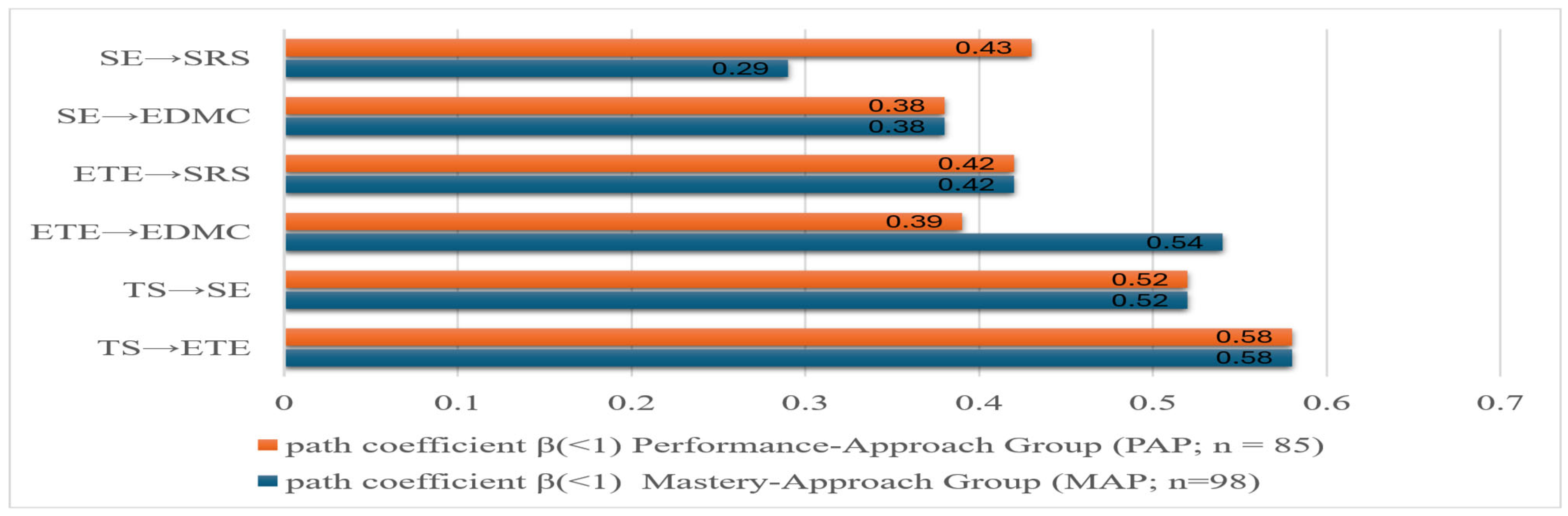
| Mastery-Approach | 98 | 30.0 | 4.35 (0.52) | 3.12 (0.71) | 2.89 (0.68) | 2.45 (0.81) |
| Performance-Approach | 85 | 26.0 | 3.68 (0.61) | 4.28 (0.48) | 3.05 (0.74) | 3.82 (0.65) |
| Mastery-Avoidance | 72 | 22.0 | 3.95 (0.58) | 2.95 (0.80) | 4.41 (0.45) | 3.15 (0.77) |
| Performance-Avoidance | 72 | 22.0 | 3.22 (0.75) | 3.88 (0.62) | 3.28 (0.70) | 4.33 (0.50) |
| Total Sample | 327 | 100 | 3.86 (0.68) | 3.52 (0.75) | 3.38 (0.79) | 3.35 (0.84) |
Appendix B. Statistics of Mean (M) and Standard Deviation (SD) of Observational Variables
| Variable Type | Observation Variable | Mean (M) | Standard Deviation (SD) |
|---|---|---|---|
| Embodied Teaching Experience ETE | ETE1 | 3.87 | 0.72 |
| ETE2 | 3.75 | 0.78 | |
| ETE3 | 3.62 | 0.81 | |
| Personalized value guidance PVD | PVD1 | 3.92 | 0.68 |
| PVD2 | 3.81 | 0.73 | |
| PVD3 | 3.76 | 0.75 | |
| Social learning support SLS | SLS1 | 3.78 | 0.75 |
| SLS2 | 3.59 | 0.83 | |
| SLS3 | 3.65 | 0.79 | |
| Visual feedback of achievements VFO | VFO1 | 3.85 | 0.70 |
| VFO2 | 3.72 | 0.76 | |
| VFO3 | 3.68 | 0.74 | |
| Engineering Ethics Decision-Making Capability EDMC | EDMC1 | 3.79 | 0.71 |
| EDMC2 | 3.68 | 0.75 | |
| EDMC3 | 3.57 | 0.80 | |
| EDMC4 | 3.49 | 0.82 | |
| Intensity of social responsibility SRS | SRS1 | 3.95 | 0.67 |
| SRS2 | 3.83 | 0.71 | |
| SRS3 | 3.76 | 0.74 | |
| SRS4 | 3.69 | 0.77 |
Appendix C. Reliability and Validity Test Results of the Measurement Model
| Latent Variable | Observing Variables | Standardization Factor Load | Cronbach’s α | Composite Reliability (CR) | Average Variance Extracted (AVE) |
|---|---|---|---|---|---|
| Teaching satisfaction (TS) | 0.89 | 0.92 | 0.70 | ||
| Embodied teaching experience | ETE1 | 0.85 | 0.82 | 0.82 | 0.68 |
| ETE2 | 0.81 | ||||
| ETE3 | 0.77 | ||||
| Personalized value guidance | PVD1 | 0.87 | 0.78 | 0.78 | 0.71 |
| PVD2 | 0.83 | ||||
| PVD3 | 0.79 | ||||
| Social learning support | SLS1 | 0.86 | 0.85 | 0.85 | 0.72 |
| SLS2 | 0.82 | ||||
| SLS3 | 0.79 | ||||
| Visual feedback of achievements | VFO1 | 0.84 | 0.76 | 0.76 | 0.69 |
| VFO2 | 0.80 | ||||
| VFO3 | 0.78 | ||||
| Self-efficacy | SE1 | 0.82 | 0.83 | 0.84 | 0.70 |
| SE2 | 0.81 | ||||
| SE3 | 0.79 | ||||
| Engineering-ethics decision-making ability | EDMC1 | 0.83 | 0.81 | 0.81 | 0.67 |
| EDMC2 | 0.79 | ||||
| EDMC3 | 0.76 | ||||
| EDMC4 | 0.73 | ||||
| Intensity of social responsibility | SRS1 | 0.85 | 0.79 | 0.79 | 0.68 |
| SRS2 | 0.81 | ||||
| SRS3 | 0.78 | ||||
| SRS4 | 0.75 | ||||
| Latent Variable | Mean (M) | Standard Deviation (SD) | 1 | 2 | 3 | 4 | 5 | 6 |
|---|---|---|---|---|---|---|---|---|
| Experiential Transformer Engagement (ETE) | 3.75 | 0.65 | 0.82 | |||||
| Personalized value guidance (PVD) | 3.83 | 0.64 | 0.51 ** | 0.84 | ||||
| Social learning support (SLS) | 3.67 | 0.72 | 0.46 ** | 0.49 ** | 0.85 | |||
| Visual feedback of achievements (VFO) | 3.75 | 0.67 | 0.43 ** | 0.47 ** | 0.52 ** | 0.83 | ||
| Engineering-ethics decision-making ability (EDMC) | 3.63 | 0.68 | 0.58 ** | 0.35 ** | 0.39 ** | 0.41 ** | 0.82 | |
| Intensity of social responsibility (SRS) | 3.81 | 0.66 | 0.53 ** | 0.45 ** | 0.44 ** | 0.48 ** | 0.61 ** | 0.82 |
| Inspection Indicators | Inspection Values | Reference Standards | Inspection Results |
|---|---|---|---|
| KMO value | 0.83 | >0.7 | suitable for factor analysis |
| Bartlett’s sphericity test | χ2 = 1826.37, df = 190, p < 0.001 | *** p < 0.001 | significant, suitable for factor analysis |
| Factor Number | Initial Eigenvalue | Variance Contribution Rate (%) | Cumulative Variance Contribution Rate (%) | Characteristic Values After Rotation | Variance Contribution Rate After Rotation (%) | Cumulative Variance Contribution Rate After Rotation (%) |
|---|---|---|---|---|---|---|
| 1 | 6.55 | 29.77 | 29.77 | 6.24 | 31.20 | 31.20 |
| 2 | 5.74 | 26.09 | 55.86 | 5.74 | 28.70 | 59.90 |
| 3 | 4.70 | 21.36 | 77.22 | 4.70 | 23.50 | 83.40 |
| 4 | 3.32 | 15.09 | 92.31 | 3.32 | 16.60 | 100.00 |
| 5 | 0.89 | 4.05 | 96.36 | - | - | - |
| Observing Variables | Factor 1 (ETE) | Factor 2 (PVD) | Factor 3 (SLS) | Factor 4 (VFO) | Common Factor Variance (h2) |
|---|---|---|---|---|---|
| ETE1 | 0.82 | 0.15 | 0.12 | 0.10 | 0.71 |
| ETE2 | 0.79 | 0.18 | 0.14 | 0.13 | 0.68 |
| ETE3 | 0.75 | 0.21 | 0.16 | 0.15 | 0.64 |
| PVD1 | 0.16 | 0.85 | 0.13 | 0.11 | 0.75 |
| PVD2 | 0.19 | 0.81 | 0.15 | 0.14 | 0.70 |
| PVD3 | 0.20 | 0.78 | 0.17 | 0.16 | 0.69 |
| SLS1 | 0.13 | 0.17 | 0.83 | 0.12 | 0.72 |
| SLS2 | 0.15 | 0.19 | 0.80 | 0.16 | 0.69 |
| SLS3 | 0.17 | 0.21 | 0.78 | 0.18 | 0.67 |
| VFO1 | 0.11 | 0.14 | 0.15 | 0.84 | 0.73 |
| VFO2 | 0.13 | 0.16 | 0.18 | 0.80 | 0.68 |
| VFO3 | 0.15 | 0.18 | 0.20 | 0.77 | 0.65 |
Appendix D. Structural Model and Hypothesis Testing Results
| Fitting Indicators | Indicator Symbol | Reference Standard | The Results of this Study | Adaptation Judgment |
|---|---|---|---|---|
| Chi-square–degree of freedom ratio | χ2/df | 1.0~3.0 | 2.17 | adaptation |
| Goodness-of-fit index | GFI | >0.9 | 0.92 | adaptation |
| Adjusted goodness-of-fit index | AGFI | >0.8 | 0.88 | adaptation |
| Comparative fitting index | CFI | >0.9 | 0.94 | adaptation |
| Standardized fitting index | NFI | >0.9 | 0.91 | adaptation |
| Tucker–Lewis index | TLI | >0.9 | 0.93 | adaptation |
| Root mean square of approximation error | RMSEA | <0.08 | 0.062 | adaptation |
| Assuming the Path | Path Coefficient (β) | Standard Error (SE) | CR Value | p-Value | Assuming Verification Results |
|---|---|---|---|---|---|
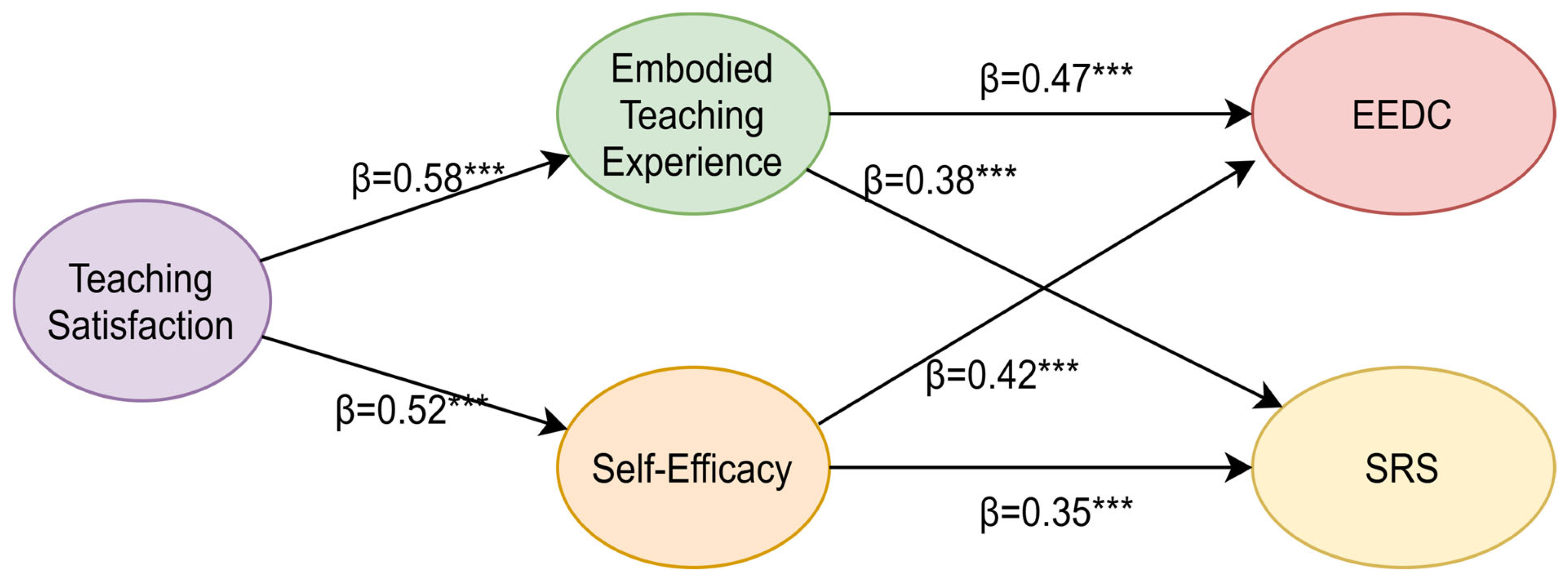
| H1: TS→ETE | 0.58 | 0.07 | 8.29 | <0.001 | Support |
| H2: TS→EDMC | 0.15 | 0.06 | 2.50 | <0.05 | Support |
| H3: TS→SRS | 0.13 | 0.06 | 2.17 | <0.05 | Support |
| H4: ETE→EDMC | 0.47 | 0.08 | 5.88 | <0.001 | Support |
| H5: ETE→SRS | 0.42 | 0.08 | 5.25 | <0.001 | Support |
| H6: TS→SE | 0.52 | 0.07 | 7.43 | <0.001 | Support |
| H7: SE→EDMC | 0.38 | 0.07 | 5.43 | <0.001 | Support |
| H8: SE→SRS | 0.35 | 0.07 | 5.00 | <0.001 | Support |
| H9: mediating effect | - | - | - | - | Support |
Appendix E. Results of Model Testing for Unmeasured Latent Method Factor (ULMF)
| Fit Indices | Baseline Measurement Model (Six-Factor Model) | Model with Unmeasured Latent Method Factor (ULMF) (Six-Factor + Method Factor) | Change Value (Δ) | Criteria for Evaluation |
|---|---|---|---|---|
| χ2 (df) | 386.15 (200) | 352.71 (180) | - | - |
| CFI | 0.941 | 0.949 | +0.008 | Δ CFI < 0.01 [23] |
| TLI | 0.928 | 0.934 | +0.006 | - |
| RMSEA [90% CI] | 0.057 [0.049, 0.065] | 0.055 [0.047, 0.063] | −0.002 | - |
| SRMR | 0.042 | 0.038 | −0.004 | - |
| Observed Variables | Factor Loadings (λ) in the Baseline Model | Factor Loadings (λ) in the ULMF Model | Change in Factor Loadings (Δ λ) | ULMF Method Factor Loadings (λM) | Significance (p-Value) |
|---|---|---|---|---|---|
| ETE1 | 0.85 | 0.83 | −0.02 | 0.12 | 0.063 |
| ETE2 | 0.81 | 0.79 | −0.02 | 0.10 | 0.087 |
| ETE3 | 0.77 | 0.76 | −0.01 | 0.06 | 0.221 |
| SE1 | 0.82 | 0.81 | −0.01 | 0.05 | 0.285 |
| SE2 | 0.81 | 0.80 | −0.01 | 0.07 | 0.194 |
| SE3 | 0.79 | 0.78 | −0.01 | 0.04 | 0.371 |
| EDMC1 | 0.83 | 0.82 | −0.01 | 0.07 | 0.172 |
| EDMC2 | 0.79 | 0.78 | −0.01 | 0.06 | 0.241 |
| EDMC3 | 0.76 | 0.75 | −0.01 | 0.05 | 0.309 |
| EDMC4 | 0.73 | 0.72 | −0.01 | 0.04 | 0.398 |
| SRS1 | 0.85 | 0.84 | −0.01 | 0.08 | 0.132 |
| SRS2 | 0.81 | 0.80 | −0.01 | 0.06 | 0.257 |
| SRS3 | 0.78 | 0.77 | −0.01 | 0.05 | 0.331 |
| SRS4 | 0.75 | 0.74 | −0.01 | 0.04 | 0.410 |
References
- World Health Organization (WHO). Global Status Report on Road Safety 2023; World Health Organization: Geneva, Switzerland, 2023; Available online: https://www.who.int/publications/i/item/9789240086517 (accessed on 2 January 2025).
- Jaramillo, P.; Kahn Ribeiro, S.; Newman, P.; Dhar, S.; Diemuodeke, O.E.; Kajino, T.; Lee, D.S.; Nugroho, S.B.; Ou, X.; Hammer Strømman, A.; et al. Transport. In Climate Change 2022: Mitigation of Climate Change, Contribution of Working Group III to the Sixth Assessment Report of the Intergovernmental Panel on Climate Change; Shukla, P.R., Skea, J., Slade, R., Al Khourdajie, A., van Diemen, R., McCollum, D., Eds.; Cambridge University Press: Cambridge, UK, 2022; pp. 1049–1160. [Google Scholar]
- United Nations. The Sustainable Development Goals Report 2023: Special Edition; United Nations Department of Economic and Social Affairs: New York, NY, USA, 2023; Available online: https://unstats.un.org/sdgs/report/2023/The-Sustainable-Development-Goals-Report-2023.pdf (accessed on 3 January 2025).
- Ryan, R.M.; Deci, E.L. Intrinsic and Extrinsic Motivation from a Self-Determination Theory Perspective: Definitions, Theory, Practices, and Future Directions. Contemp. Educ. Psychol. 2020, 61, 101860. [Google Scholar] [CrossRef]
- Kolb, D.A. Experiential Learning: Experience as the Source of Learning and Development, 2nd ed.; Pearson: London, UK, 2015. [Google Scholar]
- Bandura, A. Self-Efficacy: The Exercise of Control; W.H. Freeman: New York, NY, USA, 1997. [Google Scholar]
- Teather, A.; Etterson, J. Value-Action Gaps Between Sustainability Behaviors, Knowledge, Attitudes and Engagement in Campus and Curricular Activities Within a Cohort of Gen Z University Students. 2023. Available online: https://www.susted.com/wordpress/content/value-action-gaps-between-sustainability-behaviors-knowledge-attitudes-and-engagement-in-campus-and-curricular-activities-within-a-cohort-of-gen-z-university-students_2023_04/ (accessed on 3 January 2025).
- Walumbwa, F.O.; Mayer, D.M.; Wang, P.; Wang, H.; Workman, K.; Christensen, A.L. Linking Ethical Leadership to Employee Performance: The Roles of Leader-Member Exchange, Self-Efficacy, and Organizational Identification. Organ. Behav. Hum. Decis. Process. 2011, 115, 204–213. [Google Scholar] [CrossRef]
- Fini, E.H.; Awadallah, F.; Parast, M.M.; Abu-Lebdeh, T. The Impact of Project-Based Learning on Improving Student Learning Outcomes of Sustainability Concepts in Transportation Engineering Courses. Eur. J. Eng. Educ. 2018, 43, 473–488. [Google Scholar] [CrossRef]
- Wiek, A.; Withycombe, L.; Redman, C.L. Key competencies in sustainability: A reference framework for academic program development. Sustain. Sci. 2011, 6, 203–218. [Google Scholar] [CrossRef]
- Elhaffar, G.; Durif, F.; Dubé, L. Towards closing the attitude-intention-behavior gap in green consumption: A narrative review of the literature and an overview of future research directions. J. Clean. Prod. 2020, 275, 122556. [Google Scholar] [CrossRef]
- Stajkovic, A.D.; Luthans, F. Self-efficacy and work-related performance: A meta-analysis. Psychol. Bull. 1998, 124, 240–261. [Google Scholar] [CrossRef]
- Schwarzer, R.; Jerusalem, M. Generalized self-efficacy scale. In Measures in Health Psychology: A User’s Portfolio. Causal and Control Beliefs; Weinman, J., Wright, S., Johnston, M., Eds.; NFER-NELSON: Windsor, UK, 1995; pp. 35–37. [Google Scholar]
- Elliot, A.J.; Murayama, K. On the measurement of achievement goals: Critique, illustration, and application. J. Educ. Psychol. 2008, 100, 613–628. [Google Scholar] [CrossRef]
- Borenstein, J.; Drake, M.J.; Kirkman, R.; Swann, J.L. The Engineering and Science Issues Test (ESIT): A discipline-specific approach to assessing moral judgment. Sci. Eng. Ethics 2010, 16, 387–407. [Google Scholar] [CrossRef] [PubMed]
- Elliot, A.J.; McGregor, H.A. A 2 × 2 Achievement Goal Framework. J. Pers. Soc. Psychol. 2001, 80, 501–519. [Google Scholar] [CrossRef] [PubMed]
- Hu, L.; Bentler, P.M. Cutoff criteria for fit indexes in covariance structure analysis: Conventional criteria versus new alternatives. Struct. Equ. Model. 1999, 6, 1–55. [Google Scholar] [CrossRef]
- Preacher, K.J.; Hayes, A.F. Asymptotic and resampling strategies for assessing and comparing indirect effects in multiple mediator models. Behav. Res. Methods 2008, 40, 879–891. [Google Scholar] [CrossRef] [PubMed]
- Preacher, K.J.; Kelley, K. Effect size measures for mediation models: Quantitative strategies for communicating indirect effects. Psychol. Methods 2011, 16, 93–115. [Google Scholar] [CrossRef] [PubMed]
- Podsakoff, P.M.; MacKenzie, S.B.; Podsakoff, N.P. Sources of method bias in social science research and recommendations on how to control it. Annu. Rev. Psychol. 2012, 63, 539–569. [Google Scholar] [CrossRef] [PubMed]
- Milligan, M.K.J.; Brackin, P. ABET update: Proposed revisions to EAC general criteria 3 and 5. In Proceedings of the 2016 EDI, San Francisco, CA, USA, 29 March–1 April 2016. [Google Scholar]
- Barkaoui, A.; Ouldasine, R.; Bettaibi, S.; Jamart-Gregoire, B.; Ezbakhe, A. A streamlined and adaptive approach for accrediting a French education system program by ABET-EAC. Front. Educ. 2024, 9, 1405653. [Google Scholar] [CrossRef]
- Nakad, M.; Gardelle, L.; Abboud, R.J. A Systematic Review of the Different Methods Assessing the Integration of Sustainability in Engineering Curricula. Sustainability 2024, 16, 4549. [Google Scholar] [CrossRef]



| Variable | SDG Target | Mechanism | Empirical Proxy |
|---|---|---|---|
| EDMC | 11.2 “Access to safe, affordable, accessible transport” | Prioritization of safety over cost in design dilemmas | Score on “prioritize pedestrian safety” item |
| SRS | 13.3 “Climate change education” | Willingness to invest extra effort in low-carbon solutions | Score on “greenhouse-gas awareness” item |
| ETE | 4.7 “Education for sustainable development” | Exposure to real-world socio-technical trade-offs | Factor score on “authentic transport project” items |
| SE | 4.4 “Skills for decent jobs” | Confidence to voice ethical concerns in multidisciplinary teams | Score on “express ethics in team” item |
| Research Question (RQ) | Corresponding Hypothesis (H) | Purpose |
|---|---|---|
| RQ1: Does teaching satisfaction significantly enhance students’ EDMC and SRS? | H1, H2 (Direct effects: TS→ EDMC/SRS) | To establish the baseline relationship. |
| RQ2: Do ETE and SE mediate these relationships? | H3–H8 (Mediation paths: TS → ETE/SE → EDMC/SRS) | To test the dual-mediation mechanisms. |
| RQ3: Whether achievement–goal model has moderating mediating effect? | H9 (Moderated mediation) | To examine how student motivation types influence the efficacy of each path. |
| Comparative strength of pathways | H10a, H10b (Contrast of indirect effects) | To determine the relative importance of ETE vs. SE in the given context. |
| Construct | No. of Items | Example item | Cronbach’s α | Source |
|---|---|---|---|---|
| Experiential Transformer Engagement (ETE) | 3 | “The course provided real-world transport sites (e.g., intersections, construction zones) for ethical analysis.” | 0.82 | Adapted from Kolb (2015) [5] |
| Self-Efficacy (SE) | 3 | “I feel confident expressing ethical concerns during team design meetings.” | 0.83 | Schwarzer and Jerusalem (1995) [13] |
| Engineering Ethical Decision-Making Competence (EDMC) | 4 | “When cost and safety conflict, I can prioritise ethical principles.” | 0.81 | ESIT, α = 0.84 (Borenstein et al., 2010) [15] |
| Strength of Social Responsibility (SRS) | 4 | “I am willing to spend extra time improving the social value of transport projects (e.g., pedestrian accessibility).” | 0.79 | SDG 11.2 aligned |
| Teaching Satisfaction (TS) | 12 (4 dims) | “I can see my ethical reasoning ability growing through visible feedback.” | 0.89 | Second-order factor |
| Path | Point Estimate | 95% CI | Proportion of Total Effect (%) |
|---|---|---|---|
| TS→ ETE→ EDMC | 0.27 | [0.183, 0.362] | 64.3 |
| TS→ SE → EDMC | 0.20 | [0.134, 0.281] | 47.6 |
| TS→ ETE → SRS | 0.24 | [0.156,0.331] | 64.9 |
| TS → SE → SRS | 0.18 | [0.121, 0.254] | 48.7 |
| Study | Country/Type | Discipline | Sample Size (N) | Research Design | Key Path/Relationship | Coefficient Value |
|---|---|---|---|---|---|---|
| Teather and Etterson (2023) [7] | Australia/Cross-sectional | Higher Education | 472 | Survey | Values–behavior gap (Attitude Engagement) | r = 0.29 |
| Walumbwa et al. (2011) [8] | USA/Multilevel | Organizational Behavior | 336 | Field study | Self-efficacy→Job performance | β = 0.38 |
| Fini et al. (2018) [9] | USA/Higher Education | Engineering Education | 127 | Quasi-experimental | Project-based Learning → Sustainability Learning Outcomes | *d* = 0.72 (Cohen’s d) |
| Wiek et al. (2011) [10] | International/Framework | Sustainability Science | - | Theoretical | Key competencies Action (estimated) | - |
| This study | China/SEM | Engineering Education | 327 | Cross-sectional | ETE → EDMC SE → EDMC | β = 0.47 ** β = 0.38 ** |
| Week | Learning Task | Ethical Dilemma Embedded | Deliverable | Mastery-Oriented Rubric (Excerpt) |
|---|---|---|---|---|
| 1 | Field audit of informal-settlement intersection | Competing demands: bus-lane vs. vendor relocation | 5 min video log | “Identify at least two stakeholder value conflicts with evidence” |
| 2 | Generate three design alternatives | Trade-off: cost, safety, equity | Design memo | “Use SDG 11.2 indicator to justify priority ranking” |
| 3 | Public consultation role-play | Voice of elderly and disabled residents | Reflection journal | “Document how feedback altered your weighting of safety vs. cost” |
| 4 | Design-and-defense panel | External examiner asks “Would you relocate 50 households?” | Slide deck and Q & A | “Defend final decision with at least two ethical theories” |
| Studio Week | Embedded Ethical Dilemma | Deliverable | ABET 2025 Criterion | Mapped SDG Indicator |
|---|---|---|---|---|
| 1 | Bus-lane vs. vendor relocation | 5 min video log | 3.f. “recognize ethical conflicts” | 11.2.1% population with safe access |
| 2 | Cost–safety–equity trade-off | Design memo | 3.h. “assess sustainability impacts” | 11.2.1 + 13.2.2 CO2 reduction |
| 3 | Elderly and disabled consultation | Reflection journal | 3.g. “listen to diverse stakeholders” | 11.7.1 public-space inclusion index |
| 4 | External examiner defense | Slide deck and Q&A | 3.i. “justify decisions using ethical theories” | 11.2.1 post-intervention safety audit |
Disclaimer/Publisher’s Note: The statements, opinions and data contained in all publications are solely those of the individual author(s) and contributor(s) and not of MDPI and/or the editor(s). MDPI and/or the editor(s) disclaim responsibility for any injury to people or property resulting from any ideas, methods, instructions or products referred to in the content. |
© 2026 by the author. Licensee MDPI, Basel, Switzerland. This article is an open access article distributed under the terms and conditions of the Creative Commons Attribution (CC BY) license.
Share and Cite
Zhang, H. Engineering Ethics Education for Sustainable Transport: A Dual-Mediation Model of Teaching Satisfaction, Embodied Experience, and Self-Efficacy. Sustainability 2026, 18, 2114. https://doi.org/10.3390/su18042114
Zhang H. Engineering Ethics Education for Sustainable Transport: A Dual-Mediation Model of Teaching Satisfaction, Embodied Experience, and Self-Efficacy. Sustainability. 2026; 18(4):2114. https://doi.org/10.3390/su18042114
Chicago/Turabian StyleZhang, Huili. 2026. "Engineering Ethics Education for Sustainable Transport: A Dual-Mediation Model of Teaching Satisfaction, Embodied Experience, and Self-Efficacy" Sustainability 18, no. 4: 2114. https://doi.org/10.3390/su18042114
APA StyleZhang, H. (2026). Engineering Ethics Education for Sustainable Transport: A Dual-Mediation Model of Teaching Satisfaction, Embodied Experience, and Self-Efficacy. Sustainability, 18(4), 2114. https://doi.org/10.3390/su18042114