Article

Engineering Ethics Education for Sustainable Transport: A Dual-Mediation Model of Teaching Satisfaction, Embodied Experience, and Self-Efficacy

School of Traffic and Transportation, Shijiazhuang Tiedao University, Shijiazhuang 050043, China
Sustainability 2026, 18(4), 2114; https://doi.org/10.3390/su18042114
Submission received: 4 January 2026 / Revised: 6 February 2026 / Accepted: 12 February 2026 / Published: 20 February 2026

Abstract

Integrating engineering ethics education into the curriculum system of China’s transportation engineering major is crucial for promoting Sustainable Development Goal 11 (SDG 11) in the field of transportation engineering in China. However, the mapping relationship between teaching satisfaction and engineering ethics literacy, which are traditional indicators for evaluating teaching effectiveness in China, is not clear. This study constructed a teaching satisfaction transformation model with Experiential Transformer Engagement (ETE) and Self-Efficacy (SE) as dual mediators. Through experimental testing of undergraduate students majoring in transportation engineering from five universities in Hebei Province, it was found that both ETE and SE significantly moderated the conversion of teaching satisfaction to two key ethical abilities: Ethical Decision-Making Competence (EDMC) and Social Responsibility Strength (SRS). Among them, ETE accounted for about 64% of the total indirect impact on the two outcomes, which was significantly stronger than SE’s 48%. In addition, achievement goal orientation has a significant moderating effect. These findings not only address the teaching framework of engineering ethics that is suitable for the Chinese context, but also expand the theoretical basis and implementation plans of teaching models in the early stages of engineering ethics education in developing countries.

1. Introduction

Rapid global urbanization and the climate crisis have positioned transportation systems at the center of sustainable development discourse. Road traffic accidents result in approximately 1.35 million fatalities annually [1], while transportation-related emissions account for roughly 24% of global energy-related CO2 emissions [2]. In response, the United Nations Sustainable Development Goals (SDGs) explicitly call for resilient infrastructure (SDG 9) and safe, inclusive, and sustainable cities (SDG 11) [3].
Achieving these objectives requires not only innovative technologies but also engineers who can integrate safety, equity, and ecological stewardship into their design decisions. Despite the widespread incorporation of ethics modules in engineering curricula, we find that there is no significant correlation between students’ satisfaction with teaching and their willingness to give priority to public interest issues, which shows that there is a certain gap between the satisfaction in the evaluation of educational achievements and the requirements for technical personnel’s ethical literacy in engineering practice. This disconnect—termed the “satisfaction–responsibility paradox”—undermines the educational efficacy needed to advance sustainable transportation practices. Self-determination theory (SDT) posits that teaching satisfaction [4], grounded in the fulfillment of autonomy, competence, and relatedness, enhances intrinsic motivation, thereby fostering deeper engagement in value-laden tasks such as ethical reasoning [4]. From this perspective, satisfaction acts as a catalyst for students’ willingness to engage with complex socio-technical dilemmas—a process most effectively facilitated through Experiential Transformer Engagement (ETE). Complementarily, social cognitive theory (SCT) highlights self-efficacy SE [4]—the belief in one’s capacity to execute specific actions—as a key determinant of whether individuals translate ethical awareness into actual decisions, particularly under pressure. SE is not merely a byproduct of motivation; it functions as a psychological resource that sustains ethical agency beyond academic settings.
Critically, these two theoretical pathways are not parallel but potentially synergistic; satisfaction derived from well-designed experiential tasks (ETE) can strengthen (SE), while heightened SE may in turn reinforce engagement in ethically challenging experiences. However, the extent to which and the mechanisms by which these factors jointly explain the relationship between teaching satisfaction and sustainability-oriented ethical outcomes remain empirically unexplored in engineering education—a gap this study aims to address. To bridge said gap, we propose and validate a dual-mediation model linking teaching satisfaction to sustainability-oriented ethical outcomes through ETE [5] and SE [6]. Drawing on survey data from 327 undergraduate transportation engineering students across five Chinese universities, we examine three research questions:
RQ1. Does teaching satisfaction significantly enhance students’ EDMC and SRS?
RQ2. Do ETE and SE mediate these relationships?
RQ3. Whether achievement–goal model has moderating mediating effect?
To empirically test these questions, we draw upon Self-Determination Theory and Social Cognitive Theory to formulate a set of specific hypotheses, which posit directional relationships and comparative strengths among the constructs, moving from exploration to prediction.
Addressing these research questions generates three key contributions: First, we quantify the relative influence of experiential and psychological pathways on ethical learning outcomes, offering curriculum developers evidence-based insights to inform strategic resource allocation. Second, we extend SDT and SCT within the context of sustainability-oriented engineering education, demonstrating that authentic transportation challenges—such as the trade-offs between implementing bus lanes and displacing low-income communities—serve as impactful situated learning experiences. Thirdly, we have integrated mature teaching models in Western engineering education, such as project-based learning, role-playing, and iterative feedback, to construct an ETE teaching process based on real scenario simulation, and provided corresponding support strategies for students’ SE. This framework system not only verifies the impact of ETE and SE on the effectiveness of engineering ethics teaching, but also explores how countries and regions like China, where engineering ethics education has just begun to integrate into professional education, can deepen the reform of engineering theory education, and whether mature Western experiences are applicable, addressing the specific social and technological challenges faced by developing countries and regions.
In summary, although teaching satisfaction is often regarded as an indicator of educational effectiveness, it is not clear how to transform it into the potential mechanism of engineering ethics literacy required by engineers in the process of sustainable development of transportation. In many cases, there is a problem that satisfaction does not match the effectiveness of Engineering ethics education. In view of this situation, this study integrates SDT and SCT to propose a dual-mediation model, which assumes that teaching satisfaction jointly influences students’ engineering ethics decision-making capabilities and social responsibility strength through the “value internalization” path of ETE and the “behavior empowerment” path of SE. Based on a systematic review of relevant theories, we will identify the differences in the research between teaching satisfaction affecting students’ EDMC and SRS through ETE and SE.

2. Literature Review

In the dual context of global sustainable development and the transformation of engineering education, engineering ethics education, as a key link in cultivating future engineers’ social responsibility and ethical decision-making abilities, is increasingly valued for its teaching effectiveness and mechanism research. However, there are still theoretical gaps and insufficient empirical evidence in explaining how teaching satisfaction can be transformed into sustainable ethical competence, especially in the context of engineering education in rapidly developing regions such as China. This chapter clarifies the theoretical positioning and research gaps of this study by systematically reviewing relevant theoretical frameworks and empirical research. Firstly, by integrating self-determination theory (SDT) and social cognitive theory (SCT), a dual mediation theory model of “experience-transformation participation” and “self-efficacy” is constructed (Section 2.1, Section 2.2 and Section 2.3); Secondly, we define the contextualized connotation of “experience-transformation participation” in engineering ethics education (Section 2.4); Next, we explore the moderating effect of achievement–goal orientation (Section 2.5); Finally, we identify the three major gaps in current research (Section 2.6) and lay a theoretical foundation for subsequent empirical studies.

2.1. Theoretical Positioning of Key Studies

In order to better integrate engineering education in local Chinese universities with the SDGs framework, this article conducted a comparative study of existing research results and also found a benchmark for future research. In order to increase the contrast of research results, the criteria for literature selection included the correlation of research methods, the correlation of experimental path structure, and the provision of comparable quantitative parameter effects. The main achievements are as follows:
The Value Action Gap Approach: Teather and Etterson (2023) [7] emphasizes the moderate correlation between the sustainability attitudes and commitments of Generation Z students (* r * ≈ 0.29), providing a key reference point for investigating the “Satisfaction Responsibility Paradox” in this study and highlighting the limitations of knowledge transfer alone.
The path from self-efficacy to performance: Walumbwa et al. (2011) [8] demonstrated in organizational contexts that self-efficacy is an important predictor of moral performance (β = 0.38). This provides strong meta-theoretical support for the assumed Social Cognitive Theory (SCT) pathway in our model and establishes a comparable effect size benchmark.
Experiential learning efficacy pathway: Fini et al. (2018) [9] used a quasi-experimental design to demonstrate that project-based learning significantly improved the sustainability learning outcomes of transportation courses (Cohen’s * d * = 0.72). This study provides a direct method and effect-size reference for the design and expected impact of the experiential transformer device in our research.
Sustainable Development Capability Framework Path: Wiek et al. (2011) [10] provided a theoretical foundation for normative capability through their Key Capability Framework for Sustainable Development, which is a core component of our outcome variable, Ethical Decision-Making Capability (EDMC).
Overall, these studies confirm the independent importance of experiential learning and self-efficacy. However, they were mainly conducted in the Western or post-materialist context, without comparing the relative strength of empirical (such as ETE) and psychological (such as SE) pathways in the integrated model. Therefore, based on these benchmarks, this study proposed and tested a dual mediation model that combines teaching satisfaction, ETE, and SE. Our goal is to test and compare the effectiveness of these pathways in the context of engineering education in a rapidly developing region (Hebei Province, China). This method directly fills the gap left by benchmark research, especially the lack of comprehensive comparison and contextual application, while allowing for meaningful evaluation of our results based on established effect sizes.

2.2. From Teaching Satisfaction to Sustainability Outcomes

Student satisfaction is a widely recognized metric for assessing teaching quality and its immediate outcomes. Grounded in SDT, satisfaction derived from the fulfillment of autonomy, competence, and related needs is believed to enhance intrinsic motivation, which subsequently fosters deeper engagement and behavioral persistence [4]. In the context of engineering education, students who report higher levels of satisfaction typically exhibit greater course engagement and improved technical learning outcomes.
However, when the anticipated outcomes shift from general engagement to sustainability-oriented ethical competencies—such as the willingness to prioritize public good over costs or the strength of pro-sustainability behavioral intentions—the empirical relationship with teaching satisfaction becomes notably less consistent and is theoretically underexplored. While some studies indicate positive correlations, the effect sizes are often modest (β≈ 0.20) and highly dependent on contextual factors such as instructional design and assessment methods. More critically, other research highlights a satisfaction–responsibility paradox: students may express high levels of satisfaction with ethics courses yet demonstrate limited transfer of ethical reasoning to complex real-world trade-offs [7]. This paradox suggests that satisfaction alone may be an inadequate lever for cultivating the normative competencies and value commitments essential for sustainable development.
SCT provides a complementary yet distinct perspective by emphasizing SE—the belief in one’s ability to organize and execute courses of action—as a more proximal and potent predictor of behavioral intention and persistence, particularly in challenging or ethically ambiguous situations [11]. Meta-analytic evidence suggests that domain-specific self-efficacy may serve as a stronger predictor of ethical behavioral intentions than general course satisfaction [12]. This theoretical divergence prompts an essential inquiry: does teaching satisfaction influence sustainability outcomes primarily by fostering intrinsic motivation toward ethical engagement (an SDT pathway), by enhancing the confidence to act ethically (an SCT pathway), or through a combination of both? The existing literature lacks a coherent framework for examining these mechanistic pathways.
This study constructs a dual mediation model with ETE and SE as the main pathway to systematically explore the roles of ETE and SE in the process of converting teaching satisfaction to engineering ethics literacy, clarify the differences and correlations between the two, and provide a theoretical support and teaching plan for a new model of engineering education reform, especially for developing countries and regions where transportation engineering is rapidly developing but engineering ethics education is lagging behind.

2.3. Theoretical Integration: SDT and SCT as Complementary Lenses

In classical educational theory, self-determination theory (SDT) and social cognitive theory (SCT) respectively point out two key paths:
The path based on SDT (usually achieved through ETE): It emphasizes the emotional and cognitive involvement of students in moral issues in real and challenging tasks, thereby promoting the internalization of their values.
The path based on SCT (mainly constructed through SE): It focuses on behavioral empowerment, enabling students to believe that they have the ability to adhere to ethical standards under real pressures such as cost and time.
However, there may be tension between these two paths in practice:
If there is an excessive reliance on performance feedback in cultivating SE, it may weaken students’ autonomy, which is a core requirement of SDT.
If ETE only provides immersive challenges without sufficient teaching support, it may make students feel powerless rather than empowered.
Therefore, a dual-pathway model helps us not only examine the contributions of ETE and SE, but also explore their interactions—whether they work independently, in a sequential order, or in synergy with each other?
This comprehensive framework goes beyond the perspective of viewing ETE and SE as isolated intermediaries, but rather as two theoretically based transmission channels that jointly lead teaching satisfaction towards two complementary dimensions of engineering ethics learning: internalization (via ETE) and empowerment (via SE).

2.4. ETE in Engineering Ethics: A Situated Definition

Based on Bandura’s self-efficacy theory [6] and Kolb’s experiential learning theory framework [5], this study conceptualizes ETE in the context of engineering ethics education as a structured and guided teaching experience. In this context, students are immersed in real social and technological dilemmas that contain ethical conflicts, physically, cognitively, and emotionally, and must make and demonstrate their value-oriented decisions within the constraints of reality. Unlike general experiential learning (such as simulations or case studies), the ETE in this framework is defined by three core features that integrate sustainability and ethics, and collectively aim to cultivate self-efficacy in engineering ethics decision-making:
Situated Authenticity: The learning environment directly maps or integrates into real transportation system scenarios (such as intersections, construction sites, and transportation corridors), making ethical trade-offs such as safety and cost, fairness and efficiency tangible. This authenticity provides a reliable source of master experience for the formation of self-efficacy.
Multi-Sensory Engagement: The learning process not only relies on cognitive analysis but also emphasizes perceptual and emotional intervention through observing traffic flow, listening to community testimony, drawing spatial inequality maps, etc., to enhance the emotional significance and value-internalization depth of ethical dilemmas. This participation provides students with alternative experiences and emotional awakenings, further consolidating their beliefs in coping with similar challenges.
Ethical Action Imperative: Task-design forces students to propose, defend, or make decisions with ethical implications, and often promotes their application, coordination, and negotiation value in simulated or real responsibilities through studio models such as “design and rebuttal” (see Section 5). This process directly exercises their normative ability and strengthens their self-efficacy belief of ‘I can do it’ through successful execution experience.
In summary, by integrating classic theories of instructional psychology, Experiential Transformer Engagement (ETE)’s teaching design, which combines real-life situations, multisensory involvement, and action compulsion, not only promotes the internalization of engineering ethics principles, but more importantly, it systematically constructs the necessary experience for students to cultivate self-efficacy in engineering ethics decision-making, enabling them to believe that they have the ability to analyze, judge, and act in the face of complex sustainability ethical dilemmas. This integrated perspective goes beyond simple experience accumulation and points towards the deep teaching goal of cultivating professional ethical initiative through targeted experiential design [6].

2.5. Achievement–Goal Orientation as a Moderator

Students enter ethics courses with a variety of goal profiles. Mastery-Approach goals (MAP) emphasize understanding and self-improvement, while Performance-Approach goals (PAP) focus on the demonstration of normative competence [13]. Students who adopt MAP are inclined to pursue challenging tasks and demonstrate tolerance for ambiguity, whereas those with PAP prefer clear rubrics and high success visibility. Moderated mediation analyses reveal that MAP enhances the effectiveness of experiential pedagogy on ethical sensitivity, while PAP strengthens the impact of instructor feedback on self-efficacy. Therefore, it is essential to integrate goal-orientation contingencies into the design of sustainability education in order to optimize ethical learning outcomes.

2.6. Research Gaps

Three gaps in the literature have motivated the present study. First, while SDT and SCT have been applied independently, there is a lack of research that integrates these frameworks to compare the relative significance of experiential versus psychological pathways leading to sustainability-oriented ethical outcomes. Second, existing measures of “satisfaction” rarely include items specifically related to sustainability, such as perceived support for addressing trade-offs associated with the Sustainable Development Goals. Third, prior studies predominantly feature Western samples; consequently, evidence from specific rapidly developing regional contexts—such as China—is often underrepresented in the literature, which restricts external validity. This study aims to address these gaps by testing a dual-mediation model within a representative case of rapid developing countries and regions worldwide: transportation engineering students in Hebei Province, China. This focus allows for a deep and contextually grounded analysis of the mechanisms at play, thereby providing culturally contextualized evidence for global ESD policy. To situate our research within the framework of the Sustainable Development Goals (SDGs), we map key variables to relevant SDG targets, mechanisms, and empirical proxies, as illustrated in Table 1.

2.7. Research Hypotheses

To empirically address the aforementioned research questions, this study integrates the SDT and SCT frameworks, derives 10 specific hypotheses, and constructs a dual-mediation model to comprehensively explore how teaching satisfaction influences the enhancement of students’ sustainable ethical competence through different pathways (Table 2).
H1. Teaching satisfaction is positively associated with Experiential Transformer Engagement (TS→ETE).
H2. Teaching satisfaction is positively associated with self-efficacy (TS→SE).
H3. Experiential Transformer Engagement is positively associated with engineering ethical decision-making competence (ETE→EDMC).
H4. Experiential Transformer Engagement is positively associated with strength of social responsibility (ETE→SRS).
H5. Self-efficacy is positively associated with engineering ethical-decision-making competence (SE→EDMC).
H6. Self-efficacy is positively associated with strength of social responsibility (SE→SRS).
H7. The effect of teaching satisfaction on EDMC is mediated by (a) ETE and (b) SE.
H8. The effect of teaching satisfaction on SRS is mediated by (a) ETE and (b) SE.
H9. Achievement–goal orientation moderates the mediated pathways such that Mastery-Approach goals amplify the ETE path [13,14,15,16], whereas Performance-Approach goals amplify the SE path.
H10a. The indirect effect of teaching satisfaction on EDMC via ETE is significantly stronger than the indirect effect via SE.
H10b. The indirect effect of teaching satisfaction on SRS via ETE is significantly stronger than the indirect effect via SE.
Given the high contextual salience of socio-technical trade-offs in rapidly developing regions, we anticipate that embodied internalization (ETE) will account for a greater proportion of variance than self-efficacy (SE).

3. Participants and Procedure

3.1. Participants and Data Collection

A multi-stage stratified sample of undergraduate transportation engineering students was drawn from five universities in Hebei Province, China, comprising three comprehensive institutions, one polytechnic university, and one industry-oriented institution. Program size and gender ratio were employed as stratification variables to enhance external validity. Eligibility criteria required participants to have completed at least one ethics-related module and to have engaged in a capstone transport design course. Following approval from the College Academic Committee, coordinators distributed anonymous Qualtrics links to 354 students; 27 responses were excluded due to straight-lining or more than 15% missing data, resulting in a total of 327 valid cases (effective response rate = 92.3%). The final sample consisted of 25% sophomores, 40% juniors, and 35% seniors; 38% of the participants identified as female and 62% as male, which is consistent with regional program demographics. Data collection took place during the last two weeks of the Spring 2023 semester to ensure that the participants were familiar with embedded ethics tasks. Participants provided electronic informed consent and received a debriefing within a period of 48 h. No incentives exceeding the equivalent of USD 5 were offered in order to minimize self-selection bias.

3.2. Measurement Development and Validity Evidence

All scales demonstrated good internal consistency reliability (see Table 3). Of particular importance is the ETE scale, which was specifically developed to align with the three-dimensional theoretical framework outlined in Section 2.4. Content validity was established through the systematic design of items that directly correspond to each theoretical dimension: items referencing “real-world transport sites” reflect Situated Authenticity; those involving “multiple senses” capture Multi-Sensory Engagement; and those requiring students to “solve practical problems on-site” embody the Ethical Action Imperative. This intentional item construction ensures that the scale measures the targeted construct—embodied, ethical, and contextually authentic pedagogy—rather than general experiential learning. For the other constructs (e.g., SE, EDMC), established scales were adapted and contextualized to the Chinese transportation engineering education setting (see Appendix A for full items).

3.3. Instrument Development and Adaptation

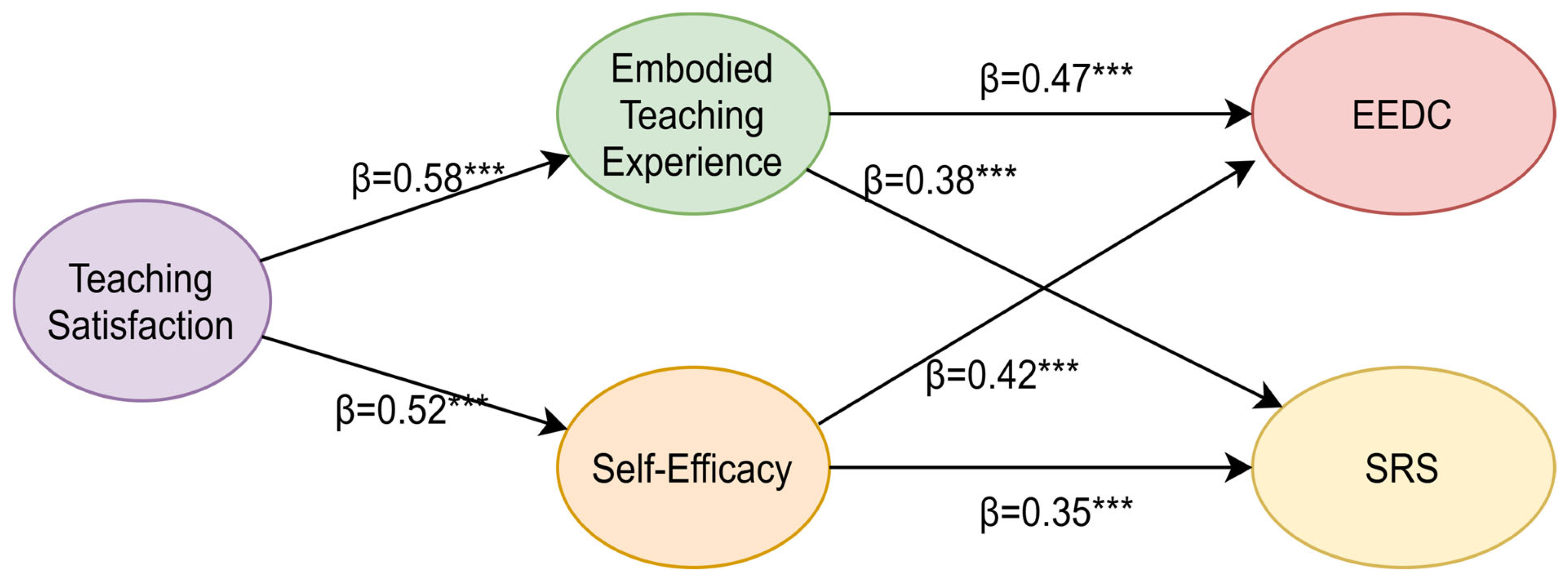
The data analysis proceeded in two sequential stages to ensure the robustness of the findings. First, a confirmatory factor analysis (CFA) was conducted to evaluate the measurement model, assessing the reliability, validity, and fit of all constructs before testing the structural relationships. The detailed results of the CFA, including model-fit indices and validity tests, are reported in Section 4.1 and Appendix C. Second, the proposed dual-mediation structural model (see Figure 1) was estimated using Mplus 8.8 software, employing the maximum likelihood robust (MLR) estimation method.
All survey instruments were originally developed based on established theoretical scales (see sources in Table 3). To ensure conceptual equivalence and cultural relevance for the Chinese student population, rigorous translation and back-translation was conducted by a bilingual expert panel. Furthermore, all items were contextualized within the domain of transportation engineering and sustainability dilemmas pertinent to the Chinese urbanizing context (e.g., referencing “bus-lane implementation,” “informal-settlement intersections”). This process ensured that the constructs measured were both theoretically sound and contextually meaningful for the participants. The final English versions used in this manuscript are the result of this adaptation process. The complete survey instrument in bilingual format (Chinese–English) is provided as Supplementary Material.

3.4. Data Statistical Analysis

The double mediation model shown in Figure 1 was estimated using the MLR estimation method based on Mplus 8.8 software.
Firstly, the multiple kurtosis coefficient of Mardia is 5.4, indicating mild non normality in the data, and the MLR estimation method effectively addresses this issue.
Secondly, the model fit is comprehensively evaluated through the following indicators: chi square degree of freedom ratio (χ2/df < 3), comparative fit index (CFI), Tucker–Lewis index (TLI), approximate root mean square error (RMSEA), and standardized root mean square residual (SRMR). The evaluation criteria refer to the recommendations of Hu and Bentler (1999) [17]: CFI/TLI ≥ 0.90, RMSEA ≤ 0.08, SRMR ≤ 0.08. The significance test of the mediating effect was conducted using the bias corrected Bootstrap method [18], with 5000 replicates set. If the 95% confidence interval of the indirect effect does not include zero, it is considered significant.
In addition, to test the moderating effect of achievement goals, the study first used K-means clustering analysis (K = 4) to distinguish participants into a mastery goal-oriented group (n = 98) and performance goal-oriented group (n = 85), with a silhouette coefficient of 0.42. Subsequently, multiple sets of structural equation models were used for analysis, and before comparing the structural paths between groups, the measurement invariance was ensured through the Δχ 2 test (p < 0.05). The detailed results of cluster analysis are shown in Appendix A (Table A2).
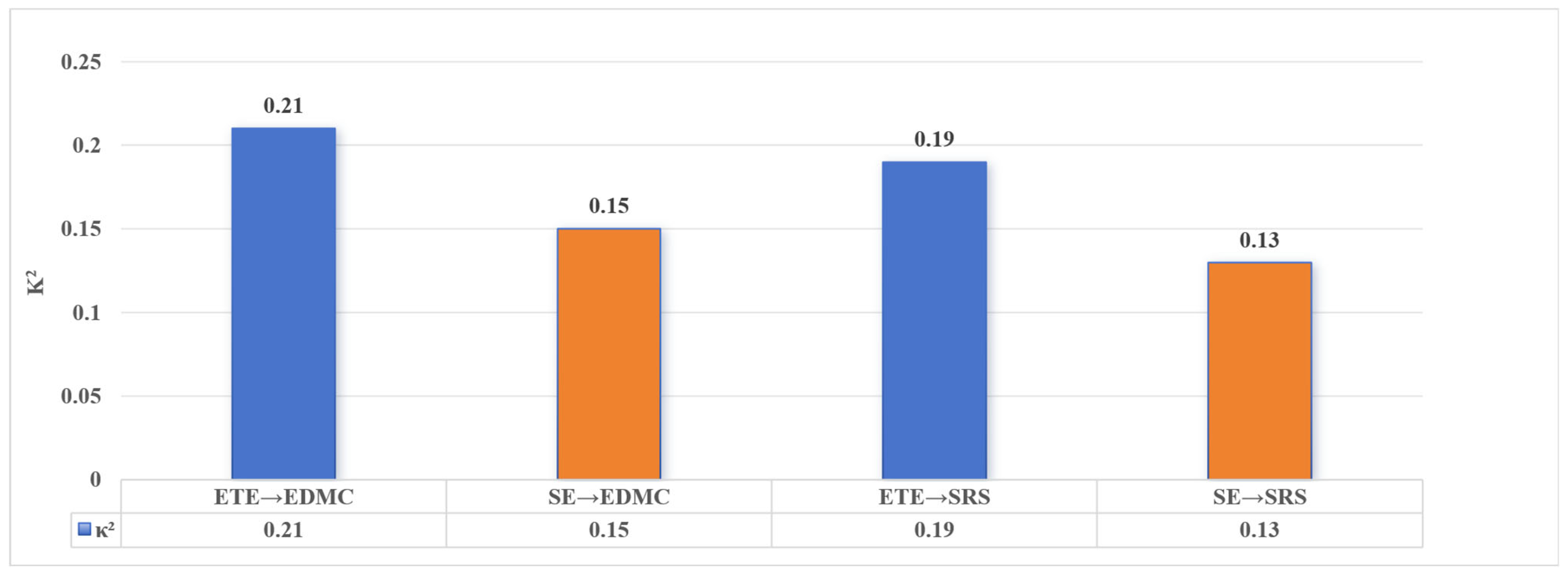
Finally, the effect size evaluation of indirect effects refers to the κ2 index proposed by Preacher and Kelley (2011) [19]. In this study, the κ2 value of the path ETE → EDMC was 0.21, and the κ2 value of the path SE → EDMC was 0.18, both within the moderate effect range.

3.5. Procedural and Statistical Remedies for Common Method Variance (CMV)

Recognizing the potential for common-method variance inherent in cross-sectional self-report data, we implemented both procedural and statistical remedies in accordance with established guidelines [20]. Procedurally, we ensured respondent anonymity to mitigate evaluation apprehension, utilized clear and distinct scale anchors, and separated the measurement of predictor and criterion variables within the survey. Statistically, we employed three complementary tests:
  • Harman’s Single-Factor Test: The first unrotated factor accounted for 38% of the variance, which is below the 50% threshold.
  • Marker-Variable Technique: By using a theoretically unrelated variable—“frequency of library visits”—as a marker (r < 0.05 with all substantive constructs), we controlled for its variance and found that all significant paths remained stable (Δβ < 0.02).
  • Unmeasured Latent Method Factor (ULMF) Test: We conducted a more rigorous assessment by incorporating an uncorrelated method factor into the measurement model.
As detailed in Appendix E, there was only marginal improvement in model fit (ΔCFI = 0.008), while all substantive factor loadings remained significant and exceeded 0.70, indicating that common method variance did not account for a substantial portion of covariance among constructs.

3.6. Ethics Approval

This study was reviewed and approved by the College Academic Committee of the School of Traffic and Transportation at Shijiazhuang Tiedao University under approval letter No. CE-2024-03-10. Informed consent was obtained from all participants involved in this research.

4. Results

4.1. Measurement Model

A confirmatory factor analysis (CFA) employing robust maximum likelihood estimation supported the proposed six-factor structure (χ2/df = 1.93, CFI = 0.94, TLI = 0.93, RMSEA = 0.057, SRMR = 0.042). All standardized factor loadings were greater than 0.70 (p < 0.001), and composite reliabilities ranged from 0.81 to 0.92 (see Appendix B). Discriminant validity was established using the Fornell–Larcker criterion: the square root of the average variance extracted (AVE) for each latent construct exceeded its correlations with any other construct (refer to Appendix C).

4.2. Structural Model

The structural model demonstrated an acceptable fit (χ2/df = 2.17, CFI = 0.94, TLI = 0.93, RMSEA = 0.062, SRMR = 0.045). Figure 1 illustrates the standardized path coefficients clearly indicating that the teaching satisfaction (TS) significantly predicted both mediators—Experiential Transformer Engagement (ETE; β= 0.58, p < 0.001) and self-efficacy (SE; β= 0.52, p < 0.001)—thereby supporting hypotheses H1 and H2, respectively.
Furthermore, ETE positively influenced engineering ethical-decision-making competence (EDMC; β= 0.47, p < 0.001) as well as the strength of social responsibility (SRS; β= 0.42, p < 0.001), confirming hypotheses H3 and H4 accordingly.
Similarly, SE exerted significant effects on EDMC (β= 0.38; p < 0.001) and SRS (β= 0.35; p <0.001), corroborating hypotheses H5 and H6.
The direct paths from TS to EDMC (β = 0.15; p = 0.013) and SRS (β = 0.13; p = 0.021) were found to be significant but modest in magnitude, thereby lending support to hypotheses H7 and H8. The complete structural model fit indices along with detailed hypothesis testing results—including path coefficients, standard errors, composite reliability values, and corresponding p-values—are documented in Appendix D.

4.3. Mediation Analysis

Bias-corrected bootstrapping with 5000 samples indicated that both indirect pathways were statistically significant (The specific results are shown in Table 4).
As shown in Table 4, the pathway from TS to ETE to EDMC accounted for 64.3% of the total effect, while the pathway from TS to SE to EDMC explained 47.6%. Similarly, ETE and SE mediated 64.9% and 48.7% of the total effect on SRS, respectively. Given that the two mediators are correlated (r = 0.53), a contrast test was conducted; however, the difference in specific indirect effects was not statistically significant (Δind = 0.02, 95% CI [–0.06, 0.10]), suggesting that both pathways hold equal importance for sustainability-oriented ethical outcomes.
To test H10a and H10b, we conducted pairwise contrasts of the two indirect effects. The difference between the ETE and SE indirect effects was Δind = 0.27–0.20 = 0.07 for EDMC, 95% CI [0.01, 0.13] (excluding zero), and Δind = 0.24–0.18 = 0.06 for SRS, 95% CI [0.005, 0.12] (excluding zero). Thus, both H10a and H10b are supported: the ETE pathway is significantly stronger than the SE pathway in the Hebei context.
In addition, the standardized indirect effect (κ2) of the two mediation paths also showed a consistent trend, as shown in Figure 2. For the two result variables (edmc and SRS), the path via ete (κ2 = 0.21, 0.19) was greater than that via se (κ2 = 0.15, 0.13), which further supported the above conclusion.
In addition, according to Podsakoff et al.’s (2012) methodology [20], Harman’s single-factor test, which revealed that the first unrotated factor accounted for only 38% of the variance—below the critical threshold of 50%—indicating that common method variance is not a predominant bias.

4.4. Moderation Analysis

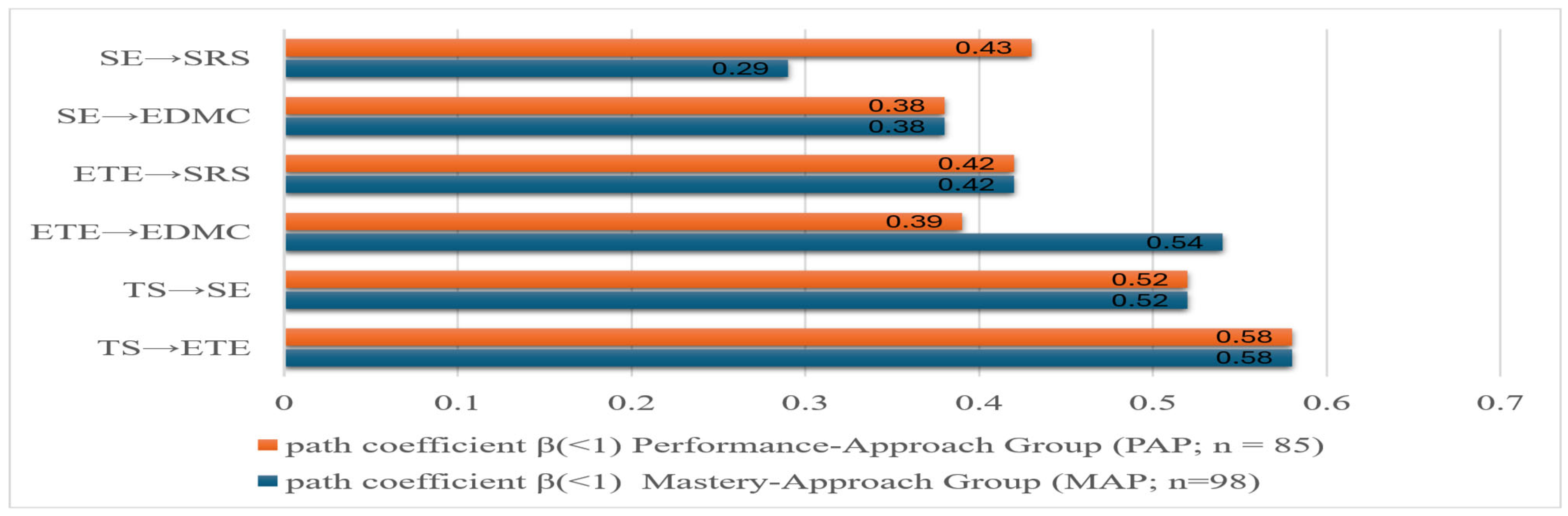
Multi-group structural equation modeling (SEM) revealed significant differences between the Mastery-Approach (MAP; n = 98) and Performance-Approach (PAP; n = 85) groups across two structural paths (Δχ2 = 6.54, p = 0.011). The between-group differences in key structural paths are visually summarized in Figure 3, which presents a bar chart comparison of the standardized path coefficients (β) for the Mastery-Approach (MAP) and Performance-Approach (PAP) groups. As illustrated, the path from ETE to EDMC was significantly stronger for MAP students (β = 0.54) than for PAP students (β = 0.39). Conversely, the path from SE to SRS was stronger for PAP students (β= 0.43) than for MAP students (β = 0.29). These differential patterns confirm the moderating role of achievement–goal orientation (H9 supported).
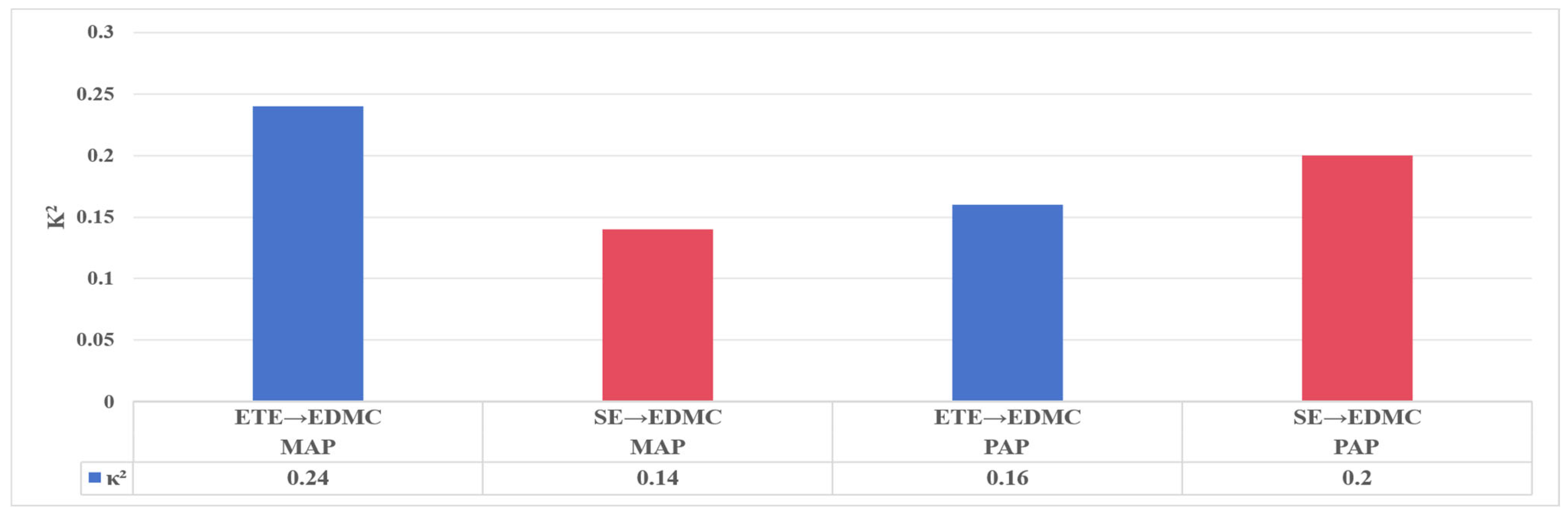
In order to more accurately compare the strength of mediation effect between groups, we further calculated the standardized indirect effect (κ2) of grouping, and the results are summarized in Figure 4. The data showed that for the ETE → EDMC pathway, the effect of map group (κ2 = 0.24) was stronger than that of PAP group (κ2 = 0.16); For SE→EDMC pathway, the effect of PAP group (κ2 = 0.20) was stronger than that of map group (κ2 = 0.14). No significant difference was found in other structural pathways between groups (p > 0.05).

5. Discussion

This study empirically validates a dual-mediation model that elucidates how teaching satisfaction translates into sustainability-oriented ethical competencies within the distinctive context of rapid developing countries and regions worldwide in Hebei Province, China. The findings confirm that both ETE and SE serve as significant mediators, yet with a marked difference in their relative strength: the ETE pathway (β = 0.47, p < 0.01) exerted a significantly stronger mediating effect than the SE pathway (β = 0.38, p < 0.01). [H10a, H10b]. Furthermore, the students’ achievement–goal orientation moderates these mechanisms [H9], with the Mastery-Approach (MAP) students benefiting more from ETE and the Performance-Approach (PAP) students deriving greater benefit from SE-building feedback. These insights offer a nuanced, theory-grounded blueprint for engineering ethics education tailored to contexts where sustainability trade-offs are immediate and salient.
  • The dominant influence mechanism of ETE pathway
The predominance of the ETE effect can be attributed to its congruence with the high-stakes, visible socio-technical dilemmas characteristic of rapidly developing regions. As defined in this study, ETE is characterized by Situated Authenticity, Multi-Sensory Engagement, and an ethical action imperative [Section 2.4]. In a setting where students routinely encounter real-world conflicts, abstract ethical principles become tangible and emotionally salient. This immersive, value-laden experience aligns closely with SDT [4], effectively satisfying students’ needs for autonomy, competence, and relatedness, thereby fostering a deeper internalization of sustainability norms. When ethical stakes are felt, not just discussed, the pathway from satisfaction to internalized competence becomes more potent, a notion supported by situated learning perspectives [5].
  • The complementary role of SE path
Although relatively less dominant in this specific context, the substantial mediation via self-efficacy (≈48%) underscores a complementary psychological mechanism essential for sustained ethical agency. Rooted in SCT, SE represents the belief in one’s capability to execute ethical actions despite constraints [6]. This empowerment is crucial for translating internalized values into persistent behavior, especially beyond the classroom, in future professional settings where engineers face pressures. Therefore, while ETE may be more effective for initial value internalization in high-salience contexts, SE functions as the vital psychological resource that enables students to uphold and act upon these principles over the long term [21], making it an indispensable component of a holistic ethics education.
  • Comparative positioning with previous studies
To place the results of this study in a broader academic context, we selected several key studies for comparison (see Table 5).
When selecting comparative literature, three criteria are used: method relevance (using empirical designs or theoretical frameworks comparable to the dual-path model of this study), construct relevance (focusing on self-efficacy, sustainability attitudes, ethical reasoning, or ability development), and baseline value (providing standardized effect measures such as β, r , or Cohen’s * d * for comparison). In subsequent comparisons, β refers to the standardized path coefficient, r is the Pearson correlation coefficient, and * d * is the Cohen d value (standardized mean deviation).
The differential moderation effect, as visually summarized in Figure 3, clarifies for whom each pathway is most effective. As illustrated in the bar-chart comparison, students with a Mastery-Approach (MAP) orientation, driven by intrinsic growth, show a stronger ETE→EDMC link (β = 0.54 vs. 0.39), as experiential learning aligns with their desire for deep understanding [17]. Conversely, students with a Performance-Approach (PAP) orientation, focused on demonstrating competence, exhibit a stronger SE→SRS link (β = 0.43 vs. 0.29), as clear feedback and visible skill-building bolster their confidence. This finding necessitates a differentiated instructional strategy; curricula should offer open-ended, authentic ETE tasks to engage MAP learners while incorporating structured, feedback-rich exercises to build the SE of PAP learners.
As synthesized in Table 5, prior studies have established independent links between teaching satisfaction, self-efficacy, experiential learning, and ethical outcomes, predominantly in Western or post-materialist contexts. Our study advances this discourse by being among the first to quantitatively compare the dual-pathway effects of ETE and SE on EDMC in a comprehensive model, and tested them in regions where engineering ethics education is under-represented, within an integrated model and to do so within the under-represented context of rapid developing countries and regions worldwide. The finding that ETE contributes 64% of the indirect effect—a proportion notably higher than the effect sizes (β ≈ 0.20–0.38) reported in studies from Western societies—highlights context as a critical boundary condition. This suggests that the pedagogical leverage of embodied experience is amplified where infrastructure dilemmas are first-generation and ethically stark, thereby extending the applicability of SDT and SCT beyond Western, post-materialist educational settings.
Although the model constructed in this study still adopts commonly used patterns from Western engineering ethics and SDE, the outstanding contribution of this study lies in the systematic integration and situational adaptation of these methods in areas where engineering ethics education in Chinese universities is weak. In many developing regions, engineering ethics education is still in its infancy, and the direct transferability of the “Western experience” is often limited by the immediacy of different resources, student motivation characteristics, and sustainability trade-offs. Our research validates the dual pathways of ETE and SE in the engineering education environment in China, providing reference for engineering ethics education in rapidly developing countries and regions like China.
  • Specific teaching inspirations and implementation plans
Based on the findings of this study, that ETE promotes ethical internalization through real-life situations, while SE empowers behavior through structured feedback, we designed and implemented a four week “design defense” studio module (see Table 6) to replace traditional ethics lectures.
This module is designed to closely correspond to the three core features of ETE: the first week focuses on the authenticity of the situation, the second and third weeks run through the mandatory ethical actions, and the fourth week integrates multi-sensory participation. To objectively evaluate the effectiveness of the teaching module, we have expanded the connotation of indicator 11.2.1 of the United Nations Sustainable Development Goals (SDGs) [22], defining it as:
“The change in the proportion of people who can use public transportation within a 10 min walk and live in areas with an annual road injury rate of less than 5/100,000 before and after intervention measures.“
This definition not only focuses on accessibility of transportation, but also integrates the core ethical dimension of safety, requiring students to propose engineering solutions that take into account both. The calculation is based on real data: population distribution (Baidu heat map), road safety (2023 accident public data set of the Municipal Public Security Bureau), and bus network (GIS layer of bus stops). We set an increase of ≥5% in this proportion as the threshold for generating “effective improvement” in the plan, thereby transforming abstract ethical-decision-making ability into quantifiable and verifiable real-world impact indicators.
Finally, as shown in Table 7, each step of the module accurately corresponds to the ethical and sustainability standards of ABET Engineering Certification (2025) and is mapped to specific SDG indicators, forming a curriculum-implementation framework that is both rooted in theory and internationally transferable, providing an operational example for systematically cultivating engineers with ethical judgment and action confidence in complex reality.
  • Limitations and future research
This study has several limitations that warrant consideration. First, the cross-sectional design precludes definitive causal inferences regarding the proposed mediation pathways, despite them being grounded in established theory. Second, the regional specificity of the sample (Hebei Province) limits the generalizability of the findings to other cultural or developmental contexts. Third, a key methodological limitation pertains to uncontrolled potential covariates. The model does not account for confounding variables such as prior ethical training, personality traits, or general academic ability, all of which may jointly influence teaching satisfaction, experiential engagement, self-efficacy, and the ethical outcomes measured. Although the sampling criteria required completion of at least one ethics module to partially mitigate differences in foundational knowledge, this control is insufficient. Future research should explicitly measure and statistically control for these covariates, or preferably, adopt longitudinal or experimental designs to establish clearer causal relationships and minimize confounding bias in the estimated paths. To establish broader applicability, future work should test this model across diverse regions within China and in other rapidly developing countries to identify boundary conditions and advance a more contextually sensitive theory of ethics pedagogy.

6. Conclusions

This study established and validated a dual-mediation model that elucidates the psychological mechanism by which teaching satisfaction promotes the sustainable development of ethical competence among engineering students. The research findings confirm that this influence is transmitted through two different but complementary pathways: Experiential Transformer Engagement (ETE), which promotes deep internalization of moral values, and Self-Efficacy (SE), which establishes the motivational confidence required for moral behavior.
The key finding of this study is the significant difference in strength between the two mediating pathways linking teaching satisfaction to engineering ethics competence, as evidenced in the specific context of Hebei Province, China. The results confirm that the ETE pathway (βββ = 0.47, p < 0.01) is significantly more effective than the SE pathway (βββ = 0.38, p < 0.01). This reaffirms that in resource-limited, rapidly developing environments, internalizing values through situated experiences exerts a greater influence on the development of students’ professional ethics than interventions focused solely on building confidence. Furthermore, this process is moderated by students’ achievement–goal orientation: Mastery-Approach (MAP) students derive greater benefit from ETE, while Performance- Approach (PAP) students respond more strongly to SE-enhancing interventions.
These findings offer critical guidance for regions where engineering ethics education is still emerging. By empirically clarifying the mechanism through which teaching satisfaction transforms into professional competence and social responsibility, this study enables the contextual adaptation of established Western models of engineering ethics education and SDGs higher education frameworks. Therefore, engineering education programs aim to effectively cultivate personnel with ethical competencies geared towards sustainable development, they must systematically construct a dual-path-driven teaching environment. This can be achieved through strategies such as (1) designing embodied teaching modules that integrate authenticity, multi-sensory engagement, and ethical decision-making to activate the value internalization process emphasized by SDT; and (2) embedding structured feedback mechanisms that provide clear benchmarks for ability growth, particularly for performance-oriented students, to consolidate the behavioral execution and persistence emphasized by SCT. Ultimately, this approach serves to develop locally relevant engineering ethics curricula and provides a contextualized, evidence-based way to prepare future engineers who are not only adaptable to local conditions but also equipped with the ethical commitment and practical capability needed to address complex sustainability challenges.

Supplementary Materials

The following supporting information can be downloaded at: https://www.mdpi.com/article/10.3390/su18042114/s1.

Funding

This work was financially supported by the Higher Education Teaching Reform and Practice Project of Hebei Provincial Department of Education, titled “Research on the Implementation and Quality Assurance Mechanism of Ideological and Political Education in Traffic Engineering Courses Based on Collaborative Education Goals” (Project No. 2023GJJG236).

Institutional Review Board Statement

The study was conducted in accordance with the Declaration of Helsinki, and approved by the College Academic Committee of Shijiazhuang Tiedao University (Approval Letter No. CE-2024-03-10).

Informed Consent Statement

Informed consent was obtained from all subjects involved in the study.

Data Availability Statement

All relevant data are within the manuscript; further inquiries can be directed to the corresponding author.

Conflicts of Interest

The author declares no conflicts of interest.

Appendix A. Survey Instruments and Achievement Goal Profiles

The items presented here represent the final English versions administered in the survey. These items were developed through a rigorous process of translation, back-translation, and contextual adaptation to ensure conceptual validity and cultural relevance within the context of transportation engineering education in China.
To ensure alignment between the scale and sustainable education goals, an independent panel comprising two educational experts and one SDG education advisor assessed the relevance of each item to Sustainable Development Goals 4.7, 11.2, and 13.3. The content validity index (CVI) was 0.88, indicating strong content validity and a high degree of correspondence between the scale items and the targeted sustainability-oriented educational objectives.

Appendix A.1. Complete Measurement Scales and Item Wordings

Table A1. Complete item list for first-order latent variables.
Latent Variable (Abbreviation) and Correspondence to Figure 1Item CodeItem Wording (Original Chinese/English Translation)Scale Origin/Adaptation
Experiential Transformer Engagement (ETE)—MediatorETE1 The course provided real-life traffic engineering practice scenarios (e.g., construction sites, labs) for ethical analysis.Self-developed, based on the definition of ETE (Section 2.4)
ETE2I can participate in traffic engineering teaching through multiple senses (seeing, listening, operating).
ETE3During teaching, there is an opportunity to solve practical traffic engineering problems on-site (e.g., congestion analysis, intersection optimization).
Self-Efficacy (SE)—MediatorSE1I have the ability to independently solve ethical dilemmas in transportation engineering.Adapted from Schwarzer and Jerusalem (1995) General Self-Efficacy Scale [13]
SE2I have confidence in expressing ethical views within the team.
SE3I believe that I can practice engineering social responsibility.
Teaching Satisfaction (TS)—Second-Order Exogenous Variable (comprising four first-order dimensions below) Self-developed, grounded in Self-Determination Theory. This second-order factor is composed of the following four dimensions: PVD, SLS, VFO, and ETE (the latter is also a mediator)
Personalized Value Guidance (PVD)—1st-order dim. of TSPVD1Teachers are tolerant of students’ different views on the value of engineering (e.g., balancing efficiency and fairness).Self-developed
PVD2Teachers will combine professional development guidance with ethical requirements in the field of transportation engineering.
PVD3When I am confused about the value selection of engineering, I can receive targeted guidance from teachers.
Social Learning Support (SLS)—1st-order dim. of TSSLS1Group cooperation to complete traffic engineering learning tasks (e.g., course design, research reports) is highly efficient.Self-developed
SLS2I am able to frequently exchange practical experience in transportation engineering with industry mentors.
SLS3The traffic engineering community practice I participated in (e.g., research, promotion) can be recognized.
Visual Feedback of Outcomes (VFO)—1st-order dim. of TSVFO1The presentation of course evaluation results (e.g., homework grading, ability feedback) is clear and easy to understand.Adapted from the Engineering and Science Issues Test (ESIT) [15]
New item added to reflect perceived social value
VFO2 I can clearly perceive my improvement in core competencies in transportation engineering, such as scheme design and problem analysis.
VFO3 I can see the improvement of my social value through professional learning through the ability growth curve.
Engineering Ethical Decision-Making Competence (EDMC)—EndogenousEDMC1When faced with transportation engineering conflicts (e.g., cost and safety), I can prioritize ethical principles.Adapted from the Engineering and Science Issues Test (ESIT) [15]
EDMC2I am able to accurately assess the social and ethical risks of transportation engineering schemes, such as their impact on vulnerable groups.
EDMC3I am able to propose transportation engineering solutions that balance technology and ethics.
EDMC4I am able to explain to the team the reasons for engineering ethics decisions.
Strength of Social Responsibility (SRS)—EndogenousSRS1I believe that traffic engineering design should prioritize ensuring public safety (e.g., pedestrian/non-motorized vehicle safety).Self-developed, aligned with China’s “Guiding Opinions on Ideological and Political Construction of Higher Education Curriculum” and SDG 11.2
SRS2I am willing to invest extra effort in enhancing the social value of transportation engineering, such as green, low-carbon, and barrier-free access.
SRS3I will pay attention to the impact of transportation engineering on the ecological environment.
SRS4I will actively understand the social needs of transportation engineering (e.g., the travel needs of the elderly and disabled).
Note: ETE serves both as a first-order dimension of Teaching Satisfaction (TS) and as a mediator in the structural model. All items were measured on a 5-point Likert scale.

Appendix A.2. Achievement Goal Orientation: Measurement and Grouping

Table A2. Achievement goal orientation scale and K-means clustering results.
Goal-Orientation Type
(Abbreviation)
Sample ItemScale Origin
Mastery-Approach (MAP)“I study hard to master professional knowledge and skills.”Adapted from Elliot and McGregor (2008) Achievement Goal Scale [16]
Performance-Approach (PAP)“I value achieving good grades and rankings in the course.”
Mastery-Avoidance (MAV)“I study hard to avoid not being able to understand important concepts.”
Performance-Avoidance (PAV)“I try my best to avoid underperforming in the course.”
Table A3. K-means clustering results of achievement goal types (N = 327).
Cluster (Type)n%MAP M (SD)PAP M (SD)MAV M (SD)PAV M (SD)
Mastery-Approach9830.04.35 (0.52)3.12 (0.71)2.89 (0.68)2.45 (0.81)
Performance-Approach8526.03.68 (0.61)4.28 (0.48)3.05 (0.74)3.82 (0.65)
Mastery-Avoidance7222.03.95 (0.58)2.95 (0.80)4.41 (0.45)3.15 (0.77)
Performance-Avoidance7222.03.22 (0.75)3.88 (0.62)3.28 (0.70)4.33 (0.50)
Total Sample3271003.86 (0.68)3.52 (0.75)3.38 (0.79)3.35 (0.84)
Note: Bolded values in each row represent the cluster-defining center (highest mean score) for that student group. The clustering variable was the mean score across the four goal orientation scales. The final cluster centers were well-separated (all distances > 1). This grouping was used for the multi-group SEM analysis testing H9 (Section 4.4).

Appendix B. Statistics of Mean (M) and Standard Deviation (SD) of Observational Variables

Table A4. Statistical summary of mean (M) and standard deviation (SD) of observational variables.
Variable TypeObservation Variable Mean (M)Standard Deviation (SD)
Embodied Teaching Experience
ETE
ETE13.870.72
ETE23.750.78
ETE33.620.81
Personalized value guidance
PVD
PVD13.920.68
PVD23.810.73
PVD33.760.75
Social learning support
SLS
SLS13.780.75
SLS23.590.83
SLS33.650.79
Visual feedback of achievements
VFO
VFO13.850.70
VFO23.720.76
VFO33.680.74
Engineering Ethics Decision-Making Capability
EDMC
EDMC13.790.71
EDMC23.680.75
EDMC33.570.80
EDMC43.490.82
Intensity of social responsibility
SRS
SRS13.950.67
SRS23.830.71
SRS33.760.74
SRS43.690.77

Appendix C. Reliability and Validity Test Results of the Measurement Model

Table A5. Reliability and convergence validity analysis results of the measurement model (N = 327).
Latent VariableObserving VariablesStandardization Factor LoadCronbach’s αComposite Reliability (CR)Average Variance Extracted (AVE)
Teaching satisfaction (TS)0.890.920.70
Embodied teaching experienceETE10.850.820.820.68
ETE20.81
ETE30.77
Personalized value guidancePVD10.870.780.780.71
PVD20.83
PVD30.79
Social learning supportSLS10.860.850.850.72
SLS20.82
SLS30.79
Visual feedback of achievementsVFO10.840.760.760.69
VFO20.80
VFO30.78
Self-efficacySE10.820.830.840.70
SE20.81
SE30.79
Engineering-ethics decision-making abilityEDMC10.830.810.810.67
EDMC20.79
EDMC30.76
EDMC40.73
Intensity of social responsibilitySRS10.850.790.790.68
SRS20.81
SRS30.78
SRS40.75
Note: The p-values of all standardized factor loadings are <0.001; teaching satisfaction (TS) is a second-order latent variable, and its reliability and validity indicators are comprehensively calculated from four first-order dimensions.
Table A6. Correlation coefficient matrix of latent variables and discriminant validity test results (N = 327).
Latent VariableMean (M)Standard Deviation (SD)123456
Experiential Transformer Engagement (ETE)3.750.650.82
Personalized value guidance (PVD)3.830.640.51 **0.84
Social learning support (SLS)3.670.720.46 **0.49 **0.85
Visual feedback of achievements (VFO)3.750.670.43 **0.47 **0.52 **0.83
Engineering-ethics decision-making ability (EDMC)3.630.680.58 **0.35 **0.39 **0.41 **0.82
Intensity of social responsibility (SRS)3.810.660.53 **0.45 **0.44 **0.48 **0.61 **0.82
Note: (1) The values bolded on the diagonal represent the square root of the average variance extracted (AVE) of each latent variable. (2) The values on non-diagonal lines are the Pearson correlation coefficients between latent variables. (3) ** p < 0.01.
Table A7. KMO test and Bartlett’s sphericity test.
Inspection IndicatorsInspection ValuesReference StandardsInspection Results
KMO value0.83>0.7suitable for factor analysis
Bartlett’s sphericity testχ2 = 1826.37, df = 190, p < 0.001*** p < 0.001significant, suitable for factor analysis
Note: *** indicates p < 0.001, statistically significant.
Table A8. Eigenvalues, variance contribution rates, and cumulative variance contribution rates of each factor.
Factor NumberInitial EigenvalueVariance Contribution Rate (%)Cumulative Variance Contribution Rate (%)Characteristic Values After RotationVariance Contribution Rate After Rotation (%)Cumulative Variance Contribution Rate After Rotation (%)
16.5529.7729.776.2431.2031.20
25.7426.0955.865.7428.7059.90
34.7021.3677.224.7023.5083.40
43.3215.0992.313.3216.60100.00
50.894.0596.36---
Note: After orthogonal rotation using the maximum variance method, the variance-contribution rates of the four factors were reallocated to 31.20%, 28.70%, 23.50%, and 16.60%, with a cumulative variance explanation rate of 92.31%.
Table A9. Factor load matrix after rotation (absolute load value >0.5).
Observing VariablesFactor 1
(ETE)
Factor 2
(PVD)
Factor 3
(SLS)
Factor 4 (VFO)Common Factor Variance (h2)
ETE10.820.150.120.100.71
ETE20.790.180.140.130.68
ETE30.750.210.160.150.64
PVD10.160.850.130.110.75
PVD20.190.810.150.140.70
PVD30.200.780.170.160.69
SLS10.130.170.830.120.72
SLS20.150.190.800.160.69
SLS30.170.210.780.180.67
VFO10.110.140.150.840.73
VFO20.130.160.180.800.68
VFO30.150.180.200.770.65
Note: The bold values in the table represent the highest factor loadings of each observed variable on each factor, indicating that the variable mainly belongs to the corresponding factor dimension.

Appendix D. Structural Model and Hypothesis Testing Results

Table A10. Fit of structural equation model for multi-index comprehensive evaluation.
Fitting IndicatorsIndicator SymbolReference StandardThe Results of this StudyAdaptation Judgment
Chi-square–degree of freedom ratioχ2/df1.0~3.02.17adaptation
Goodness-of-fit indexGFI>0.90.92adaptation
Adjusted goodness-of-fit indexAGFI>0.80.88adaptation
Comparative fitting indexCFI>0.90.94adaptation
Standardized fitting indexNFI>0.90.91adaptation
Tucker–Lewis indexTLI>0.90.93adaptation
Root mean square of approximation errorRMSEA<0.080.062adaptation
Note: The AGFI value is 0.88, slightly below the strict standard of 0.9, but still above the acceptable level of 0.85. Considering the high complexity of the model and the good performance of other indicators, this fitting level is within an acceptable range.
Table A11. Statistics of structural model inspection results.
Assuming the PathPath Coefficient
(β)
Standard Error
(SE)
CR Valuep-ValueAssuming Verification Results
H1: TS→ETE0.580.078.29<0.001Support
H2: TS→EDMC0.150.062.50<0.05Support
H3: TS→SRS0.130.062.17<0.05Support
H4: ETE→EDMC0.470.085.88<0.001Support
H5: ETE→SRS0.420.085.25<0.001Support
H6: TS→SE0.520.077.43<0.001Support
H7: SE→EDMC0.380.075.43<0.001Support
H8: SE→SRS0.350.075.00<0.001Support
H9: mediating effect----Support

Appendix E. Results of Model Testing for Unmeasured Latent Method Factor (ULMF)

Table A12. Comparison of fit between the baseline measurement model and the model incorporating ULMF (N = 327).
Fit IndicesBaseline Measurement Model (Six-Factor Model)Model with Unmeasured Latent Method Factor (ULMF)
(Six-Factor + Method Factor)
Change Value (Δ)Criteria for Evaluation
χ2 (df)386.15 (200)352.71 (180)--
CFI0.9410.949+0.008Δ CFI < 0.01 [23]
TLI0.9280.934+0.006-
RMSEA [90% CI]0.057 [0.049, 0.065]0.055 [0.047, 0.063]−0.002-
SRMR0.0420.038−0.004-
Table A13. Stability of standardized factor loadings of key constructs in the Unmeasured Latent Method Factor (ULMF) model.
Observed VariablesFactor Loadings (λ) in the Baseline ModelFactor Loadings (λ) in the ULMF ModelChange in Factor Loadings
(Δ λ)
ULMF Method Factor Loadings
(λM)
Significance (p-Value)
ETE10.850.83−0.020.120.063
ETE20.810.79−0.020.100.087
ETE30.770.76−0.010.060.221
SE10.820.81−0.010.050.285
SE20.810.80−0.010.070.194
SE30.790.78−0.010.040.371
EDMC10.830.82−0.010.070.172
EDMC20.790.78−0.010.060.241
EDMC30.760.75−0.010.050.309
EDMC40.730.72−0.010.040.398
SRS10.850.84−0.010.080.132
SRS20.810.80−0.010.060.257
SRS30.780.77−0.010.050.331
SRS40.750.74−0.010.040.410
Notes: (1) In the Unmeasured Latent Method Factor (ULMF) model, the method factor was specified to be uncorrelated with all substantive constructs (ETE, SE, EDMC, SRS), and its loadings were freely estimated across all observed variables. (2) Model fit comparison: Following the incorporation of ULMF, the improvement in CFI (Δ CFI = 0.008) fell below the critical threshold of 0.01, indicating that common method variance (CMV) did not exert a substantive influence on the model’s covariance structure [23]. (3) Stability of factor loadings: The standardized factor loadings of all observed variables on their respective substantive constructs remained stable after ULMF inclusion (absolute changes ≤ 0.02 for all), and all loadings retained high significance (p < 0.001; omitted from the table for conciseness). (4) Loadings of the method factor were generally small (ranging from 0.04 to 0.12), and the vast majority were non-significant (p > 0.05), suggesting the absence of a salient common method factor. Conclusion: Synthesizing the results of Harman’s single-factor test, the marker-variable method, and ULMF analysis, the risk of common method bias in this study is at an acceptable level and unlikely to pose a substantive threat to the research conclusions.

References

  1. World Health Organization (WHO). Global Status Report on Road Safety 2023; World Health Organization: Geneva, Switzerland, 2023; Available online: https://www.who.int/publications/i/item/9789240086517 (accessed on 2 January 2025).
  2. Jaramillo, P.; Kahn Ribeiro, S.; Newman, P.; Dhar, S.; Diemuodeke, O.E.; Kajino, T.; Lee, D.S.; Nugroho, S.B.; Ou, X.; Hammer Strømman, A.; et al. Transport. In Climate Change 2022: Mitigation of Climate Change, Contribution of Working Group III to the Sixth Assessment Report of the Intergovernmental Panel on Climate Change; Shukla, P.R., Skea, J., Slade, R., Al Khourdajie, A., van Diemen, R., McCollum, D., Eds.; Cambridge University Press: Cambridge, UK, 2022; pp. 1049–1160. [Google Scholar]
  3. United Nations. The Sustainable Development Goals Report 2023: Special Edition; United Nations Department of Economic and Social Affairs: New York, NY, USA, 2023; Available online: https://unstats.un.org/sdgs/report/2023/The-Sustainable-Development-Goals-Report-2023.pdf (accessed on 3 January 2025).
  4. Ryan, R.M.; Deci, E.L. Intrinsic and Extrinsic Motivation from a Self-Determination Theory Perspective: Definitions, Theory, Practices, and Future Directions. Contemp. Educ. Psychol. 2020, 61, 101860. [Google Scholar] [CrossRef]
  5. Kolb, D.A. Experiential Learning: Experience as the Source of Learning and Development, 2nd ed.; Pearson: London, UK, 2015. [Google Scholar]
  6. Bandura, A. Self-Efficacy: The Exercise of Control; W.H. Freeman: New York, NY, USA, 1997. [Google Scholar]
  7. Teather, A.; Etterson, J. Value-Action Gaps Between Sustainability Behaviors, Knowledge, Attitudes and Engagement in Campus and Curricular Activities Within a Cohort of Gen Z University Students. 2023. Available online: https://www.susted.com/wordpress/content/value-action-gaps-between-sustainability-behaviors-knowledge-attitudes-and-engagement-in-campus-and-curricular-activities-within-a-cohort-of-gen-z-university-students_2023_04/ (accessed on 3 January 2025).
  8. Walumbwa, F.O.; Mayer, D.M.; Wang, P.; Wang, H.; Workman, K.; Christensen, A.L. Linking Ethical Leadership to Employee Performance: The Roles of Leader-Member Exchange, Self-Efficacy, and Organizational Identification. Organ. Behav. Hum. Decis. Process. 2011, 115, 204–213. [Google Scholar] [CrossRef]
  9. Fini, E.H.; Awadallah, F.; Parast, M.M.; Abu-Lebdeh, T. The Impact of Project-Based Learning on Improving Student Learning Outcomes of Sustainability Concepts in Transportation Engineering Courses. Eur. J. Eng. Educ. 2018, 43, 473–488. [Google Scholar] [CrossRef]
  10. Wiek, A.; Withycombe, L.; Redman, C.L. Key competencies in sustainability: A reference framework for academic program development. Sustain. Sci. 2011, 6, 203–218. [Google Scholar] [CrossRef]
  11. Elhaffar, G.; Durif, F.; Dubé, L. Towards closing the attitude-intention-behavior gap in green consumption: A narrative review of the literature and an overview of future research directions. J. Clean. Prod. 2020, 275, 122556. [Google Scholar] [CrossRef]
  12. Stajkovic, A.D.; Luthans, F. Self-efficacy and work-related performance: A meta-analysis. Psychol. Bull. 1998, 124, 240–261. [Google Scholar] [CrossRef]
  13. Schwarzer, R.; Jerusalem, M. Generalized self-efficacy scale. In Measures in Health Psychology: A User’s Portfolio. Causal and Control Beliefs; Weinman, J., Wright, S., Johnston, M., Eds.; NFER-NELSON: Windsor, UK, 1995; pp. 35–37. [Google Scholar]
  14. Elliot, A.J.; Murayama, K. On the measurement of achievement goals: Critique, illustration, and application. J. Educ. Psychol. 2008, 100, 613–628. [Google Scholar] [CrossRef]
  15. Borenstein, J.; Drake, M.J.; Kirkman, R.; Swann, J.L. The Engineering and Science Issues Test (ESIT): A discipline-specific approach to assessing moral judgment. Sci. Eng. Ethics 2010, 16, 387–407. [Google Scholar] [CrossRef] [PubMed]
  16. Elliot, A.J.; McGregor, H.A. A 2 × 2 Achievement Goal Framework. J. Pers. Soc. Psychol. 2001, 80, 501–519. [Google Scholar] [CrossRef] [PubMed]
  17. Hu, L.; Bentler, P.M. Cutoff criteria for fit indexes in covariance structure analysis: Conventional criteria versus new alternatives. Struct. Equ. Model. 1999, 6, 1–55. [Google Scholar] [CrossRef]
  18. Preacher, K.J.; Hayes, A.F. Asymptotic and resampling strategies for assessing and comparing indirect effects in multiple mediator models. Behav. Res. Methods 2008, 40, 879–891. [Google Scholar] [CrossRef] [PubMed]
  19. Preacher, K.J.; Kelley, K. Effect size measures for mediation models: Quantitative strategies for communicating indirect effects. Psychol. Methods 2011, 16, 93–115. [Google Scholar] [CrossRef] [PubMed]
  20. Podsakoff, P.M.; MacKenzie, S.B.; Podsakoff, N.P. Sources of method bias in social science research and recommendations on how to control it. Annu. Rev. Psychol. 2012, 63, 539–569. [Google Scholar] [CrossRef] [PubMed]
  21. Milligan, M.K.J.; Brackin, P. ABET update: Proposed revisions to EAC general criteria 3 and 5. In Proceedings of the 2016 EDI, San Francisco, CA, USA, 29 March–1 April 2016. [Google Scholar]
  22. Barkaoui, A.; Ouldasine, R.; Bettaibi, S.; Jamart-Gregoire, B.; Ezbakhe, A. A streamlined and adaptive approach for accrediting a French education system program by ABET-EAC. Front. Educ. 2024, 9, 1405653. [Google Scholar] [CrossRef]
  23. Nakad, M.; Gardelle, L.; Abboud, R.J. A Systematic Review of the Different Methods Assessing the Integration of Sustainability in Engineering Curricula. Sustainability 2024, 16, 4549. [Google Scholar] [CrossRef]
Figure 1. Structural model of the dual-mediation effect of teaching satisfaction on sustainability-oriented ethical outcomes (*** p < 0.001).
Sustainability 18 02114 g001
Figure 2. Standardized indirect effects (κ2) of ETE vs. SE on sustainability-oriented ethics outcomes.
Sustainability 18 02114 g002
Figure 3. Multi-group SEM results for Mastery-Approach and Performance-Approach students. (Note: MAP, n = 98, PAP, n = 85).
Sustainability 18 02114 g003
Figure 4. Moderated mediation: κ2 comparison between Mastery-Approach (MAP) and Performance-Approach (PAP) students.
Sustainability 18 02114 g004
Table 1. Links between SDG and key variables in this study.
VariableSDG TargetMechanismEmpirical Proxy
EDMC11.2 “Access to safe, affordable, accessible transport”Prioritization of safety over cost in design dilemmasScore on “prioritize pedestrian safety” item
SRS13.3 “Climate change education”Willingness to invest extra effort in low-carbon solutionsScore on “greenhouse-gas awareness” item
ETE4.7 “Education for sustainable development”Exposure to real-world socio-technical trade-offsFactor score on “authentic transport project” items
SE4.4 “Skills for decent jobs”Confidence to voice ethical concerns in multidisciplinary teamsScore on “express ethics in team” item
Table 2. Mapping of research questions to hypotheses.
Research Question (RQ)Corresponding Hypothesis (H)Purpose
RQ1: Does teaching satisfaction significantly enhance students’ EDMC and SRS?H1, H2 (Direct effects: TS→ EDMC/SRS)To establish the baseline relationship.
RQ2: Do ETE and SE mediate these relationships?H3–H8 (Mediation paths: TS → ETE/SE → EDMC/SRS)To test the dual-mediation mechanisms.
RQ3: Whether achievement–goal model has moderating mediating effect?H9 (Moderated mediation)To examine how student motivation types influence the efficacy of each path.
Comparative strength of pathwaysH10a, H10b (Contrast of indirect effects)To determine the relative importance of ETE vs. SE in the given context.
Table 3. Reliability and sample items of measurement scales.
ConstructNo. of ItemsExample itemCronbach’s αSource
Experiential Transformer Engagement (ETE)3“The course provided real-world transport sites (e.g., intersections, construction zones) for ethical analysis.”0.82Adapted from Kolb (2015) [5]
Self-Efficacy (SE)3“I feel confident expressing ethical concerns during team design meetings.”0.83Schwarzer and Jerusalem (1995) [13]
Engineering Ethical Decision-Making Competence (EDMC)4“When cost and safety conflict, I can prioritise ethical principles.”0.81ESIT, α = 0.84 (Borenstein et al., 2010) [15]
Strength of Social Responsibility (SRS)4“I am willing to spend extra time improving the social value of transport projects (e.g., pedestrian accessibility).”0.79SDG 11.2 aligned
Teaching Satisfaction (TS)12 (4 dims)“I can see my ethical reasoning ability growing through visible feedback.”0.89Second-order factor
Note: Proportions do not sum to 100% because the two mediators are correlated (r = 0.53) and each is calculated against the total effect. All items were rated on a 5-point Likert scale (1 = strongly disagree, 5 = strongly agree). For the complete item wordings, descriptive statistics, and full validity analyses (including CFA, CR, AVE, and discriminant validity), please refer to Appendix A, Appendix B and Appendix C. Confirmatory factor analysis (CFA) supported configural and metric invariance across gender and university types (Δ CFI < 0.01).
Table 4. Standardized indirect effects and 95% bias-corrected confidence intervals (5000 bootstraps).
PathPoint Estimate95% CIProportion of Total Effect (%)
TS→ ETE→ EDMC0.27[0.183, 0.362]64.3
TS→ SE → EDMC0.20[0.134, 0.281]47.6
TS→ ETE → SRS0.24[0.156,0.331]64.9
TS → SE → SRS0.18[0.121, 0.254]48.7
Note: Proportions do not sum to 100% because mediators are correlated and total effects include small direct paths.
Table 5. Selected comparative studies on pathways to ethical and sustainability outcomes in educational and professional contexts.
StudyCountry/TypeDisciplineSample Size
(N)
Research DesignKey Path/RelationshipCoefficient Value
Teather and Etterson (2023) [7]Australia/Cross-sectionalHigher Education472SurveyValues–behavior gap (Attitude Engagement)r = 0.29
Walumbwa et al. (2011) [8]USA/MultilevelOrganizational Behavior336Field studySelf-efficacy→Job performanceβ = 0.38
Fini et al. (2018) [9]USA/Higher EducationEngineering Education127Quasi-experimentalProject-based Learning → Sustainability Learning Outcomes*d* = 0.72 (Cohen’s d)
Wiek et al. (2011) [10]International/FrameworkSustainability Science-TheoreticalKey competencies Action (estimated)-
This studyChina/SEMEngineering Education327Cross-sectionalETE → EDMC
SE → EDMC
β = 0.47 **
β = 0.38 **
Note: β represents the standardized path coefficient, r represents the Pearson correlation coefficient, and *d* represents Cohen’s d value (standardized mean deviation). ** Expressing p < 0.01, the selected study provides a comparative effect measure or theoretical benchmark related to the dual pathway model. All coefficients are derived from the cited original research. For detailed definitions and explanations, please refer to Section 5.
Table 6. The FIRST ABET-EAC-2025-aligned, SDG-indexed 4-week ethics-studio module for transportation engineering: translating ETE principles into measurable outcomes.
WeekLearning TaskEthical Dilemma EmbeddedDeliverableMastery-Oriented Rubric
(Excerpt)
1Field audit of informal-settlement intersectionCompeting demands: bus-lane vs. vendor relocation5 min video log“Identify at least two stakeholder value conflicts with evidence”
2Generate three design alternativesTrade-off: cost, safety, equityDesign memo“Use SDG 11.2 indicator to justify priority ranking”
3Public consultation role-playVoice of elderly and disabled residentsReflection journal“Document how feedback altered your weighting of safety vs. cost”
4Design-and-defense panelExternal examiner asks “Would you relocate 50 households?”Slide deck and Q & A“Defend final decision with at least two ethical theories”
Note: The module’s impact is assessed by the change in the SDG 11.2.1-based indicator described in the main text.
Table 7. Mapping the 4-week “design-and-defense” studio onto ABET EAC 2025 ethics and sustainability criteria.
Studio WeekEmbedded Ethical DilemmaDeliverableABET 2025 CriterionMapped SDG Indicator
1Bus-lane vs. vendor relocation5 min video log 3.f. “recognize ethical conflicts”11.2.1% population with safe access
2Cost–safety–equity trade-offDesign memo3.h. “assess sustainability impacts”11.2.1 + 13.2.2 CO2 reduction
3Elderly and disabled consultationReflection journal3.g. “listen to diverse stakeholders”11.7.1 public-space inclusion index
4External examiner defense Slide deck and Q&A3.i. “justify decisions using ethical theories” 11.2.1 post-intervention safety audit
Disclaimer/Publisher’s Note: The statements, opinions and data contained in all publications are solely those of the individual author(s) and contributor(s) and not of MDPI and/or the editor(s). MDPI and/or the editor(s) disclaim responsibility for any injury to people or property resulting from any ideas, methods, instructions or products referred to in the content.