_Li.png)
E-Servicescape and Online Travel Platform Outcomes: The Moderating Role of E-Familiarity

 ,
,  ,
,  ,
,  ,
,  ,
,  and
and 
Abstract
1. Introduction
- How does ES influence FE, PA, and trust?
- What are the downstream effects of these factors on WL and e-WOM?
- How does EF moderate the relationships between ES and these outcomes?
2. Theoretical Background
3. Conceptual Model
3.1. E-Servicescape
3.2. Flow Experience
3.3. Positive Affect
3.4. Trust
3.5. E-Familiarity
4. Methods
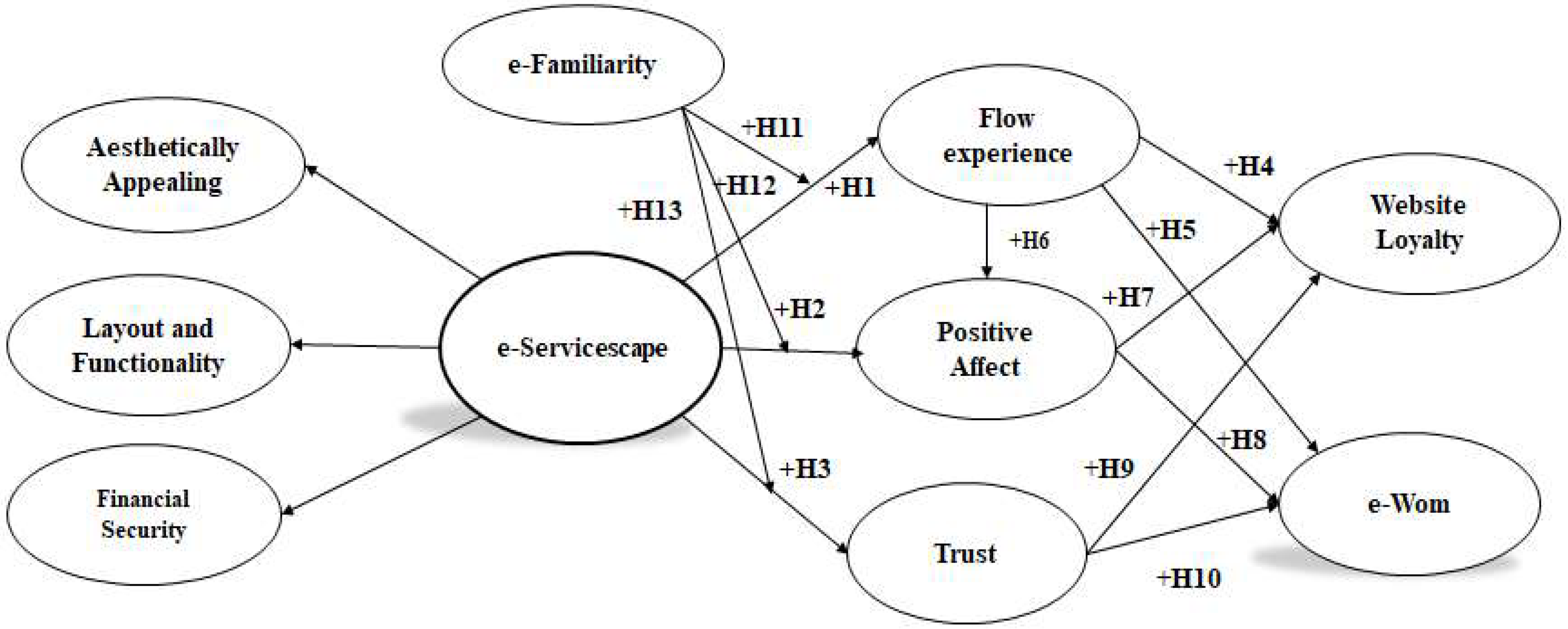
4.1. Research Model
4.2. Sample and Data Collection
4.3. Measures
4.4. Data Analysis
5. Findings
5.1. Demographic Features of Participants
5.2. Measurement Model
5.3. Structural Model
5.4. Results of Moderating Effect
6. Discussion, Conclusion and Implications
6.1. The Effect of ES on FE
6.2. The Effect of ES on Trust
6.3. The Moderating Role of EF in the ES–FE Relationship
6.4. Theoretical Contributions
6.5. Managerial Implications
6.6. Limitations
6.7. Directions for Future Research
Author Contributions
Funding
Institutional Review Board Statement
Informed Consent Statement
Data Availability Statement
Conflicts of Interest
References
- Bitner, M.J. Servicescapes: The Impact of Physical Surroundings on Customers and Employees. J. Mark. 1992, 56, 57–71. [Google Scholar] [CrossRef] [Scilit]
- Harris, L.C.; Goode, M.M.H. Online Servicescapes, Trust, and Purchase Intentions. J. Serv. Mark. 2010, 24, 230–243. [Google Scholar] [CrossRef] [Scilit]
- Dutta, A. Impact of Electronic Servicescape of Online Gaming on Customer Engagement. J. Electron. Commer. Organ. 2020, 18, 49–63. [Google Scholar] [CrossRef] [Scilit]
- Wu, L.; Shen, H.; Fan, A.; Mattila, A.S. The Impact of Language Style on Consumers′ Reactions to Online Reviews. Tour. Manag. 2017, 59, 590–596. [Google Scholar] [CrossRef] [Scilit]
- Yadav, R.; Mahara, T. Exploring the Role of E-Servicescape Dimensions on Customer Online Shopping. J. Electron. Commer. Organ. 2020, 18, 53–73. [Google Scholar] [CrossRef] [Scilit]
- Gefen, D.; Karahanna, E.; Straub, D.W. Trust and TAM in Online Shopping: An Integrated Model1. MIS Q. 2003, 27, 51–90. [Google Scholar] [CrossRef] [Scilit]
- Park, J.-Y.; Back, R.M.; Bufquin, D.; Shapoval, V. Servicescape, Positive Affect, Satisfaction and Behavioral Intentions: The Moderating Role of Familiarity. Int. J. Hosp. Manag. 2019, 78, 102–111. [Google Scholar] [CrossRef] [Scilit]
- Lee, S.; Jeong, M. Effects of E-Servicescape on Consumers’ Flow Experiences. J. Hosp. Tour. Technol. 2012, 3, 47–59. [Google Scholar] [CrossRef] [Scilit]
- Huang, D.; Li, Z.; Mou, J.; Liu, X. Effects of Flow on Young Chinese Consumers’ Purchase Intention: A Study of e-Servicescape in Hotel Booking Context. Inf. Technol. Tour. 2017, 17, 203–228. [Google Scholar] [CrossRef] [Scilit]
- Boukabiya, A.; Outtaj, B. The Impact of E-Servicescape on the Flow and Purchase Intention of Online Consumers: Quantitative Analysis of B to C e-Commerce Stores in Morocco. Int. J. Account. Financ. Audit. Manag. Econ. 2021, 2, 200–219. [Google Scholar]
- Alipoor, V.; Professor, A.; Reza Sa, M.; Golshan, G. Investigating the Impact of E-Servicescape Dimensions and Experience & Risk Factors on E-WOM: Mediating Role of Trust. J. Bus. Intell. Manag. Stud. 2022, 11, 87–114. [Google Scholar]
- Safira, S.N.; Nirawati, L. The Influence of E-Servicescape, E-Trust, and E-Service Quality on Customer Satisfaction on the E-Commerce. J. Manaj. Bisnis 2024, 11, 1530–1543. [Google Scholar] [CrossRef] [Scilit]
- Wichitsathian, S.; Suvittawat, A. The Mediating Roles of Service Experience and Satisfaction: How Servicescape Influences Loyalty and Electronic Word-of-Mouth. Adm. Sci. 2025, 15, 485. [Google Scholar] [CrossRef] [Scilit]
- Li, Z.; Tulcanaza-Prieto, A.B.; Lee, C.W. Effect of E-Servicescape on Emotional Response and Revisit Intention in an Internet Shopping Mall. J. Theor. Appl. Electron. Commer. Res. 2024, 19, 2030–2050. [Google Scholar] [CrossRef] [Scilit]
- Amer, S.M. The Effect of E-Servicescape, Website Trust and Perceived Value on Consumer Online Booking Intentions: The Moderating Role of Online Booking Experience. Int. Bus. Res. 2021, 14, 133. [Google Scholar] [CrossRef] [Scilit]
- Zentner, H.; Gračan, D.; Barkiđija Sotošek, M. Digital Business Models in the Hospitality Sector: Comparing Hotel Bookings with Yacht Charter Bookings. Sustainability 2022, 14, 12755. [Google Scholar] [CrossRef] [Scilit]
- Mehrabian, A.; Russell, J.A. An Approach to Environmental Psychology; MIT Press: Cambridge, MA, USA, 1974. [Google Scholar]
- Erul, E.; Karacabey, F.A.; Woosnam, K.M.; Koc, E. Rethinking Stimulus-Organism-Response Theory for Residents’ Behaviour in Tourism. Curr. Issues Tour. 2024, 2024, 1–17. [Google Scholar] [CrossRef] [Scilit]
- Venkatesh, A. Cybermarketscapes and Consumer Freedoms and Identities. Eur. J. Mark. 1998, 32, 664–676. [Google Scholar] [CrossRef] [Scilit]
- Koernig, S.K. E-scapes: The Electronic Physical Environment and Service Tangibility. Psychol. Mark. 2003, 20, 151–167. [Google Scholar] [CrossRef] [Scilit]
- Vilnai-Yavetz, I.; Rafaeli, A. Aesthetics and Professionalism of Virtual Servicescapes. J. Serv. Res. 2006, 8, 245–259. [Google Scholar] [CrossRef] [Scilit]
- Alcántara-Pilar, J.M.; Del Barrio-García, S.; Porcu, L.; Crespo-Almendros, E. Language as a Cultural Vessel in Online Servicescapes: Its Impact on Consumers’ Perceived Risk, Attitudes, and Behavioural Intentions. J. Consum. Behav. 2017, 16, E61–E75. [Google Scholar] [CrossRef] [Scilit]
- Kuhn, S.W.; Spies, H.; Petzer, D.J. Online Servicescape Dimensions as Predictors of Website Trust in the South African Domestic Airline Industry. South. Afr. Bus. Rev. 2019, 19, 44–71. [Google Scholar] [CrossRef] [Scilit]
- Ballantyne, D.; Nilsson, E. All That Is Solid Melts into Air: The Servicescape in Digital Service Space. J. Serv. Mark. 2017, 31, 226–235. [Google Scholar] [CrossRef] [Scilit]
- Teng, H.-J.; Ni, J.-J.; Chen, H.-H. Relationship between E-Servicescape and Purchase Intention among Heavy and Light Internet Users. Internet Res. 2018, 28, 333–350. [Google Scholar] [CrossRef] [Scilit]
- Bilgihan, A.; Nusair, K.; Okumus, F.; Cobanoglu, C. Applying Flow Theory to Booking Experiences: An Integrated Model in an Online Service Context. Inf. Manag. 2015, 52, 668–678. [Google Scholar] [CrossRef] [Scilit]
- Gao, L.; Bai, X. Online Consumer Behaviour and Its Relationship to Website Atmospheric Induced Flow: Insights into Online Travel Agencies in China. J. Retail. Consum. Serv. 2014, 21, 653–665. [Google Scholar] [CrossRef] [Scilit]
- Ali, F. Hotel Website Quality, Perceived Flow, Customer Satisfaction and Purchase Intention. J. Hosp. Tour. Technol. 2016, 7, 213–228. [Google Scholar] [CrossRef] [Scilit]
- Eroglu, S.A.; Machleit, K.A.; Davis, L.M. Empirical Testing of a Model of Online Store Atmospherics and Shopper Responses. Psychol. Mark. 2003, 20, 139–150. [Google Scholar] [CrossRef] [Scilit]
- Ali, F.; Amin, M.; Ryu, K. The Role of Physical Environment, Price Perceptions, and Consumption Emotions in Developing Customer Satisfaction in Chinese Resort Hotels. J. Qual. Assur. Hosp. Tour. 2016, 17, 45–70. [Google Scholar] [CrossRef] [Scilit]
- Tran, G.A.; Strutton, D. Comparing Email and SNS Users: Investigating e-Servicescape, Customer Reviews, Trust, Loyalty and E-WOM. J. Retail. Consum. Serv. 2020, 53, 101782. [Google Scholar] [CrossRef] [Scilit]
- Lee, S.A.; Jeong, M.; Jeon, M.M. Effects of Experiential Stimuli on Customers’ Responses: An Example of Bed and Breakfast Websites. J. Hosp. Tour. Technol. 2016, 7, 390–404. [Google Scholar] [CrossRef] [Scilit]
- da Silva de Matos, N.M.; de Oliveira Duarte, P.A.; de Sá, E.S. Once-in-a-Lifetime Leisure Experiences (OLLE): The Role of Flow, Novelty, and Interpersonal Interaction on Tourists’ Satisfaction and Memories. J. Vacat. Mark. 2024, 30, 615–632. [Google Scholar] [CrossRef] [Scilit]
- Karasakal, S. Effects of Flow Experience on Satisfaction: An Examination on Vacation Experience. Anatolia Tur. Araştırmaları Derg. 2020, 31, 63–73. [Google Scholar] [CrossRef] [Scilit]
- Kim, M.; Thapa, B. Perceived Value and Flow Experience: Application in a Nature-Based Tourism Context. J. Destin. Mark. Manag. 2018, 8, 373–384. [Google Scholar] [CrossRef] [Scilit]
- Sann, R.; Luecha, P.; Rueangchaithanakun, R. The Effects of Virtual Reality Travel on Satisfaction and Visiting Intention Utilizing an Extended Stimulus-Organism-Response Theory: Perspectives from Thai Tourists. J. Hosp. Tour. Insights 2024, 7, 2684–2703. [Google Scholar] [CrossRef] [Scilit]
- An, S.; Choi, Y.; Lee, C.-K. Virtual Travel Experience and Destination Marketing: Effects of Sense and Information Quality on Flow and Visit Intention. J. Destin. Mark. Manag. 2021, 19, 100492. [Google Scholar] [CrossRef] [Scilit]
- Chen, X.; Cheng, Z.; Kim, G.-B. Make It Memorable: Tourism Experience, Fun, Recommendation and Revisit Intentions of Chinese Outbound Tourists. Sustainability 2020, 12, 1904. [Google Scholar] [CrossRef] [Scilit]
- Rodríguez-Torrico, P.; San José Cabezudo, R.; San-Martín, S.; Trabold Apadula, L. Let It Flow: The Role of Seamlessness and the Optimal Experience on Consumer Word of Mouth in Omnichannel Marketing. J. Res. Interact. Mark. 2023, 17, 1–18. [Google Scholar] [CrossRef] [Scilit]
- Zhang, M.; Hu, M.; Guo, L.; Liu, W. Understanding Relationships among Customer Experience, Engagement, and Word-of-Mouth Intention on Online Brand Communities. Internet Res. 2017, 27, 839–857. [Google Scholar] [CrossRef] [Scilit]
- Cyr, D.; Hassanein, K.; Head, M.; Ivanov, A. The Role of Social Presence in Establishing Loyalty in E-Service Environments. Interact. Comput. 2007, 19, 43–56. [Google Scholar] [CrossRef] [Scilit]
- Anderson, R.E.; Srinivasan, S.S. E-satisfaction and E-loyalty: A Contingency Framework. Psychol. Mark. 2003, 20, 123–138. [Google Scholar] [CrossRef] [Scilit]
- van Noort, G.; Voorveld, H.A.M.; van Reijmersdal, E.A. Interactivity in Brand Web Sites: Cognitive, Affective, and Behavioral Responses Explained by Consumers’ Online Flow Experience. J. Interact. Mark. 2012, 26, 223–234. [Google Scholar] [CrossRef] [Scilit]
- Guo, Z.; Xiao, L.; Van Toorn, C.; Lai, Y.; Seo, C. Promoting Online Learners’ Continuance Intention: An Integrated Flow Framework. Inf. Manag. 2016, 53, 279–295. [Google Scholar] [CrossRef] [Scilit]
- Díaz-García, A.; González-Robles, A.; Mor, S.; Mira, A.; Quero, S.; García-Palacios, A.; Baños, R.M.; Botella, C. Positive and Negative Affect Schedule (PANAS): Psychometric Properties of the Online Spanish Version in a Clinical Sample with Emotional Disorders. BMC Psychiatry 2020, 20, 56. [Google Scholar] [CrossRef] [Scilit]
- Watson, D.; Clark, L.A.; Tellegen, A. Development and Validation of Brief Measures of Positive and Negative Affect: The PANAS Scales. J. Pers. Soc. Psychol. 1988, 54, 1063–1070. [Google Scholar] [CrossRef] [PubMed]
- Ehlers, L.; van Schalkwyk, S. Product Videos “Gone Viral”: Exploring the Role of Content, Positive Affect and Social Motivations. J. Commun. Sci. South. Afr. 2021, 40, 43–62. [Google Scholar] [CrossRef] [Scilit]
- Bilgihan, A.; Okumus, F.; Nusair, K.; Bujisic, M. Online Experiences: Flow Theory, Measuring Online Customer Experience in e-Commerce and Managerial Implications for the Lodging Industry. Inf. Technol. Tour. 2014, 14, 49–71. [Google Scholar] [CrossRef] [Scilit]
- Su, L.; Hsu, M.K.; Marshall, K.P. Understanding the Relationship of Service Fairness, Emotions, Trust, and Tourist Behavioral Intentions at a City Destination in China. J. Travel Tour. Mark. 2014, 31, 1018–1038. [Google Scholar] [CrossRef] [Scilit]
- Beatty, P.; Reay, I.; Dick, S.; Miller, J. Consumer Trust in E-Commerce Web Sites. ACM Comput. Surv. 2011, 43, 1–46. [Google Scholar] [CrossRef] [Scilit]
- McKnight, D.H.; Choudhury, V.; Kacmar, C. Developing and Validating Trust Measures for E-Commerce: An Integrative Typology. Inf. Syst. Res. 2002, 13, 334–359. [Google Scholar] [CrossRef] [Scilit]
- Hwang, Y.; Kim, D.J. Customer Self-Service Systems: The Effects of Perceived Web Quality with Service Contents on Enjoyment, Anxiety, and e-Trust. Decis. Support Syst. 2007, 43, 746–760. [Google Scholar] [CrossRef] [Scilit]
- Gefen, D.; Straub, D.W. Consumer Trust in B2C E-Commerce and the Importance of Social Presence: Experiments in e-Products and e-Services. Omega 2004, 32, 407–424. [Google Scholar] [CrossRef] [Scilit]
- Delgado-Ballester, E.; Luis Munuera-Alemán, J. Brand Trust in the Context of Consumer Loyalty. Eur. J. Mark. 2001, 35, 1238–1258. [Google Scholar] [CrossRef] [Scilit]
- Harris, L.C.; Goode, M.M.H. The Four Levels of Loyalty and the Pivotal Role of Trust: A Study of Online Service Dynamics. J. Retail. 2004, 80, 139–158. [Google Scholar] [CrossRef] [Scilit]
- Flavián, C.; Guinalíu, M. Consumer Trust, Perceived Security and Privacy Policy. Ind. Manag. Data Syst. 2006, 106, 601–620. [Google Scholar] [CrossRef] [Scilit]
- Velicia-Martin, F.; Folgado-Fernández, J.A.; Palos-Sánchez, P.R.; López-Catalán, B. MWOM Business Strategies: Factors Affecting Recommendations. J. Comput. Inf. Syst. 2023, 63, 176–189. [Google Scholar] [CrossRef] [Scilit]
- Aeron, P.; Jain, S.; Kumar, A. Revisiting Trust toward E-Retailers among Indian Online Consumers. J. Internet Commer. 2019, 18, 45–72. [Google Scholar] [CrossRef] [Scilit]
- Gefen, D. E-Commerce: The Role of Familiarity and Trust. Omega 2000, 28, 725–737. [Google Scholar] [CrossRef] [Scilit]
- Kaya, B.; Behravesh, E.; Abubakar, A.M.; Kaya, O.S.; Orús, C. The Moderating Role of Website Familiarity in the Relationships Between E-Service Quality, e-Satisfaction and e-Loyalty. J. Internet Commer. 2019, 18, 369–394. [Google Scholar] [CrossRef] [Scilit]
- Catalán, S.; Martínez, E.; Wallace, E. Analysing Mobile Advergaming Effectiveness: The Role of Flow, Game Repetition and Brand Familiarity. J. Prod. Brand Manag. 2019, 28, 502–514. [Google Scholar] [CrossRef] [Scilit]
- Gagez, A.E. Pazarlama Araştırmaları (Marketing Researches), 3rd ed.; Beta Basım Yayım Dağıtım: Istanbul, Turkey, 2010. [Google Scholar]
- Bryman, A.; Cramer, D. Quantitative Data Analysis with SPSS Release 10 for Windows; Routledge: Milton Park, UK, 2002. [Google Scholar]
- Tabachnick, B.G.; Fidell, L.S. Using Multivariate Statistics, 5th ed; Pearson: New York, NY, USA, 2007. [Google Scholar]
- Tankovic, A.C.; Benazic, D. The Perception of E-Servicescape and Its Influence on Perceived e-Shopping Value and Customer Loyalty. Online Inf. Rev. 2018, 42, 1124–1145. [Google Scholar] [CrossRef] [Scilit]
- Casaló, L.V.; Flavián, C.; Guinalíu, M. The Role of Satisfaction and Website Usability in Developing Customer Loyalty and Positive Word-of-mouth in the E-banking Services. Int. J. Bank Mark. 2008, 26, 399–417. [Google Scholar] [CrossRef] [Scilit]
- Line, N.D.; Hanks, L. The Social Servicescape: Understanding the Effects in the Full-Service Hotel Industry. Int. J. Contemp. Hosp. Manag. 2019, 31, 753–770. [Google Scholar] [CrossRef] [Scilit]
- Podsakoff, P.M.; MacKenzie, S.B.; Lee, J.-Y.; Podsakoff, N.P. Common Method Biases in Behavioral Research: A Critical Review of the Literature and Recommended Remedies. J. Appl. Psychol. 2003, 88, 879–903. [Google Scholar] [CrossRef] [Scilit] [PubMed]
- Hair, J.F.; Anderson, R.E.; Tatham, R.L.; Black, W.C. Multivariate Data Analysis, Multivariate Data Analysis; Annabel Ainscow: Southampton, UK, 2019; Volume 87. [Google Scholar]
- Chin, W.W. How to Write up and Report PLS Analyses. In Handbook of Partial Least Squares: Concepts, Methods and Applications; Springer Handbooks of Computational Statistics; Springer: Berlin/Heidelberg, Germany, 2010; pp. 655–690. [Google Scholar]
- Fornell, C.; Larcker, D.F. Evaluating Structural Equation Models with Unobservable Variables and Measurement Error. J. Mark. Res. 1981, 18, 39–50. [Google Scholar] [CrossRef] [Scilit]
- Henseler, J.; Ringle, C.M.; Sarstedt, M. A New Criterion for Assessing Discriminant Validity in Variance-Based Structural Equation Modeling. J. Acad. Mark. Sci. 2015, 43, 115–135. [Google Scholar] [CrossRef] [Scilit]
- Sia, P.Y.-H.; Saidin, S.S.; Iskandar, Y.H.P. Systematic Review of Mobile Travel Apps and Their Smart Features and Challenges. J. Hosp. Tour. Insights 2023, 6, 2115–2138. [Google Scholar] [CrossRef] [Scilit]
- Chen, J.-S.; Kamalanon, P.; Janupiboon, T.P. Company Websites and Mobile Apps versus Social Media: Which Service Experience Creates More Customer Value for Online Travel Agencies? Serv. Bus. 2022, 16, 1081–1110. [Google Scholar] [CrossRef] [Scilit]
- Hien, N.N.; Vo, L.T.; Ngan, N.T.T.; Ghi, T.N. The Tendency of Consumers to Use Online Travel Agencies from the Perspective of the Valence Framework: The Role of Openness to Change and Compatibility. J. Open Innov. Technol. Mark. Complex. 2024, 10, 100181. [Google Scholar] [CrossRef] [Scilit]
- Ali, F.; Ali, L.; Gao, Z.; Terrah, A.; Turktarhan, G. Determinants of User’s Intentions to Book Hotels: A Comparison of Websites and Mobile Apps. Aslib J. Inf. Manag. 2024, 76, 16–41. [Google Scholar] [CrossRef] [Scilit]



| Variable | Category | n | % |
|---|---|---|---|
| Gender | Male | 128 | 50.0 |
| Female | 128 | 50.0 | |
| Education level | University degree | 165 | 64.5 |
| Other | 91 | 35.5 | |
| Marital status | Single | 141 | 55.1 |
| Married/Other | 115 | 44.9 | |
| Age | 18–24 | 72 | 28.1 |
| 25–34 | 106 | 41.4 | |
| 35–44 | 63 | 24.6 | |
| 45–58 | 15 | 5.9 | |
| Most frequently used online reservation platform (n = 218) | Trivago | 87 | 39.9 |
| ETS Tour | 66 | 30.3 | |
| Tatilsepeti | 21 | 9.6 | |
| Booking | 20 | 9.2 | |
| Otelz | 7 | 3.2 | |
| Jolly Tour | 7 | 3.2 | |
| Tatilbudur | 6 | 2.8 | |
| Hotel websites | 4 | 1.8 | |
| Frequency of online reservations | Once | 122 | 47.7 |
| Twice | 31 | 12.1 | |
| Three or more times | 103 | 40.2 |
| Latent Variables | Indicators | Loading | CR | AVE |
|---|---|---|---|---|
| ES (Second-order) | 0.923 | 0.801 | ||
| Aesthetically Appealing | Aesthetic1 | 0.903 | 0.919 | 0.698 |
| Aesthetic2 | 0.912 | |||
| Aesthetic3 | 0.643 | |||
| Aesthetic4 | 0.873 | |||
| Aesthetic5 | 0.819 | |||
| Layout and Functionality | Layandfunc2 | 0.592 | 0.904 | 0.658 |
| Layandfunc4 | 0.860 | |||
| Layandfunc5 | 0.929 | |||
| Layandfunc6 | 0.929 | |||
| Layandfunc7 | 0.716 | |||
| Financial Security | FinSec1 | 0.725 | 0.883 | 0.612 |
| FinSec2 | 0.910 | |||
| FinSec3 | 0.842 | |||
| FinSec4 | 0.484 | |||
| FinSec5 | 0.872 | |||
| FE | Flowexp1 | 0.885 | 0.882 | 0.664 |
| Flowexp2 | 0.921 | |||
| Flowexp4 | 0.468 | |||
| Flowexp5 | 0.898 | |||
| PA | Posaffect1 | 0.866 | 0.949 | 0.824 |
| Posaffect2 | 0.935 | |||
| Posaffect3 | 0.905 | |||
| Posaffect4 | 0.923 | |||
| Trust | Trust1 | 0.904 | 0.948 | 0.786 |
| Trust2 | 0.935 | |||
| Trust3 | 0.924 | |||
| Trust4 | 0.943 | |||
| Trust5 | 0.705 | |||
| WL | Loy1 | 0.932 | 0.954 | 0.874 |
| Loy2 | 0.933 | |||
| Loy3 | 0.938 | |||
| EF | Efamailiar1 | 0.940 | 0.969 | 0.885 |
| Efamailiar2 | 0.939 | |||
| Efamailiar3 | 0.938 | |||
| Efamailiar4 | 0.946 | |||
| e-WOM | Ewom1 | 0.936 | 0.952 | 0.868 |
| Ewom2 | 0.943 | |||
| Ewom3 | 0.916 | |||
| 1 | 2 | 3 | 4 | 5 | 6 | 7 | 8 | 9 | 10 | |
|---|---|---|---|---|---|---|---|---|---|---|
| 1 | 0.836 | |||||||||
| 2 | 0.718 | 0.811 | ||||||||
| 3 | 0.671 | 0.714 | 0.782 | |||||||
| 4 | ---* | ---* | ---* | 0.793 | ||||||
| 5 | 0.729 | 0.697 | 0.700 | 0.723 | 0.815 | |||||
| 6 | 0.678 | 0.640 | 0.647 | 0.732 | 0.754 | 0.908 | ||||
| 7 | 0.684 | 0.680 | 0.724 | 0.777 | 0.742 | 0.697 | 0.887 | |||
| 8 | 0.647 | 0.624 | 0.637 | 0.711 | 0.679 | 0.675 | 0.720 | 0.935 | ||
| 9 | 0.635 | 0.631 | 0.678 | 0.723 | 0.684 | 0.621 | 0.738 | 0.700 | 0.941 | |
| 10 | 0.660 | 0.575 | 0.620 | 0.692 | 0.625 | 0.629 | 0.720 | 0.706 | 0.625 | 0.932 |
| 1 | 2 | 3 | 4 | 5 | 6 | 7 | 8 | 9 | 10 | 11 | |
|---|---|---|---|---|---|---|---|---|---|---|---|
| 1 | |||||||||||
| 2 | 0.810 | ||||||||||
| 3 | 0.722 | 0.799 | |||||||||
| 4 | --- * | ---* | ---* | ||||||||
| 5 | 0.830 | 0.806 | 0.781 | 0.880 | |||||||
| 6 | 0.743 | 0.708 | 0.703 | 0.784 | 0.839 | ||||||
| 7 | 0.743 | 0.736 | 0.778 | 0.820 | 0.823 | 0.748 | |||||
| 8 | 0.704 | 0.687 | 0.669 | 0.749 | 0.758 | 0.727 | 0.771 | ||||
| 9 | 0.682 | 0.688 | 0.714 | 0.757 | 0.749 | 0.658 | 0.777 | 0.741 | |||
| 10 | 0.720 | 0.627 | 0.661 | 0.731 | 0.693 | 0.678 | 0.772 | 0.760 | 0.662 | ||
| 11 | 0.488 | 0.448 | 0.509 | 0.525 | 0.512 | 0.426 | 0.427 | 0.385 | 0.309 | 0.376 |
| Hypothesis | Manner | β | t | p | Outcome | VIF | ƒ2 |
|---|---|---|---|---|---|---|---|
| H1 | e-Serv → Flowexp | 0.563 | 7.003 | 0.000 | Supported | 2.199 | 0.370 |
| H2 | e-Serv → Posaff | 0.304 | 3.121 | 0.002 | Supported | 2.294 | 0.010 |
| H3 | e-Serv → Trust | 0.480 | 5.748 | 0.000 | Supported | 2.119 | 0.276 |
| H4 | Flowexp → WebLoy | 0.191 | 2.422 | 0.015 | Supported | 2.932 | 0.030 |
| H5 | Flowexp → e-Wom | 0.095 | 1.153 | 0.249 | Not Supported | 2.932 | 0.007 |
| H6 | Flowexp → Posaff | 0.432 | 4.696 | 0.000 | Supported | 2.956 | 0.166 |
| H7 | Posaff → WebLoy | 0.249 | 3.562 | 0.000 | Supported | 2.567 | 0.059 |
| H8 | Posaff → e-Wom | 0.205 | 2.743 | 0.006 | Supported | 2.567 | 0.037 |
| H9 | Trust → WebLoy | 0.406 | 5.280 | 0.000 | Supported | 2.467 | 0.233 |
| H10 | Trust → e-Wom | 0.507 | 6.574 | 0.000 | Supported | 2.467 | 0.163 |
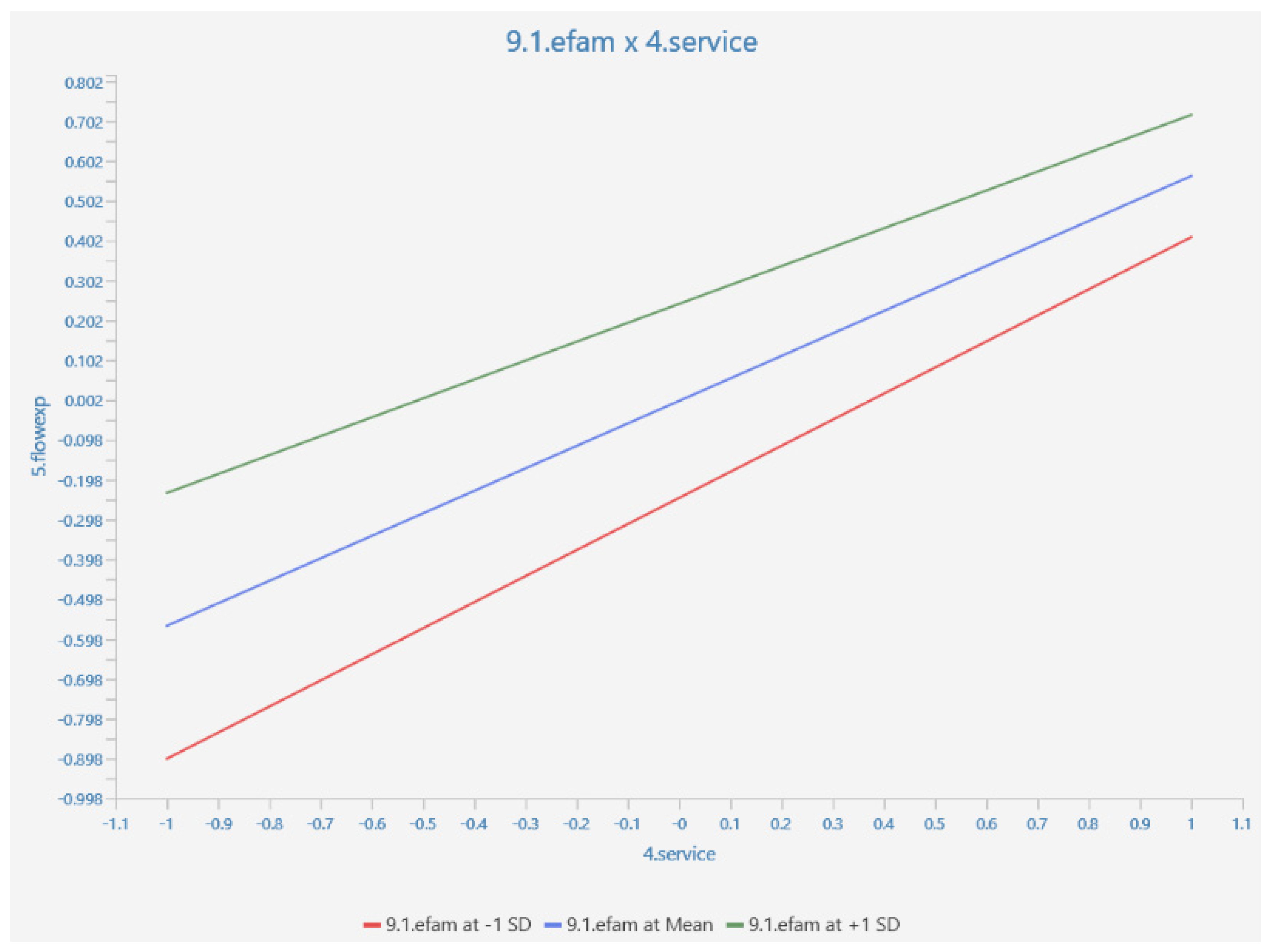
| H11 | e-Fam × e-Serv → Flowexp | −0.091 | 2.448 | 0.014 | Supported | 1.327 | 0.026 |
| H12 | e-Fam × e-Serv → Posaff | −0.029 | 0.718 | 0.473 | Not Supported | 1.362 | 0.002 |
| H13 | e-Fam × e-Serv → Trust | −0.049 | 1.325 | 0.185 | Not Supported | 1.327 | 0.006 |
| Flowexp R2 = 0.662 Q2 = 0.643; Psaff R2 = 0.621 Q2 = 0.541; Trust R2 = 0.671 Q2 = 0.654; WebLoy R2 = 0.590 Q2 = 0.556; e-Wom R2 = 0.553 Q2 = 0.496 | |||||||
Disclaimer/Publisher’s Note: The statements, opinions and data contained in all publications are solely those of the individual author(s) and contributor(s) and not of MDPI and/or the editor(s). MDPI and/or the editor(s) disclaim responsibility for any injury to people or property resulting from any ideas, methods, instructions or products referred to in the content. |
© 2026 by the authors. Licensee MDPI, Basel, Switzerland. This article is an open access article distributed under the terms and conditions of the Creative Commons Attribution (CC BY) license.
Share and Cite
Uslu, A.; Tarinc, A.; Erul, E.; Eren, R.; Andrade-Ruiz, G.; Tuncer, M.A.; Alagöz, G. E-Servicescape and Online Travel Platform Outcomes: The Moderating Role of E-Familiarity. Sustainability 2026, 18, 2105. https://doi.org/10.3390/su18042105
Uslu A, Tarinc A, Erul E, Eren R, Andrade-Ruiz G, Tuncer MA, Alagöz G. E-Servicescape and Online Travel Platform Outcomes: The Moderating Role of E-Familiarity. Sustainability. 2026; 18(4):2105. https://doi.org/10.3390/su18042105
Chicago/Turabian StyleUslu, Abdullah, Abdullah Tarinc, Emrullah Erul, Ramazan Eren, Gricela Andrade-Ruiz, Mehmet Arif Tuncer, and Gürkan Alagöz. 2026. "E-Servicescape and Online Travel Platform Outcomes: The Moderating Role of E-Familiarity" Sustainability 18, no. 4: 2105. https://doi.org/10.3390/su18042105
APA StyleUslu, A., Tarinc, A., Erul, E., Eren, R., Andrade-Ruiz, G., Tuncer, M. A., & Alagöz, G. (2026). E-Servicescape and Online Travel Platform Outcomes: The Moderating Role of E-Familiarity. Sustainability, 18(4), 2105. https://doi.org/10.3390/su18042105