Article

Hotel Guests’ Perceptions of Sustainable Tourism Practices Within the Framework of Cue Utilization Theory: An Analysis of a Worldwide Online Travel Platform’s Sustainability-Certified Hotels


by
Aysel Çetinkaya
1,
Zeynep Benan Dondurucu
2,
Sema Çağlayan
3,*,
Gamze Yetkin Cılızoğlu
4 and
Yeliz Kuşay
5
1
Department of Journalism, Faculty of Communication, Kocaeli University, Kocaeli 41001, Türkiye
2
Department of Public Relations and Publicity, Faculty of Communication, Kocaeli University, Kocaeli 41001, Türkiye
3
Independent Researcher, Kocaeli 41310, Türkiye
4
Department of Advertising, Faculty of Communication, Kocaeli University, Kocaeli 41001, Türkiye
5
Department of Public Relations and Publicity, Faculty of Communication, Marmara University, İstanbul 34722, Türkiye
*
Author to whom correspondence should be addressed.
Sustainability 2026, 18(2), 1113; https://doi.org/10.3390/su18021113
Submission received: 16 December 2025 / Revised: 3 January 2026 / Accepted: 16 January 2026 / Published: 21 January 2026

Abstract

In the digital tourism marketplace, online reviews have become a decisive source of information for travelers who cannot directly assess the quality of hospitality services before purchase. However, it remains unclear how service-related and sustainability-related cues interact to shape guest perceptions in sustainable hotel contexts. This study investigates how intrinsic and extrinsic cues are reflected in online user reviews of sustainable hotels. Drawing on Cue Utilization Theory, a longitudinal content analysis was conducted on a worldwide online travel platform’s (OTP) reviews of hotels certified for their sustainability practices (2004–2024) by user selection. A coding framework was developed deductively based on prior studies on hotel service quality and sustainability practices, and data were analyzed using MAXQDA, Leximancer, and VADER sentiment analysis. Findings indicated that reviews primarily emphasize service quality attributes—particularly staff efficiency, food quality, and accommodation facilities—while sustainability themes appear less frequently, often in nature-related contexts. Sentiment analysis revealed a predominantly positive emotional tone shaped by service quality experiences. Overall, intrinsic cues play a central role in forming guest perceptions, highlighting the need for emotionally engaging sustainability communication strategies.

1. Introduction

Online trip-booking platforms have emerged as significant tourism marketing channels due to advances in information technologies [1]. Product/service ratings and reviews featured on these platforms are integral components of online shopping experiences and serve as vital sources of specific information about products and services [2].
Guests often experience uncertainty about a hotel’s quality when making online reservations [3]. To reduce this uncertainty, they look at product cues such as brand name, cost of the product/service, and user reviews, before making a decision [1,4]. These cues can be either intrinsic or extrinsic. While intrinsic cues refer to features inherent to the good itself—such as size, form, texture—extrinsic cues have flexible characteristics such as price, trademark, and country of origin [5]. The interaction between intrinsic and extrinsic cues found in online reviews serves as a crucial factor shaping consumer decision-making patterns.
Because hospitality services are intangible, guests typically rely on intrinsic and as extrinsic cues to reduce uncertainty and risk when making reservation decisions [3]. For experience-based goods, such as hotel and tourism offerings, intrinsic cues are often unavailable at the moment of purchase. Therefore, consumers tend to rely on extrinsic cues [6] or derive intrinsic cues indirectly through other reviews of consumers.
In the literature, studies examining online consumer reviews in the hospitality sector have addressed various dimensions such as hotel service quality [7,8,9,10], customer behavior/experience [11,12,13,14], customer satisfaction/dissatisfaction [15,16,17,18,19,20], review reliability [21,22,23], and sentiment analysis [24,25,26]. Studies focusing on online reviews of sustainable accommodation have primarily concentrated on guest perception/evaluation [27,28,29,30] and customer satisfaction/dissatisfaction [31,32,33]. However, the examination of intrinsic and extrinsic cues in relation to tourism destinations remains limited, and consumers tend to consider both categories when selecting potential destinations [34,35]. Considering that travelers also tend to check online reviews of alternative hotels before making a reservation [36], hotel reviews represent a fundamental source for evaluating intrinsic and extrinsic cues.
In this context, the primary aim of this study is to reveal how frequently these cue types appear in online reviews of sustainable hotels, with which themes they are associated, and in what message tone they are presented. Accordingly, the study analyzes general service-quality- and sustainability-related themes identified in 20,820 online reviews from OTP-listed hotels with sustainability certifications ranked by user choice, examining them in relation to cue type and message tone. Drawing on Cue Utilization Theory, this analysis provides valuable contributions to both the literature and practice by offering a comparative examination of hotel service quality and sustainability practices within the guest evaluation process. This study differs from prior research by conducting a comprehensive assessment of intrinsic and extrinsic cues within sustainable hotels through a large dataset, examining their thematic and message tone dimensions under the framework of Cue Utilization Theory.

2. Cue Utilization Theory

Cue Utilization Theory explains how consumers and decision-makers use various informational cues to make judgments about products or situations [37]. One of the foremost scholars to formulate a theoretical model of the consumer product evaluation process, Cox [38], conceptualized a product as “a set of cues.” Based on his sorting rule model of the consumer product evaluation process, consumers rely on a sequence of cues to form evaluative judgments about a product [38,39]. Building on Cox’s model, Olson [39] developed a more comprehensive framework for the process of product quality evaluation. In the first stage of this model, consumers perceive and distinguish product cues, then select those they believe to be related to quality. In the second stage, they combine their judgments about these cues to form an overall quality perception [5]. According to this theory, consumers draw on both intrinsic and extrinsic cues when considering goods.
Intrinsic cues refer to properties that are inherent to the physical structure of a product or inseparable aspects of a service that cannot be adjusted without modifying the product itself [37]. These include attributes such as taste, design, performance, product features, the logo’s visual design, general appearance, packaging quality, and instruction manual quality [37,40]. For example, in the hotel context, attributes such as location, service quality, atmosphere, room quality, price–performance ratio, and hotel amenities can be considered intrinsic cues [35]. In the context of tourism, core attraction elements are considered intrinsic cues and include factors such as special events, physical geography, climate, culture, history, diversity of activities, entertainment, and infrastructure [34]. Intrinsic cues are generally assumed to exert a stronger influence in the consumer evaluation process [5,6].
Extrinsic cues, on the other hand, are attributes external to the product but associated with it. These attributes include price, brand name, warranty, manufacturer or brand reputation, retailer, point of sale, and country of origin [37,40]. Moreover, extrinsic cues also encompass elements such as online consumer reviews—covering aspects like average rating, variance, volume, content style, source credibility, and purchase verification—along with brand and price [41]. The number of online reviews is known to influence consumers’ behavioral intentions, such as purchase likelihood and recommendation intentions. Label, cost, and digital customer feedback are among the key external indicators that buyers depend on when judging experiential products. These reviews provide indirect experiences that help consumers minimize ambiguity and prevent purchase-related risks. In the tourism sector, consumers also tend to check online reviews of alternative hotels before making a purchase decision [36]. Extrinsic cues become particularly important when information is ambiguous, when they serve as the only available information source, or when consumers lack expertise or time [39,42].

3. The Role of Online Reviews in Shaping Guest Perception in the Tourism Sector

Globalization and technological progress have accelerated the spread of e-commerce, leading to the widespread use of online reviews (ORs) to evaluate hotels, destinations, restaurants, and other tourism products. ORs, as a new form of online word-of-mouth communication, influence consumers’ purchase decisions. Online consumer reviews (OCRs) are digital platforms where users share their evaluations of products and where other consumers can access these evaluations. OCRs serve as a crucial source of information that directly or indirectly affects potential consumer behavior and provides insight into how well consumer expectations are met regarding product quality, ease of use, and customer service [43,44]. Zhang et al. [45] emphasize that consumers seeking to purchase an item or offering engage in digital information seeking before finalizing their choices. Liu et al. [46] highlight that online reviews influence potential consumers’ purchase decisions.
OCRs function as platforms that allow customers and potential consumers to access information while evaluating a product [47]. Reviews reflect the positive, negative, or neutral opinions of users who have purchased a product or used a service in an online environment [45]. This is because individuals who check consumer review websites may take into account variables such as the brand under review, total number of reviews (volume), provenance of the review (e.g., verified user or expert), average rating (valence), variance among reviews, and the degree of consensus across opinions before making a purchase decision. These variables influence consumers’ evaluations and purchase behavior [41].
A growing body of research highlights the importance of online reviews in guiding customer decision [43]. Ananda et al. [47], in their study of in Denpasar, determined that online customer reviews exert a positive and substantial influence on buying intention. Hasrul et al. [48] similarly observed that online customer reviews influence purchase intentions for electronic products on Tokopedia.
Consumers intending to purchase tourism products/services often consult the reviews of other consumers to reduce perceived risks before making a decision [4,49]. During the COVID-19 pandemic, this tendency became even stronger, as consumers increasingly sought unbiased and reliable information to minimize uncertainty regarding tourism products and services [43,44,49,50]. Potential travelers frequently use online platforms before making purchase decisions. The main reason for this tendency is that potential consumers perceive online reviews as less biased and more trustworthy [51].
According to data from BrightLocal [52], 91% of consumers regularly read online reviews for tourism-related products, and 84% trust these reviews as much as personal recommendations. 68% of guests are inclined to spend more on touristic attractions with positive reviews and higher ratings. Faridah et al. [53] found that 70% of participants trust online reviews when making accommodation reservations, and 60% perceive reviews as more reliable than traditional marketing or advertising. As a result of this trend, the tourism and hospitality industry has increasingly focused on strengthening its online image to encourage positive reviews [54].

4. The Concept of Sustainable Tourism and the Impact of Hotel Service Quality and Sustainable Initiatives on Guest Satisfaction

The tourism industry, due to its multi-sectoral nature and its strong dependence on the environment and local communities, must adopt a sustainable approach [55]. Sustainable tourism (ST) represents a positive approach that seeks to minimize environmental and cultural impacts, reduce tensions arising from the interactions among industry, visitors, environment, and communities, enhance guest satisfaction and promote sustained economic development [56].
When considered as a tool, ST refers to various levels of sustainability-oriented practices. On the demand side, such practices include responsible behaviors of tourists who voluntarily support environmental, social, and economic sustainability (the triple bottom line—TBL), represented by concepts such as responsible tourism, green tourism, and volunteer tourism [57]. On the supply side, ST practices encompass the responsible actions of companies that adopt corporate social responsibility (CSR) or environmental, social, and governance (ESG) approaches [58].
Four main approaches have emerged in defining sustainable tourism—duality, continuity, goal, and convergence—and these approaches have evolved over time [59]. According to the duality approach, ST is positioned as a small-scale type of tourism that stands in opposition to mass tourism, which is perceived as large-scale and unsustainable [56]. The continuum perspective emerged in the 1990s, proposing that there is a continuum between sustainable tourism and mass tourism, and suggesting that sustainability should be regarded as a value to be achieved [59]. The goal-oriented approach argues that mass tourism can be made more sustainable and that sustainability should be treated as a target to be achieved. In line with this understanding, implementation rules and guidelines were developed, and stakeholders were encouraged to adopt more sustainable practices. The convergence approach represents the most recent interpretation of sustainable tourism. It considers ST as a universal goal pertinent to all tourism formats, regardless of scale, emphasizing that progress toward this goal is what truly matters [56,59].
ST encompasses four dimensions: economic, environmental, socio-cultural, and governance. The aim across these dimensions is to establish a sustainable alignment of environmental protection, cultural coherence, social equality, and the pursuit of economic values. The economic dimension of ST includes maximizing benefits to local economies (creating employment, strengthening local supply chains), reducing income leakage, and alleviating poverty. The environmental dimension involves protecting the natural and built environment, saving energy and water, managing waste, and preserving biodiversity, including practices such as environmental/ecological footprint reduction. The socio-cultural dimension focuses on boosting the everyday welfare of local communities, maintaining cultural integrity, ensuring community participation, and aligning tourism activities with principles of social equity [56,60,61,62]. Current academic discourse has primarily emphasized environmental sustainability, paying limited attention to social and cultural aspects; however, the significance of local communities has recently gained greater recognition [63,64]. The governance dimension of ST focuses on the importance of institutional capacity and multi-stakeholder participation for sustainable tourism planning and management. Therefore, several scholars have recognized governance as the fourth pillar of sustainability [65,66].
In the hospitality industry, guest satisfaction is directly linked to hotel service quality. Given the intense competition in tourism markets, hotel service quality attributes stand out as key differentiators for achieving competitive advantage and improving consumer satisfaction. Service quality in tourism refers to a hotel’s ability to meet guest expectations, or the degree to which the offered service corresponds to those expectations Identifying the factors influencing service quality in accommodation businesses is crucial for ensuring guest satisfaction/loyalty, as well as for enhancing the overall service experience [8,67,68]. Markovic and Jankovic [69] identified accessibility, tangibility, and staff empathy as essential elements of hotel service quality. Similarly, Ali et al. [67] found that empathy, responsiveness, assurance, and tangibility are positively associated with customer satisfaction, while Rao and Sahu [70] highlighted that tangible aspects such as staff performance and cleanliness are among the most decisive factors influencing guest satisfaction. Considering the significant correlation between guest satisfaction and service quality in hospitality, it becomes crucial to define the dimensions that determine hotel service quality and to identify the factors through which customer satisfaction is formed.
In the literature, hotel service quality dimensions have been examined in various aspects such as room amenities, hotel amenities, hotel style, bed comfort, cleanliness, physical atmosphere, food and beverage, breakfast, meals, staff, service personalization, location, parking, view, travel experience, cost–benefit ratio, value, budget, security and safety, and general satisfaction [7,10,12,13,14,16,17,18,19,20,71,72]. As emphasized by Kalnaovakul & Promsivapallop [8], these service quality dimensions can also be analyzed through guest feedbacks and online reviews to assess customer satisfaction.
In service-oriented industries such as tourism, sustainability initiatives can further enhance customer satisfaction. This is because communication strategies based on social and environmental sustainability principles have the potential to strengthen corporate image and reputation, improve customer relationship management, and increase trust, satisfaction, and loyalty [73]. Moise et al. [74] found that green hotel practices have a positive impact on guest satisfaction and loyalty, while Chang et al. [75] reported that eco-friendly hotels achieve higher guest satisfaction. In the context of online reviews, Gerdt et al. [76] highlighted a positive relationship between sustainability themes and guest satisfaction, Galati et al. [77] showed that such reviews affect tourists’ green hotel purchase decisions, while Pacheco et al. [28] found that tourists often mention sustainability-related aspects in their hotel evaluations. In the literature, hotels’ sustainability practices have been analyzed in relation to guest evaluation and customer satisfaction, focusing on environmental and social dimensions such as reuse, waste management, recycling, water and energy efficiency, eco-sustainability certification, sustainable food and infrastructure, local product use, cultural heritage, community support, and guest education [28,29,30]. Additionally, several studies have explored satisfaction/dissatisfaction in sustainable hotels through eco-luxury experiences, ecological accommodation, and factors such as greenwashing and green marketing [31,32,33,78,79,80]. However, as highlighted by Aliyah et al. [81], both sustainable practices and general service quality attributes play decisive roles in shaping customer satisfaction in sustainable hotels. Therefore, this study integrates both service quality and sustainability practices to generate a holistic comprehension of the factors shaping guest evaluation in sustainable hotels.

5. Methodology

5.1. Research Design

This study aims to examine online user reviews of sustainable hotels to identify the frequency, thematic distribution, and emotional tone of intrinsic and extrinsic cues, thereby interpreting these reviews within the context of guest perception and sustainability communication. Accordingly, the research seeks to address the following questions, which aim to explore the multidimensional dynamics of user reviews in the context of sustainable hotels:
RQ1: What is the frequency of service quality and sustainability themes in user reviews?
RQ2: How have service quality and sustainability themes evolved over time in user reviews?
RQ3: How frequently, and within which themes, do intrinsic and extrinsic cues appear in user reviews?
RQ4: What is the emotional distribution (positive, neutral, negative) of user reviews across different themes?
In this study, the content analysis method was adopted due to its ability to systematically analyze large datasets of hotel reviews, its frequent use in similar studies in the literature, and its relevance to the nature of the data examined. Content analysis is an analytical technique that enables the systematic examination of textual or visual materials according to specific coding categories. In the analysis of user-generated content and new media-based texts, content analysis is often employed to explore meanings and patterns within the context of the research topic. In the literature, studies analyzing online reviews of accommodation facilities have employed content analysis to examine various topics such as green hotel practices [29], priority service characteristics [24], review quality [22], and hotel service attributes and customer satisfaction [17,82], demonstrating that content analysis has been applied using both mixed-method and single-method approaches. Depending on the research purpose, the method allows for the development of subjective coding categories, while the analytical framework can also be constructed based on prior studies in the literature [83].
The coding framework used in this study was developed through a deductive approach, grounded in previous research on hotel service quality, sustainability practices and cue types (Intrinsic/extrinsic cues). The main and sub-coding categories were organized under three primary themes: hotel service quality, sustainability practices, and cue types comprising a total of 25 subthemes. Table 1 presents detailed definitions and corresponding references for each subtheme. Each review was analyzed based on these predefined themes and categorized accordingly. This framework ensures the systematic classification of reviews and maintains consistency throughout the content analysis process.

5.2. Sample

User reviews of the hotels listed among the 15 highest-ranked Sustainable Hotels, identified as OTP-listed hotels with sustainability certifications ranked by user choice, were selected as the sample. The 2024 sustainability-based hotel ranking was prepared in collaboration with the platform’s sustainability data partner, which evaluates hotels based on 70 sustainability-related terms/categories identified within reviews published during the previous year. Among these, hotels demonstrating high overall guest experience scores were ranked as Best.
Table 2 presents the number of reviews per hotel and the regional distribution of reviews. The hotels in question are regionally distributed as follows: South Asia (n = 4), Southern Europe (n = 5), Northern Europe (n = 3), Central Europe (n = 2, 2.6%), and North America (n = 1). The fact that these regions have the highest international tourist flows according to data from [91] supports the representativeness of the sample selection and its capacity to reflect the population. A total of 20,820 online guest reviews were examined spanning the period from 2004 to 2024.
In addition to capturing changes in user perceptions over time, a longitudinal design was explicitly adopted to examine whether sustainability-related themes in hotel reviews reflect a short-term, event-driven discourse or a more structural and sustained shift. More specifically, the temporal dimension enables the identification of fluctuations associated with period-specific conditions as opposed to patterns that emerge consistently across subsequent periods. This analytical perspective allows for an assessment of whether sustainability functions primarily as a situational response to contextual influences or as an increasingly consolidated component of hotel practices and societal expectations.

5.3. Data Collection Procedure

The data consisting of user reviews were obtained from the OTP, an online travel and review platform. This platform was selected because of its widespread global use for accommodation searches and its platform-level mechanisms for preventing fake reviews, such as automated detection systems, community rules, staff moderation, and the elimination of fraudulent content—which enhance data reliability.
On the selected OTP, each accommodation page presents user reviews in a structured format that includes an overall rating on a fixed scale (e.g., 1 to 5), a review title, the complete review text, and the review creation date. In addition, the platform provides supplementary metadata, including the traveler’s stated stay date, travel type, and self-reported location. Reviews are publicly accessible and can be sorted by recency or relevance using built-in filtering options. These functional characteristics enable the systematic identification and extraction of comparable review fields across accommodations and support the replicability of the data collection procedure.
The extensive scope of the research, spanning the years 2004–2024, necessitated a rigorous and long-term data collection process. This process was conducted by an expert academic research team consisting of five (5) members over a period exceeding six months. To ensure full compliance with the terms of use and ethical standards of online travel platforms (OTPs), the team accessed only publicly available content and adhered strictly to established research guidelines. In total, 20,820 reviews covering the period from 2004 to 2024 were collected. The data collection process involved the archival of publicly accessible User-Generated Content (UGC) available on the platform. The dataset was compiled exclusively for academic research purposes using non-intrusive, system-safe automated data access techniques that did not interfere with platform operations. This process adhered strictly to fair use principles; no private user data were accessed, and all reviewer identities were fully anonymized.
The data collection procedure followed a fully automated approach conducted through a licensed third-party API service. User reviews and basic hotel information for the selected hotels were retrieved via RapidAPI, following the creation of a subscription to a licensed commercial data extraction API and acquisition of an API key. Data retrieval was performed using standard academic data mining protocols (utilizing Python 3.10) to manage authorized requests compliant with the platform’s structure. The API responses were returned in JSON format and processed using the JSON and Pandas libraries. For each hotel, variables including hotel name, review creation date, review title, review text, and stay date were extracted, structured into a pandas.DataFrame, and exported in Microsoft Excel format for subsequent analysis. To strictly prioritize user privacy, no personal identifiers (such as usernames, avatars, or profile URLs) were collected or stored. As the data were accessed exclusively through a licensed API-based mechanism, the procedure complied with the terms of service of online travel platforms (OTPs) and did not involve unauthorized automated extraction or direct web scraping. The platform name is anonymized to adhere to ethical research standards regarding commercial proprietary data and to avoid potential conflicts. Given that the analyzed content consists solely of publicly available, user-generated reviews, involves no interaction or intervention with users, and does not constitute human subject research, ethical committee approval was not required [92,93]. Accordingly, an official waiver stating that formal ethical approval was not required for this study was obtained from the Kocaeli University Social and Human Sciences Ethics Committee, and an Author Declaration on Ethical and GDPR Compliance signed by the authors has also been submitted. Further details regarding ethical procedures and data protection measures are reported in the Institutional Review Board Statement and Data Protection and GDPR Compliance sections following the Conclusions and Implications section.
No temporal or language restrictions were imposed on the dataset, as the study aimed to explore how often and during which periods service-quality- and sustainability-related cues appeared in user reviews. Therefore, all accessible reviews of the listed hotels were included. Following the approach of Lee et al. [11], who conducted a longitudinal analysis of online travel platform reviews, this study was structured as longitudinal, acknowledging that user experiences may evolve over time. To analyze multilingual user reviews, non-English OTP comments written in 25 different languages (n = 5031, 24.2%) were translated into English using ChatGPT (GPT-4 model), an AI-based translation model developed by OpenAI. The translation process was carried out between 2 and 5 May 2025. The translation process was guided by previous studies in the tourism domain that used machine translation (MT) applications for multilingual reviews [94] and supported by research demonstrating that AI-based translation systems can preserve semantic integrity in user-generated texts [95,96]. All translations were subsequently reviewed and verified by a professional translation agency. To ensure translation quality and semantic accuracy, all translated texts underwent a systematic quality control procedure. Specifically, the translations were reviewed and verified in full by a professional translation agency, which assessed semantic equivalence, contextual coherence, and potential meaning shifts between the source texts and the English translations. Any identified discrepancies were corrected prior to analysis.
Although machine translation may introduce minor lexical or stylistic variations, such effects are generally more consequential in analyses focusing on fine-grained linguistic features than in those examining higher-level thematic structures and overall sentiment. In the present study, thematic and sentiment analyses were conducted at an aggregated level, reducing the likelihood that translation-related variations would systematically bias the findings. Furthermore, the use of a single translation model across all non-English reviews ensured procedural consistency, while the subsequent professional verification helped minimize potential semantic shifts. Accordingly, any translation-related impact on theme identification or sentiment polarity is expected to be minimal and unlikely to affect the overall interpretation of the results.

5.4. Coding and Intercoder Reliability

The qualitative content analysis was conducted using MAXQDA (version 24) software. Although a closed coding approach was adopted, the potential subjectivity in classifying intrinsic and extrinsic cues warranted the use of a consensus coding strategy [97,98]. To establish the initial clarity and consistency of the coding scheme, two expert coders independently analyzed a 5% subsample of the dataset as a pilot study, yielding a raw agreement rate of 91%. Following this pilot validation, the coding process followed a three-step validation framework to increase consistency of judgment, minimize interpretation discrepancies, and ensure intercoder reliability. In the first stage, the full dataset (n = 20,820) was systematically coded by the first coder. Each review was coded according to its contextual relevance using word groups, sentences, and conceptually coherent text blocks, applying a multiple-coding technique [99]. In the second stage, a second coder reviewed the coding output to identify inconsistencies and ambiguities. This step aligns with Guba’s [100] cross-check logic to enhance coding accuracy in qualitative research. In the final stage, any remaining discrepancies were discussed in consensus meetings with a third adjudicator coder, where unresolved codes were reviewed collaboratively until agreement was reached. The overall reliability of this framework was confirmed by a Cohen’s Kappa coefficient of 0.87, calculated using the intercoder agreement module of MAXQDA (version 24). Since these values exceed the thresholds commonly accepted in the literature [101] the research results were established as methodologically robust.

5.5. Statistical/Data Analysis

The coding process was carried out systematically using MAXQDA (version 24), a widely used qualitative data analysis software. Descriptive statistical techniques, including frequency, percentage, and cross-tabulation analyses, were employed to identify relationships between themes. To visualize conceptual relationships and meaning patterns among themes, Leximancer software was used to generate theme-based concept maps. Sentiment analysis was then conducted to determine the emotional orientation of the themes, and compound scores were obtained using the VADER algorithm.

5.6. Methodological Limitations

Despite the methodological rigor applied throughout the research process, several limitations should be acknowledged. First, the sample selection is limited to user reviews obtained from a single online travel platform and from hotels recognized for their sustainability practices within that platform. Although the selected hotels are geographically distributed across regions with high international tourism flows, the findings may not be fully generalizable to all accommodation types, destinations, or review platforms. User perceptions and review patterns may vary across platforms with different user bases, rating systems, and review cultures.
Second, source anonymization constitutes an additional limitation. In line with ethical research standards and to avoid potential commercial sensitivity, hotel names and the platform identity were anonymized. While this approach protects institutional confidentiality, it also restricts the possibility of conducting hotel-specific or brand-level comparisons and limits the interpretation of findings in relation to individual organizational characteristics.
Third, the use of machine translation for non-English reviews represents a further methodological constraint. Although all translated texts were reviewed and verified by a professional translation agency and analyses were conducted at an aggregated thematic and sentiment level, minor semantic or stylistic nuances may not have been fully preserved in translation. Such nuances could, in some cases, influence the expression of emotional tone or subtle meaning in user-generated content. Nevertheless, given the consistency of the translation procedure and the focus on higher-level thematic patterns, any potential translation-related effects are considered limited and unlikely to alter the overall conclusions of the study.

6. Results

6.1. Findings Regarding the Themes Identified in User Reviews

In total, 20,820 user reviews were analyzed within the framework of the hotel service quality and sustainability themes (RQ1). Table 3 presents the distribution of the reviews across these themes and their subthemes. Percentages are calculated based on the total number of coded thematic instances, rather than the number of reviews, due to the use of multiple coding. However, when the same code was expressed across multiple sentences within a single review, it was treated as a single thematic instance for that review. The majority of the reviews (76%) were found to be related to hotel service quality, while 25.6% were associated with sustainability.
The findings obtained from the analysis of user reviews of sustainable hotels (RQ1) indicate that users predominantly evaluate their hotel experiences based on elements of service quality.
The distribution of user reviews across subthemes shows considerable variations. Among the reviews related to hotel service quality, the subtheme with the highest frequency was staff efficiency (n = 15,825; 76%), followed by food & beverage (n = 13,040; 62.6%), customer experience and overall satisfaction (n = 12,171; 58.5%), and accommodation amenities (n = 10,823; 52%). Less than half of the reviews contained references to location (n = 9147; 43.9%), comfort (n = 8001; 38.4%), cleanliness (n = 4796; 23%), service personalization (n = 3474; 23%), price & performance (n = 2443; 11.7%), and safety & security measures (n = 369; 1.8%). These results indicate that, in online reviews, guests’ evaluations of service quality primarily emphasize facility amenities and staff attentiveness, while other themes receive comparatively less emphasis. The findings are consistent with previous research that analyzed hotel reviews in the context of service quality, identifying staff efficiency, food & beverage, and accommodation/room amenities as key determinants of customer satisfaction compared to other subdimensions [7,16,17,24].
When examining the subthemes of sustainability practices, it was found that the subtheme with the highest frequency in user reviews was nature-based accommodation (n = 5324; 25.6%). In the analysis, it was determined that the other subthemes showed a low frequency distribution. The subthemes are listed as sustainable luxury experience (n = 769; 3.7%), local source/product usage (n = 403; 1.9%), sustainable cuisine/food (n = 288; 1.4%), sustainable infrastructure (n = 236; 1.1%), energy efficiency (n = 147; 0.7%), cultural heritage/community support (n = 140; 0.7%), educational and awareness-raising practices (n = 99; 0.5%), recycling (n = 45; 0.2%), water efficiency (n = 39; 0.2%), and sustainability certifications and labels (n = 32; 0.2%).
The findings are consistent with the results reported in the analyses of sustainable hotel reviews conducted by Ali et al. [89] and Pacheco et al. [28]. In both studies, subthemes related to sustainability practices were found to appear only to a limited extent in guest reviews. The fact that the majority of the analyzed reviews focus on tangible elements—such as staff, food & beverage, and accommodation amenities—that shape the overall guest experience indicates, as emphasized by Aliyah et al. [81] in their study on consumer reviews of green hotels, that general service quality dimensions play a more decisive role in determining customer satisfaction. Approximately 1.1% of the analyzed reviews (n = 236) indicated that the sustainability practices adopted by hotels caused guest dissatisfaction. These results are consistent with the findings of Ali et al. [89], who identified that certain sustainable hotel practices led to dissatisfaction among some guests. Although at a relatively low rate (n = 10; 0.01%), there were also comments indicating that the sustainability practices of the hotels were perceived as insincere or as instances of “greenwashing”.
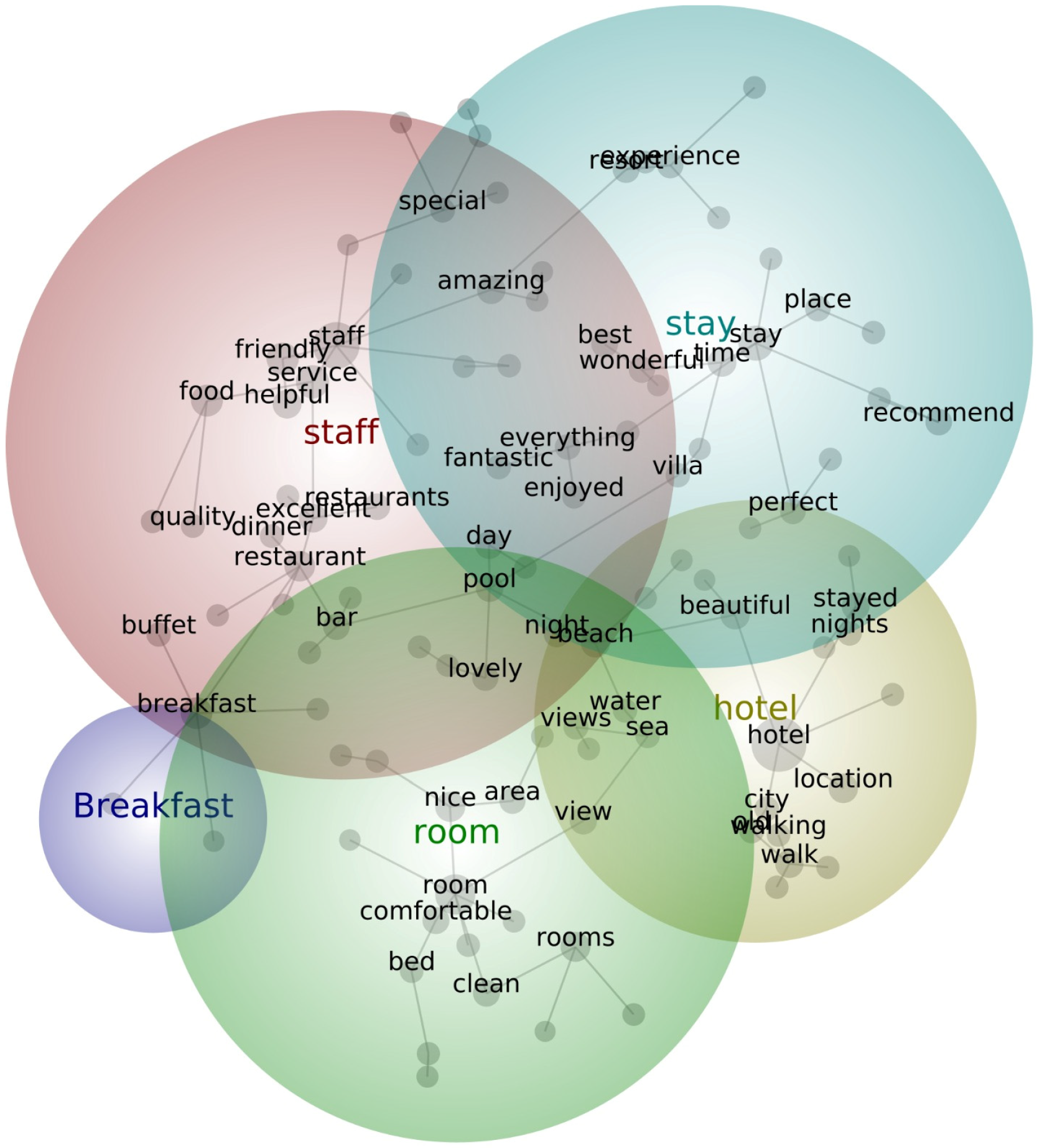
Figure 1 presents a concept map illustrating co-occurrence patterns among the most frequently mentioned words across all user reviews. This map provides valuable insight into which concepts are emphasized by guests when evaluating their hotel experiences and how these concepts are interrelated. The analysis identified five main thematic clusters, namely “staff,” “stay,” “room,” “hotel,” and “breakfast.” One of the largest clusters, “staff,” is associated with words such as “service” (n = 7670, 35%), “friendly” (n = 6350, 29%), and “helpful” (n = 4516, 21%), which describe how guests perceive and characterize hotel staff and the quality of their service. Within this cluster, links between the word “staff” (n = 14,803, 68%) and terms such as “restaurant” (n = 5250, 24%), “quality” (n = 2193, 10%), and “dinner” (n = 1899, 9%) indicate that the service quality provided by staff working in food and beverage service areas is also highly valued in guest reviews. The “stay” cluster relates to experience (n = 3941; 18%), place (n = 3619; 17%), recommend (n = 4569; 21%), resort (n = 4071; 19%), perfect (n = 3148; 15%), and villa (n = 2291; 11%), reflecting its association with customer experience and overall satisfaction. The “room” cluster includes comfortable (n = 3820; 18%), bed (n = 1936; 9%), clean (n = 4096; 19%), area (n = 3130; 14%), and views (n = 2392; 11%), while the “hotel” cluster highlights location (n = 5490; 25%), city (n = 2229; 10%), walking (n = 1890; 9%), and walk (n = 4043; 19%). These findings indicate that room-related attributes are assessed mainly through tangible aspects such as cleanliness, comfort, and view, while hotel-related evaluations are largely linked to location. The relatively smaller “breakfast” cluster mainly consists of guest evaluations related to food and beverage themes, which can be attributed to the fact that most of the hotels offer bed-and-breakfast services.
When the interconnections between clusters were analyzed, it was found that the “staff” and “stay” clusters intersected through words such as “amazing” (n = 4597; 21%), “best” (n = 3865; 18%), and “fantastic” (n = 2396; 11%). This finding indicates that the stay experience is closely associated with staff attentiveness. At the intersection of the “staff” and “room” clusters, connections were found through words such as “bar” (n = 3060; 14%), “beach” (n = 4686; 22%), and “pool” (n = 3852; 18%). This finding suggests that, in guest evaluations, both hotel and room facilities, as well as staff working across different departments, play a significant role in shaping perceptions. Between “stay” and “hotel” clusters, beautiful (n = 5147; 24%) and perfect (n = 3148; 15%) emerged as key adjectives, implying that customer experiences are positively shaped by hotel attributes. The “hotel” and “room” clusters highlight the prominence of words such as “beach” (n = 4686; 22%), “water” (n = 2312; 11%), “view” (n = 3653; 17%), and “sea” (n = 2107; 10%), indicating that both hotel and room features are evaluated in terms of amenities such as scenic views and proximity to the sea or beach. When the intersections between the clusters are analyzed overall, it is observed that positive adjectives such as “special” (n = 2390; 11%), “amazing” (n = 4597; 21%), “enjoyed” (n = 1843; 9%), “best” (n = 3865; 18%), “lovely” (n = 3031; 14%), “beautiful” (n = 5147; 24%), and “perfect” (n = 3148; 15%) are predominantly present across different interconnections between clusters. This finding indicates that guests’ overall experiences within the “staff,” “stay,” “hotel,” and “room” clusters are predominantly positive. The concept map analysis reveals that the “room” cluster is characterized by tangible factors related to basic room features, the “staff” cluster includes descriptive words reflecting staff attentiveness, the “stay” cluster captures dimensions of guest experience, and the “hotel” cluster is primarily associated with location-based evaluations. These findings align with the concept map results of Pacheco et al. [28], who analyzed guest reviews of green hotels. This result suggests that guest reviews of sustainable hotels also tend to focus on tangible elements that are directly experienced and observed by customers.
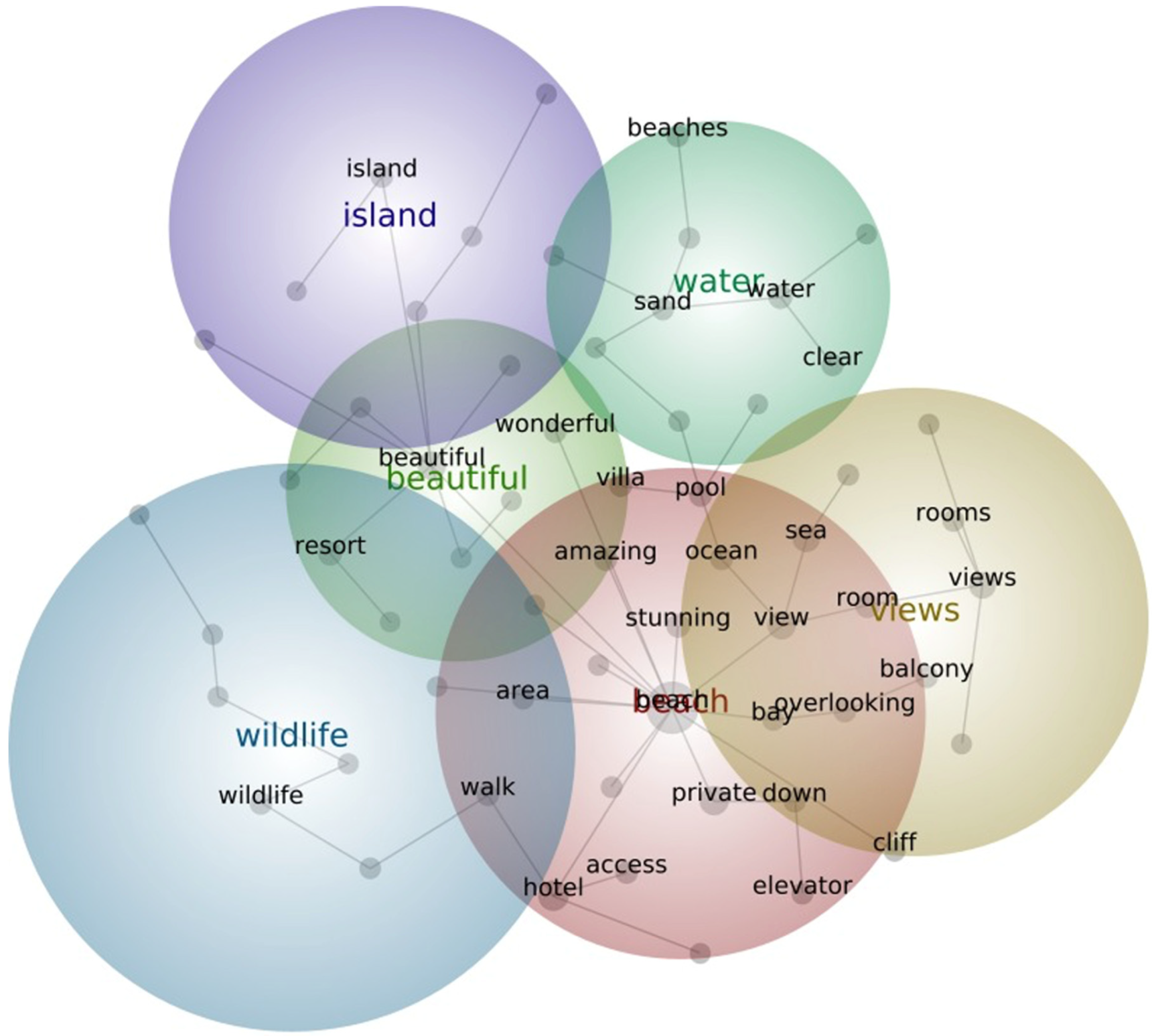
Figure 2 presents a concept map of co-occurrence patterns among frequently mentioned words within sustainability-themed reviews. The analysis revealed six main thematic clusters: “wildlife,” “island,” “beautiful,” “water,” “beach,” and “views.” The “wildlife” cluster, which is one of the largest groups, is associated with words such as “wildlife” (n = 1860; 24%), “resort” (n = 1105; 14%), and “walk” (n = 933; 12%). This distribution indicates that guests describe their nature-based accommodation experiences through references to wildlife and the natural environment. The “beach” cluster shows high frequency and strong interconnections with ocean (n = 1398; 18%) and sea (n = 1087; 14%). The presence of adjectives such as “stunning” (n = 932; 12%) and “amazing” (n = 777; 10%) further indicates that guests perceive ocean, sea, and beach experiences positively within the context of nature-based accommodation. Words like access (n = 699; 9%), elevator (n = 621; 8%), and cliff (n = 544; 7%) reflect the importance of accessibility within nature-based accommodation contexts. In the “views” cluster, the words “views” (n = 1500; 19%), “view” (n = 1200; 15%), and “room” (n = 1000; 13%) appear with high frequency. The words “rooms” (n = 850; 11%) and “balcony” (n = 751; 10%) also stand out, while “overlooking” (n = 621; 8%) shows relatively lower frequency and connection strength. This distribution indicates that, in sustainable hotels, nature-based accommodation experiences are shaped through the integration of tangible property features, such as room view, overall scenery, and balcony view, with elements of the natural environment. The “island” cluster is characterized by the word “island” (n = 1002; 13%), which stands out as the most prominent term shaping its overall structure.
The fact that the word “island” forms an independent cluster is associated with the presence of several island-based sustainable hotels in the dataset. This distribution indicates that guests evaluated their accommodation experiences in these hotels through the natural and environmental elements provided by island geographies. The “beautiful” cluster is centered around the word “beautiful” (n = 850; 11%), with other highly weighted and strongly connected words such as “wonderful” (n = 698; 9%) and “villa” (n = 622; 8%), indicating that as a positive adjective, “beautiful” reflects guests’ overall favorable evaluations of the accommodation experiences offered by sustainable hotels. The water cluster, organized around water (n = 752; 10%), includes beaches (n = 698; 9%) and sand (n = 620; 8%). The results show that natural elements enhancing the guest experience, such as the sea, beach, and sand, are considered integral components of the accommodation experience in reviews of sustainable hotels.
The analysis of interconnections between clusters showed that the “wildlife” and “beach” clusters intersect through the words “walk” (n = 903; 12%) and “area” (n = 852; 11%). This finding indicates that guests associate nature-based accommodation experiences with walking activities and the environmental features of the surrounding area. The analysis of interconnections between clusters revealed that the overlap between the “beach” and “views” clusters was higher compared to other clusters. The two clusters intersect through the words “ocean” (n = 1398; 18%), “sea” (n = 1087; 14%), “view” (n = 1200; 15%), “room” (n = 1000; 13%), and “overlooking” (n = 621; 8%). The high quantitative frequency of intersecting words indicates that guests evaluate the environmental features of accommodation facilities, such as beaches, together with the properties’ views and spatial location in a holistic framework. In contrast, the intersections among other clusters are more limited. The intersection between the “wildlife” and “beautiful” clusters through only the word “resort” (n = 1105; 14%) suggests that the wildlife experience is positively perceived when integrated with the facilities of the resort. Similarly, the overlap between the “beautiful” and “beach” clusters through the words “amazing” (n = 777; 10%) and “villa” (n = 622; 8%) indicates that guests evaluate their accommodation experiences positively in relation to tangible features such as the resort’s seaside location and scenic views. Overall, these findings demonstrate that guest reviews of sustainable hotels emphasize both the tangible and intangible characteristics of the facilities and their natural surroundings. This result supports Brochado and Pereira’s [27] observation that the accommodation experience is evaluated as a multidimensional construct encompassing the experiential elements offered by the natural environment.

6.2. Findings on the Change in Themes in User Reviews over the Years

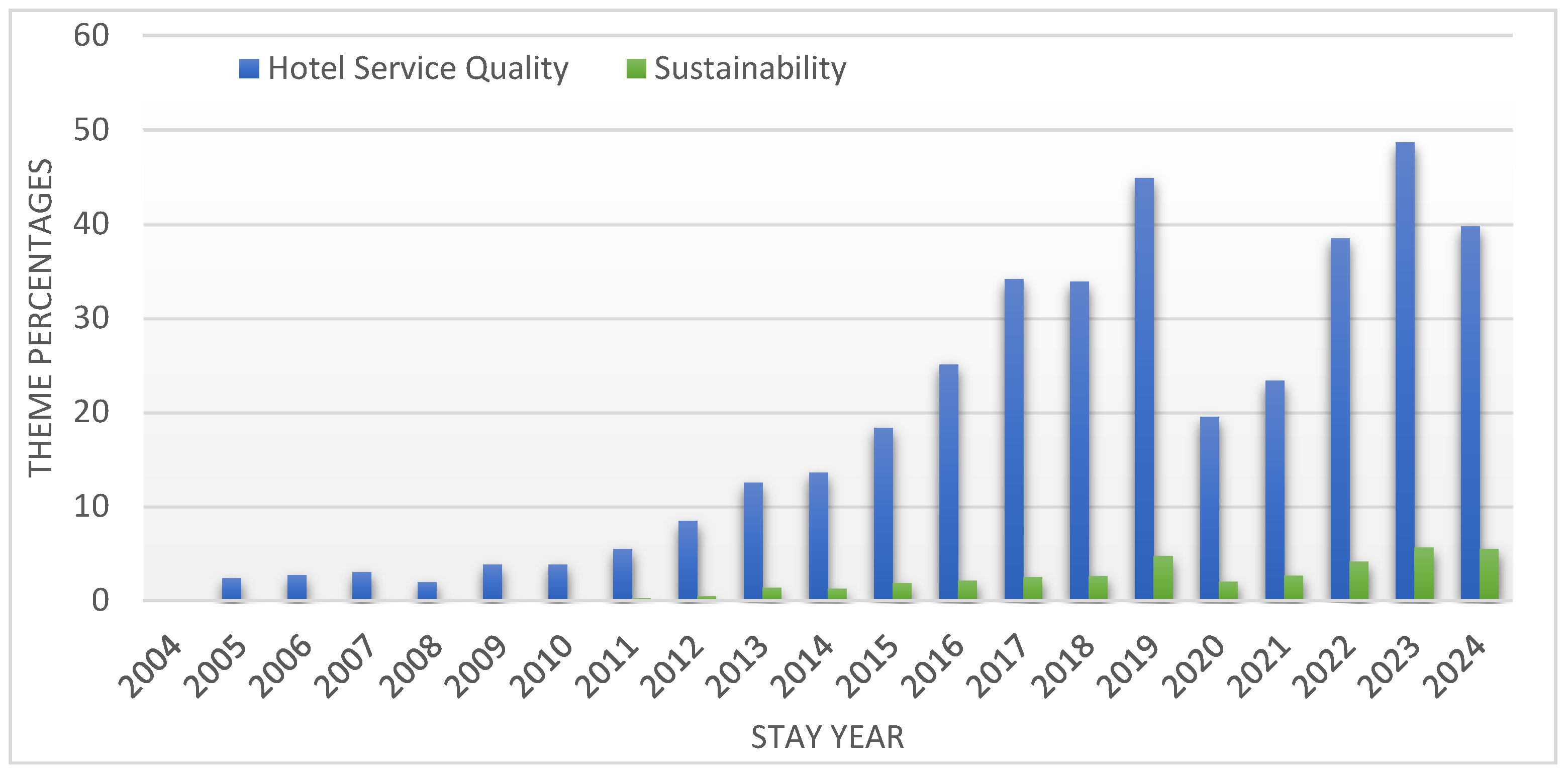
The identification of annual variation rates in the dominant themes of user reviews (RQ2) is of critical importance for predicting consumer trends and improving service quality in line with these trends. In this context, Chart 1 illustrates the percentage change in the distribution of the “Hotel Service Quality” and “Sustainability” themes between 2004 and 2024. Thematic change analyses (RQ2) across years indicate that hotel service quality themes have remained markedly more dominant than sustainability themes in user reviews over the long term. Throughout the 2004–2024 period, the consistently high proportional distribution of service-quality-related themes indicates that guests prioritize tangible service elements that they directly experience in their online evaluations.
The findings show that the proportion of comments associated with the hotel service quality theme is considerably higher than that of comments related to sustainability practices. These results are consistent with the findings of Aliyah et al. [81], who analyzed green hotel reviews between 2022 and 2024, and Pacheco et al. [28], who examined 2023 green hotel reviews within the context of sustainability and hotel service quality themes. Another notable finding of the analysis is the sharp decline in service-quality-related comments in 2020, following an upward trend that had begun in the 2010s. This result is linked to the social restrictions and measures implemented globally in accommodation facilities due to the COVID-19 pandemic. As Xu et al. [20] also emphasize, the nature of user reviews regarding accommodation facilities changed significantly between pre- and post-COVID-19 periods. Beginning in 2021, as the global effects of the pandemic subsided and travel restrictions eased, comments emphasizing hotel service quality attributes once again showed an upward trend. In contrast, the sustainability practices theme displayed a low proportional distribution throughout all analyzed years. The comments containing this theme showed a relatively increasing trend starting from 2015, reaching 4.7% in 2019. In 2020, sustainability-oriented reviews experienced a sharp decline due to the impacts of the COVID-19 pandemic. However, starting from 2021, as the effects of the pandemic diminished, sustainability-themed reviews also began to show an upward trend, similar to the overall hotel service quality theme. Another important finding is that, between 2023 and 2024, comments related to this theme reached their highest level across the years, approaching 6%. Throughout the 2004–2024 period, the proportionally higher distribution of the Hotel Service Quality theme compared to the Sustainability theme indicates that guests emphasized tangible service elements derived from their direct experiences more strongly than relatively abstract attributes such as sustainability in their online reviews.
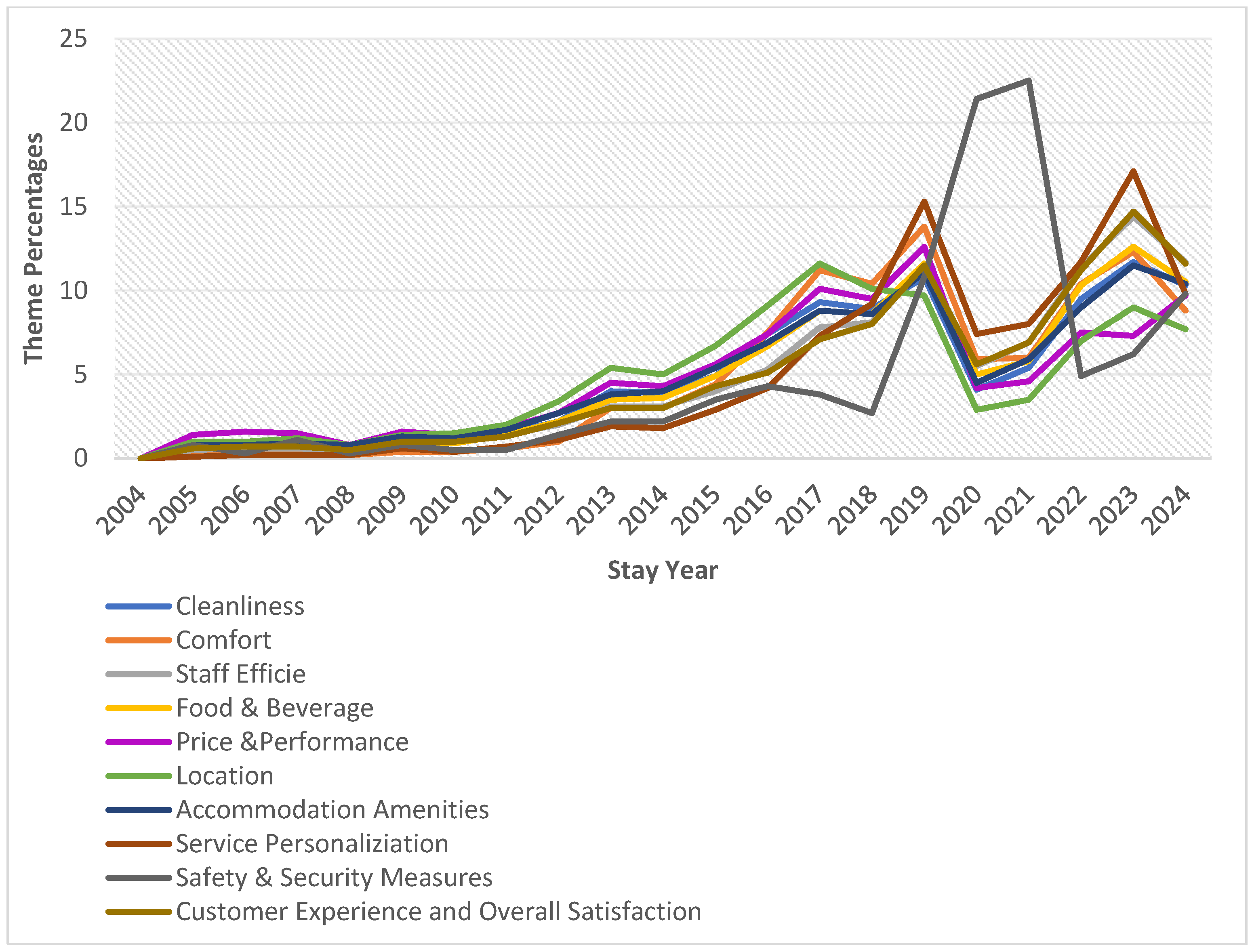
Chart 2 displays the yearly variation in hotel service quality sub-themes. The user reviews associated with all sub-themes show a general upward trend until 2019, with this increase becoming more pronounced during 2016–2019. In this period, themes such as service personalization, comfort, price & performance, customer experience and overall satisfaction, food & beverage, location, and staff efficiency exhibited a noticeable rise. However, beginning in 2020, the reviews related to general service quality sub-themes showed a downward trend, which continued through 2021. This trend can be explained by the travel restrictions implemented worldwide and the social distancing measures imposed on service delivery in the hospitality sector during the COVID-19 pandemic.
One of the key findings identified in the analysis is that the safety & security measures theme reached its highest rate during 2020–2021. These results align with Xu et al. [20], who found that during the COVID-19 period, guests placed greater emphasis on health and safety attributes when evaluating hotels. However, all dimensions of general service quality began to rise again starting in 2022. Among these dimensions, the relatively high proportions of service personalization, staff efficiency, customer experience and overall satisfaction, and food & beverage indicate, as Jang et al. [102] suggest, that guests’ evaluation criteria for service quality dimensions have not significantly changed over time. Overall, the findings reveal that while the core dimensions of service quality remain dominant in the long term, themes such as safety and hygiene tend to gain prominence during crisis periods.
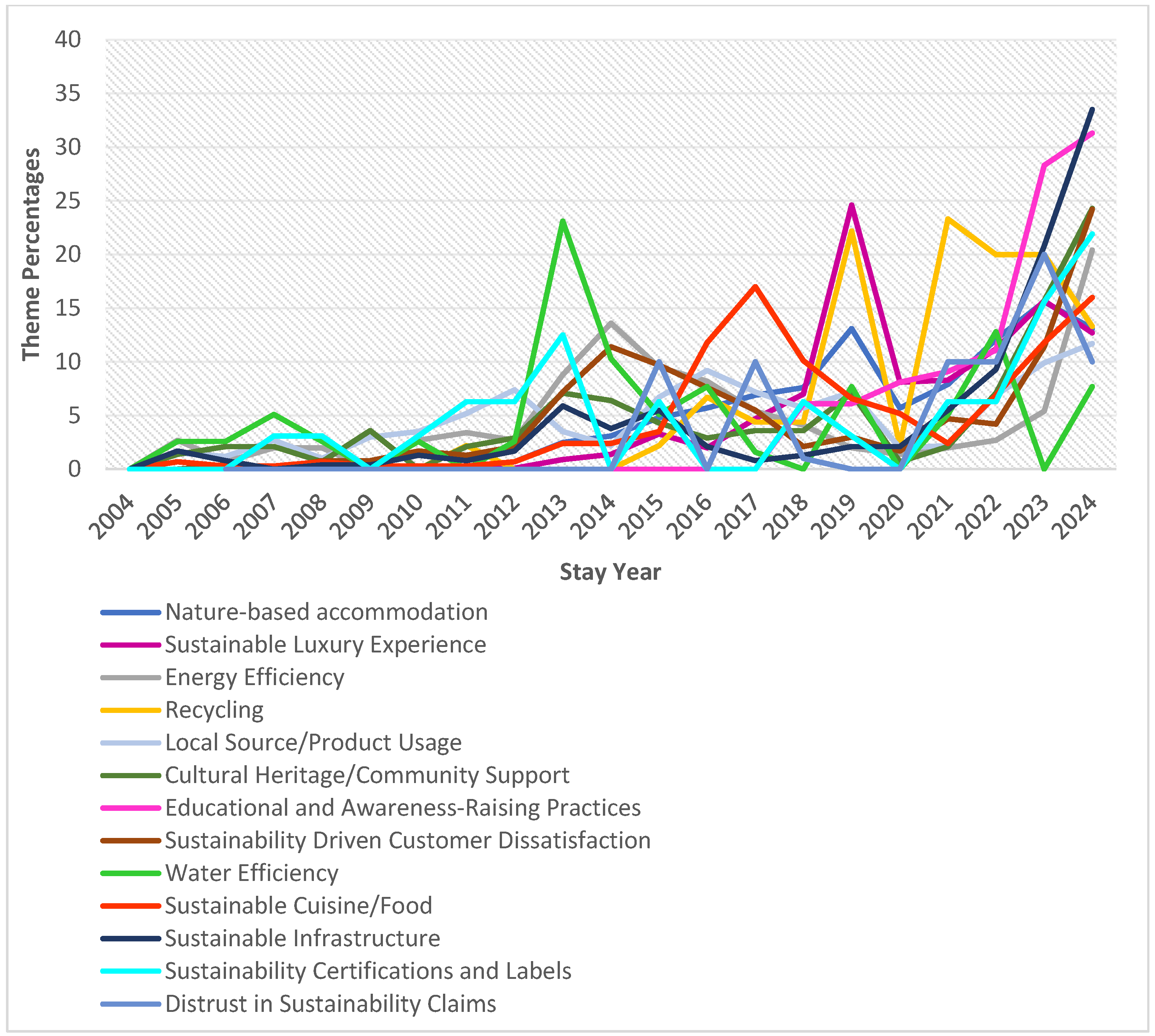
Chart 3 presents the yearly distribution of sub-themes related to sustainability. The findings indicate that between 2004 and 2010, all sub-themes exhibited relatively low representation in guest reviews. In contrast to the steady increase observed in hotel service quality sub-themes, sustainability-related sub-themes displayed a more fluctuating pattern over the years. Sudden spikes were observed in specific sub-themes, including water efficiency (2013), energy efficiency (2014), sustainable cuisine/food (2017), sustainable luxury experience (2018), and recycling (2021). Another significant finding is that, similar to general service quality sub-themes, sustainability-related sub-themes experienced a decline in 2020 due to the COVID-19 pandemic after a period of consistent growth until 2019. This is consistent with Xu et al. [20], who highlighted that during the COVID-19 period, guest evaluations shifted toward health-focused concerns, leading to fewer assessments of broader, more abstract service attributes such as sustainability.
The nature-based accommodation sub-theme exhibited a steady upward trend between 2012 and 2019, then declined during the pandemic years (2019–2021), and began to rise again from 2022 onward. Apart from these sub-themes, educational and awareness-raising practices, energy efficiency, sustainable infrastructure, cultural heritage/community support, sustainable certifications and labels, sustainable cuisine/food, and sustainable luxury experience sub-themes have shown an upward trend in the post-COVID-19 period. In the graph, the relatively high distribution of nature-based accommodation and sustainable luxury experience categories, particularly starting from 2018, can be interpreted—consistent with Brochado and Pereira [27]—as reflecting the integration of sustainability practices with hotel facilities, making them an integral part of the sustainable tourism experience. The increasing representation of environmentally related sub-themes of sustainability in recent years parallels the findings of Aliyah et al. [81], who reported rising guest attention to sustainability practices in green hotels. Furthermore, the upward trend observed in socially oriented sustainability sub-themes such as local source/product usage and cultural heritage/community support indicates, as highlighted by Brazytė et al. [30], that social dimensions are gaining importance alongside environmental ones in consumer evaluations of sustainable tourism.
Another key finding of this study is that the distrust in sustainability claims and sustainability-based dissatisfaction sub-themes exhibited periodic increases, including in the post-COVID-19 period. This result aligns with Ali et al. [89], who found that certain sustainability practices in accommodation, such as towel reuse, motion-sensitive lighting, and keycard or sensor-controlled systems, may reduce perceived service quality and lead to guest dissatisfaction. Distrust in sustainability claims can be interpreted, as highlighted by Ali et al. [89], as stemming from guests’ perceptions that a hotel’s sustainability practices are inadequate, and—as noted by Lv et al. [79]—from an increase in negative evaluations toward hotels that may reinforce suspicions of greenwashing.

6.3. Findings on the Variation in Themes Based on Intrinsic and Extrinsic Cues

The findings regarding the frequency of intrinsic and extrinsic cues across the hotel service quality and sustainability themes (RQ3) indicate that nearly all user reviews (n = 20,358; 97.8%) contained intrinsic cues, while the number of reviews including extrinsic cues was notably low (n = 1094; 5.3%). Accordingly, intrinsic cues ratios are generally higher than extrinsic cues ratios across all sub-themes. These results suggest that guests tend to focus more on core attributes, such as hotel features and service quality, than on external factors that are not directly related to the product or service when evaluating their accommodation experiences.
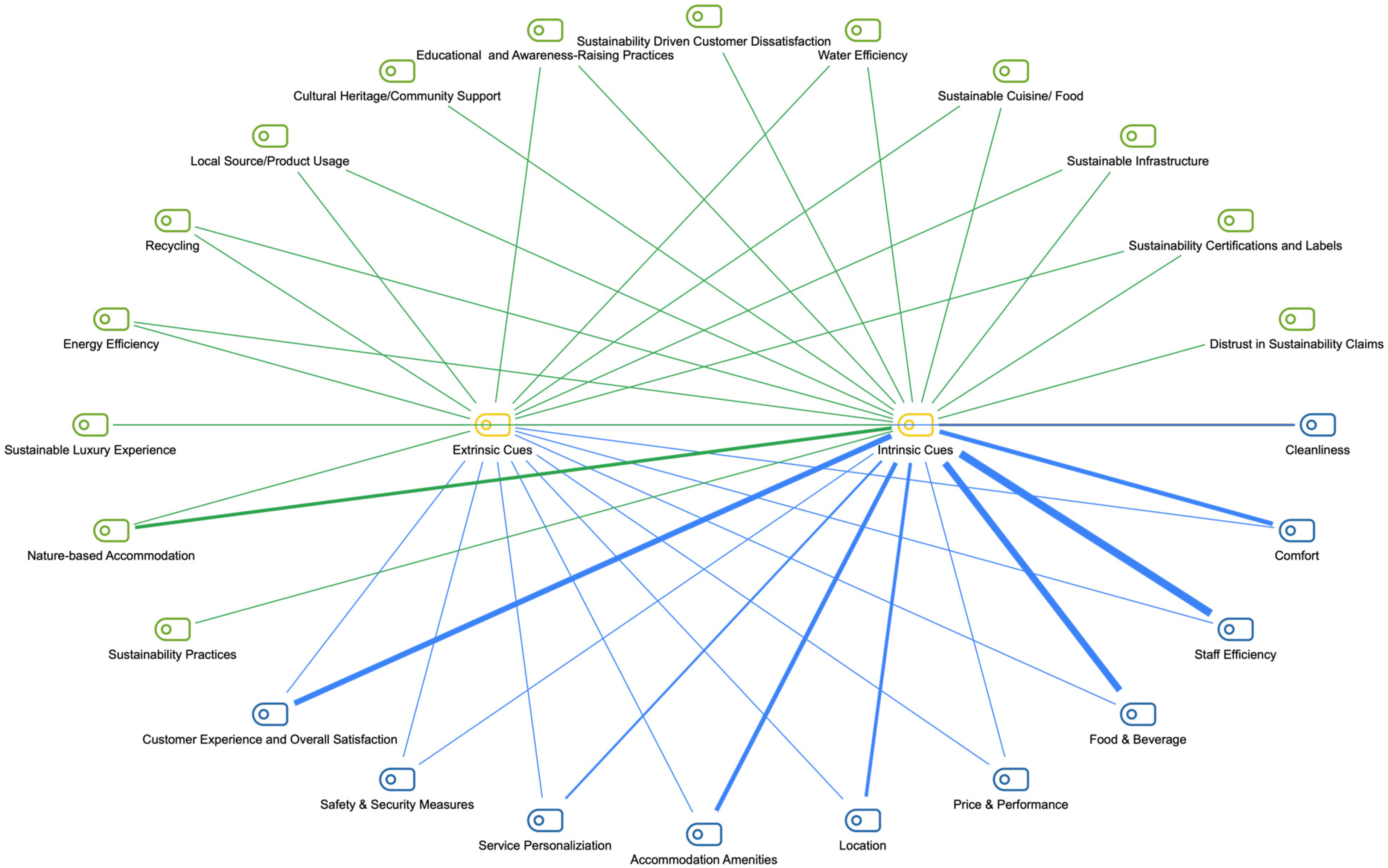
Table 4 presents the distribution of intrinsic (attributes inherent to the product/service itself) and extrinsic (attributes external to the product/service) cues across hotel service quality and sustainability practices sub-themes. Figure 3, which illustrates the Code Co-occurrence Model, depicts the relational structure and intersections between these themes around intrinsic/extrinsic cues, enabling a multidimensional analysis of guest evaluations regarding overall service quality and sustainability practices. An examination of Table 4 reveals that, within the hotel service quality theme, the sub-themes most strongly associated with intrinsic cues are staff efficiency (n = 15,505; 76.2%), food & beverage (n = 12,753; 62.2%), customer experience and overall satisfaction (n = 11,934; 58.6%), and accommodation amenities (n = 10,569; 51.9%). These results indicate that guest evaluations are predominantly shaped by tangible service quality elements. Given that staff performance is a critical determinant of perceived service quality [7,18,19]; that food & beverage directly influences satisfaction through taste, restaurant service, and presentation quality [17,71,84]; and that room/facility amenities [16] serve as fundamental components in assessing comfort, functionality, and aesthetics, these three sub-themes emerge as prominent intrinsic cues influencing perceived service quality and overall satisfaction [13,14].
In Table 4, it is observed that within the main theme of hotel service quality, extrinsic cues exhibit a proportional distribution similar to that of intrinsic cues. Although the quantitative distribution of these sub-themes is lower compared to intrinsic cues, the high presence of extrinsic cues in user reviews related to accommodation amenities (n = 752, 68.7%), staff efficiency (n = 807, 73.8%), food & beverage (n = 732, 66.9%), and customer experience and overall satisfaction (n = 679, 62.1%) indicates that guests’ perceptions of service quality are shaped not only by tangible elements directly experienced, but also by factors such as hotel image, brand value, environmental context, and references to other user reviews. Additionally, the relatively high rate of location (n = 628; 57.4%) among extrinsic cues indicates that guests evaluate hotel location not only experientially but also through external factors such as environmental appeal and regional prestige. Considering Hossain et al. [34], who emphasized the joint influence of intrinsic and extrinsic cues on guest satisfaction in tourism destinations, the present findings similarly indicate that guest evaluations of certain sub-themes reflect both cue types simultaneously, illustrating the multidimensional structure of perceived service quality.
In the context of the Code co-occurrence model, when the relationship between intrinsic and extrinsic cues and the general service quality sub-themes is examined, it is observed that the sub-themes staff efficiency, food & beverage, accommodation amenities, and customer experience and overall satisfaction have a strong association with the intrinsic cue cluster. Another important finding identified in the model is that sub-themes such as comfort, cleanliness, location, and service personalization, which serve as tangible service evaluation criteria, are also moderately associated with the intrinsic cue cluster. The Code co-occurrence model also shows that the extrinsic cue cluster is connected to the general service quality sub-themes in a way similar to the intrinsic cue cluster. However, the associations between extrinsic cues and these sub-themes are not as strong as those observed for the intrinsic cues. These results align with the findings of Aliyah et al. [81] and Pacheco et al. [28], who demonstrated that guest evaluations of green hotels are primarily shaped by personal experiences involving tangible service elements. However, the model indicates that both intrinsic and extrinsic cues are linked to the sub-themes. In this context, while intrinsic cues primarily shape customers’ overall service quality evaluations, extrinsic cues appear to play a complementary role in the process.
According to Table 4, within the sustainability practices theme, intrinsic cues (n = 20,358; 97.8%) display a proportionally higher distribution than extrinsic cues (n = 1094; 5.3%), similar to the pattern observed in general service quality. The sub-themes most closely associated with intrinsic cues are nature-based accommodation (n = 5158; 25.3%) and sustainable luxury experience (n = 752; 3.2%). These results reveal that guests evaluate their accommodation experiences based on variables such as the degree of integration between the facility and the natural environment, and luxury accommodation opportunities combined with sustainability principles. Moreover, as emphasized by Brochado and Pereira [27], the integration of sustainability practices with hotel amenities contributes to the creation of the overall guest experience, which explains why the reviews often reflect this experience through intrinsic cues. In other sub-themes such as local source/product usage, sustainable cuisine/food, and sustainability-driven customer dissatisfaction, intrinsic cues were found to have a lower distribution. The reviews under these sub-themes generally reflect guest evaluations of directly experienced processes, such as food and beverage services, use of local products, architectural features, and dissatisfaction arising from sustainability-related practices.
A similar proportional trend is observed among extrinsic cues, with nature-based accommodation (n = 179; 15.5%) emerging as the sub-theme with the highest rate. This finding is associated with guests’ references to destination image, marketing communications emphasizing “nature,” and mentions of environmental or natural features in other users’ reviews. In line with Feng et al. [35], who found that brand familiarity and online reviews can influence hotel booking decisions, this result suggests that extrinsic cues may also shape guest evaluation processes. Furthermore, the coexistence of intrinsic and extrinsic cues—despite quantitative differences—within the nature-based accommodation sub-theme aligns with the findings of Hossain et al. [34], who demonstrated that guest evaluation processes in tourism destinations are shaped by the interaction between both types of cues. Another important finding is that the sustainability-driven customer dissatisfaction (n = 44; 4.0%) sub-theme displays a relatively high representation among extrinsic cues. Considering its moderate distribution among intrinsic cues as well, it can be inferred that dissatisfaction with sustainability-oriented practices arises both from direct negative experiences and from indirect variables such as hotel image, website and social media messages, and other users’ reviews.
In the Code Co-occurrence Model presented in Figure 3, the relationship between intrinsic and extrinsic cues and the sub-themes of sustainability practices shows that only nature-based accommodation demonstrates a strong association with the intrinsic cue cluster. While both cue types are linked to all sustainability sub-themes, these associations generally remain limited. This indicates that sustainability practices are often perceived as secondary components in guest evaluations, exerting a lower influence compared to general service quality sub-themes. Nevertheless, similar to service quality, both intrinsic and extrinsic cues are found to be associated with sustainability sub-themes, suggesting that guest evaluations of sustainability practices are primarily shaped by intrinsic cues, while extrinsic cues serve a complementary role in the evaluation process.

6.4. Findings on the Emotional Distribution of Themes in User Reviews

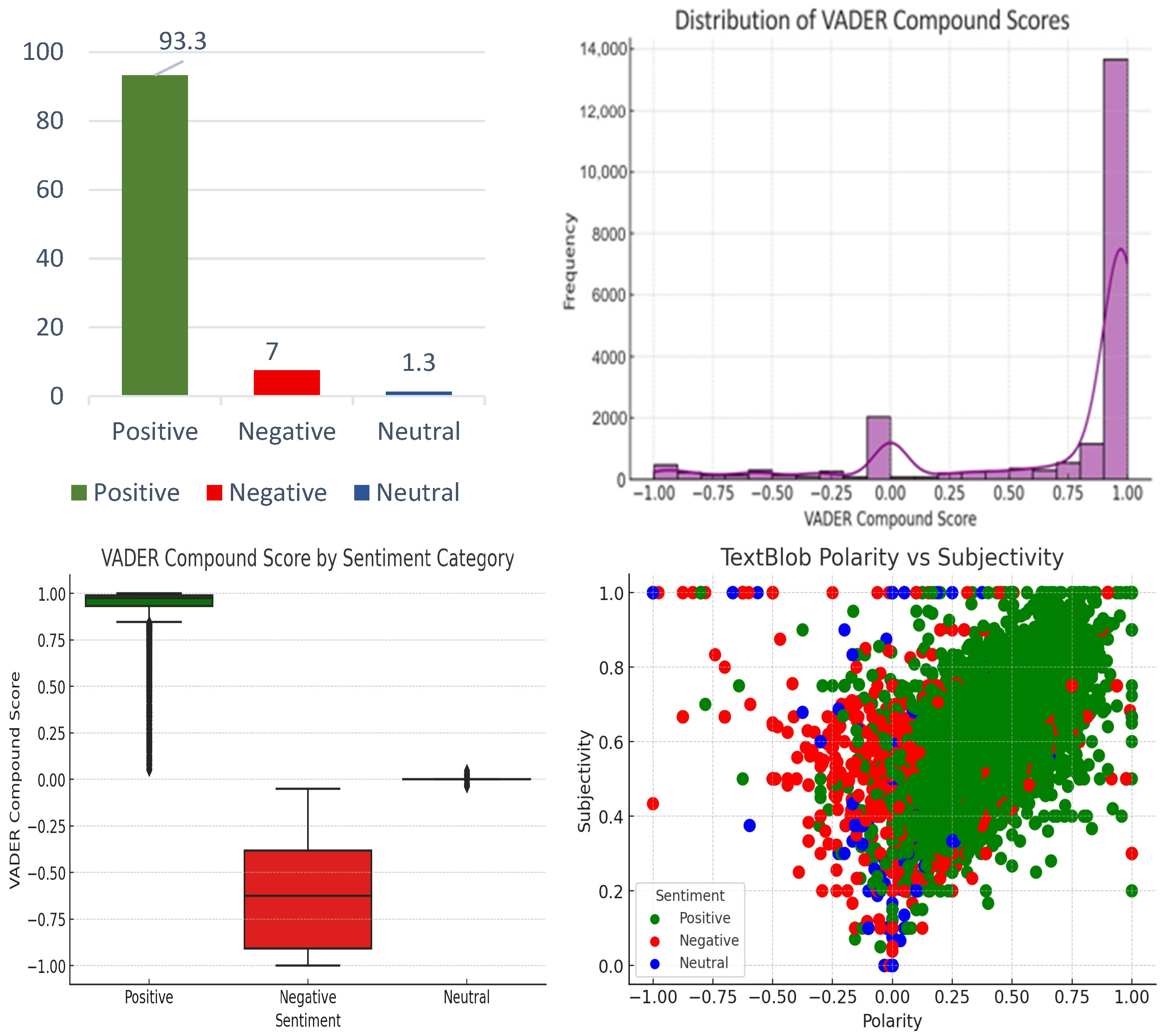
Chart 4 presents the descriptive statistics, VADER compound score distribution, and TextBlob analysis results used to determine the emotional tone of user reviews. Each review was categorized into three main sentiment classes—positive, negative, and neutral—based on its overall emotional orientation. This sentiment analysis reveals how guests’ evaluations are shaped emotionally, providing a deeper understanding of the data. Findings based on the sentiment analysis (RQ4) reveal that user comments predominantly display a strongly positive emotional tone, indicating that customer satisfaction follows a homogeneous and high-intensity distribution.
An examination of Chart 4 shows that nearly all guest reviews demonstrate a clearly positive orientation. Among the analyzed reviews, 93.3% (n = 19,427) have a positive orientation, 7.6% (n = 1585) a negative orientation, and 1.3% (n = 268) a neutral orientation. The Vader compound score distribution indicates that scores cluster between +0.75 and +1.00. This indicates that a large proportion of the comments exhibit a distinctly strong positive emotional tone. Negative scores, on the other hand, are fewer in number and are distributed between −0.25 and −1.00. These findings reveal that overall guest satisfaction levels are high, while guest dissatisfaction remains limited and is concentrated in specific sub-themes related to both general service quality and sustainability practices. Neutral comments, on the other hand, are concentrated around 0 within a narrow range in the VADER compound score graph. This result shows that these comments are mainly informative or descriptive in nature (e.g., location, accommodation amenities, food & beverage, etc.).
The VADER Compound Score by Sentiment Category graph further shows that positive sentiment has a narrow distribution, with a median score approaching 0.9. Given the high mean and low variance of positive compound scores, these reviews display a homogeneous emotional intensity and consistently high guest satisfaction. The negative sentiment category shows a wide distribution, with the median value ranging between −0.5 and −0.6. Considering that the average compound scores of these negative comments are low and their variance is high, it is observed that the intensity of negative emotions displays a heterogeneous pattern. This result indicates that while some evaluations are highly critical, others contain only a mild negative tone, showing that the level of customer dissatisfaction varies from one comment to another. Neutral comments; however, are clustered within a very narrow range with a median value close to 0. This shows that these comments are more descriptive in nature and do not convey a clear emotional orientation in terms of guest satisfaction or dissatisfaction.
In the Textblob polarity vs. subjectivity graph, positive reviews predominantly occupy the +0.25 to +1.00 polarity range, with subjectivity levels concentrated between 0.60 and 1.00. This indicates that positive comments are largely subjective, shaped by personal experiences and emotional expressions. Hence, guest satisfaction is mainly articulated through personal and affective narratives. Negative comments are positioned on the polarity axis between −1.00 and −0.05, while their subjectivity values show a wide distribution between 0.20 and 1.00. These results indicate that both strong and mild criticisms coexist within negative comments. In addition, the broad spread of negative comments reveals that these evaluations are made both subjectively and objectively, based on personal experiences and observable issues. In this context, it is seen that guest dissatisfaction is expressed in a more heterogeneous way through both subjective and objective assessments. Neutral comments, on the other hand, are generally located between −0.05 and +0.05 on the polarity axis, with subjectivity values mostly distributed between 0.00 and 0.40. These results show that, due to the minimal emotional orientation of neutral comments, they carry a more descriptive character. The analysis results indicate that guest satisfaction in the reviews is generally shaped by subjective and emotional factors, while dissatisfaction is influenced by both subjective and objective elements.
These findings are consistent with the results of Le et al. [25], who conducted a sentiment analysis of OTPs’ hotel reviews focusing on polarity and subjectivity. That study found that despite the high number of reviews, polarity values were mostly concentrated in the positive range (+0.25–0.35), while subjectivity values clustered between 0.40 and 0.60. Similarly, Rita et al. [26] showed in their sentiment analysis of OTPs’ hotel reviews that negative comments could address both tangible service quality aspects, such as hotel features, and subjective factors, such as personal experiences. As seen, the findings of both studies align with the results of this research, supporting that customer satisfaction is predominantly expressed through subjective and emotional statements, whereas dissatisfaction is conveyed through both subjective evaluations based on personal experiences and objective elements such as facilities and service quality.
Table 5 presents the sentiment-based distribution of positive, negative, and neutral reviews across hotel service quality and sustainability practices. The results show that positive guest evaluations significantly outnumber negative and neutral assessments. Within the hotel service quality theme, the sub-themes receiving the highest proportions of positive feedback are staff efficiency (n = 15,072; 77.6%), food & beverage (n = 12,348; 63.6%), customer experience and overall satisfaction (n = 11,776; 60.6%), and accommodation amenities (n = 10,066; 51.8%). Moderate positive evaluations cluster around location (n = 8646; 44.5%) and comfort (n = 7543; 38.8%). The sub-themes that received the highest level of negative evaluations under the main theme of hotel service quality were identified as accommodation amenities (n = 940, 59.3%), staff efficiency (n = 936, 59.1%), and food & beverage (n = 870, 54.9%), respectively. Moderate concentrations of negative sentiment appear in location (n = 671; 42.3%), customer experience and overall satisfaction (n = 539; 34%), price & performance (n = 520; 32.8%), and comfort (n = 493; 31.2%). However, the quantitative distribution of negative reviews is lower compared to positive ones. The fact that the sub-themes of staff efficiency, food & beverage, and accommodation amenities show a high proportional distribution in both positive and negative reviews indicates that tangible service elements play a critical role in shaping the customer experience [7,18]. Hence, these sub-dimensions serve as dual determinants of satisfaction and dissatisfaction. The quantitative distribution of neutral reviews is considerably lower compared to positive and negative ones. Similar to those categories, the sub-themes that received the highest level of neutral evaluations are listed as staff efficiency (n = 145, 54.1%), food & beverage (n = 161, 60.1%), and accommodation amenities (n = 151, 56.3%), respectively. Customers’ neutral evaluations of these sub-categories can be explained by their tendency to perceive these sub-themes as routine elements related to service quality [17].
The high proportional distribution of the staff efficiency theme in positive reviews aligns with the findings of Peres & Paladini [7], Padma & Ahn [19], and Thu [18], who analyzed positive, negative, and neutral customer evaluations in the context of service quality dimensions. Likewise, the proportional strength of food & beverage, location, and accommodation amenities mirrors the findings of the same authors, while comfort corresponds with the results of Padma & Ahn [19]. In negative hotel reviews, the finding that the accommodation amenities and staff efficiency sub-themes exhibit high quantitative distribution, while location and price sub-themes show an average level of distribution, is consistent with the studies of Cenni [103]. The findings of the study reveal that tangible service quality elements are decisive in the guest evaluation process, and that the customer experience is shaped around these sub-themes in both positive and negative reviews [7,18,19,103].
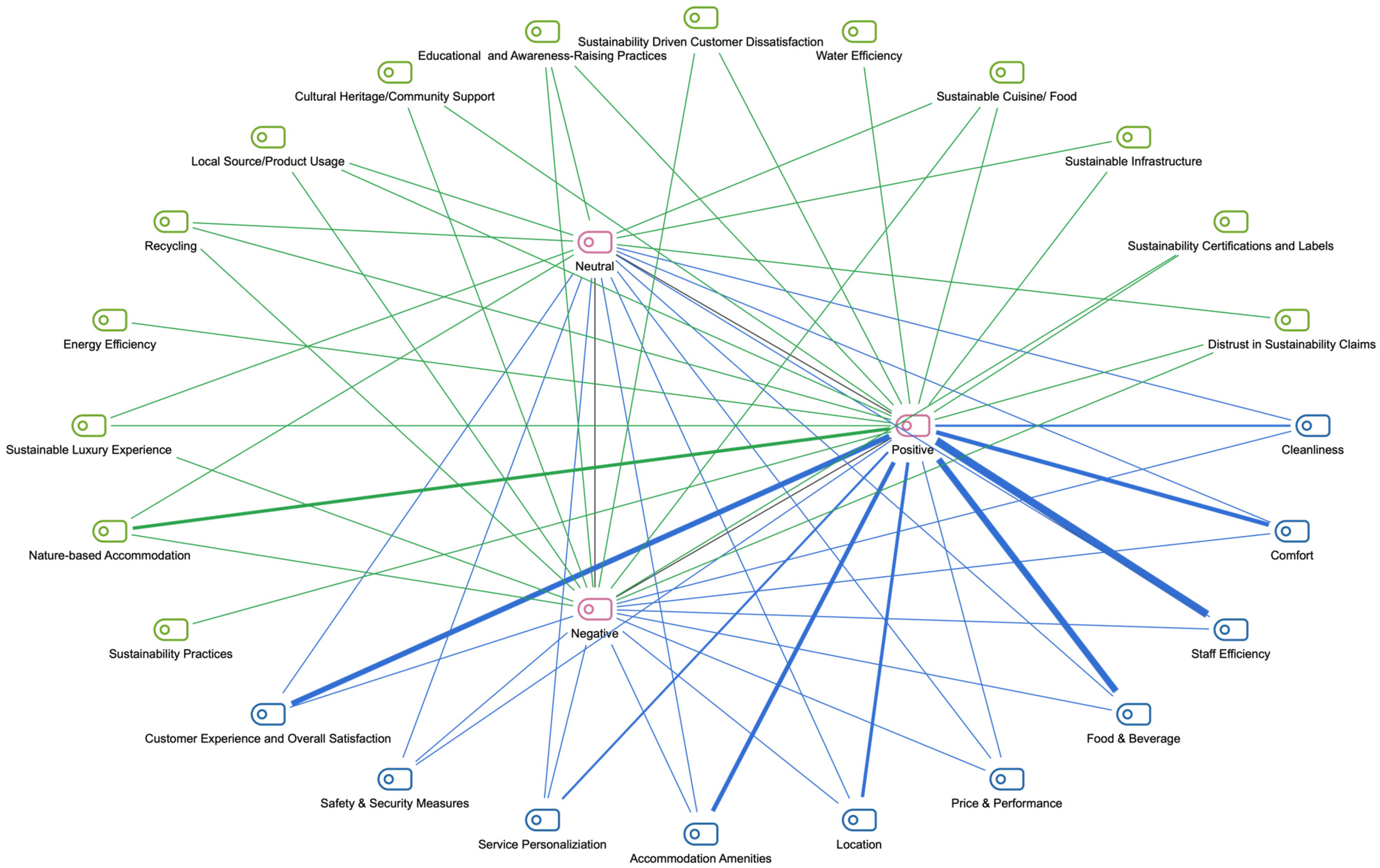
In the context of the code co-occurrence model, when the relationships between positive, negative, and neutral reviews and the general service quality sub-themes are evaluated, it is observed that staff efficiency, food & beverage, customer experience and overall satisfaction, and accommodation amenities show a high level of association with the positive review cluster, while location, comfort, and cleanliness are moderately associated with it (Figure 4). In the code co-occurrence model, the clusters of negative and neutral reviews are also connected to the general service quality sub-themes. However, the connections between negative and neutral reviews and these sub-themes are not as strong as those of the positive review cluster. These findings align with the results of Aliyah et al. [81], who found that positive consumer evaluations of green hotels are primarily based on tangible service elements. Nevertheless, the model also indicates relationships between positive, negative, and neutral reviews and the general service quality sub-themes. Therefore, the fact that the same sub-themes establish varying levels of association across positive, negative, and neutral review clusters can be interpreted as a reflection of the multidimensional nature of customer perception.
Table 5 shows that positive reviews related to the main theme of sustainability practices are quantitatively higher than negative and neutral reviews, except for the sub-themes distrust in sustainability claims and sustainability-driven customer dissatisfaction. In addition, no neutral reviews were identified in the subcategories of energy efficiency, cultural heritage/community support, sustainability-driven customer dissatisfaction, water efficiency, and sustainability certifications and labels. Among positive reviews, the most frequent sub-themes are nature-based accommodation (n = 5114; 26.3%), sustainable luxury experience (n = 744; 3.8%), local source/product usage (n = 393; 2%), and sustainable cuisine/food (n = 273; 1.4%). It is observed that moderate positive evaluations are concentrated in the sub-themes of sustainable infrastructure (n = 225, 1.2%), energy efficiency (n = 134, 0.7%), and cultural heritage/community support (n = 137, 0.7%). Although limited, the fact that guests made positive evaluations regarding categories such as sustainable infrastructure, energy efficiency, cultural heritage/community support, local source/product usage, and sustainable cuisine/food indicates, as emphasized by Aliyah et al. [81], that a portion of guests are aware of the sustainable initiatives implemented by these hotels. Comments on the sustainability practice sub-themes are generally positive in nature but display a more limited distribution compared to overall service quality sub-themes. This finding supports the results of Brazytė et al. [30] and Aliyah et al. [81], who found that while customers tend to evaluate sustainability practices positively, these practices play a more indirect role in customer satisfaction compared to service quality factors. In positive reviews, the high frequency of evaluations related to nature-based accommodation and sustainable luxury experience subcategories can be interpreted, as emphasized by Brochado and Pereira [27], as being associated with the integration of sustainability practices into hotel amenities, which enhances the overall consumer experience. Among negative reviews, the sustainability sub-themes with the highest distribution are nature-based accommodation (n = 209, 13.2%) and sustainability-driven customer dissatisfaction (n = 105, 6.6%). Although there are also negative evaluations related to other sub-themes, their quantitative distribution remains quite limited. For neutral reviews, the sustainability sub-theme with the highest distribution is nature-based accommodation (n = 48, 17.9%), while other sub-themes show very low quantitative representation. However, the analysis revealed that negative reviews, though limited, appeared across all sustainability sub-themes, with higher concentration in nature-based accommodation and sustainability-driven customer dissatisfaction. This aligns with the findings of Ali et al. [89], who identified that a segment of guests evaluated sustainable hotel practices negatively. In this context, to avoid guest dissatisfaction, it is essential for hotels to communicate their sustainability practices transparently and clearly with guests and align these policies with guest expectations throughout the implementation process.
In the context of the code co-occurrence model, the relationship between positive, negative, and neutral reviews and the sub-themes of the sustainability practices category shows that the nature-based accommodation sub-theme has a more pronounced association with the positive review cluster compared to other sub-themes. Within the code co-occurrence model, both positive and negative review clusters are associated with all sub-themes related to sustainability practices. However, the neutral review cluster shows a weaker connection with these sub-themes and lacks association with some of them. The model indicates that the relationships formed by the sustainability practice sub-themes in positive, negative, and neutral guest evaluations are generally more limited compared to those formed by the general service quality sub-dimensions. This finding reveals, as noted by Brazytė et al. [30], Pacheco et al. [28], and Aliyah et al. [81], that guests tend to assign relatively lower importance to sustainability practices in their sentimental evaluations compared to general service quality factors. However, enhancing guest awareness of these practices and integrating them with general service quality components would contribute to a more holistic improvement of the overall customer experience. These results are consistent with the findings of Aliyah et al. [81], who demonstrated in their study on green hotel reviews that positive consumer evaluations are primarily based on tangible service elements. Nonetheless, the model also reveals that positive, negative, and neutral reviews are all connected with general service quality sub-themes. Therefore, the varying degrees of association that these sub-themes form across different sentiment clusters suggest that customer perception is shaped by a multidimensional structure.

7. Discussion

The development of new communication technologies has made online travel platforms one of the primary marketing communication channels in the tourism industry. However, in these digital environments, consumers’ decision-making processes involve uncertainty due to the intangible nature of services. Because hotel quality cannot be directly experienced before purchase, guests tend to rely on secondary information sources such as online reviews and ratings when forming their decisions [3,43,44]. At this point, the interaction between intrinsic and extrinsic cues plays a key role in shaping perceptions of the product or service. Yet, studies that examine guest evaluations in hotel reviews through the lens of these cues are still limited [34,35]. Accordingly, there is a gap in understanding which types of cues underpin guest evaluations in online reviews of sustainability-oriented hotels. In this context, the present study adopts Cue Utilization Theory to investigate how frequently intrinsic and extrinsic cues are used in user reviews of sustainable hotels, how they are distributed across themes, and how they relate to message tone, thereby interpreting these reviews in terms of guest perception and satisfaction.
The analysis shows that, in online reviews of sustainable hotels, greater emphasis is placed on tangible dimensions of service quality such as staff efficiency, food and beverage quality, and accommodation amenities. The consistency of these findings with prior research examining online hotel reviews through service quality dimensions [7,16,17,24] indicates that guest satisfaction in sustainable hotels is likewise primarily shaped by tangible service quality attributes. The finding that sustainability practices occupy a more limited place in guest reviews supports prior work in this field [28,89]. As noted by Pacheco et al. [28], this may be associated with guests’ lack of awareness of sustainability practices, their tendency to prioritize tangible elements in their evaluations, greenwashing concerns, or the failure of hotel managers and staff to sufficiently integrate sustainability practices into operational processes. In this regard, it is recommended that sustainable hotels enhance guest awareness, integrate sustainability initiatives into overall service perceptions, and reduce greenwashing concerns by transforming sustainability practices into visible and measurable service quality attributes and by developing strategic and tactical practices that embed this mindset at both staff and managerial levels. In addition, integrating these practices into strategic communication processes is crucial for increasing guests’ awareness of sustainability features. The findings further show, in line with Brochado & Pereira [27], that guests tend to define sustainable hotel experiences in a multi-layered way through their interactions with the natural environment, and that sustainability is associated less with an abstract environmental attitude and more with observable environmental characteristics. This suggests that sustainability strategies in the accommodation sector should be designed in ways that also highlight the natural elements guests actually experience.
Across the 2004–2024 period, the persistently high proportional distribution of service-quality-related themes and the more fluctuating pattern of sustainability-related sub-themes indicate that guests tend to prioritize directly experienced tangible service attributes in their online reviews. The service-quality findings support Jang et al. [102], who argued that the criteria underpinning service quality perceptions do not change dramatically over time. However, the decline in comments on both service quality and sustainability during the COVID-19 period, alongside the sharp rise in the “safety & security” sub-theme, aligns with Xu et al. [20], who reported that guest evaluations shifted toward health- and safety-oriented considerations during the pandemic. In this respect, it is suggested that, in times of crisis, sustainable hotels should restructure strategic management and communication processes in line with guest expectations while preserving “sustainability” as a core organizational value. The analysis also shows that, in the post-pandemic period, social sustainability themes have risen alongside environmental sustainability. This trend is consistent with the findings of Aliyah et al. [81], who observed an upward trajectory in sustainability-related comments in green hotels. In this context, it is essential to regularly analyze guests’ evolving perceptions of sustainability and the changing trends within the sector so that hotel management can align their strategic planning, service development, and communication policies with current expectations. On the other hand, the periodic increase in sub-themes related to dissatisfaction and distrust toward sustainability practices indicates, as emphasized by Lv et al. [79], that greenwashing perceptions remain a persistent risk for sustainable hotels and, as noted by Ali et al. [89], that sustainability initiatives can sometimes have a negative impact on customer satisfaction. To minimize these risks, sustainable hotels should communicate their initiatives transparently and directly to guests, systematically promote awareness-raising and educational programs, and turn guests into active participants in the sustainability process. Moreover, strengthening engagement with different guest segments through communication strategies tailored to demographic and sociocultural variables is recommended.
The thematic analysis of intrinsic and extrinsic cues shows that user reviews tend to evaluate both service quality and sustainability practices primarily through intrinsic cues. These findings support Kim & Kim [13] and Zhang & Kim [14], who found that service quality is shaped by directly experienced tangible indicators such as staff, room/facility amenities and food and beverage. However, the fact that external cues also show a relatively high proportional distribution in similar sub-themes indicates that these cues play a supportive role in guest satisfaction. This is consistent with Hossain et al. [34], who highlighted the complementary influence of intrinsic and extrinsic cues in the evaluation of accommodation facilities. In this context, sustainable hotels should not only strengthen the tangible service-quality elements that shape intrinsic cues, but also manage extrinsic cues—such as user reviews, certifications, hotel photographs and videos—effectively within their strategic communication policies. A similar pattern is observed for sustainability practices: reviews are largely structured around intrinsic cues relating to nature-based accommodation and eco-luxury experiences. The finding that extrinsic factors play a more limited role in these evaluations is in line with Aliyah et al. [81] and Pacheco et al. [28], who reported that sustainability-related guest comments are predominantly based on personal experiences. At the same time, the prominent position of nature-based accommodation among extrinsic cues suggests, as emphasized by Feng et al. [35], that other guests’ reviews can meaningfully influence booking decisions. Accordingly, it is recommended that sustainable hotels manage external cues such as green certifications, destination image, visual materials and user reviews as part of an integrated sustainability communication strategy.
The sentiment analysis indicates that user reviews overall exhibit a positive emotional tone and that guest satisfaction is high. Negative reviews form a more heterogeneous pattern and are grounded both in subjective experiences and in service shortcomings. Both positive and negative evaluations tend to focus on the same tangible service attributes, particularly staff efficiency, food and beverage quality and accommodation amenities. This supports the findings of Peres & Paladini [7], Padma & Ahn [19] and Thu [18], who showed that guest satisfaction is anchored in tangible service quality. In this regard, it is important that sustainable hotels prioritize improvements in core service quality dimensions. Given the subjective and varied structure of negative reviews, it is also recommended that hotels establish a dynamic quality management system that continuously monitors online reviews. Although comments on sustainability practices are numerically more limited than those on service quality, they too are predominantly positive in tone, suggesting, as argued by Aliyah et al. [81], that at least a subset of guests possesses a positive sustainability awareness. In this context, it is important for sustainable hotels to design communication activities within an informative, participatory and trust-based framework that raises guest awareness and strengthens favorable perceptions. On the other hand, the fact that some negative reviews cluster around sub-themes such as “sustainability-driven customer dissatisfaction” and “nature-based accommodation” indicates, as highlighted by Ali et al. [89], that sustainability practices may constrain satisfaction for certain guests. Accordingly, it is necessary to identify sustainability-based practices that may limit customer satisfaction in hotel services and to plan improvement solutions. In addition, to maintain the balance between hotels’ sustainability values and guest experience, it is recommended to develop feedback mechanisms that measure the impact of sustainability policies and practices on guest satisfaction.

8. Conclusions and Implications

This study examined online user reviews of sustainable hotels through the lens of Cue Utilization Theory, revealing which types of cues play a stronger role in shaping guest evaluations. The primary findings show that online reviews generally carry a strongly positive emotional tone, yet intrinsic cues—such as service quality, which are directly experienced—are far more influential in shaping guest perceptions than sustainability practices. In contrast, extrinsic cues such as visual materials and sustainability certifications play a complementary role in reinforcing guest perceptions. The findings indicate that sustainability practices create a strong impression only when they are visible, experiential, and fully integrated into the overall service experience.
The secondary findings demonstrate that the factors shaping guest perceptions in the context of sustainable hospitality vary over time and according to conditions. In particular, the prominence of safety, hygiene, and social sustainability in reviews during the post-pandemic period shows that guest expectations are dynamic and that sustainability strategies must be updated in ways that are sensitive to such changes. In this regard, the results underscore the importance of giving simultaneous emphasis not only to environmental aspects but also to tangible service elements directly experienced by guests, social responsibility practices, and trust-based communication in sustainability-focused service design. The study highlights that online reviews should be systematically evaluated as a strategic source of feedback both for service improvement and for sustainability communication. In doing so, it offers a holistic contribution to the tourism and hospitality literature from both theoretical and practical standpoints.

8.1. Theoretical Implications

The Cue Utilization Theory perspective adopted in this study provides a theoretical foundation for understanding which cues and themes exert stronger effects on guest perceptions in online evaluations of sustainable hotels—an area that remains limited in the existing literature—and serves as a guide for future research. The findings demonstrate that guests prioritize tangible and directly experienced cues in their evaluations, thereby revealing a concrete pattern that demonstrates the theory’s applicability within the hospitality sector. Furthermore, the prominence of certain themes during periods such as the pandemic draws attention to the dynamic nature of cues and creates opportunities to examine the theory in temporal contexts. In this regard, the study is expected to offer a valuable theoretical framework for future research that compares intrinsic and extrinsic cues across different destination types, cultural contexts, and digital platforms.

8.2. Practical Implications

The findings of the research offer significant practical implications for sustainable hotels aiming to improve strategic management and communication practices. Since service quality is the primary determinant of guest satisfaction, hotels must prioritize improving processes related to staff efficiency, food and beverage quality, and accommodation amenities.
To increase guest awareness of sustainability practices, these initiatives should be made visible, measurable, and experienceable. To reduce perceptions of greenwashing, it is essential to communicate sustainability efforts transparently and to consistently manage extrinsic cues such as user reviews and visual materials.
The findings also show that guest expectations change during crisis periods such as the pandemic. This situation highlights the importance of hotel resilience and indicates that communication and service policies must be structured in a way that preserves sustainability values while adapting to changing conditions. Accordingly, hotel managers should strategically employ both intrinsic and extrinsic cues to integrate sustainability messages into the guest experience, thereby both enhancing customer satisfaction and strengthening the perceived value of sustainability practices. Moreover, considering that the emotional tone of reviews overwhelmingly reflects service-quality-based factors, sustainability initiatives and related communication activities should be designed in alignment with the positive emotions generated by service quality and in ways that foster a similar emotional connection.

8.3. Limitations and Future Research

This research has certain limitations. Since the analysis was conducted on a single online platform, the findings may not be generalizable to all digital environments or cultural contexts. Sentiment analysis may limit the contextual depth of reviews, and differences may exist between users’ actual behaviors and the content of their reviews.
Future studies may conduct comparative analyses of intrinsic and extrinsic cues across different platforms and destination types. Guest awareness of sustainability and perceptions of green hotels may be tested through experimental designs. The influence of cultural differences, demographic characteristics, and motivational factors on cue utilization may be examined in greater depth.
In light of these limitations, the study provides an important starting point for future research aiming to understand the relationship between sustainable hotels, consumer behavior, and online evaluations.

Author Contributions

Conceptualization, A.Ç. and Z.B.D.; methodology, A.Ç. and Z.B.D.; software, A.Ç., Z.B.D. and S.Ç.; validation, A.Ç., Z.B.D. and S.Ç.; formal analysis, A.Ç., Z.B.D. and S.Ç.; investigation, A.Ç., Z.B.D. and S.Ç.; resources, A.Ç., Z.B.D., G.Y.C. and Y.K.; data curation, A.Ç., Z.B.D. and S.Ç.; writing—original draft preparation, A.Ç., Z.B.D., G.Y.C. and Y.K.; writing—review and editing, A.Ç., Z.B.D., G.Y.C. and Y.K.; visualization, A.Ç., Z.B.D. All authors have read and agreed to the published version of the manuscript.

Funding

This research received no external funding.

Institutional Review Board Statement

Not applicable.

Informed Consent Statement

Not applicable.

Data Availability Statement

The datasets generated for this research can be obtained from the corresponding author upon reasonable request.

Conflicts of Interest

The authors declare no conflicts of interest.

References

  1. Ert, E.; Fleischer, A. Mere position effect in booking hotels online. J. Travel Res. 2016, 55, 311–321. [Google Scholar] [CrossRef]
  2. Kunst. Sources of Information about Products in the U.S. 2025. Statista. Available online: https://www.statista.com/forecasts/997051/sources-of-information-about-products-in-the-us (accessed on 5 November 2025).
  3. Shin, S.; Chung, N.; Xiang, Z.; Koo, C. Assessing the impact of textual content concreteness on helpfulness in online travel reviews. J. Travel Res. 2018, 58, 579–593. [Google Scholar] [CrossRef]
  4. Bigné, E.; William, E.; Soria-Olivas, E. Similarity and consistency in hotel online ratings across platforms. J. Travel Res. 2019, 59, 742–758. [Google Scholar] [CrossRef]
  5. Szybillo, G.J.; Jacoby, J. Intrinsic versus extrinsic cues as determinants of perceived product quality. J. Appl. Psychol. 1974, 59, 74–78. [Google Scholar] [CrossRef]
  6. Miyazaki, A.D.; Grewal, D.; Goodstein, R.C. The effect of multiple extrinsic cues on quality perceptions: A matter of consistency. J. Consum. Res. 2005, 32, 146–153. [Google Scholar] [CrossRef]
  7. Kaveski Peres, C.; Pacheco Paladini, E. Exploring the attributes of hotel service quality in Florianópolis-SC, Brazil: An analysis of tripadvisor reviews. Cogent Bus. Manag. 2021, 8, 1926211. [Google Scholar] [CrossRef]
  8. Kalnaovakul, K.; Promsivapallop, P. Hotel service quality dimensions and attributes: An analysis of online hotel customer reviews. Tour. Hosp. Res. 2023, 23, 420–440. [Google Scholar] [CrossRef]
  9. Ban, H.-J.; Choi, H.; Choi, E.-K.; Lee, S.; Kim, H.-S. Investigating key attributes in experience and satisfaction of hotel customer using online review data. Sustainability 2019, 11, 6570. [Google Scholar] [CrossRef]
  10. Suvachart, N. Content analysis for promoting accommodation services business. KKBS J. Bus. Adm. Account. 2021, 5, 1–20. [Google Scholar]
  11. Lee, C.K.H.; Tse, Y.K.; Zhang, M.; Ma, J. Analysing online reviews to investigate customer behaviour in the sharing economy: The case of Airbnb. Inf. Technol. People 2020, 33, 945–961. [Google Scholar] [CrossRef]
  12. Chittiprolu, V.; Samala, N.; Bellamkonda, R.S. Heritage hotels and customer experience: A text mining analysis of online reviews. Int. J. Cult. Tour. Hosp. Res. 2021, 15, 131–156. [Google Scholar] [CrossRef]
  13. Kim, Y.-J.; Kim, H.-S. The impact of hotel customer experience on customer satisfaction through online reviews. Sustainability 2022, 14, 848. [Google Scholar] [CrossRef]
  14. Zhang, X.; Kim, H.-S. Customer experience and satisfaction of disneyland hotel through big data analysis of online customer reviews. Sustainability 2021, 13, 12699. [Google Scholar] [CrossRef]
  15. Choi, T.Y.; Chu, R. Determinants of hotel guests’ satisfaction and repeat patronage in the Hong Kong hotel industry. Int. J. Hosp. Manag. 2001, 20, 277–297. [Google Scholar] [CrossRef]
  16. Magnini, V.P.; Crotts, J.C.; Zehrer, A. Understanding customer delight: An application of travel blog analysis. J. Travel Res. 2011, 50, 535–545. [Google Scholar] [CrossRef]
  17. Zhou, L.; Ye, S.; Pearce, P.L.; Wu, M.-Y. Refreshing hotel satisfaction studies by reconfiguring customer review data. Int. J. Hosp. Manag. 2014, 38, 1–10. [Google Scholar] [CrossRef]
  18. Thu, H.N.T. Measuring guest satisfaction from online reviews: Evidence in Vietnam. Cogent Soc. Sci. 2020, 6, 1801117. [Google Scholar] [CrossRef]
  19. Padma, P.; Ahn, J. Guest satisfaction & dissatisfaction in luxury hotels: An application of big data. Int. J. Hosp. Manag. 2020, 84, 102318. [Google Scholar] [CrossRef]
  20. Xu, J.; Wang, X.; Zhang, J.; Huang, S.S.; Lu, X. Explaining customer satisfaction via hotel reviews: A comparison between pre- and post-COVID-19 reviews. J. Hosp. Tour. Manag. 2022, 53, 208–213. [Google Scholar] [CrossRef]
  21. Chua, A.Y.K.; Banerjee, S. Reliability of Reviews on the Internet: The Case of Tripadvisor; World Congress on Engineering and Computer Science: San Francisco, CA, USA, 2013. [Google Scholar]
  22. Fong, L.H.N.; Lei, S.S.I.; Law, R. Asymmetry of hotel ratings on tripadvisor: Evidence from single- versus dual-valence reviews. J. Hosp. Mark. Manag. 2017, 26, 67–82. [Google Scholar] [CrossRef]
  23. Ma, S.; Kirilenko, A. How Reliable is Social Media Data? Validation of Tripadvisor Tourism Visitations Using Independent Data Sources. In Information and Communication Technologies in Tourism 2021; Wörndl, W., Koo, C., Stienmetz, J.L., Eds.; Springer: Cham, Switzerland, 2021; pp. 286–293. [Google Scholar] [CrossRef]
  24. Atabay, L.; Çizel, B. Comparative content analysis of hotel reviews by mass tourism destination. J. Tour. Serv. 2020, 11, 147–166. [Google Scholar] [CrossRef]
  25. Le, H.T.M.; Phan-Thi, T.-A.; Nguyen, B.T.; Nguyen, T.Q. Mining online hotel reviews using big data and machine learning: An empirical study from an emerging country. Ann. Tour. Res. Empir. Insights 2025, 6, 100170. [Google Scholar] [CrossRef]
  26. Rita, P.; Ramos, R.; Borges-Tiago, M.T.; Rodrigues, D. Impact of the rating system on sentiment and tone of voice: A booking.com and tripadvisor comparison study. Int. J. Hosp. Manag. 2022, 104, 103245. [Google Scholar] [CrossRef]
  27. Brochado, A.; Pereira, C. Comfortable experiences in nature accommodation: Perceived service quality in glamping. J. Outdoor Recreat. Tour. 2017, 17, 77–83. [Google Scholar] [CrossRef]
  28. Pacheco, L.; Ramazanova, M.; Carvalho, J.M.S.; Nogueira, S.; Durão, M. How do guests evaluate eco-certified hotels? An analysis of guests’ reviews of Portuguese hotels. Tour. Hosp. Res. 2024, 14673584241264776. [Google Scholar] [CrossRef]
  29. Yi, S.; Li, X.; Jai, T.-M. Hotel guests’ perception of best green practices: A content analysis of online reviews. Tour. Hosp. Res. 2018, 18, 191–202. [Google Scholar] [CrossRef]
  30. Brazytė, K.; Weber, F.; Schaffner, D. Sustainability management of hotels: How do customers respond in online reviews? J. Qual. Assur. Hosp. Tour. 2016, 18, 282–307. [Google Scholar] [CrossRef]
  31. Robinot, E.; Giannelloni, J.-L. Do hotels’ “green” attributes contribute to customer satisfaction? J. Serv. Mark. 2010, 24, 157–169. [Google Scholar] [CrossRef]
  32. Berezan, O.; Raab, C.; Yoo, M.; Love, C. Sustainable hotel practices and nationality: The impact on guest satisfaction and guest intention to return. Int. J. Hosp. Manag. 2013, 34, 227–233. [Google Scholar] [CrossRef]
  33. Ríos-Martín, M.Á.; Folgado-Fernández, J.A.; Palos-Sánchez, P.R.; Castejón-Jiménez, P. The impact of the environmental quality of online feedback and satisfaction when exploring the critical factors for luxury hotels. Sustainability 2019, 12, 299. [Google Scholar] [CrossRef]
  34. Hossain, M.E.; Quaddus, M.; Shanka, T. Effects of intrinsic and extrinsic quality cues and perceived risk on visitors’ satisfaction and loyalty. J. Qual. Assur. Hosp. Tour. 2015, 16, 119–140. [Google Scholar] [CrossRef]
  35. Feng, Y.; Cao, W.; Shin, G.C.; Yoon, Y. The external effect of international tourism on brand equity development process of multinational firms (MNFs). J. Brand Manag. 2021, 28, 578–595. [Google Scholar] [CrossRef]
  36. Phillips, P.; Barnes, S.; Zigan, K.; Schegg, R. Understanding the impact of online reviews on hotel performance: An empirical analysis. J. Travel Res. 2016, 56, 235–249. [Google Scholar] [CrossRef]
  37. Oduro, S.; De Nisco, A.; Petruzzellis, L. Country-of-origin image and consumer brand evaluation: A meta-analytic review. J. Prod. Brand Manag. 2023, 33, 108–124. [Google Scholar] [CrossRef]
  38. Cox, D.F. The Sorting Rule Model of the Consumer Product Evaluation Process. In Risk Taking and Information Handling in Consumer Behavior; Graduate School of Business Administration, Harvard University: Boston, MA, USA, 1967; pp. 324–369. [Google Scholar]
  39. Olson, J.C. Cue Utilization in the Quality Perception Process: A Cognitive Model and an Empirical Test. Ph.D. Thesis, Purdue University, West Lafayette, IN, USA, 1972; pp. 1–207. [Google Scholar]
  40. Stumpf, S.A.; Chaudhry, P.E.; Perretta, L. Fake: Can business stanch the flow of counterfeit products? J. Bus. Strategy 2011, 32, 4–12. [Google Scholar] [CrossRef]
  41. Langan, R.; Besharat, A.; Varki, S. The effect of review valence and variance on product evaluations: An examination of intrinsic and extrinsic cues. Int. J. Res. Mark. 2017, 34, 414–429. [Google Scholar] [CrossRef]
  42. Akdeniz, B.; Calantone, R.J.; Voorhees, C.M. Effectiveness of marketing cues on consumer perceptions of quality: The moderating roles of brand reputation and third-party information. Psychol. Mark. 2013, 30, 76–89. [Google Scholar] [CrossRef]
  43. Pop, R.-A.; Săplăcan, Z.; Dabija, D.-C.; Alt, M.-A. The impact of social media influencers on travel decisions: The role of trust in consumer decision journey. Curr. Issues Tour. 2021, 25, 823–843. [Google Scholar] [CrossRef]
  44. Assaker, G.; O’Connor, P. eWOM platforms in moderating the relationships between political and terrorism risk, destination image, and travel intent: The case of Lebanon. J. Travel Res. 2020, 60, 503–519. [Google Scholar] [CrossRef]
  45. Zhang, J.; Zheng, W.; Wang, S. The study of the effect of online review on purchase behavior: Comparing the two research methods. Int. J. Crowd Sci. 2020, 4, 73–86. [Google Scholar] [CrossRef]
  46. Liu, Z.; Lei, S.; Guo, Y.; Zhou, Z. The interaction effect of online review language style and product type on consumers’ purchase intentions. Palgrave Commun. 2020, 6, 11. [Google Scholar] [CrossRef]
  47. Ananda, P.D.V.; Yasa, N.N.K.; Ekawati, N.W.; Warmika, I.G.K. Online customer review, online customer rating, and payment guarantee influence on purchase intention. J. Ekon. Bisnis Jagaditha 2023, 10, 125–133. [Google Scholar] [CrossRef]
  48. Hasrul, A.F.; Suharyati, S.; Sembiring, R. Analisis pengaruh online customer review dan rating terhadap minat beli produk elektronik di tokopedia. In Proceedings of the Konferensi Riset Nasional Ekonomi Manajemen dan Akuntansi, Jakarta, Indonesia, 12–13 August 2021; Volume 2. [Google Scholar]
  49. Zheng, D.; Luo, Q.; Ritchie, B.W. The role of trust in mitigating perceived threat, fear, and travel avoidance after a pandemic outbreak: A multigroup analysis. J. Travel Res. 2021, 61, 581–596. [Google Scholar] [CrossRef]
  50. Filieri, R. What makes online reviews helpful? A diagnosticity-adoption framework to explain informational and normative influences in e-WOM. J. Bus. Res. 2015, 68, 1261–1270. [Google Scholar] [CrossRef]
  51. Xu, X.; Pratt, S. Social media influencers as endorsers to promote travel destinations: An application of self-congruence theory to the Chinese generation Y. J. Travel Tour. Mark. 2018, 35, 958–972. [Google Scholar] [CrossRef]
  52. Murphy, R. Local Consumer Review Survey: How Customer Reviews Affect Behavior. BrightLocal. Available online: https://www.brightlocal.com/research/local-consumer-review-survey/ (accessed on 13 November 2025).
  53. Faridah, N.; Julius, A.; Gracious Kaazara, A. An evaluation of the effects of advertising on consumer brand awareness in an organization, a case study of Mukwano Group of Gompanies. Int. J. Acad. Pedagog. Res. 2023, 7, 206–212. [Google Scholar]
  54. Christopher, T.; Mackline, N.; Prudence, K.; Paschal, T.; Nelson, A.; Christopher, F. Financial distress among manufacturing companies in Uganda. Int. J. Acad. Multidiscip. Res. 2022, 6, 104–110. [Google Scholar]
  55. Manning, T. Indicators of tourism sustainability. Tour. Manag. 1999, 20, 179–181. [Google Scholar] [CrossRef]
  56. Lu, J.; Nepal, S.K. Sustainable tourism research: An analysis of papers published in the journal of sustainable tourism. J. Sustain. Tour. 2009, 17, 5–16. [Google Scholar] [CrossRef]
  57. Mondal, S.; Samaddar, K. Responsible tourism towards sustainable development: Literature review and research agenda. Asia Pac. Bus. Rev. 2021, 27, 229–266. [Google Scholar] [CrossRef]
  58. Peng, X.; Wang, H.; Fang, P.; Song, W.; Zhou, D. Mapping progress in hospitality CSR research: A bibliometric review from 2006 to 2023. J. Hosp. Tour. Manag. 2023, 57, 284–302. [Google Scholar] [CrossRef]
  59. Clarke, J. A Framework of approaches to sustainable tourism. J. Sustain. Tour. 1997, 5, 224–233. [Google Scholar] [CrossRef]
  60. Hashemkhani Zolfani, S.; Sedaghat, M.; Maknoon, R.; Zavadskas, E.K. Sustainable tourism: A comprehensive literature review on frameworks and applications. Econ. Res. Ekon. Istraživanja 2015, 28, 1–30. [Google Scholar] [CrossRef]
  61. Yfantidou, G.; Matarazzo, M. The future of sustainable tourism in developing countries. Sustain. Dev. 2017, 25, 459–466. [Google Scholar] [CrossRef]
  62. Liu, C.-H.; Tzeng, G.-H.; Lee, M.-H.; Lee, P.-Y. Improving metro–airport connection service for tourism development: Using hybrid MCDM models. Tour. Manag. Perspect. 2013, 6, 95–107. [Google Scholar] [CrossRef]
  63. Nurjaya, I.N. Global principles of sustainable tourism development ecological, economic and cultural. Sociol. Jurisprud. J. 2022, 5, 97–106. [Google Scholar] [CrossRef]
  64. Butowski, L. Sustainable tourism: A human-centered approach. Sustainability 2021, 13, 1835. [Google Scholar] [CrossRef]
  65. Jitmaneeroj, B. Reform priorities for corporate sustainability: Environmental, social, governance, or economic performance? Manag. Decis. 2016, 54, 1497–1521. [Google Scholar] [CrossRef]
  66. Niavis, S.; Papatheochari, T.; Psycharis, Y.; Rodriguez, J.; Font, X.; Martinez Codina, A. Conceptualising tourism sustainability and operationalising its assessment: Evidence from a mediterranean community of projects. Sustainability 2019, 11, 4042. [Google Scholar] [CrossRef]
  67. Ali, B.J.; Gardi, B.; Jabbar Othman, B.; Ali Ahmed, S.; Burhan Ismael, N.; Abdalla Hamza, P.; Mahmood Aziz, H.; Sabir, B.Y.; Sorguli, S.; Anwar, G. Hotel service quality: The impact of service quality on customer satisfaction in hospitality. Int. J. Eng. Bus. Manag. 2021, 5, 14–28. [Google Scholar] [CrossRef]
  68. Top, C.; Ali, B.J. Customer satisfaction in online meeting platforms: Impact of efficiency, fulfillment, system availability, and privacy. Amazon. Investig. 2021, 10, 70–81. [Google Scholar] [CrossRef]
  69. Marković, S.; Raspor Janković, S. Exploring the relationship between service quality and customer satisfaction in croatian hotel industry. Tour. Hosp. Manag. 2013, 19, 149–164. [Google Scholar] [CrossRef]
  70. Rao, P.S.; Sahu, P.C. Impact of service quality on customer satisfaction in hotel industry. J. Humanit. Soc. Sci. 2013, 18, 39–44. [Google Scholar] [CrossRef]
  71. Kim, B.; Kim, S.; Heo, C.Y. Analysis of satisfiers and dissatisfiers in online hotel reviews on social media. Int. J. Contemp. Hosp. Manag. 2016, 28, 1915–1936. [Google Scholar] [CrossRef]
  72. Lei, S.S.I.; Wang, D.; Fong, L.H.N.; Ye, S. Recipe for perceived personalization in hotels. Tour. Manag. 2024, 100, 104818. [Google Scholar] [CrossRef]
  73. Jayawardena, C.; Pollard, A.; Chort, V.; Choi, C.; Kibicho, W. Trends and sustainability in the Canadian tourism and hospitality industry. Worldw. Hosp. Tour. Themes 2013, 5, 132–150. [Google Scholar] [CrossRef]
  74. Moise, M.-S.; Gil-Saura, I.; Ruiz-Molina, M.-E. Effects of green practices on guest satisfaction and loyalty. Eur. J. Tour. Res. 2018, 20, 92–104. [Google Scholar] [CrossRef]
  75. Chang, R.; Chanda, R.C.; Vafaei-Zadeh, A.; Hanifah, H.; Gui, A. Assessing green practices on eco-friendly hotel customer loyalty: A partial least squares structural equation modeling and fuzzy-set qualitative comparative analysis hybrid approach. Sustainability 2024, 16, 3834. [Google Scholar] [CrossRef]
  76. Gerdt, S.-O.; Wagner, E.; Schewe, G. The relationship between sustainability and customer satisfaction in hospitality: An explorative investigation using eWOM as a data source. Tour. Manag. 2019, 74, 155–172. [Google Scholar] [CrossRef]
  77. Galati, A.; Thrassou, A.; Christofi, M.; Vrontis, D.; Migliore, G. Exploring travelers’ willingness to pay for green hotels in the digital era. J. Sustain. Tour. 2023, 31, 2546–2563. [Google Scholar] [CrossRef]
  78. Moreno Brito, Y.L.; Ban, H.-J.; Kim, H.-S. Ecological hotels’ customer satisfaction through text mining of online reviews: A case of ecuador hotels. J. Hosp. Tour. Insights 2024, 7, 1532–1552. [Google Scholar] [CrossRef]
  79. Lv, L.; Liu, G.G.; Zhou, W.; Yu, J.J. Morality or hypocrisy: The effect of hotel sustainability labels varies across different online review valence. Int. J. Hosp. Manag. 2024, 122, 103838. [Google Scholar] [CrossRef]
  80. Yoon, D.; Chen, R.J.C. A Green shadow: The influence of hotel customers’ environmental knowledge and concern on green marketing skepticism and behavioral intentions. Tour. Anal. 2017, 22, 281–293. [Google Scholar] [CrossRef]
  81. Aliyah, U.; Williady, A.; Kim, H.-S. An evaluation of green hotels in Singapore, Sentosa Island: A big data Study through online review. Tour. Hosp. 2025, 6, 24. [Google Scholar] [CrossRef]
  82. Li, H.; Ye, Q.; Law, R. Determinants of customer satisfaction in the hotel industry: An application of online review analysis. Asia Pac. J. Tour. Res. 2013, 18, 784–802. [Google Scholar] [CrossRef]
  83. Krippendorff, K. Content Analysis: An Introduction to Its Methodology, 3rd ed.; SAGE Publications: Thousand Oaks, CA, USA, 2012. [Google Scholar]
  84. Brochado, A.; Brochado, F. What makes a glamping experience great? J. Hosp. Tour. Technol. 2019, 10, 15–27. [Google Scholar] [CrossRef]
  85. Chan, E.S.W.; Lam, D. Hotel safety and security systems: Bridging the gap between managers and guests. Int. J. Hosp. Manag. 2013, 32, 202–216. [Google Scholar] [CrossRef]
  86. Park, E.; Chae, B.; Kwon, J.; Kim, W.-H. The effects of green restaurant attributes on customer satisfaction using the structural topic model on online customer reviews. Sustainability 2020, 12, 2843. [Google Scholar] [CrossRef]
  87. Kunz, J.; May, S.; Schmidt, H.J. Sustainable luxury: Current status and perspectives for future research. Bus. Res. 2020, 13, 541–601. [Google Scholar] [CrossRef]
  88. Šimková, E.; Kořínková, B.; Obršálová, K. Environmental education of tourists for sustainable tourism development. Czech J. Tour. 2023, 12, 1–19. [Google Scholar] [CrossRef]
  89. Ali, U.; Arasli, H.; Arasli, F.; Saydam, M.B.; Capkiner, E.; Aksoy, E.; Atai, G. Determinants and impacts of quality attributes on guest perceptions in Norwegian green hotels. Sustainability 2023, 15, 5512. [Google Scholar] [CrossRef]
  90. Chen, H.; Bernard, S.; Rahman, I. Greenwashing in hotels: A structural model of trust and behavioral intentions. J. Clean. Prod. 2019, 206, 326–335. [Google Scholar] [CrossRef]
  91. UN Tourism. UN Tourism World Tourism Barometer Global Tourism Statistics. UN Tourism. Available online: https://www.untourism.int/un-tourism-world-tourism-barometer-data (accessed on 17 December 2025).
  92. Cheng, M.; Jin, X. What do airbnb users care about? An analysis of online review comments. Int. J. Hosp. Manag. 2019, 76, 58–70. [Google Scholar] [CrossRef]
  93. Saydam, M.B.; Borzyszkowski, J.; Karatepe, O.M. An exploration of employees’ experiences of online food delivery: Evidence from employee reviews. Int. J. Contemp. Hosp. Manag. 2024, 36, 2909–2931. [Google Scholar] [CrossRef]
  94. Rosa-Sorlozano, C.; Candel-Mora, M.Á. Machine translation of tourism reviews: Quality assessment and localization. Transl. Translanguaging Multiling. Contexts 2025, 11, 48–64. [Google Scholar] [CrossRef]
  95. Koka, N.A.; Akan, F.; Ibrahim Kana’n, B.H.; Khan, M.R.; Zulfiquar, F.; Jan, N. Impact of artificial intelligence (AI) on translation quality: Assessment and evaluation. J. Southwest Jiaotong Univ. 2023, 58, 907–918. [Google Scholar] [CrossRef]
  96. Popovic, M.; Lapshinova-Koltunski, E.; Koponen, M. Effects of Different Types of Noise in User-Generated Reviews on Human and Machine Translations Including ChatGPT. In Proceedings of the Ninth Workshop on Noisy and User-Generated Text (W-NUT 2024); San Giljan, Malta, 22 March 2024, van der Goot, R., Bak, J., Müller-Eberstein, M., Xu, W., Ritter, A., Baldwin, T., Eds.; Association for Computational Linguistics: San Giljan, Malta, 2024; pp. 17–30. [Google Scholar]
  97. Cascio, M.A.; Lee, E.; Vaudrin, N.; Freedman, D.A. A Team-based approach to open coding: Considerations for creating intercoder consensus. Field Methods 2019, 31, 116–130. [Google Scholar] [CrossRef]
  98. Miles, M.B.; Huberman, A.M. Qualitative Data Analysis: An Expanded Sourcebook, 2nd ed.; Sage Publications: Thousand Oaks, CA, USA, 1994; 338p. [Google Scholar]
  99. Campbell, J.L.; Quincy, C.; Osserman, J.; Pedersen, O.K. Coding in-depth semistructured interviews: Problems of unitization and intercoder reliability and agreement. Sociol. Methods Res. 2013, 42, 294–320. [Google Scholar] [CrossRef]
  100. Guba, E.G. Criteria for assessing the trustworthiness of naturalistic inquiries. ECTJ 1981, 29, 75–91. [Google Scholar] [CrossRef]
  101. Lacy, S.; Riffe, D. Sampling error and selecting intercoder reliability samples for nominal content categories. Journal. Mass Commun. Q. 1996, 73, 963–973. [Google Scholar] [CrossRef]
  102. Jang, S.; Liu, T.; Kang, J.H.; Yang, H. Understanding important hotel attributes from the consumer perspective over time. Australas. Mark. J. 2018, 26, 23–30. [Google Scholar] [CrossRef]
  103. Cenni, I. Sharing travel experiences on tripadvisor: A genre analysis of negative hotel reviews written in French, Spanish and Italian. J. Pragmat. 2024, 221, 76–88. [Google Scholar] [CrossRef]
Figure 1. Theme-based concept map of user comments.
Sustainability 18 01113 g001
Figure 2. Theme-based concept map of user comments among sustainability themes.
Sustainability 18 01113 g002
Chart 1. Distribution of hotel service quality and sustainability themes over the years.
Sustainability 18 01113 ch001
Chart 2. Distribution of hotel service quality sub-themes over the years.
Sustainability 18 01113 ch002
Chart 3. Distribution of sustainable sub-themes over the years.
Sustainability 18 01113 ch003
Figure 3. Code co-occurrence model depicting the distribution of intrinsic and extrinsic cues among themes.
Sustainability 18 01113 g003
Chart 4. Descriptive statistics and VADER compound scores of sentiment analysis among themes.
Sustainability 18 01113 ch004
Figure 4. Code co-occurrence model depicting the distribution of emotions among themes.
Sustainability 18 01113 g004
Table 1. Analysis categories & descriptions.
Theme 1: Hotel Service QualityDescriptions
1. CleanlinessHygiene, cleanliness, and order in rooms and common areas [16].
2. ComfortRoom comfort, furniture comfort, quietness/lighting level [15].
3. Staff EfficiencyStaff attitude, language skills, attentiveness, and problem-solving capacity [7,12,17,18].
4. Food & BeverageQuality, variety, and presentation of food and beverages [9,17,71,84].
5. LocationPhysical location, accessibility, centrality, and surrounding environment [7,19].
6. Price & PerformanceThe balance and perceived value between the price paid and the service received [17].
7. Accommodation AmenitiesRoom and facility amenities (e.g., room size, spa, fitness center, etc.) [10,16].
8. Service personalizationMeeting special guest requests, personalized gestures such as greetings or celebrations [72].
9. Safety & Security MeasuresMeasures, rules, and protocols ensuring guest safety, property protection, and health precautions [20,85].
10. Customer Experience and Overall SatisfactionGeneral satisfaction with accommodation experience, intention to revisit or recommend [13,14].
Theme 2: Sustainability PracticesDescriptions
1. Energy EfficiencyTechnological and behavioral practices and equipment aimed at reducing energy consumption [28,29].
2. Water EfficiencyTechnological and behavioral practices and equipment aimed at reducing water consumption [28,29].
3. RecyclingProcesses of waste separation and reuse [28,29].
4. Sustainable InfrastructureEnvironmentally sensitive building design using sustainable materials and architecture [30].
5. Cultural Heritage/Community supportService delivery practices engaging local culture and communities [30].
6. Local Source/Product UsageProcurement of products and services from local suppliers and producers [30].
7. Sustainable Cuisine/FoodFood services emphasizing local, organic, fair-trade, and waste-minimizing practices [30,86].
8. Sustainable Luxury ExperienceAccommodation experiences combining luxury and sustainability [33,87].
9. Nature-based accommodationAccommodation that harmonizes with the natural environment and encourages interaction with nature [27,78].
10. Educational and Awareness-Raising PracticesPrograms designed to inform or educate guests about sustainability initiatives [29,88].
11. Sustainability Certifications and LabelsCertificates and labels verifying the implementation of sustainable practices (e.g., eco-certifications, green labels) [28].
12. Sustainability-driven customer dissatisfactionGuest dissatisfaction caused by sustainability-based practices such as towel reuse, recycling, and the use of energy-saving lighting [31,32,89].
13. Distrust in sustainability claimsSkepticism toward sustainability claims, including greenwashing and green marketing distrust [79,80,90].
Cue TypesDescriptions
1. Intrinsic CuesPersonal experiences, emotional expressions, subjective service evaluations, (perceived comfort, staff interaction experiences, perceived value for money, expectation–experience comparisons, overall satisfaction or dissatisfaction statements, and intention-related expressions such as willingness to revisit or recommend, etc.) [5,34,41].
2. Extrinsic CuesUser reviews, certifications, photographs, videos, brand identity elements, social media visuals, official website information, location data, map visuals, and peer recommendations [5,6,34,41].
Table 2. OTP-listed hotels with sustainability certifications ranked by user choice.
RegionNo/HotelsNumber of Reviews by Hotel
n/%
Number of Reviews by Region
n/%
South Asia1. B.B.T.E.176/0.87018/33.7
2. B.R.M.823/4.0
3. F.B.A.M.3010/14.5
4. A.P.H.T.R.3009/14.5
Southern Europe5. I.O.716/3.46525/31.3
6. V.P.F.736/3.5
7. H.B.D.2123/10.2
8. B.H.2322/11.2
9. M.W.E.H.628/3.0
Northern Europe10. T.H.1190/5.75469/26.3
11. H.F.1269/6.1
12. K.A.3010/14.5
Central Europe13. A.H.P.342/1.6535/2.6
14. H.L.193/0.9
North America15. G.F.A.G.C.C.1273/6.11273/6.1
Total20,82020,820
Note: Hotel names have been anonymized and are represented only by their initial letters in order to protect commercial identities and to comply with ethical considerations related to data reporting.
Table 3. The percentage distributions of the themes in the comments.
Hotel Service Qualityn%
Staff Efficiency15,82576.0
Food & Beverage13,04062.6
Customer Experience and Overall Satisfaction12,17158.5
Accommodation Amenities10,82352.0
Location914743.9
Comfort800138.4
Cleanliness479623.0
Service Personalization347416.7
Price &Performance244311.7
Safety & Security Measures3691.8
Sustainabilityn%
Nature-based accommodation532425.6
Sustainable Luxury Experience7693.7
Local Source/Product Usage4031.9
Sustainable Cuisine/Food2881.4
Sustainability-Driven Customer Dissatisfaction2361.1
Sustainable Infrastructure2361.1
Energy Efficiency1470.7
Cultural Heritage/Community Support1400.7
Educational and Awareness-Raising Practices990.5
Recycling450.2
Water Efficiency390.2
Sustainability Certifications and Labels320.2
Distrust in Sustainability Claims100.01
Table 4. Distribution of intrinsic and extrinsic cues across themes.
Hotel Service QualityIntrinsic CuesExtrinsic Cues
n%n%
Cleanliness466422.930928.2
Comfort779338.336233.0
Staff Efficiency15,50576.280773.8
Food & Beverage12,75362.673266.9
Price &Performance235011.526424.1
Location897544.162857.4
Accommodation Amenities10,56951.975268.7
Service Personalization334216.418717.1
Safety & Security Measures3591.8353.2
Customer Experience and Overall Satisfaction11,93458.667962.1
Sustainability PracticesIntrinsic CuesExtrinsic Cues
n%n%
Nature-based accommodation515825.317915.5
Sustainable Luxury Experience7523.7161.5
Energy Efficiency1440.7222.2
Recycling440.240.4
Local Source/Product Usage3941.9363.3
Cultural Heritage/Community Support1370.7181.6
Educational and Awareness-Raising Practices940.530.3
Sustainability-Driven Customer Dissatisfaction2291.1444.0
Water Efficiency380.2121.1
Sustainable Cuisine/Food2821.4252.3
Sustainable Infrastructure2241.1252.3
Sustainability Certifications and Labels310.230.3
Distrust in Sustainability Claims100.0100
Note: Due to the use of multiple coding, a single review may contain both intrinsic and extrinsic cues; therefore, the combined frequencies of these cue types within a given theme may exceed the total frequency of that theme.
Table 5. Distribution of emotions across themes/Sentimental analysis.
ThemesPositiveNegativeNeutral
Hotel Service Qualityn%n%n%
Cleanliness444122.942426.86323.5
Comfort754338.849331.211944.4
Staff Efficiency15,07277.693659.114554.1
Food & Beverage12,34863.687054.916160.1
Price &Performance201210.452032.85319.8
Location864644.567142.311041
Accommodation Amenities10,06651.894059.315156.3
Service Personalization312916.135622.54215.7
Safety & Security Measures3221.7623.972.6
Customer Experience and Overall Satisfaction11,77660.6539344416.4
Sustainability Practicesn%n%n%
Nature-based Accommodation511426.320913.24817.9
Sustainable Luxury Experience7443.8241.562.2
Energy Efficiency1340.7352.200
Recycling370.2110.710.4
Local Source/Product Usage3932271.741.5
Cultural Heritage/Community Support1370.7150.900
Educational and Awareness-Raising Practices950.550.310.4
Sustainability-Driven Customer Dissatisfaction50.011056.600
Water Efficiency300.2171.100
Sustainable Cuisine/Food2731.4281.841.5
Sustainable Infrastructure2251.2261.610.4
Sustainability Certifications and Labels290.150.300
Distrust in Sustainability Claims40.0160.410.4
Disclaimer/Publisher’s Note: The statements, opinions and data contained in all publications are solely those of the individual author(s) and contributor(s) and not of MDPI and/or the editor(s). MDPI and/or the editor(s) disclaim responsibility for any injury to people or property resulting from any ideas, methods, instructions or products referred to in the content.