Review

Adopting a Quality-of-Life Approach to Urban Development: Proposing a New Framework Based on Structural, Fairness, and Perception Lenses


1
Rutgers School of Public Health, Rutgers University, Piscataway, NJ 08854, USA
2
Quality of Life Initiative (UN-Habitat), Nairobi 30470, Kenya
3
Institute for Environment and Human Security, United Nations University, 53113 Bonn, Germany
4
Institute for Housing and Urban Development Studies, Erasmus University Rotterdam, Burgemeester Oudlaan 50, 3063 ND Rotterdam, The Netherlands
5
STATEC, L-4401 Belval, Luxembourg
6
School of Environment, Education, and Development, University of Manchester, Manchester M13 9PL, UK
*
Author to whom correspondence should be addressed.
Sustainability 2026, 18(4), 2102; https://doi.org/10.3390/su18042102
Submission received: 8 December 2025 / Revised: 12 February 2026 / Accepted: 14 February 2026 / Published: 20 February 2026
(This article belongs to the Section Development Goals towards Sustainability)

Abstract

Given the lack of integrated, cross-cutting approaches in urban Quality of Life measures, a new framework is proposed here that draws upon a city-level index co-created under the Quality of Life Initiative implemented by UN-Habitat. Using a conceptual narrative review with a systematic structure, themes relevant to the urban context were clustered into three areas or ‘lenses’ through which decision-making in development and policy might be viewed, namely: Structural (i.e., adequacy, affordability, objective safety), Fairness (i.e., equity, inclusion, opportunity), and Perception (i.e., belonging, perceived safety, meaning and purpose). In support of creating sustainable communities, structural foundations and needs, such as housing, transport, food, and infrastructure, typically need to be addressed first. These structural realities are then filtered through a fairness lens—who benefits, who participates, and who is left behind? Finally, the filtered urban experience culminates in perception-level outcomes in terms of how people feel, connect, and find meaning in their urban experience. While presented sequentially in the framework, this is not prescriptive. Cities may start with any one lens dependent upon the context of the sustainable development challenge they are seeking to address while still recognizing the dynamic tensions among the lenses. The power of the framework lies in moving beyond siloed thinking to examine interconnections and intersectionality. To explore the potential practical application of the framework it was applied to three key urban Quality of Life challenges, namely, informality, migration, and sustainability. The framework is offered as an adaptable tool for policymakers and practitioners to support the design of more equitable, inclusive, and meaningful urban development interventions that support delivery of the Sustainable Development Goals and the global agenda to leave no one behind.

1. Introduction

Quality of Life (QoL) measures are used to assess urban development, given economic growth alone does not guarantee well-being [1]. While there is no agreed upon definition of what constitutes a good life and QoL varies across geographic, economic, and socio-cultural contexts, it is commonly held to equate to life satisfaction, with philosophers positing the desire to live a happy life as a quest of humanity [2,3,4]. Global development agendas such as the United Nations (UN) Sustainable Development Goals (SDGs) [5] and the New Urban Agenda [6] align with eudaimonic perceptions of happiness, which according to Aristotelian thought, are associated with the motivation to realize one’s true potential [7].
Urban migration, climate change, and the impact of the COVID-19 pandemic and lockdown focused attention on QoL in cities as an end in itself and a determinant of health and other social outcomes [4,8,9]. Urban QoL should reflect more inclusive, safe, resilient, and sustainable cities and human settlements in line with the local implementation of the SDGs, especially SDG 11 [5]. In addition, SDG 1.1.1 (proportion of the population living below the international poverty line, by sex, age, employment status, and geographic location (urban/rural)), SDG 4.1.2 (education completion rate (primary, lower secondary, and upper secondary education)), SDG 8.5.2 (unemployment rate (by sex, age, and persons with disabilities)), SDG 11.2.1 (proportion of the population that has convenient access to public transport (by sex, age, and persons with disabilities)), SDG 16.1.1 (number of victims of intentional homicide (per 100,000 by sex and age)), and SDG 16.1.4 (proportion of the population that feel safe walking around the area they live after dark) are also relevant to QoL in urban contexts [5,6,8].
The present study draws on an extensive and detailed literature review to examine the city-level index co-created under the QoL Initiative implemented by UN-Habitat [10] and was informed by the insights and feedback gleaned from an assembled community of practice (CoP; see Appendix A). It explores the concept of QoL in the context of urban development and proposes a new framework with cross-cutting themes (‘lenses’) through which urban development decisions and/or policy interventions may be viewed to plan interventions that better align local needs with sustainable global urban development and the SDGs [5].
Urban QoL as a construct is a combination of objective conditions, subjective appraisal, and personal values that can be evaluated at the individual and community levels [11,12]. It has different meanings across disciplines [13], for example, livability comparisons are used in journalism [14] and geography [15], while economics uses wage differentials, psychology and sociology adopt well-being, and urban planners focus on community [16]. QoL measures often consolidate these different approaches in an effort to develop a comprehensive assessment. However, challenges such as climate change, disasters, food insecurity, inequality, informality, poverty, migration, and public health are deeply interdependent as the SDGs reflect in the mission to “leave no one behind” [5,8,14]. For example, extreme weather events may drive migration, fueling the growth of informal settlements, leading to housing inadequacy and public health issues [8,17] all of which impact delivery of the SDGs [5]. Despite this complexity, sustainable development responses remain siloed and/or top–down, particularly in the Global South, with policy solutions applied without regard for local social, economic, and political dynamics [18]. The implementation of global agendas such as the SDGs [5] likewise face limitations due to insufficient stakeholder engagement and weak localization mechanisms [19].
Given the limitations of a gross domestic product (GDP)-based approach to QoL, with material conditions unable to account for individual and community well-being [20,21], the assessment of QoL in urban development assumes greater prominence. Previous attempts to move beyond traditional GDP-focused measures included the social indicators movement of the 1960s and 1970s, which incorporated material and immaterial conditions into development assessments [22]. The Easterlin Paradox [23] challenged the notion that economic growth directly correlates with increased happiness. Efforts to broaden development metrics intensified in the 1990s with the creation of the Human Development Index by Mahbub ul Haq and Amartya Sen [24]. The World Bank advocated for development that creates environments where people can enjoy long, healthy, and creative lives—objectives often sidelined in favor of commodity accumulation and financial growth [25]. The World Health Organization (WHO) developed its QoL assessment tool in 1995 to evaluate individuals’ perceptions of their lives in the context of culture, value systems, and personal aspirations [26]. The Organization for Economic Co-operation and Development (OECD) Wellbeing Framework [27] and the UN-Habitat’s Urban Monitoring Framework [28] included well-being, livability, and QoL metrics. Despite these efforts, there remains a lack of integrated, cross-cutting approaches in urban QoL metrics needed to bridge global development agendas with local realities that reflect the lived experiences of individuals and communities. While it is beyond the scope of the current account to compare and contrast these previous efforts, in short, the OECD asks: Are people materially and socially well-off compared to others? UN-Habitat asks: Is the city developing sustainably and equitably? The QoL framework asks: Is life in this place fair, safe, and meaningful as it is actually lived? While the proposed QoL framework can complement the OECD and UN-Habitat frameworks, it fills a critical conceptual gap in explaining why cities that ‘perform well’ on global indices, such as SDG indicators [5] may still fail to deliver a good life for many of their residents. As such, it presents an opportunity for a unique urban pattern of measures to be determined in a highly context-specific manner able to accommodate a more holistic approach in support of sustainable communities.
Urban planning and the built environment influence QoL [29], supporting health and well-being [30], happiness in urban neighborhoods [31,32,33,34,35,36], and subjective well-being (SWB) [37]. Research [3] underscored four critical determinants of well-being in human settlements, namely: community participation and engagement, accessibility, place-based identity, and safety. Others [6] grouped QoL assessments into four areas: (i) a personal well-being approach focused on life satisfaction, (ii) a community trends approach centered on QoL components, (iii) a livability comparison based on objective QoL criteria, and (iv) a market-resident approach based on housing prices and/or wage differentials. Studies [38] conceptualized the connection of the built environment with SWB to travel, leisure, work, social relationships, residential, emotional responses, and health. Urban QoL is thus an outcome of optimizing urban development and draws on SWB [38], urban happiness [4], urban livability [39], and sustainability [40,41]. Despite these insights into the determinants of urban QoL, governance and policy interventions tend to adopt a single domain such as equity or affordability [42,43,44] and in turn fail to recognize that interventions in one domain, such as housing, can have significant effects on other life domains, such as health and social cohesion [45,46]. Current approaches to decision- and policy-making in urban contexts neither account sufficiently for such intersectionality in terms of overall QoL nor reflect the complexity and understanding needed to enact human-centric urban interventions that accommodate the needs, priorities, and aspirations of sustainable communities.
The proposed QoL framework moves beyond siloed approaches and offers the opportunity to determine a more holistic understanding of urban development that can help cities better diagnose urban challenges and plan interventions that advance QoL for urban residents in line with the SDGs. A conceptual narrative review with a systematic structure was used to explore literature relating to the domains that emerged from the QoL Initiative [10] and subsequently clustered them into three meta lenses that comprise the new QoL framework.

2. Literature Review

2.1. Adequacy

Adequacy in urban contexts is conceptualized as the capacity of housing, infrastructure, and essential services to reliably meet the needs of urban residents and extends beyond mere access to shelter or basic utilities, encompassing the quality, stability, and resilience of these provisions with adequate housing and infrastructure being foundational for public health, social stability, and overall well-being [47,48,49]. Adequacy is not limited to physical infrastructure and UN-Habitat [50] holds that it must include resilience to environmental shocks. The World Bank’s Urban Resilience Program and Intergovernmental Panel on Climate Change (IPCC) connect resilience with the capacity of urban areas to absorb and recover from environmental disruptions. Urban infrastructure is integral to maintaining urban QoL, especially in marginalized communities where vulnerabilities are most acute [15,51]. In informal settlements and migrant communities, adequacy takes on particular importance given housing and income challenges [52,53,54,55].

2.2. Affordability

Affordability in regard to QoL reflects the capacity of individuals and households to access essential services and secure adequate housing without undue financial strain [14,44,56] and is a material condition and a determinant of fairness (overlapping with distributive justice). Housing affordability is a significant contributing factor to urban well-being, influencing economic stability, health outcomes, and social equity [14,39,40,43,44,56,57] and concerns dwelling size, income thresholds, and loan burden. Affordability extends beyond housing to include basic services such as education, healthcare, and transportation, with lack of affordability in these domains exacerbating urban inequalities and socio-economic disparities [39,40,44,56]. Research [43] highlighted the disproportionate effect rising housing expenditures have on worsening urban inequity especially among low-income populations and renters. In informal settlements and low-income urban areas, lack of access to affordable housing and services drives insecurity and instability [52,53,54,55]. While livability rankings should incorporate equity and accessibility, especially for housing [14], global rankings often exclude cost of living and housing affordability. Addressing affordability not only improves individual well-being but also contributes to economic resilience and community stability [14]. Urban design and mobility solutions, such as subsidized public transportation and integrated transport networks, increase job opportunities, social inclusion, and access to essential services [39,58] and can improve QoL.

2.3. Safety: Objective and Perceived

Safety was one among the domains identified by the QoL Initiative CoP as a necessary condition through which life in urban contexts must be considered [10]. The literature review highlighted the difference between objective and perceived safety, the former representing material and environmental conditions protecting urban residents from harm, injury, or insecurity, and the latter addressing emotional and psychological security—i.e., the perception that one is safe and secure [3,38,52,59]. Ensuring both is a requirement for a decent QoL. Objective safety involves not only reducing crime and violence but also improving urban resilience and safeguarding communities against both human-made and natural threats such as pollution, natural disasters, and inadequate infrastructure [15,51,60]. Evaluating objective safety of inhabitants in cities is therefore foundational to enabling other aspects of urban well-being. Perceived safety, i.e., how safe people feel in public spaces, is influenced by a range of factors, such as urban form and density [61,62,63]. Research [62] found that compact neighborhoods report higher levels of anxiety and fear of crime despite lower crime statistics, largely due to perceptions of crowding, noise, and insufficient public space. Lighting affects perceived safety, with well-lit public spaces enhancing feelings of security, while poorly lit areas increased anxiety and avoidance behaviors [64]. Areas with a diversity of land uses—such as housing, shops, cafés, and community services—tended to feel safer due to increased foot traffic and natural surveillance, which can deter crime and foster informal social control [63]. Perceived safety is also connected to community cohesion and social infrastructure [65] with neighborhood watch programs and participatory urban design processes [61,63] effective in building trust and reducing fear of crime [66]. Beyond infrastructure, psychosocial factors, such as media coverage [67], social trust [68], prior victimization [69], and systemic biases like gendered fear of public spaces [70] are also relevant here.

2.4. Equity

Equity is a component of social justice and encapsulates the tridimensional social justice framework, featuring redistribution, recognition, and representation [71]. It was chosen for its intuitiveness and operability. It also includes procedural equity, such as fairness in how decisions are made. Distinct from equality, which suggests uniform distribution, equity includes the distinct needs and vulnerabilities of different communities and individuals that require targeted interventions [72,73]. Grounded in urban justice theories, particularly the Right to the City framework, it advocates for equal rights to urban spaces and decision-making processes [74,75]. While equity was a core tenet of urban planning in the 19th-century, specifically aimed at improving living conditions amid rapid urbanization, traditional assessment metrics associated with livability and QoL often ignore equity concerns [76]. However, research would support its inclusion in QoL assessments [42]. In lower socioeconomic urban contexts, equitable access to basic services and infrastructure, as well to green space and other social infrastructure, was found to be critical to well-being [77]. Disparities in these areas can perpetuate cycles of poverty, limit social mobility, and contribute to spatial segregation [76]. Marginalized communities—such as low-income households, ethnic minorities, and migrants—are disproportionately affected by inadequate urban planning with limited access to essential services [41,66]. Urban policies that focus on equity seek to address disparities through inclusive planning, participatory governance, and community-focused development strategies [72,77]. Empirical evidence suggests that equitable urban planning not only improves QoL for marginalized groups but also strengthens social cohesion and community resilience [42]. While measures of equity in the context of policy intervention will need to distinguish inclusion and opportunity metrics, there are ways to do so that are contextually relevant. Not wishing to prejudice the validity of measures being explored, it is beyond the scope of the current study to offer comparative operational definitions for the urban context.

2.5. Inclusion

Inclusion emphasizes the importance of participation, representation, and belonging in urban development processes and concerns the human element of who is present, who participates, and whose voices are heard in decision-making [41,78]. Urban inclusion encompasses social, spatial, political, and economic dimensions, each playing a role in determining how communities experience urban development and its resulting impacts on QoL [66]. Social inclusion involves creating spaces for marginalized voices in community planning and governance, while spatial inclusion focuses on ensuring access to public spaces and community infrastructure for all residents [58,79]. Political inclusion emphasizes representation in decision-making processes, particularly for historically excluded groups, while economic inclusion seeks to provide equitable opportunities for employment, entrepreneurship, and financial stability [77]. Policy mechanisms that prioritize inclusion foster stronger community ties, improve trust in local governance, and enhance overall QoL with strategies such as participatory budgeting, community-based planning, and inclusive governance models involving marginalized communities in urban development processes [78,79].

2.6. Opportunity

Opportunity in relation to urban QoL represents the capacity of individuals and communities to access resources, act on them, and transform them into outcomes that improve their life [58,80]. While framed primarily in socio-economic and service terms, intergenerational opportunity, i.e., how current policies shape future access for children, youth, or migrants, is also relevant here [81]. Opportunity encompasses both the availability of the basic services critical to a decent QoL and the agency necessary to leverage them in concert with a person’s values, needs, and aspirations [80,82]. In urban contexts, disparities in opportunity are often correlated with socio-economic status, location, and other institutional barriers, resulting in uneven life outcomes across communities [58,77]. Urban policies that prioritize opportunity seek to address these barriers to economic mobility and promote access to services and social participation with interventions such as skills training programs, accessible public education, and workforce development initiatives as pathways to opportunity [58,82].

2.7. Belonging

A sense of belonging contributes to SWB, community cohesion, and resilience in urban settings with the urban form central to place attachment and social interaction [38,59,83]. Satisfaction with social connections in neighborhoods directly predicts stronger place attachment and belonging [84] while community involvement in placemaking fosters a sense of ownership [85,86] and collective identity [87]. Social infrastructure supports belonging [59,66,83,87,88], with accessible public spaces, parks, community centers, and gathering areas foundational to building social ties and enhancing community bonds [38,83]. Policy interventions aimed at enhancing belonging often focus on inclusive urban design and participatory planning processes [89,90] with neighborhood revitalization and public space projects enhancing residents’ emotional connection to their urban environment [89,91]. Such interventions are particularly impactful in marginalized communities, where social isolation and spatial segregation are more pronounced [66]. Supplemented by digital belonging [92], online social networks and hybrid communities are becoming an important facet of QoL in urban spaces. Belonging however does not describe closed spaces such as gated communities or ethnic enclaves used to exclude others, where feelings of belonging among residents are not extended to adjacent communities [93].

2.8. Meaning and Purpose

Rooted in Aristotelian concepts of eudaimonia, notions of meaning and purpose are perhaps the most abstract components of QoL and yet are deeply significant to well-being and living a good life [7,94]. While individualist and collectivist societies might emphasize different forms of fulfilment, the pursuit of meaning and purpose appears to be universal [7,94]. The urban context plays a crucial role in providing the spaces and opportunities for individuals to flourish, cultivate purpose, and realize their potential [95]. Studies have shown that even in low-resource environments, individuals derive significant meaning from community involvement, family support, and social networks [4,95]. Urban design and community involvement can play a significant role in fostering a sense of meaning and purpose [59,83,88,91,96] with policies that promote civic engagement and volunteering, supporting local community and public art projects, with cultural and recreational spaces shown to be instrumental in nurturing a sense of purpose in urban settings [66,78,97].

3. Materials and Methods

3.1. Study Context

Implemented by UN-Habitat, with sponsorship from the QoL Program of the Kingdom of Saudi Arabia, the QoL Initiative was launched in 2022 [10]. It sought to develop a people-centered framework and index to assess and improve well-being in cities around the globe. Unlike traditional indices built for national comparisons, the QoL Initiative anchors measurement at the city level where urban life unfolds, and integrates local customization with global comparability. Cities can develop their own version of the index informed by context and priorities. In this way, urban leaders, policymakers, and communities can better understand and act on what matters most in people’s daily lives, integrating both objective conditions and subjective lived experiences across multiple domains of urban life. Between January 2023 and January 2025, the QoL Initiative undertook an extensive consultative process involving expert group meetings, thematic workshops, and engagement with pilot cities supported by the CoP (see Appendix A). This iterative dialogue surfaced a set of urban life domains held to be important to QoL alongside a series of cross-cutting themes that reflected residents’ lived realities and policy challenges. Together they offered a new way of ‘seeing’ urban challenges and identifying intervention points that prioritize the human experience. However, while these insights held strong intuitive logic, they need to be tested against the academic literature. As such, the present study examines the issues emerging from the QoL Initiative in an effort to provide credibility, conceptual rigor, and policy relevance. It went on to cluster the QoL domains into three lenses that relate to structural conditions, fairness-related dynamics, and subjective perceptions that shape the lived experience and created a QoL framework relevant to advancing the shift toward people-centered urban development.

3.2. Methodological Approach

This study is grounded in a qualitative synthesis of research literature and is a conceptual narrative review with a systematic structure informed by the insights of a CoP comprising QoL experts, practitioners, academicians, and policy makers (see Appendix A) engaging on an in-kind basis with the QoL Initiative [10]. Given the topic’s broad scope and the volume of relevant literature, the account reflects the major trends and findings in the field rather than offering an exhaustive analysis. Emergent domains or metrics from the literature were considered by the CoP with individuals making suggestions for what else might be included or what could be omitted. In addition to journal articles, a range of books, book chapters, reports, and gray literature from major multilateral institutions (e.g., UN, OECD, etc.) were included. Using open access databases and a stepwise narrowing of keyword searches, key literature reviews and high-impact empirical studies were identified; recommendations on seminal papers and work by QoL scholars were also sought from the CoP. While a wide range of domains contribute to urban QoL, this study selected those cited most frequently that were conceptually robust and relevant to urban policy and enjoyed face validity with the CoP. These were then clustered into three meta domains, termed ‘lenses’ (i.e., structural, fairness, and perception), in accord with the patterns observed across the literature reviewed and the input from the CoP. The proposed QoL framework includes those domains that consistently appeared in relation to urban environments and can be meaningfully influenced by city actors. It offers a coherent and actionable framework that balances theoretical rigor with practical utility.
Relevant literature was identified using a systematic approach rather than an exhaustive review given the breadth of QoL as a field. Given limited institutional access to subscription-based academic databases at the outset of the review process, the primary database search used the open access scholarly index ‘OpenAlex’ (classic codebase with data updates 30 May, 7 July, and 21 August 2025). To ensure comprehensiveness, additional targeted searches were conducted using Scopus (2025 product roadmap) and SpringerLink (Springer Nature Link). Articles behind paywalls identified as potentially relevant by title and abstract were obtained through academic members in the CoP. Only results in English were considered to ensure methodologically consistency. The key term query used in the database searches was: (“quality of life” OR “well-being” OR “life satisfaction” OR “livability”) AND (“urban planning” OR “urban development” OR “urban governance” OR “city policy”) AND (“domain”). The domain field was changed in each search using terms from the QoL Initiative with 990 results as follows: Affordability (115 results), Access (and Accessibility) (91 results), Belonging (59 results), Choice (104 results), Connectedness (87 results), Equity (138), Inclusion (135 results), Safety (259), and Satisfaction & Adequacy (2 results). After removing duplicates and screening titles and abstracts for relevance to urban development and QoL, studies that focused narrowly on clinical health-related QoL, lacked conceptual depth, or were unrelated to city-level challenges were omitted. A full-text review of the remaining 92 articles was undertaken using an inductive thematic approach to identify recurring concepts, relationships, and framings related to QoL in urban contexts. Themes were coded in relation to the domain and their application across urban life and then clustered into broader conceptual groupings. In parallel, 43 additional sources were identified by experts across key urban sectors, and 14 high-quality gray literature reports were included based on their methodological rigor and relevance to practice. The final review thus included 149 sources, analysis of which served as the evidence base for the lens structure proposed.

3.3. Data Management

Selected literature and references were imported to Zotero (version 7), a free, open-source reference management tool. The selected sources were then entered into a spreadsheet with details of the publication year, access type, author details, title, study type, URL link, abstract, and the article tags. The full literature database is available from the authors upon request, subject to sharing rights.

4. Results

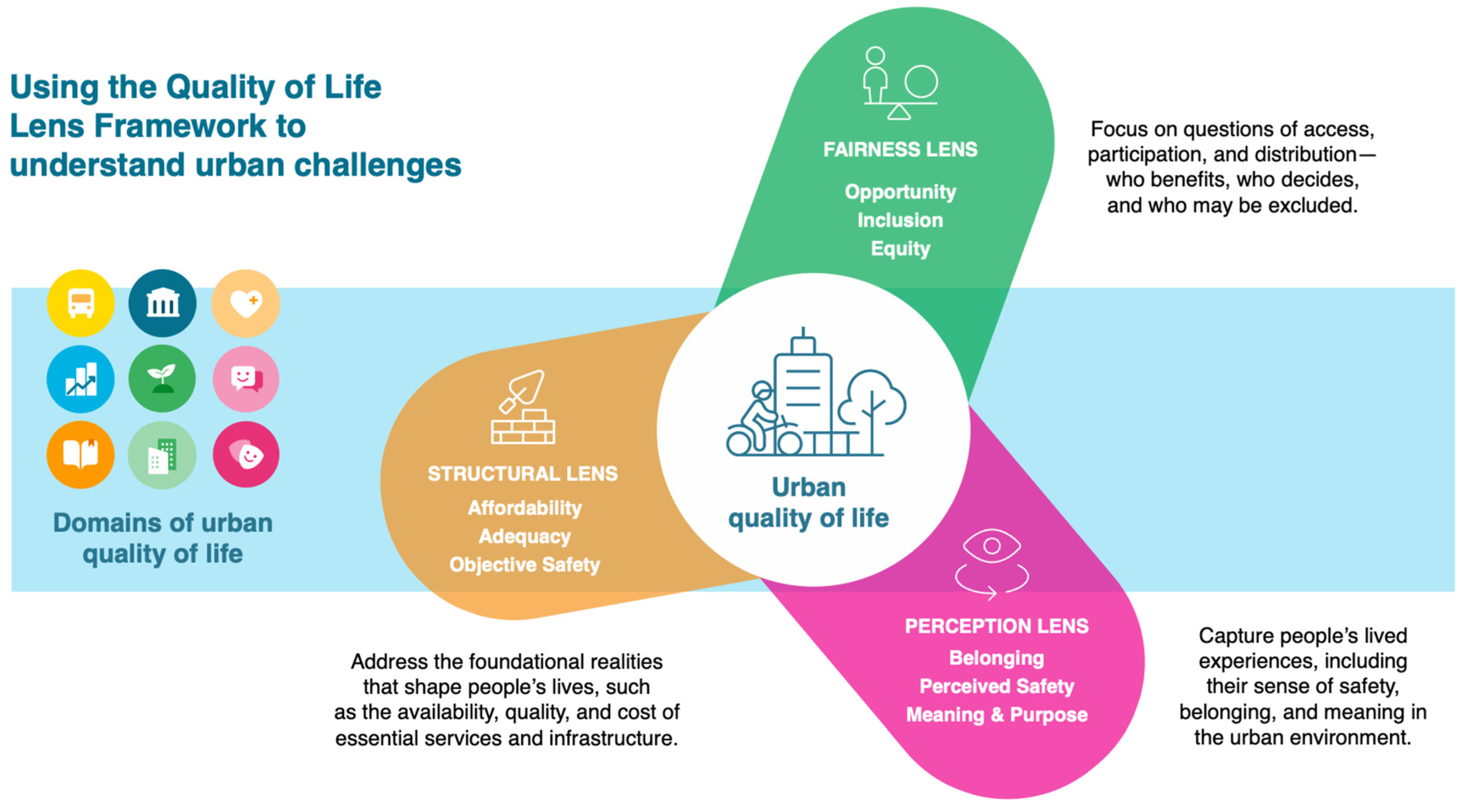
The QoL domains used to undertake the literature review arose from the work of the QoL Initiative. The literature revealed these domains tend to be applied in a fragmented and siloed manner in terms of material conditions, distributive justice, and SWB. Informed by the inductive synthesis of the 149 reviewed literature sources, the present study partitioned the domains into three clusters—Structural, Fairness, and Perception (Figure 1); the CoP confirmed the conceptual legitimacy and practical relevance of this approach. Given the conceptual narrative approach adopted it is not possible to trace those domains emergent solely from the literature and those emerging from dialogue with the CoP; the process was iterative with suggestions from the CoP tested against the literature and those domains distilled from the literature ‘tested’ with the CoP.

4.1. Structural Lens (Adequacy, Affordability, Objective Safety)

Drawn from concepts of basic needs and urban resilience [47,51], structural domains determine the baseline for health, safety, and shelter. Adequacy concerns a person’s ability to meet their basic survival and fundamental needs, including clothing, education, employment, food, healthcare, and shelter, suggesting their salience over other lenses [47,48,49,58,98,99]. Examining various domains of urban life through the prism of affordability provides insight into what individuals really value. A key change from the domains identified by the QoL Initiative is that safety was added as part of the Structural lens (as Objective Safety) as well as to the Perception lens (as Perceived Safety). This fully accords with the literature, with safety concerning both material conditions, i.e., the physical environment, and the subjective experience [3,38,52]. The structural lens sets the base for understanding QoL in urban contexts—it reflects necessary but insufficient conditions and aligns closely with established definitions of urban livability, which frame livable neighborhoods as those that are safe, attractive, and well-served by accessible housing, employment opportunities, public space, services, and transport [100]. While livability typically emphasizes physical infrastructure and service provision, the structural lens also considers how these conditions interact with broader QoL outcomes. Together, adequacy, affordability, and objective safety form the structural lens and constitute the minimum thresholds that must be met before fairness and perception-level dimensions can meaningfully shape urban QoL.

4.2. Fairness Lens (Equity, Inclusion, Opportunity)

Fairness, rather than justice, was used here as the lens given it offers a more intuitive, practical, and operational framing that connects equity, inclusion, and opportunity. The fairness lens can view the structural realities through a focus on the distributive justice aspects of urban life, inspired by the Right to the City and social justice in urban planning [74,75]. Considerations of equity and inclusion are crucial for mitigating disparities in access to services and social participation [42,58,77] and in urban contexts, equity involves not only the presence of essential infrastructure and services, but also the ability of all residents to access them in a fair and timely way—recognizing that factors such as distance, cost, and spatial segregation often determine who truly benefits. Inclusion is framed not just as physical access but as participatory justice, ensuring marginalized groups are represented in urban decision-making [78,79]. Equity is outcome-oriented, while inclusion is process- and agency-oriented. While equity ensures that resources are fairly distributed, inclusion guarantees that all community members are actively engaged and represented in decision-making processes, solidifying their role as co-creators of urban well-being. This difference is critical and is reflected in the proposed QoL framework given equitable distribution alone would not guarantee the involvement of marginalized groups in shaping policies that affect their lives. Opportunity is rooted in Amartya Sen’s capability approach; access alone is not enough, and choice without access is empty [101]. What matters is the capability or real opportunity to act on one’s values and life goals. Tokenistic (symbolic) participation must be avoided so that opportunity is transformative in enabling individuals to not only access resources but to also act upon them in meaningful ways.

4.3. Perception Lens (Belonging, Perceived Safety, Meaning and Purpose)

The urban experience is ultimately the actual, lived experience of individuals. Anchored in urban sociology and environmental psychology, these domains reflect how people actually perceive their life in urban settings. Belonging is thus conceptualized in the new QoL framework not only as a feeling of connection to place but also as a pathway to enhanced community resilience and collective well-being. Research [38] argues that urban form influences perceptions of safety and community attachment affecting overall life satisfaction with belonging mediated by place attachment and social infrastructure in fostering community cohesion [59,83]. Connectedness alone is insufficient, rather it is a pathway to belonging, operating via social cohesion, shared space, identity, and emotional ties [84]. Perceived safety directly influences residents’ willingness to engage with their surroundings, fellow residents, and public services. The addition of meaning and purpose reflects the eudaimonic perspective and interpretation of Aristotle that a person’s ultimate aim in life is to strive to realize their true potential [7]. This underscores the notion that viewing urban QoL through the lens of meaning and purpose can enable individuals to engage with their communities and pursue their aspirations regardless of their socio-economic status.

4.4. Applying the QoL Framework

While the literature included urban development QoL assessments, they tended to address material conditions (e.g., decent employment, housing, infrastructure, services), justice-oriented policies (e.g., equity, inclusion), or SWB (e.g., belonging, perceived safety) in isolation [16,29,38]. For example, policies targeting a single sector—such as housing, transport, or health—while fundamentally connected in actuality are rarely treated as such in urban decision-making [38,45,46]. This can lead to policy interventions that improve physical conditions without addressing fairness or enhancing lived experiences. The proposed QoL moves beyond siloed thinking, reflecting the interconnectedness of the QoL domains and revealing interdependencies across multiple domains of urban life in a manner akin to the real world. For example, interventions designed to improve physical infrastructure can also influence residents’ mental well-being, social inclusion, and perceptions of safety, depending on how they are experienced and accessed. By diagnosing urban conditions through structural, fairness, and perception lenses in turn, cities can become better equipped to recognize these interconnections and design integrated, multi-impact interventions that reflect the complex realities of urban life. This approach aligns well with the call to move towards more holistic, human-centered governance and planning [29,39]. The term ‘lens’ was used for each of the three clusters to emphasize that the intent of the QoL framework is to enable those involved in urban development to view city and community challenges across the clustered domains in a more holistic way. The proposed QoL framework was therefore conceptually applied to three key urban development challenges, namely, informality, migration, and sustainability, to gauge its applicability prior to examining it in real-world settings.

4.4.1. Informality

Informality, a form of urbanization shaped by state and resident actions intersecting with formal planning processes [102], is both a challenge and a vital adaptive component of urban life [17]. The unique challenges it presents are complex to address through urban policy interventions and the QoL framework could enable consideration beyond a narrow, sectoral analysis. While common structural deficits in informal contexts can be easily observed, such as the inadequacy of housing and/or infrastructure, lack of affordability of essential services, or exposure to objective safety risks like environmental hazards [47,49], these conditions alone are insufficient to provide a determination of the QoL in place. Specifically, residents of informal areas are typically excluded from formal systems of opportunity and inclusion and may face profound inequities in accessing services, representation, and recognition [77,103]. The chronic insecurity of residential tenure and economic informality undermine perceived safety, while exclusion from social networks or public life erodes belonging, and persistent precarity may limit residents’ ability to pursue meaning and purpose in their daily lives [38,66]. While informality represents a material gap and a failure of governance and social justice, it also reflects the agency and adaptive strategies in urban contexts, such as community organizing, self-built housing, and social economies [104,105]. So, while informality is framed as a problem, it is also a source of resilience and one that is especially important in areas such as climate vulnerability and urban sustainability [106].
Using the structural, fairness, and perception-based lenses of the new QoL framework to address informality could yield material insights into the lived experience of informal residents to better inform interventions and shape solutions. It is not just how these lenses interact with each other when considering informality, but also how informality interacts with other key issues. A case in point being migration, a primary driver of urbanization, which intersects with informality. Migrants are disproportionately affected by issues of housing and income insecurity [53,54,55] with informal settlements typically located in areas that may also expose them to health risks, e.g., poor water quality, environmental hazards [107], with limited economic opportunities and subject to social exclusion [8]. Indeed, many of the most meaningful attempts to engage with and address urban informality prioritize fairness and perception issues alongside the physical (structural) issues of upgrading housing and infrastructure. For example, Slum and Shackdwellers International (SDI) used participatory enumerations—placing participation and representation at the center of urban development and the upgrading of informal settlements—as a core part of its methodology to improve the lives and living conditions for residents of low-income and informal settlements [108,109]. Improving living conditions and transforming political relations were viewed as equally significant to infrastructure improvement in fostering resilience in informal settlements [110]. There were also examples where structural improvements failed because fairness and perception were not considered in slum neighborhoods, with various challenges identified such as insufficiently meeting the housing deficit or creating housing that was too expensive for the intended beneficiaries to live in [111]

4.4.2. Migration

Migration is a primary means by which people are drawn to urban centers, driven by socioeconomic change, political instability, environmental pressures, and the comparative advantages that cities offer [112,113,114]. Quality of life itself is a key driver, with economics literature framing it as a public good that shapes where people want to live and work, often weighed against other scarce resources [115]. The rise in livability indices and global city rankings since the late 20th century reflects this logic, spotlighting dimensions such as safety, healthcare, education, climate, and cultural vibrancy as magnets for mobility [14]. Yet migration is not only international: internal and circular flows, shaped by labor markets, family dynamics, and environmental shocks, can each play a decisive role in urban growth trajectories and in redistributing risks and opportunities across regions [116,117]. These movements alter the social fabric of cities, contributing innovation, workforce renewal, and cultural vitality 117]. They also strain housing, infrastructure, and governance when unmanaged or exclusionary [113,118]. Importantly, migration reshapes family and community structures, redefining caregiving, intergenerational support, and social cohesion in urban contexts [119]. The COVID-19 pandemic underscored the fluidity of these processes, as large-scale reverse migration revealed both the precarity of urban livelihoods and the resilience of mobility networks [9,120]. Together, these dynamics highlight that migration cannot be reduced to either a demographic burden or benefit: it is a multidimensional force that both reflects and reshapes QoL, with outcomes contingent on how effectively cities manage the interplay between mobility, opportunity, and inclusion.
Migration, whether voluntary or involuntary, presents layered personal and societal challenges that vary across socioeconomic groups [8]. Migrant populations are often disproportionately exposed to personal and health risks—whether through insecure housing, unsafe living conditions, or exclusion from formal labor markets and services [8,121]. At the same time, the capacity of systems to recognize and uplift migrant skills and talent remains uneven, leading to underutilization of human capital and reinforcing inequality. Governance therefore plays a decisive role: the inclusion—or absence—of migrants in city planning and representation directly shapes their QoL, enhancing opportunities for integration in some cases or entrenching marginalization in others [78]. Gender, age, and legal status further intersect to condition migrant experiences [9,112,120,122], influencing access to resources as well as perceptions of safety, belonging, and meaning. Stigma and lack of cultural recognition can erode well-being, while inclusive policies and recognition of diversity can strengthen identity and cohesion [78]. From the perspective of the QoL framework, these dynamics cut across structural conditions, fairness concerns, and perception-level outcomes. Policies that respond only to material deficits without addressing fairness or perception concerns are unlikely to yield lasting improvements, whereas approaches that integrate migrants as co-creators of urban life can transform migration into a driver of resilience, renewal, and social cohesion, ultimately enhancing QoL not only for migrants but for the urban population as a whole.

4.4.3. Sustainability

Urban sustainability literature is synonymous with concepts such as smart cities, biophilic design, urban renewal, urban compactness, and transit-oriented development, among others with smart city interventions viewed as a pathway to improving QoL, urban resilience, and inclusion [123,124,125]. Biophilic design is a socio-ecological response to challenges in rapid urbanization, such as densification and loss of ecological diversity in urban areas [126,127], and can increase urban QoL by emphasizing interactions between humans and nature with improvements in cognitive functions, stress reduction, and positive affect [127]. A growing emphasis on the more integrative perspectives of urban sustainability goes beyond the ecological aspects and examines the intersections with social and economic systems as well as individual and population health [90,127]; this approach sits well with the proposed QoL framework.
Sustainable cities and communities are defined as places where people want to live and work now and in the future since the urban environ meets their needs, contributes to a high QoL, is safe and inclusive, well planned, well built, functions well, and offers equal opportunities and good services for all [126]. This definition reflects the intersection of sustainability as a concept with QoL across multiple aspects. Specifically, socioeconomic equality, i.e., equitable access to resources and opportunities, has been linked to social resilience and sustainability alongside inclusive growth and preservation of cultural heritage [90]. Urbanization and climate change are also linked, with rapid urbanization contributing to climate change that in turn exacerbates vulnerabilities in urban areas [8]. Whereas cities produce 80 per cent of global GDP, they also account for more than 70 per cent of global greenhouse gas emissions [128]. Beyond the environmental, economic, social, and health impacts that affect QoL at the individual and collective levels, climate change affects QoL in cities as it reshapes the comparative advantage of regions, making certain areas unproductive and unlivable while other areas become more attractive and/or productive [8]. A focus on adaptability and resilience as principles guiding urban interventions in the built environment seek to promote more sustainable development [90,124,129,130]. However, a key limitation of existing frameworks, such as the SDGs [5], is held to be that they overly emphasize quantitative data, overlooking important qualitative aspects of sustainability [130]. As such, the new QoL framework offers a more balanced approach given it integrates subjective and qualitative perspectives across the three lenses more in line with the outcome goal of the SDGs to leave no one behind.
The environment, as one of the key urban life domains, can be analyzed through all three lenses. When viewed structurally, attention turns to the adequacy and resilience of environmental infrastructure; through a fairness lens, to differential access and exposure to environmental hazards and benefits (such as green spaces); and through a perception lens, to how nature supports emotional well-being, belonging, and a sense of place. Issues such as climate change and environmental pollution significantly impact structural conditions necessary for survival and the fulfillment of basic needs, i.e., through endangering lives, posing health risks, and interfering with an individual’s ability to earn a living [131,132]. They also concern fairness with some individuals and groups being more vulnerable to, and disproportionately affected by, extreme weather events that can exacerbate issues such as poverty, hunger, and health, with unequal access to resources deepening the social and economic divide in urban areas [131,133]. The perception lenses would then be used to examine how these conditions are perceived by individuals and communities and how they affect overall QoL given social and emotional well-being are critical components of the social nature of climate change [131]. Narrowly technocratic and structural approaches to sustainability—which often prioritize arbitrarily chosen indicators—can have negative effects on the fairness and perception dimensions of QoL. For example, nature-based solutions to climate change are frequently framed as being more beneficial and democratic than ostensibly ‘artificial’ counterparts—yet can still be implemented in ways that are contextually inappropriate and further marginalize vulnerable groups [134] or fail to adequately engage with the perceptions and priorities of intended beneficiaries [135]. An approach to urban sustainability that recognizes and redresses these tendencies by incorporating fairness and perception alongside structural components has the potential to lead to more meaningful and transformational progress towards sustainability and the SDGs [5]. While the QoL is often framed in terms of human needs and well-being, it must also be understood within ecological thresholds and social and planetary boundaries. The doughnut economics model [136] argues that for a society to thrive it needs to be a “safe and just space”. By positioning QoL as both socially grounded and environmentally constrained, the proposed framework promotes urban development that is not only people-centered, but also ecologically responsible.

5. Discussion

Domains of QoL in urban settings emerged from the QoL Initiative and the CoP and were tested against the literature and a new QoL framework developed based on clustering domains under three lenses: Structural, Fairness, and Perception. The scientific legitimacy of the proposed framework QoL framework is strengthened given it combined a conceptual narrative review with a systematic structure and expert validation through a CoP thus bridging academic evidence and practice-based insight. The tailored lens structures can be developed in other policy contexts, enabling cities to navigate complexity while aligning local realities with global agendas. This is especially important in the Global South given the interplay of scale, informality, and governance fragmentation [137] as well as issues pertaining to power relations and the political economy [138]. The QoL framework can sit comfortably alongside the SDGs [5] given it recognizes the interplay of various domains needed to deliver an agenda to leave no one behind. It then extends this consideration by bringing the local and lived experience to the fore in realizing these global goals.
While the domains identified by QoL Initiative highlighted access and choice [10], these were brought together under ‘opportunity’, reflecting both the agency and capability emphasized by Amartya Sen’s Capability Approach [101]. For example, the ability to move freely in a city, to participate in cultural life, to access networks of opportunities, and enjoy the benefits that cities offer. While the structural lens determines a baseline level of environmental reality within any urban context, it is insufficient alone and structural realities should be evaluated through the fairness lens. Who is included? Who is left out? Who is empowered with the capability and agency to act? These considerations of fairness are central to any meaningful conceptualization of QoL, highlighting the importance of equity, inclusion, and opportunity as mechanisms that mediate the lived experience of urban environments [72,73]. Recognizing justice as fairness [139], distinguishing distributive justice (roughly similar to equity) from procedural justice (roughly similar to inclusion), and adding a recognition or opportunity dimension [140], fairness was adopted as the QoL lens. It focuses on impartiality and equal treatment, ensuring everyone is treated the same way, regardless of individual circumstances, while justice emphasizes giving each person what they deserve based on a standard, whether that is a legal or moral one.
The new QoL framework positions the safety element as both objective safety (structural lens) and perceived safety (perception lens). This distinction is meant to emphasize the subjective experience of safety and security within urban spaces, which is supported by research showing that individuals may feel unsafe even in environments with low objective risk factors such as urban design, lighting, social cohesion, or community trust [62,64]. In applying the QoL framework, structural conditions such as inadequate housing or unsafe infrastructure are compounded by fairness gaps—such as unequal access to services or lack of representation—and further shaped by perception-level outcomes, including fear, exclusion, or lack of meaning in urban life [44,47,49,141]. These issues are not simply added to one another but interact in complex ways that may change over time. This complexity underscores the need for a QoL framework that accounts for structural conditions, fairness dynamics, and perception-level outcomes. For example, a structurally safe space may still feel unsafe if social trust is lacking; access to services may not equate to opportunity if agency is constrained, etc. While this framing does not claim to be exhaustive, it captures a fuller spectrum of urban life that should enable a more holistic diagnosis of urban conditions and the design of impactful interventions for people.
The proposed lenses are distinct from the OECD Wellbeing Framework [27] which assesses wellbeing across 11 domains, i.e., civic engagement, social connections, work–life balance, safety, subjective wellbeing, environmental quality, knowledge and skills, health, work and job quality, housing and income and wealth [27]. The OECD Framework’s dimensions and indicators broadly touch on material conditions and aspects of QoL conditions, including equity from a gendered perspective, mood, and life satisfaction. The proposed QoL framework builds on this by providing a structured method to assess material conditions, thereby providing a broader approach to matters of equity and subjective experience. The QoL lenses also extend the UN-Habitat’s City Prosperity Index, which examines dimensions of a city’s productivity, infrastructure development, QoL, equity and inclusion, environmental sustainability, and governance and legislation [142]. While the three lenses go beyond established theoretical and governance models, they loosely echo frameworks such as Maslow’s hierarchy of needs [143] that posited a progression from basic material conditions to higher-order psychological fulfillment. However, the proposed QoL framework is not prescriptive or universally fixed and offers a diagnostic prism through which different aspects of urban QoL can be examined—either sequentially or starting from whichever lens is most relevant to the urban context and the challenge at hand. For instance, in some cities, equity or belonging will be the primary concern and thus the entry point. Likewise, from a governance perspective, structural conditions often fall within municipal mandates, while fairness concerns may require national-level policy shifts, and perception-level outcomes can emerge from both. This flexible structuring encourages a more integrated view of urban development while allowing adaptation to local priorities and perspectives.
At the heart of the QoL approach—and perhaps one of its greatest advantages vis-à-vis many global development frameworks—is its nearly universal applicability. QoL means something different to everyone, each having their own intuitive understanding of what it means to them. As such, the final layer of the proposed framework of lenses for viewing urban development revolves around this subjective nature of the lived experience. While the structural building blocks are non-negotiable for determining access to basic services and the fairness lens clarifies how these resources are distributed, it is the perception of these realities that completes QoL as a lived experience. How people feel connected to their communities, perceive their safety, and find meaning and purpose in their urban environments are critical components of well-being and resilience [38,83].
The QoL Framework tripartite structure serves to integrate whether people can live safely and affordably (structural conditions), with whether opportunities are inclusive and equitably distributed (fairness conditions), and whether people feel they belong, feel safe, and experience meaning (perceptual conditions). Given QoL is held to exist where all three conditions are present simultaneously, the proposed framework goes beyond other models that measure these elements separately or incompletely. This is a theoretical shift from additive indicators to relational sufficiency. In particular, it elevates Perception where neither the OECD Wellbeing Framework [27] nor UN-Habitat’s Urban Monitoring Framework [28] treat belonging, perceived safety, or meaning and purpose as co-equal foundations. When included, they are secondary outcomes (OECD, life satisfaction), or embedded indirectly (UN-Habitat, quality-of-life sub-index). In doing so, the proposed framework recognizes that people do not experience cities as indicators or systems, and that perception mediates how structural and fairness conditions are lived. So, while a city can be objectively safe it can feel unsafe. It can also be affordable yet feel exclusionary. The QoL framework could help make such tensions analytically visible. While equity appears in both the OECD and UN-Habitat frameworks, the QoL model treats fairness as constitutive of QoL, not simply an outcome. It moves beyond distribution (who gets what) to recognition and inclusion (who belongs, who is seen, and who has voice) and aligns with environmental justice and sustainable communities more akin to the SDGs [5]. Unlike global benchmarking tools, the QoL framework could be especially powerful for neighborhood diagnostics, community-based participatory research, and co-creation of interventions with residents because it combines measurable conditions, equity, and narrative and perceptual data. It therefore offers a means to create a shared understanding among planners, policymakers, and communities—a gap in the approaches offered by both the OECD and UN-Habitat.
While single-sector interventions may appear to offer a cost-effective approach to urban development, and tend to reflect the governance structures of place-based models, the lack of progress towards the SDGs [5,6] suggests other approaches are needed [18]. The literature highlights the importance of assessing both objective and subjective components to comprehensively evaluate urban QoL [29]. This calls for mixed methodologies to be used in data collection and assessment, considering both top–down and bottom–up approaches [144]. Recognizing that there are connections and a dynamic tension among the different lenses in the proposed QoL framework calls for further research to deepen our appreciation of such. Field testing of the framework is currently underway with nine cities involved in the QoL Initiative Pilot Cities project representing diverse global regions: Bhubaneswar (India), Kampala (Uganda), Logan (Australia), Madinah (Saudi Arabia), Nis (Serbia), Querétaro (Mexico), Quito (Ecuador), Udon Thani (Thailand), and Vancouver (Canada) [145]. Emergent insights support the field utility of the QoL framework in opening up the analytical space between common and context-specific objective and subjective perspectives seeking to improve residents’ lived experiences as a legitimate goal of sustainable development and delivery of the SDGs at the sub-national level. Any refinements to the framework can be added as this project is scaled up to 100 cities in the future. Once populated with quantitative data, the framework can offer cities and urban managers a way to connect planned interventions to meaningful QoL outcomes, helping them navigate the increasing complexity of multidimensional urban challenges.
In creating the proposed QoL framework, potential limitations include regional imbalance in the literature reviewed compounded by a reliance on English-language sources, and a focus on urban contexts with stronger data availability. While universality and adaptability are asserted, results from the pilot cities may reveal that the QoL framework will need to better accommodate contexts characterized by extreme inequality, conflict, or disaster. There may also be an opportunity to embed SDG indicators, consider further the measurement challenges in assessing meaning and purpose, as well as those relating to perceived safety and belonging. Future studies might include the possibility of adding more domains to one of more of the lenses, and/or adding one of more lenses to the model. The intersection and application of this framework with other urban challenges such as water scarcity, migration and demographic pressures, children’s well-being, educational access, artificial intelligence (AI), and digital transformation could also be considered. Given the rise in AI, smart technologies are likely to grow in terms of influence and impact on urban QoL, from optimized mobility and predictive infrastructure maintenance to issues of surveillance, and digital divides. The applicability of the QoL framework to mega-cities of the Global South, such as Cairo or Buenos Aires, would also be of interest.

6. Conclusions

The theoretical breakthrough of the QoL Framework is a move from “How Is the City Doing?” to “How Is Life Being Lived?” Quality of life is not a property of cities alone, nor of individuals living in urban settings, but of the relationships among structure, fairness, and perception of the lived experience. The proposed framework reframes urban QoL as: relational (between people and place); normative (grounded in dignity and justice); experiential (rooted in meaning and belonging); and, action-oriented (usable at the scale where life is lived). In doing so, the QoL framework serves to complement existing global development agenda, such as the SDGs, with consideration of local issues such as why a city or urban settlement might do well on global indices but still fail to support and sustain a good life for many of its residents. This is especially relevant to the realizing the SDGs that include specific goals for urban spaces, such as SDG 11 on Sustainable Cities and Communities.
The three meta lenses of the QoL framework, namely structural, fairness, and perception, could help the process of localizing urban development given they extend traditional GDP-focused measures and serve to bring the lived experiences of people to the forefront. The opportunity to embed SDG indicators within the framework could provide a way for cities to track progress toward sustainable development outcomes in line with UN-Habitat’s focus on promoting socially and environmentally sustainable towns and cities and adequate shelter for all.
By aligning with existing municipal governance structures—where efforts often concentrate on structural conditions—the new QoL framework calls for the incorporation of fairness and perception lenses. These are frequently overlooked in day-to-day service provisions that strive to create conditions where no one is left behind. As such, it can help bridge municipal, regional, and national layers of governance, offering a more coherent approach to strengthening cross-sectoral coordination and thereby localize global agendas through a more holistic approach to urban development.
The new QoL framework could help leaders better understand the priorities for sustainable development in urban settings and enable policymakers to design more integrated, multi-impact interventions that drive forward QoL for individuals and communities. While the interpretation of the proposed structural, fairness, and perception lenses will vary according to the urban context, the relevance of the QoL could be universal and applicable to urban development and efforts to advance sustainable communities globally.

Author Contributions

Conceptualization, W.M.P.; methodology, W.M.P., A.S. and E.S.; software, E.S.; validation, W.M.P., A.S., M.D.W. and E.M.; formal analysis, W.M.P., A.S. and E.S.; investigation, W.M.P., A.S. and E.S.; resources, A.S. and M.D.W.; data curation, E.S.; writing—original draft preparation, W.M.P., A.S. and E.S.; writing—review and editing, W.M.P., H.S., D.D., F.S. and J.A.; visualization, A.S.; supervision, W.M.P.; project administration, A.S.; funding acquisition, A.S. All authors have read and agreed to the published version of the manuscript.

Funding

This research was implemented by UN-Habitat, with sponsorship from the Quality of Life Program of the Kingdom of Saudi Arabia.

Institutional Review Board Statement

Not applicable.

Informed Consent Statement

Not applicable.

Data Availability Statement

The full literature database is available from the authors upon request, subject to sharing rights.

Acknowledgments

The authors gratefully acknowledge the generous support of the Quality of Life Program of the Kingdom of Saudi Arabia, which sponsors the global Quality of Life Initiative implemented by UN-Habitat. The authors wish to acknowledge the academic engagement of those named in Appendix A as members of the Quality of Life Community of Practice; this article draws upon their insights in shaping the development of the lens framework. The authors are particularly thankful to all those who contributed literature recommendations, case materials, and shared feedback throughout the deliberative review process.

Conflicts of Interest

The authors declare no conflicts of interest. The funders had no role in the design of the study; in the collection, analyses, or interpretation of data; in the writing of the manuscript; or in the decision to publish the results.

Abbreviations

The following abbreviations are used in this manuscript:
AIArtificial Intelligence
CoPCommunity of Practice
GDPGross Domestic Product
QoLQuality of Life
SDGsSustainable Development Goals
UNUnited Nations

Appendix A

Table A1. Academia Community of Practice involved with the Quality of Life Initiative.
NameOrganization
Abdullah AlghannamPrincess Nourah bint Abdulrahman University, Saudi Arabia
Jamie AndersonUniversity of Manchester, UK
Jane BattersbyUniversity of cape Town, South Africa
Patricia CanelasUniversity of Oxford, UK
Lucia DammertUniversidad de Santiago de Chile, Chile
Kirti DasPrinceton University, USA
David DodmanErasmus University Rotterdam, The Netherlands
Adel Al DosaryKing Fahad University for Minerals and Petroleum, Saudi Arabia
Catherine GallParis Sorbonne, France
Amy Edwards HolmesJohn Hopkins University, USA
Lara KinneirLondon Interdisciplinary School, UK
Debolina KunduNational Institute of Urban Affairs, India
Sara De LisJohns Hopkins University, USA
Melanie LoweRoyal Melbourne Institute of Technology, Australia
Abdulrahman MohammedUN-Habitat
Eduardo MorenoUN-Habitat
Matthew MorganQuality of Life Foundation
Fernando MurilloUniversity of Buenos Aires, Argentina
Sukaina Al NasrawiUN Economic and Social Commission for Western Asia
Wendy PurcellRutgers University & Harvard University, USA
Anu RamaswamiPrinceton University, USA
Saut SagalaInstitut Teknologi Bandung, Indonesia
Francesco SarracinoSTATEC, Luxembourg
Andrew SchmidtUN-Habitat
Himanshu ShekharUnited Nations University
Joseph SirgyVirginia Polytechnic Institute and State University, USA
Alsaleh SugatiQuality of Life Program Center
Mezyad Al TerkawiKing Saud University, Saudi Arabia
Yonette ThomasUrban360, USA
Habib TiliouineUniversity of Oran, Algeria
Arturo TorresUniversity of Guadalajara, Mexico
Philipp UlbrichUniversity of Glasgow
Raphaelle VignolUN-Habitat

References

  1. Murgaš, F.; Klobučník, M. Quality of Life in the City, Quality of Urban Life or Well-Being in the City: Conceptualization and Case Study. Ekológia 2018, 37, 183–200. [Google Scholar] [CrossRef]
  2. Diener, E. Subjective well-being. Psychol. Bull. 1984, 95, 542–575. [Google Scholar] [CrossRef]
  3. Shekhar, H.; Schmidt, A.J.; Wehling, H.-W. Exploring Wellbeing in Human Settlements—A Spatial Planning Perspective. Habitat Int. 2019, 87, 66–74. [Google Scholar] [CrossRef]
  4. Sobhaninia, S.; Samavati, S.; Aldrich, D.P. Designing for Happiness, Building for Resilience: A Systematic Review of Key Factors for Cities. Int. J. Urban Sustain. Dev. 2024, 16, 360–378. [Google Scholar] [CrossRef]
  5. United Nations. The 17 Goals|Sustainable Development; United Nations: New York, NY, USA, 2015. Available online: https://sdgs.un.org/goals (accessed on 7 December 2025).
  6. United Nations. The New Urban Agenda; Habitat III: Quito, Ecuador, 2016. Available online: https://habitat3.org/the-new-urban-agenda/ (accessed on 7 December 2025).
  7. Ryff, C.D.; Singer, B.H. Know Thyself and Become What You Are: A Eudaimonic Approach to Psychological Well-Being. J. Happiness Stud. 2008, 9, 13–39. [Google Scholar] [CrossRef]
  8. Adger, W.N.; Crépin, A.-S.; Folke, C.; Ospina, D.; Chapin, F.S.; Segerson, K.; Seto, K.C.; Anderies, J.M.; Barrett, S.; Bennett, E.M.; et al. Urbanization, migration, and adaptation to climate change. One Earth 2020, 3, 396–399. [Google Scholar] [CrossRef]
  9. Jesline, J.; Romate, J.; Rajkumar, E.; George, A.J. The Plight of Migrants during COVID-19 and the Impact of Circular Migration in India: A Systematic Review. Humanit. Soc. Sci. Commun. 2021, 8, 231. [Google Scholar] [CrossRef]
  10. Quality of Life Initiative. A Fresh Perspective on Measuring Quality of Life: Initial Process to Conceptualise a Universal Tool to Measure Quality of Life in Cities; UN-Habitat: Nairobi, Kenya, 2023. [Google Scholar]
  11. Felce, D. Defining and Applying the Concept of Quality of Life. J. Intellect. Disabil. Res. 1997, 41, 126–135. [Google Scholar] [CrossRef]
  12. Tabol, C. Bringing an Ecological Perspective to Quality of Life Research: Can Empowerment Theory Explain Variance in Quality of Life Ratings? Digital Repository Service—Northeastern University. 2008. Available online: https://repository.library.northeastern.edu/ (accessed on 7 December 2025).
  13. Myers, D. Building Knowledge about Quality of Life for Urban Planning. J. Am. Plan. Assoc. 1988, 54, 347–358. [Google Scholar] [CrossRef]
  14. Cramer-Greenbaum, S. Who can afford a ‘livable’ place? The part of living global rankings leave out. Int. J. Urban Sustain. Dev. 2020, 13, 70–82. [Google Scholar] [CrossRef]
  15. Cutter, S.L. Resilience to what? Resilience for whom? The geographic perspective. Environ. Sci. Policy Sustain. Dev. 2016, 58, 15–25. [Google Scholar]
  16. Levent, T.B.; Nijkamp, P. Quality of Urban Life: A Taxonomic Perspective. Stud. Reg. Sci. 2006, 36, 269–281. [Google Scholar] [CrossRef]
  17. Vigiola, G.Q. Informal Housing and Residents’ Well-Being in Caracas and Sydney: A Comparative Study of Residents’ Experiences. Glob. Discourse 2022, 12, 289–308. [Google Scholar] [CrossRef]
  18. Abuiyada, R. Traditional development theories have failed to address the needs of the majority of people at grassroots levels with reference to GAD. Int. J. Bus. Soc. Sci. 2018, 9, 115–119. [Google Scholar] [CrossRef]
  19. Novović, G. Can Agenda 2030 bring about “localization”? Policy limitations of Agenda 2030 in the broader global governance system. Dev. Policy Rev. 2021, 40, e12587. [Google Scholar] [CrossRef]
  20. Giannetti, B.F.; Agostinho, F.; Almeida, C.M.V.B.; Huisingh, D. A Review of Limitations of GDP and Alternative Indices to Monitor Human Wellbeing and Manage Ecosystem Functionality. J. Clean. Prod. 2015, 87, 11–25. [Google Scholar] [CrossRef]
  21. Hulten, C.R.; Nakamura, L.I. Is GDP Becoming Obsolete? The “Beyond GDP” Debate. NBER Working Paper Series, 18 July 2022. Available online: https://www.nber.org/papers/w30196 (accessed on 7 December 2025).
  22. Land, K.C.; Michalos, A.C. Fifty Years after the Social Indicators Movement: Has the Promise Been Fulfilled? Soc. Indic. Res. 2017, 135, 835–868. [Google Scholar] [CrossRef]
  23. Easterlin, R.A.; O’Connor, K.J. The Easterlin Paradox. In Handbook of Labor, Human Resources and Population Economics; Zimmermann, K.F., Ed.; Springer: Cham, Switzerland, 2022. [Google Scholar] [CrossRef]
  24. Sagar, A.D.; Najam, A. The Human Development Index: A Critical Review. Ecol. Econ. 1998, 25, 249–264. [Google Scholar] [CrossRef]
  25. Cracolici, M.F.; Cuffaro, M.; Nijkamp, P. The measurement of economic, social and environmental performance of countries: A novel approach. Soc. Indic. Res. 2010, 95, 339–356. [Google Scholar] [CrossRef]
  26. World Health Organization. The World Health Organization Quality of Life (WHOQOL); WHO: Geneva, Switzerland, 2012; Available online: https://www.who.int/publications/i/item/WHO-HIS-HSI-Rev.2012.03 (accessed on 7 December 2025).
  27. OECD. How’s Life? 2024; OECD Publishing: Paris, France, 2024; Available online: https://www.oecd.org/en/publications/how-s-life-2024_90ba854a-en.html (accessed on 7 December 2025).
  28. UN-Habitat. The Global Urban Monitoring Framework; UN-Habitat: Nairobi, Kenya, 2022; Available online: https://unhabitat.org/the-global-urban-monitoring-framework (accessed on 7 December 2025).
  29. Marans, R.W.; Stimson, R. An Overview of Quality of Urban Life. In Investigating Quality of Urban Life; Marans, R.W., Stimson, R., Eds.; Social Indicators Research Series; Springer: Dordrecht, The Netherlands, 2011; Volume 45. [Google Scholar] [CrossRef]
  30. Kent, J.L.; Thompson, S.M. The Three Domains of Urban Planning for Health and Well-Being. J. Plan. Lit. 2014, 29, 239–256. [Google Scholar] [CrossRef]
  31. Giles-Corti, B.; Vernez-Moudon, A.; Reis, R.; Turrell, G.; Dannenberg, A.L.; Badland, H.; Foster, S.; Lowe, M.; Sallis, J.F.; Stevenson, M.; et al. City Planning and Population Health: A Global Challenge. Lancet 2016, 388, 2912–2924. [Google Scholar] [CrossRef]
  32. Pfeiffer, D.; Cloutier, S. Planning for Happy Neighborhoods. J. Am. Plan. Assoc. 2016, 82, 267–279. [Google Scholar] [CrossRef]
  33. Anderson, J.; Benton, J.; Ye, J.; Barker, E.; Macintyre, V.; Wilkinson, J.; Rothwell, J.; Dennis, M.; French, D. Large walking and wellbeing behaviour benefits of co-designed sustainable park improvements: A natural experimental study in a UK deprived urban area. Environ. Int. 2024, 187, 108669. [Google Scholar] [CrossRef]
  34. Benton, J.S.; Cotterill, S.; Anderson, J.; Macintyre, V.G.; Gittins, M.; Dennis, M.; French, D.P. A natural experimental study of improvements along an urban canal: Impact on canal usage, physical activity and other wellbeing behaviours. Int. J. Behav. Nutr. Phys. Act. 2021, 18, 19. [Google Scholar] [CrossRef]
  35. Giles-Corti, B.; Moudon, A.V.; Lowe, M.; Cerin, E.; Boeing, G.; Frumkin, H.; Salvo, D.; Foster, S.; Kleeman, A.; Bekessy, S.; et al. What Next? Expanding Our View of City Planning and Global Health, and Implementing and Monitoring Evidence-Informed Policy. Lancet Glob. Health 2022, 10, e919–e926. [Google Scholar] [CrossRef] [PubMed]
  36. Anderson, J.; Ruggeri, K.; Steemers, K.; Huppert, F. Lively social space, well-being activity, and urban design: Findings from a low-cost community-led public space intervention. Environ. Behav. 2016, 49, 685–716. [Google Scholar] [CrossRef]
  37. Wang, F.; Wang, D. Place, Geographical Context and Subjective Well-Being: State of Art and Future Directions. In Mobility, Sociability and Well-Being of Urban Living; Springer: Berlin/Heidelberg, Germany, 2016; pp. 189–230. [Google Scholar] [CrossRef]
  38. Mouratidis, K. Urban Planning and Quality of Life: A Review of Pathways Linking the Built Environment to Subjective Well-Being. Cities 2021, 115, 103229. [Google Scholar] [CrossRef]
  39. Martino, N.; Girling, C.; Lu, Y. Urban Form and Livability: Socioeconomic and Built Environment Indicators. Build. Cities 2021, 2, 82. [Google Scholar] [CrossRef]
  40. Shama, Z.S.; Motlak, J.B. Indicators for Sustainable Housing. IOP Conf. Ser. Mater. Sci. Eng. 2019, 518, 022009. [Google Scholar] [CrossRef]
  41. Chang, S.; Smith, M.K. Residents’ quality of life in smart cities: A systematic literature review. Land 2023, 12, 876. [Google Scholar] [CrossRef]
  42. Brambilla, M.; Michelangeli, A.; Peluso, E. Equity in the city: On measuring urban (ine)quality of life. Urban Stud. 2013, 50, 3205–3224. [Google Scholar] [CrossRef]
  43. Albouy, D.; Ehrlich, G.; Liu, Y. Housing Demand, Cost-of-Living Inequality, and the Affordability Crisis; NBER Working Paper; National Bureau of Economic Research: Cambridge, MA, USA, 2016; Volume 22816. [Google Scholar] [CrossRef]
  44. Perera, U.; Mensah, C.A. Housing Affordability as a Reflexivity of Quality of Life. In Multidimensional Approach to Quality of Life Issues; Sinha, B., Ed.; Springer: Singapore, 2019; pp. 25–41. [Google Scholar] [CrossRef]
  45. Yarker, S.K. Belonging in Byker: The Nature of Local Belonging and Attachment in Contemporary Cities. Ph.D. Thesis, Newcastle University, Newcastle upon Tyne, UK, 2014. Available online: http://theses.ncl.ac.uk/jspui/handle/10443/2619 (accessed on 7 December 2025).
  46. Swope, C.B.; Hernández, D. Housing as a Determinant of Health Equity: A Conceptual Model. Soc. Sci. Med. 2019, 243, 112571. [Google Scholar] [CrossRef]
  47. Rao, N.D.; Min, J. Decent Living Standards: Material Prerequisites for Human Wellbeing. Soc. Indic. Res. 2018, 138, 225–244. [Google Scholar] [CrossRef] [PubMed]
  48. Das, K.; Ramaswami, A.; Fan, Y.; Cao, J. Connecting the dots between urban infrastructure, well-being, livability, and equity: A data-driven approach. Environ. Res. Infrastruct. Sustain. 2022, 2, 035004. [Google Scholar] [CrossRef]
  49. Riva, A.; Rebecchi, A.; Capolongo, S.; Gola, M. Can Homes Affect Well-Being? A Scoping Review among Housing Conditions, Indoor Environmental Quality, and Mental Health Outcomes. Int. J. Environ. Res. Public Health 2022, 19, 15975. [Google Scholar] [CrossRef] [PubMed]
  50. UN-Habitat. The Right to Adequate Housing: Fact Sheet No. 21/Rev. 1; UN-Habitat: Nairobi, Kenya, 2009; Available online: https://unhabitat.org/sites/default/files/documents/2019-05/fact_sheet_21_adequate_housing_final_2010.pdf (accessed on 7 December 2025).
  51. Godschalk, D.R. Urban Hazard Mitigation: Creating Resilient Cities. Nat. Hazards Rev. 2003, 4, 136–143. [Google Scholar] [CrossRef]
  52. Hulse, K.; Saugeres, L. Housing Insecurity and Precarious Living: An Australian Exploration: Final Report; Australian Housing and Urban Research Institute: Melbourne, Australia, 2008. [Google Scholar]
  53. Khan, A.; Arokkiaraj, H. Challenges of Reverse Migration in India: A Comparative Study of Internal and International Migrant Workers in the Post-COVID Economy. Comp. Migr. Stud. 2021, 9, 49. [Google Scholar] [CrossRef]
  54. Dwivedi, S.; Perumal, S.K.; Kumar, S.; Bhattacharyya, S.; Kumari, N. Impact of Cross Border Reverse Migration in Delhi–UP Region of India during COVID-19 Lockdown. Comput. Math. Biophys. 2023, 11, 0151. [Google Scholar] [CrossRef]
  55. Tiwari, P.; Majumdar, S. Examining the Impact of Socio-Economic, Demographic and Policy Factors on Reverse Migration in India During COVID-19 Pandemic. Environ. Urban. ASIA 2024, 15, 226–240. [Google Scholar] [CrossRef]
  56. Mia, M.A.; Zull, E.I. Housing Affordability: Measurements and Trends. In Sustainable Cities and Communities; Filho, W.L., Azul, A.M., Brandli, L., Özuyar, P.G., Wall, T., Eds.; Springer: Cham, Switzerland, 2020; pp. 1–13. [Google Scholar] [CrossRef]
  57. Monk, S.; Whitehead, C. Making Housing More Affordable; Wiley-Blackwell: Hoboken, NJ, USA, 2010. [Google Scholar] [CrossRef]
  58. Murgante, B.; Patimisco, L.; Annunziata, A. Developing a 15-Minute City: A Comparative Study of Four Italian Cities—Cagliari, Perugia, Pisa, and Trieste. Cities 2024, 146, 104765. [Google Scholar] [CrossRef]
  59. Qi, J.; Mazumdar, S.; Vasconcelos, A.C. Understanding the Relationship between Urban Public Space and Social Cohesion: A Systematic Review. Int. J. Community Well-Being 2024, 7, 155–212. [Google Scholar] [CrossRef]
  60. UN-Habitat. Enhancing Urban Safety and Security: Global Report on Human Settlements 2007; Routledge: London, UK, 2012. [Google Scholar]
  61. Franc, R.; Prizmic-Larsen, Z.; Lipovčan, L.K. Personal Security and Fear of Crime as Predictors of Subjective Well-Being. In Subjective Well-Being and Security; Springer: Dordrecht, The Netherlands, 2012. [Google Scholar] [CrossRef]
  62. Mouratidis, K. Compact City, Urban Sprawl, and Subjective Well-Being. Cities 2019, 92, 261–272. [Google Scholar] [CrossRef]
  63. Mouratidis, K.; Yiannakou, A. What Makes Cities Livable? Determinants of Neighborhood Satisfaction and Neighborhood Happiness in Different Contexts. Land Use Policy 2022, 112, 105855. [Google Scholar] [CrossRef]
  64. Johansson, M.; Tsiakiris, G.; Rahm, J. People’s Conceptual Environmental Appraisals of Urban Space in Daylight and Electric Light. IOP Conf. Ser. Earth Environ. Sci. 2024, 1320, 012013. [Google Scholar] [CrossRef]
  65. Wang, Q.-C.; Liu, X.; Jian, I.Y.; Zhang, E.-J.; Hou, Y.-T.; Siu, K.W.M.; Li, Y.-B. Community Resilience in City Emergency: Exploring the Roles of Environmental Perception, Social Justice and Community Attachment in Subjective Well-Being of Vulnerable Residents. Sustain. Cities Soc. 2023, 97, 104745. [Google Scholar] [CrossRef]
  66. Setiawan, C.T.; Ningtyas, R. Urban Well-Being and Community Development: Investigating the Relationship Between Built Environments, Social Networks, and Quality of Life. West Sci. Soc. Humanit. Stud. 2023, 1, 53–62. [Google Scholar] [CrossRef]
  67. Niu, C.; Jiang, Z.; Liu, H.; Yang, K.; Song, X.; Li, Z. The influence of media consumption on public risk perception: A meta-analysis. J. Risk Res. 2020, 25, 21–47. [Google Scholar] [CrossRef]
  68. Siegrist, M.; Cvetkovich, G. Perception of Hazards: The Role of Social Trust and Knowledge. Risk Anal. 2000, 20, 713–720. [Google Scholar] [CrossRef]
  69. Janssen, H.J.; Oberwittler, D.; Koeber, G. Victimization and Its Consequences for Well-Being: A Between- and Within-Person Analysis. J. Quant. Criminol. 2020, 37, 101–140. [Google Scholar] [CrossRef]
  70. Dubey, S.; Bailey, A.; Lee, J. Women’s Perceived Safety in Public Places and Public Transport: A Narrative Review of Contributing Factors and Measurement Methods. Cities 2025, 156, 105534. [Google Scholar] [CrossRef]
  71. Cazden, C. A framework for social justice in education. Int. J. Educ. Psychol. 2012, 1, 178–198. [Google Scholar] [CrossRef]
  72. Fainstein, S.S. The Just City. Int. J. Urban Sci. 2013, 18, 1–18. [Google Scholar] [CrossRef]
  73. Purcell, M. Possible Worlds: Henri Lefebvre and the Right to the City. J. Urban Aff. 2014, 36, 141–154. [Google Scholar] [CrossRef]
  74. Lefebvre, H. The Right to the City. In Writings on Cities; Kofman, E., Lebas, E., Eds.; Blackwell: Oxford, UK, 1996; pp. 147–159. [Google Scholar]
  75. Harvey, D. Rebel Cities: From the Right to the City to the Urban Revolution; Verso: London, UK; New York, NY, USA, 2012. [Google Scholar]
  76. Northridge, M.E.; Freeman, L. Urban Planning and Health Equity. J. Urban Health 2011, 88, 582–597. [Google Scholar] [CrossRef] [PubMed]
  77. Cinderby, S.; Archer, D.; Mehta, V.K.; Neale, C.; Opiyo, R.; Pateman, R.M.; Muhoza, C.; Adelina, C.; Tuhkanen, H. Assessing inequalities in wellbeing at a neighbourhood scale in low-middle-income-country secondary cities and their implications for long-term livability. Front. Sociol. 2021, 6, 729453. [Google Scholar] [CrossRef] [PubMed]
  78. Szaboova, L.; Adger, W.N.; Safra de Campos, R.; Siddiqui, T.; Alam Bhuiyan, M.R.; Billah, T.; Rocky, M.H. Promoting Sustainable Cities through Creating Social Empathy Between New Urban Populations and Planners. npj Urban Sustain. 2024, 4, 52. [Google Scholar] [CrossRef]
  79. Reuter, K.T. Human Rights and the City: Including Marginalized Communities in Urban Development and Smart Cities. J. Hum. Rights 2019, 18, 382–402. [Google Scholar] [CrossRef]
  80. Kotan, M. Freedom or Happiness? Agency and Subjective Well-Being in the Capability Approach. J. Socio-Econ. 2010, 39, 369–375. [Google Scholar] [CrossRef]
  81. Torche, F. Intergenerational Mobility and Equality of Opportunity. Eur. J. Sociol. 2015, 56, 343–371. [Google Scholar] [CrossRef]
  82. Barton, H. Land use planning and health and well-being. Land Use Policy 2009, 26, S115–S123. [Google Scholar] [CrossRef]
  83. Lomas, M.J.; Ayodeji, E.; Brown, P. Experiences of Place Attachment and Mental Wellbeing in the Context of Urban Regeneration. Health Place 2021, 70, 102604. [Google Scholar] [CrossRef]
  84. Weijs-Perrée, M.; Van den Berg, P.; Arentze, T.; Kemperman, A. Social Networks, Social Satisfaction and Place Attachment in the Neighborhood. Region 2017, 4, 133–151. [Google Scholar] [CrossRef]
  85. Jacobs, J. The Death and Life of Great American Cities; Vintage Books: New York, NY, USA, 1961. [Google Scholar]
  86. Whyte, W.H. The Social Life of Small Urban Spaces; The Conservation Foundation: Washington, DC, USA, 1980. [Google Scholar]
  87. Dash, S.P.; Shenoy, A.; Prabhu, S.G. Understanding the factors of accessibility to the neighborhood green spaces that contribute to social cohesion: A systematic literature review. J. Infrastruct. Policy Dev. 2024, 8, 4383. [Google Scholar] [CrossRef]
  88. Anthun, K.S.; Maass, R.E.K.; Hope, S.; Espnes, G.A.; Bell, R.; Khan, M.; Lillefjell, M. Addressing inequity: Evaluation of an intervention to improve accessibility and quality of a green space. Int. J. Environ. Res. Public Health 2019, 16, 5015. [Google Scholar] [CrossRef]
  89. Sauter, D.; Huettenmoser, M. Liveable Streets and Social Inclusion. Urban Des. Int. 2008, 13, 67–79. [Google Scholar] [CrossRef]
  90. Seduikyte, L.; Grazuleviciute-Vileniske, I.; Mlinkauskienė, A.; Januškienė, E. Fostering Resilient Communities through the Interaction of Heritage, Policy, and Participation: Insights from a Lithuanian Case Study. Sustainability 2025, 17, 3883. [Google Scholar] [CrossRef]
  91. Pierce, J.; Martin, D.G.; Murphy, J.T. Relational place-making: The networked politics of place. Trans. Inst. Br. Geogr. 2011, 36, 54–70. [Google Scholar] [CrossRef]
  92. Machin Suárez, R.; Viscay Mantilla, D. From Virtual Communities to Research on Virtuality: Emerging Concepts and Research Challenges—Ethnographic Research in the Digital Age. In New Waves in Social Psychology; Suárez, R.M., Ed.; Palgrave Macmillan: Cham, Switzerland, 2021. [Google Scholar] [CrossRef]
  93. Hammad, A.; Li, M.; Vrcelj, Z. A Narrative Review of Gated Communities and the Transformative Social Impact in Middle Eastern Cities. Urban Plan. Transp. Res. 2025, 13, 2489464. [Google Scholar] [CrossRef]
  94. Sirgy, J.M. Positive Balance: A Hierarchical Perspective of Positive Mental Health. Qual. Life Res. 2019, 28, 1921–1930. [Google Scholar] [CrossRef]
  95. VanderWeele, T.J.; McNeely, E.; Koh, H.K. Reimagining Health-Flourishing. JAMA 2019, 321, 1667–1668. [Google Scholar] [CrossRef]
  96. Abdelfattah, L.; Deponte, D.; Fossa, G. The 15-minute city: Interpreting the model to bring out urban resiliencies. Transp. Res. Procedia 2022, 60, 330–337. [Google Scholar] [CrossRef]
  97. Thwaites, K.; Romice, O.; Porta, S.; Greaves, M.; Barbour, G.; Pasino, P. Urban Design and Quality of Life. In Handbook of Environmental Psychology and Quality of Life Research; Fleury-Bahi, G., Pol, E., Navarro, O., Eds.; Springer: Cham, Switzerland, 2017; pp. 241–273. [Google Scholar]
  98. Nelson, G.; Saegert, S. Housing and Quality of Life: An Ecological Perspective. In Handbook of Disease Burdens and Quality of Life Measures; Preedy, V.R., Watson, R.R., Eds.; Springer: New York, NY, USA, 2010; pp. 3363–3382. [Google Scholar] [CrossRef]
  99. Reckien, D.; Lwasa, S.; Satterthwaite, D.; McEvoy, D.; Creutzig, F.; Montgomery, M.; Schensul, D.; Balk, D.; Khan, I.A.; Fernandez, B.; et al. Equity, Environmental Justice, and Urban Climate Change. In Climate Change and Cities, 1st ed.; Rosenzweig, C., Solecki, W.D., Romero-Lankao, P., Mehrotra, S., Dhakal, S., Ali Ibrahim, S., Eds.; Cambridge University Press: Cambridge, UK, 2018; pp. 173–224. [Google Scholar] [CrossRef]
  100. Lowe, M.; Arundel, J.; Hooper, P.; Rozek, J.; Higgs, C.; Roberts, R.; Giles-Corti, B. Liveability Aspirations and Realities: Implementation of Urban Policies Designed to Create Healthy Cities in Australia. Soc. Sci. Med. 2020, 245, 112713. [Google Scholar] [CrossRef] [PubMed]
  101. Sen, A. Development as Freedom; Oxford University Press: Oxford, UK, 1999. [Google Scholar]
  102. Roy, A. Urban Informality: Toward an Epistemology of Planning. J. Am. Plan. Assoc. 2005, 71, 147–158. [Google Scholar] [CrossRef]
  103. Fattah, K.N. Informal Housing Residents’ Well-being in Cities of the Global North and South: A Reply to ‘Informal Housing and Residents’ Well-being in Caracas and Sydney: A Comparative Study of Residents’ Experiences’ by Quintana Vigiola. Glob. Discourse 2022, 12, 309–312. [Google Scholar] [CrossRef]
  104. Kamalipour, H. Forms of Informality and Adaptations in Informal Settlements. ArchNet-IJAR Int. J. Archit. Res. 2016, 10, 60–76. [Google Scholar] [CrossRef]
  105. Nutakor, J.A.; Zhou, L.; Larnyo, E.; Addai-Danso, S.; Tripura, D. Socioeconomic Status and Quality of Life: An Assessment of the Mediating Effect of Social Capital. Healthcare 2023, 11, 749. [Google Scholar] [CrossRef]
  106. Muchiri, C.N.; Opiyo, R.O. Community Adaptation Strategies in Nairobi Informal Settlements: Lessons from Korogocho, Nairobi-Kenya. Front. Sustain. Cities 2022, 4, 932046. [Google Scholar] [CrossRef]
  107. Dovey, K.; King, R. Forms of Informality: Morphology and Visibility of Informal Settlements. Built Environ. 2011, 37, 11–29. [Google Scholar] [CrossRef]
  108. Appadurai, A. Why enumeration counts. Environ. Urban. 2012, 24, 639–641. [Google Scholar] [CrossRef]
  109. Patel, S.; Baptist, C.; D’Cruz, C. Knowledge is power—Informal communities assert their right to the city through SDI and community-led enumerations. Environ. Urban. 2012, 24, 13–26. [Google Scholar] [CrossRef]
  110. Rusca, M.; Sverdlik, A.; Acharya, A.; Basel, B.; Boyd, E.; Comelli, T.; Dodman, D.; Fraser, A.; Harris, D.M.; Lindersson, S.; et al. Plural Climate Storylines to Foster Just Urban Futures. Nat. Cities 2024, 1, 732–740. [Google Scholar] [CrossRef]
  111. Albuquerque, N.; Guedes, M.C. Cities without slums and the right to the city: Slums in Sub-Saharan Africa. Renew. Energy Environ. Sustain. 2021, 6, 24. [Google Scholar] [CrossRef]
  112. Trask, B.S. Urbanization, Migration, and the Family Dimension; United Nations Department of Economic and Social Affairs (UNDESA): New York, NY, USA, 2022. Available online: https://www.un.org/development/desa/family/wp-content/uploads/sites/23/2022/04/UN.Keynote.Urbanization.Trask_.2022.pdf (accessed on 7 December 2025).
  113. Randolph, G.F. Does Urbanization Depend on In-Migration? Demography, Mobility, and India’s Urban Transition. Environ. Plan. A 2024, 56, 117–135. [Google Scholar] [CrossRef]
  114. Kenya Population & Development Conference. 2025. Available online: https://www.planning.go.ke/the-kenya-population-and-development-conference-2025-officially-opened/ (accessed on 7 December 2025).
  115. Lambiri, D.; Biagi, B.; Royuela, V. Quality of Life in the Economic and Urban Economic Literature. Soc. Indic. Res. 2007, 84, 1–25. [Google Scholar] [CrossRef]
  116. Skeldon, R. International Migration, Internal Migration, Mobility and Urbanization: Towards More Integrated Approaches. In Migration Research Series No. 53; IOM: Geneva, Switzerland, 2017; Available online: https://publications.iom.int/books/mrs-no-53-international-migration-internal-migration-mobility-and-urbanization-towards-more (accessed on 7 December 2025).
  117. IOM. World Migration Report 2015—Migrants and Cities: New Partnerships to Manage Mobility; IOM UN Migration: Geneva, Switzerland, 2015; Available online: https://publications.iom.int/books/world-migration-report-2015-migrants-and-cities-new-partnerships-manage-mobility (accessed on 7 December 2025).
  118. Zhang, Y.; You, C.; Pundir, P.; Meijering, L. Migrants’ Community Participation and Social Integration in Urban Areas: A Scoping Review. Cities 2023, 141, 104447. [Google Scholar] [CrossRef]
  119. Bahira-Trask, B. Migration, urbanization and the family dimension. In Expert Paper; UN DESA Population Division: New York, NY, USA, 2021; Available online: https://social.desa.un.org/sites/default/files/inline-files/Migration-Urbanization-and-the-Family-Dimension-by-Bahira-Trask_0.pdf (accessed on 7 December 2025).
  120. Choksi, N.; Deogam, S.; Rathwa, K. The Effects of Feverse Migration on Indigenous Communities Following India’s COVID-19 Lockdown. Items, 16 June 2022. Available online: https://items.ssrc.org/covid-19-and-the-social-sciences/covid-19-fieldnotes/the-effects-of-reverse-migration-on-indigenous-communities-following-indias-covid-19-lockdown/ (accessed on 7 December 2025).
  121. Rygaard, N.P. Climate Change, Migration, Urbanization, and the Mental Health of Children at Risk in the European Union. Eur. Psychol. 2021, 26, 204–211. [Google Scholar] [CrossRef]
  122. Saha, S.; Peer, K.; Saha, S. Reverse Migration, Sustainable Development, and Innovation during COVID-19 Pandemic: A Case Study of Indian Women and Children. Int. J. Innov. Sustain. Dev. 2023, 18, 206–226. [Google Scholar] [CrossRef]
  123. Dashkevych, O.; Portnov, B.A. Criteria for smart city identification: A systematic literature review. Sustainability 2022, 14, 4448. [Google Scholar] [CrossRef]
  124. Samarakkody, A.; Amaratunga, D.; Haigh, R. Characterising Smartness to Make Smart Cities Resilient. Sustainability 2022, 14, 12716. [Google Scholar] [CrossRef]
  125. Mitieka, D.; Luke, R.; Twinomurinzi, H.; Mageto, J. Smart Mobility in Urban Areas: A Bibliometric Review and Research Agenda. Sustainability 2023, 15, 6754. [Google Scholar] [CrossRef]
  126. Romance, R.; Nielsen-Rodríguez, A.; Benítez-Porres, J.; Chinchilla-Minguet, J.L.; Morente-Oria, H. Cognitive Effects and Educational Possibilities of Physical Activity in Sustainable Cities. Sustainability 2018, 10, 2420. [Google Scholar] [CrossRef]
  127. Lefosse, D.; van Timmeren, A.; Ratti, C. Biophilia Upscaling: A Systematic Literature Review Based on a Three-Metric Approach. Sustainability 2023, 15, 15702. [Google Scholar] [CrossRef]
  128. United Nations. The Sustainable Development Goals Report 2022; United Nations Department of Economic and Social Affairs (UNDESA): New York, NY, USA, 2022. Available online: https://desapublications.un.org/publications/sustainable-development-goals-report-2022 (accessed on 7 December 2025).
  129. Glavan, L.O.; Nikolić, N.; Folić, B.; Vitošević, B.; Mitrović, A.; Kosanović, S. COVID-19 and City Space: Impact and Perspectives. Sustainability 2022, 14, 1885. [Google Scholar] [CrossRef]
  130. Michalina, D.; Mederly, P.; Diefenbacher, H.; Held, B. Sustainable Urban Development: A Review of Urban Sustainability Indicator Frameworks. Sustainability 2021, 13, 9348. [Google Scholar] [CrossRef]
  131. Gasper, R.; Blohm, A.; Ruth, M. Social and Economic Impacts of Climate Change on the Urban Environment. Curr. Opin. Environ. Sustain. 2011, 3, 150–157. [Google Scholar] [CrossRef]
  132. Proust, K.; Newell, B.; Brown, H.; Capon, A.; Browne, C.; Burton, A.; Dixon, J.; Mu, L.; Zarafu, M. Human Health and Climate Change: Leverage Points for Adaptation in Urban Environments. Int. J. Environ. Res. Public Health 2012, 9, 2134–2158. [Google Scholar] [CrossRef]
  133. Dietz, T.; Shwom, R.L.; Whitley, C.T. Climate Change and Society. Annu. Rev. Sociol. 2020, 46, 135–158. [Google Scholar] [CrossRef]
  134. Osaka, S.; Bellamy, R.; Castree, N. Framing “nature-based” solutions to climate change. WIREs Clim. Change 2021, 12, e729. [Google Scholar] [CrossRef]
  135. Diep, L.; Parikh, P.; dos Santos Duarte, B.P.; Bourget, A.F.; Dodman, D.; Martins, J.R.S. “It Won’t Work Here”: Lessons for Just Nature-Based Stream Restoration in the Context of Urban Informality. Environ. Sci. Policy 2022, 136, 542–554. [Google Scholar] [CrossRef]
  136. Raworth, K. Doughnut Economics: Seven Ways to Think Like a 21st-Century Economist; Penguin Random House: London, UK, 2017. [Google Scholar]
  137. Auerbach, A.M.; LeBas, A.; Post, A.E.; Weitz-Shapiro, R. State, society, and informality in cities of the global south. Stud. Comp. Int. Dev. 2018, 53, 261–280. [Google Scholar] [CrossRef]
  138. Phillips, N. Power and inequality in the global political economy. Int. Aff. 2017, 93, 429–444. [Google Scholar] [CrossRef]
  139. Rawls, J. A Theory of Justice; The Belknap Press of Harvard University Press: Cambridge, MA, USA, 1971. [Google Scholar]
  140. Freeman, S. Rawls on Distributive Justice and the Difference Principle. In The Oxford Handbook of Distributive Justice; Olsaretti, S., Ed.; Online Edition 2018; Oxford University Press: Oxford, UK, 2018. [Google Scholar] [CrossRef]
  141. Boza-Kiss, B.; Pachauri, S.; Zimm, C. Deprivations and inequities in cities viewed through a pandemic lens. Front. Sustain. Cities 2021, 3, 645914. [Google Scholar] [CrossRef]
  142. UN-Habitat. City Prosperity Index. Urban Indicators Database; UN-Habitat: Nairobi, Kenya, 2025. Available online: https://data.unhabitat.org/pages/city-prosperity-index (accessed on 7 December 2025).
  143. Maslow, A.H. A Theory of Human Motivation. Psychol. Rev. 1943, 50, 370–396. [Google Scholar] [CrossRef]
  144. Al-Qawasmi, J. Measuring quality of life in urban areas: Toward an integrated approach. Int. J. Environ. Sci. Nat. Resour. 2020, 25, 556158. [Google Scholar] [CrossRef]
  145. Quality of Life Initiative. Valuing What Matters: Strategic Engagement of the Quality of Life Initiative at the 12th Session of the World Urban Forum; UN-Habitat: Nairobi, Kenya, 2024. [Google Scholar]
Figure 1. The Quality of Life Framework Applied to Urban Development. Source: Authors, 2025.
Sustainability 18 02102 g001
Disclaimer/Publisher’s Note: The statements, opinions and data contained in all publications are solely those of the individual author(s) and contributor(s) and not of MDPI and/or the editor(s). MDPI and/or the editor(s) disclaim responsibility for any injury to people or property resulting from any ideas, methods, instructions or products referred to in the content.