Article

Economic and Environmental Analysis of Hybrid Wire-Arc Additive Manufacturing with Metal Forming Operations


by
Pedro M. S. Rosado
1,
Rui F. V. Sampaio
1,
Francisco M. V. Graça
1,
João P. M. Pragana
1,*,
Ivo M. F. Bragança
2,3,
Inês Ribeiro
1 and
Carlos M. A. Silva
1
1
IDMEC, Instituto Superior Técnico, Universidade de Lisboa, Av. Rovisco Pais, 1049-001 Lisboa, Portugal
2
CIMOSM, Instituto Superior de Engenharia de Lisboa, Instituto Politécnico de Lisboa, R. Conselheiro Emídio Navarro 1, 1959-007 Lisboa, Portugal
3
IDMEC, Instituto Superior de Engenharia de Lisboa, Instituto Politécnico de Lisboa, R. Conselheiro Emídio Navarro 1, 1959-007 Lisboa, Portugal
*
Author to whom correspondence should be addressed.
Sustainability 2026, 18(4), 2101; https://doi.org/10.3390/su18042101
Submission received: 20 January 2026 / Revised: 16 February 2026 / Accepted: 17 February 2026 / Published: 20 February 2026
(This article belongs to the Section Sustainable Materials)

Abstract

This work aims to evaluate the economic and environmental performance of hybrid additive manufacturing (HAM) chains with metal forming operations in comparison with conventional manufacturing approaches. The approach integrates processes such as Wire-Arc Directed Energy Deposition (DED-Arc), machining, and incremental sheet forming to combine material deposition, shaping, and finishing within a single processing chain. To support this, a process-based cost model (PBCM) was developed to estimate production costs by linking process parameters with technological and operational variables and implementing computer-assisted modeling of the processing chain for identification of the production costs and corresponding key cost drivers. In parallel, a cradle-to-gate Life Cycle Assessment (LCA) was performed to evaluate environmental impacts across the stages of the HAM chain. The results indicate that direct labor, material, and machine usage are the primary cost drivers in the HAM chain. Compared to conventional chains of machining from solid or die casting, HAM achieves high reductions in production cost, from 67.8% to 84.5%, and in environmental impact of up to one order of magnitude, due to lower material consumption and independence from dedicated tooling. Overall, this work provides an integrated framework for the economic and environmental assessment of HAM, laying the foundation for future industrial implementation.

1. Introduction

The definition of hybrid manufacturing (HM) has undergone several revisions over the years since its emergence in the early 2000s as a result from the rapid growth of technological contributions that were associated with the term [1]. In fact, the definition is historically rooted with the term ‘hybrid machining’ to designate integrations of two or more machining processes with performance characteristics that surpass those of the individual processes [2]. Although initially limited to machining processes, the aforementioned proposals were crucial for establishing the principles of HM that were centered on the synergistic benefits attainable from process combinations to new setups.
Given the above, HM began including other manufacturing technologies, such as welding, forming, or casting, in new processing chains that allowed the growing demands for complex components with strict requirements to be met [3,4]. This continuous development found its way to newer technologies, such as metal additive manufacturing processes, through combinations with different thermal heat sources or with machining operations. All of these contributions are now defined within the scope of hybrid additive manufacturing (HAM) for solving the main drawbacks of additive manufacturing processes related to limited productivity, low precision, and rough surface quality [5].
More recently, HAM chains began integrating directed energy deposition (DED) with metal forming operations with the following goals: to enhance material properties [6], to introduce reinforcements or functional elements in semi-finished formed parts [7,8], or to produce preforms that are subsequently shaped by metal forming to create complex, net-shaped parts [9]. Additionally, DED processes are seen as a more suitable candidate for HAM than other metal additive manufacturing groups, such as powder bed fusion (PBF), due to lower capital investment, higher availability, and suitability for large-scale construction [10], especially if electric arc heat sources are employed (DED-Arc) [11].
Despite the above contributions to the expansion of HAM, its technological readiness is also highly dependent on its economic feasibility. Given that cost and quality constitute the primary drivers of market competitiveness [12], conducting cost assessments of each technology is of paramount importance for informed decision-making, as each approach, whether conventional or hybrid, exhibits distinct characteristics, including initial investment, material consumption, processing time, and flexibility.
Building on these principles, several cost modeling approaches have been developed to evaluate the economic performance of DED-Arc chains, where machining stages can also be included as part of post-processing [13]. The Operations-based Cost Model proposed by Williams and Martina [14] quantified machine and resource consumption as specific costs per hour, demonstrating production cost reductions between 7% and 69% compared to conventional machining. Subsequently, Cunningham et al. [15] introduced a time-driven Activity-based Cost model that improved the estimation of deposition time through toolpath generation to account for geometric complexity. This methodology was later refined by Kokare et al. [16] and Facchini et al. [17], who expanded the activity scope to better capture manufacturing variability. To overcome the limitations of previous models, Dias et al. [18] proposed a process-based cost model (PBCM) that integrates process parameters with operational data to evaluate new factors such as worker dedication and part rejection. More recently, Life Cycle Costing (LCC) methodologies [19] have been applied to capture costs across the product’s entire life cycle. Collectively, these models highlight material, equipment, and labor costs as the main cost drivers, reinforcing the need for comprehensive cost modeling to optimize economic feasibility in DED-Arc.
Adding to the above economic perspective, environmental impacts also play a crucial role in assessing the feasibility of emerging technologies by following policies and regulations, such as the Ecodesign Directive [20] and the Waste Framework Directive [21], that aim to promote resource efficiency and sustainable management of industrial waste.
Several studies have assessed the environmental performance of DED-Arc processing chains using methodologies based on Life Cycle Assessment (LCA). Bekker et al. conducted a pioneering LCA on DED-Arc, comparing it with conventional processes such as milling and green sand casting, and identified raw material production as the dominant environmental issue [22]. Campatelli et al. [23] and Priarone et al. [24] highlighted that integrating DED-Arc with machining can improve energy efficiency, although pre-processing stages and material consumption remain critical factors. Kokare et al. [19] and Alves et al. [25] applied ISO 14044-compliant [26] LCA methods to multiple case studies, showing that the environmental impact of DED-Arc is strongly affected by material efficiency, shielding gas use, and part complexity, with conventional machining being favorable only in cases of low Buy-to-Fly (BTF) ratios. Dias et al. [18] further demonstrated that an integrated additive–subtractive approach reduces environmental impacts compared to machining, with energy consumption emerging as a key contributor to resource impacts.
The aforementioned studies emphasize that processing chains centered on DED-Arc, with optimized material usage, process parameters, and energy consumption, can be considered as an ecologically and economically sustainable alternative to conventional manufacturing chains. However, there is no data in the literature regarding the performance of HAM chains with any metal additive manufacturing process, such as DED-Arc. Although some of the previous works include machining stages, these are limited to post-processing operations for fine-tuning surface roughness and dimensional accuracy, rather than providing substantial material removal that would contribute significantly to the overall manufacturing strategy. Moreover, integrations with other manufacturing processes, such as metal forming, are also not covered from economic or environmental perspectives. While recent contributions have highlighted the technological potential of novel HAM chains [27], further insights into their economic and environmental feasibility are required to verify whether they can successfully replace conventional chains, depending on a specific, yet-to-be-defined case.
Under these circumstances, this work aims to evaluate the economic and environmental performance of hybrid additive manufacturing (HAM) chains that integrate DED-Arc with machining and metal forming operations. To this end, a process-based cost model (PBCM) was developed to estimate the production costs of HAM, analyze its economic behavior, and compare it with conventional manufacturing routes based on machining and die casting. In parallel, Life Cycle Assessment (LCA) was employed to identify and compare the environmental impacts of HAM and benchmark them against established processes. Both analyses are supported by an experimental case study integrating DED-Arc, milling, and incremental forming, which provides detailed data on material consumption, energy use, and processing times for model validation.
Beyond its empirical results, this work contributes to the theoretical discussion on the economic and environmental assessment of hybrid additive manufacturing. It proposes an integrated techno-economic and environmental framework tailored to hybrid process chains, addressing the literature’s focus on stand-alone AM systems [28]. By modeling the interactions between additive, subtractive, and forming stages, it promotes a more holistic view of hybrid manufacturing. Through PBCM and LCA in a single, experimentally validated framework, the study also improves consistency between economic and environmental analyses and enables more robust comparisons with conventional routes. Overall, it supports the broader debate on the sustainability and competitiveness of HAM, providing a structured basis for informed process selection and development.

2. Methodology

2.1. Process-Based Cost Modeling

The process-based cost model developed for hybrid additive manufacturing (HAM) chains follows a backward approach, starting from the final cost and tracing it back to the controllable technical parameters that influence it. For this purpose, cost is derived from measurable factors that are grounded on process parameters of each of the operation stages involved in HAM. This requires establishing a causal chain that links operating conditions to production cost [29].
The construction of the PBCM involves three main steps: (i) identification of relevant cost elements, (ii) determination of the contributing factors, and (iii) correlation of process operations with the associated costs. These steps were applied to develop the cost estimation model for DED-Arc, machining, and incremental forming stages, enabling the evaluation of HAM chains that integrate an arbitrary amount of each operation.
On a global level, the total production costs C t o t a l were assessed from two cost variants through the following equation:
C t o t a l = C f i x e d + C v a r i a b l e
where C f i x e d and C v a r i a b l e represent fixed and variable costs, meaning if they are not or are dependent on the production volume, respectively. Each cost variant can be further divided into multiple cost elements for a given timeframe, as shown in the following two equations:
C f i x e d = C m a c h i n e r y + C t o o l i n g + C b u i l d i n g + C m a i n t e n a n c e
C v a r i a b l e = C m a t e r i a l I s c r a p + C l a b o r + C e n e r g y
As seen, fixed costs include all expenses related to (i) machinery—the equipment used for a given process C m a c h i n e r y ; (ii) tools, fixtures, jigs, or other auxiliary elements required for production C t o o l i n g ; (iii) maintenance of any of the aforementioned equipment C m a i n t e n a n c e ; and (iv) building use and associated infrastructure C b u i l d i n g . Overhead costs, corresponding to expenses not directly attributable to production, were excluded, as they are context-specific and, therefore, not relevant for comparative analysis.
The variable cost variant is calculated from all expenses related to (i) materials and consumables C m a t e r i a l ; (ii) direct labor C l a b o r ; and (iii) energy consumption C e n e r g y , while also accounting for the income from recyclable or recoverable scrap I s c r a p .
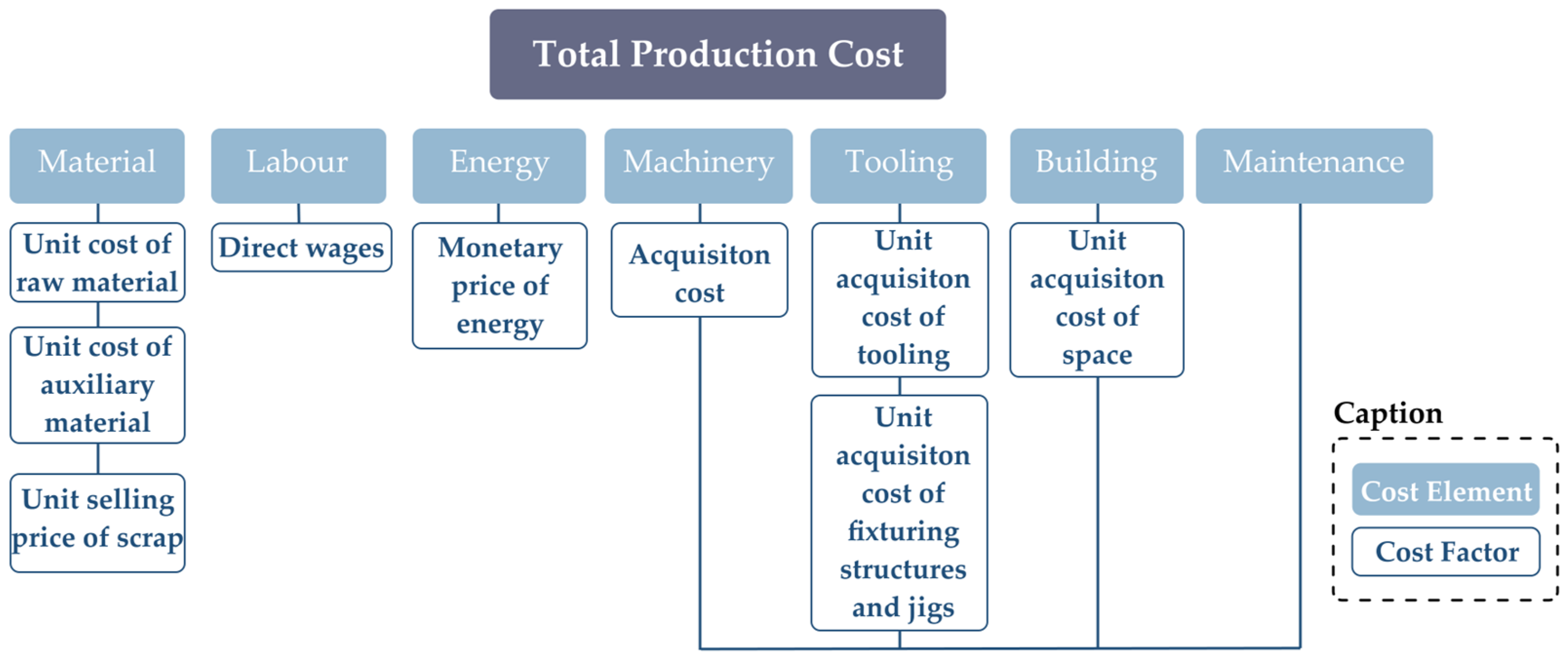
The proposed model follows the cost breakdown system (CBS) that is schematized in Figure 1 based on the aforementioned cost elements, together with the cost factors that are associated with each.

2.1.1. Fixed Costs

Expenses related to machinery were modeled following a straight-line depreciation to the acquisition cost of each machine M m a c h , distributed over its useful life N m a c h in years. Because the model assesses the cost of sequences built with different manufacturing processes, machinery-related costs are calculated across a total of k operations. Additionally, the machines are assumed to be non-dedicated to account for the possibility of utilization across different projects rather than assignment to a single geometry. This means that the corresponding acquisition cost is allocated proportionally to the production volume of the part under analysis. This allocation is performed using the time-utilization rate U R , proportional to the ratio between the cycle time t c required for each operation i and the total machine uptime t u as follows:
C m a c h i n e r y = i = 1 k M m a c h N m a c h   U R = i = 1 k M m a c h N m a c h   t c   N G F t u
where N G F is the net-to-gross factor used for considering the rejection rate—percentage of failed parts to be sold as scrap—in operation i , together with rejections from subsequent operations up to the final operation k . This factor can be estimated from the following equation:
N G F = 1 i k ( 1 R R )
The inclusion of this factor reflects the higher probability of part rejection in hybrid manufacturing routes that encompass multiple sequential operations, such as DED-Arc, milling, and incremental forming, all of which rely on accessible, well-established CNC principles and can be performed on non-dedicated, multi-purpose equipment. This rationale ensures that the impacts of rejected parts are properly captured throughout the hybrid additive manufacturing chain.
Expenses related to tooling reflect the tools that are in direct contact with the material and the fixture systems that are used in each process. Given that different tools and/or fixture systems may be used for the same operation, the equation for assessing tooling costs per part C t o o l i n g can be written as a function of the acquisition cost of each active tool M t o o l and fixing system M f i x , as follows:
C t o o l i n g = i = 1 k j = 1 n i M t o o l t t o o l   t o n + M f i x N f i x   N G F
where n i denotes the number of tools used in operation i , giving rise to a summation of two cost components. The first estimates the cost per part of each active tool by accounting for its service life t t o o l (in units of time) and the duration over which the tool undergoes wear during processing, t o n (in units of time per part). The second component corresponds to the fixing systems, whose costs depend on the total number of production cycles they can withstand, N fix .
This structure ensures compatibility with different expressions used to estimate tool service life, such as the Taylor equations commonly applied to active tools in machining operations [30]. Expenses of fixing systems were instead accounted for by their annual depreciation, as their lifespan is significantly longer than that of active tools.
Expenses associated with building use are based upon the unit acquisition cost per square meter of factory space M b u i l d . This investment accounts not only for the area occupied by the machines M A but also for the additional space required to ensure safe working conditions for operators when handling parts ( 1 + A o p ) . The total building investment is then depreciated on a straight-line basis over its service life N b u i l d , as shown in the following equation:
C b u i l d i n g = i = 1 k M b u i l d N b u i l d   M A   1 + A o p   U R A P
where the utilization rate U R and the annual production of parts A P are used to define the share of dedicated building occupation and to convert the building cost element into units of cost per part.
Finally, the last fixed cost element related to maintenance is expressed as a function of the remaining cost elements related to machinery, tooling, and building use, previously expressed in Equations (4), (6) and (7). It is represented by a percentage R m a i n t that accounts for maintenance expenses not included in the initial investments, as well as downtime during which the machines are unavailable. This leads to the following equation:
C m a i n t e n a n c e = R m a i n t   C m a c h i n e r y + C t o o l i n g + C b u i l d i n g
Because expenses are allocated based on equipment time utilization, both the machine uptime and the cycle times of each process in the HAM chain must be determined.
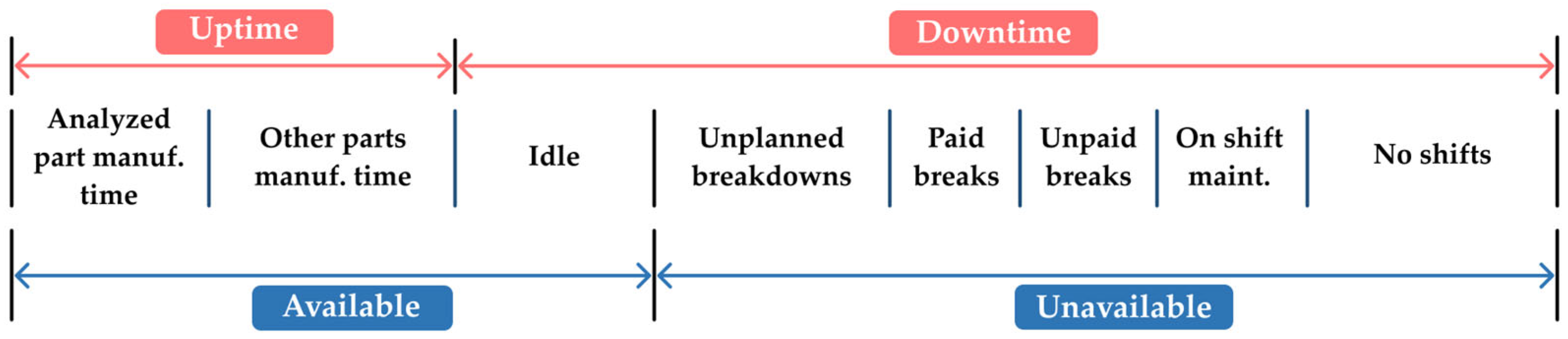
Machine uptime t u is computed over a 24 h period and multiplied by the number of annual working days. Its daily value is obtained by subtracting machine idle time (periods in which equipment is available but not assigned work) from the available operating time, itself calculated by subtracting planned or unplanned interruptions and maintenance periods from the factory operating time, as presented in Figure 2.
The cycle time of each operation t c is derived from the process parameters and divided into two parcels: setup and processing activities. Setup includes the batch-level machine setup time allocated per part t s e t m a c h and the workpiece-handling time per part t s e t h a n d , covering part changeover, fixturing, cleaning, tool calibration, and zero setting. Processing time t o n is obtained from the specific operating conditions. To improve time-estimation accuracy, CAD/CAM-based calculation is used to provide a more realistic estimate based on executed G-code rather than average process rates [15].
This rationale can also be used for obtaining the tool-change time t c h a n g e and idle tool-motion time t i d l e , which are not accounted for within the processing time t o n and are equally frequent in machining and incremental forming operations. Hence, the cycle time for the aforementioned processes is obtained as follows:
t c = t s e t m a c h + t s e t h a n d + t i d l e + t o n + t c h a n g e   ( m a c h i n i n g   a n d   i n c r e m e n t a l   f o r m i n g )
For DED-Arc, the model follows a structure similar to that of Dias et al. [18], incorporating wire-change t c h a n g e w i r e and gas-change times t c h a n g e g a s together with the setup times t s e t m a c h and t s e t h a n d . Consumptions per part are determined using process parameters, where ρ w i r e , m w i r e , V d e p , V g a s , and Q g a s denote wire density, mass of the acquired wire coil, deposited volume per part, gas cylinder volume, and gas flow rate. These are used to convert time consumptions on wire and gas change from time to time per part, allowing the computation of the setup time per part t s e t D E D for DED-Arc as follows:
t s e t D E D = t s e t m a c h + t s e t h a n d + t c h a n g e w i r e   ρ w i r e   V d e p m w i r e + t c h a n g e g a s   Q g a s   t d e p V g a s
The deposition time t d e p , non-deposition torch motions t i d l e , and dwell times for cooling t c o o l are also estimated from executed G-code. Equation (11) discloses the calculation of the cycle time for DED-Arc:
t c D E D = t s e t D E D + t d e p + t i d l e + t c o o l

2.1.2. Variable Costs

Expenses related to materials are defined as the material cost C m a t e r i a l minus scrap income I s c r a p , obtained by summing material costs across all operations and subtracting the revenue from scrap recovery.
The model assumes that raw material may be acquired in any format depending on the composition of a given HAM chain. In order to ensure that the model is replicable for any given order of operations, the acquisition cost of the raw material M r a w with a mass m r a w and density ρ r a w is considered, together with the utilized volume, and included only in the first operation ( i = 1 ). Additionally, consumables such as shielding gas and wire feedstock (DED-Arc), lubricant oils (incremental forming), and cutting fluid (machining) are included within the material cost element.
For DED-Arc operations, shielding gas cost is computed from its flow rate Q gas and deposition time t d e p derived from G-code, with M g a s representing the acquisition cost of a gas cylinder of volume V g a s . The cost of deposited material is based on its volume V d e p and the wire acquisition cost M w i r e . Incremental forming operations are affected by lubricant oil costs, which are based on their acquisition cost M l u b for a corresponding volume V l u b and by the consumption of lubricant oil per cycle U l u b . Machining operations follow a similar logic to the former, but with cutting fluid under a given acquisition cost M f l u i d for a volume V f l u i d and a machine tank volume V t a n k , which is assumed to be fully replaced twice a year. This allows a equation for material costs to be expressed as follows:
C m a t = C r a w + C w i r e + C g a s + C l u b + C f l u i d   N G F = = M r a w   ρ r a w m r a w   V 0 + M w i r e   ρ w i r e m w i r e   V d e p + M g a s   Q g a s V g a s   t d e p + M l u b   U l u b V l u b + M f l u i d   V t a n k V f l u i d × t c t u / 2   N G F
As seen, the net-to-gross factor N G F again ensures that the variable cost of rejected parts is uniformly allocated to the corresponding parts.
Waste estimation requires tracking material flow across operations. The initial volume V 0 is provided by the user, and the per-part volume after each operation V i is obtained from the previous value V i 1 according to the operation-specific transformation. For DED-Arc, the deposited volume is determined from the deposition time, wire feed speed W F S , and wire diameter w i r e , while for machining, the per-part volume is obtained from the Buy-to-Fly ratio B T F , that quantifies the ratio between initial and final volumes after a given operation. For incremental forming, the volume is equal to that of the previous operation. These approaches are implemented according to the following equation:
V i = V i 1 + V d e p = V i 1 + W F S   π   w i r e 2 4   t d e p                 ( D E D - A r c ) V i 1 / B T F                 ( m a c h i n i n g ) V i 1                 ( i n c r e m e n t a l   f o r m i n g )
Rejected-part material is allocated using the rejection rate R R , while scrap from the corresponding parts in the form of chip is included via the term B T F 1 . Scrap income per part is then obtained from scrap volume and the selling price per volume of material C s c r a p , as follows:
I s c r a p = V i 1   R R + V i × B T F 1   C s c r a p
Direct labor costs depend on worker wages M l a b o r , the number of operators required, and the remunerated operating time. Only direct workers are considered, as indirect labor is typically included in overheads. A dedicated worker-time value per operation is used for capturing machine setup and operator supervision of CNC program execution, through the cycle time of each operation (Equations (9) and (11)). The final expression also includes the worker dedication factor W D as the percentage of time each operator spends actively supervising or handling a given machine, resulting in the following equation:
C l a b o r = M l a b o r   i = 1 k t s e t + t c   W D   N G F
Finally, energy cost is a function of the energy price M e n e r g y and the energy consumption E for each operation. Because direct energy measurements are rarely available, regression-based estimates are often unreliable; instead, nominal machine power ratings combined with typical operational efficiency values are used to approximate consumption. Alternatively, the PBCM can also incorporate experimentally validated consumption data when such information is available. As highlighted by Kirchain [29], the energy consumed with the production of rejected parts must also be accounted for, leading to the following expression:
C e n e r g y = M e n e r g y   i = 1 k E   N G F

2.2. Life Cycle Assessment

For the purpose of this study, Life Cycle Assessment (LCA) was used as the framework for evaluating the environmental performance of the HAM chains under investigation. Among the methods commonly used for environmental assessment, such as cumulative energy demand, carbon footprint, and LCA, only LCA provides a comprehensive view of all potential environmental impacts rather than focusing on a single issue [31]. This holistic perspective is essential for supporting decisions in sustainable manufacturing, namely, for the identification of burden shifting between environmental categories.
According to the ISO 14040 standard [32], LCA involves compiling and characterizing the inputs and outputs of materials, energy, and emissions for all processes across a product’s life cycle, and evaluating their associated environmental impacts. By applying this methodology, it becomes possible to compare alternative manufacturing sequences, highlight critical points in the hybrid process chain, and support eco-design or process optimization decisions [33].

2.2.1. Goal, Scope, and Inventory

Firstly, the definition of the goal and scope involved establishing the context of the study and describing the product system in terms of its functional unit and boundaries. The functional unit serves as a reference to which all input and output flows are related, allowing for quantification of the function assigned to the product system and providing a basis for comparison between alternatives.
Since the objective of this analysis is to compare the environmental impacts through different manufacturing approaches, the study is conducted as a comparative cradle-to-gate analysis. The system boundaries, material, and energy flows of the unit processes considered, as well as the recovery of previously used products, are represented in a block diagram within the life cycle stages.
The Life Cycle Inventory (LCI) analysis involves collecting and compiling data on elementary flows from all processes within the system, using a combination of different sources. The resulting inventory of elementary flows serves as the basis for the Life Cycle Impact Assessment (LCIA) phase. For this work, the Ecoinvent v3.9 database [34] was used to provide process inventories for each elementary flow under consideration.

2.2.2. Impact Assessment

Translation of the elementary flows into environmental impact indicators was accomplished via the LCA software SimaPro v9.5 [35]. The software allowed for implementation of the Environmental Footprint (EF) method, developed by the European Commission [36]. This method is based on the assessment of midpoint categories that ensure the traceability of results in the form of environmental categories of a given operation.
For each elementary flow j , the emitted/extracted quantity E j is multiplied by the characterization factor C F j associated with the impact category c . Results are then summed across all elementary flows to compute the total impact indicator per category I S c . This allows the normalized values per category N c to be obtained by dividing the characterization results I S c by the normalization factor of that category N F c , as follows:
N c = I S c N F c = j C F j   E j N F c
For the EF method, the normalization factors N F c correspond to the average annual per capita environmental impact in the European Union for the reference year 2010.
The collective environmental assessment of all impact categories is obtained through the calculation of a single score S S . This indicator is derived from the normalized values for each category N c and from the corresponding weighting factors W F c specified for the European Union [36], using the following equation:
S S = c N c   W F c

3. Case Study

3.1. Procedures and Input Data

Validation of the proposed models was carried out through the production of a case-study part through a HAM chain, previously developed by the authors [37], based on the sequential integration of three distinct manufacturing processes. Firstly, DED-Arc is employed for the customization of a sheet-based substrate through layer-by-layer construction. Secondly, machining in the form of milling is used to perform roughening and finishing operations that improve the surface quality and dimensional accuracy of the as-built material. Thirdly, and lastly, incremental forming is carried out to shape the final geometry without resorting to dedicated tooling.
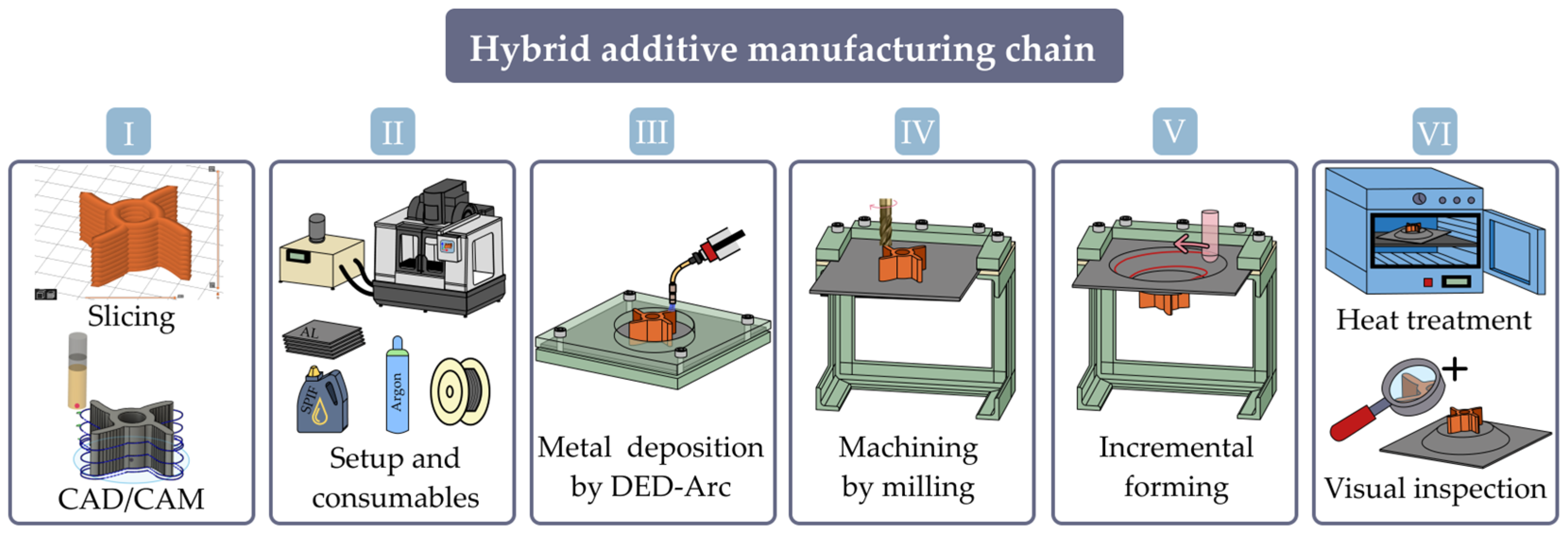
This chain comprises six stages: (I) pre-processing, involving decision-making and full 3D modeling; (II) equipment setup, including machine preparation and consumables; (III) metal deposition by DED-Arc; (IV) milling; (V) incremental forming; and (VI) post-processing (Figure 3).
Stages (I) and (VI) include activities such as process planning, parameter definition, inspection, heat treatment, and finishing. As these activities are highly dependent on part specifications and industrial context, while common to conventional processes such as machining from solid and die casting, they fall outside the scope of the present study.
Stage (II) covers machine setup, including tool installation or replacement, and, in the case of DED-Arc, wire feeding and shielding gas preparation. In contrast, part-handling activities, such as part replacement, clamping, tool calibration, workpiece zeroing, and minor cleaning, are integrated into stages (III)–(V) focused on the execution of DED-Arc, milling, and incremental forming operations through CNC programs.

3.1.1. Experimental Work

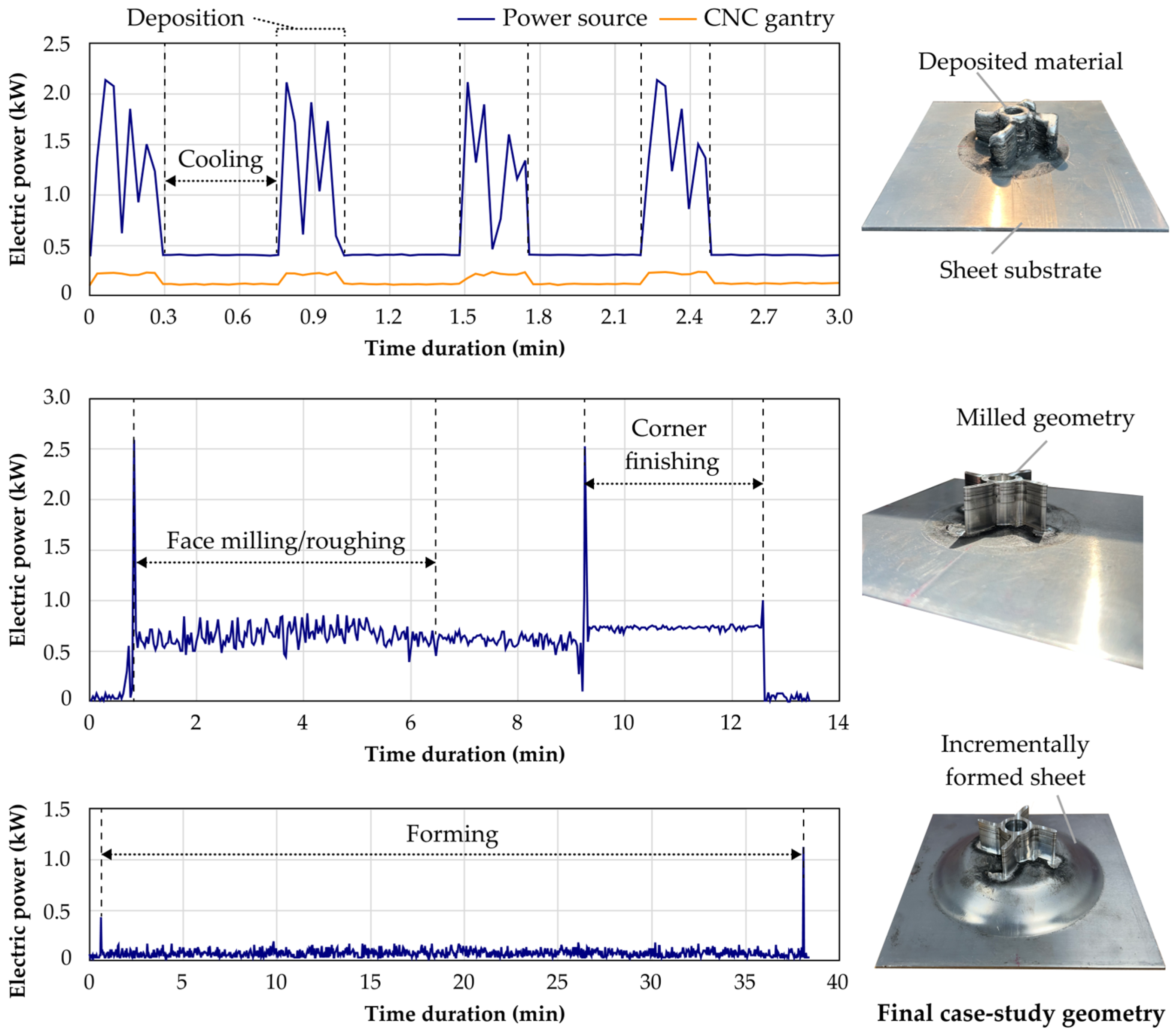
Metal deposition by DED-Arc was performed with a 3-axis CNC gantry equipped with a Lincoln Electric Power Wave 300 CE Advanced GMAW power source. The materials employed were 1 mm diameter AA5356 wire, a 140 × 140 × 2 mm AA6082-T6 sheet substrate, and high-purity argon (99.99%) as shielding gas. Subsequent milling operations comprised the facing of the upper surface, followed by roughing and finishing of the blade and tube regions using an 8 mm tungsten carbide end mill, and corner finishing with a 4 mm tungsten carbide end mill. All milling operations were conducted on a 3-axis HAAS Mini Mill 2. The incremental forming stages were carried out on the same equipment, using a hardened D2 tool steel forming tool with a 12 mm diameter hemispherical tip. The case-study part geometry throughout the hybrid chain is shown in Figure 4.
The CAD/CAM software used for programing the toolpaths was Autodesk Fusion 360 v17.0.1 [38] for milling and incremental forming operations, which also provided pre-production processing time estimates. For DED-Arc operations, the software used was PrusaSlicer v2.9 [39], with adjustments made for accommodating torch travel directions and compensation of edge deviations caused by melt-pool flow.
Energy consumption in the three-phase circuits of the aforementioned equipment was monitored using a PROVA 6830 power meter with clamp ammeters and voltage probes, attaining 1 W resolution up to 10 kW and a maximum measurable current of 100 A. Representative measurements for each manufacturing stage are shown in Figure 4. Four final parts were produced and the processing times and average electric power consumptions, with standard deviations ranging from 2% to 4%, for the three stages of the HAM chain were recorded.

3.1.2. Dataset for Cost Modeling

The input values used in the cost model for the case-study part are organized in tables that follow the same structure implemented in the data-entry interface of the program.
Table 1 compiles all process-independent parameters that were inputted into the proposed PBCM and are universal to all manufacturing operations under consideration. In the operations model, an annual schedule of 240 working days with a single daily shift is assumed and, for simplification, this period is taken as the machine uptime. Accordingly, all remaining input parameters reflect values commonly practiced in Portugal in 2025. The remaining process-dependent parameters are disclosed in Table A1, Table A2 and Table A3 for each of the manufacturing processes that are incorporated into the HAM chain. This information is presented individually, for each process, since parameters with the same physical meaning may have different values depending on a specific operation.
All parameters related to acquisition costs for machinery, active tools, fixturing tools, materials, and other consumables, together with their corresponding characteristics, were obtained from suppliers and their respective catalogs. Although these parameters are required for assessing the cost of the case-study part, they are not specific to it and may be applied to other cases that employ similar equipment and consumables.
Unlike the former, parameters that are specific to the case-study part were experimentally measured during the tryouts. This includes time consumptions during the various line utilization tasks, which were initially predicted with the CAD/CAM software and afterwards validated, and energy consumptions (in kWh) obtained from the integer of the experimental measurements of electric power as a function of time (refer to Figure 4).
Lastly, general parameters such as worker dedication and rejection rate were taken from the literature [18,24], as they depend strongly on the application context, such as the requirements and quality criteria imposed on the final product.

3.1.3. Dataset for Life Cycle Assessment

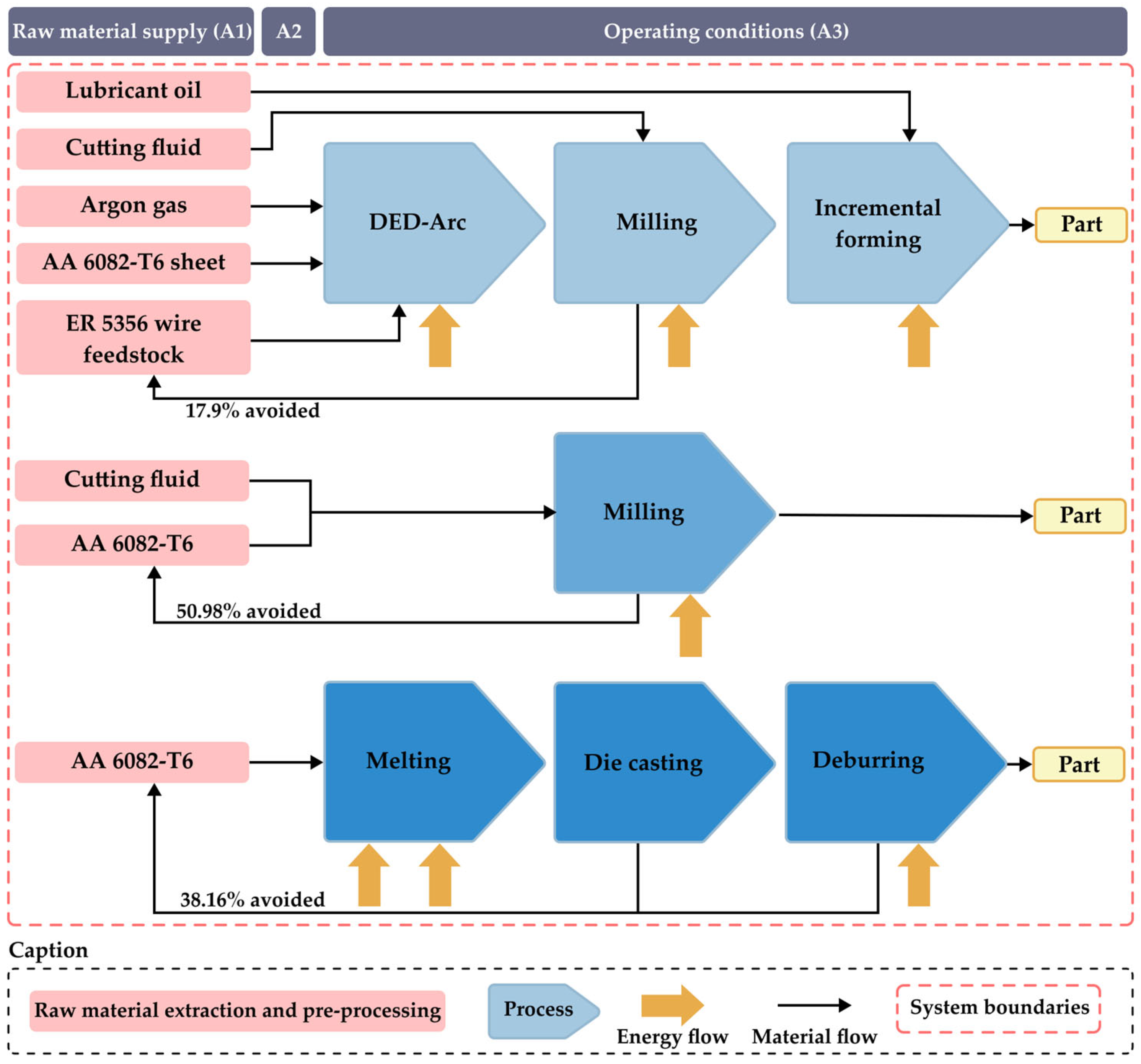
The Life Cycle Assessment of the HAM chain followed a cradle-to-gate approach, accounting for all environmental impacts from raw material extraction up to the factory gate for a functional unit of one case-study part (Figure 5). This approach did not take into consideration the environmental impacts associated with tooling because a full Life Cycle Assessment of each tool would require numerous assumptions regarding pre-processing and end-of-life phases. Additionally, since most tools under analysis contain long service lives, such as die casting molds or incremental forming tools, their environmental impacts lead to residual contributions (lower than 0.6%) on the impacts per part.
Although the analysis follows a cradle-to-gate scope, the reuse of aluminum waste, whether in the form of scrap generated during milling or as part of the biscuit and runner system from die casting, is accounted for in the LCA for all evaluated chains. For this reason, a recovery rate of 54% was assumed for aluminum chips recycled via remelting, accounting for oxidation and dross formation losses [40]. In the case of the wasted material from die casting, where high recovery rates (above 90%) are reported in the literature [41], full recovery was assumed. Both recycling pathways were modeled to represent the potential substitution of primary raw materials in future production cycles, with the avoided percentages calculated as the product of the wasted material percentage (retrieved from the corresponding Buy-to-Fly ratios of each process) and the recovery rate after remelting.
The Life Cycle Inventory (LCI) was obtained from quantification of all input and output flows that are disclosed in Figure 5, together with the system boundaries presenting the material and energy flows for the HAM approach alongside two conventional production routes—machining from solid and die casting—used for comparison purposes. All three approaches were assessed considering the corresponding life cycle stages—raw material supply, transportation, and operating conditions (stages A1, A2, and A3, respectively). Table A4 (in Appendix A) provides a detailed description of the LCI with data obtained either experimentally or sourced exclusively from the respective models [42].

3.2. Economic Analysis

This section focuses on the results obtained from the proposed process-based cost model (PBCM) for evaluating the HAM chain. It begins with an examination of the main cost drivers associated with each operation in the hybrid process sequence. This is followed by a sensitivity analysis to identify the parameters that most significantly influence total production costs and to assess the robustness of the model. Finally, a comparative analysis between the HAM chain and conventional manufacturing processes—machining from solid and die casting—is presented to contextualize the economic performance of the proposed hybrid approach within established industrial alternatives.

3.2.1. Cost Drivers

The identification of the main cost drivers for the proposed HAM chain that integrates a sequence of DED-Arc, milling, and incremental forming operations was achieved from the implementation of the proposed PBCM, following the equations disclosed in Section 2.1.
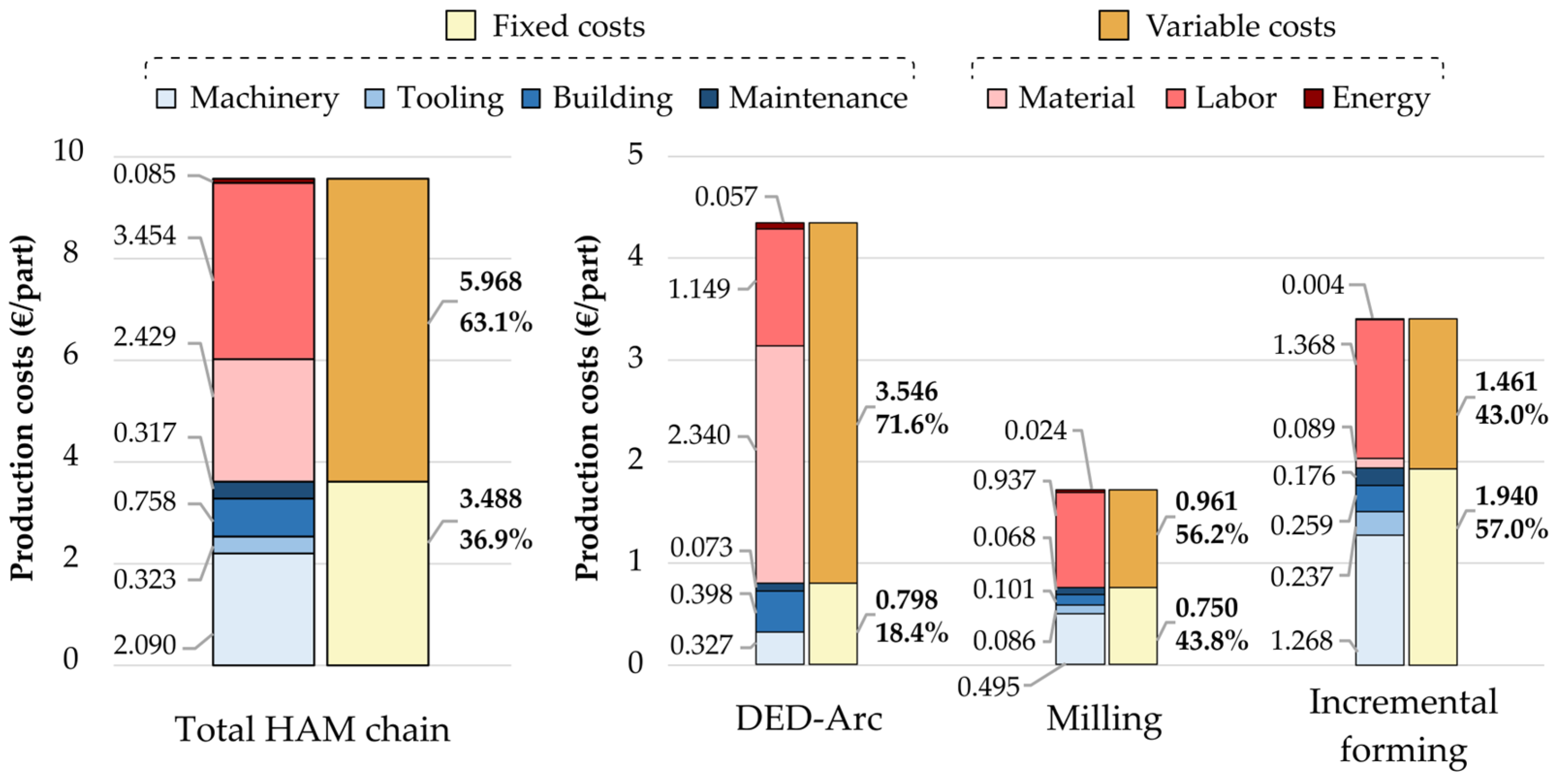
For this purpose, the model was fed with data obtained from the production of the case-study part, generating the plots shown in Figure 6. The right plot presents the production cost per part for each of the three individual operations, while the left plot shows the total cost for the complete HAM chain by summing the individual contributions. Both plots include captions identifying the cost elements considered, together with their classification as fixed or variable costs.
From the left plot of Figure 6, it is possible to determine a total production cost of approximately 9.46 € for each case-study part under analysis. This value results from a higher share of variable costs (63.1%) compared with fixed costs (36.9%).
In addition, materials, labor, and machinery costs can be identified as the main factors influencing the economic performance of the HAM chain, together representing nearly 84.3% of the total production cost per part. This result is expected for a manufacturing chain that relies on non-dedicated equipment for both machinery and tooling, which leads to more efficient utilization of installed capacity and, consequently, a greater dependence on variable costs.
The right plot of Figure 6 provides further insight into the reasons behind the economic performance of the HAM chain by examining each operation individually. As shown, each operation exhibits different cost distributions and dominant cost elements. For DED-Arc, there is a substantial dependence on material costs, representing 53.9% of the total. For milling and incremental forming, labor is the main cost element, representing shares of 54.8% and 40.2%, respectively, followed by machinery costs with smaller shares of 29% and 37.3%, respectively.
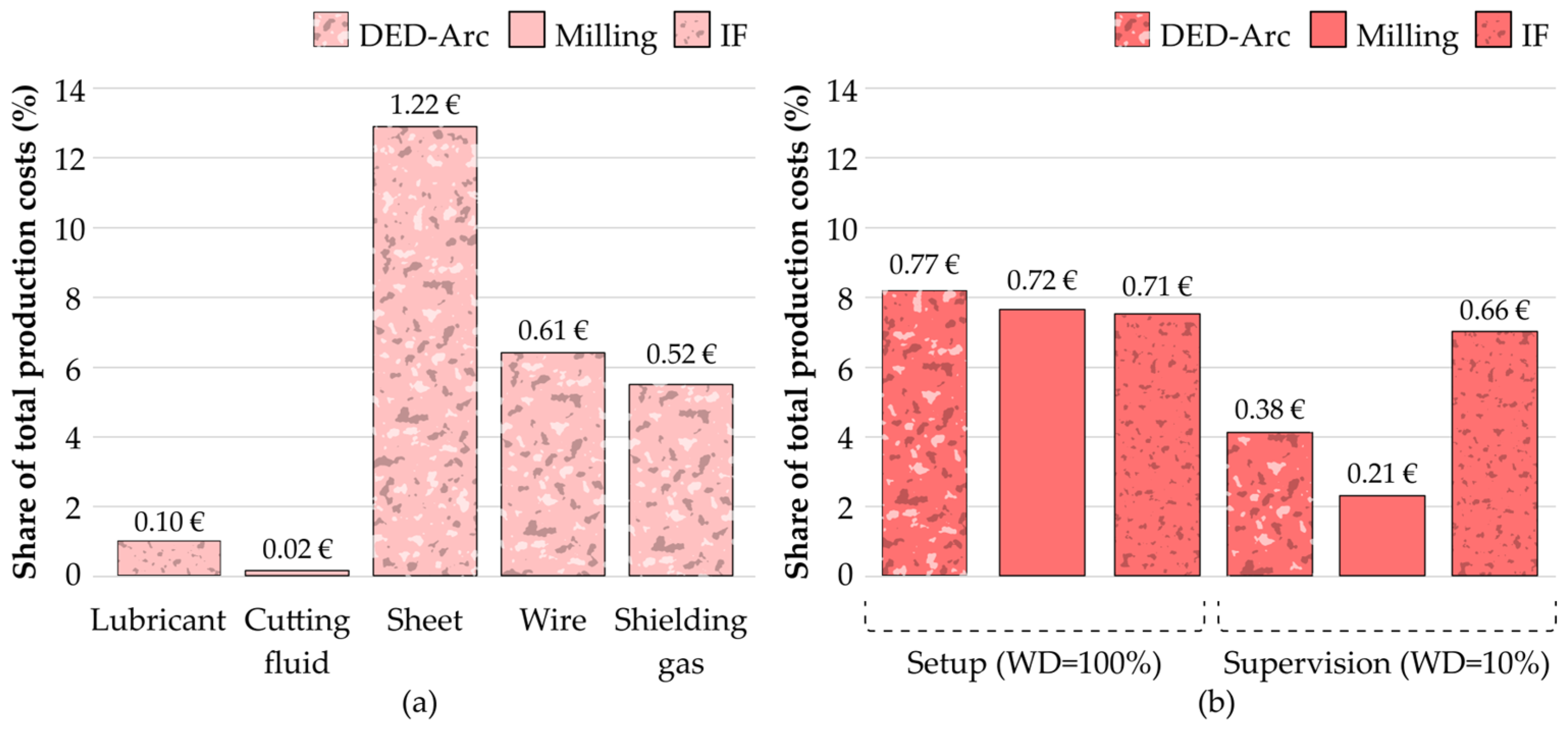
A deeper analysis of the material and labor costs involved in the HAM chain is presented in Figure 7, where the share of total production costs (as a percentage) is plotted against the respective cost drivers for each cost element. The plots were designed to clearly associate each cost driver with its corresponding operation—DED-Arc, milling, or incremental forming (IF).
In terms of material costs (Figure 7a), the main cost driver is the acquisition of the raw sheet material, which represents nearly 13% of the total production cost because of its high volume (about 3.82 higher than that of the material deposited by DED-Arc). This cost is attributed to the DED-Arc operation, as it is the first stage of the HAM chain for the case-study part where the sheet material also serves as the substrate for supporting layer-by-layer construction. Nevertheless, material consumption during DED-Arc remains relevant due to the wire feedstock and shielding gas required for the process. The remaining material costs—lubricant oil for IF and cutting fluid for milling—are only marginal and, in the case of milling, are fully compensated for by the revenue from scrap material.
For labor costs (Figure 7b), the main cost drivers are associated with setup tasks, which result in nearly similar production costs for the three operations that make up the HAM chain and collectively account for almost 24% of the total production cost per part. Setup tasks are slightly more expensive for DED-Arc due to the need to perform additional activities such as changing the wire feedstock coil and replacing shielding gas cylinders, both of which do not apply to the other two operations. Supervision tasks are less significant because worker involvement is minimal, consistent with the fact that all machinery operates under fully automated CNC control. However, supervision during IF operations represents a higher share of 7% of the total production cost when compared with supervision of DED-Arc and milling. This is due to the longer cycle times of IF, which require more sustained monitoring during the course of the HAM chain.
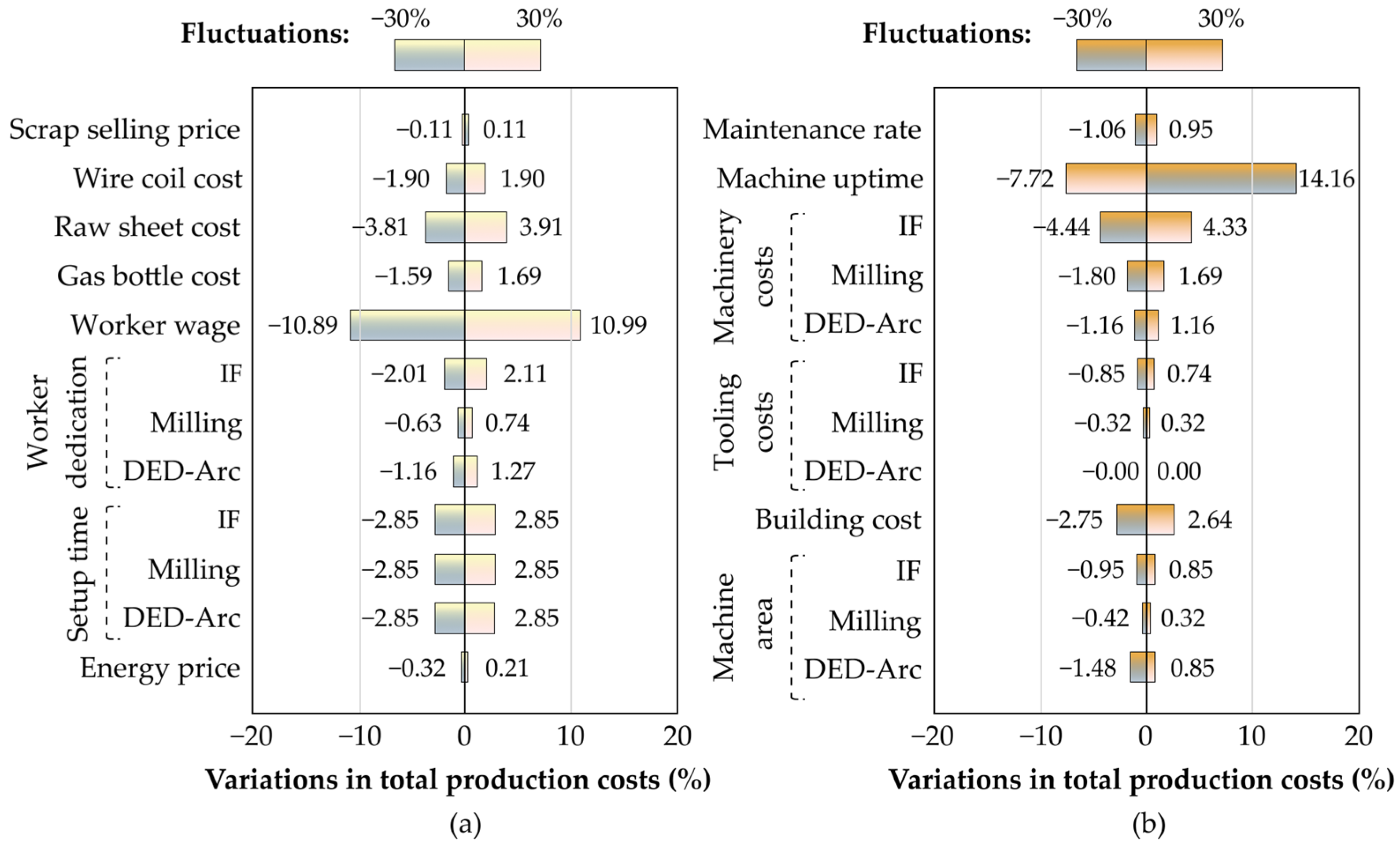
The identification of these elements as the main cost drivers is further supported by a sensitivity analysis, which is relevant for evaluating the magnitude of cost fluctuations that may arise from market dynamics. This is shown in Figure 8, with emphasis on model inputs that primarily affect variable and fixed costs. The plots were built by assuming a variation within a range of ±30% for each model input under analysis, which were then used to compute the resulting percentage variation in the total production costs per part.
In terms of variable costs (Figure 8a), variations in setup times for the three operations resulted in production cost changes of ±2.85%, as only a single batch per production line was considered for the annual volume. Changes in worker dedication led to cost variations of up to 2.11% for the IF operation, whereas the largest fluctuations arise from changes in direct wages, reaching up to 10.99%. This clearly identifies direct wages as a critical price factor. This is followed by material costs, with the largest variation observed in the acquisition cost of the sheet material.
For fixed costs (Figure 8b), a 30% increase in the acquisition cost of the machine used for IF results in a 4.33% increase in overall production cost, exceeding the fluctuations previously observed for sheet material cost. However, the largest variation among all inputs is associated with changes in machine uptime. Reducing machine uptime leads to production cost increases of up to 14.16%, driven by higher utilization rates that directly affect the fixed costs associated with machinery, building, and maintenance. This suggests that, when production cost reduction is required, temporarily increasing machine uptime to complete the batch more efficiently may be an effective strategy.
The remaining fluctuations in inputs that primarily affect fixed costs remain marginal. Hence, variable costs dominate the economic performance of the HAM chain, with particular influence on DED-Arc and milling operations.

3.2.2. Comparative Analysis with Conventional Chains

The next step in evaluating the cost performance of the HAM chain consisted of a comparative analysis with conventional approaches that have already reached a high technological readiness level and are therefore widely adopted across several industrial sectors. The basis for the comparison was the case-study part, along with the input data and economic results presented previously in Section 3.1 and Section 3.2.
For this purpose, two conventional production chains based on die casting and machining from solid were considered. To ensure a fair comparison, the process-independent input parameters defined for the proposed PBCM (refer to Table 1) were also applied to both conventional chains.
For die casting, production costs were obtained from an existing cost model developed by Ribeiro [42] with emphasis on a manufacturing sequence comprising melting, injection, and deburring, assumed to operate in parallel. Consequently, contributions from indirect costs (i.e., overheads) were excluded, maintaining consistency with the approach used in the PBCM for HAM. The die casting model was updated to incorporate a more recent producer price index for steel, and all geometric, material, and part-specific inputs were aligned with those of the case-study part, enabling the calculation of the corresponding cycle time.
For machining from solid, the proposed PBCM was applied by considering only the cost elements directly associated with milling operations. Material cost was based on the acquisition of a solid block large enough to accommodate the geometry of the case-study part. The operation sequence consisted of a roughing step followed by finishing, resulting in Buy-to-Fly (BTF) ratios of 6.329 and 2.825, respectively. The average power consumption of 708.88 W was assumed constant throughout the cutting periods. These corresponded to 67.32 min and 9.72 min per part for roughing and finishing, respectively, that were predicted from the CNC programs.
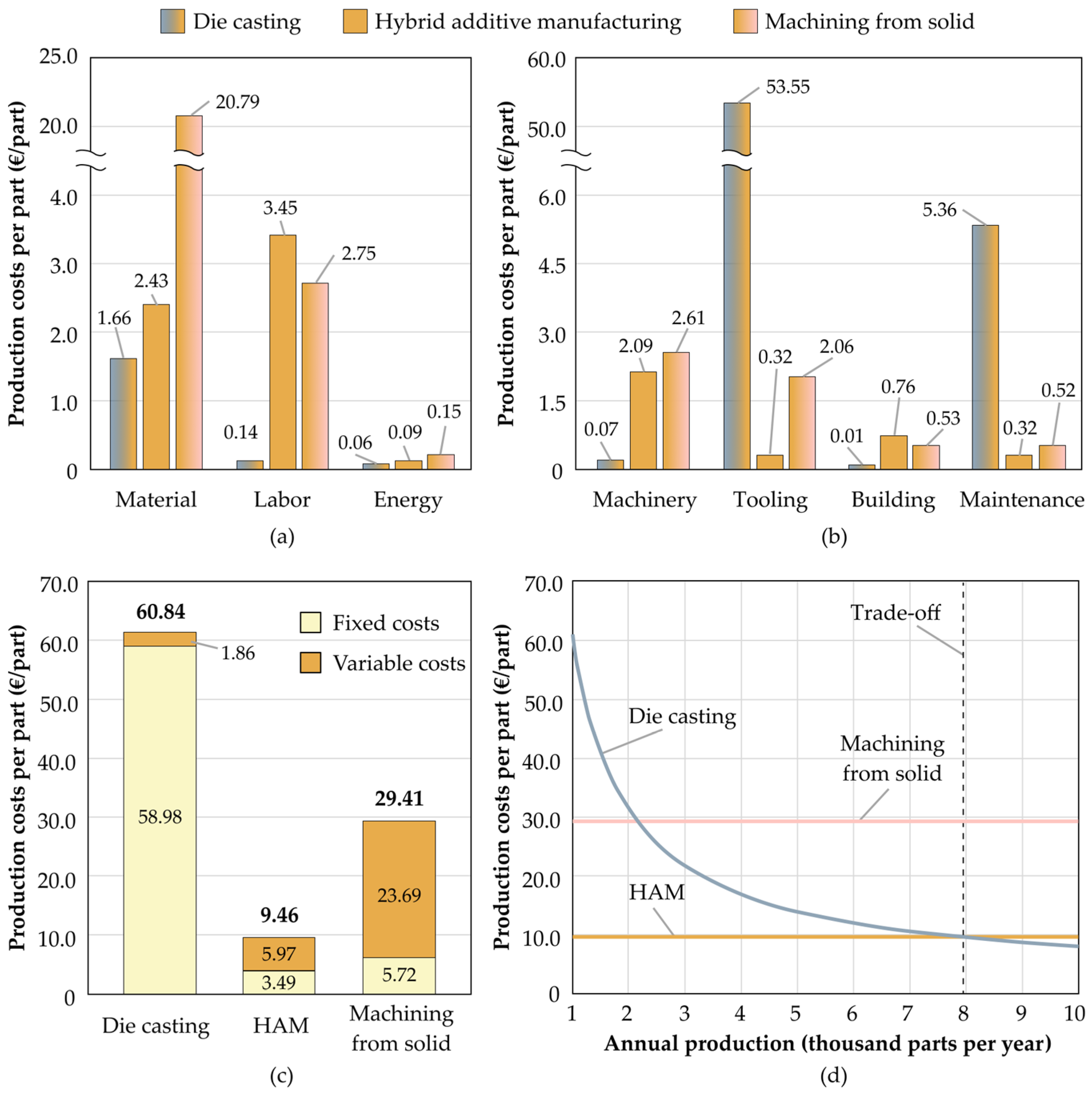
The results of the comparative analysis for the three production chains are presented in Figure 9. In terms of variable costs (Figure 9a), machining from solid is the most expensive chain due to its exceptionally high material expenses. This stems from the significant material waste generated by the long, complex milling operations required, which greatly reduces process efficiency compared with die casting or HAM, where material scrap is minimal. In contrast, die casting exhibits the lowest variable costs, largely due to the lower acquisition cost of the raw material, unlike the wire feedstock and sheet material required in HAM, as well as minimal labor and energy costs. These advantages arise from the very short cycle times and the high utilization rate of the die casting machine, which was assumed to operate in parallel with other projects beyond the case-study part.
When considering fixed costs (Figure 9b), the die casting chain is significantly more expensive than the other two chains. This is primarily due to the tooling costs associated with the acquisition and use of dedicated molds, which, unlike die casting machinery, cannot be treated as non-dedicated equipment because their geometry is specific to the case-study part. Consequently, maintenance costs, including potential mold repairs, also rise to substantial values. In contrast, the HAM chain exhibits the lowest fixed costs, largely because it relies on non-dedicated equipment. The machining from solid chain also demonstrates lower fixed costs compared with die casting, although still higher than HAM, due to increased utilization rates of both machinery and tooling. This results from the longer cycle times of the chain, which, in the case of active cutting tools, approach values closer to their expected lifetimes.
The total production costs per part for the three manufacturing chains are presented in Figure 9c. This plot summarizes the earlier analysis on cost performance, specifically, that die casting is driven by fixed costs (96.9%), whereas machining from solid is driven by variable costs (80.6%). The HAM chain also exhibits a slight predominance of variable costs, as described in Section 3.2.1, but remains the most balanced between the two cost components. Overall, HAM achieves substantial reductions in the production costs per part: 84.5% compared with die casting and 67.8% compared with machining from solid.
To assess the influence of annual production volume on the comparative analysis of the three manufacturing chains, the production cost per part was recalculated for batch sizes from 1000 to 10,000 parts per year and plotted in Figure 9d. As shown, only the die casting chain exhibits significant cost variation with increasing production volume due to its dedicated resources, which require substantial upfront investment that can be amortized over larger production batches. This is consistent with the economics of mass-production systems such as die casting. A clear trade-off point is observed at 7842 parts per year, beyond which die casting becomes more cost-effective than the HAM chain.
In contrast, the HAM and machining from solid chains show no meaningful sensitivity to production volume, as all equipment is assumed to be non-dedicated and therefore independent from the annual production. Consequently, there are no production volume conditions under which machining from solid outperforms the HAM chain in terms of production costs in the case-study part.

3.3. Environmental Analysis

This section is centered on the results obtained from the Life Cycle Assessment (LCA) conducted for the HAM chain to produce the case-study part. It begins with an evaluation of the main environmental impact drivers associated with the overall sequence and with each integrated operation. Similarly to what was shown in Section 3.2, a comparative analysis between the HAM chain and conventional chains based on machining from solid and die casting is afterwards provided to contextualize the environmental performance of the proposed hybrid approach relative to established industrial alternatives.

3.3.1. Impact Analysis

Following the Environmental Footprint methodology, an LCA of the HAM chain was conducted based on the evaluation of results across midpoint-level environmental impact categories. Although these categories represent the damage assessment stage of the method, they retain a midpoint character, resulting from the aggregation of 23 characterization categories into 16 impact categories with common impact units.
The computed results for the individual impact indicators I S c with normalized and weighted values N c ,   S S c are disclosed in Table 2, according to the corresponding damage categories and units under analysis. The weighting factors W F c established by the European Commission [34] are also included.
In addition, the weighted values are expressed through the single score indicator S S obtained from Equation (18) (Section 2.2.2), allowing for the evaluation of the weighted contribution of each category to the overall environmental impact of the HAM chain.
Among all categories, climate change, resource use (fossils), and particulate matter represent not only the largest contributions to the total impact but also some of the highest normalized values compared with the remaining categories. These can therefore be identified as the most critical environmental areas. Their relevance is linked to the increase in global average temperature due to greenhouse gas emissions, the adverse effects on human health caused by particulate matter emissions and their precursors (e.g., NOx, SO2), and the depletion of non-renewable energy resources such as coal, oil, and gas.
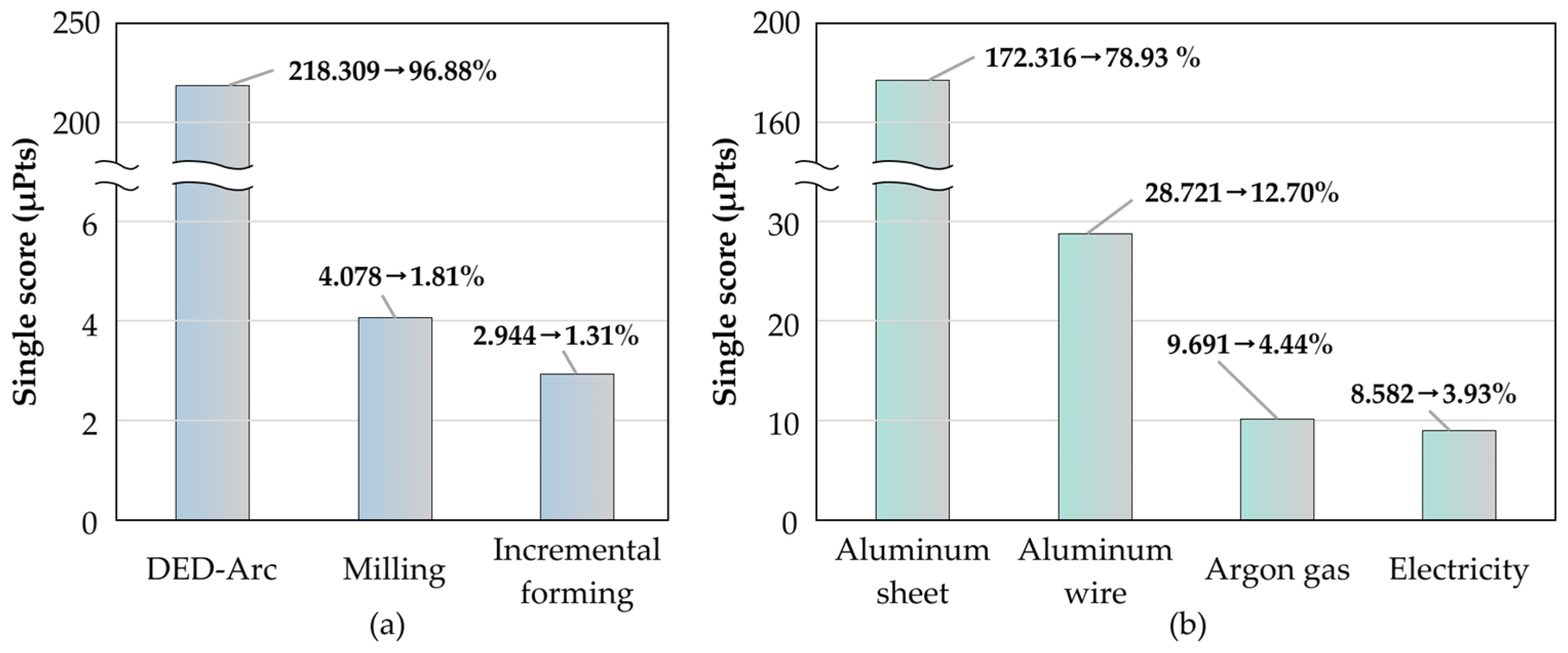
Figure 10a shows the computed single score indicators for each of the three operations from the HAM chain. As seen, DED-Arc dominates the environmental impact results, corresponding to 96.88% of the total single score of 225.33 μPts for the total HAM chain. Due to this dominance, the environmental impact sources for DED-Arc operation were analyzed separately from the remaining operations, as illustrated in Figure 10b.
In fact, nearly all impact categories show a substantial contribution from the extraction and pre-processing of the raw aluminum sheet, which represents the dominant impact source among the four processes considered in DED-Arc. This results from the high energy demand associated with producing primary aluminum from alumina, which affects climate change and resource use, which were the two key impact indicators identified in Table 2. For the particulate matter category, the third key impact indicator, emissions from alumina treatment and handling also play a major role, together with the inhalable particle emissions associated with electricity generation for the DED-Arc process.

3.3.2. Comparative Analysis with Conventional Chains

The final assessment of the environmental performance of the HAM chain consists of a comparative analysis between conventional chains aimed at producing the case-study part. For this purpose, the results obtained from the LCA of conventional chains based on die casting and on machining from solid were considered, following the material and energy flowchart previously shown in Section 3.3.2 (refer to Figure 5).
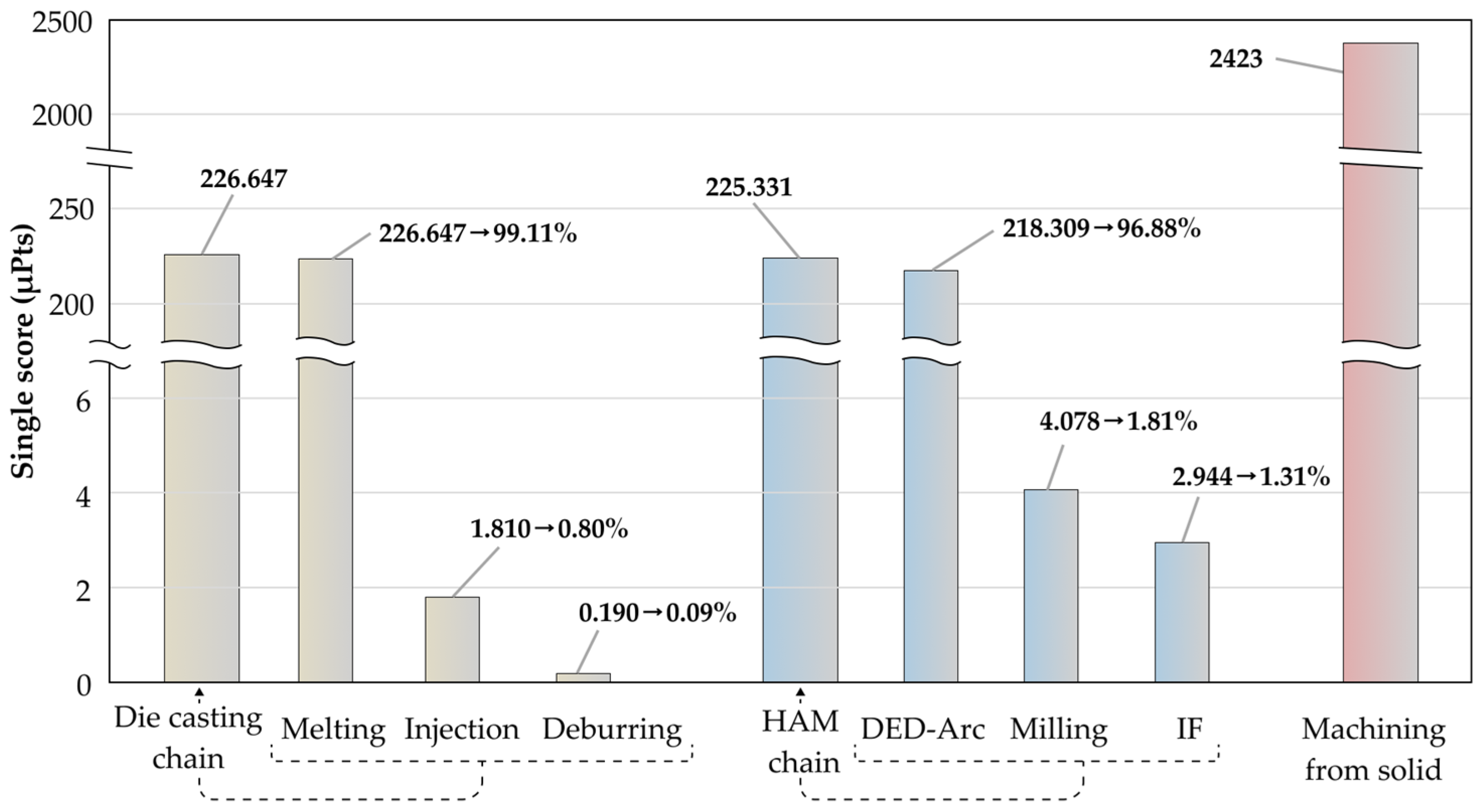
The evaluation was based on the single score indicators for each approach, which were computed and are plotted in Figure 11. For the die casting and HAM chain cases, the indicators of the individual operations are also shown separately. In the case of the HAM chain, the results correspond to those shown in Figure 10, while for machining from solid, only a single bar is presented because this approach consists of a single milling operation.
From the above figure, it can be identified that the conventional die casting chain is dominated by the extraction and melting of the aluminum alloy, which accounts for more than 99% of the total environmental impact. In fact, as was previously observed for the HAM chain, the primary driver is likewise the production of primary aluminum, arising from the same underlying impact mechanisms. When comparing the two approaches from an environmental perspective, HAM achieves a reduction in environmental impact across the main critical categories relative to the conventional die casting process. However, the total environmental impacts of both routes remain relatively close, which is consistent with the small differences observed in the individual impact categories.
In comparison with the machining from solid chain, the scenario is drastically different due to the significantly higher consumption, and consequent waste, of aluminum required to produce a thin-walled part, as in the case-study component. Such high material demand inevitably drives increased extraction and primary aluminum production, resulting in a marked rise in environmental impacts across all categories. This is reflected in the exceptionally high single score indicator shown in Figure 11, which is more than ten times higher than that of the HAM chain.
Overall, these results clearly indicate that machining from solid is the least environmentally sustainable option among the three approaches analyzed, due to its high material waste, energy demand, and associated upstream impacts. In contrast, HAM is confirmed as a more sustainable alternative, exhibiting consistently lower environmental burdens across the main impact categories, particularly in terms of material efficiency and cumulative energy use. These findings highlight the potential of hybrid additive routes to reduce resource consumption and environmental impacts while enhancing manufacturing performance.

4. Conclusions

The main conclusions that can be drawn from this work on the assessment of the economic and environmental performance of hybrid additive manufacturing (HAM) chains with metal forming operations are the following:
  • The proposed PBCM integrates DED-Arc deposition, machining, incremental forming, and all setup/handling tasks, providing a detailed tool to evaluate how process parameter changes affect production costs. CAD/CAM integration improves processing time accuracy for flexible geometries and supports informed decisions on DED-Arc deposition paths and milling or incremental forming tool trajectories.
  • Both the developed PBCM and LCA models are applicable to arbitrary parts, enabling case-specific economic and environmental assessments. In addition, they can be applied to HAM chains comprising an arbitrary number of DED-Arc, machining, and incremental forming operations. For practitioners, this flexibility enables the use of the models as practical decision-support tools to compare alternative process configurations, assess cost and environmental performance prior to implementation, and optimize hybrid manufacturing chains according to technical or sustainability goals.
  • From an operation perspective, material cost is the main driver in deposition tasks (53.9% of DED-Arc cost), due to the volume of sheet required and the higher price of wire feedstock. In contrast, milling and incremental forming are mainly driven by labor and machine costs because of setup requirements, handling activities, and, especially, the long forming times that result in high equipment utilization.
  • For the HAM chain, cost is dominated by variable cost elements (63.1%), resulting mostly from labor and material expenses, indicating efficient utilization of installed capacity and non-dedicated equipment. The sensitivity analysis confirms that direct wages and material price have the strongest influence on total cost, as well as the machine uptime due to its effect on the increase in the utilization rate.
  • In comparing manufacturing approaches, die casting is economically unfavorable for small-to-medium series (up to 1000 parts/year) due to the high cost of the mold, which represents 88% of the total cost and cannot be effectively amortized. HAM is more economically viable for low-volume production because it avoids dedicated tooling and enhances resource utilization. Machining from solid is economically infeasible due to its very high Buy-to-Fly ratio, making material cost the dominant element.
  • Using EF 3.1 and Ecoinvent v9.5, the environmental assessment shows that primary aluminum extraction dominates impacts across all approaches, making total material mass (part + waste) the key environmental driver. As a result, differences between approaches mainly reflect the amount and type of aluminum processed. HAM’s reduced material demand leads to impact reductions relative to die casting, and more than an order-of-magnitude reduction compared with machining from solid.
  • Overall, HAM demonstrates clear advantages over traditional approaches due to its near-net-shape capability, geometric flexibility, reduced material waste, and lower economic and environmental burdens, making it a robust and competitive solution for low to medium batches. Future work will focus on extending this assessment to additional materials, process configurations, and production scales, as well as on improving process integration and utilization levels as the technology matures.

Author Contributions

Conceptualization, J.P.M.P. and C.M.A.S.; methodology, J.P.M.P., I.R. and C.M.A.S.; software, F.M.V.G.; validation, P.M.S.R., R.F.V.S. and I.M.F.B.; formal analysis, P.M.S.R. and F.M.V.G.; investigation, P.M.S.R., R.F.V.S. and F.M.V.G.; resources, J.P.M.P., I.M.F.B. and I.R.; data curation, P.M.S.R. and F.M.V.G.; writing—original draft preparation, F.M.V.G. and J.P.M.P.; writing—review and editing, P.M.S.R., R.F.V.S., I.M.F.B., I.R. and C.M.A.S.; visualization, R.F.V.S., F.M.V.G. and J.P.M.P.; supervision, I.M.F.B., I.R. and C.M.A.S.; project administration, C.M.A.S.; funding acquisition, J.P.M.P. and C.M.A.S. All authors have read and agreed to the published version of the manuscript.

Funding

This research was funded by Fundação para a Ciência e a Tecnologia of Portugal (FCT) via LAETA (project UID/50022/2025) and project 2023.12345.PEX (DOI: 10.54499/2023.12345.PEX), and by the Innovation Pact “R2UTechnologies—modular systems” (C644876810-00000019), by the “R2UTechnologies” Consortium, co-financed by NextGeneration EU, through the Incentive System “Agendas para a Inovação Empresarial” (“Agendas for Business Innovation”), within the Recovery and Resilience Plan (PRR).

Institutional Review Board Statement

Not applicable.

Informed Consent Statement

Not applicable.

Data Availability Statement

The raw data supporting the conclusions of this article will be made available by the authors on request.

Acknowledgments

The authors would like to acknowledge the support provided by Fundação para a Ciência e a Tecnologia of Portugal (FCT) for its financial support via LAETA (project https://doi.org/10.54499/UID/50022/2025) and project 2023.12345.PEX (https://doi.org/10.54499/2023.12345.PEX). This work is a result of the Innovation Pact “R2UTechnologies—modular systems” (C644876810-00000019), by the “R2UTechnologies” Consortium, co-financed by NextGeneration EU, through the Incentive System “Agendas para a Inovação Empresarial” (“Agendas for Business Innovation”), within the Recovery and Resilience Plan (PRR).

Conflicts of Interest

The authors declare no conflicts of interest.

Abbreviations

The following abbreviations are used in this manuscript:
APAnnual Production
BTFBuy-to-Fly ratio
CADComputer-Aided Desing
CAMComputer-Aided Manufacturing
CBSCost Breakdown Structure
CNCComputer Numerical Control
DED-ArcWire-Arc Directed Energy Deposition
EFEnvironmental Footprint
GMAWGas Metal Arc Welding
HAMHybrid Additive Manufacturing
HMHybrid Manufacturing
IFIncremental Forming
ISOInternational Organization for Standardization
LCALife Cycle Assessment
LCCLife Cycle Costing
LCILife Cycle Inventory
LCIALife Cycle Impact Assessment
NGFNet-to-Gross Factor
PBCMProcess-Bases Cost Model
PBFPowder Bed Fusion
SSSingle Score Indicator
URUtilization Rate

Appendix A

Table A1. Values of DED-Arc input parameters of the proposed process-based cost model (PBCM) applied to the case-study part.
SymbolProcess-Independent ParameterValue
M m a c h Machine investment 20,500  
M A Machine area 20   m 2
E Energy consumption (per cycle) 0.317   k W h
t s e t h a n d Part handling time 4   m i n / p a r t
t s e t m a c h Machine setup time (for 1000 parts) 40   m i n
M f i x Fixture and jig cost 271.73  
M r a w Raw sheet cost (10.8 kg) 107.7  
ρ r a w Sheet density 2.70   g / c m 3
V 0 Sheet volume per part 40.328   c m 3
M w i r e Wire cost per coil (7 kg with 1 mm diameter) 135.16  
ρ w i r e Wire density 2.64   g / c m 3
t c h a n g e w i r e Wire changeover time 5   m i n
W F S Wire feed speed 6   m / m i n
M g a s Gas cylinder cost (10,500 L) 120  
Q g a s Gas flow rate 18   L / m i n
t c h a n g e g a s Gas changeover time 5   m i n
t c o o l Total cooling time (per part) 14.5   m i n
t d e p Deposition time (per part) 2.24   m i n
t i d l e Non-deposition motion time (per part) 3.53   m i n
W D Worker dedication 10 %
R R Rejection rate 5 %
Table A2. Values of milling input parameters of the proposed process-based cost model (PBCM) applied to the case-study part.
SymbolProcess-Independent ParameterValue
M m a c h Machine investment 50,000  
M A Machine area 8.175   m 2
E Energy consumption (per cycle) 0.141   k W h
t s e t h a n d Part handling time 4   m i n / p a r t
t s e t m a c h Machine setup time (for 1000 parts) 40   m i n
M f i x Fixture and jig cost 1132.63  
M t o o l Active tool cost (⌀ = 4 mm; 8 mm) 10.95   ; 14.95  
t t o o l Active tool life (⌀ = 4 mm; 8 mm)7522.41 min; 1596.0 min
n r p m Spindle speed ((⌀ = 4 mm; 8 mm) 5000   r p m ; 4000   r p m
M c o o l Cutting fluid cost (20 L) 250.95  
V t a n k Machine tank volume 4   L
t i d l e Idle tool-motion time (per part) 27   s
t o n Processing time (per part) 11.2   m i n
t c h a n g e Tool-change time (per part) 18   s
B T F Buy-to-Fly ratio 1.074
W D Worker dedication 10 %
R R Rejection rate 5 %
Table A3. Values of incremental forming input parameters of the proposed process-based cost model (PBCM) applied to the case-study part.
SymbolProcess-Independent ParameterValue
SymbolMachine investment 50,000  
M m a c h Machine area 8.175   m 2
M A Energy consumption (per cycle) 0.024   k W h
E Part handling time 4   m i n / p a r t
t s e t h a n d Machine setup time (for 1000 parts) 40   m i n
t s e t m a c h Fixture and jig cost 1132.63  
M f i x Active tool cost 35.59  
M t o o l Active tool life 100   h
t t o o l Lubricant oil cost (208 L) 2123.86  
M l u b Lubricant consumption (per cycle) 9   m L
U l u b Idle tool-motion time (per part) 8   s
t i d l e Processing time (per part) 37.2   m i n
t o n Tool-change time (per part) 8   s
t c h a n g e Worker dedication 10 %
W D Rejection rate 5 %
Table A4. Life Cycle Inventory (LCI) considered in the proposed Life Cycle Assessment (LCA) of the hybrid additive manufacturing (HAM) chain applied to the case-study part.
Manufacturing
Approach
OperationResourceValue
Die castingMeltingAluminum ingot207 g
Electricity PT Mix0.023 kWh
Heat from natural gas0.093 MJ
InjectionElectricity PT Mix0.096 kWh
DeburringElectricity PT Mix0.010 kWh
Aluminum waste79 g
Machining from
solid
MillingAluminum block2.287 kg
Cutting fluid124.70 g
Electricity PT Mix0.912 kWh
Aluminum waste2.159 kg
Hybrid additive
manufacturing
DED-ArcAluminum wire27.86 g
Aluminum sheet108.89 g
Argon gas (99.99%)66.99 g
Electricity PT Mix0.371 kWh
MillingCutting fluid23.71 g
Electricity PT Mix0.141 kWh
Aluminum waste9.22 g
Incremental
forming
Lubricant oil10.58 g
Electricity PT Mix0.023 kWh

References

  1. Zhu, Z.; Dhokia, V.G.; Nassehi, A.; Newman, S.T. A Review of Hybrid Manufacturing Processes—State of the Art and Future Perspectives. Int. J. Comput. Integr. Manuf. 2013, 26, 596–615. [Google Scholar] [CrossRef]
  2. Aspinwall, D.K.; Dewes, R.C.; Burrows, J.M.; Paul, M.A.; Davies, B.J. Hybrid High Speed Machining (HSM): System Design and Experimental Results for Grinding/HSM and EDM/HSM. CIRP Ann. 2001, 50, 145–148. [Google Scholar] [CrossRef]
  3. Nau, B.; Roderburg, A.; Klocke, F. Ramp-up of Hybrid Manufacturing Technologies. CIRP J. Manuf. Sci. Technol. 2011, 4, 313–316. [Google Scholar] [CrossRef]
  4. Silva, S.F.; Rosado, P.M.S.; Sampaio, R.F.V.; Pragana, J.P.M.; Bragança, I.M.F.; Assunção, E.; Silva, C.M.A. A New Methodology to Fabricate Polymer–Metal Parts Through Hybrid Fused Filament Fabrication. Sustainability 2025, 17, 4254. [Google Scholar] [CrossRef]
  5. Merklein, M.; Junker, D.; Schaub, A.; Neubauer, F. Hybrid Additive Manufacturing Technologies—An Analysis Regarding Potentials and Applications. Phys. Procedia 2016, 83, 549–559. [Google Scholar] [CrossRef]
  6. Huang, J.; Zhang, H.; Li, R.; Zhao, X.; Lin, H.; Zhai, W.; Wang, G.; Fu, Y. Hybrid In-Situ Hot Rolling and Wire Arc Additive Manufacturing of Al-Si Alloy: Microstructure, Mechanical Properties and Strengthening Mechanism. J. Manuf. Process. 2024, 127, 328–339. [Google Scholar] [CrossRef]
  7. Rosado, P.M.S.; Sampaio, R.F.V.; Pragana, J.P.M.; Bragança, I.M.F.; Silva, C.M.A.; Martins, P.A.F. Exploring Wire-Arc Additive Manufactured Rivets for Joining Hybrid Electrical Busbars. J. Adv. Join. Process. 2024, 10, 100272. [Google Scholar] [CrossRef]
  8. Bambach, M.; Sviridov, A.; Weisheit, A.; Schleifenbaum, J. Case Studies on Local Reinforcement of Sheet Metal Components by Laser Additive Manufacturing. Metals 2017, 7, 113. [Google Scholar] [CrossRef]
  9. Merklein, M.; Schulte, R.; Papke, T. An Innovative Process Combination of Additive Manufacturing and Sheet Bulk Metal Forming for Manufacturing a Functional Hybrid Part. J. Mater. Process. Technol. 2021, 291, 117032. [Google Scholar] [CrossRef]
  10. Sampaio, R.F.V.; Rosado, P.M.S.; Pragana, J.P.M.; Bragança, I.M.F.; Silva, C.M.A.; Rosa, L.G.; Martins, P.A.F. Formability Assessment of Additively Manufactured Materials via Dieless Nakajima Testing. J. Manuf. Mater. Process. 2024, 8, 180. [Google Scholar] [CrossRef]
  11. Costello, S.C.A.; Cunningham, C.R.; Xu, F.; Shokrani, A.; Dhokia, V.; Newman, S.T. The State-of-the-Art of Wire Arc Directed Energy Deposition (WA-DED) as an Additive Manufacturing Process for Large Metallic Component Manufacture. Int. J. Comput. Integr. Manuf. 2023, 36, 469–510. [Google Scholar] [CrossRef]
  12. Juchem, D.M.; Hofler, C.E.; Céspedes, E.A.H.; Marin, F.A. Structural Changes That Generate Competitive Ability to the Metal Working Industry. Chin. Bus. Rev. 2015, 14, 41–48. [Google Scholar] [CrossRef]
  13. Mecheter, A.; Tarlochan, F.; Kucukvar, M. A Review of Conventional versus Additive Manufacturing for Metals: Life-Cycle Environmental and Economic Analysis. Sustainability 2023, 15, 12299. [Google Scholar] [CrossRef]
  14. Williams, S.; Martina, F. Wire+arc Additive Manufacturing vs. Traditional Machining from Solid: A Cost Comparison; Welding Engineering and Laser Processing Centre, Cranfield University: Bedfordshire, UK, 2015. [Google Scholar]
  15. Cunningham, C.R.; Wikshåland, S.; Xu, F.; Kemakolam, N.; Shokrani, A.; Dhokia, V.; Newman, S.T. Cost Modelling and Sensitivity Analysis of Wire and Arc Additive Manufacturing. Procedia Manuf. 2017, 11, 650–657. [Google Scholar] [CrossRef]
  16. Kokare, S.; Oliveira, J.P.; Godina, R. Modelling of Wire Arc Additive Manufactured Product Cost. Procedia Comput. Sci. 2023, 217, 1513–1521. [Google Scholar] [CrossRef]
  17. Facchini, F.; De Chirico, A.; Mummolo, G. Comparative Cost Evaluation of Material Removal Process and Additive Manufacturing in Aerospace Industry. In Industrial Engineering and Operations Management I; Reis, J., Pinelas, S., Melão, N., Eds.; Springer Proceedings in Mathematics & Statistics; Springer International Publishing: Cham, Switzerland, 2019; Volume 280, pp. 47–59. ISBN 978-3-030-14968-0. [Google Scholar]
  18. Dias, M.; Pragana, J.P.M.; Ferreira, B.; Ribeiro, I.; Silva, C.M.A. Economic and Environmental Potential of Wire-Arc Additive Manufacturing. Sustainability 2022, 14, 5197. [Google Scholar] [CrossRef]
  19. Kokare, S.; Oliveira, J.P.; Santos, T.G.; Godina, R. Environmental and Economic Assessment of a Steel Wall Fabricated by Wire-Based Directed Energy Deposition. Addit. Manuf. 2023, 61, 103316. [Google Scholar] [CrossRef]
  20. European Parliament and Council Directive 2009/125/EC of the European Parliament and of the Council of 21 October 2009 Establishing a Framework for the Setting of Ecodesign Requirements for Energy-Related Products. 2009. Available online: https://eur-lex.europa.eu/eli/dir/2009/125/oj (accessed on 1 December 2025).
  21. European Parliament and Council Directive 2008/98/EC of the European Parliament and of the Council of 19 November 2008 on Waste and Repealing Certain Directives. 2008. Available online: https://eur-lex.europa.eu/eli/dir/2008/98/oj (accessed on 1 December 2025).
  22. Bekker, A.C.M.; Verlinden, J.C. Life Cycle Assessment of Wire + Arc Additive Manufacturing Compared to Green Sand Casting and CNC Milling in Stainless Steel. J. Clean. Prod. 2018, 177, 438–447. [Google Scholar] [CrossRef]
  23. Campatelli, G.; Montevecchi, F.; Venturini, G.; Ingarao, G.; Priarone, P.C. Integrated WAAM-Subtractive Versus Pure Subtractive Manufacturing Approaches: An Energy Efficiency Comparison. Int. J. Precis. Eng. Manuf.-Green Technol. 2020, 7, 1–11. [Google Scholar] [CrossRef]
  24. Priarone, P.C.; Campatelli, G.; Montevecchi, F.; Venturini, G.; Settineri, L. A Modelling Framework for Comparing the Environmental and Economic Performance of WAAM-Based Integrated Manufacturing and Machining. CIRP Ann. 2019, 68, 37–40. [Google Scholar] [CrossRef]
  25. Alves, A.S.F.; Kokare, S.; Oliveira, J.P.; Godina, R. Environmental Comparison of Wire and Arc Additive Manufacturing and CNC Milling on Steel Produced Parts. Procedia Comput. Sci. 2025, 253, 3025–3036. [Google Scholar] [CrossRef]
  26. ISO 14044:2006; Environmental Management—Life Cycle Assessment—Requirements and Guidelines. ISO (International Organization for Standardization): Geneva, Switzerland, 2006.
  27. Hafenecker, J.; Rothfelder, R.; Schmidt, M.; Merklein, M. Additive and Formative Manufacturing of Hybrid Parts with Locally Adapted, Tailored Properties. In Progress in Powder Based Additive Manufacturing; Drummer, D., Schmidt, M., Eds.; Springer Tracts in Additive Manufacturing; Springer Nature Switzerland: Cham, Switzerland, 2025; pp. 219–240. ISBN 978-3-031-78349-4. [Google Scholar]
  28. Shah, H.H.; Tregambi, C.; Bareschino, P.; Pepe, F. Environmental and Economic Sustainability of Additive Manufacturing: A Systematic Literature Review. Sustain. Prod. Consum. 2024, 51, 628–643. [Google Scholar] [CrossRef]
  29. Kirchain, R.E. Cost Modeling of Materials and Manufacturing Processes. In Encyclopedia of Materials: Science and Technology; Elsevier: Amsterdam, The Netherlands, 2001; pp. 1718–1727. ISBN 978-0-08-043152-9. [Google Scholar]
  30. Kalpakjian, S.; Schmid, S.R.; Sekar, K.S.V. Manufacturing Engineering and Technology; Always learning; 7. ed. in SI units; Pearson Education South Asia: Singapore, 2014; ISBN 978-0-13-312874-1. [Google Scholar]
  31. Life Cycle Assessment: Theory and Practice; Hauschild, M.Z., Rosenbaum, R.K., Olsen, S.I., Eds.; Springer International Publishing: Cham, Switzerland, 2018; ISBN 978-3-319-56474-6. [Google Scholar]
  32. ISO 14040:2006; Environmental Management—Life Cycle Assessment—Principles and Framework. ISO (International Organization for Standardization): Geneva, Switzerland, 2006.
  33. Lee, K.-M.; Inaba, A. Life Cycle Assessment: Best Practices of ISO 14040 Series; Center for Ecodesign and LCA (CEL), Ajou University: Suwon, Republic of Korea, 2004. [Google Scholar]
  34. Ecoinvent Centre. ecoinvent v3.9.1 Database, Ecoinvent: Zürich, Switzerland, 2023. Available online: https://www.ecoinvent.org (accessed on 1 July 2025).
  35. PRé Sustainability. SimaPro v9.5, PRé Sustainability: Amersfoort, The Netherlands, 2023. Available online: https://simapro.com/ (accessed on 1 July 2025).
  36. Andreasi Bassi, S.; Biganzoli, F.; Ferrara, N.; Amadei, A.; Valente, A.; Sala, S. Updated Characterisation and Normalisation Factors for the Environmental Footprint 3.1 Method; EUR; Publications Office of the European Union: Luxembourg, 2023; ISBN 978-92-76-99069-7. [Google Scholar]
  37. Rosado, P.M.S.; Sampaio, R.F.V.; Medeiros, J.M.; Pragana, J.P.M.; Bragança, I.M.F.; Silva, C.M.A.; Martins, P.A.F. Hybrid Wire-Arc Additive Manufacturing of Sheet Metal Components with Three-Dimensional Features. Prog. Addit. Manuf. 2026; in press. [Google Scholar] [CrossRef]
  38. Autodesk Inc. Fusion 360 v17.0.1, Autodesk Inc.: Mill Valley, CA, USA, 2025. Available online: https://www.autodesk.com/products/fusion-360 (accessed on 1 April 2025).
  39. Prusa Research a.s. PrusaSlicer v2.9, Prusa Research a.s.: Prague, Czech Republic, 2025. Available online: https://www.prusa3d.com/prusaslicer/ (accessed on 1 April 2025).
  40. Shamsudin, S.; Lajis, M.; Zhong, Z.W. Evolutionary in Solid State Recycling Techniques of Aluminium: A Review. Procedia CIRP 2016, 40, 256–261. [Google Scholar] [CrossRef]
  41. Capuzzi, S.; Timelli, G. Preparation and Melting of Scrap in Aluminum Recycling: A Review. Metals 2018, 8, 249. [Google Scholar] [CrossRef]
  42. Ribeiro, I. Comprehensive Life Cycle Framework Integrating Part and Tool Design. Ph.D. Thesis, Instituto Superior Técnico, Universidade Técnica de Lisboa, Lisboa, Portugal, 2012. [Google Scholar]
Figure 1. Cost Breakdown Structure (CBS) of the proposed process-based cost model (PBCM) for hybrid additive manufacturing (HAM) chains, detailing the factors related to each cost element.
Sustainability 18 02101 g001
Figure 2. Schematic representation and classification of line utilization tasks over a given period.
Sustainability 18 02101 g002
Figure 3. Schematic representation of the stages included in the hybrid additive manufacturing (HAM) chain under investigation.
Sustainability 18 02101 g003
Figure 4. Experimental power consumption retrieved from the execution of the DED-Arc stage (for four material layers), the milling stage, and the incremental forming stage.
Sustainability 18 02101 g004
Figure 5. Material and energy flowchart illustrated for the three manufacturing approaches and the system boundaries considered for Life Cycle Assessment (LCA) of the chains.
Sustainability 18 02101 g005
Figure 6. Production costs per part for each cost element for the complete hybrid additive manufacturing (HAM) chain (left plot) and for each of the corresponding three operations (right plot).
Sustainability 18 02101 g006
Figure 7. Share of total production costs (%) according to the cost drivers for (a) material costs and (b) labor costs with reference to the operations of DED-Arc, milling, and incremental forming (IF).
Sustainability 18 02101 g007
Figure 8. Sensitivity analysis on different model inputs related to (a) variable and (b) fixed costs.
Sustainability 18 02101 g008
Figure 9. Comparative analysis of the cost performance of hybrid additive manufacturing (HAM) and conventional chains based on die casting and machining from solid: (a) variable costs, (b) fixed costs, and (c) total costs for an annual production of 1000 parts, and (d) for an annual production range from 1000 to 10,000 parts.
Sustainability 18 02101 g009
Figure 10. Computed single score indicators (in μPts) for the hybrid additive manufacturing (HAM) chain, presented according to (a) the individual operations and (b) the sources.
Sustainability 18 02101 g010
Figure 11. Computed single score indicators (in μPts) for the three different manufacturing chains, presented according to the individual operations and the total values for each.
Sustainability 18 02101 g011
Table 1. Values of process-independent input parameters of the proposed process-based cost model (PBCM) applied to the case-study part.
SymbolProcess-Independent ParameterValue
A P Annual production 1000   parts
t u Machine uptime 240 × 8   h / year
N m a c h Machine lifetime 15   years
N f i x Toolholder and fixture lifetime 1 0 6   cycles
M b u i l d Acquisition cost of factory space 2000   / m 2
N b u i l d Service life of factory space 30   years
A o p Safety clearance area 25 %
R m a i n t Relative cost for maintenance 10 %
M s c r a p Waste income (aluminum) 0.0035   / cm 2
M l a b o r Direct worker wage 10   / h
M e n e r g y Monetary price of electricity 0.16   / kWh
Table 2. Total impact indicators I S c and weighted values S S c of the hybrid additive manufacturing (HAM) chain according to each damage category and corresponding normalization and weighting factors N F c , W F c retrieved from the literature [36].
Damage CategoryUnits N F c [36] W F c [36] I S c S S c   ( μ P t s )
Acidificationmol H+eq5.56 × 1016.20%2.00 × 10−222.30
Climate changekg CO2 eq7.55 × 10321.06%2.72 × 10075.87
Ecotoxicity, freshwaterCTUe5.67 × 1041.92%8.26 × 1002.80
Particulate matterdisease inc.5.95 × 10−48.96%2.12 × 10−731.92
Eutrophication, marinekg Neq1.95 × 1012.80%2.90 × 10−34.16
Eutrophication, freshwaterkg Peq1.61 × 1002.96%8.97 × 10−416.49
Eutrophication, terrestrialmol Neq1.77 × 1023.71%3.00 × 10−26.29
Human toxicity, cancerCTUh1.73 × 10−52.13%3.30 × 10−94.06
Human toxicity, non-cancerCTUh1.29 × 10−41.84%4.85 × 10−86.92
Ionizing radiationkBq U2354.22 × 1035.01%1.20 × 10−11.42
Land usept8.19 × 1057.94%4.90 × 1000.48
Ozone depletionkg CFC-11eq5.23 × 10−26.31%3.10 × 10−80.04
Photochemical ozone formationkg NMVOCeq4.09 × 1014.78%9.70 × 10−311.34
Resource use (fossils)MJ6.50 × 1048.32%2.83 × 10136.19
Resource use (minerals and metals)kg Sbeq6.36 × 10−27.55%3.04 × 10−63.61
Water usem3 depriv.1.15 × 1048.51%5.60 × 10−14.14
Disclaimer/Publisher’s Note: The statements, opinions and data contained in all publications are solely those of the individual author(s) and contributor(s) and not of MDPI and/or the editor(s). MDPI and/or the editor(s) disclaim responsibility for any injury to people or property resulting from any ideas, methods, instructions or products referred to in the content.