1. Introduction
As one of China’s oldest circular agricultural systems, the mulberry-dyke fishpond system represents a remarkable historical achievement through which people came to understand, utilize, and transform nature; Huzhou in Zhejiang Province preserves the most intact and largest such system among China’s traditional eco-agricultural models, and it was recognized in November 2017 as a Globally Important Agricultural Heritage System. The mulberry-dyke fishpond system not only integrates subsystems such as mulberry-dykes, fishponds, and sericulture, but also reduces—and in some cases even avoids—the impacts of natural disasters such as floods. Through mutual supplementation of materials and energy among subsystems, it lowers production input costs, increases outputs, and thereby raises agricultural production income. It embodies rich ecological, economic, social, cultural, scientific, demonstrative, and educational values, contributing to sustainable development between humans and nature.
However, with the development of modern agriculture, the use of chemical fertilizers, pesticides, and machinery, and the rising cost of labor, the mulberry-dyke fishpond system has increasingly been fading from practice. After the reform and opening-up period, the area of dykes and ponds shrank dramatically, the dyke–pond landscape became fragmented and insular, and new ecological problems emerged. As the self-regulating capacity of the dyke–pond ecosystem declined, profit-driven trends led to a growing prevalence of monoculture aquaculture, separation of cropping and breeding, and intensive farming models. In response to the decline in the mulberry-dyke fishpond system, academic discussions have primarily followed two paths: technical conservation and developmental utilization. The first path focuses on ecological maintenance and technical restoration of the system. For instance, Lu Hongfang et al. [
1] employed energy-value analysis to quantify the economic benefits of subsystems, providing scientific grounds for optimizing production structures. Nie Chengrong et al. and Guan Luji et al. proposed specific ecological restoration and monitoring plans from the perspectives of ecological engineering and remote sensing monitoring, respectively [
2,
3]. Such research solidifies the foundational understanding of mulberry-dyke fishponds as ecological engineering systems [
4]. However, it implicitly treats the system as a static entity requiring restoration and maintenance. It fails to adequately address fundamental questions: why the system lost vitality under modernization pressures and how its intrinsic value logic transformed. The second research path focuses more on management conflicts and value realization within conservation. For instance, Hou Chu et al. highlighted the issues of weak conservation awareness and insufficient value recognition [
5]; Liu Shaohui et al. keenly observed that declining economic value is the primary cause of decline and proposed constructing new models with high economic value [
6]; Qian Binbin directly explored pathways for value transformation through leisure agriculture development [
7]. While these studies begin to address the core of sustainable development—value realization—most center on economic value or treat ecological and social values as appendages to economic development. This approach risks producing short-sighted and narrow revitalization strategies, failing to acknowledge a critical contemporary trend: the ecological and sociocultural values of mulberry-dyke fishponds are increasingly prominent, while their traditional economic value has relatively diminished. Consequently, identifying and constructing an integrated mechanism to realize their multiple values—particularly non-market values—remains a weak link in existing research.
In response to the decline in the mulberry-dyke fishpond system, domestic scholars have undertaken valuable research in areas such as energy-value analysis, ecological restoration, and remote sensing monitoring [
8]. Although the mulberry-dyke fishpond system is rooted in China’s specific geographical and cultural context, as a quintessential composite agricultural ecosystem and living cultural heritage, the challenges it faces in conservation, transmission, and sustainable development share significant commonalities with numerous traditional agricultural systems worldwide. International academic attention to such systems has shifted from early ecological descriptions and technical analyses toward deeper assessments of multifunctional values, innovations in governance mechanisms, explorations of sustainable development pathways, and strategies for balancing cultural preservation with innovation within tourism development [
9]. First, at the level of theoretical frameworks and global perspectives, the Globally Important Agricultural Heritage Systems (GIAHS) initiative launched by the Food and Agriculture Organization of the United Nations (FAO) provides an authoritative international context for understanding the value of mulberry-dyke fishponds. GIAHS emphasizes that traditional agricultural systems are not only sites of food production but also repositories of biodiversity, adaptive knowledge, cultural heritage, and distinctive landscapes [
10]. This concept resonates with the internationally recognized notion of “agricultural multifunctionality,” which posits that agriculture serves not only an economic function by providing agricultural products but also fulfills multiple roles such as maintaining ecological environments, preserving cultural heritage, and sustaining rural communities. This provides a solid theoretical foundation for reassessing the phenomenon where the economic value of declining mulberry-dyke fishponds diminishes while their ecological and social value becomes increasingly prominent.
Second, comparative studies on specific system types have yielded substantial findings. For instance, research on the rice-fish co-cultivation systems prevalent across East and Southeast Asia has confirmed their ecological advantages in stabilizing yields and reducing external inputs. However, it also reveals the practical challenge that their actual adoption rate falls far short of theoretical potential—a situation mirroring the “circular inefficiency” observed in mulberry-dyke fishpond systems [
11]. This confirms that the “circular inefficiency” faced by mulberry-dyke fishponds is not an isolated case. In-depth studies of agroforestry systems reveal a core contradiction in the sustainable development of heritage systems: the tension between significant ecological service values (such as climate adaptation and carbon storage) and the management complexities, economic risks, and long return cycles faced by farmers [
12]. This profoundly confirms the unsustainable root cause stemming from the approach of “prioritizing ecological value over farmer incentives” in the conservation of mulberry-dyke fishponds, highlighting the critical importance of designing reasonable economic compensation and risk-sharing mechanisms within revitalization frameworks. Such studies consistently emphasize the need for institutional innovation to make their non-market value explicit, providing direct reference points for exploring market-based solutions like “eco-fish” branding and concession management for mulberry-dyke fishponds.
Most studies have focused on conservation, proposing measures such as protecting and ecologically restoring fish-pond systems, rehabilitating dyke–pond ecology, establishing heritage-conservation plans, implementing in situ living-heritage conservation, and providing ecological compensation to farmers engaged in mulberry-dyke fishpond production [
13]. Yet protection through continual investment alone cannot effectively realize the system’s practical functions or fully deliver its inherent values; thus, it is necessary to identify revitalization mechanisms that can sustain the mulberry-dyke fishpond system over the long term.
In summary, existing research has accumulated substantial findings on preservation and utilization strategies, yet there remains a gap in exploring the underlying mechanisms of why these systems fail and how to systematically revitalize them. We conceptualize mulberry-dyke fishponds as socio-ecological systems whose value content and structure dynamically evolve with socioeconomic development. The core questions are the following: What transformations have occurred in their value systems? What are the driving factors? And how can we construct revitalization mechanisms that effectively respond to these changes and realize their comprehensive value? This study aims to address the existing research gap—which has prioritized conservation over utilization and lacked in-depth exploration of pathways to realize the non-market values (ecological and social) of mulberry-dyke fishponds. By analyzing the structural shifts in their market, social, and ecological values, we identify critical factors affecting system revitalization. We propose a systemic revitalization mechanism integrating technological, economic, and institutional approaches, offering actionable recommendations to enhance system revitalization and ensure sustainable development.
2. Materials and Methods
2.1. Overview of the Study Area
The core area of the Huzhou Nanxun mulberry-dyke fishpond system is located in Digang Village, Huzhou, China (located at 37°12′18″ N, 120°17′40″ E). Situated in the southern part of Hefu Town, the village is a typical ancient Jiangnan water-town settlement on the Hangjiahu Plain. Historically, it was named “Digang” because reeds densely covered the stream banks and waterways crisscrossed the area. The Beijing–Hangzhou Grand Canal runs through the village, which is characterized by being surrounded by water, interlaced river channels, shaded mulberry groves, and contiguous fishponds across the water-town plain. The village covers a total area of 6.3 km
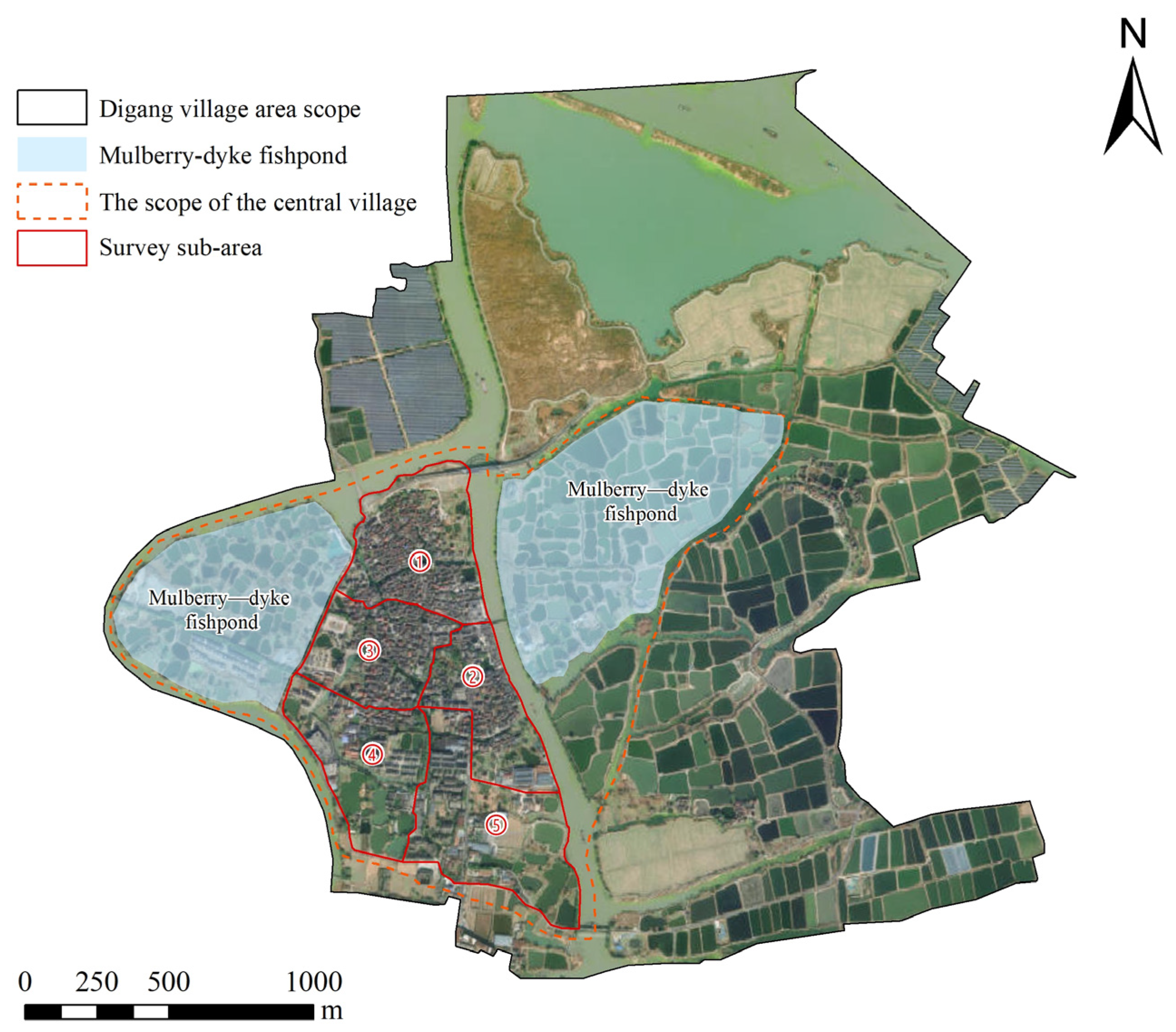
2 and comprises 20 villager groups, 1117 households, and a total population of 3320. To understand current production and living practices among Digang residents, the level of local economic development, as well as villagers’ awareness of and participation in Digang’s tourism development and their willingness to engage in conservation of the mulberry-dyke fishpond system, the research team designed a questionnaire based on resident interviews. A questionnaire interview survey was conducted in Digang Village, covering with five survey sub-areas. The core study area of the Digang Village and its five sub-areas are shown in
Figure 1.
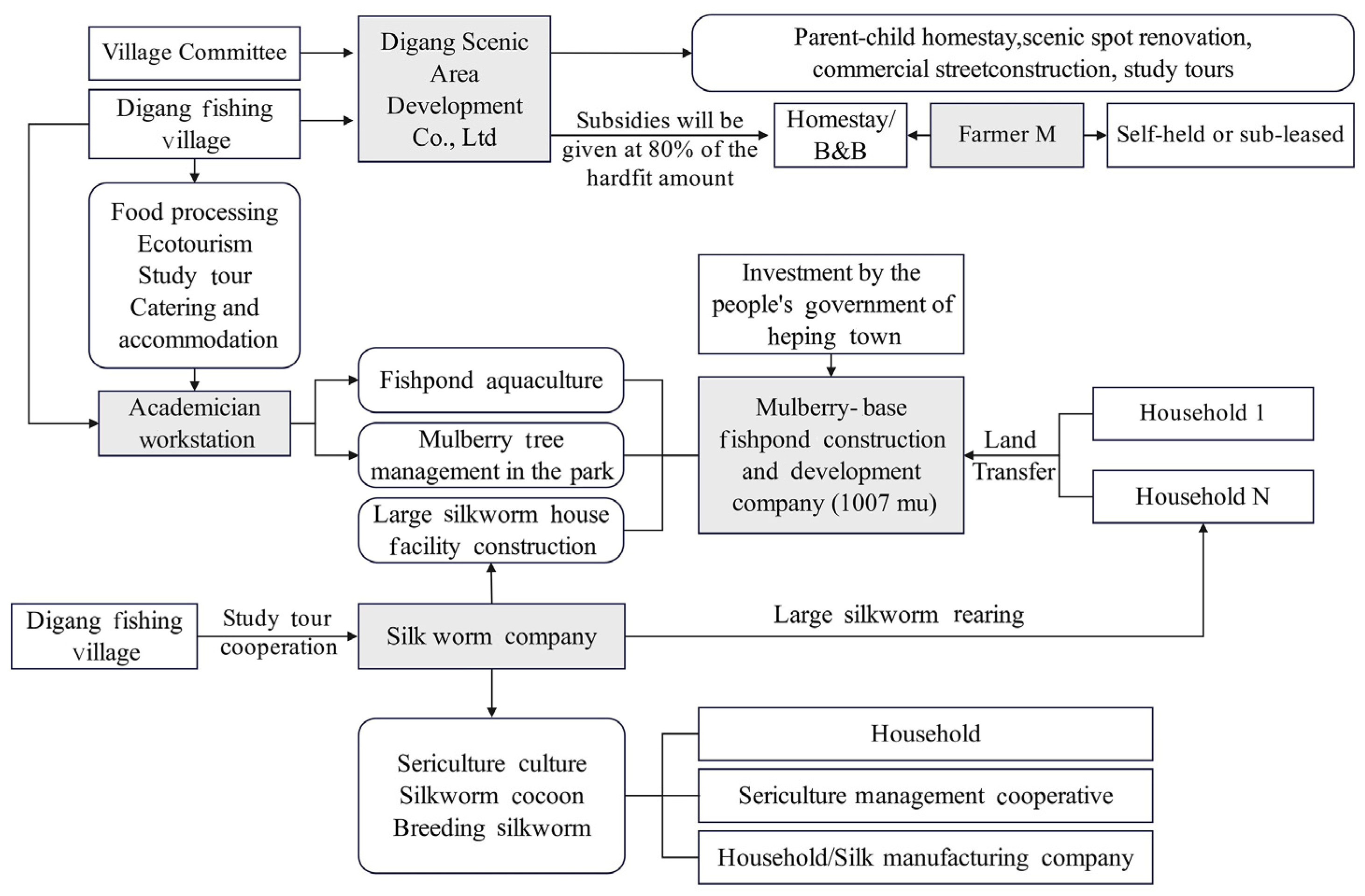
Based on on-site interviews and field investigations, a “protection–inheritance–utilization” model for the mulberry-dyke fishpond conservation area was developed (
Figure 2).
As shown in
Figure 2, the current operation and management of the mulberry-dyke fishpond reserve primarily rely on the following two core governance models:
First, the integration of industry, academia, and research is reshaping traditional circular agricultural production models. Hefu Town invested in the establishment of the Mulberry-dyke Fishpond Construction and Development Company, which transferred 1007 mu of mulberry-dyke fishponds in the core zone from households to build the protected area. The local government has promoted enterprise-based operation and maintenance of the core protected zone through a guaranteed-support approach, employing full-time staff responsible for routine mulberry management. In collaboration with an academician workstation, pilot initiatives have been launched to restore ecological fishpond aquaculture, with the resulting “ecological fish” marketed to local fish restaurants. Outside the core zone, a small number of villagers in Digang village still retain ownership of their land and fishponds; however, the dyke-to-pond ratio has been largely disrupted, and these areas have been converted into modern fishponds.
Second, government–company–farmer collaborative operations. Through government investment, corporate management, and farmer participation, mechanized large-scale silkworm rearing facilities were established, forming an “enterprise + farmer” production model. Supported by dedicated conservation funds for the mulberry-dyke fishpond system and investment from the Hefu Town government, the Mulberry-dyke Fishpond Construction and Development Company built a large silkworm-rearing facility equipped with mechanized rearing systems. A silkworm enterprise from Deqing was introduced to conduct silkworm production on a self-financing, profit-and-loss basis. In addition, the town government invested RMB 4 million for future renovation of the site into a study-tour (research-and-education) facility. The silkworm production process has been innovated via an “enterprise + households” model: the enterprise undertakes mechanized rearing of young silkworms, after which households conduct manual rearing of mature silkworms. The study-tour base provides an institutional foundation for education and dissemination of the agricultural production culture embedded in the mulberry-dyke fishpond system. Collectively, these protection, inheritance, and utilization approaches not only improve production efficiency but also enable the integration of household livelihoods with ecological objectives.
This model exemplifies the attempts and limitations of a tripartite governance structure involving government leadership, market operations, and community participation. As the initiator and investor, the Hefu Town government established a state-owned platform company (the Mulberry-dyke Fishpond Construction and Development Company) to control core resources (a 1007 mu protected area), demonstrating the government’s decisive role in safeguarding agricultural cultural heritage. However, this government-enterprise-led model faces dual challenges in market-oriented operations: on one hand, the platform company shoulders public functions like ecological conservation and cultural preservation, requiring long-term investment; on the other, it must achieve economic sustainability through tourism development and product sales, creating inherent tension between these objectives. The involvement of the “Academician Workstation” depicted in the diagram represents a path toward technical solutions, yet it remains uncertain whether technological empowerment can resolve systemic contradictions.
Simultaneously, this operational model reflects the dilemma of shifting value from productive cycles to consumer experiences. The core of traditional mulberry-dyke fishpond systems lies in the material-energy closed loop of ‘mulberry-silkworm-fish-mud,’ whereas the current model attempts to construct a value-added chain of ‘resources-products-services-experiences.’ The tourism development segment (family-friendly homestays, educational tours, commercial streets) and the production segment (fishpond farming, mulberry tree management, sericulture) are weakly connected through educational partnerships and food processing, suggesting a disconnect between production and consumption, and between conservation and utilization. This disconnect is precisely the root cause of the circular economy’s inefficiency: primary products like ecological fish and silkworm cocoons have limited market value, while the development of tourism experience products has yet to establish a differentiated competitive advantage.
The operational management model analysis in
Figure 1 provides a structural perspective for understanding the value transformation of mulberry-dyke fishponds. This model attempts to resolve the core contradiction—declining economic value coupled with the prominence yet marketization challenges of ecological and social value—through institutional innovation. However, its effectiveness faces multiple constraints: ① the sustainability of government subsidies; ② insufficient market willingness to pay for ecological goods and services; ③ limited breadth and depth of community participation. These constraints explain why, despite multi-stakeholder engagement and multiple revitalization attempts, the mulberry-dyke fishpond system continues to face persistent threats of “fewer ponds per base, disintegration of traditional circular agricultural production patterns.” Therefore, genuine revitalization mechanisms must transcend the current model, requiring institutional innovation at deeper levels—including property rights arrangements, benefit distribution, and value realization.
2.2. Survey Design
To gain an in-depth understanding of the socioeconomic conditions of Digang village residents, their knowledge of mulberry-dyke fishpond systems, production practices, and attitudes toward sustainable community tourism, this study conducted a systematic questionnaire survey across five survey areas of Digang village. Considering the dispersed residential patterns and accessibility of villagers, a combination of convenience sampling and random sampling was employed.
Questionnaire Design. The structured questionnaire comprised five modules: (1) basic personal and household information; (2) household land and mulberry-dyke fishponds management status; (3) production costs and income structure; (4) awareness and evaluation of the mulberry-dyke fishpond conservation area and heritage; (5) support for community-sustainable tourism development, perceived benefits, and risks (using a five-point Likert scale: 1 = Strongly Disagree, 5 = Strongly Agree).
Sampling and Semi-structured Interviews. To gather in-depth insights, we conducted semi-structured interviews with 12 key informants, including 5 older-generation farmers, 3 tourism operators, 2 managers from the Mulberry-dyke Fishpond Construction and Development Company, 1 town government official, and 1 scenic area operations manager. Interviews were face-to-face, one-on-one sessions averaging 25–30 min each. The interview outline centered on core topics including the value evolution of mulberry-dyke fishponds, the effectiveness and challenges of current revitalization measures, and recommendations for future development.
Sample Overview. A total of 124 questionnaires were distributed. After excluding 7 invalid questionnaires due to incomplete or contradictory information, 117 valid questionnaires were obtained, yielding a valid response rate of 94.4%.
Data Analysis. Data analysis was conducted using Excel 2021 and SPSS 26.0 software. First, descriptive statistical analysis was performed on the socioeconomic characteristics of the sample, including frequency, percentage, and mean. Second, for Likert scale data, the mean (M) and standard deviation (SD) were calculated to assess the central tendency and dispersion of villagers’ attitudes. Additionally, cross-tabulation and independent samples t-tests/one-way ANOVA were employed to investigate whether significant differences existed in key attitude variables—such as support level and perceived risk—between distinct demographic groups (e.g., different age cohorts, villagers engaged versus not engaged in fishpond labor). The significance level for all statistical tests was set at α = 0.05.
2.3. Current Status of the Mulberry-dyke Fishpond Industrial Chain
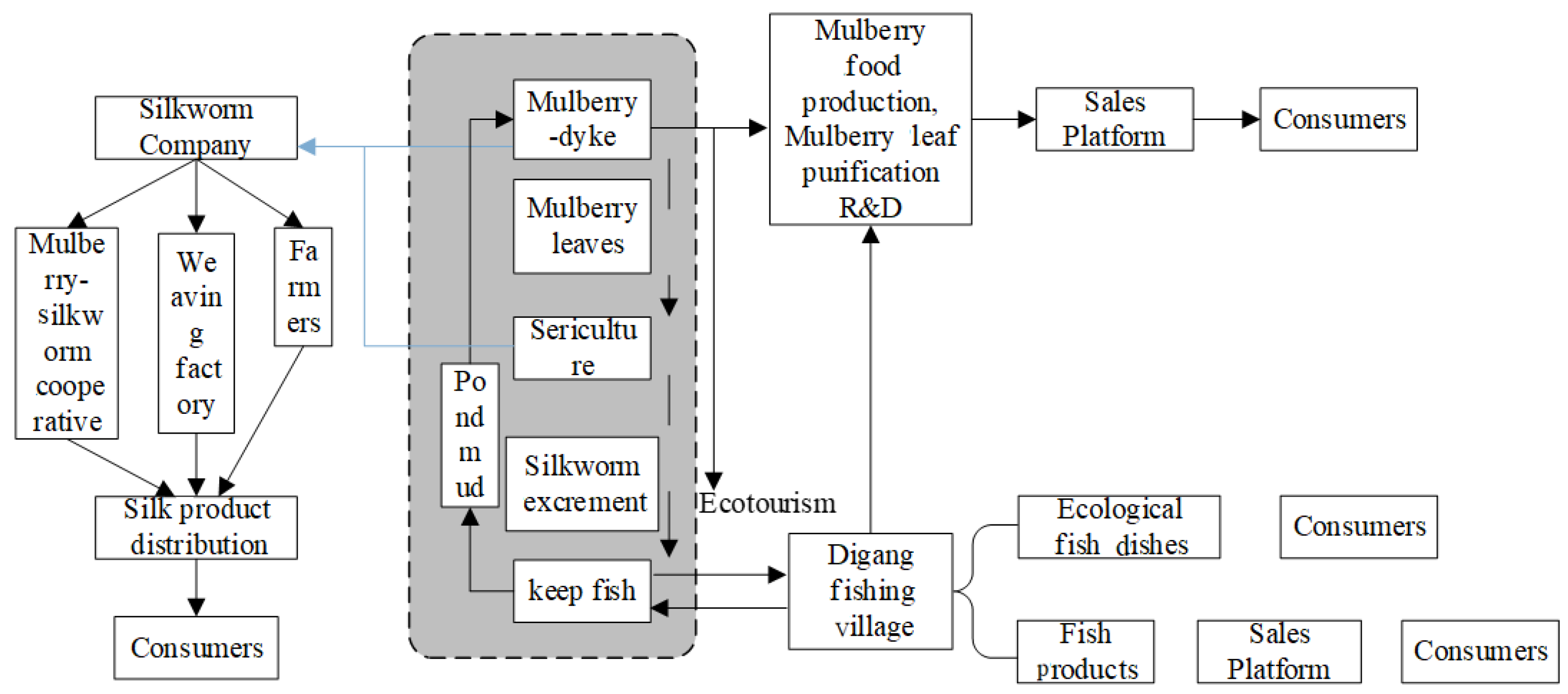
Based on the current practices of protection, inheritance, and utilization of the mulberry-dyke fishpond system in Hefu Town, the industrial chain under the existing operation and management framework can be delineated (
Figure 3).
As shown in the figure, although a protected area has been established and a new cycle has been reconstructed through “utilization within protection”—thereby re-linking disrupted segments of the production chain and enabling renewed circular operation—the system as a whole still exhibits a pattern of uneconomic circularity. Specifically, locally produced cocoons are not competitive in the raw-material market due to high labor costs and low output, and they are not sufficiently integrated with local weaving and textile manufacturers. Moreover, the protected area faces an asymmetry between costs and returns, resulting in inadequate incentives for market-oriented operation. The scale of agricultural by-product sales remains small, yielding limited pull effects; processing technologies such as mulberry-leaf purification are still in the pilot stage. The specialty ecological fish sector also suffers from insufficient downstream demand, high costs, and unstable marketing channels, making profitability difficult to achieve. In addition, enterprises associated with the natural resources of the mulberry-dyke fishpond system account for only a small proportion, and an industrial cluster centered on the system’s core resources has yet to take shape.
3. Results
3.1. Data Description
Statistical analysis of 117 valid questionnaires reveals the socioeconomic characteristics of respondents and their fundamental views on mulberry-dyke fishponds, as shown in
Table 1. Socioeconomic characteristics of respondents and their basic views on mulberry-dyke fishponds (
n = 117). The data indicates a profoundly aged respondent population, with an average age of 66.5 years and 81.2% aged 60 or older, reflecting severe demographic aging within the local community. Additionally, 92.3% of respondents were born in the village, with an average residency of 58.4 years, indicating their deep familiarity with local conditions and lending high credibility to their perspectives. Regarding livelihood patterns, only 13.7% of households still have members engaged in mulberry-dyke fishpond labor, and just 4.3% of households rely on fish farming as their primary permanent occupation. This confirms the decline in the traditional mulberry-dyke fishpond production model in the area.
Regarding land and production, only 38.5% of households currently own mulberry-dyke fishpond systems. Among these households, just 42.2% persist in self-cultivation, while 57.8% have opted for land transfer or idleness, indicating a gradual withdrawal of primary producers. Crucially, among respondents reporting changes in pond-to-land ratios, a significant 72.0% observed a decrease in pond proportions. This directly reflects the erosion of mulberry-dyke fishpond systems and the disintegration of traditional pond-land spatial structures.
Regarding perceptions and attitudes toward mulberry-dyke fishpond farming and the protected area, on one hand, villagers demonstrated extremely high awareness of Huzhou’s mulberry-dyke fishpond farming as a Globally Important Agricultural Heritage System (GIAHS) brand, indicating strong recognition of its socio-cultural value. On the other hand, villagers’ views on the future development of the protected area are markedly divided: only 41.9% of respondents explicitly expressed optimism about its prospects, while 29.1% expressed pessimism and another 29.1% were uncertain. This reflects that the community has yet to reach a consensus on the effectiveness and future of the protected area. Further analysis of villagers’ expectations for the reserve reveals that economic benefits (65.0%) and a beautiful environment (58.1%) are the two primary demands. This indicates that villagers anticipate both direct economic gains and value the ecological services provided by the reserve. However, the primary challenges in current production practices are costs exceeding benefits (51.3%), labor shortages (46.2%), and insufficient technical capabilities (34.2%). These factors explain why ecological value struggles to translate into economic returns, making traditional circular agriculture unsustainable.
Regarding sustainable tourism, villagers exhibit high support coupled with moderate risk perception. They express strong support for deepening community tourism and welcoming more visitors, indicating overall acceptance of tourism development pathways. However, their identification with the community tourism destination brand remains moderate, and they do not strongly agree that tourism development will increase income, while also worrying about excessive capital investment. This suggests that although villagers support tourism development, they still harbor doubts about actual benefits and the costs of their own participation, indicating that endogenous motivation within the community needs further stimulation.
3.2. Analysis of Existing Problems in the Mulberry-dyke Fishpond Industrial Chain
The activation initiatives undertaken in the mulberry-dyke fishpond protected area are intended to restore the economic cycle and realize economic value. In practice, however, the circular agricultural production system of mulberry-dyke fishponds have been disrupted, and its economic value has increasingly been supplanted by newly added ecological and social values [
14]. Although local stakeholders have recognized that study-tour programs and ecotourism can help deliver social and ecological benefits, the current emphasis remains on reconstructing the traditional circular agricultural production model to achieve economic returns, rather than further leveraging institutional optimization to enable market realization of the increasingly salient social and ecological values. Meanwhile, divergent views on the reserve’s prospects (only 41.9% optimistic) indicate that the existing model has failed to effectively address villagers’ core demands for economic benefits (65.0%) and a beautiful environment (58.1%). This has hindered their shift in focus from production to value realization.
The proportion of households still engaged in mulberry-dyke fishpond production is extremely low (13.7%), and among them, less than 5% practice fully ecological farming and aquaculture. This micro-level evidence confirms the unsustainability of the traditional circular model. Simultaneously, despite local efforts in ecotourism, villagers exhibit limited perception of tourism-driven economic benefits. Regarding the statement “Sustainable tourism development in Digang Village has improved my standard of living,” the mean score (M = 3.2) falls between “neutral” and “agree.” Interviews with scenic area management and local tourism operators, along with three months of visitor registration data (n = 86), reveal that visitors aged 60 and above constitute 72.1% of the total. Their weak demand for cultural and creative products and immersive experiences hinders the dissemination of socio-cultural value. Data further indicates that while villagers generally recognize the heritage value, their identification with the community brand (M = 3.8) and willingness to participate in tourism development (M = 3.5–4.0) still have significant room for improvement. Only 41.9% of villagers express optimism about the reserve’s development prospects, suggesting low perceived benefits and reflecting insufficient endogenous momentum within the community for cultural inheritance under the “integration of production, living, and ecology” framework.
3.3. Analysis of Value Transformation in the Mulberry-dyke Fishpond System
3.3.1. Decline in Traditional Economic Value
In the traditional mulberry-dyke fishpond system, outputs were not limited to a single agricultural product, but encompassed multiple economic commodities such as silk cocoons/silk and aquatic products. This diversified output structure enhanced overall agricultural efficiency and expanded farmers’ income sources. For example, mulberry trees planted on pond dykes provided leaves for silkworm rearing, and the resulting silk possessed high economic value for textile production. Meanwhile, fish raised in the ponds constituted an important agricultural product. Pond sediment was used as fertilizer for mulberry trees, and silkworm frass generated from mulberry feeding served as fish feed [
15]. This resource-recycling mechanism substantially reduced production costs and thereby generated relatively high economic returns.
With rapid socioeconomic transformation, however, the circular industrial chain of the mulberry-dyke fishpond system has fractured. Mulberry harvesting and silkworm rearing have gradually retreated from the original production system as labor costs associated with leaf picking have risen; “the eastward decline and westward shift of mulberry cultivation” provides a representative example [
13]. The primary productivity of mulberry-dyke agriculture is low, and the traditional production model has been strongly challenged. The essence of traditional mulberry-dyke fishpond systems lies in their cyclical nature, yet economic outputs across subsystems are highly uneven. Research indicates that fishpond cultivation within these subsystems yields significantly higher economic returns than silkworm farming or rice cultivation. This disparity has become the primary economic driver behind the decline in mulberry orchards and the expansion of specialized fishponds over recent decades [
16]. This trend is corroborated by the present survey, where labor shortages and costs outweighing benefits were cited by villagers as the top two production challenges. During interviews, some villagers noted that income from mulberry leaf harvesting was insufficient to cover a worker’s daily wages, providing a tangible illustration of how labor costs squeeze profit margins and lead to the abandonment of production processes. The survey found that among households still maintaining fishponds, the average pond-to-farmland ratio has fallen far below the traditional golden ratio. Moreover, over 70% of respondents indicated that the pond-to-farmland ratio has decreased over the past few decades. The median annual income derived from family mulberry-dyke fishponds is merely RMB 5000, far below the average annual household income, making its economic contribution negligible. In stark contrast, during the same period, specialized modern intensive aquaculture operations in Nanxun District achieved net profits of RMB 15,000–25,000 per mu. This substantial income disparity directly fuels the abandonment of mulberry trees in favor of ponds, or even the filling and expansion of mulberry-dyke fishpond systems. Consequently, the spatial structure of these integrated systems disintegrates, directly reflecting the decline in their comprehensive economic value. Current status of resource development and utilization of mulberry-dyke fishponds is shown in
Table 2. Current status of resource development and utilization in the location of mulberry-dyke fishponds.
3.3.2. Salience of Social Value
During the early formation and development of mulberry-dyke fishponds, local communities relied on this circular agricultural model for self-sufficiency, forming a relatively complete labor-intensive industrial chain with numerous production stages and high labor inputs. As a result, it provided abundant employment opportunities for local farmers [
17]. In contrast, this survey reveals that the average number of individuals in a household currently engaged in mulberry-dyke fishpond labor is only 0.2, indicating that modern production models have extremely limited capacity to absorb employment. However, a remarkable 95% of respondents recognized the heritage brand of Huzhou’s mulberry-dyke fishponds, and over 80% reported feeling personally insulted when the ponds faced criticism (M = 4.1). This strongly underscores the social value of heritage as a vessel for community cultural identity.
In contemporary society, the value of the mulberry-dyke fishpond system is increasingly manifested due to its scarcity. Its continued existence and inheritance are of great significance for safeguarding and promoting the historical culture of the Chinese nation. The circular-agriculture philosophy embodied by mulberry-dyke fishponds not only reflect the ancient Chinese worldview of “the unity of humans and nature”, but also represents a pioneering practice in the cyclic use of natural resources and ecological environmental protection. This aligns with today’s concept of harmony between humans and nature, thereby highlighting its social value.
In addition, the distinctive fish–mulberry culture associated with mulberry-dyke fishponds have been continuously accumulated. As part of China’s traditional agricultural culture, it embodies the industrious and simple cultural ethos of farmers. Research indicates that the system’s comprehensive services, particularly in the area of cultural services, have made outstanding contributions [
18]. In a living form, it records and demonstrates the development history of mulberry cultivation and sericulture, reeling and weaving silk, and freshwater fish farming over more than 2500 years, serving as a “living fossil” that can be studied and referenced for the present and the future. It warrants further exploration how to transform these highlighted social values into sustainable development momentum. International heritage tourism research indicates that successful revitalization requires a delicate balance between cultural authenticity and tourism commercialization [
9]. This serves as a warning that tourism development around the mulberry-dyke fishponds should avoid turning cultural heritage into a “museum exhibit” or subjecting it to excessive alienation. Its core should lie in enabling visitors to understand the cyclical wisdom of the “integration of production, living, and ecology” through immersive experiences and educational programs, thereby achieving the living transmission of culture and the dissemination of its value.
3.3.3. Explicitization of Ecological Value
Historically, favorable environmental conditions led to the ecological value of traditional mulberry-dyke fishponds being overlooked. Today, as environmental issues receive increasing attention, the ecological value of mulberry-dyke fishponds continues to appreciate. According to the Huzhou Mulberry-Dyke Fishpond Conservation Management Measures and relevant local planning documents, the mulberry-dyke fishpond system has been explicitly recognized as an agricultural ecological space playing a crucial role in water conservation, climate regulation, and biodiversity protection. Its ecological value has received formal acknowledgment from local governments at the spatial planning and policy levels. Through infiltration, they can replenish groundwater aquifers and help maintain surrounding groundwater levels. The extensive water surface of fishponds generates substantial water vapor through evapotranspiration, thereby increasing air humidity, reducing soil moisture evaporation, and contributing to the formation of a regional microclimate. Through circular material use, the migration and reuse of nutrients such as nitrogen and phosphorus within the system is achieved [
19] and dependence on external fertilizers is reduced; while lowering production costs, pond tailwater requires no treatment because excess nutrients and wastes are effectively processed within the system. Nearly no waste is discharged from the system, enabling “zero” pollution emissions from agricultural production and enhancing ecosystem stability and the sustainability of agricultural production [
20]. This model delivers significant regulatory services, with soil organic carbon storage being one of its key regulatory functions. Meanwhile, water purification services have been confirmed as the highest-value ecosystem service within the system [
21].
The mulberry-dyke fishpond system also supports rich biodiversity. Beyond mulberry trees and fish, it attracts various insects, birds, and other aquatic organisms. This diversity helps maintain ecosystem stability and resilience, while also providing habitats for wildlife survival and reproduction, thereby enriching the broader urban ecological system.
When assessing the carbon sink function of mulberry-dyke fishpond systems, a life cycle assessment study conducted by a team from the University of Oxford indicated that the soil and vegetation of these ponds possess significant carbon sequestration potential [
22]. However, accurately quantifying the net carbon sink effect of mulberry-dyke fishponds requires more than just considering vegetation and soil carbon sequestration; comprehensive flux monitoring encompassing carbon uptake and greenhouse gas emissions must be conducted [
23].
The manifestation of ecological value extends beyond cognitive and policy recognition, increasingly translating into tangible economic premiums through market mechanisms—though this conversion remains incomplete. In reserve pilot projects, ecological products command significant premiums: mulberry-fed fish raised with traditional ecological methods fetch up to 200% of conventional feed-raised fish prices. This 20–30 yuan/kg premium reflects the market’s partial validation of their ecological value. The integrated output value from combining ecological and socio-cultural values through cultural tourism can generate greater marginal benefits. By developing educational tours of mulberry-dyke fishponds and hosting the Mulberry-Fish Culture Festival, Digang Village welcomed over 700,000 visitors in 2023, with comprehensive cultural tourism revenue exceeding 140 million yuan. This created new value far surpassing traditional agricultural and fishery outputs, achieving per-mu output worth dozens of times that of single-crop farming. Furthermore, the avoided wastewater treatment costs within the mulberry-dyke fishpond’s internal circulation system represent another manifestation of its ecological regulation value.
4. Discussion
4.1. Analysis of Value Structure Transformation
In summary, the modern mulberry-dyke fishpond system differs from the traditional agro-ecological system: its original economic value has gradually declined in modern society, while social and ecological values have become increasingly prominent. The main reasons are as follows. First, rapid industrialization and urbanization have driven labor migration from rural to urban areas, resulting in rural labor shortages. This survey data provides direct evidence: the average age of interviewed villagers reached 66.5 years, indicating severe community aging. Labor shortages were cited by 46.2% of respondents as one of the primary challenges currently facing mulberry-dyke fishpond production, while the proportion of households with members still engaged in this labor has dropped to 13.7%. Consequently, a significant reason for the decline in traditional economic value is the rise in labor costs coupled with labor shortages. Second, changes in agricultural production modes—particularly the development of modern agricultural technologies and the rise of intensive, high-input, high-yield fishpond models—have gradually eroded the economic competitiveness of traditional mulberry-dyke fishponds. Third, the homogenization of agricultural products is unfavorable for meeting differentiated market demand. Traditional mulberry-dyke fishpond products are not markedly differentiated from modern aquaculture products [
24]; under conditions of information asymmetry and insufficient brand regulation, they cannot meet modern consumers’ demand for high-quality and diverse agricultural products, leading to limited market demand for ecologically farmed fish [
15]. Fourth, environmental pollution and ecological degradation: due to industrial development and the excessive use of artificial feeds, modern fishponds and feed-based “traditional” mulberry-dyke fishponds face problems such as deteriorating water quality and declining soil quality. In contrast, ecologically managed modern mulberry-dyke fishponds can still retain their original ecosystem service value, which becomes increasingly visible as demand for environmental quality rises.
This study confirms that the fundamental driving force behind the decline in Huzhou’s mulberry-dyke fishpond system lies in the systemic transformation of its internal value structure. The core competitiveness of the traditional model stemmed from the low costs and composite outputs achieved through the closed-loop cycle of “mulberry-silkworm-fish-mud,” where economic, ecological, and social values were unified and implicit within the production process. However, the modernization process deconstructed this system through two key mechanisms. Rising labor costs and market-driven division of labor completely disrupted the original material cycle, exposing each subsystem to direct comparison in external markets. This led to the elimination of less competitive segments, such as sericulture. Meanwhile, evolving social values created new demand-side pressures, namely strong demands for ecological security, cultural heritage preservation, and experiential economies.
It is particularly important to clarify that the rise in ecological value and the possibility of economic assessment discussed in this study do not advocate for the simple monetization of an ecosystem’s intrinsic value [
25]. We adhere to the ecosystem services framework, focusing on those services that provide direct or indirect support for human well-being and whose benefit flows can be assessed through market or non-market methods. The value appreciation of mulberry-dyke fishpond systems—which purify water, maintain biodiversity, sequester carbon and release oxygen, and enhance landscape aesthetics—manifests in two aspects: increased scarcity (relative to surrounding polluted or homogenized agricultural landscapes) and emerging willingness to pay. This value can be indirectly monetized through methods like the “cost of replacement” approach (estimating the cost of artificially achieving equivalent water purification) or the “revealed preference” method (e.g., market premiums for ecological products or payments for ecotourism) [
26]. Thus, the core contradiction today is not the absence of ecological value, but the severe lack of market-based institutional channels connecting this vast potential asset to tangible benefits for local communities, resulting in a cycle of inefficiency.
4.2. Exploring the Connotation of Revitalization
As a component of agricultural heritage, revitalizing mulberry-dyke fishponds essentially entail reflecting on the relationship among protection, inheritance, and utilization. Protection is the precondition for inheritance: only effective protection can ensure the integrity and authenticity of the system and provide a reliable material foundation for inheritance. Inheritance is the purpose of protection: through inheritance, the system’s value and significance can be continuously disseminated and promoted in society [
25], enabling its circular-agriculture philosophy and fish–mulberry culture to endure and remain resilient within Chinese culture. Rational utilization functions as a “lubricant” that both realizes protection and promotes inheritance. On the one hand, through the inheritance of culture and concept, the value of the mulberry-dyke fishpond is recognized and understood across generations; education and popularization can stimulate public interest and participation, facilitating rational utilization. On the other hand, utilization can in turn promote inheritance and protection by providing power and resources for heritage transmission and by offering economic and social support for protection. For example, through tourism, exhibitions, and education, more people can access and understand cultural heritage, allowing it to continuously generate economic, social, and ecological value and gradually turning protection and inheritance into a broad societal consensus [
27].
Therefore, protection, inheritance, and utilization constitute an interrelated and mutually reinforcing circulatory system. Revitalization of mulberry-dyke fishponds is a practical measure to promote protection, deepen inheritance, and expand utilization, with the ultimate goal of achieving the sustainable development of this cultural heritage. In other words, revitalization entails protecting the spatial structure and ecological farming practices of the system; inheriting the essence of its circular agriculture and the cultural tradition of integrating “production–living–ecology” [
28]; and accelerating the market realization of its social and ecological values to broaden utilization—thereby forming a sustainable pathway of protection, inheritance, and utilization and ultimately achieving the goal of revitalization.
4.3. Global Comparative Perspective and Implications
The challenges facing mulberry-dyke fishponds are not isolated incidents, but rather the common predicament faced by Globally Important Agricultural Heritage Systems (GIAHS) and similar traditional systems amid the tide of modernization. Through global comparison, we can more clearly identify the uniqueness of this case and the universal significance of its solutions.
Comparison with East Asian Models. Japan’s Satoyama-Satoumi systems similarly experienced decline and rediscovery. Their revival hinged on transforming eco-friendly production practices into robust brand premiums through mechanisms like Satoyama certification, enabling consumers to pay for landscape conservation and biodiversity preservation [
29]. This aligns perfectly with the regional ecological branding logic proposed in this study, demonstrating that embedding ecological value into tradable products is a viable international practice.
Comparison with Developing Country Models. The Ifugao rice terraces in the Philippines similarly face threats from the outflow of young and able-bodied labor and the discontinuity of traditional knowledge. Research indicates that viewing terraces as dynamic socio-ecological systems reveals that their sustainability hinges on community resilience and their central role in decision-making processes [
30]. Recent research further advocates that conservation policies should be integrated with livelihood support and community empowerment to establish co-management models. This provides a direct reference point for rethinking the risks posed by insufficient community agency in the current governance of mulberry-dyke fishponds [
31]. It highlights the dangers of inadequate community agency within the prevailing government-corporate-led model of mulberry-dyke fishpond management, thereby reinforcing this study’s subsequent argument that deep community participation should serve as the cornerstone of all revitalization mechanisms.
Comparison with policy-driven models. Within the EU’s Common Agricultural Policy, substantial budgets fund agri-environmental measures for farmers, directly compensating them for productivity losses or increased costs incurred through adopting environmentally friendly practices. This provides a top-level design approach for exploring performance-based ecological compensation or carbon sink + trading mechanisms for mulberry-dyke fishponds, demonstrating that using public finances to purchase ecological services is an internationally recognized policy tool. The European Union’s Common Agricultural Policy (CAP), as one of the world’s most mature agricultural support systems, clearly demonstrates how policy objectives have evolved from merely safeguarding agricultural production to actively purchasing ecosystem services through public finances [
32]. Under this agri-environmental paradigm, the CAP has established dedicated budgets for agri-environmental and climate measures, directly compensating farmers for increased costs or lost income incurred through the adoption of environmentally friendly practices. Although its implementation effectiveness and efficiency still have room for improvement [
33], the mechanism itself provides direct top-level design reference for exploring performance-based ecological compensation or “carbon sink plus” transactions in mulberry-dyke fishponds. The latest CAP reform further strengthens its “green ambition” by linking a larger proportion of payments to strict environmental practices [
34], further confirming that using institutionalized payments to guide ecological conservation is a significant trend in global agricultural policy.
The aforementioned international cases and Huzhou’s mulberry-dyke fishponds, despite their distinct geographical locations, cultures, and system types, collectively point to a structural universal dilemma: the non-market values (ecological, socio-cultural) of traditional agricultural heritage systems have gained widespread recognition in contemporary society and are even incorporated into international conventions and national policy frameworks. However, a significant and persistent institutional gap exists between value recognition and value capture [
35,
36].
Japan’s Satoyama systems achieve brand premiums through third-party certification, yet certification coverage remains limited and heavily reliant on consumer ethical awareness; the community resilience of the Ifugao Rice Terraces in the Philippines depends on indigenous governance traditions, but faces increasing fragility under pressures of generational succession and external capital intervention; the EU’s Common Agricultural Policy purchases ecosystem services through public finance, yet its green payments face criticism for efficiency losses and distributional inequity, while struggling to precisely align with specific ecological outcomes. These cases collectively reveal that no universal, one-size-fits-all institutional template exists. Any value realization mechanism must be embedded within specific property rights structures, social governance traditions, and market development stages.
Conversely, the case of Huzhou’s mulberry-dyke fishponds offers a uniquely Chinese experiment addressing this global challenge. Unlike the EU’s top-down public payment approach, China’s rural collective ownership system provides the institutional foundation for community-based resource rights confirmation and tiered allocation of management rights. Unlike Japan’s consumer ethics-driven certification premiums, China’s vast domestic tourism market and emerging middle class provide scaled demand-side support for experiential, participatory ecological and cultural consumption. Unlike the Philippines’ external aid-dependent community governance, China’s local governments possess strong mobilization capabilities in infrastructure development and platform-based market entity cultivation, creating policy space for piloting composite governance tools like concessions.
Therefore, the revitalization mechanism framework constructed by this research is not a simple imitation or collage of existing international experiences. Instead, it represents a systematic innovation in tool combinations tailored to China’s specific institutional endowments, based on identifying the aforementioned universal institutional gaps. Its deeper significance lies in providing the global agricultural cultural heritage field with an empirical model demonstrating how to transform local institutional strengths into tradable governance solutions. While this solution cannot be mechanically replicated, its underlying diagnostic logic—identifying types of value imbalances, pinpointing institutional bottlenecks, and assembling tailored tools—holds cross-contextual reference value.
4.4. Recommendations for Revitalization
To overcome these challenges, this paper moves beyond isolated technical fixes or fiscal subsidies by constructing a multidimensional, systemic revitalization framework that integrates technological, economic, social, and institutional dimensions. This framework aligns with cutting-edge international concepts in socio-ecological system (SES) governance [
37], aiming to transform ecological and social values into sustainable market incentives through innovative institutional design. It is recommended that the government, in light of the value transformation trend of the mulberry-dyke fishpond system, properly understand the relationship between protection, inheritance, and utilization. By defining protection objectives and establishing an institutional system with clear and balanced boundaries of rights, responsibilities, and benefits, the government can create new markets that realize social and ecological values and promote their preservation and appreciation. Specific recommendations—advancing protection, inheritance, and utilization in parallel—are as follows:
- (1)
Establish special planning and implement resource management. The local governments should formulate dedicated protection-and-development plans that clarify objectives, content, priorities, and measures; clarify the relationship between inheritance and utilization; inventory the resource base of the mulberry-dyke fishpond system; implement classified management; and establish a dynamic monitoring information system to enable data sharing [
38].
- (2)
Establish a concession (franchise) institutional framework for the mulberry-dyke fishpond system. This system aims to enhance value realization efficiency through market-oriented, professional operations while implementing sophisticated institutional designs to mitigate social and ecological risks. Ultimately, it seeks to achieve a win–win outcome encompassing heritage preservation, sustainable corporate operations, and enhanced community well-being. The concession refers to the process of selecting operators through bidding or auction, granting them limited development rights while imposing statutory conservation obligations and community benefit-sharing responsibilities [
39]. Currently, Hefu Town has invested in establishing the Mulberry-Dyke Fishpond Construction and Development Company, which oversees unified management of the core area. This provides an existing operational entity and spatial scope for piloting the concession system. The feasible approach can be divided into two steps: First, within the existing company framework, designate 1–2 fishpond units as internal “concession” pilot zones. Invite villager representatives to jointly formulate and test specific performance indicators for resource utilization, revenue distribution, and ecological conservation. Once the model matures, it can be opened to external entities through bidding processes. Community representatives should hold significant seats on the bid evaluation committee, and the weighting for community benefit plans and heritage protection schemes in the evaluation criteria must not be lower than that for economic bids. The government’s role should shift from direct operator to rule-maker and strong regulator, establishing contract-based periodic evaluation and exit mechanisms. This effectively controls risks and refines contract details through practical feedback. The concession contract serves not only as a resource usage agreement but also as a legal instrument for risk management and interest balancing [
40]. Beyond ecological protection clauses, it must include the following key provisions safeguarding community rights. Revenue-sharing clauses: clearly stipulate the profit-sharing ratio and mechanism for earnings exceeding the guaranteed base rent, ensuring villagers share in land appreciation and operational dividends; participation priority clauses requiring operators to prioritize local villagers in hiring, training, and ancillary services (e.g., homestays, catering supplies), with minimum local employment quotas; cultural oversight clauses establishing a heritage protection oversight committee comprising villager representatives, experts, and government officials, granting them review and advisory rights over decisions affecting core cultural heritage elements (e.g., pond–paddy ratios, traditional techniques, landscape features) in operational activities.
- (3)
Regional branding. The foundation of brand building lies in existing recognition. Surveys indicate that villagers possess extremely high awareness (95%) of the Huzhou Mulberry-Dyke Fishpond Heritage brand, forming a robust social recognition base for brand development. Currently, the existing Digang Scenic Area Development Co., Ltd. can take the lead in collaborating with the village collective to design and authorize the use of a unified “Di Gang · Mulberry-dyke Fishpond” sub-brand logo for local agricultural products that meet traditional ecological standards (such as ecological fish and mulberries). Local governments should strengthen regional brand building by deeply exploring the historical background, cultural characteristics, and ecological value of mulberry-dyke fishponds; shaping a distinctive brand image; clarifying naming rights and usage permissions for the Huzhou mulberry-dyke fishpond brand through regulatory certification; creating and disseminating brand stories; and enhancing emotional connection and quality perception.
- (4)
Carbon sink research promotes the realization of ecological product value. To translate these visible ecological values into economic incentives, exploring market-based approaches is crucial. The widely studied Payment for Ecosystem Services (PES) mechanism provides us with a theoretical framework [
41]. Carbon sink trading represents a localized implementation of the PES concept, attempting to monetize regulatory services like carbon sequestration and convert supporting and cultural services—such as biodiversity conservation and water purification—into product premiums. This approach thereby reinvests in the protection and management of the ecosystem. Mulberry-dyke fishpond ecosystems possess carbon sequestration potential. It is recommended that local governments collaborate with research institutions to establish a long-term observation station within the Di Gang Village reserve. Research must transcend the narrow perspective of vegetation-based carbon sequestration, adopting an ecosystem accounting approach to simultaneously monitor mulberry vegetation’s carbon dioxide absorption, greenhouse gas emissions from pond sediments, and dynamic changes in soil organic carbon pools. Simultaneously, successful experiences from similar domestic ecosystems should be actively referenced. Zhanjiang City, Guangdong Province, innovatively applied the mulberry-dyke fishpond’s “cultivation-farming coupling” ecological model in mangrove restoration and successfully released China’s first “Mangrove Carbon Credit Methodology,” providing a comprehensive local solution for quantifying, verifying, and trading wetland blue carbon. In the short term, governments can integrate preliminary carbon sink research findings with existing ecological advantages to plan pathways for realizing the value of carbon sinks combined with diversified ecological products. Examples include carbon sinks + ecological branding, carbon sinks + ecological compensation, and carbon sinks + financial instruments.
- (5)
Enterprise collaboration and product innovation. The sustainability of mulberry-dyke fishponds depend not only on technological innovation and product diversification, but also on enhanced cooperation among enterprises—for example, establishing industrial alliances, conducting joint R&D and innovation, sharing market resources, strengthening talent cultivation and exchange, and recommending green production. Such cooperation can enable resource sharing, risk sharing, and market expansion, thereby promoting sustainable development.
- (6)
Identify consumer segments and develop corresponding tourism products. This study’s data reveals that villagers’ current participation in developing diversified tourism products is very low (with related income often accounting for 0%), and market offerings remain limited. Although tourism support is high (average 4.2–4.3), brand recognition is only moderate (average 3.8). Furthermore, the visitor demographic is aging (72.1% are elderly tourists), necessitating the identification of distinct consumer segments. It is necessary to capture the main consumer groups in the new-consumption era and identify differentiated need across segments, promoting innovation in product R&D and sales models. Comprehensive ecotourism development should provide tourism service products oriented to different consumer groups and optimize marketing models via the Internet—for example, develop family-oriented tourism services such as culinary-product development competitions, mulberry-based culinary training, dyke-side angling, and mulberry-forest camping to meet differentiated needs among family members. At the same time, develop differentiated service products across consumption tiers, segment markets, and create high-end customized services for domestic and international high-net-worth visitors. Through systematic study tours and in-depth experiences, “tell China’s story well,” enhance international and domestic visibility, and increase resource value added. In addition, develop “mulberry tree adoption” programs, online platforms for “pet silkworms,” and mulberry-dyke fishpond games to expand the system’s influence and broaden the audience for tertiary-industry development [
42].
- (7)
Strengthen property rights foundations and community governance to establish a benefit-sharing mechanism with deep villager participation. Deep villager participation constitutes both the social foundation and ultimate goal of revitalizing the mulberry-dyke fishpond system. We must transcend the traditional mindset that views villagers as passive labor or tourist attractions. Through clear property rights systems and inclusive governance designs, villagers should become the primary agents, protagonists, and main beneficiaries of conservation and development. Relevant research emphasizes that transforming local residents from bystanders into co-creators—through a heritage-led local learning and entrepreneurial ecosystem—is key to achieving sustainable cultural transmission and community development. While upholding collective ownership, further refine and stabilize household contracting rights, with a focus on liberalizing the operational rights of mulberry-dyke fishpond systems. This will establish the property rights foundation for introducing “franchise operations” (Recommendation 2) or establishing community cooperatives, enabling villagers to contribute their land management rights as equity shares. This approach transforms resources into assets and villagers into shareholders. Surveys indicate villagers’ willingness to participate in tourism development is moderately high (M = 3.5–4.0), yet they lack influence in decision-making processes. Therefore, to stimulate endogenous motivation, mandatory or incentivized participation seats for villagers should be established across all stages—including reserve management, tourism company operations, and brand usage. Specifically, within regional brand management rules (Recommendation 3), clearly stipulate that villagers’ products meeting ecological standards are entitled to use the brand logo. This transforms villagers’ high brand awareness (mean 4.5) into market competitiveness. In carbon trading (Recommendation 4) revenue distribution, allocate a fixed proportion to community public funds and direct dividends to farmers, directly converting the explicit value of ecological benefits (58.1% of villagers expect beautiful environments) into villagers’ property income. Research indicates that villagers currently derive an extremely low proportion of income from tourism-related businesses (such as homestays and farm stays), with most reporting zero related income. Therefore, in tourism product development (Recommendation 6), prioritize supporting small-to-micro businesses independently operated by villagers, such as homestays, local dining, and agricultural experience workshops. The scenic area company (Recommendation 1) should transition into a platform and service provider. By establishing unified standards, providing skills training, and implementing centralized marketing, it should integrate these dispersed community businesses into packaged tourism itineraries. This ensures core tourism development revenues remain within the community, tangibly enhancing villagers’ sense of gain [
43]. Current mulberry-dyke fishpond production faces dual challenges of labor shortages (46.2%) and insufficient technical skills (34.2%), compounded by severe community aging (81.2% over 60 years old). A “Mulberry-dyke Fishpond Heritage Bearer” subsidy program must be established to provide stipends to farmers who persist in traditional ecological farming and master sericulture and silk weaving techniques. Regularly organize systematic training workshops for villagers, particularly the younger generation (Recommendation 6), covering ecological agriculture techniques, cultural heritage interpretation, and rural tourism management. This will transform the cultural essence of “integrated production, living, and ecology” into sustainable livelihood capabilities.
These seven recommendations form a multidimensional governance and market-based resolution strategy: Recommendations (1) Specialized Planning and (7) Property Rights Community Foundation constitute institutional safeguards, while clear property rights arrangements and deep community participation form the social foundation for revitalization. Recommendations (2) to (5) serve as tools for market value conversion, centered on creating transaction vehicles for highlighted non-market values. Building the “mulberry-dyke fishpond” regional ecological brand capitalizes on its unique production methods and cultural narratives, achieving product premium pricing through ecological branding. Recommendation (6) serves as the value realization vehicle. The effective operation of all tools and vehicles relies on the community participation core established by Recommendation (7).
4.5. Research Limitations and Future Prospects
This study has several limitations. First, it primarily relies on cross-sectional surveys, which reveal current conditions and correlations but cannot rigorously infer causal relationships or dynamic processes. The generalizability of conclusions to broader regions and different types of Sankey fishponds requires further validation. Second, assessments of ecosystem services (e.g., carbon sequestration, water purification capacity) rely on secondary literature and resident perceptions, lacking long-term in situ monitoring data. This limits the precision of economic evaluations of ecological value. Finally, the effectiveness of the proposed revitalization mechanisms requires practical validation.
Future research could explore the following directions: First, conduct long-term tracking studies to monitor the sustained impacts of different revitalization policies on community livelihoods, ecological indicators, and cultural heritage. Second, advance interdisciplinary methodological research by collaborating between ecologists and economists to develop low-cost, operational protocols for measuring and monitoring ecosystem services and carbon sequestration in complex systems like mulberry-dyke fishponds. This would establish baseline data, laying a robust scientific foundation for ecological compensation and market-based transactions. Third, explore the universal significance and implications for scaling up this revitalization mechanism. Conduct comparative institutional analysis across countries and systems to identify which institutional arrangements most effectively achieve the conservation and sustainable development of agricultural cultural heritage under diverse political–economic contexts, thereby distilling more generalizable governance theories.
Although this study uses Huzhou’s mulberry-dyke fishpond system as a specific case, the core logic and key tools of the revitalization mechanism framework it constructs hold significant reference value and implications for traditional agricultural systems or cultural heritage sites facing similar challenges globally. Scholars can conduct comparative institutional analysis across countries and systems. Its universality manifests primarily in the following three dimensions:
Constrained by research methodology and timeframe, core ecological indicators of the Digang village mulberry-dyke fishpond system—such as carbon sequestration capacity and water purification efficiency—were not measured or quantified in situ. Consequently, demonstrating specific ecological benefits relies heavily on general literature findings and community perception data. Future research urgently requires long-term ecological monitoring to establish baseline data, thereby providing precise scientific pricing foundations for market-based implementation mechanisms like ecological compensation and carbon trading. This addresses a critical scientific challenge in transforming the ecological value highlighted by mulberry-dyke fishpond systems into tradable ecological products.
Conduct long-term tracking studies focusing on how community participation levels and equitable benefit distribution impact the system’s long-term resilience. Through such research, we can continuously enrich and refine China’s approach and global insights for preserving and revitalizing agricultural cultural heritage.
The universal significance and implications for scaling up this revitalization mechanism. Although this study uses Huzhou’s mulberry-dyke fishponds as a specific case, the revitalization mechanism framework it constructs holds significant reference value and implications for traditional agricultural systems or cultural heritage sites facing similar challenges worldwide. Its universality manifests across three dimensions:
- (1)
Universal applicability of the theoretical framework: This mechanism is grounded in two internationally dominant theories—agricultural multifunctionality and socio-ecological systems governance. The decline in any long-standing agricultural heritage embodying diverse values fundamentally stems from imbalances in economic, ecological, social, and cultural values. Therefore, the analytical and action framework proposed herein—precisely identifying value shifts, addressing market failures through institutional innovation, and establishing multi-stakeholder interest linkages—constitutes a methodology with universal explanatory power and guidance.
- (2)
Transferability of key tools and alignment with international experience: The specific tools within the mechanism are not isolated inventions but resonate with global sustainable agricultural practices. For instance, franchising and regional branding are essentially localized adaptations of internationally recognized models like “Protected Designation of Origin” and “Eco-Product Certification.” The carbon trading concept directly aligns with the global environmental economic policy of “Payments for Ecosystem Services (PES).” Community participation and cultural tourism integration reflect core principles consistently advocated by UNESCO and FAO in cultural heritage preservation. This ensures the scheme’s compatibility with global discourse frameworks and technical toolkits.
- (3)
Key to successful implementation: contextual adaptation, not mechanical replication: It must be emphasized that this mechanism’s vitality lies in its systemic nature, while successful transplantation hinges on contextual adaptation. Resource endowments, property rights systems, cultural customs, and market maturity vary significantly across regions. Therefore, in practice, policymakers should prioritize drawing on the systemic thinking of this framework rather than mechanically replicating specific provisions. For instance, in regions with ambiguous property rights systems, community resource rights confirmation should be prioritized; in areas with underdeveloped tourism, brand building may precede tourism product development. The principles highlighted in this paper—categorical management and identifying distinct consumer groups—are precisely manifestations of this adaptive mindset.
In summary, the revitalization case of mulberry-dyke fishponds offers the world a Chinese model demonstrating how globally valuable indigenous knowledge can be transformed into sustainable local practices, further abstracted into a “generalizable framework for reference.” We anticipate this systematic approach will inspire agricultural cultural heritage conservation and sustainable development in other regions.
5. Conclusions
This study systematically reveals that the decline in the mulberry-dyke fishpond system is not merely a disappearance of value, but stems from a fundamental shift in its internal value structure. Specifically: (1) Under the impact of industrialization and modern agricultural technologies, the traditional circular agricultural production model upon which the system relied disintegrated due to rising labor costs and disrupted industrial chains, leading to a significant decline in its direct economic value. Traditional economic value has markedly diminished due to the loss of comparative advantage. Microdata indicates that the median annual income generated by the traditional production model for households is only 5000 yuan, rendering its economic competitiveness far inferior to modern intensive aquaculture (with profits per mu ranging from 15,000 to 25,000 yuan). This directly led to the withdrawal of producers and the disintegration of the “farm-pond” cyclical structure. (2) Ecological regulation and socio-cultural values have gained prominence in the contemporary context and are increasingly seeking market expression. The ecological regulation services provided by the system (such as water purification and biodiversity maintenance) and its socio-cultural value have become increasingly significant under the global ecological crisis and cultural diversity protection agenda. This is reflected in policy recognition, market premium payments for ecological products (e.g., doubled prices for eco-friendly fish), and the significant emerging value generated by eco-cultural tourism (e.g., Di Gang Village’s annual tourism revenue of 140 million yuan). The primary contradiction in current conservation and utilization practices is not the disappearance of value, but rather the lack of effective market-based pathways to realize these increasingly prominent non-market values. This leads to a severe imbalance between conservation investments and economic returns, trapping the system in a sustainability dilemma of “circular inefficiency.” This is evident not only in the fact that circular agricultural production models face broken cycles, but also in the difficulties encountered in value addition and realization when developing secondary and tertiary industries based on existing resources like mulberry-dyke fishpond systems. Therefore, the revitalization mechanism proposed in this paper essentially involves designing and creating a new market through institutional innovation (such as franchising and brand certification). This approach quantifies, establishes rights to, and facilitates the trading of the system’s increasingly prominent ecological and socio-cultural values, thereby reshaping its endogenous drivers for sustainable development.
This study transcends the narrow perspectives of purely technical conservation or tourism development, offering an analytical framework based on “dynamic value transformation—institutional innovation response.” Its primary theoretical contribution lies in revealing that the sustainability crisis of composite agricultural cultural heritage like Mulberry-dyke fishponds fundamentally stems from structural imbalances in multiple values and market failures. Thus, genuine revitalization hinges on creating new rules and markets through refined institutional design—enabling the identification, quantification, and trading of non-market values to transform social and ecological well-being into sustainable economic incentives. This framework offers new analytical tools for understanding agricultural heritage systems facing similar challenges globally.
Based on the above findings, this study’s practical direction is clear: the revival of Mulberry-dyke fishponds must shift from restoring single-production cycles to building ecosystems that realize multiple values. This implies that policies and practices should focus on systemic institutional innovation, such as the following:
Implementing concession systems with equal rights, responsibilities, and benefits to introduce market efficiency while legally safeguarding community revenues and heritage preservation through contractual agreements; establishing authoritative ecological product certification systems to translate the system’s ecological advantages into stable market premiums; exploring science-based ecological value accounting and compensation mechanisms (e.g., carbon sequestration) to broaden value realization channels; all measures must be grounded in deepening community participation, ensuring their central role and core beneficiary rights as an unshakable foundation to achieve truly sustainable integration of production, living, and ecology.
In summary, this study not only diagnoses the deep-seated mechanisms behind the decline in the Mulberry-dyke fishpond system but also charts a feasible path for institutional innovation to transform its increasingly evident ecological and sociocultural potential into developmental momentum. It contributes a systematic Chinese case study and solution for the preservation and revitalization of global agricultural cultural heritage.