The Impact of ESG Ratings on Corporate Carbon Performance: From the Perspective of Internal and External Interaction
Abstract
1. Introduction
2. Literature Review
2.1. Research on ESG Ratings
2.2. Research on Corporate Carbon Performance
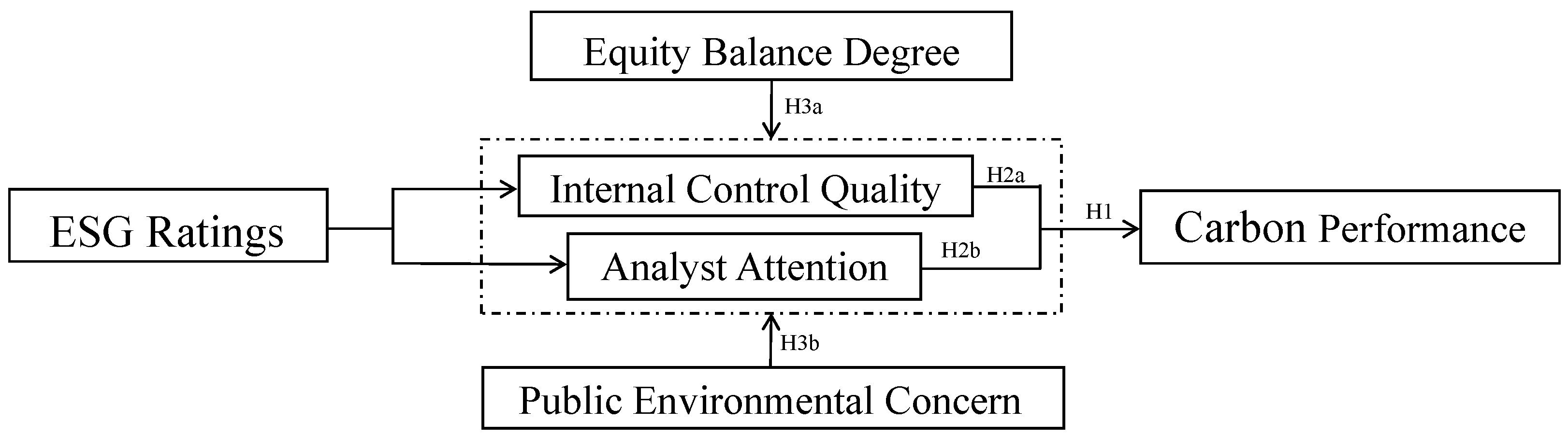
3. Theoretical Analysis and Research Hypothesis
3.1. The Impact of ESG Ratings on Corporate Carbon Performance
3.2. Meditation of ESG Ratings to Improve Corporate Carbon Performance
3.2.1. The Meditation of Internal Control Quality
3.2.2. The Meditation of Analyst Attention
3.3. Moderation of ESG Ratings to Improve Corporate Carbon Performance
3.3.1. The Moderation of Equity Balance Degree
3.3.2. The Moderation of Public Environmental Concern
4. Research Design
4.1. Data and Sampling
4.2. Model Construction
4.3. Variable Setting
4.3.1. Explained Variable
4.3.2. Explanatory Variable
4.3.3. Control Variables
4.3.4. Mechanism Variables
4.3.5. Moderation Variables
5. Empirical Analysis
5.1. Descriptive Statistics
5.2. Correlation Analysis
5.3. Benchmark Regression Analysis
5.4. Mechanism Analysis
5.5. Moderation Analysis
5.6. Robustness Test
- (1)
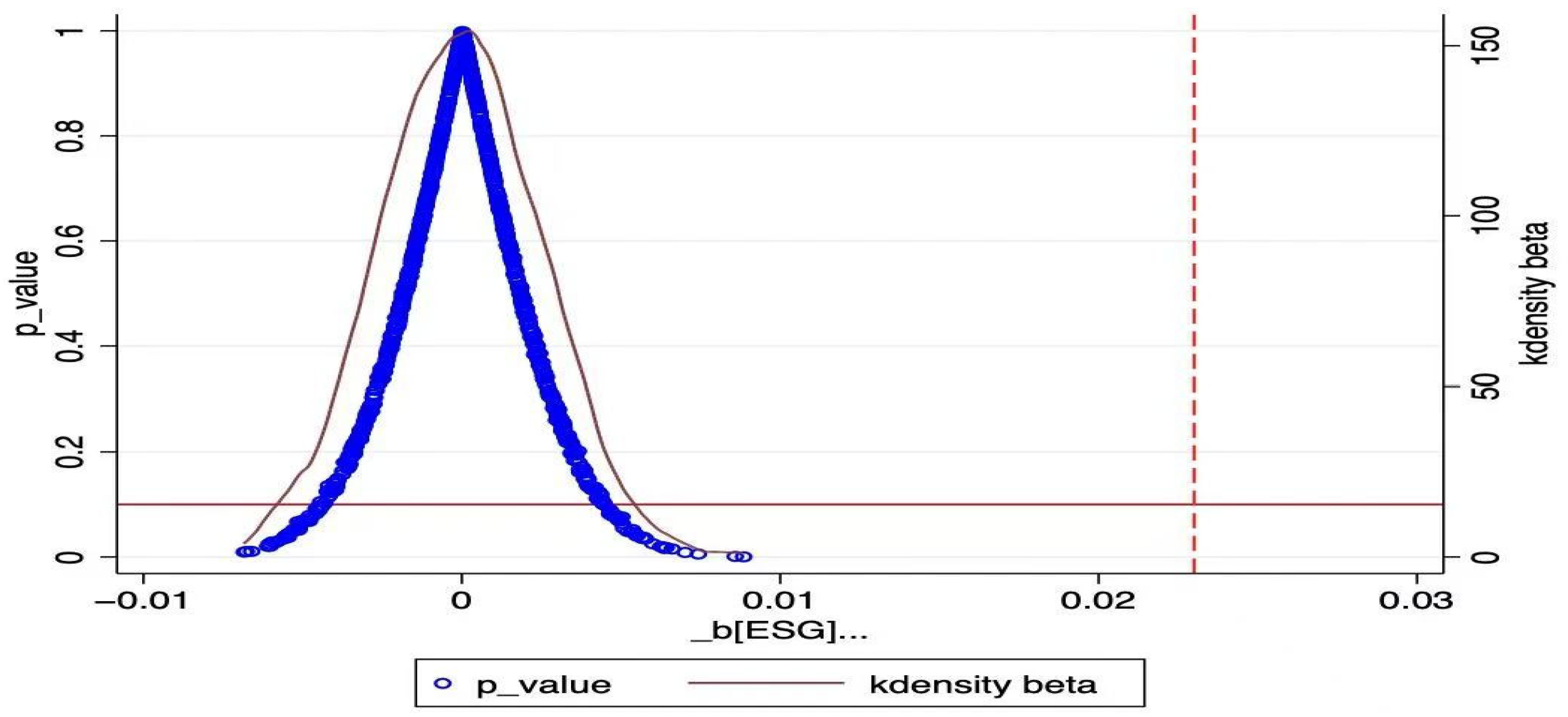
- Placebo test
- (2)
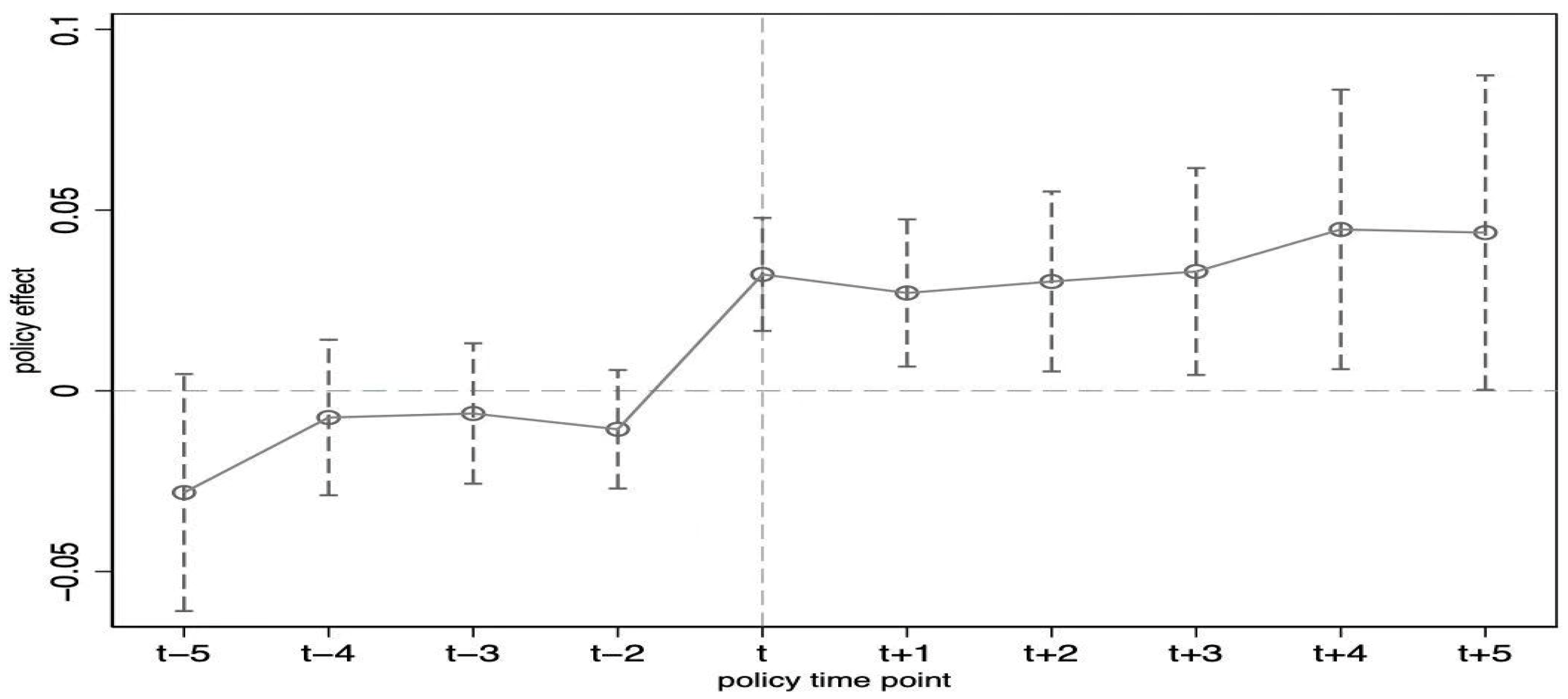
- Parallel Trend Test
- (3)
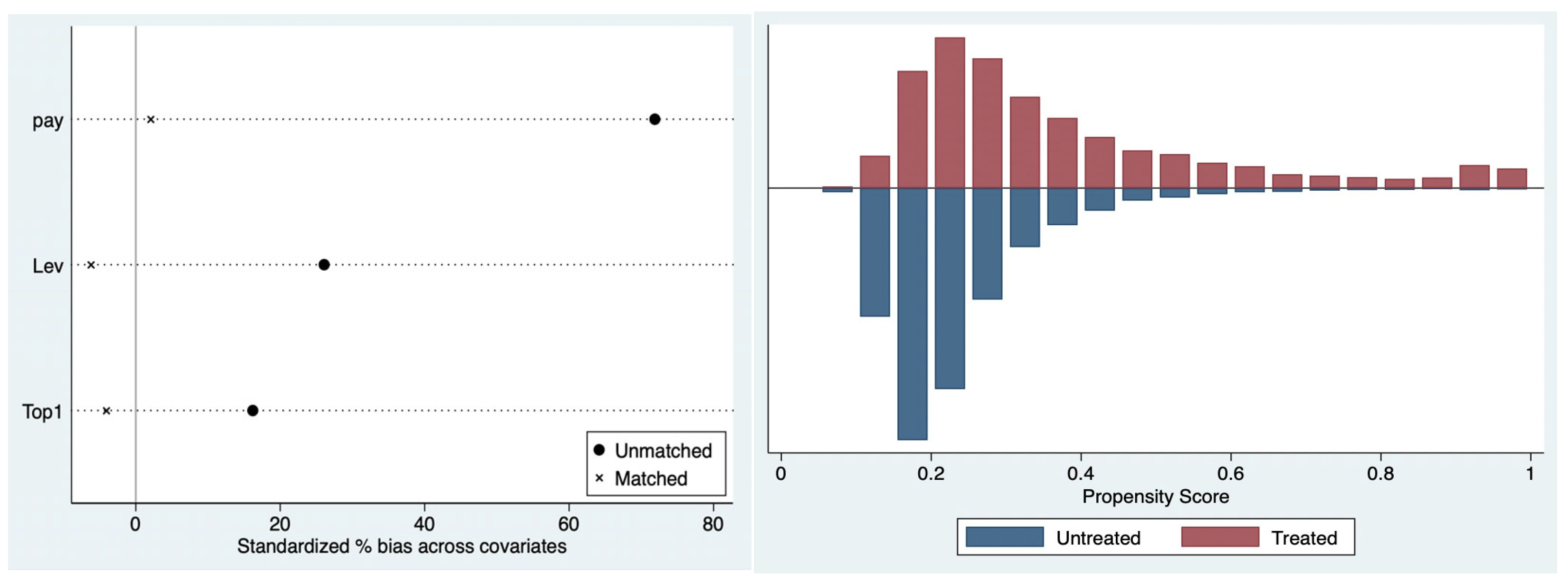
- PSM-DID method
- (4)
- Changing the sample interval
6. Further Analysis
6.1. Dynamic Effect
6.2. Heterogeneity Analysis
6.2.1. Pollution Intensity
6.2.2. Customer Concentration
6.2.3. Digital Transformation Degree
7. Conclusions
7.1. Conclusions of This Study
7.2. Theoretical Contributions
7.3. Practical Implications
- (1)
- Clarify the Position of ESG Ratings as Market-Based Soft Regulation and Integrate Them into the Climate Governance Policy System
- (2)
- Promote the Reform of Internal Governance Structure and Consolidate the institutional Foundation for Translating ESG Pressures into Emission Reduction Actions
- (3)
- Strengthening the Synergy of Market Information Intermediaries and Social Public Opinion Supervision to Amplify the External Governance Effect of ESG Ratings
- (4)
- Implement Differentiated ESG Governance Strategies to Improve the Precision and Adaptability of Policy Tools
7.4. Limitations and Prospects of This Study
Author Contributions
Funding
Institutional Review Board Statement
Informed Consent Statement
Data Availability Statement
Conflicts of Interest
Abbreviations
References
- Srikan, D. Non-traditional security threats in the 21st century: A review. Int. J. Dev. Confl. 2014, 4, 60–68. [Google Scholar]
- Wang, S.; Xu, J.; Zhang, W.; Cheng, M. Research on the impact of green finance on China’s carbon neutralization capacity. Environ. Sci. Pollut. Res. 2023, 30, 108330–108345. [Google Scholar] [CrossRef]
- Orazalin, N.S.; Ntim, C.G.; Malagila, J.K. Board sustainability committees, climate change initiatives, carbon performance, and market value. Br. J. Manag. 2024, 35, 295–320. [Google Scholar] [CrossRef]
- He, L.Y.; Chen, K.X. Digital transformation and carbon performance: Evidence from firm-level data. Environ. Dev. Sustain. 2025, 27, 23639–23664. [Google Scholar] [CrossRef]
- Long, G.; Duan, D.; Wang, H.; Chen, S. The impact of industrial robots on low-carbon green performance: Evidence from the belt and road initiative countries. Technol. Soc. 2024, 79, 102712. [Google Scholar] [CrossRef]
- Nuraini, L.; Amrulloh, A. Auditors and Sustainability Reporting: Ensuring Accuracy and Transparency in ESG Disclosure. Res. Acad. Innov. Data Anal. 2024, 1, 112–124. [Google Scholar]
- Avramov, D.; Cheng, S.; Lioui, A.; Tarelli, A. Sustainable Investing with ESG Rating Uncertainty. J. Financ. Econ. 2022, 145, 642–664. [Google Scholar] [CrossRef]
- Christensen, D.M.; Serafeim, G.; Sikochi, A.S. Why is Corporate Virtue in the Eye of the Beholder? The Case of ESG Ratings. Account. Rev. 2021, 97, 147–175. [Google Scholar] [CrossRef]
- Friede, G.; Busch, T.; Bassen, A. ESG and Financial Performance, Aggregated Evidence from More Than 2000 Empirical Studies. J. Sustain. Financ. Invest. 2015, 5, 210–233. [Google Scholar] [CrossRef]
- Flammer, C. Does Corporate Social Responsibility Lead to Superior Financial Performance? A Regression Discontinuity Approach. Manag. Sci. 2015, 61, 2549–2568. [Google Scholar] [CrossRef]
- Hao, P.; Alharbi, S.S.; Hunjra, A.I.; Zhao, S. How do ESG ratings promote digital technology innovation? Int. Rev. Financ. Anal. 2025, 97, 103886. [Google Scholar] [CrossRef]
- Li, Z.; Wang, X.; Wu, Z. Can green finance reform and innovation policies promote corporate carbon performance? Financ. Res. Lett. 2024, 62, 105203. [Google Scholar] [CrossRef]
- Jiang, Y.; Luo, L.; Tsang, A.; Zhang, Y. Carbon emission trading scheme and carbon performance: The role of carbon management system. Br. Account. Rev. 2025, 57, 101492. [Google Scholar] [CrossRef]
- Donaldson, T.; Preston, L.E. The Stakeholder Theory of the Corporation: Concepts, Evidence, and Implications. Acad. Manag. Rev. 1995, 20, 65–91. [Google Scholar] [CrossRef]
- Freeman, R.E.; Evan, W.M. Corporate Governance: A Stakeholder Interpretation. J. Behav. Econ. 1990, 19, 337–359. [Google Scholar] [CrossRef]
- Wu, H.; Xu, L.; Ren, S.; Hao, Y.; Yan, G. How do energy consumption and environmental regulation affect carbon emissions in China? New evidence from a dynamic threshold panel model. Resour. Policy 2020, 67, 101678. [Google Scholar] [CrossRef]
- Luo, L.; Tang, Q. Corporate governance and carbon performance: Role of carbon strategy and awareness of climate risk. Account. Financ. 2021, 61, 2891–2934. [Google Scholar] [CrossRef]
- Rodrigue, M.; Magnan, M.; Cho, C.H. Is environmental governance substantive or symbolic? An empirical investigation. J. Bus. Ethics 2013, 114, 107–129. [Google Scholar] [CrossRef]
- Hyatt, D.G.; Berente, N. Substantive or symbolic environmental strategies? Effects of external and internal normative stakeholder pressures. Bus. Strategy Environ. 2017, 26, 1212–1234. [Google Scholar] [CrossRef]
- Xu, X.L.; Chen, H.H.; Li, Y.; Chen, Q.X. The role of equity balance and executive stock ownership in the innovation efficiency of renewable energy enterprises. J. Renew. Sustain. Energy 2019, 11, 055901. [Google Scholar] [CrossRef]
- Wang, Y.; Zhao, Z.; Shi, M.; Liu, J.; Tan, Z. Public environmental concern, government environmental regulation and urban carbon emission reduction-Analyzing the regulating role of green finance and industrial agglomeration. Sci. Total Environ. 2024, 924, 171549. [Google Scholar] [CrossRef] [PubMed]
- He, F.; Du, H.; Yu, B. Corporate ESG performance and manager misconduct: Evidence from China. Int. Rev. Financ. Anal. 2022, 82, 102201. [Google Scholar] [CrossRef]
- Tan, Y.; Zhu, Z. The Effect of ESG Rating Events on Corporate Green Innovation in China, The Mediating Role of Financial Constraints and Managers’ Environmental Awareness. Technol. Soc. 2022, 68, 101906. [Google Scholar] [CrossRef]
- Wang, C.; Wu, J.; Zhang, B. Environmental regulation, emissions and productivity: Evidence from Chinese COD-emitting manufactures. J. Environ. Econ. Manag. 2018, 92, 54–73. [Google Scholar] [CrossRef]
- Yang, C.; Yang, R.; Zhou, Y.; Liu, Z. E, S, and G, not ESG: Heterogeneous Effects of Environmental, Social, and Governance Disclosure on Green Innovation. Corp. Soc. Responsib. Environ. Manag. 2023, 31, 1220–1238. [Google Scholar] [CrossRef]
- Houston, J.F.; Shan, H.Y. Corporate ESG Profiles and Banking Relationships. Rev. Financ. 2022, 35, 3373–3417. [Google Scholar] [CrossRef]
- Zhang, D.Y.; Lucey, B.M. Sustainable Behaviors and Firm Performance: The Role of Financial Constraints’ Alleviation. Econ. Anal. Policy 2022, 74, 220–233. [Google Scholar] [CrossRef]
- Zhang, C.; Zhang, S.; Yang, Y.; Zhou, Z. The Impact of Carbon Risk on Corporate Greenwashing Behavior: Inhibition or Promotion? Sustainability 2025, 17, 10188. [Google Scholar] [CrossRef]
- Meyer, J.W.; Roman, B. Institutionalized organizations: Formal structure as myth and ceremony. Am. J. Sociol. 1997, 83, 340–363. [Google Scholar] [CrossRef]
- Kirk, M.P.; Vincent, J.D. Professional Investor Relations within the Firm. Account. Rev. 2014, 89, 1421–1452. [Google Scholar] [CrossRef]
- Li, J.L.; Xu, X.G. Can ESG rating reduce corporate carbon emissions?—An empirical study from Chinese listed companies. J. Clean. Prod. 2024, 434, 140226. [Google Scholar] [CrossRef]
- Raghunandan, A.; Rajgopal, S. Do ESG Funds Make Stakeholder-Friendly Investments? Rev. Account. Stud. 2022, 27, 822–863. [Google Scholar] [CrossRef]
- Wang, H.; Liu, J.; Zhang, L. Carbon Emissions and Assets Pricing—Evidence from Chinese Listed Firms. China J. Econ. 2022, 9, 28–75. [Google Scholar] [CrossRef]
- Chen, D.P.; Chen, Y.S. Research on the Relationship between Ownership Concentration, Equity Balance and Corporate Performance-An Empirical Test of Small and Medium-sized Enterprises in 2007–2009. Account. Res. 2011, 1, 38–43. [Google Scholar]
- Graham, J.R.; Harvey, C.R.; Rajgopal, S. The Economic Implications of Corporate Financial Reporting. J. Account. Econ. 2005, 40, 3–73. [Google Scholar] [CrossRef]
- Belgicq, P.B.; Maria, J.B.C. Green Public Procurement as an Initiative for Sustainable Consumption: An Exploratory Study of Spanish Public Universities. J. Clean. Prod. 2016, 133, 648–656. [Google Scholar] [CrossRef]
- Bui, B.; Houqe, M.N.; Zaman, M. Climate governance effects on carbon disclosure and performance. Br. Account. Rev. 2020, 52, 100880. [Google Scholar] [CrossRef]
- Clarkson, P.M.; Li, Y.; Richardson, G.D.; Vasvari, F.P. Does It Really Pay to Be Green? Determinants and Consequences of Proactive Environmental Strategies. J. Account. Public Policy 2011, 30, 122–144. [Google Scholar] [CrossRef]
- Li, C.; Qi, L. Can Government Environmental Attention Improve Corporate Carbon Emission Reduction Performance?—Evidence from China A-Share Listed Companies with High-Energy-Consumption. Sustainability 2024, 16, 4660. [Google Scholar] [CrossRef]
- Zhou, J.; Lei, X.; Yu, J. ESG rating divergence and corporate green innovation. Bus. Strategy Environ. 2024, 33, 2911–2930. [Google Scholar] [CrossRef]
- La Ferrara, E.; Chong, A.; Duryea, S. Soap Operas and Fertility, Evidence from Brazil. Am. Econ. J. Appl. Econ. 2012, 4, 1–31. [Google Scholar] [CrossRef]
- Li, S.; Jayaraman, V.; Paulraj, A.; Shang, K.C. Proactive Environmental Strategies and Performance: Role of Green Supply Chain Processes and Green Product Design in the Chinese High-tech Industry. Int. J. Prod. Res. 2016, 54, 2136–2151. [Google Scholar] [CrossRef]
- Itzkowitz, J. Customers and cash: How relationships affect suppliers’ cash holdings. J. Corp. Financ. 2013, 19, 159–180. [Google Scholar] [CrossRef]
- Crawford, S.; Huang, Y.; Li, N.; Yang, Z. Customer concentration and public disclosure: Evidence from management earnings and sales forecasts. Contemp. Account. Res. 2020, 37, 131–159. [Google Scholar] [CrossRef]
- Lu, Y.; Chen, X.P. Digital economy, new-type urbanization, and carbon emissions: Evidence from China. Environ. Prog. Sustain. Energy 2022, 43, e14045. [Google Scholar] [CrossRef]
- Yue, Q.; Lv, S. Impact of Digital Transformation on Carbon Performance of Industrial Firms Considering Performance–Expectation Gap as a Moderator. Sustainability 2024, 16, 6097. [Google Scholar] [CrossRef]


| Variable Type | Variable Name | Variable Symbol | Variable Definition and Computation |
|---|---|---|---|
| Explained variable | Corporate carbon performance | CP | Ratio of business income to carbon emissions |
| Explanatory variable | ESG ratings | ESG | 0–1 variable, defined according to whether SynTao Green Finance publishes ESG rating data of the company. |
| Mechanism variables | Internal control quality | IC | The internal control score of DiBo is increased by 1, and then the natural logarithm is taken. |
| Analyst attention | Attention | The number of analysts focusing on the enterprise is taken as the natural logarithm of the sum, incremented by 1. | |
| Moderation variables | Equity balance degree | Share | The total of the shares held by the first largest shareholder divided by the number of shares held by the second to fifth shareholders. |
| Public environmental concern | Index | Total search index of Baidu smog | |
| Control variables | Scale of enterprise | Size | The natural logarithm of an organization’s t assets |
| Return on total assets | ROA | Net profit/total assets balance | |
| Growth ability | Growth | Growth rate of enterprise operating income | |
| Management compensation | Pay | Total compensation of enterprise management | |
| Corporate gearing ratio | Lev | Total liabilities divided by total assets | |
| Equity concentration | TOP1 | The largest shareholder’s shareholding ratio | |
| Operational capability | Trac | Accounts receivable turnover rate |
| Variables | Obs | Mean | SD | Min | Median | Max |
|---|---|---|---|---|---|---|
| CP | 20,222 | 0.489 | 0.452 | 0.243 | 0.318 | 2.321 |
| ESG | 20,222 | 0.279 | 0.448 | 0.000 | 0.000 | 1.000 |
| Growth | 20,222 | 0.163 | 0.365 | −0.555 | 0.106 | 2.287 |
| Pay | 20,222 | 6,520,000 | 5,480,000 | 708,000 | 4,910,000 | 33,100,000 |
| Size | 20,222 | 22.300 | 1.309 | 19.675 | 22.084 | 26.207 |
| ROA | 20,222 | 0.041 | 0.061 | −0.251 | 0.039 | 0.205 |
| Lev | 20,222 | 0.409 | 0.199 | 0.051 | 0.401 | 0.895 |
| Trac | 20,222 | 29.309 | 119.842 | 0.847 | 4.904 | 1077.928 |
| TOP1 | 20,222 | 34.370 | 14.619 | 8.720 | 32.280 | 74.870 |
| Index | 20,222 | 232.870 | 214.664 | 0.000 | 195.033 | 1273.994 |
| Share | 20,222 | 0.760 | 0.620 | 0.003 | 0.596 | 4.000 |
| IC | 20,222 | 6.468 | 0.144 | 4.830 | 6.492 | 6.831 |
| Attention | 20,222 | 1.305 | 1.183 | 0.000 | 1.099 | 4.331 |
| Variables | CP | ESG | Growth | Pay | Size | ROA | Lev | Trac | TOP1 |
|---|---|---|---|---|---|---|---|---|---|
| CP | 1 | ||||||||
| ESG | 0.621 *** | 1 | |||||||
| Growth | −0.027 *** | −0.053 *** | 1 | ||||||
| Pay | 0.106 *** | 0.348 *** | 0.072 *** | 1 | |||||
| Size | 0.037 *** | 0.426 *** | 0.044 *** | 0.476 *** | 1 | ||||
| ROA | −0.037 *** | 0.028 *** | 0.259 *** | 0.167 *** | −0.028 *** | 1 | |||
| Lev | 0.018 *** | 0.116 *** | 0.023 *** | 0.145 *** | 0.542 *** | −0.392 *** | 1 | ||
| Trac | −0.016 ** | 0.058 *** | 0.018 *** | 0.053 *** | 0.132 *** | 0.055 *** | 0.062 *** | 1 | |
| TOP1 | −0.042 *** | 0.074 *** | −0.012 * | −0.014 ** | 0.204 *** | 0.126 *** | 0.054 *** | 0.063 *** | 1 |
| (1) | (2) | |
|---|---|---|
| CP | CP | |
| ESG | 0.0222 *** (3.5401) | 0.0257 *** (4.0105) |
| Growth | 0.0454 *** (9.4869) | |
| Pay | −0.0000 (−1.0383) | |
| Size | −0.0010 (−0.1940) | |
| ROA | 0.0067 (0.1889) | |
| Lev | 0.0845 *** (4.4292) | |
| Trac | −0.0000 ** (−2.4647) | |
| TOP1 | −0.0003 (−0.8815) | |
| Id | Yes | Yes |
| Year | Yes | Yes |
| _cons | 0.3166 *** (163.1851) | 0.3138 *** (2.7507) |
| N | 20,222 | 20,222 |
| adj. R2 | 0.8760 | 0.8775 |
| Variable | IC | Attention | CP | |
|---|---|---|---|---|
| (1) | (2) | (3) | (4) | |
| ESG | 0.0109 *** (2.8933) | 0.2026 *** (7.7843) | 0.0265 *** (4.1115) | 0.0252 *** (3.9011) |
| ESG*Share | 0.0233 ** (2.2769) | |||
| ESG*Index | 0.0001 *** (5.2182) | |||
| Controls | Yes | Yes | Yes | Yes |
| Id | Yes | Yes | Yes | Yes |
| Year | Yes | Yes | Yes | Yes |
| _cons | 6.3557 *** (77.2605) | −9.1648 *** (−15.4114) | 0.3194 *** (2.7987) | 0.3274 *** (2.8849) |
| N | 20,222 | 20,222 | 20,222 | 20,222 |
| adj. R2 | 0.0896 | 0.1900 | 0.8776 | 0.8779 |
| Variable | CP | |
|---|---|---|
| (1) | (2) | |
| Nearest Neighbor Matching | Radius Matching | |
| ESG | 0.0233 *** (3.5323) | 0.0231 *** (3.5027) |
| Controls | Yes | Yes |
| Id | Yes | Yes |
| Year | Yes | Yes |
| _cons | 0.3228 *** (2.8009) | 0.3216 *** (2.7896) |
| N | 19,564 | 19,559 |
| r2_a | 0.8781 | 0.8781 |
| CP | ||
|---|---|---|
| (1) | (2) | |
| I(t = Ti) | 0.0249 *** (3.1689) | 0.0280 *** (3.5125) |
| I(t = Ti + 1) | 0.0129 *** (2.8940) | 0.0184 *** (3.9525) |
| I(t = Ti + 2) | 0.0144 * (1.8869) | 0.0207 *** (2.7153) |
| I(t = Ti + 3) | 0.0073 (1.3493) | 0.0130 ** (2.3446) |
| I(t = Ti + 4) | 0.0134 (0.5368) | 0.0219 (0.8727) |
| I(t = Ti + 5) | 0.0040 (0.5624) | 0.0140 * (1.8831) |
| _cons | 0.3156 *** (172.4738) | 0.3033 *** (2.7788) |
| Controls | No | Yes |
| Id | No | Yes |
| Year | No | Yes |
| N | 21,854 | 21,720 |
| r2_a | 0.8759 | 0.8771 |
| Variables | CP | |||||
|---|---|---|---|---|---|---|
| Pollution Intensity | Customer Concentration | Digital Transformation Degree | ||||
| (1) | (2) | (3) | (4) | (5) | (6) | |
| ESG | 0.0159 (1.3851) | 0.0242 *** (3.0153) | 0.0272 *** (3.0255) | 0.0088 (0.8251) | 0.0032 (0.3193) | 0.0392 *** (3.9230) |
| Controls | Yes | Yes | Yes | Yes | Yes | Yes |
| Id | Yes | Yes | Yes | Yes | Yes | Yes |
| Year | Yes | Yes | Yes | Yes | Yes | Yes |
| _cons | 0.2527 (1.1445) | 0.3478 ** (2.3588) | 0.4425 *** (2.7339) | 0.1641 (0.8389) | 0.5229 *** (3.1465) | 0.2815 (1.5189) |
| N | 5218 | 14,346 | 9753 | 9811 | 8122 | 11,442 |
| r2_a | 0.8815 | 0.8785 | 0.8808 | 0.8761 | 0.8649 | 0.8827 |
Disclaimer/Publisher’s Note: The statements, opinions and data contained in all publications are solely those of the individual author(s) and contributor(s) and not of MDPI and/or the editor(s). MDPI and/or the editor(s) disclaim responsibility for any injury to people or property resulting from any ideas, methods, instructions or products referred to in the content. |
© 2026 by the authors. Licensee MDPI, Basel, Switzerland. This article is an open access article distributed under the terms and conditions of the Creative Commons Attribution (CC BY) license.
Share and Cite
Li, N.; Tian, Y.; Zhang, C.; Zhang, B.; Yang, J. The Impact of ESG Ratings on Corporate Carbon Performance: From the Perspective of Internal and External Interaction. Sustainability 2026, 18, 2079. https://doi.org/10.3390/su18042079
Li N, Tian Y, Zhang C, Zhang B, Yang J. The Impact of ESG Ratings on Corporate Carbon Performance: From the Perspective of Internal and External Interaction. Sustainability. 2026; 18(4):2079. https://doi.org/10.3390/su18042079
Chicago/Turabian StyleLi, Nana, Yuna Tian, Chuwei Zhang, Baojian Zhang, and Jiawei Yang. 2026. "The Impact of ESG Ratings on Corporate Carbon Performance: From the Perspective of Internal and External Interaction" Sustainability 18, no. 4: 2079. https://doi.org/10.3390/su18042079
APA StyleLi, N., Tian, Y., Zhang, C., Zhang, B., & Yang, J. (2026). The Impact of ESG Ratings on Corporate Carbon Performance: From the Perspective of Internal and External Interaction. Sustainability, 18(4), 2079. https://doi.org/10.3390/su18042079