Article

Nitrous Oxide Production Within Sludge Aggregates in a Full-Scale A2/O Wastewater Treatment Plant: A Microscopic Investigation

1
Xi’an Branch, North China Municipal Engineering Design & Research Institute Co., Ltd., Xi’an 710018, China
2
School of Environmental and Municipal Engineering, Xi’an University of Architecture and Technology, Xi’an 710055, China
*
Author to whom correspondence should be addressed.
Sustainability 2026, 18(4), 2070; https://doi.org/10.3390/su18042070
Submission received: 13 January 2026 / Revised: 12 February 2026 / Accepted: 14 February 2026 / Published: 18 February 2026

Abstract

Mitigating nitrous oxide (N2O) emissions from municipal wastewater treatment plants (WWTPs) requires a clear understanding of their in situ production. This study employed microelectrodes to perform in situ profiling of N2O dynamics within sludge aggregates across anaerobic, anoxic, and aerobic tanks of a full-scale WWTP. The results showed that N2O production was heterogeneous: highest in the anoxic tank, lower in the aerobic tank, and minimal in the anaerobic tank. Specifically, the inlet section of the anoxic tank exhibited the maximum net production (1380.99 µmol·cm−2·h−1), 1.4 times that of the front aerobic section (986.09 µmol·cm−2·h−1). Denitrification (anoxic zone) and ammonia oxidation (aerobic zone) were identified as the two dominant pathways. Optimizing substrate availability, dissolved oxygen levels, and nitrite concentration can effectively reduce N2O production potential. This study provides novel insights into the source identification of N2O in full-scale WWTPs, forming an important basis for the sustainable optimization and greenhouse gas mitigation of wastewater treatment.

1. Introduction

Nitrous oxide (N2O) is the third most significant long-lived greenhouse gas, with a global warming potential 265 times that of CO2 over a 100-year period and an average atmospheric lifetime of 114 years [1,2,3]. It is also the dominant anthropogenic ozone-depleting substance in the stratosphere [4,5]. Wastewater treatment plants (WWTPs) constitute a major source of global anthropogenic N2O emissions, responsible for approximately 4–6% of the total and showing a persistent increasing trend [6]. This effectively shifts nitrogen pollution from water bodies to the atmosphere, posing a critical challenge to the sustainability of wastewater treatment. Yet, effective mitigation remains difficult due to the complexity of N2O production mechanisms and the absence of targeted control strategies. In municipal WWTPs, biological treatment units—especially nitrogen removal processes—are responsible for over 70% of the total N2O emissions [7,8]. A detailed understanding of the mechanisms driving N2O formation and release during nitrogen removal is therefore essential for developing sustainable wastewater treatment practices.
Within nitrogen removal processes, N2O is primarily generated through nitrification and denitrification pathways, which include ammonia oxidation by nitrifying bacteria, nitrifier denitrification, and heterotrophic denitrification [9]. Moreover, the production and release of N2O are strongly influenced by operational parameters such as dissolved oxygen (DO), carbon-to-nitrogen ratio, pH, and temperature, often resulting in fluctuations exceeding 50% in emissions [10,11,12]. However, previous studies have largely relied on macroscopic monitoring techniques, such as gas chromatography or gas flux modeling, without providing mechanistic insights at the microenvironment level [13]. Theoretically, N2O is produced by microorganisms within sludge aggregates and subsequently released via liquid-phase mass transfer and aeration-driven stripping. Given its relatively high solubility [14], N2O may not escape directly from its sites of generation. Therefore, investigating the mechanisms of N2O generation within sludge aggregates is critical for accurately identifying generation sources and developing effective mitigation strategies. Yet, conventional measurement techniques face limitations in resolving the generation and dynamic spatial distribution of N2O within sludge aggregates.
Microelectrode technology offers high spatiotemporal resolution, with a response time of ≤10 s and a spatial accuracy as fine as 20 μm, allowing for in situ and continuous concentration profiling within sludge aggregates [15,16]. This technique has been employed in studies of sludge aggregates (settling flocs), biofilms, and granular sludge systems [17,18,19]. It has successfully been used to investigate in situ microbial activity and elucidate nitrogen transformation pathways [17,18,19]. These applications establish microelectrode technology as an indispensable tool for probing microbial processes and reaction mechanisms within biomass. However, its application to investigate N2O production and conversion in full-scale WWTPs remains limited.
This study investigated sludge samples collected from the anaerobic, anoxic, and aerobic tanks of a full-scale WWTP. Primary sections for N2O generation were identified through an analysis of nitrogen distribution within the sludge aggregates. The spatial distribution of net volumetric N2O production rates was calculated and correlated with microenvironmental parameters to clarify key sources of N2O generation. This study aims to provide novel insights into the source identification of N2O and to provide sustainable mitigation strategies for WWTPs.

2. Materials and Methods

2.1. Overview of the WWTP

The activated sludge aggregates used in this study were collected from the anaerobic, anoxic, and aerobic tanks of the Xi’an Fifth WWTP in China. The plant has a total treatment capacity of 400,000 m3·d−1, including an advanced treatment unit capable of handling 100,000 m3·d−1. The treatment process consists of pretreatment, A2/O (anaerobic/anoxic/oxic) secondary biological treatment, advanced treatment, and disinfection, achieving stable and efficient nitrogen removal overall.
The designed influent quality requirements are as follows: COD 480 mg·L−1, BOD5 240 mg·L−1, SS 300 mg·L−1, NH4+-N 45 mg·L−1, TP 6 mg·L−1, TN 65 mg·L−1, pH 6–8, and wastewater temperature not lower than 14 °C. The treated effluent meets the Shaanxi Province Discharge Standard.
The average nitrogen concentrations in the functional zones of the biological treatment process were as follows: In the anaerobic tank, average NH4+-N and NO3-N concentrations were 23.28 mg·L−1 and 0.26 mg·L−1, respectively. In the anoxic tank, at the inlet section, average NH4+-N and NO3-N were 16.49 mg·L−1 and 6.25 mg·L−1; at the back section, they were 16.65 mg·L−1 (NH4+-N) and 0.12 mg·L−1 (NO3-N). In the aerobic tank, at the inlet section, average NH4+-N and NO3-N were 15.36 mg·L−1 and 2.95 mg·L−1; in the middle section, NH4+-N decreased to 4.48 mg·L−1 while NO3-N increased to 10.74 mg·L−1; at the end section, NH4+-N further declined to 0.49 mg·L−1 and NO3-N rose to 14.29 mg·L−1.

2.2. Conventional Analytical Methods

Concentrations of NH4+-N, NO2-N, and NO3-N were determined using standard methods [20]. pH was measured with a pH meter (Unisense, Aarhus, Denmark), and DO was measured with a portable DO meter (HQ25d, HACH, Loveland, CO, USA). Prior to analysis, all water samples were filtered through 0.45 μm membranes.

2.3. Microelectrode Measurements

Microelectrodes. Six types of microelectrodes (NH4+, NO3, NO2, O2, N2O, and pH) were used to profile the spatial distribution of compounds within sludge aggregates. The N2O microelectrode was commercially obtained from Unisense, with a tip diameter of 25 μm [21]. The remaining five microelectrodes were fabricated, each featuring a tip diameter < 25 μm [22]. The detection limits for these six electrodes were as follows: NH4+ 0.06–100 mmol·L−1, NO3 0.06–10 mmol·L−1, NO2 0.008–100 mmol·L−1, O2 0.72–10 mmol·L−1, N2O 0.3–500 μmol·L−1, and pH 4–11. All electrodes were calibrated prior to use with standard solutions of known concentrations. The N2O microelectrode exhibited a linear regression coefficient > 0.998 and a response time < 5 s, while the fabricated microelectrodes each had a response time < 6 s. This calibration procedure ensured the accuracy and reliability of all subsequent measurements.
Sludge Sampling and Microelectrode Testing. Sludge samples were collected from the anaerobic, anoxic, and aerobic tanks of a full-scale A2/O process. To capture spatial variations in N2O production, the anoxic tank was subdivided into an inlet section (within 1 m of the anaerobic tank outlet) and an end section (within 1 m of the aerobic tank inlet). The aerobic tank was divided into front, middle, and end sections. All sampling was completed within a single 2 h period. At each of the six sampling points, samples were taken from 0.5 m below the liquid surface. DO concentrations were measured on-site immediately after collection using a portable meter. These DO values served as reference points for the subsequent microelectrode profiling.
After sedimentation, microelectrode profiling was performed immediately in a recirculating upflow chamber [23]. A rubber dropper was used to transfer activated sludge onto a mesh screen inside the chamber, maintaining the sludge aggregates in suspension under flowing liquid to simulate their in situ suspension conditions within the tank. Prior to measurements, the DO concentration within the chamber was adjusted to correspond with that of the respective section by introducing air or nitrogen gas.
The microelectrode was mounted on a micromanipulator and advanced into the sludge aggregate in 100 μm steps. Signals (voltage and current) from the microelectrode were collected with a PHM210 voltammeter and a PA2000 picoammeter (Unisense), converted via an A/D interface, and recorded in real time using Profix 3.05 software for spatial profile visualization. Each aggregate was measured three times by repeated insertion to ensure reproducibility. All tests were conducted at 20 °C, in accordance with the average water temperature of the full-scale plant. A schematic of the microelectrode measurement system is presented in Supplementary Materials Figure S1.
Calculation of Net Volumetric Production Rates. Within sludge aggregates, changes in substrate concentration are governed by both substrate diffusion and microbial reactions. The net volumetric rates were calculated according to Fick’s second law by Equation (1) [24,25]:
C ( z , t ) t = D s 2 C ( z , t ) z 2 Q ( z ) + P ( z )
In the equations, C(z,t) is substrate concentration (mmol·m−3) at time t and depth z, respectively. Q and P are consumption and production rate (mmol·m−3·s−1), respectively.
When steady state is achieved, the left expression is zero. Equation (1) can be reduced to:
D s 2 C ( z . t ) z 2 = Q ( z ) P ( z )
Define R(z) = [Q(z) − P(z)]/Ds as net volumetric rate (mmol·m−3·s−1). Using Euler’s formula for numeric integration, the following equation can be obtained as:
C z n + 1 = C z n + h × R n
where h is the step size (100 μm). After further integration, the equation can be obtained as:
C n + 1 = C n + h × C z n
Substituting C z n with Equation (3), the net volumetric rate can be calculated as:
R n 1 = C n 1 C n h C z n 1 h
In the equations, Rn−1 denotes the net volumetric rate (mmol·m−3·s−1), where a positive value indicates net consumption of the substance and a negative value indicates net production. C represents the substrate concentration (mmol·m−3), h is the step size (100 μm), n is the number of measurement steps, and Dₛ is the effective diffusion coefficient (m2·s−1).
Different sludge morphologies (e.g., activated sludge, biofilm, granular sludge) exhibit distinct diffusion coefficients due to variations in structure and density. In this study, activated sludge flocs were used. Therefore, diffusion coefficients for activated sludge flocs were cited from published data [26,27,28]: 2.1 × 10⁻⁵ cm2·s−1 for N2O, 1.65 × 10⁻⁵ cm2·s−1 for O2, 1.38 × 10⁻⁵ cm2·s−1 for NH4+, 1.5 × 10⁻⁵ cm2·s−1 for NO3, and 1.25 × 10⁻⁵ cm2·s−1 for NO2.

3. Results

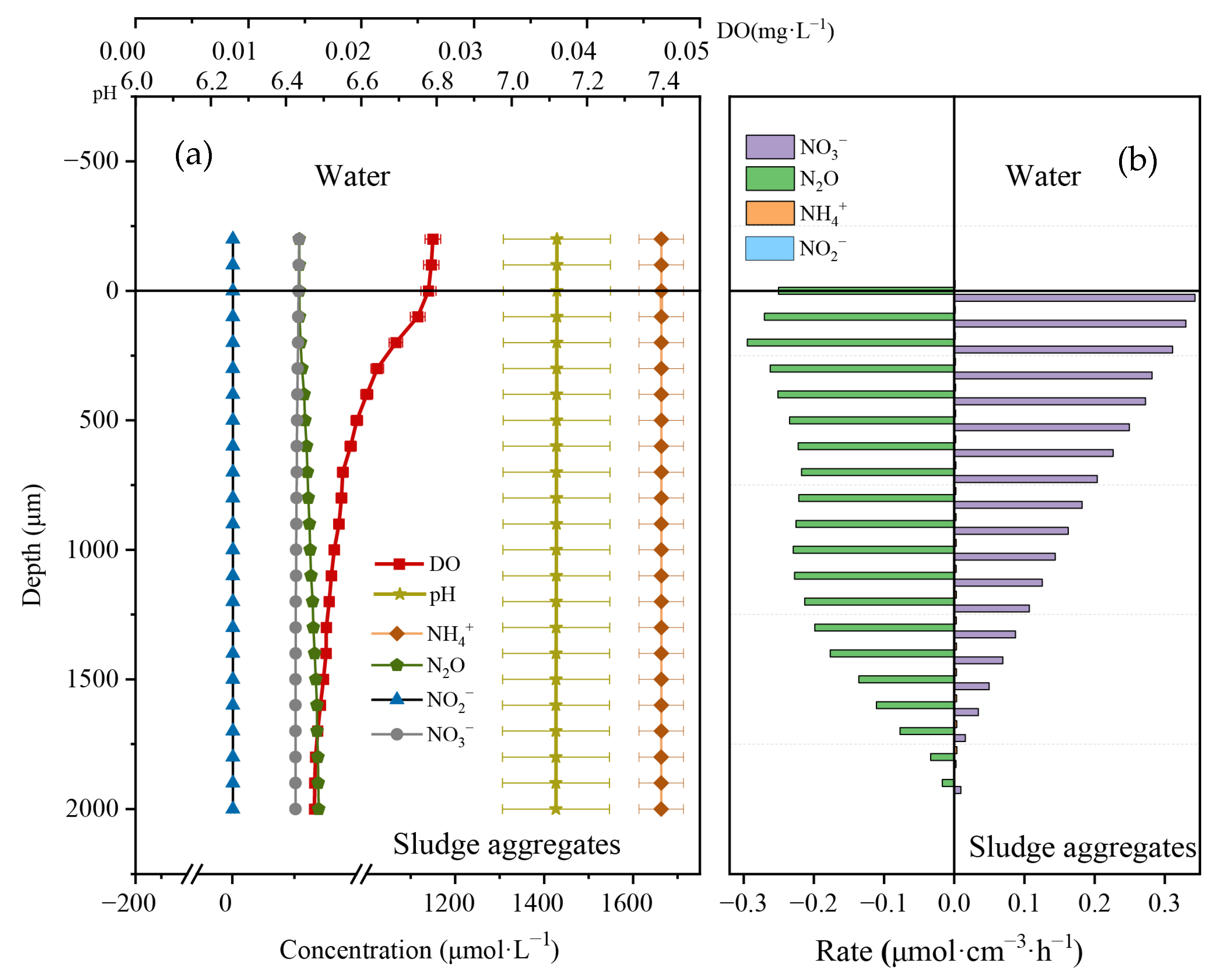
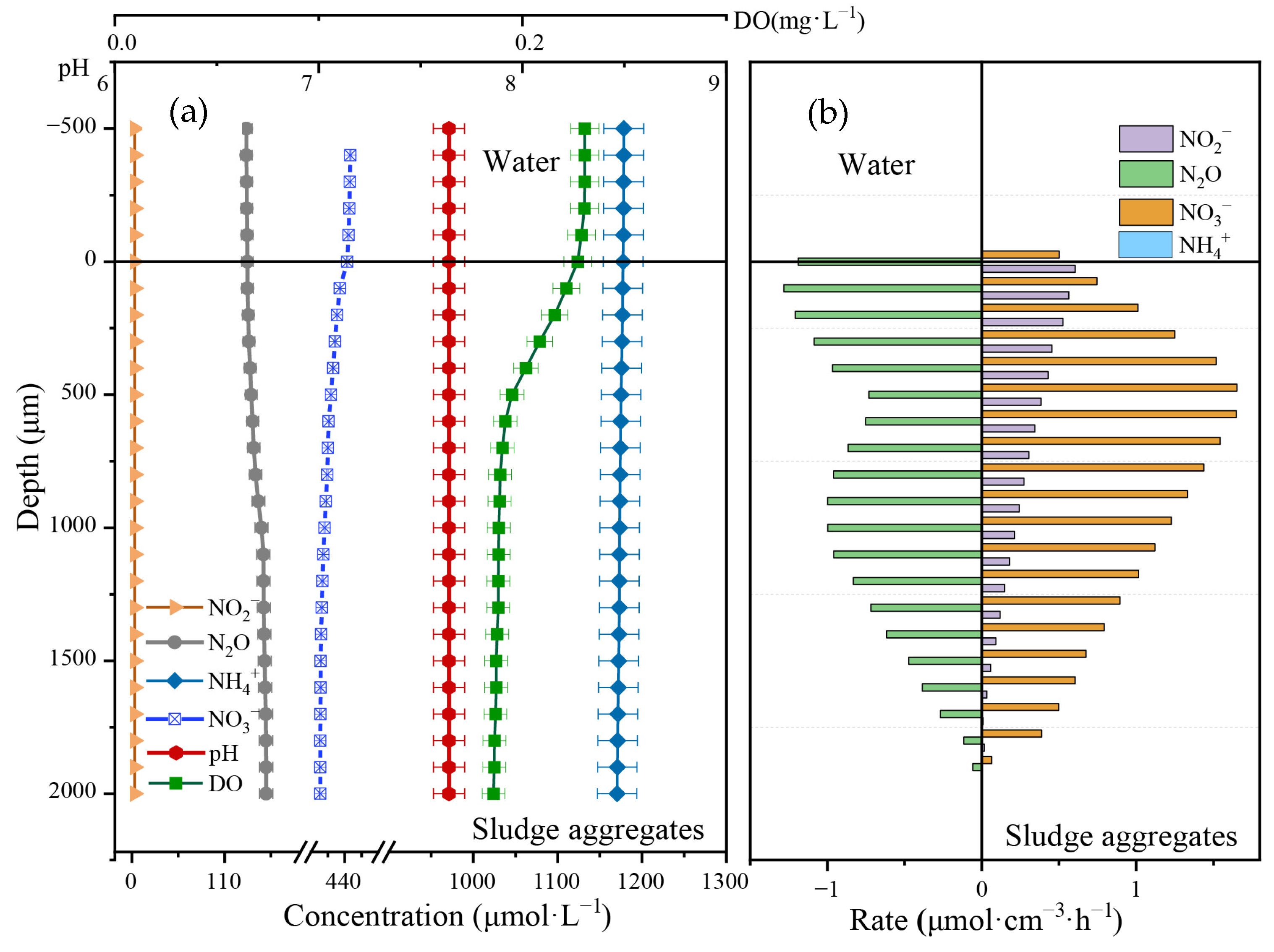
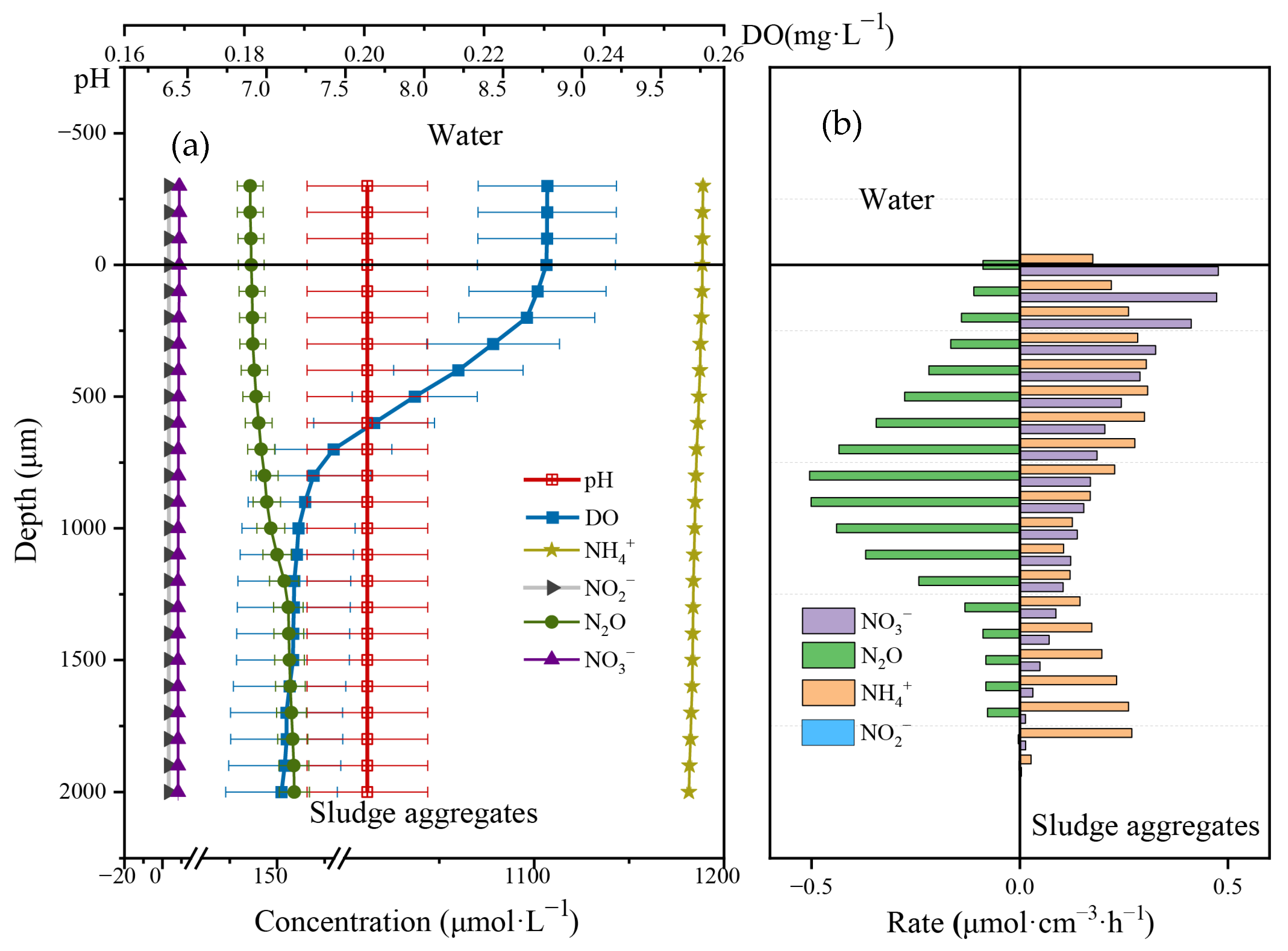
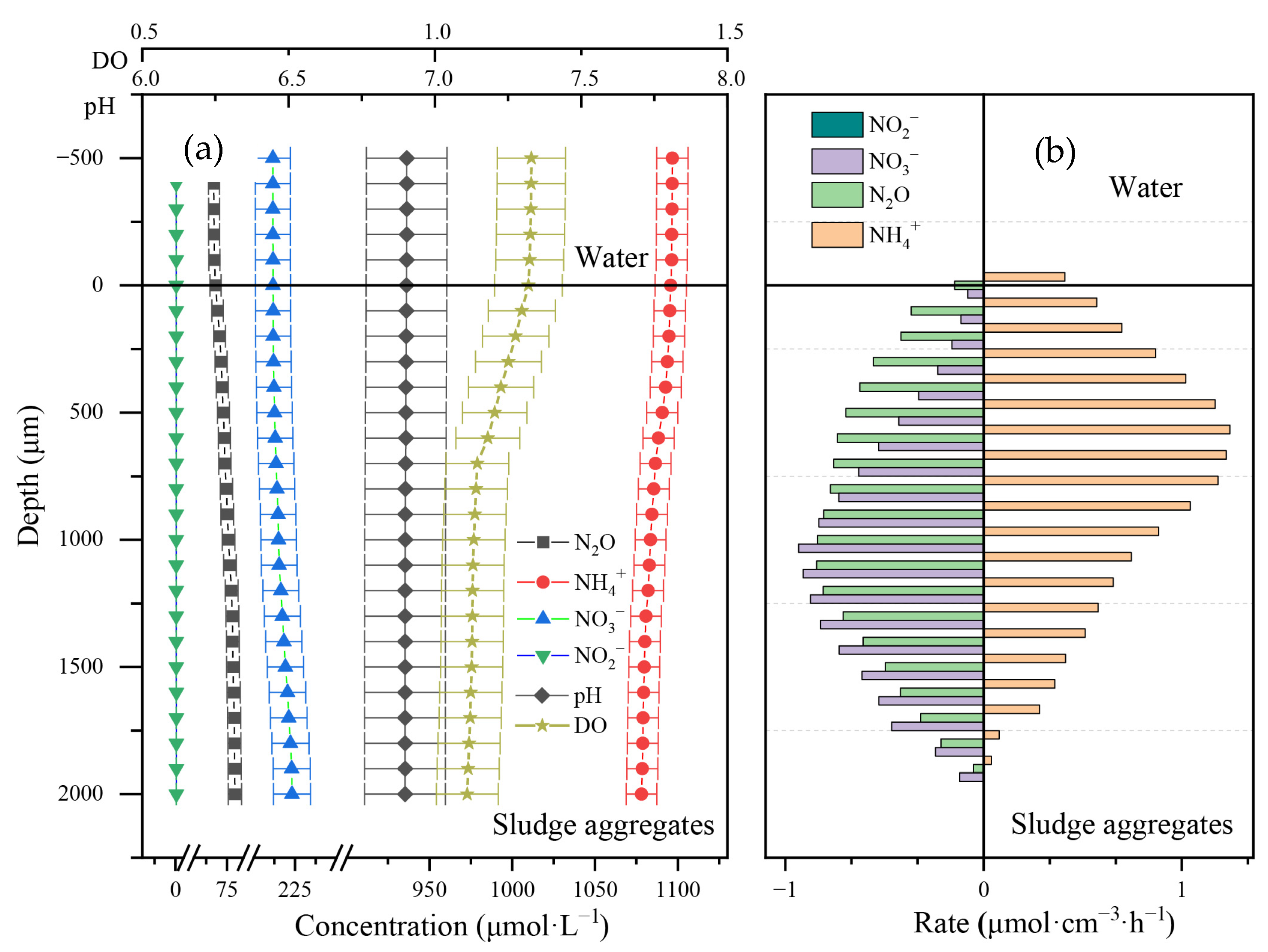
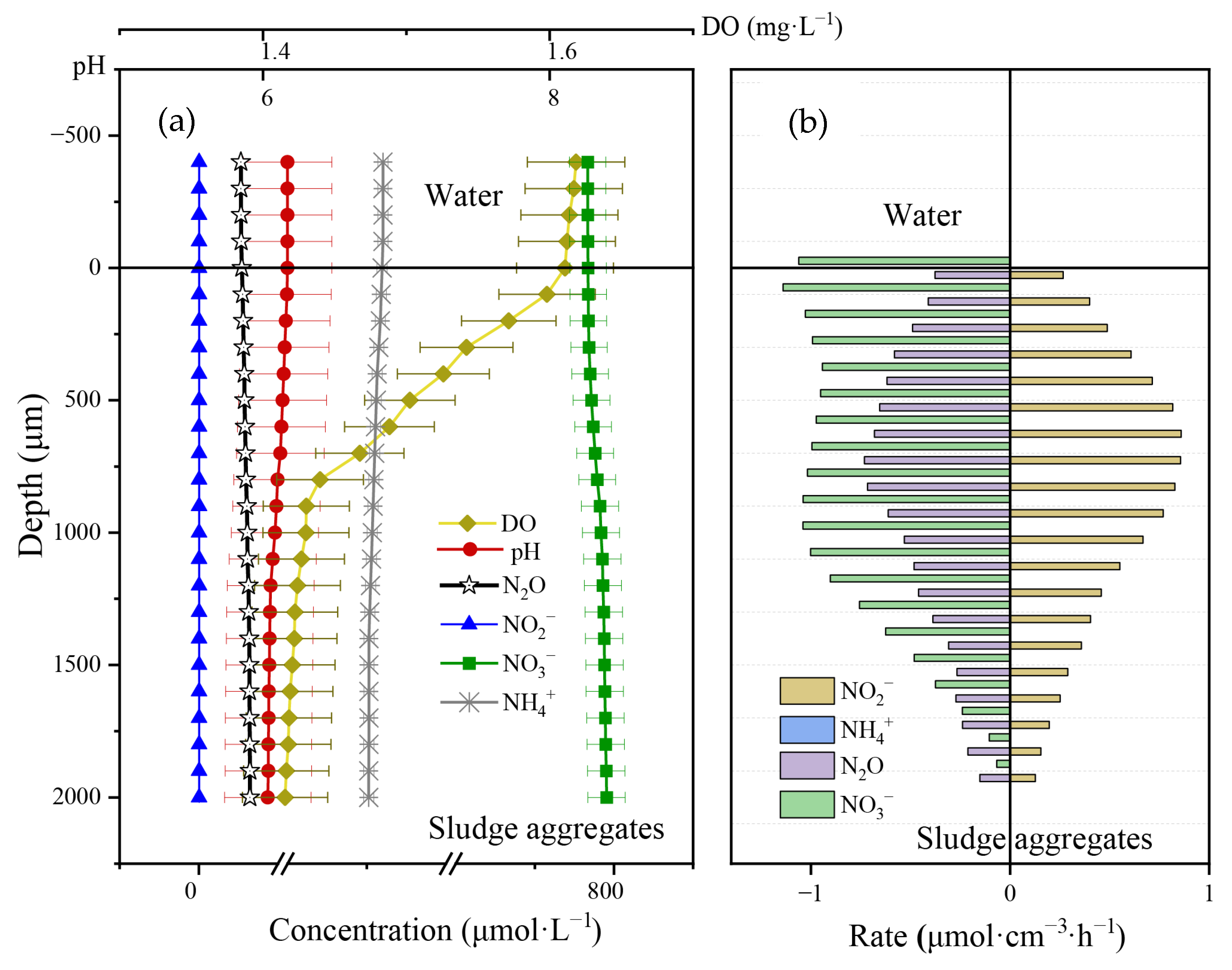
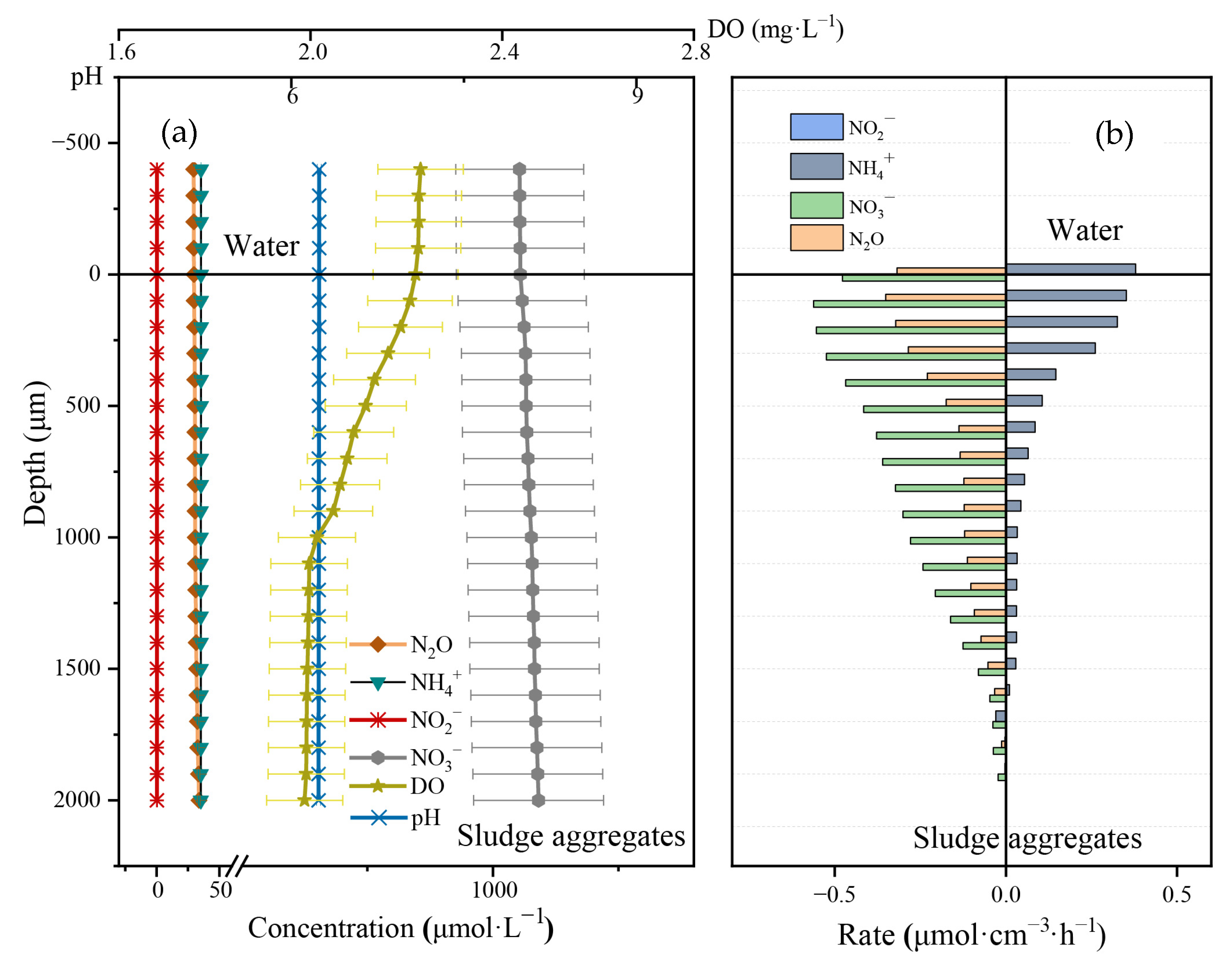
Figure 1, Figure 2, Figure 3, Figure 4, Figure 5 and Figure 6 present the in situ concentration and reaction-rate profiles within sludge aggregates collected from anaerobic, anoxic, and aerobic tanks. The left-hand panels display the measured spatial distributions of O2, nitrogen species (dissolved N2O, NH4+, NO3, NO2), and pH across the sludge layer. Correspondingly, the right-hand panels show the production/consumption rate profiles of nitrogen species. In all figures, the vertical coordinate zero represents the sludge–water interface, with positive values extending into the interior of the aggregate.

3.1. In Situ N2O Production Within Sludge Aggregates from the Anaerobic Tank of the A2/O

Figure 1 shows the variations in (a) substance concentrations and (b) reaction rates within sludge aggregates collected from the anaerobic tank. The dissolved oxygen concentration remained consistently below 0.03 mg·L−1 (Figure 1a), confirming the maintenance of an anaerobic environment. The slight decline in pH observed was primarily attributed to biological phosphorus release occurring under anaerobic conditions [29]. Throughout the sludge layer, concentrations of NH4+ and NO2 remained relatively stable. In contrast, NO3 concentration gradually decreased from 18.83 µmol·L−1 at the surface layer to near-zero levels in deeper zones, with a maximum consumption rate of 0.34 μmol·cm−3·h−1 recorded at the surface.
Correspondingly, dissolved N2O concentration exhibited an increasing trend, reaching a maximum of 25 µmol·L−1. The corresponding N2O production rates were approximately 0.3 μmol·cm−3·h−1 in the surface layer, 0.25 μmol·cm−3·h−1 in the middle layer, and 0.15 μmol·cm−3·h−1 in the deep layer, resulting in an overall average rate of about 0.23 μmol·cm−3·h−1 (Figure 1b).
Under anaerobic conditions, the decrease in nitrate concentration, along with the accumulation of nitrous oxide, indicated that N2O production in the anaerobic tank occurred mainly via nitrate reduction pathways. The relatively low nitrate consumption rate observed can be largely explained by its inherently low concentration—nitrate in the anaerobic tank originates from sludge recirculation, resulting in an initial concentration as low as 0.26 mg·L−1. This also reasonably accounts for the comparatively low N2O production observed in the anaerobic tank.

3.2. In Situ N2O Production Within Sludge Aggregates from the Inlet Section of the Anoxic Tank in the A2/O

Figure 2 shows the variations in (a) substance concentrations and (b) reaction rates within sludge aggregates sampled from the inlet section of the anoxic tank. Upon entering the sludge aggregate, DO concentration dropped sharply within the surface 500 μm, reaching a minimum of 0.19 mg·L−1 (Figure 2a). Throughout the aggregate, concentrations of NO3 and NO2 exhibited decreasing trends with increasing depth, whereas NH4+ concentration remained stable. After accounting for concentration attenuation due to diffusion resistance, the maximum consumption rates of NO2 and NO3 were 0.6 and 1.65 μmol·cm−3·h−1, respectively (Figure 2b). Notably, the maximum NO3 consumption rate occurred at a depth of 600 μm. This is likely attributable to the relatively high DO level in the surface layer (0–500 μm), where heterotrophic bacteria preferentially utilize DO rather than NO3 for organic oxidation, thereby suppressing denitrification activity [30].
Within the sludge aggregates (0–2000 μm), N2O concentration increased continuously to 215 μmol·L−1 at 2000 μm. The maximum N2O production rate was calculated to be 1.28 μmol·cm−3·h−1 in the surface 200 μm layer, fivefold higher than the maximum rate observed in anaerobic tank. Moreover, a secondary peak rate of 1.0 μmol·cm−3·h−1 occurred at 900 μm depth, indicating that N2O production remained relatively high throughout the aggregate, with an average rate of 0.92 μmol·cm−3·h−1.
The simultaneous consumption of NO2 and NO3 indicates active denitrification, where heterotrophic bacteria reduce these compounds to N2, with N2O as an intermediate. In the surface layer of the aggregate, the different reduction rates of NO3 and NO2 led to NO2 accumulation, which subsequently inhibits N2O reductase activity and promotes N2O formation. This mechanism explains the observed maximum N2O production rate in the surface zone. As depth increased, nitrite concentration gradually decreased, accompanied by a reduction in N2O production. These observations provide practical insight for controlling N2O emissions during denitrification: operational strategies should prioritize minimizing nitrite accumulation to facilitate complete reduction of N2O to N2.

3.3. In Situ N2O Production Within Sludge Aggregates from the Rear Section of the Anoxic Tank in the A2/O

Figure 3 shows the variations in (a) substance concentrations and (b) reaction rates within sludge aggregates sampled from the end section of the anoxic tank. Upon entering the aggregate, DO concentration declined rapidly within the surface 500 µm, falling below 0.2 mg·L−1 (Figure 3a). Along the depth of the sludge aggregate, NH4+ concentration decreased slightly, with a maximum consumption rate of only 0.31 μmol·cm−3·h−1 (Figure 3b), which is primarily attributed to its utilization for microbial cell synthesis. Concurrently, the maximum consumption rate of NO3 was 0.47 μmol·cm−3·h−1, less than one-third of the rate observed in the inlet section of the anoxic tank. NO2 concentration remained consistently low throughout with negligible fluctuation, and its corresponding transformation rate was virtually zero.
Within the 0–2000 µm depth range, N2O concentration accumulated continuously, reaching 160 μmol·L−1 at 2000 µm. Its maximum production rate was 0.51 μmol·cm−3·h−1, which is less than one-third of the maximum rate recorded in the inlet section of the anoxic tank. The notably lower N2O production in this zone is likely due to the reduced nitrate consumption rate resulting from the generally lower concentrations of substrates (e.g., nitrate and organic matter) available in this region.

3.4. In Situ N2O Production Within Sludge Aggregates from the Inlet Section of the Aerobic Tank in the A2/O

Figure 4 shows the variations in (a) substance concentrations and (b) reaction rates within sludge aggregates sampled from the inlet section of the aerobic tank. Inside the aggregate, DO concentration gradually declined, yet its minimum remained above 1.0 mg·L−1 (Figure 4a), confirming an aerobic environment. NH4+ concentration decreased rapidly, with a maximum consumption rate reaching 1.2 µmol·cm−3·h−1 (Figure 4b). Concurrently, NO3 concentration increased sharply, exhibiting a maximum production rate of 0.9 µmol·cm−3·h−1. In contrast, NO2 concentration remained consistently low with negligible fluctuation, and its transformation rate was nearly zero.
Within the 0–2000 μm depth range, N2O concentration increased continuously to 80 µmol·L−1, accompanied by a maximum production rate of 0.84 µmol·cm−3·h−1. This peak rate was equivalent to two-thirds of that in the inlet anoxic section. It also exceeded the rate observed in the end anoxic section and was 2.65 times higher than the value recorded in the anaerobic tank.
The rapid decrease in NH4+ concentration accompanied by a sharp increase in NO3 concentration is a characteristic signature of nitrification. The progressive accumulation of N2O throughout the reaction indicates its continuous production as a by-product of the nitrification process. Therefore, based on the profile characteristics, N2O production in the front aerobic section can be attributed to ammonium oxidation. The variation trends of ammonium oxidation rate and N2O production rate across different depths further suggest that N2O formation primarily occurred in the deeper sludge layers under lower DO conditions. This is consistent with findings reported by Jia et al. [31], which indicate that low DO promotes N2O emissions during nitrification. Under low-DO conditions, the N2O generated via the denitrification pathway of nitrifiers increases significantly. These results revealed the importance of controlling DO to minimize N2O production potentials from nitrification in the aerobic tank of a full-scale WWTP.

3.5. In Situ N2O Production Within Sludge Aggregates from the Mid-Section of the Aerobic Tank in the A2/O

Figure 5 shows the variations in (a) substance concentrations and (b) reaction rates within sludge aggregates sampled from the mid-section of the aerobic tank. Inside the aggregate, DO concentration decreased to a minimum of 1.4 mg·L−1 (Figure 5a). This indicates that DO penetrated the entire floc and was higher than in the inlet section of the aerobic tank. Under the plant’s constant aeration mode, biochemical oxygen demand declined as organic matter and ammonium nitrogen were consumed, which led to a corresponding rise in DO concentration [32]. Throughout the depth of the sludge layer, NH4+ concentration decreased rapidly, with a maximum consumption rate of 0.86 μmol·cm−3·h−1 (Figure 5b), a value lower than that observed in the front aerobic section. Concurrently, NO3 concentration increased sharply, exhibiting a maximum production rate of 1.1 μmol·cm−3·h−1. NO2 concentration remained stable, and its consumption rate was near zero, indicating no intermediate nitrite accumulation.
Within the 0–2000 μm depth range, N2O concentration increased continuously, reaching 65 μmol·L−1 at 2000 μm. The maximum production rate was 0.73 μmol·cm−3·h−1, which was slightly lower than that in the inlet section of the aerobic tank.
The sharp decrease in NH4+ concentration accompanied by a simultaneous increase in NO3 concentration confirms the occurrence of nitrification. This indicates that N2O production in the mid-section of the aerobic tank primarily originated from ammonium oxidation. Compared to the front aerobic section, the reduced ammonium oxidation rate in the mid-section suggests weakened nitrification activity, likely associated with substrate limitation. The higher DO level (minimum 1.4 mg·L−1 vs. 1.0 mg·L−1 in the inlet section) may also have facilitated more complete ammonia oxidation, thereby partially reducing N2O production via the nitrification pathway. The decline in N2O production rate (0.73 μmol·cm−3·h−1 vs. 0.84 μmol·cm−3·h−1 in the inlet section) further confirms that the microenvironment in the mid-section was more favorable for achieving complete nitrification. Further optimization of aeration strategies holds potential for further suppressing N2O generation.

3.6. In Situ N2O Production Within Sludge Aggregates from the End Section of the Aerobic Tank in the A2/O

Figure 6 shows the variations in (a) substance concentrations and (b) reaction rates within sludge aggregates sampled from the end section of the aerobic tank. Inside the sludge aggregate, DO concentration decreased gradually to a minimum of 2.0 mg·L−1 (Figure 6a), indicating that oxygen penetrated the entire aggregate. Throughout the sludge layer, NH4+ concentration declined only slightly, with a maximum consumption rate of 0.38 µmol·cm−3·h−1—a 56% reduction compared to the value observed in the mid-section of the aerobic tank. Concurrently, NO3 concentration increased, reaching a maximum production rate of 0.56 µmol·cm−3·h−1. NO2 concentration remained largely constant, with its transformation rate approaching zero.
Within the surface layer (0–2000 µm) of the sludge, N2O concentration showed a relatively gradual increase, reaching only 34 µmol·L−1 at 2000 µm. Its production correlated closely with NH4+ consumption, with a maximum production rate of 0.35 µmol·cm−3·h−1 (Figure 6b). This confirmed that nitrification was the dominant pathway for N2O production. The notably low NH4+ concentration in this section limited nitrification activity and thus weakened subsequent N2O production, resulting in a significantly lower generation rate than that in the mid-section. These results clearly illustrate the influence of substrate concentration and dissolved oxygen distribution on N2O production.

4. Discussion

Previous studies have reported that N2O generation in wastewater treatment systems primarily originates from the following pathways [9,33]: ammonia oxidation driven by ammonia-oxidizing bacteria (AOB), AOB-mediated denitrification, and denitrification by heterotrophic denitrifying bacteria. For AOB, hydroxylamine oxidoreductase (HAO) is considered the key enzyme affecting the N2O production potential of the ammonia oxidation pathway [34]. Consequently, nitrifiers lacking HAO-encoding genes—such as ammonia-oxidizing archaea and anaerobic ammonia-oxidizing bacteria—cannot produce N2O. In contrast, proteobacterial AOB (e.g., Nitrosomonas and Nitrosococcus) can synthesize N2O aerobically by reducing nitric oxide derived from hydroxylamine oxidation and nitrite reduction [34]. Moreover, Nitrosomonas spp. are also capable of generating N2O during anaerobic growth on ammonia and nitrite, a process known as AOB-mediated denitrification [35]. For heterotrophic denitrifying bacteria, nitrous oxide reductase (NOS) is the key enzyme influencing N2O production potential in the denitrification pathway. In some denitrifiers (e.g., Thauera and Diaphorobacter), suppressed NOS activity leads to increased N2O release [36]. Additionally, a few denitrifiers (e.g., Pseudomonas aeruginosa PAO1 and Propionibacterium freudenreichii) lack NOS-encoding genes altogether; thus, N2O is their terminal metabolic product and can accumulate [37,38].
Numerous studies have indicated that N2O emissions mainly occur in the aerobic zone, accounting for 70% or even higher [7,8,39]. This study investigated the spatial distribution within a full-scale A2/O process (Table 1). The data revealed that N2O production intensity followed the descending order: anoxic tank > aerobic tank ≥ anaerobic tank, with extremely low production rates in the anaerobic tank. A comprehensive analysis indicates that denitrification in the anoxic zone and ammonia oxidation in the aerobic zone are the two primary sources of N2O production in this system. Spatially, N2O production rates were highest at the inlet sections of both tanks. In the anoxic tank inlet, the rate was 1.5 times higher than in the aerobic tank inlet, corresponding to a net production ratio of 1.4:1. While previous studies generally report that N2O is released largely in the aerobic zone, our findings highlight that its actual production potential lies predominantly in the anoxic zone. In contrast, at the end sections of both the anoxic and aerobic tanks, reduced N2O generation was observed due to limited reaction substrates, decreased nitrite concentrations, and elevated dissolved oxygen levels.
In summary, N2O production in the biological tanks of the Xi’an Fifth WWTP predominantly occurs in the inlet section of the anoxic tank (via denitrification) and the inlet section of the aerobic tank (via nitrification). To mitigate N2O production potentials, operational strategies should be targeted to these two key zones. In the front anoxic section, controlling nitrite accumulation is essential. This can be achieved by adjusting the internal recycle ratio and ensuring sufficient carbon availability, thereby reducing N2O formation during denitrification. In the front aerobic section, implementing gradient aeration is effective. DO setpoints (DO > 2 mg·L−1) can be staged along the tank length to maintain efficient nitrification while minimizing N2O production. Both strategies can be integrated into real-time control systems, enabling dynamic adjustments that sustain nitrogen-removal performance. Thus, combining these measures offers practical solutions for reducing the N2O production potential of WWTPs.

5. Conclusions

This study employed microelectrode technology in a full-scale A2/O process to investigate the in situ spatial heterogeneity of N2O production within sludge aggregates. The results indicated that the anoxic tank was the primary source of N2O generation, with its inlet section exhibiting the highest net production rate, approximately 1.4 times higher than that in the aerobic tank. In contrast, N2O production in the anaerobic tank was minimal. Denitrification and ammonia oxidation were identified as the predominant pathways for N2O production. Nitrite accumulation and DO levels were found to be key controlling factors. This study provides novel microscale insights into the in situ production of N2O within sludge aggregates. These findings have practical implications for targeted N2O mitigation strategies. For instance, controlling nitrite accumulation in the anoxic section through carbon dosing and optimizing aeration gradients (DO > 2 mg·L−1) in the front aerobic section could be effective measures. A key limitation is the single-plant scope, which may affect generalizability, and the focus on microscale production without quantifying plant-wide emissions. Future research should integrate microscale profiles with macro-scale emission monitoring to develop and validate mitigation strategies across diverse WWTPs.

Supplementary Materials

The following supporting information can be downloaded at: https://www.mdpi.com/article/10.3390/su18042070/s1, Figure S1: Diagram of the microelectrode system setup.

Author Contributions

Formal analysis, A.W.; investigation, S.N.; data curation, G.L.; writing—review and editing, H.K.; funding acquisition, Writing–review & editing, Supervision, Y.L. All authors have read and agreed to the published version of the manuscript.

Funding

This work was supported by the CCTCG Corporate Bond Project for Sci-Tech Innovation, Grant number ZXZ-2-5; Shaanxi Province Key Research and Development Projects, Grant number 2025SF-YBXM-276 and Shaanxi Provincial Department of Education Project, Grant number 24JC049.

Institutional Review Board Statement

Not applicable.

Informed Consent Statement

Not applicable.

Data Availability Statement

The raw data supporting the conclusions of this article will be made available by the authors upon request.

Conflicts of Interest

Authors Haixia Kong, Shoutian Nie, Guang Li, and Andong Wang are employed by the Xi’an Branch of North China Municipal Engineering Design & Research Institute Co., Ltd. This study received funding from the CCTCG Corporate Bond Project for Sci-Tech Innovation. The funder was not involved in the study design, collection, analysis, interpretation of data, the writing of this article, or the decision to submit it for publication. The remaining authors declare that the research was conducted in the absence of any commercial or financial relationships that could be construed as a potential conflict of interest.

References

  1. Guo, G.; Wang, Y.; Hao, T.; Wu, D.; Chen, G.-H. Enzymatic Nitrous Oxide Emissions from Wastewater Treatment. Front. Environ. Sci. Eng. 2018, 12, 10. [Google Scholar] [CrossRef]
  2. Kumaş, K.; Akyüz, A. Theoretical Nitrous Oxide, Methane, Carbon Dioxide Emissions Calculations to the Atmosphere in Niğde, Turkey Niğde, Türkiye’de Atmosfere Salınan. DUFED 2021, 10, 209–220. [Google Scholar]
  3. Jamei, M.; Hassan, M.; Faroouqe, A.A.; Ali, M.; Karbasi, M.; Randhawa, G.S.; Yaseen, Z.M.; Dwyer, R. Monitoring of Greenhouse Gas Emission Drivers in Atlantic Canadian Potato Production: A Robust Explainable Intelligent Glass-Box. Results Eng. 2024, 24, 103297. [Google Scholar] [CrossRef]
  4. Ravishankara, A.R.; Daniel, J.S.; Portmann, R.W. Nitrous Oxide (N2O): The Dominant Ozone-Depleting Substance Emitted in the 21st Century. Science 2009, 326, 123–125. [Google Scholar] [CrossRef]
  5. Hayashi, K.; Itsubo, N. Damage Factors of Stratospheric Ozone Depletion on Human Health Impact with the Addition of Nitrous Oxide as the Largest Contributor in the 2000s. Int. J. Life Cycle Assess. 2023, 28, 990–1002. [Google Scholar] [CrossRef]
  6. Daudt, G.C.; Magnus, B.S.; Schambeck, C.M.; Libardi, N.; Costa, R.H.R. da Assessment of Nitrous Oxide and Carbon Dioxide Emissions and the Carbon Footprint in an Aerobic Granular Sludge Reactor Treating Domestic Wastewater. Environ. Eng. Sci. 2022, 39, 561–572. [Google Scholar] [CrossRef]
  7. Tumendelger, A.; Alshboul, Z.; Lorke, A. Methane and Nitrous Oxide Emission from Different Treatment Units of Municipal Wastewater Treatment Plants in Southwest Germany. PLoS ONE 2019, 14, e0209763. [Google Scholar] [CrossRef]
  8. Tallec, G.; Garnier, J.; Billen, G.; Gousailles, M. Nitrous Oxide Emissions from Denitrifying Activated Sludge of Urban Wastewater Treatment Plants, Under Anoxia and Low Oxygenation. Bioresour. Technol. 2008, 99, 2200–2209. [Google Scholar] [CrossRef]
  9. Thakur, I.S.; Medhi, K. Nitrification and Denitrification Processes for Mitigation of Nitrous Oxide from Waste Water Treatment Plants for Biovalorization: Challenges and Opportunities. Bioresour. Technol. 2019, 282, 502–513. [Google Scholar] [CrossRef]
  10. Yan, W.; Li, J.; Gu, L.; Ye, C.; Liang, J.; Fu, J.; Zheng, S.; Yu, X. Nitrous Oxide Emissions and Microbial Communities Variation in Low Dissolved Oxygen and Low Carbon-to-Nitrogen Ratio Anoxic–Oxic Wastewater Treatment Plant. Environ. Sci. Pollut. Res. 2024, 31, 42779–42791. [Google Scholar] [CrossRef]
  11. Kemmou, L.; Amanatidou, E. Factors Affecting Nitrous Oxide Emissions from Activated Sludge Wastewater Treatment Plants—A Review. Resources 2023, 12, 114. [Google Scholar] [CrossRef]
  12. Law, Y.; Lant, P.; Yuan, Z. The Effect of pH on N2O Production under Aerobic Conditions in a Partial Nitritation System. Water Res. 2011, 45, 5934–5944. [Google Scholar] [CrossRef] [PubMed]
  13. Duan, H.; van den Akker, B.; Thwaites, B.J.; Peng, L.; Herman, C.; Pan, Y.; Ni, B.-J.; Watt, S.; Yuan, Z.; Ye, L. Mitigating Nitrous Oxide Emissions at a Full-Scale Wastewater Treatment Plant. Water Res. 2020, 185, 116196. [Google Scholar] [CrossRef] [PubMed]
  14. Law, Y.; Ye, L.; Pan, Y.; Yuan, Z. Nitrous Oxide Emissions from Wastewater Treatment Processes. Philos. Trans. R. Soc. B Biol. Sci. 2012, 367, 1265–1277. [Google Scholar] [CrossRef] [PubMed]
  15. Sombeck, J.T.; Miller, L.E. Short Reaction Times in Response to Multi-Electrode Intracortical Microstimulation May Provide a Basis for Rapid Movement-Related Feedback. J. Neural Eng. 2019, 17, 016013. [Google Scholar] [CrossRef]
  16. Han, Y.; Liu, J.; Guo, X.; Li, L. Micro-Environment Characteristics and Microbial Communities in Activated Sludge Flocs of Different Particle Size. Bioresour. Technol. 2012, 124, 252–258. [Google Scholar] [CrossRef]
  17. Lv, Y.; Ju, K.; Wang, L.; Sun, T.; Miao, R.; Wang, X.; Wei, F.; Xia, S. In Situ Probing of Microbial Activity within Anammox Granular Biomass with Microelectrodes. J. Biosci. Bioeng. 2016, 121, 450–456. [Google Scholar] [CrossRef]
  18. Wang, C.; Gao, F.; Gao, S.; Nian, Z.; Han, X. Upflow Blanket Filter Anammox (UBFA) System Treating Low-Nitrogen Wastewater: High-Efficient Nitrogen Removal, Granules Formation, N2O Emission, and Microbial Succession. Bioprocess Biosyst. Eng. 2024, 48, 395–412. [Google Scholar] [CrossRef]
  19. Dong, J.; Wu, Y.; Wang, C.; Lu, H.; Li, Y. Three-Dimensional Electrodes Enhance Electricity Generation and Nitrogen Removal of Microbial Fuel Cells. Bioprocess Biosyst. Eng. 2020, 43, 2165–2174. [Google Scholar] [CrossRef]
  20. Gilcreas, F.W. Future of Standard Methods for the Examination of Water and Wastewater. Health Lab. Sci. 1967, 4, 137–141. [Google Scholar]
  21. Lv, Y.; Zhang, X.; Zhu, C.; Lin, L.; Sun, T.; Wang, X.; Wang, L. Micro-Analysis of Nitrous Oxide Accumulation in Denitrification under Acidic Conditions: The Role of Ph and Free Nitrous Acid. SSRN Electron. J. 2022. [Google Scholar] [CrossRef]
  22. Lv, Y.; Ju, K.; Sun, T.; Wang, L.; Miao, R.; Liu, T.; Wang, X. Effect of the Dissolved Oxygen Concentration on the N2O Emission from an Autotrophic Partial Nitritation Reactor Treating High-Ammonium Wastewater. Int. Biodeterior. Biodegrad. 2016, 114, 209–215. [Google Scholar] [CrossRef]
  23. Li, B.; Bishop, P.L. Micro-Profiles of Activated Sludge Floc Determined Using Microelectrodes. Water Res. 2004, 38, 1248–1258. [Google Scholar] [CrossRef] [PubMed]
  24. Santegoeds, C.M.; Damgaard, L.R.; Hesselink, G.; Zopfi, J.; Lens, P.; Muyzer, G.; de Beer, D. Distribution of Sulfate-Reducing and Methanogenic Bacteria in Anaerobic Aggregates Determined by Microsensor and Molecular Analyses. Appl. Environ. Microbiol. 1999, 65, 4618–4629. [Google Scholar] [CrossRef]
  25. Baeten, J.E.; van Loosdrecht, M.C.M.; Volcke, E.I.P. Modelling Aerobic Granular Sludge Reactors Through Apparent Half-Saturation Coefficients. Water Res. 2018, 146, 134–145. [Google Scholar] [CrossRef] [PubMed]
  26. Revsbech, N.P.; JØrgensen, B.B.; Brix, O. Primary Production of Microalgae in Sediments Measured by Oxygen Microprofile, H14CO3- Fixation, and Oxygen Exchange Methods1. Limnol. Oceanogr. 1981, 26, 717–730. [Google Scholar] [CrossRef]
  27. Broecker, W.S.; Peng, T.-H. Gas Exchange Rates between Air and Sea1. Tellus 1974, 26, 21–35. [Google Scholar] [CrossRef]
  28. Okabe, S.; Satoh, H.; Watanabe, Y. In Situ Analysis of Nitrifying Biofilms as Determined by In Situ Hybridization and the Use of Microelectrodes. Appl. Environ. Microbiol. 1999, 65, 3182–3191. [Google Scholar] [CrossRef]
  29. Latif, M.A.; Mehta, C.M.; Batstone, D.J. Low pH Anaerobic Digestion of Waste Activated Sludge for Enhanced Phosphorous Release. Water Res. 2015, 81, 288–293. [Google Scholar] [CrossRef]
  30. Huang, C.; Liu, Q.; Li, Z.-L.; Ma, X.; Hou, Y.-N.; Ren, N.-Q.; Wang, A.-J. Relationship Between Functional Bacteria in a Denitrification Desulfurization System Under Autotrophic, Heterotrophic, and Mixotrophic Conditions. Water Res. 2021, 188, 116526. [Google Scholar] [CrossRef]
  31. Jia, W.; Liang, S.; Zhang, J.; Ngo, H.H.; Guo, W.; Yan, Y.; Zou, Y. Nitrous Oxide Emission in Low-Oxygen Simultaneous Nitrification and Denitrification Process: Sources and Mechanisms. Bioresour. Technol. 2013, 136, 444–451. [Google Scholar] [CrossRef] [PubMed]
  32. Marek, K.; Pawęska, K.; Bawiec, A. Treatment of Wastewater with High Ammonium Nitrogen Concentration. J. Ecol. Eng. 2021, 22, 224–231. [Google Scholar] [CrossRef]
  33. Ni, B.-J.; Ye, L.; Law, Y.; Byers, C.; Yuan, Z. Mathematical Modeling of Nitrous Oxide (N2O) Emissions from Full-Scale Wastewater Treatment Plants. Environ. Sci. Technol. 2013, 47, 7795–7803. [Google Scholar] [CrossRef] [PubMed]
  34. Stein, L.Y. Surveying N2O-Producing Pathways in Bacteria. In Methods in Enzymology; Elsevier: Amsterdam, The Netherlands, 2011; pp. 131–152. [Google Scholar] [CrossRef]
  35. Mao, W.; Yang, R.; Shi, H.; Feng, H.; Chen, S.; Wang, X. Identification of Key Water Parameters and Microbiological Compositions Triggering Intensive N2O Emissions during Landfill Leachate Treatment Process. Sci. Total Environ. 2022, 833, 155135. [Google Scholar] [CrossRef] [PubMed]
  36. Lv, Y.; Chen, X.; Zhang, X.; Zhu, C.; Pan, Y.; Sun, T.; Wang, L. Denitrification for Acidic Wastewater Treatment: Long-Term Performance, Microbial Communities, and Nitrous Oxide Emissions. J. Biosci. Bioeng. 2022, 134, 513–520. [Google Scholar] [CrossRef]
  37. Oshiki, M.; Ishimaru, M.; Hatamoto, M.; Yamaguchi, T.; Araki, N.; Okabe, S. N2O Production Using Native Nos-Deficient Denitrifying Bacterial Strains Screened by a Genome Mining Approach. Bioresour. Technol. Rep. 2020, 11, 100529. [Google Scholar] [CrossRef]
  38. Nie, H.; Liu, X.; Dang, Y.; Ji, Y.; Sun, D.; Smith, J.A.; Holmes, D.E. Efficient Nitrous Oxide Recovery from Incineration Leachate by a nosZ-Deficient Strain of Pseudomonas Aeruginosa. Bioresour. Technol. 2020, 297, 122371. [Google Scholar] [CrossRef]
  39. Hu, Z.; Lee, J.W.; Chandran, K.; Kim, S.; Khanal, S.K. Nitrous Oxide (N2O) Emission from Aquaculture: A Review. Environ. Sci. Technol. 2012, 46, 6470–6480. [Google Scholar] [CrossRef]
Figure 1. Spatial profiles of (a) substance concentrations and (b) reaction rates within sludge aggregates from the anaerobic tank.
Sustainability 18 02070 g001
Figure 2. Spatial profiles of (a) substance concentrations and (b) reaction rates within sludge aggregates from the inlet section of the anoxic tank.
Sustainability 18 02070 g002
Figure 3. Spatial profiles of (a) substance concentrations and (b) reaction rates within sludge aggregates from the end section of the anoxic tank.
Sustainability 18 02070 g003
Figure 4. Spatial profiles of (a) substance concentrations and (b) reaction rates within sludge aggregates from the inlet section of the aerobic tank.
Sustainability 18 02070 g004
Figure 5. Spatial profiles of (a) substance concentrations and (b) reaction rates within sludge aggregates from the mid-section of the aerobic tank.
Sustainability 18 02070 g005
Figure 6. Spatial profiles of (a) substance concentrations and (b) reaction rates within sludge aggregates from the end section of the aerobic tank.
Sustainability 18 02070 g006
Table 1. Characteristics of N2O production inside sludge aggregates.
Sections of the Biological TankRate (µmol·cm−3·h−1)Net Production (µmol·cm−2·h−1)
Rate RangeAverage RateMaximum Rate
Anaerobic tank0.14–0.290.230.291.38
Inlet section of the anoxic tank0.47–1.281.11.281380.99
End section of the anoxic tank0.08–0.510.260.51405.42
Inlet of the aerobic tank0.14–0.840.640.84986.09
Middle section of the aerobic tank0.26–0.730.520.73798.27
End section of the aerobic tank0.05–0.350.170.35256.43
Disclaimer/Publisher’s Note: The statements, opinions and data contained in all publications are solely those of the individual author(s) and contributor(s) and not of MDPI and/or the editor(s). MDPI and/or the editor(s) disclaim responsibility for any injury to people or property resulting from any ideas, methods, instructions or products referred to in the content.