The Impact of the Climate Crisis on Mental Health: A Systematic Literature Review



Abstract
1. Introduction
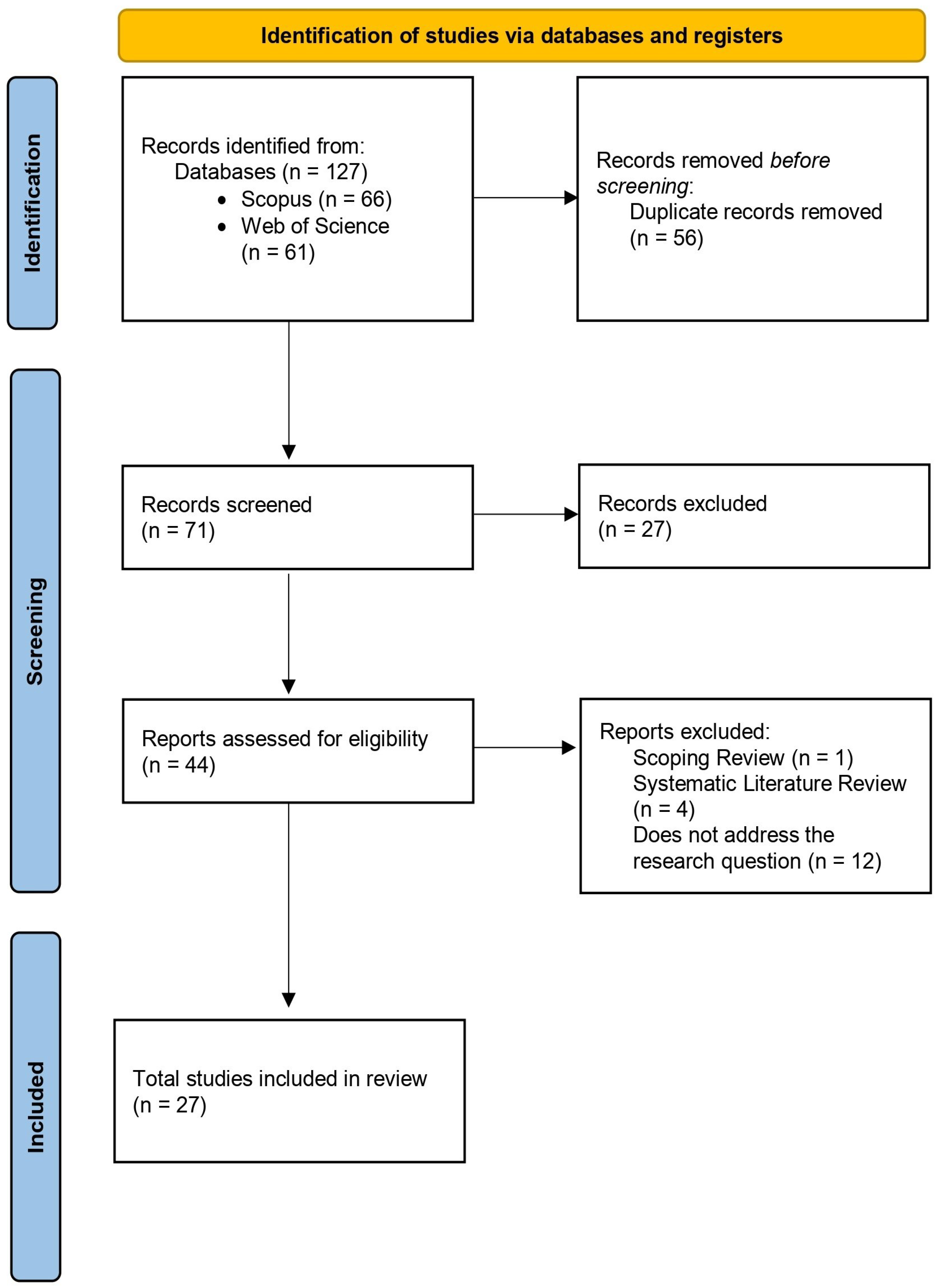
2. Materials and Methods
2.1. Search Strategy
2.2. Eligibility Criteria
3. Results and Discussion
3.1. Study Characteristics

| Instrument | Instrument Description and Authors | Studies Using the Instrument (n) |
|---|---|---|
| Climate Change Anxiety Scale (CCAS) | The CCAS assesses anxiety related to climate change. It is composed of two subscales totaling 13 items: eight items addressing cognitive–emotional impairment and five items related to functional impairment. Responses are recorded on a 5-point Likert scale based on frequency, ranging from 1 (never) to 5 (almost always) [9]. | 27 |
| Generalized Anxiety Disorder Scale (GAD-7) | The GAD-7 was developed to detect likely instances of generalized anxiety disorder based on DSM-5 criteria, with seven items assessed on a four-point Likert scale that measures the frequency of anxiety symptoms, with response options from 1 (never) to 4 (nearly every day) [30]. | 9 |
| New Environmental Paradigm Scale (NEP/NEP-R) | The NEP scale comprises 15 assertions, with half being anthropocentric and reverse-coded. Responses are evaluated using a seven-point Likert scale, ranging from 1 (strongly disagree) to 7 (strongly agree), with elevated scores indicating more robust pro-environmental beliefs [31]. | 4 |
| Patient Health Questionnaire-9 (PHQ-9) | The PHQ-9 is a nine-item self-evaluation tool for depression. Participants assess the intensity of symptoms encountered in the preceding fortnight on a scale from 0 (never) to 3 (nearly daily) [32]. | 3 |
| Kessler Psychological Distress Scale (K6/K10) | The K10 is a self-administered instrument including ten items that assesses psychological discomfort. Items are evaluated using a five-point Likert scale, ranging from 1 (never) to 5 (always). It assesses aspects such as nervousness, negative affect, fatigue, and agitation. A short version of this instrument is also available (K6) [33]. | 3 |
| Pro-Environmental Behaviour Scale (PEBS) | The PHQ-9 is a nine-item self-administered questionnaire designed to evaluate depression symptoms. Participants indicate how frequently they have experienced each symptom over the previous two weeks, using a scale ranging from 0 (never) to 3 (almost every day) [34]. | 2 |
| Future Event Questionnaire (FEQ) | The FEQ assesses future event recognition, including optimism and pessimism. It consists of 34 items (17 for each dimension) rated on a five-point scale from 1 (not at all certain) to 5 (as certain as one can be), with total scores ranging from 17 to 85 [35]. | 2 |
3.2. Methodological Quality
3.3. Analyzing the Risk of Bias
3.4. Socio-Economic Factors
3.5. Pro-Environmental Behavior
4. Final Considerations
Author Contributions
Funding
Conflicts of Interest
References
- World Health Organization. Mental Health and Climate Change: Policy Brief; World Health Organization: Geneva, Switzerlamd, 2022. [Google Scholar]
- Steentjes, K.; Pidgeon, N.F.; Poortinga, W.; Corner, A.J.; Arnold, A.; Böhm, G.; Mays, C.; Poumadère, M.; Ruddat, M.; Scheer, D.; et al. European Perceptions of Climate Change (EPCC): Topline Findings of a Survey Conducted in Four European Countries in 2016; Cardiff University: Cardiff, UK, 2017. [Google Scholar]
- Crandon, T.J.; Scott, J.G.; Charlson, F.J.; Thomas, H.J. A social–ecological perspective on climate anxiety in children and adolescents. Nat. Clim. Change 2022, 12, 123–131. [Google Scholar] [CrossRef]
- Gibson, K.E.; Barnett, J.; Haslam, N.; Kaplan, I. The mental health impacts of climate change: Findings from a Pacific Island atoll nation. J. Anxiety Disord. 2020, 73, 102237. [Google Scholar] [CrossRef] [PubMed]
- Parsons, E.S.; Jowell, A.; Veidis, E.; Barry, M.; Israni, S.T. Climate change and inequality. Pediatr. Res. 2025, 98, 1238–1245. [Google Scholar] [CrossRef] [PubMed]
- Clayton, S. Climate anxiety: Psychological responses to climate change. J. Anxiety Disord. 2020, 74, 102263. [Google Scholar] [CrossRef] [PubMed]
- Diffey, J.; Wright, S.; Uchendu, J.O.; Masithi, S.; Olude, A.; Juma, D.O.; Anya, L.H.; Salami, T.; Mogathala, P.R.; Agarwal, H.; et al. “Not about us without us” — The feelings and hopes of climate-concerned young people around the world. Int. Rev. Psychiatry 2022, 34, 499–509. [Google Scholar] [CrossRef]
- Budziszewska, M.; Jonsson, S.E. Talking about climate change and eco-anxiety in psychotherapy: A qualitative analysis of patients’ experiences. Psychotherapy 2022, 59, 606. [Google Scholar] [CrossRef]
- Clayton, S.; Karazsia, B.T. Development and validation of a measure of climate change anxiety. J. Environ. Psychol. 2020, 69, 101434. [Google Scholar] [CrossRef]
- Mallett, R.K. Eco-guilt motivates eco-friendly behavior. Ecopsychology 2012, 4, 223–231. [Google Scholar] [CrossRef]
- Awad, E.; Malaeb, D.; Sakr, F.; Dabbous, M.; Iskandar, K.; El Khatib, S.; Fekih-Romdhane, F. Psychometric properties of the Arabic version of the Eco-guilt and Eco-grief scales. Sci. Rep. 2025, 15, 11735. [Google Scholar] [CrossRef]
- Engstrom, S. Recognising the role eco-grief plays in responding to environmental degradation. J. Transdiscipl. Peace Prax. 2019, 1, 168–186. [Google Scholar]
- Cunsolo, A.; Ellis, N.R. Ecological grief as a mental health response to climate change-related loss. Nat. Clim. Change 2018, 8, 275–281. [Google Scholar] [CrossRef]
- Pihkala, P. Anxiety and the ecological crisis: An analysis of eco-anxiety and climate anxiety. Sustainability 2020, 12, 7836. [Google Scholar] [CrossRef]
- American Psychological Association. Majority of US Adults Believe Climate Change Is Most Important Issue Today. 2020. Available online: https://www.apa.org/news/press/releases/2020/02/climate-change (accessed on 10 January 2026).
- Hickman, C.; Marks, E.; Pihkala, P.; Clayton, S.; Lewandowski, R.E.; Mayall, E.E.; Wray, B.; Mellor, C.; Van Susteren, L. Climate anxiety in children and young people and their beliefs about government responses to climate change: A global survey. Lancet Planet. Health 2021, 5, e863–e873. [Google Scholar] [CrossRef] [PubMed]
- Contreras, A.; Blanchard, M.A.; Mouguiama-Daouda, C.; Heeren, A. When eco-anger (but not eco-anxiety nor eco-sadness) makes you change! A temporal network approach to the emotional experience of climate change. J. Anxiety Disord. 2024, 102, 102822. [Google Scholar] [CrossRef]
- Stanley, S.K.; Hogg, T.L.; Leviston, Z.; Walker, I. From anger to action: Differential impacts of eco-anxiety, eco-depression, and eco-anger on climate action and wellbeing. J. Clim. Change Health 2021, 1, 100003. [Google Scholar] [CrossRef]
- Özkan, A.; Kolcu, M.; Yilmaz, A.; Akbaş, G. Is Ecological Anxiety Due to Climate Change Associated With the Fertility Preferences of Women? J. Eval. Clin. Pract. 2025, 31, e14265. [Google Scholar] [CrossRef]
- Galway, L.P.; Field, E. Climate emotions and anxiety among young people in Canada: A national survey and call to action. J. Clim. Change Health 2023, 9, 100204. [Google Scholar] [CrossRef]
- Shepherd, S.; Raynal, P.; Guedj, M. Psychometric properties of the French version of the climate change worry scale. J. Clim. Change Health 2024, 20, 100361. [Google Scholar] [CrossRef]
- Ogunbode, C.A.; Doran, R.; Hanss, D.; Ojala, M.; Salmela-Aro, K.; van den Broek, K.L.; Bhullar, N.; Aquino, S.D.; Marot, T.; Schermer, J.A.; et al. Climate anxiety, wellbeing and pro-environmental action: Correlates of negative emotional responses to climate change in 32 countries. J. Environ. Psychol. 2022, 84, 101887. [Google Scholar] [CrossRef]
- Cruz, S.M.; High, A.C. Psychometric properties of the climate change anxiety scale. J. Environ. Psychol. 2022, 84, 101905. [Google Scholar] [CrossRef]
- Ramsay, G.; Williams, M.; Marks, E.; Morgan, G. A COSMIN systematic review of the psychometric properties of instruments that measure climate change-related distress. Cogent Ment. Health 2025, 4, 2449878. [Google Scholar] [CrossRef]
- Sapiains, R.; Azócar, G.; Paloml-Vélez, G.; Rondanelli, R. Climate change anxiety in the scientific community: An exploratory study with Chilean climate change-related scholars. Front. Psychol. 2025, 16, 1507487. [Google Scholar] [CrossRef]
- Efetürk, N.; Gökçay, G.; Akgün, Z.G.; Çevirme, A. The impact of climate change anxiety on the willingness to have children among married individuals. J. Public Health 2024, 32. [Google Scholar] [CrossRef]
- Reyes, M.E.S.; Carmen, B.P.B.; Luminarias, M.E.P.; Mangulabnan, S.A.N.; Ogunbode, C.A. An investigation into the relationship between climate change anxiety and mental health among Gen Z Filipinos. Curr. Psychol. 2021, 42, 7448–7456. [Google Scholar] [CrossRef]
- Innocenti, M.; Santarelli, G.; Faggi, V.; Castellini, G.; Manelli, I.; Magrini, G.; Galassi, F.; Ricca, V. Psychometric properties of the Italian version of the Climate Change Anxiety Scale. J. Clim. Change Health 2021, 3, 100080. [Google Scholar] [CrossRef]
- Fekih-Romdhane, F.; Malaeb, D.; Yakın, E.; Sakr, F.; Dabbous, M.; El Khatib, S.; Obeid, S.; Hallit, S. Translation and validation to the Arabic language version of the climate change anxiety scale (CCAS). BMC Psychiatry 2024, 24, 507. [Google Scholar] [CrossRef] [PubMed]
- Spitzer, R.L.; Kroenke, K.; Williams, J.B.; Löwe, B. A brief measure for assessing generalized anxiety disorder: The GAD-7. Arch. Intern. Med. 2006, 166, 1092–1097. [Google Scholar] [CrossRef] [PubMed]
- Dunlap, R.E.; Van Liere, K.D.; Mertig, A.G.; Jones, R.E. New trends in measuring environmental attitudes: Measuring endorsement of the New Ecological Paradigm: A revised NEP scale. J. Soc. Issues 2000, 56, 425–442. [Google Scholar] [CrossRef]
- Kroenke, K.; Spitzer, R.L.; Williams, J.B. The PHQ-9: Validity of a brief depression severity measure. J. Gen. Intern. Med. 2001, 16, 606–613. [Google Scholar] [CrossRef]
- Kessler, R.C.; Andrews, G.; Colpe, L.J.; Hiripi, E.; Mroczek, D.K.; Normand, S.L.; Zaslavsky, A.M. Short screening scales to monitor population prevalences and trends in non-specific psychological distress. Psychol. Med. 2002, 32, 959–976. [Google Scholar] [CrossRef]
- Markle, G.L. Pro-environmental behavior: Does it matter how it’s measured? Development and validation of the Pro-Environmental Behavior Scale (PEBS). Hum. Ecol. 2013, 41, 905–914. [Google Scholar] [CrossRef]
- Miranda, R.; Mennin, D.S. Depression, generalized anxiety disorder, and certainty in pessimistic predictions about the future. Cogn. Ther. Res. 2007, 31, 71–82. [Google Scholar] [CrossRef]
- Nunnally, J.C.; Bernstein, I.H. Psychometric Theory; McGraw-Hill: New York, NY, USA, 1978. [Google Scholar]
- Koran, J. Indicators per factor in confirmatory factor analysis: More is not always better. Struct. Equ. Model. Multidiscip. J. 2020, 27, 765–772. [Google Scholar] [CrossRef]
- Tam, K.-P.; Chan, H.-W.; Clayton, S. Climate change anxiety in China, India, Japan, and the United States. J. Environ. Psychol. 2023, 87, 101991. [Google Scholar] [CrossRef]
- Drasgow, F.; Probst, T.M. The psychometrics of adaptation: Evaluating measurement equivalence across languages and cultures. In Adapting Educational and Psychological Tests for Cross-Cultural Assessment; Lawrence Erlbaum Associates New Jersey: Mahwah, NJ, USA, 2005; pp. 3–38. [Google Scholar]
- Ozolins, U.; Hale, S.; Cheng, X.; Hyatt, A.; Schofield, P. Translation and back-translation methodology in health research—A critique. Expert Rev. Pharmacoeconomics Outcomes Res. 2020, 20, 69–77. [Google Scholar] [CrossRef]
- Whiting, P.; Savović, J.; Higgins, J.P.; Caldwell, D.M.; Reeves, B.C.; Shea, B.; Davies, P.; Kleijnen, J.; Churchill, R. ROBIS: A new tool to assess risk of bias in systematic reviews was developed. J. Clin. Epidemiol. 2016, 69, 225–234. [Google Scholar] [CrossRef]
- Sanderson, S.; Tatt, I.D.; Higgins, J.P. Tools for assessing quality and susceptibility to bias in observational studies in epidemiology: A systematic review and annotated bibliography. Int. J. Epidemiol. 2007, 36, 666–676. [Google Scholar] [CrossRef]
- Lau, S.S.S.; Appiah, K.; Ho, C.C.Y.; Cheng, M.C.H.; Yang, B.-Y. Measuring Chinese negative emotion towards climate change: Psychometric properties of the Chinese version of Climate Change Anxiety Scale. J. Clim. Change Health 2025, 21, 100364. [Google Scholar] [CrossRef]
- Whitmarsh, L.; Player, L.; Jiongco, A.; James, M.; Williams, M.; Marks, E.; Kennedy-Williams, P. Climate anxiety: What predicts it and how is it related to climate action? J. Environ. Psychol. 2022, 83, 101866. [Google Scholar] [CrossRef]
- Chung, S.J.; Jang, S.J.; Lee, H. Eco-anxiety and environmental sustainability interest: A secondary data analysis. Int. J. Ment. Health Nurs. 2023, 32, 1462–1472. [Google Scholar] [CrossRef]
- Ediz, Ç.; Yanik, D. The effects of climate change awareness on mental health: Comparison of climate anxiety and hopelessness levels in Turkish youth. Int. J. Soc. Psychiatry 2023, 69, 2157–2166. [Google Scholar] [CrossRef]
- Assaf, R.R.; Shelton, S.K.; Morphew, T.; Clayton, S.; Wu, J. Climate anxiety among adolescents in a pediatric emergency department. Environ. Res. Health 2025, 3, 045001. [Google Scholar] [CrossRef]
- Lukacs, J.N.; Bratu, A.; Adams, S.; Logie, C.; Tok, N.; McCunn, L.J.; Lem, M.; Henley, A.; Closson, K.; Martin, G.; et al. The concerned steward effect: Exploring the relationship between climate anxiety, psychological distress, and self-reported climate related behavioural engagement. J. Environ. Psychol. 2023, 90, 102091. [Google Scholar] [CrossRef]
- Hogg, T.L.; Stanley, S.K.; O’Brien, L.V.; Wilson, M.S.; Watsford, C.R. Psychometric properties of the Hogg Eco-Anxiety Scale (HEAS-13) and the prediction of pro-environmental behavior. J. Environ. Psychol. 2021, 76, 101641. [Google Scholar]
- Ajzen, I. The theory of planned behavior. Organ. Behav. Hum. Decis. Processes 1991, 50, 179–211. [Google Scholar] [CrossRef]
- Fishbein, M.; Ajzen, I. Belief, Attitude, Intention, and Behavior: An Introduction to Theory and Research; Addison-Wesley: Reading, MA, USA, 1977. [Google Scholar]
- Fielding, K.S.; McDonald, R.; Louis, W.R. Theory of planned behaviour, identity and intentions to engage in environmental activism. J. Environ. Psychol. 2008, 28, 318–326. [Google Scholar] [CrossRef]
- Abdu, S.M.M.; Gebreal, A.; Alsaleem, S.A.; Aljohani, M.S.; Abdel-Rahman, S.; Hussein, M.F.; Ghazy, R.M. Arabic validation and cross-cultural adaptation of climate anxiety scale. Clin. Epidemiol. Glob. Health 2024, 30, 101835. [Google Scholar] [CrossRef]
- Jang, S.J.; Chung, S.J.; Lee, H. Validation of the climate change anxiety scale for Korean adults. Perspect. Psychiatr. Care 2023, 2023, 9718834. [Google Scholar] [CrossRef]
- Mirandi, M.; Ghizzoni, G.; Garofalo, C.; Delvecchio, E.; Rettori, G.; Clayton, S.; Mazzeschi, C. Development and validation of the climate change anxiety scale–short form. Clin. Neuropsychiatry 2025, 22, 465. [Google Scholar]
- Innocenti, M.; Bocci Benucci, S.; Dockerty, G.; De Micco, G.; Lombardi, G.S.; Perilli, A.; Fioravanti, G. Exploring eco-anxiety in Italian adolescents: Psychometric evaluation of the Climate Change Anxiety Scale and theoretical insights into the association with pro-environmental attitudes. Front. Psychol. 2025, 16, 1601891. [Google Scholar] [CrossRef]
- Prata, A.; Matos, M. Compassion towards nature and well-being: The role of climate change anxiety and pro-environmental behaviors. Sustainability 2025, 17, 4349. [Google Scholar] [CrossRef]
- Mouguiama-Daouda, C.; Blanchard, M.A.; Coussement, C.; Heeren, A. On the measurement of climate change anxiety: French validation of the climate anxiety scale. Psychol. Belg. 2022, 62, 123. [Google Scholar] [CrossRef] [PubMed]
- Eren, D.Ç.; Yıldız, M.K. Is climate change awareness a predictor of anxiety among nursing students?: A cross-sectional study. Nurse Educ. Today 2024, 143, 106390. [Google Scholar] [CrossRef] [PubMed]
- Bratu, A.; Card, K.G.; Closson, K.; Aran, N.; Marshall, C.; Clayton, S.; Hogg, R.S. The 2021 Western North American heat dome increased climate change anxiety among British Columbians: Results from a natural experiment. J. Clim. Change Health 2022, 6, 100116. [Google Scholar] [CrossRef]
- Qader, M.Q.; Ali, A.N.; Stuhlhofer, E.W.; Blbas, H.T.A.; Saber, A.F.; Ayanlade, A. Climate change anxiety and its effect on emotional and functional health: Regional analysis. Acta Psychol. 2025, 260, 105724. [Google Scholar] [CrossRef]
- Ahmead, M.; El Sharif, N.; Maqboul, E.; Zyoud, R.A.; Nawajah, I. The impact of climate change experience on Palestinian university students’ mental health: A cross-sectional study. Frontiers in Climate 2025, 7, 1580361. [Google Scholar] [CrossRef]
- Ahmed, D.R.; Kakamad, K.K.; Al-Taie, R.H.; Ahmed, J.O.; Heun, R. Prevalence of climate anxiety and its association with mental health: National cross-sectional study in Iraq. BJPsych Int. 2025, 1–7. [Google Scholar] [CrossRef]
- Roberts, A.; Poortinga, W.; Williams, M.O. Climate anxiety in the United Kingdom: Associations with environmentally relevant behavioural intentions, and the moderating role of efficacy. J. Environ. Psychol. 2025, 105, 102595. [Google Scholar] [CrossRef]
- Cameron, E.C.; Kagee, A. Psychological, experiential, and behavioral predictors of climate change anxiety among South African university students. Trends Psychol. 2025, 1–22. [Google Scholar] [CrossRef]
- Innocenti, M.; Santarelli, G.; Lombardi, G.S.; Ciabini, L.; Zjalic, D.; Di Russo, M.; Cadeddu, C. How can climate change anxiety induce both pro-environmental behaviours and eco-paralysis? The mediating role of general self-efficacy. Int. J. Environ. Res. Public Health 2023, 20, 3085. [Google Scholar] [CrossRef]

| Parameter | Description |
|---|---|
| Population (P) | Studies conducted on human populations in any geographic region. |
| Intervention (I) | It’s not an intervention per se. The review focused on studies that employed the Climate Change Anxiety Scale (CCAS) to measure levels of climate anxiety. |
| Comparison (C) | Comparisons between social groups based on sociodemographic and psychological factors. |
| Outcome (O) | Identification of levels of climate anxiety and the factors that significantly influence CCAS outcomes. |
| Study Design (S) | Empirical observational and validation studies using the Climate Change Anxiety Scale (CCAS). |
| Inclusion Criteria | Exclusion Criteria |
|---|---|
| Peer-reviewed empirical articles published in English between 2020 and 2025. | Literature reviews, systematic reviews, scoping reviews, and meta-analyses. |
| Studies that used the Climate Change Anxiety Scale (CCAS) as the primary instrument, in accordance with Clayton and Karazsia (2020). | Research that either did not employ the CCAS or did not concentrate on climate fear as assessed by the CCAS. |
| Studies with the primary or secondary objective of examining socioeconomic, demographic, or psychological factors associated with levels of climate anxiety. | Studies focused exclusively on other climate-related constructs (e.g., environmental concern, risk perception, eco-guilt) without levels of climate anxiety measured by CCAS. |
| Empirical quantitative studies, including cross-sectional studies, validation studies, and correlational analyses. | Conceptual papers, theoretical essays, commentaries, short communications, conference abstracts, and dissertations. |
| Studies assessing psychological factors (e.g., anxiety, depression, coping strategies, emotions, beliefs, personality traits) and/or socioeconomic factors (e.g., gender, age education, income). | Studies with insufficient methodological detail or unavailable full texts. |
| Studies conducted in any country or cultural context, enabling cross-national and cross-cultural comparison of CCAS-related findings. | Studies using qualitative methods only, without quantitative CCAS-based analysis. |
| Bias Domain | Low Risk | Some Concerns | High Risk |
|---|---|---|---|
| Confounding | 2 | 3 | 22 |
| Selection of participants | 0 | 1 | 26 |
| Missing data | 2 | 6 | 19 |
| Measurement of outcomes | 0 | 3 | 24 |
| Selection of the reported result | 0 | 0 | 27 |
| Study | Country | Population and Sample | Gender and Age Group (Mean and SD) | Instrument | Results |
|---|---|---|---|---|---|
| Cruz e High (2022) [23] | US | General US population N = 513 Convenience and snowball sampling | Age not reported | CCAS, CCK-LS, and Spielberger State-Trait Anxiety Inventory | CCAS can be used to assess climate change anxiety levels. It has been replicated in diverse populations and can be treated as a multidimensional measure. |
| Innocenti et al. (2021) [28] | Italy | General population of Italian nationality and resident in Italy N = 130 | Female = 67.6%; Mean age = 32.4 (SD = 11.72) | CCAS, GAD-7, K-10, NEP-R, BRS | The CCAS has good internal consistency and is associated with environmental concerns and climate change. |
| Lau et al. (2025) [43] | China | General Chinese population aged 18 years and over, living in Hong Kong N = 1567 | Mean age = 27.3 (SD = 11.6) | CCAS, PHQ-4, WHO-5, IRI-D, NPI-R, CBI-S, DBS | The CCAS showed excellent reliability and internal consistency. No significant gender differences were found, but a lower correlation for societal concern compared to other dimensions. |
| Fekih-Romdhane et al. (2024) [29] | Lebanon | General population, residents of Lebanon aged 18 and over N = 763 | Female = 63.4%; Mean age = 28.57 (SD = 11.08) | CCAS | The CCAS showed good reliability. Higher climate anxiety levels were significantly associated with higher stress, anxiety and depression. |
| Abdu et al. (2024) [53] | Lebanon, Palestine, Egypt, Saudi Arabia, and the United Arab Emirates | Adults from selected Arabic-speaking countries N = 350 Convenience and snowball sampling | Female = 54.9%; Mean age = 30.6 (SD = 12.9) | CCAS | The Arabic version of the CCAS was successfully translated, culturally adapted, and validated, showing good validity and reliability under a bifactor model. |
| Jang et al. (2023) [54] | South Korea | General Korean population N = 459 | Female = 51.0%; Mean age = 44.18 (SD = 13.54); Age range = 19–65 | CCAS and FEQ | The Korean CCAS demonstrated good validity and reliability. Higher climate anxiety was associated with more pessimistic future expectations. |
| Mirandi et al. (2025) [55] | Italy | Italian emerging adults N = 891 Convenience and snowball sampling | Female = 67.6%; Mean age = 23.00 (SD = 2.50); Age range = 19–29 | CCAS-SF, GAD-7, PHQ-9 | Measurement invariance across sex was confirmed. Females showed higher cognitive-emotional impairment. The Italian version of CCAS is a reliable and valid measure to assess climate anxiety. |
| Innocenti et al. (2025) [56] | Italy | High school students N = 250 Convenience and snowball sampling | Female = 45.6%; Mean age = 16.13 (SD = 1.44) | CCAS, Climate Change Worry Scale, NEP-R | The CCAS demonstrated adequate psychometric properties. Higher CCAS predicted greater worry and rumination, which subsequently predicted pro-environmental attitudes. |
| Prata and Matos (2025) [57] | Portugal | Portuguese general population hosted at the University of Coimbra N = 522 Snowball sampling | Female = 69.16%; Mean age = 44.49 (SD = 11.68); Age range = 18–65 | CAS, HEAS, EAS, CNS-Brief, CEAS | The CAS showed good internal consistency and multiple forms of validity. The relationship between natural connection and well-being was mediated by climate worry and environmental activity. |
| Mouguiama-Daouda et al. (2022) [58] | France | French-speaking participants N = 305 (study 1) and N = 905 (study 2) Convenience sampling | Female = 72.13%; Mean age = 30.80 (SD = 11.32); Age range = 17–70 | CCAS, GAD-7, BDI-II, EIDS | A 13-item, two-factor CCAS showed the best fit. Factors were correlated with depressed and environment identity, yet not with anxiety in general. |
| Study | Country | Population and Sample | Gender and Age Group (Mean and SD) | Instrument | Results |
|---|---|---|---|---|---|
| Efeturk et al. (2024) [26] | Turkey | General population, literate and married (N = 977) | Female = 73.2% | CCAS and WHCS | Mean CCAS scores were higher for women. Climate anxiety significantly reduced willingness to have children due concerns about well-being and environmental conditions. |
| Tam et al. (2023) [38] | China, India, Japan, and USA | General population (N = 4000) | Age and Gender not reported | CCAS | The CCAS showed similar structure and psychological meaning across the four countries. |
| Eren et al. (2024) [59] | Turkey | Nursing students (N = 419) | Female = 79.7%; Mean age = 26.4 (SD = 1.95) | CCAS and GCCAS | Participants reported significant concern about climate change and elevated climate anxiety. |
| Reyes et al. (2021) [27] | Philippines | Generation Z Filipinos (N = 433) Convenience sampling | Female = 66.51%; Mean age = 20.4 (SD = 1.60) Age range = 18–26 | CCAS and MHI-38 | Climate anxiety was associated with higher psychological distress and predicted lower mental health, with no association with psychological well-being. |
| Lukacs et al. (2023) [48] | Canada | General population of British Columbia residents (N = 1553) Convenience sampling | Female = 50.4%; Age not reported | CCAS, K6, and Clayton Behavioural Engagement Scale | Climate anxiety was positively associated with psychological distress and climate related behavioral engagement, although this relationship weakened at very high anxiety levels. |
| Whitmarsh et al. (2022) [44] | UK | UK general population (N = 891) | Female = 53.7%; Mean age = 47.1; Age range = 18–85 | CCAS, GAD-7, FFMQ-18, NEP, and NR-6 | Climate anxiety was generally low. Younger age, greater weather concern, generalized anxiety and stronger nature connection predicted higher climate anxiety. |
| Ediz et al. (2023) [46] | Turkey | Young people, climate activists and non-activists (N = 306) | Age not reported | CCAS and BHS | Heightened awareness and understanding of climate change correlated with elevated anxiety and despair. |
| Bratu et al. (2022) [60] | Canada | Individuals living in British Columbia (N = 859) Convenience sampling | Age range = 25–64 | CCAS | Climate anxiety increased significantly after the 2021 heat dome, with average CCAS scores rising from 1.66 to 1.87. |
| Qader et al. (2025) [61] | Iraqi Kurdistan | General population (N = 385) Convenience sampling | Female = 58.5%; Mean age = 31.65; Majority aged 26–35 | CCAS-SF | Climate anxiety adversely impacted emotional and functional well-being, especially among older, urban, and economically disadvantaged individuals. |
| Assaf et al. (2025) [47] | USA | Pediatric emergency department patients (N = 744) Convenience sampling | Female = 55.2%; Majority aged 14–15; Age range = 12–17 | CCAS and GAD-7 | The CCAS-S showed high sensitivity and specificity. Females and individuals with public health insurance showed higher odds of climate anxiety. |
| Chung et al. (2023) [45] | South Korea | South Korean adults (N = 459) | Age range = 19–65 | CCAS, Climate Change Risk Perception Inventory, and FEQ | Eco-anxiety was the strongest predictor of environmental sustainability interest, highlighting the role of mental health assessment. |
| Sapiains et al. (2025) [25] | Chile | Chilean climate scientists (N = 249) Purposive sampling | Female = 55.8%; Majority aged 20–35 | CCAS and GAD-7 | Climate scientists demonstrated significant emotional responses to climate change, especially among women, younger demographics, and social scientists. |
| Ahmead et al. (2025) [62] | Palestine | Palestinian undergraduate students (N = 1338) Convenience sampling | Female = 69.4% | CCAS, HADS, and Kessler Psychological Distress Scale | Students reported low climate anxiety but high levels of depression, distress, stress, and anxiety, potentially limiting environmental engagement. |
| Ahmed et al. (2025) [63] | Iraq | Iraqi adults (N = 1019) Convenience sampling | Female = 52.2%; Majority aged 18–41 | CCAS, PHQ-9, and GAD-7 | Severe climate anxiety was reported by 71.4% of participants, with higher levels among older adults and positive correlations with depression and anxiety. |
| Roberts et al. (2025) [64] | UK | UK adults (N = 1044) | Female = 52.8%; Mean age = 49.5 (SD = 17.1); Age range = 18–98 | CCAS and ERB intention measures | The S-CCAS showed acceptable validity. Climate anxiety shown a positive correlation with environmental responsible behavior intentions. |
| Cameron and Kagee (2025) [65] | South Africa | University students (N = 343) | Majority aged 18–23 | CCAS, PHQ-9, GAD-7, NEP, Nature Relatedness Scale, and PEBS | Students exhibiting elevated levels of general anxiety, sadness, environmental concern, nature relatedness, and climate information seeking experienced heightened climate anxiety. |
| Innocenti et al. (2023) [66] | Italy | Healthy italian adults (N = 394) Convenience and snowball sampling | Female = 64.21%; Age not reported | CCAS, PEBS, and GSE | Cognitive impairment related to climate anxiety both increased and reduced pro-environmental behaviors and negatively affected self-efficacy. |
Disclaimer/Publisher’s Note: The statements, opinions and data contained in all publications are solely those of the individual author(s) and contributor(s) and not of MDPI and/or the editor(s). MDPI and/or the editor(s) disclaim responsibility for any injury to people or property resulting from any ideas, methods, instructions or products referred to in the content. |
© 2026 by the authors. Licensee MDPI, Basel, Switzerland. This article is an open access article distributed under the terms and conditions of the Creative Commons Attribution (CC BY) license.
Share and Cite
Tabak, B.M.; Conceição, L.A.d. The Impact of the Climate Crisis on Mental Health: A Systematic Literature Review. Sustainability 2026, 18, 2049. https://doi.org/10.3390/su18042049
Tabak BM, Conceição LAd. The Impact of the Climate Crisis on Mental Health: A Systematic Literature Review. Sustainability. 2026; 18(4):2049. https://doi.org/10.3390/su18042049
Chicago/Turabian StyleTabak, Benjamin Miranda, and Laís Almeida da Conceição. 2026. "The Impact of the Climate Crisis on Mental Health: A Systematic Literature Review" Sustainability 18, no. 4: 2049. https://doi.org/10.3390/su18042049
APA StyleTabak, B. M., & Conceição, L. A. d. (2026). The Impact of the Climate Crisis on Mental Health: A Systematic Literature Review. Sustainability, 18(4), 2049. https://doi.org/10.3390/su18042049