1. Introduction
Against the backdrop of intensifying global uncertainty and sustainability challenges, enterprises are increasingly confronted with systemic and persistent external shocks, such as geopolitical tensions and technological decoupling. Since the escalation of the Sino–US trade and technology conflicts in early 2025, Chinese firms have faced mounting pressures arising from restricted exports, elevated technological barriers, and intensified international competition. Under such conditions, the ability to maintain stable operations and recover from disruptions has become critical for sustainable development. As a result, enterprise resilience (ER)—defined as the capacity to absorb shocks, adapt to changing conditions, and recover while preserving core functions—has emerged as a central concern for both scholars and practitioners concerned with sustainable corporate governance and management [
1].
Importantly, unlike traditional economic downturns or exogenous shocks that are typically short-lived and cyclical, the Sino–US trade and technology conflicts represent a prolonged, structurally embedded form of crisis. These conflicts are characterized by persistent policy uncertainty, selective technological blockades, and fragmented global value chains, rather than temporary demand or supply shocks. Under such conditions, firms operate within fundamentally altered information-processing environments, characterized by asymmetric, rapidly evolving, and locally dispersed information, thereby posing unprecedented challenges to corporate governance and decision-making structures.
A substantial body of research has examined the antecedents of ER, primarily focusing on organizational resources, strategies, and managerial characteristics [
2,
3,
4]. However, far less attention has been paid to governance structures and decision-making patterns that shape how these resources are mobilized during crises. Because crisis response fundamentally depends on timely information processing and coordinated action, governance design may critically shape firms’ resilience. Yet this structural dimension remains underexplored, particularly in highly uncertain environments.
Power allocation patterns are typically classified as centralized or decentralized according to the dispersion of decision-making authority. Centralization promotes control and coordination [
5], whereas decentralization (DEC) enhances flexibility and local responsiveness [
6]. However, most evidence is derived from stable operating environments. When firms face external crises, the simultaneous need for unified coordination and rapid local adaptation creates a tension between these two governance modes. This raises a fundamental research question with important implications for sustainable enterprise development: Which power configuration model can genuinely enhance ER, enabling it to withstand the impacts of crises and adapt to new environmental changes? Is the mechanism of action context-dependent?
To address these gaps, this study investigates the underlying mechanisms through which power allocation patterns shape ER in the context of overlapping external shocks—most notably the Sino–US trade war and the escalating technology conflict. Using a sample of Chinese A-share listed firms from 2018 to 2023, it further examines how innovation demand and Prospector strategy moderate the relationship between power allocation and ER. By explicitly linking governance structure to ER from a sustainability-oriented perspective, this study extends the literature on the antecedents of ER and offers governance insights for firms seeking to enhance long-term viability and sustainable development under systemic external risks.
The remaining sections are structured as follows:
Section 2 presents the literature review and hypothesis development.
Section 3 describes the methodology.
Section 4 reports the results.
Section 5 further analyzes heterogeneity. Finally,
Section 6 presents the conclusions, implications, and limitations.
2. Literature Review and Hypothesis Development
2.1. Enterprise Resilience (ER)
Enterprise resilience is a fundamental concept in management. Its theoretical roots trace back to ecology, where Holling [
7] originally defined resilience as “the ability of a system to absorb disturbances and maintain its core functions.” Subsequent studies have extended this concept into the social sciences. Currently, ER is mainly defined from three perspectives. From the capability perspective, it refers to an organization’s ability to withstand external shocks and restore its original structure after disruption [
4], thereby safeguarding organizational continuity and long-term viability. The process perspective characterizes resilience as a dynamic and gradual adaptive evolution to cope with challenges [
8], emphasizing continuous adaptation as a foundation for sustainable development. The outcome perspective emphasizes the state of achieving effective adaptation and survival in the face of adversity [
9], reflecting a sustainable equilibrium between stability and change. While ER fundamentally reflects a dynamic and adaptive capability that unfolds through organizational processes, such capabilities are inherently latent and difficult to observe directly in large-sample research. Therefore, following the outcome-based tradition in archival studies, we capture resilience through firms’ demonstrated ability to maintain stability and restore growth under external shocks, treating observable financial indicators as manifestations of these underlying adaptive processes.
As scholarly interest in ER continues to grow, existing research has examined its determinants from multiple perspectives. From an external organizational standpoint, prior studies have shown that actively fulfilling external social responsibilities enhances an organization’s capacity to cope with long-term challenges [
10]. Complementary research further indicates that building and leveraging relationships with external stakeholders constitutes a critical pathway for strengthening ER [
4]. With regard to internal organizational factors, scholars adopting a resource-based perspective argue that redundant resources serve as an essential buffer against external shocks and provide the material foundation necessary for subsequent recovery [
11]. At the strategic level, existing analyses suggest that firms can bolster their resilience by making flexible adjustments in areas such as R&D and marketing [
12]. Moreover, research on top management teams highlights that executive heterogeneity influences how organizations interpret crises and formulate strategic responses, underscoring the role of individual managerial characteristics in shaping organizational reactions to external shocks [
13].
Although the aforementioned studies examine the antecedents of ER from the perspectives of resources, strategies, individual characteristics, and cognition, the effectiveness of these factors ultimately depends on an organization’s structural design. Such structural design, in turn, is fundamentally shaped by its power allocation patterns, which influence the efficiency of resource deployment, the processes through which strategies are executed, the transmission of leadership intent, and the flow of information and cognition across organizational units. From a sustainability-oriented governance perspective, an inappropriate power allocation arrangement may weaken not only immediate crisis response but also an organization’s capacity for long-term adaptation and sustainable development. Therefore, it is necessary to undertake a deeper investigation into the mechanisms through which power allocation patterns shape ER.
2.2. Power Allocation Pattern
The power allocation pattern, defined as the distribution and coordination of authority across different organizational levels and actors, is a classic topic in organizational theory, corporate governance, and strategic management [
14]. Its core concern lies in the degree to which decision-making authority is dispersed across organizational hierarchies. Power allocation patterns can be classified into two fundamental types based on the degree of decentralization: centralized and decentralized. Existing research primarily focuses on comparing the effectiveness of centralization and DEC, giving rise to two seemingly opposing perspectives. Some scholars argue that concentrating decision-making authority in the hands of senior managers facilitates unified resource allocation, rapid transmission of directives, and a high degree of consistency in operational standards [
15]. In stable market environments, the command-and-control model can enhance operational efficiency by leveraging economies of scale, reducing internal friction, and ensuring consistent strategic execution, thereby exerting a positive influence on firm performance.
Conversely, other studies suggest that granting greater autonomy to subordinate business units or departments enables organizations to operate closer to the market, thereby facilitating more flexible responses to localized demands, stimulating innovation, and accelerating their responsiveness to emerging opportunities and threats [
16,
17]. To reconcile these opposing views, some scholars further contend that the relationship between DEC and performance is not a simple positive linear one. Instead, they propose a more nuanced “inverted U-shaped relationship,” suggesting that institutional design should seek an appropriate balance between centralization and DEC [
18].
Although existing studies have extensively examined how power allocation patterns affect firms under normal conditions, a significant research gap remains concerning how heterogeneity in these patterns influences ER when firms encounter external crises marked by extreme uncertainty, such as financial crises, global pandemics, or supply chain disruptions.
2.3. Power Allocation Pattern and Enterprise Resilience
Building upon a clarification of the conceptual framework of ER, existing research has gradually shifted its focus toward analyzing its dynamic processes. Scholars generally agree that ER does not emerge overnight, but rather, it manifests as a continuous process that encompasses crisis anticipation and preparedness, crisis response and management, and post-crisis learning and transcendence [
1].
To more systematically explain how organizational structures shape this process, we draw on dynamic capability theory, which posits that firms sustain a competitive advantage under environmental turbulence by developing higher-order capabilities to sense opportunities and threats, seize critical resources, and reconfigure organizational assets [
19]. These three dimensions provide a coherent theoretical lens for understanding how DEC influences ER. Specifically, we argue that DEC enhances ER by strengthening firms’ sensing, seizing, and reconfiguring capabilities throughout the crisis lifecycle.
In the pre-crisis stage, the emphasis is on the sensing capability—proactively identifying risks and preparing strategic defenses. The decentralized organizational structure enables the real-time capture of fragmented market signals [
20] and shortens communication chains through a flattened decision-making hierarchy [
21]. This allows organizations to rapidly detect shifts in the external environment. Simultaneously, dispersed decision-making authority facilitates the timely activation of contingency plans and the efficient integration of resources. Moreover, DEC fosters a culture of devolved responsibility [
22], which encourages middle and frontline managers to proactively identify emerging risks and develop innovative solutions. This approach empowers teams to take initiative in technology research and customer needs analysis [
23], rather than passively waiting for directives from top management. This cultural orientation fosters an enterprise-wide early warning mechanism, reducing dependence on a single layer of decision-makers.
During the crisis, the critical capability shifts to seizing—responding adaptively and reallocating resources swiftly. In the face of a rapidly changing external environment, DEC offers key advantages, including bidirectional information flow [
24] and dynamic decision-making. Autonomy at the frontline enables teams to adjust their actions in real time based on situational changes. Simultaneously, the dispersion of authority helps mitigate systemic risks arising from potential decision-making errors by senior management. [
25]. Moreover, DEC fosters a sense of psychological empowerment among employees [
26], which not only helps alleviate crisis-induced anxiety but also motivates individuals to proactively take on unconventional tasks and engage in knowledge sharing.
In the post-crisis phase, the focus turns to reconfiguring resources for recovery and learning. The self-directed learning culture fostered by DEC becomes a key driver in building a learning organization [
27]. Operational teams conduct reflective reviews based on contextualized experience, while senior management undertakes strategic evaluations, creating a bidirectional feedback loop. This dynamic shifts the organization from a passive emergency response to proactive learning [
28], ultimately enhancing organizational capabilities and driving performance breakthroughs.
It is important to acknowledge, however, that DEC may also introduce certain costs and risks. These include heightened coordination challenges, potential goal diversification across subunits, and the risk of inconsistent responses when integration mechanisms are weak. In particular, without strong incentive alignment and information sharing systems, decentralized decision-making may lead to efforts that are locally efficient but globally suboptimal.
Notwithstanding these potential costs, we argue that the dynamic capabilities enabled by DEC, such as enhanced sensing, seizing, and reconfiguring, play a dominant role in building ER, particularly in high-velocity environments requiring rapid adaptation. Based on this discussion, the first hypothesis is proposed:
H1. DEC is positively associated with ER.
2.4. The Moderating Role of Business Strategy
In response to changes in the external environment, enterprises need to choose flexible strategies and allocate their internal resources effectively [
29]. Miles and Snow [
30] detail three viable business strategies that may exist simultaneously within industries—
Prospectors,
Defenders, and
Analyzers.
Prospectors are more inclined to explore new markets or develop differentiated products to pursue rapid growth. They also tend to diversify their development strategies. Compared to
Defenders,
Prospectors are generally more responsive to external pressures and more effective in utilizing resources [
31]. At the same time, the
Prospectors strategy promotes a high degree of focus on specific goals among all employees, which mitigates the fragmentation of goals that can occur in a decentralization system.
According to Organizational Information Processing Theory, firms must possess adequate information processing capacity to meet the demands of analyzing large volumes of complex data [
32]. When a crisis hits, the
Prospectors strategy is often accompanied by information overload. At this time, a decentralization model, which is a distributed information processing mechanism, can effectively improve the enterprise’s use of information and reduce distortion between headquarters and the front line. For
Prospectors, DEC better enables the rapid translation of information into action, thereby reducing the risk of decision-making errors caused by information delays.
Moreover, Dynamic Capability Theory emphasizes that firms must be able to respond swiftly to changes in the external environment and quickly reconfigure their resources and capabilities to remain competitive in a dynamic market [
19]. When a crisis strikes,
Prospectors often encounter greater market competition and higher levels of pressure than
Defenders [
33]. This requires the ability to quickly identify competitive threats and market opportunities, as well as the ability to continuously adjust resource allocation. DEC enhances organizational responsiveness by shortening the “risk perception–resource deployment” chain. It enables frontline teams to rapidly mobilize available resources in response to locally sourced information.
DEC may also pose challenges, of course. For example, departments may act opportunistically to pursue their own interests, which could trigger conflicts between local and overall interests. However, organizations adopting the
Prospector strategy typically have clear goals. Such a strong strategic focus enables decentralized units to make decisions that focus more on overall objectives, thereby reducing interdepartmental short-sightedness and conflicts of interest [
34]. This enables local decisions to organically align with the broader interests of the organization, thereby enhancing consistency between top-level strategy and departmental implementation. Based on the above discussion, this paper postulates a second hypothesis:
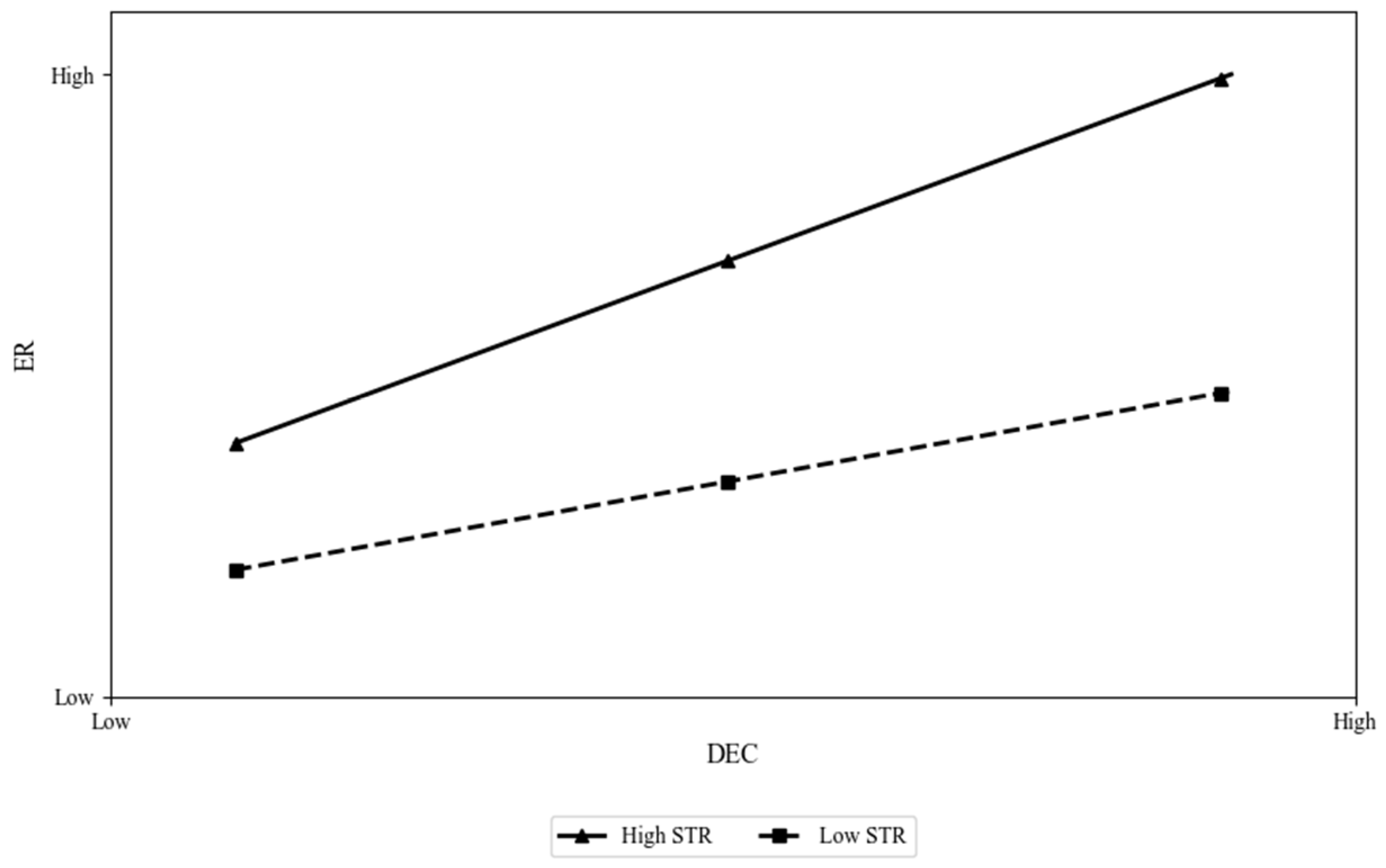
H2. The Prospector business strategy positively moderates the correlation between DEC and ER.
2.5. The Moderating Role of Innovation Demand
The impact of DEC on ER can vary by industry. Specifically, industries with a high demand for innovation require greater innovation capabilities. According to the knowledge-based view, the core of an enterprise’s innovation capability lies in its ability to acquire, integrate, and apply both tacit and explicit knowledge. In industries with high demands for innovation, technological complexity requires real-time interaction of knowledge from different sources [
35]. DEC is akin to building a well-connected “information superhighway” that breaks down “information silos” between departments, allowing knowledge to flow quickly. This improves the efficiency of knowledge matching and gives rise to disruptive technologies that transform industry patterns. DEC makes information flow easier, but it also leads to the fragmentation of knowledge distribution [
36]. Tacit knowledge is usually attached to individuals or small groups [
37]. Innovation-oriented enterprises tend to focus on mining tacit knowledge. However, high innovation demand pushes these enterprises to invest in knowledge integration capabilities. This, in turn, stimulates them to build cross-departmental knowledge-sharing platforms that transform dispersed tacit experiences into reusable explicit knowledge bases. This integration capability allows decentralized units to maintain agile autonomous decision-making while optimizing actions based on comprehensive organizational knowledge. By avoiding trial and error, it facilitates the rapid diffusion of local innovations into systemic resilience.
Additionally, psychological research has found that work motivation and creativity increase when people’s sense of autonomy, competence, and belonging is fulfilled [
38]. DEC fosters a culture that promotes self-directed exploration by empowering employees with greater decision-making autonomy. In such an environment, employees no longer passively perform tasks but instead take the initiative to experiment with new methods and technologies, tap into the infinite possibilities of knowledge combinations, and accumulate knowledge reserves for the enterprise to cope with risks. In line with this discussion, the following hypothesis is proposed:
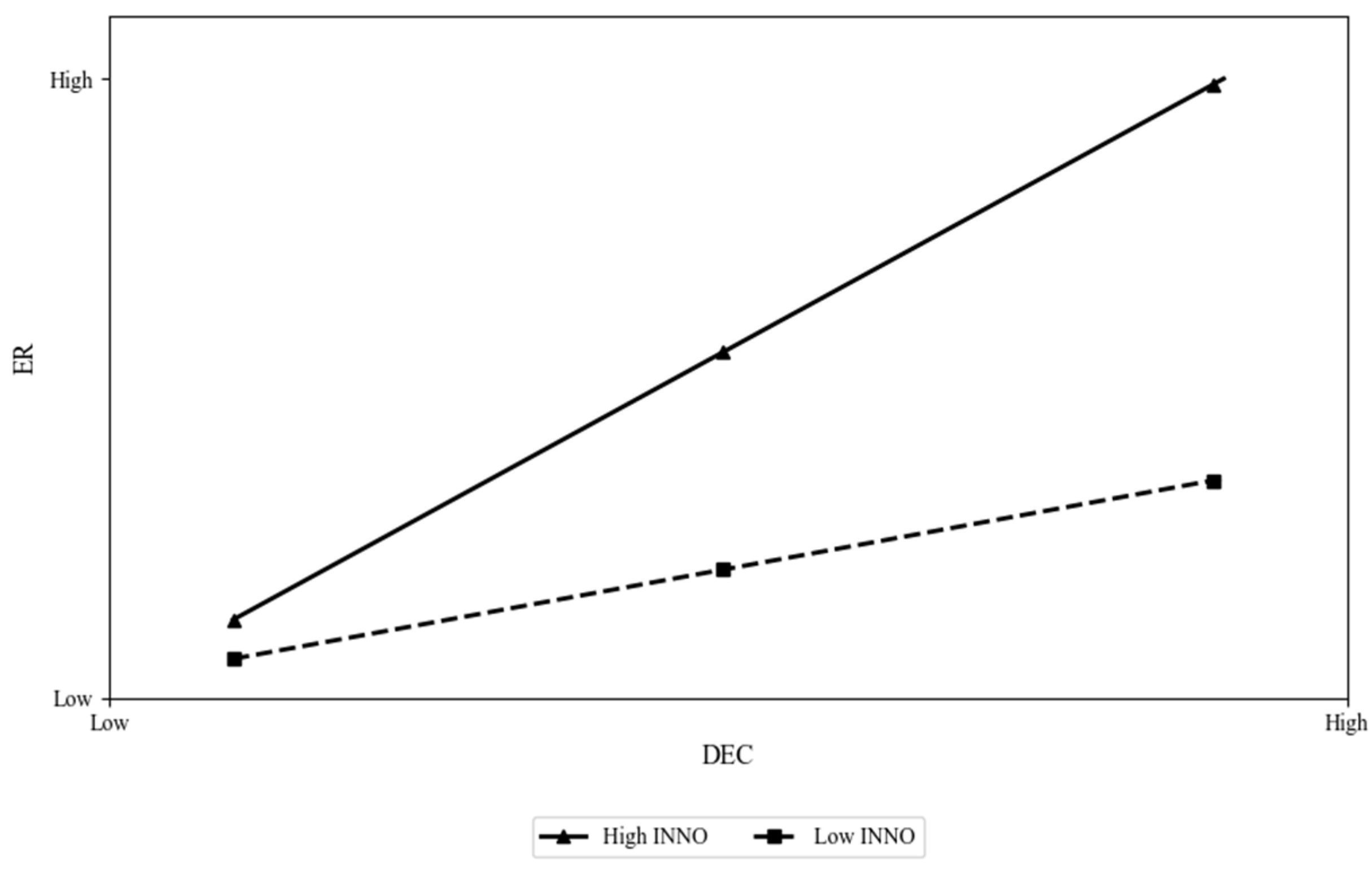
H3. Innovation demand positively moderates the linkage between DEC and ER.
5. Further Analysis
To further explore the potential heterogeneity in the relationship between DEC and ER, this paper analyzes ownership structure and geographical location.
5.1. Analysis of Ownership Heterogeneity
Differences in ownership structure may result in variations in goal orientation, resource allocation, and incentive mechanisms. As a result, the effects of DEC may also vary. In this paper, enterprises are classified based on their ownership structure into state-owned (SOE) and non-state-owned (non-SOE) categories. A dummy variable is created for ownership type, where 1 represents state-owned enterprises and 0 represents non-state-owned enterprises. This variable is then used in separate regressions for state-owned and non-state-owned enterprises.
According to the results in
Table 7, Models 11 and 12, the DEC coefficients are significant for non-SOEs but not for SOEs. The divergent impact of DEC on SOEs and non-SOEs can be effectively interpreted through the lens of institutional theory, specifically the concept of competing institutional logics. SOEs in China operate under a dominant state logic, which prioritizes socio-political objectives such as maintaining employment, ensuring social stability, and fulfilling government policy mandates. This logic creates a complex institutional environment where performance is evaluated against multiple, often conflicting, criteria.
Consequently, even when decision-making authority is formally decentralized within an SOE, the actions of empowered middle managers remain heavily constrained by the pervasive state logic. Their autonomy is directed towards mitigating political risks and adhering to administrative directives, rather than pursuing purely economic resilience. This logic displacement diminishes the effectiveness of DEC in enhancing operational flexibility and rapid market response, which are core to the economic resilience measured in this study.
In contrast, non-SOEs primarily operate under a market logic, where the paramount goals are economic efficiency and profit maximization. Within this simpler and more coherent institutional environment, DEC functions as theorized: it empowers managers to respond swiftly to market signals, reallocate resources efficiently, and pursue opportunities for recovery and growth. The alignment between the market logic and the economic objective of resilience allows DEC to fully unleash its adaptive potential in non-SOEs.
5.2. Analysis of Regional Heterogeneity
Due to regional differences in economic development and policy support, the impact of DEC on ER may vary. In this paper, enterprises are categorized into the eastern region (EAST) and the central-western region (MID-WEST) based on their geographic locations. A dummy variable is created for region, where 1 represents the EAST and 0 represents the MID-WEST. Regression analysis is conducted on enterprises grouped by region to explore how geographic location influences the results.
According to the results in
Table 7, Models 11 and 12, DEC coefficients for enterprises in both the eastern and central-western regions are significantly positive. However, the Chow test results show a
p-value of 0.883, indicating no significant difference in the coefficients between the groups. This suggests that there is no regional heterogeneity in the positive impact of DEC on ER. The consistency of decentralization’s benefits across regions reflects the powerful role of coercive isomorphism within China’s institutional environment. Despite regional disparities in economic development, Chinese firms in both the developed eastern regions and the less-developed central and western regions face strong nationwide institutional constraints.
Relatively homogeneous institutional constraints at the national level may outweigh the influence of weaker and more heterogeneous institutional conditions at the regional level. The crisis events examined in this study—such as the trade war and technological decoupling—were national in scope and largely shaped by centralized policy responses. Therefore, the mechanism through which DEC enhances ER may function as a broadly effective governance arrangement that transcends regional disparities, operating consistently within China’s overarching national institutional framework.
6. Conclusions and Discussion
6.1. Conclusions
This paper examines the impact of external crises, such as the US–China trade and technology wars and the COVID-19 pandemic, on ER. Using Chinese A-share listed companies from 2018 to 2023 as the research sample, the study empirically tests the influence of DEC on ER in crisis situations. The findings are as follows: (1) DEC positively promotes ER in times of crisis. By flattening decision-making hierarchies, DEC reduces the layers of information transmission, facilitates cross-departmental information flow, and enhances the dynamic adaptability of resource allocation. Additionally, DEC fosters an autonomous learning culture, stimulating employees’ intrinsic motivation for innovation and communication. It also strengthens risk early warning, dynamic response, and organizational learning capabilities, thereby enhancing ER. (2) The Prospector strategy strengthens the positive relationship between DEC and ER. Enterprises that adopt a Prospector strategy emphasize proactive expansion and diversification, requiring higher information processing and dynamic response capabilities. Without a compatible governance structure, however, this strategy may expose the firm to heightened vulnerability during crises. In such times, DEC, as a distributed information processing mechanism, improves information utilization efficiency, shortens response time, and reduces interdepartmental conflicts, thereby aligning strategy and execution more effectively. This makes the effect of DEC on ER more pronounced under a Prospector orientation. (3) Innovation demands strengthen the positive relationship between DEC and ER. Higher innovation demands require firms to enhance knowledge sharing and information exchange, which in turn drives investment in knowledge-sharing and integration platforms. DEC breaks down information silos, facilitating rapid knowledge flow and improving knowledge matching efficiency, while converting fragmented knowledge into systemic assets. This study deepens the contextualized understanding of the effectiveness of power allocation patterns by situating the analysis within external crisis environments. It clearly demonstrates how DEC enhances ER through the improvement of dynamic capabilities, thereby enriching research on the antecedents of ER and providing critical insights for organizational design aimed at sustainability. Moreover, the study identifies two critical moderating variables—Prospector strategy and innovation demand—which further delineate the boundary conditions of the antecedent mechanisms underlying ER and suggest pathways for firms to proactively build organizational structures that support sustainable growth in volatile environments.
6.2. Theoretical Contributions
This study offers several theoretical contributions to the literature on ER, governance, and sustainable management.
First, we extend the ER literature by introducing organizational power allocation as a critical antecedent of ER in crisis contexts. While prior research has primarily emphasized resources, strategies, or managerial characteristics under relatively stable conditions, we shift attention to governance structures and demonstrate that DEC becomes particularly consequential when firms face external shocks and heightened uncertainty. By situating governance mechanisms within crisis situations, we show that DEC constitutes a foundational institutional arrangement that systematically shapes firms’ adaptive capacity and recovery processes. This perspective advances ER research from a resource and behavior perspective to a structural governance perspective and highlights the importance of crisis-oriented governance design.
Second, we contribute to theory by uncovering the underlying mechanisms through which DEC enhances ER. Drawing on dynamic capability theory, we conceptualize ER as a dynamic adaptive capability and show that DEC strengthens firms’ sensing, seizing, and reconfiguring capacities across different crisis stages. By linking governance design to dynamic capabilities, our study provides a more process-oriented explanation of how structural arrangements translate into adaptive outcomes.
Third, this study enriches the sustainability and crisis management literature by situating governance choices within highly uncertain environments. We demonstrate that DEC supports not only short-term shock absorption but also long-term adaptive growth, thereby highlighting governance sustainability as an important yet underexplored dimension of sustainable development.
Finally, by examining the moderating effects of strategic orientation and innovation demands, and by revealing the heterogeneous effects between SOEs and non-SOEs, our study specifies the boundary conditions of DEC. These findings underscore that the efficacy of governance mechanisms is not universal but is contingent on both strategic and institutional contexts, thereby advancing a more nuanced contingency theory of governance for ER.
6.3. Managerial Implications
As environmental uncertainty becomes the new normal, traditional hierarchical “pyramid” structures increasingly struggle to cope with information asymmetry and delayed responses. In general, firms should move toward more decentralized governance arrangements that facilitate cross-departmental collaboration, accelerate information flows, and enable timely local decision-making, thereby strengthening organizational adaptability and resilience.
However, the optimal degree and implementation path of decentralization vary across firm types. For firms pursuing a Prospector strategy or facing high innovation demands, greater decentralization is particularly beneficial. These firms operate in dynamic and knowledge-intensive environments where rapid adaptation and localized problem-solving are critical. Managers in such contexts should grant substantial decision rights to frontline units, adopt modular structures, and establish flexible authorization systems that allow teams to independently allocate resources and respond to market changes.
In contrast, for SOEs, where multiple policy mandates and administrative objectives often coexist, excessive or abrupt decentralization may lead to coordination problems and goal divergence. A more appropriate approach is gradual and controlled delegation, such as implementing pilot decentralization programs in selected divisions, introducing clear accountability mechanisms, and combining local autonomy with strong strategic oversight from the headquarters. This “bounded decentralization” helps balance flexibility with alignment to policy mandates.
For firms in traditional or mature industries, where operational routines are relatively stable and innovation pressures are lower, full-scale decentralization may generate unnecessary coordination costs. Instead, managers may adopt selective decentralization, delegating authority primarily in areas requiring rapid market responsiveness (e.g., marketing or customer service) while maintaining centralized control over standardized production and financial decisions.
Overall, an effective governance design should follow the principle of being “strategically centralized but tactically decentralized,” ensuring strategic coherence at the top while preserving operational flexibility at lower levels. Such differentiated approaches enable firms with varying ownership structures and industry characteristics to translate decentralization into sustainable resilience more effectively.
6.4. Limitations and Future Research Directions
Despite its contributions, this study has several limitations that suggest directions for future research.
First, our measurement of ER adopts an outcome-oriented approach based on observable financial stability and post-crisis growth. Although such indicators are widely used in archival research and allow for objective large-sample analysis, they may not fully capture the multidimensional and process-based nature of resilience as a dynamic capability. Future studies could complement this approach with perceptual scales, qualitative methods, or case studies to provide a richer understanding of resilience formation.
Second, our empirical design is constrained by the relatively limited time span of the sample and the use of observational data, which may not fully capture the long-term and evolutionary process through which resilience is accumulated. Although instrumental variable estimation is employed to mitigate endogeneity concerns, we acknowledge that residual endogeneity may persist due to unobserved factors. Our identification strategy relies on the validity of the exclusion restriction, which, while theoretically grounded, cannot completely rule out all potential confounding influences. Future studies could employ more exogenous research designs to provide stronger causal evidence and better capture the dynamic formation of resilience.
Third, several key constructs are measured using structural or industry-level proxies. Although these proxies reflect firms’ institutional tendencies toward decentralization and innovation demand, they may not perfectly capture actual operational practices at the grassroots level. Future research could incorporate survey or field data to develop more fine-grained measures of decentralization and firm-level innovation demand.