1. Introduction
The merge area at interchanges is a critical hot spot for traffic conflicts within urban expressway networks, characterized by frequent traffic weaving, significant speed differentials, and complex vehicle interactions [
1]. As urbanization intensifies, the safety and efficiency of these merging zones directly impact the overall sustainability of urban mobility systems. Conflicts in these areas not only elevate crash risks but also contribute to congestion, increased emissions, and reduced network resilience, thereby undermining key pillars of sustainable transportation [
2]. Therefore, a precise understanding of vehicle interaction mechanisms is fundamental for advancing traffic safety engineering and developing intelligent infrastructure solutions that support safer, smoother, and more sustainable urban traffic flow.
Existing research has investigated merging behavior from multiple perspectives. Studies have utilized vehicle trajectories, UAV imagery, or LiDAR data to extract driving features and identify risky behaviors [
1]. Microscopic simulation tools (e.g., VISSIM, Unity) have been widely employed to model traffic flow and evaluate the impacts of various merging strategies on efficiency and safety [
3,
4]. Recently, the research focus has shifted from isolated vehicle maneuvers to interactions between vehicles. Advanced methods such as inverse reinforcement learning and deep learning have been deployed to classify interaction patterns and infer decision-making processes [
2,
5], offering insights into risk formation. However, the complexity and inherent danger of real-world interaction experiments remain a major constraint for in-depth behavioral analysis [
6].
Driving simulation technology has thus emerged as a mainstream approach to achieve both safety and realism [
7]. It provides a controllable, repeatable and safe experiment for studying driving behaviors in complex traffic scenarios, making it particularly suitable for high-risk or difficult-to-reproduce traffic situations. For instance, Shi et al. [
3] used a driving simulation to analyze driver interaction behavior patterns in complex settings. Jung et al. [
8] employed simulation to examine risk characteristics in human–machine hybrid driving environments. Additionally, Siebinga et al. [
9] reproduced vehicle interaction scenarios in ramp merging areas via simulation to evaluate potential safety risks.
Nevertheless, a significant limitation persists: most simulator-based studies rely on single-vehicle setups, where interactions occur between a human driver and pre-programmed automated vehicles. These setups often fail to capture the rich, real-time behavioral feedback and uncertainty inherent in multi-driver interactions, limiting the authenticity and generalizability of findings [
9,
10]. To address these shortcomings, multi-driver interactive driving simulation technology has gained increasing attention [
3,
7]. This approach allows multiple real drivers to interact within the same virtual scenario in real time, more accurately reproducing dynamic behaviors such as cooperation and competition in merging areas, and thus offers a promising pathway for uncovering risk formation mechanisms during vehicular interactions.
Against this background, the present study aims to enhance the safety and sustainability of urban interchange merging areas by investigating vehicular interaction risks through a novel multi-driver experimental framework. A multi-driver driving simulation platform was developed using Unity3D, enabling real-time interaction among multiple human drivers via a local network. Vehicle trajectory data were collected from controlled merging experiments. Interaction events were identified using an eight-direction relative position model and assessed using time-proximity risk metrics derived from Anticipated Collision Time (ACT). An ordered logit regression model was then applied to quantify the impact of various kinematic factors on interaction risk severity.
The findings are anticipated to provide critical risk parameters for the optimization of Advanced Driver-Assistance Systems (ADAS) and collision warning algorithms, as well as a theoretical basis for the refined design of interchange merging areas. By quantifying interaction risks and driving behavior patterns, this research aims to offer a new analytical perspective and data-driven support for enhancing the proactive safety of future transportation systems and the sustainability of infrastructure.
The remainder of this paper is organized as follows:
Section 2 reviews related work on driving behavior and simulation.
Section 3 details the experimental design.
Section 4 describes the extraction of interaction events and risk metrics.
Section 5 presents the risk assessment model and results. Finally,
Section 6 concludes with key findings and their implications for road safety and sustainable traffic management.
2. Literature Review
2.1. Research on Driving Behavior in Merging Areas
Driving behaviors in merging areas exhibit highly complex and multidimensional characteristics, primarily including longitudinal acceleration and deceleration, lateral lane-changing decisions, and gap judgment operations. Early studies [
11] indicated that drivers’ subjective desired speed, perceived safe distance, and lane-merging intent collectively influence merging decisions. Empirical studies based on trajectory data further reveal that merging behavior typically unfolds in three stages: acceleration to seek gaps, lateral approach, and cutting in to merge, with a highly coupled relationship between longitudinal and lateral maneuvers [
12].
In addition, driving behaviors in merging areas vary significantly across different lane types and traffic conditions. For example, Duan et al. [
13] found in their study of work-zone merging behavior that high traffic density and drivers’ individual characteristics, such as driving preferences and experience, significantly influence merging strategies and conflict risks. Siriwardene et al. [
14] based on observational research, pointed out that drivers’ experience and response characteristics under different traffic conditions moderate their choices of merging behavior and lane-changing strategies. Sun et al. [
15] reconstructed two-dimensional trajectories of the merging process using imitation learning, demonstrating that merging behavior is not only affected by traffic density but also closely related to drivers’ merging strategies and environmental conditions. Collectively, these studies indicate that vehicle type, traffic density, and drivers’ individual characteristics play important moderating roles in merging behaviors. It is noteworthy that traffic accidents in merging areas often stem from the dynamic interactions between multiple vehicles, rather than the action of a single vehicle.
2.2. Driving Simulation Experiments and Multi-Driver Interaction Studies
Driving simulators are widely used in driving behavior and traffic safety research due to their controllable, safe, and repeatable characteristics. Existing studies indicate that high-fidelity driving simulators can effectively replicate real-world driving scenarios, including speed control, lane-keeping, and driving reaction times [
16], thereby providing reliable data support for analyzing driving behavior in complex traffic environments. In studies of driving behavior in merge areas, driving simulation experiments have revealed the significant influence of environmental factors and individual differences on driving decisions. For instance, research indicates that drivers’ merge strategies vary considerably under different traffic density conditions [
17]. Furthermore, in merge zones characterized by complex information and high traffic density, drivers’ visual workload increases substantially [
18].
In recent years, multi-driver collaborative simulation has emerged as a hot topic in interdisciplinary research, finding extensive applications in fields such as traffic safety, human factors engineering, and intelligent transportation systems. Shi et al. [
3] developed a Unity-VISSIM co-simulation platform enabling multiple drivers to simultaneously participate in driving simulation experiments within a virtual reality environment, facilitating the study of their interactive behaviors and decision-making strategies. Ramlall et al. [
10] proposed a networked multi-participant driving simulator framework integrating synchronous Electroencephalography (EEG) and driving telemetry data acquisition to analyze cognitive states and interactive coordination among drivers. Mohammadi et al. [
19] constructed an open-source co-simulation platform based on VR-SUMO. By dynamically coupling real drivers in virtual reality with background traffic generated by SUMO, they achieved a more realistic and controllable interactive experimental environment. Jung et al. [
8] using a multi-agent driving simulation approach, systematically analyzed key safety metrics such as acceleration fluctuations, lane position deviations, and headway distances between autonomous and human-driven vehicles in mixed car-following scenarios, assessing potential interaction risks in mixed traffic environments. In addition, Siebinga et al. [
9] proposed a coupled multi-driver driving simulation framework to study vehicle interaction decisions in ramp merging areas. Their results indicate that the coordinated acceleration and deceleration behaviors between mainline and merging vehicles can be accurately reproduced using multi-driver simulation, offering a novel approach for analyzing merging conflict mechanisms.
2.3. Vehicle Interaction Recognition and Risk Quantification Models
Research on vehicle interaction recognition and risk quantification has evolved from a traditional vehicle-road framework toward dynamic modeling of vehicle-vehicle interactions. Prevailing methods primarily rely on metrics such as Time to Collision (TTC) and Post Encroachment Time (PET) to characterize potential conflicts [
20,
21]. These methods can capture instantaneous risk variations and quantify hazard levels to some extent. However, because such indicators primarily rely on kinematic relationships at specific moments, they are limited in sensitivity to continuous interaction processes, behavioral hesitation, and latent factors such as driver stress, which constrains their applicability in complex merging scenarios.
To overcome these limitations, the ACT proposed in recent years provides a new behavioral dynamics analysis framework for evaluating driving behavior consistency [
22]. Existing research indicates that ACT can quantify the degree of consistency between driving behavior and its underlying behavioral model, thereby effectively identifying abnormal responses triggered by surrounding traffic disturbances [
23,
24]. For instance, the two-dimensional ACT metric proposed by Venthuruthiyil and Chunchu [
22] simultaneously characterizes potential collision risks in both longitudinal and lateral dimensions. Compared to traditional metrics that consider only single-dimensional information (such as TTC in the following scenarios), ACT better reflects interactive conflict characteristics based on future trajectory predictions. Furthermore, Tang [
25] extended ACT by introducing a temporal evolution dimension to the safety metric, enabling the capture of how risk evolves over time in dynamic traffic situations, thereby enhancing risk representation in complex interaction scenarios.
In terms of risk quantification, statistical models, machine learning, and deep learning methods have been widely applied. Li et al. [
26] used microscopic trajectory data from highway ramp merging areas and applied a stochastic accelerated failure time model to quantify vehicle merging time gaps and their relationships with dynamic traffic variables. Tian et al. [
27] employed an improved machine learning model combined with explainability analysis to identify and quantify traffic conflict risks in ramp merging areas. Ye et al. [
28] employed deep learning models to perform spatio-temporal predictions of risk propagation and potential conflicts in merge zones. This approach captures the evolving characteristics of risks within complex, dynamically interacting scenarios, providing a forward-looking analytical tool for active safety and conflict warning systems.
3. Driving Simulation Experiment
3.1. Experimental Setup
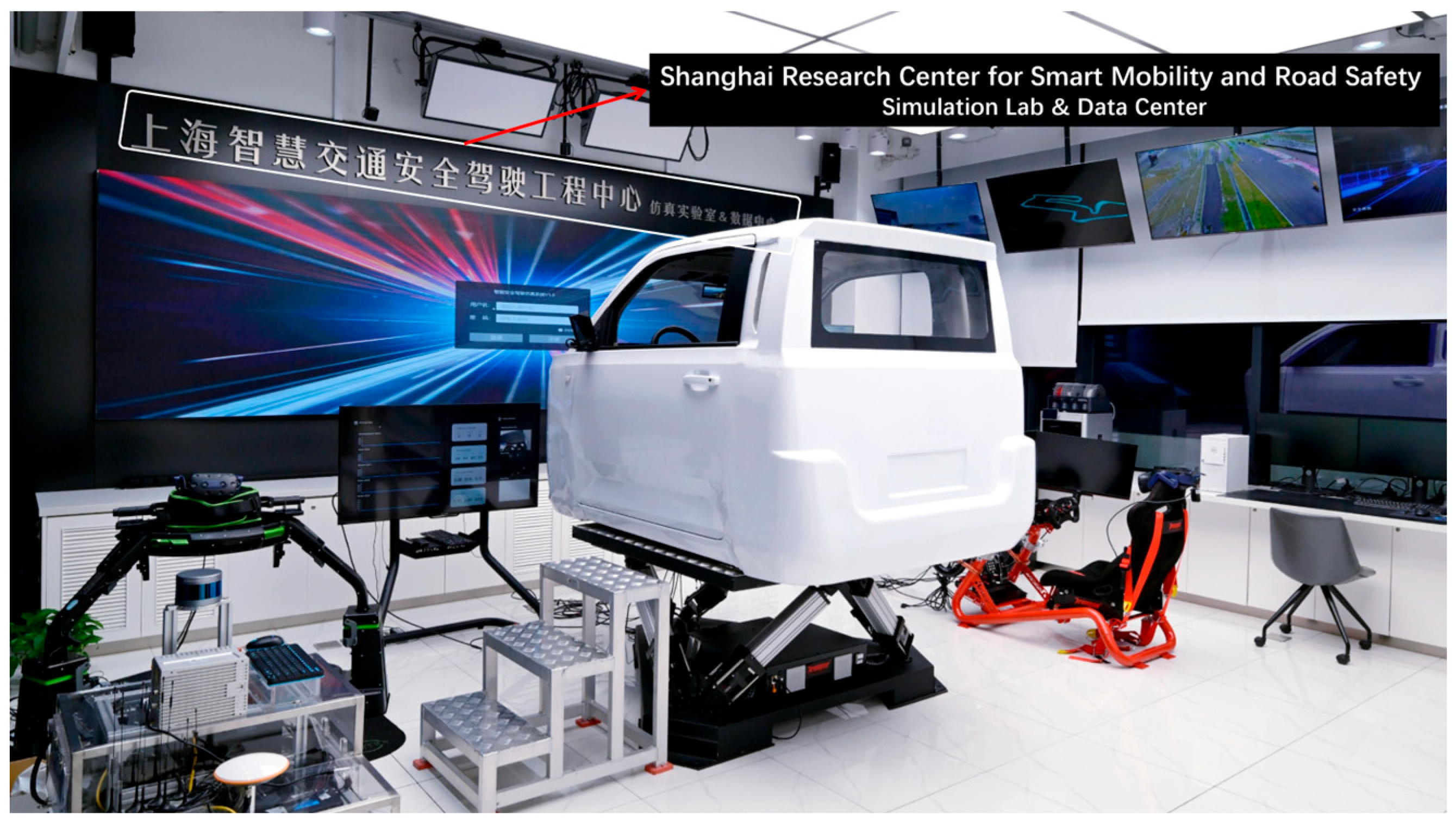
This study employed the multi-driver driving simulation platform of the Shanghai Research Center for Smart Mobility and Road Safety. The platform is developed based on the Unity3D engine and a multiplayer online framework, establishing a system that supports collaborative driving simulations for multiple drivers. After connecting to the network, users can jointly perform driving tasks within a shared virtual traffic environment. The system enables functionalities such as synchronized cross-client perspectives, real-time physical collisions, and vehicle–environment interactions, thereby providing effective technical support for research on multi-driver online collaborative driving behaviors [
4].
The platform integrates two kinds of high-immersion driving simulation devices, including:
- (1)
Six Degree of Freedom High-Fidelity Driving Simulator
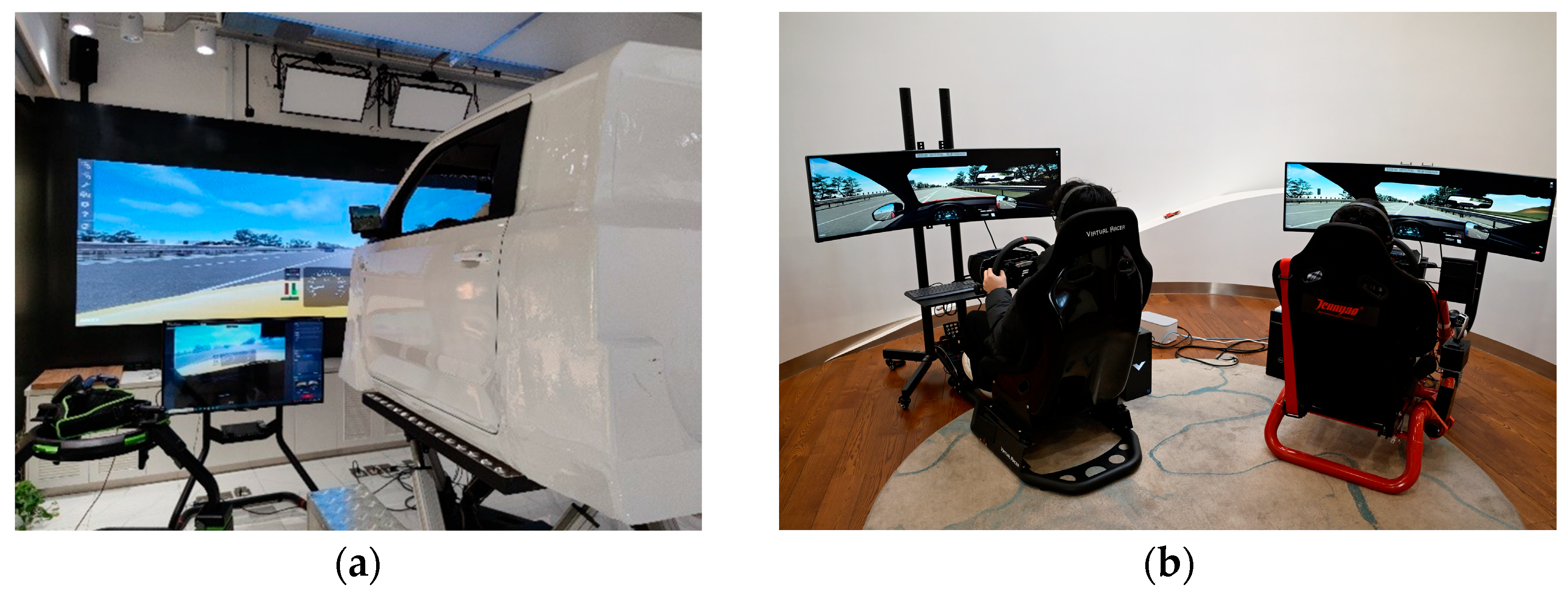
This simulator (shown in
Figure 1) is equipped with a six-degrees-of-freedom motion platform, capable of realistically simulating dynamic feedback such as acceleration, deceleration, and turning sensations. The driver’s cabin is assembled according to actual vehicle standards and is fitted with hardware including a steering wheel, pedals, and gear shifter. A front panoramic screen and in-car displays replicate a complete driving field of view and rearview mirror information. An integrated audio system is employed to simulate vehicle and environmental sounds.
- (2)
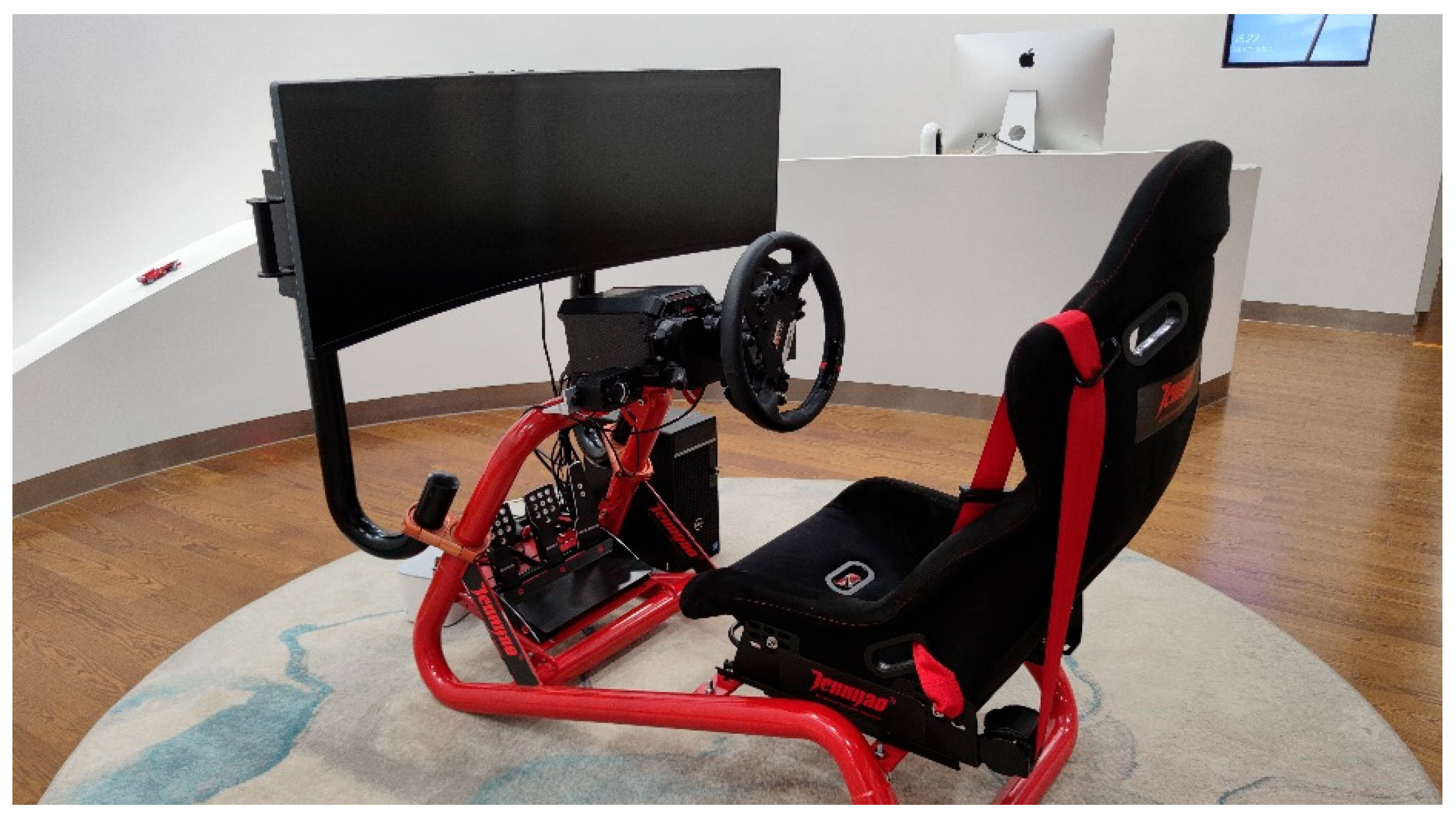
Fixed Base Driving Simulator
This simulator (shown in
Figure 2) features a curved front display screen, and is equipped with a full set of operating hardware, including a steering wheel, turn signal stalk, gear shifter, and pedals. It supports the connection of headphones or external speakers to provide auditory feedback.
3.2. Participants
The experiment consisted of a pilot stage and a formal stage. The pilot experiment was conducted with 5 professional drivers to validate system stability and online functionality.
For the formal experiment, a total of 60 volunteers were recruited. The sample was designed to reflect the gender and age distribution of drivers in China to ensure representativeness. All participants held valid driver’s licenses, reported being in good health, and had not consumed alcohol or taken medication prior to the experiment.
The volunteers ranged in age from 20 to 59 years, with males comprising two-thirds of the sample and an average age of 29.2 years. As presented in
Table 1, participants were divided into three groups based on driving experience: (1) 20 novice drivers had an average age of 22.4 years and an average driving experience of 1.8 years; (2) 20 experienced drivers had an average age of 31.3 years and an average driving experience of 9.4 years; (3) 20 professional drivers had an average age of 48.7 years and an average driving experience of 20.8 years. It is noted that participants aged 20–59 years were recruited to represent the core active driving population while ensuring all held full driving licenses and fell within the dominant age ranges for novice, experienced, and professional driver categories in China.
3.3. Experimental Design
3.3.1. Road Network Design
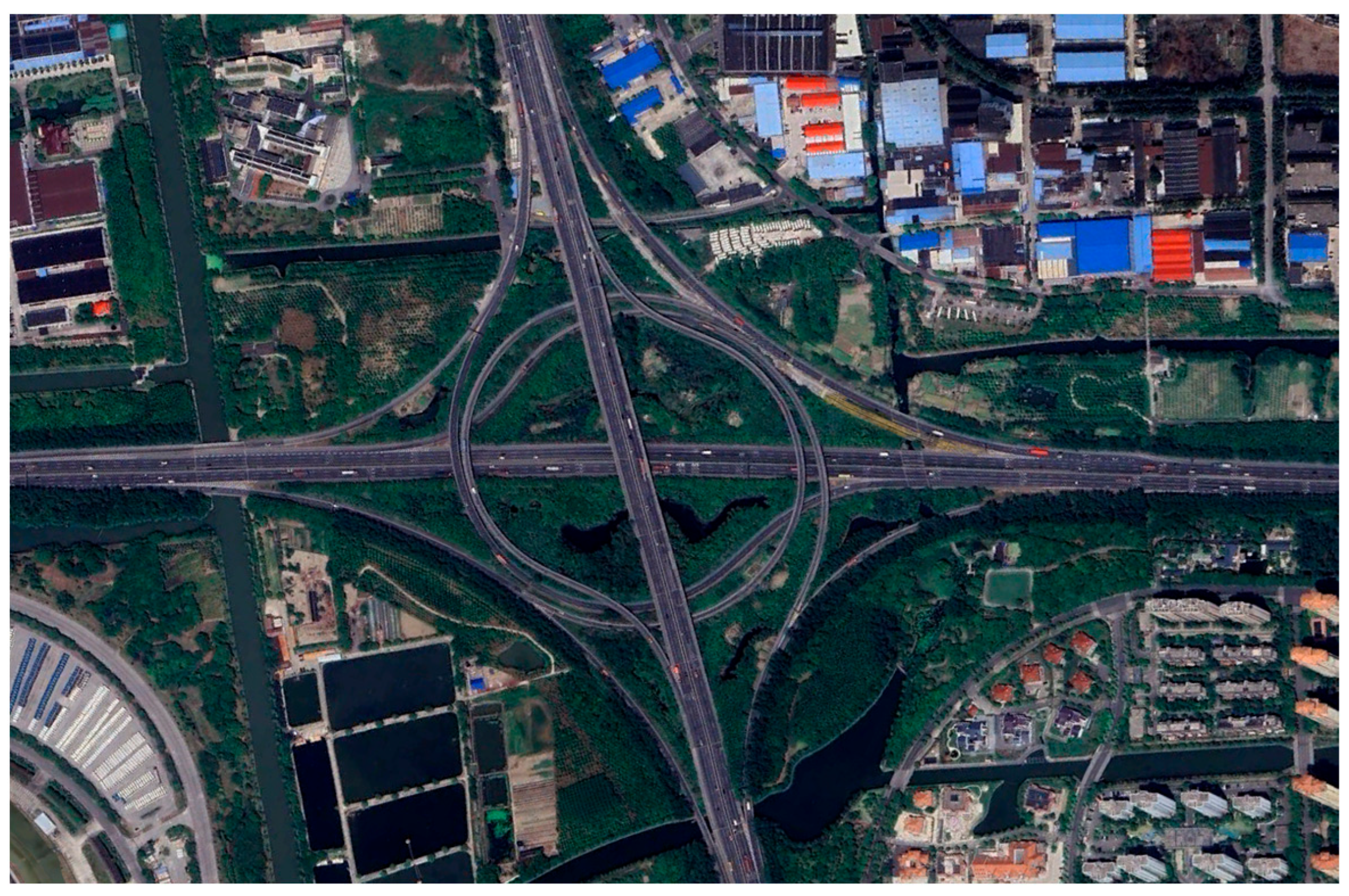
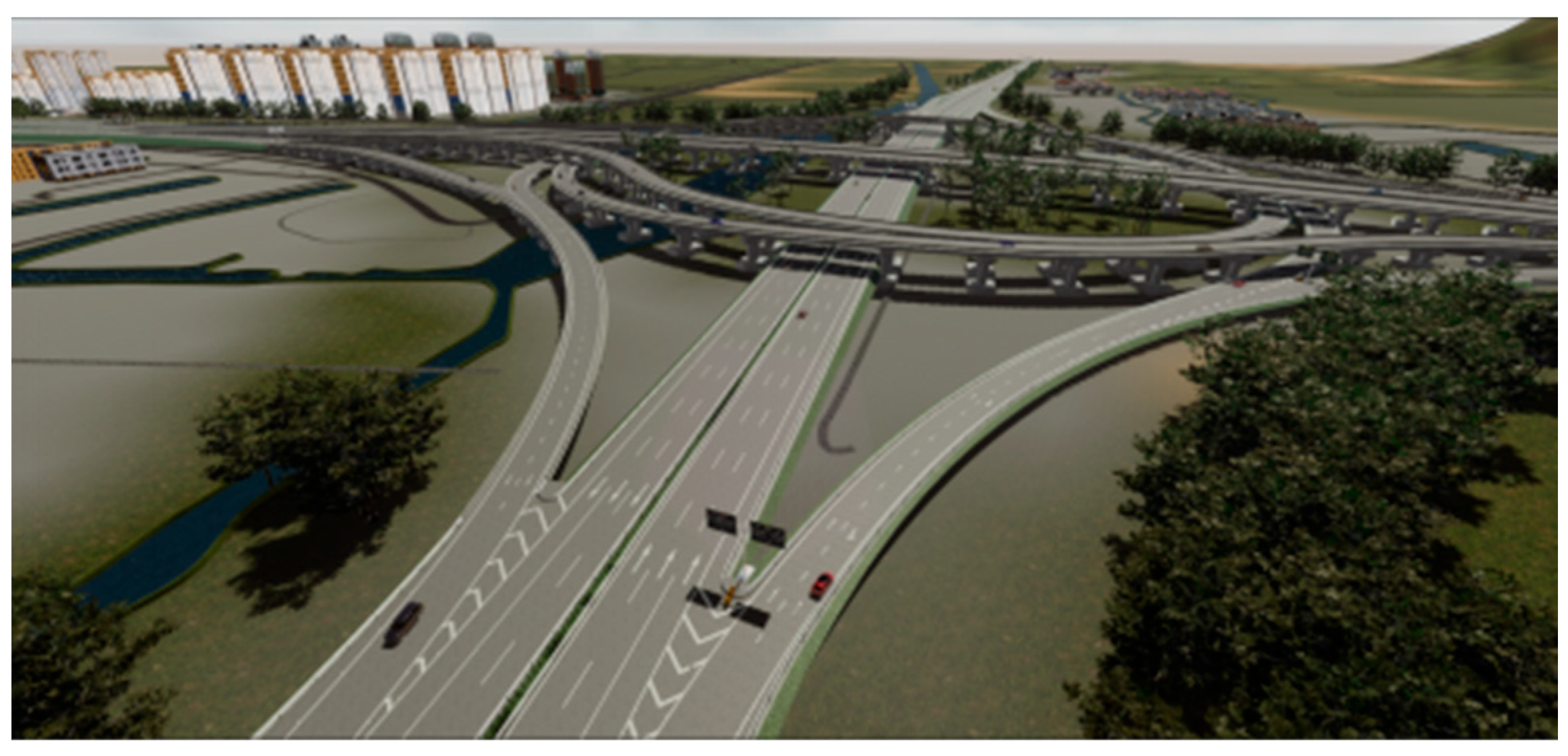
The experimental environment was constructed using the Unity 3D engine to meticulously replicate a complex interchange, as shown in
Figure 3. The modeling strictly adheres to real-road design parameters, incorporating geometric features (lane width, slope, turning radius), lane divisions, traffic markings, road signs, guardrails, and other roadside facilities. High-precision texture mapping was applied to enhance visual realism (
Figure 4). The primary area of interest for data collection was designated as the eastern merging zone.
3.3.2. Driving Tasks in the Experimental Scenes
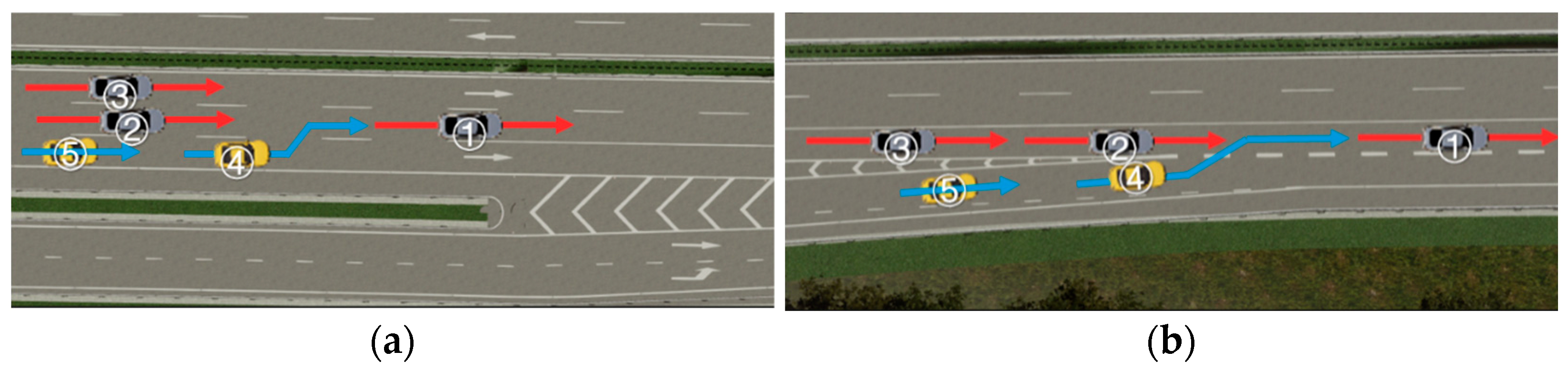
To capture the variety of interaction patterns at the interchange, the experiment was designed around two typical merging scenes, as shown in
Figure 5. Each scene utilized a coordinated setup of 5 driving simulators.
Scene 1 (Mainline Merging): This scene simulated a scenario where vehicles were in the mainline area before entering an upcoming acceleration lane. Specifically, vehicles in the rightmost mainline lane (Vehicle ④ and Vehicle ⑤) need to change lanes to the left in advance to avoid the extended solid line area ahead, thereby interacting with the traffic stream in the adjacent left lane (Vehicle ①, Vehicle ②, and Vehicle ③).
Scene 2 (Ramp Merging): This scene simulated the classic on-ramp merging scenario. Vehicles from the ramp and acceleration lane (Vehicle ④ and Vehicle ⑤) needed to adjust their speed and position to dynamically interact with the traffic stream in the rightmost mainline lane (Vehicle ①, Vehicle ②, and Vehicle ③) to complete a safe merge.
To ensure the experimental vehicles consistently converged at the designated interaction zones, two inconspicuous guide vehicles were placed within the simulation. These guide vehicles, visually identical to regular traffic, maintained a constant speed and trajectory. Their purpose was to gently guide both mainline and ramp vehicles, ensuring the reproducible initiation of interactive events across all experimental trials.
3.4. Experimental Procedure
To create a controlled and effective merging environment, it is necessary to conduct specially designed controlled experiments that highlight the active interactive behaviors of vehicles during merging and converge states, and expose the underlying mechanisms of their interactions [
29,
30]. Therefore, drivers were assigned to specific vehicles. Three professional drivers operated the straight-through vehicles (Vehicle ①, Vehicle ②, and Vehicle ③). Volunteer participants operated the merging vehicles (Vehicle ④ and Vehicle ⑤).
Figure 6 presents the process of the formal experiment, which lasted approximately 30 min and proceeded as follows:
- (1)
Preparation and Briefing: Participants were briefed on the experiment. They then completed personal and driving experience questionnaires.
- (2)
Test Drive and Adaptation: Participants engaged in a 5 min practice session in a non-experimental setting to familiarize themselves with the simulator controls and environment.
- (3)
Formal Experiment: Experimental scenarios were presented in a random order. Participants followed audio instructions to complete designated driving tasks. Three professional drivers controlled straight-line traffic (Vehicle ①, Vehicle ②, and Vehicle ③) for consistency, while volunteers operated the merging vehicles (Vehicle ④ and Vehicle ⑤).
3.5. Data Collection and Description
During the experiment, the simulator recorded data from all five test vehicles within each trial at a sampling frequency of 100 Hz. A total of 512 instances of merging event data were collected. As listed in
Table 2, each data instance captured a comprehensive set of dynamic vehicle parameters, including positional coordinates (x, y, z), speed, acceleration, yaw angle, travel distance, steering wheel angle, and pedal positions. The specific parameters are summarized in the table below.
4. Data Preparation
4.1. Surrogate Safety Indicators
In traffic safety research, proactive safety assessment is widely recognized as an effective method for evaluating various traffic risks [
31]. Compared to actual collisions, traffic conflicts occur more frequently and are easier to observe, making them a key subject of traffic safety studies. Researchers commonly use surrogate safety indicators to quantify the latent collision risk in such traffic conflict scenarios [
32,
33,
34]. Most surrogate indicators for assessing conflict severity are proximity-based, operating on the assumption that a closer proximity between vehicles implies a higher collision probability [
35,
36]. These indicators can be categorized into temporal and non-temporal types. Among temporal proximity indicators, TTC is the most extensively used. TTC is defined as the time remaining until a collision occurs if two vehicles on a collision course maintain their current driving states. However, practical applications have revealed several limitations of the traditional TTC metric [
36,
37,
38]. First, it is primarily effective in quantifying rear-end conflicts and cannot be readily applied to all conflict types. Second, its calculation relies on the assumption of linear vehicle motion. Moreover, the standard TTC does not account for dynamic factors such as acceleration.
To address the above limitations, Venthuruthiyil and Chunchu [
22] proposed a novel time-based proximity risk assessment metric, termed ACT. ACT is defined as the ratio of the minimum distance between vehicles at a given instant to their relative speed along the direction of the minimum distance. The equation for ACT can be expressed as:
where,
represents the minimum distance between vehicles;
represents the approach rate along the direction of the minimum distance.
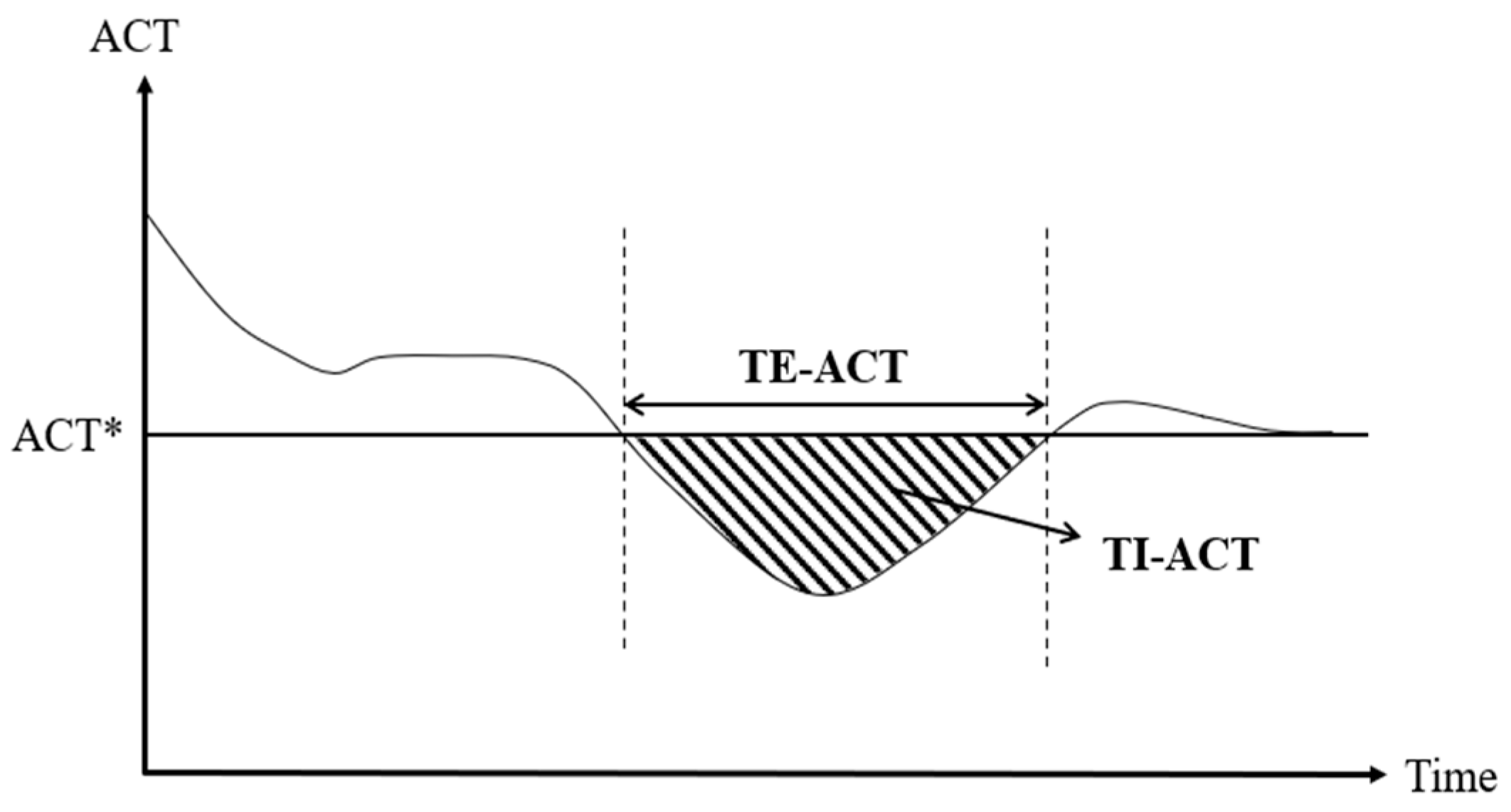
Using the ACT Curve, two additional safety indicators can be derived, namely Time-Exposed ACT (TE_ACT) and Time-Integrated ACT (TI_ACT). TE_ACT measures the duration during which vehicles are exposed to unsafe scenarios, while TI_ACT quantifies the severity of the potential collision [
22].
Figure 7 illustrates an ACT Curve divided into safe and unsafe regions by a safety threshold
. This study focuses on the interchange merging area as the analytical scenario, where vehicle interactions primarily involve cut-in maneuvers, accompanied by both lateral and longitudinal interactions. To comprehensively assess the potential risks during vehicle interactions, an intermediate value of 5 is selected as the unified
safety threshold based on findings from Venthuruthiyil and Chunchu (2022), in which the ACT was first proposed to capture the risk pattern and a procedure to automatically detect conflict situations and extract ACT profiles from the trajectory data was devised [
22]. The segment of the ACT Curve located within the unsafe region determines the extent of risk exposure and the severity of potential collisions. By extracting and merging all ACT curve segments situated within the unsafe region, the resulting total time corresponds to the collision exposure duration, while the total shaded area represents the collision severity.
These two indicators can be defined by the following mathematical expressions:
where
is the ACT safety threshold;
represents the ACT value between vehicles at time
.
4.2. Extraction of Interaction Events
4.2.1. Interaction Behavior Patterns
In the study of vehicle interactions within interchange merging areas, Zhang et al. [
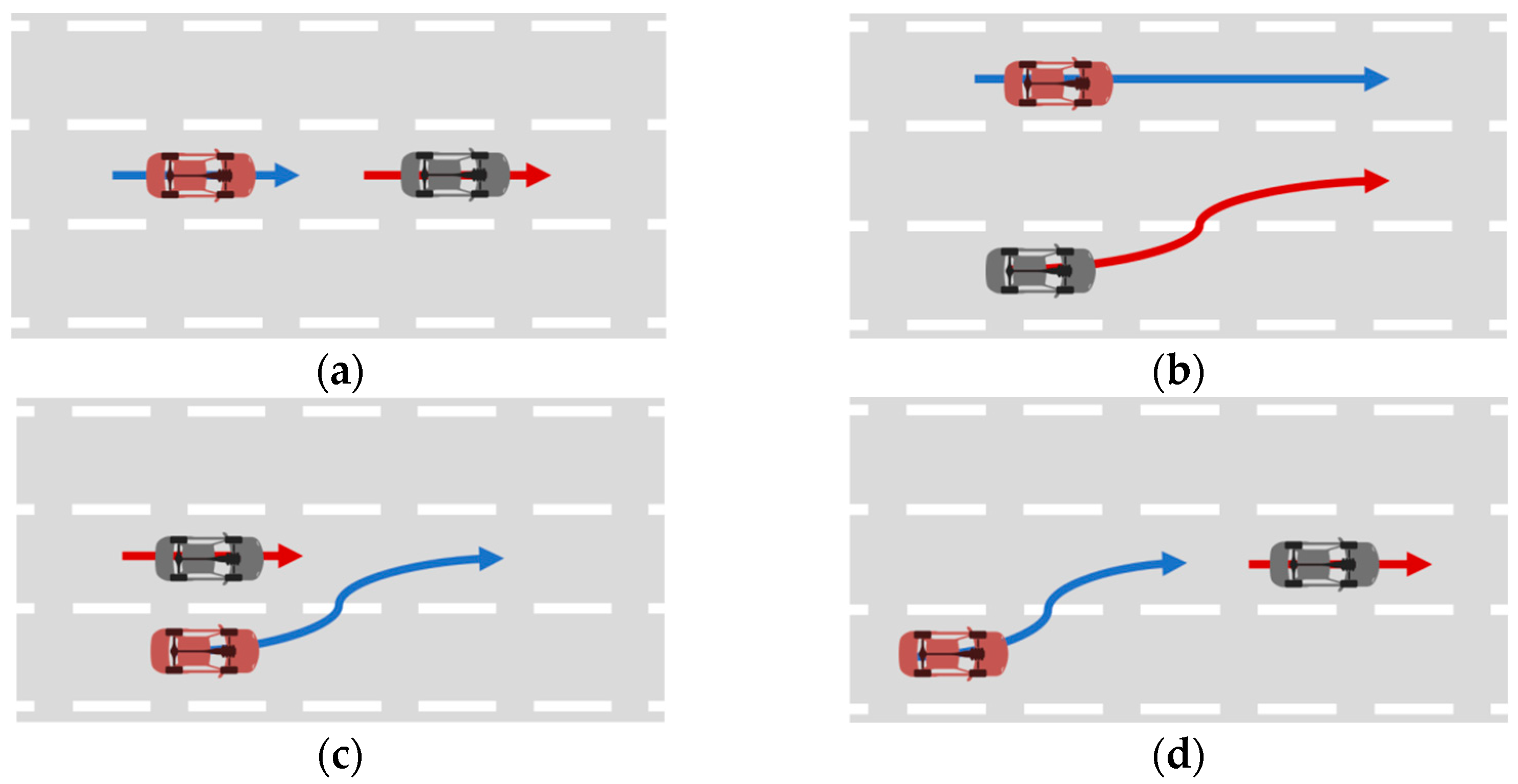
2] observed numerous interactive behaviors using drone footage and subsequently categorized them into four distinct patterns (
Figure 8): the longitudinal effect, lateral effect, front insertion effect, and rear insertion effect.
Longitudinal Effect: This pattern occurs predominantly when two vehicles are in the same lane, involving car-following behavior caused by close spacing.
Lateral Effect: This pattern primarily manifests during the merging process between the mainline and the ramp, characterized by lateral encroachment between ramp-entering vehicles and mainline traffic.
Front Insertion Effect: This pattern mainly occurs when two vehicles are in adjacent lanes. The merging vehicle, after confirming a safe gap using rearview and side mirrors, cuts into the traffic stream ahead of a mainline vehicle.
Rear Insertion Effect: This pattern also occurs between two vehicles in adjacent lanes. Here, the merging vehicle maneuvers into the traffic stream behind a mainline vehicle.
These four interaction patterns serve as the primary manifestation of drivers’ behavioral characteristics—such as assertiveness, caution, or cooperation—during conflicts at the merging point, captured through their kinematic signatures.
4.2.2. Identification of Effective Interaction Behaviors
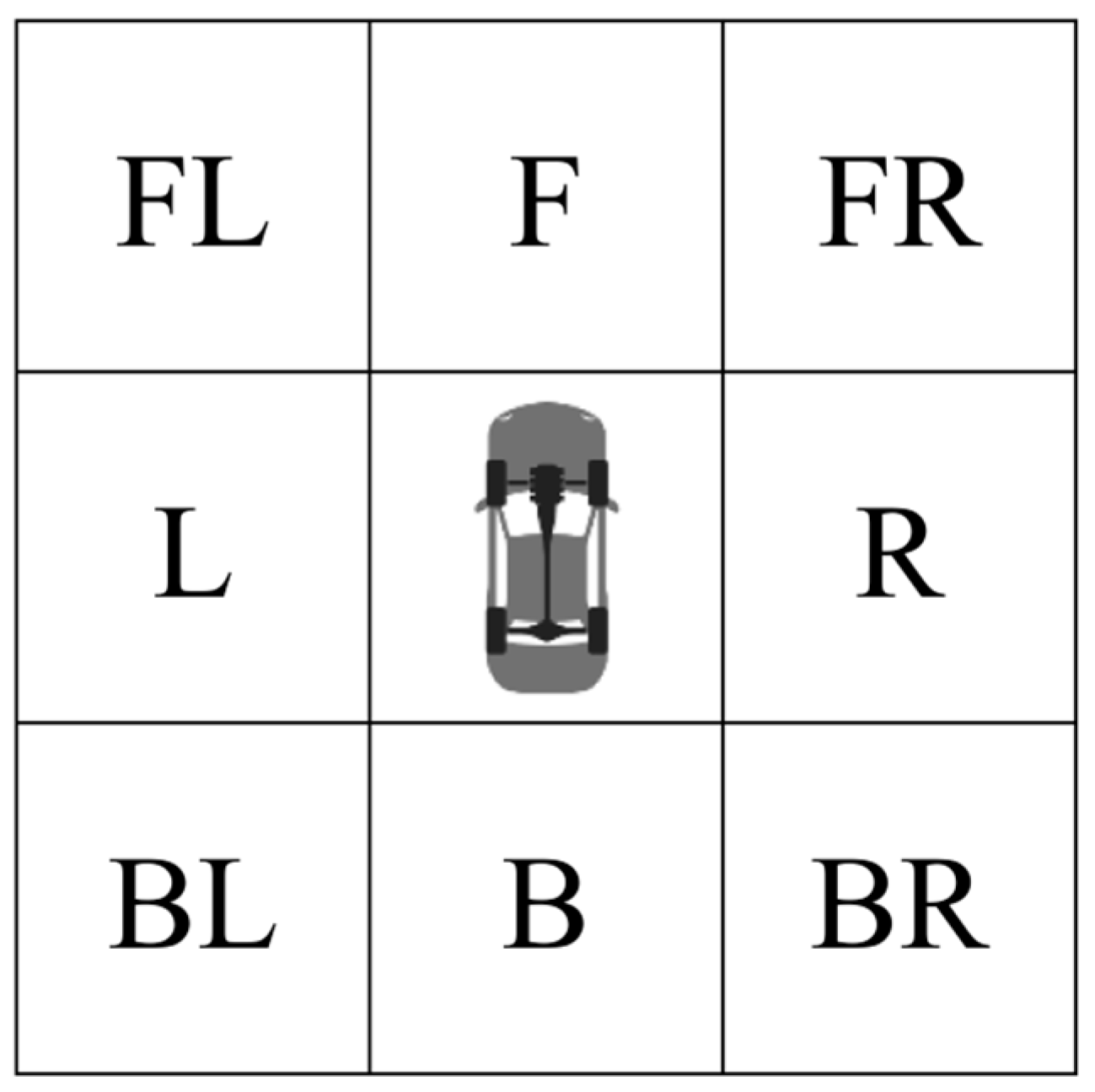
To extract interaction events from vehicle trajectory data, the first step is to identify pairs of interacting vehicles. Based on the extracted trajectory coordinates and vehicle heading information, the positions of adjacent vehicles can be transformed into a heading-oriented coordinate system with the ego vehicle at the origin. Subsequently, by applying thresholds for frontal distance (5 m) and lane width (3.75 m), the relative positional relationship between vehicles can be categorized into eight classes, including Front (F), Front-Left (FL), Front-Right (FR), Left (L), Right (R), Back (B), Back-Left (BL) and Back-Right (BR), as illustrated in
Figure 9.
The four interaction behavior patterns can be mapped onto this relative position framework through specific sequences of positional code changes. For example, if the relative position of an interacting vehicle pair follows the sequence of position codes ‘BR-R-FR-F’ (or a subset like ‘R-FR-F’ or ‘FR-F’), the pair is classified as having performed a front insertion maneuver. Similarly, the remaining three interaction behavior patterns correspond one-to-one with other characteristic trends in position code sequences, as summarized in
Table 3.
Accordingly, vehicle pairs exhibiting interaction behavior and their complete interaction time series were extracted. The ACT was calculated frame-by-frame for each series. An interaction event was deemed valid if the ACT value fell below a predefined threshold at any point. In line with existing research [
22], an ACT threshold of 5.0 s was adopted. Following the extraction of interaction events and calculation of ACT indicators, a total of 231 valid interaction events were identified. These comprised 74 cases of longitudinal effect, 48 cases of lateral effect, 95 cases of frontal insertion, and 14 cases of rear insertion.
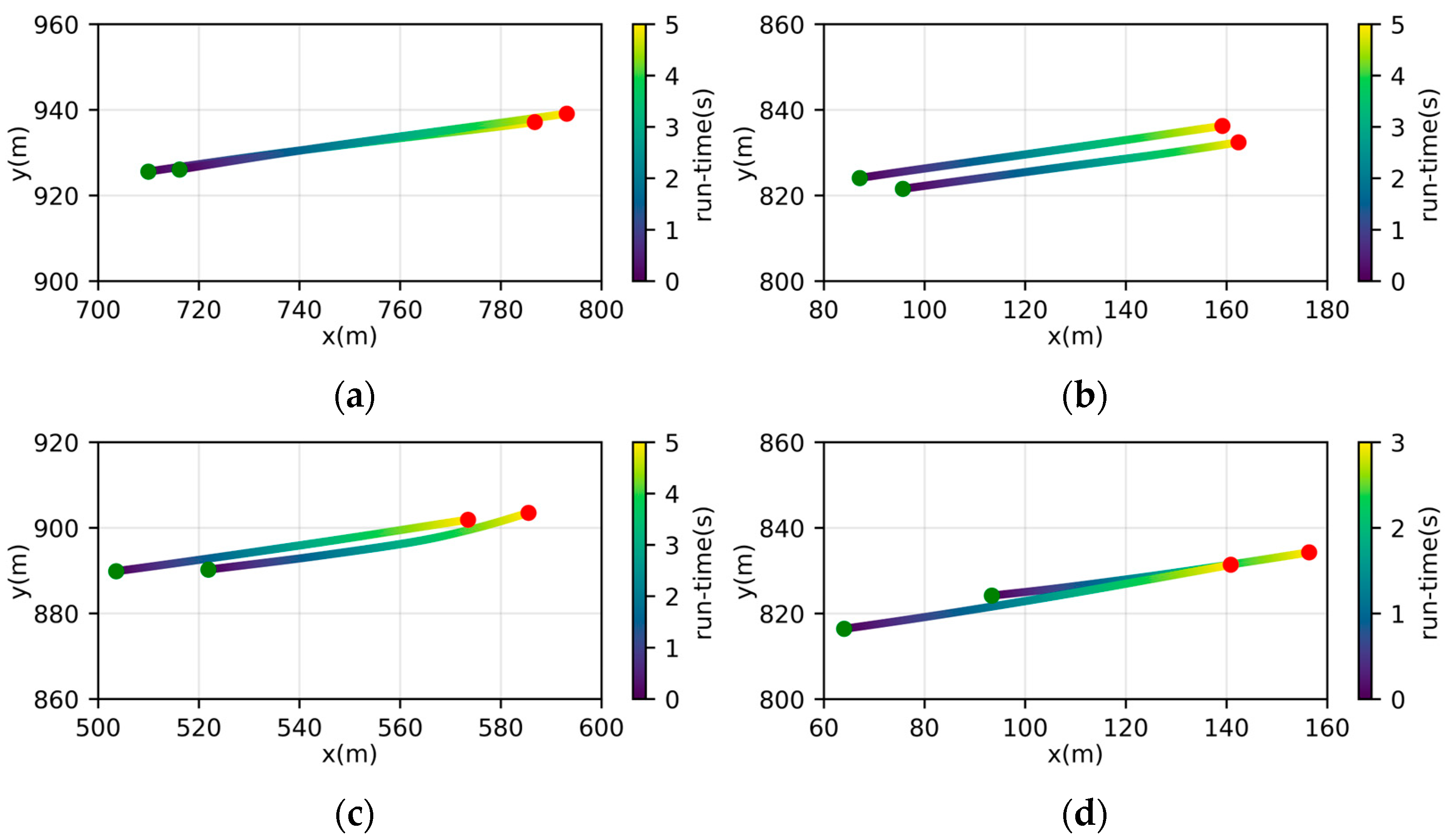
Figure 10 illustrates the typical trajectories of four vehicle Interaction Behavior Patterns, wherein the trajectory color gradient represents the progression of time.
4.3. Risk Level Classification
4.3.1. Risk Quantification
This study employs TE_ACT and TI_ACT as metrics to quantify the risk level of interaction events, which serve as the basis for risk level classification.
In the actual collected trajectory data of interacting vehicles, the TE_ACT and TI_ACT indicators can be calculated approximately using sampling and finite difference methods:
where
is the ACT safety threshold, set to 5.0 s in this study;
denotes the data acquisition interval, which equals 0.01 s given a sampling frequency of 100 Hz;
is the indicator function that takes the value 1 if the risk condition (
) is satisfied at frame
k, and 0 otherwise.
4.3.2. Risk Classification
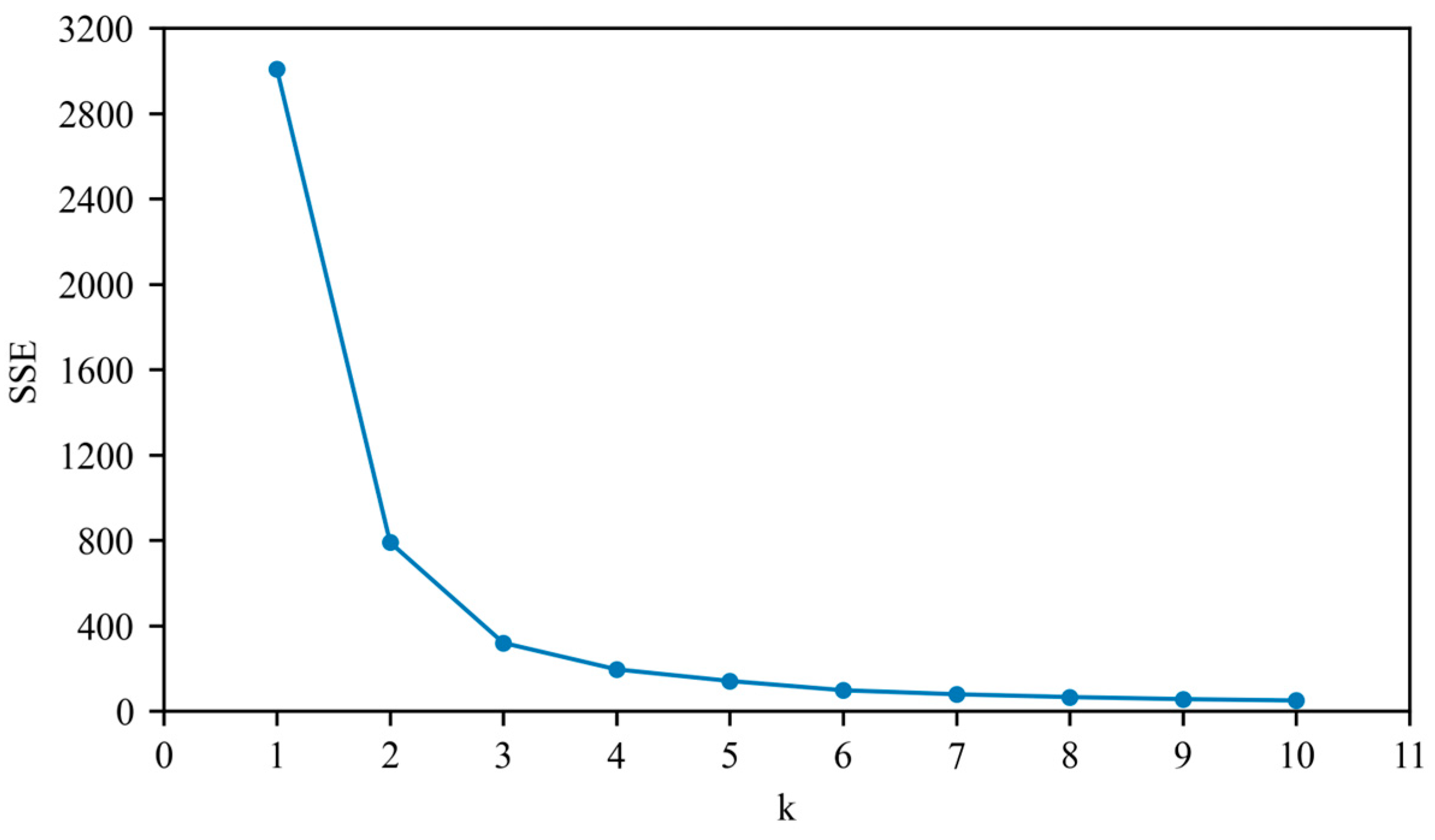
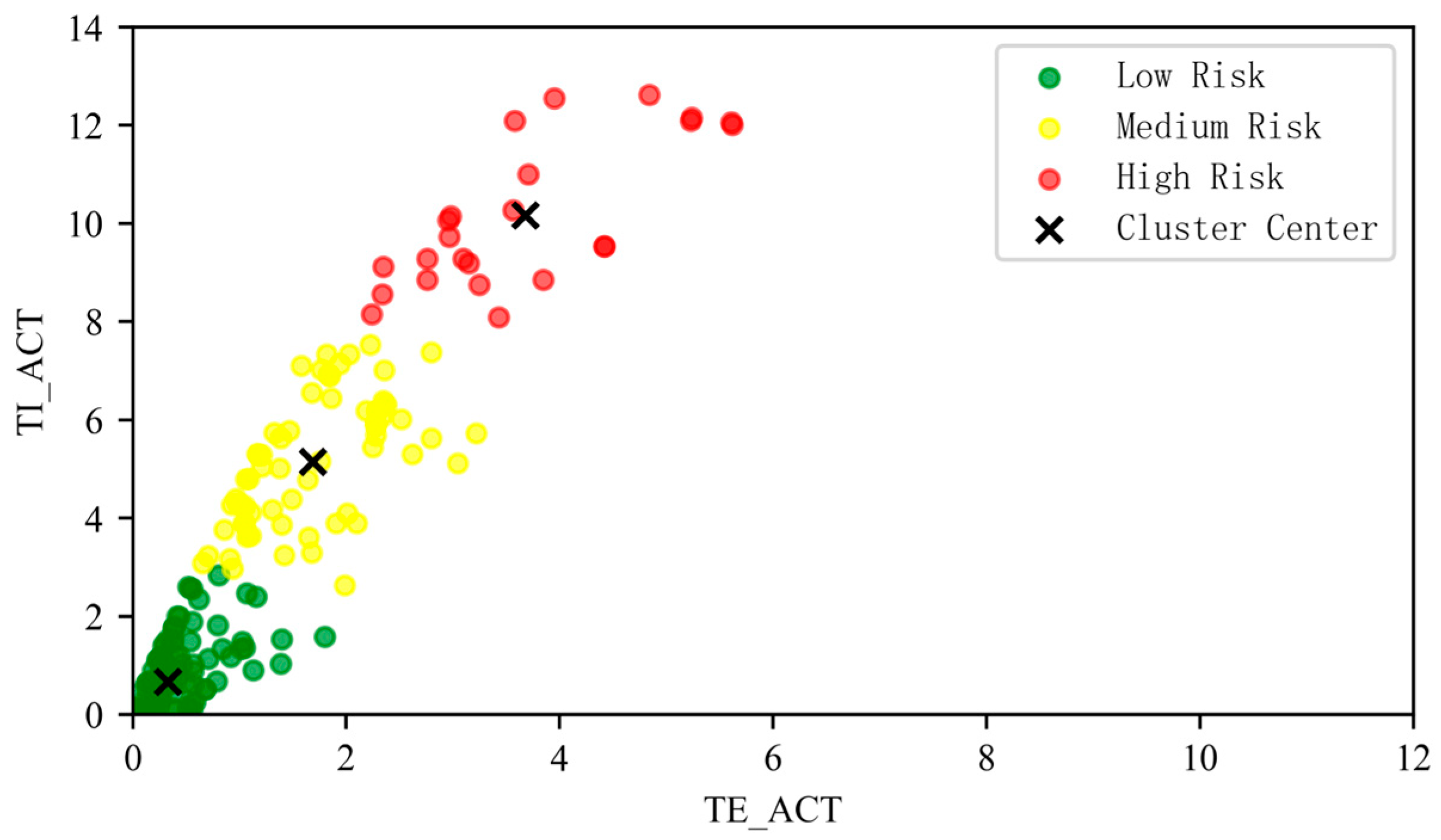
To accurately determine the risk level of interaction behaviors, this study utilizes an unsupervised clustering method to classify the quantified interaction risks. Specifically, the K-means algorithm is employed to divide all interaction events into k risk levels, thereby providing baseline labels for subsequent model construction. Additionally, the Sum of Squared Errors (SSE) is employed as a metric of clustering performance. By plotting the SSE as a function of the number of clusters k, the ‘elbow point’ is identified to determine the optimal number of clusters.
The SSE test results and clustering outcomes are presented in
Figure 11 and
Figure 12. When k equals 3, the SSE curve displays a clear inflection point. Accordingly, this study selects 3 as the appropriate number of risk levels (k = 3). Based on this, the effective interaction events are classified into three risk levels, with the numbers of low-risk, medium-risk, and high-risk events being 138, 67, and 26, respectively.
5. Results and Discussion
5.1. Candidate Explanatory Variables
Candidate explanatory variables were derived from ten categories of time-series signals recorded during vehicle interactions, as listed in
Table 4. These signals included the speed, lateral acceleration, and longitudinal acceleration of both the subject vehicle and the interacting vehicle, as well as the inter-vehicle distance, lateral velocity difference, longitudinal velocity difference, and heading angle difference. For each type of time-series signal, eight statistical indices were extracted: mean value, standard deviation, initial value, final value, maximum value, minimum value, maximum absolute first-order difference, and relative time of occurrence of the extreme value. This process yielded a total of 80 candidate explanatory variables for subsequent modeling.
5.2. Model Construction
5.2.1. Ordered Logit Regression (OLR)
The ordered logit model is a regression method suitable for modeling ordinal categorical response variables, such as the ‘low–medium–high’ risk levels in this study. Its fundamental assumption is that an unobserved continuous latent variable (representing the underlying risk) determines the observed ordinal categories through a set of threshold parameters (cut-points). The logit model is formulated as:
where
denotes the
th threshold;
is the vector of explanatory variables;
represents the regression coefficients. The exponentiated coefficient
represents the odds ratio (OR) for a one-unit change in the corresponding explanatory variable. In practical terms, a positive coefficient indicates that an increase in the variable makes it more likely for the observation to fall into a higher risk category, while a negative coefficient indicates the opposite.
The model’s statistical significance, explanatory power, and discriminative performance were assessed using the following multidimensional indicators.
Likelihood Ratio Test: This test compares the fitted model against a null model (intercept only). The test statistic is expressed as:
This statistic follows a chi-square distribution. A p-value less than 0.05 indicates that the explanatory variables significantly improve the model fit.
McFadden Pseudo
quantifies the model’s explanatory power, which is defined as:
Unlike the derived from Ordinary Least Squares regression, the pseudo is not directly comparable in magnitude and serves primarily as a relative indicator of goodness-of-fit for discrete choice models, such as logit or ordered logit regressions. For interpretive reference, empirical guidelines suggest the following approximate intervals: a pseudo below 0.10 indicates a weak fit; a value between 0.10 and 0.20 suggests a moderate fit; a value between 0.20 and 0.40 reflects a good fit; and values exceeding 0.40 are considered indicative of a very good fit.
The receiver operating characteristic (ROC) analysis is widely used to evaluate the discriminative ability of classification models by examining the trade-off between true positive and false positive rates across different decision thresholds. Volume Under the ROC Surface (VUS) is used to measure the overall discriminative performance. VUS extends the AUC (Area Under ROC Curve) for binary classification to provide a ranking or discrimination metric for three-class ordinal classification [
39]. It assesses the model’s capacity to correctly distinguish among the low, medium, and high categories in sequence—specifically, when one low, one medium, and one high sample are randomly drawn, VUS is the probability that their scores exactly satisfy ‘low < medium < high.’ For three-class problems, the expected value for a random classifier is 1/6, approximately 0.1667, while the VUS value of a perfect classifier is 1. That is, the closer the VUS is to 1, the better the separability among the three categories, whereas the closer it is to 1/6, the closer it approaches randomness [
39,
40]. To estimate uncertainty, this study adopts the bootstrap method for VUS to provide confidence intervals.
5.2.2. Modeling Procedure
The 231 valid interaction events were split into training/validation (85%) and held-out test (15%) sets using stratified sampling to preserve the class distribution.
All candidate explanatory variables were preprocessed to ensure comparability and stable model fitting: missing numerical values were imputed with the median, categorical variables were one-hot encoded, and all features were standardized.
In the training phase, Synthetic Minority Over-sampling Technique (SMOTE) was applied to medium-risk and high-risk samples to address the problem of class imbalance. Subsequently, feature selection was conducted using L1 logistic regression with class weights, and the cross-fold stability of candidate explanatory variables was assessed via five-fold cross-validation. Ultimately, features consistently selected across folds were used to construct the final ORL model.
5.3. Model Application
5.3.1. Overall Model Fit and Discriminative Performance
Based on the final training set (after SMOTE
), the log-likelihood of the fitted ORL model and the log-likelihood of the null model (intercept only) are as follows:
Accordingly, the likelihood ratio statistic is calculated as follows:
With 40 degrees of freedom, this statistic yields a p-value of (p < 0.05), indicating that the full model provides a statistically significant improvement in fit over the null model.
The McFadden pseudo is 0.3193. According to commonly used empirical thresholds, this value falls within the ‘good’ range, suggesting that the selected temporal statistical features provide substantial explanatory power for the risk level of interactive behavior.
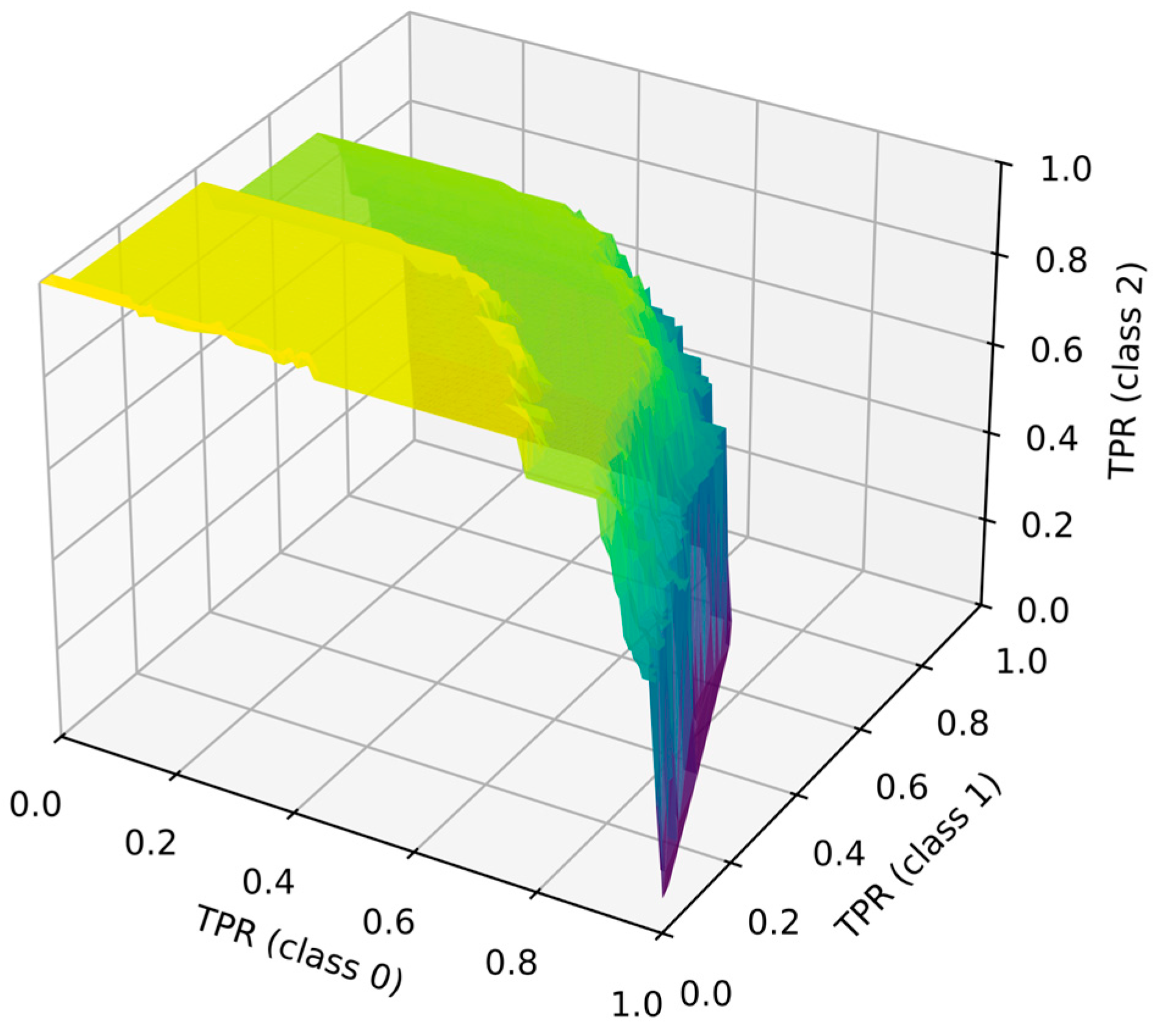
On the test set, the model achieves a VUS of 0.7190, with a 95% bootstrap confidence interval (CI) of [0.5268, 0.8866], as shown in
Figure 13. This result is significantly higher than the random baseline, indicating that the model demonstrates good overall separability in the three-class ordinal classification.
5.3.2. Key Statistical Findings on Risk Factors
The model ultimately retained 40 input variables, and based on Wald tests of individual regression coefficients (significance threshold
p < 0.05), the statistically significant explanatory variables are summarized in
Table 5. All continuous variables have been standardized using z-scores, and OR denotes the impact of each one standard deviation (SD) increase in the variable on the probability of being classified as a higher risk level.
The ordered logit regression results indicate the presence of several significant risk factors. Both the relative time of occurrence of the extreme value of the speed of the interacting vehicle and the maximum absolute first-order difference in the speed of the interacting vehicle exhibit a significant positive correlation with the risk of interaction events. Specifically:
- (1)
Each one-unit increase in the maximum absolute first-order speed difference in the interacting vehicle raises the odds of a high-risk event by 16.22 times.
- (2)
Each one-unit increase in the relative timing of the speed extreme corresponds to an odds ratio of 6.76 for high-risk classification.
- (3)
Similarly, the initial longitudinal speed difference and the relative timing of its extreme value also act as positive risk indicators. A one-unit increase in the initial longitudinal speed difference elevates the high-risk probability by 144%.
By contrast, volatility metrics exhibit a risk-mitigating effect:
- (1)
A one-unit increase in the standard deviation of the interacting vehicle’s vertical acceleration reduces the high-risk probability to 11.04% of the baseline.
- (2)
A one-unit increase in the standard deviation of the subject vehicle’s speed decreases the high-risk probability by 90.4%.
- (3)
The maximum absolute first-order difference in the subject vehicle’s speed emerges as the strongest mitigating factor, lowering the high-risk probability to only 2.33% of its original value per unit increase.
- (4)
Other significant variables, such as the minimum speed of the subject vehicle and the relative timing of the heading-angle-difference extreme, show odds ratios between 0.24 and 0.53, implying that improvements in these measures can reduce high-risk probability by 47% to 76%.
5.3.3. Interpretation and Engineering Implications
From an engineering standpoint, the results highlight three key points for real-time risk assessment and warning systems.
Firstly, the temporal dimension is critical for distinguishing among risk levels. Relying solely on the instantaneous magnitude of kinematic features—such as peak speed or maximum acceleration—proves insufficient for precise and proactive risk classification. This is because identical magnitudes can bear entirely different implications depending on when they occur within an event’s evolution. In this study, the relative timing of an extreme value within the interaction sequence is established as a core discriminant. Specifically, this study demonstrates that extreme values or abrupt changes which emerge during the later stages of the interaction process are substantially more likely to signal an imminent escalation to a high-risk situation. This finding underscores that risk is not a static property captured at a snapshot, but a dynamic process where the temporal context dictates the severity. Consequently, it necessitates a paradigm shift in system design: real-time monitoring must move beyond tracking magnitudes in isolation to incorporate the dynamic trajectory and timing of events as fundamental inputs to risk assessment logic.
Secondly, it is essential to differentiate between the semantic roles of the ‘subject vehicle’ and the ‘interacting vehicle’. The analysis shows that a first-order mutation in the speed of the interacting vehicle constitutes a strong risk signal. In contrast, similar abruptness indicators for the subject vehicle did not demonstrate consistent risk-indicating effects within the model. This suggests that the behaviors of different traffic participants contribute differently to risk formation. The sudden actions of the interacting vehicle often act as the primary risk trigger, whereas certain dynamic changes in the subject vehicle may reflect evasive or buffering maneuvers. Therefore, warning rules should be constructed by clearly distinguishing these roles, prioritizing abrupt changes from the interacting vehicle as the main basis for triggering alerts.
Thirdly, the initial state of an event holds independent predictive value for risk. Features such as the initial longitudinal speed difference and the initial lateral acceleration were significantly correlated with risk levels. A large initial speed difference or a high initial acceleration typically indicates the presence of a prior hazard or more aggressive driving behavior even before the interaction fully develops. These initial conditions provide valuable a priori risk cues. Monitoring systems should therefore pay increased attention to these parameters at the early stage of an interaction to allow more time for potential intervention.
Overall, the analysis of
Table 5 indicates that the ability to distinguish risk levels is attributable not only to magnitude-based features (such as abrupt changes in speed or acceleration), but more importantly, to heterogeneous informational dimensions—the joint influence of the timing of occurrences within the sequence, the initial and terminal indicators, and the magnitude or fluctuations collectively determine the final risk level of the event. The range of OR values for 17 significant variables and their 95% confidence intervals all exclude 1, further confirming the robustness of the combined effects of these dimensions. Accordingly, the empirical conclusion of this study is as follows: when developing real-time risk early warning systems, ‘the relative time of extreme value occurrence within the temporal window’, ‘first-order mutation in the speed of the interacting vehicle’, and ‘the initial speed difference or acceleration level of the event’ should be prioritized as key monitoring indicators.
A supplementary analysis of high-risk event distribution revealed that novice merging drivers were involved in a disproportionately higher share (46%) of such events compared to experienced (35%) and professional drivers (19%), hinting at the moderating role of driving experience. However, the core kinematic risk factors (e.g., abrupt speed changes, late-stage extremes) were identified across all driver groups, suggesting their fundamental role in conflict escalation.
6. Conclusions
This study established a multi-driver simulation platform to investigate vehicle interaction behaviors in interchange merging areas. By collecting high-resolution trajectory data, we identified 231 valid interaction events and classified them into four patterns—longitudinal, lateral, front cut-in, and rear cut-in—using an eight-direction relative position model. The risk of each event was quantified with Time-Exposed and Time-Integrated Anticipated Collision Time (TE_ACT/TI_ACT) metrics. Unsupervised clustering categorized these events into three risk levels: 138 low-risk, 67 medium-risk, and 26 high-risk events. An ordered logit regression model (McFadden pseudo R2 = 0.319) was then applied to identify key influencing factors. The principal conclusions are as follows:
- (1)
The proposed eight-direction framework offers an effective, reproducible method for classifying interaction behaviors, successfully categorizing all observed events. This supports systematic, fine-grained safety analysis in complex merging scenarios.
- (2)
The ACT-based temporal indicators (TE_ACT and TI_ACT) effectively captured both the intensity and persistence of risk exposure. They demonstrated strong utility in differentiating risk levels, providing a robust quantitative basis for proactive safety assessment that surpasses traditional instantaneous metrics.
- (3)
The regression model revealed distinct, quantifiable mechanisms of risk. Interaction risk escalates significantly with abrupt speed changes (OR = 16.22) and late-stage speed extremes (OR = 6.76) in the interacting vehicle, as well as large initial speed differences (OR = 2.45). Conversely, stable speed regulation and adaptive acceleration by the subject vehicle were potent mitigating factors, with specific measures reducing high-risk odds by 90.4% and 97.7%, respectively. This highlights the critical importance of smooth driving behaviors for sustainable traffic flow.
- (4)
The relative time of occurrence of the extreme value of the speed of the interacting vehicle is a critical factor in distinguishing risk levels, offering greater explanatory power than traditional instantaneous magnitude-based metrics. Specifically, extreme values or abrupt changes that emerge during the later stages of the interaction process are more likely to indicate that an event will escalate into a high-risk situation in the near term. Consequently, real-time monitoring systems must incorporate its dynamic variations into their risk assessment logic.
- (5)
The construction of warning rules should clearly differentiate between the semantic roles of the “subject vehicle” and the “interacting vehicle,” with abrupt changes in the interacting vehicle serving as the primary basis for triggering alerts. At the same time, the initial state of an event holds independent predictive value for risk, and monitoring systems should therefore pay greater attention to these parameters during the early stages of an interaction to allow more time for potential intervention measures.
In summary, this research presents an integrated framework—from interaction identification and continuous risk quantification to influential factor analysis—that clarifies the mechanisms of risk formation in merging zones. The quantitative findings offer actionable insights for developing intelligent safety tools, adaptive collision-warning systems, and sustainably oriented infrastructure management, contributing directly to safer, more efficient, and resilient urban transportation systems.
While the proposed framework provides mechanistic insights and actionable implications, further efforts are needed to enhance its generalizability, validate its transferability across data sources, and enable real-time implementation. Accordingly, future work will proceed in three directions. First, broaden scenario diversity by systematically varying external environmental factors, such as traffic density, weather, visibility, lighting, and geometric design, while increasing the number and heterogeneity of participants to strengthen generalizability. Second, pursue cross-validation with additional data sources (e.g., field trajectory datasets where available) to examine the transferability of interaction patterns and ACT-based temporal risk signatures beyond the simulator. Third, translate the identified risk mechanisms into a real-time prototype by implementing online feature extraction within a sliding time window and developing warning logic that explicitly accounts for the semantic roles of the “subject vehicle” and “interacting vehicle,” enabling earlier and more context-aware intervention in merging zones. Furthermore, while the experiment recorded driver demographics and experience, the current analysis did not fully model how these characteristics, their combinations, or latent factors like stress response time modulate interaction risk. Future research should integrate detailed driver profiling and psychophysiological measures to build upon the universal kinematic risk model established here.
Additionally, future studies with larger, balanced samples could investigate interaction effects between driver demographics (e.g., age × experience × gender). Integrating psychophysiological measures such as stress response time or cognitive load could further illuminate how internal states modulate interaction risk. To build a more holistic understanding, future experiments could combine the present kinematic-focused approach with comprehensive driver assessments (trait, state, and performance metrics) within the same multi-driver simulation framework. In addition, the application of advanced artificial intelligence and machine learning techniques—such as deep sequence models for real-time conflict prediction or explainable AI for interpreting risk factors—represents a promising avenue for automating and refining safety assessments based on ACT, TTC, and other dynamic indicators. As for the ACT* safety threshold, the choice of a fixed threshold may not fully capture context-dependent risk perceptions and that future work could explore adaptive thresholding methods. Furthermore, future versions of the simulation platform could be coupled with macroscopic or mesoscopic traffic simulation software such as Aimsun to study how localized interaction risks propagate at the network level.
Funding
This research was funded by the Shanghai Science and Technology Planning Project (20DZ2252100).
Institutional Review Board Statement
The study was conducted in accordance with the Declaration of Helsinki, and approved by the Ethics Committee of the Shanghai Research Center for Smart Mobility and Road Safety in China on 6 January 2025 (Approval Number: 2025-01-002), with which the author was formerly affiliated.
Informed Consent Statement
Informed consent was obtained from all subjects involved in the study.
Data Availability Statement
The original contributions presented in this study are included in the article. Further inquiries can be directed to the corresponding author.
Conflicts of Interest
Haorong Peng was employed by the ”Tongji Architectural Design (Group) Co., Ltd., Shanghai 200092, China“. The authors, Haorong Peng, declare that the research was conducted in the absence of any commercial or financial relationships that could be construed as no conflict of interest.
Abbreviations
The following abbreviations are used in this manuscript:
| EEG | Electroencephalography |
| TTC | Time to Collision |
| PET | Post Encroachment Time |
| ACT | Anticipated Collision Time |
| TE_ACT | Time-Exposed ACT |
| TI_ACT | Time-Integrated ACT |
| F | Front |
| FL | Front-Left |
| FR | Front-Right |
| L | Left |
| R | Rright |
| B | Back |
| BL | Back-Left |
| BR | Back-Rright |
| SSE | Sum of Squared Errors |
| OLR | Ordered Logit Regression |
| OR | Odds Ratio |
| ROC | Receiver Operating Characteristic |
| VUS | Volume Under the ROC Surface |
| AUC | Area Under ROC Curve |
| SMOTE | Synthetic Minority Over-Sampling Technique |
| CI | Confidence Interval |
| SD | Standard Deviation |
References
- Li, H.; Zhang, J.; Li, Y.; Huang, Z.; Cao, H. Modeling and Simulation of Vehicle Group Collaboration Behaviors in an On-Ramp Area with a Connected Vehicle Environment. Simul. Model. Pract. Theory 2021, 110, 102332. [Google Scholar] [CrossRef] [Scilit]
- Zhang, F.F.; Wang, C.J.; Wang, J.H. Vehicle interaction patterns at on-ramp merging area of urban expressway. China J. Highw. Transp. 2022, 35, 66–79. [Google Scholar] [CrossRef]
- Ma, W.; Li, P.; Zhao, J.; Qi, J.; Li, C. Organized Traffic Interweaving: Cooperative Trajectory Control of Vehicles Merging from Exit Ramps onto Surface Streets. J. Transp. Eng. Part A Syst. 2025, 151, 04024119. [Google Scholar] [CrossRef] [Scilit]
- Shi, X.; Yang, S.; Ye, Z. Development of a Unity–VISSIM Co-Simulation Platform to Study Interactive Driving Behavior. Systems 2023, 11, 269. [Google Scholar] [CrossRef] [Scilit]
- Jia, X.; Sun, L.; Tomizuka, M.; Zhan, W. IDE-Net: Interactive Driving Event and Pattern Extraction from Human Data. IEEE Robot. Autom. Lett. 2021, 6, 3065–3072. [Google Scholar] [CrossRef] [Scilit]
- Himmels, C.; Parduzi, A.; Löcken, A.; Protschky, V.; Venrooij, J.; Riener, A. Validating Risk Behavior in Driving Simulation Using Naturalistic Driving Data. Transp. Res. Part F Traffic Psychol. Behav. 2024, 107, 710–725. [Google Scholar] [CrossRef] [Scilit]
- Zhang, Y.; Yan, X.; Wu, J.; Duan, K. Effect of Warning System on Interactive Driving Behavior at Unsignalized Intersection under Fog Conditions: A Study Based on Multiuser Driving Simulation. J. Adv. Transp. 2020, 2020, 8871875. [Google Scholar] [CrossRef] [Scilit]
- Jung, A.; Jo, Y.; Oh, C.; Park, J.; Yun, D. A Multi-Agent Driving-Simulation Approach for Characterizing Hazardous Vehicle Interactions between Autonomous Vehicles and Manual Vehicles. Appl. Sci. 2024, 14, 1468. [Google Scholar] [CrossRef] [Scilit]
- Siebinga, O.; Zgonnikov, A.; Abbink, D. Interactive Merging Behavior in a Coupled Driving Simulator: Experimental Framework and Case Study. Hum. Factors Transp. 2022, 60, 516–525. [Google Scholar] [CrossRef] [Scilit]
- Ramlall, P.; Jones, E.; Roy, S. Development of a Networked Multi-Participant Driving Simulator with Synchronized EEG and Telemetry for Traffic Research. Systems 2025, 13, 564. [Google Scholar] [CrossRef] [Scilit]
- Sun, J.; Zuo, K.; Jiang, S.; Zheng, Z. Modeling and Predicting Stochastic Merging Behaviors at Freeway On-Ramp Bottlenecks. J. Adv. Transp. 2018, 2018, 9308580. [Google Scholar] [CrossRef] [Scilit]
- Siebinga, O.; Zgonnikov, A.; Abbink, D. A Model of Dyadic Merging Interactions Explains Human Drivers’ Behavior from Control Inputs to Decisions. PNAS Nexus 2024, 3, pgae420. [Google Scholar] [CrossRef] [Scilit]
- Duan, K.; Yan, X.; Li, X.; Hang, J. Improving Drivers’ Merging Performance in Work Zone Using an in-Vehicle Audio Warning. Transp. Res. Part F Traffic Psychol. Behav. 2023, 95, 297–321. [Google Scholar] [CrossRef] [Scilit]
- Siriwardene, S.; Ashraf, M.; Debnath, A.K. An Observational Study of Understanding the Factors Influencing Merging Behaviour in Work Zones. Transp. Res. Part F Traffic Psychol. Behav. 2025, 109, 556–570. [Google Scholar] [CrossRef] [Scilit]
- Sun, J.; Yang, H. Learning Two-Dimensional Merging Behaviour from Vehicle Trajectories with Imitation Learning. Transp. Res. Part C Emerg. Technol. 2024, 160, 104530. [Google Scholar] [CrossRef] [Scilit]
- Ni, X.; Huang, H.; Li, R.; Chen, A.; Liu, Y.; Xing, H.; Liu, K.; Wang, M. Synergistic Influence of Rainstorm and Waterlogging on Drivers’ Driving Behavior—An Experimental Study Based on High-Fidelity Driving Simulator. Sustainability 2022, 14, 8517. [Google Scholar] [CrossRef] [Scilit]
- Liu, Z.; Liu, X.; Li, Q.; Zhang, Z.; Gao, C.; Tang, F. Strategies for Coordinated Merging of Vehicles at Ramps in New Hybrid Traffic Environments. Sustainability 2025, 17, 4522. [Google Scholar] [CrossRef] [Scilit]
- Zhang, Y.; Jiang, P.; Wang, S.; Cheng, S.; Xu, J.; Liu, Y. Study on the Driver Visual Workload in High-Density Interchange-Merging Areas Based on a Field Driving Test. Sensors 2024, 24, 6247. [Google Scholar] [CrossRef] [Scilit]
- Mohammadi, A.; Cherakkatil, M.S.B.; Park, P.Y.; Nourinejad, M.; Asgary, A. An Open-Source Virtual Reality Traffic Co-Simulation for Enhanced Traffic Safety Assessment. Appl. Sci. 2025, 15, 9351. [Google Scholar] [CrossRef] [Scilit]
- Meng, X.H.; Zhang, Z.Z.; Shi, Y.Y. Research on Traffic Safety on Freeway Merging Sections Based on TTC and PET. Appl. Mech. Mater. 2014, 587–589, 2224–2229. [Google Scholar] [CrossRef] [Scilit]
- Jiang, R.; Zhu, S.; Chang, H.; Wu, J.; Ding, N.; Liu, B.; Qiu, J. Determining an Improved Traffic Conflict Indicator for Highway Safety Estimation Based on Vehicle Trajectory Data. Sustainability 2021, 13, 9278. [Google Scholar] [CrossRef] [Scilit]
- Venthuruthiyil, S.P.; Chunchu, M. Anticipated Collision Time (ACT): A Two-Dimensional Surrogate Safety Indicator for Trajectory-Based Proactive Safety Assessment. Transp. Res. Part C Emerg. Technol. 2022, 139, 103655. [Google Scholar] [CrossRef] [Scilit]
- Jiao, Y.; Calvert, S.C.; Van Cranenburgh, S.; Van Lint, H. A Unified Probabilistic Approach to Traffic Conflict Detection. Anal. Methods Accid. Res. 2025, 45, 100369. [Google Scholar] [CrossRef] [Scilit]
- Lee, M.; Kim, Y.; Kim, T.; Hwang, S. Enhancing Perceived Risk Prediction of Human-Vehicle Collisions in Urban and Construction Environments by Incorporating Motion Dynamics and Behavior-Based Features. J. Asian Archit. Build. Eng. 2025, 1–21. [Google Scholar] [CrossRef] [Scilit]
- Tang, S.; Lu, Y.; Liao, Y.; Cheng, K.; Zou, Y. A New Surrogate Safety Measure Considering Temporal–Spatial Proximity and Severity of Potential Collisions. Appl. Sci. 2024, 14, 2711. [Google Scholar] [CrossRef] [Scilit]
- Li, Y.; Zhu, J.; Haque, M.M.; Lee, J. Hazard-Based Duration Modelling of Merging Time Interval on Freeway on-Ramps. Transp. Saf. Environ. 2023, 5, tdac040. [Google Scholar] [CrossRef] [Scilit]
- Tian, Y.; Zhang, Z.; Li, Z.; Fu, X.; Wang, G.; Ma, Y.; Wu, J. Traffic Conflict Identification and Risk Assessment at Ramp Merging Areas Based on Improved XGBoost and SHAP. J. Transp. Eng. Part A Syst. 2025, 151, 04025091. [Google Scholar] [CrossRef] [Scilit]
- Ye, Q.; Li, Y.; Niu, B. Risk Propagation Mechanism and Prediction Model for the Highway Merging Area. Appl. Sci. 2023, 13, 8014. [Google Scholar] [CrossRef] [Scilit]
- Wang, Y.; Lyu, N.; Wu, C.; Du, Z.; Deng, M.; Wu, H. Investigating the Impact of HMI on Drivers’ Merging Performance in Intelligent Connected Vehicle Environment. Accid. Anal. Prev. 2024, 198, 107448. [Google Scholar] [CrossRef] [Scilit]
- Siebinga, O.; Zgonnikov, A.; Abbink, D.A. Human Merging Behavior in a Coupled Driving Simulator: How Do We Resolve Conflicts? IEEE Open J. Intell. Transp. Syst. 2024, 5, 103–114. [Google Scholar] [CrossRef] [Scilit]
- Xie, K.; Ozbay, K.; Yang, H.; Li, C. Mining Automatically Extracted Vehicle Trajectory Data for Proactive Safety Analytics. Transp. Res. Part C Emerg. Technol. 2019, 106, 61–72. [Google Scholar] [CrossRef] [Scilit]
- Fu, C.; Sayed, T. Comparison of Threshold Determination Methods for the Deceleration Rate to Avoid a Crash (DRAC)-Based Crash Estimation. Accid. Anal. Prev. 2021, 153, 106051. [Google Scholar] [CrossRef] [Scilit]
- Hossain, M.; Abdel-Aty, M.; Quddus, M.A.; Muromachi, Y.; Sadeek, S.N. Real-Time Crash Prediction Models: State-of-the-Art, Design Pathways and Ubiquitous Requirements. Accid. Anal. Prev. 2019, 124, 66–84. [Google Scholar] [CrossRef] [Scilit]
- Dimitriou, L.; Stylianou, K.; Abdel-Aty, M.A. Assessing Rear-End Crash Potential in Urban Locations Based on Vehicle-by-Vehicle Interactions, Geometric Characteristics and Operational Conditions. Accid. Anal. Prev. 2018, 118, 221–235. [Google Scholar] [CrossRef] [Scilit] [PubMed]
- Sacchi, E.; Sayed, T. Conflict-Based Safety Performance Functions for Predicting Traffic Collisions by Type. Transp. Res. Rec. J. Transp. Res. Board 2016, 2583, 50–55. [Google Scholar] [CrossRef] [Scilit]
- Mahmud, S.M.S.; Ferreira, L.; Hoque, M.S.; Tavassoli, A. Application of Proximal Surrogate Indicators for Safety Evaluation: A Review of Recent Developments and Research Needs. IATSS Res. 2017, 41, 153–163. [Google Scholar] [CrossRef] [Scilit]
- Zheng, L.; Ismail, K.; Meng, X. Traffic Conflict Techniques for Road Safety Analysis: Open Questions and Some Insights. Can. J. Civ. Eng. 2014, 41, 633–641. [Google Scholar] [CrossRef] [Scilit]
- Nadimi, N.; Ragland, D.R.; Mohammadian Amiri, A. An Evaluation of Time-to-Collision as a Surrogate Safety Measure and a Proposal of a New Method for Its Application in Safety Analysis. Transp. Lett. 2020, 12, 491–500. [Google Scholar] [CrossRef] [Scilit]
- Liu, S.; Xu, W.; Sun, X.; Zhang, Y. Fast and Unbiased Estimation of Volume under Ordered Three-Class ROC Surface (VUS) Based on Dynamic Programming. IEEE Access 2019, 7, 63972–63982. [Google Scholar] [CrossRef] [Scilit]
- Zhu, H.; Liu, S.; Xu, W.; Chen, C.; Tan, H. Fast and Unbiased Estimation of Volume under the Ordered Multi-Class ROC Hyper-Surface with Continuous Measurements. Digit. Signal Process. 2022, 126, 103500. [Google Scholar] [CrossRef] [Scilit]
Figure 1.
Six Degrees of Freedom High-Fidelity Driving Simulator.
Figure 1.
Six Degrees of Freedom High-Fidelity Driving Simulator.
Figure 2.
Fixed Base Driving Simulator.
Figure 2.
Fixed Base Driving Simulator.
Figure 3.
Satellite Image of the Interchange Intersection.
Figure 3.
Satellite Image of the Interchange Intersection.
Figure 4.
Driving Simulation Experimental Scene Established in Unity.
Figure 4.
Driving Simulation Experimental Scene Established in Unity.
Figure 5.
Schematic Representation of Merging Scenes in Multi-driver Driving Simulation Experiment: (a) Scene 1: Mainline Merging; (b) Scene 2: Ramp Merging.
Figure 5.
Schematic Representation of Merging Scenes in Multi-driver Driving Simulation Experiment: (a) Scene 1: Mainline Merging; (b) Scene 2: Ramp Merging.
Figure 6.
Experimental Process: (a) Experimental Process of the Six Degrees of Freedom Driving Simulator; (b) Experimental Process of the Fixed Base Driving Simulator.
Figure 6.
Experimental Process: (a) Experimental Process of the Six Degrees of Freedom Driving Simulator; (b) Experimental Process of the Fixed Base Driving Simulator.
Figure 7.
Temporal Risk Exposure Indicators Based on the Anticipated Collision Time (ACT) Curve ( is the ACT safety threshold).
Figure 7.
Temporal Risk Exposure Indicators Based on the Anticipated Collision Time (ACT) Curve ( is the ACT safety threshold).
Figure 8.
Illustration of Four Vehicle Interaction Behavior Patterns: (a) Longitudinal Effect; (b) Lateral Effect; (c) Front Insertion; (d) Rear Insertion.
Figure 8.
Illustration of Four Vehicle Interaction Behavior Patterns: (a) Longitudinal Effect; (b) Lateral Effect; (c) Front Insertion; (d) Rear Insertion.
Figure 9.
Schematic Diagram of Vehicle Relative Positions (Host vehicle represented as the central gray vehicle).
Figure 9.
Schematic Diagram of Vehicle Relative Positions (Host vehicle represented as the central gray vehicle).
Figure 10.
Trajectory diagrams of the four vehicle Interaction Behavior Patterns: (a) Longitudinal Effect; (b) Lateral Effect; (c) Front Insertion; (d) Rear Insertion.
Figure 10.
Trajectory diagrams of the four vehicle Interaction Behavior Patterns: (a) Longitudinal Effect; (b) Lateral Effect; (c) Front Insertion; (d) Rear Insertion.
Figure 11.
Sum of Squared Errors (SSE) test results.
Figure 11.
Sum of Squared Errors (SSE) test results.
Figure 12.
K-means clustering results for effective interaction events.
Figure 12.
K-means clustering results for effective interaction events.
Figure 13.
Volume Under the Receiver Operating Characteristic Surface (VUS) 3D for the Entire Dataset.
Figure 13.
Volume Under the Receiver Operating Characteristic Surface (VUS) 3D for the Entire Dataset.
Table 1.
Statistics of Drivers’ Age and Driving Experience.
Table 1.
Statistics of Drivers’ Age and Driving Experience.
| Driver Group | Number of Participants | Average Age (Years) | Average Driving Experience (Years) |
|---|
| Novice Drivers | 20 | 22.4 | 1.8 |
| Experienced Drivers | 20 | 31.3 | 9.4 |
| Professional Drivers | 20 | 48.7 | 20.8 |
| Total Sample | 60 | 29.2 | 10.7 |
Table 2.
Experimental Raw Data Variables.
Table 2.
Experimental Raw Data Variables.
| Variable Name | Unit |
|---|
| Recording Time | s |
| x | m |
| y | m |
| z | m |
| Speed | m/s |
| Longitudinal Acceleration | m/s2 |
| Lateral Acceleration | m/s2 |
| Yaw Angle | ° |
| Angular Acceleration | °/s |
| Travel Distance | m |
| Steering Wheel Angle | rad |
| Accelerator Pedal Position | % |
| Brake Pedal Position | % |
Table 3.
Relative Position Code Conditions Corresponding to Interaction Behavior Patterns.
Table 3.
Relative Position Code Conditions Corresponding to Interaction Behavior Patterns.
| Interaction Behavior Pattern | Position Code Conditions |
|---|
| Longitudinal Effect | F, B |
| Lateral Effect | FL-L, BL-L, FR-R, BR-R, L, R |
| Frontal Insertion | BR-R-FR-F, R-FR-F, FR-F |
| Rear Insertion | FR-R-BR-B, R-BR-B, BR-B |
Table 4.
Semantic Description of Indicators.
Table 4.
Semantic Description of Indicators.
| Indicator | Description |
|---|
| Subject vehicle | The vehicle that consistently occupies the central position in the ‘eight-direction classification,’ serving as the reference object for analysis. |
| Interacting vehicle | Relative to the subject vehicle, the vehicle whose position or directional category changes during the interaction event. |
| Mean value | Mean value over the entire time series. |
| Standard deviation | Describes the magnitude of fluctuation, indicating the degree of numerical dispersion. |
| Initial value | Initial value at the start of the interaction event. |
| Final value | Value at the end of the interaction event. |
| Maximum value | The maximum value occurring in the time series. |
| Minimum value | Minimum value observed in the time series. |
| Maximum absolute first-order difference | The maximum absolute first-order difference between adjacent time points within the time series, used to measure the magnitude of instantaneous variation. |
| Relative time of occurrence of the extreme value | The relative position (0–1) within the entire time series at which the extreme value is first reached, reflecting the timing of the occurrence of the extreme value. |
Table 5.
Significant Explanatory Variables in the Ordered Logit Model.
Table 5.
Significant Explanatory Variables in the Ordered Logit Model.
| Variables | Coefficient | Standard Error | p-Value | OR (95%CI) |
|---|
| Relative time of occurrence of the extreme value of the speed of the interacting vehicle | 1.9104 | 0.3544 | <0.0001 | 6.7561 (3.37–13.53) |
| Maximum absolute first-order difference in the speed of the interacting vehicle | 2.7865 | 0.6281 | <0.0001 | 16.2235 (4.74–55.57) |
| Standard deviation of the vertical acceleration of the interacting vehicle | −2.2033 | 0.5411 | <0.0001 | 0.1104 (0.04–0.32) |
| Mean value of the original vehicle speed | 1.5300 | 0.3935 | 0.0001 | 4.6179 (2.14–9.98) |
| Minimum value of the original vehicle speed | −1.4207 | 0.3909 | 0.0005 | 0.2416 (0.11–0.52) |
| Initial value of the longitudinal velocity difference | 0.8954 | 0.2837 | 0.0016 | 2.4482 (1.40–4.27) |
| Maximum absolute first-order difference in original vehicle speed | −3.7590 | 1.2146 | 0.0020 | 0.0233 (0.00–0.25) |
| Standard deviation of original vehicle speed | −2.3432 | 0.8104 | 0.0038 | 0.0960 (0.02–0.47) |
| Relative time of occurrence of the extreme value of heading angle difference | −1.1995 | 0.4656 | 0.010 | 0.3013 (0.12–0.75) |
| Final value of lateral velocity difference | 0.6560 | 0.2591 | 0.0113 | 1.9270 (1.16–3.20) |
| Initial value of subject vehicle lateral acceleration | 0.8205 | 0.3369 | 0.0149 | 2.2716 (1.17–4.40) |
| Minimum value of interacting vehicle lateral acceleration | 0.8374 | 0.3547 | 0.0182 | 2.3103 (1.15–4.63) |
| Mean value of interacting vehicle vertical acceleration | −0.6271 | 0.2709 | 0.0206 | 0.5341 (0.31–0.91) |
| Initial value of vertical acceleration of the interacting vehicle | 0.4405 | 0.1905 | 0.0208 | 1.5535 (1.07–2.26) |
| Relative time of occurrence of the extreme value of vertical acceleration of the subject vehicle | −1.0288 | 0.4763 | 0.0308 | 0.3574 (0.14–0.91) |
| Relative time of occurrence of the extreme value of longitudinal velocity difference | 1.2607 | 0.6109 | 0.0390 | 3.5278 (1.07–11.68) |
| Relative time of occurrence of the extreme value of vertical acceleration of the interacting vehicle | −0.6931 | 0.3532 | 0.0497 | 0.5000 (0.25–0.98) |
| Disclaimer/Publisher’s Note: The statements, opinions and data contained in all publications are solely those of the individual author(s) and contributor(s) and not of MDPI and/or the editor(s). MDPI and/or the editor(s) disclaim responsibility for any injury to people or property resulting from any ideas, methods, instructions or products referred to in the content. |