Review

A Review of Sulfate Removal Technologies in Wastewater: A Perspective on Simultaneous Removal of Sulfate and Co-Existing Contaminants

Key Laboratory of Water Quality Science and Water Environment Recovery Engineering, Beijing University of Technology, Beijing 100124, China
*
Author to whom correspondence should be addressed.
Sustainability 2026, 18(4), 2031; https://doi.org/10.3390/su18042031
Submission received: 31 December 2025 / Revised: 8 February 2026 / Accepted: 13 February 2026 / Published: 16 February 2026
(This article belongs to the Section Sustainable Water Management)

Abstract

The high concentrations of sulfate and other pollutants in various contaminated waters awaiting treatment have emerged as a global environmental challenge, frequently exceeding the discharge limits for pollutants in wastewater worldwide. Simultaneous removal processes for sulfate and other pollutants offer not only effective treatment but also potential significant economic benefits. Previous reviews have primarily focused on the sulfate removal efficiency and the associated economic and environmental benefits of single or combined technologies, with limited discussion on the simultaneous removal of sulfate and other aquatic pollutants. To address this gap, this review proposes an innovative perspective focusing on the co-removal performance and technical pathways of sulfate and other pollutants via various removal technologies, alongside an evaluation of their effectiveness. First, this paper summarizes the myriad pollutants potentially present in contaminated waters across various global scenarios and reviews existing fundamental sulfate removal processes, including chemical precipitation, ion exchange, and reverse osmosis. The advantages and limitations of these technologies in wastewater treatment are analyzed, with particular emphasis on their performance in the simultaneous removal of sulfate and other pollutants. Subsequently, the application of achieving simultaneous removal of sulfate and metal ions through the combination of multiple removal processes and the dynamic regulation of the crystallization process is analyzed. Finally, the review evaluates the economic and environmental viability of combined processes and dynamic regulation technologies, discusses the challenges encountered in practical applications, and outlines directions for future research. This review innovatively shifts the focus of sulfate removal technologies toward the simultaneous removal of sulfate and other pollutants, thereby promoting the development of sulfate removal technologies in a more efficient and sustainable direction.

1. Introduction

Many countries worldwide have tightened the sulfate limits for industrial wastewater to below 250 mg/L (Chatla, A. et al., 2023) [1]. The specific maximum permissible limits for sulfate established by various global regulatory agencies are summarized in Table 1. However, sulfate concentrations in industrial wastewater generated from mining areas and coal-fired power plants are generally high (e.g., South African gold mine wastewater SO42− = 4800 mg/L), exceeding the limits by 10–20 times (Chen et al., 2013) [2]. Sulfate in effluents can corrode pipelines and, under anoxic and microbe-rich environments, may be reduced into toxic and strong-smelling hydrogen sulfide. More critically, sulfate often forms complex pollution with heavy metals (Fe, Al, Zn), selenite, and COD, which is difficult to remove simultaneously using traditional single treatment technologies. In addition to causing the effluent quality to fail to meet standards, these pollutants lead to equipment corrosion and severe pollution of the ecological environment. It is particularly noteworthy that heavy metals in wastewater pose a direct and severe threat to the ecological environment and various organisms.
The historical development of sulfate removal from wastewater can be broadly categorized into four stages. The first stage (prior to 2000) involved the use of chemical precipitation methods for sulfate removal, such as calcium and barium salt precipitation. This approach suffered from significant drawbacks, including high residual sulfate concentrations, the generation of large quantities of sludge, and issues related to production costs. The second stage witnessed the development of electrochemical and membrane separation technologies. While these two technologies possess the significant advantages of low sludge production and lower costs, they still suffer from the critical drawbacks of membrane fouling and relatively low removal rates. In the third stage, crystallization methods saw significant development, with heterogeneous nucleation garnering widespread attention due to its high removal efficiency and by-products capable of resource utilization; furthermore, the investigation of various influencing factors and low-cost seed crystals is considered the future research direction for this technology. In the fourth stage, biotechnology has been widely applied to sulfate removal; this technology utilizes various organic substances and vegetation to remove sulfate, providing strong support for green and sustainable development. Additionally, over the past decade, scholars have discovered that single sulfate removal technologies cannot adequately meet stricter wastewater treatment standards and requirements for efficient simultaneous removal (Quintana-Baquedano et al., 2023; An et al., 2022) [10,11]. Consequently, an increasing number of studies and reviews have attempted to employ combined technologies to achieve higher sulfate removal rates, lower costs, and improved resource utilization of by-products (Bai et al., 2023) [12].
Synergistic removal processes refer to the integration of two or more technologies into a single system to enhance sulfate removal efficiency through complementary mechanisms. The core lies in overcoming the limitations of single technologies to achieve more thorough treatment effects (for sulfate removal technologies, this can involve reducing the residual sulfate concentration in water to <200 mg/L) (Chatla, A. et al., 2023) [1]. Synergistic removal processes targeting sulfate and co-occurring pollutants in water possess core advantages, including superior purification efficiency, lower water treatment costs, broader resource utilization of by-products, and wider adaptability to different water quality conditions (Kebede K. Kefeni et al., 2017) [13]. Given these advantages, in recent years, numerous scholars have explored combined technologies based on fundamental sulfate removal processes to achieve synergistic removal. In studies by Seongchul Ryu et al. (2019) [14], an integrated system of submerged membrane distillation and adsorption was constructed to recover pure water while utilizing adsorbents to treat the concentrate, thereby achieving the simultaneous separation of sulfate and heavy metals from acid mine drainage. Similarly, Xiang-Yang Lou et al. (2020) [15] developed a coupled process of tubular membrane distillation and crystallization to simultaneously achieve the concentration of heavy metal wastewater and the resource recovery of sulfate crystals via thermal driving. Furthermore, Weiquan Li et al. (2025) [16] employed an electrochemically activated limestone system to utilize the acid-base environment generated by electrolysis for the in-situ regulation of mineral dissolution and precipitation, synergistically realizing valuable metal extraction and sulfate removal. However, two limitations remain in these studies. However, two limitations remain in these studies. First, existing research on combined technologies and the synergistic removal of sulfate and co-occurring pollutants primarily aims to enhance the performance of a specific technology (e.g., electrochemistry, traditional chemical precipitation, induced crystallization). Consequently, there is a lack of review research specifically focused on combined technologies and the synergistic removal of sulfate and co-occurring pollutants. Second, most existing relevant studies focus predominantly on the removal efficiency and fate of sulfate, with less attention paid to the fate of co-occurring pollutants (such as organics, heavy metals, etc.). This may lead to the loss of potentially recoverable by-products and a consequent loss of certain economic benefits.
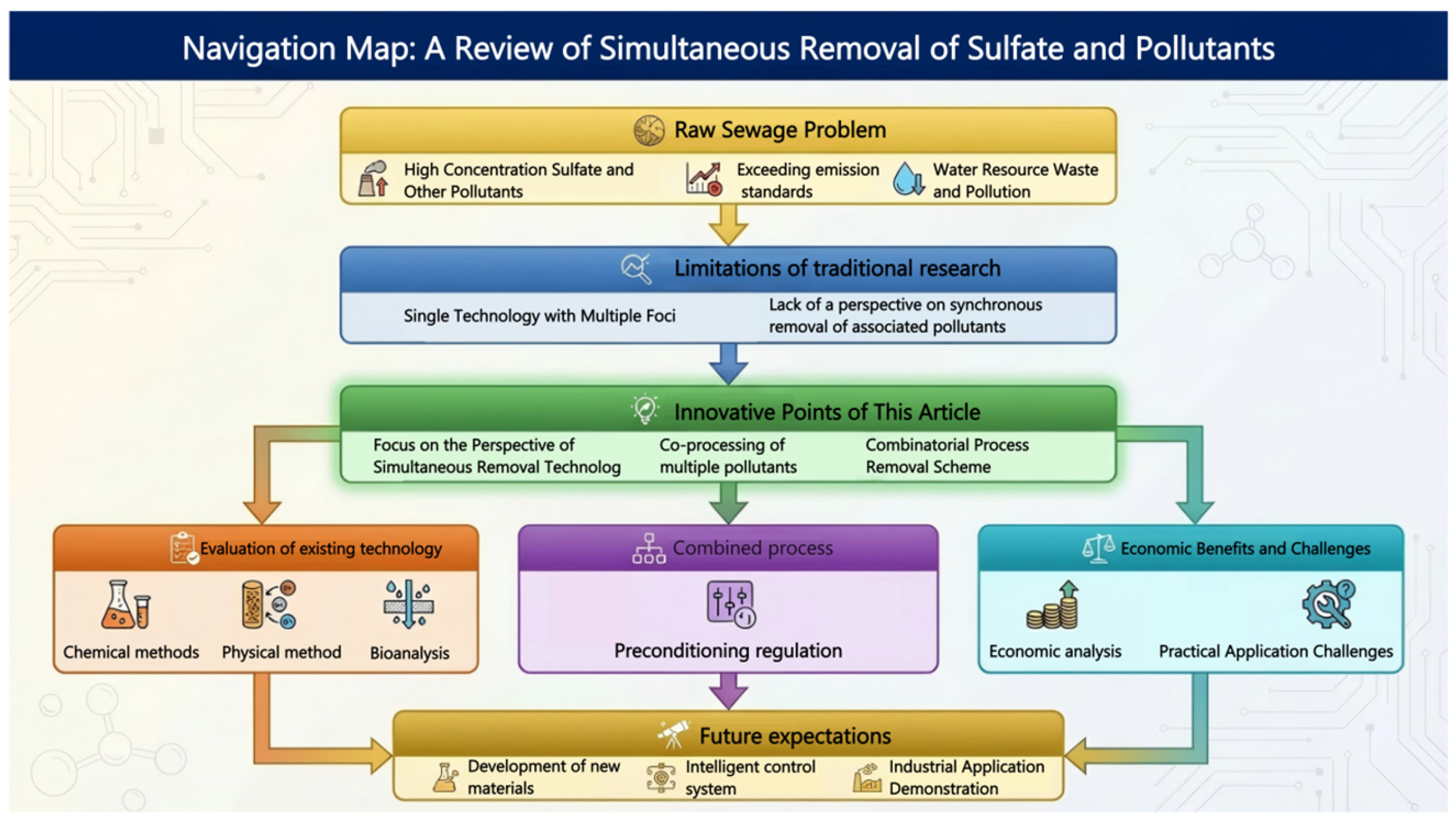
Addressing the two aforementioned gaps, this review innovatively focuses on the simultaneous removal performance, technical pathways, and evaluation of sulfate and other co-occurring pollutants. Specifically, this article aims to: (1) systematically characterize the complex interactions among multiple pollutants in diverse wastewaters, such as mine drainage and industrial effluents; (2) critically evaluate the performance and inherent limitations of existing sulfate removal processes regarding their capacity for synergistic treatment; and (3) propose innovative technical pathways involving combined technologies and dynamic regulation of induced crystallization to achieve efficient co-removal of sulfate and associated pollutants (Figure 1). By synthesizing these aspects, this review seeks to promote the development of sulfate treatment toward a more efficient and sustainable direction.

2. Characteristics of Complex Pollution in Sulfate-Contaminated Waters from Various Sources

High-concentration sulfate wastewater rarely exists in the form of a single pollutant; its sources (e.g., mining, chemical industry, energy sectors, etc.) often dictate that it is inevitably accompanied by other complex co-occurring pollutants, such as heavy metal ions, high concentrations of organic matter, high salinity (e.g., chloride ions) (Guo, L. et al., 2023) [17], and extreme pH values (Kebede K. Kefeni et al., 2017) [13]. These co-occurring pollutants not only increase the difficulty of wastewater treatment but also render single sulfate removal technologies incapable of meeting discharge standards. Therefore, analyzing the complex pollution characteristics of different water bodies serves as the basis for demonstrating the necessity of synchronous removal processes for sulfate and other pollutants, and constitutes the foundational work for researching the simultaneous removal of sulfate and co-occurring pollutants.

2.1. Mining Wastewater: Acid Mine Drainage (AMD)

Among various sulfate-contaminated water bodies, Acid Mine Drainage (AMD) is the most representative and exhibits the most severe sulfate pollution. When mining activities expose sulfide minerals (e.g., FeS2, FeS, Cu2S) to water and oxygen, a series of oxidation reactions occur, leading to the formation of AMD (D. Kirk Nordstrom et al., 2011 [18].
The core formation mechanism (using pyrite, FeS2, as an example) is as follows:
Initial oxidation (generation of Fe2+ and sulfate):
2 F e S 2 + 7 O 2 + 2 H 2 O 2 F e 2 + + 4 S O 4 2 + 4 H +
Further oxidation of Fe2+ to Fe3+ (under acidic conditions):
4 F e 2 + + O 2 + 4 H + 4 F e 3 + + 2 H 2 O
Fe3+-catalyzed oxidation of FeS2 (accelerating acid production):
F e S 2 + 14 F e 3 + + 8 H 2 O 15 F e 2 + + 2 S O 4 2 + 16 H +
Specifically, Reaction (1) occurs in neutral pH and oxygen-rich environments and represents the initial step of AMD generation. Reaction (2) takes place in environments with a pH greater than 3.5 but less than 5; while the rate of this reaction is kinetically low, the process is significantly accelerated by acidophilic iron-oxidizing bacteria (e.g., Acidithiobacillus ferrooxidans) (Akcil and Koldas, 2006) [19]. Furthermore, Reaction (2) serves as the rate-determining step in AMD generation; however, when the pH falls below 2, ferric ions continue to oxidize additional pyrite, triggering Reaction (3) and generating substantial amounts of hydrogen ions, which leads to the formation of hyper-acidic solutions (K. Rambabu et al., 2020) [20].
Other sulfide minerals, such as pyrrhotite (Fe1−xS) (Nelson Belzile et al., 2004) [21] and chalcocite (Cu2S), also undergo similar acid-generating and sulfate-producing reactions.
This process governs the typical complex pollution characteristics of AMD (Geoffrey S. Simate et al., 2014) [22]. We compiled data on pollutant concentrations in acid mine drainage from five distinct mining regions (Table 2), revealing the following features: high sulfate concentrations, which can reach 1–20 g/L (H. Al-Zoubi et al., 2010) [23], far exceeding discharge standards; strong acidity, where the substantial generation of H+ from Reactions (1) and (3) typically results in pH values as low as 2–4; and high concentrations of heavy metals (Kebede K. Kefeni et al., 2017) [13], as the highly acidic environment significantly enhances the solubility of various metal ions such as Fe, Mn, Al, Cu, Zn, Pb, and Ni, maintaining them in a high-concentration dissolved state.
Notably, in addition to sulfate and heavy metals, certain coal mine waters exhibit extremely high concentrations of chloride ions (Cl), which significantly contribute to the secondary salinization of surface water bodies (Ewa Janson, 2024; Ewa Szalińska et al., 2025) [24,25]. This high-salinity environment, characterized by the co-occurrence of high sulfate and chloride levels, has been identified as a critical factor in ecological disasters, such as toxic algal blooms, posing a severe threat to the biological characteristics of river basins (Ewa Szalińska et al., 2025; Krzysztof Mitko et al., 2020; Marian Turek et al., 2024) [24,26,27].
Table 2. Pollutant concentrations in acid mine drainage from different mining areas.
ReferencesBaruah and Singh, (2022) [28] (mg/L)M. Hermassi et al., (2021) [29] (mg/L)Seongchul Ryu et al., (2018) [14] (mg/L)Weiquan L et al., (2025) [16] (mg/L)Bárbara Vital et al., (2019) [30] (mg/L)
Concentration
Parameters
Al-375 ± 201502.9293
Ni0.01470.3 ± 0.043.5--
Fe0.3741535 ± 303400.413.4
Mg581826 ± 252204.3436
Cu0.0143111 ± 159019.8615
Mn0.1005--1.1203
Zn0.046101 ± 1512035.468.5
SO42−293-4.3365.28250
Cd0.00010.4 ± 0.05-17.7-
Pb0.0119----
pH0.00771.8–2.42.0 ± 0.22.5-

2.2. Energy and Chemical Industry Wastewater

Energy production and chemical processing constitute another primary source of sulfate in industrial wastewater. These wastewaters are generally characterized by complex pollution features, including high salinity, highly toxic organic matter, and specific heavy metal ions (Binsheng Liao et al., 2025) [31].

2.2.1. Flue Gas Desulfurization Wastewater (FGD)

Coal-fired power plants widely employ limestone-gypsum wet flue gas desulfurization (WFGD) technology, the principle of which is based on utilizing CaCO3 to absorb SO2 to form calcium sulfate (gypsum). This process generates wastewater containing high concentrations of a wide variety of pollutants (Michael Dean Wales et al., 2021) [32].
Based on WFGD technology, the desulfurization process inevitably involves the following reaction equations:
C a C O 3 + S O 2 + 1 2 O 2 C a S O 4 + C O 2
which consequently results in high concentrations of sulfate in the discharged wastewater. Furthermore, the combustion process converts chlorine, ubiquitously present in coal, into gaseous hydrogen chloride (HCl) (Qianqian Sun, 2021) [33]; upon entering the FGD scrubber, HCl readily dissolves in water and completely ionizes:
H C l ( g ) H + ( a q ) + C l ( a q )
Moreover, due to the extremely high solubility of the subsequently formed calcium chloride (CaCl2), Cl does not precipitate with gypsum but continuously accumulates within the FGD slurry circulation system, resulting in extremely high Cl concentrations in the wastewater (Yi Xina et al., 2020; Daniel B. Gingerich et al., 2020) [34,35]. Trace heavy metals and metalloids (e.g., chromium, cadmium, zinc, arsenic, etc.) in coal volatilize during high-temperature combustion; therefore, during the flue gas cooling process, they exist partly in oxidized states (e.g., Hg2+) and partly adsorbed onto fine fly ash particles. As the flue gas passes through the scrubber, these soluble oxidized metals and heavy metal-laden particles are captured by the slurry, leading to the entry of heavy metal and metalloid ions, such as P b 2 + ,   C d 2 + and AsO43−, into the liquid phase (Biao Fu, 2019) [36].
Monitoring by Ścieżyńska Dominika et al. (2024) [37] of a Polish WFGD system revealed diverse pollutants, including COD (250 mg/L, TOC (101.2 mg/L), N H 4 + (36 mg/L, and a high C l concentration of 16 g/m3 (16,000 mg/L). The wastewater also contained various heavy metals (e.g., Sb, As, Hg, Pb), inorganic anions (SO42−, F, C N ), and organic traces (AOX, PAHs). The study concluded that pollutant composition is driven by fuel type, unit load, and hydraulic load.
Xuan Yao et al. (2021) [38] pointed out in their study that, in addition to containing extremely high concentrations of sulfate (SO42−, 11,210 mg/L) and calcium ions (Ca2+, 658 mg/L), FGD wastewater is also rich in high concentrations of chloride ions (Cl, 7100 mg/L). Furthermore, the wastewater contains metal ions (such as calcium, magnesium, sodium, etc.), suspended solids, and other ionic pollutants (Table 3).

2.2.2. Metallurgical Industry Wastewater

With the surging global demand for battery materials, metal extraction technologies represented by hydrometallurgical processes (such as the production of battery-grade nickel sulfate) have become increasingly critical. However, these processes—particularly atmospheric agitation leaching and heap leaching—often rely on the excessive addition of sulfuric acid and other reagents in pursuit of high metal recovery rates (Srdan Stanković, 2022; Hayate Sato, 2025) [39,40]. This process characteristic inevitably leads to the generation of compositionally complex Hydrometallurgical Acidic Wastewater (HAW), the core challenge of which lies in the co-existence of high concentrations of residual sulfate (SO42−) and target metal ions (e.g., Ni2+, Co2+) (Kinnunen et al., 2024) [41].
Consequently, this type of wastewater exhibits significant complex pollution characteristics: high acidity (low pH) derived from the leaching process, high toxicity caused by soluble heavy metal ions (e.g., Ni2+, Co2+, Cu2+, Fe2+/Fe3+), and high salinity contributed by high concentrations of anions (particularly SO42− and Cl) (DOUGLAS S, 2004) [42]. These characteristics of high salinity, high acidity, and high toxicity render wastewater treatment extremely challenging.
In response to this complex solution system, the treatment objective must focus on the “simultaneous removal” of pollutants. Traditional stepwise treatment technologies (e.g., “neutralization-precipitation of metals followed by sulfate treatment”) not only suffer from lengthy process flows and high reagent consumption but are also prone to generating substantial secondary pollution (e.g., heavy metal-laden low-density sludge), thereby increasing subsequent disposal costs and the potential risk of equipment corrosion (Fenglian Fu, 2010) [43]. Consequently, developing efficient, cost-effective, and environmentally friendly technologies (or combined technologies) to achieve the simultaneous removal and resource recovery of heavy metal ions and high-concentration sulfate from wastewater serves as a key driver in promoting the transformation of the metallurgical industry toward green, sustainable, and circular economy models.

2.2.3. Coking Wastewater

Coking wastewater is a highly toxic industrial wastewater generated during the coke washing and coke oven gas condensation processes. Possessing an extremely complex composition, it is universally acknowledged by the academic community as one of the most refractory industrial wastewaters (A. Tutić, 2023; Markus Tamang, 2022) [44,45].
The pollutants therein encompass two major categories: organic and inorganic substances. Specifically, inorganic substances include sulfate (SO42−) and chloride (Cl), as well as high concentrations of ammonia nitrogen (NH3-N), cyanide (CN), and thiocyanate (SCN); organic substances include refractory and toxic organic compounds such as high concentrations of phenols, polycyclic aromatic hydrocarbons (PAHs), and nitrogen-containing heterocyclic compounds (Guo et al., 2023; A. Tutić et al., 2023) [17,44].
The difficulty in treating coking wastewater lies in its toxicity and complexity. Studies indicate that single purification processes are incapable of ensuring that the effluent meets discharge standards for sulfate and other pollutants; furthermore, substances such as phenols (≥200 mg/L) and cyanide (>2 mg/L) can inhibit nitrification, denitrification, and thiocyanate degradation—processes essential for sulfate removal in biological treatment—thereby exerting inhibitory effects and threatening ecosystem safety (A. Tutić, 2023; Markus Tamang, 2022) [44,45]. Therefore, it is imperative to develop synergistic removal processes and combined technologies capable of simultaneously removing inorganic salts such as sulfate and ammonia nitrogen, while efficiently degrading toxic and refractory organic matter (A. Tutić, 2023) [44].

2.2.4. Petrochemical Wastewater

Petrochemical wastewater originates from processes such as crude oil production and refining, and is similarly characterized by high toxicity and a refractory nature (Muhammad Shettima Lawan, 2023) [46].
Petrochemical wastewater contains a diverse array of pollutants, comprising both organic and inorganic substances. Of particular concern are high concentrations of sulfate, associated sulfur-containing compounds, and refractory organic sulfur; these are difficult to remove via traditional processes, exhibit strong inhibitory effects, and are prone to generating toxic hydrogen sulfide gas. A study by Kondaveeti et al. indicated that petroleum refinery wastewater contains 14.5–1222 mg/L of SO42−, while produced water contains 0.01–10 g/L of SO42−; sulfate concentrations in both water bodies far exceed the regulatory requirements for wastewater discharge. Regarding other pollutants, inorganic substances include high salinity (with TDS reaching up to 100 g/L or more), ammonia nitrogen, and heavy metals (Kondaveeti et al., 2023) [47]; organic pollutants encompass high concentrations of total petroleum hydrocarbons (TPH), polycyclic aromatic hydrocarbons (PAHs), high concentrations of dissolved organic sulfur (DOS, such as sulfonates, thioethers, etc.), and phenols (Li et al., 2024) [48].
The challenge associated with this type of wastewater lies in the simultaneous treatment of inorganic sulfate, refractory organic sulfur (DOS), and other toxic organic pollutants. Both H2S, the product of anaerobic sulfate reduction, and high concentrations of organic sulfur can severely inhibit the efficacy of biochemical systems (Ye Chen, 2008) [49]; consequently, they must be removed during pretreatment or simultaneous treatment processes.

2.3. Municipal Wastewater

Unlike industrial wastewater, sulfate concentrations in municipal wastewater are typically relatively low and are generally not considered primary targets for removal (Que-Nguyen Ho et al., 2023) [50]. However, the presence of sulfate still poses challenges to the operation of wastewater treatment plants (WWTPs), with the core issue lying in its anaerobic transformation.
In sewer networks or the anoxic/anaerobic zones of WWTPs (e.g., primary settling tanks, anaerobic tanks), sulfate-reducing bacteria (SRB) reduce SO42− to H2S (Tian-wei Hao et al., 2014) [51]. H2S is not only a major cause of malodor and pipeline corrosion but also acts as a potent biological inhibitor. Studies indicate that H2S exhibits significant toxicity toward core functional microorganisms responsible for biological nutrient removal (BNR), particularly nitrifying bacteria and polyphosphate-accumulating organisms (PAOs) (César Huiliñir, 2021; Qingan Meng, 2023) [52,53].
In the treatment of municipal wastewater, although sulfate is not directly removed, it is essential to systematically consider the inhibitory effects of its transformation product (H2S) on the simultaneous removal processes of other pollutants, such as nitrogen and phosphorus. Therefore, systematically considering the synergistic relationships among multiple pollutants—including sulfate transformation—in municipal wastewater treatment is crucial for ensuring the stable and efficient operation of WWTPs.

2.4. Synergistic Challenges Posed by Complex Pollutant Matrices

In summary, sulfate-containing wastewaters from various sources all exhibit complex pollution characteristics. As shown in Table 4, the primary barriers to wastewater treatment lie in the inter-constituent interference. For instance, in FGD wastewater, the coexistence of high-concentration Cl and SO42− significantly complicates the selectivity of ion-exchange resins and increases the osmotic pressure in reverse osmosis processes. Similarly, in AMD, the presence of multivalent heavy metals often leads to the formation of complex mineral phases, which can encapsulate sulfate ions during precipitation, thereby reducing the purity of recovered byproducts. Therefore, understanding these complex interactions is a prerequisite for developing the dynamic regulation methods and combined technologies discussed in the subsequent sections.
Subsequently, this review focuses on the simultaneous removal efficacy of sulfate, heavy metals (ions), and specific organic matter. Furthermore, it proposes feasible and high-efficiency treatment processes—employing either standalone or combined technologies—tailored to the corresponding types of wastewater.

3. Current Sulfate Removal Methods and Their Simultaneous Removal Efficacy

The removal of sulfate from wastewater is a subject with a long-standing research history, spawning a diverse array of removal technologies that have evolved into major pathways, including physical methods (e.g., adsorption and membrane separation), chemical methods (e.g., precipitation and electrocoagulation), and biological methods.
A survey of prior reviews reveals that scholars have predominantly adhered to the classical “physical-chemical-biological” classification framework, focusing on elucidating the removal mechanisms, efficacy, influencing factors, and economic viability of various technologies specifically for sulfate.
However, as elucidated in the preceding sections, whether in Acid Mine Drainage (AMD), Flue Gas Desulfurization (FGD) wastewater, or metallurgical industry wastewater, sulfate rarely exists as an isolated pollutant. Conversely, it invariably forms complex combined pollution systems characterized by high concentrations of heavy metals, high salinity (e.g., Cl), refractory organic matter, or extreme pH levels. In this context, persisting with the traditional perspective of evaluating technologies based solely on “sulfate removal rate” fails to address the practical treatment demands of contemporary complex industrial wastewater; furthermore, it overlooks the potential economic benefits derived from the recovery of co-occurring pollutants (heavy metal ions and specific organic matter) during the treatment process.

3.1. Precipitation Methods

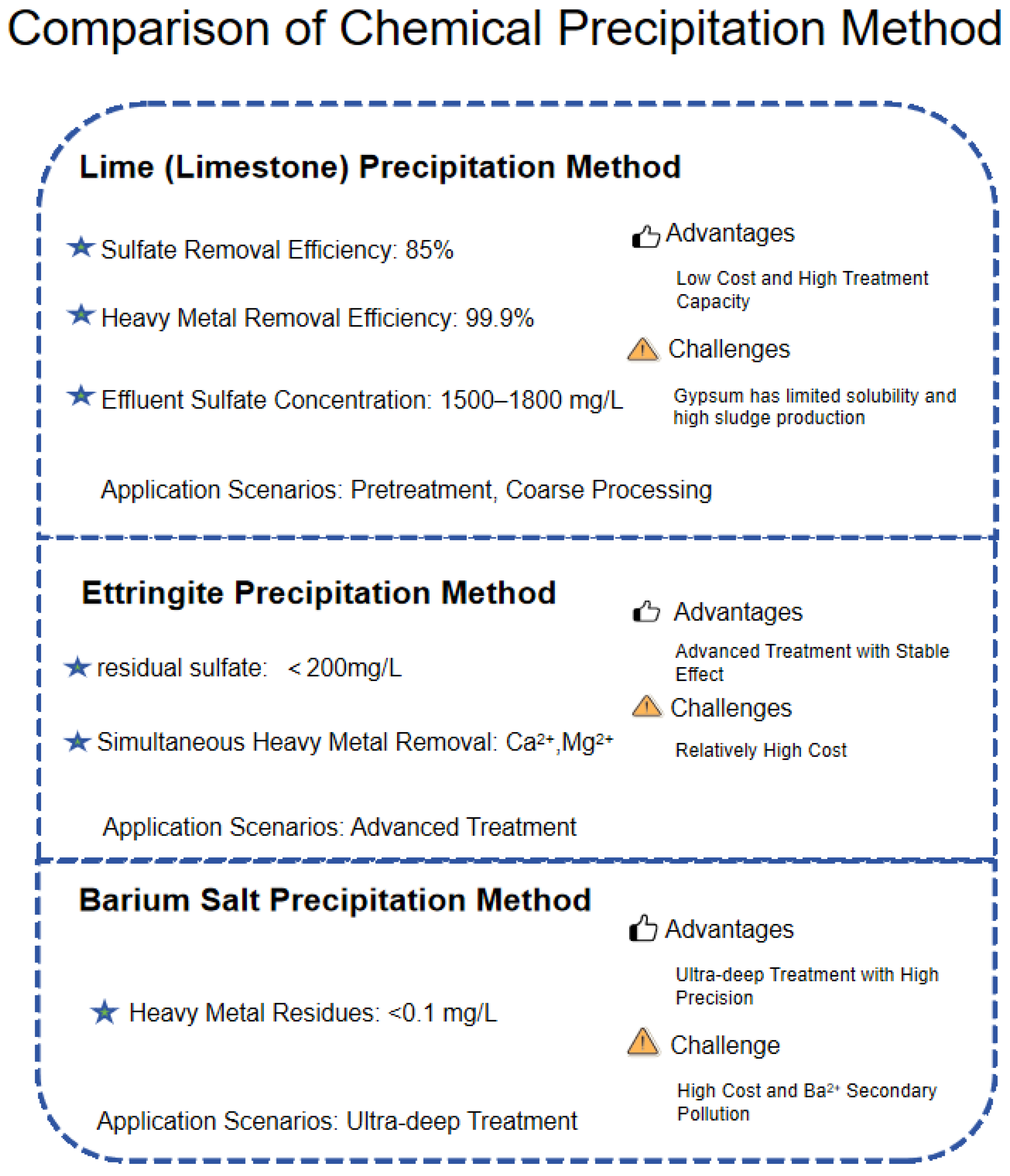
Chemical precipitation stands as one of the classic and most widely applied technologies for treating high-concentration sulfate wastewater. Its fundamental principle involves dosing chemical agents into the wastewater to induce a reaction between sulfate ions and specific cations, thereby forming precipitates with low solubility, which are subsequently removed through solid-liquid separation. Due to its process maturity, relative operational simplicity, and high cost-effectiveness, this method demonstrates significant engineering application value, particularly when serving as a pretreatment step or a high-load treatment unit (Chatla et al., 2023) [1]. The primary precipitation pathways include lime (limestone) precipitation, ettringite precipitation, and barium salt precipitation (Figure 2).

3.1.1. Lime (Limestone) Precipitation

Lime (limestone) precipitation is the most traditional chemical method and possesses the greatest potential for simultaneous removal. Its core mechanism involves utilizing low-cost lime (Ca(OH)2) or limestone (CaCO3) as a calcium source to precipitate sulfate in wastewater as calcium sulfate dihydrate (CaSO4·2H2O), i.e., gypsum. Simultaneously, the addition of lime raises the pH to precipitate sulfate while efficiently co-precipitating and removing various heavy metal ions (e.g., Fe3+, Al3+, Cu2+, etc.) in the form of hydroxides. Furthermore, it effectively reduces water acidity; consequently, it is often regarded as the preferred pretreatment process for treating Acid Mine Drainage (AMD) (Fernando et al., 2018) [54].
For instance, in a study utilizing steel slag (whose main active component is CaO, operating on a mechanism similar to lime) to treat real AMD, the method not only achieved removal rates of 99.9% for iron (Fe) and 85% for sulfate (SO42−) within 36 h but also realized the complete removal of various heavy metals (e.g., Fe, Mn, Zn, Cu, Ni, Cd) within 12 h, fully demonstrating its efficacy in the simultaneous removal of sulfate and metal impurities (C. R. Blanco-Zúñiga et al., 2023) [55].
However, for some acid mine wastewaters with lower initial sulfate concentrations, while the lime (stone) treatment method retains its capability to remove associated pollutants, it exerts no significant effect on the sulfate concentration in the wastewater. For example, in a field study at the Sarcheshmeh porphyry copper mine in Iran, lime treatment significantly removed various metal ions (with removal rates for Al, Cu, and Zn exceeding 99%), yet the sulfate concentration in the raw solution remained at original levels. The researchers noted that in the field AMD treatment experiment, the sulfate concentration in the raw water was 715–922 mg/L, while that in the treated water was 855–925 mg/L, showing no statistically significant difference between the two (Khorasanipour et al., 2011) [56].
The critical limitation of the lime (limestone) precipitation method lies in the inherent solubility of gypsum itself, which results in a theoretical minimum sulfate concentration of approximately 1500–1800 mg/L in the treated effluent. This makes it difficult to meet increasingly strict discharge standards (typically requiring < 250–500 mg/L) (Chatla et al., 2023; Geldenhuys et al., 2003) [1,57]. Furthermore, this process generates large volumes of mixed sludge containing gypsum and metal hydroxides with high water content, the dewatering, transportation, and disposal of which constitute major economic and environmental burdens. Therefore, lime (stone) precipitation is typically employed as an efficient and cost-effective pretreatment or rough treatment technology, rather than as an ultimate solution for advanced treatment.

3.1.2. Ettringite Precipitation

To overcome the limitations imposed by gypsum solubility, Ettringite precipitation has been developed as an effective technology for the advanced removal of sulfate, with the potential to achieve simultaneous removal effects. For instance, the SAVMIN® process developed by Mintek in South Africa is based on this principle. By dosing aluminum sources (e.g., aluminum hydroxide, sodium aluminate) into wastewater under highly alkaline conditions (pH 11–12, typically provided by excess lime), it facilitates the reaction of S O 4 2 , Ca2+, and Al3+ to generate ettringite crystals (Ca6Al2(SO4)3(OH)12·26H2O) with extremely low solubility. This can stably reduce effluent sulfate concentrations to below 200 mg/L (Chatla et al., 2023; Fernando et al., 2018) [1,54]. Simultaneously, heavy metal ions can replace Ca2+ in the ettringite lattice to form stable metal-substituted ettringite compounds for immobilization, while phosphorus binds with Ca2+ in the system to form calcium phosphate, which co-precipitates with ettringite.
The high pH environment (typically >11) required by this process naturally facilitates the simultaneous removal of magnesium ions. Under these pH conditions, Mg2+ precipitates in the form of magnesium hydroxide (Mg(OH)2), thereby achieving synergistic removal with sulfate. Researchers have developed the Hydrotalcite-Ettringite precipitation (HT-Ett) process route; by first inducing the formation of magnesium-aluminum hydrotalcite (HT) to preliminarily fix Mg2+ and a portion of SO42−, followed by ettringite precipitation, this method effectively solves the challenge of treating high-magnesium wastewater (Chatla et al., 2023) [1]. A pilot study focusing on wastewater from the Stillfontein gold mine in South Africa indicated that the SAVMIN process successfully reduced sulfate concentrations from 800 mg/L to below 200 mg/L (Bowell et al., 2004) [58], achieving efficient simultaneous removal of sulfate and calcium ions.
However, ettringite precipitation faces two major challenges: first, the high cost of aluminum reagents significantly increases operational expenses; second, magnesium ions (Mg2+) commonly present in wastewater can inhibit the formation of ettringite and may generate brucite and hydrotalcite-like byproducts, thereby affecting removal efficiency (Dou et al., 2017) [59].
Current research hotspots focus on recovering aluminum sources from ettringite sludge to reduce costs—for example, a low-pH dissolution method can achieve an aluminum recovery rate exceeding 98% (Tian et al., 2019) [60]—and on developing process conditions with better tolerance to co-existing ions. These efforts are crucial for enhancing the economic viability and practical application prospects of this technology.

3.1.3. Barium Salt Precipitation

When it is necessary to remove sulfate to extremely low levels, barium salt precipitation is an effective method and can, to a certain extent, achieve simultaneous removal effects. This method utilizes barium salts (e.g., BaCl, BaCO3, BaS, etc.) to react with SO42− to generate barium sulfate (BaSO4) with extremely low solubility, theoretically capable of reducing sulfate concentrations to the mg/L level (Yuqian Zhou et al., 2024) [61].
Meanwhile, relevant studies suggest that adopting a stepwise dosing strategy—adding the main agent first to remove over 80% of the sulfate, followed by synergistic agents such as sodium sulfide and calcium hydroxide—can circumvent ion competitive reactions, thereby ensure the efficiency of the main reaction while removing associated pollutants. For example, in a study utilizing lime pretreatment and BaS to treat mine water containing 2650 mg/L of sulfate, the final effluent concentration dropped to 250 mg/L; furthermore, the simultaneous metal removal efficacy was excellent, with concentrations of metals such as Mg, Fe, and Al dropping below 0.1 mg/L (Maree et al., 2004) [62]. Another study employing Ba(OH)2 combined with Mg(OH)2 to treat South African gold mine wastewater further reduced sulfate from 4890 mg/L to 24 mg/L, achieving a removal rate exceeding 99% (Bologo et al., 2012) [63].
However, the widespread application of barium salt precipitation is severely constrained by two major factors: first, the high cost of barium salt reagents; and second, the high toxicity of soluble barium salts themselves. If overdosed or if the reaction is incomplete, residual Ba2+ can cause severe secondary pollution (Fernando et al., 2018) [54]. Consequently, this method is typically reserved for specific scenarios with extreme requirements for effluent quality and necessitates precise dosage control. To improve its economic viability and reduce environmental risks, current research directions include integrating this method with other processes (such as lime pretreatment or magnesium hydroxide treatment) and regenerating BaS through the high temperature carbothermal reduction of BaSO4 precipitates to achieve reagent recycling, thereby constructing a more sustainable process system (Chatla et al., 2023) [1].

3.2. Advanced Sulfate Removal Technologies

3.2.1. Membrane Separation Technologies

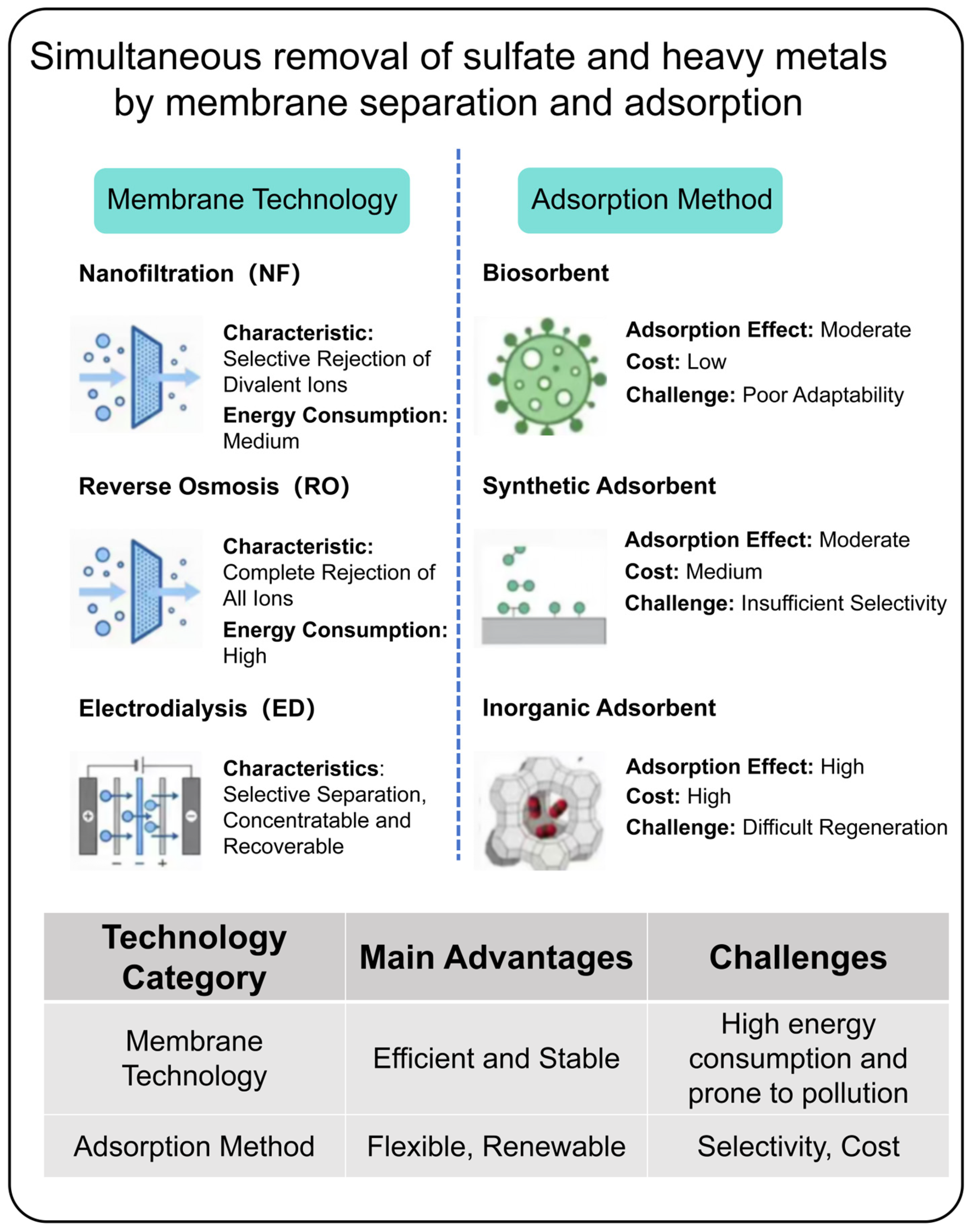
Membrane separation technology is a highly efficient physical separation process. It utilizes selectively permeable membranes, driven by external forces (typically pressure), to separate different components in wastewater based on the synergistic effects of size exclusion (molecular sieving) and electrostatic repulsion (Donnan effect) (Chatla et al., 2023) (Figure 3) [1].
In the field of sulfate removal, Nanofiltration (NF) and Reverse Osmosis (RO) are the two most widely applied and effective pressure-driven membrane technologies. The surfaces of membrane materials (predominantly polyamide composite membranes) are typically negatively charged, generating strong electrostatic repulsion against similarly negatively charged multivalent anions (e.g., SO42−). Meanwhile, their dense skin layer structure effectively intercepts hydrated ions; thus, even under high-concentration conditions, NF and RO membranes exhibit extremely high sulfate rejection rates (Fernando et al., 2018) [54].
Extensive research and practice demonstrate that NF and RO technologies can stably achieve sulfate removal rates exceeding 90%, or even approach complete removal. Regarding other pollutants in the water body, they also demonstrate unique advantages and selectivity. While efficiently retaining divalent SO42−, NF membranes also possess high removal rates for divalent cations in water, particularly heavy metal ions (e.g., Cu2+, Zn2+, Ni2+) and hardness ions (Ca2+, Mg2+), typically reaching over 95% (López et al., 2019; Pino et al., 2018) [64,65]. This renders NF an ideal technology for the simultaneous removal of these two major pollutants—sulfate and heavy metals—and facts have proven its significant application value in fields such as Acid Mine Drainage (AMD) treatment.
In a study targeting mine water after lime pretreatment, the nanofiltration process successfully reduced sulfate and heavy metal concentrations from 1850 mg/L to 65 mg/L, with a removal rate as high as 96% (Fernando et al., 2018) [54]. In another treatment of wastewater containing 3500 mg/L sulfate and other pollutants from a basin in South Africa, the commercial NF90 membrane achieved a removal rate of 97.6% (Fernando et al., 2018) [54].
Beyond pressure-driven membranes, other membrane technologies such as Electrodialysis (ED), Forward Osmosis (FO), and Membrane Distillation (MD) also show immense potential in the simultaneous removal of sulfate and other pollutants. For instance, in electrodialysis technology, cations (e.g., heavy metal ions Pb2+, Cu2+, and salt ions Na+, Ca2+) migrate through cation exchange membranes to the concentrate compartment, being retained simultaneously with sulfate; meanwhile, other anions (e.g., nitrate, phosphate, chloride) can also pass through anion exchange membranes along with sulfate, achieving simultaneous multi-anion removal.
Despite the remarkable efficacy of membrane technologies in pollutant removal, their large-scale application faces severe challenges.
Taking pressure-driven membranes as an example, Nanofiltration (NF) membranes, by virtue of their selective separation properties, can separate sulfate from high-value salts (e.g., sodium chloride), offering potential for resource recovery while demonstrating outstanding removal efficacy for pollutants such as sulfate and heavy metals. In contrast, Reverse Osmosis (RO) membranes are capable of the indiscriminate and efficient retention of nearly all dissolved ions, achieving comprehensive simultaneous removal of sulfate, heavy metals, and monovalent salts, yielding permeate of extremely high quality. However, the rejection rate of NF membranes for monovalent ions (e.g., Na+, K+, Cl) is relatively low (typically between 20% and 80%). Consequently, they fail to meet requirements in scenarios necessitating total desalination, as the permeate retains a certain concentration of monovalent ions. Although RO offers comprehensive removal, it is associated with higher energy consumption and a more severe risk of membrane fouling (Aguiar et al., 2016) [66]; these issues collectively constrain the widespread application of membrane technologies.
Secondly, the membrane separation process inevitably generates a stream of high-concentration concentrate (brine/retentate), accounting for approximately 10–50% of the influent volume. This concentrate is enriched with all retained pollutants, and its economic and environmentally friendly disposal constitutes a formidable challenge to achieving “Zero Liquid Discharge” (ZLD) (Chatla et al., 2023) [1]. To mitigate membrane fouling, complex pretreatment units (e.g., chemical precipitation, microfiltration, or ultrafiltration) are typically required prior to the membrane system, further increasing the complexity and cost of the entire process.
Furthermore, the separation efficiency of NF and RO is heavily dictated by the presence of competing ions in complex wastewater matrices. There are three primary mechanisms underlying these effects (Nur Syahirah Suhalim et al., 2022) [67]. Primarily, high concentrations of monovalent ions, such as chloride (Cl), induce a charge screening effect that shields the negative surface charge of the membrane. This diminishes the electrostatic repulsion (Donnan effect) between the membrane and SO42−, leading to a significant decline in sulfate rejection, a phenomenon particularly pronounced in NF processes (Nur Syahirah Suhalim et al., 2022) [67]. Additionally, ion-pairing and neutralization represent another critical mechanism. The coexistence of multivalent cations (e.g., Ca2+, Mg2+) promotes the formation of neutral species such as C a S O 4 , which are less affected by electrostatic repulsion and are primarily rejected via size exclusion, thereby reducing overall removal efficiency in high-hardness water (Weizhu Zhou et al., 2025) [68]. Lastly, competing ions increase the total dissolved solids (TDS), elevating the osmotic pressure of the solution. This necessitates higher operating pressures to maintain water flux and may exacerbate concentration polarization at the membrane surface, ultimately compromising the permeate quality (Weizhu Zhou et al., 2025) [68]. To address the significant impact of competing ions on membrane separation efficiency, researchers have attempted to modulate membrane surface charges and implement material modifications to counteract the screening effect induced by monovalent ions (Cristina Ileana Covaliu-Mierlă et al., 2023) [69].
Future research in membrane technology should focus on developing novel membrane materials with superior antifouling properties, optimizing membrane modules and operational processes to reduce energy consumption, and exploring integrated processes (Integrated/combined technologies) that combine membrane technology with other techniques such as chemical precipitation and crystallization. For instance, the effluent concentration from lime precipitation is typically 1500–1800 mg/L, whereas the influent sulfate concentration for membrane technology generally needs to be controlled at around 1000 mg/L. The advantages and disadvantages of the two complement each other: chemical precipitation serves as a pretreatment for membrane technology to lower influent concentration and reduce membrane fouling, while membrane technology serves as an advanced treatment to compensate for the limitations of precipitation/crystallization. By combining to form a synergistic system of “high-concentration pretreatment—advanced purification—resource recovery,” this approach adapts to diverse scenario requirements. Thereby, while ensuring efficient simultaneous removal of pollutants, it achieves the resource utilization of the concentrate and the overall economic and environmental sustainability of the treatment process (Jin et al., 2020) [70].

3.2.2. Adsorption

Adsorption is a technology that utilizes the immense specific surface area and abundant surface functional groups of porous solid adsorbents to enrich and immobilize dissolved sulfate ions from wastewater at the solid-liquid interface via physical or chemical forces, thereby achieving separation and removal. This method has garnered significant attention due to its operational simplicity, wide applicability, and the extensive availability and low cost of certain adsorbents (especially industrial byproducts and agricultural wastes) (Chatla et al., 2023) [1].
The removal process of sulfate on the adsorbent surface is typically governed by the synergistic action of one or more mechanisms, primarily including electrostatic attraction, ion exchange, and ligand exchange (surface complexation). Electrostatic Attraction is one of the primary adsorption mechanisms. When the solution pH is below the Point of Zero Charge (PZC) of the adsorbent, the adsorbent surface becomes positively charged due to protonation, thereby attracting the negatively charged and high-charge-density sulfate ions via electrostatic forces (Fernando et al., 2018) [54]. Ion Exchange is commonly observed in materials such as Layered Double Hydroxides (LDHs) or anion exchange resins, where anions (e.g., Cl, OH) pre-existing in their framework or interlayers can exchange with SO42− in the solution, thereby fixing the sulfate within the material structure. Furthermore, Ligand Exchange and Surface Complexation are particularly common on the surfaces of metal (hydr)oxides (e.g., Zr, Fe, Al-based adsorbents). Here, surface hydroxyl functional groups (-OH) act as coordination sites to form stable inner-sphere or outer-sphere complexes with sulfate (e.g., ≡Zr-OSO3) (Michael P. Schmidt et al., 2020) [71]. The effect produced by this chemical bonding typically exhibits higher selectivity and stability.
The core of the adsorption method lies in the development and selection of adsorbent materials that possess high capacity and high selectivity for sulfate. Their performance primarily depends on the physicochemical properties of the adsorbent, the solution environment (e.g., pH), and the adsorption mechanism. Precisely herein lies the key to determining whether the simultaneous removal of associated pollutants can be achieved; for instance, many adsorbents possess the capability to remove cations (e.g., heavy metals) and anions (e.g., sulfate) simultaneously. Based on their source and properties, adsorbents used for sulfate removal can be broadly categorized into biosorbents, inorganic adsorbents, and synthetic adsorbents.
Among biosorbents, those extracted from biomasses such as shrimp and crab shells, potato peels, and rice straw have been extensively studied. Notably, shrimp and crab shell-based adsorbents exhibit a sulfate adsorption capacity of up to 156 mg/g while simultaneously removing heavy metals and neutralizing acidity. This is attributed to the chitin, chitosan, and calcium carbonate present on the surface of these shells. Specifically, calcium carbonate can directly neutralize acid; the amino groups of chitosan protonate under acidic conditions to assist in binding hydrogen ions; meanwhile, the amino and hydroxyl groups of chitosan adsorb heavy metal ions via coordination bonds or ion exchange. Furthermore, calcium salts generated from the reaction co-precipitate with heavy metals, which, combined with the physical entrapment by the porous structure, achieves heavy metal removal. Sulfate is retained either by forming insoluble sulfate precipitates with heavy metals or through ion exchange with protonated chitosan, ultimately achieving the simultaneous effects of acid neutralization, heavy metal adsorption, and sulfate removal. Additionally, biochar and activated carbon can be produced from cottonseed hull waste. Biochar demonstrates a sulfate adsorption capacity of 153.85 mg/g in an alkaline medium (pH 9.8) (Chatla et al., 2023) [1], while activated carbon, leveraging its developed pore structure and surface reactivity, can effectively remove organic pollutants such as dyes and phthalates from water while adsorbing sulfate (Chatla et al., 2023) [1].
Synthetic adsorbents offer broader possibilities for achieving high-efficiency sulfate removal coupled with the simultaneous removal of multiple pollutants. For example, weak base anion exchange resins, such as Amberlyst A21, demonstrated a sulfate adsorption capacity of 12.78 mg/mL in fixed-bed experiments (Fernando et al., 2018) [54]. Their surfaces contain anion exchange functional groups (such as quaternary ammonium salts) that can simultaneously adsorb various anionic pollutants in the solution via ion exchange; concurrently, the porous structure of the resin possesses certain physical adsorption capabilities, assisting in the retention of pollutants in different forms and thereby reinforcing the simultaneous removal effect. Moreover, grafting conductive polypyrrole onto Granular Activated Carbon (GAC) can increase its sulfate adsorption capacity to 44.7 mg/g, significantly outperforming traditional materials (Fernando et al., 2018) [54].
Among high-efficiency inorganic materials, Layered Double Hydroxides (LDHs) exhibit outstanding performance. In particular, Mg-Al LDH boasts a sulfate adsorption capacity as high as 840 mg/g (Chatla et al., 2023) [1]. Its ordered layered structure and large specific surface area provide ample active sites, allowing it to simultaneously host multiple pollutants via synergistic actions—such as ion exchange, surface complexation, precipitation, and acid-base neutralization—without mutual interference, making it extremely promising in terms of its capability to simultaneously remove multiple pollutants.
Despite the immense potential and advantages offered by the versatility of adsorption methods—specifically, their capability for the simultaneous removal of multiple pollutants—their practical application remains confronted with numerous challenges.
Primary among these is the issue of selectivity and ion competition. In real wastewater characterized by high salinity and complex compositions, most adsorbents exhibit insufficient selectivity for sulfate, severely compromising their removal efficiency. Admittedly, research indicates that for certain adsorbents (e.g., Amberlyst A21 resin), while chloride and fluoride ions typically compete for adsorption sites, this competitive effect vanishes once the system reaches sulfate saturation, demonstrating a preferential adsorption characteristic for sulfate (Fernando et al., 2018) [54]. However, the trade-off is a consequent decline in the capacity for the simultaneous removal of multiple pollutants. To mitigate these competitive hurdles while adhering to the “waste control by waste” concept, researchers have developed innovative composite adsorbents derived from industrial byproducts (Viswanathan, S.P. et al., 2024) [72]. Xu et al. (2022) [73] developed red mud-based geopolymer permeable concrete (RMPC) by replacing 50% cement with aluminum industry byproduct red mud, utilizing its high alkalinity (pH 9.2–12.8) and large specific surface area (11.65–30.72 m2/g) for synergistic pollutant removal. Under optimized conditions (24-h hydraulic retention time, influent pH 4.0), RMPC achieved 100% removal of C u 2 + (10 mg/L), Z n 2 + (16 mg/L), M n 2 + (10 mg/L), and C d 2 + (1.6 mg/L). Its core mechanisms include: (1) Portlandite in red mud releases O H , stabilizing effluent pH at ~8.0 to neutralize AMD acidity (influent pH 2.5–4.0); (2) S O 4 2 combines with red mud-released C a 2 + to form C a S O 4 precipitates, mitigating sulfate pollution; (3) heavy metals are retained via hydroxide precipitation (e.g., C u ( O H ) 2 , Z n ( O H ) 2 ) and C-S-H gel/haematite adsorption. Long-term tests (228 days) showed >90% heavy metal removal, with 50% lower cost than traditional permeable reactive walls, offering a sustainable solution for industrial waste recycling and AMD treatment.
Secondly, adsorbent regeneration and cost constitute core bottlenecks determining economic viability. The preparation costs of high-efficiency adsorbents (e.g., LDHs, MOFs) are prohibitive, while stable, efficient, and low-cost regeneration technologies remain immature; furthermore, the generation of secondary pollution during the regeneration process must be avoided (Chatla et al., 2023) [1].
Furthermore, the vast majority of current research remains confined to laboratory batch experiments, and the feasibility for large-scale industrial application in continuous flow reactors has not been sufficiently validated. Transitioning from the laboratory to industrial application requires overcoming multiple hurdles, including mass transfer kinetics, long-term stability, and antifouling performance.
Future development of adsorption methods should focus on: (1) Utilizing waste resources to prepare low-cost, high-performance composite adsorbents to achieve “waste control by waste”; (2) Designing novel adsorption materials with high selectivity based on approaches such as computational chemistry; (3) Exploring coupling processes between adsorption and other technologies (e.g., membrane separation, chemical precipitation) to address more complex wastewater treatment demands.

3.3. Emerging Sulfate Removal Technologies—Potential Technologies for Simultaneous Removal

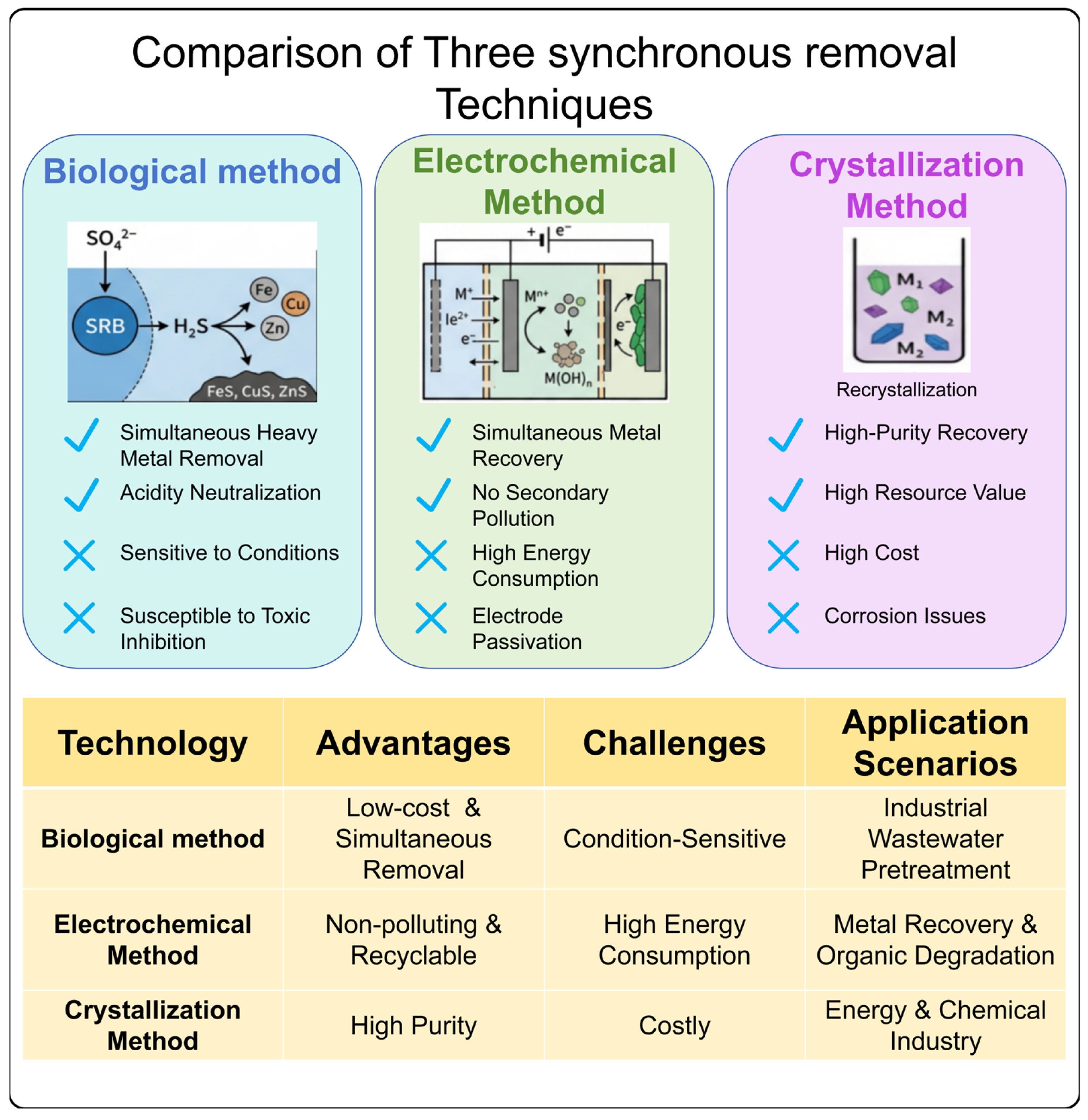
Beyond the aforementioned mature processes based on precipitation, separation, and adsorption, biological methods, electrochemical methods, and crystallization methods—as potential technologies for emerging or cross-disciplinary applications—have exhibited unique advantages and immense research value in the realm of “simultaneous removal” in recent years. This section will focus on a critical review of the mechanisms, current status, and future directions of these technologies regarding the synergistic treatment of sulfate and associated pollutants (Figure 4).

3.3.1. Biological Methods

Among biological methods, the biological sulfate reduction process based on Sulfate-Reducing Bacteria (SRB) is the most widely employed.
Under anaerobic conditions, SRB utilize organic matter present in wastewater (such as lactate, acetate, etc.) or hydrogen gas as electron donors, employing sulfate (SO42−) as the terminal electron acceptor to reduce it to sulfide (HS/H2S) for removal (Kebede K. Kefeni et al., 2017) [13]. Currently, BSR technology has been extensively investigated for the treatment of Acid Mine Drainage (AMD) and certain industrial wastewaters; efforts are also being directed towards screening acid-tolerant and metal-toxicity-resistant SRB strains to optimize bioreactors for enhanced sulfate removal efficiency (Biological Sulfate Reduction, BSR) (Ivan Nancucheo et al., 2017) [74]. Beyond this, the most critical aspect lies in its potential for the synchronous removal of other pollutants. The core advantage of the BSR process in the context of synchronous removal is its superior capability to synchronously remove heavy metal ions (Shipra Varshney et al., 2023) [75]. The H2S generated via SRB metabolism serves as a highly efficient precipitant for heavy metals. It reacts with dissolved divalent metal ions in wastewater, such as Fe, Cu, Zn, Ni, Pb, Cd, and other metals (Me), to form metal sulfide (MeS) precipitates characterized by extremely low solubility. Since the solubility products of metal sulfides (MeS) are far lower than those of their corresponding hydroxides, the removal rates of heavy metals are exceptionally high and stable. Secondly, the reductive metabolic process of SRB consumes protons ( H + ) and generates alkalinity ( H C O 3 ), which effectively neutralizes the strong acidity of wastewater such as AMD (Biological Sulfate Reduction, BSR), thereby creating a more favorable pH environment for microbial activity and metal precipitation (Ivan Nancucheo et al., 2017) [74]. However, the BSR process also possesses numerous limitations. Although it can utilize waste organic matter to effectively reduce operating costs and holds immense potential for synchronous removal, SRB are highly sensitive to reaction conditions and are susceptible to inhibition by high concentrations of heavy metals, the self-toxicity of H2S, and extreme pH levels (Kebede K. Kefeni et al., 2017; Shipra Varshney et al., 2023) [13,75].

3.3.2. Electrochemical Methods

Electrochemical methods refer to a technological system that utilizes electrons as “clean reagents” to achieve the separation, transformation, or recovery of pollutants through electrode reactions or ion migration under an electric field, without the need for additional chemicals or the generation of waste requiring secondary treatment (Sergi Garcia-Segura, 2018) [76]. In the developmental history of sulfate wastewater treatment, electrochemical technology is regarded as a pivotal advanced treatment method following chemical precipitation, garnering attention for its significant advantages, such as low sludge production (Milad Mousazadeh et al., 2021) [77] and ease of automation (Fernando et al., 2018) [54].
With advancements in materials science and reactor design, modern electrochemical technology has evolved beyond the singular function of desalination. It is now moving towards the simultaneous removal of heavy metals, selective separation, degradation of refractory organic matter, and resource recycling (Jan-Max Arana Juve et al., 2022) [78]. Currently, electrochemical treatment processes targeting sulfate-containing wastewater primarily include membrane-based Electrodialysis (ED) (Yu Luo et al., 2022) [79], Electrocoagulation (EC) (Caroline Rodrigues et al., 2020) [80], and Bioelectrochemical Systems (BES) (Matteo Tucci et al., 2021) [81].
The mechanism of sulfate removal via electrochemical methods is contingent upon the specific process configuration. Electrodialysis (ED) leverages the selective permeability of anion and cation exchange membranes. Under the influence of a direct current (DC) electric field, it drives SO42− through the anion exchange membrane into the concentrate compartment, thereby separating sulfate from the water body. Electrocoagulation (EC) employs sacrificial anodes (typically aluminum or iron), which undergo electrochemical dissolution to generate metal cation ( A l 3 + or F e 2 + / F e 3 + ). These cations hydrolyze in situ to form highly active polymer or hydroxide flocs, which remove sulfate ions from water through adsorption, surface complexation, and sweep flocculation (Maria A. Mamelkina et al., 2017) [82].
However, early electrochemical technologies were often plagued by bottlenecks such as severe membrane fouling, high energy consumption, and limited sulfate removal rates. These limitations have prompted researchers to explore the coupling of electrochemical methods with other mechanisms (Sajjad Al-Amshawee et al., 2020; Amina Tahreen et al., 2020) [83,84].
Compared with traditional physicochemical methods, the unique advantage of electrochemical technology lies in its ability to achieve the simultaneous targeted transformation or separation of multiple components in complex wastewater by regulating electrode potential, current density, and the reaction system.
Electrochemical technologies can achieve the synchronous removal and recovery of heavy metals. Addressing the characteristic coexistence of high concentrations of sulfate and heavy metals (Fe, Al, Zn, Cu, etc.) in Acid Mine Drainage (AMD), electrochemical systems provide a pathway capable of recovering valuable metals while simultaneously neutralizing acidity. Li et al. (2025) [16] proposed an Electrochemically Activated Limestone System, which utilizes electrochemical processes to accelerate the dissolution of limestone and regulate pH in situ. Research indicates that this process not only effectively precipitates sulfate but also achieves the synchronous recovery of valuable metals from AMD, significantly enhancing the economic benefits of the treatment process. Furthermore, during the electrodialysis process, heavy metal cations (e.g., Cu2+, Pb2+) and sulfate anions migrate in opposite directions under the influence of an electric field; this mechanism enables the synchronous retention and enrichment of heavy metals and sulfate within the concentrate, thereby creating conditions for subsequent resource recovery (Maria del Mar Cerrillo-Gonzalez et al., 2023) [85].
Electrochemical technology can achieve the simultaneous degradation of refractory organic matter. In the treatment of petrochemical and coking wastewater, sulfate often coexists with refractory organic matter (e.g., phenols, organic sulfur). Bioelectrochemical Systems (BES) offer an innovative solution to this challenge. Research by Kondaveeti et al. (2023) [47] indicates that BES can combine wastewater treatment with bioenergy production. In the cathode chamber, sulfate serves as the electron acceptor and is reduced by Sulfate-Reducing Bacteria (SRB); meanwhile, the anode chamber utilizes electrogenic bacteria to oxidize and degrade organic pollutants, thereby achieving the simultaneous progression of sulfate reduction and organic mineralization. This coupling mechanism not only removes pollutants but also reduces the system’s overall energy consumption through the conversion of chemical energy from organics. Additionally, Sulfate Radical-based Advanced Oxidation Processes (SR-AOPs) have become a research hotspot. On anodes with high oxygen evolution overpotential, such as Boron-doped Diamond (BDD) (Hanfeng Jiang et al., 2023) [86], sulfate can be activated to generate strongly oxidizing sulfate radicals ( S O · 4 ), which subsequently attack and mineralize refractory organics like antibiotics and dyes (Yangxian Liu et al., 2021, Luchuan Chen et al., 2018) [87,88].
The most distinctive advantage of electrochemical methods lies in their clean nature, characterized by the absence of need for additional auxiliary chemicals and the non-generation of waste requiring secondary treatment (Sergi Garcia-Segura, 2018) [76]. This method does not require massive dosing of chemical agents, thereby reducing the risk of secondary pollution (Kajal Saini et al., 2025) [89].
The electrochemical coupling system recently developed by Li et al. (e.g., packing limestone into the anode) successfully overcame the limitations of traditional neutralization methods—such as large sludge volumes and difficulty in metal recovery—and can absorb carbon dioxide through calcium ions and bicarbonate in the effluent. This reduces carbon emissions, effectively realizing “treating waste with waste” and resource recovery (Weiquan Li et al., 2025) [16].
Despite its immense potential and clear advantages, the large-scale application of electrochemical methods still faces challenges.
(1)
Energy consumption and cost: Particularly when treating high-concentration wastewater, electricity consumption constitutes the main economic burden.
(2)
Stability issues: Electrode passivation and membrane fouling caused by chemical and biological factors remain key factors affecting the long-term stability of the system (Weiquan Li et al., 2025) [16].
(3)
Byproduct risks: For wastewater containing high concentrations of chloride ions (e.g., FGD wastewater), the electrolysis process may generate byproducts such as active chlorine (predominantly hypochlorite). Active chlorine can produce direct combined toxicity with other chlorine products; therefore, reaction conditions need to be strictly controlled (Hualiang Feng, 2023) [90].
Considering its technical characteristics comprehensively, we believe electrochemical methods are particularly suitable for treating Acid Mine Drainage (AMD) enriched with high-value metals, petrochemical wastewater containing organic pollutants, and battery industry wastewater containing high-value metals. In these scenarios, the benefits derived from the simultaneous recovery of metals or degradation of organics can effectively reduce certain treatment steps and offset partial operational costs.
In the future, the development of electrochemical technology should focus on: Developing high-performance anti-fouling electrode materials, optimizing reactor structures to reduce ohmic resistance (energy loss), and constructing combined processes deeply integrated with biological methods and crystallization to further enhance its techno-economic competitiveness in complex industrial wastewater treatment.

3.3.3. Crystallization—Advanced Purification Process Based on Phase Change and Resource Recovery

Unlike traditional chemical precipitation methods that rely on rapid, disordered nucleation processes resulting in large volumes of difficult-to-treat sludge, Crystallization is a precise fractional separation technology driven by thermodynamics (Yan Zhang et al., 2026) [91]. By precisely regulating the solution’s supersaturation and optimizing the interfacial environment (reducing interfacial impurity concentration), this technology forces target ions to accumulate in an ordered manner at the solid-liquid interface, thereby separating high-purity sulfur-containing crystal products (such as gypsum, mirabilite, etc.) from complex wastewater (Bo Shen et al., 2024) [92]. Against the backdrop of “Zero Liquid Discharge” (ZLD) becoming the new normal for global industrial wastewater governance, crystallization is regarded as a highly promising technology for realizing the simultaneous removal and resource recovery of sulfate and associated pollutants (Raj Vardhan Patel et al., 2025) [93].
The core mechanism of crystallization lies in utilizing solvent evaporation or temperature changes to cause the solution state to traverse the Metastable Zone and enter the unstable zone (labile zone), thereby inducing nucleation and crystal growth (Bo Shen et al., 2024) [92]. Based on different driving forces, mainstream technological pathways can be categorized into Evaporative Crystallization and Cooling/Freezing Crystallization (Haijiao Lu et al., 2017) [94].
First, solidification and removal via lattice doping and co-crystallization. When heavy metal ions possessing ionic radii and charge properties similar to those of host lattice ions (such as calcium and sulfate ions) are present in wastewater, these impurities enter the crystal interior through isomorphous substitution or physical inclusion. Although this reduces the purity of the salt, from the perspective of synchronous treatment of sulfate and co-occurring pollutants, the synchronous solidification of heavy metals and sulfate is achieved through the formation of stable double salts (e.g., carnallite, alum) or solid solutions. For instance, in the treatment of nickel/cobalt-containing sulfate metallurgical wastewater, jarosite-type compounds can be generated by controlling crystallization conditions, effectively locking heavy metal ions within the lattice and thereby reducing the toxicity of the filtrate. This method can be applied to treat heavy metals and high concentrations of sulfate in metallurgical wastewater, effectively lowering wastewater toxicity (Montserrat Cruells et al., 2022) [95].
Second, synchronous separation and recovery are achieved via fractional crystallization. This represents the synchronous removal mode with the highest resource recovery value among crystallization methods. By utilizing the solubility differences of various salts and pollutants on the phase diagram, multi-stage crystallization operations are employed to recover sulfate as pure salt, while simultaneously enriching heavy metals or organic matter into a minimal volume of mother liquor, or precipitating them separately at different stages (Kagiso S. More et al., 2024) [96].
Current innovative research focuses on overcoming the inhibition effects of impurities on crystallization through crystal habit modifiers and dynamic regulation strategies (Yang Minhang, 2025) [97]. For example, addressing the challenge where magnesium ions and antiscalants (such as PPA) adsorb onto crystal nuclei surfaces and inhibit growth, recent studies have successfully improved crystallization kinetics in complex systems and enhanced sulfate removal rates in the presence of organics by introducing seed induction and magnetic field-assisted technologies (Weibin Xu and Cheng Liu, 2025) [98]. Furthermore, the emergence of Membrane Distillation Crystallization (MDC) technology, which utilizes hydrophobic microporous membranes for heat and mass transfer, allows operation at extremely high supersaturation levels; it demonstrates excellent anti-wetting properties, nearly 100% synchronous rejection of non-volatile pollutants (heavy metals, sulfate), and stability in highly saturated solutions(Xiang-Yang Lou et al., 2020) [15].
Despite its significant advantages, the crystallization method still faces challenges regarding high capital expenditure and complex scaling and corrosion issues. Particularly in high-chloride environments such as Flue Gas Desulfurization (FGD) wastewater (chloride concentration > 20,000 mg/L), the presence of chloride ions not only alters the crystallization habit of sulfate but also imposes extremely high requirements on equipment materials.
Synthesizing its technical characteristics, the crystallization method yields favorable results in the treatment of wastewater from the energy and chemical industries, as well as Acid Mine Drainage (AMD). Targeting the “high-salt, high-chlorine, and complex pollution” characteristics of high-salt wastewater in the energy and chemical sectors (such as FGD and coal chemical wastewater), salt separation crystallization (utilizing the solubility difference between sodium sulfate and sodium chloride) is currently the only mature pathway to achieve resource-oriented zero liquid discharge. For AMD containing extremely high concentrations of iron ions and sulfate ions, freezing crystallization technology can synchronously recover valuable iron salts and reduce the sulfate load, possessing extremely high economic potential (More, K.S. et al., 2024) [96].

4. Application of Combined Technologies and Dynamic Regulation Strategies in the Synchronous Removal of Sulfate and Co-Occurring Pollutants

While individual technologies—such as precipitation, membrane separation, biological and electrochemical methods, and crystallization—show potential for synchronous removal, their practical application in complex sulfate-containing wastewater is often constrained by treatment efficiency, applicability, or operational costs. Specifically, chemical precipitation is ineffective for refractory organic matter, membrane separation suffers from concentrate disposal challenges, and biological methods are highly susceptible to high salinity and heavy metal toxicity. To overcome these limitations, this section systematically examines combined processes and dynamic regulation strategies, focusing on the synergistic mechanisms and application of “concentration-conversion-separation” coupling within complex systems like Acid Mine Drainage (AMD) and desulfurization wastewater. These technology couplings provide the theoretical support necessary for achieving high-efficiency synchronous removal of sulfate and co-occurring pollutants.

4.1. Membrane Separation Coupled with Bio/Electrochemical Systems

In the face of Acid Mine Drainage (AMD) or industrial wastewater, the application of single treatment technologies often fails to perfectly resolve sulfate and co-occurring pollutants such as heavy metals: while membrane separation technology is highly efficient, it requires addressing the issues of concentrate disposal and membrane fouling; while biological reduction is low-carbon, it is susceptible to toxicity inhibition from heavy metals and hypochlorous acid (Hualiang Feng et al., 2023, Weibin Xu and Cheng Liu., 2025) [90,98]. The deep coupling of membrane separation and biological methods is not merely a simple summation of physical retention and biochemical conversion, but rather a paradigm innovation based on “fractional enrichment-directional conversion,” yielding a 1 + 1 > 2 result (Emir Kasım Demir et al., 2021) [99].
In this combined system, the nanofiltration (NF) membrane serves as the primary barrier, utilizing its negatively charged surface characteristics and the Donnan exclusion effect to achieve high rejection rates of divalent anions ( S O 4 2 ) and polyvalent heavy metal cations (such as C u 2 + , Z n 2 + , N i 2 + etc.), with rejection rates typically stabilizing at above 95% (López et al., 2019; Pino et al., 2018) [64,65]. This process can effectively remove sulfate and polyvalent heavy metal cations from the permeate, allowing the permeate to be directly reused for industrial production. More critically, the NF membrane efficiently concentrates pollutants into a small volume of liquid through steric hindrance and electrostatic effects, thereby significantly reducing the required volume of subsequent reactors, providing high-load feed for biological or electrochemical treatment units, and minimizing the treatment costs of the concentrate to the greatest extent (Yongxun Jin et al., 2020) [70].
In the concentrate disposal stage, the biological sulfate reduction (BSR) process based on sulfate-reducing bacteria (SRB) demonstrates its unique synchronous removal logic. In an anaerobic environment, SRB utilize organic matter as electron donors to reduce sulfate in the concentrate to sulfide (HS/H2S) (Sanath Kondaveeti et al., 2023) [47]. At this point, the heavy metal ions ( M e n + ) enriched in the system rapidly combine with the in situ generated sulfide to form metal sulfide (MeS) precipitates with extremely low solubility products (Sun Kyung Hwang and Eun Hea Jho, 2018) [100]. Due to the fact that the stability of MeS is far higher than that of hydroxides, even under lower pH conditions, it can ensure that the residual concentration of heavy metals in the effluent is superior to discharge standards. Simultaneously, the BSR process consumes protons and generates alkalinity, effectively neutralizing the acidity of the influent and forming a self-repairing and self-balancing cycle system (Sun Kyung Hwang and Eun Hea Jho, 2018) [100]. This logic of “treating waste with waste” achieves the synchronous removal of sulfate and heavy metals as well as resource recovery.
Furthermore, the introduction of Bioelectrochemical Systems (BES) facilitates energy recovery alongside the synchronous removal of sulfate and organic sulfur. By degrading refractory organic matter via anodic oxidation and driving sulfate reduction at the cathode, BES achieves the conversion of chemical energy into electrical energy during the pollutant removal process. Research by Kondaveeti et al. (2023) [47] indicates that this system is capable of synchronously treating high concentrations of sulfate and refractory organic sulfur in petrochemical wastewater, effectively reducing the operational energy consumption of the system. We posit that the coupled system of membrane separation and bio-electrochemistry establishes a synergistic control pathway based on “pre-membrane enrichment–in-situ sulfidation–heterogeneous precipitation,” resolving the dual bottlenecks of difficult membrane concentrate treatment and the susceptibility of biological methods to heavy metal toxicity inhibition. Its advantages lie in the ability to synchronously remove sulfate and heavy metals while recovering high-purity metal sulfides; its disadvantages involve the necessity of external carbon sources to maintain SRB activity, and the risk of membrane fouling remains a technical pain point affecting the long-term operation of the system. Regarding water bodies rich in organic matter, utilizing the organics present in the water as a natural carbon source can be considered to reduce the costs and environmental impacts associated with external carbon sources (Meena Choudhary et al., 2024) [101]. The coupled technology of membrane separation and bio-electrochemistry is highly suitable for treating Acid Mine Drainage (AMD) or electroplating industrial wastewater that possesses high value for metal resource recovery and contains a certain organic load.

4.2. Multi-Stage Pretreatment Coupled with Fractional Crystallization

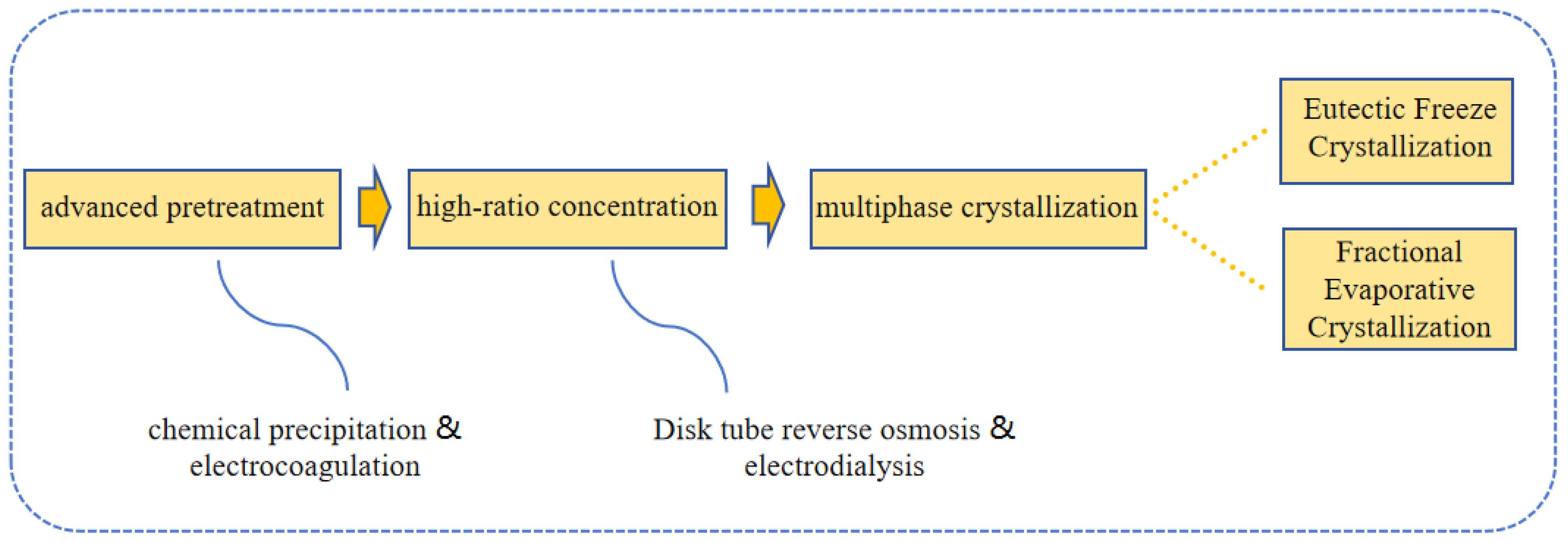
Targeting extremely refractory wastewater characterized by “high salinity, high hardness, and high chloride ions,” such as desulfurization wastewater from thermal power plants (FGD) and other industrial wastewaters, traditional single precipitation methods have become inadequate and fail to meet the dual objectives of resource recovery and Zero Liquid Discharge (ZLD) (Zheng Yao et al., 2024) [102]. Multi-stage pretreatment coupled with fractional crystallization technology achieves the differential separation of pollutants and high-value-added resource recovery through precise thermodynamic phase regulation (Liao Binsheng et al., 2025) [31]. Its typical process pathway can be divided into three key stages: advanced pretreatment, high-ratio concentration, and multiphase crystallization (Figure 5) (Liao Binsheng et al., 2025) [31]. First, advanced pretreatment utilizes chemical precipitation (such as the lime-soda ash method) or electrocoagulation (EC) to preliminarily remove the majority of hardness ions and suspended solids, effectively circumventing the risk of physical scaling in subsequent crystallizers. Subsequently, High-pressure Reverse Osmosis (DTRO) or Electrodialysis (ED) is employed to concentrate Total Dissolved Solids (TDS) to the critical saturation point, laying the foundation for volume reduction in terminal crystallization.
In the multiphase crystallization stage, process selection should be based on energy efficiency demands and the purity requirements of the end products; currently, two main differentiated technological pathways exist: The first is thermodynamically driven Fractional Evaporative Crystallization (Bo Shen et al., 2024) [92]. This technology emphasizes the precise fractionation of high-salt components and the production of dry salts. We propose that nanofiltration (NF) can be utilized at the front end of concentration to achieve the pre-separation of mono/divalent ions (Chatla et al., 2023) [1], subsequently coupled with Mechanical Vapor Recompression (MVR) technology (Tong and Elimelech., 2016) [103] to elevate supersaturation via solvent evaporation, thereby separately producing industrial-grade sodium chloride and sodium sulfate. Relevant studies indicate that by dynamically optimizing supersaturation to control nucleation rates, the purity of sodium chloride crystals can exceed 99% (Liao Binsheng et al., 2025) [31], significantly enhancing the market added value of by-products and making it suitable for resource recovery projects with extremely high requirements for industrial salt purity.
Phase equilibrium-driven Eutectic Freeze Crystallization (EFC) has already been introduced in Section 3.3.3. This pathway focuses on synchronous water and salt recovery under low energy consumption. Unlike solvent evaporation in thermal methods, EFC utilizes the drastic differences in solubility characteristics between salts and water at low temperatures to synchronously precipitate pure ice and high-purity salt crystals near the eutectic point. A four-year industrial pilot study conducted by Kagiso S. More et al. (2025) [96] in South Africa demonstrated its superior energy efficiency ratio: by optimizing heat transfer interfaces and pipeline flow fields, the monthly recovery rate of sodium sulfate leaped from 3.5 tons to 9.1 tons, and purity increased from 50% to 84.9%. Since it does not involve the latent heat of phase change (vaporization) of water, its energy consumption is only 1/6.7 of that of traditional evaporation methods, making it a suitable choice for projects pursuing low-carbon, low-energy operation and high recovery rates.
During the crystallization process, impurity metal ions and trace organic matter are excluded into a minimal volume of mother liquor, thereby achieving precise physical separation from the bulk salts (Kagiso S. More et al., 2025) [96]. This enriched mother liquor can be further processed via chelate precipitation or solidification treatment to achieve harmless disposal, thoroughly blocking the pathway of pollution transfer to the environment.
Multi-stage pretreatment coupled with fractional crystallization technology transcends the traditional “mixed crystallization” mode, utilizing the dynamic differences in ion solubility gradients to achieve salt-salt separation and the extreme concentration of heavy metals. This process represents one of the most mature pathways currently available for achieving resource-oriented Zero Liquid Discharge (ZLD) and possesses high economic benefits; however, high Capital Expenditure (CAPEX) and the extreme challenges imposed on equipment materials by high-chloride environments still constitute barriers to its widespread application (Muhammad Yaqub et al., 2022) [104]. The process demonstrates favorable treatment efficacy for thermal power plant desulfurization wastewater, coal chemical wastewater, and metallurgical high-salt wastewater characterized by ultra-high TDS and complex compositions.

4.3. Dynamic Regulation Strategies in Crystallization Processes

In complex wastewater matrices, the sulfate crystallization process is not an isolated thermodynamic phase transition but a complex kinetic process deeply coupled with coexisting impurities, hydraulic shear, and dynamic fluctuations in supersaturation (Weibin Xu and Cheng Liu, 2025) [98]. This section aims to explore how to overcome the inhibition effects of impurities on crystallization through multidimensional dynamic regulation, achieving the efficient conversion of sulfate and co-occurring pollutants.
First, induced crystallization driven by heterogeneous nucleation represents a core strategy for lowering the system energy barrier and enhancing removal rates. Traditional homogeneous nucleation is often difficult to control due to prolonged induction times and sensitivity to environmental fluctuations. The introduction of seed crystals with high specific surface areas (such as silica sand or pre-generated calcium sulfate crystals) can serve as effective carriers; by providing abundant active sites, they facilitate the transition of crystals from “burst nucleation” to “controlled growth”(Mark Daniel G. de Luna et al., 2017, Seckler et al., 2022) [105,106]. As pointed out by Xu and Liu (2025) [98], a dynamic suspension system constructed via a fluidized bed reactor (FBC) is capable of utilizing optimized mass transfer efficiency to significantly shorten the induction time. Within this dynamic regulation framework, the stirring intensity (typically maintained at approximately 450 rpm) must strike a delicate balance between promoting solute diffusion and avoiding secondary crystal breakage, in order to maintain a steady-state crystal size distribution.
Secondly, kinetic compensation targeting the interference of complex organic matter (such as antiscalants) constitutes a critical challenge in realizing synchronous removal. Organic matter such as polyacrylic acid (PAA), which is ubiquitously present in wastewater, significantly inhibits the enlargement of sulfate particles by chelating metal ions, adsorbing onto crystal growth sites, or generating charge repulsion effects (Yijie Cai et al., 2025) [107]. Dynamic regulation strategies require the system to possess the capability of real-time sensing of impurity concentration fluctuations. By precisely regulating the molar ratio of calcium to sulfur (typically controlled between 1.25 and 2.0) and the solution saturation index (SI), sufficient driving force can be generated to overcome the steric hindrance effects of organic matter. When the supersaturation is controlled at a critical threshold (S = 2.1), the system can ensure a relatively high sulfate removal rate (reaching over 60%) while simultaneously avoiding the escape of fine particles caused by excessively high local supersaturation, thereby ensuring the robustness of effluent water quality (Weibin Xu and Cheng Liu et al., 2025) [98].
Furthermore, we posit that the coupled application of lattice-directed doping and Process Analytical Technology (PAT) can endow the system with adaptive regulation capabilities. Synthesizing existing literature, we propose a possibility—shifting away from the mindset of mere “impurity removal” to utilizing the affinity between heavy metal ions (such as N i 2 + , C o 2 + ) and the sulfate lattice, effectively locking them within the solid-phase matrix through isomorphous substitution during the dynamic crystallization process (Hun-Yi Liu et al., 2024) [108]. This process necessitates reliance on online monitoring technologies (such as FBRM, Focused Beam Reflectance Measurement) (Lorena Barros et al., 2021) [109], which can provide real-time feedback on the evolution of crystal counts and particle sizes. Once an abnormal surge in the number of crystal nuclei is detected, the control system can instantaneously reduce the dosing rate or adjust the reflux ratio, thereby repairing crystal quality by broadening the Metastable Zone Width (MSZW).
Dynamic regulation technology in the crystallization process facilitates a transition from singular “static proportioning” to a holistic dynamic control logic based on “induced nucleation–kinetic compensation–real-time feedback.” Its advantages lie in the ability to significantly enhance the purity of crystalline by-products and augment the system’s resilience against organic load shocks; however, its limitations are that the capture of this dynamic equilibrium point relies heavily on high-precision sensors and automation algorithms, imposing higher requirements on on-site operation and maintenance as well as computational power. This technology is particularly applicable to textile dyeing wastewater, coal chemical circulating water, and high-sulfur industrial wastewater, which are characterized by drastic fluctuations in organic content and require the simultaneous recovery of high-purity gypsum or salt products.

5. Discussion

5.1. From Single Removal to Synergistic Control: Paradigm Shift Under Complex Matrices

The comprehensive analysis of sulfate removal technologies in this review indicates that the paradigm of industrial wastewater treatment is undergoing a significant transition from “single sulfate compliance” to “synergistic control and resource recovery of multi-pollutants.” Typical high-sulfate wastewaters, such as Acid Mine Drainage (AMD) and Flue Gas Desulfurization (FGD) wastewater from thermal power plants, invariably exhibit characteristics of multi-component complex pollution 1. Although traditional single chemical precipitation is technologically mature in sulfate removal, it possesses limitations when facing such complex matrices: it is not only difficult to reduce sulfate to stringent discharge standards (<250 mg/L) (Chatla, A. et al., 2023) [1], but it also generates massive amounts of hazardous sludge containing heavy metals, resulting in the phase transfer of pollutants rather than their thorough elimination (Geoffrey S. Simate et al., 2014) [22]. In contrast, the core principle of synchronous removal technologies lies in utilizing the chemical or physical interactions between pollutants to transform treatment challenges into removal driving forces. For instance, in the Biological Sulfate Reduction (BSR) system, the reduction product of sulfate ( S 2 ) serves precisely as an efficient precipitant for removing heavy metal ions ( M e n + ) (Ditiro Mafane et al., 2025) [110]; meanwhile, during the Nanofiltration (NF) process, the negative charge on the membrane surface generates strong electrostatic repulsion against both divalent anions ( S O 4 2 ) and complexed heavy metals (López et al., 2019; Pino et al., 2018) [64,65]. This intrinsic mechanistic coupling fully demonstrates that the process design for treating complex wastewater should and must be established upon a profound understanding of the coexistence behavior of sulfate and co-occurring pollutants (heavy metals, organic matter, chloride ions, etc.).

5.2. Comparative Analysis of Synergistic Mechanisms and Applicability of Different Technological Pathways

In evaluating the synchronous removal potential of various technologies, we found that different mechanisms exhibit significant differentiated advantages when coping with specific pollutant combinations, demonstrating strong potential in the treatment of specific types of wastewater.
Biological methods based on sulfate-reducing bacteria (SRB) demonstrate unique “self-repairing” capabilities in treating Acid Mine Drainage (AMD). The SRB metabolic process not only achieves the deep solidification of heavy metals by generating sulfide precipitates (whose solubility products are far lower than those of hydroxides) but also significantly raises the system pH by consuming protons (K. Rambabu et al., 2020) [20]. This quadruple coupled process of “electron donor oxidation–sulfate reduction–heavy metal precipitation–acidity neutralization” makes it an ideal choice for treating acidic wastewater with low-to-medium concentrations and high metal content (K. Rambabu et al., 2020) [20]. However, its limitation lies in the low tolerance threshold of microorganisms to high concentrations of heavy metals and their own metabolic byproducts (H2S) (Jéssica Pelinsom Marques et al., 2025) [111], which restricts its direct application in high-load industrial wastewater.
Crystallization methods, particularly fractional crystallization and Eutectic Freeze Crystallization (EFC), represent the ultimate pursuit of precision in physical separation and low energy consumption. Unlike the disorder of chemical precipitation, crystallization methods achieve the “differential separation” of pollutants through thermodynamic control (Bo Shen et al., 2024) [92]. The latest industrial pilot data indicate that Pipeline Freeze Crystallization (PFC) technology, by utilizing the difference in salt-water solubility at low temperatures, not only achieves high-purity recovery of sodium sulfate (>84.9%) but also consumes only 1/6.7 of the energy of traditional evaporation methods (Kagiso S. More et al., 2025) [96]. This suggests that when treating high-salinity wastewater (FGD, coal chemical), utilizing phase change driving forces for resource recovery is already economically feasible, especially for scenarios pursuing Zero Liquid Discharge (ZLD). Ordered crystallization methods achieve precise control of phase change separation and a trade-off in energy consumption to a certain extent.
The breakthrough of electrochemical technology in the field of synchronous removal lies in its ability to achieve selective conversion through potential regulation, possessing the advantage of cleanliness (Sergi Garcia-Segura, 2015) [76]. For instance, the electrochemically activated limestone system achieves the fractional extraction of valuable metals and the synchronous precipitation of sulfate by regulating pH in situ (Maria del Mar Cerrillo-Gonzalez et al.) [85]. Although its cleanliness is undoubted, in high-chloride wastewater (such as FGD), the electrolysis process may generate toxic byproducts such as active chlorine (Hualiang Feng, 2023) [90]. This represents a potential environmental risk of the technology, which needs to be circumvented in practical process design through the optimization of electrode materials or post-treatment units. To provide a structured comparison of these technological pathways, the core synergistic mechanisms, optimal wastewater types, key advantages, and primary limitations of each method are synthesized in Table 5.

5.3. The “Additive Effect” of Combined Processes: Solving the Dilemmas of Single Technologies

Single technologies sometimes still face the dilemma of trade-offs; however, the combined processes emphasized in this review achieve a “1 + 1 > 2” additive effect through the rational linkage of unit operations.
The first combined process is the complementarity between membrane concentration and biological conversion (NF + BSR). Membrane separation technology is often plagued by the difficulty of concentrate disposal, while biological methods are constrained by fluctuations in influent water quality. Employing Nanofiltration (NF) as a pretreatment unit allows for the efficient retention and concentration of sulfate and heavy metals from low-concentration, large-volume wastewater (López et al., 2019; Pino et al., 2018; Yongxun Jin et al., 2020) [64,65,70]. This not only provides high-concentration electron acceptors for the subsequent bioreactor—significantly reducing the required volume of the biological treatment unit—but also effectively mitigates the hydraulic shock loads faced by the biological system. Subsequently, the bioreactor converts sulfate in the concentrate into sulfide to precipitate heavy metals (Sun Kyung Hwang and Eun Hea Jho, 2018) [100], fundamentally resolving the issue of secondary pollution from membrane concentrate. This coupled pathway of “physical enrichment–biomineralization” provides a solution to the critical limitation of membrane technology being “separation only without degradation”.
The second combined process is the integration of multi-stage pretreatment with resource-oriented crystallization. For wastewater characterized by high hardness and high organic content, such as FGD wastewater, direct crystallization inevitably leads to severe scaling and a decline in product purity (Zheng Yao et al., 2024) [102]. The introduction of multi-stage pretreatment (combinations such as chemical softening + DTRO) effectively eliminates impurity ions (Ca2+, Mg2+) that interfere with crystallization (Liao Binsheng et al., 2025) [31], enabling the terminal fractional crystallization in the technological route to focus on the separation and purification of high-value salts (NaCl, Na2SO4). Studies indicate that through this refined fractionation, the purity of sodium chloride crystals can exceed 99% (Liao Binsheng et al., 2025) [31], thereby transforming wastewater treatment from a mere cost center into a resource that generates economic benefits.

5.4. Dynamic Regulation: From Steady-State Operation to Intelligent Response

Fluctuations in the composition of industrial wastewater are the primary causes leading to unstable treatment efficacy and either insufficient or excessive chemical dosing. The dynamic regulation strategies for the crystallization process proposed in this review reveal a new pathway to overcome impurity interference. Traditional views regard organic matter (such as antiscalants) as absolute inhibitors of crystallization; however, through induced crystallization and the dynamic compensation of supersaturation, this kinetic barrier can be effectively breached (Yijie Cai et al., 2025) [107]. The introduction of seed crystals not only provides active sites but also shortens the induction time (Mark Daniel G. de Luna et al., 2017, Seckler et al., 2022) [105,106]. More importantly, through real-time monitoring (such as FBRM technology) and feedback regulation of supersaturation, the system is capable of maintaining the driving force for crystal growth during fluctuations in impurity concentrations. This transition from “static parameter setting” to “dynamic process control” represents a key solution for enhancing the industrial stability of sulfate removal technologies.

5.5. Challenges and Perspectives

Although synchronous removal technologies have demonstrated immense potential, they still require continuous development to overcome challenges in practical engineering applications:
(1)
The stability of long-term operation and membrane fouling. Whether in membrane separation or Membrane Distillation Crystallization (MDC), membrane fouling remains the core obstacle limiting long-cycle operation (Aguiar et al., 2016) [66]. Future research should not be limited solely to membrane cleaning strategies but should focus on the development of novel anti-fouling membrane materials and deep integration with pretreatment processes (such as the degradation of organic matter via advanced oxidation).
(2)
The discussion on technical economic efficiency and carbon footprint (CAPEX/OPEX). Advanced combined processes (such as MVR crystallization) are often accompanied by high Capital Expenditure (Tong and Elimelech, 2016) [103]. Future technology assessments could introduce Life Cycle Assessment (LCA) to comprehensively consider the offset benefits brought by resource recovery. Currently, the utilization of waste heat to drive membrane distillation or the adoption of low-energy freezing crystallization technology proposed by academia (Kagiso S. More et al., 2025) [96] represents important directions for reducing the overall carbon footprint.
(3)
Toxic byproducts within technological pathways also require control. In electrochemical and biological treatment processes, strict monitoring of H2S fugitive emissions and the generation of chlorinated byproducts is required (Hualiang Feng, 2023) [90] to ensure the safety of the treatment process itself.
In summary, the treatment of sulfate wastewater is no longer a problem of removing a single ion, but a systems engineering endeavor involving multi-component separation, conversion, and resource recovery. Realizing the efficient synchronous removal of sulfate and co-occurring pollutants through the optimization of combined processes and the dynamic regulation of crystallization processes is not only technologically feasible but also the imperative path toward achieving Zero Liquid Discharge (ZLD) and resource recycling in industrial wastewater.

6. Conclusions

This review aims to explore synergistic treatment processes and technical pathways for sulfate and co-occurring pollutants (such as heavy metals and organic matter) in wastewater from the innovative perspective of synchronous removal, with the objective of overcoming the bottlenecks of single removal technologies and achieving resource recovery. This study has systematically summarized the complex pollution characteristics of complex water bodies such as mine drainage, industrial wastewater, and municipal wastewater, and has deeply evaluated the synchronous removal efficacy of technologies, including precipitation, membrane separation, adsorption, biological methods, electrochemical methods, and crystallization. It was found that through combined processes (such as nanofiltration coupled with biological reduction) and dynamic regulation strategies (such as induced crystallization and supersaturation compensation), the interactions between pollutants can be effectively utilized. This allows for the efficient recovery of high-purity metal sulfides, gypsum, or industrial salts and the reduction of carbon emissions, while simultaneously achieving compliant discharge of sulfate. The core contribution of this review lies in shifting the research focus from mere “sulfate removal” to “synergistic control of multi-pollutants,” thereby providing theoretical support and process references for the Zero Liquid Discharge (ZLD) of high-salinity and high-toxicity wastewater.
Despite the immense potential of synchronous removal technologies, this study also points out that they still face challenges in practical applications. The main limitations include: the excessively high initial Capital Expenditure (CAPEX) of complex process systems (such as MVR crystallization), the persistent severity of fouling and scaling issues in membrane modules during long-term operation, and the necessity for further strict control over toxic byproducts (such as active chlorine and hydrogen sulfide) potentially generated in electrochemical and biological processes.
Future research should transition from laboratory-scale feasibility studies to industrial-scale optimization by focusing on three strategic dimensions: (1) Material Innovation and Pretreatment Integration: Developing high-performance anti-fouling membrane materials and integrating them with advanced oxidation processes (AOPs) to mitigate the persistent challenge of organic fouling and scaling in long-term operations. (2) Technological-Economic Synthesis: Employing Life Cycle Assessment (LCA) to quantify the trade-offs between the high CAPEX of advanced systems, such as MVR crystallization, and the environmental offsets provided by resource recovery and waste-heat-driven technologies (e.g., membrane distillation or low-energy freeze crystallization). (3) Intelligence-driven Regulation: Establishing intelligent dynamic control systems that integrate Artificial Intelligence (AI) with advanced sensors (e.g., FBRM for real-time crystal size distribution monitoring). A promising application involves employing machine learning algorithms to process high-frequency sensor data, enabling the real-time optimization of supersaturation and chemical dosing in crystallization reactors. This approach can effectively resolve the kinetic instabilities caused by impurity interference during synchronous removal, thereby ensuring process robustness, maximizing byproduct purity, and minimizing energy consumption.
By prioritizing these pathways, the synchronous removal of sulfate and co-occurring pollutants will serve as a definitive driver for realizing Zero Liquid Discharge (ZLD) and promoting the sustainable green transformation of global industrial wastewater management.
In summary, advancing the synchronous removal of sulfate and co-occurring pollutants is not merely a technological necessity for addressing complex industrial wastewater pollution, but also a core driving force for realizing industrial green transformation and resource recycling.

Author Contributions

Conceptualization, H.Z. and Y.L.; methodology, Y.L. and T.L.; validation, Y.L., T.L. and H.Z.; formal analysis, Y.L.; investigation, Y.L. and T.L.; resources, H.Z.; data curation, Y.L.; writing—original draft preparation, Y.L. and T.L.; writing—review and editing, Y.L., T.L. and H.Z.; visualization, T.L.; supervision, H.Z.; project administration, H.Z. and Y.L.; funding acquisition, H.Z. All authors have read and agreed to the published version of the manuscript.

Funding

This research was funded by the Central Government Guided Local Science and Technology Development Special Project of Ningxia Hui Autonomous Region (2024FRD05070).

Data Availability Statement

No new data were created or analyzed in this study. Data sharing is not applicable to this article.

Acknowledgments

During the preparation of this manuscript, the author(s) used Gemini 3.0, Gemini 3.0 Pro, and the Doubao Large Model (v1.83.5) for polishing the content and grammar of the initial draft. For proofreading and translation of this manuscript, the author(s) used Gemini 3.0 Pro. In creating the illustrations for this manuscript, the author(s) used “Lingxi AI 3.0” developed by Kingsoft Office (WPS) to refine the image content. The authors have reviewed and edited the output and take full responsibility for the content of this publication.

Conflicts of Interest

The authors declare no conflict of interest.

References

  1. Chatla, A.; Almanassra, I.W.; Abushawish, A.; Laoui, T.; Alawadhi, H.; Atieh, M.A.; Ghaffour, N. Sulphate removal from aqueous solutions: State-of-the-art technologies and future research trends. Desalination 2023, 558, 116615. [Google Scholar] [CrossRef]
  2. Chen, M.Q.; Wu, F.J. Mechanisms and remediation technologies of sulfate removal from acid mine drainage. Adv. Mater. Res. 2013, 610, 3252–3256. [Google Scholar] [CrossRef]
  3. WHO. Guidelines for Drinking-Water Quality, 4th ed.; WHO: Geneva, Switzerland, 2011. [Google Scholar]
  4. WHO. A compendium of drinking-water quality standards in the Eastern Mediterranean Region. In World Health Organization Regional Office for the Eastern Mediterranean; WHO: Geneva, Switzerland, 2006; pp. 1–24. [Google Scholar]
  5. US EPA. Npdes Permit No. NM0022250 Fact Sheet for the Draft National Pollutant Discharge Elimination System (Npdes) Permit to Discharge to Waters of the United States; Albuquerque Bernalillo County Water Utility Authority (ABCWUA), U.S. Environ. Prot. Agency: Washington, DC, USA, 2018; pp. 1–16.
  6. GB 5749-2022; Standards for Drinking Water Quality. State Administration for Market Regulation and Standardization Administration of the People’s Republic of China. Standards Press of China: Beijing, China, 2022.
  7. Arnold, M.; Gericke, M.; Muhlbauer, R. Technologies for sulphate removal with valorisation options. In Proceedings of the IMWA 2016 Annual Conference: Mining Meets Water—Conflicts and Solutions, Leipzig, Germany, 11–15 July 2016; pp. 11–15. [Google Scholar]
  8. IS 10500:2012; Drinking Water—Specification (Second Revision). Bureau of Indian Standards (BIS): New Delhi, India, 2012.
  9. Amaral Filho, J.; Azevedo, A.; Etchepare, R.; Rubio, J. Removal of sulfate ions by dissolved air flotation (DAF) following precipitation and flocculation. Int. J. Miner. Process. 2016, 149, 1–8. [Google Scholar] [CrossRef]
  10. Quintana-Baquedano, A.A.; Sanchez-Salas, J.L.; Flores-Cervantes, D.X. A review of technologies for the removal of sulfate from drinking water. Water Environ. J. 2023, 37, 718–728. [Google Scholar] [CrossRef]
  11. An, W.; Zhao, J.; Lu, J.; Han, Y.; Li, D. Zero-liquid discharge technologies for desulfurization wastewater: A review. J. Environ. Manag. 2022, 321, 115953. [Google Scholar] [CrossRef]
  12. Bai, F.; Liu, S.; Ma, J.; Zhang, Y. Biodegradation of sulfate and elimination of heavy metals by immobilized-microbial bioaugmentation coupled with anaerobic membrane bioreactor. Chem. Eng. J. 2023, 473, 145196. [Google Scholar] [CrossRef]
  13. Kefeni, K.K.; Msagati, T.A.M.; Mamba, B.B. Acid mine drainage: Prevention, treatment options, and resource recovery: A review. J. Clean. Prod. 2017, 151, 475–493. [Google Scholar] [CrossRef]
  14. Ryu, S.; Naidu, G.; Johir, M.A.; Choi, Y.; Jeong, S.; Vigneswaran, S. Acid mine drainage treatment by integrated submerged membrane distillation–sorption system. Chemosphere 2019, 218, 955–965. [Google Scholar] [CrossRef]
  15. Lou, X.-Y.; Xu, Z.; Bai, A.P.; Resina-Gallego, M.; Ji, Z.G. Separation and Recycling of Concentrated Heavy Metal Wastewater by Tube Membrane Distillation Integrated with Crystallization. Membranes 2020, 10, 19. [Google Scholar] [CrossRef]
  16. Li, W.; Wang, J.; Zhan, Z.; Luo, J.; Zhou, D.; Lei, Y. Extraction of valuable metals from acid mine drainage by an electrochemically activated limestone system. Nat. Commun. 2025, 16, 6719. [Google Scholar] [CrossRef]
  17. Guo, L.; Xie, Y.; Sun, W.; Xu, Y.; Sun, Y. Research Progress of High-Salinity Wastewater Treatment Technology. Water 2023, 15, 684. [Google Scholar] [CrossRef]
  18. Nordstrom, D.K.; Blowes, D.W.; Ptacek, C.J. Hydrogeochemistry and microbiology of mine drainage: An update. Appl. Geochem. 2015, 57, 3–16. [Google Scholar] [CrossRef]
  19. Akcil, A.; Koldas, S. Acid Mine Drainage (AMD): Causes, treatment and case studies. J. Clean. Prod. 2006, 14, 1139–1145. [Google Scholar] [CrossRef]
  20. Rambabu, K.; Banat, F.; Pham, Q.T. Biological remediation of acid mine drainage: Review of past trends, present challenges and future outlook. Environ. Sci. Ecotechnol. 2020, 2, 100024. [Google Scholar] [CrossRef]
  21. Belzile, N.; Chen, Y.W.; Cai, M.F.; Li, Y.R. A review on pyrrhotite oxidation. J. Geochem. Explor. 2004, 84, 65–76. [Google Scholar] [CrossRef]
  22. Simate, G.S.; Ndlovu, S. Acid mine drainage: Challenges and opportunities. J. Environ. Chem. Eng. 2014, 2, 1785–1803. [Google Scholar] [CrossRef]
  23. Al-Zoubi, H.; Rieger, A.; Steinberger, P.; Pelz, W.; Haseneder, R.; Härtel, G. Nanofiltration of Acid Mine Drainage. Desalination Water Treat. 2010, 21, 148–161. [Google Scholar] [CrossRef]
  24. Janson, E. Multi-decadal impact of mine waters in Przemsza River Basin, Upper Silesian Coal Basin, Southern Poland. Water 2024, 16, 3147. [Google Scholar] [CrossRef]
  25. Szalińska, E.; Motyka, J.; d’Obyrn, K.; Orlińska-Woźniak, P.; Nachlik, E.; Mączałowski, A.; Wilk, P. Current and future chloride concentrations in a large river—Will a disaster happen again? Water Resour. Ind. 2025, 33, 100289. [Google Scholar] [CrossRef]
  26. Mitko, K.; Laskowska, E.; Turek, M.; Dydo, P.; Piotrowski, K. Scaling risk assessment in nanofiltration of mine waters. Membranes 2020, 10, 288. [Google Scholar] [CrossRef]
  27. Turek, M.; Mitko, K.; Skóra, P. Applying nanofiltration to decrease energy consumption and sensitivity toward feed composition fluctuations in salt production. Membranes 2024, 14, 103. [Google Scholar] [CrossRef] [PubMed]
  28. Mazinder Baruah, P.; Singh, G. Assessment of potability of minewater pumped out from Jharia Coalfield, India: An integrated approach using integrated water quality index, heavy metal pollution index, and multivariate statistics. Environ. Sci. Pollut. Res. 2022, 29, 27366–27381. [Google Scholar] [CrossRef] [PubMed]
  29. Hermassi, M.; Granados, M.; Valderrama, C.; Ayora, C.; Cortina, J.L. Recovery of Rare Earth Elements from acidic mine waters by integration of a selective chelating ion-exchanger and a solvent impregnated resin. J. Environ. Chem. Eng. 2021, 9, 105906. [Google Scholar] [CrossRef]
  30. Vital, B.; Bartacek, J.; Ortega-Bravo, J.C.; Jeison, D. Treatment of acid mine drainage by forward osmosis: Heavy metal rejection and reverse flux of draw solution constituents. Chem. Eng. J. 2018, 332, 85–91. [Google Scholar] [CrossRef]
  31. Liao, B.; Zeng, X.; Ling, Z.; Zhao, S.; Li, B.; Han, X. Recent Advances in Zero Discharge Treatment Technologies for Desulfurization Wastewater in Coal-Fired Power Plants: A Mini-Review. Processes 2025, 13, 982. [Google Scholar] [CrossRef]
  32. Wales, M.; Gebremichael, E.; Wang, X.; Perea, E.; Jayaweera, P.; Jayaweera, I. Flue Gas Desulfurization (FGD) Wastewater Treatment Using Polybenzimidazole (PBI) Hollow Fiber (HF) Membranes. Membranes 2021, 11, 430. [Google Scholar] [CrossRef]
  33. Sun, Q.; Fang, T.; Chen, J.; Da, C. Characteristics of Chlorine Releasing from Coal-Fired Power Plant. Atmosphere 2021, 12, 1550. [Google Scholar] [CrossRef]
  34. Xin, Y.; Zhou, Z.; Ming, Q.; Sun, D.; Han, J.; Ye, X.; Dai, S.; Jiang, L.-M.; Zhao, X.; An, Y. A two-stage desalination process for zero liquid discharge of flue gas desulfurization wastewater by chloride precipitation. J. Hazard. Mater. 2020, 397, 122744. [Google Scholar] [CrossRef]
  35. Gingerich, D.B.; Mauter, M.S. Flue gas desulfurization wastewater composition and implications for regulatory and treatment train design. Environ. Sci. Technol. 2020, 54, 3783–3792. [Google Scholar] [CrossRef]
  36. Fu, B.; Liu, G.J.; Mian, M.M.; Sun, M.; Mu, D. Characteristics and speciation of heavy metals in fly ash and FGD gypsum from Chinese coal-fired power plants. Fuel 2019, 251, 593–602. [Google Scholar] [CrossRef]
  37. Ścieżyńska, D.; Majewski, M.; Nath, S.; Bury, D.; Jastrzębska, A.; Bogacki, J.; Marcinowski, P. Application of waste iron in wet flue gas desulfurization (WFGD) wastewater treatment. Environ. Sci. Pollut. Res. 2024, 31, 66090–66102. [Google Scholar] [CrossRef] [PubMed]
  38. Yao, X.; Zhang, M.; Deng, B.Y.; Yang, X.H.; Yang, H.R. Primary Research of a New Zero-Liquid-Discharge Technology of Wet Flue Gas Desulfurization Wastewater by Low-Rank Heat from Flue Gas. Energies 2021, 14, 4259. [Google Scholar] [CrossRef]
  39. Stankovic, S.; Kamberovic, Ž.; Friedrich, B.; Stopic, S.; Sokic, M.; Markovic, B.; Schippers, A. Options for Hydrometallurgical Treatment of Ni-Co Lateritic Ores for Sustainable Supply of Nickel and Cobalt for European Battery Industry from South-Example includeern Europe and Turkey. Metals 2022, 12, 807. [Google Scholar] [CrossRef]
  40. Sato, H.; Kamisono, M.; Goto, M. High-Purity Nickel Recovery from Low-Grade Nickel Laterite Ore Using Hydrophobic Diluted Deep Eutectic Solvents. ACS Sustain. Resour. Manag. 2025, 2, 1400−1406. [Google Scholar] [CrossRef]
  41. Kinnunen, P.; Riihimäki, T.; Kinnunen, K.; Salo, M.; Heikola, T.; Mäkinen, J. Process design for direct production of battery grade nickel sulfate. J. Sustain. Metall. 2024, 10, 1369–1379. [Google Scholar] [CrossRef]
  42. Flett, D.S. Cobalt-nickel separation in hydrometallurgy: A review. Chem. Sustain. Dev. 2004, 12, 81–91. [Google Scholar]
  43. Fu, F.; Wang, Q. Removal of heavy metal ions from wastewaters: A review. J. Environ. Manag. 2011, 92, 407–418. [Google Scholar] [CrossRef]
  44. Tutić, A.; Miloloža, M.; Cvetnić, M.; Martinjak, V.; Furač, L.; Markić, M.; Ukić, Š.; Bolanča, T.; Kučić Grgić, D. An overview of coking wastewater characteristics and treatment technologies. Kemija u industriji: Časopis kemičara i kemijskih inženjera Hrvatske 2023, 72, 349–358. [Google Scholar] [CrossRef]
  45. Tamang, M.; Paul, K.K. Advances in treatment of coking wastewater—A state of art review. Water Sci. Technol. 2022, 85, 449–473. [Google Scholar] [CrossRef]
  46. Lawan, M.S.; Kumar, R.; Rashid, J.; Barakat, M.A. Recent Advancements in the Treatment of Petroleum Refinery Wastewater. Water 2023, 15, 3676. [Google Scholar] [CrossRef]
  47. Kondaveeti, S.; Govindarajan, D.; Mohanakrishna, G.; Thatikayala, D.; Abu-Reesh, I.M.; Min, B.; Nambi, I.M.; Al-Raoush, R.I.; Aminabhavi, T.M. Sustainable bioelectrochemical systems for bioenergy generation via waste treatment from petroleum industries. Fuel 2023, 331, 125632. [Google Scholar] [CrossRef]
  48. Li, Y.G.; He, C.; Chen, C.M.; Liu, F.; Shi, Q. Molecular investigation into the transformation of recalcitrant dissolved organic sulfur in refinery sour water during stripping process. Pet. Sci. 2024, 21, 2112–2119. [Google Scholar] [CrossRef]
  49. Chen, Y.; Cheng, J.J.; Creamer, K.S. Inhibition of anaerobic digestion process: A review. Bioresour. Technol. 2008, 99, 4044–4064. [Google Scholar] [CrossRef] [PubMed]
  50. Ho, Q.N.; Anam, G.B.; Kim, J.; Park, S.; Lee, T.-U.; Jeon, J.-Y.; Choi, Y.-Y.; Lee, B.J. Fate of sulfate in municipal wastewater treatment plants and its effect on sludge recycling as a fuel source. Sustainability 2023, 15, 311. [Google Scholar] [CrossRef]
  51. Hao, T.W.; Xiang, P.Y.; Mackey, H.R.; Chi, K.; Lu, H.; Chui, H.K.; van Loosdrecht, M.C.M.; Chen, G.H. A review of biological sulfate conversions in wastewater treatment. Water Res. 2014, 65, 1–21. [Google Scholar] [CrossRef]
  52. Huiliñir, C.; Fuentes, V.; Estuardo, C.; Antileo, C.; Pino-Cortés, E. Partial Nitrification in a Sequencing Moving Bed Biofilm Reactor (SMBBR) with Zeolite as Biomass Carrier: Effect of Sulfide Pulses and Organic Matter Presence. Water 2021, 13, 2484. [Google Scholar] [CrossRef]
  53. Meng, Q.A.; Zeng, W.; Fan, Z.W.; Li, S.S.; Peng, Y.Z. Sulfide inhibition on polyphosphate accumulating organisms and glycogen accumulating organisms: Cumulative inhibitory effect and recoverability. J. Hazard. Mater. 2023, 451, 131157. [Google Scholar] [CrossRef]
  54. Fernando, W.A.M.; Ilankoon, I.M.S.K.; Syed, T.H.; Yellishetty, M. Challenges and opportunities in the removal of sulphate ions in contaminated mine water: A review. Miner. Eng. 2018, 117, 74–90. [Google Scholar] [CrossRef]
  55. Blanco-Zúñiga, C.R.; Orjuela-Fajardo, C.N.; Rojas-Arias, N. Heavy metals and sulfate removal from acid mine drainage using steel mill slag in a rotational mixing device. J. Appl. Res. Technol. 2023, 21, 433–446. [Google Scholar] [CrossRef]
  56. Khorasanipour, M.; Moore, F.; Naseh, R. Lime treatment of mine drainage at the sarcheshmeh porphyry copper mine, Iran. Mine Water Environ. 2011, 30, 216–230. [Google Scholar] [CrossRef]
  57. Geldenhuys, A.J.; Maree, J.P.; de Beer, M.; Hlabela, P. An integrated limestone/lime process for partial sulphate removal. J. S. Afr. Inst. Min. Metall. 2003, 103, 345–353. [Google Scholar]
  58. Bowell, R.J.; Dill, S.; Cowan, J.; Wood, A. A review of sulfate removal options for mine waters. In Proceedings of Mine Water; University of Newcastle: Newcastle upon Tyne, UK, 2004; pp. 75–88. [Google Scholar]
  59. Dou, W.X.; Zhou, Z.; Jiang, L.M.; Jiang, A.J.; Huang, R.W.; Tian, X.C.; Zhang, W.; Chen, D.Q. Sulfate removal from wastewater using ettringite precipitation: Magnesium ion inhibition and process optimization. J. Environ. Manag. 2017, 196, 518–526. [Google Scholar] [CrossRef] [PubMed]
  60. Tian, X.C.; Zhou, Z.; Xin, Y.; Jiang, L.M.; Zhao, X.D.; An, Y. A novel sulfate removal process by ettringite precipitation with aluminum recovery: Kinetics and a pilot-scale study. J. Hazard. Mater. 2019, 365, 572–580. [Google Scholar] [CrossRef]
  61. Zhou, Y.Q.; Zhou, Y.H.; Liu, R.L.; Zheng, G.C.; Tao, C.Y.; Xi, B.J. Recyclable and Efficient Recovery of Ca and S from Phosphogypsum by Using Multistep Precipitation. ACS Omega 2024, 9, 4664–4672. [Google Scholar] [CrossRef] [PubMed]
  62. Maree, J.P.; Hlabela, P.; Nengovhela, R.; Geldenhuys, A.J.; Mbhele, N.; Nevhulaudzi, T.; Waanders, F.B. Treatment of Mine Water for Sulphate and Metal Removal Using Barium Sulphide. Mine Water Environ. 2004, 23, 195–203. [Google Scholar] [CrossRef]
  63. Bologo, V.; Maree, J.P.; Carlsson, F. Application of magnesium hydroxide and barium hydroxide for the removal of metals and sulphate from mine water. Water SA 2012, 38, 23–28. [Google Scholar] [CrossRef]
  64. López, J.; Reig, M.; Gibert, O.; Cortina, J.L. Recovery of sulphuric acid and added value metals (Zn, Cu and rare earths) from acidic mine waters using nanofiltration membranes. Sep. Purif. Technol. 2019, 212, 180–190. [Google Scholar] [CrossRef]
  65. Pino, L.; Vargas, C.; Schwarz, A.; Borquez, R. Influence of operating conditions on the removal of metals and sulfate from copper acid mine drainage by nanofiltration. Chem. Eng. J. 2018, 345, 114–125. [Google Scholar] [CrossRef]
  66. Aguiar, A.O.; Andrade, L.H.; Ricci, B.C.; Pires, W.L.; Miranda, G.A.; Amaral, M.C.S. Gold acid mine drainage treatment by membrane separation processes: An evaluation of the main operational conditions. Sep. Purif. Technol. 2016, 170, 360–369. [Google Scholar] [CrossRef]
  67. Suhalim, N.S.; Kasim, N.; Mahmoudi, E.; Shamsudin, I.J.; Mohammad, A.W.; Mohamed Zuki, F.; Jamari, N.L. Rejection mechanism of ionic solute removal by nanofiltration membranes: An overview. Nanomaterials 2022, 12, 437. [Google Scholar] [CrossRef]
  68. Zhou, W.; Chen, J.; Dai, R.; Wang, Z. Selective removal of organic matters from high-salinity chemical industrial wastewater: Ultrafiltration or nanofiltration? Water Res. 2025, 282, 123762. [Google Scholar] [CrossRef] [PubMed]
  69. Covaliu-Mierlă, C.I.; Păunescu, O.; Iovu, H. Recent advances in membranes used for nanofiltration to remove heavy metals from wastewater: A review. Membranes 2023, 13, 643. [Google Scholar] [CrossRef] [PubMed]
  70. Jin, Y.X.; Lee, J.; Gwak, G.; Chung, C.M.; Choi, J.W.; Cho, K.; Hong, S.W. Sequential combination of nanofiltration and ettringite precipitation for managing sulfate-rich brines. Environ. Res. 2020, 187, 109693. [Google Scholar] [CrossRef] [PubMed]
  71. Schmidt, M.P.; Siciliano, S.D.; Peak, D. Spectroscopic quantification of inner-and outer-sphere oxyanion complexation kinetics: Ionic strength and background cation effect on sulfate adsorption to hematite. ACS Earth Space Chem. 2020, 4, 1765–1776. [Google Scholar] [CrossRef]
  72. Viswanathan, S.P.; Kuriakose, G.M.; Njazhakunnathu, G.V.; Neelamury, S.P.; Ambatt, T.P. Facile and environmentally sustainable synthesis of bone waste derived biochar-based bimetallic-LDH nanocomposite for selected dyes removal from aqueous medium. Waste Dispos. Sustain. Energy 2024, 6, 355–369. [Google Scholar] [CrossRef]
  73. Xu, W.; Yang, H.; Mao, Q.; Luo, L.; Deng, Y. Removal of heavy metals from acid mine drainage by red mud–based geopolymer pervious concrete: Batch and long–term column studies. Polymers 2022, 14, 5355. [Google Scholar] [CrossRef]
  74. Nancucheo, I.; Bitencourt, J.A.P.; Sahoo, P.K.; Alves, J.O.; Siqueira, J.O.; Oliveira, G. Recent Developments for Remediating Acidic Mine Waters Using Sulfidogenic Bacteria. BioMed Res. Int. 2017, 2017, 7256582. [Google Scholar] [CrossRef]
  75. Varshney, S.; Bhattacharya, A.; Gupta, A. Halo-alkaliphilic microbes as an effective tool for heavy metal pollution abatement and resource recovery: Challenges and future prospects. 3 Biotech 2023, 13, 400. [Google Scholar] [CrossRef]
  76. Garcia-Segura, S.; Ocon, J.D.; Chong, M.N. Electrochemical oxidation remediation of real wastewater effluents—A review. Process Saf. Environ. Prot. 2018, 113, 48–67. [Google Scholar] [CrossRef]
  77. Mousazadeh, M.; Niaragh, E.K.; Usman, M.; Khan, S.U.; Sandoval, M.A.; Al-Qodah, Z.; Khalid, Z.B.; Gilhotra, V.; Emamjomeh, M.M. A critical review of state-of-the-art electrocoagulation technique applied to COD-rich industrial wastewaters. Environ. Sci. Pollut. Res. 2021, 28, 43143–43172. [Google Scholar] [CrossRef]
  78. Arana Juve, J.-M.; Christensen, F.M.S.; Wang, Y.; Wei, Z. Electrodialysis for metal removal and recovery: A review. Chem. Eng. J. 2022, 435, 134857. [Google Scholar] [CrossRef]
  79. Luo, Y.; Liu, Y.X.; Shen, J.N.; Van der Bruggen, B. Application of bipolar membrane electrodialysis in environmental protection and resource recovery: A review. Membranes 2022, 12, 829. [Google Scholar] [CrossRef] [PubMed]
  80. Rodrigues, C.; Follmann, H.V.D.; Núñez-Gómez, D.; Nagel-Hassemer, M.E.; Lapolli, F.R.; Lobo-Recio, M.A. Sulfate removal from mine-impacted water by electrocoagulation: Statistical study, factorial design, and kinetics. Environ. Sci. Pollut. Res. 2020, 27, 39572–39583. [Google Scholar] [CrossRef] [PubMed]
  81. Tucci, M.; Cruz Viggi, C.; Resitano, M.; Matturro, B.; Crognale, S.; Pietrini, I.; Rossetti, S.; Harnisch, F.; Aulenta, F. Simultaneous removal of hydrocarbons and sulfate from groundwater using a “bioelectric well”. Electrochim. Acta 2021, 388, 138636. [Google Scholar] [CrossRef]
  82. Mamelkina, M.A.; Cotillas, S.; Lacasa, E.; Sáez, C.; Tuunila, R.; Sillanpää, M.; Häkkinen, A.; Rodrigo, M.A. Removal of sulfate from mining waters by electrocoagulation. Sep. Purif. Technol. 2017, 182, 87–93. [Google Scholar] [CrossRef]
  83. Al-Amshawee, S.; Yunus, M.Y.B.; Azoddein, A.A.M.; Hassell, D.G.; Dakhil, I.H.; Abu Hasan, H. Electrodialysis desalination for water and wastewater: A review. Chem. Eng. J. 2020, 380, 122231. [Google Scholar] [CrossRef]
  84. Tahreen, A.; Jami, M.S.; Ali, F. Role of electrocoagulation in wastewater treatment: A developmental review. J. Water Process Eng. 2020, 37, 101440. [Google Scholar] [CrossRef]
  85. Cerrillo-Gonzalez, M.D.M.; Villen-Guzman, M.; Rodriguez-Maroto, J.M.; Paz-Garcia, J.M. Metal recovery from wastewater using electrodialysis separation. Metals 2023, 14, 38. [Google Scholar] [CrossRef]
  86. Jiang, H.; Chen, H.; Wei, K.; Liu, L.; Sun, M.; Zhou, M. Comprehensive analysis of research trends and prospects in electrochemical advanced oxidation processes (EAOPs) for wastewater treatment. Chemosphere 2023, 341, 140083. [Google Scholar] [CrossRef]
  87. Liu, Y.; Liu, L.; Wang, Y. A critical review on removal of gaseous pollutants using sulfate radical-based advanced oxidation technologies. Environ. Sci. Technol. 2021, 55, 9691–9710. [Google Scholar] [CrossRef]
  88. Chen, L.; Lei, C.; Li, Z.; Yang, B.; Zhang, X.; Lei, L. Electrochemical activation of sulfate by BDD anode in basic medium for efficient removal of organic pollutants. Chemosphere 2018, 210, 516–523. [Google Scholar] [CrossRef] [PubMed]
  89. Saini, K.; Kumar, S.S.; Kumar, V.; Bajar, S. Utilizing sulfate-reducing bacteria in bioelectrochemical systems for industrial wastewater treatment: A comprehensive review. Bioprocess Biosyst. Eng. 2025. [Google Scholar] [CrossRef] [PubMed]
  90. Feng, H.; Liao, X.; Yang, R.; Chen, S.; Zhang, Z.; Tong, J.; Liu, J.; Wang, X. Generation, toxicity, and reduction of chlorinated byproducts: Overcome bottlenecks of electrochemical advanced oxidation technology to treat high chloride wastewater. Water Res. 2023, 230, 119531. [Google Scholar] [CrossRef] [PubMed]
  91. Zhang, Y.; Yu, H.; Zou, Y.; Liu, Y.; Yuan, B.; Hu, T. Freeze crystallization and thermodynamic modeling for lithium extraction from brine. Sep. Purif. Technol. 2026, 382, 135909. [Google Scholar] [CrossRef]
  92. Shen, B.; Zhao, B.; Du, H.; Ren, Y.; Tang, J.; Liu, Y.; Hua, Q.; Wang, B. Influence of organic impurities on fractional crystallization of NaCl and Na2SO4 from high-salinity coal chemical wastewater: Thermodynamics and nucleation kinetics analysis. Molecules 2024, 29, 1928. [Google Scholar] [CrossRef]
  93. Patel, R.V.; Yadav, A.; Shahi, V.K. Advances in membrane distillation for wastewater treatment: Innovations, challenges, and sustainable opportunities. Sci. Total Environ. 2025, 969, 178749. [Google Scholar] [CrossRef]
  94. Lu, H.; Wang, J.; Wang, T.; Wang, N.; Bao, Y.; Hao, H. Crystallization techniques in wastewater treatment: An overview of applications. Chemosphere 2017, 173, 474–484. [Google Scholar] [CrossRef]
  95. Cruells, M.; Roca, A. Jarosites: Formation, Structure, Reactivity and Environmental. Metals 2022, 12, 802. [Google Scholar] [CrossRef]
  96. More, K.S.; Maree, J.P.; Mahlangu, M. Indirect freeze crystallization—An emerging technology for valuable resource recovery from wastewater. Minerals 2024, 14, 427. [Google Scholar] [CrossRef]
  97. Yang, M.; Cheng, H.; Zhao, J.; Cheng, W. Mechanisms and Applications of Impurity-Driven Surface Modification in Magnesium Sulfate Crystallization. Crystals 2025, 15, 190. [Google Scholar] [CrossRef]
  98. Xu, W.; Liu, C. Application of induced crystallization for the mitigation of calcium sulfate in high-sulfate wastewater: A review. J. Water Process Eng. 2025, 69, 106824. [Google Scholar] [CrossRef]
  99. Demir, E.K.; Yaman, B.N.; Çelik, P.A.; Puhakka, J.A.; Sahinkaya, E. Simulated acid mine drainage treatment in iron oxidizing ceramic membrane bioreactor with subsequent co-precipitation of iron and arsenic. Water Res. 2021, 201, 117297. [Google Scholar] [CrossRef]
  100. Hwang, S.K.; Jho, E.H. Heavy metal and sulfate removal from sulfate-rich synthetic mine drainages using sulfate reducing bacteria. Sci. Total Environ. 2018, 635, 1308–1316. [Google Scholar] [CrossRef] [PubMed]
  101. Choudhary, M.; Verma, P.; Ray, S. A comprehensive review on bio-electrochemical systems for wastewater treatment: Process, electricity generation and future aspect. Environ. Dev. Sustain. 2024. [Google Scholar] [CrossRef]
  102. Yao, Z.; Kim, D.; Bravo, J.; Romero, C.; Oztekin, A.; Norris, P.; Cohron, M.; Baltrusaitis, J. Experimental Characterization and Quantification of Effluent Contaminants in Wastewater Streams from Coal-Fired Power Plants. ACS EST Water 2024, 4, 2458−2469. [Google Scholar] [CrossRef]
  103. Tong, T.; Elimelech, M. The global rise of zero liquid discharge for wastewater management: Drivers, technologies, and future directions. Environ. Sci. Technol. 2016, 50, 6846–6855. [Google Scholar] [CrossRef] [PubMed]
  104. Yaqub, M.; Nguyen, M.N.; Lee, W. Treating reverse osmosis concentrate to address scaling and fouling problems in zero-liquid discharge systems: A scientometric review of global trends. Sci. Total Environ. 2022, 844, 157081. [Google Scholar] [CrossRef]
  105. de Luna, M.D.G.; Rance, D.P.M.; Bellotindos, L.M.; Lu, M.-C. Removal of sulfate by fluidized bed crystallization process. J. Environ. Chem. Eng. 2017, 5, 2431–2439. [Google Scholar] [CrossRef]
  106. Seckler, M.M. Crystallization in Fluidized Bed Reactors: From Fundamental Knowledge to Full-Scale Applications. Crystals 2022, 12, 1541. [Google Scholar] [CrossRef]
  107. Cai, Y.J.; Zhang, D.Q.; Liu, D.D.; Hou, J.W. Synergistic effect of sulfosalicylic acid and polyaspartic acid as an effective inhibitor of calcium phosphate scale. J. Environ. Chem. Eng. 2025, 13, 115158. [Google Scholar] [CrossRef]
  108. Liu, H.Y.; Vilando, A.C.; Ha, T.H.; Lu, M.C. Exploring the feasibility of using fluidized bed homogeneous crystallization technology to recover sulfate ions from briny water as calcium sulfate pellets. Desalination 2024, 592, 118174. [Google Scholar] [CrossRef]
  109. Barros, L.; Gim-Krumm, M.; Seriche, G.; Quilaqueo, M.; Castillo, C.; Ihle, C.F.; Ruby-Figueroa, R.; Estay, H. In-situ and real-time aggregation size evolution of copper sulfide precipitates using focused beam reflectance measurement (FBRM). Powder Technol. 2021, 380, 205–218. [Google Scholar] [CrossRef]
  110. Mafane, D.; Ngulube, T.; Mphahlele-Makgwane, M.M. Anaerobic Bioremediation of Acid Mine Drainage Using Sulphate-Reducing Bacteria: Current Status, Challenges, and Future Directions. Sustainability 2025, 17, 3567. [Google Scholar] [CrossRef]
  111. Marques, J.P.; Rodrigues, V.G.S. A Systematic Literature Review of Treatment Approaches with Sulfate-Reducing Bacteria for Acid Mine Drainage. Water Air Soil Pollut. 2025, 236, 271. [Google Scholar] [CrossRef]
Figure 1. Navigation Map.
Sustainability 18 02031 g001
Figure 2. Comparison of Core Process of Chemical Precipitation Methods.
Sustainability 18 02031 g002
Figure 3. Simultaneous removal of sulfate and heavy metals by membrane separation and adsorption.
Sustainability 18 02031 g003
Figure 4. Comparison of Three Synchronous Removal Techniques.
Sustainability 18 02031 g004
Figure 5. A simplified block flow diagram (BFD) of the multi-stage pretreatment coupled with fractional crystallization process.
Sustainability 18 02031 g005
Table 1. Maximum Permissible Limits of Sulfate in Wastewater by Various Regulatory Agencies.
Agency/CountrySulphate (mg/L)
WHO [3,4]250
U.S.EPA [5]500
China [6]250
Australia [7]250
South Africa [7]200–400
Canada [7]65–500
India [8]200–400
Brazil [9]250
Netherlands [9]150
Table 3. Pollutant concentrations in desulfurization wastewater from coal-fired power plants (Xuan Yao et al., 2021) [38].
ParametersUnitConcentration
pH-5.6
Ca2+mg/L658
Mg2+mg/L4225
Na+mg/L166
K+mg/L32
Clmg/L7100
SO42−mg/L11,210
Fmg/L1010
Table 4. Typical compositions of sulfate-rich wastewaters and their specific challenges for simultaneous removal.
Wastewater SourcePrimary Pollutant CompositionKey Simultaneous Removal Challenges
Acid Mine DrainageAl, Ni, Fe, Mg, Cu, Mn, Zn, Cd, Pb, SO42−.High acidity promotes metal solubility; potential for gypsum scaling during neutralization inhibits metal recovery efficiency.
Flue Gas Desulfurization Wastewater C a 2 + , N a + , C l , M g + , K + , S O 4 2 .Extremely high salinity and Cl interfere with ion exchange; high hardness (Ca2+, Mg2+) leads to severe membrane fouling.
Metallurgical Industry WastewaterNi2+, Co2+, Cu2+, Fe2+/Fe3+, S O 4 2 ,   C l .Complexity of multivalent cations requires precise pH control to achieve selective separation of valuable metals and sulfate.
Coking WastewaterNH3-N(Ammonia nitrogen), C N , S C N , S O 4 2 ,   C l , phenols, polycyclic aromatic hydrocarbons (PAHs), nitrogen-containing heterocyclic compounds.Organic pollutants can poison catalysts or foul adsorbents, requiring coupled biological-physical treatment to handle toxicity.
Petrochemical WastewaterOrganic sulfur, phenols, NH3-N, TDS (Total Dissolved Solids), S O 4 2 .High TOC levels hinder the crystallization purity of sulfate salts; competition between COD degradation and sulfate reduction.
Municipal WastewaterCOD(Chemical Oxygen Demand), N, P, S O 4 2 .Low SO42− concentrations lead to inefficient recovery; anaerobic transformation produces H2S, causing odor and corrosion.
Table 5. Comparative Analysis of Major Technology Pathways for the Simultaneous Removal of Sulfate and Co-occurring Pollutants.
Technology PathwayCore Synergistic MechanismOptimal Wastewater TypeKey AdvantagesPrimary Limitations
PrecipitationChemical Co-precipitation: Formation of low-solubility compounds (e.g., gypsum, ettringite) while simultaneously capturing heavy metals via hydroxide formation or lattice substitution.High-concentration sulfate pre-treatment or bulk removal (e.g., AMD).Mature process, operational simplicity, and cost-effectiveness for large-scale contaminant reduction.High volume of hazardous sludge containing heavy metals; effluent sulfate levels limited by gypsum solubility.
AdsorptionMultifaceted Surface Interactions: Synergistic effects of electrostatic attraction, ion exchange, and ligand exchange (surface complexation) at the solid-liquid interface.Polishing/Tertiary treatment; “waste-to-resource” applications using modified industrial or agricultural byproducts.High flexibility and simplicity; composite materials can simultaneously sequester cations and anions without mutual interference.Low selectivity in high-salinity matrices due to ion competition; high synthesis and regeneration costs for advanced materials.
Membrane SeparationElectrostatic Repulsion & Size Exclusion: Combined Donnan effect and molecular sieving to simultaneously reject sulfate, multivalent cations, and organic matter.High-value resource recovery from complex metallurgical and mining effluents; desalination scenarios.Superior treatment precision with synchronous removal rates exceeding 90%; stable and highly scalable.High energy consumption and membrane fouling risks; management of high-salinity retentate is required for ZLD.
Electrochemical MethodsElectron-mediated Transformation: DC-driven ion migration (ED) or in-situ coagulant/oxidant generation (EC) for simultaneous separation and recovery.AMD enriched with valuable metals; petrochemical and battery wastewater containing recalcitrant organics.“Green” technology requiring minimal chemical additives; high automation; facilitates high-purity metal recovery.Significant electricity costs for high-concentration streams; electrode passivation; risk of toxic active chlorine byproducts in high-chloride matrices.
Biological MethodsFractional Reduction & In-situ Sulfidation: SRB-mediated reduction of sulfate to sulfides, which subsequently precipitate heavy metals as highly stable sulfides.AMD or plating wastewater with moderate sulfate concentrations and sufficient organic loads.Low operational costs; simultaneous acid neutralization and high-purity metal sulfide recovery; low environmental footprint.High sensitivity of microorganisms to environmental fluctuations (pH, toxicity); requirement for external carbon sources.
CrystallizationPhase-change Driven Separation: Precise thermodynamic control of supersaturation to induce ordered crystal growth for fractional or co-crystallization of pure salts.High-salinity, high-hardness, and high-chloride wastewater (e.g., FGD); ZLD applications.Enables precise “fractional” separation of pollutants; high-value resource recovery; energy-efficient freeze crystallization options.High initial capital expenditure (CAPEX); complex scaling and corrosion control; heavy reliance on advanced automation.
Disclaimer/Publisher’s Note: The statements, opinions and data contained in all publications are solely those of the individual author(s) and contributor(s) and not of MDPI and/or the editor(s). MDPI and/or the editor(s) disclaim responsibility for any injury to people or property resulting from any ideas, methods, instructions or products referred to in the content.