From Private Cars to Micromobility: Network Modeling and Environmental Assessment of Short-Distance Trips in Izmir

Abstract
1. Introduction
2. Literature Review
2.1. E-Scooters
2.1.1. User Characteristics and Usage Patterns
2.1.2. Built Environment and Network-Level Effects
2.1.3. Modal Substitution Effects
2.2. E-Bikes and Electric-Bike-Sharing Systems
2.3. Environmental and Life-Cycle Assessment of Micromobility
3. Methodology and Data
3.1. Data Collection and Sampling Procedure
- (i)
- being 18 years of age or older;
- (ii)
- using a private vehicle as their primary mode of transportation;
- (iii)
- residing in or regularly traveling within the Bornova district.
- n: Sample size.
- t: Theoretical value (for 95% confidence interval, 1.96).
- p: The frequency of occurrence of the event under investigation.
- q: The frequency of non-occurrence of the event under investigation (1-p).
- d: Margin of error (0.05 at 95% confidence interval).
- N: Population size.
3.2. Survey Statistical Analyses
3.3. Transport Network Modeling Framework
3.4. Life-Cycle Assessment (LCA) of Emission Impacts
4. Study Area
5. Findings
5.1. Statistical Analyses
- There is no statistically significant relationship between the gender variable and the shifts (chi-square = 2.668; df = 1; p = 0.102), showing that the observed differences were random and that the shifts did not differ significantly according to gender.
- There is a statistically significant relationship between the age variable and the shifts (chi-square = 30.743; df = 4; p < 0.001). According to this result, it is seen that the shifts towards micromobility occurred largely among users between the ages of 15–45.
- There is a significant relationship between educational level and the shifts (chi-square = 12.219; df = 5; p = 0.032), showing that educational level is an effective factor in the transition tendency of private-vehicle users to micromobility.
- There is a statistically significant relationship between working status and the shifts (chi-square = 33.043; df = 5; p < 0.001). This reveals that individuals’ transition tendencies to micromobility varied according to their working status.
- There is a significant relationship between monthly income level and the shifts (chi-square = 13.453; df = 4; p = 0.009). According to this result, the income level of users was an important variable affecting micromobility preference.
- There is a significant relationship between monthly transportation expenses and the shifts (chi-square = 14.829; df = 3; p = 0.002). Accordingly, the shifts from private-vehicle users varied depending on monthly transportation expenses.
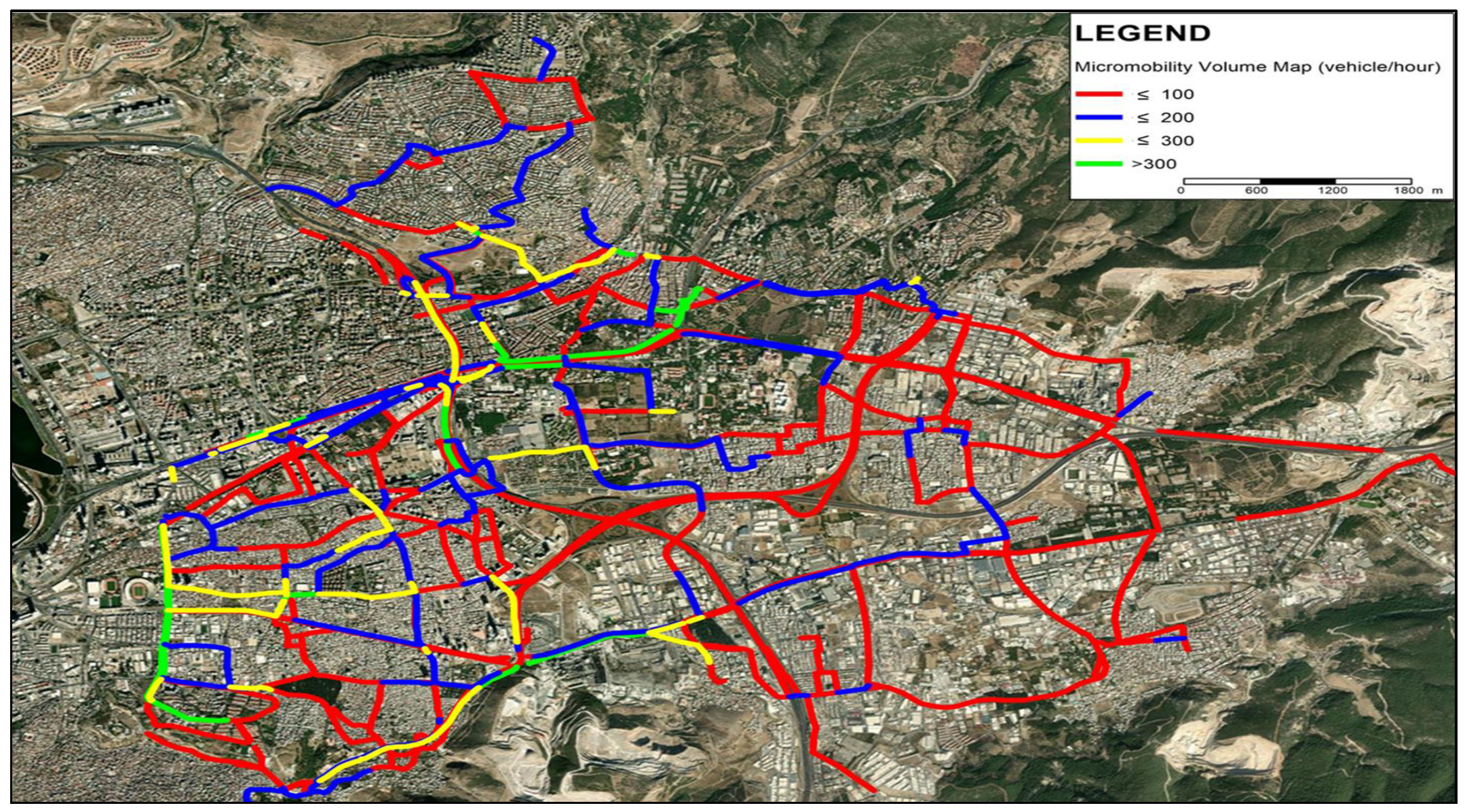
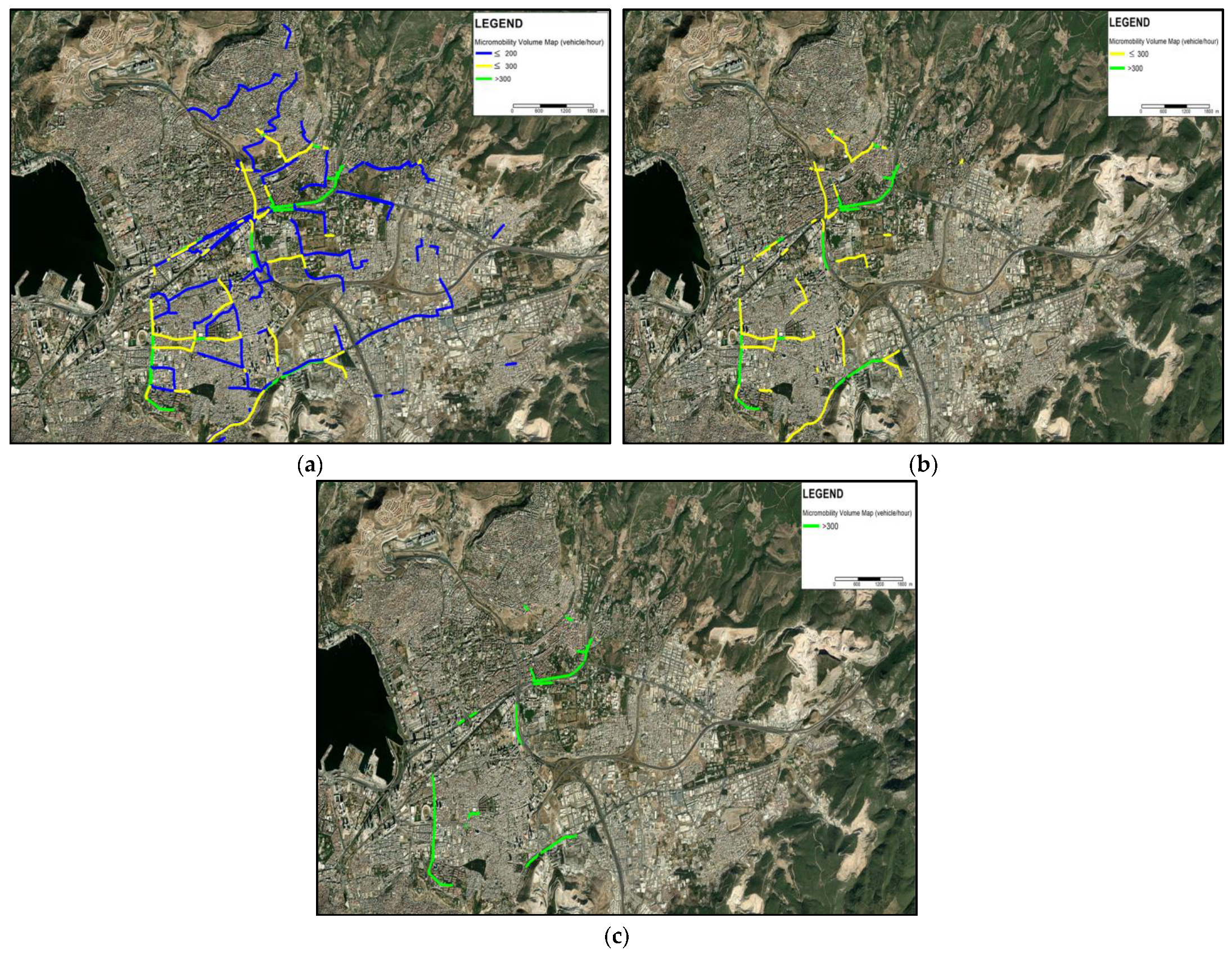
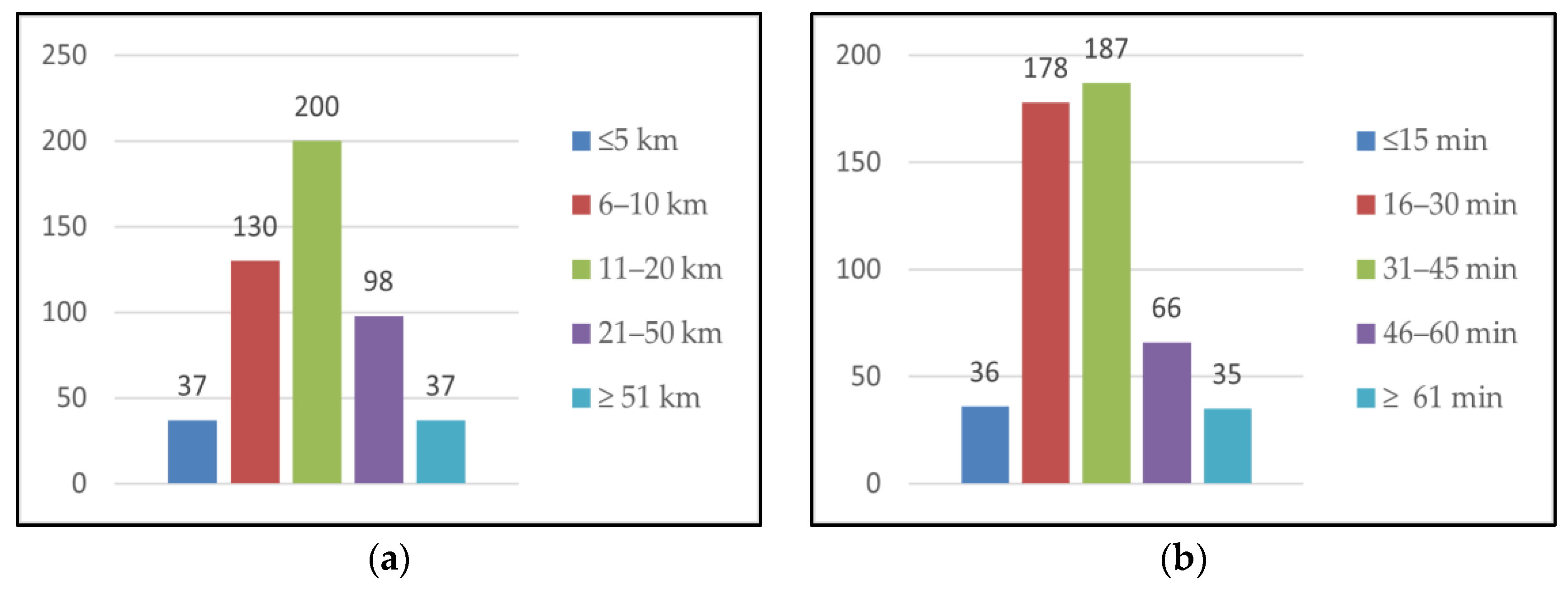
5.2. Modal Shift and Modeling
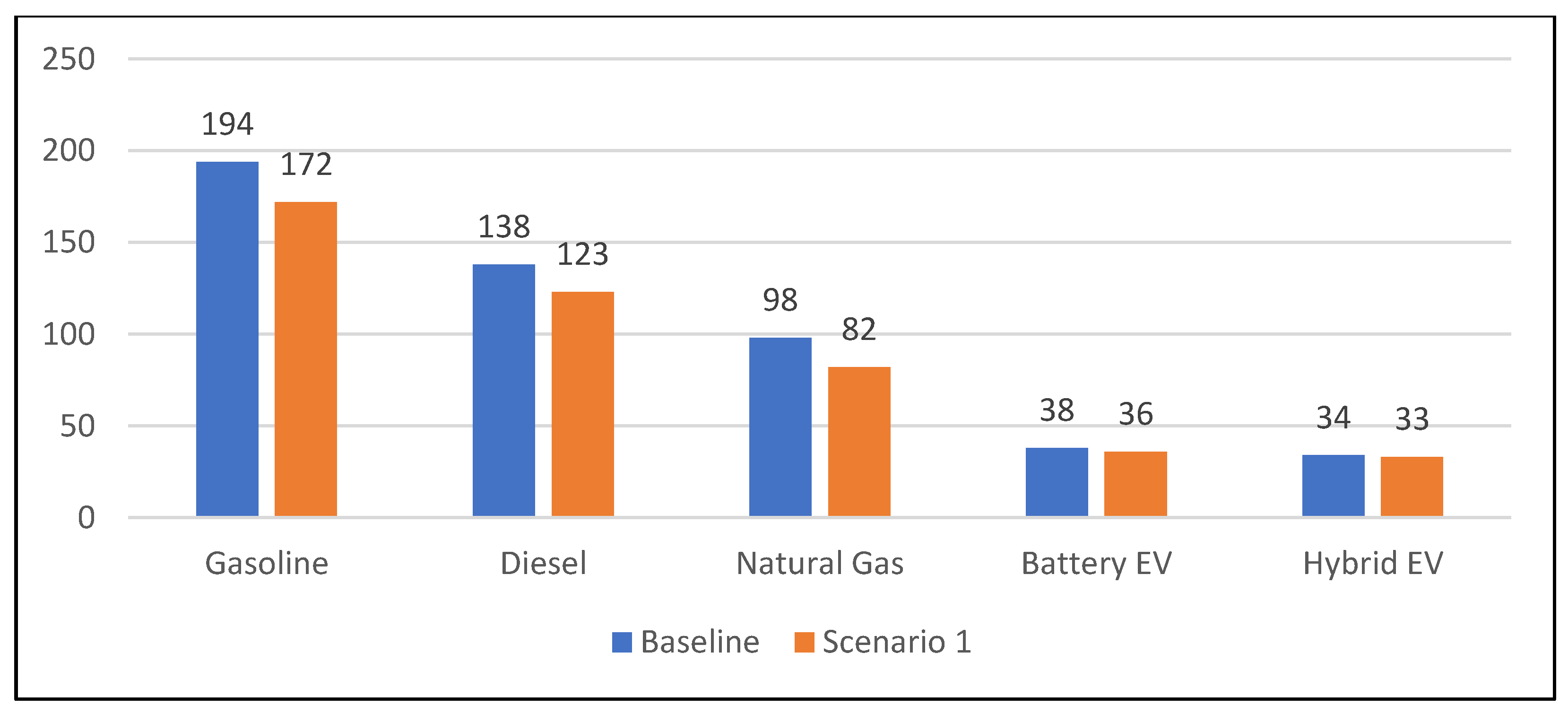
5.3. Life-Cycle (LCA) Analyses
6. Conclusions and Recommendations
Author Contributions
Funding
Institutional Review Board Statement
Informed Consent Statement
Data Availability Statement
Conflicts of Interest
References
- Abduljabbar, R.L.; Liyanage, S.; Dia, H. The role of micro-mobility in shaping sustainable cities: A systematic literature review. Transp. Res. Part D Transp. Environ. 2021, 92, 102734. [Google Scholar] [CrossRef] [Scilit]
- Fan, Z.; Harper, C.D. Congestion and environmental impacts of short car trip replacement with micromobility modes. Transp. Res. Part D Transp. Environ. 2022, 103, 103173. [Google Scholar] [CrossRef] [Scilit]
- Heineke, K.; Kloss, B.; Darius, S.; Weig, F. Micromobility’s 15,000-Mile Checkup; McKinsey & Company: New York, NY, USA, 2019; Available online: https://www.mckinsey.com/industries/automotive-and-assembly/our-insights/micromobilitys-15000-mile-checkup (accessed on 11 January 2025).
- European Union. Travel Distance per Person per Day by Main Travel Mode for Urban Mobility on All Days (%). Eurostat. 2023. Available online: https://ec.europa.eu/eurostat/statistics-explained/images/f/fb/Travel_distance_per_person_per_day_by_main_travel_mode_for_urban_mobility_on_all_days_%28%25%29_v3.png (accessed on 22 February 2026).
- Institute for Transportation and Development Policy. Defining Micromobility. Available online: https://itdp.org/multimedia/defining-micromobility/ (accessed on 25 February 2025).
- International Transport Forum (ITF). Micromobility, Equity and Sustainability; OECD Publishing: Paris, France, 2022; Available online: https://www.itf-oecd.org/micromobility-equity-sustainability (accessed on 20 February 2025).
- Huo, J.; Yang, H.; Li, C.; Zheng, R.; Yang, L.; Wen, Y. Influence of the built environment on e-scooter sharing ridership: A tale of five cities. J. Transp. Geogr. 2021, 93, 103084. [Google Scholar] [CrossRef] [Scilit]
- Reck, D.J.; Haitao, H.; Guidon, S.; Axhausen, K.W. Explaining shared micromobility usage, competition and mode choice by modelling empirical data from Zurich, Switzerland. Transp. Res. Part C Emerg. Technol. 2021, 124, 102947. [Google Scholar] [CrossRef] [Scilit]
- Campisi, T.; Akgün, N.; Tesoriere, G. An ordered logit model for predicting the willingness of renting micromobility in urban shared streets: A case study in Palermo, Italy. In Proceedings of the ICCSA 2020, Cagliari, Italy, 1–4 July 2020; pp. 796–808. [Google Scholar] [CrossRef] [Scilit]
- Mathew, J.; Liu, M.; Seeder, S.; Li, H.; Bullock, D. Analysis of e-scooter trips and their temporal usage patterns. ITE J. 2019, 89, 44–49. [Google Scholar]
- Bagdatli, M.E.C.; Godebey, G. Electric scooter use: The perspective of university students. J. Transp. Health 2025, 42, 102039. [Google Scholar] [CrossRef] [Scilit]
- Feng, Y.; Zhong, D.; Sun, P.; Zheng, W.; Cao, Q.; Luo, X.; Lu, Z. Micromobility in smart cities: A closer look at shared dockless e-scooters via big social data. arXiv 2020, arXiv:2010.15203. [Google Scholar] [CrossRef] [Scilit]
- McKenzie, G. Urban mobility in the sharing economy: A spatiotemporal comparison of shared mobility services. Comput. Environ. Urban Syst. 2020, 79, 101418. [Google Scholar] [CrossRef] [Scilit]
- Gössling, S. Integrating e-scooters in urban transportation: Problems, policies and the prospect of system change. Transp. Res. Part D Transp. Environ. 2020, 79, 102230. [Google Scholar] [CrossRef] [Scilit]
- Hosseinzadeh, A.; Karimpour, A.; Kluger, R. Factors influencing shared micromobility services: An analysis of e-scooters and bikeshare. Transp. Res. Part D Transp. Environ. 2021, 100, 103047. [Google Scholar] [CrossRef] [Scilit]
- Şengül, B.; Mostofi, H. Impacts of e-micromobility on the sustainability of urban transportation: A systematic review. Appl. Sci. 2021, 11, 5851. [Google Scholar] [CrossRef] [Scilit]
- Guo, Y.; Zhang, Y. Understanding factors influencing shared e-scooter usage and its impact on auto mode substitution. Transp. Res. Part D Transp. Environ. 2021, 99, 102991. [Google Scholar] [CrossRef] [Scilit]
- Ecer, F.; Küçükönder, H.; Kayapınar Kaya, S.; Görçün, Ö.F. Sustainability performance analysis of micromobility solutions with a novel IVFNN-Delphi-LOPCOW-CoCoSo framework. Transp. Res. Part A Policy Pract. 2023, 172, 103667. [Google Scholar] [CrossRef] [Scilit]
- Bielinski, T.; Wazna, A. Electric scooter sharing and bike sharing use behaviour and characteristics. Sustainability 2020, 12, 9640. [Google Scholar] [CrossRef] [Scilit]
- Laa, B.; Leth, U. Survey of e-scooter users in Vienna: Who they are and how they ride. J. Transp. Geogr. 2020, 89, 102874. [Google Scholar] [CrossRef] [Scilit]
- Nikiforiadis, A.; Paschalidis, E.; Stamatiadis, N.; Paloka, N.; Tsekoura, E.; Basbas, S. E-scooters and other mode trip chaining: Preferences and attitudes of university students. Transp. Res. Part A Policy Pract. 2023, 170, 103636. [Google Scholar] [CrossRef] [Scilit]
- Reck, D.J.; Axhausen, K.W. Who uses shared micromobility services? Empirical evidence from Zurich, Switzerland. Transp. Res. Part D Transp. Environ. 2021, 94, 102803. [Google Scholar] [CrossRef] [Scilit]
- Lee, H.; Baek, K.; Chung, J.H.; Kim, J. Factors affecting heterogeneity in willingness to use e-scooter sharing services. Transp. Res. Part D Transp. Environ. 2021, 92, 102751. [Google Scholar] [CrossRef] [Scilit]
- 6t-Bureau de Recherche. Usages et Usagers des Trottinettes Électriques en Free-Floating en France; ADEME: Angers, France, 2019; p. 158. [Google Scholar]
- Liao, F.; Correia, G. Electric carsharing and micromobility: A literature review on their usage pattern, demand, and potential impacts. Int. J. Sustain. Transp. 2022, 16, 269–286. [Google Scholar] [CrossRef] [Scilit]
- Cao, Z.; Zhang, X.; Chua, K.; Yu, H.; Zhao, J. E-scooter sharing to serve short-distance transit trips: A Singapore case. Transp. Res. Part A Policy Pract. 2021, 147, 177–196. [Google Scholar] [CrossRef] [Scilit]
- Krier, C.; Chrétien, J.; Lagadic, M.; Louvet, N. How do shared dockless e-scooter services affect mobility practices in Paris: A survey-based estimation of modal shift. Transp. Res. Rec. 2021, 2675, 291–304. [Google Scholar] [CrossRef] [Scilit]
- Chang, A.; Miranda-Moreno, L.; Clewlow, R.; Sun, L. Trend or Fad? Deciphering the Enablers of Micromobility in the U.S.; SAE Technical Paper; SAE International: Warrendale, PA, USA, 2019. [Google Scholar]
- Pimentel, R.; Lowry, M. If you provide, will they ride? Motivators and deterrents to shared micromobility. Int. J. Bus. Appl. Soc. Sci. 2020, 6, 26–38. [Google Scholar] [CrossRef] [Scilit]
- Cairns, S.; Behrendt, F.; Raffo, D.; Beaumont, C.; Kiefer, C. Electrically assisted bikes: Potential impacts on travel behaviour. Transp. Res. Part A Policy Pract. 2017, 103, 327–342. [Google Scholar] [CrossRef] [Scilit]
- Clewlow, R. The Micro-Mobility Revolution. Available online: https://medium.com/populus-ai/the-micro-mobility-revolution-95e396db3754 (accessed on 22 February 2026).
- Tiwari, A. Micro-Mobility: The Next Wave of Urban Transportation in India. Available online: https://yourstory.com/journal/micro-mobility-edc6x8f1y1 (accessed on 18 February 2025).
- National Association of City Transportation Officials (NACTO). Shared Micromobility in the U.S.: 2019; NACTO: New York, NY, USA, 2019. [Google Scholar]
- SPRB Bruxelles Mobilité. Enquête sur L’usage des Trottinettes Électriques à Bruxelles; Brussels Regional Public Service: Brussels, Belgium, 2019; p. 60. [Google Scholar]
- Fearnley, N.; Johnsson, E.; Berge, S.H. Patterns of e-scooter use in combination with public transport. Findings 2020, 1–7. [Google Scholar] [CrossRef] [Scilit]
- Aguilera-García, Á.; Gomez, J.; Sobrino, N.; Vinagre Díaz, J.J. Moped scooter sharing: Citizens perceptions, users behavior and implications for urban mobility. Sustainability 2021, 13, 6886. [Google Scholar] [CrossRef] [Scilit]
- Markvica, K.; Schwieger, K.; Aleksa, M. E-scooter as environmentally friendly last-mile option? Insights on spatial and infrastructural implications for urban areas based on the example of Vienna. In Proceedings of the Real CORP 2020, Vienna, Austria, 15–18 September 2020. [Google Scholar]
- Caspi, O.; Smart, M.J.; Noland, R.B. Spatial associations of dockless shared e-scooter usage. Transp. Res. Part D Transp. Environ. 2020, 86, 102396. [Google Scholar] [CrossRef] [Scilit]
- Bai, S.; Jiao, J. Dockless e-scooter usage patterns and urban built environments: A comparison study of Austin and Minneapolis. Travel Behav. Soc. 2020, 20, 264–272. [Google Scholar] [CrossRef] [Scilit]
- Smith, C.S.; Schwieterman, J.P. E-Scooter Scenarios: Evaluating the Potential Mobility Benefits of Shared Dockless Scooters in Chicago; DePaul University: Chicago, IL, USA, 2018. [Google Scholar]
- Jiao, J.; Bai, S. Understanding shared e-scooter travels in Austin, TX. ISPRS Int. J. Geo-Inf. 2020, 9, 135. [Google Scholar] [CrossRef] [Scilit]
- Cherry, C.; Yang, H.; Jones, L.; He, M. Dynamics of electric bike ownership and use in Kunming, China. Transp. Policy 2016, 45, 127–135. [Google Scholar] [CrossRef] [Scilit]
- Castro, A.; Gaupp-Berghausen, M.; Dons, E.; Standaert, A.; Laeremans, M.; Clark, A.; Anaya-Boig, E.; Cole-Hunter, T.; Avila-Palencia, I.; Rojas-Rueda, D.; et al. Physical activity of electric bicycle users vs. non-cyclists: Insights from seven European cities. Transp. Res. Interdiscip. Perspect. 2019, 1, 100017. [Google Scholar] [CrossRef] [Scilit]
- Li, A.; Zhao, P.; He, H.; Axhausen, K. Understanding the Variations of Micromobility Behavior Before and During COVID-19 Pandemic Period; ETH Zurich Research Collection: Zürich, Switzerland, 2020. [Google Scholar] [CrossRef]
- Bourne, J.E.; Cooper, A.R.; Kelly, P.; Kinnear, F.J.; England, C.; Leary, S.; Page, A. The impact of e-cycling on travel behaviour: A scoping review. J. Transp. Health 2020, 19, 100910. [Google Scholar] [CrossRef] [Scilit]
- Zhang, Y.; Thomas, T.; Brussel, M.; van Maarseveen, M. Exploring the impact of built environment factors on the use of public bikes at bike stations: Case study in Zhongshan, China. J. Transp. Geogr. 2017, 58, 59–70. [Google Scholar] [CrossRef] [Scilit]
- Dzięcielski, M.; Nikitas, A.; Radzimski, A.; Caulfield, B. Understanding the determinants of bike-sharing demand in the context of a medium-sized car-oriented city: The case study of Milton Keynes, UK. Sustain. Cities Soc. 2024, 114, 105781. [Google Scholar] [CrossRef] [Scilit]
- Bieliński, T.; Kwapisz, A.; Ważna, A. Electric bike-sharing services mode substitution for driving, public transit, and cycling. Transp. Res. Part D Transp. Environ. 2021, 96, 102883. [Google Scholar] [CrossRef] [Scilit]
- Fukushige, T.; Fitch, D.T.; Handy, S. Estimating vehicle-miles traveled reduced from dock-less e-bike-share: Evidence from Sacramento, California. Transp. Res. Part D Transp. Environ. 2023, 117, 103671. [Google Scholar] [CrossRef] [Scilit]
- Wang, X.; Peng, Z.; Li, X.; Du, M.; Lyu, F.; Kang, J.-Y.; Lee, K.; Liu, D. Analysis of the multi-scale spatial heterogeneity of factors influencing the electric bike-sharing travel demand in small and medium-sized cities. Sustainability 2025, 17, 10437. [Google Scholar] [CrossRef] [Scilit]
- Kazmaier, M.; Taefi, T.T.; Hettesheimer, T. Techno-economic and ecological potential of electric scooters: A life-cycle analysis. Eur. J. Transp. Infrastruct. Res. 2020, 20, 233–251. [Google Scholar] [CrossRef] [Scilit]
- Moreau, H.; de Jamblinne de Meux, L.; Zeller, V.; d’Ans, P.; Ruwet, C.; Achten, W.M.J. Dockless e-scooter: A green solution for mobility? Sustainability 2020, 12, 1803. [Google Scholar] [CrossRef] [Scilit]
- Jia, R.; Gao, K. Life-cycle analysis of shared e-scooter: Data-driven approaches in 100 EU cities. Transp. Res. Part D Transp. Environ. 2025, 148, 105009. [Google Scholar] [CrossRef] [Scilit]
- Izmir Metropolitan Municipality. Izmir Metropolitan Area Urban Transport Master Plan (UPI 2030); Izmir, Türkiye, 2021. Available online: https://www.izmir.bel.tr/CKYuklenen/dokumanlar_2018/upi_sonuc_ozeti.pdf (accessed on 19 November 2024).
- Izmir Metropolitan Municipality Transportation Department. Izmir Micromobility Usage Data; Izmir, Türkiye, 2024. Available online: https://www.izmir.bel.tr/ (accessed on 18 January 2025).
- Heineke, K.; Kloss, B.; Scurtu, D. Micromobility: Industry Progress and a Closer Look at the Case of Munich; McKinsey Global Institute: Munich, Germany, 2019. [Google Scholar]
- Negri, M.; Bieker, G. Life-Cycle Greenhouse Gas Emissions from Passenger Cars in the European Union: A 2025 Update and Key Factors to Consider; International Council on Clean Transportation (ICCT): Washington, DC, USA, 2025. [Google Scholar]






| Descriptive Statistics | ||||||||
|---|---|---|---|---|---|---|---|---|
| Criteria | 1 | 2 | 3 | 4 | 5 | N | Mean | Std Deviation |
| Inadequate infrastructure | 88 | 70 | 82 | 176 | 86 | 502 | 3.203 | 1.356 |
| I do not find it safe | 75 | 114 | 51 | 103 | 159 | 502 | 3.313 | 1.484 |
| Scooters are not maintained properly and are broken | 49 | 83 | 60 | 194 | 116 | 502 | 3.488 | 1.277 |
| High usage fee | 66 | 79 | 65 | 159 | 133 | 502 | 3.426 | 1.372 |
| Limited coverage areas | 48 | 75 | 61 | 197 | 121 | 502 | 3.534 | 1.268 |
| Low number of scooters | 52 | 101 | 80 | 157 | 112 | 502 | 3.351 | 1.304 |
| Exposure to adverse weather conditions | 29 | 64 | 71 | 189 | 149 | 502 | 3.727 | 1.182 |
| Long travel distance | 25 | 80 | 66 | 194 | 137 | 502 | 3.673 | 1.177 |
| Having too much stuff when traveling | 29 | 89 | 59 | 190 | 135 | 502 | 3.624 | 1.215 |
| Parking problems | 82 | 105 | 47 | 150 | 118 | 502 | 3.233 | 1.432 |
| Valid N (listwise) | 502 | |||||||
| Demographic Data | N | Percentage | Modal Shift to Micromobility | Chi-Square | Degree of Freedom (df) | p-Value | ||
|---|---|---|---|---|---|---|---|---|
| Yes | No | |||||||
| Gender | Male | 303 | 0.60 | 108 | 195 | 2.668 | 1 | 0.102 |
| Female | 199 | 0.40 | 57 | 142 | ||||
| Age | 15–25 | 112 | 0.22 | 52 | 60 | 30.743 | 4 | p < 0.001 |
| 26–35 | 114 | 0.23 | 46 | 68 | ||||
| 36–45 | 129 | 0.26 | 41 | 88 | ||||
| 46–64 | 128 | 0.25 | 26 | 102 | ||||
| 65 and over | 19 | 0.04 | 0 | 19 | ||||
| Educational Level | Primary school | 18 | 0.04 | 0 | 18 | 12.219 | 5 | 0.032 |
| High school | 145 | 0.29 | 44 | 101 | ||||
| Associate degree | 103 | 0.21 | 40 | 63 | ||||
| University | 207 | 0.41 | 72 | 135 | ||||
| Postgraduate | 27 | 0.05 | 9 | 18 | ||||
| Other | 2 | 0.00 | 0 | 2 | ||||
| Working Status | Full-time employee | 328 | 0.65 | 106 | 222 | 33.043 | 5 | p < 0.001 |
| Part-time employee | 22 | 0.04 | 9 | 13 | ||||
| Student | 70 | 0.14 | 39 | 31 | ||||
| Retired | 37 | 0.07 | 3 | 34 | ||||
| I do not work | 35 | 0.07 | 5 | 30 | ||||
| Other | 10 | 0.02 | 3 | 7 | ||||
| Monthly Income Level | 0–5000 TL | 23 | 0.05 | 12 | 11 | 13.453 | 4 | 0.009 |
| 5001–20,000 TL | 166 | 0.33 | 61 | 105 | ||||
| 20,001–40,000 TL | 185 | 0.37 | 63 | 122 | ||||
| 40,001–60,000 TL | 80 | 0.16 | 22 | 58 | ||||
| 60,001 and above | 48 | 0.10 | 7 | 41 | ||||
| Monthly Transportation Expenses | Less than 1000 TL | 87 | 0.17 | 29 | 58 | 14.829 | 3 | 0.002 |
| 1001–3000 TL | 244 | 0.49 | 92 | 152 | ||||
| 3001–5000 TL | 111 | 0.22 | 37 | 74 | ||||
| 5001 TL and above | 60 | 0.12 | 7 | 53 | ||||
| Variable | Coeff. | SE | z | p |
|---|---|---|---|---|
| (Intercept) | 0.531 | 0.75 | 0.707 | - |
| Employed (ref: Not Empolyed) | 0.908 | 0.390 | 2.326 | 0.020 |
| Student (ref: Not Empolyed) | 1.381 | 0.500 | 2.764 | 0.006 |
| Travel Duration | −0.298 | 0.128 | −2.321 | 0.020 |
| Inadequate Infrastructure | −0.215 | 0.105 | −2.042 | 0.041 |
| Safety | −0.306 | 0.107 | −2.849 | 0.004 |
| Variable | Pearson r | p-Value | Tolerance | VIF |
|---|---|---|---|---|
| Employed (ref: Not Empolyed) | 0.149 | 0.002 | 0.779 | 1.284 |
| Student (ref: Not Empolyed) | −0.027 | 0.585 | 0.797 | 1.254 |
| Travel Duration | 0.148 | 0.001 | 0.962 | 1.039 |
| Inadequate Infrastructure | 0.140 | 0.002 | 0.671 | 1.490 |
| Safety | 0.234 | <0.001 | 0.674 | 1.484 |
| Private-Car Travel Distance | N | Would You Use Micromobility on This Trip? | Rate of Modal Shift |
|---|---|---|---|
| Yes | |||
| <5 km | 37 | 13 | 0.35 |
| 5–10 km | 130 | 43 | 0.33 |
| Variable | Expression | Baseline (0) | Scenario (1) | Unit |
|---|---|---|---|---|
| Average car EF | 216 | 215 | ||
| Car VKT | 450,904 | 420,527 | veh-km | |
| Car emissions | 97.4 | 90.4 | ||
| Micromobility VKT | - | 25,140 | veh-km | |
| Micro EF | - | 66 | ||
| Micromobility emissions | - | 1.66 | ||
| Total emissions | 97.4 | 92.06 | ||
| Net reduction | - | 5.34 |
Disclaimer/Publisher’s Note: The statements, opinions and data contained in all publications are solely those of the individual author(s) and contributor(s) and not of MDPI and/or the editor(s). MDPI and/or the editor(s) disclaim responsibility for any injury to people or property resulting from any ideas, methods, instructions or products referred to in the content. |
© 2026 by the authors. Licensee MDPI, Basel, Switzerland. This article is an open access article distributed under the terms and conditions of the Creative Commons Attribution (CC BY) license.
Share and Cite
Ogutveren, E.; Haldenbilen, S. From Private Cars to Micromobility: Network Modeling and Environmental Assessment of Short-Distance Trips in Izmir. Sustainability 2026, 18, 3523. https://doi.org/10.3390/su18073523
Ogutveren E, Haldenbilen S. From Private Cars to Micromobility: Network Modeling and Environmental Assessment of Short-Distance Trips in Izmir. Sustainability. 2026; 18(7):3523. https://doi.org/10.3390/su18073523
Chicago/Turabian StyleOgutveren, Emre, and Soner Haldenbilen. 2026. "From Private Cars to Micromobility: Network Modeling and Environmental Assessment of Short-Distance Trips in Izmir" Sustainability 18, no. 7: 3523. https://doi.org/10.3390/su18073523
APA StyleOgutveren, E., & Haldenbilen, S. (2026). From Private Cars to Micromobility: Network Modeling and Environmental Assessment of Short-Distance Trips in Izmir. Sustainability, 18(7), 3523. https://doi.org/10.3390/su18073523