Article

Reflexive Governance for UN SDG Implementation: Assessing Capacities in Bulgaria and Romania

1
Ecological Economics Group, School of Computing Science, Business Administration, Economics and Law, Carl von Ossietzky University, 26129 Oldenburg, Germany
2
Climate, Atmosphere and Water Research Institute, Bulgarian Academy of Sciences, 1784 Sofia, Bulgaria
Sustainability 2026, 18(4), 2026; https://doi.org/10.3390/su18042026
Submission received: 28 June 2025 / Revised: 3 February 2026 / Accepted: 9 February 2026 / Published: 16 February 2026

Abstract

Progress toward achieving the 17 Sustainable Development Goals (SDGs) has largely failed to meet initial ambitions and is often associated with increased ecological footprints and spillovers, pointing to inherent tensions within the SDG framework and governance gaps. Applying the 2030 Agenda’s principles places new demands on policy and scientific systems, underscoring the need for enhanced domestic capacities. Drawing on the understanding that addressing the SDGs’ problem characteristics requires moving beyond rational decision-making toward reflexive governance, the paper outlines implications for key cross-cutting capacities. The empirical analysis uses qualitative data from expert interviews and document analysis (2015–2025) to examine the responses of two EU Eastern enlargement countries to the global agenda, complemented by performance assessments. The comparison reveals uneven progress, with some advances in socioeconomic goals contrasted by slower, stagnant, or declining trends in environmental goal achievement. This underscores the need to prioritize environmental sustainability while addressing interdependencies and trade-offs with other goals to realize the transformative purpose of the 2030 Agenda and beyond. However, capacity shortcomings for pursuing such an integrated approach highlight the importance of continued capacity-building within public administration. Bulgaria shows limited SDG steering effects amid ongoing political instability, whereas Romania has emerged as a regional frontrunner through its innovative governance framework and capacity-building program, demonstrating a transformative political impact.

1. Introduction

In 2015, 193 UN member states adopted the 2030 Agenda for Sustainable Development, featuring 17 Sustainable Development Goals (SDGs) aimed at addressing pressing global concerns such as poverty, social well-being, and environmental degradation. This joint commitment underscores the urgent need to integrate multiple policy fields, posing a significant challenge for both policymaking and societal development. Given the central role of governments in galvanizing transformative action, national level implementation has become critical for analyzing how the 2030 Agenda is translated into action [1,2].
Halfway to 2030, SDG progress remains slow—only 15% of the measurable targets are on track—pointing to major governance gaps [3,4]. Although the SDGs have had some positive discursive effects, their transformative impact is found to be limited, with political processes advancing only sluggishly and progress often correlating with rising ecological footprints and negative spillovers [5,6,7]. A major criticism of the global agenda is its premise that all 17 goals carry equal weight and should be pursued simultaneously. The conflict between the objectives of economic growth and environmental sustainability has particularly raised doubts about whether policy coherence—and the achievement of all SDGs—is realistic, given the increasing evidence that unlimited economic growth is incompatible with a planet of finite resources [8,9].
Addressing such shortcomings and trade-offs, and applying the SDG principles of indivisibility and integration place new demands on national policy and scientific systems, often requiring a systemic approach to capacity-building across individual, institutional, and network levels [10,11,12,13]. In this context, capacity-building (or capacity development) emerges as a key concept and research priority for more effective SDG implementation. Although relevant to both the Global South and North [14,15,16], capacity-building under SDG Target 17.9—focused on means of implementation—remains primarily directed toward developing countries. Governments are urged to invest in strengthening domestic capacities, yet a deeper understanding of the distinct governance needs and multidimensional nature of required capacities remains crucial [1]. While prior work has focused primarily on formal institutions, less attention has been given to knowledge and its generation in national SDG implementation. Given the increasing importance of science in this regard, the paper draws on insights from environmental politics and sustainability governance to outline key implications for the cross-cutting capacities necessary within domestic systems. These considerations subsequently guide the capacity assessment in the empirical analysis, which focuses on two neighboring countries from the EU’s Eastern enlargement—both ranking among the lowest in administrative capacity and SDG progress [17,18,19,20].
Based on an in-depth case study of Bulgaria, the paper examines the government’s formal response to the 2030 Agenda and explores whether new capacities have been developed in this context. Romania, recognized by the UN DESA for its innovative governance approach and ambitious capacity-building program, serves as a secondary case. Juxtaposing the two cases highlights contrasting governance dynamics and identifies key factors driving variation in SDG implementation.
The paper is structured as follows: Section 2 reviews prior work on national SDG implementation and sets out the rationale for examining reflexive capacities and social learning within domestic systems. The analytical framework and methodological approach used to examine national SDG implementation are outlined in Section 3. Section 4 illustrates the current sustainability-related development trends in Bulgaria and Romania and presents the empirical evidence from both countries. The final sections discuss the resulting implications for theory and practice and offer recommendations for future research and policy.

2. Reflexive Governance for National SDG Implementation

2.1. National SDG Implementation

Experiences with the Millennium Development Goals (2000–2015) showed that separating economic and environmental objectives led to uneven progress, improving some development indicators while exacerbating climate change, resource depletion, and biodiversity loss [21]. In response, the post-2015 Agenda draws on the recognition that poverty and social welfare cannot be addressed in isolation from environmental change and the carrying capacity of natural systems. Thus, the SDGs represent a historic shift in UN efforts to unify socioeconomic concerns and environmental sustainability within a universal global agenda. They embody a governance model rooted in global inclusiveness and comprehensive goal-setting, characterized by a legally non-binding nature, reliance on the relatively weak High-level Political Forum on Sustainable Development, and flexibility to accommodate national preferences and priorities [11].
Building on earlier research on international institutions, three types of SDG steering effects have been identified: discursive, normative, and institutional [3]. Discursive effects refer to changes in debates increasingly aligning with the SDGs, including explicit references to the goals, targets, or principles of the 2030 Agenda. Such shifts may give rise to normative effects, reflected in changes to legislation, regulatory frameworks, or policies influenced by the SDGs. Institutional effects, in turn, involve establishing new structures—such as departments, committees, offices, or programs—or restructuring existing institutions. The simultaneous occurrence of all three effects within a political system is described as a transformative impact, representing the ultimate ambition of the 2030 Agenda. Experiences from the initial implementation period indicate that the steering effects of the SDGs have been largely discursive, shaping how sustainable development is understood and communicated, while deeper normative and institutional changes to national legislation and governance have remained relatively rare.
International policy implementation is often more prone to deviation from initial commitments than domestic policy, as adoption may not always reflect genuine political will or the ability to translate international agreements into action [22]. Although governance is widely recognized as critical to achieving the SDGs, designing arrangements that can trigger systemic transformations remains a complex challenge. Effective implementation depends on stronger coordination across levels of government, broader stakeholder engagement, and the development of human and institutional capacities [23,24]. National SDG delivery is often associated with reorganizing public administrations and policymaking systems to strengthen horizontal coordination across sectors and vertical coordination across levels of government. At the same time, investment in strategic planning, innovation, and institutional capacity is essential for managing conflicts, overcoming systemic barriers, and responding effectively to crises [11,12].
Empirical research reveals wide variation in how countries interpret and pursue integrated SDG implementation and policy coherence. Tosun and Leininger [25] show that these differences stem less from the SDG framework itself—or from structural factors such as income level or political centralization—and more from the idiosyncrasies of domestic policymaking processes. Similarly, Glass and Newig [26], drawing on a study of 41 high- and upper-middle-income countries, find that while democratic institutions, public participation, economic power, education, and geographic location support SDG progress, policy coherence shows no clear impact—likely due to implementation complexity and its often delayed effects. A review of 137 countries’ Voluntary National Reviews (VNRs) by Breuer and Leininger [27] further demonstrates that sustainability policy is rarely pursued holistically. Only a few countries meet all four criteria of their typology, including political leadership, horizontal and vertical integration, and stakeholder engagement. Implementation is most commonly led by foreign affairs or environment ministries, often with limited public participation. Wealthier countries tend to establish more cross-sectoral mechanisms, while regime type appears to have only a marginal influence on institutional design.

2.2. Cross-Cutting Capacities for National SDG Implementation

While experiences with applying the principle of environmental policy integration (EPI) offer valuable insights for advancing the global agenda, it has been argued that the SDG challenge reshapes our understanding of the key dimensions that advance EPI [28,29]. This shift is particularly evident with respect to political will and the normative framework, as the SDGs prioritize all goals equally rather than granting “principled priority” to environmental concerns. At the same time, human and institutional capacities—long central to EPI—remain highly relevant in the SDG context [28]. Cognitive and analytical capacities are considered critical for policy learning, including systems thinking, the generation of environmental knowledge through advisory mechanisms, the use of tools such as Environmental Impact Assessments (EIAs), and strategic foresight to anticipate long-term environmental challenges. Institutional arrangements that bridge sectoral silos—such as cross-departmental working groups, consultations, and EIA procedures—are considered to play a key role, with responsibility increasingly shifting from environment ministries to more influential bodies, such as finance or foreign affairs ministries, or the prime minister’s or president’s office.
Although evidence of progress on policy coherence and institutional integration remains limited, existing studies show that some countries have assigned coordination roles to central agencies, interdepartmental bodies, and, in some cases, to parliaments or advisory councils. To date, however, no single institutional model has been empirically proven to be effective in addressing SDG implementation challenges [3,30].
Science-based approaches for assessing interlinkages and designing transformation are increasingly used in the SDG context, yet early progress has been limited to monitoring and evaluation [31]. The role of science is envisioned as ‘a trusted advisor’ in aligning local targets with global thresholds and biophysical boundaries [32]. Sustainability researchers are called upon to adopt inter- and transdisciplinary approaches, develop context-specific solutions, support stakeholder collaboration (e.g., SDG labs), integrate diverse forms of knowledge, and treat sustainability as an ongoing, open-ended social learning process [33]. Generating socially robust knowledge and strengthening the science–policy–society interface are vital for navigating goal interactions, managing trade-offs and synergies, and setting priorities [4,34]. In the second half of SDG implementation, science is expected to assume a central role in operationalizing the principles of indivisibility, integration, and universality through collaboration with governments [10]. Key areas of action include analyzing SDG interlinkages and developing national databases; linking environmental and socioeconomic concerns to support SDG target 17.19 and the UN’s “Beyond GDP” initiative; understanding biophysical boundaries and ecological footprint impacts; and enhancing capacity to assess geographic spillovers. Institutions promoting sustainable development are also urged to prioritize knowledge brokering and diplomacy [35]. In this regard, governments and research institutions are expected to cooperate in creating open-access knowledge platforms, particularly in low- and middle-income countries, to integrate fragmented knowledge, assess transformation strategies, and help non-scientific actors design context-specific pathways for change.
While previous work has emphasized some key capacity dimensions for national-level SDG implementation, little attention has been paid to how knowledge is generated and applied within domestic contexts. Acknowledging the distinctive nature of the sustainable development challenge, this paper integrates insights from the social learning and reflexive governance literature to draw deeper implications for the competencies and skills, and knowledge-based mechanisms needed to promote social learning at the national level.

2.3. Promoting Social Learning in the SDG Context

Unlike conventional environmental issues with clear causes and effects (such as air and water pollution), many pressing challenges today have transformed conditions that traditional environmental policies fail to address effectively. Issues like climate change, biodiversity loss, soil and groundwater contamination, hazardous chemical use, and urban sprawl—often referred to as ‘persistent’ or ‘creeping’ problems—represent a new type of long-term challenge marked by slow, cumulative changes, high levels of complexity, and extended time frames for both the emergence of impacts and the development and implementation of solutions [36,37]. Under such conditions, uncertainty has become a defining feature of environmental problems and the knowledge and policies associated with them. This is evident in the difficulty of predicting environmental change and its consequences, the need to act on problems that may not yet be visible, and the unpredictable effects of policy decisions, inaction, or innovation [37,38,39].
The SDG framework encompasses several environmental goals—SDG 6 (Clean Water), SDG 13 (Climate Action), SDG 14 (Life Below Water), and SDG 15 (Life on Land)—which, in turn, require domestic policies capable of addressing the uncertainty and complexity inherent in these issues. Pursuing these goals alongside socioeconomic objectives further necessitates managing trade-offs and interconnectedness among environmental, economic, and social indicators. Addressing such problem characteristics calls for a new approach that redefines the relationship between knowledge production and decision-making—a central aspect of sustainability governance [40].
The concepts of institutional integration and policy coherence as used in the SDG context are rooted in rational decision-making traditions in public policy and administration [30]. However, approaches associated with first-generation planning and New Public Management are increasingly viewed as ill-suited to addressing the complex challenges of sustainable development and long-term environmental change [41,42]. Similarly, traditional governance patterns based on regulation and market mechanisms have proven insufficient to tackle the challenge of sustainable development, pointing to the need to adopt a long-term perspective and reflexive approaches [43]. Originating from discourses on the ecological and technological risks of industrialization, reflexive governance has become a central concept in the field of environmental governance and sustainable development [43,44,45]. It highlights the need to critically reassess specialized problem-solving in policymaking and social organization, which often leads to unintended consequences like environmental degradation and systemic risks. Central to the reflexive mode of governance is the role of knowledge and the processes through which knowledge is generated [46], with social learning representing the key mechanism enabling reflexive and long-term policymaking [41,43]. This process shows itself in the close interaction between science, policy, and society actors in both producing and applying knowledge. While science has traditionally served as an advisor to policymakers, recent work suggests that the boundaries between processes of knowledge generation and decision-making have become blurred [40]. This shift reflects ideas from established concepts, such as Mode-2 science [47], co-production of knowledge [48], sustainability science [49], and post-normal science [50,51]. Linking knowledge to action is thus recognized as one of the essential capacities for advancing sustainability, with science playing a key role—not only in developing effective strategies and designing interventions but also in supporting their implementation [52].
These considerations have direct implications for the governance mode required to translate the ambitions of the 2030 Agenda (and beyond) into national contexts. Using reflexive governance and social learning as ‘sensitizing concepts’ [53], suggesting a normative orientation that guides empirical analysis rather than determining it rigidly, key cross-cutting capacity dimensions can be singled out to complement existing insights on human and institutional capacities in the SDG context.

2.4. Resulting Implications for Domestic Capacities

Human dimension. The capabilities of key actors organizing and participating in reflexive governance processes are critical to their functioning and effectiveness. Scholars distinguish key elements of reflexive governance, describing it as a “rule-setting and rule-implementation process that includes interaction, deliberation and adaptation as areas of individual and collective behavior” [54]. These areas of individual and collective behavior—interaction, deliberation and adaptation—also represent essential competency domains. Interaction involves the inclusion of both state and non-state actors in setting policy goals and implementing strategies, with subcomponents, such as relating to others, cooperating, and managing conflicts. Deliberation is associated with the application of transdisciplinary forms of learning to integrate insights from science and practice, requiring motivation to learn, the ability to understand and tolerate differing beliefs and values, and the capacity to handle complexity and find creative solutions. Adaptation entails the iterative development of strategies and the flexibility of institutions to adapt in case of new knowledge and developments, with key subcomponents including self-reflection, embracing failure as part of managing complex tasks, and identifying innovative solutions. Addressing problems like climate change adaptation, further requires developing “uncertainty competence” tailored to the concrete issue.
Knowledge-based institutional mechanism. Governance discussions emphasize that coordination among heterogeneous actors should occur within networks rather than institutionalized hierarchies, in order to facilitate exchange and learning between diverse participants [42]. Research policy—particularly national research programs for sustainable development—is recognized as an appropriate mechanism for enhancing reflexivity in society regarding established beliefs, norms, and priority goals of development strategies. It is also seen as a ‘tool for social learning’, providing a platform for interaction between science (both natural and social science) and society to generate problem and solution-oriented knowledge. However, designing such programs, which seek to cross traditional boundaries of knowledge production and decision-making, presents novel challenges compared with traditional modes of scientific activity and research organization. The main challenges include [40]: (1) involving practitioners in processes of knowledge generation and implementation (transdisciplinarity); (2) engaging scientific actors in decision-making processes (active policy integration); (3) acknowledging the normative role of science and sustainable development in shaping society within environmental constraints (normativity), (4) creating open and learning-oriented policy systems (learning), and (5) linking knowledge generation processes to relevant domains and contexts to address global problems (international approach).

3. Research Approach and Methods

3.1. Case Selection

This study employs a qualitative case study design to examine how, and to what extent, national governments translate the UN SDGs into practice and whether new human or institutional capacities have been created in this context. Bulgaria was selected for in-depth examination due to data richness and its appropriateness for controlled comparison with countries exhibiting similar background conditions from the EU’s Eastern enlargement [55]. Romania was included as a secondary case to highlight contrasting governance dynamics in the region and identify potential best practices, without aiming for a fully systematic comparison. A method-of-difference approach is applied by selecting a case with comparable structural characteristics but different values on the study variable. The observed cross-case differences are treated as potential causal factors. As Krause [56] notes, asymmetrical comparison can enhance the interpretation of findings. Including insights from Romania thus provides valuable context for understanding the Bulgarian case and the factors shaping variation in SDG implementation and capacity building between the two countries.
To illustrate the central challenge of reconciling human development with ecological limits and to provide background for the analysis, the development patterns in Bulgaria and Romania are also examined, situating them within the regional and EU context using the Global Sustainability Quadrant approach and the SDG Index and Dashboards.

3.2. Analytical Framework for National SDG Implementation

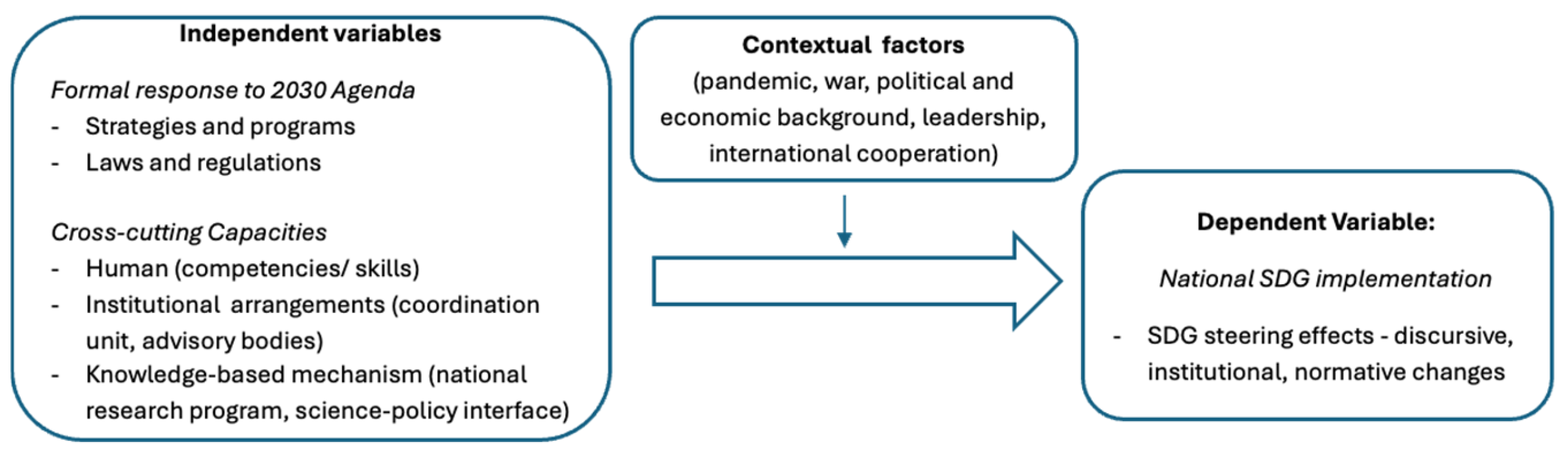
To analyze and compare SDG implementation across countries, this study distinguishes between policy outputs and outcomes. Policy outputs refer to the formal decisions adopted by political institutions (e.g., governments, parliaments, and regulatory agencies), taking the form of strategies, programs, laws, or regulations, as set out in administrative or legal documents [57,58]. Policy outcomes, in turn, refer to the consequences of these outputs, capturing whether and how targeted actors change and adapt their behavior in response to implemented policies. Figure 1 presents the analytical framework for national SDG implementation, outlining the dependent and independent variables, their hypothesized relationship, and the background (contextual) conditions. The study conceptualizes national SDG implementation as the dependent variable, understood as the process through which governments translate the SDGs into national strategic frameworks. Policy effects are not assessed in terms of success or failure but are measured in degrees, using behavioral outcome variables that capture the extent of policy change. To this end, the analysis draws on the SDG steering effects framework, which identifies country-level changes across three dimensions: (1) discursive, (2) institutional, and (3) normative [59]. These outcomes are shaped by the political decisions governments take, reflecting national preferences as well as their capacity to act on formal commitments [60], which constitute the outputs treated as independent variables in the framework.
Accordingly, the formal response to the 2030 Agenda is articulated through national strategies, programs, laws, and regulations adopted by governments, as well as through the cross-cutting capacities (human and institutional) established to implement the SDGs. The former is captured through a review of national policy documents, including VNRs and national strategic documents, while the latter is examined based on expert interviews and document analysis. The human capacity (skills and competencies) within the public administration is assessed using data on participatory processes, transdisciplinary forms of learning, and the adaptation of strategies, which are characteristic for the areas of behavior and competencies in the reflexive mode. The institutional framework is examined by looking at newly established arrangements, including coordination units and expert bodies, along with knowledge-based mechanisms that foster the science-policy-society interface, such as national science policy and research programs.
Finally, background conditions can be essential for causation in national SDG implementation and its outcomes, often in ways that extend beyond the control of individual governments. These include global crises such as the COVID-19 pandemic, the ongoing military conflict in Ukraine, as well as broader political, economic, and social challenges. At the same time, country-specific factors such as leadership and initiative, and international cooperation have been shown to play a key role in triggering transformational processes for SDG implementation. Given the differences in contextual conditions and decision-making processes, the findings cannot be generalized to other CEE countries. Hence, the study aims at analytical rather than statistical generalization [61,62], using the case study to shed light on selected sensitizing concepts and support hypothesis generation and application in other contexts.
Data from Bulgaria cover the period 2015–2025, which is characterized by deep political divisions, including seven extraordinary parliamentary elections and multiple short-lived coalition governments. To enhance research quality and validity, methodological and data triangulation were applied [63]. To minimize bias and capture diverse perspectives, the study draws on multiple sources of evidence, using expert interviews and document analysis as the primary methods, complemented by participant observation. Ten expert interviews were conducted—nine with Bulgarian officials and one with a key informant on Romania’s SDG implementation—selected based on their professional roles and expertise (see Appendix A). The expert interview method is well suited to reconstructing both process-related knowledge and contextual aspects of SDG implementation, while also eliciting interpretive insights into experts’ subjective orientations, norms, and perceptions [64]. The Romanian informant, owing to their recognized expertise and direct involvement, provided firsthand insights into national implementation dynamics. The interview also sought to uncover underlying factors shaping developments reported in Romania’s VNRs. As Yin [61] notes, key informants are critical, as they deliver deeper contextual understanding and facilitate access to additional sources.
Seven interviews were conducted in person and three online, lasting between 30 min and two hours. All interviews were recorded, transcribed, and thematically analyzed in relation to the study variables. Informed consent was obtained at the beginning of each interview. Notes from informal interviews with civil servants during a research stay at Bulgaria’s Ministry of Environment and Water (MOEW) in 2018 provided additional insights into their perceptions and experiences. Document analysis complemented the interviews and included Bulgaria’s National Development Programme 2030, the 2020 and 2025 VNRs, as well as Romania’s 2018 and 2023 VNRs. Supplementary data for Bulgaria were also obtained under the UNECE Aarhus Convention on access to public information. Data analysis was guided by the conceptual categories while remaining open to inductive insights. To enhance the credibility of the interview data, member checks were conducted, allowing respondents to review and approve their statements [65]. Interim reports were shared with experts where appropriate to validate and refine interpretations.

4. SDG Implementation in Bulgaria and Romania

4.1. Sustainable Development Trajectories in Europe

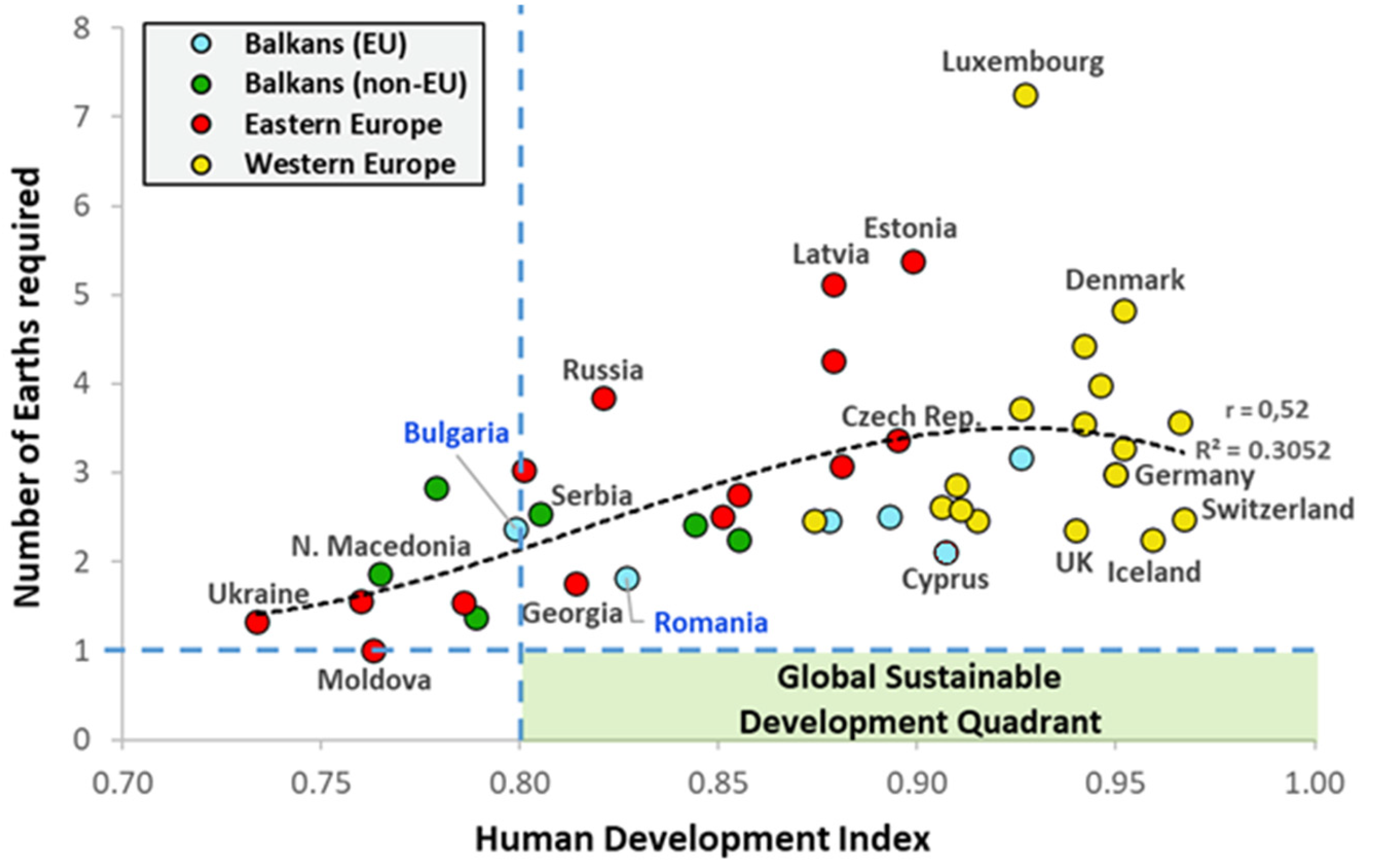
Bulgaria and Romania share common historical trajectories—most notably decades under communist rule and joint EU accession in 2007—while continuing to face similar challenges such as economic underdevelopment, low ecological effectiveness of their economies, demographic decline, and EU scrutiny related to corruption and judicial reform. Comparisons between the two countries usually focus on economic indicators such as GDP growth, unemployment, and foreign investment, whereas sustainability-related indicators remain largely overlooked. Figure 2 illustrates the relationship between socioeconomic development and ecological sustainability using the Global Sustainability Quadrant approach, which compares a population’s Human Development Index (HDI) with its Ecological Footprint (EF). The quadrant marks the area in which both dimensions fulfill the minimum conditions for sustainable development. An HDI above 0.8 indicates a high level of human development, while an EF below the fair Earth share threshold of 2.063 global hectares per person represents the planet’s biocapacity to meet annual human demand. This comparison highlights the challenge of achieving high levels of human well-being while staying within ecological limits. As shown in the graph, no European country maintains consumption rates within biophysical boundaries, as current lifestyles require more than one planet to sustain. There is also a considerable correlation between the two variables (r = 0.52). Bulgaria and Romania, like non-EU Balkan countries, remain distant from the sustainable development threshold. By contrast, countries such as Germany, the UK, and Switzerland achieve higher HDI on almost equal EF values. Overall, the analysis indicates unfavorable trends and critical imbalances between social welfare and environmental protection in CEE.
Looking at the average SDG Index scores, stark disparities emerge across Europe. While Northern European countries score above 80%, Eastern European countries average around 60%, and some EU candidate countries fall to around 50%, with fewer than one-third of the SDG targets on track [66]. Yet research shows that, over the long-term, countries identified as ‘SD leaders’ make only modest progress, while lower-scoring southern and eastern European countries exhibit significantly stronger improvements toward the goals [67].
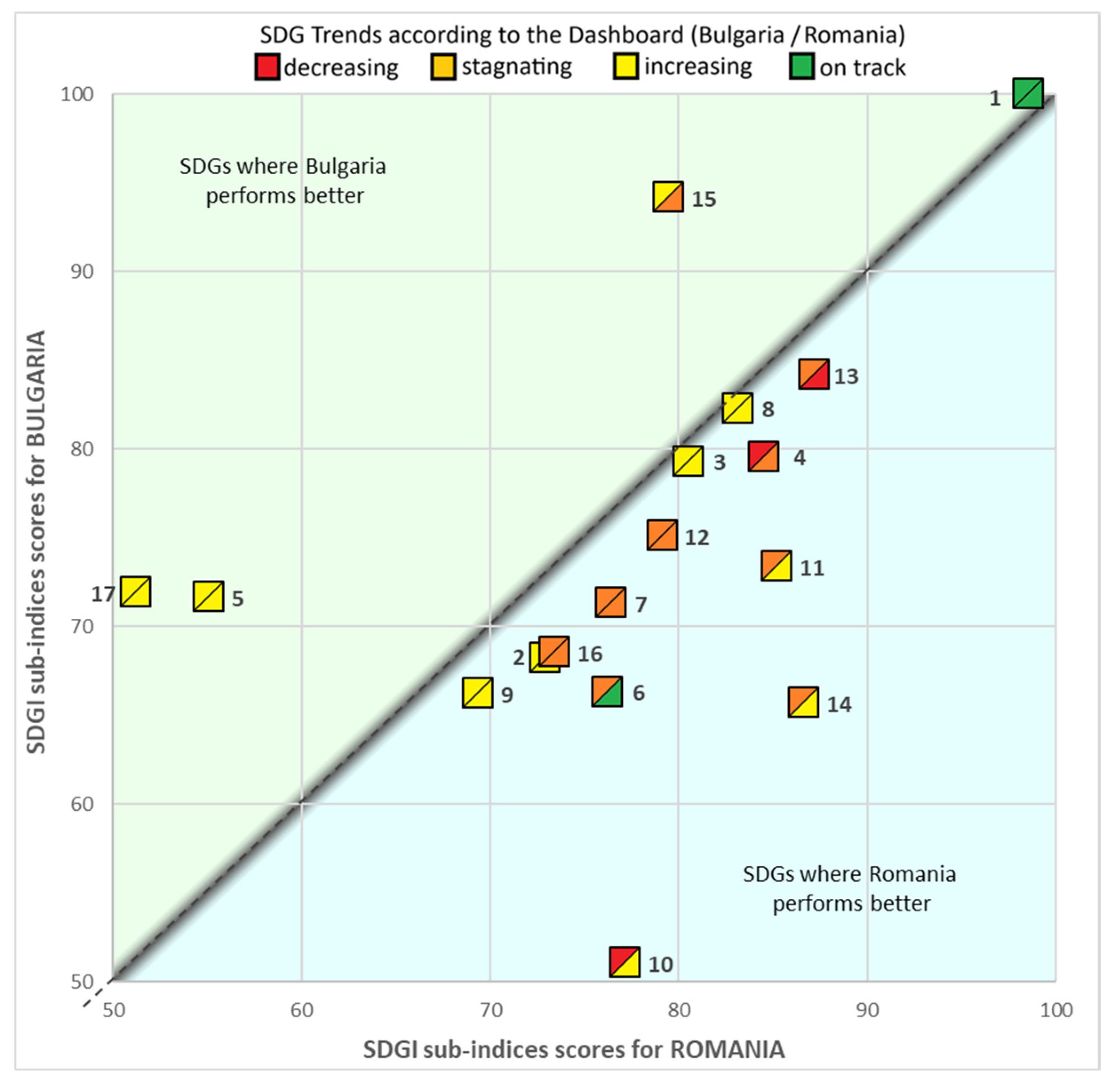
According to the SDG Dashboard, Figure 3 illustrates that although Romania outperforms Bulgaria on most goals, prospects for achieving the SDGs by 2030 remain concerning—if not unrealistic—in both countries. While socioeconomic goals such as SDG 1 (No Poverty), SDG 2 (Zero Hunger), SDG 8 (Decent Work and Economic Growth), and SDG 9 (Industry, Innovation, and Infrastructure) show generally positive trajectories in both contexts, progress on environmental goals is far more limited. The most concerning trends are observed in SDG 4 (Quality Education), SDG 7 (Affordable and Clean Energy), SDG 12 (Responsible Consumption and Production), SDG 13 (Climate Action), and SDG 16 (Peace, Justice, and Strong Institutions), all of which are stagnating or declining. SDG 10 remains especially challenging in Bulgaria, where significant inequalities persist. The reasons behind the stagnation in environmental goals (SDG12 and 13) can be traced to the significant challenges both countries face in these policy areas. They remain well below the EU average on key indicators such as reliance on coal, high energy intensity of their economies, circular material use, material footprint, and waste management—underscoring persistent difficulties in transitioning toward more sustainable consumption and production patterns and in aligning with EU environmental and circular economy benchmarks. These trends have been further reinforced by post-COVID-19 industrial growth, continued reliance on energy-intensive, high-carbon technologies, and the limited deployment of renewable energy sources (Bulgaria VNR 2025; Romania VNR 2023).

4.2. Bulgaria

4.2.1. Formal Government Response

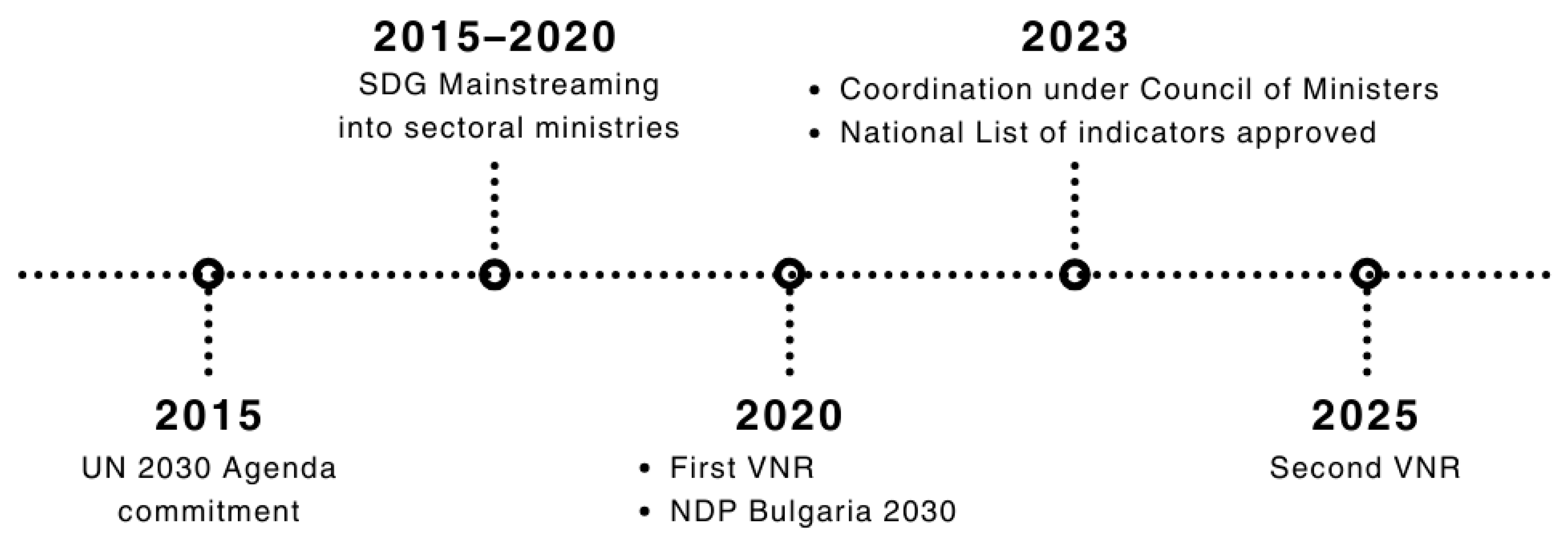
Following the adoption of the 2030 Agenda in 2015, the Ministry of Foreign Affairs initiated the integration of the SDGs across ministries to raise awareness and assign responsibilities. The national approach aligns with EU policy by distinguishing between external implementation (support for third countries) and internal implementation (domestic action), reflecting core priorities—particularly in the areas of migration and cooperation in Southeast Europe [68]. Figure 4 provides an overview of the key milestones in Bulgaria’s SDG implementation.
According to ministerial officials, domestic policies already implicitly address all SDGs, reducing the need for a separate SDG strategy (Ministry of Foreign Affairs, 2018, pers. comm.). In this context, the National Development Program “Bulgaria 2030”, adopted in 2020, was aligned with the UN framework and represents the formal governmental response to the SDGs (Ministry of Finance, 2019, pers. comm.). Although it assigns equal weight to all dimensions of sustainable development, socioeconomic concerns have been prioritized—particularly accelerated economic growth, demographic renewal, and reduced inequalities. The analysis of policy synergies and trade-offs has received limited attention and is identified as a key future priority. Despite recognizing the important role of national parliaments in advancing the 2030 Agenda, Bulgaria’s parliament has not been actively engaged [69]. Following a series of government collapses linked to corruption scandals and political instability, attention shifted to the new National Recovery and Resilience Plan addressing COVID-19’s impact. In the absence of a dedicated SDG funding mechanism, commitments are pursued through sectoral policies financed by national and EU funds, and other sources (Administration of the Council of Ministers, 2024, pers. comm.).
Building on the first VNR (2020), the second VNR (2025) placed emphasis on broadening stakeholder engagement by bringing together NGOs, businesses, academia, youth, and local authorities in the monitoring and reporting process. This inclusive approach created improved conditions for dialogue, policy legitimacy, and mobilized resources and ideas. The review presents progress from 2015 to 2024, highlighting achievements, challenges, and more than 40 good practices from public institutions, businesses, and civil society (Administration of the Council of Ministers, pers. comm. 2025). Key priorities for future action include strengthening national-local coordination and aligning strategic documents with the SDGs, improving national data systems to support evidence-based policymaking, and establishing mechanisms for interaction among state and non-state institutions [70].
According to the interviewed experts, while the Bulgarian government formally acknowledges the SDGs in its strategic documents, their integration into policymaking remains fragmented. Political commitment is perceived as symbolic, driven primarily by EU and international obligations rather than domestic initiative. Environmental considerations are often marginalized, and sustainable development is approached in isolation rather than as a holistic framework. Experts emphasize the need to revise the NDP “Bulgaria 2030” to promote cross-sectoral coherence, enhance public participation, and strengthen environmental impact assessment (EIA) procedures to ensure legal compliance and rebuild public trust. Although EU membership has contributed to stronger legislation and increased civil society engagement, respondents note that persistent political instability and weak policy continuity prevent further progress. Public awareness of sustainability challenges is viewed as low, limiting broader support for related policies and initiatives (expert interviews, 2024).

4.2.2. Cross-Cutting Capacities

Administrative skills and competencies. In 1998, Bulgaria introduced a unified civil service model through the Public Administration Act, emphasizing the role of political cabinets and political neutrality of civil servants in government activities [71]. International organizations such as the EU and UN, along with their member states, have contributed to strengthening environmental capacities in CEE through financial aid, technical support, capacity building, and increased stakeholder participation [72,73]. However, experts view administrative capacity for EPI and delivering on the SDGs as insufficient (Interviews with representatives from the Ministry of Foreign Affairs, 2018; Ministry of Environment and Water, 2018; and REC, 2017). Key barriers include the absence of a clear vision and conceptual understanding of sustainable development, as well as limited capacity to address interlinkages among its dimensions and to manage trade-offs. Without stronger leadership and a coherent vision, SDG implementation risks being reduced to a procedural formality rather than serving as a transformative agenda. One interviewee noted that shortcomings in the development of effective strategic documents constrain the implementation of international commitments, which often remain pro forma (Ministry of Environment and Water, 2018). In this context, experts emphasize the need for specialized training in areas such as the conceptual foundations of sustainable development, strategic planning, environmental governance and policy integration, the nexus approach and systemic thinking, circular economy, and sustainable consumption and production. Likewise, the 2020 VNR underscores the importance of strengthening administrative capacity to ensure effective SDG implementation.
Although the Institute for Public Administration (IPA) has introduced new training programs on climate protection, its capacity is seen insufficient to meet demand for SDG-related training (expert interview, 2018; pers. comm., IPA 2024). Ministries are expected to assume greater ownership of policymaking and improve coordination across the vast array of strategic documents. Experts propose appointing a Vice Prime Minister for Sustainable Development and an Ombudsman for Future Generations, as well as strengthening the National Assembly’s role through thematic intergroups (expert interviews, 2024).
Institutional arrangements. The lack of a functioning coordination mechanism for cross-sectoral communication has been identified as a stumbling block to sustainable development policymaking and SDG implementation (Ministry of Foreign Affairs, 2021, pers. comm.; Ministry of Environment and Water, 2018; Government of Bulgaria, 2020). Since the early 2000s, attempts to establish cross-departmental bodies, such as a Council for Sustainable Development, have proven short-lived. In 2023, the Council of Ministers was tasked with overseeing SDG monitoring and reporting, leading to the establishment of a National Coordination Mechanism to promote policy integration and interagency cooperation (Decree № 52 of 10 April 2023, VNR 2025). The Development Council was designated as the main SDG reporting body (Decree No 77 of 16 May 2023), alongside the adoption of 215 indicators to monitor SDG progress.
The ‘Strategic Planning’ Directorate was tasked with coordinating a working group under the Development Council to prepare Bulgaria’s Second VNR (Council of Ministers Decision No. 156/2024). As part of this process, two competitions for good practices among public institutions and non-state actors were organized, and a series of roundtables and public discussions were convened to assess progress, identify challenges, and present the VNR’s findings, with selected examples included in the official report. Following the formation of a new government under Prime Minister Rosen Zhelyazkov in January 2025—which resigned in December 2025—the Development Council and the Strategic Planning Directorate were dissolved, and SDG monitoring was transferred to the Strategic Development, Coordination, and Concessions Directorate.
National science and research policy for sustainable development. The Ministry of Education and Science, which is responsible for monitoring SDG 4 (Quality Education), also oversees the National Strategy for the Development of Scientific Research in Bulgaria (2017–2030). The strategy aims to modernize the national science system, align it with European standards, and position Bulgaria as a hub for advanced research and innovation. Its priorities include topics like sustainable infrastructure, low-carbon energy, bioeconomy, medicine, human capital, and ecology. The first national research programs with allocated budget (2018–2022) sought to reduce fragmentation within the research system and to support both basic and applied research in areas such as environmental and disaster risk management, climate and energy, health, technology, and culture. In addition, a new national research initiative, “Critical and Strategic Raw Materials for a Green Transition and Sustainable Development”, was launched in 2024 with a five-year budget of €4 million, focusing on the extraction, processing, and recycling of critical raw materials to support the green transition (Government Decree No 508, 18 July 2024).

4.3. Romania

4.3.1. Formal Government Response

The 2030 Agenda and its 17 SDGs were integrated into the strategic framework through the revision of the 2008 National Sustainable Development Strategy, resulting in the updated “National Sustainable Development Strategy: Horizons 2013–2020–2030”, which emphasizes sustainability and societal well-being under the motto “Keep healthy what keeps you in good health”. In 2016, the Romanian Parliament became the first member of the Inter-Parliamentary Union to endorse the 2030 Agenda. The Chamber of Deputies subsequently established a Subcommittee on Sustainable Development to strengthen legislative ownership and integrate the SDGs into the parliamentary processes.
The two VNRs, submitted in 2018 and 2023, underscore Romania’s commitment to creating an enabling environment for sustainable development and to actively supporting international and regional SDG efforts. The first VNR (2018) elaborates on the principle of “Leave no one behind” and examines national policies and trends aimed at building an inclusive and sustainable society [74]. It provides a detailed progress assessment on several goals, including SDG 6 (Clean Water and Sanitation), SDG 7 (Affordable and Clean Energy), SDG 11 (Sustainable Cities and Communities), SDG 12 (Responsible Consumption and Production), SDG 15 (Life on Land), and SDG 17 (Partnerships for the Goals). In its second VNR (2023), Romania reports on progress and challenges in achieving the SDGs, highlighting advances in the governance and institutional framework for policy coherence, crisis response, resilience of vulnerable groups, and best practices from institutions and civil society. It outlines the national implementation approach, rooted in interministerial collaboration and guided by whole-of-government and whole-of-society principles [75].
To enhance policy coherence for sustainable development (PCSD), Romania requested an assessment by the Organization for Economic Cooperation and Development (OECD) in 2019, which focused on institutionalizing political commitment, long-term planning, cross-sectoral coordination, participation, and the monitoring of policy coherence. Building on these recommendations, a PCSD roadmap was developed in 2023 to strengthen the institutional framework and administrative capacity, positioning the country as a national and regional leader in advancing the 2030 Agenda. Key strategic documents were adopted to establish the legal foundation for mainstreaming the SDG perspective into policy planning methodologies and budgeting, as well as into efforts to strengthen the regulatory impact assessment system.

4.3.2. Cross-Cutting Capacities

In 2015, Romania’s sustainable development efforts were coordinated by the Interministerial Committee for the Coordination of Environmental Integration into Sectoral Policies, led by the Minister of Environment and the Department of Sustainable Development, coordinated by a State Counselor. Due to limited effectiveness, the Department of Sustainable Development took over the SDG coordination in 2017 under the direct oversight of the Prime Minister. One respondent highlighted the strategic value of placing SDG coordination within the Prime Minister’s Office, noting that line ministries such as the Ministry of Environment or the Ministry of Foreign Affairs lack the cross-sectoral authority to manage complex issues. Since then, new decision-making and specialized bodies have been established to foster communication and cooperation among stakeholders at the national, regional, and local levels, such as committees, networks, consultative councils, and platforms.
In 2018, Romania became the first EU member state to introduce the role of “sustainable development expert” into its national job classification system. In this connection, a postgraduate program was launched to build public-sector expertise, and by 2022, 150 experts—mainly from central government and 22 regional hubs—had completed the pilot training. Plans are in place to train 2000 additional officials by 2026, including 400 from central administration and 1600 from local authorities, with content tailored to regional and local contexts. The program covers environmental and socioeconomic issues and involves experts from national and international universities and institutions. Romania’s emphasis on capacity-building has tripled the number of universities prioritizing sustainability. Plans include appointing one or two university representatives per region to lead sustainability-related initiatives. An annual allocation of EUR 1.5 million aims to supports cross-sector collaboration and societal engagement through projects led by civil society and academic institutions.
The National Strategy for Research, Innovation and Intelligent Specialization 2022–2027 sets out the vision for research and innovation to 2030. Developed through a broad consultative process, it addresses key societal challenges (e.g., climate change, digitization, and health crises), strengthening Romania’s position in European and global research and innovation. The strategy promotes excellence in foundational and applied research, while fostering public–private collaboration. Notably, the Center of Excellence for Sustainable Development in Public Administration, established in 2022, seeks to strengthen the science–policy–society interface. Headquartered in Bucharest with branches across the eight development regions, it connects universities, research institutes, local authorities, SMEs, NGOs, and civil society. It aims to advance sustainable development by improving sustainability modeling and providing innovative policy options and scenarios [75].

5. Discussion

The comparison of Bulgaria and Romania (2015–2025) reveals two contrasting approaches to SDG implementation. In Bulgaria, the SDGs have influenced the policy discourse on sustainable development, mainly through the incorporation of SDG language into national strategies and policy documents. Yet, government action has remained largely formal and reactive, shaped by political divisions and instability. Some institutional adjustments have occurred, notably the 2023 decision assigning responsibility for SDG monitoring and reporting to the Council of Ministers, alongside participatory processes initiated during the preparation of the 2025 VNR. However, no normative reforms, such as new SDG-aligned legislation, have been introduced. Romania, by contrast, has adopted a proactive approach to developing an innovative governance framework, positioning itself as a regional frontrunner in advancing the global agenda. Policy coherence for sustainable development has been pursued through centralized coordination, parliamentary engagement, and strong inter-institutional collaboration, including the adoption of new legislation to mainstream the SDGs in policy planning and budgeting. Thus, these developments suggest a potentially transformative impact reflected in discursive, institutional, and normative changes.
The paper further focuses on the need for reflexive capacities within domestic systems to address the distinct characteristics of the SDGs. Weak national capacities have long constrained compliance with international environmental and sustainable development norms across CEE. Common barriers include limited conceptual understanding of sustainable development and insufficient administrative and institutional capacity [76,77,78,79]. In Bulgaria, despite recognized capacity shortcomings in managing sustainable development, no targeted efforts to strengthen administrative capacity have been undertaken. By comparison, Romania stands out as a pioneer in launching a wide-reaching capacity-building program across public administration. A network of institutional mechanisms engages both government and society in SDG delivery while strengthening the science–policy interface. Taken together, the study demonstrates variation in SDG implementation in both countries, with political commitment, parliamentary backing, and leadership emerging as central factors underpinning Romania’s progressive approach. Collaboration with international organizations, such as the OECD, has driven strategic and institutional reforms and strengthened administrative capacity.
Achieving high levels of human well-being while staying within the planet’s ecological limits remains a major challenge in CEE and Europe. Progress is more pronounced in socio-economic goals, whereas environment-related goals, such as SDG 12 and SDG 13, show stagnating or declining trends in both Bulgaria and Romania. Although it may still be too early to observe positive performance impacts resulting from recently introduced changes, there is a clear tendency of policy efforts that support selective goal prioritization. Importantly, cherry-picking the SDGs risks undermining the 2030 Agenda’s core principles of indivisibility and integration, thereby impeding overall progress [80]. The VNRs highlight major difficulties in the policy areas of responsible consumption and production and climate change, while the interdependencies between environmental protection and human well-being remain less salient and are still largely ignored. Other comparative studies likewise emphasize persistent gaps in assessing and managing SDG interlinkages [31]. In this context, ensuring socio-economic progress without environmental degradation requires stronger integration of environmental concerns into development processes, underscoring the continued relevance of the EPI concept in national SDG implementation. Being more prominent in Europe through EU legal and political commitment [81], EPI gives ‘principled priority’ to environmental over non-environmental objectives, rather than assuming balanced integration [82]. This perspective aligns with the normative goal of sustainable development—to shape society within Earth’s biophysical limits [83]—and the safe boundaries for sustaining the stability and resilience of the Earth system over time [84]. Reaffirming this worldview will be essential beyond 2030 to better align the global agenda’s transformative vision with the means chosen to achieve it.

6. Conclusions

The success of the UN 2030 Agenda in achieving its transformative goal depends on the policy efforts of all Member States. These efforts are shaped not only by governments’ genuine commitment but also by their ability to put SDGs’ core principles into practice. Understanding the capacity dimensions essential for national implementation is both conceptually and practically significant. Adequately addressing the problem characteristics of the SDGs calls for reflexive approaches that go beyond traditional policymaking. Building on this rationale, the study identifies key cross-cutting aspects that complement existing capacity frameworks for advancing EPI and national SDG implementation, including general competencies and skills as well as mechanisms for generating and applying knowledge.
The empirical analysis delivers evidence from two EU Eastern enlargement countries, helping explain variation in SDG implementation and contributing to broader governance capacity debates. In both countries, development trajectories reveal imbalances between social welfare and environmental protection, with progress on socioeconomic goals but slower, stagnant, or even regressive trends in environmental goals—pointing to the need to accord greater, principled priority to the environment in future SDG efforts. While Bulgaria has shown limited SDG steering effects, Romania exhibits a transformative political impact, driven by strong political commitment, leadership, and international cooperation. A longitudinal analysis could further assess how the SDG-induced changes influence policy integration and performance over time.
The findings also point to a substantial gap between required and existing capacities, underscoring the need for targeted capacity-building within public administration. Yet, a systematic analysis of capacity development for sustainability in the Eastern enlargement is generally lacking. Future research should evaluate the effectiveness and transfer potential of Romania’s pioneering capacity-building approach to Bulgaria and other countries, and examine government efforts in external SDG implementation, including support to developing countries and managing international spillover effects.
With implications beyond 2030, further conceptual and empirical work is needed to determine how capacity development processes can be most effectively designed. Key questions include: Which interventions best affect cognitive abilities and behavior? Who should organize these learning processes, and which actors should be involved? What are the associated implementation costs, and how should they be financed?
To enhance the effectiveness of national SDG implementation, policymakers should consider the following priorities:
  • Strengthen political and legislative commitment—Enhance the role of the National Assembly in SDG implementation, for example by forming thematic intergroups and appointing an Ombudsman for future generations.
  • Pursue an environmentally integrated approach—Avoid cherry-picking SDGs, introduce metrics beyond GDP to measure progress, adopt an EPI approach to development and strengthen EIA procedures, and manage trade-offs to ensure socioeconomic development is not at the expense of the environment.
  • Build capacities for sustainable development—Develop key competencies and skills across the public administration and key actors to enhance the effectiveness of policymaking and strategic documents for sustainable development.
  • Enhance reflexivity in society—Improve cross-sectoral and multilevel communication and cooperation while fostering social learning, by creating adequate conditions for interaction among science, policy, and society actors, for example, through national research programs for sustainable development.

Funding

This research received no external funding.

Institutional Review Board Statement

This study was waived from ethical review in accordance with the legal regulations of the Carl von Ossietzky University of Oldenburg, as the research did not give rise to any safety concerns or violations of human dignity, life, health, freedom, property, the environment, or peaceful coexistence.

Informed Consent Statement

Prior informed consent was obtained from all interviewees involved in the study.

Data Availability Statement

The original contributions presented in this study are included in the article. Further inquiries can be directed to the corresponding author.

Acknowledgments

Thanks are due to Hristo Dokov for assistance with the figures.

Conflicts of Interest

The authors declare no conflicts of interest.

Correction Statement

This article has been republished with a minor correction to the readability of Figure 4, Table A1 and Table A2. This change does not affect the scientific content of the article.

Abbreviations

The following abbreviations are used in this manuscript:
SDGsSustainable Development Goals
CEECentral and Eastern Europe
EPIEnvironmental Policy Integration
PCSDPolicy coherence for sustainable development
VNRVoluntary National Review

Appendix A

Table A1. Overview of Expert Interviews by Institutional Affiliation and Functional Role.
CountryInstitutional AffiliationDirectorate/
Functional Role
Area of ResponsibilityInterview FormatTime Period
Bulgaria
Ministry of Environment and Water EU Affairs Coordination and International CooperationState Expert(F)2018
Environmental PoliciesState Expert(F)2018
Deputy Minister (former) (online)2024
Minister (former) (online)2024
Ministry of Foreign AffairsUnited Nations and Development CooperationDirector(F)2018
United Nations and Development CooperationAttaché(F)2018
Ministry of Science of EducationScience DirectorateDirector 2017
Institute of Public AdministrationTraining, International
Activity and Projects
Training Manager(F)2017
Regional Environmental CenterBulgarian OfficeDirector(F)2017
Romania
Prime Minister’s OfficeDepartment of
Sustainable Development
State Counsellor(online)2024
Note: F: face-to-face interview; Online: Virtual interview.

Appendix B

Table A2. Comparative Overview of SDG Implementation in Bulgaria and Romania (as of 2025).
BulgariaRomania
VNRs
2020, 20252018, 2023
National
approach
- SDG mainstreaming into national policies
- Commitments under sectoral policies
- NDP “Bulgaria 2030” as formal response
- Socio-economic concerns given priority
- SDGs embedded in the National
Sustainable Development Strategy 2030
- Whole-of-government and whole-of-society principles applied
Parliamentary involvement - No active involvement- First IPU member to endorse the SDGs
Monitoring
Framework
- 215 National Indicators for Sustainable
Development officially adopted in 2023
- 291 National Indicators for Sustainable
Development defined in 2022
Budget - No dedicated SDG funding mechanism
- Funding tied to sectoral policies budgets
- New legal framework to integrate the SDGs into budgeting
Institutional
arrangements
- The Council of Ministers oversees
national SDG monitoring and reporting
- SDG coordination assigned to PM’s Office
- A robust institutional framework created
Administrative capacities- Capacity deficits among experts
- A need for specialized training
- First in EU to include “sustainable development expert” in job classification
Capacity
building
- No targeted programs for capacity
development in public administration
- Postgraduate program launched to develop public expertise (2,000 targeted by 2026)
Science-policy
Interface
- National Strategy for the Development
of Scientific Research (2017–2030)
- New research initiative on critical raw
materials for green transition
- First research programs funded
- National Strategy for Research, Innovation and Intelligent Specialization (2022–2027)
- Centre of Excellence established to advance research, education, and dialogue
- Additional budget secured for academic and civil society project work

References

  1. Hickmann, T.; Biermann, F.; Sénit, C.-A.; Sun, Y.; Bexell, M.; Bolton, M.; Bornemann, B.; Censoro, J.; Charles, A.; Coy, D.; et al. Scoping article: Research frontiers on the governance of the Sustainable Development Goals. Glob. Sustain. 2024, 7, e7. [Google Scholar] [CrossRef]
  2. Stafford-Smith, M.; Griggs, D.; Gaffney, O.; Ullah, F.; Reyers, B.; Kanie, N.; Stigson, B.; Shrivastava, P.; Leach, M.; O’Connell, D. Integration: The key to implementing the Sustainable Development Goals. Sustain. Sci. 2017, 12, 911–919. [Google Scholar] [CrossRef] [PubMed]
  3. Biermann, F.; Hickmann, T.; Sénit, C.-A.; Beisheim, M.; Bernstein, S.; Chasek, P.; Grob, L.; Kim, R.E.; Kotzé, L.J.; Nilsson, M.; et al. Scientific evidence on the political impact of the Sustainable Development Goals. Nat. Sustain. 2022, 5, 795–800. [Google Scholar] [CrossRef]
  4. United Nations Department of Economic and Social Affairs. The Sustainable Development Goals Report 2023: Special Edition. Towards a Rescue Plan for People and Planet; UN DESA: New York, NY, USA, 2023. [Google Scholar]
  5. Firoiu, D.; Ionescu, G.H.; Cismaș, L.M.; Vochița, L.; Cojocaru, T.M.; Bratu, R.-Ș. Can Europe Reach Its Environmental Sustainability Targets by 2030? A Critical Mid-Term Assessment of the Implementation of the 2030 Agenda. Sustainability 2023, 15, 16650. [Google Scholar] [CrossRef]
  6. Hametner, M. Economics without ecology: How the SDGs fail to align socioeconomic development with environmental sustainability. Ecol. Econ. 2022, 199, 107490. [Google Scholar] [CrossRef]
  7. Moinuddin, M.; Olsen, S.H. Examining the unsustainable relationship between SDG performance, ecological footprint and international spillovers. Sci. Rep. 2024, 14, 11277. [Google Scholar] [CrossRef]
  8. Hickel, J. The contradiction of the sustainable development goals: Growth versus ecology on a finite planet. Sustain. Dev. 2019, 27, 873–884. [Google Scholar] [CrossRef]
  9. Coscieme, L.; Mortensen, L.F.; Anderson, S.; Ward, J.; Donohue, I.; Sutton, P.C. Going beyond Gross Domestic Product as an indicator to bring coherence to the Sustainable Development Goals. J. Clean. Prod. 2020, 248, 119232. [Google Scholar] [CrossRef]
  10. Weitz, N.; Carlsen, H.; Bennich, T.; Nilsson, M.; Persson, Å. Returning to core principles to advance the 2030 Agenda. Nat. Sustain. 2023, 6, 1145–1148. [Google Scholar] [CrossRef]
  11. Biermann, F.; Kanie, N.; Kim, R. Global governance by goal-setting: The novel approach of the UN Sustainable Development Goals. Curr. Opin. Environ. Sustain. 2017, 26–27, 26–31. [Google Scholar] [CrossRef]
  12. United Nations. Independent Group of Scientists appointed by the Secretary-General, Global Sustainable Development Report 2023: Times of crisis, times of change: Science for accelerating transformations to sustainable development; UN: New York, NY, USA, 2023. [Google Scholar]
  13. Mauli, S.; Maelaua, J.; Reeve, E.; Thow, A.M.; Johnson, E.; Farrell, P.; Patay, D. Systemic Capacity in Food System Governance in the Solomon Islands: “It’s More than Just Training”. Sustainability 2023, 15, 10710. [Google Scholar] [CrossRef]
  14. Sagar, A. Capacity Development for the Environment: A View for the South, A View for the North. Annu. Rev. Energy Environ. 2000, 25, 377–439. [Google Scholar] [CrossRef]
  15. Sagar, A.; Vandeveer, S. Capacity Development for the Environment: Broadening the Scope. Glob. Environ. Politics 2005, 5, 14–22. [Google Scholar] [CrossRef]
  16. Jänicke, M.; Jörgens, H. New Approaches to Environmental Governance. In Environmental Governance in Global Perspective: New Approaches to Ecological Modernisation; Jänicke, M., Jacob, K., Eds.; Freie Universität, Environmental Policy Research Centre: Berlin, Germany, 2007; pp. 167–210. [Google Scholar]
  17. Firoiu, D.; Ionescu, G.H.; Băndoi, A.; Florea, N.M.; Jianu, E. Achieving Sustainable Development Goals (SDG): Implementation of the 2030 Agenda in Romania. Sustainability 2019, 11, 2156. [Google Scholar] [CrossRef]
  18. Ionescu, G.; Jianu, E.; Patrichi, I.; Ghiocel, F.; Lili, T.; Iancu, D. Assessment of Sustainable Development Goals (SDG) Implementation in Bulgaria and Future Developments. Sustainability 2021, 13, 12000. [Google Scholar] [CrossRef]
  19. Kramer, J.M. EU Enlargement and the Environment: Six Challenges. Environ. Politics 2004, 13, 290–311. [Google Scholar] [CrossRef]
  20. Andonova, L. Transnational Politics of the Environment. The European Union and Environmental Policy in Central and Eastern Europe; MIT Press: Cambridge, MA, USA, 2004. [Google Scholar]
  21. United Nations. The Millennium Development Goals Report 2015; United Nations: New York, NY, USA, 2015. [Google Scholar]
  22. Knill, C.; Heichel, S.; Arndt, D. Really a front-runner, really a Straggler? Of environmental leaders and laggards in the European Union and beyond—A quantitative policy perspective. Energy Policy 2012, 48, 36–45. [Google Scholar] [CrossRef]
  23. Gupta, J.; Nilsson, M. Toward a Multi-level Action Framework for Sustainable Development Goals. In Governing through Goals; Kanie, N., Biermann, F., Biermann, F., Young, O.R., Eds.; Sustainable Development Goals as Governance Innovation; The MIT Press: Cambridge, MA, USA, 2017; pp. 275–294. [Google Scholar]
  24. Allen, C.; Malekpour, S.; Mintrom, M. Cross-scale, cross-level and multi-actor governance of transformations toward the Sustainable Development Goals: A review of common challenges and solutions. Sustain. Dev. 2023, 31, 1250–1267. [Google Scholar] [CrossRef]
  25. Tosun, J.; Leininger, J. Governing the Interlinkages between the Sustainable Development Goals: Approaches to Attain Policy Integration. Glob. Chall. 2017, 1, 1700036. [Google Scholar] [CrossRef]
  26. Glass, L.-M.; Newig, J. Governance for achieving the Sustainable Development Goals: How important are participation, policy coherence, reflexivity, adaptation and democratic institutions? Earth Syst. Gov. 2019, 2, 100031. [Google Scholar] [CrossRef]
  27. Breuer, A.; Leininger, J.; Malerba, D.; Tosun, J. Integrated policymaking: Institutional designs for implementing the sustainable development goals (SDGs). World Dev. 2023, 170, 106317. [Google Scholar] [CrossRef]
  28. Nilsson, M.; Persson, Å. Policy note: Lessons from environmental policy integration for the implementation of the 2030 Agenda. Environ. Sci. Policy 2017, 78, 36–39. [Google Scholar] [CrossRef]
  29. Bornemann, B.; Weiland, S. The UN 2030 Agenda and the Quest for Policy Integration: A Literature Review. Politics Gov. 2021, 9, 96–107. [Google Scholar] [CrossRef]
  30. Nilsson, M.; Vijge, M.J.; Alva, I.L.; Bornemann, B.; Fernando, K.; Hickmann, T.; Scobie, M.; Weiland, S. Interlinkages, Integration and Coherence. In The Political Impact of the Sustainable Development Goals: Transforming Governance Through Global Goals? Sénit, C.-A., Biermann, F., Hickmann, T., Eds.; Cambridge University Press: Cambridge, UK, 2022; pp. 92–115. [Google Scholar]
  31. Allen, C.; Metternicht, G.; Wiedmann, T. Prioritising SDG targets: Assessing baselines, gaps and interlinkages. Sustain. Sci. 2019, 14, 421–438. [Google Scholar] [CrossRef]
  32. Griggs, D.; Stafford Smith, M.; Rockström, J.; Öhman, M.; Gaffney, O.; Glaser, G.; Kanie, N.; Noble, I.; Steffen, W.; Shyamsundar, P. An integrated framework for Sustainable Development Goals. Ecol. Abd Soc. 2014, 19, 49. [Google Scholar] [CrossRef]
  33. Stafford-Smith, M.; Cook, C.; Sokona, Y.; Elmqvist, T.; Fukushi, K.; Broadgate, W.; Jarzebski, M.P. Advancing sustainability science for the SDGs. Sustain. Sci. 2018, 13, 1483–1487. [Google Scholar] [CrossRef]
  34. Nilsson, M.; Chisholm, E.; Griggs, D.; Howden-Chapman, P.; McCollum, D.; Messerli, P.; Neumann, B.; Stevance, A.-S.; Visbeck, M.; Stafford-Smith, M. Mapping interactions between the sustainable development goals: Lessons learned and ways forward. Sustain. Sci. 2018, 13, 1489–1503. [Google Scholar] [CrossRef]
  35. Messerli, P.; Kim, E.M.; Lutz, W.; Moatti, J.-P.; Richardson, K.; Saidam, M.; Smith, D.; Eloundou-Enyegue, P.; Foli, E.; Glassman, A.; et al. Expansion of sustainability science needed for the SDGs. Nat. Sustain. 2019, 2, 892–894. [Google Scholar] [CrossRef]
  36. Schneider, V.; Leifeld, P.; Malang, T. Coping with creeping catastrophes: National political systems and the challenges of slow-moving policy problems. In Long-Term Governance for Social-Ecological Change; Siebenhüner, B., Arnold, M., Eisenack, K., Jacob, K., Eds.; Routledge: New York, NY, USA, 2013; pp. 221–239. [Google Scholar]
  37. Siebenhüner, B.; Arnold, M.; Eisenack, K.; Jacob, K. Long-Term Governance for Social-Ecological Change; Routledge: New York, NY, USA, 2013. [Google Scholar]
  38. Jänicke, M.; Jörgens, H. Strategic Environmental Planning and Uncertainty: A Cross-National Comparison of Green Plans in Industrialized Countries. Policy Stud. J. 2000, 28, 612–632. [Google Scholar] [CrossRef]
  39. Grunwald, A. Working Towards Sustainable Development in the Face of Uncertainty and Incomplete Knowledge. J. Environ. Policy Plan. 2007, 9, 245–262. [Google Scholar] [CrossRef]
  40. Luks, F.; Siebenhüner, B. Transdisciplinarity for social learning? The contribution of the German socio-ecological research initiative to sustainability governance. Ecol. Econ. 2007, 63, 418–426. [Google Scholar] [CrossRef]
  41. Voß, J.-P.; Smith, J.; Grin, J. Designing Long-term Policy: Rethinking Transition Management. Policy Sci. 2009, 42, 275–302. [Google Scholar] [CrossRef]
  42. Voß, J.-P.; Bauknecht, D.; Kemp, R. Reflexive Governance for Sustainable Development; Edward Elgar: Cheltenham, UK, 2006. [Google Scholar]
  43. Brousseau, E.; Dedeurwaerdere, T.; Siebenhüner, B. Reflexive Governance and Global Public Goods; MIT Press: Cambridge, MA, USA, 2012. [Google Scholar]
  44. Beck, U. The Risk Society-Towards a New Modernity; Sage Publications: Thousand Oaks, CA, USA, 1992. [Google Scholar]
  45. Voß, J.-P.; Kemp, R. Sustainability and reflexive governance: Introduction. In Reflexive Governance for Sustainable Development; Voß, J.-P., Bauknecht, D., Kemp, R., Eds.; Edward Elgar: Cheltenham, UK, 2006. [Google Scholar]
  46. Brousseau, E.; Dedeurwaerdere, T.; Siebenhüner, B. Knowledge Matters: Institutional Frameworks to Govern the Provision of Global Public Goods. In Reflexive Governance for Global Public Goods; Brousseau, E., Dedeurwaerdere, T., Siebenhüner, B., Eds.; MIT Press: Cambridge, MA, USA, 2012; pp. 243–282. [Google Scholar]
  47. Gibbons, M.; Limoges, C.; Nowotny, H.; Schwartzman, S.; Scott, P.; Trow, M. The New Production of Knowledge: The Dynamics of Science and Research in Contemporary Societies; SAGE Publications: Thousand Oaks, CA, USA, 1994. [Google Scholar]
  48. Jasanoff, S. States of Knowledge: The Co-Production of Science and Social Order; Routledge: London, UK, 2004. [Google Scholar]
  49. Kates, R.W.; Clark, W.C.; Corell, R.; Hall, J.M.; Jaeger, C.C.; Lowe, I.; McCarthy, J.J.; Schellnhuber, H.J.; Bolin, B.; Dickson, N.M.; et al. Sustainability Science. Science 2001, 292, 641–642. [Google Scholar] [CrossRef] [PubMed]
  50. Funtowicz, S.O.; Ravetz, J.R. Science for the post-normal age. Futures 1993, 25, 739–755. [Google Scholar] [CrossRef]
  51. Funtowicz, S.O.; Ravetz, J.R. The Worth of a Songbird—Ecological Economics as a Post-Normal Science. Ecol. Econ. 1994, 10, 197–207. [Google Scholar] [CrossRef]
  52. Clark, W.; Harley, A. Sustainability Science: Toward a Synthesis. Annu. Rev. Environ. Resour. 2020, 45, 331–386. [Google Scholar] [CrossRef]
  53. Blumer, H. What is Wrong with Social Theory? Am. Sociol. Rev. 1954, 19, 3–10. [Google Scholar] [CrossRef]
  54. Grothmann, T.; Siebenhüner, B. Reflexive Governance and the Importance of Individual Competencies: The Case of Adaptation to Climate Change in Germany. In Reflexive Governance and Global Public Goods; Brousseau, E., Dedeurwaerdere, T., Siebenhüner, B., Eds.; MIT Press: Cambridge, MA, USA, 2012; pp. 299–313. [Google Scholar]
  55. Van Evera, S. Guide to Methods for Students of Political Science; Cornell University Press: Ithaca, NY, USA, 1997. [Google Scholar]
  56. Krause, M. Comparative Research: Beyond Linear-Causal Explanation. In Practising Comparison. Logics. Relations, Collaborations; Mattering Press: Manchester, UK, 2016; pp. 45–67. [Google Scholar]
  57. Knill, C.; Tosun, J. Public Policy: A New Introduction; Bloomsbury Academic: London, UK, 2020. [Google Scholar]
  58. Steinebach, Y. Environmental Policy Outputs, Outcomes, and Impacts. In Routledge Handbook of Environmental Policy; Jörgens, H., Knill, C., Steinebach, Y., Eds.; Routledge: London, UK, 2023; pp. 28–42. [Google Scholar]
  59. Biermann, F.; Hickmann, T.; Sénit, C.-A. The Political Impact of the Sustainable Development Goals: Transforming Governance Through Global Goals? Cambridge University Press: Cambridge, UK, 2022. [Google Scholar]
  60. Goggin, M.; Bowman, A.; Lester, J.; O’Toole, L. Implementation Theory and Practice: Toward a Third Generation; Scott, Foresman/Little, Brown Higher Education: Glenview, IL, USA, 1990. [Google Scholar]
  61. Yin, R. Case Study Research and Applications: Design and Methods, 6th ed.; Sage: Thousand Oaks, CA, USA, 2018. [Google Scholar]
  62. Flick, U. An Introduction to Qualitative Research; SAGE: Thousand Oaks, CA, USA, 2023. [Google Scholar]
  63. Flick, U. Triangulation in Qualitative Research. In A Companion to Qualitative Research; Flick, U., Kardorff, E.V., Steinke, I., Eds.; Sage: London, UK; Thousand Oaks, CA, USA, 2004; pp. 178–183. [Google Scholar]
  64. Meuser, M.; Nagel, U. The Expert Interview and Changes in Knowledge Production. In Interviewing Experts; Palgrave Macmillan: London, UK, 2009; pp. 17–42. [Google Scholar]
  65. Flick, U. Managing Quality in Qualitative Research; Sage: London, UK, 2007. [Google Scholar]
  66. Lafortune, G.; Fuller, G.; Kloke-Lesch, A.; Koundouri, P.; Riccaboni, A. European Elections, Europe’s Future and the SDGs: Europe Sustainable Development Report 2023/24; SDSN: Paris, France, 2024. [Google Scholar]
  67. Hametner, M.; Kostetckaia, M. Frontrunners and laggards: How fast are the EU member states progressing towards the sustainable development goals? Ecol. Econ. 2020, 177, 106775. [Google Scholar] [CrossRef]
  68. Government of Bulgaria. Voluntary National Review of the Republic of Bulgaria of the Implementation of the Sustainable Development Goals; Council of Ministers: Sofia, Bulgaria, 2020. [Google Scholar]
  69. Kiselova, N. The Role of the National Assembly in the Implementation of the UN Sustainable Development Goals in Bulgaria. In European Development Policy—Challenges and Opportunities; Fileva, P., Neykova, M., Zlateva, M., Eds.; Bulgarian Platform for International Development: Sofia, Bulgaria, 2018; pp. 103–114. [Google Scholar]
  70. Government of Bulgaria. Second Voluntary National Review of the Republic of Bulgaria, 2025; Council of Ministers: Sofia, Bulgaria, 2025. [Google Scholar]
  71. Arabadzhiyski, N. Development policies for administration of the executive authority in the Republic of Bulgaria for the second program period of membership in the European Union. In Proceedings of the National Conference 10 Years in the EU—Development Impact on Public Policies and Legislation, Sofia, Bulgaria, 10 November 2017. [Google Scholar]
  72. VanDeveer, S. Effectiveness, Capacity Development and International Environmental Cooperation. In Handbook of Global Environmental Politics; Dauvergne, P., Ed.; Edward Elgar Publishing: Cheltenham, UK, 2005. [Google Scholar]
  73. Andonova, L.B.; VanDeveer, S.D. EU expansion and the internationalization of environmental politics in Central and Eastern Europe. In Comparative Environmental Politics: Theory, Practice, and Prospects; Steinberg, P.F., VanDeveer, S.D., Eds.; The MIT Press: Cambridge, MA, USA, 2012; pp. 287–313. [Google Scholar]
  74. Government of Romania. Transformation Towards a Sustainable and Resilient Romania. Romania’s Voluntary National Review 2018; Ministry of Environment: Bucharest, Romania, 2018. [Google Scholar]
  75. Government of Romania. Voluntary National Review: Implementing the 17 SDGs in Romania; Department of Sustainable Development: Bucharest, Romania, 2023. [Google Scholar]
  76. Börzel, T. Coping with Accession to the European Union. New Modes of Environmental Governance; Palgrave Macmillan UK: Basingstoke, UK, 2009. [Google Scholar]
  77. Jörgens, H. Governance by Diffusion: Implementing Global Norms Through Cross-National Imitation and Learning. In Governance for Sustainable Development. The Challenge of Adapting Form to Function; Lafferty, W., Ed.; Edward Elgar: Cheltenham, UK, 2004; pp. 246–283. [Google Scholar]
  78. Medarova-Bergström, K.; Steger, T.; Paulsen, A. The Case of EPI in Central and Eastern Europe. In Governance for the Environment: A Comparative Analysis of Environmental Policy Integration; Goria, A., Sgobbi, A., von Homeyer, I., Eds.; Edward Elgar: Cheltanham, UK, 2010; pp. 179–199. [Google Scholar]
  79. van der Grift-Simeonova, V.; van der Valk, A. Environmental policy integration: Towards a communicative approach in integrating nature conservation and urban planning in Bulgaria. Land Use Policy 2016, 57, 80–93. [Google Scholar] [CrossRef]
  80. Forestier, O.; Kim, R.E. Cherry-picking the Sustainable Development Goals: Goal Prioritization by National Governments and Implications for Global Governance. Sustain. Dev. 2020, 28, 1269–1278. [Google Scholar] [CrossRef]
  81. Lenschow, A. Environmental policy integration: Greening sectoral policies in Europe; Earthscan Publications: London, UK, 2002. [Google Scholar]
  82. Lafferty, W.; Hovden, E. Environmental policy integration: Towards an analytical framework. Environ. Politics 2003, 12, 1–22. [Google Scholar] [CrossRef]
  83. Daly, H.; Farley, J. Ecological Economics: Principles and Applications; Island Press: Washington, DC, USA, 2004. [Google Scholar]
  84. Rockström, J.; Gupta, J.; Qin, D.; Lade, S.J.; Abrams, J.F.; Andersen, L.S.; Armstrong McKay, D.I.; Bai, X.; Bala, G.; Bunn, S.E.; et al. Safe and just Earth system boundaries. Nature 2023, 619, 102–111. [Google Scholar] [CrossRef]
Figure 1. Analytical framework on national SDG implementation—key variables.
Sustainability 18 02026 g001
Figure 2. Ecological Footprint and Human Development Index of Countries Source: Data obtained from Global Footprint Network, National Footprint Accounts 2022 (data year 2022).
Sustainability 18 02026 g002
Figure 3. Comparative trends in SDG Performance in Bulgaria and Romania Source: SDG Index and Dashboards (2023).
Sustainability 18 02026 g003
Figure 4. Timeline of key milestones in Bulgaria’s SDG implementation.
Sustainability 18 02026 g004
Disclaimer/Publisher’s Note: The statements, opinions and data contained in all publications are solely those of the individual author(s) and contributor(s) and not of MDPI and/or the editor(s). MDPI and/or the editor(s) disclaim responsibility for any injury to people or property resulting from any ideas, methods, instructions or products referred to in the content.